Biodiversity Heritage Library - Program news and collection highlights from BHL
  • Home
  • News
  • Featured Books
    • All Featured Books
    • Book of the Month Series
    • BHL at 20
  • User Stories
  • Campaigns
    • Fossil Stories
    • Garden Stories
    • Monsters Are Real
    • Page Frights
    • Her Natural History
    • Earth Optimism 2020
  • Tech Blog
  • Visit BHL
Home
News
Featured Books
    All Featured Books
    Book of the Month Series
    BHL at 20
User Stories
Campaigns
    Fossil Stories
    Garden Stories
    Monsters Are Real
    Page Frights
    Her Natural History
    Earth Optimism 2020
Tech Blog
Visit BHL
  • Home
  • News
  • Featured Books
    • All Featured Books
    • Book of the Month Series
    • BHL at 20
  • User Stories
  • Campaigns
    • Fossil Stories
    • Garden Stories
    • Monsters Are Real
    • Page Frights
    • Her Natural History
    • Earth Optimism 2020
  • Tech Blog
  • Visit BHL
Biodiversity Heritage Library - Program news and collection highlights from BHL
Blog Reel, Featured Books

Discovering Carrie B. Aaron Through Projects and Partnerships

A double page spread of a handwritten notebook open to page 1

This post is part of BHL at 20: Treasures from the Biodiversity Heritage Library, a series contributed by members of the BHL community, highlighting remarkable works from across the collection in celebration of its 20th anniversary.

As the Cataloging and Digital Resources Librarian for the Academy of Natural Sciences (Academy) of Drexel University, I get to work with a lot of different materials including periodicals, rare books, archival manuscripts, and more. I recently had the joy of working with scientists’ handwritten notebooks and field journals while completing a project to have 83 of them digitized and transcribed for BHL.

One of the selected notebooks stood out to me: A notebook containing an entomological essay by Carrie Aaron, in part because it highlights a common problem encountered when researching women in the natural sciences. Before uploading the notebook to BHL, the original finding aid record described Carrie as “Mrs. Aaron” and did not provide any additional information about her. Thankfully, Academy Archivist Jessica Lydon noticed the issue and provided more details for me to add to the record, leading me to build a BHL Creator ID for Carrie Aaron that links to her Wikidata identifier. This might sound like a small detail only librarians would notice, but it’s a huge step in building recognition for an author.
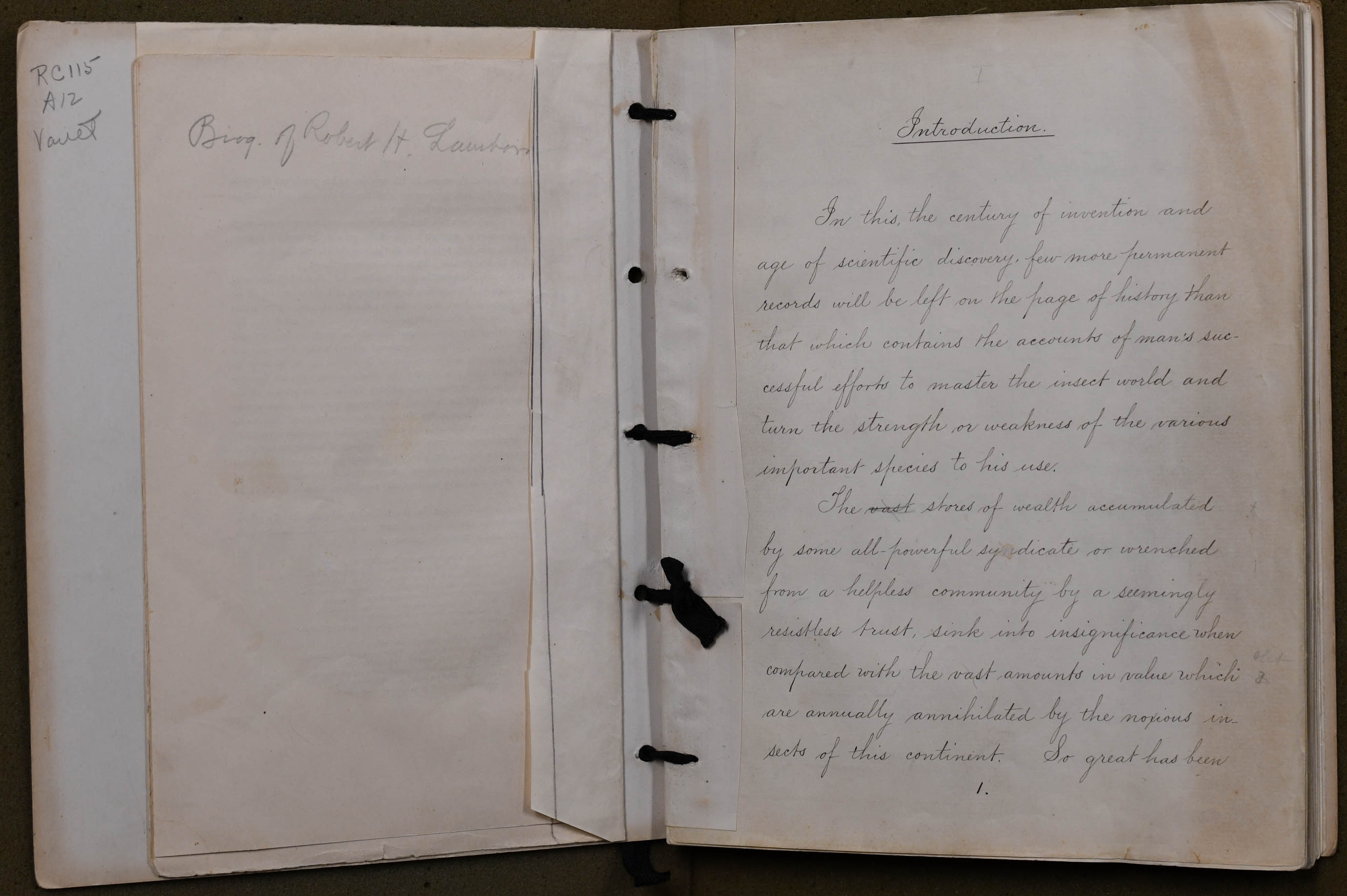
An historic notebook opened to a page 1, a page filled with neat handwriting

Page 1 of A notebook containing an entomological essay by Carrie Aaron, 1889, 1890, 1901, Small Collections and Individual Manuscripts Box 4, ANSP-Coll-0156, Carrie Baily Aaron Papers, Library and Archives, Academy of Natural Sciences of Drexel University, Philadelphia, Pennsylvania.

The updated catalog record provides more context around Aaron’s essay, which she submitted to a contest aimed at gathering information on how to eradicate mosquitoes. In Aaron’s written biographical notice about contest-holder Robert Henry Lamborn, she said, “While engaged in building the Lake Superior Railroad, Dr. Lamborn suffered so from the attacks of countless mosquitos, that he became interested in extermination of the insect, and later offered prizes for the three best essays on the subject.” I wonder if this was the motivation behind her essay submission.

With the help of dedicated Drexel University student digitization assistants, the Academy Library and Archives was happy to contribute the beautifully handwritten notebook to BHL, which showcases Aaron’s extensive entomological knowledge. Included are analyses of potential methods to reduce mosquito populations, including the use of dragonflies, which Aaron called “the hawks of the minuter insect world.”
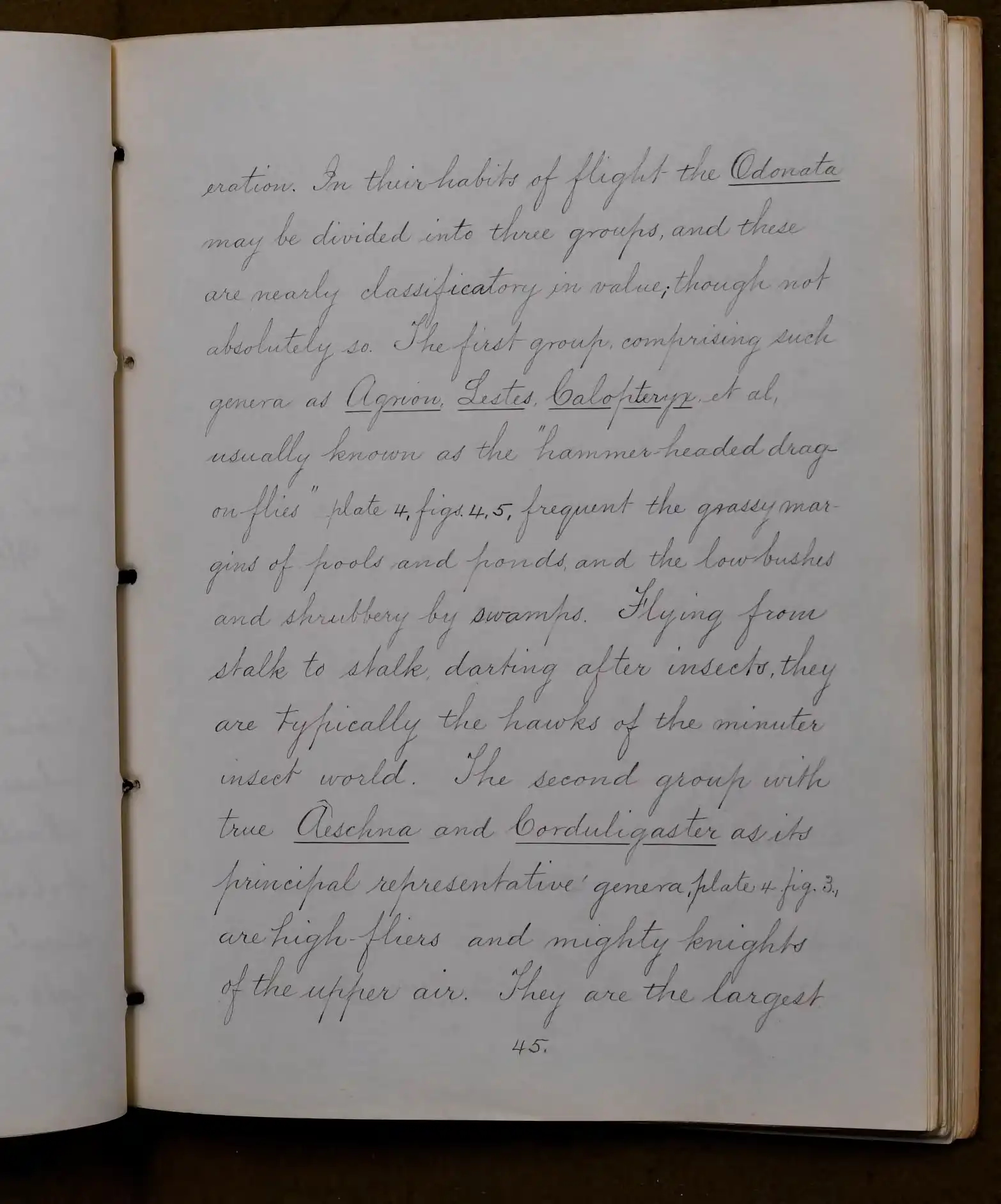
A page (page 45) of an historic notebook filled with very neat handwritten cursive script

A page from Carrie Aaron’s notebook on BHL in which she refers to hammer-headed dragonflies as “the hawks of the minuter insect world”. (A notebook containing an entomological essay by Carrie Aaron, 1889, 1890, 1901, Small Collections and Individual Manuscripts Box 4, ANSP-Coll-0156, Carrie Baily Aaron Papers, Library and Archives, Academy of Natural Sciences of Drexel University, Philadelphia, Pennsylvania.)

Aaron and her researchers apparently even attempted to inoculate themselves with what was then described as poisonous droplets from mosquitoes, but the attempt was “not successful, owing probably to the inferiority of the needle as an injector, compared with the delicate hypopharynx.” The essay was later published with other submissions in Dragon Flies vs. Mosquitoes: Can the Mosquito Pest be Mitigated? under the title “The Dipterous Enemies of Man.”

In addition to the essay, Aaron’s notebook in the Academy’s collection contains a letter from Henry Skinner congratulating Aaron on her prize-winning essay and confirming that her entomological reputation would “now be well established.” Ten years after receiving the congratulatory letter, Aaron wrote to Skinner in 1900 asking that her name be removed from the list of associate members of the American Entomological Society: “During the ten years of my membership I have attended only two meetings; this has not been from lack of interest as much as from the fact that lady members are too greatly in the minority, and also that I care so little for the classification of insects.” This is not to say that Aaron was not grateful to Skinner for their “more than thirty year sympathetic friendship,” for which she thanked him in a letter she wrote in 1923.
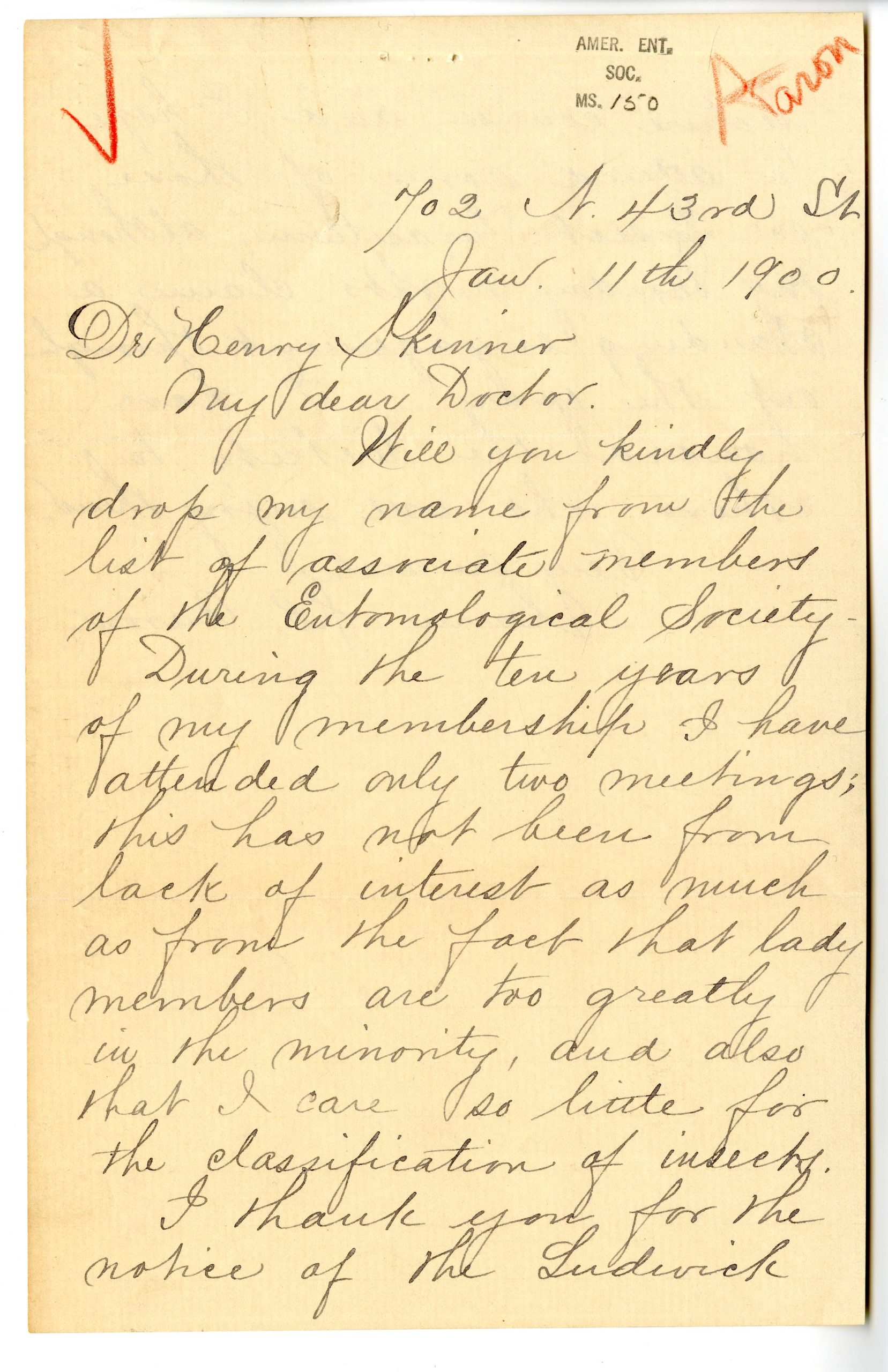
The first page of a letter written in cursive script on yellowed paper (dated 1900)

Carrie Aaron asking that her name be removed from the list of associate members of the American Entomological Society. (Carrie Aaron letter to Henry Skinner, January 11, 1900, Box 1, Folder 1, ANSP-Coll-0150, American Entomological Society correspondence, Library and Archives, Academy of Natural Sciences of Drexel University, Philadelphia, Pennsylvania.)

When given the opportunity to write a blog post in celebration of BHL’s 20th anniversary, it was an easy choice among the Academy Library and Archives staff to write about Carrie Aaron. The timing couldn’t have been better; shortly after choosing our blog post topic, we welcomed intern Will Le, who is currently digitizing our entire American Entomological Society (AES) correspondence collection, including letters written by Aaron, and uploading it to PA Photos and Documents. Funding for this project was generously provided by Dr. William Day and the American Entomological Society. Shout-out to Will Le, Jessica Lydon, Greg Cowper, and the American Entomological Society for making this happen!

Thanks to our intern and the AES digitization project, I was able to read Carrie Aaron’s letters on my laptop and learn about her travels in Santa Monica, a place she describes as “the land of perpetual bloom and uninterrupted sounds of birds and insects.” Later in this letter, Aaron describes a meaningful experience while visiting museums:

At Avalon we met the only woman curator of marine objects in the world and because she noticed how interested I was, also inquisitive, she shared a willingness to dissect and classify me; her museum contained many natural curiosities found in the waters of that locality. The most interesting museum I have ever seen is in Los Angeles, Exposition Park (of 130 acres) owned by the state, the resources and industries of California are shown in most attractive scenic effects. The exhibit of fossil remains of prehistoric animals really is wonderful, and made me regret not being healthy enough to make our Academy of Nat. Sci. a competitor in ownership of such a valuable contribution to scientific knowledge.
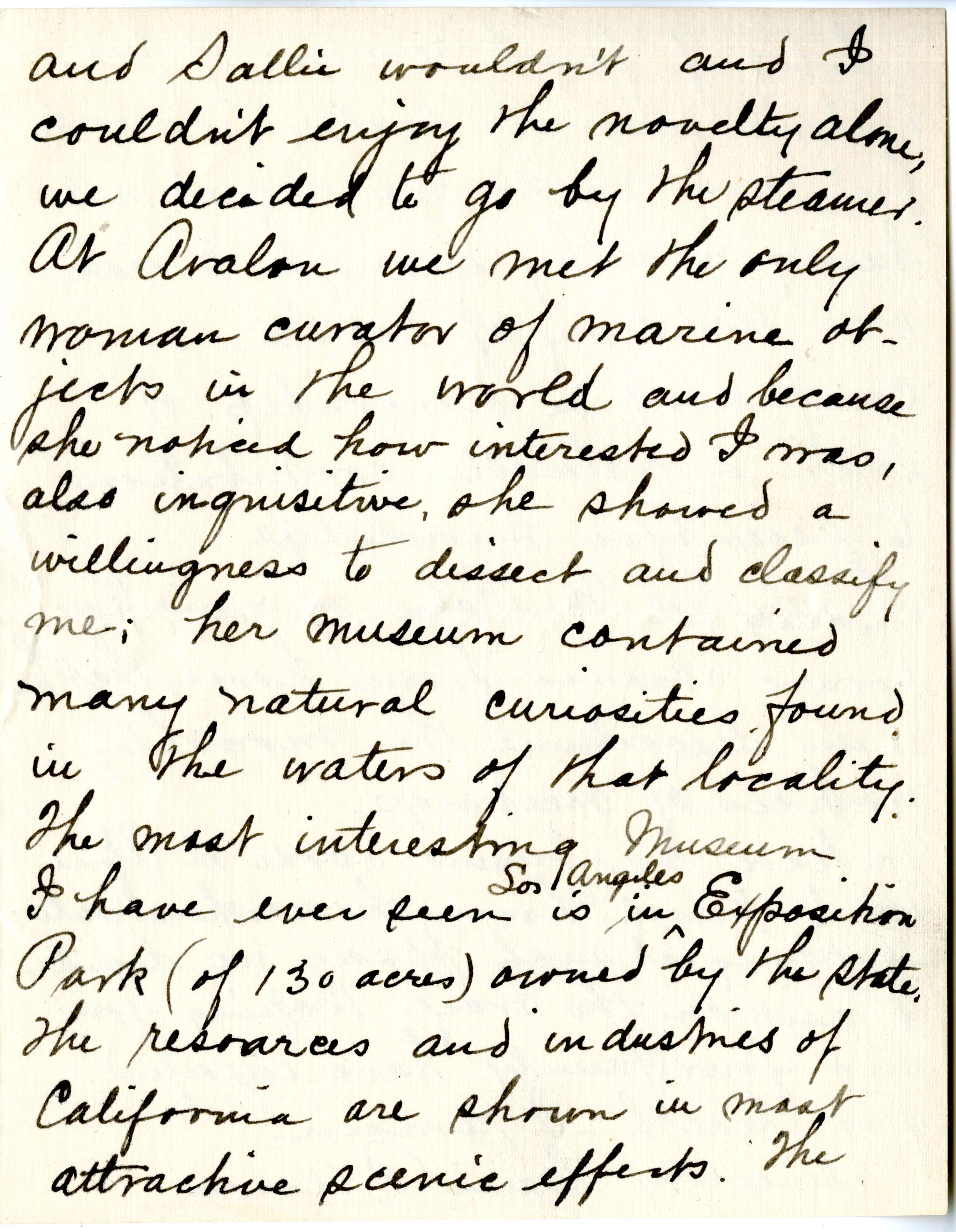
A page of a letter written in black ink in cursive script

Aaron describes meeting “the only woman curator of marine objects in the world.” (Carrie Aaron letter to Henry Skinner, March 8, 1926, Box 1, Folder 1, ANSP-Coll-0150, American Entomological Society correspondence, Library and Archives, Academy of Natural Sciences of Drexel University, Philadelphia, Pennsylvania.)

Now I have a new research topic: who was the “only woman curator of marine objects in the world” Aaron was so excited to meet? To be continued!

After working with archival notebooks and reading Carrie Aaron’s letters, I’m thrilled to see how digitization and public access to collections spur research into lesser-known individuals and uncover more potential research subjects! I don’t consider myself a historian, but it’s difficult to resist historical research when presented with easily accessible primary sources and when given the tools to link subjects across different platforms. I hope to continue this energizing work at the Academy of Natural Sciences in collaboration with BHL for years to come.


From the Biodiversity Heritage Library

For 20 years, BHL has helped uncover the people and stories hidden within biodiversity literature and archives, making them freely available for new generations to discover. Your support helps us continue digitizing, connecting, and sharing collections like Carrie Aaron’s notebook—and ensures that more overlooked voices and histories can be found.

Orange button with a heart icon

September 16, 2026by nkearney
Blog Reel, Featured Books

Extinct Species Descriptions: the most precious treasure in BHL

An historic illustration of two Thylacines (Tasmanian Tigers): tan-coloured dog-like marsupials with black stripes.

This post is part of BHL at 20: Treasures from the Biodiversity Heritage Library, a series contributed by members of the BHL community, highlighting remarkable works from across the collection in celebration of its 20th anniversary.

We are now exactly halfway through our 20th Anniversary blog post series. Coordinating this celebration of treasures chosen by our BHL community has been one of the most rewarding projects in my time as BHL’s Communications Director. It is an absolute honor to share mine now.

My favorite treasures in BHL are the very first scientific descriptions of new species. I like to think of these descriptions as a species’ international debut in the literature.

An historic illustration of two small wallabies.

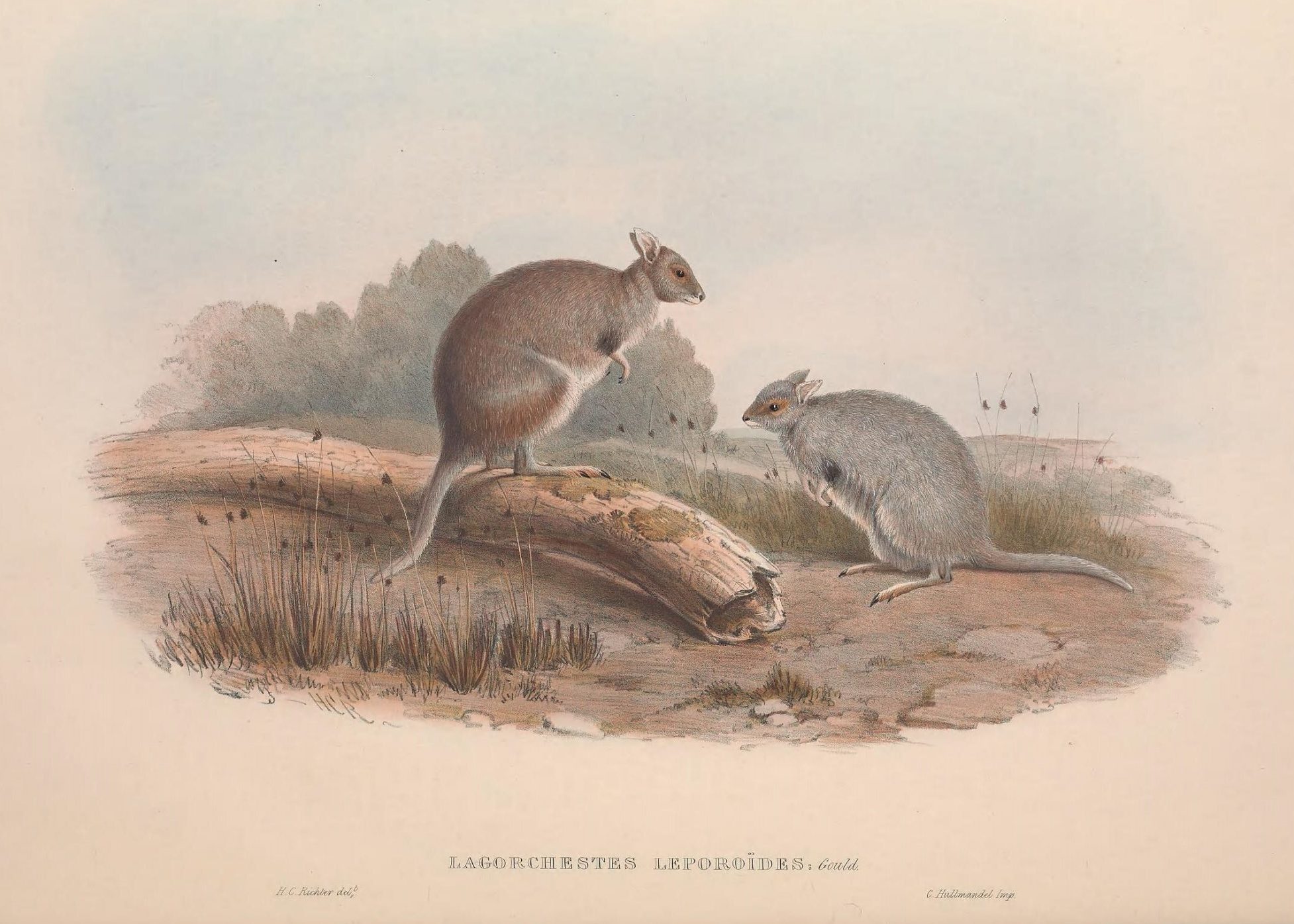
The now-extinct Eastern Hare-wallaby, (Lagorchestes leporides), illustrated by Henry Constantine Richter in John Gould’s A Monograph of the Macropodidae, or Family of Kangaroos (1841), Plate 12. Gould formally described the species earlier that year in the Proceedings of the Zoological Society of London.

As the Manager of BHL Australia, the descriptions I love the most are those of Australian species. Australia was one of the last continents to be encountered and documented by European naturalists. British colonization did not begin until 1788, but from the late eighteenth century onward, descriptions of Australia’s bizarre marsupials and monotremes began appearing in European literature thick and fast, accompanied by a buzz of excitement and wonder.

I find it fascinating to read the awe and curiosity of those early naturalists as they tried to fit Australia’s truly perplexing creatures into their existing understanding of the natural world. One of my absolute favorites is George Shaw’s 1799 description of the platypus: “Of all the Mammalia yet known,” he wrote, “it seems the most extraordinary…” I encourage you to read the full description. It’s wonderful.

But today – on Australia’s National Threatened Species Day – I want to talk about the most precious of these treasures: the descriptions of species that disappeared from the living world a devastatingly short time after making their debut in the scientific literature.

European colonization had devastating consequences for Australia’s native biodiversity. Australia’s long isolation as an island continent meant that many of its endemic animals were exceptionally vulnerable to the onslaught of introduced placental predators and competitors. The introduction of foxes and cats in particular, combined with the unprecedented destruction of the natural environment, has resulted in Australia having the highest rate of mammal extinctions in the world.

Tragically, many of Australia’s introduced species were deliberately released in attempts to make Australia more like Europe, a history I explored in an earlier BHL blog post, Exploring the Acclimatisation Society of Victoria’s Role in Australia’s Ecological History).

BHL: a treasure trove of lost species

While museum specimens may continue to reveal information about the anatomy, genetics and diet of extinct species, the literature preserves precious details from observations of living animals: their behavior, abundance, habitats, interactions, and how they were understood and perceived over time.

Scattered throughout BHL are descriptions, field observations, and illustrations of Australian species that have since disappeared: the Pig-footed Bandicoot, Lesser Bilby and Crescent Nail-tail Wallaby, and so many more. These depictions of once-living animals are now invaluable records of species that will never be observed again.

An historic illustration of three small brown marsupials with pointy noses, long ears and thin short legs.

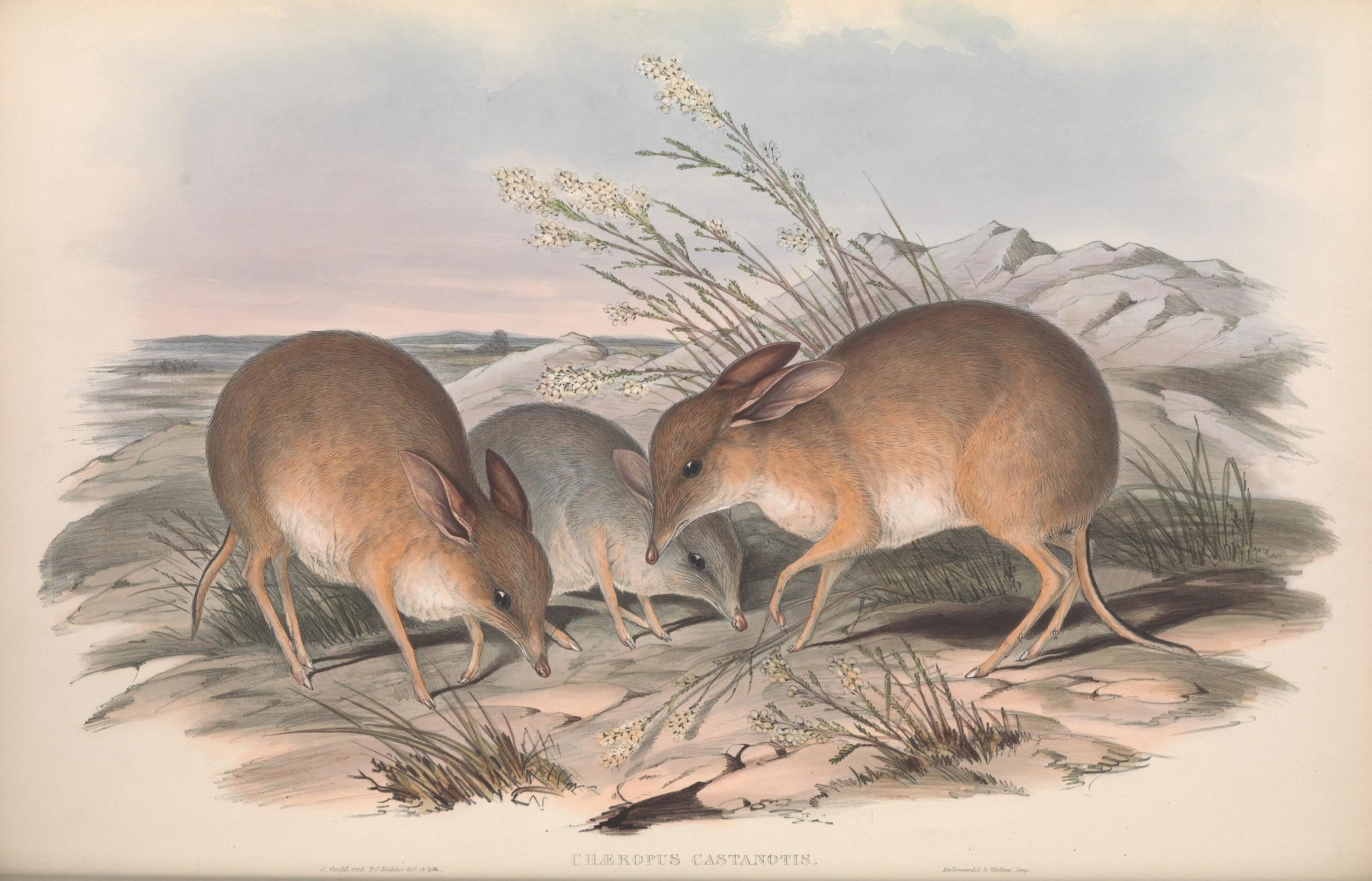
Henry Constantine Richter’s beautiful illustration of the now-extinct Pig-footed Bandicoot, from John Gould’s The Mammals of Australia 1863. Contributed by Smithsonian Libraries and Archives. View in BHL

It is our hope that by making this historic literature accessible and discoverable, we may learn from the past, and help prevent more species from becoming records of what has been lost.

The Thylacine: “an animal of the past”

Australia’s most well-known extinct species is the thylacine, or Tasmanian tiger. This dog-like marsupial carnivore was relentlessly persecuted as a threat to livestock, with private and government bounties placing a price on its head. Hunting and trapping, along with habitat destruction and fragmentation, drove it into rapid decline. The last known thylacine died in captivity at Beaumaris Zoo in Hobart on September 7, 1936. The species had been granted legal protection only two months earlier.

Australia’s National Threatened Species Day marks the anniversary of that tragic death: 90 years ago today.

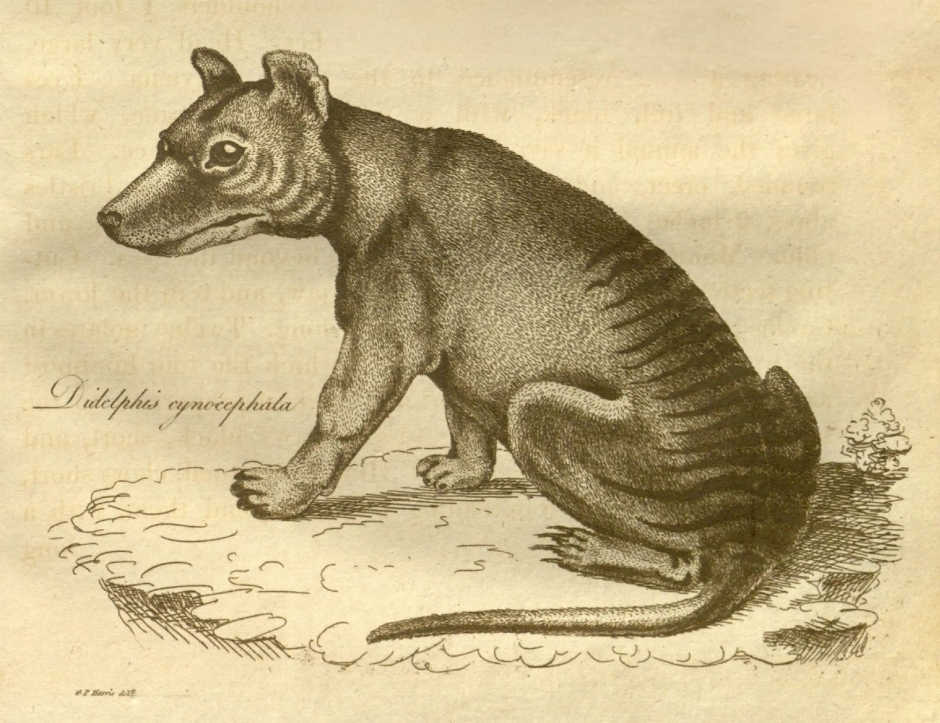
BHL preserves a sobering scientific trail of the thylacine, documenting the brief period within which this beautiful species was observed, named, misunderstood, persecuted and, ultimately, lost. The first published scientific description and illustration of the thylacine appeared in the Transactions of the Linnean Society of London in 1808. Its author, George Prideaux Robert Harris, gave it the name Didelphis cynocephala (the “dog-headed opossum”). Harris wrote that its large black eyes gave it “a savage and malicious appearance” and compared it to the wolf or hyena.

An historic illustration of the Thylacine, a dog-like marsupial with black stripes along its back.

The first published illustration of the Thylacine, accompanying George Prideaux Robert Harris’s 1808 description in “Description of Two New Species of Didelphis from Van Diemen’s Land,” Transactions of the Linnean Society of London 9: 174–178. Contributed by Missouri Botanical Garden, Peter H. Raven Library. View in BHL

These negative words would echo through subsequent accounts. In 1838, Tasmanian naturalist Ronald Campbell Gunn reported that thylacines attacked sheep at night and were “so very large and powerful, that a number of dogs will not face one”. More than three decades later, Johan Ludwig Gerhard Krefft described the thylacine as “a dangerous creature” and “the largest and most ferocious of the whole Mammalian Fauna in Australia”. Modern research, however, suggests that the thylacine was probably poorly equipped to take down an adult sheep, making its reputation as a formidable livestock killer all the more tragic.

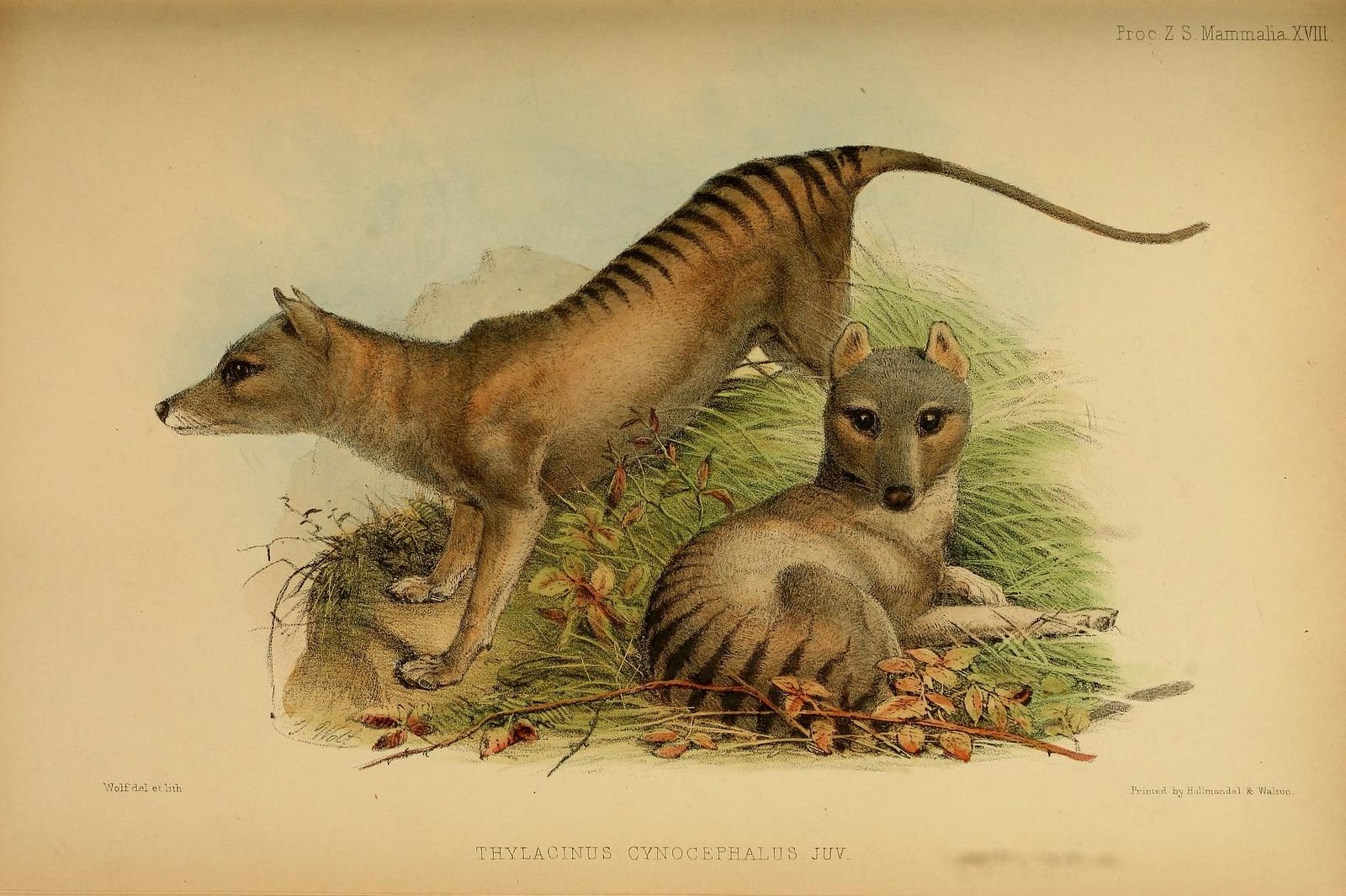
Yet, among these hostile accounts are warnings of the thylacine’s diminishing numbers. Joseph Wolf, one of the nineteenth century’s most celebrated zoological artists, depicted thylacines for the Proceedings of the Zoological Society of London (1850) and later for his magnificent Zoological Sketches (1861). His drawings were based on observations of a living pair of juvenile thylacines at London Zoo, the first thylacines ever to be exhibited in a zoological garden. In the accompanying text, zoologist Philip Lutley Sclater warned:

“The thylacine originally preyed on the Kangaroos and Bandicoots, but since the introduction of sheep into the colony, it has become more addicted to attack sheep folds. Perpetual war is therefore waged against it by the Tasmanian shepherds, whose determined persecution must eventually lead to its extinction.”

An historic illustration of two thylacines (brown dog-like marsupials with black stripes down their backs).

Joseph Wolf’s illustration of the two living thylacines on display at London Zoo, from the Proceedings of the Zoological Society of London (1850). Contributed by Harvard University, Museum of Comparative Zoology, Ernst Mayr Library. View in BHL

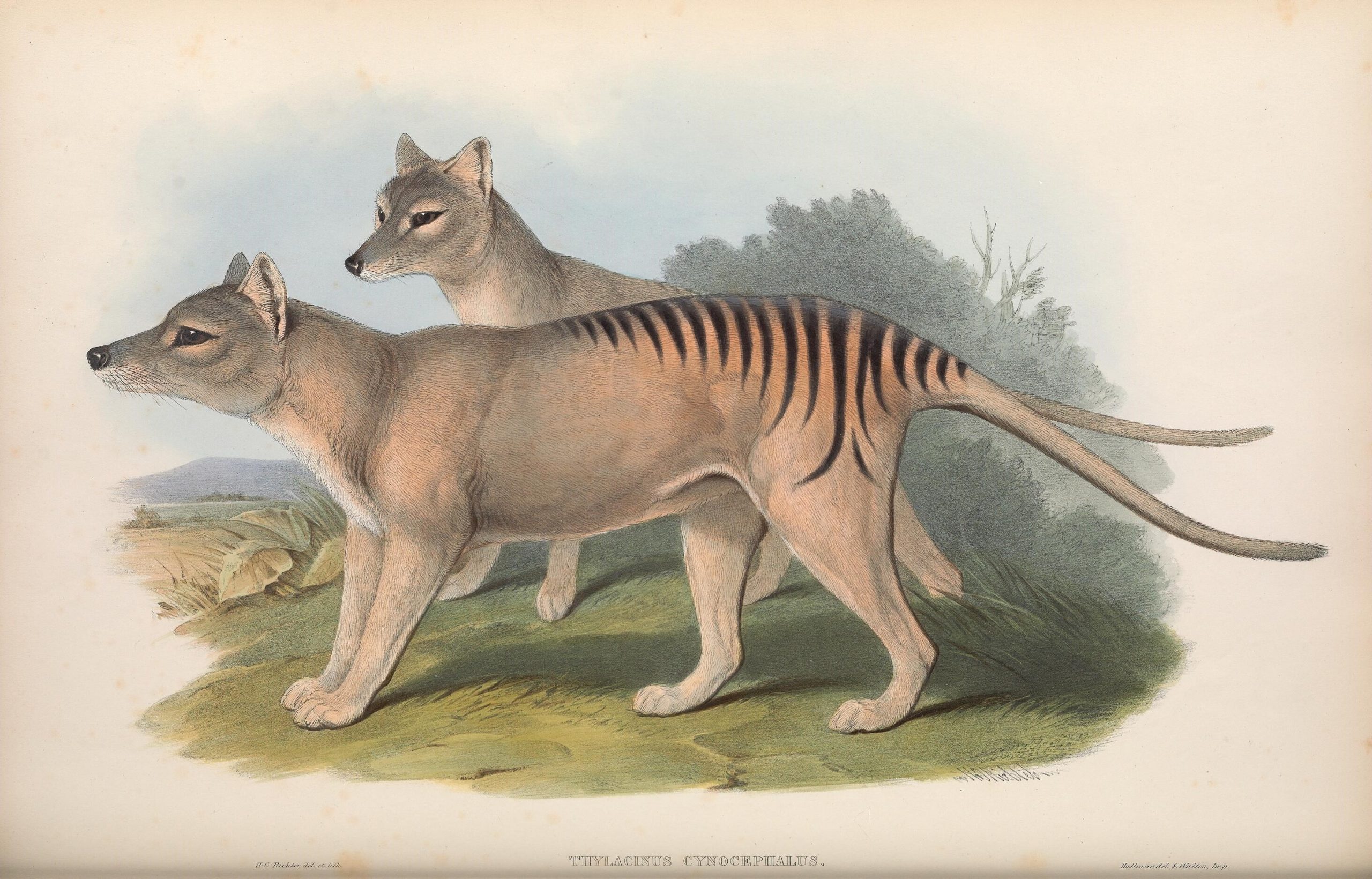
And then, in 1863, alongside one of the most famous illustrations of the thylacine, by Henry Constantine Richter for John Gould’s The Mammals of Australia, Gould gave an even more chilling prediction:

“When the comparatively small island of Tasmania becomes more densely populated, and its primitive forests are intersected with roads from the eastern to the western coast, the numbers of this singular animal will speedily diminish, extermination will have its full sway, and it will then, like the Wolf in England and Scotland, be recorded as an animal of the past: although this will be a source of much regret, neither the shepherd nor the farmer can be blamed for wishing to rid the island of so troublesome a creature. A price is already put upon the head of the native Tiger, as it is called; but the fastnesses of the Tasmanian rocky gullies, clothed with impenetrable forests, will, for the present, preserve it from destruction.”

John Gould was right: Tasmania’s gullies and forests protected the thylacine for the present – for his present. Seventy-three years later, the last known thylacine was dead.

An historic illustration of two Thylacines (Tasmanian Tigers) – tan-coloured dog-like marsupials with black stripes.

The thylacine, illustrated by Henry Constantine Richter, from John Gould’s “The mammals of Australia” (1863). Contributed by Smithsonian Libraries and Archives. View in BHL

Treasures lost, then found

Thankfully, not every story ends with extinction. One species in BHL is particularly close to my heart: the Leadbeater’s possum.

Also known as the fairy possum, the Leadbeater’s possum entered the scientific literature in 1867, when Frederick McCoy described it as both a new species and a new genus. McCoy was the first Director of the National Museum of Victoria, the institution now known as Museums Victoria, where I have worked for the past 23 years.

McCoy was renowned for spending substantial sums on books, an extravagance I will forever be grateful for. He ordered the latest scientific publications from Europe to be shipped to Australia at great expense, building what would become one of Australia’s largest and most significant natural history library collections. More than 150 years later, many of these nineteenth-century treasures are freely accessible on BHL, thanks to my wonderful team at BHL Australia.

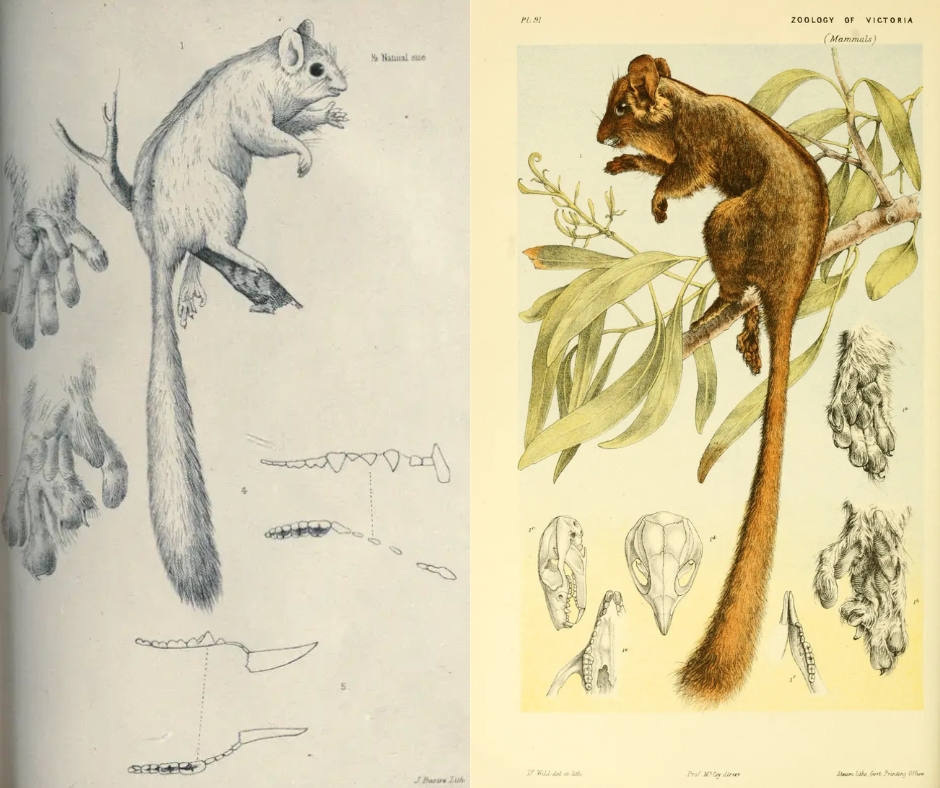
McCoy named the new species Gymnobelideus leadbeateri, after John Leadbeater, the Museum’s first taxidermist. His original description includes a black-and-white illustration drawn from this specimen by Arthur Bartholomew. The image was later reworked by artist and lithographer Dr. John J. Wild, into the beautiful full-color plate that was published in McCoy’s Prodromus of the Zoology of Victoria (1885).

Two historic reproductions of a similar illustration of a Leadbeater's Possum. The left in black and white, the right in full colour with more detail.

Left: Arthur Bartholomew’s original illustration of the Leadbeater’s possum, accompanying McCoy’s first published description, On a new genus of Phalanger (1867). Right: Plate 91 by Dr. John J. Wild for McCoy’s Prodromus of the Zoology of Victoria (1885).

Only a handful of Leadbeater’s possums were recorded over the next few decades, and when no sightings were made across a period of 50 years, the species was presumed extinct. Then, in 1961, a small colony was rediscovered near Marysville. In 1971, the Leadbeater’s possum was chosen as the faunal emblem of my home state of Victoria. Sadly, despite decades of conservation efforts, the future of our treasured fairy possum is far from secure. The species remains Critically Endangered, threatened by habitat loss and fragmentation, bushfires, climate change, and predation by feral cats.

Protecting our remaining treasures

When I first envisioned this 20th Anniversary series, I imagined it as a celebration of the rare books, exquisite artworks, and unique archives in BHL. Yet, the treasures I find most precious are the species themselves.

BHL provides a window into the point in history when each species entered the scientific record. It also preserves observations of animals that have since vanished: where they lived, how they behaved, how people perceived them, and, occasionally, the warnings that they were disappearing.

The thylacine reminds us what happens when those warnings are ignored. The Leadbeater’s possum is an urgent reminder that sometimes we have a second chance.

For 20 years, BHL has helped preserve the record of life on Earth and make it freely accessible to everyone. My greatest hope for the next 20 is that we use the knowledge preserved across our 64+ million pages not only to understand what we have lost, but to help protect what we still have.

From the Biodiversity Heritage Library

By supporting BHL, you help preserve the knowledge of species past and present and keep it freely available to researchers, conservationists, and policymakers around the world.

Orange button with a heart icon

September 7, 2026by nkearney

Help Support BHL

BHL's existence depends on the financial support of its patrons. Help us keep this free resource alive!

search

About BHL

The Biodiversity Heritage Library (BHL) is the world’s largest open access digital library for biodiversity literature and archives. BHL operates as a worldwide consortium of natural history, botanical, research, and national libraries working together to digitize the natural history literature held in their collections and make it freely available for open access as part of a global “biodiversity community.”

Join Our Mailing List

Sign up to receive the latest news, content highlights, and promotions.

Subscribe Now

Subscribe to Blog via Email

Enter your email address to subscribe to this blog and receive notifications of new posts by email.

Join 319 other subscribers

Subscribe to Blog Via RSS

Subscribe to the blog RSS feed to stay up-to-date on all the latest BHL posts.

Access RSS Feed

Inspiring Discovery through Free Access to Biodiversity Knowledge.

The Biodiversity Heritage Library makes it easier than ever for you to access the information you need to study and explore life on Earth…for free, anytime, anywhere.


64+ Million Pages of
Biodiversity Literature Online.

EXPLORE

Tools and Services
to Transform Research.

EXPLORE

300,000+
Illustrations on Flickr.

EXPLORE

ABOUT | HARMFUL CONTENT | PRIVACY | SITE MAP | TERMS OF USE