Biodiversity Heritage Library - Program news and collection highlights from BHL
  • Home
  • News
  • Featured Books
    • All Featured Books
    • Book of the Month Series
    • BHL at 20
  • User Stories
  • Campaigns
    • Fossil Stories
    • Garden Stories
    • Monsters Are Real
    • Page Frights
    • Her Natural History
    • Earth Optimism 2020
  • Tech Blog
  • Visit BHL
Home
News
Featured Books
    All Featured Books
    Book of the Month Series
    BHL at 20
User Stories
Campaigns
    Fossil Stories
    Garden Stories
    Monsters Are Real
    Page Frights
    Her Natural History
    Earth Optimism 2020
Tech Blog
Visit BHL
  • Home
  • News
  • Featured Books
    • All Featured Books
    • Book of the Month Series
    • BHL at 20
  • User Stories
  • Campaigns
    • Fossil Stories
    • Garden Stories
    • Monsters Are Real
    • Page Frights
    • Her Natural History
    • Earth Optimism 2020
  • Tech Blog
  • Visit BHL
Biodiversity Heritage Library - Program news and collection highlights from BHL
BHL News, Blog Reel

BHL at TDWG 2013 Annual Conference

View Full Size ImageThe TDWG 2013 Annual Conference has kicked off in Florence, Italy and will run through November 1, 2013.  We are very pleased to announce that BHL will be hosting a Symposium today, Monday, October 28, at 14:00 CEST.

The symposium, entitled “Crafting the Future of a Global Biodiversity Heritage Library for Diverse Communities’ Needs,” will be led by BHL Program Director Martin Kalfatovic and will feature a panel of key members of the BHL-Global, including William Ulate, Trish Rose-Sandler, Jiři Frank, Lucy Waringi, and Connie Rinaldo.

The symposium will focus on strategies for creating, expanding and maintaining a multinational digital library programme; digitisation platforms, standards and services; creating value-added features for discipline-specific communities; use of social media and outreach to increase use and build new audiences; and migration from projects to sustainable programmes.  Panel members will deliver presentations from their perspectives as project-, country-, and continent- collaborators on the Biodiversity Heritage Library, sharing their experiences and promoting a discussion on next steps to improve strategies for meeting the needs of scientists.

The TDWG conference is an annual meeting of the international organization Biodiversity Information Standards (TDWG), also known as the Taxonomic Databases Working Group.  TDWG has a successful track record of fostering international collaborations around biodiversity technology projects and currently focuses on the development of standards for exchanging biodiversity data.

We are looking forward to productive and informative discussions with attendees at today’s Symposium and throughout the TDWG conference!


October 28, 2013by sayeedmd
Blog Reel, User Stories

Taxonomic research on Southeast Asian land snails

Portrait version of the Biodiversity Heritage Library logo.

As part of our regular BHL and Our Users series, we’re pleased to introduce Barna Páll-Gergely, a PhD student in the Department of Biology at Shinshu University in Japan.  Barna has had a lifelong interest in shells and land snails and has graciously agreed to answer some questions about how BHL has impacted his research.

BHL and Our Users: Barna Páll-Gergely

View Full Size Image

What is your title, institutional affiliation, and area of interest?
I graduated from University of Pécs, a Hungarian university, and am now a PhD student in Japan, at Matsumoto, Shinshu University.  I am interested in the taxonomy and evolution of some land snail groups, mainly from South-east Asia.

How long have you been in your field of study?
I started collecting shells at the age of five, as many of us do.  I then worked on land snails for about 10 years, starting in the secondary school.

When did you first discover BHL?
A museum curator friend of mine showed it to me about two years ago.

What is your opinion of BHL and how has it impacted your research?
It provides wonderful possibilities for taxonomists who need to regularly use the very old literature.  BHL provides access to the kind of literature which can often be found only in large, old museum libraries. I also have access to recent papers because I am studying in a Japanese University, but without BHL I would be in big trouble with accessing the old sources.

How often do you use BHL?
I have to check some things almost every day, and during the literature search period (when I start working on a new taxonomic group), I use it practically all day.

How do you usually use BHL (read the titles online/download whole PDFs/Select Pages to Download for a custom PDF/etc.)
I usually download whole publications for my “literature collection”, and at the same time I produce smaller pdf files with the information I need for a specific subject. It is easier to handle smaller files when I just need to check something such as the exact page number of a citation.

What are your favorite features/services on BHL?
I can search for scientific names, and people’s names. This is a very big help.

When I started to deal with the land snail family Plectopylidae, I just typed “plectopylis” into the search field and I could read and download many old literature. Without this possibility (scientific or authors name as a search option) finding all relevant literature would have taken maybe two times longer, and more importantly, there would have been a risk of overlooking some sources.  This was very helpful while I was working with my colleagues on the the description of new species and subspecies shown in the image below.

View Full Size Image
New species and subspecies of the land snail family Plectopylidae from China
and Vietnam (Páll-Gergely & Hunyadi, 2013). This family was neglected
since the beginning of the 20th Century
.

If you could change one thing about BHL, what would it be, or what developmental aspect would you like the BHL team to focus on next?
In many cases the plates of figures and the blank pages in-between appear marked as “text” on the left-hand navigation menu.  It would be great to enumerate them. The other thing is that selecting pages of a single publication and finding the plates at the end of each volume takes a long time. Sometimes it would be more user-friendly to provide a way to automatically group these together for download.

View Full Size Image
Godwin-Austen, H.H. 1917 Zoological
results of the Abor Expedition, 1911–12.
XLVII Mollusca, VII. Cyclophoridae
(in part) Records of the Indian Museum 8:
493—580. 
http://biodiversitylibrary.org
/item/41753#pag e/677/mode/1up

If you had to choose one title/item in BHL that has most impacted your research, or one item that you prefer above any other in BHL, what would it be and why?
There are many relevant sources I like, for example I am really fascinated by monographs like Kobelt’s Cyclophoridae or the Mollusca of India  by Godwin-Austen. On the other hand, discovering something unusual, or let’s say, “funny” is always a good moment.  My actual favourite is a part in Godwin-Austen’s “Zoological results of the Abor Expedition” (1917), after the description of Rhaphaulus miriensis: “After getting as far as writing the above description I left my work room for lunch, leaving the shell on a slide resting on plasticine. On taking up work again I found it crushed. Thus one of the most interesting shells found recently on the Eastern Frontier has to be rediscovered.”

Literature mentioned:
Kobelt W. 1902 Das Tierreich. Mollusca: Cyclophoridae R. Friedländer und Sohn, Berlin 662pp.

Godwin-Austen, H.H. 1882–1920 Land and Freshwater Mollusca of India, including South Arabia, Baluchistan, Afghanistan, Kashmir, Nepal, Burma, Pegu, Tenasserim, Malaya Peninsula, Ceylon and other islands of the Indian Ocean; Supplementary to Masers Theobald and Hanley’s Conchologica Indica Taylor and Francis, London, 257pp, 442pp.

Godwin-Austen, H.H. 1917 Zoological results of the Abor Expedition, 1911–12. XLVII Mollusca, VII. Cyclophoridae (in part) Records of the Indian Museum 8: 493—580.

Páll-Gergely, B. & Hunyadi, A. (2013): The family Plectopylidae Möllendorff 1898 in China (Gastropoda, Pulmonata). — Archiv für Molluskenkunde 142 (1): 1–66.


October 15, 2013by sayeedmd
BHL News, Blog Reel

GBIF Launches New Web Portal!

View Full Size Image
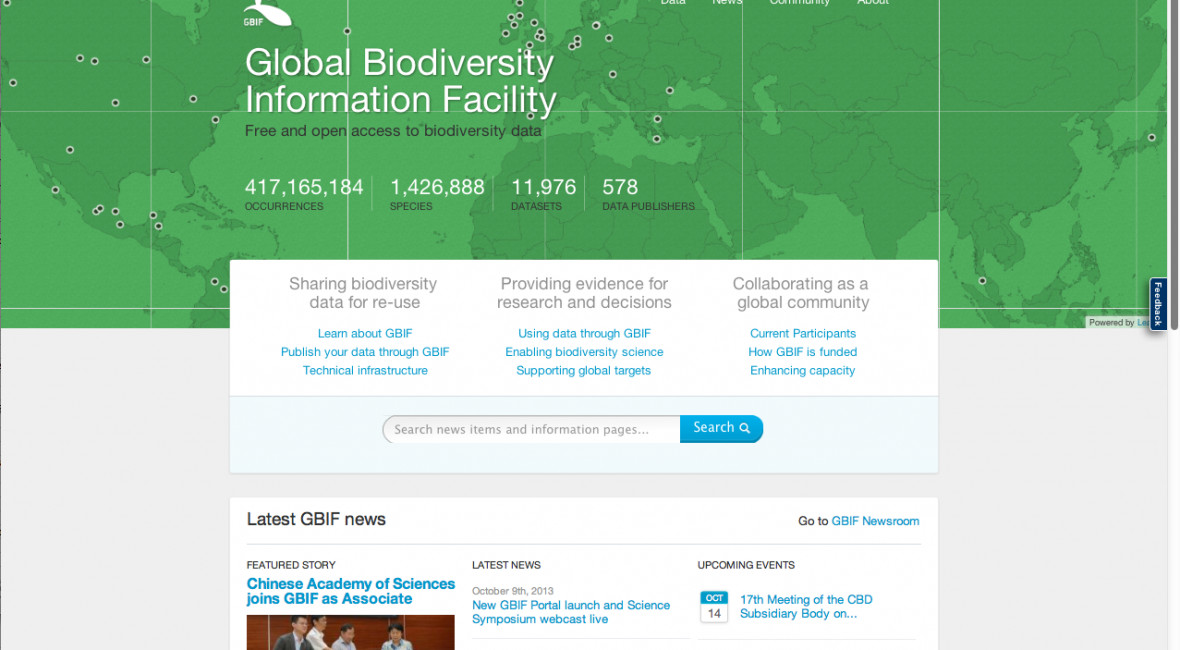
GBIF’s new web portal: http://www.gbif.org

We’re very excited to share that yesterday, October 9, the Global Biodiversity Information Facility (GBIF) launched their new web portal as part of the 20th meeting of the GBIF Governing Board.  The new portal provides greatly enhanced access to the world’s largest database of documented evidence for the distribution of species across the planet.

The scientific meeting was held in Berlin and webcast for the press and public. Tim Hirsch, Senior Program Officer for Engagement, and Tim Robertson, Information Systems Architect, introduced and demonstrated some of the new features now available.  For example, the home page now includes prominent links to information that help “tell the entire GBIF story,” including how GBIF, its content-contributing partners, and users are:

  1. Sharing Biodiversity for Reuse;
  2. Providing Evidence for Research and Decisions; and
  3. Collaborating as a Global Community.

You can learn more about all of the new functionality by visiting the new GBIF web portal or watching the webcasts of the launch.

The meeting also included presentations on how GBIF’s partners in Colombia and Japan are providing free and open access to information about biodiversity in their own countries.  In the afternoon, the annual GBIF Science Symposium highlighted how researchers throughout the world are using the data mobilized through GBIF’s network of data publishers.  The Symposium kicked off with a presentation on climate change and patterns of biodiversity by Miguel Bastos Araújo, winner of the 2013 Ebbe Nielsen Prize.  More information is available in the Symposium brochure and webcast of the event.

October 10, 2013by sayeedmd
BHL News, Blog Reel

BHL’s Latest News!

View Full Size Image
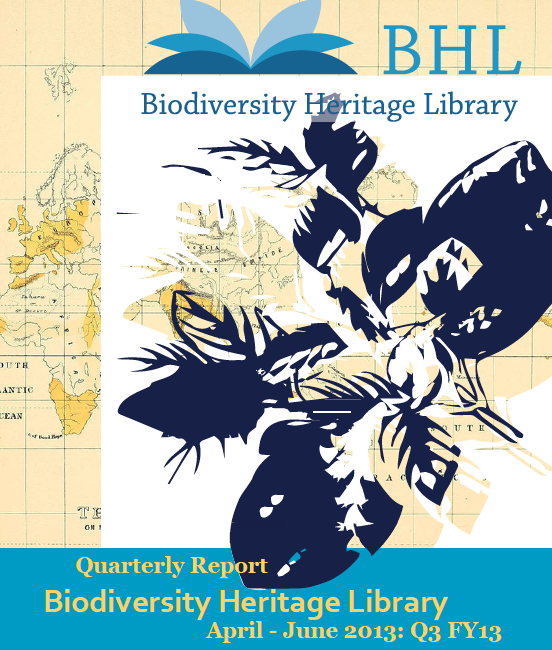
Latest BHL Quarterly Report

Wondering what BHL has been working on lately? Check out our latest quarterly report which details our production statistics and showcases some of our most recent exciting project accomplishments! For example, during this past quarter alone, we celebrated the birth of another regional node – BHL Africa, fortified our strategic direction with the approval of new vision, mission and goal statements, and participated as a content hub in recently launched Digital Public Library of America (DPLA), resulting in over 115,000 BHL volumes being made available through the DPLA portal.  Production efforts kept apace with nearly 600,000 pages scanned and over 1,000,000 names added to BHL.

Learn all about these developments and see how our project is performing in the latest BHL Quarterly Report.

Quarterly reports will be archived on our public wiki.

August 27, 2013by sayeedmd
BHL News, Blog Reel

BHL at Summer Teacher Institutes

This summer, the Library of Congress hosted five-day Summer Teacher Institutes in Washington, DC.  As part of the most recent Institute, BHL shared an exhibit table on Science and Technology with the Library of Congress on Tuesday, August 6, 2013.  Carolyn Sheffield, of the Smithsonian Institution, shared information on BHL and distributed stickers, pins, and BHL business cards—complete with gorgeous illustrations from BHL.  Dr. Tomoko Steen, Research Specialist and Camron Lee, Junior Fellow, both of the Science, Technology, and Business Division of the Library of Congress, shared the table, helping to spread the word about BHL as well as sharing amazing education resources compiled by their Division.

Attendees included 25 teachers from primary, secondary, undergraduate and graduate programs from across the country.   The majority of attendees had not heard of BHL before and were delighted to learn of the free resources that BHL makes available.  Many attendees expressed enthusiasm for the content, especially the images on Flickr, and many said that they were to share the information about BHL’s free resources with their colleagues at their schools.

View Full Size Image

August 19, 2013by sayeedmd
Page 4 of 4«1234

Help Support BHL

BHL's existence depends on the financial support of its patrons. Help us keep this free resource alive!

search

About BHL

The Biodiversity Heritage Library (BHL) is the world’s largest open access digital library for biodiversity literature and archives. BHL operates as a worldwide consortium of natural history, botanical, research, and national libraries working together to digitize the natural history literature held in their collections and make it freely available for open access as part of a global “biodiversity community.”

Follow BHL

  • Bluesky logo
  • Instagram logo
  • Facebook logo
  • Flickr logo
  • Twitter logo

Join Our Mailing List

Sign up to receive the latest news, content highlights, and promotions.

Subscribe Now

Subscribe to Blog via Email

Enter your email address to subscribe to this blog and receive notifications of new posts by email.

Join 319 other subscribers

Subscribe to Blog Via RSS

Subscribe to the blog RSS feed to stay up-to-date on all the latest BHL posts.

Access RSS Feed


64+ Million Pages of
Biodiversity Literature Online.

EXPLORE

Tools and Services
to Transform Research.

EXPLORE

300,000+
Illustrations on Flickr.

EXPLORE

ABOUT | HARMFUL CONTENT | PRIVACY | SITE MAP | TERMS OF USE