Biodiversity Heritage Library - Program news and collection highlights from BHL
  • Home
  • News
  • Featured Books
    • All Featured Books
    • Book of the Month Series
    • BHL at 20
  • User Stories
  • Campaigns
    • Fossil Stories
    • Garden Stories
    • Monsters Are Real
    • Page Frights
    • Her Natural History
    • Earth Optimism 2020
  • Tech Blog
  • Visit BHL
Home
News
Featured Books
    All Featured Books
    Book of the Month Series
    BHL at 20
User Stories
Campaigns
    Fossil Stories
    Garden Stories
    Monsters Are Real
    Page Frights
    Her Natural History
    Earth Optimism 2020
Tech Blog
Visit BHL
  • Home
  • News
  • Featured Books
    • All Featured Books
    • Book of the Month Series
    • BHL at 20
  • User Stories
  • Campaigns
    • Fossil Stories
    • Garden Stories
    • Monsters Are Real
    • Page Frights
    • Her Natural History
    • Earth Optimism 2020
  • Tech Blog
  • Visit BHL
Biodiversity Heritage Library - Program news and collection highlights from BHL
Blog Reel, User Stories

Helping Out with Diverse Interests in Biodiversity: Taxonomy of Molluscs and Birds

Portrait version of the Biodiversity Heritage Library logo.
View Full Size Image
Prof. Hamish Spencer (right) and his long-time 
collaborator, Prof. Jon Waters (left) examining the 
holdfast of a brown alga, Durvillaea poha, a species 
they and a student of theirs described after showing
 it was genetically distinct from the widespread D. antarctica.  
The holdfasts pictured are the habitat for a number of 
interesting invertebrates (e.g., molluscs, crustaceans). 
One of these, the gastropod mollusc Diloma durvillaea, 
was also described by them.

New Zealand is an exciting place to study biodiversity for a number of reasons. First, its unique set of plants and animals, evolving in the context of an active geologic history, results in several model systems that are ideal for testing ideas about how evolution works. Second, the country still has areas of its natural environment that are relatively undisturbed, something of which the wider public is very proud and which means that many people are interested in and aware of many native species. And, third, New Zealand is still in an “age of discovery” with undescribed species turning up in numerous studies across almost all habitats.

Hamish Spencer has had the good fortune not only living in such an amazing location but has also pursued a very rewarding career in preserving and improving understanding of the rich biodiversity found here. He currently serves as Director of the Allan Wilson Centre, a cross-institutional group of evolutionary biologists working on various aspects of New Zealand’s biodiversity.  He is also a Professor in the Department of Zoology at the University of Otago, in the city of Dunedin, known as the Edinburgh of the South.  

As part of our regular BHL and Our Users series, Professor Spencer has graciously agreed to answer some questions about how BHL has impacted that work.

When did you first discover BHL?

A while ago! Not sure.  Maybe 6 years?

What is your opinion of BHL and how has it impacted your research? 

It is fantastic! What is more important, even: it is getting better.  I am amazed at the breadth of its material, especially from the 19th Century. I work on the phylogenetics of a variety of groups (so far, molluscs, birds, trematodes, brown algae, polychaetes, crustaceans), usually as model systems to answer a question about the way evolution works. For example, I have been interested in the importance of long-distance dispersal in marine environments, especially the Pacific and Southern Oceans. With my collaborators, I have used brown algae, molluscs and crustaceans to investigate various questions about dispersal and sometimes venture into the taxonomy of these groups when the phylogenetic work reveals new species or clades. In order to do that properly, I like to consult original descriptions and, although Otago is New Zealand’s oldest university, with a good library dating back well over 130 years, sometimes that literature is simply unavailable.  That is where BHL comes in.

How often do you use BHL?

It is very sporadic.  Sometimes not for weeks at a time and then intensively for a week or so.

How do you usually use BHL? 

Usually I want a whole article from an ancient journal, so I download that.  I find that if I just read online, I inevitably need to check some detail and so I have to go back and look at I again. Sometimes, if I want some part of a book, I download just the relevant pages.

What are your favorite features/services on BHL?

I am amazed and impressed by the breadth of material available.  It is a real tribute to the many people who have gone to the effort of producing high-quality scans of so much material. It is seldom, now, that I am wanting to read something from the 19th century that is not there.  As a consequence BHL is becoming my first port-of-call for such items.  It is a bookmark I use frequently.

If you could change one thing about BHL, what would it be, or what developmental aspect would you like the BHL team to focus on next?

The one thing that does not work very well is the downloading of parts of an item.  Selecting a large number of pages and then finding a number of them are blank can waste quite a bit of time.  (I think you know this is an issue, already, though!)

If you had to choose one title/item in BHL that has most impacted your research, or one item that you prefer above any other in BHL, what would it be and why?

That’s hard, since I work on a range of groups, but I suppose the early issues of Proceedings of the Malacological Society of London would be up there (even though it is 20th century!).  More recently the (19th-century) Transactions of the Royal Society of South Australia have been very useful.

We send our deepest thanks to Hamish Spencer for his participation in this series.  We’re always excited to learn more about how people are using BHL and the impact it has had on their work.  Gathering feedback on what our users would like to see changed or improved also helps us guide future development so that we can continue to improve and transform BHL to meet the needs of our users.  Have a story of how BHL has impacted your work?  We would love to hear from you! Send us an email to [email protected].

February 25, 2014by sayeedmd
Blog Reel

Happy Lunar New Year from BHL and Equus Caballus!

View Full Size Image
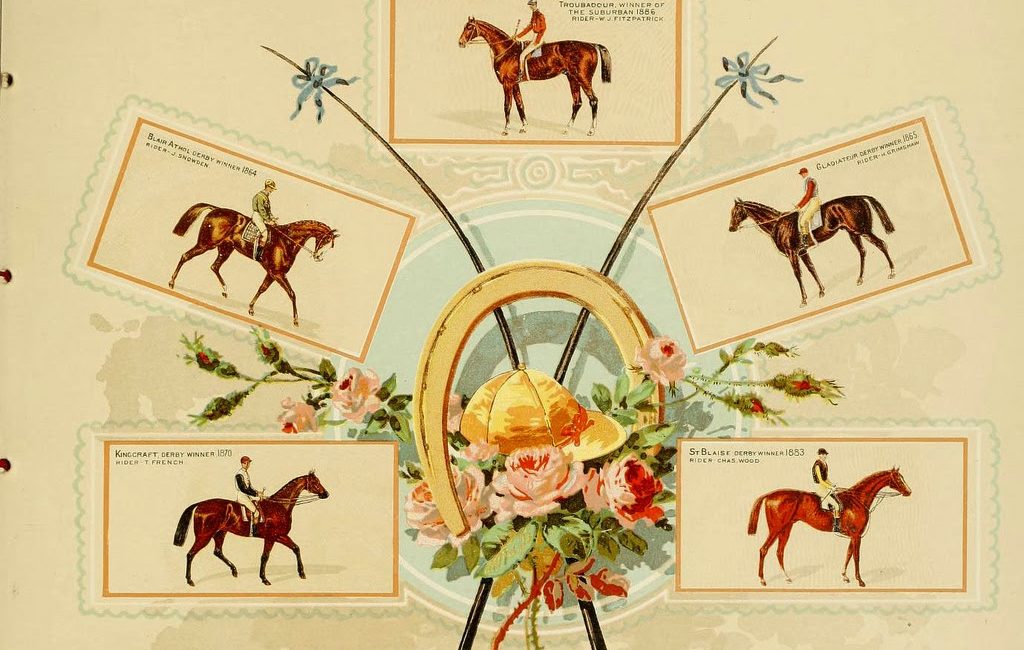
Album of celebrated American and English running horses.
New York: Kinney Bros. [1888?] biodiversitylibrary.org/page/24788565

From agriculture to transportation to war, Equus caballus has held a prominent and highly respected position in cultures across the world for thousands of years.  With the Lunar New Year celebrations underway for the next several days, we’re ushering in the year of the horse with some highlights on horse biodiversity from the literature in BHL!

  • You’ve heard of Clydesdales and Thoroughbreds, but what is it that defines these breeds?  According to Agriculture: Animal Husbandry (1901) by William P. Brooks, Clydesdales are bred as draft horses, with broad, stocky frames that make them well-suited to pulling heavy loads. The Thoroughbred, on the other hand, is bred for speed and has a more slender form with powerful lungs.  Learn more about the many different breeds of domesticated horses: http://www.biodiversitylibrary.org/page/30230823#page/85/mode/1up.
View Full Size Image
The new book of the horse.  London: Cassell and Co., 1911.
biodiversitylibrary.org/page/254311803
  • So you’ve always wanted to learn to ride a horse but weren’t sure where to start?  For some turn- of-the-century tips on trotting, walking, and galloping, look no further than the 1881 treatise How to Ride and School a Horse by Edward L. Anderson.  As a bonus, Anderson has also included some tips on horse gymnastics!
View Full Size Image
The analysis of the hunting field. London: Methuen, 1904.
biodiversitylibrary.org/page/20389207
  • Which modern horse can’t be ridden?  Considered the last truly wild horse, Equus przewalskii Poliakov, 1881, more commonly known as Przewalskii’s horse, is the only extant horse to never be tamed.  Nearly extinct by the late twentieth century, it has been reintroduced into the wild in places like China and Mongolia and its status has been updated to endangered.  Populations have seen some increases but threats such as disease, habitat destruction, and climate change remain.  BHL and our partners at EOL work hard to provide open access to information about species, including habitat and behavior, so that informed conservation decisions can be made, especially for those that been threatened or endangered.  Learn more about Przewalskii’s horse in BHL:  http://www.biodiversitylibrary.org/name/Equus_przewalskii.


View Full Size Image
The Evolution of the Horse Family,
as illustrated in the Yale Collections.
American Journal of Science, 1907.
biodiversitylibrary.org/page/40226990
  • How do modern horses differ from their earlier counter-parts?  Many of you may already know that pre-historic horses were generally smaller than modern horses but you may be surprised to learn that one of the key differences was the number of toes.  That’s right, toes.  While the modern horse has one-toed hooves, many pre-historic horses had three or more toes as shown in the illustration to the right.  Find out about how these changes may have benefitted horses as they evolved and discover other changes as described in Richard S. Lull’s 1907 article The Evolution of the Horse Family, as illustrated in the Yale Collections in the American journal of science.
Horses are documented in over 400 pages of open access literature in BHL, with a significant portion focusing on the modern Equus caballus: http://www.biodiversitylibrary.org/name/Equus%20caballus.
BHL relies on donations from individuals to support scanning of the biodiversity literature held in some of the world’s most renowned natural history and botanical libraries.  The examples below highlight the ways your donation can make a meaningful and lasting impact:
$25 – Creates Flickr sets of our images which are popular with educators and artists
$50 – Promotes biodiversity education through social media, such as our blog
$100 – Scans 1,000 pages to be made available for free and open access
$250 – Helps us support marketing interns who circulate biodiversity content worldwide
$500 – Improves existing methodology and helps develop new tools for biodiversity research
Help make the year of the horse a lucky and prosperous year for BHL and our users by making a donation to support our continued growth!  https://donate.sil.si.edu/v/DonateBHL.asp
February 3, 2014by sayeedmd
Blog Reel, Featured Books

Happy Holidays from BHL and Rangifer tarandus!

As part of BHL’s Winter Appeal, we’re highlighting some of the amazing species that are especially well-adapted to cold, wintery climes as well as those that often come to mind as we celebrate the winter holidays.  Last week we featured Ursus maritimus, the magnificent apex predator of the Arctic commonly known as the polar bear.  This week, we turn our eyes again to the North Pole to shine the spotlight on a well-known celebrity of  the giving season!

View Full Size Image
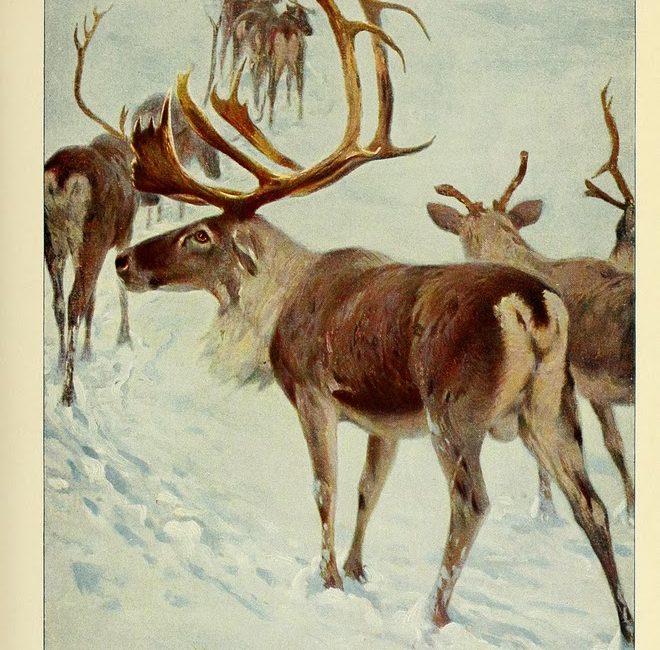
Wild Life of the World: A Descriptive Survey
of the Geographical Distribution of Animals.
London, F Warne and Co, 1916.
http://biodiversitylibrary.org/page/21738521
#page/455/mode/1up


Rangifer tarandus
As the holiday season goes into full swing, the festive days of late December bring a dazzling array of familiar images–shiny packages with ribbons and bows, snowy rooftops and fir trees, and of course the ubiquitous Rangifer tarandus.  Whether pulling sleighs or playing games, these antlered animals  feature prominently in decorations throughout the holiday season.  If you’ve ever watched the holiday cartoons broadcast at this time of year, you could be forgiven for thinking that reindeer are an especially uniform species, intolerant of differences.  But what of reality?  As it turns out, in real life reindeer exhibit a remarkable range of diversity.

Distinguishing them from other deer, reindeer are the only species in which both the male and female grow antlers. Within the species, reindeer display notable variations in size, shape and color.  According to The Animals of World: Brehm’s Life of Animals (1895) a comparison of tame and wild reindeer would reveal such differences just in the size and shape of the hooves that one could easily see how they might be considered belonging to separate species.  Antler size and fur coloration are also known to vary in the different regions of the reindeer’s circumpolar habitat.  Even within individuals, coloration changes with the seasons, bringing on a more greyish-white hue for the snowy winter months.

View Full Size Image
Verzameling van uilandsche en zeldzaame vogelen.
Amsterdam, J.C. Sepp, 1772-1781.
http://biodiversitylibrary.org/page/11267501#page/199/mode/1up

But sometimes the differences are significant enough to denote a classifiable distinction and today taxonomists recognize several subspecies of reindeer.  For example, Rangifer tarandus groenlandicus, shown above, occurs primarily in Greenland.  Even for those of us not well-versed in scientific names, this shouldn’t be surprising with the obvious phonetic similarity between groenlandicus and Greenland.  What many of us will find surprising, though, is that the common name of this subspecies is the “barren-ground caribou” meaning that, yes, caribou are subspecies of reindeer!  Who knew? (Well, undoubtedly some of you did but for those of us more familiar with the animated variety, let us not be ashamed to admit we are duly surprised!)

Other subspecies include the Dawson’s caribou (Rangifer tarandus dawsoni) which once roamed the Queen Charlotte Islands of British Columbia and is now presumed extinct.  While some information can still be derived from the DNA extracted from bones, fur and other remains of Dawson’s caribou and other extinct species, the vast majority of scientific knowledge on their appearance and behavior is locked in rare or hard to find literature.

View Full Size Image
The animals of the world. Brehm’s life of animals.
Chicago, A. N. Marquis, 1895.
http://www.biodiversitylibrary.org/page/37569440

#page/540/mode/1up

Habitat destruction, hunting and predators continue to present threats to wild caribou and reindeer.  In 1983, the US Fish and Wildlife Service listed the subspecies Rangifer tarandus caribou as endangered and advocated to protect its habitat.  Even at the turn of the century, reports of diminishing populations of one of the largest subspecies, Rangifer tarandus fennicus or Finland reindeer, were common.  In one of several such reports, cited in Extinct and vanishing mammals of the Old World (1945), the author laments, “The Finland reindeer is thus very nearly exterminated in the greatest part of its former habitat and it looks almost as a bitter irony of fate that it should not be recognized and discerned as a separate race before it was in so imminent danger of becoming entirely extinct…”

While we can’t bring the species and subspecies that have gone extinct, we can preserve our knowledge of them to help avoid future extinctions. By making this knowledge widely available, we can become better stewards to those species that are still here and especially to those recovering from diminished populations.

The BHL currently provides access to over 42 million pages and over 87,000 images and is changing the face of research methodology.  Scientists around the world are using BHL to identify and classify species, facilitate further scientific research, and support conservation efforts to help prevent future extinctions.  The ongoing growth of BHL is supported in part by our dedicated patrons whose gifts support the digitization of additional literature, technical development of the program, and improvement of data curation.  We hope you’ll take a moment to review how your donation can be put to work and will consider supporting BHL this holiday season!

View Full Size Image
The wild beasts of the world.
London, T.C & E.C. Jack, 1909
http://biodiversitylibrary.org/page/19080406#page/157/mode/1up

Thank you and Happy Holidays!


December 23, 2013by sayeedmd
Blog Reel, User Stories

Basionyms, Synonyms, Authorities: Tracking the Names of Macro- and Micro Algae Through Time

Portrait version of the Biodiversity Heritage Library logo.

As part of our BHL & Our Users series, we recently caught up with Dr. Roberta Cowan, a specialist in Phycology (taxonomy) and information management. Over the last 19 years, Dr. Cowan has been actively involved in nomenclatural work, notably for Australian algal species.  Dr. Cowan was kind enough to provide some background on her work and the role BHL has played in making that work both quicker and easier over the years.

Roberta Cowan, PhD 

View Full Size Image
Dr. Cowan collecting on Whidbey Island,
Washington State 

In the 1980s a number of countries had nomenclatural plant databases. There was the famous Index Kewensis from Royal Botanic Gardens, Kew  and the Gray Cards from the Harvard University Herbaria. In Australia the Australian Plant Name Index (APNI) was being prepared. In the early 1990s proposals were put forward to the Australian Government to create a database for the marine macroalgae (Australian Marine Algal Name Index, AMANI) and the freshwater algae. Later the marine microalgae were included in AMANI. All of this information is now being updated and transferred to the Atlas of Living Australia (ALA).

I began work on AMANI in 1994. At that time, in order to check the accuracy of information regarding binomials cited in literature about Australian algae the original literature had to be sourced via the inter-library loan system. By definition much of the literature was contained in monographs and journal runs that were considered rare by the lending library. This invariably meant that the item was not available for photo-copying. Often the full bibliographic details for original literature was not entirely clear and so a ‘catch 22’ situation occurred in that an item may well be sourced to a particular library but could not be copied until the full bibliographic detail was supplied. The detail could only be supplied by accessing the item. Access to the item therefore had to wait until I could travel to the lending library. This meant waiting until travel to the libraries on the other side of Australia–or the other side of the planet–could be afforded.

In 2007, with the founding of the Biodiversity Heritage Library the problems of access and the problems of confirming bibliographic details became increasingly rare. My work changed from submitting inter-library loan forms and waiting for weeks for a requested item to arrive to searching BHL, selecting the item for download, filling in the information: title, author, keywords and waiting a very short time for the pdf to appear via a link in an email.

I am presently editing the algal data relevant to the nomenclature of all names cited in Australian taxonomic literature and all taxonomic literature citing Australian algal names for the Atlas of Living Australia. BHL is one of my most important tools.

December 17, 2013by sayeedmd
BHL News, Blog Reel

Art of Life Team Holds 2nd Face to Face Meeting in St. Louis, Missouri

Portrait version of the Biodiversity Heritage Library logo.
View Full Size Image
Pictured left to right:  Rob Guralnick, Mike Lichtenberg, Kyle Jaebker, Trish Rose-Sandler, Guarav Vaidya, Joel Richard, Doug Holland, William Ulate.  Not pictured:  Chris Freeland, Mike Blomberg, Chuck Miller.

The NEH-funded Art of Life project recently held its second face to face meeting November 2013 in St. Louis, Missouri.  Institutions represented were from the Missouri Botanical Garden (MOBOT), Indianapolis Museum of Art (IMA), the University of Colorado Boulder (CU-Boulder); Washington University, St Louis (WUSTL), and Smithsonian Institution Libraries (SIL).

The team focused primarily on how to bring the algorithm work to a close.  The IMA developed four algorithms for identifying which pages in the BHL corpus contain images.  Those algorithms were run across a gold standard set of 40k pages to determine their accuracy and performance.  Two of the four algorithms were deemed to be useful (accuracy ratings were above 80%).  Currently, an environment is being established to enable efficient processing of those two algorithms across the entire corpus of 40+ million pages.  There was also discussion on how to refine the functionality of the Macaw tool which will be used to broadly classify the page images into groups such as illustrations, photographs, diagrams/tables, and maps.  Further work on the schema included efforts to create an application profile based on VRA Core and Darwin Core element sets.   Finally, the team wrapped up the meeting by investigating bulk uploads of large numbers of images to Flickr and Wikimedia Commons as well as how to then extract the resulting crowdsourced metadata back into the BHL portal.

Notes and action items from the meeting can be found on the Art of Life site  http://biodivlib.wikispaces.com/Art+of+Life.

View Full Size Image
Pictured left to right:  Kyle Jaebker, Joel Richard, Mike Lichtenberg,
Mike Blomberg, William Ulate, Doug Holland, Guarav Vaidya, Chris Freeland.
Not pictured:  Chuck Miller, Rob Guralnick

Questions about the project’s goals, progress, and technology can be directed to Principal Investigator, Trish Rose-Sandler at trish.rose-sandler [at] mobot.org.  The Art of Life project runs from May 1, 2012 through April 30, 2014 and is generously funded by the National Endowment for the Humanities.

View Full Size Image

Any views, findings, conclusions, or recommendations expressed in this blog post do not necessarily represent those of the National Endowment for the Humanities.

December 10, 2013by sayeedmd
BHL News, Blog Reel

BHL’s Latest News!

View Full Size Image
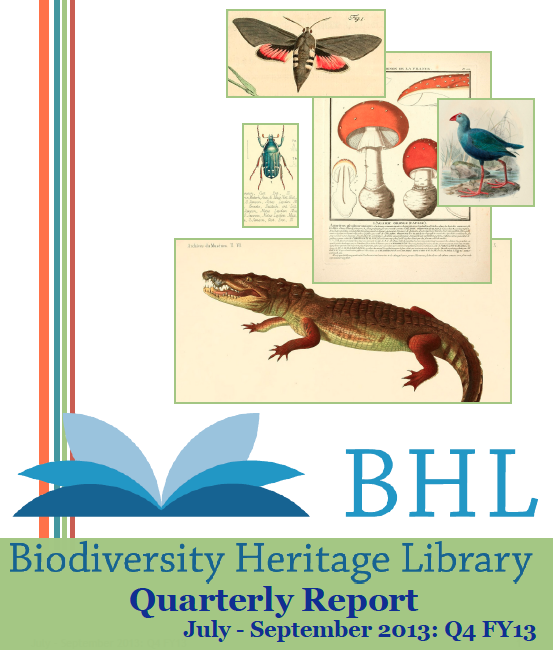
BHL Quarterly Report, Q4 FY13

If you’re reading this blog, you probably already know that BHL provides free and open access to millions of pages of biodiversity literature.  But did you also know that BHL is working to change the nature of biodiversity research through digitization?

In addition to the over 2 million pages scanned by BHL participating libraries in the past twelve months, BHL also co-launched the NESCent-EOL-BHL research sprint which will support research projects seeking answers to important biodiversity and ecological questions through mining BHL and EOL; received an IMLS National Leadership Grant for enhancing full text searching and indexing in BHL through purposeful gaming; organized a social media campaign around unsung biodiversity hero Alfred Russel Wallace; and hosted five interns to build social media, marketing, and reference skills in the next generation of librarians.

Learn all about these developments, and see how our project is performing in the latest BHL Quarterly Report and Newsletter!  Stay up to date in the future by subscribing to our quarterly newsletters.

We know you’ll be impressed at the ways we’re inspiring discovery through free access to biodiversity knowledge!

View Full Size Image
BHL Fall 2013 Newsletter
December 3, 2013by sayeedmd
Blog Reel, User Stories

The Plants of Acadia National Park

As part of our regular BHL and Our Users series, we’re pleased to introduce Dr. Karen James, staff scientist at Mount Desert Island Biological Laboratory (MDIBL).

Karen holds a PhD in genetics and has worked in her field for 11 years since receiving her degree.  About seven years ago, her interests began shifting towards biodiversity and citizen science applications and she has graciously agreed to answer some questions about how BHL has impacted that work.

BHL and Our Users: Dr. Karen James

View Full Size Image
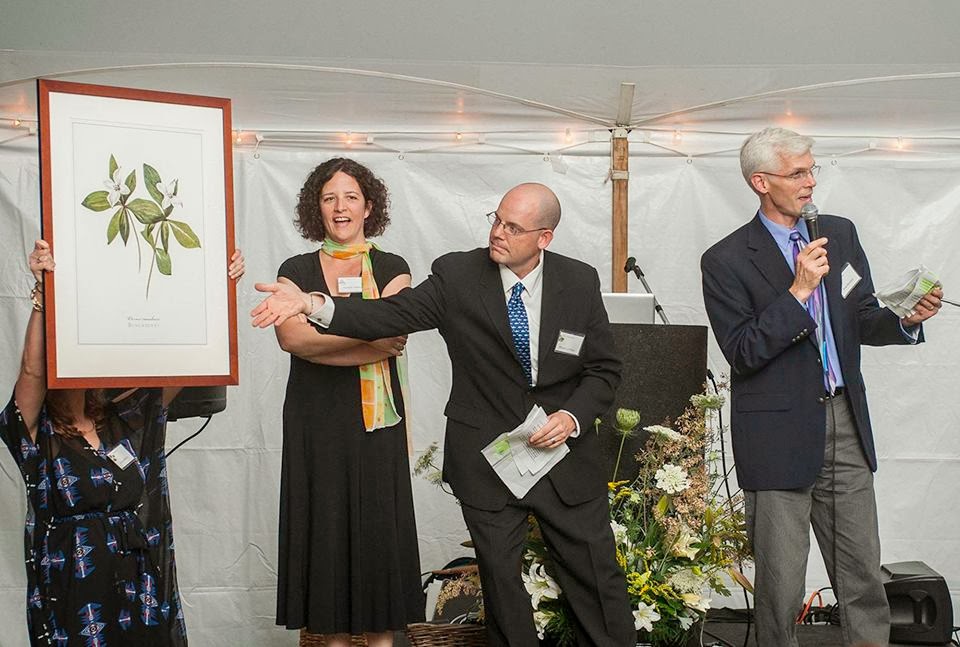
Live auction in support of an extension of the BioTrails project to include 
the plants of Acadia National Park. Karen James is second from the left. 
Photo by Michael York for MDIBL.

When did you first discover BHL?

I was a postdoc at the Natural History Museum in London from 2003-2010. The museum was one of the founding members, so I have known about it from the very beginning. I started using it more regularly in 2009, in relation to my interest in Charles Darwin.  At the time, I was the science coordinator for the NHM’s Darwin200 campaign, and I’ve found countless uses for it since then.

What is your opinion of BHL and how has it impacted your research?

View Full Size Image
Twinflower (Linnaea borealis) by Mary Vaux
Walcott. 1925. North American Wild Flowers.
Washington, D.C., 1925. (Photographed by
Michael York for MDIBL at Thuya Garden library.)  

The BHL provides a much-needed service – free access to a wide range of natural history publications including artwork. As I mentioned, I’ve used it in a number of different contexts to support and inform my work. One of these was a fundraising campaign is to support an extension of my NSF-funded project called BioTrails. BioTrails combines DNA-based species identification (‘DNA barcoding’) with citizen science in Acadia National Park. The project uses DNA barcoding to validate identifications of invertebrate animals collected by citizen scientists in support of research on the impacts of environmental change. I’d like expand the project to the plants of Acadia National Park, and have been exploring some nontraditional funding avenues for this including private donations and crowdfunding.

I needed some visually compelling images – ideally in the public domain – of some of Acadia’s plants to illustrate our fundraising materials. A colleague of mine at MDIBL discovered a wonderful five-volume book of botanical plates – North American Wild Flowers by Mary Vaux Walcott  – at a local botanical garden. There were a number of Acadia species in the book, and we hired a professional photographer to capture digital images of some of them, but I wanted more. I scoured BHL for high-resolution scans of illustrations not only by Walcott but also by others (Walcott didn’t paint every species I wanted to include). In the end, I had sourced beautiful, high-resolution, public-domain botanical illustrations of 25 of Acadia’s most iconic plant species. We had the white-balance adjusted so they all matched, and we added both common and scientific names to each. We held a live auction at MDIBL’s annual gala to support the project; each high-bidder received a large, framed print of one of the illustrations, and everyone went home with a package of notecards. We’ll be able to re-use these resources for the crowdfunding campaign I’m hoping to launch in the next few weeks, just in time for the holidays.

How often do you use BHL?

Twice a month, but occasionally much more intensively if I’m researching something.

View Full Size Image
Bracken fern (Pteridium aquilinum) by J. H.
Emerton and C. E. Faxon, C. E. in D. C. Eaton.
1879. The Ferns of North America. Salem. 1879.
(Photographed by Michael York for MDIBL at
Thuya Garden library.) 

How do you usually use BHL?

For research I usually just read online, but when I want high-resolution images I select pages to download.

What are your favorite features/services on BHL?

Being able to search by taxonomic name is HUGE. I wouldn’t have been able to find the images for my project without this.

If you could change one thing about BHL, what would it be, or what developmental aspect would you like the BHL team to focus on next?

I’d like to be able to quickly and easily search for text in the volume I’m browsing.


If you had to choose one title/item in BHL that has most impacted your research, or one item that you prefer above any other in BHL, what would it be and why?

I already mentioned North American Wild Flowers by Mary Vaux Walcott.   Another important one for me has been The British Flora by William J. Hooker (4th edition); I used it extensively researching a book chapter I’m writing on repeating Charles Darwin’s 1855 survey of the plants in a meadow near his home.


November 15, 2013by sayeedmd
Page 3 of 4«1234»

Help Support BHL

BHL's existence depends on the financial support of its patrons. Help us keep this free resource alive!

search

About BHL

The Biodiversity Heritage Library (BHL) is the world’s largest open access digital library for biodiversity literature and archives. BHL operates as a worldwide consortium of natural history, botanical, research, and national libraries working together to digitize the natural history literature held in their collections and make it freely available for open access as part of a global “biodiversity community.”

Follow BHL

  • Bluesky logo
  • Instagram logo
  • Facebook logo
  • Flickr logo
  • Twitter logo

Join Our Mailing List

Sign up to receive the latest news, content highlights, and promotions.

Subscribe Now

Subscribe to Blog via Email

Enter your email address to subscribe to this blog and receive notifications of new posts by email.

Join 319 other subscribers

Subscribe to Blog Via RSS

Subscribe to the blog RSS feed to stay up-to-date on all the latest BHL posts.

Access RSS Feed


64+ Million Pages of
Biodiversity Literature Online.

EXPLORE

Tools and Services
to Transform Research.

EXPLORE

300,000+
Illustrations on Flickr.

EXPLORE

ABOUT | HARMFUL CONTENT | PRIVACY | SITE MAP | TERMS OF USE