Biodiversity Heritage Library - Program news and collection highlights from BHL
  • Home
  • News
  • Featured Books
    • All Featured Books
    • Book of the Month Series
    • BHL at 20
  • User Stories
  • Campaigns
    • Fossil Stories
    • Garden Stories
    • Monsters Are Real
    • Page Frights
    • Her Natural History
    • Earth Optimism 2020
  • Tech Blog
  • Visit BHL
Home
News
Featured Books
    All Featured Books
    Book of the Month Series
    BHL at 20
User Stories
Campaigns
    Fossil Stories
    Garden Stories
    Monsters Are Real
    Page Frights
    Her Natural History
    Earth Optimism 2020
Tech Blog
Visit BHL
  • Home
  • News
  • Featured Books
    • All Featured Books
    • Book of the Month Series
    • BHL at 20
  • User Stories
  • Campaigns
    • Fossil Stories
    • Garden Stories
    • Monsters Are Real
    • Page Frights
    • Her Natural History
    • Earth Optimism 2020
  • Tech Blog
  • Visit BHL
Biodiversity Heritage Library - Program news and collection highlights from BHL
Blog Reel, User Stories

BHL Facilitates Research on Alfred Russel Wallace’s Legacy

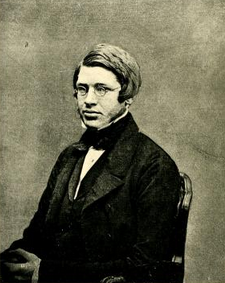
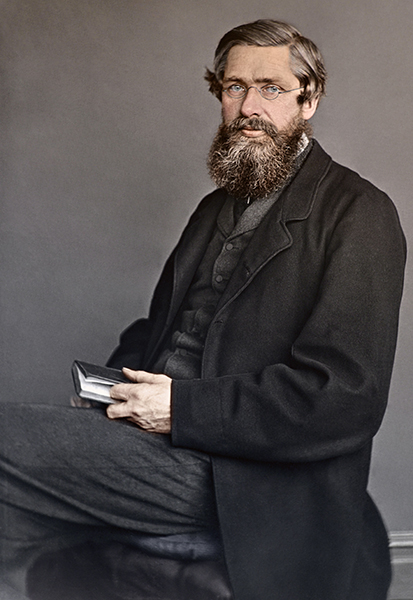
Alfred Russel Wallace in 1869. Copyright George Beccaloni.

In 1854, Alfred Russel Wallace began an eight year collecting trip to Southeast Asia, through the region he called the Malay Archipelago (now Malaysia, Singapore, Indonesia, and East Timor). It was during this expedition, in the midst of a fever in 1858, that Wallace conceived (independently of Darwin) of the theory of natural selection. Wallace expanded his idea into a detailed article which he sent to Charles Darwin for comment, unaware that Darwin himself had come to the same conclusion, though he had yet to publish the theory.

At the suggestion of Darwin’s friends Charles Lyell and Joseph Hooker, Wallace’s article, together with unpublished writings by Darwin on the subject of natural selection and evolution, were presented to the Linnean Society in 1858 and subsequently published in the Society’s journal as “On the Tendency of Species to Form Varieties; and On the Perpetuation of Varieties and Species by Natural Means of Selection,” with Darwin and Wallace as co-authors.

While important for its link to the theory of evolution by means of natural selection, Wallace’s Malay Archipelago expedition was also scientifically significant from a collecting standpoint.

Beccaloni (center) with the Patrons of his Wallace projects. Sir David Attenborough (left), Patron of the Wallace Correspondence Project, and Bill Bailey (right), Patron of the Wallace Memorial Fund. Photographed at London’s Natural History Museum in 2012. Copyright Jan Beccaloni.

Dr. George Beccaloni, Director of the Alfred Russel Wallace Correspondence Project (an open access archive of Wallace’s manuscripts), is working to catalog the animal species collected by him during his expedition. Not surprisingly, given the sheer number of specimens and the passage of time, this is a challenging endeavor.

“We know Wallace collected nearly 126,000 specimens: about 110,000 insects, 7,500 shells, 8,050 bird skins, and 410 mammals and reptiles, which ranged from Orangutans to Birds of Paradise, from land snails to cockroaches, from Birdwing butterflies to tiny parasitic wasps,” shares Beccaloni. “I have estimated that about 5,000 of them were new to science, but apart from the 295 species he described himself, there is no list of all the others – or the many species he collected which already had scientific names.”

Scientific literature is a valuable source of information on Wallace’s specimens, but locating the relevant publications is itself a challenge.

“I am collaborating with colleagues in Southeast Asia and at London’s Natural History Museum to produce a detailed list of the species Wallace collected,” explains Beccaloni. “It is a difficult task because the information about them is scattered through the scientific literature of the last 163 years, in an estimated 400 or more publications. To find these requires considerable detective work.”

Fortunately, the Biodiversity Heritage Library is making it considerably easier for Beccaloni to access the publications he needs for this research.

“BHL is an absolutely fantastic resource which is very important to my work,” affirms Beccaloni. “Locating mentions of Wallace specimens is tricky, but at least most of the articles are now available in the BHL. If they weren’t, it would mean going to a specialist library and searching through the physical publications, which would take a lot more effort and be logistically difficult.”

Once a catalog of Wallace’s specimens is completed, it can be used to help track down the physical specimens in London’s Natural History Museum and other museum collections, leading to increased global access to Wallace’s specimens through digitization.

“The specimens can be digitized and the images and data made freely available on the Internet,” says Beccaloni. “Colleagues in Southeast Asia view this as ‘digital repatriation’ of the material Wallace collected in their countries.”

In addition to his work related to Alfred Russel Wallace (including the Alfred Russel Wallace Correspondence Project, Wallace Letters Online and The Wallace Website), Beccaloni is also a specialist in the taxonomy and ecology of butterflies and orthopteroid insects (especially cockroaches). He is the founder and author of the Cockroach Species File, a world catalog of cockroaches. Again, BHL provides access to key resources.

“For my work on the Cockroach Species File, I often need copies of old and often obscure taxonomic papers, which fortunately I am usually able to find in the BHL,” says Beccaloni.

Homepage of the Cockroach Species File.

Beccaloni’s favorite BHL feature is the ability to generate custom PDFs of relevant pages, eliminating the need to download an entire journal volume. To further improve the efficiency of his research, Beccaloni notes that the ability to search the full text of BHL’s collections for specific search terms (e.g. “Wallace”) would be of considerable value.

Full text search is a feature that BHL’s users have long-requested, and we are happy to confirm that its development is currently underway! Through increased research efficiency, full text search will enhance BHL’s ability to inspire discovery through free access to biodiversity knowledge. Stay tuned for more information on this new service.

Alfred Russel Wallace was truly a pioneer who left behind a considerable scientific legacy. Thanks to the work of Dr. Beccaloni and others on the Wallace projects, this legacy is being documented and made more accessible to a worldwide audience. We are proud to know that BHL’s collections are playing an important part in this valuable work.

Explore the Alfred Russel Wallace projects below:

  • Alfred Russel Wallace Correspondence Project
  • Wallace Letters Online
  • The Wallace Website

______________________________________

This post may contain the personal opinions of BHL users or affiliated staff and does not necessarily represent the official Biodiversity Heritage Library (BHL) position on these matters.

November 9, 2017by michelle.underhill
Blog Reel, User Stories

Rejuvenating Centuries’ Old Botany with Phytogeography

Here’s a word of the day for you: Phytogeography.

Phytogeography is a branch of biogeography that investigates the geographic distribution of plants and the effect that the earth’s surface has on that distribution. To go further down the rabbit hole, biogeography studies the distribution of species and organisms now and throughout time. This research reveals important interdependencies between geology, climate, dispersal and evolution.

View Full Size Image
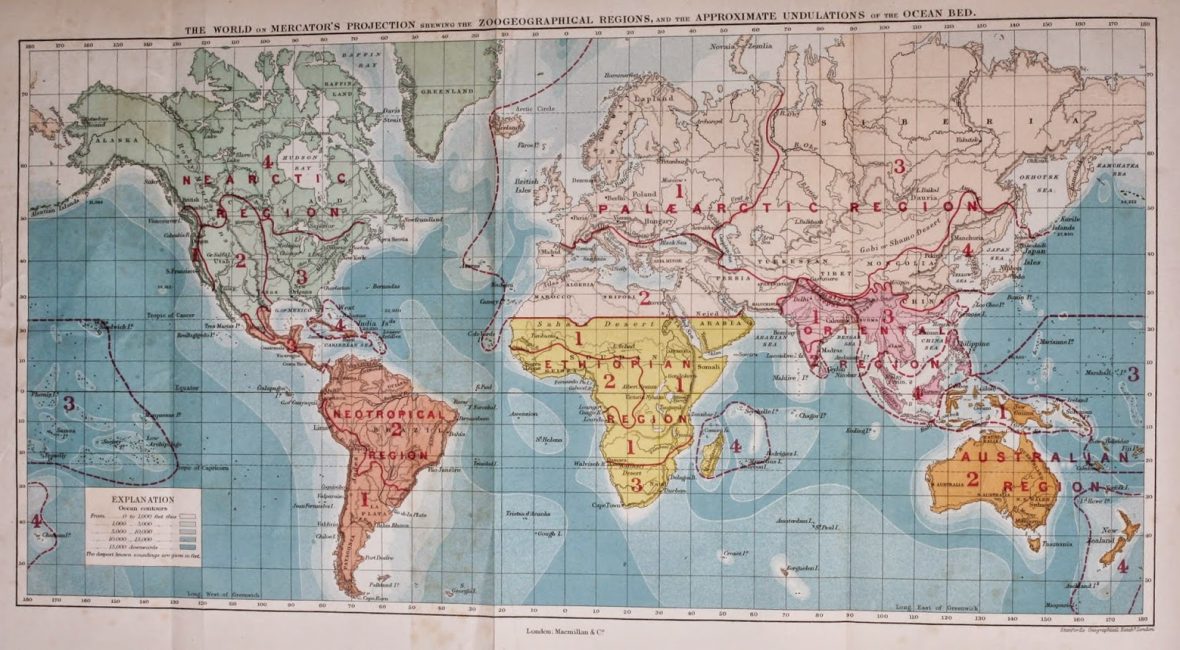
Wallace’s map, showing the zoogeographical regions of the world. The Geographical Distribution of Animals. v.1 (1876). http://biodiversitylibrary.org/page/30228507.

Alfred Russel Wallace is commonly known as the “Father of Biogeography.” Although not as famously recognized as Charles Darwin, Wallace actually came up with the theory of evolution by means of natural selection independent of and simultaneous to Darwin. Wallace spent a great part of his career in South America and the Malay Archipelago. During this time, his observations on distribution, breeding, and migration tendencies helped him develop a theory of evolution incorporating the influence of geological barriers on speciation. He also argued that species abundance was directly related to food availability.

Today, biogeographers are largely interested in how environmental factors and human activities influence species distribution. Biogeographic change and insight offered by historical data are a long-time passion of Dr. Quentin Groom, research assistant at the Botanic Garden Meise, Belgium. His particular interest is phytogeography, especially as it relates to the interaction between humans and plants.

View Full Size Image
Dr. Quentin Groom, research assistant at the Botanic Garden Meise, Belgium.

Groom’s interest in phytogeography began ten years ago, but more recently, his discovery of BHL expanded his research possibilities. “[BHL] is a fantastic resource, making research possible that would never have been considered in the past. I use it to find information on particular species and also to find source documents for further analysis. The ability to search by taxon name is invaluable, but having stable URLs for each page is [also] a great feature.”

The ability to access this digitized literature is only part of the greater picture of facilitating efficient science and discovery. Intuitive search capabilities and the opportunity to augment existing files are other features Groom would like to see within BHL and the larger bioinformatics community.

“I feel [BHL] is just one step in the full digitization and semantic annotation of biodiversity literature. I’d like to be able to add annotations [to BHL]. [The ability to] search by location name and taxon name would be useful, even if the location names were only countries. It might [also] be useful to have the ability to add internal links within BHL to connect citations within one document to their source in BHL,” mused Dr. Groom.

The Mining Biodiversity project, funded by an IMLS Digging Into Data grant, is currently working to address some of these requests. The project aims to create a next-generation digital library by enriching BHL with semantic metadata through deployment of advanced text-mining techniques. This data will be used to support a semantic search system enhanced with clustering and visualization tools. The idea is that a user will be able to search not only for species, but also filter the results for references to habitat, diet, predation, and related facets. The result will be fully interlinked and indexed access to the full content of BHL library documents, allowing users to locate precisely the information of interest to them in an easy and efficient manner.

Furthermore, the project is exploring ways to make BHL more “social”, allowing for collaborative curation where users can easily share and discuss our collections. This will not only facilitate expanded reuse and discovery of our material, but will also allow us to evaluate how our content is being used around the globe and by whom, and better measure its impact on biodiversity awareness.

The Mining Biodiversity project runs through December, 2015. As we continue to improve our collections and services, you can explore our collection of over 44.8 million pages of biodiversity literature spanning over 500 years of research and discovery.

View Full Size Image
Red Deadnettle (Lamium purpureum) from one of Dr. Groom’s favorite BHL books, Flora Londinensis, v. 1 (1777). http://biodiversitylibrary.org/page/40966493.

Amongst all that content, what would a phytogeographer choose as his favorite items in the collection? “Linnaeus’ Species Plantarum is an inspiring work. Flora Londinensis by William Curtis makes common weeds special with its illustrations. I also have a soft spot for literature from Northumberland where I used to live,” mused Quentin.

Indeed, Dr. Groom recently republished the Flora of Northumberland and Durham (Winch 1831) as an online, semantically enhanced Pensoft “Advanced Book” using the scan originally taken from BHL. The Flora provides valuable insight into how biodiversity in North-east England has changed over time.

“Historic biodiversity literature is not just of cultural interest, it can be used to chart biogeographic change and help us understand the impacts of environmental change on biodiversity,” explains Quentin in an EU BON review of his republication. “Even if we are trying to predict future scenarios for biodiversity, understanding the changes of the past will help understand the changes we should expect in the future.”

Dr. Groom recently submitted another paper using data gathered from BHL, entitled “Piecing together the biogeographic history of Chenopodium vulvaria L. using botanical literature and collections”. The paper charts the distribution of Chenopodium vulvaria over more than 200 years and uses old literature to understand how its habitat may have changed. All of the observations extracted from the literature were georeferenced and are available on GBIF. You can view a preprint of the paper in PeerJ.

The digitization of historic literature, and its enhancement using semantic and linked data, is revolutionizing scientific research, connecting scientists to relevant information more efficiently than ever before. Through continued dedication to open access, BHL and like-minded projects will continue to inspire discovery through free access to biodiversity knowledge.

We extend a special thanks to Quentin for not only describing how BHL is currently impacting his work, but also for revealing important ways that we can improve our library. Do you have ideas about how you would like to see BHL improve? Would you like to tell us about how BHL has impacted your own research? Then send us some feedback!

November 13, 2014by ulib-libraryjobs
Blog Reel, Featured Books

Visitors from Paradise: The Paradiseidae

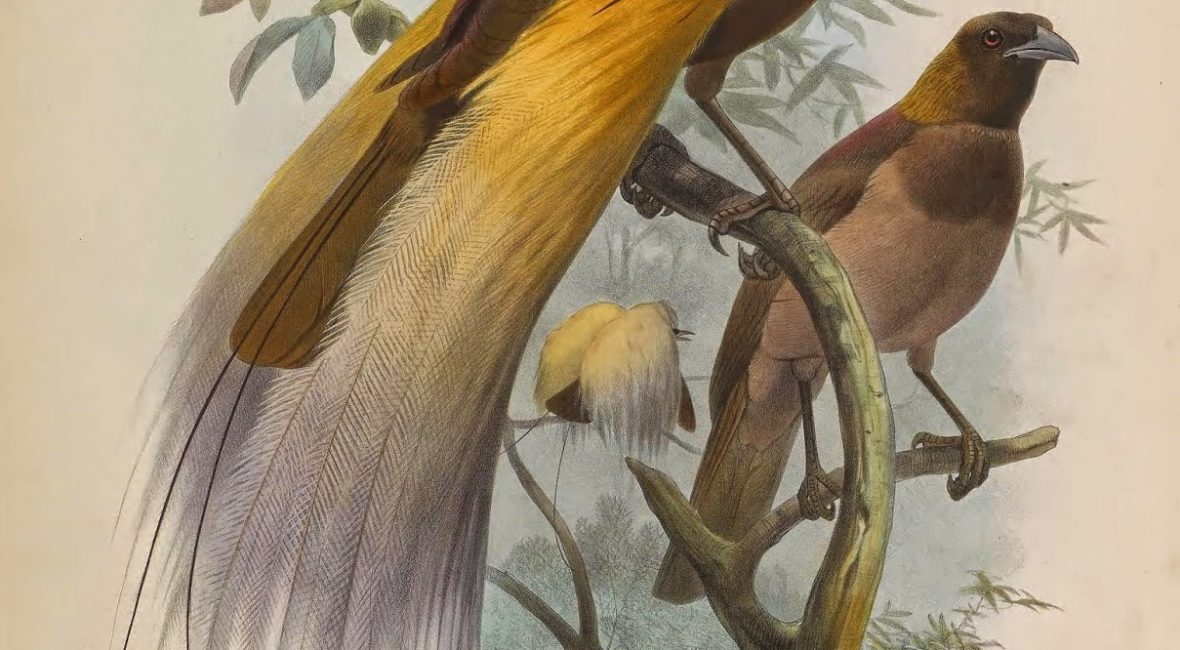
Deep within the rainforest canopy of the Aru Islands, just west of New Guinea, two male Greater Birds-of-Paradise dance among the branches in carefully coordinated steps, their magnificent yellow, white, and maroon plumage undulating gracefully to the rhythm of their own unique song.

Carl Linnaeus named this species Paradisaea apoda, meaning “legless bird-of-paradise.” The misnomer was based on early trade-skins prepared and shipped to Europe without feet, feeding a notion that these “visitors from paradise” glided endlessly through the air, remaining aloft until death.

Naturalist and explorer Alfred Russel Wallace (who simultaneous to Darwin developed the concept of evolution by means of natural selection), spent extensive time in the Aru Islands during the mid-1800s, collecting and describing many species, including P. apoda. Upon receiving a specimen, Wallace declared the bird “the most perfectly lovely of the many lovely productions of nature,” but lamented that, should “civilized man” ever reach these “virgin forests,” he would surely disturb nature’s balance and cause the creature’s extinction.

View Full Size Image
Paradisaea apoda. Elliot, Giraud Daniel. A Monograph of the Paradiseidae.
http://biodiversitylibrary.org/page/44792765

Daniel Giraud Elliot, one of the most important American ornithologists and naturalists of the nineteenth century, was enthralled with Wallace’s work, and his descriptions of birds of paradise. While Wallace was not the first western naturalist to see Birds-of-Paradise in the wild (a distinction held by René Primevère Lesson during the 1822-25 circumnavigation voyage of the French La Coquille), his accounts are poetic and highly detailed. They provided inspiration for one of Elliot’s crown-jewels, A Monograph of the Paradiseidae.

View Full Size Image
Epimachus ellioti (named after Elliot). Elliot, Giraud Daniel. A Monograph of the Paradiseidae.
http://biodiversitylibrary.org/page/44792854

Born in 1835, Elliot achieved many prestigious accomplishments over his lifetime. In 1869, he became one of the scientific founders of the American Museum of Natural History (for which his personal collection of North American birds comprised some of the museum’s first accessioned specimens). In 1894, Elliot became the curator of the Department of Zoology for the Field Museum of Natural History. He also traveled extensively, often for years at a time, and published hundreds of papers and multiple monographs relating his findings and experiences. These considerable accomplishments are even more impressive considering Elliot’s limited formal education.

While Elliot produced many works on mammals, his true passion was birds. He became famous for his monographs on bird families, which summarized previous taxonomic information about the species included, while also providing new observations and analysis based on his travels and museum specimens. He used his own wealth and formidable connections with elite European contacts to finance these publications.

View Full Size Image
Cicinnurus regius. Elliot, Giraud Daniel. A Monograph of the Paradiseidae.
http://biodiversitylibrary.org/page/44792836

A Monograph of the Paradiseidae, published in London in 1873, is a large folio with 37 lithographs (36 of which are hand-colored) detailing typical Bird-of-Paradise species from the Paradiseae family, as well as members of the Epimachinae (now Epimachus genus) and Tectonarchinae (now Ptilonorhynchidae) families. His fourth illustrated monograph, Elliot chose the Birds-of-Paradise as his subject in order to finally present a “correct idea” of the birds’ appearance. At the time of his writing, quality specimens were finally making their way to Europe, replacing the “mutilated” skins that naturalists has previously relied upon. Elliot also acknowledges the contributions of Prof. Schlegel from the Museum at Leyden, John Gould, and M.J.P. Verreaux, all of whom allowed him to examine their own specimens to inform his publication.

The original watercolor paintings on which Paradiseidae’s lithographs are based were created by German artist Joseph Wolf, who also executed work for David Livingstone, Henry Walter Bates, John Gould (think the incredible Birds of Asia masterpiece), and Wallace himself. Of Wolf, Elliot wrote, “The drawings of Mr. Wolf will, I am sure, receive the admiration of those who see them; for, like all that artist’s productions, they cannot be surpassed, if equalled, at the present time.” The lithography for the work was performed by Joseph Smit, with coloration undertaken by John Douglas White.

View Full Size Image
Cicinnurus respublica. Elliot, Giraud Daniel. A Monograph of the Paradiseidae.
http://biodiversitylibrary.org/page/44792828

Elliot’s regard for Wallace cannot be mistaken. For the book’s dedication, he writes, “To Alfred Russel Wallace, whose fame as a traveler is only eclipsed by that which he has gained as a naturalist; and to whom we are indebted for nearly all our authentic information regarding the habits of the many species of the Birds of Paradise.”

Elliot’s A Monograph of the Paradiseidae is one of the “most admired bird books ever produced.” As a commodity, it is also very valuable, fetching a hefty $45,924 USD price tag at a 2007 Christie’s auction. Thanks to the Smithsonian Libraries, however, you can view and download this book for free in BHL.

The digitized Smithsonian copy comes from the Joseph F. Cullman 3rd Library of Natural History, which holds the Smithsonian’s collection of over 10,000 rare books in anthropology and the natural sciences. The full collection of illustrations can also be found in the BHL Flickr.

View Full Size Image
Paradisaea raggiana. Elliot, Giraud Daniel. A Monograph of the Paradiseidae.
http://biodiversitylibrary.org/page/44792727

Today, there are 41 recognized species of birds of paradise. They are all found almost exclusively in New Guinea and its satellites, with a few exceptions in the Maluku Islands and eastern Australia. Fortunately, Wallace’s prophecy has not come true. The Greater Bird of Paradise is common throughout its range, evaluated as a species of “least concern” by the IUCN. Currently, only 3 of the 41 recognized species are listed as “threatened”: Wahnes’s Parotia, the Blue Bird of Paradise, and the Black Sicklebill. Several are “near-threatened,” however, and hunting and habitat loss continues to be a concern.

As you enjoy the spectacular Paradiseidae illustrations, remember that awareness is a key component in conservation. We can all play a part in mitigating factors that contribute to species loss. And a tax-deductible gift to BHL can help us continue to provide scientists with the information they need to identify and protect our biodiversity. Let’s ensure that these beautiful birds are here for generations to come!

View Full Size Image
Seleucidis melanoleucus. Elliot, Giraud Daniel. A Monograph of the Paradiseidae.
http://biodiversitylibrary.org/page/44792862


September 25, 2014by michelle.underhill
Blog Reel, Featured Books

Book of the Week: Wallace’s Second Place Finish

History never looks too kindly on second place. Neil Armstrong rolls off the tongue as the first man to walk on the moon, but most people hesitate at Buzz Aldrin. Mack Robinson came from a famously athletic family–older brother to Jackie Robinson–and broke the 200-meter world record in the 1936 Olympics. Of course his name is merely the answer to an obscure trivia question as he didn’t win the gold, second only to Jesse Owens. Charles Darwin is so closely associated with evolution and natural selection that his name literally serves as a synonym for the theory. And yet, if only for a slight flap of a butterfly’s wing, we might refer to the transmutation of species as Wallacinian and Alfred Russel Wallace would have gone down in history as the founder of evolution.

View Full Size Image
Alfred Russel Wallace,
doesn’t think Wallacinian
sounds that bad

Instead, Wallace is remembered today–if remembered at all–as the man second place to Darwin. But here at the BHL, we recognize Wallace as the naturalist, explorer, geographer, anthropologist, biologist, environmentalist and human rights advocate that he was. The man who, independently of Darwin, arrived to the same conclusion on the origin of species. To honor this somewhat neglected legacy on the 100th anniversary of his death, the BHL has dedicated this week, and this week’s book of the week post, to highlighting our collection of Wallace writings, discoveries and contributions to our understanding of the natural world. To give Wallace the defining word on his role in history, we turn to the description of his life penned by Wallace himself, My life: a record of events and opinions.

In this autobiographical work, Wallace traces his heritage, details his troubled childhood, recounts his early adventures and subsequent publications, and chronicles his transition to advocate and spiritualist–all through correspondence and recollections in his own words. Born to a large family of limited means in Hertfordshire, England, Wallace did not receive much formal education as his family couldn’t afford the demands of tuition. Instead, he was sent to live with his brother and apprentice as a railway surveyor, which–during the railroad boom of the 1830s–was a decent career.

However, young Wallace was not satisfied merely earning a living. He became fascinated by natural history, and through his self-education crossed paths with Henry Walter Bates. Bates was at 19 a published beetle expert and interested in adventure. The two resourceful young men decided to organize an expedition to the Amazon, selling specimens to make ends meet.

The trip did not go well for Wallace. Almost immediately Wallace and Bates separated, and Wallace headed east on the Rio Negro. Wallace relied entirely on native populations for guides, but locals were scarce and escorts rare, “this combined to render my numerous journeys in this almost totally unknown region comparatively unproductive in birds and insects.”

View Full Size Image
An illustration of the Rio Negro from Wallace’s
“A narrative of travels on the Amazon and Rio Negro”

Wallace spent four years in the Amazon, and while his luck in finding “miscellaneous collections” increased, luck in other areas did not. Wallace’s health suffered by a “succession of fevers and dysentery.” His younger brother, Herbert, joined him to help, and within five months, Herbert contracted yellow fever, dying within a few days. Wallace decided to return to England and recounted what happened on the voyage home:

On Friday…about nine in the morning, just after breakfast, Captain Turner, who was half-owner of the vessel, came into the cabin, and said, ‘I’m afraid the ship’s on fire. Come and see what you think of it.’…All hands were at once ordered into the boats…We lay near the ship all afternoon, watching the progress of the flames…[The boat] now presented a magnificent and awful sight as it rolled over, looking like a huge caldron of fire, the whole cargo of rubber, etc., forming a liquid burning mass at the bottom…we bade adieu to the Helen, now burnt down to the water’s edge…My collections, however, were in the hold, and were irretrievably lost. And now I began to think that almost all the reward of my four years of privation and danger was lost.

Wallace and the crew spent 10 days at sea before being rescued by a boat that itself barely made it back to shore.

Even without his collection of specimens that took four years to collect, Wallace published an account of his Amazon travels 18 months later, to little fanfare and much criticism. Undefeated, Wallace once again ventured into the field, this time to Southeast Asia for eight years. The result was an 1855 paper titled, “On the Law Which Has Regulated the Introduction of New Species,” outlining an introductory description of the theory of evolution. Much like his previous work, the article was a flop.

Three years later, Wallace found himself on an island in the Moluccas. Once again, he was destitute and attempting to make ends meet by selling his specimens. During his travels he contracted malaria, and in a feverish state, made a connection that lead to a manuscript detailing the principle of natural selection. Wallace had previously sent all his works directly to publishers. This time, he wanted a peer to review it first and sent it to someone he considered a mentor after beginning a correspondence following his last publication. That is, he sent it to Charles Darwin.

View Full Size Image
Wallace’s map of the Galapagos Islands
from his work, “Island Life”

Now imagine for a moment you are Darwin. Having worked on a theory for the last 20 years, Darwin had yet to publish anything. He receives this 20-page manuscript from a young acquaintance detailing his life’s work. “All my originality,” he wrote to his friend, geologist Charles Lyell, “will be smashed.” He considered publishing a summary of his own writing but continued, “I would far rather burn my whole book than that [Wallace] or any man should think that I had behaved in a paltry spirit.”

Instead, Darwin, Lyell and the botanist Joseph Hooker hastily arranged a reading of both Darwin and Wallace’s works before the Linnean Society on July 1, 1858. A year later, On the Origin of Species was published and the rest is history.

View Full Size Image
Illustration from
“The Malay Archipelago”
View Full Size Image
Another illustration from
“The Malay Archipelago”
View Full Size Image
Wallace’s Bird of Paradise
from “The Malaysia and
Pacific Archipelagoes”

For Wallace’s part, he was never bitter about the lack of recognition. He embraced Darwin’s success almost as his own, writing, “Some…declare that I am more Darwinian than Darwin himself…and they are not far wrong.” Wallace became a part of the scientific elite and took pride in that fact:

I think, therefore, that I may have the satisfaction of knowing that by writing my article and sending it to Darwin, I was the unconscious means of leading him to concentrate himself on the task of drawing up what he termed ‘an abstract’ of the great work he had in preparation, but which was really a large and carefully written volume–the celebrated ‘Origin of Species.’

Darwin dedicated the rest of his life expounding and building upon “Origin.” Wallace went on to publish some 22 full-length books and almost 800 articles, only some focusing on his scientific achievements. He branched out to write on subjects varying from his embrace of spiritualism to land nationalization to dangerous working conditions for the urban poor. He advocated for the education of women “so that they are rendered independent of marriage as a means of gaining a home and a living,” and is considered one of the first scientists to raise concerns over the impact humans have on the environment.

Wallace is not the prominent figure that Darwin is, and his name is not representative of the theory that he described and advanced. But he was satisfied with the contributions he made to the field and didn’t define his life by the recognition that he could have received had he published first. And who says there’s no room in history for second place?

If you’re interested in Wallace’s compelling life story, learn more about his works as the BHL celebrates Wallace all this week. Check out some of his writings in our Wallace iTunes U collection or our previous book of the week post on Wallace’s The Malay Archipelago.

Want to learn more about the life and work of Alfred Russel Wallace? See this fantastic website containing biographical information, FAQ’s, links to his letters and the Wallace100 campaign sponsored by our partners The Natural History Museum, London.

References:

  • Conniff, R. (2008, June). On the Origin of a Theory. The Smithsonian Magazine. Retrieved from http://www.smithsonianmag.com/science-nature/presence-darwin.html
  • Garrity, L. (2009, Jan 22). Out of Darwin’s Shadow. Smithsonian.com. Retrieved from http://www.smithsonianmag.com/science-nature/Out-of-Darwins-Shadow.html
November 7, 2013by LANL_RL

Help Support BHL

BHL's existence depends on the financial support of its patrons. Help us keep this free resource alive!

search

About BHL

The Biodiversity Heritage Library (BHL) is the world’s largest open access digital library for biodiversity literature and archives. BHL operates as a worldwide consortium of natural history, botanical, research, and national libraries working together to digitize the natural history literature held in their collections and make it freely available for open access as part of a global “biodiversity community.”

Join Our Mailing List

Sign up to receive the latest news, content highlights, and promotions.

Subscribe Now

Subscribe to Blog via Email

Enter your email address to subscribe to this blog and receive notifications of new posts by email.

Join 319 other subscribers

Subscribe to Blog Via RSS

Subscribe to the blog RSS feed to stay up-to-date on all the latest BHL posts.

Access RSS Feed

Inspiring Discovery through Free Access to Biodiversity Knowledge.

The Biodiversity Heritage Library makes it easier than ever for you to access the information you need to study and explore life on Earth…for free, anytime, anywhere.


64+ Million Pages of
Biodiversity Literature Online.

EXPLORE

Tools and Services
to Transform Research.

EXPLORE

300,000+
Illustrations on Flickr.

EXPLORE

ABOUT | HARMFUL CONTENT | PRIVACY | SITE MAP | TERMS OF USE