Biodiversity Heritage Library - Program news and collection highlights from BHL
  • Home
  • News
  • Featured Books
    • All Featured Books
    • Book of the Month Series
    • BHL at 20
  • User Stories
  • Campaigns
    • Fossil Stories
    • Garden Stories
    • Monsters Are Real
    • Page Frights
    • Her Natural History
    • Earth Optimism 2020
  • Tech Blog
  • Visit BHL
Home
News
Featured Books
    All Featured Books
    Book of the Month Series
    BHL at 20
User Stories
Campaigns
    Fossil Stories
    Garden Stories
    Monsters Are Real
    Page Frights
    Her Natural History
    Earth Optimism 2020
Tech Blog
Visit BHL
  • Home
  • News
  • Featured Books
    • All Featured Books
    • Book of the Month Series
    • BHL at 20
  • User Stories
  • Campaigns
    • Fossil Stories
    • Garden Stories
    • Monsters Are Real
    • Page Frights
    • Her Natural History
    • Earth Optimism 2020
  • Tech Blog
  • Visit BHL
Biodiversity Heritage Library - Program news and collection highlights from BHL
Blog Reel, User Stories

Examining the History of Paleoanthropology Using BHL

In the middle of the nineteenth century, the scientific community was engrossed in discussions about evolution and the origin of species. The publication of Darwin’s On the Origin of Species in 1859 fueled extensive scientific debate and prompted further questions regarding human evolution. A key figure in these debates was Thomas Henry Huxley, an English biologist and comparative anatomist.

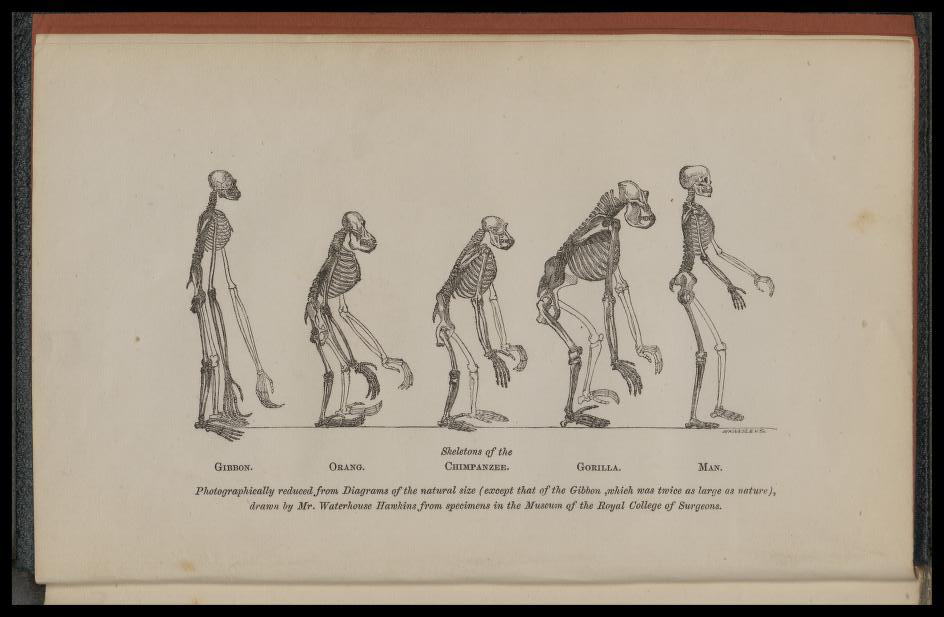
Frontispiece. Huxley, Thomas Henry. Evidence as to Man’s Place in Nature. 1863. Digitized by Cambridge University Library as part of Charles Darwin’s Library. http://s.si.edu/2inaol1.

A close friend of Charles Darwin and a staunch public supporter of the theory of natural selection, Huxley used his expertise in embryology, paleontology and comparative anatomy to demonstrate an evolutionary relationship between humans and apes. In a series of public lectures between 1860-62, he presented research on anatomical similarities between humans and apes and discussed hominin fossil discoveries, including a skullcap from the first recognized Neanderthal Man which was unearthed in Germany in 1856.

These oral discourses were collected into a single volume and published in 1863 as Evidence as to Man’s Place in Nature.

Huxley, Thomas Henry. Evidence as to Man’s Place in Nature. 1863. Digitized by Cambridge University Library as part of Charles Darwin’s Library. Page 139. http://s.si.edu/2B12Tvx.


Paige Madison, a PhD candidate studying the history of paleoanthropology at Arizona State University, identifies this publication as a vital reference for her doctoral research.

Paige Madison, PhD candidate at Arizona State University. Photo Credit: Alex Reynes.

“This was one of the pioneering works in the history of paleoanthropology,” explains Madison. “Huxley’s argumentative strategy is wonderful. At a time when it was hard to get away from preconceived notions about human evolution, Huxley asks his readers to take a step back and imagine they were visitors from Saturn, ‘happily free from all personal interest.’ He lays out the facts concerning humans’ similarities to other apes and then asks the impartial scientific Saturnians, ‘Is Man so different from any of these Apes?'”

For her dissertation, Madison is examining a series of case studies on the history of paleoanthropology spanning well over a century. This research requires examination of numerous historic publications, such as Huxley’s Man’s Place in Nature. Thanks to the Biodiversity Heritage Library, she has easy access to the necessary references.

“BHL has been central to my research,” asserts Madison. “It allows me to quickly access a wealth of material online, so I can spend my time researching rather than running back and forth to the University library.”

After first being introduced to BHL by fellow graduate students five years ago, Madison now uses the library almost weekly to access the research of key scientists in her field. By downloading entire PDFs of relevant publications or selecting specific pages using BHL’s custom PDF generator, she is able to guarantee easy offline access to important references. She also uses the library to gather images, which she finds useful both for her research and when creating presentations.

“The images I can download from BHL are high quality,” says Madison. “I know exactly where they came from and how they were used to illuminate a particular aspect of a scientist’s overall argument.”

While she finds BHL’s collections invaluable, Madison notes that the consolidation of duplicate author names would greatly improve the user experience. As a request voiced by many users, name authority control is indeed high on BHL’s list of development priorities.

For Madison, exploring the history of hominin fossils and our understanding of their place in the evolution of Homo sapiens is a passion that is greatly facilitated by the Biodiversity Heritage Library. We are proud to know that BHL’s open access collection is helping to illuminate the history of science to accelerate research today and empower future discoveries.

You can follow Paige Madison’s research on Twitter at @FossilHistory.

Reference

Hauserman, Samantha. 2013. “Thomas Henry Huxley (1825-1895).” The Embryo Project Encyclopedia, November 26. Accessed December 5, 2017. https://embryo.asu.edu/pages/thomas-henry-huxley-1825-1895.

______________________________________

This post may contain the personal opinions of BHL users or affiliated staff and does not necessarily represent the official Biodiversity Heritage Library (BHL) position on these matters.

January 11, 2018by michelle.underhill
Blog Reel, Featured Books

It’s The End of the World as We Know It. Do You Feel Fine?

View Full Size Image
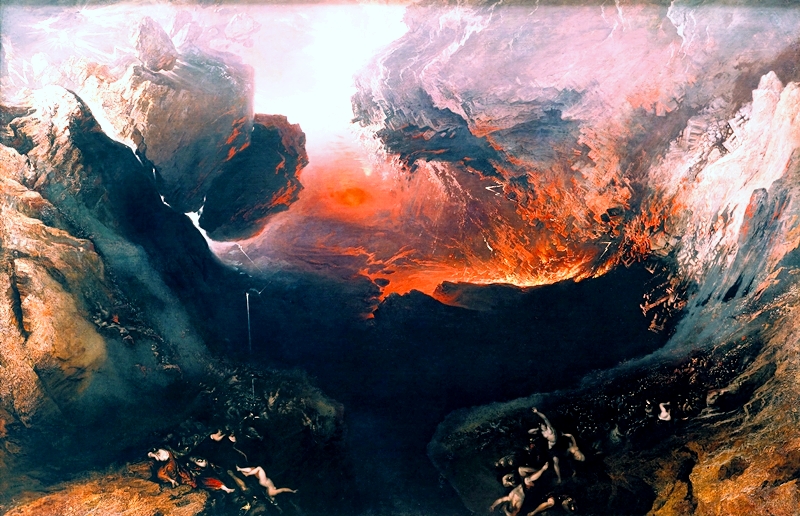
The Great Day of His Wrath (1853), Artist: John Martin

If you are reading this post then the world hasn’t ended…but, you probably already knew it wasn’t going to end.

Don’t look so disappointed. Yes, the human race regrettably has always had a collective death wish, eagerly awaiting the promise of the end of times since the beginning of times. Or have we? Ironically, it was the Maya, the ancient civilization that gave us such a precise date by which to count down to our own demise: December 21, 2012, that Mayan archeologist William Saturno explains looked for evidence that life goes on:

“We keep looking for endings. The Maya were looking for a guarantee that nothing would change. It’s an entirely different mindset.”

Mayan cosmology is more concerned about looking for assurances of continued life on earth, not death. So be comforted on this day – a day like any other – and use it to reflect on the greater value that life seems to take on in the face of our imminent death.

Besides a hopeful view of the future, the Maya had many beliefs worth adopting. Another foreign notion to our fast-paced-commerce-driven society is the worship of nature and animals as divine gods. The Mayans had a great reverence for nature which might explain why their entire religious pantheon is made up of deities that are either animals or humans with anthropomorphic features. They believed in worshiping life in its diverse manifestations.

Book of the Week

To honor this ancient civilization’s deep reverence for biodiversity we have chosen a singularly unique study undertaken by Alfred M. Tozzer and Glover M. Allen, for this week’s book of the week:

Animal Figures in the Maya Codices (1910)

Mr. Tozzer is one of the most famous American Mayanists to date and Mr. Glover was a zoologist specializing in Mesoamerican species at the turn of the last century. Together, the duo was determined to match Mayan hieroglyphic characters, glyphs and artwork depicting Mayan gods to modern species analogues. They were fairly successful in identifying the specific species that the Maya would come in contact with and thus idealize as religious deities.

Mayan Art Inspired by Meso-American Species

Gilbert Borrego, our Flickr Guru, has scoured the BHL in search of Meso-american species and put together a 58 plate Flickr Collection dedicated to Mayan plant and animal life. We have matched these illustrations with the respective Mayan hieroglyphs present in Tozzer and Allen’s work. Your job is to examine the glyphs and see if you see any resemblance between the Mayan art and their species counterparts.

Jaguar (Panthera onca)

View Full Size ImageView Full Size Image

The jaguar a predatory animal symbolized strength, courage, associated with great Mayan warriors. Some scholars have also purported that the beautiful animal is the ruler of the Underworld.

Blue Macaw (Ara militaris)

View Full Size ImageView Full Size Image 

According to Tozzer and Glover, the  Macaw was one of the lightning beasts associated with the worship of fire and the sun. Their brilliant blue feathers were often used in ceremonial headdresses.

Yucatan Screech Owl or Moan-Bird (Otus choliba thompsoni)

View Full Size ImageView Full Size Image 

The owl is a symbol of death and destruction and is regarded as the Moon or Night God. The Owl resides in the  mythological “House of Drought,” unlike the serpent which occupies the “House of Rain”  therefore symbolizing life.<

Serpent (Boidae)

View Full Size ImageView Full Size Image

The serpent was extremely important for it symbolized the live-giving force rain, and thus regulated the annual yield of  crops. It is most likely that this association was made because snakes show themselves in large numbers before and after rainfall.

King Vulture (Sarcoramphus papa)

View Full Size ImageView Full Size Image

Scholars have speculated that the King Vulture symbolizes power as well as sacrifice. According to Mayan mythology ‘lesser’ Vultures would not eat until the King came down and plucked out the eyeballs and entrails of the dead.

Coppery-tailed Trogon aka The Quetzal (Pharomacrus mocinno)

View Full Size ImageView Full Size Image

The Quetzal, meaning ‘large brilliant tail feather’, is a rare bird found in certain parts of Southern Mexico. Its brilliant green color and particularly long tail feathers made it a sacred bird to the Mayans that was reserved for use in headdresses of rulers. The bird is associated with the mythical hero Quetzalcoatl, the feathered serpent god, whom the Mayans mistook conquistador Hernán Cortés for. According to an account by Alexander von Humboldt, the Mayans were impatiently awaiting the return of this god because he would bring a time of great peace with him. Read more about that here.

Clearly, Mayans were more concerned with the cycle of life rather than the end of the world as we know it. In the spirit of their great culture, take the time to celebrate your continued life today. And if for some reason you were in a panic about the world ending, then calm yourself and visit NASA’s 2012 de-bunked website.You’ll surely feel better.

We hope you enjoyed this post. Interested in guest-blogging for BHL? We’d love that! Natural history, biodiversity and conservation topics are especially welcomed. Email us your ideas at [email protected]

December 21, 2012by [email protected]

Help Support BHL

BHL's existence depends on the financial support of its patrons. Help us keep this free resource alive!

search

About BHL

The Biodiversity Heritage Library (BHL) is the world’s largest open access digital library for biodiversity literature and archives. BHL operates as a worldwide consortium of natural history, botanical, research, and national libraries working together to digitize the natural history literature held in their collections and make it freely available for open access as part of a global “biodiversity community.”

Join Our Mailing List

Sign up to receive the latest news, content highlights, and promotions.

Subscribe Now

Subscribe to Blog via Email

Enter your email address to subscribe to this blog and receive notifications of new posts by email.

Join 319 other subscribers

Subscribe to Blog Via RSS

Subscribe to the blog RSS feed to stay up-to-date on all the latest BHL posts.

Access RSS Feed

Inspiring Discovery through Free Access to Biodiversity Knowledge.

The Biodiversity Heritage Library makes it easier than ever for you to access the information you need to study and explore life on Earth…for free, anytime, anywhere.


ABOUT | HARMFUL CONTENT | PRIVACY | SITE MAP | TERMS OF USE