Biodiversity Heritage Library - Program news and collection highlights from BHL
  • Home
  • News
  • Featured Books
    • All Featured Books
    • Book of the Month Series
    • BHL at 20
  • User Stories
  • Campaigns
    • Fossil Stories
    • Garden Stories
    • Monsters Are Real
    • Page Frights
    • Her Natural History
    • Earth Optimism 2020
  • Tech Blog
  • Visit BHL
Home
News
Featured Books
    All Featured Books
    Book of the Month Series
    BHL at 20
User Stories
Campaigns
    Fossil Stories
    Garden Stories
    Monsters Are Real
    Page Frights
    Her Natural History
    Earth Optimism 2020
Tech Blog
Visit BHL
  • Home
  • News
  • Featured Books
    • All Featured Books
    • Book of the Month Series
    • BHL at 20
  • User Stories
  • Campaigns
    • Fossil Stories
    • Garden Stories
    • Monsters Are Real
    • Page Frights
    • Her Natural History
    • Earth Optimism 2020
  • Tech Blog
  • Visit BHL
Biodiversity Heritage Library - Program news and collection highlights from BHL
Blog Reel, Featured Books

Chesapeake Bay Foundation Contributes Annual and Investigative Reports to BHL

The Chesapeake Bay Foundation has spent the past fifty years working on a complex ecological problem. The Chesapeake Bay is an estuary in Maryland, Delaware, D.C. and Virginia. While about half of its water comes from the Atlantic Ocean, the rest flows to the bay from 64,000 square miles of watershed – spanning 6 states and home to over 18 million people. Pollution from sewage, agriculture, and industry (as well as other impacts of human development) have degraded the bay’s water quality, damaging biodiversity as well as human health, economics, and recreation. Chesapeake Bay Foundation (CBF) is a private sector group using many approaches to tackle this regional issue.

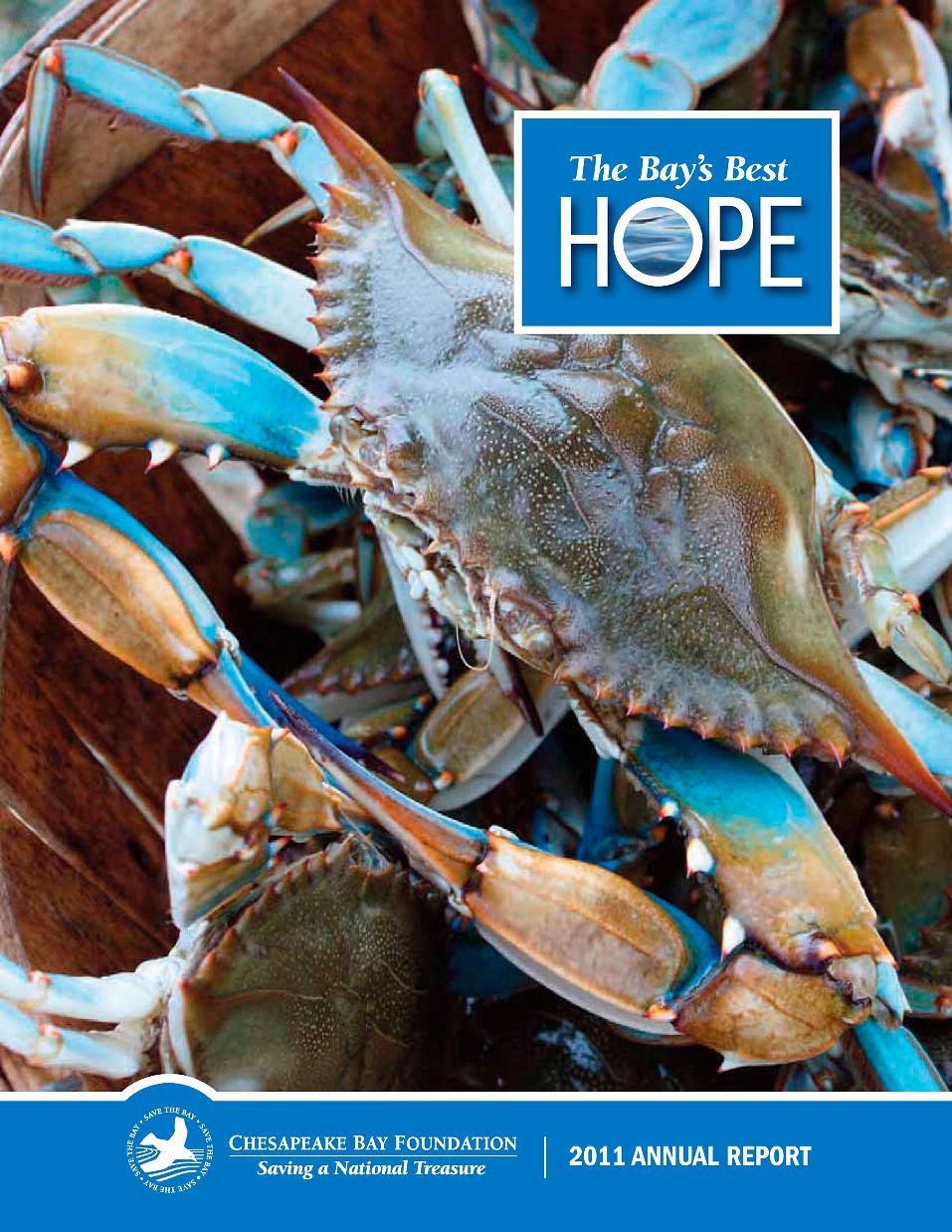
Thanks to CBF’s participation in the Expanding Access to Biodiversity Literature project, Annual Reports and Investigative Reports from CBF are now available on BHL. These publications document CBF’s initiatives in environmental science, restoration, education, advocacy and litigation.

CBF has contributed its Annual Reports from 2008-2014 which track the organization’s accomplishments and goals. The Investigative Reports contributed to BHL are:

  • Climate change and the Chesapeake Bay : challenges, impacts, and the multiple benefits of agricultural conservation work (2007)
  • Bad waters : dead zones, algal blooms, and fish kills in the Chesapeake Bay region in 2007 (2007)
  • Bad water and the decline of blue crabs in the Chesapeake bay (2008)
  • Bad water 2009 : the impact on human health in the Chesapeake Bay region (2009)
  • Angling for healthier rivers : the link between smallmouth bass mortality and disease and the need to reduce water pollution in Chesapeake Bay tributaries (2013)
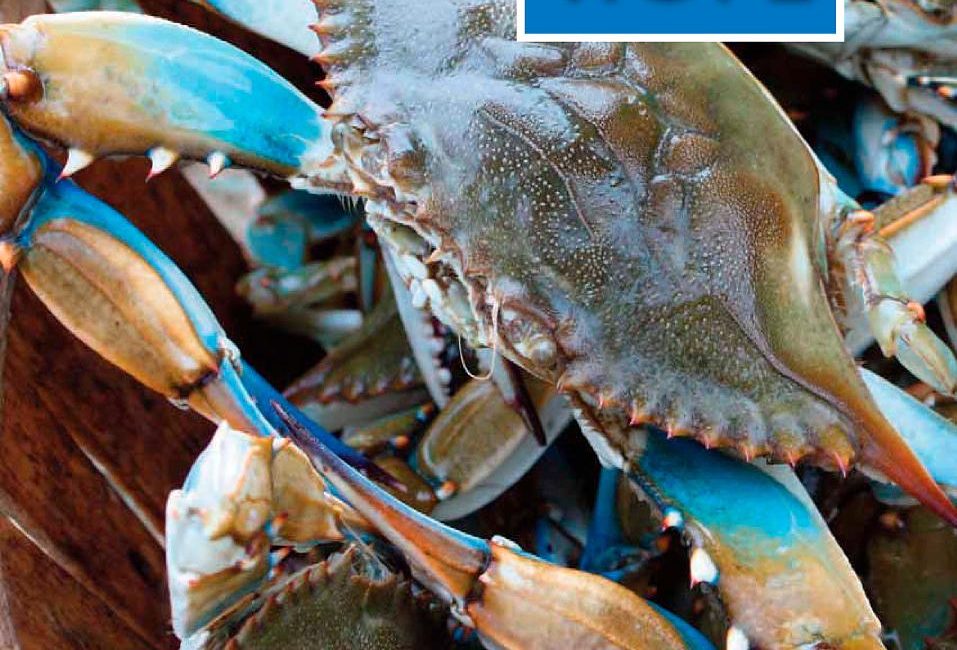
Atlantic Blue Crab on the cover of the 2011 Chesapeake Bay Foundation Annual Report. Contributed to BHL by the Chesapeake Bay Foundation as part of the Expanding Access to Biodiversity Literature project. http://s.si.edu/2jcgOHS.


About the Chesapeake Bay Foundation

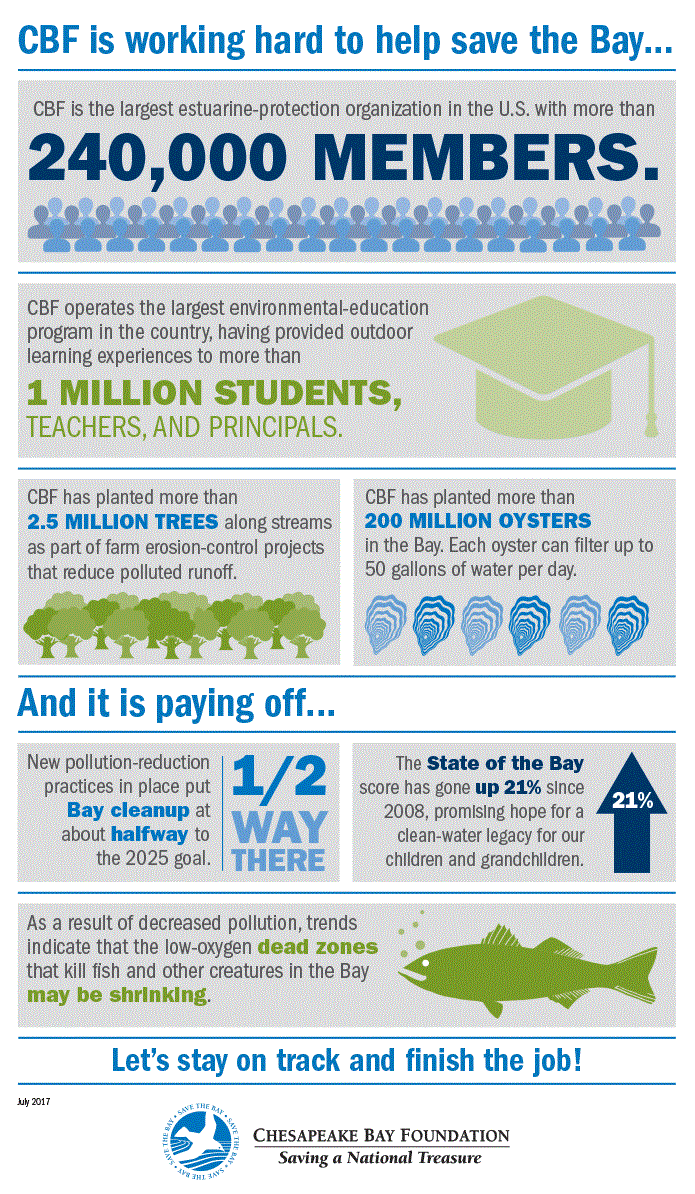
CBF has been active in coastal conservation since 1967. With offices in Maryland, Virginia, Pennsylvania and D.C., as well as fifteen field centers, it’s the largest independent conservation organization dedicated to promoting the health of the Chesapeake Bay.

Infographic by Chesapeake Bay Foundation, web accessed 12/1/2017: http://www.cbf.org/about-cbf/history/decades-of-success/?referrer=http://www.cbf.org/about-cbf/history/.

Over the decades, CBF has been instrumental in organizing and sustaining inter-state conservation work. In the 1970s, CBF called for and then provided staff support to a seven-year Environmental Protection Agency (EPA) Chesapeake Bay Study which analyzed the state of the bay and identified contributing problems. In the 1980s, based on the study’s results, CBF participated in negotiations for the first Chesapeake Bay Agreement, a cooperative inter-state commitment to reduce pollution. Today’s goals for bay cleanup are outlined in the Chesapeake Clean Water Blueprint, an interstate agreement that includes fairly-distributed, measurable goals as well as EPA-imposed consequences for failure to comply. CBF scientists evaluate the long-term progress of the Bay’s health by measuring indicators in three key areas: pollution, habitat, and fisheries.

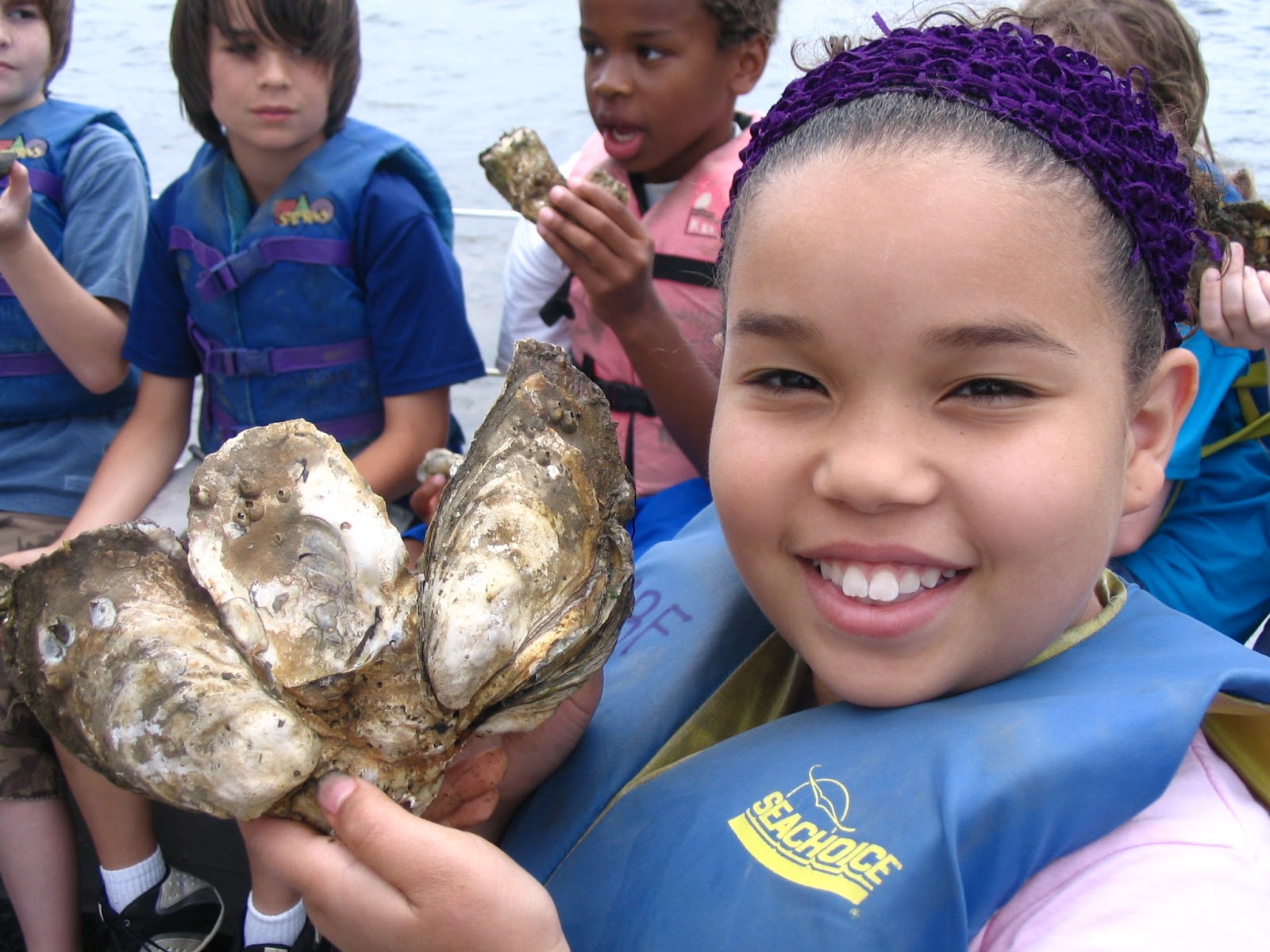
CBF’s education programs bring youth into the field for hands-on learning. Kids explore wetlands by boat and learn about watershed ecology and local fishing communities. Photo courtesy of the Chesapeake Bay Foundation/cbf.org.

One of CBF’s many current projects has communities ‘recycling’ oyster shells. Restaurants and citizens bring their empty shells to drop-off points, where they are cleaned and then placed in tanks of swimming oyster larvae. The larvae anchor onto the shells and grow into young ‘spat’ oysters. Oyster gardeners place these shells in rivers and the Bay to help rebuild oyster reefs. This helps to restore the oyster population and improve water quality – one of these filter feeders can filter up to 50 gallons of water in a day.

Thanks to the Chesapeake Bay Foundation for sharing their extensive work with us on the Biodiversity Heritage Library!

Source 

Chesapeake Bay Foundation (n.d.) Retrieved from http://www.cbf.org/

December 21, 2017by ulib-libraryjobs
Blog Reel, Featured Books

John Forbes Royle: Materia Medica and Economic Botany

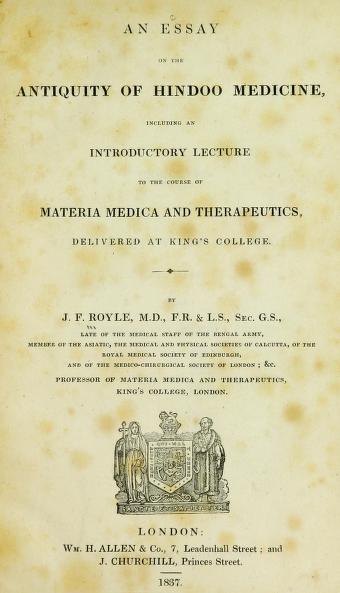
As part of the Expanding Access to Biodiversity Literature project, an interesting title was added to BHL from Yale University’s Harvey Cushing/John Hay Whitney Medical Library and the online Medical Heritage Library: An essay on the antiquity of Hindoo medicine, including an introductory lecture to the course of materia medica and therapeutics, delivered at King’s College, by physician-botanist John Forbes Royle.

Title page of An essay on the antiquity of Hindoo medicine, including an introductory lecture to the course of materia medica and therapeutics, delivered at King’s College, by Royle, J. Forbes (John Forbes), 1799-1858. London, Allen, 1837. Digitized by Yale University via the Medical Heritage Library. http://s.si.edu/2mtstTx.

This work from 1837 documents the materia medica (pharmacology) of India, and explores the historical exchange of medicinal knowledge between cultural groups of India, Arabia, Persia, Greece and China. Including details in botany, ecology, minerology and astronomy, it’s an intriguing interdisciplinary resource that can also be read for insights on its Western author and this period in time.

John Forbes Royle (1798-1858) traded his plan to join the British army for an unexpected interest in natural history. He was born at Kanpur, India, and would return to India after attending Edinburgh High School and the East India Company’s military academy at Addiscombe. Inspired by the mentorship of physician Anthony Todd Thomson, Royle chose to pursue medicine as a means to further his study of botany. He became an assistant surgeon with the East India Company, and in the following years worked at several locations across northern India, where he studied medicines from bazaars, employed collectors to amass a collection of economic plants, and became superintendent of the garden at Saharanpur. He earned the titles of MD in 1833 and Professor of Materia Medica at King’s College, London, in 1836.

An excerpt from Essay on the antiquity of Hindoo medicine demonstrates Royle’s interconnected thinking on medicine:

“There are, however, two branches of this extensive science [botany], respecting which I am desirous of making a few observations; one is the connexion between the Structure and Natural affinities of plants, and their Physical and Medical properties; and the other is the Geographical distribution, especially as connected with Climate. Both are important subjects, whether we consider them in a scientific or a practical point of view. The one teaches us the laws which influence the distribution of plants; points out the countries and climates which different families affect; and gives us principles for their cultivation, either as medicines, or as objects of agriculture: the other is no less valuable in affording us innumerable indications in every part of the world, for discovering the properties of new and unknown plants, whether as fitting them for food, for medicine, or for any of the arts of life[.]” [Royle, p. 3]

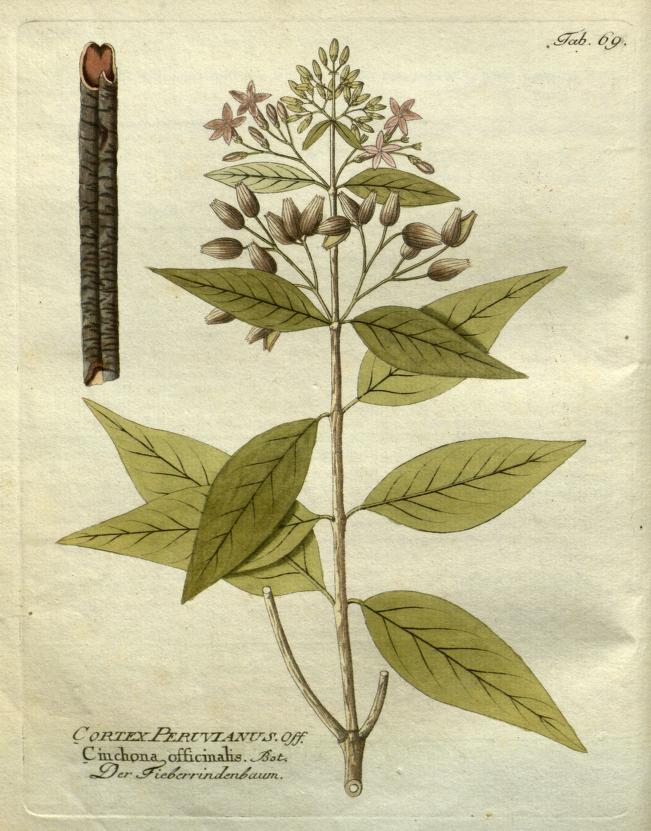
Cinchona, a South American genus. Its bark contains medicinal compounds including quinine, used to treat malaria. Royle recommended that Cinchona be grown in India. Image from BHL book: Icones plantarum medico-oeconomico-technologicarum cum earum fructus ususque descriptione. Wien:herausgegeben von Ignatz Albrecht und verlegt bey Phil. Jos. Schalbaecher, [1800]-1822. Digitized by Missouri Botanical Garden. http://s.si.edu/2iiHgMh.


Cushing/Whitney Medical Library of Yale University

The copy of Royle’s text in BHL belonged to Edward Salisbury, a Yale graduate and professor who encouraged scholarship on West and South Asia. Salisbury donated his “Oriental Library,” a collection of hundreds of rare and early printed books and manuscripts, to the college in 1870. Salisbury’s Oriental Library is foundational to what is now the third-largest collection of Islamic manuscripts in the United States. Last year, Yale celebrated Salisbury’s 175th anniversary as the first professor of Arabic and Sanskrit languages and literature in the Americas.

Essay on the antiquity of Hindoo medicine is now held at the Medical Historical Library of the Cushing/Whitney Medical Library. The library was named for Yale graduates Harvey Cushing, known as the father of neurosurgery, and John Hay Whitney, Herald Tribune editor and patron of the arts. In 1935, Cushing and two other physicians, John F. Fulton and Arnold C. Klebs, donated their personal collections of medical texts to the medical library, beginning its Medical Historical Library. Its collections include materials ranging from the 16th to 20th century, with works from Robert Boyle, Galen, William Harvey, Hippocrates, and Andreas Vesalius. Additionally, the Historical Library also holds prints, a collection of weights and measures, and presents rotating exhibits.

The Cushing/Whitney Library is also home to the Cushing Center, a room in the stacks transformed to display the medical specimens of Cushing’s Brain Tumor Registry. Cushing meticulously documented over 2,200 case studies as he pioneered the field of neurosurgery, and his registry includes specimens preserved from human surgeries and autopsies as well as notes, journal excerpts, photos and negatives.

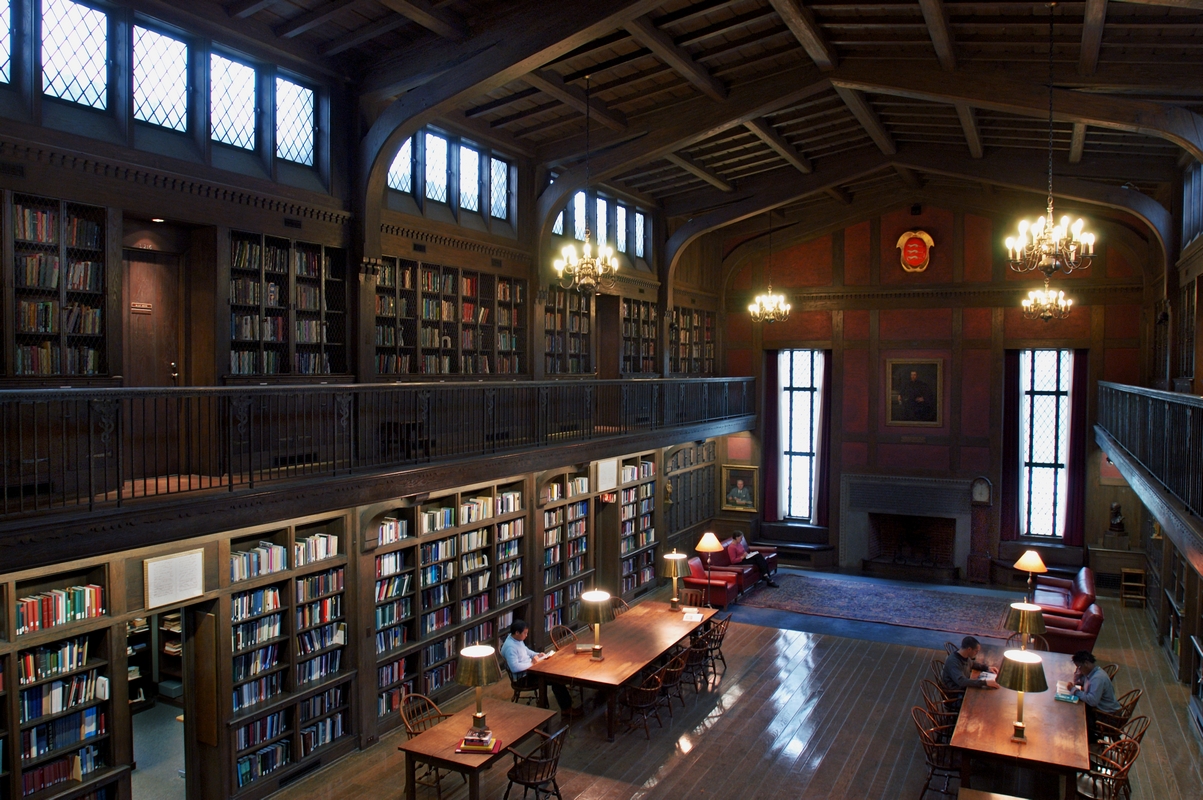
Harvey Cushing/John Hay Whitney Medical Library Historical Library. Frank Poole, 2004.


Medical Heritage Library

The Medical Heritage Library (MHL) is an online collection of materials that are free and openly accessible through the Internet Archive. Royle’s Essay on antiquity of Hindoo medicine came to BHL via the MHL.

Much like BHL, the MHL is a collaborative effort by medical libraries to promote access to resources (such as rare books, pamphlets, journals and films) that are useful across a spectrum of disciplines. The collection includes over 200,000 titles with fascinating variety – skimming the landing page, one can find herbals, medical dictionaries and papers, as well as video clips of 1960s tobacco commercials and Helen Keller’s autobiography.

The Medical Heritage Library was launched in 2010 by founders The Augustus C. Long Health Sciences Library at Columbia University and Columbia University Libraries/Information Services; The College of Physicians of Philadelphia; The Cushing/Whitney Medical Library at Yale University; The Francis A. Countway Library of Medicine at Harvard University; U.S. National Library of Medicine; and Wellcome Library in London, UK. (For more information about its content contributors, funding and support, please see MHL’s ‘About’ page.)

An essay on the antiquity of Hindoo Medicine is a welcome addition to BHL’s collection of works by John Forbes Royle, which include:

  • Illustrations of the botany and other branches of the natural history of the Himalayan Mountains: and of the flora of Cashmere. London: Wm. H. Allen, 1839. (Digitized by Missouri Botanical Garden)
  • On the culture and commerce of cotton in India and elsewhere; with an account of the experiments made by the Hon. East India Company up to the present time. London: Smith, Elder, 1851. (Digitized by the University of British Columbia Library)
  • The fibrous plants of India, fitted for cordage, clothing, and paper. With an account of the cultivation and preparation of flax, hemp, and their substitutes. London, Smith, Elder, and Co.; 1855. (Digitized by Cornell University Library)
  • A manual of materia medica and therapeutics including the preparations of the pharmacopoeias of London, Edinburgh, and Dublin, with other approved medicines. London: John Churchill, MDCCCLVI [1856]. (Digitized by King’s College London, Foyle Special Collections Library)

Thanks to Melissa Grafe, Ph.D, Head of the Medical Historical Library and John R. Bumstead Librarian for Medical History, who shared how this volume came to the Medical Historical Library.

Sources

  • About (n.d.) Retrieved from http://archive.org/details/medicalheritagelibrary&tab;=about.
  • About (n.d.) Retrieved from http://www.medicalheritage.org/about/.
  • About (n.d) Retrieved from https://salisbury175.yale.edu/about.
  • Harvey Cushing and the Cushing Center (n.d.) Retrieved from http://library.medicine.yale.edu/cushingcenter/history.
  • History of the Library (n.d.) Retrieved from http://library.medicine.yale.edu/about/history.
  • Royle, John Forbes (1837). London, Allen. Retrieved from https://www.biodiversitylibrary.org/item/199214.
  • Woodward, B. B. “Royle, John Forbes (1798–1858).” Rev. Mark Harrison. Oxford Dictionary of National Biography. Ed. H. C. G. Matthew and Brian Harrison. Oxford: OUP, 2004. Online ed. Ed. David Cannadine. May 2010. Retrieved from http://www.oxforddnb.com/view/article/24239.
November 16, 2017by ulib-libraryjobs
Blog Reel

In-copyright titles added in the 3rd quarter of 2017

From July to September of this year, BHL received permission for 43 new in-copyright titles, all as part of the Expanding Access to Biodiversity Literature project. This is a slight increase over the numbers added in the first two quarters.

BHL licenses content under a
Creative Commons Attribution-NonCommercial-ShareAlike 4.0 license

Below are the 43 titles added in the second quarter, in the order permission was secured. For those that have already been scanned or uploaded, links are available. Look for the rest as they’re added to the collection; you can check the recent additions, or see all the permission titles available in BHL on the permissions page.

Titles in BHL have been digitized/contributed by the rights holders unless otherwise stated.

Alabama Academy of Science
  • Journal of the Alabama Academy of Science
Denver Botanic Gardens
  • Green Thumb News
  • Green Thumb Newsletter
  • Mountain, Plain, and Garden
  • The Green Thumb
American Association of Zoo Keepers
  • AAZK Bulletin
  • AAZK Newsletter
  • Ruptured Rhino
The Avicultural Society
  • Avicultural Magazine
Oregon Flora Project
  • Oregon Flora Newsletter
Kelly Allred
  • The New Mexico Botanist
New York State Ornithological Association
  • The Kingbird
The Arboretum Foundation

  • Arboretum Bulletin
  • University of Washington Arboretum Bulletin
  • Washington Park Arboretum Bulletin

Lunds Botaniska Förening

  • Opera Botanica, v.42 (1977)
Illinois State Academy of Science
  • Transactions
Brooklyn Botanic Garden
  • A Teaching Guide to the Trees and Shrubs of Greater New York, Including the Kinds Most Commonly Seen in Cultivation (1933 and 1947 editions)
  • Guide to Trees and Shrubs Based on Those of Greater New York: Native, Naturalized, and Commonly Cultivated Exotic Kinds
  • Leaflet / Leaflets
  • Plants and Gardens
  • Plants of the U.S. Military Academy, West Point, New York

Florida Exotic Plant Pest Council and Southeast Exotic Plant Pest Council

Wildland WeedsUniversity of Florida/IFAS Center for Aquatic and Invasive Plants
  • Aquaphyte
International Ornithologists’ Union
  • IXe Congrès Ornithologique International, Rouen, 9 au 13 Mai 1938 (Digitized by Smithsonian Libraries)
Tulane University
  • Tulane Studies in Geology
  • Tulane Studies in Geology and Paleontology
University of Texas Austin Libraries

  • Contributions in Marine Science
  • University of Texas at Austin Bulletins and Publications
African Violet Society of America
  • African Violet Magazine
Ohio Biological Survey
  • Ohio Biological Survey Notes
The Natural History Society of Maryland
  • Bulletin
  • Bulletin of the Maryland Herpetological Society
  • Maryland Naturalist
  • Maryland: A Journal of Natural History
  • Proceedings
Texas Ornithological Society
  • Bulletin of the Texas Ornithological Society
  • Occasional Publications
Desert Botanical Garden
  • Agave
  • Saguaroland Bulletin
  • The Sonoran Quarterly
Torrey Botanical Society
  • Memoirs of the Torrey Botanical Club
American Ornithological Society
  • Proceedings of the XIIIth Ornithological Congress
Museum of Texas Tech University
  • Occasional Papers
  • Special Publications

Department of Malacology, The Academy of Natural Sciences of Philadelphia

  • Tryonia
American Daffodil Society
  • The Daffodil Bulletin
  • The Daffodil Journal

BHL thanks the many individuals and organizations who have so generously allowed their publications to be digitized and made available to the world under open access. If there’s a book or journal you would like to see in BHL, please let us know!

And as always, don’t forget to follow BHL on Facebook, Twitter (@BioDivLibrary), Instagram, Pinterest, and Tumblr.

October 24, 2017by [email protected]
Blog Reel, Featured Books

Lloyd Library and Museum

View Full Size Image
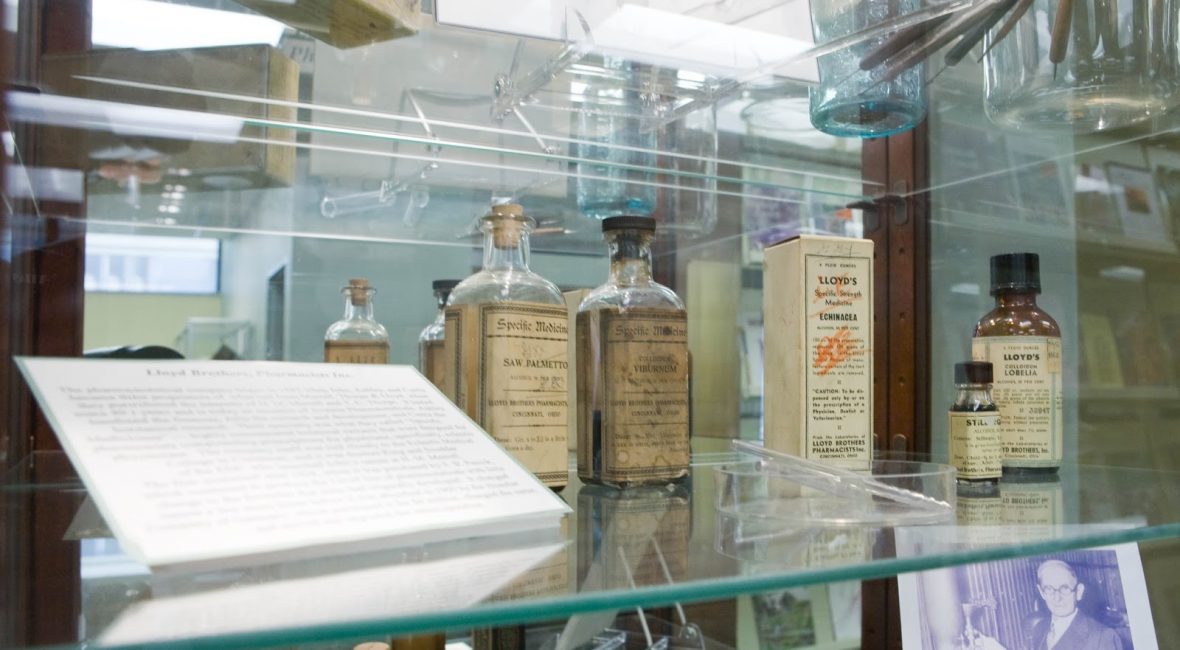
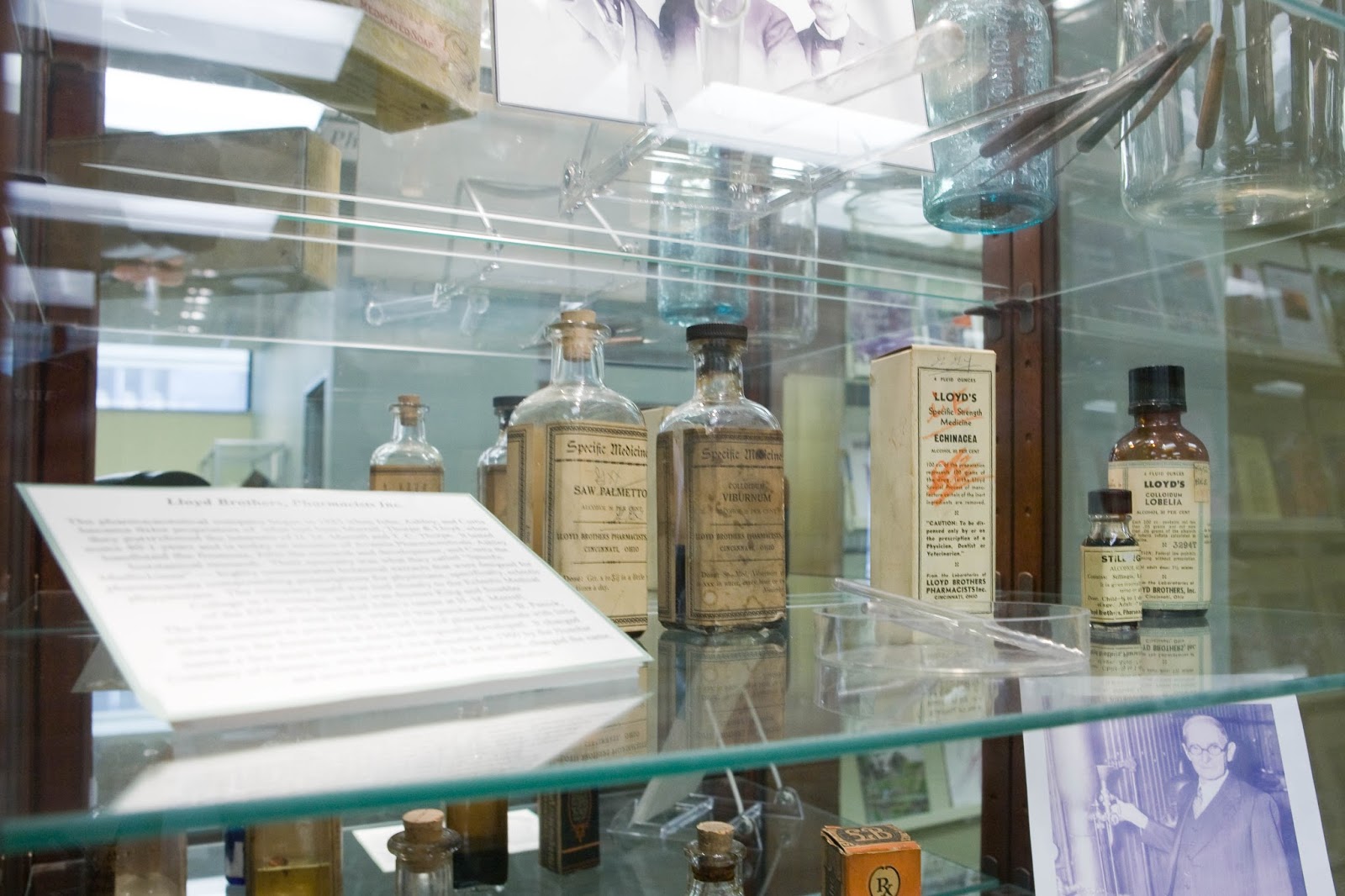
“Paraphernalia,” photo by Cindi (Flickr, Creative Commons)

Over the course of the Expanding Access to Biodiversity Literature (EABL) project, contributing organizations have shipped material to Internet Archive scanning centers around the country. A few have scanned their own material, and a few more have used third-party commercial services. One EABL contributor did things a little differently.

Betsy Kruthoffer, Librarian and Rare Books Cataloger at the Lloyd Library and Museum, selected a number of important titles from the library’s collection that were not in BHL. After weighing various scanning options, she got in touch with the digital lab at the Public Library of Cincinnati and Hamilton County (PLCH), which had done good work for a Lloyd patron the previous year (and, conveniently, is located right down the street). PLCH agreed to do the scanning, with the understanding that the digitized books would also be made available in a PLCH online collection.

Once the scanning was complete, Betsy considered loading all of the images onto an external hard drive and mailing it to Mariah Lewis, the EABL Metadata Specialist, in order to contribute the scans to BHL. After learning about Macaw (BHL’s metadata and upload software), however, she decided to take a stab at the uploading herself–with great success. BHL’s collection is richer thanks to her thorough work.

History of the Lloyd Library and Museum

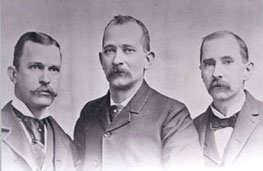
The Lloyd Library began with three brothers: John Uri, Nelson Ashley, and Curtis Gates Lloyd. According to tradition, the first books in the library were Edward Parrish’s A Treatise on Pharmacy (1864 edition) and George Fownes’ A Manual of Elementary Chemistry, Theoretical and Practical (1864 edition). These books accompanied John Uri Lloyd, the oldest of the three, when he went to Cincinnati to become a pharmacist in 1864. His brothers soon followed after.

Eventually, the brothers joined together to form Lloyd Brothers, Pharmacists, Inc. John Uri’s small library grew with the company; in 1901, it got its own building (it would move several times in following years), and in 1919, a trust was established to ensure that the library would continue and be open to the public. A new structure was erected in 1970 adjacent to the one that had housed the library for 75 years. This is where the library remains today.

View Full Size Image
The Lloyd brothers. http://www.lloydlibrary.org/history/lloyd%20pharmacy.html.

The Lloyd Library has one of the preeminent North American collections related to pharmacology and natural products, but it covers many related subjects as well: botany, pharmacognosy, herbal and alternative medicine, horticulture, eclectic medicine (an herbal medicine school), and sectarian medicine (predecessor to homeopathy), among others.

Curtis Gates Lloyd, an avid mycologist, amassed a considerable herbarium, nicknamed the “mushroom museum.” After his death in 1926, the botanical specimens were given to the University of Cincinnati, and the mushrooms went to the U.S. Department of Agriculture. A small collection of medicine bottles and pharmacy implements remains; these comprise the Lloyd Museum, which features permanent and rotating exhibits.

For more detailed accounts of the Lloyd brothers, their company, and the history of the Lloyd Library and Museum, visit the Lloyd’s website.

Rare Books from the Lloyd Library

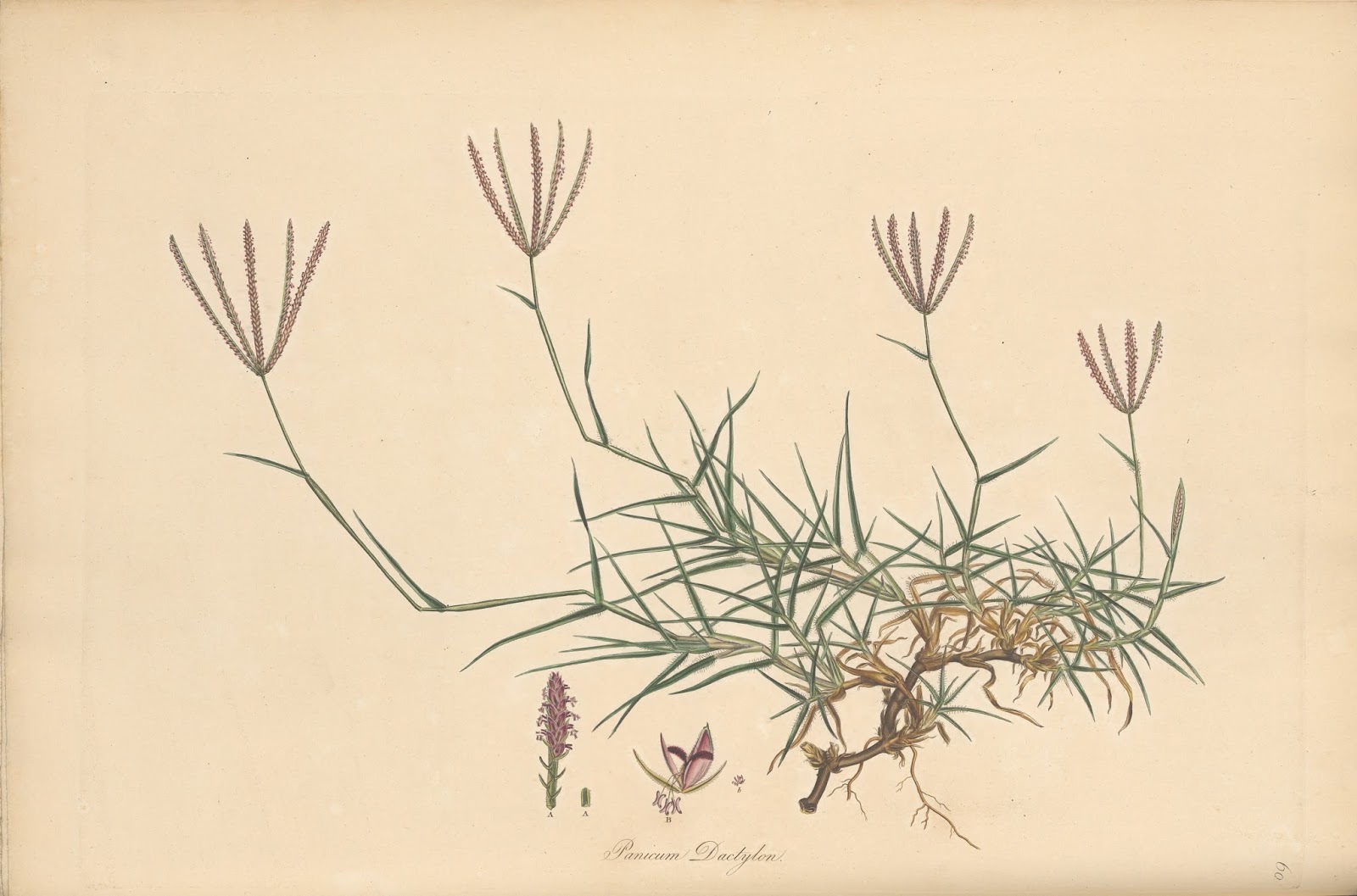
Of the titles digitized by PLCH, Betsy Kruthoffer considers one the most important: John Sibthorp’s Flora Graeca, published in 10 volumes from 1806 to 1840. This monumental work contains nearly a thousand color plates of the flora of Greece as surveyed in the late 18th century by Sibthorp and Ferdinand Bauer, who illustrated them. Sibthorp himself never lived to see the printed Flora–he died in 1797 of an illness contracted on one of his trips–but he provided for its publication in his will.

View Full Size Image
Sibthorp, John. Flora Graeca. v. 1 (1806). Contributed by the
Lloyd Library and Museum. https://biodiversitylibrary.org/page/54016367.

Betsy has recorded the fascinating story of how the Lloyd Library came to possess a first edition of the Flora Graeca, one of only 25 printed.

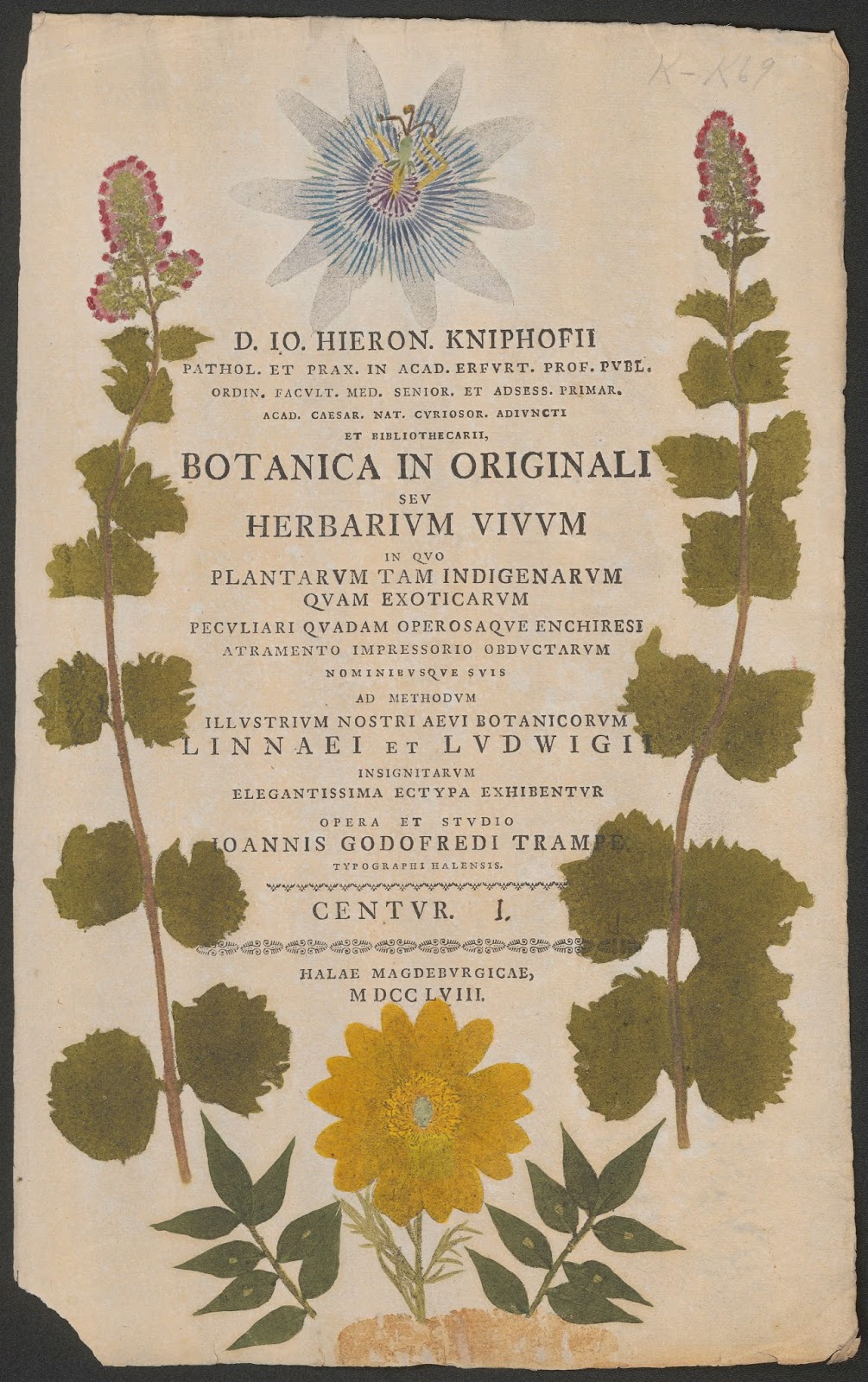
Another important title is Johann Kniphof’s Botanica in originali, published in 12 volumes (1758-1764). The work uses a technique called “nature printing,” which involves creating plates or engravings from direct impressions of actual plant specimens and using those plates to print images.

View Full Size Image
Kniphof, Johannes. Botanica in originali. v. 1 (1758). Contributed by the
Lloyd Library and Museum. https://biodiversitylibrary.org/page/53840216.

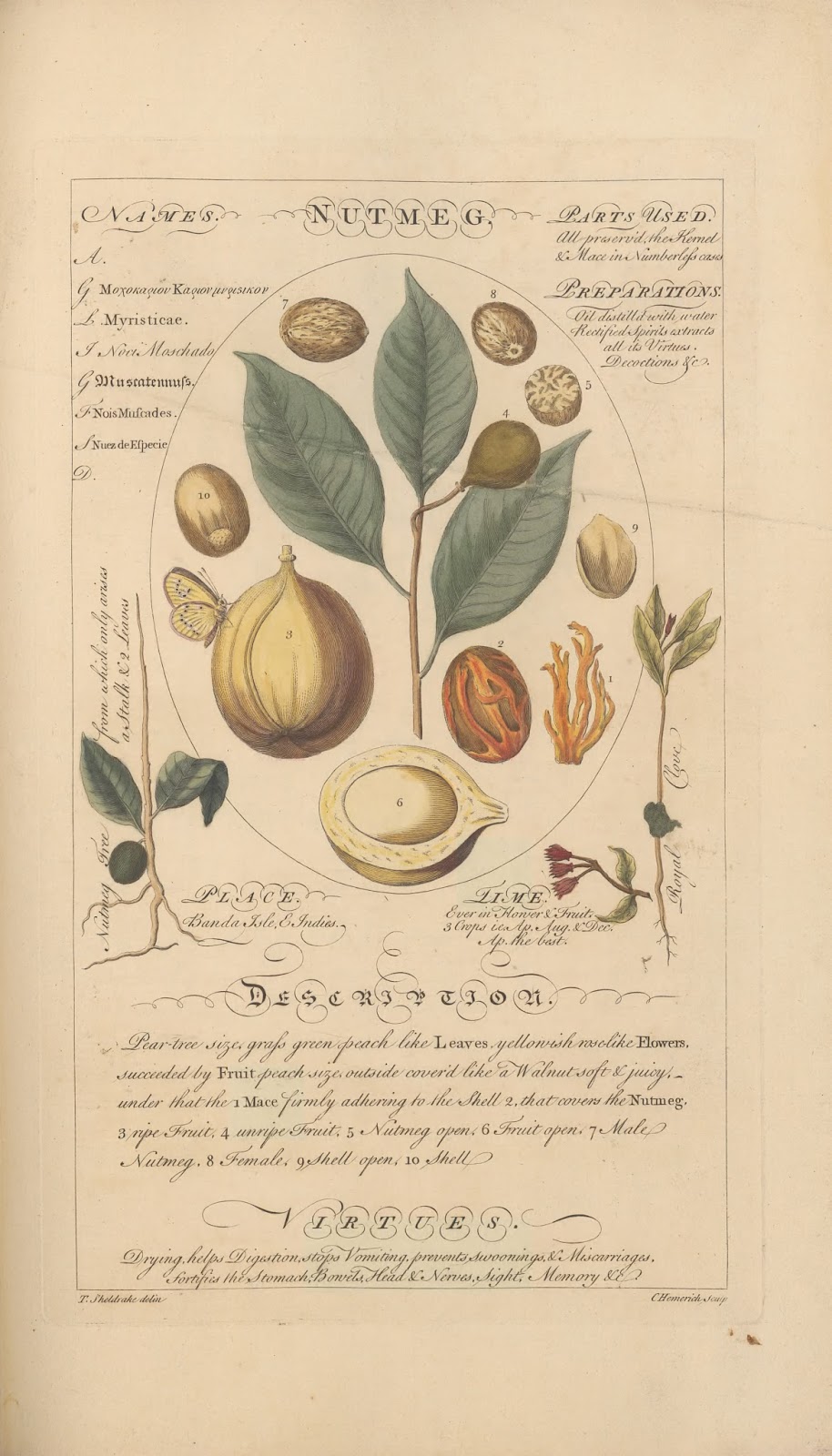
A third title, noteworthy for its illustrations (and its very long subtitle), is Timothy Sheldrake’s Botanicum medicinale : an herbal of medicinal plants on the College of Physicians list : describing their places of growth, roots, bark, leaves, buds, time of flowering, blossoms, flowers, stiles, chives, embrio’s, fruits, farina, colours, seeds, kernels, seed-vessels, parts used in medicine, preparations in the shops, medicinal virtues, names in nine languages : most beautifully engraved on 118 large folio copper-plates from the exquisite drawings of the late ingenious T. Sheldrake ; … To which is now added, his tables for finding the heat and cold in all climates that exotic plants may be raised in summer and preserved in winter (c. 1868).

Less an academic tome and more a physician’s quick-reference herbal, the Botanicum medicinale is organized into single-page summaries of each plant, with engraved text around a colored illustration.

View Full Size Image
Sheldrake, Timothy. Botanicum medicinale. c. 1868. Contributed by the
Lloyd Library and Museum. https://biodiversitylibrary.org/page/53779797.

The complete list of titles submitted by the Lloyd Library to BHL:

  • John Sibthorp’s Flora Graeca (1806-1840)
  • Johannes Kniphof’s Botanica in originali (1758-1764)
    • The index to the above work: Index universalis in omnes XII centurias Botanicae in originali D. Io. Hieron. Kniphofii seu Herbarii vivi (1767)
  • Timothy Sheldrake’s Botanicum medicinale (c.1768)
  • Maria Sybilla Merian’s Erucarum ortus, alimentum et paradoxa metamorphosis (1718)
    • To learn more about this pioneering naturalist, see Grace Costantino’s 2015 blog post, “From Early Women in Science to Ultraviolet Film: Using Art to Understand Insects“
  • Heinrich Witte’s Flora : afbeeldingen en beschrijvingen van boomen, heesters, éénjarige planten, enz., voorkomende in de nederlandsche tuinen (1868)

Thank you to Betsy Kruthoffer, the Lloyd Library, and the Public Library of Cincinnati and Hamilton County for working with EABL to make these historic works available to everyone.

October 19, 2017by eomeara
BHL News, Blog Reel

Association of Zoos and Aquariums Annual Conference 2017

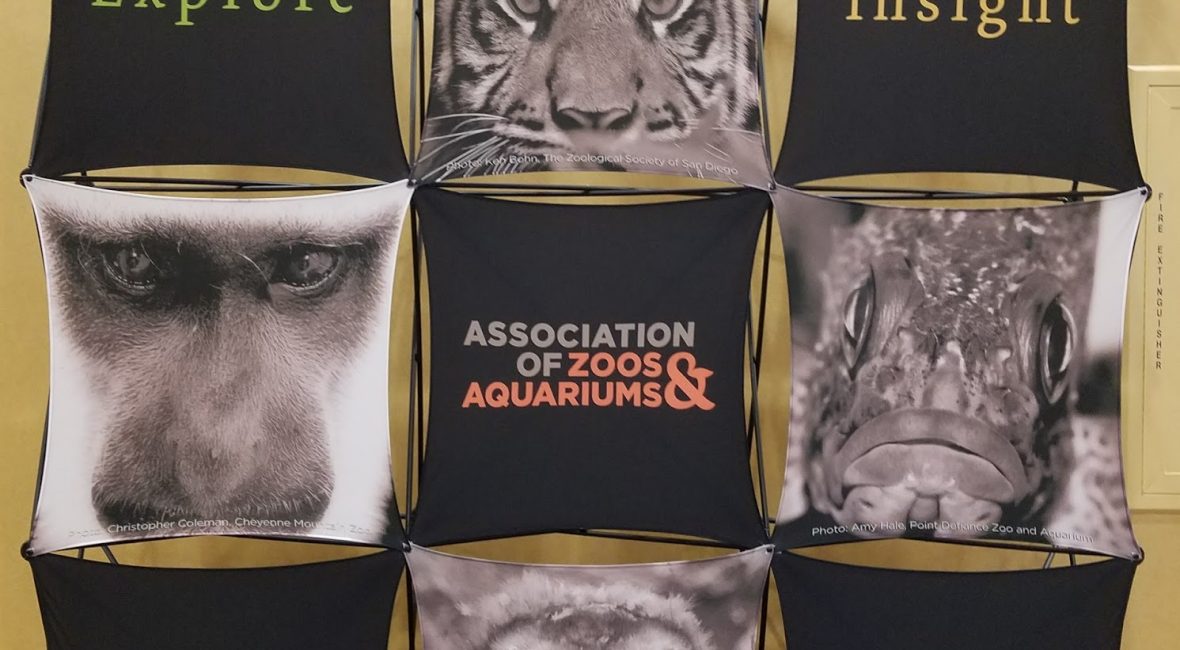
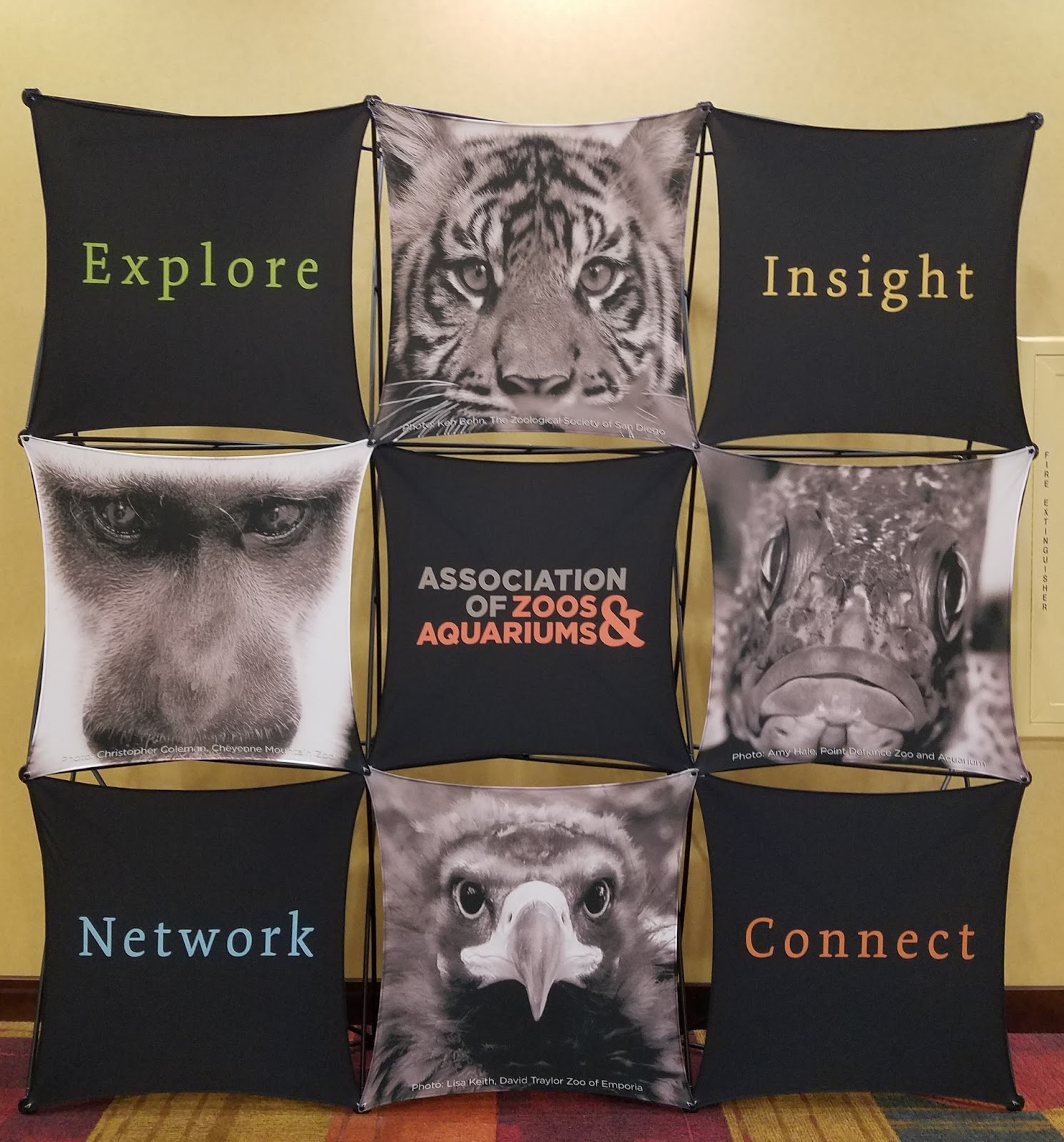
Last week the Association of Zoos and Aquariums held its annual conference in Indianapolis, Indiana. The conference draws around 2,800 attendees from a diverse group of institutions and organizations around the world.  The Expanding Access to Biodiversity Literature team was able to send representation and take part in the poster presentations.

The Association of Zoos and Aquariums (AZA) was originally founded in 1924 as the American Association of Zoological Parks and Aquariums, later changing its name to the American Association of Zoological Parks and Aquariums and eventually selecting its current moniker.  The founding officers included  Chairman C. Emerson Brown from the Philadelphia Zoological Park, Vice Chairman Dr. Harry M. Wegeforth of the San Diego Zoological Society, and Secretary Will O. Doolittle.  The original directors were Edward H. Bean of the Milwaukee Zoological Park and George P. Vierheller of the Saint Louis Zoological Garden.  Chairman C. Emerson Brown’s publication “A pocket list of the mammals of eastern Massachusetts…” can even be found in BHL here.

As a non-profit the AZA is “dedicated to the advancement of zoos and aquariums in the areas of conservation, education, science, and recreation.”  The organization represents over 230 different institutions within the United States and around the world.  The AZA and their institutions have a strong commitment to animal welfare and conservation which is seen through the millions of dollars they commit to scientific research, conservation and educational programing.

Besides supporting these areas they are also an independent accrediting organization.  With some of the highest and most comprehensive standards, not even 10% of the United States’ 2,800 licensed wildlife exhibitors meet the top standards held by AZA.  Every year AZA accredited institutions allocate $160 million on field conservation around the world- over 2,600 projects worked on by specialists in the field.  The AZA itself has provided a cumulative seven million dollars on over 375 projects in conservation.  Every year 40,000 teachers are trained at AZA accredited facilities, which lend support to state science curricula.  Overall, the Association of Zoos and Aquariums’ pledge to the natural world furthers the fields of animal welfare and conservation and trains new generations to save the biodiversity.

The conference began on Friday with committee meetings and the pre-conference tour.  On Saturday and Sunday, small session meetings and workshops were held.  Sunday evening an icebreaker was held at the Indiana State Museum ahead of the conference kickoff at the Opening General Session on Monday morning.  Below learn more about a sampling of the meetings, panels, and events that were attended by EABL.

<!–
View Full Size Image
Association of Zoos & Aquariums Signage

–>

Coastal Ecosystem Learning Center (CELC) Meeting

The Coastal Ecosystem Learning Center, a network of 25 aquariums and marine science education centers located in the United States, Canada and Mexico, was originally foundedin 1996 by Coastal America.  With strong support from the National Oceanic and Atmospheric Administration, the consortium works to involve the public in protecting coastal and marine ecosystems. One of the major topics at the meeting was aquaculture- cultivating aquatic animals or plants for food.  Not to be left behind the curve, BHL already holds a number of titleson the subject. Do you have any thoughts or feelings on aquaculture?  Let us know in the comment section!

California Association of Zoos and Aquariums

The California Association of Zoos and Aquariums (CAZA) is a way to bring together all of those involved in AZA accredited zoos and aquariums in the California area.  California currently maintains more accredited zoos than any other state- twenty-three.  CAZA is dedicated to monitoring the local legislation that would affect the welfare and conservation of the natural world.

Icebreaker at the Indiana State Museum

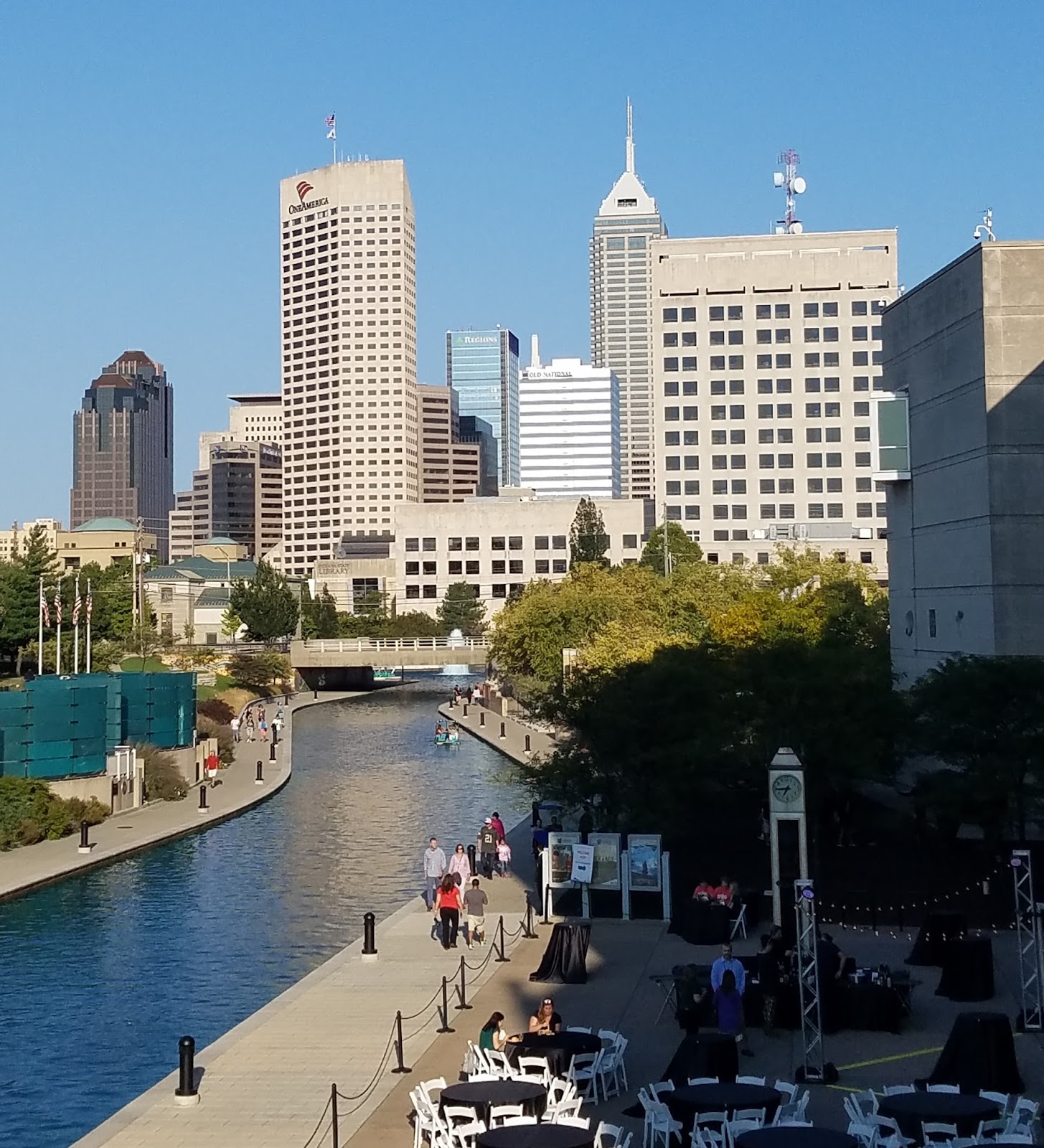
Sunday evening the Indiana State Museum hosted a social event that allowed those in the zoo and aquarium field to catch up and enjoy Indiana history.  The museum, located along the Indiana Central Canal built in the 1800s, offered spectacular views of the city and even attracted the Indianapolis Colts’ mascot, Blue to join in the fun.

<!–
View Full Size Image
View from the Indiana State Museum of the Central Canal

–>

Opening General Session

The conference kicked off Monday morning with the opening session.  Dennis Kelly, Chair of the AZA Board of Directors and the Director of the Smithsonian’s National Zoo and Conservation Biology Institute, welcomed attendees to the annual conference and introduced Mike Crowther, President and CEO of the Indianapolis Zoo who hosted this year’s conference.  He prepared attendees for the Indianapolis Zoo Day by throwing stuffed toy macaws into the audience to preface the zoo’s Magnificent Macaw exhibit which allows the birds to fly a half mile across the zoo and back  multiple times a day.

The Opening General Session also included speeches by Dr. Carl Jones and Wayne Pacelle.  Dr. Carl Jones, winner of the 2016 Indianapolis Prize, is known around the world for his championing work in saving a number of different species that were on the brink of extinction: the pink pigeon, the echo parakeet and the Mauritius kestrel.  Dr. Jones noted that zoos have the answer to saving species and urged attendees to think of zoos as arks and be creative in animal management.  He recalled many instances where other scientists recommended saving species that were not high risk, but maintained his commitment to high-risk species.  His commitment paid off when he restored a species (the Mauritius kestrel) of four to four hundred over the course of a decade.  Dr. Jones noted “it is not hard to save a species, but it takes time” and “we should not tolerate any future extinctions.”  Through his experiences as a world-class conservationist, he challenged the idea that focusing on entire ecosystems was the only way to save a species.  Instead, he found that working with particular species saves entire systems and that it is not about preservation, but looking forward and thinking about the future.

Wayne Pacelle is the President and Chief Executive Officer of the Humane Society of the United States (HSUS.)  In the position since 2004, Pacelle has helped the HSUS grow and pursue its goal of being the largest animal care and advocacy organization in the nation.  Since the start of his tenure, Pacelle has overseen the passing of over 1,100 state animal protection laws and over 100 federal statutes.  Before Pacelle took the stage, attendees were urged to remember that diversity made us stronger and that this was even true of diverse and differing opinions.  Pacelle lauded the work AZA zoos have been doing in the areas of animal welfare and conservation and highlighted the work the HSUS is doing in animal protection.

Nature of Americans

“The Future of Wildlife Depends on the Connections we Make Today and the ‘Nature of Americans'” was one of the first panels. The speakers- Claire Martin from the Disney Conservation Fund, Dr. Daniel Escher of DJ Case & Associates, and Monica Lopez Magee of the Children and Nature Network – presented a study done between 2015 and 2016 in response to the growing amount of time spent inside and on electronic media.  The major mission of the talks was to discuss what people think about nature and how do those in the field turn that into action.

Dr. Escher, a social scientist, talked about the Nature of Americans study (available at https://natureofamericans.org.)   Some of the key findings were that people like zoos and aquariums, the vast majority of children and adults like visiting zoos and aquariums, interest in nature is high across household incomes, and interest in nature is high and stable across educational levels.  Another major takeaway was that nature is social.  Most of the interviewed returned responses that showed people were more likely to experience nature in social groups rather than alone.

Magee went over some of the examples of using the data found in the study to connect with the community.  The first was “Nature in the City.” The Tracy Aviary in Utah brought nature to the community.  They attempted to go mobile and do activities outside of their institution. However, the initial attempt was not enough.  They eventually found that collaborating with local libraries and using them as a community hub and audience was very successful.

Another example presented was at the Houston Zoo.  They had a Zoo Sprouts program that had always been indoors. In order to get more engagement with the users they just moved the program outdoors. They found that this caused the children to be more inclined to meet and touch the animals and to explore their surroundings. The idea that nature is messy and unexpected things happen within it versus technology, which can be more stagnant, were shown by both the study and the case studies to be the reason children were drawn to it.

Overall, this panel focused on explaining the study and examples of using nature in education and outreach in order to give those in the zoo and aquarium field ideas of how to use these findings in their own institutions whether in activities or even in branding.

Why Save a Species?

The “Why Save a Species” panel brought together five different international conservation projects that highlighted regional species and animal reintroductions. The presentations focused on lessons on wildlife management, human-animal interactions and public interaction, working with international colleagues and working with stakeholders to aid in saving species from extinction.

Dr. Melissa Songer gave the first presentation from the Smithsonian Conservation Biology Institute and National Zoo. It centered on restoring the Przewalksi’s horse to the wild in the Kalameili Nature Reserve located in Xinjiang, China. The Przewalksi’s horse was extinct in the wild in the 1960s with the only living animals being in Western zoos.  Within these zoos, and with careful genetic management, the population grew from 14 founders into 1,900 horses who lived in captivity.  Reintroduction efforts began, and they are no longer nearing extinction.

This particular presentation was on the reintroduction efforts in Mongolia. Because of the harsh winters, they turned the project into a semi-release of the horses. The project members reached out to the locals to see if they were interested in the project and found that the locals were worried about how the release program would affect local pastures for the cattle and therefore affect the locals’ livelihood. Dr. Songer noted that one of the challenges was balancing the goals of the different stakeholders.

Carlos Galvis of the Zoologico de Cali in Columbia presented on the Golden Poison Frog. The Wildlife Conservation Society and the Zurich Zoo provided funding to help conserve the species in Colombia.  Through this research, they found that the range of distribution of the frogs was much larger than originally thought.  They are now working to use this new distribution of the species to conduct field studies and help determine if reintroduction is necessary.

Dr. Ian Singleton, Director of Conservation of the PanEco Foundation and Sumatran Orangutan Conservation Program talked about their work in reintroducing the orangutans to their native Indonesia. Through Dr. Singleton’s work, two genetically viable and self-sustaining wild populations have been established. Their goal is to release 350 orangutans at each of their sites.  So far 170 orangutans have been released in Jambi and 99 have been released in Jantho. They have been attempting to tackle the demand for wildlife in the illegal trade through education of the locals, finding that some of those involved just needed to be told that it was detrimental to the population of the orangutans.

Dr. Amy Dickman, director of the Ruaha Carnivore Project in Tanzania, highlighted the struggle between humans and carnivores in the area.  The Barabaig people have long had a tradition of killing African lions. Dr. Dickman’s team wanted to determine why they were killing the lions and other large carnivores which would contribute to eventual extinction of species. After many failed attempts at making contact with the tribe, they found that the people had started using the solar charging station to charge their mobile phones. Eventually they were able to create an understanding and trust with the community.

She found that there were four major reasons why the carnivores were being hunted: deprecation of cattle, absence of benefit from their presence, rewards to warriors for the killing of the animals, and lack of motivation to care about the animals. To solve the first issue, they helped to build safe areas for their cattle and crops. They then started a point system that rewarded the community members for capturing images of the local wildlife.  The points could be exchanged for something they wanted- healthcare and other benefits. They also started a warrior school in order to allow people in the community to still gain notoriety.  The school provided these ‘warriors’ with educational benefits. Thanks to Dr. Dickman and her team they were able to change an entire community’s understanding of nature.

John Newby, CEO of the Sahara Conservation Fund, talked about another species who has been extinct in the wild since the 1980s- the scimitar-horned oryx. The last surviving oryx was killed inside a game reserve in Chad.  In 2008 the Sahara Conservation Fund started its project to reintroduce oryx into their natural habitat. The first fully wild calves have already been born- there are currently 90 in the wild breeding and 23 offspring.  The Fund’s goal is to have 500 breeding animals that are secure and free-ranging. Newby stressed that the zoo community played a major role in helping stop the extinction of the oryx and that the captive population was imperative for reintroducing the species.

Michael Mace, curator of birds at the San Diego Zoo Safari Park, closed out the panel.  He noted zoos and aquariums need to continue to fight for every creature.  This includes the flagship or more well-known animals as well as the lesser known species and even the unknown species that have yet to be discovered.  It is also imperative to ignite visitors- engaging and inspiring the next generation to protect wildlife. Some of the overall takeaways were that while donors may want to give a large amount of money in a short time, budgets for conservation efforts need to be able to adapt and change without being specifically allocated. Each of the presentations mentioned the local communities, and it is important to note that they cannot sustain these conservation efforts.  Therefore, it is imperative that international supporters step up.  Since these conservation efforts take time, donor fatigue happens and those involved should be prepared to get creative with providing results and finding new sponsors.

<!–
View Full Size Image
Expanding Access to Biodiversity Literature Poster

–>

Poster Reception

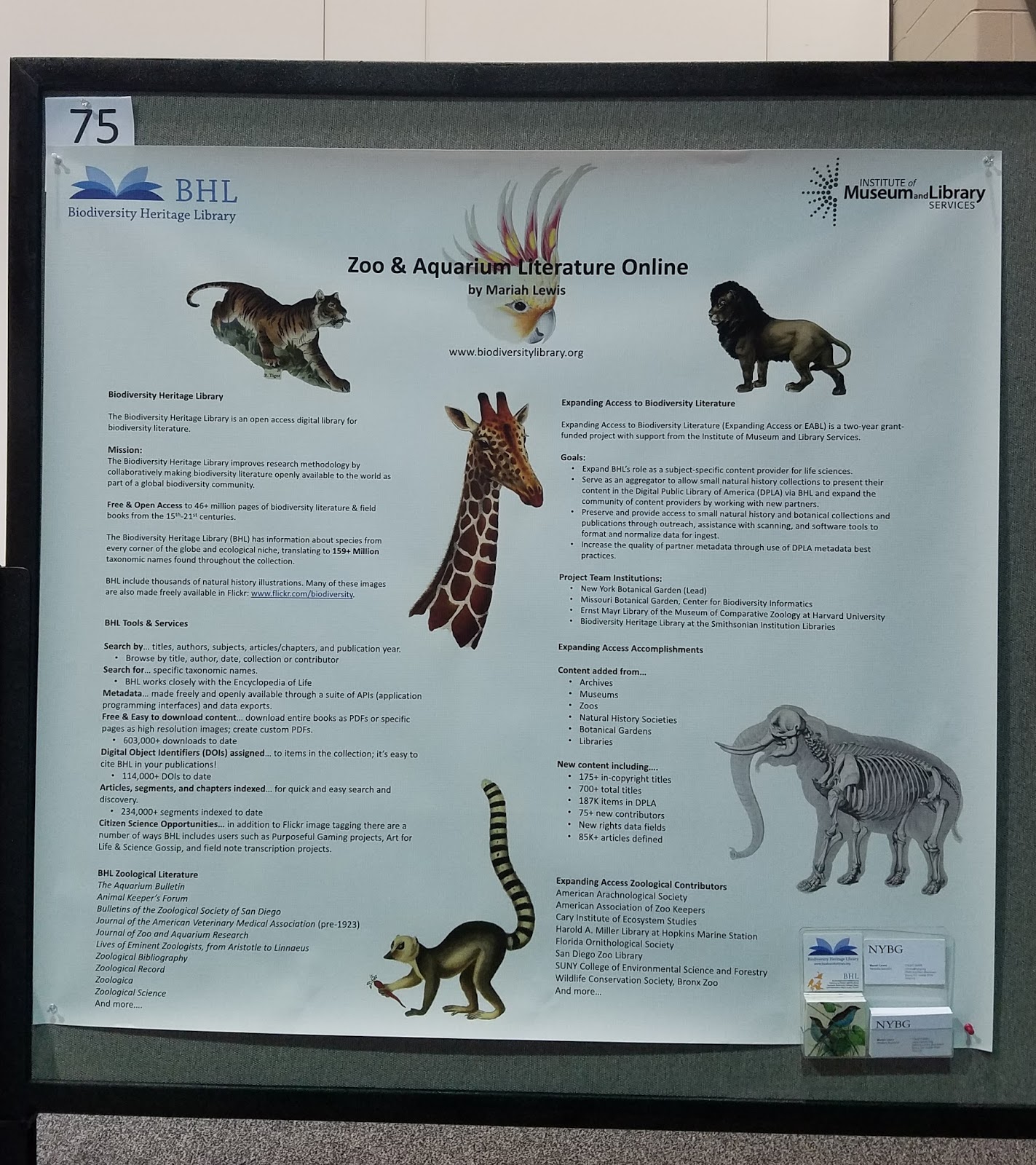
The Expanding Access to Biodiversity Literature poster was titled “ZooLiterature Online” and reflected the work the grant had done in the area of zoo and aquarium literature.  Since AZA was a relatively new area for BHL, a portion of the poster was general information about BHL highlighting some of the different ways content could be used and analyzed. The poster also highlighted the Expanding Access project, its goals, grant team institutions, accomplishments and zoo and aquariums contributors and titles in BHL, many added as part of EABL. The poster was well received and introduced many AZA conference attendees to BHL.

Explore the zoological titles highlighted in the EABL poster in BHL here:

  • The Aquarium Bulletin (Digitized by Smithsonian Libraries)
  • Animal Keeper’s Forum (Digitized by Smithsonian Libraries with permission from American Association of Zoo Keepers)
  • Bulletins of the Zoological Society of San Diego (Contributed by San Diego Zoo Global Library & Archives)
  • Journal of the American Veterinary Medical Association (pre-1923) (Digitized by University of Toronto Libraries)
  • Journal of Zoo and Aquarium Research (Contributed by European Association of Zoos and Aquaria)
  • Lives of Eminent Zoologists, from Aristotle to Linnaeus (Digitized by Smithsonian Libraries)
  • Zoological Bibliography (Contributed by Aves Press Limited)
  • Zoological Record (Digitized by Smithsonian Libraries and the USDA National Agricultural Library)
  • Zoologica (Digitized by MBLWHOI Library)
  • Zoological Science (Digitized by Library of Congress)

Communities Come Together Over Gardens: Using Horticulture to Connect with Our Neighbors

The focus of most of the AZA panels was, logically, zoos and aquariums.  However, one of the final panel options centered around botanical gardens in zoos. The panel began with a look back at horticulture in zoos. Fifty years ago, it involved trimming hedges around the property. Forty years ago, zoos moved towards hiring horticulturists to create convincing habitats. Moving to thirty years ago, some zoos started becoming botanical gardens as well. It was just twenty years ago that zoos and aquariums became more interested in plant conservation as an added component to their missions.

Presenting at the panel was Steve Foltz, Director of Horticulture at the Cincinatti Zoo and Botanical Garden; Paul Bouseman, Botanical Curator at the Mesker Park Zoo and Botanic Garden; Bob Chabot, former Director of Horticulture at the Jacksonville Zoo and Gardens and current Chief of Staff at Zoo New England; and Christine Nye, Horticultural Programs Manager at the John G. Shedd Aquarium.

Each presenter highlighted the work their zoos and aquariums did both within their institution and in their community in the area of horticulture. The Cincinnati Zoo worked to build bridges in their community by planting trees in areas of the town that were affected by tornadoes or in communities in need of transformation. They worked with master gardeners, Proctor and Gamble, and the Cincinnati Reds to help renew the community and change the way the community looks at the zoo.

The Shedd Aquarium uses the spaces around its exhibit as a free public garden space and created volunteer and education programs around it.

The Mesker Park Zoo and Botanic Garden uses horticulture to attract people with the power of plants. Mesker’s local community comes in and volunteers and they gain a better connection with the zoo.

The Jacksonville Zoo and Garden partnered with a number of different local organizations and even a high school. Chabot and the zoo worked to create gardens in a number of locations and used the local arts high school- Douglas Anderson School of the Arts- to record sounds for the Butterfly Hollow exhibit.

<!–
View Full Size Image
Indianapolis Zoo Garden

–>

Zoo Day at the Indianapolis Zoo

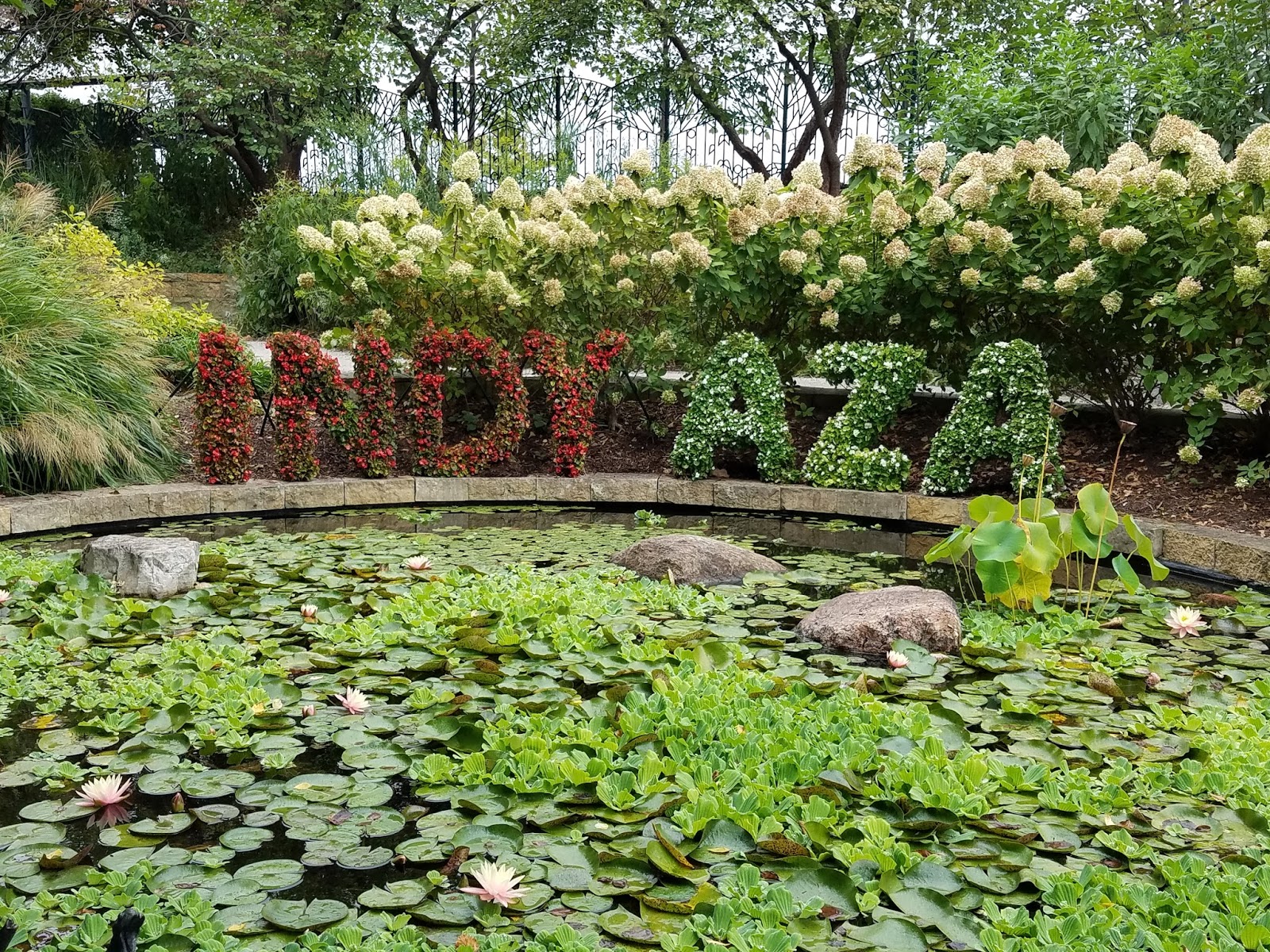
The final event of the AZA Annual Conference was Zoo Day.  The day included full access to the rides and attractions- including the carousel, train ride, skyline, 4D theatre, Kombo Family Coaster, and Race-A-Cheetah. They also set up a number of different chats, demos, feedings and presentations throughout the afternoon and evening.  Between the hosted lunch, happy hour, dinner, and dancing AZA attendees were able to take advantage of a number of different Behind-the-Scenes Open-Houses that allowed those from other zoos and aquariums to get a better understanding of the operations and animal care at the Indianapolis Zoo.

Also attended were Public Perceptions of Zoos and Aquariums in a Changing World, Classic Continuing Conservation, What’s New in Exhibit Design?, and Cognitive Tasks for Great Apes: Promoting Conservation, Research, Education and Animal Wellness.

Moving forward, the Expanding Access team and the Biodiversity Heritage Library hope to maintain our current relationships with Zoo and Aquarium institutions and publishers.

Are you part of a zoo or aquarium and interested in what you can do to get involved? Here’s some tips on what you can do!

  1. Use BHL!
  2. Consider adding your publications to BHL.
  3. If you have legacy literature you want scanned from your library or archive, email us!
  4. Suggest titles you would like to see in BHL and we will do our best to include them.

For any of these suggestions please email use our Feedback form here.  You can also check out our poster presentation in PDF format here.

September 21, 2017by aneeser
Blog Reel, Featured Books

The Delaware Museum of Natural History

View Full Size Image
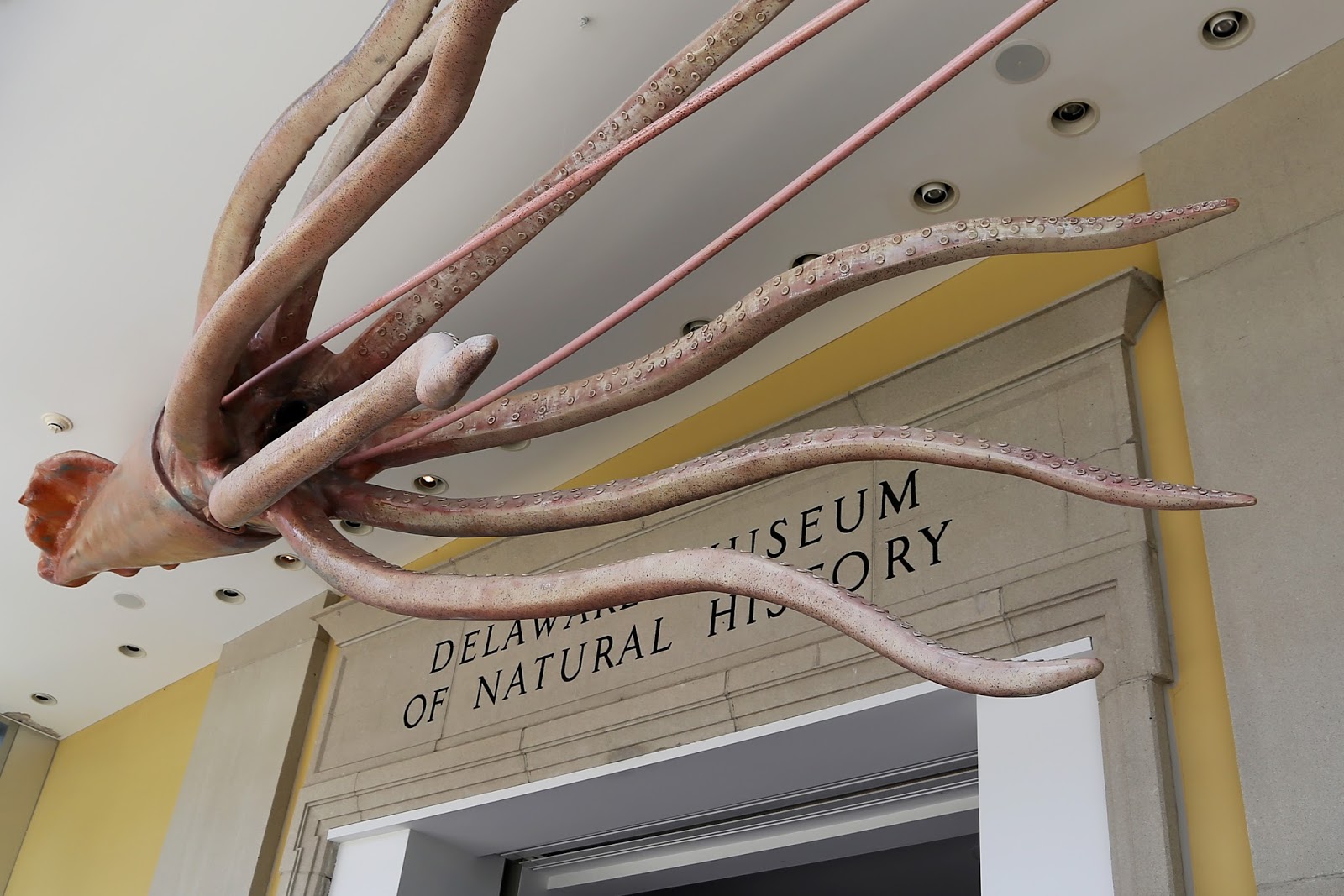
Image adapted from a photo by Jim, the Photographer. Original on Flickr.
(CC BY 2.0)

History
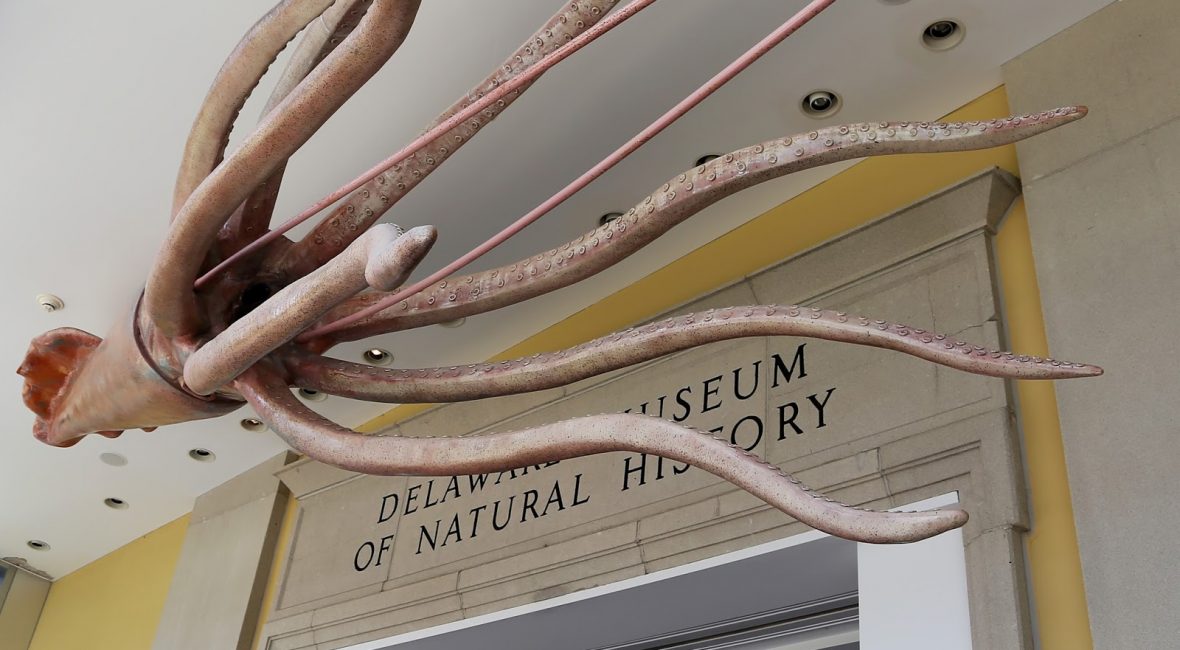
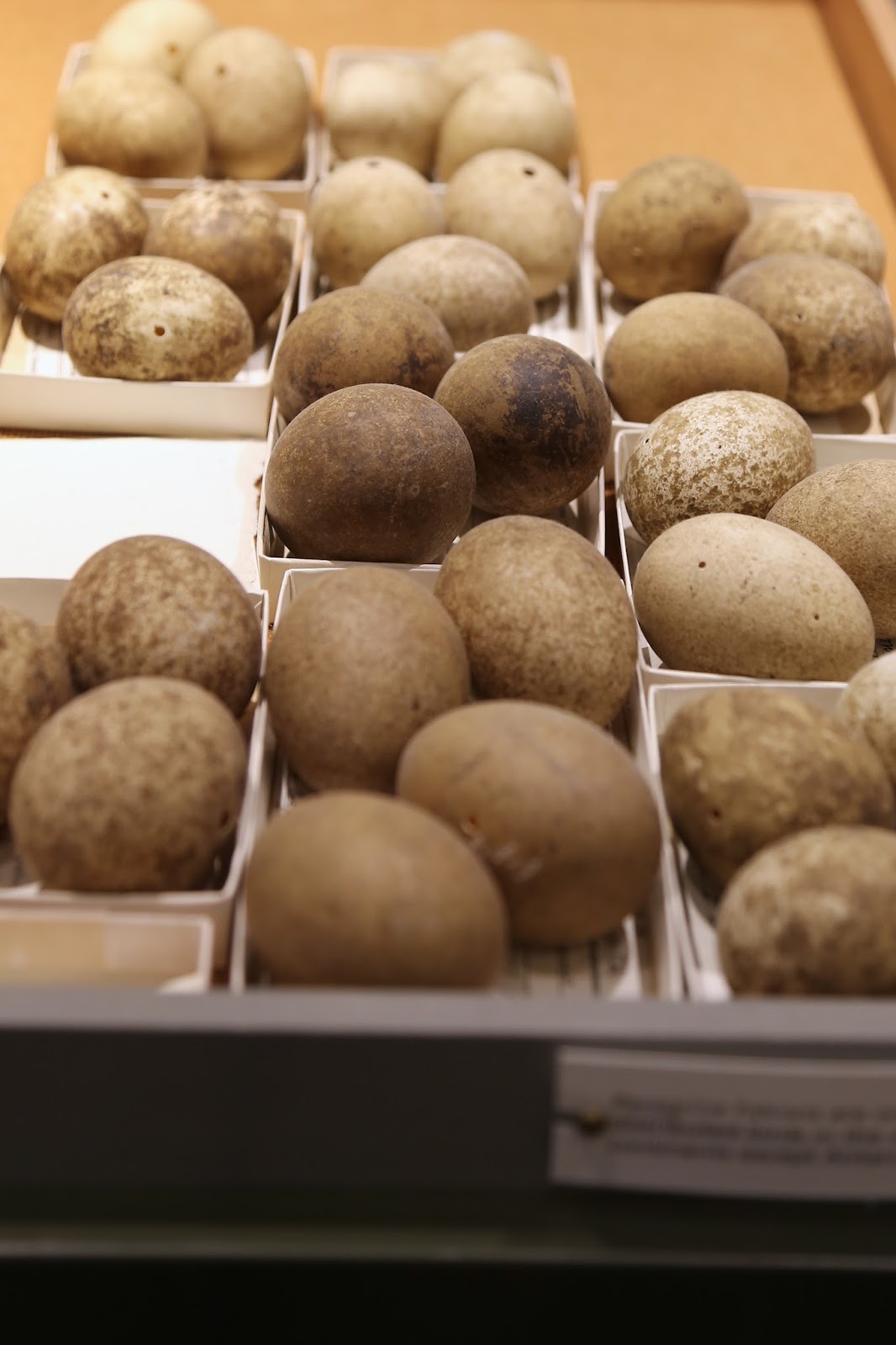
For over 40 years, the Delaware Museum of Natural History (DMNH) has promoted the study of nature, investigated the planet’s flora and fauna, and educated the public with its world-class collections, which are particularly rich in mollusks and birds (DMNH’s collection of bird eggs is the second-largest in North America).

View Full Size Image
“The Egg Collection”
Photo by Jim, the Photographer
on Flickr (CC BY 2.0)

Founded in 1957, the museum began as an idea in the mind of John duPont, heir to the DuPont Chemical fortune. An avid naturalist, duPont travelled the world and amassed a collection of 113,000 birds and 2 million seashells. He used a portion of land from his family’s estate to found the museum that houses his collections. It opened to the public in 1972.

Long after his involvement with DMNH had ended, duPont moved his attention to athletics. He used some of his fortune to open a training center for Olympic athletes on his sprawling estate in Pennsylvania. The athletes, trainers, and coaches who worked for him were known as Team Foxcatcher and enjoyed considerable success. As years went on, however, duPont’s behavior became increasingly erratic. His deterioration came to a head in January of 1996, when, for reasons unknown, he shot and killed his star wrestling coach, Olympic gold medalist Dave Schultz. This tragic story was (loosely) told in the 2014 film Foxcatcher.

Publications and Rare Books

Birds, shells, and mammals aren’t the only things that John duPont put in the DMNH; he also contributed a library with an excellent collection of rare books. DMNH recently contributed some of these books to BHL through the Expanding Access to Biodiversity Literature (EABL) project, which works with organizations across the U.S. to digitize unique and valuable material. The DMNH-contributed books include rare works from the 18th century and publications by the museum, including several works by duPont himself. Below are some highlights; the complete list can be found here and here.

1. Index testarvm conchyliorvm quae adservantvr in mvseo Nicolai Gvaltieri (1742)

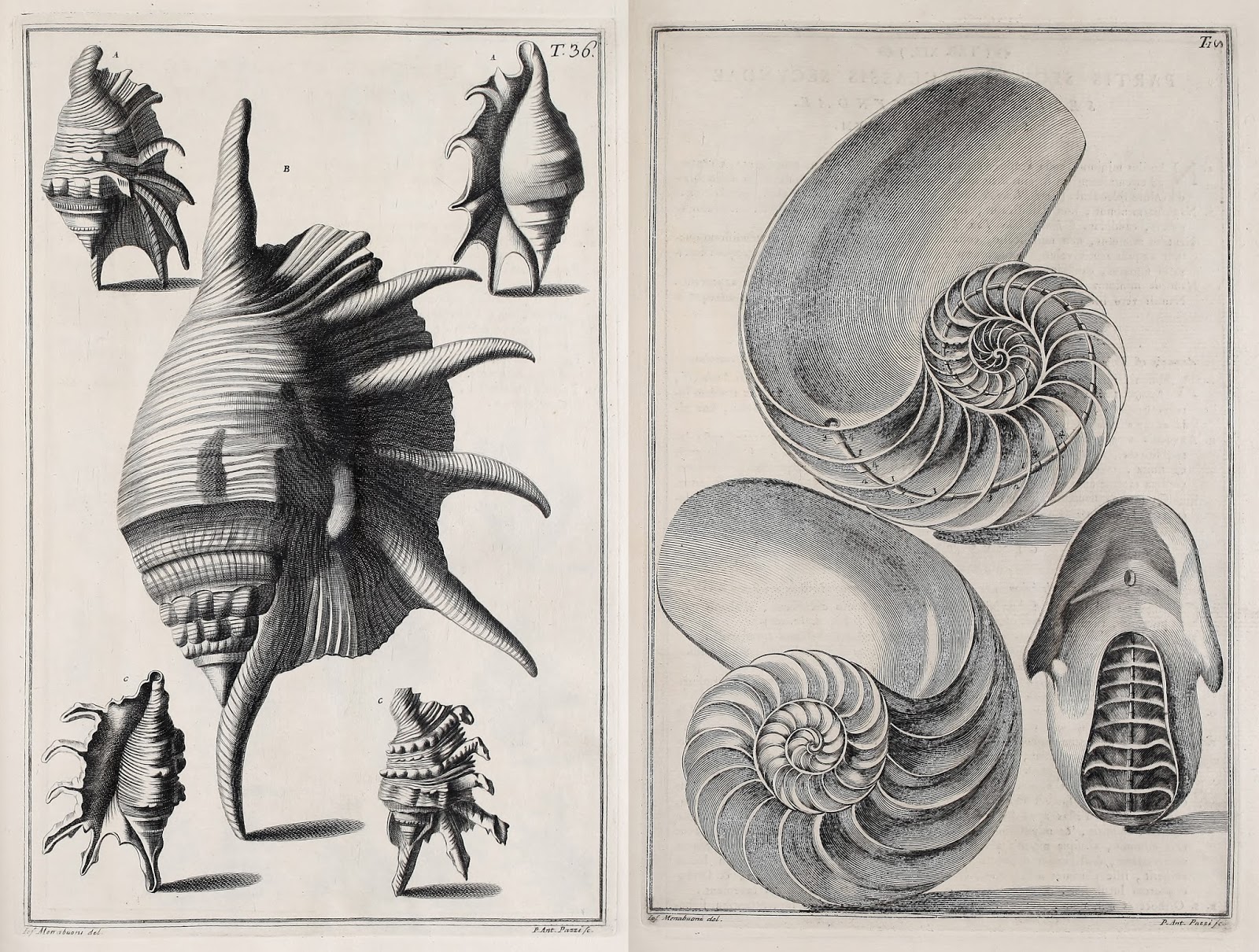
Niccolò Gualtieri was an Italian doctor, malacologist, and professor at the University of Pisa, whose collection of shells is the oldest in the university’s natural history museum. Particularly noteworthy in his Index testarvm conchyliorvm are his descriptions of argonauts, also called paper nautiluses.

View Full Size Image
Plates from Gualtieri’s Index: L: T.36, Conch shells (Strombidae);
R: T.18, Nautilus.

2. Woodpeckers of the World (Monograph Series No. 4, 1982)

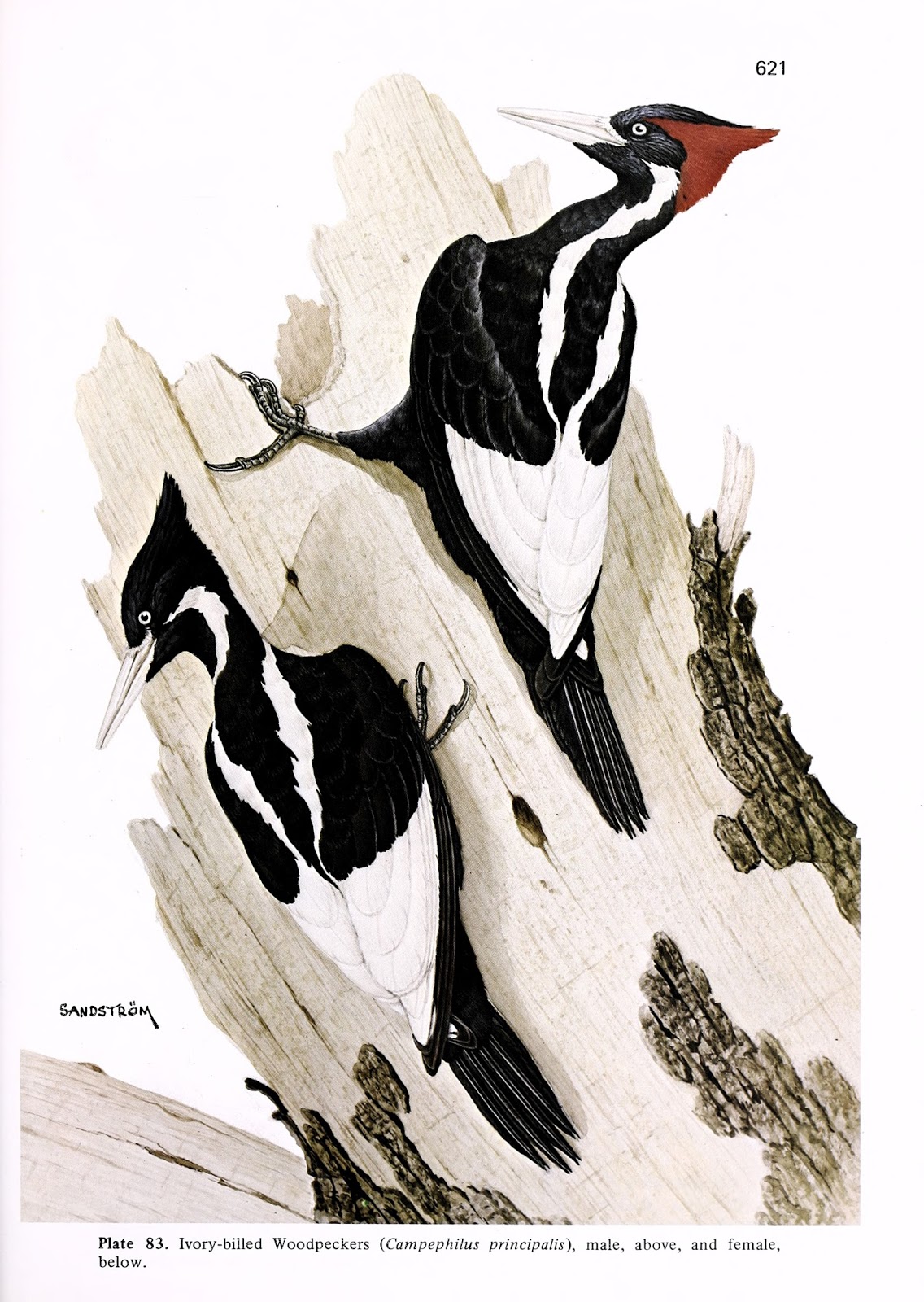
Lester L. Short, born in 1933, is one of the world’s foremost experts on woodpeckers (family Picidae). A former curator of birds at the American Museum of Natural History, Short travelled to over 60 countries documenting woodpeckers and in 1986 was one of the last people to see a Cuban Ivory-billed Woodpecker, Campephilus principalis bairdii, in the wild. The bird is now believed to be extinct.

Short’s Woodpeckers of the World was written with the encouragement and support of John duPont; in fact, duPont arranged for his illustrator, George Sandström, to work with Short to produce the 101 color plates in the book.

View Full Size Image
Ivory-billed Woodpeckers, illustrated by George Sandström.
From Woodpeckers of the World (1982), p. 621:
http://biodiversitylibrary.org/page/53631011

3. Philippine Birds (Monograph Series No. 2, 1971)

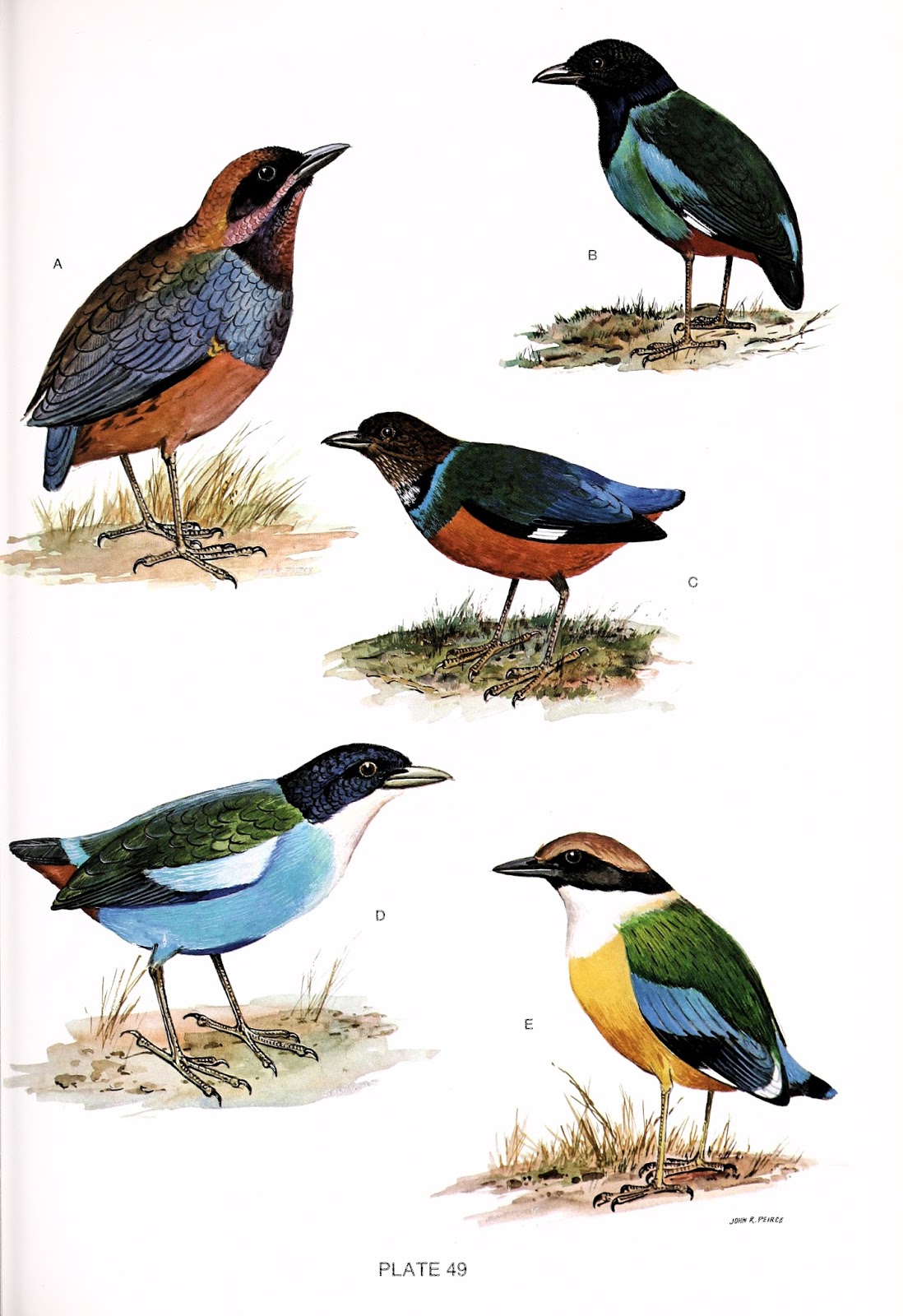
John duPont wrote this book based on his own expeditions to the Philippines, beginning in 1958. In the foreword to the book, ornithologist Dean Amadon writes that “anyone who knows John duPont will realize that, once in the islands, he heads for the nearest mountains and jungles: he is not one to dawdle about in the gardens of local officials.” Philippine Birds was written as an identification guide rather than a comprehensive work, with brief descriptions accompanying color illustrations by George Sandström.

View Full Size Image
Pittas (family Pittidae), illustrated by George Sandström.
From Philippine Birds (1971), plate 49:
http://biodiversitylibrary.org/page/53630110

Jean Woods, Curator of Birds at DMNH, worked with the EABL team to digitize these titles and get them into the BHL collection. Discussing the importance of putting them online, she said, “We’re excited to have the museum’s publications and rare books available through the Biodiversity Heritage Library to be used by researchers that have not previously had access to them.” She added that some of the titles, like Philippine Birds, have been out of print for years and that “many of the rare mollusk books contain original species descriptions which continue to be essential for taxonomic work.”

We are grateful to Jean and to the Delaware Museum of Natural History for so generously sharing their wealth of publications and rare books with the BHL community.

References

About us. (n.d.). Retrieved from http://www.delmnh.org/about-us-2/
Eckholm, E. (1986, May 5). Woodpecker, believed extinct, seen in Cuba. The New York Times. Retrieved from http://www.nytimes.com/1986/05/05/us/woodpecker-believed-extinct-seen-in-cuba.html
Longman, J. (2010, December 9). John E. du Pont, heir who killed an Olympian, dies at 72. The New York Times. Retrieved from http://www.nytimes.com/2010/12/10/sports/olympics/10dupont.html?_r=0
Niccolò Gualtieri’s splendid seashells. (2016, August 26). Retrieved from http://www.italianways.com/niccolo-gualtieris-splendid-seashells/
August 17, 2017by [email protected]
BHL News, Blog Reel

In-copyright Titles from the 2nd quarter of 2017

From April to June of this year, BHL received permission for 36 new in-copyright titles, keeping pace with the 39 added in the first quarter. The Expanding Access to Biodiversity Literature project, BHL staff, and new members and affiliates all contributed to securing permission and are now working to scan and upload. To put that 36 number in perspective, there are about 650 in-copyright titles in BHL, out of 125,000 total–that’s just a half percent, but it’s growing!

View Full Size Image
BHL licenses content under a
Creative Commons Attribution-NonCommercial-ShareAlike 4.0 license

Below are the 36 titles added in the second quarter, in the order permission was secured. For those that have already been scanned or uploaded, links are available. Look for the rest as they’re added to the collection; you can check the recent additions, or see all the permission titles available in BHL on the permissions page. Titles in BHL have been digitized/contributed by the rights holders unless otherwise stated.

1. North Carolina Biological Survey and the North Carolina State Museum of Natural Sciences

  • A Distributional Survey of North Carolina MammalsThe Seaside Sparrow, Its Biology and ManagementAtlas of North American Freshwater Fishes (with supplement)Autumn Land-bird Migration on the Barrier Islands of Northeastern North CarolinaEndangered, Threatened, and Rare Fauna of North Carolina (Parts I-IV)Research Vessel Dan Moore station logsBird Life of North Carolina’s Shining Rock WildernessFourth Colloquium on Conservation of Mammals of the Southeastern U.S.
2. Florida Ornithological Society
  • Florida Field Naturalist (Digitized by Smithsonian Libraries)
3. Delaware Museum of Natural History
  • Living Volutes, a Monograph of the Recent Volutidae of the World
  • South Pacific Birds
  • Woodpeckers of the World
  • Ranellidae and Personidae: A Classification of Recent Species
  • Philippine Birds
4. New York Botanical Garden
  • Advances in Cladistics, v.1 (Digitized by Smithsonian Libraries)
5. Bombay Natural History Society
  • Buceros: ENVIS newsletter (Digitized by Smithsonian Libraries)
6. Dr. Peter Shaw Ashton
  • Peter S. Ashton papers: field work in Sarawak and Malaysia (Digitized by Harvard University Botany Libraries)
7. Vascular Plant Herbarium, School of Life Sciences, Arizona State University
  • Canotia (Digitized by The New York Botanical Garden, LuEsther T. Mertz Library)
8. Northwest Horticultural Society
  • Newsletter
9. Hardy Fern Foundation
  • Hardy Fern Foundation Newsletter
  • Hardy Fern Foundation Quarterly
10. Virginia Native Plant Society
  • Bulletin
  • Sempervirens
11. Trustees of the Royal Botanic Gardens, Kew
  • Antarctic Journal 1839-43: Travels papers. Erebus & Terror voyage. (Sir Joseph Dalton Hooker) (Digitized by Royal Botanic Gardens Kew, Library, Art & Archives)
12. University of Washington Botanic Gardens
  • Urban Horticulture Presents
  • Urban Horticulture
  • Camas Quarterly
  • E-Flora
13. International Carnivorous Plant Society
  • Carnivorous Plant Newsletter
Thank you to the individuals and organizations who have so generously given permission for these titles in support of open access. If there’s a title you’d like to see in BHL, let us know here. And don’t forget to follow BHL on Facebook, Twitter (@BioDivLibrary), Instagram, Pinterest, and Tumblr.
August 1, 2017by eomeara
Page 2 of 6«1234»...Last »

Help Support BHL

BHL's existence depends on the financial support of its patrons. Help us keep this free resource alive!

search

About BHL

The Biodiversity Heritage Library (BHL) is the world’s largest open access digital library for biodiversity literature and archives. BHL operates as a worldwide consortium of natural history, botanical, research, and national libraries working together to digitize the natural history literature held in their collections and make it freely available for open access as part of a global “biodiversity community.”

Join Our Mailing List

Sign up to receive the latest news, content highlights, and promotions.

Subscribe Now

Subscribe to Blog via Email

Enter your email address to subscribe to this blog and receive notifications of new posts by email.

Join 319 other subscribers

Subscribe to Blog Via RSS

Subscribe to the blog RSS feed to stay up-to-date on all the latest BHL posts.

Access RSS Feed

Inspiring Discovery through Free Access to Biodiversity Knowledge.

The Biodiversity Heritage Library makes it easier than ever for you to access the information you need to study and explore life on Earth…for free, anytime, anywhere.


ABOUT | HARMFUL CONTENT | PRIVACY | SITE MAP | TERMS OF USE