Biodiversity Heritage Library - Program news and collection highlights from BHL
  • Home
  • News
  • Featured Books
    • All Featured Books
    • Book of the Month Series
    • BHL at 20
  • User Stories
  • Campaigns
    • Fossil Stories
    • Garden Stories
    • Monsters Are Real
    • Page Frights
    • Her Natural History
    • Earth Optimism 2020
  • Tech Blog
  • Visit BHL
Home
News
Featured Books
    All Featured Books
    Book of the Month Series
    BHL at 20
User Stories
Campaigns
    Fossil Stories
    Garden Stories
    Monsters Are Real
    Page Frights
    Her Natural History
    Earth Optimism 2020
Tech Blog
Visit BHL
  • Home
  • News
  • Featured Books
    • All Featured Books
    • Book of the Month Series
    • BHL at 20
  • User Stories
  • Campaigns
    • Fossil Stories
    • Garden Stories
    • Monsters Are Real
    • Page Frights
    • Her Natural History
    • Earth Optimism 2020
  • Tech Blog
  • Visit BHL
Biodiversity Heritage Library - Program news and collection highlights from BHL
BHL News, Blog Reel

CBHL 2017: Expanding Access visits the Twin Cities

Portrait version of the Biodiversity Heritage Library logo.

The Council on Botanical and Horticultural Libraries met for its annual conference in Chaska, Minnesota this year.  The conference, which took place June 5th through June 9th, was attended by three Expanding Access to Biodiversity Literature team members: Susan Fraser, Susan Lynch, and Mariah Lewis.

Tuesday the team hosted a pre-conference workshop titled “Contributing to a National Digital Infrastructure, with Help Every Step of the Way.”  The workshop was attended by both members of CBHL and those outside CBHL who were interested in the Expanding Access project.  The training covered a variety of topics including collection development, the Digital Public Library of America, metadata, imaging standards, BHL related tools and defining articles within BHL. The three-hour session was well attended and some attendees are expected to contribute to BHL in the upcoming months while others have already added content through Expanding Access.  Check out the Lloyd Library and Museum’s contributions here!

View Full Size Image

Tuesday evening, after a day of committee meetings, the opening reception kicked off the annual CBHL meeting.  A wonderful evening of hors d’oeuvres allowed members to reconnect and meet the ten first time attendees.

The next day was spent at the University of Minnesota Landscape Arboretum, a quick drive past Prince’s Paisley Park.  Kathy Allen, this year’s host and the Librarian at the Andersen Horticultural Library, welcomed CBHL members and introduced the Arboretum Director, Peter C. Moe, who gave a thorough, informative and interesting introduction to the Arboretum.  This was followed by a presentation about the Arboretum’s education programs by the Director of the Education Department, Tim Kenny.

The next presentation of the day followed David Bedford’s experiences with apple breeding at the University of Minnesota.  A Senior Research Fellow at the Horticultural Research Center, Bedford took the audience through a history of apple migration and how exactly we get those delicious apple varieties we see in the grocery store.  Notably, the University of Minnesota has developed such apple varieties as Honeycrisp, Regent, and SweeTango.

Wednesday afternoon was spent touring the garden and the Andersen Horticultural Library. Following this was a tram ride around 3-Mile Drive and a stop in at the newly constructed Tashjian Bee and Pollinator Discovery Center, which has been open less than a year.  The Center was created to be both an educational and outreach project in association with the University of Minnesota’s world-renowned bee research.

View Full Size Image

Thursday the attendees ventured to the University of Minnesota in the Twin Cities.  The morning kicked off in the Wangensteen Library of Biology & Medicine, where tours of the stacks and a rare book showing were given.  Later, members were able to tour the Weisman Art Museum and spend time in the Dear Darwin exhibit.  The crew then walked across the Mississippi on their way to the Elmer L. Andersen Library.

The early afternoon was spent between two activities.  The first was a presentation on the University of Minnesota’s Children’s Literature Research Collection which included a viewing of original artwork by Anne Ophelia Dowden, Betsy Bowen, and Phyllis Root.  The second activity was a tour through the Minnesota Library Access Center- the cavernous storage facility that can hold up to 1.4 million volumes.  With shelves standing 17 feet tall, items are shelved by size and retrieved by forklift.  Later that afternoon there was a panel discussion of Collection Stewardship.

After the group’s time at the University of Minnesota, they traveled to the Minneapolis Institute of Art, taking advantage of the range of art and artifacts in the wonderfully-curated exhibits.  Also nearby was “Eat Street.”  Covering seventeen blocks, Eat Street incorporates a number of different culinary styles, flavors and atmospheres.

View Full Size Image

On Friday, the annual meeting returned to the Andersen Arboretum.  After a morning of business meetings, a joint CBHL/Friends of the Andersen Horticultural Library Luncheon was held.  CBHL members were able to enjoy the company of the Friends of the Library, who had graciously helped secure the luncheon speaker, and furniture designer legacy Mira Nakashima.  Reflecting on the life and career of her father, master furniture designer George Nakashima, and the current pieces the company is now working to create, Mira Nakashima’s presentation allowed the audience to travel with her into her memories.  After lunch Mira Nakashima led small group tours of the Andersen Library’s Nakashima furniture collection.

That afternoon, there was an Arboretum Behind-the-Scene bus tour where participants were able to see more than just the main area.  This included seeing the apple orchards referenced in an earlier presentation and the home of the osprey family that stars in the University of Minnesota Osprey Cam.

View Full Size Image

The conference concluded after the Annual Literature Award Ceremony and Banquet.  Each year, after the presentation of the awards and during the banquet, the members enjoy a final speaker and the book raffle.

This year’s banquet speaker was Dr. David Zlesak.  An Associate Professor of Horticulture at the University of Wisconsin, the presentation focused on the plant introduction pipeline.  This follows the life of new varieties from planning and breeding to marketing and selling.

Eight member presentations were given throughout the week.  A chance to share institutional projects with other members, the topics included plant information, children’s literature diversity, film crews in archives, Wikipedia edit-a-thons, bookplates, book reviews, lost gardens, and a new collection management system at the Morton Arboretum.

To read more about the Council on Botanical and Horticultural Libraries Annual Conference, check out the September issue of the CBHL Newsletter.

July 20, 2017by ntay
BHL News, Blog Reel

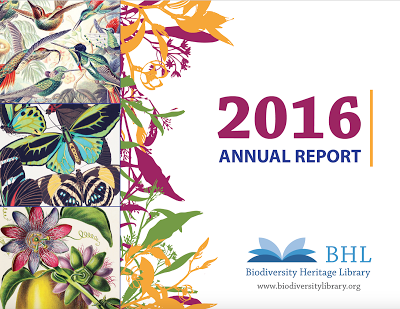
2016 BHL Annual Report

The 2016 BHL Annual Report is now available!

View Full Size Image


Find out how our collections grew and audiences engaged with our library in 2016, learn more about some exciting new projects, and explore impact stories from users across the globe. Read the report now!

You can also get the latest updates from BHL in our newsletters. Explore past newsletters here and subscribe to our mailing list here.

July 19, 2017by Grace Costantino
Blog Reel, Featured Books

The Southern Cultivator

The Expanding Access to Biodiversity Literature (EABL) collection has grown rapidly over the last year, with the addition of born digital material and in-copyright titles scanned by various BHL member libraries. It wasn’t until recently, however, that the collection included titles contributed directly by non-BHL members. This process—a significant departure from usual BHL workflows—is part of EABL’s effort to digitize valuable content from organizations outside the consortium. Contributors ship their material to the closest Internet Archive (IA) scanning center, where it is scanned and added to the BHL and EABL IA collections. From there, the metadata is ingested into BHL by the usual process. EABL then reimburses the scanning cost.

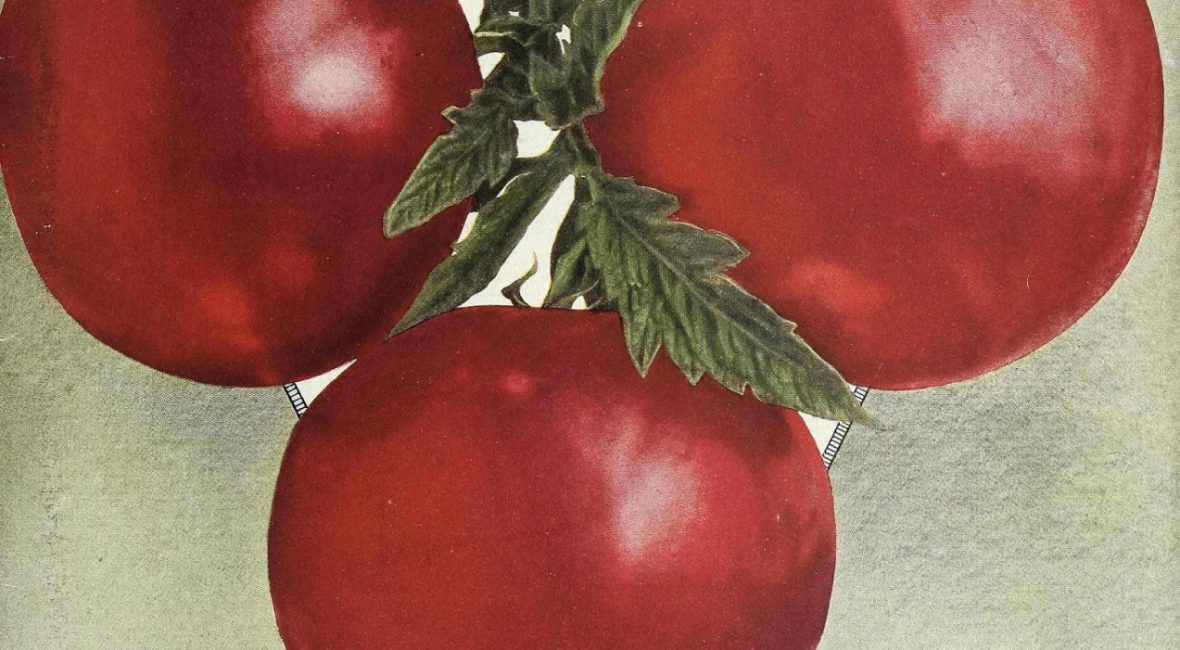
The first organization to digitize in this way through EABL was the Cherokee Garden Library, Kenan Research Center at the Atlanta History Center. They contributed seed catalogs published by H.G. Hastings & Co., a major commercial agricultural company in Atlanta, Georgia, in the early 20th century.

View Full Size Image
Hastings’ Seeds, No.55 (1918). http://www.biodiversitylibrary.org/page/53015794. Digitized by Cherokee Garden Library, Kenan Research Center at the Atlanta History Center.

The Cherokee Garden Library also contributed a number of volumes (v.1-4, 1843-1846; v.13-15, 1855-1857; v.17, 1859) of The Southern Cultivator, another Atlanta-based publication that historian Michael T. Bernath called “the Confederacy’s oldest, strongest, and intellectually most impressive agricultural journal.” The journal is important not only as a source of information about the agriculture industry of the antebellum South, but also for its stark depiction of American slavery and the unconscionable role it played in the rise of that industry. It was published from 1843 to 1872.

View Full Size Image
Southern Cultivator. v. 17 (1859). http://www.biodiversitylibrary.org/page/53013665. Digitized by Cherokee Garden Library, Kenan Research Center at the Atlanta History Center.

The editors of The Southern Cultivator minced no words in promoting the practice of slavery; in fact, they saw it as a crucial component in their plan to elevate southern agriculture. In v.1 (1843), they printed an address given by John Belton O’Neall to the Agricultural Society of South Carolina in December of the previous year. In it, Judge O’Neall states that there is one obstacle to realizing the full industrial potential of the state — the “carelessness of her operatives,” i.e., slaves. He continues, “Still, our slaves are capable of more, much more, than we have hitherto had credit for. It is only necessary that they should be taught habits of regularity, economy and thrift, to make them the most effective laborers in the world. This is what we are attempting.” (p.109).

Difficult as it is to read these words—and they are hardly the most racist to appear in the journal’s pages—they provide an unvarnished glimpse into a period of American history in which slavery was a cornerstone of agriculture throughout much of the country. Indeed, The Southern Cultivator shows that it was not southerners alone who believed slavery was vital to the economy. In v.17 (1859), as the tensions that would lead to civil war were quickly rising, the editors reprinted an editorial from the Providence [Rhode Island] Post arguing that the North would suffer equally, if not more, if the South were to secede from the Union or if slavery were abolished. They preface the editorial by saying, completely without irony, that they “seldom dabble in anything that even resembles the ‘dirty water of politics’.” The editorial itself is frank in putting material concerns over principle:

Slavery may be a great outrage against humanity. We look upon it in this light, and have no defence to offer for it. But we remind Northern men, not only that the North clung to while it promised to be profitable…but that Northern merchants and Northern mechanics and Northern manufacturers are dependent on it to-day for their stately ships, their immense store-houses, their splendid dwellings, their paying railroads and their reputation for thrift. (p.107)

View Full Size Image
Sample of the index to v.17 (1859),
showing the topical breadth of the journal. http://www.biodiversitylibrary.org/page/53013673. Digitized by Cherokee Garden Library, Kenan Research Center at the Atlanta History Center.

As the United States continues to grapple with the legacy of the Confederacy, slavery, and the aftermath of the American Civil War, the digitization of these volumes is particularly timely. We are grateful to the Cherokee Garden Library, Kenan Research Center at the Atlanta History Center for contributing them through EABL, and we hope that they will be useful to researchers across many disciplines.

To learn more about the Cherokee Garden Library and its work with EABL, see this post from earlier this year.

Reference
Michael T. Bernath, Confederate Minds: The Struggle for Intellectual Independence in the Civil War South, Chapel Hill, North Carolina: University of North Carolina Press, 2010, p. 86.

June 15, 2017by [email protected]
BHL News, Blog Reel

DPLA Reharvest of BHL Data

View Full Size Image

On April 11, 2017 the Digital Public Library of America (DPLA) reharvested all BHL data for ingest into its portal at https://dp.la/.

While BHL has served as a content hub for DPLA since its launch in 2013, our data has not been updated in their portal since that launch, primarily due to the absence of a workflow on DPLA’s end for automatically harvesting new data. Since 2013, the number of BHL records in our portal has increased significantly and changes and corrections to pre-2013 records were not reflected in the DPLA portal. This new harvest not only captures new data but also ingests updates to existing records.

View Full Size Image
View of BHL records from DPLA’s first harvest–these lack the thumbnail


Before the harvest, BHL had 123,472 items in DPLA. After the reharvest, BHL now has over 187,000 items in DPLA. This not only represents a 52% increase in BHL records in DPLA, but more importantly, the quality of those records has improved and is now in sync with BHL.

From the perspective of DPLA visitors, the most noticeable change is the addition of thumbnail images, which were lacking in DPLA prior to the reharvest. Going forward, DPLA will automatically reharvest BHL data on a bi-monthly schedule.

View Full Size Image
View of BHL records from DPLA’s recent harvest, which includes thumbnails

Why is it important for our data to be in DPLA? BHL wants its data represented in DPLA because it supports our mission to make biodiversity literature as openly available and accessible as possible. DPLA exposes BHL content to new audiences who otherwise may not be aware of our existence and emphasizes the richness of U.S. national collections, which helps underscore the value of libraries for both American and global citizens.

You can explore BHL’s collection in DPLA and many others here.

May 18, 2017by [email protected]
Blog Reel, Featured Books

The Worcester Country Horticultural Society

In the fall of 1840, in Worcester, Massachusetts, two dozen attendees of the Worcester Agricultural Society’s Annual Cattle Show put on a display of local fruits and flowers. The attention it received led to the creation, in 1842, of the Worcester County Horticultural Society (WCHS), the third oldest active society of its kind in the United States.

View Full Size Image
The logo of the WCHS, from Transactions, 1912
(image in the public domain,
from Wikipedia)

Today, the WCHS is based at Tower Hill Botanic Garden, which it established in 1986. While many things have changed since the era of its founding 175 years ago, the WCHS continues to “inspire the use and creation of horticulture to improve lives, enrich communities and strengthen commitment to the natural world.” The history of this effort is documented in the Transactions of the Worcester County Horticultural Society, which is available in BHL’s collection through the work of the Expanding Access to Biodiversity Literature project. Thank you to the WCHS for sharing this valuable publication with BHL and its users.

History of the WCHS


“It is truth, TRUTH—and the Universe was framed to corroborate it—that of all employments, none is better than the Culture of the Earth, none more independent, none more pleasant, none more worthy the dignity of Man!”
-George Jaques, Transactions of the Worcester County Horticultural Society, p.11 (1847)
On September 19, 1840, several men gathered for the purpose of establishing a society that would do for horticulture what the Worcester Agricultural Society had done for agriculture: the “mutual improvement in [its] theoretical and practical branches.” The Agricultural Society’s Annual Cattle Show was chosen as the venue for an initial exhibition. Prior to the show itself, ads were placed in area newspapers soliciting contributions from the gardens and orchards of the public. The exhibit opened the day before the Cattle Show, to popular acclaim and the chagrin of the elder society, which was in danger of being upstaged. A host of new members was admitted (membership was $1), and the nascent horticultural society entered a period of steady growth.
View Full Size Image
The “Surpasse,” one of the peaches on display at
the Exhibition of 1846, from
The Peaches of New York (1917)

From the beginning, regular exhibitions were the main occupation of the WCHS. Strict rules governed the creation of these exhibits and the conduct of the committees appointed to organize them. Nevertheless, George Jaques lamented in the Transactions (1847):

It may pour balm into some wounds, in certain quarters—wounds which Time—that physician, so eminent for the thorough course that he pursues with his patients—may have failed of healing, to acknowledge the sinfulness of some of the Committees, in venturing upon an infringement of the above Rules, in so far, as to procure the concurrent testimony of the palate, as well as that of the eye, in regard to the character of the subjects of their examination.
 
What Mr. Jaques was admitting, however obliquely, is that committee members were tasting the wares meant for display—bad behavior that, according to the Report on Fruit for the Annual Exhibition of 1847, was not evident in the public:
 
Notwithstanding the hall was constantly thronged with visitors, and many hundreds of samples of beautiful and tempting fruit within reach of every one, yet all seemed to feel and act as if it was placed there to be examined with the eye only. No instance of pilfering, and but little unnecessary handling of the fruit, was known to occur.
View Full Size Image
The first Horticultural Hall, from
Transactions, 1891-1892
(image in the public domain,
from Wikipedia)

In 1851, the WCHS built Horticultural Hall, its first permanent residence, on Front Street in the heart of Worcester. Horticultural Hall served as the home of the society until 1928, when the society built a larger structure—with the same name—on Elm Street, just a few blocks away. The second hall served the society until 1983, when it purchased a 132-acre parcel of land in Boylston. Here, at Tower Hill Farm, it created Tower Hill Botanic Garden, its present home.

Exhibits were the primary activity of the WCHS in its first century. While many of the varieties of fruits and vegetables named in the Transactions are no longer familiar, a few have become staples in the U.S. The Report on Vegetables for the Annual Exhibition of 1847 notes the presence of a novel cultivar: 

A solitary specimen of the Cauliflower, as a peculiar species of the Cabbage, was introduced by Mr. D.W. Lincoln, probably to remind the spectators of that esculent, which is said by a recent author, to have “furnished epicures of all countries with some of their greatest luxuries.” 

Similarly, the Committee was pleased to see common potatoes, which were not yet a mainstay of the American diet.

In addition to detailed accounts of each year’s Exhibition, the Transactions records the effects of larger historical and climatological events on horticulture: the Annual Report of 1864 reports that owing to the outbreak of the American Civil War, there was no Annual Exhibition in 1861; the Transactions of 1942 documents the effects of rationing during World War II; and the Report of Judge of Plants and Flowers of 1963 records the effects of the severe drought that gripped Massachusetts for most of that decade. 

View Full Size Image
Photo of the Systematic Garden at Tower Hill
(image in the public domain, from Wikipedia)

The Transactions also documents the decline of estate gardens (and the exhibitions they supported) in the 1940s commensurate with the rise of industrial agriculture, large-scale co-ops, and decreasing barriers to foreign imports. Changing with the times, the WCHS eventually shifted its focus to the smaller gardens that most people cultivate today. Tower Hill Botanic Garden still hosts flower shows and grows vegetables and fruit, but it also offers year-round educational programming, including a variety of gardening classes.

In the preface to the Transactions of 1847, George Jaques wrote, “The Horticultural Association, it should be borne in mind, is still but a nursery plant, and these few leaves can give only a faint idea of what its foliage, flowers, and ripened fruits may be in the years to come.” He could not have imagined that 170 years later, the work of the WCHS continues, and that the “nursery plant” has become a garden.

Reference

“Farming in the 1940s.” Wessels Living History Farm. Accessed April 19, 2017. http://www.livinghistoryfarm.org/farminginthe40s/farminginthe1940s.html

“History and Mission.” Tower Hill Botanic Garden. Accessed April 19, 2017. http://www.towerhillbg.org/history-and-mission/

“Life in the year 1842, when the Worcester County Horticultural Society began.” Tower Hill Botanic Garden. (March 1, 2017). http://www.towerhillbg.org/2017/03/01/year-1842-founding-worcester-horticultural-society/

April 20, 2017by [email protected]
BHL News, Blog Reel

New in-copyright titles for a new year

View Full Size Image
BHL licenses content under a Creative Commons
Attribution Non-commercial Share-alike 4.0 license

The first quarter of 2017 saw 39 in-copyright titles added to BHL, setting the pace for another record-breaking year. New international BHL Members and Affiliates, as well as grant projects like Expanding Access to Biodiversity Literature, have contributed to the growing number of recent titles in the collection, as member libraries continue to chip away at digitizing the legacy literature.

Below is the list of titles for which BHL received permission in January, February, and March of 2017. While most of these titles have not yet been digitized, be sure to check the recent additions page, which is updated regularly. Links will also be provided on BHL’s Permissions page once they’re available.

1. Australian Garden History Society

  • Australian Garden History

2. Carol D. Allen

  • North American native terrestrial orchids: propagation and production: conference proceedings, March 16 & 17
3. Amphipacifica Research Publications
  • Amphipacifica
4. Cherokee Garden Library, Kenan Research Center at the Atlanta History Center
  • Hastings’ Seeds
5. National Museum of Natural History, Smithsonian Institution
  • Atoll Research Bulletin
6. International Hoya Association
  • Fraterna
  • Newsletter
7. Robert Dale Kloppenburg
  • Dr. Schlecter’s HoyasHoya Basics: A Beginner’s Guide to Growing and Caring for HoyasHoya NewHoya pollinaria: A Photographic StudyHoya section sperlingii (vahl) miquelHoya Sections: A Complete Study with Modifications and AdditionsHoyas of N.E. New GuineaMalaysian Hoya SpeciesPhilippine Hoya SpeciesSamoan Hoya SpeciesThe Ganges HoyasThe Hoya Handbook
8. Smithsonian Libraries
  • Smithsonian Libraries Translation Series
9. San Diego Zoo Global
  • Bulletins of the Zoological Society of San Diego
10. Xerces Society for Invertebrate Conservation
  • Atala
11. The Lepidoptera Research Foundation, Inc.
  • The Journal of Research on the Lepidoptera
12. Yale University
  • Field Notebooks: Beecher, Charles Emerson
  • Field Notebooks: Schuchert, Charles
13. Geological Institute RAS, Research Organization of the Russian Academy of Sciences
  • Bulletin of Commission for study of the Quaternary
  • Transactions of the Geological Institute of the Academy of Sciences of the USSR (1956-1991)
  • Transactions of the Geological Institute of the Russian Academy of Sciences (1992-present)
  • Transactions of the Institute of Geological Sciences (1938-1956)
  • Travaux de l’Institut geologique de l’Academie des Sciences de l’URSS
14. The Royal Society of Victoria
  • Proceedings of the Royal Society of Victoria
15. Tennessee Native Plant Society
  • Tennessee Native Plant Society Newsletter
16. Carnegie Institution for Science
  • Monograph Series
17. Western Australian Herbarium, Department of Parks and Wildlife
  • Kingia
  • Nuytsia: Western Australia’s Journal of Systematic Botany
  • Western Australian Herbarium Research Notes
18. British Trust for Entomology
  • Journal of the Society for British Entomology
  • Transactions of the Society for British Entomology
19. Smithsonian Institution
  • Hawaiian biogeography: evolution on a hot spot archipelago

BHL wishes to thank the many individuals and organizations who have so generously allowed their publications to be digitized and made available to the world. If there’s a book or journal you would like to see in BHL, please let us know!

And as always, don’t forget to follow BHL on Facebook, Twitter (@BioDivLibrary), Instagram, and Tumblr.

April 18, 2017by eomeara
BHL News, Blog Reel

Expanding Access goes to Hollywood!

Portrait version of the Biodiversity Heritage Library logo.

This is Mariah Lewis, Metadata Specialist for the Expanding Access to Biodiversity Literature Grant Project, reporting in! Well, we didn’t get that biodiversity literature television show we had been hoping for, but the Expanding Access grant team was on the move again in February conducting training sessions. This time it was a cross-country adventure to California. Happy to escape the New York winter, I began my adventure in San Diego.

Balboa Park is the home to the renowned San Diego Zoo, child of San Diego Zoo Global. However, northeast of the more traditional zoo, nestled among bright green mountains in the San Pasqual Valley is the San Diego Zoo Safari Park. The expansive wildlife sanctuary covers 1,800 acres and is occupied by over 3,000 animal residents. Over the weekend I was able to visit this oasis, go on a safari on the Africa tram, and even catch a cheetah cub feeding.

View Full Size Image

As the weekend ended it was time to get to work! Also found at the Safari Park is the Institute for Conservation Research, the Harter Veterinary Medical Center, and the San Diego Zoo Global Library. The Library is committed to providing materials, research, and project assistance to the San Diego Zoo Global crew and houses most of the zoo’s collection of over 12,000 books and journals.

The Expanding Access training was hosted and attended by the Library staff. The two-day training cast a broad net including an overview of BHL, instruction on BHL systems and workflows, and hands on training of those BHL systems. We look forward to working with the team at the San Diego Zoo Global Library to include Bulletins of the Zoological Society of San Diego and other titles in the Biodiversity Heritage Library!

View Full Size Image
Photograph by: Jeanne Nelson
Pictured: Beth Autin, Mariah Lewis, and Kathy Elliott at the San Diego Zoo

The next stop on my California adventure was Lost Angeles after getting a (non-literal) crash course in California rush hour. The second training session was hosted at the Los Angeles County Arboretum & Botanic Garden and included staff from the LA Arboretum Library and the Natural History Museum of Los Angeles County, both now Affiliates of BHL.

The history of the Los Angeles County Arboretum is rich and well documented on the Arboretum’s website. A year after its founding in 1947, Dr. Frans Verdoorn- the first director- obtained the Library’s first 1,000 books. With such a storied history it is no surprise that the Arboretum goes beyond being a botanical garden and also represents a historical site. The Library is a great example of how the LA Arboretum respects and exceed its mission to, “cultivate our natural, horticultural and historic resources for learning, enjoyment and inspiration.” The current structure that houses the Library was originally built in 1959 with the addition of an annex built in 1986. The library is open to the public and its materials can be used on site. The Library holds a truly extensive collection of seed catalogs from companies across California- from Los Angeles to San Francisco. These seed catalogs will be added to BHL as part of the Expanding Access project.

View Full Size Image

The Natural History Museum of Los Angeles County is one of three in a family of natural history museums. The other two are the La Brea Tar Pits and Museum and the William S. Hart Park and Museum. Located southwest of downtown Lost Angeles, the Museum has a collection of over 35 million objects placing it among the top collectors of natural and cultural history collections in terms of both the vastness and value of the items. It holds the title of being the largest of its kind within its collection since its inception in 1913. The Library has over 200,000 items and over 30 Special Collections in a number of fields related to natural history. The Library is accessible to Natural History Museum staff and researchers who make appointments. They have a strong focus on Southern California with content dating back to the 16th century. As one of their first additions to the Expanding Access project, they will be contributing a very rare and significant book about the birds of Ceylon.

This training was more focused on the hands-on aspects of BHL- getting images and information into BHL and making sure it is in the best possible condition for our users. The day was beautiful and we were able to enjoy lunch with the Arboretum’s many peacock residents. The namesake for their face, there is also an event in March celebrating the friendly fowl whose lineage dates back to the late 1800s. The interactions between these two institutions and their staff was a wonderful reminder of the collaborative nature of the Biodiversity Heritage Library and its ability to help institutions transcend silos.

View Full Size Image
Photograph by: Bill Vogt
Pictured: Marissa Kings, Susan Eubank, Mariah Lewis, Patty Johnson, Lauren Noonan, Richard Hulser
While the weather for the trainings was perfect- in true California fashion- I was also able to experience the rain storm that made headlines. Hailed as a “once-in-a-decade” storm, I was truly able to get a well-rounded and amazing experience in Southern California. A special thanks goes out to my fabulous hosts in San Diego and Los Angeles for being part of the Expanding Access project and taking time out of their week to learn more about BHL!

References:

Donahue, Katharine E.S. “Natural History Museum of Los Angeles County Research Library.” Science & Technology Libraries 6, no. 1–2 (October 4, 1985): 83–89. doi:10.1300/J122v06n01_09.
“Natural History Museum of Los Angeles County – Los Angeles County.” Accessed March 2, 2017. http://www.lacounty.gov/things-to-do/libraries-museums/museum-of-natural-history.
“Libraries & Museums – Los Angeles County.” Accessed March 9, 2017. http://www.lacounty.gov/things-to-do/libraries-museums/.
“Our History | The Arboretum.” Accessed March 2, 2017. http://www.arboretum.org/explore/our-history/.
“Research Library.” Natural History Museum of Los Angeles County, May 24, 2010. http://www.nhm.org/site/research-collections/research-library.
“SDZG Library.” Accessed March 13, 2017. http://library.sandiegozoo.org/about.htm.

“About San Diego Zoo Global.” San Diego Zoo Safari Park, December 16, 2014. http://sdzsafaripark.org/visitor-info/about-san-diego-zoo-global.

Photographs: All photographs, unless otherwise noted, were taken by Mariah Lewis.

March 16, 2017by ntay
Page 3 of 6« First...«2345»...Last »

Help Support BHL

BHL's existence depends on the financial support of its patrons. Help us keep this free resource alive!

search

About BHL

The Biodiversity Heritage Library (BHL) is the world’s largest open access digital library for biodiversity literature and archives. BHL operates as a worldwide consortium of natural history, botanical, research, and national libraries working together to digitize the natural history literature held in their collections and make it freely available for open access as part of a global “biodiversity community.”

Join Our Mailing List

Sign up to receive the latest news, content highlights, and promotions.

Subscribe Now

Subscribe to Blog via Email

Enter your email address to subscribe to this blog and receive notifications of new posts by email.

Join 319 other subscribers

Subscribe to Blog Via RSS

Subscribe to the blog RSS feed to stay up-to-date on all the latest BHL posts.

Access RSS Feed

Inspiring Discovery through Free Access to Biodiversity Knowledge.

The Biodiversity Heritage Library makes it easier than ever for you to access the information you need to study and explore life on Earth…for free, anytime, anywhere.


ABOUT | HARMFUL CONTENT | PRIVACY | SITE MAP | TERMS OF USE