
Biodiversity Heritage Library - Program news and collection highlights from BHL
  • Home
  • News
  • Featured Books
    • All Featured Books
    • Book of the Month Series
    • BHL at 20
  • User Stories
  • Campaigns
    • Fossil Stories
    • Garden Stories
    • Monsters Are Real
    • Page Frights
    • Her Natural History
    • Earth Optimism 2020
  • Tech Blog
  • Visit BHL
Home
News
Featured Books
    All Featured Books
    Book of the Month Series
    BHL at 20
User Stories
Campaigns
    Fossil Stories
    Garden Stories
    Monsters Are Real
    Page Frights
    Her Natural History
    Earth Optimism 2020
Tech Blog
Visit BHL
  • Home
  • News
  • Featured Books
    • All Featured Books
    • Book of the Month Series
    • BHL at 20
  • User Stories
  • Campaigns
    • Fossil Stories
    • Garden Stories
    • Monsters Are Real
    • Page Frights
    • Her Natural History
    • Earth Optimism 2020
  • Tech Blog
  • Visit BHL
Biodiversity Heritage Library - Program news and collection highlights from BHL
Blog Reel, Featured Books

The New York Entomological Society

View Full Size Image
The New York Entomological Society (NYES), founded in 1892, is one of the oldest, continually active entomological societies in the U.S. The Brooklyn Entomological Society, which predates the NYES by 20 years, merged with it in 1968.
Through the Expanding Access to Biodiversity Literature project, the NYES recently gave BHL permission to digitize its journals—Entomologica Americana (v.1-49, 1885-1975) and the Journal of the New York Entomological Society (v.1-107, 1893-1999)—as well as the Bulletin of the Brooklyn Entomological Society (v.1-60, 1878-1965). Most of the issues have been digitized and are now available in BHL.

History of the NYES
View Full Size Image
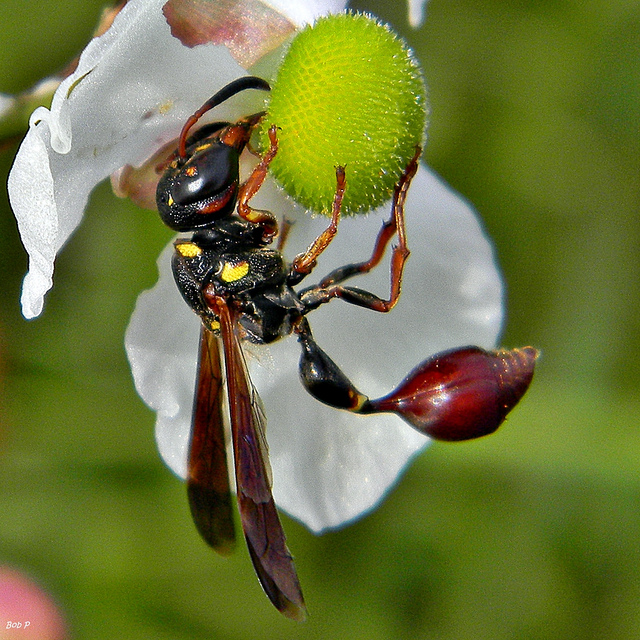
Zethus slossonae, named after Annie Trumbull Slosson
(photo by Bob Peterson, Flickr)
On June 29th, 1892, five men gathered in the home of entomologist Charles Palm (not to be confused with the other Charles Palm, also a New York entomologist) for the first meeting of the NYES. Their first order of business was to elect three members, including Annie Trumbull Slosson (Leng, 130). Years later, she described her first meeting:
I shall never forget the sensation produced by my unexpected entrance into that scientific meeting. Through the smoke of pipes and over mugs of some beverage which foamed in the gas-light in a sudsy sort of way, I saw startled, embarrassed faces … The host himself, good Mr. Palm, seemed somewhat embarrassed. After seating me in the most comfortable chair unoccupied, he hastened away to order coffee for me as more appropriate and fitting drink for a feminine throat (Klots, 139).
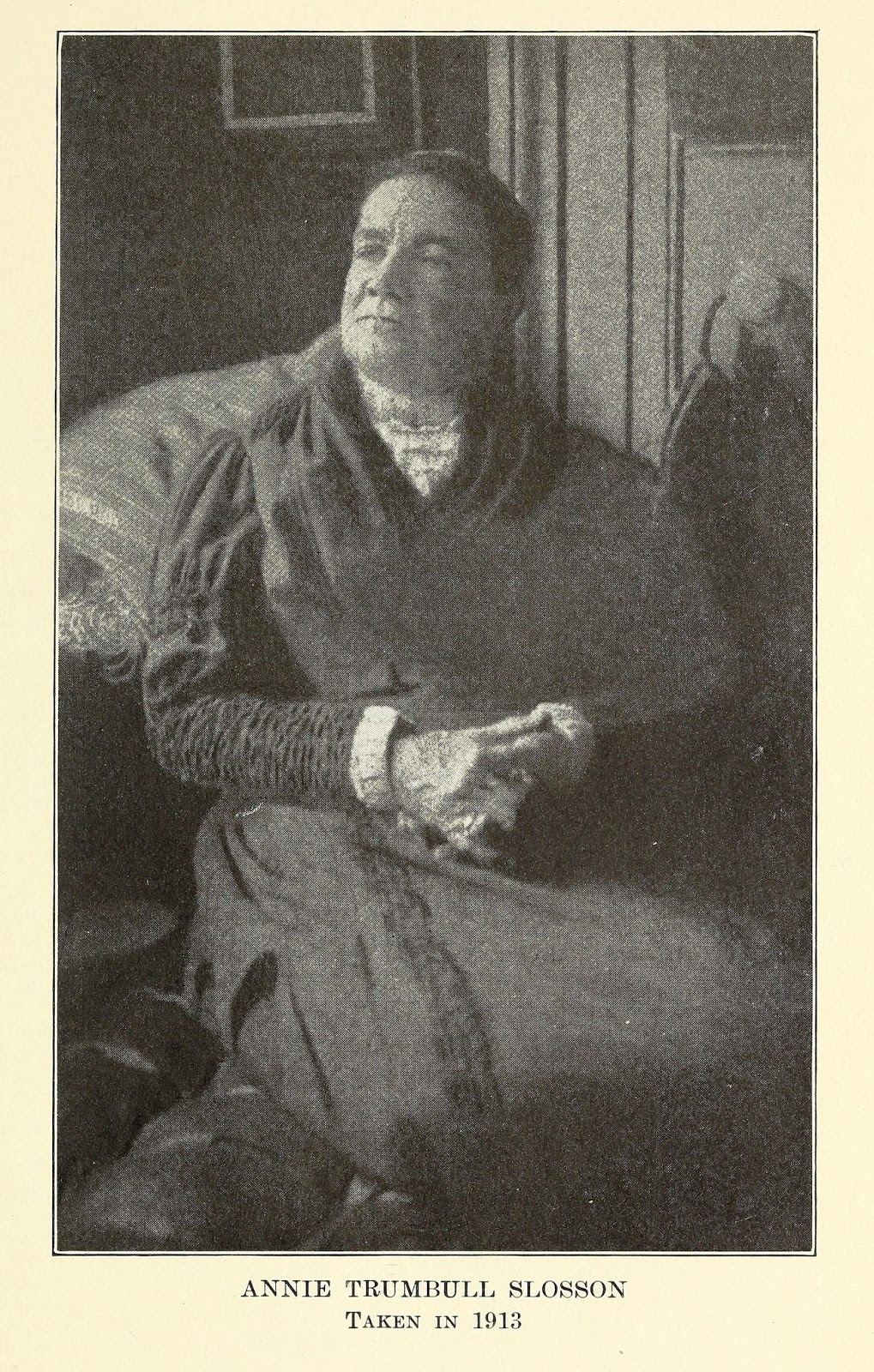
Despite taking up entomology in middle age (she was previously a fiction writer) and having no formal education in it, Slosson would become one of the Society’s most accomplished members. She amassed a large specimen collection, now housed at the American Museum of Natural History (AMNH) and has a genus and over 100 species (slossonae) named after her. She also authored numerous articles in the journals of the NYES and other entomological organizations and was instrumental in moving NYES meetings to the AMNH (Seltmann).
View Full Size Image
Photo of Annie Trumbull Slosson from
Journal of the New York Entomological Society, v.34 no.4 (1926)
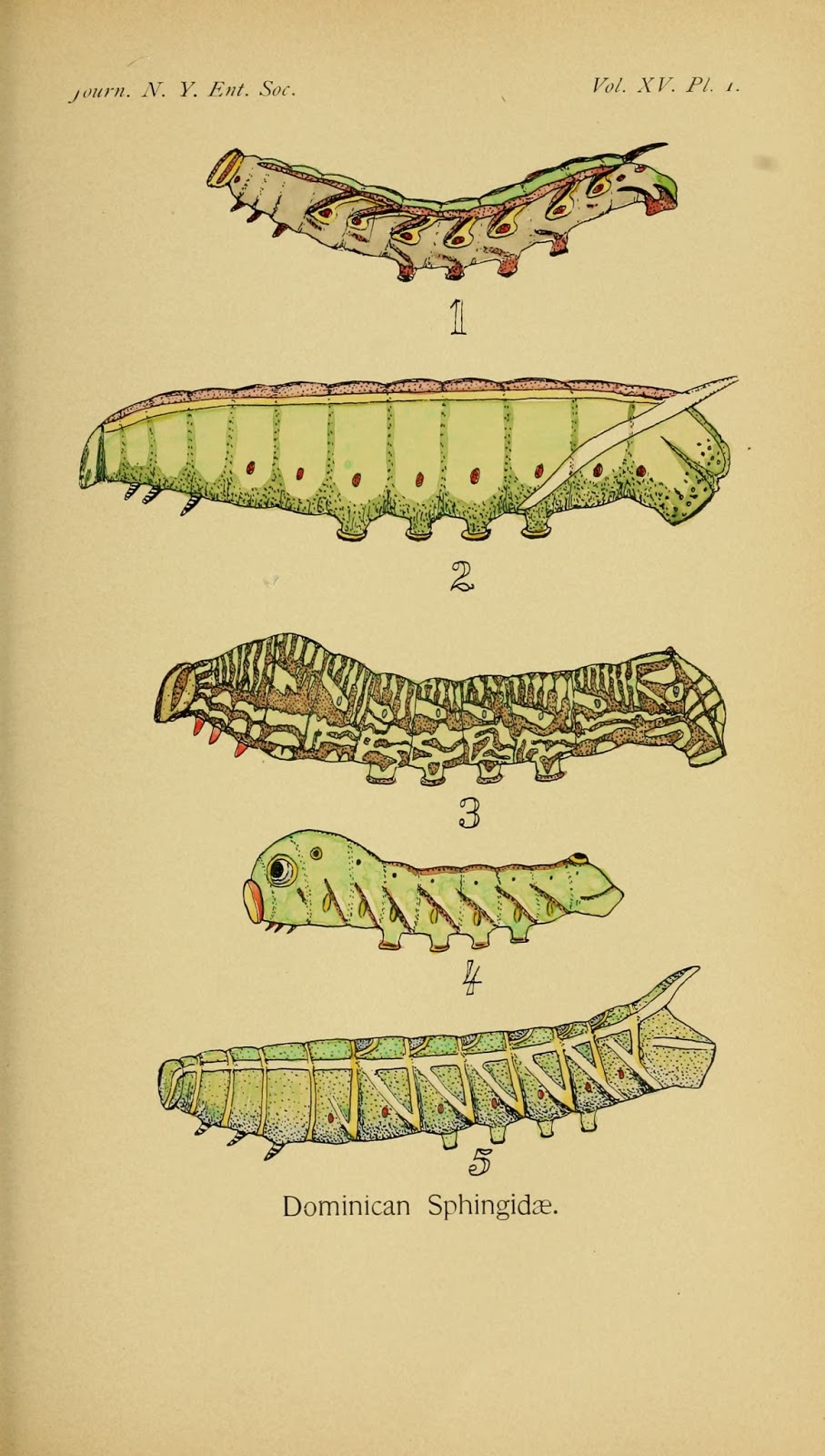
Though NYES membership hovered around ten individuals in the first decade of its existence, the Society began publishing the Journal of the New York Entomological Society in 1893. Slosson was its chief contributor, and the sale of her collected specimens at auction funded the journal and ensured regular publication. Another member who contributed to the journal’s early success was Louis H. Joutel, who, in addition to serving as the Society’s treasurer and secretary, was an accomplished illustrator; his drawings appear throughout early volumes of the journal (Leng, 130).
View Full Size Image
“Dominican Sphingidae”
by Louis Joutel, from
Journal of the New York Entomological Society, v.15 (1907)
Within a few years, the Society had begun to broaden its reach. In 1895 it joined the Scientific Alliance of New York, which included distinguished organizations like the New York Academy of Sciences and the Torrey Botanical Society, and strengthened its relationship with the AMNH, where it enjoyed access to the library and collections in the position of “a non-paying tenant with a generous landlord” (Klots, 146).
By all accounts, Society meetings were an occasion for the sharing of exciting specimen finds as well as good food and drink. Above all, they were informal. Elsie Klots wrote that “During the nineteen thirties and early forties speakers were so often startled by the steady click of knitting needles and the ominous waving of an ear trumpet that it became customary to explain to them, before the meeting, that the occupants of the front row were the faithful wives of some of our elder members and that they were an accepted and beloved part of our meetings” (Klots, 143-144).
In 1942, the NYES celebrated its 50th anniversary, with nearly half of its 26 former presidents in attendance. In 1949, the Society put on a public exhibit of insect photography in Roosevelt Hall, at the AMNH. It proved so popular that a second exhibit the following year was moved to the museum’s foyer. It featured photographs, paintings, drawings, publications by Society members, equipment, and insect origami. In 1964, the NYES convened for a third special meeting to honor four individuals who had been members for over 50 years. Dr. E.R.P. Janvrin, who joined in 1902, held the distinction of longest membership (Klots, 140).
From the beginning, the NYES maintained a close relationship with the Brooklyn Entomological Society, its elder neighbor. Members of each society were invited to the other’s meetings and field trips, and in 1903 the NYES began devoting two pages of its journal to publish the proceedings of the Brooklyn Society (Klots, 145). The incorporation of the Brooklyn Entomological Society into the NYES, celebrated on October 29, 1968 (the 75th anniversary of the NYES) was thus a natural union for two organizations whose activities had converged for a long time.
View Full Size Image
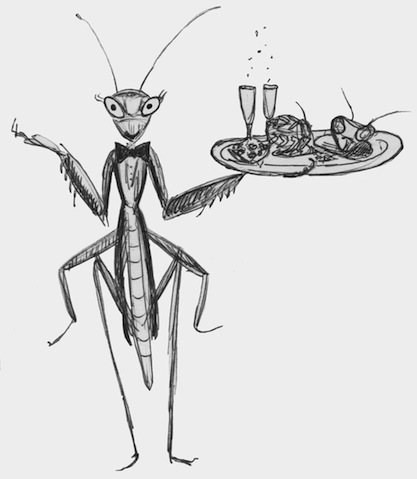
Drawing for a NY Eats Bugs dinner hosted
by the NYES and others in 2015 (unknown artist)
The NYES celebrated its centennial on May 20th, 1992, with a banquet at the Explorers Club in New York City. The major draw of the evening was its theme: insects as food. Guests enjoyed a variety of appetizers and desserts with insects as ingredients, as well as a talk by keynote speaker Dr. Gene DeFoliart of the University of Wisconsin, an expert on the subject (Society History). The NYES has since participated in similar “bug banquets” at the Explorers Club.
Today, the NYES continues to meet at the AMNH on the third Tuesday of every month, September through May (excluding December). Professional and amateur entomologists alike hear talks by invited speakers on topics of entomological and biological significance. The Society also continues to publish its journal, which in 2009 was renamed Entomologica Americana (also the title of the Brooklyn Entomological Society’s journal, which ceased publication in 1975.

We are grateful to the NYES for sharing its rich legacy of entomological scholarship with BHL and with researchers around the world!

Note: this post has been edited to remove the incorrect statement that the NYES is the third or fourth oldest entomological society in the U.S.

Reference

Klots, Elsie B. “The History of the New York Entomological Society.” Journal of the New York Entomological Society 76, no. 3 (1968): 138-155.
Leng, Charles W. “History of the New York Entomological Society, 1893-1918.” Journal of the New York Entomological Society 26, no. 3/4 (1918): 129-133.
Seltmann, Katja. “Collector Spotlight: Annie Trumbull Slosson.” Tri-Trophic Thematic Collection Network. Last modified September 12, 2013. http://tcn.amnh.org/updates/collectorspotlightannietrumbullslosson.
“Society History.” The New York Entomological Society, Inc. Accessed September 14, 2016. http://www.nyentsoc.org/history.
September 15, 2016by [email protected]
Blog Reel, Featured Books

The Raptor Research Foundation

View Full Size ImageThis year, the Raptor Research Foundation (RRF) celebrates its 50th year of promoting scientific understanding of birds of prey. Last month, the RRF gave BHL permission to add its newsletter and the first 38 years of its journal to the collection—a wealth of information about hawks, eagles, falcons, owls, and their relatives—as part of the Expanding Access to Biodiversity Literature (EABL) project. 

History

 
Following a precipitous decline in the population of Peregrine Falcons in the mid-1960s, and before the effects of agricultural chemicals like DDT were well understood, experts identified a correlation between the crisis and an increase in cereal farming in Great Britain. A handful of those experts convened to tackle the problem, and thus was born the Raptor Research Foundation in February of 1966. 
 
In the years since its founding, the RRF has gained a robust international membership and expanded its scope to cover all aspects of raptor science. Writing to commemorate the RRF’s 50th anniversary in the March, 2016 issue of the Journal of Raptor Research (v.50, no.1), W. Grainger Hunt—one of RRF’s original members—notes that the Foundation’s early activities all progressed to “a satisfying endpoint—from field biology to chemistry and physiology, from experimentation to population ecology and advocacy, and ultimately, to restoration.” He goes on to mention several important contributions of RRF members, including the discovery that the drug diclofenac was responsible for decimating Asian vulture populations. 

Today, the RRF remains at the forefront of raptor conservation, harnessing the power of volunteers to address the myriad threats to raptor populations around the world: its Conservation Committee releases Position Statements that engage, challenge, and influence policymakers; its annual conference is a gathering place for the raptor community to present original research and participate in training workshops; and its publications disseminate the latest findings in raptor science to the broader scientific community. 

Publications

 
View Full Size Image
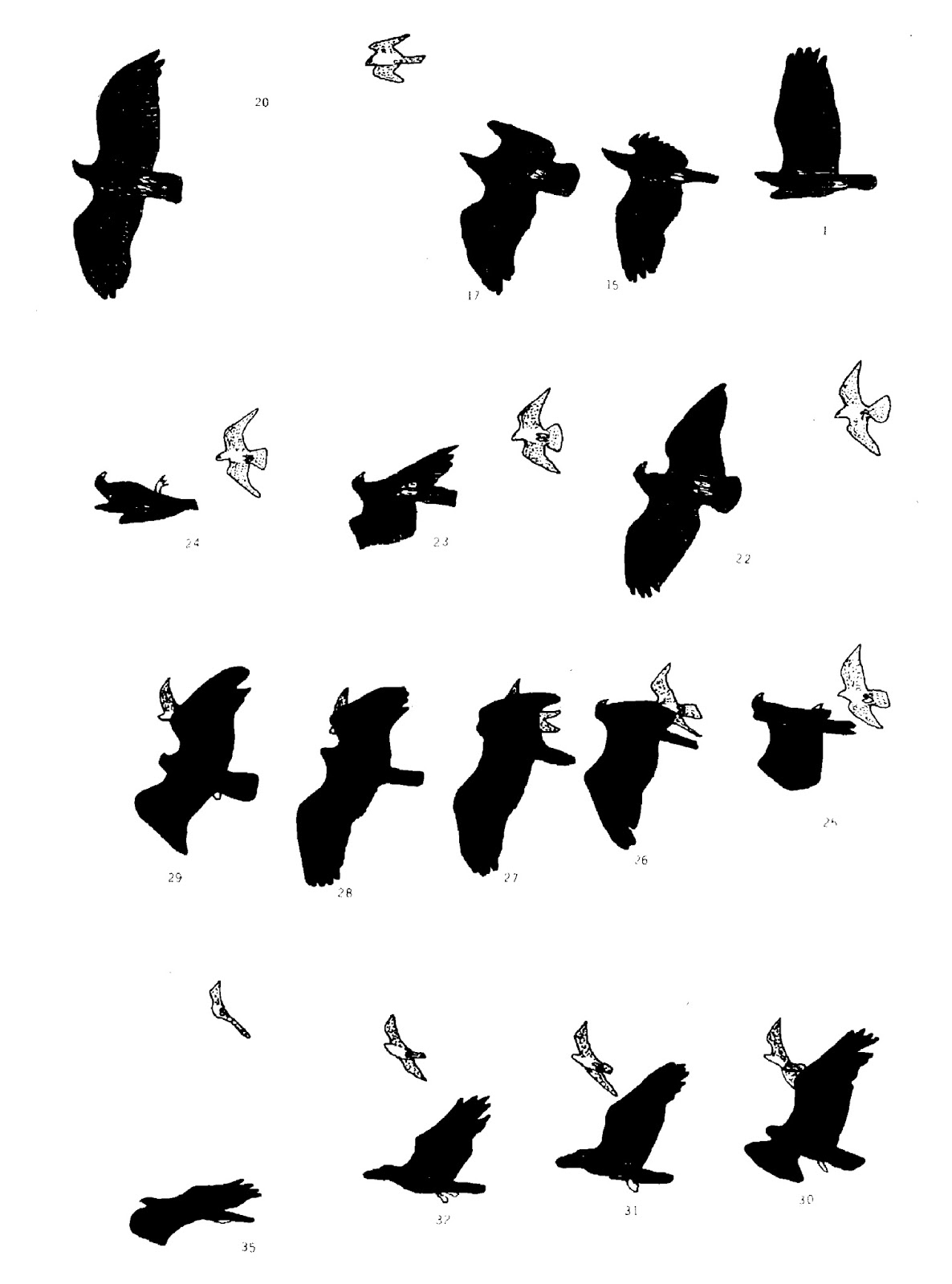
A frame-by-frame capture of a Peregrine Falcon attacking a Bald Eagle, in
“Field Techniques in a Study of the Behavior of Peregrine Falcons,” p.93
by R. Wayne Nelson, Raptor Research v.7 no.3 (1973)
The journal of the RRF began publication in 1967 as Raptor Research News, which doubled as an organizational newsletter and a vehicle for scholarship. Starting with volume 6 in 1972, the title was shortened to Raptor Research, which reflected its broader scope. It was also organized into three sections: formal, peer-reviewed Scientific Papers; Reports, Reviews, and Opinion, which contained meeting reports, book reviews, and other secondary material receiving less editorial scrutiny; and Notes, News, and Queries, which contained items typically found in a newsletter. 
 
Beginning with volume 21 in 1987, the journal was renamed The Journal of Raptor Research, its current title. Like the preceding title, it is published quarterly and organized into Research Articles, Short Communications, and Letters, followed by secondary material such as book reviews. Within the next several weeks, The Journal of Raptor Research will be available on BHL through volume 39 (2005). 
 
View Full Size Image
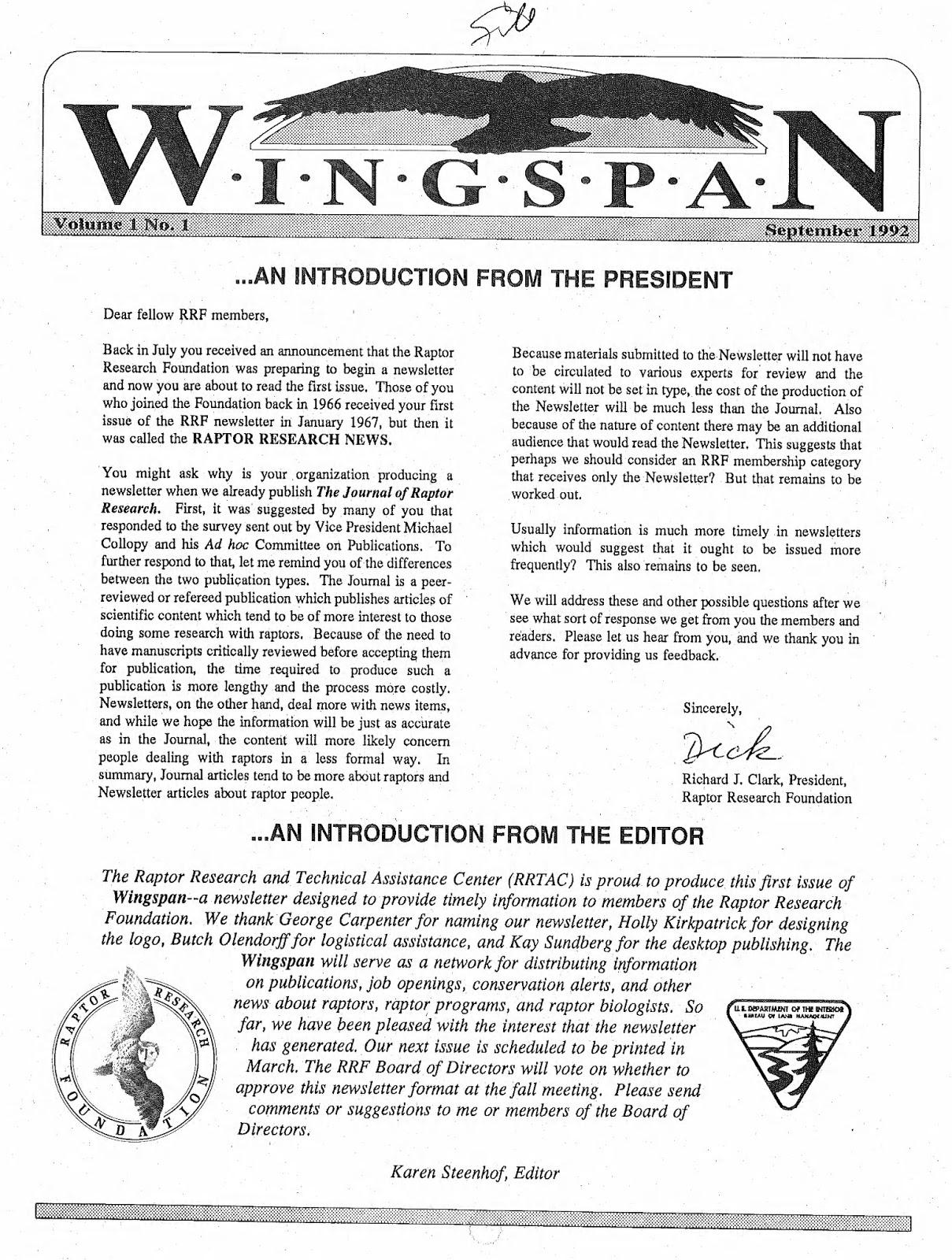
The inaugural issue of Wingspan, v.1, no.1 (1992)
In 1992, recognizing the need for a separate publication that was less labor-intensive than the journal and more appropriate for informal news items relevant to the raptor community, the RRF established a newsletter called Wingspan. Wingspan is published twice a year and contains news about Foundation leadership and elections, member profiles, conference summaries, short features about individuals and organizations involved in raptor conservation, and other brief news items. Or, as then-president Richard J. Clark summarized in his introduction to the first issue of Wingspan in 1992, “Journal articles tend to be more about raptors and Newsletter articles about raptor people.” Look for additional issues of Wingspan in BHL in the coming weeks.

The EABL staff is grateful to the RRF for so generously allowing its publications to appear in BHL, and we wish them success in their ongoing efforts to promote understanding and conservation of raptors.
August 18, 2016by [email protected]
Blog Reel, Featured Books

The Pennsylvania Horticultural Society

The Pennsylvania Horticultural Society (PHS) is a nonprofit organization based in Philadelphia, Pennsylvania, that offers a variety of gardening programs and activities to its members as well as the surrounding city and state. Its annual Philadelphia Flower Show is the largest and longest-running event of its kind, attracting florists, gardeners, and landscape designers from all over the world. The PHS has also produced many publications over the years, some of which are now available in BHL through the IMLS grant Expanding Access to Biodiversity Literature (EABL).

History of the PHS

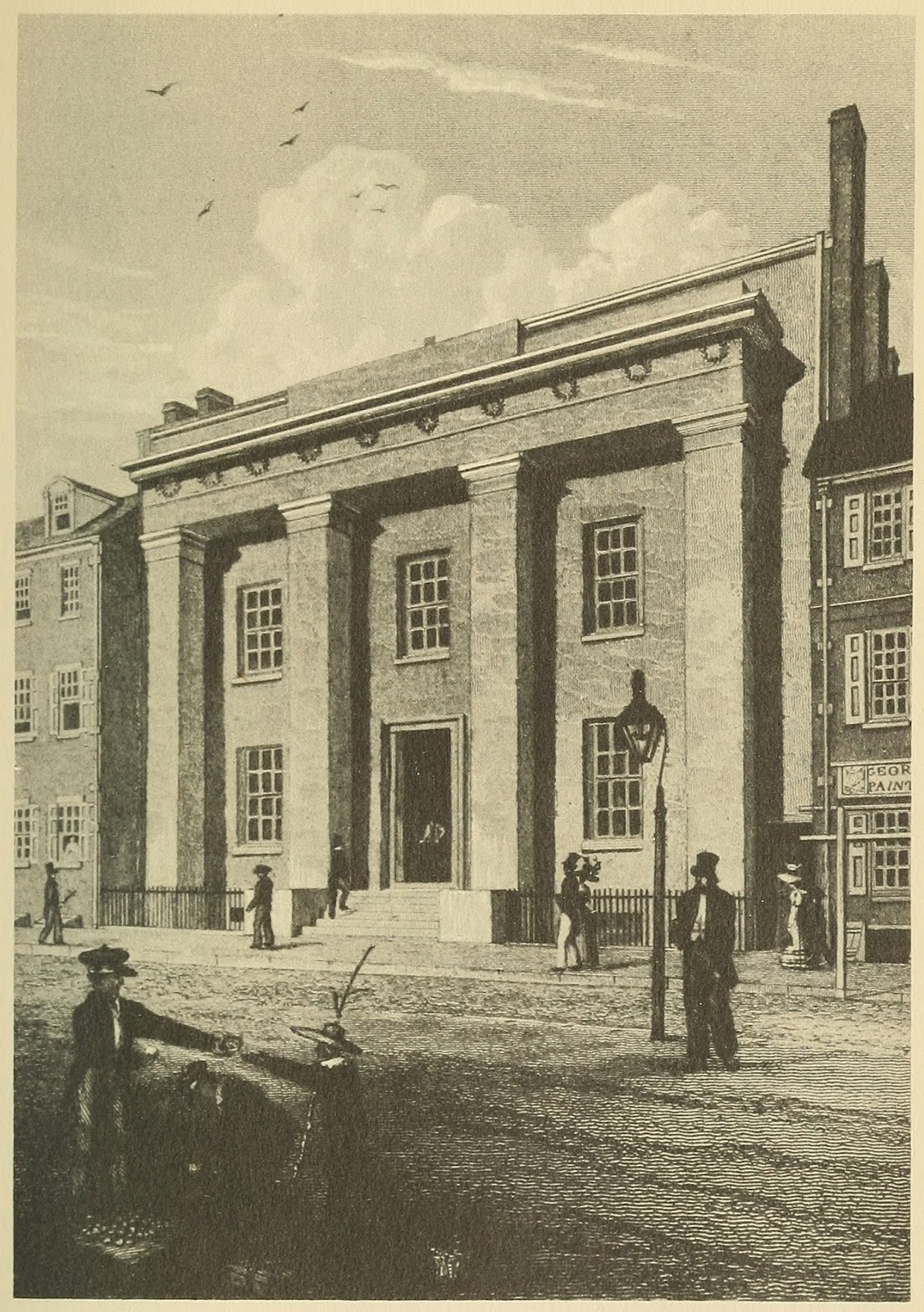
Founded in 1827 with 80 members, the PHS provided a forum for serious growers interested in horticulture and its various applications, commercial and academic. At monthly meetings, members exhibited rare or unusual plants, discussed innovations in horticulture, tasted wine, and distributed among themselves cuttings and grafts of plants from all over the U.S. The PHS began a small library in 1828, and the following year held its first annual Philadelphia Flower Show.
View Full Size Image
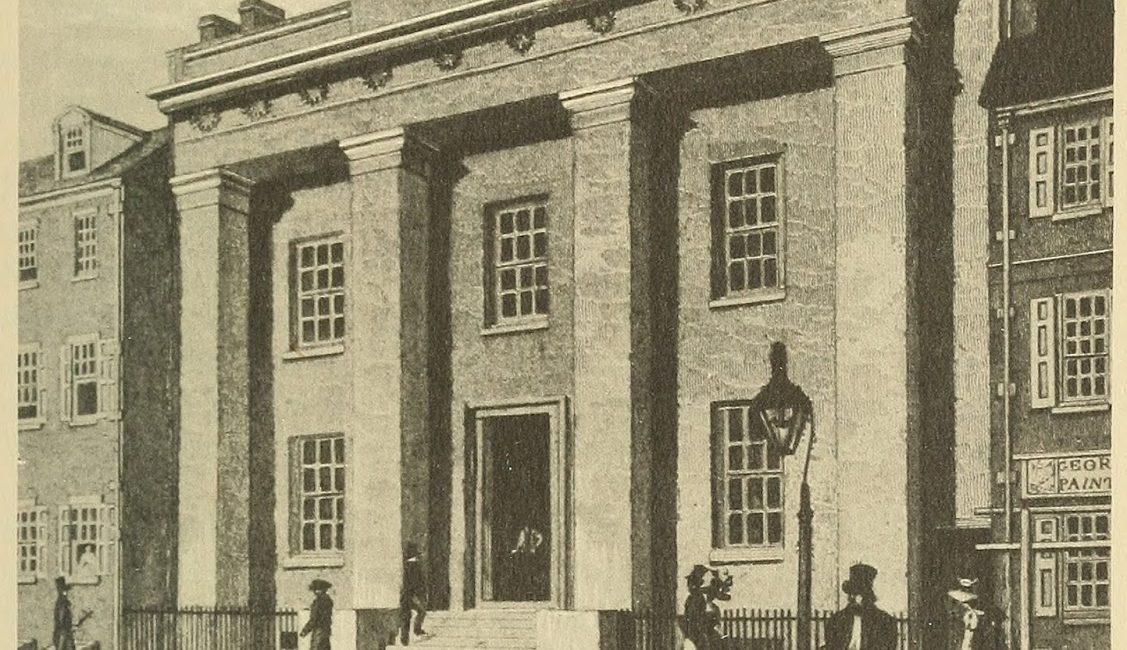
The Franklin Institute on South Seventh Street, site of the PHS’s first meeting (from James Boyd’s A History of the Pennsylvania Horticultural Society 1827-1927)
Over the next several decades, many prominent seedsmen–some of them PHS members–exhibited at the Philadelphia Flower Show, including Henry Dreer, Robert Buist, Josiah Coates, and David Landreth. These men owned successful nurseries, and many of their catalogs can be found in BHL’s Seed & Nursery Catalogs collection.
By 1842, the PHS library contained 450 volumes. It was expanded, and a librarian hired at a salary of $50 per year. By 1850, the library had doubled in size, becoming one of the largest horticultural collections in the country. In 1854, it narrowly avoided destruction in a fire that claimed the Philadelphia Museum.
Around this time, the PHS began making recommendation to the Philadelphia City Council on which trees to eliminate and which to cultivate in public parks. This marked the beginning of PHS’s longstanding efforts to bring gardening to urban spaces, efforts which continued in the decade preceding the Civil War, despite a decline in the Society’s membership and finances.
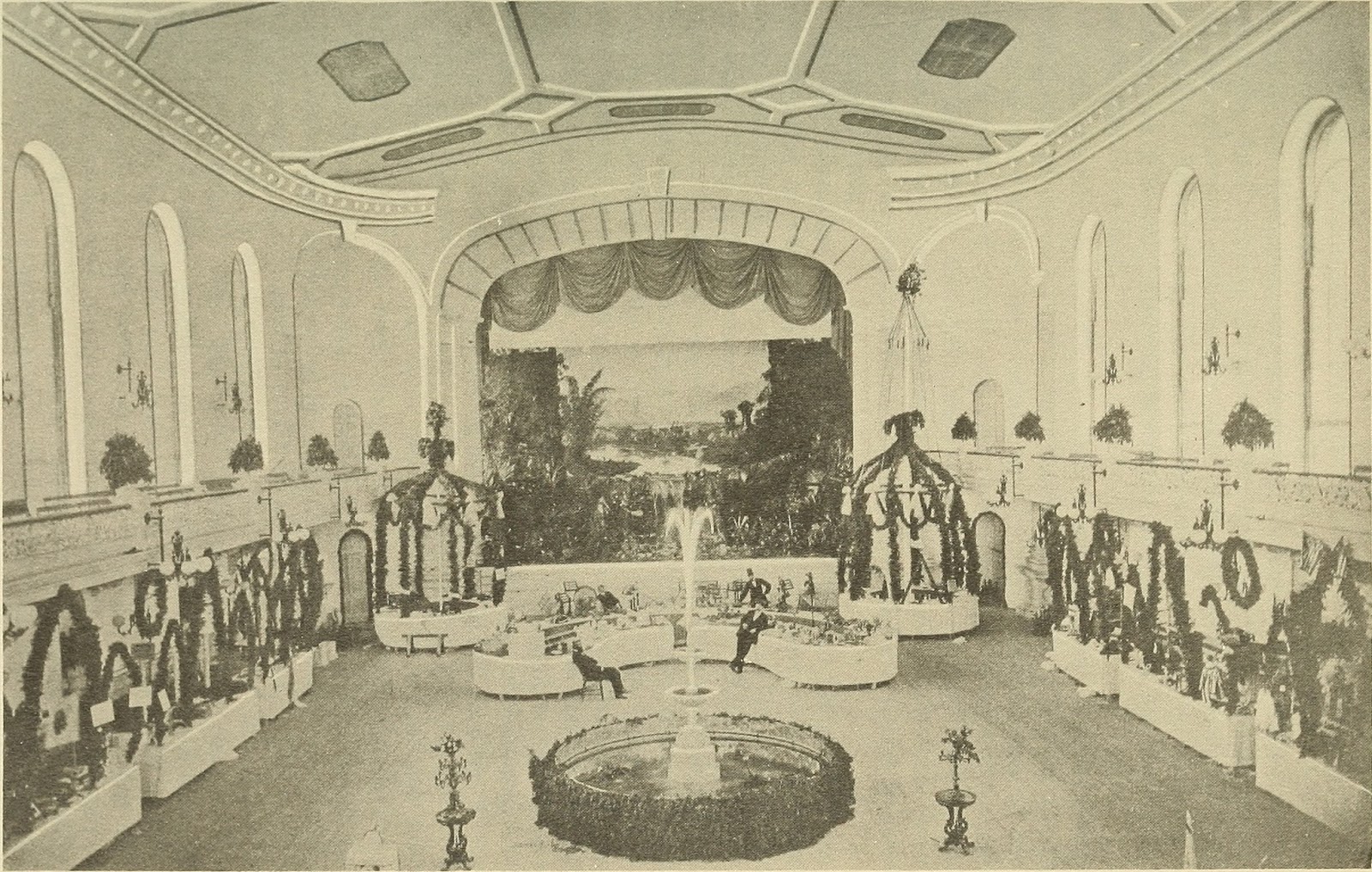
While its finances were still precarious after the Civil War, the PHS enjoyed increased membership, and in 1867 built its first Horticultural Hall. The more famous Horticultural Hall was built in Fairmount Park for the Centennial Exposition of 1876; PHS members actively contributed to the planning and execution of the Centennial, and the event afforded its members the opportunity to display their fruits and flowers. After the Centennial, PHS held its annual flower show in the new hall. The original hall was damaged in a fire in early 1881 and rebuilt later that year; it was completely destroyed by a second fire in 1893. A third hall was built in 1896, which was sold in 1917 in a time of financial hardship.
View Full Size Image
Interior of the first Horticultural Hall (from James Boyd’s A History of the Pennsylvania Horticultural Society 1827-1927)

The 20th century saw the PHS shift to a predominantly amateur membership, which continued to grow with each passing decade. During World War 2, its members were involved in the movement to plant “victory gardens” which could sustain families during a time of scarcity. Writing in the 1945 Yearbook of the Pennsylvania Horticultural Society, the Report of the President for the previous year asserted:

I feel we should all take pride in the condition of the Society, especially in the face of the changing economic conditions that have been brought about by the war. A planned economy, with all of its regimentation, has been forced upon us for the duration of the Second World War, and the end is not yet. Our important duty has been to keep alive human interest in the work of our Creator as we find it in plant life, which is the very sustenance of our existence. Horticulture, in truth, is refined from agriculture to fit the home and becomes the basis of its economy, from which our community and national economy and life are but mammoth developments.

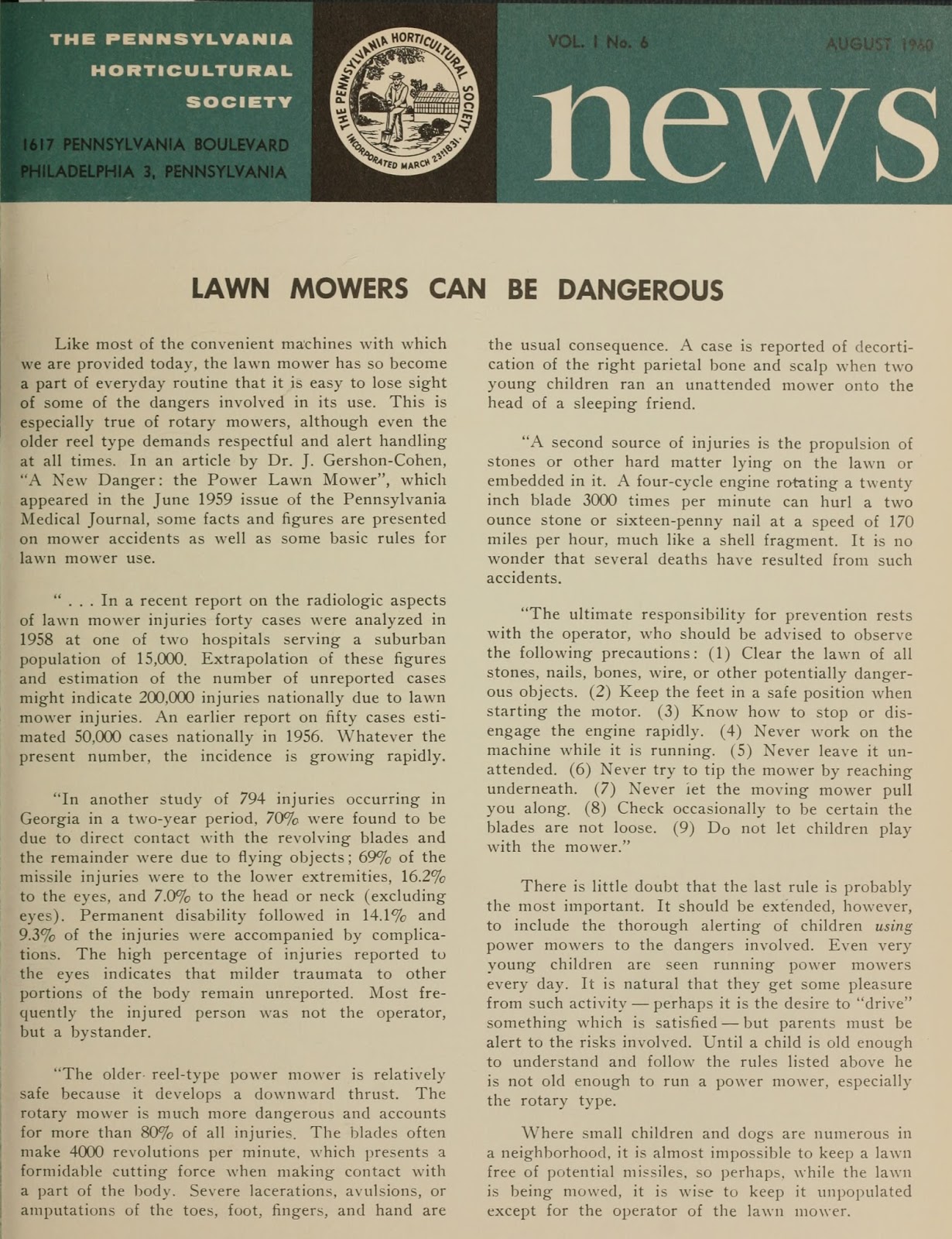
By the second half of the 20th century, the amateur-oriented activities of the PHS were clearly reflected in its publications, such as a members’ newsletter that offered gardening tips, brief articles, and book recommendations. Meanwhile, the Philadelphia Flower Show continued to grow in size and prominence.

View Full Size Image
“Lawn Mowers Can Be Dangerous” from the PHS News, v.1 no.6 (1960)

The PHS Today

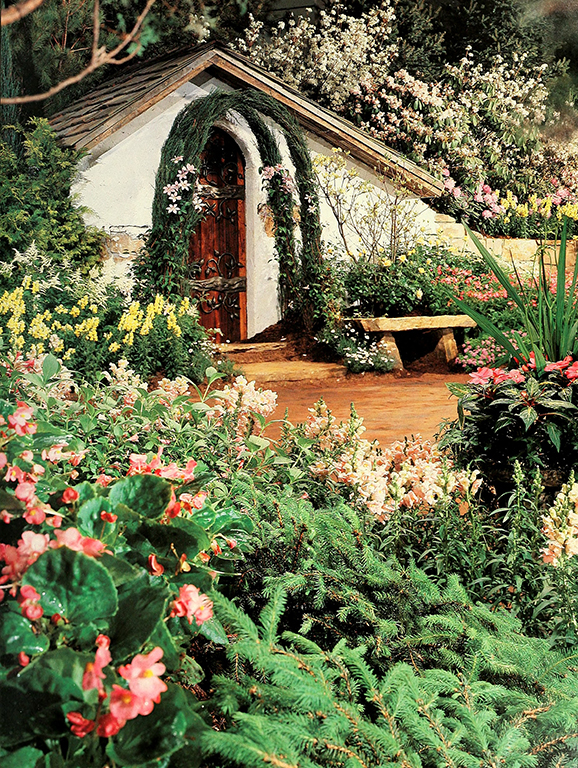
Currently, the PHS boasts a membership of 27,000. The Philadelphia Flower Show continues to be a major event every year, and in keeping with its early activities, the PHS remains heavily involved in creating civic landscapes, improving public parks, and planting community gardens in Philadelphia.

View Full Size Image
An exhibit at the 1997 Philadelphia Flower Show
The PHS McLean Library contains 15,000 volumes and is working to digitize many historic, public domain horticultural works as well as PHS publications. It has given BHL permission to add many of these to its own collection (where they will appear soon!), including:
  • Yearbook of the Pennsylvania Horticultural Society (1925-1998)
  • PHS News (v.1-38, 1960-1997)
  • Philadelphia Spring Flower Show (1966-1997) [title varies]
  • Pennsylvania Gardens (v.1-4 (1937)
  • From Seed to Flower: Philadelphia 1681-1876 (1976)
  • Bulletin of the Pennsylvania Horticultural Society (v.1, nos.1-2 (1923))
  • The Green Scene (v.1-42, 1972-2014)
  • A History of the Pennsylvania Horticultural Society, 1827-1927 (1929)
  • America’s Garden Legacy: A Taste for Pleasure (1978)

Janet Evans, Associate Director of the McLean Library, says, “We made a commitment…to contribute to digitization of horticultural material. I think it’s particularly important in horticulture, because so many of the older serials have never been well indexed, and yet they contain information that is of value to researchers today – historians, biographers, academics in the humanities as well as horticulturists.”

We are grateful to the PHS for their commitment to open access and their efforts to promote horticulture in Pennsylvania and across the world!

July 21, 2016by [email protected]
BHL News, Blog Reel

April showers bring…new in-copyright content to BHL!

Portrait version of the Biodiversity Heritage Library logo.

April, May, and June were busy months for processing license agreements and adding new in-copyright titles: 35 in all, bringing our total to 56 for the first half of 2016! Many licensors outside the BHL Consortium gave permission for their content, which adds contemporary scholarship to the collection already rich in legacy literature.

View Full Size Image
https://creativecommons.org/licenses/by-nc-sa/4.0/

Below is the full list of in-copyright titles added between April 1st and June 30th, 2016. We thank the individuals and organizations who so generously gave BHL permission to make them available under a Creative Commons Attribution-NonCommercial-ShareAlike 4.0 (CC BY-NC-SA 4.0) license:

  1. Ohio Coleopterist Society
    1. Ohio Beetles Bulletin (2009–)
  2. Wim Vader and fellow editors
    1. Amphipod Newsletter (1972–)
  3. Maryland Ornithological Society
    1. Field List of the Birds of Maryland (3rd. Ed.)
    2. Maryland Birdlife (1945–)
    3. The Yellowthroat (1980–)
  4. Mantis Study Group
    1. Mantis Study Group Newsletter (1996-2007)
  5. Phasmid Study Group
    1. Phasmid Studies (1992–)
  6. Mary Bamas Pomeroy
    1. Favorite Wildflowers of the West Coast
  7. New York Entomological Society
    1. Bulletin of the Brooklyn Entomological Society (1923-1965)
    2. Entomologica Americana (1926-1975)
    3. Journal of the New York Entomological Society (1923-1999)
  8. Western Carolina Botanical Club
    1. Shortia (1979–)
  9. Southern California Botanists
    1. A Flora of the Santa Rosa Plateau, Southern California 
    2. Crossosoma (1975–)
    3. Endangered Plant Communities of Southern California
    4. Flora and Ecology of the Santa Monica Mountains (1st and 2nd Eds.)
    5. Leaflets (1992–)
    6. SCB News (1973-1991)
  10. Arkansas Native Plant Society
    1. Claytonia (1981–)
  11. Pacific Seabird Group
    1. Pacific Seabird Group Bulletin (1974-1993)
    2. Pacific Seabirds (1994–)
  12. Arnold Arboretum at Harvard University
    1. Bulletin of Popular Information (1911-1939)
    2. Arnoldia (1940–)
  13. Wildlife Conservation Society
    1. Zoologica (1907-1973)
  14.  Micropalaeontological Society
    1. A Stereo-Atlas of Ostracod Shells (1973-1999)
  15. Delaware Native Plant Society
    1. The Turk’s Cap (1998–)
  16. Tennessee Ornithological Society
    1. The Migrant (1930–)
    2. The Tennessee Warbler (2000–)
  17. Wilson Ornithological Society
    1. The Wilson Bulletin (1894-2005)
    2. The Wilson Journal of Ornithology (2006–)
  18. Queensland Museum
    1. Memoirs of the Queensland Museum (1912–)
  19. Royal Botanic Gardens Victoria
    1. Muelleria: An Australian Journal of Botany (1995–)
  20. Illinois Ornithological Society
    1. Meadowlark (1992–)
  21. Northern California Botanists
    1. Botanical Leaflets (2007–)

As in the previous quarter, most of the new titles are the result of the Expanding Access to Biodiversity Literature (EABL) project. EABL solicits print and digital materials from content providers across the United States, including small organizations with unique publications that reflect their niche research areas.

If you would like more information about how copyright information is displayed in BHL and how in-copyright content may be used, see the Licensing and Copyright page on the BHL wiki; for information about how to contribute in-copyright content and the complete list of in-copyright titles that BHL has secured permission for to date, see the Permissions page.

As always, check the blog and follow BHL on Facebook and Twitter (@BioDivLibrary) for updates on new content!

July 19, 2016by eomeara
BHL News, Blog Reel

Expanding Access and MiBio team members present at the annual Council on Botanical and Horticultural Libraries Meeting

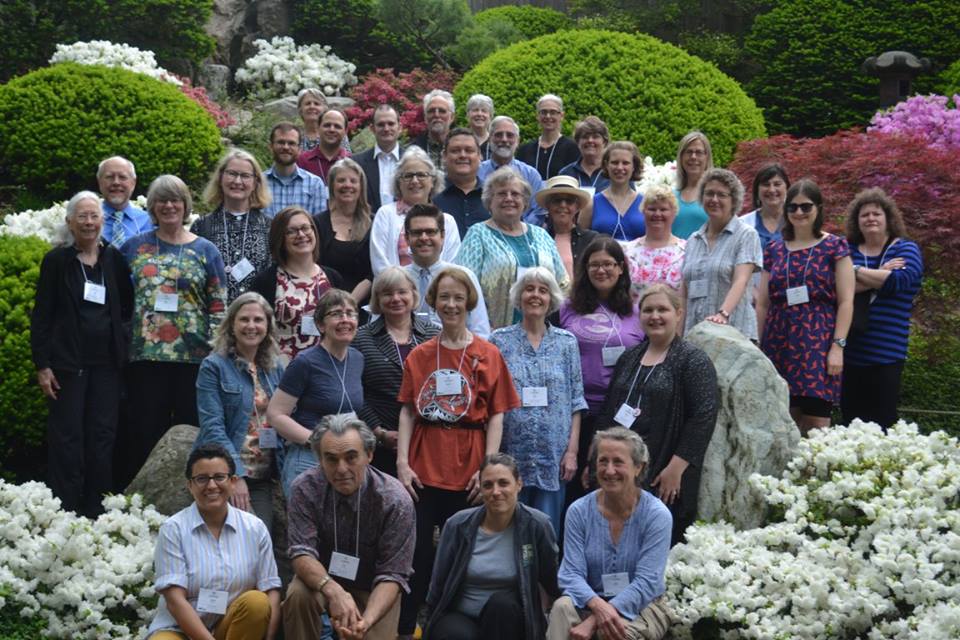
The Council on Botanical and Horticultural Libraries hosted its 48th Annual Meeting in Cleveland, Ohio May 24-28th, 2016.  With perfect weather and a packed schedule, members were kept busy experiencing a number of different museums, attending meetings and hosting member presentations and speakers.  Tours of the Cleveland Botanical Garden, West Side Market, Great Lakes Science Center, Rock and Roll Hall of Fame and Museum, Dittrick Museum of Medical History, Cleveland Museum of Art, Cleveland Museum of Natural History, Herb Society of America, and the Holden Arboretum allowed attendees to gain a well-rounded sense of Cleveland’s landscape.
View Full Size Image
Photo credit: Jennifer McDowell


The Council on Botanical and Horticultural Libraries (CBHL) is made up of organizations, institutions and individuals from around the world.  It was created to initiate and facilitate communication between those focused on libraries and botanical and horticultural literature and dates back to November 13, 1969 when the first conference convened in Boston, Massachusetts.  It was more formally founded the following year at the Second Conference.  Members of CBHL include the Denver Botanical Gardens Helen Fowler Library, Michigan State University Libraries, the Morton Arboretum and many others.  Some BHL affiliates and partners are also a part of CBHL including the Missouri Botanical Garden, the New York Botanical Garden, and the California Academy of Sciences Library.
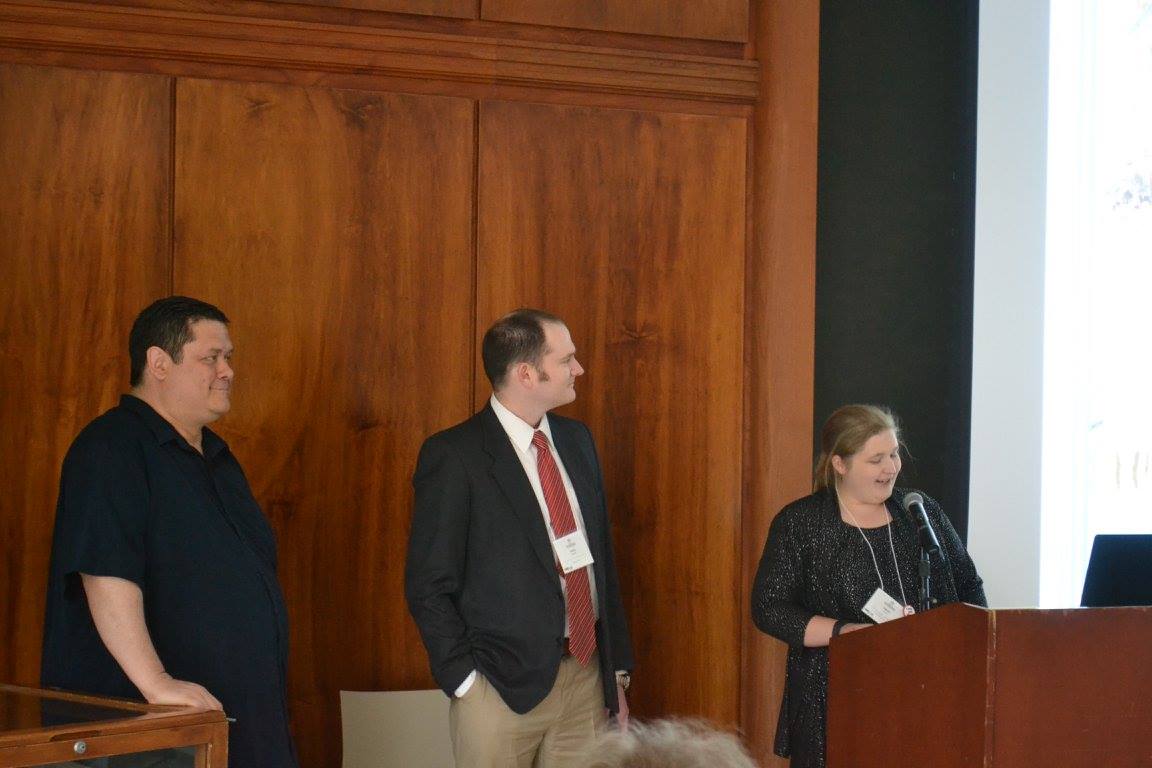
One of the member presentations was titled “Towards better accessibility to biodiversity knowledge: The Biodiversity Heritage Library as a platform for content sharing and discovery” and included two different presentations on two BHL projects.  The first was the Expanding Access to Biodiversity (EABL) team members: Mariah Lewis and Patrick Randall.  This presentation, which is now available online, covered topics such as timeline, funding, scope, copyright, digitization, metadata, curation, and the benefits of participation. 
Following this was William Ulate who presented on Mining Biodiversity (MiBio).  While Expanding Access aims to bring more content into BHL, Mining Biodiversity is dedicated to transforming BHL into a next-generation social digital library resource that not only gives access to users, but also facilitates study and discussion of legacy scientific documents.  This international collaboration is a project rooted in helping users locate information within BHL easily and efficiently while fostering collaboration.  The presentation can be viewed here.  Members were also able to access and test the search interfaceand leave valuable feedback for the project. 
View Full Size Image
William Ulate, Patrick Randall, and Mariah Lewis present at CBHL
Photo Credit: Bill Musser

The two presentations were met with an extremely positive response from attendees and facilitated wonderful conversations about the Biodiversity Heritage Library, Expanding Access to Biodiversity Literature, and Mining Biodiversity.  Expanding Access was able to talk with a number of future contributors about the project and are looking forward to working with them to add their content into BHL!

Special thanks to our spectacular hosts: The Cleveland Botanical Garden and The Holden Arboretum and CBHL for allowing us to present!
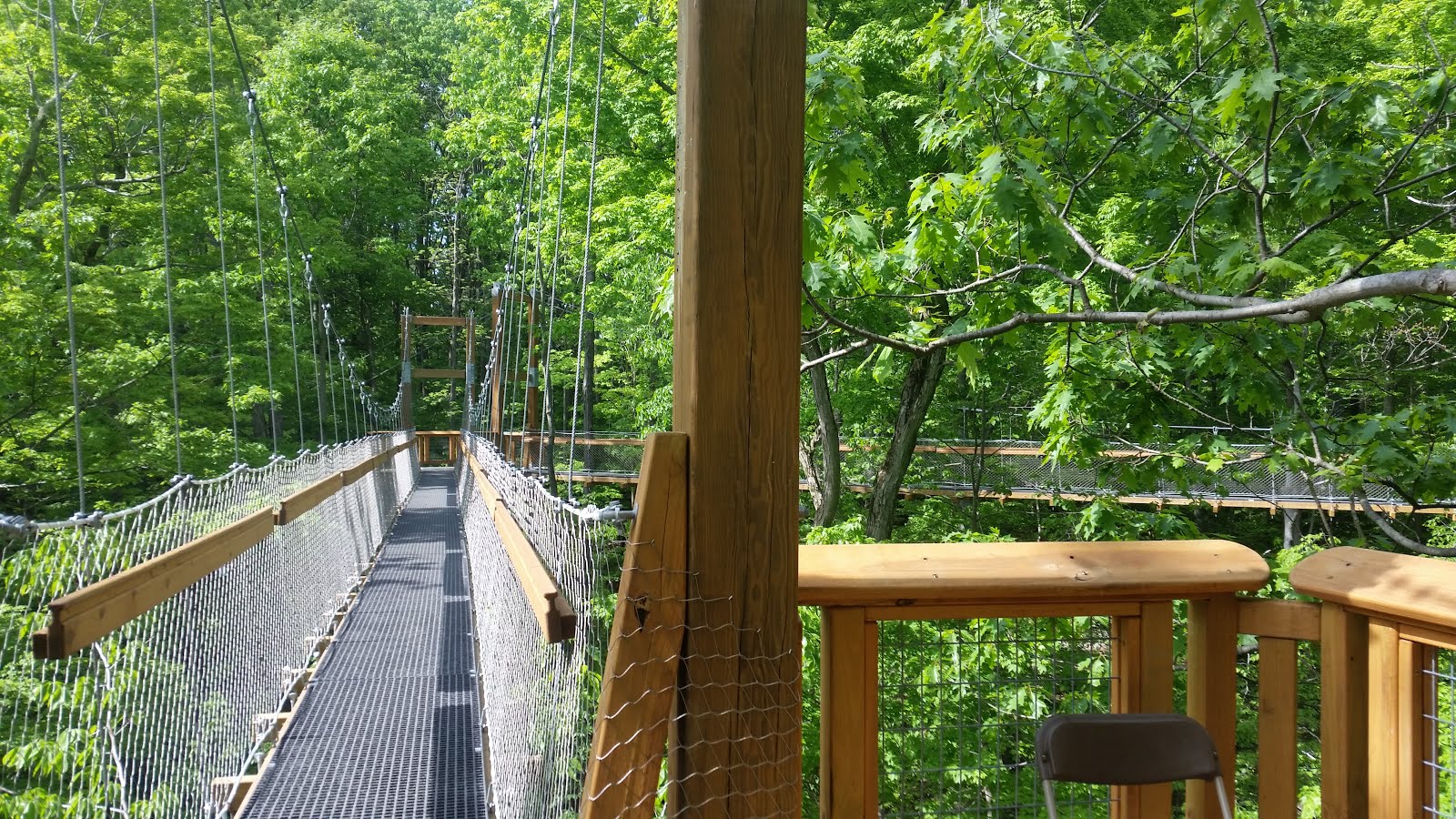
View Full Size Image
It’s the Canopy Walk at the Holden Arboretum! 
Photo credit: Mariah Lewis

Want more information on the Expanding Access project?  Interested in being one of our contributors?  Please email Patrick Randall at [email protected]for more information!  An Expanding Access team member will be present at ALA’s Annual Conference.  If you would like to talk about the project in-person in Orlando next week please email Mariah Lewis at [email protected].  

June 16, 2016by aneeser
Blog Reel, Featured Books

The Roosevelt Wild Life Station

This is the first in a monthly series of posts highlighting contributions to the Expanding Access to Biodiversity Literature (EABL) project, which aims to enhance BHL’s collections with content from natural history libraries, societies, and other institutions across the United States.

The Roosevelt Wild Life Station (RWLS) is a research center within the SUNY College of Environmental Science and Forestry (ESF) in Syracuse, New York. Its mission is “to deliver the science and trained professionals to preserve our wildlife heritage and save imperiled species worldwide.” In the first half of the 20th century, the RWLS produced two publications—the Roosevelt Wild Life Bulletin and the Roosevelt Wild Life Annals—which are now available in BHL.

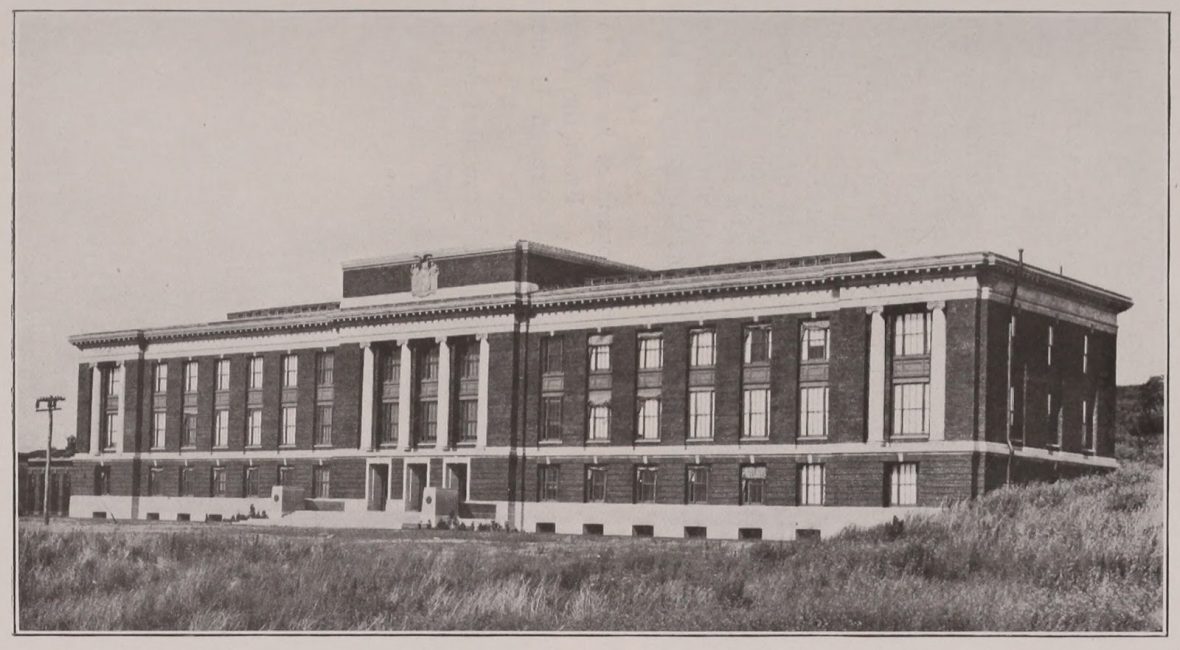
View Full Size Image
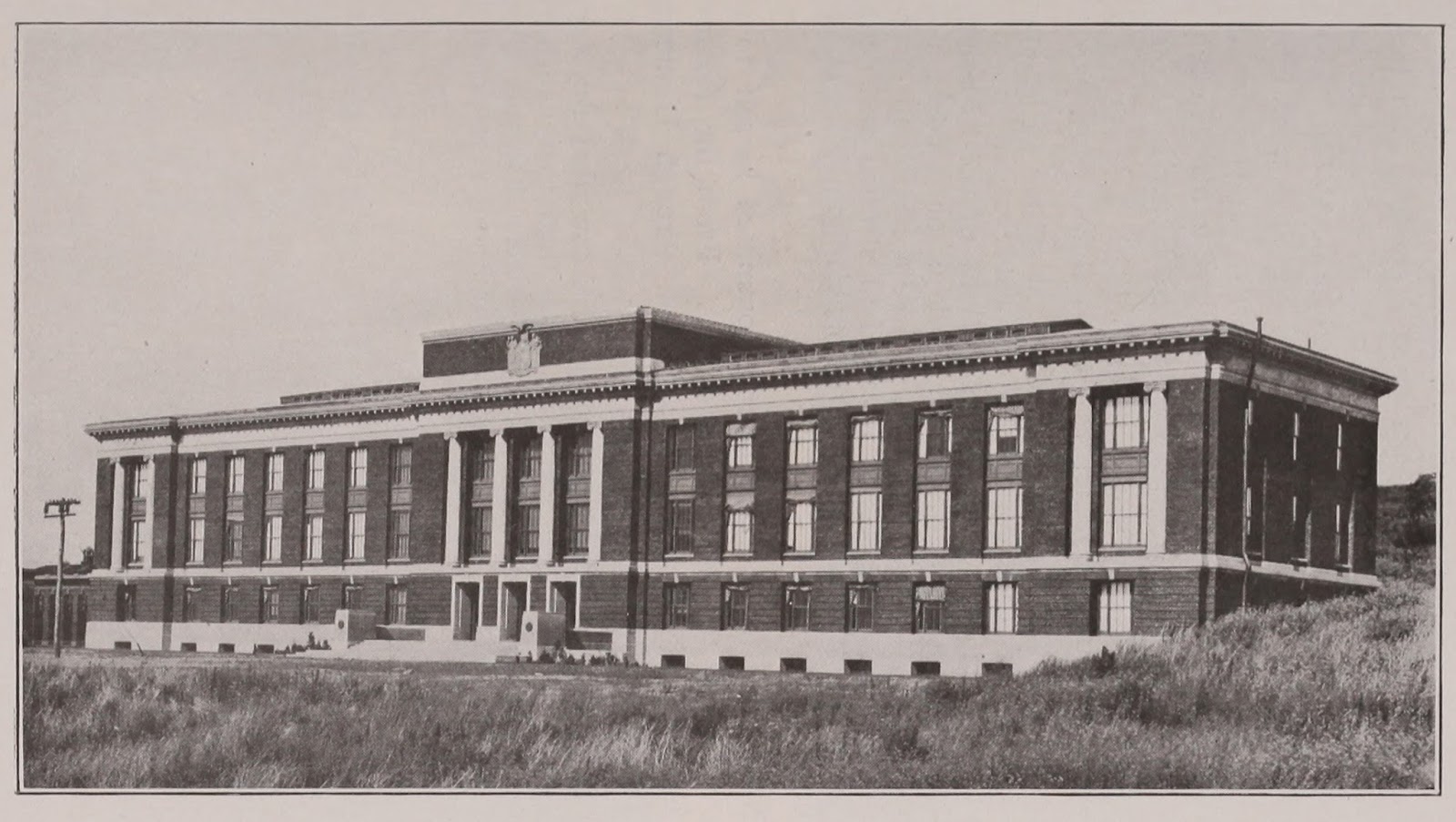
“The New York State College of Forestry, Syracuse, containing the offices and laboratories of the Roosevelt Wild Life Forest Experiment Station,” from Roosevelt Wild Life Bulletin, v.1 no.1 (1921).

Founding of the RWLS

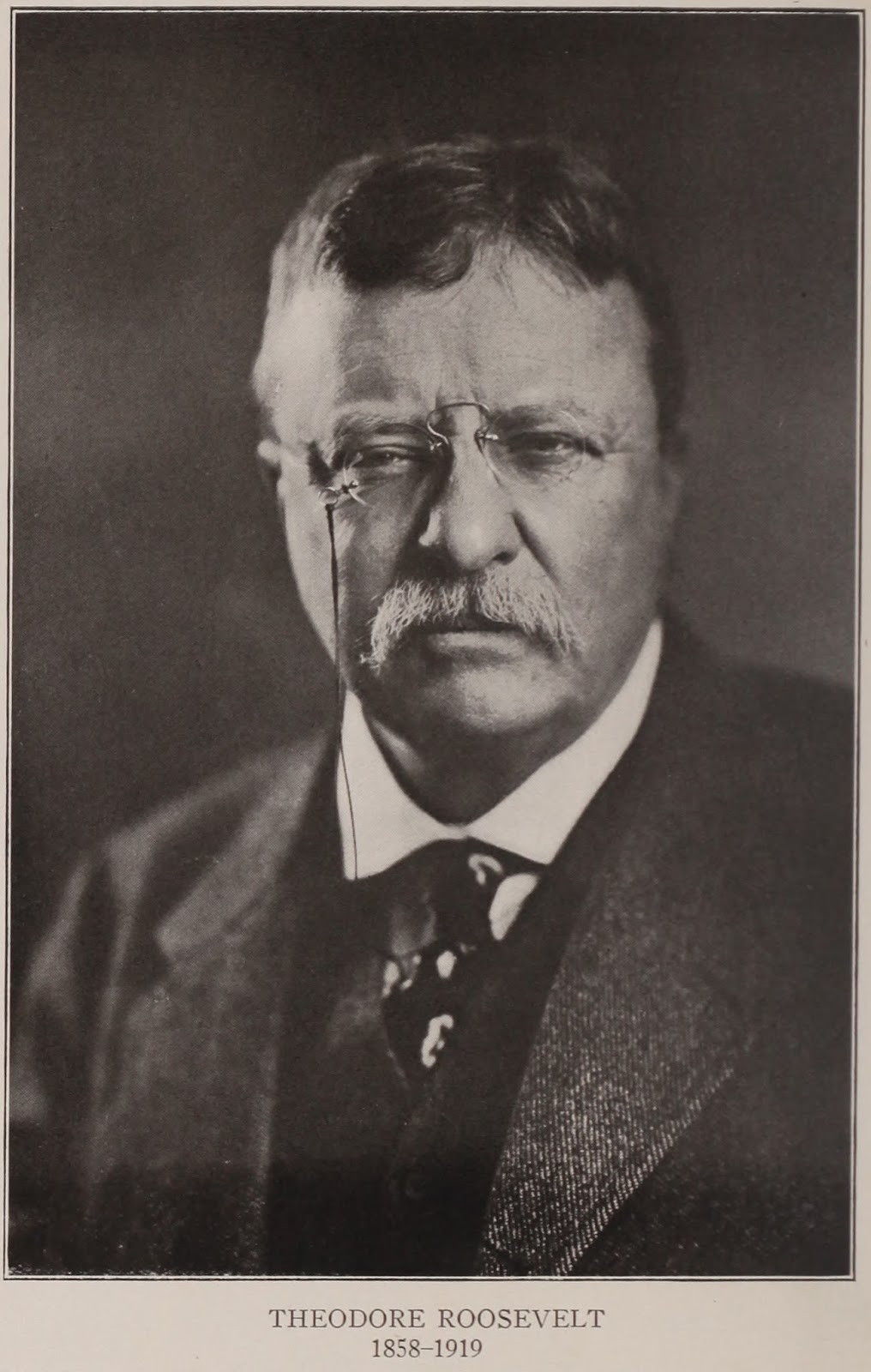
In December of 1916 Charles Christopher Adams, a zoologist at the New York State College of Forestry at Syracuse University, approached Theodore Roosevelt to discuss the need for systematic study of big game and other mammals in the forests of North America. Dr. Adams believed that a lack of understanding of these animals was a problem not only for scientists, but also for industry—particularly forestry—and the economy in general. Roosevelt agreed that research in this area should be undertaken and asked Dr. Adams to devise a plan, which he outlined the following year. Despite Roosevelt’s enthusiastic approval, the work was delayed—first by the onset of World War I, and then by Roosevelt’s death on January 9, 1919.

Dr. Adams, undeterred by these events, saw a new opportunity to carry on the vision he had shared with Roosevelt, and convinced the state legislature of New York to establish the Roosevelt Wild Life Forest Experiment Station as a memorial to the former President. The Station was signed into law on May 10, 1919, as part of the New York State College of Forestry. The legislation stated that the RWLS would conduct “investigations, experiments, and research in relation to the habits, life histories, methods of propagation and management of fish, birds, game and food and fur-bearing animals and forest wild life.” Dr. Adams was the Station’s first director.

View Full Size Image
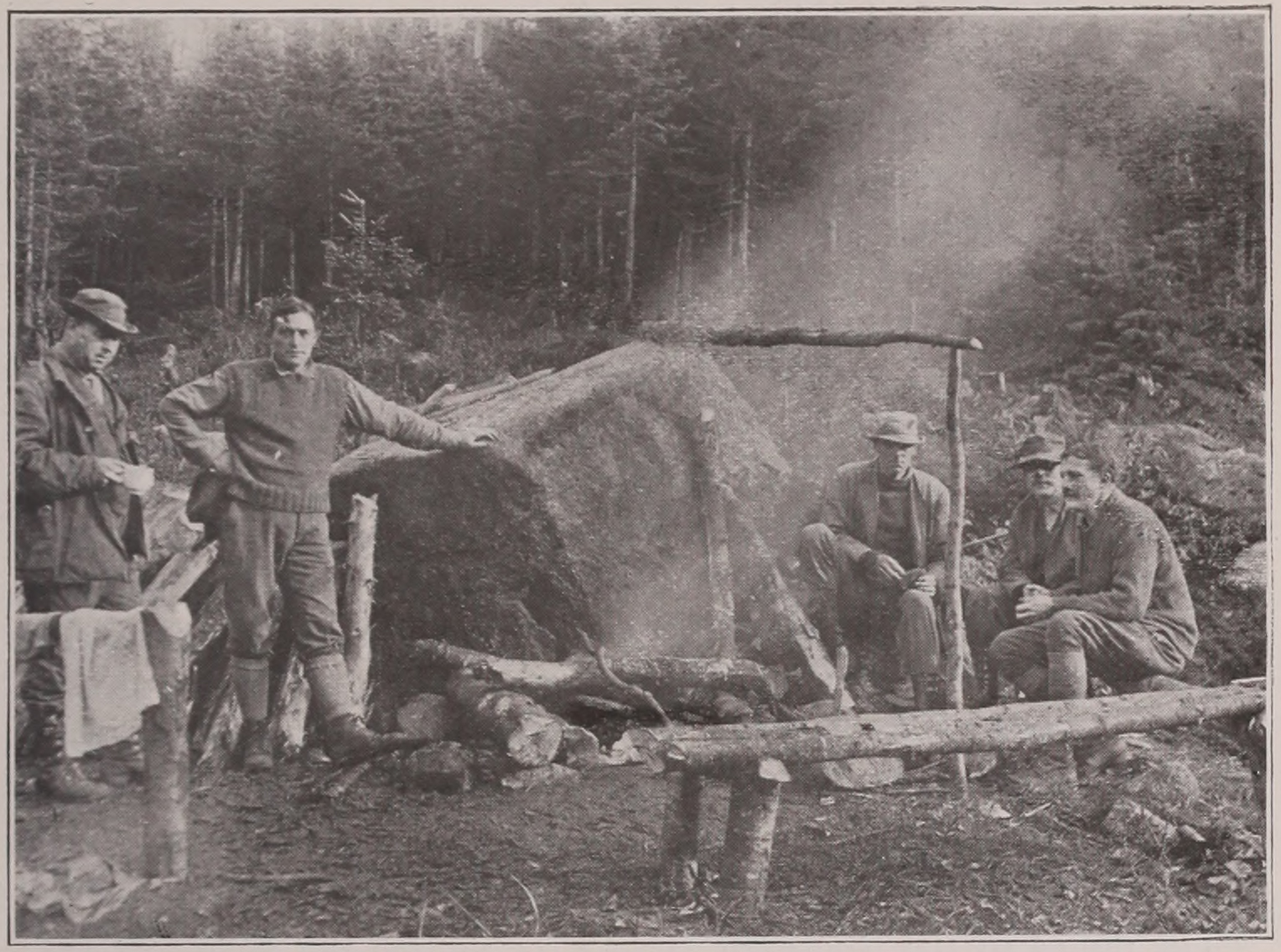
“The field party of the Roosevelt Wild Life Station at camp on Mount Marcy, working in cooperation with other scientists,” from Roosevelt Wild Life Bulletin, v.1 no.1 (1921).

Writing in Science in June, 1919, Dr. Adams proclaimed:

“Never before in America, and for that matter, possibly, never before in the world, has there been a forest biological station devoted primarily or exclusively to the study of every phase of forest wild life. The establishment of such a station at the New York State College of Forestry, at Syracuse University, is thus an event of considerable general interest and importance, not only to those interested in the conservation of wild life, to foresters, and to zoologists in general, and particularly to field naturalists, but in addition to many others who are interested in the ecology of fish, birds, game, fur-bearing animals, and other kinds of forest wild life. This station, named in honor of the man … thus becomes a very appropriate memorial to Theodore Roosevelt.”

An editorial in the August, 1919 issue of Forest and Stream speculated that “The work that such an experiment station may do is almost limitless and its possibilities are as yet quite beyond the range of our imagination.”

The conservationist George Bird Grinnell was equally laudatory; in the foreword to the first issue of the Roosevelt Wild Life Bulletin (1921), he wrote, “No one more than Theodore Roosevelt appreciated the value of the work done and to be done by the field-naturalist. No one more than he would welcome those services to science that may be accomplished by the Experiment Station that bears his name.”

View Full Size Image
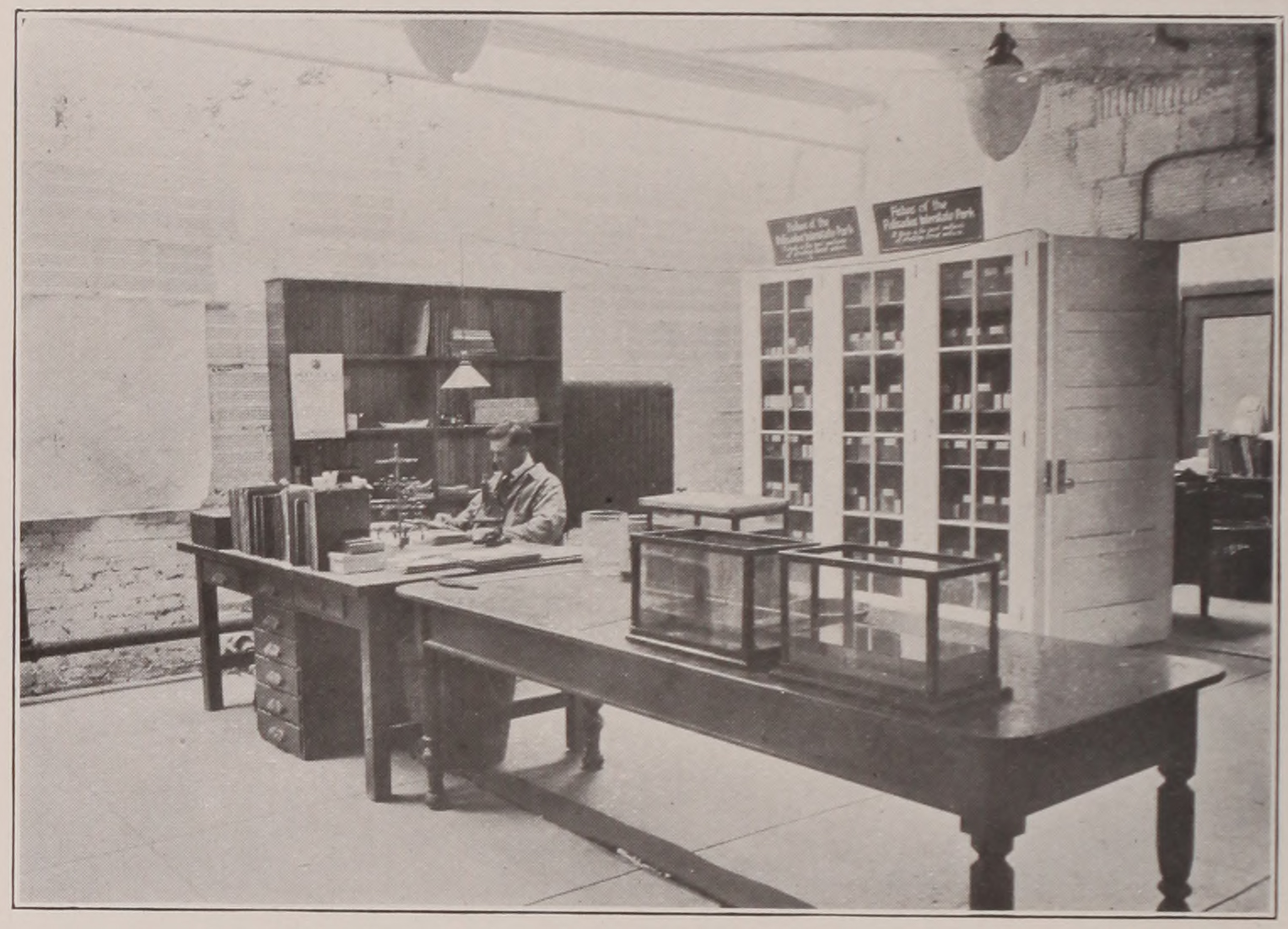
“The fish laboratory of the Roosevelt Wild Life Station,” from Roosevelt Wild Life Bulletin, v.1 no.1 (1921).

Publications of the RWLS

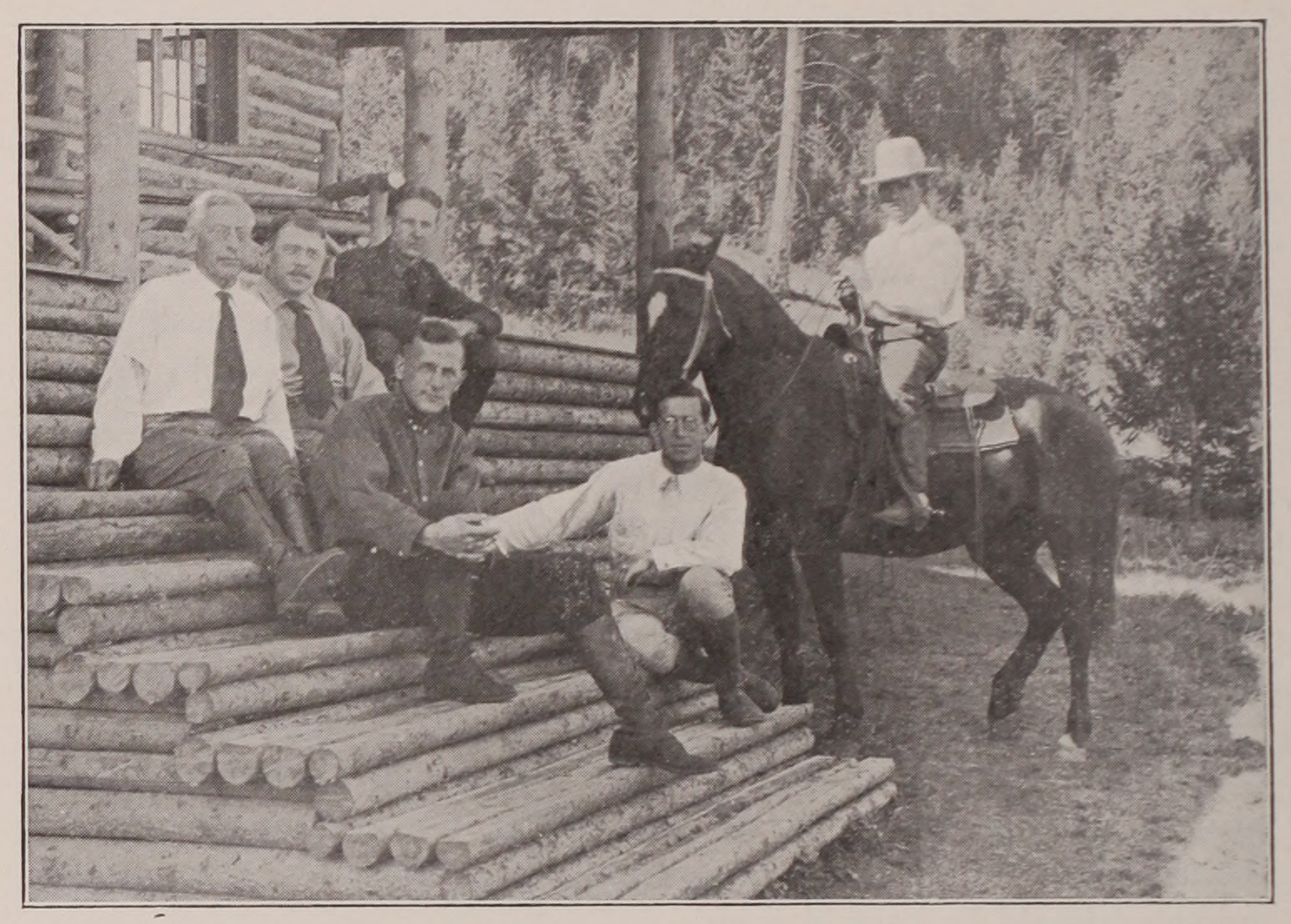
Under Dr. Adams’s tenure as director, the RWLS began publishing the Roosevelt Wild Life Bulletin in 1921, which ran until 1950. The Bulletin contains general and “popular interest” pieces related to forest ecology. Many of these articles describe the geography and wildlife of the forests immediately surrounding the RWLS, as well as the Adirondacks and other regions of upstate New York. Several others detail field research conducted at Camp Roosevelt, Yellowstone National Park, where Professor Alvin Whitney, of the New York State College of Forestry, ran a boys’ summer camp in the early 1920s.

View Full Size ImageView Full Size Image

View Full Size Image
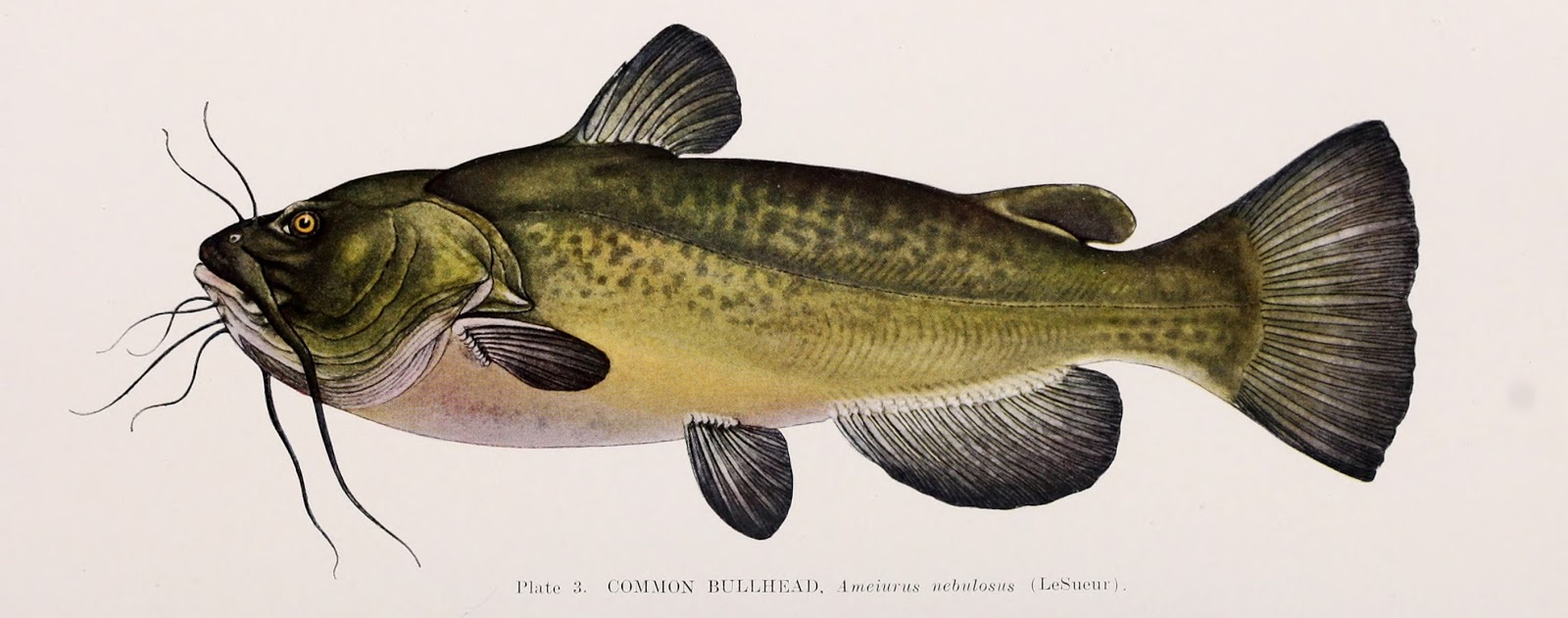
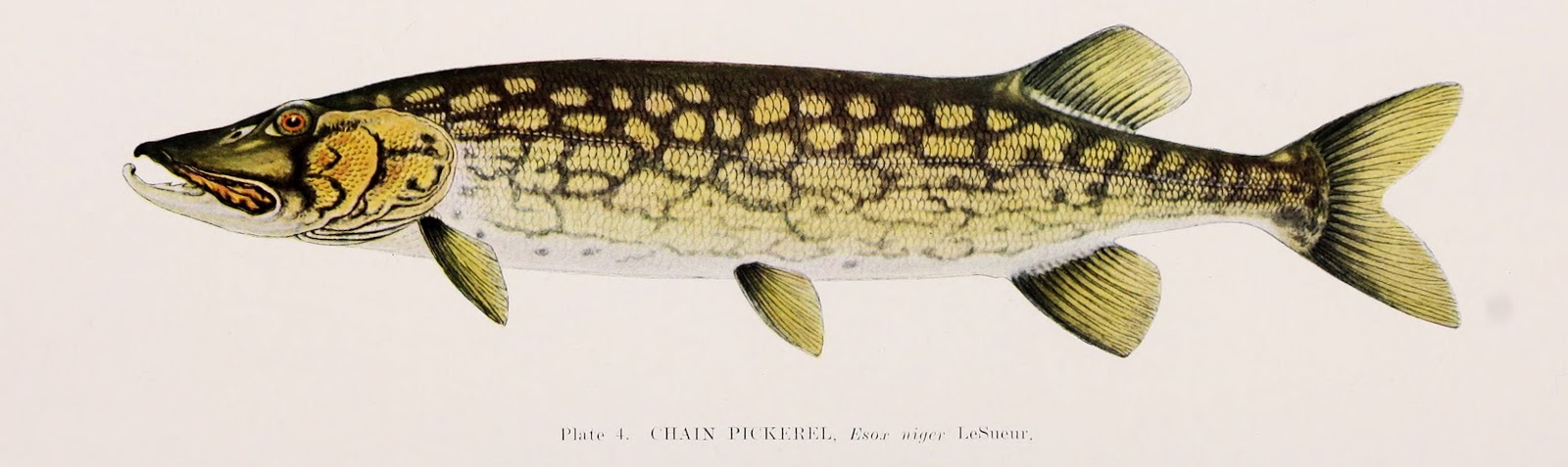
Color plates from Roosevelt Wild Life Annals, v.1 no.3-4 (1926)

Typically, each issue of the Bulletin is organized around a single topic or group of related topics: parasites in freshwater fishes, a county-level wildlife and forest survey, and the management of ruffed grouse, among others. These articles, which treated wildlife as natural resources, would surely have interested naturalists, foresters, and hunters alike. In fact, within a few years of the RWLS’s founding, people from as far away as India began to request research on subjects as esoteric as muskrat farming.

View Full Size Image
“Field party of the Roosevelt Wild Life Station in Yellowstone Park, summer of 1921,” in Roosevelt Wild Life Bulletin, v.1 no.1 (1921).

In 1926, the RWLS began a second publication, the Roosevelt Wild Life Annals, which ran for 10 years. Whereas the Bulletin was intended for a broad audience, the Annals contain technical papers that would have been of interest to professional naturalists, particularly zoologists and botanists. Like the Bulletin, each issue is typically devoted to a single topic: the red squirrel, trout streams in Yellowstone National Park, the bank swallow, and others.

The RWLS Today

View Full Size Image
From Roosevelt Wild Life Bulletin, v.1 no.1 (1921)

Following the publication of the last Bulletin in 1950, the RWLS entered a period of inactivity that lasted until 1999, when it was reactivated through a combination of private and state funding. Governor George Pataki and Theodore Roosevelt IV presided over the rededication. The RWLS began to support student internships at ESF’s Adirondack Ecological Center, and in 2014 the NYS Department of Environmental Conservation provided $3.4 million in funding for wildlife research and management.

Today, the RWLS focuses on the northeastern U.S. and southeastern Canada in the context of truly global issues: habitat loss and climate change. In addition to providing hands-on experience to students of wildlife science, its priorities are “protection of imperiled keystone and strongly valued species vulnerable to the impacts of rapidly changing landscapes and climate; and habitat management issues, such as maintaining effective habitat in private-land mosaics, protecting and expanding core habitat areas, and securing habitat connectivity.” In these efforts, the RWLS carries on the vision shared by Dr. Adams and Theodore Roosevelt a hundred years ago.

Reference

Adams, C. C. (1919). The Roosevelt Wild-Life Forest Experiment Station. Science, n.s. 49(1275), 533-534.

Frair, J., & Gibbs, J. P. (2011, Spring). The Roosevelt Wild Life Station: Revitalizing a forgotten conservation legacy. Fair Chase, 30-34.

National Park Service. Roosevelt Lodge, 1920. Retrieved from https://www.nps.gov/yell/learn/historyculture/rooseveltlodge.htm

SUNY College of Environmental Science and Forestry. History of the Roosevelt Wild Life Station [PDF document]. Retrieved from http://www.esf.edu/rwls/timeline.pdf

May 26, 2016by [email protected]
BHL News, Blog Reel

Expanding Access (EABL) Project Brings New In-Copyright Content to BHL

In case you missed our last post recapping the in-copyright content in BHL over 2015, we secured agreements with 23 licensors to provide 34 in-copyright titles for free and open access via our online collection.
View Full Size Image
BHL is thrilled that for the first few months of 2016, we have gotten permission to add 20 new in-copyright titles! Why such a sudden bounty? We have the work of the new IMLS-Funded Project: Expanding Access to Biodiversity Literature (EABL) to thank for securing the large majority of these agreements and for performing the work of integrating this new content into our collection. Some of the titles below are from small natural history organizations that had previously digitized their content but lacked a way to have it represented in BHL. In the coming months, as larger content providers benefit from EABL assistance, the list will grow to include unique titles never before digitized.Our latests in-copyright titles are:

  1. Arachnologische Mitteilungen from the Arachnologische Gesellschaft
  2. Sage Notes from the Idaho Native Plant Society
  3. Roosevelt Wild Life Station:
    1. Roosevelt Wild Life Annals
    2. Roosevelt Wild Life Bulletin
  4. Long Island Botanical Society Newsletter from the Long Island Botanical Society
  5. California Native Plant Society:
    1. The Bay Leaf from the East Bay Chapter
    2. Mimulus Memo from the Kern Chapter
    3. The Pipevine from the Mount Lassen Chapter
  6. “A short Flora of Berwickshire” by M E Braithwaite (2014)
  7. Golden Gate Audubon Society’s The Gull
  8. Quaestiones Entomologicae of the University of Alberta
  9. The Echinoderm Newsletter from the Smithsonian Institution
  10. Wisconsin Entomological Society
    1. Wisconsin Entomological Society Newsletter
    2. “Checklist of Wisconsin Dragonflies” (1993)
    3. “Wisconsin Millipeds” (1995)
    4. “Checklist of Wisconsin Centipedes (Chilopoda)” (1997)
    5. “Checklist of Wisconsin Butterflies” (2002)

Linnaean Society of New York

  1. Transactions of the Linnaean Society of New York
  2. Abstract of the proceedings of the Linnaean Society of New York
  3. Proceedings of the Linnaean Society of New York

As a reminder, our in-copyright titles are availble under a Creative Commons license as specified in the volume metadata. Would you like to learn more about reusing CC licensed content? Please see our Licensing & Copyright page as linked from the footer of our website:

View Full Size Image

The future of in-copyright content in BHL is sure to surge under the leadership of the EABL project. With a goal of acquiring content from over 100 first-time contributors over 2 years, EABL will bring free and open access to invaluable content to benefit scientific research for years to come.

May 5, 2016by [email protected]
Page 5 of 6« First...«3456»

Help Support BHL

BHL's existence depends on the financial support of its patrons. Help us keep this free resource alive!

search

About BHL

The Biodiversity Heritage Library (BHL) is the world’s largest open access digital library for biodiversity literature and archives. BHL operates as a worldwide consortium of natural history, botanical, research, and national libraries working together to digitize the natural history literature held in their collections and make it freely available for open access as part of a global “biodiversity community.”

Join Our Mailing List

Sign up to receive the latest news, content highlights, and promotions.

Subscribe Now

Subscribe to Blog via Email

Enter your email address to subscribe to this blog and receive notifications of new posts by email.

Join 319 other subscribers

Subscribe to Blog Via RSS

Subscribe to the blog RSS feed to stay up-to-date on all the latest BHL posts.

Access RSS Feed

Inspiring Discovery through Free Access to Biodiversity Knowledge.

The Biodiversity Heritage Library makes it easier than ever for you to access the information you need to study and explore life on Earth…for free, anytime, anywhere.


ABOUT | HARMFUL CONTENT | PRIVACY | SITE MAP | TERMS OF USE