
Biodiversity Heritage Library - Program news and collection highlights from BHL
  • Home
  • News
  • Featured Books
    • All Featured Books
    • Book of the Month Series
    • BHL at 20
  • User Stories
  • Campaigns
    • Fossil Stories
    • Garden Stories
    • Monsters Are Real
    • Page Frights
    • Her Natural History
    • Earth Optimism 2020
  • Tech Blog
  • Visit BHL
Home
News
Featured Books
    All Featured Books
    Book of the Month Series
    BHL at 20
User Stories
Campaigns
    Fossil Stories
    Garden Stories
    Monsters Are Real
    Page Frights
    Her Natural History
    Earth Optimism 2020
Tech Blog
Visit BHL
  • Home
  • News
  • Featured Books
    • All Featured Books
    • Book of the Month Series
    • BHL at 20
  • User Stories
  • Campaigns
    • Fossil Stories
    • Garden Stories
    • Monsters Are Real
    • Page Frights
    • Her Natural History
    • Earth Optimism 2020
  • Tech Blog
  • Visit BHL
Biodiversity Heritage Library - Program news and collection highlights from BHL
Blog Reel, Featured Books

From Poetry to Pulp Fiction: Carnivorous Plants in Popular Culture

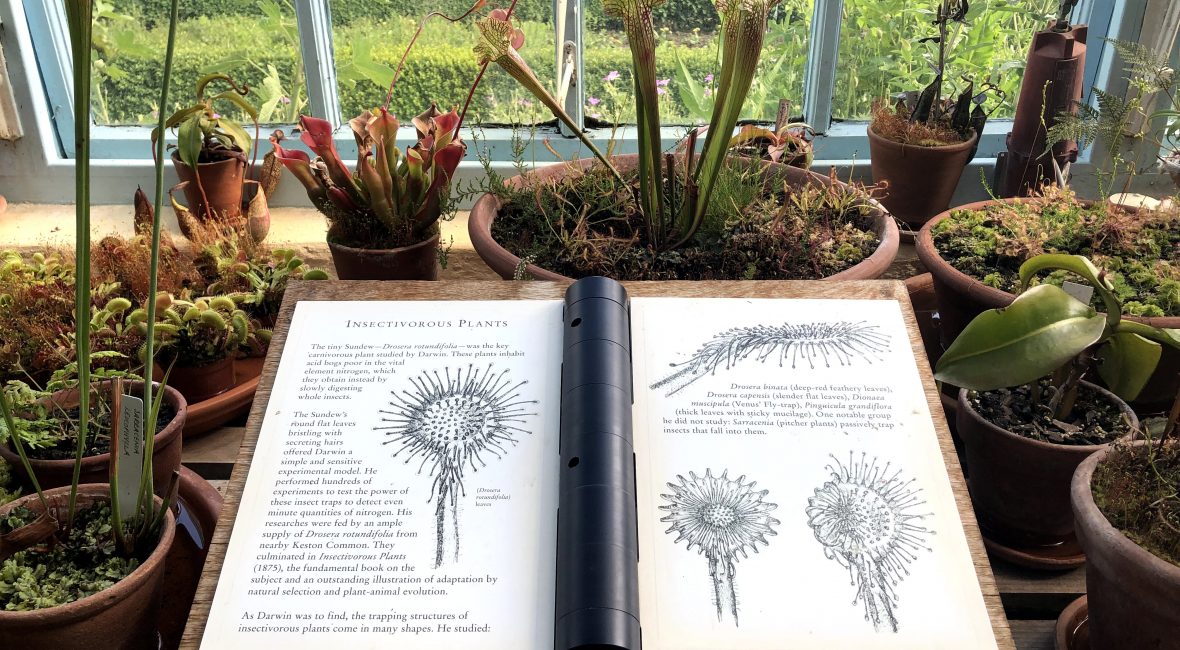
Black and white book open on a table, depicting insectivorous plant sketches and text, surrounded by potted carnivorous plants

Carnivorous plants, beguiling vegetables capable of attracting, trapping, and digesting animal prey, have fascinated generations of botanists on nearly every continent. However, there is perhaps no better way to trace their rise to cultural prominence than through the eyes of the Darwin family. The botanical legacy of Charles Darwin, his grandfather Erasmus, and son Francis, conveys the dramatic shift in how carnivorous plants were perceived by general botanical audiences from the late eighteenth century and into the twentieth. From poetic musings about their carnivorous habits to pulp fiction accounts of man-eating vegetal monsters, the BHL carnivorous plant collection offers a glimpse into the powerful spell these plants have cast over readers and observers through the centuries.

Venus flytrap with some red spike-lined traps open and others closed on insect prey. Cluster of white blossoms.

The Venus flytrap, (Dionaea muscipula). Curtis, William. Curtis’s Botanical Magazine. Vol. 19. Plate No. 785. 1804. Engraving by Sydenham Edwards. Contributed in BHL from the Missouri Botanical Garden, Peter H. Raven Library.

Charles Darwin was enamoured with carnivorous plants. As early as 1859, soon after encountering the sundew Drosera rotundifolia on an English heath, the author of On the Origin of Species wrote, “I care more about Drosera than the origin of all the species in the world” (Darwin Correspondence Project). By September 1860 he was working with Dionaea muscipula as well, and would later dub the Venus flytrap “one of the most wonderful” plants in the world (Darwin 1875, 286). Darwin’s rigorous experimentation with these enigmatic vegetal carnivores culminated in 1875 with the publication of Insectivorous Plants. This treatise laid the framework for the study of plant carnivory as it exists today and cemented the notion of carnivorous plants in the scientific and public imagination.
Drosera rotundifolia on display in Charles Darwin’s greenhouse. Downe, UK. June 22, 2019. Photo credit: John Schaefer.

Black and white book open on a table, depicting insectivorous plant sketches and text, surrounded by potted carnivorous plants

Selected images from Insectivorous Plants on display in Darwin’s greenhouse. Downe, UK. June 22, 2019. Photo credit: John Schaefer.

Yet Charles Darwin was neither the first nor the only one in his family to delight at the Venus flytrap and its murderous cohort. Indeed, his fascination with these plants developed over three generations of philosophical thought and scientific experimentation that included his grandfather and son. The family’s work with carnivorous plants reveals much about the enduring botanical legacy of Erasmus, Charles, and Francis Darwin.

Poetic Botany

The second part of Erasmus Darwin’s poem The Botanic Garden (1789) sought to display the Linnaean sexual system through poetic analogies of plant sexuality and human affairs, accompanied by Erasmus’ own botanical notes and observations. He carefully weaved together mythological and the physiological discussions through poetic prose and technical footnotes, appealing to a broad audience of general readers and botanical experts alike. His stanza on Drosera beautifully illustrates the tone of the work as a whole:

Queen of the marsh, imperial Drosera treads
Rush-fringed banks, and moss-embroider’d beds;
Redundant folds of glossy silk surround
Her slender waist, and trail upon the ground;
Five sister-nymphs collect with graceful ease,
Or spread the floating purple to the breeze;
And five fair youths with duteous love comply
With each soft mandate of her moving eye.
As with sweet grace her snowy neck she bows,
A zone of diamonds trembles round her brows,
Bright shines the silver halo, as she turns;
And, as she steps, the living lustre burns. (Darwin 1791, 24-25)

Erasmus considered the “viscous material” of the Drosera merely a mechanism to prevent “small insects from infesting the leaves,” “[a]s the ear-wax in animals seems to be in part designed to prevent fleas and other insects from getting into their ears” (Darwin 1789, 24). Darwin further relayed in his extensive notes to the reader that “[i]n the Dionaea Muscipula there is a still more wonderful contrivance to prevent the depredations of insects: […] so irritable, that when an insect creeps upon them, they fold up, and crush or pierce it to death” (Darwin 1789, 15). He had witnessed this “irritable” behavior of Dionaea firsthand in August 1788 at Ashburn Hall, Derbyshire, subsequently receiving a colored illustration of the flytrap from Maria Elizabetha Jacson.

Black and white sketch of a Venus flytrap, including open and closed leaves and a cluster of flowers

The Venus flytrap (Dionaea muscipula). Darwin, Erasmus. The Botanic Garden. A Poem in Two Parts. Pt. I Containing the Economy of Vegetation. Pt. 2. the Loves of the Plants. With Philosophical Notes. The third edition. 1791. Engraving by F.P. Nodder. Contributed in BHL from the Wellcome Library (archive.org).

Erasmus Darwin’s conviction that these mechanisms—“curious contrivance[s]” to “prevent various insects from plundering the honey, or devouring the seed”—were a defense against insects is perplexing, placing so much emphasis on the damage a tiny fly could inflict on these plants (Darwin 1789, 15). Was he perhaps allowing poetic metaphors to guide his understanding of biological phenomena? While painting a vivid picture of “The fell SILENE and her sisters fair,” who “[s]kill’d in destruction, spread the viscous snare,” he seemed to present his anthropomorphized botanical actors as righteous wardens rather than scheming hunters (Darwin 1789, 15).

Carnivorous plants continued to assert themselves in poetry and philosophical thought at the turn of the century. Some authors expressed incredulity and wonder at carnivory as such, as did the Irish poet Thomas Moore in Epistles, Odes, and Other Poems (1806): “The Lord deliver us, Think of a vegetable being ‘carnivorous!’” (Moore, 156). Moore’s verse parallels William Bartram’s lively 1791 description, included in his Travels Through North and South Carolina: “But admirable are the properties of the extraordinary Dionaea muscipula! […] carnivorous vegetable!” (Bartram 1791, xiii).

A pitcher plant with pitcher "lid" open and a closed blossom in the foreground. A Venus flytrap with open "traps" and a cluster of white blossoms.

The Venus flytrap (Dionaea muscipula) and yellow pitcher plant (Sarracenia flava). Plate LXI. Thornton, Robert John. New Illustration of the Sexual System of Carolus von Linnaeus: And the Temple of Flora, or Garden of Nature. 1807. Contributed in BHL from the Missouri Botanical Garden, Peter H. Raven Library.

Darwin’s ‘Most Wonderful’ Plants

It was not until 1860, when another Darwin, Charles, began pondering the lethal activities of sundews to make sense of the Venus flytrap and other suspected vegetal carnivores. Over the course of the next decade, he sporadically worked with the Droseraceae. Among those who facilitated his study of these plants were the American naturalist Mary Treat and Sir Joseph Dalton Hooker, Darwin’s close friend and director of Kew Gardens, who supplied him with living specimens. Armed with this network of correspondents and the global resources of Kew, Darwin was able to carry out the investigations of carnivory from his backyard greenhouse in Downe.

Two black and white sketches of open and closed tentacles of the sundew plant, surrounded by descriptive text of the species

The trapping mechanism of the sundew Drosera rotundifolia. Page 10. Darwin, Charles. Insectivorous Plants. 1875. Contributed in BHL from the Royal College of Physicians in Edinburgh by the Wellcome Library (archive.org).

In the early 1870s Darwin’s passion for these plants reached a fever pitch. While focusing mainly on Drosera, he simultaneously studied carnivory in Dionaea, Utricularia, Pinguicula, and Aldrovanda. Meanwhile, Hooker occupied himself with the pitcher plants Nepenthes, Sarracenia, and Cephalotus at Kew. Inspired by a visit to Darwin’s home, Dr. John Burdon-Sanderson, one of the most prominent physiologists of the nineteenth century, was also compelled to investigate the mysterious behavior of Dionaea.

Burdon-Sanderson’s experiments showed that Dionaea’s leaves closed only when unsuspecting prey disturbed the electric current running through the plant, just as animal muscles contract in response to stimulus. Darwin further elucidated the nature of this ingenious trapping mechanism. He realized that the plant had “learned” to determine the prey that was worth capturing. Of the three trigger hairs on each lobe of the leaf, two had to be touched within 20 seconds of each other to trigger the trap. Continuous stimulation would cause the trap to seal shut and begin digesting its prey, while smaller insects could simply slip out and the trap would reset. Part of Darwin’s enduring impact on biology was his work that examined such evolutionary adaptations through various botanical lenses, with carnivorous plants serving as a prime example.

Father and Son

Darwin’s son, Francis, carried on his father’s legacy in a variety of ways, including his own research of plant carnivory. Francis’s passion for carnivorous plants first stemmed from aiding his father in his work on Insectivorous Plants, in which he is credited with illustrating the tiny underwater traps of Aldrovanda and Utricularia. Drosera, however, was the resounding favorite of both father and son. Nearly two-thirds of Insectivorous Plants was dedicated to the sundew. Being privy to his father’s experiments, Francis sought to develop the book’s findings after the first edition was published.

Detractors of Charles Darwin’s carnivorous theory frequently pointed out that so-called carnivorous plants flourished in European hothouses year-round without any insect prey to feed on. Experiments that Darwin carried out while writing Insectivorous Plants sought to address this quandary but failed, as all the plants — fed or not — had died. Francis returned to the subject of his father’s beloved Drosera rotundifolia in June 1877, finding out that the sundews that had been ‘fed’ nearly doubled in seed production and size (Darwin 1878). Since these early experiments, many carnivorous genera have been proven to demonstrate increased size and biomass when the plants had access to insect prey. After his father’s death, Francis went on to publish a revised second edition of Insectivorous Plants in 1888, incorporating new discoveries by himself and others to enhance the scientific understanding of plant carnivory.

Botanical Bestiaries

Parallel to this shift in scientific illustration, an explosion of periodical literature featuring plant carnivory catapulted the Venus flytrap and its fellow vegetal carnivores into the public imagination. Fictional accounts of man-eating plants regularly featured in Anglo-American periodical literature at the end of the nineteenth century, perpetuating pseudo-scientific stories from fictional explorers encountering such horrors as the “Man-Eating Tree” of Madagascar or the “Vampire Vine” of Namibia (Prior 1939, 10-19).

A tree with tentacles for branches entangles a grown man while two men with spears watch in shock

The man-eating tree. Page 476. Buel, James W. Sea and land : an illustrated history of the wonderful and curious things of nature existing before and since the deluge. 1887. Contributed in BHL from University of Connecticut Libraries (archive.org).


A woman is fed to a giant carnivorous plant while men and women with spears and shields look on.

Sacrificed to a man-eating plant. Prior, Sophia. Carnivorous Plants and “the Man Eating Tree.” 1939. Contributed in BHL from the University Library, University of Illinois Urbana Champaign. CC BY-NC-SA 3.0. Rights Holder: Field Museum of Natural History.

Sir Arthur Conan Doyle, the author of Sherlock Holmes, helped jumpstart this craze in 1880 with “The American’s Tale.” First published anonymously in the Christmas special of the London Society magazine, this short story centered around a man killed by a massive Venus flytrap in the Arizona wilderness. The legendary science fiction writer H.G. Wells also wrote of a botanist’s blood-sucking orchid in 1905, laying the foundations for alien man-eating plants featured in musical, film, and television adaptations of Little Shop of Horrors and Day of the Triffids, popular in the twentieth century (Price 2013).

In Conclusion

As countless stunning cultivars are grown commercially to fuel the demanding global plant trade, wild populations of carnivorous plants have become increasingly threatened by habitat destruction, poaching, pollution, and anthropogenic climate change. Nearly half of all carnivorous plants fall under International Union for Conservation of Nature (IUCN) risk categories, ranging from near threatened to critically endangered. Frequently appearing in special exhibitions and displays at botanic gardens around the world, these plants continue to draw the fascination of millions of visitors each year. As legions of individuals have struggled to find a place for them within various social and scientific contexts, carnivorous plants have become firmly established as organisms of towering cultural significance.

Misty view of sundew plants with pink sticky hairs on green leaves. One Venus flytrap leaf hidden among the sundew leaves.

A Venus flytrap (Dionaea muscipula) lurking among a sea of sundews (Drosera capensis). Royal Botanic Garden, Sydney. February 8, 2020. Photo credit: John Schaefer.

The Plant Humanities Initiative at Dumbarton Oaks takes an interdisciplinary approach to understanding the roles of plants in human affairs. This blog series, and the BHL carnivorous plant collection, were created in collaboration with the Plant Humanities Lab – an open access platform developed by Dumbarton Oaks and JSTOR. Find more information on the cultural history of the Venus flytrap and many other plants here.

References and Additional Suggested Reading

Bartram, William, and T. Cander. Travels through North and South Carolina, Georgia, East and West Florida, the Cherokee Country, the Extensive Territories of the Muscogulges or Creek Confederacy, and the Country of the Chactaws : Containing an Account of the Soil and Natural Productions of Those Regions : Together with Observations on the Manners of the Indians : Embellished with Copper-Plates. Philadelphia : Printed by James and Johnson, 1791. https://doi.org/10.5962/bhl.title.109283

Darwin, Charles. Insectivorous Plants. London : J. Murray, 1875. https://doi.org/10.5962/bhl.title.99933

Darwin, Charles, and Francis Darwin. Insectivorous Plants. London : J. Murray, 1888. https://doi.org/10.5962/bhl.title.74

Darwin Correspondence Project, “Letter no. 2996,” accessed on 2 August 2021, https://www.darwinproject.ac.uk/letter/DCP-LETT-2996.xml

Darwin, Erasmus. The Botanic Garden. A Poem in Two Parts. Pt. I Containing the Economy of Vegetation. Pt. 2. the Loves of the Plants. With Philosophical Notes. The third edition. London : Printed for J. Johnson, 1791. https://doi.org/10.5962/bhl.title.143120

Darwin, Francis. Experiments on the Nutrition of Drosera rotundifolia. Botanical Journal of the Linnean Society, 17(98), 17–31, 1878.

Ellis, John, Lockyer Davis, Carl von Linné, and James Roberts. Directions for Bringing over Seeds and Plants, from the East-Indies and Other Distant Countries, in a State of Vegetation : Together with a Catalogue of Such Foreign Plants as Are Worthy of Being Encouraged in Our American Colonies, for the Purposes of Medicine, Agriculture, and Commerce. To Which Is Added, the Figure and Botanical Description of a New Sensitive Plant, Called Dionaea Muscipula: Or, Venus’s Fly-Trap. London : Printed and sold by L. Davis, printer to the Royal Society, opposite Gray’s-Inn, Holborn, 1770. https://doi.org/10.5962/bhl.title.108658

Hooker, Joseph Dalton. Report of the British Association for the Advancement of Science. Vol. 44. London, 1875.https://www.biodiversitylibrary.org/item/94451

Juniper, B. E. The Carnivorous Plants. London ; San Diego: Academic Press, 1989.

Moore, Thomas. Epistles, Odes, and Other Poems. James Carpenter, 1806.

Price, Cheryl Blake. “VEGETABLE MONSTERS: MAN-EATING TREES IN FIN-DE-SIÈCLE FICTION.” Victorian Literature and Culture 41, no. 2 (June 2013): 311–27. https://doi.org/10.1017/S1060150312000411

Prior, Sophia. Carnivorous Plants and “the Man Eating Tree.” Chicago: Field Museum of Natural History, 1939. https://www.biodiversitylibrary.org/item/25206

Recommended Sites

Darwin Correspondence Project

IUCN (International Union for Conservation of Nature) Red List of Threatened Species

International Carnivorous Plants Society (ICPS)

Plant Humanities Initiative

Wikipedia. “Carnivorous Plant.”

October 28, 2021by [email protected]
Blog Reel, Featured Books

Flytraps, Sundews, and Pitchers: Discovering the Carnivorous Plants of BHL

Full color sketch of a blooming Venus flytrap, with white blossoms and red-lined traps catching insects

In a world where staggering habitat destruction and biodiversity loss have become the new normal, understanding the extraordinary interactions between plants and humans is increasingly urgent. Yet the human tendency to ignore the importance of plant-human interactions remains persistent. The Plant Humanities Initiative at Dumbarton Oaks seeks to address this gap in plant awareness through an interdisciplinary coalition of programs and scholarship tackling the cultural significance of plants in human affairs.

As the Digital Plant Humanities Intern for Dumbarton Oaks this summer, I will be writing an interactive, visual essay on the cultural history of Venus flytrap (Dionaea muscipula) for the Plant Humanities Lab – a new open access portal developed by Dumbarton Oaks and JSTOR Labs. Accompanying this essay is a BHL collection highlighting the wealth of digitized scientific literature and botanical illustration surrounding carnivorous plants. These fascinating organisms attract, capture, and digest animal prey in order to supplement the nutrient-poor soil of their natural habitats. Today, over seven hundred species possessing this specialized suite of adaptations have been identified, evolving at least seven times independently!

As the English botanist Sir Joseph Hooker once proclaimed, “such vegetable sportsmen as the Sundew, the Venus’s Flytrap, and the Pitcher-Plants” have long been of interest to the botanically inclined (Hooker 1875, 102). The carnivorous plant collection on BHL emphasises sources that feature the Venus flytrap (Dionaea) and sundews (Drosera), as well as the pitcher plants (Nepenthes, Cephalotus, and Sarracenia). Each group represents a different trapping mechanism deployed by the plants to catch their prey: the infamously fast snap traps of Dionaea, dangerously beautiful adhesive leaves of Drosera, and the deceptively simple pitfall traps of the pitcher plants.

A close up view of the ground covered with pitcher plants, Venus flytraps, and sundew plants

L-R: Pitcher plant (Sarracenia purpurea), Venus flytrap (Dionaea muscipula), Sundew (Drosera capensis). Royal Botanic Garden, Sydney. February 8, 2020. Photo credit: John Schaefer.

The Venus flytrap, a familiar household name and easily the most famous carnivorous plant, has inspired countless admirers over the past several hundred years. Charles Darwin considered it among the “most wonderful” plants in the world (Darwin 1875, 243). Carl von Linné, the father of modern taxonomy, dubbed it a “miracle of nature” (Linné 1774, 335). Even American naturalist and politician Thomas Jefferson attempted to cultivate Dionaea in order to showcase the flora of his fledgling nation. With carnivorous plants native to every continent except Antarctica, this macabre curiosity of the vegetable kingdom is in good company.

Indigenous Narratives

Before addressing the fascinating Western narrative of carnivorous plants, a story deeply rooted in colonial expansion and discovery, it is important to first note their rich place in indigenous cultural and medicinal practices around the world. Found in the wild globally, these plants have long been integrated into the knowledge systems of Indigenous peoples from locales as far-flung as Australia, Indonesia, Scandinavia, and North America.

Several Indigenous peoples appear to have been intimately familiar with the plants’ murderous habits long before the arrival of European colonizers, and this carnivorous behavior clearly influenced their cultural significance. The Toraja people of Sulawesi Selatan (South Celebes), Indonesia, believe that ants killed by the “suke-bombo” (a species of Drosera), housed the souls of dead ancestors (Nooy-Palm 1979, 228). By lighting the plants ablaze, these trapped souls could become rainclouds and bring a plentiful harvest. On the other side of the world, Native American Cherokee medical practitioners used the pitcher plant Sarracenia purpurea, the “never-failing insect hunter” to obtain a “never-failing memory” during their training rituals (Mooney 1931, 101). Water from various pitcher plants has been used medicinally in various cultural traditions for centuries, and scientists have only just begun to understand the medicinal powers of the Droseraceae, long prized for their anti-inflammatory chemical properties (Egan and Kooy 2013). Yet surviving texts that discuss the true purpose of their deadly design did not appear until the mid-eighteenth century, when European naturalists first encountered the Venus flytrap. [1]

Early Modern Herbals

Mostly cropping up in early modern medicinal herbals, there were several 16th-17th century accounts of insects being killed by plants. The Flemish botanist Rembert Dodoens is responsible for the first printed image of a carnivorous plant — a woodcut of Drosera rotundifolia under the Latin name “Ros Solis” in his herbal Crŭÿde boeck (1554).

Five sketches of carnivorous plants accompanied by original Dutch description

First printed image of a carnivorous plant, Ros Solis (Drosera rotundifolia L.). Page cccliiii. Dodoens, Rembert. Crŭÿde boeck. 1563. Contributed in BHL from the Missouri Botanical Garden, Peter H. Raven Library.

The English herbalist John Gerard appears to have included some midges or gnats in sundew woodcuts from his 1597 herbal, largely plagiarized from Dodoens’ work. Of course, this detail could simply be a printing error and he certainly did not recognize the significance of this strange phenomenon. Upon careful inspection, D. rotundifolia also appears in the upper left corner of his elaborately engraved frontispiece. Try to spot it!

Ornate black and white title page depicting a garden scene, two cherubs, four gentlemen, and a female figure

Frontispiece. Gerard, John. The Herball, or, Generall Historie of Plantes. 1597. Contributed in BHL from the Boston Public Library (archive.org).

The unusual leaves of pitcher plants were even more puzzling for early modern naturalists. Mark Catesby suggested that Sarracenia pitchers served as an asylum for insects and frogs in his illustrated The Natural History of Carolina, Florida and the Bahama Islands (Catesby 1734, 70). Scottish botanist Robert Morison wrote – incorrectly – that the lid of Sarracenia worked like a hinge to trap insects (Morison 1699, 533). Carl von Linné echoed this claim in Hortus Cliffortianus (Linné 1737, 497). In his “PrælectionesIn ordines naturales plantarum,” Linné further supposed that the purpose of the pitchers was to “supply water to thirsty birds” (Linné 1792, 316; see also Miller 1755, 161).

Full color sketch of a pitcher plant including modified leaves and flowering parts, with yellow-striped, black-spotted frog beneath

Pitcher plant (Sarracenia purpurea). T. 70. Catesby, Mark. The Natural History of Carolina, Florida and the Bahama Islands… 1734. Contributed in BHL from the Smithsonian Libraries and Archives.

Full color sketch of a pitcher plant including modified leaves and flowering parts, with red-eyed frog beneath

Pitcher plants (Sarracenia flava and S. psittacina). T. 69. Catesby, Mark. The Natural History of Carolina, Florida and the Bahama Islands… 1734. Contributed in BHL from the Smithsonian Libraries and Archives.

Linné was also the first to describe a carnivorous plant – Drosera and Aldrovanda – according to modern standards of binomial nomenclature, originally popularized through his own classification system based upon the number of sexual organs (i.e., pistils and stamens) that a plant possesses.

Discovering Carnivory

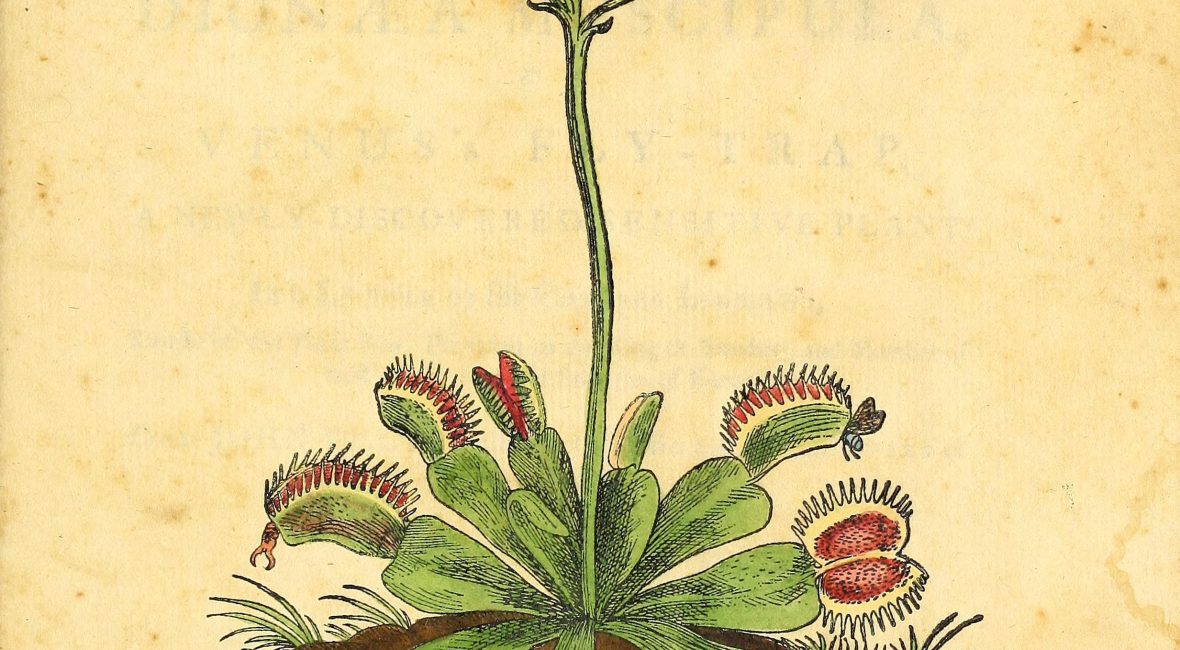
John Ellis, an English linen merchant, naturalist, and close friend of Linné, was the first to publish a scientific description and illustration of the Venus flytrap. Amended to the end of his short 1770 pamphlet on Transatlantic plant transport, a brief description in the guise of an open letter to Linné signaled the formal entrance of plant carnivory into Western scientific discourse.

Full color sketch of a blooming Venus flytrap, with white blossoms and red-lined traps catching insects

Venus’s Flytrap (Dionaea muscipula). Ellis, John. Directions for Bringing over Seeds and Plants, from the East-Indies and Other Distant Countries, in a State of Vegetation. 1770. Engraving by James Roberts. Contributed in BHL from the Smithsonian Libraries and Archives.

Ellis points to the likelihood of carnivory in his letter to Linné:

“I know that every discovery in nature is a treat to you ; but in this you will have a feast […] no end or design of nature has yet appeared to you from these surprising motions […] the plant, of which I now enclose you an exact figure […] shows, that Nature may have some views towards its nourishment, in forming the upper joint of its leaf like a machine to catch food.” (Ellis 1770, 37)

Linné appears to have met this claim with skepticism, for in Mantissa Plantarum he preferred to describe the snap trap as a simple “catch-and-release” mechanism, intended to stave off predatory insects (Linné 1771, 238).

International Inquiries

Word of the strange Venus flytrap spread quickly across Europe, with a wide range of commentators in France, Italy, Germany, Sweden, and England weighing in on the existence of carnivorous plants. Perhaps the most significant was little-known German botanist Albrecht Wilhelm Roth. After learning of Dionaea’s killer instincts, Roth sought to understand similar trapping mechanisms in two close European relatives: the sundews Drosera rotundifolia and D. longifolia. After extensive experiments attempting to explain the physiology of their sensitive trapping mechanisms, he devoted an entire chapter to the sundews in Beyträge Zur Botanik. [2] His work was later corroborated by William Withering and at least two other English botanists (Withering 1787, 332). He devoted part of his treatise to the more abstract problems carnivory posed… neatly tiptoeing around potential theological conflicts:

“Herr Ellis utters the conjecture in his letter to the Knight of Linné that nature, in the formation of the leaves of Dionaea, may have had some concern for its nourishment. Herr Hofrath Schreber, however, considers this assumption unbelievable, namely that the plant takes some nourishment from the insects crushed between its leaves. It is certain that we cannot judge with certainty what kind of intentions the wise creator had, that he gave these plants a special construction and irritable property, but I believe that one could not wrongly assume that the construction and the nature of these plants aim at in order to obtaining their nourishment for the maintenance and reproduction of their species. Because we can not determine whether these plants, in particular, may not need animal juices for their nourishment and preservation due to their special construction? In addition, we know that the leaves of the plants also have such vessels through which they draw foreign parts from the air for their food, so that there is no reason to doubt the possibility of this.” (Roth 1782, 73)

In 1791, the American naturalist William Bartram prefaced his “Travels through North and South Carolina” with what can be best described as a love letter to Dionaea:

“But admirable are the properties of the extraordinary Dionaea muscipula! A great extent on each side of that Turpentine rivulet is occupied by those sportive vegetables — let us advance to the spot in which nature has seated them. Astonishing production! see the incarnate lobes expanding, how gay and sportive they appear ready on the spring to intrap incautious deluded insects! what artifice! there behold one of the leaves just closed upon a struggling fly; another has gotten a worm; its hold is sure, its prey can never escape — carnivorous vegetable! Can we after viewing this object, hesitate a moment to confess, that vegetable beings are endued with some sensible faculties or attributes, similar to those that dignify animal nature; they are organical, living, and self-moving bodies, for see here, in this plant, motion and volition.” (Bartram 1791, xiii-xiv)

A cluster of white flowers are seen about the open leaves of a Venus flytrap

Venus flytrap (Dionaea muscipula) in bloom. Royal Botanic Garden, Sydney. February 8, 2020. Photo credit: John Schaefer.

Bartram is, however, not so generous with other vegetable suspects like Sarracenia and Drosera, stating that “whether the insects caught in their leaves, and which dissolve and mix with the fluid, serve for ailment or support to these kinds of plants, is doubtful.” The Venus flytrap was met with similar skepticism in Europe. An Italian translation of John Hill’s A Decade of Curious and Elegant Trees and Plants (1773) claimed that unspecified experiments had proven Ellis’ notion of plant carnivory to be false, despite including a somewhat viscous-looking illustration of the flytrap.

Full color sketch of a white blossoming Venus flytrap with red-lined traps

Venus flytrap (Dionaea muscipula). Figure V. Hill, John, Cesare Maioli, and Giovanni Generoso Salomoni. Decade Di Alberi Curiosi Ed Eleganti Piante Delle Indie Orientali, e Dell’ America Ultimamente Fatte Gia’ Note. 1786. Contributed in BHL from the Harvard University Botany Libraries.

A decade later, on the other side of the world, British explorer Matthew Flinders exalted the discovery of Cephalotus follicularis, a monotypic Australian pitcher plant:

”January 1802 […] Amongst the plants collected by Mr. Brown and his associates, was a small one of a novel kind, which we commonly call the pitcher plant. Around the root leaves are several little vases lined with spiny hairs, and these were generally found to contain a sweetish water, and also a number of dead ants. It cannot be asserted that the ants were attracted by the water, and prevented by the spiny hairs from making their escape; but it seemed not improbably, that this was a contrivance to obtain the means necessary either to the nourishment or preservation of the plant” (Flinders 1814, 64).

In Conclusion

The BHL carnivorous plant collection highlights some of the earliest attempts to understand the insatiable appetites of carnivorous plants, revealing the extent to which they were entangled with the history of botanical exploration. The next post in this series will explore these plants through the eyes of three generations of Darwins on BHL (Erasmus, Charles, and Francis), looking at their enduring impact on botany in the popular imagination.

References and Additional Suggested Reading

Bartram, William, and T. Cander. Travels through North and South Carolina, Georgia, East and West Florida, the Cherokee Country, the Extensive Territories of the Muscogulges or Creek Confederacy, and the Country of the Chactaws : Containing an Account of the Soil and Natural Productions of Those Regions : Together with Observations on the Manners of the Indians : Embellished with Copper-Plates. Philadelphia : Printed by James and Johnson, 1791. https://doi.org/10.5962/bhl.title.109283

Catesby, Mark. The Natural History of Carolina, Florida and the Bahama Islands : Containing the Figures of Birds, Beasts, Fishes, Serpents, Insects, and Plants : Particularly, the Forest-Trees, Shrubs, and Other Plants, Not Hitherto Described, or Very Incorrectly Figured by Authors : Together with Their Descriptions in English and French : To Which, Are Added Observations on the Air, Soil, and Waters : With Remarks upon Agriculture, Grain, Pulse, Roots, &c. : To the Whole, Is Prefixed a New and Correct Map of the Countries Treated Of. Vol. 2. London : Printed at the expence of the author, and sold by W. Innys and R. Manby, at the West End of St. Paul’s, by Mr. Hauksbee, at the Royal Society House, and by the author, at Mr. Bacon’s in Hoxton, 1734. https://doi.org/10.5962/bhl.title.62015

Darwin, Charles. Insectivorous Plants. London : J. Murray, 1875. https://doi.org/10.5962/bhl.title.99933

Dodoens, Rembert. Crŭÿde Boeck : In Den Welcken Die Geheele Historie Dat Es Tgheslacht, Tfatsoen, Nae[m], Natuere, Cracht Ende Werckinghe, van Den Cruyden, Niet Alleen Hier Te Lande Wassende, Maer Oock van de[n] Andere[n] Vremde[n] in Der Medecynen Oorboorlijck, Met Grooter Neersticheyt Begrepen Ende Verclaert Es, Met Der Seluer Cruyden Natuerlijck Naer Dat Leuen Conterfeytsel Daer by Ghestelt. Gheprint Thantwerpen : In die Cammerstrate inden Arent seghen Scarabaeum by my Jan vander Loe, 1563. https://doi.org/10.5962/bhl.title.7118

Egan, Paul A., and Frank van der Kooy. “Phytochemistry of the Carnivorous Sundew Genus Drosera (Droseraceae) – Future Perspectives and Ethnopharmacological Relevance.” Chemistry & Biodiversity 10, no. 10 (October 2013): 1774–90. https://doi.org/10.1002/cbdv.201200359

Ellis, John, Lockyer Davis, Carl von Linné, and James Roberts. Directions for Bringing over Seeds and Plants, from the East-Indies and Other Distant Countries, in a State of Vegetation : Together with a Catalogue of Such Foreign Plants as Are Worthy of Being Encouraged in Our American Colonies, for the Purposes of Medicine, Agriculture, and Commerce. To Which Is Added, the Figure and Botanical Description of a New Sensitive Plant, Called Dionaea Muscipula: Or, Venus’s Fly-Trap. London : Printed and sold by L. Davis, printer to the Royal Society, opposite Gray’s-Inn, Holborn, 1770. https://doi.org/10.5962/bhl.title.108658

Flinders, Matthew. A Voyage to Terra Australis : Undertaken for the Purpose of Completing the Discovery of That Vast Country, and Prosecuted in the Years 1801, 1802 and 1803, in His Majesty’s Ship the Investigator, and Subsequently in the Armed Vessel Porpoise and Cumberland Schooner : With an Account of the Shipwreck of the Porpoise, Arrival of the Cumberland at Mauritius, and Imprisonment of the Commander during Six Years and a Half in That Island. Vol. 1. London : Printed by W. Bulmer and Co. , Cleveland-Row ;, 1814. https://doi.org/10.5962/bhl.title.106080

Gerard, John, Edmund Bollifant, John Norton, Bonham Norton, William Rogers, and Rembert Dodoens. The Herball, or, Generall Historie of Plantes. Imprinted at London : By [Edm. Bollifant for Bonham Norton and] John Norton, 1597. https://doi.org/10.5962/bhl.title.99400

Green, Thomas., and Thomas Green. The Universal Herbal; or, Botanical, Medical, and Agricultural Dictionary; Containing an Account of All the Known Plants in the World, Arranged According to the Linnean System. Specifying the Uses to Which They Are or May Be Applied, Whether as Food, as Medicine, or in the Arts and Manufactures, with the Best Methods of Propagation, and the Most Recent Agricultural Improvements … 2d ed., rev.Improved. Vol. 1. London,: Caxton Press, 1826. https://doi.org/10.5962/bhl.title.22325

Hill, John, Cesare Maioli, and Giovanni Generoso Salomoni. Decade Di Alberi Curiosi Ed Eleganti Piante Delle Indie Orientali, e Dell’ America Ultimamente Fatte Gia’ Note. Roma : Nella Stamperia Salomoni, 1786. https://doi.org/10.5962/bhl.title.123996

Hooker, Joseph Dalton. Report of the British Association for the Advancement of Science. Vol. 44. London., 1875. https://www.biodiversitylibrary.org/item/94451.

Linné, Carl von. Hortus Cliffortianus : Plantas Exhibens Quas in Hortis Tam Vivis Quam Siccis, Hartecampi in Hollandia, Coluit … Georgius Clifford … Reductis Varietatibus Ad Species, Speciebus Ad Genera, Generibus Ad Classes, Adjectis Locis Plantarum Natalibus Differentiisque Specierum. Cum Tabulis Aeneis. Amstelaedami [Amsterdam]: [s.n.], 1737. https://doi.org/10.5962/bhl.title.690

Linné, Carl von. “Praelectiones in Ordines Naturales Plantarum.” Hamburgi : impensis Benj. Gottl. Hoffmanni (typis G. F. Schniebes), 1792. https://www.biodiversitylibrary.org/bibliography/74201

Linné, Carl von. Systema vegetabilium: secundum classes, ordines, genera, species cum characteribus et differentiis. Dieterich, 1774. 335.

Linné, Carl von. “Mantissa Plantarum altera.” Holmiae : Impensis Direct. Laurentii Salvii, 1771. https://www.biodiversitylibrary.org/bibliography/71691

Juniper, B. E. The Carnivorous Plants. London ; San Diego: Academic Press, 1989.

Miller, Philip. “Figures of the Most Beautiful, Useful, and Uncommon Plants Described in the Gardeners Dictionary […] Vol. II.” London : Printed for the Author; And Sold by John Rivington in St. Paul’s Church-Yard, A. Millar, H. Woodfall, J. Whiston and B. White, J. Hinton, G. Hawkins, R. Baldwin, J. Richardson, W. Johnston, S. Crowder , P. Davey and B. Law, T. Caslon, […], 1755. https://www.biodiversitylibrary.org/bibliography/74698

Mooney, James, and Frans M. Olbrechts. Swimmer Manuscript: Cherokee Sacred Formulas and Medicinal Prescriptions by James Mooney. Revised, Completed, and Edited by Frans M. Olbrechts. [Bureau of American Ethnology Bulletin 99.]. Vol. 71st Congress, nos. 581, serial set no. 9470, 581. United States Congressional Serial Set. Washington, DC, 1931.

Nooy-Palm, Hetty. The Sa’dan-Toraja: A Study of Their Social Life and Religion. Verhandelingen van Het Koninklijk Instituut Voor Taal-, Land-, En Volkenkunde. Martinus Nijhoff, 1979. http://ehrafworldcultures.yale.edu/document?id=og13-007

Roth, Albrecht Wilhelm. Beyträge Zur Botanik. Bremen : G.L. Förster, 1782. https://doi.org/10.5962/bhl.title.125404

Wandersee, James H., and Elisabeth E. Schussler. “Preventing Plant Blindness.” The American Biology Teacher 61, no. 2 (1999): 82–86. https://doi.org/10.2307/4450624

Withering, William, and Jonathan Stokes. A Botanical Arrangement of British Plants; Including the Uses of Each Species, in Medicine, Diet, Rural Economy and the Arts, with an Easy Introduction to the Study of Botany … 2nd ed. / illustrated by copper plates. Vol. 1. Birmingham : Printed by M. Swinney [& Walker for G.G.J. & J. Robinson, London], 1787. https://doi.org/10.5962/bhl.title.151683

Recommended Sites

eHRAF World Cultures

International Carnivorous Plants Society (ICPS)

Native American Ethnobotany Database

Plant Humanities Initiative

Wikipedia. “Carnivorous Plant.”

Notes

[1] Improving BHL as an ethnobotanical resource is an ongoing process, so some helpful external databases are included under “Recommended Sites.” Tracing the provenance of this knowledge is often difficult, especially in older ethnobotanical works that omit the names of Indigenous sources.

[2] Original German text:

“Herr Ellis äußert in seinem Briefe an den Ritter von Linne die Mutmaßung, daß die Natur bei der Bildung der Blätter der Dionaea, vielleicht einiges Absehen auf ihre Ernährung gehabt haben möge e). Der Herr Hofrath Schreber halt aber diese Mutmaßung für unglaublich, daß nämlich die Pflanze von den zwischen ihren Blättern zerdrückten Insekten einige Nahrung ziehe f). Es ist gewiß, daß wir nicht mit Gewissheit entscheiden sollen/ können sonnen, was der weise Schöpfer für Absichten gehabt habe, daß er diesen Pflanzen einen besonderen Bau und reizbare Eigenschaft gab, indessen glaube ich doch, daß man wohl nicht mit Unrecht annehmen sollte, daß der Bau und die Eigenschaft diesers Pflanzen dahin abzielen, um dadurch ihre Nahrung zur Erhaltung und Fortpflanzung ihrer Arten zu erhalten. Wir können ja nicht entscheiden, ob diese Pflanzen nicht vielleicht vor anderen es besonders nach ihrem Bau bedürfen, thierische Säfte zu ihrer Nahrung und Erhaltung zu haben? Zudem wissen wir ja, daß die Pflanzen vornehmlich in den Blättern auch solche Gefäße haben, durch welche sie aus der Luft fremde Theile zu ihrer Nahrung an sich ziehen, daß wie also an der Möglichkeit nicht Ursache haben, zu zweifeln.” (Roth 1782, 73)


Editor’s Note

The original post used the term “plant blindness,” a widely used term in botany and plant conservation, to describe the human tendency to ignore the importance of plant-human interactions. BHL recognizes that it is ableist language, framing disability as needing to be cured, and does not adhere to our communications style guide.

For further consideration: McDonough MacKenzie, C, Kuebbing, S, Barak, RS, et al. We do not want to “cure plant blindness” we want to grow plant love. Plants, People, Planet. 2019; 1: 139– 141. https://doi.org/10.1002/ppp3.10062.

September 23, 2021by [email protected]
Blog Reel, Campaigns, Featured Books, Page Frights

Monsters in Nature: Frightful Tales from the 19th Century

Today’s book is truly filled with Page Frights! Sea and Land: An Illustrated History of the Wonderful and Curious Things of Nature Existing Before and Since the Deluge, by James W. Buel (1849-1920), highlights some truly horrific creatures and plants, with colorful tales and an abundance of amazing illustrations.  You can read about, and see images of, giant prehistoric and contemporary land, air and sea creatures, sometimes in battle with one another and sometimes battling humans–including early man.

Some of the creatures covered and treated with illustrations read like a carnival of monstrosities: Animals not destructible by fire!  The monster sea-elephant!  The terrible water-spout!  The sea-serpent of ancient legend!  There are many gruesome tales, fables, and even ghost tales!  We will highlight a few of Buel’s tales of monsters in nature, in his own words, with accompanying illustrations.

It is important to remember that this book is a reflection of the culture of its time, and scientific inquiry has yielded much more information about these species and helped demystify many of the myths and legends that are sensationalized in the book.  Bearing that in mind, get ready for some fantastic and frightful tales and images!

The Tale of a Kraken Attacking a Ship!

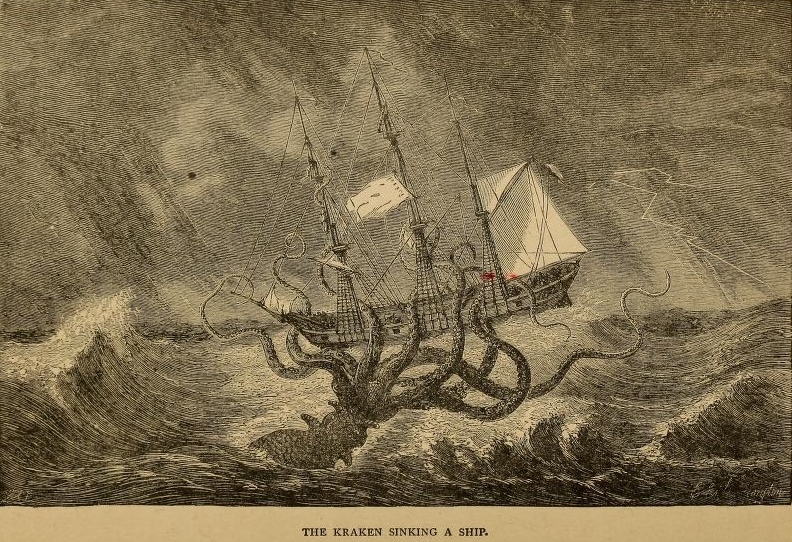
Adventures with the Frightful Squid [Kraken]. Account below from Buel’s Sea and Land:

“In olden times sailors were harassed by many groundless fears, superstitions being abundant and ignorance general.  The early Spanish poetic chroniclers, who delighted in telling the story of Columbus’ voyages, invariably disfigured their narratives with miracles and wonders.  In those days Jack, looking over the side of his vessel, was prepared to see anything, and to this willing disposition may be attributed the creation of mermaids, sea-serpents, grinning or winking monsters, and leviathans big enough to swallow a ship.  There was the squid which, as the sepia octopus, we know in these days to be an extremely large and most diabolically unpleasant beast; but in the olden times this animal was reckoned to be larger than a cathedral, in proof of which the following story is recited:

“A big ship was on the West African Coast; the men were getting the anchor, when a squid arose and wreathed its fearful snake-like limbs around the vessel’s spars.  The tips of these limbs soared quaveringly high above the mastheads, and the weight of the cuttle drove the ship down on to her beam ends.  Here now was a lively situation.  The crew plied axes and knives, but in vain, whereupon they invoked the aid of their patron saint, Thomas.  Eventually the wounded monster grew alarmed and sank, and the crew afterward, to commemorate their deliverance, marched in a body to the Church of St. Thomas, where subsequently there was hung up a painting, representing the unparalleled conflict. […]

“Pliny, the ancient, relates the history of an enormous cuttle-fish that haunted the coast of Spain and destroyed fishing ground.  He asserts that this creature was finally captured, and weighed seven hundred pounds, and that its arms were thirty feet in length.  As the cuttle-fish was esteemed by the ancients a most savory dish, the head of this formidable monster was given to Lucullas to whom it belonged rightfully by reason of his exalted rank” (Buel, 1887, pp. 75-77).

View Full Size Image
Adventures with the Frightful Squid, also called “Kraken” (see image here)

A Giant, Man-Attacking Crab!

Monster Sea-Spiders. Account below from Buel’s Sea and Land:

“From an article in a recent number of St. Nicholas, I condense the following interesting information about crabs:

“Among the most remarkable, and the largest of crabs, is the Japanese sea-spider, highly esteemed in the Orient as an excellent article of food.  Its principal claws are each five feet in length, measuring from ten to twelve feet between the tips of the nippers, and presenting an astonishing spectacle when entangled in the nets and hauled aboard the boats.  With their slow, measured movements and the powerful weapons of defense, these crabs are the giants of the spiders of the sea.  Professor Ward, who has collected them in Japan, states that they have a remarkable habit of leaving the water at night and crawling up the banks presumably to feed, and that there they are sought by the crab-hunters.  A story is told of a party of fishermen who had camped out on a river bank, and one of whom aroused the others in the night by yells and screams.  Running to the spot they found that one of these monster crabs, in wandering over the flats, had accidentally crawled over him with his great claws, frightening him almost to death” (Buel, 1887, pp. 64-65).

View Full Size Image
Japanese Spider Crab (see image here)

“The robber-crab, peculiar to the Samoan Islands. . .lives principally in the branches of the cocoanut tree.  It exercises no little intelligence in getting at the fruit, which it accomplishes by carrying the nut to the very top of the tree, and then dashing it down with force enough to break the shell.  A gentleman relates that upon an occasion, while he was walking in a Samoan forest, he saw a robber-brab reach down its claws from a thick palm branch and seize a goat by the ears that was passing underneath.  So powerful was the crab that it lifted the goat almost clear from the ground” (Buel, 1887, pp. 65, 67).

View Full Size Image
Robber-Crab lifting a goat off the ground (see image here)

A Horrifying Man-Eating Tree!

A Man-Eating Plant. Account below from Buel’s Sea and Land:

“Travelers have told us of a plant, which they assert grows in Central Africa and also in South America, that is not contented with the myriad of large insects which it catches and consumes, but its voracity extends to making even humans its prey.  This marvelous vegetable Minotauris represented as having a short, thick trunk, from the top of which radiate giant spines, narrow and flexible, but of extraordinary tenaciousness, the edges of which are armed with barbs, or dagger-like teeth.  Instead of growing upright, or at an inclined angle from the trunk, these spines lay their outer ends upon the ground, and so gracefully are they distributed that the trunk resembles an easy couch with the green drapery around it.  The unfortunate traveler, ignorant of the monstrous creation which lies in his way, and curious to examine the strange plant, or to rest himself upon its inviting stalk approaches without a suspicion of his certain doom.  The moment his feet are set within the circle of the horrid spines, they rise up, like gigantic serpents, and entwine themselves about him until he is drawn upon the stump, when they speedily drive their daggers into his body and thus complete the massacre.  The body is crushed until every drop of blood is squeezed out of it and becomes absorbed by the gore-loving plant, then the dry carcass is thrown out and the horrid trap set again.

“A gentleman of my acquaintance, who, for a long time, resided in Central America,, affirms the existence of such a plant as I have here briefly described, except that instead of the filaments, or spines, resting on the ground he says they move themselves constantly in the air, like so many huge serpents in an angry discussion, occasionally darting from side to side as if striking at an imaginary foe.  When their prey comes within reach the spines reach out with wonderful sagacity (if I may be allowed to apply the expression to a vegetable creature), and grasp it in an unyielding embrace, from whence it issues only when all the substance of its body is yielded up.  In its action of exerting pressure upon its prey, this dreadful plant resembles the instrument used in the dark ages for inflicting a torturous death.  It was made of two long iron cylinders, on the inside of which were sharp, projecting pikes.  The victim was placed inside, and the two cylinders then brought forcibly together, thus driving a hundred or more of the pointed pikes into all parts of his body and producing a frightful death.  Generally this inquisitorial instrument was made, somewhat crudely, to represent a woman, hence the name applied to it was “The Maiden,” by which it is still known.

“Dr. Antonio Jose Marquez, a distinguished gentleman of the city of Barranguilla, in the United States of Colombia, in describing this wonderful plant to the author, affirms that when excited it violently agitates its long, tentacle-like stems, the edges of which, rasping upon each other, produce a hissing noise which resembles the Spanish expression, ya-te-veo, the literal translation of which is “I see you.”  The plant is therefore known, in South America, by the name Yataveo” (Buel, 1887, pp. 475-477).

View Full Size Image
The Man-Eating Tree (see image here)

Click here to read the book, and more of its frightful tales!  Here are some wickedly monstrous illustrations to lure you to this special collection of Page Frights!

View Full Size Image
Sea Serpent (see image here)
View Full Size Image
Imagined battle between early man and Plesiosaurus (see image here)
View Full Size Image
Pterodactyl and sea dinosaurs (see image here)

What is your favorite image or story from today’s #PageFrights book?

October 11, 2016by micahv

Help Support BHL

BHL's existence depends on the financial support of its patrons. Help us keep this free resource alive!

search

About BHL

The Biodiversity Heritage Library (BHL) is the world’s largest open access digital library for biodiversity literature and archives. BHL operates as a worldwide consortium of natural history, botanical, research, and national libraries working together to digitize the natural history literature held in their collections and make it freely available for open access as part of a global “biodiversity community.”

Join Our Mailing List

Sign up to receive the latest news, content highlights, and promotions.

Subscribe Now

Subscribe to Blog via Email

Enter your email address to subscribe to this blog and receive notifications of new posts by email.

Join 319 other subscribers

Subscribe to Blog Via RSS

Subscribe to the blog RSS feed to stay up-to-date on all the latest BHL posts.

Access RSS Feed

Inspiring Discovery through Free Access to Biodiversity Knowledge.

The Biodiversity Heritage Library makes it easier than ever for you to access the information you need to study and explore life on Earth…for free, anytime, anywhere.


ABOUT | HARMFUL CONTENT | PRIVACY | SITE MAP | TERMS OF USE