Biodiversity Heritage Library - Program news and collection highlights from BHL
  • Home
  • News
  • Featured Books
    • All Featured Books
    • Book of the Month Series
    • BHL at 20
  • User Stories
  • Campaigns
    • Fossil Stories
    • Garden Stories
    • Monsters Are Real
    • Page Frights
    • Her Natural History
    • Earth Optimism 2020
  • Tech Blog
  • Visit BHL
Home
News
Featured Books
    All Featured Books
    Book of the Month Series
    BHL at 20
User Stories
Campaigns
    Fossil Stories
    Garden Stories
    Monsters Are Real
    Page Frights
    Her Natural History
    Earth Optimism 2020
Tech Blog
Visit BHL
  • Home
  • News
  • Featured Books
    • All Featured Books
    • Book of the Month Series
    • BHL at 20
  • User Stories
  • Campaigns
    • Fossil Stories
    • Garden Stories
    • Monsters Are Real
    • Page Frights
    • Her Natural History
    • Earth Optimism 2020
  • Tech Blog
  • Visit BHL
Biodiversity Heritage Library - Program news and collection highlights from BHL
Blog Reel, Campaigns, Featured Books

Holmes, Shells, and the Intersection of Art & Science

View Full Size Image
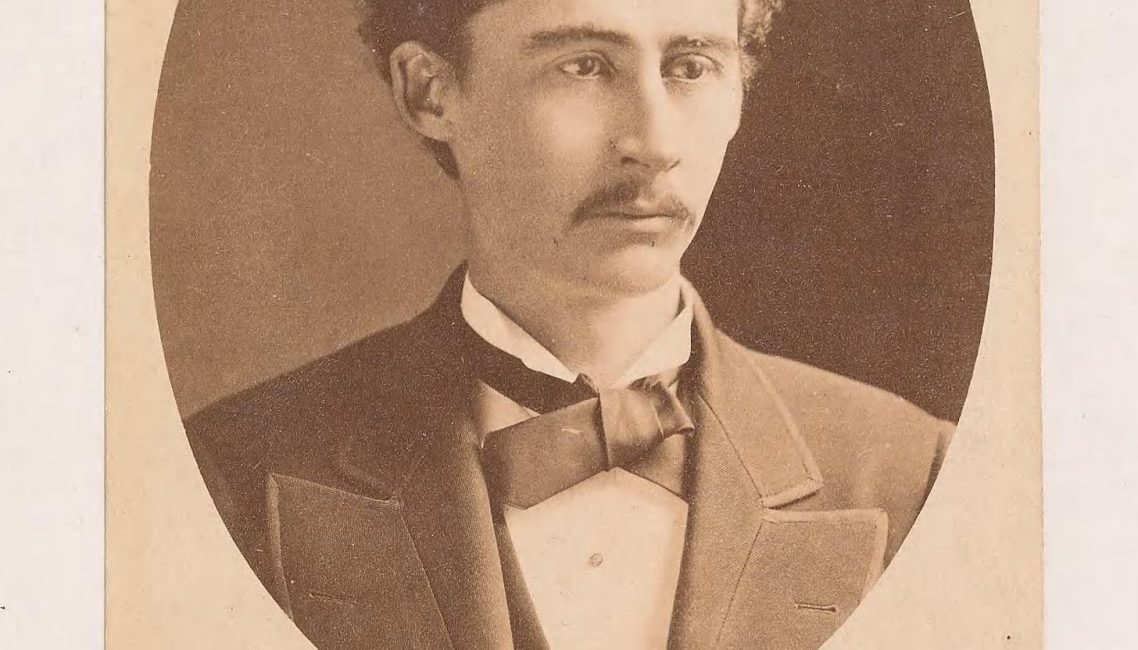
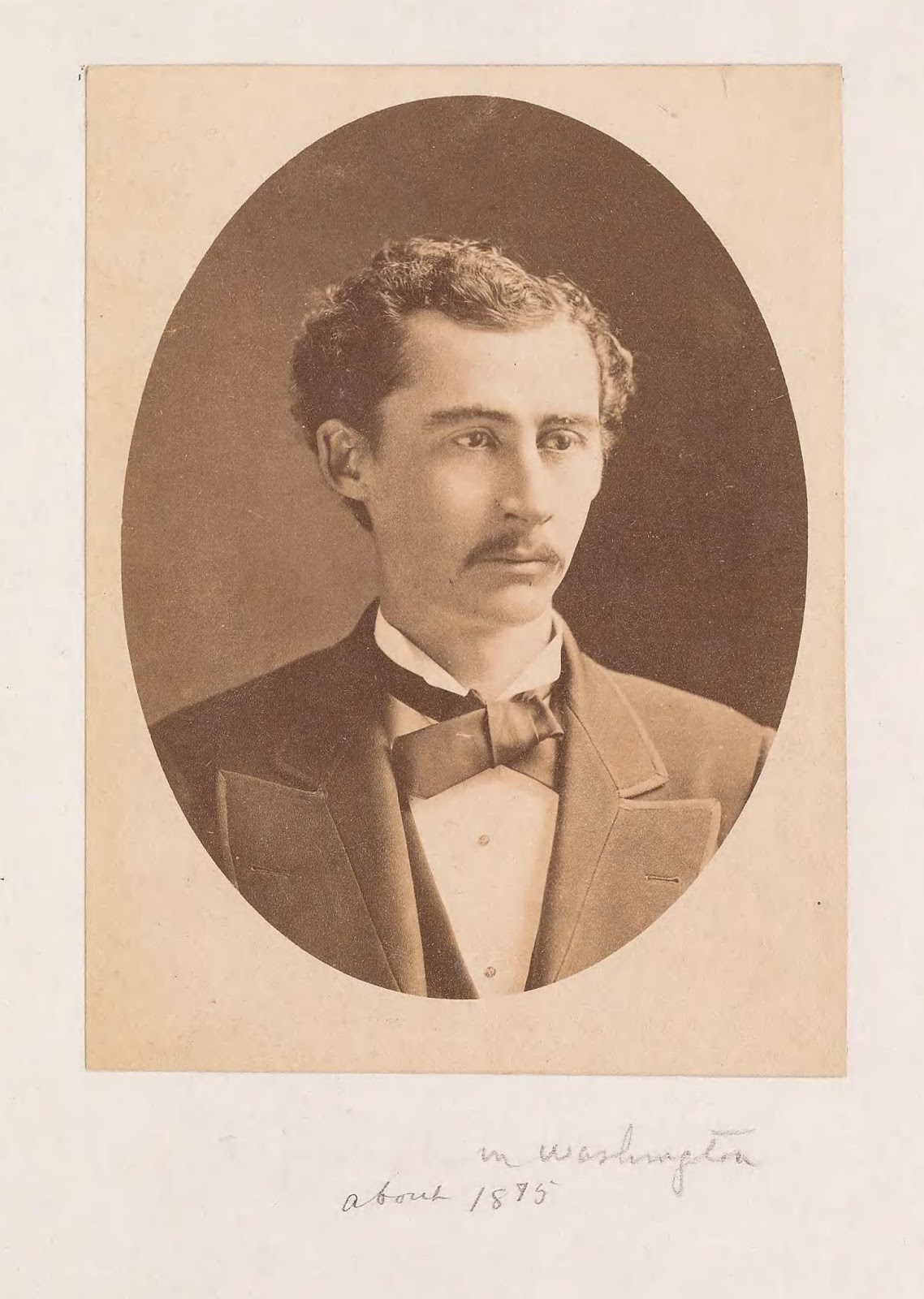
William Henry Holmes, about 1875. Random Records of a Lifetime. v. 1. http://www.biodiversitylibrary.org/page/52009570. Digitized by Smithsonian Libraries.

From November 28th through December 9th, BHL is joining the Smithsonian Libraries, Smithsonian Institution Archives, Smithsonian Field Book Project, and Smithsonian Transcription Center in hosting the #ManyHatsofHolmes transcription event. This event challenges volunteers around the world to help us transcribe William Henry Holmes’ archival materials. Learn more on the Smithsonian Libraries’ blog.

As the hashtag implies, William Henry Holmes (1846-1933) studied a variety of topics throughout his distinguished career, including anthropology, archaeology, art, and geology. He spent much of his career affiliated with the Smithsonian Institution. He studied art under Theodore Kauffman and went on to work as a scientific illustrator with Smithsonian staff. In 1872, he was appointed artist-topographer to the United States survey of the territories under Ferdinand V. Hayden and in 1874 was appointed assistant geologist. He went on to work with the United States Geological Survey (USGS) and the Bureau of American Ethnology (BAE) before returning to the Smithsonian’s United States National Museum (USNM). Holmes eventually became head curator of the Smithsonian Institution’s Department of Anthropology and Director of the National Gallery of Art.

Many of Holmes’ field notes and personal records have been digitized by Smithsonian Libraries and Smithsonian Institution Archives as part of The Field Book Project. These are available in BHL. In addition to these archival materials, BHL also holds a number of publications by Holmes.
View Full Size Image
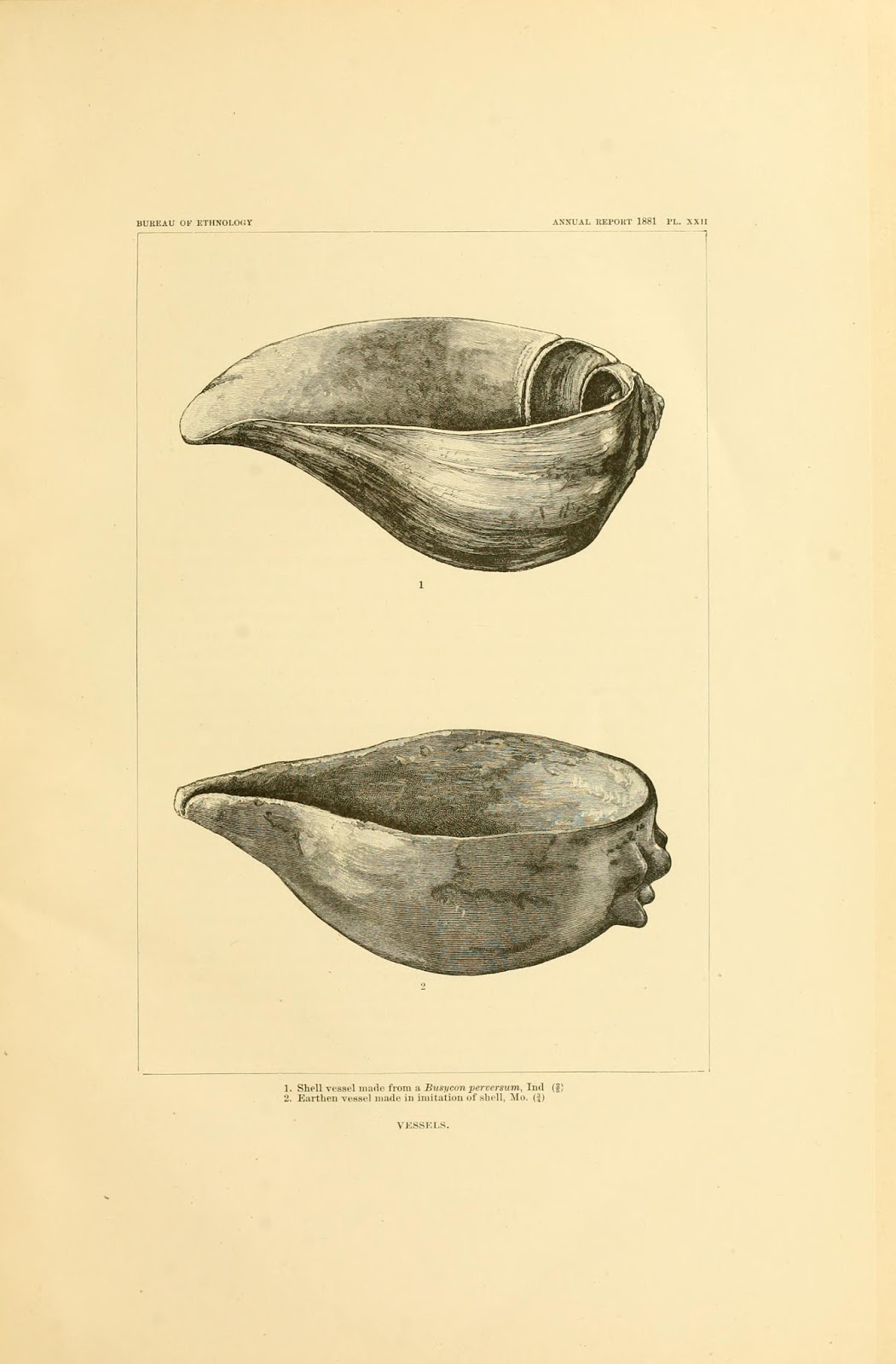
Top figure: Vessel made from a lightning whelk (Sinistrofulgur perversum) – synonym Busycon perversum – shell. Bottom figure: Earthen vessel made in imitation of a shell. Holmes, William Henry. Art in Shell of the Ancient Americans. 1883. http://biodiversitylibrary.org/page/11258636. Digitized by Smithsonian Libraries.

One of those publications is Art in Shell of the Ancient Americans, which was published in 1883 as part of the second annual report of the Bureau of Ethnology.

Holmes intended this publication to be a preliminary study of the ways in which Native Americans in the distant past used shells as a medium for artistic expression and how this artwork represents a phase in the evolution of human culture. It discusses the use of shells as implements, utensils, and objects of ornamentation (such as jewelry).

Most of the objects presented in the publication were obtained from graves and tumuli (ancient burial mounds), which explains how such delicate pieces survived throughout the centuries. But, while these pieces can be deemed ancient, Holmes did not have enough data to provide a reliable estimation of age.

At this point, you might be wondering why a book about shell art would be relevant for a biodiversity library and what bearing it might have on scientific research. The simple answer is that these shells are remnants of living creatures – mollusks that died long ago but still left behind a legacy in shell. However, Art in Shell has relevance for scientific research beyond this vague connection with the natural world.
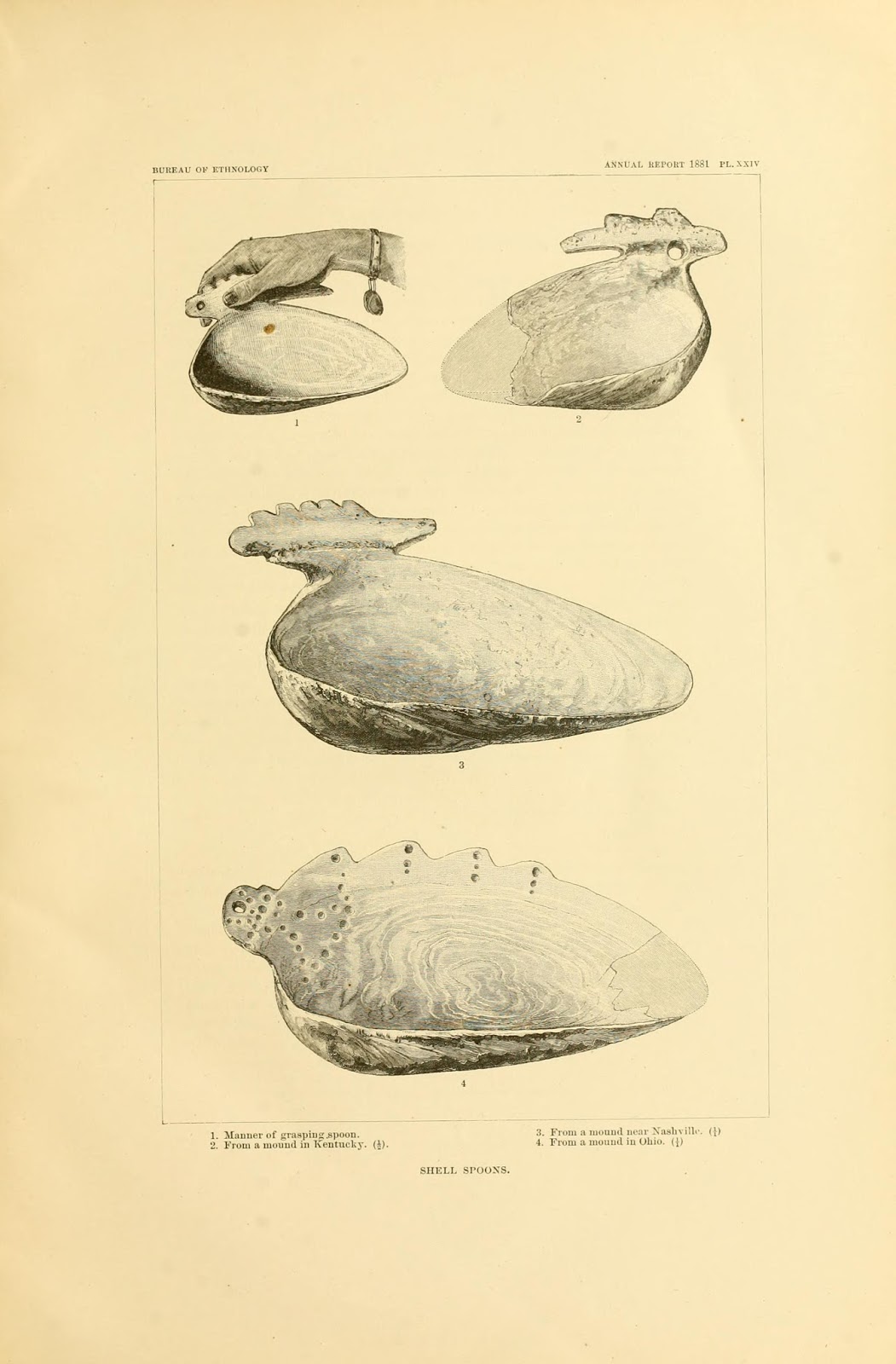
View Full Size Image
Shell spoons made from Lampsilis ovata (synonym Unio ovatus) – top and center – and Potamilus alatus (synonym Unio alatus) – bottom. Holmes, William Henry. Art in Shell of the Ancient Americans. 1883. http://www.biodiversitylibrary.org/page/11258608. Digitized by Smithsonian Libraries.

In the publication, Holmes attempts to identify the species (or most-specific taxa possible) to which the shell used for the object belongs. This information provides a valuable record of human interaction with various mollusk species and helps document the diversity of species present in ancient America. The presence of shells in various regions, when coupled with species distribution data that demonstrates the transport of these shells from their source, can also provide insight into historic Native American migration paths, tribal contacts, and trade.

Thus, this book is not just a book about art. It represents a beautiful union of art and science. And considering the many disciplinary hats that Holmes wore throughout his career, it’s no surprise that his publication would bridge these two worlds. Art in Shell is therefore not only a very fitting book to highlight as a representation of the union of Holmes’ many interests, but the insights it provides into Native American culture also make it particularly relevant this month as we celebrate Native American Heritage Month.
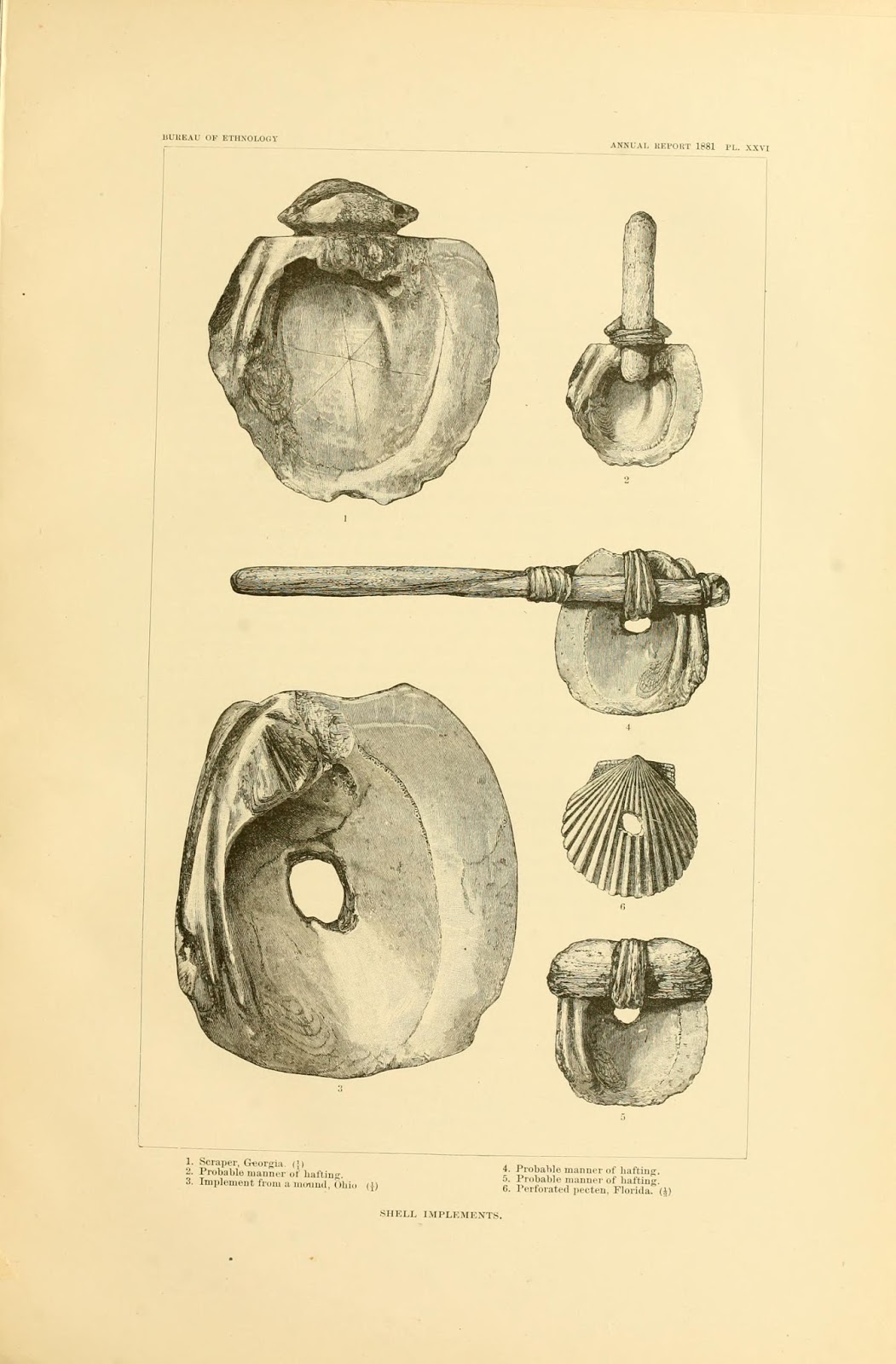
View Full Size Image
Implements made from Unio vericosus (figs. 1 and 2), Cyclonaias tuberculata (synonym Unio tuberculosus, figs. 3-5) and Pecten (fig. 6). Holmes, William Henry. Art in Shell of the Ancient Americans. 1883. http://www.biodiversitylibrary.org/page/11258618. Digitized by Smithsonian Libraries.

So, can we tie this publication back to the Random Records of a Lifetime series that is the subject of our #ManyHatsofHolmes transcription event? Holmes’ discussion about his work with shell art in these records seems to be fairly limited, but in his biographical sketch in volume I, Holmes does report that, “The years 1882-3-4 and 5 were devoted largely to Museum work and the study of primitive art in its various branches.” As Art in Shell was published in 1883, this account is likely a reference in part to his work on this publication (as well as the many others on ancient American art that he produced during this time period).

As you participate in the challenge, can you find additional references in the Random Records that can be linked back to Art in Shell? If you do, share them on social media with #ManyHatsofHolmes.

Additionally, if you need a break from transcription or want another challenge, try taxon tagging the illustrations from Holmes’ Art in Shell on Flickr. By tagging the shell art with the taxonomic name of the species to which the shell belongs, you can help researchers more easily discover which species ancient Americans were using to create these objects. Learn more about taxon tagging in this article and see our detailed instructions here. Find the Art in Shell images in Flickr here.

See this video for basic instructions on how to tag the illustrations in Art in Shell:

Holmes was truly a man of many trades and talents. As you dig deeper into his work during the #ManyHatsofHolmes event, be sure to share your findings on social media with the hashtag. Thanks so much for participating in our Holmes extravaganza!
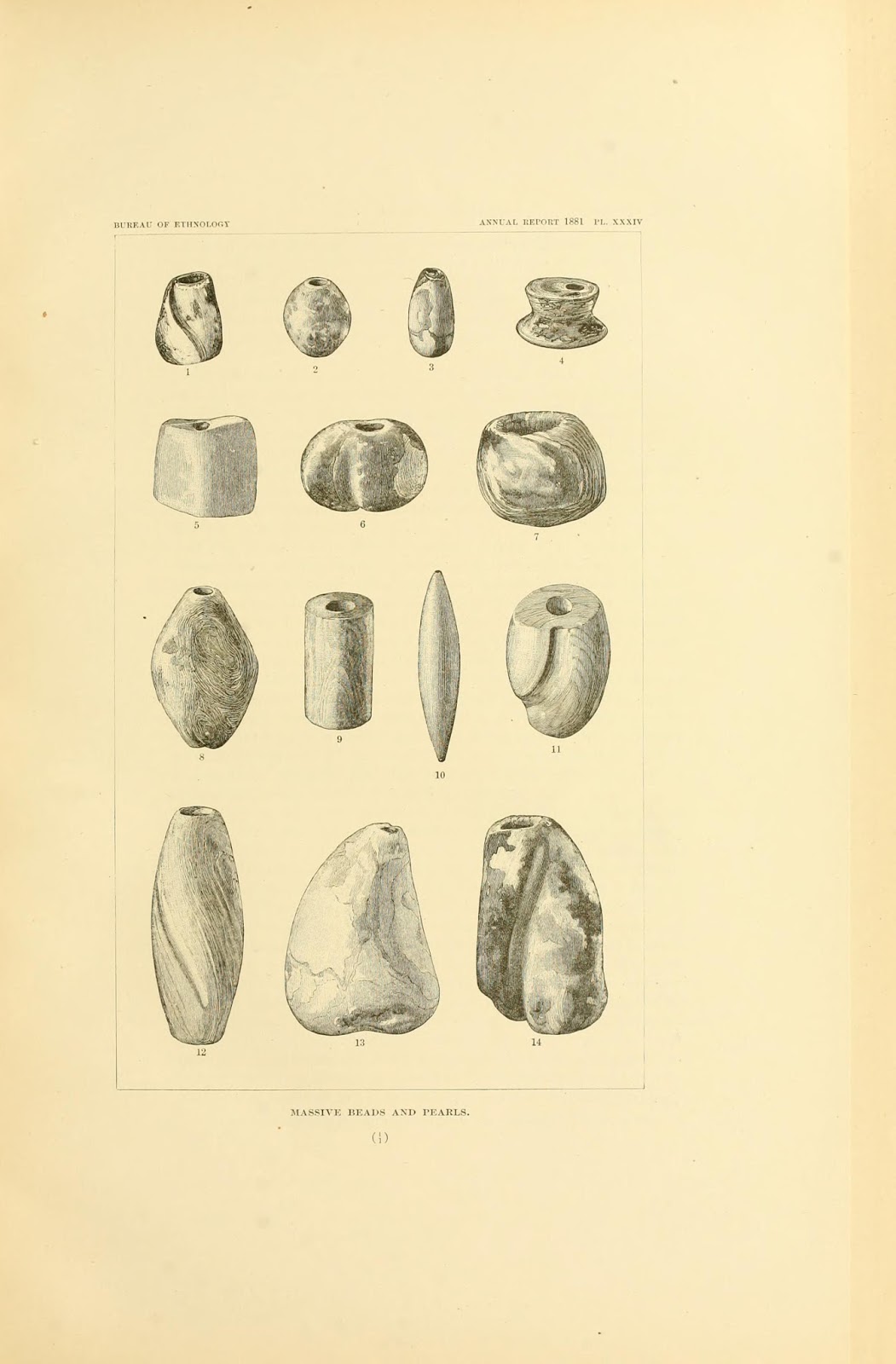
View Full Size Image
Beads and pearls. Figs. 1, 7, 12, and 9: Sinistrofulgur perversum (synonym Busycon perversum); Fig. 2: Crassadoma gigantea (synonym Hinnites giganteus); Fig. 3 and 13: pearls, latter from Haliotis californianus; Fig. 4: unknown univalve; Fig. 5: ivory?; Figs. 6 and 11: unknown dextral whorled shell; Fig. 14: Strombus or Busycon. Holmes, William Henry. Art in Shell of the Ancient Americans. 1883. http://www.biodiversitylibrary.org/page/11258675. Digitized by Smithsonian Libraries.
November 30, 2016by michelle.underhill
Blog Reel, Featured Books

Catesby’s Magnificent Natural History, In Three Editions

View Full Size Image
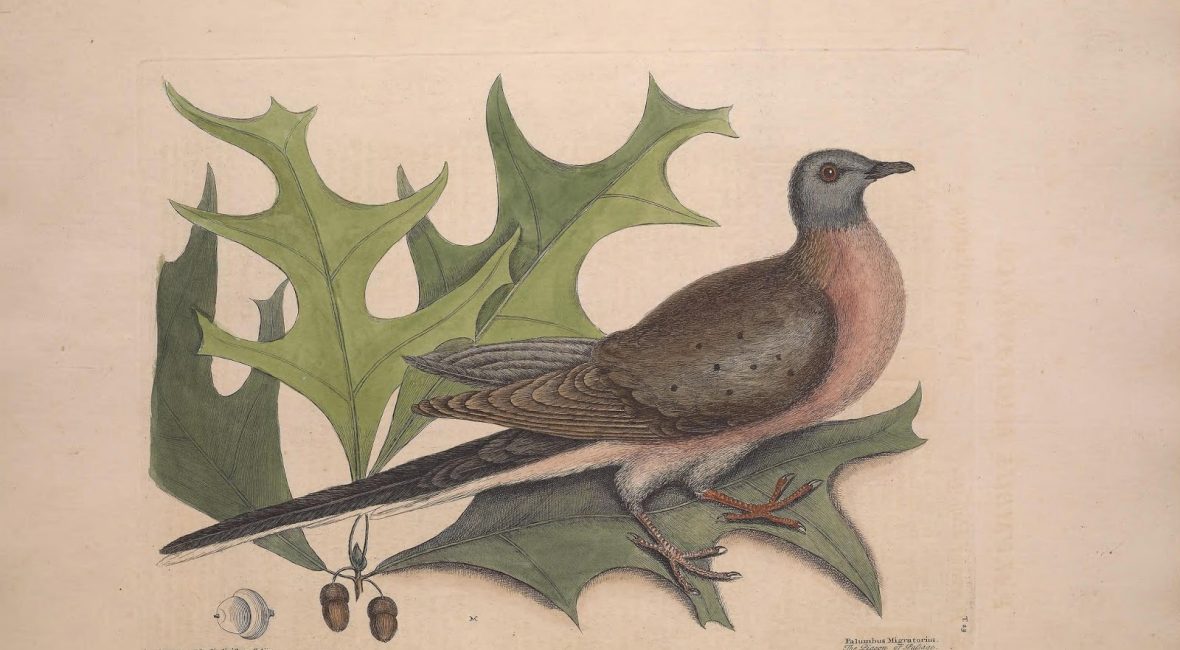
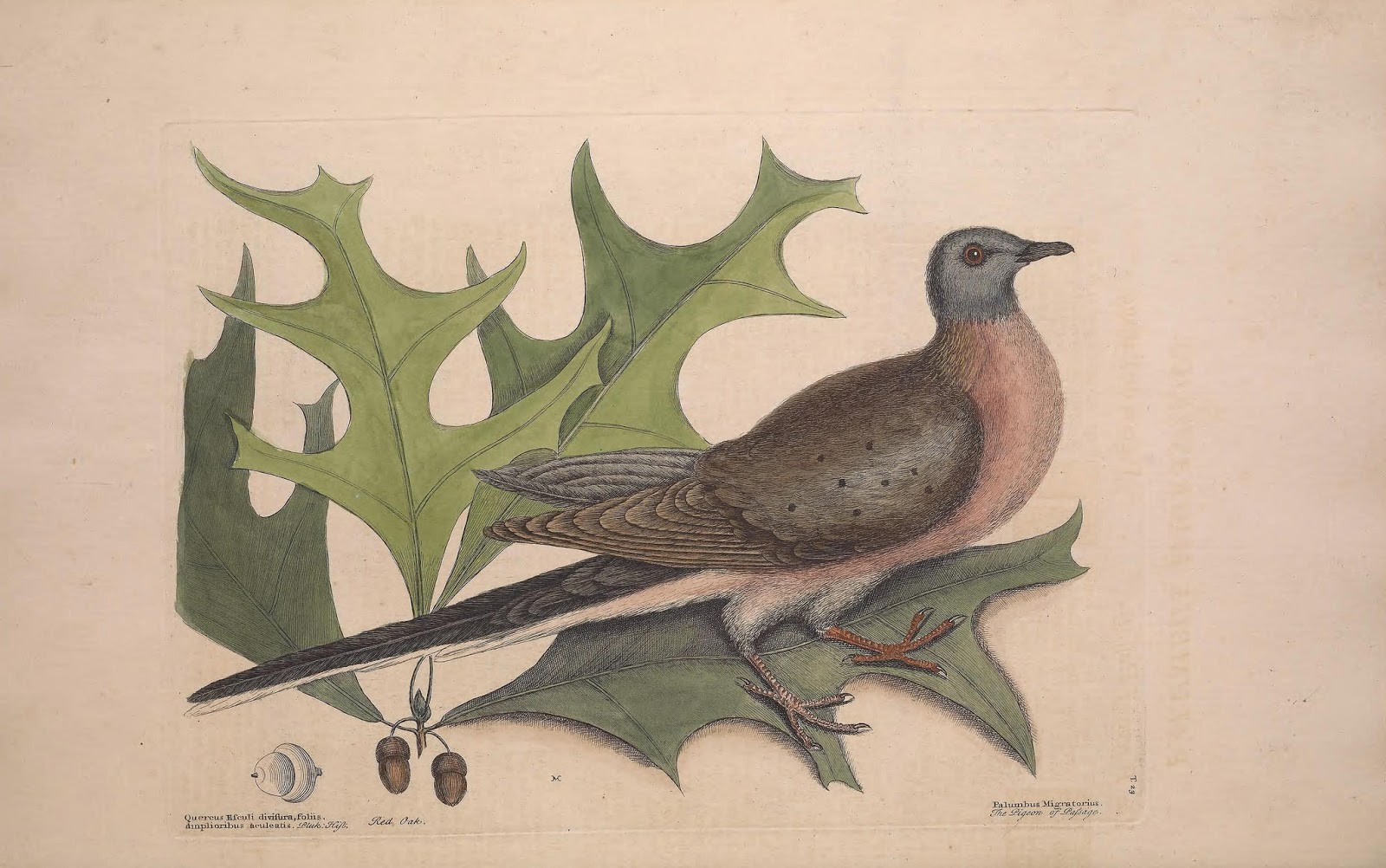
First published illustration of a passenger pigeon (Ectopistes migratorius). Pictured with American turkey oak (Quercus laevis). Catesby, Mark. The Natural History of Carolina, Florida, and the Bahama Islands. v. 1, ed. 1, pl. 23. Digitized by Smithsonian Libraries. http://biodiversitylibrary.org/page/40753186. Taxon tagged in Flickr by Michelle Marshall: https://www.flickr.com/photos/biodivlibrary/26918652441.

In May of 1729, the first part of the first fully illustrated book on the flora and fauna of North America was presented to the Royal Society. Upon the conclusion of the work, Royal Society Secretary Cromwell Mortimer praised it as “the most magnificent Work I know of, since the Art of Printing has been discovered” (Nelson and Elliott, 165).

The work was The Natural History of Carolina, Florida, and the Bahama Islands, and all told it was issued in eleven parts (including an appendix) over an eighteen year period (from 1729-1747). It included 220 plates and accompanying pages of text, a map and account of North America, two indices, a preface, a dedication, and a list of subscribers.

The author of the work was Mark Catesby.

An expansive account of Catesby’s life and work is captured in The Curious Mister Catesby, edited by E. Charles Nelson and David J. Elliott, which received the 2016 CBHL (The Council on Botanical and Horticultural Libraries) Annual Literature Award for Overall Significant Contribution to the Literature of Botany or Horticulture. This work allows us to appreciate the extent of Catesby’s contribution to the study of North American biodiversity.

Mark Catesby was born on 24 March 1682/83 in England (probably in Castle Hedingham, Essex), the (probably) fifth son of John Catesby, a gentleman who became mayor of Sudbury in 1673. When John died in 1703, Mark received a substantial inheritance that included property in Sudbury and London, providing him with a level of security that would allow him to pursue his interest in natural history (Nelson and Elliott, 3-4, hereafter referred to as “N&E;”).

View Full Size Image
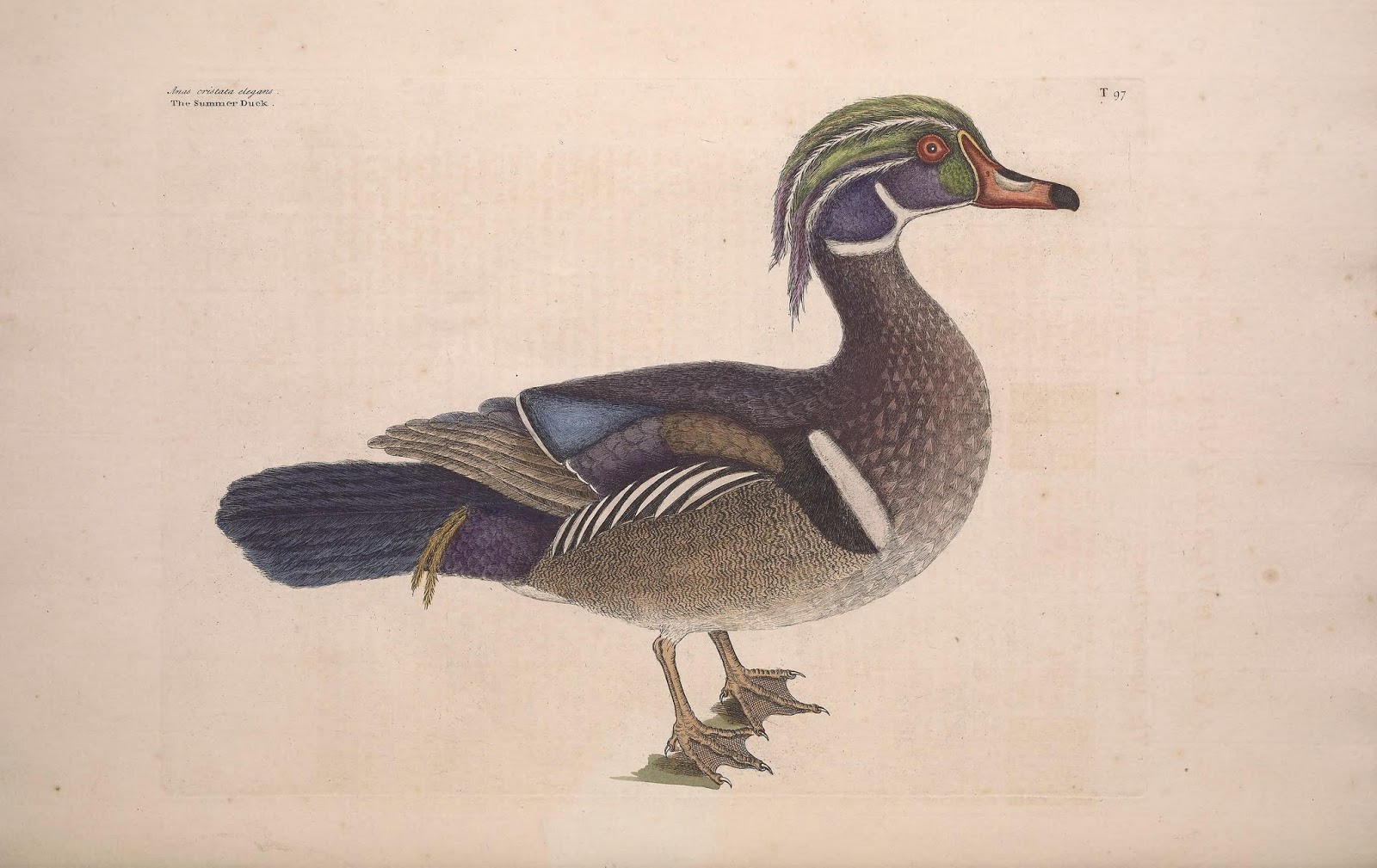
Wood duck (Aix sponsa). Catesby, Mark. The Natural History of Carolina, Florida, and the Bahama Islands. v. 1, ed. 1. pl. 97. Digitized by Smithsonian Libraries. http://biodiversitylibrary.org/page/40753408. Taxon tagged in Flickr by Michelle Marshall: https://www.flickr.com/photos/biodivlibrary/26987327575.

Catesby first set foot in North America in 1712. Serving as chaperone for his sister Elizabeth, whose husband Dr. William Cocke had arrived in Virginia some two years earlier, Catesby was hosted principally by prominent Virginian citizen William Byrd II during this first visit. Shortly after his arrival, Catesby began collecting plants, specimens of which he sent across the Atlantic to Samuel Dale and Dr. Henry Compton (Bishop of London). During these first several years in America, Catesby also visited Jamaica, Bermuda, Hispaniola, and Puerto Rico (N&E;, 8).

Catesby returned to England in 1719, possibly in response to his brother’s death two years earlier (N&E;, 9). He was, however, determined to return to North America and continue his study of the land’s rich flora and fauna. In 1722, he got his wish. This time, his trip was sponsored by members of the Royal Society, who hoped that he would collect specimens from and generally enhance natural history knowledge about this New World. From 1722-early 1725, Catesby explored and collected in South Carolina. The following year, from 1725-26, Catesby ventured to the Bahamas to continue his research (N&E;, 12-13).

View Full Size Image
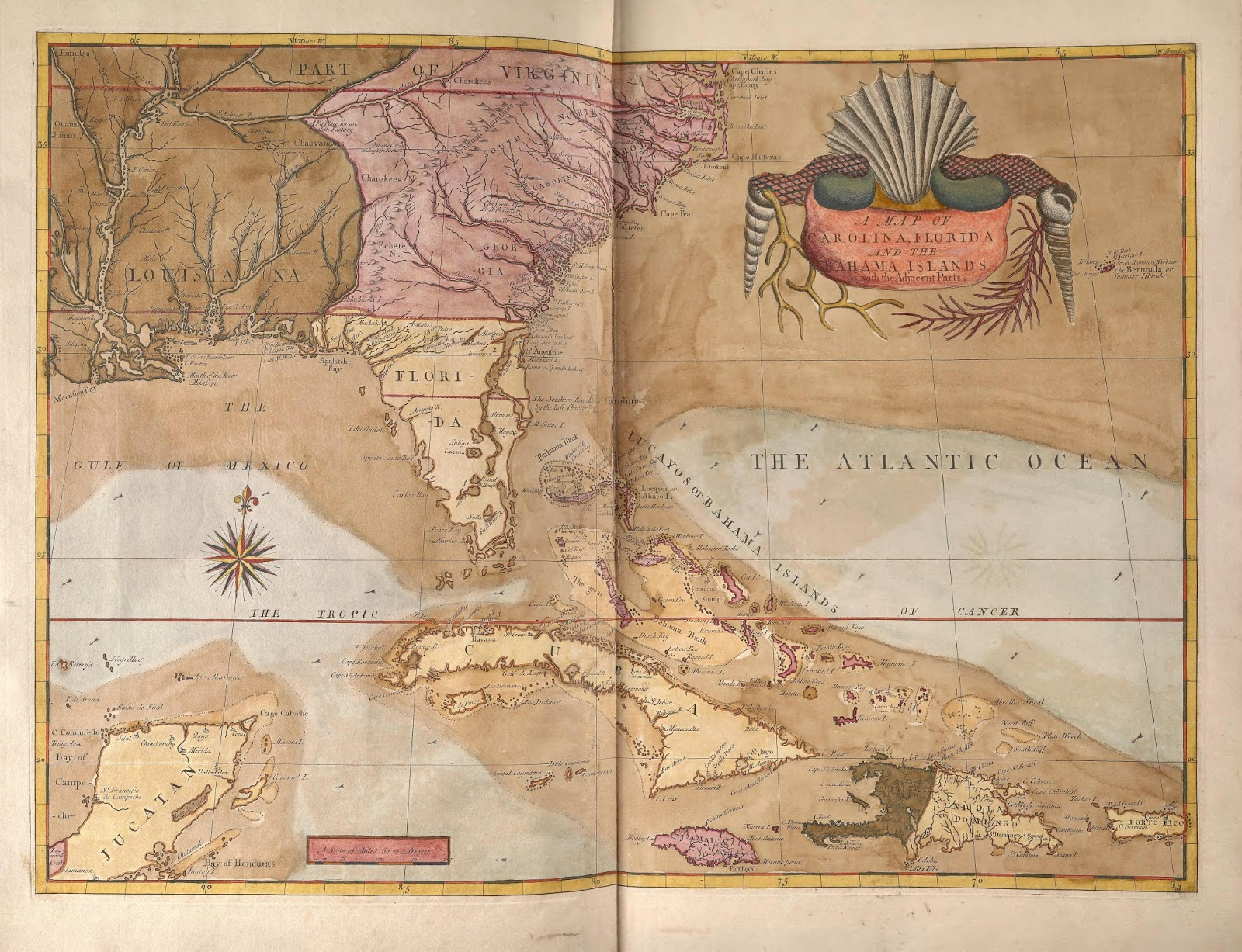
Catesby’s map of Carolina, Florida and the Bahama Islands with the Adjacent Parts.  Catesby, Mark. The Natural History of Carolina, Florida, and the Bahama Islands. v. 1, ed. 1. Digitized by Smithsonian Libraries. http://biodiversitylibrary.org/page/40753095.

During his time in America, Catesby not only collected specimens, many of which he sent back to England, but he also produced sketches and watercolors of the species he encountered. According to Henrietta McBurney, who wrote a chapter for The Curious Mister Catesby on Mark’s preparatory drawings for Natural History, the challenges of transporting the necessary art equipment into the field probably meant that Catesby made field drawings in pen and ink while traveling through the country and then worked up folio-sized watercolors, which would later be translated to etched plates for his publication, back at his lodgings (N&E;, 143). At all times, Catesby placed great emphasis on portraying each species in as life-like a manner as possible, working from live animals when possible and obtaining fresh supplies of specimens, like fish, whose color and appearance change rapidly after death (N&E;, 145).

View Full Size Image
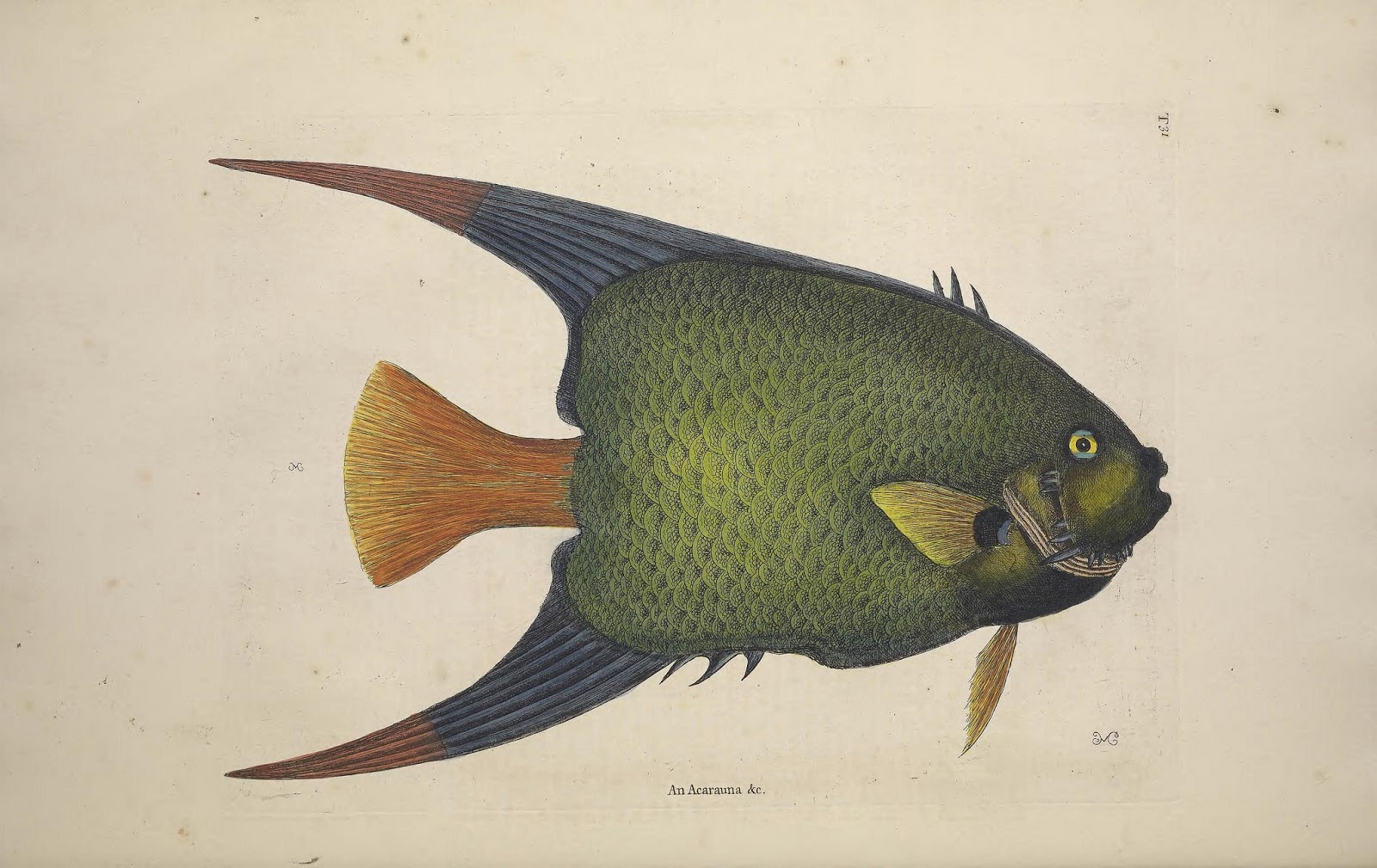
Queen angelfish (Holacanthus ciliaris). Catesby, Mark. The Natural History of Carolina, Florida, and the Bahama Islands. v. 2, ed. 1, pl. 31. Digitized by Smithsonian Libraries. http://biodiversitylibrary.org/page/40680191. Taxon tagged in Flickr by Michelle Marshall: https://www.flickr.com/photos/biodivlibrary/26364199924.

In 1726, Catesby left the Bahamas and returned to England with the intention of publishing his accounts and illustrations in “a large folio on a grand, almost unprecedented scale” (N&E;, 155). Leslie K. Overstreet, Curator of Natural History Rare Books at the Smithsonian Libraries, provides an extensive examination of Catesby’s publication within the twelfth chapter of The Curious Mister Catesby.

According to Ms. Overstreet, Catesby opted to print the work at his own expense. Fortunately, his friend Peter Collinson, a Quaker merchant and Fellow of the Royal Society, agreed to lend Catesby funds to support the publication. These funds were not sufficient to cover the cost of expert engravers, so Catesby hired professional artist Joseph Goupy to teach him how to etch so that Catesby could work up the plates for his publication himself (N&E;, 155).

View Full Size Image
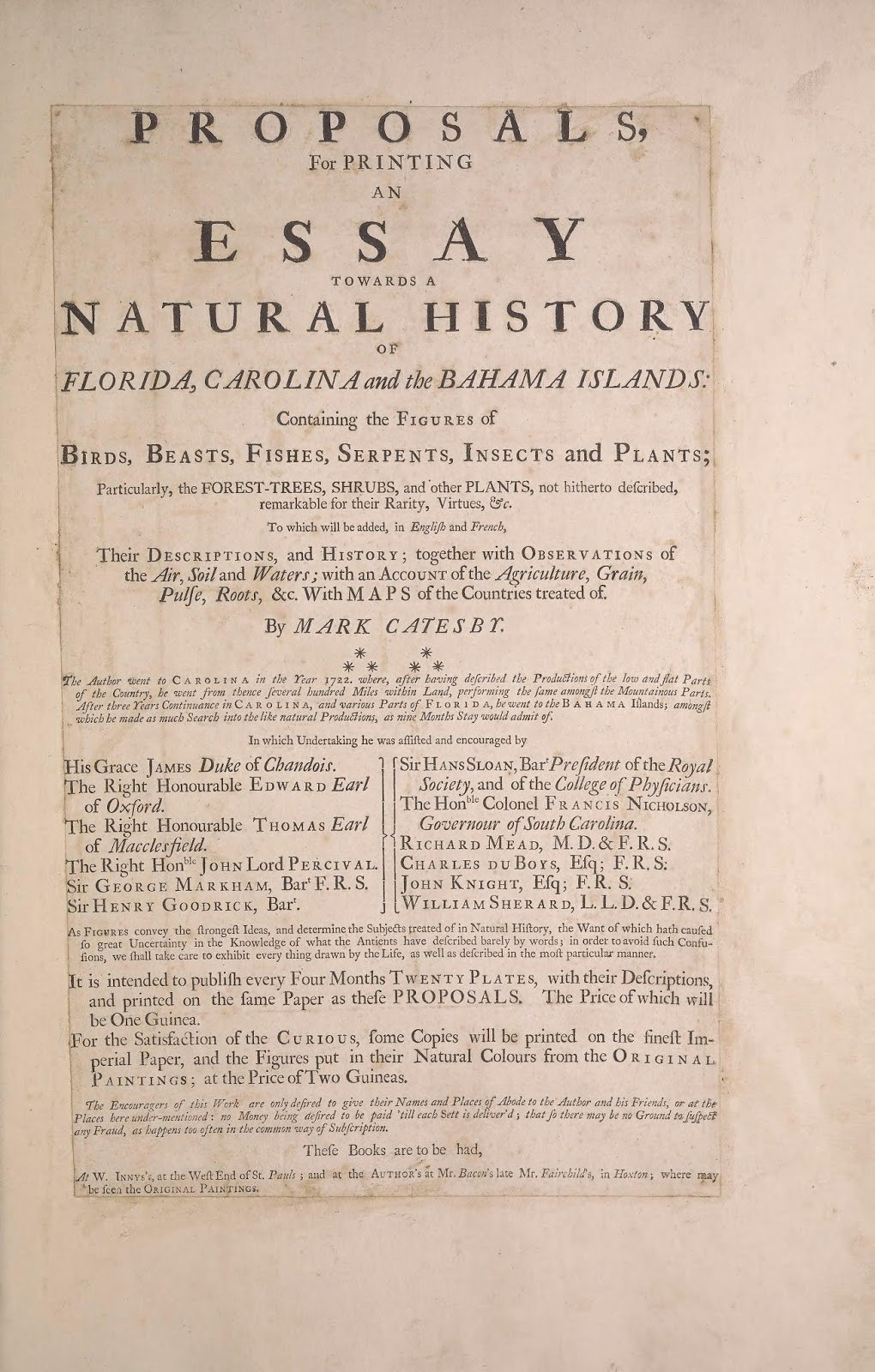
Proposal or prospectus soliciting subscribers for Natural History. Dating from late 1729. Catesby, Mark. The natural history of Carolina, Florida and the Bahama Islands. v. 1, ed. 1. Digitized by Smithsonian Libraries. http://biodiversitylibrary.org/page/40753109.

In order to ensure that enough copies of the work would be sold to justify the cost of its production, Catesby solicited subscribers for Natural History. He distributed a prospectus instructing people who wished to obtain a copy of the work to sign up as subscribers (N&E;, 156). The prospectus indicated that he intended to publish the book in parts of 20 plates and accompanying text issued every four months. Subscribers could elect to receive colored plates for two guineas a part or uncolored plates for one guinea per part (N&E;, 159). The prospectus also directed potential subscribers to view his original artwork, which would be featured in the publication, at Thomas Fairchild’s nursery in Hoxton (N&E;, 147).

All told, Catesby’s final version of the “List of the Encouragers” (a list of the work’s subscribers, which, as was customary at this time, are listed within the publication) includes 155 names (N&E;, 159).

Assured that the book would sell, Catesby set about producing the publication, which included not only etching the copper plates and writing the text, but also hand-coloring (maybe not all) the prints as well (N&E;, 158).  Catesby also enlisted a friend, who requested to remain unnamed, to translate the text into French. The final publication included a column of English text alongside a column of French text (N&E;, 13).

View Full Size Image
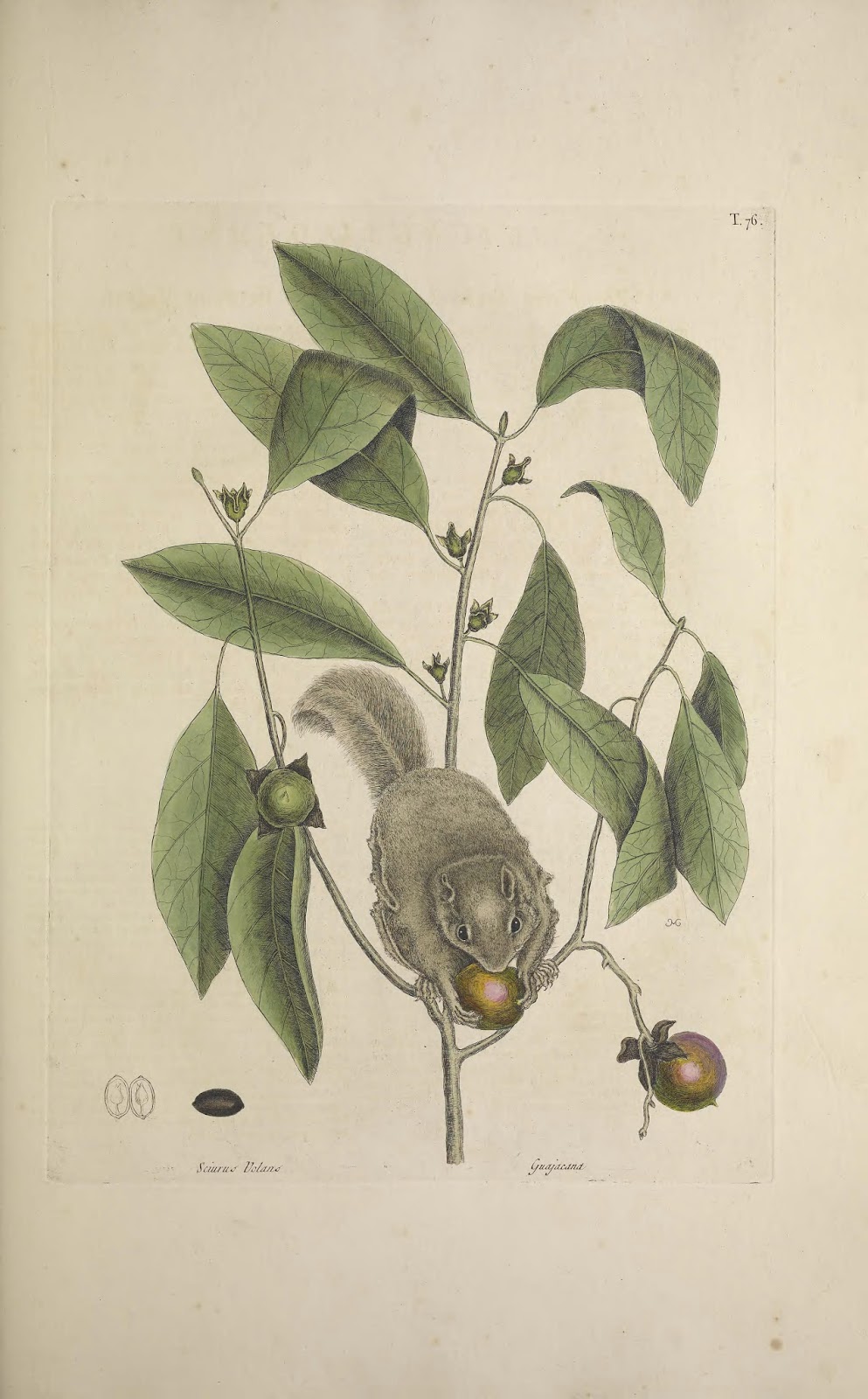
Southern flying squirrel (Glaucomys volans) and American persimmon (Diospyros virginiana). Catesby’s squirrel borrowed from drawing by Everhard Kick. Catesby, Mark. The Natural History of Carolina, Florida, and the Bahama Islands. v. 2, ed. 1. pl. 76. Digitized by Smithsonian Libraries. http://biodiversitylibrary.org/page/40680326. Taxon tagged in Flickr by Michelle Marshall: https://www.flickr.com/photos/biodivlibrary/26696533570.

For the plates, Catesby used his own watercolors and also borrowed and included illustrations from other artists. For example, Catesby’s depiction of the southern flying squirrel in plate 76 was borrowed from Dutch artist Everhard Kick (N&E;, 150-151). Artists Georg Dionysius Ehret and George Edwards also contributed drawings to the work (N&E;, 152-153).

View Full Size Image
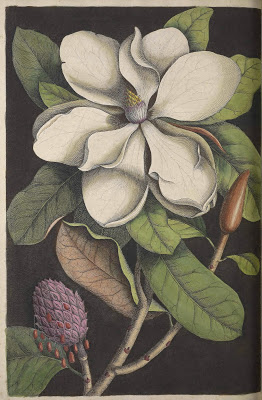
Southern magnolia (Magnolia grandiflora). Illustration etched for Catesby by Georg Dionysius Ehret after Ehret’s own watercolor painting. Catesby, Mark. The Natural History of Carolina, Florida, and the Bahama Islands. v. 2, ed. 1. pl. 61. Digitized by Smithsonian Libraries. http://biodiversitylibrary.org/page/40680281. Taxon tagged in Flickr by Michelle Marshall: https://www.flickr.com/photos/biodivlibrary/26901263141

Due to the amount of work required for the publication, Catesby was not able to adhere to his one part every four months plan. However, he continued to steadily produce new parts, which were sent to his subscribers. The first four parts of the work were issued in numerous typesettings, as Catesby was apparently cautious about ordering too many copies of each part (many subscribers signed up over the life of the publication, so Catesby was not working with a fixed number of “Encouragers”), which in turn required him to order additional copies of the early parts as new subscribers signed on. By the fifth part, however, we see only one typesetting, indicating that Catesby was confident enough in his sales that he ordered sufficient quantities to meet demand (N&E;, 160-163).

In 1743, the last part of volume 2 was presented to the Royal Society. Four years later, in 1747, the appendix, consisting of an additional twenty plates and text, was presented, bringing the first edition to completion (N&E;, 158). Approximately 180-200 copies were produced, only about 100 of which survive. There are only a few known perfect copies of this first edition, and of these, only the Smithsonian Libraries’ copy (which is freely available in BHL) contains “all three pieces of ephemera relating to the production of the work” (N&E;, 165).

View Full Size Image
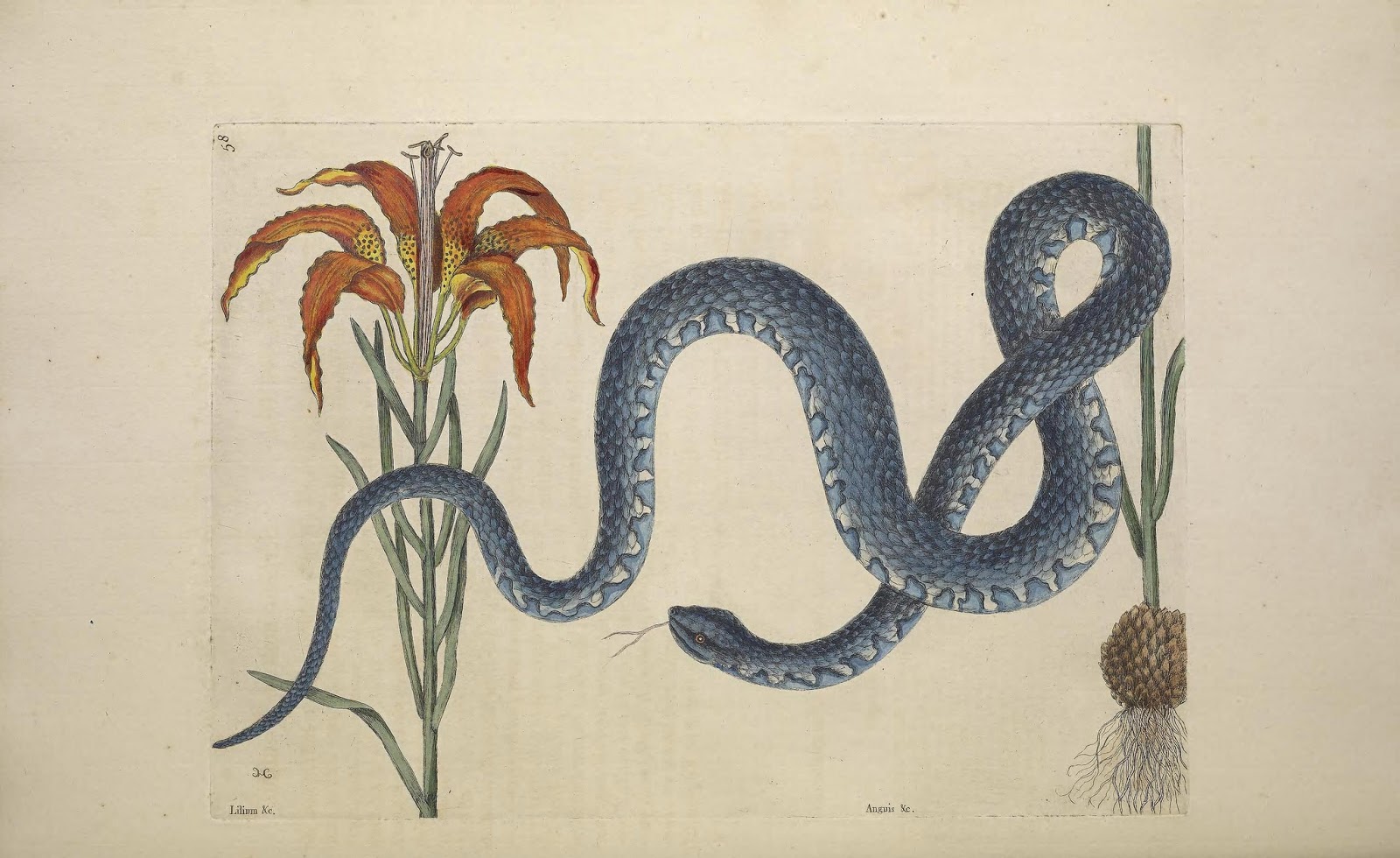
Eastern mudsnake (Farancia abacura) and pine lily (Lilium catesbaei). Catesby, Mark. The Natural History of Carolina, Florida, and the Bahama Islands. v. 2, ed. 1. pl. 58. Digitized by Smithsonian Libraries. http://biodiversitylibrary.org/page/40680272. Taxon tagged in Flickr by Michelle Marshall: https://www.flickr.com/photos/biodivlibrary/26875557812.

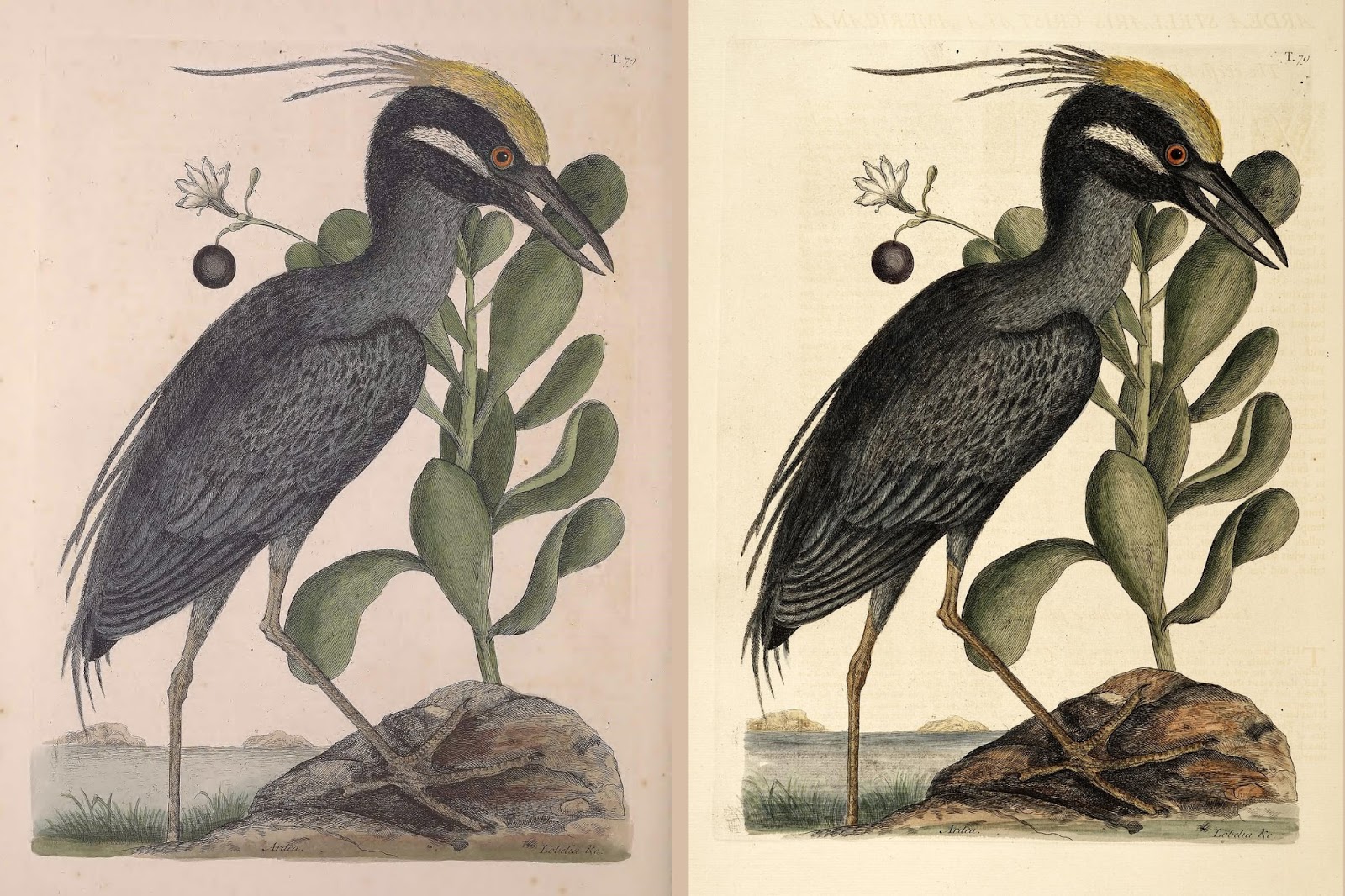
A second edition of Natural History was produced by George Edwards in 1754, five years after Catesby’s death in 1749. This edition is identical to the first, and many copies even include leftover printed sheets from the first edition. The plates for the 2nd edition were produced using Catesby’s original copper plates, but the coloring tends to be brighter than those completed by Catesby himself (N&E;, 166-168). The 2nd edition is freely available in BHL thanks to the Missouri Botanical Garden.

View Full Size Image
Yellow-crowned night heron (Nyctanassa violacea) and gullfeed (Scaevola plumieri). Comparing plate from edition 1 (left) with plate from edition 2 (right). Left: v. 1, ed. 1, pl. 79. Digitized by Smithsonian Libraries. http://biodiversitylibrary.org/page/40753354. Taxon tagged in Flickr by Michelle Marshall: https://www.flickr.com/photos/biodivlibrary/26713640390. Right: v. 1, ed. 2, pl. 79. Digitized by Missouri Botanical Garden. http://biodiversitylibrary.org/page/10900266. Taxon tagged in Flickr by Michelle Marshall: https://www.flickr.com/photos/biodivlibrary/7874637134.

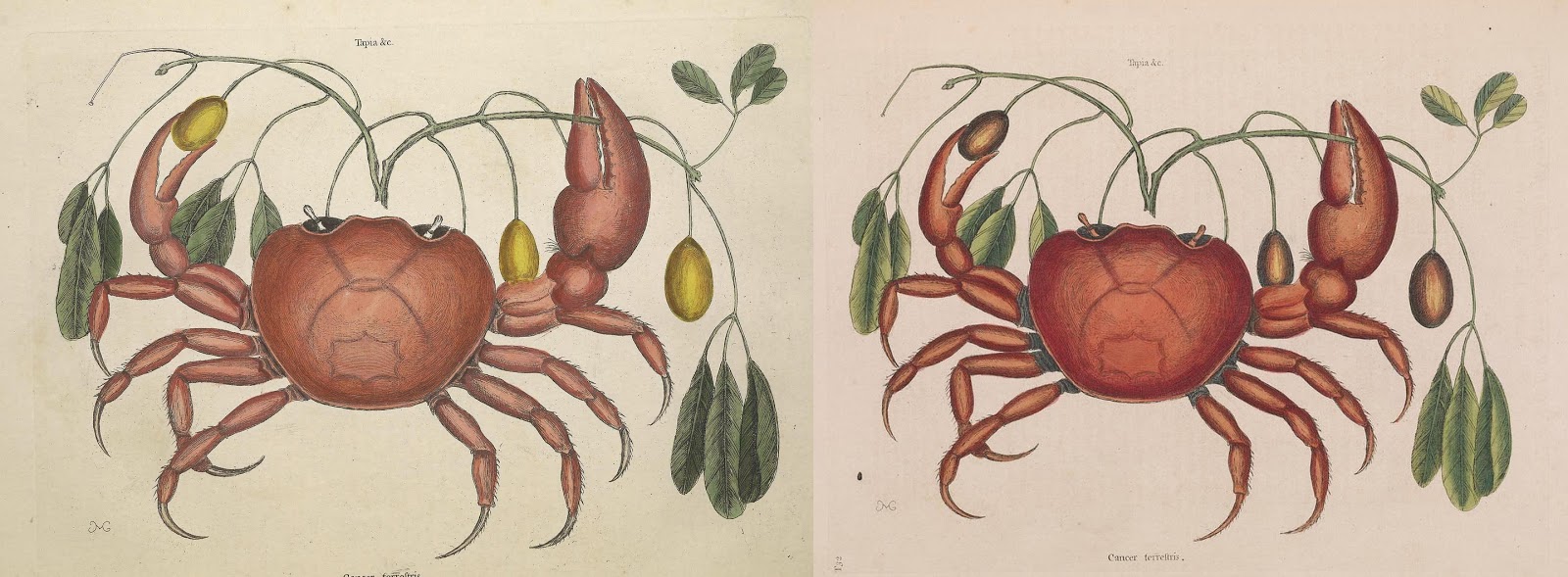
A 3rd edition was published in 1771 by bookseller Benjamin White. This edition is made up of completely reset text and the Linnaean binomials have been added where available. While the edition did use Catesby’s original copper plates, the plates from the 3rd edition are significantly more brightly colored than those of the first edition (N&E;, 168-169). The 3rd edition is freely available in BHL thanks to the University Library at the University of North Carolina, Chapel Hill.

View Full Size Image
Purple land crab (Gecarcinus ruricola) and blackwood (Picrodendron baccatum). Comparing plate from edition 1 (left) with plate from edition 3 (right). Left: v. 2, ed. 1, pl. 32. Digitized by Smithsonian Libraries. http://biodiversitylibrary.org/page/40680194. Taxon tagged in Flickr by Michelle Marshall: https://www.flickr.com/photos/biodivlibrary/26936128596. Right: v. 2, ed. 3, pl. 32. Digitized by University Library, University of North Carolina at Chapel Hill. http://biodiversitylibrary.org/page/38993454. Taxon tagged in Flickr by Michelle Marshall: https://www.flickr.com/photos/biodivlibrary/6829772164.


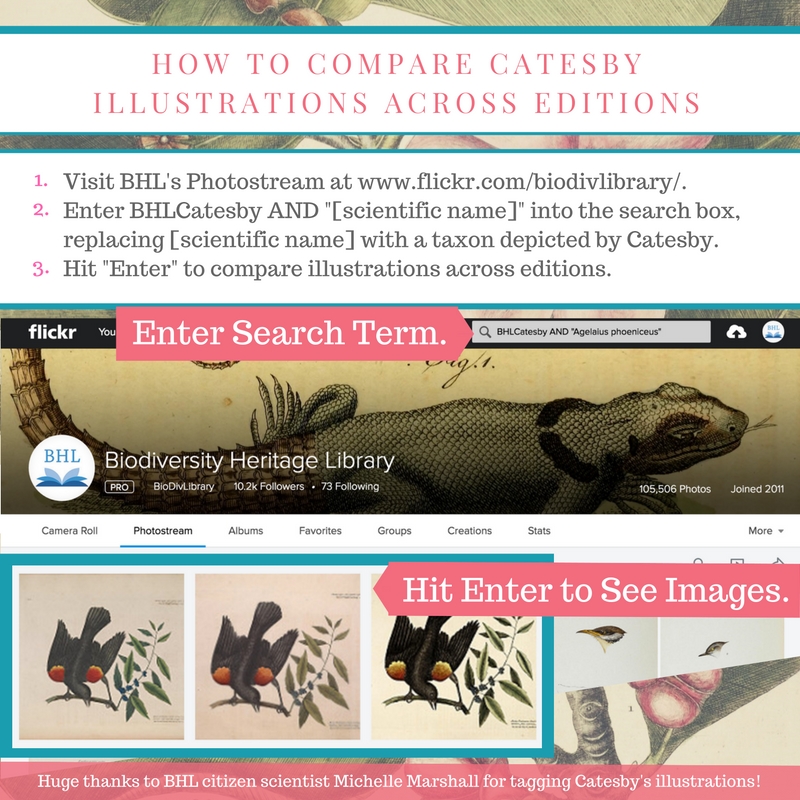
All of the plates from all three editions are available in the BHL Flickr. Thanks to BHL citizen scientist Michelle Marshall (also the curator of BHL’s Instagram), all plates from all editions have been tagged with the common, given and currently accepted scientific names for each species. The Curious Mister Catesby, which includes a species list by James L. Reveal in the book’s appendix (N&E;, 331-341), was used to verify the current accepted name for each species. This not only allows you to search Catesby’s illustrations by taxonomic name, but it also allows us to compare the differences in the illustrations across editions. To compare illustrations across editions, search BHL’s Flickr photostream by BHLCatesby AND “[scientific name]”, inserting the scientific name of a species depicted by Catesby in the brackets where indicated.

View Full Size Image

Catesby’s work, and particularly his illustrations, are significant for a variety of reasons. As the first fully illustrated book on the flora and fauna of North America, this book was the first introduction for many Europeans to much of the biodiversity of the New World. Beyond this, Catesby’s work was a significant resource for Carl Linnaeus, whose binomial system for naming plants (which he introduced in print with his Species Plantarum in 1753) and animals (applied in his Systema Naturae, 1758) is still used today (N&E;, 189).

View Full Size Image
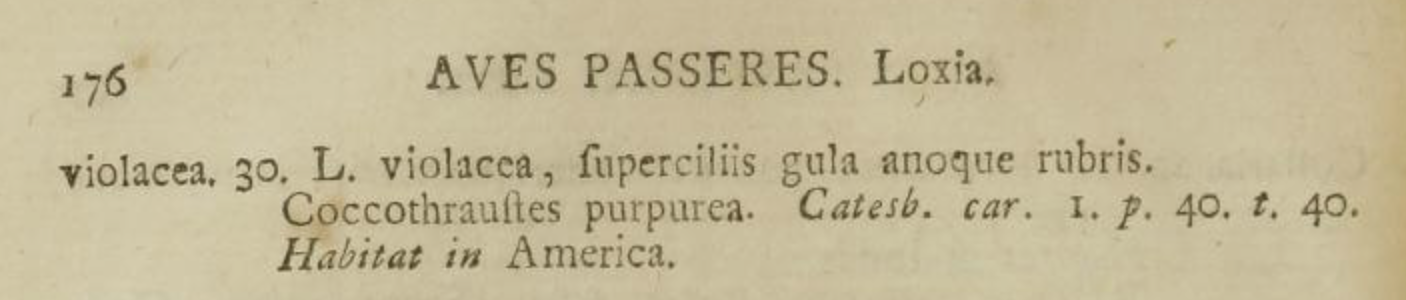
Species description for Greater Antillean bullfinch (Loxigilla violacea, previously Loxia violacea) in Systema Naturae, v. 1 (1758). Catesby is the only reference that Linnaeus cites for this species name. Digitized by the Missouri Botanical Garden. http://biodiversitylibrary.org/page/727083.

Linnaeus cited Catesby extensively in Species Plantarum and Systema Naturae, showing that Natural History enhanced Linnaeus’ understanding of many species. 131 of the 187 plants depicted by Catesby were cited by Linnaeus in Species Plantarum (N&E;, 201). Additionally, Linnaeus referenced Catesby 139 times in Systema Naturae (N&E;, 254-255). For some of these references, Catesby was the sole source of information for Linnaeus on a given species, and Catesby’s illustrations serve as the type for several of Linnaeus’ species names. In Species Plantarum, for example, 17 of Linnaeus’ species entries cite only Catesby, while Catesby’s plates serve as the type for 34 of the species in that work (N&E;, 201). For 52 of the species entries in Systema Naturae, Catesby was Linnaeus’ only reference (N&E;, 255).

View Full Size Image
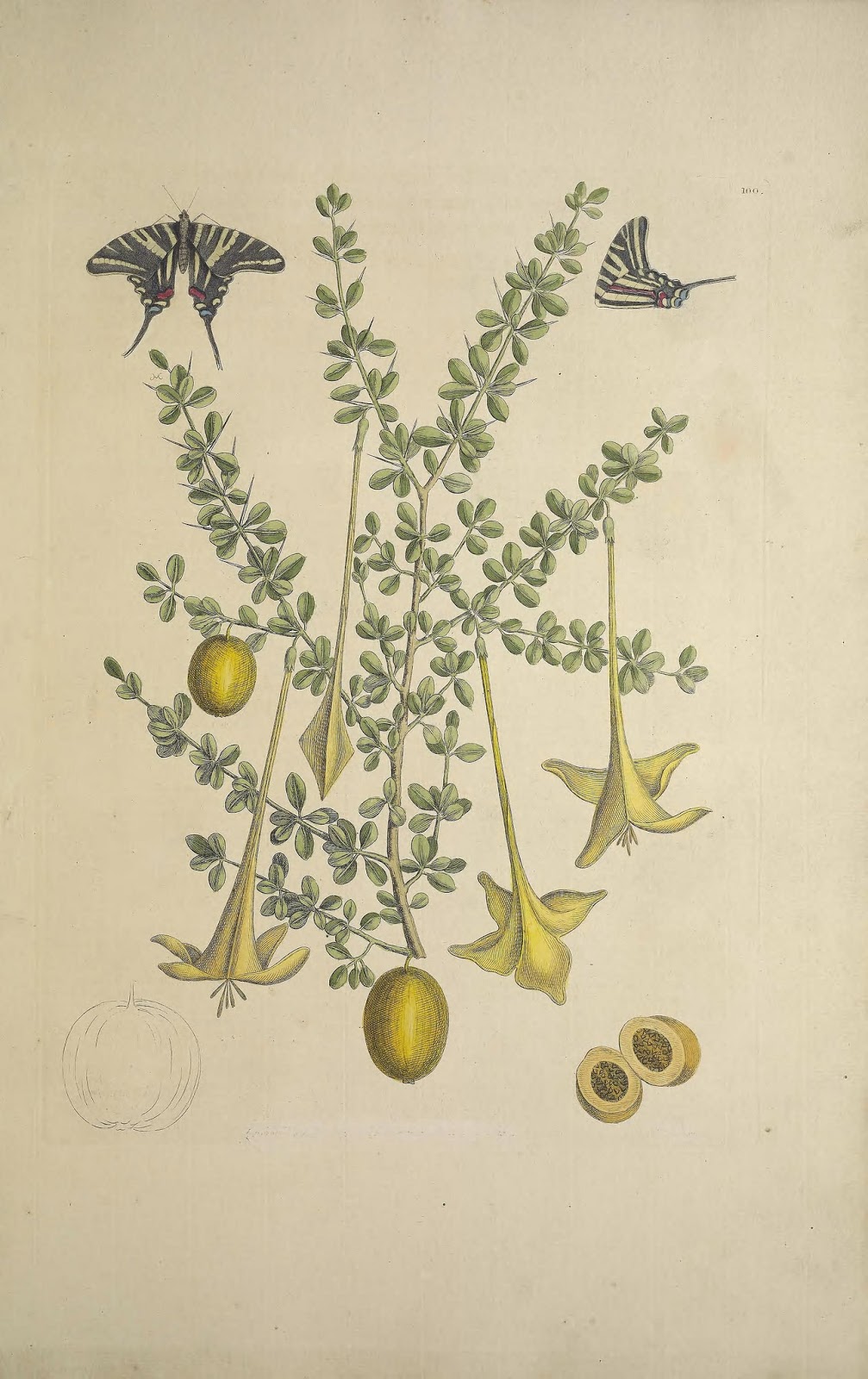
Lily thorn (Catesbaea spinosa). Pictured with zebra swallowtail (Protographium marcellus). Catesby is the only source that Linnaeus cited when naming Catesbaea spinosa in Species Plantarum (1753). This engraving serves as the type for this name. Catesby, Mark. The Natural History of Carolina, Florida, and the Bahama Islands. v. 2, ed. 1. pl. 100. Digitized by Smithsonian Libraries.  http://biodiversitylibrary.org/page/40680398. Taxon tagged in Flickr by Michelle Marshall: https://www.flickr.com/photos/biodivlibrary/26936345516.

The Natural History of Carolina, Florida, and the Bahama Islands represents a milestone in the cultivation of natural history knowledge. We are indebted to this “ingenious” naturalist Mark Catesby who dedicated his life to capturing and describing the biodiverse wonders of the New World. What a wondrously beautiful and curious world we live in.

REFERENCE 
Nelson, E C, and David J. Elliott. The Curious Mister Catesby: A “truly Ingenious” Naturalist Explores New Worlds., 2015. Print.

September 1, 2016by ulib-libraryjobs
BHL News, Blog Reel

IFLA Presentation on Expanding Access to Natural History Illustrations

View Full Size Image
View the slides here.

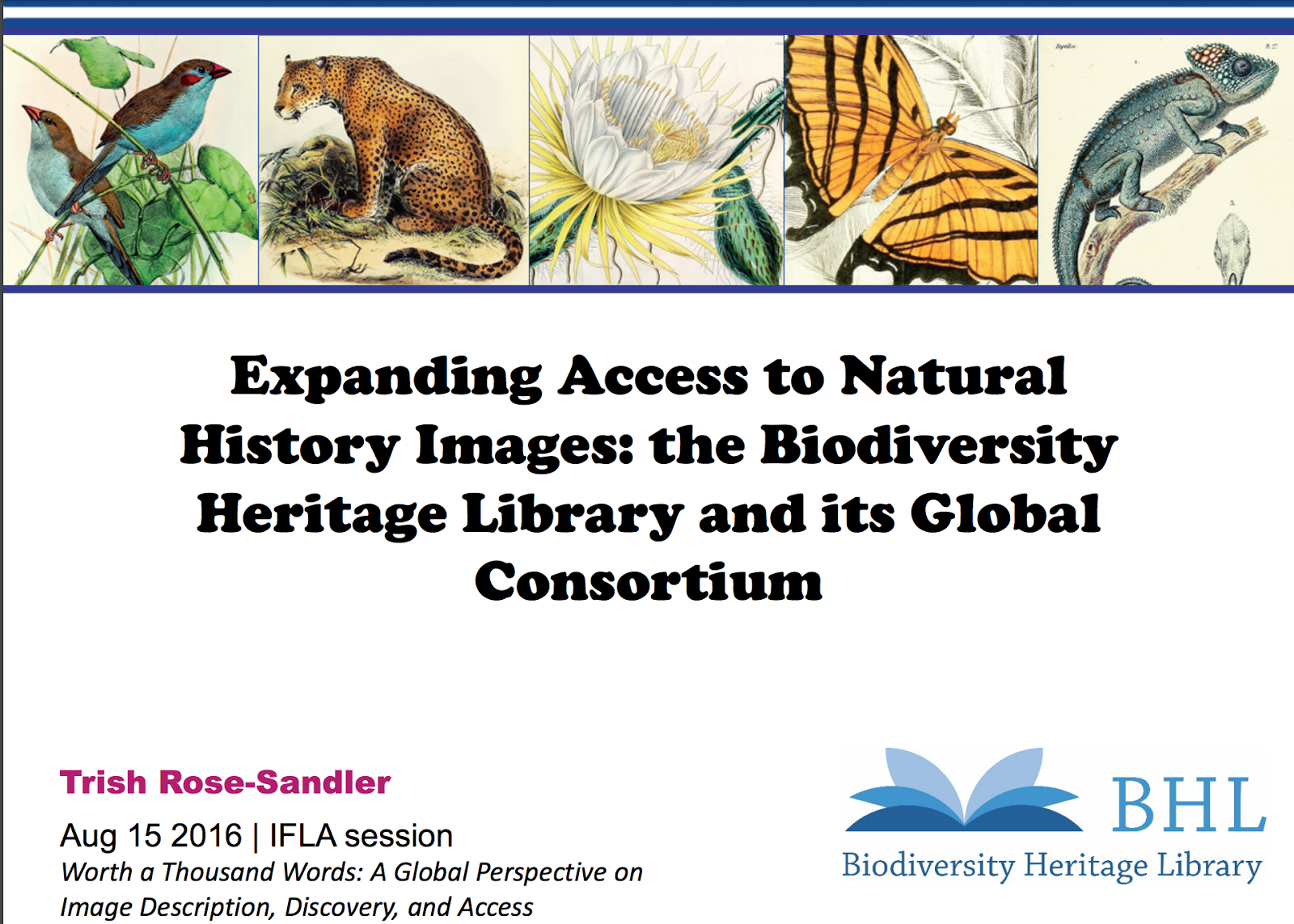
BHL was invited to give a talk at a one day session called “Worth a Thousand Words: A Global Perspective on Image Description, Discovery, and Access.” This session was part of the IFLA World Library and Information Congress held in Columbus, Ohio from August 13-19th 2016.

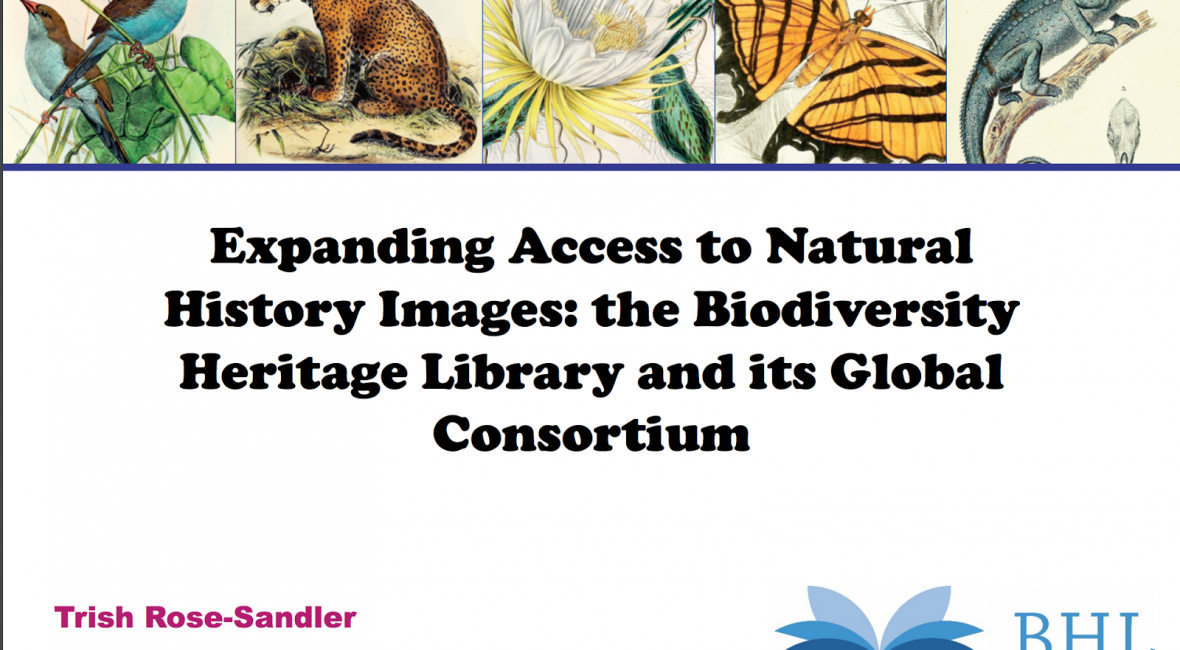
The talk, entitled “Expanding Access to Natural History Images: the Biodiversity Heritage Library and its Global Consortium,” focused on the ways that BHL has sought to improve access to its images, which are mostly hidden within the books and journals on its portal. It featured the image content found on our Flickr and Science Gossip sites and emphasized the cross-disciplinary importance of this content, which appeals to a wide variety of audiences including artists, biologists, humanities scholars, historians of science, librarians, educators and outreach professionals. The talk concluded with a discussion of how to gauge the success of our sites, which we do by looking at statistics, user engagement, coverage by the media, and the extent to which we reach new audiences.

Reception to the talk was very positive. The presentation also allowed us to reach new audiences, particularly since most of the librarians present work mostly with humanities materials and at least half of the audience was not familiar with the BHL and its content.

The session was also held in an unusual location – a cartoon museum! Specifically, it was the Billy Ireland Cartoon Museum on the campus of Ohio State University. Attendees to the session were also treated to lunchtime discussion with artist Jeff Smith, who is an American cartoonist who created the comic book series Bone, as well as a tour of the library and museum.

Slides from the talk are available here. All slides from the session are here.

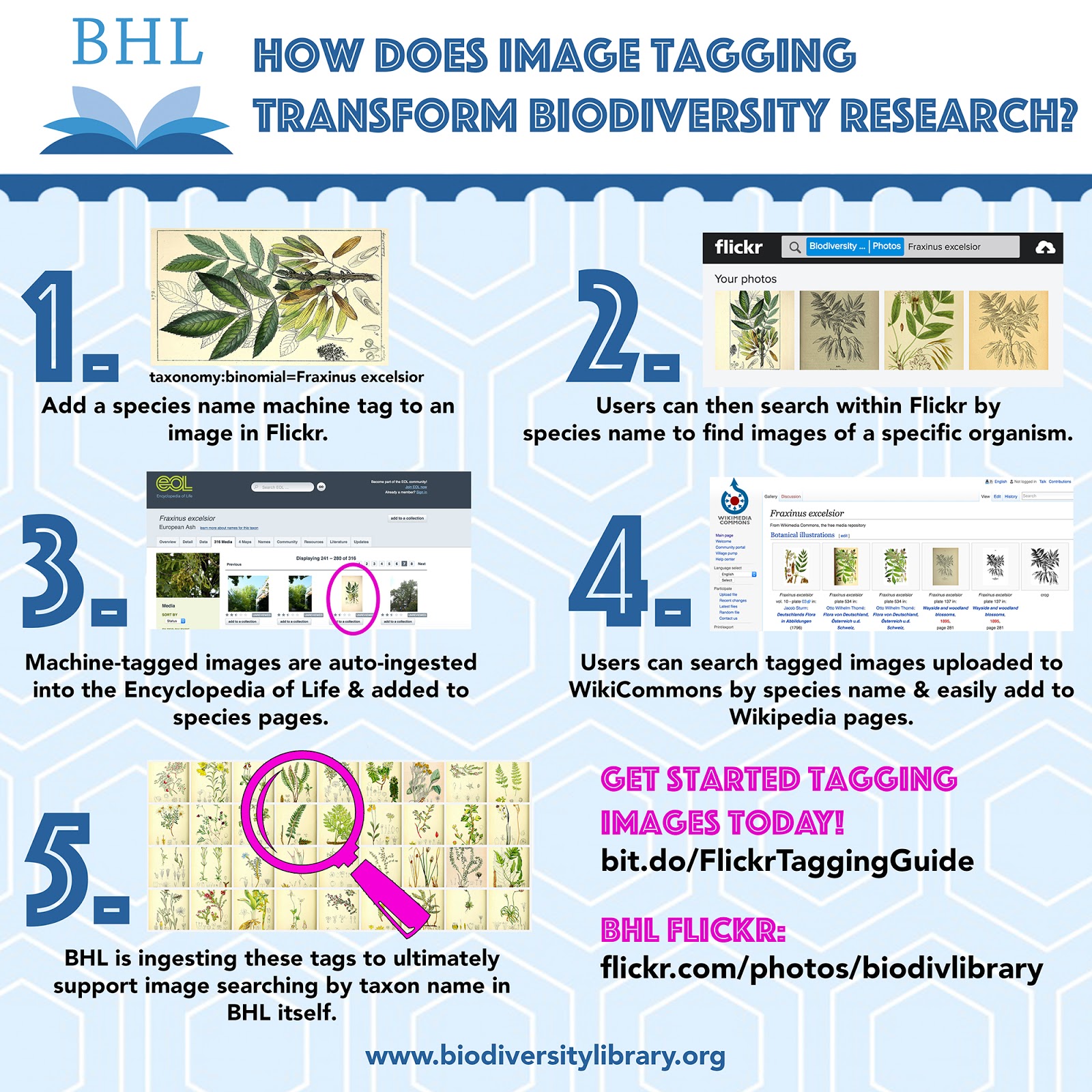
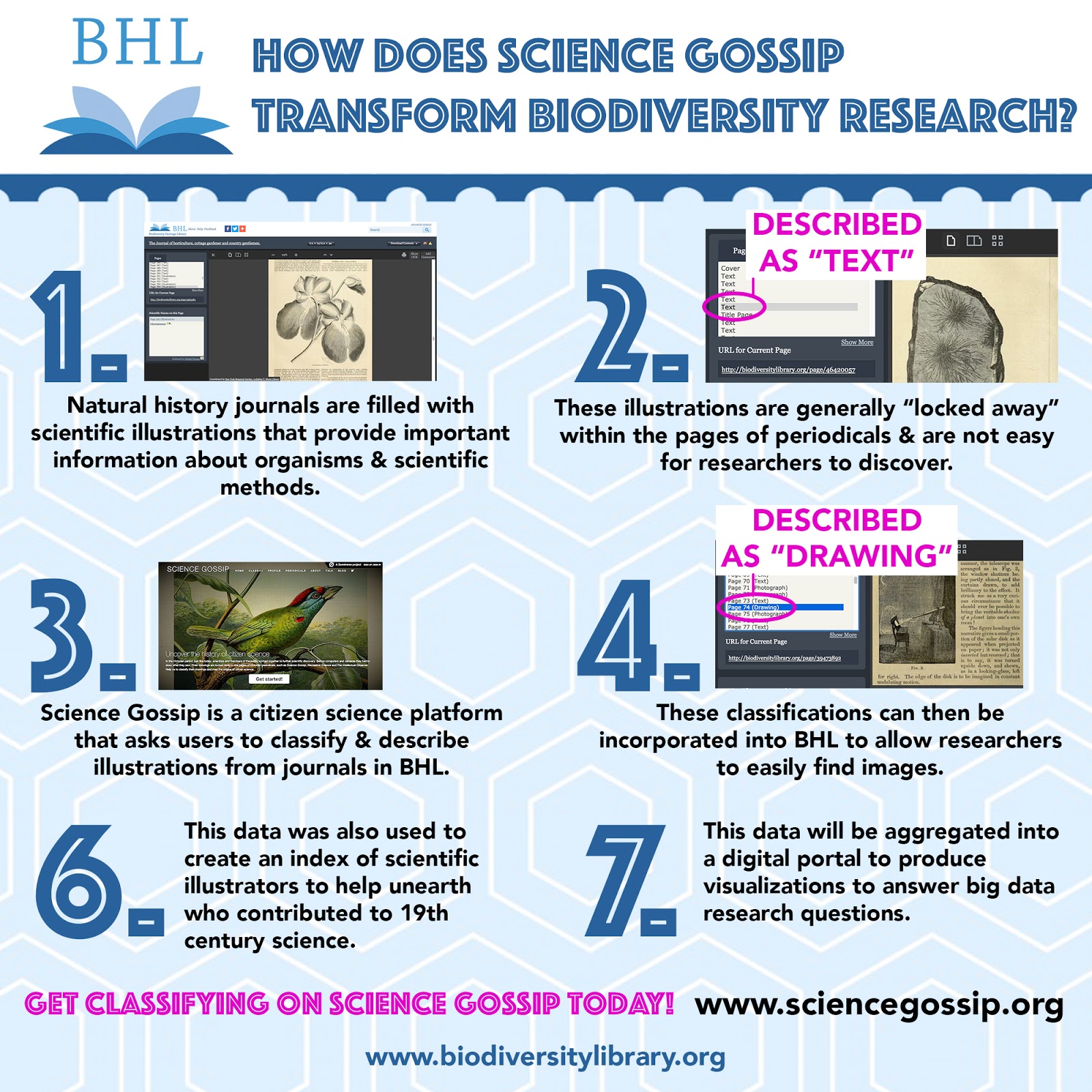
How do citizen science activities like Flickr tagging and Science Gossip help transform research? Find out below and start contributing today!

View Full Size Image


View Full Size Image


August 30, 2016by ulib-libraryjobs
Blog Reel

A Visual Delight: Natural History Illustrations from BHL on Instagram

BHL is now on Instagram!

Embracing the visually-driven nature of Instagram, our feed focuses on sharing the stunning historic illustrations in BHL’s collection. From birds of paradise to boxing kangaroos, charming bookplates, and artworks by some of history’s most renowned illustrators, there’s a wealth of visual delight waiting for you on our Instagram.

View Full Size Image
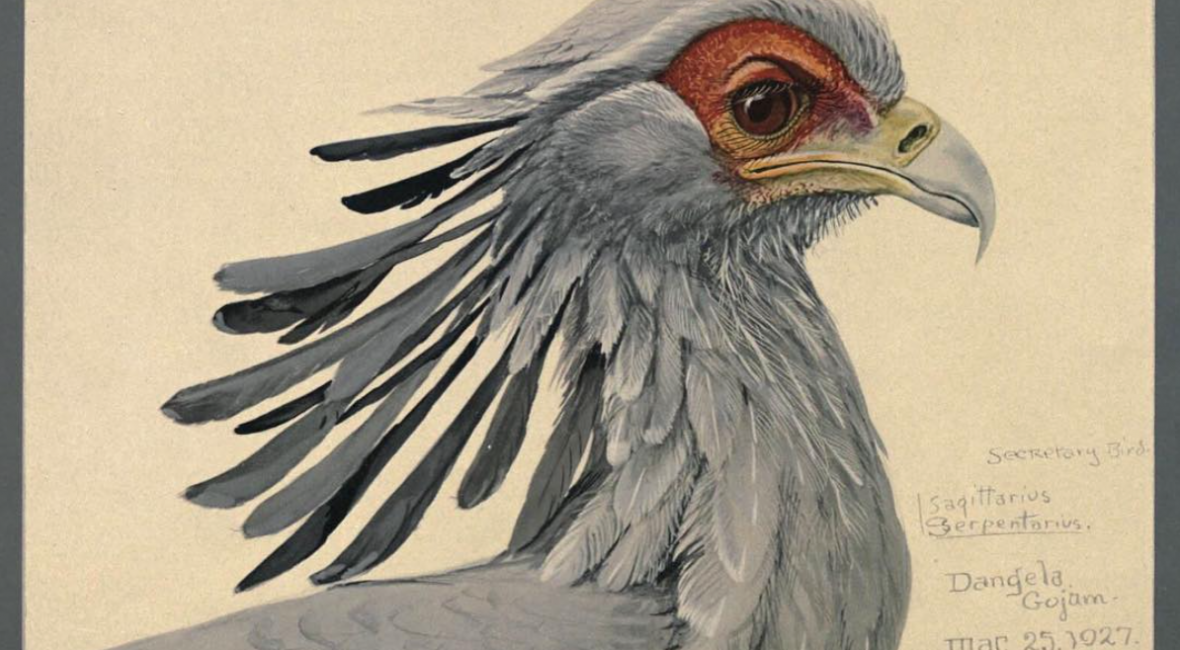
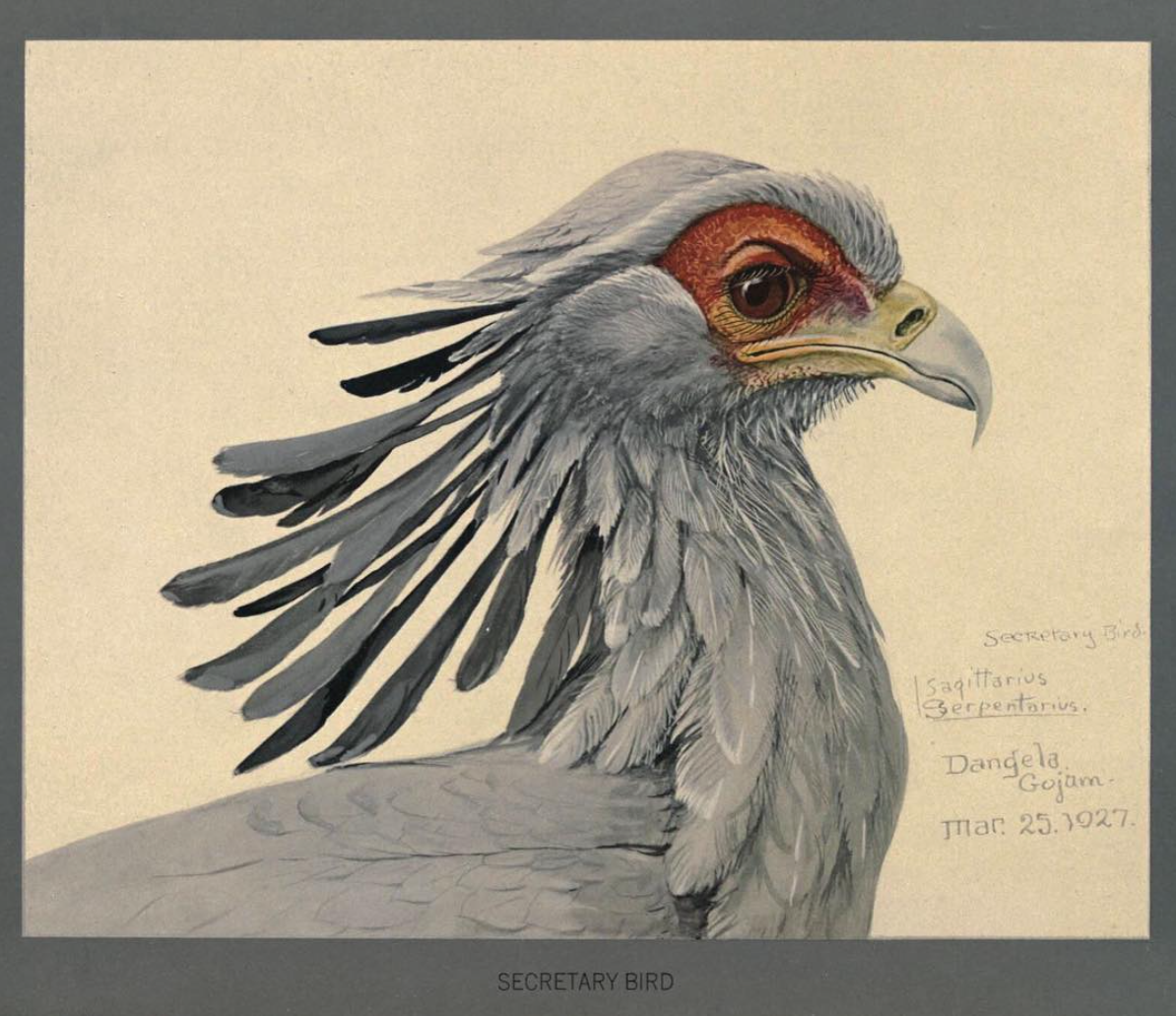
Secretarybird (Sagittarius serpentarius) is a nomadic bird of prey found in the grasslands of sub-Saharan Africa. #SciArt by Louis Agassiz Fuertes in the Album of Abyssinian Birds and Mammals (1930). Contributed by University Library, University of Illinois Urbana-Champaign. http://ow.ly/V5SQ3035ED9. Posted to Instagram by Michelle Marshall.

Plus, thanks to citizen science taxon tagging activities for BHL’s Flickr, the species in each illustration have been conveniently identified in the post description. Translation: you’ll always be able to identify what species you’re looking at, even if you’ve never seen it before.

And Flickr taxon tagging isn’t the only way that citizen science has benefited our Instagram. The feed itself is curated by BHL citizen scientist Michelle Marshall.

View Full Size Image
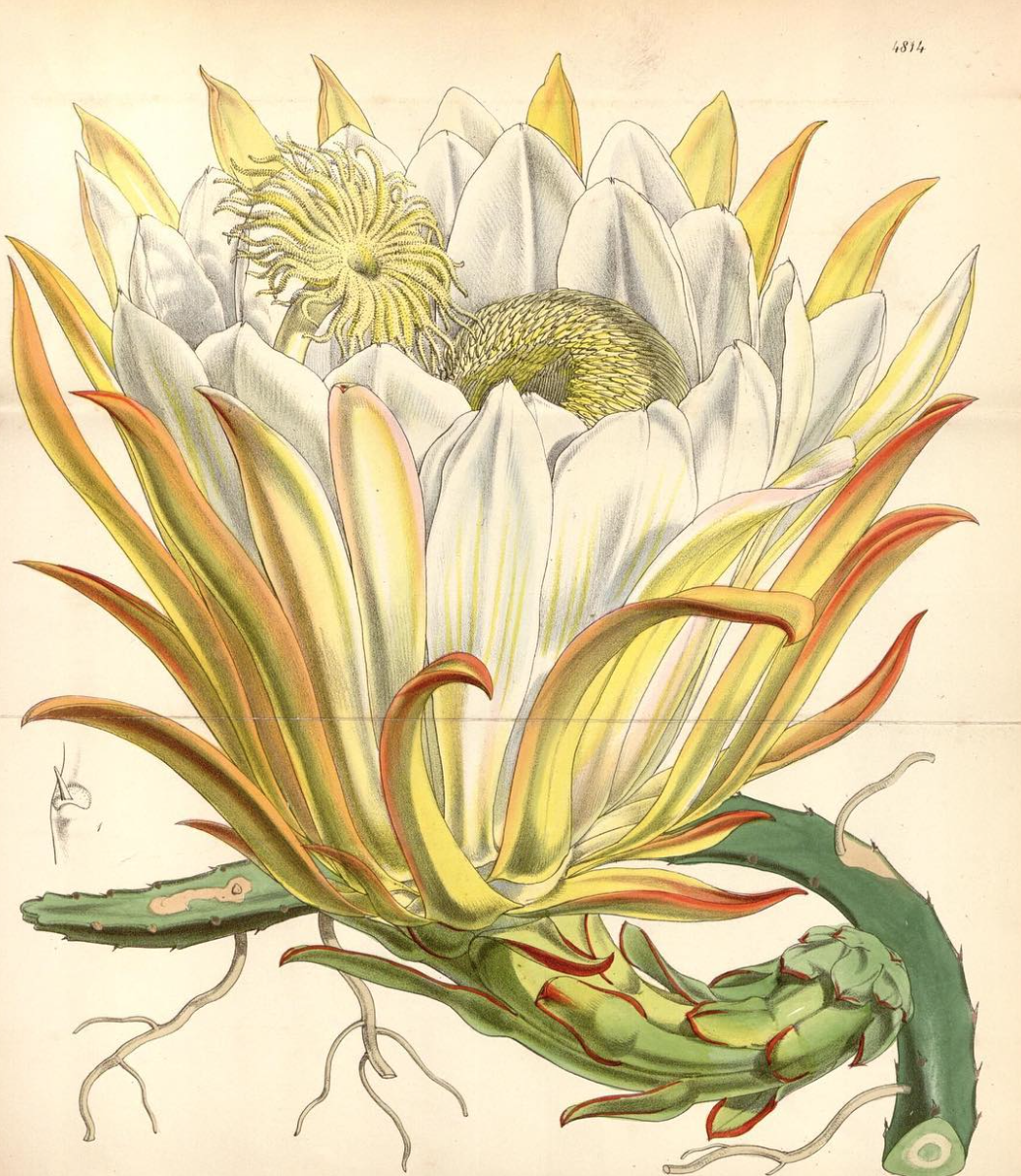
Night-blooming cactus (Hylocereus lemairei). By Walter Hood Fitch. Curtis’s Botanical Magazine, Vol. 54 (1827). Contributed by Missouri Botanical Garden. http://biodiversitylibrary.org/page/488560. Posted to Instagram by Michelle Marshall.

Michelle first became involved in citizen science through the Smithsonian Transcription Center, which she discovered while looking for ways to volunteer in her free time during her STEM studies. Through those activities, Michelle discovered BHL and our Flickr tagging opportunities. She now focuses on researching taxonomy to add to our images – an activity that she finds deeply rewarding.

“My favorite thing about volunteering for BHL is that I am always learning through research,” says Michelle. “I am able to connect with scientists and libraries to learn more, and I know more about biodiversity, geography, and even scientific art than I have ever learned in formal study. Just browsing the images on Flickr leads to new discoveries that I am excited to learn about and share with others on social media.”

Michelle first began sharing her finds through her own Twitter account. The posts were so well-received that she decided to create @HistSciArt, devoted specifically to sharing BHL illustrations and her related taxonomic research.

“I knew that BHL has been working on making the images more accessible for everyone, in particular the scientific community, so I thought that creating an account devoted specifically to sharing these images on Twitter would help with that effort,” explains Michelle. “Most of the images that I tweet I have researched the taxonomy for, and I try to share more information than just the illustration.”

We were so impressed by Michelle’s account and the quality of her research and posts that, when she expressed interest in expanding her efforts to Instagram, we invited her to do so by curating an account for BHL.

View Full Size Image
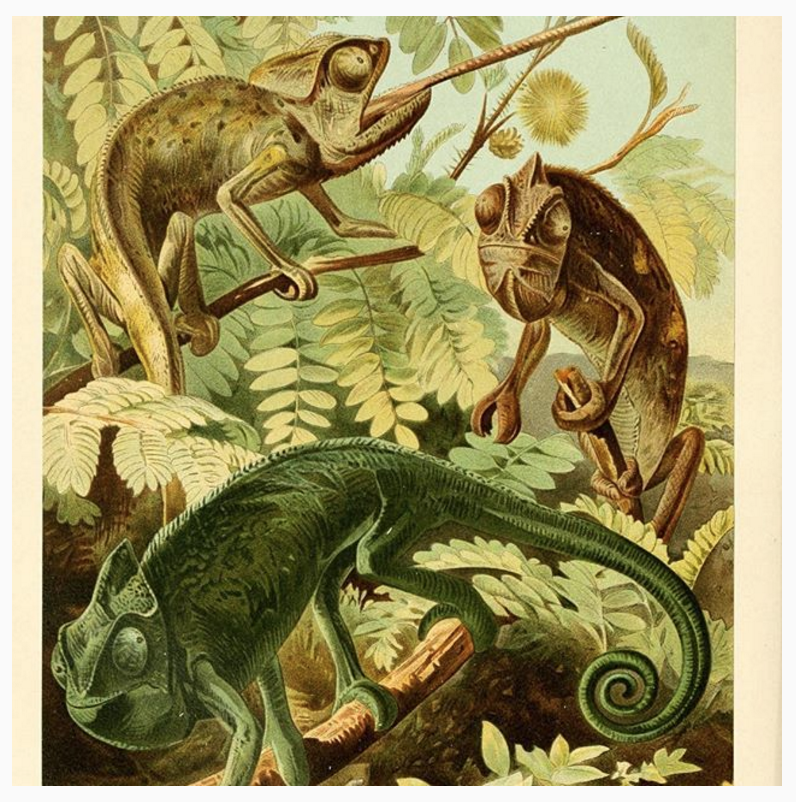
African Chameleon (Chamaeleo africanus) for #WorldLizardDay. Alfred Edmund Brehm, Brehm’s Tierleben, Bd. 2 (1913). Contributed by Ernst Mayr Library, Museum of Comparative Zoology at Harvard University. http://ow.ly/eX9W303e4bF. Posted to Instagram by Michelle Marshall.

“Instagram is an enormously popular social media platform, so I was truly honored when I was asked to curate BHL’s Instagram account,” says Michelle. “Because I believe in the great work that BHL is doing to support science and research, I felt that this would be another way that I could help share the wealth of knowledge in BHL’s collection. The great thing about sharing BHL’s collections on Instagram is that I am able to provide more information about the book and image as well as to connect with more people and institutions. Because I share different content on Instagram, any followers of HistSciArt and BHL on Twitter will have more great works to view and explore.”

And it seems people do indeed love exploring BHL illustrations on Instagram (we’re not surprised!). BHL’s Instagram has grown to over 400 followers in just over two weeks. This success is due not only to the quality of BHL’s collections, but also to the caliber of Michelle’s research and posts, which not only provide taxonomic and bibliographic information, but also identify the contributing libraries and include timely and engaging hashtags. We’ve also started posting one of each day’s Instagram posts to BHL’s Facebook as #BHLDailySciArt.

View Full Size Image
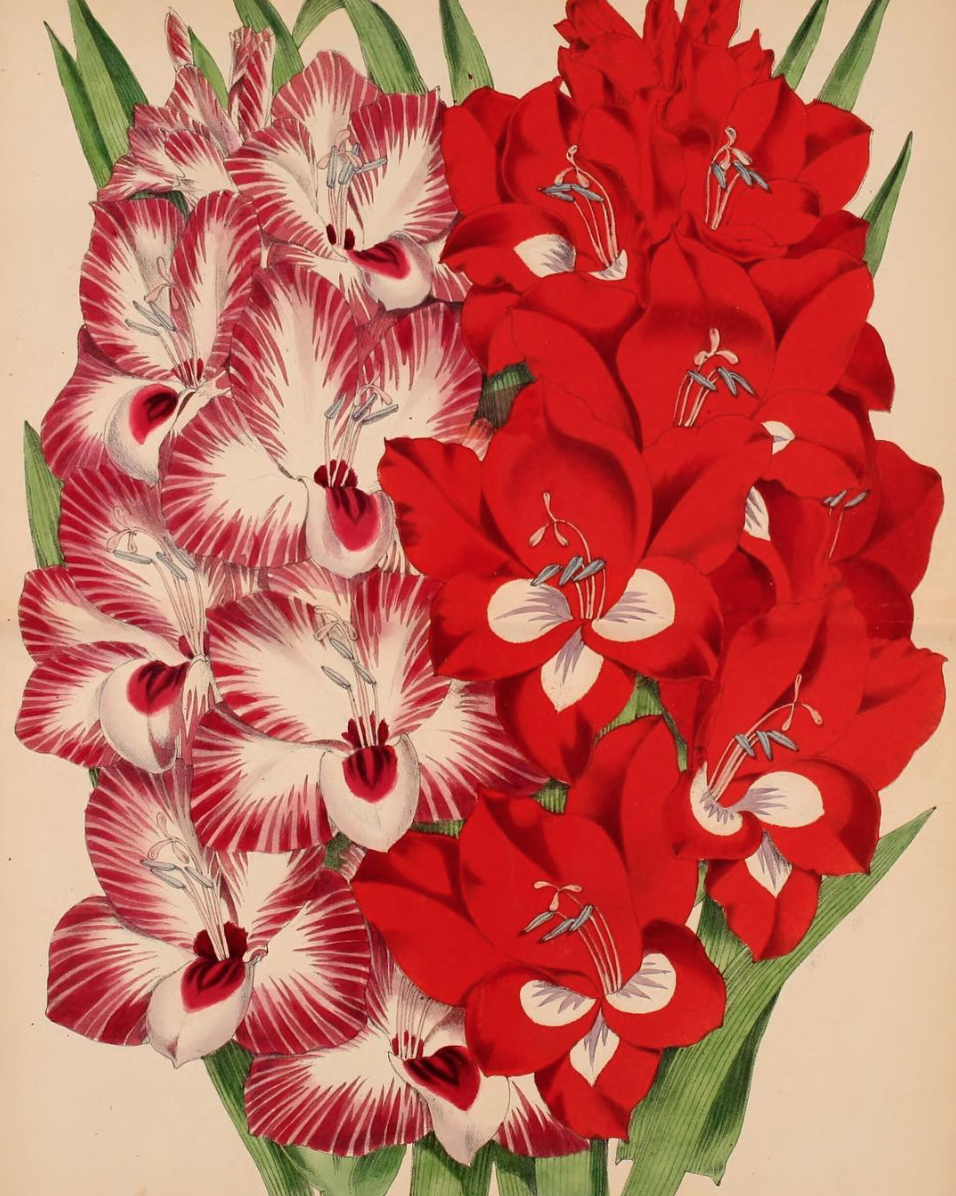
Gladiolus orphée and Gladiolus horace. Botanical #SciArt by Worthington George Smith. The Floral Magazine, Vol. 9 (1870). Contributed by the LuEsther T. Mertz Library of The New York Botanical Garden. biodiversitylibrary.org/page/50241074. Posted to Instagram by Michelle Marshall.

We’re so grateful to Michelle for all of her contributions to help increase awareness of and access to BHL’s collections. We believe this partnership is a testament to the power and benefits of citizen science, and with that we also extend a huge thanks to each and every volunteer that dedicates their time and resources to improving BHL collections. You can learn more about all of our citizen science opportunities here.

So, you might be wondering (as we were!), for someone who’s explored as many books and researched as many illustrations as Michelle has, which title would she pick as her favorite? It turned out to be an easy question for her to answer.

“When I discovered Catesby’s The natural history of Carolina, Florida and the Bahama Islands, I think I literally leapt out of my chair!” exclaims Michelle. “I grew up in Florida and South Carolina, and here was a spectacular natural history work all about the native flora and fauna of my area. Catesby spent lots of time in the Southern Colonies during the 1720s, which is the same time that part of my family came to what was then called Carolina. I like to think that what he saw and experienced was the same as what my ancestors knew. I am so pleased to have access to all three editions of his work through BHL and to have taxon tagged all of them!”

View Full Size Image
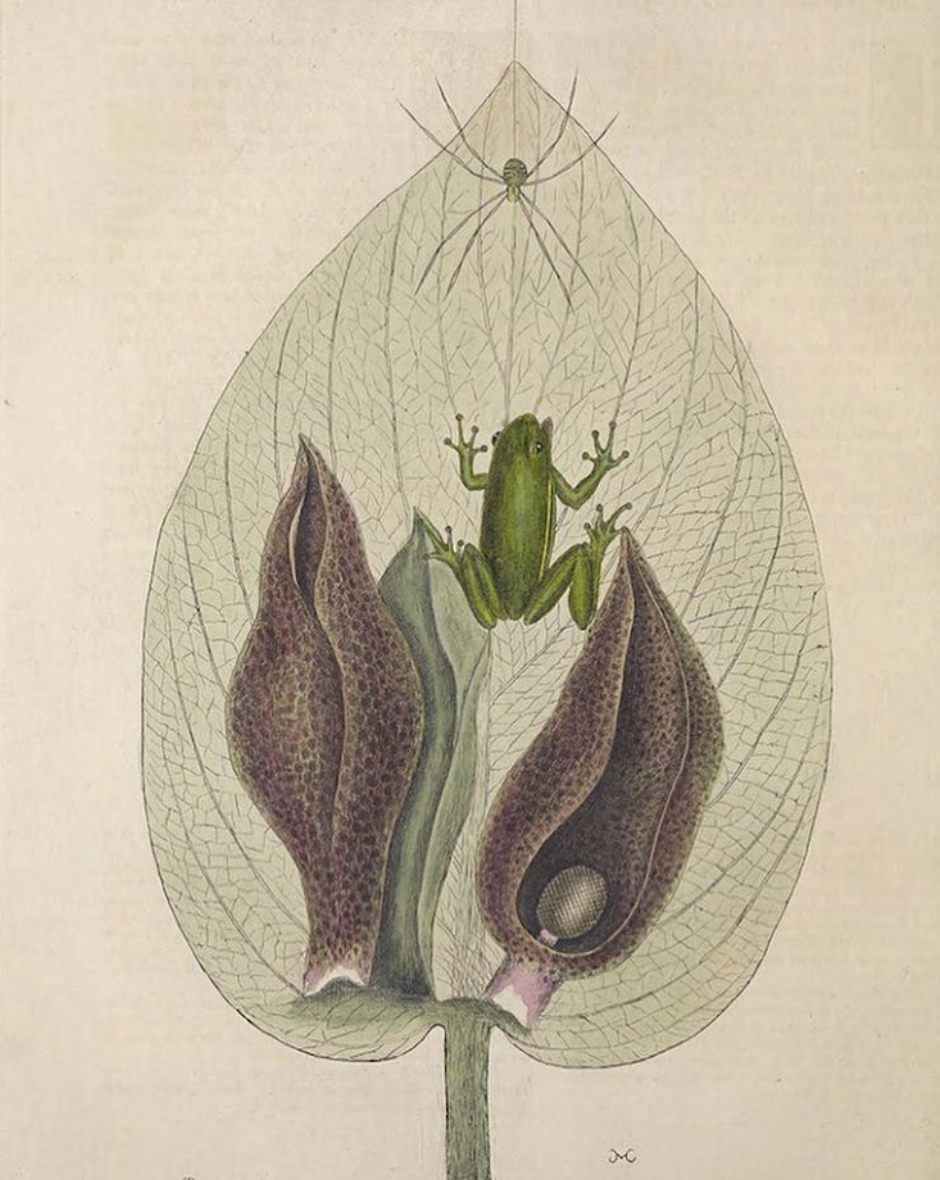
Green tree frog (Hyla cinerea) about to snack on a Green lynx spider (Peucetia viridans) while hanging onto Skunk cabbage (Symplocarpus foetidus). Mark Catesby, The Natural History of Carolina, Florida and the Bahama Islands, Vol.2, 1st Ed. (1743). Contributed by Smithsonian Libraries. http://biodiversitylibrary.org/page/40680311. Posted to Instagram by Michelle Marshall.

You can explore the illustrations from all three editions of Catesby’s monumental work (it’s the first major illustrated publication on the flora and fauna of North America and was chosen by Smithsonian Libraries as their BHL@10 Notable Book Contribution) in Flickr, all of which have been taxon tagged by Michelle.

Be sure to check out more of the beautiful illustrations in our collection by following us on Instagram. A world of art and science (made possible thanks to citizen science) awaits you!

View Full Size Image
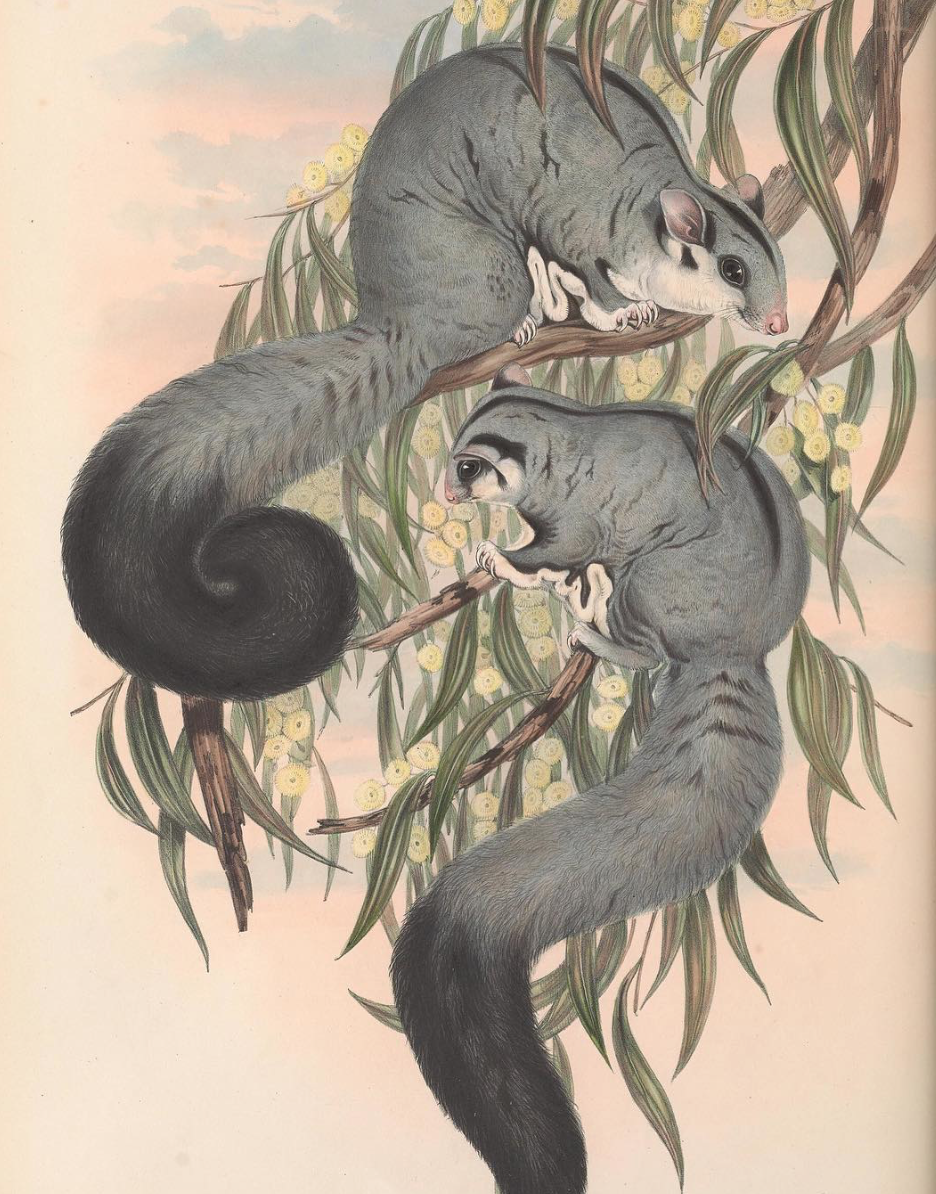
Squirrel Glider (Petaurus norfolcensis). Although it resembles a squirrel, this mammal is a marsupial native to Australia. #SciArt by Henry Constantine Richter and John Gould for Gould’s Mammals of Australia, Vol. 1 (1863). Contributed by Smithsonian Libraries. http://ow.ly/e5zj303j4nr. Posted to Instagram by Michelle Marshall.
August 22, 2016by ulib-libraryjobs
BHL News, Blog Reel

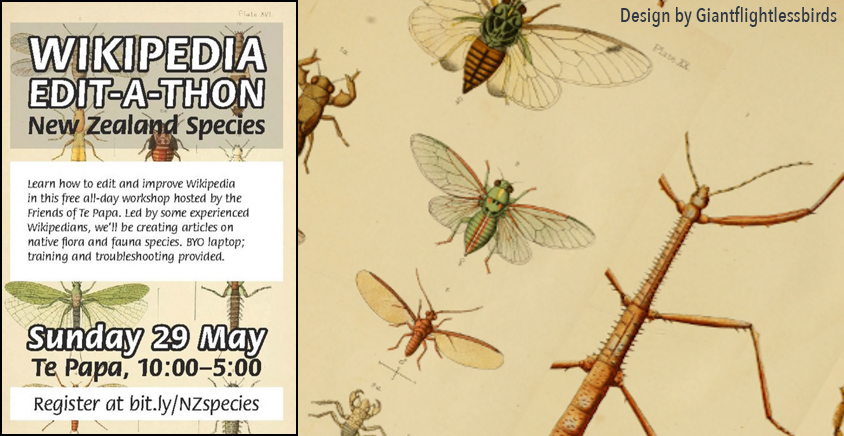
Wikipedia Edit-a-thon for New Zealand Species, 29 May 2016!

View Full Size Image

Help improve Wikipedia articles about New Zealand species!

On Sunday, 29 May 2016, the Friends of Te Papa will be hosting a Wikipedia edit-a-thon focused on adding New Zealand plant and animal species to Wikipedia. The edit-a-thon will occur from 10:00-17:00 NZST at the Museum of New Zealand Te Papa Tongarewa in Wellington, New Zealand. You can sign up here to attend in person. You can find more information about the event here.

Participants from all over the world are also encouraged to join in remotely! Follow #NZspecies on Twitter to get updates from the event as it happens as well as to ask questions while you edit Wikipedia pages. Just be sure to add the hashtag #NZspecies to the edit summary for any content you create in Wikipedia prior to saving so that your contributions can be recorded. If you’d like to participate remotely, you can add your Wikipedia username to the “Attending remotely” section at the bottom of the Wikipedia Edit-a-thon page.

BHL has lots of great resources that you can use to do research on New Zealand species and enhance Wikipedia pages. These include:

  • Images of New Zealand species. Here’s a collection of over 650 of them in Flickr. View these instructions to see how to add images to Wikicommons.
  • BHL has a wealth of publications about New Zealand.
  • Finally, need to find information about a specific species? Search for it in BHL using our taxonomic name finding tool and discover all of the publications in BHL that mention that species.

One of the edit-a-thon organizers, Siobhan Leachman (whom we’ve interviewed on our blog before in relation to her extensive citizen science activities) also recommends the following resources in BHL:

  • Illustrations of the New Zealand Flora, Vols 1 and 2 by T. F. Cheeseman. Siobhan has created a spreadsheet providing taxonomic information for the species in these images, as well as identifying which ones are needed for Wikicommons and which species are absent from Wikipedia.
  • Anything written by George Vernon Hudson but especially his classic An elementary manual of New Zealand entomology. As Siobhan says, “New Zealand endemic beetles and moths are crying out for more articles.”
  • The Ross Expedition described many New Zealand species for the first time so the publication about the expedition, Zoology of the voyage of the H.M.S Erebus and Terror, is also very useful.
  • Transactions and Proceedings of the New Zealand Institute, which, Siobhan says, “is just full of material that can be cited in Wikipedia articles.”
We’re excited to see how this event helps improve access to information about New Zealand species and how BHL’s free resources can contribute to that process and knowledge. We’d like to extend a huge shout-out to the organizers, Siobhan Leachman and Mike Dickison, for putting together this wonderful opportunity, and we hope you’ll join the fun during the New Zealand species edit-a-thon!
May 23, 2016by michelle.underhill
BHL News, Blog Reel

We Challenge You to #DigIntoDyar

This post originally published on the Smithsonian Libraries blog Unbound. 

Important entomological work. The Bahá’í faith. Secret tunnels under Washington, DC. What do all of these elements have in common? Curiously, Smithsonian scientist Harrison Gray Dyar, Jr..

Dyar, Honorary Custodian of Lepidoptera at the United States National Museum (now, National Museum of Natural History) for over 30 years, was a prolific entomologist – studying sawflies, moths, butterflies and mosquitos and publishing his findings. He described hundreds of species and genera and brought new ones to light. “Dyar’s Law”, a standard rule used to measure premature insects, is named in his honor.

View Full Size Image
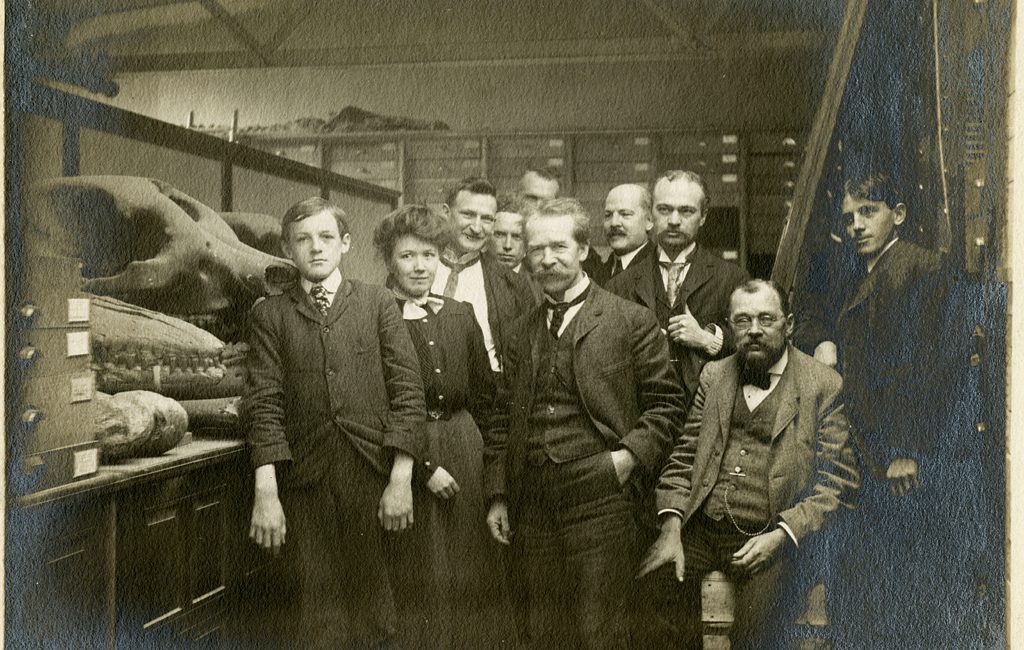
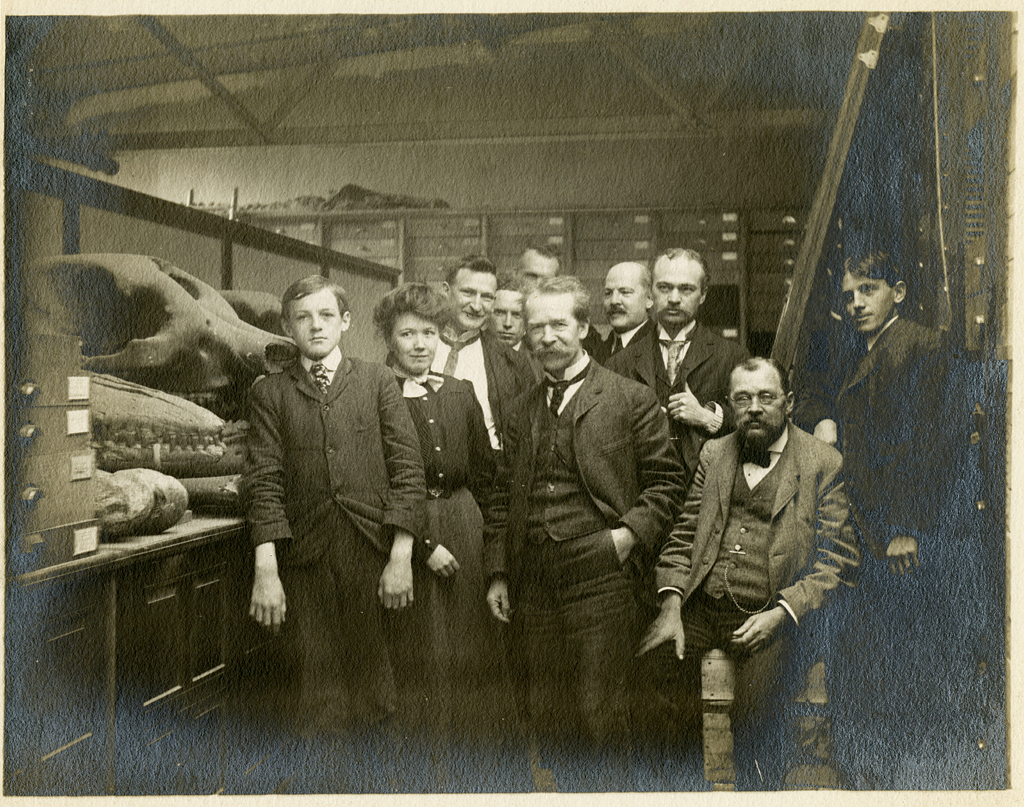
Harrison G. Dyar, Jr., third from right, with Entomology staff of the U.S. National Museum in 1905. Courtesy of Smithsonian Institution Archives.

Yet, the work of this successful entomologist is often overshadowed by his fascinating personal life. Dyar was a bigamist and consequently dismissed from the USDA for conduct unbecoming of a federal employee. He practiced the Bahá’í faith, a movement that seeks to reconcile science with religion. And perhaps most newsworthy: he dug a series of mysterious tunnels beneath his home in Northwest DC. Tunnels that many believed were the work of spies until Dyar finally fessed up.

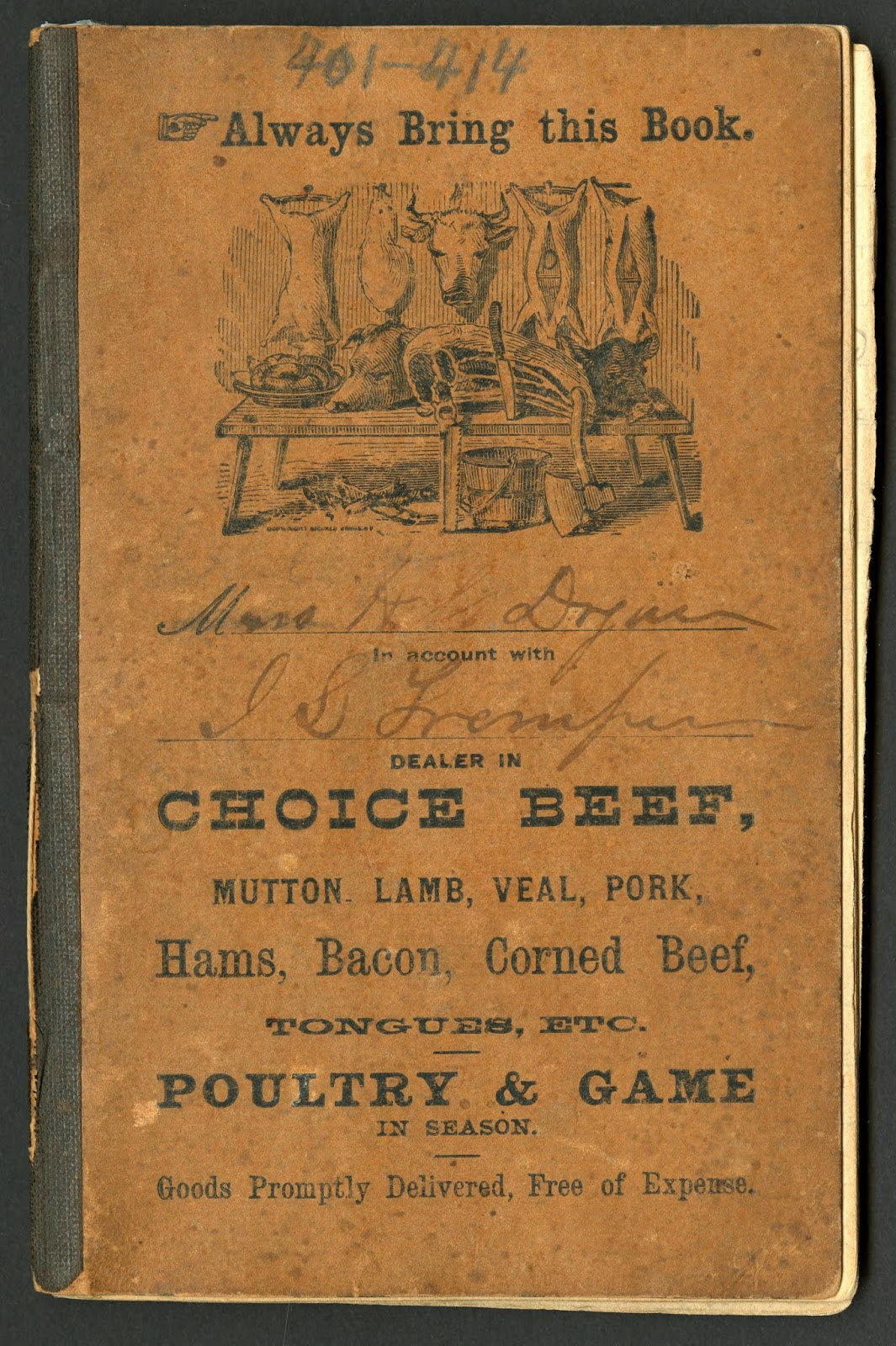
Starting today, you can be a part of the scientific legacy of this interesting figure in Smithsonian science. The Smithsonian Institution Archives has uploaded five volumes of Dyar’s “blue books” (notebooks in which he jotted down scientific observations) to the Smithsonian Transcription Center. Volunteers are encouraged to dive into the books and help us transcribe Dyar’s work for future study.

View Full Size Image
Cover of “Bluebook 401-414”, by H.G. Dyar. Digitized by Smithsonian Institution Archives. http://biodiversitylibrary.org/page/46177763.

From now until May 20th, we’ll be encouraging everyone to #DigIntoDyar with a series of blog posts about Dyar’s work as well as a live Google Hangout on May 17th (2:30, EDT). Both will feature National Museum of Natural History research associate and Dyar biographer, Marc Epstein. Marc, who recently published Moths, Myths and Mosquitos: The Eccentric Life of Harrison G. Dyar, Jr., will help us understand Dyar’s work, his sordid personal life, and his legacy.

View Full Size Image

Along the way, we’ll be sharing other tidbits and images via social media. We hope you’ll tune in as we #DigIntoDyar and learn more about this fascinating part of Smithsonian history.

You can browse Dyar’s field notebooks in BHL, digitized by Smithsonian Institution Archives as part of the Field Book Project. Below are the BHL links to the field notes that are part of this challenge, as well as the links to those projects in the Smithsonian Transcription Center to help you get started transcribing right away!

Happy Digging!

H. G. Dyar – Bluebook 401- 414, 1893-1894 | https://transcription.si.edu/project/8144
H. G. Dyar – Bluebook 415-435, 1893-1894 | https://transcription.si.edu/project/8145
H. G. Dyar – Bluebook 436-450, 1893-1894 | https://transcription.si.edu/project/8146
H. G. Dyar – Bluebook 451-473, 1894 | https://transcription.si.edu/project/8147
H. G. Dyar, Bluebook 474-491, 1894-1897 | https://transcription.si.edu/project/8148

May 13, 2016by ulib-libraryjobs
BHL News, Blog Reel

Earth Day 2016!

Happy Earth Day!  This special day for recognizing and fighting the serious and negative effects of climate change began on April 22nd, 1970.  On that first Earth Day, 20 million Americans peacefully demonstrated to shine light on the devastating effects of modern life and production on wildlife and the climate.  Soon after this the Clean Air Act, Clean Water Act, Endangered Species Act, and other laws meant to protect the environment were passed by the government.  By the 1990s Earth Day expanded and came to be celebrated by over 200 million people in 141 countries–and now more than 1 billion people all around the world participate on Earth Day in order to help the environment.
Climate change refers to changes happening to the world climate, which are linked to rising sea levels, melting glaciers, and shifting flower and plant blooming times.  Contributions to human-induced climate change include the burning of fossil fuels, which releases heat-trapping gases into the air.  Climate change affects biodiversity of all kinds and in all areas of the world, often by depriving animals of their habitats and food sources, or changing their living conditions dramatically and dangerously.
Deforestation, another driving cause of climate change, is the cutting down of trees on a very large scale, and it happens most often due to agricultural reasons, financial reasons, or human expansion into new areas to live.  Millions of species lose their habitats as a result of deforestation.  In addition, without the trees to provide a forest canopy to block the sun during the day and capture heat at night, extreme temperature swings result and can negatively impact plants and animals in the area.  
View Full Size Image
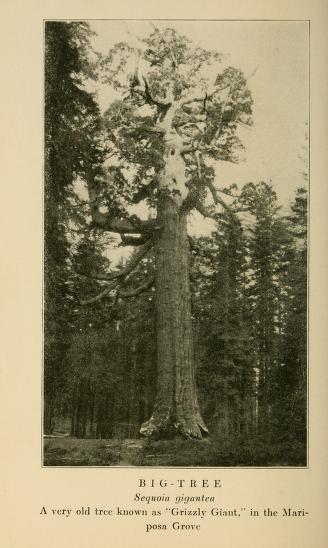
Let’s preserve our beautiful forests–and plant new ones! Image at BHL here.
There are lots of things that you can do this Earth Day to help fight climate change.  One of the most important things people and organizations do is plant trees.  This short read, Trees Are the Answer. . .to America’s Growing Environmental Concerns, is just as relevant today as when it was published.  Trees fight climate change by absorbing excess CO2 from the atmosphere.  CO2 is harmful to the climate and is created by such things as car emissions.  In one year, an acre of mature trees can absorb enough CO2 to make up for a car that drove 26,000 miles (source).  In addition to absorbing CO2, trees absorb other climate pollutants such as nitrogen oxide and ammonia, and act as a filter to capture harmful particulates in their leaves and bark.  In addition to planting trees, you can take part in cleaning local parks and streams, start composting to turn food waste into soil, eat less meat to reduce greenhouse gas emissions that are a byproduct of the meat industry, stop using disposable plastic which can kill wildlife and destroy ecosystems, buy local produce to reduce the carbon emissions needed to drive in non-local produce, drive less to reduce your carbon footprint (try biking for some healthy fun!), sign up to stop receiving junk mail which wastes paper, and recycle electronic devices which are normally thrown into landfills that pollute the environment.
View Full Size Image
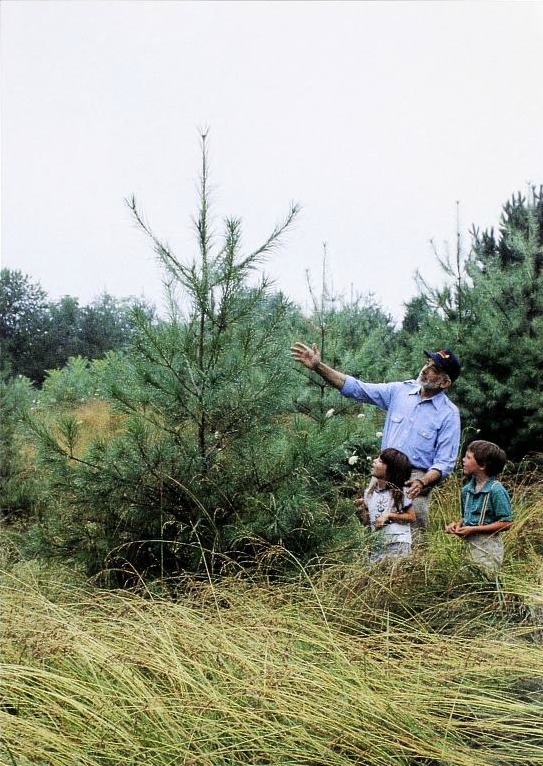
Planting trees will help combat climate change. Image at BHL here.
If you are a budding naturalist, you can help the climate and biodiversity by becoming a Citizen Naturalist–anyone can do this, including kids!  Citizen Naturalists monitor their local ecosystems and threats to wildlife and submit their observations to citizen science programs.  There are many groups dedicated to wildlife observation to help protect wildlife and fight climate change, and some of the fun animals you can help observe include frogs, birds, fireflies, and Monarch Butterflies.  If you want to work alongside a professional scientist, you can become a Citizen Science volunteer, where you assist scientists in their research to help analyze and combat the effects of climate change.  Check out the National Wildlife Federation’s page about Citizen Naturalists and Scientists for more information about groups to join and project ideas: NWF Citizen Science Resources.  You can also get involved with Citizen Science through BHL: Click Here for BHL Citizen Science Information!
View Full Size Image
Citizen Naturalists and Citizen Scientists can take note of the wildlife in their backyards and local parks. Image at BHL here.
How do you plan to get involved this Earth Day?  Tell us below!
www.earthday.org
https://www.epa.gov/earthday
https://www.nwf.org/Wildlife/Wildlife-Conservation/Citizen-Science.aspx
http://environment.nationalgeographic.com/environment/global-warming/deforestation-overview/
http://climate.nasa.gov/
April 22, 2016by micahv
Page 3 of 6« First...«2345»...Last »

Help Support BHL

BHL's existence depends on the financial support of its patrons. Help us keep this free resource alive!

search

About BHL

The Biodiversity Heritage Library (BHL) is the world’s largest open access digital library for biodiversity literature and archives. BHL operates as a worldwide consortium of natural history, botanical, research, and national libraries working together to digitize the natural history literature held in their collections and make it freely available for open access as part of a global “biodiversity community.”

Join Our Mailing List

Sign up to receive the latest news, content highlights, and promotions.

Subscribe Now

Subscribe to Blog via Email

Enter your email address to subscribe to this blog and receive notifications of new posts by email.

Join 319 other subscribers

Subscribe to Blog Via RSS

Subscribe to the blog RSS feed to stay up-to-date on all the latest BHL posts.

Access RSS Feed

Inspiring Discovery through Free Access to Biodiversity Knowledge.

The Biodiversity Heritage Library makes it easier than ever for you to access the information you need to study and explore life on Earth…for free, anytime, anywhere.


64+ Million Pages of
Biodiversity Literature Online.

EXPLORE

Tools and Services
to Transform Research.

EXPLORE

300,000+
Illustrations on Flickr.

EXPLORE

ABOUT | HARMFUL CONTENT | PRIVACY | SITE MAP | TERMS OF USE