Biodiversity Heritage Library - Program news and collection highlights from BHL
  • Home
  • News
  • Featured Books
    • All Featured Books
    • Book of the Month Series
    • BHL at 20
  • User Stories
  • Campaigns
    • Fossil Stories
    • Garden Stories
    • Monsters Are Real
    • Page Frights
    • Her Natural History
    • Earth Optimism 2020
  • Tech Blog
  • Visit BHL
Home
News
Featured Books
    All Featured Books
    Book of the Month Series
    BHL at 20
User Stories
Campaigns
    Fossil Stories
    Garden Stories
    Monsters Are Real
    Page Frights
    Her Natural History
    Earth Optimism 2020
Tech Blog
Visit BHL
  • Home
  • News
  • Featured Books
    • All Featured Books
    • Book of the Month Series
    • BHL at 20
  • User Stories
  • Campaigns
    • Fossil Stories
    • Garden Stories
    • Monsters Are Real
    • Page Frights
    • Her Natural History
    • Earth Optimism 2020
  • Tech Blog
  • Visit BHL
Biodiversity Heritage Library - Program news and collection highlights from BHL
BHL News, Blog Reel

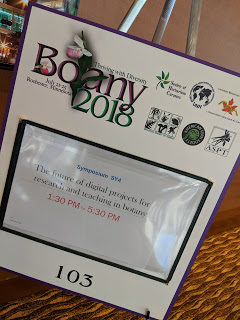
Botany 2018: The Future of Digital Projects for Research & Teaching in Botany

Botany Symposium 2018 Poster

BHL Program Director Martin Kalfatovic was invited to participate in a symposium, hosted by JSTOR Global Plants, at Botany 2018 in Rochester, MN entitled The Future of Digital Projects for Research & Teaching in Botany.

Jason Przybylski, Senior Licensing Editor / JSTOR. Symposium panelist.

The symposium addressed questions such as: what existing digital projects in botany have been successful and how did they become so; what areas of need should future projects explore; how do we define success for digital projects; how do digital projects directed at students differ from those aimed at the researcher; how can we use digital projects to reach new students and interested lay people; and how are new digital projects funded and supported for the long term.

The panel included speakers from a range of backgrounds — including both academics and librarians, as well as people working for organizations developing these digital initiatives—creating a conversation that brought together multiple viewpoints. Panelists included:

  • Jason Przybylski, Senior Licensing Editor / JSTOR
  • Deirdre Ryan, Director, Primary Sources & JSTOR Forum
  • Barbara Thiers, Director of Science, New York Botanical Garden
  • Martin Kalfatovic, Associate Director, Smithsonian Libraries and Program Director, The Biodiversity Heritage Library
  • Elspeth Haston, Deputy Herbarium Curator, Royal Botanic Garden Edinburgh
  • Adrian S. Wisnicki, Assistant Professor and Center for Digital Research in the Humanities Faculty Fellow, University of Nebraska-Lincoln & Director, Livingstone Online
  • Hilary Callahan, Ann Whitney Olin Professor of Biology, Barnard College

Symposium Abstract

Botany was early to recognize the potential impacts on the field of digitization and digital projects, from scanning herbarium specimens so scholars from around the world could easily access them to recovering lost archives to developing access to copious amounts of data on plant life and biodiversity more broadly. As digitization of physical materials has become more widespread and digital capabilities have increased, the expectations for digital projects in botany have similarly advanced. It is no longer enough to simply scan an item and make it available as a PDF on a website. Researchers and students now are looking for innovative digital projects that use the digital medium to present objects in new ways or bring together materials in ways that weren’t possible in an analog environment, all of which allows for new avenues to pursue in research and teaching. This symposium will bring together presenters working on digital projects in botany to examine the current state of the field and its future directions. The panel will include speakers from a range of backgrounds – including both academics and librarians, as well as people working for organizations developing these digital initiatives – creating a conversation that will bring together multiple viewpoints. The symposium will address questions such as: what existing projects have been successful and how did they become so; what areas of need should future projects explore; how do we define success for digital projects; how do digital projects directed at students differ from those aimed at the researcher; how can we use digital projects to reach new students and interested lay people; and how are new digital projects funded and supported for the long term. By the end of the symposium, we will aim to have identified trends in the field and areas that need further development, hopefully providing the necessary grounding for future digital developments.

The BHL presentation, “The Biodiversity Heritage Library: Empowering Discovery through Free Access to Biodiversity Knowledge” is available online.

From the abstract: The Biodiversity Heritage Library (BHL) has no bricks, no mortar, but rather stands as a vast online collection of biodiversity knowledge compiled from the collections of natural history and botanical libraries the world over. These collections–comprised of scientific journals, books, and archival collections–provide information critical to the study of life on our planet. Replete with species descriptions and occurrence data, ecosystem profiles, behavioral observations, and climatic records, these collections inform current research and provide historical information on species abundance, habitat alteration, and human exploration. In many cases, these publications are only physically available in one or two locations throughout the world.

Funding for the symposium was provided by the Botanical Society of America.

From the poster sessions:


Some flora and fauna:

Vanessa atalanta (Red Admiral)

Basidiomycota

August 7, 2018by
BHL News, Blog Reel

BHL at the Northeast Natural History Conference

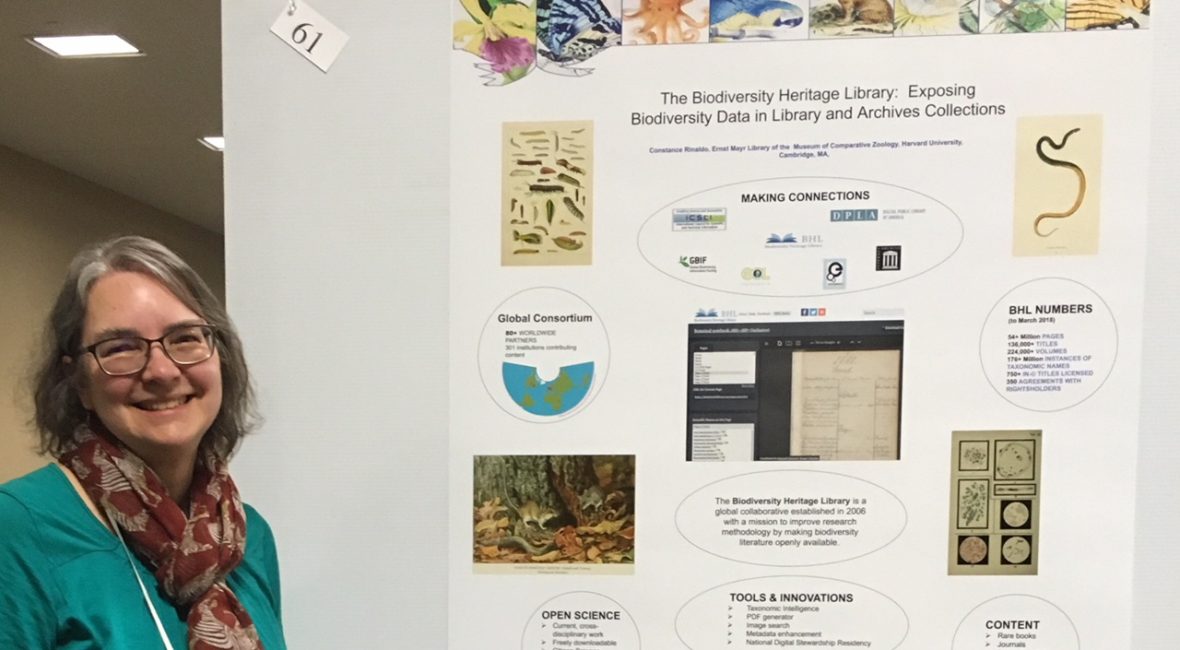
woman in green shirt standing in front of a poster.

The weekend looked promising:  a lovely clear Friday night for a drive to Burlington, Vermont, USA from southern New Hampshire to attend the Northeast Natural History Conference (13-15 April 2018).  What could be better than a hotel humming with botanists and zoologists and activities for them?  The conference was packed—five concurrent sessions (often standing room only) and around 140 posters Saturday and Sunday along with workshops (Bat houses anyone?) and demonstrations throughout the weekend.  Students, faculty and naturalists from colleges, universities and small research or rescue organizations presented posters and talks that focused on New England, New York and Eastern Canadian native vertebrates, invertebrates, plant species diversity and distribution, invasive species and wetland habitats.

woman in green shirt standing in front of a poster.

Constance Rinaldo (Librarian of the Ernst Mayr Library and Museum of Comparative Zoology Archives; Chair of the BHL Executive Committee) standing with her BHL poster at the Northeast Natural History Conference.

Some of the posters that caught my eye (beyond the BHL poster that I presented) included “Restoring Northeast Understory Species: A case of the Primary Literature” presented by Isabel A. Schmitt and Dr. James H. Graves.  They presented a literature review that led to practical methods to reintroduce native species.  Another interesting poster was the “Use of Point-and-Shoot Photography to Compare Regional Differences in Coyote (Canis latrans) Skull Size”.  Osrica Mclean et al developed an online collection of digital images of skulls and calibrated the images so that they could be measured accurately online.

I attended a talk about how specialist and generalist rodents disperse mycorrhizae (Ryan Stephens and Rebecca Rowe) along with a presentation that detailed 42 years of vegetation change on Franconia Ridge in New Hampshire by Charles Cogbill.  Dr. Cogbill used an archive of photographs (from 1860 to present) to identify the effects of hikers on the trail vegetation (much damage is done). Another conference theme was bats and how white nose syndrome has affected bats in New England.   In a talk by Meghan Lout, she described a house in Middlebury, VT from which 550 bats were seen exiting one evening.  The owners were unaware that their house was a haven for bats.

Interacting with so many enthusiastic people studying nature—from observational work to highly experimental research—was inspiring and exciting.  The BHL poster was well received.  University faculty members and naturalists from small organizations stopped by to tell me how much BHL has improved their research workflows. Many students discovered BHL at this conference and were suitably impressed.  I asked for suggestions to enhance BHL and the common theme was “more”.  More content (with some individuals offering resources) and more current materials.  New potential users were surprised that content is available for free download. A few of the more sophisticated users suggested that we needed a taxonomic name authority file so names can be plugged in and the historical names and current names could be viewed as a complete set.

Leaving was somewhat deflating—snow, sleet and freezing rain as only the north country can do it.  Miserable driving, 45 mph tops, cars off the road, 4 hours on the road instead of 3. But so worth it to be among so many people studying the natural world.

May 2, 2018by michelle.underhill
BHL News, Blog Reel

Association of Zoos and Aquariums Annual Conference 2017

Last week the Association of Zoos and Aquariums held its annual conference in Indianapolis, Indiana. The conference draws around 2,800 attendees from a diverse group of institutions and organizations around the world.  The Expanding Access to Biodiversity Literature team was able to send representation and take part in the poster presentations.

The Association of Zoos and Aquariums (AZA) was originally founded in 1924 as the American Association of Zoological Parks and Aquariums, later changing its name to the American Association of Zoological Parks and Aquariums and eventually selecting its current moniker.  The founding officers included  Chairman C. Emerson Brown from the Philadelphia Zoological Park, Vice Chairman Dr. Harry M. Wegeforth of the San Diego Zoological Society, and Secretary Will O. Doolittle.  The original directors were Edward H. Bean of the Milwaukee Zoological Park and George P. Vierheller of the Saint Louis Zoological Garden.  Chairman C. Emerson Brown’s publication “A pocket list of the mammals of eastern Massachusetts…” can even be found in BHL here.

As a non-profit the AZA is “dedicated to the advancement of zoos and aquariums in the areas of conservation, education, science, and recreation.”  The organization represents over 230 different institutions within the United States and around the world.  The AZA and their institutions have a strong commitment to animal welfare and conservation which is seen through the millions of dollars they commit to scientific research, conservation and educational programing.

Besides supporting these areas they are also an independent accrediting organization.  With some of the highest and most comprehensive standards, not even 10% of the United States’ 2,800 licensed wildlife exhibitors meet the top standards held by AZA.  Every year AZA accredited institutions allocate $160 million on field conservation around the world- over 2,600 projects worked on by specialists in the field.  The AZA itself has provided a cumulative seven million dollars on over 375 projects in conservation.  Every year 40,000 teachers are trained at AZA accredited facilities, which lend support to state science curricula.  Overall, the Association of Zoos and Aquariums’ pledge to the natural world furthers the fields of animal welfare and conservation and trains new generations to save the biodiversity.

The conference began on Friday with committee meetings and the pre-conference tour.  On Saturday and Sunday, small session meetings and workshops were held.  Sunday evening an icebreaker was held at the Indiana State Museum ahead of the conference kickoff at the Opening General Session on Monday morning.  Below learn more about a sampling of the meetings, panels, and events that were attended by EABL.

<!–

View Full Size Image
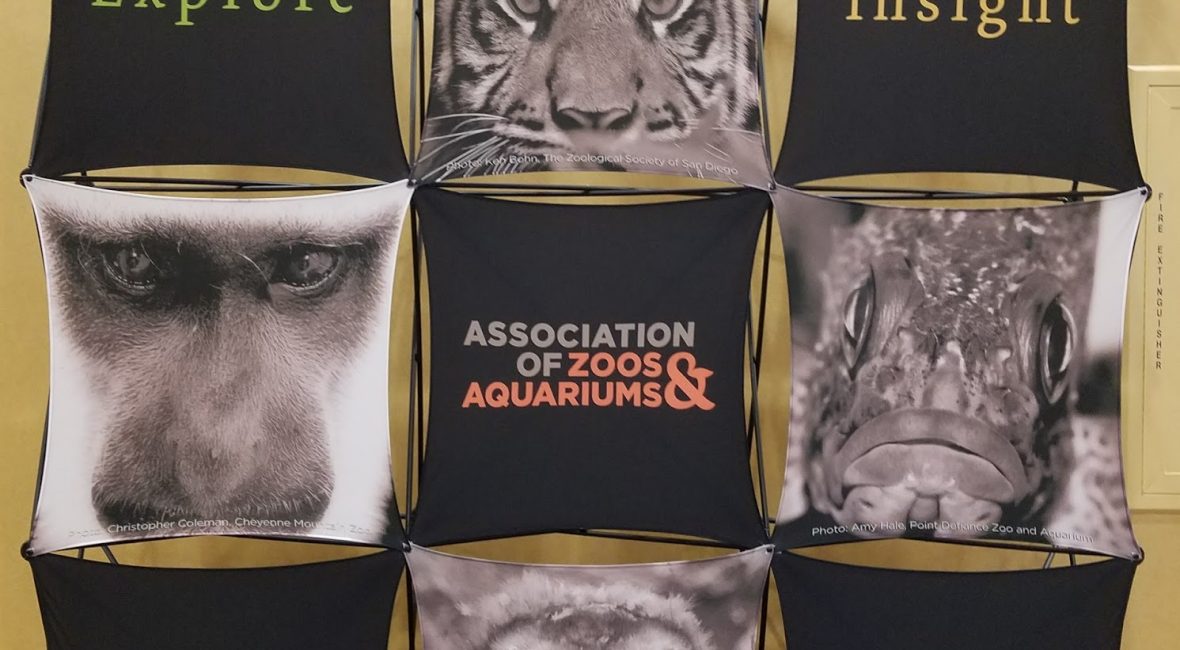
Association of Zoos & Aquariums Signage

–>

Coastal Ecosystem Learning Center (CELC) Meeting

The Coastal Ecosystem Learning Center, a network of 25 aquariums and marine science education centers located in the United States, Canada and Mexico, was originally foundedin 1996 by Coastal America.  With strong support from the National Oceanic and Atmospheric Administration, the consortium works to involve the public in protecting coastal and marine ecosystems. One of the major topics at the meeting was aquaculture- cultivating aquatic animals or plants for food.  Not to be left behind the curve, BHL already holds a number of titleson the subject. Do you have any thoughts or feelings on aquaculture?  Let us know in the comment section!

California Association of Zoos and Aquariums

The California Association of Zoos and Aquariums (CAZA) is a way to bring together all of those involved in AZA accredited zoos and aquariums in the California area.  California currently maintains more accredited zoos than any other state- twenty-three.  CAZA is dedicated to monitoring the local legislation that would affect the welfare and conservation of the natural world.

Icebreaker at the Indiana State Museum

Sunday evening the Indiana State Museum hosted a social event that allowed those in the zoo and aquarium field to catch up and enjoy Indiana history.  The museum, located along the Indiana Central Canal built in the 1800s, offered spectacular views of the city and even attracted the Indianapolis Colts’ mascot, Blue to join in the fun.

<!–

View Full Size Image
View from the Indiana State Museum of the Central Canal

–>

Opening General Session

The conference kicked off Monday morning with the opening session.  Dennis Kelly, Chair of the AZA Board of Directors and the Director of the Smithsonian’s National Zoo and Conservation Biology Institute, welcomed attendees to the annual conference and introduced Mike Crowther, President and CEO of the Indianapolis Zoo who hosted this year’s conference.  He prepared attendees for the Indianapolis Zoo Day by throwing stuffed toy macaws into the audience to preface the zoo’s Magnificent Macaw exhibit which allows the birds to fly a half mile across the zoo and back  multiple times a day.

The Opening General Session also included speeches by Dr. Carl Jones and Wayne Pacelle.  Dr. Carl Jones, winner of the 2016 Indianapolis Prize, is known around the world for his championing work in saving a number of different species that were on the brink of extinction: the pink pigeon, the echo parakeet and the Mauritius kestrel.  Dr. Jones noted that zoos have the answer to saving species and urged attendees to think of zoos as arks and be creative in animal management.  He recalled many instances where other scientists recommended saving species that were not high risk, but maintained his commitment to high-risk species.  His commitment paid off when he restored a species (the Mauritius kestrel) of four to four hundred over the course of a decade.  Dr. Jones noted “it is not hard to save a species, but it takes time” and “we should not tolerate any future extinctions.”  Through his experiences as a world-class conservationist, he challenged the idea that focusing on entire ecosystems was the only way to save a species.  Instead, he found that working with particular species saves entire systems and that it is not about preservation, but looking forward and thinking about the future.

Wayne Pacelle is the President and Chief Executive Officer of the Humane Society of the United States (HSUS.)  In the position since 2004, Pacelle has helped the HSUS grow and pursue its goal of being the largest animal care and advocacy organization in the nation.  Since the start of his tenure, Pacelle has overseen the passing of over 1,100 state animal protection laws and over 100 federal statutes.  Before Pacelle took the stage, attendees were urged to remember that diversity made us stronger and that this was even true of diverse and differing opinions.  Pacelle lauded the work AZA zoos have been doing in the areas of animal welfare and conservation and highlighted the work the HSUS is doing in animal protection.

Nature of Americans

“The Future of Wildlife Depends on the Connections we Make Today and the ‘Nature of Americans'” was one of the first panels. The speakers- Claire Martin from the Disney Conservation Fund, Dr. Daniel Escher of DJ Case & Associates, and Monica Lopez Magee of the Children and Nature Network – presented a study done between 2015 and 2016 in response to the growing amount of time spent inside and on electronic media.  The major mission of the talks was to discuss what people think about nature and how do those in the field turn that into action.

Dr. Escher, a social scientist, talked about the Nature of Americans study (available at https://natureofamericans.org.)   Some of the key findings were that people like zoos and aquariums, the vast majority of children and adults like visiting zoos and aquariums, interest in nature is high across household incomes, and interest in nature is high and stable across educational levels.  Another major takeaway was that nature is social.  Most of the interviewed returned responses that showed people were more likely to experience nature in social groups rather than alone.

Magee went over some of the examples of using the data found in the study to connect with the community.  The first was “Nature in the City.” The Tracy Aviary in Utah brought nature to the community.  They attempted to go mobile and do activities outside of their institution. However, the initial attempt was not enough.  They eventually found that collaborating with local libraries and using them as a community hub and audience was very successful.

Another example presented was at the Houston Zoo.  They had a Zoo Sprouts program that had always been indoors. In order to get more engagement with the users they just moved the program outdoors. They found that this caused the children to be more inclined to meet and touch the animals and to explore their surroundings. The idea that nature is messy and unexpected things happen within it versus technology, which can be more stagnant, were shown by both the study and the case studies to be the reason children were drawn to it.

Overall, this panel focused on explaining the study and examples of using nature in education and outreach in order to give those in the zoo and aquarium field ideas of how to use these findings in their own institutions whether in activities or even in branding.

Why Save a Species?

The “Why Save a Species” panel brought together five different international conservation projects that highlighted regional species and animal reintroductions. The presentations focused on lessons on wildlife management, human-animal interactions and public interaction, working with international colleagues and working with stakeholders to aid in saving species from extinction.

Dr. Melissa Songer gave the first presentation from the Smithsonian Conservation Biology Institute and National Zoo. It centered on restoring the Przewalksi’s horse to the wild in the Kalameili Nature Reserve located in Xinjiang, China. The Przewalksi’s horse was extinct in the wild in the 1960s with the only living animals being in Western zoos.  Within these zoos, and with careful genetic management, the population grew from 14 founders into 1,900 horses who lived in captivity.  Reintroduction efforts began, and they are no longer nearing extinction.

This particular presentation was on the reintroduction efforts in Mongolia. Because of the harsh winters, they turned the project into a semi-release of the horses. The project members reached out to the locals to see if they were interested in the project and found that the locals were worried about how the release program would affect local pastures for the cattle and therefore affect the locals’ livelihood. Dr. Songer noted that one of the challenges was balancing the goals of the different stakeholders.

Carlos Galvis of the Zoologico de Cali in Columbia presented on the Golden Poison Frog. The Wildlife Conservation Society and the Zurich Zoo provided funding to help conserve the species in Colombia.  Through this research, they found that the range of distribution of the frogs was much larger than originally thought.  They are now working to use this new distribution of the species to conduct field studies and help determine if reintroduction is necessary.

Dr. Ian Singleton, Director of Conservation of the PanEco Foundation and Sumatran Orangutan Conservation Program talked about their work in reintroducing the orangutans to their native Indonesia. Through Dr. Singleton’s work, two genetically viable and self-sustaining wild populations have been established. Their goal is to release 350 orangutans at each of their sites.  So far 170 orangutans have been released in Jambi and 99 have been released in Jantho. They have been attempting to tackle the demand for wildlife in the illegal trade through education of the locals, finding that some of those involved just needed to be told that it was detrimental to the population of the orangutans.

Dr. Amy Dickman, director of the Ruaha Carnivore Project in Tanzania, highlighted the struggle between humans and carnivores in the area.  The Barabaig people have long had a tradition of killing African lions. Dr. Dickman’s team wanted to determine why they were killing the lions and other large carnivores which would contribute to eventual extinction of species. After many failed attempts at making contact with the tribe, they found that the people had started using the solar charging station to charge their mobile phones. Eventually they were able to create an understanding and trust with the community.

She found that there were four major reasons why the carnivores were being hunted: deprecation of cattle, absence of benefit from their presence, rewards to warriors for the killing of the animals, and lack of motivation to care about the animals. To solve the first issue, they helped to build safe areas for their cattle and crops. They then started a point system that rewarded the community members for capturing images of the local wildlife.  The points could be exchanged for something they wanted- healthcare and other benefits. They also started a warrior school in order to allow people in the community to still gain notoriety.  The school provided these ‘warriors’ with educational benefits. Thanks to Dr. Dickman and her team they were able to change an entire community’s understanding of nature.

John Newby, CEO of the Sahara Conservation Fund, talked about another species who has been extinct in the wild since the 1980s- the scimitar-horned oryx. The last surviving oryx was killed inside a game reserve in Chad.  In 2008 the Sahara Conservation Fund started its project to reintroduce oryx into their natural habitat. The first fully wild calves have already been born- there are currently 90 in the wild breeding and 23 offspring.  The Fund’s goal is to have 500 breeding animals that are secure and free-ranging. Newby stressed that the zoo community played a major role in helping stop the extinction of the oryx and that the captive population was imperative for reintroducing the species.

Michael Mace, curator of birds at the San Diego Zoo Safari Park, closed out the panel.  He noted zoos and aquariums need to continue to fight for every creature.  This includes the flagship or more well-known animals as well as the lesser known species and even the unknown species that have yet to be discovered.  It is also imperative to ignite visitors- engaging and inspiring the next generation to protect wildlife. Some of the overall takeaways were that while donors may want to give a large amount of money in a short time, budgets for conservation efforts need to be able to adapt and change without being specifically allocated. Each of the presentations mentioned the local communities, and it is important to note that they cannot sustain these conservation efforts.  Therefore, it is imperative that international supporters step up.  Since these conservation efforts take time, donor fatigue happens and those involved should be prepared to get creative with providing results and finding new sponsors.

<!–

View Full Size Image
Expanding Access to Biodiversity Literature Poster

–>

Poster Reception

The Expanding Access to Biodiversity Literature poster was titled “ZooLiterature Online” and reflected the work the grant had done in the area of zoo and aquarium literature.  Since AZA was a relatively new area for BHL, a portion of the poster was general information about BHL highlighting some of the different ways content could be used and analyzed. The poster also highlighted the Expanding Access project, its goals, grant team institutions, accomplishments and zoo and aquariums contributors and titles in BHL, many added as part of EABL. The poster was well received and introduced many AZA conference attendees to BHL.

Explore the zoological titles highlighted in the EABL poster in BHL here:

  • The Aquarium Bulletin (Digitized by Smithsonian Libraries)
  • Animal Keeper’s Forum (Digitized by Smithsonian Libraries with permission from American Association of Zoo Keepers)
  • Bulletins of the Zoological Society of San Diego (Contributed by San Diego Zoo Global Library & Archives)
  • Journal of the American Veterinary Medical Association (pre-1923) (Digitized by University of Toronto Libraries)
  • Journal of Zoo and Aquarium Research (Contributed by European Association of Zoos and Aquaria)
  • Lives of Eminent Zoologists, from Aristotle to Linnaeus (Digitized by Smithsonian Libraries)
  • Zoological Bibliography (Contributed by Aves Press Limited)
  • Zoological Record (Digitized by Smithsonian Libraries and the USDA National Agricultural Library)
  • Zoologica (Digitized by MBLWHOI Library)
  • Zoological Science (Digitized by Library of Congress)

Communities Come Together Over Gardens: Using Horticulture to Connect with Our Neighbors

The focus of most of the AZA panels was, logically, zoos and aquariums.  However, one of the final panel options centered around botanical gardens in zoos. The panel began with a look back at horticulture in zoos. Fifty years ago, it involved trimming hedges around the property. Forty years ago, zoos moved towards hiring horticulturists to create convincing habitats. Moving to thirty years ago, some zoos started becoming botanical gardens as well. It was just twenty years ago that zoos and aquariums became more interested in plant conservation as an added component to their missions.

Presenting at the panel was Steve Foltz, Director of Horticulture at the Cincinatti Zoo and Botanical Garden; Paul Bouseman, Botanical Curator at the Mesker Park Zoo and Botanic Garden; Bob Chabot, former Director of Horticulture at the Jacksonville Zoo and Gardens and current Chief of Staff at Zoo New England; and Christine Nye, Horticultural Programs Manager at the John G. Shedd Aquarium.

Each presenter highlighted the work their zoos and aquariums did both within their institution and in their community in the area of horticulture. The Cincinnati Zoo worked to build bridges in their community by planting trees in areas of the town that were affected by tornadoes or in communities in need of transformation. They worked with master gardeners, Proctor and Gamble, and the Cincinnati Reds to help renew the community and change the way the community looks at the zoo.

The Shedd Aquarium uses the spaces around its exhibit as a free public garden space and created volunteer and education programs around it.

The Mesker Park Zoo and Botanic Garden uses horticulture to attract people with the power of plants. Mesker’s local community comes in and volunteers and they gain a better connection with the zoo.

The Jacksonville Zoo and Garden partnered with a number of different local organizations and even a high school. Chabot and the zoo worked to create gardens in a number of locations and used the local arts high school- Douglas Anderson School of the Arts- to record sounds for the Butterfly Hollow exhibit.

<!–

View Full Size Image
Indianapolis Zoo Garden

–>

Zoo Day at the Indianapolis Zoo

The final event of the AZA Annual Conference was Zoo Day.  The day included full access to the rides and attractions- including the carousel, train ride, skyline, 4D theatre, Kombo Family Coaster, and Race-A-Cheetah. They also set up a number of different chats, demos, feedings and presentations throughout the afternoon and evening.  Between the hosted lunch, happy hour, dinner, and dancing AZA attendees were able to take advantage of a number of different Behind-the-Scenes Open-Houses that allowed those from other zoos and aquariums to get a better understanding of the operations and animal care at the Indianapolis Zoo.

Also attended were Public Perceptions of Zoos and Aquariums in a Changing World, Classic Continuing Conservation, What’s New in Exhibit Design?, and Cognitive Tasks for Great Apes: Promoting Conservation, Research, Education and Animal Wellness.

Moving forward, the Expanding Access team and the Biodiversity Heritage Library hope to maintain our current relationships with Zoo and Aquarium institutions and publishers.

Are you part of a zoo or aquarium and interested in what you can do to get involved? Here’s some tips on what you can do!

  1. Use BHL!
  2. Consider adding your publications to BHL.
  3. If you have legacy literature you want scanned from your library or archive, email us!
  4. Suggest titles you would like to see in BHL and we will do our best to include them.

For any of these suggestions please email use our Feedback form here.  You can also check out our poster presentation in PDF format here.

September 21, 2017by aneeser
BHL News, Blog Reel

BHL at XXI AETFAT 2017 in Nairobi, Kenya

Last month, the BHL Program Director Martin R. Kalfatovic and Program Manager Carolyn A. Sheffield participated in multiple events throughout different regions of Kenya to help promote BHL to existing and potentially new users, connect with our BHL Africa partners, and explore opportunities for growing partnerships in the region.  We will be highlighting each event with its own blog post throughout the week, starting with the first stop in Nairobi, Kenya.

From 15-19 May 2017, the National Museums of Kenya and the Catholic University of East Africa (CUEA) co-hosted the XXI AETFAT (Association for the Study of Tropical Flora of Africa) Congress. Held on the beautiful campus of CUEA, the Congress brought together approximately 250 individuals from around the world to meet and discuss research on various aspects of the botany of tropical Africa.  BHL participated with a symposium Botanical Contributions from the Biodiversity Heritage Library: A Focus on Africa, which focused on digital library resources related to the conference topics.

View Full Size Image
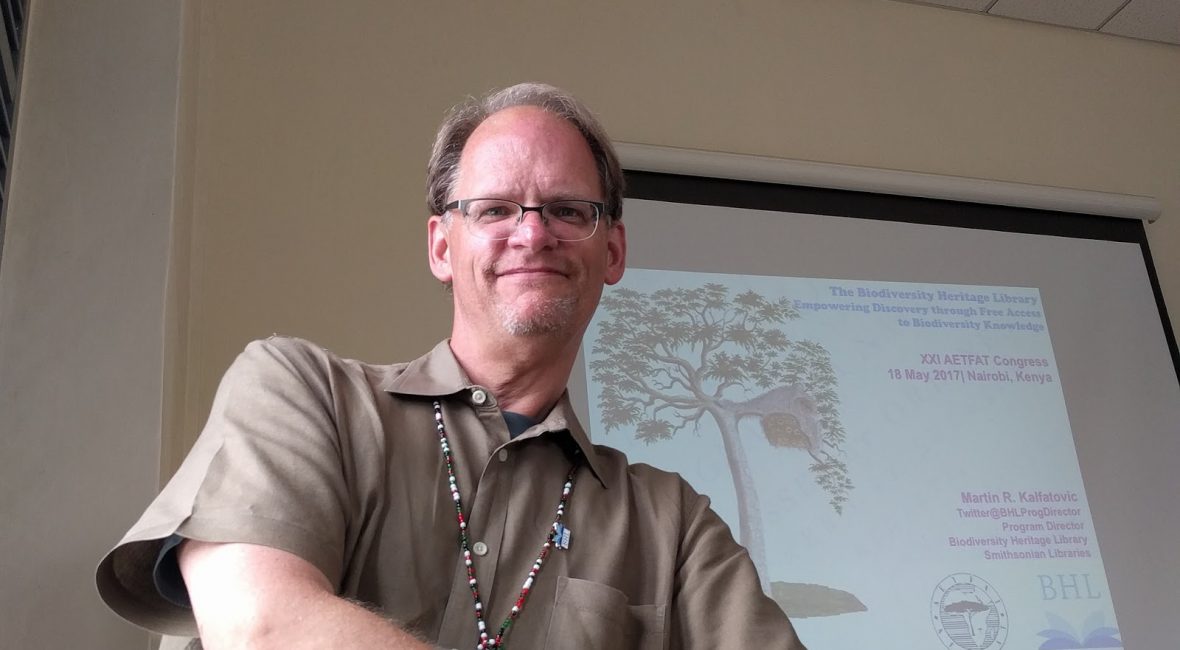
Martin R. Kalfatovic at the podium for the BHL symposium

 at XXI AETFAT 2017

The symposium was led by BHL Program Director, Martin R. Kalfatovic and also included presentations from BHL Program Manager, Carolyn Sheffield and Director of JSTOR Primary Sources, Deirdre Ryan. 

Kalfatovic opened the session with an introduction to BHL, entitled Biodiversity Heritage Library: Empowering Discovery Through Free Access to Biodiversity Knowledge. Kalfatovic also delivered a presentation on behalf of Grace Costantino entitled The Story of Engagement: Outreach Strategies at the Biodiversity Heritage Library.  
In Building the Biodiversity Heritage Library Through Standards and Content, Sheffield reported on strategies and results from BHL Workshops, highlighting involvement and new contributions from BHL Africa partners.  

Ryan delivered an overview of JSTOR entitled “Journals, AETFAT, African Plants, and more…,” covering the scope and breadth of JSTOR collections, including 2,600 journal titles which are made freely available to all non-profit and educational institutions in Africa through the African Access Initiative.  Additionally, she highlighted results of the African Plants Initiative that grew into the Global Plants Initiative and has brought digitized herbarium sheets into the JSTOR collection, many of which link to BHL!  She also identified the AETFAT Congress as a historically significant event for JSTOR, where some of the founding ideas first germinated.  Kalfatovic then concluded the session and opened it up for questions.  

View Full Size Image
Carolyn Sheffield and Ben Nakitare at the NMK booth

      at the XXI AETFAT 2017 exhibits

Approximately 20 people were in attendance at the session and discussions were fruitful, focusing on both BHL work to date and potential future opportunities. 

In addition to the symposium, the conference provided several other opportunities for productive discussions with both BHL users and also with several BHL Africa partners.  It was especially lovely to catch up with some of our colleagues from National Museums of Kenya who hosted and participated in the BHL Africa Workshop in 2015, including Dr. Geoffrey Mwachala, Dr. Asha Owano, Lawrence Monda, and Ben Nakitare. We are thrilled with their ongoing commitment to participate in BHL, and we look forward to continued collaborations with our partners at National Museums of Kenya and all of our BHL Africa partner institutions!  

June 5, 2017by sayeedmd
BHL News, Blog Reel

Expanding Access and MiBio team members present at the annual Council on Botanical and Horticultural Libraries Meeting

The Council on Botanical and Horticultural Libraries hosted its 48th Annual Meeting in Cleveland, Ohio May 24-28th, 2016.  With perfect weather and a packed schedule, members were kept busy experiencing a number of different museums, attending meetings and hosting member presentations and speakers.  Tours of the Cleveland Botanical Garden, West Side Market, Great Lakes Science Center, Rock and Roll Hall of Fame and Museum, Dittrick Museum of Medical History, Cleveland Museum of Art, Cleveland Museum of Natural History, Herb Society of America, and the Holden Arboretum allowed attendees to gain a well-rounded sense of Cleveland’s landscape.
View Full Size Image
Photo credit: Jennifer McDowell


The Council on Botanical and Horticultural Libraries (CBHL) is made up of organizations, institutions and individuals from around the world.  It was created to initiate and facilitate communication between those focused on libraries and botanical and horticultural literature and dates back to November 13, 1969 when the first conference convened in Boston, Massachusetts.  It was more formally founded the following year at the Second Conference.  Members of CBHL include the Denver Botanical Gardens Helen Fowler Library, Michigan State University Libraries, the Morton Arboretum and many others.  Some BHL affiliates and partners are also a part of CBHL including the Missouri Botanical Garden, the New York Botanical Garden, and the California Academy of Sciences Library.
One of the member presentations was titled “Towards better accessibility to biodiversity knowledge: The Biodiversity Heritage Library as a platform for content sharing and discovery” and included two different presentations on two BHL projects.  The first was the Expanding Access to Biodiversity (EABL) team members: Mariah Lewis and Patrick Randall.  This presentation, which is now available online, covered topics such as timeline, funding, scope, copyright, digitization, metadata, curation, and the benefits of participation. 
Following this was William Ulate who presented on Mining Biodiversity (MiBio).  While Expanding Access aims to bring more content into BHL, Mining Biodiversity is dedicated to transforming BHL into a next-generation social digital library resource that not only gives access to users, but also facilitates study and discussion of legacy scientific documents.  This international collaboration is a project rooted in helping users locate information within BHL easily and efficiently while fostering collaboration.  The presentation can be viewed here.  Members were also able to access and test the search interfaceand leave valuable feedback for the project. 
View Full Size Image
William Ulate, Patrick Randall, and Mariah Lewis present at CBHL
Photo Credit: Bill Musser

The two presentations were met with an extremely positive response from attendees and facilitated wonderful conversations about the Biodiversity Heritage Library, Expanding Access to Biodiversity Literature, and Mining Biodiversity.  Expanding Access was able to talk with a number of future contributors about the project and are looking forward to working with them to add their content into BHL!

Special thanks to our spectacular hosts: The Cleveland Botanical Garden and The Holden Arboretum and CBHL for allowing us to present!
View Full Size Image
It’s the Canopy Walk at the Holden Arboretum! 
Photo credit: Mariah Lewis

Want more information on the Expanding Access project?  Interested in being one of our contributors?  Please email Patrick Randall at [email protected]for more information!  An Expanding Access team member will be present at ALA’s Annual Conference.  If you would like to talk about the project in-person in Orlando next week please email Mariah Lewis at [email protected].  

June 16, 2016by aneeser
BHL News, Blog Reel

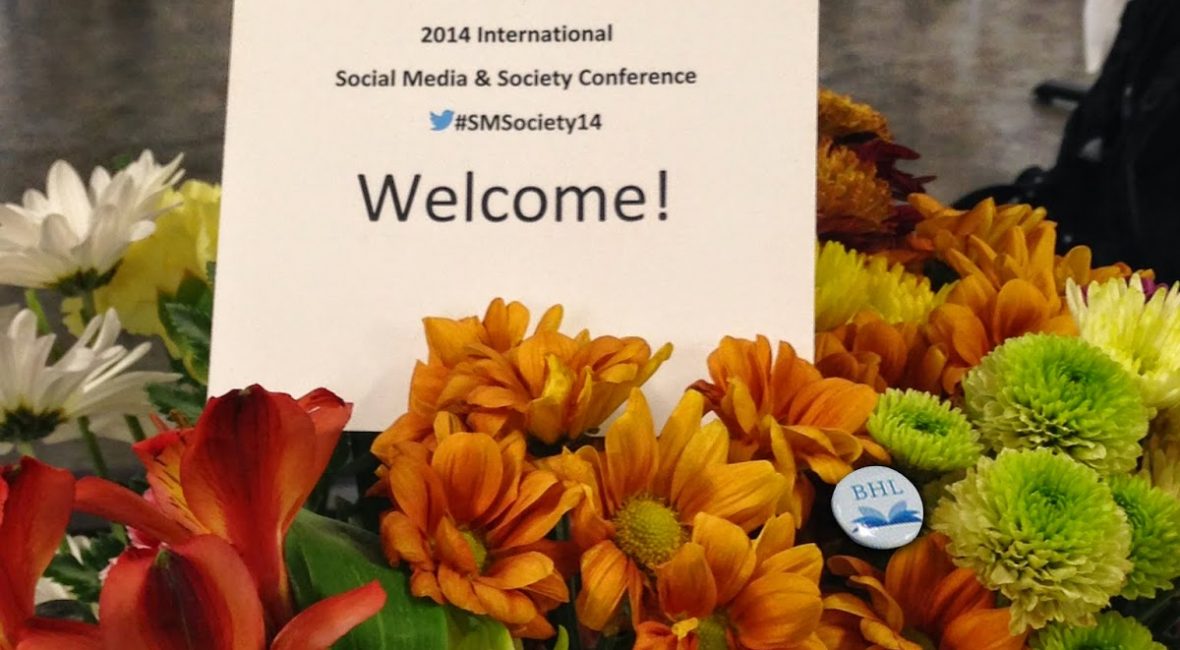
Some Reflections on Social Media and Society

What are the impact and implications of social media on society?

View Full Size Image

This question was the fundamental discussion point of the Social Media and Society 2014 conference in Toronto, Canada, Sept. 27-28, 2014. Now in its fifth year, the conference, organized by the Social Media Lab at Ryerson University (a partner in the Mining Biodiversity project funded by the IMLS Digging Into Data Challenge, of which BHL is also a participant), brings together researchers and practitioners across a broad range of social media related fields to discuss current research and best practices in social media, as well as its application to society at large.

BHL Outreach and Communication Manager, Grace Costantino, was invited to attend the conference. As the manager of BHL’s social media networks (Twitter, Facebook, blog, Flickr, Pinterest), she was eager to connect with other professionals, discover current trends, and investigate best practices and new directions for BHL social media.

The conference discussed a variety of topics, including social media’s effect on relationships and voice; differences among genders in social media participation; privacy; deciphering influence within social media; social media as a marketing platform; use of social media within science communication; how scholars use social networks; and altmetrics.

Several interesting findings and further questions emerged within these topics.

View Full Size Image
From Keith Hampton’s talk. Social Media and cloud computing are as revolutionary (and for some scary) as electricity was in the past.

Keith Hampton, keynote speaker for day one, related his research regarding social media’s effect on relationships, voice, and gender. Common lore asserts that extensive adoption of social media results in increased alienation and more fleeting relationships within society. Conversely, Hampton’s research found that social media results in more persistent relationships and an increased awareness of the activities of one’s social ties through digital technology.

Along another avenue of research involving social media and politics, Hampton found that social media does not make people more inclined to engage in political conversations online. While 86% of surveyed participants expressed a willingness to discuss a political topic offline, only 42% were willing to share their opinions online, and only .3% said they were willing to discuss them online but not offline. The reason for this may be the persistent nature of social media; once an opinion is voiced, it is very difficult to erase it. People were also more willing to share when they believed that their network of followers were sympathetic to their viewpoints.

Finally, in regards to stress and social media, Hampton found that women who use social media felt less psychological stress but more social stress, while men generally did not display any correlation between social media use and stress (though they may feel some social stress when hearing about a friend’s demotion or interaction with a crime).

One panel within the conference presented research investigating the facets of influence within social media, and how to identify influential users. The general definition of influence in this context was those individuals most likely to disperse information within a network. Elizabeth Dubois of the Oxford Internet Institute proposed four facets of influence (popularity, interaction, knowledge, and social embeddedness), and depending on the facet used, different influencers emerged. Weiai Xu of the University of Buffalo found that opinion leaders on Twitter are generally those most connected and involved. K. Hazel Kwon of Arizona State University also found that people were more likely to share or engage with a topic or event that many of their friends also followed, suggesting that anonymity (once touted as a benefit of online interactions) is detrimental to increasing awareness via social media.

View Full Size Image

The discussion on privacy and social media raised many good questions for researchers and practitioners. How much privacy should users expect on social media, particularly in regards to their public tweets being retweeted or shared via media outlets? This discussion was largely centered around the @SteenFox “What Were you Wearing” debate. Twitter is a public platform, but the speakers noted that a full awareness of the “public” nature of public tweets was sometimes lacking among users. The thought-provoking question of “are hashtags the antithesis to an expectation of privacy,” given that by their use you join a very public, sometimes global conversation outside of your own network, was raised by Siobhan O’Flynn from the University of Toronto. The main take-away from the panel was that more education is needed regarding what privacy means in social media.

Interesting particularly for BHL were the discussions regarding the role of Twitter in science topics and scholars’ use of social media. Moritz David Buchi of the University of Zurich presented on “How does the representation of science topics differ between news and tweets?” He found that, in general, news outlets were more objective while tweets were more dramatic. Science tweets are also largely not intended to be self-contained, but instead linked to larger news articles. These tweets also operated mostly on a broadcasting model, involving little dialogue. Retweets were most prominent, producing a diffusion of knowledge effect.

Two separate panels discussed scholars’ use of social media. Anabel Quan-Haase, Kim Martin, and Lori Mccay-Peet cited Gruzd and Goertzen’s paper “Wired Academia: Why Social Science Scholars are Using Social Media,” which outlines three main motives for social media use among scholars: information gathering; collaboration; and socializing and information dissemination. Bonnie Stewart found that scholars participated in social media to voice an opinion and contribute to a discussion, though traditional “power factors” like institutional affiliation affected how well these voices were heard. George Veletsianos of Royal Roads University found that while scholars use social media for knowledge creation (like crowdsourcing) and dissemination, they still struggle with issues of copyright restrictions; negotiating personal and professional boundaries; and a lack of frameworks in academia to evaluate the legitimacy of networked activities, which results in pressure to engage in traditional outreach and dissemination activities. Related to this was a presentation by Heidi Julien from the University of Buffalo, which discussed the use of almetrics (alternatives to the traditional journal impact factor and personal citation indices) to inform tenure decisions. Her experience shows that institutions are still a long way from incorporating altmetrics into these decisions.

View Full Size Image
Richard Naples of Smithsonian Libraries, with his poster.

BHL partner Smithsonian Libraries also presented a poster at the conference entitled “The GIF That Keeps on Giving,” by Richard Naples. The poster presents the library’s use of animated GIFs in Tumblr, and the increased exposure and reach that this “culture remix” enables. Many of the GIFs are from books digitized for BHL.

Overall, the conference was an excellent learning and engagement opportunity, with many applications for BHL. Ms. Costantino developed a better understanding of the types of posts users are more likely to engage with; how better to craft social media campaigns around storytelling to excite curiosity; why scholars (one of BHL’s core audiences) are using social media and what they hope to find via these outlets; how to better understand, track, and engage with BHL’s online community; and how to help contribute to the case for altmetrics.

View Full Size Image

The BHL Outreach and Communication Manager position, and this conference attendance, are made possible in part through funding from the Institute of Museum and Library Services (Grant number LG-00-14-0032-14).

September 30, 2014by ulib-libraryjobs
BHL News, Blog Reel

Things a Librarian Can Learn at TDWG

View Full Size ImageI was privileged to attend and present at the Biodiversity Information Standards (TDWG) meeting (see posts on Nov 11: https://blog.biodiversitylibrary.org/2013/11/global-bhl-partners-present-symposium.html, Nov 26: https://blog.biodiversitylibrary.org/2013/11/the-tdwg-2013-annual-conference-my.html and Nov. 29: https://blog.biodiversitylibrary.org/2013/11/quello-che-era-nuovo-in-tdwg-2013.html).   The theme for 2013 was “Virtual Communities for Biodiversity Science”, an apt theme for the global virtual Biodiversity Heritage Library.  The venue was beautiful Florence, Italy and the weather was warm.  TDWG is a long and information-packed meeting that incorporates many topics of interest to the Biodiversity Heritage Library and librarians.  Metadata, vocabularies for taxonomy, interoperability and linked open data are common themes at TDWG  to which librarians, particularly those engaged in biological information,  can relate.  I particularly enjoyed the poster sessions.  There were 31 posters and I will highlight a few in this post.

View Full Size ImageBHL partners such as ViBRANT (http://vbrant.eu/), OpenUp (http://open-up.eu/), BioStor http://biostor.org/), and Zookeys (http://www.pensoft.net/
journals/zookeys/) and others were represented at TDWG ensuring lively discussions.  The poster “Bibliography of Life: Comprehensive services for biodiversity bibliographic references” addressed de-duplicating and parsing the components of references from a variety of sources to improve and expand literature searching.  Other posters highlighted object digitization and the TDWG Audubon Core metadata standard.  The Naturalis Biodiversity Center reviewed their work digitizing collection objects, including videos, using the Audubon Core standard for metadata.  Another poster from Belgian institutions, Agora 3D Evaluating the Digitisation of Scientific Collections, reviewed scanning technology and techniques for biological specimens to develop a set of standards and protocols for museums.  Other posters highlighted taxonomic information such as “From Dendroeca blackburniae to Dendrceca blackburniae:  what’s in a name” citing the need for clean, correct scientific names to support names-based architecture and “ComTax: Community-driven Curation for Taxonomic Databases”, a project designed to support manual  correction and verification of name data. The TDWG meeting has much to offer archivists and librarians looking for the biological perspective on metadata and curation.

December 6, 2013by Kathryn Stine
Page 1 of 212»

Help Support BHL

BHL's existence depends on the financial support of its patrons. Help us keep this free resource alive!

search

About BHL

The Biodiversity Heritage Library (BHL) is the world’s largest open access digital library for biodiversity literature and archives. BHL operates as a worldwide consortium of natural history, botanical, research, and national libraries working together to digitize the natural history literature held in their collections and make it freely available for open access as part of a global “biodiversity community.”

Join Our Mailing List

Sign up to receive the latest news, content highlights, and promotions.

Subscribe Now

Subscribe to Blog via Email

Enter your email address to subscribe to this blog and receive notifications of new posts by email.

Join 319 other subscribers

Subscribe to Blog Via RSS

Subscribe to the blog RSS feed to stay up-to-date on all the latest BHL posts.

Access RSS Feed

Inspiring Discovery through Free Access to Biodiversity Knowledge.

The Biodiversity Heritage Library makes it easier than ever for you to access the information you need to study and explore life on Earth…for free, anytime, anywhere.


64+ Million Pages of
Biodiversity Literature Online.

EXPLORE

Tools and Services
to Transform Research.

EXPLORE

300,000+
Illustrations on Flickr.

EXPLORE

ABOUT | HARMFUL CONTENT | PRIVACY | SITE MAP | TERMS OF USE