Biodiversity Heritage Library - Program news and collection highlights from BHL
  • Home
  • News
  • Featured Books
    • All Featured Books
    • Book of the Month Series
    • BHL at 20
  • User Stories
  • Campaigns
    • Fossil Stories
    • Garden Stories
    • Monsters Are Real
    • Page Frights
    • Her Natural History
    • Earth Optimism 2020
  • Tech Blog
  • Visit BHL
Home
News
Featured Books
    All Featured Books
    Book of the Month Series
    BHL at 20
User Stories
Campaigns
    Fossil Stories
    Garden Stories
    Monsters Are Real
    Page Frights
    Her Natural History
    Earth Optimism 2020
Tech Blog
Visit BHL
  • Home
  • News
  • Featured Books
    • All Featured Books
    • Book of the Month Series
    • BHL at 20
  • User Stories
  • Campaigns
    • Fossil Stories
    • Garden Stories
    • Monsters Are Real
    • Page Frights
    • Her Natural History
    • Earth Optimism 2020
  • Tech Blog
  • Visit BHL
Biodiversity Heritage Library - Program news and collection highlights from BHL
Blog Reel, Featured Books

Book of the Week: So You Saw Jaws and You Think You Know Sharks?

View Full Size Image
You would be hard-pressed to find someone today who has not seen the legendary Jaws movie. The movie defined a generation and solidified sharks as one of the most gruesome and dangerous killers on the planet. But such misconceptions are an injustice to this diverse, and often harmless, order of fish, some of which reach a mature length shorter than that of an average housecat.


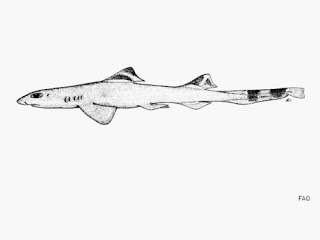
Case in point: Meet Eridacnis radcliffei, also known by the common name of the Pygmy Ribbontail Cat Shark, which, at 19-24 centimeters, is one of the smallest sharks in the world. Eridacnis radcliffei is a member of the Carcharhiniformes order, “typical” sharks characterized by “long mouths, two dorsal fins without spines, an anal fin, and the eyes over the mouth.” These sharks differ from sharks in other orders “in having movable lower eyelids.”


Occuring around continental and insular shelves, the Pygmy Ribbontail Cat Shark is found in the western Indo-Pacific from Tanzania to the Philippines. Its diet consists mostly of bony fishes, crustaceans and squid. This species is of minimal importance to the fishing industry, being sometimes caught in bottom trawls off the coast of the Philippines but not typically sold in the industry. They are currently listed as “Least Concern” by the IUCN.


This week’s book of the week, v. 24, n. 4 (1981) of Oceanus, contains a very interesting article by Leonard J. V. Compagno, entitled “Legend versus Reality: The Jaws Image and Shark Diversity.” In it, he tackles the widely-accepted conception that all sharks are behemoths that can be “typified by large and powerful species.” Such impressions have been encouraged by the advent of films such as Jaws and Deep Blue Sea, which represent sharks as monstrous goliaths capable of, should they so choose, swallowing humans whole.


Within this article, Compagno takes an objective look at the superorder of Selachimorpha – sharks – finding that, in the 296 shark species that he studied, only about 4% were more than 4 meters long. And our friend, the Pygmy Ribbontail Cat Shark, gets its moment in the spotlight on pages 15–16, were it is highlighted as one of the smallest shark species in the world.


Take a few moments to flip through Compagno’s article, possibly re-evaluating your conception of the shark as a giant killer to the beautifully diverse range of aquatic species that it is. And to learn even more about our highlighted species, the Pygmy Ribbontail Cat Shark, explore its page on the Encylopedia of Life.


This week’s book of the week, v. 24, no. 4 (1981) of Oceanus, was contributed by the MBL WHOI library.
January 6, 2011by ulib-libraryjobs
Blog Reel

Good Neighbors: Modern Ecology

View Full Size ImageThe modern ecological movement* can be traced back to the 1970 observance of Earth Day. Now a global celebration, the first Earth Day was conceived by a United States Senator from Wisconsin and called for nationally coordinated educational programming to raise consciousness about increasing environmental degradation. Forty years later, “Earth Day is everyday” and the UN has named 2010 the International Year of Biodiversity in an effort that mirrors Sen. Gaylord Nelson’s hopeful vision.

But there are distinctions between earlier environmental campaigns and current thinking; it’s no longer sufficient to organize efforts around the “wilderness” or far-away habitats of endangered species. The flora and fauna of your back-yard could be just as susceptible to extinction as the inhabitants of the rain forests. And unless you live under the sea, saving the whales might not be your first priority. Popularized by Michael Rosenzweig, a University of Arizona ecologist, reconciliation ecology acknowledges that “nothing influences species’ diversities more than the amount of area available to life.” And as cities continue to grow, area available to local species becomes increasingly sought-after, a veritable arena for biological competition. Traditional wisdom tells us winners and losers are functions of competition. Period. Conversely, reconciliation ecology accepts the reality of competition for finite space while insisting a win-win outcome is still possible–provided we adjust human activities in accordance with local species’ requirements for survival.

Click here for more information about reconciliation ecology and here for a look at BHL content about species in your neighborhood.

*oh, and of course, we should remember the galvanizing effect of Rachel Carson’s Silent Spring.
Image credit: [email protected]

August 3, 2010by jwinberry
Blog Reel, Featured Books

Book of the Week: Species Highlight – The Eastern Painted Turtle

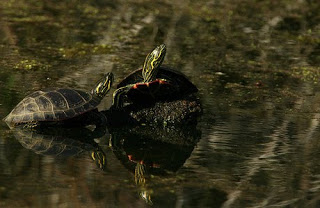
View Full Size ImageImagine that you are strolling through the forest on a fine summer morning. The birds are chirping merrily above your head, and an occasional squirrel scurries across the path in front of you. Suddenly, you reach a clearing, in the midst of which is a large pond. As you take a moment to look around, you suddenly notice a log floating carelessly through the water. Except, this is no ordinary log! Indeed, it appears to be moving! On closer inspection, you realize that this is not just a log, but a log covered with as many as 50 painted turtles, all basking in the warm summer sun. While you may never have experienced this yourself, this is indeed a sight which you might see should you find yourself around freshwater anywhere in North America from Southern Canada to northern Mexico. It is the sight of Chrysemys picta, also known as the Eastern Painted Turtle – the most common turtle in North America and one of the featured species this week on EOL.

Chrysemys picta is brightly marked, with a “relatively flat upper shell with red and yellow markings on a black or greenish brown background.” Capable of living several decades, they “prefer living in freshwater that is quiet, shallow, and has a thick layer of mud.” While relatively common and abundant, some populations are “threatened by the destruction of their habitat,” and “in Canada, painted turtles have been placed on the federal blue list, which identifies animals considered vulnerable to human activities or natural events, but not immediately threatened.”

Chrysemys picta is very descriptively discussed in this week’s book of the week, Amphibia and reptiles (1901), by Hans Gadow. As of 1901, the Eastern Painted Turtle was “one of the few species of which, thanks to L. Agassiz, complete data of growth from the new born to the old age are known.” Here, Gadow refers to L. Agassiz’s work Contributions to the Natural History of the United States of America, volume 1 (1857), which articulates the growth of this species over time.

Take a moment to peruse Gadow’s description of this turtle, as well as many other amphibians and reptiles, in Amphibia and reptiles. And remember, if you’re ever out strolling through the forest and come across a pond with a “moving log,” be sure to take a closer look, for it might just prove to be a hoard of Eastern Painted Turtles basking in the sun.

June 3, 2010by michelle.underhill

Help Support BHL

BHL's existence depends on the financial support of its patrons. Help us keep this free resource alive!

search

About BHL

The Biodiversity Heritage Library (BHL) is the world’s largest open access digital library for biodiversity literature and archives. BHL operates as a worldwide consortium of natural history, botanical, research, and national libraries working together to digitize the natural history literature held in their collections and make it freely available for open access as part of a global “biodiversity community.”

Follow BHL

  • Bluesky logo
  • Instagram logo
  • Facebook logo
  • Flickr logo
  • Twitter logo

Join Our Mailing List

Sign up to receive the latest news, content highlights, and promotions.

Subscribe Now

Subscribe to Blog via Email

Enter your email address to subscribe to this blog and receive notifications of new posts by email.

Join 319 other subscribers

Subscribe to Blog Via RSS

Subscribe to the blog RSS feed to stay up-to-date on all the latest BHL posts.

Access RSS Feed


64+ Million Pages of
Biodiversity Literature Online.

EXPLORE

Tools and Services
to Transform Research.

EXPLORE

300,000+
Illustrations on Flickr.

EXPLORE

ABOUT | HARMFUL CONTENT | PRIVACY | SITE MAP | TERMS OF USE