Biodiversity Heritage Library - Program news and collection highlights from BHL
  • Home
  • News
  • Featured Books
    • All Featured Books
    • Book of the Month Series
    • BHL at 20
  • User Stories
  • Campaigns
    • Fossil Stories
    • Garden Stories
    • Monsters Are Real
    • Page Frights
    • Her Natural History
    • Earth Optimism 2020
  • Tech Blog
  • Visit BHL
Home
News
Featured Books
    All Featured Books
    Book of the Month Series
    BHL at 20
User Stories
Campaigns
    Fossil Stories
    Garden Stories
    Monsters Are Real
    Page Frights
    Her Natural History
    Earth Optimism 2020
Tech Blog
Visit BHL
  • Home
  • News
  • Featured Books
    • All Featured Books
    • Book of the Month Series
    • BHL at 20
  • User Stories
  • Campaigns
    • Fossil Stories
    • Garden Stories
    • Monsters Are Real
    • Page Frights
    • Her Natural History
    • Earth Optimism 2020
  • Tech Blog
  • Visit BHL
Biodiversity Heritage Library - Program news and collection highlights from BHL
Blog Reel, Campaigns, Featured Books, Fossil Stories

A Sinner Killed During the Great Flood or a Fossil Reptile? Discovering the Plesiosaur

Most people today are at least somewhat familiar with the order of extinct marine reptiles known as Plesiosauria, thanks to the legend of the Loch Ness monster, which is often described as resembling a plesiosaur. Indeed, some argue that Nessie may in fact be a surviving member of this order. Scientists, however, reject this suggestion, if for no other reason that the Loch Ness lake formed a mere 10,000 years ago, while the fossil record indicates that plesiosaurs went extinct over 66 million years ago. And yet, even if plesiosaurs can’t account for the Loch Ness legend, the story of their discovery is still captivating.

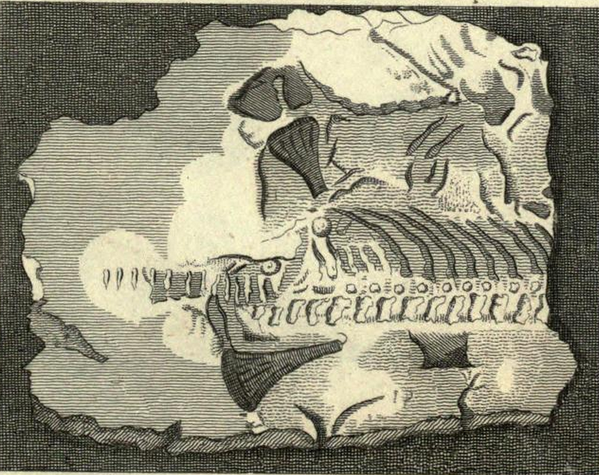
Plesiosaurs are among the first extinct fossil reptiles to be recognized as such. Plesiosaur fossils were described as early as 1605, though in the seventeenth century they were not recognized as extinct reptiles. In 1719, Anglican clergyman William Stukeley, who pioneered archaeological studies at Stonehenge and Avebury, described a partial plesiosaur skeleton that had been brought to his attention by Robert Darwin of Elston, Charles Darwin’s great-grandfather. The skeleton had been found at a quarry at Fulbeck, England. It had been used to reinforce the slope of a watering-hole until the fossils were discovered within it, after which it was displayed in the local vicarage as the remains of a sinner killed during the Biblical flood. Stukeley’s description in “An Account of the Skeleton of a Large Animal Impressed on Stone,” which describes the fossils as belonging to a sea creature such as a crocodile or porpoise, is the first published description of an articulated fossil reptile skeleton.

View Full Size Image
Stukeley’s plesiosaur. Original Publication: Philosophical Transactions of the Royal Society of London. 1719. Reprint, 1809: http://biodiversitylibrary.org/page/23269260. Digitized by University of California Libraries.

Further descriptions of plesiosaurs through the early nineteenth century were still based on incomplete specimens. In 1821, William Conybeare and Henry Thomas De la Beche gave the genus its name, Plesiosaurus, when they described a partial skeleton from the collection of Colonel Thomas James Birch.

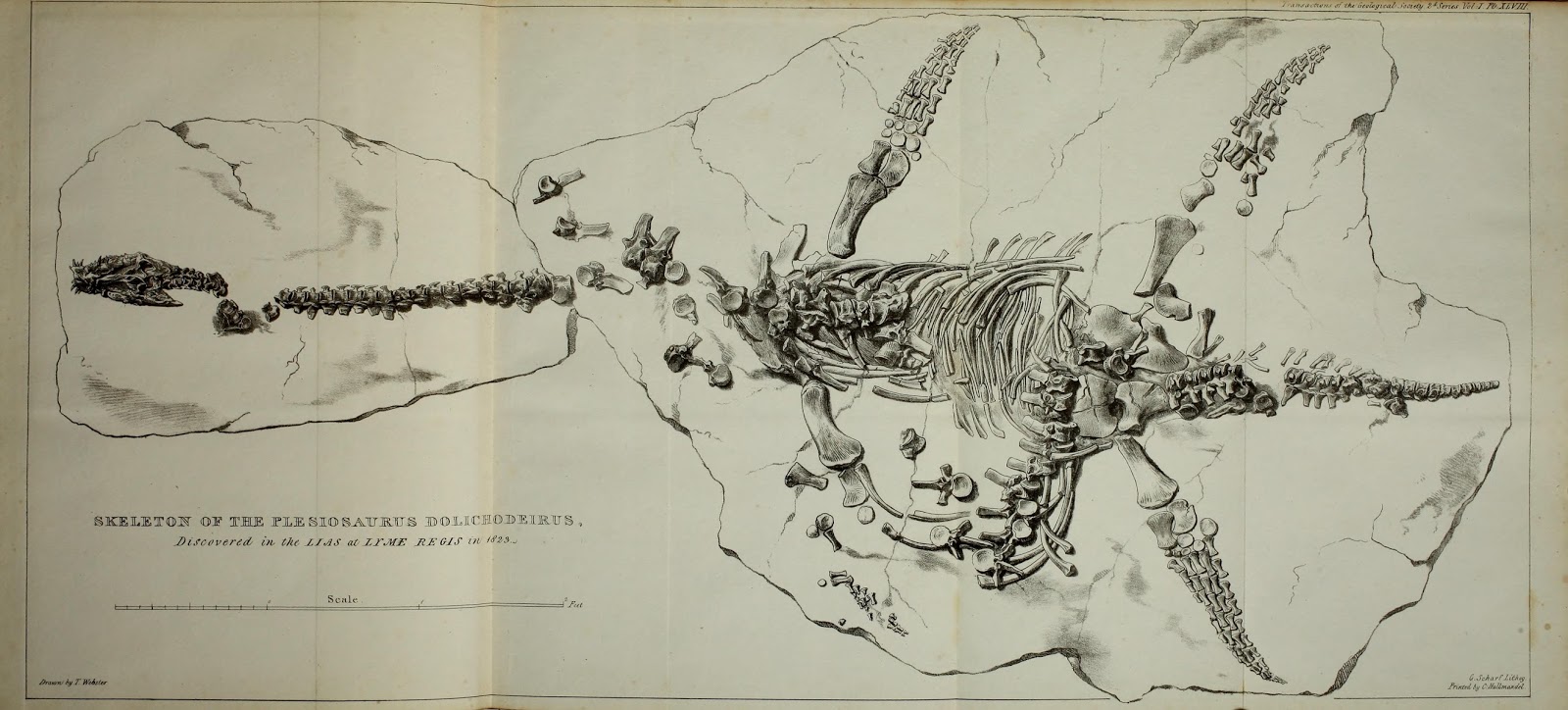
It was 1823 when the next great milestone in the plesiosaur story occurred. Famous “fossil-hunter” Mary Anning discovered a nearly complete skeleton at Lyme Regis in Dorset, England. The fossil was acquired by the Duke of Buckingham, who lent it to geologist William Buckland, who himself made it available to William Conybeare. Conybeare described the find, and asserted the full species name, Plesiosaurus dolichodeirus, during the same lecture at which Megalosaurus, the first dinosaur genus to be validly named, was described.
View Full Size Image
Anning’s plesiosaur. Transactions of the Geological Society. ser. 2, v.1. 1824. http://biodiversitylibrary.org/page/36238986. Digitized by California Academy of Sciences.

Sadly, despite Mary Anning’s significant contribution to the history of plesiosaur discovery, she is not named in Conybeare’s paper.

Fossil Stories

Stay tuned all week for more great fossil fun with our #FossilStories campaign, including:

  • Tweets and Facebook Posts
  • Blog Posts highlighting milestones and key publications in the history of fossil research
  • A Flickr Collection with hundreds of historic fossil illustrations
  • A Pinterest Collection featuring a selection of our favorite fossil illustrations
  • A BHL Collection containing seminal publications in the history of paleontology
  • A series of live webcasts at BHL partner institutions
  • A citizen science challenge in collaboration with The Field Book Project, the Smithsonian Transcription Center, and Smithsonian Institution Archives
Follow #FossilStories on Twitter and Facebook to learn more.
October 14, 2015by michelle.underhill
Blog Reel, Featured Books

Early Women In Science: Trekking Through Nature, Trailblazing Their Way Through History

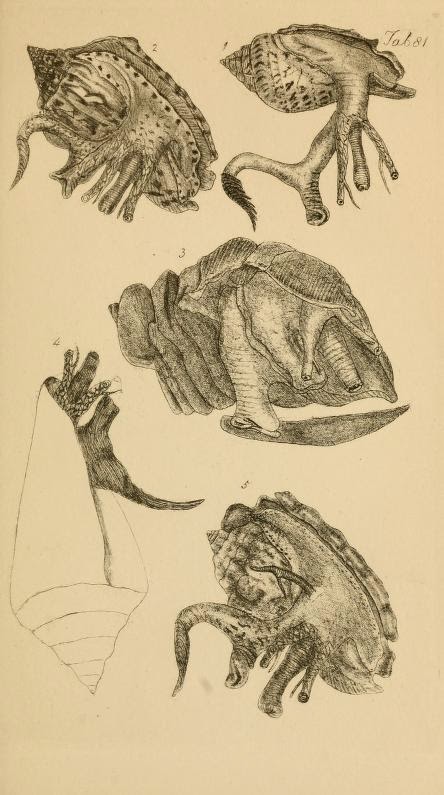
The sixteen women featured in the “Early Women In Science” exhibition are each extraordinary for unique reasons.  One trait they all share is that they were doing work in scientific fields reserved for men. They sometimes had to fight for recognition of their work—or went completely unrecognized for some of their major contributions. For instance, Maria Emma Gray (1787-1876) was a talented natural history illustrator. She not only contributed to the work of her husband, zoologist John Edward Gray, but also saw him through his nervous breakdown, eventually helping him to work again. Despite her contributions to his studies, however, she is not credited in his works.

View Full Size Image
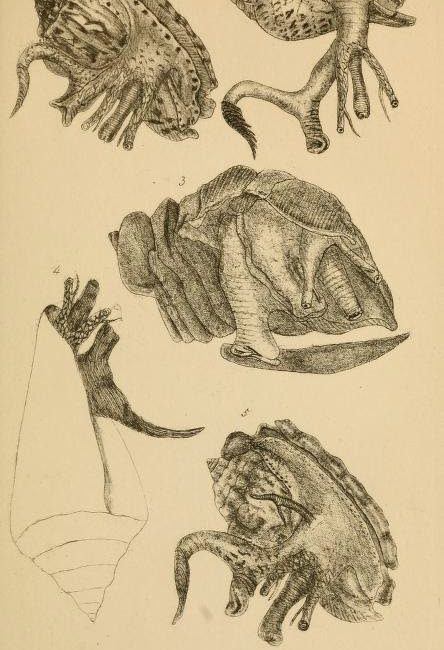
Illustration by Maria Emma Gray, from Figures of Molluscous Animals, Selected from Various Authors. Etched for the Use of Students by Maria Emma Gray, vol. 2, 1859 | Smithsonian Biodiversity Heritage Library

Even when the male scientific community did praise the contributions of their feminine peers, many of the earliest women scientists remained resistant to any form of boasting or taking credit, since that was considered unseemly in women. Not so with bold scientists like Ynes Enriquetta, Julietta Mexia, or Alice Eastwood, who rightfully took credit for their amazing accomplishments.

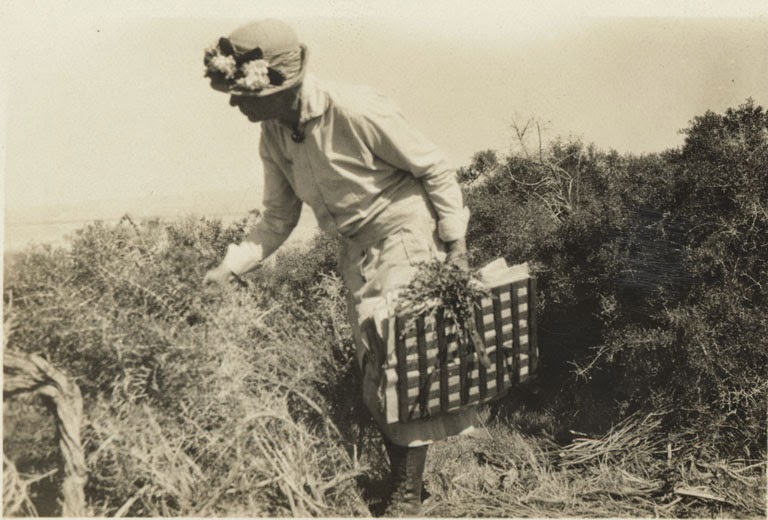
Alice told her contemporary, Agnes Chase (agrostologist, 1869-1963): “the most proper [honor] is that officially the name of the Herbarium is the Alice Eastwood Herbarium of the California Academy of Sciences” since she built it herself “with no help” from 1912 to 1930.And in truth, Alice did manage this effort with little help. Furthermore, prior to the new herbarium’s construction, Alice risked her life to save the Academy’s collections during the San Francisco Earthquake of 1906. Despite fires in the surrounding buildings and a caved-in stairwell, Alice climbed into the previous herbarium and managed to save the most irreplaceable of the herbarium specimens with a rope and pulley and the help of one other man.

View Full Size Image
Alice Eastwood collecting Festuca eastwoodae grass, courtesy of the California Academy of Sciences Archives

These women were brave. Not only did they enter their respective fields at a time when women were meant to remain in the domestic sphere, but they often solitarily braved harsh wilderness conditions to explore, observe, and collect flora, fauna and other specimens.  Katherine Brandegee(1844-1920) was a botanist, and in her journeys she survived shipwrecks, seclusion with bears, wolves and coyotes, and encounters with potentially dangerous men in the uninhabited areas she trekked. All the while, collecting and preserving specimens, rather than her own safety, were her primary concerns.

Many of the women in the exhibit shared a courage, a sense of adventure, and a love of nature that allowed them to push through the difficulties—whether physical or mental—of becoming scientists.Some were self-taught, while others were accepted to prestigious schools. Most of them were given honorary degrees and other awards. Some, like Susan Fenimore Cooper (1813-1894), were multi-talented, engaging not only in scientific pursuits, but other artistic endeavors like fiction writing.Furthermore, many of these women demonstrated exceptional foresight, warning that neglect and abuse of our natural environment would result in dire consequences. They were right.

Enjoy the fascinating stories, illustrations and books from and about “Early Women In Science” in our new exhibit here.

December 9, 2014by micahv

Help Support BHL

BHL's existence depends on the financial support of its patrons. Help us keep this free resource alive!

search

About BHL

The Biodiversity Heritage Library (BHL) is the world’s largest open access digital library for biodiversity literature and archives. BHL operates as a worldwide consortium of natural history, botanical, research, and national libraries working together to digitize the natural history literature held in their collections and make it freely available for open access as part of a global “biodiversity community.”

Join Our Mailing List

Sign up to receive the latest news, content highlights, and promotions.

Subscribe Now

Subscribe to Blog via Email

Enter your email address to subscribe to this blog and receive notifications of new posts by email.

Join 319 other subscribers

Subscribe to Blog Via RSS

Subscribe to the blog RSS feed to stay up-to-date on all the latest BHL posts.

Access RSS Feed

Inspiring Discovery through Free Access to Biodiversity Knowledge.

The Biodiversity Heritage Library makes it easier than ever for you to access the information you need to study and explore life on Earth…for free, anytime, anywhere.


64+ Million Pages of
Biodiversity Literature Online.

EXPLORE

Tools and Services
to Transform Research.

EXPLORE

300,000+
Illustrations on Flickr.

EXPLORE

ABOUT | HARMFUL CONTENT | PRIVACY | SITE MAP | TERMS OF USE