Biodiversity Heritage Library - Program news and collection highlights from BHL
  • Home
  • News
  • Featured Books
    • All Featured Books
    • Book of the Month Series
    • BHL at 20
  • User Stories
  • Campaigns
    • Fossil Stories
    • Garden Stories
    • Monsters Are Real
    • Page Frights
    • Her Natural History
    • Earth Optimism 2020
  • Tech Blog
  • Visit BHL
Home
News
Featured Books
    All Featured Books
    Book of the Month Series
    BHL at 20
User Stories
Campaigns
    Fossil Stories
    Garden Stories
    Monsters Are Real
    Page Frights
    Her Natural History
    Earth Optimism 2020
Tech Blog
Visit BHL
  • Home
  • News
  • Featured Books
    • All Featured Books
    • Book of the Month Series
    • BHL at 20
  • User Stories
  • Campaigns
    • Fossil Stories
    • Garden Stories
    • Monsters Are Real
    • Page Frights
    • Her Natural History
    • Earth Optimism 2020
  • Tech Blog
  • Visit BHL
Biodiversity Heritage Library - Program news and collection highlights from BHL
Blog Reel, User Stories

BHL Isn’t Just For Biologists

Portrait version of the Biodiversity Heritage Library logo.

Charles Darwin is famous for the theory of evolution by means of natural selection. The theory hinges on the mutability of species, whereby the propagation of certain favorable traits within members of a species may gradually result in the evolution of that species. The question of when Darwin first came to believe in the mutability of species – when he became a “convinced transmutationist” – has long been a point of contention among historians of science.

There are two prevailing theories on the topic. The early conversion hypothesis states that Darwin developed a belief in the transmutation of species while on the Beagle voyage based on observed similarities between the fossils he was collecting and extant species in the area. The second theory, the late conversion hypothesis, holds that Darwin did not start believing that species were mutable until after the Beagle voyage, once experts in England had studied the specimens he collected. Today, most historians of science support the latter theory.

Dr. Paul D. Brinkman, Head of the History of Science Research Lab and Curator of Special Collections at the North Carolina Museum of Natural Sciences, finds the late conversion theory flawed.
View Full Size Image
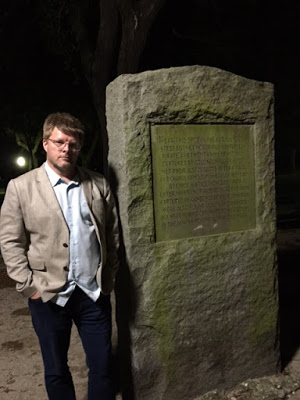
Paul D. Brinkman consorting with known pirates in Charleston, SC.

Brinkman has been studying the history of science for nearly twenty years. He specializes in late nineteenth- and early twentieth-century geology and vertebrate paleontology, especially in the American West, and is also interested in the spread of science from Europe to the New World and the trans-Atlantic exchanges of specimens and ideas. The question of when Darwin adopted a transmutationist viewpoint is of particular interest to Dr. Brinkman.

In a 2010 paper published in the Journal of the History of Biology entitled “Charles Darwin’s Beagle Voyage, Fossil Vertebrate Succession, and the ‘Gradual Birth & Death of Species,'” Brinkman argues that Darwin’s own journals from the Beagle voyage (which include discussions of the similarities between some of the fossils he was collecting and extant species – notably Glyptodontidae fossils and living armadillos – and reflections regarding fossil vertebrate succession – which Darwin himself later identified as a key element in his contemplation on the origin of species) suggest that Darwin’s adoption of transmutationism happened gradually but certainly during, and not after, the Beagle voyage.

Darwin’s journals and publications, as well as the books that Darwin was known to have in his Beagle library, provide key information that Brinkman used to support his arguments. As such, access to these materials is crucial to Brinkman’s research. Thanks to BHL, it’s easier than ever for him to obtain these resources.

Dr. Brinkman was introduced to BHL many years ago by Christine Giannoni, Museum Librarian at The Field Museum. Christine is a star promoter of BHL, having been involved with the program for many years; she currently serves as the Museum’s Member Representative to BHL. Thanks to her introduction, Brinkman is now a regular user of BHL.

“BHL is a wonderful resource,” lauds Brinkman. “I use a lot of old and obscure resources in my line of work, and BHL makes getting access to these sources a lot easier.”
View Full Size Image
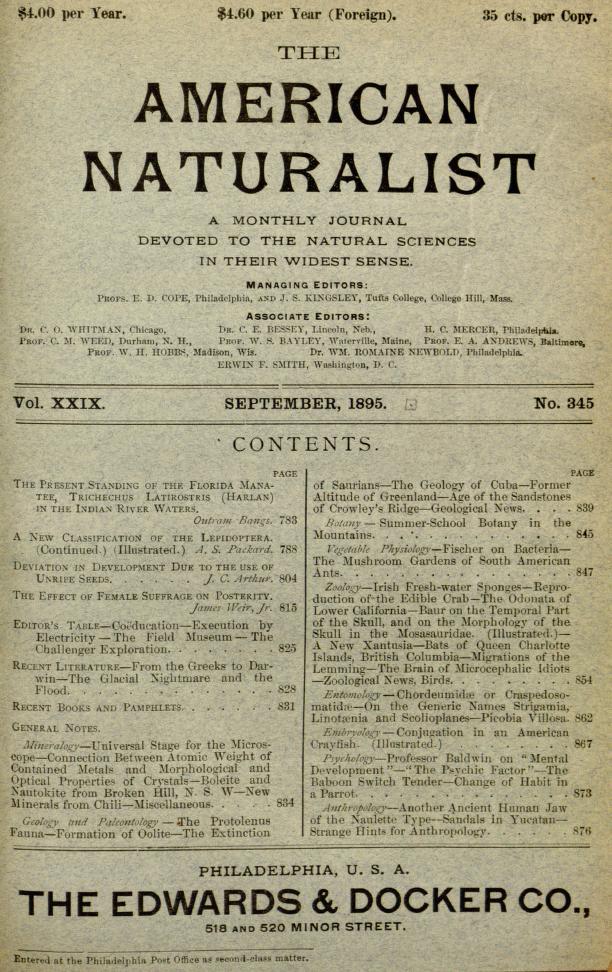
The cover of the American Naturalist of September, 1895, which Brinkman downloaded from BHL for a recent project entitled “Edward Drinker Cope’s final feud.” http://biodiversitylibrary.org/item/129692.

When conducting research, Brinkman often refers to BHL 8-10 times a day, reading articles online or downloading relevant pages as PDFs. He also downloads title pages and significant figures for use in lecture slides. And while he may refer to specialized material when conducting specific research, the most-common type of material that he consults on BHL may surprise you.

“I probably use old museum annual reports more than any other single resource on BHL,” explains Brinkman. “This is especially useful, as a lot of these old reports have been relegated to offsite storage at many university libraries, which can sometimes mean long delays. BHL, however, provides them at the click of a button!”

So, whether it’s helping a scientist confirm the identity of a specimen collected in the field or providing primary source evidence to support the work of historians of science, it’s clear that BHL greatly increases the efficiency of research for those working in a variety of disciplines. We think Darwin would approve.

December 17, 2015by ulib-libraryjobs
Blog Reel, Featured Books

Book of the Week: More with Darwin

View Full Size Image
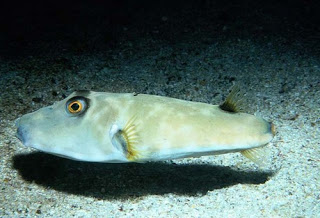
So, our last book of the week took a look at Darwin’s voyage on the H.M.S. Beagle through the eyes of a child. We thought it fitting this week to continue with the theme of the H.M.S Beagle, wrapping it together with one of the featured species on EOL this week, the Sphoeroides angusticeps, or the Narrow-Headed Puffer.

The Narrow-Headed Puffer is endemic to the Galapagos Islands, and indeed was first described in part 4 of The zoology of the voyage of H.M.S. Beagle … during the years 1832-1836, page 154. Upon returning home, Darwin gave his collection of about 137 species of fish gathered during the voyage of the H.M.S. Beagle to his friend, avid beetle collector Rev. Leonard Jenyns, for keeping. While Jenyns worked through this collection to describe it, he “had the most difficult time with the fish, as he knew next to nothing about their anatomy.”

Jenyns, transcribing Darwin’s own description of the specimen, described the Narrow-Headed Puffer fish as “above dull green, base of Pectorals and Dorsal black, a white patch beneath the Pectorals.” However, he noted that “The colors must have very much altered from the action of the spirit, as it now appears of a nearly uniform reddish brown, only paler beneath.” Interestingly, Jenyns originally misidentified the species, calling it Tetrodon aerostaticus. This was corrected to Tetrodon angusticeps, and is now known as Sphoeroides angusticeps.

Take a moment to check out the first descripton of the Narrow-Headed Puffer fish in this week’s book of the week, and be sure to take a look at this species on EOL to find more information.

This week’s book of the week, The zoology of the voyage of H.M.S. Beagle … during the years 1832-1836, part 4 (1842), was contributed by the MBLWHOI library.

October 4, 2010by michelle.underhill
Blog Reel, Featured Books

Book of the Week: Darwin for Children

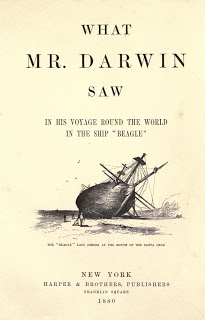
View Full Size ImageThe great scientific discoveries that have been made during the many incredible exploring expeditions throughout history have long interested both scientists and laymen alike, and perhaps none more so than the voyages undertaken by Charles Darwin himself on the H.M.S. Beagle. While the appeal of the narratives of these expeditions to adults may seem obvious, engaging children in such works is not always simple. The concern with “interest[ing] children in the study of natural history, and of physical and political geography”so that they might exhibit enthusiasm for nature throughout their lives is the chief concern of this week’s book of the week, What Mr. Darwin saw in his voyage round the world in the ship “Beagle” (1880), compiled from Darwin’s Journal of researches into the geology and natural history of the various countries visited by H. M. S. Beagle.

In a preface directed towards parents, the author writes,

“The compiler has thought it an advantage to connect stories about a great variety of animals with one person, and he an observer of such credibility and authority that little if anything that was learned of him would have to be unlearned. Mr. Darwin is, of course, pre-eminently such an observer. On the other hand, by carefully connecting these stories with the places on the earth’s surface where the animals were studied, a correct notion will be had of the distribution of the animal kingdom, with a corresponding insight into the geography of the globe in its broadest sense.”

What Mr. Darwin Saw is divided into four parts: Animals, Man (describing the people and cultures encountered on the voyage), Geography (describing the cities, rivers, mountains, valleys, plains, etc. seen on the expedition), and Nature (discussing the “grander terrestrial processes and phemonena” encountered). The original text comes from Darwin’s writings, though some small alterations have been made for the publication to take into account audience and overall organization. Since the changes are so minimal, the work is still attributed to Charles Darwin.

Before beginning the main narrative of What Mr. Darwin Saw, children are given a short biography of Charles Darwin and a description of the voyage of the H.M.S. Beagle. Children are then urged to test their own powers of observation by counting how many animals they can find in an accompanying woodcut by Thomas Bewick.

The description of the animals, people, geography and nature in the following sections of text are rich and inviting, as they are presented in a highly conversational tone produced from Darwin’s own observations. Children would be highly entertained to read Darwin’s description of the Guanaco, or Wild Llama’s, reactions around strange behavior in humans. They would likewise be thrilled to read of the dangerous encounter Darwin and his team experienced with an ice cliff, and their imaginations would be stimulated by Darwin’s description of the coral and coral architects around the visited lagoon islands. And while these writings may have been directed at children, they are nevertheless singularly engrossing for adults as well. So, whether child or adult, take a few minutes to look through Darwin’s narrative of the biodiversity, cultures and geography encountered on that monumental voyage of the H.M.S. Beagle.

This week’s book of the week, What Mr. Darwin saw in his voyage round the world in the ship “Beagle” (1880), by Charles Darwin, was contributed by the University of California Libraries.

September 22, 2010by michelle.underhill

Help Support BHL

BHL's existence depends on the financial support of its patrons. Help us keep this free resource alive!

search

About BHL

The Biodiversity Heritage Library (BHL) is the world’s largest open access digital library for biodiversity literature and archives. BHL operates as a worldwide consortium of natural history, botanical, research, and national libraries working together to digitize the natural history literature held in their collections and make it freely available for open access as part of a global “biodiversity community.”

Follow BHL

  • Bluesky logo
  • Instagram logo
  • Facebook logo
  • Flickr logo
  • Twitter logo

Join Our Mailing List

Sign up to receive the latest news, content highlights, and promotions.

Subscribe Now

Subscribe to Blog via Email

Enter your email address to subscribe to this blog and receive notifications of new posts by email.

Join 319 other subscribers

Subscribe to Blog Via RSS

Subscribe to the blog RSS feed to stay up-to-date on all the latest BHL posts.

Access RSS Feed


64+ Million Pages of
Biodiversity Literature Online.

EXPLORE

Tools and Services
to Transform Research.

EXPLORE

300,000+
Illustrations on Flickr.

EXPLORE

ABOUT | HARMFUL CONTENT | PRIVACY | SITE MAP | TERMS OF USE