Biodiversity Heritage Library - Program news and collection highlights from BHL
  • Home
  • News
  • Featured Books
    • All Featured Books
    • Book of the Month Series
    • BHL at 20
  • User Stories
  • Campaigns
    • Fossil Stories
    • Garden Stories
    • Monsters Are Real
    • Page Frights
    • Her Natural History
    • Earth Optimism 2020
  • Tech Blog
  • Visit BHL
Home
News
Featured Books
    All Featured Books
    Book of the Month Series
    BHL at 20
User Stories
Campaigns
    Fossil Stories
    Garden Stories
    Monsters Are Real
    Page Frights
    Her Natural History
    Earth Optimism 2020
Tech Blog
Visit BHL
  • Home
  • News
  • Featured Books
    • All Featured Books
    • Book of the Month Series
    • BHL at 20
  • User Stories
  • Campaigns
    • Fossil Stories
    • Garden Stories
    • Monsters Are Real
    • Page Frights
    • Her Natural History
    • Earth Optimism 2020
  • Tech Blog
  • Visit BHL
Biodiversity Heritage Library - Program news and collection highlights from BHL
Blog Reel, Campaigns, Her Natural History

The Popular and Prolific Ms. Pratt

Plate 122. Pratt, Anne. The Flowering Plants, Grasses, Sedges, & Ferns of Great Britain and Their Allies, the Club Mosses, Horsetails, etc. Volume 2. 1905. Contributed in BHL by The LuEsther T Mertz Library, the New York Botanical Garden.

During the Victorian era, many gifted women participated in what has been called the “Golden Age of botanical art,” reflecting both a surge in gardening interests across English society, as well advances in book-making technology (Burns, Kramer). Though virtually unknown today, Anne Pratt (1806-1893) was one of the most prolific and popular artists and writers of this time, ultimately producing twenty published works that were loved for their handsome and accurate illustrations, and helping to create interest in flower study in the general public.

Born in 1806 in Strood, Kent, Pratt was the second of three daughters to Robert Pratt, a successful wholesale grocer, and Sara Bundock, who helped instill a love of gardening, plants and flowers in her daughter (Kramer). Due to poor health, Pratt was often confined indoors, where drawing became a favorite pastime (Wikipedia). A friend of the family, Dr. Dodds, introduced her to botany, a subject in which women were encouraged to participate and considered particularly well suited – collecting, illustrating, decoupage, and writing were all acceptable activities during a time when society imposed more restrictions than not (Burns).

Unmarried until the age of sixty, it is likely that Pratt’s only source of income was her botanical writing and illustrations (Burns). Pratt became a household name with Wild Flowers of the Year, issued in 1852-1853; after seeking her permission, she dedicated the book to Queen Victoria, who praised it and requested copies of all of Pratt’s works as a result (Burns). Pratt’s The Flowering Plants and Ferns of Great Britain is credited with generating a lot of interest in the general public in British flora by combining “easily digested science with miscellaneous romantic flower-lore” (Blunt & Stearn). Originally five volumes covering the entire British flora, a sixth supplemental volume The British Grasses, Sedges, Ferns and their Allies the Club Mosses, Pepperworts, and Horsetails was published in 1873. Pratt begins volume one telling her readers that “one of the chief objects is to aid those who have not hitherto studied Botany,” and she briefly compares the Linnaean system of classification with various natural systems currently in vogue (Burns).

Plate 102. Pratt, Anne. The Flowering Plants, Grasses, Sedges, & Ferns of Great Britain and Their Allies, the Club Mosses, Horsetails, etc. Volume 2. 1905. Contributed in BHL by The LuEsther T Mertz Library, the New York Botanical Garden.

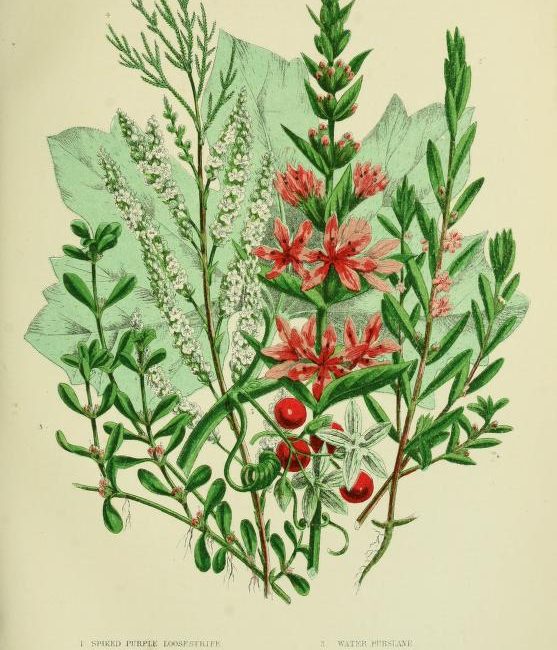
Flowering Plants… also employed a new method for mass market book printing called the Baxter method. Patented by George Baxter in 1835, it “combined the two processes of intaglio and relief” and a “relatively cheap color printing process for the mass market” (Burns). Acknowledged as a landmark book in many ways with far reaching influence: “…this work had a remarkably long life as a standard reference work: the illustrations of ferns in the final volume continued to be used into the second half of the twentieth century” (Wikipedia). There are also numerous references to the use of plants for medicinal purposes as well as folkloric information, e.g. that of Tamarisk (Támarix), “thought to improve the flavour of ale; the spit made of its wood imparted an excellence to the meat roasted upon it; and its use was considered so beneficial to persons afflicted with diseases of the spleen, that physicians ordered patients to eat from dishes made of Tamarisk wood” (Pratt). Tamarisk is also mentioned in classic literature: “Homer mentions it as the tree against which Achilles laid his spear before he rushed into Xanthus to pursue the fleeing Trojans.” (Pratt)

So plunged in Xanthus, by Achilles’ force,
Roars the resounding surge with men and horse;
His bloody lance the hero cast aside,
Which spreading Tamarisks on the margin hide.

English tamarisk (4) with assorted other plants. Pratt, Anne. The Flowering Plants, Grasses, Sedges, & Ferns of Great Britain and Their Allies, the Club Mosses, Horsetails, etc. Volume 2. 1905. Contributed in BHL by The LuEsther T Mertz Library, the New York Botanical Garden.

Though she is generally lauded for her artistry, Pratt has been criticized for lacking scientific credentials and it’s been debated whether or not she may be considered a true botanist (Kramer). And, in some cases her illustrations have also been criticized; the illustrations for The Flowering Plants, for example: “are pleasantly composed, though owing to the limitations of the newly popular technique of chromolithography, not always very accurate in colour…the drawings which illustrate her book are her own work, though in their published form no doubt owe a good deal to the artists of the firm W. Dickes and co. who redrew them on stones” (Blunt & Stearn).

As was typical for the Victorian era, Pratt downplayed her own work, such as in the opening of Flowers and Their Associations (1840) with the “hopes these pages may not be unacceptable” (Kramer). Though considered a “suitable ladylike pursuit” in the eighteenth century, the field of botany was also changing, “Botany, like other natural history avocations, was in the process of professionalization and was dominated by men” (Lindsay).

Ultimately, Pratt was read by a wide audience, with the ability to “blend botany with the romance of nature–and thus fulfill two marketing niches–the demand for nature writing and flowers and the need for botanical knowledge for ladies” (Kramer). Regardless of any controversy over her credentials, most importantly Pratt’s books were appreciated on multiple levels, and reviving interest in Pratt’s substantial body of work is an important example of the BHL’s ongoing endeavor to preserve biodiversity literature and bring to light forgotten authors and illustrators.

References

Blunt, Wilfrid, and William T. Stearn. 1994. The Art of Botanical Illustration. Woodbridge, Suffolk: Antique Collectors’ Club in association with the Royal Botanic Gardens, Kew.

Burns, Mary. 2017. “Printing and Publishing the Illustrated Botanical Book in Nineteenth Century Great Britain.” Cogent Arts & Humanities 4: 1364058.

Lindsay, Debra. 2018. Maria Martin’s world: Art & Science, Faith & Family in Audubon’s America.

Pratt, Anne, and Edward Step. 1905. The Flowering Plants, Grasses, Sedges, & Ferns of Great Britain and Their Allies, the Club Mosses, Horsetails, etc. London: F. Warne.

Shteir, Ann B. 1996. Cultivating Women, Cultivating Science: Flora’s Daughters and Botany in England 1760 to 1860.

Walpole, Josephine. 2006. A History and Dictionary of British Flower Painters, 1650-1950. Woodbridge: Antique Collectors’ Club.

Wikipedia, “Anne Pratt,” accessed March 12, 2019, https://en.wikipedia.org/wiki/Anne_Pratt.

March 29, 2019by Joel Richard
Blog Reel, Campaigns, Her Natural History

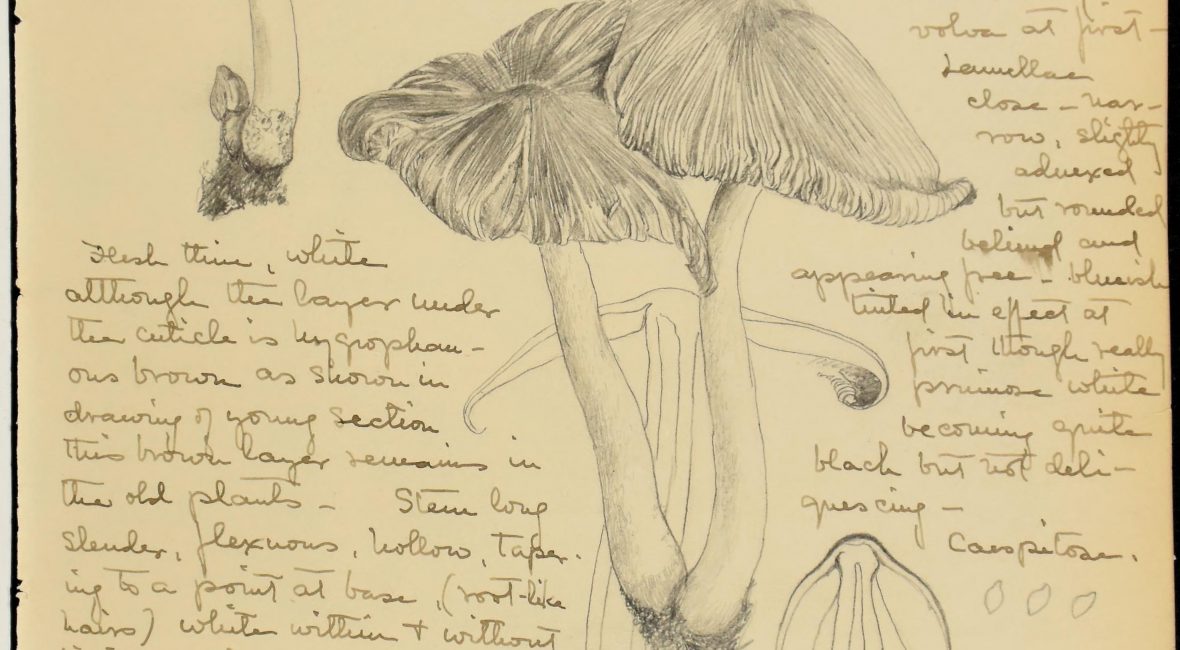
Henrietta Page sketchbook of fungi drawings

Page, Henrietta. [Sketchbook of drawings of fungi], volume II. Contributed in BHL Harvard University Herbarium, Botany Libraries.

The Harvard Botany Libraries recently acquired and digitized Henrietta Page’s [Sketchbook of drawings of fungi], volume II. The sketchbook was a gift from the Boston Mycological Club (BMC) where Page was a member and served on the executive committee for a time. She was also a member of the Boston Society of Natural History. The sketchbook mostly describes fungi collected during July and August when Page attended three-week long natural history classes held in Alstead, New Hampshire under the Alstead School of Natural History from 1899-1903. The mycology section was taught by Hollis Webster, secretary and co-founder of the BMC and Harvard graduate (class of 1884); phanerogamic botany by Merritt Lyndon Fernald; ornithology by Ralph Hoffmann; and physiography and biology by William Lusk Webster Field. The school ran from 1899-1904.

The sketchbook was originally unattributed, but Jason Karakehian (BMC archivist) discovered that the sketchbook connects to specimens that are now housed in the fungarium at New York Botanical Garden (NYBG). The specimens were originally part of the Alstead School of Natural history fungarium, which was integrated into the BMC fungarium after the Alstead School’s closing. Jason was able to attribute the sketchbook to Ms. Page by searching the NYBG’s online database of specimens for fungal collections made in Alstead in the years 1900-1903, which yielded a few collections whose labels referred to Henrietta Page by name and referenced specific pages in her sketchbook “Vol. II.”

Page, Henrietta. [Sketchbook of drawings of fungi], volume II. Contributed in BHL Harvard University Herbarium, Botany Libraries.

There are a number of glass plate negatives, prints, and lantern slides of fungi in the BMC archive which were made by Hollis Webster in the 1902 and 1903 sessions of the School. These have been cleaned, organized, placed in archival negative envelopes, and listed in a spreadsheet. The specimens photographed do not appear to match those drawn by Ms. Page, but there is some overlap in taxa.

The sketchbook is a popular new acquisition and has already been used for several classes interested in field notes, women in science, and scientific illustrations.

Page, Henrietta. [Sketchbook of drawings of fungi], volume II. Contributed in BHL Harvard University Herbarium, Botany Libraries.

March 27, 2019by Joel Richard
Blog Reel, Campaigns, Her Natural History

Dorothea Eliza Smith: Resilient Botanical Illustrator

Title page of The Fruits of the Lima Market, a collection of manuscript illustrations by Dorothea Eliza Smith.

As we celebrate the role women have played in the natural history sciences, we can find many examples of successful women who have been under-appreciated for the meaningful work they did during their lives. Women like Maria Sibylla Merian, Mary Margaret Smith, and Evelyn Cheesman significantly advanced a variety of sciences, even if they have only recently been gaining attention for doing so. But historic relegation of women has also meant that countless people throughout history were denied the tools to achieve success in these fields. How many women could have been published artists or scientists, if it weren’t for societal expectations that never gave them the chance?

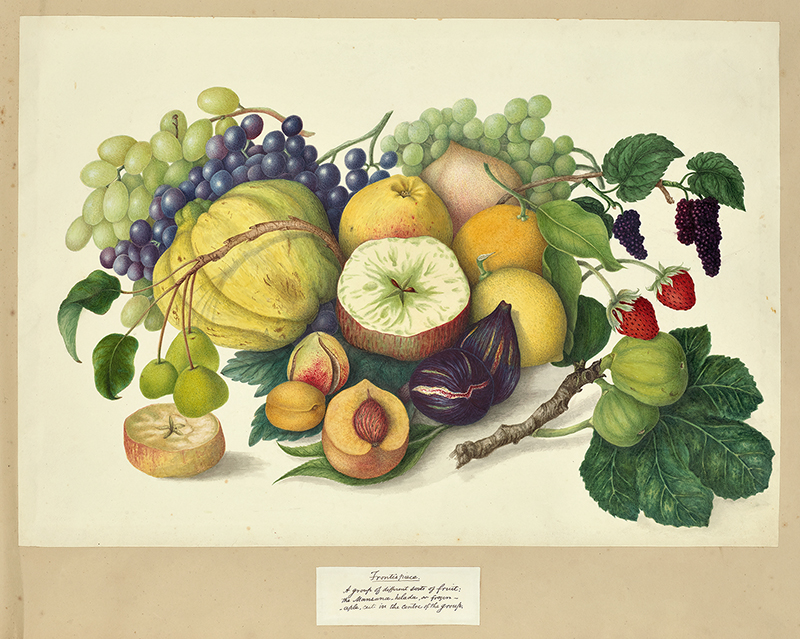
Within the collections of rare botanical texts and seldom seen manuscripts housed at the Oak Spring Garden Foundation is a beautiful work by a largely unknown artist, Dorothea Eliza Smith. Her Fruits of the Lima Market – a collection of watercolors that she completed between 1850 and 1853 – stands out as an exemplary creation made even more impressive by her relative obscurity and the sparse details of her life.

Frontispiece of The Fruits of the Lima Market. These illustrations were never published and would likely have vanished into complete obscurity had the artist’s husband not worked to preserve them in the family collection.

Dorothea was born to Joseph and Dorothy Peers on January 29, 1804, in Wales – the third child and first girl born to the couple. In 1828, when she was twenty-four, she married William Kerr who was a merchant trading primarily out of Caracas, Venezuela, but their marriage was cut short as Kerr seems to have died sometime before 1840. That year, Dorothea married Dr. Archibald Smith, who also had extensive experience living and working in South America.

Smith was born in 1797 in Scotland, received his medical degree from the University of Glasgow in 1820, and moved to Peru five years later. Once there, he was employed by a British mining company to help its workers adjust to the high altitudes at which they worked, but the company’s bankruptcy in 1827 meant that Smith needed to find new work. To this effect, he rented some land and began to grow sugar cane, but by 1830 he had moved to Lima and the next year took a job overseeing the health of British and American sailors stationed in and around the Peruvian capital. (Peru became an independent country in 1824, so the sailors were not part of an occupying force.) At some point during this time he must have become acquainted with Dorothea as they married in Scotland in 1840 where they continued to live for the next few years.

Punica granatum (Pomegranate) by Dorothea Eliza Smith. The folio contains 30 watercolors and eventually made its way to Crewe Hall library, where they were purchased by Rachel and Paul Mellon in 1957.

While their marriage appears to have been strong, they both faced an enormous loss when Archibald and the couple’s daughter Dorothy – who was eight – were shipwrecked off the Peruvian coast, and Dorothy drowned. Dorothea wrote from Liverpool to her husband shortly after the loss in 1849 that “we are all improving in strength not withstanding our recent trial” and would soon join her husband in Peru with their other children – Sophia, Isabella, and John. Interestingly, Dorothea and the children decided to sail around Cape Horn on their journey to South America rather that land in Panama, walk across the isthmus, and catch another ship to Peru. Both trips took similar amounts of time, but supposedly with three children, Dorothea would have rather not tried to keep track of them on an overland trek. The details of the Smiths’ time in Peru are sparse, other than that Dorothea worked on her watercolors of the fruits of the Lima market from 1850 to 1853, and at any rate they all seemed to have returned to the United Kingdom by 1855. Dorothea would die about nine years later, in 1864, and her husband would join her in 1868, both in Edinburgh, Scotland.

Bananas by Dorothea Eliza Smith. The watercolors are remarkably detailed and include botanical details like cross-sections and seed pods. These details underly observations on the artist’s behalf that go beyond a casual or purely aesthetic purpose.

Dorothea Smith’s The Fruits of the Lima Market are significant and worthy of study both for their quality and for their commentary on botanical science and British economic reach. To begin, Dorothea’s watercolors are impressive in that they are thoughtfully detailed in their depiction and with regards to their associated scientific information (Each painting includes notes on its fruit’s scientific name, local name, height, and fruiting months), and in that they have a refined artistic sensibility to them as pertains to the ways in which Smith plays with the juxtaposition of the different colors of the fruits. Smith also provided drawings of cross-sections of the fruits and their seeds. It is further interesting that Smith chose to draw the fruits of the Lima market as opposed to other flora from the Peruvian countryside. Her choice seems to be wrapped up both in her assumedly easy access to such fruits and in her life as spouse to first a merchant then a medical doctor and one-time farmer who both left Britain for opportunities in South America. Even her trip to arrive in Peru followed established trade and tourist routes from Europe to the western South American coast. Her watercolors work on two levels then – the first as an expression of her high scientific and artistic acumen and secondly as a reflection of her proximity to British commercial interests throughout the world. Smith’s manuscript was maintained by her husband after her death as he worked to make it known to knowledgeable scientists (even citing her in his own work), and as such kept it from disappearing into complete obscurity. Thus, the remarkable work of Dorothea Eliza Smith remains and whose story, though very much incomplete, understates the significant contributions of so many unknown female scientists and illustrators to the collected advancement of Western science.

References

Vega, Fernando, Kimberly Fisher, and Tony Willis. “Dorothea Eliza Smith, artist of ‘The Fruits of the Lima Market’” Archives of Natural History 41.2 (October 2014): 223-229.

March 26, 2019by Joel Richard
Blog Reel, Campaigns, Featured Books, Her Natural History

General Instructions for Rearing Silkworms: Louise Rienzi and California’s Silk Industry

Title page. Rienzi, Louise. General instructions for rearing silkworms. 1887. Contributed in BHL from the Library of Congress.

When Louise Rienzi wrote her guide on General Instructions for Rearing Silkworms, in 1887, she was part of a movement attempting to establish a viable silk industry for the United States. The epicenter of the new industry was California, where Louis Prevost, a French botanist, was the first to grow silkworms and produce cocoons, in 1860. The physical environment was favorable, and the industry saw some success before it eventually faded.

Several groups were formed to promote the industry, including the State Board of Silk Culture in San Jose. This organization was responsible for printing and distributing Louise Rienzi’s sericultural manual in the late 1880s.  Louise Rienzi also served as Secretary of the State Board and issued official reports on the monthly and annual meetings as well as the contributions of various committees, such as the Committee on Mulberry Trees, Eggs and Cocoons.

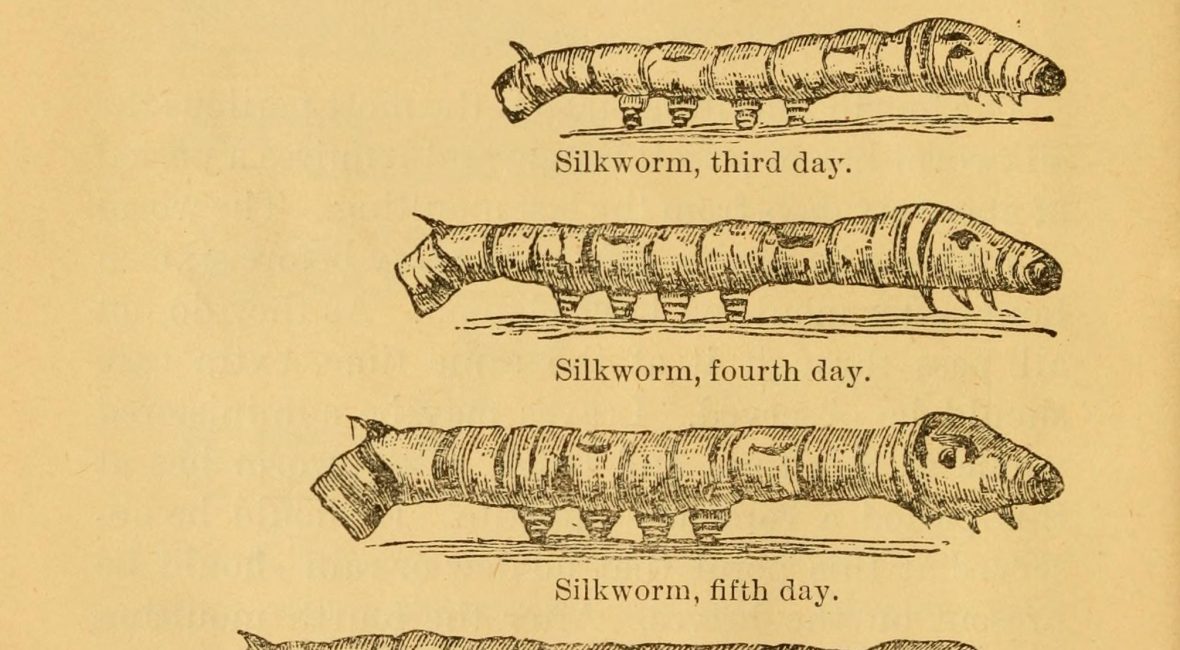
“Fifth stage of silkworms”. Rienzi, Louise. General instructions for rearing silkworms. 1887. Contributed in BHL from the Library of Congress.

General Instructions for Rearing Silkworms is a straightforward and detailed guide to the practicalities of raising silkworms. Instructions for successful cocooneries include descriptions of the types of trays, rack, and shelves needed, methods for keeping the air pure and clean, and instructions for feeding the worms. There is also a lengthy section titled Treatise on the Selection of Healthy Silkworm Eggs, which gives instructions for microscopic examination of the eggs and blood of the chrysalis. The entire manual is illustrated with numerous sketches of the equipment needed and the various stages of the eggs, worms, and moths themselves.

Raising silkworms according to this manual is very much a labor-intensive undertaking. To start, a constant supply of fresh mulberry leaves must be available to the silkworm rearer.  Rienzi states that “the worms from an ounce of eggs will consume from twelve hundred to thirteen hundred pounds of mulberry leaves.”  At first, the worms must be fed every few hours with fresh leaves.  The worms go through four moultings, each lasting about a week, and throughout this time period, the temperature, cleanliness and general welfare of the silkworms must be closely monitored.

Mulberry leaves. Rienzi, Louise. General instructions for rearing silkworms. 1887. Contributed in BHL from the Library of Congress.

Rienzi includes detailed descriptions of the changes in appearance which worms and eggs go through as they mature. Her practical advice for what to watch for also gives color to this business-like black-and-white manual: the silkworm egg itself is “the color of ash wood, and of the form of a lentil,” and a “pale lavender” hue to the eggs indicates that they will soon hatch, while a mature silkworm that is ready to spin will stop eating and take on a “golden, transparent color.”

Despite her detailed knowledge of silkworm rearing and enthusiastic support of the California silk industry, the value of Rienzi’s work seems to have been overlooked for some time. It was not until 1895 that the California legislature voted to appropriate funds for the pay claim of Louise Rienzi “for services rendered the State Board of Silk Culture as Secretary, Instructress, and Silk Expert, from December 12, 1885- to April 2, 1887”. Her compensation was set at $87.50 per month.

Further Readings

Klose, Nelson. California’s Experimentation in Sericulture. In Pacific Historical Review, v. 30 (Aug. 1961) 213-227

Klose, Nelson. Sericulture in the United States. Agriculture History, Vol. 37, No. 4 (Oct. 1963), 225-234.

Klose, Nelson. Louis Prevost and the Silk Industry at San Jose. In California Historical Society Quarterly, v.43 (Dec. 1964) 309-317

Mason, Frank R. The American Silk Industry and the Tariff.  American Economic Association Quarterly, 3rd Series, Vol. 11, No. 4 (Dec. 1910) 1-182

Onaga, Lisa. Silkworm, Science, And Nation: A Sericultural History Of Genetics In Modern Japan.  Dissertation: Cornell University, 2012. (https://hdl.handle.net/1813/29385)

Wyceoff, William C. Review: The Silk Industry in the United States. Science. Vol. 3, No. 57 (Mar. 7, 1884), pp. 290-292

The Journal of the Assembly during the Thirty-first Session of the Legislature of the State of California, 1895   (GoogleBooks)

March 25, 2019by Joel Richard
Blog Reel, Campaigns, Featured Books, Her Natural History

Mary Margaret Smith: Ichthyologist, Artist, and First Director of the JLB Smith Institute of Ichthyology

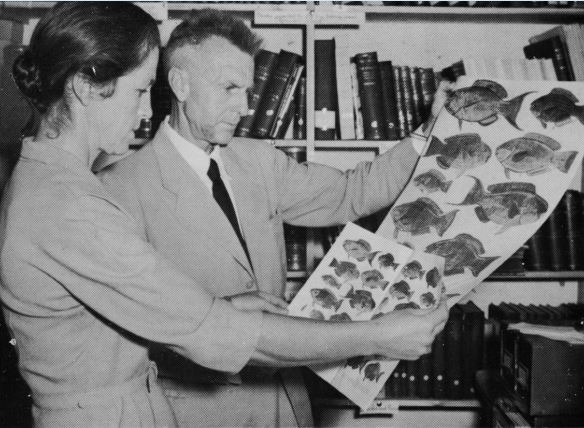
Margaret and JLB Smith review art proofs

A version of this post was originally published on the blog of the Margaret Smith Library, SAIAB. It is reproduced with permission from the author, Sally Schramm.

fish

From the cover of The life and work of Margaret M. Smith / Mike Bruton (c.1986)

The Library at the South African Institute for Aquatic Biodiversity is named for Mary Margaret Smith (née Macdonald), the first Director of the JLB Smith Institute of Ichthyology. Macdonald attended Rhodes University College in Grahamstown from 1934 to 1937. She was awarded her B.Sc. degree in 1936, majoring in physics and chemistry (with distinction), and became a senior demonstrator in the Chemistry Department.

James Leonard Brierley (JLB) Smith (1897-1968), Associate Professor of Organic Chemistry, and Mary Macdonald, were married in 1938. With her not liking the new name “Mary Smith”, she was from that time always known as “Margaret Smith”.

JLB Smith

JLB Smith with White steenbras , Knysna ca. 1950

JLB Smith, a keen angler, developed a more formal interest in ichthyology, the study of fishes. His young wife soon became involved in his hobby and accompanied him on fishing trips and collecting expeditions.

Margaret Smith

Margaret Smith drawing on a boat in the Seychelles.

Typical lab conditions, Shimoni, Kenya 1952

Typical lab conditions, Shimoni, Kenya 1952.

In 1946, the Department of Ichthyology was established at Rhodes University and J.L.B and Margaret Smith were able to devote all their energies to the production of an authoritative book on the sea fishes of southern Africa.

Margaret and JLB Smith review art proofs

Margaret and JLB Smith review art proofs.

One of their greatest problems was a lack of suitable illustrations. Undaunted, despite no artistic training, Margaret Smith, took on the task. The first edition of The Sea Fishes of Southern Africa, published in 1949, contained her exceptional illustrations.

Plate 32. The sea fishes of Southern Africa. 1949. By JLB and Mary Margaret Smith. Art by Mary Margaret Smith. Contributed in BHL from Cornell University Library with permission from the South African Institute for Aquatic Biodiversity. CC-BY-NC-SA.

Plate 12. The sea fishes of Southern Africa. 1949. By JLB and Mary Margaret Smith. Art by Mary Margaret Smith. Contributed in BHL from Cornell University Library with permission from the South African Institute for Aquatic Biodiversity. CC-BY-NC-SA.

She in turn taught what was to become a group of acclaimed natural history artists.

After the death of JLB Smith in January 1968, Margaret Smith continued her ichthyological research in Grahamstown. At the end of 1968, the South African Council for Scientific and Industrial Research (CSIR) and Rhodes University decided to establish the J.L.B Smith Institute of Ichthyology. Margaret was appointed the first Director of the new Institute, now the South African Institute for Aquatic Biodiversity (SAIAB).

Margaret and JLB Smith with their dog, Marlin.

Margaret and JLB Smith with their dog, Marlin.

The Margaret Smith House, a women’s residence at Rhodes University, likewise honours her contribution to our local university and to international science.

Margaret Smith died in 1987. She had given 49 years of service to ichthyology.

Margaret’s achievements, the fine building, the reference collection of fish which she so adequately preserved, the status of the institute as a museum of international standing, are there for all to see. What is less known is the woman herself in her private life which few could know much about. This may be summed up in two words: for all her public flamboyance, she was a kind woman. Nobody with a hard-luck story was ever turned away … she helped innumerable people. If something was needed and could not otherwise be got she would dip into her pockets, and never say a word. [1]

The Biodiversity Heritage Library holds a collection of JBL Smith’s Ichthyological Papers, edited by his wife, Margaret Smith, and published in 1969, the year after his death. Contributed by the Library of the South African Institute for Aquatic Biodiversity, the two volume work was published by the J.L.B. Smith Institute of Ichthyology.

Coelacanth

Coelacanth re-discovered off the coast of South African in 1938. Smith, J.L.B. “A Living Fish of Mesozoic Type.” Nature. v. 143 (1939). In: Ichthyological Papers. Ed. Mary Margaret Smith. 1969. Contributed in BHL from the South African Institute for Aquatic Biodiversity.

One of the highlights of the publication is the description of the “re-discovery” of the coelacanth, believed to have become extinct in the Late Cretaceous, around 66 million years ago, but rediscovered off the coast of South Africa in 1938. Marjorie Courtenay-Latimer, curator of the East London Museum, discovered a specimen from amongst the catch of a local trawler, Captain Hendrick Goosen, and contacted J.L.B. Smith regarding the discovery. Smith subsequently named the species Latimeria chalumnae after Courtenay-Latimer.

You can read more about the life and achievements of Marjorie Courtenay-Latimer as part of the #HerNaturalHistory campaign.

Reference

[1] PBN Jackson. 1997. Variations on a theme: the three directors of the first fifty years of the JLB Smith Institute of Ichthyology. Trans. Roy. Soc. S. Afr., 51:40.

March 24, 2019by michelle.underhill
Blog Reel, Campaigns, Her Natural History

Marjorie Eileen Doris Courtenay-Latimer: Beyond the Coelacanth

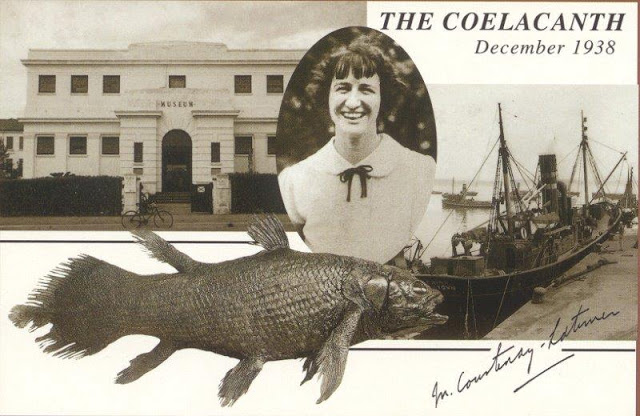
Commemorative postcard

A version of this post was originally published on the blog of the Margaret Smith Library, SAIAB. It is reproduced with permission from the author, Sally Schramm.

Willie and I look forward to our first born towards the end of April/beginning of May and we both pray it will be a lover of all that is beautiful in nature. Willie wants it to be a botanist — I want it to be a lover of birds and animals.
Eric Latimer’s diary, 25th November 1906

Marjorie Eileen Doris Courtenay-Latimer (1907-2004) is ubiquitously remembered and celebrated for her part in recognising that the large fish trawled by Capt. Hendrik Goosen and the crew of the Nerine in December 1938 was an astonishing find. This was to be identified as the first live coelacanth known to Western science. JLB Smith, the ichthyologist who first described it, named it Latimeria chalumnae after Marjorie, and the Eastern Cape river mouth near which it was found.

Commemorative postcard

Commemorative postcard on the “re-discovery” of the coelacanth.

Reading the Border Historical Society’s The Coelacanth journal Commemorative edition in honour of Dr Marjorie Courtenay-Latimer (2004) we find a life dedicated to a great deal more than that single event. Her contributions to the Eastern Cape town of East London, and to the Museum in particular, were immense.

Born two months prematurely, surviving practically every childhood disease known — and the Flu Pandemic (1918-1920) — the apparently frail Marjorie’s interest in “all that is beautiful in nature” intensified as her family followed father Eric Latimer to his postings at a succession of often isolated railway stations in the Free State and Eastern Cape. The entire family walked and picnicked, collected, recorded and illustrated specimens, thoroughly appreciative of the wild areas around them.

Keeping natural history journals and scrapbooks became a life-long habit for Marjorie. Here we read in 1938, “Every where everything was beautiful — watched, talked and breathed nature. Every scrap of this day was heavenly”.

The Coelacanth Vol. 42 (1) Centrepiece

The Coelacanth Vol. 42 (1) Centrepiece.

We also read of Marjorie, aged 24, as the first curator in 1931 (at £2 a month, with a petty cash allowance of 5/-) of the new and sparsely provisioned East London Museum, with its meagre collections; setting up displays (initially from her family’s own collections) and dioramas; her dedication in building collections both cultural and of natural history; her awareness of the museum’s value and interest to the public and especially to children; and of the planting of the indigenous museum garden. All this was accomplished in the early years with very little help; we read only of one named assistant Enoch [Enoch Elias], who helped Marjorie lug the coelacanth back to the Museum in 1938.

Other contributions tell of her stint on Bird Island in Algoa Bay for six weeks in 1936, with her parents as chaperones (mother enthused, father dreadfully bored); of her botanical and fossil-collecting field trips, often with close friends, specifically of the excavation and mounting of the almost-complete dicnodoni skeleton Kannemeyeria simocephalus.

Marjorie recounts many of these events from her early life and career, and explains how they ultimately contributed to the coelacanth “discovery”, in a 1979 paper published in the Occasional papers of the California Academy of Sciences. For example, it was because of her employment at the East London Museum that she met JLB Smith, with whom she developed a professional relationship that she called upon following her discovery in December 1938. And it was during her time on Bird Island that she met Capt. Hendrik Goosen, who became a regular source of specimens for her collecting activities for the Museum — and ultimately the supplied the famed coelacanth specimen.

Marjorie summarizes her story and the events that culminated in her famed discovery as such:

“This story is one of the most astounding records of a woman’s intuition, for:

had I never gone to Bird Island;
had I never met Dr. JLB Smith who, of all the scientists I met as a young girl struggling with meagre funds in a small Museum, always gave encouragement and never criticism;
and had I not gone to the wharf to wish the men a Happy Christmas,

there never would have been a coelacanth discovery in South Africa, on 22 December 1938.”

Marjorie was an author of scientific and popular literature on a wide variety of topics and was an active member of diverse museum, historical and natural history societies. She supported conservation and the establishment of nature reserves such as Potters Pass, East London, and Gonubie Nature Reserve. Finally, we read of her numerous civic awards, honorary fellowships, and her Honorary Doctorate from Rhodes University.

Dr Marjorie Courtenay-Latimer

Dr Marjorie Courtenay-Latimer PhD (Honoris Causa) 1971.

Marjorie Courtenay-Latimer Collection Thomas River Historical Village (Pic: Mike Schramm)

Marjorie Courtenay-Latimer Collection. Thomas River Historical Village. (Pic: Mike Schramm)

On her retirement as Director from the East London Museum in 1973, Marjorie moved to Witselbos in the Tsitsikamma area. Her house Mygene was named for her childhood nickname “Genie”, from the popular song “Jeanie with the light brown hair”, “… I see her tripping where the bright streams play, Happy as the daisies that dance on her way …”

Having done a brick-laying course at the East London Technical College, she tackled a kitchen extension with aplomb. She painted and sculpted in clay. She still kept in touch with friends and colleagues world-wide. Forays into nature continued as ever.

Marjorie Courtenay-Latimer Collection Thomas River Historical Village (Pic: Mike Schramm)

Marjorie Courtenay-Latimer Collection. Thomas River Historical Village. (Pic: Mike Schramm)

She returned to East London in the 1980s. On her moving to frail-care shortly before her death in 2004, a collection of Marjorie’s personal effects (including the certificate and house plaque above) were left behind in the house which she had recently occupied.

Fortuitously, these were subsequently recovered when the house was sold ten years later. A serendipitous chain of events led to the display of some items at Thomas River Historical Village near Cathcart, Eastern Cape. The Village is the site of the original Thomas River Station — where Eric Latimer and his family had lived in the late 1920s.

Saving History (Daily Dispatch 18th Oct 2014)

Saving History (Daily Dispatch 18th Oct 2014).

The original Thomas River Station, built in the late 1870s. (Pic: Mike Schramm)

The original Thomas River Station, built in the late 1870s. (Pic: Mike Schramm)

Among the treasures found was the album presented to Marjorie on her 90th birthday in 1997 “with appreciation and admiration” by the South African Museums Association. There is a facsimile copy at Thomas River Historical Village. Many of the contributors are a who’s who of prominent naturalists, authors and artists, all friends and colleagues.

Contribution by Richard Liversidge, ornithologist, previously Director, McGregor Museum, Kimberley Marjorie Courtenay-Latimer Collection,Thomas River Historical Village (Pic: Mike Schramm)

Contribution by Richard Liversidge, ornithologist, previously Director, McGregor Museum, Kimberley. Marjorie Courtenay-Latimer Collection,Thomas River Historical Village. (Pic: Mike Schramm)

The many happy memories recalled through the warm contributions would have delighted Willie and Eric Latimer. Their first child was a daughter who truly was a “lover of all that is beautiful in nature”.

Marjorie Courtney-Latimer — a life lived richly beyond the coelacanth!

March 23, 2019by michelle.underhill
Blog Reel, Campaigns, Her Natural History

A lifetime among Cacti: Helia Bravo-Hollis

Four days before becoming a centenarian, Dr. Helia Bravo Hollis passed away, on September 26th, 2001. Her biography is the history of the inclusion of women in the scientific research community and the slow but productive development of academic calling.

Teacher Bravo, as she liked to be called, never bothered or worried about being a pioneer in a discipline at a complicated stage in Mexican history. Although she always had a genuine concern for social inequalities, she believed that only through education this could be changed. To do so, she was a very dedicated researcher and teacher.

Her work is defined by the word vocation, as she describes it in her own words, full of humility:

“I did my job with a sense of responsibility before the National Autonomous University of Mexico UNAM, with love, passion, and courage; It was enjoyable research rather than a job. In spite of everything, I think that my work is still far from being satisfactory because the knowledge of the cacti is not finished, it is always being done”.

Dr. Bravo Hollis’ bookplate. Historic Archive of Biology Institute of UNAM.

Since her childhood, Dr. Bravo Hollis stood out for her hard work. When she was 10 years old, she received a diploma of achievement from President Porfirio Díaz. In high school, she shared the classroom with distinguished personalities such as Octavio Paz, Salvador Novo, Carlos Pellicer, and even Frida Kahlo, among many other brilliant personalities of Mexican culture. As a teenager, she presented her works in the Antonio de Alzate Society and published them in Revista Mexicana de Biología (Mexican Biology Journal). Those tasks motivated her first trip abroad: a summer course at Pomona College, California. All of this gives us an idea of her striving at academic matters.

Helia during her studies with Dr. Ochoterena. Ca. 1930. Historic Archive of Biology Institute of UNAM.

The First Certified Biologist

Bravo Hollis was meant to study Medicine, however, she decided to study Biology against her family’s wishes. The career did not exist formally yet, and the studies were set in combination at the National School of Medicine and at the High Studies School, both part of UNAM.

In 1927, Bravo Hollis became the first certified biologist of Mexico and, in 1929 when the University reached its autonomy and her mentor Dr. Isaac Ochoterena was appointed in charge of the future Institute of Biology, she was chosen to create the Herbarium and was also commissioned with the study of the Cactaceae, one of the most identifiable, diverse plant families in Mexico: cactus, cholla, nopales, … and thus more than 700 species that, for the most part, do not exist anywhere else.

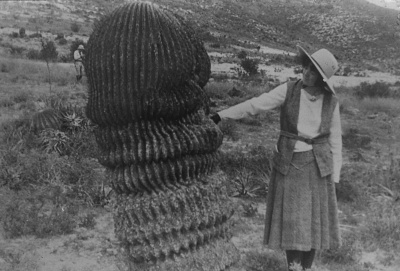
Therefore, Bravo Hollis began a stage in her career where she travelled around Mexico to collect information and samples and photograph different types of cacti. This culminated in 1931 when she graduated as a Master in Biological Sciences at the Faculty of Philosophy and Letters of UNAM, with the thesis entitled Contribuciones al conocimiento de las cacatáceas de Tehuacán (Contribution to knowledge of the Cacti of Tehuacán). This would set the beginning of her subject of study for the years to come.

Dr. Bravo Hollis in one of her many trips of specimen recollections. Ca. 1940. Historic Archive of Biology Institute of UNAM.

From this moment forward, her research career was unstoppable, focused on systematics of cacti in Mexico and part of North America. In 1937, she published her book Las cactáceas de México (Mexican Cacti), which placed her at the forefront of this field of research around the world. In the autumn of 1951, the Mexican Society of Cactology was founded with Dr. Bravo Hollis as president of Cactaceae and Suculentas Mexicanas, which published its first issue in June 1955. Its members carried out intense field work and with all the collected material contributed to the foundation of what became the Botanical Garden of UNAM. Throughout the 1960s, Dr. Bravo Hollis managed the gardens with passion and was highly respected, to the point that she even says she paid the workers out of her own pocket when a strike left them without a salary. Sorrowfully as she expressed:

“I am retired from working at the Biology Institute at 90 years old, handicapped by painful arthritis that prevents me from walking”.

Bravo Hollis, Helia. Las Cactáceas de México. 1937. Contributed in BHL by Instituto de Biología UNAM as part of BHL México. CC-BY-NC-SA.

In total, Bravo Hollis published almost 170 articles and three books, described 60 scientific classifications and made 59 nomenclature reviews. She received numerous awards and recognitions, including the Cactus d’Or from the International Organization of Succulents, an honorary doctorate and an Emeritus Research Prize at UNAM. Her works received worldwide acclaim from fellow biologists and botanists, and today six species and one subspecies of cacti are named after her. Additionally, the Botanical Garden in Tehuacán pays tribute to her through its name: the Helia Bravo Hollis Botanical Garden.

Dr. Bravo Hollis on fieldwork. Ca. 1980. Historic Archive of Biology Institute of UNAM.

References

Bravo-Hollis, Helia. (2004). Memorias de una vida y una profesión. México: Universidad Nacional Autónoma de México, Instituto de Biología, Dirección General de Divulgación de la Ciencia.

Granados Chapa, Miguel Ángel. (2001). La reina de las cactáceas. La Jornada. Recuperado de: https://www.proceso.com.mx/302201/la-reina-de-las-cactaceas

Salcedo Meza, Concepción. (2001). La pasión por la ciencia de una mujer centenaria. ¿Cómo ves? (34). pp. 29-30. Recuperado de: http://www.comoves.unam.mx/assets/revista/34/quienes_34.pdf

Photographs: Historic Archive of Biology Institute of Universidad Nacional Autónoma de México, UNAM.

March 22, 2019by Joel Richard
Page 3 of 5« First...«2345»

Help Support BHL

BHL's existence depends on the financial support of its patrons. Help us keep this free resource alive!

search

About BHL

The Biodiversity Heritage Library (BHL) is the world’s largest open access digital library for biodiversity literature and archives. BHL operates as a worldwide consortium of natural history, botanical, research, and national libraries working together to digitize the natural history literature held in their collections and make it freely available for open access as part of a global “biodiversity community.”

Join Our Mailing List

Sign up to receive the latest news, content highlights, and promotions.

Subscribe Now

Subscribe to Blog via Email

Enter your email address to subscribe to this blog and receive notifications of new posts by email.

Join 319 other subscribers

Subscribe to Blog Via RSS

Subscribe to the blog RSS feed to stay up-to-date on all the latest BHL posts.

Access RSS Feed

Inspiring Discovery through Free Access to Biodiversity Knowledge.

The Biodiversity Heritage Library makes it easier than ever for you to access the information you need to study and explore life on Earth…for free, anytime, anywhere.


64+ Million Pages of
Biodiversity Literature Online.

EXPLORE

Tools and Services
to Transform Research.

EXPLORE

300,000+
Illustrations on Flickr.

EXPLORE

ABOUT | HARMFUL CONTENT | PRIVACY | SITE MAP | TERMS OF USE