Biodiversity Heritage Library - Program news and collection highlights from BHL
  • Home
  • News
  • Featured Books
    • All Featured Books
    • Book of the Month Series
    • BHL at 20
  • User Stories
  • Campaigns
    • Fossil Stories
    • Garden Stories
    • Monsters Are Real
    • Page Frights
    • Her Natural History
    • Earth Optimism 2020
  • Tech Blog
  • Visit BHL
Home
News
Featured Books
    All Featured Books
    Book of the Month Series
    BHL at 20
User Stories
Campaigns
    Fossil Stories
    Garden Stories
    Monsters Are Real
    Page Frights
    Her Natural History
    Earth Optimism 2020
Tech Blog
Visit BHL
  • Home
  • News
  • Featured Books
    • All Featured Books
    • Book of the Month Series
    • BHL at 20
  • User Stories
  • Campaigns
    • Fossil Stories
    • Garden Stories
    • Monsters Are Real
    • Page Frights
    • Her Natural History
    • Earth Optimism 2020
  • Tech Blog
  • Visit BHL
Biodiversity Heritage Library - Program news and collection highlights from BHL
Blog Reel, Campaigns, Featured Books, Her Natural History

Museum für Naturkunde Explores Maria Sibylla Merian’s Legacy and Editions of Her Metamorphosis

Three hundred and seventy-four years ago on 2 April 1647, a remarkable woman was born: the artist and naturalist Maria Sibylla Merian. In the 17th and 18th century world of male-dominated science, Merian had to fight for her place in the natural sciences. Against all odds, she became a trailblazer, especially in developmental biology.
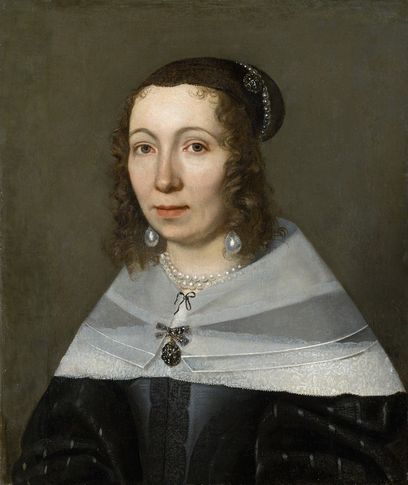
Portrait of a woman in 17th century clothes.

Portrait of Maria Sybilla Merian by Jacob Marrell, 1679.  From the collection of: Kunstmuseum Basel.

Merian’s legacy was recently explored during a 4-week student-project at the library of the Museum für Naturkunde (MfN) in Berlin. The project was part of a master’s program for the University of Applied Science in Leipzig to enlarge the student’s experience in the historical holding field and give a glimpse into the planning and conducting of a project. The aim of the project itself was and is the digitization of two different editions of Merian’s work, Metamorphosis insectorum Surinamensium, as well as a restorative and provenance research summary about the volumes. Both editions show Merian’s talent in painting and observing insects and plants.

Merian’s fascination with flowers and painting had its origin with her stepfather Jacob Marrel, a known flower painter of the time, who took her under his wing. Despite her mother’s wish, who considered painting too “masculine,” Merian learned how to draw and engrave from Marrel and by the age of eleven, she was able to engrave on copper independently (Kutschera 2017: 28). At the age of twelve, she developed a heightened interest in exploring the nature around her and was especially fascinated by the metamorphosis of silk worms. Merian conducted her own studies, feeding the silkworm larvae and observing their transformation. Thus, her collection of different caterpillar species started to grow.
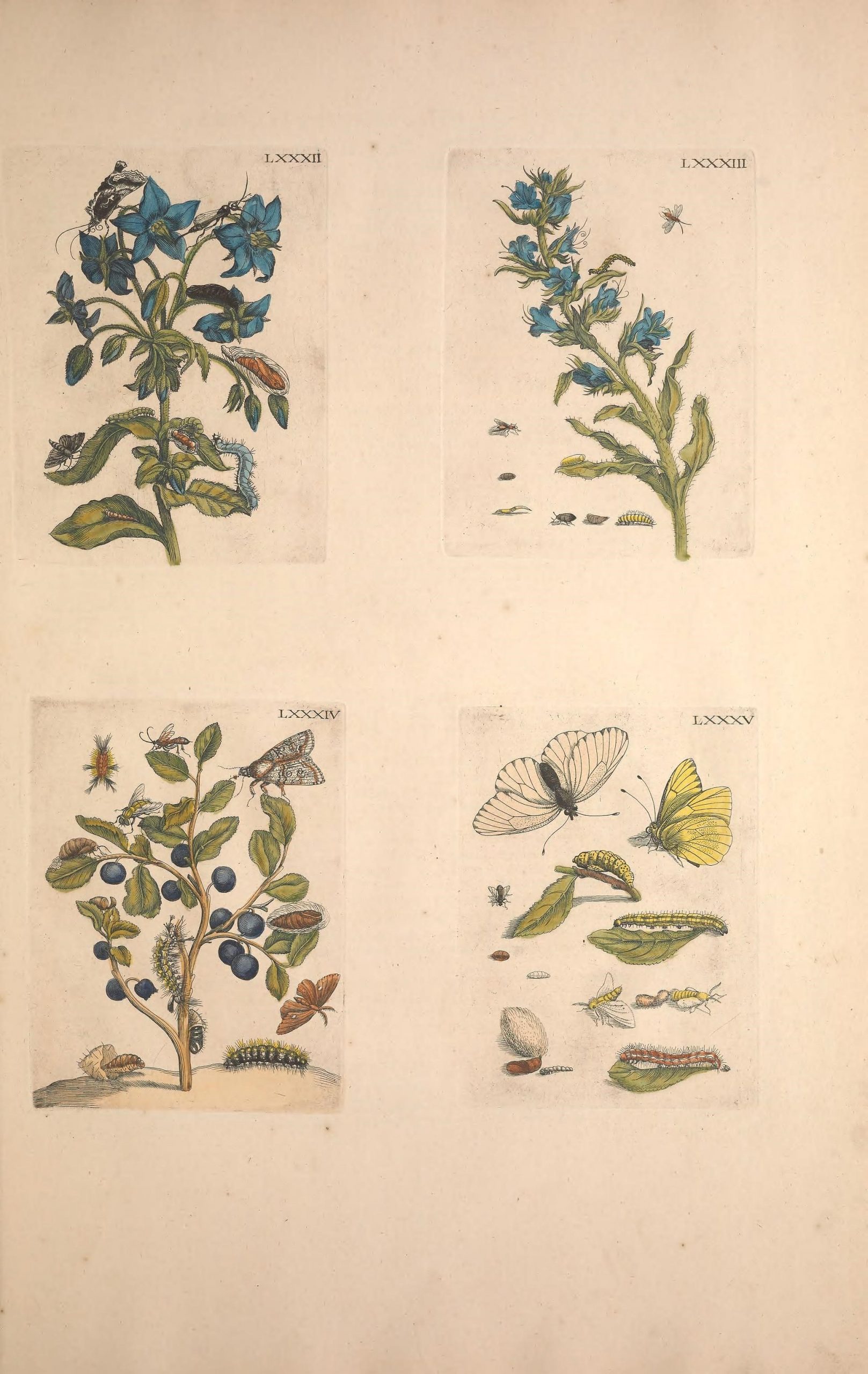
Examples of flowers and insects, found in: De Europischen insecten. 1730.

Examples of flowers and insects. Found in: Merian, Maria Sybilla. De Europischen insecten, v.3. 1730. Contributed in BHL from Smithsonian Libraries and Archives.

In 1665, shortly after her 18th birthday, Merian married Johann Andreas Graff (1636-1701)—a marriage that ended in divorce nearly 30 years later in 1692. Merian published her first work, the flower book Neues Blumenbuch, in 1675. It contained examples for the students of her painting and embroidery classes. She did not lose her interest in the metamorphosis of species, however, and published her first book about caterpillars in 1679 under the name Der Raupen Wunderbare Verwandelung und Sonderbare Blumennahrung (engl. “The Wondrous Transformation of Caterpillars and their Remarkable Diet of Flowers”). The “Anderer Theil” (engl. “Other volume”) followed in 1683.

In 1685, Merian moved with her two young daughters to a community of Labadists in Friesland. There, the exotic butterflies from Suriname in the collection of the castle Waltastate served as a template for new paintings and sparked her interest towards this exotic country. It was also the place she observed and recorded the metamorphosis of the frog in 1686 for the very first time, 13 years before Antonie van Leeuwenhoek documented it in a letter to the Royal Society (Nagendra 2016: 122). However, the small family did not stay in Friesland for long and moved to Amsterdam in 1690. With the help of other naturalists and the caterpillars they brought with them, the three women established themselves as artists.

Through the connections Merian made in Holland, she met travellers that came back from the Dutch colony Suriname with collections full of colourful insects. Although these were pretty to look at, the collections lacked the information about the insects’ developments.

“In Holland, I saw with wonderment the beautiful creatures brought back from the East and West Indies, especially when I had the honour to be able to see the splendid collection belonging to […] Dr Nicolaas Witsen […] and many others, in which I found these and countless other insects, but without their origins and subsequent development, in other words, how they develop from caterpillars into chrysalises and so on. All this stimulated me to undertake a long and costly journey to Suriname […] in order to pursue my investigations further.” (Merian & O’Brien-Twohig 2012: 2)

Merian’s decision to travel to Suriname, a country known for the death of many travelers due to tropical diseases at the time, as a divorced 52-year-old woman was quite scandalous. On top of that, Merian managed to finance herself independently by selling her paintings beforehand.

In 1699, Merian and her youngest daughter Dorothea Maria boarded a ship to Suriname. They arrived in Paramaribo and quickly learned that the Dutch colonists were not interested in helping them in their mission to locate and study the foreign insects. Instead, Merian relied on the assistance and knowledge of the Indigenous and African people enslaved on the Dutch sugar plantations.

Over the next two years, Merian and her daughter spent time exploring the jungle, canoeing rivers and painting every plant and insect they could find. Everything that they collected, from the information to the first artworks, went into Merian’s journal. Unfortunately, the pair returned home in 1701, earlier than expected, when Merian became ill, possibly with malaria. As a result, her stay on a plantation near the riverside of Paramaribo was cut short by three years.

Merian presented the results from her trip in the Metamorphosis insectorum surinamensium, first published in 1705. In it, 60 plates show the variety of the vibrant colours of the rainforest, each accompanied with information about their practical use, medical remedies, or general studies about the development of the insects and plants. A lot of her knowledge about the usage came from the enslaved people of the Suriname plantations. It is unclear whether Merian herself bought the enslaved people with whom she worked or if they were a gift when she first arrived (Davis 1996: 210).

Merian herself wrote on plate 36 about the plant Costus arabicus:

“I had my Indian dig [Costus arabicus] up by the root and carry it home and plant it in my garden” as well as that “because the forest is so densely grown with thistles and thorns, I had to send my slaves ahead of me with axes to hack out an opening for me.”

Therefore, while she writes about the help she received from enslaved people, unlike many other explorers and naturalists of her time, she still did not credit them by names (Baumhammer & Kennedy 2017: 213). In her publication, they remain an anonymous source of information.
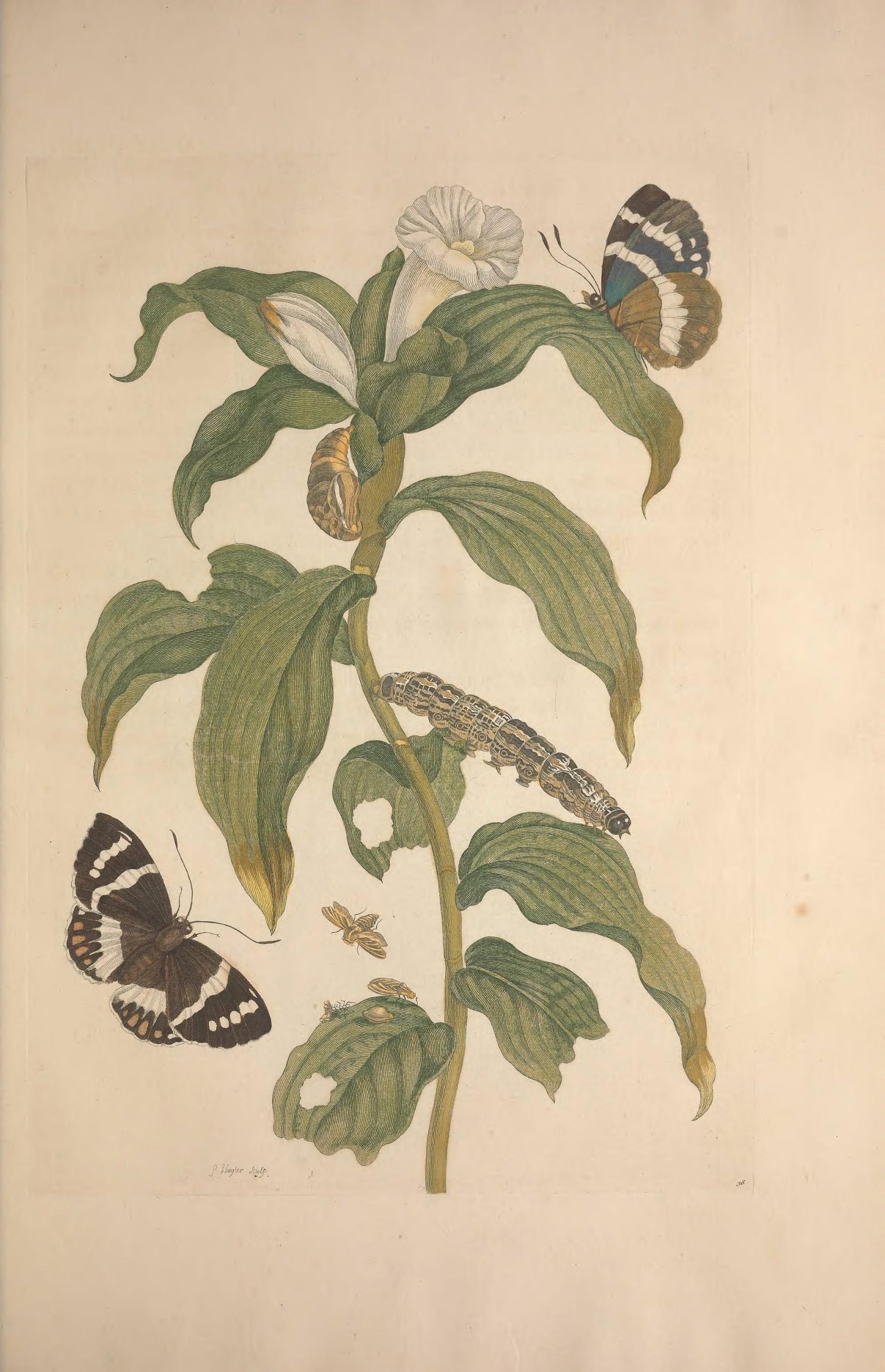
Costus Arabicus, a Banana Stem Borer Moth and an unidentified butterfly. Found in Metamorphosis insectorum surinamensium 1705, plate 36.

Costus arabicus, a Banana Stem Borer Moth, and an unidentified butterfly. Found in: Merian, Maria Sybilla. Metamorphosis insectorum surinamensium. 1705. Contributed in BHL from Smithsonian Libraries and Archives.

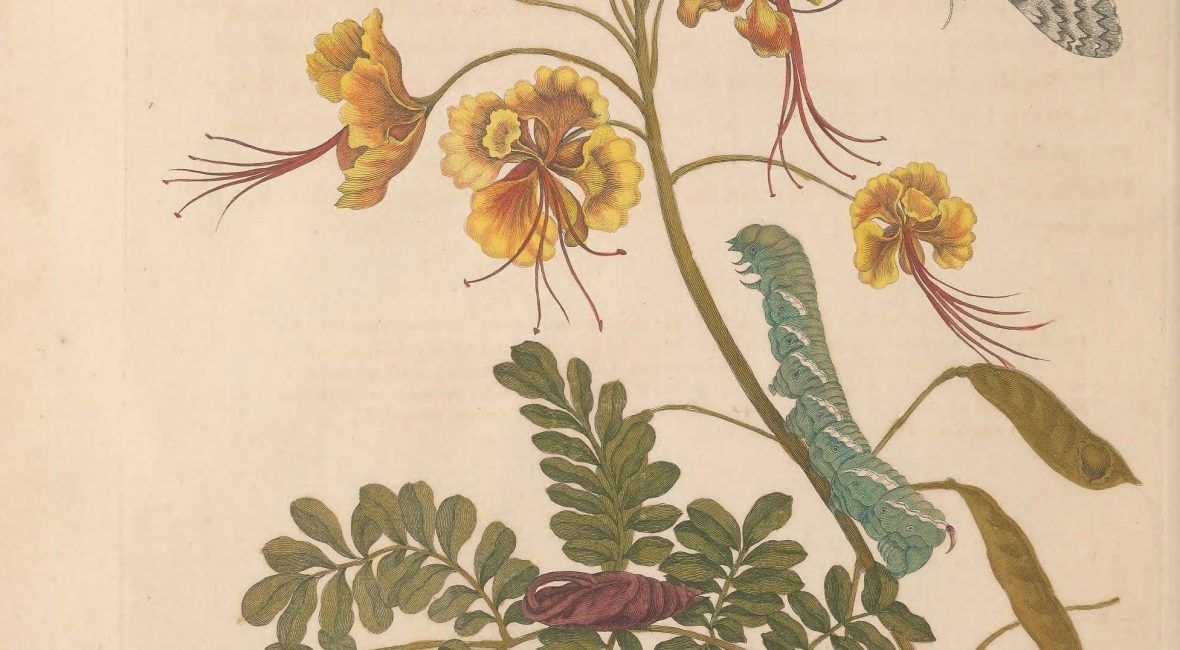
In a later part of the book, there is a hard breach between the beautiful painting of the Peacock flower and Merian’s description of the usage of said flower. She writes that enslaved women told her about the horrible treatment from the Dutch and their use of the seeds to cause abortions and save their children from the same enslaved fate.

The focus of Merian’s criticism was mainly on the Dutch farming practices and not on the brutal treatment of the enslaved people. She could not understand how the Dutch ignored the richness and diversity of the flora around them and only planted sugar. Lizabeth Paravisini-Gebert suggests that Merian was interested only in sharing scientific findings from her time in Suriname. “Full of groundbreaking information to communicate to a world avid for scientific knowledge, she was not gifted with a facile pen for anything other than scientific fact” (Paravisini-Gebert 2012: 12). While this might explain her lack of a more pronounced criticism of slavery, it does not condemn the fact that she took an enslaved woman with her back to Amsterdam as indicated by the passenger list for the sailing back home. This woman was most likely the person Merian referenced as “my Indian” from the text about Costus arabicus (Davis 1996: 212; Polcha 2019).

There is no mention in the sources about Merian’s behaviour towards the enslaved people on whom she relied, but Merian did participate in the racial hierarchies of trans-national colonialism. While she may have broken gender rules and created brilliant works of art, Merian ultimately profited from the suffering of others.

Merian’s reliance on and usage of the information and help she received from enslaved people must not be ignored, as it opens the discussion about how slavery affected her work and how she benefited from it. Merian would likely not have had access to most of the plants and insects described in her book without the help from enslaved African and Indigenous people, especially since the Dutch colonists did not support her studies. Would there have been a Metamorphosis without Merian using and exploiting the established oppression?

Ultimately, Metamorphosis did not sell as well as previously hoped and Merian lived in modesty. Her plans to publish translations of the book could not succeed due to the expense. She died poor on 13 January 1717, probably the same day Czar Peter the Great bought her remaining paintings (Nagrenda 2016: 118; Kutschera 2017: 30; Pieters & Winthagen 1999: 6).
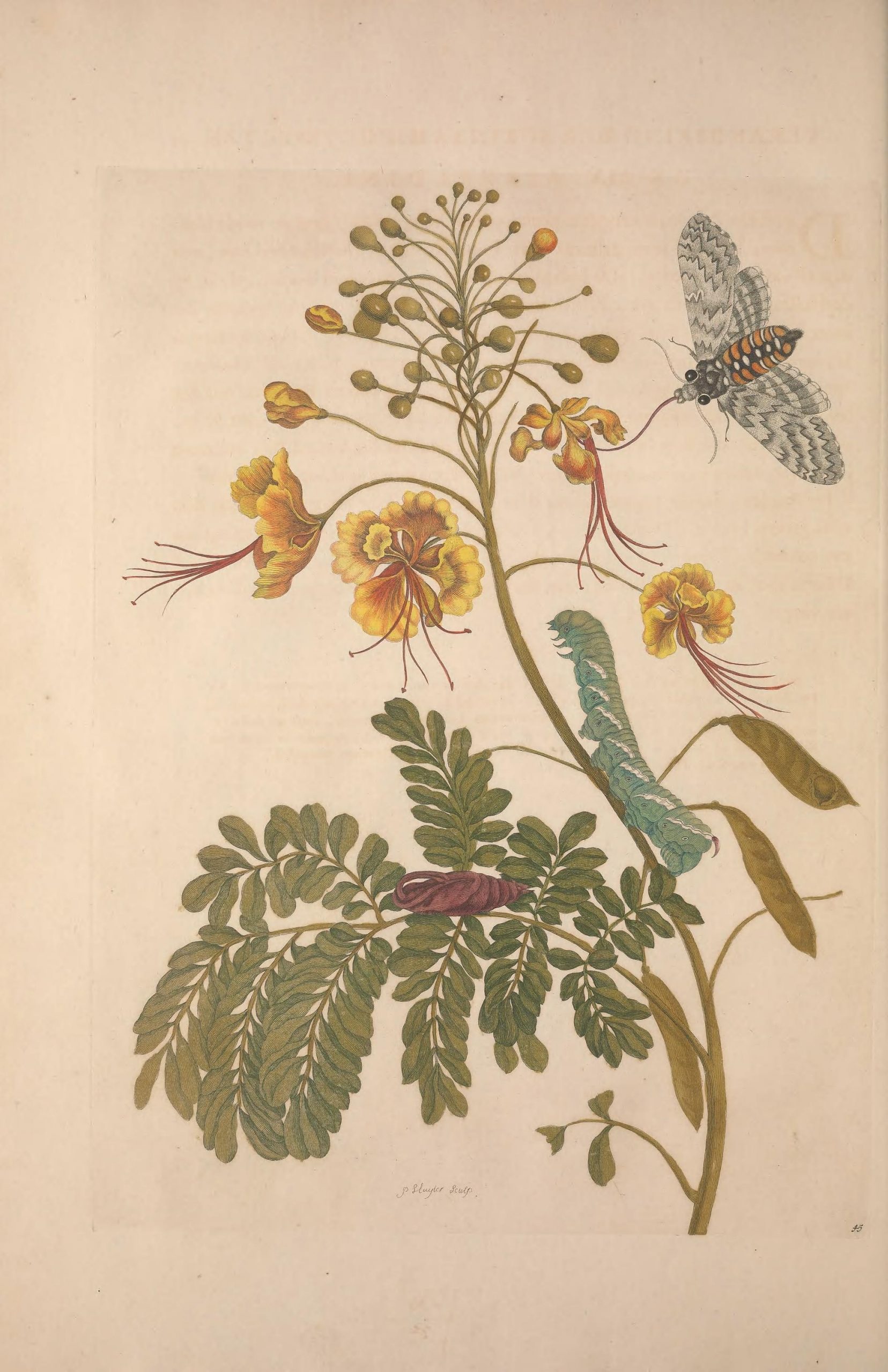
The peacock flower (Caesalpinia pulcherrima) with its seeds and the life cycle of the Caroline Sphinx Moth (Manduca sexta). Found in Metamorphosis insectorum surinamensium 1705, plate 45.

The peacock flower (Caesalpinia pulcherrima) with its seeds and the life cycle of the Caroline Sphinx Moth (Manduca sexta). Found in: Merian, Maria Sybilla. Metamorphosis insectorum surinamensium. 1705. Contributed in BHL from Smithsonian Libraries and Archives.

The beforehand mentioned project at the Museum für Naturkunde in Berlin revolved around the Dissertation sur la generation et les transformations des insectes de Surinam (published in 1726) and the three volumes of Histoire générale des insectes de Surinam et de toute l’Europe (published in 1771). These editions used the copper plates from the original Metamorphosis print. Although they lack the vivid colours of their original counterpart, the black and white engravings still show the broad diversity of the Suriname (and European) insects and plants. Currently the library awaits the arrival of a new book scanner to digitize these four books, as they were too large for the scanner currently in use. They should be available in BHL by the end of the year (2021).

The Dissertation contains twelve more plates, two of which Merian did not make herself. These two plates and their explanation were full of errors. Due to this and wrongly coloured plates in later editions, Merian was harshly criticized despite showing and explaining nearly everything right in her own coloured and published edition (Pieters & Winthagen 1999: 10; Nagrenda 2016: 121). However, “the many racist, sexist, plain nasty (and ignorant) 19th century critiques of her work in Surinam only serve to highlight the remarkable and path-breaking nature of her work in the 17th century” (Nagendra 2016: 121).

The three volumes of Histoire générale des insectes de Surinam et de toute l’Europe furthermore included the European insects as well, using original drawings from Merian, too. The Museum’s copies were a donation by the Gesellschaft naturforschender Freunde zu Berlin (G.n.F., engl. “Berlin Society of Friends of Natural Science”) when they closed their library in 1907. It is unknown who bought them for the G.n.F. but they were acquired between 1793 and 1828. Handwritten annotations show that the same person used the books. Furthermore, the copy at the Museum shows one of the incorrect plates is upside down, which ironically highlights the errors.
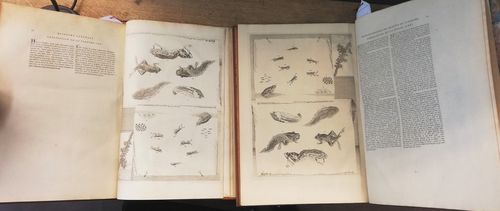
Comparison of two copies of a book with black and white illustrations. One copy has the illustration bound upside down.

Comparison of the incorrect copy of Histoire générale des insectes de Surinam et de toute l’Europe in the collection of the Museum für Naturkunde in Berlin. Photo Credit: Antonia Trojok.

Alongside these four books, another was found and digitized from the MfN collection: a German edition of a volume from Historiae naturalis by John Johnston, for which Maria Sibylla Merian’s older half-brothers, Matthäus and Caspar Merian, made the copper plates. You can find their names engraved on two plates in the books. The siblings learned alongside each other during their childhood as Jacob Marrel’s students. This title testifies to the artistic talent that ran in the family, given the detail included even for those animals of purely fantastical origins.
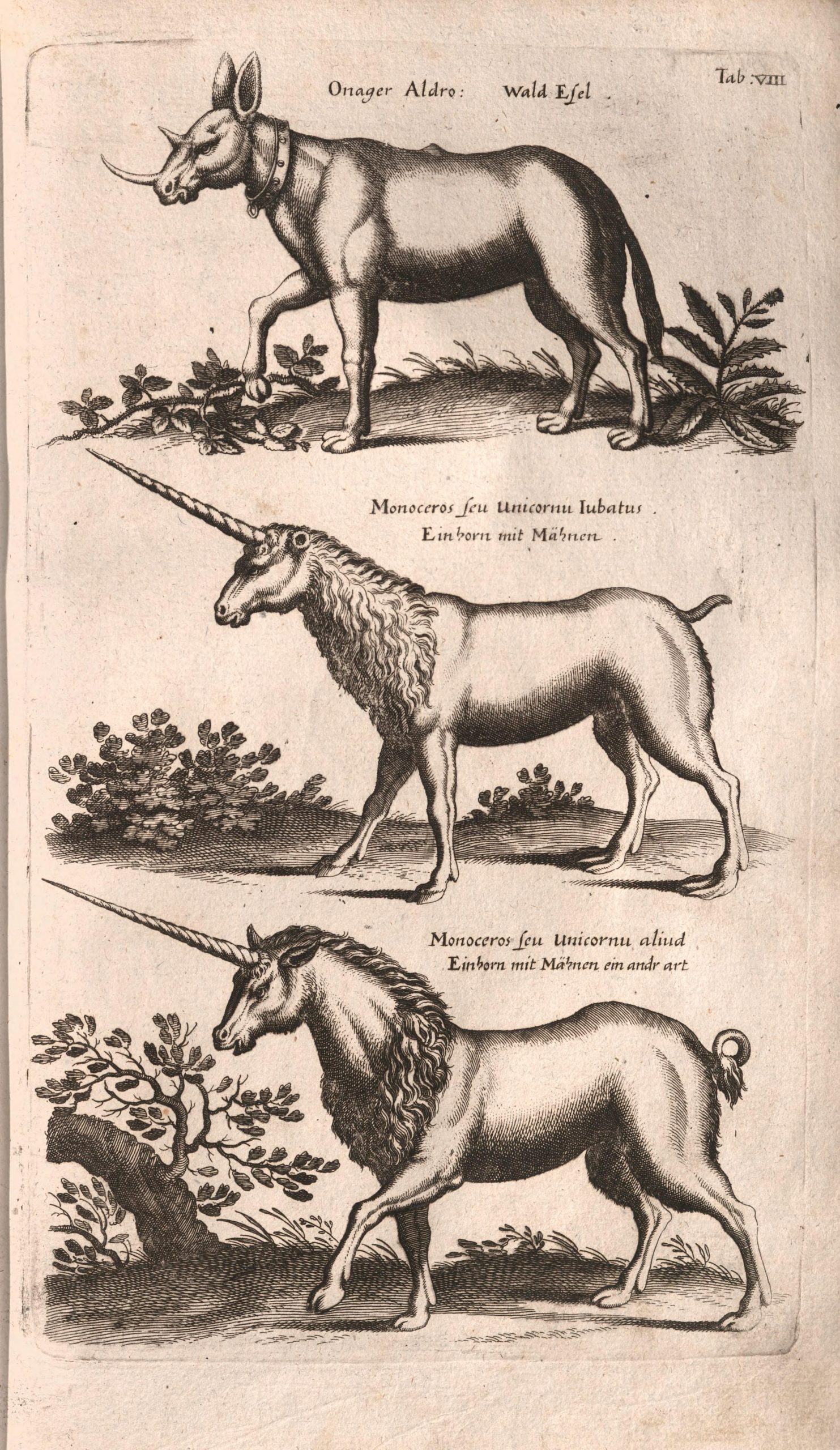
Engraved illustration of three unicorns.

Plate of fantastical creatures. Found in: Decker, Johannes. Naturgeschichte aus den besten Schriftstellern : mit Merianischen und neuen Kupfern. 1772. Digitized in BHL by Museum für Naturkunde Berlin.

In conclusion, the editions in the Museum für Naturkunde and many other instances show that Maria Sibylla Merian’s legacy for natural science still lives on. Merian was also the first European to do a voyage for a solely scientific purpose (Valiant 1993: 470) and recorded the life cycle of a frog. The Father of Taxonomy, Carl Linnaeus, as well as many more scientists cited her work throughout the years. However, we cannot highlight her legacy without also confronting her use of enslaved labour and acknowledging and respecting the impact that enslaved and Indigenous people in Suriname had on her work. Without them, Merian probably would not have shown the diversity of the rainforest for the first time.

With Merian’s legacy digitized, even more researchers and nature lovers can now enjoy her work in the future. Hopefully, these digitized copies will also inspire continued research into the extent and impact of the enslaved African and Indigenous people who contributed to this ground-breaking work.

You can read the first edition (in Dutch) of Metamorphosis insectorum surinamensium (1705)—freely available in BHL thanks to Smithsonian Libraries and Archives. Or check out Merian’s drawings from the first edition on the BHL Flickr page.

References

Davis, Natalie Zemon. 1996. Drei Frauenleben – Glikl – Marie de l’Incarnation – Maria Sibylla Merian. Berlin, Wagenbach.

Baumgarten, Megan & Kennedy Claire. 2017. Merian and the Pineapple: Visual Representation of the Seneses, in: Hacke, D. & Musselwhite, P. (eds.), Empire of the senses: Sensory practices of colonialism in early America, Boston, Brill, 190–222. http://dx.doi.org/10.1163/9789004340640.

Kutschera, Ulrich. 2017. Maria Sibylla Merian (1647-1717) – Pionieren der Entwicklungsbiologie und Ökologie, Biologie in unserer Zeit 47(1), 28–36. http://dx.doi.org/10.1002/biuz.201710610

Nagendra, Harini. 2016. Maria Sibylla Merian (1647–1717), Resonance 21(2), 115–124. http://dx.doi.org/10.1007/s12045-016-0305-9

Merian, Maria Sibylla & O’Brien-Twohig, Sarah. 2012. from Metamorphosis insectorum Surinamensium (Or, Transformations of Surinamese Insects ), Review: Literature and Arts of the Americas 45(1), 21–28. http://dx.doi.org/10.1080/08905762.2012.670451

Pieters, Florence. & Winthagen, Diny. 1999. Maria Sibylla Merian, naturalist and artist (1647-1717): A commemoration on the occasion of the 350th anniversary of her birth, Archives of natural history 26(1), 1–18. http://dx.doi.org/10.3366/anh.1999.26.1.1

Polcha, Elizabeth. 2019. Breeding Insects and Reproducing white Supremacy in Maria Sibylla Merian’s Ecology of Dispossession. https://www.ladyscience.com/breeding-insects-and-reproducing-white-supremacy/no57

Valiant, Sharon. 1993. Maria Sibylla Merian: Recovering an Eighteenth-Century Legend, Eighteenth-Century Studies 26(3), 467–479. https://doi.org/10.2307/2739414
June 3, 2021by Joel Richard
Blog Reel, Featured Books

Earth Day 2021: Exploring Earth’s Biodiversity through Books

background of yellow, white and red flowers with text "Happy Earth Day 2021"

Since its inaugural event on 22 April 1970, Earth Day has grown into an international annual celebration of the Earth and a movement to raise awareness about and support for environmental protection. This year’s theme, Restore Our Earth, emphasizes that, “As the world returns to normal, we can’t go back to business-as-usual.” As we face widespread climate change and unprecedented biodiversity declines—with one million species threatened with extinction—immediate, online access to essential literature is ever-more important, allowing scientists to conduct research more quickly and efficiently and improving our ability to respond to these crises. For fifteen years, the Biodiversity Heritage Library (BHL) has worked as a global consortium to provide this vital access, empower research, and make a real difference in our ability to improve the health of our planet for every species that calls it home.

This year, several of our global partners have selected a few titles from the BHL collection to commemorate Earth Day. From exploring Asia’s vast and unique biodiversity to inspiring conservation through a popular publication on birds, providing practical methods for conducting surveys and using the data to support conservation practices, and marveling at the extraordinary biodiversity of past ages, these titles highlight the richness of our planet’s biodiversity and remind us of the importance of protecting the wonderful, wild, and beautiful life on Earth.

Asian Biodiversity: An Essential Contributor to Our Beautiful Earth

By Zheping Xu, Xuejuan Chen, and Tian Jiang (National Science Library, Chinese Academy of Sciences)

Biodiversity is essentially everywhere, ubiquitous on Earth’s surface and in every drop of its bodies of water [1]. Biodiversity conservation makes great contributions to the restoration of the earth.

As a continent with the largest area and the most population, Asia holds vast biodiversity, from the equatorial region to the Arctic area, and from the coast of the western Pacific to the borders of Europe and Africa. Here, we introduce several books that review Asian biodiversity, from mammals and insects to some distinctive species from the continent.

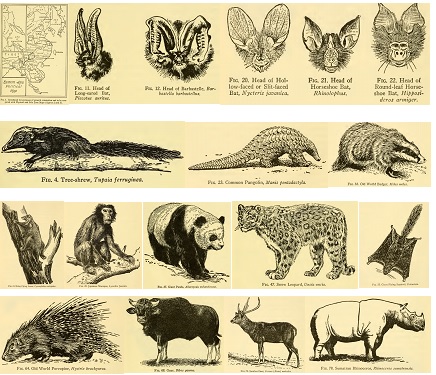
Mammals of Eastern Asia (1947) is the first general work on mammals of eastern Asia [2]. The book’s carefully prepared chapters and fine original pen sketches are interesting, useful and invaluable to the amateur as well as the professional zoologist regarding the habitats, relationships, life histories and idiosyncrasies of the widely diversified faunas.

Map of Eastern Asia and pen sketches of some mammals.

Map of Eastern Asia and pen sketches of some mammals. Source: Tate, G. H. H. (George Henry Hamilton). Mammals of Eastern Asia. 1947. Contributed in BHL from MBLWHOI Library.

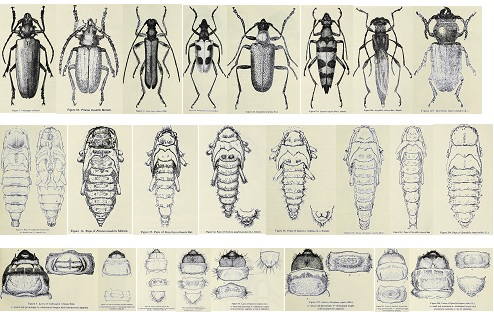
Cerambycidae of Northern Asia (1988) describes the morphology, geographic distribution, and biology of cerambycid beetles in Northern Asia of four sub­families (Prioninae, Disteniinae, Lepturinae, and Aseminae), comprising 124 species. Many cerambycid species are invasive pests of environmental concern, causing severe damage to forests and crops. Long-term field investigations were conducted on the composition and biology of cerambycids in different parts of northern Asia. Tens of thousands of larvae, pupae, and adult insects were raised in the laboratory for experiments. Keys to taxa of the family Cerambycidae based on different developmental stages are presented in this work for the first time. This book provides important information for informing broad theoretical principles and in resolving practical problems of pest infestation in forests.

Cerambycidaes: adult insects with their larvas and pupas.

Cerambycidaes: adult insects with their larvas and pupas. Source: Cherepanov, A. I. (Aleksei Ignatevich). Cerambycidae of Northern Asia. 1988. Contributed in BHL from Smithsonian Libraries and Archives. CC-BY-NC-SA.

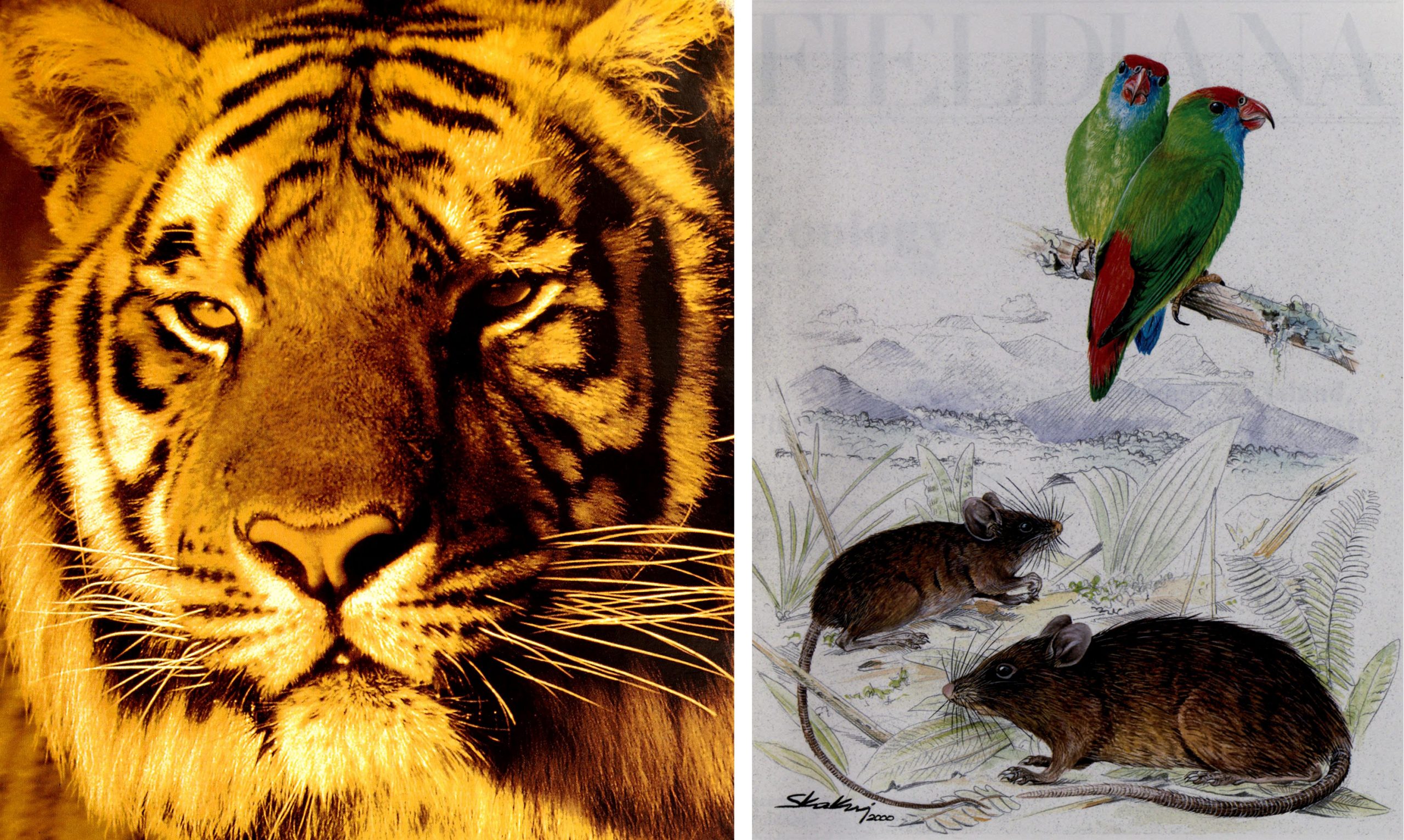
Asia is home to endemic and highly distinctive focal species. Tracking tigers (Published in 1998) gives a comprehensive overview of the wild status of the Tiger, Asian Elephant, Gaur and Banteng in Indochina. On this basis, it recommends future survey and management needs, and provides background discussion on issues to be addressed by national action plans. The Philippines’ fauna is characterized by large numbers of endemic and highly distinctive species. During the 1980s, the extent of rain-forest habitat destruction became apparent and underscored the need for extensive and detailed documentation of biological diversity to guide development and conservation for the benefit of both wildlife and the human population of the Philippines. The Mammals and birds of Camiguin Island, Philippines, a distinctive center of biodiversity (published in 2006) presents studies of Camiguin Island, a small island province in the Philippines and an ideal natural laboratory in which to investigate many aspects of the evolution and conservation of biological diversity.

photo of a tiger and illustration of green and red birds and brown rodents

Left: The tiger in Indochina. Source: Duckworth, William and S. Hedges. Tracking tigers. 1998. Contributed in BHL from Smithsonian Libraries and Archives. CC-BY-NC. Right: “Two species of mammals and one species of bird live only on Camiguin Island: Apomys sp. ([…] center left), Bullimus gamay ([…] lower right), and Loriculus sp. ([…] upper center). The distinctive volcanic peaks of Camiguin form the background.” Source: Heaney, Lawrence R. The Mammals and birds of Camiguin Island, Philippines, a distinctive center of biodiversity. 2006. Contributed in BHL from University Library, University of Illinois Urbana Champaign. CC-BY-NC-SA.

Biological species in Asia are important components of Earth’s biodiversity. Biodiversity is closely related to human well-being, but human activities caused rapid changes in biodiversity over the past decades. To restore our Earth, we must identify and assess drivers of biodiversity loss, including habitat change, climate change, invasive alien species, overexploitation, and pollution [1].

[1] Duraiappah, A. K., Naeem, S., Agardy, T., Ash, N. J., Cooper, H. D., Diaz, S., Faith, D. P., Mace, G., McNeely, J. A., Mooney, H. A., Oteng-Yeboah, A. A., Pereira, H. M., Polasky, S., Prip, C., Reid, W. V., Samper, C., Schei, P. J., Scholes, R., Schutyser, F., & Van Jaarsveld, A. (2005). Ecosystems and human well-being: biodiversity synthesis; a report of the Millennium Ecosystem Assessment. World Resources Institute. http://www.millenniumassessment.org/documents/document.354.aspx.pdf.

[2] -S., T. Mammals of Eastern Asia. Nature 161, 188 (1948). https://doi.org/10.1038/161188e0.

Our Southern Birds and Emma Bell Miles: Inspiring Appreciation for and Protection of Birds

By Tomoko Y. Steen, Ph.D. and Alison Kelly, MLIS (Science, Technology & Business Division, Library of Congress)

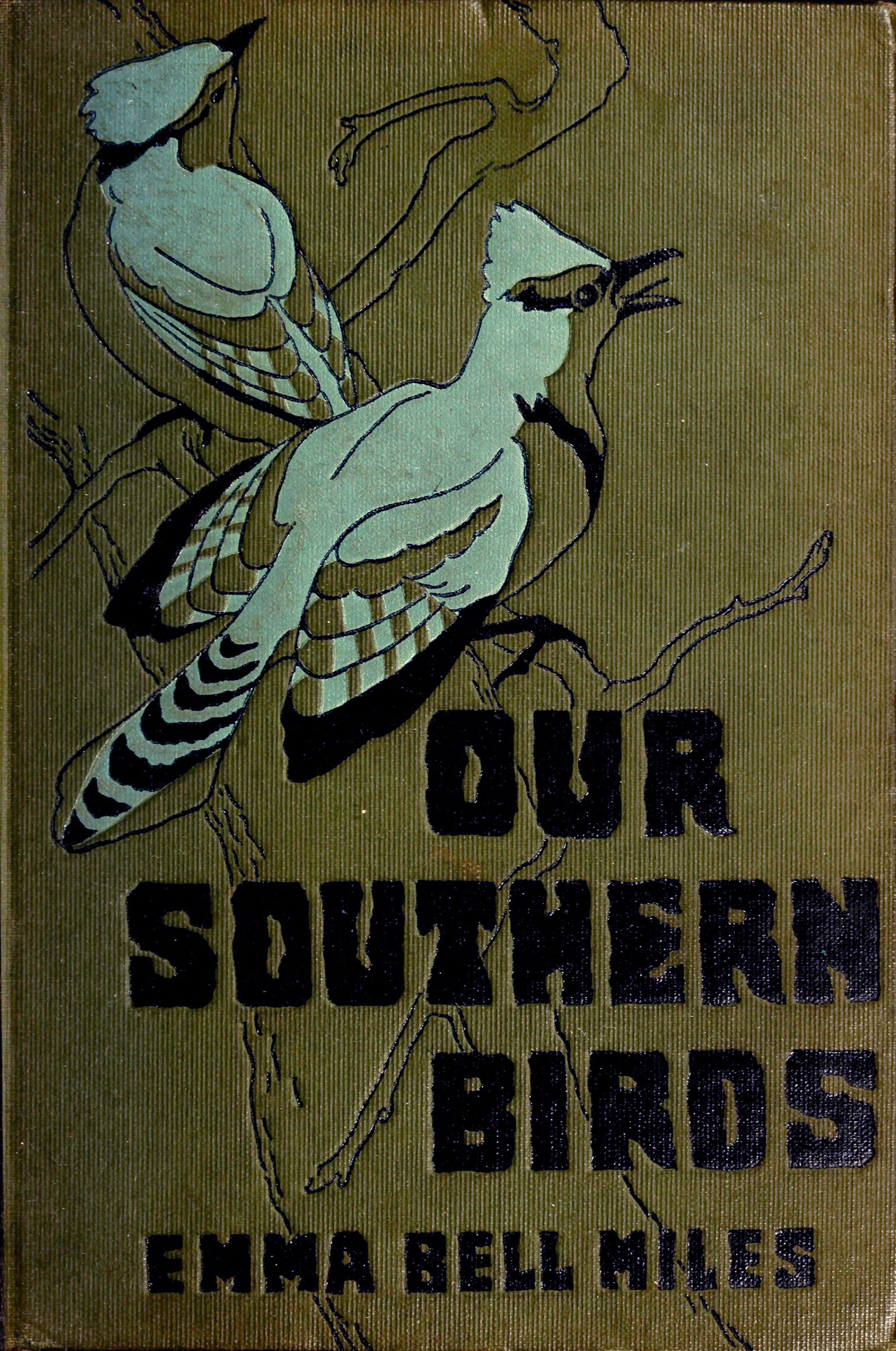
Illustrated book cover featuring two birds and title "Our Southern Birds"

Cover. Miles, Emma Bell. Our Southern Birds. Copyright 1919. Contributed in BHL from Library of Congress.

Emma Bell Miles (1879-1919) was a talented artist, writer and naturalist whose writings reflect her love of the Tennessee mountains where she spent most of her life. In Our Southern Birds, copyrighted in 1919, she recorded her detailed observations and knowledge of the birds of Appalachia, an area that had received little attention in the popular publications on birds until that time. Through this and her other works capturing the essence of natural life in the Southern mountains, Emma Bell Miles drew attention to the importance of preserving biodiversity and habitat.

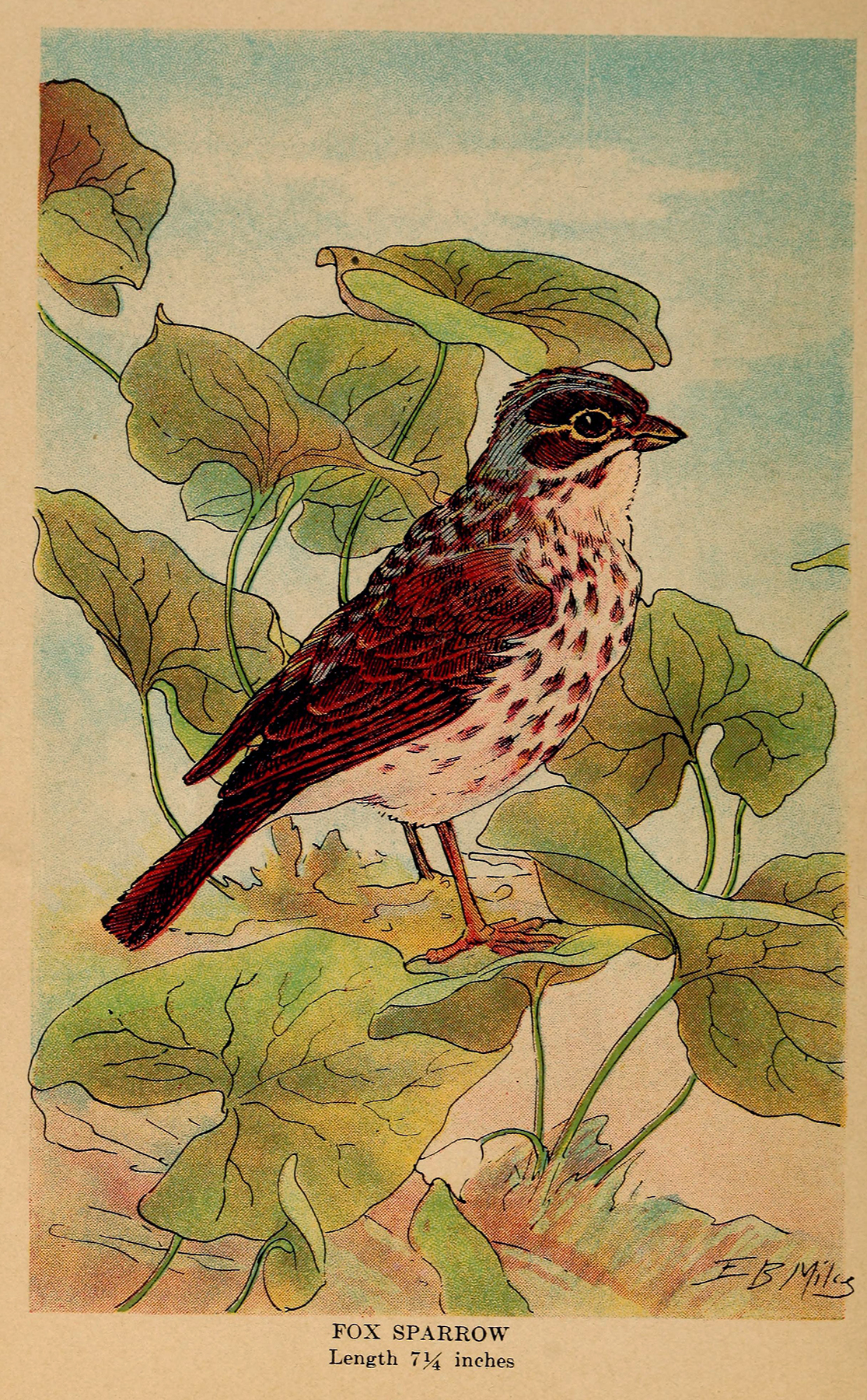
colored illustration of a bird, fox sparrow, brown with blue head and cream belly sitting on branch with green leaves

Fox sparrow. Miles, Emma Bell. Our Southern Birds. Copyright 1919. Art by Miles. Contributed in BHL from Library of Congress.

In the introduction to this, her last book, she stated:

…while the scientific study of birds is beyond most of us, yet an intimate understanding of them and their ways is within reach of everyone, and may enrich life with a new depth of interest… Go out alone in early morning, keep the sun at your back, be careful to do nothing that will startle these timid creatures, and see what you will see.

Our Southern Birds includes many beautiful illustrations by Miles, who, as a young woman, left her home in the mountains to study art in St. Louis. Plagued by homesickness for the mountains, she returned to Appalachia after two years and married a mountaineer. Their marriage was a difficult one, marked by poverty and illness, and she was often the sole supporter of the family by selling her writings, art and poetry.

Written for all levels of readers, this engaging book will appeal to anyone with an interest in birds. Part of the genius of Emma Bell Miles’ work is that she succeeds in presenting not only a careful description of over 100 birds and their habitats, but captures the individual personalities and demeanor of any given species through words and pictures. Her desire to recruit readers to active birdwatching is shown in the inclusion of blank pages for recording observations.

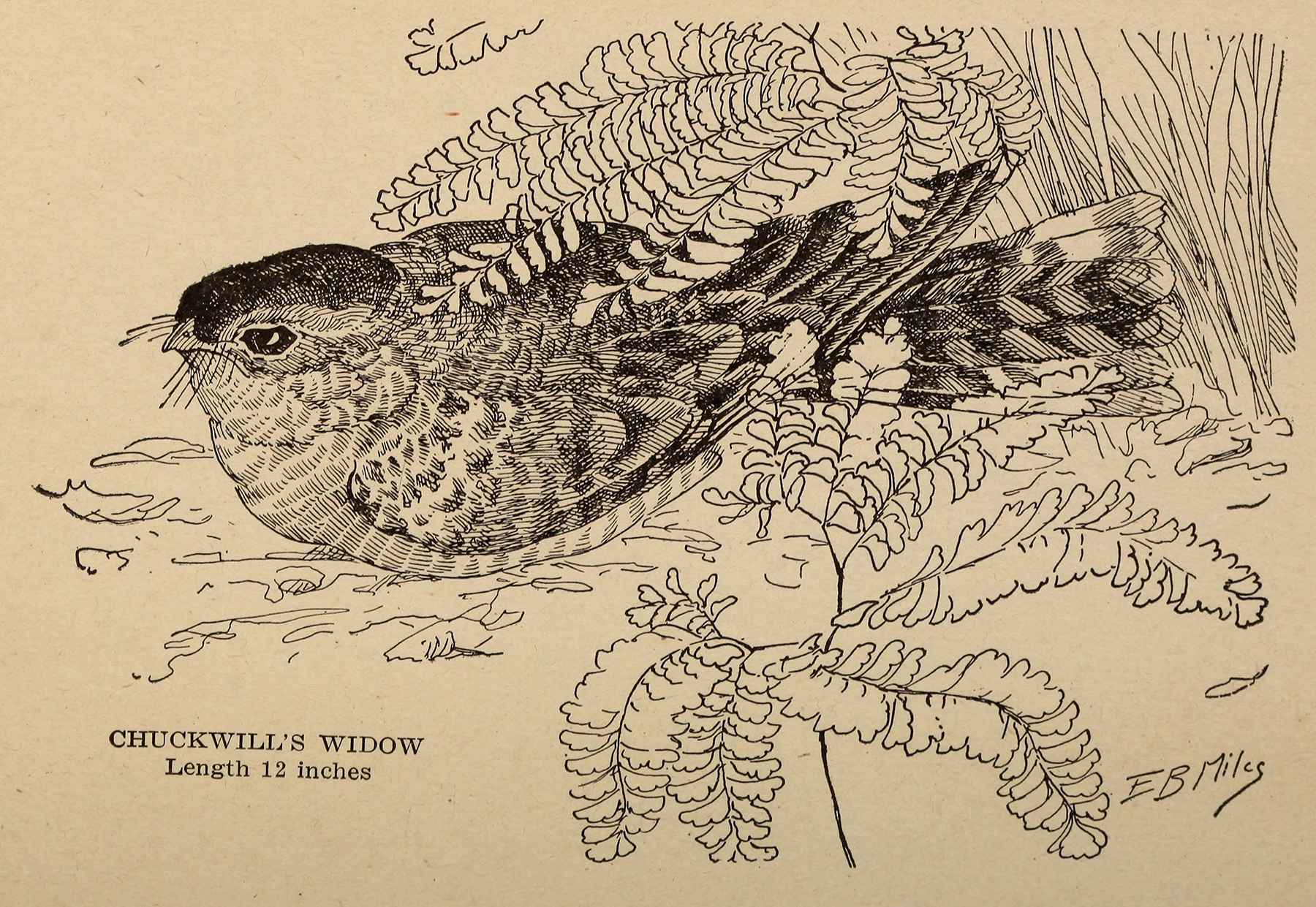
black and white illustration of a bird, chuckwill's widow, hiding within foliage

Chuckwill’s widow. Miles, Emma Bell. Our Southern Birds. Copyright 1919. Art by Miles. Contributed in BHL from Library of Congress.

“Shadows from the Past,” the final chapter of the book, mentions several species that are extinct or close to extinction. “Let the disappearance of these winged lives from their one-time haunts lead us to set a higher value on those that remain,” she writes. In poetic language she goes on to describe the tragic extinction of the passenger pigeon, concluding with an appeal that we can learn from the past: “…it is not too late to learn from the mistakes of our fathers, and though we have lost some valuable species, we may yet save others that are following these to extinction”.

In celebration of Earth Day we want to shine a light on Emma Bell Miles, whose skills in observing and recording the natural world around her will inspire readers to appreciate and preserve biodiversity in their own special place on Earth.

Environmental Evaluations Using Birds and Their Habitats

By Samantha Lindgren (University Library, University of Illinois Urbana-Champaign)

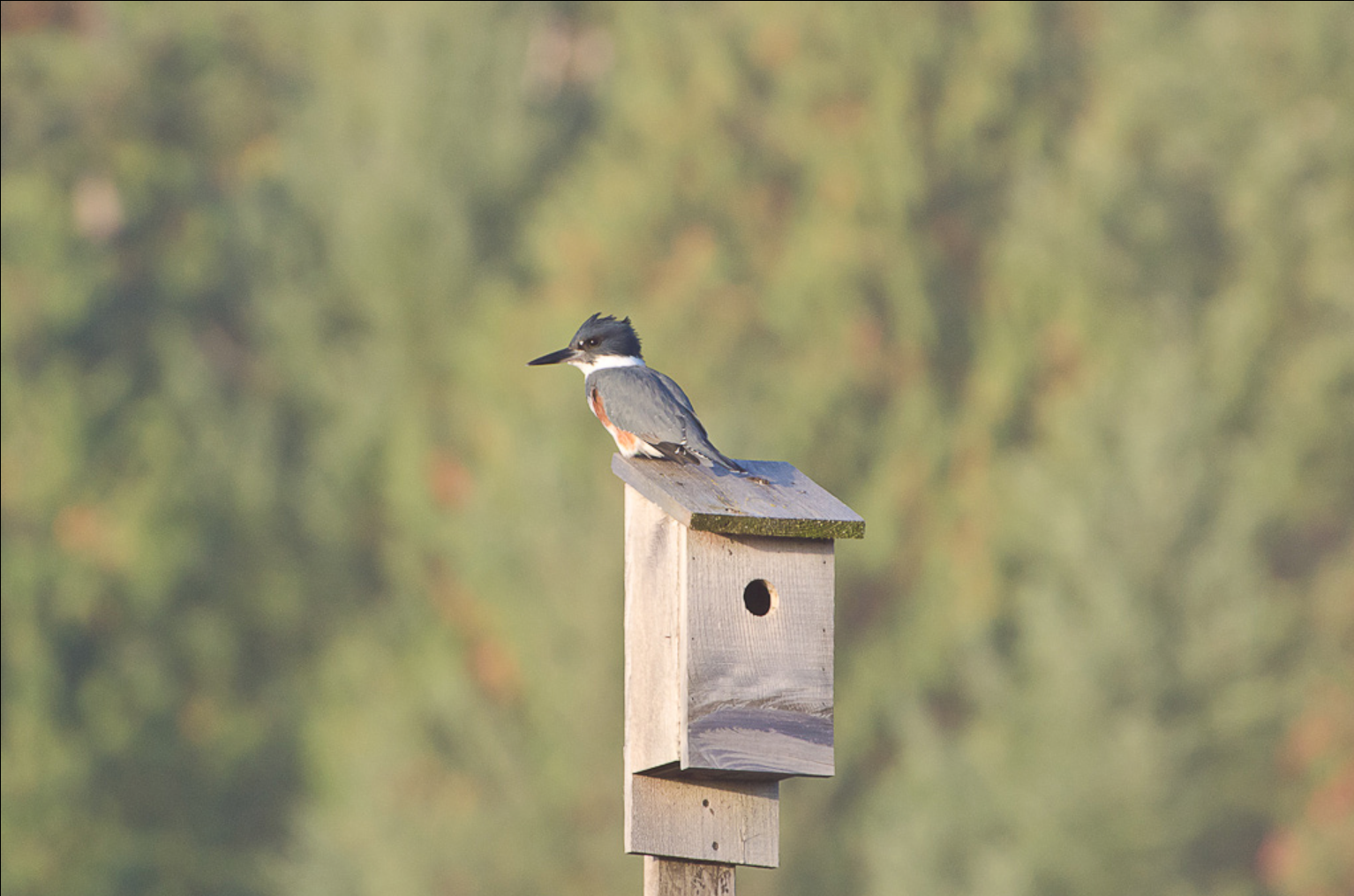
A blue and white bird sitting on a birdhouse roof with a background of trees.

A female Belted Kingfisher. Courtesy of Tyler Ingram, CC BY-NC-ND.

In their 1976 book, Environmental Evaluations Using Birds and Their Habitats, Jean and Richard Graber offer practical methods for surveying birds in Illinois with the purpose of curating data for environmental impact statements. Published as one of the Illinois Natural History Survey’s Biological Notes, the book details the data they have collected from these methods, including bird populations and habitat acreage. Throughout the book are also tables, graphs, and images supporting their methods and findings. While the book was published 45 years ago, it came at a time when concerns for environmental protection was just beginning to affect change, and it remains relevant in its advocacy for environmental conservation and restoration.

Earth Day 2021’s theme is Restore Our Earth. This theme resounds throughout the book in details of habitat surveying and restoration. As the authors posit, Illinois is a large state with diverse habitats and niches, some of which are difficult to redevelop once they are threatened. The authors discuss seven categories of gross habitats found throughout the state: forest, shrub, marsh, residential, grassland, small-grain fields, and row-crop fields. Some of these habitat types are more specific to regions of Illinois than others—such as natural marshes occurring most frequently in northeastern Illinois—however each mention comes with information on habitat replacement cost (the time required for restoration of a habitat or community), acreage data, and associated flora and fauna. Alongside this information, the authors also describe their experimental surveying methods. Through these factors, the authors garner concern for habitat conservation and restoration.

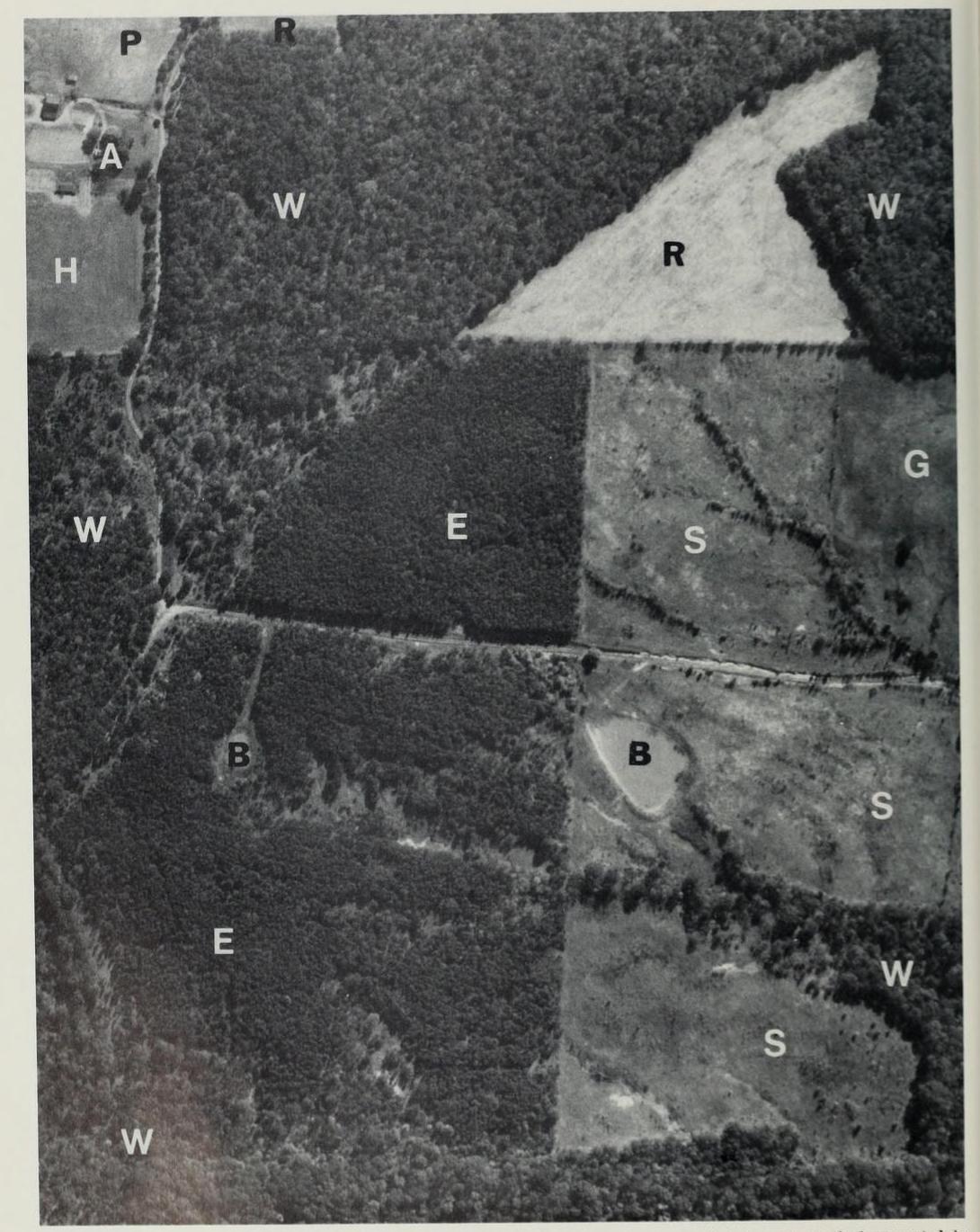
black and white aerial photo

“Fig. 8 – Aerial photograph showing a portion of the experimental impact area used to test the method presented in this paper.” Graber, Jean W. and Richard R. Environmental evaluations using birds and their habitats. 1976. Contributed in BHL from University Library, University of Illinois Urbana Champaign. CC BY-NC.

The methods discussed for collecting data on bird populations garner this concern as well. As the authors state, “…in the conservation of species we must be concerned for the welfare of all the populations that comprise the species” (11). In the context of this book, this means assigning a fair value to birds when applying an avifaunal index during surveying. However, this sentiment can be applied to Earth Day 2021 as well; in the restoration of our Earth, we must be concerned with the welfare of all aspects of Earth. Moreover, the authors supplement discussions of how and why to collect data on bird populations by speaking in-depth about the derivation of their models, and using them in practice. In this way, the authors are not only advocating for conservation and restoration, they are also providing tangible means to implement conservation and restoration practices.

Environmental Evaluations Using Birds and Their Habitats is a great representation of how to turn concern for Earth’s restoration into meaningful action, and should serve as an example that all levels of skills and fields of interest can be utilized to help Restore Our Earth.

Description of the Skeleton of an Extinct Gigantic Sloth

By Cat O’Carroll (Natural History Museum Library & Archives, London)

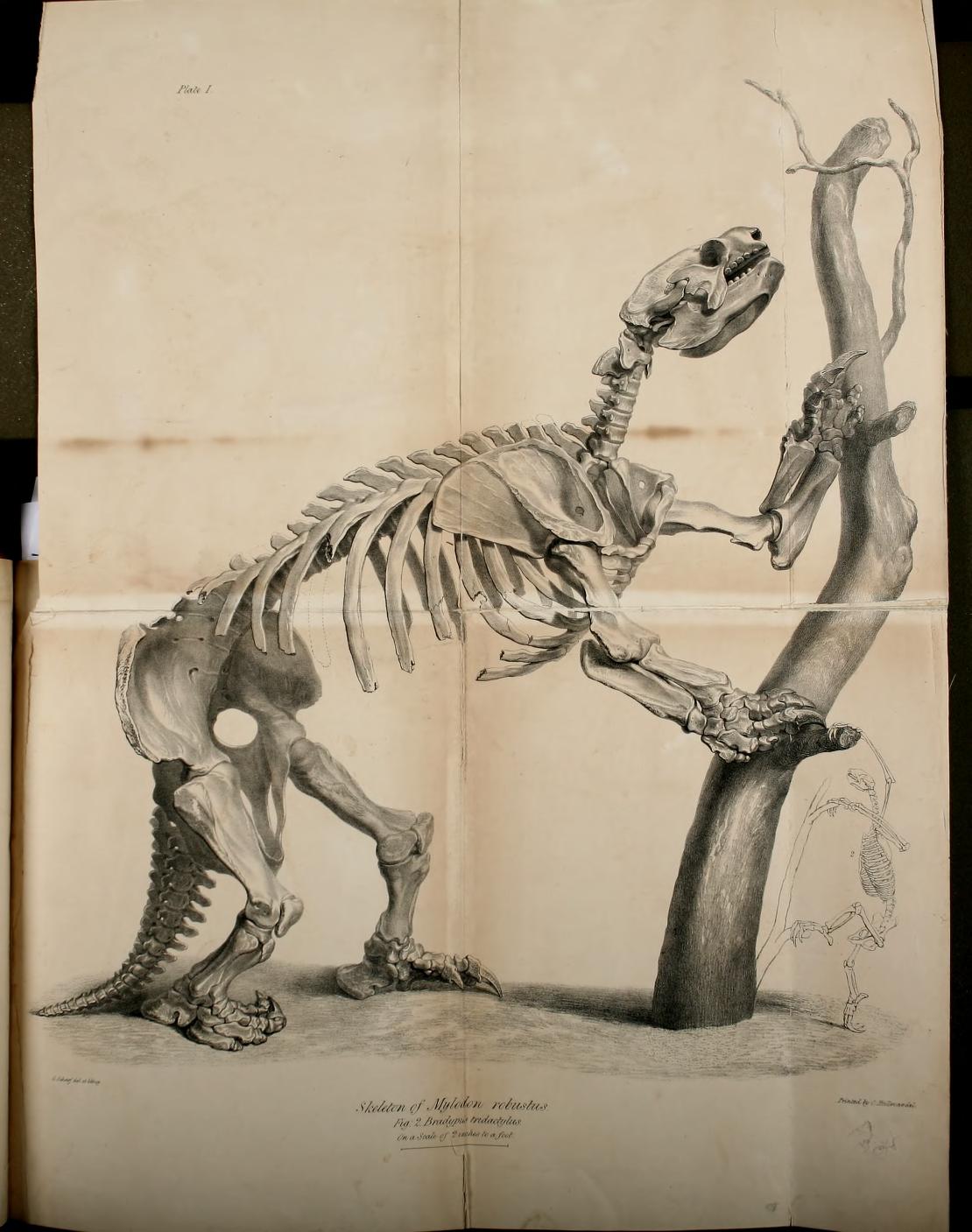
Side-view of the skeleton of the Mylodon robustus

Plate One. Side-view of the Mylodon robustus. Owen, Richard. Description of the skeleton of an extinct gigantic Sloth, Mylodon robustus, Owen, with observations on … Megatherioid quadrupeds in general. 1842. Contributed in BHL from the Natural History Museum Library & Archives.

In the year 1841, a discovery by M.Pedro de Angelis in Argentina unearthed the skeletal remains of a long extinct species……

Following on from the theme of Earth Day 2021 to Restore Our Earth, and raising issues of climate change, I’ve reflected on a title which highlighted a once extraordinary species which used to roam the earth, Description of the skeleton of an extinct gigantic Sloth, Mylodon robustus, Owen, with observations on … Megatherioid quadrupeds in general by Richard Owen (1842).

Owen, once curator at the Hunterian Museum, Royal College of Surgeons, was later in his career put in charge of the British Museum (Natural History) collections. As a result, he campaigned that a new building was needed to house the ever-expanding collections, which later built in 1881, became the Natural History Museum (NHM) in London as we know it today.

After exhuming the finds of the Mylodon robustus, it was then purchased by the Royal College of Surgeons and shipped over to London. In November 1841, it arrived in many pieces and fragile, in need of much restoring. Fossils discovered by Charles Darwin indicated several species of large quadrupeds had become extinct in South America. Owen compares descriptions of fossil remains of the Mammalia, which were collected by Charles Darwin during the voyage of the Beagle and accounted in The zoology of the voyage of H.M.S. Beagle … during the years 1832-1836.

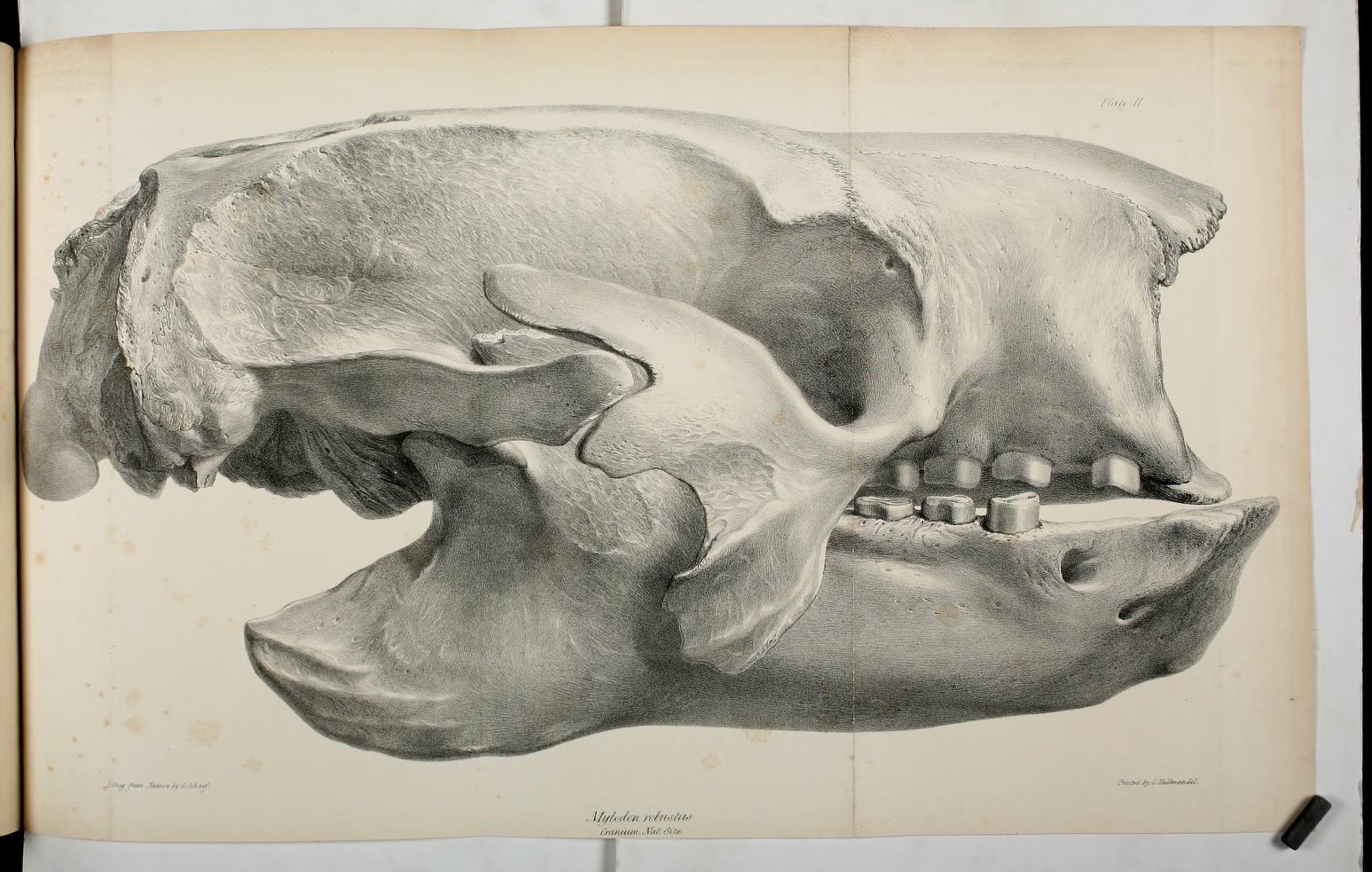
Side-view of the skull of the Mylodon robustus, natural size

Plate Two. Side-view of the skull of the Mylodon robustus, natural size. Owen, Richard. Description of the skeleton of an extinct gigantic Sloth, Mylodon robustus, Owen, with observations on … Megatherioid quadrupeds in general. 1842. Contributed in BHL from the Natural History Museum Library & Archives.

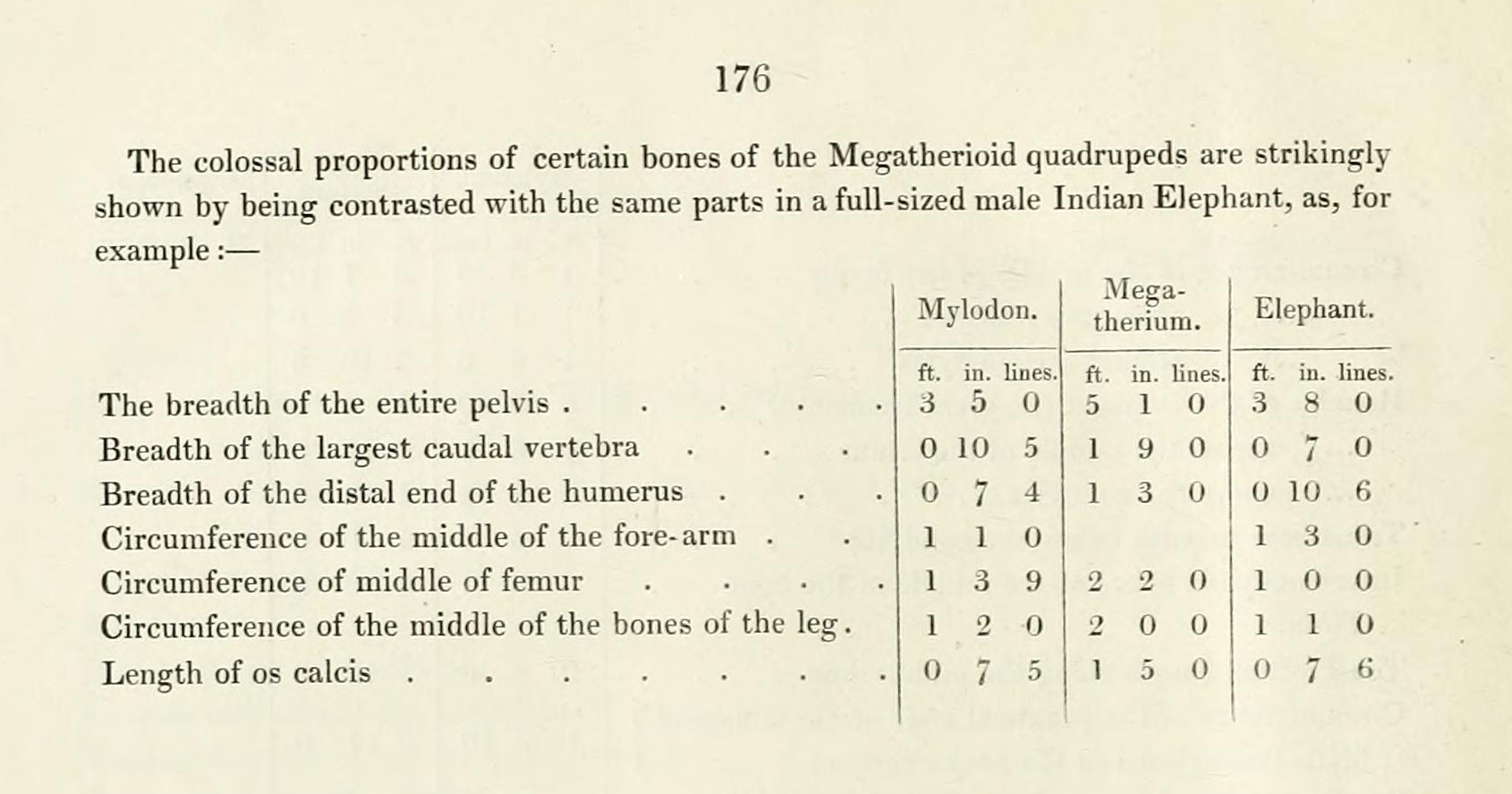
Megatherium (so named and described by Cuvier, 1795), discovered in the 18th century, was shipped to the Museo Nacional de Ciencias in Madrid. However, if you happen to walk down Fossil Way at the Natural History Museum today, you cannot miss the full Megatherium skeleton cast which stands on display. In terms of scale, Owen compares some of the bones of the Mylodon to that of Megatherium and a full-sized elephant.

Comparison of certain bone size between Mylodon, Megatherium and an Indian Elephant

Comparison of certain bone size between Mylodon, Megatherium and an Indian Elephant, page 176. Owen, Richard. Description of the skeleton of an extinct gigantic Sloth, Mylodon robustus, Owen, with observations on … Megatherioid quadrupeds in general. 1842. Contributed in BHL from the Natural History Museum Library & Archives.

The Life of Richard Owen (1894), by his Grandson Rev. Richard Owen, summarizes how Owen was puzzled by the habits of these extinct creatures: “Their teeth showed, by their simple structure, that they lived on vegetable food, and probably on the leaves or tender twigs of trees”. It was hard to see how, like sloths today, they could possibly adapt to climbing trees given their sheer size and weight. Owen conjectured that they may have pulled the branches down from the trees instead of climbing them. Mylodon was also furnished with a “long tongue like a giraffe’s, which would help it to reach its leafy food”.

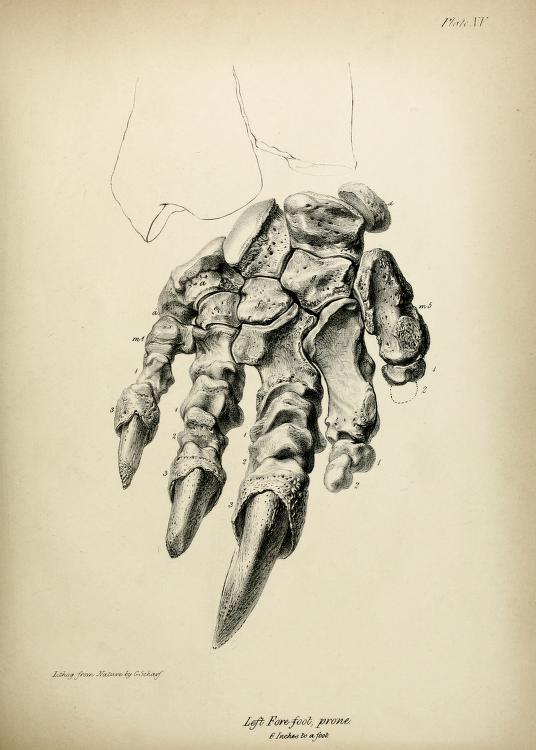
Upper, or anconal surface of the bones of the left fore-foot

Plate Fifteen. Upper, or anconal surface of the bones of the left fore-foot. Owen, Richard. Description of the skeleton of an extinct gigantic Sloth, Mylodon robustus, Owen, with observations on … Megatherioid quadrupeds in general. 1842. Contributed in BHL from the Natural History Museum Library & Archives.

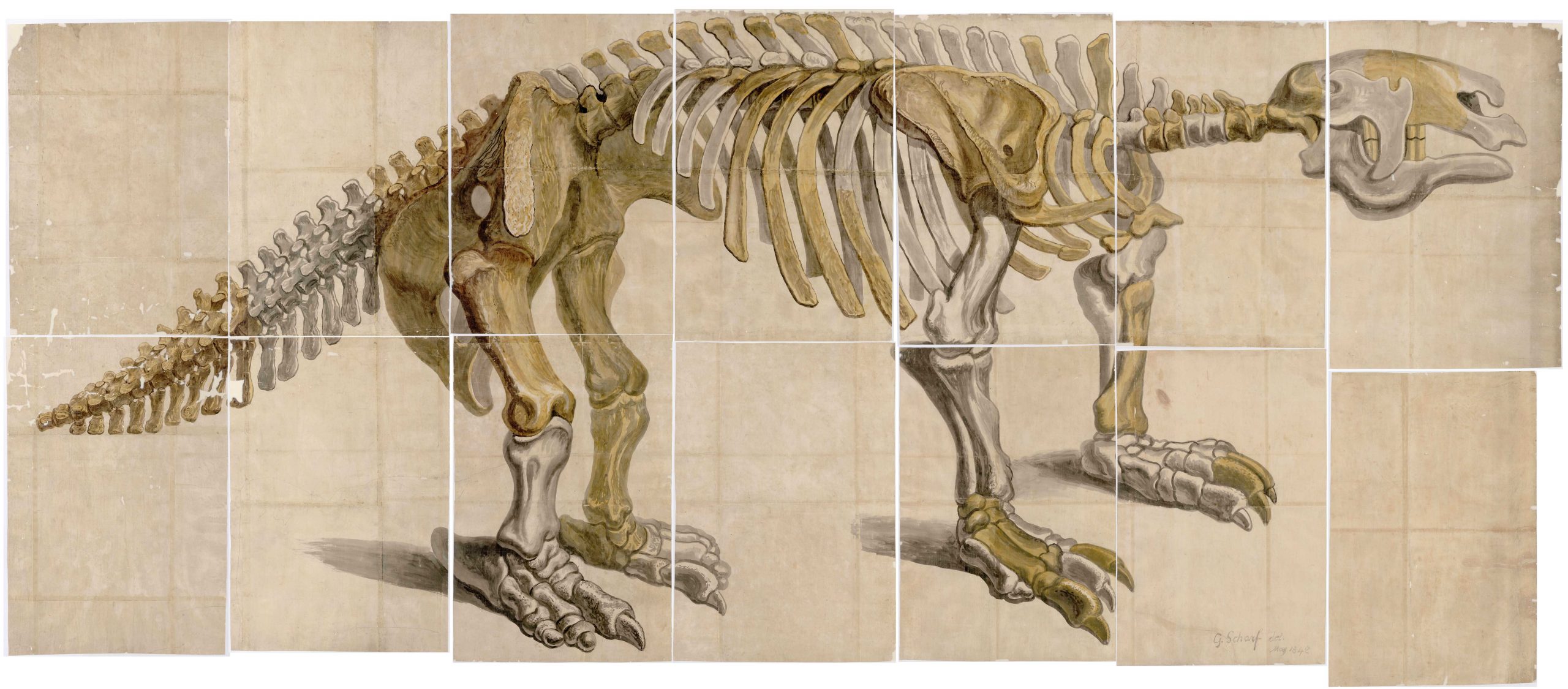
The NHM Library & Archives holds a large collection of natural history drawings and original artworks amongst its collections. In November of 2019, the Images of Nature Gallery saw the installation of George Johann Scharf’s (1786-1860) watercolour drawing of a Megatherium on full display. Completed in 1842, this one drawing comprises of fourteen sheets approximately 2463 x 5745 mm which Scharf completed for Owen. A MEGA task in itself!

George Johann Scharf (1786-1860) Watercolour drawing of a Megatherium. N.p., 1842.

George Johann Scharf (1786-1860). Watercolour drawing of a Megatherium. N.p., 1842. Print. From the Library and Archives, Natural History Museum, London.

April 22, 2021by michelle.underhill
Blog Reel, Campaigns, Her Natural History

Graceanna Lewis: A Naturalist and Abolitionist

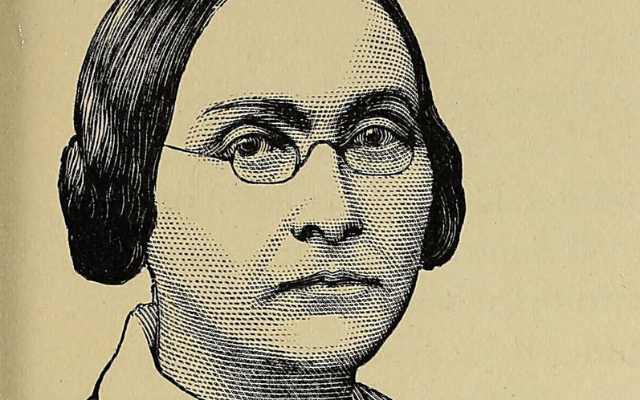
Black and white portrait of a person wearing glasses.

This post originally published on the Smithsonian Libraries and Archives’ blog, Unbound.

“To her mind the truths of science seem revealed.”

That’s how Phebe A. Hanaford, author of Daughters of America (c. 1882), described naturalist Graceanna Lewis, one of the first three woman to be accepted into the Academy of Natural Sciences. But Lewis was not only one of the first professionally acknowledged women naturalists; she was also an abolitionist and social reformer who worked for the advancement of science as well as human rights. Researchers can find many publications by and about this intriguing woman in the Smithsonian Libraries and Archives’ Digital Library and the Biodiversity Heritage Library.

Born in 1821, Lewis benefitted from an egalitarian Quaker upbringing, one that encouraged education in daughters as well as sons. Lewis told Hanaford that she learned to love natural history from her mother, Esther Lewis. Esther had been a teacher before marriage and continued to educate her own young children, sending her daughters to nearby Kimberton Boarding School as they grew. There, Graceanna was influenced by Abigail Kimber, a woman botanist who had discovered and identified several species. In 1842, Lewis’ uncle, Dr. Bartholomew Fussell, started a new boarding school for girls, and Lewis came on board as a teacher. She taught astronomy and botany, among other subjects.

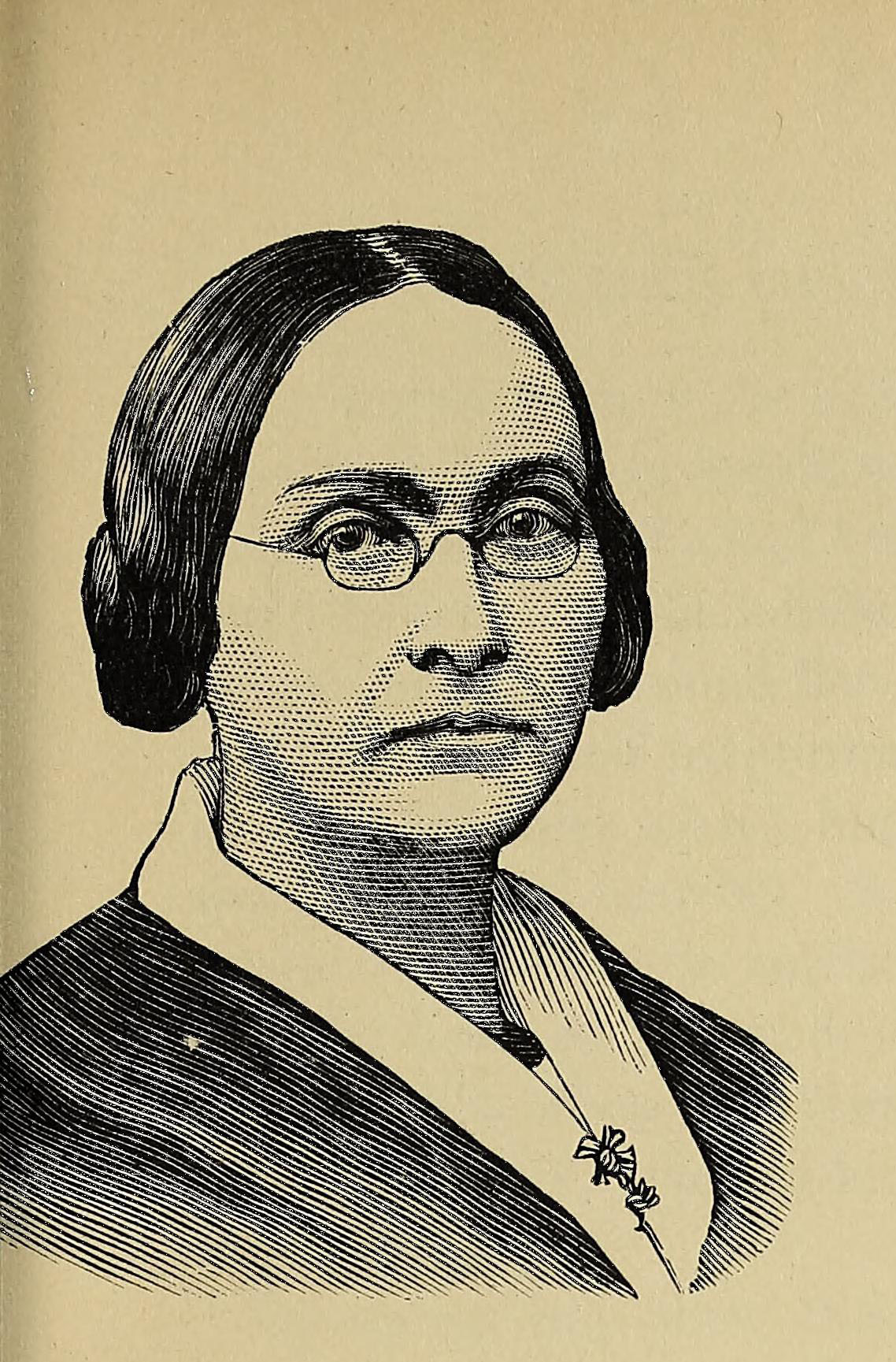
Black and white portrait of a person wearing glasses.

Portrait of Graceanna Lewis. The Underground Rail Road (1872). Digitized by Smithsonian Libraries and Archives.

From her family, Graceanna Lewis inherited not only an interest in science and education but also a deep concern for social issues. Uncle Bartholomew was an active abolitionist, and the family formed a local auxiliary of the American Anti-Slavery Society. The Lewis sisters, Graceanna, Mariann and Elizabeth, were profiled in William Still’s The Underground Rail Road (1872), which described them as “among the most faithful, devoted, and quietly efficient workers in the Anti-slavery cause”.

One of Graceanna’s earliest publications, written in the 1840s, was “An Appeal to Those Members of the Society of Friends Who Knowing the Principles of the Abolitionists Stand Aloof from the Anti-Slavery Enterprise”. It implored fellow Quakers to join the Anti-Slavery movement. The Lewis farm in Pennsylvania became a frequent and successful point on the Underground Railroad, described in detail by Still. The family helped transport those seeking freedom and provided clothes and supplies.

Eventually, Lewis moved away from the family farm to Philadelphia. She had studied birds and other natural sciences on her own, but this move allowed her to take advantage of the specimen and library collections at the nearby Academy of Natural Sciences, and it propelled her into a network of naturalists. In 1862, she met John Cassin, ornithologist and curator of birds at the Academy. Cassin had written, with George N. Lawrence and the Smithsonian’s own Spencer Baird, The Birds of North America (1860), a work Lewis found particularly inspiring.

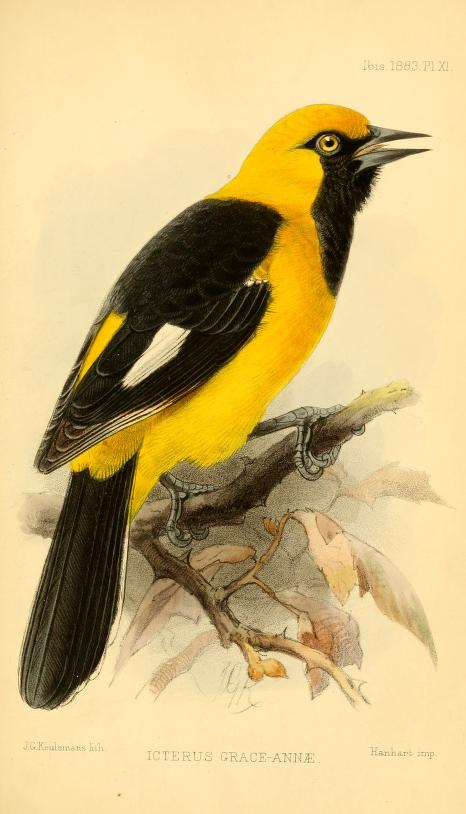
Cassin would be an invaluable friend and mentor to Lewis, even naming a bird for her, Icterus graceannae, the White-edged oriole. Lewis also corresponded frequently with Baird for years, seeking advice and asking for copies of Smithsonian publications. In 1870, the year after Cassin’s death, Lewis became one of the first three women admitted as members to the Academy.

Icterus graceannae, black and yellow bird.

Icterus graceannae, or white-edged oriole, Plate XI. Ibis. Series 5, Volume 1. No. 1-4. (1883). Contributed in BHL from Smithsonian Libraries and Archives.

Lewis had channeled her interested in ornithology into her first scientific publication, Natural History of Birds : lectures on ornithology, in ten parts (1868). It was intended as an inexpensive overview of American birds for a general audience. In it, she also proposed a new classification scheme based on embryology, the characteristics of eggs. Unfortunately, only the first part was published, as funding for the remaining nine was never secured. She continued to research and publish on birds, alongside the leading naturalists of her time. Her articles in The American Naturalist, “The Lyre Bird” (August 1870) and “Symmetrical Figures in Birds’ Feathers” (November 1871) are available in the Biodiversity Heritage Library.

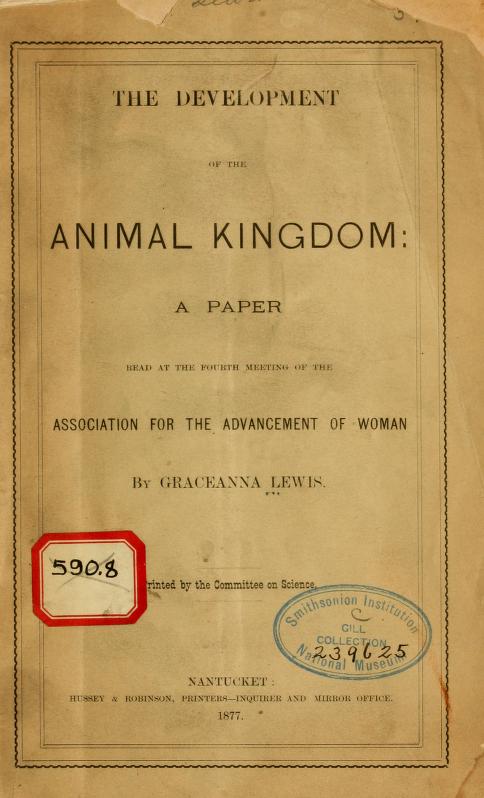
Lewis’ interests and publications grew beyond ornithology, into the classification of natural history and a “tree of life”, which she exhibited at the Centennial Exhibition in 1876. The Development of the Animal Kingdom (1877), available in the Biodiversity Heritage Library, is a twenty-page overview of her theories. It was prepared for the fourth meeting of the Association for the Advancement of Women. The group was formed in 1868 with the goal of presenting practical methods for improving women’s role in society, including education on a variety of subjects. Unsurprisingly, Lewis was active on the group’s Committee on Science.

Cover, The Development of the Animal Kingdom (1877)

Cover. The Development of the Animal Kingdom. (1877). Contributed in BHL from Smithsonian Libraries and Archives.

Lewis told Phebe A. Hanaford in 1882, “I feel that my life’s work is before me, in lecturing on zoology to girls just blooming into womanhood”. For the next twenty years, Lewis continued to teach and write about various natural history topics. Her article “On the Genus Hyliota”, discussing the distinction of two rare African birds, was published in The Annals and magazine of natural history in 1883. Her social reform interests turned to temperance and suffrage, serving stints as secretary for her local chapter of the Women’s Christian Temperance Union and suffrage association.

Graceanna Lewis died in 1912 in Media, Pennsylvania at the age of 90. Her contributions to both science and social progress leave a remarkable and inspiring legacy.

Further Reading

Baird, Spencer Fullerton, John Cassin and George N. Lawrence. The Birds of North America (1860).

Baird, Spencer Fullerton. Spencer Fullerton Baird Papers. Record Unit 7002. Smithsonian Institution Archives.

Bonta, Marcia. “Graceanna Lewis, Portrait of a Quaker Naturalist”. Quaker History, Volume 74, Number 1, Spring 1985, pp. 27-40.

Hanaford, Phebe A. Daughters of America (1883).

Lewis, Graceanna. “An appeal to those members of the Society of Friends who knowing the principles of the abolitionists stand aloof from the anti-slavery enterprise”. [between 1840 and 1849?].

Lewis, Graceanna. The Development of the Animal Kingdom (1877).

Lewis, Graceanna. “The Lyre Bird”. The American Naturalist (August 1870), pp 321.

Lewis, Graceanna. “On the genus Hyliota”. The Annals and magazine of natural history, Series 5, Volume 12, No. 67, pp. 210-212.

Lewis, Graceanna. “Symmetrical Figures in Birds’ Feathers” . The American Naturalist (November 1871), pp. 675-678.

Lewis-Fussell Family Papers, SFHL-RG5-087, Friends Historical Library of Swarthmore College.

Still, William. The Underground rail road (1872).

Truitt, James. “Digitizing the Papers of Graceanna Lewis, Ornithologist and Activist”. Cassinia. No. 77 (2017-2018), pp. 40-41.

Warner, Deborah Jean. Graceanna Lewis, scientist and humanitarian (1979).

March 30, 2021by Pedro Gonzalez Fernandez
Blog Reel, Campaigns, Featured Books, Her Natural History

Margaret S. Collins: A Legend in Termite Field Biology

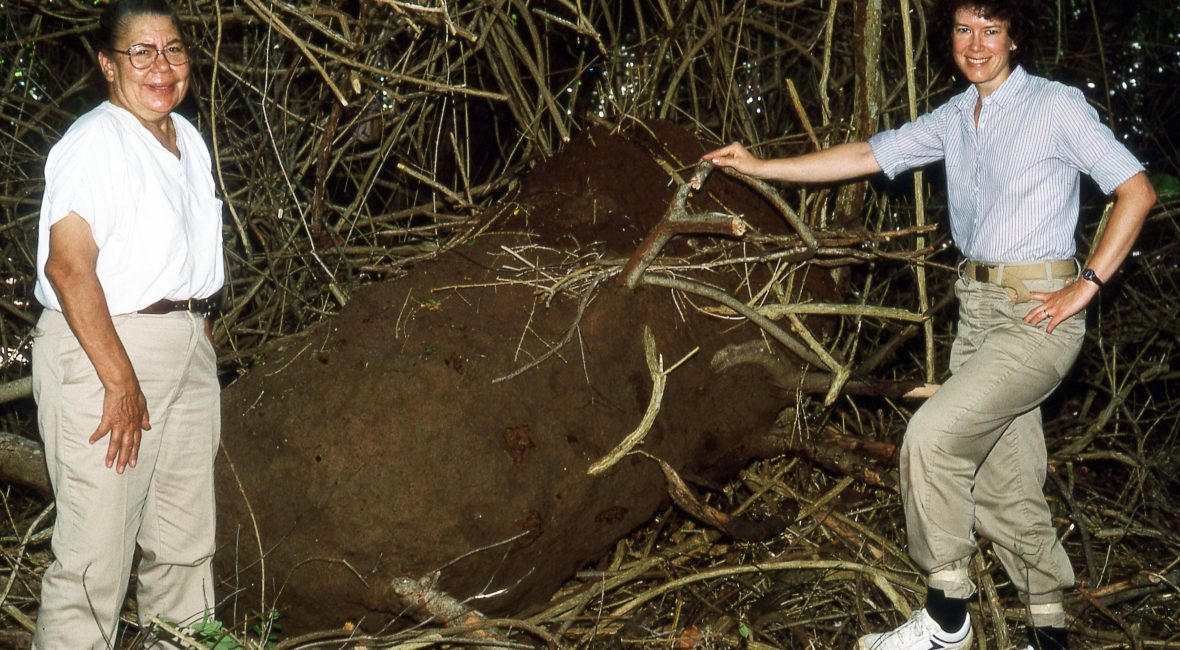
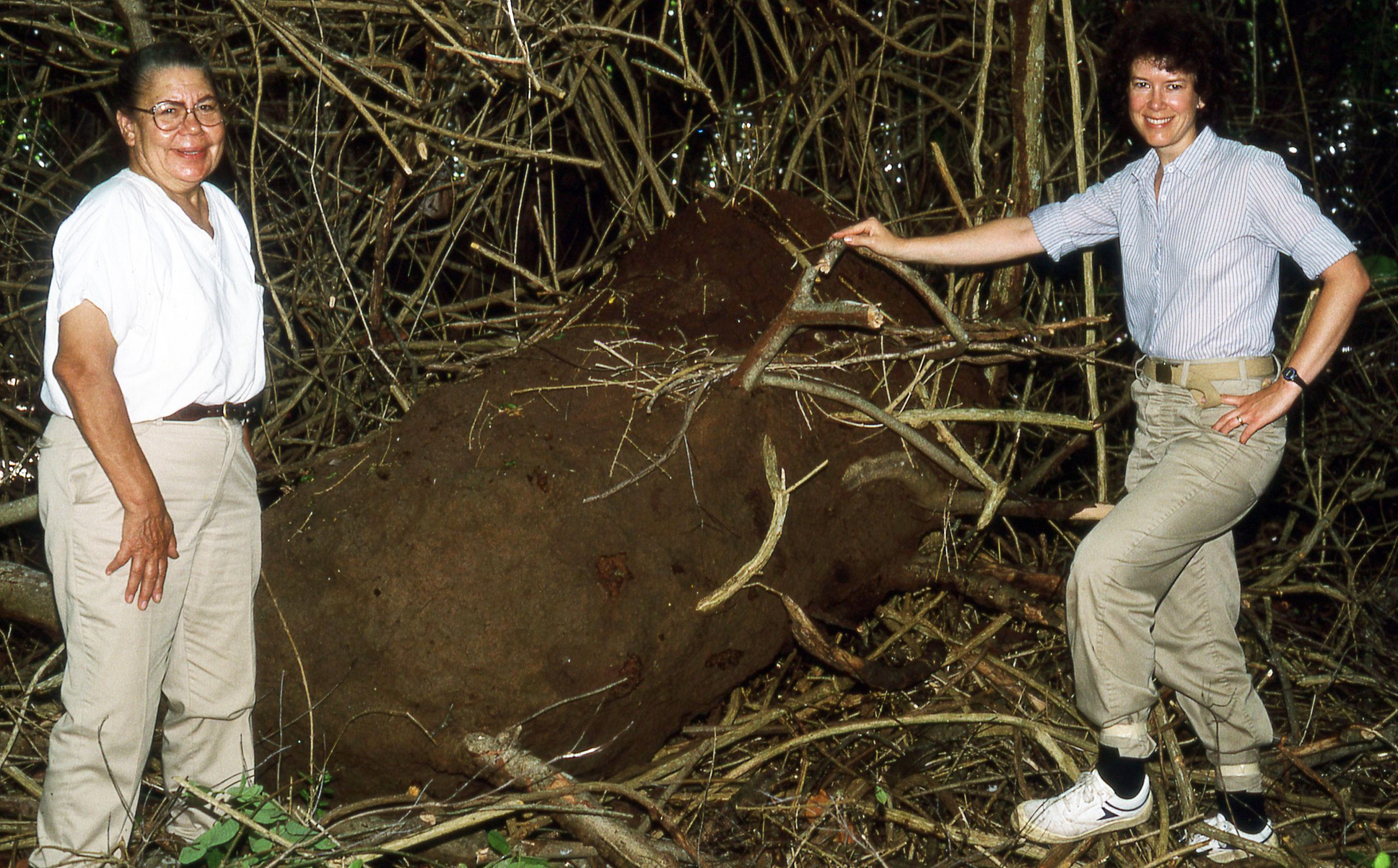
Two scientists researching termites in the British Virgin Islands stand together with a huge termite nest in between them. Photo taken in 1986.

This post was originally published on 2 March 2021 on the Smithsonian Institution Archives blog.

Two scientists researching termites in the British Virgin Islands stand together with a huge termite nest in between them. Photo taken in 1986.

Dr. Margaret S. Collins and Dr. Barbara L. Thorne standing next to a termite (Nasutitermes acajutlae) nest on Guana Island in the British Virgin Islands while studying a variety of termites in 1986. © Dr. Barbara L. Thorne.

Dr. Margaret S. Collins (1922-1996), a renowned expert on termite ecology and distribution, taught as a professor and administrator at Howard University, Florida A&M University, and Federal City College (now University of The District of Columbia) for over 35 years. Upon her retirement from teaching, Collins continued her work on termites at the Smithsonian National Museum of Natural History as a research associate from 1983 to 1996.

Over the course of her career, Collins published more than forty articles spanning the biogeography, physiology, chemical defenses, and taxonomy of termites. Collins also collected specimens in the United States, Mexico, Costa Rica, Colombia, Barbados, Belize, Suriname, the Cayman Islands, Guyana, Guatemala, and Panama. When she contracted dengue fever on an expedition in Guyana in 1983-1984 and was forced into a long hiatus from field work, she turned her focus to updating and preserving the termite specimens at the Smithsonian National Museum of Natural History. Eventually Collins returned to field research in 1994 when she once again traveled to Guyana to collect termites. In April 1996, Collins died while conducting field work in the Cayman Islands.

Collins’ biographers, such as Wini Warren and Vernard R. Lewis, have documented how she faced racism and sexism in her work and life. As one of the first African American women to earn a Ph.D. in entomology, she had to fight to find advisers as an undergraduate at West Virginia State College and to fund her field research during her early career. Additionally, Collins worked in the face of bomb threats and racist remarks as she pursued her career and advocated for equal rights during the civil rights movement.

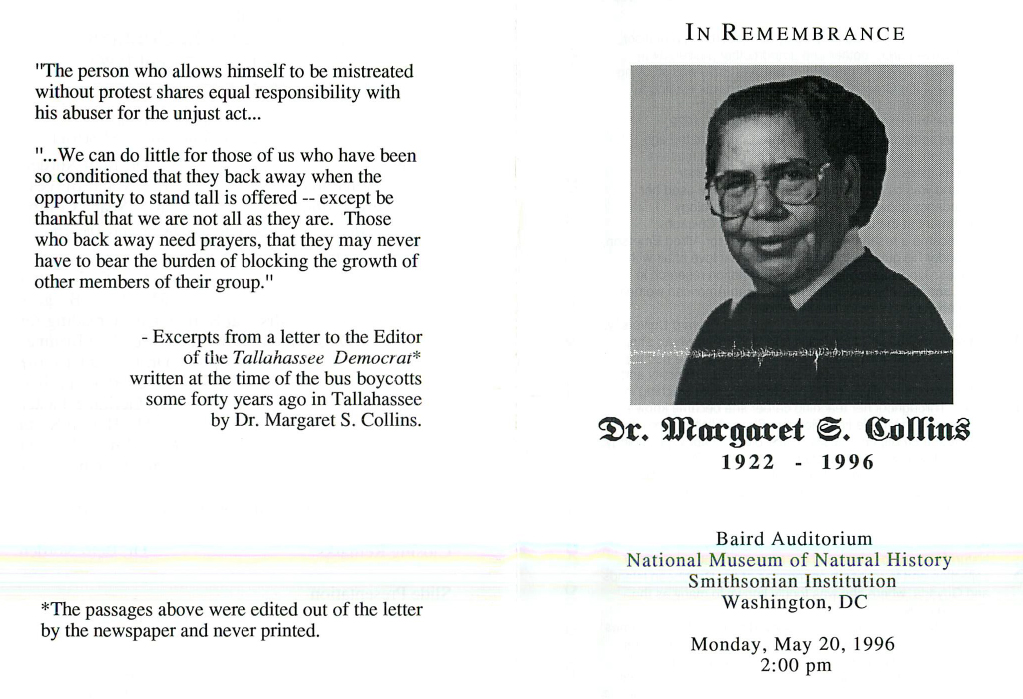
In fact, Collins’ memorial service pamphlet begins with excerpts from a letter she wrote to the editor of the Tallahassee Democrat during the 1956 Tallahassee bus boycott. During the boycott, sometimes chased by police, Collins drove protestors to and from work. The excerpts included:

The Person who allows himself to be mistreated without protest shares equal responsibility with his abuser for the unjust act…

…We can do little for those of us who have been so conditioned that they back away when the opportunity to stand tall is offered—except be thankful that we are not all as they are. Those who back away need prayers, that they may never have to bear the burden of blocking the growth of other members of their group.

These passages were edited out of Collins’ letter by the newspaper and never printed, but their inclusion in her memorial service offers a sense of the importance Collins placed on standing tall against the challenges she faced in her own life.

The first page of Margaret S. Collins’ memorial service pamphlet.

The first page of Margaret S. Collins’ memorial service pamphlet. Courtesy of Dr. Barbara L. Thorne.

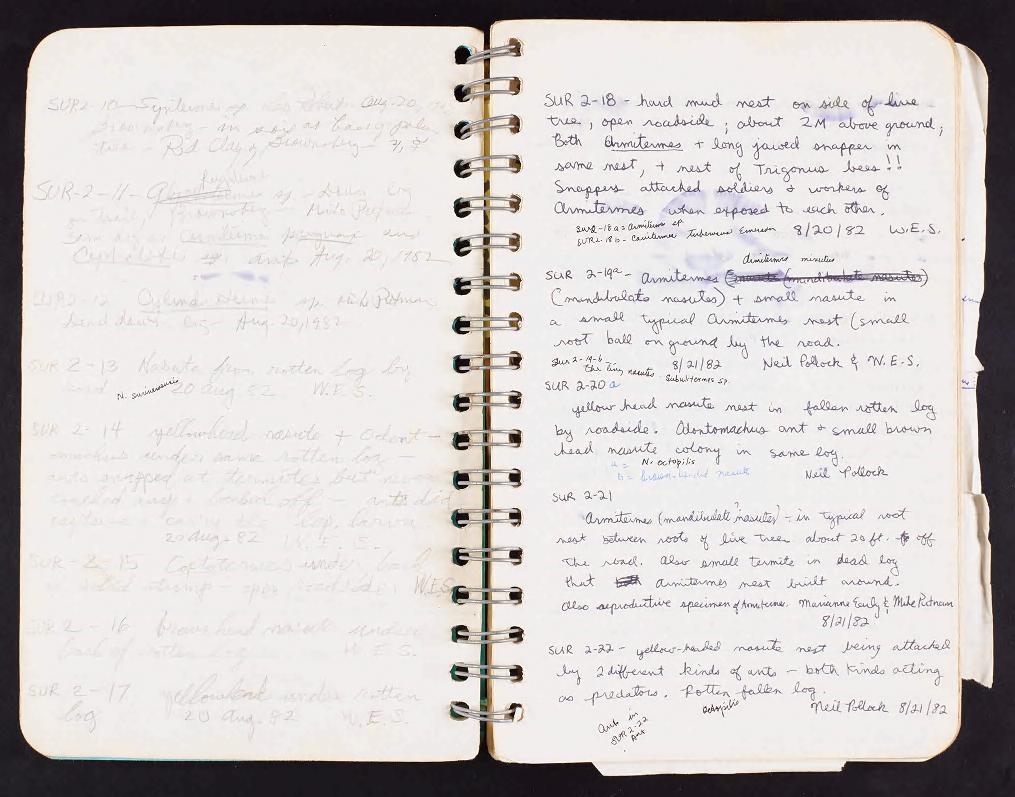
In the face of those challenges, Collins developed a love for field research. To learn more about Margaret Collins’ research, see a selection of her field notebooks, archived at the Smithsonian and digitized in the Biodiversity Heritage Library (BHL), the world’s largest open access digital library for biodiversity literature and archives. Headquartered at the Smithsonian, BHL works with libraries and archives around the world to revolutionize global research by providing free, worldwide access to knowledge about life on Earth.

An open spiral notebook with handwritten notes only on the right page.

Pages 6 and 7 from Margaret S. Collins’ Field Notes: “Combat Data,” Suriname, 1982: SIA Acc. 01-038. Contributed in BHL from Smithsonian Institution Archives.

Collins’ field notebooks were digitized and transcribed with the Smithsonian Transcription Center as part of the Smithsonian Field Book Project. Field notes can provide rich data for researchers to understand how biodiversity has changed over space and time. For example, field notebooks may describe habitats, meteorological events, and personal observations that allow us to reconstruct historical ecologies. The Archives has contributed over 300,000 pages of field notes to the Biodiversity Heritage Library as part of the Smithsonian Field Book Project. Some of Collins’ field books are part of that collection.

There are so many inspiring stories, like Dr. Collins’, about women in science at the Smithsonian in its 175-year history that can educate and embolden future generations, but only if their legacies are discoverable. On Thursday, 25 March 2021 from 1-3pm ET, join us for Wikipedia & Women in Science: Smithsonian Groundbreakers Edit-a-thon, an online Wikipedia editing workshop hosted in conjunction with the Smithsonian American Women’s History Initiative and the Smithsonian Institution Archives, part of Smithsonian Libraries and Archives.

During this training, attendees of all experience levels will learn the basics of how to edit Wikipedia by updating articles related to the history of women in science at the Smithsonian Institution in connection with the Funk List. Presenters will share how editors might research the work of these women in the absence of personal papers and institutional records. Learn more and register.

March 22, 2021by michelle.underhill
Blog Reel, User Stories

Women in Historical SciArt: BHL Empowers Research on Women in Scientific Illustration

Illustration of a cactus with a yellow flower.

Michelle Marshall is an independent researcher and creator of Historical SciArt, a research initiative dedicated to women in historic scientific illustration. In this guest post, Marshall shares more about how BHL helps empower her research on women in science.

•     •     •

In Fall 2014, I discovered the wonderful world of the Biodiversity Heritage Library. I serendipitously stumbled onto this natural history digital library through collaborations with the Smithsonian Transcription Center, and I joined a group of dedicated volunteers known as BHL citizen scientists, whose work includes researching and adding taxonomy to the scientific illustrations that BHL has uploaded to its account on Flickr.

Illustration of a bird with colors including green, orange, black, pink, purple, and white.

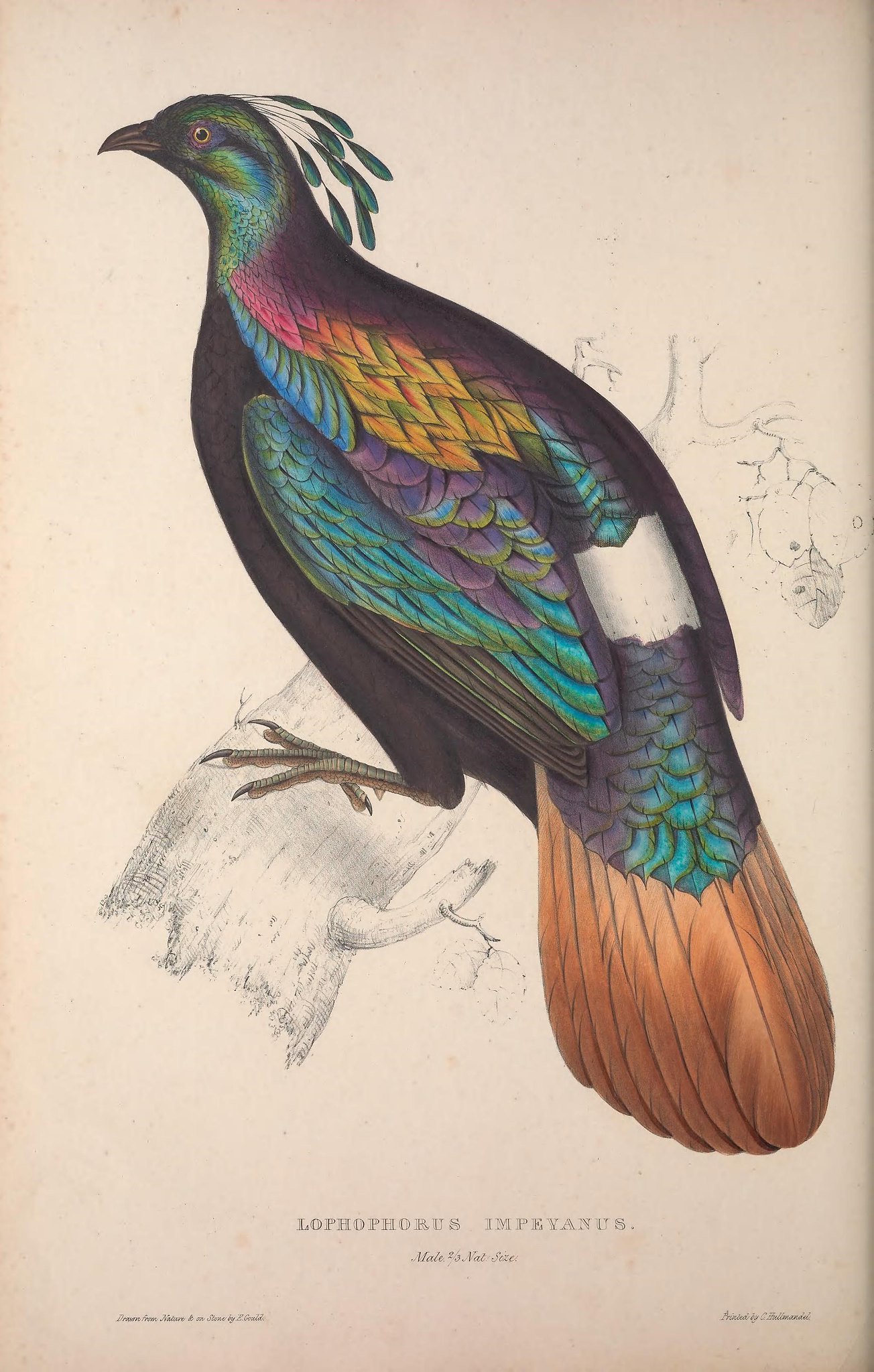
Himalayan Monal, Lophophorus impejanus, illustrated by Elizabeth Gould. Source: A century of birds from the Himalaya Mountains. 1831. Authored by John Gould and illustrated by Elizabeth Gould. Contributed in BHL from Smithsonian Libraries and Archives.

As I started to add scientific and common names to these images, I became curious about the artists. I easily discovered Maria Sibylla Merian and Elizabeth Gould, two of the more famous women natural history illustrators, but it was not until I found Roberta McIntosh that I started to scratch the surface of the multitude of women involved in this area of science.

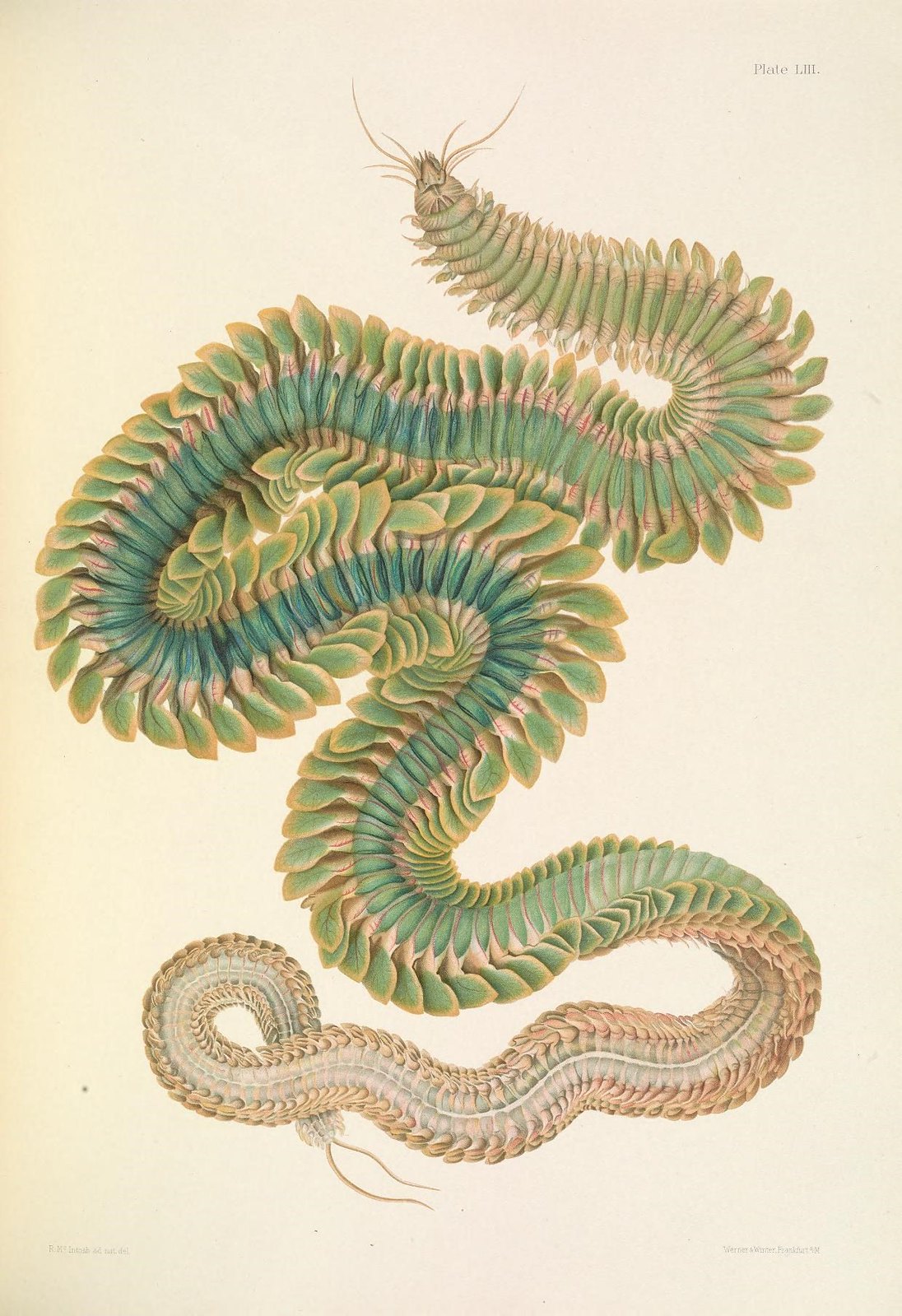
Illustration of a green annelid worm.

King ragworm, Alitta virens, illustrated by Roberta McIntosh. Source: A monograph of the British marine annelids. v.2, pt.2 (1910). Authored by William Carmichael McIntosh and illustrated by several artists including Roberta McIntosh. Contributed in BHL from Smithsonian Libraries and Archives.

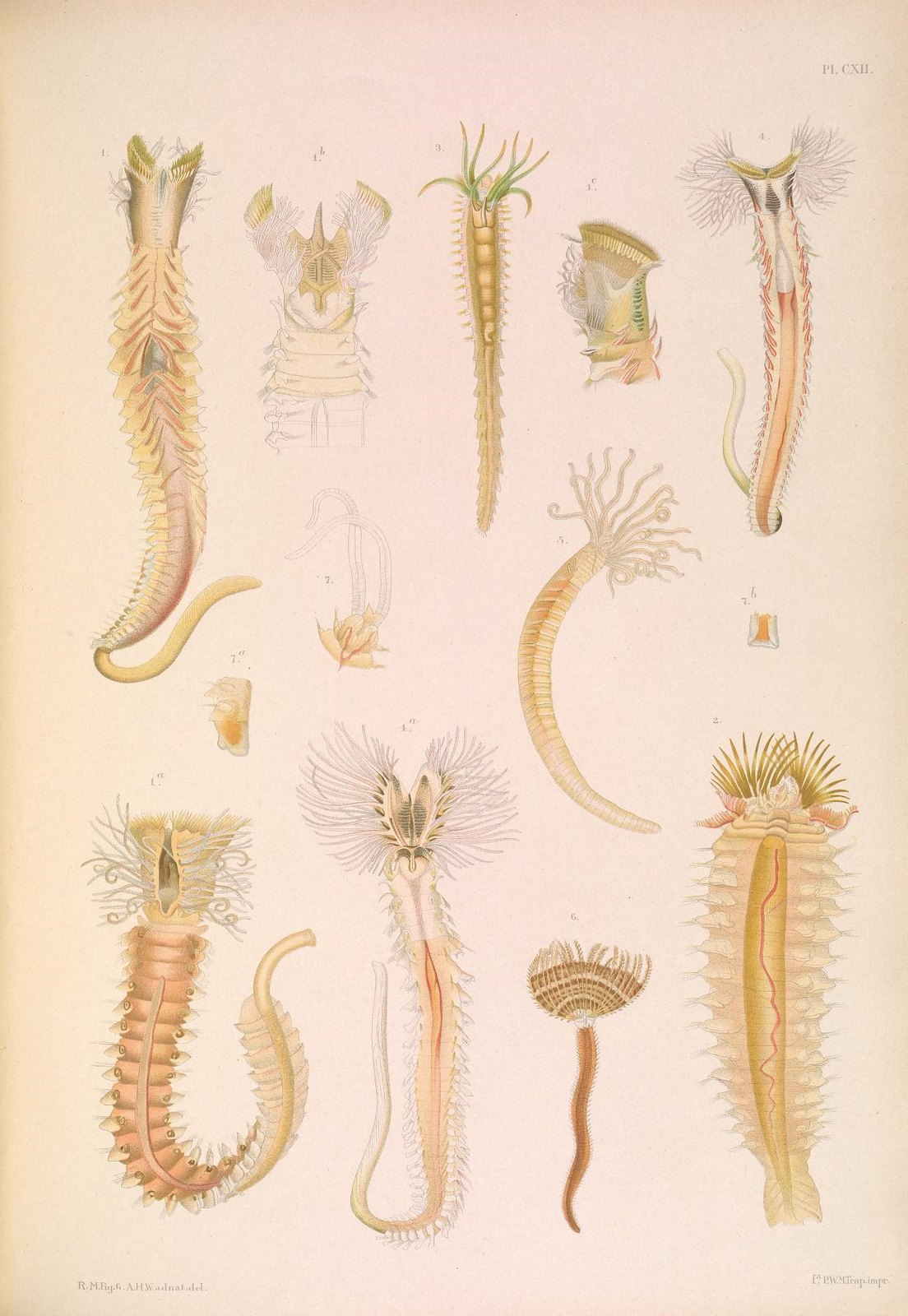
Roberta McIntosh (1843-1869) was the sister of William McIntosh, author of the multivolume publication, Monograph of the British Marine Annelids. She collected annelid specimens along with her brother, and he encouraged her to create scientific illustrations of these specimens for his work. While browsing through the monograph’s images, I noticed that there were other artists’ signatures, including one for A.H.W. In the Preface of this monograph, W. McIntosh identifies “A.H.W.” as “Miss Ada Walker” and also identifies “Miss Burnet of St. Andrews”.  I have been able to identify more information about Ada H. Walker, but Miss Burnet remains a mystery to be illuminated.

Illustration of a variety of annelid worms.

Illustration of marine annelids by Roberta McIntosh and Ada Hill Walker. Source: A monograph of the British marine annelids. v.4, pt.1 (1922). Authored by William Carmichael McIntosh and illustrated by several artists including Roberta McIntosh and Ada Hill Walker. Contributed in BHL from Smithsonian Libraries and Archives.

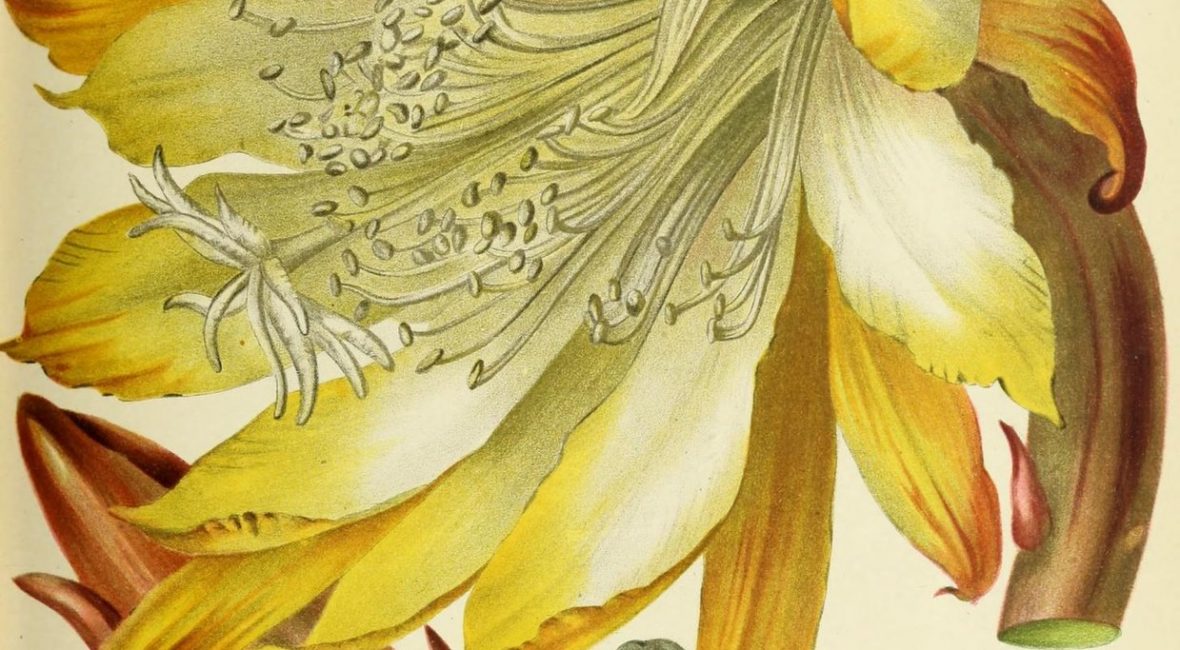
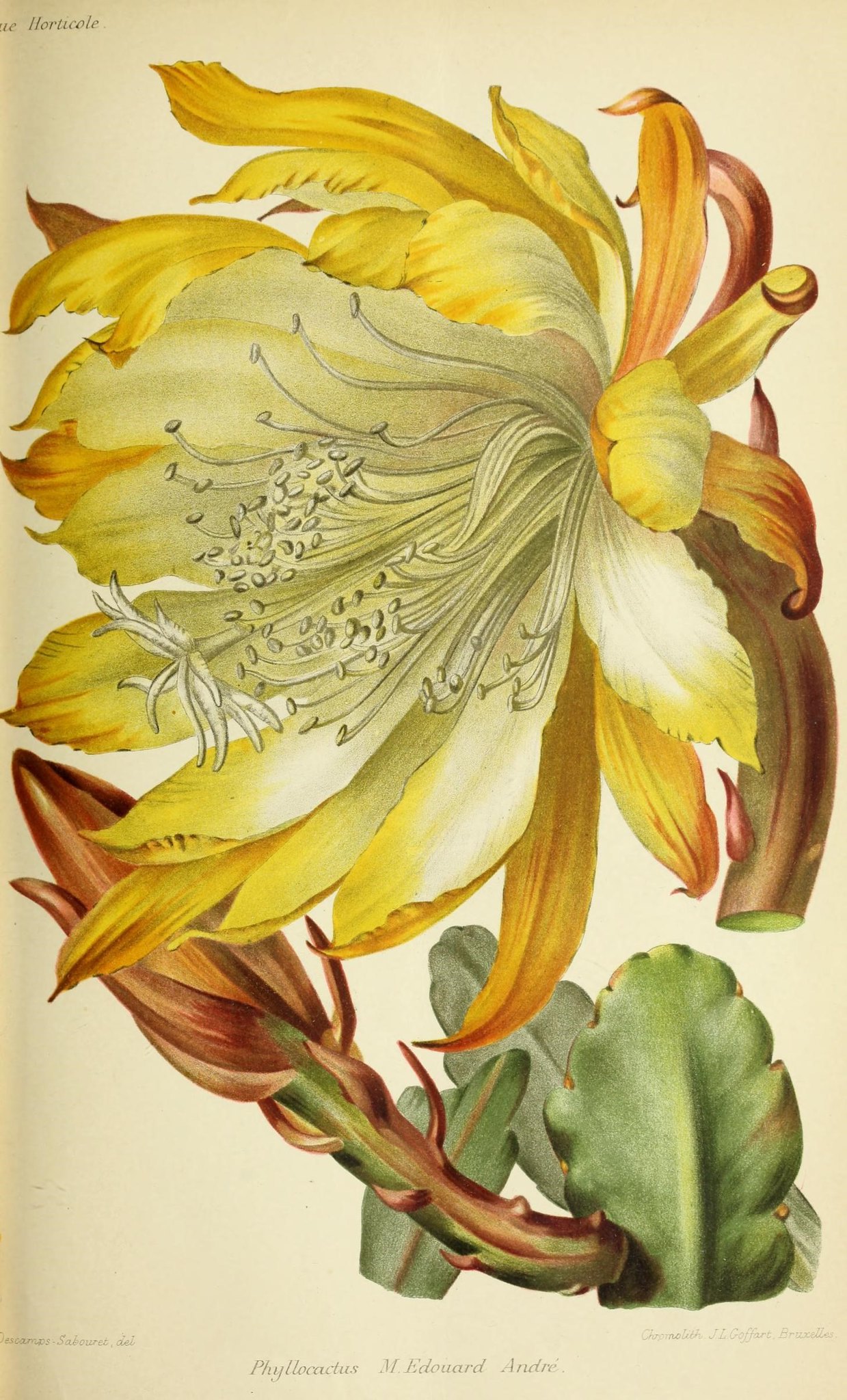
The discovery of these three women turned a spark into a flame as I realized that there are so many women still to be brought to light in this combined area of science, art, and history research. A few weeks later, I stumbled across Christine Jurine, a French artist who illustrated marine invertebrates and insects, and in the years that have passed, I have uncovered more and more. Cecile Pfulb Kastner is an accomplished French botanical illustrator, and I have written about my research into Kastner on my blog. And then there’s the sublime botanical art of Louise Cécile Descamps Sabouret for Revue Horticole.

Illustration of a cactus with a yellow flower.

Epiphyllum cactus, illustrated by Louise Cécile Descamps Sabouret. Source: Revue horticole. 1898. Contributed in BHL from Harvard University Botany Libraries.

BHL’s digital library is a gold mine of information for discovering more about these women. With the addition of full text searching, I have been able to locate details about these women, including their names, work, other publications, and collaborators. Matching up artists’ signatures with works in BHL has also led to further linking of these women across publications.

Additionally, BHL has actively supported me in making these women more visible. On countless occasions, I have collaborated with BHL staff and their partners to add these women to the BHL catalog by establishing “Creator IDs”. This designation allows other publications affiliated with this woman to be part of one hyperlink within the collection of BHL. This ID also provides “notability” to meet the criteria for inclusion in crowdsourced platforms like Wikidata, where other researchers can discover these women.

I was also pleased to collaborate with BHL and their partners for the #HerNaturalHistory campaign for Women’s History Month in 2019. Through this collaboration, many other researchers have become involved in this area through Wikipedia, and BHL has created the “Women in Natural History” collection of materials showcasing the profound and extensive work that women have done in the biodiversity sciences. These efforts continue to evolve and be updated as more information is uncovered.

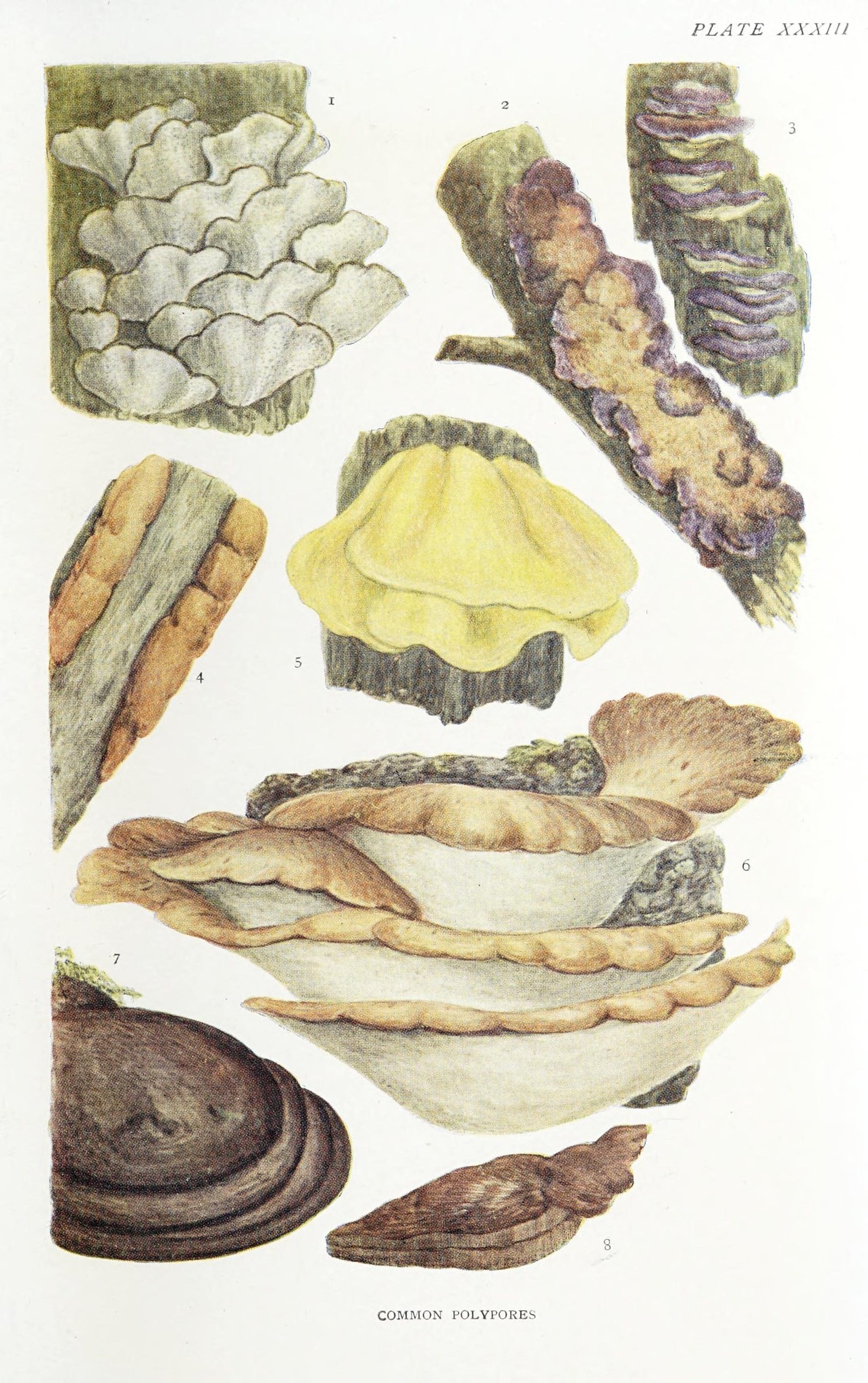
Illustration of fungi.

Various fungi illustrated by Mary K. Spittal. Source: Fungi and how to know them. 1909. Authored by Ernest W. Swanton and illustrated by Mary K. Spittal. Contributed in BHL from University of Toronto – Thomas Fisher Rare Book Library.

Through a recent encounter with the Mycological Book Club on Twitter, I was able to collaborate with other researchers to discover the full name and details of Mary Kerr Spittal. In response to tweets in which I posted illustrations done by women in mycology, Clare Blencowe of the Mycological Book Club shared with me an illustration by a not fully identified woman mycologist using the name M. Spittal. Through full text searching in BHL, I was able to find her name as “Mary K. Spittal”, as well as another publication in which she produced scientific illustrations. At this point, I enlisted the help of my long-time collaborator, Siobhan Leachman. Leachman created a Wikidata item for Spittal and also delved into more resources to discover her history. I also enlisted the help of my mother, Shelby Marshall, who is an experienced genealogy researcher. Over the next few hours, Blencowe, Leachman, Marshall, and I created a detailed picture of Mary Kerr Spittal. The next day, Chris Robson, Catalog Librarian at Harvard University Botany Libraries and a member of the BHL Cataloging Committee, responded to my BHL feedback request for a Creator ID for Spittal, linking her name to her works in BHL. Additionally, Madeline Byrne of the BHL Flickr Group responded to my request to upload Spittal’s works to Flickr, where they have been tagged by artist name to further expand the discoverability of Spittal’s artistic contributions to science. This successful collaboration brought to light another remarkable and notable woman involved in the natural history of mycology.

Yesterday I posted about M. K. Spittal, saying I couldn’t find anything about her.

Today, thanks to the power of Twitter and some spontaneous collaboration with @HistSciArt, @SiobhanLeachman & @BioDivLibrary, she has her own wikidata entry ▶️https://t.co/ysuqB0x7QW https://t.co/ZsmRGLHI1C

— The Mycological Book Club (@MycoBookClub) February 12, 2021

For the past four years, I have been fortunate to find more of these women through my individual research and collaborations with so many others. I created the spreadsheet “Women in Historical SciArt” to share my research and to promote further research into the work and lives of these remarkable women. These experiences have enriched my life beyond measure, and my goal is to continue expanding access and knowledge about the contributions of these early women scientists and illustrators.

Without BHL, I would never have discovered these inspiring women in science and their work. I am incredibly grateful to BHL for all the support and encouragement of this research, and their continued updates to their digital library and Flickr collection, which support my ongoing work.

March 16, 2021by Joel Richard
BHL News, Blog Reel

Wikipedia & Women in Science: Smithsonian Groundbreakers Edit-a-thon

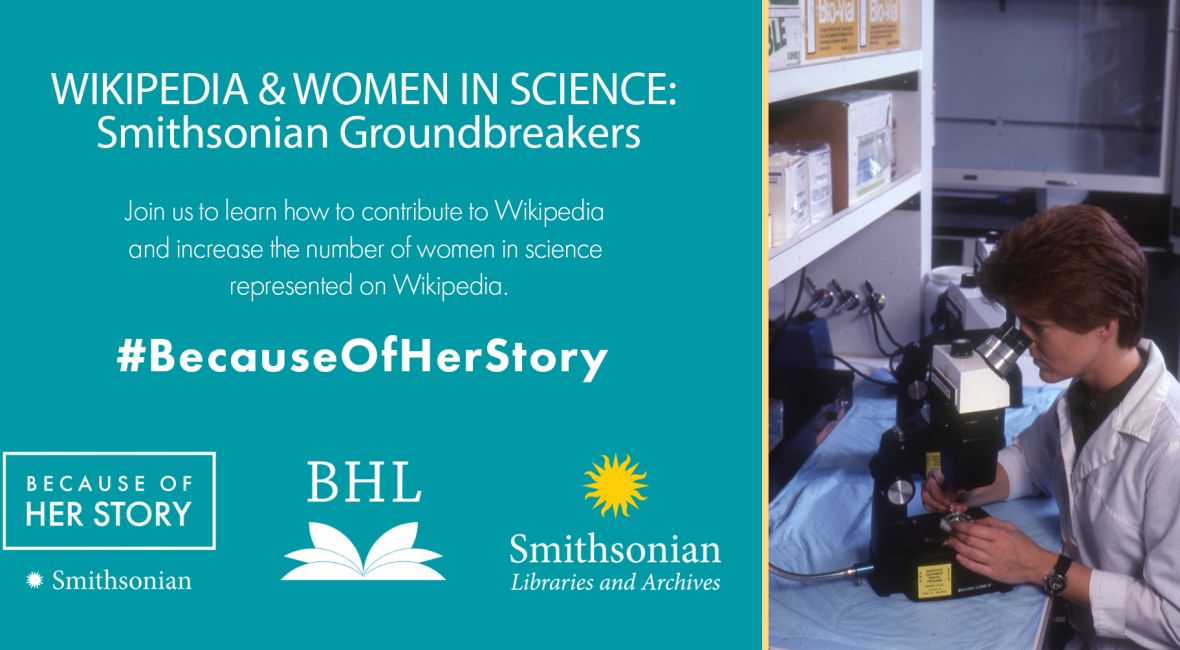
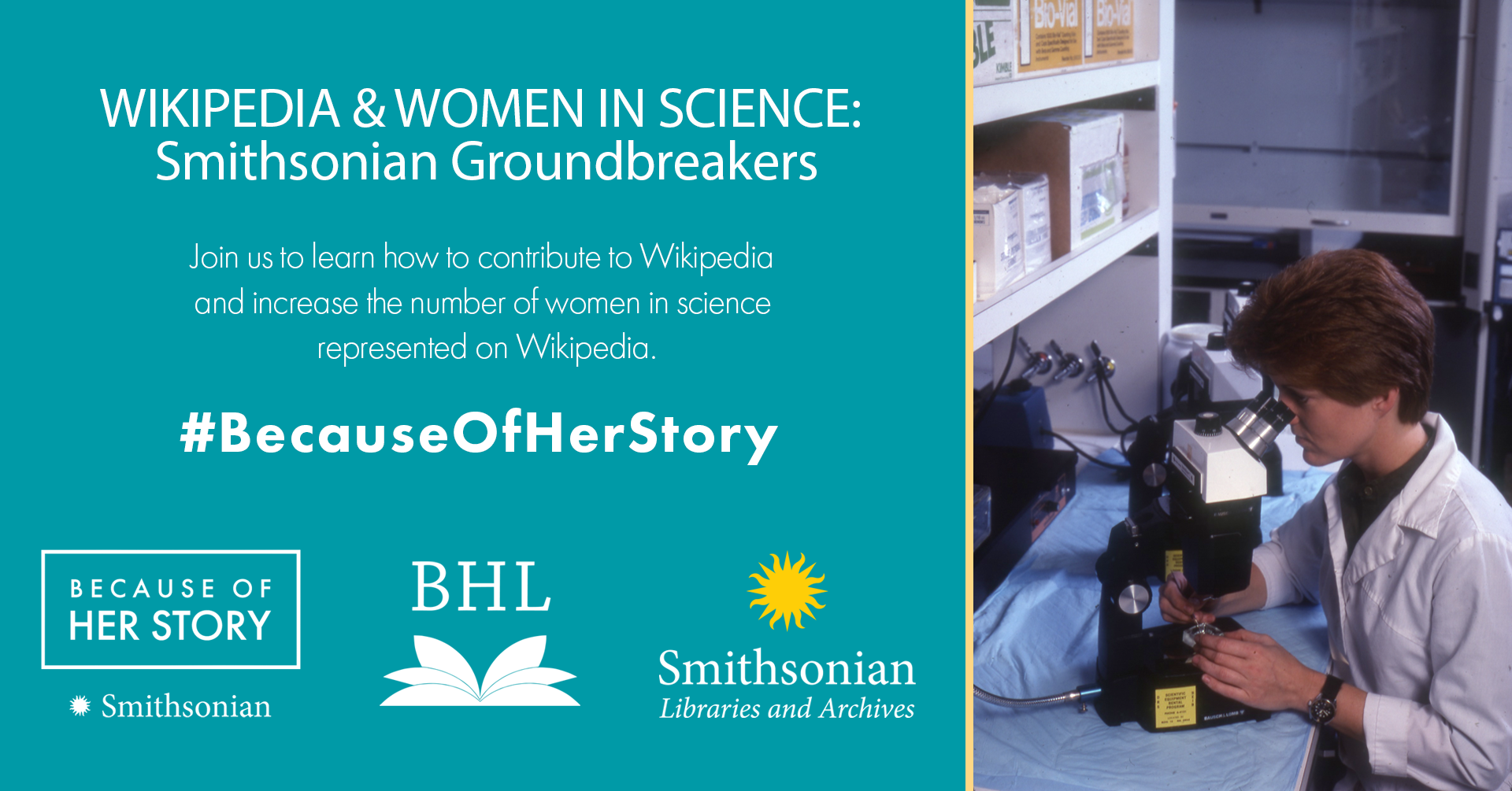
graphic for women in science wikipedia workshop

Photo in graphic shows Dr. JoGayle Howard working with embryos from the National Institutes of Health at the dissecting microscope in 1982. Photo Credit: Smithsonian Institution Archives.

Join us on 25 March 2021 (1-3pm ET) for Wikipedia & Women in Science: Smithsonian Groundbreakers Edit-a-thon, an online Wikipedia editing workshop hosted in conjunction with the Smithsonian American Women’s History Initiative and the Smithsonian Institution Archives, part of Smithsonian Libraries and Archives.

When? 25 March 2021, 1-3pm ET

Where? Online

Register Today!

During this training, attendees of all experience levels will learn the basics of how to edit Wikipedia by updating articles related to the history of women in science at the Smithsonian Institution in connection with the Funk List. Presenters will share how editors might research the work of these women in the absence of personal papers and institutional records.

As one of the web’s most visited reference sites, Wikipedia serves as a starting point for many individuals looking to learn about art, history, and science. However, less than 19% of Wikipedia biographies in English represent women, and less than 10% of Wikipedia editors identify as women. By increasing representation of women scientists on the site, your impact can spark the curiosities of future generations who see themselves in these Smithsonian groundbreakers.

This event is planned in conjunction with the Smithsonian Institution Archives, the Biodiversity Heritage Library, and the Smithsonian American Women’s History Initiative, a multiyear undertaking to document, research, collect, display, and share the history of women in the United States.

March 8, 2021by michelle.underhill
Blog Reel, Featured Books

Frances Sargent Osgood and the Language of Flowers: A 19th Century Literary Genre of Floriography and Floral Poetry

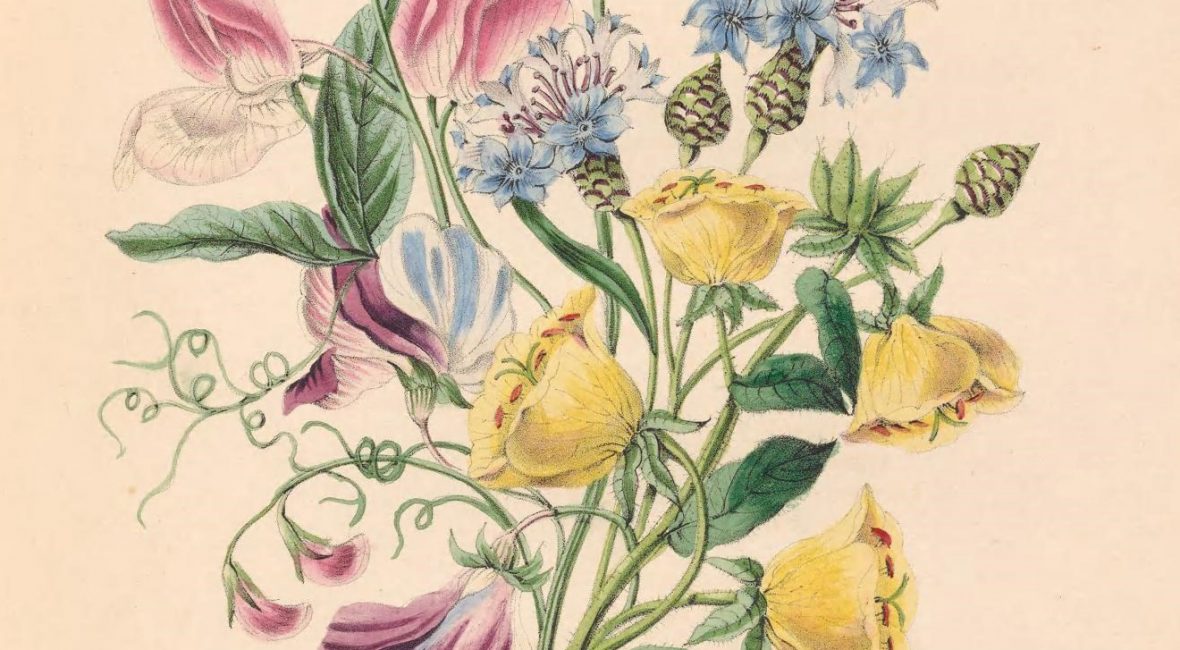
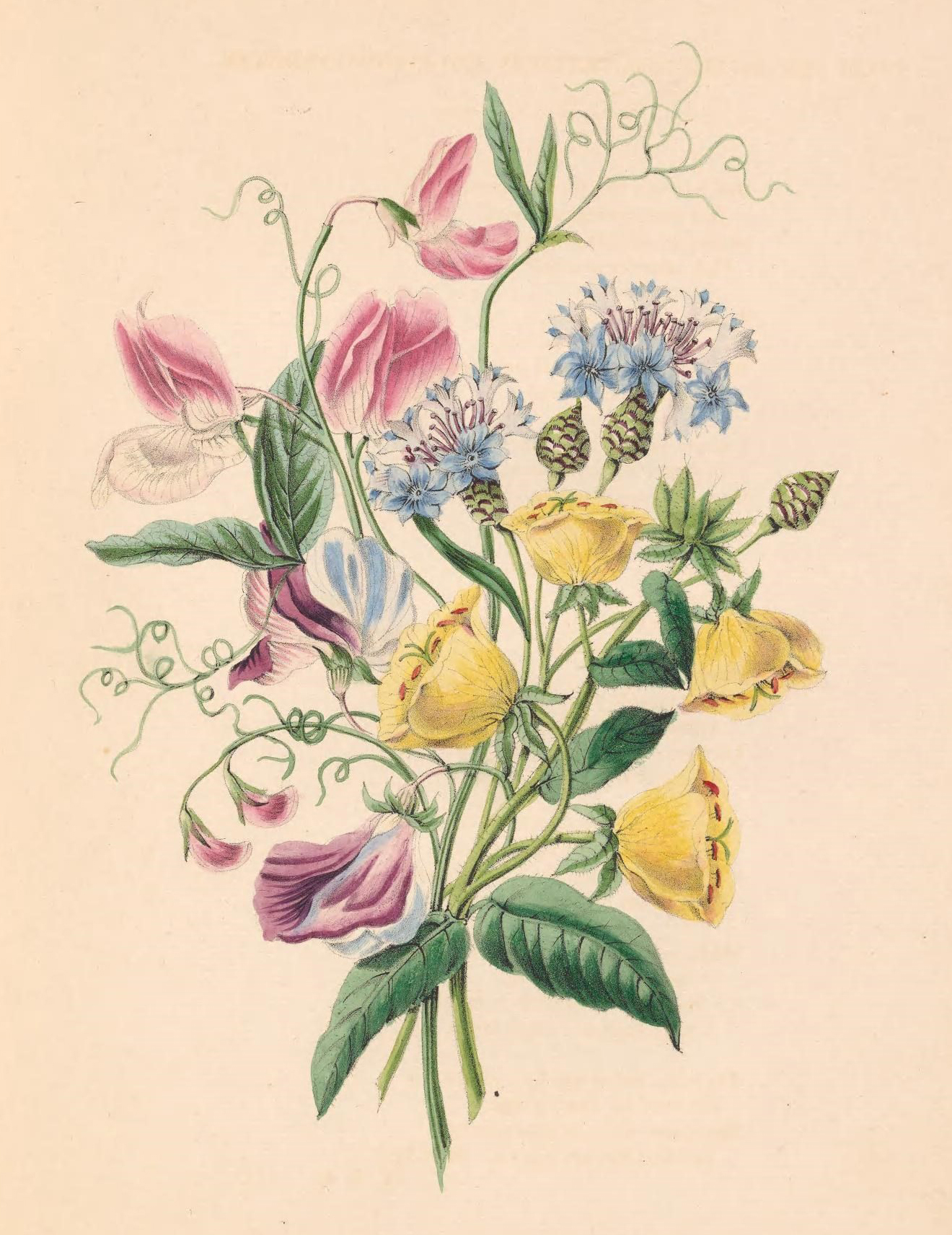
Sweet Pea, Bluebottle Centaury, and Evening Primrose.
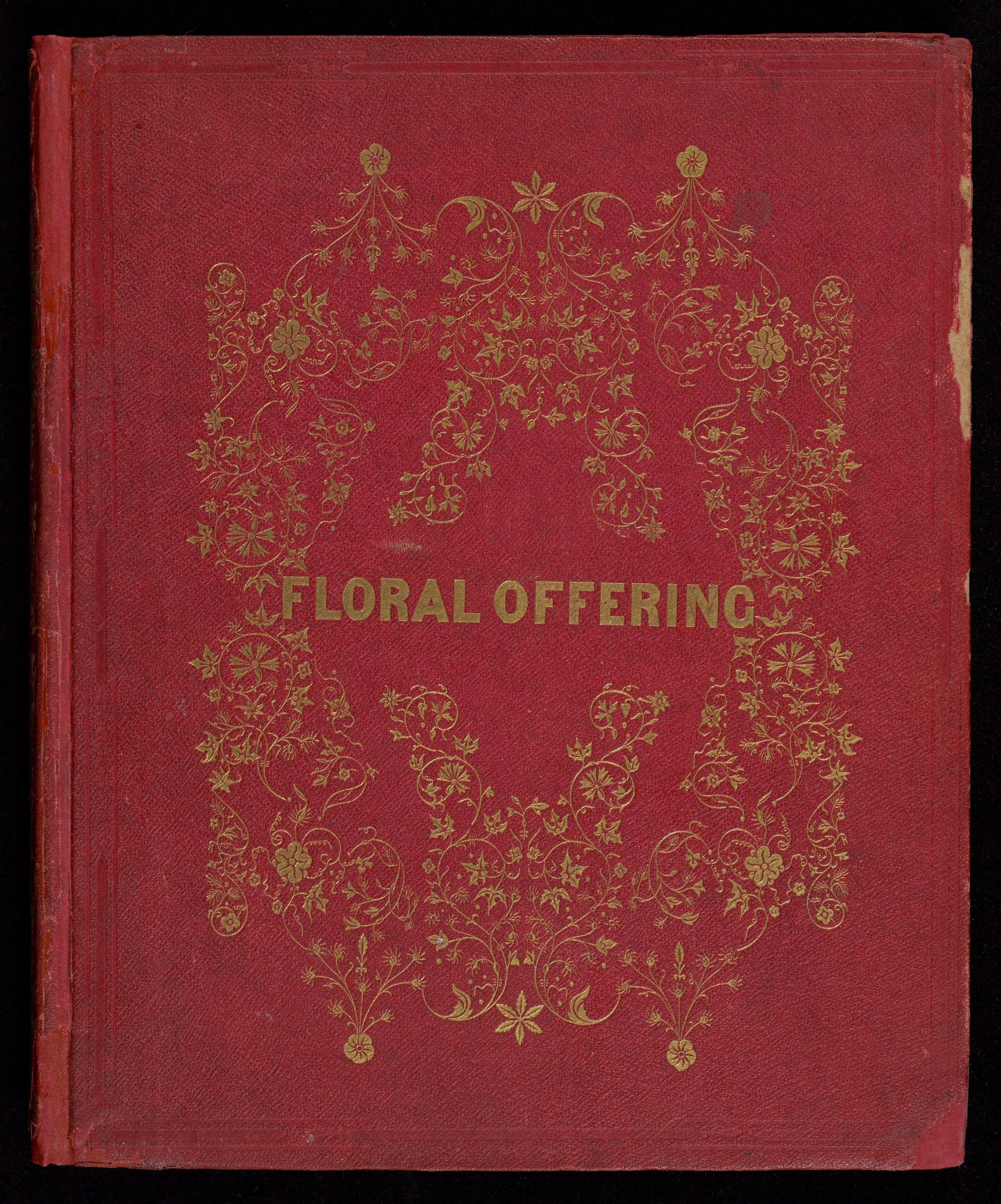
Cover of the book "The Floral Offering"

Cover. Osgood, Frances Sargent (editor). The Floral Offering, A Token of Friendship (1847). Contributed in BHL from Chicago Botanic Garden, Lenhardt Library. Digitization sponsored by the National Endowment for the Humanities (NEH).

The Language of Flowers genre is at the intersection of botany, horticulture, natural history, art, poetry, and women’s studies. This popular literary trend in the 19th century presented the world of botany through dictionaries of flowers and associated meanings, floral poetry, and prose, offering a sentimental view of natural history. A properly arranged bouquet was said to convey a “secret message” for the recipient. The “social media” of its day, this Victorian fad led to many editions of works published, with multiple titles by successful authors.

Frances Sargent Osgood edited two works in this genre: Poetry of Flowers and Flowers of Poetry and The Floral Offering.

Her description of floriography from her introductory poem in the Floral Offering follows:

INTRODUCTORY.

THY EMBLEM FLOWER.

Round every flower there gleams a glory

Bequeathed by antique song or story;

To each, old legends give a name

And its peculiar charm proclaims;

O’er smiling lawn – through shaded grove,

Our dreaming poets pensive rove,

And strive to read their language rare,

And learn the lesson latent there-

Then ‘mid them all, so fair to see,

What flower shall thy fit emblem be?

The Floral Offering, a Token of Friendship was edited by Frances S. Osgood and illustrated by J. Ackerman “with ten beautiful bouquets of flowers, elegantly colored after nature.” The work was published in Philadelphia, PA by Carey and Hart publishers in 1847. It contains poems by Osgood and others, plates with flowers assembled in bouquets, and a floral dictionary at the back containing her definitions of flowers. For example, basil means “I hate you” and olive means “peace be with you.” Osgood uses these definitions to ascribe secret messages. The list of illustrations for the plates provides the “secret message” that each illustrated arrangement is meant to convey.

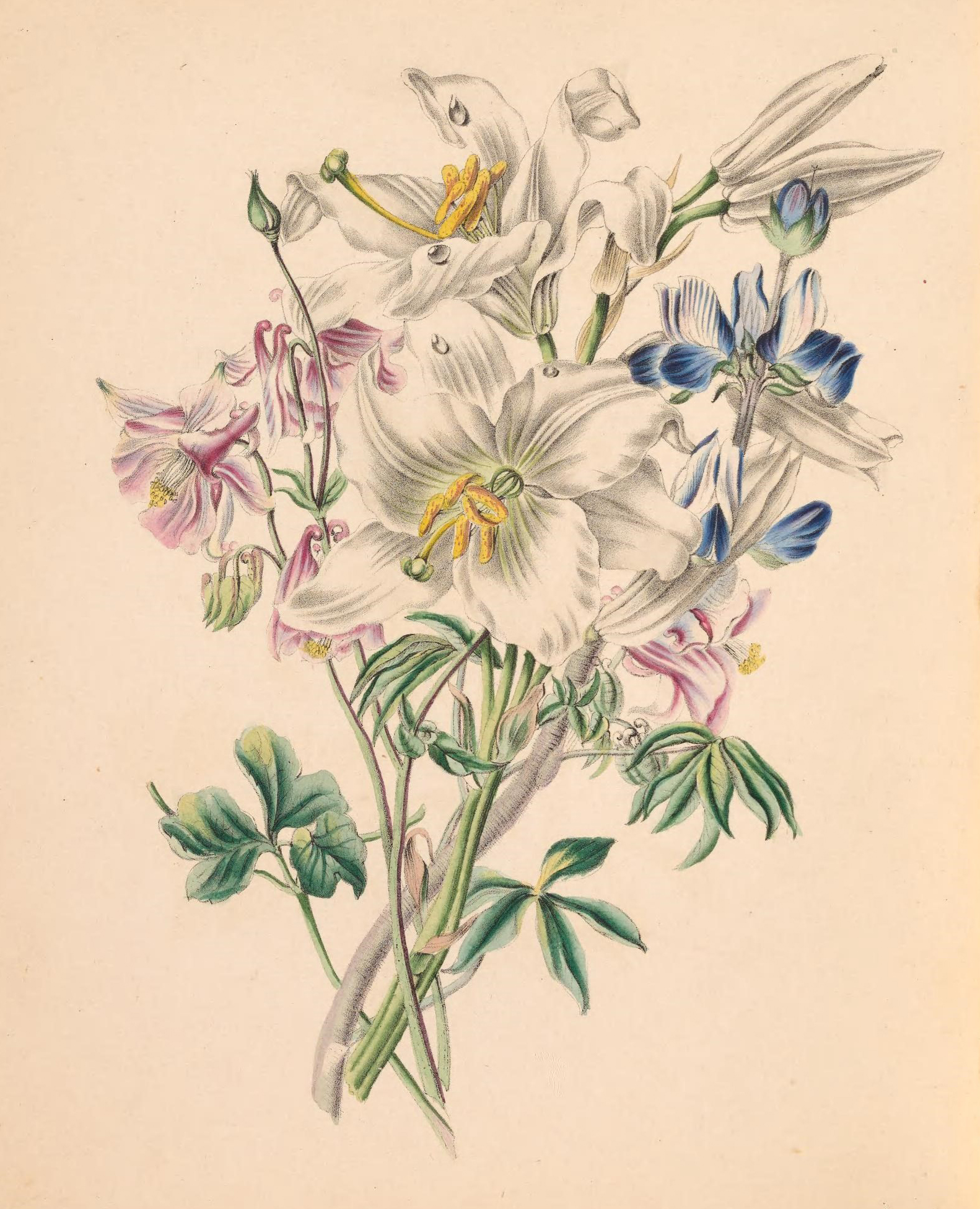
Columbine, White Lily and Lupine.

Columbine, White Lily and Lupine. Secret message: It was a dream of folly, from which I woke to weep. Osgood, Frances Sargent (editor). The Floral Offering, A Token of Friendship (1847). Art by J. Ackerman. Contributed in BHL from Chicago Botanic Garden, Lenhardt Library. Digitization sponsored by the National Endowment for the Humanities (NEH).

Frances Sargent Osgood (1811 – 1850) was one of the most influential American women poets of her time. She was born in Boston to a family of poets together with her brother, sister, and step-sister. Early on, her parents recognized her talent and encouraged her pursuits. Her first poem was published when she was a young teenager. She was a prolific writer and published numerous works in magazines for women and children and also authored and edited several books.

Osgood married a painter, Samuel Stillman Osgood, in 1835. He had previously studied at the Royal Academy, and they moved back to London where he had a successful career painting portraits. During the four years that they lived abroad, Osgood remained active in her craft and in 1839 published a compilation of all her work in a volume entitled Wreath of Wild Flowers from New England. With the unexpected death of her father, the Osgoods returned to the States, first to her family home in Boston and then settling in New York in 1840. While in New York, Osgood published two volumes in the language of flowers genre in 1841 and 1847.

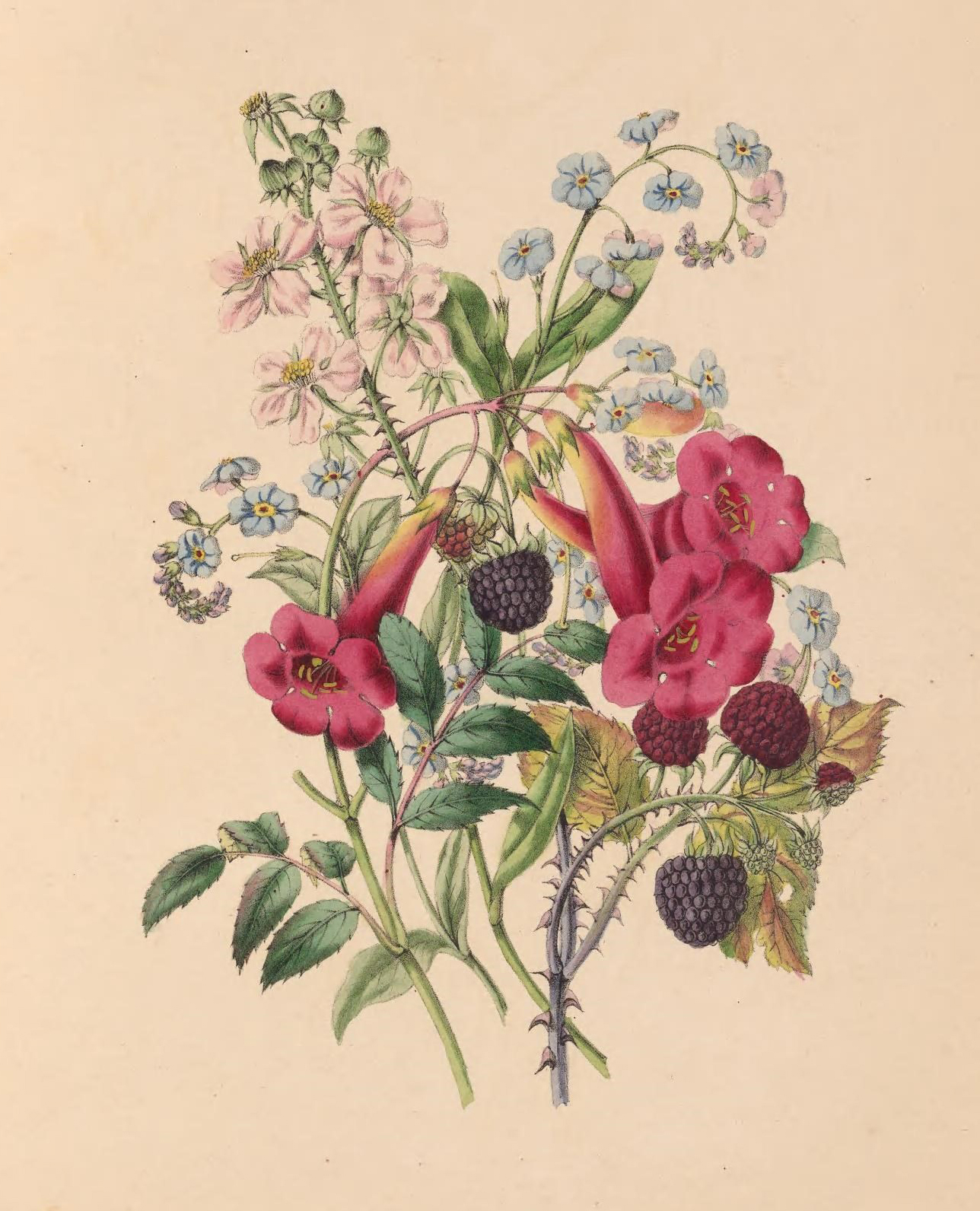
Trumpet.-flower, Forget-Me-Not, and Raspberry.

Trumpet.-flower, Forget-Me-Not, and Raspberry. Secret message: Farewell, be true to thyself, yet sometimes think of me. Osgood, Frances Sargent (editor). The Floral Offering, A Token of Friendship (1847). Art by J. Ackerman. Contributed in BHL from Chicago Botanic Garden, Lenhardt Library. Digitization sponsored by the National Endowment for the Humanities (NEH).

Osgood was very well known during her life-time, such that her biography appears in The American Female Poets; with Biographical and Critical Notices (1848), by Caroline May, and in The Female Poets of America (1849), edited by Rufus Griswold. Her notoriety and embracement of the language of flowers genre may have influenced and encouraged other women to write in the field of horticulture, botany, and natural history.

An interesting side note to her time in New York is Osgood’s association with Edgar Allen Poe. He published her poems and thought highly of her work. Their friendship is rumored to have developed into a love affair.

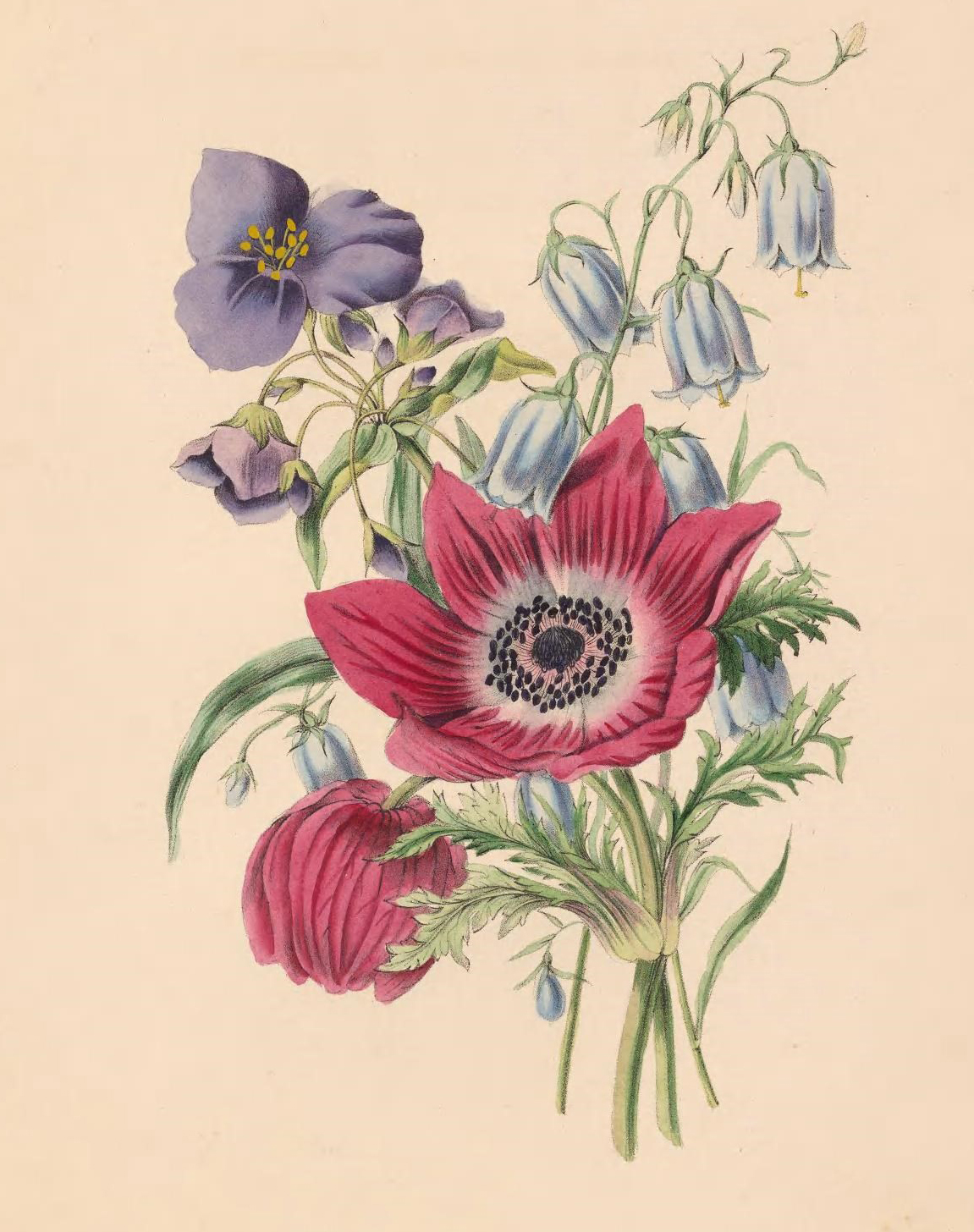
Anemone, Harebell, and Spiderwort.

Anemone, Harebell, and Spiderwort. Secret message: Thou art false, and I resign myself to my fate. Osgood, Frances Sargent (editor). The Floral Offering, A Token of Friendship (1847). Art by J. Ackerman. Contributed in BHL from Chicago Botanic Garden, Lenhardt Library. Digitization sponsored by the National Endowment for the Humanities (NEH).

Frances Sargent Osgood died from tuberculosis in 1850 at 38 years old. She was buried in Mount Auburn Cemetery near Boston with her daughter that preceded her in death. Her other two daughters died just after her in 1851.

The Memorial (1851) by “Friends of the Late Mrs. Osgood” and edited by Mary E. Hewitt was a tribute to her life. Its 346 pages contain numerous pieces by different authors; it is truly an acknowledgement of her importance to her family, friends, and literary colleagues.

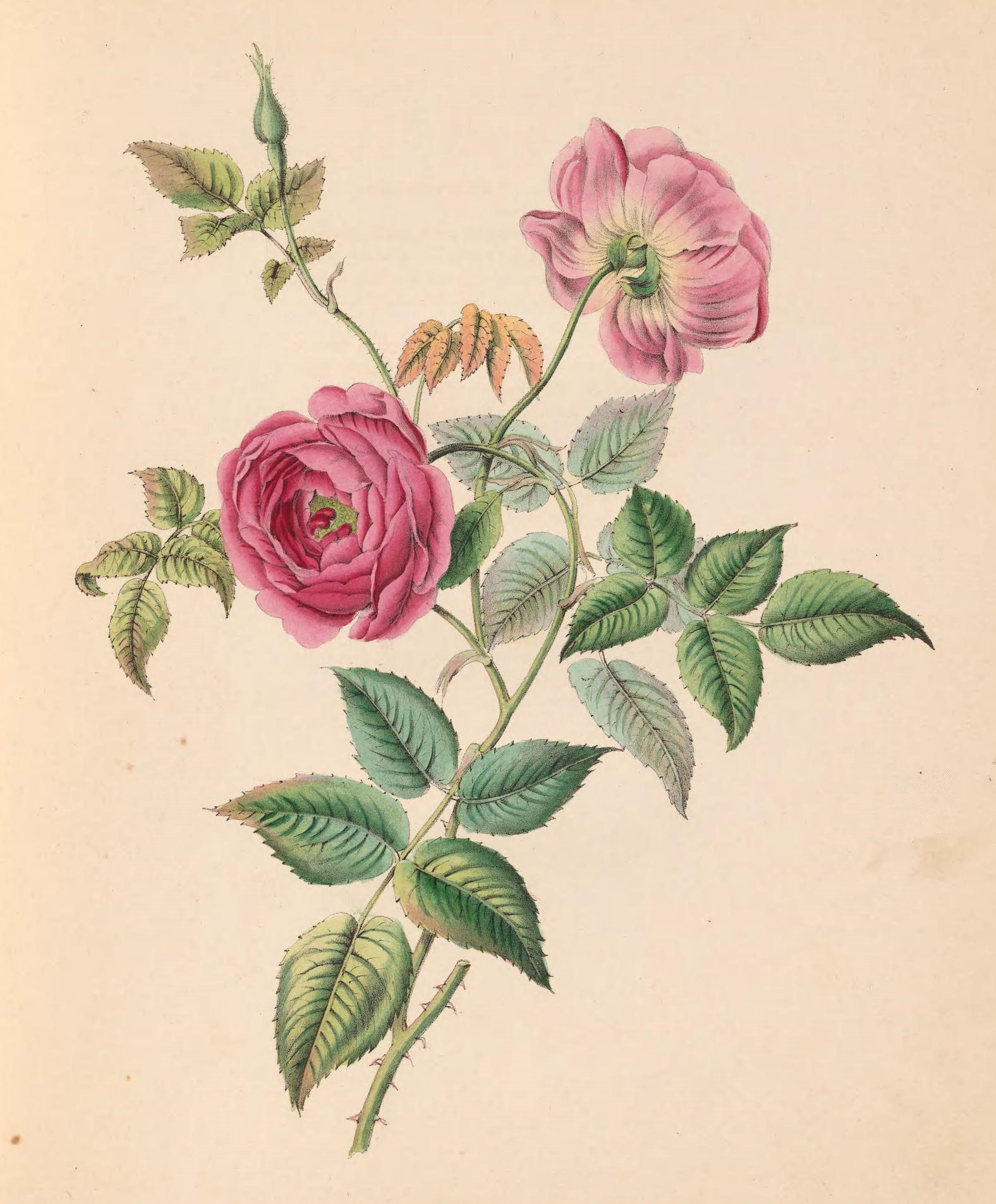
Two roses.

The Rose. Secret message: Beauty and love. Osgood, Frances Sargent (editor). The Floral Offering, A Token of Friendship (1847). Art by J. Ackerman. Contributed in BHL from Chicago Botanic Garden, Lenhardt Library. Digitization sponsored by the National Endowment for the Humanities (NEH).

The Lenhardt Library of the Chicago Botanic Garden is digitizing 62 rare and unique language of flowers volumes published in the 19th century as part of a grant from the National Endowment for the Humanities (NEH) awarded to the Chicago Horticultural Society. Over three-years, the volumes are being conserved and digitized by expert staff at the Northeast Document Conservation Center. The Floral Offering is from the second set of volumes. You can explore volumes from sets one and two as well as other titles in the Language of Flowers collection in BHL. Learn more about other language of flowers volumes digitized as part of this grant in this past blog post.

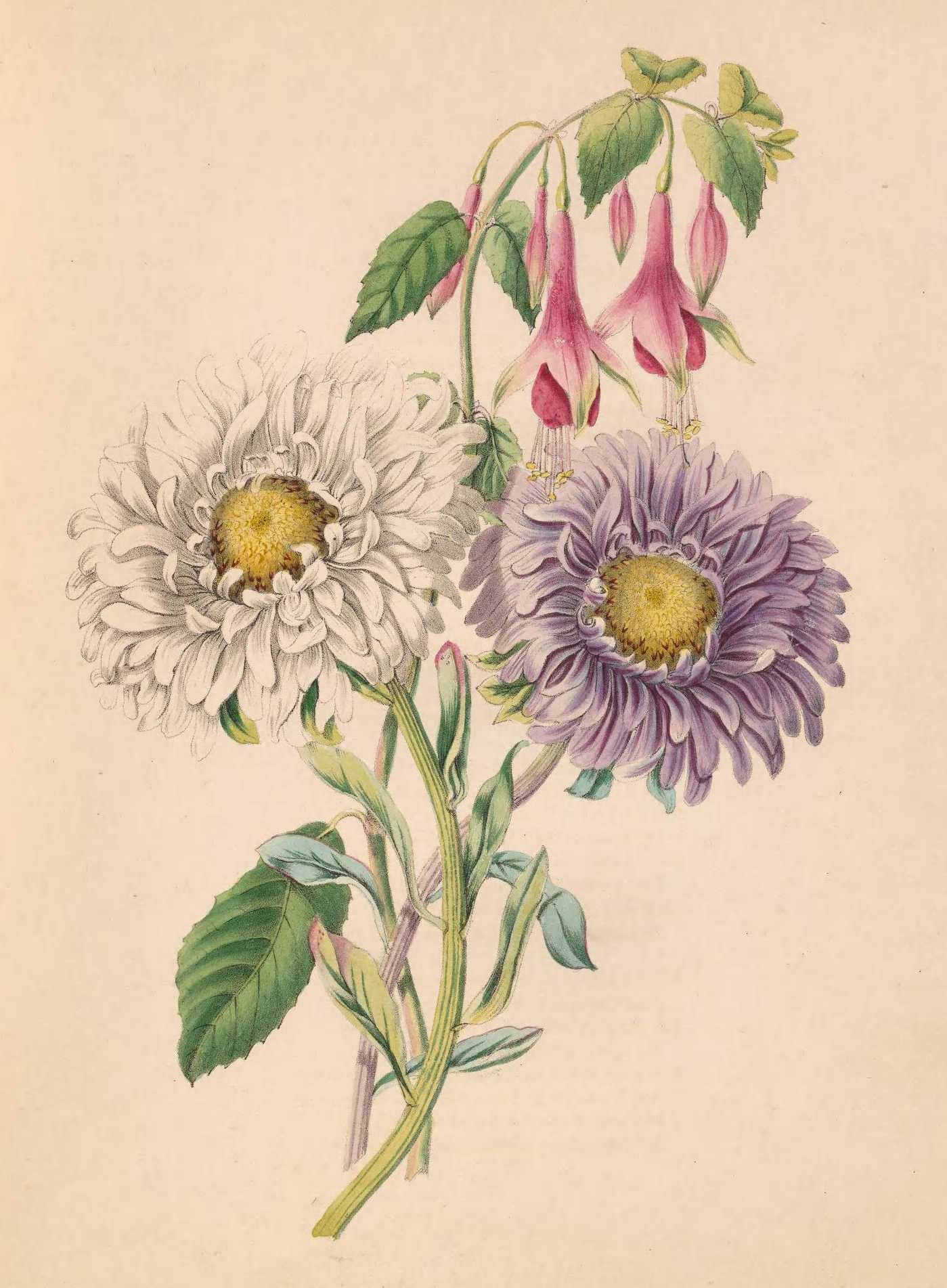
China-Aster and Fuchsia.

China-Aster and Fuchsia. Secret message: Caprice is a woman’s privilege. Osgood, Frances Sargent (editor). The Floral Offering, A Token of Friendship (1847). Art by J. Ackerman. Contributed in BHL from Chicago Botanic Garden, Lenhardt Library. Digitization sponsored by the National Endowment for the Humanities (NEH).

Sweet Pea, Bluebottle Centaury, and Evening Primrose.

Sweet Pea, Bluebottle Centaury, and Evening Primrose. Secret message: Goodbye! Our love was too lovely to last. Osgood, Frances Sargent (editor). The Floral Offering, A Token of Friendship (1847). Art by J. Ackerman. Contributed in BHL from Chicago Botanic Garden, Lenhardt Library. Digitization sponsored by the National Endowment for the Humanities (NEH).

References

Griswold, Rufus W. The Female Poets of America. Philadelphia: Carey and Hart, 1849. Internet resource.

Hewitt, Mary E. M, and Frances S. Osgood. The Memorial. New York: G.P. Putnam, 1851. Internet resource.

May, Caroline. The American Female Poets: With Biographical and Critical Notices. Philadelphia: Lindsay & Blakiston, 1848. Internet resource.

November 19, 2020by michelle.underhill
Page 1 of 51234»...Last »

Help Support BHL

BHL's existence depends on the financial support of its patrons. Help us keep this free resource alive!

search

About BHL

The Biodiversity Heritage Library (BHL) is the world’s largest open access digital library for biodiversity literature and archives. BHL operates as a worldwide consortium of natural history, botanical, research, and national libraries working together to digitize the natural history literature held in their collections and make it freely available for open access as part of a global “biodiversity community.”

Join Our Mailing List

Sign up to receive the latest news, content highlights, and promotions.

Subscribe Now

Subscribe to Blog via Email

Enter your email address to subscribe to this blog and receive notifications of new posts by email.

Join 319 other subscribers

Subscribe to Blog Via RSS

Subscribe to the blog RSS feed to stay up-to-date on all the latest BHL posts.

Access RSS Feed

Inspiring Discovery through Free Access to Biodiversity Knowledge.

The Biodiversity Heritage Library makes it easier than ever for you to access the information you need to study and explore life on Earth…for free, anytime, anywhere.


64+ Million Pages of
Biodiversity Literature Online.

EXPLORE

Tools and Services
to Transform Research.

EXPLORE

300,000+
Illustrations on Flickr.

EXPLORE

ABOUT | HARMFUL CONTENT | PRIVACY | SITE MAP | TERMS OF USE