Biodiversity Heritage Library - Program news and collection highlights from BHL
  • Home
  • News
  • Featured Books
    • All Featured Books
    • Book of the Month Series
    • BHL at 20
  • User Stories
  • Campaigns
    • Fossil Stories
    • Garden Stories
    • Monsters Are Real
    • Page Frights
    • Her Natural History
    • Earth Optimism 2020
  • Tech Blog
  • Visit BHL
Home
News
Featured Books
    All Featured Books
    Book of the Month Series
    BHL at 20
User Stories
Campaigns
    Fossil Stories
    Garden Stories
    Monsters Are Real
    Page Frights
    Her Natural History
    Earth Optimism 2020
Tech Blog
Visit BHL
  • Home
  • News
  • Featured Books
    • All Featured Books
    • Book of the Month Series
    • BHL at 20
  • User Stories
  • Campaigns
    • Fossil Stories
    • Garden Stories
    • Monsters Are Real
    • Page Frights
    • Her Natural History
    • Earth Optimism 2020
  • Tech Blog
  • Visit BHL
Biodiversity Heritage Library - Program news and collection highlights from BHL
Blog Reel, User Stories

The Australian Lepidoptera Heritage

Have you ever stumbled across a caterpillar and wondered what kind of adult moth or butterfly it would metamorphose into?

Short of catching the caterpillar and actually observing what adult it becomes, this answer might be harder to come by than you might think. Most taxonomy and identification has been performed on the adults of various Lepidopteran species, and there are still many species whose caterpillar forms are not readily known.

This is particularly true for many Australian species whose early life stages remain a scientific mystery.

Dr. Don Herbison-Evans hopes to shed some light on these Australian larval mysteries through the website Australian Caterpillars and their Butterflies and Moths, which is hosted by the Coffs Harbour Butterfly House in New South Whales, Australia.

View Full Size Image
Dr. Don Herbison-Evans.

Dr. Herbison-Evans has professional experience in a variety of scientific disciplines, including information technology and computer science, astronomy, and chemistry. His interest in entomology, however, was sparked when he emigrated from the UK to Sydney to start his academic career in the 1960s. He and good friend Dr. Stella A. Crossley (who also emigrated from the UK to Melbourne around the same time to lecture in the Psychology Department at Monash University) were fascinated by the number of caterpillar species they found in their gardens.

“I remember taking one beastie to the enquiries desk at the Australian Museum, and asking what species it was,” recalled Don. “The lady there laughed, and then explained that most of the taxonomy of Australian Lepidoptera was done by entomologists at the British Museum on dried adult specimens sent back to the UK by Joseph Banks and other British explorers, so the entomologists had no idea what the early life stages, such as the caterpillars, were like.”

Thus, Don and Stella started photographing the caterpillars they found and rearing them into adults to discover their mature counterparts. In an effort to share what they discovered, they wrote a manuscript entitled 100 Common Australian Caterpillars, but unfortunately, publishers’ interest in caterpillars in the 1970s was virtually nonexistent. So Don and Stella shelved the manuscript.

And then, some twenty years later, along came the Internet.

“We were encouraged as univerisity staff to put potted biographies of ourselves on the web for students to know more about us, and of course we included a note in ours that we were interested in caterpillars,” explained Don. “We then got increasing numbers of people sending descriptions and photos of caterpillars asking what they were. So we said: ‘OK let’s just put our book on the web.'”

And so Australian Caterpillars and their Butterflies and Moths was born. The website contains webpages for over 3,600 Australian Lepidopteran species (having grown from an original 100). These webpages include descriptive information about the species as well as, where available, images of the adult and caterpillar forms. The pages are grouped according to family, and these pages are linked via a single page for moths and another for butterflies.
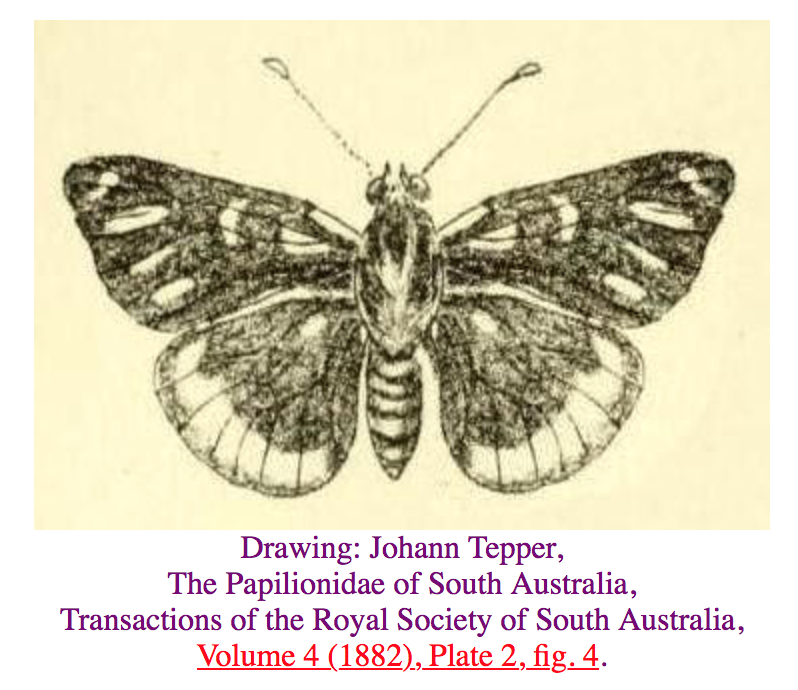
View Full Size Image
Example of BHL image in Australian Caterpillars and their Butterflies and Moths. Hesperilla bifasciata species page.

The Biodiversity Heritage Library serves as an excellent source of information for the website.

“BHL has enabled me to add historical richness to my popular descriptions of the biology of the Lepidoptera of Australia,” stated Don.

Using BHL everyday, Don searches for references to species of interest in BHL using our taxonomic name finding tool. If this does not yield results, he searches the OCR of likely journal issues for genus or species names. He then links these pages to relevant content in the website. Where illustrations are available in BHL, these are also uploaded to the corresponding species pages. These illustrations, which offer an interesting juxtaposition to modern photographs, are, in fact, Don’s favorite feature on BHL.
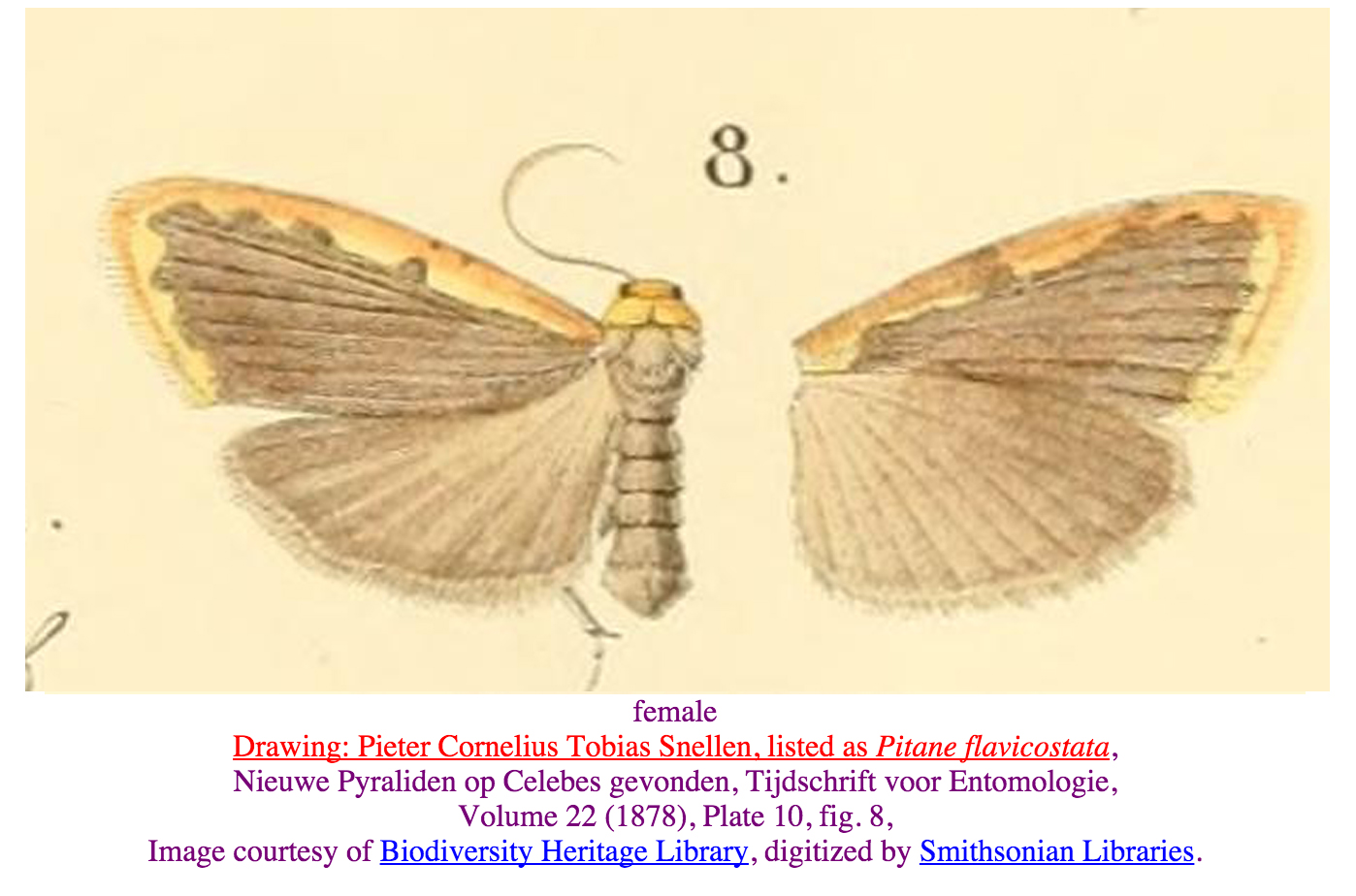
View Full Size Image
Example of BHL image in Australian Caterpillars and their Butterflies and Moths. Diduga flavicostata species page.

In addition to information about specific species, the website also provides some pretty incredible facts about caterpillars. For example, did you know that caterpillars have thousands of muscles, whereas humans only have about 500? Or that the female moths of the Australian species such as Teia anartoides have no wings, and the species disperses by the young caterpillars making an open gossamer sail out of silk, and sailing away on it in the wind?
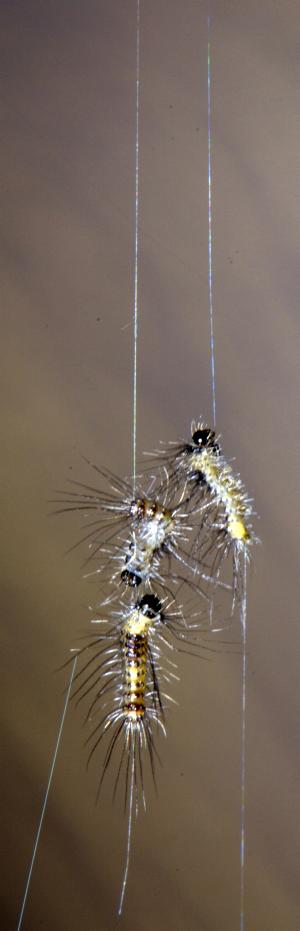
View Full Size Image
Teia anartoides young caterpillars ballooning (Photo: courtesy of Rudie Kuiter, Aquatic Photographics, Victoria). http://lepidoptera.butterflyhouse.com.au/lyma/anart.html.

The website has become an incredible resource for those interested in exploring Australian Lepidoptera. Don particularly hopes that it will help spark an interest in these insects among younger audiences.

“Our idea in the webpages is to help, particularly young Australian people, understand and value the unique entomological heritage to which they are heirs, and to foster an understanding of how to preserve that heritage for future generations,” Don explained. “The webpages try to be chatty and intriguing to, say, an intelligent 12 year old, but to include enough technical information to tempt them deeper into the ecology and taxonomy of Australian Lepidoptera. With the help of the Biodiversity Heritage Library and Wikipedia, we are able to link the current descriptions of the biology of the species to the original descriptions from two or more centuries ago and to biographies of their authors who can be seen to have been real people, who too were intensely interested in Australian fauna. I think this helps establish the idea in our readers that these organisms have perhaps as much right to live in Australia as they do, and that our living biological heritage can be preserved and maintained, just as [BHL] preserves our literary and scientific heritage.”

We think the website is well on its way to achieving this goal. After all, what young person wouldn’t want to learn more about a caterpillar that can fire fecal pellets from its anus?

Thanks very much to Dr. Herbison-Evans for sharing his work and use of BHL with us. Be sure to explore Australian Caterpillars and their Butterflies and Moths today.

Do you use BHL regularly for your work? Want to be featured on our blog? Send a message to [email protected].
November 12, 2015by ulib-libraryjobs
Blog Reel, Featured Books

Using Art to Document Species: Cramer and the Lepidoptera

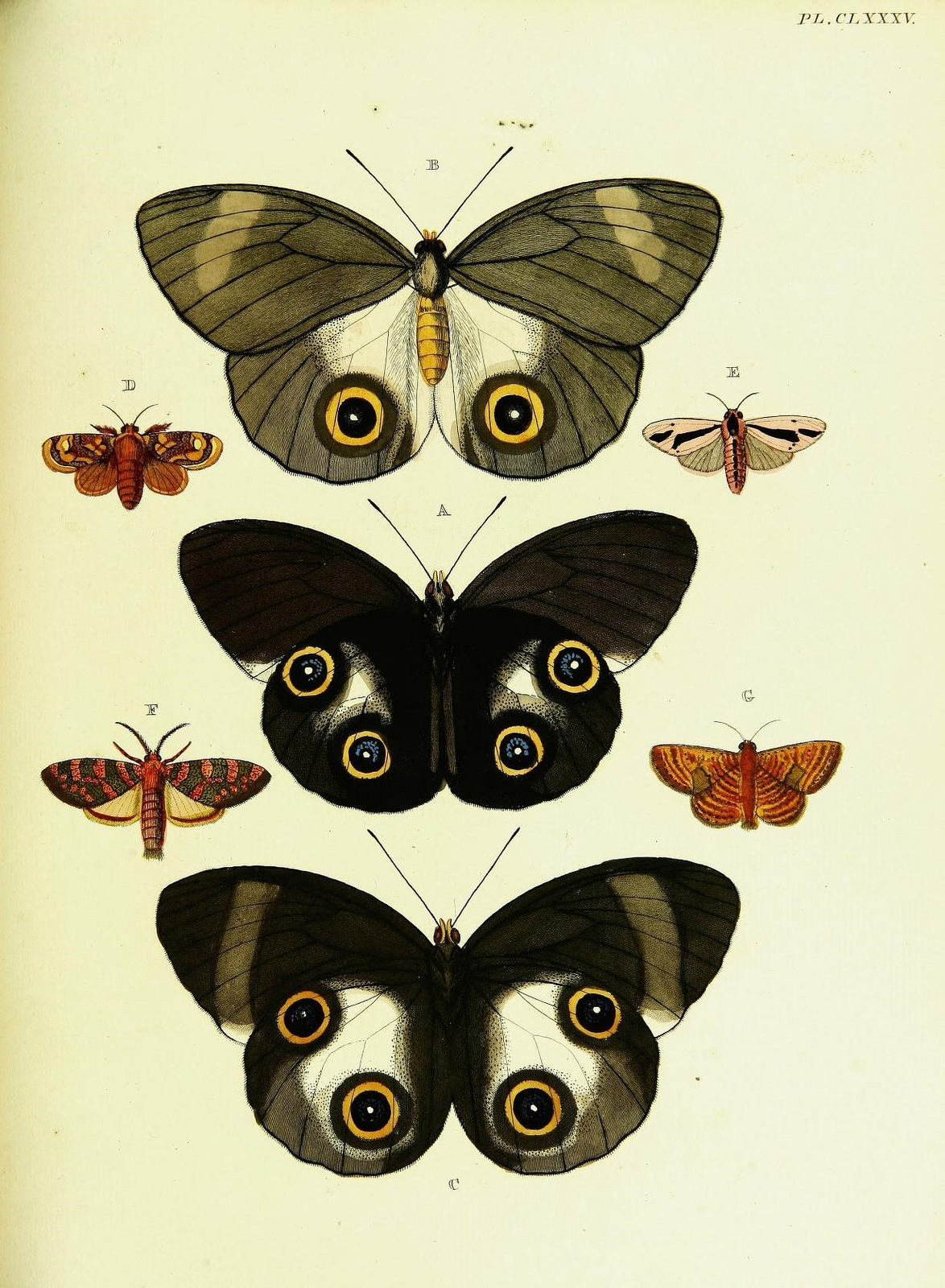
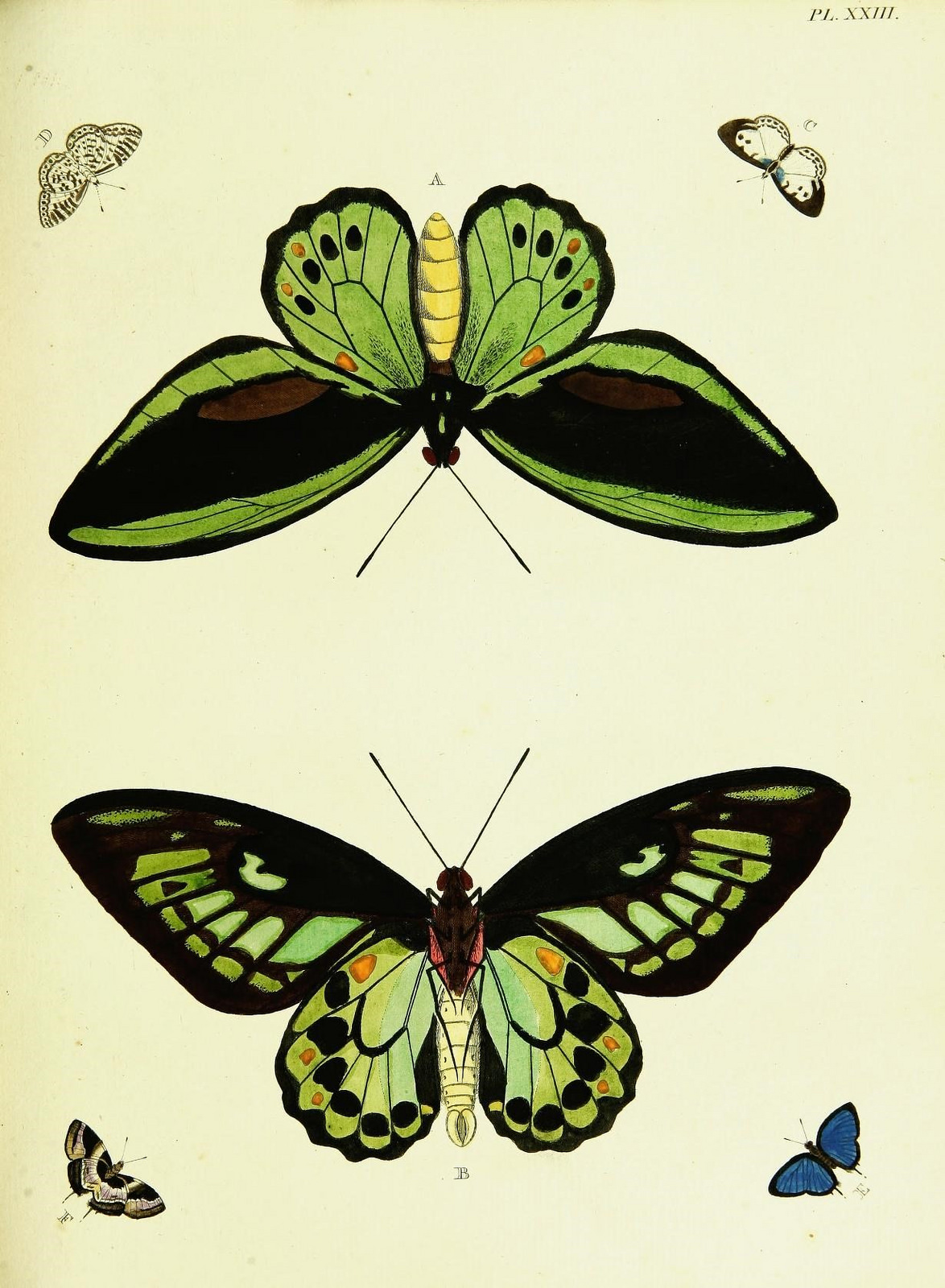
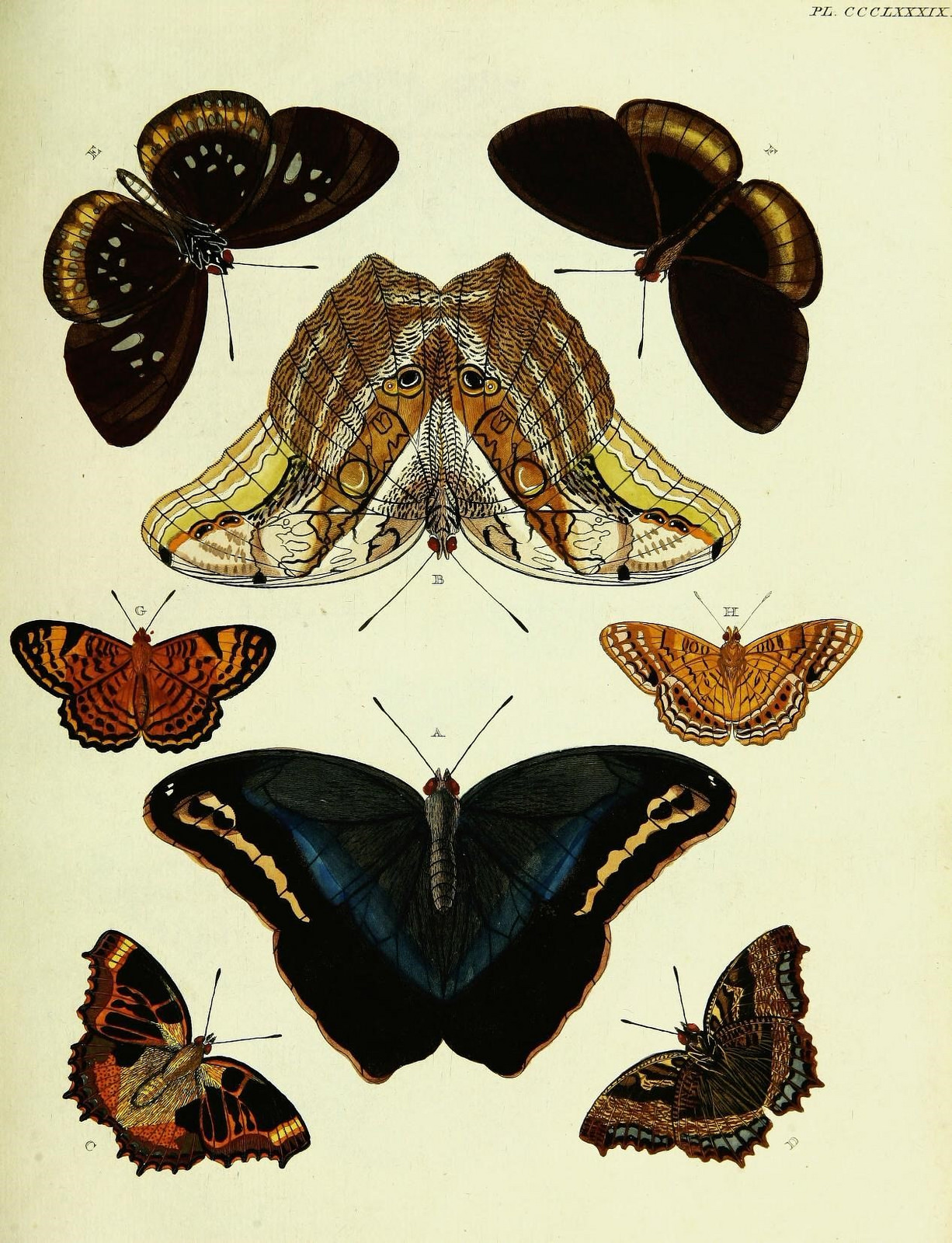
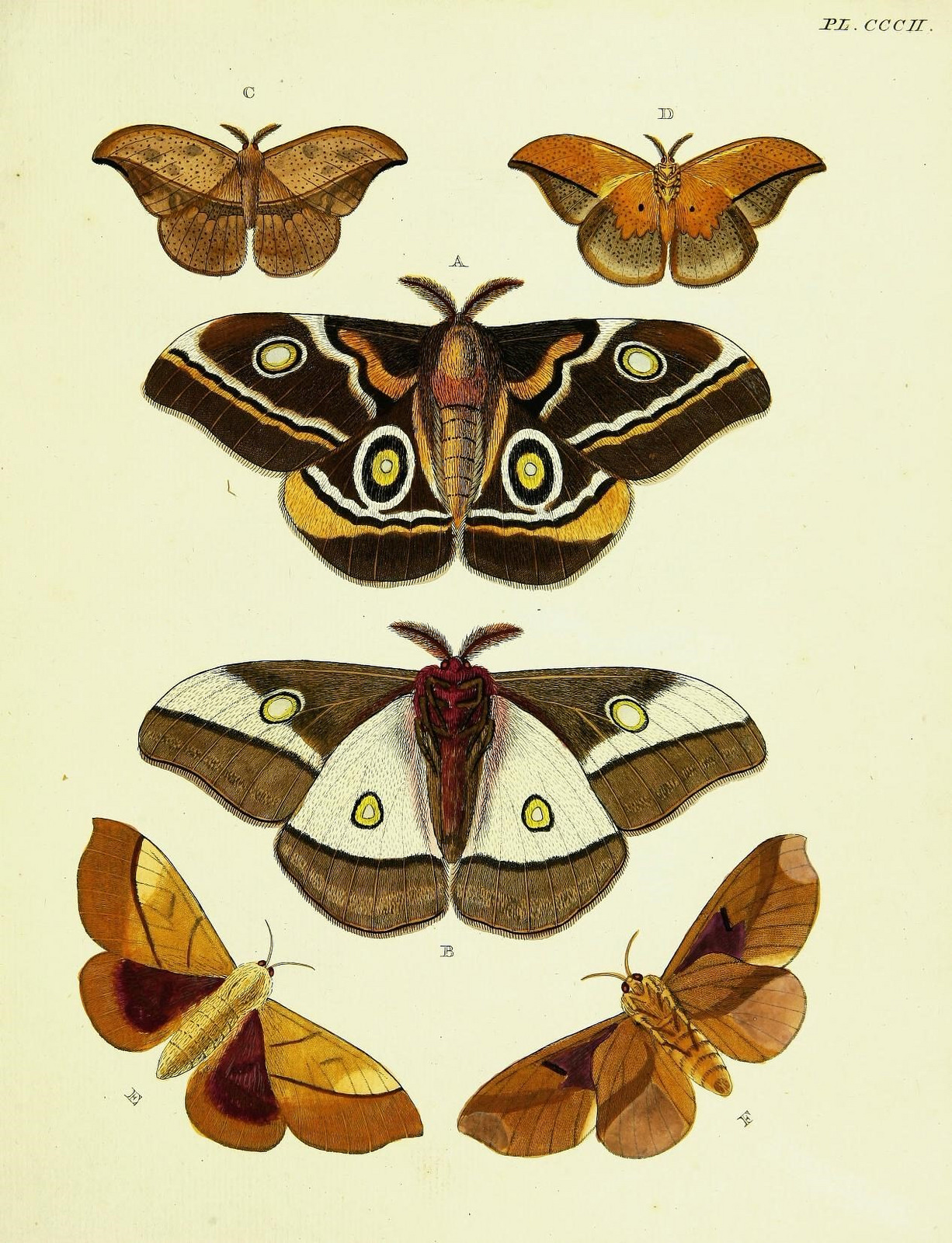
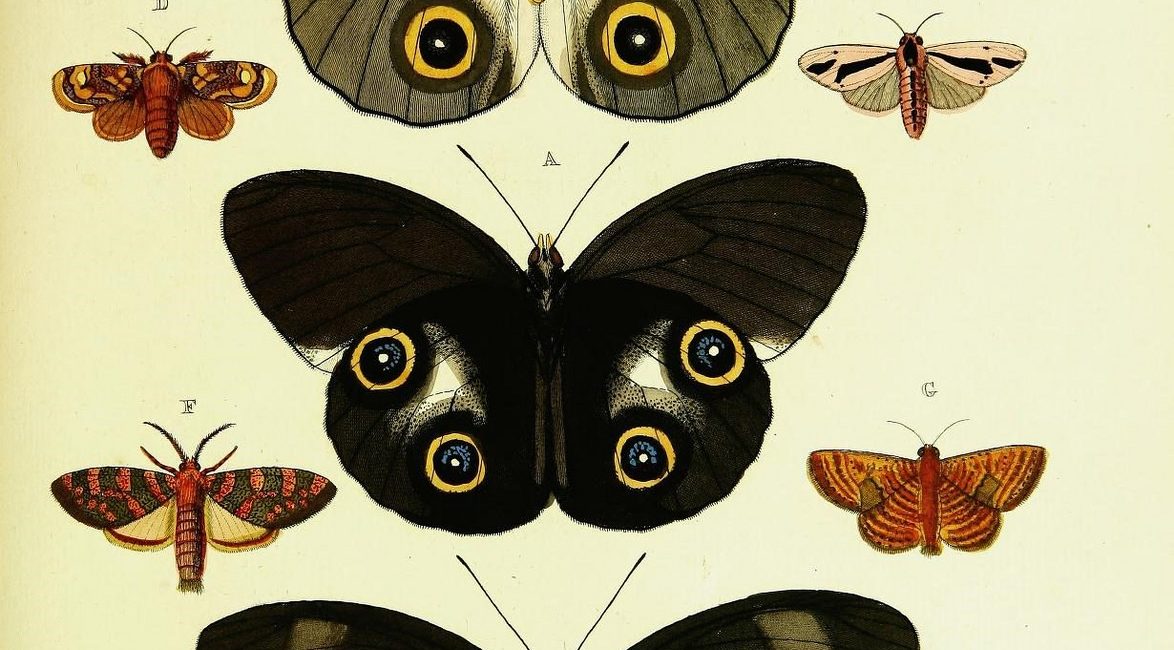
How could you make a visual record of a collection before the advent of photography? Through illustrations, of course. It was a desire to produce just such a record that prompted the creation of the magnificent plates accompanying De uitlandsche kapellen voorkomende in de drie waereld-deelen, Asia, Africa en America ([1775]-1782), by Pieter Cramer, which has been digitized for BHL by Mann Library, Cornell University.

View Full Size Image
De uitlandsche kapellen voorkomende in de drie waereld-deelen, Asia, Africa en America. [1775]-1782. Digitized by Mann Library, Cornell University. http://biodiversitylibrary.org/page/42111657.

Pieter Cramer was a wealthy linen and wool merchant from Amsterdam. Born in 1721, he had a keen interest in natural history – particularly Lepidoptera (butterflies and moths). Through purchase and trade, Cramer amassed a large collection of Lepidoptera specimens from Suriname, Sri Lanka (then Ceylon), Indonesia, North America, Africa, and Asia. Cramer hired Amsterdam artist Gerrit Wartenaar to illustrate his collection in order to make a permanent record of it. The resulting hand-colored plates were so magnificent that Cramer was encouraged to publish them. He did so via De uitlandsche kapellen, which includes 400 plates featuring 1,658 moth and butterfly species, each accompanied by a brief description of the antennal shape and wing pattern. The plates and text were published in thirty-four parts between 1775-82, with one issue being sent out to a list of subscribers every three months. The final work consists of four volumes.

View Full Size Image
De uitlandsche kapellen voorkomende in de drie waereld-deelen, Asia, Africa en America. [1775]-1782. Digitized by Mann Library, Cornell University. http://biodiversitylibrary.org/page/42111331.

Sadly, Cramer died of a fever in 1776, before the first volume was complete. His nephew and business partner, Anthony Wellemzoon van Rensselaar, enlisted the help of Caspar Stoll (who had been involved in the production of the first volume) to complete the final volumes. Stoll wrote most of the text for volume four, and, between 1787-90, published a supplement to the work that included forty-two plates of 250 additional species.

View Full Size Image
De uitlandsche kapellen voorkomende in de drie waereld-deelen, Asia, Africa en America. [1775]-1782. Digitized by Mann Library, Cornell University. http://biodiversitylibrary.org/page/42111247.

De uitlandsche kapellen is important for a number of reasons. It depicts each species at life-size and illustrates both the upper and lower wings for each. It was also the first treatise on Lepidoptera to use the newly-introduced classification system from Carl Linnaeus. Cramer and Stoll assigned each butterfly and moth to one of the three then-existing Lepidopteran genera (designated by Linnaeus) – today there are thousands of genera for butterflies and moths. In providing scientific names to the species, they not only used any existing binomials for the specimens included in the work, but, as many of the species had not yet been named, they also assigned a name and provided the first formal scientific description for many species depicted in the volumes. As a result, De uitlandsche kapellen contains hundreds of “original descriptions” and as such is still integral to the work of scientists today.

View Full Size Image
De uitlandsche kapellen voorkomende in de drie waereld-deelen, Asia, Africa en America. [1775]-1782. Digitized by Mann Library, Cornell University. http://biodiversitylibrary.org/page/42111073.

You can explore De uitlandsche kapellen voorkomende in de drie waereld-deelen, Asia, Africa en America (1779-1782), by Pieter Cramer, for free in BHL, digitized by Mann Library, Cornell University Library. You can view the illustrations in this work on Flickr: Pts. 1-2 | Pts. 3-4.

Source: James, Miller. “The Volumes of Cramer and Stoll: A Timeless Contribution to the Science of Butterflies and Moths.” Natural Histories. New York: American Museum of Natural History, 2012. 57-58. Print.

November 5, 2015by ulib-libraryjobs
Blog Reel, Featured Books

Happy Moth Week!

View Full Size Image

Happy Moth Week! National Moth Week is an annual event that celebrates the diversity and magnificence of moths. By partnering with online biological databases, National Moth Week encourages everyone to become a citizen scientist by helping map moth distributions and provide information about these amazing species.

BHL is celebrating moth week by highlighting select species gleaned from one of our favorite BHL books: Butterflies and Moths: Shown to the Children (1910), by Janet Harvey Kelman, with descriptions by Rev. Theodore Wood.

Satisfy all your moth curiosity with free moth images from BHL in our Flickr Moth Collection and books on moths in BHL. Learn more about Moth Week and find out how you can get involved.

View Full Size Image
http://biodiversitylibrary.org/page/42193530

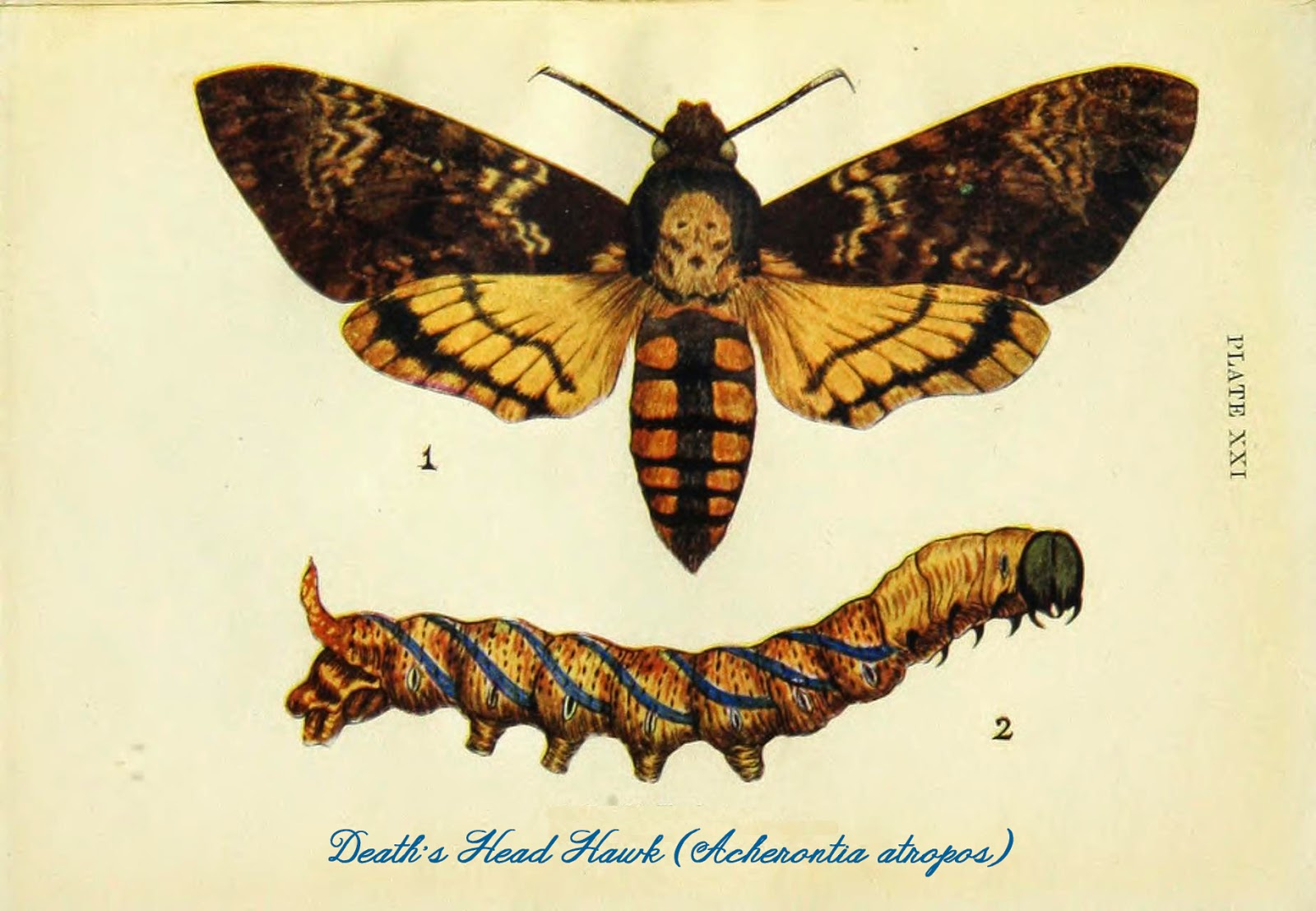
Death’s Head Hawk (Acherontia atropos)
There are three species of Death’s Head Hawk moths, but the European species is the best known. Characterized by the skull-shaped markings on its thorax, these are very large moths, with wingspans of 3.5-5 inches. The moth is capable of “squeaking” vocalizations, and commonly raids beehives for honey. By mimicking the scent of bees, it is able to prowl through the hives unmolested.

The moth’s association with death extends to its name. The genus name, Acherontia, is derived from the river Acheron in Greek mythology – one of the five rivers of the underworld associated with pain. The species name, atropos, comes from the name of one of the Greek Moirai, goddesses of fate and destiny.

Fun Quote from Butterflies and Moths
“And if you meet with [the Death’s Head Hawk], and pick it up, you will be surprised to find that it can squeak quite loudly! Stranger still, the chrysalis can squeak too, and so can the moth ! Indeed, if you pick up a Death’s Head Hawk Moth it will go on squeaking very much like a mouse all the time that you hold it in your hand!” (pg 39)

View Full Size Image
http://biodiversitylibrary.org/page/42193554

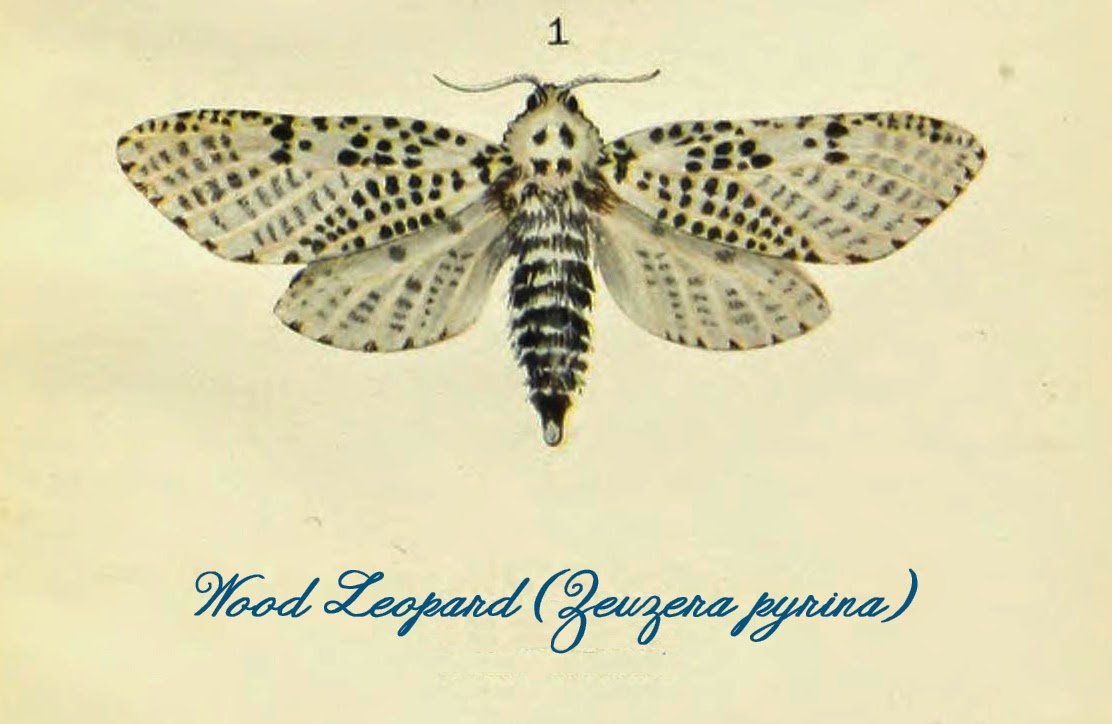
Wood Leopard (Zeuzera pyrina) 
Though found primarily in Europe and northern Africa, the Wood Leopard was introduced to America prior to 1879 and can now be found from Maine to Pennsylvania. With a wingspan measuring from just over 1 to just over 2 inches, this species boasts a distinctive, fury white thorax with six black spots and Dalmatian-esque black and white wings.

Fun Quote from Butterflies and Moths
“You may sometimes see [the Wood Leopard] resting on the trunks of trees in July and August. Then, if you examine the tree-trunk carefully, you are almost sure to find the entrance to the burrow out of which it came; for the caterpillar of this moth is one of those which feed on the solid wood of trees. The female moth lays her eggs in the crevices of the bark, and as soon as the little caterpillars appear they nibble their way into the trunk with their powerful jaws, and there live for several months, burrowing backwards and forwards, day after day, till sometimes the wood is almost honeycombed with their tunnels.” (pg 50)

View Full Size Image
http://biodiversitylibrary.org/page/42193610

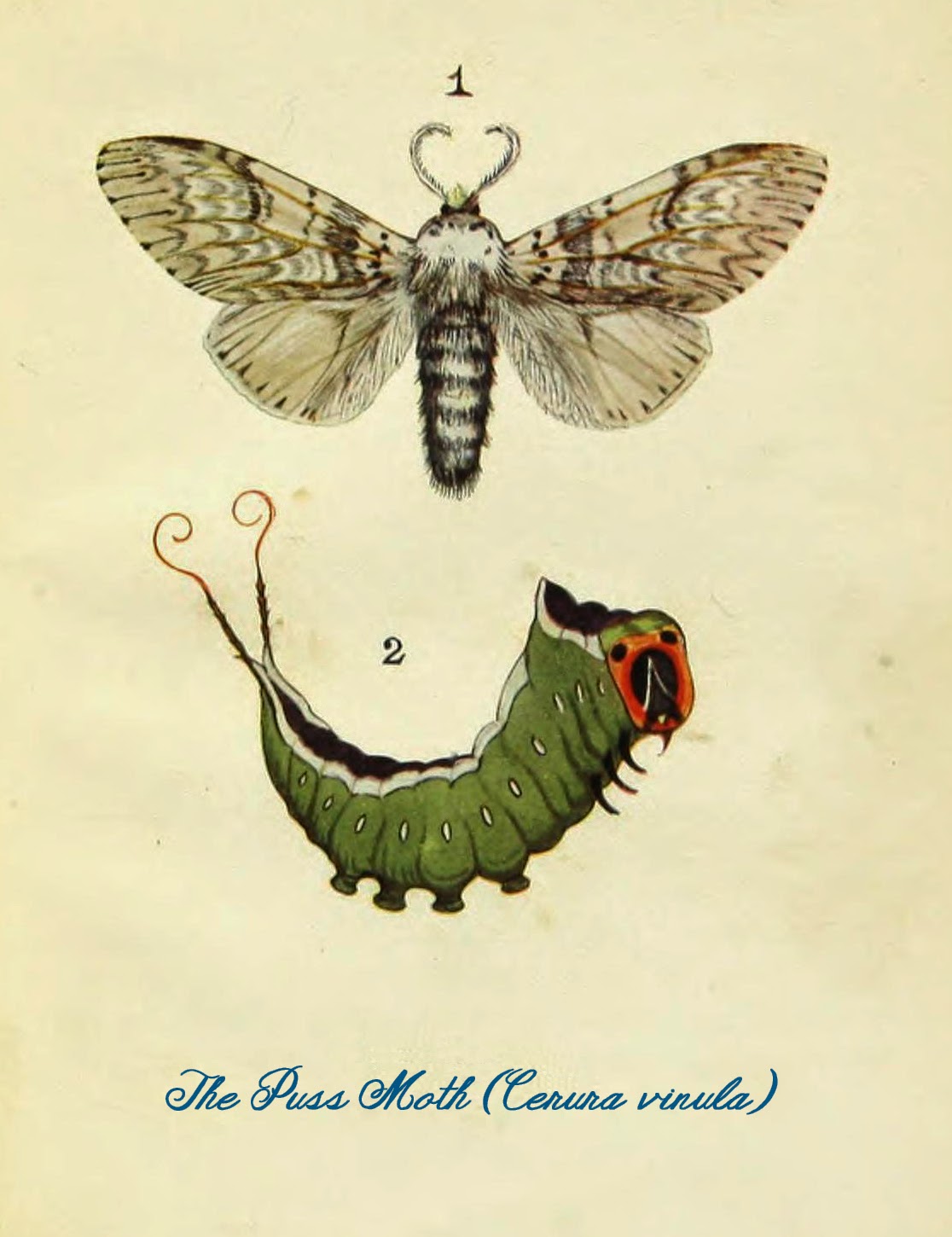
The Puss Moth (Cerura vinula)
Found throughout Europe, North Africa, and temperate Asia, the Puss Moth has a 2-3 inch wingspan and feeds on willows and poplars. With a flight period extending from April to August, the pupa winters the cold months in a wood-reinforced cocoon. The light green caterpillar exhibits a defensive pose that involves rearing its bright-red head and extendable flagellae on its rear (as seen in illustration). If a predator fails to regard this warning, the caterpillar will squirt formic acid.  

Fun Quote from Butterflies and Moths
“This fine and handsome moth is called the ‘Puss,’ because, when its wings are closed, it looks rather like a brindled cat. And there are two or three smaller moths which are a good deal like it; so these are known as ‘Kittens.'” (pg 79).

View Full Size Image
http://biodiversitylibrary.org/page/42193628

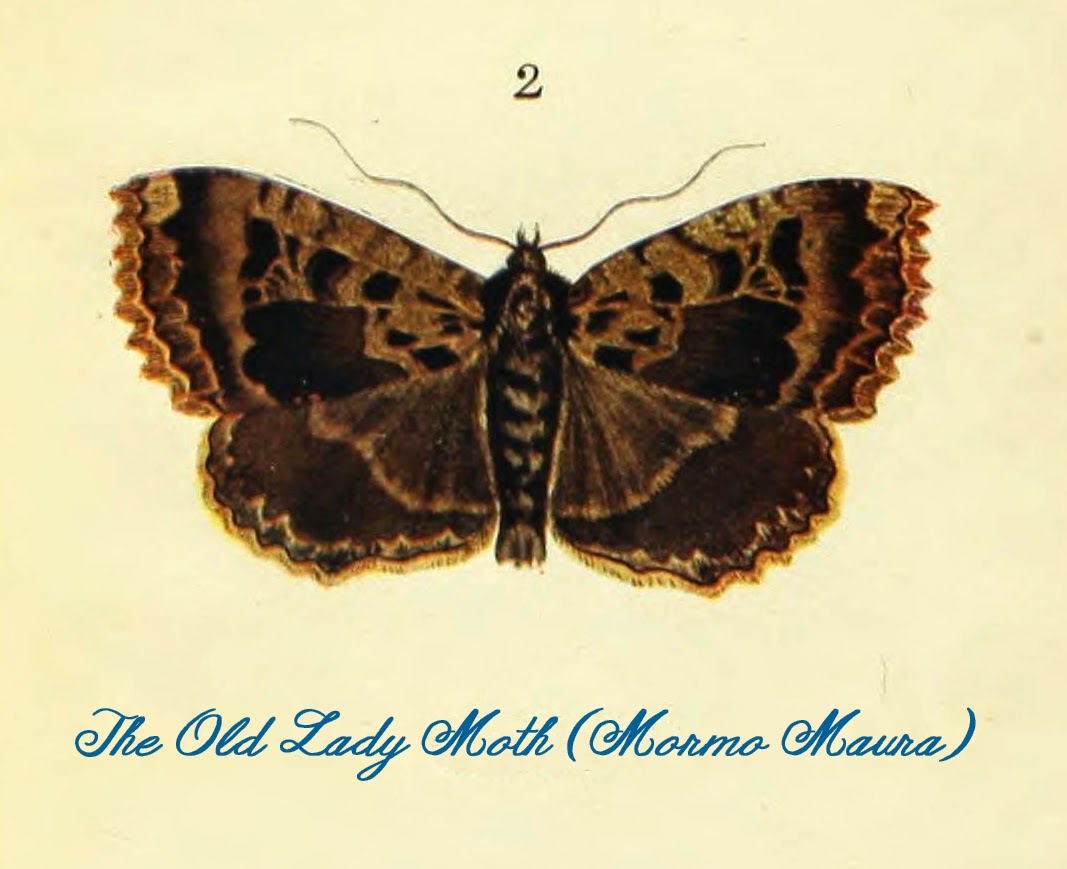
The Old Lady (Mormo Maura)
Found throughout northwestern Africa and Europe, the “Old Lady” or “Black Underwing” moth measures about 2-2.5 inches in wingspan. Found mostly near water, it hides by day and is not particularly attracted to light. It is, however, attracted to sugar, and feeds on the leaves of various fruit trees.   

Fun Quote from Butterflies and Moths
“If you were to ask me why this moth should be called the ‘Old Lady,’ I am not quite sure that I could tell you. But I think the reason must be that old ladies mostly dress in dark grey, or dark brown, or black, which are just the colours of the wings of the moth.” (pg 88)

Be sure to check out Butterflies and Moths: Shown to the Children in BHL for more fabulous moth (and butterfly) facts and images. Don’t forget to find out how you can become a citizen scientist as part of Moth Week this week!

View Full Size Image
Privet Hawk Moth (Sphinx ligustri), which will hiss at you if you make him mad. http://biodiversitylibrary.org/page/42193534
July 22, 2014by ulib-libraryjobs
Blog Reel, User Stories

How BHL Helps Users Delve into the Wonderful World of Lepidoptera!

Today, we present an example of how BHL is being utilized to expand an award-winning database on the insect order Lepidoptera! 

Generic Names of Moths of the World: Generic Names and their Type-species by Brian Pitkin and Paul Jenkins is a catalogue of more than 32,000 genus-group names of the insect order Lepidoptera. First launched in July 2004, the site was awarded the Podalirius Star in November 2004. The catalogue has recently been updated, corrected where necessary and revitalised by the addition of links to scanned images of more than 58% of the cited references to the Biodiversity Heritage Library. The majority of the links are pre-1923 as a result of copyright restrictions on more recent publications.

Work on the electronic catalogue started by bringing together digital tag-delimited files on five and a half inch floppy discs of:

  • Hemming, 1967. Generic names of Butterflies of the World and their Type-species (Lepidoptera : Rhopalocera). Bull. Br. Mus. nat. Hist. (Ent.) Suppl. 9: 509 pp.,
  • Cowan, 1968 and 1970. Annotationes Rhopalogiques: 20 pp. Published privately, Clunbury Press, Berkhamsted, Herts.
  • Volumes 2-6 of Generic Names of Moths of the World, Trustees of the British Museum (Natural History), London by the senior author.
    • Volume 1 of Generic Names of the World was digitally scanned and converted to text using optical recognition software and then checked against the original by Paul Jenkins. All were then combined into a Paradox for DOS database which ultimately was converted to MS Access 97 by the senior author and subsequently MS SQL for web deployment.

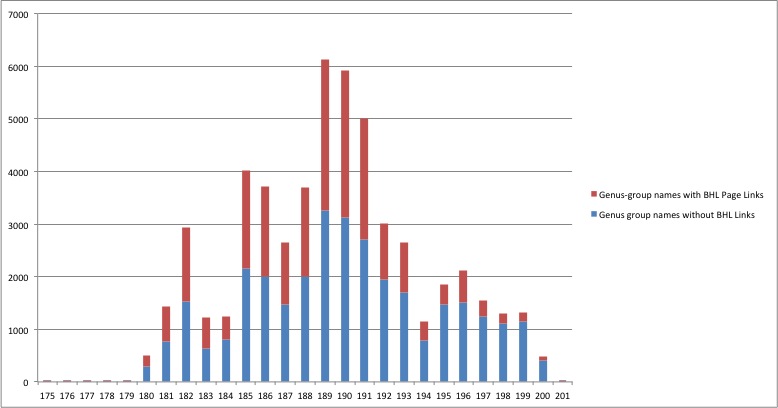
Links to BHL have since been added to the catalog, expanding the information available. 54% (17,479) of the 32,188 included genus-group names have links to BHL scanned images. 64% (17,976) of the 27,891 included type species have links to BHL scanned images. 58% (2,297) of the 3,944 included type species designations have links to BHL scanned images. The catalogue bibliography includes 8,863 references, of which 3,741 (42%) have been scanned by BHL.

View Full Size Image
Graph showing the number of genus-group names of unlinked (blue) and linked (red, n=17,553 or 54.75%) citations in Butterflies and Moths of the World by decade to BHL scanned images. (Genus-group names without citations are ignored). Click graph to enlarge.

The higher classification has also been updated as far as possible to follow van Nieukerken et al., 2011 Order Lepidoptera Linnaeus, 1758. Additional genus group names have been added from:

  •  Lamas. G., 2008. Genera and Genus-group Names of the Butterflies of the World. Excel Spreadsheet,
  • Pühringer, 2013. Checklist of the Sesiidae of the world (Lepidoptera: Ditrysia)
  • Gilligan, T. M., J. Baixeras, J. W. Brown & K. R. Tuck. 2012, T@RTS: Online World Catalogue of the Tortricidae (Ver. 2.0), by the senior author.

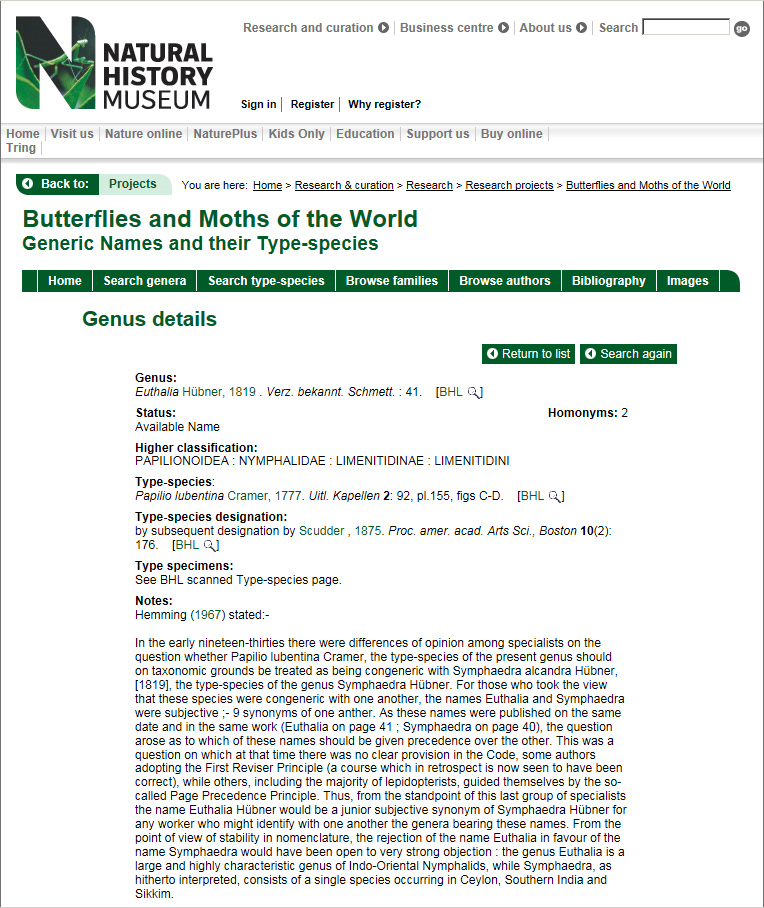
Below is an example of how Butterflies and Moths of the World links to relevant BHL scanned pages, in order to portray a history for a given species.

View Full Size Image
An example page from Butterflies and Moths of the World – Euthalia  Hübner, 1819 . Verz. bekannt. Schmett. : 41.
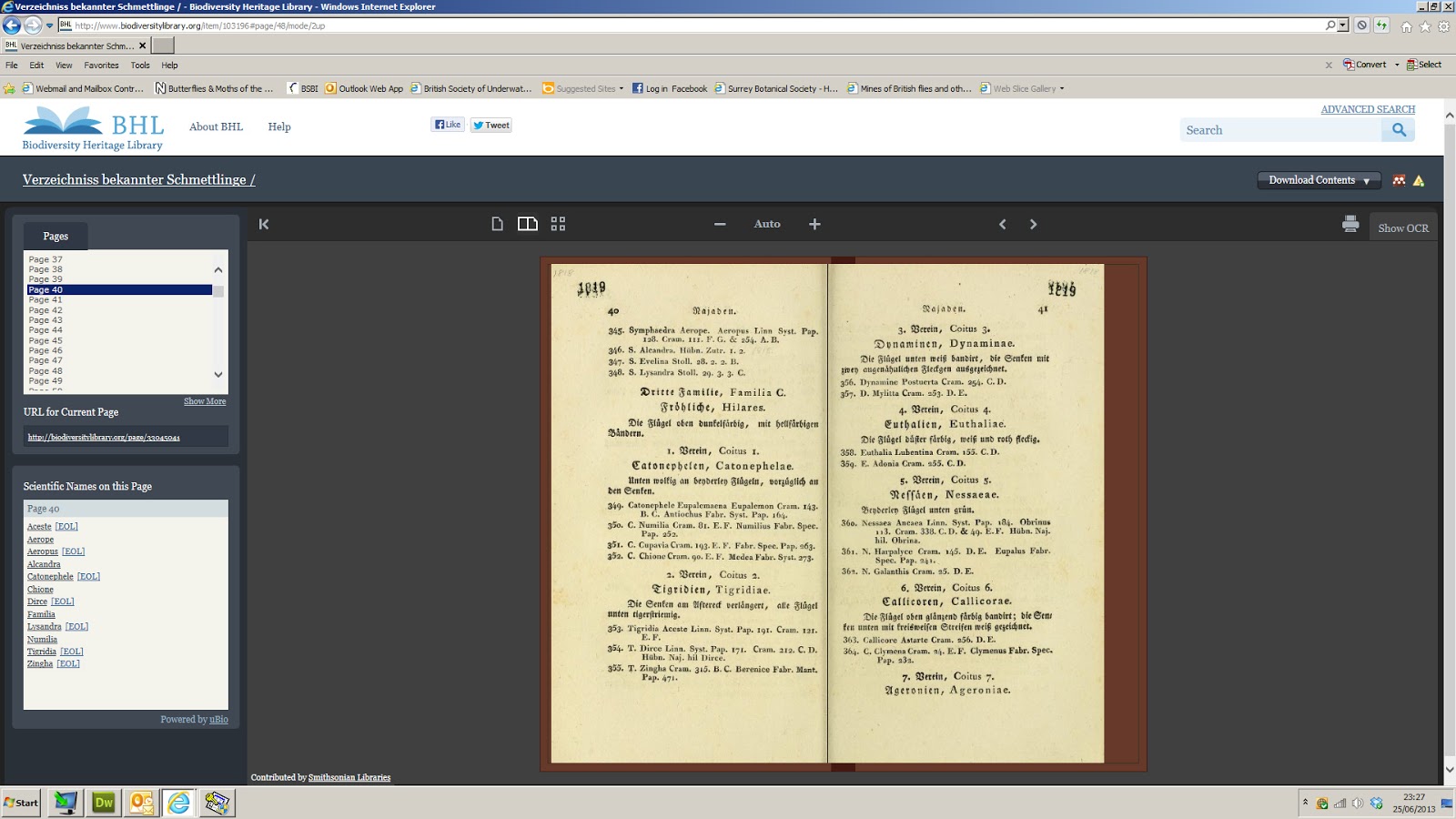
View Full Size Image
Linked BHL scanned page of the original description of Euthalia  Hübner, 1819 . Verz. bekannt. Schmett. : 41.
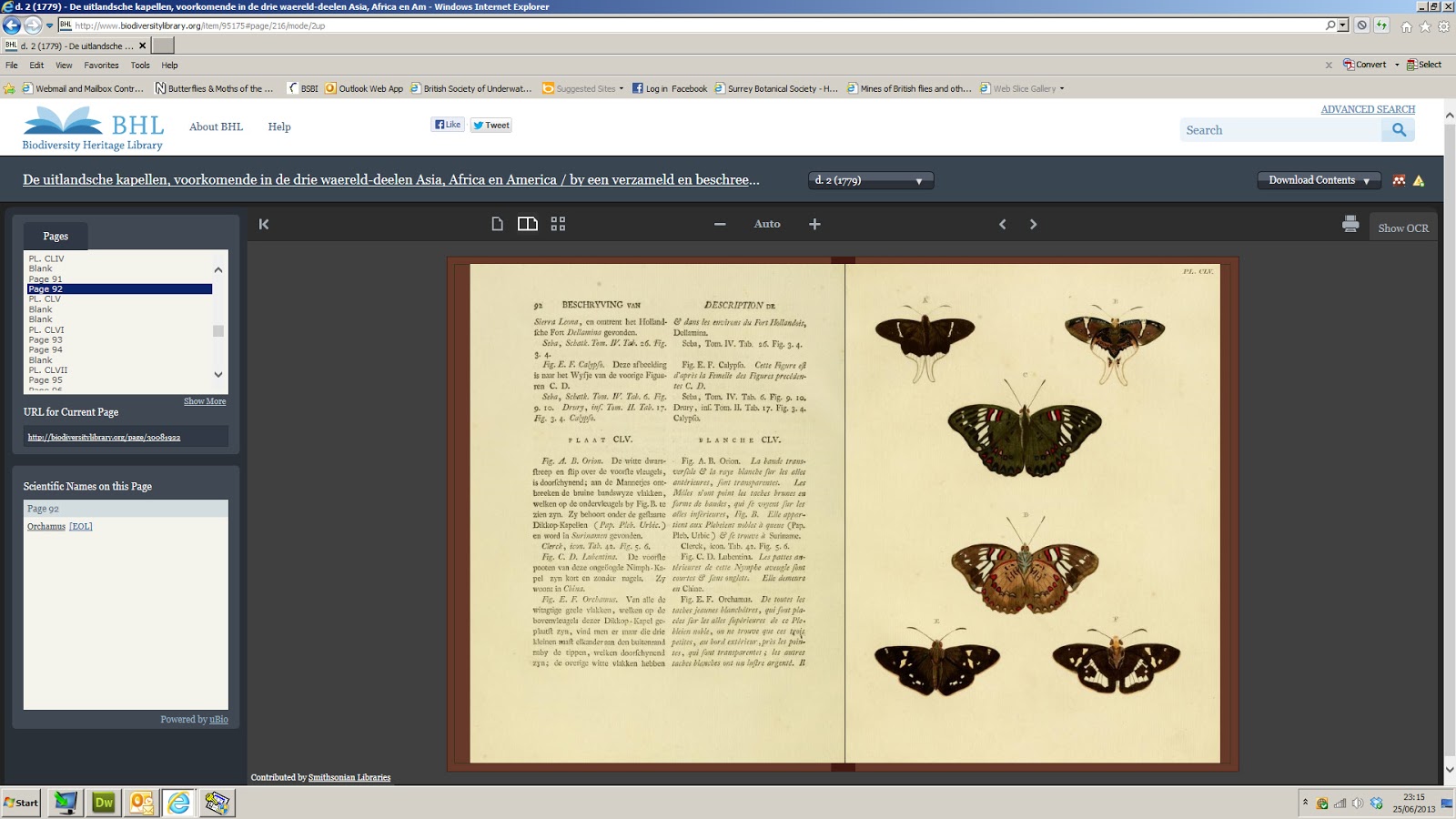
View Full Size Image
Linked BHL scanned page of the original description of the type-species of Euthalia – Papilio lubentina Cramer, 1777. Uitl. Kapellen 2: 92, pl.155, figs C-D.


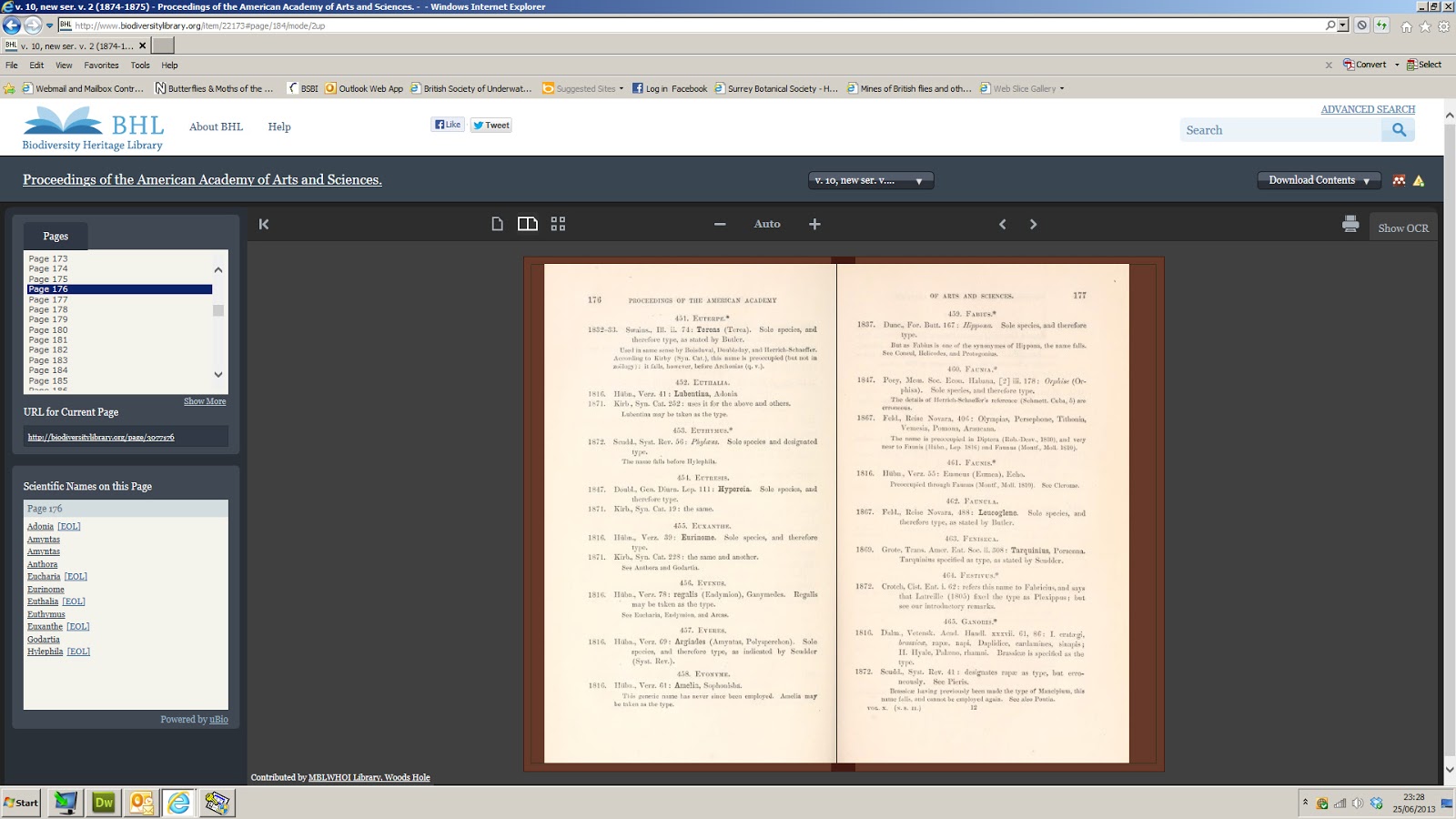
View Full Size Image
Linked BHL scanned page of the original type-species designation by Scudder, 1875. Proc. amer. acad. Arts Sci., Boston 10(2): 176.

We love hearing about all the great ways BHL users like Dr. Pitkin are adding value to their own work using BHL content. Are you using BHL in new and interesting ways? We want to hear about it! Send us feedback or write to us at [email protected].
July 24, 2013by ulib-libraryjobs
Blog Reel, Featured Books

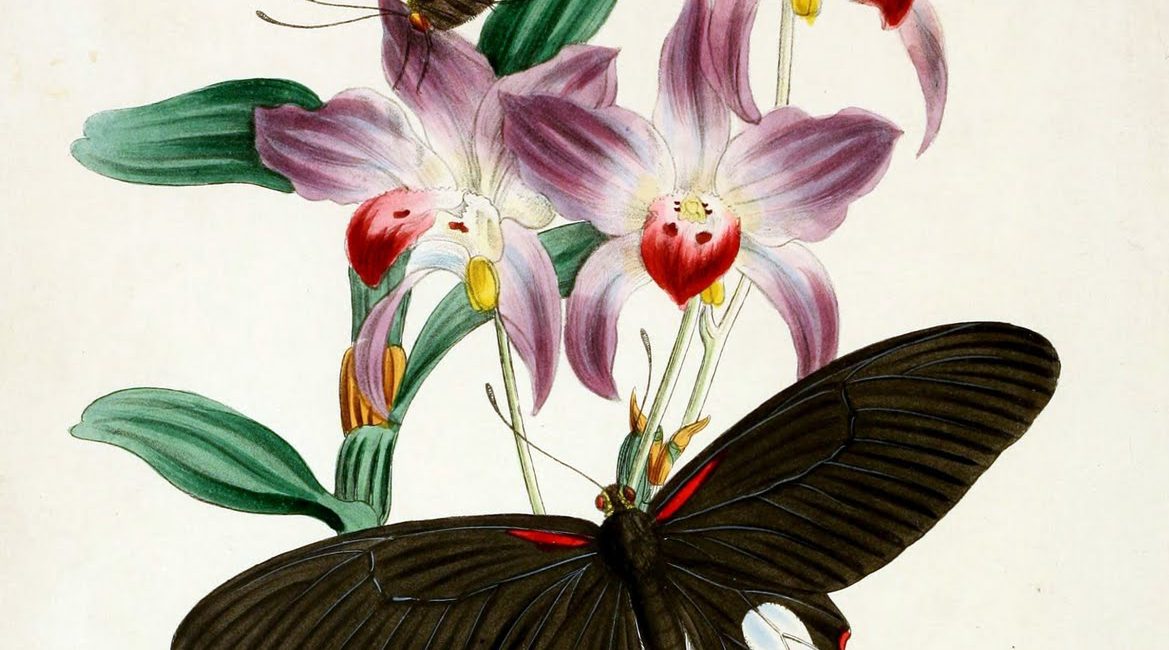
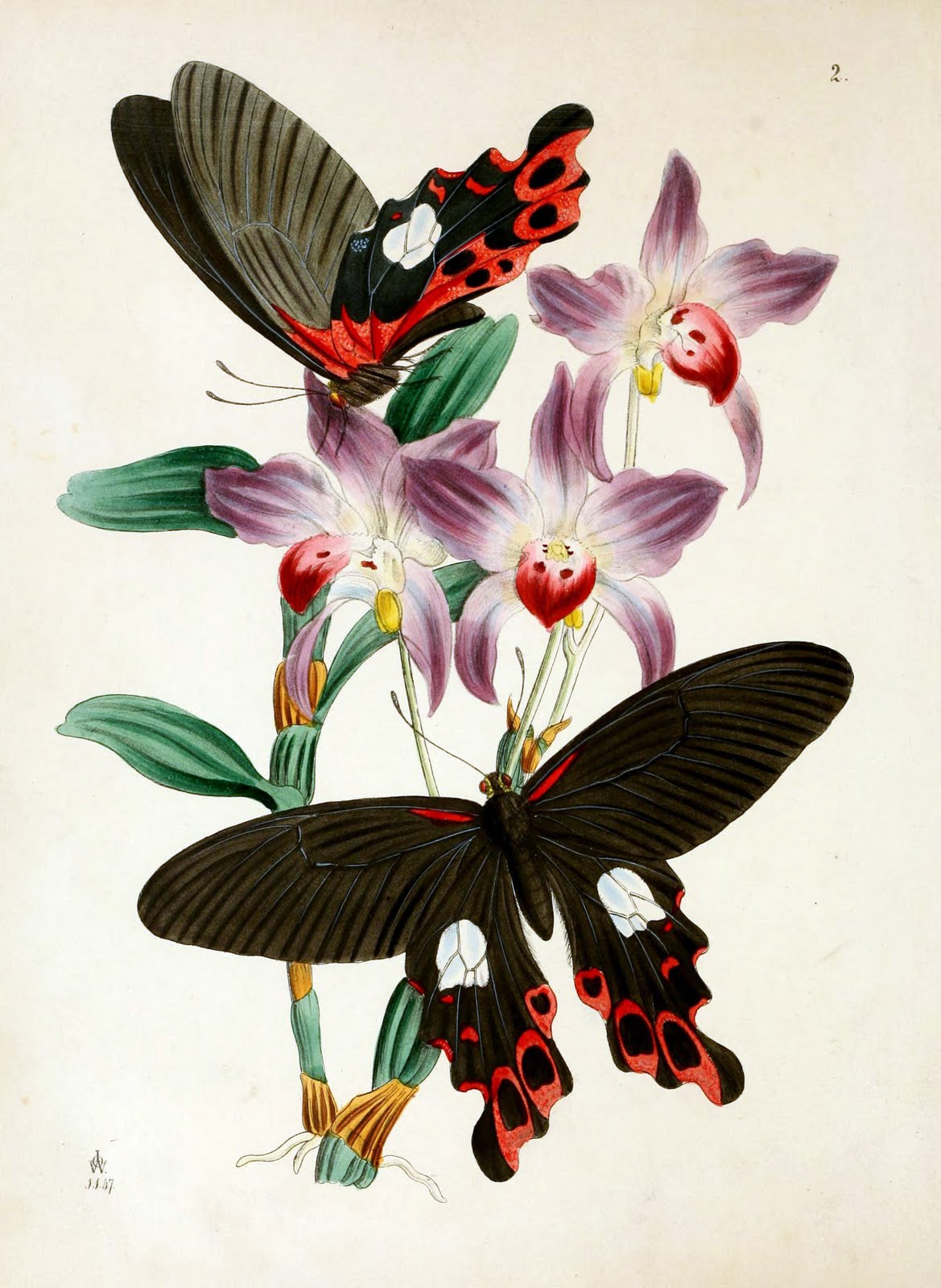
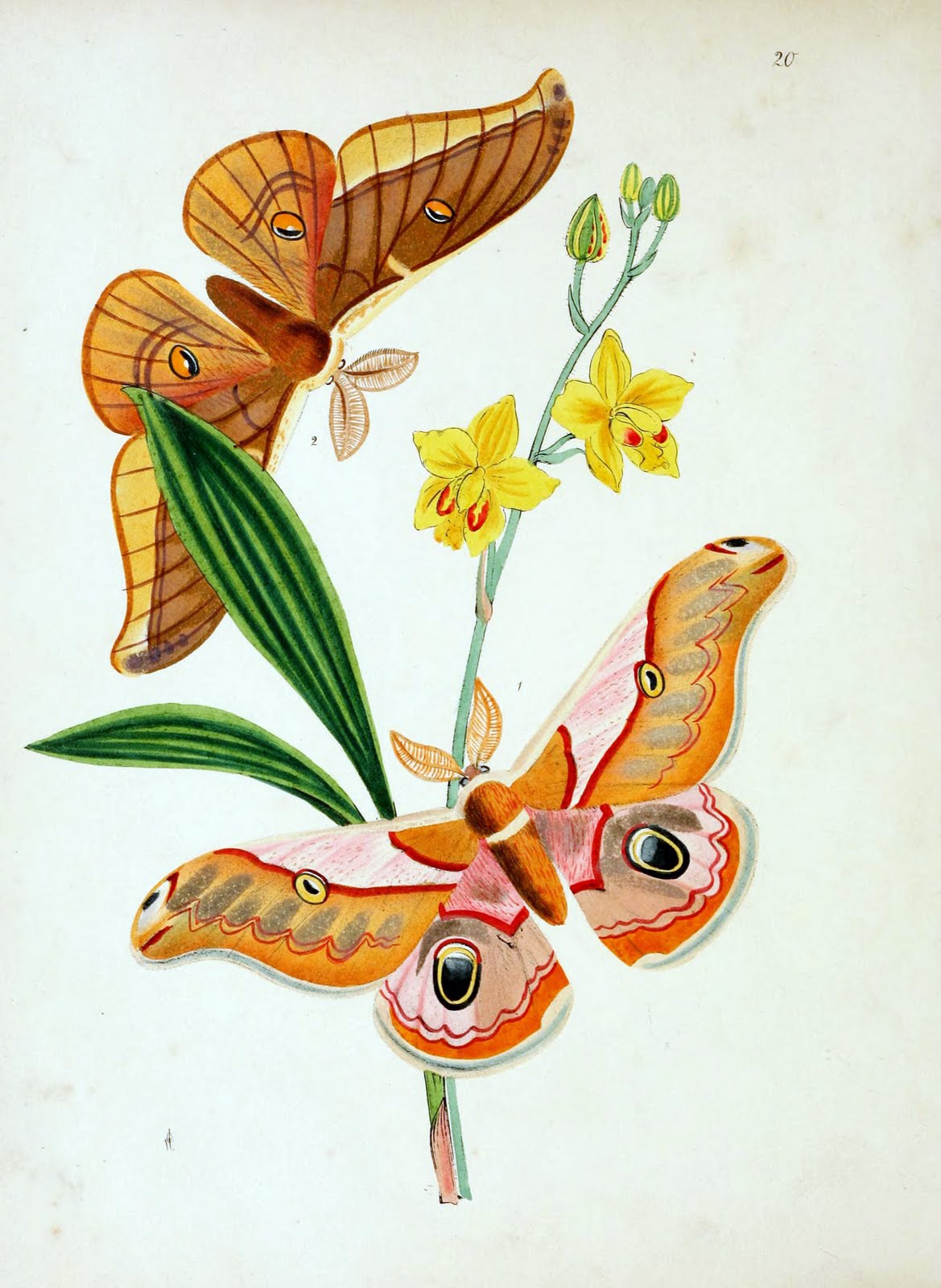
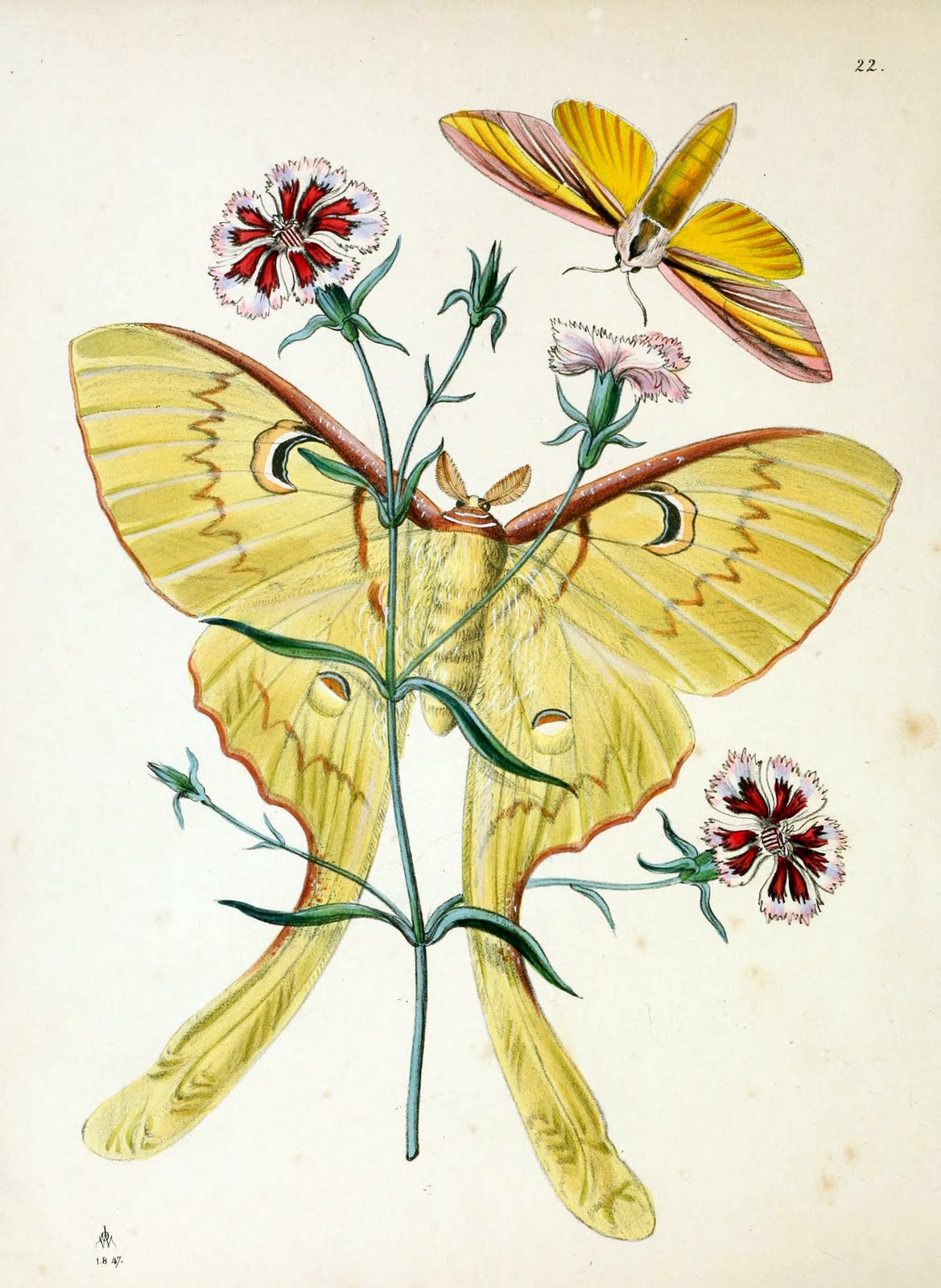
Book of the Week: Cabinet of Oriental Entomology

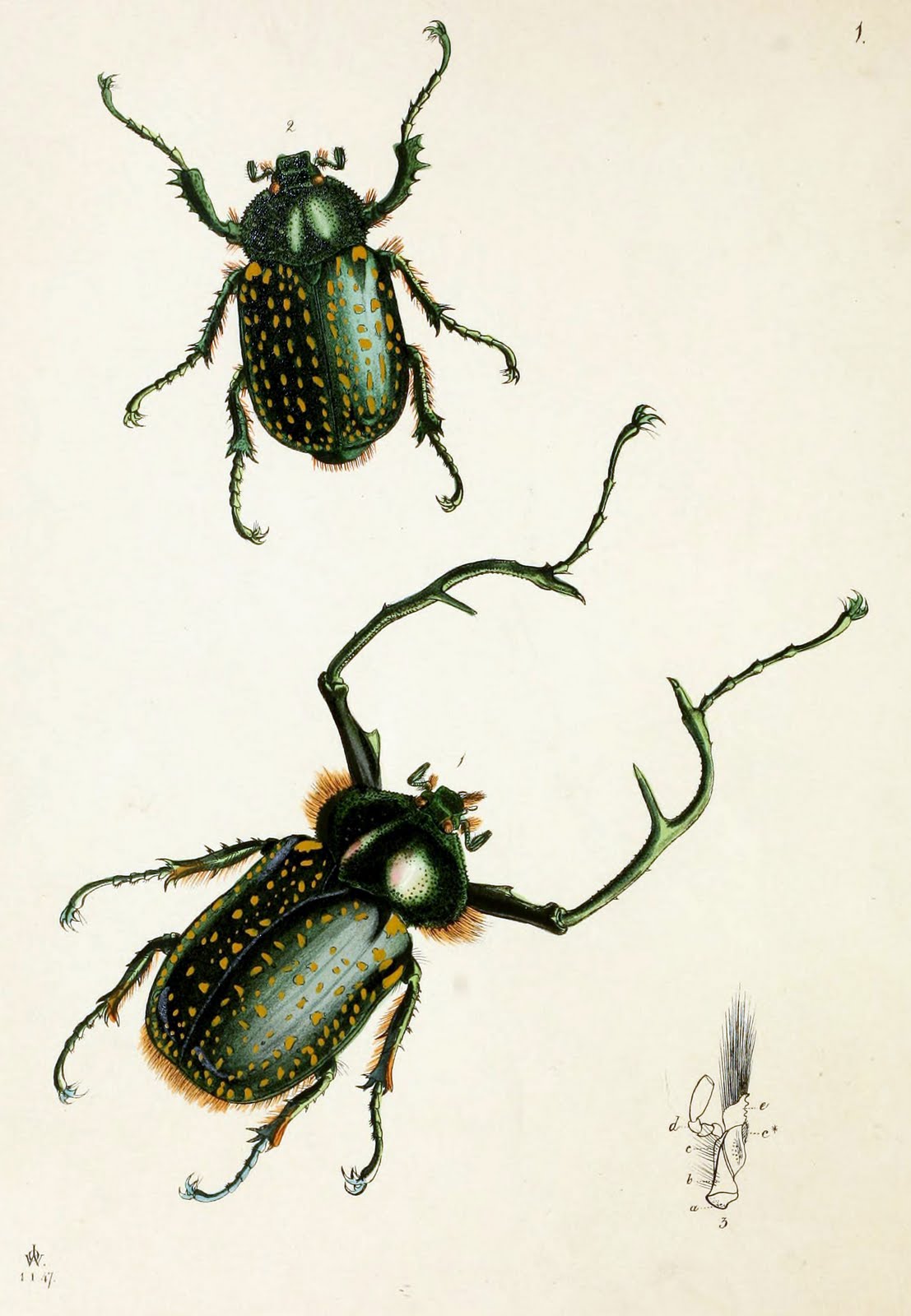
It’s bugs galore today as we feature the book The Cabinet of Oriental Entomology (1848), by J.O. Westwood. This delightful book is full of gorgeous illustrations of exotic insects. We’re picking out some of the illustrations that we particularly love and providing you with an excerpt of what the author had to say about the creatures shown. Enjoy!

View Full Size Image1) Papilio icarius

“Assam appears to be pre-eminently rich in the species of Papilio. A number of new species, from this region and the neighboring district of Sylhet, were figured in my ‘Arcana Entomologica,’ but none of them will bear comparison with the present insect, either for size or singularity of form, owing to the extraordinary elongation of the hind wings and the short dilated tails…Adopting the excellent system of nomenclature proposed with so much taste by Linnaeus, whereby the species of the modern genus Papilio were distinguished by the name of the famous heroes of antiquity, the present species…is named after Icarius, the son of Ebalus and Erigone; who, having been killed by some peasants of Greece, whose companions he had made drunk with wine, (a liquor till then unknown to them, and which from its effects they thought to be poison,) was transformed by Jupiter into a star, which was supposed by some persons to be identical with the celestial Bootes.”

2) Eucheirus macleaiiView Full Size Image
(Figure One: Male; Figure Two: Female)

“India and the adjacent islands offer to us a striking peculiarity in respect to the geographical distribution of the gigantic species of Lamellicorn beetles. Whilst the New World is inhabited by a great number of these fine insects…the tropical oriental regions can boast but of few; these however, are distinguished by their metallic or variegated appearance, of which their American brethren are destitute.”

View Full Size Image

3) Figure One: Saturnia simla

“The female of this fine species has the fore wings comparatively larger and less hooked than in the males…I trust that, in consequence of Captain Boys’ arrival in England, I shall be enabled, in a subsequent article, to communicate an account of the early states of this insect.”

Figure Two: Saturnia assama

View Full Size Image

4) Lower Figure: Actias maenae

“The accompanying figure of this very fine insect is copied from a specimen kindly communicated for representation by W.W. Saunders, Esq., F.L.S., which differs in some respects from Mr. Doubleday’s description of the species, recently published…This is certainly one of the finest of the recent additions to the list of oriental Lepidoptera; but I am informed that Dr. Boisduval possesses a species of this genus from Madagascar with much longer tails to the hind wings.”

Upper Figure: Leucophlebia lineata

“This beautiful insect appears to possess the characters of a distinct genus, in the classification of the exotic Nocturnal Heterocerous Lepidoptera; its elongated body and wings give it an analogy with some of the Sphingidae, as well as to some of the prominent moths, especially to Leiocampa Dictoea.”

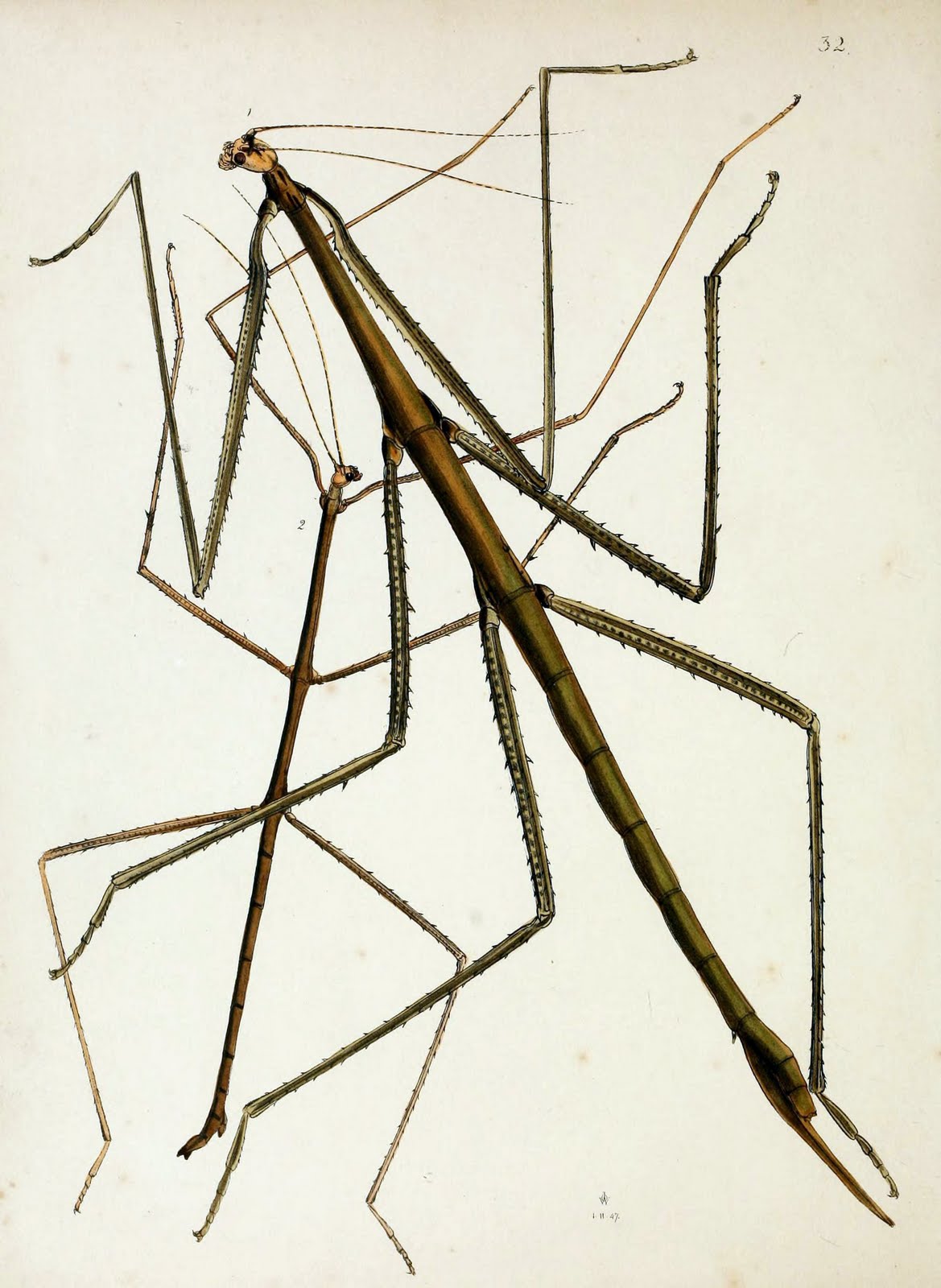
View Full Size Image5) Figure One: Bacteria sarmentosa

“This species of walking-stick insect is longer than any which I have yet seen. It is represented of the natural size, but its full extent is here decreased by unnaturally bending back the fore legs (in order to bring them into the plates) which in the living insect are directed straight forwards…The insect described above is a female; I possess also another female, which I consider to belong to the same species, which is only 7 1/2 inches long, and agrees with it in all its characters, except that the 6th ventral segment has only a minute oval sulcated tubercule at its extremity.”

Figure Two: Bacteria virgea

“The proportions and general appearance of this insect indicate that it is most probably the male of the preceding. It is on this account that I have represented them both on one plate.”

Take some time to explore the other beautiful plates in this book. The insect world is certainly nothing if not colorful!

June 2, 2011by michelle.underhill

Help Support BHL

BHL's existence depends on the financial support of its patrons. Help us keep this free resource alive!

search

About BHL

The Biodiversity Heritage Library (BHL) is the world’s largest open access digital library for biodiversity literature and archives. BHL operates as a worldwide consortium of natural history, botanical, research, and national libraries working together to digitize the natural history literature held in their collections and make it freely available for open access as part of a global “biodiversity community.”

Join Our Mailing List

Sign up to receive the latest news, content highlights, and promotions.

Subscribe Now

Subscribe to Blog via Email

Enter your email address to subscribe to this blog and receive notifications of new posts by email.

Join 319 other subscribers

Subscribe to Blog Via RSS

Subscribe to the blog RSS feed to stay up-to-date on all the latest BHL posts.

Access RSS Feed

Inspiring Discovery through Free Access to Biodiversity Knowledge.

The Biodiversity Heritage Library makes it easier than ever for you to access the information you need to study and explore life on Earth…for free, anytime, anywhere.


64+ Million Pages of
Biodiversity Literature Online.

EXPLORE

Tools and Services
to Transform Research.

EXPLORE

300,000+
Illustrations on Flickr.

EXPLORE

ABOUT | HARMFUL CONTENT | PRIVACY | SITE MAP | TERMS OF USE