Biodiversity Heritage Library - Program news and collection highlights from BHL
  • Home
  • News
  • Featured Books
    • All Featured Books
    • Book of the Month Series
    • BHL at 20
  • User Stories
  • Campaigns
    • Fossil Stories
    • Garden Stories
    • Monsters Are Real
    • Page Frights
    • Her Natural History
    • Earth Optimism 2020
  • Tech Blog
  • Visit BHL
Home
News
Featured Books
    All Featured Books
    Book of the Month Series
    BHL at 20
User Stories
Campaigns
    Fossil Stories
    Garden Stories
    Monsters Are Real
    Page Frights
    Her Natural History
    Earth Optimism 2020
Tech Blog
Visit BHL
  • Home
  • News
  • Featured Books
    • All Featured Books
    • Book of the Month Series
    • BHL at 20
  • User Stories
  • Campaigns
    • Fossil Stories
    • Garden Stories
    • Monsters Are Real
    • Page Frights
    • Her Natural History
    • Earth Optimism 2020
  • Tech Blog
  • Visit BHL
Biodiversity Heritage Library - Program news and collection highlights from BHL
BHL News, Blog Reel, Featured Books

Illuminating BHL’s Dark Data: Citizen Scientists and AI Unlock Key Biodiversity Data in GBIF

Visualizations of species occurrence data deposited in GBIF from the journals of William Brewster

In the face of climate change and environmental challenges, understanding and documenting Earth’s biodiversity is essential. The Global Biodiversity Information Facility (GBIF) serves as a global repository for biodiversity data, playing a pivotal role in this critical mission of safeguarding our planet’s biodiversity. Species occurrence data sourced from the Biodiversity Heritage Library (BHL) provides insights into species distributions, behaviors, and interactions much deeper into time, offering key species baseline data required to effectively address the climate crisis. Without accurate and comprehensive data in GBIF, our collective ability to track environmental changes and make informed decisions is severely hampered.
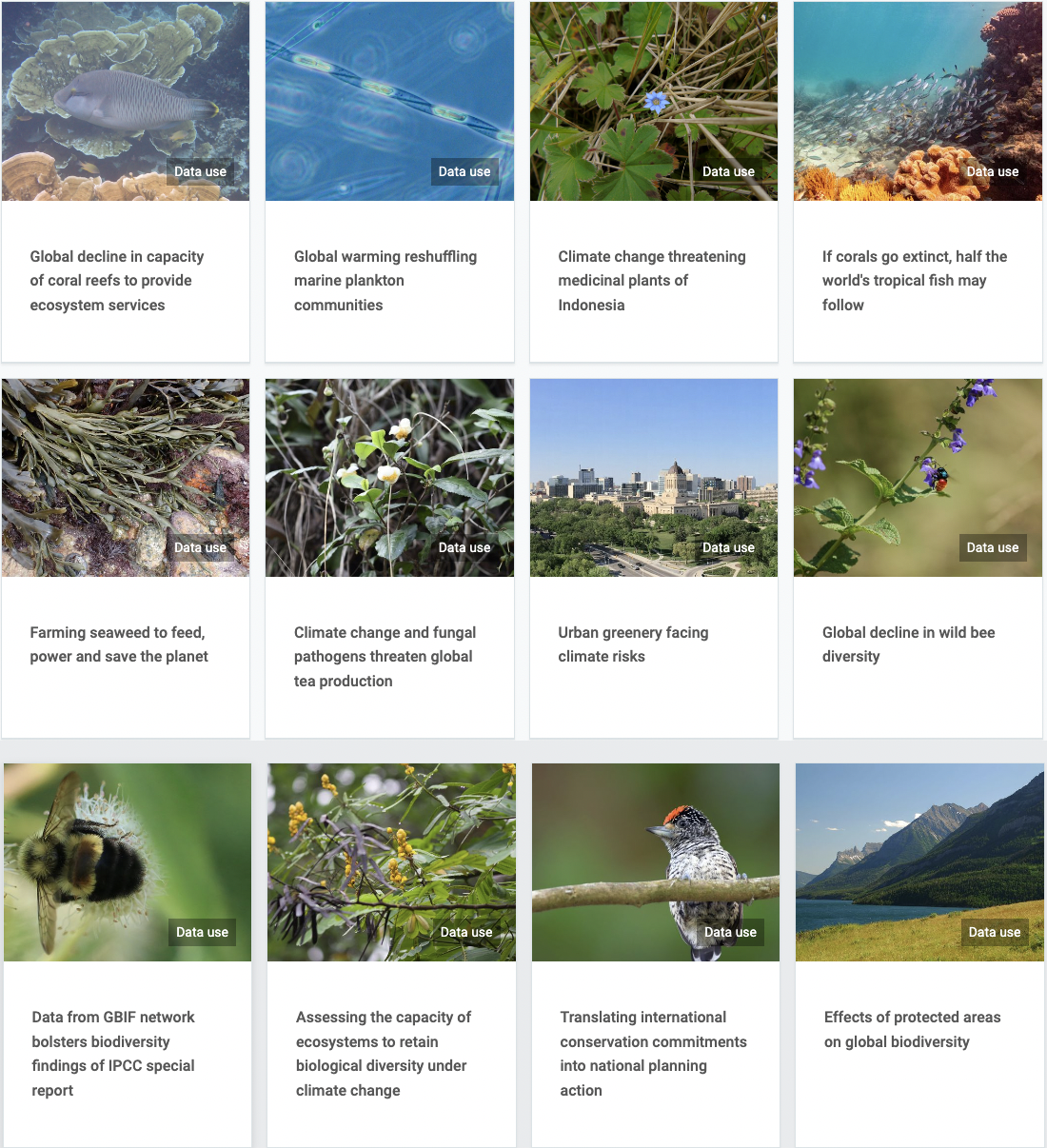
Collage of images representing data used from GBIF

Figure 1: GBIF-mediated data is used extensively in climate science and informs global environmental policy. For more information see: https://www.gbif.org/climate

As a GBIF participant node, BHL is committed to sharing biodiversity data openly, adhering to FAIR (Findable, Accessible, Interoperable, Reusable) and CARE (Collective Benefit, Authority to Control, Responsibility, Ethics) data principles, and collaborating with a global network of biodiversity organizations to bolster and build capacity to strengthen the biodiversity information infrastructure. To honor our commitments, technical staff from BHL are working to establish a scalable data pipeline of occurrence data currently trapped in archival field notes, journals, letters, correspondence, and other primary source materials. The journey has been an arduous one due to poor OCR (optical character recognition) data quality for BHL’s sub-corpus of handwritten materials.
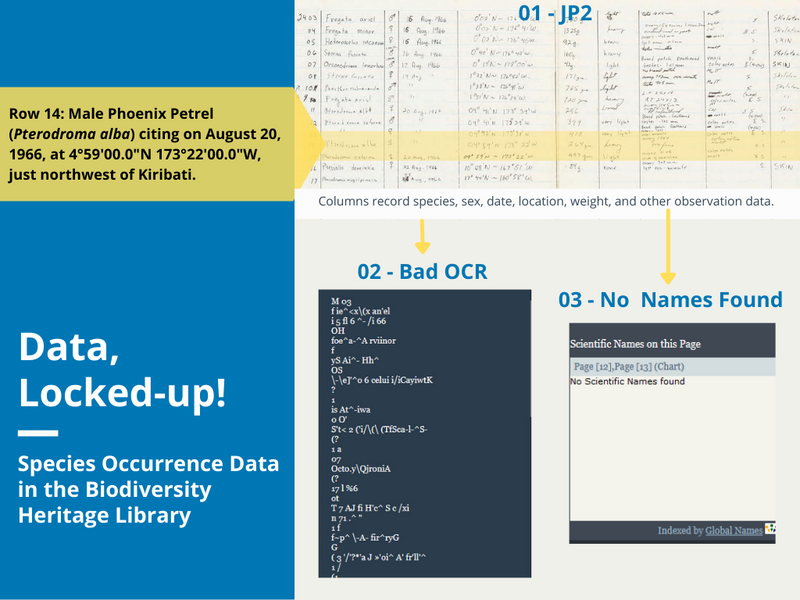
Example of handwritten observation data with poor quality OCR and no scientific names found on the page

Figure 2: Sample of “dark” handwritten observation data with corresponding unstructured, uncorrected OCR text. From National Museum of Natural History, Pacific Ocean Biological Survey Program, At-sea, 1963-1966, 1968, part 3: July – August 1966.

Technical approaches to building a BHL ETL (Extract, Transform, and Load) data pipeline of species occurrence data from BHL’s field notes include machine learning, artificial intelligence (AI), and data extraction through innovative transcription projects like DigiVol, the crowdsourcing citizen science platform collaboration between the Australian Museum and the Atlas of Living Australia.
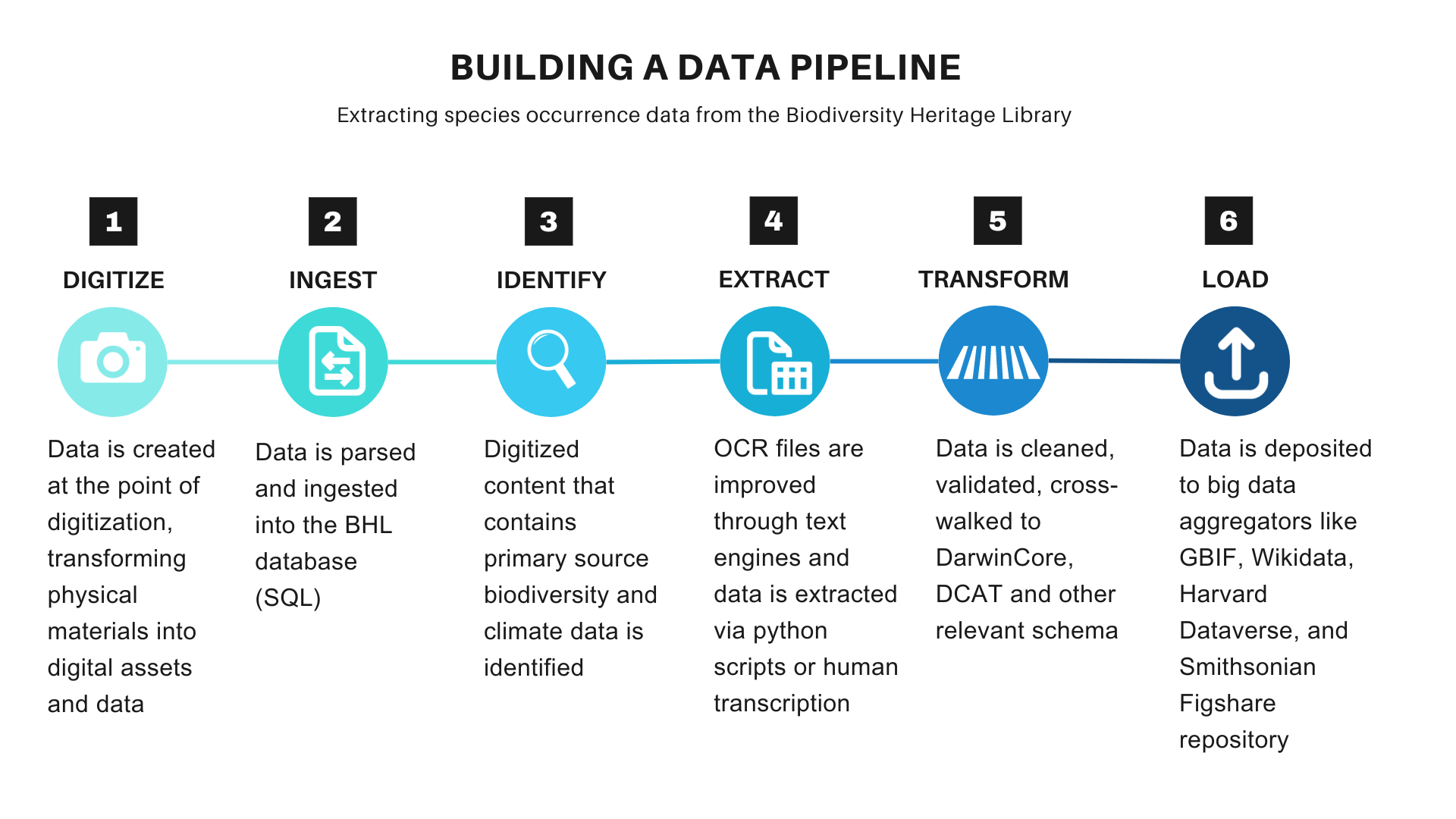
Building a data pipeline: extracting species occurrence data from BHL. 6 steps include: digitize, ingest, identify, extract, transform, and load.

Figure 3: Learn more about how BHL is building a new data pipeline from the recent talk given at TDWG 2023 entitled Unearthing the Past for a Sustainable Future: Extracting and transforming data in the Biodiversity Heritage Library for climate action; abstract; recording.

Now underway, is a global effort to convert centuries of biodiversity knowledge into accessible and actionable data, utilizing advanced AI and technical approaches. BHL Partners now have a stake in supporting international conservation policy aimed at safeguarding Earth’s biodiversity through greater data integration with the global biodiversity data infrastructure.

The Journals of William Brewster

The ornithological papers of William Brewster (1851-1919), held in the Ernst Mayr Library and Archives of the Museum of Comparative Zoology (MCZ) at Harvard University, are a rich source of historical species occurrence data and an ideal use case for building a BHL ETL data pipeline. Brewster’s field notes, journals, diaries, and correspondence comprise over 60,000 pages replete with detailed bird observations spanning 54 years (1865-1919). These records augment and extend his collection of over 40,000 bird specimens, bequeathed by Brewster to the MCZ and considered “one of the largest private collections ever made in this country [United States], and in some respects … by far the most valuable” (Henshaw, 1920). Thanks to a number of projects facilitated by the Ernst Mayr Library over the years, Brewster’s journals have been digitized and later transcribed using DigiVol.

Figure 4 below shows one example of Brewster’s extensive species lists. Brewster fastidiously recorded all essential elements of a species occurrence record and often more such as habitat information and detailed behavioral descriptions. The complexity of this example, featuring Brewster’s unique formatting, use of ornithological symbols, and tiny, crowded handwriting, highlights the value of crowdsourced human transcription by a team of enthusiastic, dedicated volunteers.

Figure 5 shows a portion of the transcription of this species list, produced in DigiVol by one of our long-time transcribers.
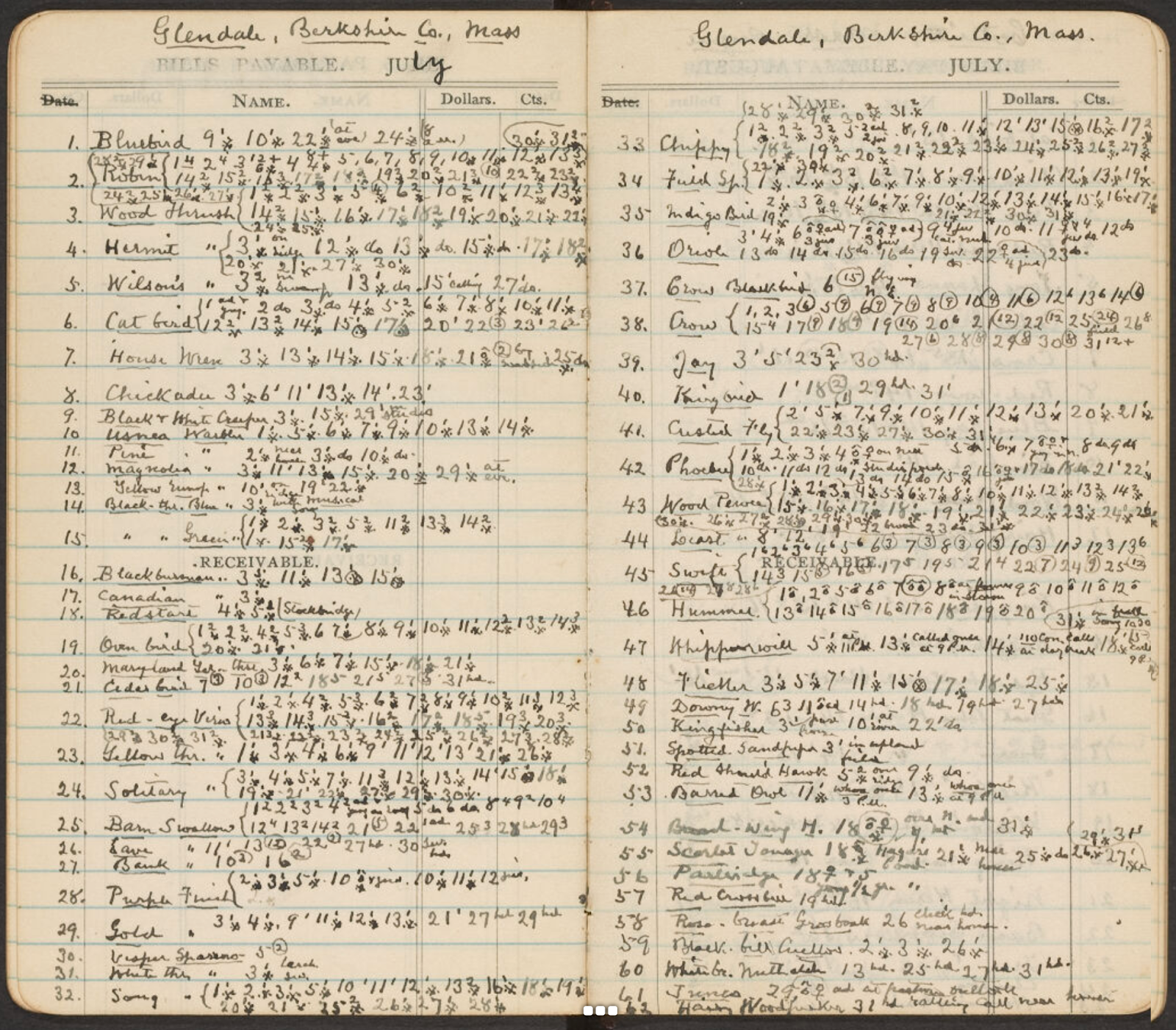
Handwritten list of species observed by William Brewster

Figure 4. Brewster’s bird observations for July from his 1915 Diary.
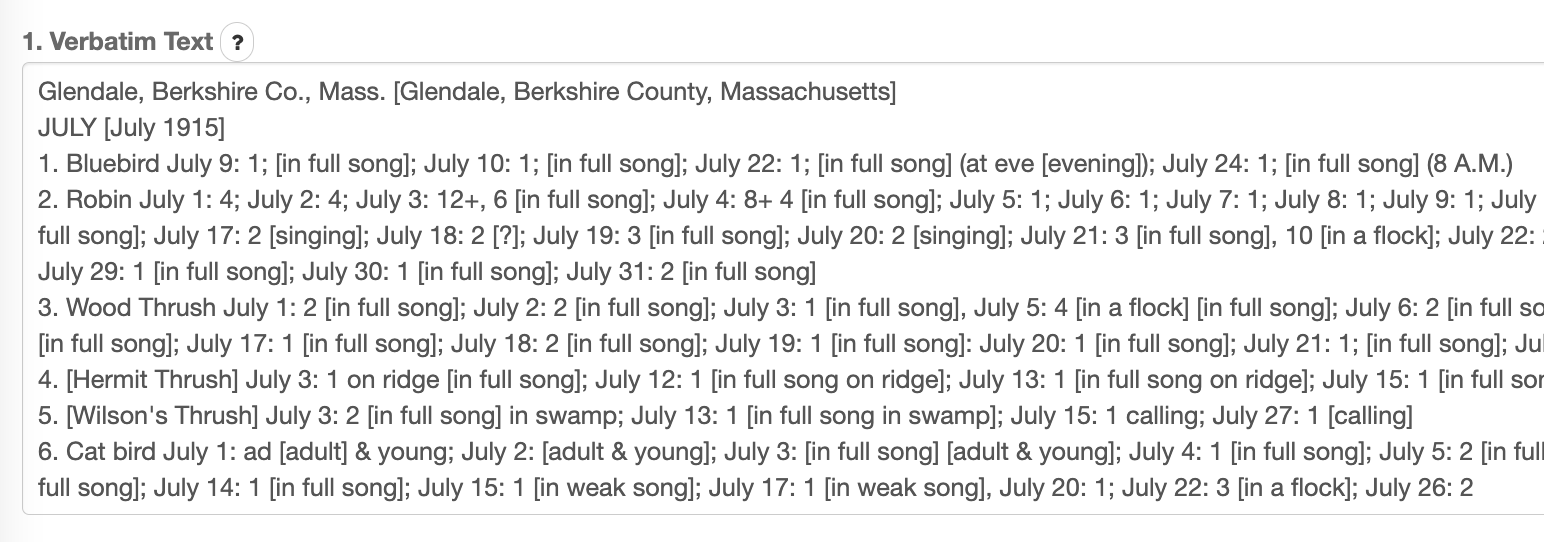
Typed transcription of the handwritten species list from William Brewster

Figure 5. A portion of the transcript of Brewster’s July, 1915 species list.

Extracting Data via Citizen Scientists and DigiVol

DigiVol, first developed in 2011 to crowdsource the transcription of specimen labels, enables institutions around the world to engage volunteers to extract data of various types, such as text, species identifications, and species traits from images. Each institution is able to upload images and manage their crowdsourcing project through the DigiVol platform. Through a combination of gamification and engagement tools such as a user forum and secure, private emails, institutions can build volunteer skills, a sense of community, and commitment.
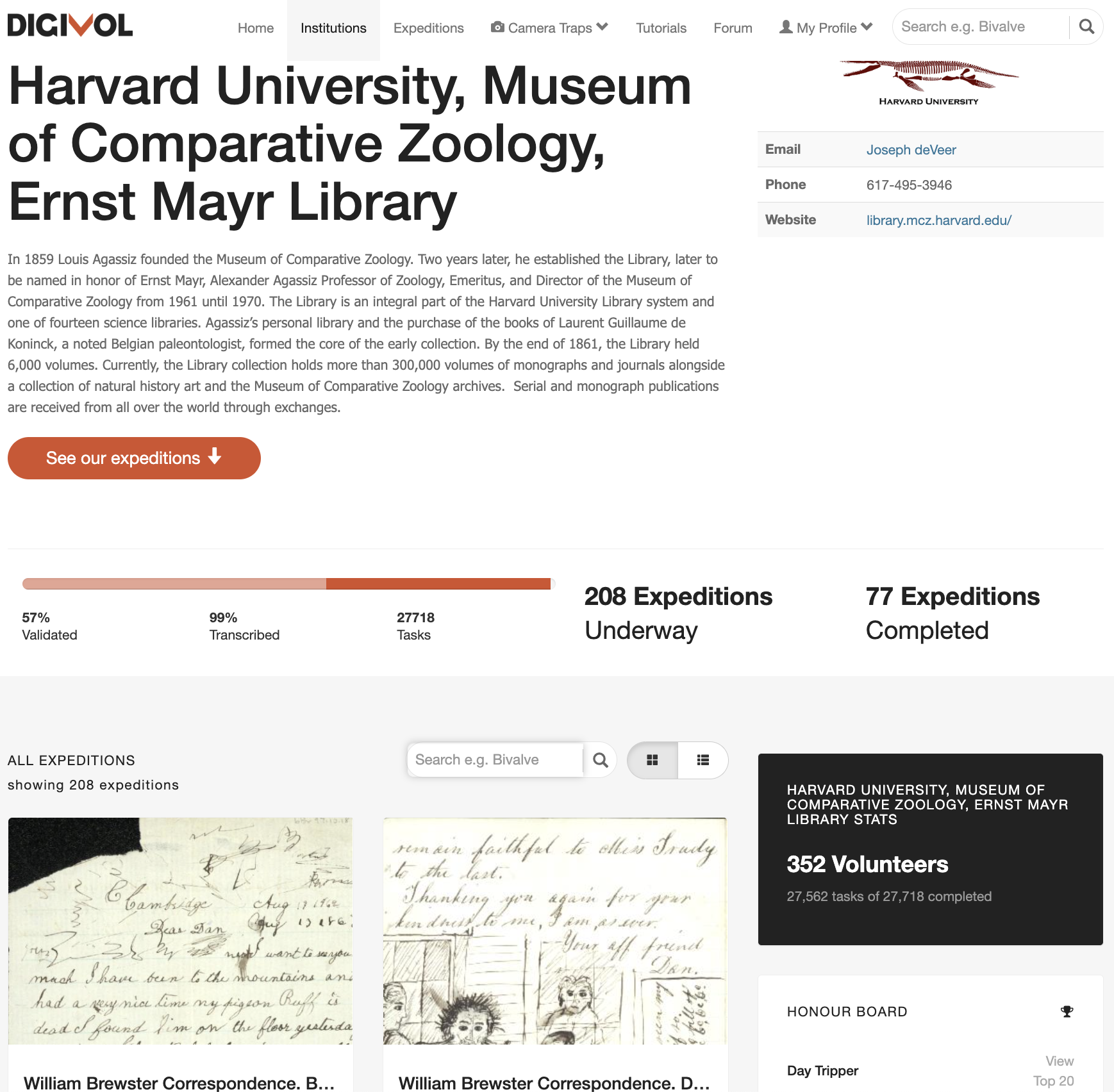
Screenshot of the Harvard University, Museum of Comparative Zoology, Ernst Mayr Library transcription portal on DigiVol platform, listing the number of expeditions and volunteers

Figure 6: The DigiVol dashboard for the Harvard Museum of Comparative Zoology, Ernst Mayr Library.

Volunteers on the website can contribute any time of day – 24/7, 365 days a year. They can choose from a broad array of “virtual expeditions” on DigiVol, from identifying animals in camera traps located in the Australian “bush” to transcribing specimen labels and field notes from locations around the world.

The DigiVol platform has seen more than 14,000 volunteers contribute 155 equivalent work years (7 hour days, 261 days a year) to the digitisation of over 6 million tasks at an estimated equivalent value of A$12 million.

In terms of the William Brewster project, 352 volunteers have transcribed over 27,000 pages of diaries and field notes, at an average 23 minutes per page. This contribution amounts to more than 5.8 work years at an equivalent cost of A$462,000.

Publishing Data to GBIF

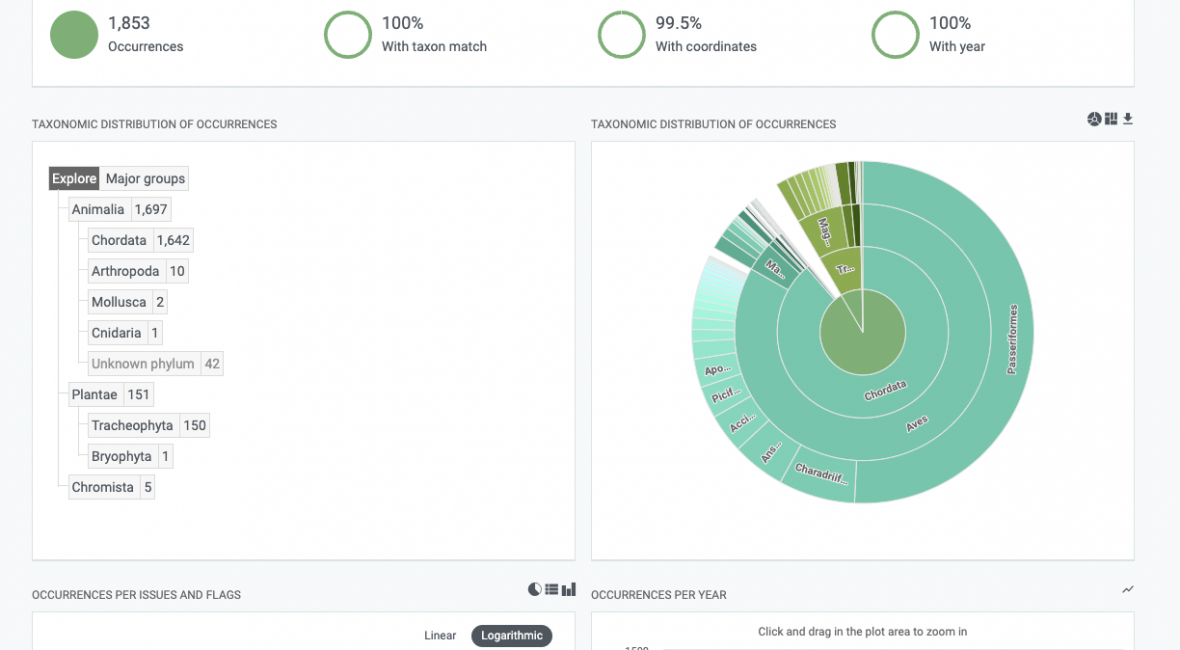
The final output of these recent data pipeline investigations was the deposit of 1,853 species occurrence records at GBIF from the Journals of William Brewster. The data deposit comprises valuable biodiversity records extracted through transcription efforts on DigiVol, transformed into DarwinCore, and subsequently published on GBIF. The species occurrence records span diverse geographical locations, primarily focusing on New England but extending to other regions of the United States, the Caribbean, and Europe. Brewster’s meticulous observations, encompassing species observation, behavioral data, and environmental conditions offer a rich historical perspective on biodiversity dating back over a century.
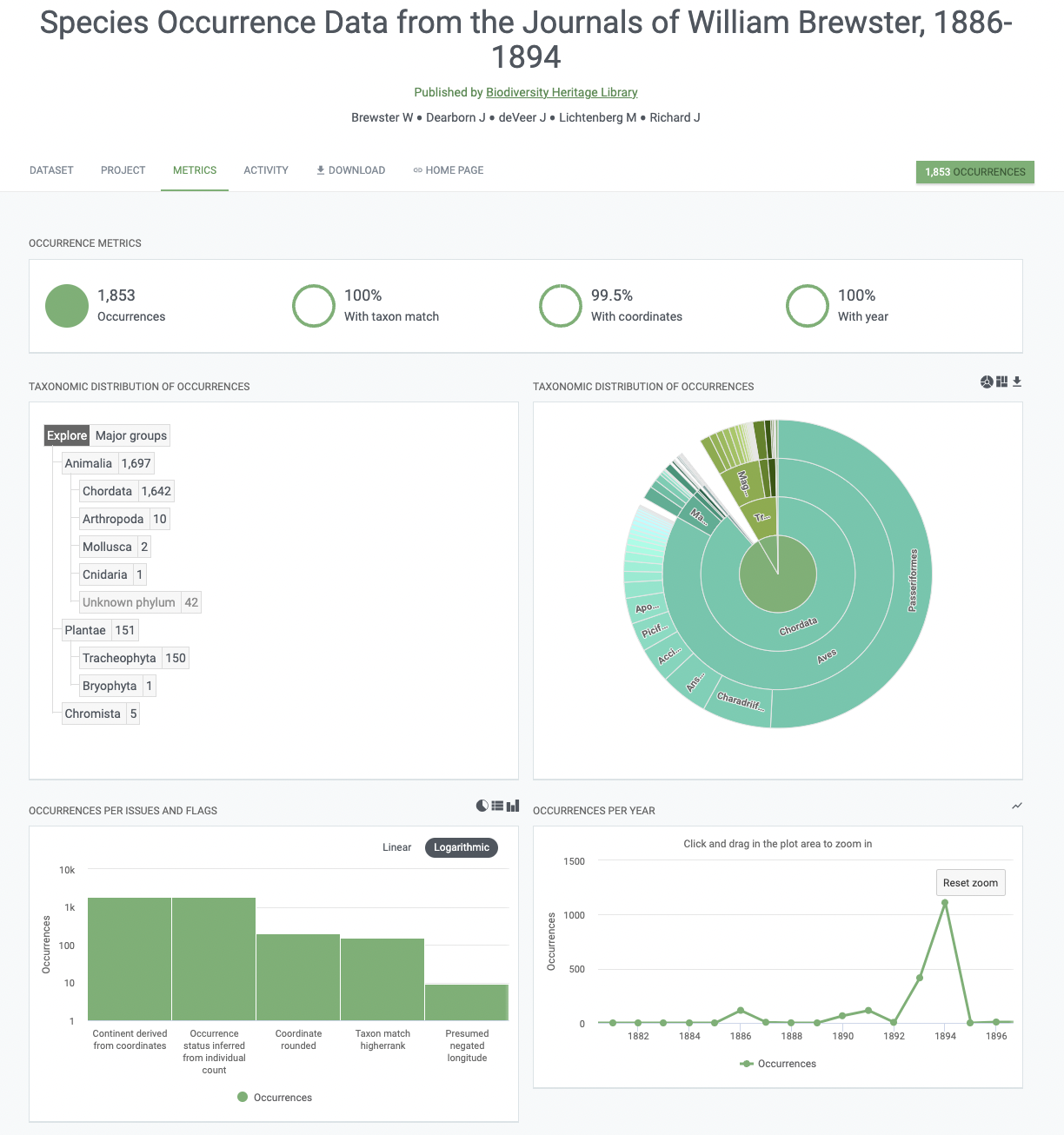
Visualizations of species occurrence data deposited in GBIF from the journals of William Brewster

Figure 7: Species Occurrence Data from the Journals of William Brewster are now available on GBIF. Additional data deposits are planned in 2024. Data deposit: https://doi.org/10.15468/q45atb

This deposit of historic biodiversity data demonstrates how valuable BHL’s collection is to global biodata infrastructure, as it plays a crucial role in establishing species base lines, informing climate change studies, tracking key environmental indicators, and contributing to the development of global biodiversity monitoring platforms.

Having the data available in BHL, even as transcribed text is one thing, but it is the human resources to review and reconcile the data that is really required to facilitate the flow of historic biodiversity data into today’s bioinformatics ecosystems. To all the humans involved in this species data project, from the initial observation and recording, to the preservation, digitization, transcription, data extraction and reconciliation, machine-learning, and creation of vital ETL data pipelines, we thank you.


Related Works

Biodiversity Heritage Library Open Data Collection. (2022, November). Smithsonian Figshare.

Crowley, B., Dearborn, J., Funkhouser, C., Kalfatovic, M., Merriman, K., Iggulden, D., Trei, K., & Herrmann, E. (2023, October). Safeguarding Access to 500 Years of Biodiversity Data: Sustainability Planning for the Biodiversity Heritage Library [TDWG2023]. Biodiversity Information Standards, Hobart, Tasmania, Australia.

Data Flows Diagram. (2023, March). BHL Technical Team (BHL-TECH) Biodiversity Heritage Library.

Dearborn, JJ (2023, April). Unifying Biodiversity Knowledge for Life on a Sustainable Planet. Biodiversity Heritage Library. https://bhl.pubpub.org/

deVeer, J. (2021, February 24). Making the Best of Difficult Times: Accelerating the Transcription of William Brewster’s Writings During the COVID-19 Pandemic. Biodiversity Heritage Library.https://blog.biodiversitylibrary.org/2021/02/accelerating-transcription-brewster-covid19.html

deVeer, J. and Rinaldo, C. (2021, February 23). The Life and Work of Robert Alexander Gilbert: Empowering New Insights through Digitization and Transcription of Archival Materials. Biodiversity Heritage Library. https://blog.biodiversitylibrary.org/2021/02/life-work-robert-gilbert.html

Henshaw, Henry W. 1920. In Memoriam: William Brewster, Born July 5, 1851 – Died July 11, 1919. The Auk 37, 1 (1920), 1–23. https://doi.org/10.2307/4072953

Lichtenberg, M. (n.d.). BHL Data Model. BHL Github Repository. https://github.com/gbhl/bhl-us/tree/master/Documentation/DataModel

Mika, K. and Dearborn, J. (2022). [poster] Extracting expedition log data found in the Biodiversity Heritage Library. Through the door and through the web: releasing the power of natural history collections onsite and online, June 5, 2023. Edinburgh, Scotland, United Kingdom: Society for the Preservation of Natural History Collections (SPNHC). https://doi.org/10.5281/zenodo.6593457.

Richard, J. (2022, December 20). OCR Improvements: An Early Analysis. Biodiversity Heritage Library. https://blog.biodiversitylibrary.org/2022/07/ocr-improvements-early-analysis.html

Rinaldo, C. (2021, February 22). Nature Conservation and William Brewster: Insights From a Lifetime of Scientific Observations. Biodiversity Heritage Library. https://blog.biodiversitylibrary.org/2021/02/william-brewster-post-one

Trizna, M., & Dearborn, J. (2023, June). AI models are getting better and better at reading handwriting, but how can we find handwritten text to begin with? [poster]. 7th Annual Digital Data Conference, Leveraging Digital Data for Conservation, Ecology, Systematics, and Novel Biodiversity Research, Tempe, Arizona, United States of America. https://doi.org/10.25573/data.23523495.v1

November 9, 2023by mdimeo
Blog Reel, Featured Books

The First European Language Monographic Series on the Zoology of Japan

View Full Size Image
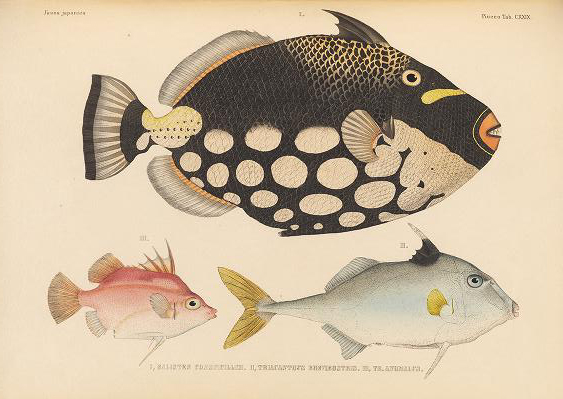
Siebold, Philipp Franz von. Fauna japonica. v.[2] Pisces. ([1842]-1850). Digitized by Harvard University, Museum of Comparative Zoology, Ernst Mayr Library.

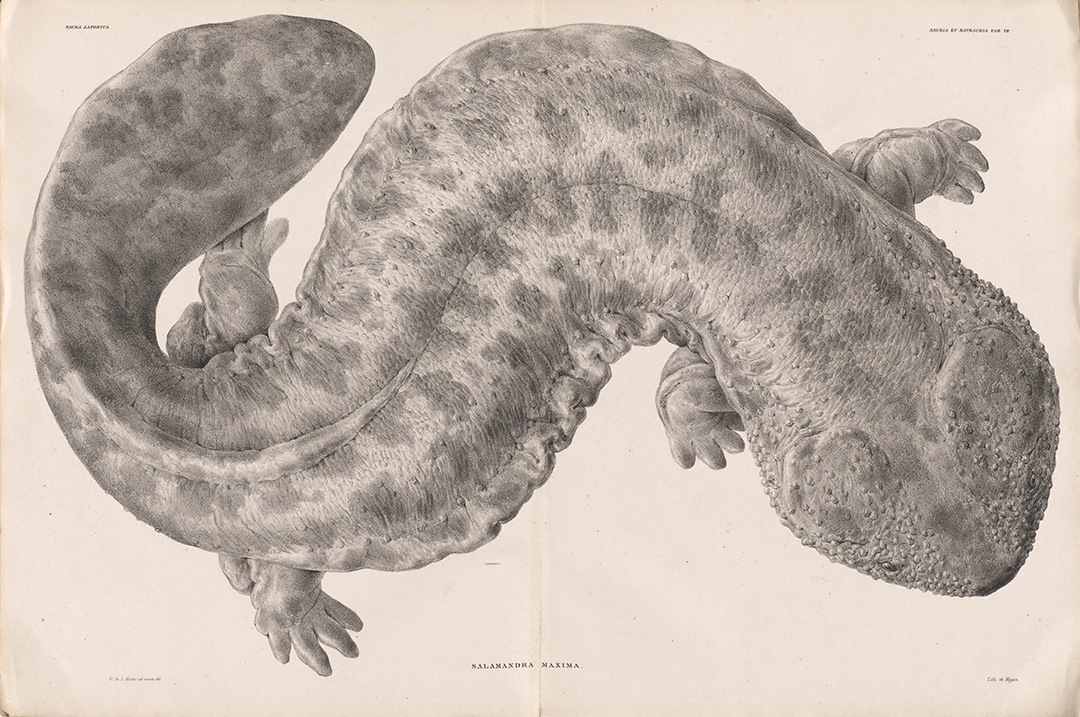
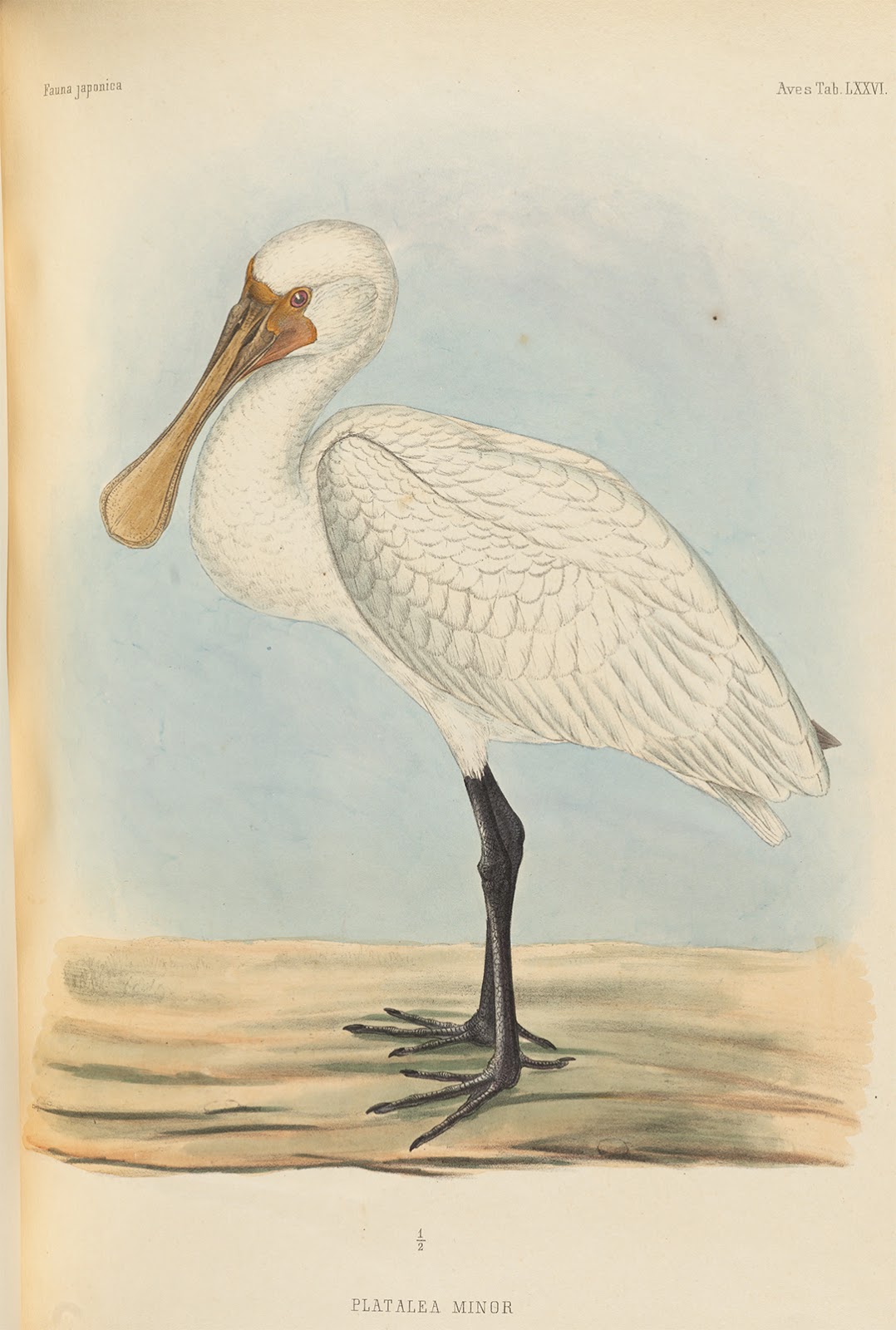
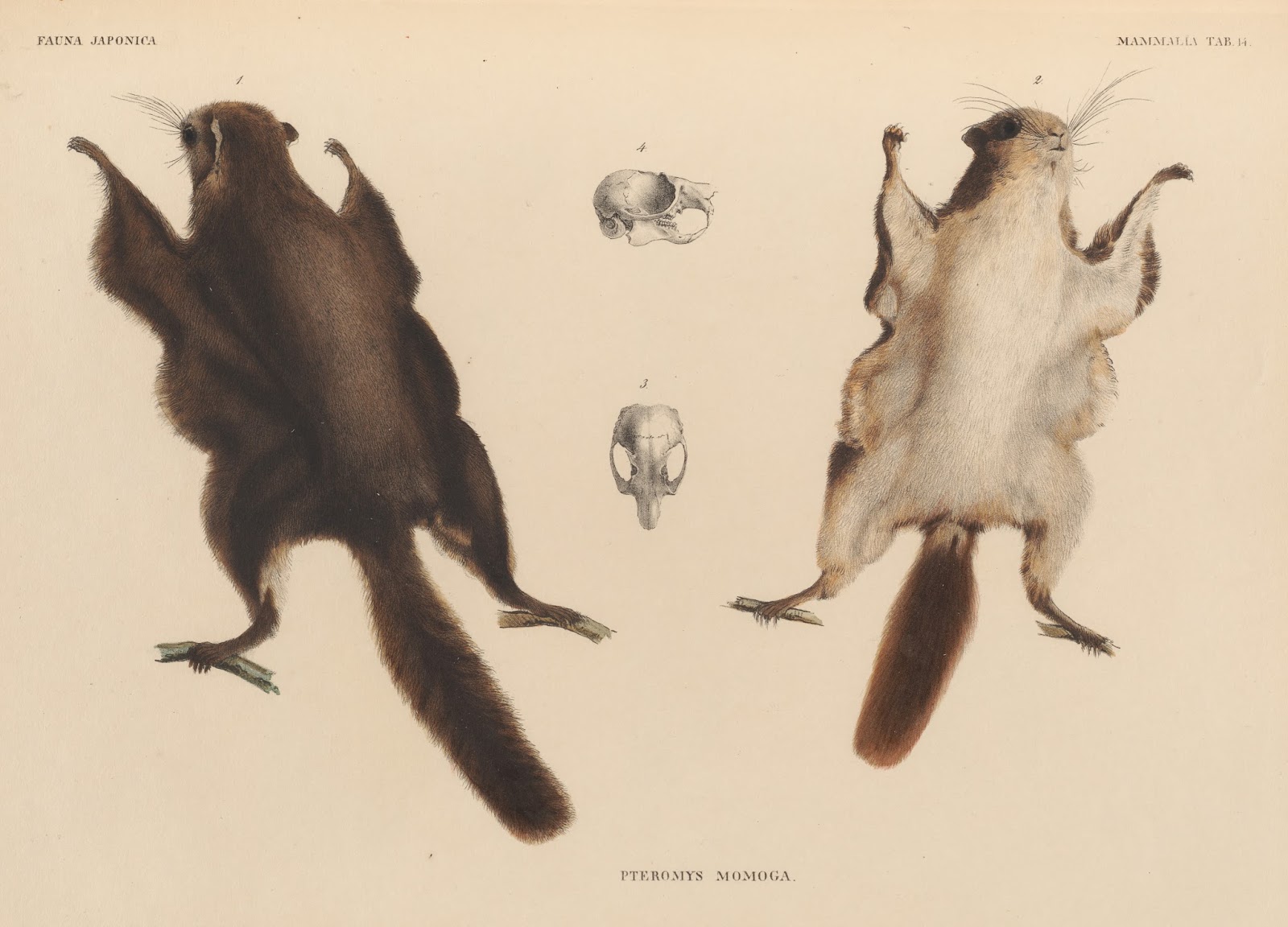
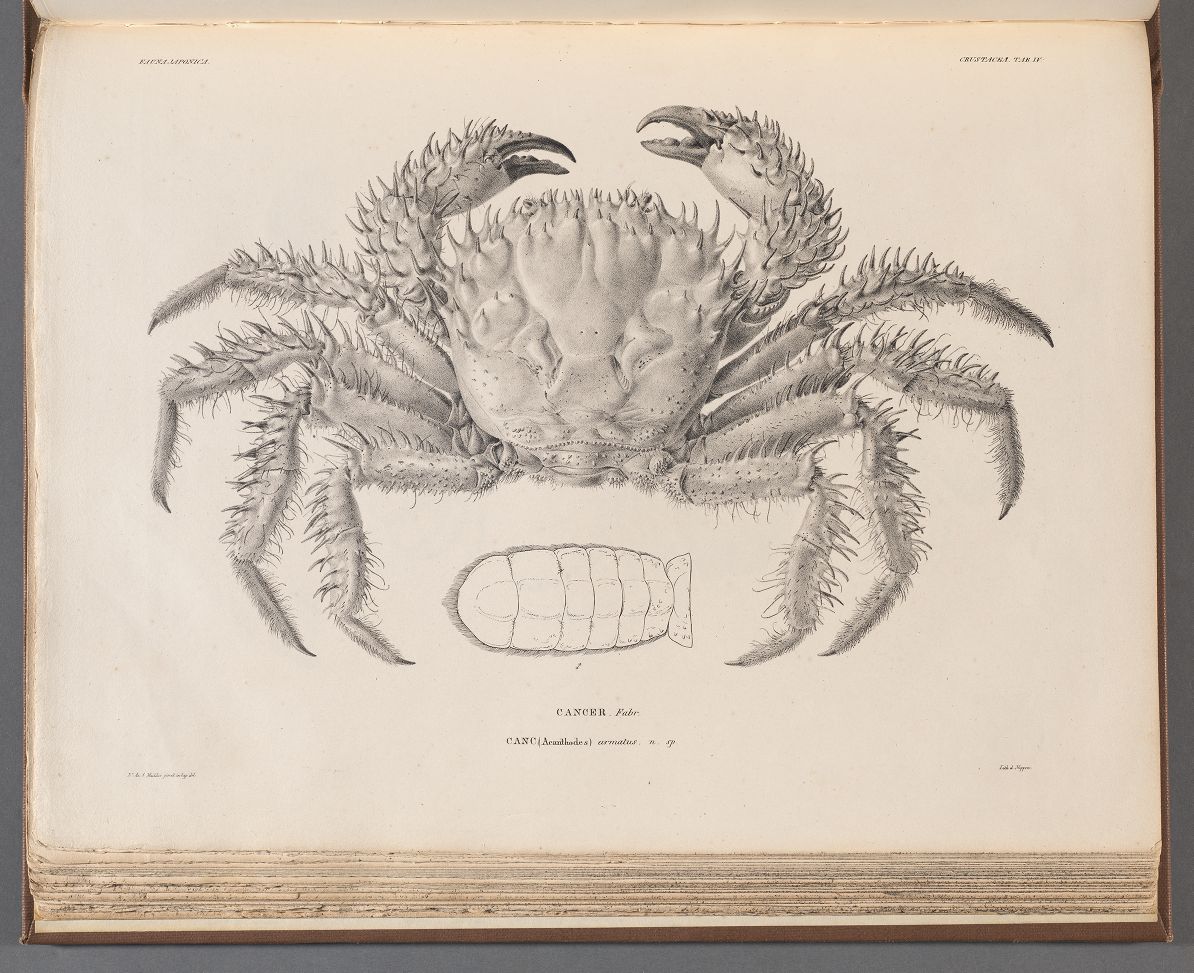
Fauna japonica, sive, Descriptio animalium, quae in itinere per Japoniam … (Leiden, 1833-1850) is a set of five volumes based on natural-history collections made in Japan by German physician and botanist Philipp Franz von Siebold and his assistant and successor Heinrich Burger, with drawings by the Japanese artist Kawahara Keiga. It is the first monographic series written in a European language (French) on the zoology of Japan, and it introduced Japanese fauna to the West on a large scale. The volumes of Fauna Japonica, contributed by the Ernst Mayr Library of the Museum of Comparative Zoology, Harvard University, can be viewed on BHL.

View Full Size Image
Siebold, Philipp Franz von. Fauna japonica. v. [3]. Reptilia. (1838). Digitized by Harvard University, Museum of Comparative Zoology, Ernst Mayr Library. http://s.si.edu/2sQxneR.

Von Siebold (1796-1866) arrived in Japan in 1823 as resident doctor of the Dutch trading post on Deshima island, Nagasaki. He was eager to learn about natural history in far-flung countries at a time when natural history knowledge was progressing in Europe. In addition to medical work, Von Siebold, who had a strong interest in zoology, and Burger along with their Japanese colleagues collected and purchased natural history specimens and ethnological objects during excursions in the Nagasaki area. Von Siebold was also allowed to travel beyond Nagasaki with Dutch embassy officials. Patients whom von Siebold and Burger treated and residents whom they met assisted with the massive collecting project. Von Siebold established a private school where he taught medicine and natural history and the students became collectors as well.

Von Siebold was was given several detailed maps of Japan for his explorations by the court astronomer, Takahashi Kageyasu. When the Japanese government discovered the maps, they accused von Siebold of spying and treason, expelling him from the country. His then 2 year old daughter, Kusumoto Ine, went on to become the first licensed female Japanese physician of Western medicine.

View Full Size Image
Siebold, Philipp Franz von. Fauna japonica. v. [4.] Aves. ([1844]-1850). Digitized by Harvard University, Museum of Comparative Zoology, Ernst Mayr Library. http://s.si.edu/2rCBqb4.

After enduring these legal difficulties, von Siebold was able to return to the Netherlands in 1829. His vast natural-history collections preceded him to Batavia onboard ships while he was detained. The Dutch contingent that received the collections was actually a bit relieved that von Siebold was not present when the specimens arrived, as they feared that he might disperse them to institutions beyond the Netherlands.

Safely home, von Siebold commissioned Leiden Museum director C. J. Temminck to write Fauna japonica’s mammal volume. Temminck and his museum colleague Hermann Schlegel compiled the bird, reptile, and fish volumes; and Leiden Museum invertebrates curator Wilhelm de Haan wrote the Crustacea volume. The series was originally published in separate fascicles, edited by von Siebold. An unfinished, unpublished echinoderm manuscript for Fauna japonica by J. A. Herklots is now in the archives of the Leiden Museum.

View Full Size Image
Siebold, Philipp Franz von. Fauna japonica. v. [5]. Mammalia. ([1842-1845]). Digitized by Harvard University, Museum of Comparative Zoology, Ernst Mayr Library. http://s.si.edu/2rCnPR3.

Initially, von Siebold published Fauna japonica partly with his own funds and partly with a grant from the Dutch government. By 1833, the Amsterdam publisher J. Muller became partners with von Siebold in the venture. Until 1840, the plates were lithographed at von Siebold’s own lithographic plant, as indicated by “Lith. d. Nippon,” and later were done at other firms until the Leiden printer A. Arnz took over publication of Fauna japonica’s text and plates entirely.

Because the original volumes of Fauna japonica were issued in a limited (unknown) number, they became so difficult and expensive to obtain that a facsimile edition in four volumes was published in Japan in 1934 in an edition of 350 copies — now that edition has become very difficult to obtain as well. The University of Kyoto has also digitized the volumes of Fauna Japonica.

View Full Size Image
Siebold, Philipp Franz von. Fauna japonica. v. [1]. Introductions and Crustacea. (1833-1850). Digitized by Harvard University, Museum of Comparative Zoology, Ernst Mayr Library. http://s.si.edu/2rRDwYL.

References:

L. B. Holthuis and T. Sakai. Ph. F. von Siebold and Fauna japonica: a history of early Japanese zoology. Tokyo: Academic Press of Japan, 1970.

L. B. Holthus. “On the dates of publication of W. De Haan’s volume on the Crustacea of P. F. von Siebold’s Fauna japonica,” The Journal of the Society for the Bibliography of Natural History, vol. 3, pt. 1, 1953.

Ueno, Masuzo. “The Western Influence on Natural History in Japan.” Monumenta Nipponica 19, no. 3/4 (1964): 315-39. doi:10.2307/2383175.

June 22, 2017by ulib-libraryjobs
BHL News, Blog Reel

‘What’s in a Name?’ Launched at Harvard Museum of Natural History

Why are names important in science? What is the difference between scientific names (also known as Latin names or taxonomic names) and common names? Why do some species have multiple names? The grant project team for What’s in a Name, supported by the Institute of Museum and Library Services (IMLS), set out to find answers and develop exhibits and other ways for anyone to explore this phenomenon. With millions of different species to identify and understand, the process of naming organisms helps scientists organize and understand the tree of life. The physical and virtual results of this exploration creatively demonstrate how scientists identify and name species, how names relate to scientific research and the progression of knowledge, and how museum specimen collections play a crucial role in the process of naming.

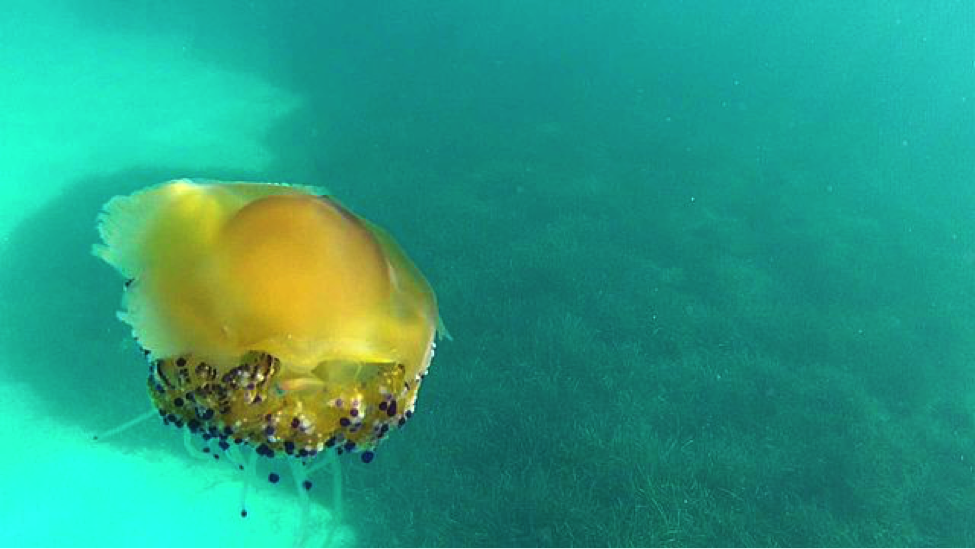
Why would something be called “Fried Egg jelly fish”, and also be known as Phacellophora camtschatica?

View Full Size Image
Image of the Fried Egg Jelly courtesy of gpapadop79 – Own work, CC BY-SA4.0, https://commons.wikimedia.org/w/index.php?curid=45347541.

Scientific names take the form of “Genus species”. Scientific names serve to distinctively identify an organism and also to show evolutionary relationships. The genus links the organism to its evolutionary relatives while the species name demonstrates its uniqueness (not unlike the family and first name convention of many people in North America). Organisms also have common names. Common names can be confusing—for instance a “Robin” in the United States is a completely different bird than a “Robin” in Europe, but if the scientific name is used, confusion can be reduced via the name unique to the organism.

The system of binomial nomenclature is used to assign species with their two-part Latin names. Carl von Linné (1707 – 1778) established a system of tiered taxonomic classification, which assigned species formal names, in the 18th century. His classification is outlined in his book, Systema Naturae. His purpose was to reduce confusion from the proliferation of common names by supplying a unique name to each organism that also displayed potential relationships with other organisms. The names were formulated from Latin words. Linné even Latinized his own name and is now best known by that name: Carolus Linnaeus.

View Full Size Image
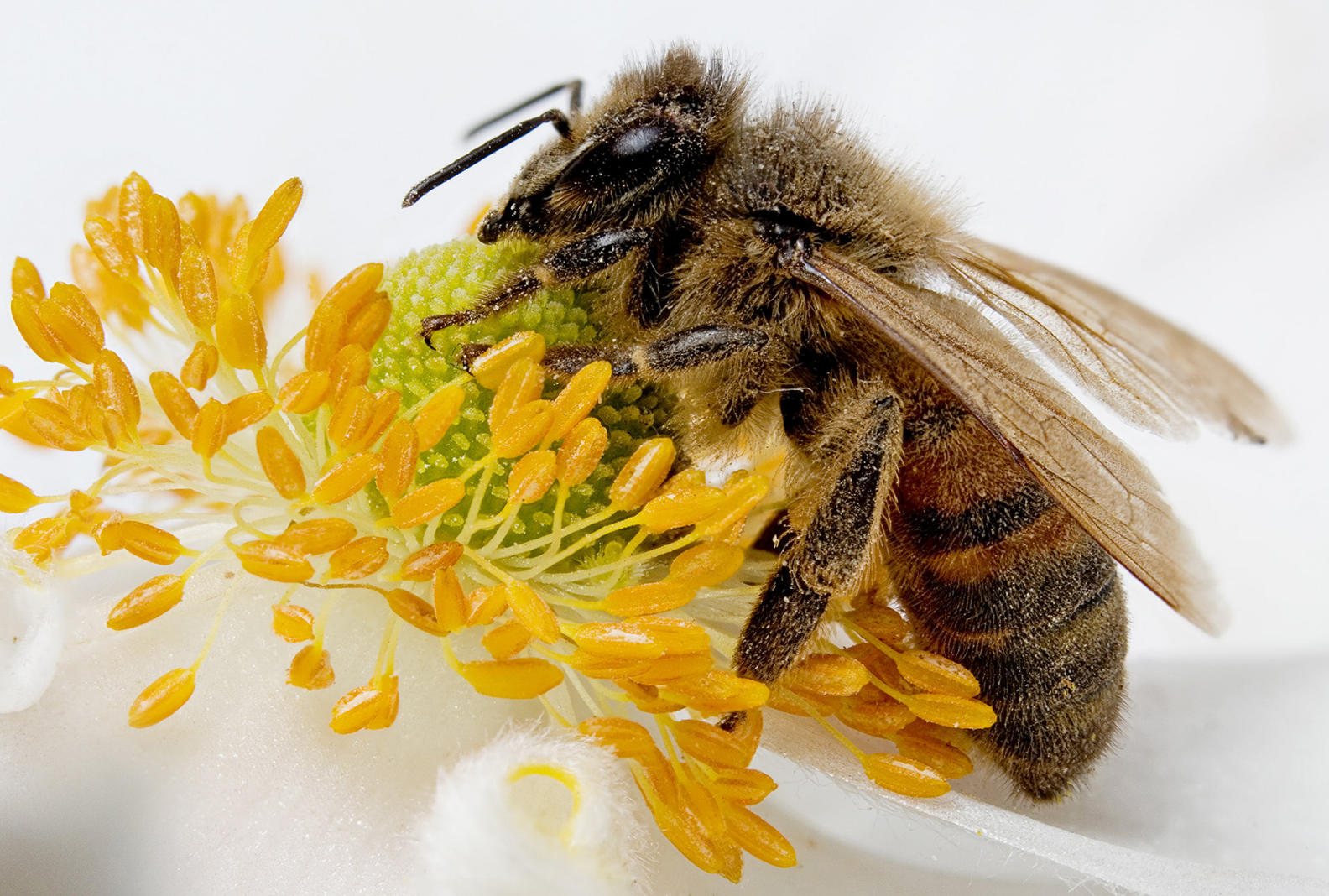
From the What’s In a Name PDF, page 32: “Carl Linnaeus gave the European Honeybee its name, Apis mellifera, which is Latin for “honey-bearing bee.” By some accounts, Linnaeus later became dissatisfied with the name he bestowed and argued to change it from Apis mellifera, to Apis mellifica, or “honey-making bee.” His mistake, he argued, was that bees make honey within the hive; they do not bear it from the flower. His argument was presumably unsuccessful as the bee still bears the erroneous name.” Image: A European Honeybee, Apis mellifera, visiting a flower that is dusting it with pollen. (JJ Harrison, CC BY-SA 3.0).

Species may be discovered by scientists poring over specimens in a museum or someone exploring an area rich in biodiversity. It is not necessary to be a scientist to name a new species but scientific names must conform to rules laid out by the International Code of Zoological Nomenclature and the International Code for Nomenclature for algae, fungi and plants. Names can reflect a characteristic of a species (Peromyscus leucopus-white-footed mouse) or can be named after a person or location (Mandelia microcornata-a nudibranch named for Nelson Mandela). Sometimes, scientists display a sense of humor when naming: Agra phobia and Agra vation are the scientific names of South American beetles. A hungry entomologist (Neal Evenhuis) named a series of flies (genus) Pieza and most notably, a species Pieza pi.

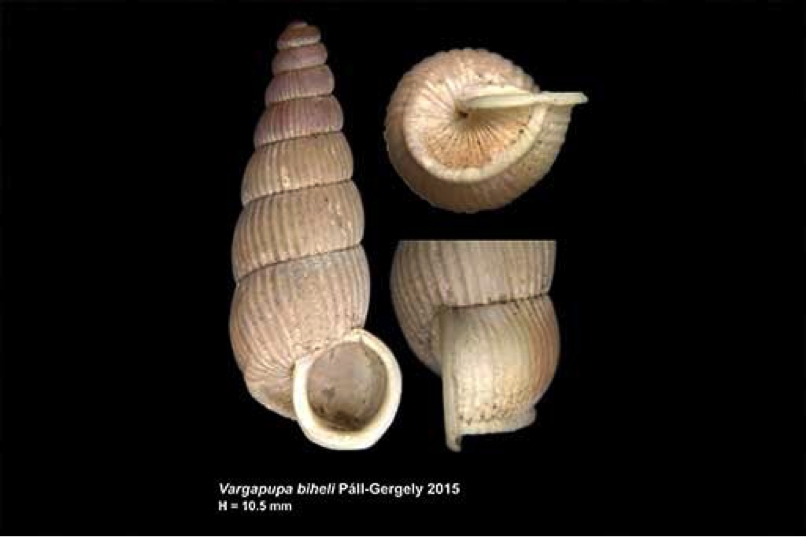
The results from the work of What’s in a Name? include four interactive exhibit stations at the Harvard Museum of Natural History on Honeybees, the extinct Dimetrodon, Jellies and Poison Ivy. There are also free online resources, including a website and a 60-page free e-book. The online resources include eight more species stories that feature images and references from the Biodiversity Heritage Library (BHL) and include familiar organisms like the dodo and sugar maple, as well as our favorite, the snail Vargapupa biheli named after BHL!

View Full Size Image
Vargapupa biheli. Image courtesy Dr. Barna Páll-Gergely.

Featured in the exhibit display on Dimetrodon, Stephanie Pierce, Assistant Professor of Vertebrate Paleontology, Harvard University, describes research being done right now on specimens of the fossil species Dimetrodon milleri, in the Museum of Comparative Zoology collection:

The What’s in a Name? project is a partnership between Harvard Museums of Science and Culture (HMSC), the Encyclopedia of Life (EOL), and the BHL, as represented by the Ernst Mayr Library of the Museum of Comparative Zoology at Harvard University. This project was made possible by IMLS.

For more information about scientific names and naming, check out the following sources

  • Bright, M. 2012. The Frog with Self-cleaning Feet: And Other Extraordinary Tales From the Animal World. Biteback Publishing. 304 pages.
  • Evenhuis, N. L.2002. Pieza, a new genus of microbombyliids from the New World (Diptera: Mythicomyiidae). Zootaxa 36(1). DOI: http://dx.doi.org/10.11646/zootaxa.36.1.1
  • Freeland, C. 2008. On Name Finding in the BHL. BHL Blog, March. https://goo.gl/wJIOWC
  • Greenstein, B. 2016. How’s your fern and bird coverage, BHL? BHL Blog, August.
  • Harvard Museums of Science and Culture. 2017, “What’s in a Name?.” http://whatsinaname.hmnh.harvard.edu/files/imls/files/_whatsinaname_.pdf
  • Judd, W. 2014.Weirdest species names. Australian Geographic. March 2014. https://goo.gl/UQ3xMA
  •  Zielinski, S. 2009. The World’s Strangest Scientific Names. Smithsonian Magazine. https://goo.gl/D3aMbb
February 14, 2017by ulib-libraryjobs
Blog Reel, Featured Books

Happy Birthday, Louis Agassiz!

Naturalist, educator, and founder of the Museum of Comparative Zoology, Jean Louis Rodolphe Agassiz was born on May 28, 1807, in Môtier, Switzerland, the oldest son of prominent pastor Rodolphe Agassiz and Rose Mayor Agassiz. Growing up near Lake Morat, Louis was fascinated by fish, catching them barehanded along with his brother Auguste. Louis was determined to study science, although his family encouraged him to pursue medicine. He studied at the Universities of Munich, Heidelberg, and Erlangen, earning a Ph.D. in 1829 and an M.D. in 1830. His 1829 publication on the fishes of Brazil (Selecta genera et species piscium) attracted the attention of Baron Georges Cuvier (1769-1832), and Agassiz spent the next two years in Paris with Cuvier.

View Full Size Image
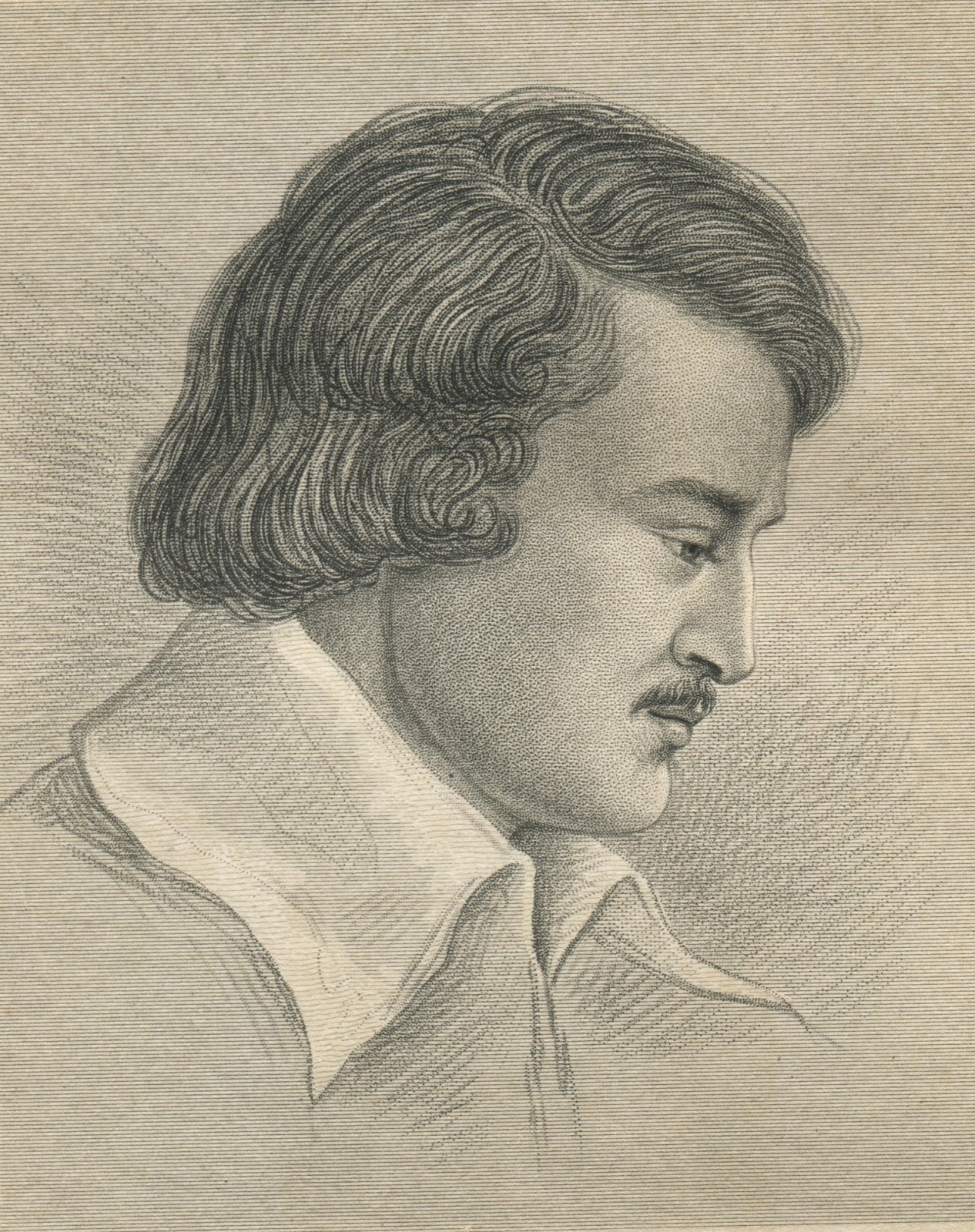
Louis Agassiz at 19, from a pastel drawing by Cecile Braun in Louis Agassiz: his Life and Correspondence. http://biodiversitylibrary.org/page/1367283.

In 1832, Agassiz became a professor of natural history at the College of Neuchâtel and married Cecile Braun, an artist and the sister of botanist Alexander Braun (1805-1877). At Neuchâtel,  Louis published on diverse subjects, including a five volume work on fossil fish, Recherches sur les Poissons Fossiles. Louis and Cecile had three children while at Neuchâtel: Alexander (1835-1910), Ida (1837-1935) and Pauline (1841-1917).

View Full Size Image
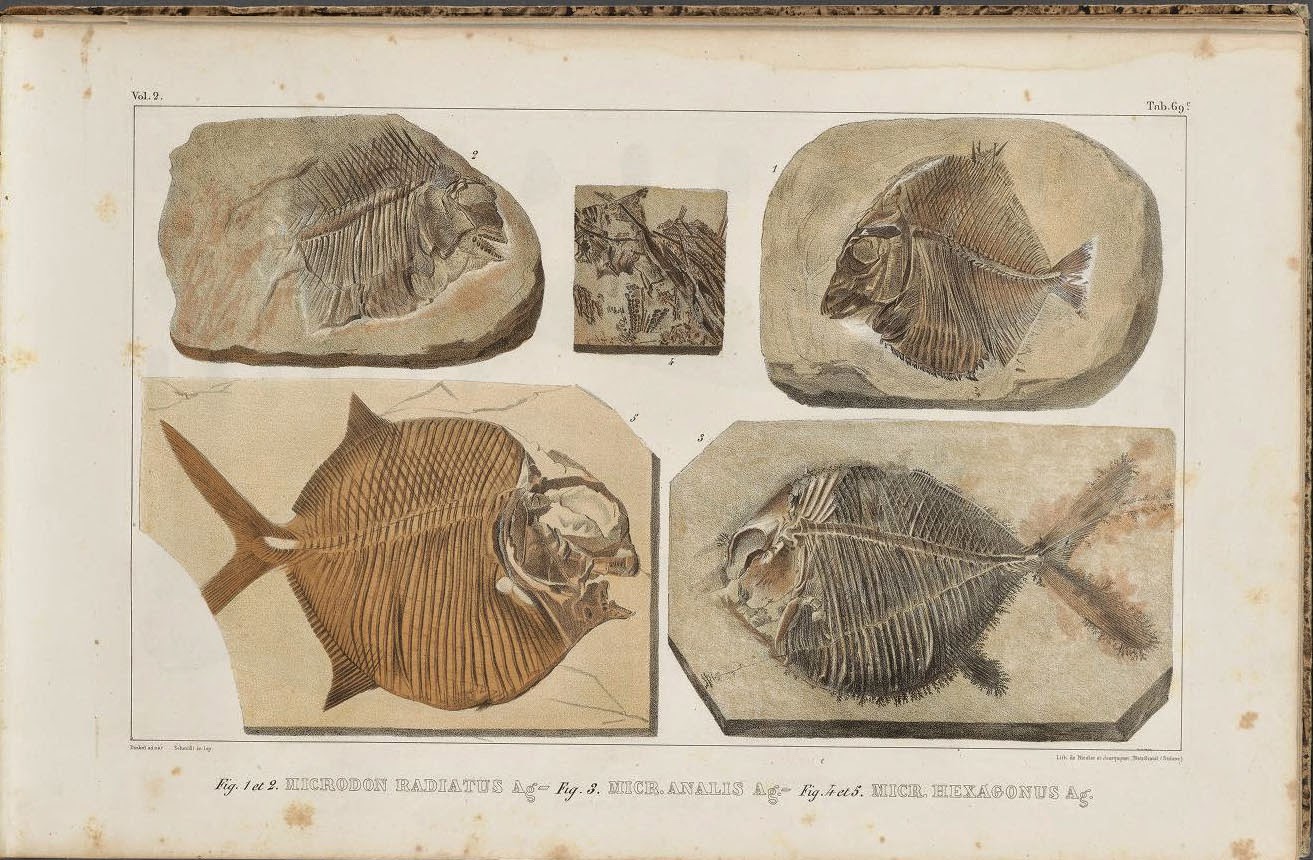
Agassiz, Louis. Recherches sur les Poissons Fossiles (1833-43). Vol. 2, plate 69c. http://biodiversitylibrary.org/page/32033418.

Between 1835-1845, while continuing to study and write about zoological topics, Agassiz also began studying geology, especially the European glaciers. His Etudes sur les Glaciers (1840) and Systeme Glaciaire (1847) were leading works in glacial theory and establishing the existence of an Ice Age.

In 1845, King Frederick William IV of Prussia awarded Agassiz a grant to travel to the United States to study “the natural history of the New World.” Agassiz sailed for Boston in September 1846. He intended to travel for two years, not knowing that he would eventually make Massachusetts his home. At the invitation of prominent businessman John Amory Lowell (1798-1881), Agassiz spoke at the Lowell Institute in Boston in the winter of 1846-47, followed by lectures in New York, Philadelphia and elsewhere on the east coast of the United States. American scientists and ordinary citizens turned out in great numbers to hear him. The published edition of his later (1849) Lowell Lecture series on embryology is available through the BHL. Beyond the lecture hall, Agassiz explored the United States from Lake Superior to the coral reefs of Florida.

Agassiz was enthusiastically welcomed into the academic and cultural life of the Boston area, and was appointed to a three-year post as Professor of Zoology and Geology at Harvard’s Lawrence Scientific School in 1847. Agassiz’ young family had stayed in Europe, where Cecile died of tuberculosis in 1848. After her death, Agassiz decided to relocate in the United States permanently, and his children joined him in Massachusetts. In 1850 Louis married Elizabeth Cabot Cary (1822-1907), who would be a partner in all aspects of his life and a founder of Radcliffe College.

A life-long collector, Agassiz immediately started assembling a zoological teaching collection at Harvard. He put out a call to the public around the U.S. in his Directions for Collecting Fishes and other Objects of Natural History. Agassiz’ texts Principles of Zoology…for the Use of Schools and Colleges and Outlines of Comparative Physiology…for the use of Schools and Colleges were reprinted in multiple editions.

By the late 1850s, Harvard’s facilities (and Agassiz’ home) were bursting with his collections. The need for space and Agassiz’ ambition to create a premier natural history museum in his adopted country led to the founding of the Museum of Comparative Zoology in Cambridge, Massachusetts, in 1859. While Louis was teaching and administering the Museum of Comparative Zoology at Harvard University, Elizabeth operated a school for young women at the Agassiz’ home from 1855-1863. More details of their life, together with the three Agassiz children, can be found in the BHL in Louis Agassiz; his life and correspondence by Elizabeth Cary Agassiz, and Elizabeth Cary Agassiz : a Biography by Lucy Allen Paton.

The Thayer Expedition to Brazil in 1865-1866 was an enormous success for Louis and Elizabeth Agassiz, collecting over 34,000 specimens for the MCZ. Louis, who started his career writing about fishes of Brazil collected by J.B. von Spix and C.F.P. von Martius, finally encountered them in their native habitat.

View Full Size Image
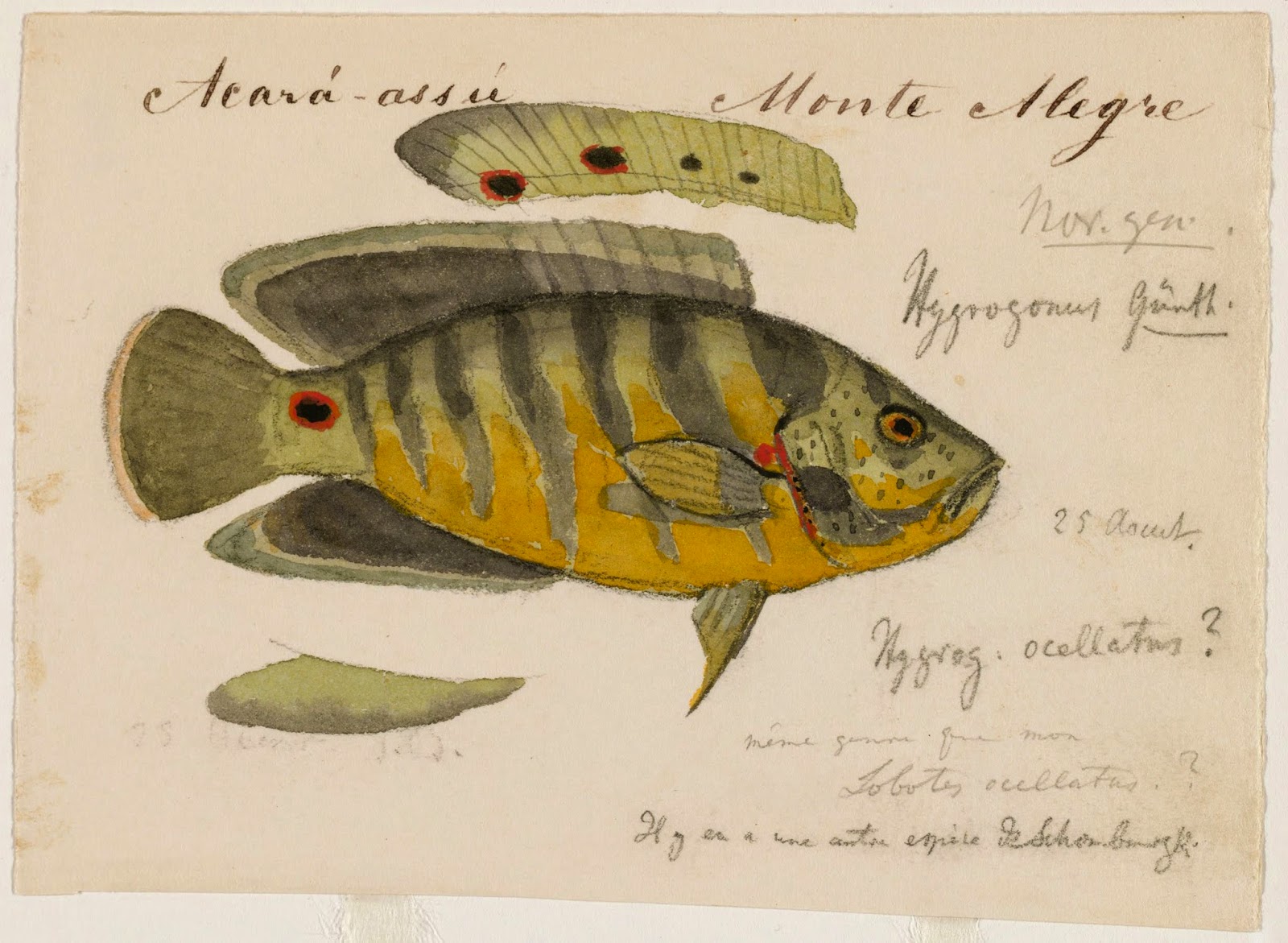
Astronotus ocellatus (Monte Alegre, Brazil) painted by J. Burkhardt during the Thayer Expedition. Special Collections of the Ernst Mayr Library of the MCZ. http://ids.lib.harvard.edu/ids/view/1662402.

Other notables on the expedition were a young William James (1842-1910) and Jacques Burkhardt (ca.1808-1867), Agassiz’ assistant and illustrator. Burkhardt had been Agassiz’ illustrator in Switzerland and joined him in the U.S. An exhibit of Burkhardt’s work from the Thayer expedition is online. In addition to the scientific results published, Louis and Elizabeth Agassiz wrote the popular account A Journey in Brazil.

Although revered as a teacher, scientist and adventurer in his own time, Agassiz has become known for his disagreement with Charles Darwin and evolutionary theory. A product of his religious early 19th century upbringing, Agassiz viewed the world as Creation, and taught that plant and animal species were fixed, not evolving. He was characteristically self-confident and could not be swayed, preferring to joust with Darwin and others while evolution was discussed and accepted in the scientific community.

Louis Agassiz passed away on December 14, 1873, following a stroke, a year after returning from another expedition to South America on the U.S. Coast Survey Hassler. The Museum of Comparative Zoology today holds approximately 21 million specimens, and is an international center for graduate study and field research, including evolutionary biology as well as zoology, taxonomy and paleontology.

May 28, 2015by ulib-libraryjobs

Help Support BHL

BHL's existence depends on the financial support of its patrons. Help us keep this free resource alive!

search

About BHL

The Biodiversity Heritage Library (BHL) is the world’s largest open access digital library for biodiversity literature and archives. BHL operates as a worldwide consortium of natural history, botanical, research, and national libraries working together to digitize the natural history literature held in their collections and make it freely available for open access as part of a global “biodiversity community.”

Join Our Mailing List

Sign up to receive the latest news, content highlights, and promotions.

Subscribe Now

Subscribe to Blog via Email

Enter your email address to subscribe to this blog and receive notifications of new posts by email.

Join 319 other subscribers

Subscribe to Blog Via RSS

Subscribe to the blog RSS feed to stay up-to-date on all the latest BHL posts.

Access RSS Feed

Inspiring Discovery through Free Access to Biodiversity Knowledge.

The Biodiversity Heritage Library makes it easier than ever for you to access the information you need to study and explore life on Earth…for free, anytime, anywhere.


64+ Million Pages of
Biodiversity Literature Online.

EXPLORE

Tools and Services
to Transform Research.

EXPLORE

300,000+
Illustrations on Flickr.

EXPLORE

ABOUT | HARMFUL CONTENT | PRIVACY | SITE MAP | TERMS OF USE