Biodiversity Heritage Library - Program news and collection highlights from BHL
  • Home
  • News
  • Featured Books
    • All Featured Books
    • Book of the Month Series
    • BHL at 20
  • User Stories
  • Campaigns
    • Fossil Stories
    • Garden Stories
    • Monsters Are Real
    • Page Frights
    • Her Natural History
    • Earth Optimism 2020
  • Tech Blog
  • Visit BHL
Home
News
Featured Books
    All Featured Books
    Book of the Month Series
    BHL at 20
User Stories
Campaigns
    Fossil Stories
    Garden Stories
    Monsters Are Real
    Page Frights
    Her Natural History
    Earth Optimism 2020
Tech Blog
Visit BHL
  • Home
  • News
  • Featured Books
    • All Featured Books
    • Book of the Month Series
    • BHL at 20
  • User Stories
  • Campaigns
    • Fossil Stories
    • Garden Stories
    • Monsters Are Real
    • Page Frights
    • Her Natural History
    • Earth Optimism 2020
  • Tech Blog
  • Visit BHL
Biodiversity Heritage Library - Program news and collection highlights from BHL
BHL News, Blog Reel

Supporting the Biodiversity Community: BHL Engages in Global Biodiversity Projects

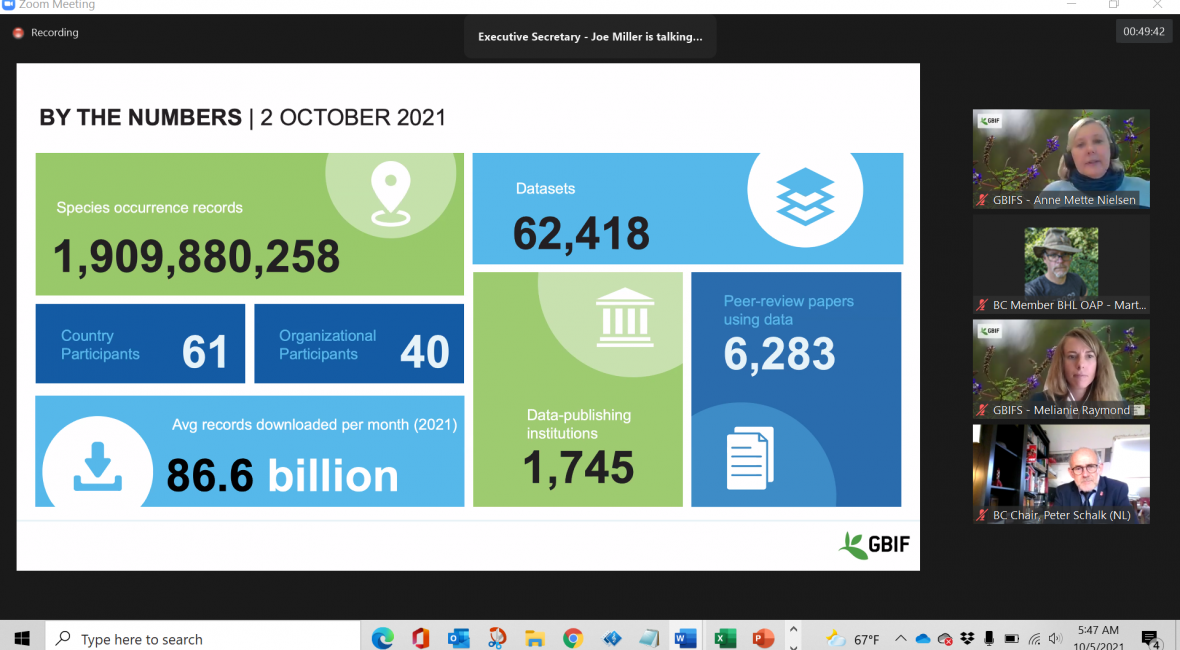
Screenshot of GBIF GB28 meeting with speakers and slides

The Biodiversity Heritage Library thrives on international partnerships and collaborative projects. In the fall of 2021, representatives from BHL participated in a number of planning meetings and conferences in support of global biodiversity projects.

BiCIKL (Biodiversity Community Integrated Knowledge Library)

BiCIKL is a European-funded partnership with 14 partners from 10 countries. The objective is to improve infrastructure to create a Biodiversity Knowledge Hub that provides a full set of linked, open biodiversity data, including names, genetics, occurrence data, natural history, authors and publications. The end result will be access to data at all points in the research cycle. The underpinnings of BiCIKL are Open Science and FAIR (Findable, Accessible, Interoperable and Reusable) data practices.

Within the BiCIKL project, there are 12 work packages. While most of the work packages are of some interest to BHL, BHL Chair Constance Rinaldo is participating most consistently in Work Package 6: “Liberation of data from literature, next-generation semantic publishing and delivery of FAIR data.” The main goals are to rapidly find, extract and link information in published literature during as well as after publication. Plazi and Pensoft are key participants in organizing how literature and snippets of literature (location, taxonomic treatments, occurrence notation, figures and tables for instance) can be integrated into the Global Biodiversity Information Facility (GBIF) and made easily accessible in context.

During the week of 20-24 September, several teams from the BiCIKL technical community attended a hybrid hackathon, hosted virtually and at Meise Botanic Garden in Belgium. Teams worked on small pilot projects to extract data and test linkages among existing infrastructures. Constance Rinaldo and Martin Kalfatovic, BHL Program Director, attended the introductory and final sessions virtually. There were nine projects overall. The pilots that potentially reflect BHL interests included: Linking specimens with material citation and vice versa; Hidden women in science; and Enriching Wikidata with information from OpenBiodiv about type specimens in context from different literature sources. The higher level conclusions were: harmonizing APIs across platforms; the shared cloud facilitates collaboration; wikidata is very useful for connecting different infrastructures; and scalability/granularity will be ongoing issues. A summary of the hackathon was presented by Quentin Groom at the TDWG 2021 conference.

Global Biodiversity Information Facility 2021 Governing Board Meeting (GB28)

The GBIF GB28 was once again held virtually from 5-7 October 2021. GB28 brought together delegates and other representatives from GBIF participating countries and organizations. BHL Chair Constance Rinaldo represented BHL as Head of Delegation (non-voting), and BHL Program Director Martin Kalfatovic is the BHL Node representative.

Tanya Abrahamse, Chair of the GBIF Governing Board, opened the meeting and presented a welcome from Joanne S. Tornow, Assistant Director, National Science Foundation, USA.

Over the course of the meeting, reports from the GBIF Executive Secretary (Joe Miller), the Budget Committee, Science Committee, and Nodes Committee were presented. Updates from the GBIF Secretariat were delivered as well as the GBIF 2022 Work Programme and draft budget.

Screenshot of GBIF GB28 meeting with speakers and slides

GBIF Executive Secretary, Joe Miller, presents GBIF By the Numbers at the annual GBIF Governing Board Meeting (GB28).

A highlight of the Governing Board meeting included the presentation of the winner of the Ebbe Nielsen Challenge. This year, an International team led by Alexander Zizka of iDiv won for creating a web-based tool linking natural science and political science. The tool, Bio-Dem, is an open-source web-app for exploring temporal and spatial relationships between the availability of biodiversity data and the dimensions of democracy.

The Young Researcher Awards this year went to:

  • Michael Belitz, a PhD candidate from the United States, selected for work on linking new analytical approaches aimed at advancing understanding of phenological impacts of climate change; and
  • Julen Torrens Baile, a Master’s student at the University of Navarra, selected for research into improving methods of modelling species distributions for invasive freshwater fish.

In other actions, Belgium was selected as the host for the 2023 Governing Board meeting, and Martin Kalfatovic was elected as 2nd Chair of the Budget Committee.

BHL Symposium at TDWG 2021

Biodiversity Information Standards (TDWG) hosted its virtual annual conference from 18-22 October with a theme of “Connecting the world of biodiversity data: uniting people, processes, and tools.” Hosted by the University of Florida Biodiversity Institute along with the Florida Museum of Natural History and iDigBio, TDWG 2021 brought more than 400 attendees together via the Whova virtual conference platform. The community engaged in online discussions, interactive workshops, in-depth symposia, contributed oral presentations, and a TDWG 2021 Worldwide Bioblitz.

TDWG 2021 conference logo: Connecting the world of biodiversity data: standards uniting people, processes, and tools

TDWG 2021 Virtual Annual Conference. Connecting the world of biodiversity data: standards uniting people, processes, and tools

On 21 October, BHL hosted a symposium titled “SYM11 Building collaborative resiliency through the Biodiversity Heritage Library,” organized by Constance Rinaldo (BHL Chair) and Colleen Funkhouser (BHL Program Manager, Smithsonian Libraries and Archives).

Moderated by Constance Rinaldo, the symposium included six talks from speakers around the world.

  • Cultivating Resilience in the Biodiversity Heritage Library During the Global Pandemic: Improving access to existing content – Colleen Funkhouser (BHL Secretariat, Smithsonian Libraries and Archives)
  • BHL and the Pandemic: An accelerator of digital advances and transformation – Alice Lemaire (Muséum national d’Histoire naturelle, Paris)
  • Algorithms for connecting scientific names with literature in the Biodiversity Heritage Library via the Global Names Project and Catalogue of Life – Geoffrey Ower (University of Illinois)
  • Biodiversity Heritage Library and Global Names: Successes, opportunities and the challenges for the future collaboration – Dmitry Mozzherin (University of Illinois Urbana-Champaign)
  • #RetroPIDs: The missing link to the foundation of biodiversity knowledge – Nicole Kearney (BHL Australia)
  • The BHL-Plazi Partnership: Getting data from the 1800s directly into 21st century, reused digital accessible knowledge – Donat Agosti (Plazi)

Discussions throughout the conference emphasized the need for better ways to extract and connect data from historic literature including the collections within BHL.

You can view a complete list of symposia, workshops, and discussion session descriptions on the TDWG conference website. All conference abstracts are published in the TDWG Proceedings 2021 in Biodiversity Information Science and Standards.

November 10, 2021by
BHL News, Blog Reel

BHL at TDWG 2020

Screenshot of a Zoom call with a collage of various people's faces.

logo for TDWG 2020 conferenceThis year, as organizations around the world have done in response to the global COVID-19 pandemic, Biodiversity Information Standards (TDWG) held its annual conference virtually. With a mix of online working sessions, webinar-style symposia, presentations, panel discussions, and recorded presentations, this year’s conference was held across two separate periods—the first dedicated to working sessions during the week of 21-25 September 2020 and the second to symposia and panel sessions the week of 19-23 October 2020.

As the TDWG 2020 Annual Conference website states, the conference “serve two purposes:

  • to provide a forum for developing, refining, and extending standards in response to new challenges and opportunities;
  • and to provide a showcase for biodiversity informatics – much of which relies on the standards created by TDWG and other organizations.”

You can view the complete list of working session and symposia and discussion session descriptions on the TDWG website. Conference sessions were also recorded and are available for viewing on the TDWG YouTube channel.

BHL Symposium at TDWG 2020

On 20 October 2020 as part of the TDWG 2020 virtual conference, BHL hosted a symposium, “SYM03 Enhancing Connections With the Global Neighbourhood Through Expanding Partnerships”, organized by Constance Rinaldo (Librarian of the Ernst Mayr Library, Harvard and Chair of the BHL Executive Committee) and Colleen Funkhouser (BHL Program Manager, Smithsonian Libraries).

The symposium consisted of four talks, covering topics including building BHL’s technical strategy, digital object identifiers (DOIs), taxonomic name finding services, and BHL’s response to the global COVID-19 pandemic. See more details about the symposium and each talk below.

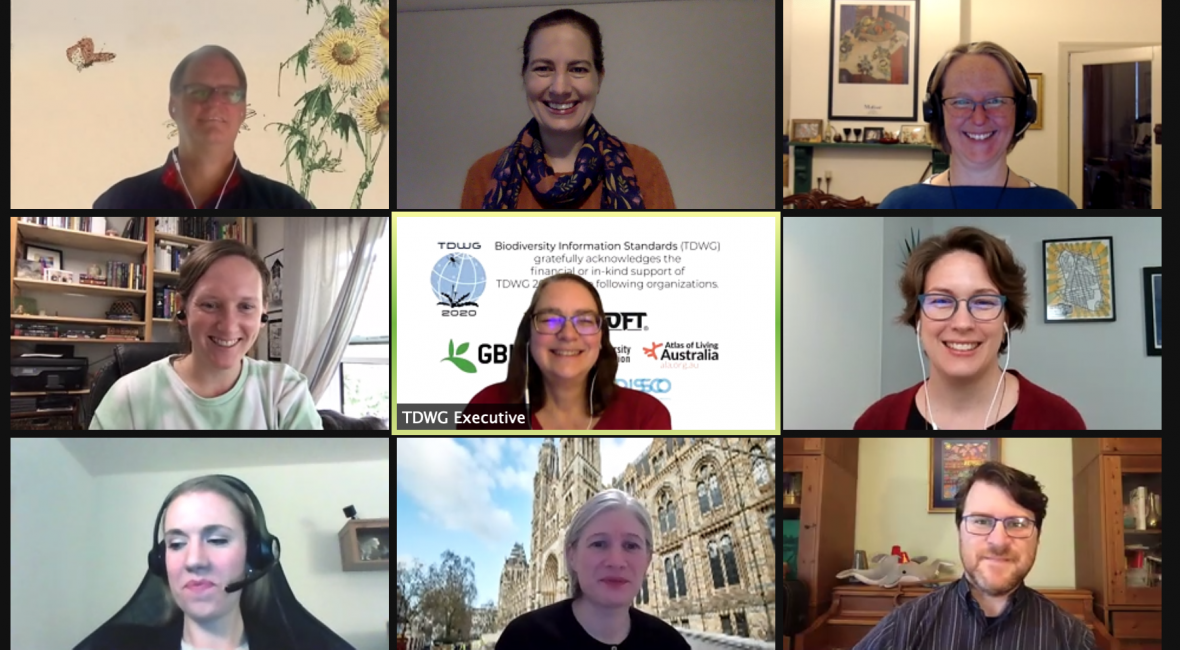
Screenshot of a Zoom call with a collage of various people's faces.

Organizers, presenters, and facilitators for the BHL Symposium at TDWG 2020. Top, L to R: Martin Kalfatovic, Nicole Kearney, Ely Wallis; Middle, L to R: Holly Little, Constance Rinaldo, Colleen Funkhouser; Bottom, L to R: Elisa Herrmann, Jane Smith, Joel Richard. Image courtesy of Nicole Kearney.

SYM03 Enhancing Connections With the Global Neighbourhood Through Expanding Partnerships
Abstract: The Biodiversity Heritage Library (BHL) is more than a digital library, it is a key resource for data related to biodiversity. Data such as museum specimens, taxonomic names, environmental and geolocation variables is embedded in the published and unpublished literature found in BHL. Over the past year, BHL has developed a five year strategic plan designed to bring more focus on data, technology and partnerships. BHL is already well-established within the global bibliographical knowledge base. The plan for the symposium is to highlight some new directions and identify synergies and connections with current, new and potential partners in the biodiversity knowledge infrastructure.

  • Building the Biodiversity Heritage Library’s Technical Strategy — Elisa Herrmann (Museum für Naturkunde Berlin)
    • Presentation Slides
  • Discovering the Platypus: From Its Scientific Description to Its DOI — Nicole Kearney (BHL Australia, Museums Victoria)
    • Presentation Slides
  • Improving Taxonomic Name Finding in the Biodiversity Heritage Library — Joel Richard (Smithsonian Libraries)
    • Presentation Slides
  • The Biodiversity Heritage Library Response to the Global COVID-19 Pandemic — Delivered by Martin Kalfatovic (BHL Secretariat, Smithsonian Libraries). Co-authors: Constance Rinaldo (Ernst Mayr Library, Harvard); Jane Smith (Library and Archives, Natural History Museum, London); David Iggulden (Library, Art & Archives at the Royal Botanic Gardens, Kew); Colleen Funkhouser (BHL Secretariat, Smithsonian Libraries).
    • Presentation Slides
Screenshot of a slide discussing BHL's objectives for its technical development goal.

Goal 2 of BHL’s 2020-2025 Strategic Plan focuses on developing the Library’s tools and services. During her talk, Building the Biodiversity Heritage Library’s Technical Strategy, Elisa Herrmann (Museum für Naturkunde Berlin) discussed the five objectives of that goal and BHL’s plans to implement those objectives. Image courtesy of Grace Costantino.

Screenshot of a Zoom call showing a slide with the BHL digital library interface on the landing page for the DOI of the platypus.

As Nicole Kearney (BHL Australia, Museums Victoria) shared during her talk, Discovering the Platypus: From Its Scientific Description to Its DOI, the first scientific description of the platypus (Ornithorhynchus anatinus) now has a DOI (https://doi.org/10.5962/p.304567), assigned by BHL. This allows anyone to easily cite this description directly and enables easier tracking of those citations. Image courtesy of Grace Costantino.

Screenshot of a Zoom call with a slide showing benefits of BHL's new name finding algorithm.

During his talk, Improving Taxonomic Name Finding in the Biodiversity Heritage Library, Joel Richard (Smithsonian Libraries) shared some of the benefits of implementing the new Global Names gnfinder tool to support taxonomic name finding in BHL. Image courtesy of Grace Costantino.

Screenshot of a Zoom call with a slide stating quotes from partners about BHL's impact during the COVID-19 pandemic.

During the presentation The Biodiversity Heritage Library Response to the Global COVID-19 Pandemic, Martin Kalfatovic (BHL Secretariat, Smithsonian Libraries) shared statements from partners about BHL’s impact during the pandemic. Image courtesy of Grace Costantino.

The symposium was well-received, with approximately 100 people attending. The talks sparked interesting discussions, with questions around such topics as opportunities for Wikidata integration; supporting annotations as part of a future IIIF integration; strategies for improving optical character recognition (OCR); development of visualizations using BHL data; identification of additional useful data access points, such as collection and specimen codes and locality names; and potential strategies for supporting third-party application development using BHL data, such as through researcher prizes and challenges.

You can view a recording of the symposium on YouTube and all session presentation files in this Google folder.

October 30, 2020by michelle.underhill
BHL News, Blog Reel

BHL and WikiCite 2018

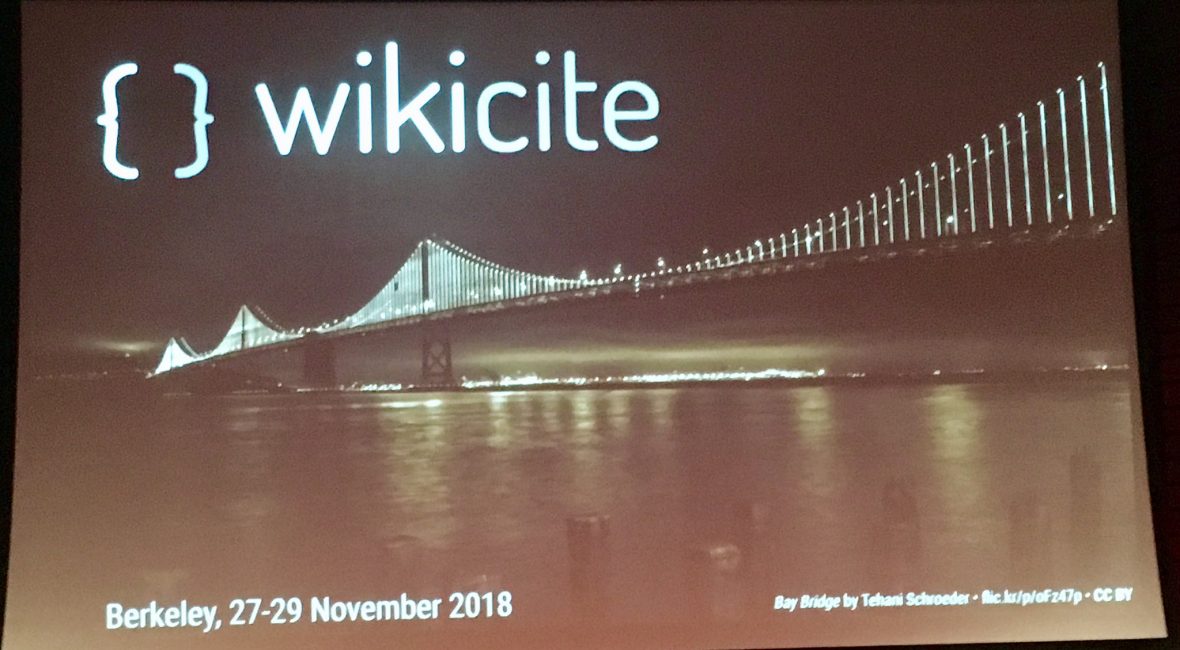
WikiCite conference in Berkeley, ca, 27-29 November 2018.

WikiCite conference in Berkeley, ca, 27-29 November 2018. Photo Credit: Diane Shaw. Graphic by Dario Taraborelli (CC-BY 4.0) with photo by Tehani Schroeder.

In November 2018, Diane Shaw, Katie Mika and Siobhan Leachman attended WikiCite 2018 in Berkeley, CA. WikiCite is a Wikimedia initiative that aims to develop a database of open citations and linked bibliographic data. Since sources are the foundation of Wikipedia’s claim to authority, WikiCite is working to build a repository of bibliographic data that is open, structured, and separable. WikiCite also draws from the academic community in which citation data (most often from peer-reviewed articles) is crucial for creating and linking knowledge. At the outset, WikiCite aimed to build this repository specifically for use in Wikipedia and other Wikimedia Foundation projects. Since the first meeting in 2016, this idea has grown into building a universal repository of sources to serve the sum of all human knowledge, leveraging Wikidata as its infrastructure.

Diane Shaw (left) and Siobhan Leachman (right) at WikiCite 2018.

Diane Shaw (left) and Siobhan Leachman (right) at WikiCite 2018. Photo Credit: Siobhan Leachman.

Now in its third iteration, the conference included extended and short presentations, numerous lightning talks, strategy tracks, tutorials, data modelling, and a hack day (renamed a Do-athon Day to be more inclusive of those who aren’t computer science experts). The purpose of the conference, open primarily by invitation to a group of approximately 100 attendees from across the United States and abroad, was to work towards a “vision of creating an open repository of bibliographical data to support the citation and fact-checking needs of Wikimedia projects, and possibly, to serve as an open infrastructure for research, education, and information quality across the web.” Librarians were well-represented among the attendees, as were linked open data advocates, software engineers, data scientists, and active members of the Wikimedian community.

Unlike some of the other very popular Wikimedia Foundation products (Wikipedia in 303 languages; Wikimedia Commons hosting image, audio, and video files; Wikisource for full text transcriptions; and Wikidata for storing structured data, among others), WikiCite has no real online presence itself, but has grown as a community of practice dedicated to the support of a bibliographical metadata commons enabling reliable, verified linked open data connections both among Wikimedia projects and externally with many other online catalogs, databases and reference sources for a variety of libraries, galleries, archives, museums, scientific institutes, and other similar organizations, including OCLC, the Internet Archive and the Biodiversity Heritage Library. We are not exaggerating when we say it was awe-inspiring to be part of this dedicated group harnessing technical knowledge, bibliographical expertise, and lots of creativity and imagination in an effort to bring about a future of linked open data serving all kinds of scholarly information needs.

What WikiCite hopes to make possible goes beyond a simple structure for providing and sharing linked open data: attendees at the conference were also experimenting with new and improved ways to discuss, analyze, curate, vet and annotate sources online.
Dario Taraborelli, Director of Research at the Wikimedia Foundation, gave a terrific overview of WikiCite in his opening talk: Here Be Dragons: Uncharted regions of the bibliographic commons. Other talks and projects that would be of particular interest to libraries include presentations about projects at the National Library of Sweden and the National Library of Wales using structured linked open data for name and subject authority files and to help document the history of national book trade; Linked Data for Production (LD4P), a collaborative pilot project using BIBFRAME for creating structured linked data with connections to Wikidata, the Virtual International Authority File (VIAF) and WorldCat; initiatives to use Wikidata, VIVO and Scholia to generate scholarly profiles; and ways to incorporate Wikidata training into library education, including classes on Library Carpentry.

Katie Mika presenting as part of WikiCite and the Biodiversity Heritage Library at WikiCite 2018.

Katie Mika presenting as part of WikiCite and the Biodiversity Heritage Library at WikiCite 2018. Photo Credit: Diane Shaw.

Katie, a former BHL National Digital Stewardship Resident from Harvard’s Museum of Comparative Zoology, and Siobhan, a citizen scientist and linked open data champion from New Zealand who has been a devoted transcriber of natural history materials in the Smithsonian Transcription Center, gave a talk on WikiCite and the Biodiversity Heritage Library. They described some of the unique challenges for heritage literature and metadata, and demonstrated how open access citations, images, and details gleaned from BHL and other open natural history digital repositories are applied to Wikimedia Foundation projects to support essential documentation of scientists, literature, and rare and endemic species.

Unlike modern scientific literature, much historic literature does not have original digital identifiers (DOI’s) attached. These identifiers enable a particular publication to be identified and provide a persistent link to its location on the Internet.  Without these identifiers it is difficult to ingest historical bibliographic data into Wikidata in bulk. If historic bibliographic data is not able to be ingested or reused, scientists are unable to make use of this important resource. Siobhan expressed her frustration that much of the citation metadata of historic biodiversity literature is not currently found in Wikidata and urged the attendees to help resolve this problem.

Siobhan Leachman presenting as part of WikiCite and the Biodiversity Heritage Library at WikiCite 2018.

Siobhan Leachman presenting as part of WikiCite and the Biodiversity Heritage Library at WikiCite 2018. Photo Credit: Diane Shaw.

Siobhan’s key takeaway from the conference was the various discussions on how to solve the difficulties of getting bibliographic information on historic biodiversity literature into Wikidata. Also of interest were the discussions on how book data is modelled in Wikidata (see https://www.wikidata.org/wiki/Wikidata:WikiProject_Books) and discovering a practical new tool to help disambiguate authors within wikidata: Author Disambiguator. Katie enjoyed the opportunity during the summit day’s events to discuss the potential for a bibliographic commons to support citations and information provenance across the web and in support of Open Science practices. On the Do-a-thon Day, Diane spent time discussing approaches for modelling the properties of holotypes on Wikidata with Siobhan, biophysicist and open scientist Daniel Mietchen, and Terry Catapano of Plazi and UC Berkeley’s Bancroft Library.

The opportunity presented by WikiCite for libraries and public knowledge creation cannot be overstated. As of November 2018, there are over 21 million publication items in Wikidata, which accounts for 40% of the entire database. More than 160 million Wikidata statements use the property “cites” (P2860) to connect items. Wikidata is open to contribute to, edit, reuse, and extend. Not only can we leverage Wikidata for metadata enrichment and linked data connections, but we can build bibliographic applications on top of this open database, track the provenance of citations, and study patterns of information reuse. Wikicite advocates for an open destination to more easily discuss, analyze, curate, annotate, and vet bibliographic resources used in Wikipedia and across the web. As connectors to information, libraries have staff who can offer a tremendous amount of expertise for modeling difficult kinds of data (like books), while ensuring equitable access to information.

The easiest way to get involved is to edit! Explore Wikidata using reasonator and SQID (“squid”). Head over to Youtube to watch talks and tutorials on Wikidata and SPARQL. Match some Wikidata items with their external identifiers using Mix ‘n Match. And join the wikicite-discuss mailing list to join conversations about adding bibliographic data to Wikidata and WikiCite program updates.

January 31, 2019by michelle.underhill
BHL News, Blog Reel

BHL at the Joint Society for the Preservation of Natural History Collections (SPNHC) and Biodiversity Information Standards (TDWG) Conference in Dunedin, New Zealand

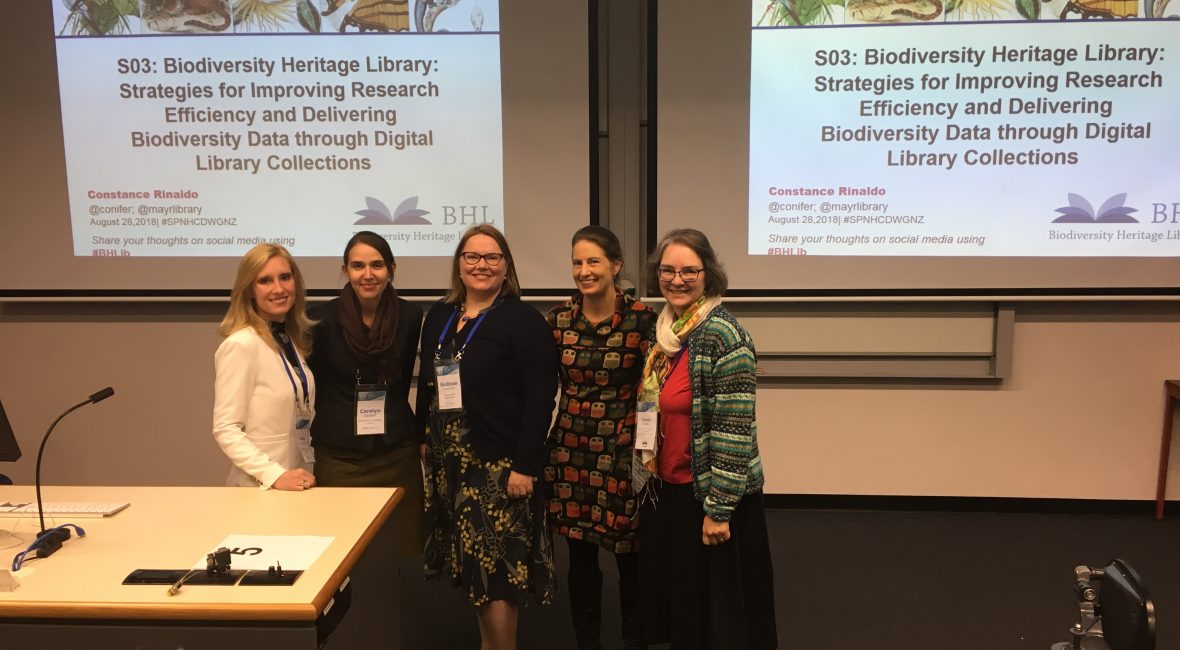
BHL representatives preparing to deliver talks as part of the BHL Symposium. Left to right: Grace Costantino, Carolyn Sheffield, Siobhan Leachman, Nicole Kearney, Constance Rinaldo.

logo for the joint TDWG/SPNHC conference

On 25 August – 1 September 2018, BHL representatives from around the world traveled to Dunedin, New Zealand to attend the joint Society for the Preservation of Natural History Collections (SPNHC) and Biodiversity Information Standards (TDWG) conference. Hosted by the Otago Museum and the University of Otago, the conference represented several firsts, including the first joint meeting of these two organizations plus the first SPNHC meeting in the Southern Hemisphere.

With the theme “Collections and Data in an Uncertain World”, the conference was an opportunity for bioinformatics and natural science collections professionals to exchange ideas and expertise as they explored the myriad intersections between collections and the data generated from them. BHL, an institutional member of TDWG, was proud to be a conference partner for this important event.

Explore the full conference program.

Keynotes

Dr. Elycia Wallis delivering a keynote address (with a highlight of BHL!) as part of the joint SPNHC/TDWG Conference.

Dr. Elycia Wallis delivering a keynote address (with a highlight of BHL!) as part of the joint SPNHC/TDWG Conference. Photo credit: Grace Costantino

In addition to over seventy sessions featuring multiple speakers in several concurrent tracks, the conference also included many fascinating keynote addresses (including one from Dr. Elycia Wallis, Member representative for BHL Australia).

Explore the abstracts for each keynote address below:

  • Building, Growing and Sustaining Global Collaborative Communities (Jonah Duckles, Director of Membership and Technology at The Carpentries)
  • The Change Imperative: Accelerating the pace of Biodiversity Discovery and Documentation (Dr. Elycia Wallis, Collections Community Engagement Manager for Atlas of Living Australia and project leader for the Australian Biodiversity Heritage Library project; Lee Belbin, geoscience graduate and IT postgraduate)
  • Promoting Public Engagement of Natural History Collections Through Science Communication (Dr. Bryan Lessard, entomologist at CSIRO’s Australian National Insect Collection)
  • Collections in an Uncertain World: The Impact of Earthquakes on Canterbury Museum (Anthony Wright, Director of Canterbury Museum)
  • If Only They Could Speak (Dr. Priscilla Wehi, conservation biologist and Rutherford Discovery Fellow at Manaaki Whenua Landcare Research in Dunedin)

BHL Symposium

BHL representatives preparing to deliver talks as part of the BHL Symposium. Left to right: Grace Costantino, Carolyn Sheffield, Siobhan Leachman, Nicole Kearney, Constance Rinaldo.

BHL representatives preparing to deliver talks as part of the BHL Symposium. Left to right: Grace Costantino, Carolyn Sheffield, Siobhan Leachman, Nicole Kearney, Constance Rinaldo.

BHL hosted a symposium at the conference, “Strategies for Improving Research Efficiency and Delivering Biodiversity Data through Digital Library Collections”, organized by Carolyn Sheffield (BHL Program Manager, Smithsonian Libraries) and moderated by Constance Rinaldo (Librarian of the Ernst Mayr Library, Harvard and Chair of the BHL Executive Committee).

The Symposium consisted of four talks, covering topics including citizen science, linking specimen records to literature, DOIs, and recent efforts to improve search efficiencies in BHL, from full text search to extracting georeference data. Explore the abstracts for each talk in the links below:

  • Outreach Strategies to Engage Citizen Scientists: Insights from the Biodiversity Heritage Library – Grace Costantino (BHL Secretariat, Smithsonian Libraries)
    • See slides
  • How A Citizen Scientist Can Reuse & Link Biodiversity Heritage Library Data – Siobhan Leachman (BHL Citizen Scientist)
    • See slides
  • What are we DOIng about the Missing Links? Connecting Taxonomic Names to the Linked Network of Scholarly Research – Nicole Kearney (BHL Australia, Museums Victoria)
    • See slides
  • Improving Search Efficiency in the Biodiversity Heritage Library Corpus – Carolyn A. Sheffield (BHL Secretariat, Smithsonian Libraries)
    • See slides

The Symposium was attended by about 100 people and was well-received. The session stimulated lively discussion regarding the lack of regulations around assigning DOIs to legacy literature, the ethics of publishers assigning DOIs to versions of out-of-copyright publications locked behind paywalls, and the need for museums to release collections-related data and images openly so that they may be reused for citizen science or on such platforms as Wikipedia (a point eloquently emphasized by Siobhan Leachman as part of a memorable Q&A exchange that was heralded and much-discussed throughout the remainder of the conference).

A group selfie with some of the excited BHL representatives! Left to right background: Carolyn Sheffield, Nicole Kearney, Elycia Wallis, Siobhan Leachman. Foreground: Grace Costantino

A group selfie with some of the excited BHL representatives! Left to right background: Carolyn Sheffield, Nicole Kearney, Elycia Wallis, Siobhan Leachman. Foreground: Grace Costantino. Photo credit: Grace Costantino

Conference Impact for BHL

Carolyn Sheffield (left) and Grace Costantino (right) at the BHL table.

Carolyn Sheffield (left) and Grace Costantino (right) at the BHL table.

As a conference partner, BHL hosted a table during the event, which provided a valuable opportunity for representatives to talk with attendees. While most had already heard of BHL, the library was still new to some. The BHL brochure and cards were also very popular, with all supplies of each (including over 250 cards) being distributed by the end of the conference.

Rinaldo also presented a poster, “Museum, Library and Archives Partnership: Leveraging Digitized Data from Historical Sources”, with co-authors Linda S. Ford (Museum of Comparative Zoology, Harvard) and Joseph deVeer (Ernst Mayr Library, MCZ, Harvard) discussing projects to digitize specimen ledger pages/cards and field books and link them to relevant specimen records in order to enhance discoverability of hidden data and promote cross-discipline research with interrelated historical resources. In particular, the poster highlighted work to digitize ornithologist William Brewster’s notebooks and correspondence, make these available via BHL, and ultimately cross-link the data with the related specimen records. You can see the poster via Dropbox.

Constance Rinaldo (left) with Linda S. Ford (right) presenting their poster: “Museum, Library and Archives Partnership: Leveraging Digitized Data from Historical Sources”.

Constance Rinaldo (left) with Linda S. Ford (right) presenting their poster: “Museum, Library and Archives Partnership: Leveraging Digitized Data from Historical Sources”. Photo credit: Jeremiah Trimble.

The conference also enabled representatives to learn more about BHL’s impact on research. Many attendees shared examples of how BHL has empowered their own research, with several agreeing to share their experience as part of the BHL User series (so be sure to follow the series to learn more!).

Several attendees were also inspired to explore ways that they could contribute to BHL, such as by uploading field notes from their institution, working with the API to add literature links to collections databases, or encouraging their institutions to join BHL.

Excursions

BHL representatives had a chance to enjoy New Zealand’s amazing landscapes, culture, and wildlife through a variety of excursions.

Costantino enjoyed a tour of the Otago Peninsula, where she saw New Zealand sea lions (Phocarctos hookeri), believed to be the world’s rarest sea lion, and yellow-eyed penguins (Megadyptes antipodes), an endangered species endemic to New Zealand.

Yellow-eyed penguin (Megadyptes antipodes).

Yellow-eyed penguin (Megadyptes antipodes). Photo credit: Grace Costantino

New Zealand sea lions (Phocarctos hookeri).

New Zealand sea lions (Phocarctos hookeri). Photo credit: Grace Costantino

Several BHL representatives also enjoyed a visit to the Orokonui Ecosanctuary, which is home to a wide variety of New Zealand flora and fauna, including kiwis, jewelled geckos, fungi like stinkhorns, New Zealand pigeons (kererūs), kākās, tuataras, and takahēs.

Takahē (Porphyrio hochstetteri) observed at the Orokonui Ecosanctuary.

Takahē (Porphyrio hochstetteri) observed at the Orokonui Ecosanctuary. Photo credit: Constance Rinaldo.

About TDWG

Biodiversity Information Standards, also known as the Taxonomic Databases Working Group, is a not-for-profit scientific and educational association that is affiliated with the International Union of Biological Sciences. TDWG was formed to establish international collaboration among biological database projects. TDWG promoted the wider and more effective dissemination of information about the Earth’s heritage of biological organisms for the benefit of the world at large. Biodiversity Information Standards (TDWG) now focus on the development of standards for the exchange of biological/biodiversity data.

About SPNHC

The Society for the Preservation of Natural History Collections (SPNHC) is an international society whose mission is to improve the preservation, conservation and management of natural history collections to ensure their continuing value to society.

Post with contributions from Carolyn Sheffield, Constance Rinaldo, Siobhan Leachman, and Nicole Kearney.

September 20, 2018by michelle.underhill
BHL News, Blog Reel

BHL at the Northeast Natural History Conference

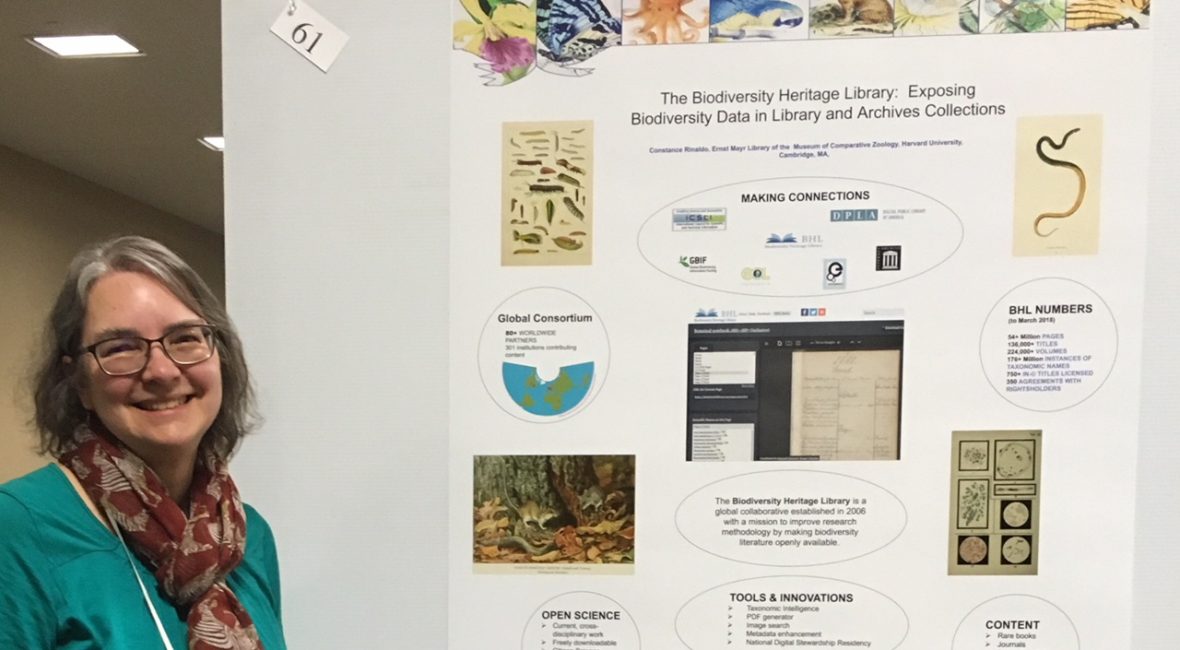
woman in green shirt standing in front of a poster.

The weekend looked promising:  a lovely clear Friday night for a drive to Burlington, Vermont, USA from southern New Hampshire to attend the Northeast Natural History Conference (13-15 April 2018).  What could be better than a hotel humming with botanists and zoologists and activities for them?  The conference was packed—five concurrent sessions (often standing room only) and around 140 posters Saturday and Sunday along with workshops (Bat houses anyone?) and demonstrations throughout the weekend.  Students, faculty and naturalists from colleges, universities and small research or rescue organizations presented posters and talks that focused on New England, New York and Eastern Canadian native vertebrates, invertebrates, plant species diversity and distribution, invasive species and wetland habitats.

woman in green shirt standing in front of a poster.

Constance Rinaldo (Librarian of the Ernst Mayr Library and Museum of Comparative Zoology Archives; Chair of the BHL Executive Committee) standing with her BHL poster at the Northeast Natural History Conference.

Some of the posters that caught my eye (beyond the BHL poster that I presented) included “Restoring Northeast Understory Species: A case of the Primary Literature” presented by Isabel A. Schmitt and Dr. James H. Graves.  They presented a literature review that led to practical methods to reintroduce native species.  Another interesting poster was the “Use of Point-and-Shoot Photography to Compare Regional Differences in Coyote (Canis latrans) Skull Size”.  Osrica Mclean et al developed an online collection of digital images of skulls and calibrated the images so that they could be measured accurately online.

I attended a talk about how specialist and generalist rodents disperse mycorrhizae (Ryan Stephens and Rebecca Rowe) along with a presentation that detailed 42 years of vegetation change on Franconia Ridge in New Hampshire by Charles Cogbill.  Dr. Cogbill used an archive of photographs (from 1860 to present) to identify the effects of hikers on the trail vegetation (much damage is done). Another conference theme was bats and how white nose syndrome has affected bats in New England.   In a talk by Meghan Lout, she described a house in Middlebury, VT from which 550 bats were seen exiting one evening.  The owners were unaware that their house was a haven for bats.

Interacting with so many enthusiastic people studying nature—from observational work to highly experimental research—was inspiring and exciting.  The BHL poster was well received.  University faculty members and naturalists from small organizations stopped by to tell me how much BHL has improved their research workflows. Many students discovered BHL at this conference and were suitably impressed.  I asked for suggestions to enhance BHL and the common theme was “more”.  More content (with some individuals offering resources) and more current materials.  New potential users were surprised that content is available for free download. A few of the more sophisticated users suggested that we needed a taxonomic name authority file so names can be plugged in and the historical names and current names could be viewed as a complete set.

Leaving was somewhat deflating—snow, sleet and freezing rain as only the north country can do it.  Miserable driving, 45 mph tops, cars off the road, 4 hours on the road instead of 3. But so worth it to be among so many people studying the natural world.

May 2, 2018by michelle.underhill
BHL News, Blog Reel

TDWG 2017 Annual Conference: Data Integration in a Big Data Universe: Associating Occurrences with Genes, Phenotypes, and Environments

The Biodiversity Heritage Library is an institutional member of TDWG. TDWG was formed to:

establish international collaboration among biological database projects. TDWG promoted the wider and more effective dissemination of information about the World’s heritage of biological organisms for the benefit of the world at large. Biodiversity Information Standards (TDWG) now focuses on the development of standards for the exchange of biological/biodiversity data.

The TDWG 2017 Annual Conference, the theme of which was “Data Integration in a Big Data Universe: Associating Occurrences with Genes, Phenotypes, and Environments” (see the full program here),  provides the opportunity for bioinformatics professionals to meet and exchange a wide variety of ideas. Held in Ottawa, Ontario, the conference was hosted by Agriculture and Agri-Food Canada and the Canadian Museum of Nature (a BHL Affiliate).

This year, The Biodiversity Heritage Library organized a symposium, “500 Years of Big Data from the Biodiversity Heritage Library”, organized by BHL Program Director Martin R. Kalfatovic and BHL Program Manager Carolyn A. Sheffield. In addition to the BHL symposium, BHL web developer Mike Lichtenberg participated in the symposium “Using Big Data Techniques to Cross Dataset Boundaries – Integration and Analysis of Multiple Datasets”, organized by Kalfatovic, Matthew Collins, and Robert Guralnick.

See details about the symposiums below:

BHL Symposium (abstracts found in the links below)

  • A path to continuous reindexing of scientific names appearing in Biodiversity Heritage Library data / Dmitry Mozzherin, Alexander A Myltsev. Biodiversity Information Science and Standards 1: e20186 (11 Aug 2017)
  • Expanding Access to Biodiversity Literature / Mariah Lewis. Biodiversity Information Science and Standards 1: e20146 (10 Aug 2017)
  • BHL’s Feedback Tools and User Surveys: Investigating User Needs for Data in Digital Libraries / Carolyn A. Sheffield, Pamela McClanahan. Biodiversity Information Science and Standards 1: e20003 (03 Aug 2017)
  • How Did BHL Get to Big Data / Martin R. Kalfatovic. Biodiversity Information Science and Standards 1: e20002 (03 Aug 2017)
  • Scientific Names: Linking the Past to Provide Context for Knowledge / Thomas M. Orrell, David Mitchell. Biodiversity Information Science and Standards 1: e19937 (01 Aug 2017)
  • Crowdsourcing Data Enhancements to Improve Named Entity Recognition in the Biodiversity Heritage Library / Katie Mika. Biodiversity Information Science and Standards 1: e17354 (25 Jul 2017)
From left: Lewis, Orrell, Mozzherin, Mika, Sheffield

Symposium: Using Big Data Techniques to Cross Dataset Boundaries – Integration and Analysis of Multiple Datasets

  • BHL: A Source for Big Data Analysis / Mike Lichtenberg. Biodiversity Information Science and Standards 1: e20339 (16 Aug 2017).

Excursion

TDWG also offered the opportunity for excursions. The Canadian Museum of Nature (CMN) provided an amazing tour of their collections facilities located just outside the city. The CMN library is also located at this facility and it was great to meet with the library staff and see their collections.
November 17, 2017by
BHL News, Blog Reel

Report on the XIX International Botanical Congress, Shenzhen, China, July 2017

View Full Size Image
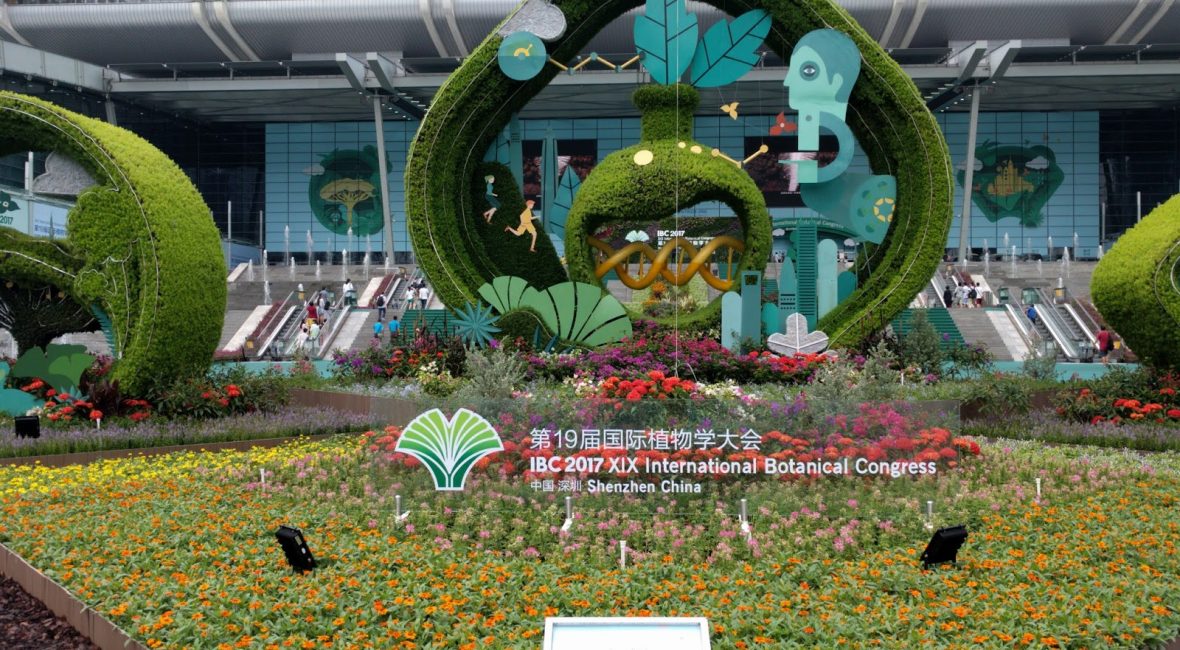
XIX IBC 2017

Along with BHL Program Manager Carolyn Sheffield, I represented BHL as a delegate to the XIX International Botanical Congress in Shenzhen, China. Held during the week of 24-28 July 2017, the Congress (which is held every five years) drew over 6,000 botanists from around the world.

The Congress provided an excellent opportunity to catch up with colleagues from around the world and learn about some of the latest botanical research.

SHENZHEN DECLARATION AND PUBLIC TALKS 

View Full Size Image
IBC logos on Shenzhen skyline

The program was divided into plenary talks, keynote talks, general symposia, and public lectures (see abstracts for all here). The Congress opened with a public lecture by Peter H. Raven, President Emeritus of the Missouri Botanical Garden. Raven’s talk, “Saving Plants to Save Ourselves: The Shenzhen Declaration” was on the public announcement of the Shenzhen Declaration on Plant Sciences. Authored by fourteen illustrious botanists that formed the Shenzhen Declaration Drafting Committee, the declaration is an important statement on the role of plant science in a changing world. The declaration opens with:

“Actions and priorities to connect the global community of plant scientists with the world’s changing societies are today more imperative than ever. Environmental degradation, unsustainable resource use, and biodiversity loss all require integrated, collaborative solutions.”

Noting the changing world we inhabit, the change evidenced by increased species extinction, global climate change, rapid changes in the practice of plant science, and refactoring of the world’s economy, the declaration outlines seven priorities for strategic action in the plant sciences. These priorities will “allow society, with the help of science, to mitigate impacts of human activities on plant species, habitats, and distributions, and to approach formation of a sustainable world for ourselves and those who follow us.”

These seven priorities are:

  • To become responsible scientists and research communities who pursue plant sciences in the context of a changing world.
  • To enhance support for the plant sciences to achieve global sustainability.
  • To cooperate and integrate across nations and regions and to work together across disciplines and cultures to address common goals.
  • To build and use new technologies and big data platforms to increase exploration and understanding of nature.
  • To accelerate the inventory of life on Earth for the wise use of nature and the benefit of humankind.
  • To value, document, and protect indigenous, traditional, and local knowledge about plants and nature.
  • To engage the power of the public with the power of plants through greater participation and outreach, innovative education, and citizen science.

Raven’s inspiring talk on the Declaration was a brilliant opening to the Congress (and was touched upon by nearly all speakers for the remainder of the Congress) and concluded with a rousing call to action: “Let us make this Congress a time of commitment to do better and resolutely seek a sound and sustainable future for all people.”

View Full Size Image
Sandra Knapp

Another public lecture of note was by Sandra Knapp (Natural History Museum, London): “People and Plants — the Unbreakable Bond”. Knapp noted “Plants form the scaffold for Earth’s green ecosystems, but they are also essential for human survival. Plants provide most of the food we eat (directly or indirectly), our medicines, clothes, buildings, and even the air we breathe; they also beautify our daily lives.” Knapp further detailed the importance of plants to humans and then pivoted to ask, “So we need plants, but do they need us?” Knapp’s answer was yes:

“In this time of increasing human impact on plants, animals and natural habitats, our actions can make a big difference in whether plants are a part of an ecological civilization for the future. Plants do in fact need us – they need us to study and use them responsibly, both as scientists and as members of human societies.”

KEYNOTE AND PLENARY TALKS

The Congress presented a number of excellent keynote and plenary talks. Of special note were the following:

“Tropical Plant-Animal Interactions: Coevolution in the Anthropocene” by W. John Kress (Smithsonian Institution, National Museum of Natural History). Kress illustrated his talk with research on the interaction of beetles, humming birds, and Zingiberales (including bananas, birds-of-paradise, heliconias, gingers, and prayer plants). Kress concluded with, “The geographic mosaic of these relationships across tropical islands, fragmented landscapes, and elevational gradients suggests that human-caused habitat alterations, biological invasions, and climate change may significantly modify and disrupt through time and space the historical patterns of ecological interactions. The future of today’s biological complexity in the Age of Humans, in the Anthropocene, remains to be determined.”

View Full Size Image
W. John Kress

“International developments and responsibilities for the botanical community in plant conservation” by Peter Wyse Jackson (Missouri Botanical Garden). Wyse Jackson provided a high level overview of the importance of the Global Strategy for Plant Conservation (GSPC), part of the United Nations Convention on Biological Diversity, and showed how individual institutions can help achieve the 2020 targets of the GSPC. He specifically noted how the Missouri Botanical Garden is working in the areas of conservation biology, ecological restoration, community conservation and education programs, horticulture and ex situ conservation towards this end. The World Flora Online project, based at the Missouri Botanical Garden and with partners worldwide, was previewed at the Congress and is a first target of the GSPC.

View Full Size Image
Peter Wyse Jackson

“Mapping Asia Plants” by Keping Ma (Institute of Botany, Chinese Academy of Sciences). Ma provided an excellent overview of a number of resources that are helping to document plant life in Asia. Ma commented, “Because of the huge population and rapid growth of economy, biodiversity including plants are being seriously threatened in Asia.” He also detailed the work of the Asia Biodiversity Conservation and Databases Network (ABCDNet) project, entitled Mapping Asia Plants for cataloguing species of plants and collecting distribution data. The importance of the Biodiversity Heritage Library China (BHL China) in providing access to literature was noted.

View Full Size Image
Keping Ma

“Developing integrative systematics in the informatics and genomic era” by Jun Wen (Smithsonian Institution, National Museum of Natural History). “Systematics is the science of discovering, organizing and interpreting the diversity of all living organisms on Earth. Recent developments in genomics and biodiversity informatics are transforming systematics and have opened up many new opportunities.” With that statement, Wen outlined the opportunities of big data, digitization, and genomics in developing the tree of life. The wider importance of this work was driven home as Wen noted “integrative systematics must proactively educate the public and policy makers on the importance of systematics and collections in the biodiversity crisis of the Anthropocene.”

View Full Size Image
Jun Wen

“Thinking through the e- in e-Floras; or, Floras old, new, and not-yet” by Kevin Thiele (Western Australian Herbarium). Thiele delivered an provocative talk that touched upon the very core of how plant scientists do their work and to what level much of the scientific output is wedded to 19th century methods of dissemination while we are living well into the 21st century. He illustrated this with how many “e-floras” simply reproduce print methodologies. He challenged the audience to consider, “If modern taxonomy and systematics were invented, or re-invented, now (in the age of the internet, social media, citizen science and the block chain), rather than in the 18th Century, would we do it all differently?”

View Full Size Image
Kevin Thiele

In perhaps the most inspirational talk of the Congress, Stephen Blackmore (Royal Botanic Garden Edinburgh) spoke on the seemingly simple topic, “Saving Plants”. Blackmore drew on his personal experience in Pearl River Delta area to tie together the different sectors and stakeholders that are needed to create a world where plants, and by extension, humans, can both survive and thrive. Blackmore focused on the contributions of botanic gardens, arboreta, seed banks and other collections of living and preserved plants to achieve the goal of saving plants. Blackmore ended on the note that “we will need to work closely together if we are to succeed in passing on the Earth’s rich, green inheritance to future generations.”

View Full Size Image
Stephen Blackmore

BIODIVERSITY HERITAGE LIBRARY SYMPOSIUM 

View Full Size Image
Speakers at the BHL Symposium

For the Congress, I, along with Carolyn Sheffield, organized a general symposium, “The Biodiversity Heritage Library: Empowering Discovery through Free Access to Biodiversity Knowledge” with colleagues from the Biodiversity Heritage Library‘s global partners. Presenters at the symposium were:

  • The Biodiversity Heritage Library: Empowering Discovery through Free Access to Biodiversity Knowledge | Martin R. Kalfatovic (Biodiversity Heritage Library / Smithsonian Libraries)
  • Real use cases for Semantic Information in BHL | William Ulate (Center for Biodiversity Informatics, IT Department, Missouri Botanical Garden)
  • A Checklist of the Orders and Families of Medicinal Plants in the Philippines | Harold Carag (The Graduate School, University of the Philippines, Los Banos)
  • The Development and Progress of BHL China | Zheping Xu (Institute of Botany, Chinese Academy of Sciences)
  • The Challenges of a Botanical Library in the Tropics and the Need for Restoration and Digitisation of Materials | Nura Abdul Karim (Singapore Botanic Gardens, National Parks Board)
  • Building Botanical Literature Collections for Global Use: Highlights from the Biodiversity Heritage Library | Carolyn Sheffield (Biodiversity Heritage Library / Smithsonian Libraries)

OTHER SYMPOSIA 

Many familiar colleagues participated in the General Symposium, “Green digitization: online botanical collections data answering real-world questions”, organized by Shelley A James (Florida Museum of Natural History, USA) and Gil Nelson (Florida State University, USA).

Talks at the symposium included:

  • Rebranding botanical collections: Global societal and biodiversity data needs for novel research | Shelley James
  • Invasive or Not? A collection-based investigation of a historically unseen, persistent green algal bloom on Pacific coral reefs | Tom Schils [unable to present]
  • Current status and the applications of online botanical collection data in China | Zheping Xu
  • Virtual Herbaria tracking usage and benefits for biological collections: An example from Australasia | David Cantrill
  • Developing standards for scoring phenology from herbarium specimens | Jenn Yost
  • From field collections to digital data: A workflow and digitization pipeline for reconstruction of a fossil flora | Dori Contreras [delivered in abstentia]

OTHER ACTIVITIES 

View Full Size Image
Artron (photo by Ivan Lee @ Artron)

A number of excursions were organized for delegates. I participated in one excursion that highlighted the hi-tech industry that has led to Shenzhen growing from a small fishing village to a world-class city with a population of 15 million in less than 40 years. The first stop was at UBTECH, a robotics start-up company that markets a robot that can interact with digital assistants (such as the Amazon Alexa). The next stop was Nirvana for this former art librarian: Artron, a world-class printer that produces art books and catalogs for the museums and galleries of the world. We visited their library and exhibition spaces. The focal point of the facility was the “Wall of Art Books.” Over 150,000 art books are on display in a four story space (that has to be experience to be believed). All books are available to view by members of the Artron private library. We visited the private library, consisting of 20 themed rooms (e.g. “Japanese Vintage Books” and “The Business of Art”) as well as the main reading room with a touch pad catalog where readers can page books (after pre-viewing full-text digitized versions). After leaving the Artron facility, I couldn’t help but imagine this is how the brick and mortar library of the future will look.

View Full Size Image

My second excursion was more on a botanical point. The Fairy Lake Botanical Garden is a 546 ha botanical garden which compares favorably with the great gardens of the world. First stop was the shade garden and butterfly pavilion, followed by the Fairy Lake and the palm area. We also had the opportunity to visit the National Cycad Conservation Center, which includes a fabulous collection of cycads from around the world and also a fossil collection. The Fairy Lake Botanical Garden also has a spectacular petrified forest area, with huge amounts of petrified wood that have been “planted” to look like a forest. We also stopped in at the Shenzhen Paleontological Museum (some dinosaurs and nice trilobites, my favorite extinct invertebrate!).

View Full Size Image
With Sandra Knapp and Peter Raven

The Congress featured a mid-week Gala that provided an opportunity to recognize the work of organizers and the program committee. The Gala also showcased a wide variety of Chinese entertainment that ranged from classical instrumentalists, to dancers and acrobats, to a Chinese doo-wop group. The accompanying buffet featured a number of tasty offerings.

IN SUMMARY 

The XIX International Botanical Congress was a unique opportunity for the Biodiversity Heritage Library to meet with colleagues from around the world (and from down the hall) to discuss important issues related to plant science and how we, as librarians, can work with plant scientists to accelerate their work and to achieve the aspirational goals as outlined in the Shenzhen Declaration.

View Full Size Image
XIX IBC 2017 at Night
August 9, 2017by
Page 1 of 51234»...Last »

Help Support BHL

BHL's existence depends on the financial support of its patrons. Help us keep this free resource alive!

search

About BHL

The Biodiversity Heritage Library (BHL) is the world’s largest open access digital library for biodiversity literature and archives. BHL operates as a worldwide consortium of natural history, botanical, research, and national libraries working together to digitize the natural history literature held in their collections and make it freely available for open access as part of a global “biodiversity community.”

Join Our Mailing List

Sign up to receive the latest news, content highlights, and promotions.

Subscribe Now

Subscribe to Blog via Email

Enter your email address to subscribe to this blog and receive notifications of new posts by email.

Join 319 other subscribers

Subscribe to Blog Via RSS

Subscribe to the blog RSS feed to stay up-to-date on all the latest BHL posts.

Access RSS Feed

Inspiring Discovery through Free Access to Biodiversity Knowledge.

The Biodiversity Heritage Library makes it easier than ever for you to access the information you need to study and explore life on Earth…for free, anytime, anywhere.


64+ Million Pages of
Biodiversity Literature Online.

EXPLORE

Tools and Services
to Transform Research.

EXPLORE

300,000+
Illustrations on Flickr.

EXPLORE

ABOUT | HARMFUL CONTENT | PRIVACY | SITE MAP | TERMS OF USE