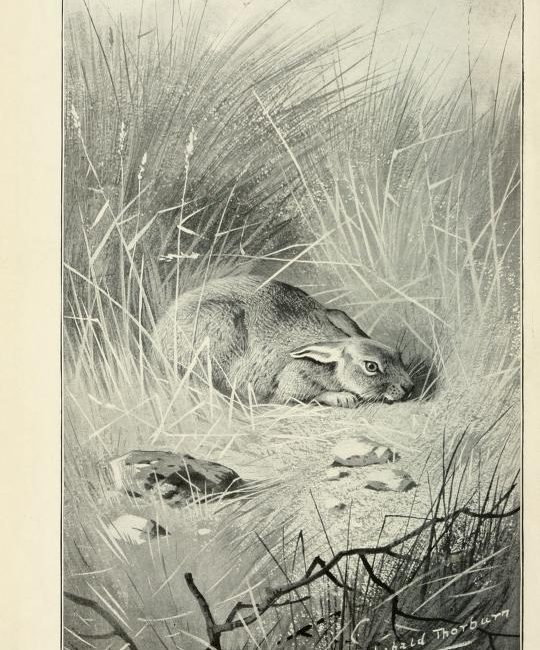
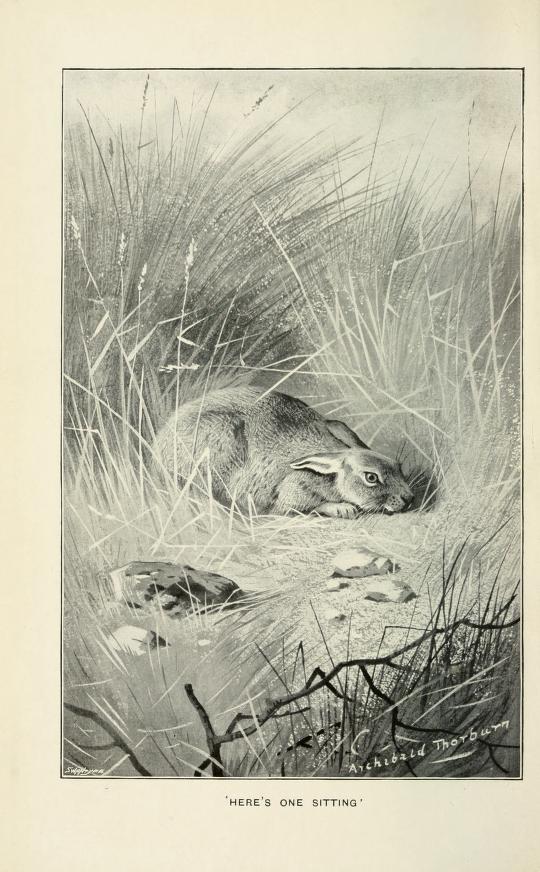
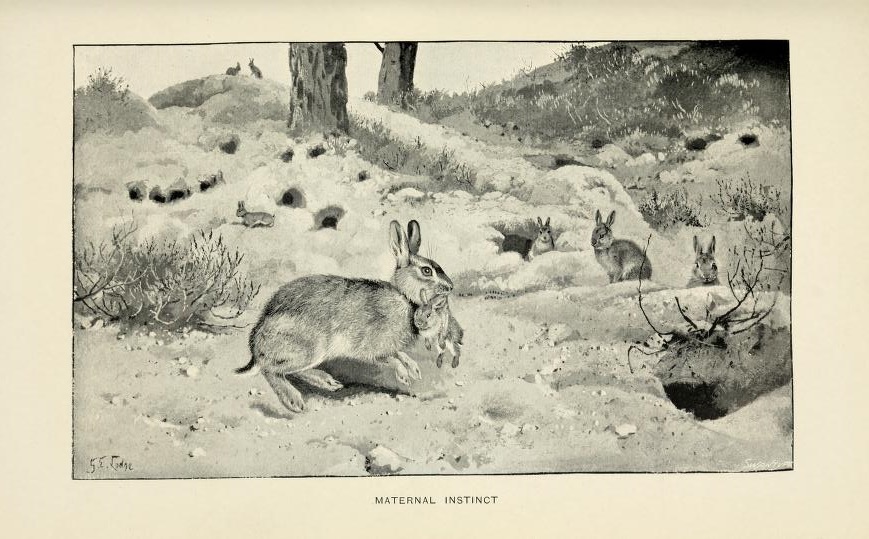
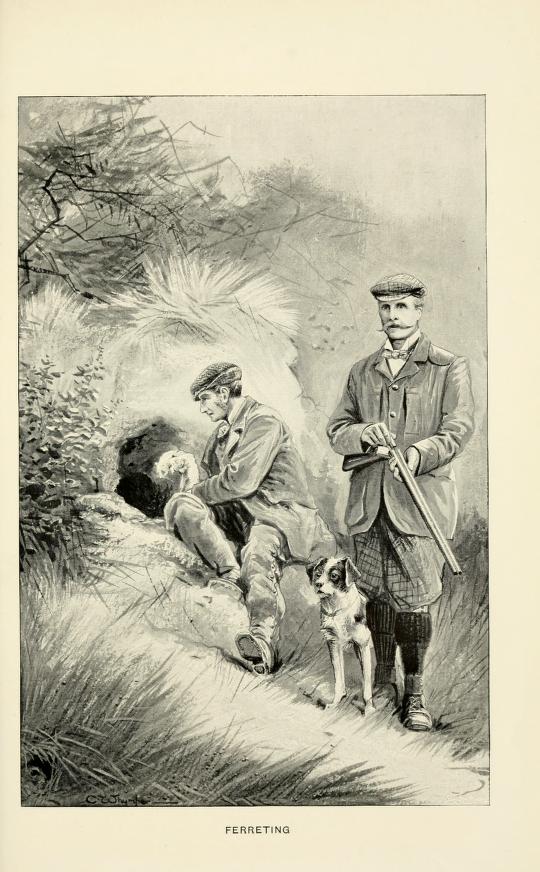
In celebration of Beatrix Potter’s birthday on July 28th, 1866, today’s book of the week explores rabbits: The Rabbit, by James Edmund Harting, with a Chapter on Cookery, by Alexander Innes Shand. This book was published in 1898 as part of the Fur, Feather and Fin Series, edited by A. E. T. Watson, that explored all kinds of wildlife and how to hunt and cook it (Frontmatter). The book contains beautiful illustrations of European rabbits engaged in various activities, and describes rabbit behavior and physiology. The following are examples of illustrations from Harting’s book:
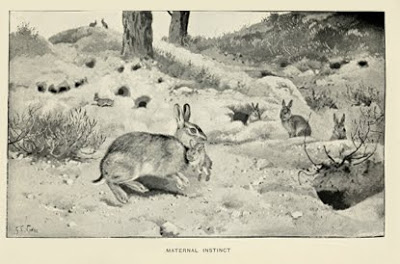
A mother rabbit returning her baby to the burrow (
21)
Hunters using a ferret to scare rabbits out of the burrow in order to shoot them (
95)
Beatrix Potter was another illustrator who created lovely pictures of rabbits. It is not surprising that Potter created such realistic illustrations of rabbits and rabbit behavior because she studied rabbit physiology and behavior in depth from the time she was a young child. Potter was born into a nouveau riche family which had inherited large sums of money from relatives, and she grew up being cared for by governesses in a large home in Kensington, London. Her parents did not bother themselves with paying much attention to her, and she “took her meals separately and seldom saw her parents except for a short visit in the evening” (MacDonald 231). As a result, Potter had several small animals as pets to keep her company “that were sometimes hardly tame,” including frogs, mice and rats (MacDonald 231). Potter began keeping a journal in 1881 in order to avoid boredom, and she continued to write and sketch in it for over a decade, writing “in code and in a hand so small as to be virtually impenetrable” (MacDonald 231). She visited local museums to study animal physiology, and when her family spent four months out of the year in the Lake District in England during Easter and summer vacations, Potter got even more in-depth physiology lessons about local wildlife:
Apparently allowed to roam unsupervised, Potter and her brother skinned and boiled dead animals until only the skeletons remained to be examined. . .In the museums Potter found special pleasure in studying and sketching animal skeletons. Her later understanding of the way animal bodies functioned made her illustrated animals particularly vital–no false movement, no oddly shaped limbs–so that they always remain true to their various species. Because the Kensington museums also preserved such decorative, domestic artifacts as furnishings and clothing, Potter accumulated various subjects in her sketchbooks, using them to study perspective to much advantage in her later books, where the low-to-the-ground vantage points of her animals show familiar objects from new angles. (MacDonald 231-2)
Potter’s initial entry into the publishing world came when illustrating greeting cards and the works of other authors, and when she published a scientific paper in 1897 on the reproductive cycles of certain mushrooms–mycology being an early passion of hers. Her paper, “On the Germination of the Spores of the Agaricineae,” had to be presented by a male friend of the family to the Linnaean Society of London since women were not allowed involvement with scientific groups yet; all of her findings in this paper have since been proven accurate. When a family friend suggested she publish a children’s book, she published an early version of The Tale of Peter Rabbit in 1901 with money that she had made illustrating greeting cards. The Warne publishing house heard of Potter’s book and agreed to reprint it, beginning a longstanding relationship between Potter and the publishing company (MacDonald 233).
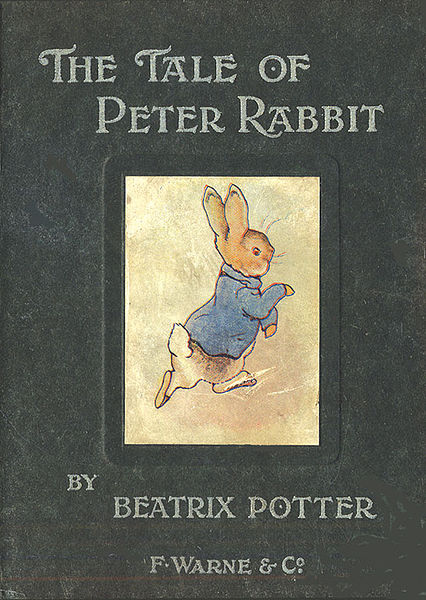
An image of a first-edition 1902-version of The Tale of Peter Rabbit
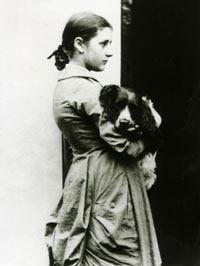
Beatrix Potter at 15 years of age, holding her pet springer spaniel, Spot.
The plot of Peter Rabbit’s tale closely reflects the rabbit behavior described in Harting’s book, The Rabbit–namely the part of the plot where Peter escapes into a farmer’s garden and eats a lot of the farmer’s vegetables, barely escaping capture by the farmer, and later returning to the safety of his mother’s burrow. Harting has described rabbits as voracious eaters compared with other animals, even as the cause of famine in the Spanish Balearic islands during the rule of Emperor Augustus (Harting 3), and includes a farmer’s description of the rabbits’ particular eating style:
A Suffolk farmer, who is a good sportsman as well as shrewd observer of facts connected with natural history, asserts that you may generally tell whether your turnips are nibbled by hares or rabbits by the difference in the mode of attacking the roots. A hare will bite off the peel and leave it on the ground; a rabbit will eat peel and all. (Harting 6)
Harting goes on to describe how rabbits also eat turnips more voraciously than rats do since “a rat when eating a turnip. . .will bit off the rind, as a hare does, and will leave it in chips on the ground; a rabbit. . .will eat peel and all” (Harting 6-7). Another trait, aside from a large appetite for vegetables, which Harting’s descriptions have in common with Potter’s character, Peter Rabbit, is that of quick escape. The purpose of the white underbelly of a rabbit, according to Harting, is to alert fellow rabbits when danger is near so that all can escape:
The advantage of having a white under-surface to the tail is also apparent on reflection; for when, on the approach of an intruder while rabbits are out feeding, those nearest to him begin to scuttle away, the little white flag in motion at once attracts the attention of others, and all speedily make for their burrows. (Harting 7-8)
Harting also recounts some interesting rumors about the origin of rabbits and the term, “rabbit,” in western Europe, as well as some fascinating facts about their resilience. Harting proposes that the rabbit was introduced to England by the Romans, who also brought the ferret to hunt the rabbit when it became too populous (Harting 1). The Romans apparently learned from rabbits how to dig tunnels into enemy territory in order to conquer the land: “The Latin word cuniculus denotes both a rabbit and an underground passage. Varro suggests that the rabbit derived its name from the burrow it forms, and Martial avers that rabbits first taught men to undermine enemies’ towns” (Harting 3-4). The origin of the term, “rabbit,” begins with the Latin cuniculus, then the Italian coniglio, the Spanish conejo, Belgic konin, Danish and Swedish kaning, German kaninchen, Old French connin, Welsh cwningen, and Old English conyng and coney. The Middle English term, “rabbet,” had only been used to describe young rabbits. Another Middle English term for the rabbit was “riote,” which is the origin of the phrase “to run riot” (Harting 4). Harting notes that rabbits are resilient, such that:
If by any accident the lower jaw of the animal is displaced, as occasionally happens from the impact of a shot, the incisors in the fractured jaw are distorted, and do not meet those above them, and as they are not then worn away by use, they continue to grow, sometimes to extraordinary length. The manner in which animals thus deformed adapt themselves to new conditions is marvelous. They not only contrive to feed, but to live a long time after the injury, as shown by the ossified condition of the fracture when at length it comes to be examined. (Harting 5-6)
Rabbits are not only resilient, but also able to adapt to become family friends and pets:
When taken young and domesticated, wild rabbits not only become soon accustomed to the altered conditions of life, but will live for many years in captivity. One, which was captured in Buckinghamshire when about ten days old and brought to London, had the run of the house and area, was tame, amusing, and cleanly in its habits. It would follow the cook about like a dog, and was a constant playmate in the nursery. In these circumstances it lived for six years. (Harting 12)
It is no surprise, then, that Beatrix Potter became fascinated by these little creatures, as Harting describes them as smart and adaptable, and as his illustrations show them to be adorable. Potter’s children’s stories and illustrations are a testament to her love and close observation of the rabbit. Happy birthday, Beatrix Potter! Here’s to your, and our, interest in these remarkable animals!
Check out all of the illustrations to Harting’s book, The Rabbit, at our Flickr stream: http://www.flickr.com/photos/biodivlibrary/sets/72157627295131062
For more information about Harting’s book and some more info about rabbits, check out an older post BHL wrote on it here: https://blog.biodiversitylibrary.org/2011/02/year-of-rabbit.html
Resources:
-
- Harting, James Edmund. The Rabbit. London: Longmans, Green, and Co., 1898.
-
- MacDonald, Ruth K. “Beatrix Potter.” British Children’s Writers, 1880-1914. Ed. Laura M. Zaidman. Dictionary of Literary Biography Vol. 141. Detroit: Gale Research, 1994. pp. 230-248.