Biodiversity Heritage Library - Program news and collection highlights from BHL
  • Home
  • News
  • Featured Books
    • All Featured Books
    • Book of the Month Series
    • BHL at 20
  • User Stories
  • Campaigns
    • Fossil Stories
    • Garden Stories
    • Monsters Are Real
    • Page Frights
    • Her Natural History
    • Earth Optimism 2020
  • Tech Blog
  • Visit BHL
Home
News
Featured Books
    All Featured Books
    Book of the Month Series
    BHL at 20
User Stories
Campaigns
    Fossil Stories
    Garden Stories
    Monsters Are Real
    Page Frights
    Her Natural History
    Earth Optimism 2020
Tech Blog
Visit BHL
  • Home
  • News
  • Featured Books
    • All Featured Books
    • Book of the Month Series
    • BHL at 20
  • User Stories
  • Campaigns
    • Fossil Stories
    • Garden Stories
    • Monsters Are Real
    • Page Frights
    • Her Natural History
    • Earth Optimism 2020
  • Tech Blog
  • Visit BHL
Biodiversity Heritage Library - Program news and collection highlights from BHL
Blog Reel, Featured Books

The Power of Community Science: How Smithsonian Volunpeers Transform Scientific Field Notes

Screenshot of Smithsonian Transcription Center displaying handwritten journal next to transcribed text

Last month, Smithsonian Libraries and Archives (SLA), Smithsonian Transcription Center (STC), and the Biodiversity Heritage Library (BHL) celebrated a significant milestone – technical staff worked collaboratively to integrate over 43,000 pages of transcription materials from STC into BHL. An additional 151,362 scientific name access points have now been added to the BHL search index for SLA archival field notes. These transcriptions enhance BHL’s full-text search, enable taxonomic name recognition, improve accessibility for vision-impaired users, and support climate research.

The Smithsonian Field Books Collection
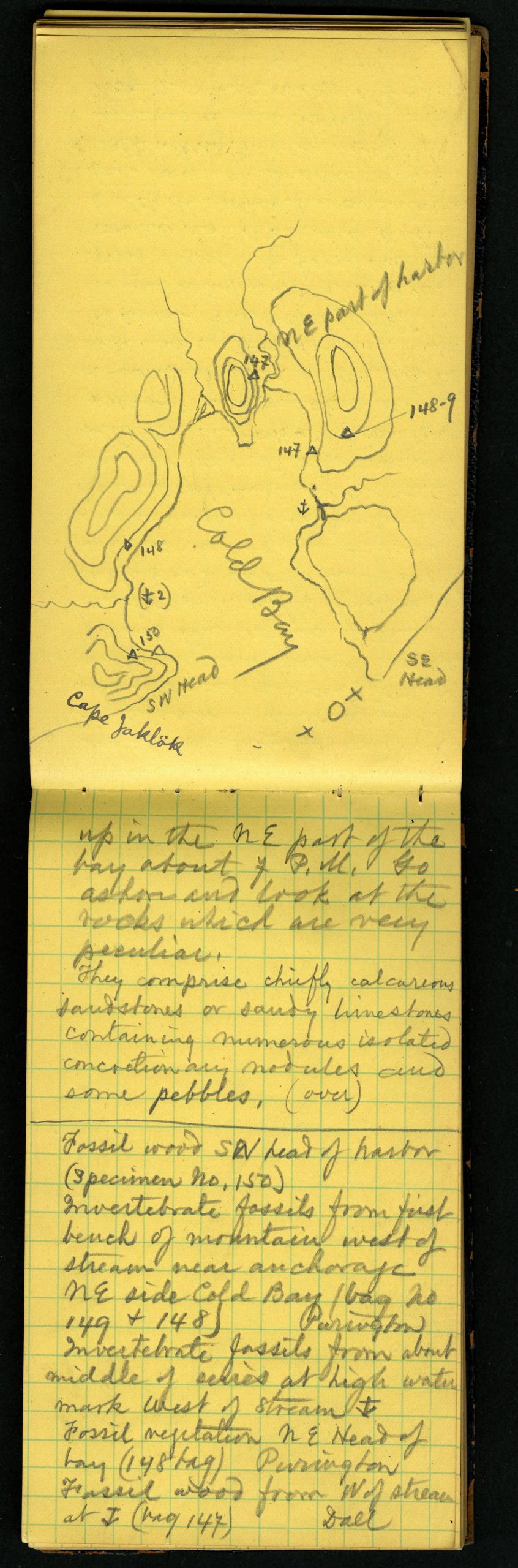
Yellow notebook with handwritten text and handdrawn map

Dall, William Healey. (1895). Alaska Coal Fields, Bogosloff Volcano, Corral Hollow, California, 1895 (Vol. 1, pp. 81 and 82).

The Smithsonian Field Books Collection is a set of primary source archival records selected from the Smithsonian Libraries and Archives (SLA). This material dates from the late nineteenth century and the first comprehensive biological survey of the continental United States to the most recently accessioned materials at the Smithsonian Institution Archives.

The collection includes personal records of naturalists and scientists such as William Healey Dall (1845 – 1927) and Cleofe Calderon (1929 – 2007) at work around the world and expedition records such as the Western Union Telegraph Expedition (1865 – 1867) of Russian America and the United States Exploring Expedition (1838 – 1842) of the Pacific Ocean.

Naturalists and scientists in the field recorded their firsthand observations and data in a wide variety of forms including diaries and journals, hand-drawn maps and tables of data, observation logs and specimen catalogs, correspondence and reports, manuscripts, sketches, photographs, even audio recordings.

Recognizing the Value of Accurate Transcription

Mining the rich information embedded in these field notes depends on accurate transcription. The majority of the field notes are handwritten – even the most recent ones. Digital surrogates provide high resolution images but fail to afford anything beyond visual accessibility. Transcription, however, opens up this material to full-text searching, pattern recognition, visual accessibility aids, and more.

Beyond the handwriting itself, the field notes also contain other non-textual information that can only be captured through transcription. Examples include ornithologist Martin Moynihan’s notations of bird song in remote regions of Central America or Charles Dolittle Walcott’s sketches and diagrams of sedimentary stratification where his fossil specimens were found in the canyons of the American Southwest.
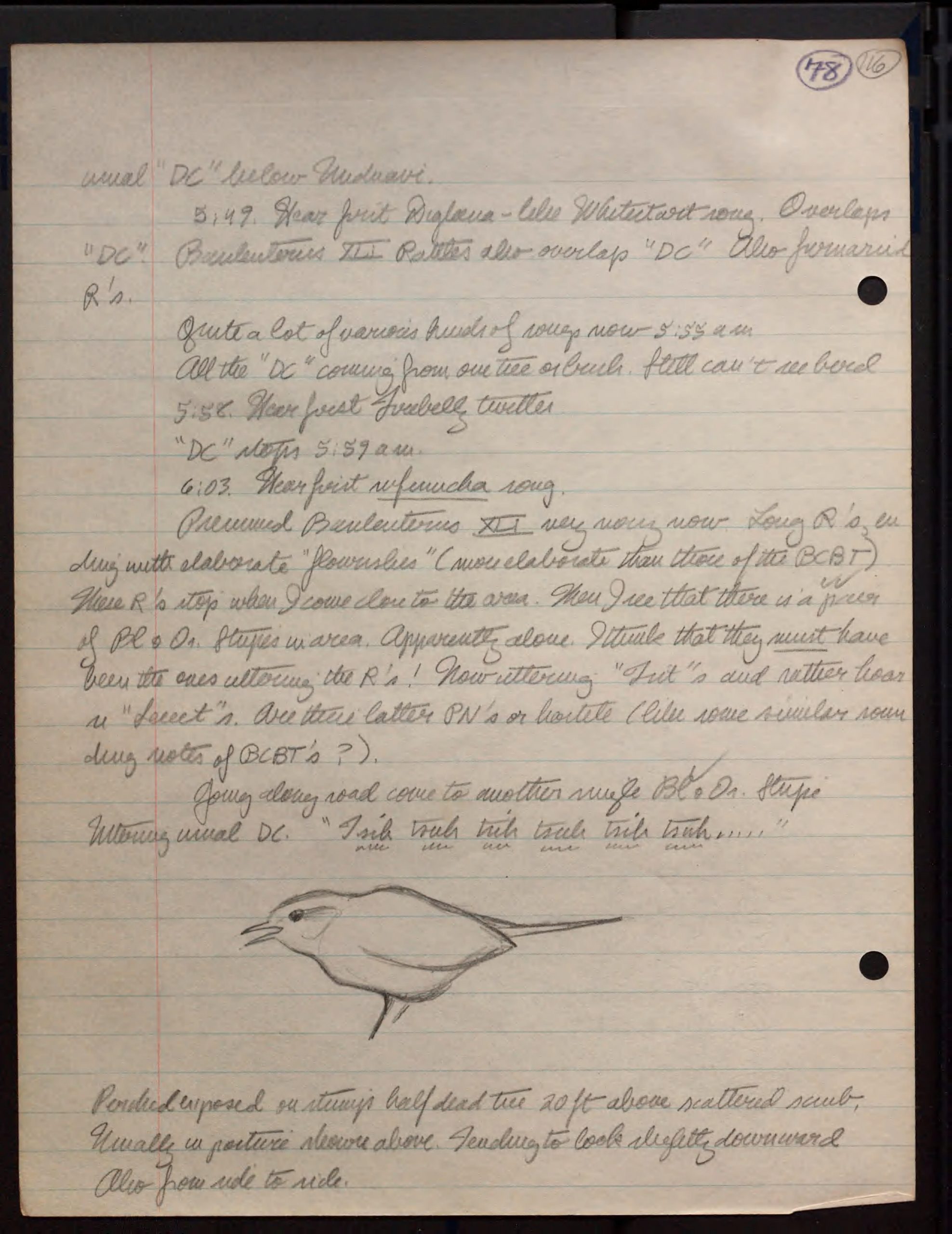
Handwritten notes with a drawing of a bird

Moynihan, M. (1963). 1962-1965 Andean Birds Mixed Flocks, Colombia, (4 of 4) (p. 78).

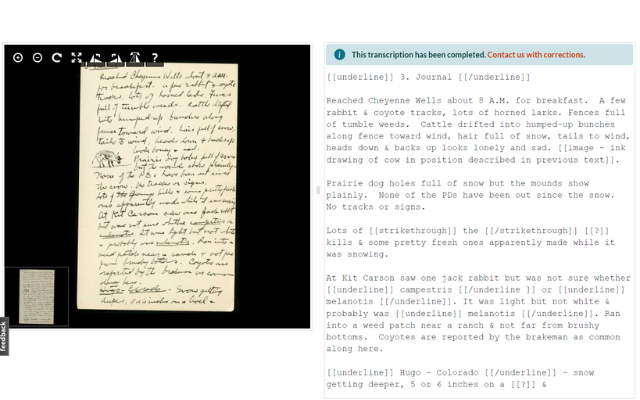
Chief naturalist with the U.S. Department of Agriculture, Vernon Orlando Bailey’s “Journal kept by Bailey on field trip to Wyoming and New Mexico, March 15-June 1906” focused on extermination techniques of gray wolves that would bring them to near extinction in the continental United States not long afterwards. The transcript includes descriptions of the sketches he included in his notes.
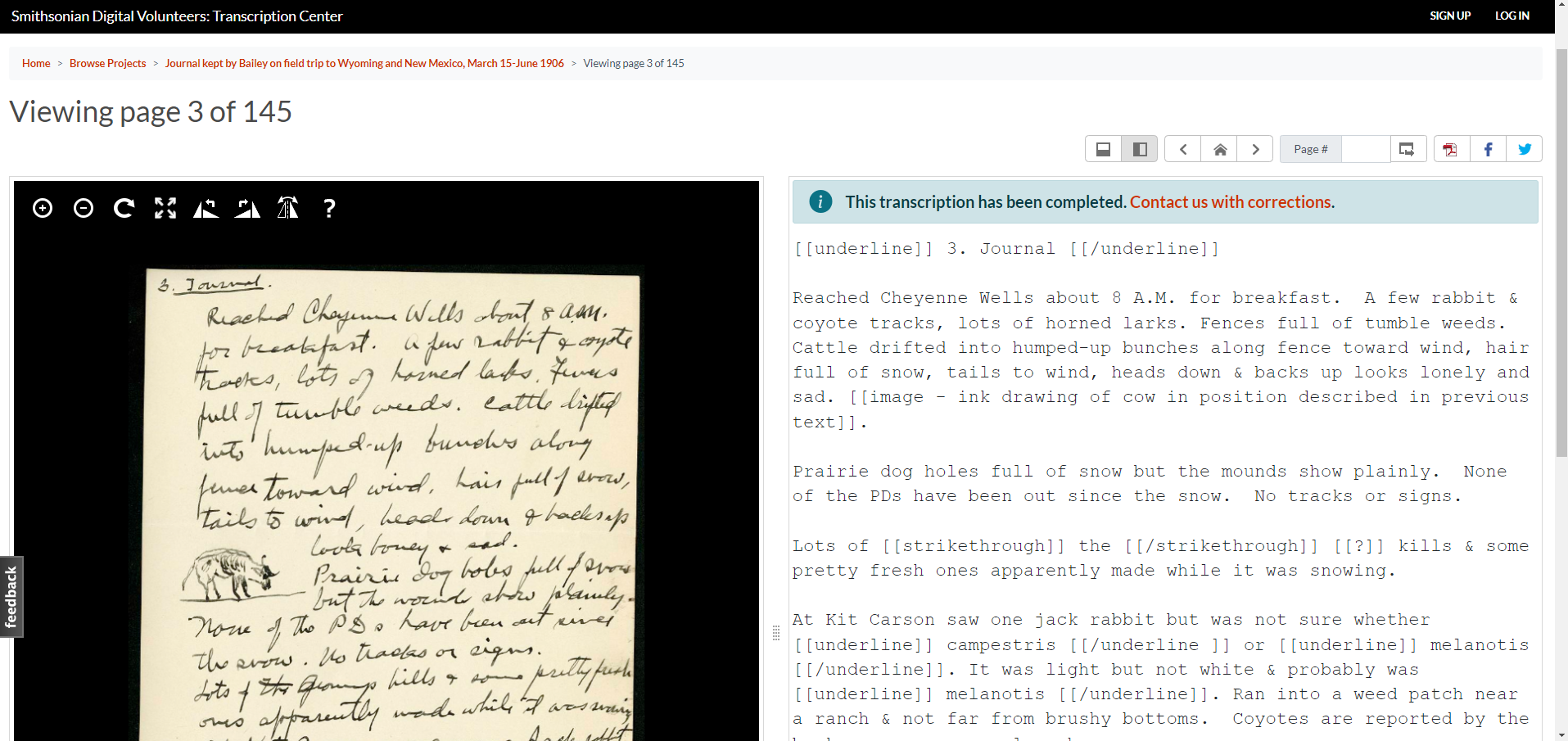
Screenshot of Smithsonian Transcription Center displaying handwritten journal next to transcribed text

Smithsonian Transcription Center image with corresponding transcription, including a text description of an ink drawing of a cow. https://transcription.si.edu/view/6656/EBOtg

The Smithsonian Field Book Project’s initial goal was to catalog these hidden biodiversity research material, improving discoverability in keeping with FAIR (Findable Accessible Interoperable Reusable) Data Principles. Doing so quickly resulted in additional researcher demand for more access and usability – first to view the field notes online (digitization) and then to examine them more closely (transcription). Grant funding assisted in a major rapid-capture digitization effort. However when it came to transcribing the digitized field notes, the Archives simply lacked the capacity to meet the level of researchers’ demand.

Turning to digital volunteers and the just-launched Smithsonian Transcription Center in 2013 changed the transcription equation beyond our best expectations both in volume and in accuracy. We quickly came to recognize these community scientists as collaborators, “volunpeers”, in the effort to advance and disseminate knowledge.

We are far from the end of this journey. More than half the collection remains to be digitized, and over two thousand digitized field notes still need transcription.

Inspired to Transcribe

These archival field notes contain vital historic biodiversity information. By transcribing the handwriting into machine readable text, volunpeers can help inform current day scientists and assist with their research on a multitude of topics such as climate change, the extinction crisis, or the spread of invasive species. Transcribing field notes can also take volunpeers on an adventure across time and distance, accompanying the writer on their journey. Having these adventures transcribed in machine readable text can also help inform science historians assisting them by making these historic documents more easily findable, searchable, and reusable.

Volunpeers collaborate to transcribe as accurately as possible the pages of the field journals provided. Multiple volunpeers will work on each project page transcribing the hard-to-read handwriting into machine readable text. Once satisfied the transcription is as complete as possible, a volunpeer will mark the transcribed page as complete. The volunpeers will then move onto the next page of the field notes until the project is finished.
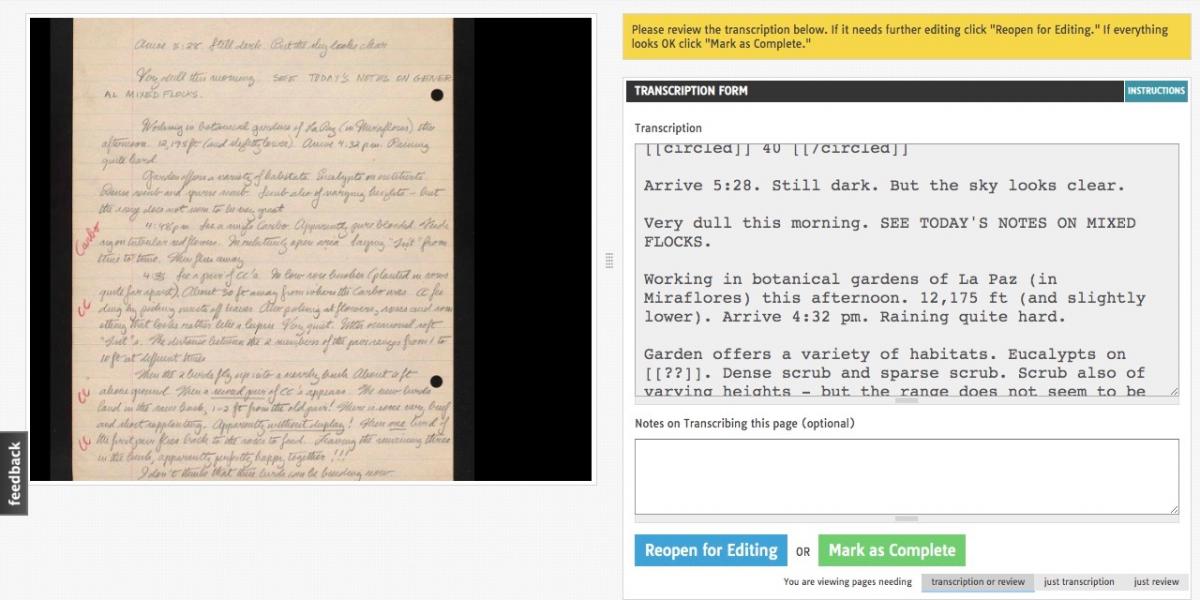
Approval workflow for Smithsonian Transcription Center

Review is the second step in the transcription process.

Having many volunpeers working on one project helps ensure the quality of the transcription. What one volunpeer finds illegible, others may be able to read, especially as all the volunpeers working on a particular project become more familiar with the handwriting.

Volunteers have transcribed hundreds of field journals over the years. Two favorite examples have been the field journals of Vernon Orlando Bailey, a field naturalist who journeyed throughout the U.S. midwest studying and collecting mammals. Another volunpeer favorite were the papers of Arctic explorer and naturalist Robert Kennicott. Read more about these volunpeer experiences on the STC blog.

The Power of the Smithsonian Transcription Center

When the first of the field books were added to Smithsonian Transcription Center (STC), the program was still available only as a beta version. Approximately 450 volunpeers were transcribing on the site (co-author Siobhan Leachman among them), with the first 6,000 completed pages under their belt. Even during this moment of immense energy and fresh connections, it must have been difficult to imagine what STC would become. Today, a little over a decade later, more than 91,000 individual volunpeers have worked together to transcribe and review over 1.4 MILLION (!) pages of historic and scientific collections.

STC is the largest digital volunteering and crowdsourcing program at the Smithsonian Institution, and provides opportunities to engage with and contribute to digitized materials from across the full breadth of content areas represented by its museums, archives, and libraries. Through collaborative transcription and review, Smithsonian staff and digital volunteers work together to ensure that this content is more readable, accessible, and text-searchable across Smithsonian data systems and beyond.

Currently, the most active and popular projects are the Freedmen’s Bureau Transcription Project, a collaboration with the National Museum of African American History and Culture that deepens insight into the Reconstruction period and empowers African American genealogical research, and Project PHaEDRA, a collaboration with the Harvard-Smithsonian Center for Astrophysics that illuminates the work and discoveries of early women computers at the Harvard College Observatory.

If you feel inspired by this data access success story, consider joining the digital volunteer community, or sign up for our newsletter to stay up-to-date on upcoming projects.

Reusing the Liberated Data

The successful integration of transcription materials into BHL makes historical scientific data more accessible and useful. Through the collaborative efforts of technical staff from the Biodiversity Heritage Library, Smithsonian Libraries and Archives, and the Smithsonian Transcription Center and dedicated volunpeers, over 151,362 scientific name access points were added to the BHL search index, greatly enhancing search capabilities over the digitized corpus of Smithsonian field notes and archives. Out of the 556 eligible items reviewed, 522 were uploaded, contributing 43,460 pages of improved OCR text. These contributions not only improve BHL’s full-text search and taxonomic name recognition services but also provide better accessibility for vision-impaired users, and support ongoing biodiversity and climate change research.
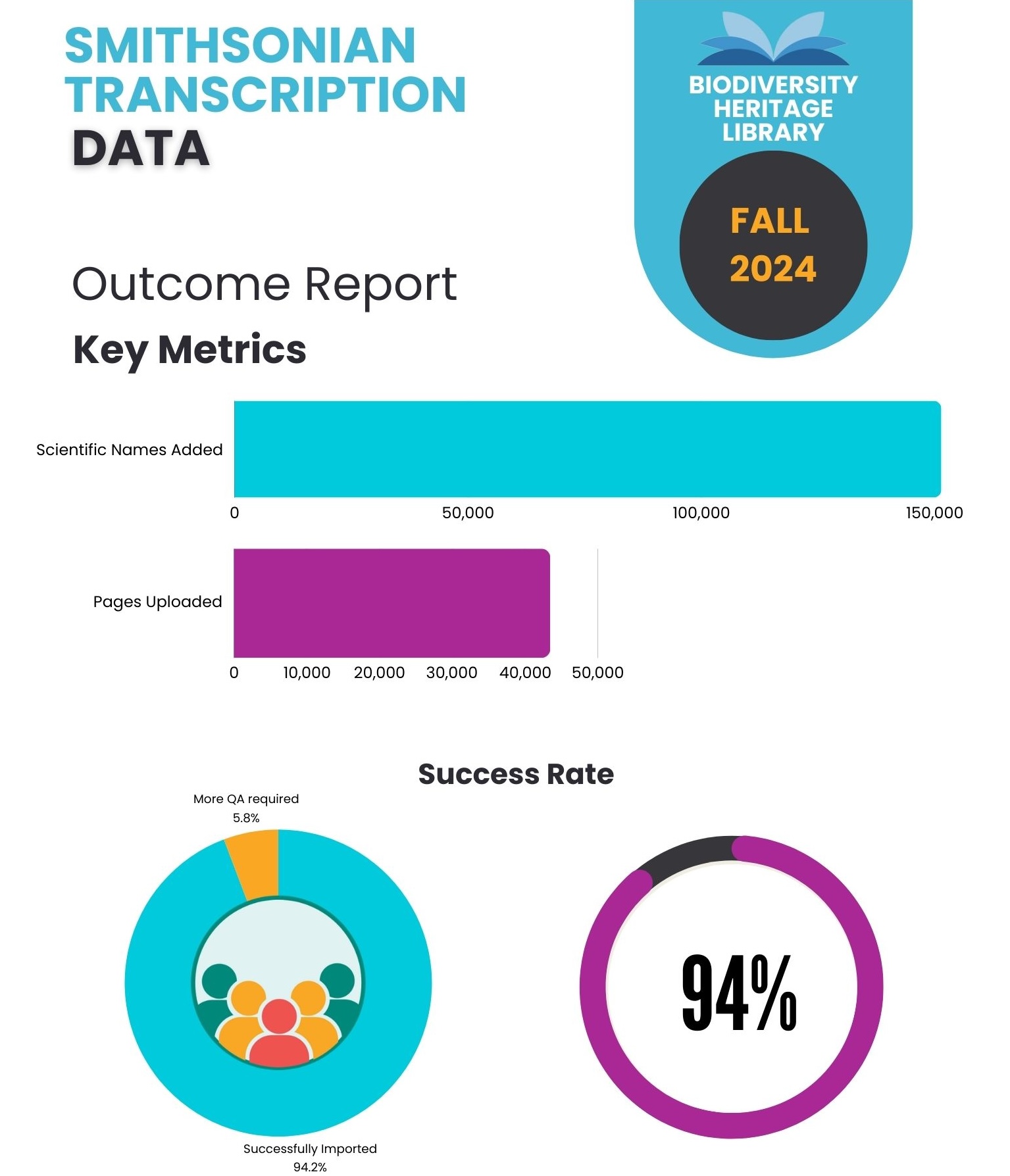
Smithsonian Transcription Data outcomes report

A special thanks goes to Mike Lichtenberg, BHL’s Lead Developer and Systems Architect and Paul Day, Lead Developer at Smithsonian Transcription Center. As with many data improvement and platform enhancement projects, the requisite technical expertise is pivotal in ensuring the success of our collective efforts!


References and Resources

Dearborn, J., Lichtenberg, M., Richard, J. M., deVeer, J., Trizna, M., & Mika, K. 2023. [Presentation] Unearthing the Past for a Sustainable Future: Extracting and Transforming Data in the Biodiversity Heritage Library for Climate Action. Presented virtually at TDWG, Tasmania, Australia 2023. https://www.youtube.com/watch?v=8sGssyrpuJw

Trizna, M., & Dearborn, J. June 2023. [Poster] AI Models Are Getting Better at Reading Handwriting, but How Can We Find Handwritten Text to Begin With?. 7th Annual Digital Data Conference, Leveraging Digital Data for Conservation, Ecology, Systematics, and Novel Biodiversity Research, Tempe, Arizona, United States of America. https://doi.org/10.25573/data.23523495.v1

Dearborn, J., & Mika, K. June 5, 2022. [Poster] Extracting Expedition Log Data Found in the Biodiversity Heritage Library. Through the Door and Through the Web: Releasing the Power of Natural History Collections Onsite and Online, Edinburgh, Scotland, United Kingdom: Society for the Preservation of Natural History Collections (SPNHC). https://doi.org/10.5281/zenodo.6593457
September 30, 2024by mdimeo
BHL News, Blog Reel, Tech Updates

BHL Adds Functionality Allowing Partners to Upload Crowdsourced Transcriptions of Digitized Archival Materials

Screenshot of a digital library book viewer with readable OCR.

The Biodiversity Heritage Library (BHL) has added functionality to allow BHL Partners to upload transcriptions in place of the automatically-generated OCR (Optical Character Recognition) for archival materials digitized in BHL. This functionality supports transcriptions generated as part of Partner crowdsourcing projects on Smithsonian Transcription Center, DigiVol, and From the Page.

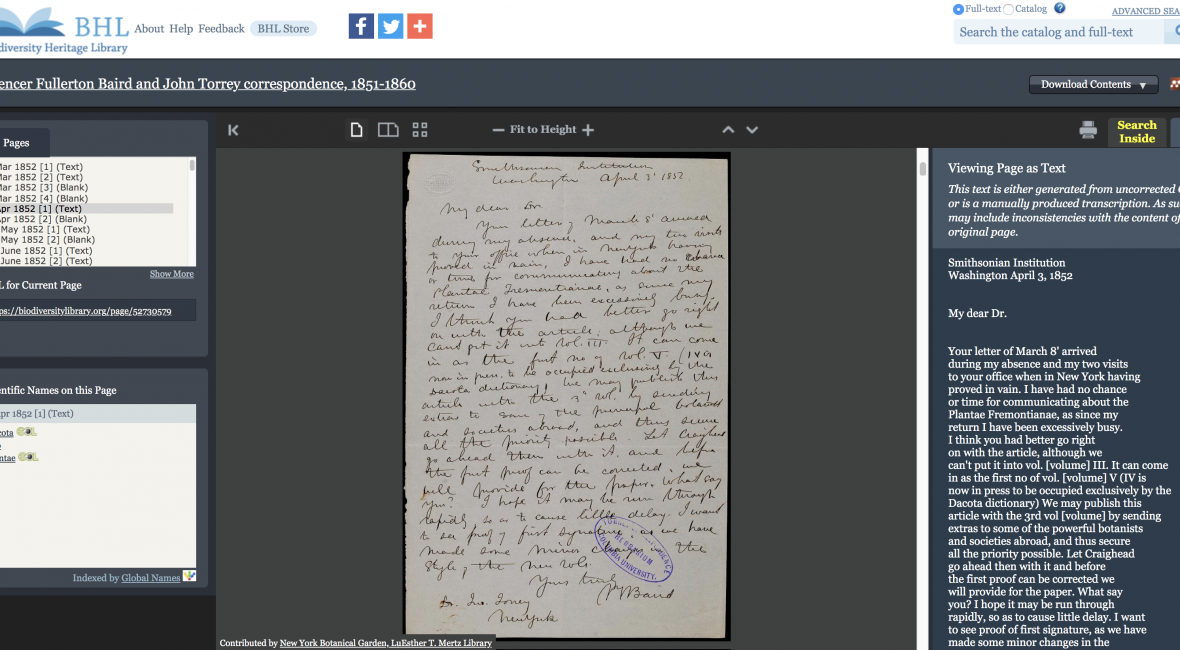
Optical Character Recognition (OCR), also called text recognition, translates text characters in scanned documents into code that can be used for data processing and enables searching of document text. Handwritten archival materials like correspondence and field notes are notoriously problematic for OCR software. Full-text searching of these materials is significantly hampered by poor OCR output.

Screenshot of a digital library book viewer with gibberish for OCR.

Example of the poor automatically-generated OCR output for handwritten correspondence. Spencer Fullerton Baird and John Torrey correspondence, 1851-1860. Contributed in BHL from the LuEsther T. Mertz Library of The New York Botanical Garden.

Crowdsourcing the transcription of archival materials has become a popular way to generate machine-readable text that enables searching and discoverability. Several BHL Partners are using crowdsourcing platforms (e.g. Smithsonian Transcription Center, DigiVol, and From the Page) to transcribe field notes, correspondence, and other archival materials that they have digitized in BHL.

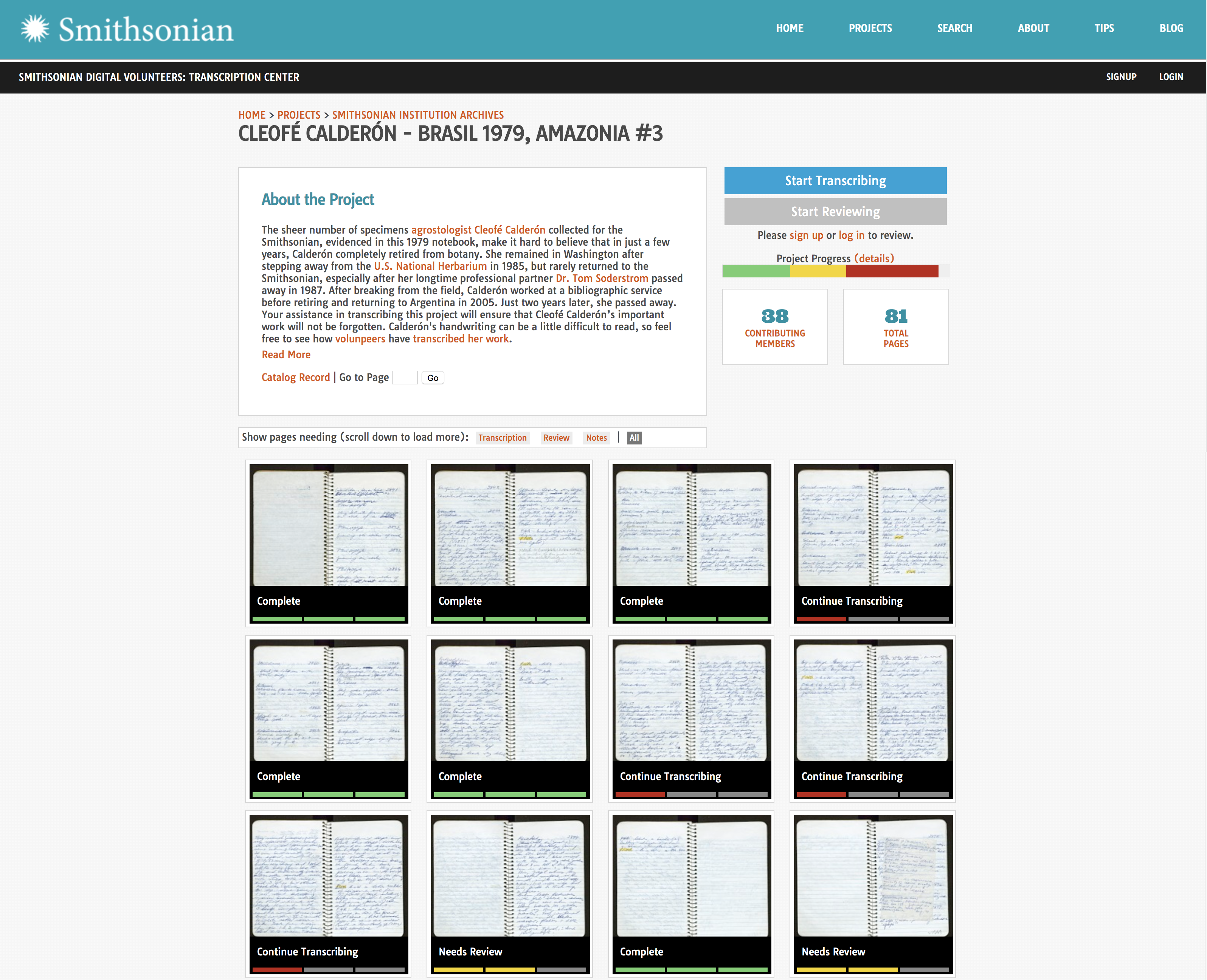
Screenshot of a project in the Smithsonian Transcription Center.

Example of a field notebook being transcribed in the Smithsonian Transcription Center. This notebook, Brasil 1979, Amazonia #3, from Cleofé Calderón is also available in BHL from the Smithsonian Institution Archives.

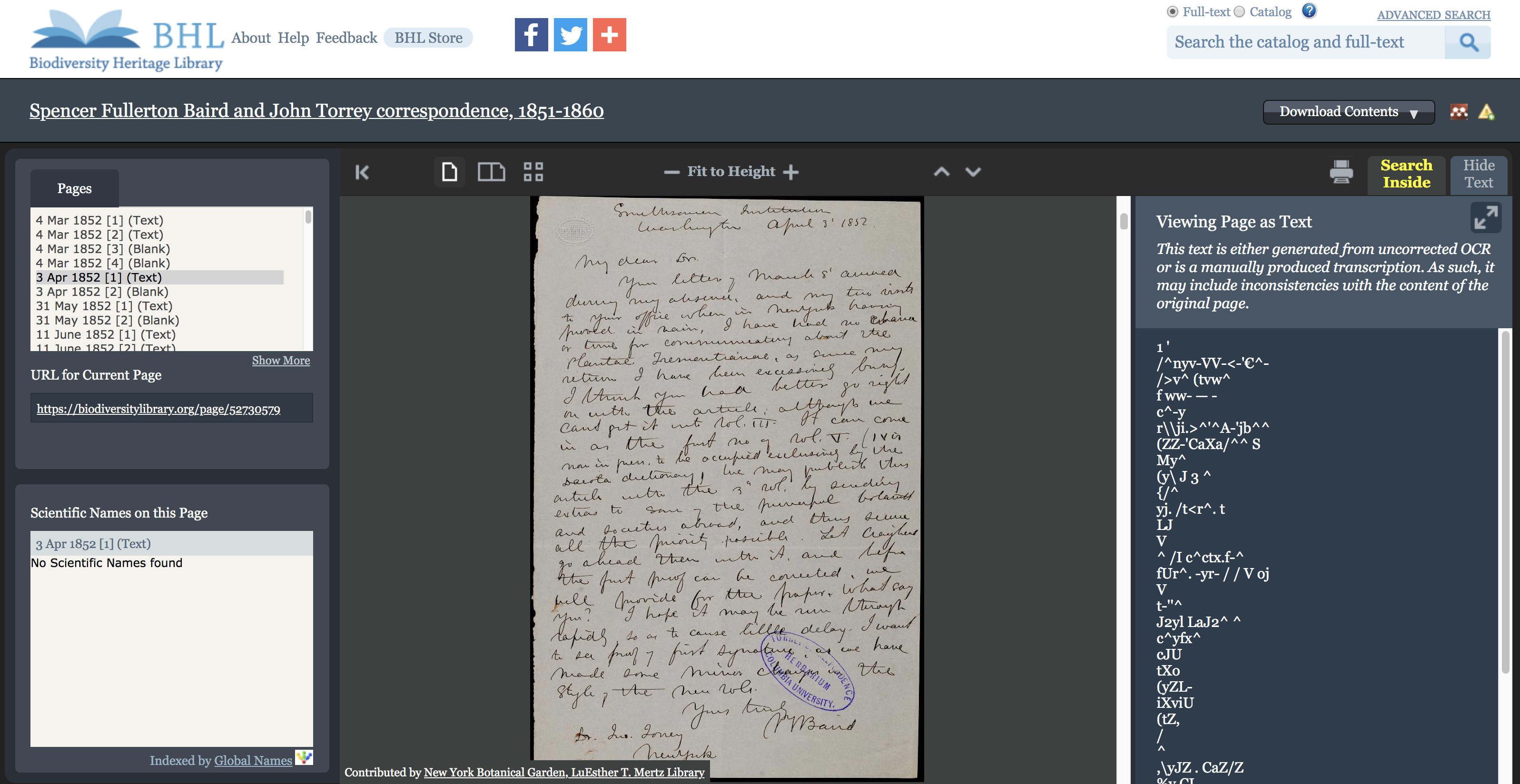
With this new functionality, these transcriptions can now be uploaded in place of the automatically-generated OCR for these items, allowing them to be full-text searchable and enabling our taxonomic name recognition software to index scientific names within their pages. Since the transcribed text can be viewed alongside the digitized page image, users can also more easily read materials with difficult-to-decipher handwriting. Thus, this new functionality makes it easier for researchers and the public to explore these valuable primary source materials and access specific information from their pages.

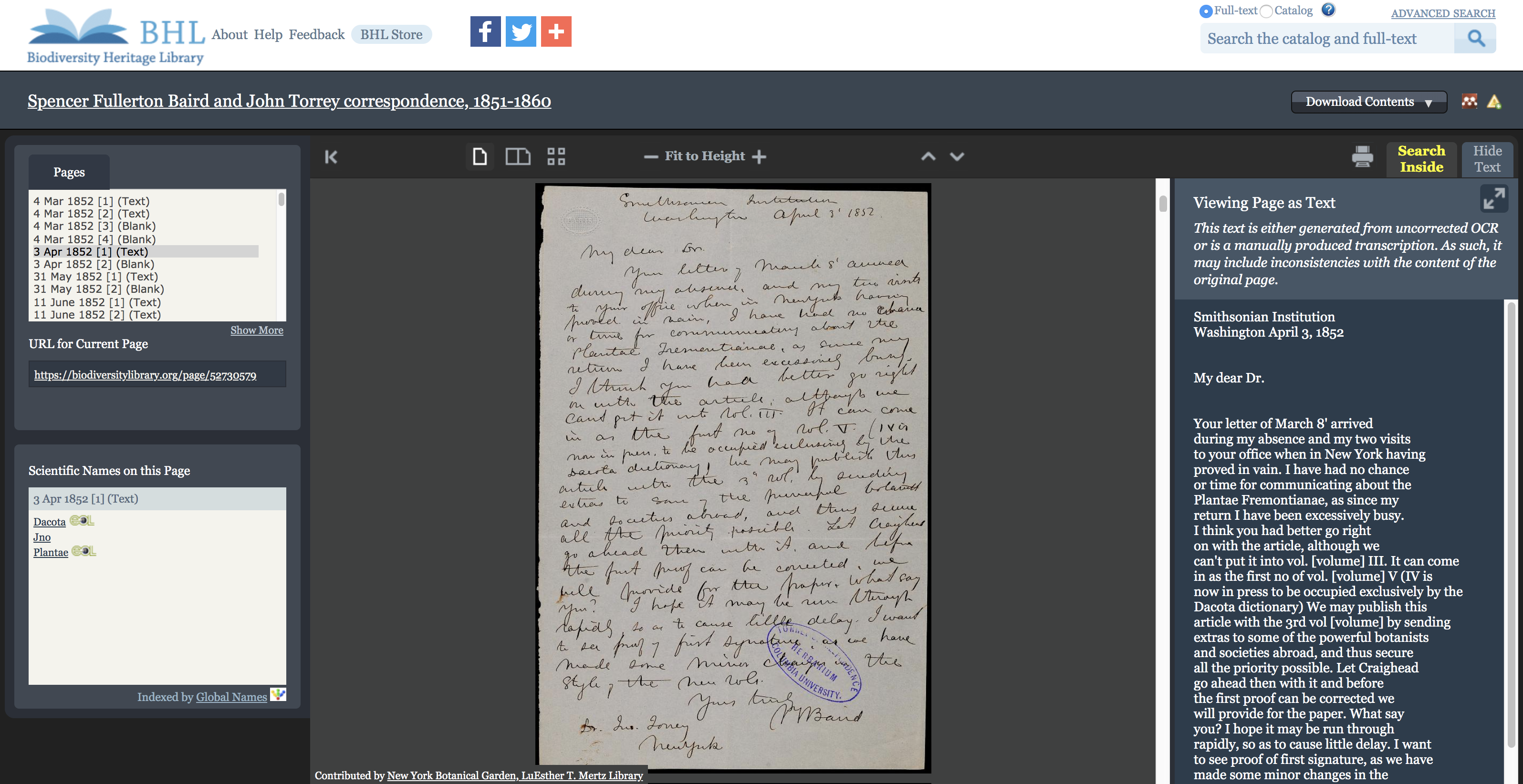
Screenshot of a digital library book viewer with readable OCR.

Above example with the OCR replaced with a crowdsourced transcription generated as part of The John Torrey Papers project from The New York Botanical Garden on From the Page. Spencer Fullerton Baird and John Torrey correspondence, 1851-1860. Contributed in BHL from the LuEsther T. Mertz Library of The New York Botanical Garden.

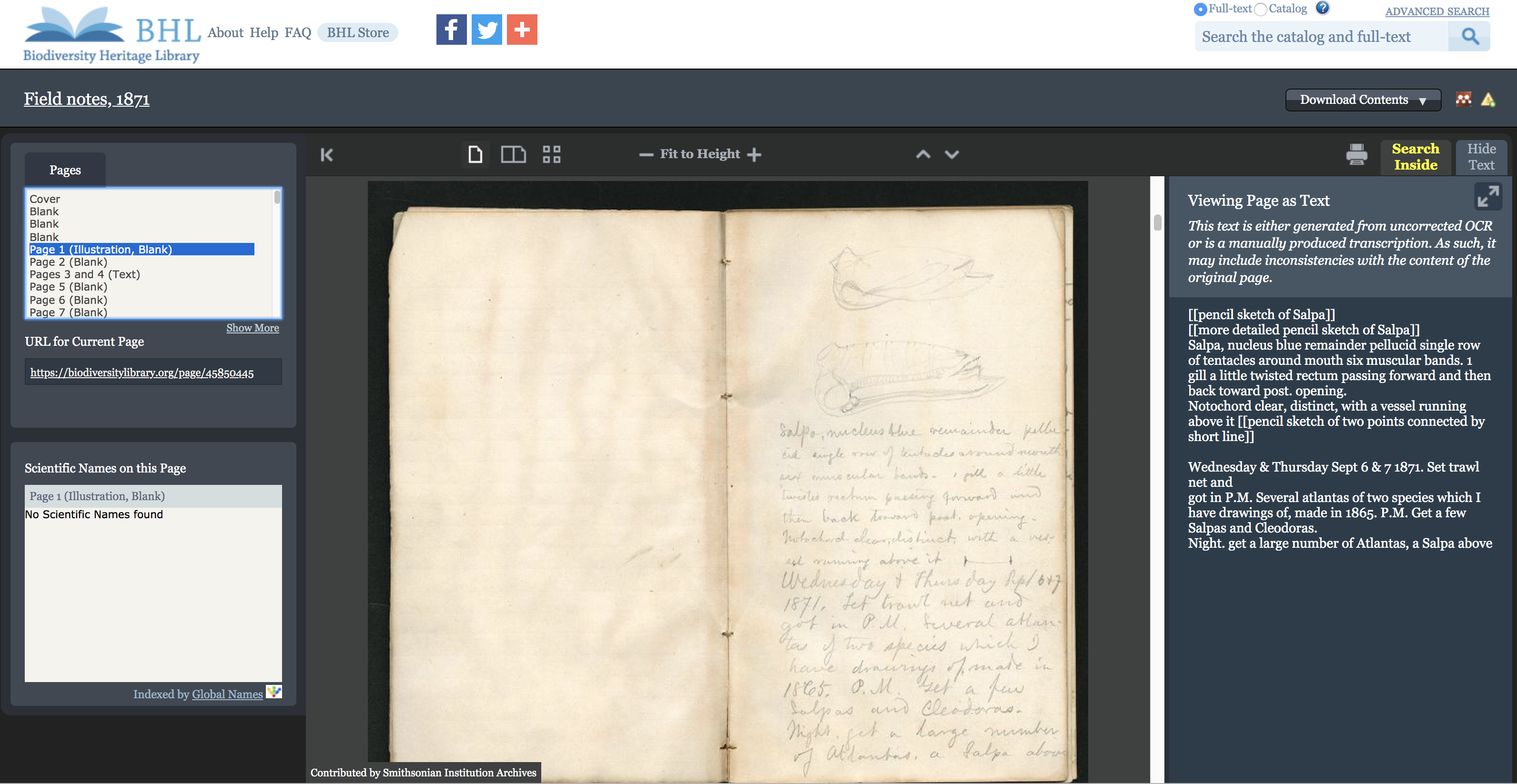
Screenshot of the BHL book viewer with a digitized field book and the transcribed text shown alongside the page in place of the OCR.

Since the transcribed text can be viewed alongside the digitized page image in the BHL book viewer, users can also more easily read archival materials. William Healey Dall’s Field Notes, 1871. Transcription generated on the Smithsonian Transcription Center. Contributed in BHL from the Smithsonian Institution Archives.

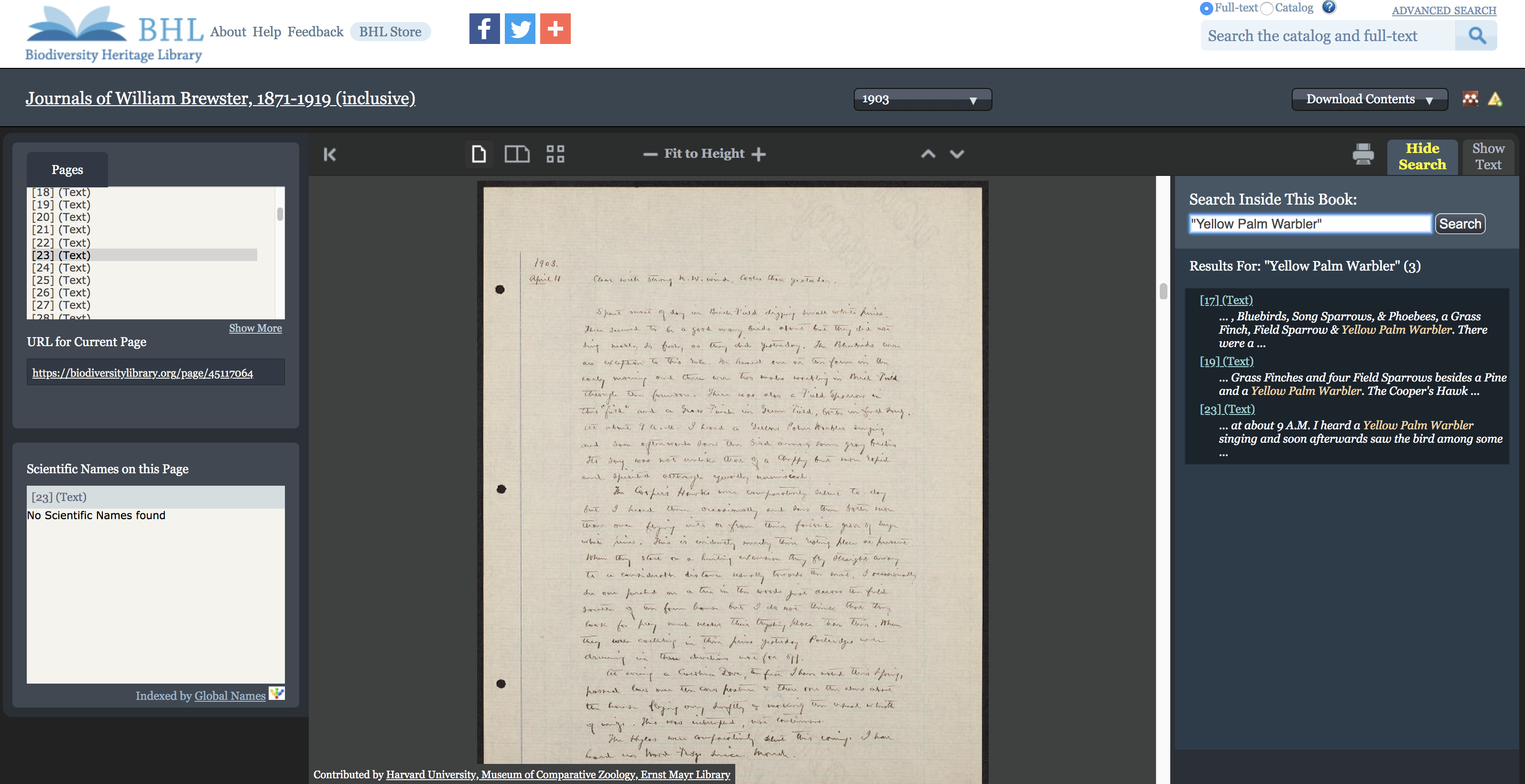
Screenshot of a book viewer with digitized archival materials and full-text search for "Yellow Palm Warbler".

Crowdsourced transcriptions allow digitized archival materials in BHL to be full-text searchable, as shown in this example searching for “Yellow Palm Warbler” within William Brewster’s 1903 journal. Transcription generated as part of the Ernst Mayr Library of Harvard University project on DigiVol. Contributed in BHL from the Ernst Mayr Library of the Museum of Comparative Zoology at Harvard University.

Screenshot of a book viewer with scientific name indexed on the page of an archival notebook.

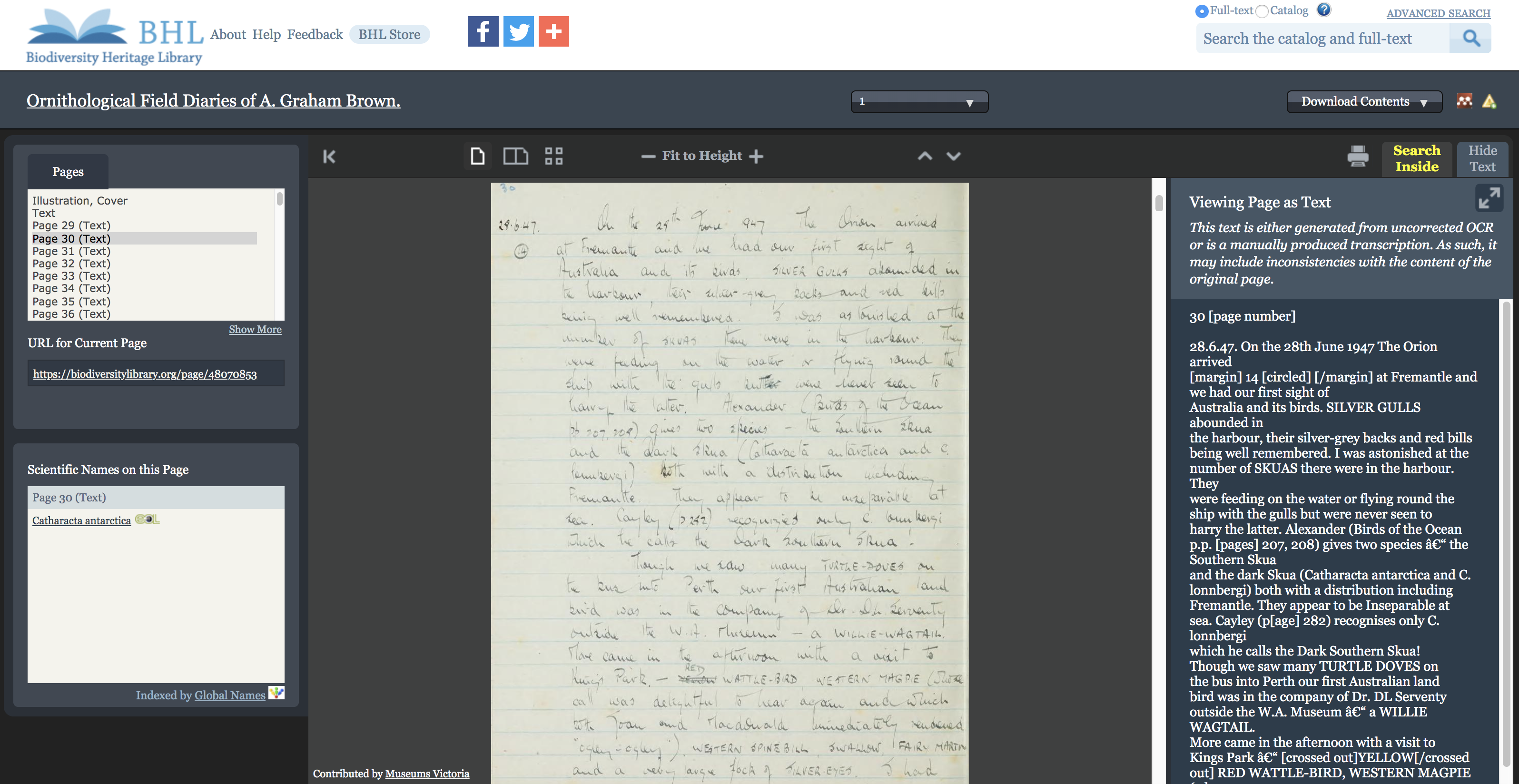
Crowdsourced transcriptions allow BHL’s taxonomic name recognition software to index scientific names within the pages of digitized archival materials, as seen in this example in which Catharacta antarctica is indexed on a page within the first volume of the Ornithological Field Diaries of A. Graham Brown. Transcription generated as part of a project from BHL Australia and Museums Victoria on DigiVol. Contributed in BHL from Museums Victoria.

Participating Partners have begun uploading transcriptions to BHL. To date, transcriptions have been uploaded from Partner crowdsourcing projects with BHL Australia, Ernst Mayr Library of Harvard University, The New York Botanical Garden, and Smithsonian Institution Archives. This is an ongoing process, and more transcriptions will be uploaded to the Library over time.

Interested in transcribing archival materials? Several BHL Partners have active transcription projects on various crowdsourcing platforms. Follow the links below to explore the opportunities and get involved:

  • Ernst Mayr Library of Harvard University on DigiVol
  • The John Torrey Papers from The New York Botanical Garden on From the Page
  • Smithsonian Institution Archives on the Smithsonian Transcription Center
July 17, 2019by michelle.underhill
Blog Reel, Campaigns, Her Natural History

Transcribe Field Notes by Female Naturalists with the #HerNaturalHistory Transcription Challenge

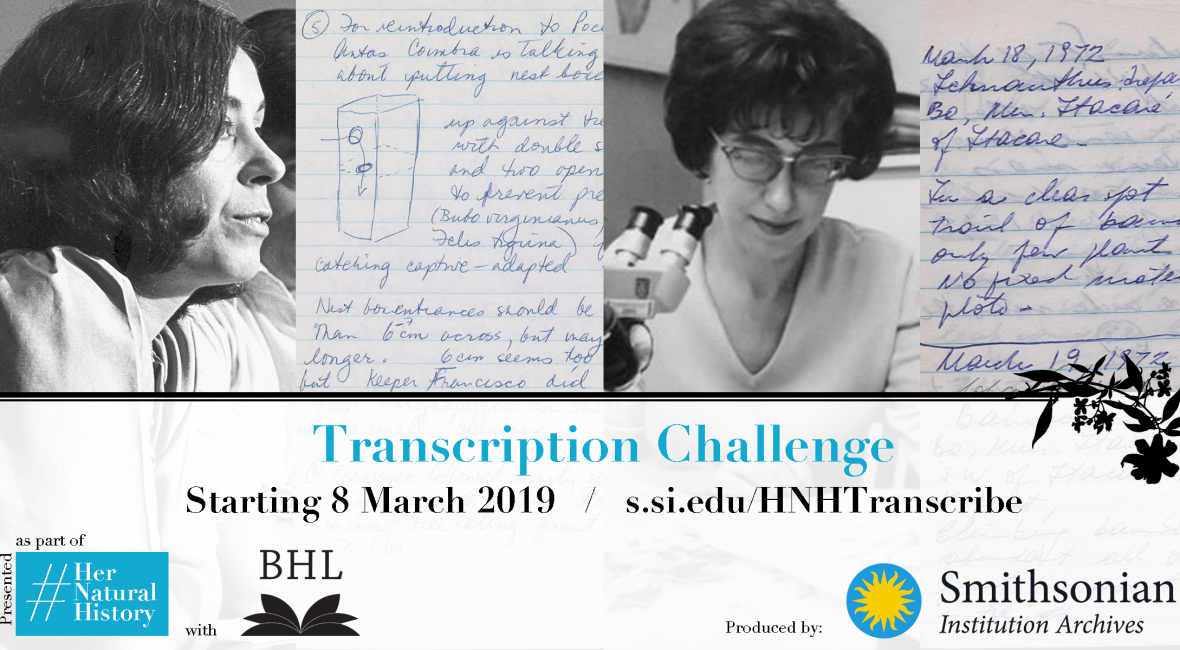
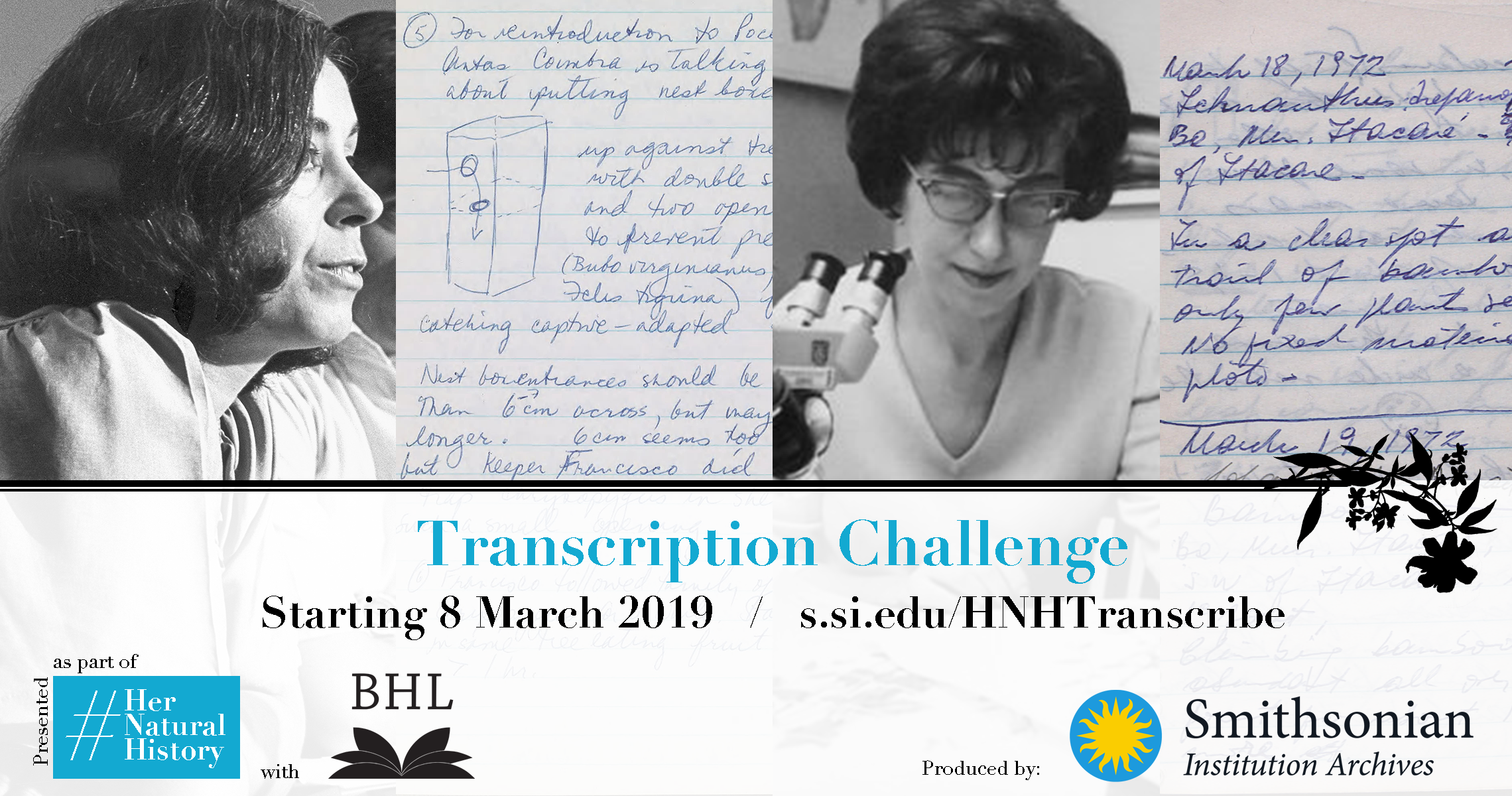
L to R: Photo of Devra Kleiman by Hirshfeld, Max, 1978, Smithsonian Archives – History Div, 94-8340; Page from Kleiman field book (Brazil notebook, 1975-1982); Photo of Cleofé E. Calderón, Smithsonian Institution Archives, SIA Acc. 11-008, Box 02, Image No. OPA-90; Page from Calderón field book (Brasil 1972, 1).

Looking for a challenge? The Smithsonian Institution Archives and the Smithsonian Transcription Center are teaming up for a #HerNaturalHistory-themed transcription challenge. Starting today (8 March), help a team of #volunpeers transcribe field notes from conservation biologist Devra Kleiman and botanist Cleofé Calderón. Dive into observations of golden lion tamarins with Kleiman, who worked at Smithsonian’s National Zoological Park from 1972 to 2001. And head to South America with Calderón to collect grasses for Smithsonian’s Department of Botany.

When? Starting TODAY, 8 March 2019
Where? Smithsonian Transcription Center. The field notes are available on the Smithsonian Institution Archives project page.

The Smithsonian Institution Archives has launched 11 field books on the Smithsonian Transcription Center. Throughout the month, additional field books will be added as others are completed. Our goal is to fully transcribe 18 field books in total (9 from each woman) by the end of March.

These transcriptions will also make the corresponding digitized field books in the Biodiversity Heritage Library more discoverable, as they can be uploaded in place of the automatically-generated OCR text in BHL to allow the field books to be full-text searchable. This will make it easier for researchers and the public to explore these valuable primary source materials and access specific information from their pages.

We hope you’ll join our #HerNaturalHistory transcription challenge to help improve access to and discoverability of the primary research of two female naturalists. Continue reading to learn more about Kleiman and Calderón.

This challenge is presented as part of the #HerNaturalHistory campaign — an international social media campaign produced in collaboration with BHL partners to celebrate women in natural history. Visit the Her Natural History webpage to learn more about this and other events and programming occurring all month long.

Devra Kleiman

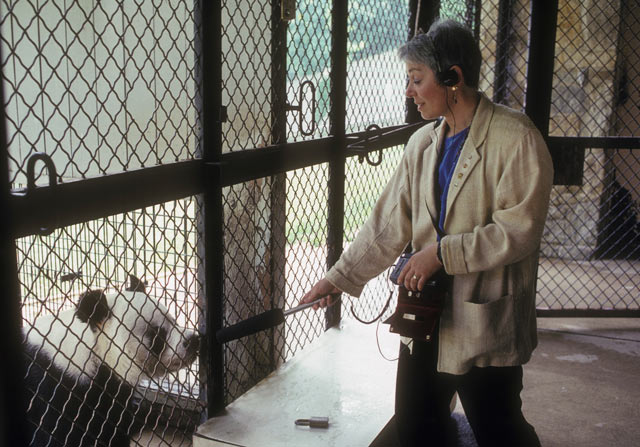
Giant Panda researcher Devra Kleiman records Hsing-Hsing’s vocalizations during breeding season, 1991, by Jessie Cohen, C-type print, National Zoo, Image ID: 614-95JC.

Conservation biologist Devra G. Kleiman (1942-2010) was the first female scientist at the National Zoological Park (NZP). She was hired by NZP in 1972 to manage the zoo’s captive breeding program. Much of her research focused on the captive breeding of giant pandas and the reintroduction of golden lion tamarins to the wild. Over her career at the zoo, she served as Assistant Director for Animal Programs, Assistant Director of Zoological Research and Education, Assistant Director of Research, Assistant Director of Zoological Research, and Senior Scientist. She authored approximately 150 manuscripts and two books.[1]

Smithsonian Institution Archives holds a large collection of archival materials documenting Kleiman’s research and professional activities. Many of her field books have been digitized in the Biodiversity Heritage Library as part of the Smithsonian Field Book Project.

Cleofé Calderón

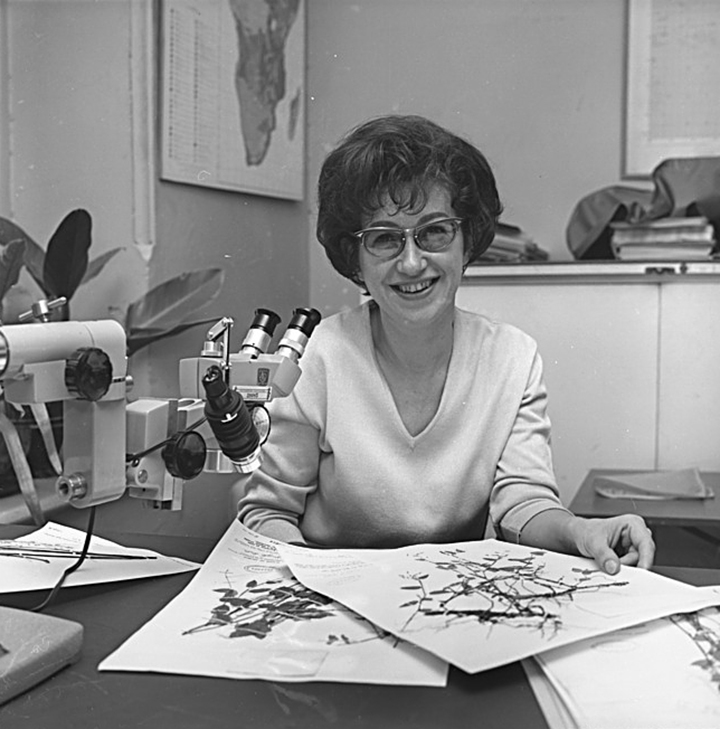
Visiting Argentine botanist Cleo Calderón with plant specimens and microscope. 1965.
From 120mm black and white negative. Smithsonian Institution Archives, SIA Acc. 11-008, Box 02, Image No. OPA-90.

Botanist Cleofé Calderón (1929-2007), born in Buenos Aires, Argentina, studied with renowned agrostologist Prof. Ing. Lorenzo Parodi at the University of Buenos Aires. She was introduced to Dr. Thomas R. Soderstrom, Curator of Grasses in the Department of Botany at the U.S. National Herbarium at the Smithsonian, during a trip to Washington, D.C. in 1961-62. The two began a close collaboration, and Calderón became a prominent botanist specializing in bamboo. With support from the Smithsonian, the Office of Scientific Affairs of the Organization of American States, and the National Geographic Society, Calderón conducted extensive field work in Central and South America, collecting plant specimens in Panama, Costa Rica, Ecuador, Colombia, and Brazil between 1966 and 1982. One of her most significant finds was the “re-discovery” of Anomochloa marantoidea, a small species of bamboo last seen in the late 1840s.[2]

Smithsonian Institution Archives holds a collection of field books documenting Calderón’s botanical research in Brazil, Panama, and Colombia between 1967 and 1981. Many of these have been digitized in the Biodiversity Heritage Library as part of the Smithsonian Field Book Project.

References

[1] Smithsonian Institution Archives. 2018. “Kleiman, Devra G.” Finding Aid, November 5. Accessed on February 28, 2019. https://siarchives.si.edu/collections/siris_arc_302446.

[2] Smithsonian Institution Archives. 2019. “Calderón, Cleofé E.” Collections. Accessed on February 28, 2019. https://siarchives.si.edu/collections/auth_per_fbr_eacp248.

March 8, 2019by michelle.underhill
Blog Reel, User Stories

Beyond Tunnels & Bigamy: The Scientific Contributions of the Infamous Harrison Dyar

View Full Size Image
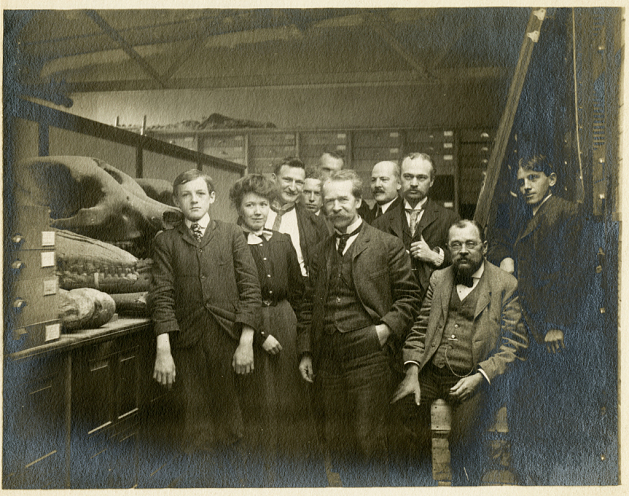
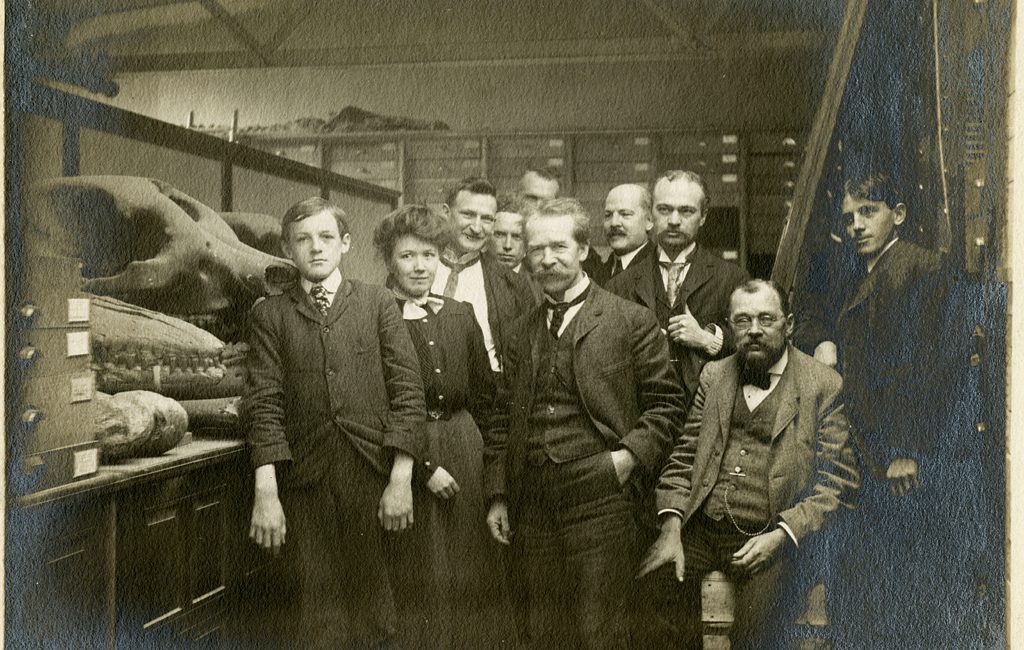
Harrison G. Dyar, Jr., third from right, with Entomology staff of the U.S. National Museum in 1905. Courtesy of Smithsonian Institution Archives.

If you have ever heard of entomologist Harrison Dyar, there’s a good chance that it was in relation to a series of tunnels that he dug beneath Washington, D.C. Or it may have been in relation to his bigamy. But if that’s all you know about Dyar, then you only know the tabloid tales.

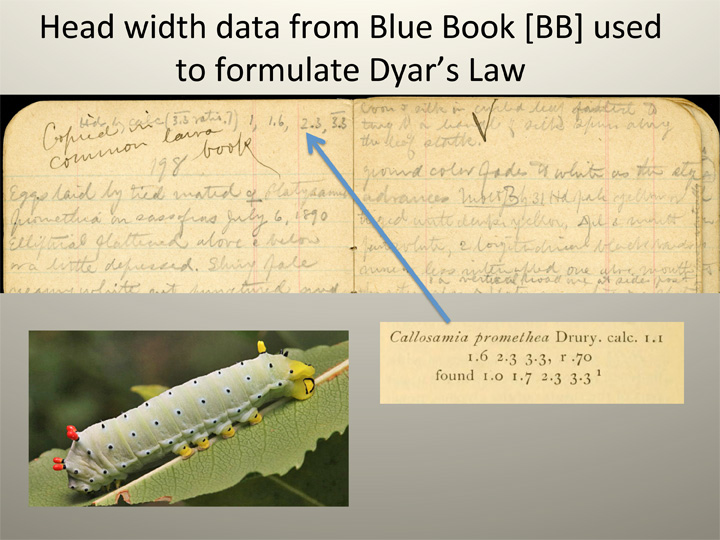
Harrison Dyar was Honorary Custodian of Lepidoptera at the United States National Museum for over 30 years. He studied sawflies, moths, butterflies and mosquitos and described hundreds of species and genera. He also contributed significantly to the study of insect development by formulating Dyar’s Law of Geometric Growth. By observing that the width of caterpillar heads was fixed within each stage of development, Dyar realized that he could use a ratio to predict the width of the head at various stages of development, and that this ratio could in turn be used to differentiate insect instars. By using this law, entomologists can identify the developmental stage of an immature insect.

Dyar’s field notebooks, including his “blue books” and “catalogue” as they’re called, contain valuable information both on Dyar’s scientific research and aspects of his personal life. For instance, they include his scientific observations made while rearing specimens, head width data used to formulate Dyar’s Law, and, on a more personal note, the identity of relatives who helped Dyar collect and rear insects.

View Full Size Image
Image Source: Smithsonian Libraries.

Dyar’s field notebooks, which are held by the Smithsonian Institution Archives, have been digitized as part of The Field Book Project and are available in BHL, making it much easier for researchers around the world to access and study Dyar’s work.

View Full Size Image
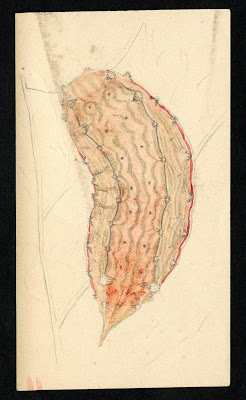
Drawing from a Dyar blue book. H. G. Dyar bluebook 575 – 625. 1896-1898. Digitized by Smithsonian Institution Archives. http://biodiversitylibrary.org/page/46194051.

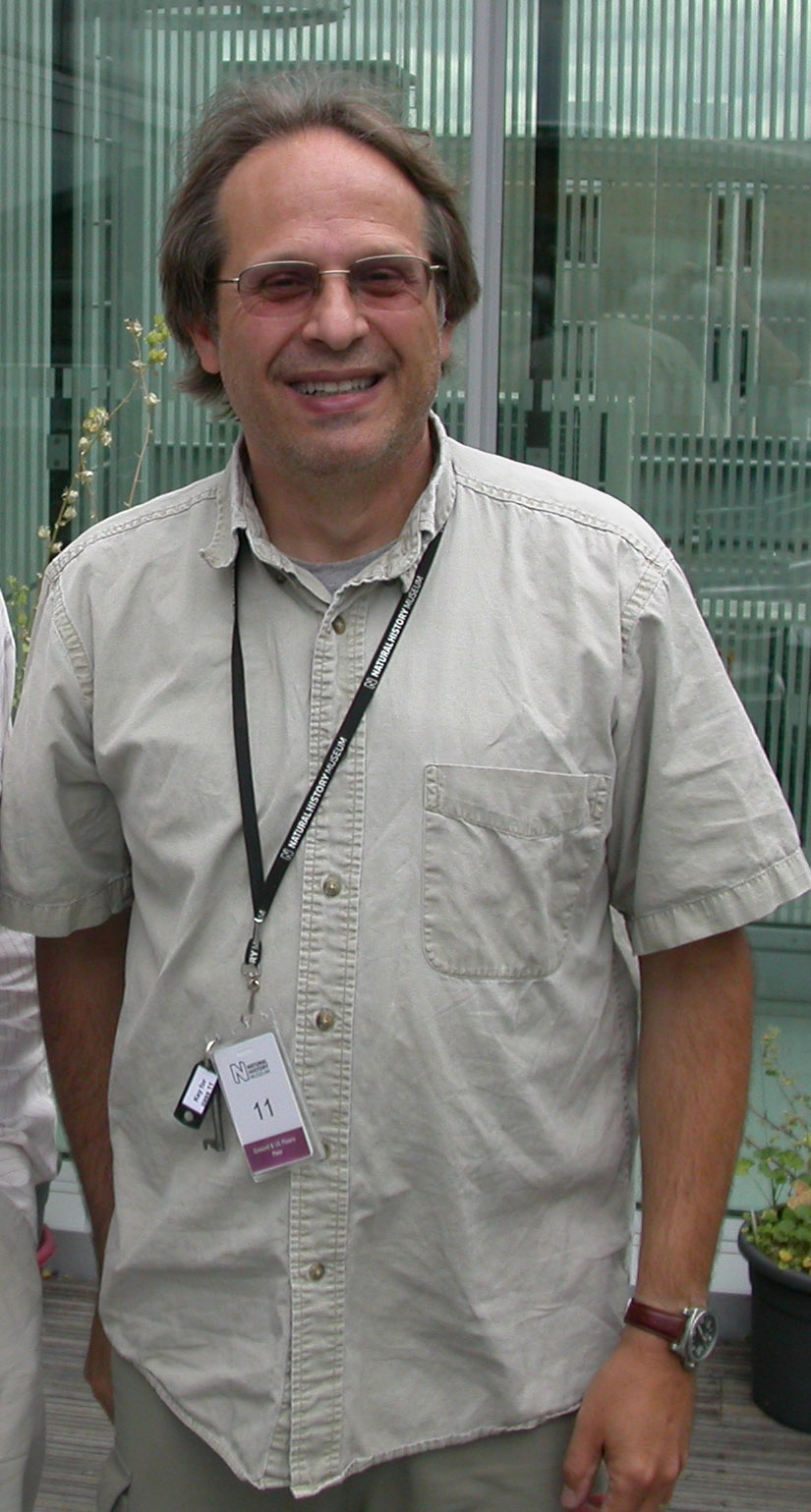
One such researcher that has benefited from online access to this materials is Dr. Marc Epstein, Research Associate at the National Museum of Natural History and Senior Insect Biosystematist (Lepidoptera) at the Plant Pest Diagnostics Center of the California Department of Food and Agriculture. Dr. Epstein has studied Dyar’s work and legacy extensively and has authored a biography on this remarkable entomologist entitled Moths, Myths and Mosquitos:The Eccentric Life of Harrison G. Dyar, Jr.. Marc discovered BHL, thanks to recommendations from his colleagues, around the time that our online library launched. Since then, BHL’s collections have had an immense impact on Marc’s research.

View Full Size Image
Dr. Marc Epstein. Image Source: California Department of Food and Agriculture.

“Even though I’m fortunate to have a good entomology library at the Plant Pest Diagnostics Center in Sacramento, CA, BHL has provided me access to so many journals that I haven’t had easy access to in California since with my move here in 2003,” asserts Marc. “In fact BHL has often provided me with the very copies I used to refer to in the Smithsonian National Museum of Natural History (NMNH) libraries!”

BHL has greatly facilitated Marc’s research on Lepidoptera and more specifically on Harrison Dyar.

“Day to day BHL has helped me do my job to identify Lepidoptera that threaten California agriculture, while providing a tremendous boost to my research projects,” explains Marc. “These have included the completion of Moths, Myths, and Mosquitoes: the Eccentric Life of Harrison G. Dyar, Jr. as well as studies on Costa Rican moths and the evolution of Lepidoptera and their caterpillars.

“Related to the Moths, Myths, and Mosquitoes, it enabled me to much more efficiently transcribe portions of Dyar’s hand-written notebooks, once in my office at NMNH. Prior to the availability of these notebooks on BHL, The Field Book Project at the Smithsonian provided me with electronic files of all of the notebooks, which are now becoming available along with transcriptions made by a corps of volunteers. Having both BHL and the notebooks on my [computer] desktop in Sacramento has enabled me to transcribe portions needed for my research while in Sacramento and saved me valuable time to focus on specimens during my visits to the NMNH entomology collections.”

The volunteer transcriptions that Marc refers to were the result of the May 2016 #DigIntoDyar campaign, which challenged volunteers to help transcribe five of Dyar’s blue books within the Smithsonian Transcription Center. The five blue books constituted a total of 169 pages, 60% of which were fully transcribed by over 60 volunteers by the end of May. Today, all 169 pages have been fully transcribed (thank you, citizen science volunteers!). You can browse the transcriptions in the Smithsonian Transcription Center at the links below:

H. G. Dyar – Bluebook 401- 414, 1893-1894 | https://transcription.si.edu/project/8144
H. G. Dyar – Bluebook 415-435, 1893-1894 | https://transcription.si.edu/project/8145
H. G. Dyar – Bluebook 436-450, 1893-1894 | https://transcription.si.edu/project/8146
H. G. Dyar – Bluebook 451-473, 1894 | https://transcription.si.edu/project/8147
H. G. Dyar, Bluebook 474-491, 1894-1897 | https://transcription.si.edu/project/8148

View Full Size Image
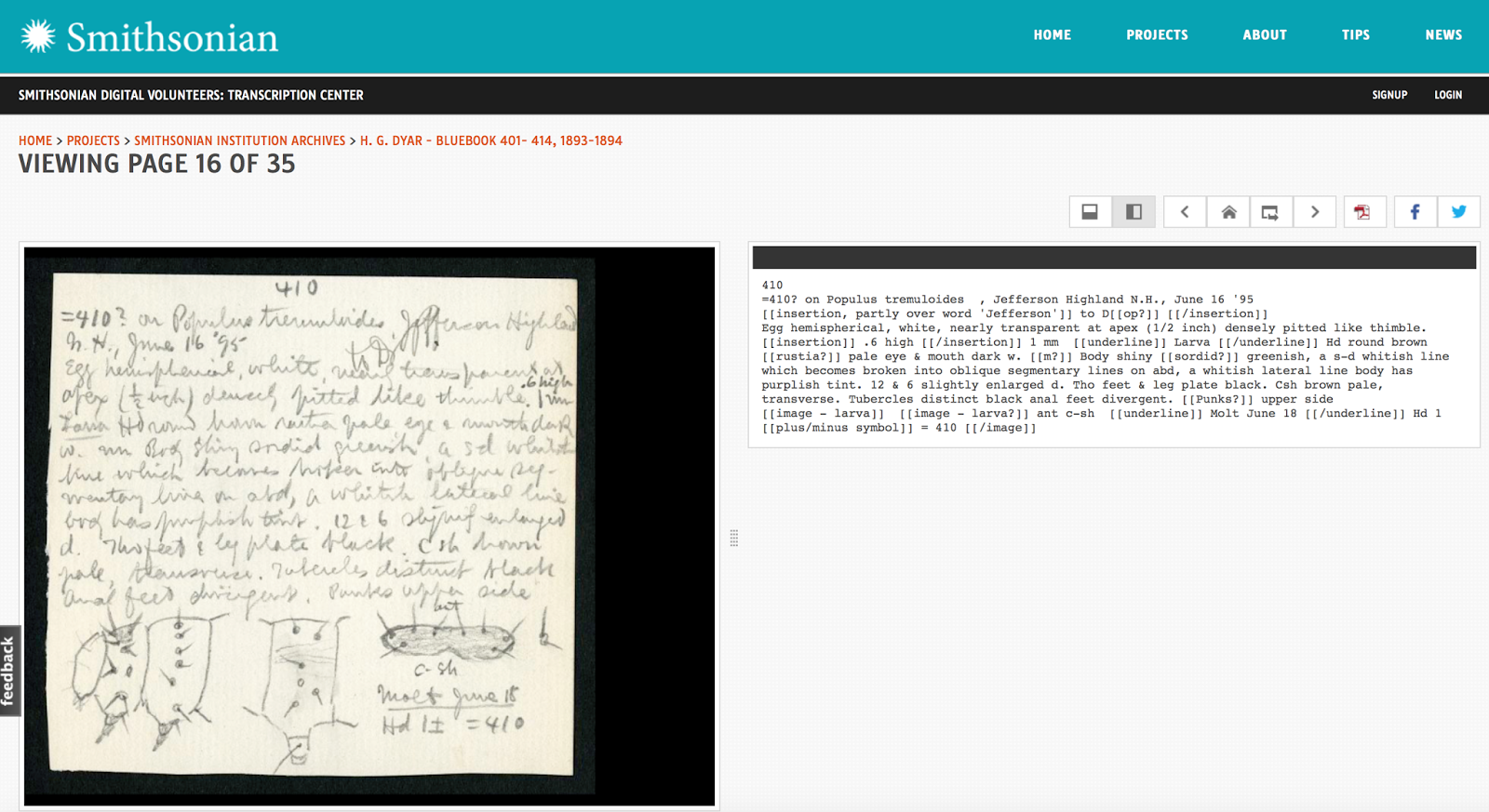
A page from H. G. Dyar bluebook 401 – 414 (1893-94), transcribed in the Smithsonian Transcription Center.

Interested in learning more about Harrison Dyar’s work and contributions? Then check out this Google Hangout from Smithsonian Libraries with Dr. Epstein. You can also learn more in this series of blog posts that Dr. Epstein wrote for Smithsonian Libraries as part of #DigIntoDyar.

Harrison Dyar’s contributions to science may often be overshadowed by his intriguing personal life, but hopefully the efforts of Dr. Epstein and others will ensure that his entire legacy is appreciated and remembered. We’re proud to be able to provide free, online access to materials, like the “blue books” and “catalogue,” that make it easier for researchers to study Dyar’s work.

______________________________________

This post may contain the personal opinions of BHL users or affiliated staff and does not necessarily represent the official Biodiversity Heritage Library (BHL) position on these matters.

September 8, 2016by michelle.underhill
BHL News, Blog Reel

We Challenge You to #DigIntoDyar

This post originally published on the Smithsonian Libraries blog Unbound. 

Important entomological work. The Bahá’í faith. Secret tunnels under Washington, DC. What do all of these elements have in common? Curiously, Smithsonian scientist Harrison Gray Dyar, Jr..

Dyar, Honorary Custodian of Lepidoptera at the United States National Museum (now, National Museum of Natural History) for over 30 years, was a prolific entomologist – studying sawflies, moths, butterflies and mosquitos and publishing his findings. He described hundreds of species and genera and brought new ones to light. “Dyar’s Law”, a standard rule used to measure premature insects, is named in his honor.

View Full Size Image
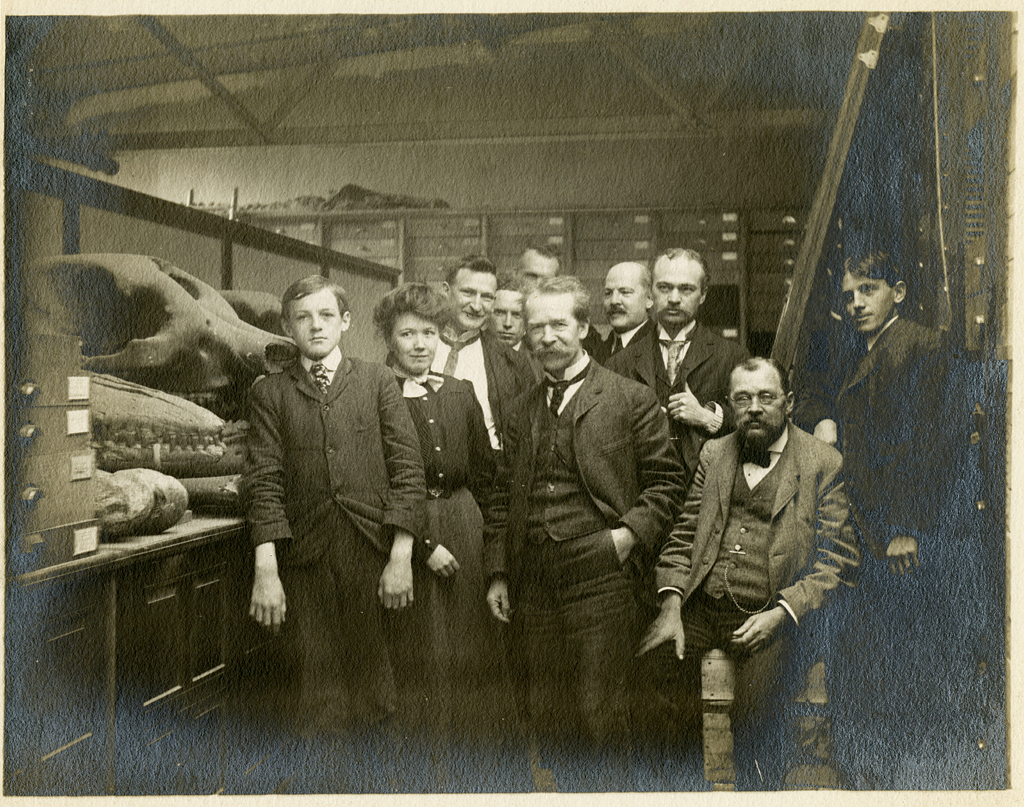
Harrison G. Dyar, Jr., third from right, with Entomology staff of the U.S. National Museum in 1905. Courtesy of Smithsonian Institution Archives.

Yet, the work of this successful entomologist is often overshadowed by his fascinating personal life. Dyar was a bigamist and consequently dismissed from the USDA for conduct unbecoming of a federal employee. He practiced the Bahá’í faith, a movement that seeks to reconcile science with religion. And perhaps most newsworthy: he dug a series of mysterious tunnels beneath his home in Northwest DC. Tunnels that many believed were the work of spies until Dyar finally fessed up.

Starting today, you can be a part of the scientific legacy of this interesting figure in Smithsonian science. The Smithsonian Institution Archives has uploaded five volumes of Dyar’s “blue books” (notebooks in which he jotted down scientific observations) to the Smithsonian Transcription Center. Volunteers are encouraged to dive into the books and help us transcribe Dyar’s work for future study.

View Full Size Image
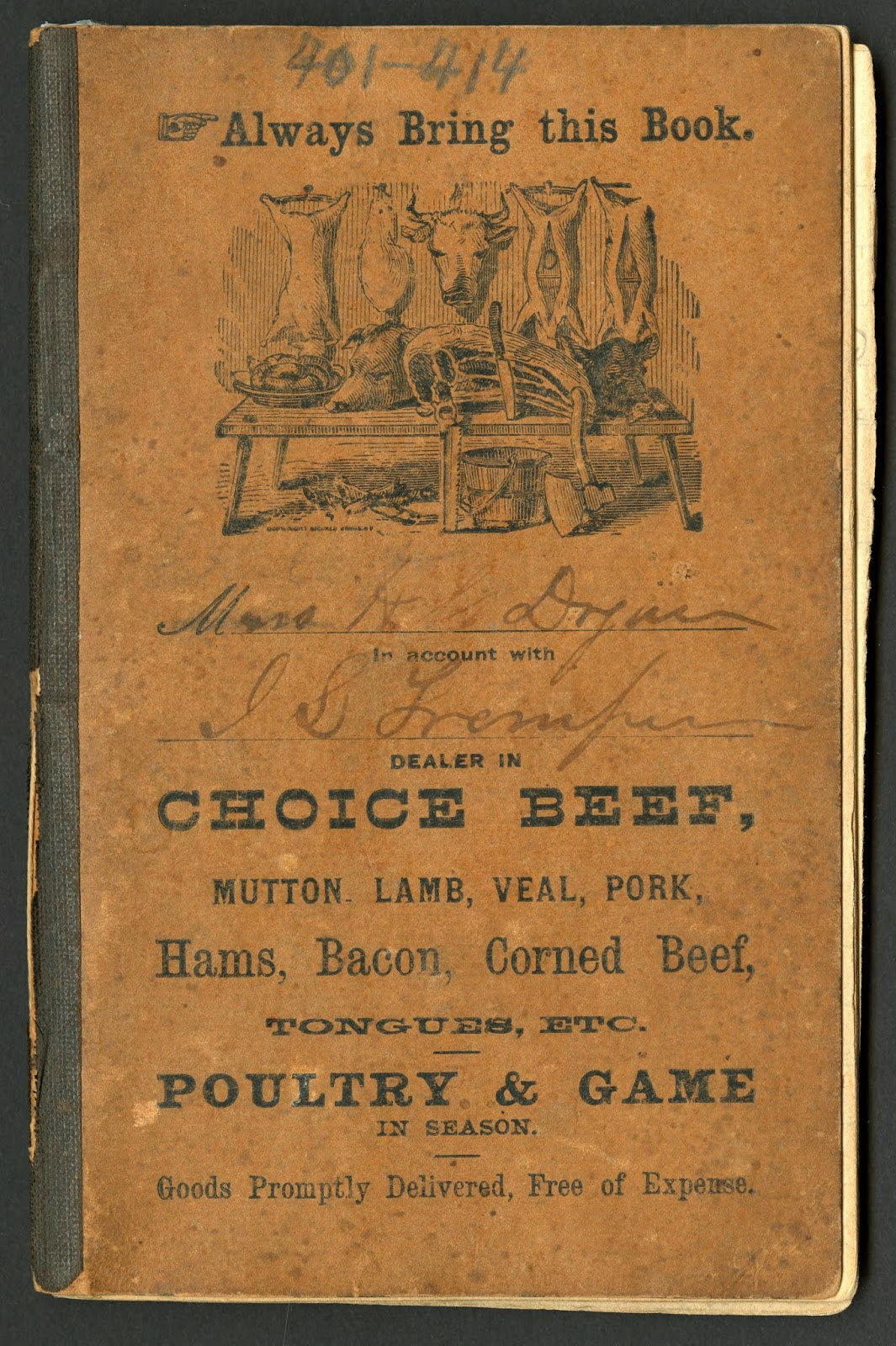
Cover of “Bluebook 401-414”, by H.G. Dyar. Digitized by Smithsonian Institution Archives. http://biodiversitylibrary.org/page/46177763.

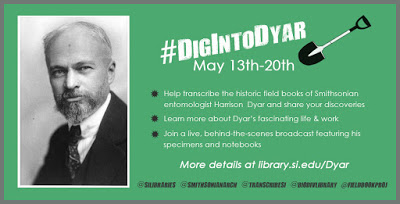
From now until May 20th, we’ll be encouraging everyone to #DigIntoDyar with a series of blog posts about Dyar’s work as well as a live Google Hangout on May 17th (2:30, EDT). Both will feature National Museum of Natural History research associate and Dyar biographer, Marc Epstein. Marc, who recently published Moths, Myths and Mosquitos: The Eccentric Life of Harrison G. Dyar, Jr., will help us understand Dyar’s work, his sordid personal life, and his legacy.

View Full Size Image

Along the way, we’ll be sharing other tidbits and images via social media. We hope you’ll tune in as we #DigIntoDyar and learn more about this fascinating part of Smithsonian history.

You can browse Dyar’s field notebooks in BHL, digitized by Smithsonian Institution Archives as part of the Field Book Project. Below are the BHL links to the field notes that are part of this challenge, as well as the links to those projects in the Smithsonian Transcription Center to help you get started transcribing right away!

Happy Digging!

H. G. Dyar – Bluebook 401- 414, 1893-1894 | https://transcription.si.edu/project/8144
H. G. Dyar – Bluebook 415-435, 1893-1894 | https://transcription.si.edu/project/8145
H. G. Dyar – Bluebook 436-450, 1893-1894 | https://transcription.si.edu/project/8146
H. G. Dyar – Bluebook 451-473, 1894 | https://transcription.si.edu/project/8147
H. G. Dyar, Bluebook 474-491, 1894-1897 | https://transcription.si.edu/project/8148

May 13, 2016by ulib-libraryjobs
BHL News, Blog Reel

The Impact of Coordinated Social Media Campaigns on Online Citizen Science Engagement

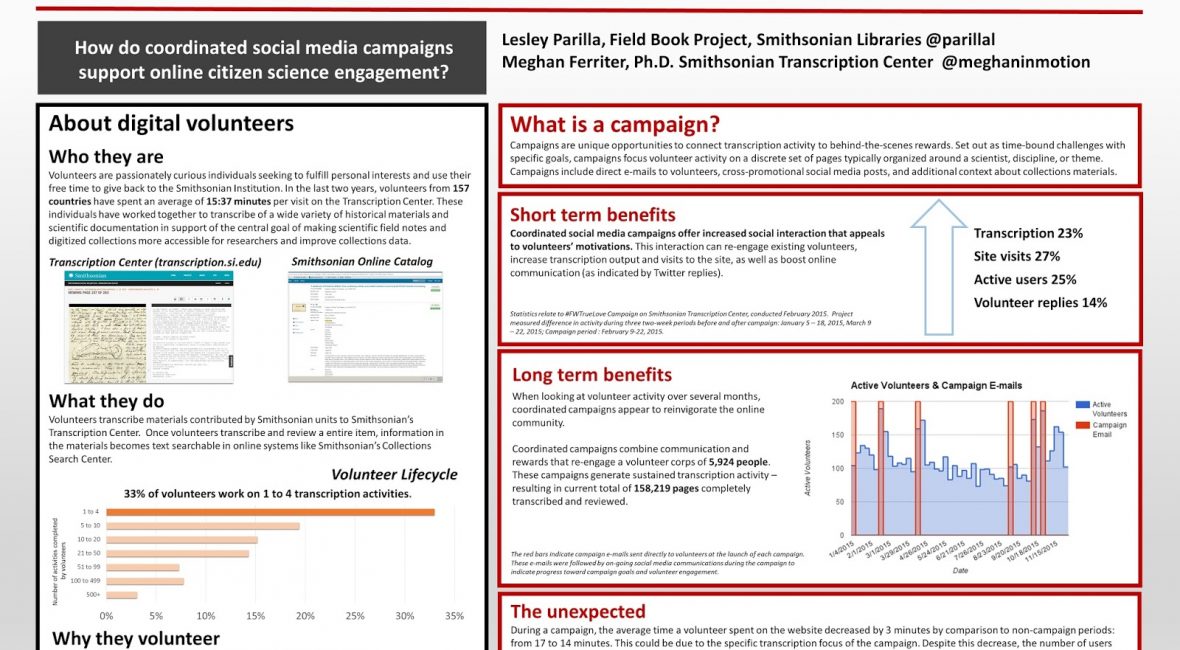
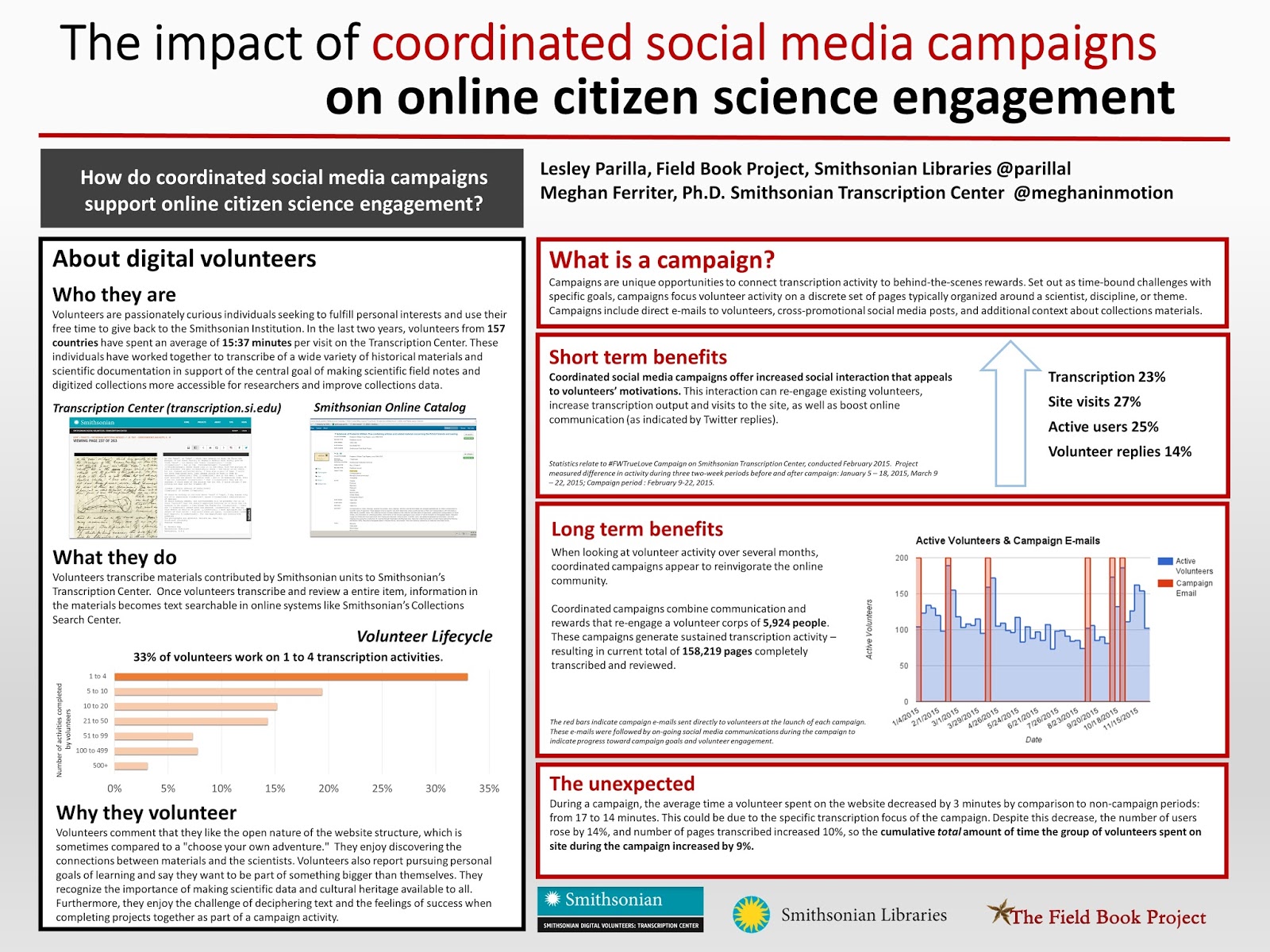
Smithsonian staff members recently presented a poster at the American Association for the Advancement of Science (AAAS) Annual Meeting in Washington, DC, 11-15 February, 2016. The poster, entitled “The Impact of Coordinated Social Media Campaigns on Online Citizen Science Engagement” by Lesley Parilla (Cataloging Coordinator, The Field Book Project) and Meghan Ferriter, Ph.D. (Project Coordinator, Smithsonian Transcription Center), highlighted the impact of a coordinated social media campaign on crowdsourced transcriptions of field notes.

View Full Size Image

The poster outlined the details and outcomes of the #FWTrueLove campaign, a collaboration involving The Field Book Project, the Smithsonian Institution Archives, the Smithsonian Transcription Center, Pyenson Lab, and the Biodiversity Heritage Library. The event challenged volunteers to fully transcribe a selection of field notes by Frederick W. True, held by the Smithsonian Institution Archives and uploaded to the Smithsonian Transcription Center, by the end of the campaign period. Materials for the challenge were identified and selected with Smithsonian Curator of Fossil Marine Mammals Dr. Nick Pyenson and the Smithsonian Field Book Project, a joint initiative of the National Museum of Natural History, Smithsonian Libraries and Smithsonian Institution Archives. The field notes are an important source of natural science data that is difficult to utilize, since they are often handwritten and fragile due to age.

The Transcription Center coordinated the multi-institutional campaign during the month of February 2015. The campaign involved blog posts, Twitter, Instagram, Facebook, and a targeted email to the Transcription Center’s current volunteers, all of which challenged users to completely transcribe 523 pages from F.W. True’s field notes within one week. Updates were posted on: http://nmnh.typepad.com/fieldbooks/fwtruelove/.

As a reward for the successful completion of the challenge, the Transcription Center coordinated Google Hangouts with Curator of Fossil Marine Mammals Dr. Nick Pyenson. Dr. Pyenson discussed the interdisciplinary nature of F.W. True’s scientific pursuits – plus True’s connections with Smithsonian researchers like Leonhard Stejneger and William Healey Dall.

The #FWTrueLove campaign contrasted with a typical experience by focusing on a specific set of materials. The modular design of the Transcription Center’s website, which incorporates multiple collection types, means that a typical volunteer experience is flexible and highly tailored to their individual interests. This flexible design enables volunteers to create their own online experience. This can be expanded with engagement via social media. An analysis of the event showed that coordinated social media campaigns increase volunteer interaction, transcription output, and the number of active users on the Transcription Center. However, there was a decrease in the average length of a visit during the campaign. This may be because new active users are specifically coming to spend time on the projects highlighted in the campaign. This varies from other periods of time on the site, when volunteers come to work on one project but move onto unrelated projects that catch their attention thanks to the site’s open structure. These focused campaigns that appear to work in direct opposition to the flexible nature of the Transcription Center may keep the community growing, serving to reinvigorate the volunteer community as a whole and combat the natural cycling of volunteers out of active participation.

Learn more about the results of the campaign on the AAAS website. See the posted in more detail on BHL’s Pinterest.

February 18, 2016by ulib-libraryjobs
Blog Reel, Campaigns, Fossil Stories

Finishing #FossilFossick with #FossilStories

On October 9, we challenged Smithsonian Transcription volunteers to transcribe the field notes of Ladd, Ward, and G. Arthur Cooper. See the details of the challenge here.

It took exactly three and a half days for volunteers to completely transcribe 9 sets of field notes totaling 252 pages. An average of 14 people contributed to each project. The range? 35 people co-opted our longest Cooper journal, while only 3 tackled his shortest 6 page journal.

Here’s what happened in the numbers:

  • 12 total projects completed in those days, including our 9 #FossilFossick Projects! 
  • 30 New volunteers! 
  • 252 pages completed – and 712 Pages total over the challenge dates! 
  • 3.5 Days from launch to completely transcribe and review the #FossilFossick field notes! 
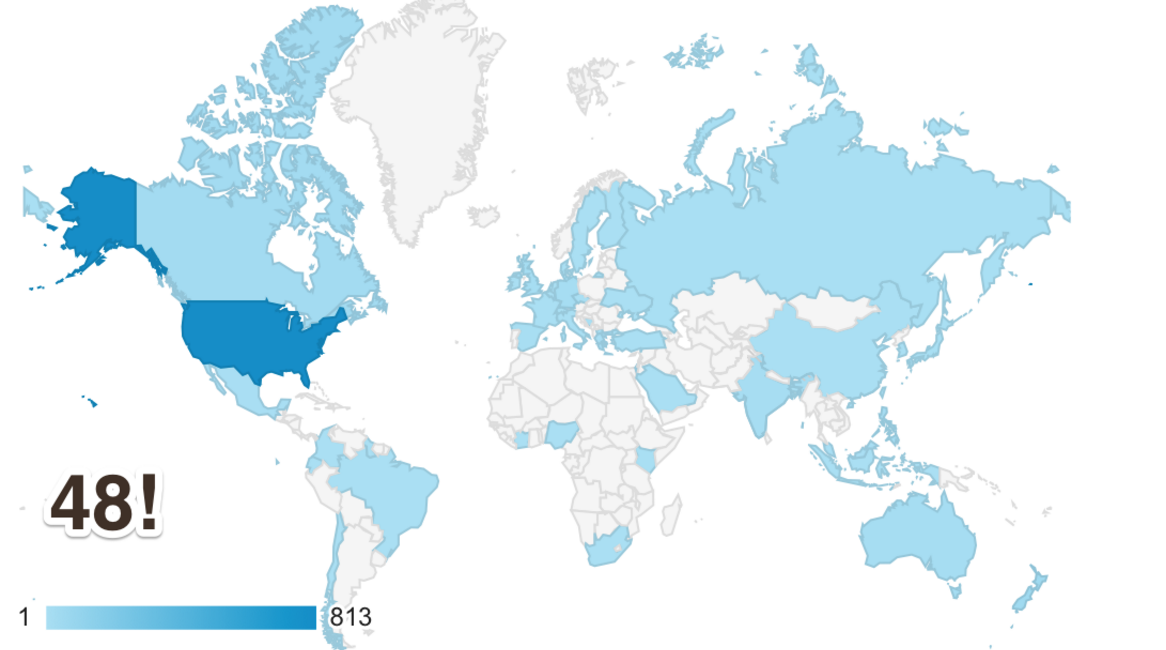
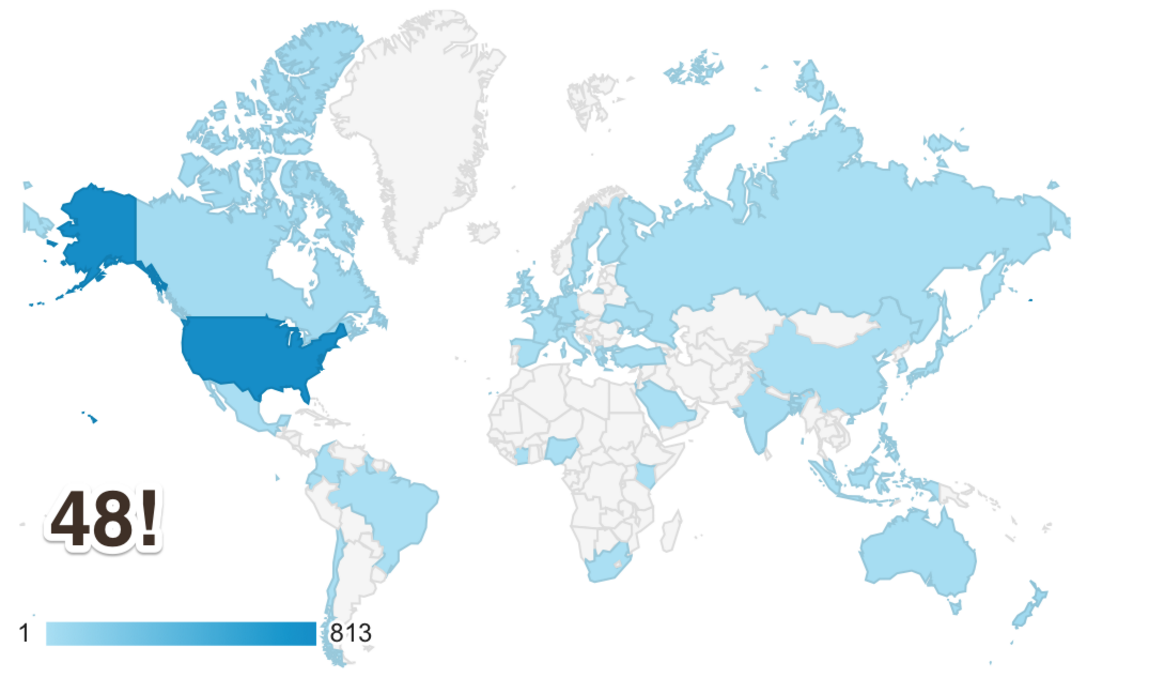
  • Visits from 48 countries including Germany, Ecuador, Turkey, India, and New Zealand 
View Full Size Image

Sharing the Challenge

Through 114 #FossilFossick Tweets and other communication, the #FossilFossick challenge gathered 192.7k impressions. The challenge announcement e-mail was opened by 1,895 people, who in total clicked on links 177 times. The update campaign e-mail sent 3 days later, pushing us through the last 29 pages, was opened by 1,121 people and resulted in 101 link clicks.

Surfacing Connections

We also asked volunteers to help us track correspondents, specimens, and locations. This part of the challenge is on-going! You can still help by reading the completed field notes (perhaps by downloading the PDF) and entering details in this Google Spreadsheet: http://bit.ly/FossilFossick

Finds From #FossilFossick Hunters

What did volunteers find interesting about this challenge? Handwriting to buddies to technology and the real personalities behind scientific field work. First, our volunteers were more than amused by Harry Ladd’s adventures and his playful personality, as well as his colorful pals.

Aeneid allusion alert! Evidently, Willy is Ladd’s Patroclus! @TranscribeSI #FossilFossick https://t.co/6k1wF8S4hu pic.twitter.com/hUjDk5E4nb

— Witchy Meg (@meg_shuler) October 10, 2015

Other volunteers tried to determine whether Ward took a street car, golf cart, or automobile from Alexandria to Mount Vernon.

.@TranscribeSI Ward misses his “electric car” & has 2 walk. Wonder if its an actual car or a trolley https://t.co/1QtyvuViXA #fossilfossick

— Siobhan (@SiobhanLeachman) October 11, 2015

Still others shared information to help one another tackle the challenge – great collaboration even from the start of the event!

To anyone who’s into #FossilFossick project (https://t.co/HL1hUdIhpH), here’s a handy fossil search db http://t.co/byhnFhfuj5 #volunpeers

— Loukritia (@loukritia_sin) October 10, 2015

What’s Next?

A total success deserves a totally fantastic reward: be sure to tune into the behind-the-scenes tour of Smithsonian fossil collections with Dr. Nicholas Pyenson, Curator of Fossil Marine Mammals at the Smithsonian’s National Museum of Natural History, via the BHL Periscope on October 26 as a reward for the successful completion of the challenge. More details to come on Twitter and Facebook.

You can explore the field notes in BHL:

  • Harry S. Ladd
  • Lester F. Ward
  • G. Arthur Cooper

You can also read all of the completed #FossilFossick projects by visiting the project pages with these links and downloading the PDFs:

  • Harry S. Ladd – https://transcription.si.edu/project/7811
  • Harry S. Ladd – https://transcription.si.edu/project/7812
  • Lester F. Ward – https://transcription.si.edu/project/7810
  • G. Arthur Cooper – https://transcription.si.edu/project/7804
  • G. Arthur Cooper – https://transcription.si.edu/project/7805
  • G. Arthur Cooper – https://transcription.si.edu/project/7806
  • G. Arthur Cooper – https://transcription.si.edu/project/7807
  • G. Arthur Cooper – https://transcription.si.edu/project/7808
  • G. Arthur Cooper – https://transcription.si.edu/project/7809
Thanks again to all of our wonderful volunteers who contributed to this challenge! When we collaborate for citizen science, everyone wins!
October 16, 2015by ulib-libraryjobs
Page 1 of 212»

Help Support BHL

BHL's existence depends on the financial support of its patrons. Help us keep this free resource alive!

search

About BHL

The Biodiversity Heritage Library (BHL) is the world’s largest open access digital library for biodiversity literature and archives. BHL operates as a worldwide consortium of natural history, botanical, research, and national libraries working together to digitize the natural history literature held in their collections and make it freely available for open access as part of a global “biodiversity community.”

Join Our Mailing List

Sign up to receive the latest news, content highlights, and promotions.

Subscribe Now

Subscribe to Blog via Email

Enter your email address to subscribe to this blog and receive notifications of new posts by email.

Join 319 other subscribers

Subscribe to Blog Via RSS

Subscribe to the blog RSS feed to stay up-to-date on all the latest BHL posts.

Access RSS Feed

Inspiring Discovery through Free Access to Biodiversity Knowledge.

The Biodiversity Heritage Library makes it easier than ever for you to access the information you need to study and explore life on Earth…for free, anytime, anywhere.


64+ Million Pages of
Biodiversity Literature Online.

EXPLORE

Tools and Services
to Transform Research.

EXPLORE

300,000+
Illustrations on Flickr.

EXPLORE

ABOUT | HARMFUL CONTENT | PRIVACY | SITE MAP | TERMS OF USE