Biodiversity Heritage Library - Program news and collection highlights from BHL
  • Home
  • News
  • Featured Books
    • All Featured Books
    • Book of the Month Series
    • BHL at 20
  • User Stories
  • Campaigns
    • Fossil Stories
    • Garden Stories
    • Monsters Are Real
    • Page Frights
    • Her Natural History
    • Earth Optimism 2020
  • Tech Blog
  • Visit BHL
Home
News
Featured Books
    All Featured Books
    Book of the Month Series
    BHL at 20
User Stories
Campaigns
    Fossil Stories
    Garden Stories
    Monsters Are Real
    Page Frights
    Her Natural History
    Earth Optimism 2020
Tech Blog
Visit BHL
  • Home
  • News
  • Featured Books
    • All Featured Books
    • Book of the Month Series
    • BHL at 20
  • User Stories
  • Campaigns
    • Fossil Stories
    • Garden Stories
    • Monsters Are Real
    • Page Frights
    • Her Natural History
    • Earth Optimism 2020
  • Tech Blog
  • Visit BHL
Biodiversity Heritage Library - Program news and collection highlights from BHL
Blog Reel, User Stories

Finding Refuge in the Library: How BHL Inspired the Mycological Book Club

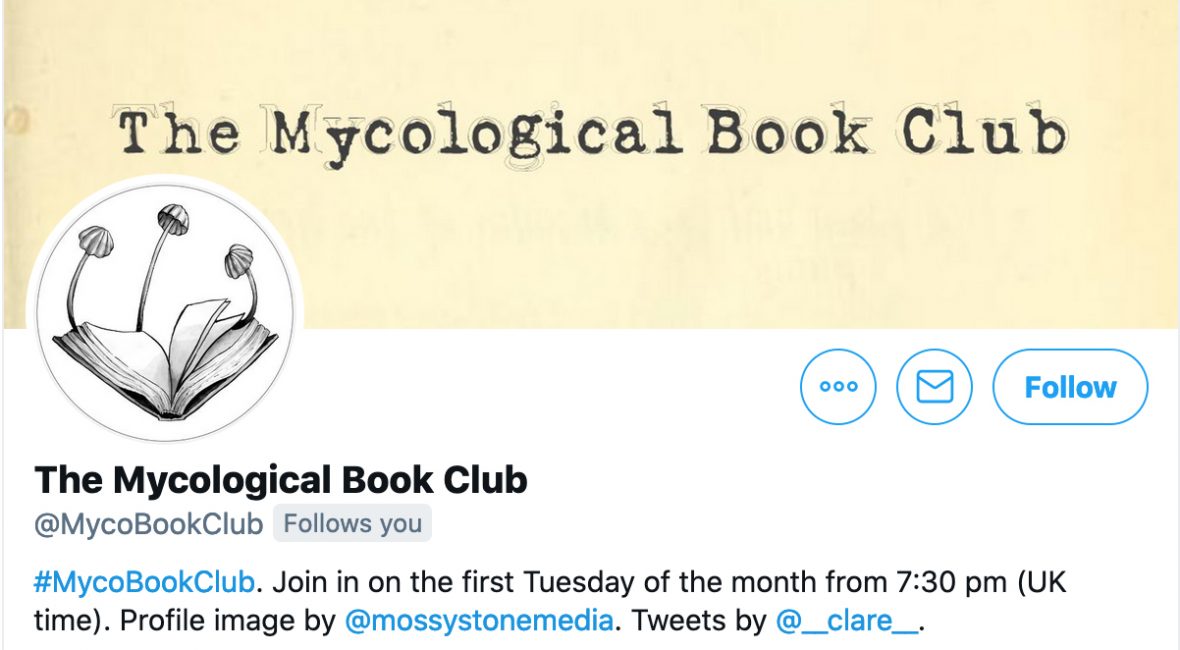
Screenshot of the Twitter profile of @MycoBookClub.

On 23 March 2020, the U.K. went into its first national lockdown in response to the COVID-19 pandemic. Social distancing and teleworking became the norm, and the walls of our homes became, in many ways, the boundaries of our individual worlds.

Amateur mycologist Clare Blencowe was eager to find a positive distraction from the realities of life during a pandemic. The Biodiversity Heritage Library’s open access collections, which for Blencowe had become a welcome refuge from the continuous onslaught of negative news articles, now became the inspiration for a new, socially distanced way to connect with other fungi lovers—in the form of “The Mycological Book Club”, an online, Twitter-based book club with a particular focus on open access literature.
#MycoBookClub logo fungi growing out of a book

#MycoBookClub logo, designed by illustrator Kelsey Sconberg of Mossy Stone Media.

“We were at the beginning of a national lockdown,” recalls Blencowe. “All social events were cancelled, and I found myself endlessly scrolling through increasingly doom-laden news, feeling increasingly doom-y. #MycoBookClub started as a simple distraction, an opportunity for a shared experience: people reading the same book and discussing it on Twitter at an allotted time.”
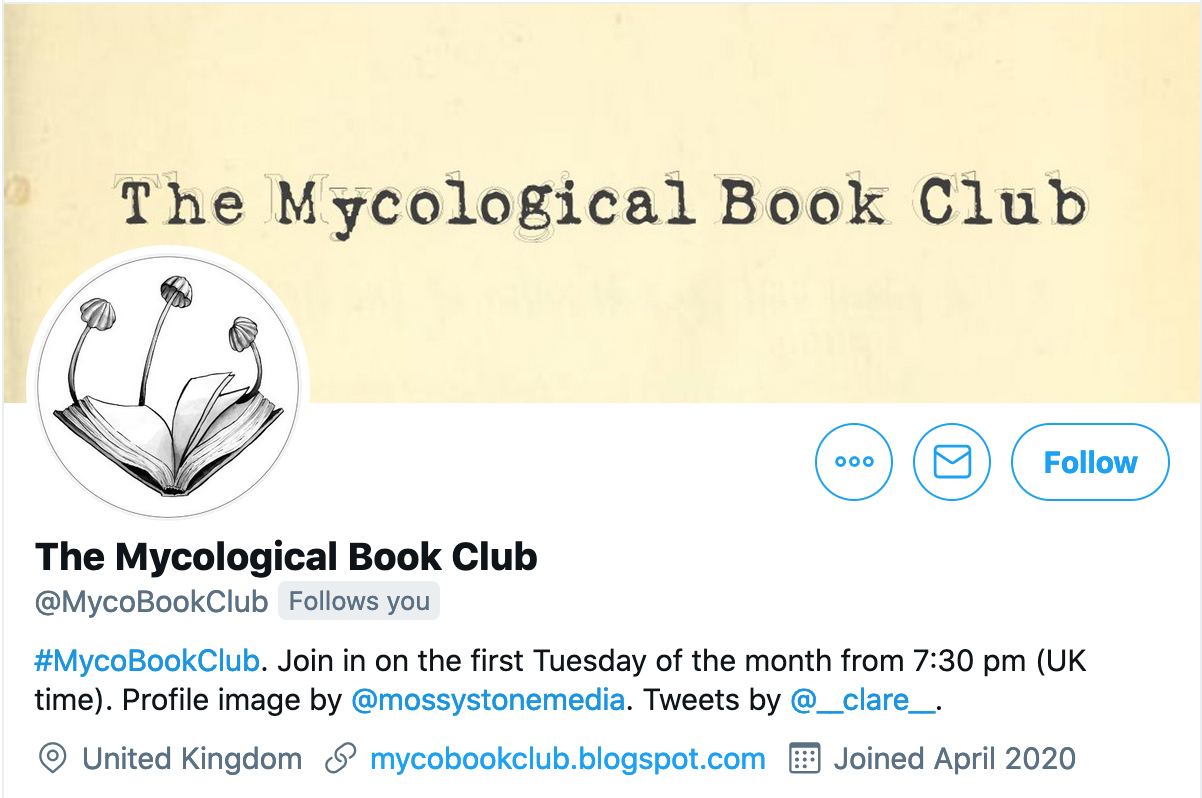
Screenshot of the Twitter profile of @MycoBookClub.

@MycoBookClub on Twitter.

Blencowe brought her idea to life by founding the @MycoBookClub Twitter account, establishing the #MycoBookClub hashtag to facilitate discussion, and setting a recurring date and time for book club meetings—the first Tuesday of the month at 7:30pm (GMT) on Twitter. She then scheduled the first #MycoBookClub meeting for 5 May 2020.

That first meeting, which brought together just a handful of followers, was dedicated to Mordecai Cubitt Cooke’s Rust, Smut, Mildew & Mould: An Introduction to the Study of Microscopic Fungi (Fifth ed. 1886), which club members accessed through BHL.

Welcome to #MycoBookClub, folks! It’s a pleasant evening here at @MycoBookClub headquarters in Sussex, England.

We’re talking about ‘MICROSCOPIC FUNGI: Rust, Smut, Mildew & Mould’ by M.C. Cooke (1886). You can find it at: https://t.co/7WO005ZS5Q pic.twitter.com/GxWzmYhnxg

— The Mycological Book Club (@MycoBookClub) May 5, 2020

With passages celebrating the beauty and wonder of the often unheeded nature in our own backyards and neighborhoods, the title was a fitting—and motivating—choice for an audience confined to their homes and local natural surroundings.

As Cooke writes,

“We might traverse the primeval forests of the new world, and explore the unknown regions of the old, and not encounter so much to excite our admiration, or cause our wonder, as lies about our feet at home; marvels which we tread beneath our feet, or kick from our path, because they appear to be only rotten sticks, withered grass, and decaying leaves.”

“Cooke’s writing provided inspiration for enjoying nature near home,” shares Blencowe. “I felt myself lifted by his soaring rhetoric.”
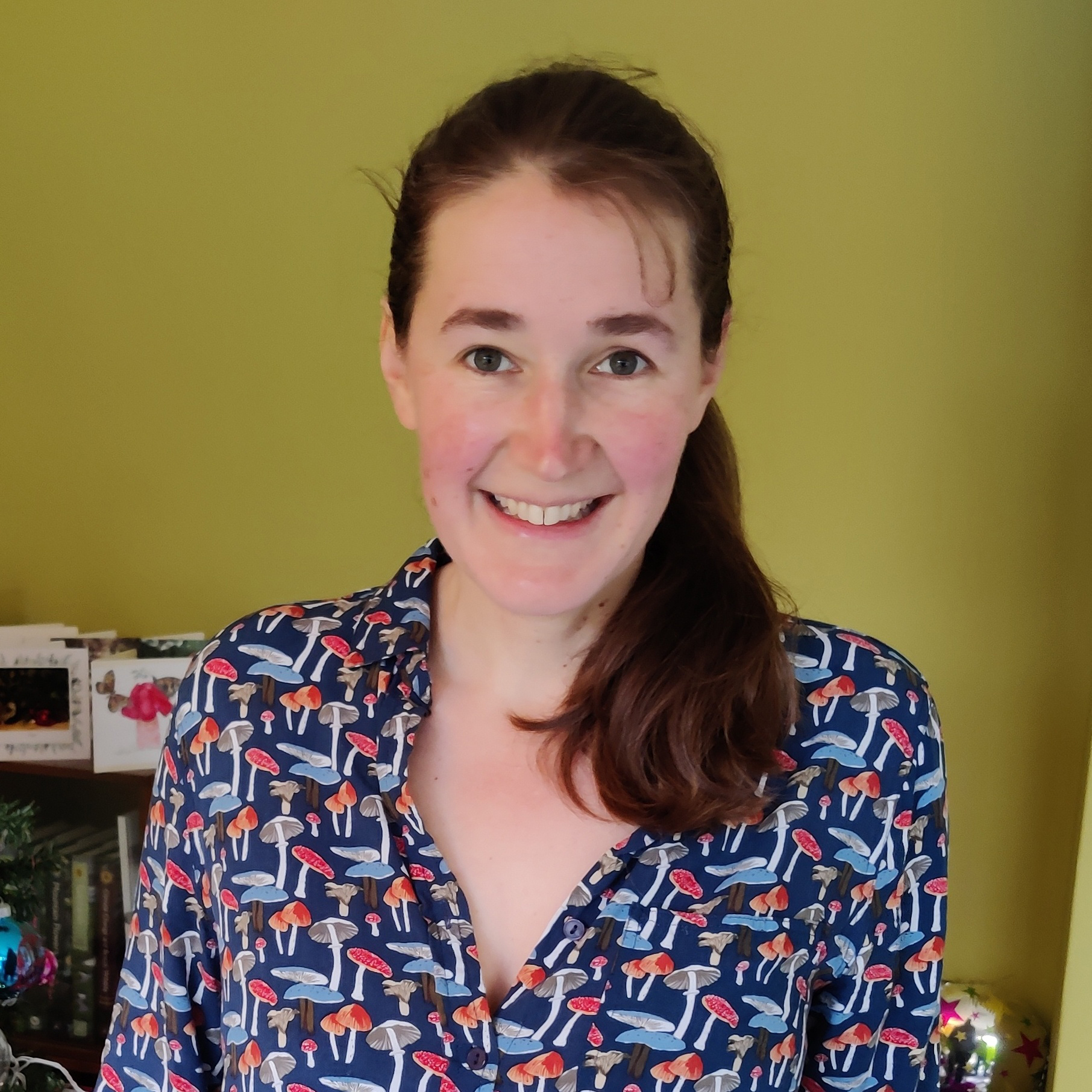
Photo of a human with long brown hair in a shirt with fungi images on it.

Amateur mycologist Clare Blencowe, founder of the #MycoBookClub. Photo courtesy of Clare Blencowe.

#MycoBookClub has allowed Blencowe to share and grow her interest in mycology—an interest that began in earnest about five years ago when a new job as manager of the Sussex Biodiversity Record Centre, and the much shorter commute that came with it, provided her with newfound time to pursue her interest in fungi. While she considers mycology a hobby, her involvement in the field has grown over the years through membership in the British Mycological Society, where she was recently elected to their Field Mycology and Conservation Committee.

BHL helped nurture this love of mycology well before the birth of #MycoBookClub. Blencowe’s first in-depth interaction with the Library occurred in April 2019, when her discovery of a small brown fungus cup in the woods led her to seek confirmation of its identity—which she believed to be the Anemone Cup Dumontinia tuberosa—by posting to the British Mycological Society Facebook group. UK-based mycologist Lukas Large responded to her post with the link to a color plate for comparison from Émile Boudier’s Icones Mycologicæ (1905-1910) in BHL.
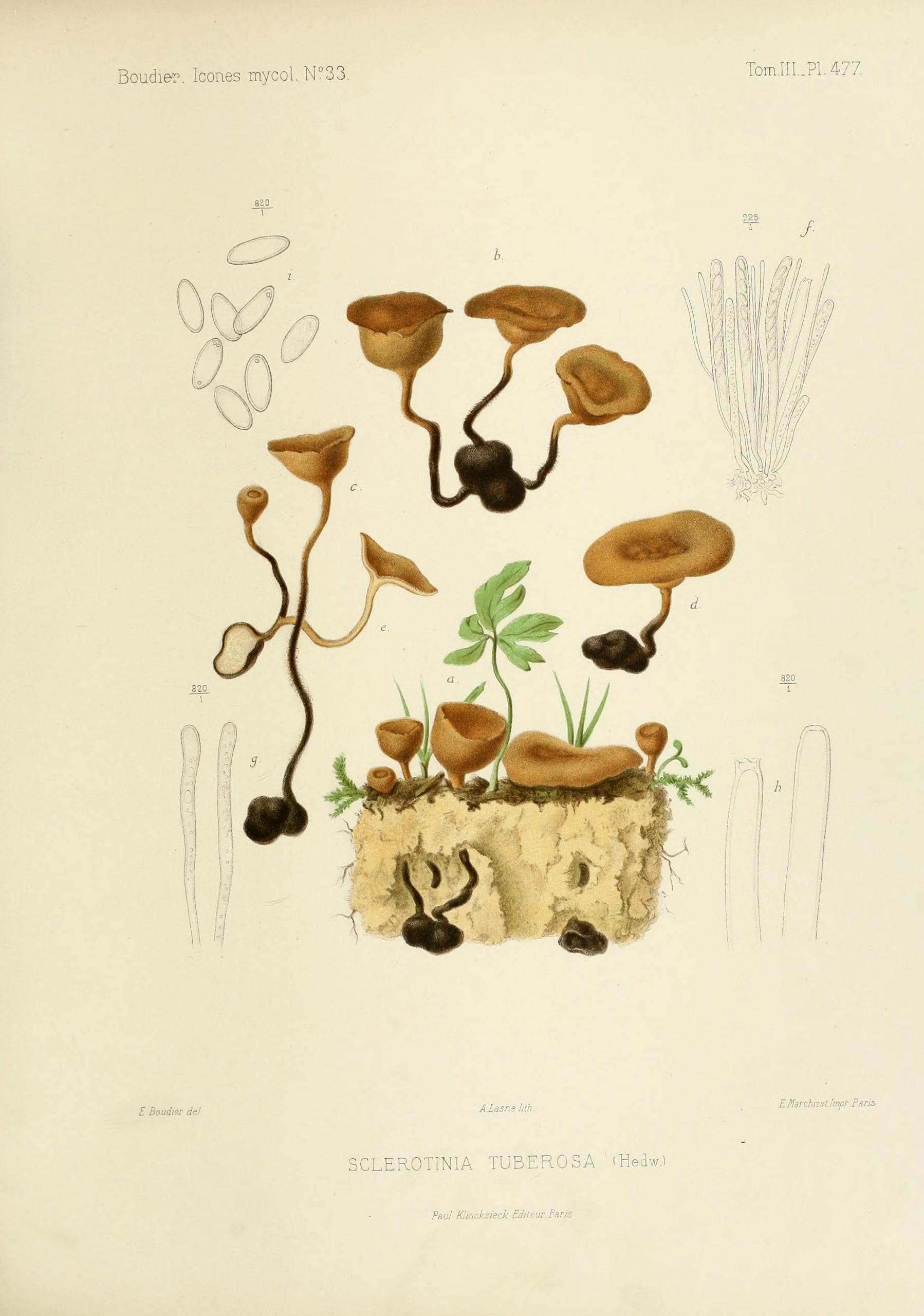
Illustration of fungi.

Illustration of Dumontinia tuberosa, plate 477. Boudier, Émile. Icones Mycologicæ (1905-1910), v.3. Art by Boudier. Contributed in BHL from the University Library, University of Illinois Urbana Champaign.

“The information contained in this beautiful colour plate far surpassed anything I had access to in my field guides at home,” shares Blencowe. “It helped me to understand the structure and features of this fungus I had in front of me, and spurred me on to take a closer look at it under the microscope. That experience really opened my eyes to what a useful resource the books in BHL can be: to inform observation and help identify species in a present day context. Sure, species concepts and nomenclature may have moved on, but the detail with which mycologists such as Boudier recorded their observations is a lesson in itself.”

Since that eye-opening experience, Blencowe continues to turn to BHL as a resource to support her interests in mycology, reading titles online and downloading select pages and images as needed. Some of her favorite aspects of the Library include a good search functionality, user-friendly online reading and content downloading, high quality scans, clear copyright information, easily-shareable direct page links, and the image collections in Flickr. Since founding #MycoBookClub, she uses BHL almost every week.

We’ve talked already here at #MycoBookClub about M.C. Cooke, but tonight we’re also feasting our eyes on ‘Selecta Fungorum Carpologia’ by The Brothers Tulasne.

You can find their illustrations in the Biodiversity Heritage Library: https://t.co/DN4Hi816XE pic.twitter.com/buaU9fMTa4

— The Mycological Book Club (@MycoBookClub) June 2, 2020

“I love the little bookish details that are preserved in BHL: the gilt decoration on a publication’s cover, ornate book plates, library stamps, barely-decipherable pencil marks and blank pages uniquely speckled with foxing,” shares Blencowe. “The scanned pages hold so much more than simply the words and the illustrations. They do your soul good.”

A reminder that it’s #MycoBookClub night tonight, from 7:30pm UK time.

We’re trying out a theme this evening: illustration ?https://t.co/Bvx0nDHY08

— The Mycological Book Club (@MycoBookClub) November 3, 2020

In the months following the club’s first meeting in May 2020, #MycoBookClub continued to grow, amassing more followers and receiving attention in outlets like The British Mycological Society Newsletter and IMA Fungus. Blencowe established a “virtual bookshelf” to maintain a list of all the books that #MycoBookClub had discussed—many of which were accessed through BHL.
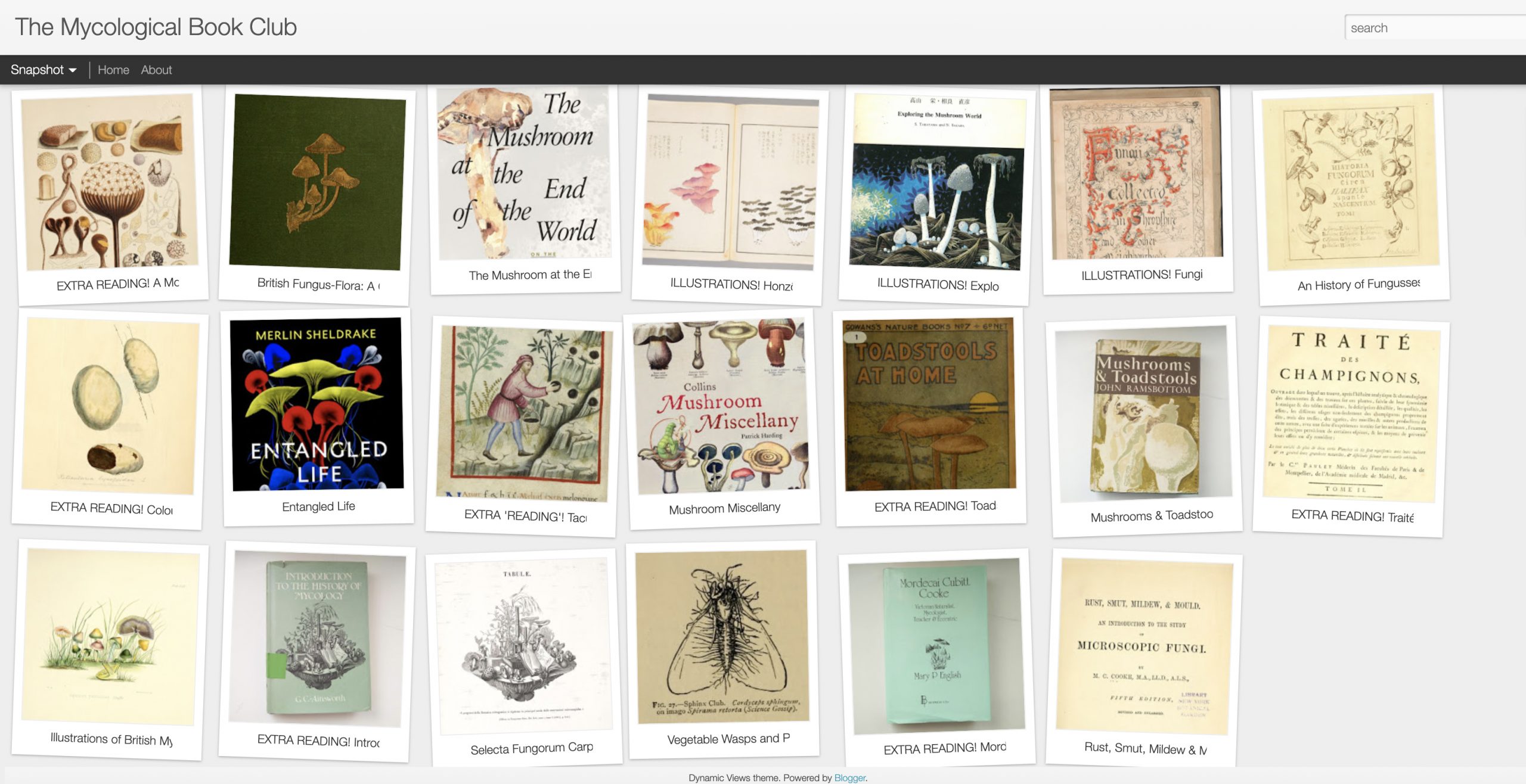
Screenshot of a virtual bookshelf with thumbnails of book covers.

#MycoBookClub “virtual bookshelf.” Source: https://mycobookclub.blogspot.com

“The more time I spend in the Library, the more amazed I am by the vast amount of literature it contains—and the neat way it is organised and presented,” lauds Blencowe. “BHL also provides the opportunity to take a deep dive into the source material for a fascinating glimpse into the machinery of global science in the 19th century.”

While she’s enjoyed many titles in BHL, a recent favorite is Anna Maria Hussey’s Illustrations of British Mycology (1847-55), which was the subject of the July 2020 #MycoBookClub meeting. Published under the name Mrs. T.J. Hussey, the two-volume work illustrates and describes species collected by Hussey and her sister, Frances Reed.

#MycoBookClub returns Tues 7 July, 7:30pm (UK time).

Thought we could take a broader look at the fungal kingdom this month with ‘Illustrations of British Mycology’ by Anna Maria Hussey (1847).

You can read it in the @BioDivLibrary, here: https://t.co/4BPXfDyWhd pic.twitter.com/icBcIRd1xM

— The Mycological Book Club (@MycoBookClub) June 7, 2020

“Hussey writes from the perspective of an enthusiastic amateur which I found both highly relatable and genuinely inspiring,” affirms Blencowe. “She writes in a chatty, conversational style which is peppered with fascinating contemporary details (such as her observation that Boletus subtomentosus has ‘the texture of a Limerick glove’) and timeless wisdom (‘life passes in gaining experience for ourselves…till at last we have acquired the wisdom to guide us safely…’).”
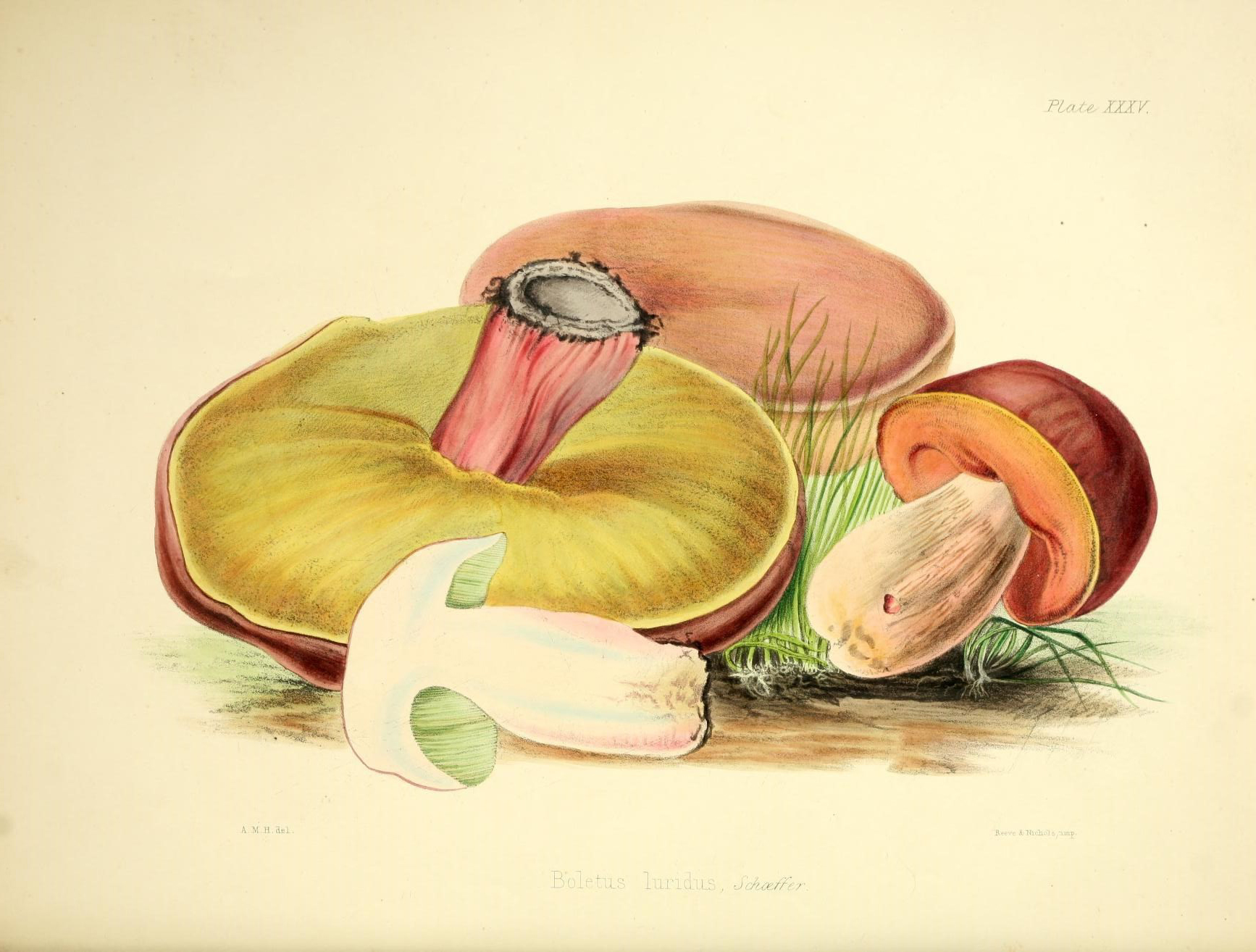
Illustration of fungi.

Illustration of Suillellus luridus, plate 35. Hussey, Anna Maria. Illustrations of British Mycology, ser.2 (1855). Art by Hussey. Contributed in BHL from The New York Botanical Garden, LuEsther T. Mertz Library. Explore all illustrations from Illustrations of British Mycology in the BHL Flickr.

Blencowe has gathered and shared via @MycoBookClub some of her favorite elements from Hussey’s work, including her approach to mycology, her discussion of fungus names, her commentary on fungi in nature, her descriptions of fungal habitats, and miscellaneous myco-chatter. Illustrations of British Mycologyis also noteworthy as a rare female-authored work in the bibliography of historic mycological literature.

“Browsing the historic biodiversity literature, it is very noticeable that certain perspectives predominate,” notes Blencowe. “The books are mostly written by men—white men. So it was a particular joy to come across Hussey’s book. I’m keen to explore ways that @MycoBookClub can provide a platform for different perspectives and respectfully champion Indigenous knowledge of fungi.”

While ours may still be a socially-distanced world, initiatives like #MycoBookClub remind us that there are still opportunities to connect with others, share our passions, and nurture a community. And while the news may still be filled with dire headlines, naturalists like Mordecai Cubitt Cooke and Anna Maria Hussey remind us that we can still find solace in nature close to home and in unexpected places, if we are just willing to look.

To quote Hussey: “The world is full of beauty that we pass by unheeded.”
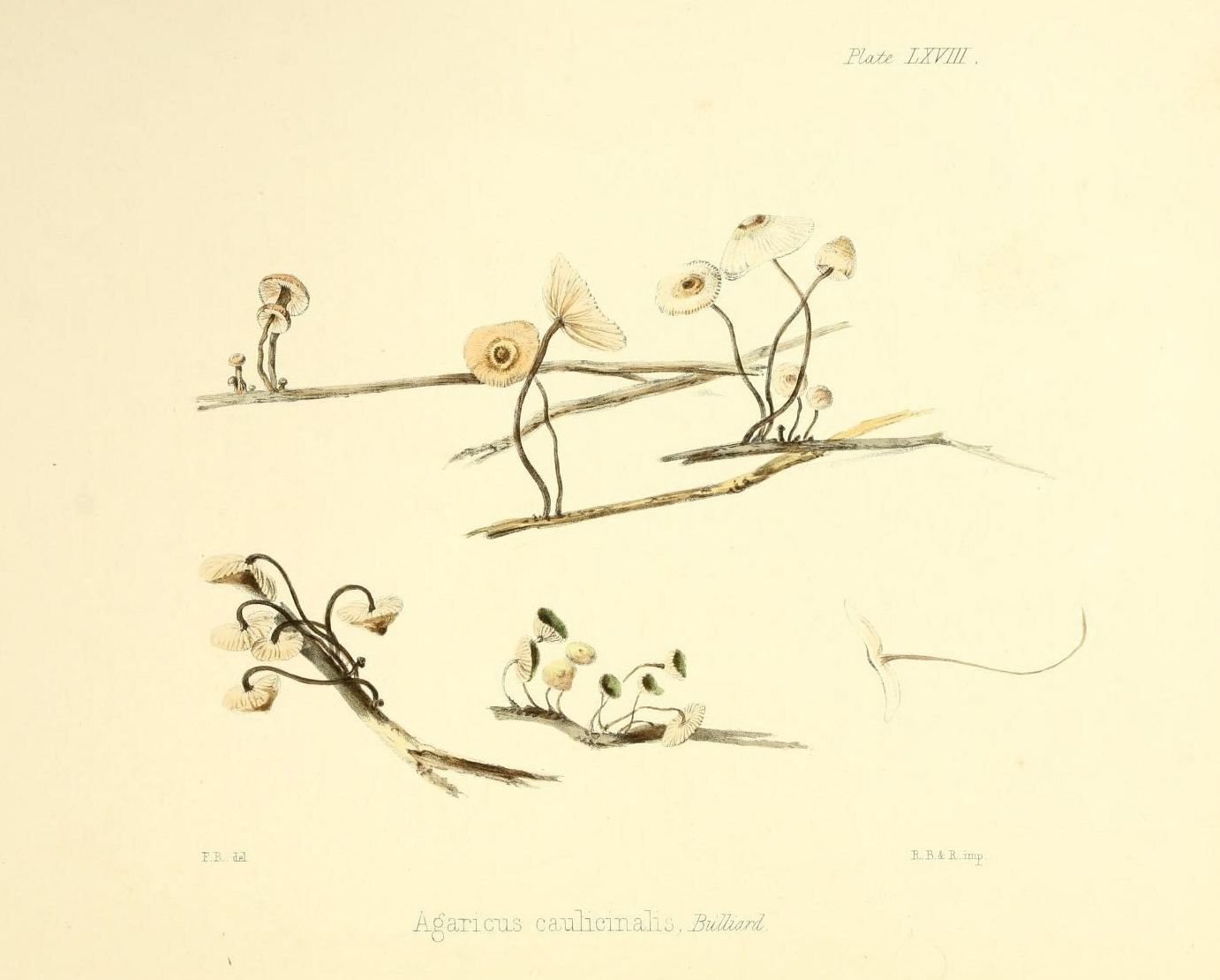
Illustration of fungi.

Illustration of Crinipellis scabella, plate 68. Hussey, Anna Maria. Illustrations of British Mycology, ser.1 (1847). Art by Frances Reed. Contributed in BHL from The New York Botanical Garden, LuEsther T. Mertz Library. This plate accompanies Hussey’s quote: “The world is full of beauty that we pass by unheeded.”

Everyone is welcome to join the #MycoBookClub. Follow @MycoBookClub for updates and meeting information, and join the discussion the first Tuesday of each month at 7:30pm (GMT) using the #MycoBookClub hashtag on Twitter.
February 1, 2021by michelle.underhill
Blog Reel, User Stories

Getting Fishy with BHL: Empowering Discoveries and Connections Around Museum Collections

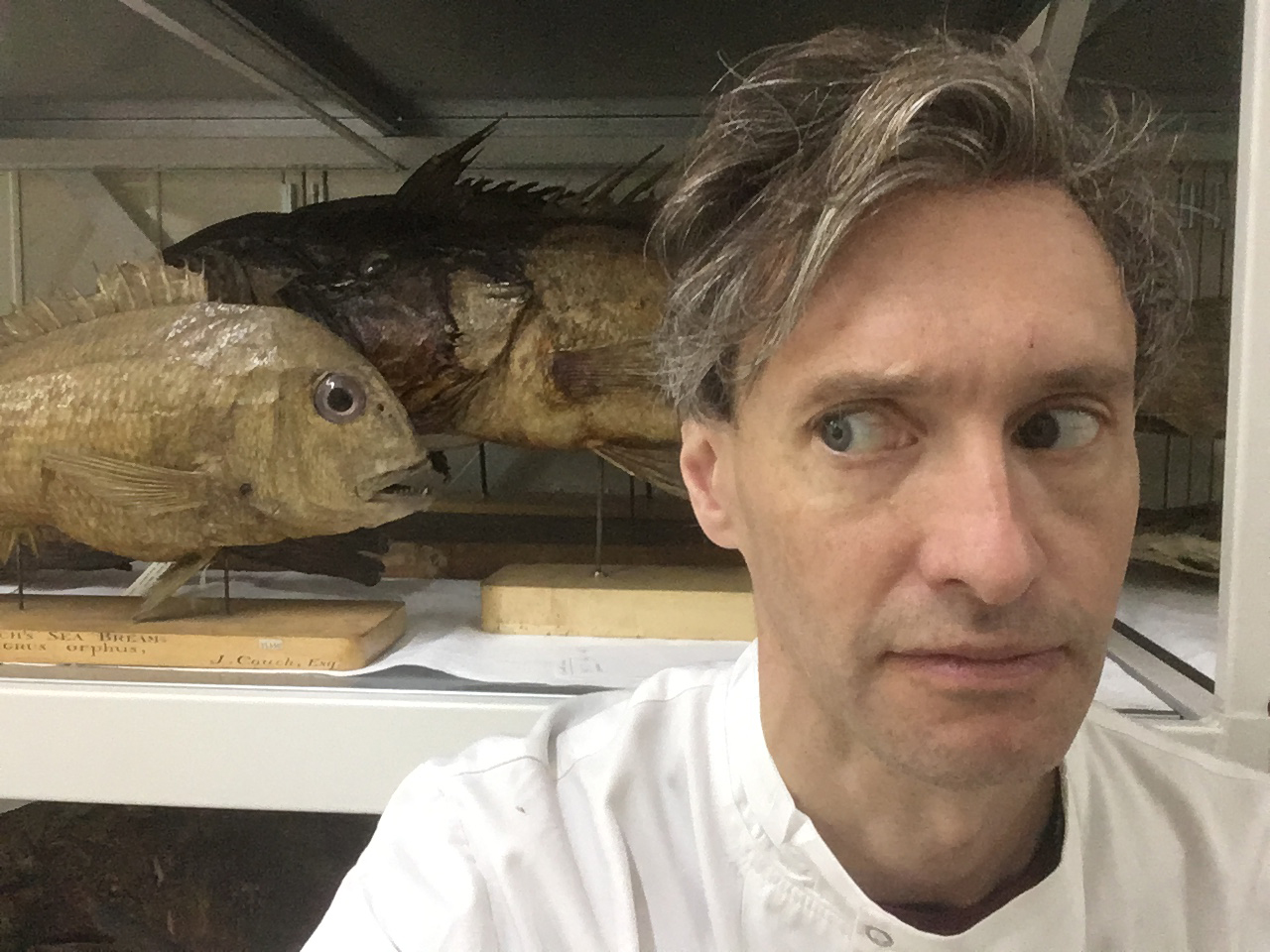
Man in a white shirt standing in front of a dried fish specimen.
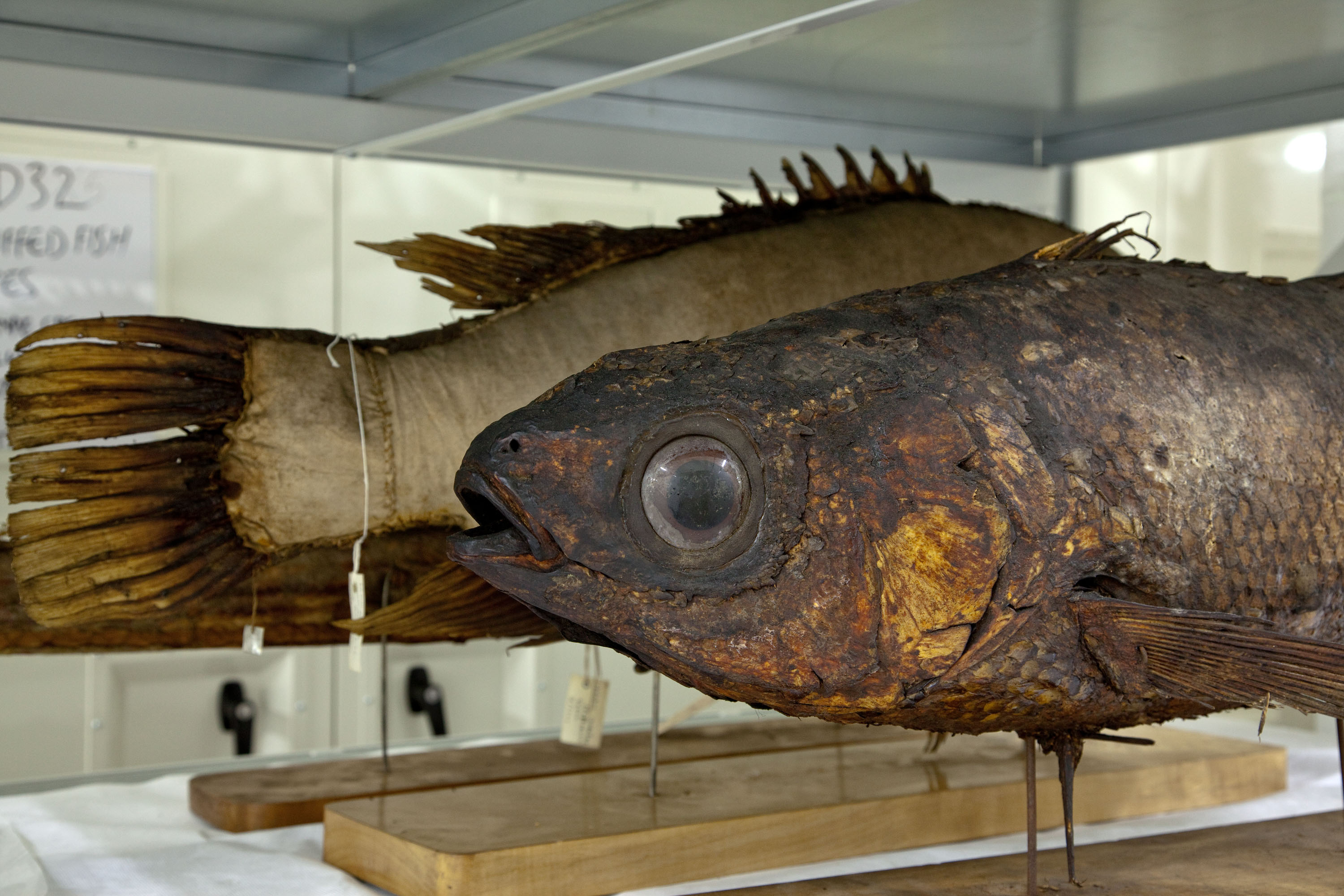
Photograph of a fish specimen.

Type specimen of Cubiceps capensis in the Natural History Museum of London’s dry specimen store, which houses most of the Museum’s skeletons, skins and stuffed fishes. Many specimens in the collection are well over 100 years old. James Maclaine, senior curator of fishes at the Museum, often uses BHL when conducting research on specimens in the collection. Photo by: Kevin Webb, NHM Photo Unit.

Twitter is a popular communication channel amongst the scientific community. Scientists use the platform to communicate with colleagues and share their research findings with both other scientists and the public.[1]

Twitter may also be a valuable source of data for researchers. For example, ecologists from the University of Gloucestershire found that “Twitter-mined” data is useful for phenological studies, such as winged-ant emergence or the appearance of house spiders in the fall.[2]

Twitter conversations can also spark unexpected discoveries. For example, a recent @BioDivLibrary Twitter conversation helped uncover a connection between the scientific literature and a museum’s collections.

It began with Boops boops, a fish — commonly called a bogue — native to the eastern Atlantic. @BioDivLibrary posted an illustration of the species in response to a tweet from Deborah Paul (@idbdeb), who shared the species as an example of a name uncovered while experimenting with parsing taxon names as part of the recent BHL data mining workshop at the University of Illinois.

?

Boops boops #SciArt from “A history of the fishes of the British Islands”, v. 1 (1868), in #BHLib via @SILibraries ➡️ https://t.co/A37BOVJ4Ru pic.twitter.com/HZVxA1ntoT

— BHL (@BioDivLibrary) June 18, 2019

The illustration, published in A History of the Fishes of the British Isles (1862-65), was based on a specimen collected in October 1842 and deposited in the Museum of the Royal Cornwall Institute at Truro. The text also mentions a second specimen, which was presented to the British Museum by a “W.P. Cocks, Esq.”. Paul tweeted an inquiry to see if anyone could help track down the current location of the specimen.

… and did you see this?! https://t.co/WzTtJjf6iN ~ specimen collected October 1842 ~ deposited Museum of the Royal Cornwall Institute at Truro ~ Wonder where it is now? Any help @NHM_Digitise? Who has Boops boops specimen from 1842? @ASIHCopeia @SPNHC @GBIF @DiSSCoEU @iDigBio? pic.twitter.com/TuJ09ueKGK

— Deborah Paul (@idbdeb) June 19, 2019

@NHM_Digitise called on James Maclaine (@beardiddley), senior curator of fishes at the Natural History Museum in London, for help tracking down the specimens. Pulling from a reference in Albert Gunther’s Catalogue of the Fishes in the British Museum, Maclaine responded that the Museum likely held the “W.P. Cocks, Esq.” specimen (with the label reading “Cork” instead of “Cocks”) and proceeded to tweet a picture of the specimen itself.

We do have one of the other ones in the reference I think (assuming W.P.Cocks and W.P.Cork are the same person!). From Albert Gunther’s Catalogue of Fishes, 1859, vol.1, p.419. pic.twitter.com/uZ5gibJmOm

— James Maclaine (@beardiddley) June 20, 2019

Here’s what the Cocks/Cork specimen looks like! The missing one will probably be dried too. pic.twitter.com/sFdaUMn5jW

— James Maclaine (@beardiddley) June 20, 2019

Beyond providing an example of the kinds of discoveries possible on the Twitterverse, this conversation also highlights the value of scientific literature for providing information on museum collections.

“Sadly, despite their many other qualities, the Victorians weren’t great at recording some details which we now would consider essential, so it is often difficult to determine the history of a 19th century fish specimen,” shares Maclaine.

When information is missing on specimen labels, the literature may be able to help fill in the gaps. For Maclaine and others managing collections, having access to this literature through BHL is incredibly valuable.

Can I just say as well, I LOVE BHL, I use it nearly every day!

— James Maclaine (@beardiddley) June 20, 2019

Maclaine finds BHL’s collections particularly useful when researching type specimens, the specific specimen used to describe a new species and the “typical” example of that species.

“Types are the most important part of our collection and are essential to any research on the species that they represent,” explains Maclaine. “However, many currently lurk unrecognized on our shelves, and it’s part of my job to find them, correctly identify them as types, and then update our records accordingly. This is where BHL comes in.”

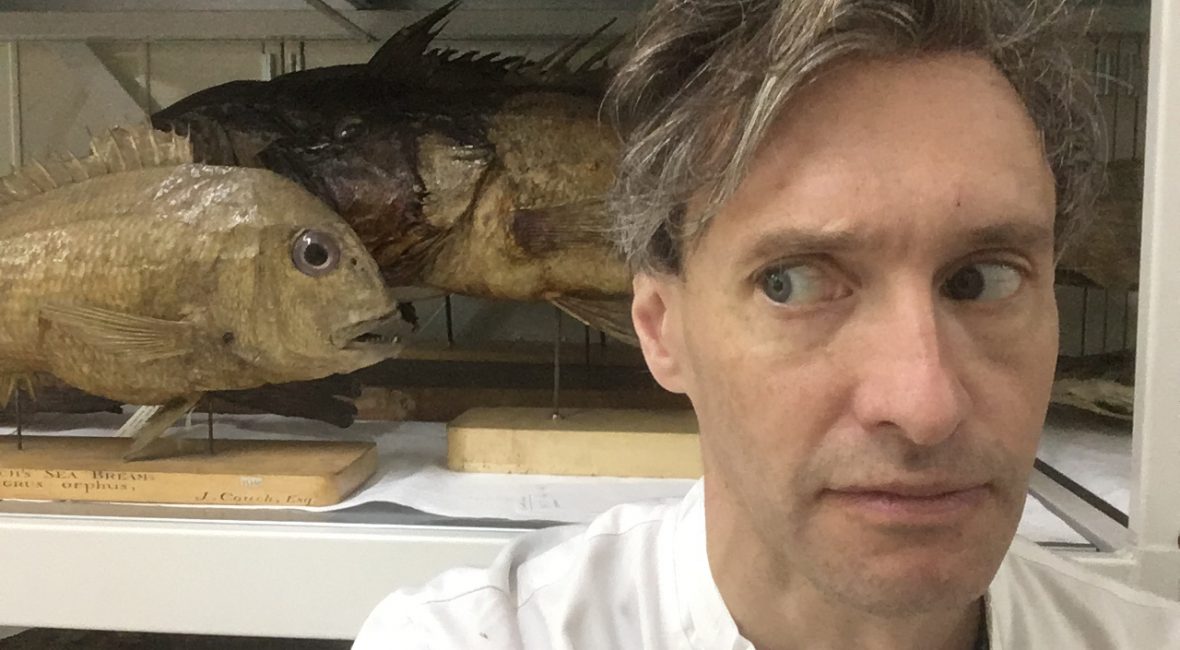
Man in a white shirt standing in front of a dried fish specimen.

James Maclaine, senior curator of fishes at the Natural History Museum in London, with a seabream collected from Cornwall by naturalist Jonathan Couch in 1843. The specimen is housed in the Museum’s dry specimen store. Photo by: James Maclaine.

Maclaine uses BHL sometimes several times each day, using the taxonomic name finding feature to locate literature on specific species, downloading relevant documents as PDFs, and linking to useful references using page permalinks.

“BHL has been fundamentally useful in two ways,” asserts Maclaine. “Firstly, it’s very easy to quickly get old references. Secondly, being able to download them is very helpful too. When investigating potential type specimens, I often have to go back to those first original species descriptions in the 19th century journals, which is now so quick and easy to do online. If I’m lucky, the species author will give a collecting locality, a collector and a measurement. If all three of those and the species name tie up with the specimen, I can be fairly certain that it was used when the species was described and is a type.”

Maclaine first discovered BHL via Eschmeyer’s Catalog of Fishes, a fish taxonomy database of all known fish names, the history of those names and where they were first published.

“One day I noticed a blue hyperlink next to a reference with the message ‘See ref. at BHL’, and that was that,” recalls Maclaine.

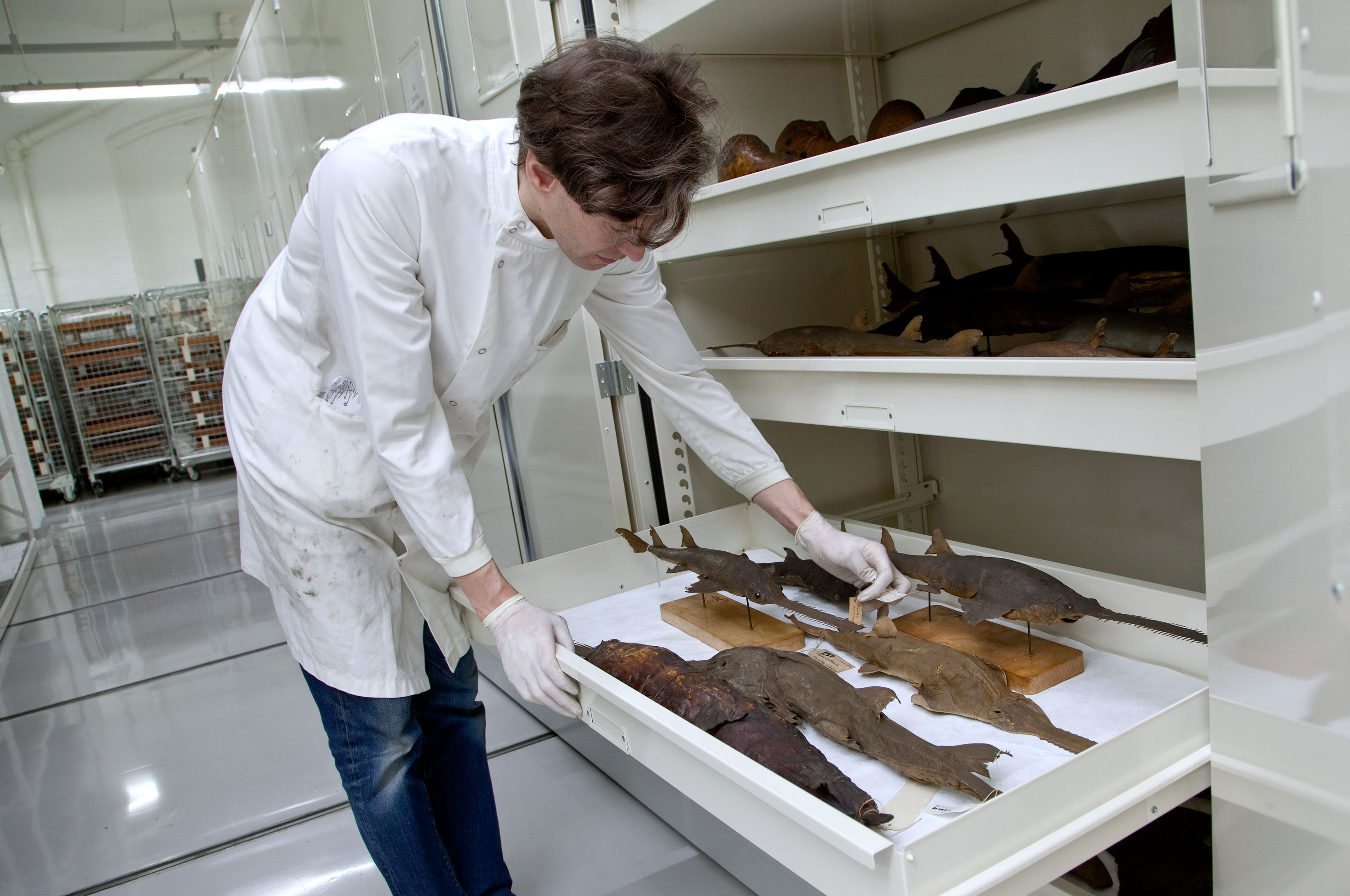
Man inspecting fish specimens in a museum drawer.

James Maclaine, senior curator of fishes at the Natural History Museum in London, inspecting specimens in the Museum’s dry specimen store, which houses most of the Museum’s skeletons, skins and stuffed fishes. Photo by: Kevin Webb, NHM Photo Unit.

As the manager of the fish collection at the Natural History Museum, Catalogue of the Fishes in the British Museum (1859-1868) is one of the most useful books in BHL’s collection for Maclaine’s work. In fact, it was this title that led him to the “W.P. Cocks, Esq.” specimen that he shared on Twitter.

Managing a 250+ year old collection means that Maclaine is responsible for ensuring that the information available for the specimens in his care is correct and up-to-date. BHL not only helps him provide reliable data for current researchers, but is also a valuable contributor to the legacy he will leave for future researchers.

“I have to think of all the generations of curators and researchers who will come after me and think, will what I’m doing be clear and comprehensible hundreds of years after I’m dead?” says Maclaine. “So, it’s great that I can now download the relevant references and then attach them to the specimen record so that everyone can see what I’ve done and why. I think the only bad thing about BHL is that it means I now spend less time in our Museum Library, another fantastic and irreplaceable resource!”

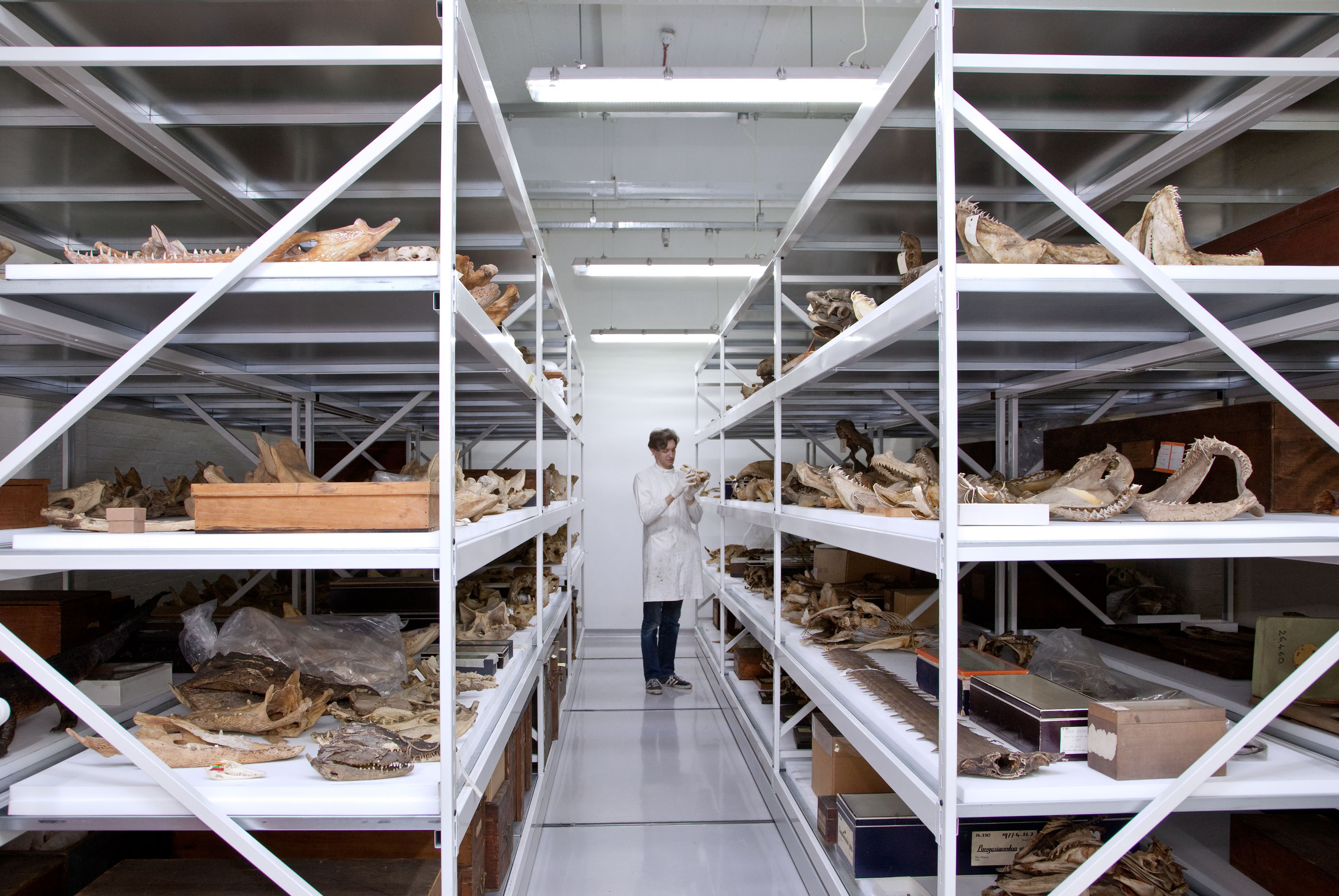
Man standing in a storage room for fish specimens.

James Maclaine, senior curator of fishes at the Natural History Museum in London, inspecting specimens in the Museum’s dry specimen store, which houses most of the Museum’s skeletons, skins and stuffed fishes. Photo by: Kevin Webb, NHM Photo Unit.

By making their literature digitally available, our Partners have ensured that anyone, anywhere can access important collections data. We’re proud to be a part of empowering new discoveries and connections, whether that be through a Twitter conversation or the diligent work of a museum collections manager.

References

[1] Phys.org. 2016. “New Study Reveals How Scientists Use Social Media.” Social Sciences, October 12. Accessed on July 9, 2019. https://phys.org/news/2016-10-reveals-scientists-social-media.html.

[2] Adam G. Hart, William S. Carpenter, Estelle Hlustik-Smith, Matt Reed, Anne E. Goodenough. “Testing the potential of Twitter mining methods for data acquisition: Evaluating novel opportunities for ecological research in multiple taxa.” Methods in Ecology and Evolution, 2018; DOI: 10.1111/2041-210X.13063.

September 5, 2019by michelle.underhill
BHL News, Blog Reel, Campaigns, Her Natural History

#HerNaturalHistory: Campaign Report and Outcomes

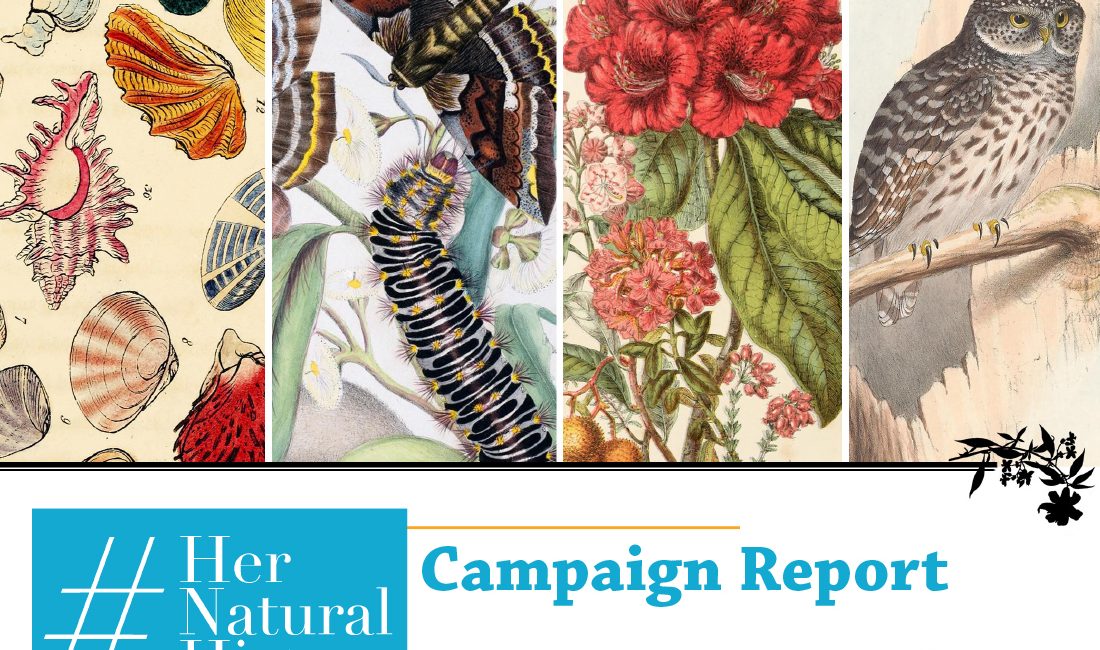
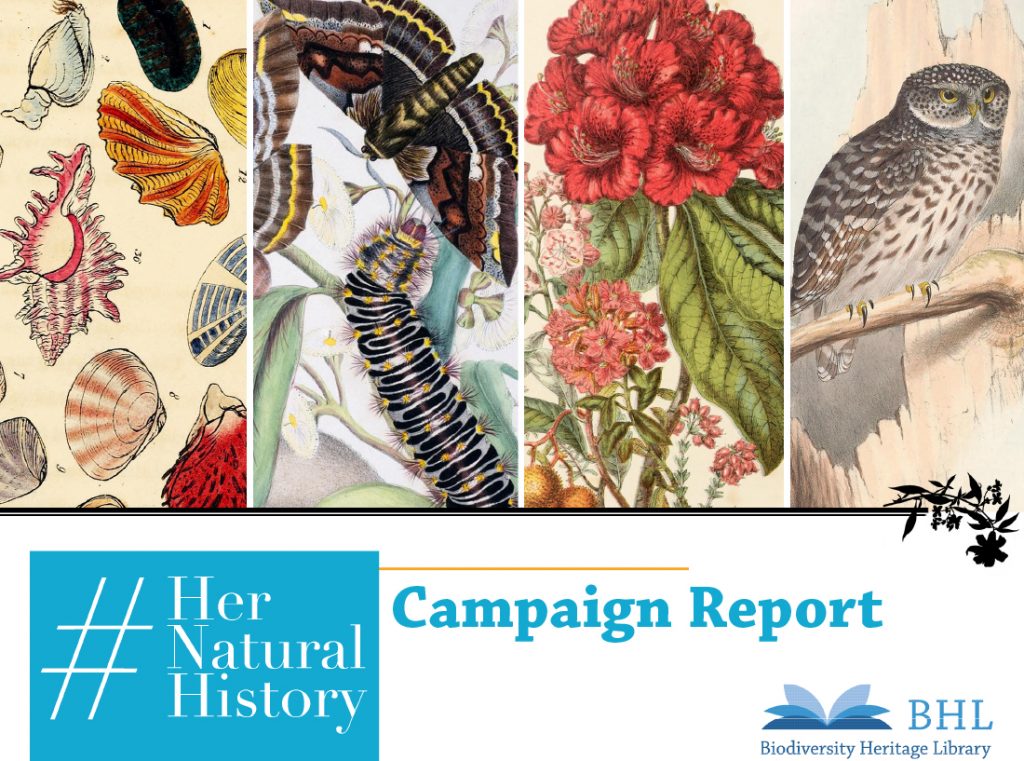
Her Natural History Campaign Report

Her Natural History Campaign Report

This year, the Biodiversity Heritage Library (BHL) and our global partners celebrated Women’s History Month with an international social media campaign: Her Natural History: A Celebration of Women in Natural History.

Kicking-off with an all-day social media blitz on International Women’s Day (8 March) and continuing throughout the month with social media and blog posts, Facebook Live events, and citizen science opportunities, Her Natural History aimed to increase awareness of and information about women in the biodiversity sciences. BHL partners also collaborated to curate the Women in Natural History Book and Female Illustrators in Natural History Flickr Collections for the campaign, featuring publications, archival materials, and illustrations by female naturalists and artists. Audiences could further engage with the work of female illustrators through the Her Natural History Coloring Book.

Extending beyond the BHL consortium, the wider community was invited to participate in the campaign by using #HerNaturalHistory to share stories, collections, publications, artworks, archival materials, exhibits, and other resources highlighting women and their contributions to natural history throughout the month. #HerNaturalHistory was also the #LibrariesOfInstagram challenge topic for March.

We were delighted with the outcomes and impact of the campaign. #HerNaturalHistory reached over 7.5 million people, with over 52 million impressions on content and over 3,100 accounts participating on social media. The campaign allowed BHL to expand its reach and engagement with existing and new audiences in notable ways, resulting in a 35% average increase in overall social reach and a 41% increase in overall social engagements compared to 2018 averages. #HerNaturalHistory also encouraged increased engagement with the works of women in BHL, fostering a 122% increase in views on books in the Women in Natural History Book Collection compared to 2018 monthly averages.

From engaging with worldwide audiences to tell the stories of so many remarkable women in science to working with our community to improve information online about the contributions of women to natural history, Her Natural History was a great example of how collaborative social media campaigns can be used to engage global audiences around important cultural and scientific topics while increasing engagement with library and archival collections.

We invite you to explore the results of the campaign in-depth within the Her Natural History campaign report.

Thank you to everyone who participated in and contributed to #HerNaturalHistory. And thank you to all of the women in science — past, present, and future — who have made such incredible contributions to biodiversity research. Thank you for giving us so many wonderful stories and accomplishments to celebrate!

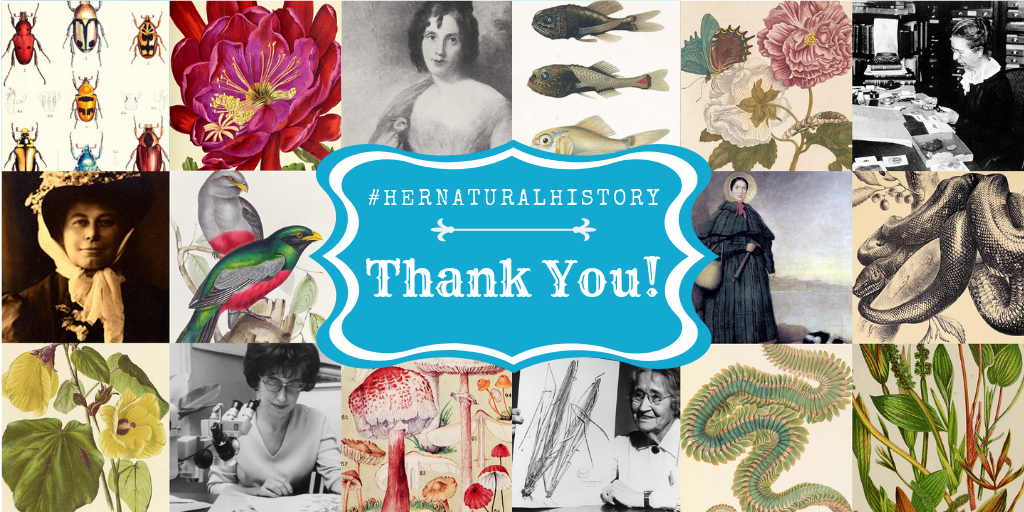
Thank you graphic for #HerNaturalHistory

May 2, 2019by michelle.underhill
Blog Reel, Campaigns, Her Natural History

Happy Women’s History Month! Join Us For #HerNaturalHistory Starting 8 March 2019

Her Natural History
Her Natural History

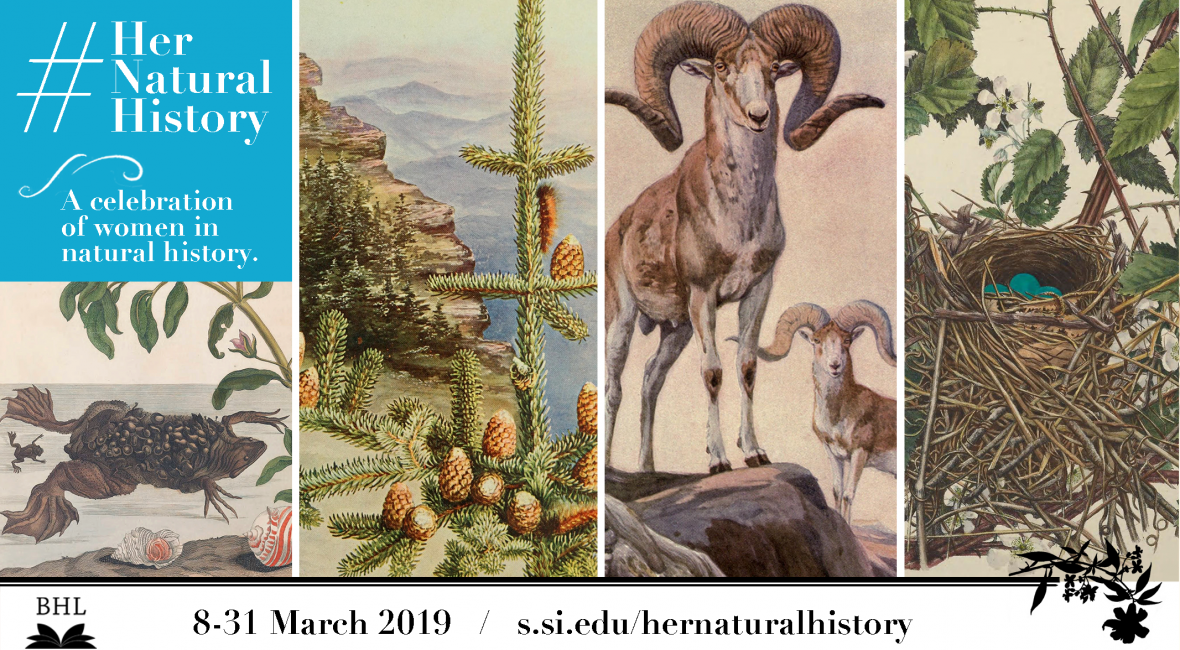
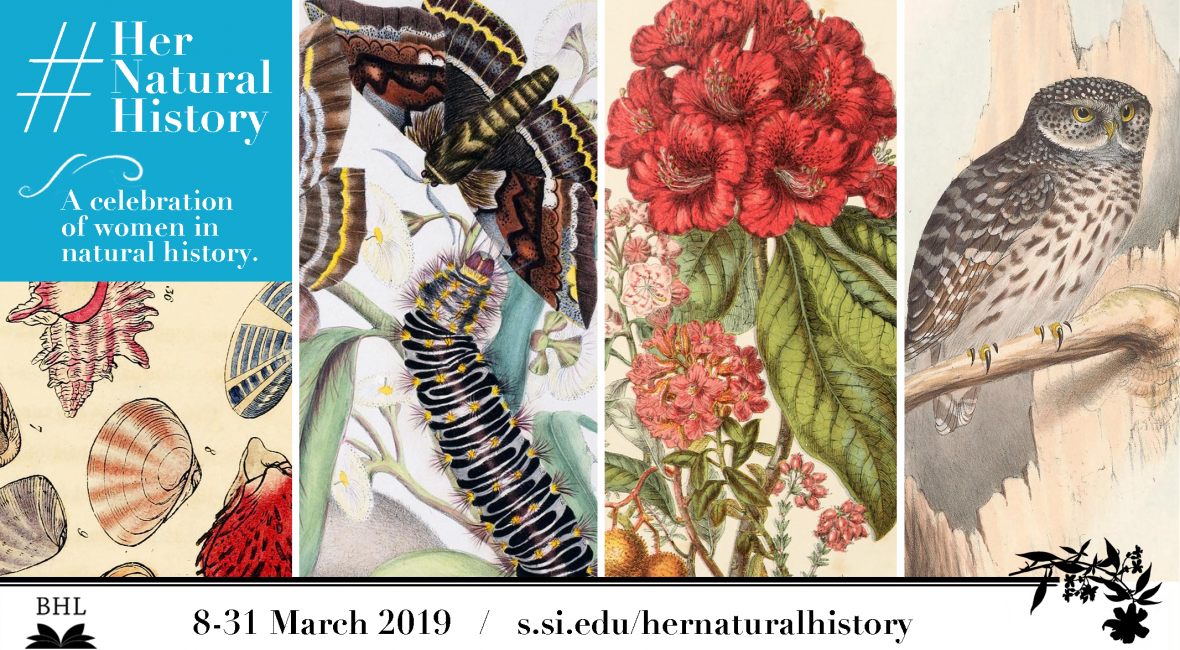
Illustrations in this graphic created by female artists who will be featured during #HerNaturalHistory. L to R: Maria Sibylla Merian, Metamorphosis insectorum surinamensium (1705); Marian Ellis Rowan, Southern Wild Flowers and Trees (1901); Winifred Austen, The Wild Beasts of the World, v. 2 (1909); Virginia Smith Jones, Illustrations of the Nests and Eggs of Birds of Ohio, v. 1 (1886). Illustrations digitized by Smithsonian Libraries, University of Toronto, and North Carolina State University Libraries.

March is Women’s History Month, and we’re celebrating with an international social media campaign produced in collaboration with our partners highlighting women and their contributions to natural history — Her Natural History: A Celebration of Women in Natural History.

Kicking-off with an all-day social media blitz on Friday, 8 March 2019 (International Women’s Day) and continuing throughout the month, Her Natural History aims to increase awareness of and information about women in the biodiversity sciences.

Women have made remarkable contributions to biodiversity research. From collecting specimens and serving as scientific illustrators to conducting and publishing research, authoring natural history books, and more, women have overcome many social and cultural obstacles and gender barriers to help further our understanding of the natural world.

As part of the campaign, we’ll be highlighting women in the BHL collection with our Women in Natural History Book and Female Illustrators Flickr Collections, featuring publications, archival materials, and illustrations by female naturalists and artists. We’ll be sharing these collections and the stories of the women who created them through our blog and on social media using the hashtag #HerNaturalHistory. You can color a selection of illustrations by female artists from BHL’s collection with our free coloring book. #HerNaturalHistory is also the #LibrariesOfInstagram challenge topic for March.

Additionally, there will be citizen science opportunities (including a Wikipedia Editing Workshop and transcription challenge) and a series of Facebook Live events from BHL partners throughout the month. See the sections below for more information about these activities.

We hope you’ll join us for the social media blitz on Friday (8 March) and throughout the month by following #HerNaturalHistory on Twitter, Facebook, and Instagram and using the hashtag to share stories, collections, publications, artworks, archival materials, exhibits, and other resources highlighting women and their contributions to natural history.

Learn more about the campaign on the Her Natural History webpage.

Her Natural History: A Celebration of Women in Natural History

When? 8-31 March, 2019
Where? Social Media (Twitter, Facebook, Instagram)
What? Join us in celebrating women in natural history this Women’s History Month! Follow along and join the campaign using #HerNaturalHistory.
More Information: s.si.edu/hernaturalhistory

Her Natural History Facebook Live Events

Facebook Live: Maria Martin.
Presented by Field Museum.
Join Chief Curiosity Correspondent Emily Graslie in the Rare Books Room at the Field Museum with Field Librarians Gretchen Rings and Diana Duncan to explore the work of Maria Martin, one of the background painters for Audubon’s Bird’s of America.
When? Friday, 8 March 2019 at 11:00am ET
Where? https://www.facebook.com/fieldmuseum

A Curious Herbal Facebook Live.
Presented by Oak Spring Garden Foundation.
Go behind-the-scenes at Oak Spring Garden Library to explore Elizabeth Blackwell’s groundbreaking illustrated work on medical plants, A Curious Herbal. The Library has several printed editions of the work as well as 73 of the original manuscript paintings Blackwell did for the book.
When? Friday, 8 March 2019 at 2:00pm ET
Where? https://www.facebook.com/OakSpringGardenFoundation

NYBG #HerNaturalHistory Live.
Presented by The New York Botanical Garden.
Get a behind-the-scenes look at some original botanical art, herbarium specimens, published works, manuscripts, and photographs by women in the natural sciences when The New York Botanical Garden goes behind-the-scenes in their Library & Herbarium.
When? Tuesday, 12 March 2019 at 12:30pm ET
Where? https://www.facebook.com/NYBotanicalGarden/

The Art & Life of Elizabeth Gould.
Presented by Smithsonian Libraries.
Get a behind-the-scenes look at the Natural History Rare Book Library at the Smithsonian Libraries as staff explore a selection of works by natural history illustrator Elizabeth Gould.
When? Friday, 22 March 2019 at 1:00pm ET
Where? https://www.facebook.com/SmithsonianLibraries

Her Natural History Citizen Science Opportunities

Women in Natural History Wikipedia Editing Workshop
Join us for the Women in Natural History Wikipedia Editing Workshop hosted by the Biodiversity Heritage Library and Smithsonian Libraries with support from Wikimedia DC. With the help of experienced Wikipedians, attendees will learn to edit Wikipedia and improve or create Wikipedia articles related to women in natural history, drawing on the Biodiversity Heritage Library’s free and extensive online collections as source materials. No editing experience is necessary.

When? 13 March 2019, 10am – 2pm ET
Where? In-person at Smithsonian Libraries (Washington, D.C.) and remotely via s.si.edu/NHWomenWikiLive
More Information: Wikipedia event page

Registration is Required:

  • Register to attend in-person
  • Register to attend remotely

Attending in person? Laptops are required. Please bring your own. Wikimedia has two laptops to loan. Reserve one by emailing [email protected]. This event is free and open to the public, but space is limited, so register today. Lunch will be provided.

Attending remotely? There will be an option to participate in the editing workshop remotely. For remote participants, the workshop will be live-streamed via YouTube Live here: https://s.si.edu/NHWomenWikiLive. Be sure to register to attend remotely

Transcription Challenge
Looking for a challenge? The Smithsonian Institution Archives and the Smithsonian Transcription Center are teaming up for a #HerNaturalHistory-themed transcription challenge. Beginning on 8 March, help a team of #volunpeers transcribe field notes from conservation biologist Devra Kleiman and botanist Cleofé Calderón. Dive into observations of golden lion tamarins with Kleiman, who worked at Smithsonian’s National Zoological Park from 1972 to 2001. And head to South America with Calderón to collect grasses for Smithsonian’s Department of Botany.

  • When? Beginning 8 March 2019
  • Where? Smithsonian Transcription Center. The field notes will be released on the Smithsonian Institution Archives project page.
March 1, 2019by michelle.underhill
BHL News, Blog Reel, Campaigns, Her Natural History

Coming This March! Her Natural History: A Celebration of Women in Natural History

Her Natural History
Her Natural History

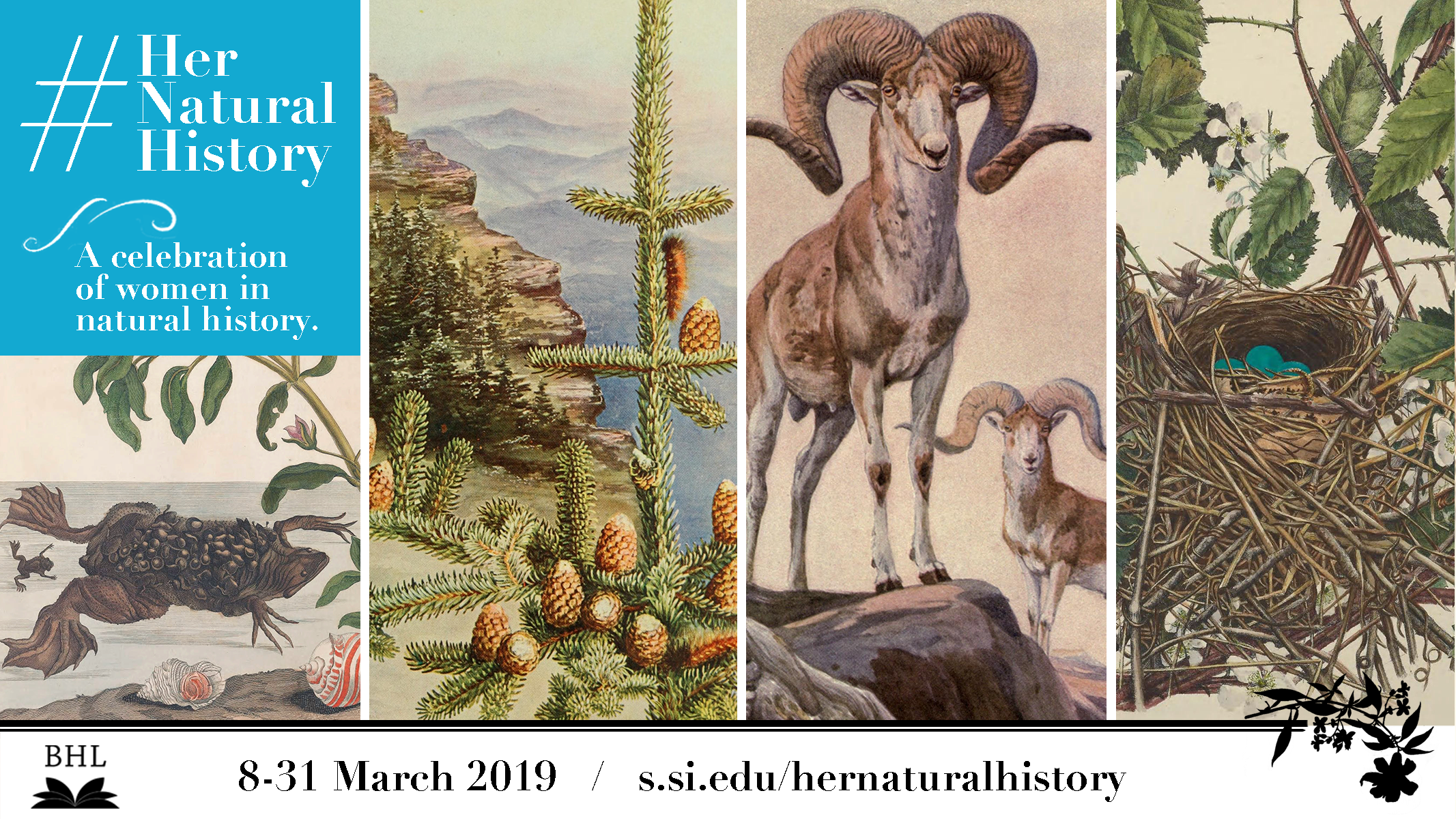
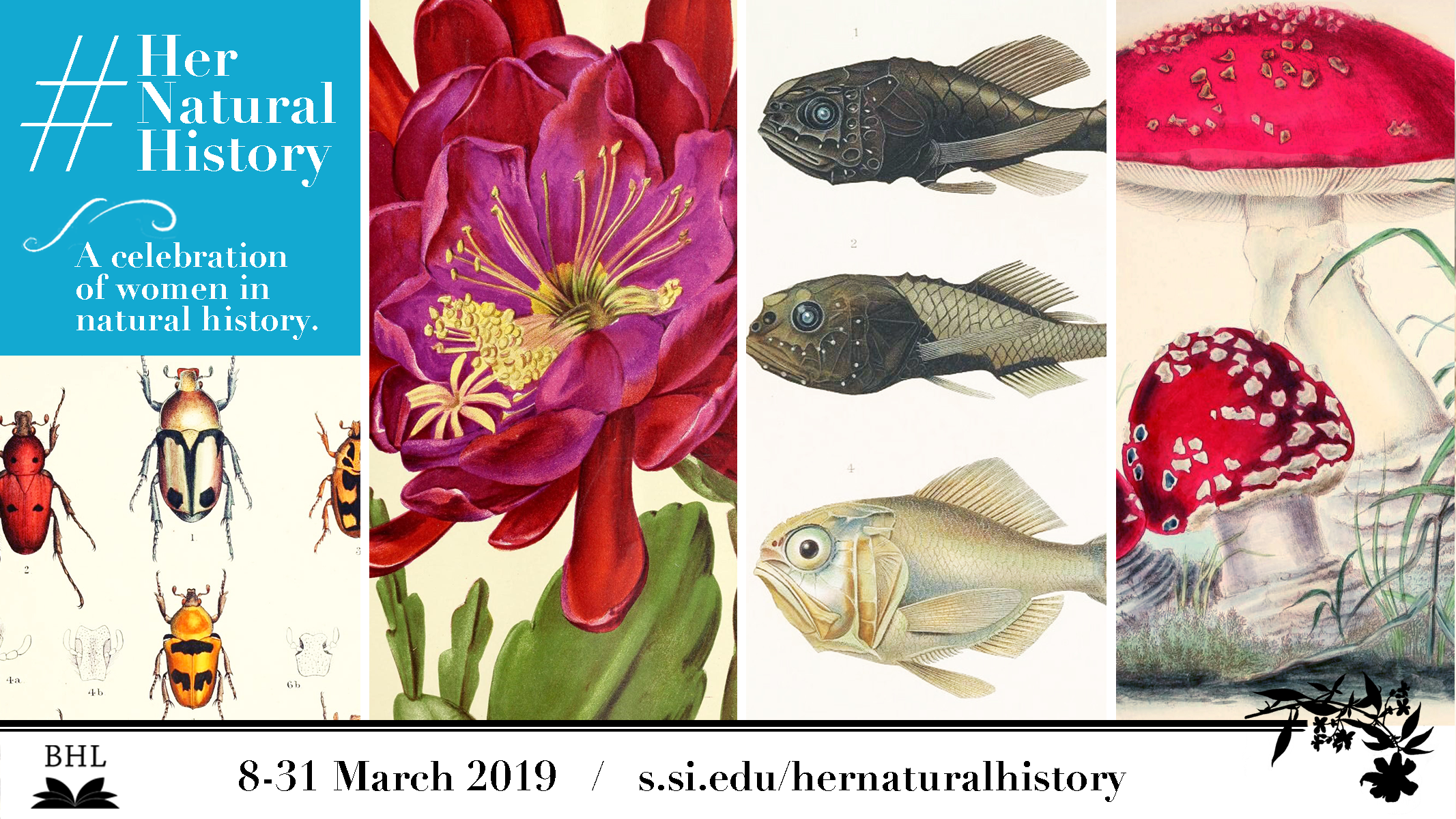
Illustrations in this graphic created by female artists who will be featured during #HerNaturalHistory. L to R: Maud Horman Fisher, Aid to the Identification of Insects, v. 2 (1882-90); Louise-Cécile Descamps-Sabouret, Revue Horticole (1899); Emma Kissling, Poissons provenant des campagnes du yacht Princesse-Alice (1911); Frances Reed, Illustrations of British Mycology, ser. 1 (1847). Illustrations digitized by Smithsonian Libraries, Harvard Botany Libraries, and The New York Botanical Garden.

This Women’s History Month, we invite you to join us in celebrating women in natural history as part of an international social media campaign produced in collaboration with our partners — Her Natural History: A Celebration of Women in Natural History.

Through social media and blog posts, interactive programming and citizen science opportunities, Her Natural History aims to increase awareness of and information about women in the biodiversity sciences.

The campaign will kick-off with an all-day social media blitz on Friday, 8 March 2019 (International Women’s Day) and continue throughout the month with additional posts and programming, including a Wikipedia Editing Workshop on 13 March. #HerNaturalHistory is also the @iglibraries #LibrariesOfInstagram challenge topic for March.

We hope you’ll join us for the social media blitz on 8 March and throughout the month by following #HerNaturalHistory on Twitter, Facebook, and Instagram and using the hashtag to share stories, collections, publications, artworks, archival materials, exhibits, and other resources highlighting women and their contributions to natural history.

Learn more about the campaign on the Her Natural History webpage, and stay tuned for more information in the coming weeks. We look forward to celebrating #HerNaturalHistory with you in March!

Her Natural History: A Celebration of Women in Natural History

When? 8-31 March, 2019
Where? Social Media (Twitter, Facebook, Instagram)
What? Join us in celebrating women in natural history this Women’s History Month! Follow along and join the campaign using #HerNaturalHistory.
More Information: s.si.edu/hernaturalhistory

February 11, 2019by michelle.underhill
BHL News, Blog Reel

Join us for Seeds in the Stacks!

Find a recording of Seeds in the Stacks on YouTube.
————————————-

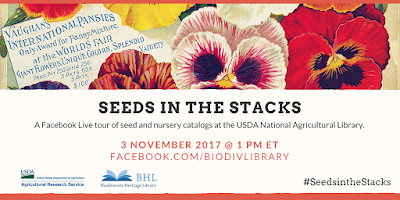
Join us for Seeds in the Stacks, a Facebook Live tour at the USDA National Agricultural Library! We’ll go behind-the-scenes to explore selections from the Library’s collection of over 200,000 seed and nursery catalogs.

WHERE?
www.facebook.com/BioDivLibrary
WHEN?
3 November 2017 @ 1pm ET

The USDA National Agricultural Library is the newest BHL Member. Since joining the consortium as an Affiliate in 2014, NAL has contributed over 2 million pages to the BHL collection, including a significant portion of its Henry G. Gilbert Nursery and Seed Trade Catalog Collection. To date, NAL has contributed over 33,000 catalogs from this collection to BHL. The catalogs can be viewed in BHL as part of the Seed & Nursery Catalogs collection.

October 30, 2017by michelle.underhill
BHL News, Blog Reel

Facebook Live Event 24 March: Celebrating Gesner

Portrait version of the Biodiversity Heritage Library logo.

View a recording of Celebrating Gesner on Facebook.

———————-

View Full Size Image

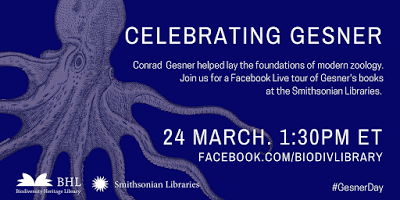
Conrad Gesner (1516-1565) was a Swiss naturalist whose Historia Animalium is considered the starting point of modern zoology. 26 March is the anniversary of his birth, and institutions around the world will celebrate #GesnerDay by highlighting his publications and contributions on social media.

In anticipation of this event, join us for a Facebook Live broadcast as we go behind-the-scenes at the Smithsonian Libraries with Leslie Overstreet, Curator of Natural-History Rare Books, who will tell us more about Gesner and showcase some of his amazing publications from the collections of the Smithsonian’s Joseph F. Cullman 3rd Rare Book Library of Natural History.

Many of Gesner’s works have also been digitized for BHL. Browse them here.

Celebrating Gesner Facebook Live Event

When? 24 March, 2017 at 1:30pm ET
Where? www.facebook.com/biodivlibrary

March 15, 2017by michelle.underhill
Page 1 of 51234»...Last »

Help Support BHL

BHL's existence depends on the financial support of its patrons. Help us keep this free resource alive!

search

About BHL

The Biodiversity Heritage Library (BHL) is the world’s largest open access digital library for biodiversity literature and archives. BHL operates as a worldwide consortium of natural history, botanical, research, and national libraries working together to digitize the natural history literature held in their collections and make it freely available for open access as part of a global “biodiversity community.”

Join Our Mailing List

Sign up to receive the latest news, content highlights, and promotions.

Subscribe Now

Subscribe to Blog via Email

Enter your email address to subscribe to this blog and receive notifications of new posts by email.

Join 319 other subscribers

Subscribe to Blog Via RSS

Subscribe to the blog RSS feed to stay up-to-date on all the latest BHL posts.

Access RSS Feed

Inspiring Discovery through Free Access to Biodiversity Knowledge.

The Biodiversity Heritage Library makes it easier than ever for you to access the information you need to study and explore life on Earth…for free, anytime, anywhere.


ABOUT | HARMFUL CONTENT | PRIVACY | SITE MAP | TERMS OF USE