Biodiversity Heritage Library - Program news and collection highlights from BHL
  • Home
  • News
  • Featured Books
    • All Featured Books
    • Book of the Month Series
    • BHL at 20
  • User Stories
  • Campaigns
    • Fossil Stories
    • Garden Stories
    • Monsters Are Real
    • Page Frights
    • Her Natural History
    • Earth Optimism 2020
  • Tech Blog
  • Visit BHL
Home
News
Featured Books
    All Featured Books
    Book of the Month Series
    BHL at 20
User Stories
Campaigns
    Fossil Stories
    Garden Stories
    Monsters Are Real
    Page Frights
    Her Natural History
    Earth Optimism 2020
Tech Blog
Visit BHL
  • Home
  • News
  • Featured Books
    • All Featured Books
    • Book of the Month Series
    • BHL at 20
  • User Stories
  • Campaigns
    • Fossil Stories
    • Garden Stories
    • Monsters Are Real
    • Page Frights
    • Her Natural History
    • Earth Optimism 2020
  • Tech Blog
  • Visit BHL
Biodiversity Heritage Library - Program news and collection highlights from BHL
BHL News, Blog Reel, Campaigns, Page Frights

Page Frights Is Coming This October!

View Full Size Image

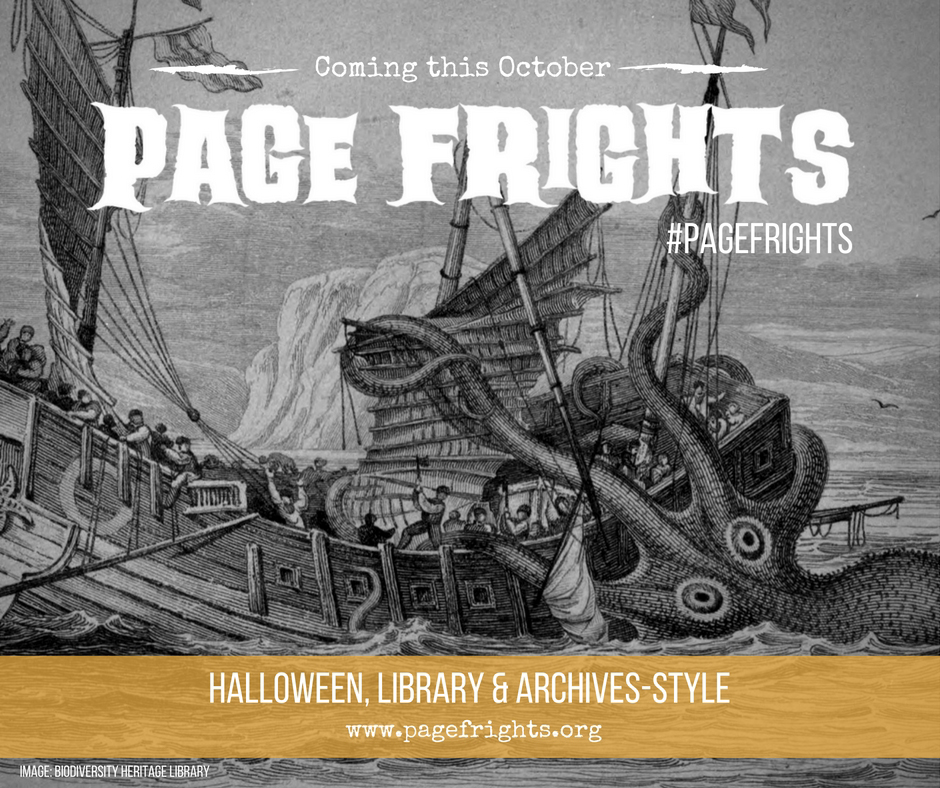
Get ready for a ghoulishly good time this October…Page Frights is coming!

From 1-31 October, libraries, archives, and other cultural institutions around the world will be gearing up for Halloween by sharing spooky, creepy, or otherwise frightening books and images from their collections on social media using the hashtag #PageFrights. Follow along and join the conversation on Twitter, Instagram, Facebook, Tumblr, and other social media sites. Visit pagefrights.org to learn more.

We’ll also be inviting you to carve pumpkins using patterns inspired by #PageFrights content. Participating institutions will create pumpkin carving patterns based on images from their collections, and these patterns will be freely available to download from the Page Frights website starting in October. We encourage you to share your carved pumpkins on social media using the #PageFrights hashtag.

View Full Size Image
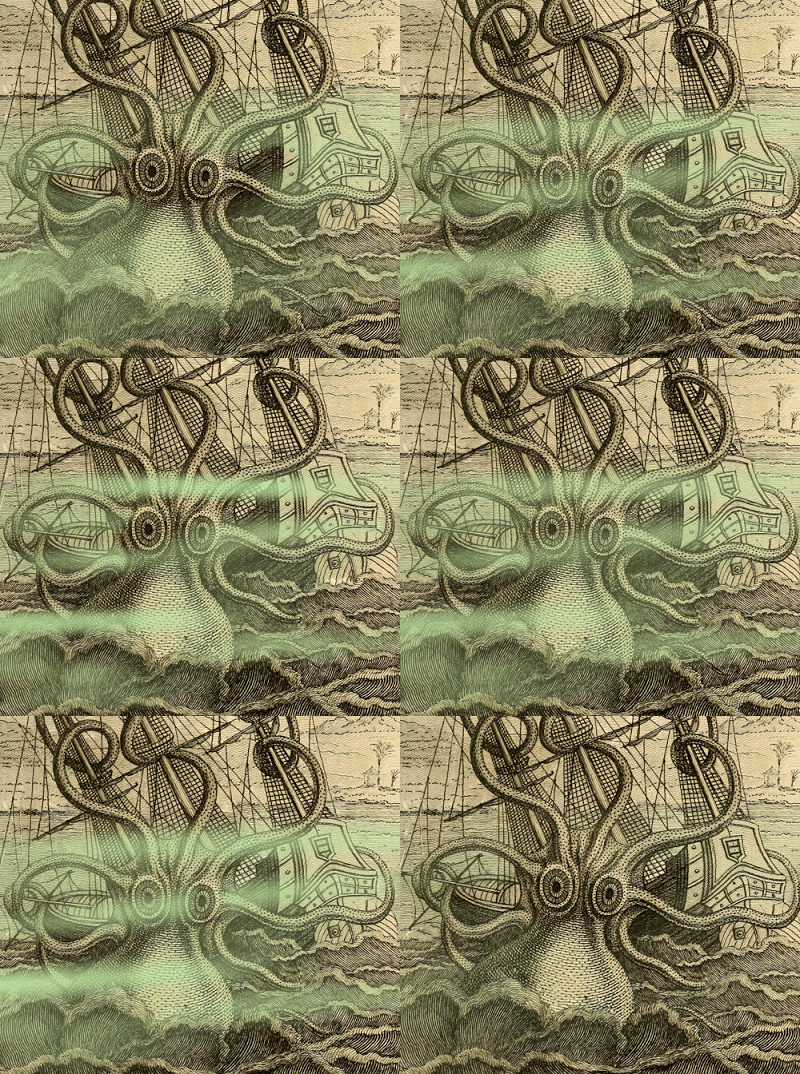
Image from: Denys de Montfort, Pierre. Histoire naturelle, générale et particulière des mollusques. t. 2 (1801). http://biodiversitylibrary.org/page/35755564. GIF created by Richard Naples of Smithsonian Libraries.

Finally, we’re joining the Digital Public Library of America (DPLA) GIF IT UP fun and encouraging you to create GIFs based on #PageFrights images. GIF IT UP is a challenge to find the best GIFs created from copyright-free heritage materials found in DPLA, DigitalNZ, Trove, or Europeana. BHL serves as a digital content hub for DPLA. Learn more on the Page Frights website.

Page Frights was inspired by the 2015 #creepyarchives campaign launched by the Medical Historical Library at Yale University. #PageFrights is spearheaded by the Biodiversity Heritage Library, The New York Academy of Medicine, the Medical Historical Library at Yale University, and Smithsonian Libraries. Visit the website to see a full list of participating institutions to date.

If you’re an institution interested in participating in Page Frights, we’d love for you to join us! Find out how you can join the Page Frights fun.

So be sure to follow #PageFrights on social media starting this October and visit the website for more great content…if you dare!!

September 19, 2016by ulib-libraryjobs
Blog Reel

A Visual Delight: Natural History Illustrations from BHL on Instagram

BHL is now on Instagram!

Embracing the visually-driven nature of Instagram, our feed focuses on sharing the stunning historic illustrations in BHL’s collection. From birds of paradise to boxing kangaroos, charming bookplates, and artworks by some of history’s most renowned illustrators, there’s a wealth of visual delight waiting for you on our Instagram.

View Full Size Image
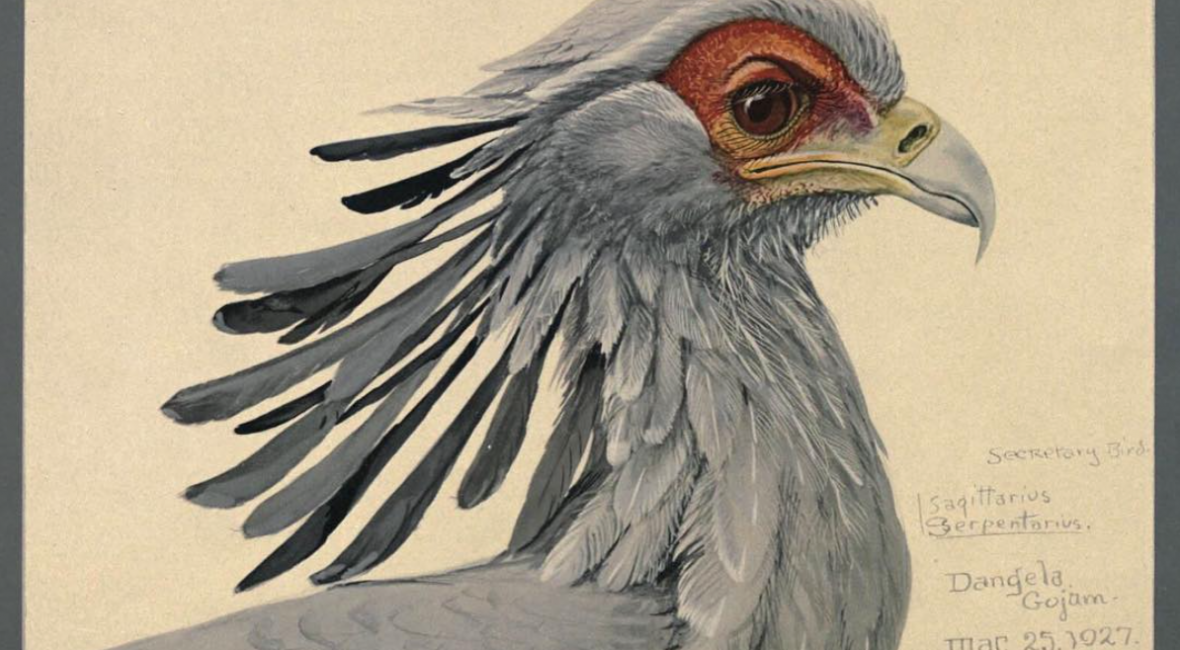
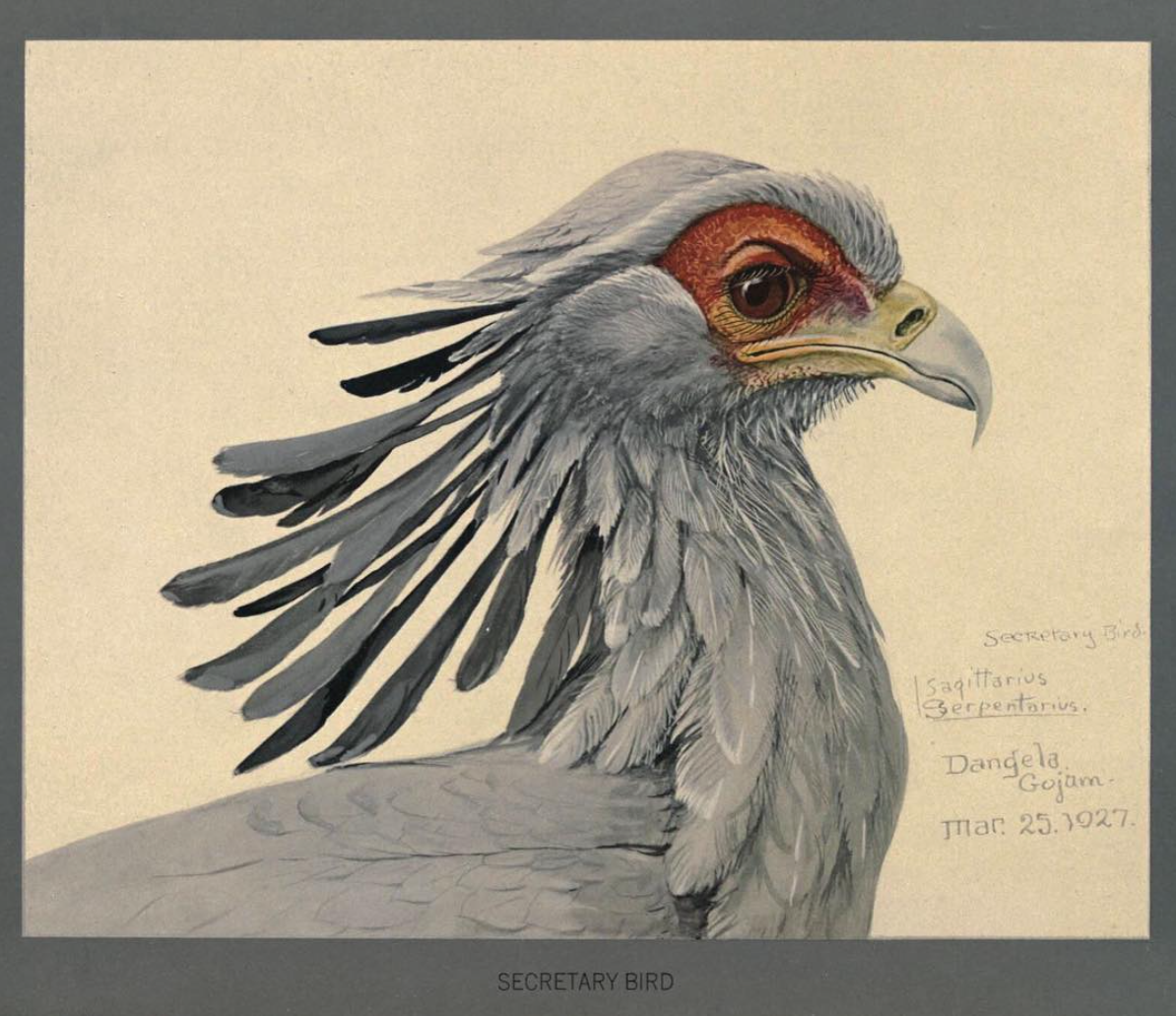
Secretarybird (Sagittarius serpentarius) is a nomadic bird of prey found in the grasslands of sub-Saharan Africa. #SciArt by Louis Agassiz Fuertes in the Album of Abyssinian Birds and Mammals (1930). Contributed by University Library, University of Illinois Urbana-Champaign. http://ow.ly/V5SQ3035ED9. Posted to Instagram by Michelle Marshall.

Plus, thanks to citizen science taxon tagging activities for BHL’s Flickr, the species in each illustration have been conveniently identified in the post description. Translation: you’ll always be able to identify what species you’re looking at, even if you’ve never seen it before.

And Flickr taxon tagging isn’t the only way that citizen science has benefited our Instagram. The feed itself is curated by BHL citizen scientist Michelle Marshall.

View Full Size Image
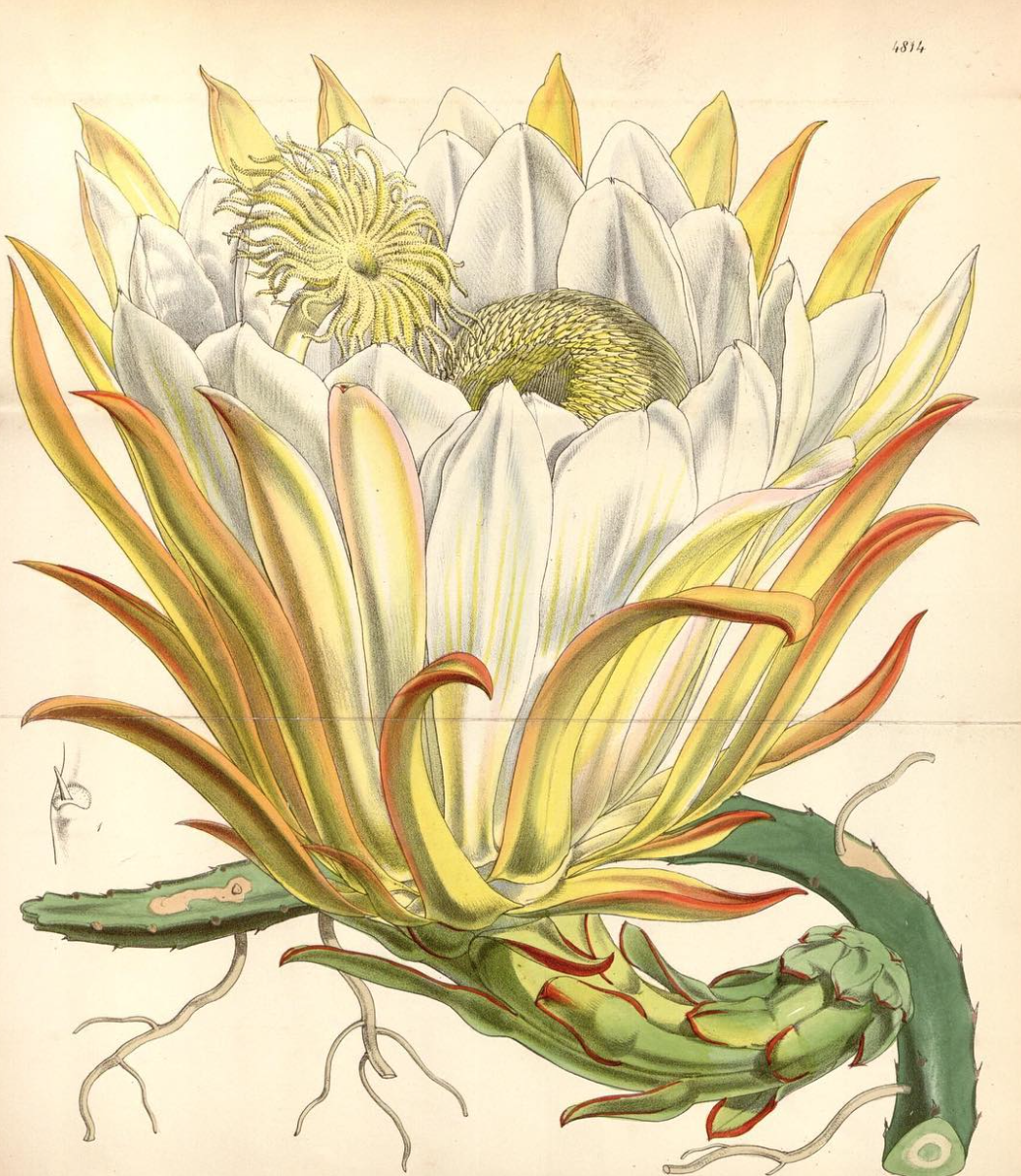
Night-blooming cactus (Hylocereus lemairei). By Walter Hood Fitch. Curtis’s Botanical Magazine, Vol. 54 (1827). Contributed by Missouri Botanical Garden. http://biodiversitylibrary.org/page/488560. Posted to Instagram by Michelle Marshall.

Michelle first became involved in citizen science through the Smithsonian Transcription Center, which she discovered while looking for ways to volunteer in her free time during her STEM studies. Through those activities, Michelle discovered BHL and our Flickr tagging opportunities. She now focuses on researching taxonomy to add to our images – an activity that she finds deeply rewarding.

“My favorite thing about volunteering for BHL is that I am always learning through research,” says Michelle. “I am able to connect with scientists and libraries to learn more, and I know more about biodiversity, geography, and even scientific art than I have ever learned in formal study. Just browsing the images on Flickr leads to new discoveries that I am excited to learn about and share with others on social media.”

Michelle first began sharing her finds through her own Twitter account. The posts were so well-received that she decided to create @HistSciArt, devoted specifically to sharing BHL illustrations and her related taxonomic research.

“I knew that BHL has been working on making the images more accessible for everyone, in particular the scientific community, so I thought that creating an account devoted specifically to sharing these images on Twitter would help with that effort,” explains Michelle. “Most of the images that I tweet I have researched the taxonomy for, and I try to share more information than just the illustration.”

We were so impressed by Michelle’s account and the quality of her research and posts that, when she expressed interest in expanding her efforts to Instagram, we invited her to do so by curating an account for BHL.

View Full Size Image
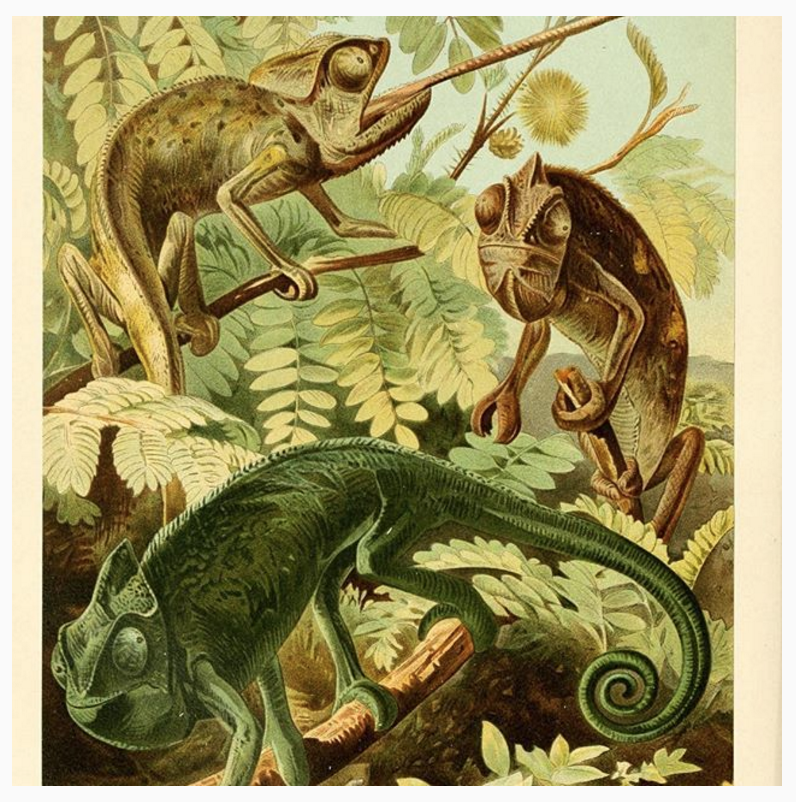
African Chameleon (Chamaeleo africanus) for #WorldLizardDay. Alfred Edmund Brehm, Brehm’s Tierleben, Bd. 2 (1913). Contributed by Ernst Mayr Library, Museum of Comparative Zoology at Harvard University. http://ow.ly/eX9W303e4bF. Posted to Instagram by Michelle Marshall.

“Instagram is an enormously popular social media platform, so I was truly honored when I was asked to curate BHL’s Instagram account,” says Michelle. “Because I believe in the great work that BHL is doing to support science and research, I felt that this would be another way that I could help share the wealth of knowledge in BHL’s collection. The great thing about sharing BHL’s collections on Instagram is that I am able to provide more information about the book and image as well as to connect with more people and institutions. Because I share different content on Instagram, any followers of HistSciArt and BHL on Twitter will have more great works to view and explore.”

And it seems people do indeed love exploring BHL illustrations on Instagram (we’re not surprised!). BHL’s Instagram has grown to over 400 followers in just over two weeks. This success is due not only to the quality of BHL’s collections, but also to the caliber of Michelle’s research and posts, which not only provide taxonomic and bibliographic information, but also identify the contributing libraries and include timely and engaging hashtags. We’ve also started posting one of each day’s Instagram posts to BHL’s Facebook as #BHLDailySciArt.

View Full Size Image
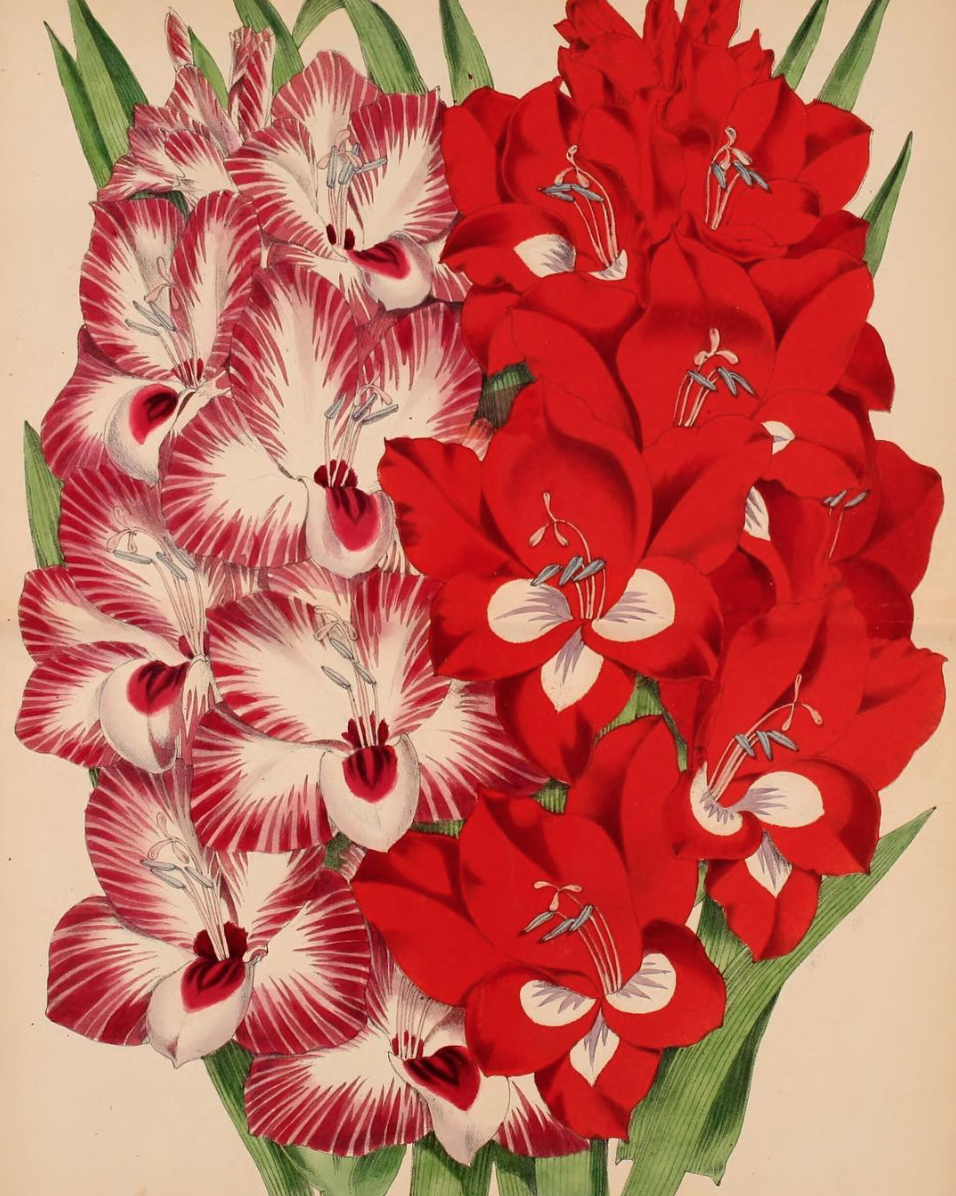
Gladiolus orphée and Gladiolus horace. Botanical #SciArt by Worthington George Smith. The Floral Magazine, Vol. 9 (1870). Contributed by the LuEsther T. Mertz Library of The New York Botanical Garden. biodiversitylibrary.org/page/50241074. Posted to Instagram by Michelle Marshall.

We’re so grateful to Michelle for all of her contributions to help increase awareness of and access to BHL’s collections. We believe this partnership is a testament to the power and benefits of citizen science, and with that we also extend a huge thanks to each and every volunteer that dedicates their time and resources to improving BHL collections. You can learn more about all of our citizen science opportunities here.

So, you might be wondering (as we were!), for someone who’s explored as many books and researched as many illustrations as Michelle has, which title would she pick as her favorite? It turned out to be an easy question for her to answer.

“When I discovered Catesby’s The natural history of Carolina, Florida and the Bahama Islands, I think I literally leapt out of my chair!” exclaims Michelle. “I grew up in Florida and South Carolina, and here was a spectacular natural history work all about the native flora and fauna of my area. Catesby spent lots of time in the Southern Colonies during the 1720s, which is the same time that part of my family came to what was then called Carolina. I like to think that what he saw and experienced was the same as what my ancestors knew. I am so pleased to have access to all three editions of his work through BHL and to have taxon tagged all of them!”

View Full Size Image
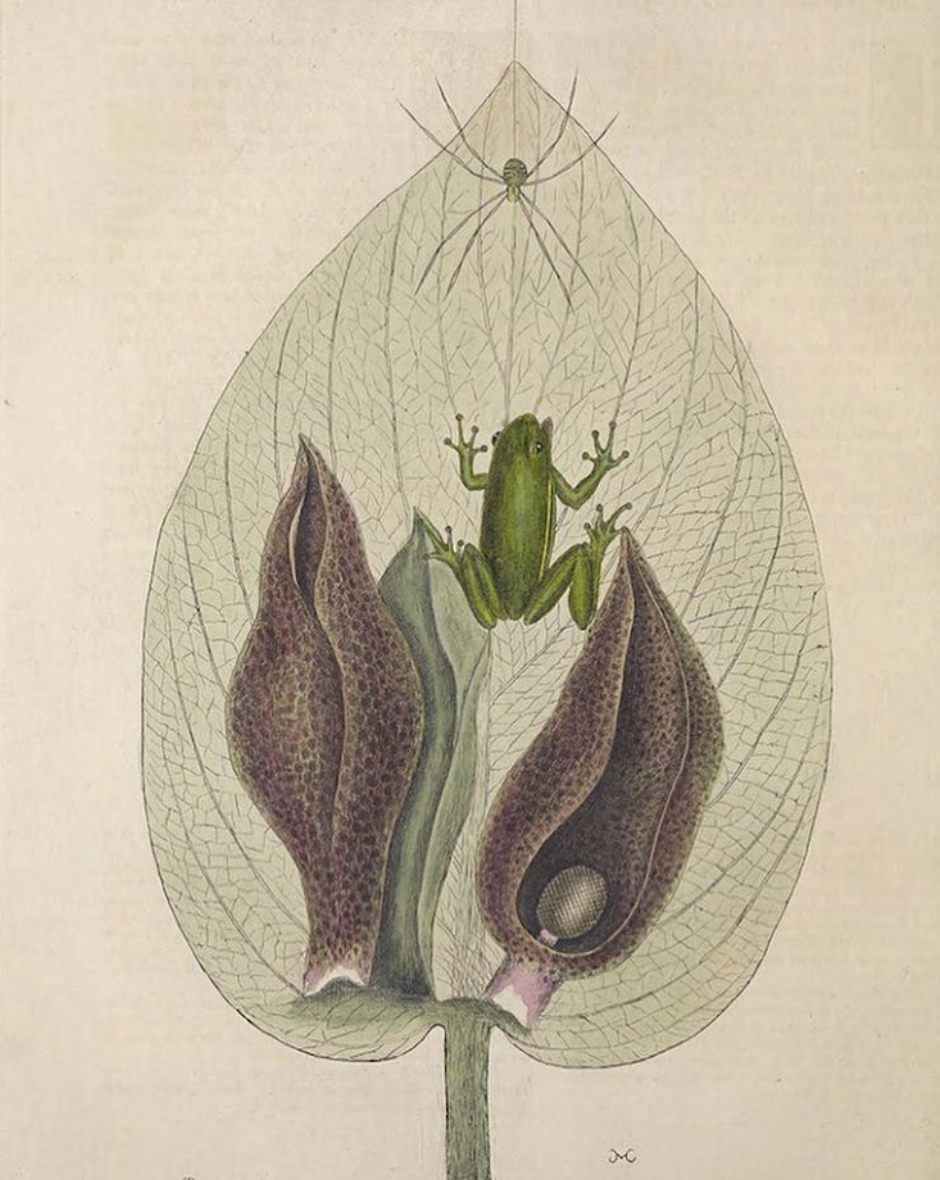
Green tree frog (Hyla cinerea) about to snack on a Green lynx spider (Peucetia viridans) while hanging onto Skunk cabbage (Symplocarpus foetidus). Mark Catesby, The Natural History of Carolina, Florida and the Bahama Islands, Vol.2, 1st Ed. (1743). Contributed by Smithsonian Libraries. http://biodiversitylibrary.org/page/40680311. Posted to Instagram by Michelle Marshall.

You can explore the illustrations from all three editions of Catesby’s monumental work (it’s the first major illustrated publication on the flora and fauna of North America and was chosen by Smithsonian Libraries as their BHL@10 Notable Book Contribution) in Flickr, all of which have been taxon tagged by Michelle.

Be sure to check out more of the beautiful illustrations in our collection by following us on Instagram. A world of art and science (made possible thanks to citizen science) awaits you!

View Full Size Image
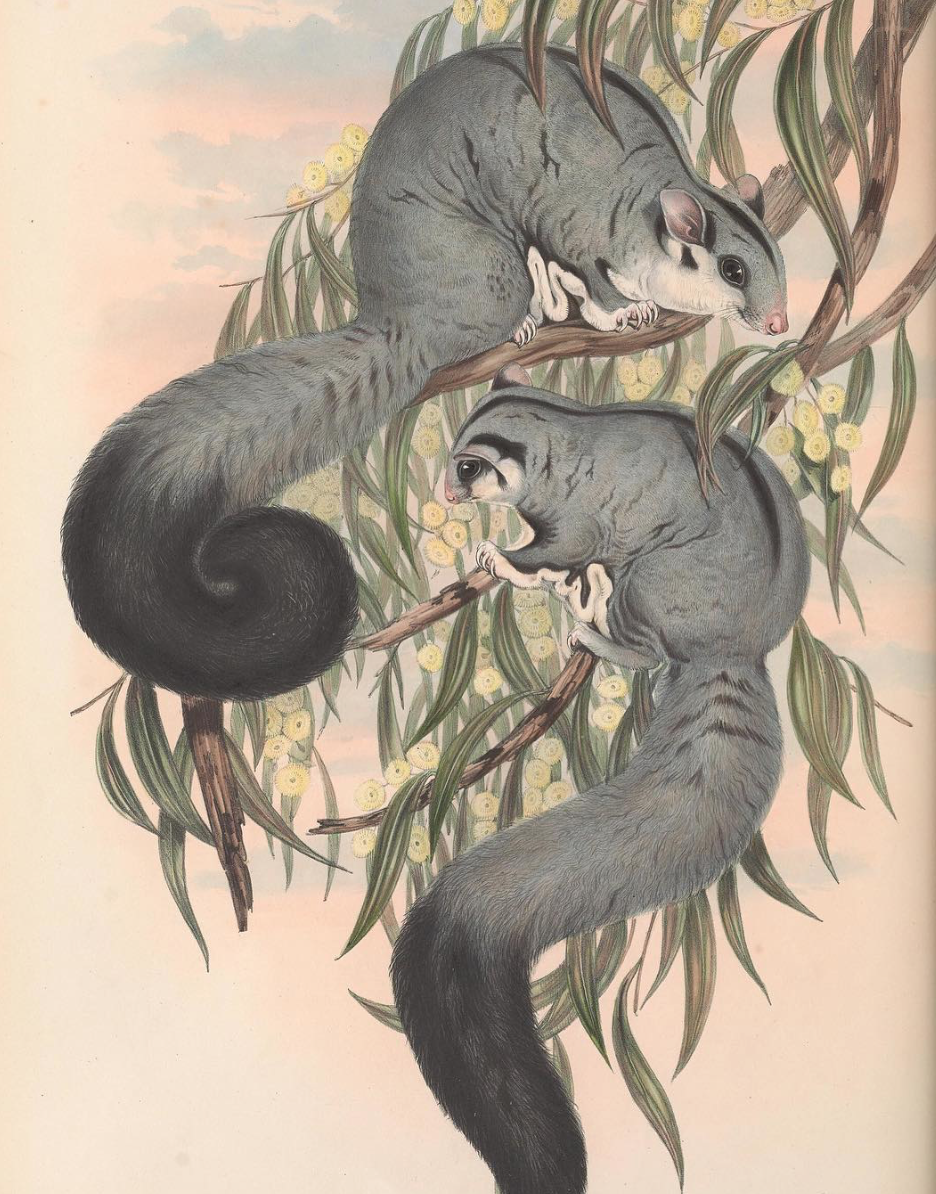
Squirrel Glider (Petaurus norfolcensis). Although it resembles a squirrel, this mammal is a marsupial native to Australia. #SciArt by Henry Constantine Richter and John Gould for Gould’s Mammals of Australia, Vol. 1 (1863). Contributed by Smithsonian Libraries. http://ow.ly/e5zj303j4nr. Posted to Instagram by Michelle Marshall.
August 22, 2016by ulib-libraryjobs
BHL News, Blog Reel

The Impact of Coordinated Social Media Campaigns on Online Citizen Science Engagement

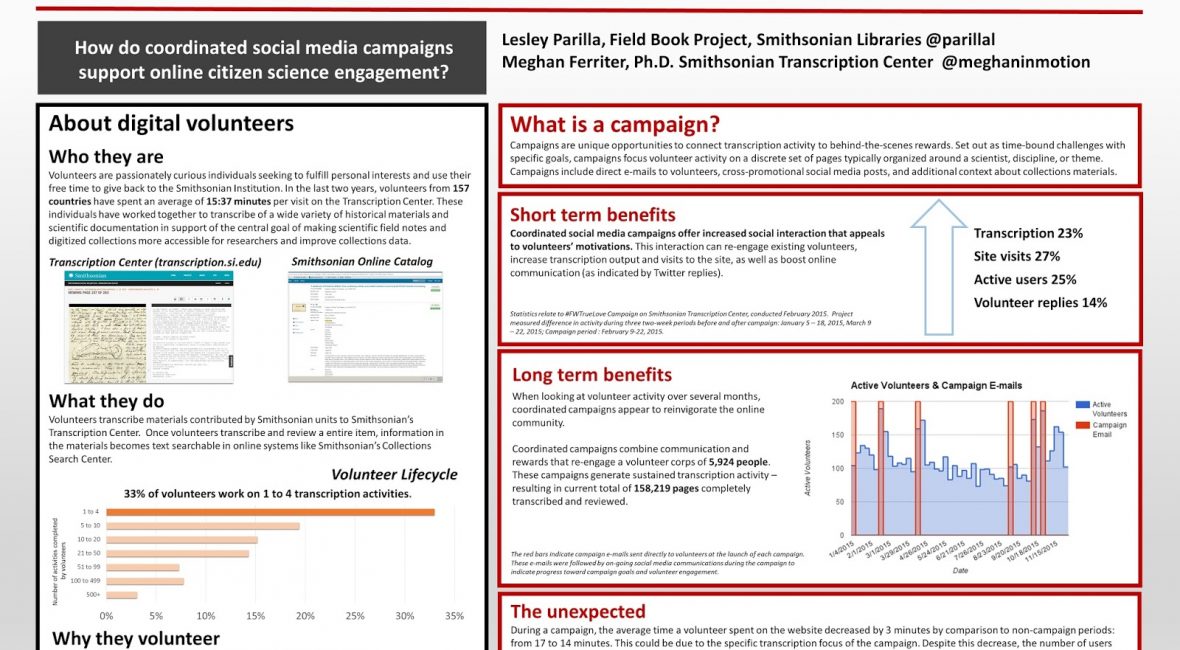
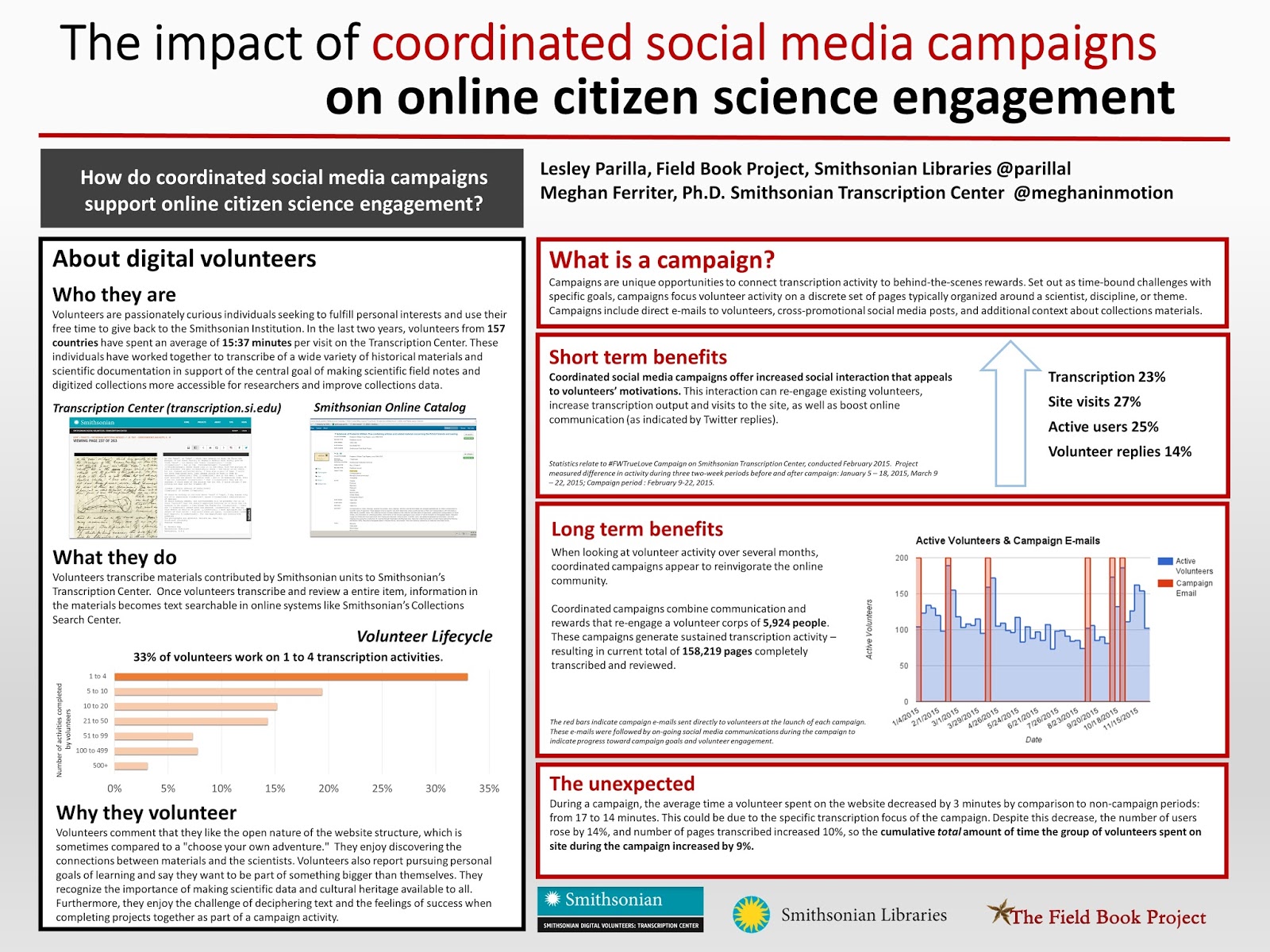
Smithsonian staff members recently presented a poster at the American Association for the Advancement of Science (AAAS) Annual Meeting in Washington, DC, 11-15 February, 2016. The poster, entitled “The Impact of Coordinated Social Media Campaigns on Online Citizen Science Engagement” by Lesley Parilla (Cataloging Coordinator, The Field Book Project) and Meghan Ferriter, Ph.D. (Project Coordinator, Smithsonian Transcription Center), highlighted the impact of a coordinated social media campaign on crowdsourced transcriptions of field notes.

View Full Size Image

The poster outlined the details and outcomes of the #FWTrueLove campaign, a collaboration involving The Field Book Project, the Smithsonian Institution Archives, the Smithsonian Transcription Center, Pyenson Lab, and the Biodiversity Heritage Library. The event challenged volunteers to fully transcribe a selection of field notes by Frederick W. True, held by the Smithsonian Institution Archives and uploaded to the Smithsonian Transcription Center, by the end of the campaign period. Materials for the challenge were identified and selected with Smithsonian Curator of Fossil Marine Mammals Dr. Nick Pyenson and the Smithsonian Field Book Project, a joint initiative of the National Museum of Natural History, Smithsonian Libraries and Smithsonian Institution Archives. The field notes are an important source of natural science data that is difficult to utilize, since they are often handwritten and fragile due to age.

The Transcription Center coordinated the multi-institutional campaign during the month of February 2015. The campaign involved blog posts, Twitter, Instagram, Facebook, and a targeted email to the Transcription Center’s current volunteers, all of which challenged users to completely transcribe 523 pages from F.W. True’s field notes within one week. Updates were posted on: http://nmnh.typepad.com/fieldbooks/fwtruelove/.

As a reward for the successful completion of the challenge, the Transcription Center coordinated Google Hangouts with Curator of Fossil Marine Mammals Dr. Nick Pyenson. Dr. Pyenson discussed the interdisciplinary nature of F.W. True’s scientific pursuits – plus True’s connections with Smithsonian researchers like Leonhard Stejneger and William Healey Dall.

The #FWTrueLove campaign contrasted with a typical experience by focusing on a specific set of materials. The modular design of the Transcription Center’s website, which incorporates multiple collection types, means that a typical volunteer experience is flexible and highly tailored to their individual interests. This flexible design enables volunteers to create their own online experience. This can be expanded with engagement via social media. An analysis of the event showed that coordinated social media campaigns increase volunteer interaction, transcription output, and the number of active users on the Transcription Center. However, there was a decrease in the average length of a visit during the campaign. This may be because new active users are specifically coming to spend time on the projects highlighted in the campaign. This varies from other periods of time on the site, when volunteers come to work on one project but move onto unrelated projects that catch their attention thanks to the site’s open structure. These focused campaigns that appear to work in direct opposition to the flexible nature of the Transcription Center may keep the community growing, serving to reinvigorate the volunteer community as a whole and combat the natural cycling of volunteers out of active participation.

Learn more about the results of the campaign on the AAAS website. See the posted in more detail on BHL’s Pinterest.

February 18, 2016by ulib-libraryjobs
BHL News, Blog Reel, Tech Updates

New Feature on BHL: Add Comments to a Book!

UPDATE:

A new and enhanced commenting system is being planned for BHL. The commenting system described below has been disabled as of July 5, 2016. Learn more.

_____________

We are pleased to announce that we have added the ability to add comments to books in the BHL website!

This new feature will allow you to easily share your discoveries while reading BHL books, highlight interesting content, post your expertise for others to see, engage in conversations about BHL books from directly within BHL, and easily discover all of the great posts from your fellow biodiversity-enthusiasts. We hope that this tool will provide another way for users to engage with our collections and network with others in the BHL community.

The new commenting feature is powered by Disqus, a social commenting tool that allows people to discuss content on websites. Disqus is the commenting tool currently in use on the BHL blog. Disqus works like other social platforms, allowing you to follow people or communities, recommend discussions (which is essentially “liking” or “favoriting” the discussion), and, on your personal Disqus homepage, see the comments and discussions from people and communities you follow, replies to your comments, or discussions recommended by those you follow. You can also share discussions via Twitter and Facebook. Thus, your comments won’t be lost in a vacuum but can be easily discovered and contributed to by other users.

This feature was developed in collaboration with the Ryerson University Social Media Lab in Canada  as part of the international project on Mining Biodiversity.

How to Comment on Books in BHL

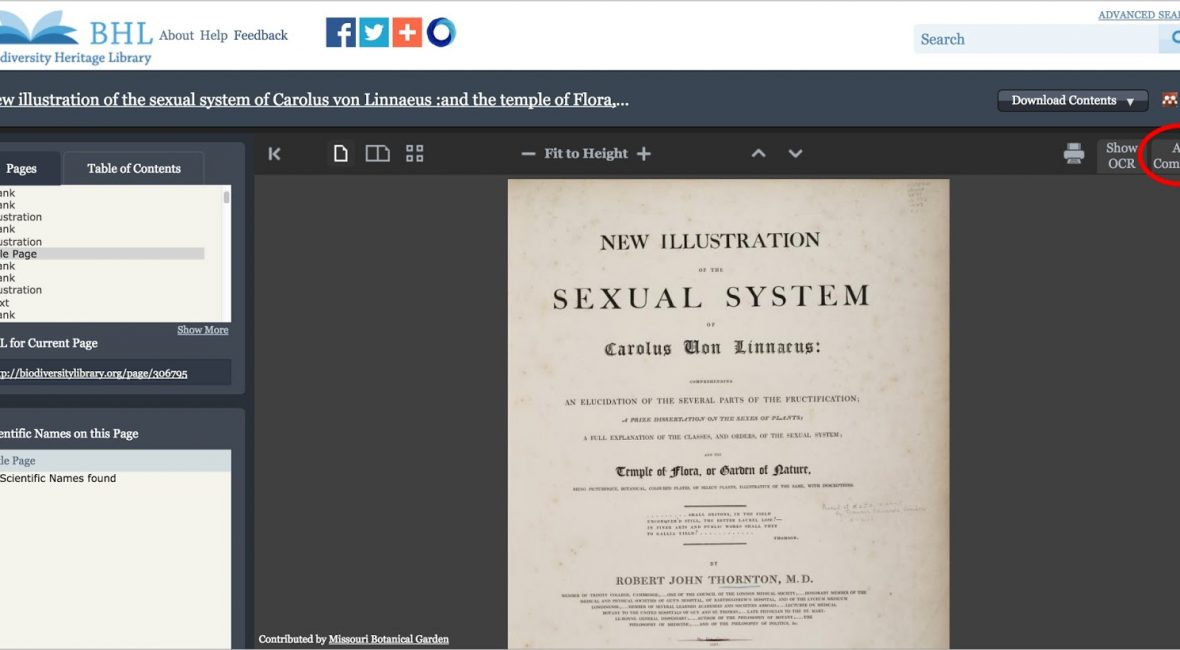
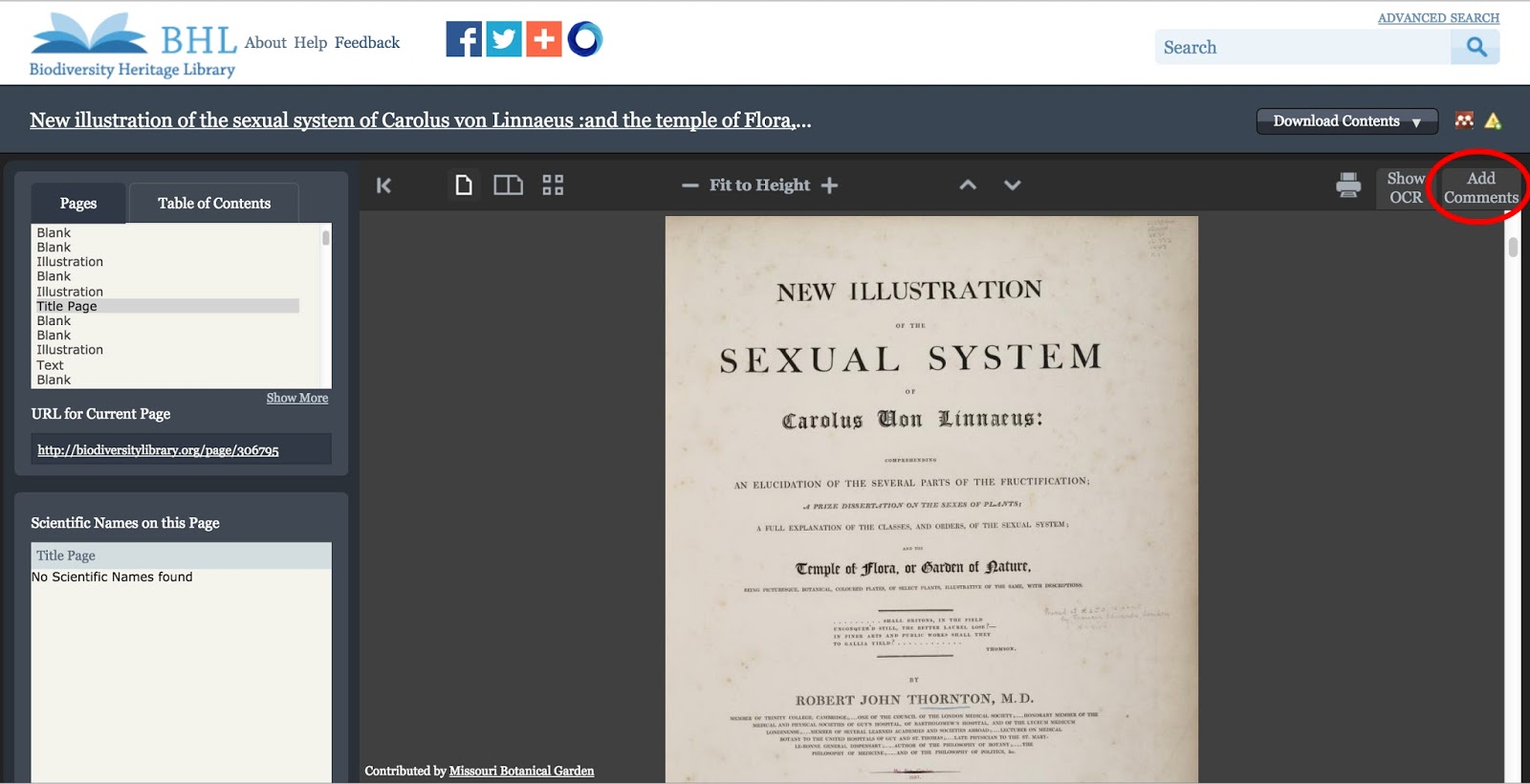
When you are viewing a book in BHL, you will notice that a new tab has been added to the book viewer that reads “Add Comments.” Click on the tab to expand the comment window. Within the expanded window, you can add a comment to the page you are viewing and view the existing comments on that page. Comments are added at the page-level, meaning that as you scroll through the book, the “Add Comments” tab will display only those comments added to the page you are viewing. If you add a new comment, it will be associated with the page you are viewing when you add the comment.
View Full Size Image
The “Add Comments” tab in the book viewer. Click to expand the window, add a comment to the page, and view existing comments on the page.

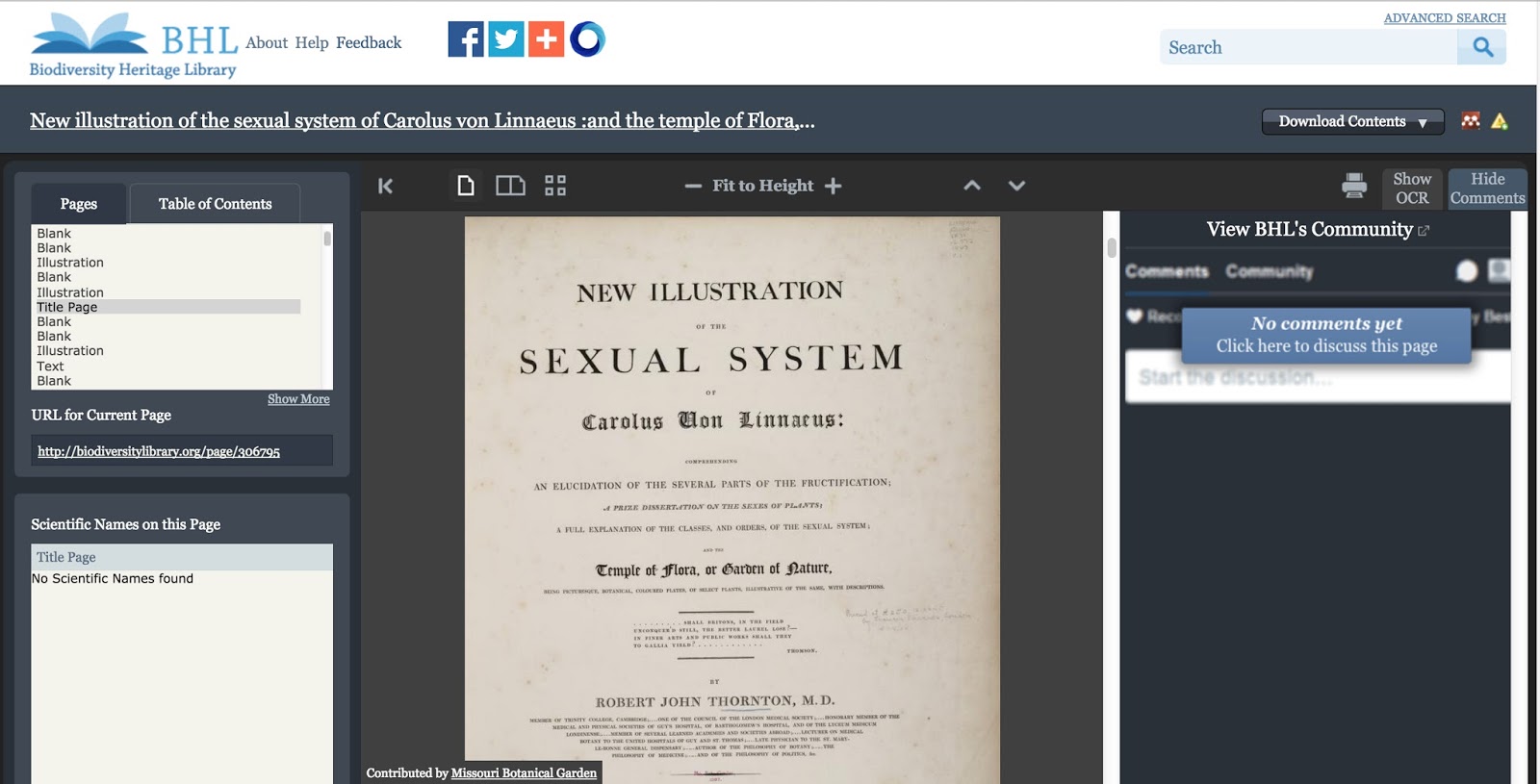
If there are no existing comments on the page you are viewing, the window will display the message “No Comments Yet. Click Here to Discuss this Page.” Click the message to add a comment to the page.
View Full Size Image
A page with no comments on it. Click the “Click Here to Discuss this Page” message to add a comment.

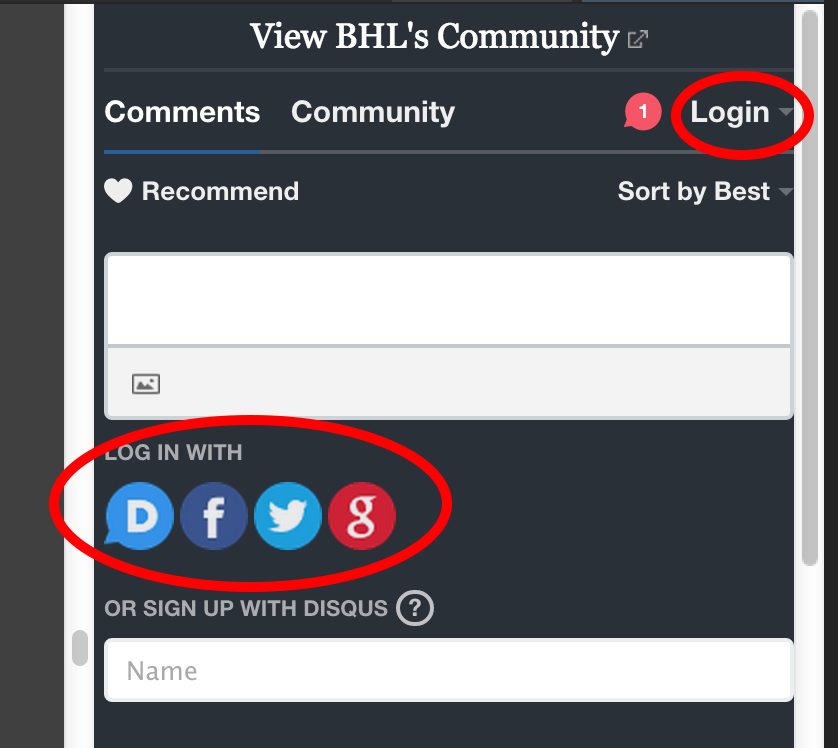
You must have a Disqus account to comment on a page in BHL. You can login to your Disqus account through the “Login” link in the “Add Comments” tab or by choosing one of the sign-in methods displayed beneath the comment text box.
View Full Size Image
Ways to login to your Disqus account to post a comment.

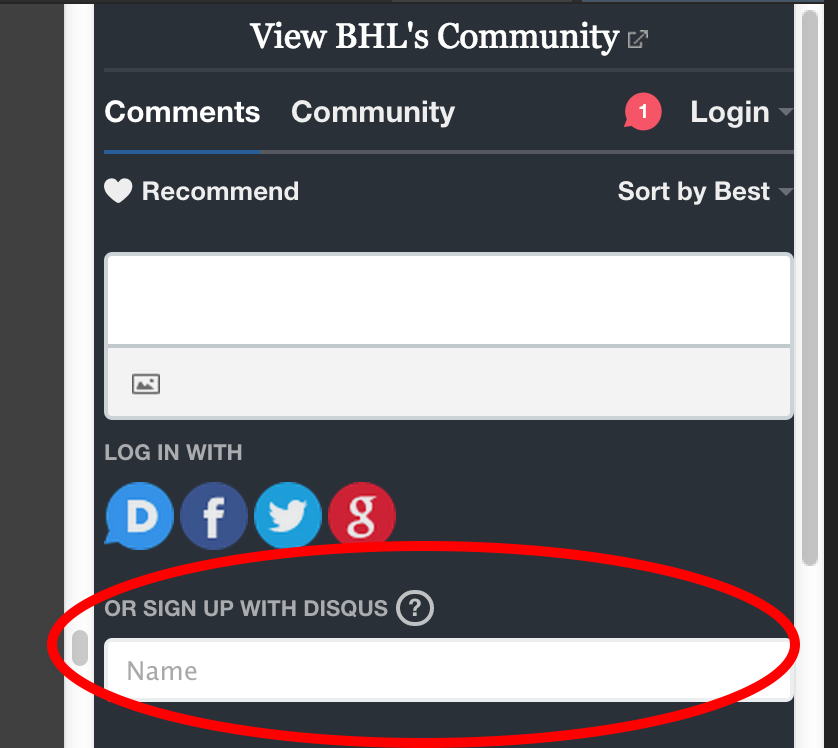
If you do not have a Disqus account, you can create one from within BHL, or you can sign-up on the Disqus website.
View Full Size Image
Click on the “Name” box to sign-up for a Disqus account from within BHL.

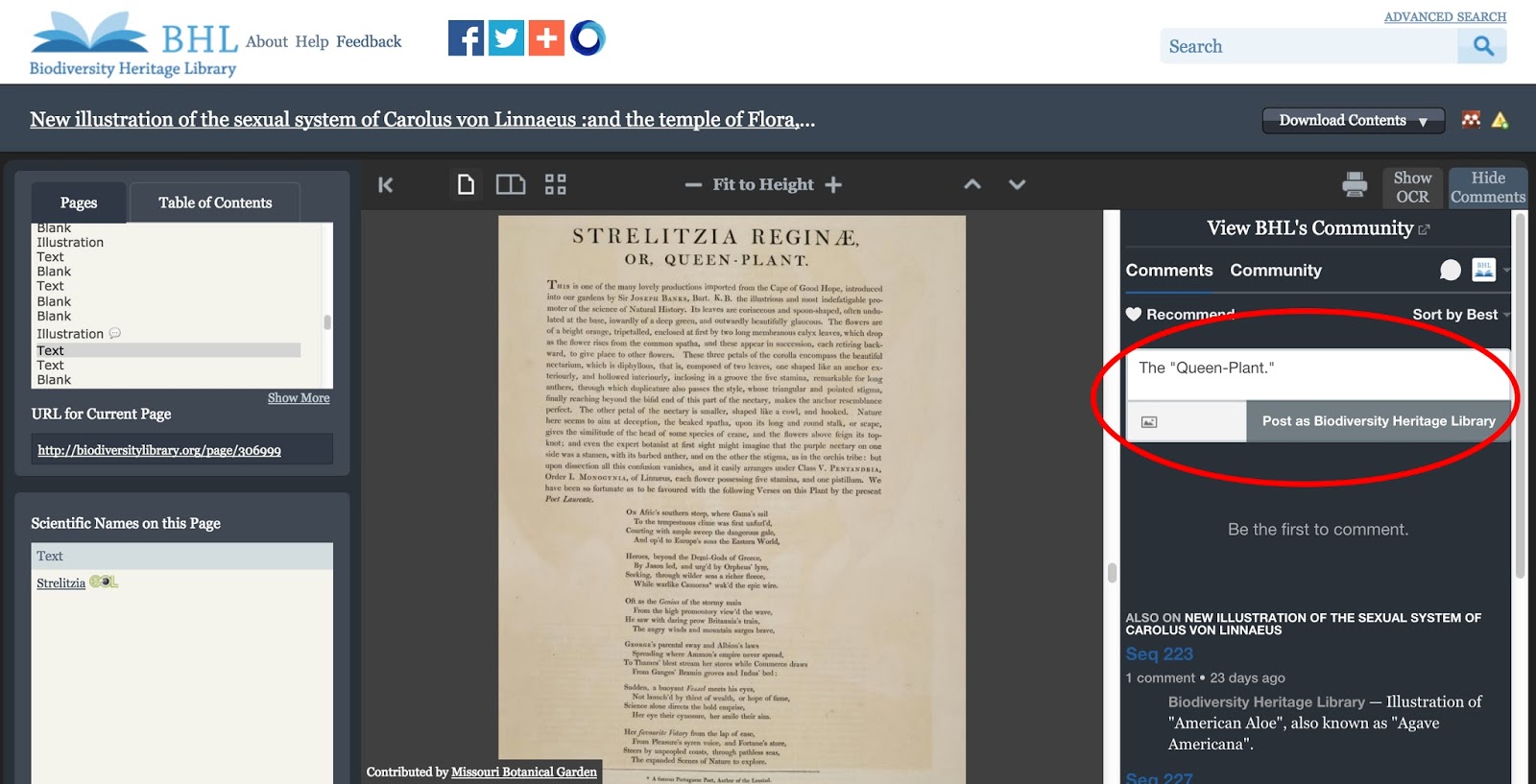
Once you are logged into Disqus, you can type your comment into the comment text box and then click the “Post As [Username]” button to submit your comment. You will then see your comment posted to the page.
View Full Size Image
Add your comment to the text box and click “Post as [Username]” to submit your comment.

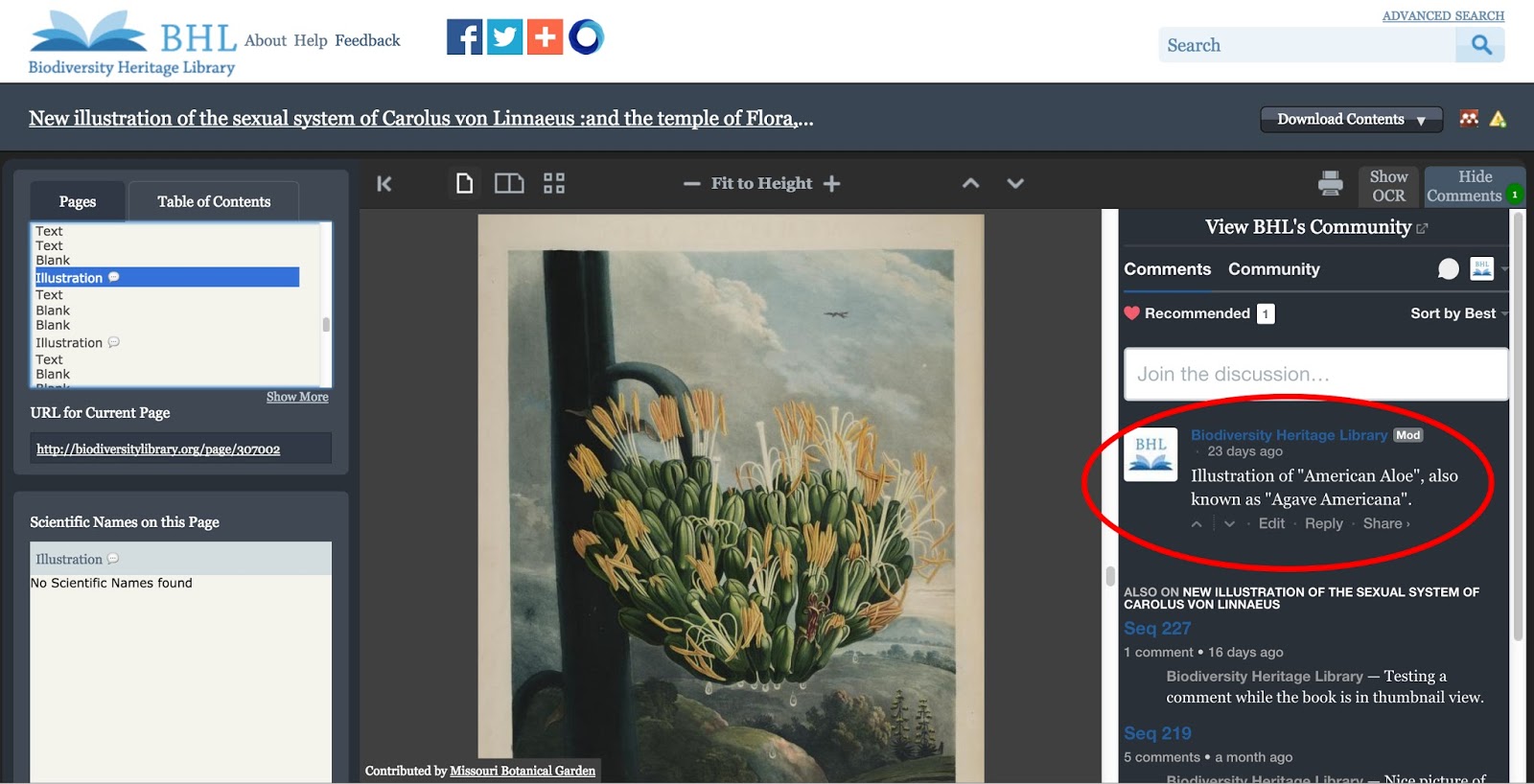
If there are pre-existing comments on the page, expanding the “Add Comments” tab will display the previous comments added to that page as well as provide you with the text box to add your own comment. Posting a comment will add your comment to the list of previously-posted comments.
View Full Size Image
A page with existing comments.

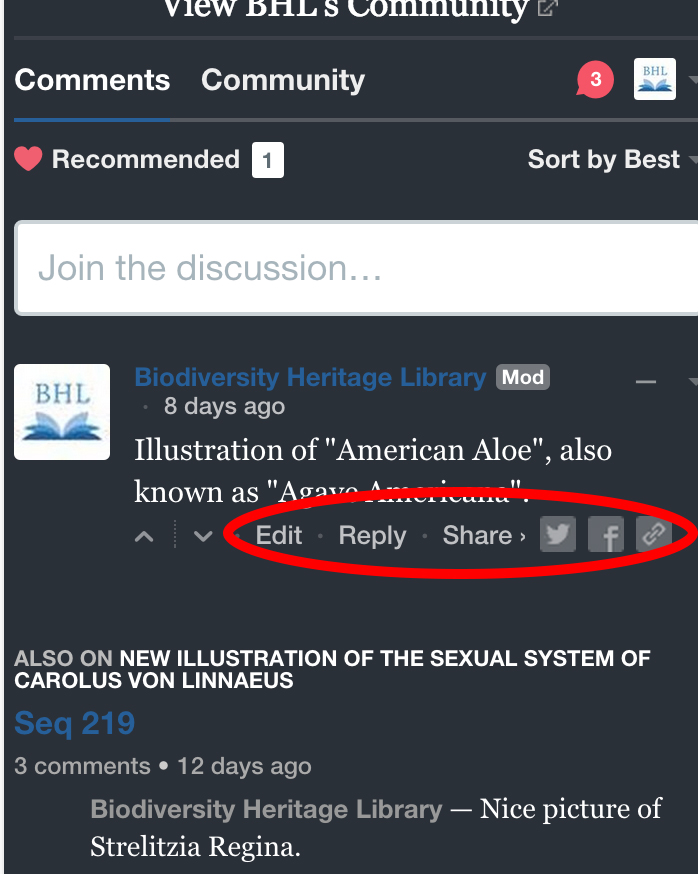
Beneath each comment, you can click on “Edit” to edit your own comments, “Reply” to reply to an existing comment, or “Share” to share the work on Twitter or Facebook.
View Full Size Image
Edit, Reply to, or Share comments from BHL.

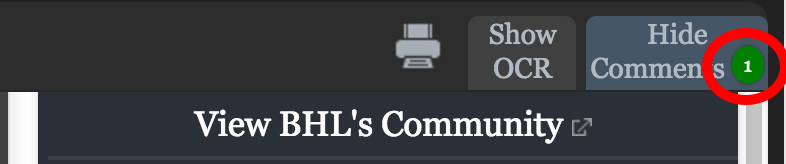
As comments are added to pages, a count bubble will display on top of the “Add Comments” tab. This bubble will show the number of comments that have been added to the page you are viewing. The count will increase when you add a new comment to a page. This count bubble will not display if there are no comments on the page.
View Full Size Image
Count of existing comments on the page.

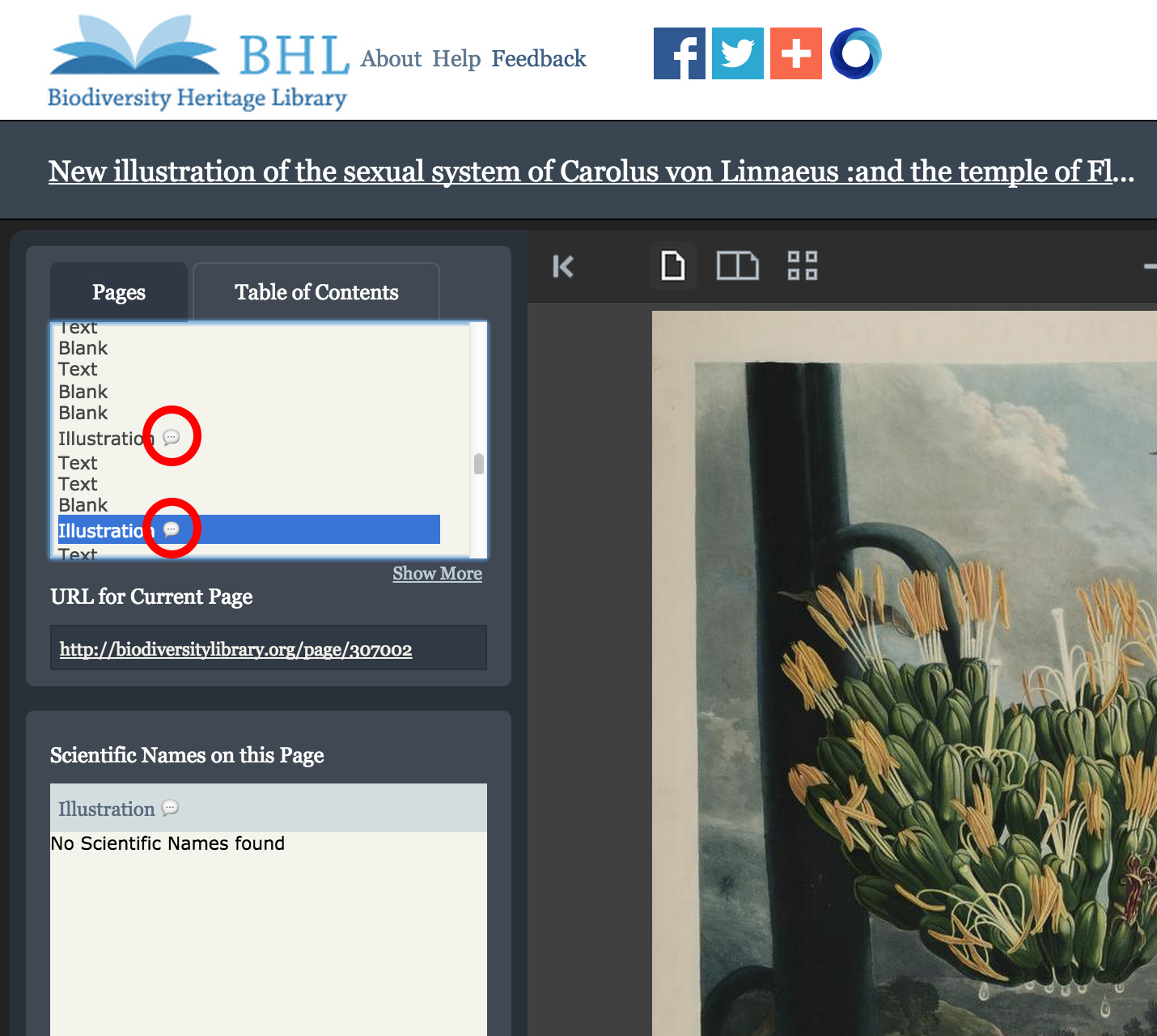
Talk bubble icons will also appear in the “Pages” box next to those pages that have comments on them. Scrolling through the “Pages” window is a quick way to see which pages in the book have comments. When a comment is added to a page for the first time, a new talk bubble icon will display next to that page in the “Pages” window.
View Full Size Image
Talk bubble icons displayed next to those pages that have a comment on them.

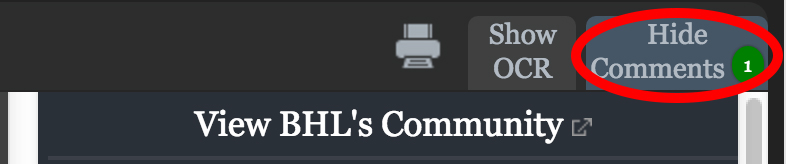
Once you expand the “Add Comments” tab, it will remain open as you scroll through the book, updating as you scroll to display the comments on the current page you are viewing. To close the window, simply click on the tab again, which will read as “Hide Comments” once the window is expanded. This will close the comment window until you expand it again by clicking on the “Add Comments” tab.
View Full Size Image
Click “Hide Comments” to close the comments window.

View and Follow Comments Added to Books in BHL

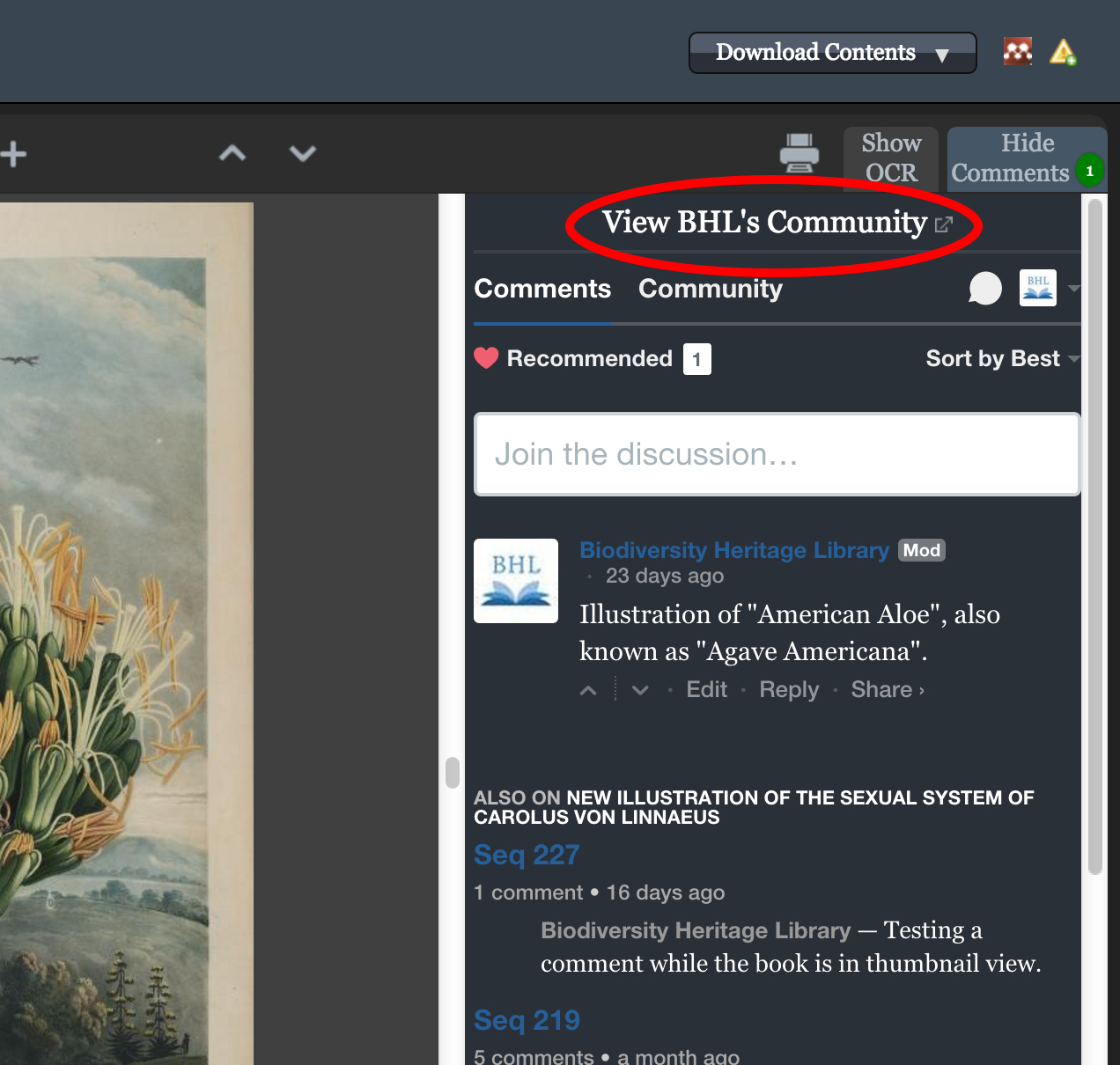
You can click on the “View BHL’s Community” link in the comment window to see a list of all of the comments added to any book in BHL. The list is available on the BHL profile page in Disqus.
View Full Size Image
Click on “View BHL’s Community” to see all of the comments added to any book in BHL.

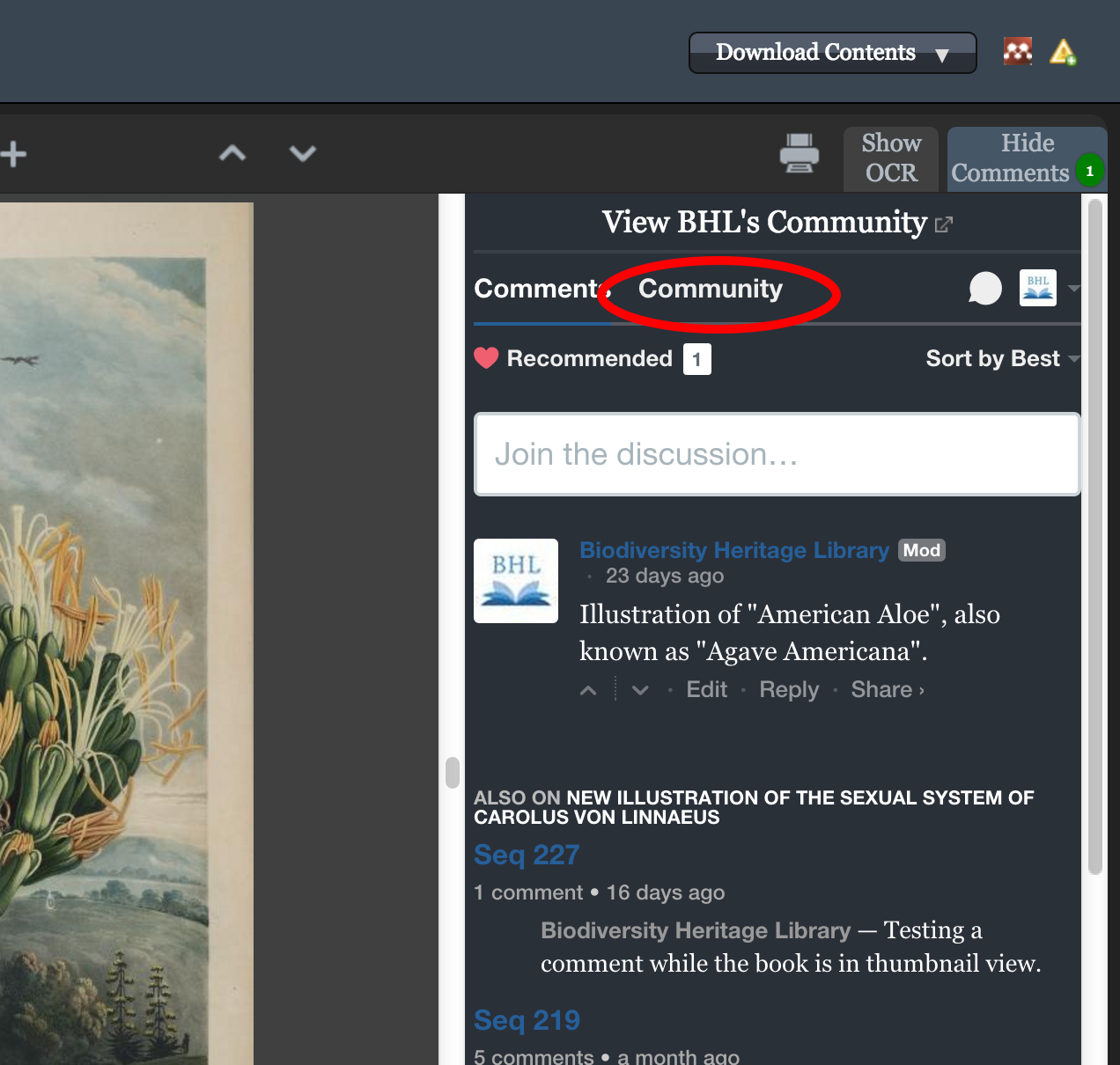
To see all of the comments added to just the book you are currently viewing, click the “Community” link in the comments window.
View Full Size Image
Click on “Community” to see a list of all of the comments added to just the book you viewing.

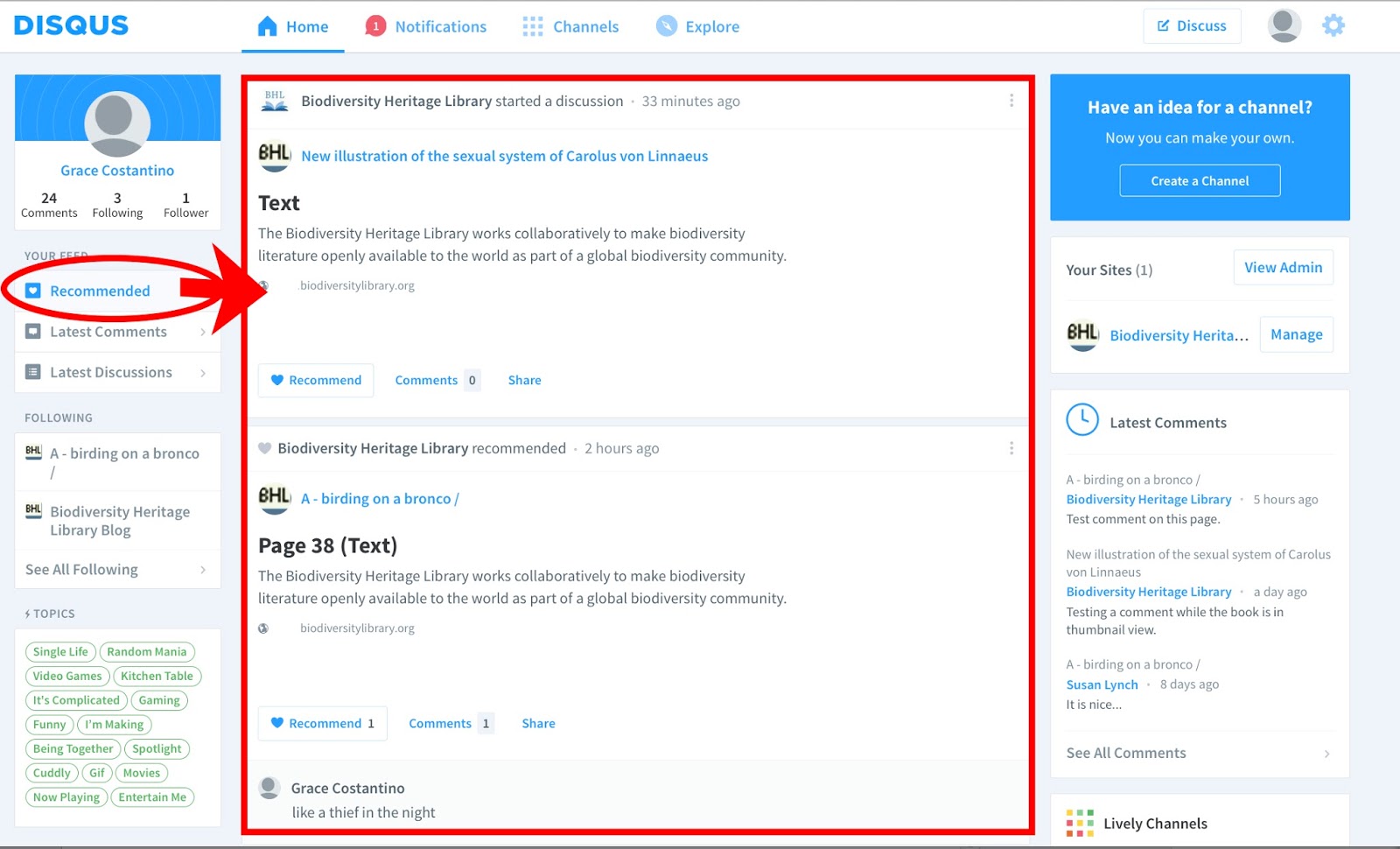
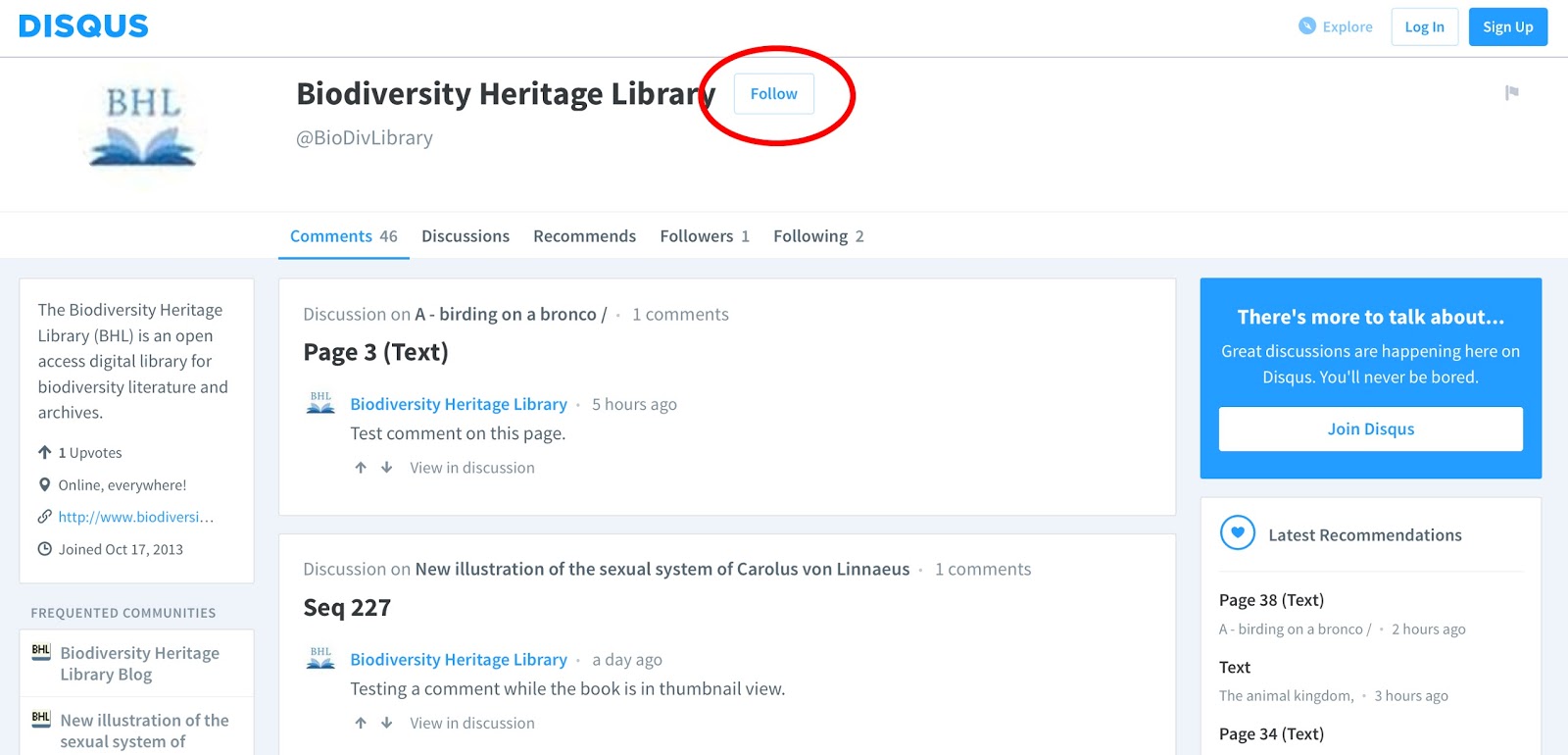
You can follow BHL on Disqus to receive notification of any new comments added to any book in BHL. Simply click on “Follow” on the BHL Disqus profile page. You will then receive notifications of all new comments added to BHL books via the “Recommended” feed on your Disqus homepage.
View Full Size Image
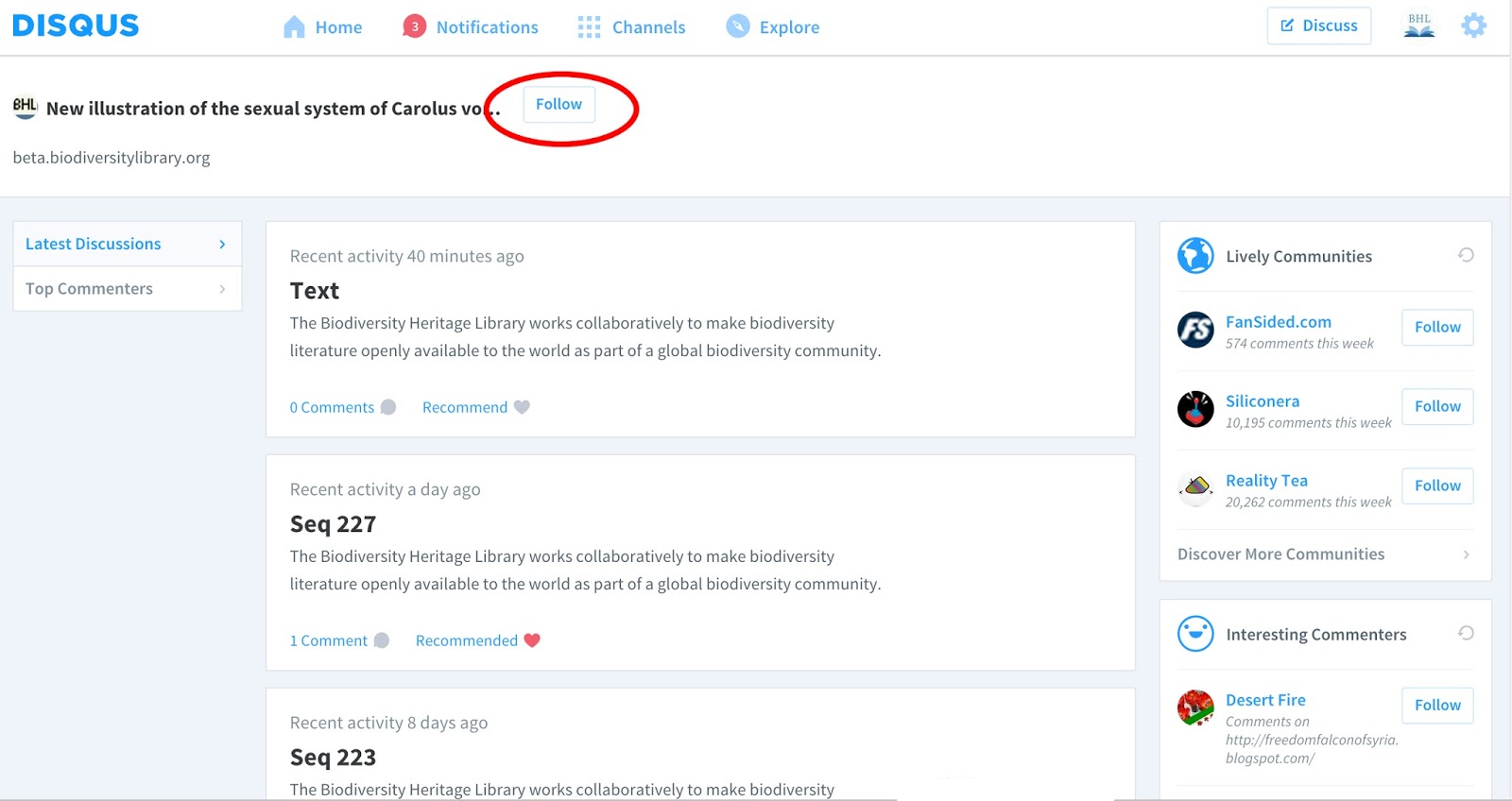
Click the “Follow” button on the BHL Disqus profile page to receive notification of any new comments added to any books in BHL.
View Full Size Image
Once you follow BHL on Disqus, you will receive notification of any new comments added to any book in BHL via the “Recommended” feed on your Disqus homepage.

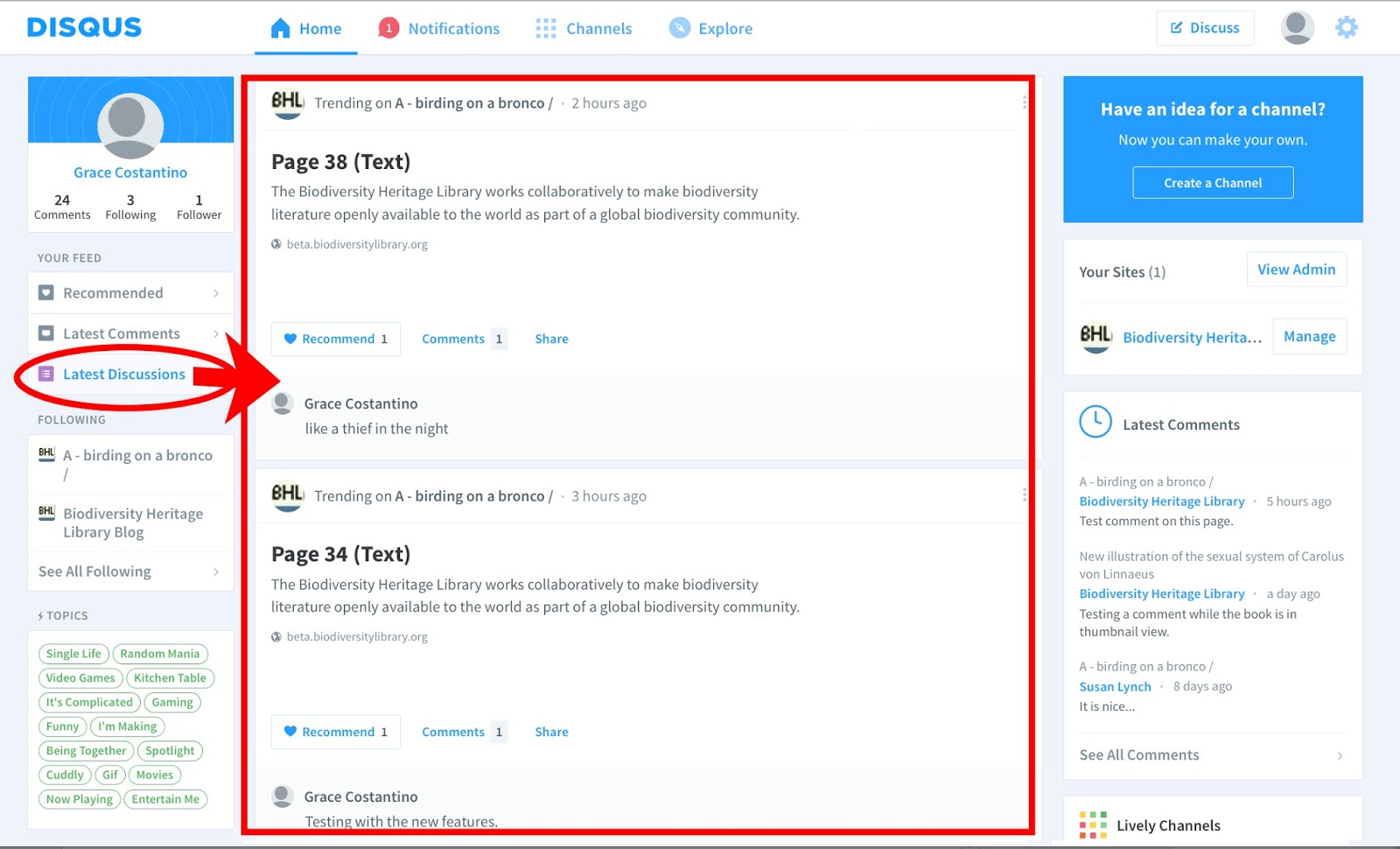
If you want to receive notification of new comments added to a particular book in BHL, simply “Follow” that book’s forum on Disqus. To do this, click on the “Community” link in the comment window for the book you want to receive notifications about. This will take you to that book’s forum on Disqus. Click on the “Follow” button in the forum’s header. You will then receive notification of new comments added to that book in the “Latest Discussions” feed on your Disqus homepage.

View Full Size Image
Click on the “Community” link for the book you want to receive notifications about.
View Full Size Image
Clicking “Community” will take you to the book’s Forum in Disqus. Click on “Follow” to follow the book and receive notification of new comments added to that book.
View Full Size Image
Once you follow a book’s forum, you will receive notification of new comments added to that book in the “Latest Discussions” tab on your Disqus homepage.

Tell us what you Think!

We want to know what you think about our new commenting feature. Send us any feedback you have about the tool via our feedback form or by leaving a comment to this blog post. We’ll use your feedback to help us improve the service.

*Please note: BHL reserves the right to monitor comments added to our library and remove any that do not comply with the terms of use as stated in the “Interactive Features and User-Generated Content” section on this page: http://biodivlib.wikispaces.com/Terms+of+Service.

View Full Size Image

This feature has been added as part of BHL’s Mining Biodiversity project. Mining Biodiversity is funded by a grant from the Institute of Museum and Library Services (Grant number LG-00-14-0032-14).

December 2, 2015by michelle.underhill
BHL News, Blog Reel

Taming the Wild Social Media Animals: Facebook, Twitter, Blogger… Oh My!

View Full Size Image

As the daughter of a children’s librarian and library branch manager, I grew up in public libraries and have become passionate about the important role a library plays within a community. This has led me down the path of becoming a librarian myself. Originally from California, I’m now living on the east coast and attending graduate school at the University of North Carolina at Chapel Hill pursuing my passion for this institution. This coming year is my last year of school for a dual Master degree program in Library Science and Public Administration. Normally, I work as a Graduate Research Assistant at the Odum Institute for Research in Social Science managing their Twitter account and conducting usage and outreach assessments. However, this summer, I was fortunate to obtain a six week Smithsonian Libraries Professional Development Internship at the Biodiversity Heritage Library. As part of this internship, I had the amazing opportunity to gain experience with evaluating BHL’s outreach strategy and impact, as well as gain a deeper knowledge about the natural sciences and the publications that have shaped biodiversity knowledge.

The first part of my project was to conduct an environmental scan of six similar organizations to BHL and answer the following questions:
  • How does BHL’s social media presence, audience size, posts, and post engagement compare to similar organizations?
    View Full Size Image
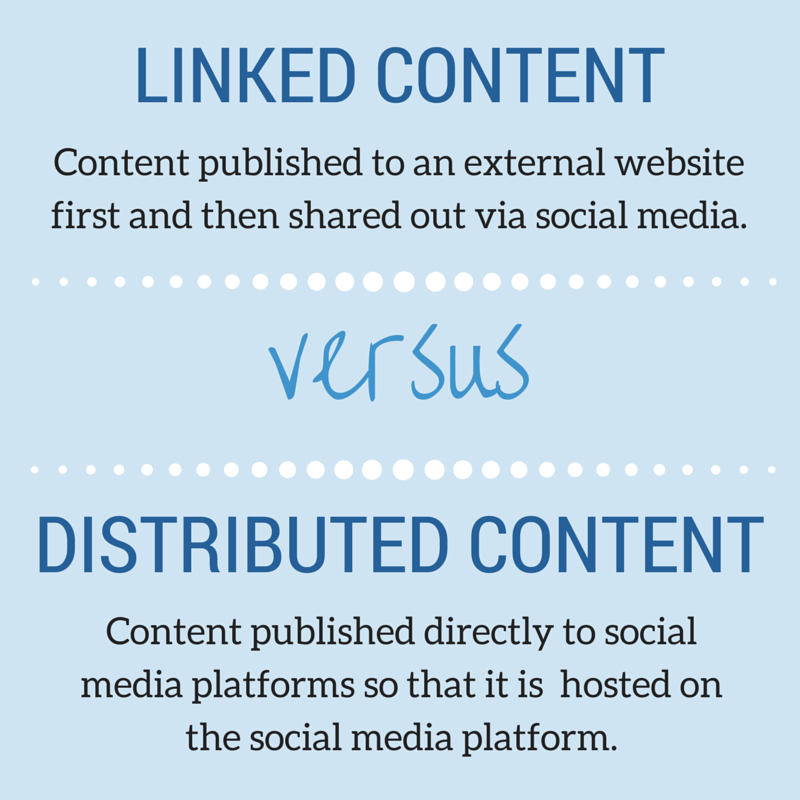
  • Are organizations similar to BHL moving away from driving social media users back to their websites by linking content and instead, simply distributing the content by posting it directly to social media platforms?
    View Full Size Image
The second part of my project was to manage BHL’s social media accounts, test out new outreach strategies, and do a strategy performance comparison to answer the following questions:
  • What are possible new outreach strategies that BHL could implement on Facebook and Twitter?
  • After implementing some of these strategies, what is the impact of these new strategies and how do they compare to BHL’s current strategies on those platforms?
If you’ve interacted with BHL on Facebook, Twitter, or Blogger anytime during the first two weeks of July, then you were talking to me and responding to my posts! Here are some of my favorite posts that I created:
Happy #InternationalPolychaeteDay! Let these amazing creatures make you feel all worm & fuzzy: http://t.co/jUj6lI5N7A pic.twitter.com/e2AiY0sCAP

— BHL (@BioDivLibrary) July 1, 2015

The force is strong with this one. Yoda bat among huge find of new species in 2009. http://t.co/B0SWHJBsIe pic.twitter.com/Zk6nMUKQZP

— BHL (@BioDivLibrary) July 2, 2015

“Uniformity is not nature’s way; diversity is nature’s way.” -Vandana Shiva #WisdomWednesday http://t.co/03hfNSoO5q pic.twitter.com/rrMg1h3zvF

— BHL (@BioDivLibrary) July 8, 2015

How has BHL impacted your work? Let us know! @Fishy_Hayes shared this #BHLimpact. http://t.co/QNWa4UWuV4 pic.twitter.com/M8LizfxvXW

— BHL (@BioDivLibrary) July 3, 2015

After collecting all the performance data and analyzing it, I submitted a final report that summarized BHL’s social media outreach impact in comparison to other organizations, discussed the performance of seven new social media strategies, and made twelve recommendations for BHL’s outreach strategy going forward.

July 30, 2015by tcmart2
BHL News, Blog Reel, Tech Updates

Announcing Altmetric and MyTweeps on BHL!

Have you ever wanted to learn more about the books in BHL? Or maybe find out what people are saying on social media about our collections? Or perhaps you’d like to connect with other BHL-enthusiasts?

We’re excited to announce that today, as part of our Mining Biodiversity project, we’ve launched two new features on BHL that will allow you to do all of the above! These features are Altmetric and MyTweeps.

Altmetric

Altmetric is a UK-based company that offers tools to help track online mentions of a library, publisher, or other entities’ content. Sites such as Twitter, Facebook, Wikipedia, Reddit, Google+, and Mendeley, as well as other online sources like blogs and news outlets, are indexed.

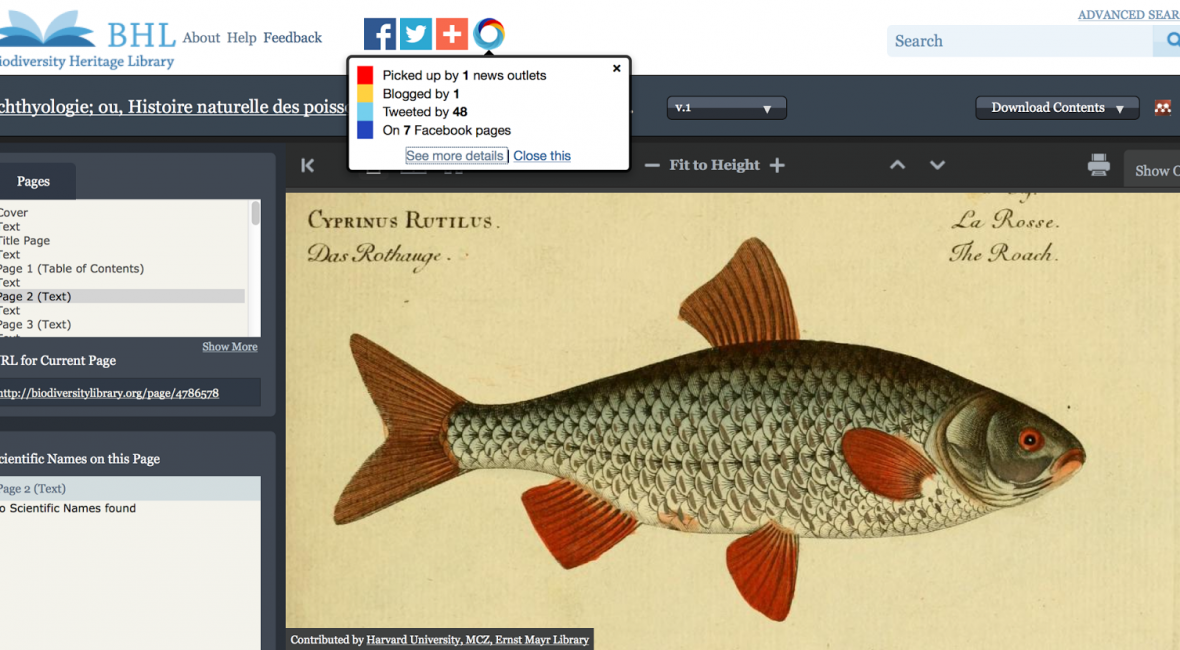
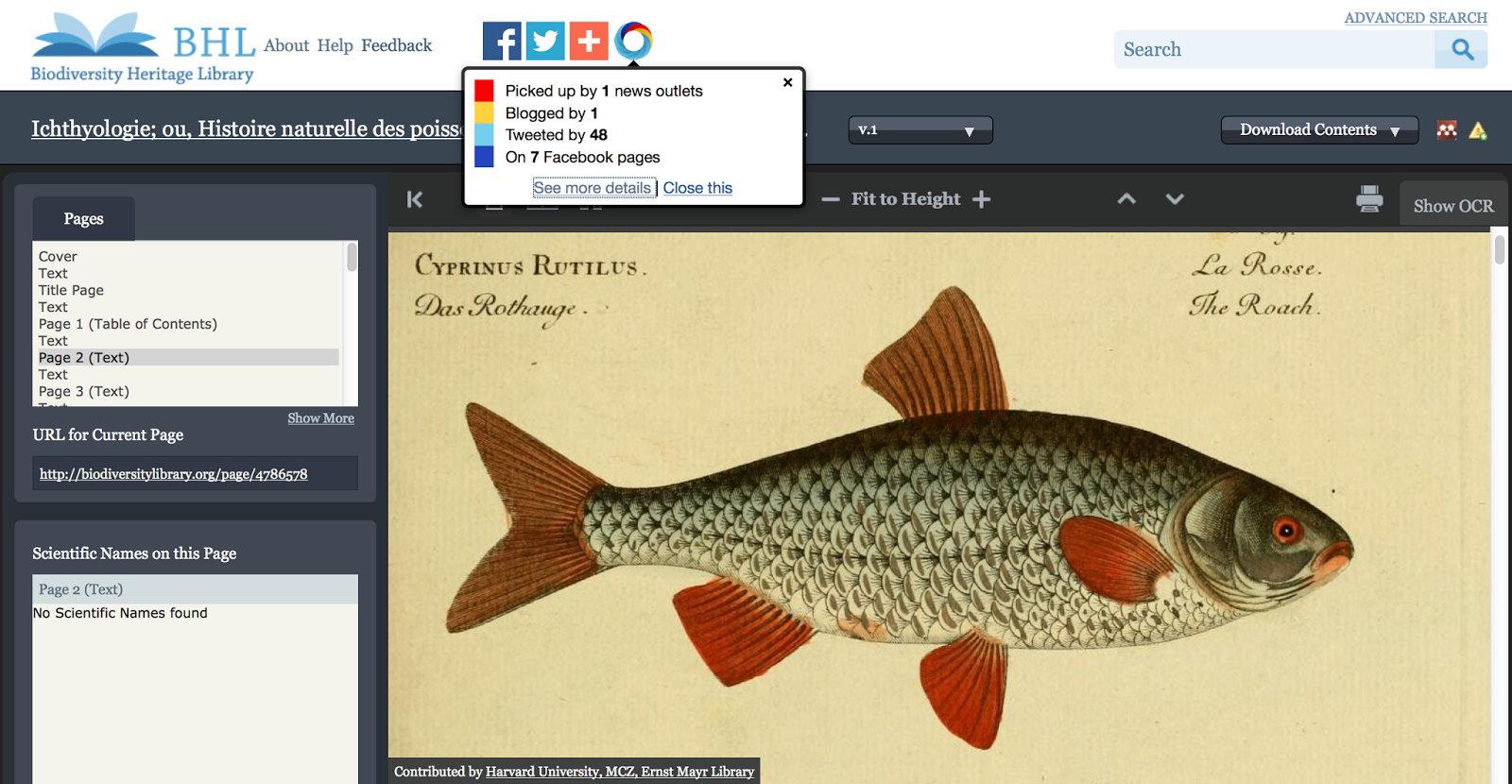
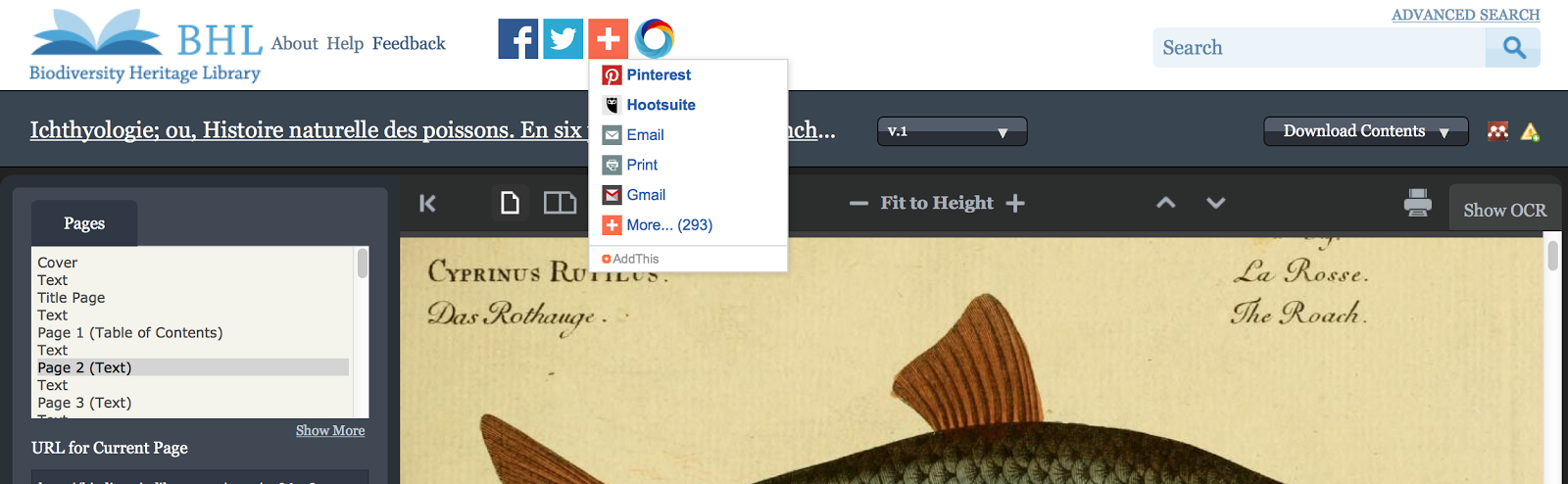
We worked with Altmetric* to track online conversations that include links to BHL books and articles. All mentions** of an individual book (which include a link to the book itself or a link to a page within that book***) are aggregated together into a single dashboard that allows you to explore all of the conversations happening about that item in one place. Each book’s individual dashboard is accessible by clicking on the Altmetric badge (a colorful, donut-shaped icon) in the book viewer header or the “see more details” link in the information box that pop-ups when you hover over the Altmetric badge (see below) in BHL.

View Full Size Image
The Altmetric badge in the BHL book viewer. Click on the badge itself, or the “See More Details” link in the pop-up box that appears when you hover over the badge, to see the Altmetric dashboard aggregating conversations about this item.


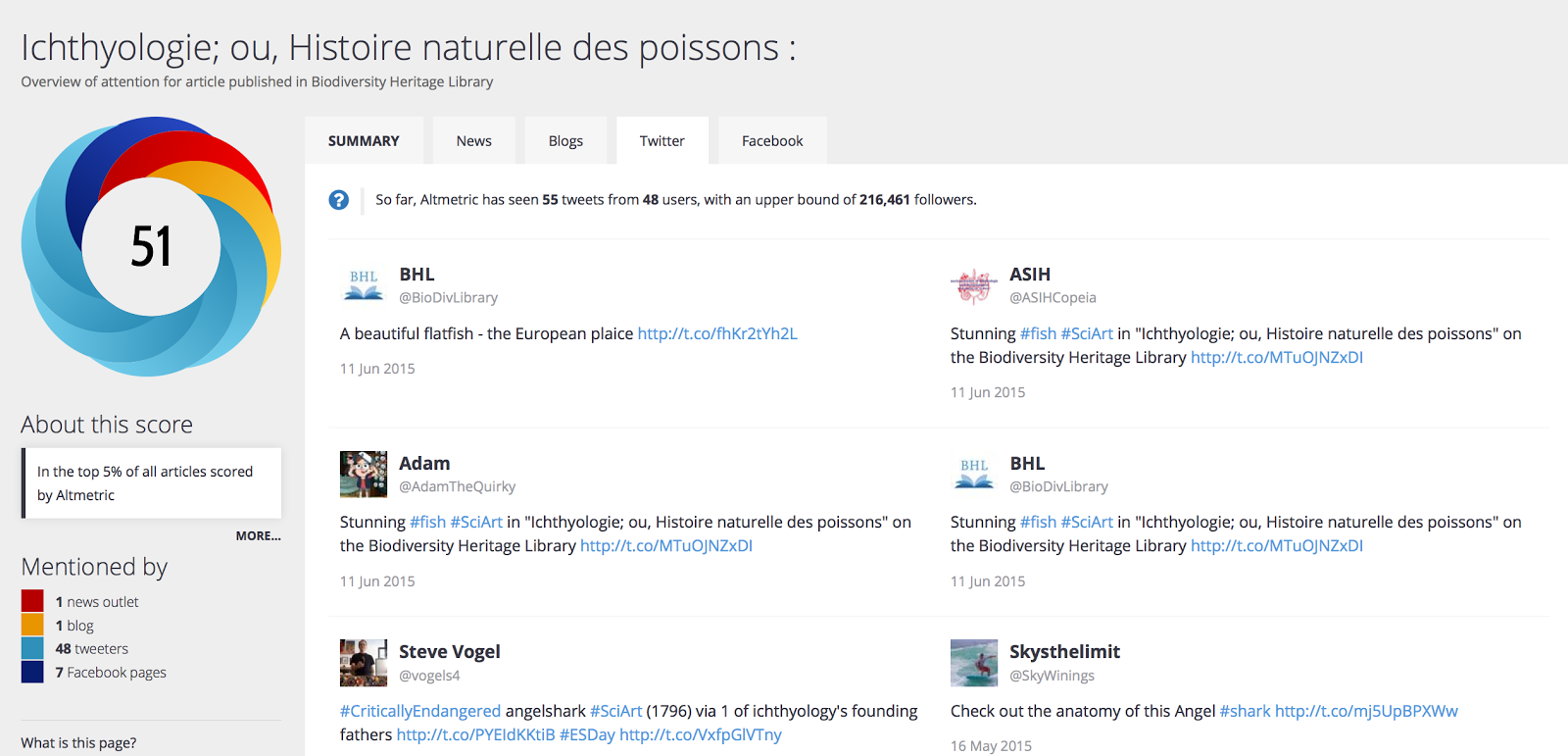
Within the dashboard, you can explore the specific tweets, Facebook posts, news articles, Wikipedia articles, or blogs that talk about that particular book. Each indexed site is represented by a different color (i.e. Twitter is teal; Facebook is navy blue; etc.), so a simple glance at the Altmetric donut will tell you which sites people have mentioned that item on.

View Full Size Image
Example of the Altmetric dashboard, accessed by clicking on the donut-shaped icon or information box illustrated above, for a book in BHL.

The Altmetric icon will appear in the book viewer header for any book that has been mentioned (and where that mention includes an actual link to that book or a page within that book) on one of the indexed online sites. If there is no Altmetric icon in the book viewer header, then there have not yet been any online conversations (with a link) about that book (but you can change that!).

Altmetric dynamically tracks new online mentions of BHL books. That means that if you tweet or post about a book in BHL (and include the link to it), Altmetric will subsequently index that post and make it available in BHL via the described Altmetric icon. Thanks to the social sharing buttons we’ve added to BHL (see below), it’s easier than ever to share your thoughts, expertise, or comments about a BHL book on social media. And thanks to our Altmetric implementation, it’s also now easier than ever for others to find those comments in BHL and benefit from your knowledge!

View Full Size Image
The social media sharing buttons on the BHL website. Simply click on the desired social site to share a link to the page you are viewing in BHL.

Altmetric picks up new mentions on Twitter, news outlets, and blogs on a daily basis. Mentions on Wikipedia, Google+, and Facebook are picked up and indexed via the described dashboards every 2-3 days.

Here are links to just a couple of BHL books that have been indexed by Altmetric. Click on the donut icon in the book viewer header to explore the fascinating conversations about each item. You can contribute directly to the online conversations using our social sharing buttons in BHL (see above), or by clicking on the appropriate links in the Altmetric dashboard (see below). Or start your own conversations about BHL books and see them appear (note the time lag for indexing on various sites above) in BHL!


  • Ichthyologie; ou, Histoire naturelle des poissons : En six parties avec 216 planches dessinées et enluminées d’après nature.
  • Caroli Linnaei…Systema naturae per regna tria naturae :secundum classes, ordines, genera, species, cum characteribus, differentiis, synonymis, locis.
  • The marine mammals of the north-western coast of North America, described and illustrated; together with an account of the American whale-fishery.
  • Conradi Gesneri medici Tigurini Historiae animalium liber IV : qui est De piscium & aquatilium animantium natura : cum iconibus singulorum ad viuum expressis ferè omnibus DCCXII.


View Full Size Image
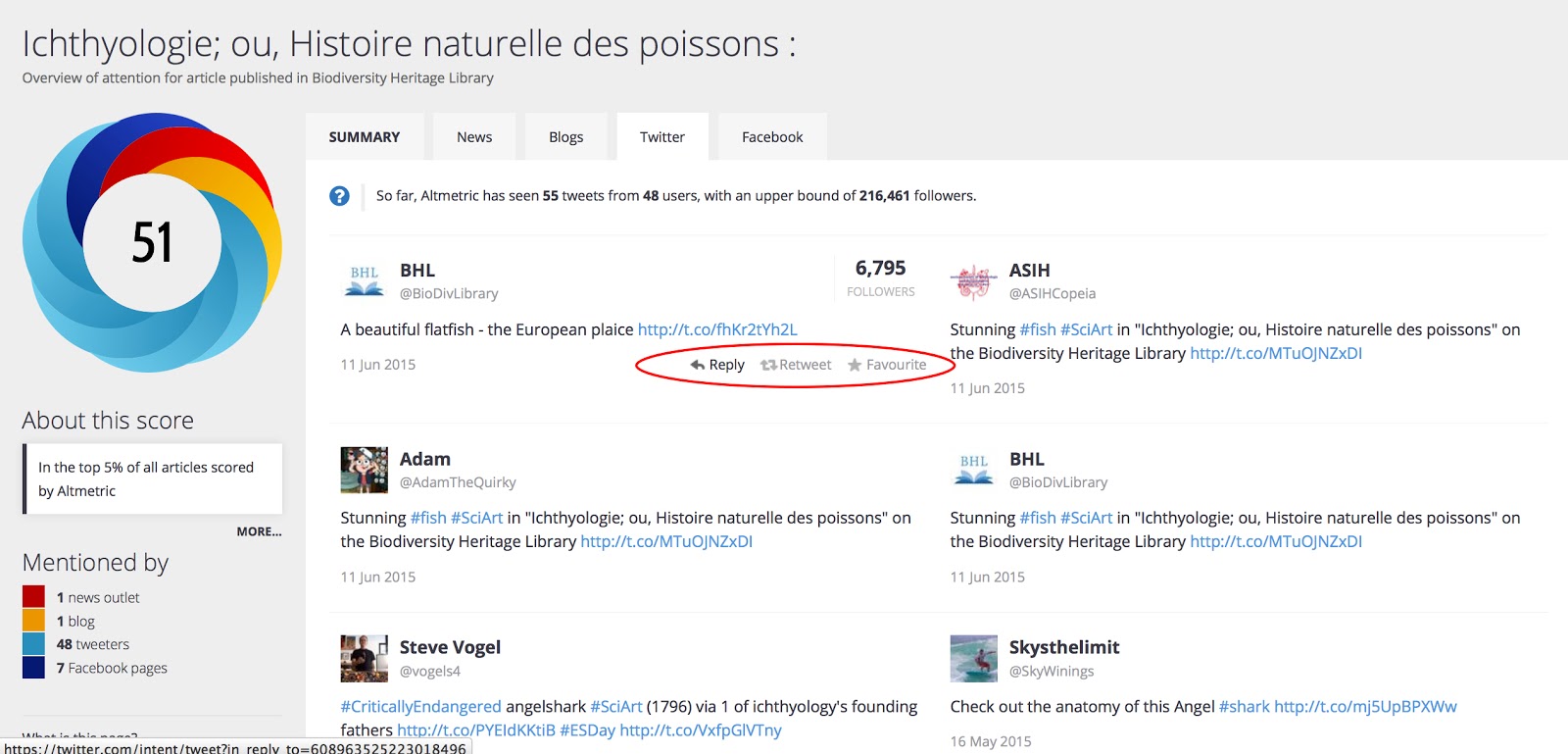
Contribute to a Twitter conversation you discover in Altmetric simply by hovering over the tweet in the Altmetric dashboard and then choosing “Reply,” “Retweet,” or “Favorite.”


View Full Size Image
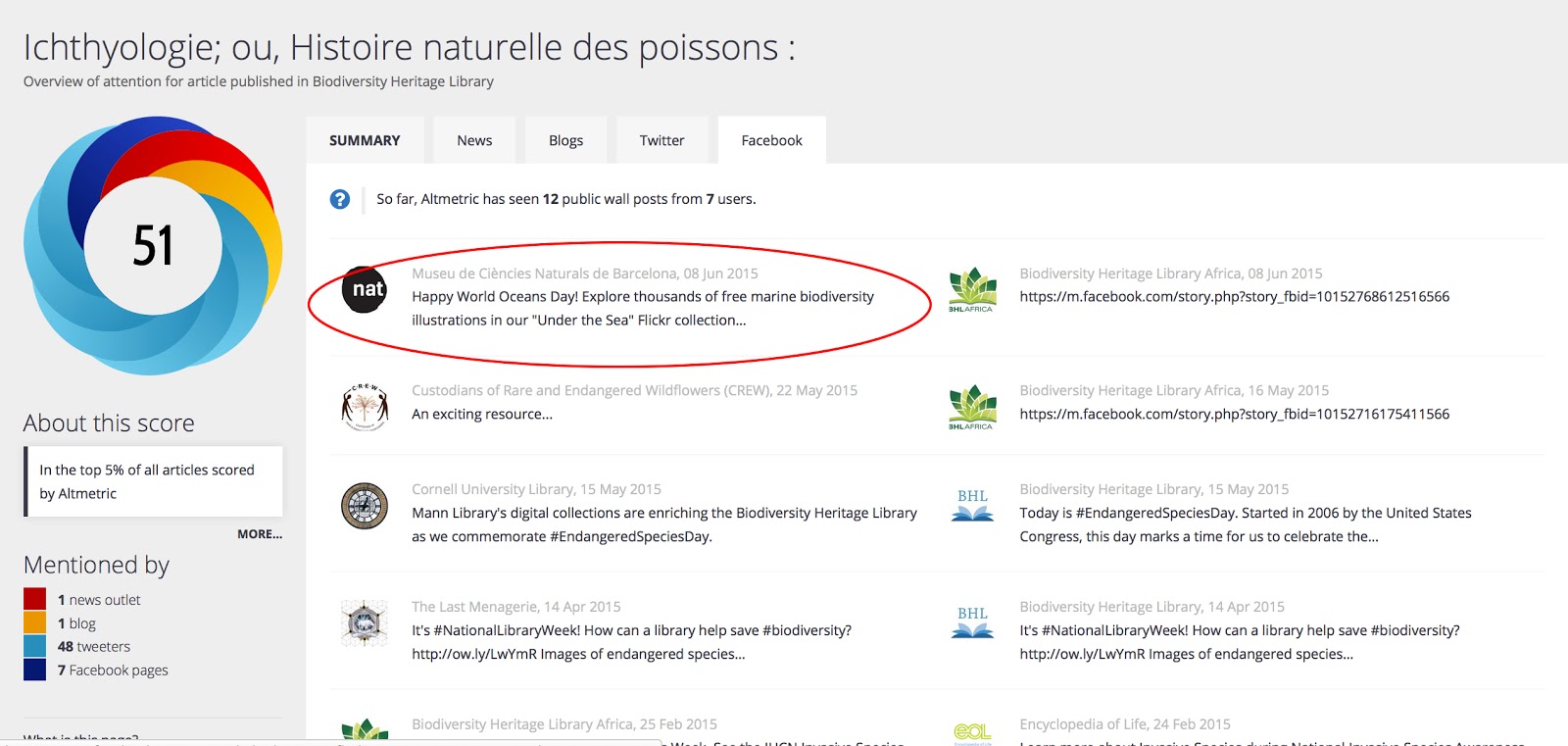
Clicking on any one of the Facebook posts you discover in the Altmetric dashboard will take you directly to that post in Facebook. From there you can comment, like, or share the post within Facebook itself.


MyTweeps

Love biodiversity, books, or natural history? Want to find others who like it too? Or perhaps you’d like to find an easy way to connect with other BHL fans? Are you on Twitter?

Then look no further than MyTweeps on BHL.

MyTweeps is a tool developed by the Social Media Lab at Ryerson University, one of our Mining Biodiversity grant partners. The tool allows you to explore an individual Twitter network (those who follow a certain account on Twitter).

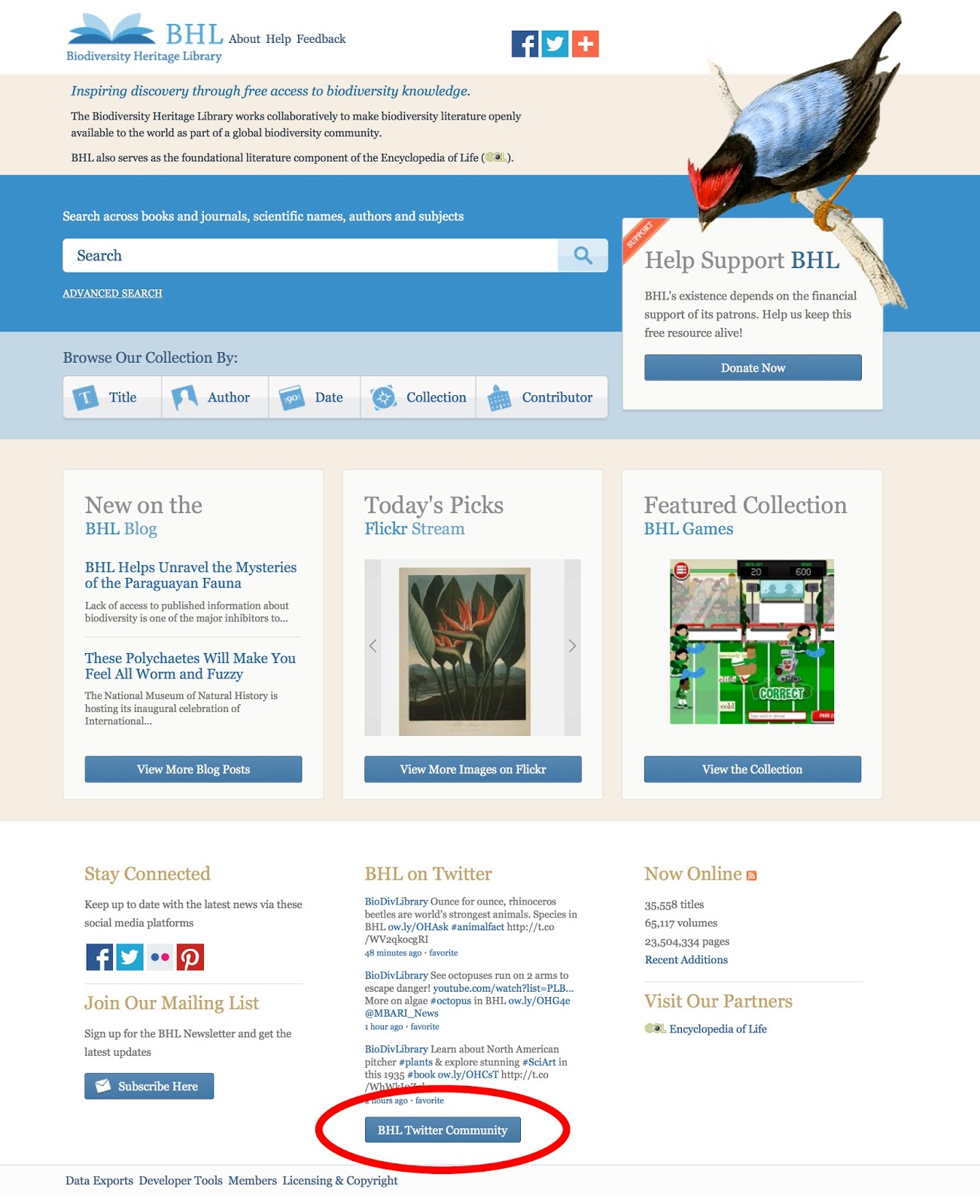
We’ve included a link to the BHL MyTweeps dashboard on the homepage of BHL. Simply click on the “BHL Twitter Community” button at the bottom of the homepage, beneath the BHL Twitter feed, to access the dashboard.

View Full Size Image
The link to the BHL MyTweeps dashboard on the BHL homepage.

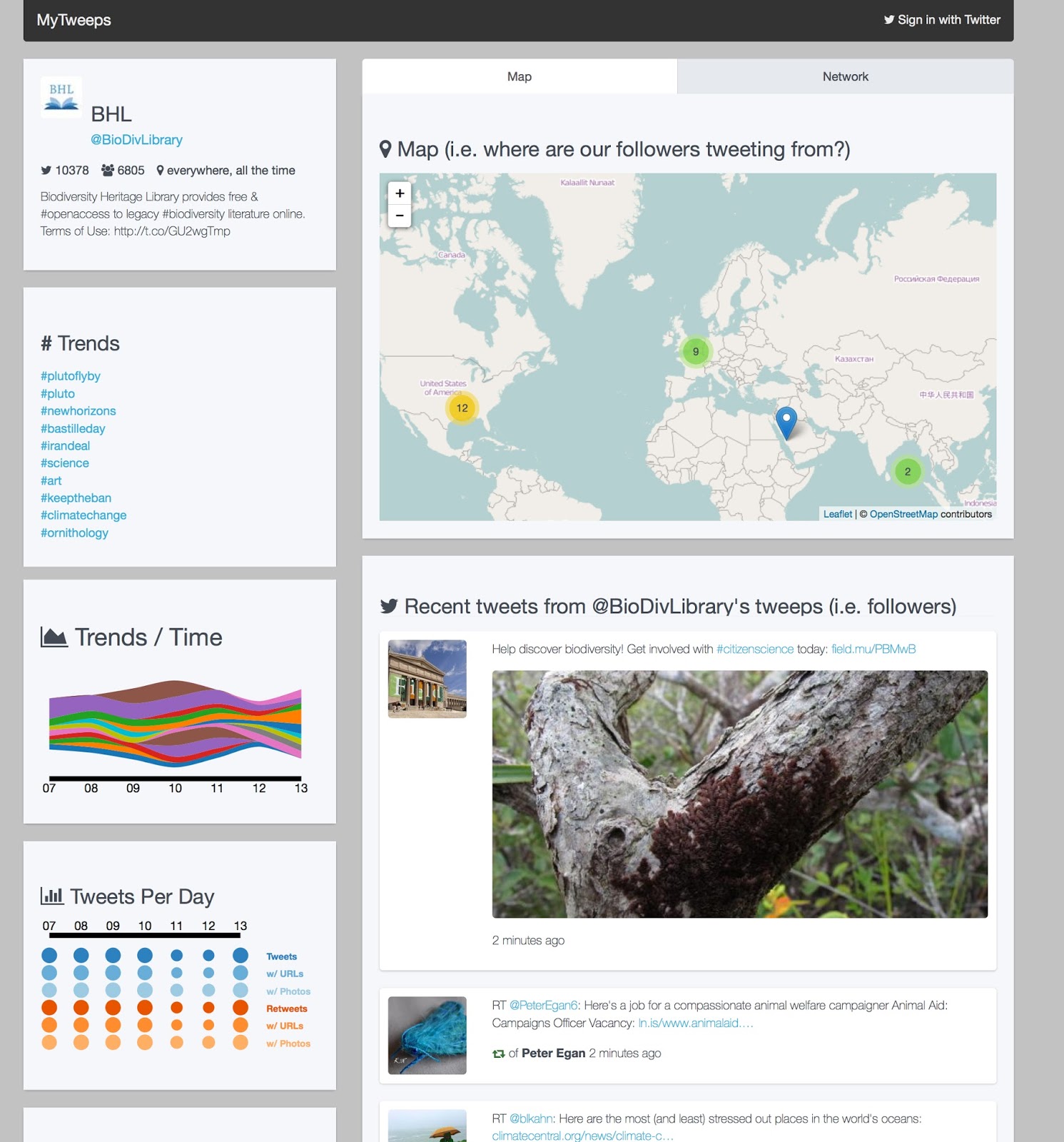
The BHL MyTweeps dashboard displays the latest tweets from the Twitter accounts that follow BHL, trending hashtags and trends over time from those followers, geographic location of BHL’s tweeps (i.e. followers), and the connectivity of the BHL network (i.e. who mentions whom among the BHL community of followers). We’ve also included an Altmetric dashboard in the lower left-hand corner of the MyTweeps page that shows the most popular BHL books on social media that week.

View Full Size Image
The BHL MyTweeps Dashboard, accessed by clicking on “BHL Twitter Community” at the bottom of the BHL homepage.

Take a look and discover a whole new network of biodiversity and BHL enthusiasts to connect, converse, and collaborate with. Or simply use MyTweeps as a way to stay informed about the topics and issues that are important to our community.

We hope you’ll explore and enjoy our new social media tools and take the opportunity to learn more awesome information about our collections. If you have any questions or comments about the tools, please don’t hesitate to send us feedback!

Happy socializing!

View Full Size Image


This project is made possible by a grant from the Institute for Museum and Library Services [Grant number LG-00-14-0032-14].

*Traditionally, Altmetric tracks only DOI (Digital Object Identifiers) mentions, but for this project our team worked with Altmetric to pioneer the tracking of URIs (Unique Resource Identifiers) via Altmetric. In exchange, Altmetric has granted us free access to their license and services.
**Mentions of BHL content on social media sites (i.e. Twitter, Facebook, Google+, Reddit, and Mendeley) are captured from June 2014-onwards. Mentions of BHL content on blogs and news articles are captured since the launch of BHL onwards.
***Indexed conversations are those that include links that start with “http://biodiversitylibrary.org/item/” or “http://biodiversitylibrary.org/page/” or “http://biodiversitylibrary.org/part/.” We are not tracking mentions with links that start with “http://biodiversitylibrary.org/bibliography/” due to Google Scholar tag guidelines, which form the basis of Altmetric’s tracking ability.

July 20, 2015by ulib-libraryjobs
BHL News, Blog Reel, Campaigns, Garden Stories

Buy a Garden Stories T-Shirt, Support BHL!

All this week we’re celebrating the art, history, and science of gardening with our Garden Stories event, highlighting over 14,000 seed and nursery catalogs in BHL, featuring over 2,500 art images from seed catalogs, and providing great gardening tips and resources on our blog, Twitter, Facebook, Flickr, Pinterest, and Tumblr. Follow #BHLinbloom or our BHL accounts on social media to follow along!

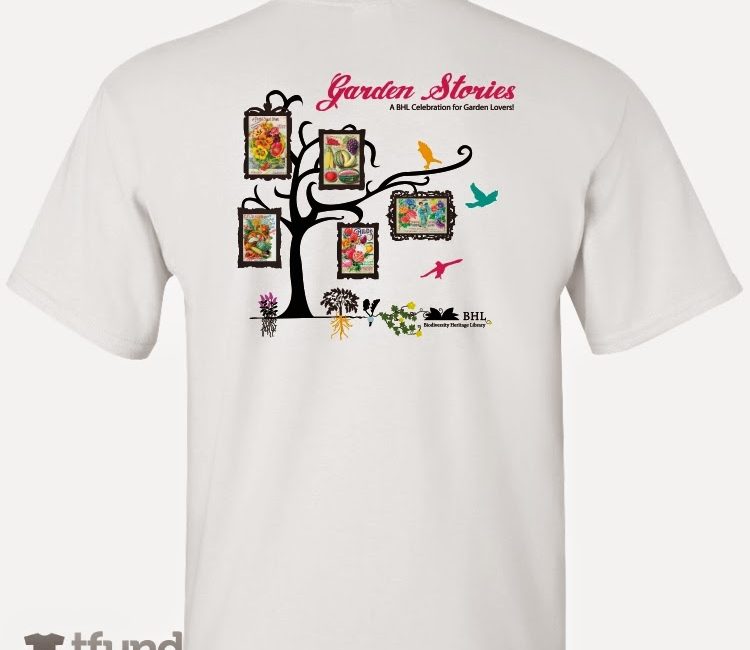
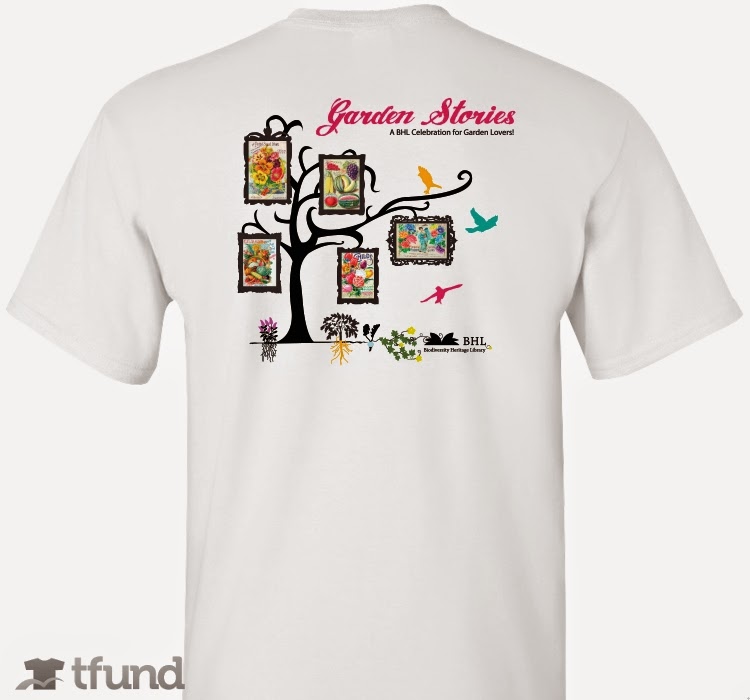
As part of the campaign we’re offering a BHL Garden Stories T-Shirt for sale! All proceeds from selling the shirt will be used to digitize more books for the Biodiversity Heritage Library collection. T-Shirts are 25 USD each. Our goal is to sell enough T-Shirts to digitize 5,000 pages, which translates to 125 T-Shirts. Help us reach our goal and support biodiversity, science, and conservation today!

Click here to buy your shirt!

View Full Size Image
Garden Stories T-Shirt available for sale through T-Fund. All proceeds will be used to digitize more books for BHL.

Curious how BHL helps support science and conservation? Check out these past blog posts!

March 20, 2015by michelle.underhill
Page 2 of 5«1234»...Last »

Help Support BHL

BHL's existence depends on the financial support of its patrons. Help us keep this free resource alive!

search

About BHL

The Biodiversity Heritage Library (BHL) is the world’s largest open access digital library for biodiversity literature and archives. BHL operates as a worldwide consortium of natural history, botanical, research, and national libraries working together to digitize the natural history literature held in their collections and make it freely available for open access as part of a global “biodiversity community.”

Join Our Mailing List

Sign up to receive the latest news, content highlights, and promotions.

Subscribe Now

Subscribe to Blog via Email

Enter your email address to subscribe to this blog and receive notifications of new posts by email.

Join 319 other subscribers

Subscribe to Blog Via RSS

Subscribe to the blog RSS feed to stay up-to-date on all the latest BHL posts.

Access RSS Feed

Inspiring Discovery through Free Access to Biodiversity Knowledge.

The Biodiversity Heritage Library makes it easier than ever for you to access the information you need to study and explore life on Earth…for free, anytime, anywhere.


ABOUT | HARMFUL CONTENT | PRIVACY | SITE MAP | TERMS OF USE