Biodiversity Heritage Library - Program news and collection highlights from BHL
  • Home
  • News
  • Featured Books
    • All Featured Books
    • Book of the Month Series
    • BHL at 20
  • User Stories
  • Campaigns
    • Fossil Stories
    • Garden Stories
    • Monsters Are Real
    • Page Frights
    • Her Natural History
    • Earth Optimism 2020
  • Tech Blog
  • Visit BHL
Home
News
Featured Books
    All Featured Books
    Book of the Month Series
    BHL at 20
User Stories
Campaigns
    Fossil Stories
    Garden Stories
    Monsters Are Real
    Page Frights
    Her Natural History
    Earth Optimism 2020
Tech Blog
Visit BHL
  • Home
  • News
  • Featured Books
    • All Featured Books
    • Book of the Month Series
    • BHL at 20
  • User Stories
  • Campaigns
    • Fossil Stories
    • Garden Stories
    • Monsters Are Real
    • Page Frights
    • Her Natural History
    • Earth Optimism 2020
  • Tech Blog
  • Visit BHL
Biodiversity Heritage Library - Program news and collection highlights from BHL
Blog Reel, Campaigns, Featured Books, Page Frights

Monsters in Nature: Frightful Tales from the 19th Century

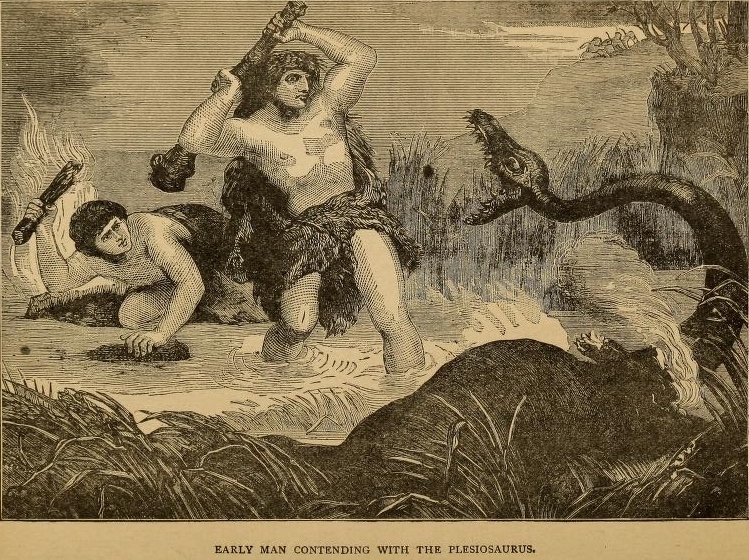
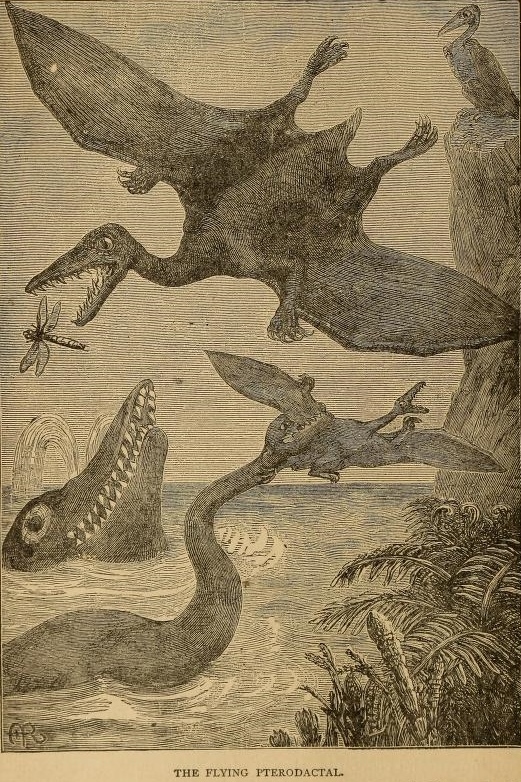
Today’s book is truly filled with Page Frights! Sea and Land: An Illustrated History of the Wonderful and Curious Things of Nature Existing Before and Since the Deluge, by James W. Buel (1849-1920), highlights some truly horrific creatures and plants, with colorful tales and an abundance of amazing illustrations.  You can read about, and see images of, giant prehistoric and contemporary land, air and sea creatures, sometimes in battle with one another and sometimes battling humans–including early man.

Some of the creatures covered and treated with illustrations read like a carnival of monstrosities: Animals not destructible by fire!  The monster sea-elephant!  The terrible water-spout!  The sea-serpent of ancient legend!  There are many gruesome tales, fables, and even ghost tales!  We will highlight a few of Buel’s tales of monsters in nature, in his own words, with accompanying illustrations.

It is important to remember that this book is a reflection of the culture of its time, and scientific inquiry has yielded much more information about these species and helped demystify many of the myths and legends that are sensationalized in the book.  Bearing that in mind, get ready for some fantastic and frightful tales and images!

The Tale of a Kraken Attacking a Ship!

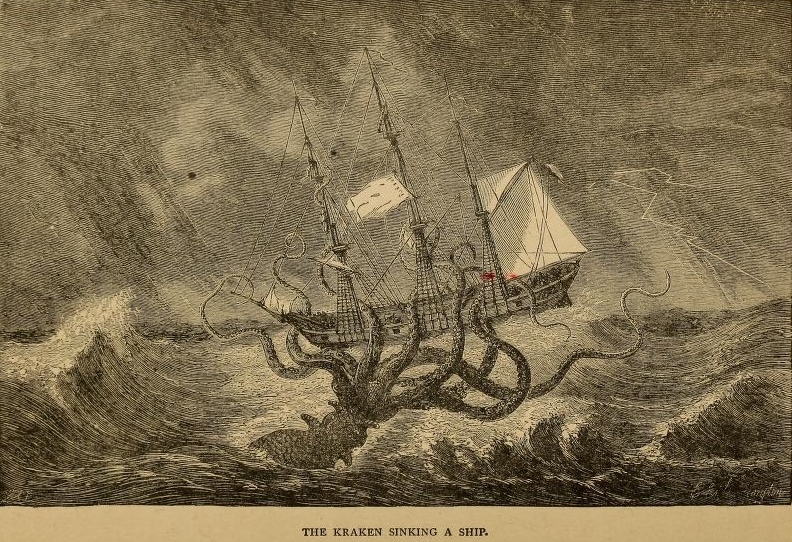
Adventures with the Frightful Squid [Kraken]. Account below from Buel’s Sea and Land:

“In olden times sailors were harassed by many groundless fears, superstitions being abundant and ignorance general.  The early Spanish poetic chroniclers, who delighted in telling the story of Columbus’ voyages, invariably disfigured their narratives with miracles and wonders.  In those days Jack, looking over the side of his vessel, was prepared to see anything, and to this willing disposition may be attributed the creation of mermaids, sea-serpents, grinning or winking monsters, and leviathans big enough to swallow a ship.  There was the squid which, as the sepia octopus, we know in these days to be an extremely large and most diabolically unpleasant beast; but in the olden times this animal was reckoned to be larger than a cathedral, in proof of which the following story is recited:

“A big ship was on the West African Coast; the men were getting the anchor, when a squid arose and wreathed its fearful snake-like limbs around the vessel’s spars.  The tips of these limbs soared quaveringly high above the mastheads, and the weight of the cuttle drove the ship down on to her beam ends.  Here now was a lively situation.  The crew plied axes and knives, but in vain, whereupon they invoked the aid of their patron saint, Thomas.  Eventually the wounded monster grew alarmed and sank, and the crew afterward, to commemorate their deliverance, marched in a body to the Church of St. Thomas, where subsequently there was hung up a painting, representing the unparalleled conflict. […]

“Pliny, the ancient, relates the history of an enormous cuttle-fish that haunted the coast of Spain and destroyed fishing ground.  He asserts that this creature was finally captured, and weighed seven hundred pounds, and that its arms were thirty feet in length.  As the cuttle-fish was esteemed by the ancients a most savory dish, the head of this formidable monster was given to Lucullas to whom it belonged rightfully by reason of his exalted rank” (Buel, 1887, pp. 75-77).

View Full Size Image
Adventures with the Frightful Squid, also called “Kraken” (see image here)

A Giant, Man-Attacking Crab!

Monster Sea-Spiders. Account below from Buel’s Sea and Land:

“From an article in a recent number of St. Nicholas, I condense the following interesting information about crabs:

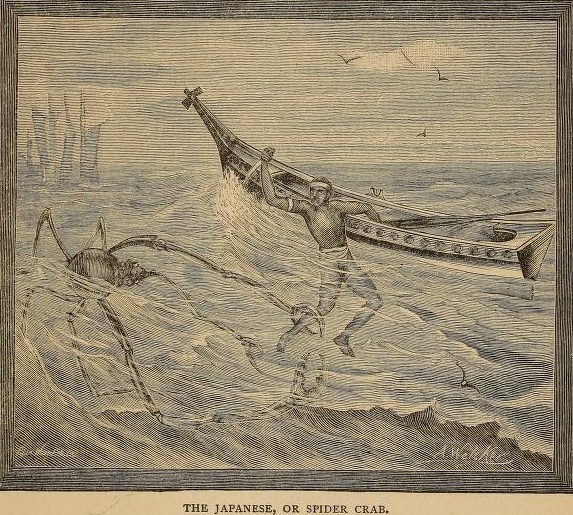
“Among the most remarkable, and the largest of crabs, is the Japanese sea-spider, highly esteemed in the Orient as an excellent article of food.  Its principal claws are each five feet in length, measuring from ten to twelve feet between the tips of the nippers, and presenting an astonishing spectacle when entangled in the nets and hauled aboard the boats.  With their slow, measured movements and the powerful weapons of defense, these crabs are the giants of the spiders of the sea.  Professor Ward, who has collected them in Japan, states that they have a remarkable habit of leaving the water at night and crawling up the banks presumably to feed, and that there they are sought by the crab-hunters.  A story is told of a party of fishermen who had camped out on a river bank, and one of whom aroused the others in the night by yells and screams.  Running to the spot they found that one of these monster crabs, in wandering over the flats, had accidentally crawled over him with his great claws, frightening him almost to death” (Buel, 1887, pp. 64-65).
View Full Size Image
Japanese Spider Crab (see image here)

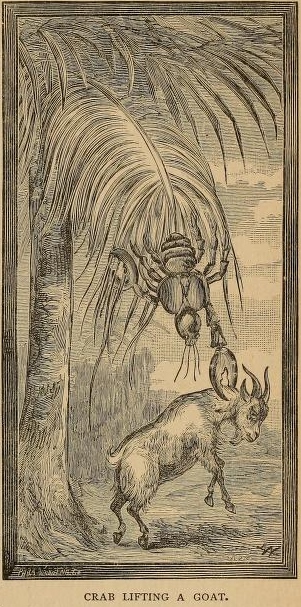
“The robber-crab, peculiar to the Samoan Islands. . .lives principally in the branches of the cocoanut tree.  It exercises no little intelligence in getting at the fruit, which it accomplishes by carrying the nut to the very top of the tree, and then dashing it down with force enough to break the shell.  A gentleman relates that upon an occasion, while he was walking in a Samoan forest, he saw a robber-brab reach down its claws from a thick palm branch and seize a goat by the ears that was passing underneath.  So powerful was the crab that it lifted the goat almost clear from the ground” (Buel, 1887, pp. 65, 67).
View Full Size Image
Robber-Crab lifting a goat off the ground (see image here)

A Horrifying Man-Eating Tree!

A Man-Eating Plant. Account below from Buel’s Sea and Land:

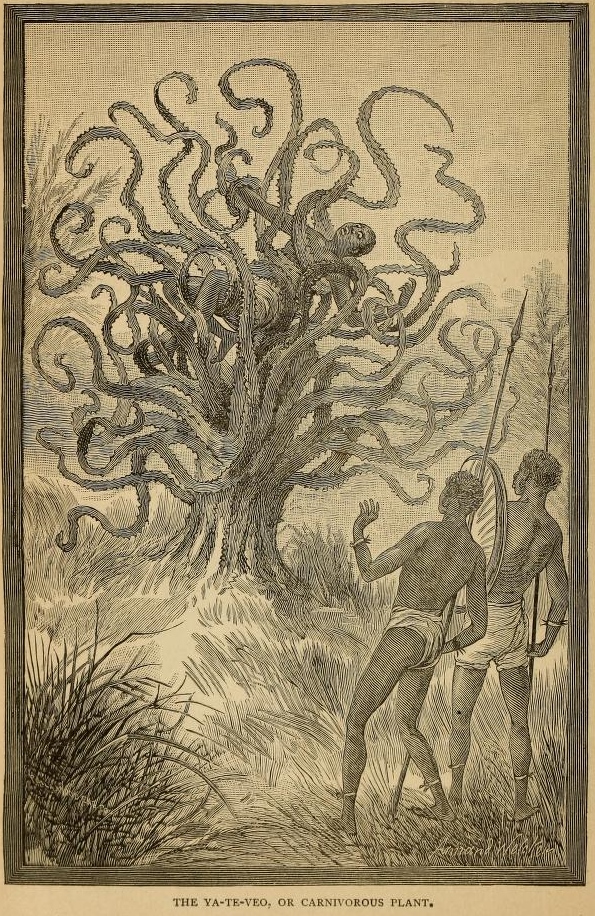
“Travelers have told us of a plant, which they assert grows in Central Africa and also in South America, that is not contented with the myriad of large insects which it catches and consumes, but its voracity extends to making even humans its prey.  This marvelous vegetable Minotauris represented as having a short, thick trunk, from the top of which radiate giant spines, narrow and flexible, but of extraordinary tenaciousness, the edges of which are armed with barbs, or dagger-like teeth.  Instead of growing upright, or at an inclined angle from the trunk, these spines lay their outer ends upon the ground, and so gracefully are they distributed that the trunk resembles an easy couch with the green drapery around it.  The unfortunate traveler, ignorant of the monstrous creation which lies in his way, and curious to examine the strange plant, or to rest himself upon its inviting stalk approaches without a suspicion of his certain doom.  The moment his feet are set within the circle of the horrid spines, they rise up, like gigantic serpents, and entwine themselves about him until he is drawn upon the stump, when they speedily drive their daggers into his body and thus complete the massacre.  The body is crushed until every drop of blood is squeezed out of it and becomes absorbed by the gore-loving plant, then the dry carcass is thrown out and the horrid trap set again.

“A gentleman of my acquaintance, who, for a long time, resided in Central America,, affirms the existence of such a plant as I have here briefly described, except that instead of the filaments, or spines, resting on the ground he says they move themselves constantly in the air, like so many huge serpents in an angry discussion, occasionally darting from side to side as if striking at an imaginary foe.  When their prey comes within reach the spines reach out with wonderful sagacity (if I may be allowed to apply the expression to a vegetable creature), and grasp it in an unyielding embrace, from whence it issues only when all the substance of its body is yielded up.  In its action of exerting pressure upon its prey, this dreadful plant resembles the instrument used in the dark ages for inflicting a torturous death.  It was made of two long iron cylinders, on the inside of which were sharp, projecting pikes.  The victim was placed inside, and the two cylinders then brought forcibly together, thus driving a hundred or more of the pointed pikes into all parts of his body and producing a frightful death.  Generally this inquisitorial instrument was made, somewhat crudely, to represent a woman, hence the name applied to it was “The Maiden,” by which it is still known.

“Dr. Antonio Jose Marquez, a distinguished gentleman of the city of Barranguilla, in the United States of Colombia, in describing this wonderful plant to the author, affirms that when excited it violently agitates its long, tentacle-like stems, the edges of which, rasping upon each other, produce a hissing noise which resembles the Spanish expression, ya-te-veo, the literal translation of which is “I see you.”  The plant is therefore known, in South America, by the name Yataveo” (Buel, 1887, pp. 475-477).
View Full Size Image
The Man-Eating Tree (see image here)

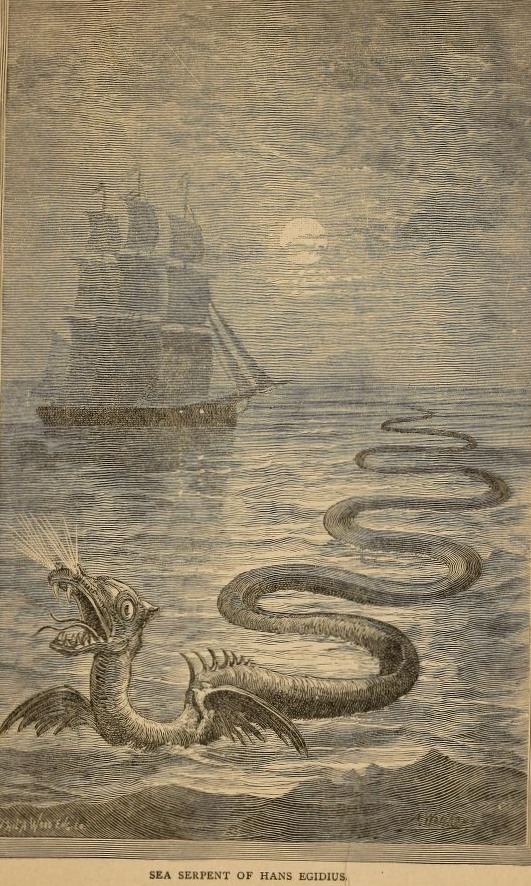
Click here to read the book, and more of its frightful tales!  Here are some wickedly monstrous illustrations to lure you to this special collection of Page Frights!
View Full Size Image
Sea Serpent (see image here)
View Full Size Image
Imagined battle between early man and Plesiosaurus (see image here)
View Full Size Image
Pterodactyl and sea dinosaurs (see image here)

What is your favorite image or story from today’s #PageFrights book?

October 11, 2016by micahv
Blog Reel, User Stories

“What a Gem!” BHL Supports Teuthology Research

Here’s a word of the day for you: Teuthology.

What does it mean? It’s the study of cephalopods. What are cephalopods? Well, they are a class of mollusks that include two extant subclasses: Coleoidea and Nautiloidea.

Still not sure what cephalopods are? You probably know them by their more common monikers: octopuses, squid, cuttlefish, and nautiluses. There are over 800 living species of cephalopods known today.

View Full Size Image
Dr. Ian G. Gleadall, Reader in Marine Biology at the International Fisheries Science Unit of Tohoku University Graduate School of Agricultural Sciences, Sendai, Japan.

Dr. Ian G. Gleadall has been studying the biology of cephalopods (particularly octopuses) for 40 years. Dr. Gleadall (a marine biologist who works in Sendai, Japan) discovered BHL in November, 2014 while visiting the National Museum of Natural History in Paris. It has had a profound impact on his research. As Dr. Gleadall explains:

“[BHL] is a truly wonderful tool. Highly useful, reliable in operation, intuitive and easy to use. I have been writing a complex systematic review of cephalopod taxonomy, with an emphasis on the octopuses of the Indo-Pacific region, particularly centred on the seas of the Japanese Archipelago. Because of many previous errors and unclear references to earlier studies in this field, I had recently decided to go deeper into previous naming systems for the Cephalopoda, particularly as regards the various groups of octopus.

“There are a number of different, rival schemes in taxonomy, so it is necessary to read the original description for each name in order to assess which should be regarded as the most appropriate to use. Many of the earlier works were published in rare and valuable tomes which are now difficult to get hold of. These books are sometimes huge in size and libraries are reluctant to have them inspected at first hand because their condition is often deteriorating and they may be heavy and difficult to handle. Getting copies of such works is in itself often very difficult and the administrative procedures can be frustrating and time consuming. It is also expensive to visit each institution concerned in many different countries.

“However, the BHL online catalogue of works provides access to a large number of such rare works, allowing me to find and study many of the books I need to use from the comfort of my laptop computer and a wireless internet connection. If I want to have copies of relevant sections, it is very easy to mark pages for collation into a customized PDF file, or even to download an entire book. This service has proven to be extremely valuable to me.

“Over recent months I have been able to quickly gain access to many older texts and this has enabled me to achieve my aims far quicker than would otherwise have been possible. For example, often when I read a new work, I find further references to works that I previously was not aware of. I can then quickly look for (and find) those using BHL. Normally, this could involve having to revisit a library in another country that I have already visited once, or I would have to try to get the library staff to send me a copy, neither of which is as fast or convenient as using BHL.”

During intensive periods of study, Dr. Gleadall uses BHL daily, sometimes downloading up to four 4 custom PDFs in a day, in addition to studying other materials online. It’s not surprising, then, that the ability to download custom PDFs is Dr. Gleadall’s favorite feature on BHL.

“About half of the publications that I access on BHL I read online and take notes. Where there is a lot of material and I do not have time to complete my work in a single session (or if there are many data-dense tables, for example), I’ll select the pages that I’m interested in and arrange for a custom PDF,” explains Dr. Gleadall. “[The custom PDF service] is so easy and intuitive to use (why can’t other internet services be so convenient and trouble-free?!).”

View Full Size Image
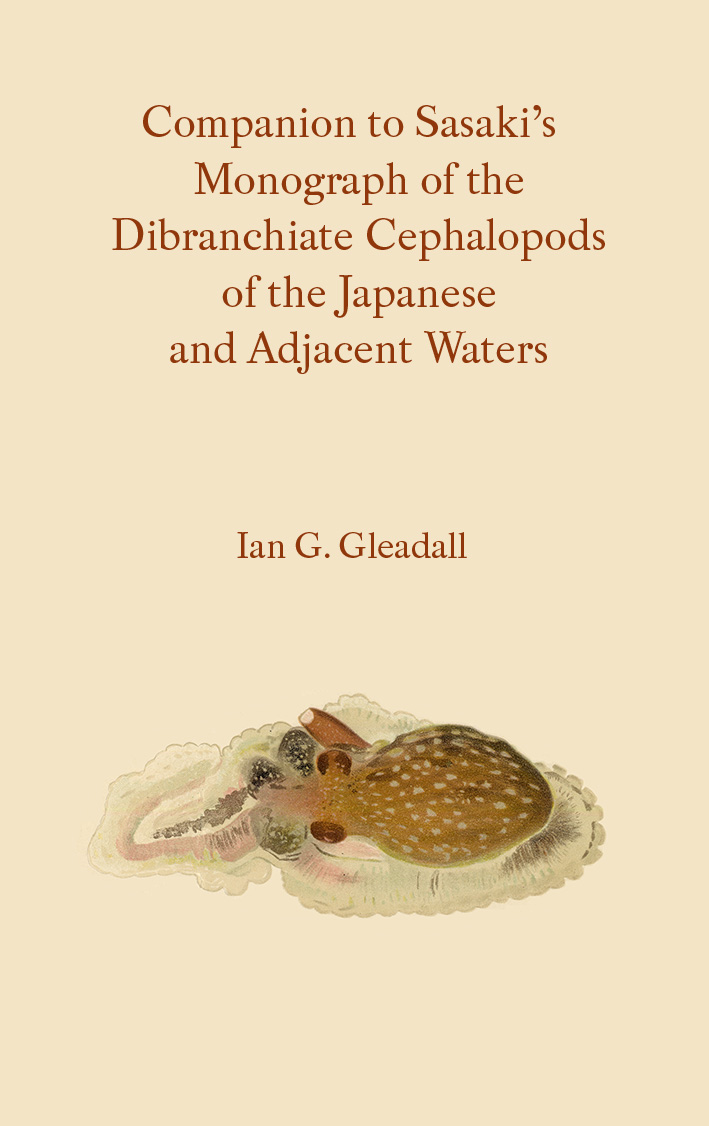
A book by Ian Gleadall (in the final stages of publication) concerning the classic 1929 monograph on the Cephalopoda by Madoka Sasaki. In writing this book, many of the references required to prepare the synonymies of various cephalopod orders, families, genera and species were viewed using the BHL online archive.

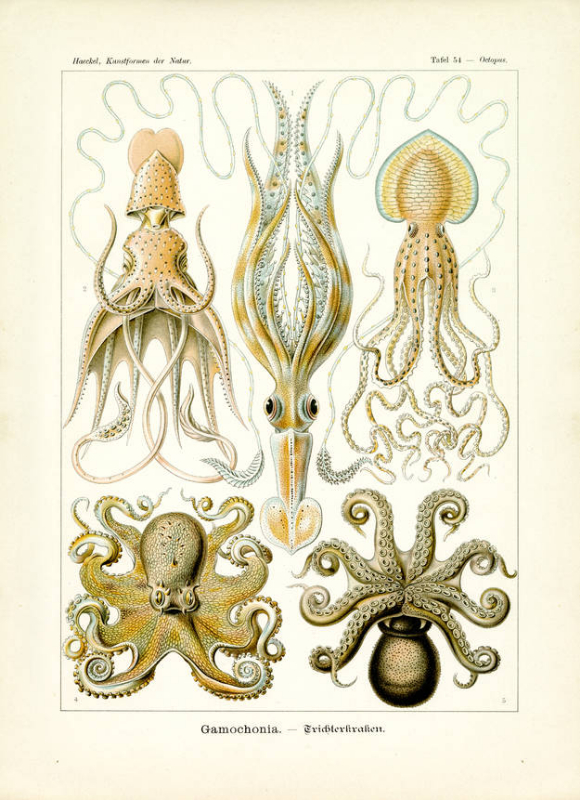
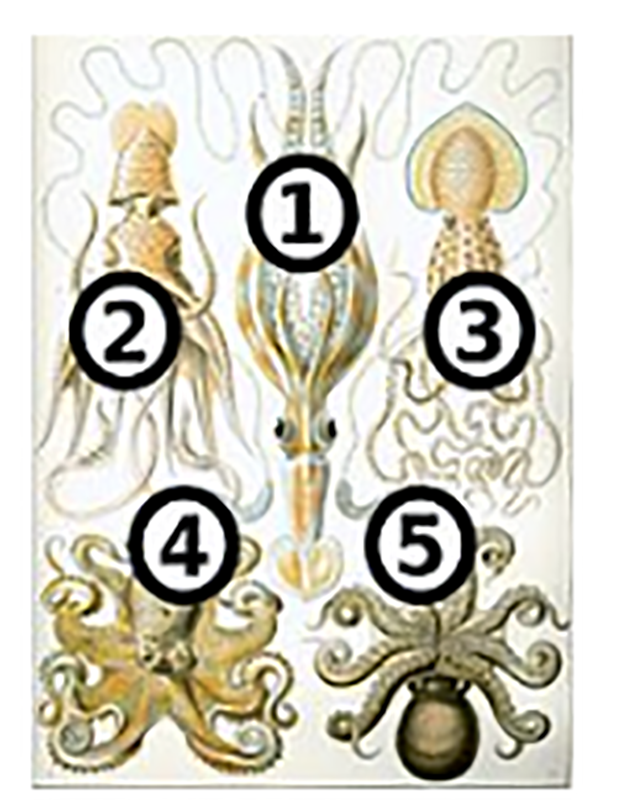
A highlight for Dr. Gleadall in his research is the opportunity to explore some of the beautiful works of art that are part of the heritage of biological description, such as the stunning cephalopod lithograph created by Ernst Haeckel as part of his Kunstformen der Natur (1904).

View Full Size Image
54th plate from Ernst Haeckel’s Kunstformen der Natur (1904), depicting squids and octopuses classified as Gamochonia. http://biodiversitylibrary.org/page/47388247.
View Full Size Image
Key to Haeckel’s plate, above. 1) Chiroteuthis veranyi (Férussac); 2) Histioteuthis ruppellii (Vérany); 3) Pinnoctopus cordiformis (Quoy and Gaimard); 4) Octopus vulgaris(Lamarck); 5) Octopus granulatus (Lamarck).

“In modern times, there are many artful illustrations and computer graphic images, but many people are unaware of the gorgeous images of more than 100 years ago, where no expense was spared to produce magnificent series of books reporting on the collections from localities far and wide by the early explorers,” lauds Dr. Gleadall.

While the experience of seeing these illustrations in person creates an impression that a computer screen cannot quite replicate (as Dr. Gleadall explains, many of the rare volumes containing these artworks are massive in size), it is often difficult to gain access to such works in physical library collections. The availability of these books in BHL, and the artwork on the BHL Flickr, ensures that everyone can see and experience this wonderful biodiversity heritage.

It is this immediate and unrestricted access that has most-impacted Dr. Gleadall’s work.

“BHL has considerably smoothed the way for me and speeded up the rate at which I can view a large number of relevant references. I look forward to being able to publish my results far more quickly than would otherwise have been possible without BHL. Many thanks.”

Thank you, Dr. Gleadall, for sharing with us the impact that BHL has on your work. Do you use BHL to support your own research? Want to tell us about it? Send an email to [email protected]!

September 10, 2015by michelle.underhill
Blog Reel, Campaigns, Featured Books, Monsters Are Real

Release the Kraken!

“Architeuthis, the giant squid, is the quintessential sea monster, probably responsible for more myths, fables, fantasies, and fictions than all other marine monsters combined…[It] surely is the most remarkable unscheduled arrival in the history of zoology, crypto or otherwise. An animal that was believed by many to be mythological verified its existence…” (Ellis, 122, 133-34).

Science knows it by the name Architeuthis dux. For centuries, however, it was known by an altogether more infamous one – The Kraken.

The Kraken: A History

Aristotle first introduced us to the giant squid (which he called teuthos) in 350 BCE, and then, in AD 77-79, Pliny the Elder related a tale of a “polyp” that was killed during its attempt to steal salted fish from the fish ponds in Carteia (Ellis, pg. 123). Described as having 30-foot long arms, the beast has been identified as a squid.

Giant squids have been seen throughout the world’s oceans, but they are quite common in the seas around Norway and Greenland. Indeed, the word “kraken” comes from the Norwegian “krake,” meaning “fabulous sea monsters.” The late 14th century version of the Icelandic saga Örvar-Oddr gives an account of the Hafgufa (“sea mist”) and Lyngbakr (“heather-back”) – beasts occurring in the Greenland Sea. While Lyngbakr is credited as the “largest whale in the sea,” the Hafgufa

“is the hugest monster in the sea. It is the nature of this creature to swallow men and ships, and even whales and everything else within reach. It stays submerged for days, then rears its head and nostrils above surface and stays that way at least until the change of tide.”

Hafgufa, it has been suggested, is a giant squid. The thirteenth century Norwegian work Konungs skuggsjá describes the beast, saying that it appears “more like an island than a fish.” The 1917 translation identifies this “monster” as the Kraken.

View Full Size Image
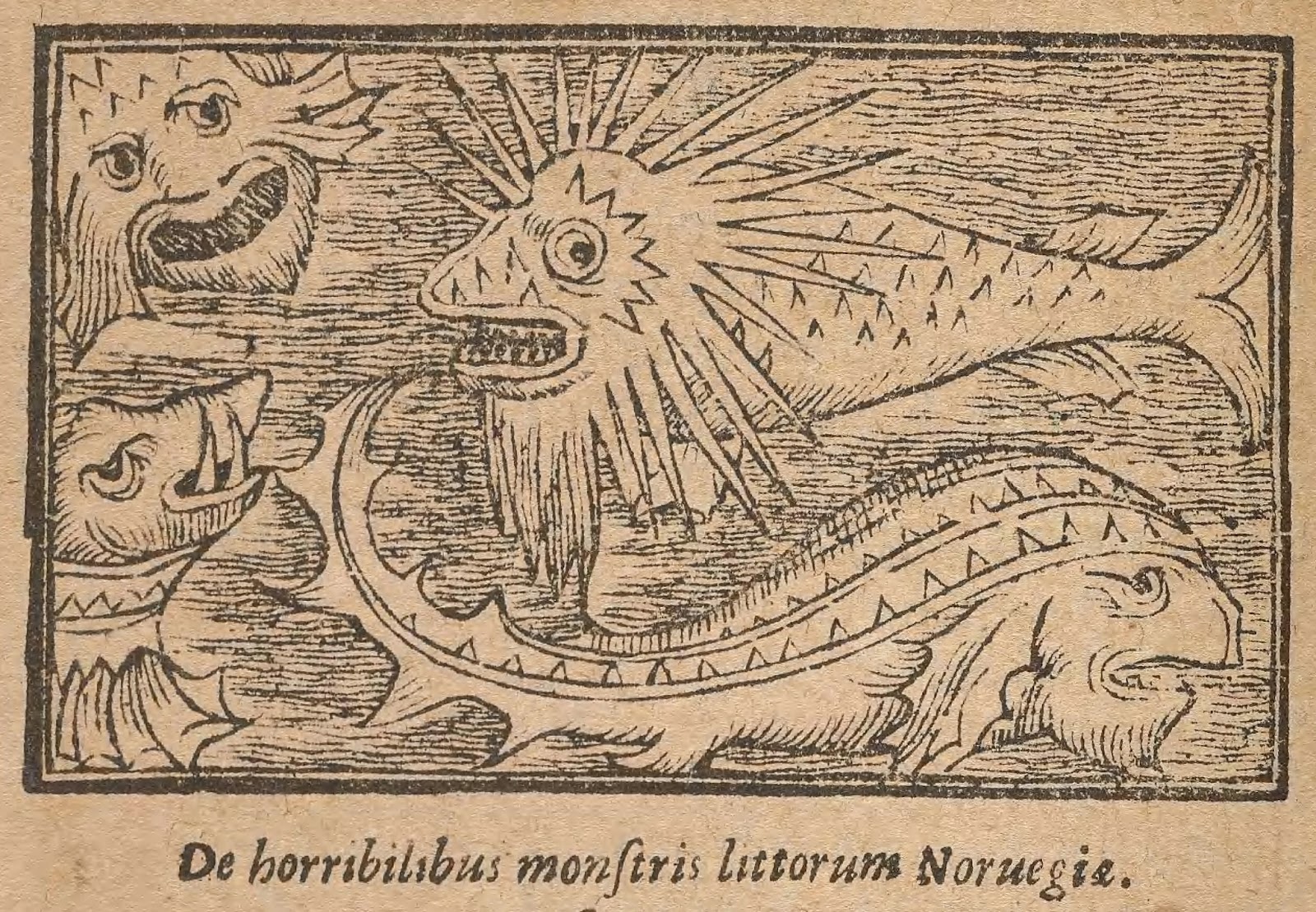
The Kraken. Magnus, Olaus. Historia de Gentibus Septentrionalibus. 1555. http://biodiversitylibrary.org/page/41862917.

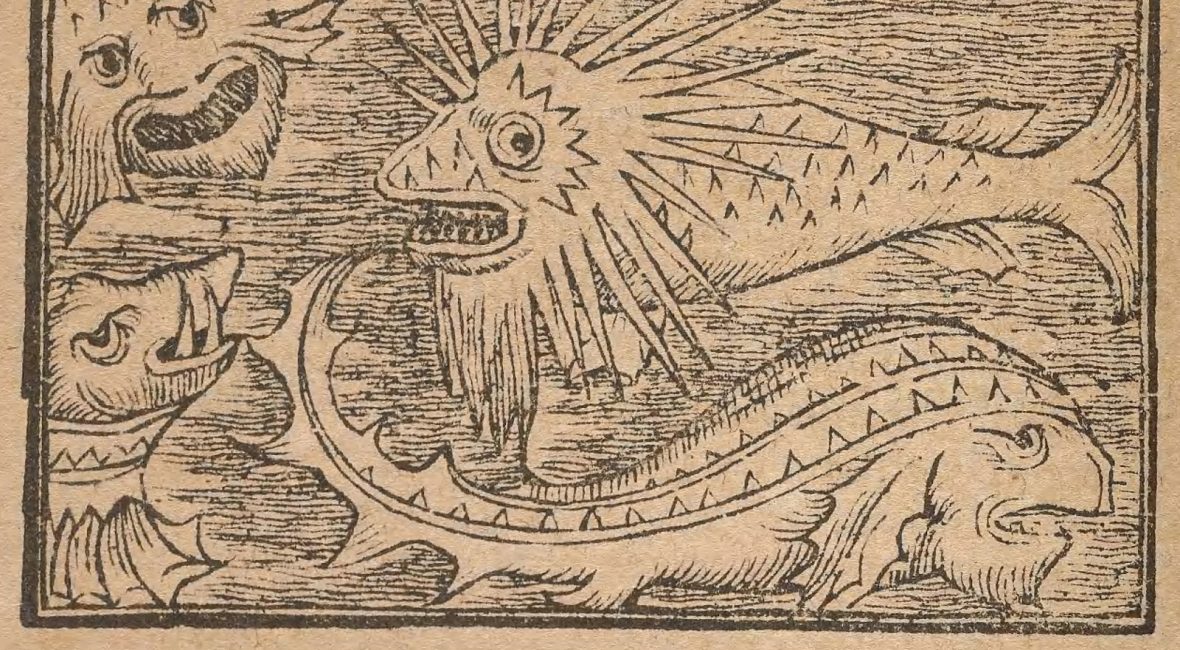
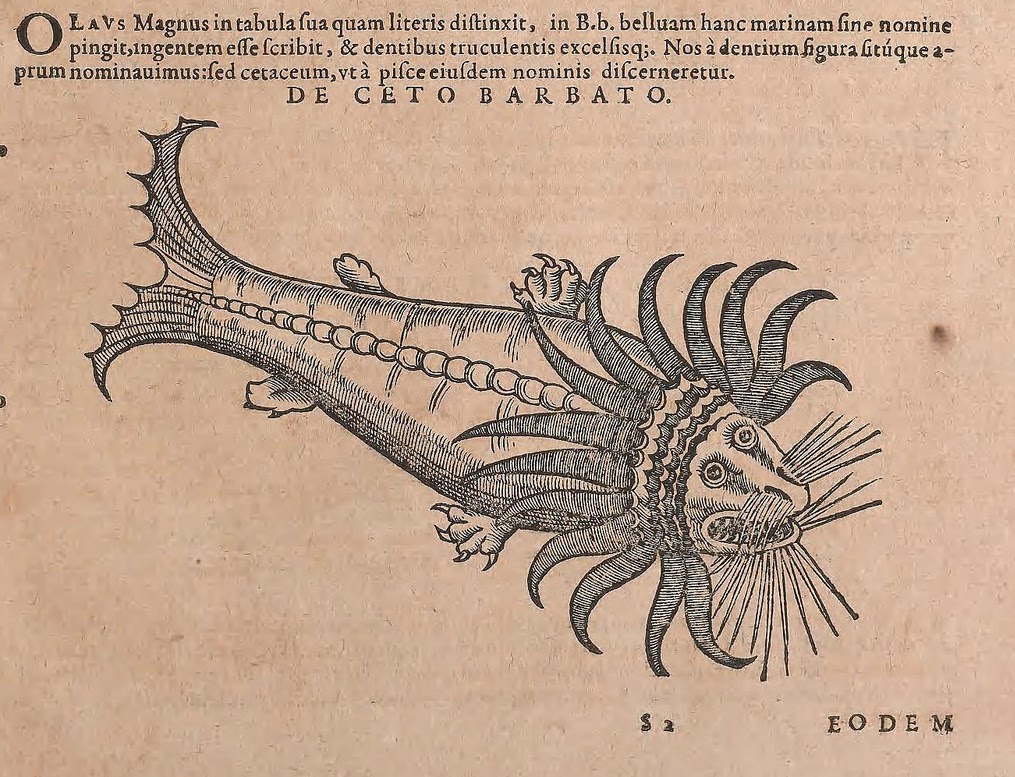
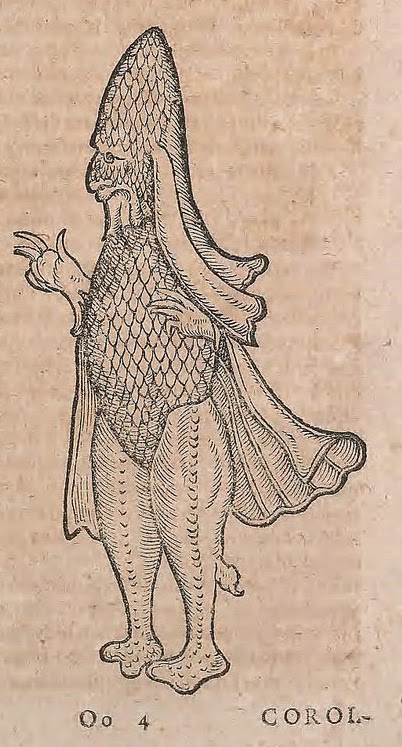
Never missing a chance to tell a good monster tale, Olaus Magnus detailed the kraken as a “monstrous fish” within Historia de Gentibus Septentrionalibus, describing them as having long sharp horns, huge red eyes, and “hairs like goose feathers, thick and long, like a beard hanging down.” He claims that “one of these Sea-Monsters will drown easily many great ships provided with many strong Marriners” – a characteristic reported in the earlier Icelandic work. Magnus’ depiction of the beast, as a strange mix of fish and squid, is quite different from those we find later in the literature, suggesting that his monster is likely a confusion of many sightings, including not only the giant squid but perhaps whales and cuttlefish as well.

View Full Size Image
Kraken, after Magnus. Gessner, Conrad. Historia Animalium. 2nd Ed. 1604. http://biodiversitylibrary.org/page/42165838.

In his first edition of Systema Naturae (1735), Carolus Linnaeus classified the kraken as a cephalopod with the scientific name Microcosmus marinus. Though it was removed from later editions of Systema, Linnaeus’ 1746 publication, Fauna Suecica, describes the kraken as “a unique monster” inhabiting the seas of Norway. He does, however, include a disclaimer that he has never seen the animal himself.

Erik Pontoppidan, bishop of Bergen, in his Det Forste Forsorg paa Norges Naturlige Historie “Natural History of Norway” (Copenhagen, 1752–3), added significantly to the kraken tale. Also writing extensively on mermaids and sea serpents, Pontoppidan describes the kraken as “the largest sea monster in the world…round, flat, and full of arms, or branches.” He writes that not only is the kraken sometimes mistaken for an island, but also that it is possible of pulling the largest ships down to the ocean’s bottom. The greatest danger to sailors he claims, however, is the whirlpool created when it sinks, capable of “draw[ing] everything down with it.”

View Full Size Image
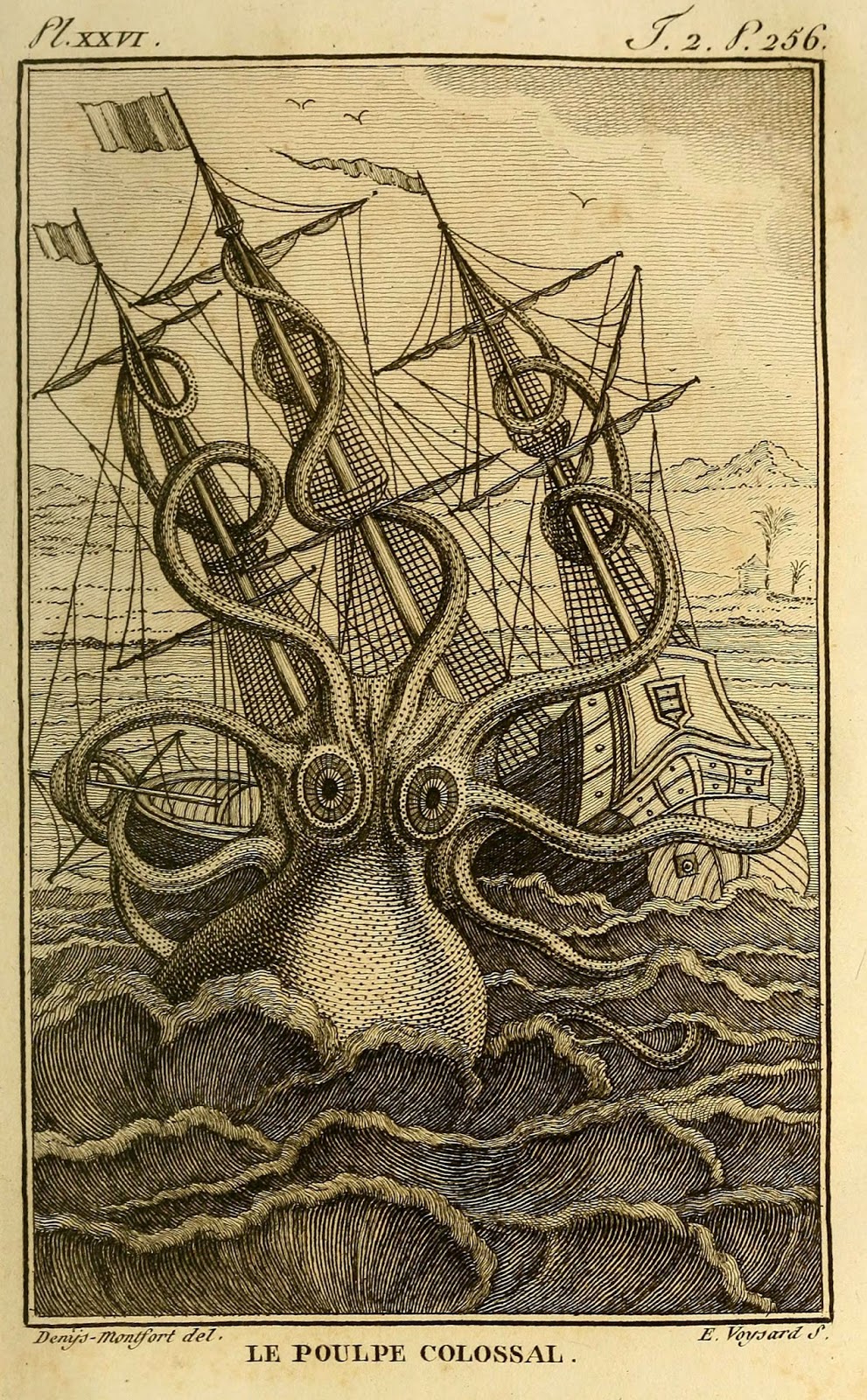
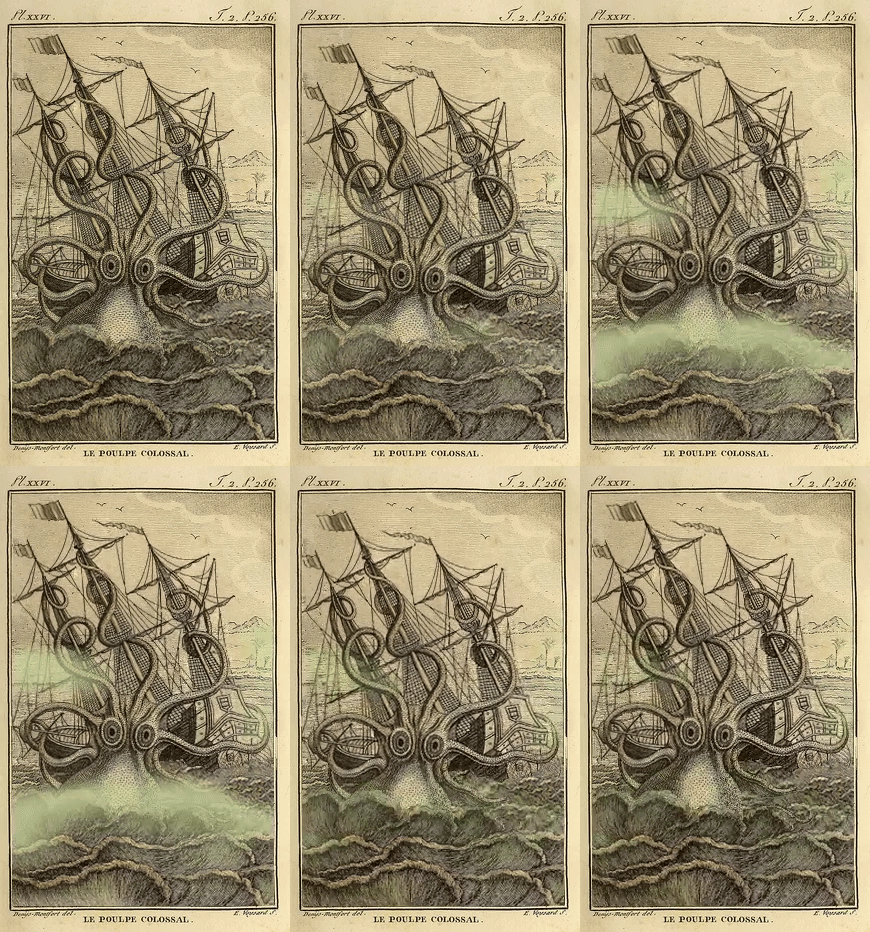
A very octopus-like Kraken. Montfort, Denys. Histoire naturelle, générale et particulière des mollusques : animaux sans vertèbres et a sang blanc. v. 2. 1801. http://biodiversitylibrary.org/page/35755564.

One of the most famous illustrations associated with the kraken, and one in which we see it take a definite cephalopod (if not more octopus-like) persona, comes from French malacologist Pierre Dénys de Montfort’s 1802 book Histoire Naturelle Générale et Particulière des Mollusques. Advertised as an encyclopedic description of mollusks, Montfort describes two kinds of giant octopus in the work: the Kraken Octopus, so often described by Norwegian sailors, and the Colossal Octopus, which he claims attacked a ship off the coast of Angola. The besieged sailors, he reports, prayed to St. Thomas, and were subsequently saved from the creature. He asserts that a votive picture of a ship embraced by this monster octopus was displayed in the St. Thomas chapel at St. Malo, though its existence has not been proven.

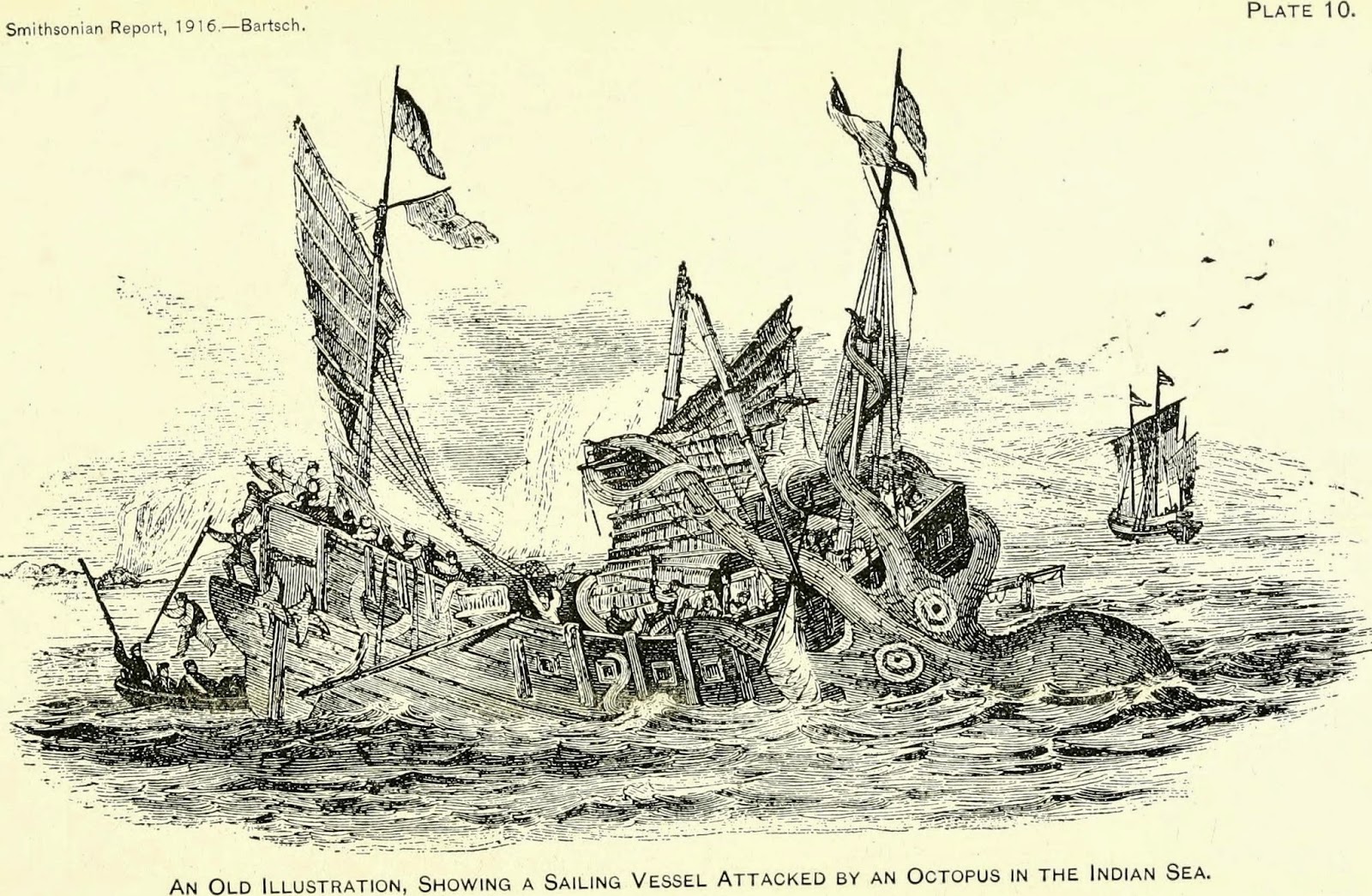
Whether or not Montfort truly believed this tale, he apparently had no qualms about publishing fiction as fact. Henry Lee, author of The Octopus in 1875, quoted Montfort as stating, “If my entangled ship is accepted, I will make my ‘colossal poulpe’ otherthrow a whole fleet.” True to his word, soon after his Histoire Naturelle publication, Montfort claimed that this same giant beast attacked and sunk a fleet of six French man-of-wars and four British ships. His reports, apparently, were influenced by Magnus and Pontoppidan’s description of the kraken’s capabilities.

View Full Size Image
“Kraken” attacking a fleet after a fashion described by Montfort. Annual Report of the Board of Regents of the Smithsonian Institution. 1916. http://biodiversitylibrary.org/page/14187069.

In the mid-1800s, the kraken took an authentic biological form as Architeuthis, passing from myth to science. Prof. Japetus Steenstrup, lecturer at Copenhagen University, introduced the giant squid in a paper that related the original description of the earliest record of a giant squid carcass washing ashore: Thingore Sand, Iceland, in 1639. The paper was read in 1849, and the official scientific name was later published in 1857.

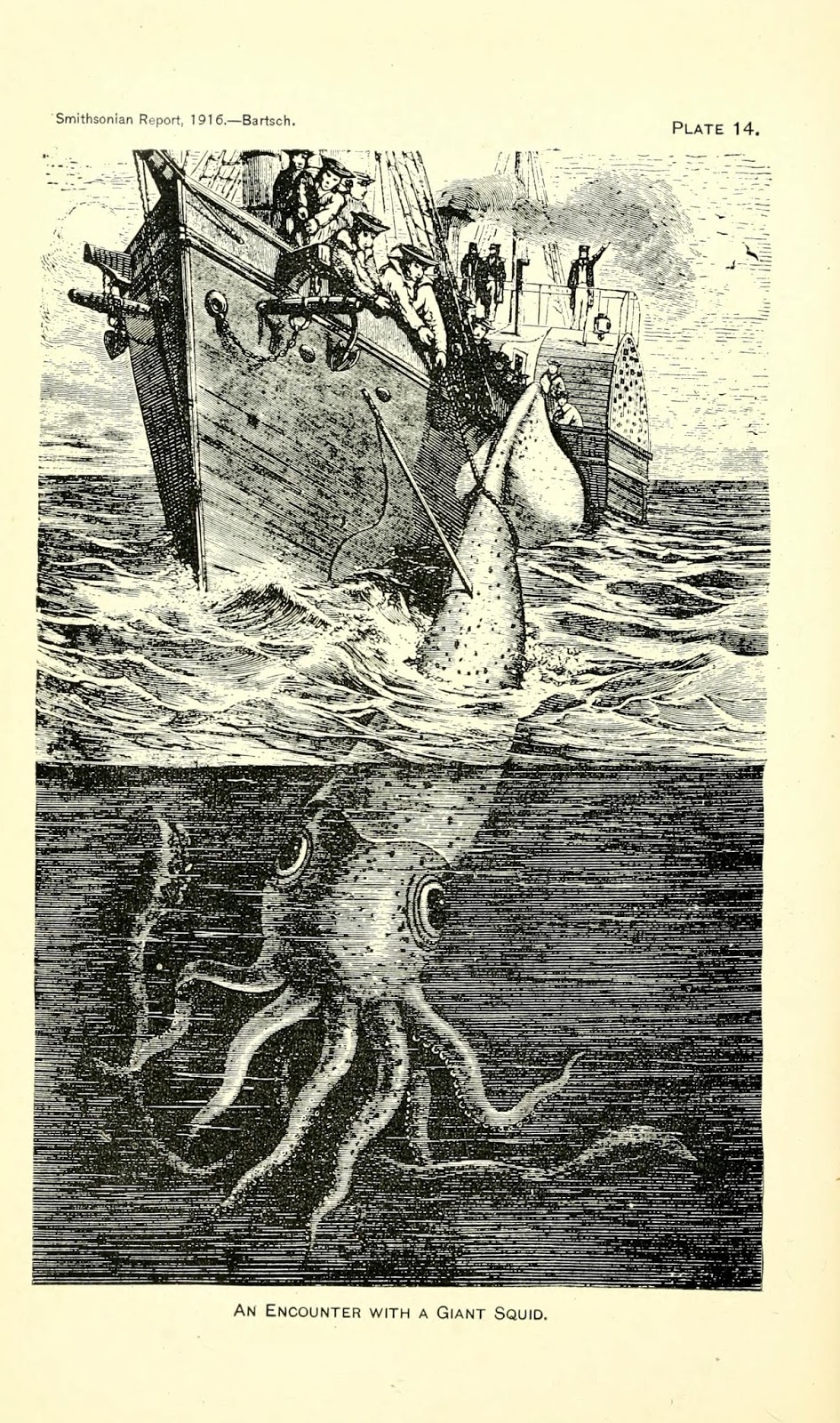
Although the giant squid was finally taxonomically official, physical evidence of the creature remained scarce. A near-catch of a specimen in November, 1861, by the Alecton off Tenerife in the Canary Islands ended with only a detached piece of the squid’s tail as any evidence of the encounter. In 1871 and 1872, two giant squid carcasses were collected on the Grand Banks and at Coombs’ Cove, Fortune Bay, Newfoundland, respectively, the latter of which was a reported 52 feet long.

View Full Size Image
Near-catch of Giant Squid by crew of the Alecton, 1861. Annual Report of the Board of Regents of the Smithsonian Institution. 1916. http://biodiversitylibrary.org/page/14187077.

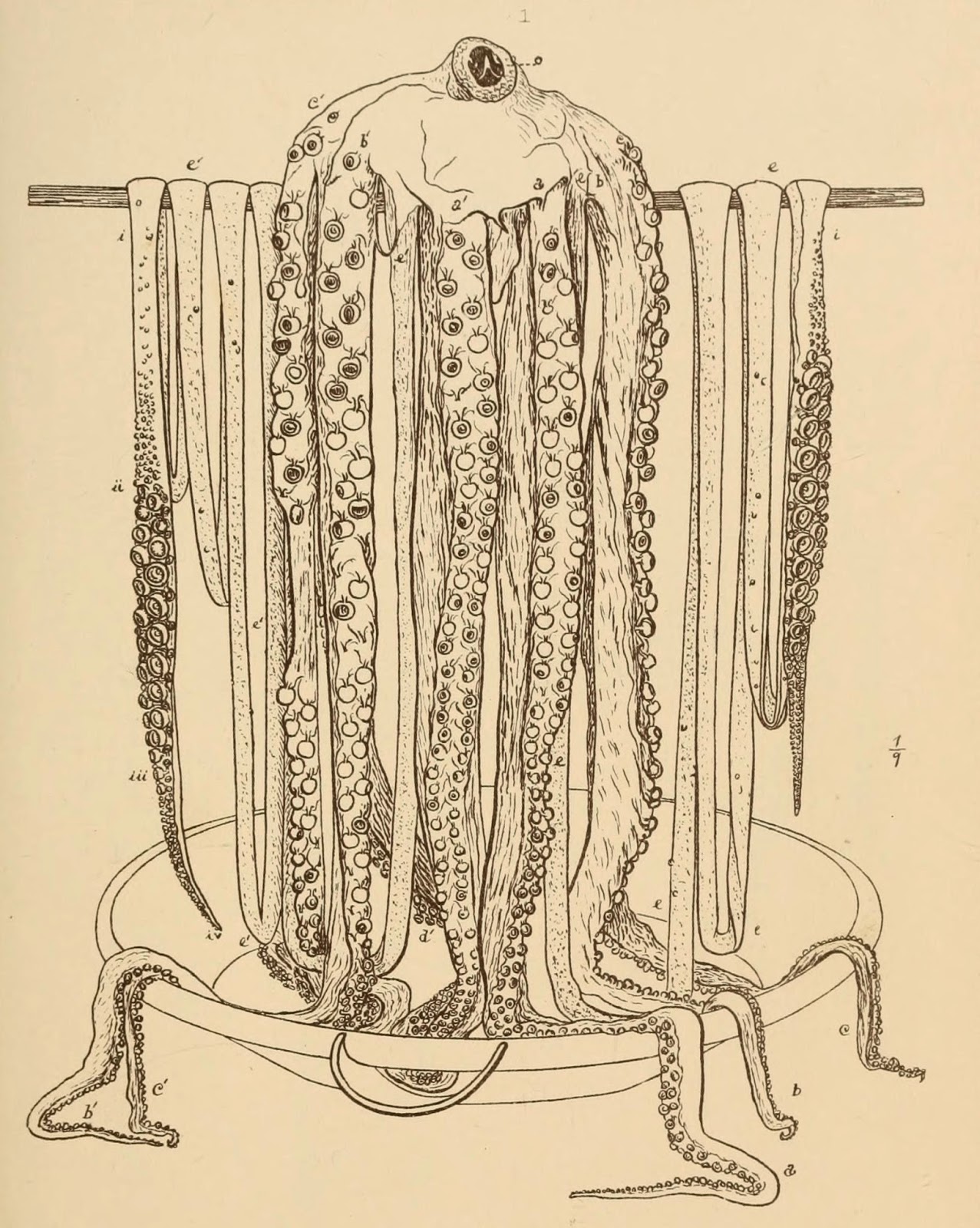
Finally, in December 1873, science caught a break. Four fishermen in Logy Bay, Newfoundland caught a giant squid in their fishing nets. The in-tact specimen was brought to Reverend Moses Harvey, an amateur naturalist, who draped it over a sponge bath for display. He then contacted Addison Emery Verrill, professor of zoology at Yale University, who conducted a full study of the specimen, which measured in at 32 feet long.

View Full Size Image
Giant Squid specimen draped over a sponge bath, 1873. Verrill, A.E. The Cephalopods of the North-eastern Coast of America. pt. 1. 1882. http://biodiversitylibrary.org/page/11826545.

Verrill collected information on every known specimen of Architeuthis and published his findings in a paper entitled The Cephalopods of the North-eastern Coast of America. Part I. The Giant Squids (Architeuthis) and their Allies; with Observations on Similar Large Species from Foreign Localities.

View Full Size Image
“In 1855, Danish zoologist Japetus Steenstrup proposed that the fabled sea bishop [another mythical monster often associated with mermaids] was actually a giant squid. He offered a picture illustrating how the misunderstanding could have occurred.” Learn more in the American Museum of Natural History’s Mythic Creatures online exhibit, from which this quote is derived. This image: Gessner, Conrad. Historia Animalium. 2nd Ed. 1604. http://biodiversitylibrary.org/page/42166070.

The Giant Squid in Science

But while the giant squid’s acceptance into the scientific canon established the cephalopod as fact, Architeuthis’ habitat, life history, breeding habits, and even definitive size remain shrouded in mystery. It currently holds the record as the second-largest mollusk and extant invertebrate (exceeded only by the colossal squid). Recent studies have revealed that it feeds on deep-sea fish and other squids, but its hunting methods and reproductive cycle are still unknown. While it was long believed that there were many species within the Architeuthis genus, recent genetic analysis suggests there is only one: Architeuthis dux. Claims of lengths reaching 150 -200 feet have been reported, even by scientists, without evidence to justify such claims. The Smithsonian’s National Museum of Natural History suggests maximum lengths of nearly 60 feet.

Until recently, no images of the giant squid in its natural habitat had ever been taken. But, on September 30, 2004, Tsunemi Kubodera (National Science Museum of Japan) and Kyoichi Mori (Ogasawara Whale Watching Association) changed this, capturing 500 photographs of a 26 foot giant squid using a camera attached to a baited line. From 2006-2012, in three separate incidents, the giant squid was reportedly filmed, though two of the specimens were less than twelve feet long.

View Full Size Image
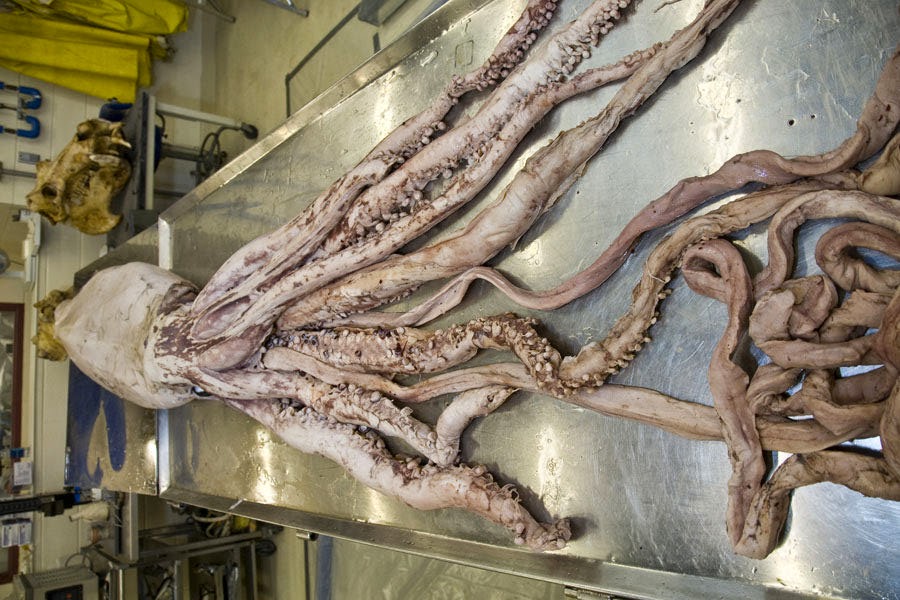
This female giant squid, caught in a net by a Spanish fisherman in 2005, is on display in the Smithsonian’s Sant Ocean Hall. Image Credit: Don Hurlbert/Smithsonian Institution, CC:BY-NC-SA. http://eol.org/data_objects/27480683. Learn more about the Giant Squid from the Smithsonian’s National Museum of Natural History.

While our knowledge about this species is increasing, we still have much to learn. Considering its size, the Giant Squid remains a surprisingly elusive creature. It demonstrates just how much we still have to learn about the ocean.

A World with a Kraken

So, does the kraken really exist? Most definitely. It is the species Architeuthis dux, the giant squid (possibly with some giant cuttlefish, colossal squid, and octopus sightings thrown into the mix).

Is it a warship-sized beast, capable of pulling entire ships to the ocean floor and indiscriminately devouring helpless sailors? No.

Yet again, inexperience and sensationalism turned reality into fiction. And to some degree, this continues to this day. Our research about this animal is still in its infancy, and much misinformation abounds. There is still much we have to learn about the “Kraken.”

  • Follow our blog and #bhlMonstersRreal on Twitter and Facebook all week to learn more about monsters and the animals that inspired them.
  • Browse historic illustrations of octopi and squid-inspired monsters and the animals that they’re based on in Flickr.
  • Browse the books that portray these historic monsters in BHL.
  • Carve a monster in your Halloween Pumpkin this year! Share your carvings with us on Facebook and Twitter!
  • See some of our favorite monsters come to life on the Smithsonian Libraries’ Tumblr!
View Full Size Image
“Release the Kraken!” In H. P. Lovecraft’s short story “The Call of Cthulhu,” Cthulhu (a part man, part dragon, and part octopus monster) attacks a ship. The sailors try to kill the beast by ramming it repeatedly, but Cthulhu simply turns into green mist and reassembles. See more fantastic historic monsters come to life on the Smithsonian Libraries’ Tumblr. GIF created by Richard Naples (Smithsonian Libraries), based on Montfort, Denys. Histoire naturelle, générale et particulière des mollusques : animaux sans vertèbres et a sang blanc. v. 2. 1801. http://biodiversitylibrary.org/page/35755564.


Reference:

  • Ellis, Richard. Monsters of the Sea. New York: Alfred A. Knopp, Inc., 1994. Print.
October 30, 2014by michelle.underhill

Help Support BHL

BHL's existence depends on the financial support of its patrons. Help us keep this free resource alive!

search

About BHL

The Biodiversity Heritage Library (BHL) is the world’s largest open access digital library for biodiversity literature and archives. BHL operates as a worldwide consortium of natural history, botanical, research, and national libraries working together to digitize the natural history literature held in their collections and make it freely available for open access as part of a global “biodiversity community.”

Join Our Mailing List

Sign up to receive the latest news, content highlights, and promotions.

Subscribe Now

Subscribe to Blog via Email

Enter your email address to subscribe to this blog and receive notifications of new posts by email.

Join 319 other subscribers

Subscribe to Blog Via RSS

Subscribe to the blog RSS feed to stay up-to-date on all the latest BHL posts.

Access RSS Feed

Inspiring Discovery through Free Access to Biodiversity Knowledge.

The Biodiversity Heritage Library makes it easier than ever for you to access the information you need to study and explore life on Earth…for free, anytime, anywhere.


64+ Million Pages of
Biodiversity Literature Online.

EXPLORE

Tools and Services
to Transform Research.

EXPLORE

300,000+
Illustrations on Flickr.

EXPLORE

ABOUT | HARMFUL CONTENT | PRIVACY | SITE MAP | TERMS OF USE