
Biodiversity Heritage Library - Program news and collection highlights from BHL
  • Home
  • News
  • Featured Books
    • All Featured Books
    • Book of the Month Series
    • BHL at 20
  • User Stories
  • Campaigns
    • Fossil Stories
    • Garden Stories
    • Monsters Are Real
    • Page Frights
    • Her Natural History
    • Earth Optimism 2020
  • Tech Blog
  • Visit BHL
Home
News
Featured Books
    All Featured Books
    Book of the Month Series
    BHL at 20
User Stories
Campaigns
    Fossil Stories
    Garden Stories
    Monsters Are Real
    Page Frights
    Her Natural History
    Earth Optimism 2020
Tech Blog
Visit BHL
  • Home
  • News
  • Featured Books
    • All Featured Books
    • Book of the Month Series
    • BHL at 20
  • User Stories
  • Campaigns
    • Fossil Stories
    • Garden Stories
    • Monsters Are Real
    • Page Frights
    • Her Natural History
    • Earth Optimism 2020
  • Tech Blog
  • Visit BHL
Biodiversity Heritage Library - Program news and collection highlights from BHL
BHL News, Blog Reel

Biodiversity Heritage Library Announces Partnership with Digital Public Library of America

View Full Size Image

The Biodiversity Heritage Library is pleased to announce that it will serve as a digital content hub within the Digital Public Library of America. The DPLA pilot project, which combines and centralizes links to the collections of participating cultural institutions, launches April 18 in Boston.

As a result of BHL’s participation as a digital content hub, links to over 111,000 BHL volumes will be available within the DPLA portal. Through the DPLA, the Biodiversity Heritage Library will collaborate with renowned libraries, universities, archives and museums to reach a wide national audience.

“The Biodiversity Heritage Library is excited to be part of the Digital Public Library of America and to provide an important body of literature that will support the important mission of providing openly available scientific publications,” said Martin Kalfatovic, BHL Program Director.

Kalfatovic served, along with founding BHL Technical Director Chris Freeland, as first co-chairs of the DPLA’s Technical Aspects Workstream.

“We are thrilled to have the Biodiversity Heritage Library as a Content Hub,” said Emily Gore, DPLA Director for Content. “The BHL shares the DPLA’s commitment to open access and global data sharing, and brings rich biodiversity collections from a number of natural history and botanical libraries to the DPLA.”

About the Digital Public Library of America

The Digital Public Library of America brings together the riches of America’s libraries, archives, and museums, and makes them freely available to the world. It strives to contain the full breadth of human expression, from the written word, to works of art and culture, to records of America’s heritage, to the efforts and data of science. The DPLA aims to expand this crucial realm of openly available materials, and make those riches more easily discovered and more widely usable and used. More information is online at http://dp.la. To find out more about the DPLA launch, April 18-19 in Boston, visit http://dp.la/get-involved/events/launch/.

April 9, 2013by ulib-libraryjobs
Blog Reel, Featured Books

The Expedition Documentation Trifecta: Biological Survey of Panama

This is the second in a 4 part joint blog series by the Field Book Project (FBP) and the Biodiversity Heritage Library (BHL), showcasing examples of digital connections between museum specimens, field book catalog records, and the resulting publications.

Documentation and specimens from expeditions often end up separated when participants return to their home institutions. The materials’ connections are sometimes inconsistently recorded. Resulting publications can suffer the same fate. These blog posts are snapshots of how these materials are being reunited virtually, through the ongoing work of BHL, FBP, and National Museum of Natural History (NMNH).

The first example of this online reunion is the Biological Survey of Panama, 1910- 1912. This was an amazing survey, conducted before the completion of the Panama Canal. Panama had not yet been fully surveyed; scientists recognized the potential lost opportunity, if the country was not studied before the Canal irrevocably altered the landscape. Smithsonian and affiliated staff who worked on the survey also developed an ongoing interest in the area as a site for long term collecting and research. This eventually resulted in a relationship with the research station on Barro Colorado Island, now known as Smithsonian Tropical Research Institute. Yet, if one looks for publications from this important survey, frequently one must read a portion of text to find the relationship.

Field books from the Survey
  • Catalog records from Field Book Project Field notes of Charles Dwight Marsh in collection RU007260
  • Catalogs and journals of Edward A. Goldman (USBS): January-July 1912; December 1910-June 1911
  • Catalogs of S. F. Hildebrand (US Bureau of Fisheries) in NMNH, Division of Fishes.
  • Correspondence and catalogs of Henri Pittier (USDA) at Smithsonian Institution Archives: Collection 1 and Collection 2
  • Catalog of Albert S. Hitchcock (USDA) at NMNH Main Library from Department of Botany.
  • Catalog of William R. Maxon (USNM) at NMNH Main Library from Department of Botany.

When cataloging field books that result from an expedition, the Field Book Project creates an Enhanced Encoded Archival Context catalog record to describe the expedition. The records are designed to provide official and variant names for a survey, major dates, participants, locations, and overall description of work completed. Details vary depending on available information. These specifics enable researchers to locate publications, field notes, and images of specimens collected during an expedition, even though the connection is not always explicitly stated in records.

By knowing who collected, where, and when, we were able to find records for field notes, publications, and specimens for the Survey of the Panama Canal. The Field Book Project’s item level cataloging facilitated the location of field notes from 5 of the 8 leading participants–several of whom were not employees of the US National Museum. We found several examples of digitized publications from original collectors in BHL, in spite of the fact they sometimes appeared a decade after the fieldwork occurred. These details also enabled the locating specimen images, like the one pictured above.

This is by no means an exhaustive search, but the ease with which these were found is heartening. Resources from expeditions like this are frequently documented only in paper or institutional memory. Publications out of copyright have the chance of being digitized by one of several institutions, but the online presence and availability of specimens and field notes (by nature of their uniqueness) requires additional care, time, and expense that many institutions may not have available. We at the Field Book Project are proud to demonstrate how these pieces can be reconnected online. Stay tuned for more expedition highlights.

Published works in BHL
  • Mammals of Panama (with thirty-nine plates)
  • The marine fishes of Panama
  • Annual report of the Board of Regents of the Smithsonian Institution for 1910 – 1912
  • Report on the Lepidoptera of the Smithsonian Biological Survey of the Panama Canal Zone
  • A century of trees of Panama
  • The Fishes of the Fresh Waters of Panama
  • Amphibians and Reptiles collected by the Smithsonian Biological Survey of the Panama Canal Zone
  • New species of fishes from Panama
  • Descriptions of New Genera and Species of Microlepidoptera from Panama
  • New Genus and Species of Hymenoptera of the Family Braconidae from Panama
  • From Expeditions organized or Participated in by the Smithsonian Institution in 1910 and 1911 pg. 15-26
  • A new catalogue of the fresh-water fishes of Panama
April 5, 2013by [email protected]
BHL News, Blog Reel

Decoding the Ocean’s Treasures One Tag at a Time

Tagging BHL Marine Images at the Smithsonian


View Full Size Image

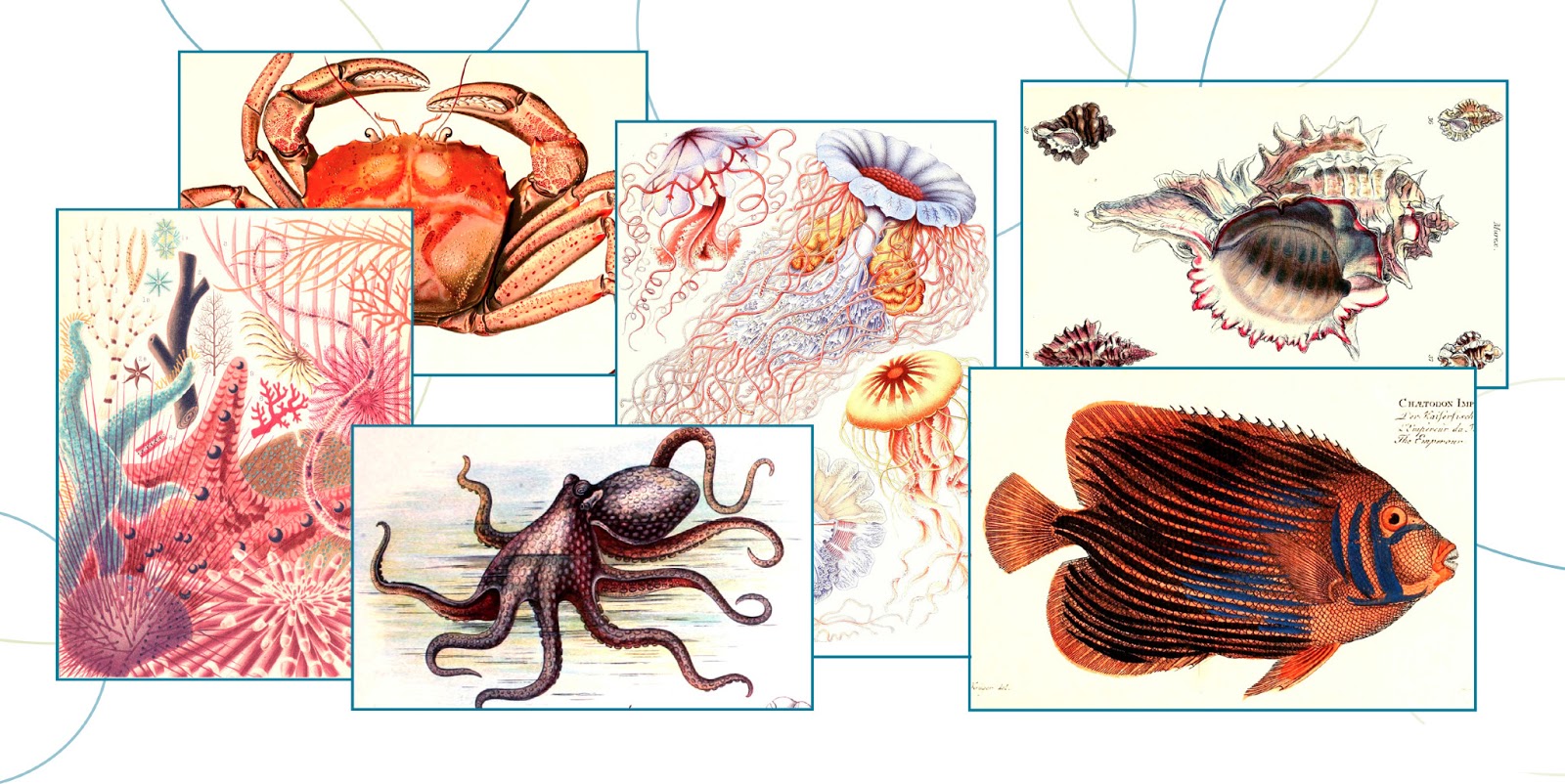
There are approximately 32,000 species of fish, representing the greatest species diversity of any vertebrate group. Mollusks, with around 85,000 extant species, constitute the largest marine phylum and about 23% of all named marine organisms. Crustaceans, with about 67,000 described species, are arthropods that range in size from .004 inches (Stygotantulus stocki) to over 12.5 feet (Japanese Spider Crab). The diverse algae group includes unicellular and multicellular organisms, such as seaweeds, dinoflagellates, red, green, brown, yellow and golden algae, and diatoms, to name a few.

Looking at the big picture, we know of over 210,000 marine species, though it is estimated that there are more than one million in total. It should come as no surprise to you that BHL has millions of pages of literature related to the topic of marine biodiversity. What you may not know is that we also have thousands of images of marine species in our Flickr.

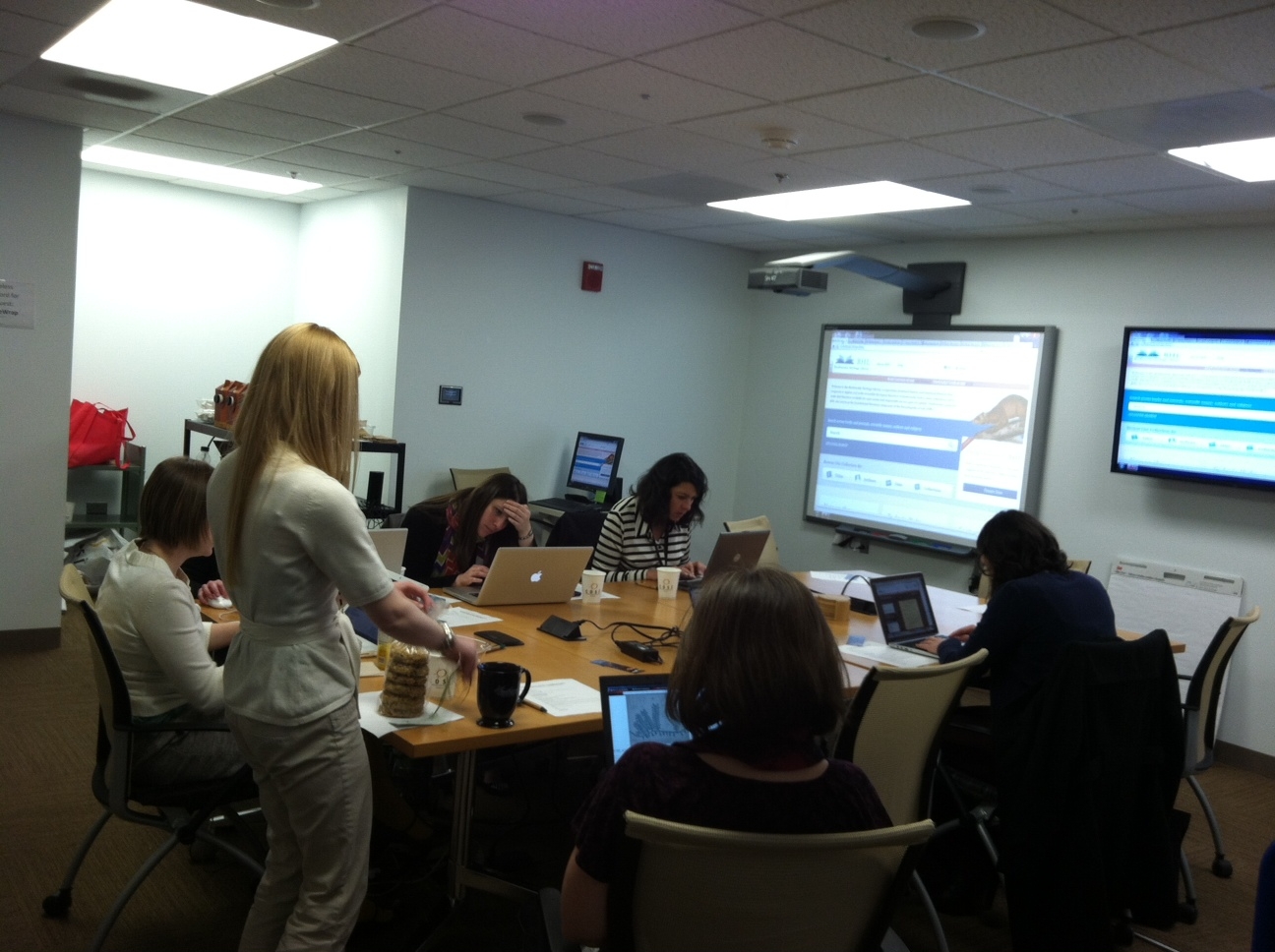
We’ve written before about our mission to add species name tags to the images in our Flickr account so that users can not only search for and find illustrations of specific organisms, but also so that we can easily share these images with external projects like the Encyclopedia of Life. To accomplish this goal, we’ve not only created instructional material and encouraged our user community to take up the charge, but we’ve also hosted two tagging parties at the Smithsonian Libraries. On April 2, 2013, we hosted our third tagging party at the Smithsonian, in conjunction with both the Encyclopedia of Life and Smithsonian’s Ocean Portal. This time, we focused our event on a theme: Marine Biodiversity.

View Full Size Image
Attendees at the Tagging Party, adding tags! Photo by Gilbert Borrego.

At our tagging parties, we invite Smithsonian staff, including curators, volunteers, interns, fellows, and librarians, to gather in person for an hour and a half to help us add tags to images in a group setting. Since this was a themed event, we directed attendees to specific sets of marine images in need of tagging. We’re happy to say that the 17 people that attended the party made some good headway on the thousands of marine images that need tagging!

You can Help!

As mentioned, all of our tagging events thus far have been staff-only occasions. While we hope to hold public events in the future, hosted at various BHL member institutions, you can actually help us tag our images right now!

How?

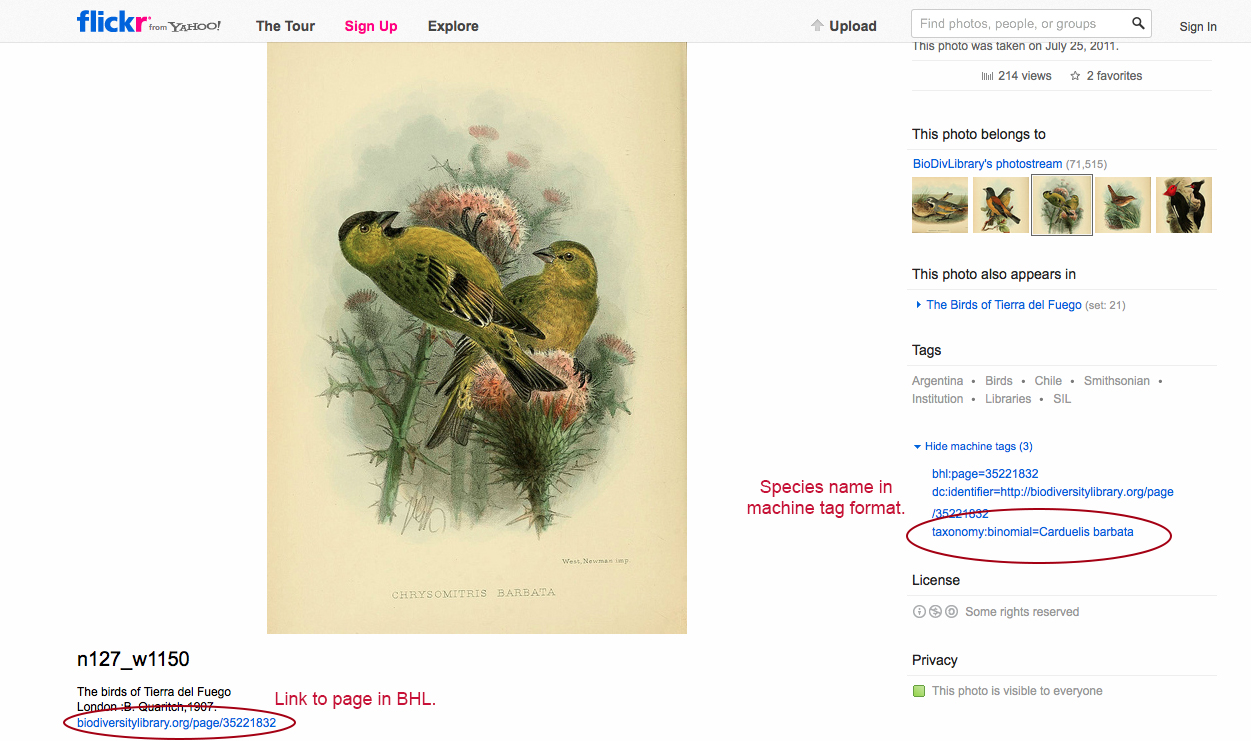
If you’re looking at an image in Flickr for which you know the species name, simply click “add a tag” and input the name in the following format:

Taxonomy:Binomial=”Genus species”

Replace the “Genus Species” text with the actual binomial for the creature you are identifying and be sure to put quotation marks around the name as shown above. So, a complete tag would look like:

Taxonomy:Binomial=”Zea mays”

How can you identify the species if you don’t recognize it on sight? Many of our illustrations actually have the species name printed on the image itself. Simply transcribe that name into the machine tag format. If the name isn’t printed on the illustration, you may be able to find an identification in BHL. Click on the link below each image to view the book in BHL, then navigate through the text pages surrounding the image to see if the species identification is given. If so, input the name into the machine tag format in Flickr.

View Full Size Image
Example of an image with a machine tag and the link to that image in BHL. Click this image to enlarge.

Every image that is tagged with a species name machine tag will automatically be added to the BHL Collection in EOL and associated with the corresponding EOL species page.

Need more help? Check out the Tagging Instructions composed by the Encyclopedia of Life, send us feedback, post a comment on this blog, or write to us at [email protected]. We’d also love to hear from you about your experience adding tags and/or suggestions for making our instructional materials or process better!

April 3, 2013by michelle.underhill
BHL News, Blog Reel

The Icing on the Cake: Signing the BHL MOU with Library of Congress

On February 22, 2013, we announced that the Library of Congress (LoC) had become the fifteenth member of BHL! As a Steering Committee member, Library of Congress will help us further build the BHL collection by digitizing books in their vast library of over 151 million items.

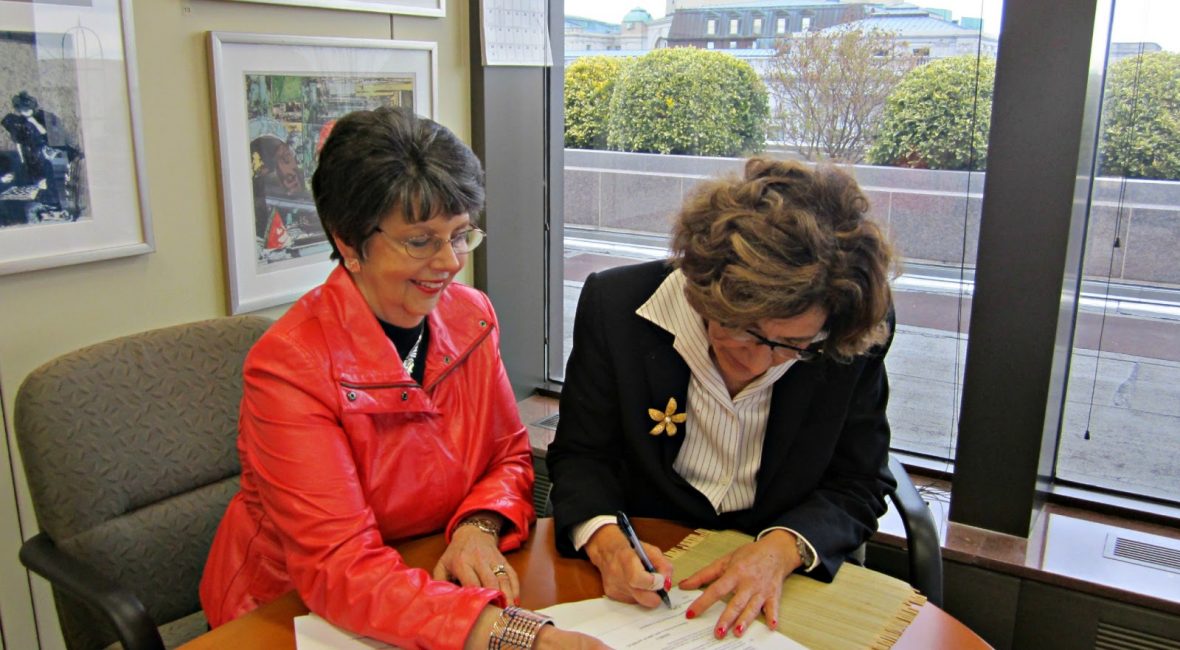
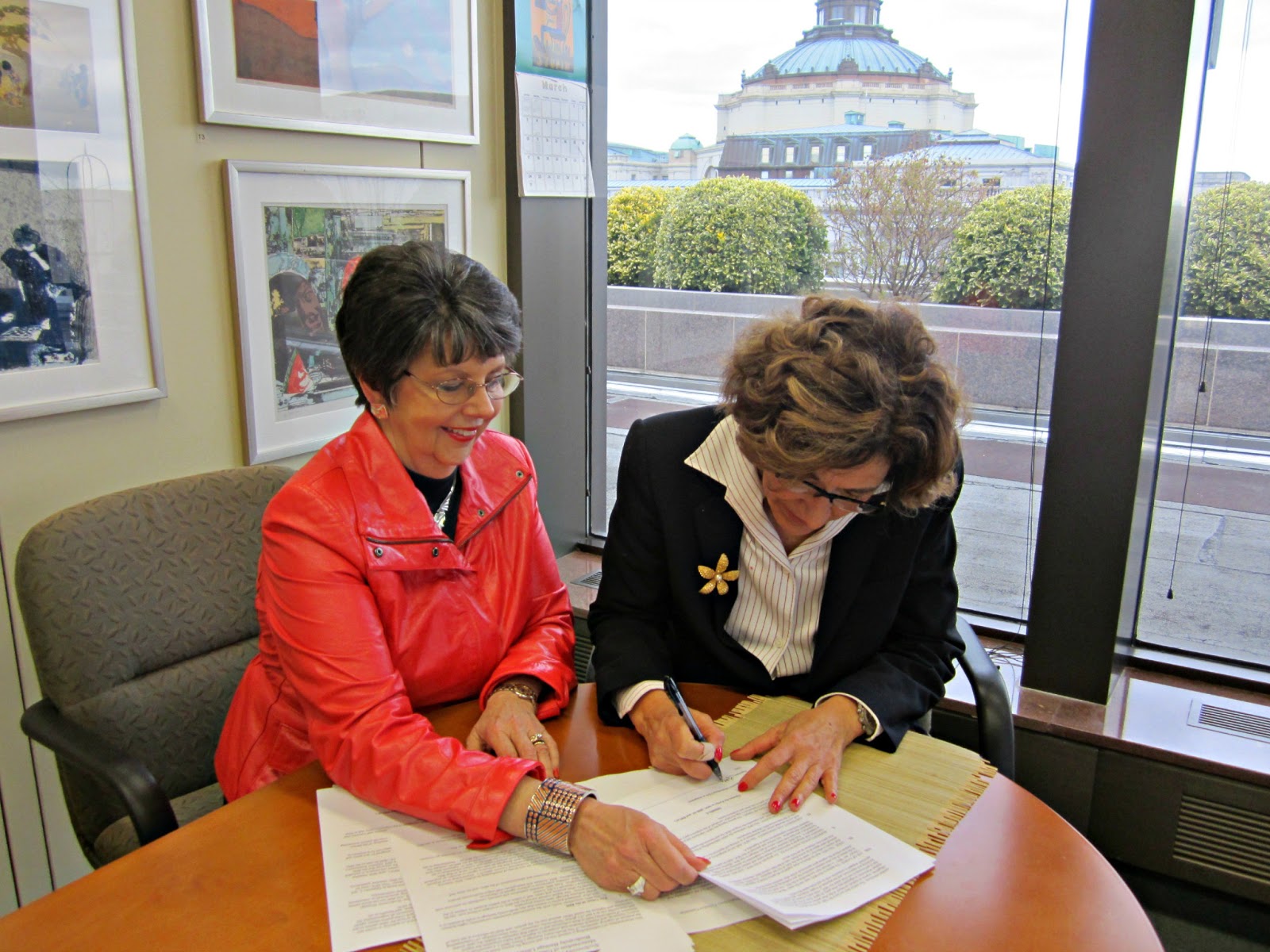
Becoming a BHL member involves not only dedicating staff and financial resources, but also the signing of an official Memorandum of Understanding. On Thursday, March 28, 2013, Nancy Gwinn (Chair of the BHL Executive Committee and Director of Smithsonian Libraries), Grace Costantino (BHL Program Manager), and Elizabeth O’Brien (Smithsonian Libraries Director of Marketing and Special Events) visited the Library of Congress for a ceremonial signing of the MOU with Roberta Shaffer (Associate Librarian for Library Services, LoC) and Leslie Girard (Confidential Assistant to the Associate Librarian for Library Services, LoC).

View Full Size Image
Roberta Shaffer (right) signing BHL MOU for LoC with Nancy Gwinn (left). Photo by Elizabeth O’Brien.

So, we’re pleased to say that everything is signed, sealed, and official! We’re so excited to call Library of Congress a partner in our great endeavor to make the world’s biodiversity literature available freely to everyone, everywhere!

And of course, it takes a village to successfully build, maintain, and manage BHL. Each new member must dedicate staff to that village. Learn more about Library of Congress’s representative to BHL, Dr. Tomoko Steen, in our previous blog post. She will coordinate workflows and identify staff to help bring LoC material into our collection of over 40 million open access pages.

Curious to know who else is a BHL member? Check out our BHL membership page.

April 1, 2013by michelle.underhill
Page 2 of 2«12

Help Support BHL

BHL's existence depends on the financial support of its patrons. Help us keep this free resource alive!

search

About BHL

The Biodiversity Heritage Library (BHL) is the world’s largest open access digital library for biodiversity literature and archives. BHL operates as a worldwide consortium of natural history, botanical, research, and national libraries working together to digitize the natural history literature held in their collections and make it freely available for open access as part of a global “biodiversity community.”

Join Our Mailing List

Sign up to receive the latest news, content highlights, and promotions.

Subscribe Now

Subscribe to Blog via Email

Enter your email address to subscribe to this blog and receive notifications of new posts by email.

Join 319 other subscribers

Subscribe to Blog Via RSS

Subscribe to the blog RSS feed to stay up-to-date on all the latest BHL posts.

Access RSS Feed

Inspiring Discovery through Free Access to Biodiversity Knowledge.

The Biodiversity Heritage Library makes it easier than ever for you to access the information you need to study and explore life on Earth…for free, anytime, anywhere.


64+ Million Pages of
Biodiversity Literature Online.

EXPLORE

Tools and Services
to Transform Research.

EXPLORE

300,000+
Illustrations on Flickr.

EXPLORE

ABOUT | HARMFUL CONTENT | PRIVACY | SITE MAP | TERMS OF USE