Biodiversity Heritage Library - Program news and collection highlights from BHL
  • Home
  • News
  • Featured Books
    • All Featured Books
    • Book of the Month Series
    • BHL at 20
  • User Stories
  • Campaigns
    • Fossil Stories
    • Garden Stories
    • Monsters Are Real
    • Page Frights
    • Her Natural History
    • Earth Optimism 2020
  • Tech Blog
  • Visit BHL
Home
News
Featured Books
    All Featured Books
    Book of the Month Series
    BHL at 20
User Stories
Campaigns
    Fossil Stories
    Garden Stories
    Monsters Are Real
    Page Frights
    Her Natural History
    Earth Optimism 2020
Tech Blog
Visit BHL
  • Home
  • News
  • Featured Books
    • All Featured Books
    • Book of the Month Series
    • BHL at 20
  • User Stories
  • Campaigns
    • Fossil Stories
    • Garden Stories
    • Monsters Are Real
    • Page Frights
    • Her Natural History
    • Earth Optimism 2020
  • Tech Blog
  • Visit BHL
Biodiversity Heritage Library - Program news and collection highlights from BHL
Blog Reel, Campaigns, Earth Optimism 2020

Alexander von Humboldt and the Interconnectedness of Nature: Exploring Humboldt’s Legacy as a Father of Modern Environmentalism

April 2020 marks the 50th anniversary of Earth Day. Organizations around the world have commemorated the occasion by participating in the global Earth Optimism movement — an initiative spearheaded by the Smithsonian to “turn the conservation conversation from doom and gloom to optimism and opportunity”.

Throughout 2020, the Biodiversity Heritage Library (BHL) and our partners are joining the movement by sharing conservation success stories from and made possible by the BHL collection. Follow our blog for conservation stories — past and present — and visit our website for more information and to explore our Earth Optimism book collection.

———————

Alexander von Humboldt (1769-1859) was a man who believed all of nature was interconnected, and that by affecting one aspect of nature, other parts of nature would be affected, too—for good or ill. Humboldt believed that one’s own emotions and subjective views were necessary in order to completely experience nature. Simply taking measurements or classifying animals, plants, rocks and other forms of life would never allow one to fully experience the truth of nature.

Born to an aristocratic Prussian family in 1769, Humboldt grew up during the Age of Enlightenment, which emphasized intense observation paired with scientific information as the primary sources of knowledge. However, Immanuel Kant’s Critique of Pure Reason (1781), which outlined the interplay of inner subjectivity and knowledge of external things, greatly influenced Humboldt’s view of nature as he grew older. According to Kant, when you look at a rock, for example, you are influenced by your own subjective beliefs. Thus, you cannot truly see the rock as a rock-in-itself, as you will always see the external world through a filter of internal senses and emotions. Humboldt likewise claimed that the external world only existed as we perceived it “within ourselves” (Humboldt in Wulf, p. 40).
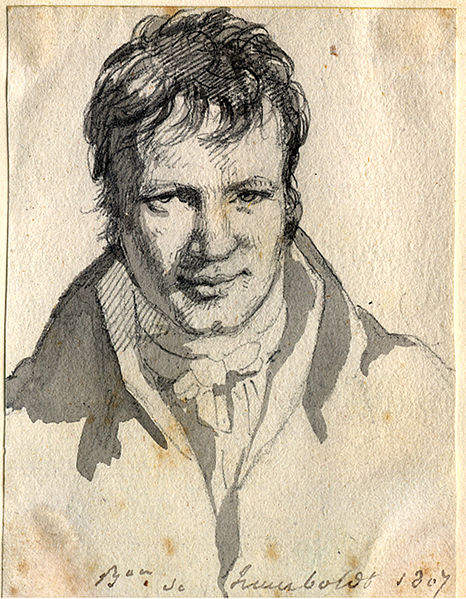
Pencil and ink sketch of a young man with short hair. Head and top of shoulders are articulated.

Houdetot, Frédéric Christophe de. Alexander von Humboldt, in Berlin 1807, Bleistift und Tusche [Pencil and Ink]. 1807. Public domain.
Humboldt became the scientist of the Romantics, who believed man was unified with nature and that nature could only be comprehended by inward feelings. Poetry, art, and emotions were viewed as the perfect vehicles through which to share one’s experience of nature. Humboldt’s infusion of emotion and prose into his observations of the natural world can be seen in one of his earlier works, Views of Nature. With this book, Humboldt created a new genre of nature writing, which was both pleasurable to read and filled with facts. He made sure that this work was poetic enough to inspire emotional fulfillment and a love of nature in the layperson while also appealing to scientists through the inclusion of annotations with scientific facts and measurements at the end of every chapter.

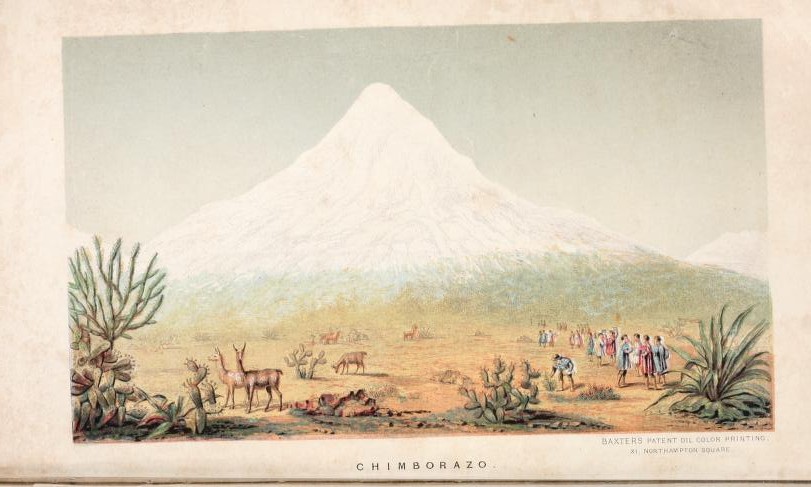
A snow-covered mountain in the distance, with a desert type scene with deer and people in the foreground.

Chimborazo mountain. Humboldt, Alexander von. Views of nature, or, Contemplations on the sublime phenomena of creation: With scientific illustrations. 1850. Contributed in BHL from MBLWHOI Library.

After receiving a rather large inheritance following his mother’s death in 1796, Humboldt’s scientific pursuits became more determined and ambitious. He decided to attempt a research expedition, and in 1799, asked permission of King Carlos IV of Spain to explore the Spanish colonies in South America and the Philippines. While he was granted a Spanish passport by the king, Humboldt had to fund the trip himself and send the king plants and animals for the royal cabinet and garden.

It was very rare for a foreigner to be allowed into the Spanish territories, and Humboldt made the most of his travels, bringing many scientific instruments with which to make observations and take measurements. He spent five years exploring different areas in South America. He compared the environments to those in different parts of Europe, noting that similar plants existed in similar climates.
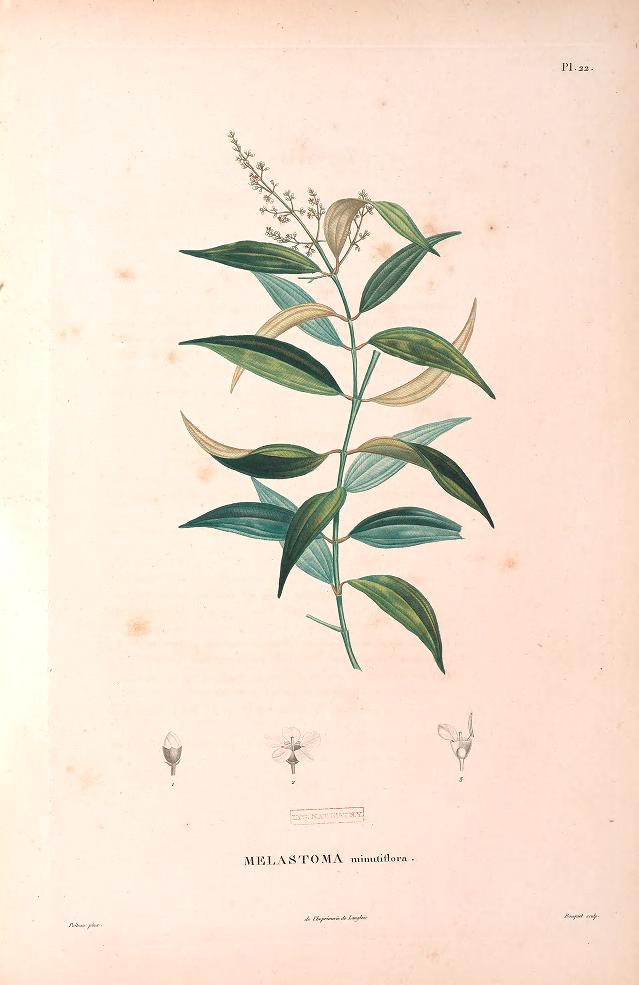
Plant with medium sized, flat green leaves and tiny white flowers.

Illustration of the “Melastoma minutiflora” which Humboldt observed in Cumana. Humboldt, Alexander von. Monographie des melastomacées, comprenant toutes les plantes de cet ordre récueillies jusqu’à ce jour. 1833. Contributed in BHL from New York Botanical Garden, LuEsther T. Mertz Library.

Humboldt’s time in Cumana, the capital of New Andalusia (an area now part of Venezuela), had a particularly profound impact on his personal and scientific views. His observations of the treatment of enslaved people in the slave market near his lodgings impelled Humboldt to become an avid abolitionist for the rest of his life. It was also in Cumana that Humboldt saw how colonialism destroyed native ecosystems, as colonists had felled so many trees that the land became dry and farming yielded less crops.

While visiting Lake Valencia, Humboldt first recorded his observation that humans could induce climate change and destroy ecosystems. He noted that when forests are destroyed, springs and riverbeds dry up, the forest floor—no longer protected by tree foliage—becomes oversaturated with rain and soil is loosened, and different types of plants and animal life die. Humboldt observed that all aspects of nature are interconnected— when one part of a natural environment is drastically altered, such as with deforestation, the rest of that environment will be impacted in various drastic ways as a result. Humboldt gave many written warnings about the importance of understanding the many reciprocal interactions in nature in order to prevent the devastation of ecosystems and biodiversity caused by humans’ interference with nature.
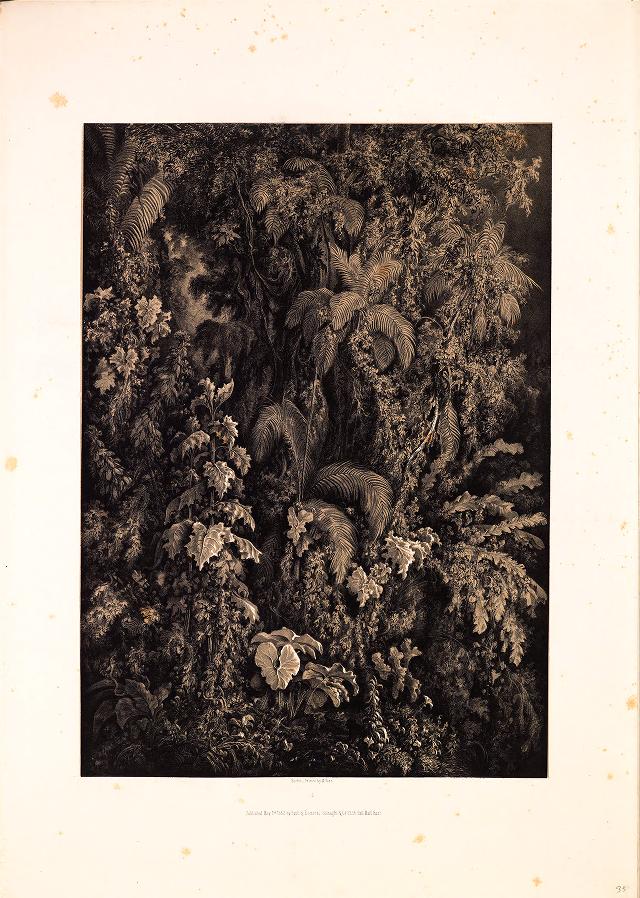
Black and white illustration of dense vegetation in a forest.

South American forest illustration. Berg, Albert. Physiognomy of tropical vegetation in South America […]. Book includes part of a letter by Humboldt to Berg. 1854. Contributed in BHL from New York Botanical Garden, LuEsther T. Mertz Library.

Climbing the Chimborazo volcano in what is now Ecuador was one of the most exciting events for Humboldt in South America. By pushing through altitude sickness, desertion by his porters at 15,600 feet, narrow and dangerous pathways that required crawling, and increasingly falling temperatures, Humboldt eventually made it to 19,413 feet—marking the first documented time that anyone had ever reached that height.

It was here that Humboldt came up with a name and a visual for his theory that all of nature was connected—not just as a living entity, but as a composite of ecosystems all over the world at different locations containing similar flora and fauna at similar geological heights and climates. The different vegetation zones of the volcano reminded Humboldt of the different vegetation zones in the wider world, going from hotter equatorial zones to colder polar zones, just as one went from the warmer base of the mountain toward its freezing summit.

Humboldt depicted his “Naturgemälde”, which in German means “painting of nature” but also “unification”, through a visualization published within Essai sur la géographie des plantes (1805). This illustration, with the unique name he gave it, showed Chimborazo as a cross-section in which different plants grew at different altitudes and temperatures. Next to the illustration was information about other mountains around the world and a description of how their plant and climate zones could be compared to those on Chimborazo at similar heights. The idea that one could visually illustrate and describe plant life based on climate and location was a completely unprecedented idea at the time, and one which still influences our scientific views today.
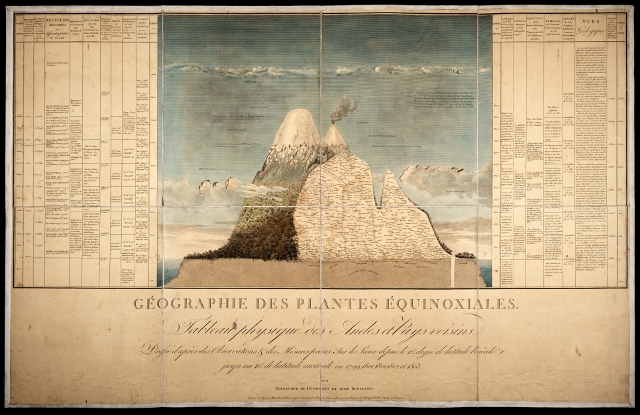
Map with cross sections of a volcano. Text surrounds the illustration.

“Naturgemälde” illustration. Bonpland, Aimé and Alexander von Humboldt. Essai sur la geographie des plantes [Essay on the geography of plants]. 1805. Contributed in BHL from Missouri Botanical Garden, Peter H. Raven Library.

In 1827 in Berlin, Humboldt gave many lectures on his observations of the natural world during his travels. Humboldt’s ability to find an interconnection between the smallest bit of moss to the tallest mountain and beyond to the heavens captivated people, as did his observations on connections between similar climates, plants and animals in different geographic locations. Listeners were dazzled by this new way of thinking and lecturing in which Humboldt connected, and made meaning out of, so many seemingly disparate ideas.

Humboldt had only one other trip to a distant land in his life. Invited by Tsar Nicholas I to gather research on platinum, which had been found in the Ural Mountains, he traveled to Russia in 1829, hoping to gather more information on different climates and plant life. While disappointed by the trip and its focus on finding platinum as a source of possible Russian currency, Humboldt nevertheless returned to Berlin filled with ideas for his next, and most popular, work—a multi-volume opus called Cosmos (Kosmos in German).

Cosmos was an embodiment of Humboldt’s ideas on the interconnectedness of nature and being. It discussed celestial matters, earthly matters, and the inner, organic life of plants, animals and humans. Humboldt enlisted the help of experts in varying fields, including classicists and historians, once again unifying seemingly separate fields by creating a work connecting ideas from these fields to one another and to science.

In 1845, the first volume of Cosmos was published in Germany. It was an instant success and was translated into various other languages. The introduction explained Humboldt’s view that all of nature was connected and formed a living whole. Humboldt was the first to describe the climate as an interaction between landmasses, the oceans and the atmosphere. He described a breath of life that came from the earth—not from divinity—and was intrinsic in all living things. Humboldt became one of the most celebrated scientists in the world after the distribution of this work not only throughout Europe, but in America as well.
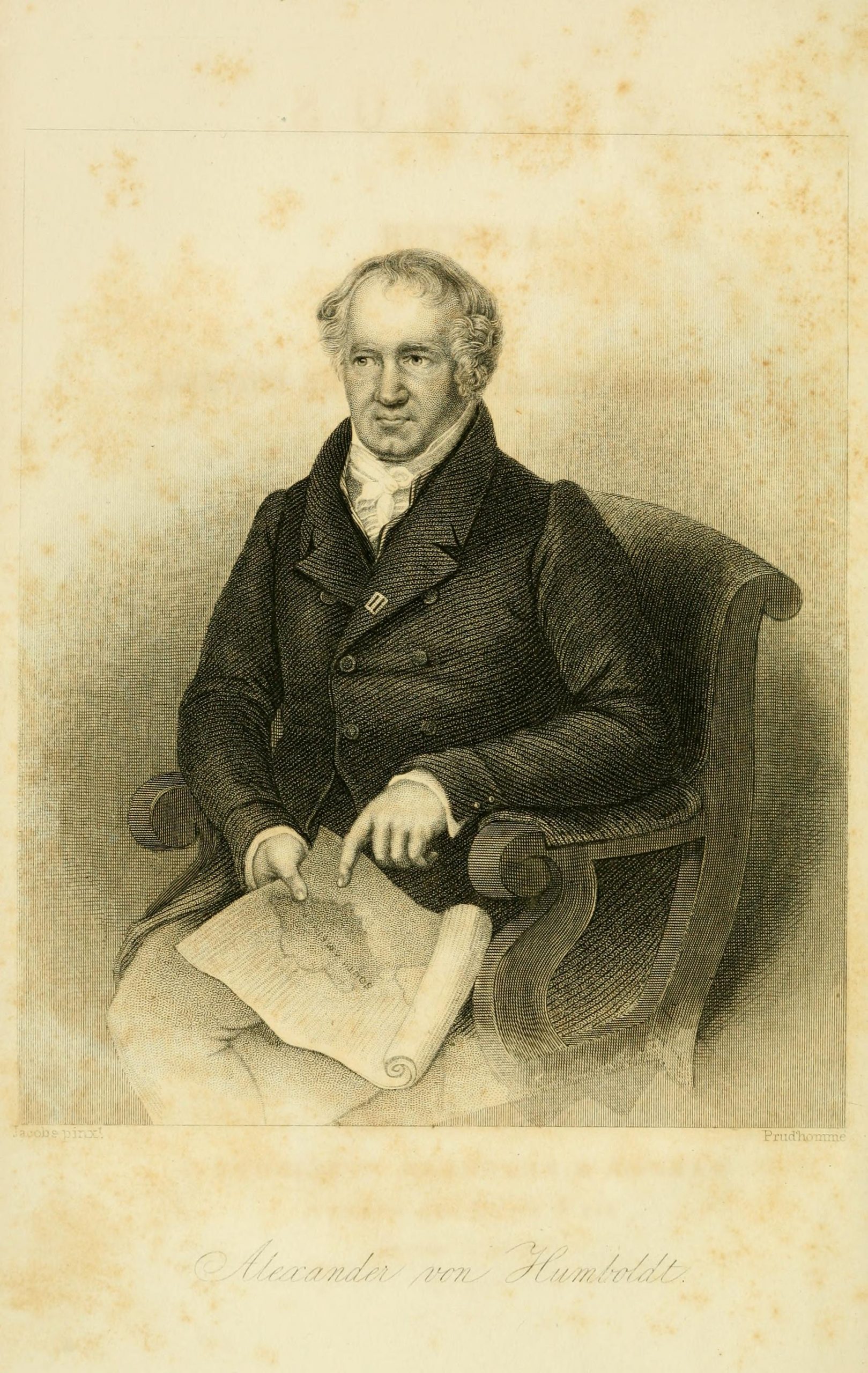
Black and white illustration of a man with receding hair dressed in 19th century clothing sitting in a chair, pointing to a map in his lap.

Portrait of Humboldt. Humboldt, Alexander von. Cosmos : a sketch of a physical description of the universe. v. 1 (1877). English translation by E.C. Otté. Contributed in BHL from the MBLWHOI Library.

Even though Humboldt expressed many dire warnings about human-induced climate change, his belief that nature was a unified whole meant that if destroying one part of an ecosystem destroyed the rest of it, then rebuilding different parts of an ecosystem could aid in its complete restoration. He encouraged everyone to experience nature by immersing themselves within it, by taking walks and going outdoors. Humboldt also believed in sharing scientific information, both within scientific circles and across other disciplines. By using this method of information sharing, we have a chance, as a world community—as a part of that living organism called “nature”—to combat climate change, to counter humans’ negative impact on nature, and to rebuild and restore different habitats and the biodiversity contained within them.

Humboldt at the Smithsonian American Art Museum

You can learn more about Humboldt’s legacy and his impact on American perceptions of nature and the environment through the exhibit Alexander von Humboldt and the United States: Art, Nature, and Culture at the Smithsonian American Art Museum (SAAM).

As the SAAM website articulates, “This exhibition will be the first to examine Humboldt’s impact on five spheres of American cultural development: the visual arts, sciences, literature, politics, and exploration, between 1804 and 1903. It centers on the fine arts as a lens through which to understand how deeply intertwined Humboldt’s ideas were with America’s emerging identity. The exhibition includes more than 100 paintings, sculptures, maps, and artifacts as well as a video introduction to Humboldt and his connections to the Smithsonian through an array of current projects and initiatives.”

The exhibit is on display from 18 September 2020 – 3 January 2021. Learn more.

Interesting Facts

Humboldt had an intense fear of ghosts, and especially feared the ghost of his mother after she died. It was rumored that he participated in several seances after her death in hopes of contacting her.

In 1804, Thomas Jefferson, then-President of the United States, invited Humboldt to the capital to discuss Humboldt’s scientific findings in the Spanish colonies. Humboldt even let Jefferson have a sizable number of pages of his research to translate, not knowing that Jefferson considered all of this information to be valuable intelligence about the Spanish territories that bordered Jefferson’s recently acquired Louisiana Purchase.

Charles Darwin, who determined that all animals evolve through natural selection, was a huge admirer of Humboldt and kept a copy of Humboldt’s Views of Nature onboard the Beagle as he sailed around the world observing animal and plant life. Humboldt did not get involved in the debate over how certain plants and animals seemed to be present only in some climates and geographies but not always in other similar ones, writing that his study of plants and animals was not about “the investigation of the origin of beings” (Wulf, p. 275)—a phrase which Darwin underlined. Darwin took up the challenge in his Origin of the Species (1859).

Humboldt called black coffee “concentrated sunshine” (Wulf, p. 283).

References

Berg, A., & Humboldt, A. (1854). Physiognomy of tropical vegetation in South America; a series of views illustrating the primeval forests on the river Magdalena, and in the Andes of New Grenada. London: Paul and Dominic Colnaghi and Co., Publishers to Her Majesty. https://doi.org/10.5962/bhl.title.119819

Bonpland, A., & Humboldt, A. (1805). Essai sur la géographie des plantes: Accompagné d’un tableau physique des régions équinoxiales, fondé sur des mesures exécutées, depuis le dixième degré de latitude boréale jusqu’au dixième degré de latitude australe, pendant les années 1799, 1800, 1801, 1802 et 1803. Paris: Levrault, Schoell et Compagnie, Libraires. https://doi.org/10.5962/bhl.title.9309

Bonpland, A., & Humboldt, A. (1833). Monographie des melastomacées, comprenant toutes les plantes de cet ordre récueillies jusqu’à ce jour, et notamment au Mèxique, dans l’Ile de Cuba, dans les provinces de Caracas, de Cumana, et de Barcèlone, aux Andes de la Nouvelle-Grenade, de Quito et du Pérou, et sur les bords du Rio-Negro, de l’Orénoque et de la rivière des Amazones. London: Gide. https://doi.org/10.5962/bhl.title.162868

Bonpland, A. & Humboldt, A. (1826). Personal narrative of travels to the equinoctial regions of the New Continent, during the years 1799-1804, by Alexander de Humboldt, and Aimé Bonpland. Vol. 6. (H.M. Williams, Trans.). London: Longman, Hurst, Rees, Orme, Brown, and Green. https://doi.org/10.5962/bhl.title.87622

Darwin, C. (1859). On the origin of species by means of natural selection, or, The preservation of favoured races in the struggle for life. London: John Murray. https://doi.org/10.5962/bhl.title.68064

Humboldt, A. (1849). Aspects of nature, in different lands and climates; with scientific elucidations. Vol. 1. (E.J. Sabine, Trans). London: Longman, Brown, Green, and Longmans. https://doi.org/10.5962/bhl.title.151955

Humboldt, A. (1871). Cosmos: A sketch of a physical description of the universe. Vol. 3. (E.C. Otté, Trans.). London: Bell & Daldy. https://doi.org/10.5962/bhl.title.27525

Humboldt, A. (1893). Cosmos: A sketch of a physical description of the universe. Vol. 1. (E.C. Otté, Trans.). London: George Bell & Sons. https://doi.org/10.5962/bhl.title.29831

Humboldt, A. (1849). Cosmos: Sketch of a physical description of the universe. Vol. 2. (E. Sabine & E. Sabine, Trans.). London: Longman, Brown, Green, and Longmans. https://doi.org/10.5962/bhl.title.29892

Humboldt, A. (1850). Views of nature, or, Contemplations on the sublime phenomena of creation: With scientific illustrations. (E.C. Otté, & H.G. Bohn, Trans.). London: Henry G. Bohn. https://doi.org/10.5962/bhl.title.4802

Magee, J. (2019). Alexander von Humboldt: A vision of the unity of Nature. In R. Huxley (Ed.), The Great Naturalists, (n.p., Kindle edition). London: Thames & Hudson.

Meinhardt, M. (2019). Alexander von Humboldt: How the most famous scientist of the Romantic Age found the soul of nature. Katonah, N.Y.: BlueBridge.

Wulf, A. (2015). The invention of Nature: Alexander von Humboldt’s new world. New York: Vintage Books.
October 1, 2020by jjones
Blog Reel, Featured Books

Athanasius Kircher’s Cabinet of Wonder: The Man Who Believed in Everything and His Museum of the Miraculous, Universal, and Absurd

Kircher-Museum_im_Collegium_Romanum giorgio de sepibus public domain large image.jpg

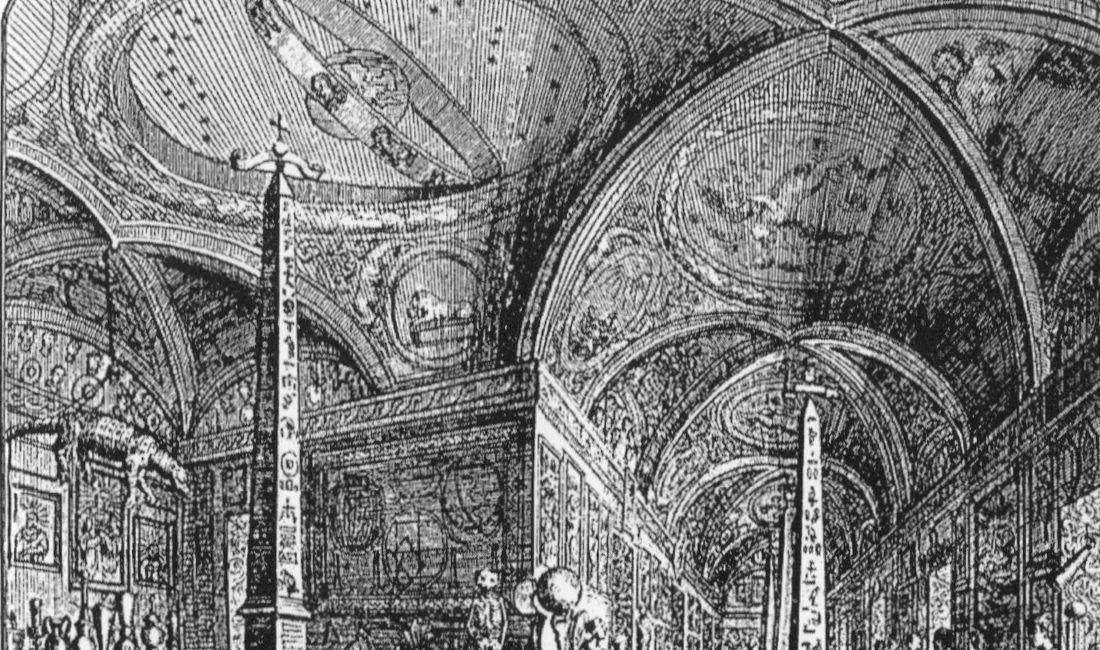
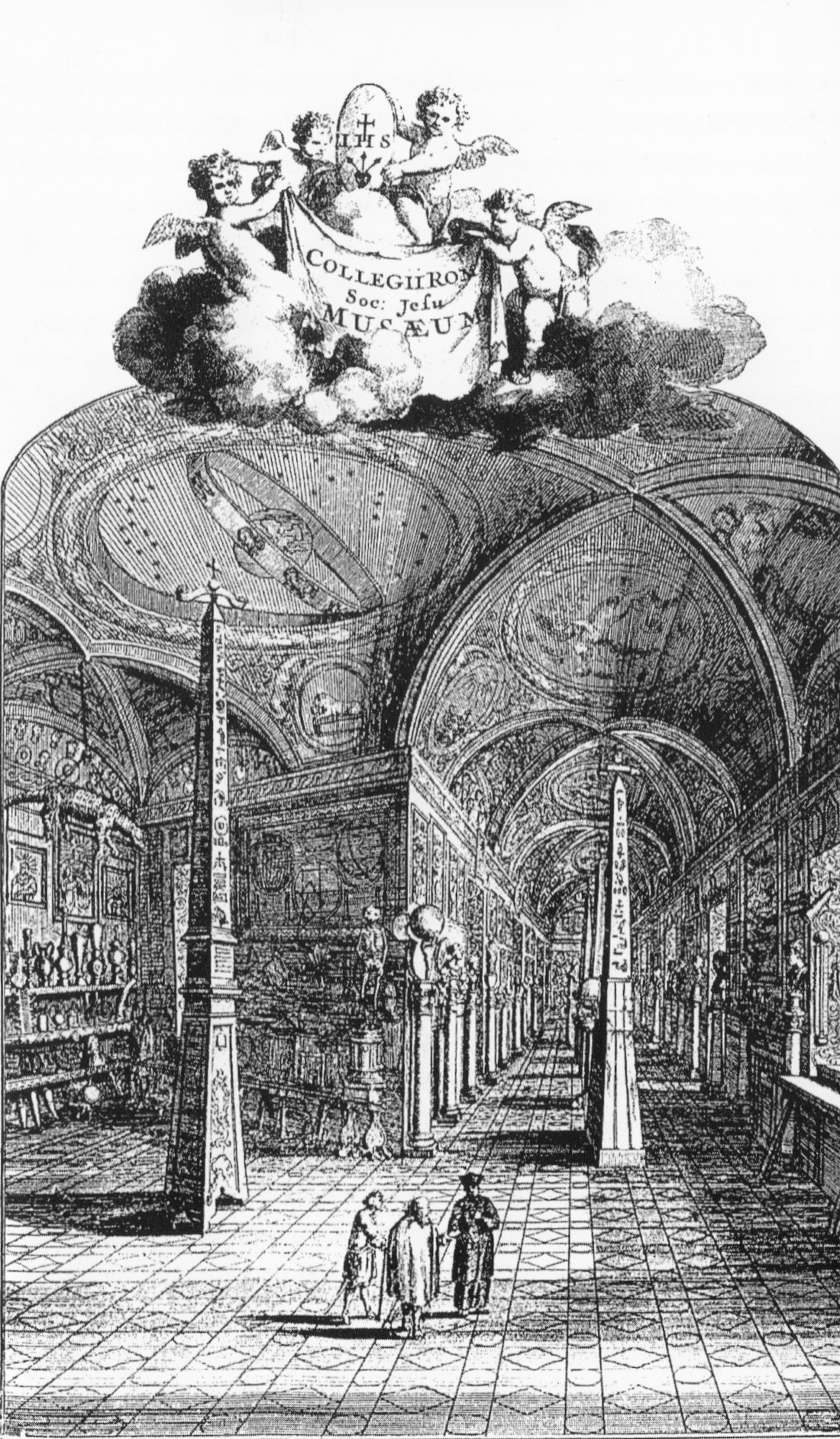
Sepibus, Giorgio de. Romani Collegii Societatus Jesu Musaeum celeberrimum […]. 1678. Image of Athanasius Kircher’s museum, or “cabinet of wonder”. Public domain.

Athanasius Kircher, a 17th century German Jesuit scholar whose name translates to “immortal” (from the Greek “Athanasius”) and “church” (from the German-derived “kircher”), was born on 2 May 1602 in Geisa, part the principality of Fulda in the Holy Roman Empire in Europe. The youngest of nine children, Kircher’s family was devoutly Catholic — a complicated religious affiliation at a time when Protestantism was more popular and war broke out between Catholics and the Protestant Lutherans and Calvinists in the form of the Thirty Years War (1618-1648). Not only did Kircher live during a period of war, but also of witch burnings and plague.

When Kircher was a young man, he was admitted to the Jesuit College at Paderborn, where he studied Greek and Hebrew and, in less than two months, mastered the natural philosophy curriculum and completed his novitiate in 1620 — an impressive achievement in such a short time. Indeed, in his autobiography, published posthumously in 1684, Kircher was hardly modest about his own life achievements…not all of which were scholarly in nature. He included stories about childhood and teenage miracles where he survived impossible situations by divine intervention, including escaping a stampede of horses and entrapment in a water wheel where he almost drowned, healing without treatment from a potentially deadly hernia, and successfully evading a mentally unstable bishop’s army.

Athanasius_Kircher.jpg

Kircher, Athanasius. Mundus subterraneus, quo universae denique naturae divitiae. 1655 printing. Portrait of Athanasius Kircher. Public domain.

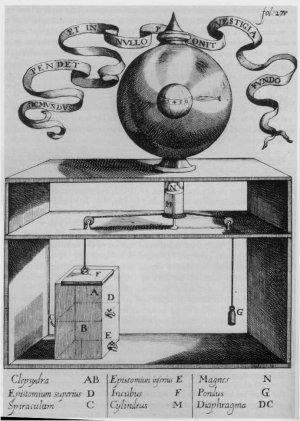
As these accounts illustrate, Kircher had a predilection for the mystical: a trait which bled into his written philosophical and scholarly works. Kircher’s works on topics such as magnetism and miraculous plants, stones, and machines captured imaginations but also infuriated scholars who found Kircher’s work to be factually flawed and too reliant on an idea that every form of knowledge could be connected by universal philosophies involving hidden, mystical elements of the natural world.

kirchers magnetic clock from magnes public domain.jpg

Kircher, Athanasius. Magnes sive de arte magnetica. 1641. Image of Kircher’s magnetic clock. Public domain.

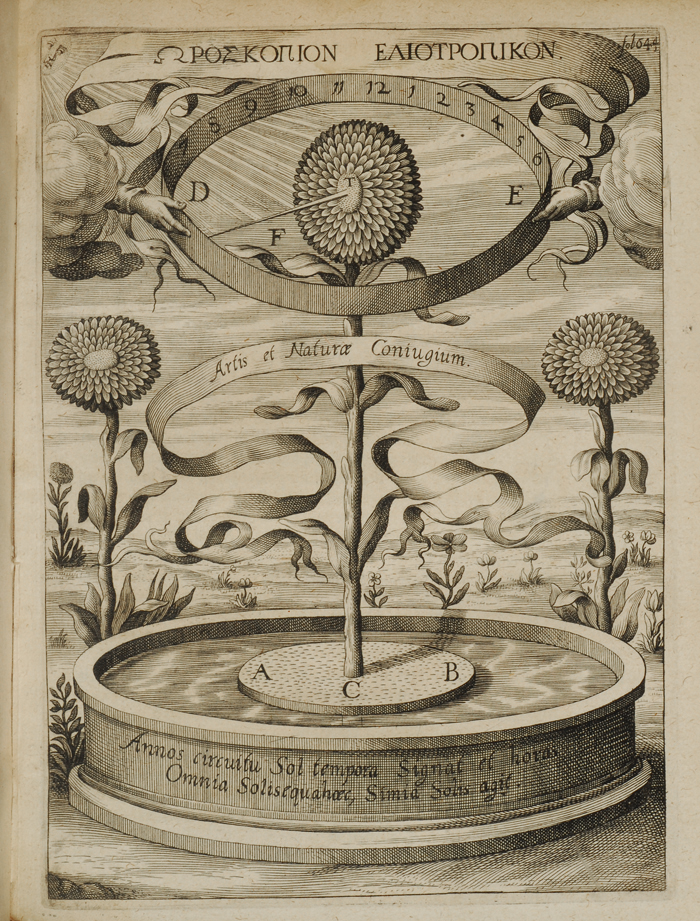
Kircher’s growing visibility in the scholarly community attracted wealthy patrons who consisted of noblemen, rulers, and other members of the academic community. He claimed to possess objects that drew on nature’s mystical properties. One of the most famous of these was his “miraculous” sunflower clock that was said to run on the mysterious power of a sunflower seed adhered to a cork floating in water that would move with the sun’s motions.

magnes sive de arte magnetica opus tripartum book sunflower clock.jpg

Kircher, Athanasius. Magnes sive de arte magnetica. 1641. Image of Kircher’s supposedly magical sunflower clock. Public domain.

Kircher also claimed to possess a manuscript that deciphered the ancient languages of the world, supposedly written by Babylonian rabbi Barachias Nephi. French lawyer, scholar and antiquarian Nicolas-Claude Fabri de Peiresc (1580-1637), who had been captivated by Kircher’s sunflower clock, hoped that the manuscript could be used to translate Egyptian hieroglyphs. Peiresc and other academics and noblemen had begun to believe Kircher capable of unlocking mysteries in nature.

This confidence was short-lived, however. By late 1633, Peiresc began to doubt the existence of the Barachias Nephi manuscript, as Kircher never produced it to Peiresc (or anyone). Peiresc also came to believe that the sunflower clock was also an illusion, guessing that the clock was really a magnet. He was correct.

Nevertheless, hoping to secure Kircher’s help with the publication of Pietro della Valle’s (1586-1652) Coptic grammar and dictionary in Rome, Peiresc used his contact with the naturalist, collector and antiquarian Cassiano dal Pozzo (1588-1657) to get Kircher transferred to Rome. In mid-November of 1633, Kircher arrived in Rome to teach mathematics at the Collegio Romano, a Jesuit scholarly institution.

It was at the Collegio Romano that Kircher finally had a place to create a museum, a veritable cabinet of wonder. The museum was created when, in 1651, Roman patrician Alfonso Donnino’s collection containing antiquities and paintings was donated to the Collegio Romano. The institution wanted to create a physical space worthy to house the items given by such a respected man. Kircher curated the museum, adding his own created machines and curious artifacts, including objects from nature, that he had received from his Jesuit contacts over the years.

With the advertisement across Europe that Kircher’s own curiosities and inventions were also contained in the museum, it became a destination for scholars, rulers, and others taking a Grand Tour of Europe. Contemporaries knew Kircher as a famous collector and author, and by surrounding himself in the museum with antiquities, natural objects, and mysterious machines which he invented, Kircher was immersed in a physical representation of his universal philosophy about the underlying, divine properties connecting all knowledge and joining together disparate items and ideas.

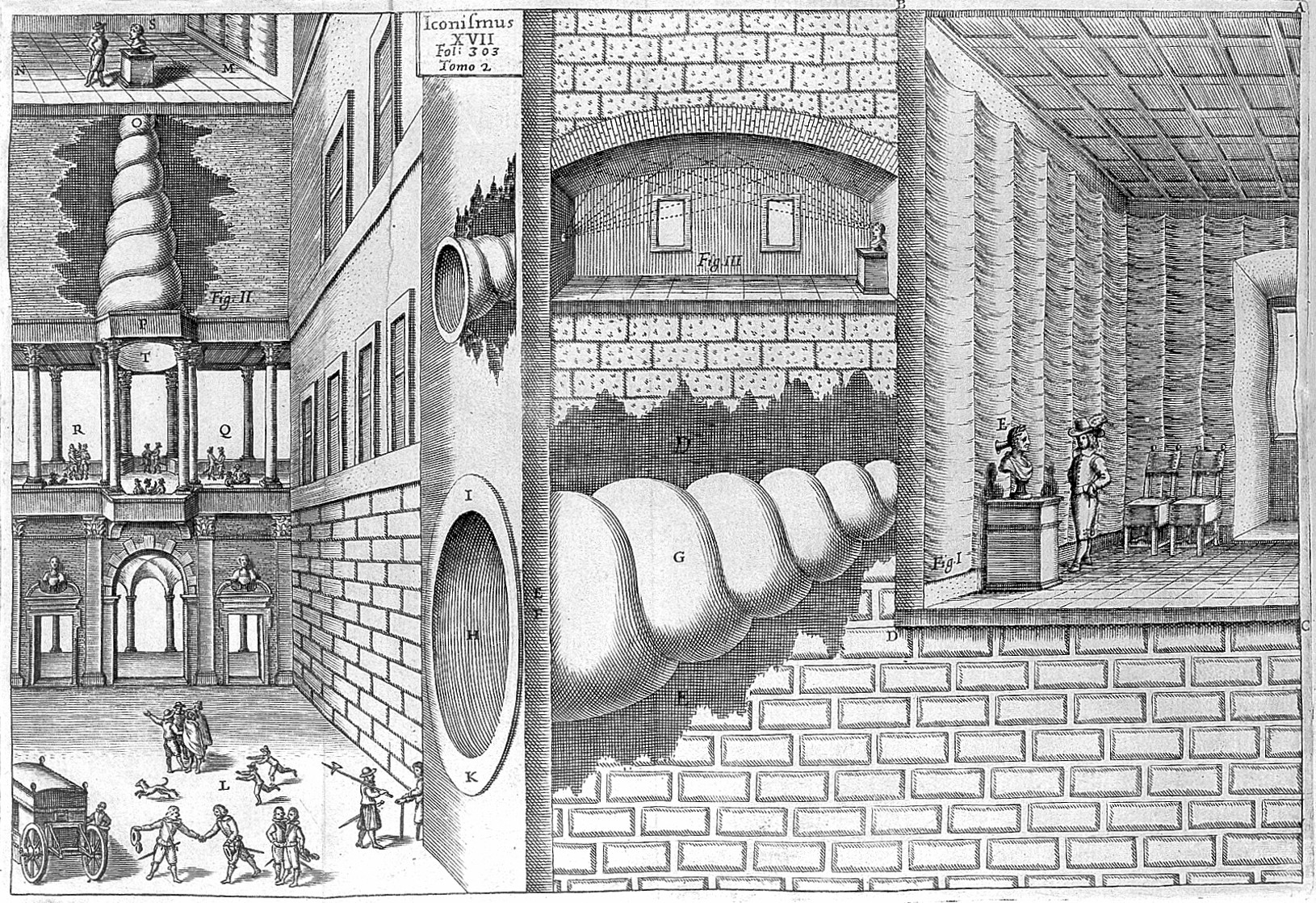
kirchers delphic oracle from his museum public domain.jpg

Kircher, Athanasius. Musurgia universalis, sive ars magna consoni et dissoni. 1650. Athanasius Kircher’s speaking trumpet. Public domain.

Kircher invited visitors to the museum to interact with the machines, read the many books, and ponder the natural items. This invitation to engage with the collections was a unique quality of Kircher’s, demonstrating a desire to connect people to both existence and the natural world through the process of creation of knowledge — yet more of his universalism in practice.

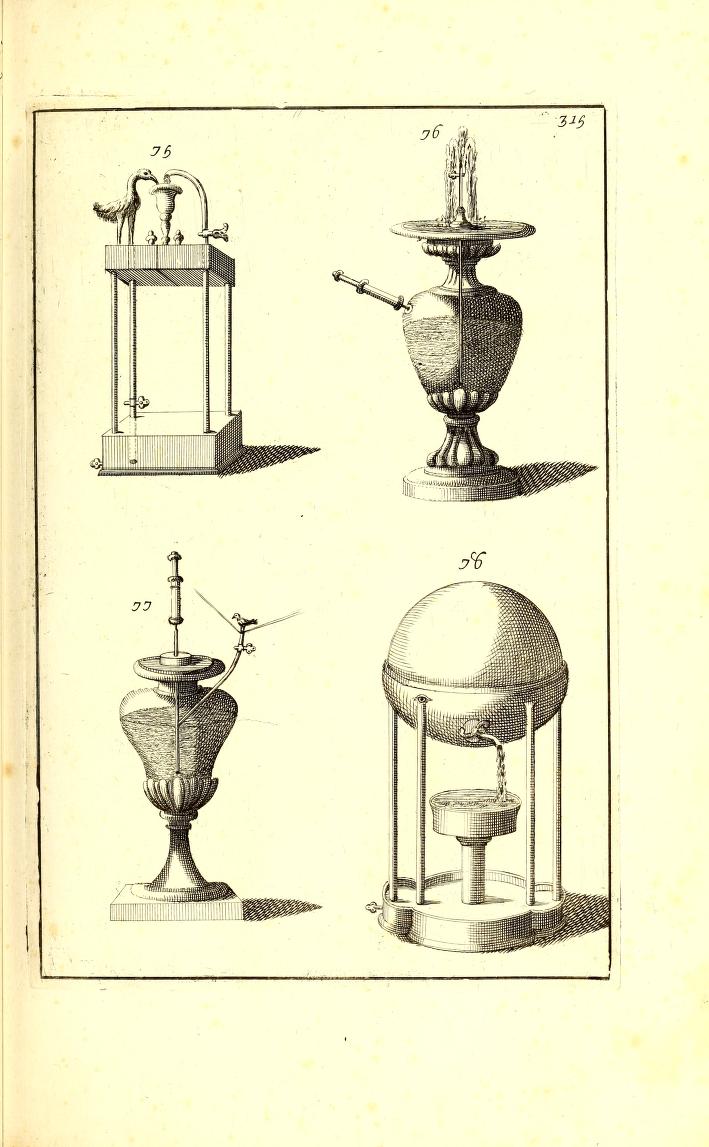
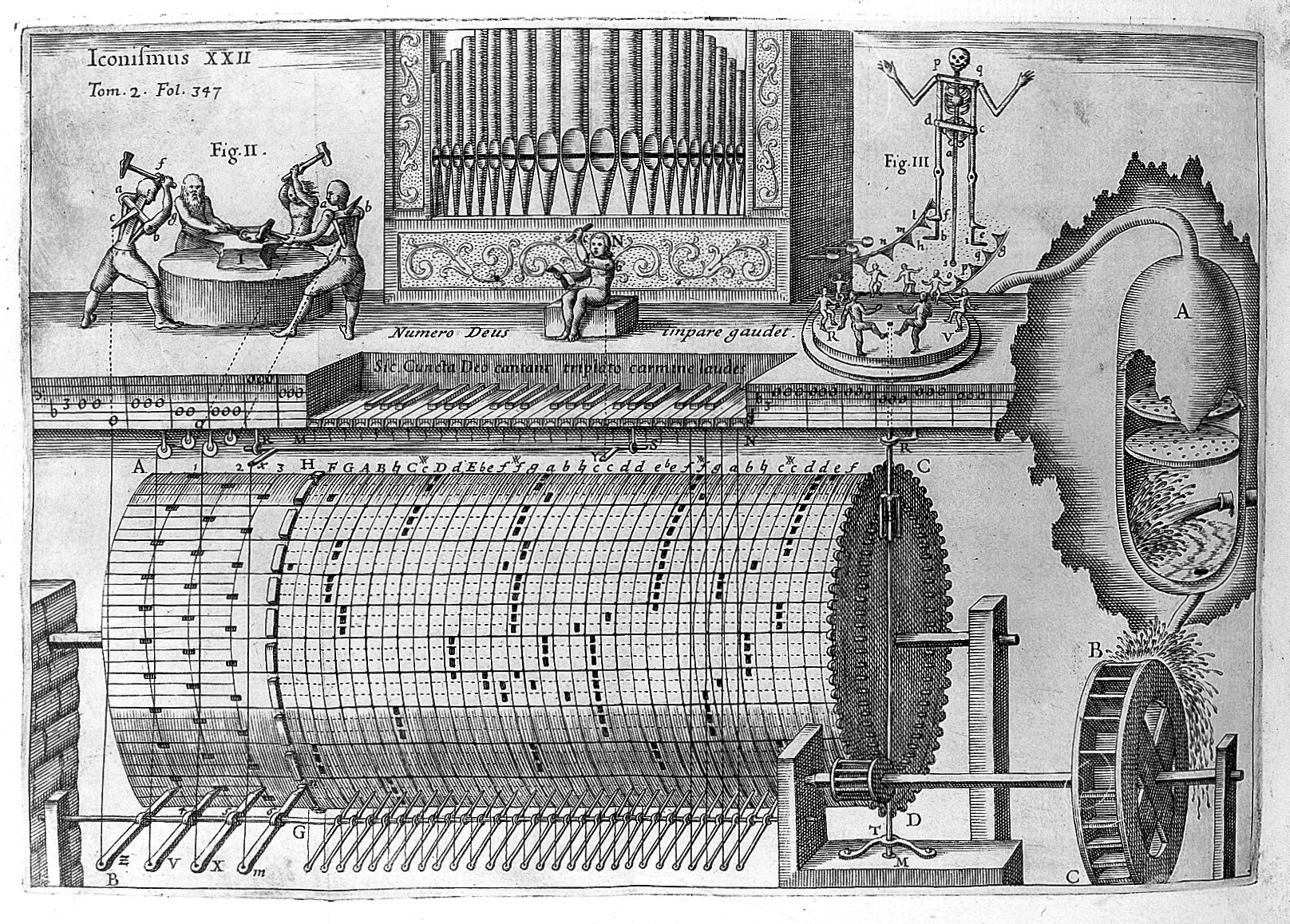
Some of the items contained in Kircher’s museum included: “vomiting statues”, one an eagle, one a lobster, each of which vomited from a cup into another vessel, and were both funny and also showed the principles of hydraulics (the movement of water); “snakestones” from India which were supposed to draw out the venom of a snake when pressed to the bite (there was no proof that these worked); bones from an ancient race of giants (which were actually mastodon bones, unknown at the time); an organ driven by a drum that played every kind of birdsong; a very large concavo-convex mirror together with a series of other mirrors which appeared to show ghosts in the air; and many more inventions, machines, statues, and other curiosities (Giorgio de Sepi created a catalog of the items in 1678).

musaeum kircherianum page 315 image.jpg

“Mathematical instruments” using water. Buonanni, Filippo. Musaeum Kircherianum sive musaeum a p. Athanasio Kirchero in Collegio Romano Societatis Jesu […]. 1709. Contributed in BHL from Smithsonian Libraries.

Kircher,_A.,__Musurgia_universalis_,_hydraulic_organ_public domain.jpg

Kircher, Athanasius. Musurgia universalis, sive ars magna consoni et dissoni. 1650. Hydraulic organ. Public domain.

After Kircher died on 27 November 1680, Filippo Buonanni (1638-1723), a Jesuit scholar who had studied under Kircher, became curator of Kircher’s museum. In 1709, Buonanni published Musaeum Kircherianum sive musaeum a p. Athanasio Kirchero in Collegio Romano Societatis Jesu […], a lavishly illustrated catalog of the museum’s collections. When there were no longer any Kircherian disciples to attend to the museum and its contents, Kircher’s inventions housed in the museum eventually stopped working. Various museums in Rome acquired pieces from Kircher’s museum after his death.

Today, the Collegio Romano has the Wunder Musaeum, dedicated to highlighting Kircher’s own collection and continuing the tradition of the wunderkammer — or “cabinet of wonders” — that Kircher had created in his museum by amassing objects of wonder from around the world (in addition to Kircher’s own fascinating machines, some of which are currently being rebuilt by those studying him).

Kircher has had a resurgence in the academic community, which now sees his universal philosophies about existence and the secrets of history and nature as an important form of thinking that differed and competed with other philosophies of his time: Aristotelian, Platonic, Galilean, Cartesian, and Newtonian, to name a few.

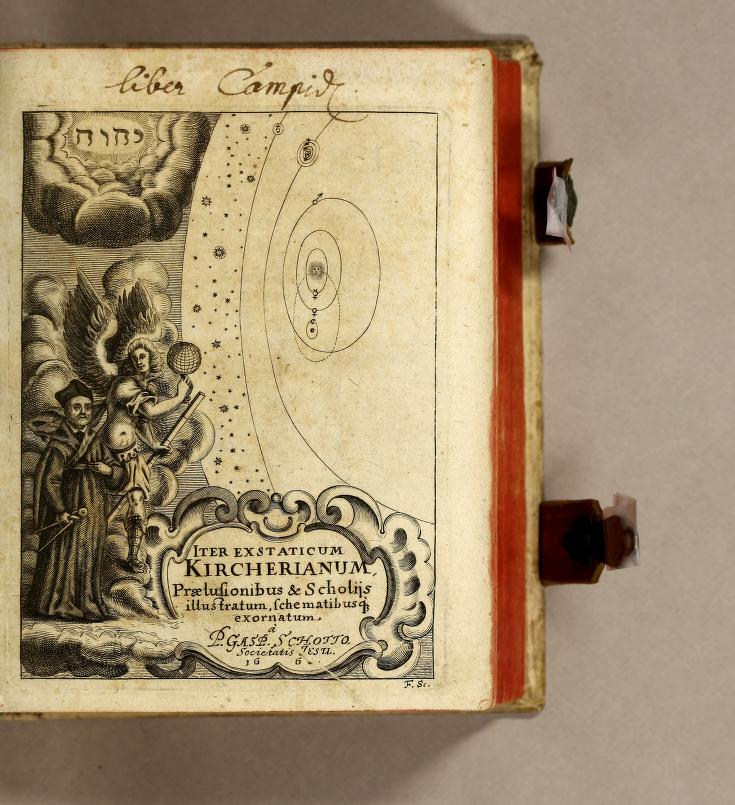
In 1660, Kircher published Itinerarium exstaticum coeleste (‘Ecstatic Celestial Journey’), which was based on a dream he had in which he traveled from the earth to outer space (space was a fluid, rather than a solid). This work dispelled almost all of the Aristotelian ideas about cosmology. In it, the angel Cosmiel reveals all the secrets of heaven and earth to Kircher, as the character “Theodidactus” (“taught by God”). To write such a book would have been against the Jesuit mandate to teach Aristotelian cosmology. Cosmiel described an immeasurable universe, in contradiction to what other philosophers such as Johannes Kepler (1571-1630) and Galileo Galilei (1564-1642) would dare to posit.

In a time when scholars sought to create hard and fast scientific rules and philosophies about how the world worked, Athanasius Kircher believed the world still contained divine mysteries and magical properties — inspiring wonder in contemporaneous and modern readers of his works.

iter exstaticum image near cover.jpg

Image of Kircher as Theodidactus with Cosmiel. Kircher, Athanisus. R.P. Athanasii Kircheri e Societate Jesu Iter extaticum coeleste […]. 1660. Contributed in BHL by John Carter Brown Library.

Works Referenced

Buonanni, R., & Kircher, A. (1709). Musaeum Kircherianum sive musaeum a p. Athanasio Kirchero in Collegio Romano Societatis Jesu jam pridem incoeptum nuper restitutum, auctum, descriptum, & iconibus illustratum [. . .]. Romae: Typis Georgii Plachi Caelaturam [. . .]. DOI: https://doi.org/10.5962/bhl.title.98588

Findlen, P. (Ed.). (2004). Athanasius Kircher: The last man who knew everything. New York: Routledge.

Glassie, J. (2012). A man of misconceptions: The life of an eccentric in an age of change. New York: Riverhead Books.

Godwin, J. (2009). Athanasius Kircher’s theatre of the world: His life, work, and the search for universal knowledge. Rochester, VT: Inner Traditions.

Kircher, A. (1678). Athanasii Kircheri e Soc. Jesu Mundus subterraneus, in XII libros digestus; quo divinum subterrestris mundi opificium, mira ergasteriorum naturae in eo distributio, verbo [Pantamorphon] protei regnum, uniuersae denique naturae majestas & divitiae summa rerum varietate exponuntur, abditorum effectuum causae acri indagine inquisitae demonstrantur, cognitae per artis & naturae conjugium ad humanae vitae necessarium usum vario experimentorum apparatu, necnon novo modo & ratione applicantur. Amstelodami: Apud Joannem Janssonium à Waesberge & filios. DOI: https://doi.org/10.5962/bhl.title.109544

Kircher, A., & Schott, G. (1660). R.P. Athanasii Kircheri e Societate Jesu Iter extaticum cœleste, quo mundi opificium, id est, cœlestis expansi, siderumq[ue] tam errantium, quàm fixorum natura, vires, proprietates, singulorumq[ue] compositio & structura, ab infimo telluris globo, usq[ue] ad ultima mundi confinia, per ficti raptus integumentum explorata, novâ hypothesi exponitur ad veritatem, interlocutoribus Cosmiele et Theodidacto. Herbipoli: sumptibus Joh. Andr. & Wolffg. Jun. Endterorum hæredibus. DOI: https://doi.org/10.5962/bhl.title.98328

Rech, C. (n.d.). Wunder Musaeum: The new construction project of the Museum of Art and Science of the Liceo EQ Visconti. Retrieved from: http://www.wundermusaeum.com/introduzione.html

Schott, G. (1662). P. Gasparis Schotti, regis curtani [. . .] Physica curiosa, sive, Mirabilia naturæ et artis libris XII. comprehensa : quibus pleraq[ue], quæ de angelis, dæmonibus, hominibus, spectris, energumenis, monstris, portentis, animalibus, meteoris, &c. rara, arcana, curiosaq[ue] circumferuntur, ad veritatis trutinam expenduntur : variis ex historia ac philosophia petitis disquisitionibus excutiuntur, & innumeris exemplis illustrantur [. . .]. Herbipoli: Sumptibus Johannis Andreæ Endteri & Wolfgangi Jun. hæredum, excudebat Jobus Hertz Typographus Herbipol. DOI: https://doi.org/10.5962/bhl.title.63881

June 6, 2019by jjones
Blog Reel, Featured Books

Horses and the History of the Circus

The history of the modern circus is deeply rooted in horsemanship.  The first modern circuses, which took place during the 18th century, were primarily demonstrations of tricks performed on a horse, first by former soldiers who learned such skills during military training, and later by talented men and women trained from a young age to accomplish acrobatics and other feats atop a horse.  In order to teach horses to perform tricks for the circus amphitheater, horsemen relied upon instruction from mentors and in books such as Dr. Sutherland’s System of Educating the Horse, with Rules for Teaching the Horse Some Forty Different Tricks or Feats. . .  This 1861 text by Dr. G. H. Sutherland claims to be the first ever published on “Educating the Horse” (view in book here).

Horse trainers in Great Britain were considered humane in their work, and as London trainer Charles Montague wrote in his 1881 book, Recollections of an Equestrian Manager (in Simon, 2014, pp. 29-10): “The horse must first be brought to feel that you are his master—his superior; not through fear of your power; but on the contrary, through his experience that though you have the power, it is always accompanied by kindness. . .never with cruelty.”  In America, Dr. Sutherland represented those using humane animal training practices, and in his text he stated that he was “convinced, by observations as well as experience, that we can successfully tame, subdue, and control the most wild and vicious horse by kindness alone. . .” (view in book here), and he proposed a training system that vehemently avoided “the use of the whip, drugs, or fetters. . .” (view in book here).

View Full Size Image
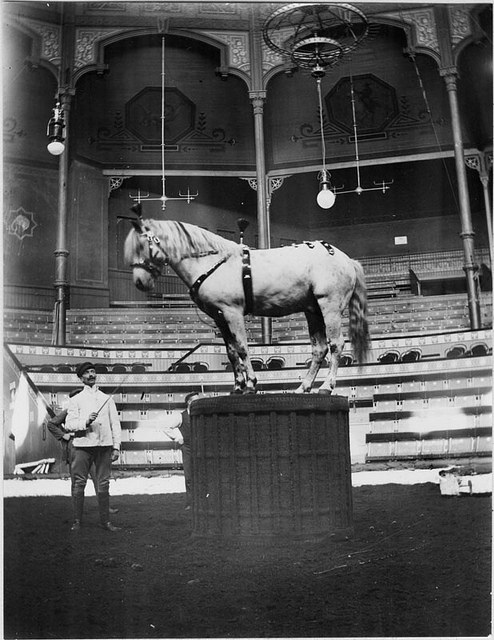
Horse at the circus in Stockholm (1905) | Unknown Attribution

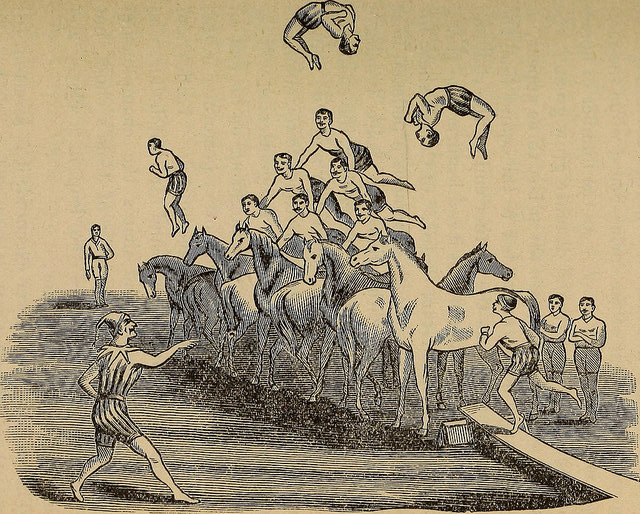
Sutherland’s horse tricks are quite delightful, and include training the horse to remove the trainer’s “cap, coat and mittens” (view in book here).  Other tricks include teaching the horse to stand up, lay down, knock on a door, say yes or no, fetch and retrieve objects, walk on hind legs, to unbuckle his own saddle and remove it, open and close doors, pump water, fire a pistol, tell his A, B, C’s, spell, read, and more amazing things!  All of these tricks begin in the book here.  When Philip Astley created the first modern circus in 1768 in London, he had his horse count, perform mind reading, and play dead.  In addition, Astley, and later more performers he hired, would end up performing acrobatics on the horse.

View Full Size Image
Equestrian Acrobatics | Theatrical and Circus Life (1893)

The history of the circus goes back thousands of years, with early depictions of acrobats from Egypt from 1300 to 1200 BCE.  The Museo Egizio in Turin has an Egyptian wall fragment from this period showing a female acrobat in a backbend, with long, wavy hair flowing to the ground, large, gold hoop earrings, and wearing only a short sarong.  Mexican ceramic statuettes from 200 BCE to 500 BCE, and prior periods, show contortionists doing splits.  The Mexican statuettes, like a Hellenic Greek statuette depicting an acrobat, have in common a sense of joy and play: the subjects are smiling and theatrical.

Of course most people might recognize the term, “circus,” or the idea of performances taking place in a circular venue when they think of ancient Rome and the gladiator contests and chariot races.  Chariot races began the trend of highlighting the horse’s—and his master’s—prowess in a circular arena during a longer period of entertainment by other performers.  These Roman gladiator and chariot contests included interludes with juggling, acrobatics, animal baiting, and sometimes people performing intricate religious rites.

Ancient China and Greece each had their own forms of traveling circuses, and medieval Europe had local fairs with performers, as well as hosting traveling performers who included fortune tellers, jesters, dancers, musicians, and tight-rope walkers.  The medieval, and Renaissance, European Church denounced performers who walked over tight-ropes and hot coals, people who could drink boiling oil or swallow fire, strongmen, and others performing seemingly miraculous stunts, thinking the performers too arrogant, or unhappy that money which should go to the Church was being spent on frivolous entertainment; sometimes tight-ropes were strung between steeples and performers were banned from entertaining at religious festivals.

View Full Size Image
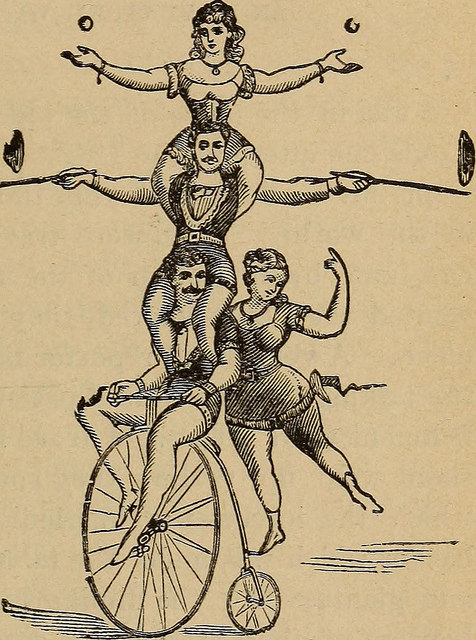
“Bicycle Riding Extraordinary” | Theatrical and Circus Life (1893)

The modern version of the circus which we know today has its roots in 18th-century Great Britain.  Philip Astley (1742-1814), the son of a veneer cutter and cabinetmaker, decided he wanted to be a horseman, since men on horseback were revered at the time as strong and brave, often prior solders.  Astley joined the Dragoons cavalry regiment, became a distinguished soldier during the Seven Years War, and left the military in 1766 as sergeant-major.  At six feet tall, Astley looked impressive atop a horse and easily started earning a living as a horseman with his white steed, performing trick riding and swordsmanship he had learned in the military.  After a few years of traveling to fairs to perform with his horse, he opened a riding school in 1768 close to Westminster Bridge, London, where he trained aristocratic young men and women.  After his morning trainings, he entertained to an audience in the school’s amphitheater.  He stood and performed acrobatics on his horse, adding ever more balancing tricks, a second horse, and a female equestrienne, Patty, who became his wife; their son John joined the act, as well.  He added clowns, magicians, tumblers, and rope dancers.  Astley gained competitors, but his was the first “modern” circus, and though the focus was mainly on the horses, he made the other acts integral to the entire spectacle.

View Full Size Image
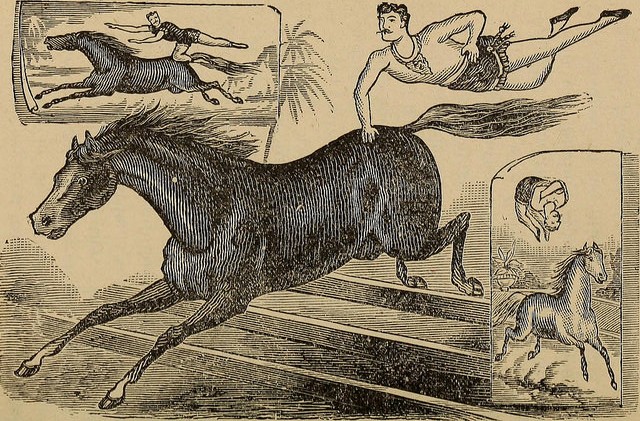
“Bareback Riding” | Theatrical and Circus Life (1893)

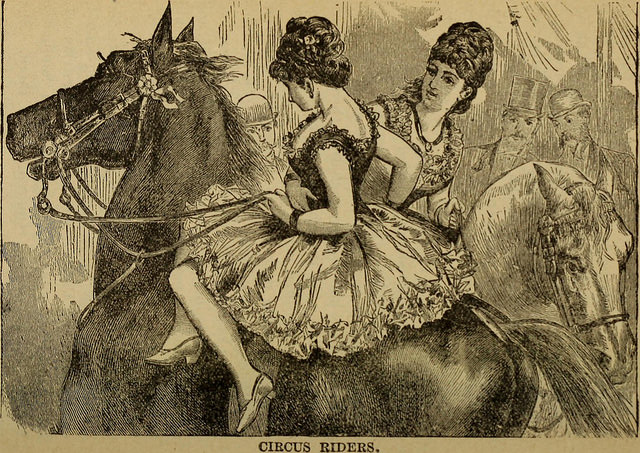
Circuses developed in Europe and America between the 18th and 19thcenturies, with more and more death-defying feats, skimpier outfits on female horse riders and acrobats, and larger-scale performances of plays or poems recreated as stories acted out by performers and horses (and sometimes, elephants).  The circus, after Astley’s time, was considered by some critics to be less of an aristocratic affair and more of a degraded mixing of high and low classes in order to see licentious performances.  However, people of all social ranks were dazzled by the spectacles and continued to attend the circus.  People especially loved women who performed feats on horseback, viewing these women as dominant and yet feminine at the same time, able to control the mighty beast and look dainty while doing so.

View Full Size Image
“Circus Riders” | Theatrical and Circus Life (1893)

The circus had come to represent a close-knit community that offered performers a chance to travel the world, and be praised for their physical feats and appearance.  Many children and adults dreamt of “running off to join the circus,” a 19th-century idea that stayed in the public’s imagination through the late 20th-century.  (Did you know that when she was a little girl in the 1940s, Jacqueline Bouvier Kennedy Onassis wore a crown when she rode her horse and said she would grow up to be “Queen of the Circus”?)

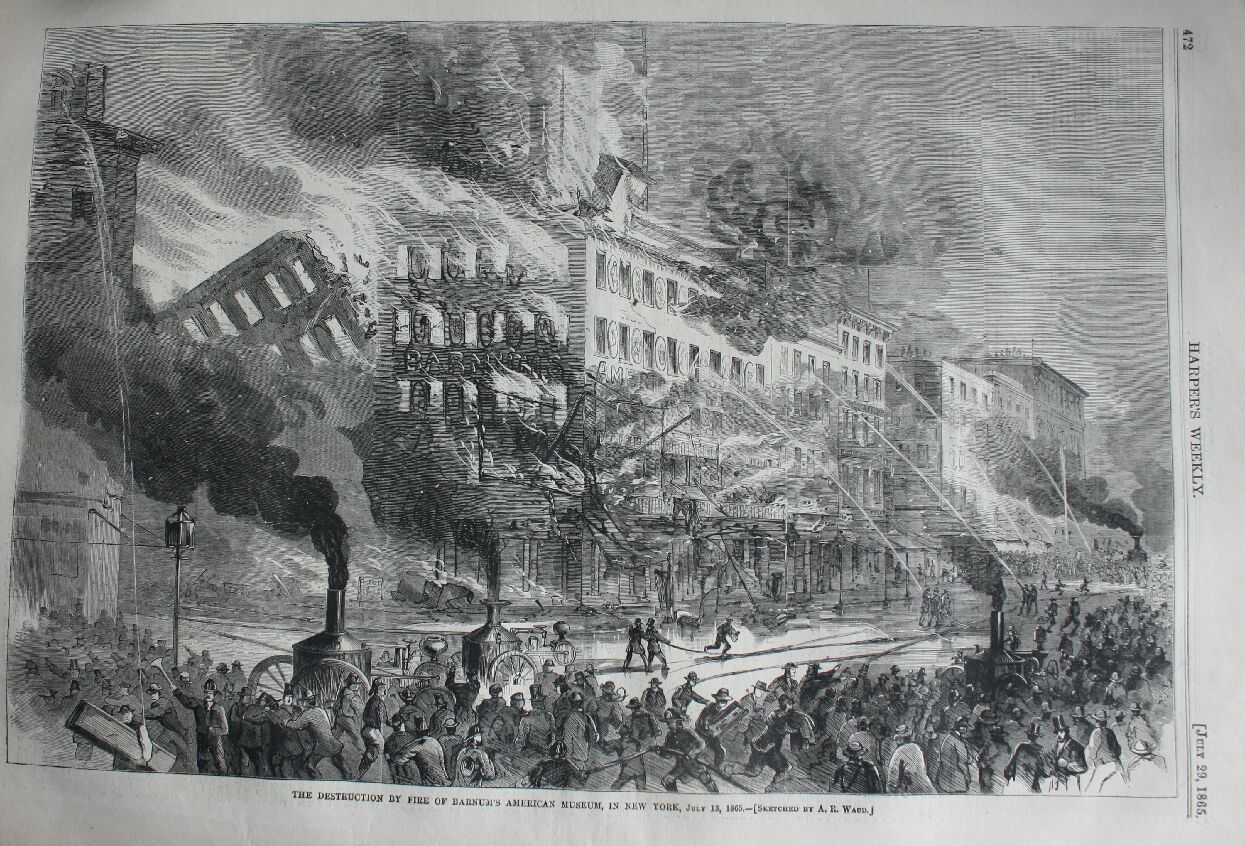
Phineas Taylor “P.T.” Barnum (1810-1891) was a man of many trades before he became a legendary circus entrepreneur.  He had a successful traveling circus, and purchased Scudder’s American Museum in 1841 and renamed it Barnum’s American Museum.  It housed sensational curiosities like the fake “Fiji Mermaid”, wax historical figures, relics from the American Revolution, taxidermy specimens, live performers, animals (including hippos, monkeys, snakes, a kangaroo, giraffes, and tigers), and an aquarium with whales.  A horrific fire broke out in 1865, tragically killing most of the animals, and destroying most of the objects and exhibitions.  Barnum re-opened the Museum at a different location but it burned down once again in 1868, again killing animals and destroying relics, although human performers were saved by firefighters.

View Full Size Image
First Fire at Barnum’s American Museum, 1865 | Harper’s Weekly
View Full Size Image
Second Fire at Barnum’s American Museum, 1868 (stereoview image) | Courtesy of Jack Mord, The Thanatos Archive

After the second American Museum fire, Barnum focused on traveling with his circus, engaging in several partnerships—the most famous, perhaps, with the owner of the very successful Great London Circus, James Anthony Bailey.  Bailey was an excellent circus director, and Barnum continued to be in the spotlight as he promoted the circus.  By 1889, the Barnum & Bailey Circus was comprised of 1,200 people, and hundreds of horses and animals, and traveled on tour in Europe.  When the Circus returned to America in 1903, Barnum & Bailey had serious competitors in the form of the Ringling Brothers.  When Barnum died, he left the Circus to Bailey, whose widow, when Bailey died, sold it to the Ringling Brothers.  Thus the creation of the “Ringling Brothers Barnum & Bailey Circus,” which still operates today.

While the grand days of the circus died down by the 1950s due to new forms of entertainment, such as Disneyland, there are still active circuses to this day.  The circus has always been fraught with the tension of death-defying feats, and the idea of whether it was a moral or immoral concept of entertainment.  However, people continue to be dazzled by the magic of spectacle which the circus provides, and has provided, in its many iterations over the years.

Special thanks to Jack Mord (The Thanatos Archive) for special use of the stereoview image of the second fire at Barnum’s American Museum in 1868.

References:

Jennings, J. J. (1893). Theatrical and circus life. . . Chicago: Laird & Lee, Publishers.

Simon, L. (2014).  The greatest shows on earth: A history of the circus.  London: Reaktion Books.

Sutherland, G. H. (1861).  Dr. Sutherland’s system of educating the horse, with rules for teaching the horse some forty different tricks or feats. . . Potsdam, NY: Fay, Baker & Co.’s Steam Power Presses.

September 3, 2015by jjones
Blog Reel, Campaigns, Featured Books

World Oceans Day: A Bibliographic Exploration of Ocean Giants

This post is the fourth in our series leading up to the celebration of World Oceans Day on June 8. This series explores publications that represent important milestones in the progress of marine bioscience research and ocean exploration.

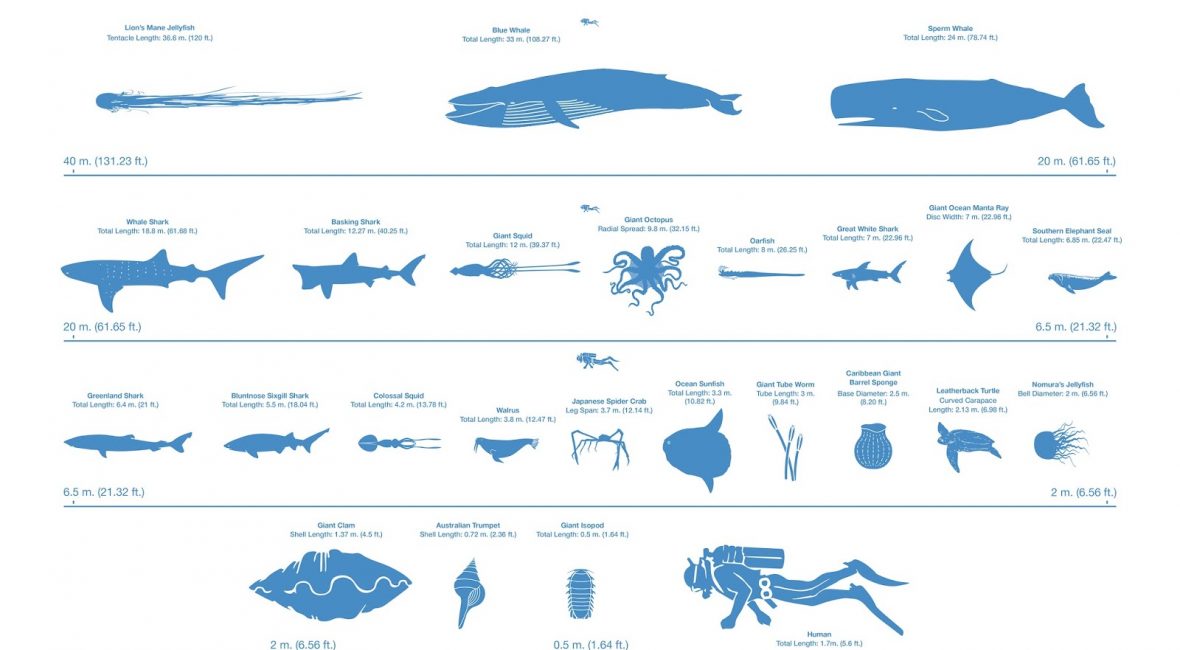
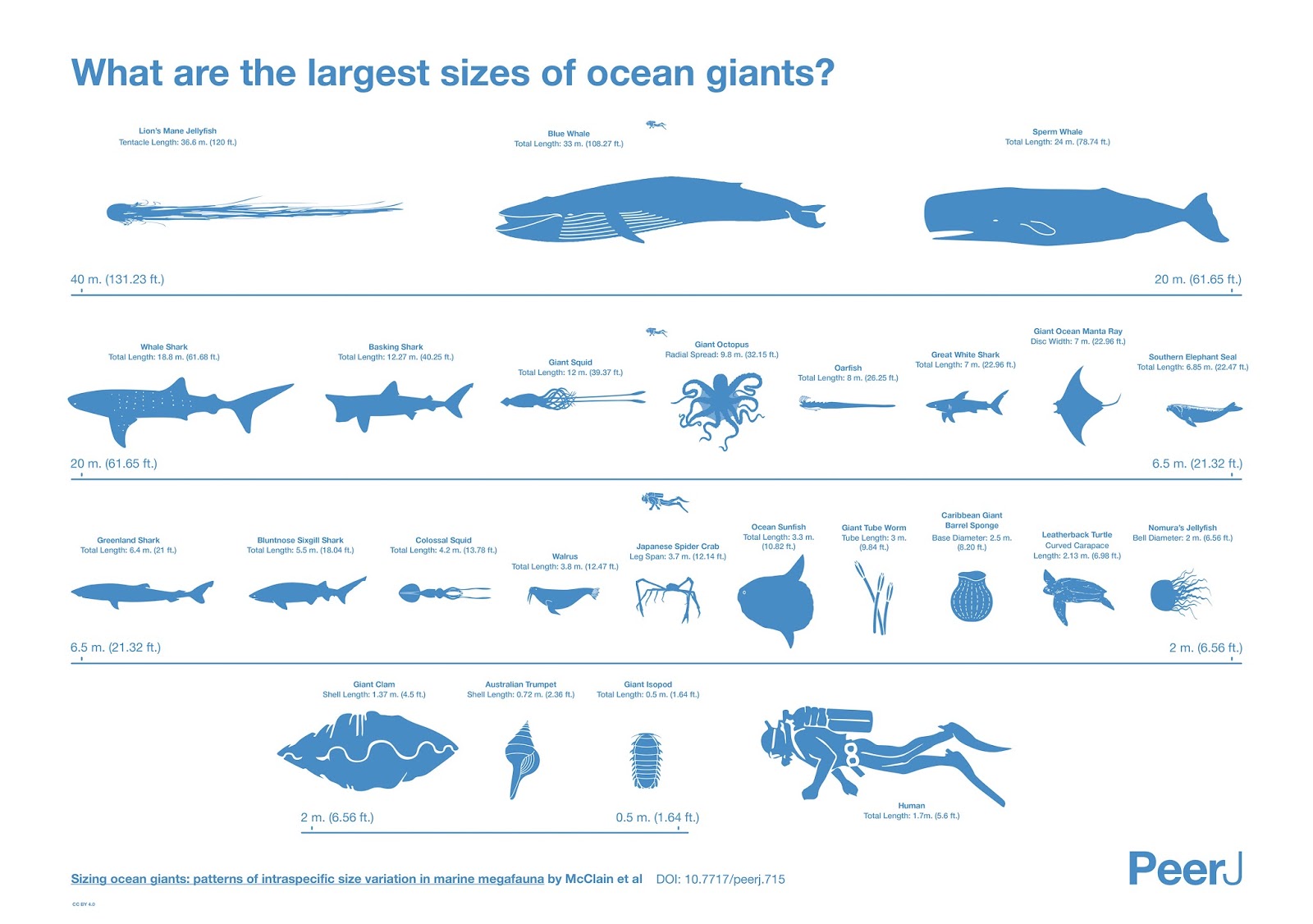
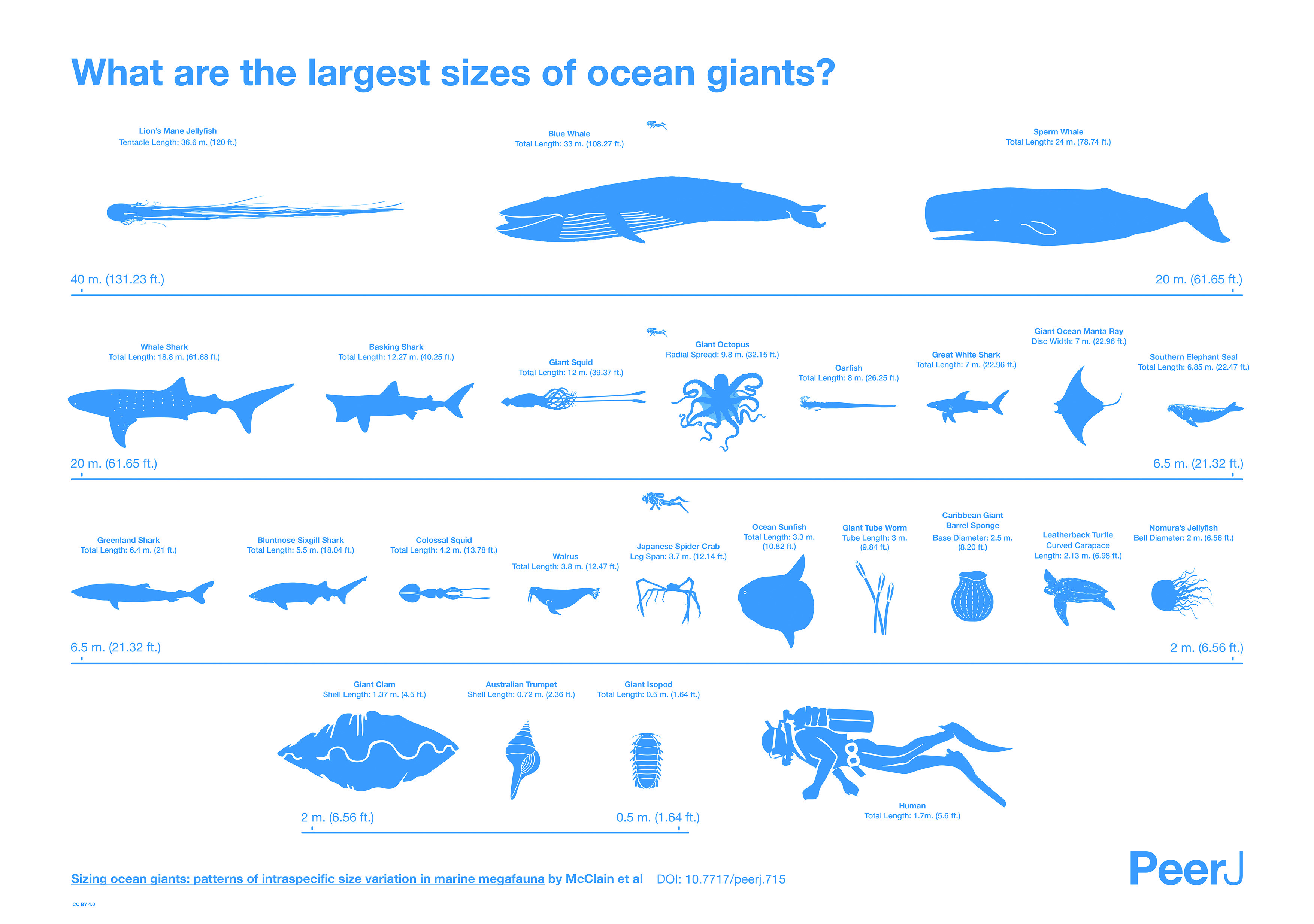
When you think of the largest creatures in the ocean, what do you picture?  You might be surprised about which creatures are largest, and about some of their fascinating histories and habits!  A recent article in the journal PeerJ documents the body length of some of the longest animals in the ocean, and in preparation for World Oceans Day on June 8, we’re diving deeper into the top ten listed in that article.

View Full Size Image
Sizing Ocean Giants: Patterns of Intraspecific Size Variation in Marine Megafauna by McClain et al | PeerJ

One of the First Scientists to Record a Plethora of Species: Linnaeus

Carl von Linnaeus (also known as Carl von Linné) was the first person to record several of the species in this top ten list, which he did in his book, Systema Naturae.  The tenth version of this book, published in 1758, is considered his authoritative taxonomical text, and scientists use the year 1758 to refer to Linnaeus’ taxa from this book (an important change Linnaeus made in the tenth version was to move whales to the mammal class rather than the fishes class).  Linnaeus was a Swedish zoologist and botanist, and also practiced as a physician.  He was born in Sweden in 1707, traveled to the Netherlands in his thirties to write Systema Naturae, returned to Sweden, and continued traveling throughout his life to further classify biological organisms.  He is known for creating the forerunner to the modern binomial nomenclature system, which was referred to as the Linnaean taxonomy.  He died in 1778 after having the opportunity to engage in philosophical conversations with other famous philosophers, teach medicine and botany, and continue to add to his taxonomy.

A Dive into Ten Ocean Giants, from Longest to Smallest (though still very long!):

View Full Size Image
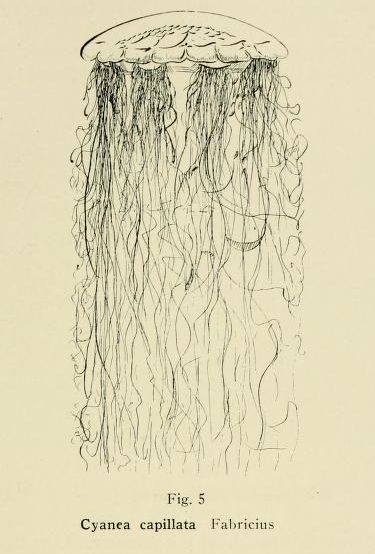
Lion’s Mane Jellyfish | view in book here

1. The lion’s mane jellyfish (Medusa capillata, also known as Cyanea capillata) is the largest species of jellyfish, and possibly the longest animal in the world, with tentacles that make this jellyfish 120 feet in length (though some estimates suggest that the bootlace worm, found in muddy and sandy shores and tide pools around the North Sea, is longer – possibly more than 170 feet long. However, since ribbon worms can stretch much more than their actual growth rate, these estimates are controversial).  It lives in cold waters, such as the Arctic, northern Atlantic, and Pacific Oceans, as well as the English channel, Irish Sea, North Sea, Scandanavian waters and sometimes the Baltic Sea.  Its tentacles are long, thin and hair-like, which is why it is referred to as a “lion’s mane”.  The bell, or umbrella, which comprises the top part of the jellyfish, can grow up to a diameter of 78.74 inches.  The hair-like tentacles emerge from the margin of the bell, in eight groups of 70 to 150 (or more) hollow tentacles, while more tentacles emerge from the bell’s subumbrella.  This jellyfish is generally a vivid yellow, orange or red color.  It feeds on zooplankton, and small fish, among other smaller creatures, and its predators include larger fish, seabirds, other jellyfish, and sea turtles.  The lion’s mane jellyfish was first scientifically documented (as Medusa capillata) by Carl von Linnaeus in 1758, in his Systema Naturae, which you can read here: http://biodiversitylibrary.org/page/727573.

Fun facts: The lion’s mane jellyfish was featured in Sir Arthur Conan Doyle’s short story “The Adventure of the Lion’s Mane”, in which the “murderer” turns out to be the jellyfish—although in real life, the lion’s mane jellyfish is not capable of killing humans, only causing a very painful sting that can result in blisters, cramps and affected heart rate and respiratory function.

View Full Size Image
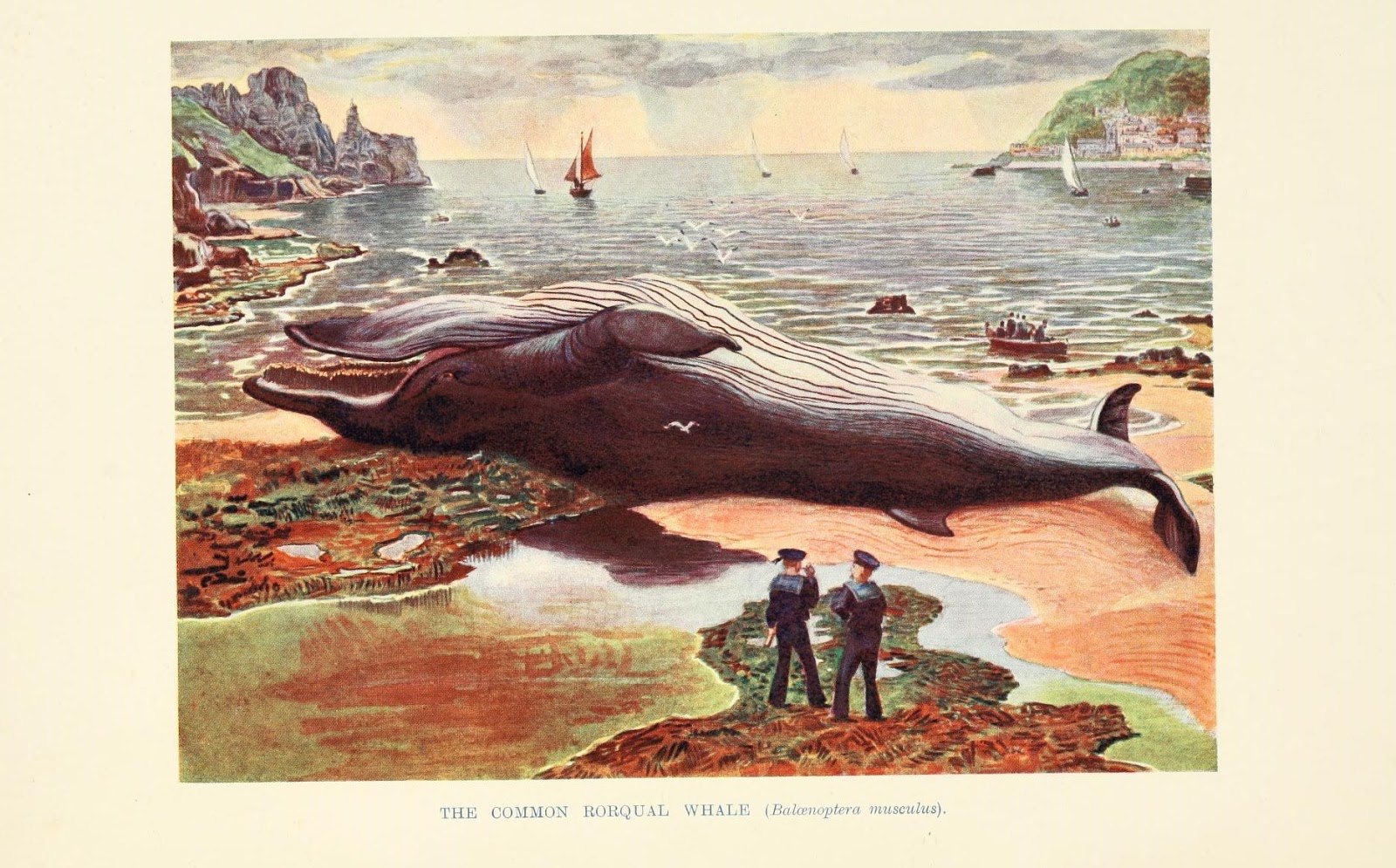
Blue Whale | view in book here

2. The blue whale (Balaenoptera musculus) was first described by Linnaeus in 1758 in Systema Naturae, and was thought to be the largest animal on the planet, though if measuring by length, it is out-shadowed by the lion’s mane jellyfish.  The blue whale is 108.27 feet long, and can weigh as much as 40 African elephants.  This species is also considered to have one of the fastest swimming speeds, at up to 30 miles per hour.  They live in all of the world’s oceans.  These amazing mammals eat up to seven tons of krill per day, by stretching their throats to open their mouths wider, and then gulping a large amount of water filled with krill.  They then use their tongues to expel the water out again through baleen plates, which capture the krill and prevent them from escaping.  The blue whale has the deepest voice of any living creature (at a frequency below humans hearing), and their voices can be heard by other blue whales for thousands of miles underwater.  Scientists have theorized that these far-reaching vocalizations help the whales map their locations across oceans.  Very little is known about their mating patterns.  This species can live as long as a human: 80 to 90 years.  You can read Linnaeus’ account of the blue whale here: http://biodiversitylibrary.org/page/726981.

Fun facts: Blue whales can dive underwater for up to 30 minutes.  A whale’s age can be determined by counting layers of waxy earplugs that develop in the whales over time (like counting tree rings).

View Full Size Image
Sperm Whale, Fig. C | view in book here

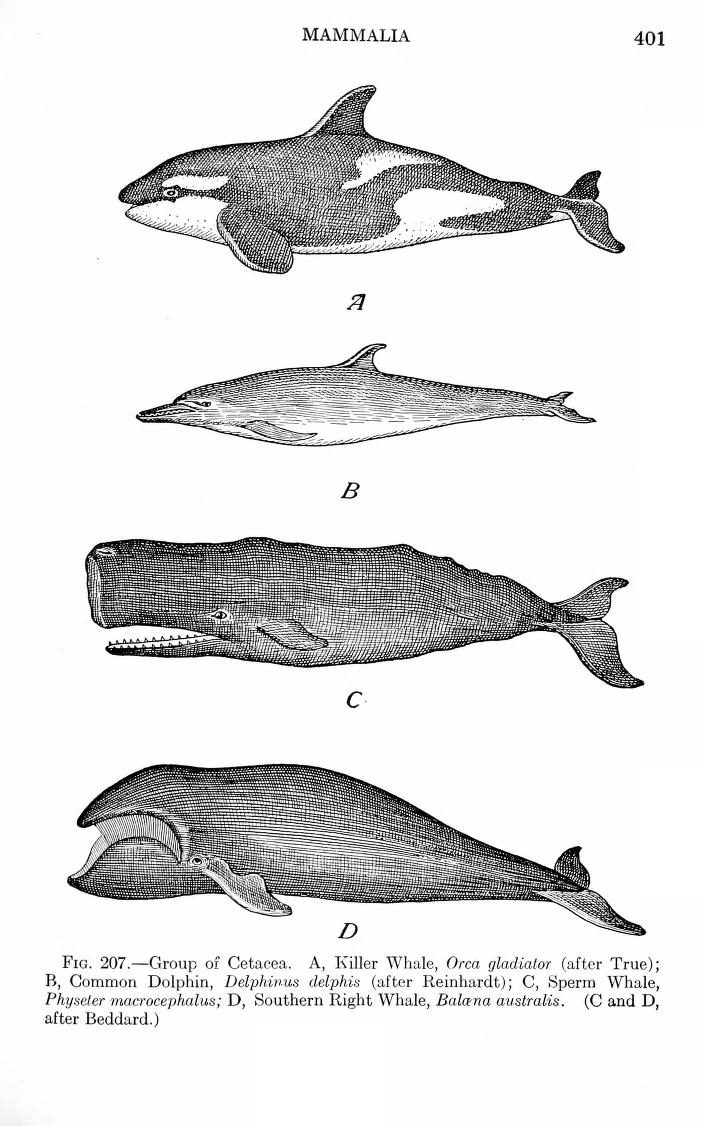
3. The sperm whale (Physeter macrocephalus) was also first described by Linnaeus in 1758.  At a length of 78.74 feet, it is the third-longest animal listed in the PeerJ article.  Among whales with teeth, the sperm whale is the largest, and also has the largest brain of any animal on the planet.  The sperm whale’s head takes up a third of its body length, and there is a specialized feature in the head that helps this whale dive deeper or rise to the surface of the water: the spermaceti organ.  This refers to a large cavity in the whale’s head filled with a waxy substance called spermaceti oil, which can be cooled (to shrink and increase density, allowing the whale to dive deeper), or heated (to expand and decrease density, allowing the whale to rise to the surface of the water).  Scientists posit that the spermaceti oil is cooled by water intake through the whale’s blowhole.  However, scientists are still trying to figure out the purpose of the spermaceti organ, and some believe it might absorb unnecessary nitrogen during dives, or help make the whale’s communicative clicking sounds resonate more loudly.  While the head of this species is extremely large, its lower, toothy jaw is very narrow and short in comparison.  The sperm whale eats giant squid, which live in deeper parts of the ocean, thus the sperm whale can dive up to one mile deep and stay under water for up to 90 minutes.  Sperm whales can live up to 70 years, and while they are close to the top of the food chain, they can be attacked by killer whales.  You can read Linnaeus’ account of the sperm whale, which is on the same page as that of the blue whale, here: http://biodiversitylibrary.org/page/726981.

Fun facts: In Herman Melville’s novel, Moby Dick, Captain Ahab was fighting a sperm whale.  The skin of a sperm whale is dark brown or blue-black, and is said to feel like the pit of a plum.  Sperm whales produce ambergris, which was once used in perfume making.  Scientists count the layers of dentinal growth on sections of sperm whale teeth to determine age.

View Full Size Image
Whale Shark (referred to here as Rhinodon Typicus), illustration by Sir Andrew Smith | view in book here

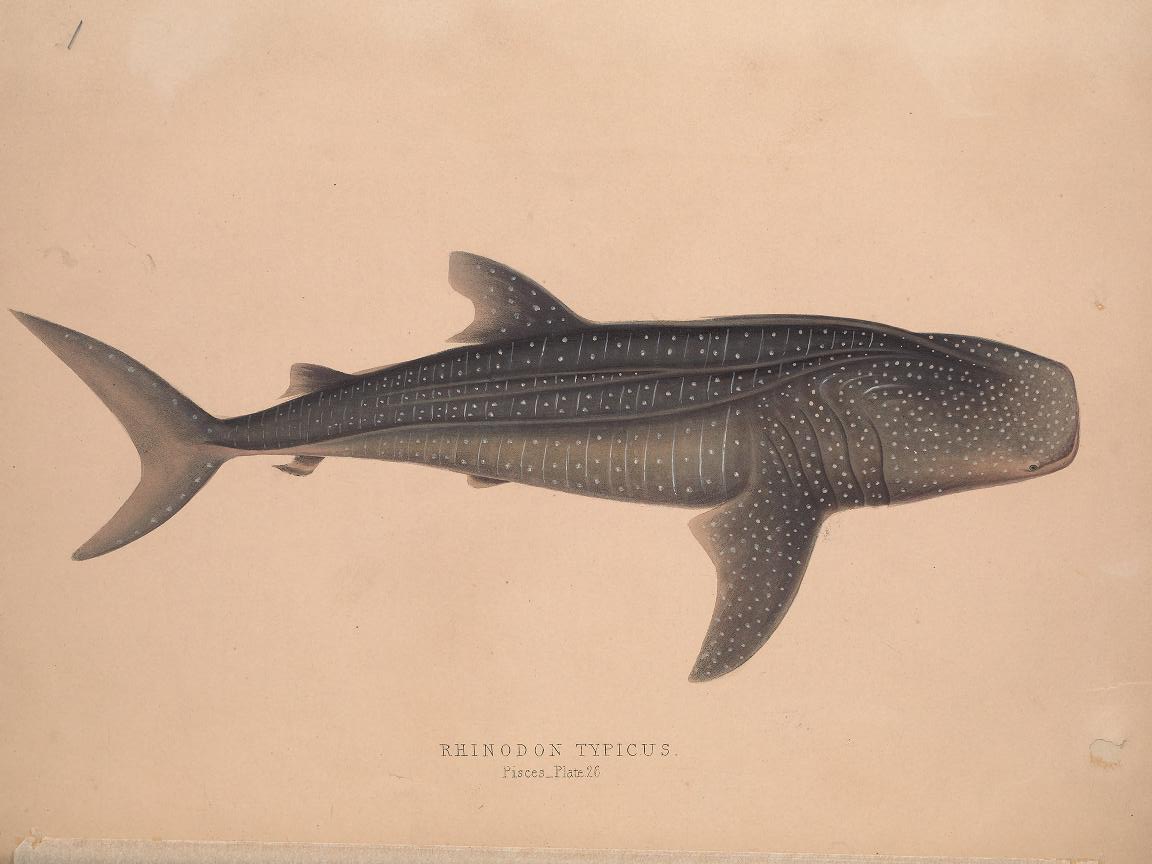
4.  The whale shark (Rhincodon typus), with a length of 61.68 feet, was first described by Sir Andrew Smith in 1828.  Smith published his findings on the whale shark in 1829 in Zoological Journal.  Smith (born 1797, died 1872) is considered a major influence in South African zoology.  He was born in Scotland, got his M.D., and practiced as a surgeon, ethnologist and zoologist.  He traveled with the Army Medical Services to South Africa and studied biological specimens there, as well as studying people native to the region.  He illustrated many specimens in Illustrations of the Zoology of South Africa (1838-1850), which you can read here: http://biodiversitylibrary.org/page/11059799.  Smith first noted the whale shark in 1828 after one was harpooned in South Africa while he was stationed there.  While it is similar in size to a whale, the whale shark is actually the largest fish in the world.  It has a wide, flat head and mouth, and dark, grey-blue skin with a beautiful pattern of pale yellow dots all over the top and sides of its body.  This shark has five large gills which contain cartilage that acts as a sieve.  Whale sharks generally eat smaller fish, and suck their prey into their large mouths and then swallow the unfortunates.  It is considered a filter feeder like the basking shark (to be mentioned later), but is much more active in its feeding than the basking shark, pumping water into its mouth sometimes in a stationary position, unlike the basking shark, which needs to swim in order to allow water into its mouth.  The whale shark lives in tropical and warm seas around the globe.  This species is not generally harmful to humans.  Unfortunately, people continue to hunt these sharks for human consumption, using parts of the shark in health supplements and shark fin soup.  Read Sir Andrew Smith’s description of the whale shark in The Zoological Journal here: http://biodiversitylibrary.org/page/2310852.

Fun facts: The whale shark’s mouth has up to 300 very small teeth, the function of which are unknown.  While scientists do not have a great understanding about how whale sharks reproduce, a pregnant female was captured and inside of her were 300 fetuses.  Known as gentle giants, sometimes humans can swim alongside, or catch a ride with, the whale shark.

View Full Size Image
Basking Shark, Fig. 14 (referred to as Cetorhinus maximus) | view in book here

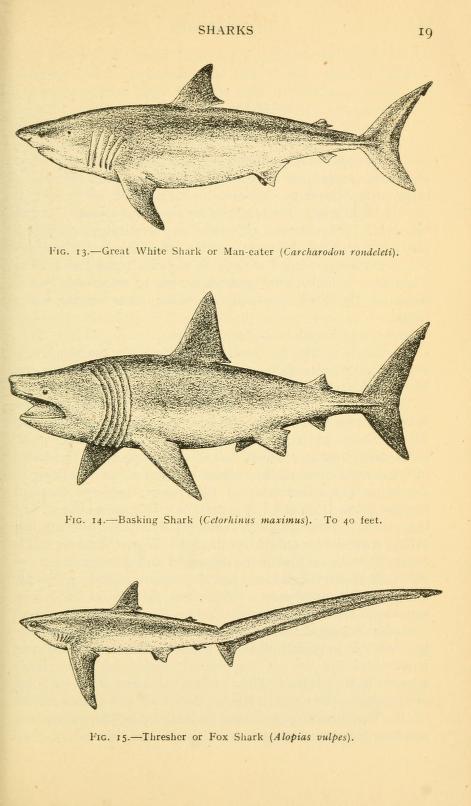
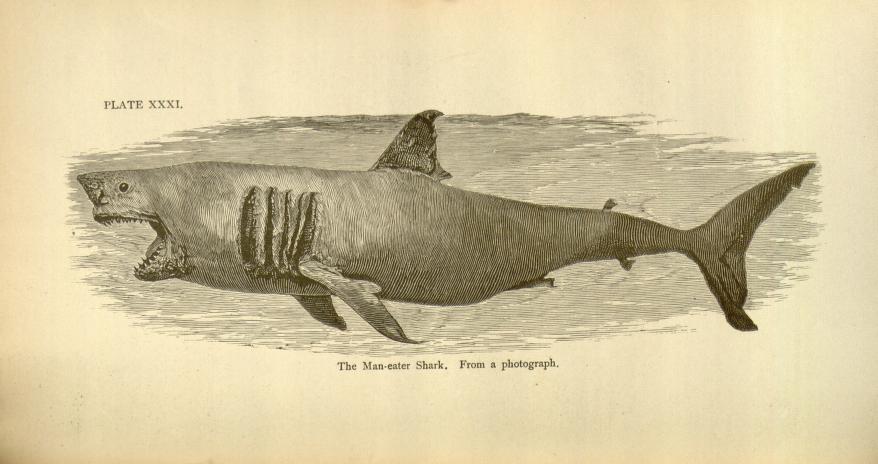
5.  The basking shark (originally called Squalus maximus, now known as Cetorhinus maximus), at a length of 40.25 feet, was first described by Johan Ernst Gunnerus in 1765.  Gunnerus was born in Norway, and practiced as a professor of theology and a bishop, as well as a botanist.  He helped found what became the Royal Norwegian Society of Science and Letters [Det Kongelige Norske Videnskabers Selskab, based in Trondheim, Norway], and published his findings on the basking shark in the Society’s journal in 1765.  This original publication has yet to be digitized by BHL, but its citation is as follows: Gunnerus, J.E. (1765). Brugden (Squalus maximus), Beskrvenen ved J. E. Gunnerus. Det Trondhiemske Selskabs Skerifter (v. 3). pp. 33-49.  Gunnerus communicated with Carl von Linnaeus (mentioned above, and also known as Carl von Linné) about some of his biological findings.  Linnaeus, in turn, helped found, and communicated with, The Royal Swedish Academy of Sciences [Kungliga Svenska Vetenskapsakademien], which published a journal in 1770 citing Gunnerus’ discovery of the basking shark, which you can read here: http://biodiversitylibrary.org/page/46782026.  Gunnerus was elected as a foreign member to the Royal Swedish Academy of Sciences in 1766.  As mentioned in the whale shark entry above, the basking shark is a less active filter feeder, and must swim over the plankton it wants to consume in order to get them into its mouth.  While basking sharks have no teeth, they have a filter that allows water to flow out of their mouths while trapping the plankton.  This species is the second-largest fish in the world.  Only one pregnant female has been caught so far, and she gave birth to six live sharks.  This shark lives around the world in boreal and temperate waters.  The basking shark can live to at least 50 years old.  They have been hunted for similar reasons to the whale shark, but are protected in British waters.
Fun facts: Basking sharks can migrate for up to 5,592 miles, and when they are not migrating or following the plankton in coastal waters, they spend most of their time in the deep ocean.  During vertical and geographical migrations, basking sharks remain in groups of the same sex and age, which suggests an interesting pattern of segregation within the species.

View Full Size Image
Giant Squid (also referred to as “Cuttle-fish”) | view in book here

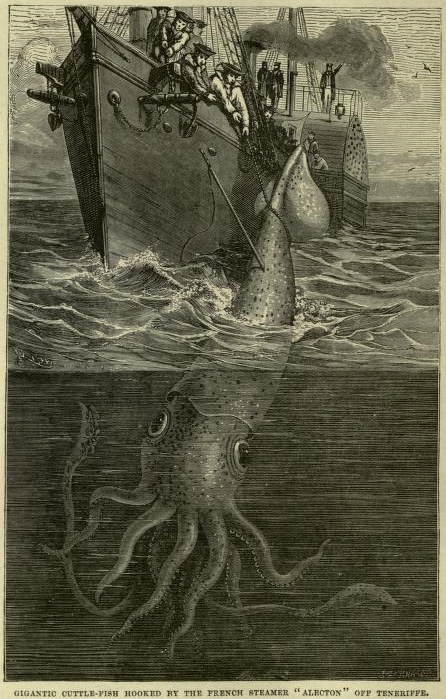
6.  The giant squid (Architeuthis dux), measuring 39.37 feet long, was first described by Japetus Steenstrup in 1857.  Scientists refer to the first mention of the giant squid by Steenstrup as occurring both in 1857, when Steenstrup published his findings in a paper, and in 1860, when three illustrative plates were published by Pieter Harting describing Architeuthis dux.  One year later, in 1861, Harting published a text on Architeuthis dux, along with the plates, which you can read here: http://biodiversitylibrary.org/page/39289600, and the mention of Architeuthis dux in the description of the illustrative plates begins here (Fig. 1. A.): http://biodiversitylibrary.org/page/39289603.  Steenstrup (born 1813, died 1897) was a Danish professor of zoology, and also studied biology.  Like Gunnerus, Steenstrup was also elected a foreign member of the Royal Swedish Academy of Sciences, in 1857.  Pieter Harting (born 1812, died 1885) taught medicine and zoology, and studied microscopy and botany, among other things.  The giant squid eats deep-sea fish and other squid by using serrated rings on its tentacles that suck onto the prey and bring the prey toward its beak, where a toothy tongue called a radula shreds the prey.  The squid has a mantle, eight arms, two tentacles longer than the arms, and hundreds of suction cups inside the tentacles.  This species has a complex brain and nervous system, and is found in oceans all over the world.  Scientists do not yet know how deep they inhabit the ocean, but some estimate that the giant squid can reside or feed at up to 900 meters deep.  Many specimens of giant squid which you see in museums were found washed ashore or in the stomachs of dead sperm whales, which regularly feed on them.  Scientists track sperm whales in order to study giant squid since the whales are so adept at locating and hunting the squid.

Fun facts: The giant squid has the largest eyes of any animal on earth, excepting the colossal squid, and the only creature known to have larger eyes is the extinct ichthyosaur.  The original edition of Twenty Thousand Leagues Under the Sea, a novel by Jules Verne, has an illustration of a man entangled in the tentacles of a giant squid.  The giant squid has been represented historically as the kraken.

View Full Size Image
Giant Octopus (referred to here as Octopus punctatus, a synonym for Enteroctopus dofleini) | view in book here

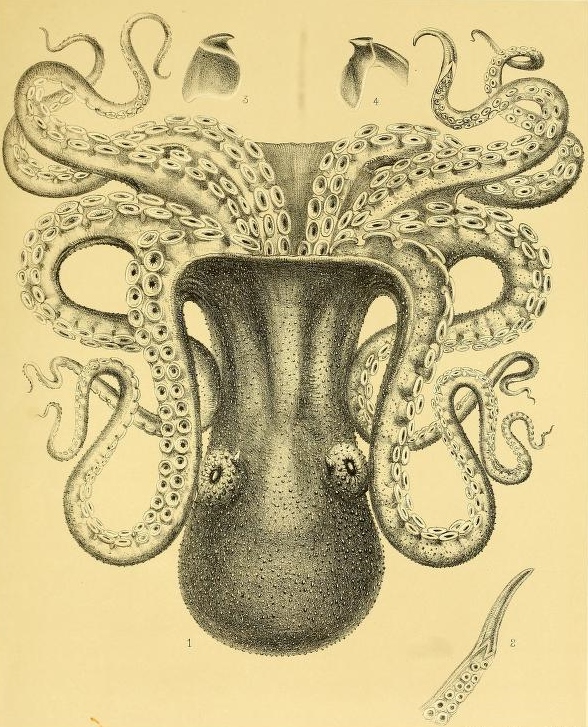
7.  The giant octopus (Enteroctopus dofleini), with a radial spread of 32.15 feet, is the largest among a group of octopuses referred to as the “giant octopus”.  The first scientific description of this particular giant octopus is by Gerhard Wülker, in 1910, where he refers to it by a synonymous name, “Polypus dofleini”.  You can read Wülker’s original description of “Polypus dofleini” here: http://biodiversitylibrary.org/page/39312736.  Wülker (born 1885, died 1930) was a German zoologist who is famous for being the first to identify the giant octopus.  E. dofleini is found in the Pacific Ocean (and is thus known as the giant Pacific octopus), and can be found as deep as 6,600 feet below the ocean’s surface.  This species lives longer than other octopuses, with a lifespan of up to 5 years.  Like all octopuses, E. dofleini has a head, eight arms with suckers on each, and papillae (hooks) lining the suckers to increase the octopus’ ability to hold onto things, such as prey.  Prey include lobsters, fish, scallops, and shrimp, among other creatures.  Once prey is captured, either by using arms singularly or all together, it is brought up to the beak at the mouth and then torn apart by a toothy tongue called a radula.  E. dofleini has distinctive longitudinal folds on its body.  These octopuses follow a pattern of mating and reproducing once, and then dying, which is referred to as “semelparity”.  After reproducing, the giant Pacific octopus will enter a seemingly gruesome phase leading up to death called “senescence”: the octopuses will eat little, their skin will retract unpleasantly, white lesions appear on the body, and activity becomes clumsy until death ensues by starvation or being preyed upon.

Fun facts: The giant Pacific octopus can lay up to 400,000 eggs, which are cared for by the female members of the species; the female stops eating to do this, and dies soon after the eggs hatch.  E. dofleini sometimes eats sharks, such as the spiny dogfish (Squalus acanthias), which can be up to four feet long.

View Full Size Image
Giant Oarfish | view in book here

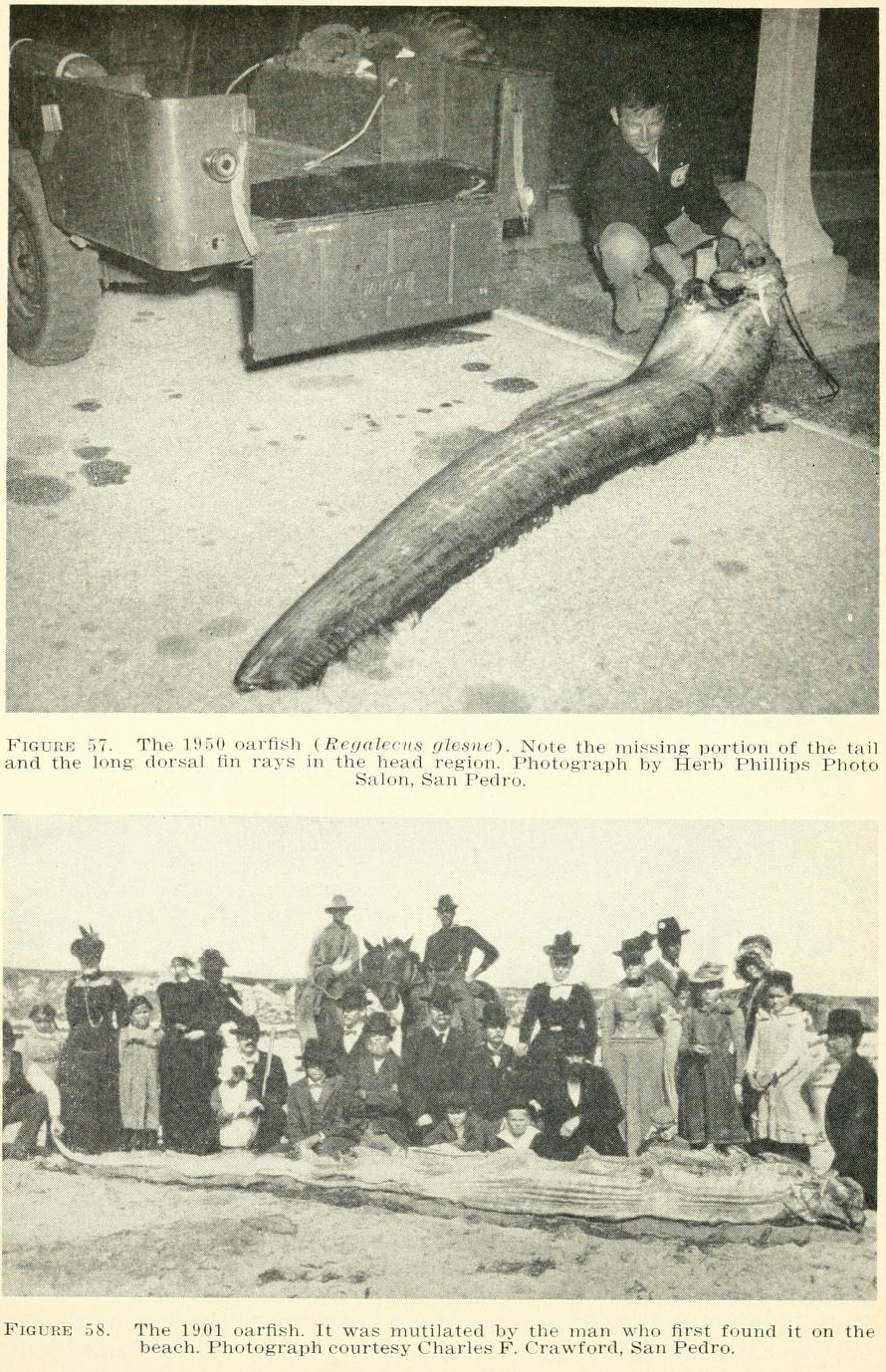
8.  The giant oarfish (Regalecus glesne), which is 26.25 feet long, was described by Peter Ascanius in 1772.  Ascanius (born 1723, died 1803) was a Norwegian scientist who taught zoology and minerology in Copenhagen.  He also practiced as a biologist, and was instructed by Carl von Linnaeus.  Like other scientists in this post, Ascanius was elected as a foreign member to a society dedicated to improving knowledge in scientific fields: in 1755 he was elected a foreign member of the Royal Society [in London], where he was considered a Fellow.  The giant oarfish is known as the “king of herrings”, and lives in oceans around the world.  Its body is shaped like a ribbon and it has a dorsal fin along its back that becomes vertically long right above its head, giving it the appearance of a rooster’s cockscomb.  This species has two pelvic fins comprised of only one ray; the fins are long and resemble oars.  There is a membrane at the tip of each pelvic fin that some scientists believe is used for tasting things.  Without teeth, the giant oarfish consumes krill by gulping water and then expelling it, trapping the krill in the gullet by means of a series of long spines.  Ascanius first wrote about the giant oarfish in 1772 in his work, Icones Rerum Naturalium, which is in the process of being digitized for BHL.  You can read the next earliest mention of the giant oarfish at the Biodiversity Heritage Library here, in Volume 2 of Monsieur le comte de La Cepède’s text, Histoire Naturelle des Poissons: http://biodiversitylibrary.org/page/12053207.  La Cepède, also known as Bernard Germain Étienne de La Ville sur Illon (born 1756, died 1825), was well-known for his contributions to the abovementioned work, Histoire Naturelle, written along with Georges Louis Leclerc, comte de Buffon.  La Cepède was a French naturalist and freemason.  Like other scientists on this list, La Cepède was elected as a Fellow of the Royal Society [London], and as a foreign member of the Royal Swedish Academy of Sciences, as well as a member of the Institute of France [L’Institut national de France].

Fun facts: The giant oarfish has no scales—instead, its body is covered in wart-like bumps called “tubercles”.  Adult members of this species sometimes kill themselves by swimming onto beaches.  The giant oarfish can self-amputate a part of the posterior end of its body, and apparently does this several times during its lifetime, as the amputated area repeatedly heals over into a stump.

View Full Size Image
Great White Shark | view in book here

9. The great white shark (Squalus carcharias, also known as Carcharodon carcharias), at 22.96 feet long, was first described by Linnaeus in his Systema Naturae in 1758 under the name Squalus carcharias.  The great white shark lives in most all oceans around the world, and can appear in coastal waters.  This species of shark is infamous for having the largest number of unprovoked attacks on humans.  However, the great white shark does not intentionally feed on humans.  Shark prey includes seals, dolphins, whales, sea lions, fish, seabirds, and other smaller creatures.  While they would appear to be at the top of the food chain, great white sharks can rarely be attacked, and killed, by groups of orca whales.  Scientists know very little about their mating behavior, but female sharks give birth to live young.  Great whites can swim up to 25 miles per hour in pursuit of prey, and launch themselves into the air from the water.  These sharks use smell, sound location and electroreception to spot prey from great distances.  The great white shark, unlike the majority of other fish, can maintain a higher body temperature than that of the surrounding water by means of a heat exchange system in their blood vessels.  These sharks can live up to 50 years.  Read Linnaeus’ account of Squalus carcharias here: http://biodiversitylibrary.org/page/727146.

Fun facts: The oldest fossils of the great white shark are 16 million years old.  It is believed that the great white shark does not intentionally seek to attack humans, but is merely engaging in “test bites”, which it also performs on other unfamiliar objects in order to identify those objects.  The great white shark was featured in Peter Benchley’s novel, Jaws, as well as Steven Spielberg’s film adaptation of the same.

View Full Size Image
Giant Manta Ray | view in book here

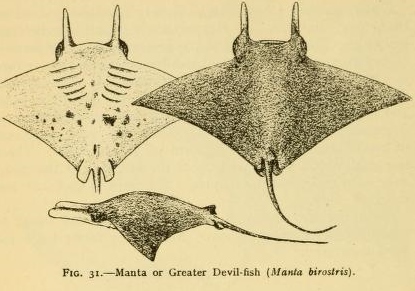
10.  The giant manta ray (Manta birostris, also known as Raja birostris) has a disc width of 22.96 feet, is the largest ray in the world, and can weigh up to two tons.  This creature was first described by Johann Julius Walbaum in 1792.  Walbaum (born 1724, died 1799), was a German physician.  He was also a naturalist and taxonomist, and the first to record many new-to-science species.  He referred to the giant manta ray as Raja birostris in his original description of the creature, though the giant manta ray is now known as Manta birostris.  This species inhabits tropical and temperate waters around the globe, and eats zooplankton like shrimp and krill.  The giant manta ray has triangle-shaped pectoral wings on either side of its body, and lobe-shaped fins towards the front of its body, extending from either side of the head.  These fins can aid in pushing water into the mouth to catch prey.  There are 18 rows of teeth in the lower jaw of its large, rectangular mouth.  Their skin is black, blue or brown, with a white underside.  Scientists look at unique patterns of markings and scars to identify individual rays.  The giant manta ray can live up to 20 years.  Read Walbaum’s description of Raja birostris here: http://biodiversitylibrary.org/page/39001752.

Fun facts: The giant manta ray can eat up to 13% of its body weight in food each week.  Sometimes the ray will remain still near a coral reef while other fish eat off pieces of loose skin and parasites, which cleans the ray and provides food for the fish.  The giant manta ray can leap out of the water, possibly as part of a mating ritual, and their offspring are called “pups”.

More World Oceans Day Resources

  • Follow us on Twitter, Facebook, and this blog all this week as we explore marine biodiversity and awesome related publications in BHL.
  • Check out some monumental publications in historic and present-day marine bioscience research in our BHL collection.
  • Browse a selection of marine biodiversity illustrations in Flickr and Pinterst
 Some Key References:
Brightwell, C. L. (1858). A life of Linnaeus. London: J. Van Voorst.
(n.d.). Encyclopedia of Life (EOL).  Retrieved from eol.org
(n.d.). Invertebrates of the Salish Sea.  Retrieved from http://www.wallawalla.edu/academics/departments/biology/rosario/inverts/
(n.d.) The Linnaean Correspondence.  Retrieved from http://linnaeus.c18.net/
(n.d.). World Register of Marine Species (WORMS).  Retrieved from http://www.marinespecies.org
June 4, 2015by jjones
Blog Reel, Featured Books

Medicinal Botanicals at the College of Physicians of Philadelphia & Early Women In Science

Medicinal Plants and Illustrated Herbals in Philadelphia

View Full Size Image
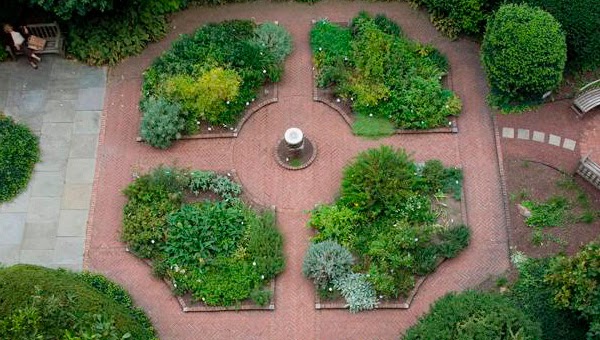
The Benjamin Rush Medicinal Garden at the College of Physicians of Philadelphia

Dr. Benjamin Rush, a founding Fellow of the College of Physicians of Philadelphia, first proposed that the College create a medicinal plant garden in 1787. The garden would not only provide medicinals for use by physicians, but would also be used as a pedagogic resource for the training of medical students.

Rush’s vision did not come to fruition until the College moved to its current site at 22nd and Ludlow Streets in 1909. An adjoining property was acquired in 1911, and a garden was planted in memory of Wharton Sinkler, a vice-president of the College. This garden contained flowers, trees, and shrubs, typical of small city parks.

A medicinal plant garden was cultivated in place of the original garden 150 years after Dr. Rush first proposed its creation. In 1937, as part of its 150th anniversary celebrations, the College converted the garden, which was tended at first by a volunteer committee made up of wives of Fellows of the College.

Today, the garden is designed around four identical parterres, planted with more than 25 different medicinal species that would have been easily identified by Dr. Rush. Each plant is labelled with its usage, the common name, and the botanical name. Therapeutic or poisonous properties have been verified by modern pharmacologists and botanists. Interpretation, including signage and an audio tour, inspires and educates visitors to consider the role of herbals in current medical applications. Information about the medicinal garden can be found here and at “No Bones About It,” a YouTube channel of the Mütter Museum.

The medicinal garden is complemented by a selection of early illustrated herbals that are in the collections of the Historical Medical Library of the College of Physicians. The earliest herbals include two editions of the Herbarius, one of the Gart der Gesundheit, and five editions of the Hortus Sanitatis, including the first edition, printed in 1491, which has been described as the largest herbal ever printed. Search the Library’s catalog to learn more. To view a selection of digitized images from the herbal collection, visit the College’s digital image library.

Early Women in Science

While men such as Dr. Rush and the Fellows of the College have contributed greatly to medical and botanical knowledge, there were trailblazing women contemporaries who engaged in the same endeavors. Many of these women had to fight societal beliefs that women should be confined to the domestic sphere in order to pursue the scientific fields of medicine or botany. In the Biodiversity Heritage Library’s digital exhibit, Early Women In Science (created for the Biodiversity Library Exhibition with support from the Smithsonian Women’s Committee), you will learn about women in scientific fields working prior to the twentieth century, including botanists who explored rough terrain across the United States and other countries in order to contribute to our knowledge of different plants.

View Full Size Image
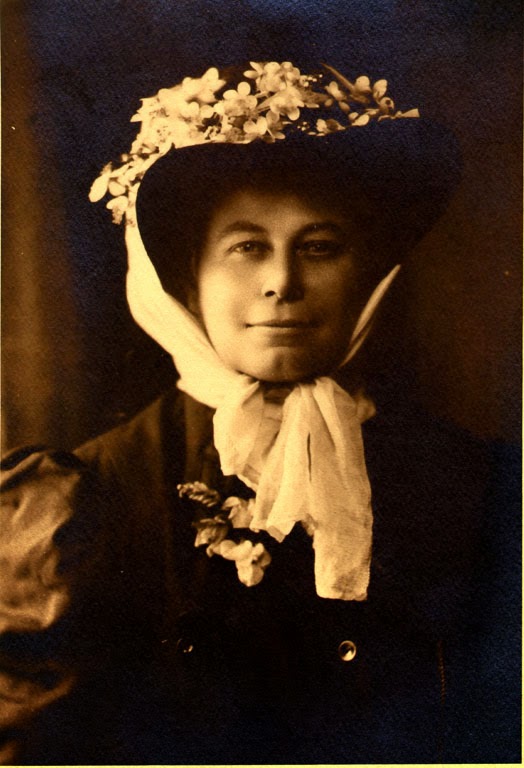
Alice Eastwood, Courtesy of the California Academy of Sciences Archives

Often these women identified many entirely unknown species. For instance, Alice Eastwood (1859-1953) hiked the High Rockies in Colorado collecting plant specimens, and continued collecting and identifying new specimens until her death; she ultimately contributed 340,000 specimens to the California Academy of Sciences Herbarium. Just as intrepid was Katharine Brandegee (1844-1920), who fought against criticism in order to enter the medical field (traditionally a job reserved for men). She obtained her M.D. from the University of California in 1878, and it was her study of medicinal plants while in the medical program that led her to ultimately take up botany as a career instead of medicine. To learn more about Alice, Katharine, and 14 other early women in science—including those who contributed to botanical (and thus medical) knowledge—please visit the digital exhibit, Early Women In Science.

Special thanks to Beth Lander and Robert Hicks, of The College of Physicians of Philadelphia, for contributing information about Dr. Rush, his medicinal garden, the College of Physicians of Philadelphia and their digital holdings, and the Mutter Museum.

January 15, 2015by jjones
BHL News, Blog Reel

BHL Life: My Experience as a BHL Marketing Intern

View Full Size Image
Me! (Laurel Byrnes, Marketing Intern at the Smithsonian Biodiversity Heritage Library)

My interest in the Smithsonian Institution, as an entity, began a long time ago when I was a young girl.  I came to DC with my middle school to visit the National Museum of Natural History and since that trip, I was completely in love with museums and wanted to know how they operated–how all of those magical exhibits came to be, who was responsible for making that happen, and all of the different people who got to work together to make this large organization thrive.  Simultaneously, being a studious girl who enjoyed reading books and doing homework in my free time, I had developed a deep love of libraries–those dark, quiet places filled with shelves and shelves of books just waiting to be explored and enjoyed.  There’s nothing quite like the feel of a book, the smell of its pages, the weight of it in your hands.  And when I discovered, a few years later, the rare books sections of different libraries, I was even more intrigued and anxious to discover not only the content of these old books and manuscripts, but also the process involved with making them, and the way that librarians and curators store, classify and preserve them.  If only there were a way to combine my two loves: museums and libraries…

So a few years intervened and I went to graduate school at Princeton University for medieval English, getting to explore my love of old texts and rare books, and to further enjoy the quiet, cavernous delights of the Princeton Library (where 500-year-old books lay casually on the shelves along with modern books, all of them ripe for consumption).  Serendipitously, I moved from my home in PA to DC, home of the Smithsonian, after I got married and was still a graduate student.  I found great joy in going to the Library of Congress for the first time to pursue my graduate work.  I was in awe of the magnitude of holdings at that Library, and the idea that it was free for anyone to read books there–and what a gorgeous place to read books!  I started to develop a serious curiosity in Library Science since I thought that being able to turn my love of books and libraries into a career would be the culmination of a lifelong dream.  And when I heard that the Smithsonian had its own system of libraries, my two loves collided, and I went to the first open house that I could at the Smithsonian Libraries inside the natural history museum (a library inside of my favorite museum–heaven!!!).  At the open house I met quite a few Smithsonian librarians and staff, including Bonnie White, Bianca Crowley and Grace Costantino.  I explained that I had recently completed a marketing internship with the Smithsonian Associates (another amazing adventure that would need its own post to tell the whole story), and Bianca and Grace suggested I try to apply for their new marketing internship with the Biodiversity Heritage Library (BHL).  I left that open house feeling lucky to have met so many kind people in the field I hoped to explore, and having gotten so much great advice from all of them about pursuing a Library Science degree and career.

I applied for the internship at the BHL and was accepted.  There is something wonderful about going to get your Smithsonian Intern badge from the security office because I felt like I was finally a member of a community of people just like me–book lovers, library lovers, museum lovers, people who enjoy internet marketing and all of the new possibilities that the Internet could bring to help libraries and museums expand their audiences and make their collections more readily available to the general public.  The idea of using the Internet to make more books more freely available to all people is something I’ve always believed in ever since I learned of the concept in grad school, and the BHL’s project of doing just that is one that I wholeheartedly wanted to contribute to and support, in any way possible.

I began my 4-week internship under the guidance of Bianca Crowley, and I learned that I would be responsible for finding 5 books from the BHL collections which I would read and write about for the “Book of the Week” blog posts for the BHL blog.  At my fingertips I had one of the most amazing collections of digitized, full-text biology- and biodiversity-related books through the BHL website, and it was fun to explore the collections to find books that could be the topics of my blog posts.  I found books about human deformity caused by corsets (a physiology book), about taxidermy, cicadas, cats and rabbits–and I could have found even more, the possibilities were endless.  These books had beautiful illustrations or photographs, amusing anecdotes or gruesome and strange facts, and were intriguing subjects on which to write.  Bianca worked collaboratively with me to make sure I had picked good books to highlight and was always available if I needed any guidance at all.  Another highlight was being able to talk with Grace Costantino about how the BHL carries out its social media and marketing work, which gives me a better sense of how large libraries operate and hope to expand their audiences.

The absolute best thing about this internship–aside from being able to show my badge and enter the National Museum of Natural History early, when all is quiet and the exhibits are completely empty of people–was being able to work with the kind and generous staff of the Biodiversity Heritage Library and learn how this operation functions.  Bianca knew I was interested in pursuing my Library Science degree, so each week she made sure that I got to meet a different member of the staff, who explained to me their job and gave me advice about applying to Library Schools.  I will always be grateful for this amazing opportunity, the wonderful people I have met, and the advice that is sure to help me on my path to Librarianship!

Written By: Laurel Byrnes, Marketing Intern at the Biodiversity Heritage Library

Connect with me: http://www.linkedin.com/in/laurelbyrnes

August 6, 2013by jjones
Blog Reel, Featured Books

Happy Birthday, Beatrix Potter! (A Book of the Week about Rabbits)

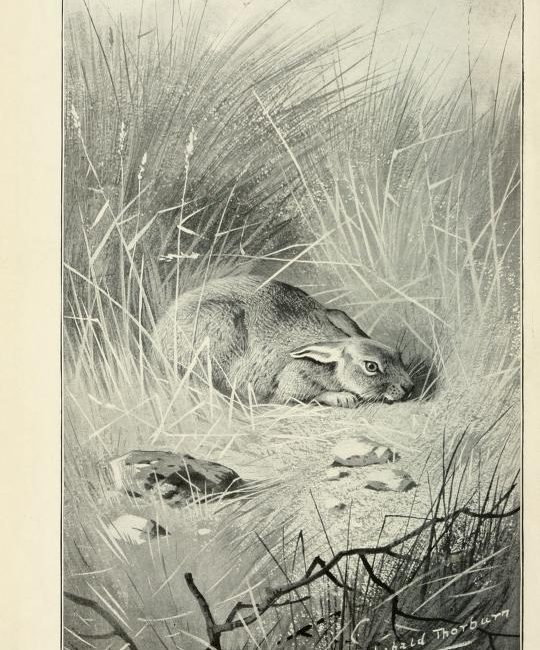
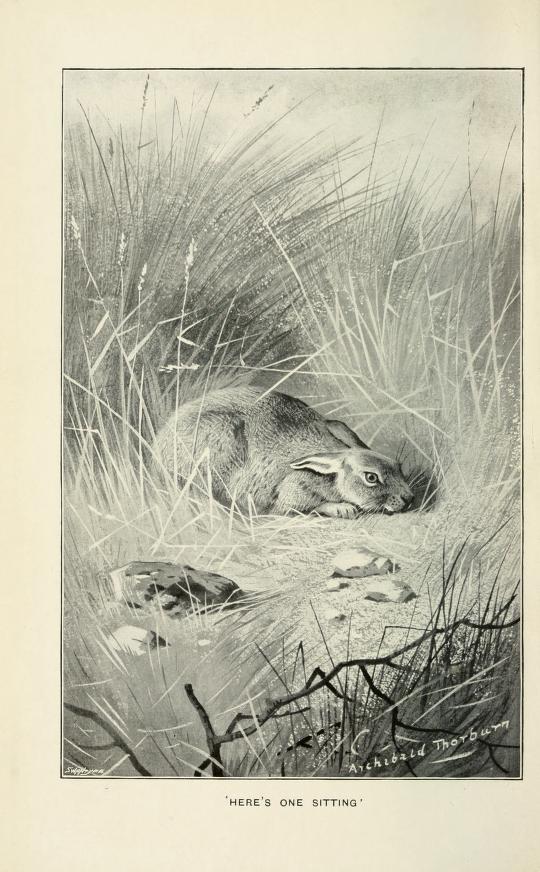
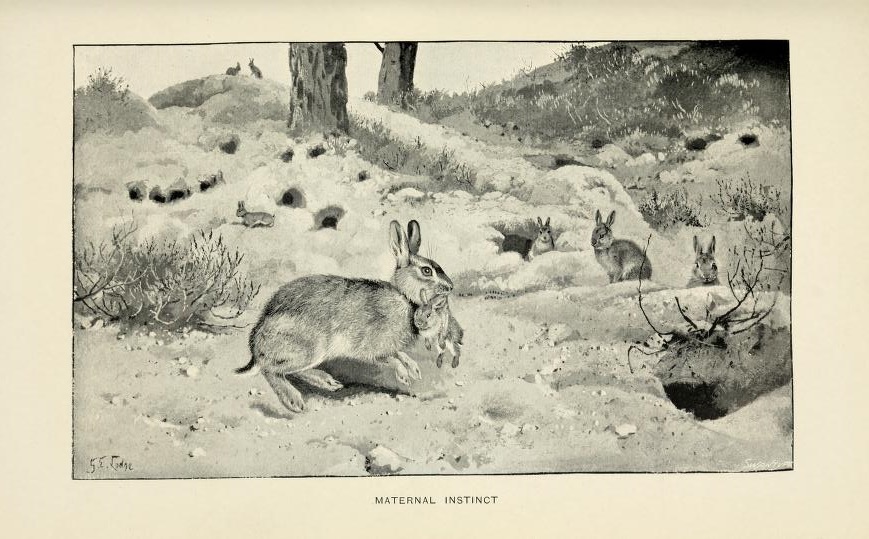
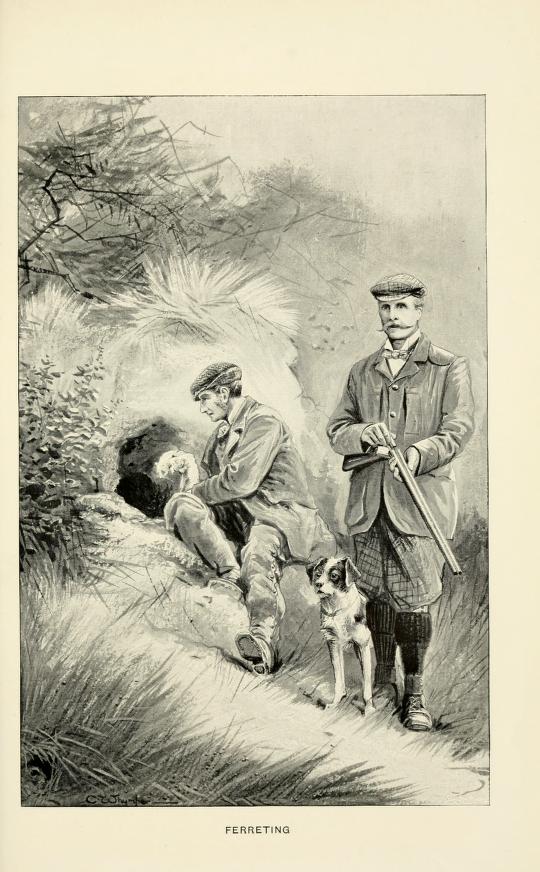
In celebration of Beatrix Potter’s birthday on July 28th, 1866, today’s book of the week explores rabbits: The Rabbit, by James Edmund Harting, with a Chapter on Cookery, by Alexander Innes Shand.  This book was published in 1898 as part of the Fur, Feather and Fin Series, edited by A. E. T. Watson, that explored all kinds of wildlife and how to hunt and cook it (Frontmatter).  The book contains beautiful illustrations of European rabbits engaged in various activities, and describes rabbit behavior and physiology.  The following are examples of illustrations from Harting’s book:

View Full Size Image
“Here’s One Sitting” (Frontmatter)
View Full Size Image
 A mother rabbit returning her baby to the burrow (21)
View Full Size Image
Hunters using a ferret to scare rabbits out of the burrow in order to shoot them (95)

Beatrix Potter was another illustrator who created lovely pictures of rabbits.  It is not surprising that Potter created such realistic illustrations of rabbits and rabbit behavior because she studied rabbit physiology and behavior in depth from the time she was a young child.  Potter was born into a nouveau riche family which had inherited large sums of money from relatives, and she grew up being cared for by governesses in a large home in Kensington, London.  Her parents did not bother themselves with paying much attention to her, and she “took her meals separately and seldom saw her parents except for a short visit in the evening” (MacDonald 231).  As a result, Potter had several small animals as pets to keep her company “that were sometimes hardly tame,” including frogs, mice and rats (MacDonald 231).  Potter began keeping a journal in 1881 in order to avoid boredom, and she continued to write and sketch in it for over a decade, writing “in code and in a hand so small as to be virtually impenetrable” (MacDonald 231).  She visited local museums to study animal physiology, and when her family spent four months out of the year in the Lake District in England during Easter and summer vacations, Potter got even more in-depth physiology lessons about local wildlife:

Apparently allowed to roam unsupervised, Potter and her brother skinned and boiled dead animals until only the skeletons remained to be examined. . .In the museums Potter found special pleasure in studying and sketching animal skeletons.  Her later understanding of the way animal bodies functioned made her illustrated animals particularly vital–no false movement, no oddly shaped limbs–so that they always remain true to their various species.  Because the Kensington museums also preserved such decorative, domestic artifacts as furnishings and clothing, Potter accumulated various subjects in her sketchbooks, using them to study perspective to much advantage in her later books, where the low-to-the-ground vantage points of her animals show familiar objects from new angles.  (MacDonald 231-2)

Potter’s initial entry into the publishing world came when illustrating greeting cards and the works of other authors, and when she published a scientific paper in 1897 on the reproductive cycles of certain mushrooms–mycology being an early passion of hers.  Her paper, “On the Germination of the Spores of the Agaricineae,” had to be presented by a male friend of the family to the Linnaean Society of London since women were not allowed involvement with scientific groups yet; all of her findings in this paper have since been proven accurate.  When a family friend suggested she publish a children’s book, she published an early version of The Tale of Peter Rabbit in 1901 with money that she had made illustrating greeting cards.  The Warne publishing house heard of Potter’s book and agreed to reprint it, beginning a longstanding relationship between Potter and the publishing company (MacDonald 233).

View Full Size Image
An image of a first-edition 1902-version of The Tale of Peter Rabbit
View Full Size Image
Beatrix Potter at 15 years of age, holding her pet springer spaniel, Spot.

The plot of Peter Rabbit’s tale closely reflects the rabbit behavior described in Harting’s book, The Rabbit–namely the part of the plot where Peter escapes into a farmer’s garden and eats a lot of the farmer’s vegetables, barely escaping capture by the farmer, and later returning to the safety of his mother’s burrow.  Harting has described rabbits as voracious eaters compared with other animals, even as the cause of famine in the Spanish Balearic islands during the rule of Emperor Augustus (Harting 3), and includes a farmer’s description of the rabbits’ particular eating style:

A Suffolk farmer, who is a good sportsman as well as shrewd observer of facts connected with natural history, asserts that you may generally tell whether your turnips are nibbled by hares or rabbits by the difference in the mode of attacking the roots.  A hare will bite off the peel and leave it on the ground; a rabbit will eat peel and all.  (Harting 6)

Harting goes on to describe how rabbits also eat turnips more voraciously than rats do since “a rat when eating a turnip. . .will bit off the rind, as a hare does, and will leave it in chips on the ground; a rabbit. . .will eat peel and all” (Harting 6-7).  Another trait, aside from a large appetite for vegetables, which Harting’s descriptions have in common with Potter’s character, Peter Rabbit, is that of quick escape.  The purpose of the white underbelly of a rabbit, according to Harting, is to alert fellow rabbits when danger is near so that all can escape:

The advantage of having a white under-surface to the tail is also apparent on reflection; for when, on the approach of an intruder while rabbits are out feeding, those nearest to him begin to scuttle away, the little white flag in motion at once attracts the attention of others, and all speedily make for their burrows.  (Harting 7-8)

Harting also recounts some interesting rumors about the origin of rabbits and the term, “rabbit,” in western Europe, as well as some fascinating facts about their resilience.  Harting proposes that the rabbit was introduced to England by the Romans, who also brought the ferret to hunt the rabbit when it became too populous (Harting 1).  The Romans apparently learned from rabbits how to dig tunnels into enemy territory in order to conquer the land: “The Latin word cuniculus denotes both a rabbit and an underground passage.  Varro suggests that the rabbit derived its name from the burrow it forms, and Martial avers that rabbits first taught men to undermine enemies’ towns” (Harting 3-4).  The origin of the term, “rabbit,” begins with the Latin cuniculus, then the Italian coniglio, the Spanish conejo, Belgic konin, Danish and Swedish kaning, German kaninchen, Old French connin, Welsh cwningen, and Old English conyng and coney.  The Middle English term, “rabbet,” had only been used to describe young rabbits.  Another Middle English term for the rabbit was “riote,” which is the origin of the phrase “to run riot” (Harting 4).  Harting notes that rabbits are resilient, such that:

If by any accident the lower jaw of the animal is displaced, as occasionally happens from the impact of a shot, the incisors in the fractured jaw are distorted, and do not meet those above them, and as they are not then worn away by use, they continue to grow, sometimes to extraordinary length.  The manner in which animals thus deformed adapt themselves to new conditions is marvelous.  They not only contrive to feed, but to live a long time after the injury, as shown by the ossified condition of the fracture when at length it comes to be examined.  (Harting 5-6)

Rabbits are not only resilient, but also able to adapt to become family friends and pets:

When taken young and domesticated, wild rabbits not only become soon accustomed to the altered conditions of life, but will live for many years in captivity.  One, which was captured in Buckinghamshire when about ten days old and brought to London, had the run of the house and area, was tame, amusing, and cleanly in its habits.  It would follow the cook about like a dog, and was a constant playmate in the nursery.  In these circumstances it lived for six years.  (Harting 12)

It is no surprise, then, that Beatrix Potter became fascinated by these little creatures, as Harting describes them as smart and adaptable, and as his illustrations show them to be adorable.  Potter’s children’s stories and illustrations are a testament to her love and close observation of the rabbit.  Happy birthday, Beatrix Potter!  Here’s to your, and our, interest in these remarkable animals!

Check out all of the illustrations to Harting’s book, The Rabbit, at our Flickr stream: http://www.flickr.com/photos/biodivlibrary/sets/72157627295131062

For more information about Harting’s book and some more info about rabbits, check out an older post BHL wrote on it here: https://blog.biodiversitylibrary.org/2011/02/year-of-rabbit.html

Resources:

    • Harting, James Edmund.  The Rabbit.  London: Longmans, Green, and Co., 1898.
    • MacDonald, Ruth K.  “Beatrix Potter.”  British Children’s Writers, 1880-1914.  Ed. Laura M. Zaidman.  Dictionary of Literary Biography Vol. 141.  Detroit: Gale Research, 1994.  pp. 230-248.
July 25, 2013by jjones
Page 1 of 212»

Help Support BHL

BHL's existence depends on the financial support of its patrons. Help us keep this free resource alive!

search

About BHL

The Biodiversity Heritage Library (BHL) is the world’s largest open access digital library for biodiversity literature and archives. BHL operates as a worldwide consortium of natural history, botanical, research, and national libraries working together to digitize the natural history literature held in their collections and make it freely available for open access as part of a global “biodiversity community.”

Join Our Mailing List

Sign up to receive the latest news, content highlights, and promotions.

Subscribe Now

Subscribe to Blog via Email

Enter your email address to subscribe to this blog and receive notifications of new posts by email.

Join 319 other subscribers

Subscribe to Blog Via RSS

Subscribe to the blog RSS feed to stay up-to-date on all the latest BHL posts.

Access RSS Feed

Inspiring Discovery through Free Access to Biodiversity Knowledge.

The Biodiversity Heritage Library makes it easier than ever for you to access the information you need to study and explore life on Earth…for free, anytime, anywhere.


64+ Million Pages of
Biodiversity Literature Online.

EXPLORE

Tools and Services
to Transform Research.

EXPLORE

300,000+
Illustrations on Flickr.

EXPLORE

ABOUT | HARMFUL CONTENT | PRIVACY | SITE MAP | TERMS OF USE