Biodiversity Heritage Library - Program news and collection highlights from BHL
  • Home
  • News
  • Featured Books
    • All Featured Books
    • Book of the Month Series
    • BHL at 20
  • User Stories
  • Campaigns
    • Fossil Stories
    • Garden Stories
    • Monsters Are Real
    • Page Frights
    • Her Natural History
    • Earth Optimism 2020
  • Tech Blog
  • Visit BHL
Home
News
Featured Books
    All Featured Books
    Book of the Month Series
    BHL at 20
User Stories
Campaigns
    Fossil Stories
    Garden Stories
    Monsters Are Real
    Page Frights
    Her Natural History
    Earth Optimism 2020
Tech Blog
Visit BHL
  • Home
  • News
  • Featured Books
    • All Featured Books
    • Book of the Month Series
    • BHL at 20
  • User Stories
  • Campaigns
    • Fossil Stories
    • Garden Stories
    • Monsters Are Real
    • Page Frights
    • Her Natural History
    • Earth Optimism 2020
  • Tech Blog
  • Visit BHL
Biodiversity Heritage Library - Program news and collection highlights from BHL
Blog Reel, Featured Books

Book of the Week: Wallace’s Second Place Finish

History never looks too kindly on second place. Neil Armstrong rolls off the tongue as the first man to walk on the moon, but most people hesitate at Buzz Aldrin. Mack Robinson came from a famously athletic family–older brother to Jackie Robinson–and broke the 200-meter world record in the 1936 Olympics. Of course his name is merely the answer to an obscure trivia question as he didn’t win the gold, second only to Jesse Owens. Charles Darwin is so closely associated with evolution and natural selection that his name literally serves as a synonym for the theory. And yet, if only for a slight flap of a butterfly’s wing, we might refer to the transmutation of species as Wallacinian and Alfred Russel Wallace would have gone down in history as the founder of evolution.

View Full Size Image
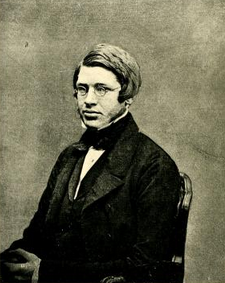
Alfred Russel Wallace,
doesn’t think Wallacinian
sounds that bad

Instead, Wallace is remembered today–if remembered at all–as the man second place to Darwin. But here at the BHL, we recognize Wallace as the naturalist, explorer, geographer, anthropologist, biologist, environmentalist and human rights advocate that he was. The man who, independently of Darwin, arrived to the same conclusion on the origin of species. To honor this somewhat neglected legacy on the 100th anniversary of his death, the BHL has dedicated this week, and this week’s book of the week post, to highlighting our collection of Wallace writings, discoveries and contributions to our understanding of the natural world. To give Wallace the defining word on his role in history, we turn to the description of his life penned by Wallace himself, My life: a record of events and opinions.

In this autobiographical work, Wallace traces his heritage, details his troubled childhood, recounts his early adventures and subsequent publications, and chronicles his transition to advocate and spiritualist–all through correspondence and recollections in his own words. Born to a large family of limited means in Hertfordshire, England, Wallace did not receive much formal education as his family couldn’t afford the demands of tuition. Instead, he was sent to live with his brother and apprentice as a railway surveyor, which–during the railroad boom of the 1830s–was a decent career.

However, young Wallace was not satisfied merely earning a living. He became fascinated by natural history, and through his self-education crossed paths with Henry Walter Bates. Bates was at 19 a published beetle expert and interested in adventure. The two resourceful young men decided to organize an expedition to the Amazon, selling specimens to make ends meet.

The trip did not go well for Wallace. Almost immediately Wallace and Bates separated, and Wallace headed east on the Rio Negro. Wallace relied entirely on native populations for guides, but locals were scarce and escorts rare, “this combined to render my numerous journeys in this almost totally unknown region comparatively unproductive in birds and insects.”
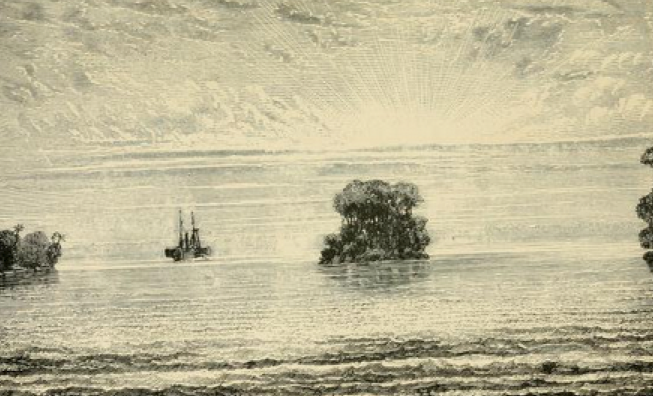
View Full Size Image
An illustration of the Rio Negro from Wallace’s
“A narrative of travels on the Amazon and Rio Negro”

Wallace spent four years in the Amazon, and while his luck in finding “miscellaneous collections” increased, luck in other areas did not. Wallace’s health suffered by a “succession of fevers and dysentery.” His younger brother, Herbert, joined him to help, and within five months, Herbert contracted yellow fever, dying within a few days. Wallace decided to return to England and recounted what happened on the voyage home:

On Friday…about nine in the morning, just after breakfast, Captain Turner, who was half-owner of the vessel, came into the cabin, and said, ‘I’m afraid the ship’s on fire. Come and see what you think of it.’…All hands were at once ordered into the boats…We lay near the ship all afternoon, watching the progress of the flames…[The boat] now presented a magnificent and awful sight as it rolled over, looking like a huge caldron of fire, the whole cargo of rubber, etc., forming a liquid burning mass at the bottom…we bade adieu to the Helen, now burnt down to the water’s edge…My collections, however, were in the hold, and were irretrievably lost. And now I began to think that almost all the reward of my four years of privation and danger was lost.

Wallace and the crew spent 10 days at sea before being rescued by a boat that itself barely made it back to shore.

Even without his collection of specimens that took four years to collect, Wallace published an account of his Amazon travels 18 months later, to little fanfare and much criticism. Undefeated, Wallace once again ventured into the field, this time to Southeast Asia for eight years. The result was an 1855 paper titled, “On the Law Which Has Regulated the Introduction of New Species,” outlining an introductory description of the theory of evolution. Much like his previous work, the article was a flop.

Three years later, Wallace found himself on an island in the Moluccas. Once again, he was destitute and attempting to make ends meet by selling his specimens. During his travels he contracted malaria, and in a feverish state, made a connection that lead to a manuscript detailing the principle of natural selection. Wallace had previously sent all his works directly to publishers. This time, he wanted a peer to review it first and sent it to someone he considered a mentor after beginning a correspondence following his last publication. That is, he sent it to Charles Darwin.
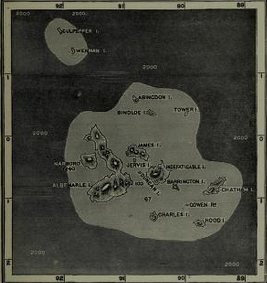
View Full Size Image
Wallace’s map of the Galapagos Islands
from his work, “Island Life”

Now imagine for a moment you are Darwin. Having worked on a theory for the last 20 years, Darwin had yet to publish anything. He receives this 20-page manuscript from a young acquaintance detailing his life’s work. “All my originality,” he wrote to his friend, geologist Charles Lyell, “will be smashed.” He considered publishing a summary of his own writing but continued, “I would far rather burn my whole book than that [Wallace] or any man should think that I had behaved in a paltry spirit.”

Instead, Darwin, Lyell and the botanist Joseph Hooker hastily arranged a reading of both Darwin and Wallace’s works before the Linnean Society on July 1, 1858. A year later, On the Origin of Species was published and the rest is history.

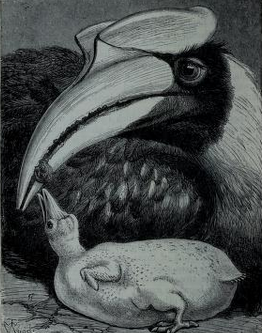
View Full Size Image
Illustration from
“The Malay Archipelago”
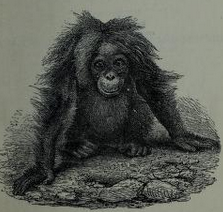
View Full Size Image
Another illustration from
“The Malay Archipelago”
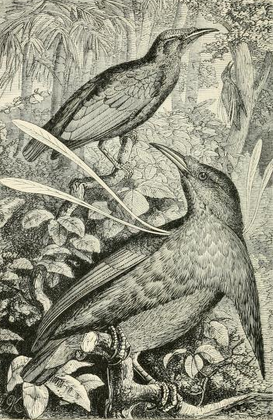
View Full Size Image
Wallace’s Bird of Paradise
from “The Malaysia and
Pacific Archipelagoes”

For Wallace’s part, he was never bitter about the lack of recognition. He embraced Darwin’s success almost as his own, writing, “Some…declare that I am more Darwinian than Darwin himself…and they are not far wrong.” Wallace became a part of the scientific elite and took pride in that fact:

I think, therefore, that I may have the satisfaction of knowing that by writing my article and sending it to Darwin, I was the unconscious means of leading him to concentrate himself on the task of drawing up what he termed ‘an abstract’ of the great work he had in preparation, but which was really a large and carefully written volume–the celebrated ‘Origin of Species.’

Darwin dedicated the rest of his life expounding and building upon “Origin.” Wallace went on to publish some 22 full-length books and almost 800 articles, only some focusing on his scientific achievements. He branched out to write on subjects varying from his embrace of spiritualism to land nationalization to dangerous working conditions for the urban poor. He advocated for the education of women “so that they are rendered independent of marriage as a means of gaining a home and a living,” and is considered one of the first scientists to raise concerns over the impact humans have on the environment.

Wallace is not the prominent figure that Darwin is, and his name is not representative of the theory that he described and advanced. But he was satisfied with the contributions he made to the field and didn’t define his life by the recognition that he could have received had he published first. And who says there’s no room in history for second place?

If you’re interested in Wallace’s compelling life story, learn more about his works as the BHL celebrates Wallace all this week. Check out some of his writings in our Wallace iTunes U collection or our previous book of the week post on Wallace’s The Malay Archipelago.

Want to learn more about the life and work of Alfred Russel Wallace? See this fantastic website containing biographical information, FAQ’s, links to his letters and the Wallace100 campaign sponsored by our partners The Natural History Museum, London.

References:

  • Conniff, R. (2008, June). On the Origin of a Theory. The Smithsonian Magazine. Retrieved from http://www.smithsonianmag.com/science-nature/presence-darwin.html
  • Garrity, L. (2009, Jan 22). Out of Darwin’s Shadow. Smithsonian.com. Retrieved from http://www.smithsonianmag.com/science-nature/Out-of-Darwins-Shadow.html

November 7, 2013by LANL_RL
BHL News, Blog Reel

Stormy Waters, Venomous Snakes and a Cup of Coffee: My Experience as a BHL Marketing Intern

A blinking cursor on a blank screen. 137 million objects, 8.2 million digitized items, illustrations and photographs, artifacts and first editions, spanning 19 institutions, 9 research centers, and hundreds of years. Where to begin?

View Full Size Image
It’s me, your local virtual marketing intern

It didn’t begin earlier this summer when I started working as the marketing intern at the BHL, and it didn’t begin earlier this year when I originally applied for the position. It probably didn’t even begin when I enrolled in the University of Washington’s master of library and information science iSchool. For the sake of argument, I’d say the beginning for me was when I was 6 years old and took my first trip to Washington, D.C. –it was my first visit to the White House and my first visit to a lot of the impressive and stunning historical sites and memorials.

But it wouldn’t have been a D.C. tour without marveling at the expansive and breathtaking collections of at least a few of the Smithsonian museums. The National Museum of American History, National Museum of Natural History, National Air and Space Museum, and, of course for a 6 year old, the National Zoo. I wasn’t aware that much information even existed, let alone could be housed in a complex of galleries, institutions, and cultural centers all free and open for anyone and everyone who had the inclination to explore.

This was a revelation. I wanted to be there, I wanted to be a part of any organization who’s mission centered on preserving history for the purpose of sharing it to contribute to our understanding of the world around us. That was the beginning, and it’s what set me on the path to pursue a profession in library sciences–though the love of cardigans, glasses, and metadata didn’t hurt either.

I didn’t get the same experience as a lot of BHL interns–mine was a virtual one. Instead of walking the halls of the prestigious institution, I received impromptu tours via Skype and experienced the library through my MacBook. Despite some of the drawbacks of not being physically present–or even in the same time zone–it also felt utterly appropriate to be connected to the BHL via a cable modem. This consortium of natural history and botanical libraries have created a highly-accessible, global, digitized collection with a mission of open access and adding to the biodiversity knowledge commons. Through BHL efforts, millions of pages of taxonomic literature have been digitized, and as part of my internship I was able to sort through tens of thousands of titles to share with the blog-reading public. Where to begin?

Under the expert guidance of Bianca Crowley, I used the BHL collection to explore and bring to light old stories and fascinating records. I traveled to the depths of the North Sea and learned of the adventurous men who trawled the harsh waters. Within the volumes also lay the life story of the prison-educated pioneer botanist, John Torrey, whose birthday necessitated a celebration of his contributions to the scientific community. I sought out among the acquisitions more information to soothe my coffee addiction and reviewed the history of the innocuous, but oh-so-delicious coffee berry. Ophidiophobia didn’t stop me from diving into the creepy, crawly world of venomous snakes. And the intriguing case of Elizabeth Blackwell and her wonderfully detailed, colorful illustrations of medicinal plants, just another highlight in the expansive literature.

I was only charged with finding five works to highlight from the BHL, but I didn’t want to stop, there was so much to discover. The blinking cursor gave way to a flow of words and I took full advantage of the 9 weeks of my summer term and the access to hundreds of thousands of titles. I was also asked to create a tutorial for the blog-publishing service that you’re using right now to read this post. From this, I discovered that I love instruction. These tutorials will ensure that my learning experiences will make it easier for the next BHL intern.

Bianca introduced me to the wonderfully supportive staff who encouraged me to pursue all my interests in this profession, including social media marketing, copyright issues, and information literacy. I will always be so grateful for this opportunity and those who were so giving of their time and experience to assist me on my path.

Now the question isn’t where to begin, the question has become where does it end?

Please check out my post highlighting Alfred Russel Wallace during BHL’s week of Wallace in November.

Connect with me on LinkedIn or Follow me @Kirsten_Clair

September 24, 2013by LANL_RL
Blog Reel, Featured Books

Book of the Week: The Curious Cures

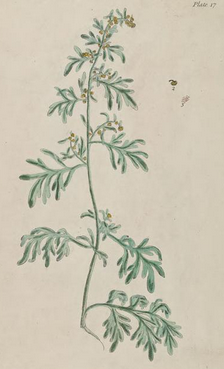
Take two of these and call in the morning. Those aren’t unusual words coming from a doctor if the “two of these” refers to some aspirin or Tylenol. It’d be a little more curious if the prescription called for two stalks of mugwort, infused with wine and a dash of salt. An interesting remedy for the common malady, but not something easily procured from the corner drug store. In the context of modern medicine this might seem an ineffective treatment, but in this week’s book of the week, “A curious herbal,” it’s the go-to recommendation for any and all disorders of the stomach, jaundice, general malaise, or swelling of the tonsils.

View Full Size Image
Blackwell’s illustration of the
Artemisia absinthium, cure for
the common stomachache.
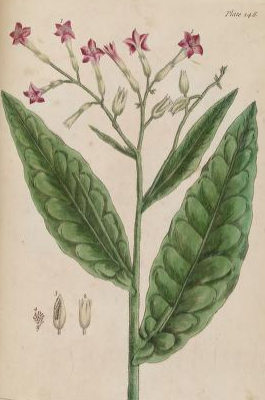
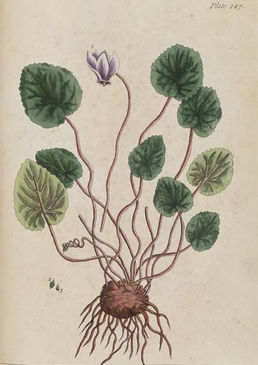
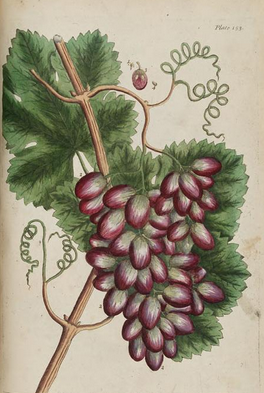
While this is not the first time “A curious herbal” has made an appearance on the BHL blog, this book offers such a variety of remedial plants that there’s an almost endless supply of medicinal instructions. Looking for a cure-all ointment or oil? Try Petum tabaccum, commonly known as tobacco. The green leaves of the plant can be used for wounds, ulcers, inflammations, tumors, and the mysterious “King’s Evil.” Even the dust “destroys Fleas, Lice, & other Vermine (sic).” Some of the plants require caution, but the Palma christi, referred to as “The greater Spurge” in the herbal, but also known as a castor oil plant, is recommended to be used with care for “watery Humors” as well as the oil extracted from the seeds “to destroy Lice in Children’s Heads.” And for a great preventative against the Plague, the Vitis vinifera, grown in Spain, Portugal, Italy, and France and flowering in April, is the approved plant of choice, also used to strengthen the stomach, help digestion and comfort the bowels. 
View Full Size Image
Petum tabaccum
View Full Size Image
Palma christi
View Full Size Image
Vitis vinifera

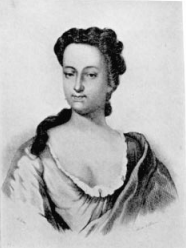
Capturing the habitats, descriptions, uses, and even the likeness of these functional plants was Elizabeth Blackwell. The legacy of Blackwell is non-existent in the history of medicine, her efforts largely dismissed as unscientific, but she was the first woman to produce an herbal, one that was innovative with an illustrated list of medicinal plants available to the medical community and the public.

View Full Size Image
Elizabeth Blackwell,
herbalist and bondsman,
from The British Library.

Blackwell’s hand-drawn illustrations and engravings were prompted by a debt and a prison sentence. Her husband and second cousin, Alexander, had a somewhat loose relationship with the law. Some shady dealings and a few questionable business decisions later, and Alexander found himself in debtors’ prison, and Blackwell found herself in a position where she needed a way to make some money quickly.

At the time, botany and the natural sciences had become a worthy pursuit of proper ladies. Blackwell had training in drawing and illustrating, had access to a printing press from one of her husband’s ne’er-do-well business pursuits, and had an idea to fill what she perceived as a void in the literature. “A curious herbal: containing five hundred cuts, of the most useful plants, which are now used in the practice of physick engraved on folio copper plans, after drawings taken from the life” was the result, issued in weekly parts and later published in two volumes.

It wasn’t the quickest means to pay off Alexander’s debts, but six years later, the book was published and Alexander was out of prison. The story didn’t end well for the couple. The two were separated after Alexander found himself on the wrong side of the law yet again, he attempted to flee, but was tried and hung for treason in 1748. Blackwell, who dedicated so many years to the herbal and immediately sold the copyright to pay off her husband’s debts, never saw him again and died ten years later.

The lack of notoriety for Blackwell herself notwithstanding, “A curious herbal” drew from the works of Sir Hans Sloane, Dr. Richard Mead, Isaac Rand and Philip Miller from the Society of Apothecaries, and Maria Sibylla Merian’s “Neues Blumen Buch,” and was the most prominent herbal of the day, still acclaimed for its detailed illustrations. Blackwell was by no means a doctor, but her herbal reference work informed the doctors–and patients–in this pre-drug store era and provides some tips for future herbalists when the Tylenol just doesn’t cut it.

Interested in more natural remedies? Check out Dr. Alain Touwaide and Emanuela Appetiti’s PLANT digital library, or rather the PLantarum Aetatis Novae Tabulae, a collection of full-text books on botany and medicinal plants printed during the 1481-1650 period. Or explore the great virtual exhibit from our BHL-Europe colleagues on all the history, legends, and, most importantly, delicious recipes surrounding other multi-use herbs and spcies.

Like the illustrations from this post? Check out this collection of medicinal plant illustrations from the BHL’s Flikr account.

References:

  • Beatty, K. (2013). “The Illustrated Herbal of Elizabeth Blackwell: A Curious Story.” Suite 101, retrieved from http://suite101.com/article/the-illustrated-herbal-of-elizabeth-blackwell-a-curious-story-a252195
  • Madge, B. (2001). “Elizabeth Blackwell–the forgotten herbalist?” Health Information and Libraries Journal, 18, p. 144-52.
September 19, 2013by LANL_RL
Blog Reel, Featured Books

Book of the Week: Don’t Tread On Me

Ophidiophobia is the irrational fear of snakes–those slithering, scaly reptiles that have been cast as the archetypal villain throughout history. Their unnatural movements and eerily flexible jaw joints do nothing to lessen their evil reputation. And even though the likelihood of encountering a snake is low, ophidiophobia is one of the most pervasive phobias in the world, making the famous question posited by Indiana Jones a fitting query, “Why did it have to be snakes?” In this week’s Book of the Week, we explore the notoriety and reality behind this cringe-worthy and feared animal in Doris Cochran’s “Poisonous reptiles of the world.”

View Full Size Image
Ancistrodon rhodostoma, a venomous pitviper species.

Despite the improbability of encountering a snake in the wild, there is still good reason to be afraid. Of the almost 3,000 varieties of snake species, about a third are deadly–killing prey with a venomous bite, squeezing victims to death, or, truly poisonous snakes known by the genus Rhabdophis, that carry a toxin to be absorbed indirectly.

But Cochran did not see a significant need for concern, especially in the United States where only one-sixth of the native snake population is dangerous, noting that “In the Untied States alone automobiles kill more than 30,000 people annually, snakes probably 160; for every person killed by a snake, 200 die in automobile accidents.” Granted, that was almost 80 years ago, but the statistics haven’t changed much over the years.

There is at least one species of venomous snake indigenous to each of the 48 contiguous United States–belonging to two major groups, Elapidae or Viperidae.

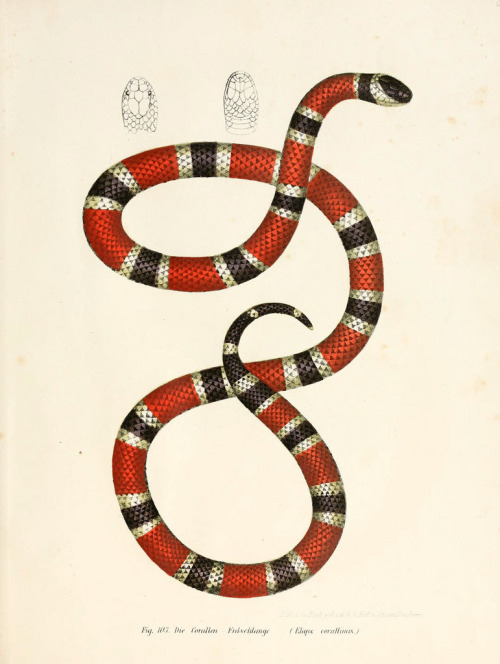
View Full Size Image
Coral snakes represent
the Elapidae group.
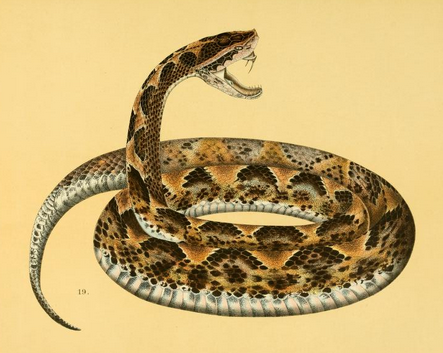
View Full Size Image
An example of the
Viperidae group,
most commonly recognized
as a rattlesnake.

The Elapidae group, most commonly represented by coral snakes, is similar in appearance to many harmless snakes. The North American variety rarely exceeds three feet in length and is commonly found in Southern states from North Carolina to the Gulf. To deliver its deadly bite, the short, vertical fangs must fully impale the victim’s flesh. While characterized as “sluggish” and “gentle” when handling, coral snakes tend to strike suddenly, leaving behind an almost imperceptible mark. The small impressions left by the attack can lead to neglect in dealing with the venom, often with deadly consequences.

Pit vipers have a more threatening name, a more notorious reputation, and outnumber the Elapidae in the United States with more than 35 species and subspecies recognized. The Viperidae group includes rattlesnakes, massasaugas, copperheads, and cottonmouths and have greater variety in physical attributes than found in the coral snakes.

The way pit vipers go after prey is most accurately described as a strike. North American snakes never jump completely off the ground during an attack, with the snake wrapped in an S position, leaving the posterior grounded for greater leverage. This allows for the body weight to drive the hollow fangs deep into the victim’s tissue, sometimes even breaking off and remaining in the wound, only to be regrown by the snake in several days. If a handler wished to remove all the fangs, rendering the snake harmless, the upper jaw would be so damaged that the snake would likely die. The venom is distributed by a tube connecting a specialized salivary gland in the jaw to the hollow tooth on the movable maxilla, and ultimately to the blood stream of the prey.

View Full Size Image
Figure of the venom apparatus in a standard
rattlesnake, with the jaw closed and fangs folded,
the jaws open and the fangs at the ready.

If a person is extremely unlucky, and circumstances align in such a way that a snake is encountered in the wild, and during that brush with danger the unlikely scenario occurs in which the snake attacks and venom is delivered, what happens next can vary widely, but consistently does not tend to be pleasant.

All venoms contain several toxins, the most important of which are the hemorrhagins and the neurotoxins. The hemorrhagins constitute the chief toxic elements of the venom of rattlesnakes and most of the other pit vipers while the neurotoxins characterize the venom of the coral snake and its relative the cobra. These venoms can coagulate blood within seconds, paralyze the respiratory system, or attack the nervous system, but common symptoms include blurred vision, convulsions, dizziness, fever, nausea, numbness, swelling, and weakness.

The effects of even a chance encounter with a snake are not encouraging. Despite medical advancements since this book’s publication, the standard recourse for a snake bite remains the same: get thee to a hospital! And if you weren’t sympathetic to Indiana Jones’ ophidiophobic plight in his adventures prior to reading this post, perhaps you are now.

For more information on the snakes described in Cochran’s “Poisonous reptiles of the world” and other creepy crawlies that pose a threat, check out this great virtual exhibit from our BHL-Europe colleagues on all things poisonous in nature.

September 12, 2013by LANL_RL
Blog Reel, Featured Books

Book of the Week: The Berry That Changed The World

Portrait version of the Biodiversity Heritage Library logo.

It’s been called the drink of civilization. The beverage that reflects the entire history of the Western world in one gulp. A small berry has sparked revolutions, genocide, imperialism, innovation–and yet is still able to satisfy the standard caffeine craving every morning. Coffee is a powerful concoction, serving as inspiration for most activities before lunch, and, this week, it also serves as inspiration for the

View Full Size Image
The cover of these week’s
Book of the Week

Book of the Week, “Coffee; its history and also its remarkable growth in the world of commerce.”

Most people would easily be able to pick a coffee bean out of a line up, but finding the coffee in nature might be more difficult. The plant that provides us with this intoxicating drink can be traced to the genus of Coffea, which varies from tree to shrub and comes in shades of purple, yellow, and green. Coffea arabica and Coffea canephora or robusta are the two most drinkable species that allow for the berries to be dried, roasted, and poured into your mug for consumption.

The origin story of this stimulant is murky. Coffee plants grow wild in the rocky soil of Ethiopia and several legends have cropped up about who first discovered they could roast the seeds of this abundant shrub.

View Full Size Image
Coffea arabica

One legend says that when the pious dervish Hadji Omar fell under the ban of the people of Mocha, and was driven forth in the year 1285, A.D., to perish in the wilderness, he roasted some of the berries that grew wild in the thickets, and some of them accidentally fell into the water which he had collected for drinking. He failed to notice it for some time, and when he did, lo ! coffee was discovered. He stole back into Mocha, proclaimed his discovery, and the Mochans […] took him back into favor, and made a saint of him on the spot.

The Mochans knew a good thing when they drank it, but were not the only ones who lay claim to this powerful breakthrough in berry consumption.

Another story gives credit to the friar of a monastery for the first use of coffee. The friar had great difficulty in keeping his monks awake during devotions, and on being told by a goatherd of the exciting effect, produced on his goats by eating coffee berries, he decided to try them on his charge. He did so with admirable results and thus was discovered the great stimulating effects of coffee, which prepared the way for its world-wide popularity.

To allow for this expansion in caffeine indulgence, greater cultivation was needed.

View Full Size Image
Illustration,
Thompson &
Taylor
Spice Co.

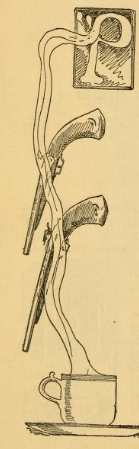
Harsh conditions on coffee plantations led to unrest, uprisings, and suppression, leading to the proliferation of the expression, “Pistols for two, and coffee for one.” Dutch East India Company and British East India Company, some of the first multinational corporations, were founded to monetize coffee and import the berries–which were mistakingly referred to as “beans” due to a certain likeness.
Part of the appeal to coffee has always been the caffeine. Caffeine is a naturally occurring stimulant acting as a psychoactive drug similar to cocaine. With such an intoxicating chemistry, it’s easy to understand why coffee parties and coffee-houses quickly became establishments–gathering places for those looking to partake in a cup as well as exchange gossip and ideas. Newspapers were created, businesses chartered, revolutions planned, even music composed by the likes of Bach and Beethoven in the cáfes of Europe.

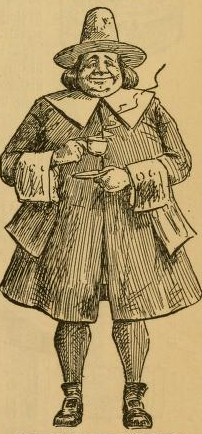
View Full Size Image
An American
enjoying his
coffee.

In America, coffee was slow to replace traditional alcoholic favorites. However, once the colonists declared some independence from the notoriously tea-loving empire, coffee became the beverage of choice. In one letter to his wife, Abigail, John Adams wrote his affection for tea was stronger, but he made the switch to coffee as it was the more patriotic option.

Despite this resistance, it was not long before coffee addiction had taken hold in the states. During the Civil War, the Union knew how to put a hurt on the South and a naval blockade prevented vital materials from making its way to port–coffee was one of these essential restricted items. Union soldiers took to chewing whole beans, while the Confederate troops were forced to find workable substitutes. An unsuccessful endeavor as Rebels on the front lines often called for informal truces so Southern tobacco could be swapped for the precious Northern drink.

Coffee is now engrained in Western culture, from cultivation on large plantations to a Starbucks on every corner. Coffee talk is shorthand for both small talk and a popular Saturday Night Live skit. Coffee is the reason for an extra break at work and the best part of waking up. So pour another cup and enjoy the bittersweet concoction almost a thousand years in the making, with or without cream.

References:

  • Norris, D.A. (2007, October 29). How a coffee played a role in Civil War. CNN. Retrieved from www.cnn.com/2007/LIVING/wayoflife/10/29/mf.coffee.confederacy/.
  • Zuraw, L. (2003, April 24). How Coffee Influenced The Course Of History. NPR. Retrieved from www.npr.org/blogs/thesalt/2013/04/24/178625554/how-coffee-influenced-the-course-of-history.


August 29, 2013by LANL_RL
Blog Reel, Featured Books

Book of the Week: Adventures on the North Sea

The North Sea—at least according to Walter Wood—was awash in blood and fish. Thus, the title of this week’s Book of the Week “North Sea fishers and fighters,” equates men drawn to the sea for the allure of earning a living and trawling to those drawn to battle for the allure of adventure and bloodshed.

Like a modern-day documenter of “The Deadliest Catch,”Wood himself was drawn to recreating the adventure of deep sea fishing during the turn of the century, writingseveralbookswith a central metaphor of fisherman as warriors. By Wood’s account, the sheer number of fish drawn in by those who braved the stormy waters of the North Sea warranted the combative analogy:
War to-day is waged as fiercely on the North Sea as it ever was when Jutlanders and Vikings came to England. But it is another sort of fight, a battle with unnumbered hosts that dwell in gloomy waters and are seldom seen till they are conquered.
View Full Size Image
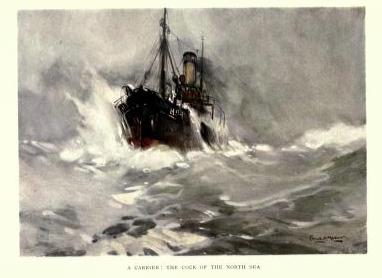
Illustration by Frank H. Masondepicting the tempestuous waters of the North Sea.
To capture the lives of the fishermen, Wood embedded himself on the boats, getting first-hand accounts of the dangers faced on a daily basis. Often the men would first have to battle the weather before they got to their ultimate adversaries—the fish. Packed into cramped spaces below deck, they had little refuge from their duties above board. The fishermen hoped for good luck while at sea but it was difficult to avoid injury. In the year witnessed by Wood, more than 15,000 patients were medically or surgically treated for everything from minor burns to broken limbs to severe head trauma, and available treatment was far from topnotch.
I heard a North Sea skipper tell how […] he severely injured his arm. For sixteen weeks he remained at sea, with no opportunity of getting the wound treated, except in the roughest fashion; there was not time when he came ashore to cure it, and he had to go back to the fleet, a helpless youngster, and let chance do the healing. This is merely one—and not a lurid—instance of the neglect and suffering […] when a mixture of turpentine and treacle was reckoned an efficient medicine.
View Full Size Image
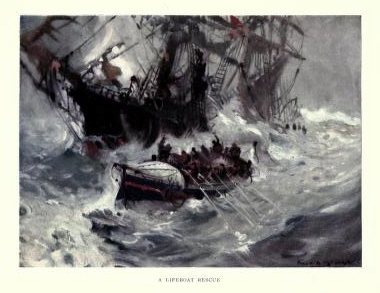
Another color illustration by Frank H. Mason with a lifeboat coming to the rescue of a ship in distress.
To Wood, despite the danger, there was something that drew men to sea, and “North Sea fishers and fighters” primarily focuses on the opportunity for fishermen to test their mettle far from shore. Though, not least of these motivations are the treasures contained within the water’s depths. Wood recounts the riches fishermen braved treacherous conditions to capture—the copious amounts of fish just below the surface of the raging water.
If the North Sea waters were translucent, what a wondrous sight would be presented to the voyagers upon its surface! Countless myriads of fishes find existence […] an almost solid moving dark or silver mass. […] Rich hauls of gold have been taken by sinking shafts; but hauls of silver fish, as precious, have been made from the prolific waters of the Bank […] a region which, in its way, has been as profitable as some of the goldfields of Australia.
View Full Size Image
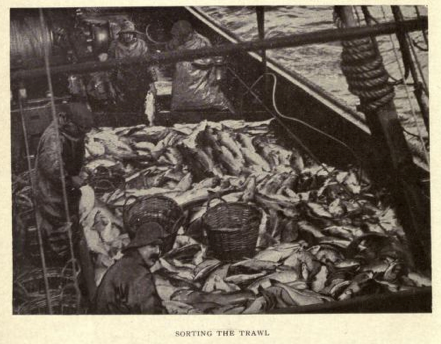
Illustration from Neal Green with fishermen sorting through the trawl.
Wood was not a naturalist by any means, preferring instead to capture the inner workings of the fishing vessel. But the fish are what drove the men to battle, and Wood couldn’t help but be captivated by the crowded masses, shown here in his depiction of the sheer tonnage hauled in by each ship: “It was not uncommon for 3 tons of fish to be caught at a time, […] I have seen one of the old beam-trawls so crammed with haddock that it could not be hauled; as a matter of fact, the net burst and the dead haddock were as thick on the surface of the water as an icefloe (sic).”
This freight would be a huge payload for the North Sea fisheries and crew. “During 1910 there were landed 141,246 tons of fish, of the value of £1,300,000.” The varieties of fish brought to port on an average day would contain soles, haddock, plaice, whiting, and—with any luck—turbot, brill, and cod.
View Full Size Image
Several fish varieties found in the North Sea.
“Brilliant” and “abundant” is how Wood characterized the supply of fish he witnessed during his travels. To this day, fishing in the North Sea remains a significant industry, but the fishing practices known by Wood are no longer sustainable. Over-fishinghas become a concern in many areas, including the North Sea, as mature fishes are fewer and annual catches continue to decline. It is unlikely Wood could recognize the regulation required of modern fishermen as they incorporate preservation into their industry, though he would definitely still detect a certain allure of adventure—and especially danger—in today’s fishers and fighters of the North Sea.
References:
  •  Britain: Catching a cold; fishing. (2002, Nov 09). The Economist, 365, 28-60. Retrieved from http://search.proquest.com/docview/224037153?accountid=14784
  •  Green, Neal. Fisheries of the North Sea, by Neal Greet. With two illustrations and a map. London: Methuen & Co. Ltd., 1918.
  •  Wood, Walter. North Sea fishers and fighters, by Walter Wood. With colour and pencil illustrations by Frank H. Mason and photographs by the author. London: K. Paul, Trench, Trübner & Co., Ltd., 1911.
August 8, 2013by LANL_RL

Help Support BHL

BHL's existence depends on the financial support of its patrons. Help us keep this free resource alive!

search

About BHL

The Biodiversity Heritage Library (BHL) is the world’s largest open access digital library for biodiversity literature and archives. BHL operates as a worldwide consortium of natural history, botanical, research, and national libraries working together to digitize the natural history literature held in their collections and make it freely available for open access as part of a global “biodiversity community.”

Join Our Mailing List

Sign up to receive the latest news, content highlights, and promotions.

Subscribe Now

Subscribe to Blog via Email

Enter your email address to subscribe to this blog and receive notifications of new posts by email.

Join 319 other subscribers

Subscribe to Blog Via RSS

Subscribe to the blog RSS feed to stay up-to-date on all the latest BHL posts.

Access RSS Feed

Inspiring Discovery through Free Access to Biodiversity Knowledge.

The Biodiversity Heritage Library makes it easier than ever for you to access the information you need to study and explore life on Earth…for free, anytime, anywhere.


ABOUT | HARMFUL CONTENT | PRIVACY | SITE MAP | TERMS OF USE