Biodiversity Heritage Library - Program news and collection highlights from BHL
  • Home
  • News
  • Featured Books
    • All Featured Books
    • Book of the Month Series
    • BHL at 20
  • User Stories
  • Campaigns
    • Fossil Stories
    • Garden Stories
    • Monsters Are Real
    • Page Frights
    • Her Natural History
    • Earth Optimism 2020
  • Tech Blog
  • Visit BHL
Home
News
Featured Books
    All Featured Books
    Book of the Month Series
    BHL at 20
User Stories
Campaigns
    Fossil Stories
    Garden Stories
    Monsters Are Real
    Page Frights
    Her Natural History
    Earth Optimism 2020
Tech Blog
Visit BHL
  • Home
  • News
  • Featured Books
    • All Featured Books
    • Book of the Month Series
    • BHL at 20
  • User Stories
  • Campaigns
    • Fossil Stories
    • Garden Stories
    • Monsters Are Real
    • Page Frights
    • Her Natural History
    • Earth Optimism 2020
  • Tech Blog
  • Visit BHL
Biodiversity Heritage Library - Program news and collection highlights from BHL

All posts by michelle.underhill

Blog Reel, Campaigns, Featured Books, Fossil Stories

Uncovering the “Fish Lizard”: Ichthyosaurs and Home

Read the full blog post
When the fossils of extinct species were first discovered, they were often misidentified. Case in point: Ichthyosaurs. The first probable illustrations of ichthyosaur fossils were published by Edward Lhuyd in his Lithophylacii Brittannici Ichnographia, 1699. He attributed the fossils to fish. In 1708, Swiss naturalist Johann Jakob Scheuchzer attributed two ichthyosaur vertebrae to a man who drowned during the Biblical flood. In 1783, an ichthyosaur jaw with teeth was exhibited by the Society for Promoting Natural History as those of a crocodilian.
Continue reading
October 15, 2015byGrace Costantino
Blog Reel, Campaigns, Featured Books, Fossil Stories

Fact or Fiction? Discovering the Mosasaur

Read the full blog post
If you’ve seen Jurassic World (or even just the trailers), then you’re familiar with Mosasaurus.
Continue reading
October 14, 2015byGrace Costantino
Blog Reel, Campaigns, Featured Books, Fossil Stories

A Sinner Killed During the Great Flood or a Fossil Reptile? Discovering the Plesiosaur

Read the full blog post
Most people today are at least somewhat familiar with the order of extinct marine reptiles known as Plesiosauria, thanks to the legend of the Loch Ness monster, which is often described as resembling a plesiosaur. Indeed, some argue that Nessie may in fact be a surviving member of this order. Scientists, however, reject this suggestion, if for no other reason that the Loch Ness lake formed a mere 10,000 years ago, while the fossil record indicates that plesiosaurs went extinct over 66 million years ago. And yet, even if plesiosaurs can’t account for the Loch Ness legend, the story of their discovery is still captivating. Plesiosaurs are among the first extinct fossil reptiles to be recognized as such.
Continue reading
October 14, 2015byGrace Costantino
BHL News, Blog Reel, Campaigns, Fossil Stories

Webcast! Exploring the Smithsonian’s FossiLab

Read the full blog post
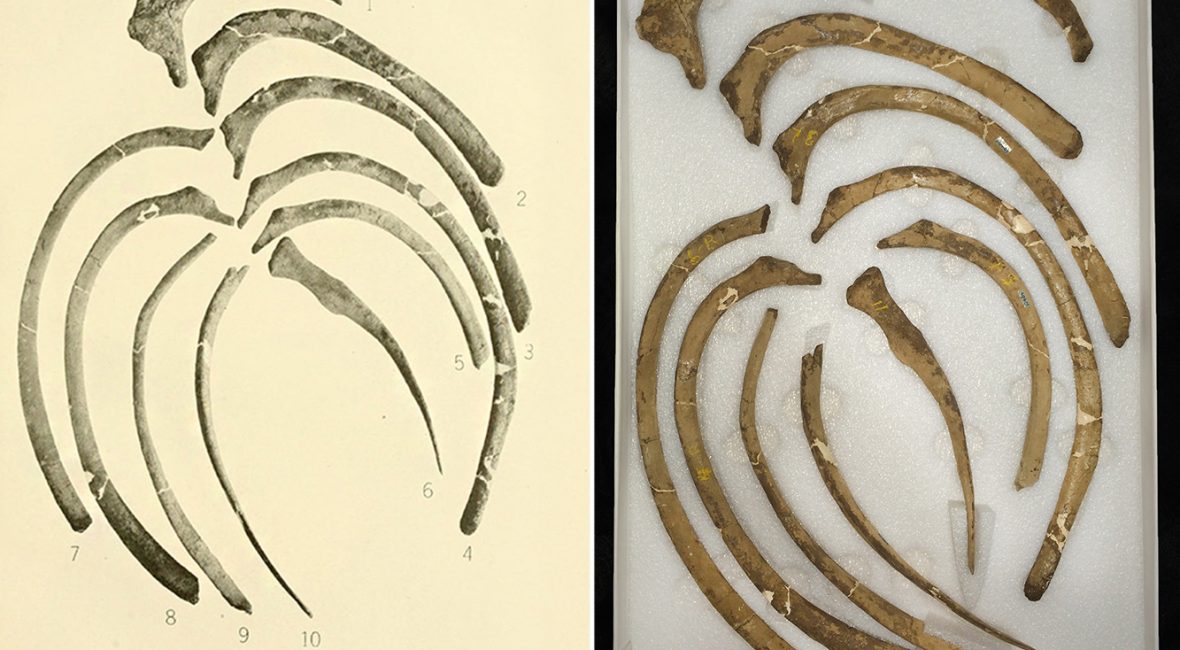
The Smithsonian National Museum of Natural History’s FossiLab is a busy place, responsible for preparing newly-collected fossils for Smithsonian’s scientists and maintaining the fossils in the Smithsonian’s collection. Visitors to the museum can actually watch staff and volunteers at work in the FossiLab, which is located within the Last American Dinosaurs Exhibition. One of the projects in the FossiLab is the conservation and rehousing of specimens from the Museum’s fossil marine mammal collection. The specimens range from individual teeth to skulls, jaws and more-or-less complete skeletons comprised of both intact and fragmentary bones.
Continue reading
October 14, 2015byGrace Costantino
Blog Reel, Campaigns, Featured Books, Fossil Stories

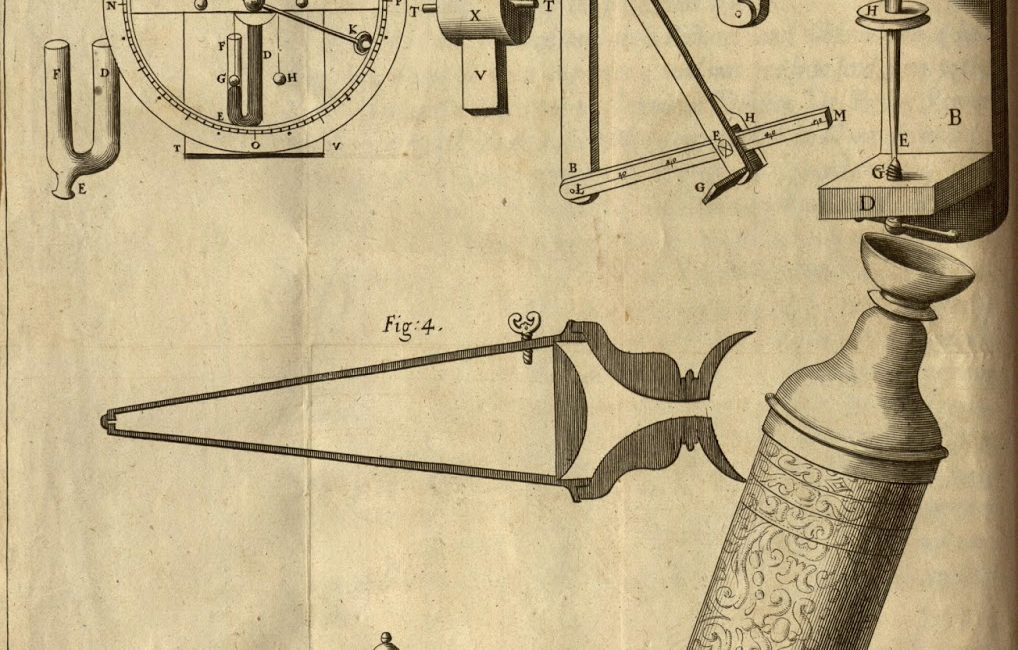
Fossils Under the Microscope: Hooke and Micrographia

Read the full blog post
By the seventeenth century, it was still widely believed that species could not become extinct, and there were still many hypotheses about the origin of fossils. One widely-held belief, extending back to Aristotle’s time, was that fossils were formed by the Earth itself, and that some “extraordinary Plastick virtue” could create stones that resembled, but were not, living organisms. But also during the seventeenth century, some critical advances in the world of science were having an impact on fossil research. Robert Hooke was born at Freshwater, on the Isle of Wight, in 1635. Though of humble origins, he eventually studied at Oxford and impressed many of England’s leading scientists with his ability to design experiments and build equipment.
Continue reading
October 13, 2015byGrace Costantino
BHL News, Blog Reel, Campaigns, Fossil Stories

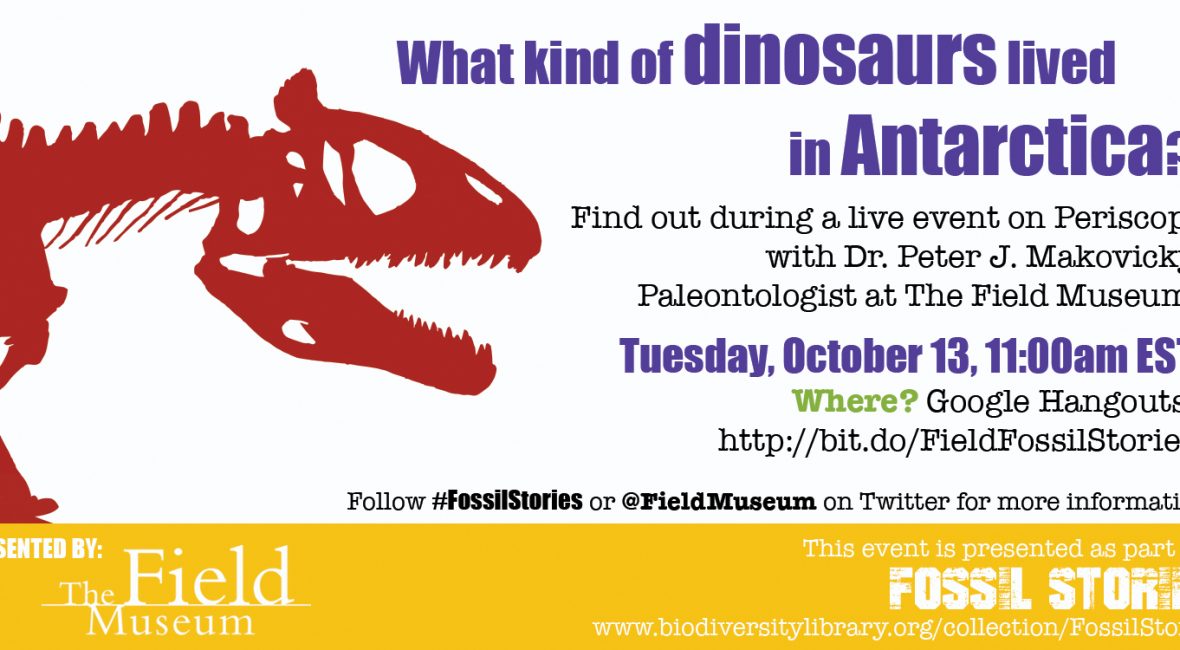
Webcast! Exploring Antarctic Dinosaurs with The Field Museum

Read the full blog post
During the 1990-91 austral summer, geologist David Elliot came across fossil bones on Mount Kirkpatrick in the Beardmore Glacier region of the Transantarctic Mountains in Antarctica at an altitude of ~4,000 m (13,000 ft) high and about 640 km (400 mi) from the South Pole. The team notified paleontologist Bill Hammer, who then excavated the fossil-bearing rock over a three week period. The excavated skeleton was eventually given the name Cryolophosaurus ellioti in an 1994 article in Science by Hammer and paleontologist William J. Hickerson.
Continue reading
October 13, 2015byGrace Costantino
BHL News, Blog Reel

BHL in Africa! Workshop & TDWG

Read the full blog post
An international ensemble of biodiversity-minded professionals recently gathered in Nairobi, Kenya for two weeks of trainings and conferences. From 24-26 September, 2015, fifteen representatives from eleven institutions throughout South Africa, Kenya, and Uganda attended a BHL Africa training workshop at the National Museums of Kenya. Following the workshop, 28 September – 1 October, 2015, the TDWG Annual Conference was held at the Windsor Golf Hotel and Country Club in Nairobi. The BHL Africa Workshop was an opportunity to provide training and help build capacity amongst the current signatories of the BHL Africa MOU.
Continue reading
October 7, 2015byGrace Costantino
Page 27 of 47« First...1020«26272829»3040...Last »

Help Support BHL

BHL’s existence depends on the financial support of its patrons. Help us keep this free resource alive!

Donate Now

search

About BHL

The Biodiversity Heritage Library (BHL) is the world’s largest open access digital library for biodiversity literature and archives. BHL operates as a worldwide consortium of natural history, botanical, research, and national libraries working together to digitize the natural history literature held in their collections and make it freely available for open access as part of a global “biodiversity community.”

Follow BHL

  • Bluesky logo
  • Facebook logo
  • Flickr logo
  • Twitter logo

Join Our Mailing List

Sign up to receive the latest news, content highlights, and promotions.

Subscribe Now

Subscribe to Blog Via RSS

Subscribe to the blog RSS feed to stay up-to-date on all the latest BHL posts.

Access RSS Feed

Inspiring Discovery through Free Access to Biodiversity Knowledge.

The Biodiversity Heritage Library makes it easier than ever for you to access the information you need to study and explore life on Earth…for free, anytime, anywhere.

63+ Million Pages of
Biodiversity Literature Online.

EXPLORE

Tools and Services
to Transform Research.

EXPLORE

300,000+
Illustrations on Flickr.

EXPLORE


ABOUT | BLOG AUTHORS | HARMFUL CONTENT | PRIVACY | SITE MAP | TERMS OF USE

Download Adobe Acrobat Reader