Biodiversity Heritage Library - Program news and collection highlights from BHL
  • Home
  • News
  • Featured Books
    • All Featured Books
    • Book of the Month Series
    • BHL at 20
  • User Stories
  • Campaigns
    • Fossil Stories
    • Garden Stories
    • Monsters Are Real
    • Page Frights
    • Her Natural History
    • Earth Optimism 2020
  • Tech Blog
  • Visit BHL
Home
News
Featured Books
    All Featured Books
    Book of the Month Series
    BHL at 20
User Stories
Campaigns
    Fossil Stories
    Garden Stories
    Monsters Are Real
    Page Frights
    Her Natural History
    Earth Optimism 2020
Tech Blog
Visit BHL
  • Home
  • News
  • Featured Books
    • All Featured Books
    • Book of the Month Series
    • BHL at 20
  • User Stories
  • Campaigns
    • Fossil Stories
    • Garden Stories
    • Monsters Are Real
    • Page Frights
    • Her Natural History
    • Earth Optimism 2020
  • Tech Blog
  • Visit BHL
Biodiversity Heritage Library - Program news and collection highlights from BHL
Blog Reel, Campaigns, Featured Books, Fossil Stories

Naming the Second Dinosaur: Mantell and Iguanodon

The second validly-named dinosaur was Iguanodon, but the identification of its fossils as a distinct and extinct species was a somewhat long and arduous process.

In 1822, Gideon Mantell, English geologist and paleontologist, came into possession of some large fossil teeth, discovered either by himself or his wife, Mary Ann. At the time of the discovery, Mantell had been acquiring and studying British fossils for several years, and he was in the process of publishing his first book, The Fossils of South Downs (1822).

Realizing that the teeth were something unique, but not certain what they were, Mantell presented them to several members of the Geological Society of London, including William Buckland, who described and validly named the first dinosaur genus, Megalosaurus. Geologist Charles Lyell also showed some of the teeth to the “Father of Paleontology,” Georges Cuvier. The teeth were initially dismissed as belonging to fish or a rhinoceros (even Cuvier at first attributed them to a rhinoceros). However, after his publication on Megalosaurus, Buckland again viewed Mantell’s collection of teeth, this time concluding that they were in fact teeth from a giant reptile, which he believed to be carnivorous. Emboldened by Buckland’s opinion, Mantell again sent some of the teeth to Georges Cuvier, who this time responded that he believed they were actually reptilian, belonging to an herbivore of some kind.

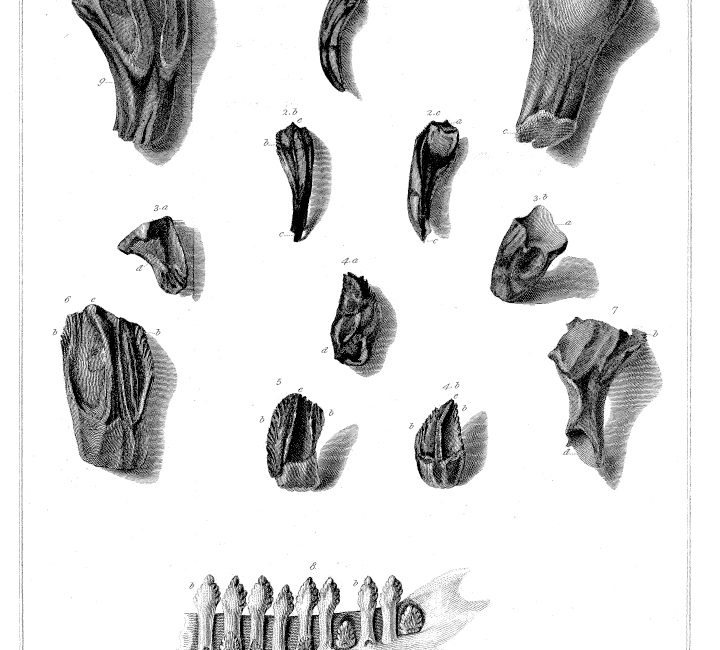
View Full Size Image
The original Iguanodon teeth described by Mantell. Philosophical Transactions of the Royal Society of London. v. 115. 1825. http://biodiversitylibrary.org/page/48364668. Digitized By: Natural History Museum, London.

Hoping to elucidate the nature of the teeth further, Mantell visited the Royal College of Surgeons in 1824, where he discovered that his teeth resembled those of an iguana skeleton recently prepared by the College’s assistant-curator, Samuel Stutchbury.

Mantell was finally ready to formally present his findings. In recognition of the resemblance between modern iguana teeth and his own fossils, Mantell gave his genus the name Iguanodon, meaning “iguana-tooth.” The name and description were published in the Philosophical Transactions of the Royal Society of London in 1825 within his article “Notice on the Iguanodon, a Newly Discovered Fossil Reptile, from the Sandstone in Tilgate Forest, in Sussex.”

View Full Size Image
Fossil Iguanodon remains described by Mantell. Now classified as Mantellodon carpenteri. Mantell, Gideon. The Wonders of Geology. v. 1 (1841). http://biodiversitylibrary.org/page/40448764. Digitized by: Smithsonian Libraries.

Although the genus name Iguanodon means “iguana-tooth,” Iguanodon represents ornithopod, herbivorous dinosaurs, which we now know are only very distantly related to modern snakes, lizards (like iguanas), and turtles (learn more about how dinosaurs, modern reptiles, and birds are related). Nevertheless, Mantell’s description represents the second dinosaur genus to be described and validly named, and together with Megalosaurus and Hylaeosaurus, were used to define Dinosauria in 1842.

Fossil Stories

Stay tuned all week for more great fossil fun with our #FossilStories campaign, including:

  • Tweets and Facebook Posts
  • Blog Posts highlighting milestones and key publications in the history of fossil research
  • A Flickr Collection with hundreds of historic fossil illustrations
  • A Pinterest Collection featuring a selection of our favorite fossil illustrations
  • A BHL Collection containing seminal publications in the history of paleontology
  • A series of live webcasts at BHL partner institutions
  • A citizen science challenge in collaboration with The Field Book Project, the Smithsonian Transcription Center, and Smithsonian Institution Archives
Follow #FossilStories on Twitter and Facebook to learn more.
October 15, 2015by michelle.underhill
Blog Reel, Campaigns, Featured Books, Fossil Stories

The First Described and Validly Named Dinosaur: Megalosaurus

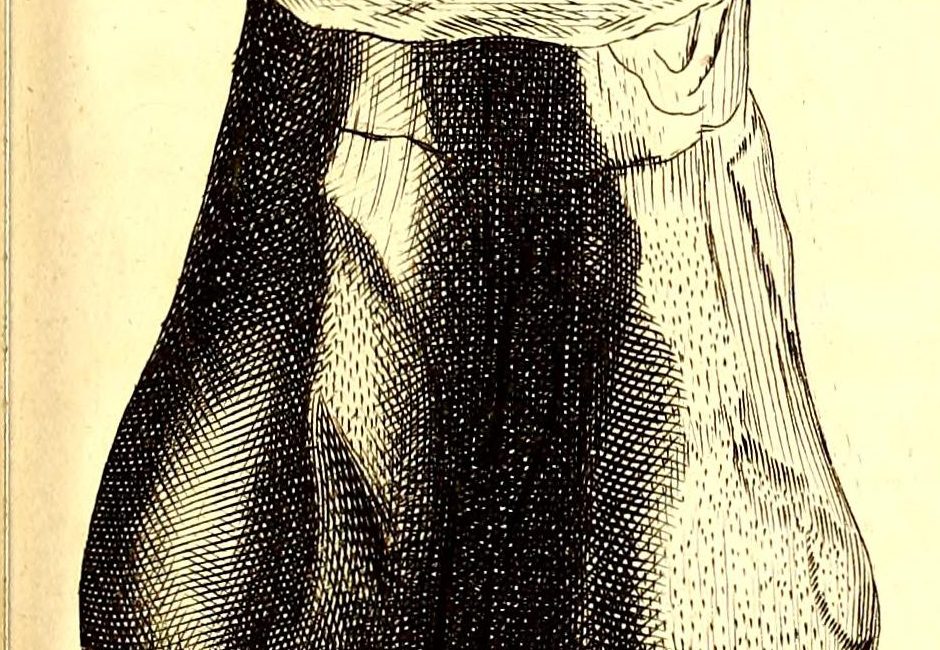
In 1676, the lower part of a massive femur was discovered in the Taynton Limestone Formation of Stonesfield limestone quarry, Oxfordshire. The bone was given to Robert Plot, Professor of Chemistry at the University of Oxford and first curator of the Ashmolean Museum. Plot published a description of it in 1677 in the Natural History of Oxfordshire. The illustration that accompanied the description is the first known published illustration of a dinosaur bone.

View Full Size Image
First published illustration of a dinosaur bone. The Natural History of Oxfordshire. 1677. http://biodiversitylibrary.org/page/48062596. Digitized by Smithsonian Libraries.

Plot first concluded that the bone belonged to a Roman war elephant, but later decided that it must instead represent the thighbone of a giant human like those described in the Bible. In 1763, Richard Brookes used Plot’s illustration of the thigh bone in his six-volume publication A System of Natural History. His reproduction of the illustration includes a caption that reads Scrotum Humanum, referencing the visual similarity between the bone and the human scrotum. Though the name is not considered valid today, its structure, following the Linnaean system of binomial nomenclature, has caused some to argue that it represents the first species name ever applied to an extinct dinosaur, because this thighbone does not, in fact, belong to a giant human, as Plot concluded. It belonged to a dinosaur, probably a Megalosaurus, although, since the specimen has since been lost, it’s impossible to know with certainty which species it belonged to.

Scrotum Humanum notwithstanding , Megalosaurus represents the first dinosaur genus to be described and validly named. In 1824, William Buckland gave the genus the name Megalosaurus in his article “Notice on the Megalosaurus or Great Fossil Lizard of Stonesfield,” describing it as an extinct giant reptile. The lithograph of the Megalosaurus jaw that accompanied the description was based on drawings done by Buckland’s wife, Mary Morland. Later in 1827, Gideon Mantell, in his The Geology of the southeast of England, assigned the type specimen its current valid binomial: Megalosaurus bucklandii.

View Full Size Image
Megalosaurus jaw and teeth. Transactions of the Geological Society. ser.2, v. 1 (1824). http://biodiversitylibrary.org/page/36238855. Digitized by: California Academy of Sciences.

The carnivorous Megalosaurus, together with the herbivorous Iguanodon and armored Hylaeosaurus, were the three genera later used by Richard Owen to define Dinosauria.

Fossil Stories

Stay tuned all week for more great fossil fun with our #FossilStories campaign, including:

  • Tweets and Facebook Posts
  • Blog Posts highlighting milestones and key publications in the history of fossil research
  • A Flickr Collection with hundreds of historic fossil illustrations
  • A Pinterest Collection featuring a selection of our favorite fossil illustrations
  • A BHL Collection containing seminal publications in the history of paleontology
  • A series of live webcasts at BHL partner institutions
  • A citizen science challenge in collaboration with The Field Book Project, the Smithsonian Transcription Center, and Smithsonian Institution Archives
Follow #FossilStories on Twitter and Facebook to learn more.
October 15, 2015by ulib-libraryjobs
Blog Reel, Campaigns, Featured Books, Fossil Stories

Identifying the First Flying Reptile: Pterosaurs

Pterosaurs, flying reptiles that lived 228-66 million years ago, are the earliest vertebrates known to have evolved the capacity for powered flight.

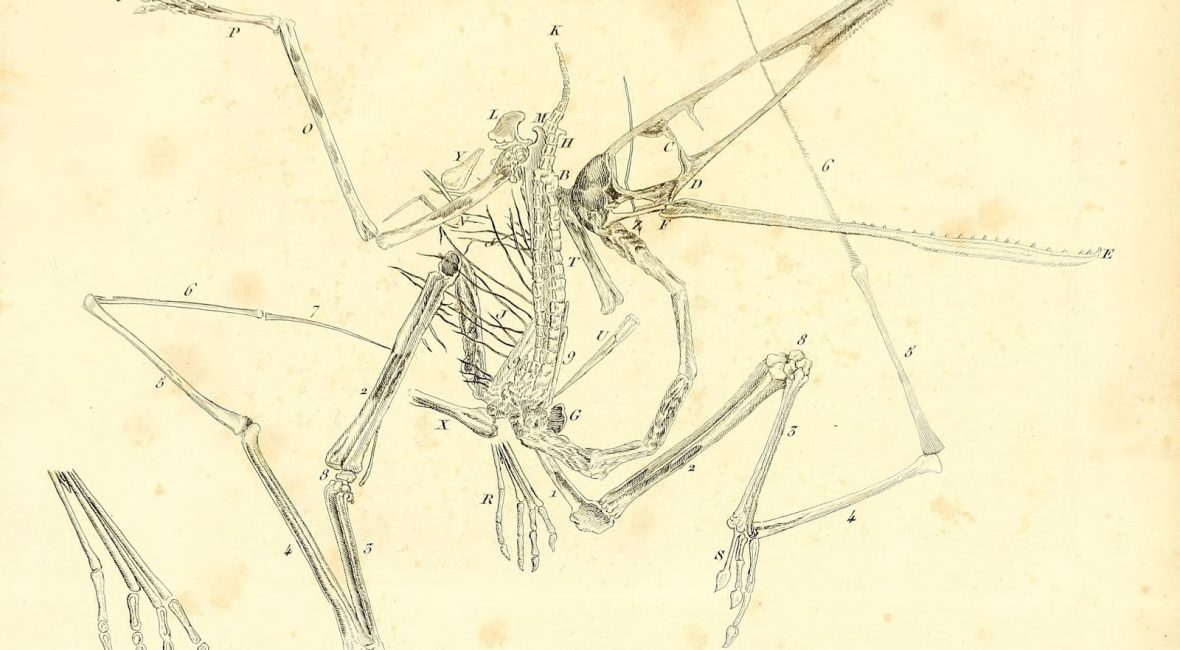
The first known pterosaur specimen was described by Cosimo Alessandro Collini in 1784. Twenty years earlier, in 1764, Collini had been appointed to supervise the Naturalienkabinett at Mannheim, established as part of the Kurpfälzische Academy of Sciences, in present-day Germany. The first-known pterosaur specimen arrived at Mannheim sometime between 1767 and 1784, probably originating from Bovaria. Collini was baffled by the specimen, but deduced that it was not a bird or a bat. He concluded that it must have been some form of marine creature, since he assumed that the ocean depths were more likely than land to house unknown species.

View Full Size Image
Collini’s pterosaur. Cuvier, Georges. Recherches sur les ossemens fossiles de quadrupèdes. t. 4 (1812). http://biodiversitylibrary.org/page/40032094. Digitized by: Smithsonian Libraries.

In 1800, Jean Hermann, Professor of Medicine in Strasbourg, drew the legendary paleontologist Georges Cuvier’s attention to the specimen through a letter that included the first restoration of a pterosaur. Hermann interpreted the figure as an intermediate form between birds and mammals and correctly deduced that the long fourth finger was used to support a wing membrane.

Reviewing Collini’s description and conclusions, Cuvier declared that the animal was actually an extinct flying reptile, which he named “Ptero-Dactyle” (Greek for “wing finger”). Cuvier published his findings in a short description in 1801 and then followed it with a longer publication in 1809. In 1818, Lorenz Oken, Professor of Medicine and Natural History at Jena, latinized Cuvier’s name to Pterodactylus.

In 1812, Samuel Thomas von Sömmerring at the Academy of Science of Bavaria published the first binomial for a pterosaur. Working from the Collini specimen, Sömmerring named the creature Ornithocephalus antiquus (now Pterodactylus antiquus), believing it to be a form between mammals and birds (with which Cuvier disagreed. He again described the pterosaur as a reptile in his 1812 publication). Even into the mid-1800s, despite mounting evidence for the reptilian interpretation, many still believed that Pterodactylus antiquus represented other groups. For instance, in 1830, German zoologist Johann Georg Wagler published a paper on amphibians in which he interpreted the pterosaur’s wings as flippers.

View Full Size Image
Pterosaur with wings interpreted as flippers. Wagler, Johann Georg. Natürliches System der Amphibien. 1830. http://biodiversitylibrary.org/page/38966085. Digitized by: Smithsonian Libraries.

Although many additional Pterodactylus species were named over the years, these were found to belong to other genera or to be juvenile forms of P. antiquus, which is now the only valid species within this genus.

Fossil Stories

Stay tuned all week for more great fossil fun with our #FossilStories campaign, including:

  • Tweets and Facebook Posts
  • Blog Posts highlighting milestones and key publications in the history of fossil research
  • A Flickr Collection with hundreds of historic fossil illustrations
  • A Pinterest Collection featuring a selection of our favorite fossil illustrations
  • A BHL Collection containing seminal publications in the history of paleontology
  • A series of live webcasts at BHL partner institutions
  • A citizen science challenge in collaboration with The Field Book Project, the Smithsonian Transcription Center, and Smithsonian Institution Archives
Follow #FossilStories on Twitter and Facebook to learn more.
October 15, 2015by michelle.underhill
Blog Reel, Campaigns, Featured Books, Fossil Stories

Uncovering the “Fish Lizard”: Ichthyosaurs and Home

When the fossils of extinct species were first discovered, they were often misidentified. Case in point: Ichthyosaurs.

The first probable illustrations of ichthyosaur fossils were published by Edward Lhuyd in his Lithophylacii Brittannici Ichnographia, 1699. He attributed the fossils to fish. In 1708, Swiss naturalist Johann Jakob Scheuchzer attributed two ichthyosaur vertebrae to a man who drowned during the Biblical flood. In 1783, an ichthyosaur jaw with teeth was exhibited by the Society for Promoting Natural History as those of a crocodilian. In 1804, Edward Donovan discovered a four metres long ichthyosaur specimen that he described as a giant lizard.

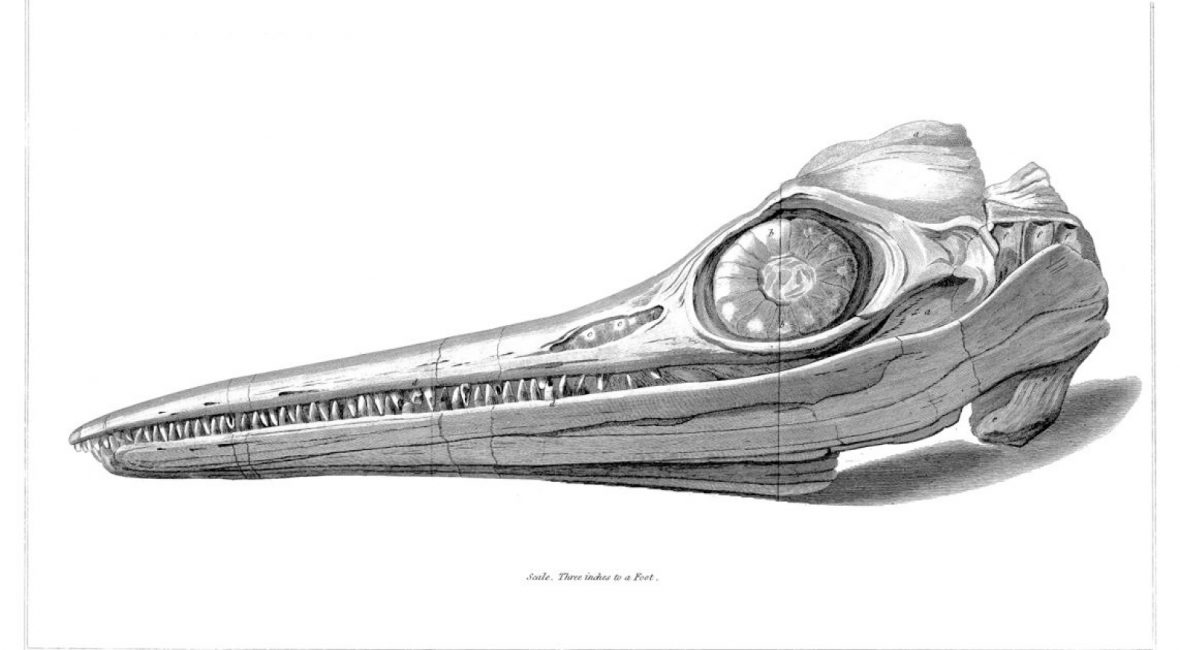
Sometime between 1809-11, a young boy named Joseph Anning spotted a “crocodile” skull in the cliffs near his home in the seaside community of Lyme Regis, England. His sister, Mary Anning, excavated the skull from the rock and, a year later, also uncovered the torso of the same specimen. Mary would go on to discover many incredibly important fossils throughout her lifetime.

View Full Size Image
Ichthyosaurus skull discovered by Joseph Anning. Philosophical Transactions of the Royal Society of London. v. 104. 1814. http://biodiversitylibrary.org/page/48435496. Digitized by: Natural History Museum, London.

The Anning specimen was sold and later acquired by the British Museum. British surgeon Sir Everard Home was intrigued by the specimen, and, in 1814, published a description of it in the Philosophical Transactions of the Royal Society of London. This article would later be recognized as the first scientific publication dedicated to an ichthyosaurus. Home believed the specimen was more closely related to fish than any other group, although he expressed some doubts, as several aspects of it resembled reptiles. He concluded that it represented a transitional form between fish and crocodiles, exhibiting, like the platypus, he argued, traits of many different groups.

View Full Size Image
Ichthyosaurus torso discovered by Mary Anning. Philosophical Transactions of the Royal Society of London. v. 104. 1814. http://biodiversitylibrary.org/page/48435498. Digitized by: Natural History Museum, London.

In 1817, German naturalist Karl Dietrich Eberhard König referred to the specimen as Ichthyosaurus, or “fish saurian.” Although he would not publish this name until 1825 (in his Icones fossilium sectiles), and despite the fact that in 1819 Home proposed the formal generic name of Proteosaurus in a scientific publication, other naturalists such as William Conybeare and Henry Thomas De la Beche adopted the name Ichthyosaurus in their own publications. By the standards of nomenclature, Home’s name should have priority, as it was published first, but the prevalent use of the name Ichthyosaurus consigned Proteosaurus to a status of “forgotten” nomen oblitum.

Today, we use the order Ichthyosauria, which was proposed by Henri Marie Ducrotay de Blainville in 1835, to describe over fifty valid genera of marine reptiles that flourished during the Mesozoic era and went extinct in the Late Cretaceous.

Fossil Stories

Stay tuned all week for more great fossil fun with our #FossilStories campaign, including:

  • Tweets and Facebook Posts
  • Blog Posts highlighting milestones and key publications in the history of fossil research
  • A Flickr Collection with hundreds of historic fossil illustrations
  • A Pinterest Collection featuring a selection of our favorite fossil illustrations
  • A BHL Collection containing seminal publications in the history of paleontology
  • A series of live webcasts at BHL partner institutions
  • A citizen science challenge in collaboration with The Field Book Project, the Smithsonian Transcription Center, and Smithsonian Institution Archives
Follow #FossilStories on Twitter and Facebook to learn more.
October 15, 2015by michelle.underhill
Blog Reel, Campaigns, Featured Books, Fossil Stories

Challenge Focus: G. Arthur Cooper

We’re so excited that our #FossilStories Citizen Science Challenge was successfully completed on October 12, with 252 pages from 9 field books fully transcribed and reviewed in just 3.5 days! Be sure to tune into the behind-the-scenes tour of Smithsonian fossil collections with Dr. Nicholas Pyenson, Curator of Fossil Marine Mammals at the Smithsonian’s National Museum of Natural History, via the BHL Periscope on October 26 as a reward for the successful completion of the challenge. More details to come on Twitter and Facebook.

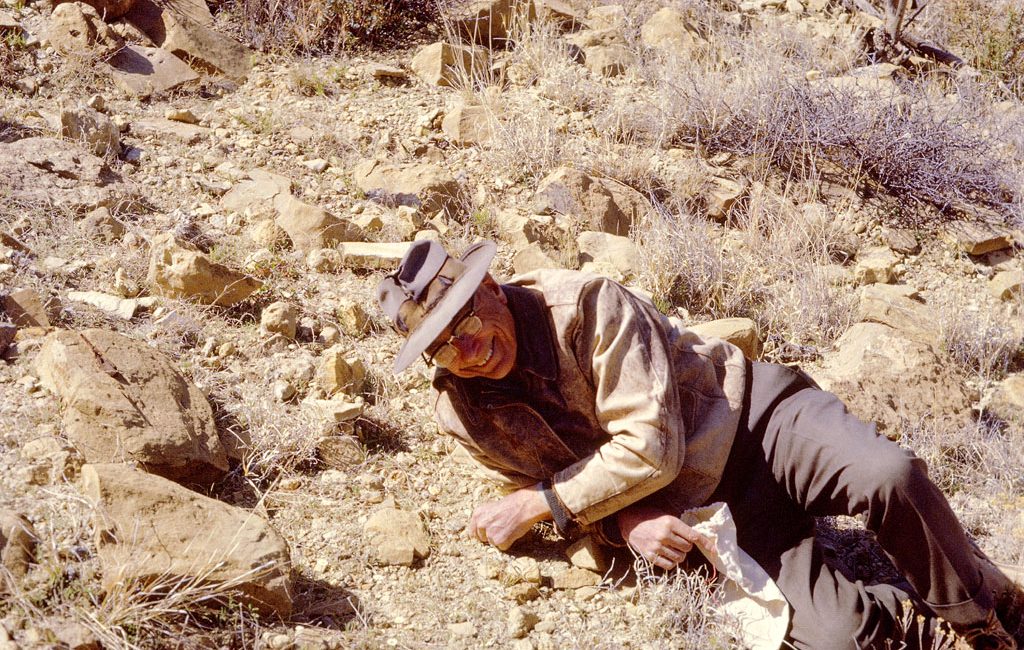
Several of the field books that have been transcribed as part of the challenge are from G. Arthur Cooper. Cooper (1902-2000) was a paleobiologist at the National Museum of Natural History (NMNH) and a recognized authority on the taxonomy and stratigraphy of Paleozoic brachiopods. Cooper worked at the Smithsonian, 1930 – 1974, first as assistant curator in the U.S. National Museum, later progressing through the ranks, becoming chairman of the Department of Paleobiology.  The Field Book Project includes records for 105 field books documenting his extensive field work in the United States, Canada, and Mexico. During his many years with the Museum, he amassed a fossil collection numbering in the thousands, now housed in the Paleobiology department, often part of the stratigraphic, Mollusca, or Bryozoa collections. His digitized field books document his work during the 1950’s and 60’s.

View Full Size Image
G. Arthur Cooper, c. 1957. Smithsonian Institution Archives, RU009524, Box 1, G. Arthur Cooper Oral History Interviews. Negative number 86-497.

During the #FossilFossick challenge, volunteers found great connections between the work documented in the field book and outside resources. Take, for instance:

.@TranscribeSI @meg_shuler Think THIS article http://t.co/mbpEWcrzOQ relates to collecting Cooper did in fieldbook https://t.co/1YA7vGP1pc

— Siobhan (@SiobhanLeachman) October 9, 2015

Thanks to all of our volunteers for the awesome connections they made as part of this challenge! Stay tuned to our blog tomorrow for more highlights from the challenge!

To learn more, check out his publications and field books in BHL, as well as his field books and images on Smithsonian’s Collections Search Center.

You can also see interviews with Dr. Cooper on the Smithsonian Institution Archives’ YouTube channel! Find out how he prepared and photographed fossil specimens (below) and see how fossil specimens are etched out of a rock.

Be sure to follow #FossilStories on Twitter and Facebook all week for more great fossil fun and more highlights from our #FossilFossick Challenge!

October 15, 2015by ulib-libraryjobs
Blog Reel, Campaigns, Featured Books, Fossil Stories

The Roots of Paleobotany: Brongniart and Fossil Plants

French botanist Adolphe-Théodore Brongniart is known as the Father of Paleobotany. Active in many branches of botany, Brongniart is most-remembered for his pioneering work on the relationship between extinct and living plants. In 1822, he published a paper on the classification and distribution of fossil plants, which he subsequently followed-up with his masterpiece Histoire des vegetaux fossiles (“History of fossil plants”) in 1828. This work was instrumental in the development of the field of paleobotany.

In 1828, Brongniart, son of the geologist Alexandre Brongniart (who worked with Georges Cuvier on geological studies in France), first published an introduction to his history of fossil plants, entitled Prodrome d’une histoire des végétaux fossiles. He then followed the introduction with his two-volume magnum opus, Histoire des végétaux fossiles.

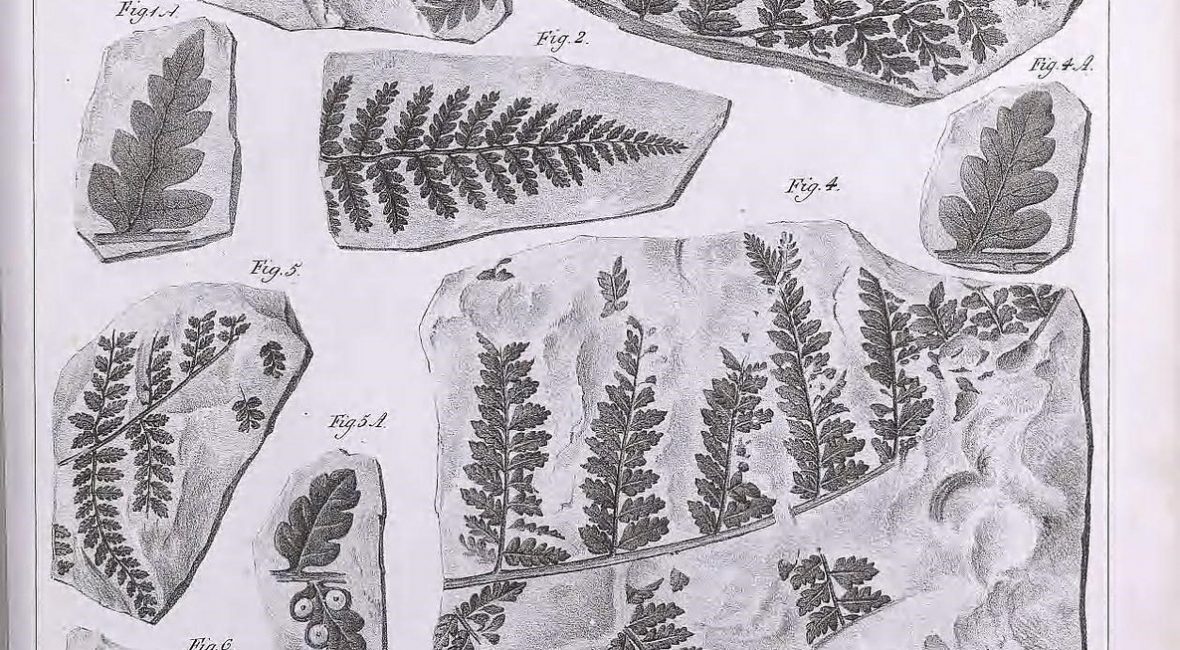
View Full Size Image
Brongniart, Alexandre. Histoire des végétaux fossiles. (1828-37). http://biodiversitylibrary.org/page/40155235. Digitized by: Smithsonian Libraries.

Within Histoire, Brongniart asserted that the history of plants could be divided into four periods. Mirroring findings from the animal kingdom, Brongniart found that, with each successive period, the represented plants became more diverse and complex. The first period was dominated by cryptogams; the first conifers emerged in the second period and then cycads in the third. Finally, in the fourth period, flowering plants made their debut. Though there were sharp floral discontinuities during the transitions between these four periods, during each period there were gradual changes within the characteristic groups.

View Full Size Image
Brongniart, Alexandre. Histoire des végétaux fossiles. (1828-37). http://biodiversitylibrary.org/page/40155265. Digitized by: Smithsonian Libraries.

Brongniart’s work is important not only because of its impact on the field of paleobotany, but also because it further demonstrated the long, progressive history of life on Earth and the emergence of new, increasingly complex forms of life over time. His work also supported the theory that Earth’s climate changed over time, as Brongniart concluded that the fossil record indicated that northern Europe had once had a tropical climate. Furthermore, Brongniart suggested that there was a correlation between the profusion of plants and the emergence of terrestrial vertebrates. As plants increased and diversified, they locked up more and more carbon dioxide from the atmosphere and produced more and more oxygen, thus fueling the environment necessary to support first air-breathing reptiles and later mammals. His theories show striking similarities to modern theories about the evolution of Earth’s atmosphere.

Fossil Stories

Stay tuned all week for more great fossil fun with our #FossilStories campaign, including:

  • Tweets and Facebook Posts
  • Blog Posts highlighting milestones and key publications in the history of fossil research
  • A Flickr Collection with hundreds of historic fossil illustrations
  • A Pinterest Collection featuring a selection of our favorite fossil illustrations
  • A BHL Collection containing seminal publications in the history of paleontology
  • A series of live webcasts at BHL partner institutions
  • A citizen science challenge in collaboration with The Field Book Project, the Smithsonian Transcription Center, and Smithsonian Institution Archives
Follow #FossilStories on Twitter and Facebook to learn more.
October 14, 2015by ulib-libraryjobs
Blog Reel, Campaigns, Featured Books, Fossil Stories

Fact or Fiction? Discovering the Mosasaur

If you’ve seen Jurassic World (or even just the trailers), then you’re familiar with Mosasaurus. In the film, it’s portrayed as a giant aquatic lizard thundering out of the water to devour great white sharks…and other mega prey.

Of course, the Jurassic World version is an exaggeration of the real thing (the film version is portrayed at 60 feet long, while the real animal maxed out at 46-50 feet long and was not capable of the water acrobatics depicted in the movie), but it is nevertheless based on a real, extinct aquatic reptile.

An historic account of an early discovery of mosasaur fossils is also probably more of an exaggeration than reality.

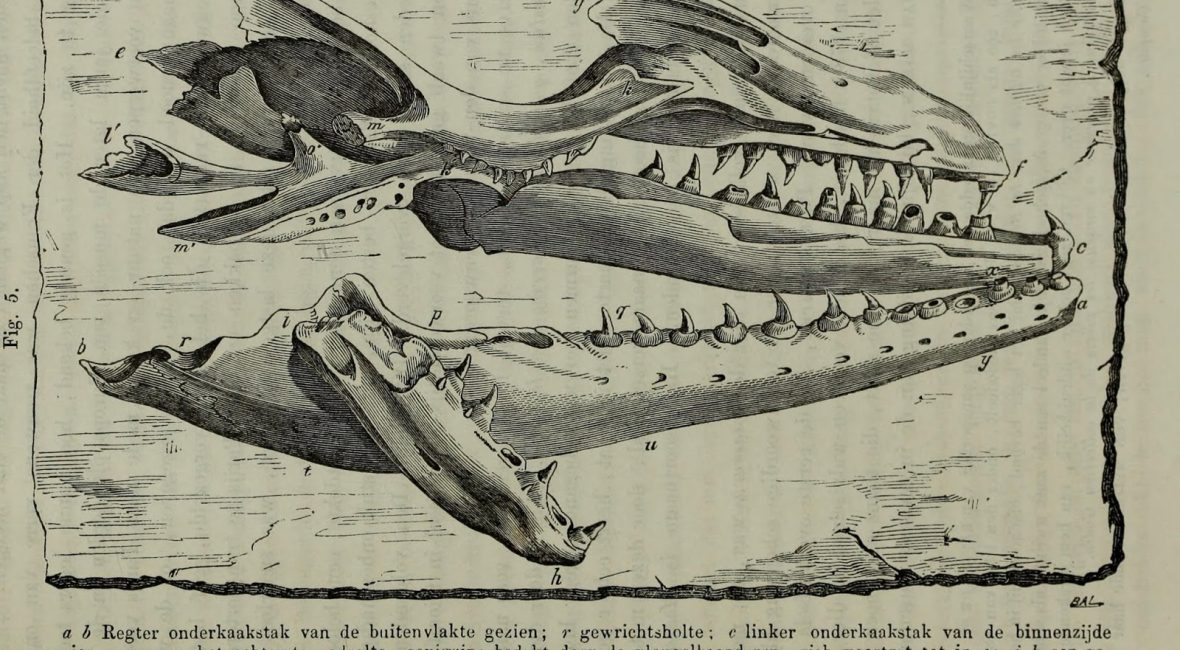
View Full Size Image
Jaws of the Mosasaur. Harting, Pieter. Album der Natuur. 1866. http://biodiversitylibrary.org/page/35222337. Digitized by Natural History Museum, London.

According to French geologist Barthélemy Faujas de Saint-Fond’s eighteenth century account of the discovery of the second known partial mosasaurus skull, quarrymen at the subterraneous quarries of St. Peter’s Mount, at Maestricht, Netherlands, uncovered the massive skull embedded in the rock sometime between 1770-74. They informed local surgeon, Leonard Hoffmann, who reportedly offered a reward for any fossils discovered in the quarry. Hoffmann took the specimen home, only to have canon Godding of Maestricht, who owned the quarry, demand to have the specimen given to him, claiming rightful ownership since the fossil had been discovered on his land. Godding subsequently filed a lawsuit against Dr. Hoffmann, eventually gaining custody of the piece.

But the story doesn’t end there. In 1795, the French revolutionary army captured Maastricht. De Saint-Fond was the Scientific Commissioner for the army, and he entered Maestricht with the express purpose of securing the “celebrated head” for the French. However, when he arrived at Godding’s mansion, the skull had already been removed from the house. A reward of six hundred bottles of good wine was offered to anyone who could locate the skull and return it to de Saint-Fond. The next morning, twelve grenadiers brought it to the French camp, where it was packaged and sent to the Museum of Natural History in Paris. De Saint-Fond also reportedly offered a substantial renumeration to Godding for the loss of the fossil.

View Full Size Image
Tooth of Mosasaur. Harting, Pieter. Album der Natuur. 1866.  http://biodiversitylibrary.org/page/35222340. Digitized by Natural History Museum, London.

And so the story goes. Dutch historian Peggy Rompen, however, has found the story to be more fiction than truth. According to her 1995 thesis, Godding was in fact the original owner of the skull. Hoffmann never possessed it, there was never a lawsuit between Godding and Hoffmann, and De Saint-Fond apparently offered no renumeration to Godding for the loss of the fossil. It seems that De Saint-Fond fabricated the story to justify the French seizure of the specimen.

View Full Size Image
Mosasaur vertebrae. Camper, Adriaan Gilles. Annales du Muséum national d’histoire naturelle. v. 19 (1812). http://biodiversitylibrary.org/page/3499442. Digitized by Natural History Museum, London.

Despite the uncertainty surrounding the truth about early discoveries of mosasaur fossils (and additional evidence that some early fossils may have been tampered with), Leonard Hoffmann did corresponded with Dutch Professor Petrus Camper about the infamous mosasaur skull. Hoffmann believed the skull belonged to a giant crocodile, while Camper insisted it was some unknown toothed whale. In 1798, Petrus’ son, Adriaan Gilles Camper, reexamined his father’s description and decided that the skull must belong to a giant, extinct monitor lizard. He communicated this belief to Georges Cuvier in 1799, and in 1808, Cuvier indicated that, based on comparative anatomy, the specimen did indeed show affinities with lizards. In 1812, Camper published a longer description of several mosasaur fossils from Maastricht. Finally, in 1822, William Daniel Conybeare gave the animal the genus name Mosasaurus, and in 1829, Gideon Mantell supplied the specific epithet hoffmannii.

Fossil Stories

Stay tuned all week for more great fossil fun with our #FossilStories campaign, including:

  • Tweets and Facebook Posts
  • Blog Posts highlighting milestones and key publications in the history of fossil research
  • A Flickr Collection with hundreds of historic fossil illustrations
  • A Pinterest Collection featuring a selection of our favorite fossil illustrations
  • A BHL Collection containing seminal publications in the history of paleontology
  • A series of live webcasts at BHL partner institutions
  • A citizen science challenge in collaboration with The Field Book Project, the Smithsonian Transcription Center, and Smithsonian Institution Archives
Follow #FossilStories on Twitter and Facebook to learn more.
October 14, 2015by michelle.underhill
Page 2 of 4«1234»

Help Support BHL

BHL's existence depends on the financial support of its patrons. Help us keep this free resource alive!

search

About BHL

The Biodiversity Heritage Library (BHL) is the world’s largest open access digital library for biodiversity literature and archives. BHL operates as a worldwide consortium of natural history, botanical, research, and national libraries working together to digitize the natural history literature held in their collections and make it freely available for open access as part of a global “biodiversity community.”

Join Our Mailing List

Sign up to receive the latest news, content highlights, and promotions.

Subscribe Now

Subscribe to Blog via Email

Enter your email address to subscribe to this blog and receive notifications of new posts by email.

Join 319 other subscribers

Subscribe to Blog Via RSS

Subscribe to the blog RSS feed to stay up-to-date on all the latest BHL posts.

Access RSS Feed

Inspiring Discovery through Free Access to Biodiversity Knowledge.

The Biodiversity Heritage Library makes it easier than ever for you to access the information you need to study and explore life on Earth…for free, anytime, anywhere.


64+ Million Pages of
Biodiversity Literature Online.

EXPLORE

Tools and Services
to Transform Research.

EXPLORE

300,000+
Illustrations on Flickr.

EXPLORE

ABOUT | HARMFUL CONTENT | PRIVACY | SITE MAP | TERMS OF USE