Biodiversity Heritage Library - Program news and collection highlights from BHL
  • Home
  • News
  • Featured Books
    • All Featured Books
    • Book of the Month Series
    • BHL at 20
  • User Stories
  • Campaigns
    • Fossil Stories
    • Garden Stories
    • Monsters Are Real
    • Page Frights
    • Her Natural History
    • Earth Optimism 2020
  • Tech Blog
  • Visit BHL
Home
News
Featured Books
    All Featured Books
    Book of the Month Series
    BHL at 20
User Stories
Campaigns
    Fossil Stories
    Garden Stories
    Monsters Are Real
    Page Frights
    Her Natural History
    Earth Optimism 2020
Tech Blog
Visit BHL
  • Home
  • News
  • Featured Books
    • All Featured Books
    • Book of the Month Series
    • BHL at 20
  • User Stories
  • Campaigns
    • Fossil Stories
    • Garden Stories
    • Monsters Are Real
    • Page Frights
    • Her Natural History
    • Earth Optimism 2020
  • Tech Blog
  • Visit BHL
Biodiversity Heritage Library - Program news and collection highlights from BHL
Blog Reel, Campaigns, Her Natural History

A lifetime among Cacti: Helia Bravo-Hollis

Four days before becoming a centenarian, Dr. Helia Bravo Hollis passed away, on September 26th, 2001. Her biography is the history of the inclusion of women in the scientific research community and the slow but productive development of academic calling.

Teacher Bravo, as she liked to be called, never bothered or worried about being a pioneer in a discipline at a complicated stage in Mexican history. Although she always had a genuine concern for social inequalities, she believed that only through education this could be changed. To do so, she was a very dedicated researcher and teacher.

Her work is defined by the word vocation, as she describes it in her own words, full of humility:

“I did my job with a sense of responsibility before the National Autonomous University of Mexico UNAM, with love, passion, and courage; It was enjoyable research rather than a job. In spite of everything, I think that my work is still far from being satisfactory because the knowledge of the cacti is not finished, it is always being done”.
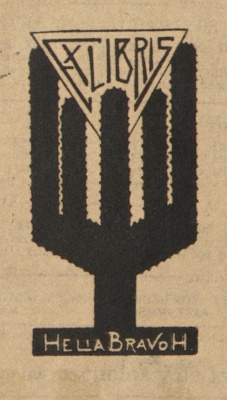
Dr. Bravo Hollis’ bookplate. Historic Archive of Biology Institute of UNAM.

Since her childhood, Dr. Bravo Hollis stood out for her hard work. When she was 10 years old, she received a diploma of achievement from President Porfirio Díaz. In high school, she shared the classroom with distinguished personalities such as Octavio Paz, Salvador Novo, Carlos Pellicer, and even Frida Kahlo, among many other brilliant personalities of Mexican culture. As a teenager, she presented her works in the Antonio de Alzate Society and published them in Revista Mexicana de Biología (Mexican Biology Journal). Those tasks motivated her first trip abroad: a summer course at Pomona College, California. All of this gives us an idea of her striving at academic matters.
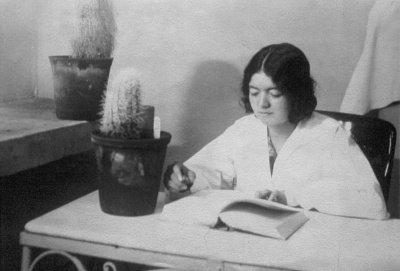
Helia during her studies with Dr. Ochoterena. Ca. 1930. Historic Archive of Biology Institute of UNAM.

The First Certified Biologist

Bravo Hollis was meant to study Medicine, however, she decided to study Biology against her family’s wishes. The career did not exist formally yet, and the studies were set in combination at the National School of Medicine and at the High Studies School, both part of UNAM.

In 1927, Bravo Hollis became the first certified biologist of Mexico and, in 1929 when the University reached its autonomy and her mentor Dr. Isaac Ochoterena was appointed in charge of the future Institute of Biology, she was chosen to create the Herbarium and was also commissioned with the study of the Cactaceae, one of the most identifiable, diverse plant families in Mexico: cactus, cholla, nopales, … and thus more than 700 species that, for the most part, do not exist anywhere else.

Therefore, Bravo Hollis began a stage in her career where she travelled around Mexico to collect information and samples and photograph different types of cacti. This culminated in 1931 when she graduated as a Master in Biological Sciences at the Faculty of Philosophy and Letters of UNAM, with the thesis entitled Contribuciones al conocimiento de las cacatáceas de Tehuacán (Contribution to knowledge of the Cacti of Tehuacán). This would set the beginning of her subject of study for the years to come.
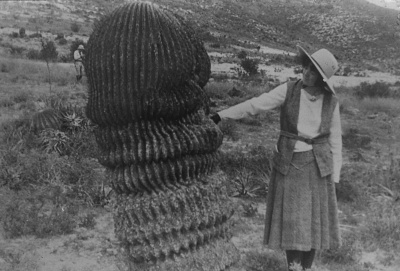
Dr. Bravo Hollis in one of her many trips of specimen recollections. Ca. 1940. Historic Archive of Biology Institute of UNAM.

From this moment forward, her research career was unstoppable, focused on systematics of cacti in Mexico and part of North America. In 1937, she published her book Las cactáceas de México (Mexican Cacti), which placed her at the forefront of this field of research around the world. In the autumn of 1951, the Mexican Society of Cactology was founded with Dr. Bravo Hollis as president of Cactaceae and Suculentas Mexicanas, which published its first issue in June 1955. Its members carried out intense field work and with all the collected material contributed to the foundation of what became the Botanical Garden of UNAM. Throughout the 1960s, Dr. Bravo Hollis managed the gardens with passion and was highly respected, to the point that she even says she paid the workers out of her own pocket when a strike left them without a salary. Sorrowfully as she expressed:

“I am retired from working at the Biology Institute at 90 years old, handicapped by painful arthritis that prevents me from walking”.
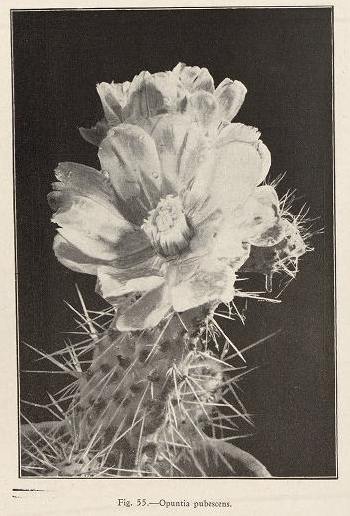
Bravo Hollis, Helia. Las Cactáceas de México. 1937. Contributed in BHL by Instituto de Biología UNAM as part of BHL México. CC-BY-NC-SA.

In total, Bravo Hollis published almost 170 articles and three books, described 60 scientific classifications and made 59 nomenclature reviews. She received numerous awards and recognitions, including the Cactus d’Or from the International Organization of Succulents, an honorary doctorate and an Emeritus Research Prize at UNAM. Her works received worldwide acclaim from fellow biologists and botanists, and today six species and one subspecies of cacti are named after her. Additionally, the Botanical Garden in Tehuacán pays tribute to her through its name: the Helia Bravo Hollis Botanical Garden.
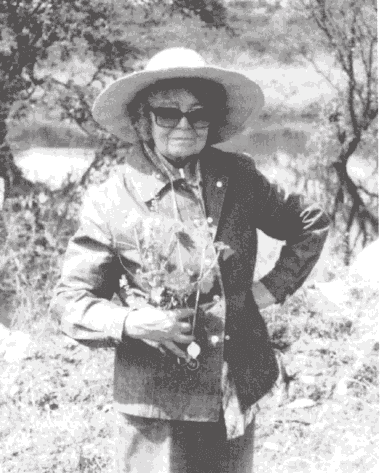
Dr. Bravo Hollis on fieldwork. Ca. 1980. Historic Archive of Biology Institute of UNAM.

References

Bravo-Hollis, Helia. (2004). Memorias de una vida y una profesión. México: Universidad Nacional Autónoma de México, Instituto de Biología, Dirección General de Divulgación de la Ciencia.

Granados Chapa, Miguel Ángel. (2001). La reina de las cactáceas. La Jornada. Recuperado de: https://www.proceso.com.mx/302201/la-reina-de-las-cactaceas

Salcedo Meza, Concepción. (2001). La pasión por la ciencia de una mujer centenaria. ¿Cómo ves? (34). pp. 29-30. Recuperado de: http://www.comoves.unam.mx/assets/revista/34/quienes_34.pdf

Photographs: Historic Archive of Biology Institute of Universidad Nacional Autónoma de México, UNAM.
March 22, 2019by Joel Richard
Blog Reel, Featured Books

Wait, is that the original?

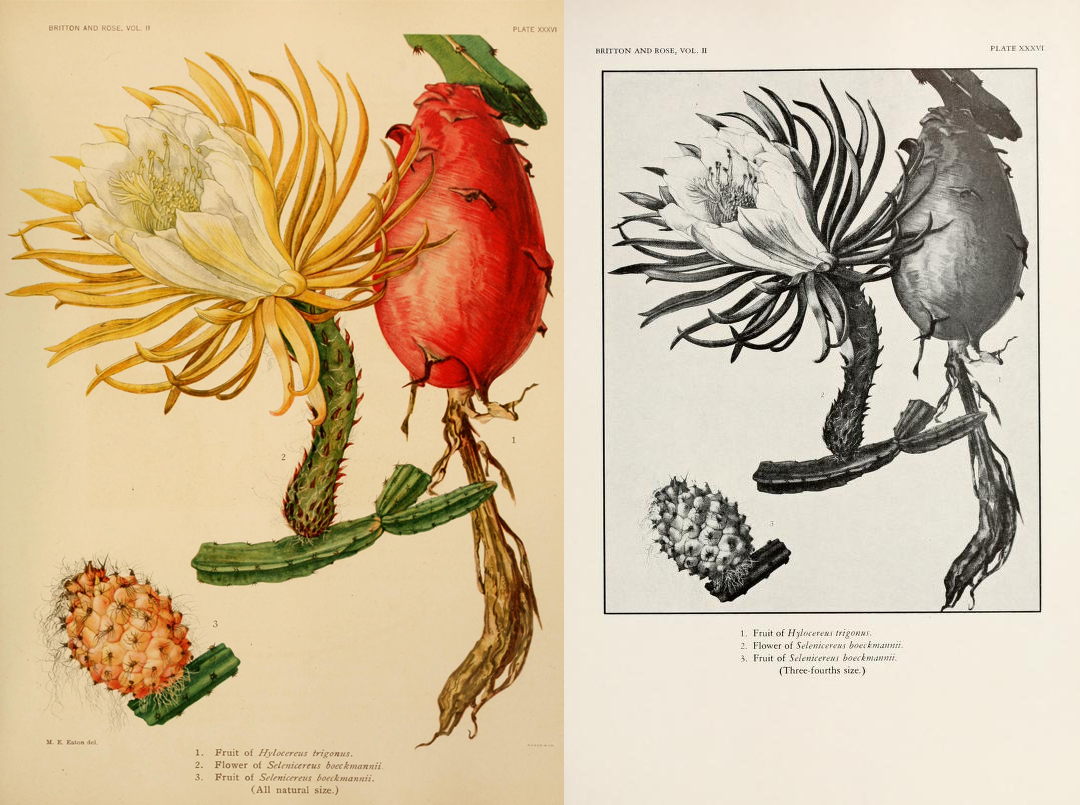
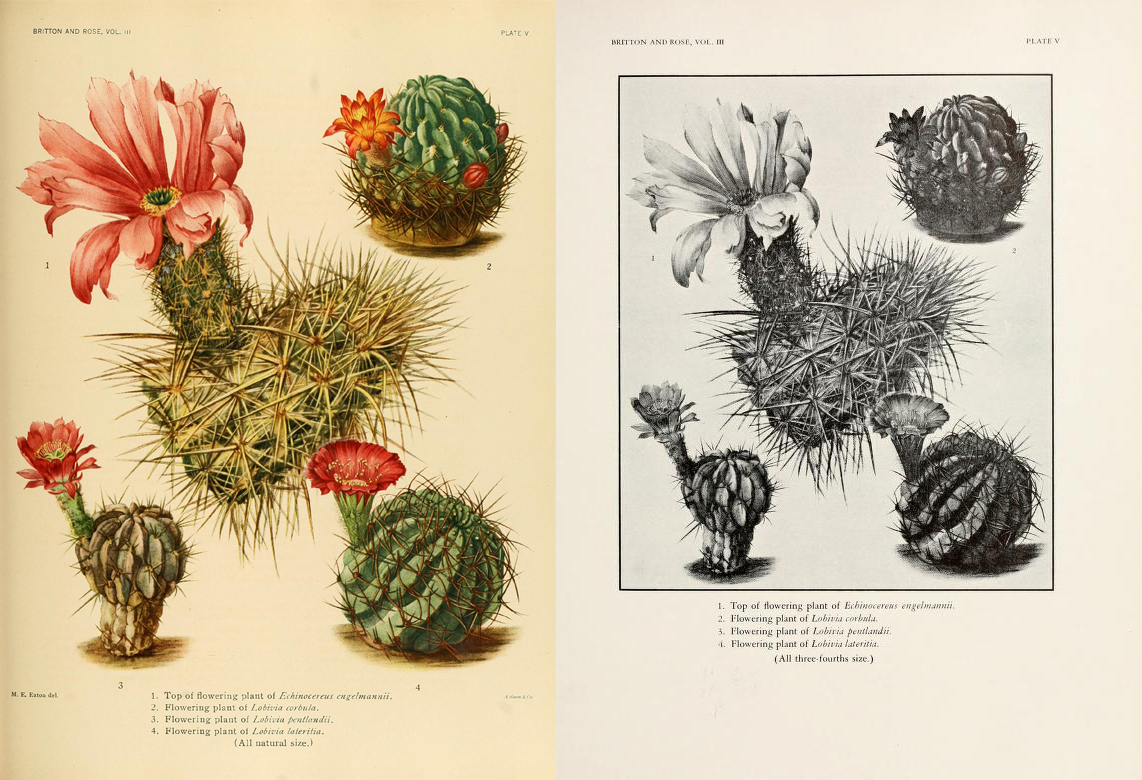
Recently, the librarians at the Smithsonian Libraries’ Botany-Horticulture Library uncovered a “mini-mystery” involving one of our titles. It started when the botanical illustrator in the Smithsonian’s Department of Botany got a call from a colleague asking why a work in BHL was appearing with black and white illustrations rather than the beautiful color originals.

View Full Size Image
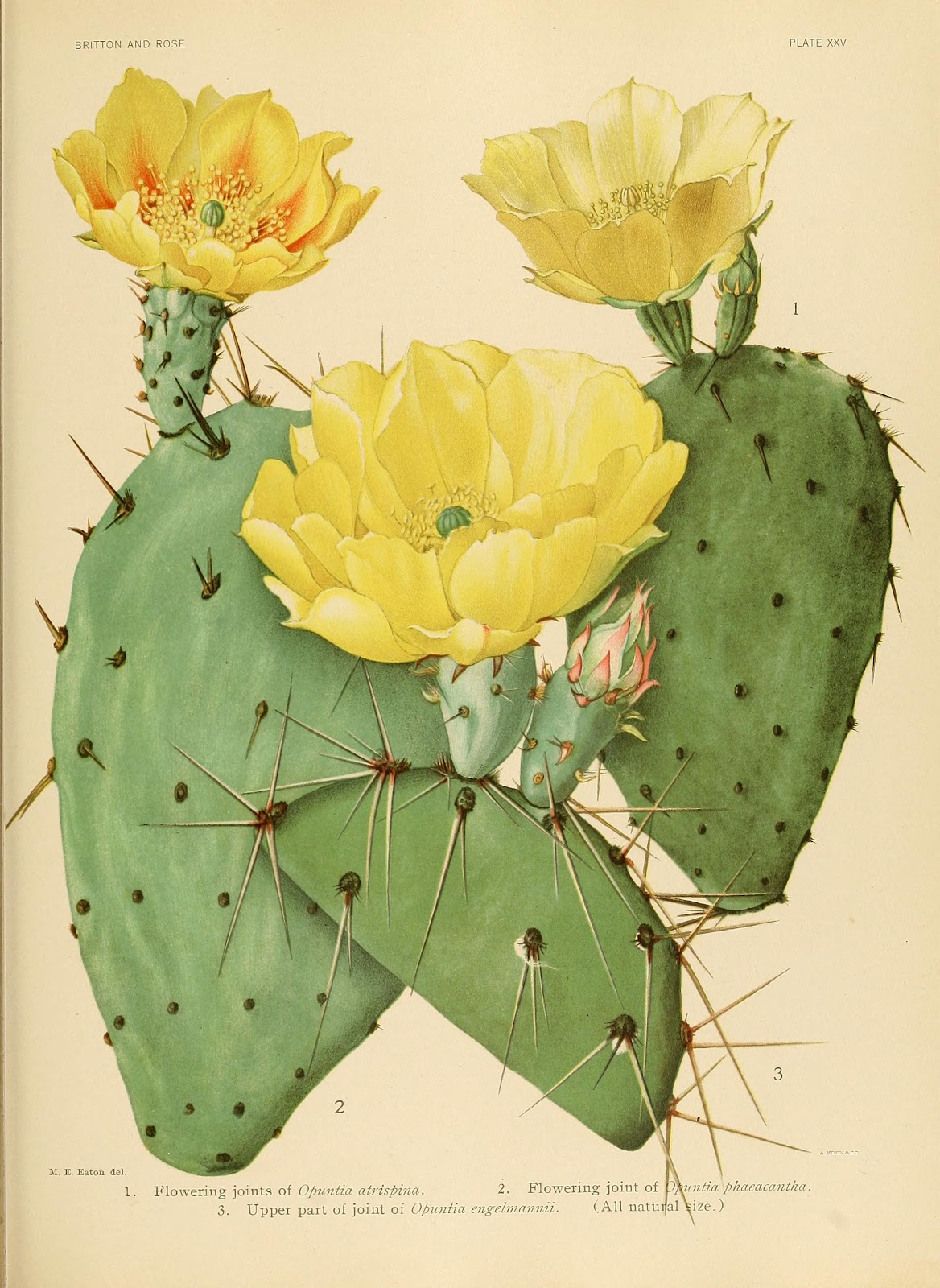
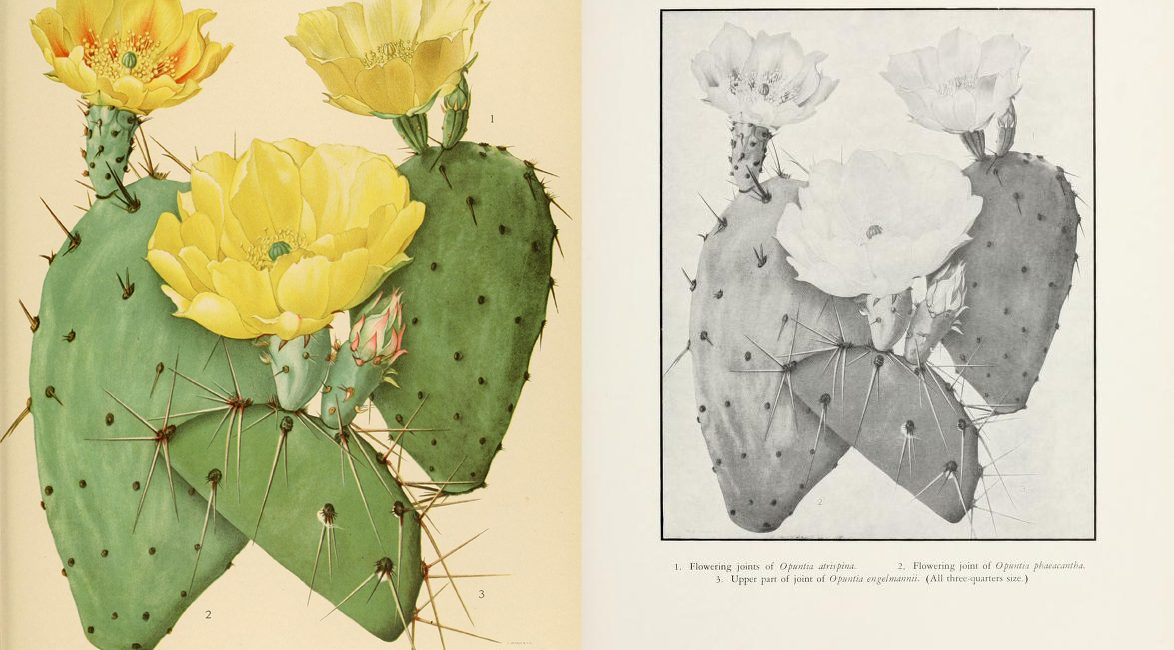
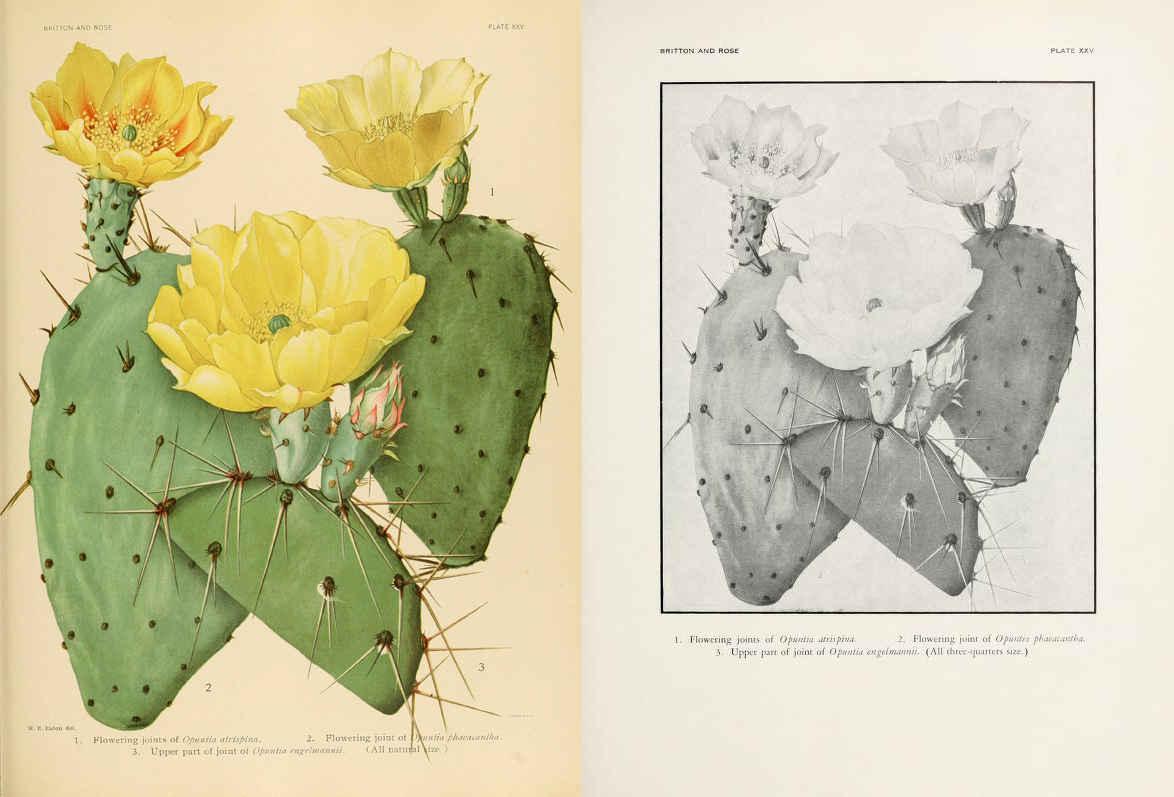
Opuntia atrispina, Opuntia phaeacantha, and Opuntia engelmannii, from

Vol. 1. Color image from BHL. Black and White image in IA.

The work in question is Britton and Rose’s The Cactaceae, Descriptions and Illustrations of Plants of the Cactus Family (The Cactaceae). The four volume set is an early definitive taxonomic work on the family Cactaceae. When the first volume was published in 1919 it sold for $18, the equivalent of $242.19 today. Noted by a contemporary reviewer as “the most sumptuous botanical publication since Dykes’ ‘The genus Iris,’” The Cactaceae was an ambitious project funded by the Carnegie Foundation. The final work was a result of the combined effort of botanists across North and South America, and the Caribbean islands. One of the reasons the work is so important is that it reexamined type specimens and original descriptions. As noted in the introduction to volume one, it was a necessary task due to many species having been incorrectly identified, descriptions incorrectly interpreted, and common names attributed to the incorrect species.

By doing further investigating on the BHL website, it was discovered that the New York Botanical Garden’s LuEsther T. Mertz Library had provided its copy for scanning, now available in all its technicolor glory.

View Full Size Image
Hylocereus trigonus and Selenicereus boeckmannii, from Vol. 2.

Color image in BHL. Black and White image in Internet Archive.

However, why did BHL have a copy with black and white illustrations in its database? As it turns out, that black and white copy of The Cactaceae had been ingested into BHL from the Internet Archive (IA) through a scan done at North Carolina State University Libraries (see Volume 1 here). For BHL to capture as much of the digitized biodiversity material as possible, it accepts scans of books and journals already present within the Internet Archive corpus that meets a set of subject heading and call number criteria in line with its collection development policy. This was the case with the NCSU Libraries’ copy of The Cactaceae, which is a reprinted version of the original 1919 publication. The publisher reissued it with black and white illustrations. For more information about our ingest of non-BHL member materials from the Internet Archive see this post.

View Full Size Image
Echinocereus engelmannii, Lobivia corbula, Lobivia lateritia, and Lobivia pentlandii, from Vol. 3. Color image in BHL. Black and White image in Internet Archive.

Using BHL’s Feedback link, the librarians requested that the black and white version’s URL be redirected to the color version of The Cactaceae, so this misunderstanding will not happen with a future user.

Mystery solved—

Find all images in Flickr:

Volume 1 | Volume 2 | Volume 3 | Volume 4

June 11, 2013by mkahn
Blog Reel, User Stories

BHL and Our Users: Joe Shaw

View Full Size Image
BHL User Joe Shaw

Raise your hand if you know what Opuntia is.

Even though you might not know it, most people would recognize Opuntia, though perhaps under another name. Named after the Greek city Opus, Opuntia is a genus in the Cacti family, containing the prickly pears, which currently constitute about 200 species. Like all true Cacti, Opuntia species are native only to the Western Hemisphere, and, with their range extending into British Columbia, are the most cold-tolerant of all lowland cacti.

Studying botany, and Opuntia in particular, has been one of Joe Shaw’s long-time passions (representing over 25 years of work). A botanist by training, Joe now concentrates his efforts on scientific writing, one aspect of which involves his website Opuntiads Web, which describes over 100 Opuntia species in the US, and his blog Oblog, which aims to “describe and illustrate cacti and succulents, their surroundings and neighbor plants, and even animals that interact with cacti.”

Opuntiads Web provides descriptions and images of each of the species cataloged on the site. Furthermore, one of the invaluable qualities of Shaw’s website for researchers is that the pages link to original descriptions of the corresponding species (gleaned from BHL, we might add!).

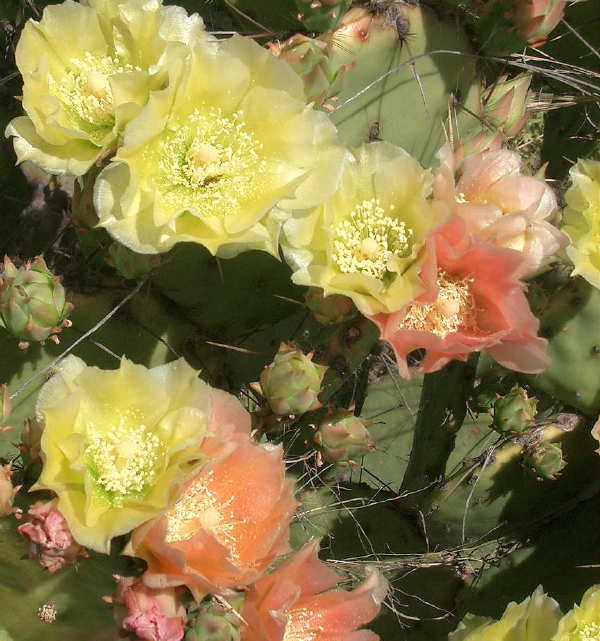
One of our favorites on the site is Opuntia atrispina, a cacti with a gorgeous yellow bloom native only to the United States. The interesting thing about the flowers of this cactus? They open yellow, but change to salmon, pink, or even tan on the second day (see image below to view transformation). Take a look at a picture of the cactus from Shaw’s website, as well as one of our favorite illustrations of it in BHL.

View Full Size Image
Opuntia atrispina flowers. From http://opuntiads.com


View Full Size Image
Illustration of Opuntia atrispina from BHL (upper right)

Shaw’s blog Oblog offers great supplementary material on these species, featuring informative posts, exceptional photographs, and fun anecdotes. We’ve reposted some of our favorite material from the blog below:

View Full Size Image
A cactus that looks like a snake!


Joe Shaw on BHL

Since 2009, BHL has served as an important component of Shaw’s work. As the introductory text on Opuntiads Web articulates,

Of the many opuntiads in the USA, some look superficially alike and some have even been forgotten; even botanists confuse them with each other and don’t know there are so many species.  But they have different bloom times, consistently identifiable fruits, normally don’t interpollinate, and are restricted to specific habitats. Early botanists identified them and understood their differences, and we use those old records to identify them, their differences, and their similarities.

The historic literature found on BHL allows Shaw to investigate the sometimes ambiguous Opuntia species, capitalizing on the work done by past botanists in order to articulate the details and differences of each species on his website. Incorporating the original species descriptions into his website, as described above, allows users to not only see the species as captured in photographs, but also understand the species as it was first documented for science. As Shaw asserts, BHL “is immensely helpful. I have been able to sort taxonomic tangles going back 200 years.”

Using BHL an average of 2-20 times per week, Joe exploits BHL’s PDF and single page download functions, expressing particular satisfaction with the speed at which BHL allows him to accomplish these tasks and the fact that this materials is available to him 24/7, at whatever hour or day he needs it. For Shaw, access to early and original species descriptions is a particularly valuable asset provided by BHL, as these are linked to on his site.

At BHL, it is not only the praise, but also the constructive criticisms that we valuable. When asked about requested site improvements, Shaw articulated a desire for even more robust species search capabilities, increased collaborations with JSTOR, the ability to sign in to a single session of use (thus improving the efficiency of page downloads), and the ability to download BHL pages via a “Drag and Drop”methodology. Continuous search improvements are always a development priority for us, and sign-in capability has been suggested to us from several sources. Though we have begun initial collaborations with JSTOR, incorporating their Early Journal Content into our article repository Citebank, we hope to expand these interactions in the future.

We’re always thrilled to hear from our users, and we know that it’s also valuable for our user community to see the many ways their fellow researchers, scientists, writers, artists, students, or nature lovers are utilizing everything BHL has to offer. We extend a special thanks to Joe Shaw for taking some time to share his experiences with us, and we hope you’ll take a few minutes to explore all the wonderful information, images, and anecdotes on Joe’s website and blog.


September 5, 2012by ulib-libraryjobs

Help Support BHL

BHL's existence depends on the financial support of its patrons. Help us keep this free resource alive!

search

About BHL

The Biodiversity Heritage Library (BHL) is the world’s largest open access digital library for biodiversity literature and archives. BHL operates as a worldwide consortium of natural history, botanical, research, and national libraries working together to digitize the natural history literature held in their collections and make it freely available for open access as part of a global “biodiversity community.”

Join Our Mailing List

Sign up to receive the latest news, content highlights, and promotions.

Subscribe Now

Subscribe to Blog via Email

Enter your email address to subscribe to this blog and receive notifications of new posts by email.

Join 319 other subscribers

Subscribe to Blog Via RSS

Subscribe to the blog RSS feed to stay up-to-date on all the latest BHL posts.

Access RSS Feed

Inspiring Discovery through Free Access to Biodiversity Knowledge.

The Biodiversity Heritage Library makes it easier than ever for you to access the information you need to study and explore life on Earth…for free, anytime, anywhere.


64+ Million Pages of
Biodiversity Literature Online.

EXPLORE

Tools and Services
to Transform Research.

EXPLORE

300,000+
Illustrations on Flickr.

EXPLORE

ABOUT | HARMFUL CONTENT | PRIVACY | SITE MAP | TERMS OF USE