Biodiversity Heritage Library - Program news and collection highlights from BHL
  • Home
  • News
  • Featured Books
    • All Featured Books
    • Book of the Month Series
    • BHL at 20
  • User Stories
  • Campaigns
    • Fossil Stories
    • Garden Stories
    • Monsters Are Real
    • Page Frights
    • Her Natural History
    • Earth Optimism 2020
  • Tech Blog
  • Visit BHL
Home
News
Featured Books
    All Featured Books
    Book of the Month Series
    BHL at 20
User Stories
Campaigns
    Fossil Stories
    Garden Stories
    Monsters Are Real
    Page Frights
    Her Natural History
    Earth Optimism 2020
Tech Blog
Visit BHL
  • Home
  • News
  • Featured Books
    • All Featured Books
    • Book of the Month Series
    • BHL at 20
  • User Stories
  • Campaigns
    • Fossil Stories
    • Garden Stories
    • Monsters Are Real
    • Page Frights
    • Her Natural History
    • Earth Optimism 2020
  • Tech Blog
  • Visit BHL
Biodiversity Heritage Library - Program news and collection highlights from BHL
BHL News, Blog Reel

Wikipedia & Women in Science: Smithsonian Groundbreakers Edit-a-thon

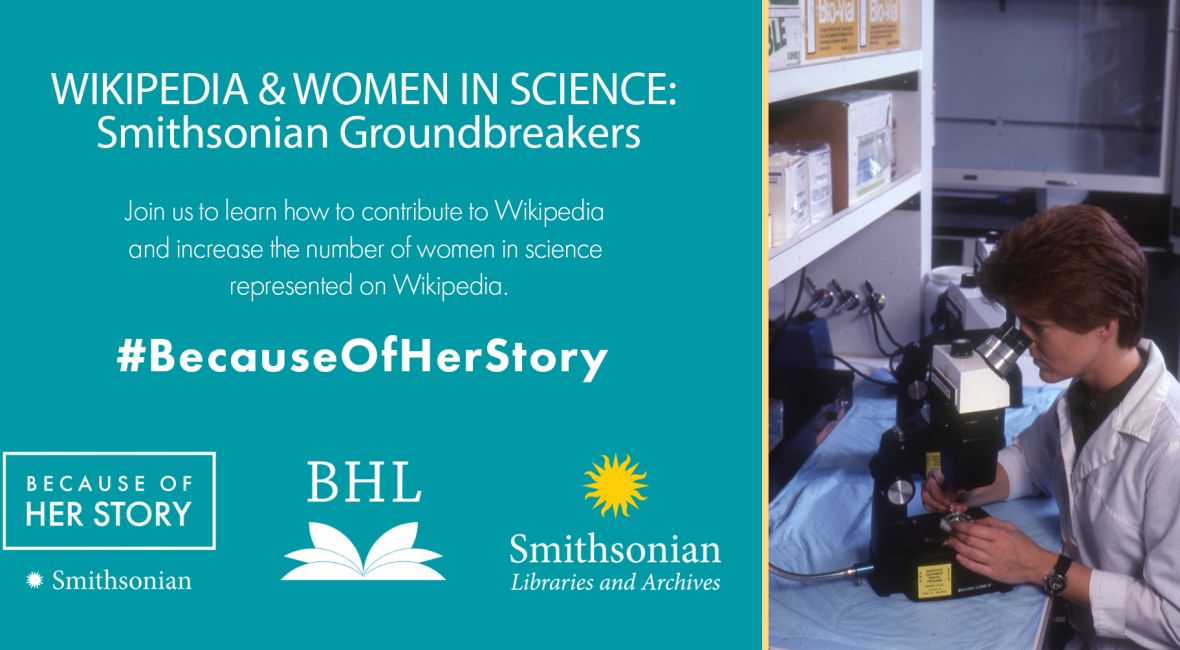
graphic for women in science wikipedia workshop

Photo in graphic shows Dr. JoGayle Howard working with embryos from the National Institutes of Health at the dissecting microscope in 1982. Photo Credit: Smithsonian Institution Archives.

Join us on 25 March 2021 (1-3pm ET) for Wikipedia & Women in Science: Smithsonian Groundbreakers Edit-a-thon, an online Wikipedia editing workshop hosted in conjunction with the Smithsonian American Women’s History Initiative and the Smithsonian Institution Archives, part of Smithsonian Libraries and Archives.

When? 25 March 2021, 1-3pm ET

Where? Online

Register Today!

During this training, attendees of all experience levels will learn the basics of how to edit Wikipedia by updating articles related to the history of women in science at the Smithsonian Institution in connection with the Funk List. Presenters will share how editors might research the work of these women in the absence of personal papers and institutional records.

As one of the web’s most visited reference sites, Wikipedia serves as a starting point for many individuals looking to learn about art, history, and science. However, less than 19% of Wikipedia biographies in English represent women, and less than 10% of Wikipedia editors identify as women. By increasing representation of women scientists on the site, your impact can spark the curiosities of future generations who see themselves in these Smithsonian groundbreakers.

This event is planned in conjunction with the Smithsonian Institution Archives, the Biodiversity Heritage Library, and the Smithsonian American Women’s History Initiative, a multiyear undertaking to document, research, collect, display, and share the history of women in the United States.

March 8, 2021by michelle.underhill
BHL News, Blog Reel, Tech Updates

BHL Adds Functionality Allowing Partners to Upload Crowdsourced Transcriptions of Digitized Archival Materials

Screenshot of a digital library book viewer with readable OCR.

The Biodiversity Heritage Library (BHL) has added functionality to allow BHL Partners to upload transcriptions in place of the automatically-generated OCR (Optical Character Recognition) for archival materials digitized in BHL. This functionality supports transcriptions generated as part of Partner crowdsourcing projects on Smithsonian Transcription Center, DigiVol, and From the Page.

Optical Character Recognition (OCR), also called text recognition, translates text characters in scanned documents into code that can be used for data processing and enables searching of document text. Handwritten archival materials like correspondence and field notes are notoriously problematic for OCR software. Full-text searching of these materials is significantly hampered by poor OCR output.

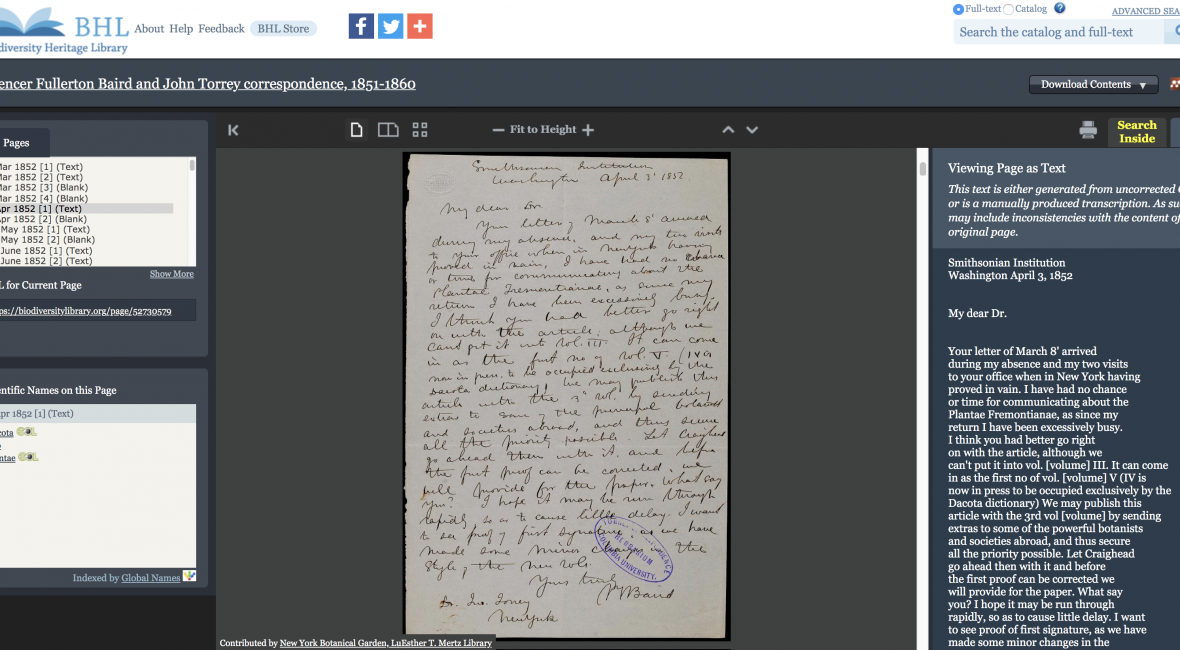
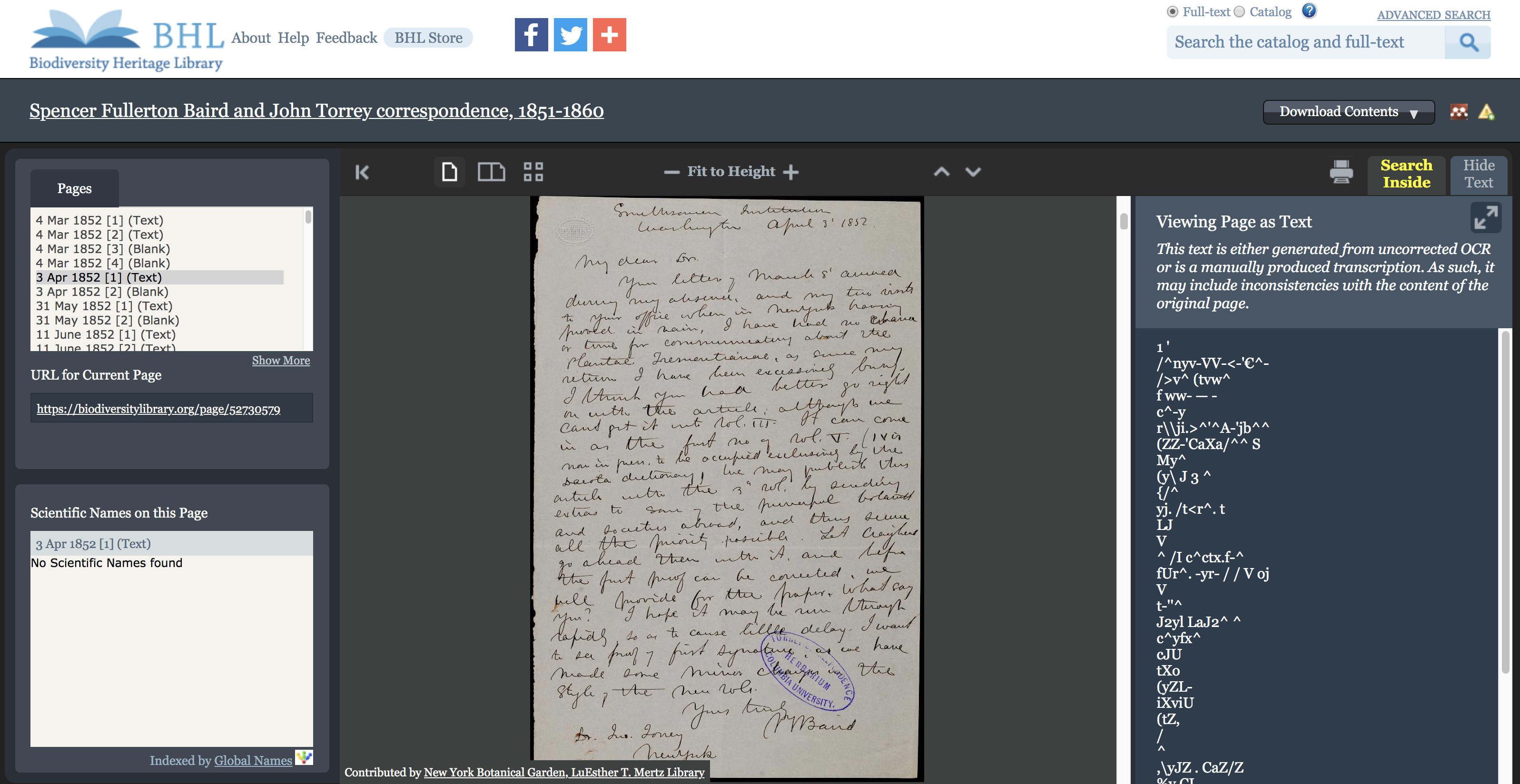
Screenshot of a digital library book viewer with gibberish for OCR.

Example of the poor automatically-generated OCR output for handwritten correspondence. Spencer Fullerton Baird and John Torrey correspondence, 1851-1860. Contributed in BHL from the LuEsther T. Mertz Library of The New York Botanical Garden.

Crowdsourcing the transcription of archival materials has become a popular way to generate machine-readable text that enables searching and discoverability. Several BHL Partners are using crowdsourcing platforms (e.g. Smithsonian Transcription Center, DigiVol, and From the Page) to transcribe field notes, correspondence, and other archival materials that they have digitized in BHL.

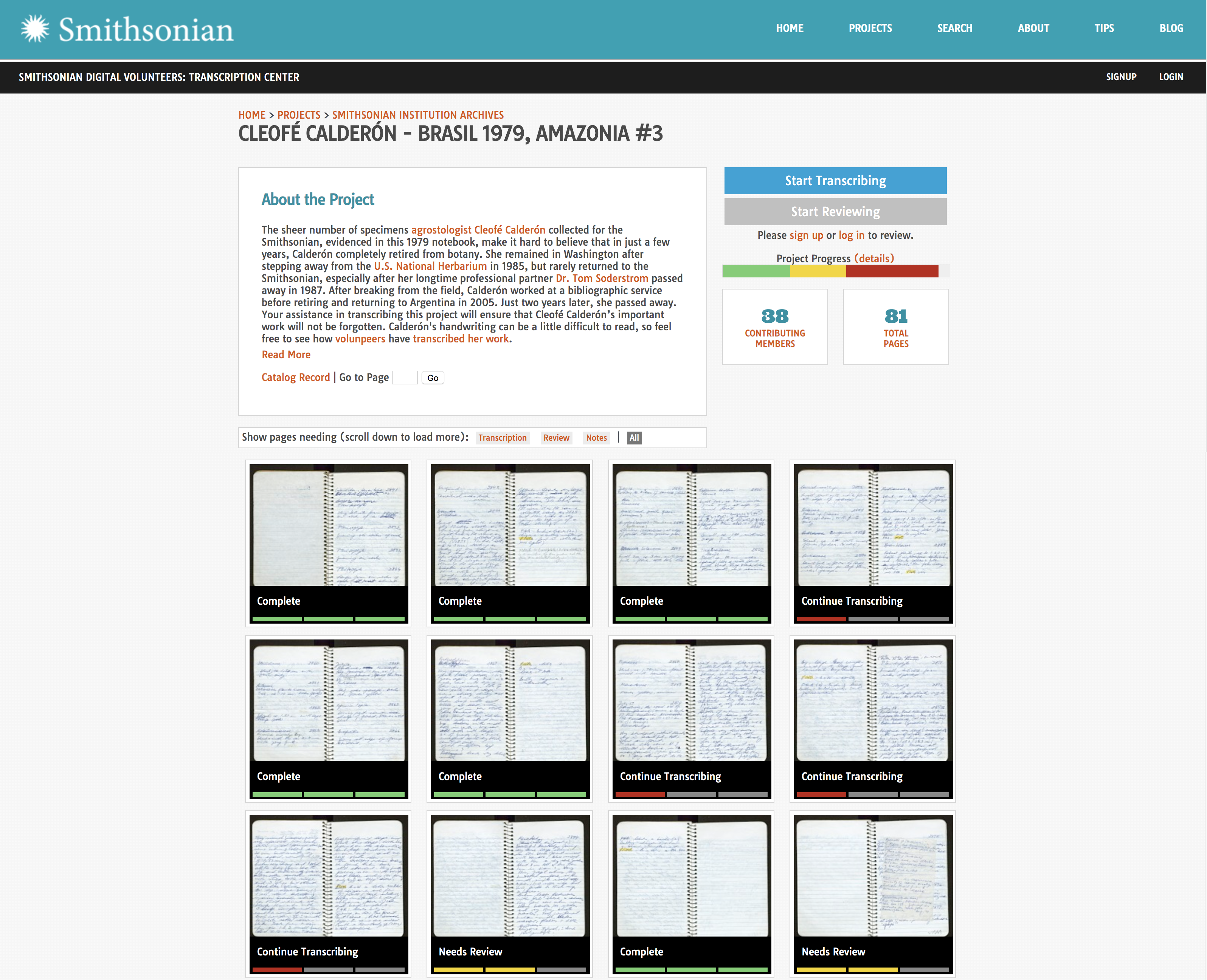
Screenshot of a project in the Smithsonian Transcription Center.

Example of a field notebook being transcribed in the Smithsonian Transcription Center. This notebook, Brasil 1979, Amazonia #3, from Cleofé Calderón is also available in BHL from the Smithsonian Institution Archives.

With this new functionality, these transcriptions can now be uploaded in place of the automatically-generated OCR for these items, allowing them to be full-text searchable and enabling our taxonomic name recognition software to index scientific names within their pages. Since the transcribed text can be viewed alongside the digitized page image, users can also more easily read materials with difficult-to-decipher handwriting. Thus, this new functionality makes it easier for researchers and the public to explore these valuable primary source materials and access specific information from their pages.

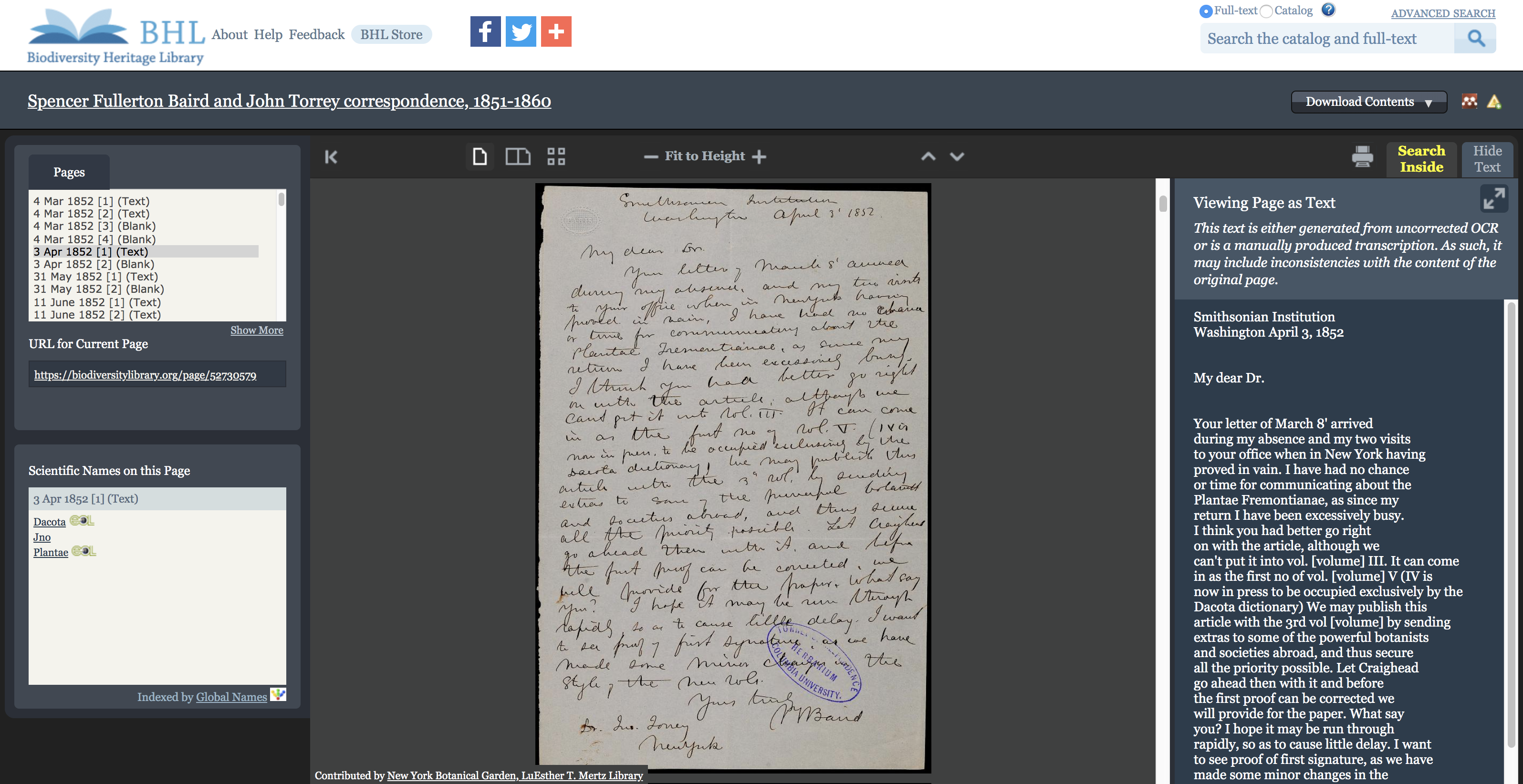
Screenshot of a digital library book viewer with readable OCR.

Above example with the OCR replaced with a crowdsourced transcription generated as part of The John Torrey Papers project from The New York Botanical Garden on From the Page. Spencer Fullerton Baird and John Torrey correspondence, 1851-1860. Contributed in BHL from the LuEsther T. Mertz Library of The New York Botanical Garden.

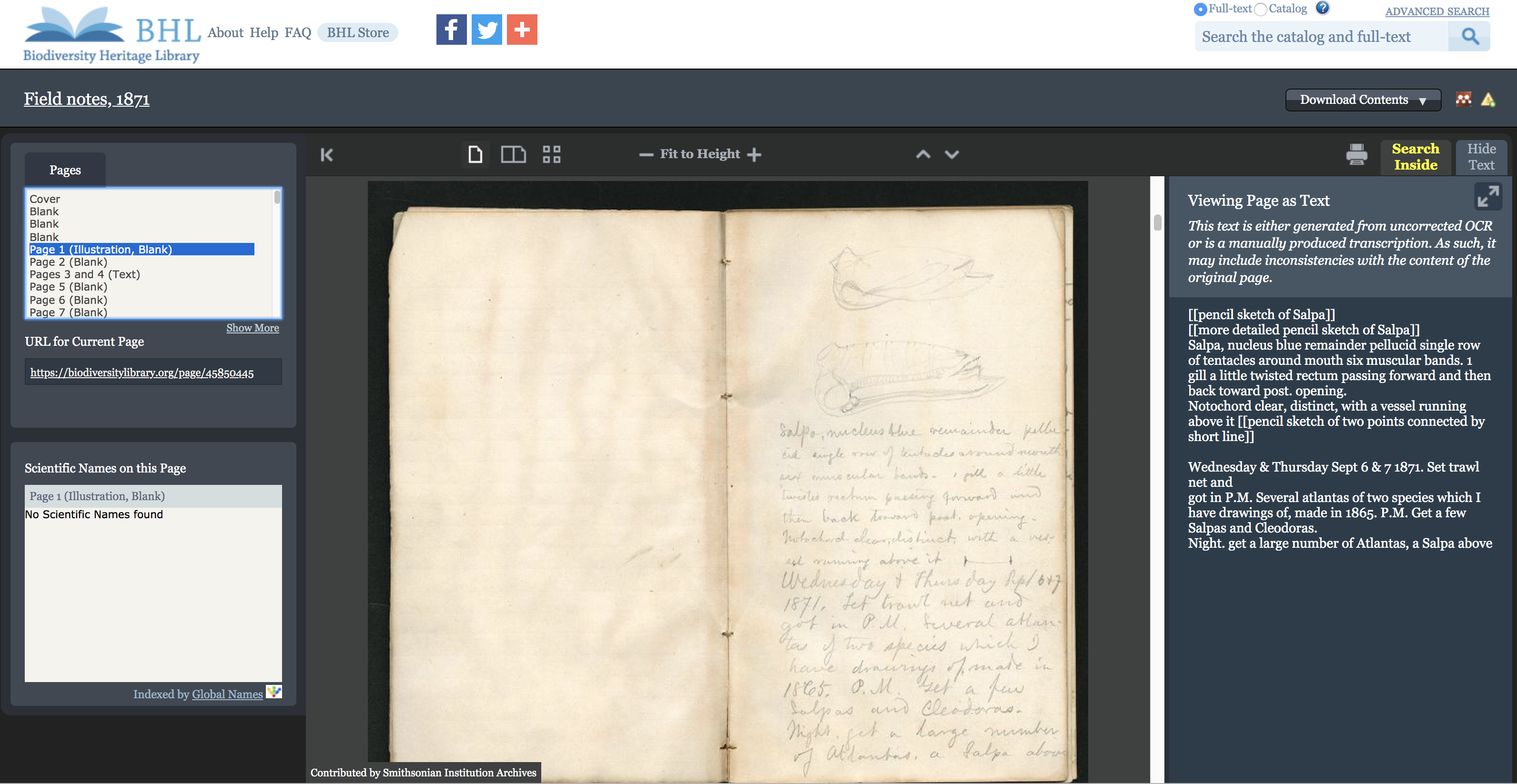
Screenshot of the BHL book viewer with a digitized field book and the transcribed text shown alongside the page in place of the OCR.

Since the transcribed text can be viewed alongside the digitized page image in the BHL book viewer, users can also more easily read archival materials. William Healey Dall’s Field Notes, 1871. Transcription generated on the Smithsonian Transcription Center. Contributed in BHL from the Smithsonian Institution Archives.

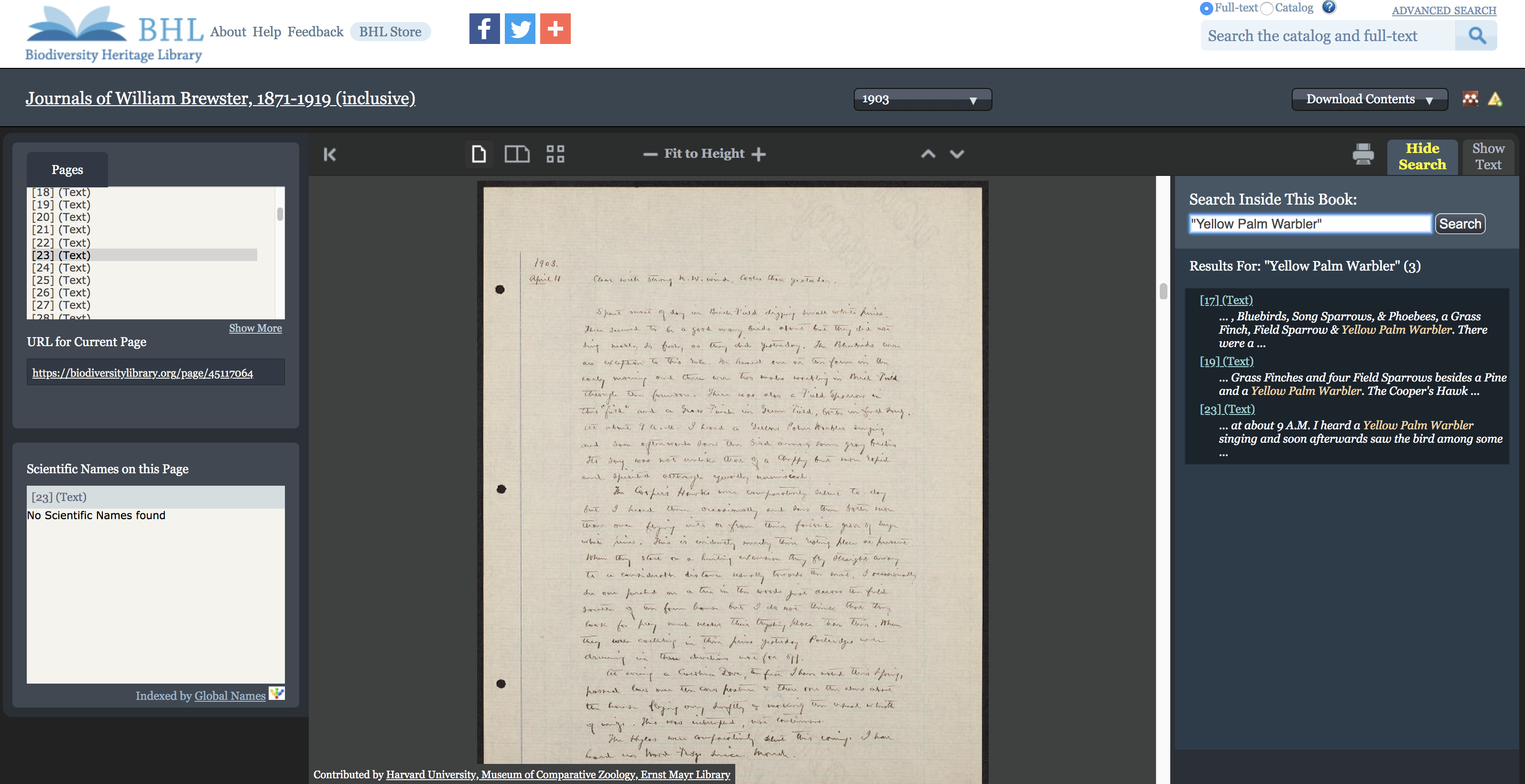
Screenshot of a book viewer with digitized archival materials and full-text search for "Yellow Palm Warbler".

Crowdsourced transcriptions allow digitized archival materials in BHL to be full-text searchable, as shown in this example searching for “Yellow Palm Warbler” within William Brewster’s 1903 journal. Transcription generated as part of the Ernst Mayr Library of Harvard University project on DigiVol. Contributed in BHL from the Ernst Mayr Library of the Museum of Comparative Zoology at Harvard University.

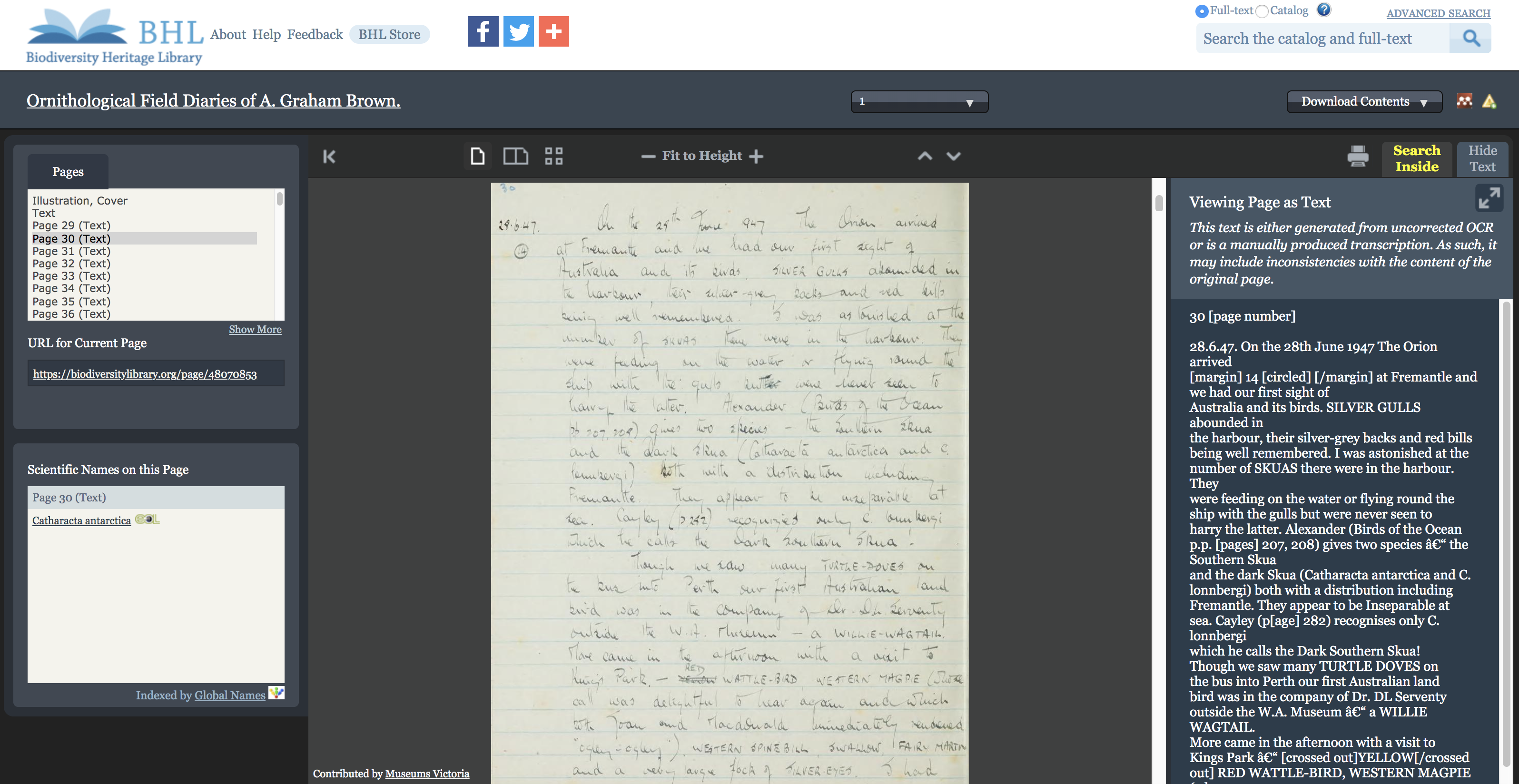
Screenshot of a book viewer with scientific name indexed on the page of an archival notebook.

Crowdsourced transcriptions allow BHL’s taxonomic name recognition software to index scientific names within the pages of digitized archival materials, as seen in this example in which Catharacta antarctica is indexed on a page within the first volume of the Ornithological Field Diaries of A. Graham Brown. Transcription generated as part of a project from BHL Australia and Museums Victoria on DigiVol. Contributed in BHL from Museums Victoria.

Participating Partners have begun uploading transcriptions to BHL. To date, transcriptions have been uploaded from Partner crowdsourcing projects with BHL Australia, Ernst Mayr Library of Harvard University, The New York Botanical Garden, and Smithsonian Institution Archives. This is an ongoing process, and more transcriptions will be uploaded to the Library over time.

Interested in transcribing archival materials? Several BHL Partners have active transcription projects on various crowdsourcing platforms. Follow the links below to explore the opportunities and get involved:

  • Ernst Mayr Library of Harvard University on DigiVol
  • The John Torrey Papers from The New York Botanical Garden on From the Page
  • Smithsonian Institution Archives on the Smithsonian Transcription Center
July 17, 2019by michelle.underhill
BHL News, Blog Reel, User Stories

Worlds of Wonder: Tracing Microscopy Illustrations on Zooniverse

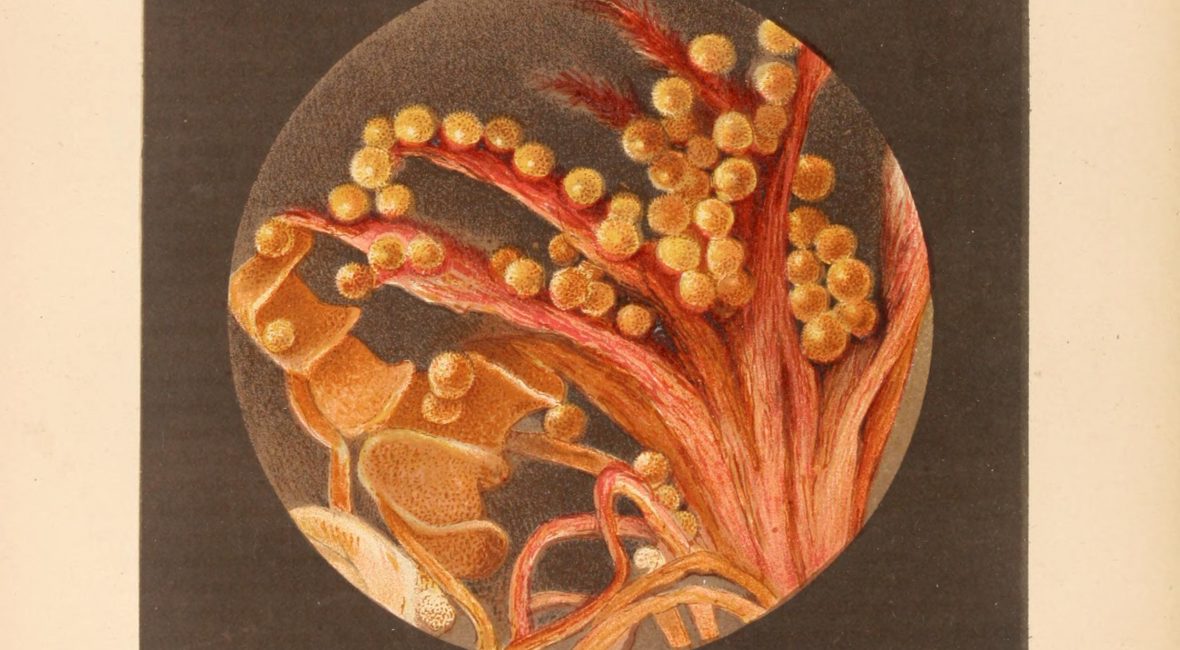
dropsofwaterthei00catl_0_0026.jpg

Catlow, Agnes. Drops of Water; their Marvellous and Beautiful Inhabitants Displayed by the Microscope. 1851. Contributed in BHL by University of Toronto – Thomas Fisher Rare Book Library.

In the mid-nineteenth century, microscopy became immensely popular with European and American naturalists. As microscopes became more affordable, microscopy societies were established, and numerous microscopy journals were launched and widely distributed. Many microscopy publications were richly illustrated, trying to recreate the “world of wonder and beauty” seen through the microscope (Gosse, 1860, p. v). In his widely read Evenings at the Microscope (1859), the English naturalist Philip Henry Gosse showed his readers “the path to the myriad wonders of creation” displayed by the microscope (p. 3). Moreover, microscopy journals, inviting their readers to contribute inquiries and observations, often made it possible for geographically dispersed microscopists to work together.

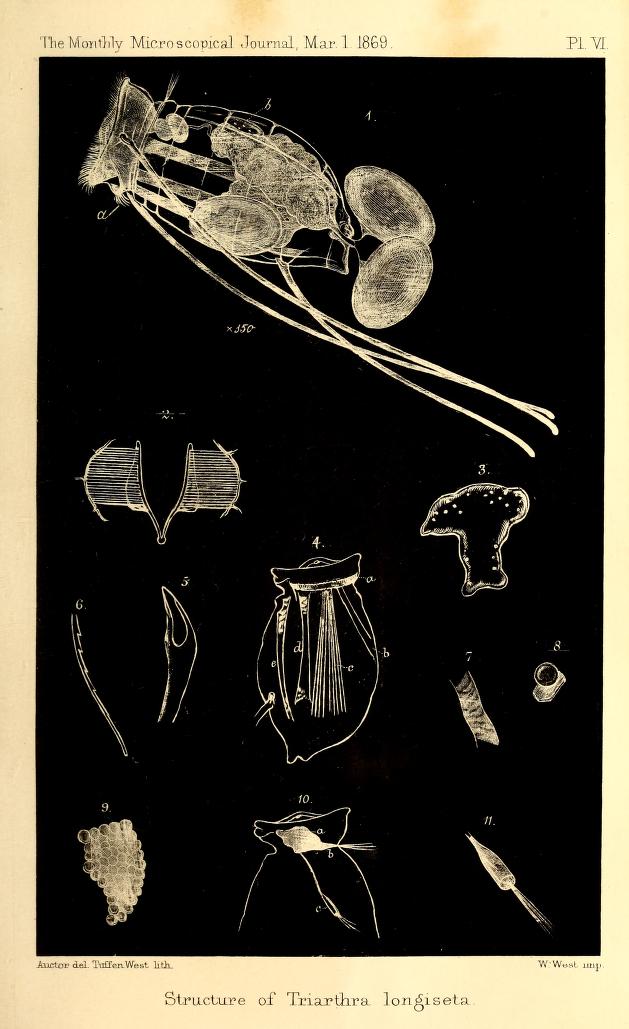
monthlymicroscop11869roya_0197.jpg

Hudson, Charles Thomas. “On Triarthra longiseta” in The Monthly Microscopical Journal. Vol. 1. 1869. Contributed in BHL by Smithsonian Libraries.

Since international copyright laws were only enforced after the signing of the Berne Convention in 1886 and the passing of the American Chace Act in 1891, mid-nineteenth-century publications frequently reused material published elsewhere. Illustrations and texts would be copied and reprinted, thus targeting several readerships at different places at the same time. Edward Pennock, editor of the Philadelphian Microscopical Bulletin and Science News, claimed that he could “write much better articles with the scissors than with the pen” (Pennock, 1890, p. 7). Pennock not only copied but also recombined articles to better accommodate the interests of his readers.

Citizen Scientists Invited to Explore the History of Microscopy

To this day, so many nineteenth-century publications on microscopy remain that they can hardly be analyzed by just a handful of historians. Therefore, the MUSTS research group at Maastricht University launched Worlds of Wonder, an online crowdsourcing project, on the Zooniverse citizen science platform. Worlds of Wonder is part of a PhD project funded by the Netherlands Organisation for Scientific Research, and it was inspired by Science Gossip, another crowdsourcing initiative asking citizen scientists to classify illustrations. The MUSTS researchers behind Worlds of Wonder, Lea Beiermann, Cyrus Mody and Raf De Bont, ask citizen scientists to help them classify nineteenth-century microscopy illustrations, assign keywords to the illustrations to make them searchable, and identify the people who made them.

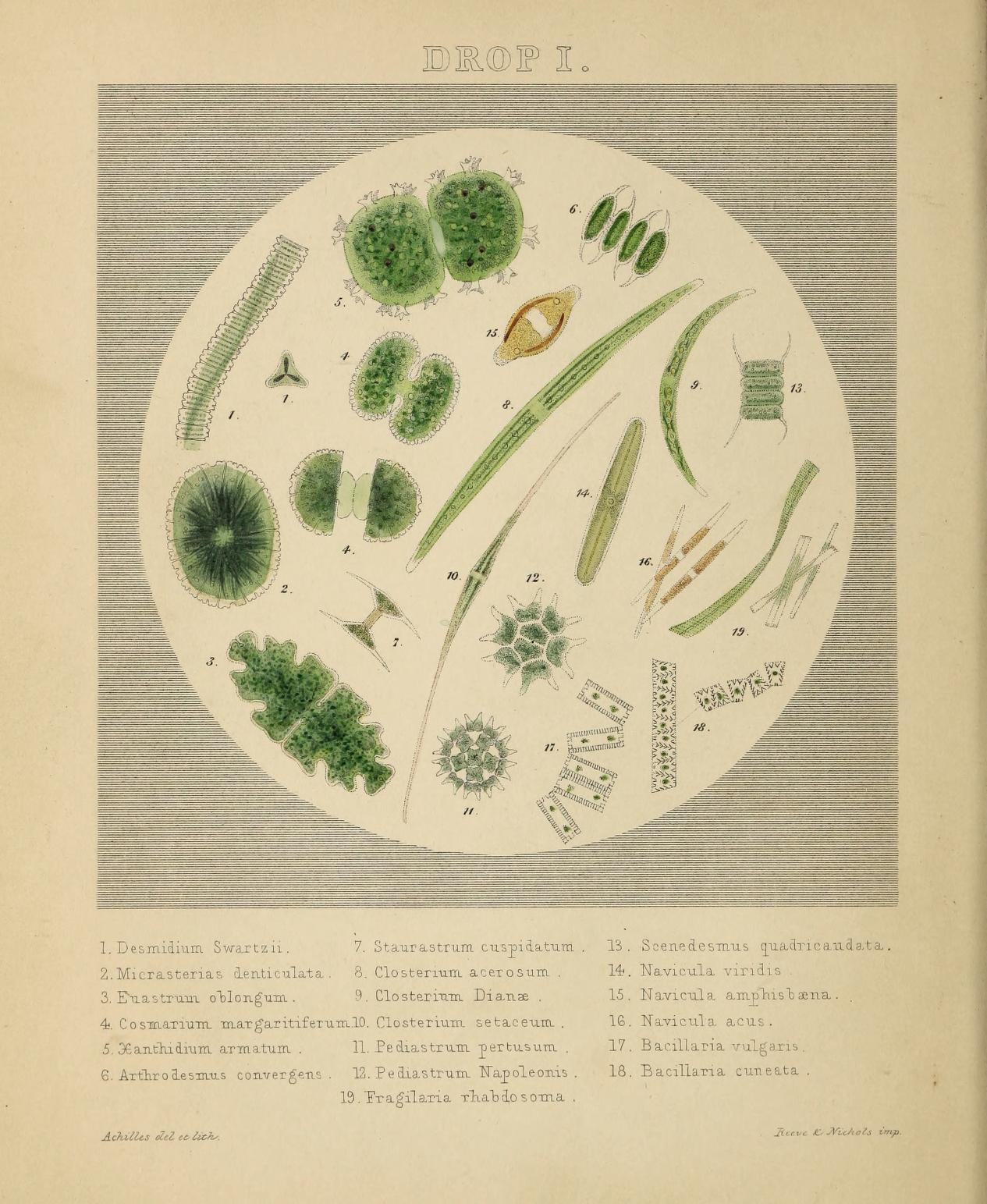
hardwickesscienc20cook_0092.jpg

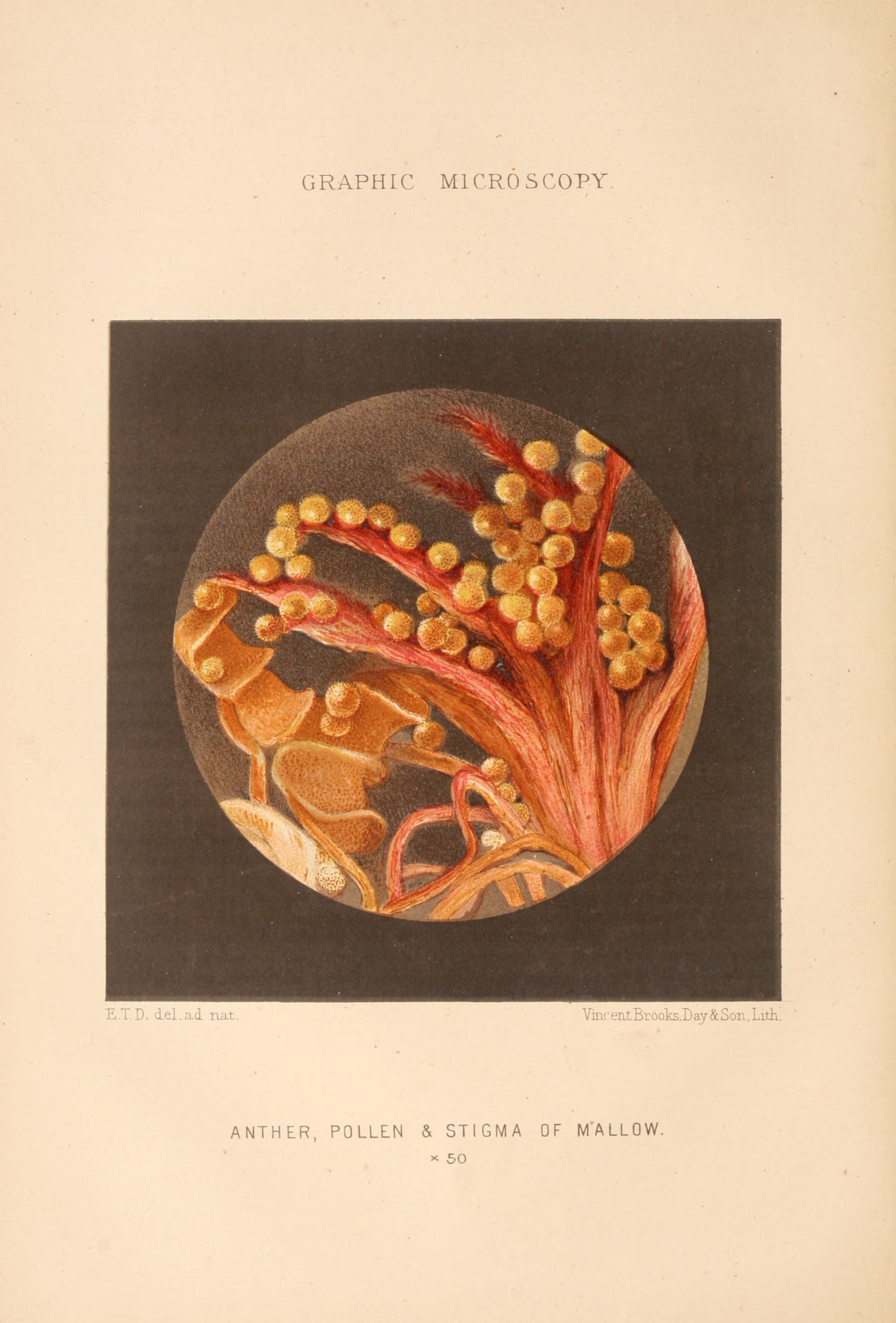
E. T. D. “Graphic Microscopy” in Hardwicke’s Science Gossip. Vol. 20. 1884. Contributed in BHL by MBLWHOI Library.

Worlds of Wonder aims to better understand the formation of a community of European and American microscopists by investigating the publications that connected them. How did microscopists and illustrators collaborate to produce illustrations? Who could contribute illustrations to microscopy publications? Where did microscopy illustrations travel and how did they change along the way? It seems that the circulation and reproduction of illustrations was a crucial factor in connecting nineteenth-century microscopists, who formed a strikingly diverse scientific community including physicians, biologists, engineers, natural historians, school teachers and zoologists with a shared interest in microscopy. Adapting and recombining published texts and illustrations may have made it easier for editors to tailor their publications to different groups of microscopists. In order to trace reproductions of microscopy illustrations, Worlds of Wonder draws on a wealth of digitized microscopy publications hosted by the BHL.

Although copyright laws were not strictly enforced in the mid-nineteenth century, issues of ownership and the authenticity of reproduced materials were strongly debated. Considering that today many online platforms continue to recombine and distribute texts and illustrations published elsewhere, Worlds of Wonder may also help us get a better idea of the effects of using these platforms in science communication.

You can join the crowdsourcing project on Zooniverse or learn more about the history of microscopy on the Worlds of Wonder blog.

References

Gosse, Philip Henry. 1860. Evenings at the Microscope; or Researches Among the Minuter Organs and Forms of Animal Life. New York: D. Appleton.

Pennock, Edward. 1890. Minutiae. The Microscopical Bulletin and Science Ne, 7(1), 7.

April 25, 2019by Joel Richard
Blog Reel, Campaigns, Her Natural History

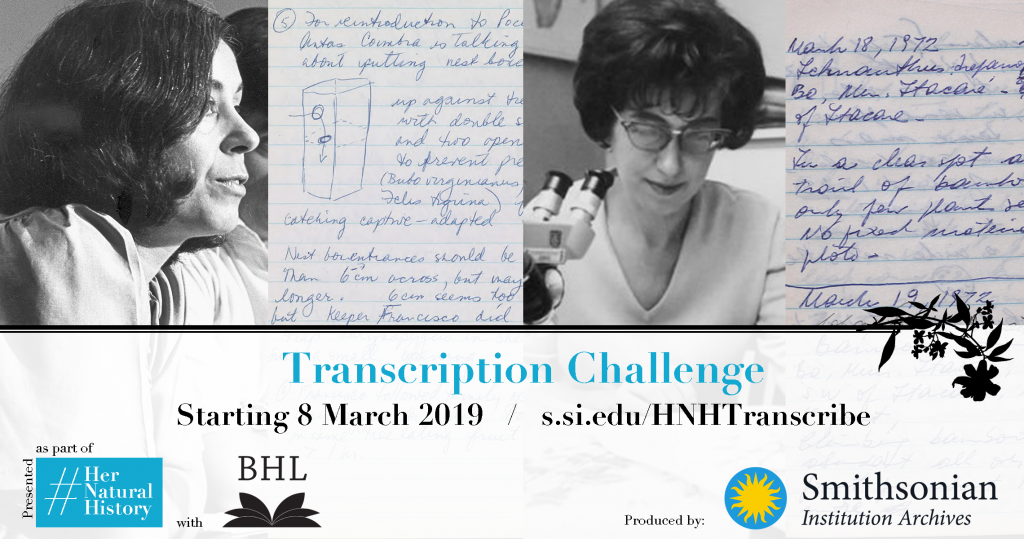
Transcribe Field Notes by Female Naturalists with the #HerNaturalHistory Transcription Challenge

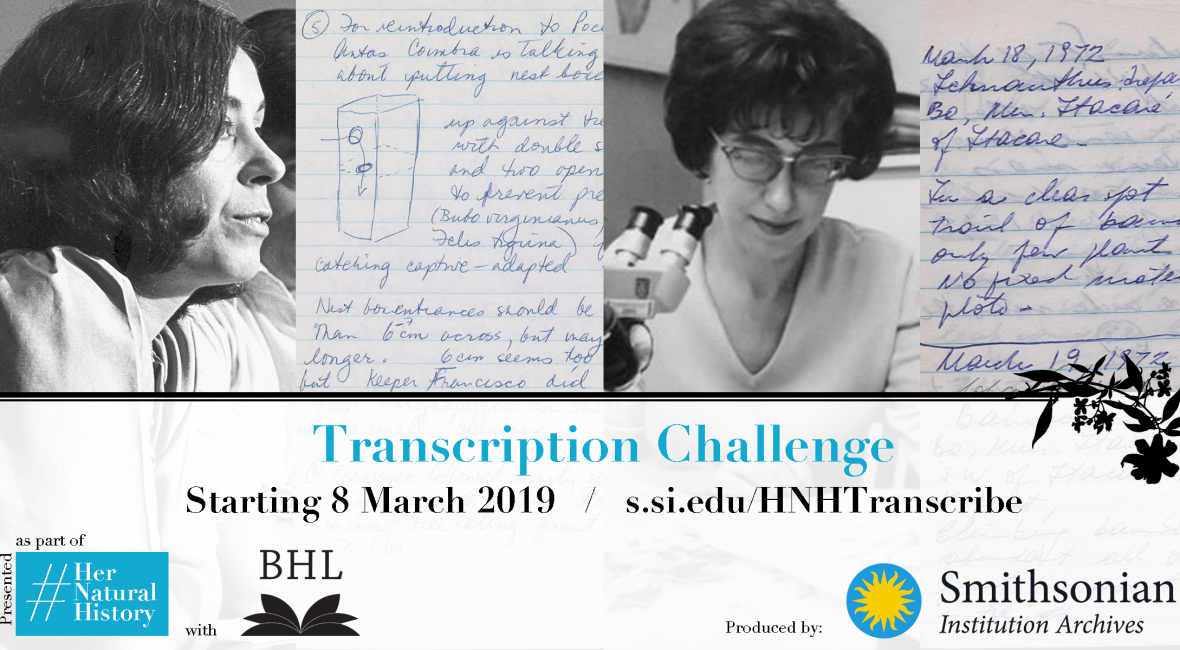
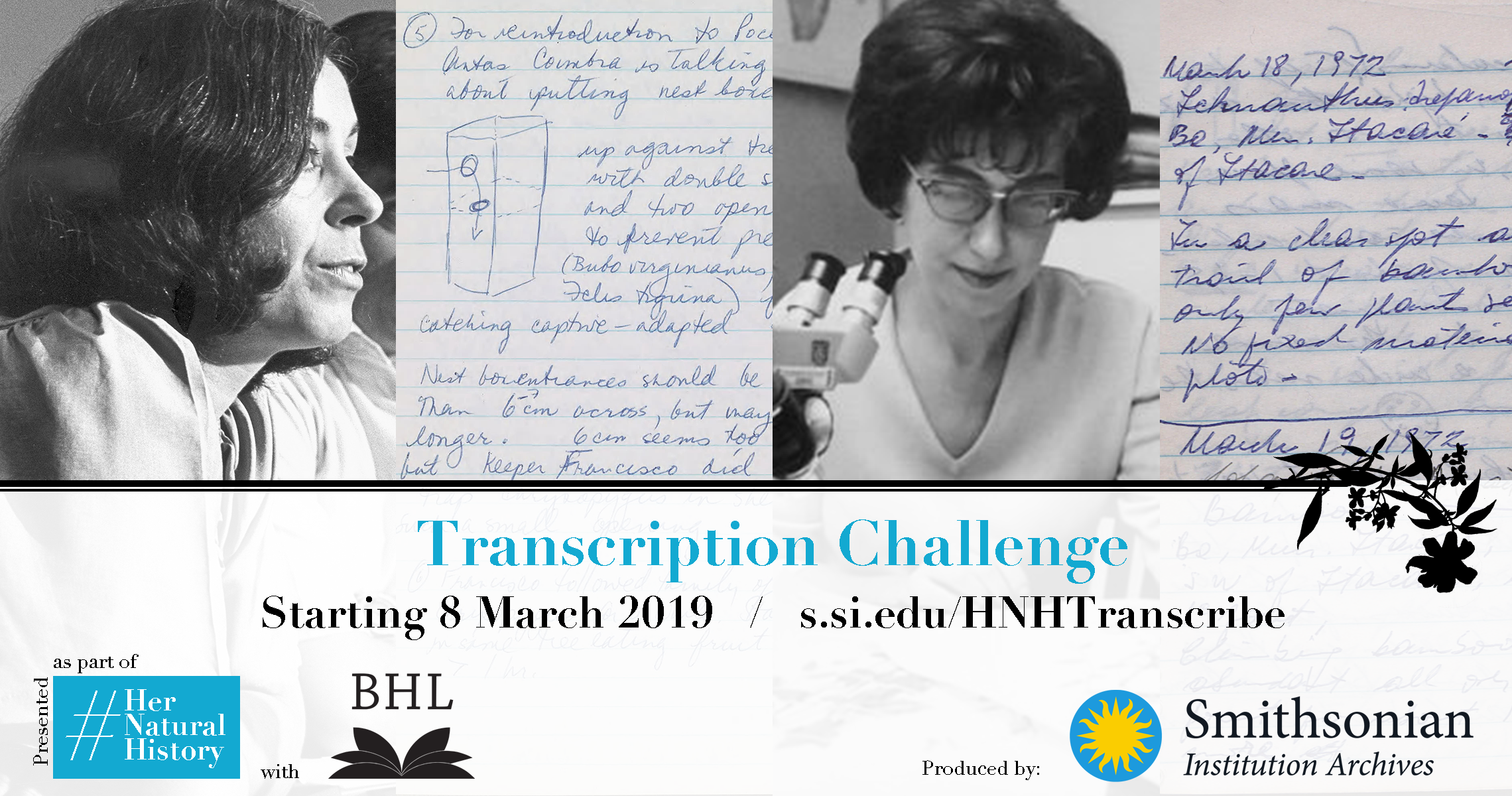
L to R: Photo of Devra Kleiman by Hirshfeld, Max, 1978, Smithsonian Archives – History Div, 94-8340; Page from Kleiman field book (Brazil notebook, 1975-1982); Photo of Cleofé E. Calderón, Smithsonian Institution Archives, SIA Acc. 11-008, Box 02, Image No. OPA-90; Page from Calderón field book (Brasil 1972, 1).

Looking for a challenge? The Smithsonian Institution Archives and the Smithsonian Transcription Center are teaming up for a #HerNaturalHistory-themed transcription challenge. Starting today (8 March), help a team of #volunpeers transcribe field notes from conservation biologist Devra Kleiman and botanist Cleofé Calderón. Dive into observations of golden lion tamarins with Kleiman, who worked at Smithsonian’s National Zoological Park from 1972 to 2001. And head to South America with Calderón to collect grasses for Smithsonian’s Department of Botany.

When? Starting TODAY, 8 March 2019
Where? Smithsonian Transcription Center. The field notes are available on the Smithsonian Institution Archives project page.

The Smithsonian Institution Archives has launched 11 field books on the Smithsonian Transcription Center. Throughout the month, additional field books will be added as others are completed. Our goal is to fully transcribe 18 field books in total (9 from each woman) by the end of March.

These transcriptions will also make the corresponding digitized field books in the Biodiversity Heritage Library more discoverable, as they can be uploaded in place of the automatically-generated OCR text in BHL to allow the field books to be full-text searchable. This will make it easier for researchers and the public to explore these valuable primary source materials and access specific information from their pages.

We hope you’ll join our #HerNaturalHistory transcription challenge to help improve access to and discoverability of the primary research of two female naturalists. Continue reading to learn more about Kleiman and Calderón.

This challenge is presented as part of the #HerNaturalHistory campaign — an international social media campaign produced in collaboration with BHL partners to celebrate women in natural history. Visit the Her Natural History webpage to learn more about this and other events and programming occurring all month long.

Devra Kleiman
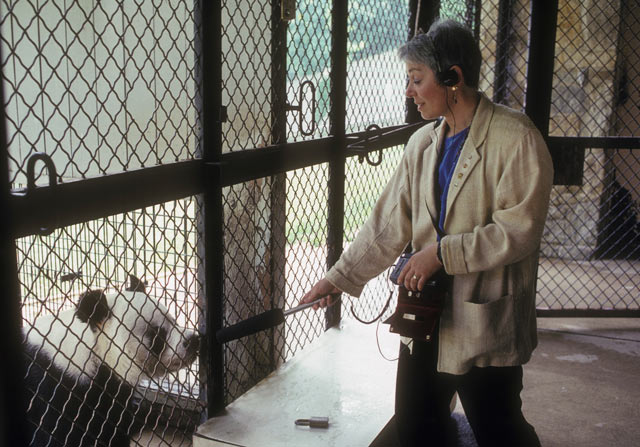
Giant Panda researcher Devra Kleiman records Hsing-Hsing’s vocalizations during breeding season, 1991, by Jessie Cohen, C-type print, National Zoo, Image ID: 614-95JC.

Conservation biologist Devra G. Kleiman (1942-2010) was the first female scientist at the National Zoological Park (NZP). She was hired by NZP in 1972 to manage the zoo’s captive breeding program. Much of her research focused on the captive breeding of giant pandas and the reintroduction of golden lion tamarins to the wild. Over her career at the zoo, she served as Assistant Director for Animal Programs, Assistant Director of Zoological Research and Education, Assistant Director of Research, Assistant Director of Zoological Research, and Senior Scientist. She authored approximately 150 manuscripts and two books.[1]

Smithsonian Institution Archives holds a large collection of archival materials documenting Kleiman’s research and professional activities. Many of her field books have been digitized in the Biodiversity Heritage Library as part of the Smithsonian Field Book Project.

Cleofé Calderón
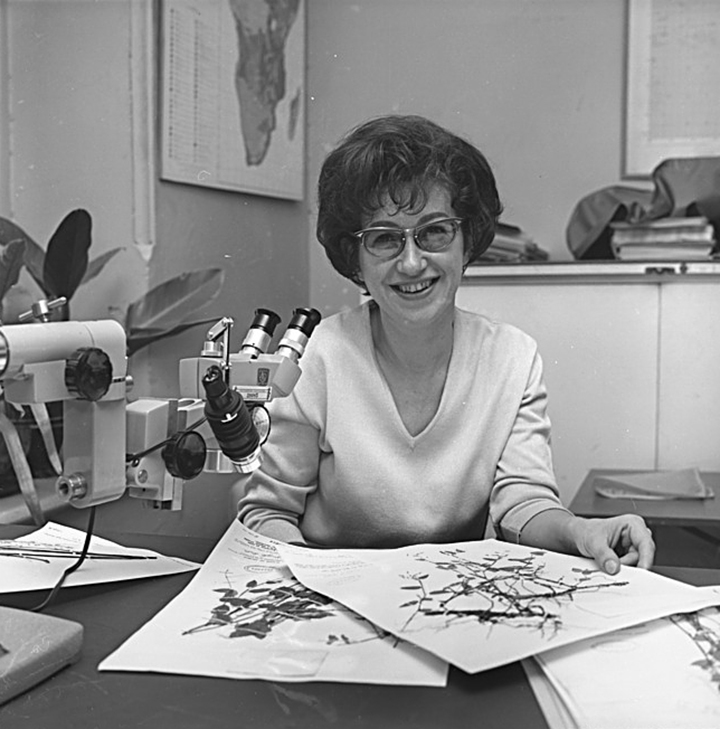
Visiting Argentine botanist Cleo Calderón with plant specimens and microscope. 1965.
From 120mm black and white negative. Smithsonian Institution Archives, SIA Acc. 11-008, Box 02, Image No. OPA-90.

Botanist Cleofé Calderón (1929-2007), born in Buenos Aires, Argentina, studied with renowned agrostologist Prof. Ing. Lorenzo Parodi at the University of Buenos Aires. She was introduced to Dr. Thomas R. Soderstrom, Curator of Grasses in the Department of Botany at the U.S. National Herbarium at the Smithsonian, during a trip to Washington, D.C. in 1961-62. The two began a close collaboration, and Calderón became a prominent botanist specializing in bamboo. With support from the Smithsonian, the Office of Scientific Affairs of the Organization of American States, and the National Geographic Society, Calderón conducted extensive field work in Central and South America, collecting plant specimens in Panama, Costa Rica, Ecuador, Colombia, and Brazil between 1966 and 1982. One of her most significant finds was the “re-discovery” of Anomochloa marantoidea, a small species of bamboo last seen in the late 1840s.[2]

Smithsonian Institution Archives holds a collection of field books documenting Calderón’s botanical research in Brazil, Panama, and Colombia between 1967 and 1981. Many of these have been digitized in the Biodiversity Heritage Library as part of the Smithsonian Field Book Project.

References

[1] Smithsonian Institution Archives. 2018. “Kleiman, Devra G.” Finding Aid, November 5. Accessed on February 28, 2019. https://siarchives.si.edu/collections/siris_arc_302446.

[2] Smithsonian Institution Archives. 2019. “Calderón, Cleofé E.” Collections. Accessed on February 28, 2019. https://siarchives.si.edu/collections/auth_per_fbr_eacp248.

March 8, 2019by michelle.underhill
BHL News, Blog Reel, Campaigns, Her Natural History

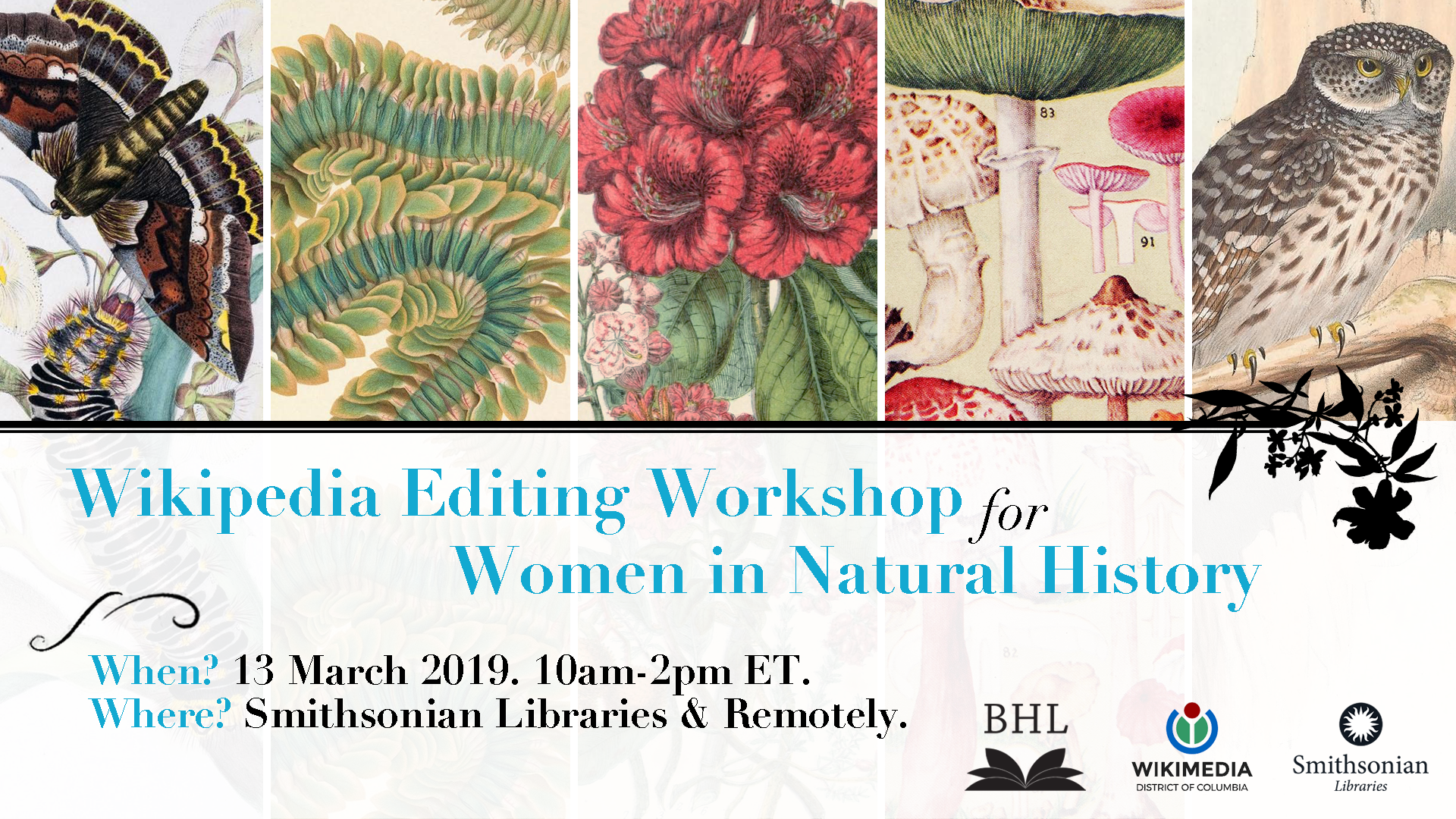
Join us for a Women in Natural History Wikipedia Editing Workshop on 13 March!

Wikipedia Editing Workshop

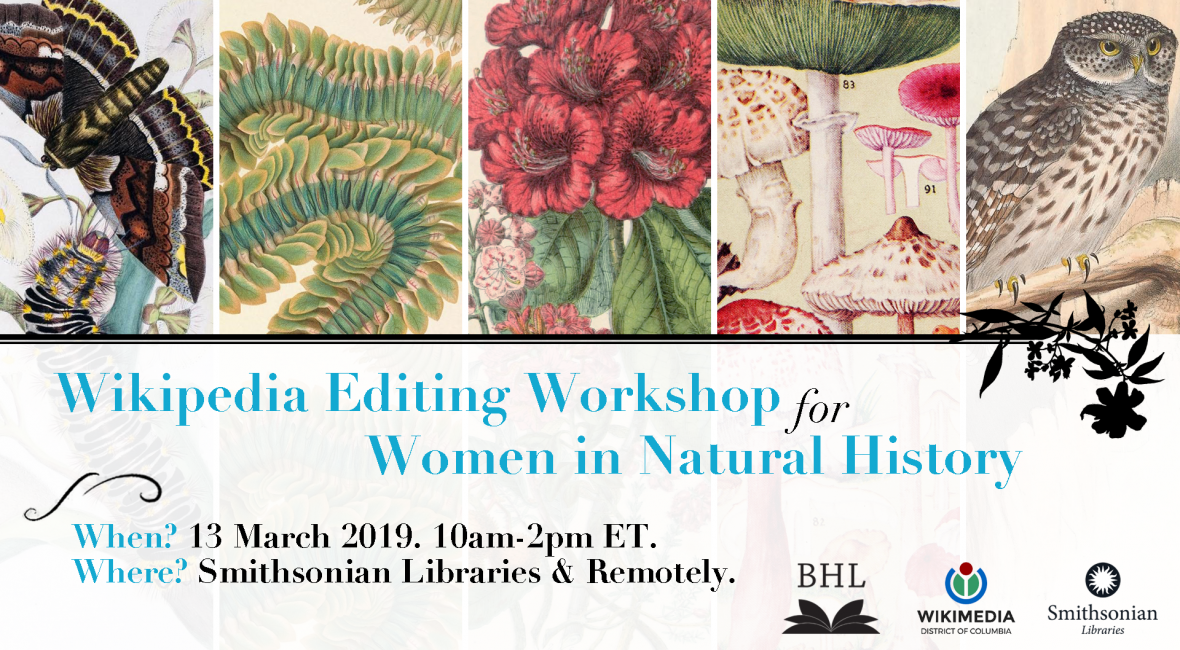
The illustrations featured in this graphic were created by women who will be featured in our Wikipedia Editing Workshop. From left to right: Harriet Scott Morgan, Australian lepidoptera and their transformations, v. 1 (1864); Roberta McIntosh, A monograph of the British marine annelids, v.2, pt.2 (1910); Elizabeth Twining, Illustrations of the natural orders of plants with groups and descriptions, v. 2 (1868); Mary Emily Eaton, Field book of common gilled mushrooms (1928); Elizabeth Gould, The Birds of Europe, v. 1 (1837).

Help us enhance information in Wikipedia about women in natural history during our Wikipedia Editing Workshop on 13 March in celebration of Women’s History Month!

In collaboration with Smithsonian Libraries and with support from Wikimedia DC, we’ll be hosting a Wikipedia Editing Workshop from 10am-2pm ET on 13 March to improve and create Wikipedia articles related to women in natural history. The workshop will be hosted by the Smithsonian Libraries in the National Museum of Natural History Library. There will also be virtual participation options. Registration is required.

See a summary of workshop details and information on how to register below. We hope you’ll join us!

Women in Natural History Wikipedia Editing Workshop

With the help of experienced Wikipedians, attendees will learn to edit Wikipedia and improve or create Wikipedia articles related to women in natural history, drawing on the Biodiversity Heritage Library’s free and extensive online collections as source materials. No editing experience is necessary.

When? 13 March 2019, 10am – 2pm ET
Where? In-person at Smithsonian Libraries (National Museum of Natural History Library, Washington, D.C.) and remotely

Registration Required:

  • Register to attend in-person
  • Register to attend remotely

More Information: Wikipedia Event Page

Attending in person? Laptops are required. Please bring your own. Wikimedia has two laptops to loan. Reserve one by emailing [email protected]. This event is free and open to the public, but space is limited, so register today. Lunch will be provided.

Attending remotely? There will be an option to participate in the editing workshop remotely. For remote participants, the workshop will be live-streamed via YouTube Live here: https://s.si.edu/NHWomenWikiLive. Be sure to register to attend remotely.

This workshop is hosted by the Biodiversity Heritage Library and Smithsonian Libraries with support from Wikimedia DC. It is being produced as part of a larger celebration around women in natural history that BHL and our partners are organizing for Women’s History Month. Stay tuned for more details about additional events and programming coming this March!

February 4, 2019by michelle.underhill
Blog Reel

The Serendipitous Discovery of Susan Fereday: A Story about the Impact of Citizen Science

View Full Size Image
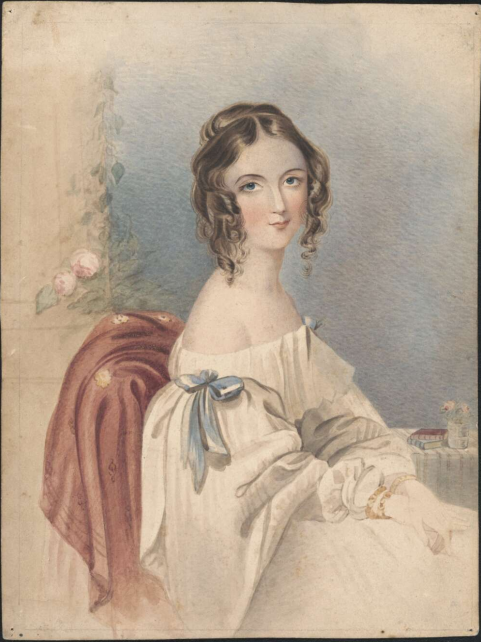
Self Portrait, Susan Fereday. National Library of Australia. Source: WikiCommons.

I love volunteering for the Biodiversity Heritage Library. I taxo tag images in the BHL Flickr account. This assists the use of these images by BHL as well as other institutions that use BHL content. It is also my favorite way of exploring BHL. I get a real thrill out of the serendipitous discoveries I make while tagging.

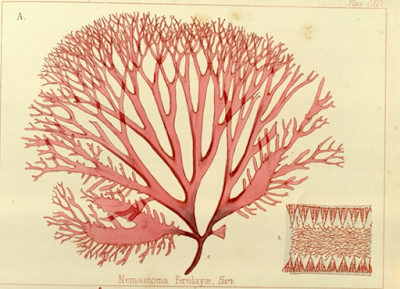
My most recent BHL adventure resulted from tagging an album of images from the boringly named but absolutely fabulous Botany of the Antarctic voyage of H. M. discovery ships Erebus and Terror in the years 1839-1843. Amongst the many images in this album was one of a particular species of seaweed – Nemastoma feredayae.

View Full Size Image
Nemastoma feredayae. Art by William Henry Harvey. The botany of the Antarctic voyage of H.M. discovery ships Erebus and Terror in the Years 1839-1843. http://biodiversitylibrary.org/page/28467702. Digitized by the Missouri Botanical Garden.

I tagged the image with the species name given, and then I attempted to confirm the current name of the seaweed. In doing so, I stumbled across the fact that the seaweed was named in honor of Mrs. Susan Fereday. Who was this mystery woman?

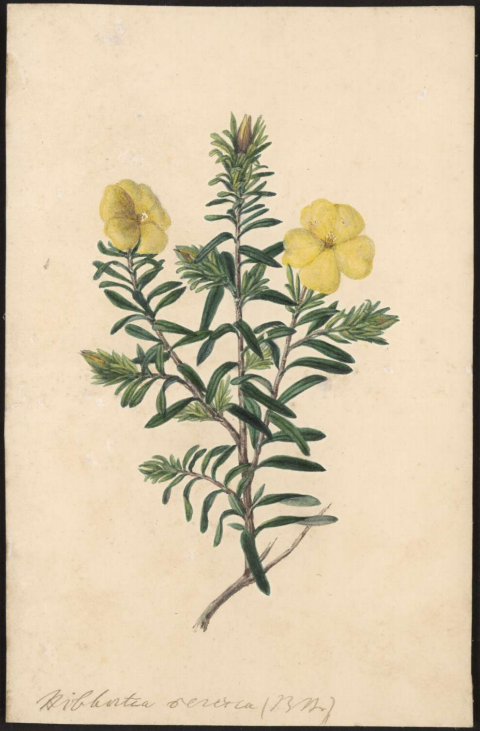
Unable to resist going down that rabbit hole, I googled her. I discovered that Susan Fereday emigrated to Tasmania, Australia from England in 1846. She was a talented artist. So talented, her artwork is now in the collection of the National Library of Australia. She concentrated on painting beautiful images of fauna and flora in and around the area where she lived.

View Full Size Image
Hibbertia sericea by Susan Fereday. National Library of Australia. Source: WikiCommons.

She was also a keen collector of seaweed specimens. She corresponded with and sent specimens to one of the foremost experts in algae of the day, William Henry Harvey. Harvey in turn honored Fereday’s contribution to the study of algae by naming two species after her. It was the image of one of those species drawn by Harvey that I had tagged in the BHL Flickr feed.

View Full Size Image
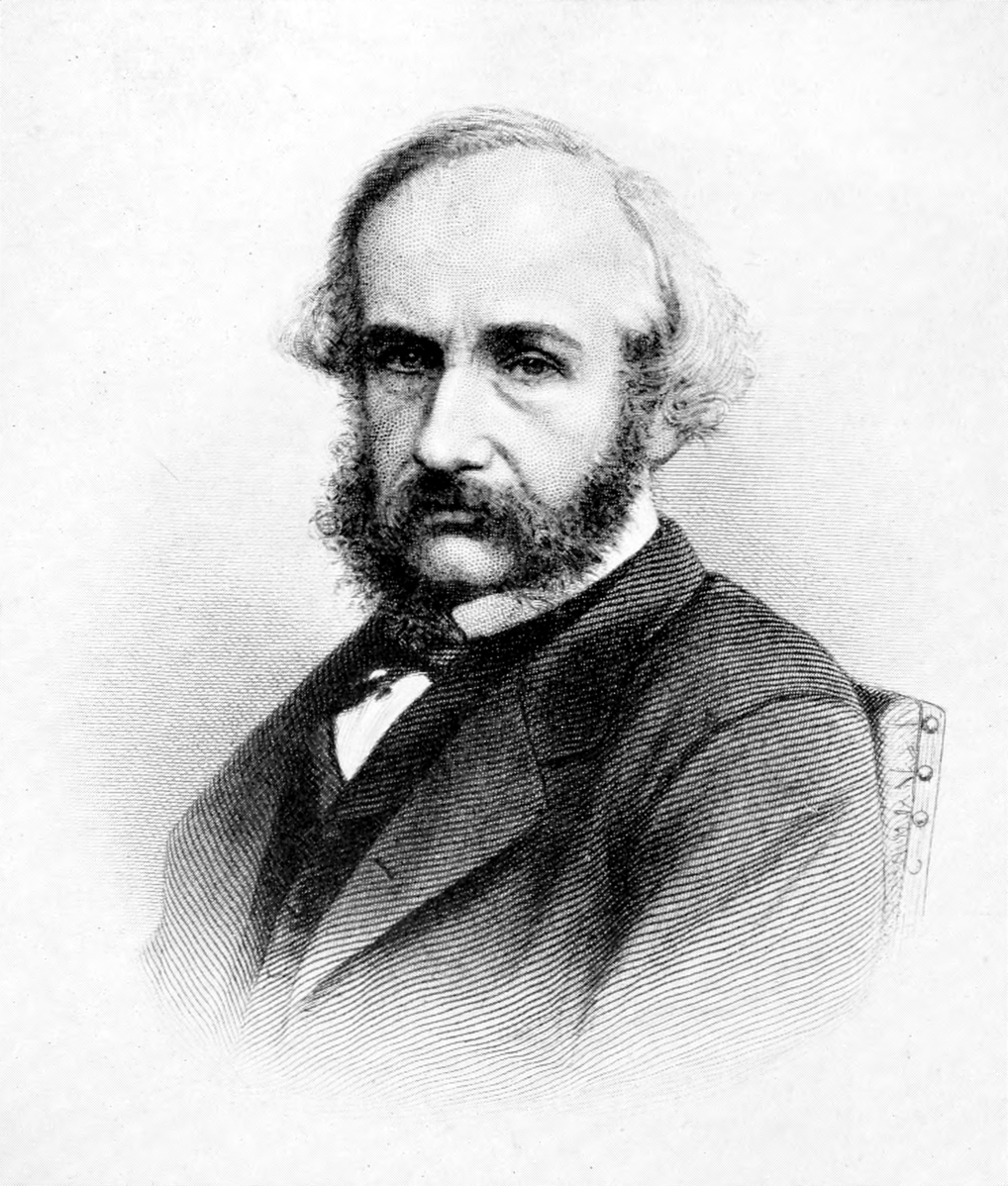
Portrait of William Henry Harvey. Oliver, F. W. (Francis Wall). Makers of British botany. (1913). http://www.biodiversitylibrary.org/page/1073575. Digitized by MBLWHOI Library.

While researching Fereday, I was disappointed to see she did not have Wikipedia page. Being a keen Wikipedian, I decided to rectify this. While drafting her article, I realized that several sources had different dates as her birth date. I emailed the National Library of Australia via their “Ask a Librarian” service to ask them to help me confirm that their records were correct.

I received a fabulously researched reply from Damien Cole, one of their librarians. He discovered that the birth date confusion was due to Susan Fereday having a sister of the same name, who had died prior to our Susan being born. Fereday was actually born in 1815! As a result of this research, the National Library subsequently edited their records to give Susan Fereday her birth date, and I obtained a reputable citation supporting that information for Fereday’s Wikipedia article.

The National Library of Australia has also shared the changes they made to their database with the Australian National Herbarium as well as Design and Art Australia Online. The Library even went so far as to contact the Encyclopedia of Australian Science to inform them of the Wikipedia article in the hope that that organization might also consider including Fereday in their website.

All of this resulted because the MBLWHOI Library (the Marine Biological Laboratory and the Woods Hole Oceanographic Institution Library) scanned the volumes on the Antarctic voyage of H. M. discovery ships Erebus and Terror and made them available to BHL. Because BHL added the images from those volumes to Flickr, I was able to tag them.

It just goes to show that when you mix citizen science with digitization and the ability to freely reuse content, everyone benefits.

I would love it if people joined me in taxotagging BHL Flickr images. Instructions can be found here.

Anyone can create or improve Wikipedia. For a beginner’s guide, see this article.

And if you think you can add to and improve Susan Fereday’s article, go for it!

May 23, 2017by ulib-libraryjobs
Blog Reel, Campaigns, Featured Books

Holmes, Shells, and the Intersection of Art & Science

View Full Size Image
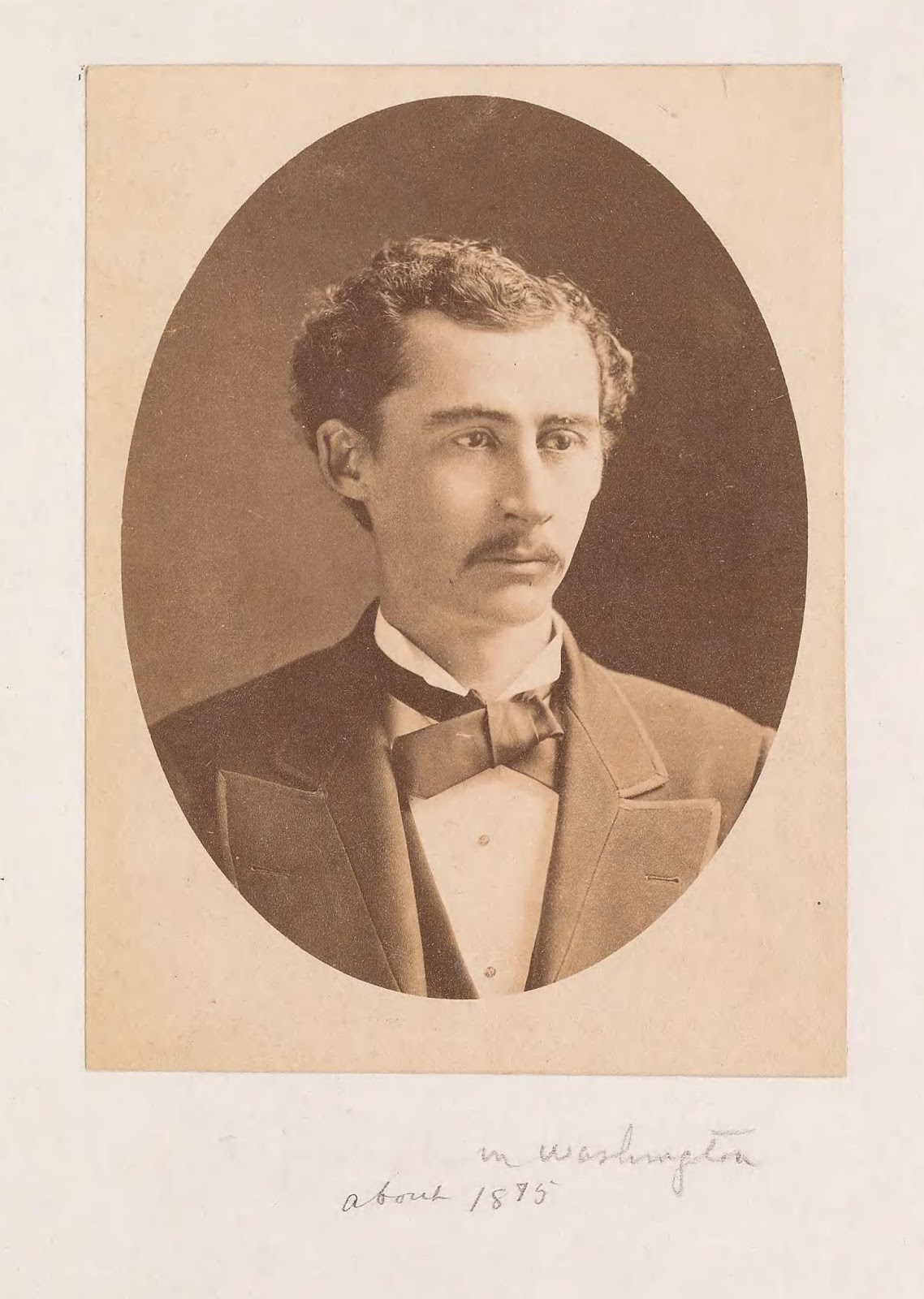
William Henry Holmes, about 1875. Random Records of a Lifetime. v. 1. http://www.biodiversitylibrary.org/page/52009570. Digitized by Smithsonian Libraries.

From November 28th through December 9th, BHL is joining the Smithsonian Libraries, Smithsonian Institution Archives, Smithsonian Field Book Project, and Smithsonian Transcription Center in hosting the #ManyHatsofHolmes transcription event. This event challenges volunteers around the world to help us transcribe William Henry Holmes’ archival materials. Learn more on the Smithsonian Libraries’ blog.

As the hashtag implies, William Henry Holmes (1846-1933) studied a variety of topics throughout his distinguished career, including anthropology, archaeology, art, and geology. He spent much of his career affiliated with the Smithsonian Institution. He studied art under Theodore Kauffman and went on to work as a scientific illustrator with Smithsonian staff. In 1872, he was appointed artist-topographer to the United States survey of the territories under Ferdinand V. Hayden and in 1874 was appointed assistant geologist. He went on to work with the United States Geological Survey (USGS) and the Bureau of American Ethnology (BAE) before returning to the Smithsonian’s United States National Museum (USNM). Holmes eventually became head curator of the Smithsonian Institution’s Department of Anthropology and Director of the National Gallery of Art.

Many of Holmes’ field notes and personal records have been digitized by Smithsonian Libraries and Smithsonian Institution Archives as part of The Field Book Project. These are available in BHL. In addition to these archival materials, BHL also holds a number of publications by Holmes.

View Full Size Image
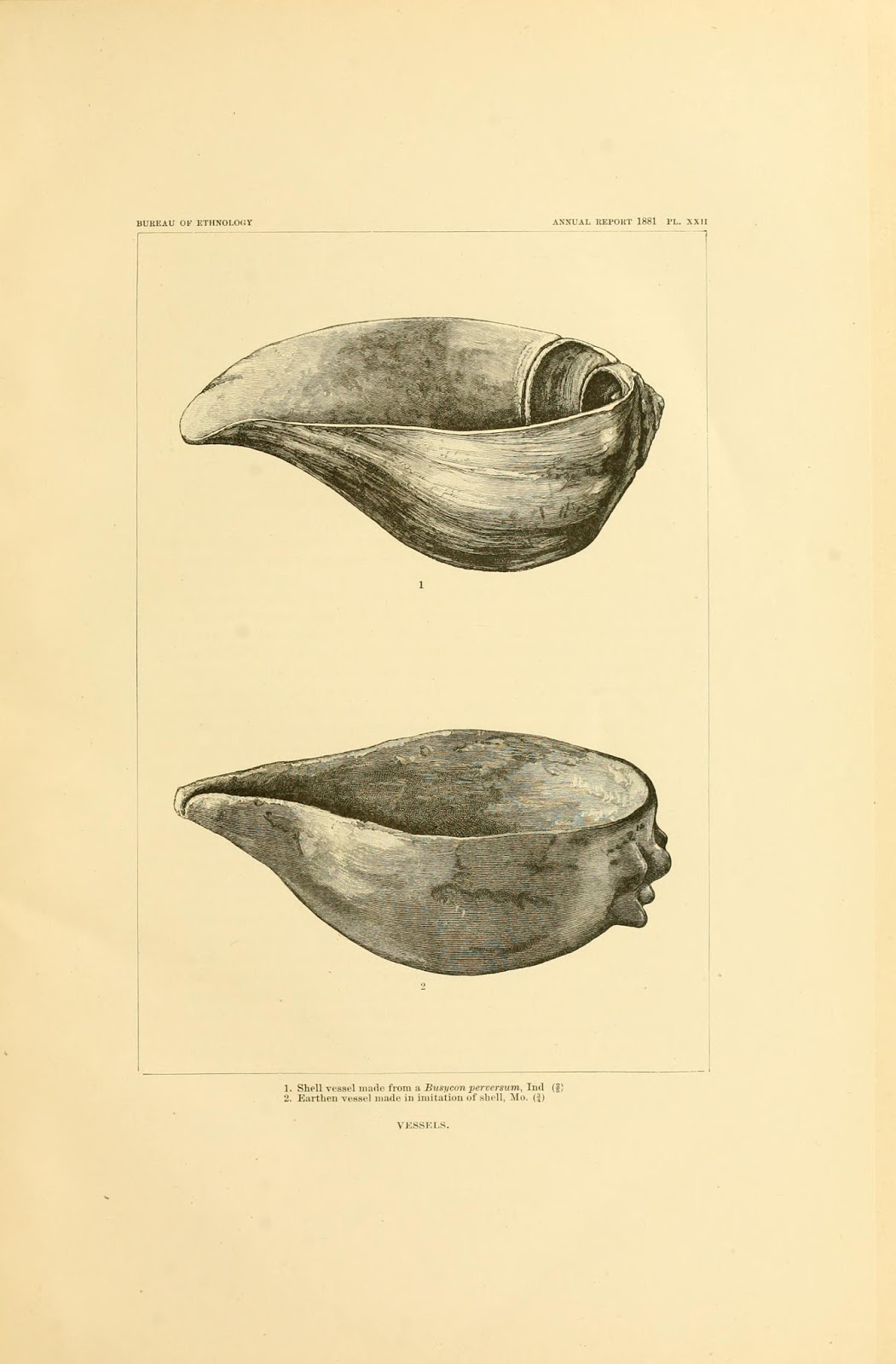
Top figure: Vessel made from a lightning whelk (Sinistrofulgur perversum) – synonym Busycon perversum – shell. Bottom figure: Earthen vessel made in imitation of a shell. Holmes, William Henry. Art in Shell of the Ancient Americans. 1883. http://biodiversitylibrary.org/page/11258636. Digitized by Smithsonian Libraries.

One of those publications is Art in Shell of the Ancient Americans, which was published in 1883 as part of the second annual report of the Bureau of Ethnology.

Holmes intended this publication to be a preliminary study of the ways in which Native Americans in the distant past used shells as a medium for artistic expression and how this artwork represents a phase in the evolution of human culture. It discusses the use of shells as implements, utensils, and objects of ornamentation (such as jewelry).

Most of the objects presented in the publication were obtained from graves and tumuli (ancient burial mounds), which explains how such delicate pieces survived throughout the centuries. But, while these pieces can be deemed ancient, Holmes did not have enough data to provide a reliable estimation of age.

At this point, you might be wondering why a book about shell art would be relevant for a biodiversity library and what bearing it might have on scientific research. The simple answer is that these shells are remnants of living creatures – mollusks that died long ago but still left behind a legacy in shell. However, Art in Shell has relevance for scientific research beyond this vague connection with the natural world.

View Full Size Image
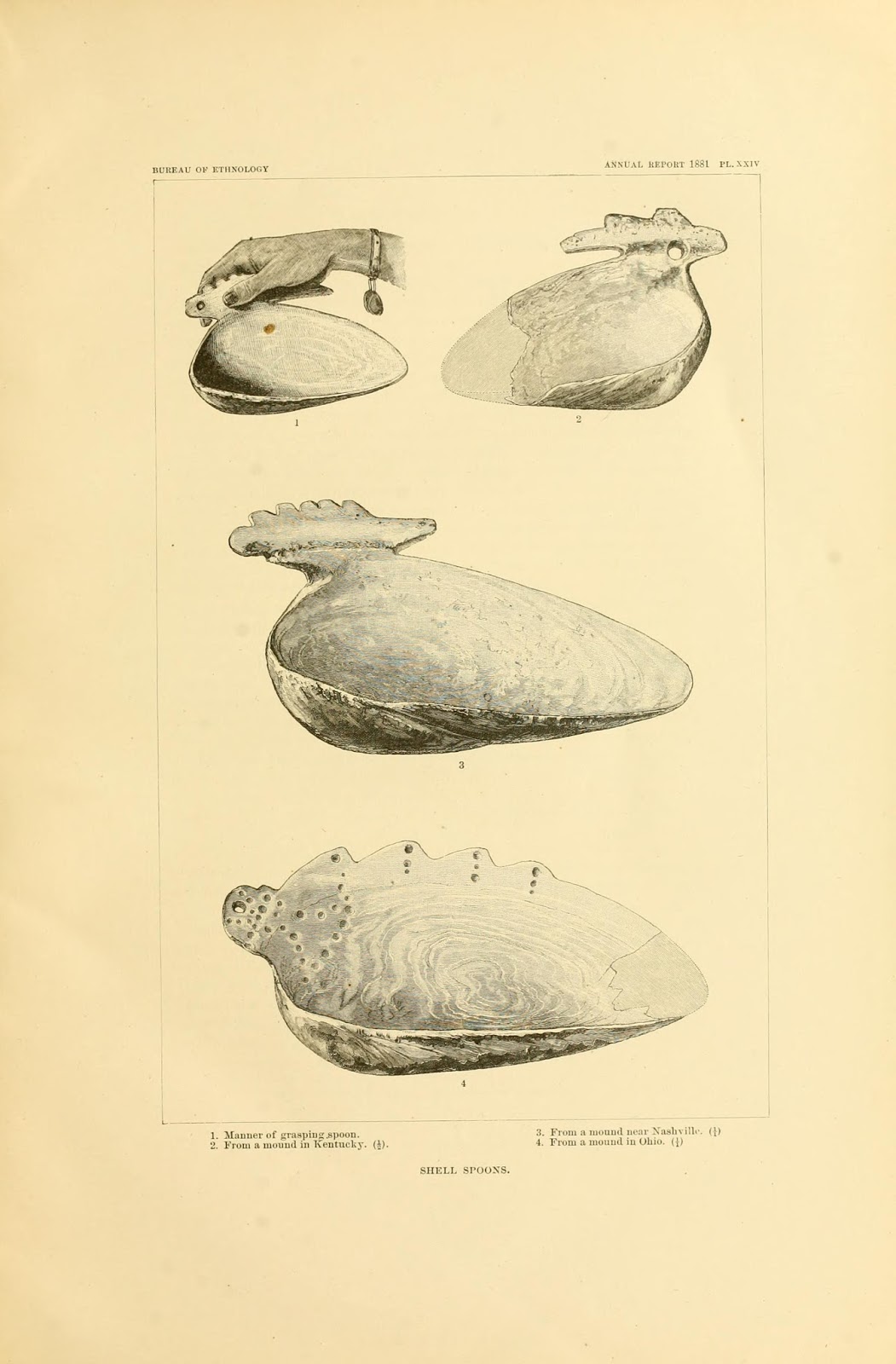
Shell spoons made from Lampsilis ovata (synonym Unio ovatus) – top and center – and Potamilus alatus (synonym Unio alatus) – bottom. Holmes, William Henry. Art in Shell of the Ancient Americans. 1883. http://www.biodiversitylibrary.org/page/11258608. Digitized by Smithsonian Libraries.

In the publication, Holmes attempts to identify the species (or most-specific taxa possible) to which the shell used for the object belongs. This information provides a valuable record of human interaction with various mollusk species and helps document the diversity of species present in ancient America. The presence of shells in various regions, when coupled with species distribution data that demonstrates the transport of these shells from their source, can also provide insight into historic Native American migration paths, tribal contacts, and trade.

Thus, this book is not just a book about art. It represents a beautiful union of art and science. And considering the many disciplinary hats that Holmes wore throughout his career, it’s no surprise that his publication would bridge these two worlds. Art in Shell is therefore not only a very fitting book to highlight as a representation of the union of Holmes’ many interests, but the insights it provides into Native American culture also make it particularly relevant this month as we celebrate Native American Heritage Month.

View Full Size Image
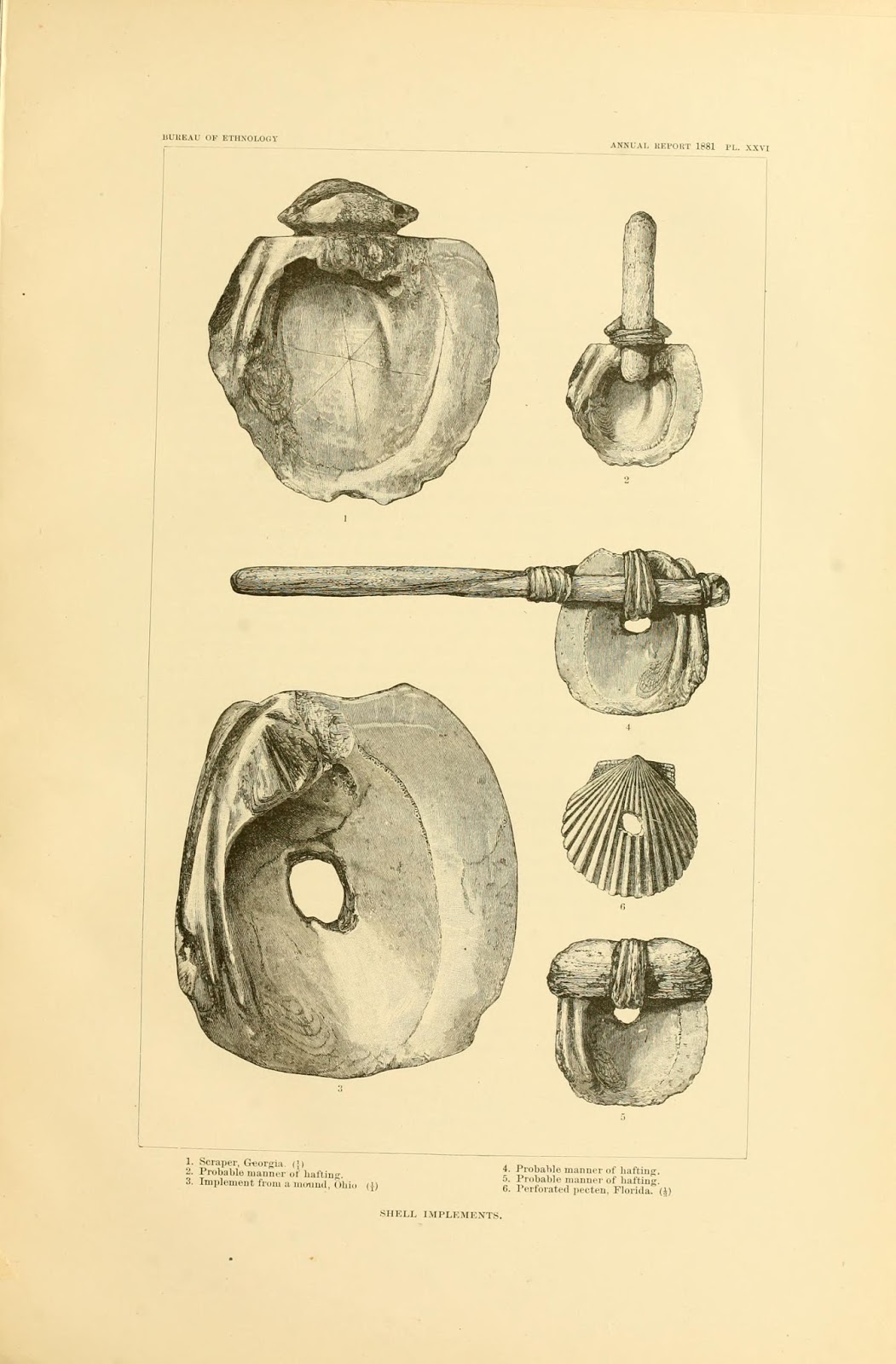
Implements made from Unio vericosus (figs. 1 and 2), Cyclonaias tuberculata (synonym Unio tuberculosus, figs. 3-5) and Pecten (fig. 6). Holmes, William Henry. Art in Shell of the Ancient Americans. 1883. http://www.biodiversitylibrary.org/page/11258618. Digitized by Smithsonian Libraries.

So, can we tie this publication back to the Random Records of a Lifetime series that is the subject of our #ManyHatsofHolmes transcription event? Holmes’ discussion about his work with shell art in these records seems to be fairly limited, but in his biographical sketch in volume I, Holmes does report that, “The years 1882-3-4 and 5 were devoted largely to Museum work and the study of primitive art in its various branches.” As Art in Shell was published in 1883, this account is likely a reference in part to his work on this publication (as well as the many others on ancient American art that he produced during this time period).

As you participate in the challenge, can you find additional references in the Random Records that can be linked back to Art in Shell? If you do, share them on social media with #ManyHatsofHolmes.

Additionally, if you need a break from transcription or want another challenge, try taxon tagging the illustrations from Holmes’ Art in Shell on Flickr. By tagging the shell art with the taxonomic name of the species to which the shell belongs, you can help researchers more easily discover which species ancient Americans were using to create these objects. Learn more about taxon tagging in this article and see our detailed instructions here. Find the Art in Shell images in Flickr here.

See this video for basic instructions on how to tag the illustrations in Art in Shell:

Holmes was truly a man of many trades and talents. As you dig deeper into his work during the #ManyHatsofHolmes event, be sure to share your findings on social media with the hashtag. Thanks so much for participating in our Holmes extravaganza!

View Full Size Image
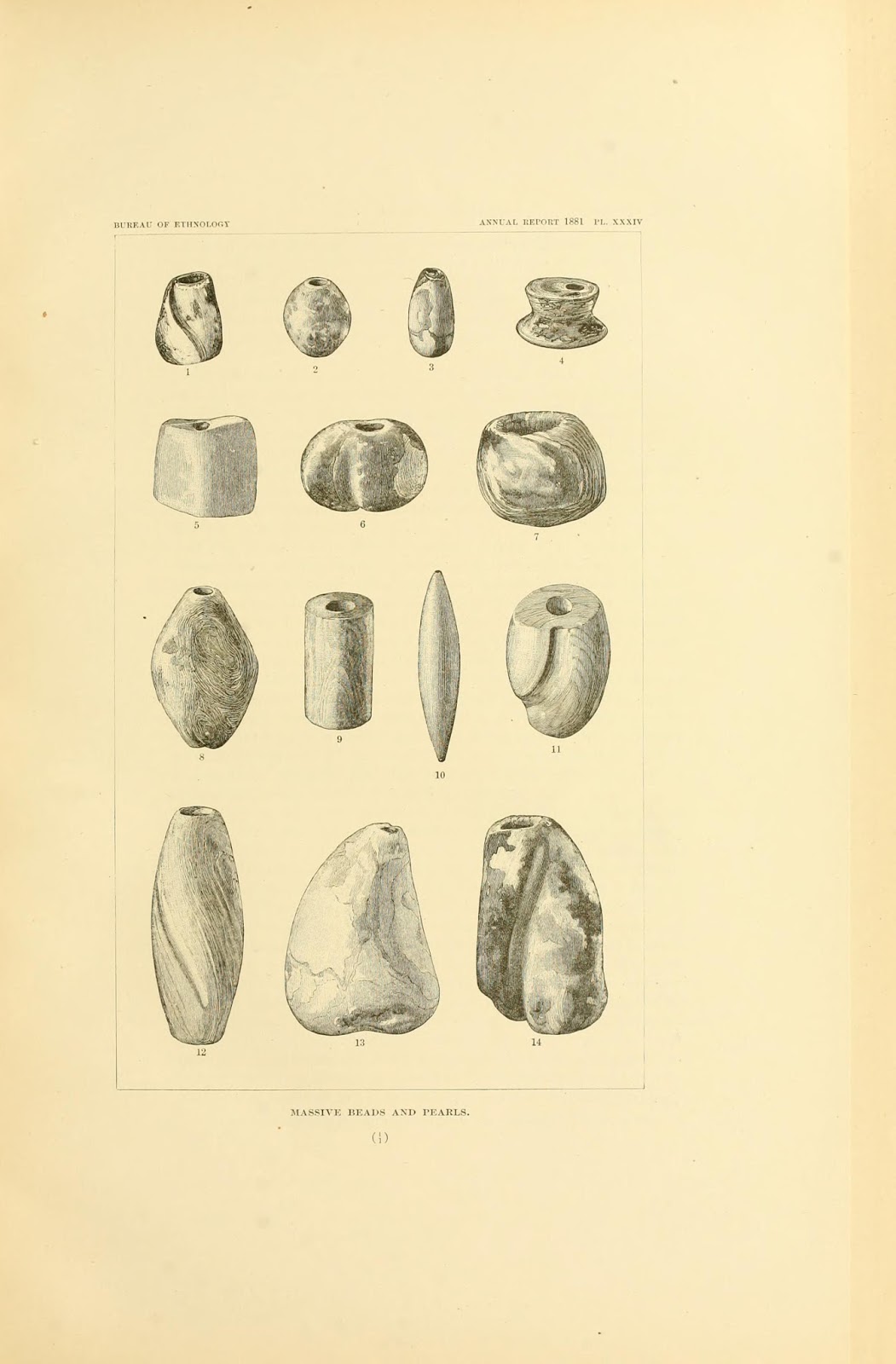
Beads and pearls. Figs. 1, 7, 12, and 9: Sinistrofulgur perversum (synonym Busycon perversum); Fig. 2: Crassadoma gigantea (synonym Hinnites giganteus); Fig. 3 and 13: pearls, latter from Haliotis californianus; Fig. 4: unknown univalve; Fig. 5: ivory?; Figs. 6 and 11: unknown dextral whorled shell; Fig. 14: Strombus or Busycon. Holmes, William Henry. Art in Shell of the Ancient Americans. 1883. http://www.biodiversitylibrary.org/page/11258675. Digitized by Smithsonian Libraries.
November 30, 2016by michelle.underhill
Page 1 of 212»

Help Support BHL

BHL's existence depends on the financial support of its patrons. Help us keep this free resource alive!

search

About BHL

The Biodiversity Heritage Library (BHL) is the world’s largest open access digital library for biodiversity literature and archives. BHL operates as a worldwide consortium of natural history, botanical, research, and national libraries working together to digitize the natural history literature held in their collections and make it freely available for open access as part of a global “biodiversity community.”

Join Our Mailing List

Sign up to receive the latest news, content highlights, and promotions.

Subscribe Now

Subscribe to Blog via Email

Enter your email address to subscribe to this blog and receive notifications of new posts by email.

Join 319 other subscribers

Subscribe to Blog Via RSS

Subscribe to the blog RSS feed to stay up-to-date on all the latest BHL posts.

Access RSS Feed

Inspiring Discovery through Free Access to Biodiversity Knowledge.

The Biodiversity Heritage Library makes it easier than ever for you to access the information you need to study and explore life on Earth…for free, anytime, anywhere.


64+ Million Pages of
Biodiversity Literature Online.

EXPLORE

Tools and Services
to Transform Research.

EXPLORE

300,000+
Illustrations on Flickr.

EXPLORE

ABOUT | HARMFUL CONTENT | PRIVACY | SITE MAP | TERMS OF USE