Biodiversity Heritage Library - Program news and collection highlights from BHL
  • Home
  • News
  • Featured Books
    • All Featured Books
    • Book of the Month Series
    • BHL at 20
  • User Stories
  • Campaigns
    • Fossil Stories
    • Garden Stories
    • Monsters Are Real
    • Page Frights
    • Her Natural History
    • Earth Optimism 2020
  • Tech Blog
  • Visit BHL
Home
News
Featured Books
    All Featured Books
    Book of the Month Series
    BHL at 20
User Stories
Campaigns
    Fossil Stories
    Garden Stories
    Monsters Are Real
    Page Frights
    Her Natural History
    Earth Optimism 2020
Tech Blog
Visit BHL
  • Home
  • News
  • Featured Books
    • All Featured Books
    • Book of the Month Series
    • BHL at 20
  • User Stories
  • Campaigns
    • Fossil Stories
    • Garden Stories
    • Monsters Are Real
    • Page Frights
    • Her Natural History
    • Earth Optimism 2020
  • Tech Blog
  • Visit BHL
Biodiversity Heritage Library - Program news and collection highlights from BHL
BHL News, Blog Reel

‘What’s in a Name?’ Launched at Harvard Museum of Natural History

Why are names important in science? What is the difference between scientific names (also known as Latin names or taxonomic names) and common names? Why do some species have multiple names? The grant project team for What’s in a Name, supported by the Institute of Museum and Library Services (IMLS), set out to find answers and develop exhibits and other ways for anyone to explore this phenomenon. With millions of different species to identify and understand, the process of naming organisms helps scientists organize and understand the tree of life. The physical and virtual results of this exploration creatively demonstrate how scientists identify and name species, how names relate to scientific research and the progression of knowledge, and how museum specimen collections play a crucial role in the process of naming.

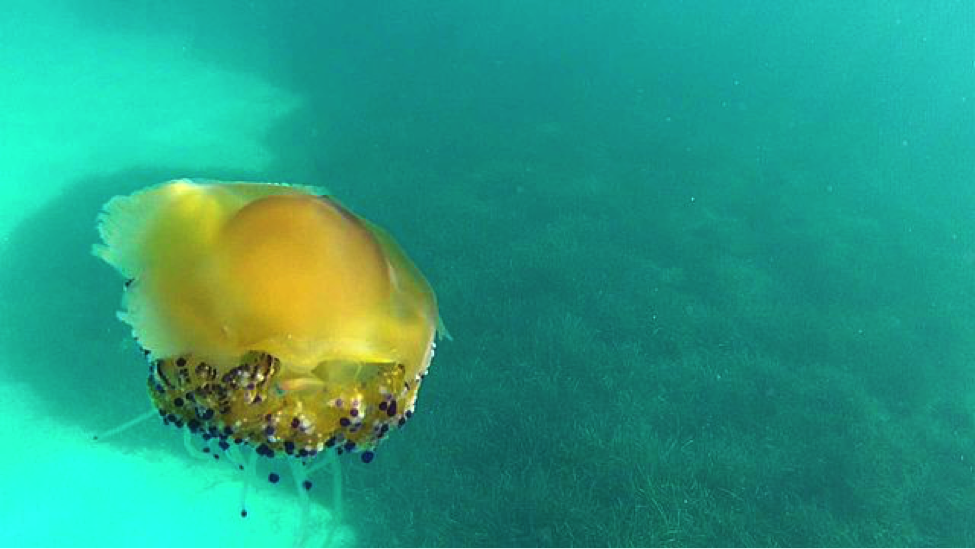
Why would something be called “Fried Egg jelly fish”, and also be known as Phacellophora camtschatica?

View Full Size Image
Image of the Fried Egg Jelly courtesy of gpapadop79 – Own work, CC BY-SA4.0, https://commons.wikimedia.org/w/index.php?curid=45347541.

Scientific names take the form of “Genus species”. Scientific names serve to distinctively identify an organism and also to show evolutionary relationships. The genus links the organism to its evolutionary relatives while the species name demonstrates its uniqueness (not unlike the family and first name convention of many people in North America). Organisms also have common names. Common names can be confusing—for instance a “Robin” in the United States is a completely different bird than a “Robin” in Europe, but if the scientific name is used, confusion can be reduced via the name unique to the organism.

The system of binomial nomenclature is used to assign species with their two-part Latin names. Carl von Linné (1707 – 1778) established a system of tiered taxonomic classification, which assigned species formal names, in the 18th century. His classification is outlined in his book, Systema Naturae. His purpose was to reduce confusion from the proliferation of common names by supplying a unique name to each organism that also displayed potential relationships with other organisms. The names were formulated from Latin words. Linné even Latinized his own name and is now best known by that name: Carolus Linnaeus.
View Full Size Image
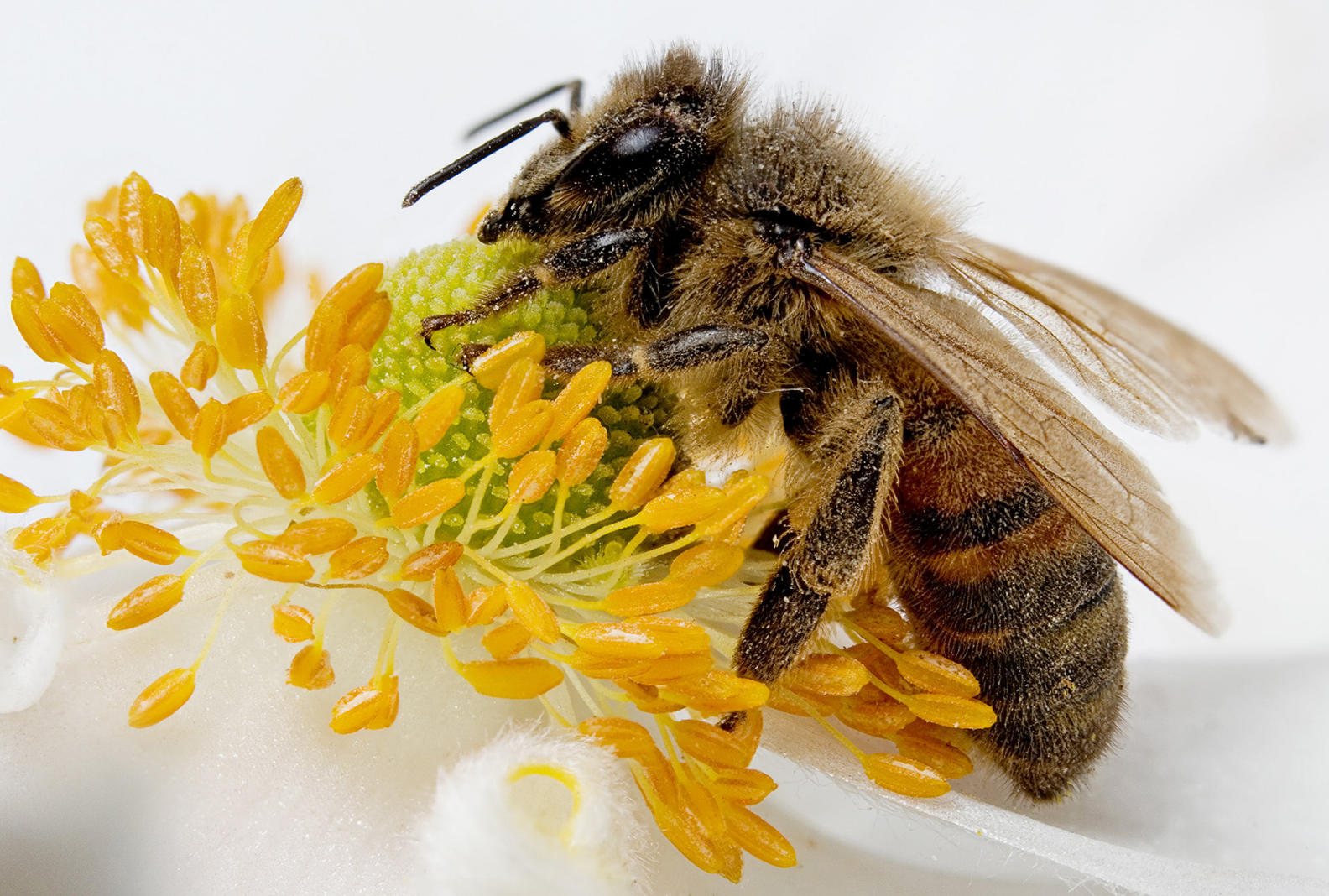
From the What’s In a Name PDF, page 32: “Carl Linnaeus gave the European Honeybee its name, Apis mellifera, which is Latin for “honey-bearing bee.” By some accounts, Linnaeus later became dissatisfied with the name he bestowed and argued to change it from Apis mellifera, to Apis mellifica, or “honey-making bee.” His mistake, he argued, was that bees make honey within the hive; they do not bear it from the flower. His argument was presumably unsuccessful as the bee still bears the erroneous name.” Image: A European Honeybee, Apis mellifera, visiting a flower that is dusting it with pollen. (JJ Harrison, CC BY-SA 3.0).

Species may be discovered by scientists poring over specimens in a museum or someone exploring an area rich in biodiversity. It is not necessary to be a scientist to name a new species but scientific names must conform to rules laid out by the International Code of Zoological Nomenclature and the International Code for Nomenclature for algae, fungi and plants. Names can reflect a characteristic of a species (Peromyscus leucopus-white-footed mouse) or can be named after a person or location (Mandelia microcornata-a nudibranch named for Nelson Mandela). Sometimes, scientists display a sense of humor when naming: Agra phobia and Agra vation are the scientific names of South American beetles. A hungry entomologist (Neal Evenhuis) named a series of flies (genus) Pieza and most notably, a species Pieza pi.

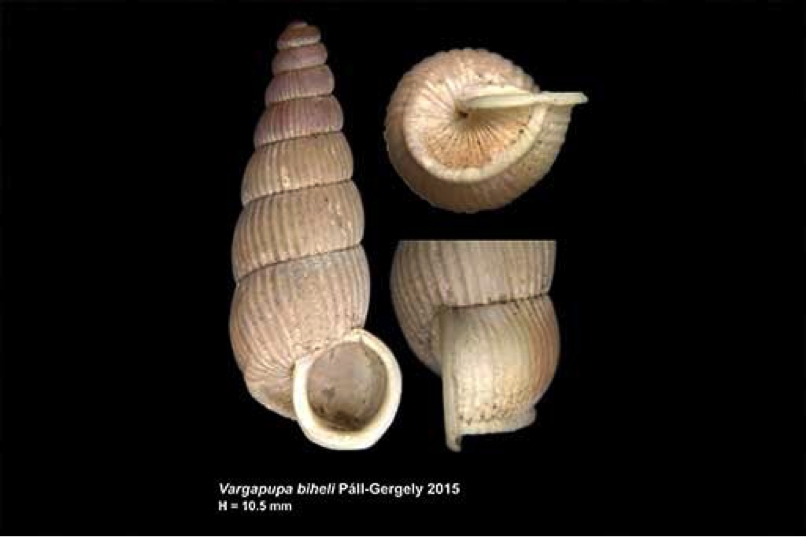
The results from the work of What’s in a Name? include four interactive exhibit stations at the Harvard Museum of Natural History on Honeybees, the extinct Dimetrodon, Jellies and Poison Ivy. There are also free online resources, including a website and a 60-page free e-book. The online resources include eight more species stories that feature images and references from the Biodiversity Heritage Library (BHL) and include familiar organisms like the dodo and sugar maple, as well as our favorite, the snail Vargapupa biheli named after BHL!
View Full Size Image
Vargapupa biheli. Image courtesy Dr. Barna Páll-Gergely.

Featured in the exhibit display on Dimetrodon, Stephanie Pierce, Assistant Professor of Vertebrate Paleontology, Harvard University, describes research being done right now on specimens of the fossil species Dimetrodon milleri, in the Museum of Comparative Zoology collection:

The What’s in a Name? project is a partnership between Harvard Museums of Science and Culture (HMSC), the Encyclopedia of Life (EOL), and the BHL, as represented by the Ernst Mayr Library of the Museum of Comparative Zoology at Harvard University. This project was made possible by IMLS.

For more information about scientific names and naming, check out the following sources

  • Bright, M. 2012. The Frog with Self-cleaning Feet: And Other Extraordinary Tales From the Animal World. Biteback Publishing. 304 pages.
  • Evenhuis, N. L.2002. Pieza, a new genus of microbombyliids from the New World (Diptera: Mythicomyiidae). Zootaxa 36(1). DOI: http://dx.doi.org/10.11646/zootaxa.36.1.1
  • Freeland, C. 2008. On Name Finding in the BHL. BHL Blog, March. https://goo.gl/wJIOWC
  • Greenstein, B. 2016. How’s your fern and bird coverage, BHL? BHL Blog, August.
  • Harvard Museums of Science and Culture. 2017, “What’s in a Name?.” http://whatsinaname.hmnh.harvard.edu/files/imls/files/_whatsinaname_.pdf
  • Judd, W. 2014.Weirdest species names. Australian Geographic. March 2014. https://goo.gl/UQ3xMA
  •  Zielinski, S. 2009. The World’s Strangest Scientific Names. Smithsonian Magazine. https://goo.gl/D3aMbb
February 14, 2017by ulib-libraryjobs
BHL News, Blog Reel

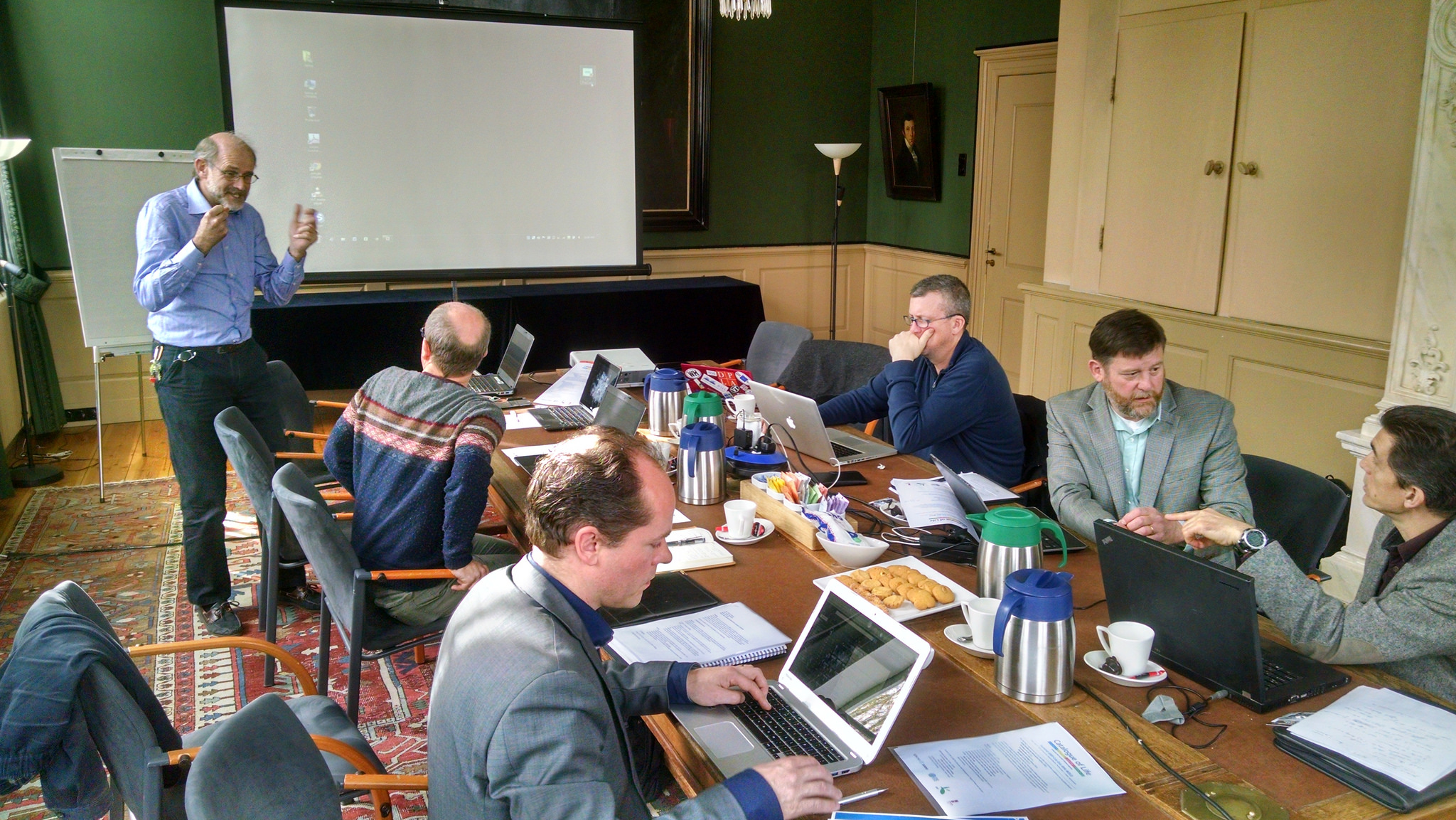
BHL participates in the GBIF-CoL-EOL-BHL-BOLD Summit at Naturalis

View Full Size Image
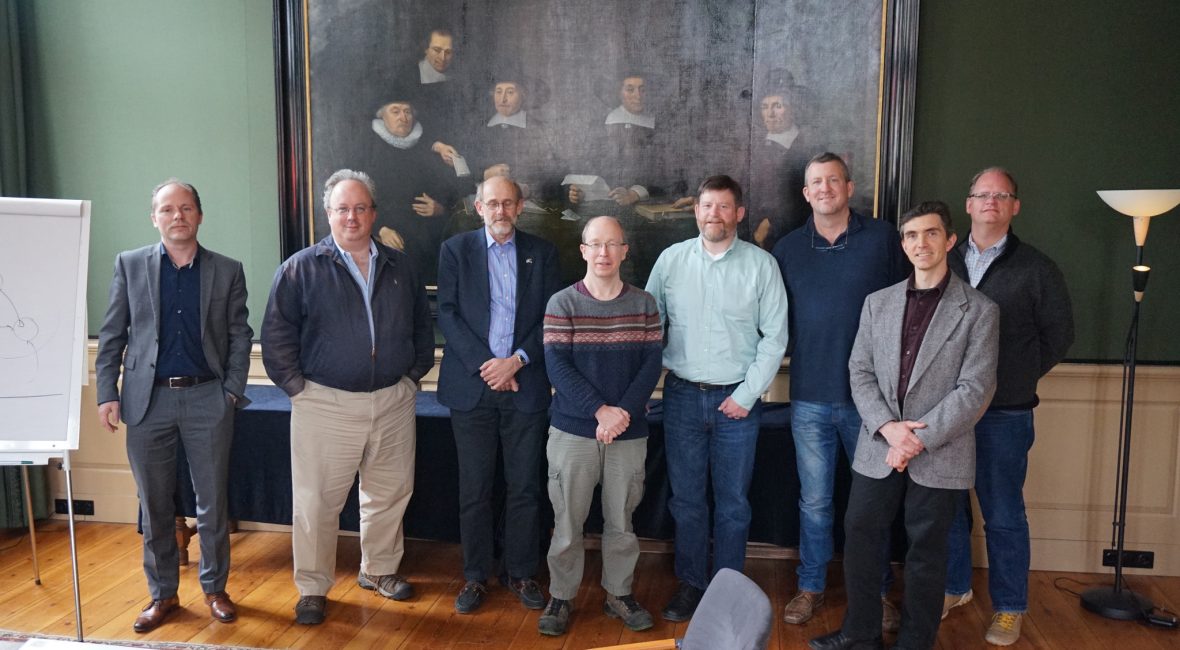
Jeroen Snijders, Bob Corrigan, Peter Schalk, Donald Hobern, Tom Orrell,
David Remsen, Alex Borisenko, Alex Borisenko, Martin Kalfatovic

On 13 April 2015, BHL Program Director Martin R. Kalfatovic attended the GBIF-CoL-EOL-BHL-BOLD Summit at Naturalis in Leiden, Netherlands. This meeting followed on the preceding Catalogue of Life meeting in Oostende, Belgium. The meeting took place in the historic Pesthuis on the Naturalis campus.

Other participants were:

  • Donald Hobern, Global Biodiversity Information Facility (GBIF)
  • Peter Schalk and David Remsen, Catalogue of Life (CoL)
  • Tom Orrell, National Museum of Natural History, Smithsonian, Integrated Taxonomic Information System (ITIS)
  • Bob Corrigan, Encyclopedia of Life (EOL)
  • Alex Borisenko, Barcode of Life (BOLD)
  • Jeroen Snijders, Naturalis

The purpose of the meeting was to discuss synergy and explore potential for intensifying collaboration concerning infrastructure, software tools, and services. The aims is to align strategic plans and future developments.

Jeroen Snijders, Naturalis CIO, opened the meeting with an overview of Naturalis IT structure and capacity. He also outlined recent past and upcoming EU funding opportunities.

Each of the participants then gave overviews of their programs and presented opportunities for collaboration and de-duplication of effort.

The Naturalis senior management team from collections, scientific research, and research and education joined the group for lunch.

View Full Size ImageThe meeting concluded with a series of action items focused on aligning programs, developing interoperable resources, and sharing services and software tools.

The successful meeting built on existing partnerships and collaborations of the participants and provided a framework for advancing shared goals.

April 22, 2015by
BHL News, Blog Reel

BHL and EOL co-host a Smithsonian Associates event

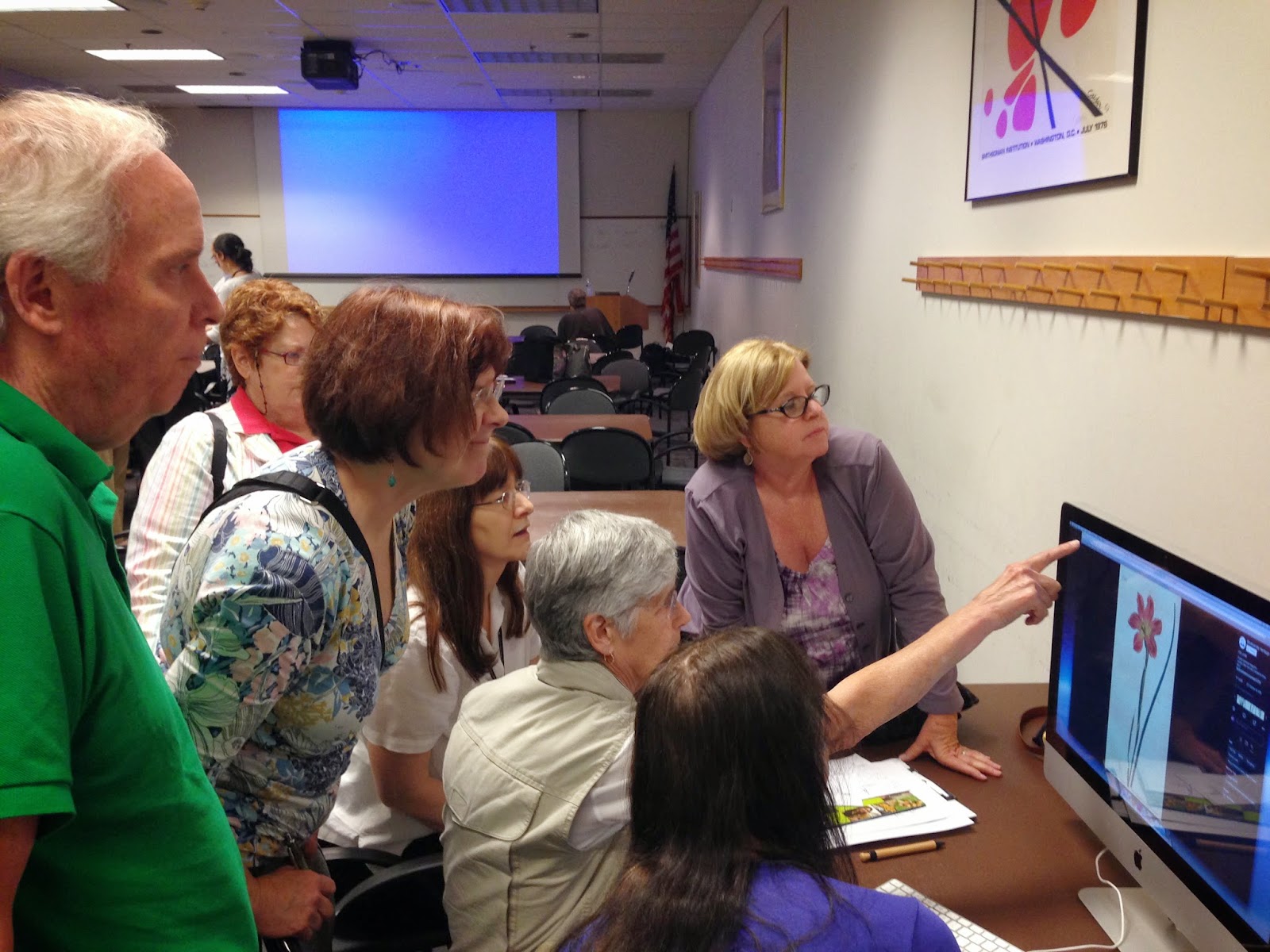
On May 28, the Biodiversity Heritage Library (BHL) and the Encyclopedia of Life (EOL) co-hosted an evening program on digital volunteerism.  The event was organized by The Smithsonian Associates (TSA) and was attended by 74 people.

View Full Size Image
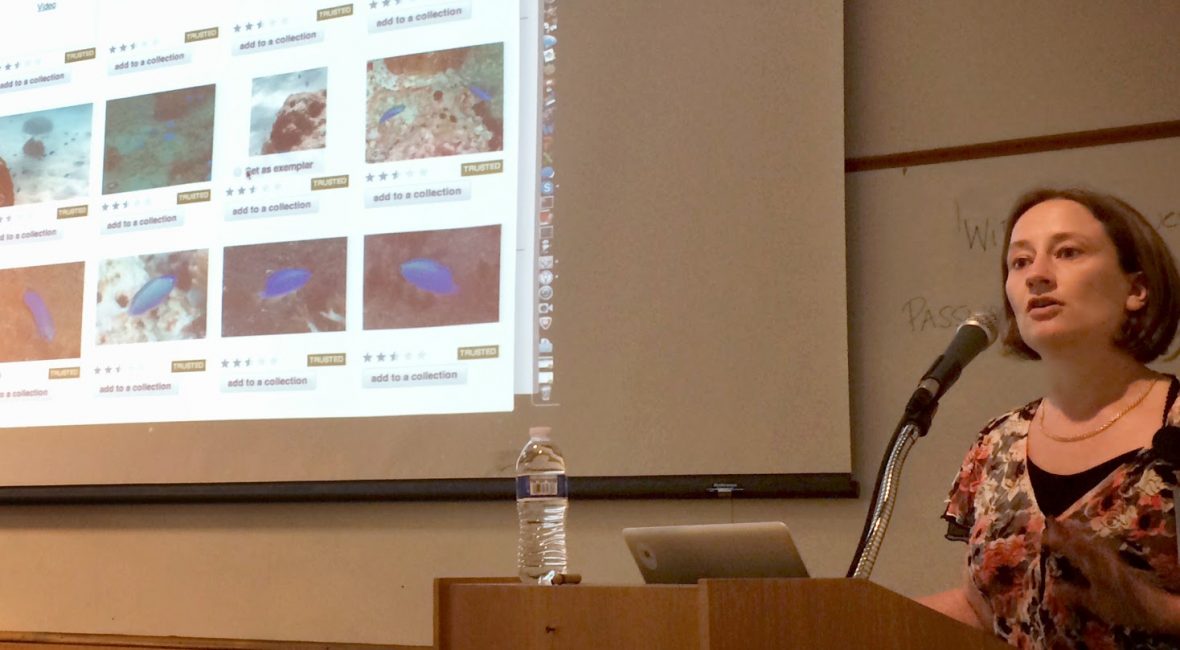
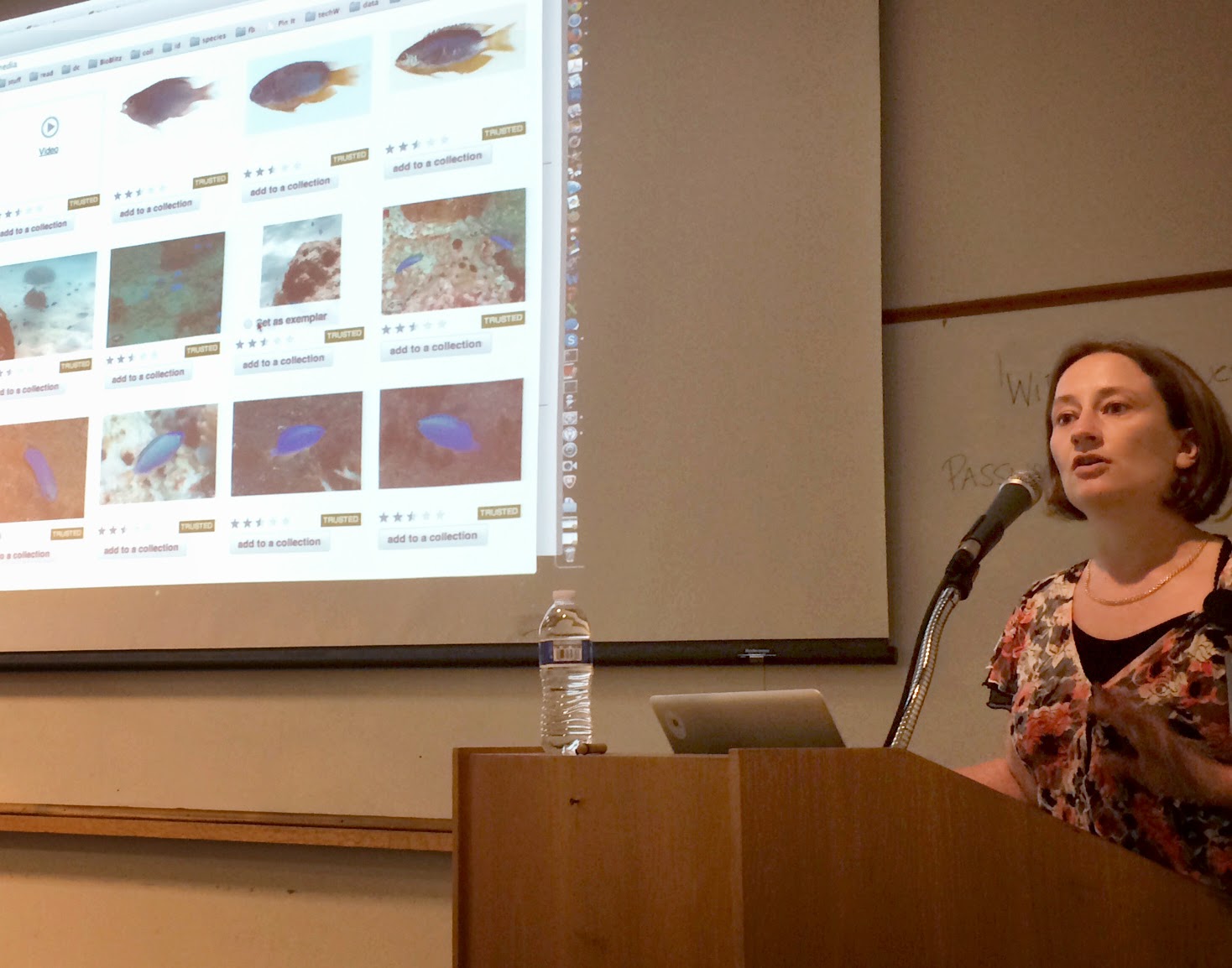
Jen Hammock presenting at the
Smithsonian Associates program

Carolyn Sheffield (BHL), Katja Schulz (EOL), and Jen Hammock (EOL) presented on BHL, EOL, and examples of how people could contribute to growing our knowledge of the planet’s biodiversity.  Presentations were followed by a hands-on session where attendees were encouraged to start machine tagging images in BHL’s Flickr Photostream, cropping and rating images, and exploring the iNaturalist platform.

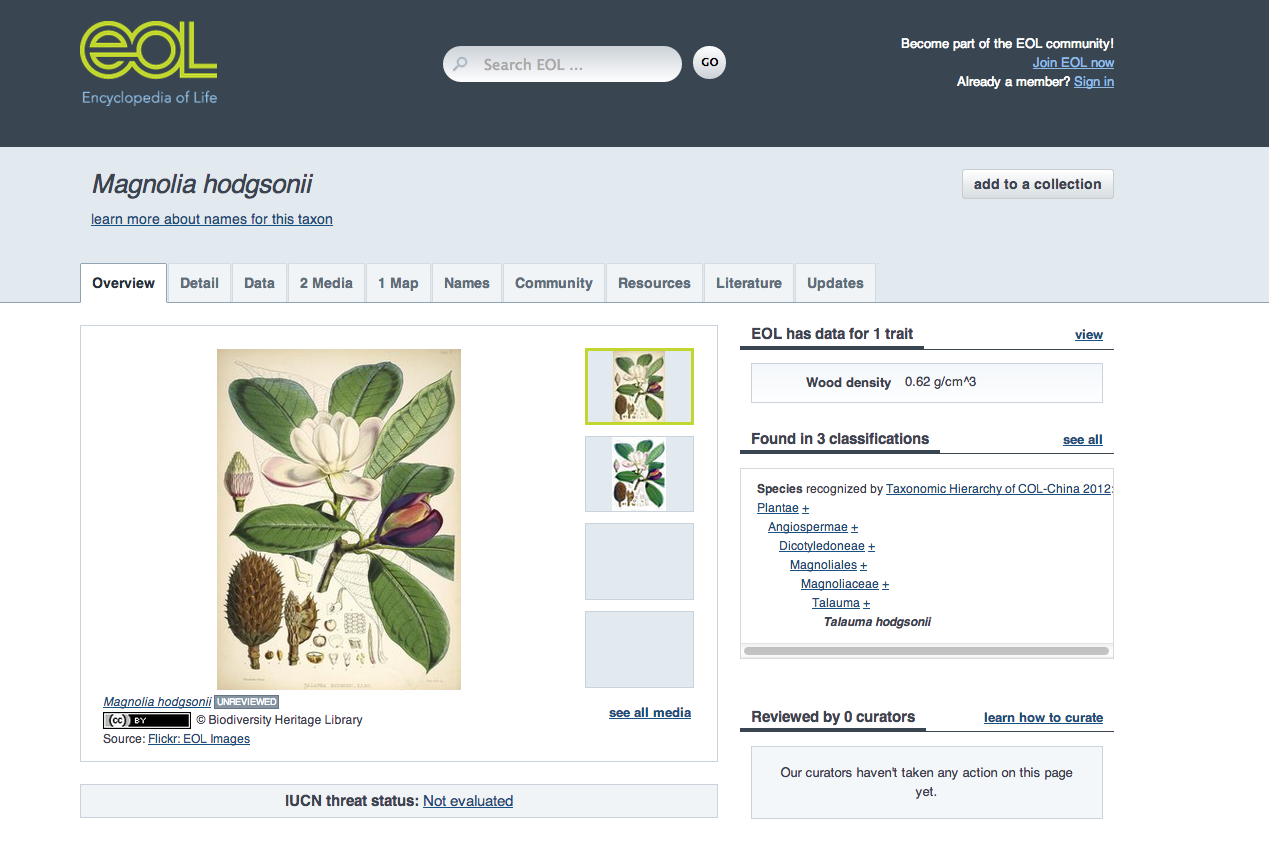
BHL has hosted similar events in the past for Smithsonian staff to learn about–and add–machine tags to the images in BHL’s Flickr Photostream.  A machine tag is a tag that is structured in such a way that a machine can read and understand it. In our case, we’re assigning machine tags of scientific names to the BHL illustrations in Flickr so that EOL can recognize those as images that can be harvested and associated with the appropriate species page in EOL.  See an example of an EOL species page with a BHL image here:

View Full Size Image
EOL species page for Magnolia hodgsonii with
illustration from BHL’s Flickr photostream

The structure that we use for the machine tags is:

taxonomy:binomial=”genus species”

You can replace “binomial” with another taxonomic tag, such as “genus” or “family, if you can only identify the organism at that level.  Learn more about the Flickr tagging process and machine tag formats in the instructions we provided to session attendees.

View Full Size Image
Katja Schulz working with
some of the TSA attendees

The TSA event was not only an opportunity to expand our cadre of machine taggers but also gave us a chance to share multiple ways that people could get involved with BHL and EOL. For example, images that depict multiple species can create confusion when associated with a single species page in EOL.  Attendees were shown how to replace such images with a cropped version showing only the relevant species.  The evening also provided a chance to showcase EOL’s recently launched iNaturalist Collections.

All told, it was a very successful event.  Several guests said they were delighted to learn about EOL and BHL and, by the end of the day, 129 more images in BHL’s Flickr Photostream boasted machine tags.  We look forward to the continued contributions of these amazing Smithsonian Associates session attendees!

Looking for a way that you can get involved?
Check out the instructions on machine tagging or visit EOL to sign up for an account and to learn more about recording your own observations of the natural world through EOL’s iNaturalist collections.

June 17, 2014by brooksm
BHL News, Blog Reel

NESCent-EOL-BHL Research Sprint

Portrait version of the Biodiversity Heritage Library logo.

We invite participants for an event that will pioneer the mining of the Encyclopedia of Life (http://eol.org) and the Biodiversity Heritage Library (http://www.biodiversitylibrary.org) to address outstanding and novel questions about the ecology and evolution of biodiversity. We aim to identify questions and data for which biologists may lack informatics skills and resources to address or analyze successfully; and symmetrically, to guide informaticians to pressing ecological and evolutionary questions. We seek to make actual discoveries through joint activities and to test the “computability” of major biodiversity databases.

We invite proposals for synthetic research on any aspect of biological science that will leverage EOL and BHL resources.  Successful applicants will be matched with an informatician, in 2 person teams, and receive support to travel to and work on-site at the National Evolutionary Synthesis Center for 4 days.

Applications for participation will be evaluated on the extent to which they

  • address an important and outstanding biological question,
  • are “risky” endeavors but with a reasonable chance of success,
  • reflect EOL’s mission to empower scientific research by providing comprehensive and trusted biodiversity data and/or NESCent’s scientific mission to advance research that addresses fundamental questions in evolutionary science. Both organizations promote the integration of methods, concepts, and data within and across disciplines (for more on the context and a classification of synthesis in evolutionary science please read Linking Big: The Continuing Promise of Evolutionary Synthesis),
  • provide evidence that sufficient data are available to tackle the question,
  • provide evidence that appropriate analytical tools are available or will be developed during the event,
  • generate products that typically fall into three broad categories (in order of importance):
    • Synthetic papers and reviews,
    • Software or mathematical tools that solve a major analytical problem.
    • New open data for Encyclopedia of Life allowing others to build on your foundation.

We will not support collection of original data or field research, but encourage the mining of public and private databases such as EOL and BHL.  NESCent is committed to making data, databases, software and other products that are developed as part of NESCent activities available to the broader scientific community. Applicants should review the Data And Software Policy for NESCent.

Proposals will be evaluated in terms of both the scientific value of the project and the qualifications of the applicant.  Visitors will receive support for travel to and from NESCent, lodging, and a per diem for meals not provided.

Before you Apply

All applicants are encouraged to contact Craig McClain, Assistant Director of Science of NESCent, or Cynthia Parr, Chief Scientist of Encyclopedia of Life, for feedback on project ideas. Proposals will be considered through November 15.  The event will likely take place February 3-7, 2014. Please review our Reporting Requirements, Travel Guidelines, and Data and Software Policy before applying.

Proposals Guidelines

Proposals are short and not to exceed 2 single-spaced (12-pt type) pages, plus a 2-page CV.   Proposals should be organized as follows:

  • Title (80 characters max)
  • Name and contact information
  • Project Summary (250 words max)
  • Public Summary (250 words max) – written for the public and visible on the NESCent web site
  • Introduction and Goals – A statement of the outstanding question being addressed and a concise review of the concept and the literature to place the project in context.
  • Proposed Activities – A clear statement of any specific data (include citations or urls) and analytical tools that will be required for the project.  The proposal should also include a clear statement on how synthesis will occur. Letters of support are required from the proprietor of datasets, analytical tools, or software not publically available or owned by the applicant or managed by EOL and BHL.
  • Rationale for support – Why can this activity be most effectively conducted at NESCent and with the Encyclopedia of Life or BHL.
  • Anticipated IT Needs – Briefly describe any needs for IT support that are important to the success of the proposed project. Please indicate whether development of software will be required. Also, briefly describe your plans to make resulting data and software available; including any conditions that might limit your ability to make these available. Please remember you need not possess the informatics skills to address the questions but do need to identify what skills are lacking.  You may propose an informatician to collaborate with.  Prior contact and letter of support with the informatician is encouraged.  If no teammate is suggested EOL/NESCent will work to identify proper support for you.
  • Anticipated Results – include a clear statement of anticipated papers, data and software products, and anticipated public release of data and products
  • Short CV of the applicant(s) (2 pages)
  • Proposal Submission

    Proposals will be accepted in digital format only as a single pdf file. Graphics should be embedded directly into the proposal document. Note that proposals should be submitted as a single pdf file including all of the components listed above, including the CV. Email your proposal to Craig McClain and Cynthia Parr, by November 15, 2013.

    Data, Software and Publication Policy

    The open availability of data, software source code, methods, and results is good scientific practice and a key ingredient of synthetic research. NESCent expects that all data and software created through NESCent-sponsored activities be made publicly available no later than one year after the conclusion of the NESCent award, or immediately upon publication of an associated article, whichever comes earlier. For more information please visit our Data, Software and Publication Policy.

    Funding for this opportunity is generously provided by the Richard Lounsbery Foundation.

    September 30, 2013by joelrichard
    BHL News, Blog Reel

    BHL Image Collection on EOL!

    View Full Size Image
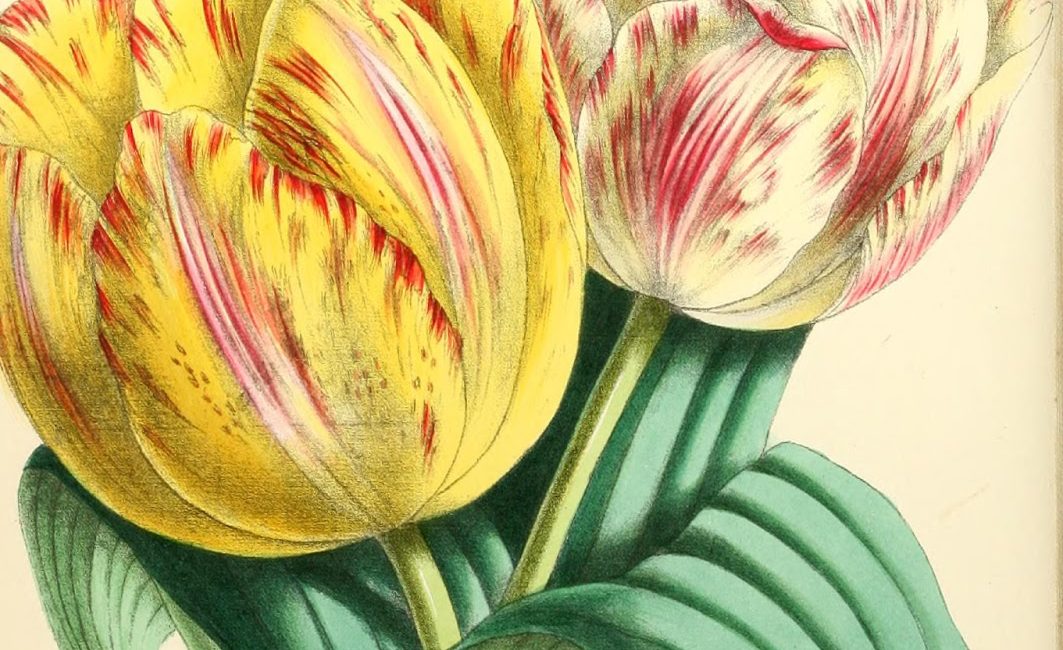
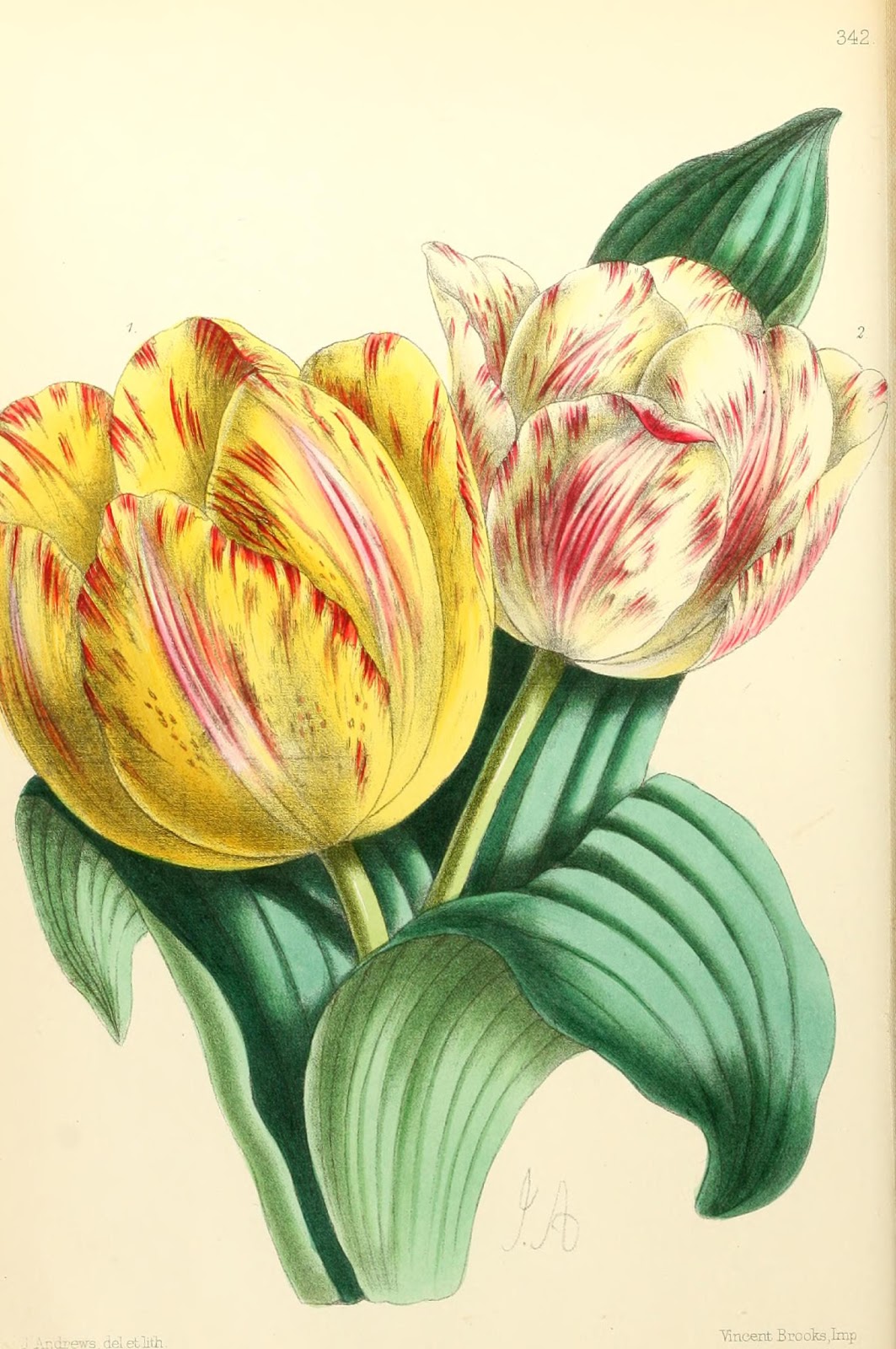
    The Floral Magazine, v. 6, pl. 342.

    The Biodiversity Heritage Library now has its own collection of images in the Encyclopedia of Life! This collection is comprised of images that have been tagged with species name machine tags, relating the species depicted in each image. The collection currently comprises over 11,000 images representing over 10,000 taxa, and will continue to grow as additional illustrations are tagged in the BHL Flickr.

    The BHL Flickr

    By now, you’re no doubt aware of the Biodiversity Heritage Library Flickr, which provides free access to over 104,000 illustrations gleaned from the BHL collections. These images span over five hundred years and range in topic from fish to reptiles, mammals to birds, insects to mollusks, and everything in between!

    Building the Collection: Tagging Images

    To make it easier for you to search our Flickr collection and for us to share images with external websites like EOL, we’re adding species name machine tags to our images, and we’ve been encouraging you to help us do this.

    A tag is basically a searchable keyword that you can add to an image to describe it, and a machine tag is a tag with special formatting to allow it to be read by computers. Thus, a species name machine tag is a tag that describes the species depicted in an image in a format that can be understood by computers.

    When you add species name machine tags to our images, you as a user can not only search the BHL Flickr and retrieve any images tagged with a desired name, but these images can also automatically be uploaded to EOL and associated with the corresponding species page.

    View Full Size Image
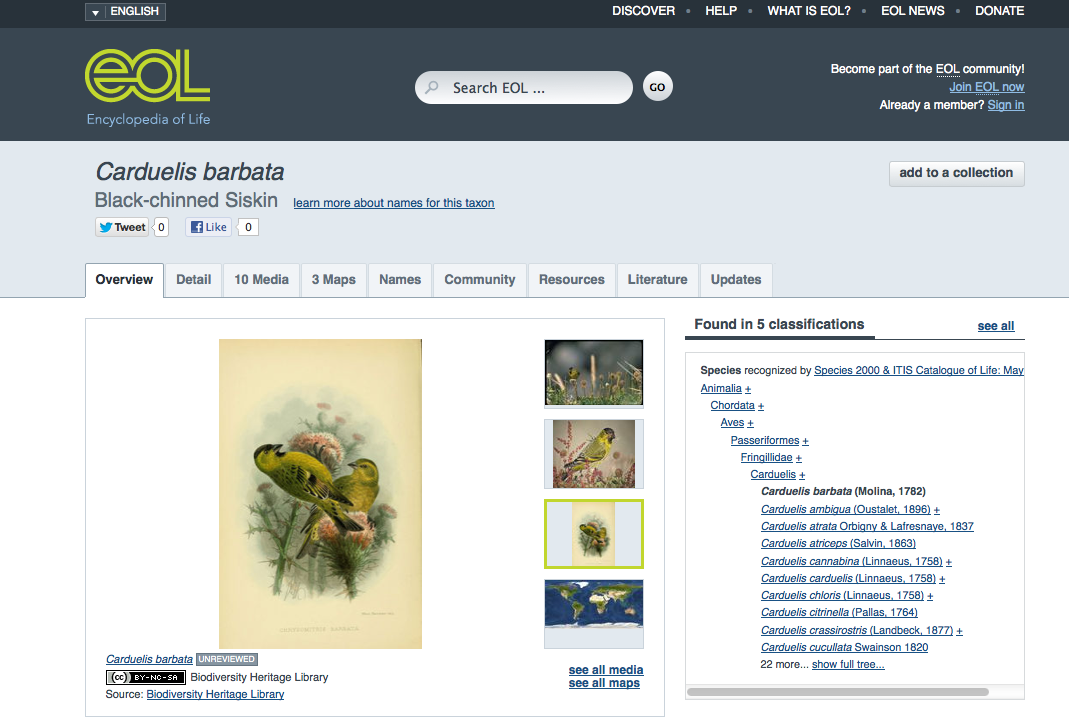
    Example of an image from the BHL Flickr automatically associated with the EOL species page for Carduelis barbata, the Black-chinned Siskin, because a species name machine tag was added to the image in Flickr.

    The format for species name machine tags is “taxonomy:binomial=Genus species,” where “Genus” and “species” are replaced with the particulars of the organism you’re describing. You can replace “binomial” with another taxonomic tag, such as “genus” or “family”, if you can only identify the organism at that level. Learn more about the Flickr tagging process and machine tag formats in our previous blog post.

    The images in the new EOL Collection are images from the BHL Flickr that have a species name machine tag associated with them. Each time new images are tagged in the BHL Flickr, they will automatically be added to our collection in EOL, as well as associated with appropriate species pages.

    You Can Help us Grow this Collection!

    With over 104,000 images in our Flickr collection to date, and that number growing daily, it’s impossible for BHL staff to tag all of our images by ourselves. That’s why we need your help! You can help us by adding species name machine tags to our images in Flickr. All you have to have is a free Flickr account to add tags to BHL images.

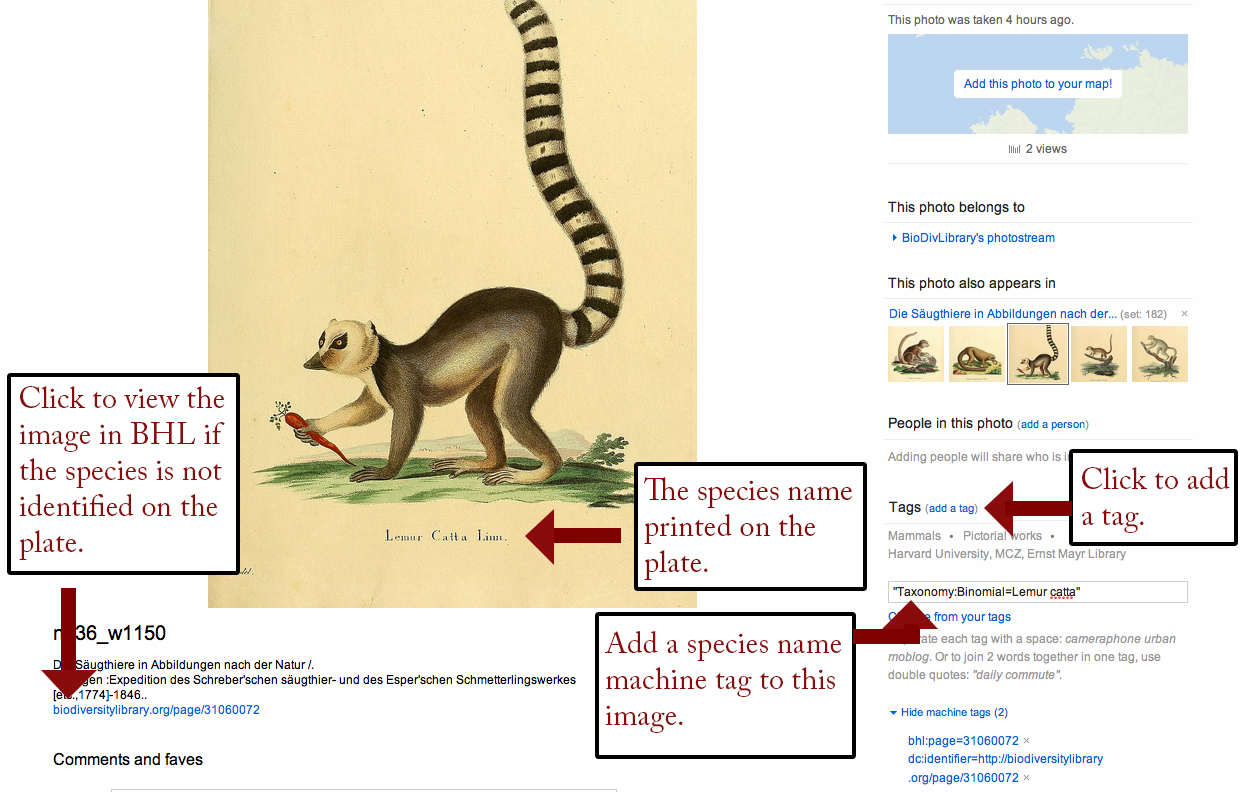
    Once you’re signed in to Flickr, browse our collection of images and when you see some with species you can identify, simply click “add a tag” and add the species name in the machine tag format (“Taxonomy:Binomial=Genus species”). Be sure to include the quotation marks around your machine tag.

    Many images actually have the species name printed on the plate itself. In these cases, you can simply transcribe that name as a tag for the image. If the species is not identified on the plate, navigate to the book in BHL to find the associated description pages outlining the species depicted. We encourage you to tag the image with the species name provided by the book itself, but if that name is no longer valid, and you know the current, accepted name, feel free to add that name as an additional tag to the image.

    View Full Size Image
    Adding a species name machine tag to an image in the BHL Flickr. Click this image to enlarge for better viewing.

    If there are multiple species depicted on an image, add a separate tag for each species depicted (or as many as you can identify). Learn more about tagging BHL images, and get additional tips, in our Guide.

    Every time you add a species name machine tag to an image in our Flickr, you’re growing the BHL EOL Collection, as your tagged images will automatically be added to that collection.

    We hope we’ve inspired you to help us identify life on earth, as portrayed through some of the most incredible scientific illustrations ever created! Keep exploring, and keep tagging!

    Visit the BHL Image Collection on EOL today!

    March 11, 2013by Grace Costantino

    Help Support BHL

    BHL's existence depends on the financial support of its patrons. Help us keep this free resource alive!

    search

    About BHL

    The Biodiversity Heritage Library (BHL) is the world’s largest open access digital library for biodiversity literature and archives. BHL operates as a worldwide consortium of natural history, botanical, research, and national libraries working together to digitize the natural history literature held in their collections and make it freely available for open access as part of a global “biodiversity community.”

    Join Our Mailing List

    Sign up to receive the latest news, content highlights, and promotions.

    Subscribe Now

    Subscribe to Blog via Email

    Enter your email address to subscribe to this blog and receive notifications of new posts by email.

    Join 319 other subscribers

    Subscribe to Blog Via RSS

    Subscribe to the blog RSS feed to stay up-to-date on all the latest BHL posts.

    Access RSS Feed

    Inspiring Discovery through Free Access to Biodiversity Knowledge.

    The Biodiversity Heritage Library makes it easier than ever for you to access the information you need to study and explore life on Earth…for free, anytime, anywhere.


    64+ Million Pages of
    Biodiversity Literature Online.

    EXPLORE

    Tools and Services
    to Transform Research.

    EXPLORE

    300,000+
    Illustrations on Flickr.

    EXPLORE

    ABOUT | HARMFUL CONTENT | PRIVACY | SITE MAP | TERMS OF USE