Biodiversity Heritage Library - Program news and collection highlights from BHL
  • Home
  • News
  • Featured Books
    • All Featured Books
    • Book of the Month Series
    • BHL at 20
  • User Stories
  • Campaigns
    • Fossil Stories
    • Garden Stories
    • Monsters Are Real
    • Page Frights
    • Her Natural History
    • Earth Optimism 2020
  • Tech Blog
  • Visit BHL
Home
News
Featured Books
    All Featured Books
    Book of the Month Series
    BHL at 20
User Stories
Campaigns
    Fossil Stories
    Garden Stories
    Monsters Are Real
    Page Frights
    Her Natural History
    Earth Optimism 2020
Tech Blog
Visit BHL
  • Home
  • News
  • Featured Books
    • All Featured Books
    • Book of the Month Series
    • BHL at 20
  • User Stories
  • Campaigns
    • Fossil Stories
    • Garden Stories
    • Monsters Are Real
    • Page Frights
    • Her Natural History
    • Earth Optimism 2020
  • Tech Blog
  • Visit BHL
Biodiversity Heritage Library - Program news and collection highlights from BHL
Blog Reel, Featured Books

A Heavy Hoax: The “Lying Stones” of Johann Beringer

Illustration of fake fossils

This blog post is part of a series from Smithsonian Libraries highlighting Unearthed, a new collection of paleobiology literature in the Biodiversity Heritage Library curated by Smithsonian Libraries in celebration of the opening of the National Museum of Natural History’s David H. Koch Hall of Fossils – Deep Time exhibit. Follow the series throughout 2019 as Smithsonian scientists and librarians discuss the collection, identify their favorite books within it, and explain the importance of paleobiology literature in research today.

This post was written by Alexandra K. Alvis, reference librarian in the Joseph F. Cullman 3rd Library of Natural History. The Cullman Library holds the Smithsonian’s collection of rare books in anthropology and the natural sciences. Its world-class collection contains approximately 20,000 volumes published before 1840, all of which are available for consultation in our reading room. The Cullman has contributed over 4,700 volumes to BHL, with more being added every week.

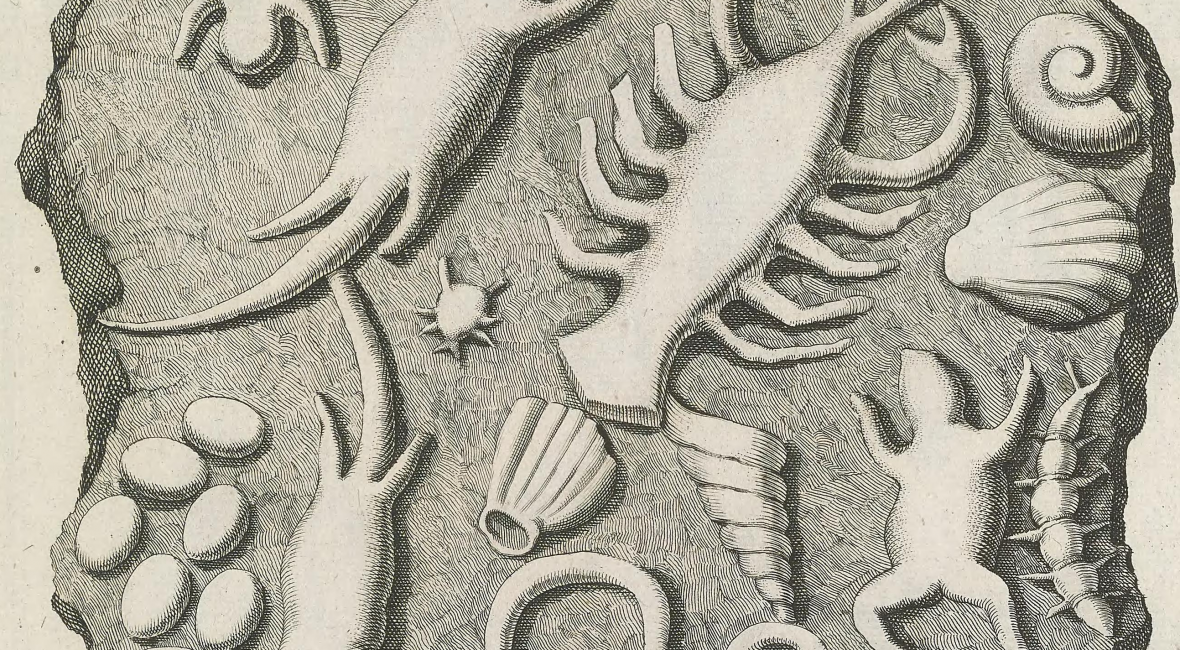
Illustration of fake fossils

Tab. I from Beringer’s Lithographia (1740). Contributed in BHL from Smithsonian Libraries.

Fake fossils are a difficult issue for modern paleontologists: there is a booming black market in forgeries, and well-intentioned researchers of the past have even managed to accidentally fool the curators of today with detailed reconstructions! The black market manufacturers have money on their minds and past researchers were simply doing their jobs to the best of their abilities, but one historical case of forged fossils stands out as particularly sinister. The victim was a certain Dr. Johann Bartholomew Adam Beringer (1667-1738), a professor at the University of Wurzburg. The perpetrators: Beringer’s very own colleagues, J. Ignatz Roderick and Georg von Eckhart.[1] This sordid tale resulted in unfortunate endings for all three of the parties involved, but also produced a curious monograph entitled Lithographia Wirceburgensis which can be found digitized in our Unearthed! digital collection.

This tale of stony deception began when the twenty-seven year old Beringer was named professor at the University of Wurzburg in 1694, only a year after achieving his doctorate in medicine there.[2] In 1695, he was summarily appointed keeper of the botanical gardens of the University. In this period, medicine was heavily anchored by botanical knowledge; the main components of most cures and salves were plant-based concoctions. Beringer was particularly enthralled by the natural history side of his career, and passionately expanded his personal cabinet of curiosities to display his collection of interesting objects from the natural world. He also began to pepper his lectures with references to “petrifactions,” a catch-all term for what modern science now understands as fossilized remains of plants and animals.

Illustration of a fake fossil

Detail, Tab XXI, Beringer’s Lithographia (1740). Contributed in BHL from Smithsonian Libraries.

Beringer’s rise through the academic ranks did not go unnoticed. J. Ignatz Roderick, a University of Wurzburg professor of geography, algebra, and analysis, and Georg von Eckhart, the University librarian, resented what they saw as Beringer’s arrogance[3] and plotted to deflate his ego. Aware of Beringer’s fascination with the fossils in the shell lime deposits of Mount Eibelstadt[4] and his collecting practices, Roderick and Eckhart formulated a plan to carve and plant fake fossils on the mountain. In 1725, they placed their first specimens and enlisted the assistance of Beringer’s “diggers”— three boys that Beringer had hired to search the mountain for “figured stones” for his cabinet— although only one of the boys knew the full extent of the deception.[5]

And so, their trap was laid: when the boys returned from the mountain with the first three fakes, Beringer was thrilled. News of the fantastic stones spread, and the boys began receiving requests for their stone-hunting abilities from local pharmacists, rich gentlemen, and even some of Beringer’s fellow medical doctors.[6] Beringer himself visited the mountain on several occasions, and remarked on the fact that the hillside which he had “frequented and examined in the past but had never scrutinized very closely, revealed a treasure.”[7] As the false stones continued to turn up, Beringer began to display them to friends and colleagues, not all of whom were as certain of their veracity as he was. He writes that “to dispel these misgivings from their minds, I led some companions on the pleasant jaunt to the site… where they dug out these portentous symbols of natural things with their own hands.”[8]

Illustration of a fake fossil.

Detail, Tab XXI, Beringer’s Lithographia (1740). Contributed in BHL from Smithsonian Libraries.

Many of the fossils found on the mountain were genuine, which certainly contributed to Beringer’s unwillingness to consider the possibility of deception in the more whimsical examples. Although his cabinet no longer survives, Beringer’s records show that it contained numerous specimens of these real fossils until Roderick and Eckhart began to surreptitiously contribute to his collection. He developed complex theories to explain the more fantastical items: the stones with writing, even with their occasional spelling and orthographical mistakes, were the work of God, to ensure that “when forgetful men grow silent, these mute stones might speak.”[9] The images of celestial activity such as shooting stars and radiant suns could be explained in reference to the Archimedian method of using a parabolic mirror to “collect [sunlight] in a bowl” in order to focus it to set fire to an enemy fleet.[10]

Illustration of fake fossils.

Tab. III from Beringer’s Lithographia (1740). Contributed in BHL from Smithsonian Libraries.

Beringer compiled these theories and justifications, along with engraved plates of the figured stones, into a dissertation to be titled Lithographia Wirceburgensis. As word reached Roderick and Eckhart that Beringer intended to publish on their hoax, it seems they felt a pang of guilt; they started a rumor that the stones had been false all along, and even sold some of them to him directly, later informing him of how they were made.[11] But Beringer put no stock their words, instead criticizing the rumor and confession as an attempt to discredit him in chapter 12 of the Lithographia.[12]

History does not record what catalyst finally changed Beringer’s mind about the origin of the stones; the story passed down through generations of scientists claims that, in translating one of the Hebrew inscriptions, he discovered his own name after the publication of the Lithographia. Disgraced, Beringer immediately sought to recall and buy back the printed sheets distributed to booksellers.[13] Historical lore describes how this process bankrupted him, although there is no evidence that this was ultimately the case. He subsequently brought a court case against Roderick, Eckhart, and the three diggers in 1726; the term “lying stones” (Lügensteine in German) was used in the case to describe the fraudulent fossils. In the course of the lawsuit, the boys were found not guilty, but the duplicity of Roderick and Eckhart was fully exposed.[14] Beringer spent his remaining thirteen years of life on staff at the University, where he published two further books.[15] But criticisms of his Lithographia have dogged his reputation as a scientist since, to the point that even his entry in the Dictionary of Scientific Biography is principally concerned with his mistake. Roderick and Eckhart suffered more immediate effects: Roderick was banished from Wurzburg, and Eckhart was denied further access to archives of the Duchy.[16] This dealt a crushing blow to his scholarship, much of which was left unfinished at his death.[17]

Frontispiece illustration for a rare book

Frontispiece illustration, Beringer’s Lithographia (1740). Contributed in BHL from Smithsonian Libraries.

The end of Beringer’s story is just the beginning for the Smithsonian Libraries’ copy of the Lithographia. It is housed in our Joseph F. Cullman 3rd Library of Natural History, and is somewhat of a bibliographic curiosity. While the title page of our copy claims it is the second edition, it is actually the second issue, incorporating the recalled sheets from the first printing. It is speculated that one of Beringer’s sons is responsible for this re-issue, perhaps to recoup some of the costs from their father’s failed effort.[18] Curiously, it lacks any sort of permanent binding, although material evidence of former binding structures suggests it had one in the past. Instead, it is loosely glued together with a scrap of a German map of Sardinia and Piedmont dated 1793. It further features its frontispiece bound in with the plates. The frontispiece is a work of art in itself, depicting the Roman poet Ovid in repose, gesturing to a mountain composed of Beringer’s figured stones as cherubs and other symbolic figures look on. In the foreground sits one of the stones surrounded by carving tools, meant by Beringer to be a nod to the divine hands that crafted them, but more ironically representative of Roderick and Eckhart’s deceit.

Detail of a fake fossil and excavation tools in a frontispiece illustration from a rare book.

Detail, Frontispiece illustration, Beringer’s Lithographia (1740). Contributed in BHL from Smithsonian Libraries.

Before coming to the Cullman, this copy of the Lithographia belonged to Austrian lawyer and botanist[19] Josef Bonaventura Holzinger (1835-1912). Holzinger was an avid antiquarian book collector with a distinctive bookplate, and the Cullman also holds another item from his collection, Euricius Cordus’ 1534 Botanologicon. But the Lithographia has a closer Smithsonian connection: it was most recently owned by Dr. Norman F. Sohl, a scientist with the United States Geological Survey. Dr. Sohl was an invertebrate paleontologist particularly interested in mollusks, and collected numerous fossil specimens that are still housed in the National Museum of Natural History. The Smithsonian Institution Archives also holds two boxes of Dr. Sohl’s papers.[20] Despite the fact that the items described in the Lithographia are known to be fakes, it is clear that the work is valuable to collectors in the field.

Holzinger’s bookplate

Holzinger’s bookplate from the Cullman copy of Beringer’s Lithographia (1740). Contributed in BHL from Smithsonian Libraries.

While Beringer and the Lithographia are now best remembered for the deception associated with them, his work is actually an important benchmark in the history of paleontology. As Melvin E. Jahn and Daniel J. Woolf describe in their 1963 work The Lying Stones of Dr. Johann Bartholomew Adam Beringer, the period in which the Lithographia was published was a time of seismic changes in how fossils and their origins were understood.[21] The very fact that Beringer presented numerous theories for the formation of his stones is indicative of how the science of the time was in flux. The Lithographia then is more than a reputation-shattering hoax, and is instead a window into paleontological thought of the 18th century. Its second issue is a precious survivor of a time before science was certain about fossils, and shows a crossroads between the theory that fossils were distributed in Great Flood of the Old Testament and the theory that the world is old enough to have changed dramatically over the ages.

References

[1] Melvin E. Jahn and Daniel J. Woolf, The Lying Stones of Dr. Johann Bartholomew Adam Beringer, Berkeley and Los Angeles: University of California Press, 1963. 3.

[2] Charles Coulston Gillispie, Dictionary of Scientific Biography, vol. 2, New York: Charles Scribner’s Sons, 1970. 15.

[3] Jahn and Woolf, 137.

[4] Gillispie, 15.

[5] Melvin E. Jahn, “Dr. Beringer and the Wurzburg ‘Lugensteine’,” Journal of the Society for the Bibliography of Natural History, vol. 4 (Jan. 1963). 143. https://www.euppublishing.com/doi/pdfplus/10.3366/jsbnh.1963.4.2.138

[6] Jahn and Woolf, 133.

[7] Johann Bartholomäus Adam Beringer, Lithographia Wirceburgensis : ducentis lapidum figuratorum, Frankfurt: Tobiam Goebhardt, 1767. 4.

[8] Beringer, 6.

[9] Beringer, 70.

[10] Beringer, 44.

[11] Jahn and Woolf, 129.

[12] Beringer, 80.

[13] Gillispie, 15.

[14] For a full record of the court proceedings, see Jahn and Woolf, 130-139.

[15] Jahn and Woolf, 139-140.

[16] Jahn, 144.

[17] Jahn and Woolf, 128.

[18] Gillispie, 16.

[19] As described in the University of Glasgow Library’s catalog record for a book once part of his collection, a c. 1483 edition of the Secreta Mulierum et Virorum of Psuedo-Albertus Magnus: https://www.gla.ac.uk/myglasgow/incunabula/a-zofauthorsa-j/albertusmagnuspseudo-secretamulierumetvirorumcumcommentostrassburgca1483/

[20] Accession 88-113. Find their record here: https://siarchives.si.edu/collections/siris_arc_229400

[21] 5.

August 8, 2019by Joel Richard
Blog Reel, User Stories

Old Literature, New Discoveries: BHL Supports Cutting Edge Whale Research

In the early 20th century, the British Colonial Office and the Discovery Committee of the British Government undertook a series of major investigations into the biology of whales in the Southern Hemisphere. Using ship- and shore-based equipment (including whaling stations on South Georgia Island operated by the UK and other nations), these Discovery Investigations, as they were called, significantly advanced human knowledge of whale morphology and ecology.

The results of the Investigations were presented within the 37 volume series entitled the Discovery Reports. Groundbreaking for their time, these Reports are still important for cetacean research today.

“The data collected and published in the Reports were unique because they represented, in every case, a one-time, time-stamped opportunity to record the precise dimensions, weights, gut contents and many other details gathered as part of whaling activities,” explains Dr. Nicholas Pyenson, Curator of Fossil Marine Mammals at the Smithsonian’s National Museum of Natural History (NMNH).

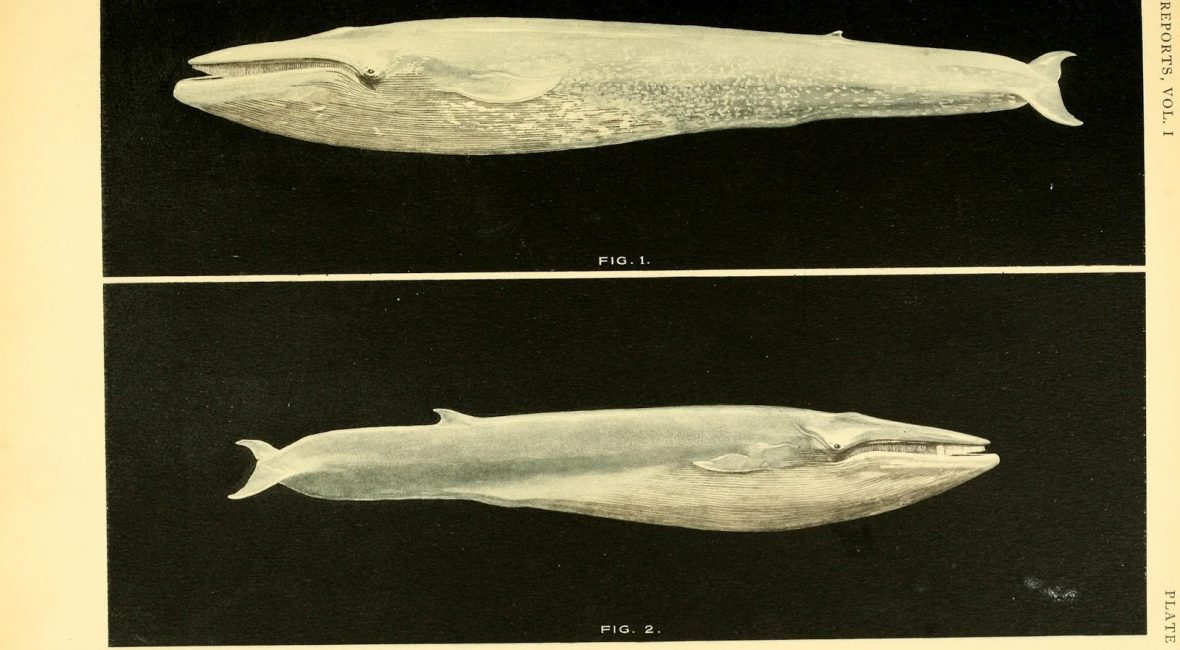
View Full Size Image
Mackintosh NA, Wheeler JFG (1929) Southern blue and fin whales. Discovery Reports 1:257—510. http://www.biodiversitylibrary.org/page/15917732. Digitized by Smithsonian Libraries.

Pyenson has used the data in the Reports to inform several recent studies. For example, he and colleague Simon Sponberg used data on total length and adult body mass for Southern blue and fin whales, published in 1929 as part of the Discovery Reports, to help develop and test regression methods for reconstructing the body size of extinct whales. Their findings, published in 2011 in the Journal of Mammalian Evolution, provided major insight into studying the evolution of cetacean body size.

View Full Size Image
Fin whale fetus. Laws RM (1959) The foetal growth rates of whales with special reference to the fin whale Balaenoptera physalus Linn. Discovery Reports 29: 281–308. http://www.biodiversitylibrary.org/page/5569026. Digitized by MBLWHOI Library.

More recently, while researching the evolution of whale hearing, Maya Yamato and Pyenson used data on the fetal growth rates of whales, published in 1959 as part of the Discovery Reports, to gain insight into the maturation of the ear in baleen and toothed whales. Their research, published in 2015 in PLOS ONE, traces the development of an evolutionarily novel feature in cetaceans – the use of an acoustic funnel, rather than an ear canal, for hearing.

“The historic information in the Reports is so valuable for a variety of questions about the evolution, anatomy, and ecology of large whales,” asserts Pyenson.

View Full Size Image
Dr. Nicholas Pyenson. Selfie from a seakayak in Sitka Sound, Alaska.

Pyenson has been studying marine mammals and other marine vertebrates for over 15 years. He’s published pioneering research on the evolution and diversification of marine mammalian lineages and has used revolutionary techniques like 3D modeling to uncover new insights into the anatomy and transformation of this group. He’s even shared some of his research during past BHL-related events, including live webcasts for the #FWTrueLove and #FossilStories campaigns.

Pyenson’s scientific achievements, including the use of emerging digital tools to expand public access to fossils, earned him the coveted Presidential Early Career Award for Scientists and Engineers (PECASE). He is the first NMNH scientist to receive this award, which is the “highest honor bestowed by the United States Government on science and engineering professionals in the early stages of their independent research careers.”

While Pyenson has embraced many novel research techniques, the historic data found in publications like the Discovery Reports underpins much of his work. Thanks to the digital open access provided by the Biodiversity Heritage Library (BHL), it’s easier than ever to integrate these resources into modern research processes.

“As a free, mobile archive for natural history literature, BHL is ideal for 21st century research, which can happen on the field, in a museum, or at a coffee shop, as long as there’s internet connectivity,” lauds Pyenson.

Pyenson began using BHL nearly ten years ago, and over the past decade, it has had a major impact on his – and his colleagues’ – research.

“BHL supercharges the speed and efficiency of scholarly research, especially in the natural sciences where old literature sometimes contains the only information on a topic, taxon, geographic locality or collector,” says Pyenson. “And because BHL is open-access, I know firsthand that many of my international colleagues have dramatically better access to the literature covered in its database than more recent journals locked behind pay-walls.”

Pyenson uses BHL at least once a week, obtaining descriptions, measurements, and detailed views of morphology on fossil or modern specimens. The usability of the website, and the fidelity and quality of the scans, allow him to access and download information that is critical to his work.

“I think BHL’s interface is really wonderful. The links are crisp and easy to find and share. I especially enjoy the selectivity of being able to download just a few pages or only a specific article from an issue.”

View Full Size Image
Dr. Nicholas Pyenson at Cuverville Island, Antarctica. Photo credit: Martha Stewart.

Given the significant impact that BHL has had on Pyenson’s work, he is anxious that more people be made aware of the vast abundance – and importance – of this free and open access collection.

“We need to get the word out. Old literature matters,” asserts Pyenson.

And matter it does. As Dr. Pyenson’s experience demonstrates, by providing a wealth of data on species morphology, phylogeny, and ecology, historic literature forms the foundation for the investigation of modern and ancient biodiversity. By making this content globally accessible to anyone with an Internet connection, BHL is helping to advance scientific research and inspire discovery of the natural world.

You can help support global research through a tax-deductible donation to BHL. With your help, we can continue to democratize access to information about biodiversity and empower scientific research on a global scale.

______________________________________

This post may contain the personal opinions of BHL users or affiliated staff and does not necessarily represent the official Biodiversity Heritage Library (BHL) position on these matters.

May 11, 2017by ulib-libraryjobs
Blog Reel, Featured Books

National Fossil Day : Eurypterus remipes

Do you know your state flower or bird? What about your state fossil? It is okay if you know the first two and not the third. Many don’t know their state fossil. There’s no better time to discover it than today — National Fossil Day.

View Full Size Image
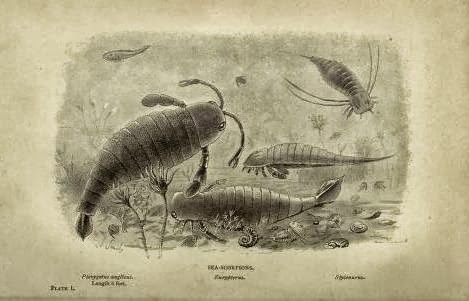
Eurypterus could swim as fast as 9.8 to 13 feet per second, which is slightly faster than a sea otter or sea turtle.

The state of New York has a pretty amazing fossil. It’s Eurypterus remipes also known as the giant sea scorpion. They existed over 400 million years ago and thrived in warm, shallow marine environments in the Middle and Late Paleozoic. This extinct relative of the modern king crab was adopted as the State fossil in 1984. The species designation “remipes” is from Latin meaning “oar” and “foot. What I find especially intriguing about them is that they are one of the first animal groups to venture from sea to land. 
 
View Full Size Image
This is a comparison of an average adult human male 5.6 ft with the average Eurypterus remipes length 7.9 inches and the largest known Eurypterus remipes fossil 4 feet 3 inches. Image from Wikipedia.
 
Eurypterus are the most commonly found genus fossil of eurypterids because during the Silurian period when the second super continent was being formed, they rapidly colonized Euramerica. This invasive species became the dominant eurypterid. Eurypterus was both a predator and hunter. While it is not entirely known what they dined on, sources speculate that they had a healthy diet of trilobites, cephalopods, and worms. 
The largest  Eurypterus remipes fossil ever found was 4 foot 3 inches long that is more than half of the height of a average human man which is 5 foot 6 inches. You can see the specimen on display at the Paleontological Research Institution in Ithaca, New York. 
Rev. H. N. Hutchinson writes about giant species that no longer exist in Extinct monsters and creatures of other days : a popular account of some of the larger forms of ancient animal life.  J. Smit, Alice B. Woodward, J. Green, Charles Knight, and others bring them to life through detailed illustrations. In this book, you can also learn about sea lizard, fish lizards, giant sloths, mastodons, great sea serpents, and the dragons of old time … dinosaurs.
Hutchinson’s excitement can be felt through his writing as he describes these long gone species. Here Hutchinson talks about the sea scorpion species, “What curious animals they must have been, using the same limbs for walking, holding their prey, and eating!”


View Full Size Image
Adult Eurypterus migrated en masse to shore areas in order to mate, lay eggs, and molt. Image from Smithsonian Institution’s National Museum of Natural History.
 
Check out the beautiful illustrations from the book here.
Also, learn all about fossils at the National Museum of Natural History’s FossiLab here.

References:

Knight, PhD.,  Graham. (n.d.). The story of one man’s plight to make fossils swim.  Retrieved from http://gknight.tripod.com/
Merck, Jr., John W. (31 October 2007). Eurypterids, arachnids, and the arthropod invasion of the land. University of Maryland. Retrieve from http://www.geol.umd.edu/~jmerck/bsci392/lecture25/lecture25.html
Share, Dr. Jack. (31 May 2012). The Eurypterid “Eurypterus remipes” is the Official Fossil of the State of New York: Part I – Evolution, Phylogeny, Morphology and Tectonics. Retrieved from http://written-in-stone-seen-through-my-lens.blogspot.com/2012/05/eurypterus-remipes-official-fossil-of.html
Share, Dr. Jack. (29 June 2012). The Eurypterid “Eurypterus remipes” is the Official Fossil of the State of New York: Part III – The R.A. Langheinrich Museum of Paleontology in Eastern Central New York. Retrieved from http://written-in-stone-seen-through-my-lens.blogspot.com/2012/06/eurypterid-eurypterus-remipes-is_29.html
Unknown. (n.d.). Eurypterus remipes NPL4415. Texas Natural Science Center: Non-vertebrate Paleontology, The University of Texas. Retrieved from http://www.utexas.edu/tmm/npl/exhibits/eurypterus.html


Unknown. (27 April 2009). New York State Fossil – Eurypterus Remipes. New York State Library. Retrieved from http://www.nysl.nysed.gov/emblems/fossil.htm

October 16, 2013by lgarvey
Blog Reel, Featured Books

This Means War! A History of the Bone Wars

View Full Size Image
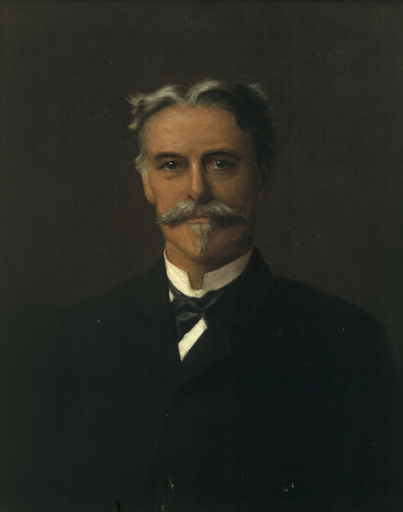
Edward Drinker Cope

Here at the Academy of Natural Sciences of Drexel University in Philadelphia, the story of the so-called Bone Wars is well known.

In short, the Academy’s Edward Drinker Cope (1840-1897), also affiliated with U. Penn, and Yale University’s Othniel Charles Marsh (1831-1899), also affiliated with the United States Geological Survey, were both prolific, well respected paleontologists. Both unearthed, described, and published their finds of fossil fauna in the post-Civil War era when the discipline of vertebrate paleontology was quite young in the U.S.

Though the two initially enjoyed each others’ company, a scientific rivalry kicked in whose results were protracted and nasty. Each scientist ridiculed the other’s published works; each endeavored to damage the other’s reputation; each supposedly sent thugs to the other’s fossil-bone quarries to raid, if not destroy, what lay therein.

But why? Briefly, it was all about priority: who had the published privilege to name which species first. In the end, all this rushing and competitiveness resulted, according to Jaffe (2000: 100) in, for example, at least 16 taxonomic names for the same extinct mammal Uintathere. Quoting the current analysis of Walter Wheeler, Jaffes (ibid) reported, “Neither [Cope nor Marsh] paid any attention to the priority of the other’s scientific names, and they both virtually ignored the priority of Leidy’s. The result was nomenclatural chaos.”

View Full Size Image
Othniel Charles Marsh

Fortunately much has been published about the intellectual combats between Cope and Marsh, yet the public never seems to tire of the Bone Wars. Science writer Mark Jaffe (2000) in his comprehensive The Gilded Dinosaur described Marsh and Cope as writing rebuttals to rebuttals within the pages of The American Naturalist. For several seasons the pages of that journal, whose gentle appellation is An Illustrated Magazine of Natural History, were replete with both paleontologists’ accusations of blunders, errors, and recklessness. Buckets of ink were spilled on their defenses, disputes, rejections, ridicules, taunts, and vengeances.

Finally the editors of this had had enough (June 1873), informing subscribers:

WE regret that Professors Marsh and Cope have considered it necessary to carry their controversy to the extent that they have. Wishing to maintain the perfect independence of the NATURALIST in all matters involving scientific criticism, we have allowed both parties to have their full say, but feeling that now the controversy between the authors in question has come to be a personal one and that the NATURALIST is not called upon to devote further space to its consideration, the continuance of the subject will be allowed only in the form of an appendix at the expense of the author.

That expensive appendix followed (June 1873) as Marsh’s Reply to Professor Cope’s Explanation, whose opening lines indicate the flavor of his nine-page thesis:

THE May NATURALIST (p. 290) contains Professor Cope’s long promised “explanation” of the many errors and false dates in his recent publications, and a most remarkable document this explanation is. As a sleight-of-hand performance with names and dates, it shows practice, and is amusing; but to those familiar with the subject, and to moralists, it suggests sad reflections. [et cetera, et cetera, et cetera…]

Cope chimed in again (July 1873) with On Professor Marsh’s Criticisms:

THE recklessness of assertion, the erroneousness of statement, and the incapacity of comprehending our relative positions, on the part of Professor Marsh, render further discussion of the trivial matters -upon which we disagree unnecessary; and my time is too fully occupied on more important subjects to permit me to waste it upon personal affairs which are already sufficiently before the public. Professor M. has recorded his views “cgre perenne,” and may continue to do so without personal notice by E. D. COPE.

Nearly 20 years after these words were published, the bitter battle for buried treasure between two 19th century vertebrate paleontologists continued to have all the intrigues of tabloid magazines today, only based on fossil finds and published claims instead of Hollywood machinations.

After all, when’s the last time you read a newspaper article began with SCIENTISTS WAGE BITTER WARFARE followed by eight subtitles? That’s what readers of the New York Herald encountered when they opened its pages on Sunday, January 21, 1890:

View Full Size Image
Page from New York Herald

SCIENTISTS WAGE BITTER WARFARE.
—
Prof. Cope of the University of Pennsylvania, Brings Serious Charges
Against Director Powell and Prof. Marsh, of the Geological Survey.
—
CORROBORATION IN PLENTY.
—
Learned Men Come to the Pennsylvanian’s Support with Allegations of Ignorance, Plagiarism and Incompetence Against the Accused Officials.
—
IMPORTANT COLLATERAL ISSUE.
—
The National Academy of Sciences, of Which Professor Marsh is President, is Charged with being Packed in the Interests of the Survey.
—
RED HOT DENIALS PUT FORTH.
—
Heavy Blows Dealt in Attack and Defence (sic) and Lots of Hard Nuts Provided for Scientific Digestion
—
WILL CONGRESS INVESTIGATE?

View Full Size Image
Joseph Leidy

Things got so bad that the pre-eminent natural historian of the day, the Academy of Natural Sciences’ Joseph Leidy (1823-1891), the Father of American Vertebrate Paleontology himself, decided to step out of the discipline he helped to found. This was saying a lot: among Leidy’s famous firsts he described Deinondon horridus, the first dinosaur discovered in the new world — a handful of teeth found by the Survey near the source of the Missouri River in 1856 — and Hadrosaurus folkii, the first articulated dinosaur ever — a nearly complete specimen unearthed in Haddonfield, NJ, in 1858. The remains of both of these animals are carefully curated under lock and key in the Academy’s Vertebrate Paleontology Department to this day.

Despite the intervening 140 years since the Bone Wars raged, the topic has been the Number One subject of Academy Archives researchers in recent years. That research resulted recently in an engaging documentary film in the new series O’Hanlon’s Heroes (see http://programma.vpro.nl/ohanlonshelden/afleveringen/de-bottenoorlog.html), just one example.

In 2012, the Bone Wars has been eclipsed only by Samuel G. Morton (1799-1851) as the most requested archival subject for researchers at the Academy Archives. Morton, certainly deserving of his own blog post, is renowned for having amassed the largest collection of human crania in the 19th century (see Morton, 1839). Like others in this story, Morton was a giant at the Academy of Natural Sciences, serving as its President from 1849 until his death. His skull collection now resides in good hands at the U. Penn Museum of Archeology and Anthropology.

View Full Size Image
1870s exterior of the Academy of Natural Sciences, Philadelphia
View Full Size Image
1901 interior of the Academy of Natural Sciences, Philadelphia

We here in the Academy Library & Archives are fortunate to be able to walk up to the stacks, survey entire runs of the American Naturalist, Transactions of the American Philosophical Society, Proceedings of the Academy of Natural Sciences, where the Bone Wars played out in print, among 250,000 other titles on site.

Thanks to the efforts of the Biodiversity Heritage Library, you can access — free — any of 57,000+ titles from the comfort of your own space. See what discoveries you might ignite as you browse the virtual pages at www.biodiversitylibrary.org.

We hope you will enjoy the selection of BHL-digitized works presented in the Bone Wars Collection. You can also download select books by Marsh and Cope for free from within the iTunes environment through our new Bone Wars iTunes U collection!

References and Further Reading

  • American Naturalist, An Illustrated Magazine of Natural History. 1873: Vol 7. Salem, MA: Peabody Academy of Sciences.
  • Cope, E. D., 1870. Synopsis of the Extinct Batrachia, Reptilia and Aves of North America. Transactions of the American Philosophical Society, New Series, Vol. 14, No. 1, pp. 1-252+i-viii
  • Jaffe, M. 2000. The Gilded Dinosaur: The Fossil War Between E. D. Cope and O. C. Marsh and the Rise of American Science. New York: Crown Publishers, 424 pp.
  • Leidy, J., 1860. Extinct Vertebrate from the Judith River and Great Lignite Formations of Nebraska. Transactions of the American Philosophical Society, New Series, Vol. 11, pp. 139-154.
  • Morton, S. G., 1839. Crania Americana ; or, a comparative view of the skulls of various aboriginal nations of North and South America. J. Dobson, [and] Simpkin, Marshall & co: Philadelphia, London.
November 13, 2012by ulib-libraryjobs

Help Support BHL

BHL's existence depends on the financial support of its patrons. Help us keep this free resource alive!

search

About BHL

The Biodiversity Heritage Library (BHL) is the world’s largest open access digital library for biodiversity literature and archives. BHL operates as a worldwide consortium of natural history, botanical, research, and national libraries working together to digitize the natural history literature held in their collections and make it freely available for open access as part of a global “biodiversity community.”

Follow BHL

  • Bluesky logo
  • Instagram logo
  • Facebook logo
  • Flickr logo
  • Twitter logo

Join Our Mailing List

Sign up to receive the latest news, content highlights, and promotions.

Subscribe Now

Subscribe to Blog via Email

Enter your email address to subscribe to this blog and receive notifications of new posts by email.

Join 319 other subscribers

Subscribe to Blog Via RSS

Subscribe to the blog RSS feed to stay up-to-date on all the latest BHL posts.

Access RSS Feed


64+ Million Pages of
Biodiversity Literature Online.

EXPLORE

Tools and Services
to Transform Research.

EXPLORE

300,000+
Illustrations on Flickr.

EXPLORE

ABOUT | HARMFUL CONTENT | PRIVACY | SITE MAP | TERMS OF USE