Biodiversity Heritage Library - Program news and collection highlights from BHL
  • Home
  • News
  • Featured Books
    • All Featured Books
    • Book of the Month Series
    • BHL at 20
  • User Stories
  • Campaigns
    • Fossil Stories
    • Garden Stories
    • Monsters Are Real
    • Page Frights
    • Her Natural History
    • Earth Optimism 2020
  • Tech Blog
  • Visit BHL
Home
News
Featured Books
    All Featured Books
    Book of the Month Series
    BHL at 20
User Stories
Campaigns
    Fossil Stories
    Garden Stories
    Monsters Are Real
    Page Frights
    Her Natural History
    Earth Optimism 2020
Tech Blog
Visit BHL
  • Home
  • News
  • Featured Books
    • All Featured Books
    • Book of the Month Series
    • BHL at 20
  • User Stories
  • Campaigns
    • Fossil Stories
    • Garden Stories
    • Monsters Are Real
    • Page Frights
    • Her Natural History
    • Earth Optimism 2020
  • Tech Blog
  • Visit BHL
Biodiversity Heritage Library - Program news and collection highlights from BHL
Blog Reel, Featured Books

An Illustrated Natural History of German Frogs: Rösel’s Historia Naturalis Ranarum Nostratium

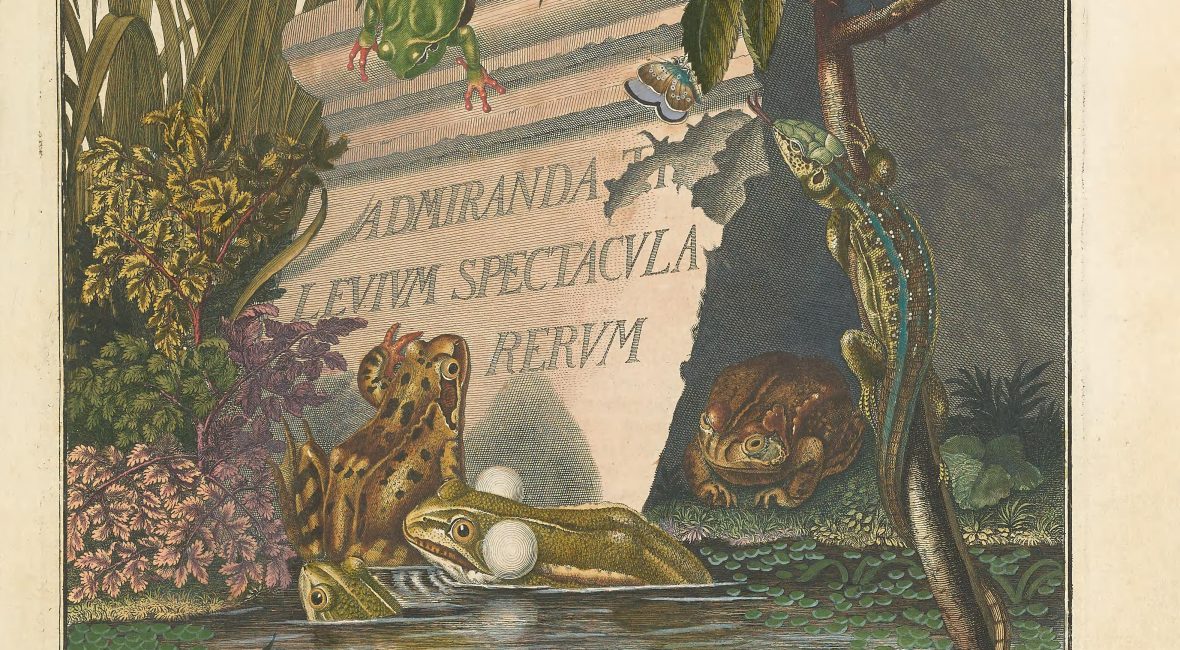
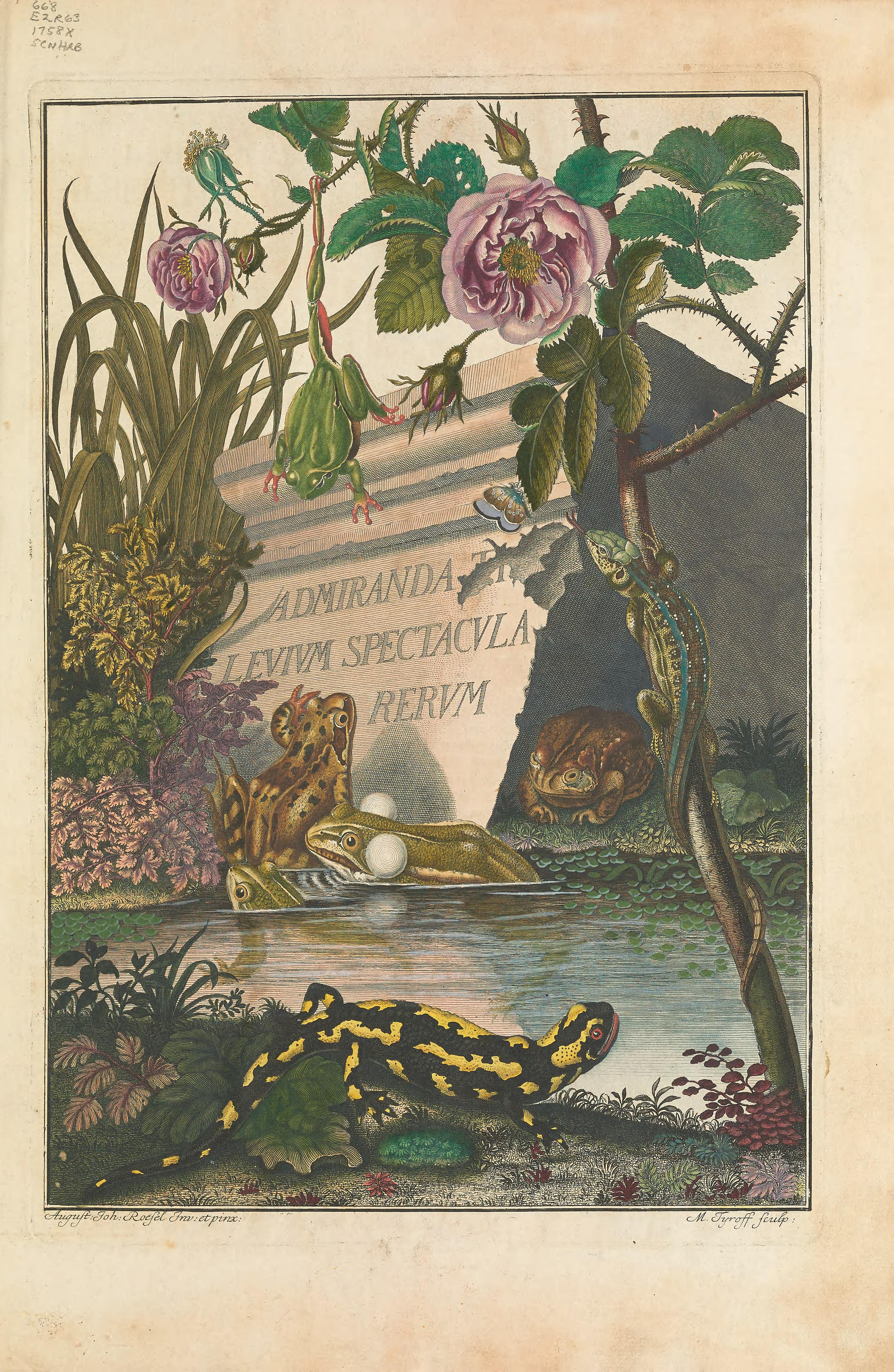
Historia naturalis ranarum nostratium frontispiece

Rösel von Rosenhof, August Johann. Historia naturalis ranarum nostratium. 1758. Contributed in BHL from Smithsonian Libraries.

Historia naturalis ranarum nostratium has been described as one of the most beautiful works devoted to frogs and amphibians.

The work of German artist and naturalist August Johann Rösel von Rosenhof, Historia naturalis ranarum nostratium describes the natural history of all then-known frogs and toads indigenous to the Nuremberg region in Germany. The title is noteworthy first for the extensive, accurate information in the text, printed in two columns in both German and Latin. As Darrel Frost, a curator in the Herpetology Department in the Division of Vertebrate Zoology at the American Museum of Natural History, wrote in his essay on the book for Natural Histories, “Rösel’s volume on German frogs represents in a very real sense the beginning of accurate life-history observation in amphibians” (Frost 2012, 38).
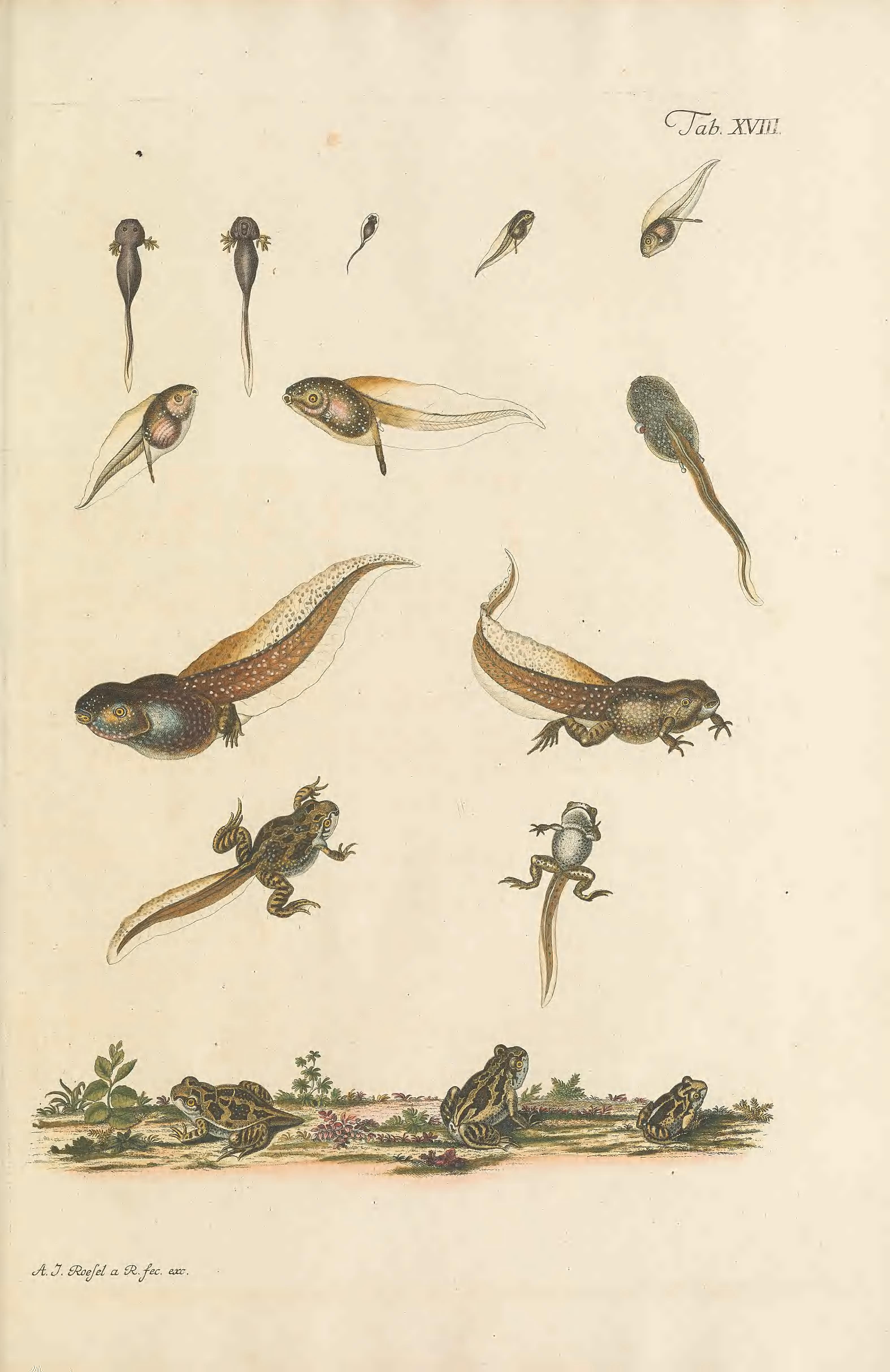
frog illustration

Rösel von Rosenhof, August Johann. Historia naturalis ranarum nostratium. 1758. Contributed in BHL from Smithsonian Libraries.

The work is equally (if not more) renowned for its illustrations. The twenty-four folio, hand-colored copper engravings portray habitats, anatomy, reproductive behavior, and larval development stages in intricate detail. The quality of the artwork is not surprising given Rösel’s artistic background.

Johann Rösel von Rosenhof was born in 1705 to a noble Austrian family near Arnstadt in the German principality of Arnstadt-Schwarzburg. Orphaned at a young age, Rösel was sent for training to his uncle, Wilhelm Rösel, an animal and landscape painter, after he showed artistic talent. He eventually became a painter of portraits and miniatures to the Danish Court in Copenhagen before returning to Nuremberg and earning his living as a painter.
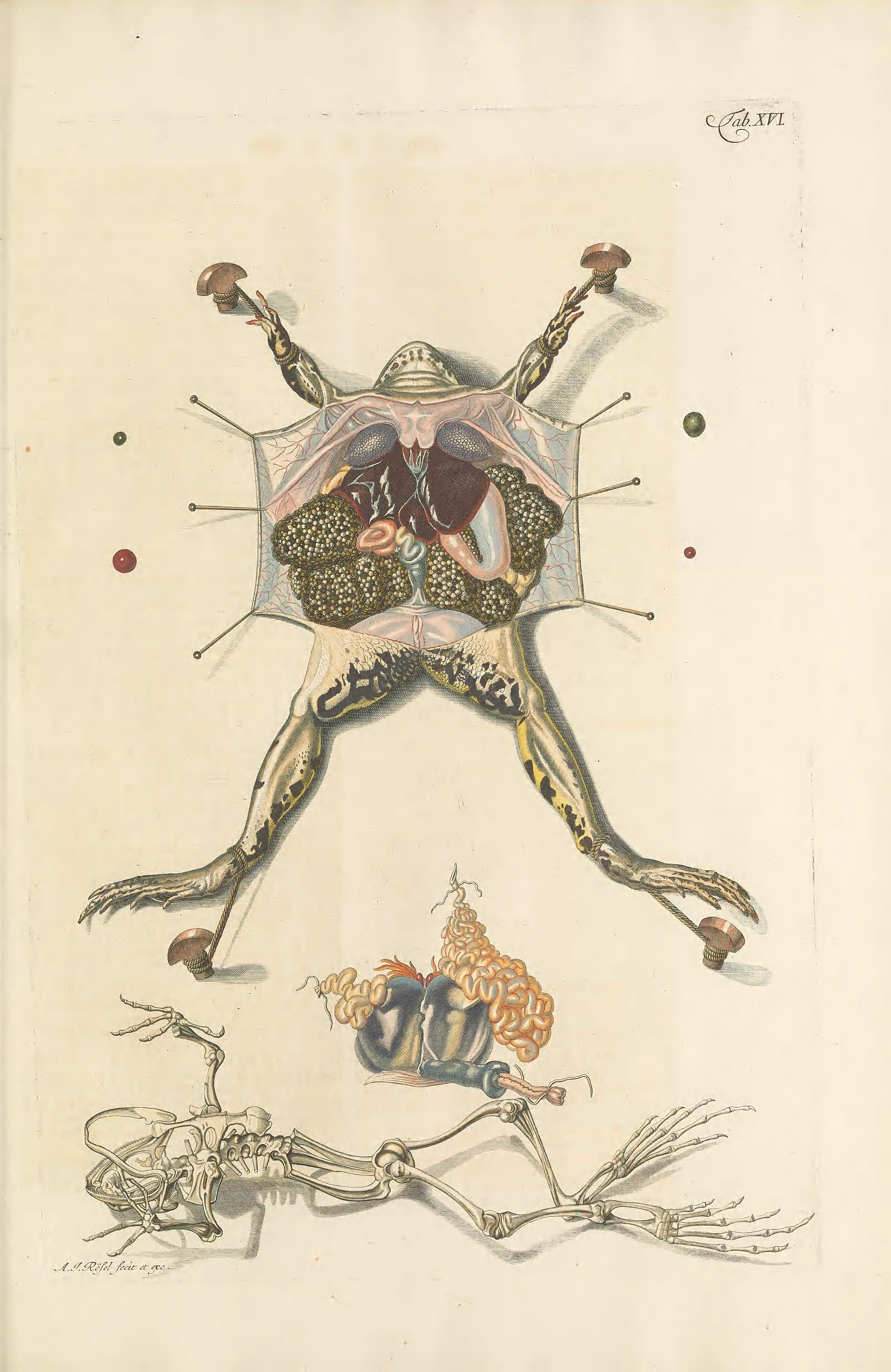
frog illustration

Rösel von Rosenhof, August Johann. Historia naturalis ranarum nostratium. 1758. Contributed in BHL from Smithsonian Libraries.

Rösel’s passion for natural history was ignited by the work of Maria Sibylla Merian, a German-born naturalist and illustrator who is recognized as one of the most significant contributors to the field of entomology. Her Metamorphosis Insectorum Surinamensium (1705) depicted the full life cycles of many Suriname insects. Merian was able to portray this life history information because she drew her subjects from life in their natural environments. Most naturalists of the day illustrated species from dead, preserved specimens, which contributed to a lack of knowledge about the true life cycle and origin of insects. Maria also portrayed the host plant for the species she studied and even illustrated the damage the insects left on the plants.
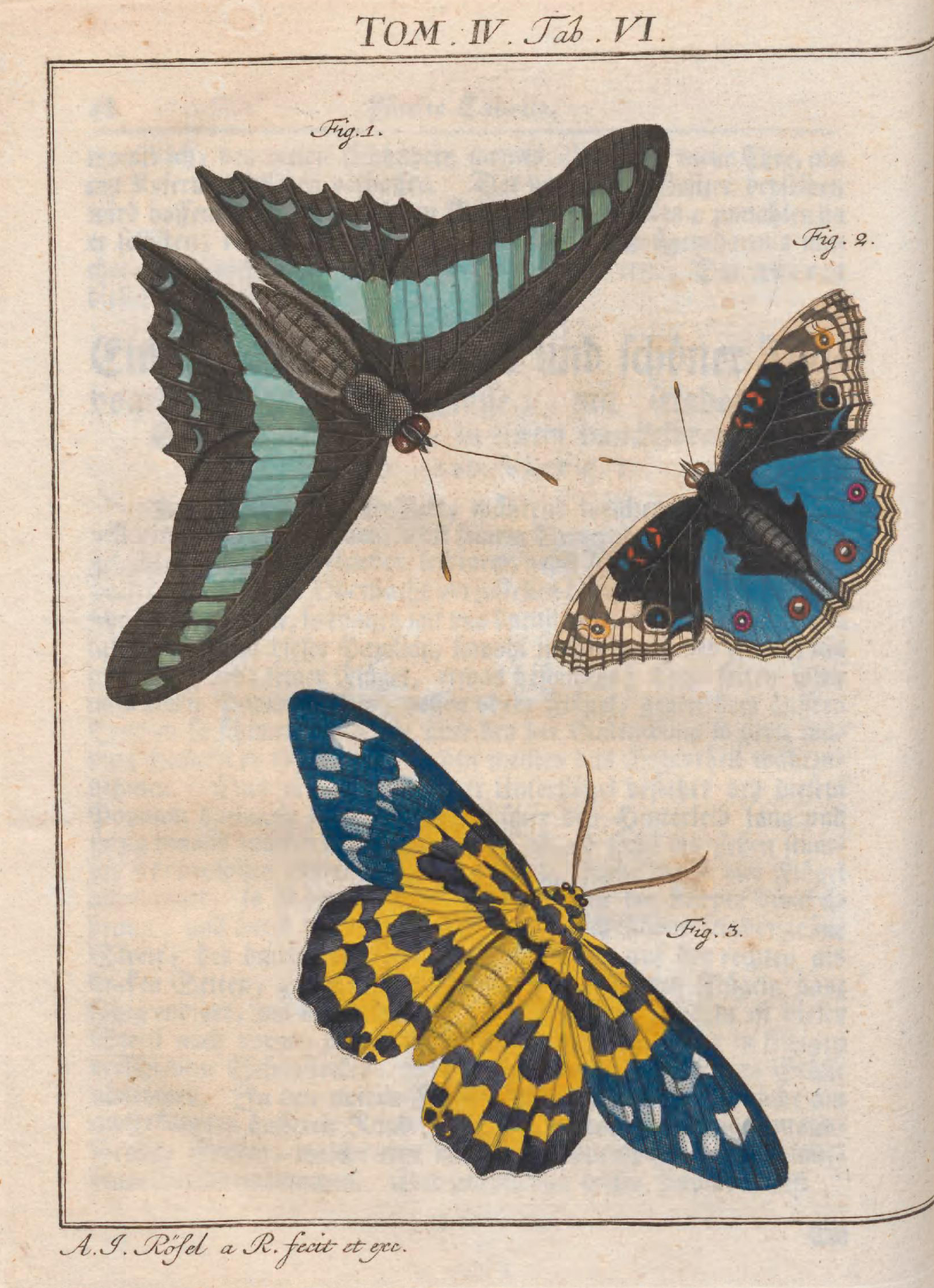
illustration of butterflies

Rösel von Rosenhof, August Johann. Der monathlich-herausgegebenen Insecten-Belustigung. v. 4 (1761). Contributed in BHL from the Naturalis Biodiversity Center.

Merian’s work inspired Rösel to study and produce a similar work on German insects. His interest in the natural world also grew to include amphibians and reptiles, and he used his leisure time to collect insect and amphibian eggs and larvae to observe their development. The first part of his first natural history publication, Der monatlich-herausgegebenen Insecten-Belustigung, was published in 1740. Four additional parts appeared over the years, with the final one being published posthumously in 1761. Because of this publication, a copy of which has been contributed in BHL from the Naturalis Biodiversity Center, Rösel is known as one of the fathers of German entomology.
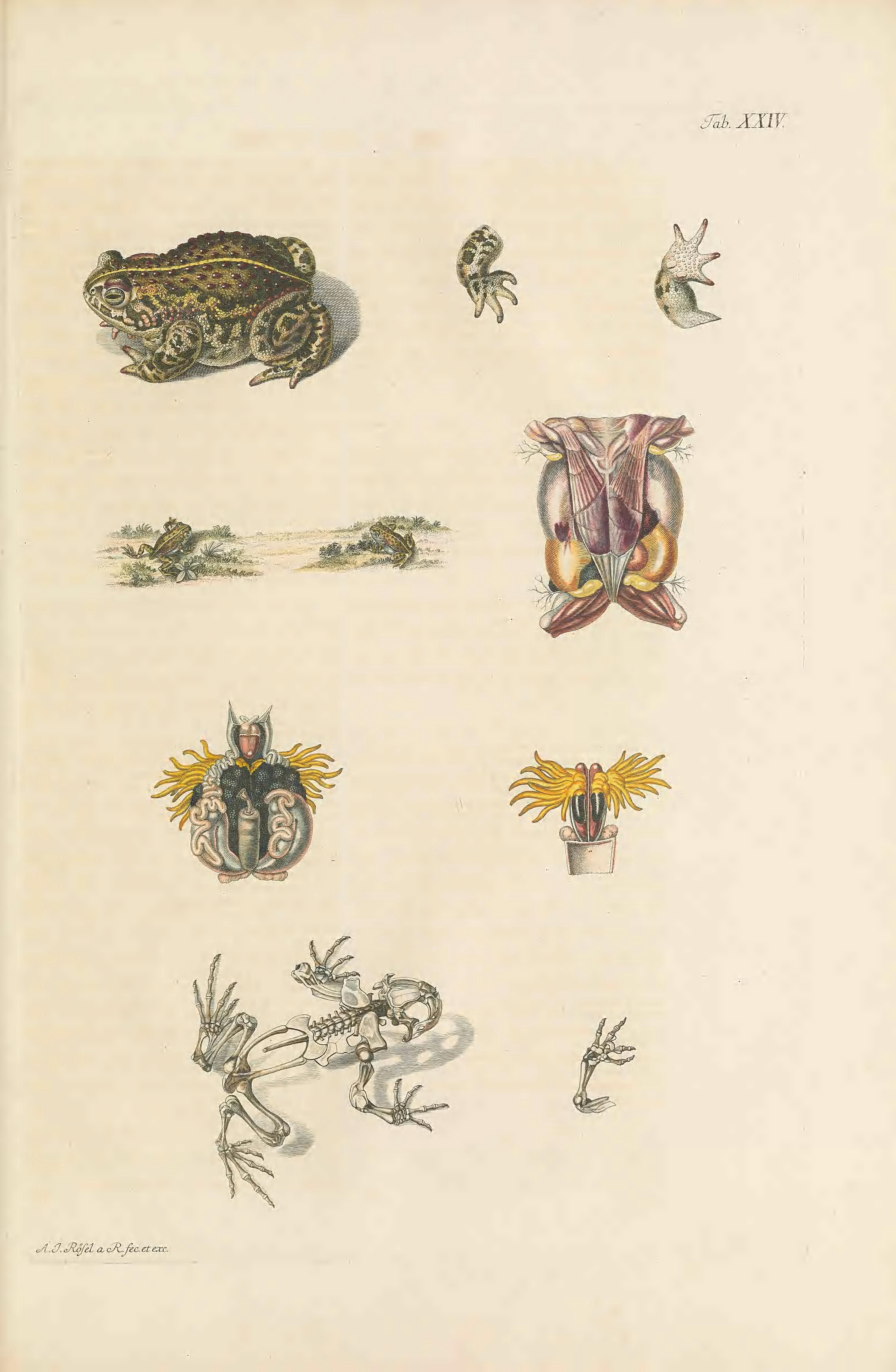
frog illustration

This illustration became the type of Bufo calamita (now Epidalea calamita). Rösel von Rosenhof, August Johann. Historia naturalis ranarum nostratium. 1758. Contributed in BHL from Smithsonian Libraries.

In 1753, Rösel published the first part of his Historia naturalis ranarum nostratium. Completed in 1758, the work is a scientific and artistic marvel, and several of the illustrated frogs, such as Bufo calamita (now Epidalea calamita) and Bufo fuscus (now Pelobates fuscus), became the types for their species. Thanks to the Smithsonian Libraries, everyone in the world can appreciate Rösel’s scientific and artistic contributions to the natural history of German frogs. The Libraries’ copy of Historia naturalis ranarum nostratium, housed in its Joseph F. Cullman 3rd Library of rare books, has recently been digitized for BHL.

As Frost outlines in his essay, Rösel intended to produce a similar work for lizards and salamanders, but sadly was not able to complete it, as he died unexpectedly on March 27, 1759.

Through his natural history publications, Rösel’s scientific legacy lives on and is accessible to everyone through the Biodiversity Heritage Library thanks to the Naturalis Biodiversity Center and Smithsonian Libraries.
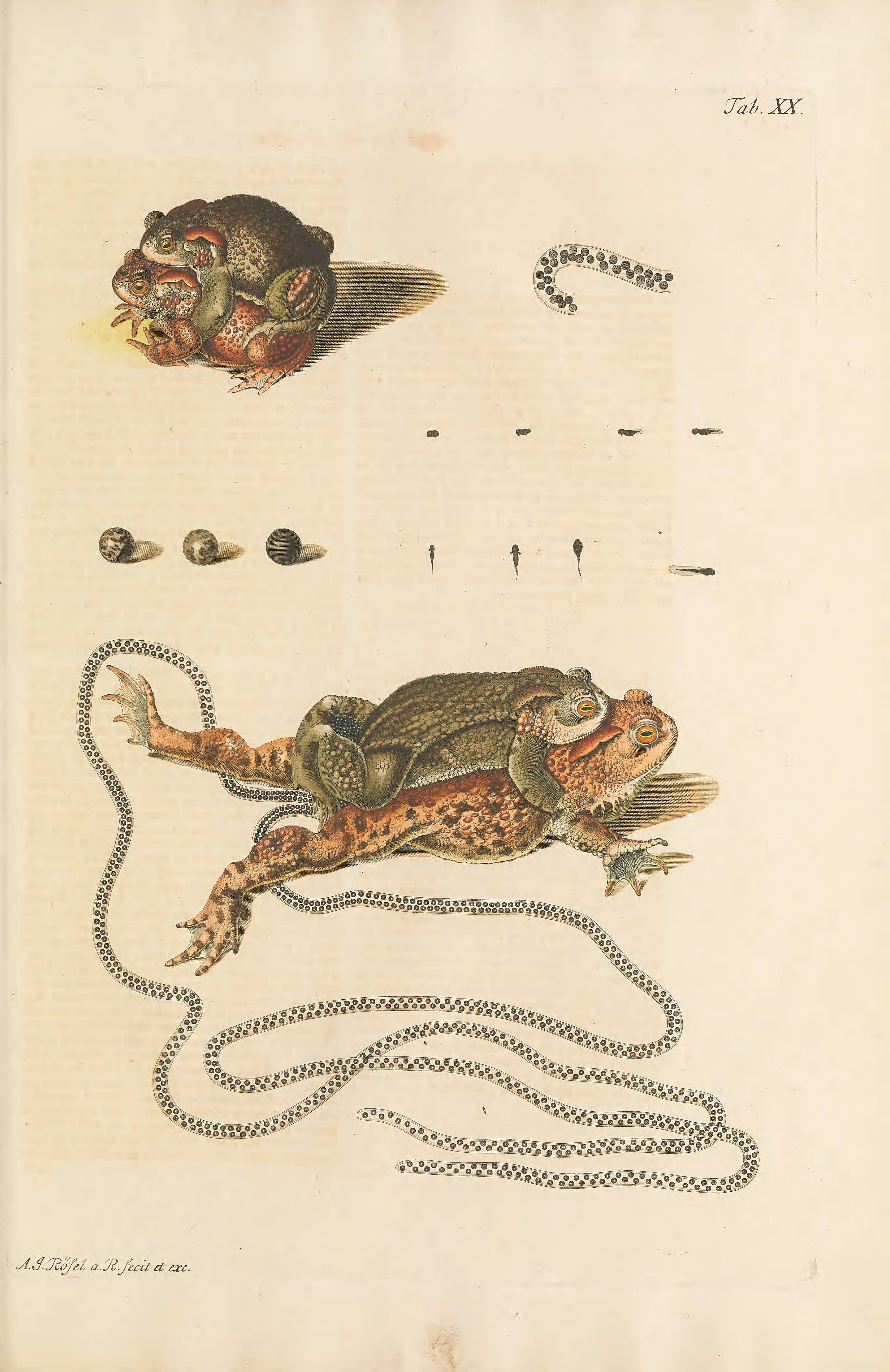
frog illustration

Rösel von Rosenhof, August Johann. Historia naturalis ranarum nostratium. 1758. Contributed in BHL from Smithsonian Libraries.

Reference

The information in this post was derived from:

Frost, Darrel. 2012. “Rösel von Rosenhof and His Natural History of Frogs.” In T. Baione (Ed.), Natural Histories: Extraordinary Rare Book Selections from the American Museum of Natural History Library (pp. 37-38). New York: Sterling Publishing.

August 2, 2018by michelle.underhill
BHL News, Blog Reel

New Grant Helps The Field Museum Digitize Rare and Interesting Books!

View Full Size Image
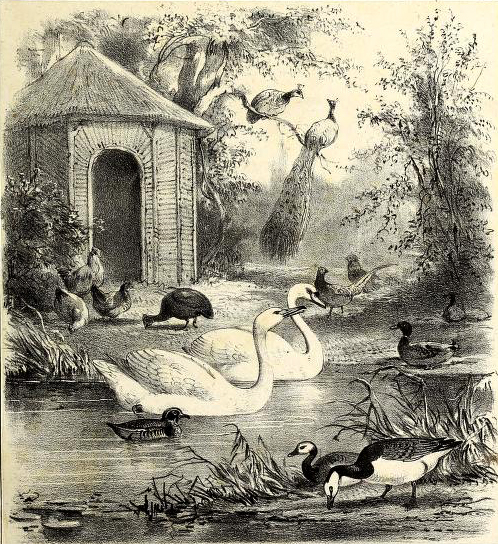
Title Page Image, v. 3, Onze vogels in huis en tuin

One of the BHL partner institutions, The Field Museum Library, was recently awarded a small grant from the Consortium of Academic and Research Libraries in Illinois (CARLI) to contribute titles to the growing BHL corpus. The proposal entitled “Empowering Biodiversity Research,” allowed The Field Museum Library to contribute 34 new titles to the BHL.

Several titles chosen for digitization came from the Library’s impressive Edward E. Ayer Ornithological Library, housed in the collections of the Mary W. Runnells Rare Book Room.

The titles were chosen for digitization via several means:

View Full Size Image
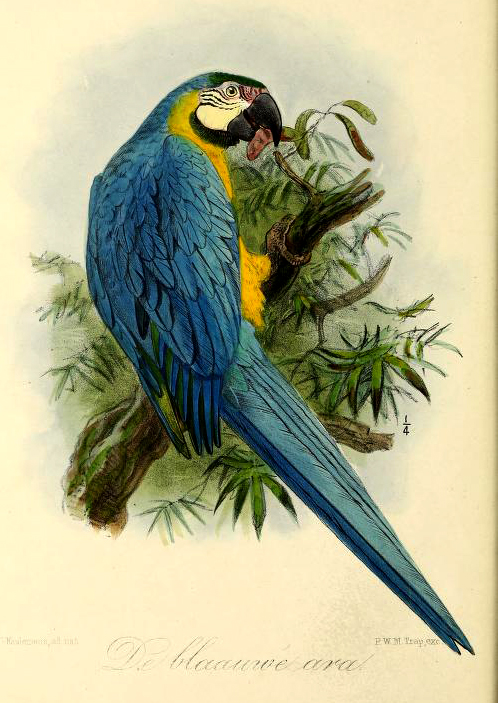
Blue Macaw. v. 3,

Onze vogels in huis en tuin

Requests received from users, which are processed via BHL’s issue tracking system, Gemini, allows us to fulfill user requests, complete series fill-in’s, and keep us organized! One item specifically requested was the famous work of Dutch illustrator John Gerard Keulemans (1842-1912), Onze vogels in huis en tuin (‘Our Birds in House and Garden’). Published in 3 volumes between 1869-1876, this collection of 200 lithographed plates were hand colored by the author. Noted for his beautiful and scientifically accurate work, Keulemans also provided illustrations for both Proceedings of the Zoological Society of London, The Ibis as well as numerous other monographs throughout the late 19th and early 20th centuries. With only 4 copies held in U.S. libraries, The Field Museum Library is the only BHL partner to own Onze vogels.


View Full Size Image
Neue Alpina, v. 1

In-demand titles were also identified via the Library’s active Interlibrary Loan (ILL) program. This service allows institutions from all over the world to request loans of books or scans of articles from The Field Museum Library. Items that are out of copyright and related to biodiversity are flagged for potential digitization. The title, Neue Alpina, has been requested via ILL twice in the last six months. This periodical, complete in two volumes, was published 1821-1827 and is focused on the natural history of Switzerland. Also part of the Ayer Collection, The Field Museum Library is the only holder of this title in the U.S.

View Full Size Image
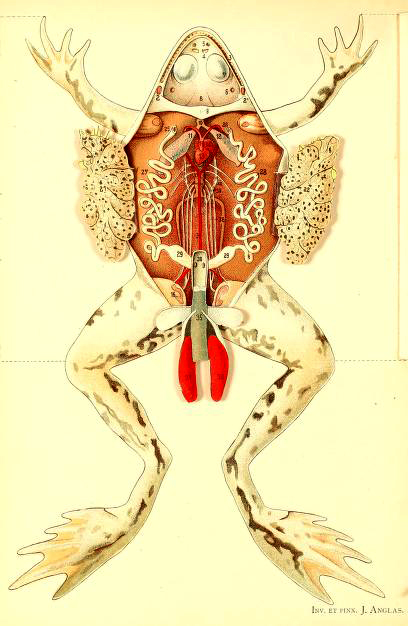
Dissected Frog. Les animaux de laboratoire

And finally, we often find pretty amazing items just by browsing the shelves! We came across an interesting item in our Herpetology Library from the collection of renowned herpetologist, Karl P. Schmidt. Les animaux de laboratoire: La grenouille (Anatomie et Dissection) is a short monograph about frog anatomy and a guide to dissection techniques. The amazing (and honestly, pretty fun) part of the book is the illustrations. The frog’s anatomy is dissected via multi-part anatomical flaps. The staff of the Internet Archive scanning center in Ft. Wayne, Indiana did a great job of capturing all of these flap elements during digitization.

Explore all items in the BHL contributed by The Field Museum Library here!

April 30, 2013by Kathryn Stine
Blog Reel, User Stories

BHL and Our Users: EOL Rubenstein Fellow, Dr. Breda Zimkus

View Full Size Image

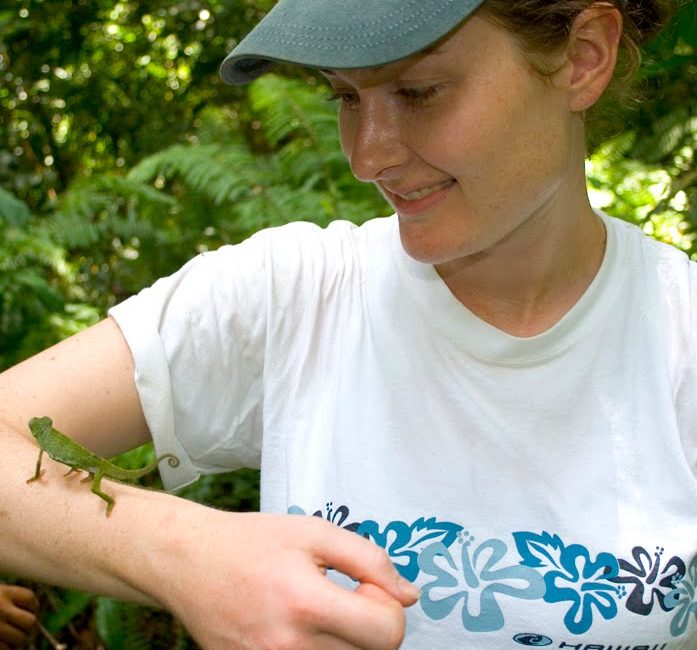
If you caught our blog post yesterday, then you know that this week we’re starting a mini-series within our larger BHL and Our Users series. This mini-series spotlights a few of the EOL Fellows – scientists who have been awarded a fellowship through the EOL Rubenstein Fellows Competition – and discusses not only their work but also how they use BHL to support it. For this, our first post, we feature Dr. Breda Zimkus, a Post-Doctoral Fellow and Genetics Resources Facility Project Manager at the Museum of Comparative Zoology at Harvard University.

Q: What are your research interests/field(s) of study & where do you do the bulk of your work (country)?

A: I am a biologist interested in phylogenetics, biogeography and conservation of amphibians and reptiles. My research integrates a broad range of techniques, including fieldwork, taxonomy and molecular systematics to interpret patterns of speciation and diversity. I am particularly interested in the phylogenetic diversification of African amphibians and use of molecular tools to define species boundaries. I have worked in many East African countries (Ethiopia, Malawi, Tanzania), and my most recent fieldwork in May/June 2011 was in the Central African country of Gabon where I completed a survey of amphibians of the Batéké Plateau National Park, which borders the Republic of Congo.

Q: In the program, Fellowships are expected to serve as a complimentary funding source to existing funding that supports your primary research activities. Please describe what you primary research activities are.

A: I am currently studying a number of frog groups that are distributed across sub-Saharan Africa, including puddle frogs (Phrynobatrachidae), rocket frogs (Ptychadenidae) and sand frogs (Pyxicephalidae: Tomopterna). I am using molecular systematics to identify cryptic species and investigating the complex diversification patterns of these lineages across the continent. In addition to being an Encyclopedia of Life Rubenstein Fellow this past year, I was also the recipient of a Ethel K. Allen, Sigma Delta Epsilon/Graduate Women In Science Fellowship, which funded my post-doctoral work on rocket frogs.

Q: Please describe how you use EOL to disseminate or support your primary research activities, or what your primary duties related to EOL are.

A: Africa still remains one of the most poorly understood areas for amphibians globally, with species rarely collected and basic data on their ecology and distribution incompletely understood. Consequently, conservation status is only adequately known for some species. This lack of knowledge is particularly worrying as concentrations of species are found in a number of sub-Saharan regions seriously threatened by environmental change. There is also a serious conservation risk to amphibians globally with the emerging prevalence of the fungal disease chytridiomycosis, possibly responsible for the extinction of many species. As an EOL fellow, I developed the African amphibian Lifedesk, so basic taxonomic data could be assembled to facilitate research. The website serves as a gateway for information regarding African amphibian species, where participants will write and edit species pages, upload images, and maintain bibliographic resources. In addition to serving as a stand-alone resource, this LifeDesk feeds content directly into the Encyclopedia of Life (EOL) and AmphibiaWeb.

Q: Who is your Mentor, what is their area of interest (research activities), and how have they supported you throughout your Fellowship?

A: I have two mentors for this project. My post-doctoral research, including my EOL work, is currently being conducted in the laboratory of Dr. James Hanken of Harvard University. The Hanken Lab studies the evolution of morphology, developmental biology, and systematics and serves as a community research facility for NSF’s AmphibiaTree project. Most work focuses on amphibians but otherwise addresses a wide range of topics, taxa and methodologies. I am conducting my EOL Fellowship work in collaboration with Dr. Simon Loader, Director of the Molecular Systematics Laboratory and Post-doctoral Researcher at the Institute of Biogeography, University of Basel. His research is specifically focused on the phylogenetic diversification of African amphibians, using an integrative approach to interpret patterns of diversity in Africa.

Q: How does BHL support your Fellows activities, as well as those research activities that fall outside of your duties as an EOL Fellow?

A: BHL has been integral to both my EOL Fellow work and my primary research on discovering African amphibians species because original species descriptions and taxonomic revisions are essential to those working on species identification. One of the major goals of the African amphibians Lifedesk is to make PDFs of all non-copyrighted material available to herpetologists around the world. Many of the most important African amphibian research was done in the early 20th century, and these manuscripts were published in rare journals. Thankfully, BHL has digitized many of these important works, so I was able to assemble PDFs online using the BHL website and upload them to the African amphibians Lifedesk.

Q: When did you first discover BHL?

A: I first heard about BHL from the librarians at the Ernst Mayr Library of the Museum of Comparative Zoology at Harvard University while conducting my PhD research. At that point I used BHL only if I was unable to find a reference in the Ernst Mayr library. When I began my EOL fellowship, I began to use BHL on a daily basis, compiling PDFs to upload to the African amphibians Lifedesk.

Q: What are your favorite features/services on BHL?

A: I am lucky to be at an institution with an amazing library system, but BHL makes biodiversity literature accessible to everyone with an internet connection. It also allows me to have electronic copies of papers on my computer, so I have them whenever I need them.

Q: If you could change one thing about BHL, or suggest one thing to be the next developmental priority for BHL, what would it be?

A: It does take time to assemble PDFs because you must locate the journal, find the issue, select each individual page of that specific issue and then have the document emailed to you. I would love to see a time when I can search for a title of a specific paper and find the PDF already assembled.

Q: Do you have a favorite book in BHL, or a book that has most supported your research activities or EOL responsibilities?

A: George Albert Boulenger (1858-1937) was a zoologist that described an incredible number of amphibians (556 species), reptiles (872 species) and fish (1,096 species). Many of Boulenger’s African amphibian descriptions were published in the Proceedings of the Zoological Society of London. I found his work published in 1900 entitled “A list of the batrachians and reptiles of the Gaboon (French Congo), with descriptions of new genera and species” to be very useful for my recent trip to Gabon.

Thank you, Dr. Zimkus, for all the valuable research you have conducted on amphibians and reptiles, and for your pioneering efforts on the African amphibians Lifedesk for EOL! We are so thrilled that BHL has been a part of the endeavor, particularly as the library at your home institution is one of the key members of BHL (Ernst Mayr Library, Harvard University)! As to your desire to eventually be able to find already-assembled PDF articles from BHL, we have been in the process of creating Citebank for some time now, with just that objective in mind. Citebank will act as an article repository, indexing and providing PDFs to articles found within larger journals and books in BHL. Though still in the developmental stage, Citebank is live on the web and already indexes and provides PDFs for a great deal of articles from BHL. We hope that this, and our other BHL efforts, will continue to play an important role in your vital research and conservation activities!

August 16, 2011by michelle.underhill
Blog Reel, Featured Books

Book of the Week: Amphibians and Reptiles Galore!

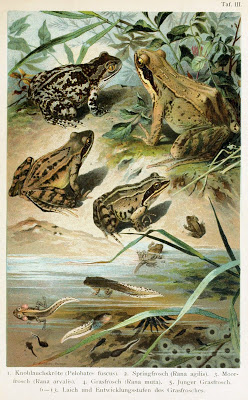
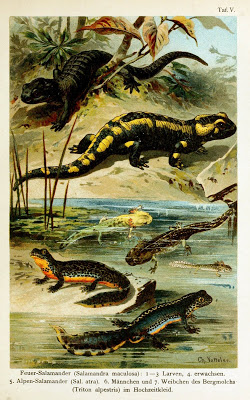
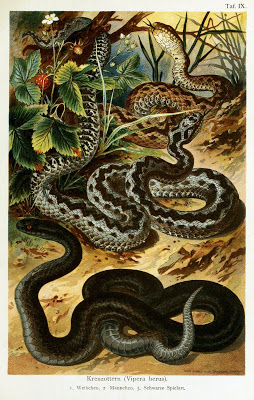
So often with scientific illustration, one finds that the depiction of species or specimens are limited to the isolated rendering of the subject in question, devoid of any habitat or environmental context that gives the reader a clear picture of what life is truly like for the animal in the wild. So, when we came across the illustrations in Deutschlands Amphibien und Reptilien. Eine Beschreibung und Schilderung sämmtlicher in Deutschland und den angrenzenden Gebietan vrokommenden Lurche und Kreichthiere (1897) by Bruno Dürigen, we knew we had to highlight them. Plus, the plethora of reptile and amphibian species displayed seemed equally worthy of attention. So, enjoy these selected illustrations from our book of the week, learn more about the species depicted in each in EOL, and imagine what life might be like in the wild for our cold-blooded friends. Plus, don’t forget to take a look at the book in BHL to see all of the other illustrations that are not highlighted in this post!

View Full Size Image

1) Common Spadefoot (Pelobates fuscus/i>)
*More references in BHL

2) Agile Frog (Rana dalmatina, previously Rana agilis)
*More references in BHL.

3) Moor FrogRana arvalis
*More references in BHL.

4) European Frog (Rana temporaria, previously Rana muta)
More references in BHL.

5) Young European Frog

6) Spawn and Stages of Development of the European Frog

View Full Size Image

1) Fire Salamander (Salamandra maculosa)

1-3) Larval Stage

4) Adult
*More references in BHL.

5) Alpine Salamander (Salamandra atra)
*More references in BHL.

6) Male and 7) Female Alpine Newt (Mesotriton alpestris), previously Triton alpestris)
*More references in BHL.

View Full Size Image

Adder (Vipera sachalinensis, previously Vipera berus)

2) Male
3) Black Species Type
*More references in BHL.

This week’s book of the week, Deutschlands Amphibien und Reptilien. Eine Beschreibung und Schilderung sämmtlicher in Deutschland und den angrenzenden Gebietan vrokommenden Lurche und Kreichthiere (1897) by Bruno Dürigen, was contributed by the Smithsonian Institution.

March 24, 2011by michelle.underhill
Blog Reel, Featured Books

Book of the Week: Frogs in Trousers?

View Full Size ImagePer our user feature earlier this week on Dr. Charlotte Sleigh of the University of Kent, we feature a book that has been particularly important for Dr. Sleigh’s recent work: Dissertations relative to the natural history of animals and vegetables , volume 2 (1789), by Lazzaro Spallanzani. Dr. Sleigh’s current activities involve writing a book on the cultural history of frogs for Reaktion Books’ Animal series. In Dr. Sleigh’s own words regarding the importance of this title for her current endeavors:

“I had come across a reference to this book in relation to a strange experiment in which Spallanzani dressed his frogs in waxed taffeta trousers, to understand how fertilization took place. As hoped, I found the account of this curious experiment, alongside many more scientifically and culturally rich accounts of his work on frogs: a jumping-off point (if you’ll pardon the pun) for further research.”

Indeed, Lazzaro Spallanzani (1729-1799), an Italian Catholic priest, biologist and physiologist, made important contributions to the world of science with his work on animal reproduction, proving that it required both semen and an ovum in order to prosper. This discovery is in part due to his experiments with frogs and trousers. With such a curious experiment leading to such an important discovery, there was no doubt that this book should be featured, in all its glory, as our book of the week, and that the passage regarding frogs and trousers should be particularly highlighted.

Spallanzani had been experimenting on animal reproduction for some time before the incident with the trousers. His experiments were confined to a particular species of frog, which he identified as the “Green Aquatic Frog.” During his course of study, involving experimenting with various environmental and conditional effects on frogs for the success of fertilization, he received a letter from abbe Nollet regarding his work. In it, Nollet wrote,

“About thirty years ago, Mr. Reaumur and myself made many researches relative to this subject…I remember putting breeches of waxed taffeta on the male [frog], and watching a long time, without perceiving any appearance that denoted an act of secundation.”

Spallanzani was intrigued by the account given him by Nollet, and decided to reproduce the experiment. By his account,

“The idea of the breeches, however whimsical and ridiculous it may appear, did not displease me, and I resolved to put it in practice. The males, notwithstanding this incumbrance, seek the females with equal eagerness, and perform, as well as they can, the act of generation; but the event is such as may be expected: the eggs are never prolific, for want of having been bedewed with semen, which sometimes may be seen in the breeches in the form of drops. That these drops are real seed, appeared clearly from the artificial secundation that was obtained by means of them.”

By such means were the facts of reproduction secured, and we have the delightful image of frogs in trousers to thank for it.

Take some time to explore Spallanzani’s work on reproduction in this volume, and consider reading up on his important work on digestion, which is recounted in the first volume of this title. And let us praise the ingenuity of our forefathers, without which we might never have the opportunity to feature such delightful accounts of experiments in our books of the week!

February 28, 2011by michelle.underhill

Help Support BHL

BHL's existence depends on the financial support of its patrons. Help us keep this free resource alive!

search

About BHL

The Biodiversity Heritage Library (BHL) is the world’s largest open access digital library for biodiversity literature and archives. BHL operates as a worldwide consortium of natural history, botanical, research, and national libraries working together to digitize the natural history literature held in their collections and make it freely available for open access as part of a global “biodiversity community.”

Join Our Mailing List

Sign up to receive the latest news, content highlights, and promotions.

Subscribe Now

Subscribe to Blog via Email

Enter your email address to subscribe to this blog and receive notifications of new posts by email.

Join 319 other subscribers

Subscribe to Blog Via RSS

Subscribe to the blog RSS feed to stay up-to-date on all the latest BHL posts.

Access RSS Feed

Inspiring Discovery through Free Access to Biodiversity Knowledge.

The Biodiversity Heritage Library makes it easier than ever for you to access the information you need to study and explore life on Earth…for free, anytime, anywhere.


64+ Million Pages of
Biodiversity Literature Online.

EXPLORE

Tools and Services
to Transform Research.

EXPLORE

300,000+
Illustrations on Flickr.

EXPLORE

ABOUT | HARMFUL CONTENT | PRIVACY | SITE MAP | TERMS OF USE