Biodiversity Heritage Library - Program news and collection highlights from BHL
  • Home
  • News
  • Featured Books
    • All Featured Books
    • Book of the Month Series
    • BHL at 20
  • User Stories
  • Campaigns
    • Fossil Stories
    • Garden Stories
    • Monsters Are Real
    • Page Frights
    • Her Natural History
    • Earth Optimism 2020
  • Tech Blog
  • Visit BHL
Home
News
Featured Books
    All Featured Books
    Book of the Month Series
    BHL at 20
User Stories
Campaigns
    Fossil Stories
    Garden Stories
    Monsters Are Real
    Page Frights
    Her Natural History
    Earth Optimism 2020
Tech Blog
Visit BHL
  • Home
  • News
  • Featured Books
    • All Featured Books
    • Book of the Month Series
    • BHL at 20
  • User Stories
  • Campaigns
    • Fossil Stories
    • Garden Stories
    • Monsters Are Real
    • Page Frights
    • Her Natural History
    • Earth Optimism 2020
  • Tech Blog
  • Visit BHL
Biodiversity Heritage Library - Program news and collection highlights from BHL
Blog Reel, Campaigns, Featured Books, Her Natural History

Mary Margaret Smith: Ichthyologist, Artist, and First Director of the JLB Smith Institute of Ichthyology

Margaret and JLB Smith review art proofs

A version of this post was originally published on the blog of the Margaret Smith Library, SAIAB. It is reproduced with permission from the author, Sally Schramm.
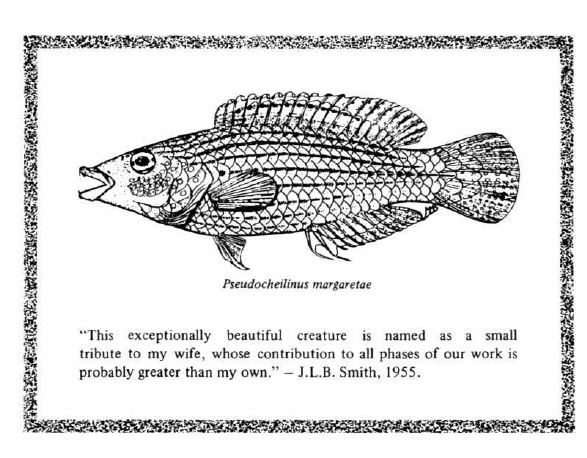
fish

From the cover of The life and work of Margaret M. Smith / Mike Bruton (c.1986)

The Library at the South African Institute for Aquatic Biodiversity is named for Mary Margaret Smith (née Macdonald), the first Director of the JLB Smith Institute of Ichthyology. Macdonald attended Rhodes University College in Grahamstown from 1934 to 1937. She was awarded her B.Sc. degree in 1936, majoring in physics and chemistry (with distinction), and became a senior demonstrator in the Chemistry Department.

James Leonard Brierley (JLB) Smith (1897-1968), Associate Professor of Organic Chemistry, and Mary Macdonald, were married in 1938. With her not liking the new name “Mary Smith”, she was from that time always known as “Margaret Smith”.
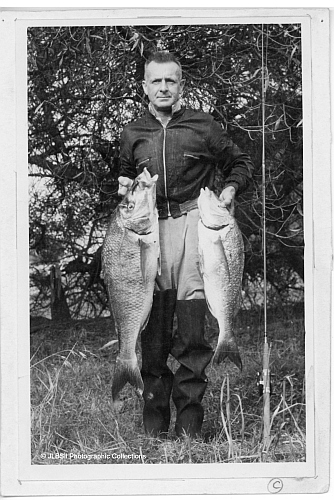
JLB Smith

JLB Smith with White steenbras , Knysna ca. 1950

JLB Smith, a keen angler, developed a more formal interest in ichthyology, the study of fishes. His young wife soon became involved in his hobby and accompanied him on fishing trips and collecting expeditions.
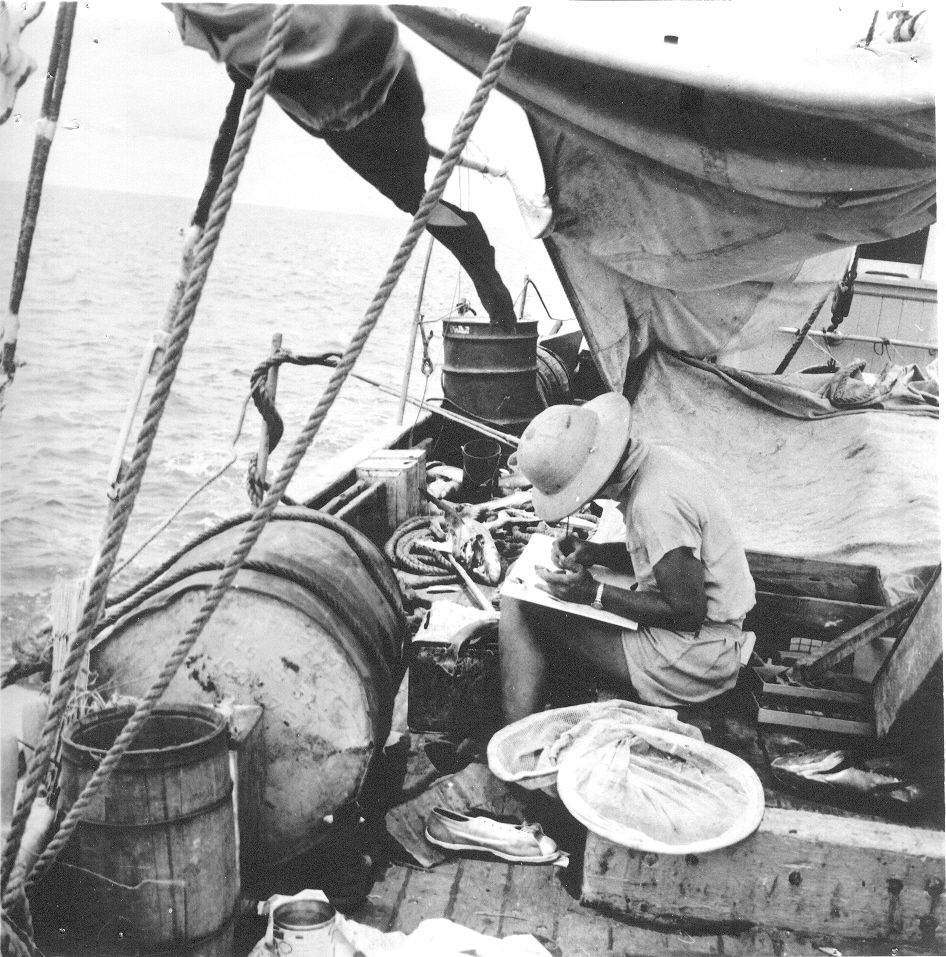
Margaret Smith

Margaret Smith drawing on a boat in the Seychelles.
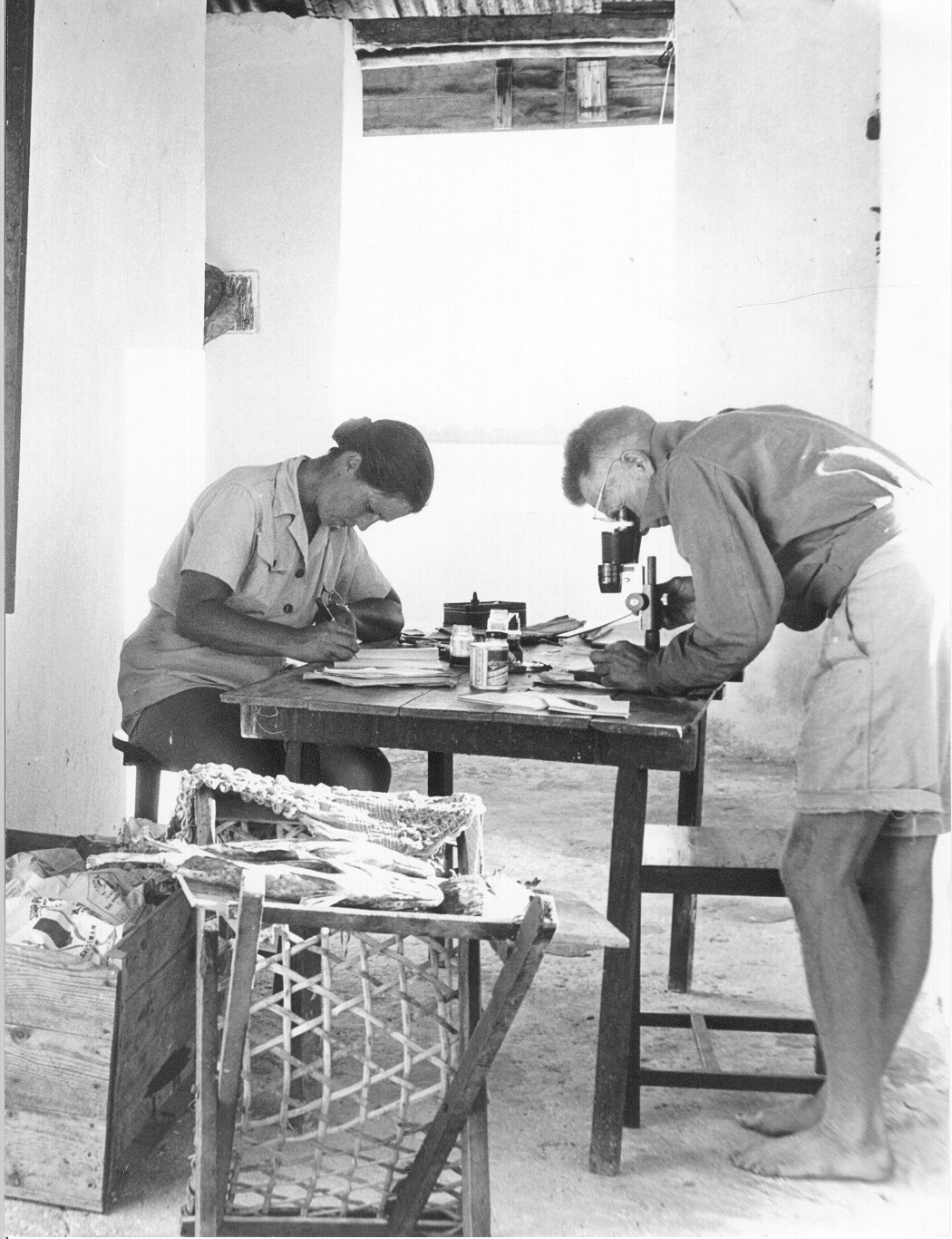
Typical lab conditions, Shimoni, Kenya 1952

Typical lab conditions, Shimoni, Kenya 1952.

In 1946, the Department of Ichthyology was established at Rhodes University and J.L.B and Margaret Smith were able to devote all their energies to the production of an authoritative book on the sea fishes of southern Africa.
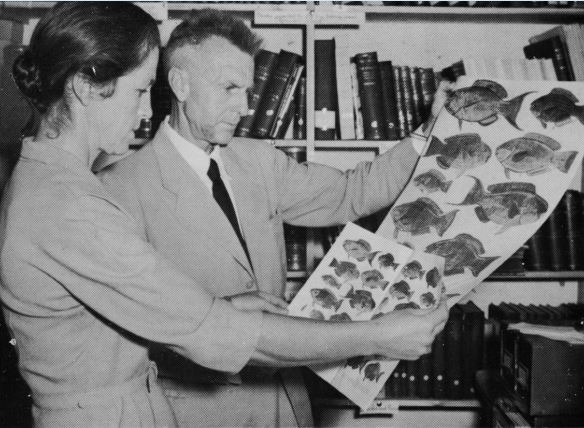
Margaret and JLB Smith review art proofs

Margaret and JLB Smith review art proofs.

One of their greatest problems was a lack of suitable illustrations. Undaunted, despite no artistic training, Margaret Smith, took on the task. The first edition of The Sea Fishes of Southern Africa, published in 1949, contained her exceptional illustrations.
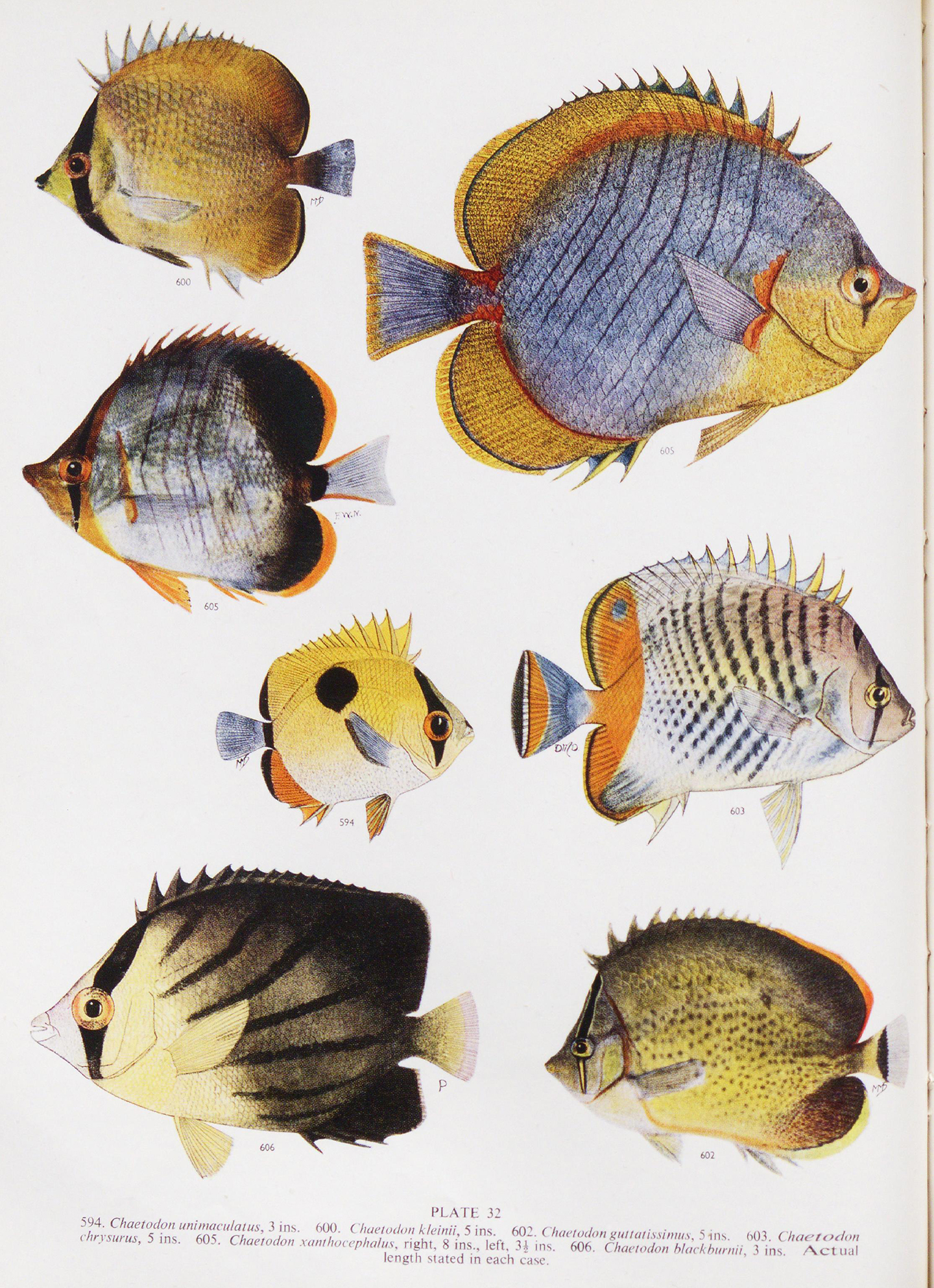
Plate 32. The sea fishes of Southern Africa. 1949. By JLB and Mary Margaret Smith. Art by Mary Margaret Smith. Contributed in BHL from Cornell University Library with permission from the South African Institute for Aquatic Biodiversity. CC-BY-NC-SA.
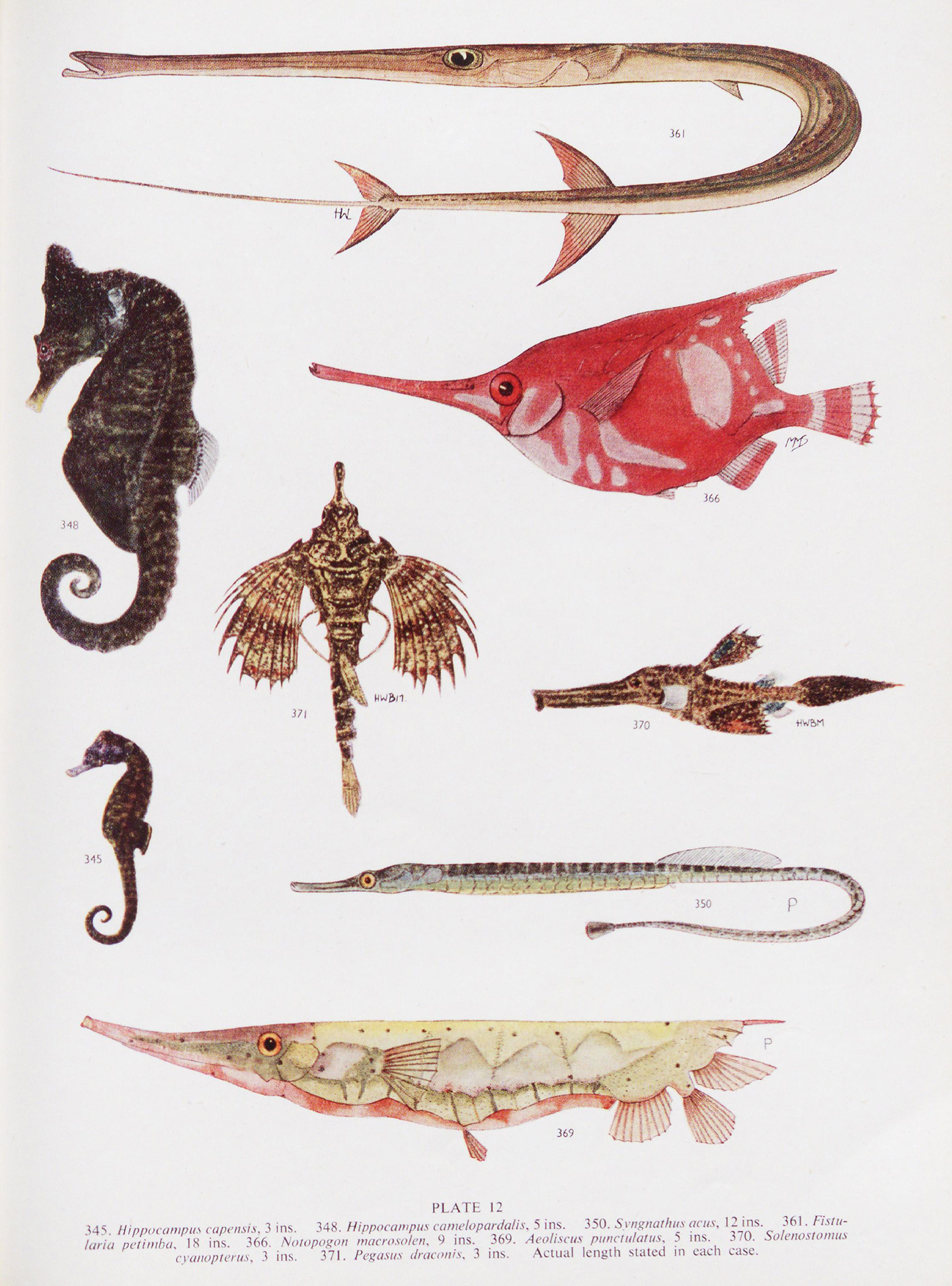
Plate 12. The sea fishes of Southern Africa. 1949. By JLB and Mary Margaret Smith. Art by Mary Margaret Smith. Contributed in BHL from Cornell University Library with permission from the South African Institute for Aquatic Biodiversity. CC-BY-NC-SA.

She in turn taught what was to become a group of acclaimed natural history artists.

After the death of JLB Smith in January 1968, Margaret Smith continued her ichthyological research in Grahamstown. At the end of 1968, the South African Council for Scientific and Industrial Research (CSIR) and Rhodes University decided to establish the J.L.B Smith Institute of Ichthyology. Margaret was appointed the first Director of the new Institute, now the South African Institute for Aquatic Biodiversity (SAIAB).
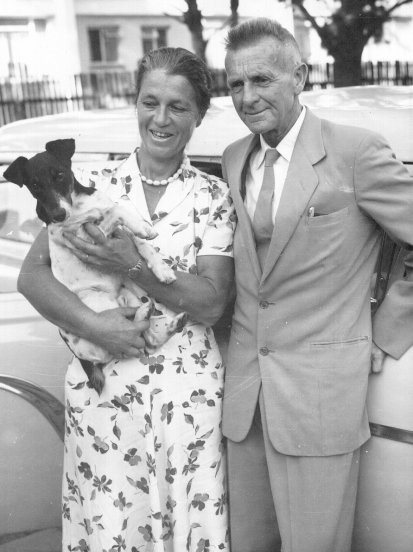
Margaret and JLB Smith with their dog, Marlin.

Margaret and JLB Smith with their dog, Marlin.

The Margaret Smith House, a women’s residence at Rhodes University, likewise honours her contribution to our local university and to international science.

Margaret Smith died in 1987. She had given 49 years of service to ichthyology.

Margaret’s achievements, the fine building, the reference collection of fish which she so adequately preserved, the status of the institute as a museum of international standing, are there for all to see. What is less known is the woman herself in her private life which few could know much about. This may be summed up in two words: for all her public flamboyance, she was a kind woman. Nobody with a hard-luck story was ever turned away … she helped innumerable people. If something was needed and could not otherwise be got she would dip into her pockets, and never say a word. [1]

The Biodiversity Heritage Library holds a collection of JBL Smith’s Ichthyological Papers, edited by his wife, Margaret Smith, and published in 1969, the year after his death. Contributed by the Library of the South African Institute for Aquatic Biodiversity, the two volume work was published by the J.L.B. Smith Institute of Ichthyology.
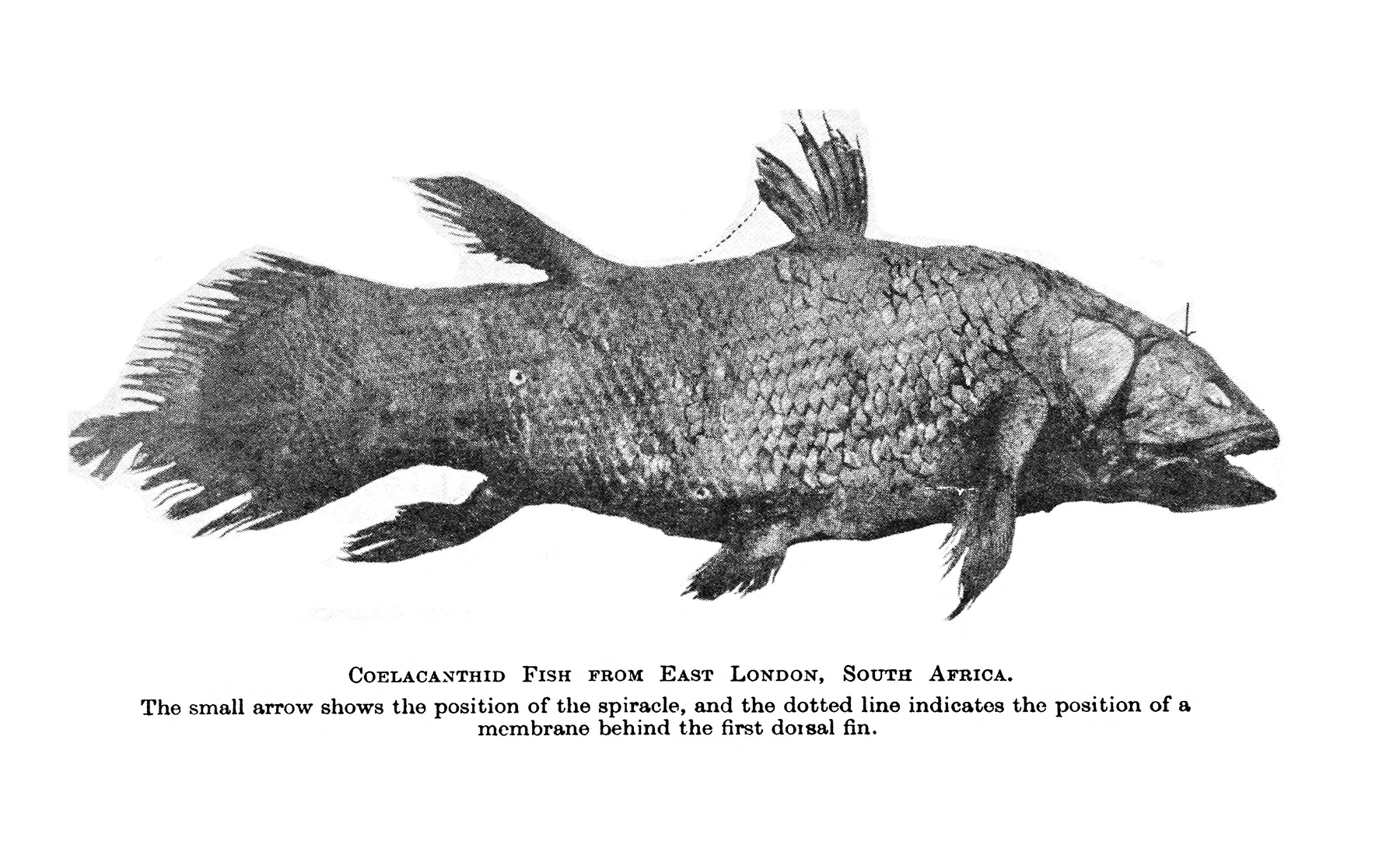
Coelacanth

Coelacanth re-discovered off the coast of South African in 1938. Smith, J.L.B. “A Living Fish of Mesozoic Type.” Nature. v. 143 (1939). In: Ichthyological Papers. Ed. Mary Margaret Smith. 1969. Contributed in BHL from the South African Institute for Aquatic Biodiversity.

One of the highlights of the publication is the description of the “re-discovery” of the coelacanth, believed to have become extinct in the Late Cretaceous, around 66 million years ago, but rediscovered off the coast of South Africa in 1938. Marjorie Courtenay-Latimer, curator of the East London Museum, discovered a specimen from amongst the catch of a local trawler, Captain Hendrick Goosen, and contacted J.L.B. Smith regarding the discovery. Smith subsequently named the species Latimeria chalumnae after Courtenay-Latimer.
You can read more about the life and achievements of Marjorie Courtenay-Latimer as part of the #HerNaturalHistory campaign.

Reference

[1] PBN Jackson. 1997. Variations on a theme: the three directors of the first fifty years of the JLB Smith Institute of Ichthyology. Trans. Roy. Soc. S. Afr., 51:40.

March 24, 2019by michelle.underhill
Blog Reel, Campaigns, Her Natural History

Marjorie Eileen Doris Courtenay-Latimer: Beyond the Coelacanth

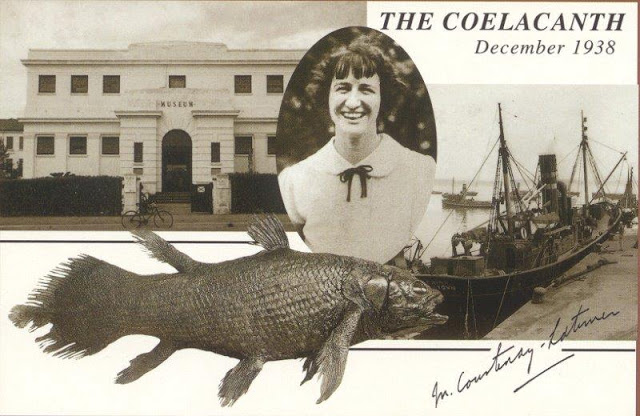
Commemorative postcard

A version of this post was originally published on the blog of the Margaret Smith Library, SAIAB. It is reproduced with permission from the author, Sally Schramm.

Willie and I look forward to our first born towards the end of April/beginning of May and we both pray it will be a lover of all that is beautiful in nature. Willie wants it to be a botanist — I want it to be a lover of birds and animals.
Eric Latimer’s diary, 25th November 1906

Marjorie Eileen Doris Courtenay-Latimer (1907-2004) is ubiquitously remembered and celebrated for her part in recognising that the large fish trawled by Capt. Hendrik Goosen and the crew of the Nerine in December 1938 was an astonishing find. This was to be identified as the first live coelacanth known to Western science. JLB Smith, the ichthyologist who first described it, named it Latimeria chalumnae after Marjorie, and the Eastern Cape river mouth near which it was found.

Commemorative postcard

Commemorative postcard on the “re-discovery” of the coelacanth.

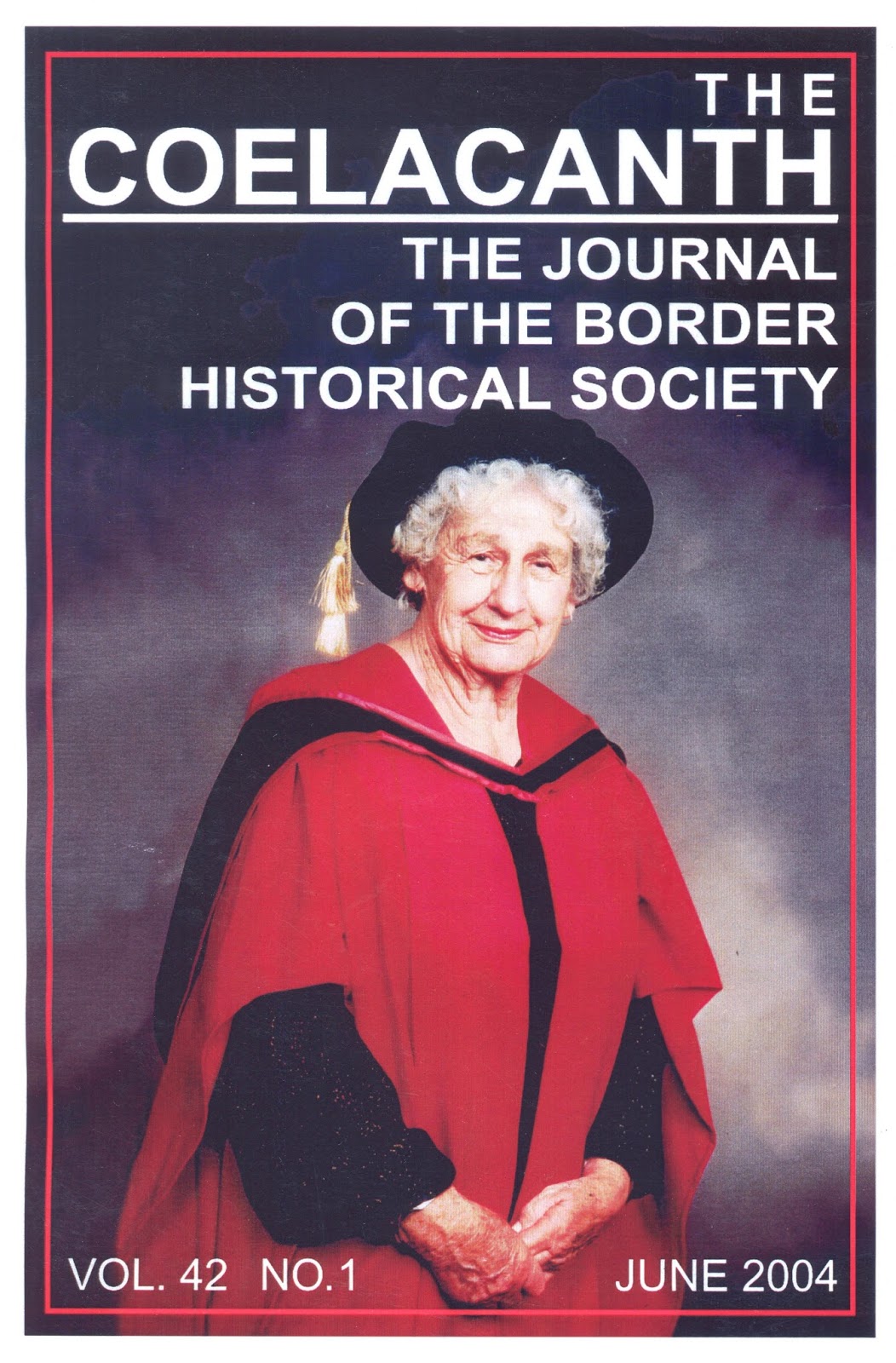
Reading the Border Historical Society’s The Coelacanth journal Commemorative edition in honour of Dr Marjorie Courtenay-Latimer (2004) we find a life dedicated to a great deal more than that single event. Her contributions to the Eastern Cape town of East London, and to the Museum in particular, were immense.

Born two months prematurely, surviving practically every childhood disease known — and the Flu Pandemic (1918-1920) — the apparently frail Marjorie’s interest in “all that is beautiful in nature” intensified as her family followed father Eric Latimer to his postings at a succession of often isolated railway stations in the Free State and Eastern Cape. The entire family walked and picnicked, collected, recorded and illustrated specimens, thoroughly appreciative of the wild areas around them.

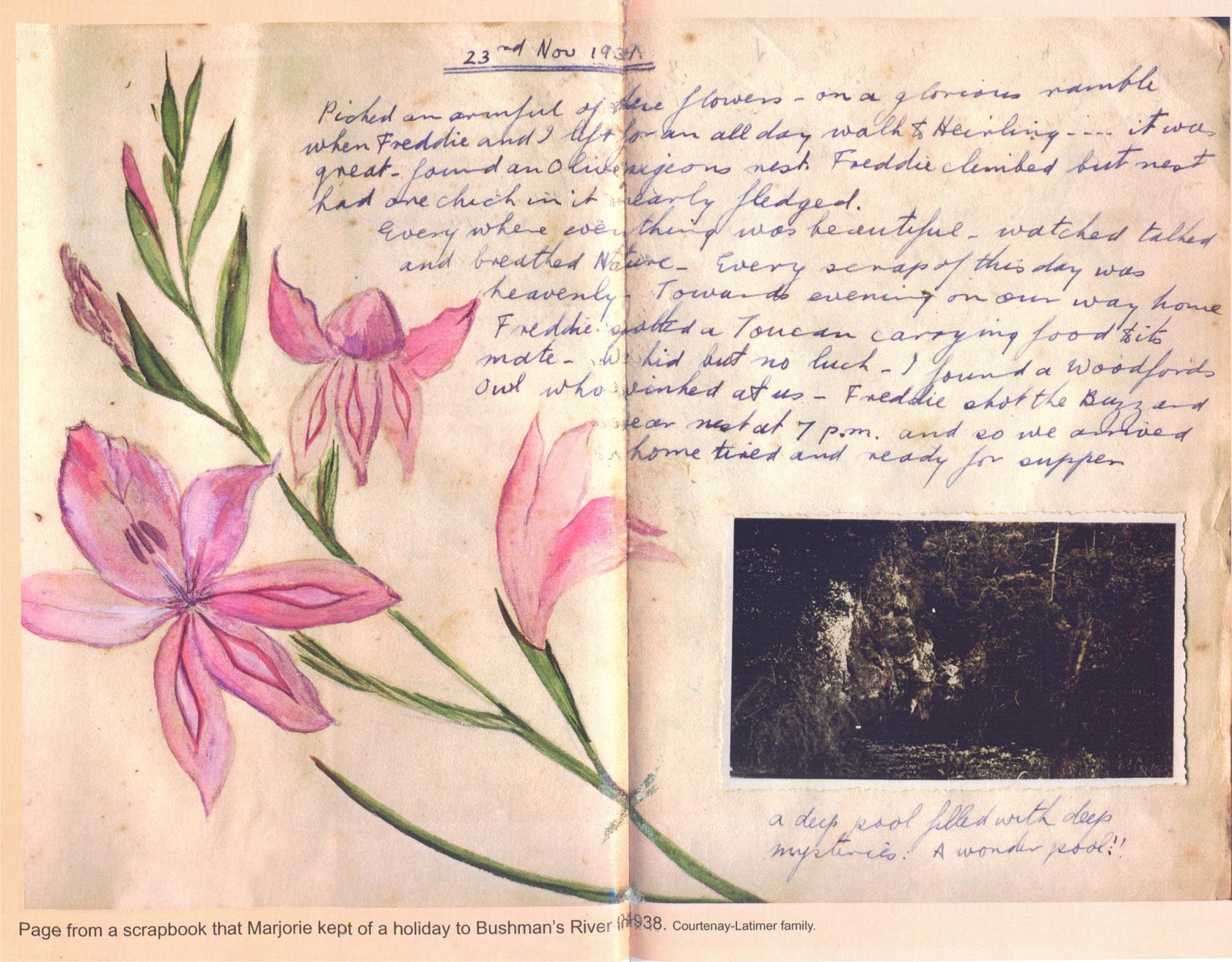
Keeping natural history journals and scrapbooks became a life-long habit for Marjorie. Here we read in 1938, “Every where everything was beautiful — watched, talked and breathed nature. Every scrap of this day was heavenly”.

The Coelacanth Vol. 42 (1) Centrepiece

The Coelacanth Vol. 42 (1) Centrepiece.

We also read of Marjorie, aged 24, as the first curator in 1931 (at £2 a month, with a petty cash allowance of 5/-) of the new and sparsely provisioned East London Museum, with its meagre collections; setting up displays (initially from her family’s own collections) and dioramas; her dedication in building collections both cultural and of natural history; her awareness of the museum’s value and interest to the public and especially to children; and of the planting of the indigenous museum garden. All this was accomplished in the early years with very little help; we read only of one named assistant Enoch [Enoch Elias], who helped Marjorie lug the coelacanth back to the Museum in 1938.

Other contributions tell of her stint on Bird Island in Algoa Bay for six weeks in 1936, with her parents as chaperones (mother enthused, father dreadfully bored); of her botanical and fossil-collecting field trips, often with close friends, specifically of the excavation and mounting of the almost-complete dicnodoni skeleton Kannemeyeria simocephalus.

Marjorie recounts many of these events from her early life and career, and explains how they ultimately contributed to the coelacanth “discovery”, in a 1979 paper published in the Occasional papers of the California Academy of Sciences. For example, it was because of her employment at the East London Museum that she met JLB Smith, with whom she developed a professional relationship that she called upon following her discovery in December 1938. And it was during her time on Bird Island that she met Capt. Hendrik Goosen, who became a regular source of specimens for her collecting activities for the Museum — and ultimately the supplied the famed coelacanth specimen.

Marjorie summarizes her story and the events that culminated in her famed discovery as such:

“This story is one of the most astounding records of a woman’s intuition, for:

had I never gone to Bird Island;
had I never met Dr. JLB Smith who, of all the scientists I met as a young girl struggling with meagre funds in a small Museum, always gave encouragement and never criticism;
and had I not gone to the wharf to wish the men a Happy Christmas,

there never would have been a coelacanth discovery in South Africa, on 22 December 1938.”

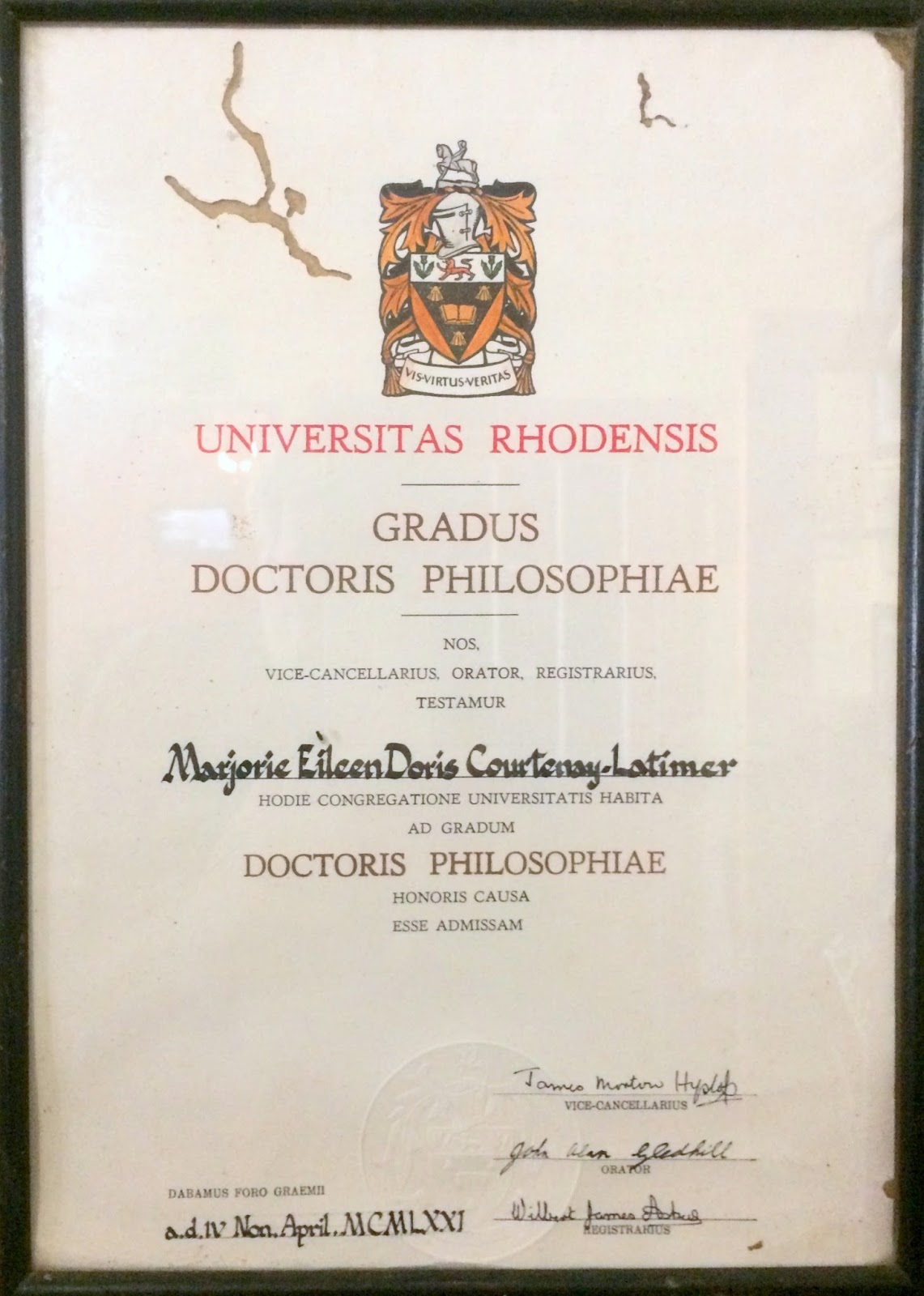
Marjorie was an author of scientific and popular literature on a wide variety of topics and was an active member of diverse museum, historical and natural history societies. She supported conservation and the establishment of nature reserves such as Potters Pass, East London, and Gonubie Nature Reserve. Finally, we read of her numerous civic awards, honorary fellowships, and her Honorary Doctorate from Rhodes University.

Dr Marjorie Courtenay-Latimer

Dr Marjorie Courtenay-Latimer PhD (Honoris Causa) 1971.

Marjorie Courtenay-Latimer Collection Thomas River Historical Village (Pic: Mike Schramm)

Marjorie Courtenay-Latimer Collection. Thomas River Historical Village. (Pic: Mike Schramm)

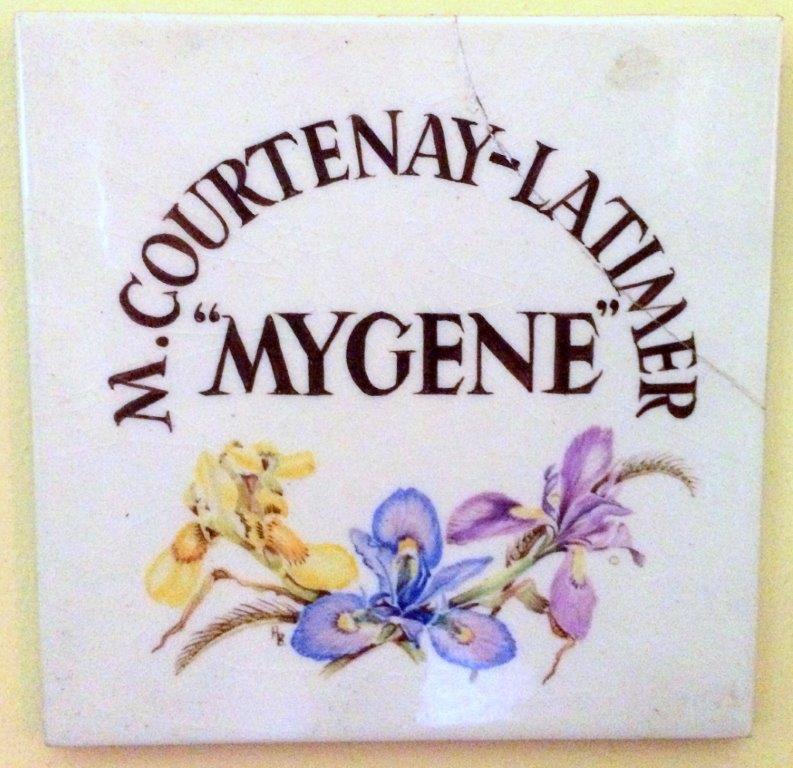
On her retirement as Director from the East London Museum in 1973, Marjorie moved to Witselbos in the Tsitsikamma area. Her house Mygene was named for her childhood nickname “Genie”, from the popular song “Jeanie with the light brown hair”, “… I see her tripping where the bright streams play, Happy as the daisies that dance on her way …”

Having done a brick-laying course at the East London Technical College, she tackled a kitchen extension with aplomb. She painted and sculpted in clay. She still kept in touch with friends and colleagues world-wide. Forays into nature continued as ever.

Marjorie Courtenay-Latimer Collection Thomas River Historical Village (Pic: Mike Schramm)

Marjorie Courtenay-Latimer Collection. Thomas River Historical Village. (Pic: Mike Schramm)

She returned to East London in the 1980s. On her moving to frail-care shortly before her death in 2004, a collection of Marjorie’s personal effects (including the certificate and house plaque above) were left behind in the house which she had recently occupied.

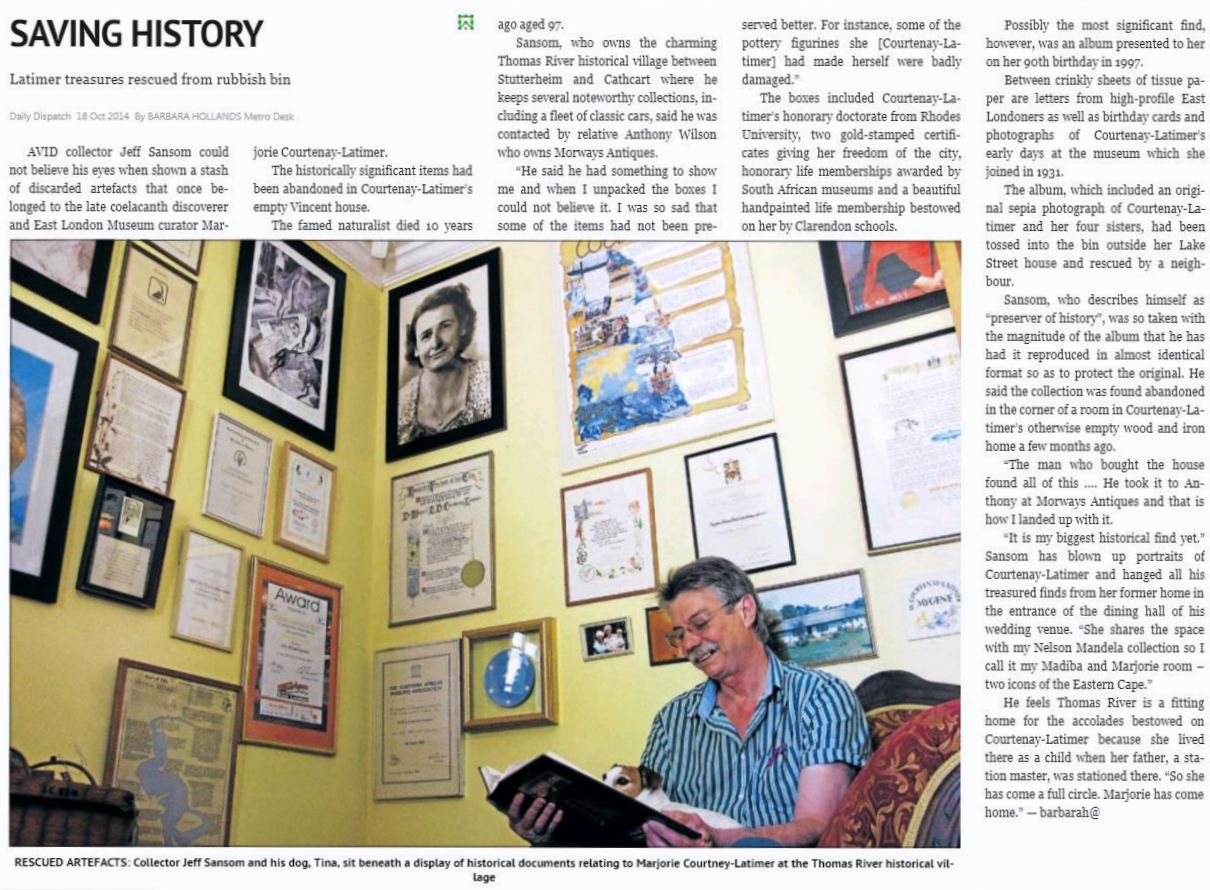
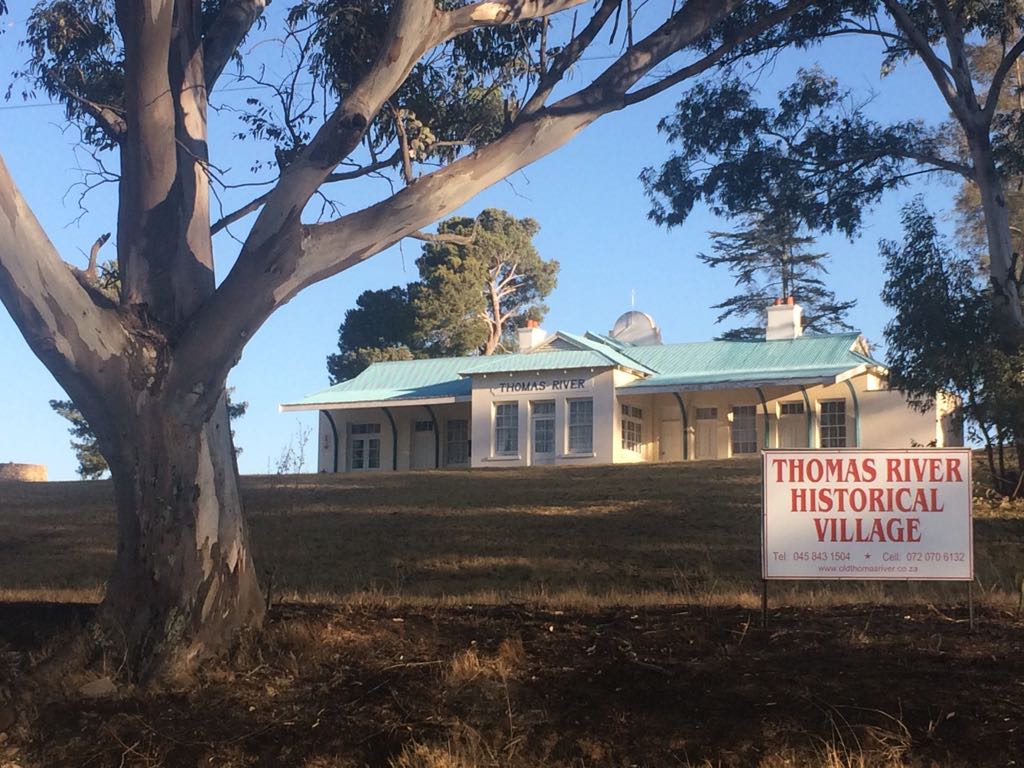
Fortuitously, these were subsequently recovered when the house was sold ten years later. A serendipitous chain of events led to the display of some items at Thomas River Historical Village near Cathcart, Eastern Cape. The Village is the site of the original Thomas River Station — where Eric Latimer and his family had lived in the late 1920s.

Saving History (Daily Dispatch 18th Oct 2014)

Saving History (Daily Dispatch 18th Oct 2014).

The original Thomas River Station, built in the late 1870s. (Pic: Mike Schramm)

The original Thomas River Station, built in the late 1870s. (Pic: Mike Schramm)

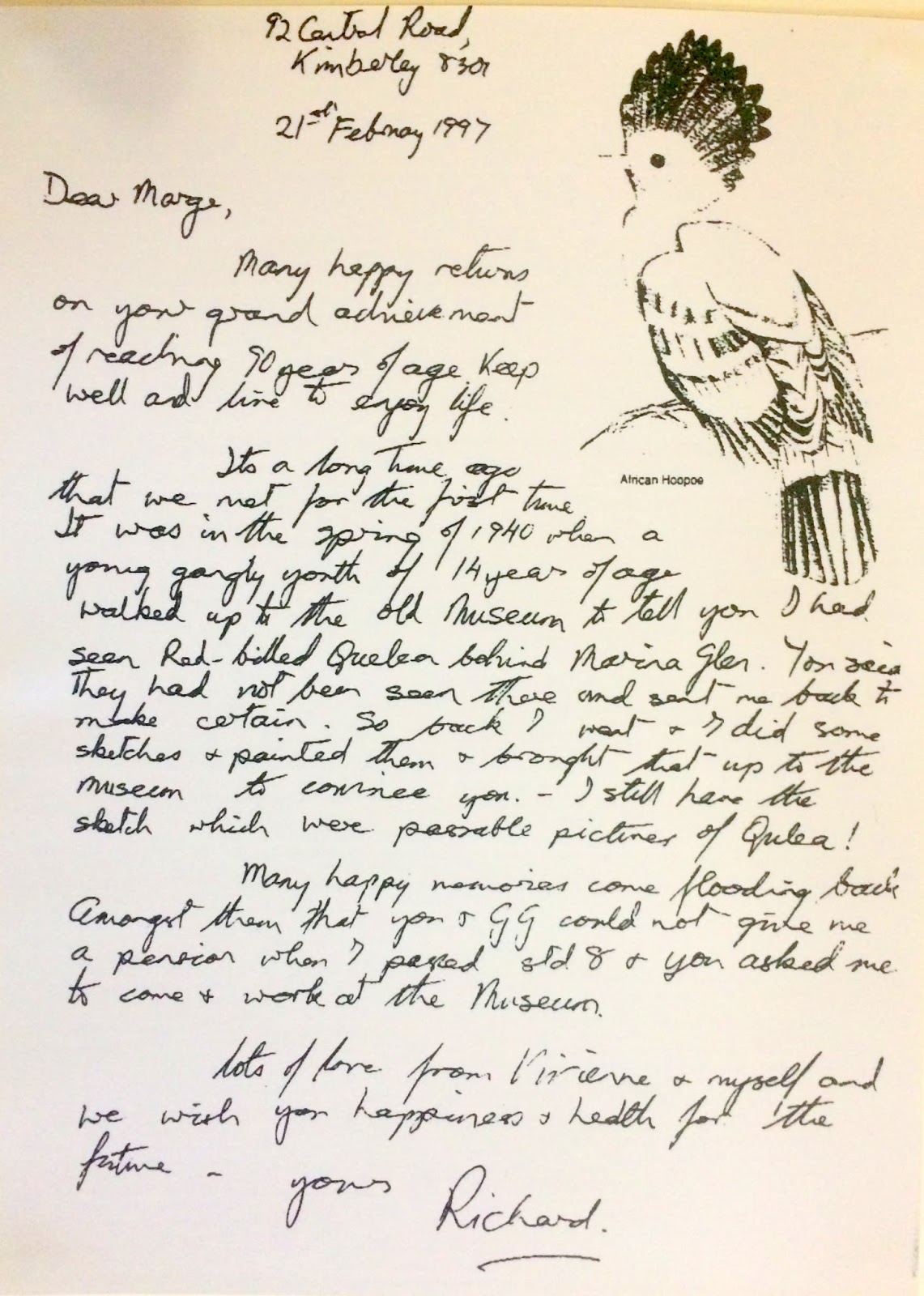
Among the treasures found was the album presented to Marjorie on her 90th birthday in 1997 “with appreciation and admiration” by the South African Museums Association. There is a facsimile copy at Thomas River Historical Village. Many of the contributors are a who’s who of prominent naturalists, authors and artists, all friends and colleagues.

Contribution by Richard Liversidge, ornithologist, previously Director, McGregor Museum, Kimberley Marjorie Courtenay-Latimer Collection,Thomas River Historical Village (Pic: Mike Schramm)

Contribution by Richard Liversidge, ornithologist, previously Director, McGregor Museum, Kimberley. Marjorie Courtenay-Latimer Collection,Thomas River Historical Village. (Pic: Mike Schramm)

The many happy memories recalled through the warm contributions would have delighted Willie and Eric Latimer. Their first child was a daughter who truly was a “lover of all that is beautiful in nature”.

Marjorie Courtney-Latimer — a life lived richly beyond the coelacanth!

March 23, 2019by michelle.underhill
Blog Reel, Featured Books

Travels in Southern Africa: William John Burchell

William John Burchell is credited “with having been the most prolific collector of botanical and zoological specimens.” [1] During a four-year scientific exploration of South Africa, he amassed a collection of over 63,000 specimens. And yet, Burchell’s contributions to science have been largely overlooked. As William Swainson bemoaned, “science must ever regret that one whose powers of mind were so varied…was so signally neglected in his own country.” [2]

View Full Size Image
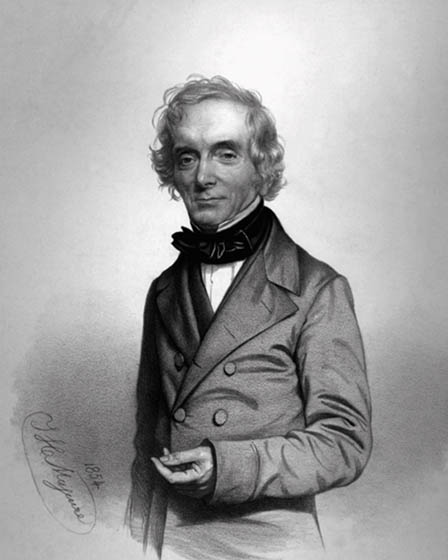
Portrait of William John Burchell by Thomas Herbert Maguire (1854). http://www.capeorchids.co.za/history.htm.

2015 marks the 200th anniversary of Burchell’s return to Cape Town following his four-year expedition in South Africa. The University of Pretoria recently digitized Burchell’s account of this journey, a two-volume work entitled Travels in the Interior of Southern Africa (1822-24) for BHL. This offers an excellent opportunity to not only highlight this recent addition from our colleagues in BHL Africa, but recognize the incredible accomplishments of a remarkable man.

William Burchell was born in Fulham, England, in 1781. His family owned the prosperous nine-and-a-half acre Fulham Nursery and Botanical Garden, which afforded him many opportunities to study botany and interact with some of the most influential natural historians of the day. Sir William Hooker, the first director of the Royal Gardens in Kew, was Burchell’s friend and mentor. The prosperity of his family’s business provided Burchell with the means to travel and nurture his interest in natural history and particularly botany.

View Full Size Image
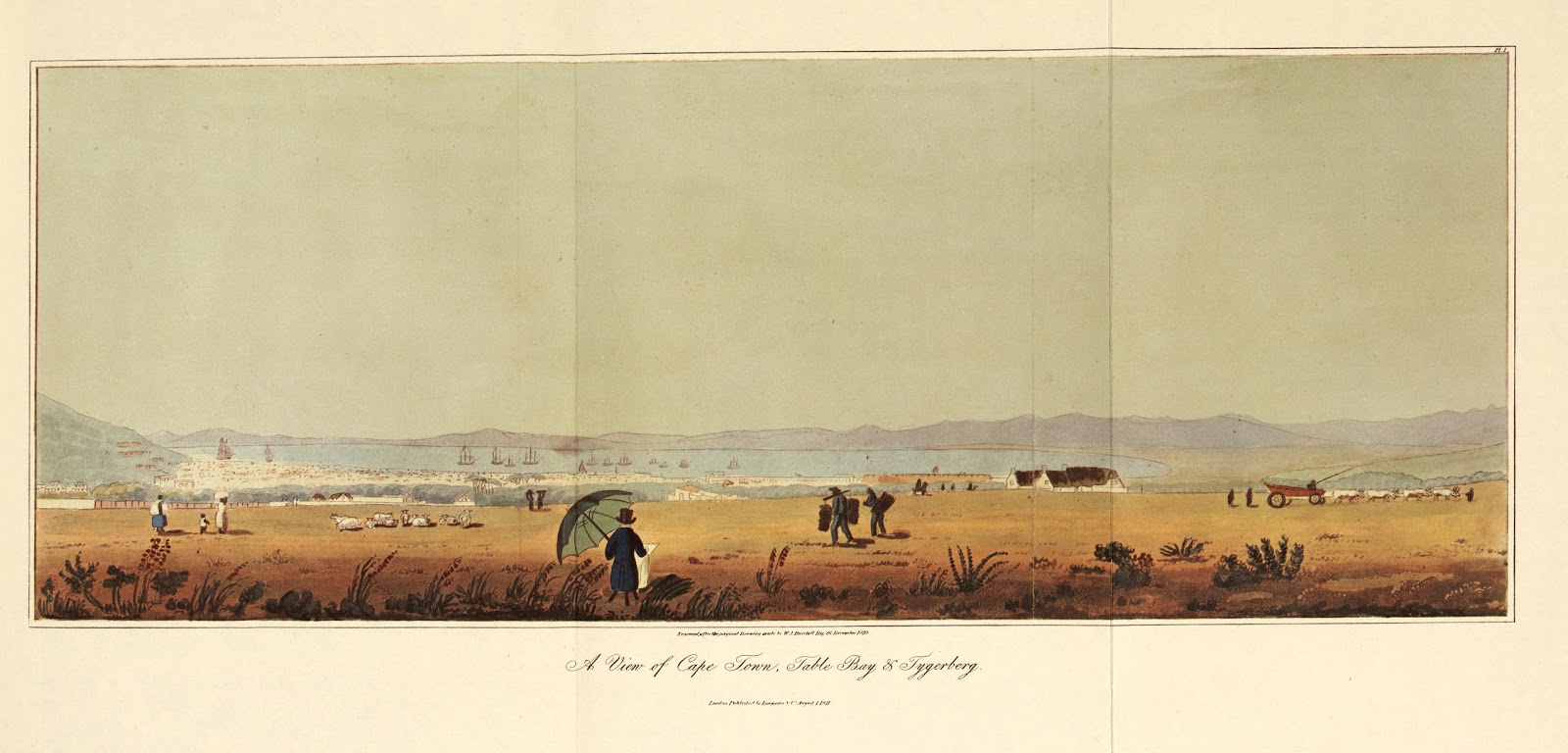
View of Cape Town, Table Bay and Tygerberg, 26 December, 1810. Engraved from a drawing by William John Burchell. Travels in the Interior of Southern Africa. v. 1 (1822). http://biodiversitylibrary.org/page/48904900. Digitized by: University of Pretoria.

In 1810, Burchell arrived in Cape Town, South Africa, and on 19 June 1811, he set out from that city on a four-year expedition throughout the interior of southern Africa “solely for the purpose of acquiring knowledge.” [2] During the journey, he covered 7,000 km, mostly in an ox-wagon that he designed to serve as his home, laboratory, and library. He traveled as far north-east as the asbestos mountains just north of Chue Spring and became the first recorded European explorer to successfully travel through Bushmanland. The account of his expedition, Travels in the Interior of Southern Africa, covers only the period from his arrival in Cape Town through his departure from Litakun in August 1812.

View Full Size Image
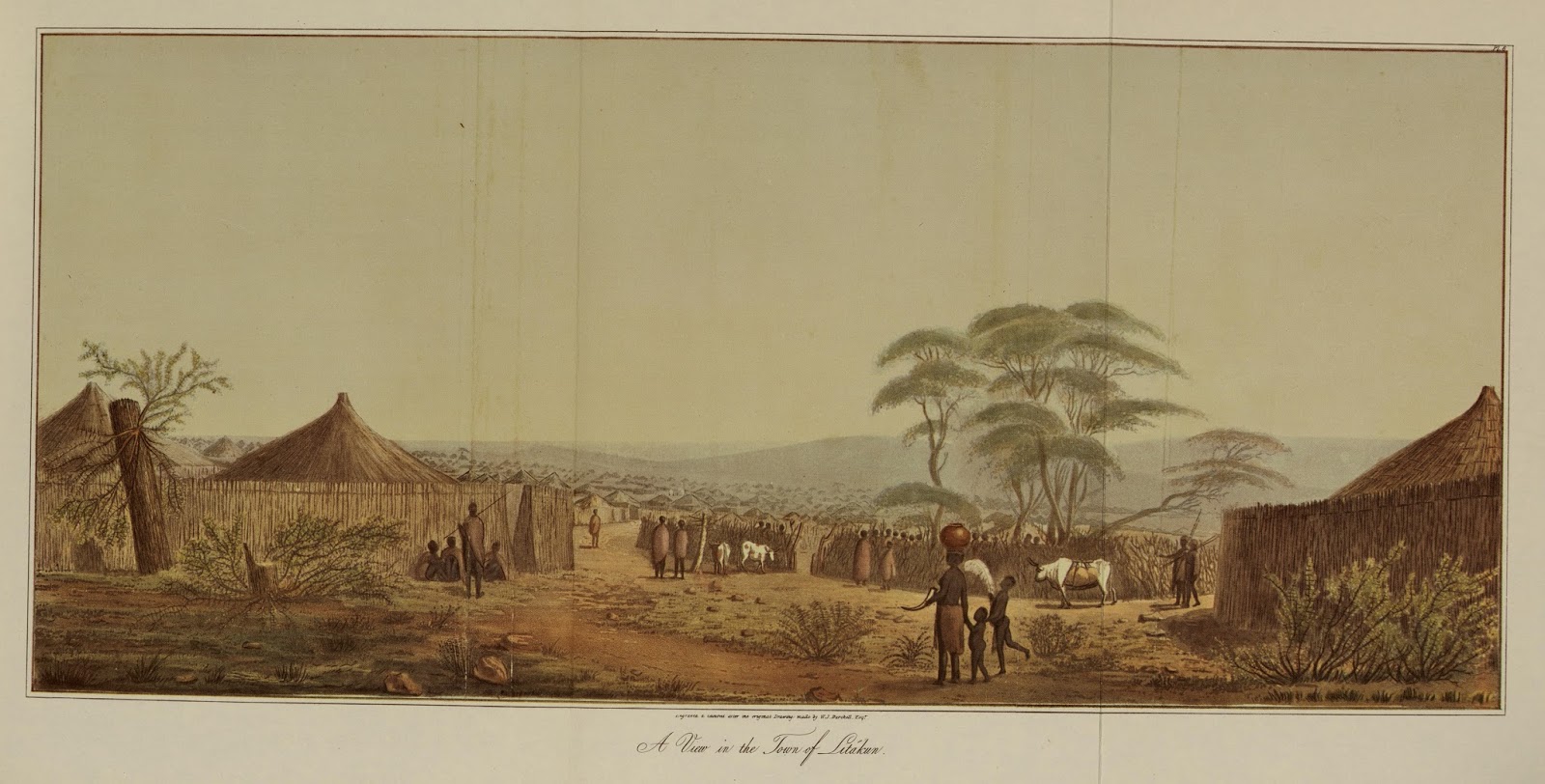
“A view in the town of Litakun.” Engraved from a drawing by William John Burchell. Travels in the Interior of Southern Africa. v. 2 (1824). http://biodiversitylibrary.org/page/48905971. Digitized by: University of Pretoria.

Burchell’s accomplishments on the journey were extensive, particularly in the field of natural history. He collected 50,000 species of plants, seeds and bulbs, 10,000 specimens of insects, animal skins, skeletons, and fish, numerous anthropological artifacts, and created 500 drawings during the expedition. The Royal Botanical Gardens in Kew now holds a vast majority of Burchell’s extensive botanical collections. His journals document the precise location, morphological features, and habitat of the specimens he collected.

View Full Size Image
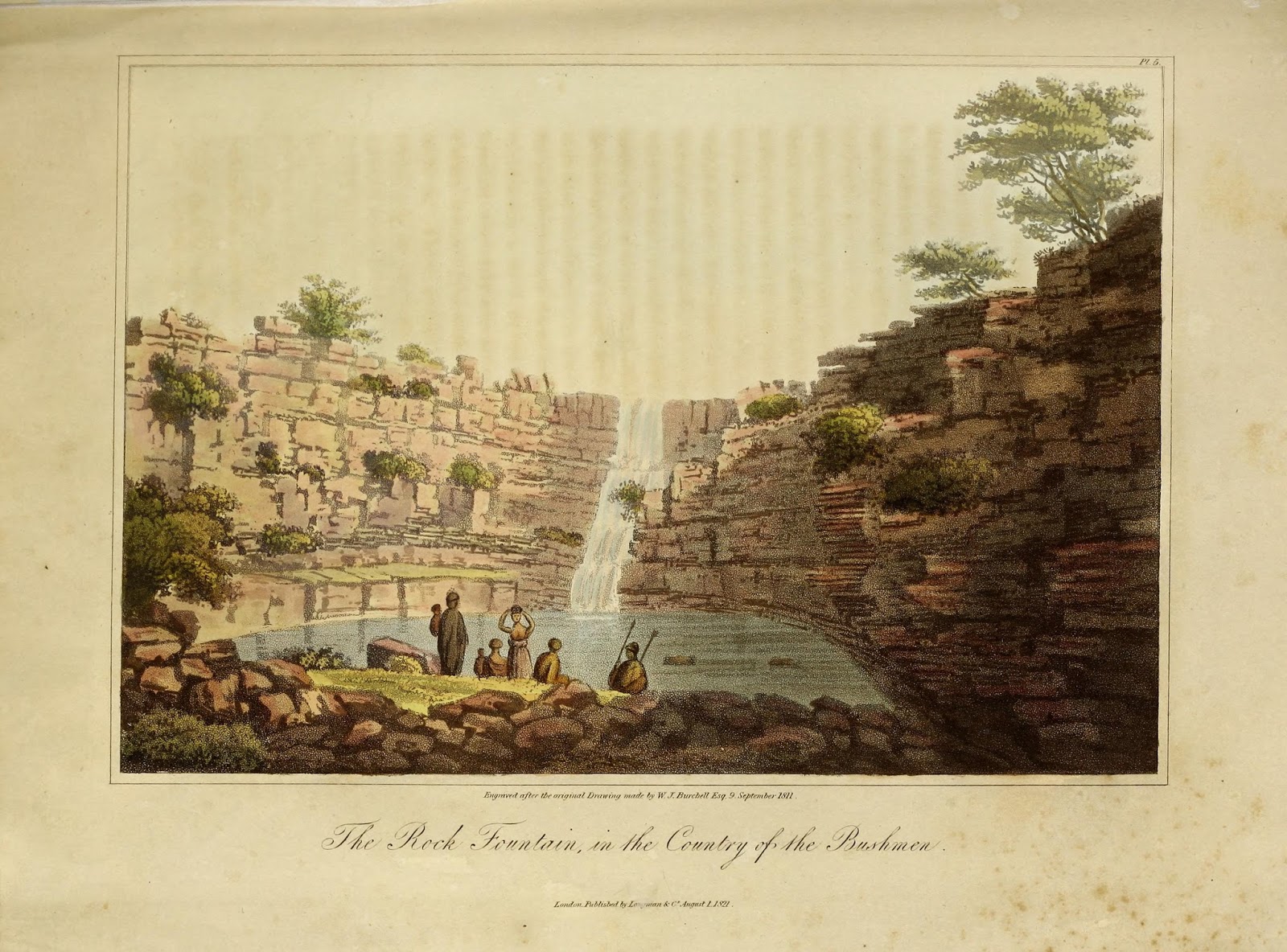
“Rock Fountain in the Country of the Bushmen.” 9 September, 1811. Engraved from a drawing by William John Burchell. Travels in the Interior of Southern Africa. v. 1 (1822). http://biodiversitylibrary.org/page/48905175. Digitized by: University of Pretoria.

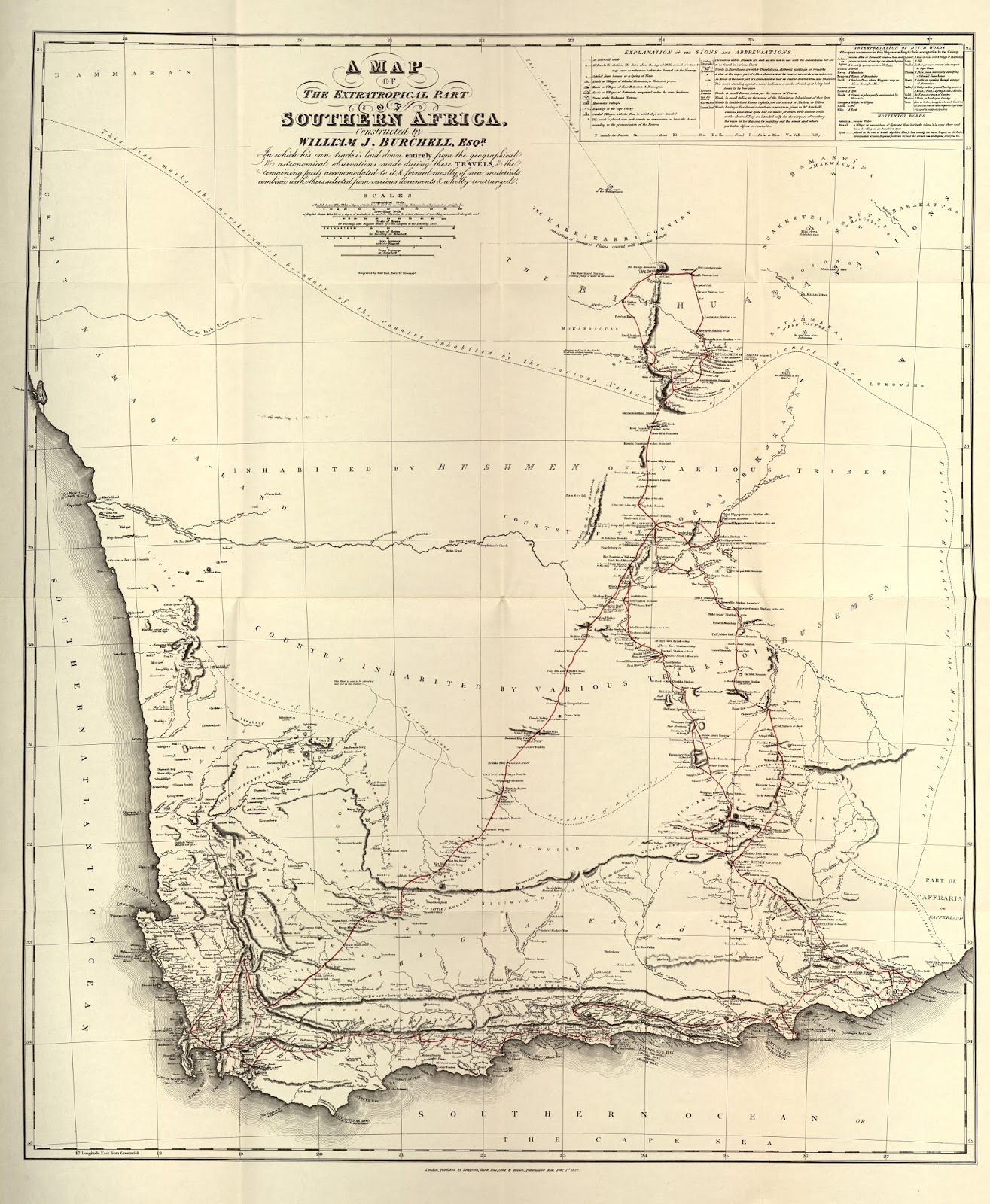
In addition to natural history, Burchell made important observations in the earth sciences during the expedition, being the first recorded person to identify asbestos in the Northern Cape and the “first to describe glacial pavements in the country.” [2] He also charted his entire route, creating a “Map of the Extratropical Parts of Southern Africa” (published in v.1 of his book), which was a “milestone in the cartography of the country.” [1] In the field of astronomy, he observed the variability of Eta Carinae’s brightness, and, by using a combination of Friar’s Balsam (Compound Tincture Benzoin), laudanum, Buchu vinegar, and Wild Wormwood to treat a serious gunshot wound afflicting one of the expedition’s members, became the first recorded person to successfully integrate indigenous herbal medicine with medicines used in Europe “into the management of such a serious condition.” [2]

View Full Size Image
Map of the Extratropical parts of Southern Africa. Travels in the Interior of Southern Africa. v. 1 (1822). http://biodiversitylibrary.org/page/48905480. Digitized by: University of Pretoria.

After Burchell’s return to Cape Town in April 1815, he went on to travel in Brazil, collecting over 23,000 additional specimens. However, after his return to England, Burchell became increasingly reclusive and protective of his collections, focusing on cataloging his vast botanical specimens but also refusing to allow others to access his collections. Some historians hypothesize that he may have suffered from a bipolar-type disorder. [2] In 1863, at the age of 82, after one unsuccessful suicide attempt by gunshot, he hung himself in a small outhouse in his garden. He is buried near his home in Fulham, in the family tomb at All Saints Church, Hammersmith.

View Full Size Image
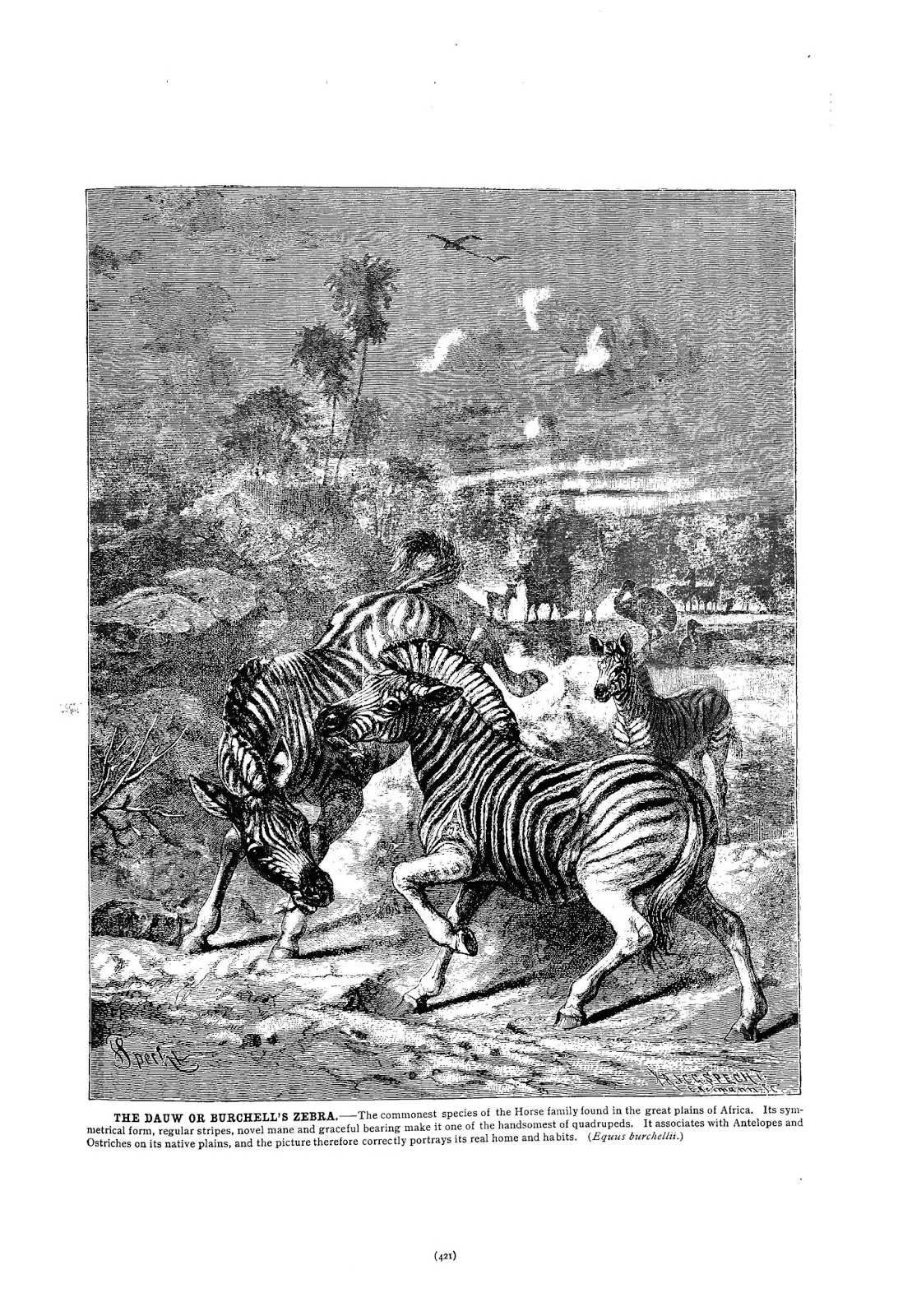
Burchell’s Zebra (Equus quagga burchellii), named after William John Burchell by John Edward Gray. Brehm, Alfred Edmund. The Animals of the World (1895). http://biodiversitylibrary.org/page/37569339. Digitized by: Cornell University Library.

Though his life had a tragic ending, Burchell’s accomplishments are remarkable. In addition to the many specimens he collected, a species of South African wild pomegranate (Burchellia bubalina) is named after him, and the common names of many animals bear his moniker, including Burchell’s zebra, Burchell’s coucal, three birds (Burchell’s starling, coarser, and grouse), a lizard (Burchell’s sand lizard), and the white rhinoceros (for which Burchell was the first to give a scientific name and is also known, although less-commonly, as Burchell’s rhinoceros). He also recommended the establishment of a public garden in Cape Town. He described the Kirstenbosch area as “the most picturesque I had seen in the vicinity.” [2] The Kirstenbosch National Botanical Garden was founded in 1913.

We are honored to have a copy of Burchell’s Travels in the Interior of Southern Africa in BHL, thanks to the University of Pretoria, as, to quote historian George Theal, it is “one of the most trustworthy and valuable books ever issued upon South Africa.” [1]

William John Burchell was an extraordinary man. We have not forgotten him.

[1] Stewart, Roger. “William John Burchell’s Medical Challenges: A 19th Century Natural Philosopher in the Field.” South African Medical Journal: 2012;102(4). pgs. 252-255.
[2] Stewart, Roger and Brian Warner. “William John Burchell: The Multi-skilled Polymath.” South African Journal of Science. 2012;108(11/12), Art. #1207, 9 pages. http://dx.doi.org/10.4102/sajs.v108i11/12.1207

November 19, 2015by ulib-libraryjobs
BHL News, Blog Reel

BHL Africa Report from Internet Archive’s Global Director

View Full Size Image

Since it’s initial organization in 2012 and launch in 2013, BHL Africa has been hard at work developing a strategy, framework, and methodology for contributing the valuable biodiversity information held within the node’s participating institutions to BHL. Significant progress occurred in April and June, 2014, with the arrival and subsequent installation of Internet Archive scanning machines at the University of Pretoria in South Africa.

View Full Size Image
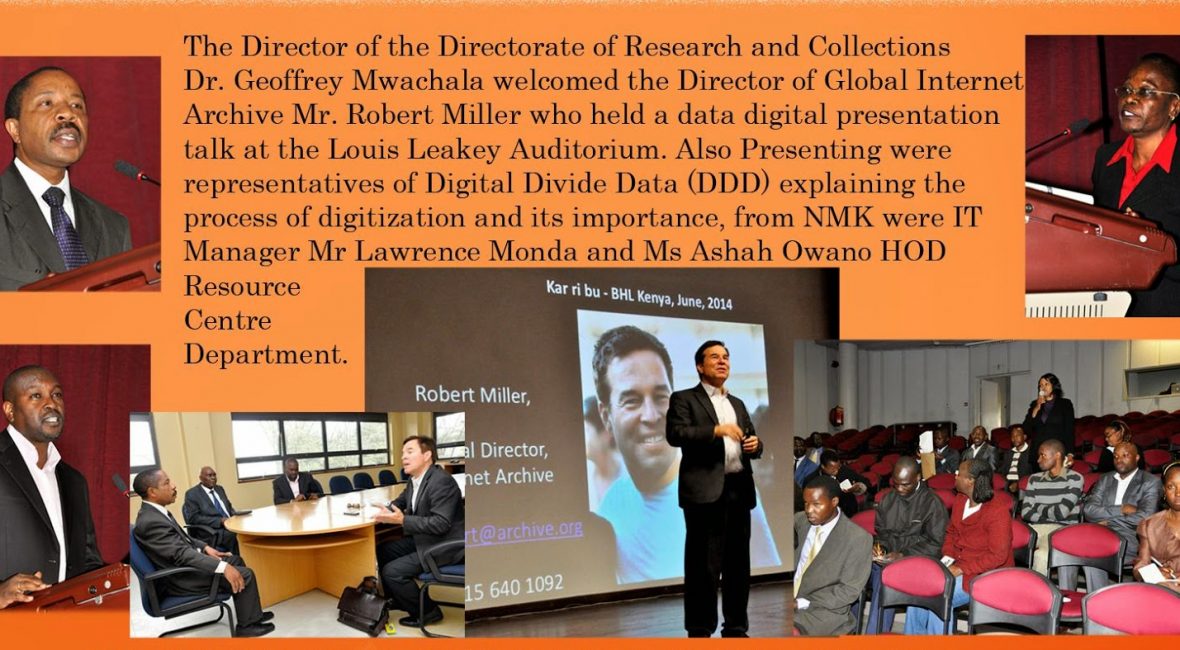
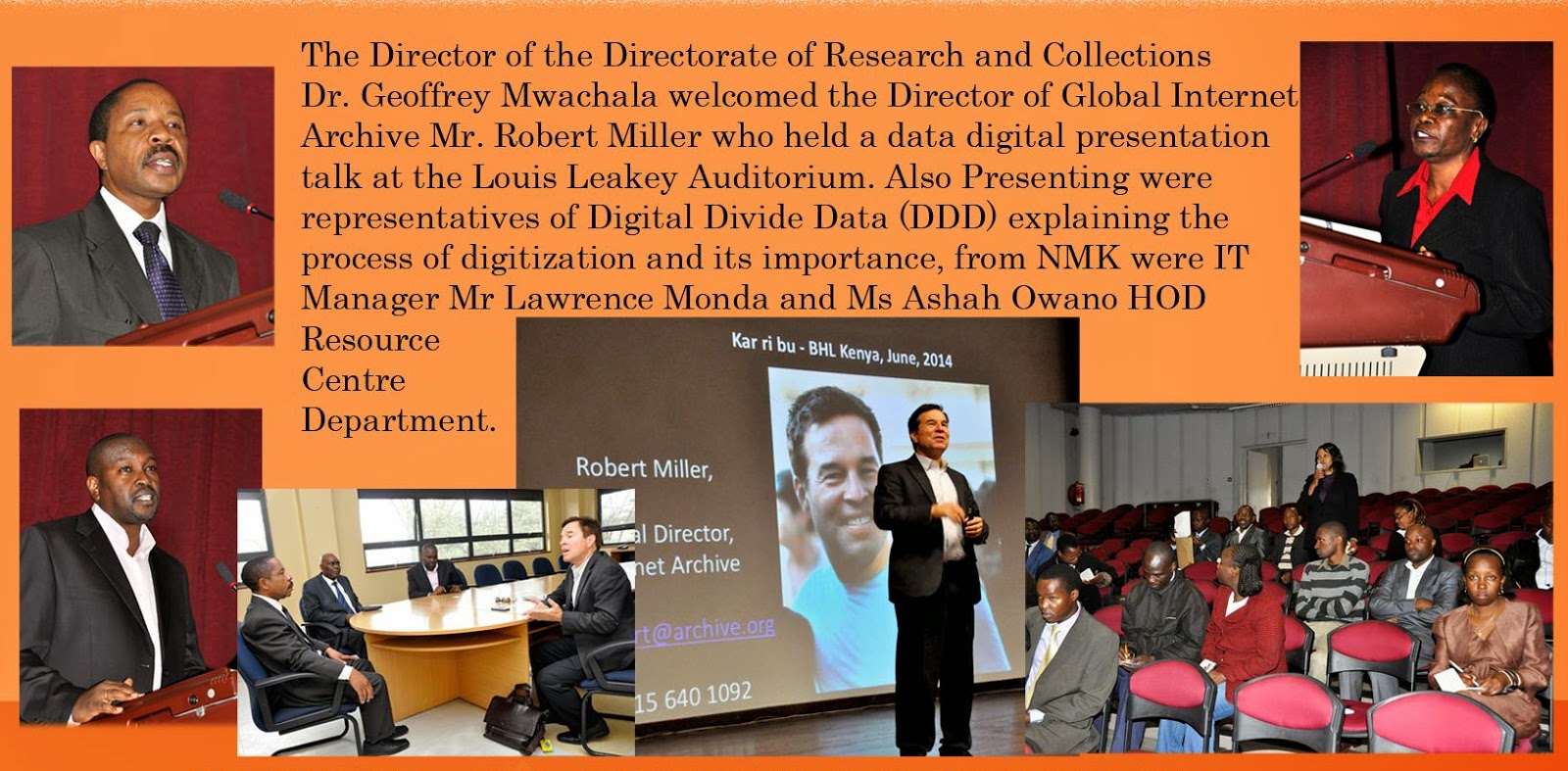
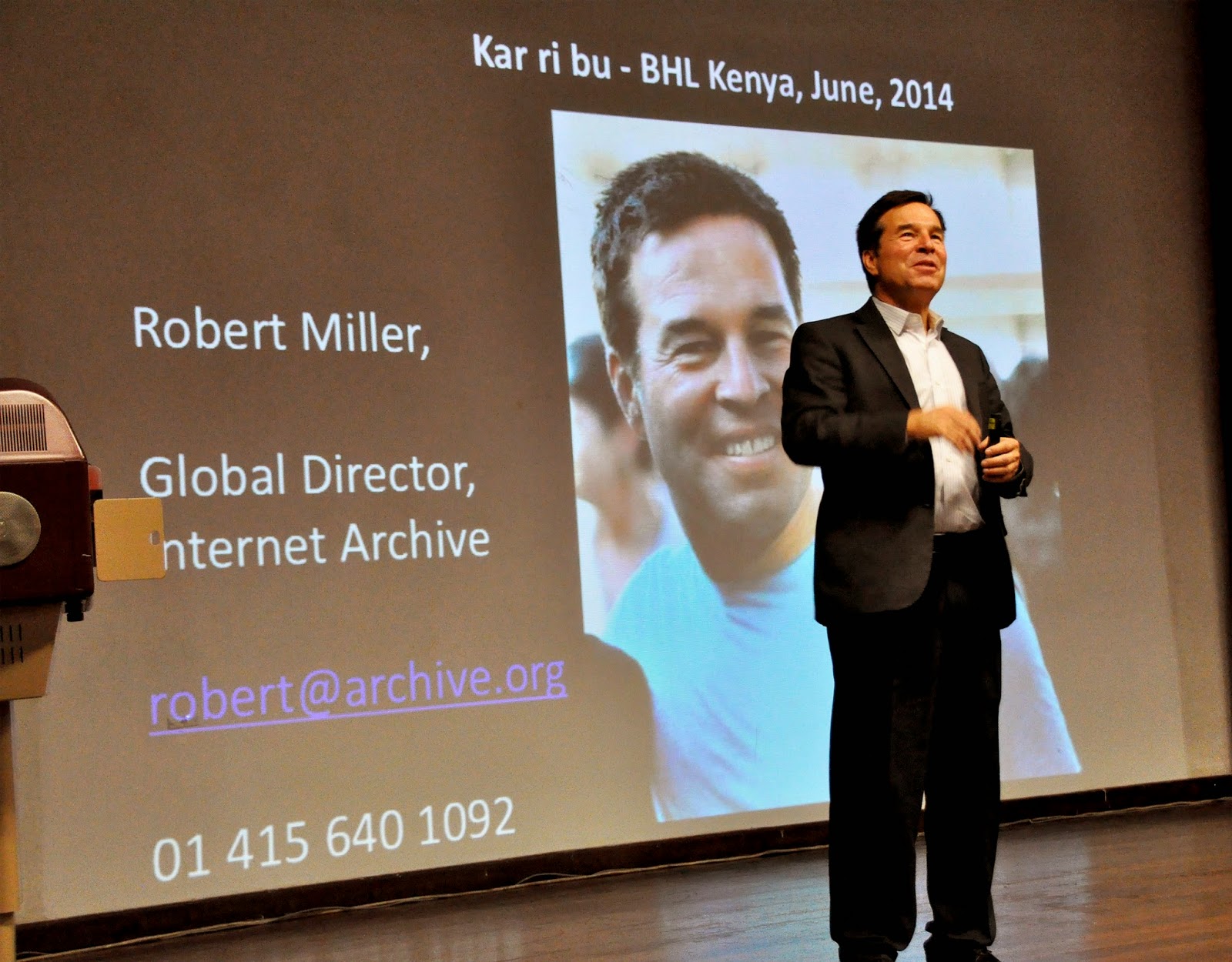
Robert Miller presenting at National Museums of Kenya

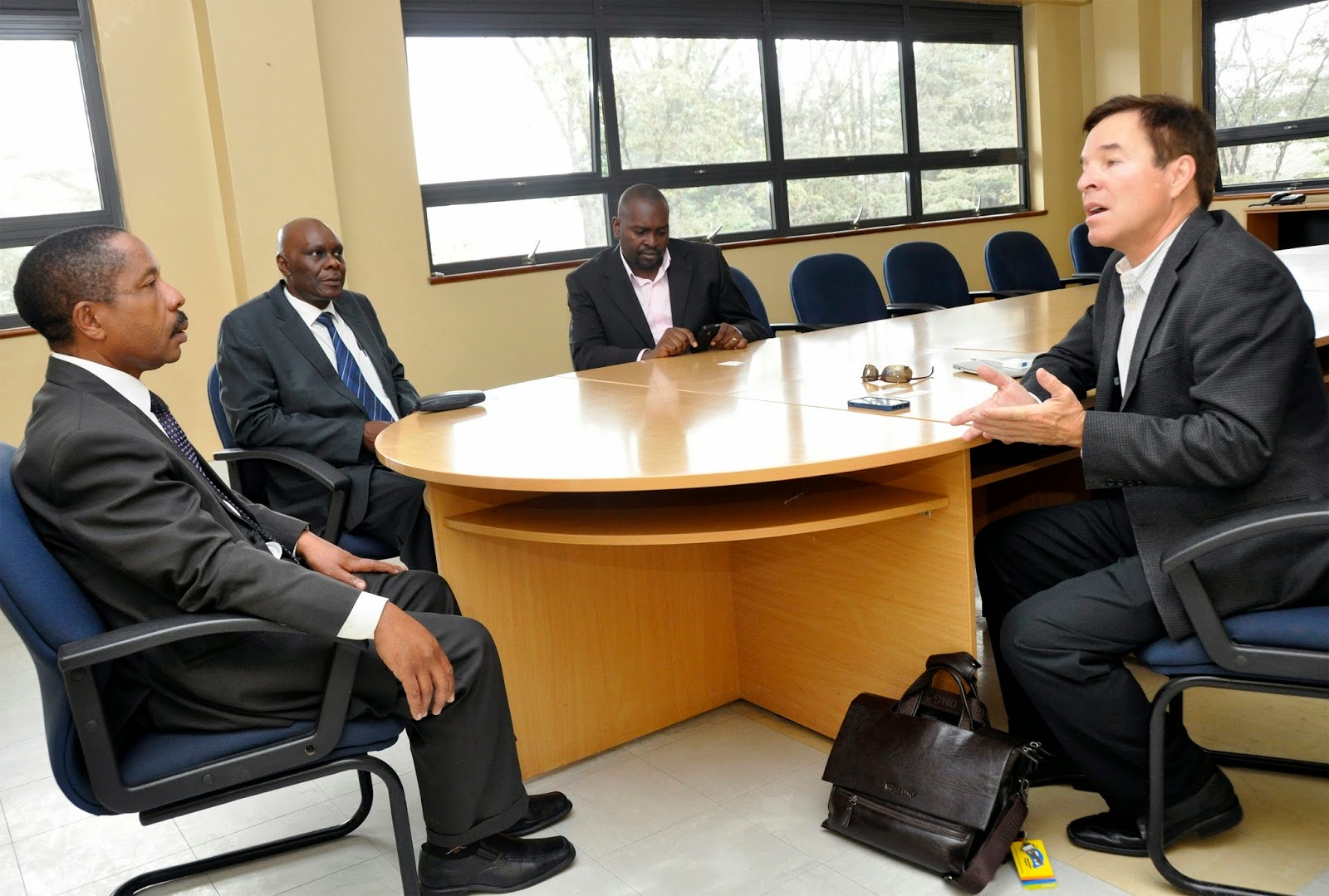
Robert Miller, Global Director of the Internet Archive, and his colleague Gemma Waterston (IA Satellite Coordinator) traveled to South Africa in June to provide installation support and operational training for the new machines. Following a successful instatement, Miller then traveled to the National Museums of Kenya (NMK) in Nairobi to discuss digitization and collaboration opportunities.

“Over many years,  I have had many wonderful opportunities to live (Asia, Europe and North America) and travel to many countries (45, in fact, prior to this trip),” commented Miller. “My trip to Kenya (country 46) was made all the more special by the warm welcome and hospitality I received by Ashah Owano [Resource Centre Manager, NMK] and Lawrence Monda [ICT Manager, NMK] and their staff at the National Museums of Kenya in Nairobi, Kenya. They arranged for me to present and talk with representatives of over 25 different institutions and present the work that the Internet Archive has done with the global BHL family.”

View Full Size Image
Robert Miller with representatives from NMK

Miller’s presentation highlighted Internet Archive’s work to bring books and media to people all over the world. Since its inception, BHL has partnered with IA for digitization and access support, contributing to IA’s current 19 petabytes of available data. Miller’s visit was a valuable opportunity for our Kenyan colleagues to better understand the services and options available to them and for Miller to form new global relationships.

“What will I remember?” pondered Miller in response to a request for information on his presentation and experiences in Kenya. “That a wonderful Museum system exists in Kenya, an amazing collection of content is found there and, most importantly, a great group of passionate people are working hard to share their world with the global community. I am so excited to build on this first meeting and hope to return soon.”

We’re excited to see where these newly-forged connections within a long-standing relationship between BHL and IA lead as well. One thing we know for sure: with the passion and determination of our African colleagues guiding an ambitious effort to provide open access to African biodiversity knowledge through BHL, our goal to become the “largest reliable, reputable, and responsive repository of biodiversity literature and archival materials” is now one step closer to becoming a full-fledged reality.

*All pictures courtesy Robert Miller

August 7, 2014by ulib-libraryjobs
BHL News, Blog Reel

Growing Globally: Digitization Developments in Africa

View Full Size Image
From left to right: Cindy-Lee Daniels  and Lidia Swart (staff at the Digitization Office, Library Services, University of Pretoria); Gemma Waterston (IA Satellite Coordinator) and Robert Miller (Director of Global IA)

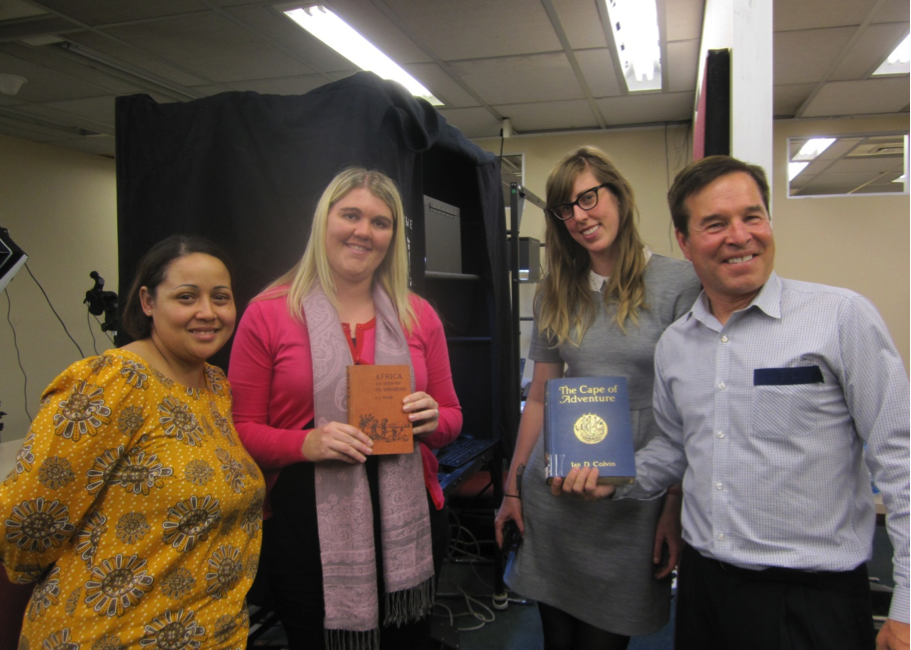
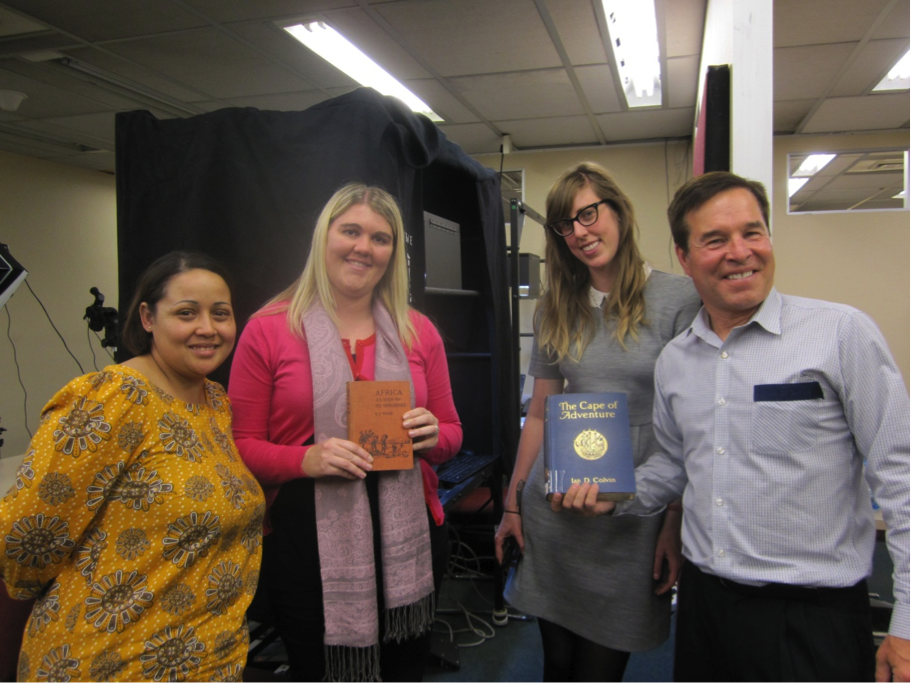
On April 15, 2013, during a ceremony hosted at the South African National Biodiversity Institute (SANBI) at the Pretoria National Botanical Garden in Pretoria, South Africa, BHL-Africa officially launched as our sixth global node. Working within the BHL consortium, BHL-Africa aims to provide open access to the valuable information held in Africa’s biodiversity institutions. For the past two years, SANBI and the University of Pretoria in South Africa have been working with Internet Archive (IA) to contribute content to BHL through existing protocols and workflows.

In April, 2014, two Internet Archive scanning machines, called “scribes,” were shipped to the University of Pretoria to facilitate local digitization efforts. To help install the machines and provide operational training, Robert Miller (Director of Global IA) and Gemma Waterston (IA Satellite Coordinator) traveled to the University of Pretoria in June. The trip culminated in the successful scanning of the first BHL-Africa book digitized through an IA machine. Scanned in just 40 minutes, the 500-page book represents the first of many contributions soon to come. These contributions will be incorporated directly into the existing BHL corpus, expanding our extensive collection of over 43 million pages.

Following the South African trip, Miller journeyed to Nairobi, Kenya, where he presented to a coterie of our Kenyan colleagues vested in the BHL-Africa initiative. During a presentation at the Louis Leakey Auditorium, Miller highlighted collaborative opportunities for digitization that would allow Kenyan content to be incorporated into the BHL collection.

We are excited about these developments, and look forward to many more contributions from our colleagues in Africa! In celebration, enjoy this collection of BHL images highlighting African biodiversity.

Get the flash player here: http://www.adobe.com/flashplayer

var so = new SWFObject(“http://www.db798.com/pictobrowser.swf”, “PictoBrowser”, “500”, “500”, “8”, “#EEEEEE”); so.addVariable(“source”, “sets”); so.addVariable(“names”, “African Biodiversity Collection”); so.addVariable(“userName”, “BioDivLibrary”); so.addVariable(“userId”, “61021753@N02”); so.addVariable(“ids”, “72157633207738920”); so.addVariable(“titles”, “on”); so.addVariable(“displayNotes”, “on”); so.addVariable(“thumbAutoHide”, “off”); so.addVariable(“imageSize”, “medium”); so.addVariable(“vAlign”, “mid”); so.addVariable(“vertOffset”, “46”); so.addVariable(“colorHexVar”, “EEEEEE”); so.addVariable(“initialScale”, “off”); so.addVariable(“bgAlpha”, “32”); so.write(“PictoBrowser140716133303”);

July 17, 2014by ulib-libraryjobs
Blog Reel, Featured Books

Shaping Public Perception of Africa: David Livingstone

Happy Birthday, David Livingstone!

View Full Size Image
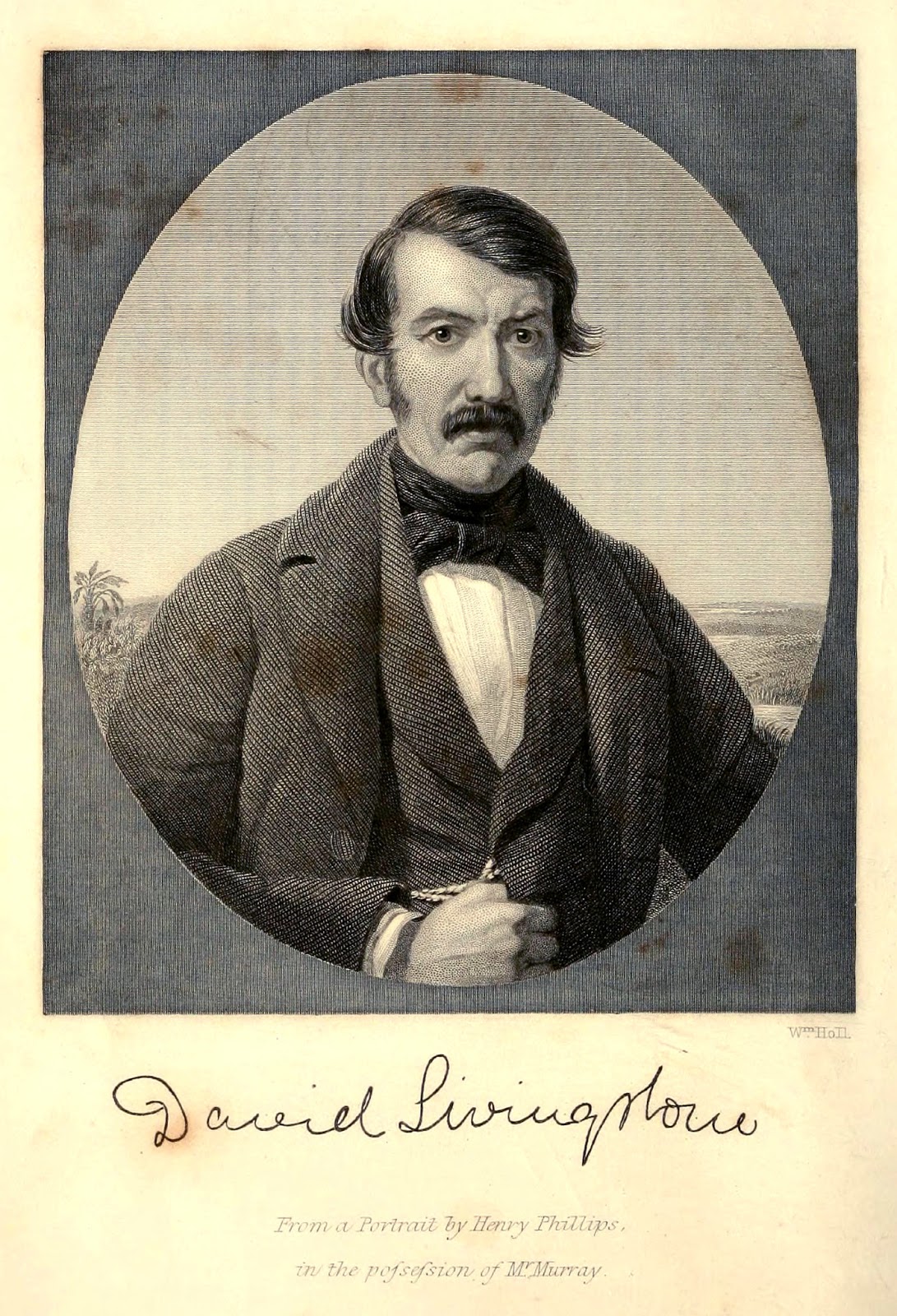
David Livingstone. Missionary Travels.

“Dr. Livingstone, I presume?”

Most of us have heard that famous phrase, uttered by Henry Morton Stanley of the New York Herald upon finding David Livingstone in Ujiji, Tanzania, on November 10, 1871.  However, just because you know the phrase doesn’t mean you know the man. Come with us as we explore this legendary explorer and celebrate his birthday!

Humble Origins

David Livingstone was the second of seven children born to a tea salesman in Blantyre, Scotland in 1813. From the age of ten, he worked in a cotton mill spending twelve hours a day tying broken threads on spinning machines. Fortune, however, had him destined for much greater things. At 23 years old, he entered Anderson’s University in Glasgow to study medicine, and in 1840, after completing his studies in London, he was licensed as a physician and ordained as a missionary. Originally intending to serve in China, Livingstone was inspired by the convictions of Robert Moffet, a missionary stationed at Kuruman, a missionary outpost in South Africa. Thus, Livingstone began his lifelong affair with Africa and set out in 1840 as a medical missionary to South Africa. He would spend the rest of his life exploring Africa, with only two visits to England over the subsequent 32 years.

An Account of More than a Decade in Africa

Livingstone, David. Missionary Travels and Researchers in South Africa. (1857). Contributed by Smithsonian Libraries.

Livingstone recounted his explorations and experience in Africa between 1840 and 1856 in his acclaimed publication Missionary Travels and Researches in South Africa. One of the nineteenth century’s best-selling books, Missionary Travels established Livingstone’s reputation as not only an exciting explorer, but also a kind-hearted humanitarian aching to improve conditions for Africans.

Missionary Travels is a narrative compilation of Livingstone’s personal field diaries.  Livingstone was careful to construct the composition to appeal to both scientific and religious readers, hoping to encourage further positive involvement in Africa. The work also includes 47 illustrations – most crafted by Captain Henry Need and Joseph Wolf.

Livingstone published the work with John Murray, one of the era’s most renowned publishers of geographical books. Murray was so anxious to secure the publication that he offered to finance all expenses in return for only one-third of the profit obtained.  

View Full Size Image
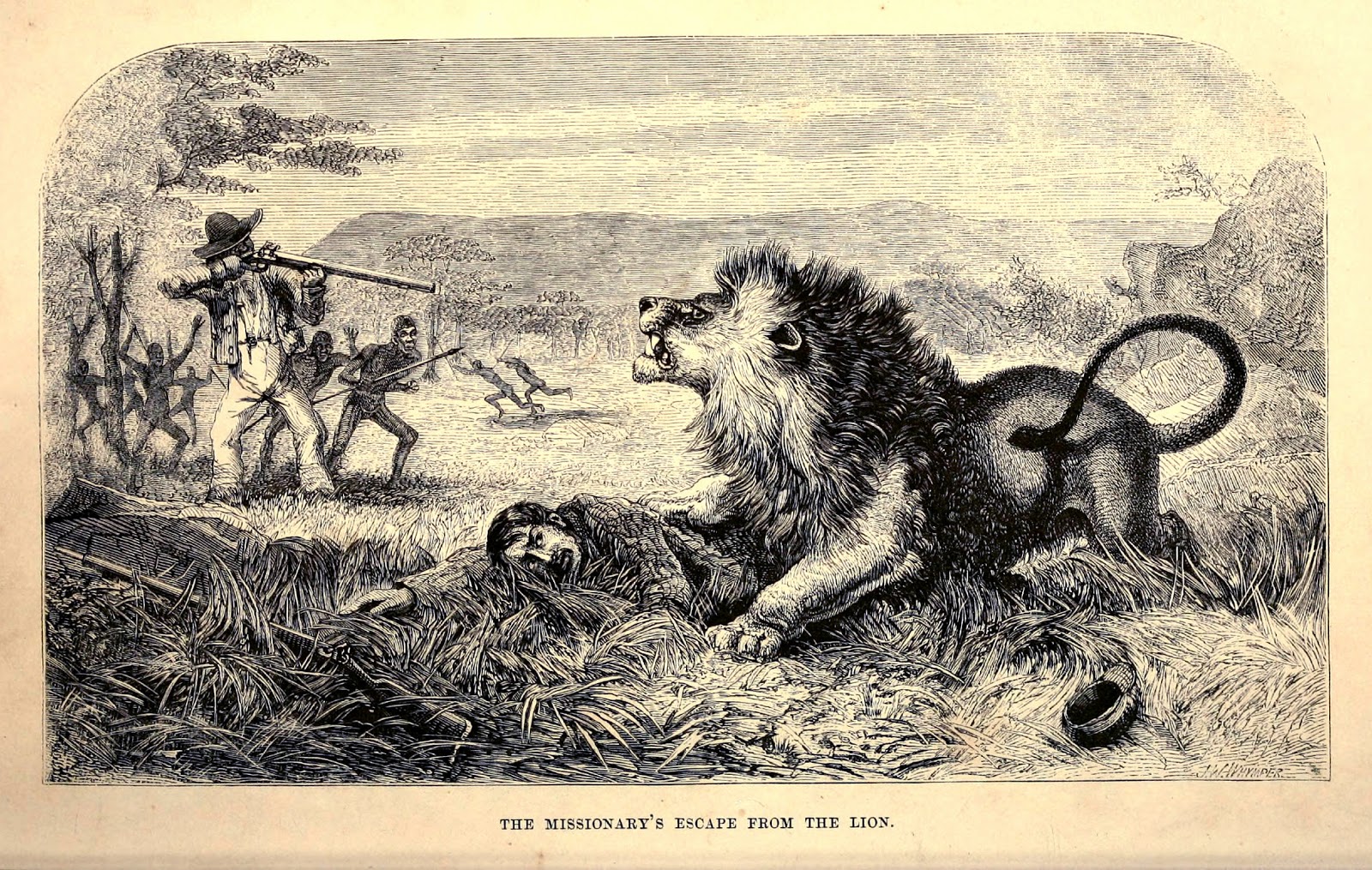
The Missionary’s Escape from the Lion. Missionary Travels.

The most famous illustration in Missionary Travels is entitled “The Missionary’s Escape from the Lion,” which depicted Livingstone pinned by a lion with his fellow travelers attempting to rescue him. Livingstone called the illustration “abominable,” asserting that “[e]veryone who knows what a lion is will die with laughing at it.” Murray ignored Livingstone’s dissatisfaction and included the illustration, knowing that most people reading Missionary Travels would not have the knowledge necessary to detect its absurdity. Furthermore, Murray understood that many audiences might never actually read the book but experience it only through illustrations. Thus, it was necessary to craft a dramatic story through images alone.

12,000 copies of the first edition of the book published in 1857, and, even at a price of one guinea each, sold out immediately. Several additional printings were ordered, selling with such success that Murray did not publish a cheaper, abridged version of the work (A Popular Account of Missionary Travels in South Africa) until 1861.

An Explorer at Heart

View Full Size Image
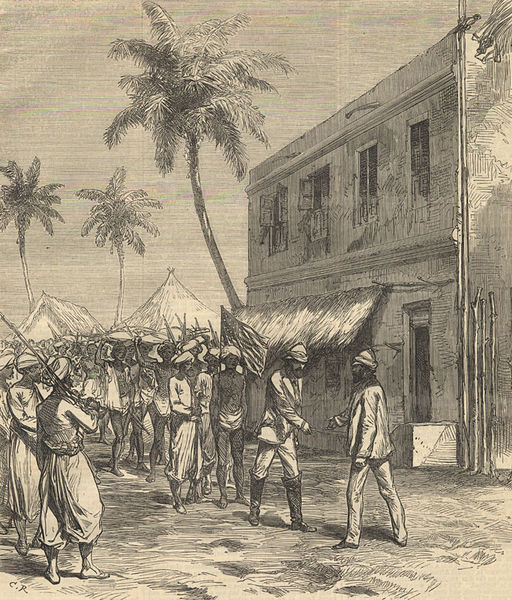
Stanley and Livingstone meet. Illustration from The Illustrated London News, 1872

As Missionary Travels and Researches in South Africa confirms, though a missionary, Livingstone spent much of his career exploring the wilds of Africa. Enthused by Livingstone’s discoveries as related in his book, the British government funded an expedition up the Zambezi River (1858-64), tasked with uncovering a route between the upper Zambezi and the coast. Extensive rapids past Cabora Bassa unfortunately made negotiating the river to the coast impossible, and the British government recalled the expedition 1864. Though unsuccessful, naturalists in the expedition party collected a wealth of valuable specimens during the six years of the expedition.

From 1866-67, Livingstone led a privately-funded expedition to discover the source of the Nile, which was debated at that time to be either Lake Albert or Lake Victoria. Arriving at Lake Bangweulu on November 8, 1867, Livingstone mistakenly asserted it as the upper reaches of the Nile. In truth, the source of the Nile lies in the high mountains of Burundi.

By the end of the Nile expedition, Livingstone’s public image was suffering due to the failures of his expeditions and reports that Livingstone was a poor leader and manager. After 1867, Livingstone’s health failed and he lost contact with the outside world completely, prompting the New York Herald to send Henry Morton Stanley in search of him in 1869. Stanley located him in Ujiji in 1871, and the article he later published about Livingstone restored public opinion of him, casting him as a great hero of adventure and discovery. However, despite Stanley’s urging to return to England to recover his health, Livingstone refused. He died in 1873 in present-day Zambia. His heart was buried under a Mvula tree and his body was transported to England, where it was interred at Westminster Abbey.

Though many of the expeditions that Livingstone undertook were unsuccessful at achieving the undertakings’ primary goals, the discoveries made along the way, and the natural riches recorded – many for the first time for Western people – made a monumental impact on the future of African exploration, understanding, and native relations.

A Monumental Legacy

View Full Size Image
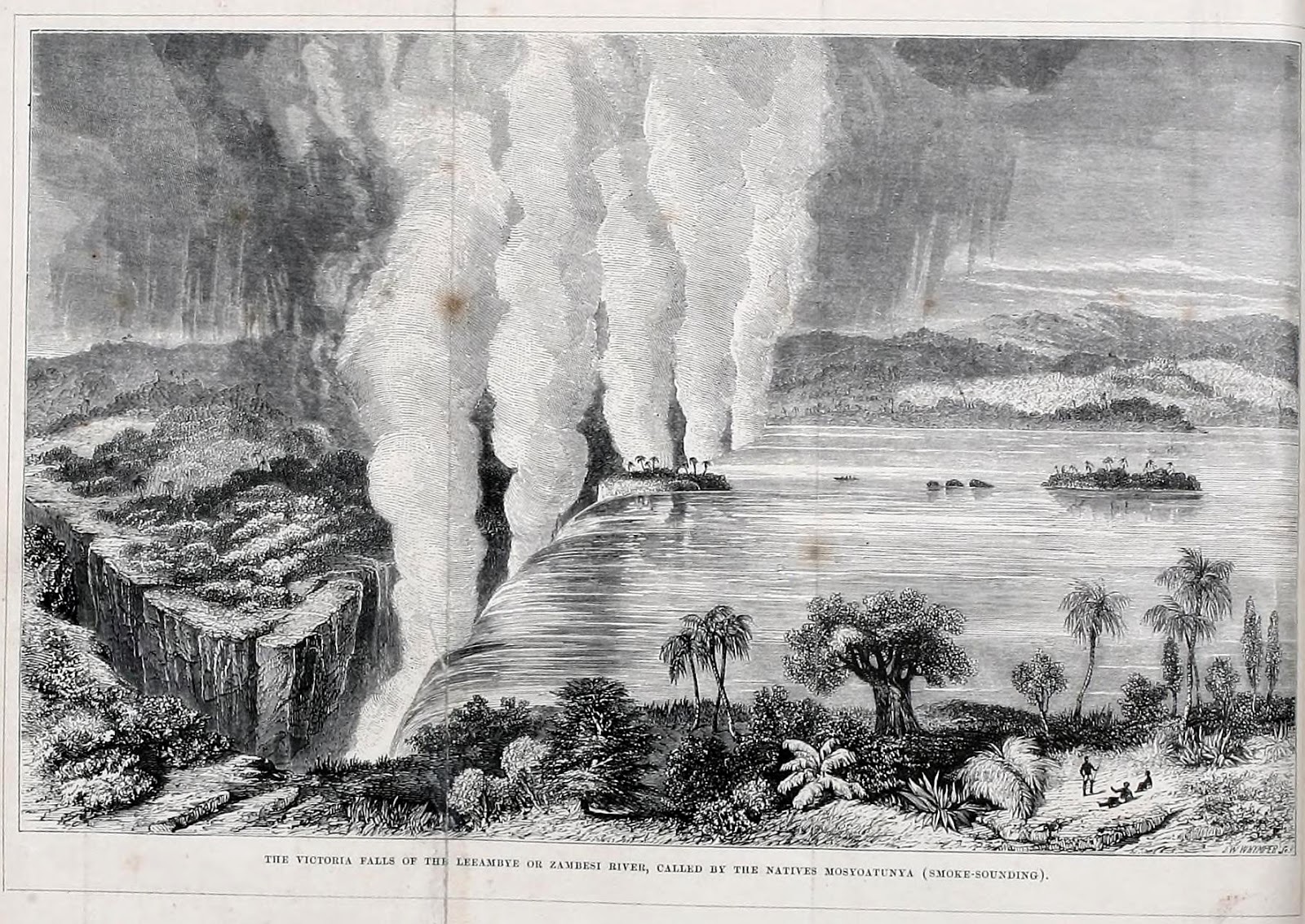
Victoria Falls. Based on sketches by David Livingstone. Missionary Travels.

David Livingstone left behind an impressive legacy. He was the first European to successfully complete a transcontinental journey across southern Africa. He was the first European to see Victoria Falls, which he named after the British Monarch of the time. He discovered for Western science many locales throughout Africa, including Lake Tanganyika, Lake Ngami, Lake Mweru, Lake Bangweulu, and the upper Zambezi River. He was instrumental in increasing European awareness of the horrors of the slave trade in Africa and encouraging equitable, rather than dictatorial, European relations and fair commercial interactions with Africa. His explorations and zeal for Africa inspired and enabled future missionaries to serve in Africa, providing valuable medical and educational support.

He was awarded the Gold Medal of the Royal Geographical Society and memorials exist for him throughout Africa, the United Kingdom, and North America. Today, we celebrate the scientific contributions, as well as the humanitarian considerations, of this icon of nineteenth century science and exploration. Happy Birthday, David Livingstone!

Additional Livingstone Resources

  • View more of Livingstone’s publications in BHL.
  • Explore Livingstone’s 1871 field diary, made digital by the David Livingstone Spectral Imaging Project in November, 2011.
  • Learn more about the history of publishing Missionary Travels.
  • Learn more about Livingstone’s life through Livingstone Online

We hope you enjoyed this post. Interested in guest-blogging for BHL? We’d love that! Natural history, biodiversity and conservation topics are especially welcomed. Email us your ideas at [email protected].

March 19, 2013by ulib-libraryjobs
Blog Reel, User Stories

BHL Use Case: Facilitating the Study of Mollusca in southern Africa

Portrait version of the Biodiversity Heritage Library logo.

Imagine that you live in a developing country and you’re studying a rare species of Mollusca. You need to verify the identity of a species you uncovered while performing some field work, but to do so you need to view a publication from the 1700s. Unfortunately, you do not have access to a library that holds the volume you need. What is a scientist to do?

Cue the Biodiversity Heritage Library! BHL is helping to improve the efficiency of scientific research around the world, particularly in developing countries, by providing free, global access to natural history literature, much of which can be found in only a few select libraries in the developing world.

Scientists everywhere feel the value of BHL, especially those in developing countries, like BHL user Dr. Dai Herbert, who graciously agreed to take some time out of his busy schedule to tell us how BHL has impacted his research on the Mollusca of southern Africa.

BHL and Our Users: Dr. Dai Herbert

View Full Size Image

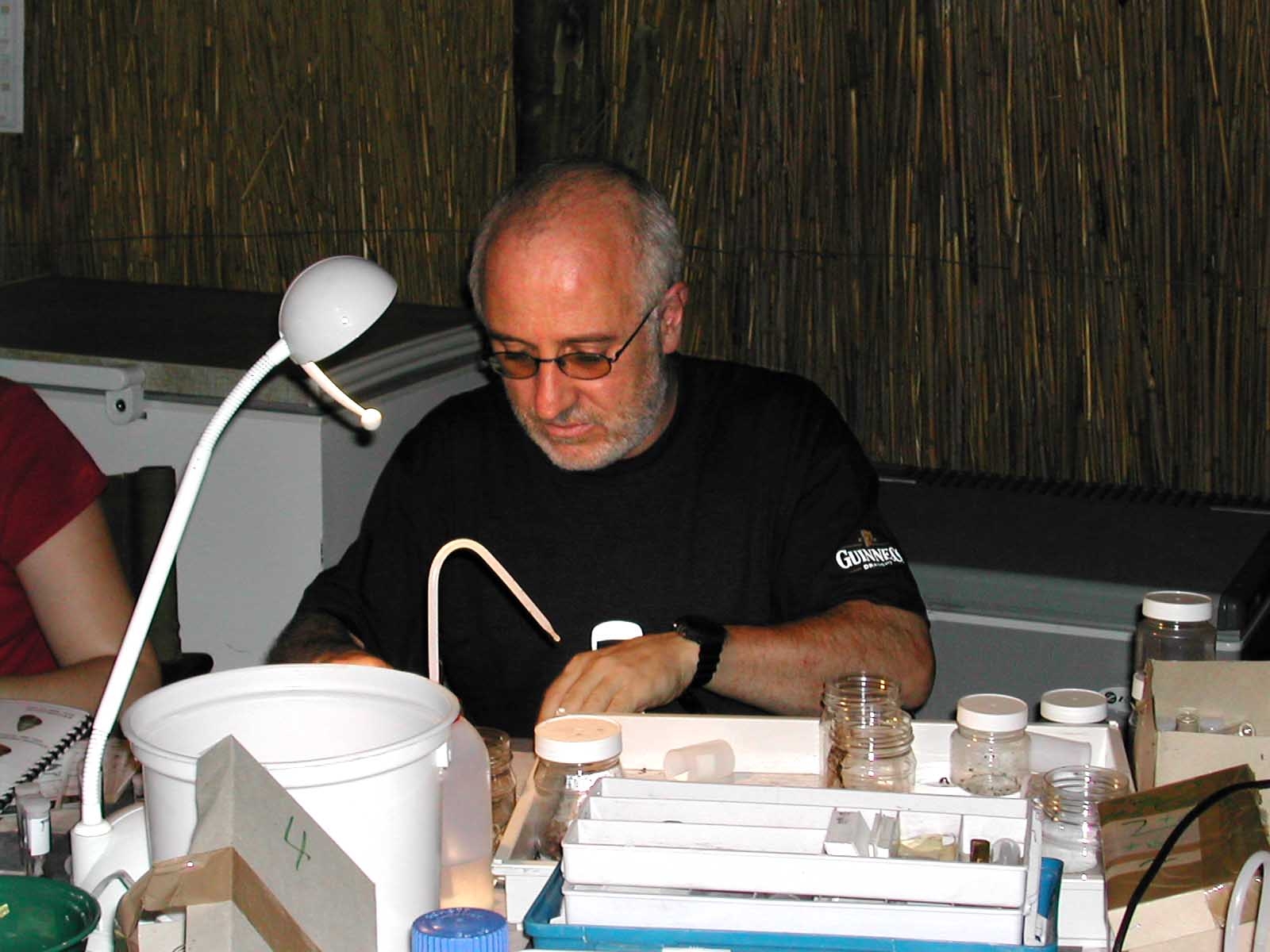
What is your title, institutional affiliation, and area of interest? Chief Curator: Mollusca, KwaZulu-Natal Museum, Pietermaritzburg and Honorary Professor, University of KwaZulu-Natal, Pietermaritzburg.

My field of interest is molluscan diversity and biogeography in southern Africa, with an emphasis on taxonomy and systematics. In work of this nature it is essential that one is fastidious and painstaking about accuracy. Consequently one often needs to go back to original sources to check information and these can sometimes be old and rare literature resources.

How long have you been in your field of study? Heavens, it’s a long time now – over 30 years.

When did you first discover BHL? I can’t remember exactly when I first came across BHL, but I have been making progressively more and more use of it over the last five years.

What is your opinion of BHL and how has it impacted your research? BHL is a tremendous and extremely valuable resource. As I mentioned previously, I frequently need to refer to the older literature, but before the advent of the internet and the BHL, this was usually a very frustrating task because much of the relevant material was not available in South Africa. This represented a considerable stumbling block and hindrance. The BHL has greatly alleviated this problem. Far more often than not, I am able to find what I need on the BHL. This resource has done an enormous amount to enhance the capacity of developing countries to undertake taxonomic research on their biota. I am extremely grateful to those who set up and manage this resource. Keep up the good work!

How often do you use BHL? This is variable and depends upon how much time I have for research (i.e. how much nonsense the bureaucrats and administrators thrust my way), but hardly a week goes by when I don’t use it. When fully engaged in a project, I might use it almost daily.

How do you usually use BHL (read the titles online/download whole PDFs/Select Pages to Download for a custom PDF/etc.)? Normally I search for the reference or journal by title, download the pdf and print the section that I need to refer to. I guess I’m still a little old fashioned in that I like to have a hard copy of original descriptions and I then scribble my own notes on these and store them for reference.

What are your favorite features/services on BHL? The advanced search facility and the pdf download option.

If you could change one thing about BHL, what would it be, or what developmental aspect would you like the BHL team to focus on next? BHL works well – the big issue is to get as much of the older literature scanned as possible.

If you had to choose one title/item in BHL that has most impacted your research, or one item that you prefer above any other in BHL, what would it be and why? This is impossible for me to say. I use many titles of considerable importance to my research.

Learn more about Dr. Herbert on the KwaZulu-Natal Museum website.

Interested in sharing how the BHL has helped facilitate your research? We would love to hear from you! Send us an email to [email protected]. With continuous input from our users, we can ensure that our development priorities continue to transform BHL into a tool that best meets the needs of our user community!

January 15, 2013by michelle.underhill
Page 1 of 212»

Help Support BHL

BHL's existence depends on the financial support of its patrons. Help us keep this free resource alive!

search

About BHL

The Biodiversity Heritage Library (BHL) is the world’s largest open access digital library for biodiversity literature and archives. BHL operates as a worldwide consortium of natural history, botanical, research, and national libraries working together to digitize the natural history literature held in their collections and make it freely available for open access as part of a global “biodiversity community.”

Join Our Mailing List

Sign up to receive the latest news, content highlights, and promotions.

Subscribe Now

Subscribe to Blog via Email

Enter your email address to subscribe to this blog and receive notifications of new posts by email.

Join 319 other subscribers

Subscribe to Blog Via RSS

Subscribe to the blog RSS feed to stay up-to-date on all the latest BHL posts.

Access RSS Feed

Inspiring Discovery through Free Access to Biodiversity Knowledge.

The Biodiversity Heritage Library makes it easier than ever for you to access the information you need to study and explore life on Earth…for free, anytime, anywhere.


64+ Million Pages of
Biodiversity Literature Online.

EXPLORE

Tools and Services
to Transform Research.

EXPLORE

300,000+
Illustrations on Flickr.

EXPLORE

ABOUT | HARMFUL CONTENT | PRIVACY | SITE MAP | TERMS OF USE