Biodiversity Heritage Library - Program news and collection highlights from BHL
  • Home
  • News
  • Featured Books
    • All Featured Books
    • Book of the Month Series
    • BHL at 20
  • User Stories
  • Campaigns
    • Fossil Stories
    • Garden Stories
    • Monsters Are Real
    • Page Frights
    • Her Natural History
    • Earth Optimism 2020
  • Tech Blog
  • Visit BHL
Home
News
Featured Books
    All Featured Books
    Book of the Month Series
    BHL at 20
User Stories
Campaigns
    Fossil Stories
    Garden Stories
    Monsters Are Real
    Page Frights
    Her Natural History
    Earth Optimism 2020
Tech Blog
Visit BHL
  • Home
  • News
  • Featured Books
    • All Featured Books
    • Book of the Month Series
    • BHL at 20
  • User Stories
  • Campaigns
    • Fossil Stories
    • Garden Stories
    • Monsters Are Real
    • Page Frights
    • Her Natural History
    • Earth Optimism 2020
  • Tech Blog
  • Visit BHL
Biodiversity Heritage Library - Program news and collection highlights from BHL
Blog Reel, User Stories

Taxonomic research on Southeast Asian land snails

Portrait version of the Biodiversity Heritage Library logo.

As part of our regular BHL and Our Users series, we’re pleased to introduce Barna Páll-Gergely, a PhD student in the Department of Biology at Shinshu University in Japan.  Barna has had a lifelong interest in shells and land snails and has graciously agreed to answer some questions about how BHL has impacted his research.

BHL and Our Users: Barna Páll-Gergely

View Full Size Image

What is your title, institutional affiliation, and area of interest?
I graduated from University of Pécs, a Hungarian university, and am now a PhD student in Japan, at Matsumoto, Shinshu University.  I am interested in the taxonomy and evolution of some land snail groups, mainly from South-east Asia.

How long have you been in your field of study?
I started collecting shells at the age of five, as many of us do.  I then worked on land snails for about 10 years, starting in the secondary school.

When did you first discover BHL?
A museum curator friend of mine showed it to me about two years ago.

What is your opinion of BHL and how has it impacted your research?
It provides wonderful possibilities for taxonomists who need to regularly use the very old literature.  BHL provides access to the kind of literature which can often be found only in large, old museum libraries. I also have access to recent papers because I am studying in a Japanese University, but without BHL I would be in big trouble with accessing the old sources.

How often do you use BHL?
I have to check some things almost every day, and during the literature search period (when I start working on a new taxonomic group), I use it practically all day.

How do you usually use BHL (read the titles online/download whole PDFs/Select Pages to Download for a custom PDF/etc.)
I usually download whole publications for my “literature collection”, and at the same time I produce smaller pdf files with the information I need for a specific subject. It is easier to handle smaller files when I just need to check something such as the exact page number of a citation.

What are your favorite features/services on BHL?
I can search for scientific names, and people’s names. This is a very big help.

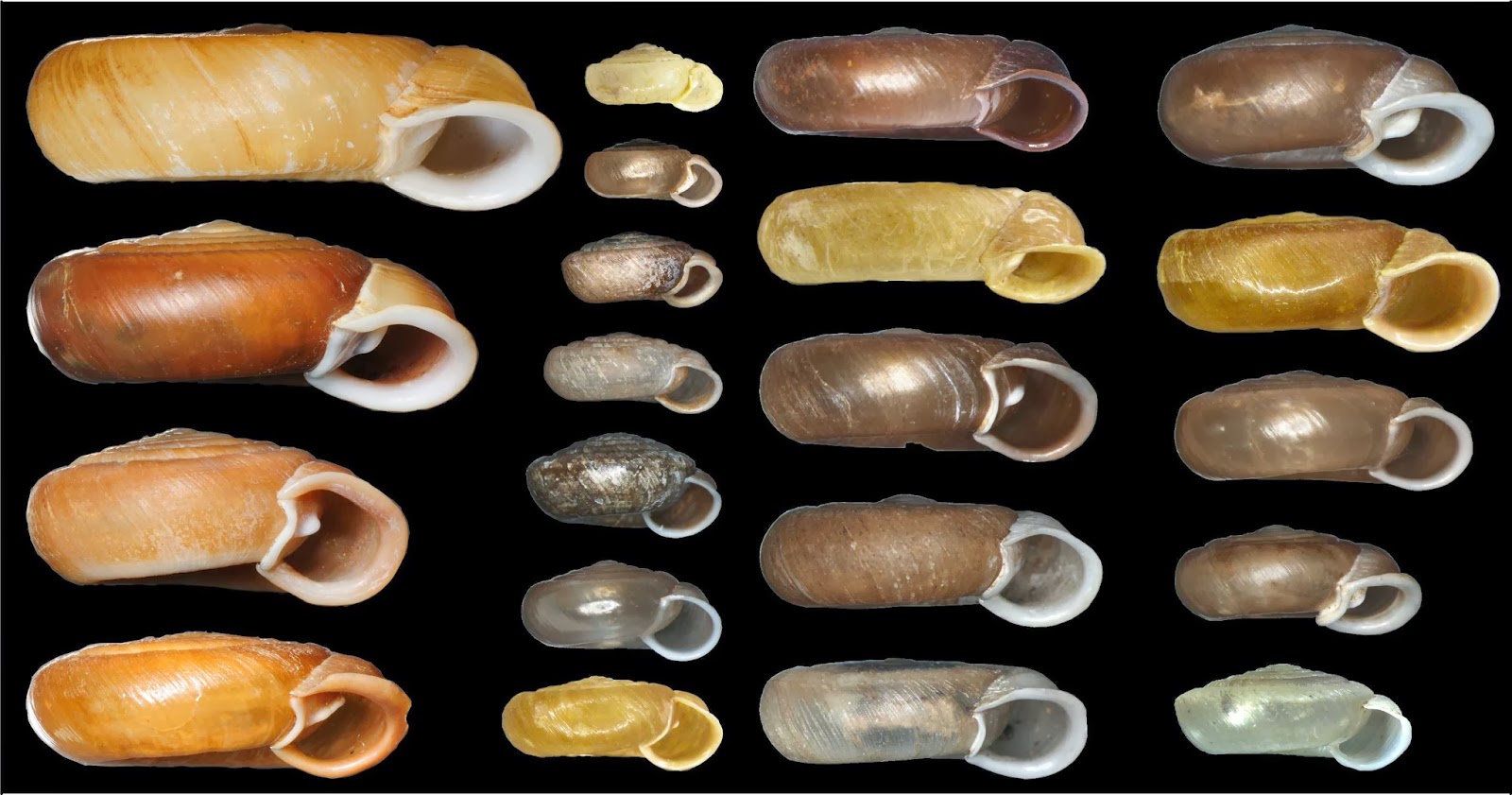
When I started to deal with the land snail family Plectopylidae, I just typed “plectopylis” into the search field and I could read and download many old literature. Without this possibility (scientific or authors name as a search option) finding all relevant literature would have taken maybe two times longer, and more importantly, there would have been a risk of overlooking some sources.  This was very helpful while I was working with my colleagues on the the description of new species and subspecies shown in the image below.
View Full Size Image
New species and subspecies of the land snail family Plectopylidae from China
and Vietnam (Páll-Gergely & Hunyadi, 2013). This family was neglected
since the beginning of the 20th Century
.

If you could change one thing about BHL, what would it be, or what developmental aspect would you like the BHL team to focus on next?
In many cases the plates of figures and the blank pages in-between appear marked as “text” on the left-hand navigation menu.  It would be great to enumerate them. The other thing is that selecting pages of a single publication and finding the plates at the end of each volume takes a long time. Sometimes it would be more user-friendly to provide a way to automatically group these together for download.
View Full Size Image
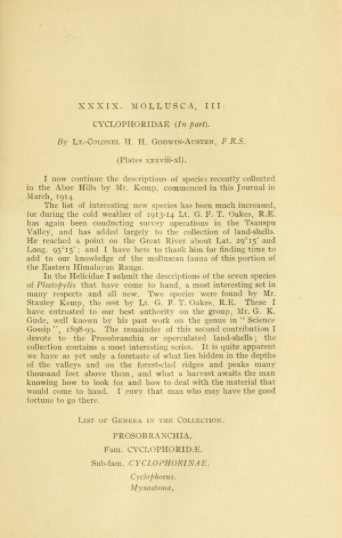
Godwin-Austen, H.H. 1917 Zoological
results of the Abor Expedition, 1911–12.
XLVII Mollusca, VII. Cyclophoridae
(in part) Records of the Indian Museum 8:
493—580. 
http://biodiversitylibrary.org
/item/41753#pag e/677/mode/1up

If you had to choose one title/item in BHL that has most impacted your research, or one item that you prefer above any other in BHL, what would it be and why?
There are many relevant sources I like, for example I am really fascinated by monographs like Kobelt’s Cyclophoridae or the Mollusca of India  by Godwin-Austen. On the other hand, discovering something unusual, or let’s say, “funny” is always a good moment.  My actual favourite is a part in Godwin-Austen’s “Zoological results of the Abor Expedition” (1917), after the description of Rhaphaulus miriensis: “After getting as far as writing the above description I left my work room for lunch, leaving the shell on a slide resting on plasticine. On taking up work again I found it crushed. Thus one of the most interesting shells found recently on the Eastern Frontier has to be rediscovered.”

Literature mentioned:
Kobelt W. 1902 Das Tierreich. Mollusca: Cyclophoridae R. Friedländer und Sohn, Berlin 662pp.

Godwin-Austen, H.H. 1882–1920 Land and Freshwater Mollusca of India, including South Arabia, Baluchistan, Afghanistan, Kashmir, Nepal, Burma, Pegu, Tenasserim, Malaya Peninsula, Ceylon and other islands of the Indian Ocean; Supplementary to Masers Theobald and Hanley’s Conchologica Indica Taylor and Francis, London, 257pp, 442pp.

Godwin-Austen, H.H. 1917 Zoological results of the Abor Expedition, 1911–12. XLVII Mollusca, VII. Cyclophoridae (in part) Records of the Indian Museum 8: 493—580.

Páll-Gergely, B. & Hunyadi, A. (2013): The family Plectopylidae Möllendorff 1898 in China (Gastropoda, Pulmonata). — Archiv für Molluskenkunde 142 (1): 1–66.
 

October 15, 2013by sayeedmd
BHL News, Blog Reel

BHL Image Collection on EOL!

View Full Size Image
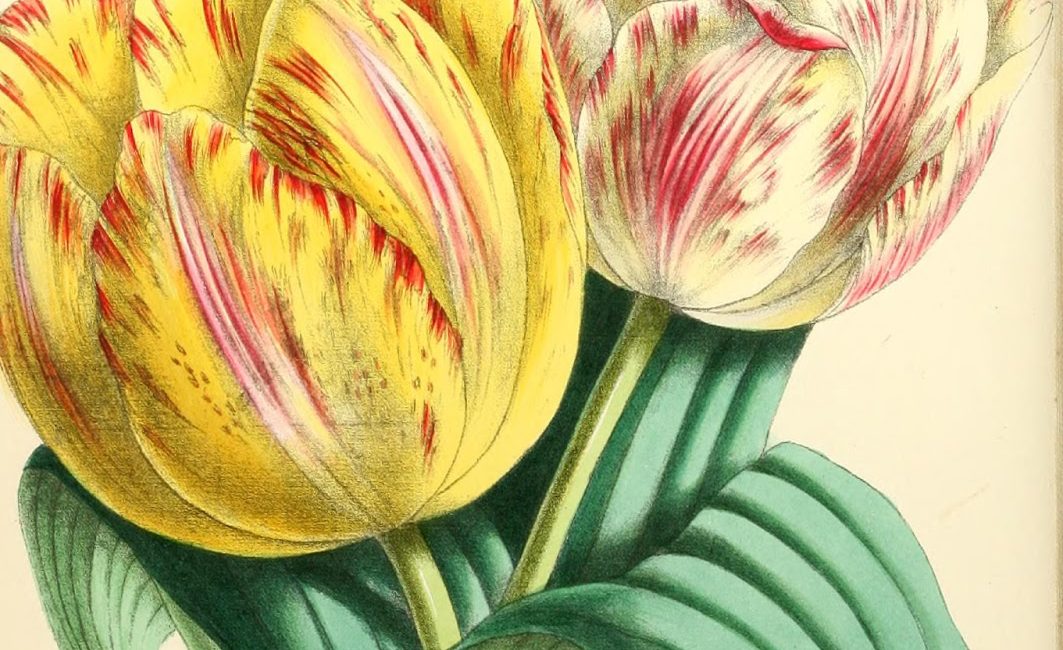
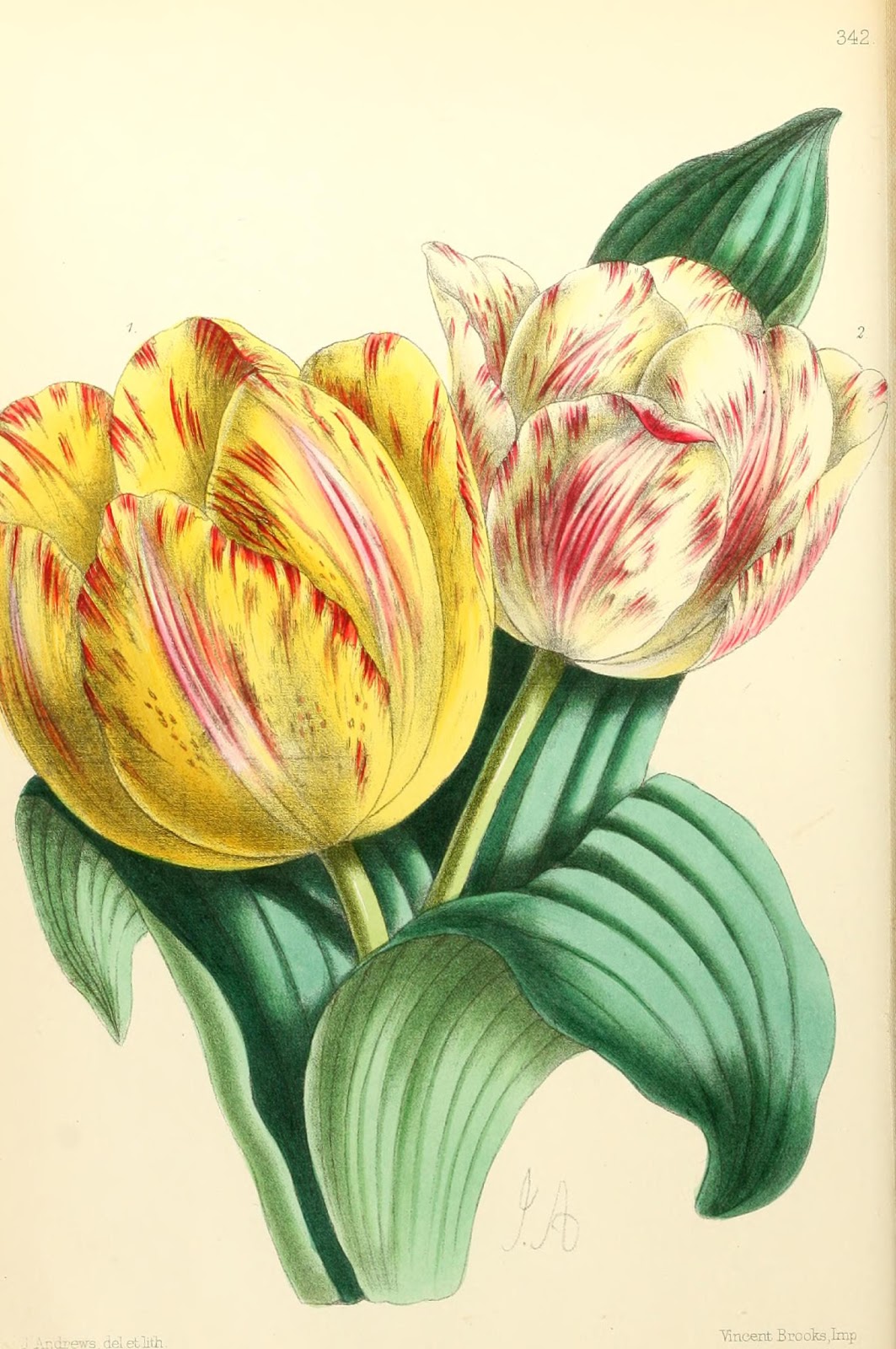
The Floral Magazine, v. 6, pl. 342.

The Biodiversity Heritage Library now has its own collection of images in the Encyclopedia of Life! This collection is comprised of images that have been tagged with species name machine tags, relating the species depicted in each image. The collection currently comprises over 11,000 images representing over 10,000 taxa, and will continue to grow as additional illustrations are tagged in the BHL Flickr.

The BHL Flickr

By now, you’re no doubt aware of the Biodiversity Heritage Library Flickr, which provides free access to over 104,000 illustrations gleaned from the BHL collections. These images span over five hundred years and range in topic from fish to reptiles, mammals to birds, insects to mollusks, and everything in between!

Building the Collection: Tagging Images

To make it easier for you to search our Flickr collection and for us to share images with external websites like EOL, we’re adding species name machine tags to our images, and we’ve been encouraging you to help us do this.

A tag is basically a searchable keyword that you can add to an image to describe it, and a machine tag is a tag with special formatting to allow it to be read by computers. Thus, a species name machine tag is a tag that describes the species depicted in an image in a format that can be understood by computers.

When you add species name machine tags to our images, you as a user can not only search the BHL Flickr and retrieve any images tagged with a desired name, but these images can also automatically be uploaded to EOL and associated with the corresponding species page.

View Full Size Image
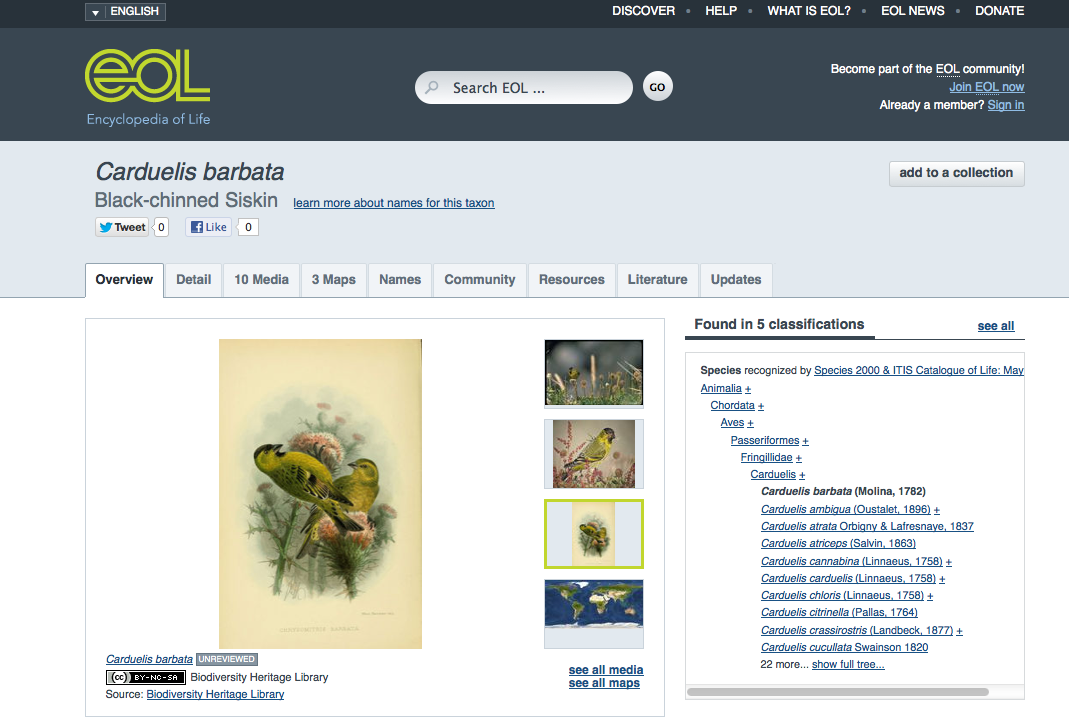
Example of an image from the BHL Flickr automatically associated with the EOL species page for Carduelis barbata, the Black-chinned Siskin, because a species name machine tag was added to the image in Flickr.

The format for species name machine tags is “taxonomy:binomial=Genus species,” where “Genus” and “species” are replaced with the particulars of the organism you’re describing. You can replace “binomial” with another taxonomic tag, such as “genus” or “family”, if you can only identify the organism at that level. Learn more about the Flickr tagging process and machine tag formats in our previous blog post.

The images in the new EOL Collection are images from the BHL Flickr that have a species name machine tag associated with them. Each time new images are tagged in the BHL Flickr, they will automatically be added to our collection in EOL, as well as associated with appropriate species pages.

You Can Help us Grow this Collection!

With over 104,000 images in our Flickr collection to date, and that number growing daily, it’s impossible for BHL staff to tag all of our images by ourselves. That’s why we need your help! You can help us by adding species name machine tags to our images in Flickr. All you have to have is a free Flickr account to add tags to BHL images.

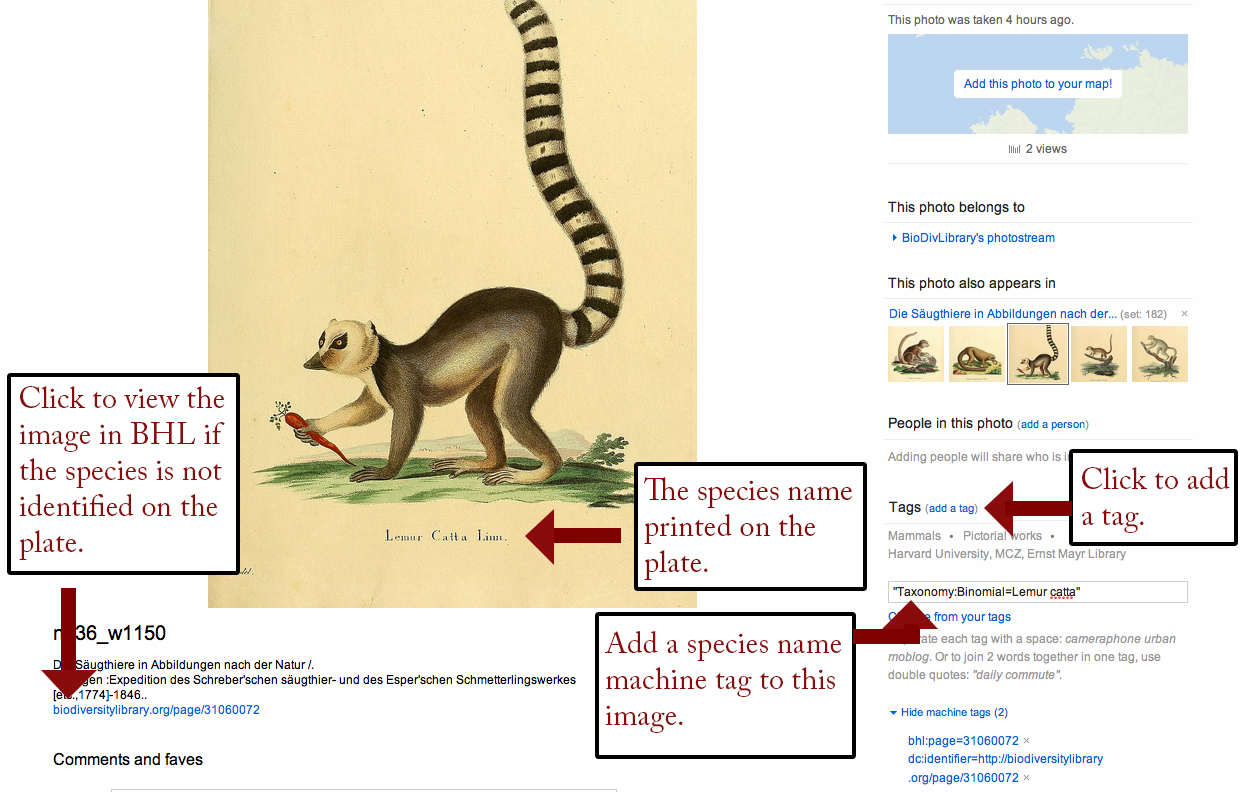
Once you’re signed in to Flickr, browse our collection of images and when you see some with species you can identify, simply click “add a tag” and add the species name in the machine tag format (“Taxonomy:Binomial=Genus species”). Be sure to include the quotation marks around your machine tag.

Many images actually have the species name printed on the plate itself. In these cases, you can simply transcribe that name as a tag for the image. If the species is not identified on the plate, navigate to the book in BHL to find the associated description pages outlining the species depicted. We encourage you to tag the image with the species name provided by the book itself, but if that name is no longer valid, and you know the current, accepted name, feel free to add that name as an additional tag to the image.

View Full Size Image
Adding a species name machine tag to an image in the BHL Flickr. Click this image to enlarge for better viewing.

If there are multiple species depicted on an image, add a separate tag for each species depicted (or as many as you can identify). Learn more about tagging BHL images, and get additional tips, in our Guide.

Every time you add a species name machine tag to an image in our Flickr, you’re growing the BHL EOL Collection, as your tagged images will automatically be added to that collection.

We hope we’ve inspired you to help us identify life on earth, as portrayed through some of the most incredible scientific illustrations ever created! Keep exploring, and keep tagging!

Visit the BHL Image Collection on EOL today!

March 11, 2013by Grace Costantino
Blog Reel

Is that an Elephant on Your Christmas Tree?

Merry Christmas!

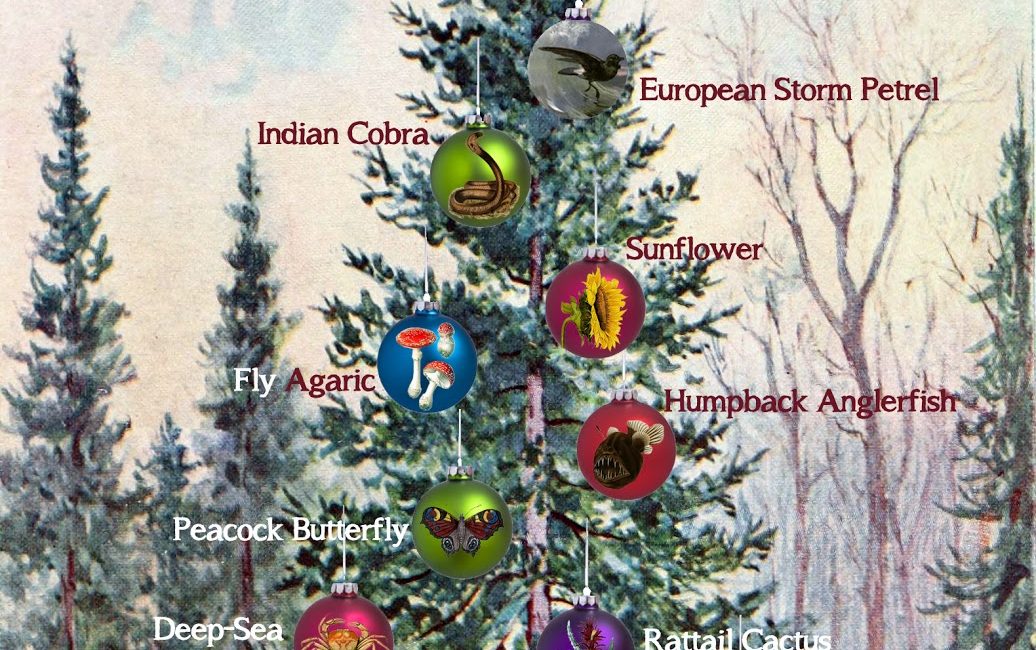
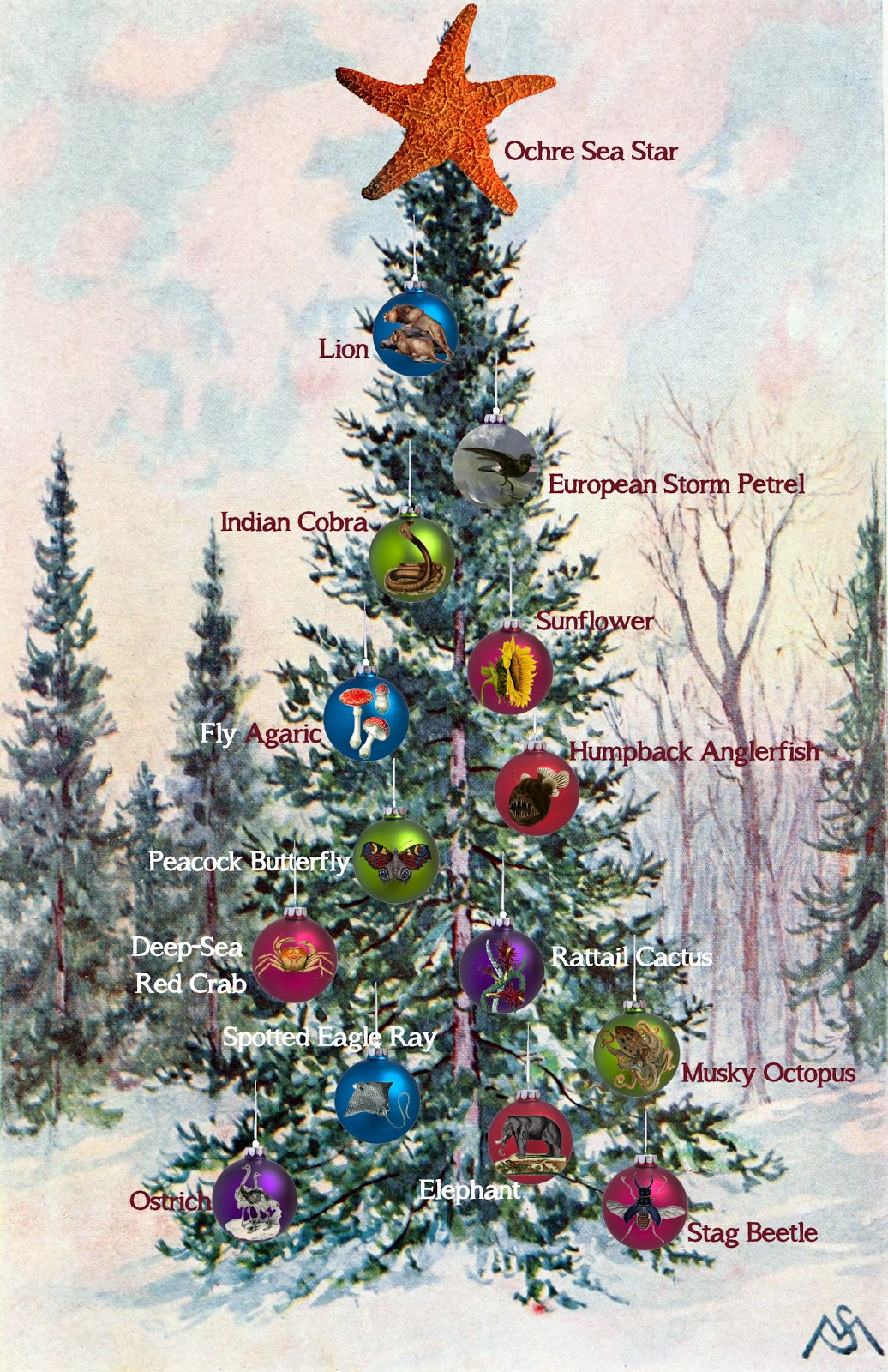
We hope you’re having a marvelous time celebrating the Holidays today! We wanted to do something fun and different for our Christmas post. So, we decided to present (pun intended!) you with your own truly biodiverse BHL Christmas tree – with a twist!

Our tree has been decorated with 15 species ornaments. Each species on the tree is identified by its common name. Below the tree is a list of 20 scientific names. All 15 of the species on the tree are listed among the binomials, as well as 5 that are not on the tree.

Can you associate our ornaments with their scientific names? Simply click on the 15 binomials you believe are represented on the tree and hit “submit.” The subsequent results screen will tell you whether you’re a taxonomy master or beginner.

We hope you enjoy our little Christmas Tree present. Good luck, and we’ll talk to you in the New Year!

View Full Size Image

Loading…
Find the illustrations pictured on the Christmas Tree in BHL:
BHL Christmas Tree  1) Ostrich  2) Stag Beetle3) Elephant4) Musky Octopus5) Spotted Eagle Ray6) Deep-Dea Red Crab7) Rattail Cactus8) Peacock Butterfly9) Humpback Anglerfish 10) Fly Agaric11) Sunflower 12) Indian Cobra13) European Storm Petrel 14) Lion15) Ochre Sea Star

December 25, 2012by ulib-libraryjobs
Blog Reel, Featured Books

Book of the Week: The Human Side of Birds

Approach Nature anew, as a child might. 

View Full Size Image

Royal Dixon, the author of this week’s book of the week, The Human Side of Birds (1917), had an eclectic background. His formal credentials included botanist at the Chicago Field Museum, ornithologist, lecturer for the NY Board of Education, science journalist and author of several books– all of which sought to put a human face on nature. He was also a dancer, thespian, political writer and founder of the First Animal Church in America.

One might ask why was this man was so intent on humanizing plants, animals, trees and birds? Dixon, it seems, was concerned with modern society and its growing inability to relate to nature. To appreciate it. To see it. And most importantly to preserve it. He saw the good in the formal sciences yet, believed in some ways that taxonomy, in particular, barred non-experts from participating in the deeply human act of naming and organizing Nature’s Kingdom. His mission was simple: bring Nature to the people. Show them how similar every creature on this planet is to us and how we are all connected to each other on the most basic and profound levels.

Besides authoring several books, Dixon’s chosen platform from which to disseminate his message was guffawed at by most in his time. He became founder and leader of the First Church for Animal Rights, which met weekly and promoted the idea that “every creature had the inalienable right to life, liberty and the pursuit of happiness.” Although the church is now defunct, or at least seems to be since there isn’t a digital whisper of such an organization to be found out in cyberspace, we here at BHL are entirely sympathetic to Dixon’s cause!  He was a man who had a formal science background yet, his efforts were wholly aimed at the general public. He realized that in order to reach people and get them to care about Nature we need to change the hearts and minds of those who believe in the stereotype that taxonomy is just a dry, stodgy, and inaccessible science concerned with mindless minutiae and doomed to endless arguments between warring factions of men who seemed partial to fabric combinations consisting only of houndstooth, tweed, or corduroy.

View Full Size Image

In his forward Dixon states his purpose simply: “to reject the limitations of unsympathetic research, and to endeavor to see beyond formal classifications, and to understand the spirit, emotions and impulses in the lives of our feathered friends of the air.” Is this not the true reason behind all this binomial naming business? Author Carol Kaesuk Yoon seems to think so in her prize winning book on taxonomy: Naming Nature. Moreover she makes the case that those of our ancestors who were not taxonomists, or folk taxonomists more precisely, did not survive. Therefore, we are all descendents of taxonomists because those who could not name, order and understand nature were unable to discern a poisonous plant from a one that was edible, or which herbal remedy could cure their sick child’s fever. They knew to avoid eating the sacred bird of the neighboring tribe lest they’d like to find their head on a stake in the morning! Our non-taxonomist ancestors were “naturally deselected.” Taxonomy is an ancient science deeply embedded into the human experience, past and present. It was and still is vital to human existence and it belongs to everyone.

So let us humor Dixon: How can he show us that birds are just like US?

Dixon’s theater background helped him understand storytelling and the human archetypes that we identify with. Therefore, his book is divided into 14 chapters; each assigned a human archetype such as the “Athlete”, the “Artist”, the “Dancer,” and it is under these human classifications that Dixon seeks to place birds:

View Full Size Image
The urbane Penguin’s apartment houses are nestled in cliff cities.
View Full Size Image
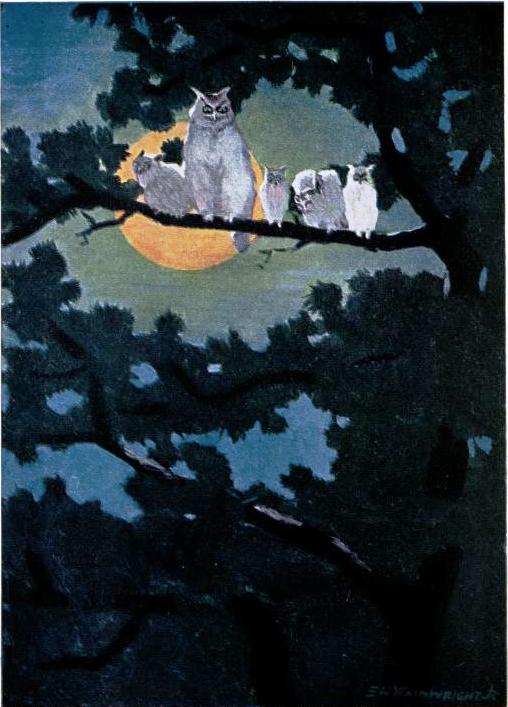
The Wise Mother: ‘Gather ’round young ones, let mother impart her wisdom with a story
View Full Size Image
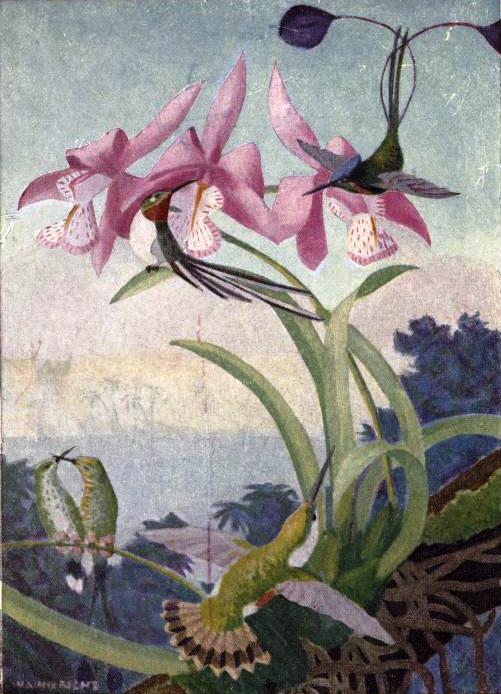
The aesthetic sense of the artistic hummingbird whose nests are wonders of delicacy and beauty
View Full Size Image
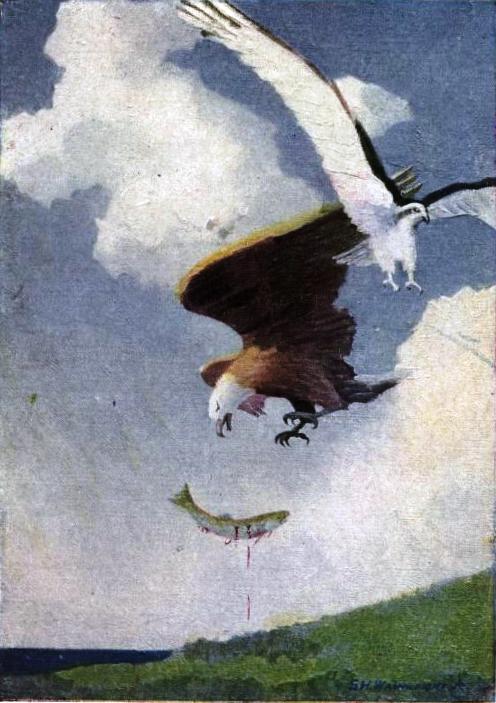
The thieving Osprey rarely fishes for himself preferring to rob others of their work. Human-like?

So today, let’s look at Nature through Dixon’s eyes: awake, appreciative, anew, as a child might. We leave you with a quote to contemplate:

“If I name every bird in my walk, describe its colour and ways, . . . give a lot of facts and details about the bird, it is doubtful if my reader is interested. But if I relate the bird in some way to human life, to my own life; show what it is to me and what it is in the landscape and season, then do I give my reader a live bird and not a labeled specimen.”

 – John Burroughs, American Naturalist and Conservationist

We would like to thank America Museum of Natural History, NY (AMNH) for digitizing this work. Incidentally, the 34 photos in Dixon’s book also come from AMNH. Bravo to the staff there for assisting in the creation and rebirth of this work. We know Dixon would be doubly pleased.

Other work’s by Dixon available on the Biodiversity Heritage Library

The Human Side of Plants (1914)
The Human Side of Trees (1917) 
The Human Side of Animals (1918)

July 19, 2012by [email protected]
BHL News, Blog Reel

Celebrating Linnaeus’ Birthday with iTunes U

View Full Size Image

He has been dubbed “The Father of Modern Taxonomy,” “The Father of Modern Ecology,” Princeps botanicorum (Prince of Botanists), “The Pliny of the North,” and “The Second Adam.” He is credited with creating the classification schema known as binomial nomenclature, and today, he turns 305 years old. Of course, we’re talking about Carl Linnaeus, and we’re celebrating his birthday with the release of our latest iTunes U collection dedicated to him.

Carl Linnaeus was born May 23rd, 1707, in Småland, Sweden. As evidenced by his later publications, his first and primary passion was botany. At an early age, he took an interest in plants, eventually coming under the tutelage of Johan Rothman, the state doctor of Småland. Linnaeus first learned to classify plants under Rothman’s direction, using the system developed by Joseph Pitton de Tournefort, which, though based on artificial similarities between organisms, nevertheless was the first system to make a clear distinction between genus and species.

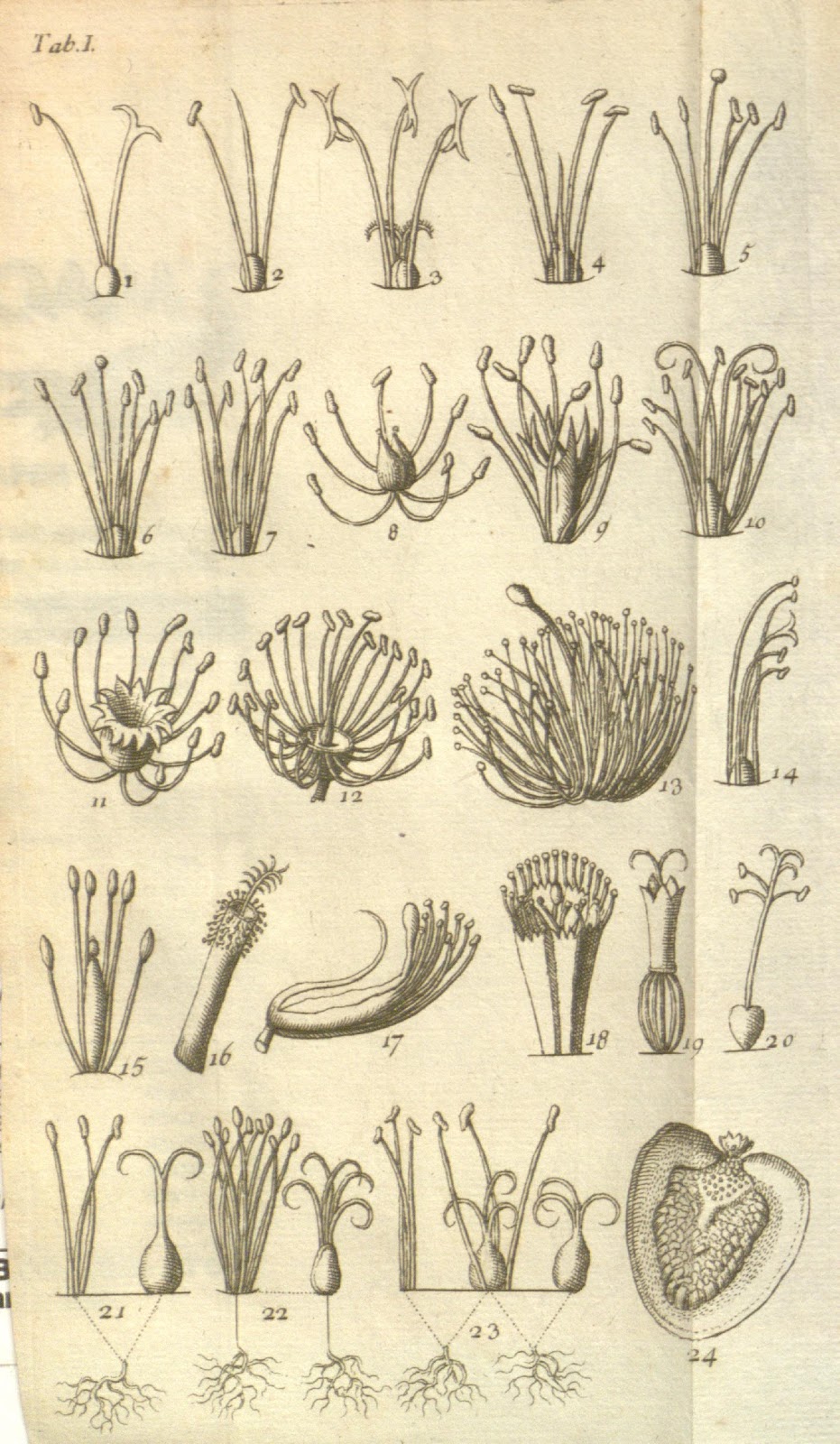
In 1728, Linnaeus enrolled at Uppsala University, where he made quick progress in the field of botany and, by only his second year, was himself giving lectures. During these years, Linnaeus began to question Tournefort’s classification system, and thus decided to develop his own. Linnaeus’ system arranged plants according to the number of stamens and pistils each possessed. This new system formed the basis of his work in the critical publication Genera Plantarum (first edition published 1737). A young German botanical draughtsman named Georg Dionys Ehret crafted a visual representation of this system, which Linnaeus included in Genera Plantarum (though without acknowledgement to Ehret). The image represents the earliest illustration of Linnaeus’ classification system for plants.

View Full Size Image
Ehret’s illustration of Linnaeus’ classification system

Linnaeus continued to revise Genera Plantarum, publishing a total of five editions (fifth edition published 1754). During the years between the publication of the first and fifth editions of this work, Linnaeus also published Species Plantarum (first edition published 1753), which arranged all plants known to him into orders, classes, and genera according to the Genera sexual system. Species Plantarum provided formal, multiple word descriptions in Latin of each species, as well as an additional epithet for easy reference. The combination of the genus and epithet quickly became a popular method by which to refer to a plant species. Species Plantarum is considered the inception of botanical nomenclature, and the use of a consistent naming structure based on the methods presented in Species and Genera was a vital step in the maturation of Linnaeus’ binomial schema.

In 1735, even before the publication of the first edition of Genera Plantarum, Linnaeus published the first edition of Systema Naturae. This first edition outlined Linnaeus’ ideas for the hierarchical arrangement of the natural world, dividing it into the animal, plant, and mineral kingdoms. His classification of the plant kingdom followed the sexual system he presented in Genera. However, it was not until the tenth edition of Systema Naturae that the binomial classification system we so readily associate with Linnaeus came into its own. While Species Plantarum had already established a binomial naming system for plants, the tenth edition of Systema Naturae (published in 1758) organized, for the first time, the animal kingdom according to this system – Kingdom, Class, Order, Genera, and Species. Thus, it represents the beginning of zoological nomenclature and, together with the first edition of Species Plantarum, is considered the starting point of binomial nomenclature.

Today, we highlight Linnaeus’ contributions to science with the release of our newest iTunes U Collection: The Carl Linnaeus Collection. The collection features 13 of Linnaeus’ publications (including the first edition of Species Plantarum, the tenth edition of Systema Naturae, and the fifth edition of Genera Plantarum), as well as two additional items about Carl Linnaeus and his sexual classification system (Carolvs Linnaevs by Edward Lee Greene and New illustration of the sexual system of Carolus von Linnaeus by Robert John Thonrton). You can download all of these titles directly onto your iPad, iPhone, or iPod Touch for free through iTunes. And, of course, you can download them directly to your computer through the BHL interface.

So Happy Birthday, Carl Linnaeus! Our present to you: Your very own iTunes U collection!

May 23, 2012by ulib-libraryjobs
BHL News, Blog Reel

Celebrating the Life and Contributions of Charles Davies Sherborn

View Full Size Image
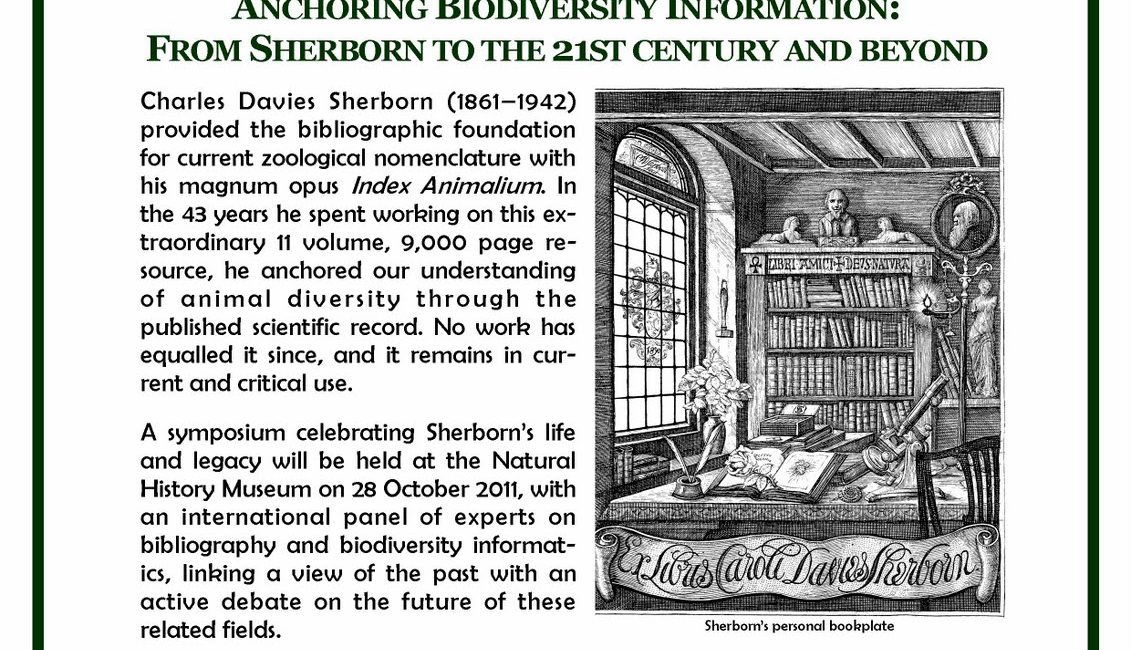
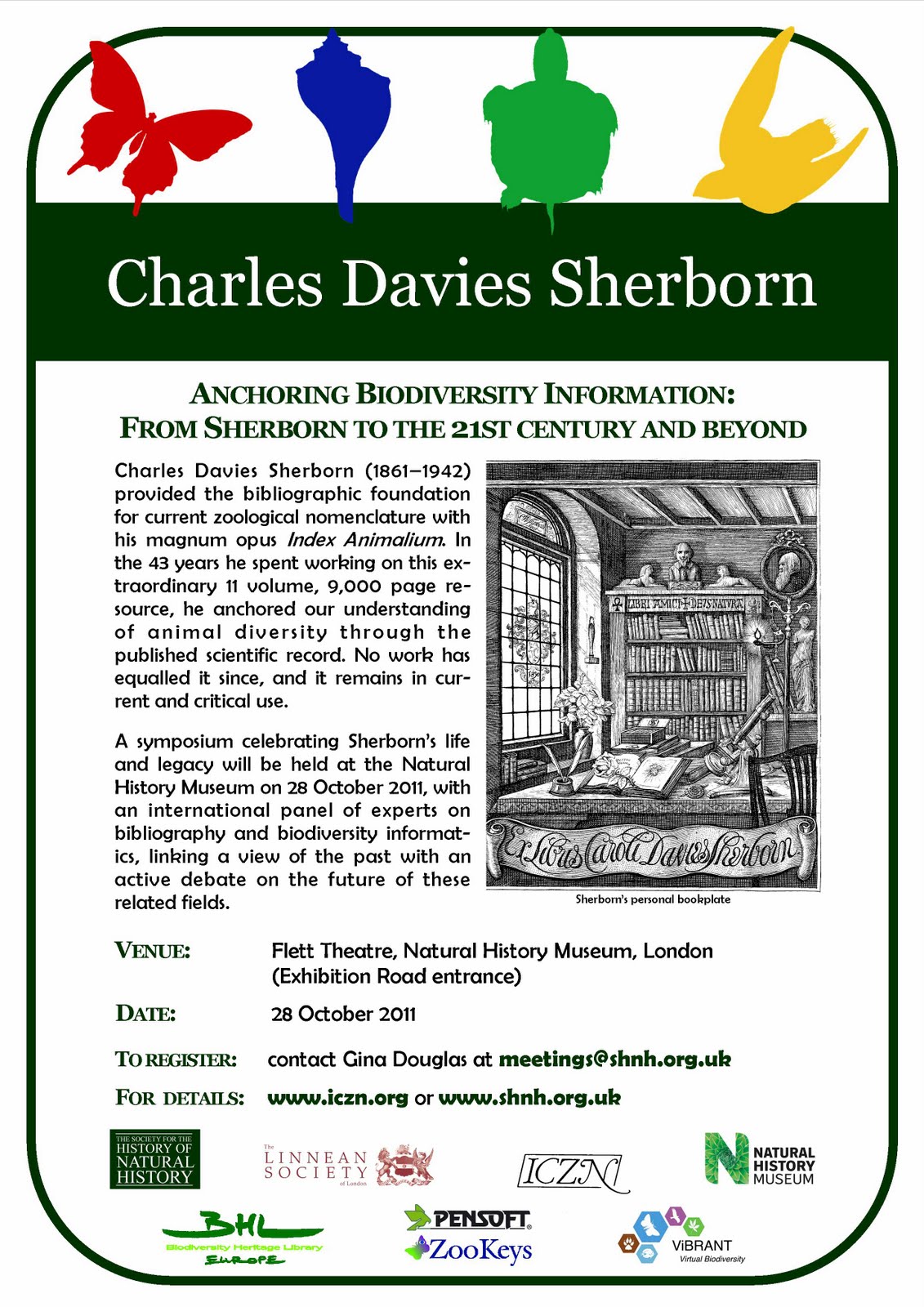
On October 28, 2011, the ICZN (International Commission on Zoological Nomenclature), in collaboration with the Society for the History of Natural History and others, hosted a symposium at the Natural History Museum, London, “Anchoring Biodiversity Information: From Sherborn to the 21st century and beyond,” honoring the 150th anniversary of the birth of Charles Davies Sherborn. Sherborn, 1861-1942, played a critical role in the biodiversity world by being the first to successfully index every living or extinct animal discovered and documented between 1758 and 1850. His greatest work, Index Animalium, took over 43 years to complete but is still referred to by taxonomist around the world. The one-day event, held at the Flett Theatre at the Natural History Museum, London, celebrated the incredible achievements of Sherborn and the ramifications for taxonomic research yesterday, today, and tomorrow.

Several BHL-affiliated staff members presented at the symposium, including BHL Technical Director Chris Freeland and Smithsonian Institution Libraries’ (SIL) staff member and BHL metadata guru Suzanne Pilsk. SIL staff members Grace Costantino (Digital Collections Librarian for BHL) and Leslie Overstreet (Curator of the Joseph F. Cullman 3rd Library at SIL, from which many BHL rare books have been scanned) also presented a poster at the event.

Approaches to preserving digitized taxonomic data

View more presentations from Chris Freeland

Chris Freeland’s presentation (pictured above) at the symposium, entitled “Approaches to preserving digitized taxonomic data: prints, manuscripts, specimens,” addressed methodologies for responsible curation of digitized prints, manuscripts, and specimens, and outlined best practices for safeguarding digitized taxonomic data to ensure longevity of resources. Such discussions are timely, as the availability of digitized taxonomic data has increased dramatically over the past twenty years as a result of increased support from national funding agencies and the declining cost of scanning devices. As such, natural history museums and libraries have taken on new responsibilities for managing electronic information as ways of providing enhanced opportunities for educational outreach and scholarly dissemination. Museums and libraries have to consider how best to create and care for electronic resources given a volatile technology landscape with rapidly changing file formats and display devices.

Unlocking indexanimaliumstatic

View more presentations from SCPilsk

SIL’s Suzanne Pilsk explained the role Smithsonian Libraries has played in bringing the critical work Index Animalium out of the library and off the page with a talk titled “Unlocking the Index Animalium: From paper slips to bytes and bits” (pictured above). Pilsk represented the work done to date by SIL staff, interns and volunteers to create an online version of the work. Smithsonian Libraries’ goal was to provide better access to the Index than was previously available and connect the researcher to the level of information needed. Over the span of years, staff has evolved the project from the initial vision of discovering where the text was located within the library walls, to linking to the scanned text via BHL.

View Full Size Image

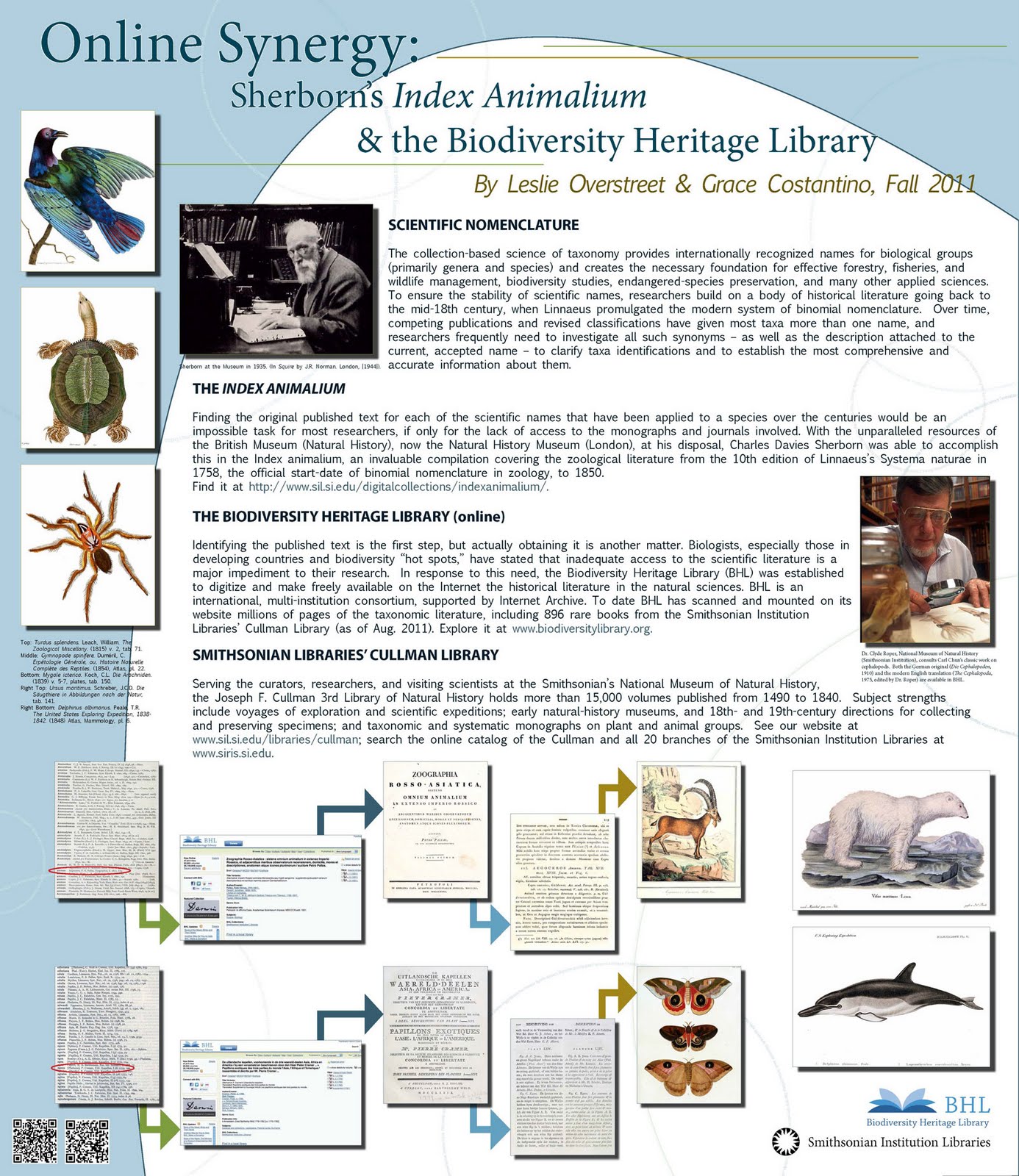
Finally, the poster presented by Grace Costantino and Leslie Overstreet, entitled “Online Synergy: Sherborn’s Index Animalium and the Biodiversity Heritage Library,” delved into the link between SIL’s online version of Index Animalium and the digitized volumes within BHL. SIL’s online version of the Index Animalium allows researchers to search the entire multi-volume work by name, epithet, or other keyword. With the citation thus provided, researchers can then access the cited text itself on BHL, finding not only the species citation but, in many cases, remarkable illustrations as well.

The talks and posters from the symposium can be viewed here, and to find out more about the incredible life of Charles Davies Sherborn, take a look at the feature on him and the symposium in The Telegraph. You can also view photos from the event on Flickr.

December 22, 2011by michelle.underhill
Page 5 of 5« First...«2345

Help Support BHL

BHL's existence depends on the financial support of its patrons. Help us keep this free resource alive!

search

About BHL

The Biodiversity Heritage Library (BHL) is the world’s largest open access digital library for biodiversity literature and archives. BHL operates as a worldwide consortium of natural history, botanical, research, and national libraries working together to digitize the natural history literature held in their collections and make it freely available for open access as part of a global “biodiversity community.”

Join Our Mailing List

Sign up to receive the latest news, content highlights, and promotions.

Subscribe Now

Subscribe to Blog via Email

Enter your email address to subscribe to this blog and receive notifications of new posts by email.

Join 319 other subscribers

Subscribe to Blog Via RSS

Subscribe to the blog RSS feed to stay up-to-date on all the latest BHL posts.

Access RSS Feed

Inspiring Discovery through Free Access to Biodiversity Knowledge.

The Biodiversity Heritage Library makes it easier than ever for you to access the information you need to study and explore life on Earth…for free, anytime, anywhere.


ABOUT | HARMFUL CONTENT | PRIVACY | SITE MAP | TERMS OF USE