Biodiversity Heritage Library - Program news and collection highlights from BHL
  • Home
  • News
  • Featured Books
    • All Featured Books
    • Book of the Month Series
    • BHL at 20
  • User Stories
  • Campaigns
    • Fossil Stories
    • Garden Stories
    • Monsters Are Real
    • Page Frights
    • Her Natural History
    • Earth Optimism 2020
  • Tech Blog
  • Visit BHL
Home
News
Featured Books
    All Featured Books
    Book of the Month Series
    BHL at 20
User Stories
Campaigns
    Fossil Stories
    Garden Stories
    Monsters Are Real
    Page Frights
    Her Natural History
    Earth Optimism 2020
Tech Blog
Visit BHL
  • Home
  • News
  • Featured Books
    • All Featured Books
    • Book of the Month Series
    • BHL at 20
  • User Stories
  • Campaigns
    • Fossil Stories
    • Garden Stories
    • Monsters Are Real
    • Page Frights
    • Her Natural History
    • Earth Optimism 2020
  • Tech Blog
  • Visit BHL
Biodiversity Heritage Library - Program news and collection highlights from BHL
BHL News, Blog Reel

Commemorating 20 Years of BHL at the 2026 Annual Meeting

A group of 26 people posing for a group photo on the steps of a building in front of a green double door. The BHL at 20 logo is in the foreground.

The Biodiversity Heritage Library continued our 20th anniversary celebration at our Annual Meeting in London from 27 April to 1 May. This year, founding members and 10th anniversary co-hosts, the Natural History Museum, London and the Royal Botanic Gardens, Kew, welcomed 46 representatives from 30 institutions across 8 countries to gather and plan for BHL’s future.
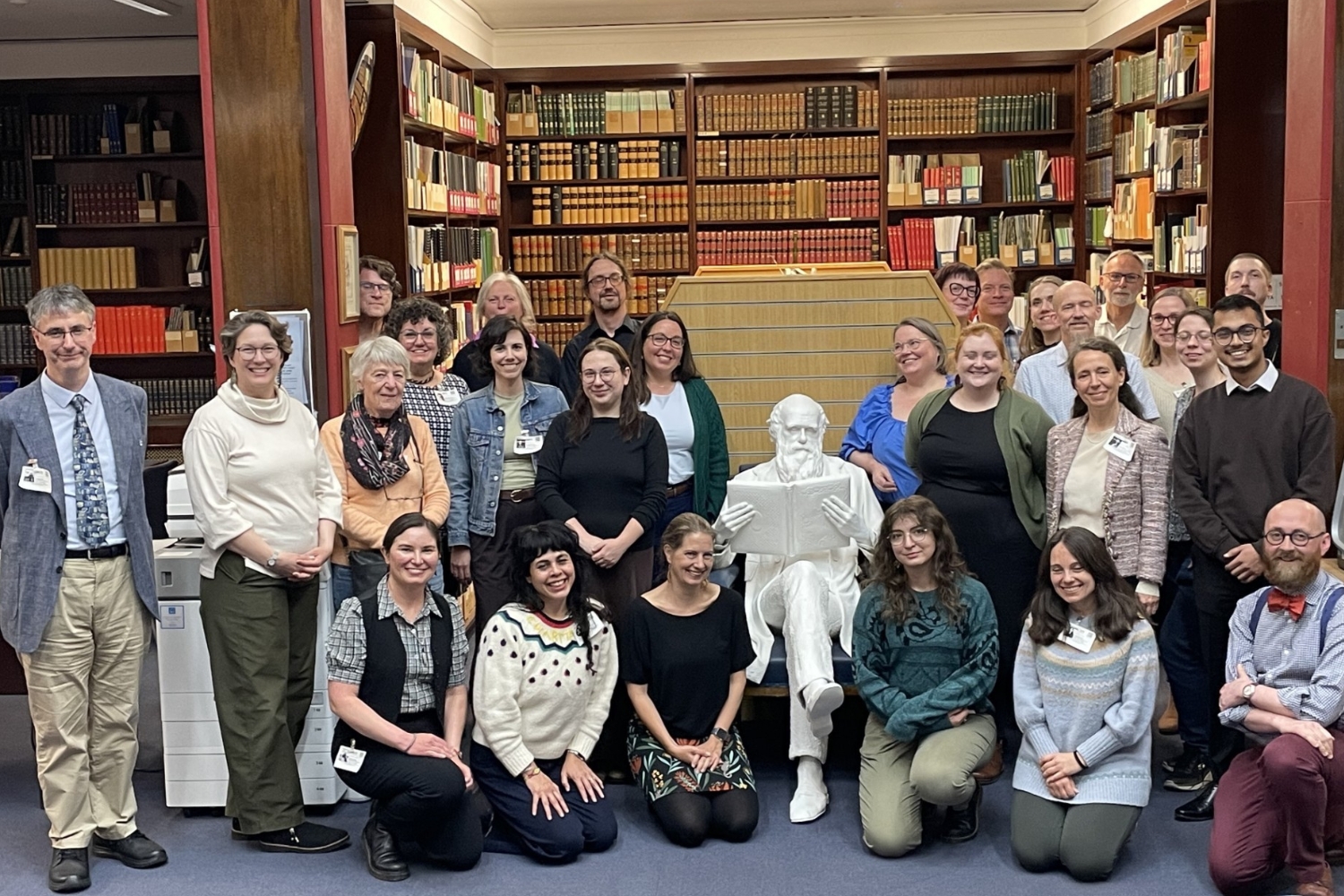
A group of 28 people posing for a group photo in a library around a life-sized white statue of Charles Darwin sitting with his legs crossed reading a book.

The attendees of the 2026 BHL Annual Meeting in the library of the Natural History Museum, London, with Charles Darwin. Photo credit: Victoria Devonport, NHM London

Though we took time to reflect on the successful collaborations of the past 20 years of BHL, this meeting was truly a time for looking forward. For me personally, this was my sixth BHL annual meeting and the most personally energizing. I started with BHL in March 2020 as BHL’s Program Manager. My first task was to help pivot the planned annual meeting in Paris to be fully virtual due to the COVID-19 pandemic. Every annual meeting since has presented its own unique opportunities and challenges; none more challenging than the 2025 annual meeting in which BHL was asked to develop an urgent transition plan to separate from the Smithsonian Institution in less than 9 months. In stark contrast, by April 2026, BHL is now operating under its new home at the Council on Library and Information Resources (CLIR) and moving its technical infrastructure to the Field Museum. We have retained our existing staff and expanded our consortium with new Members. For me, nothing is more revitalizing than gathering with the dedicated and enthusiastic contributors and supporters of BHL.

Strategic Planning

The major focus of the 2026 annual meeting was strategic planning. The BHL Executive Committee (EC) has been leading the global consortium through a strategic planning process in early 2026 to establish new goals for 2026 through 2030, as well as targeted 2 year operational plans to achieve those goals. With the transition to our new fiscal home under CLIR and the migration of our technical hosting to the Field Museum, 2026 is a year of great change for how BHL manages its daily operations.
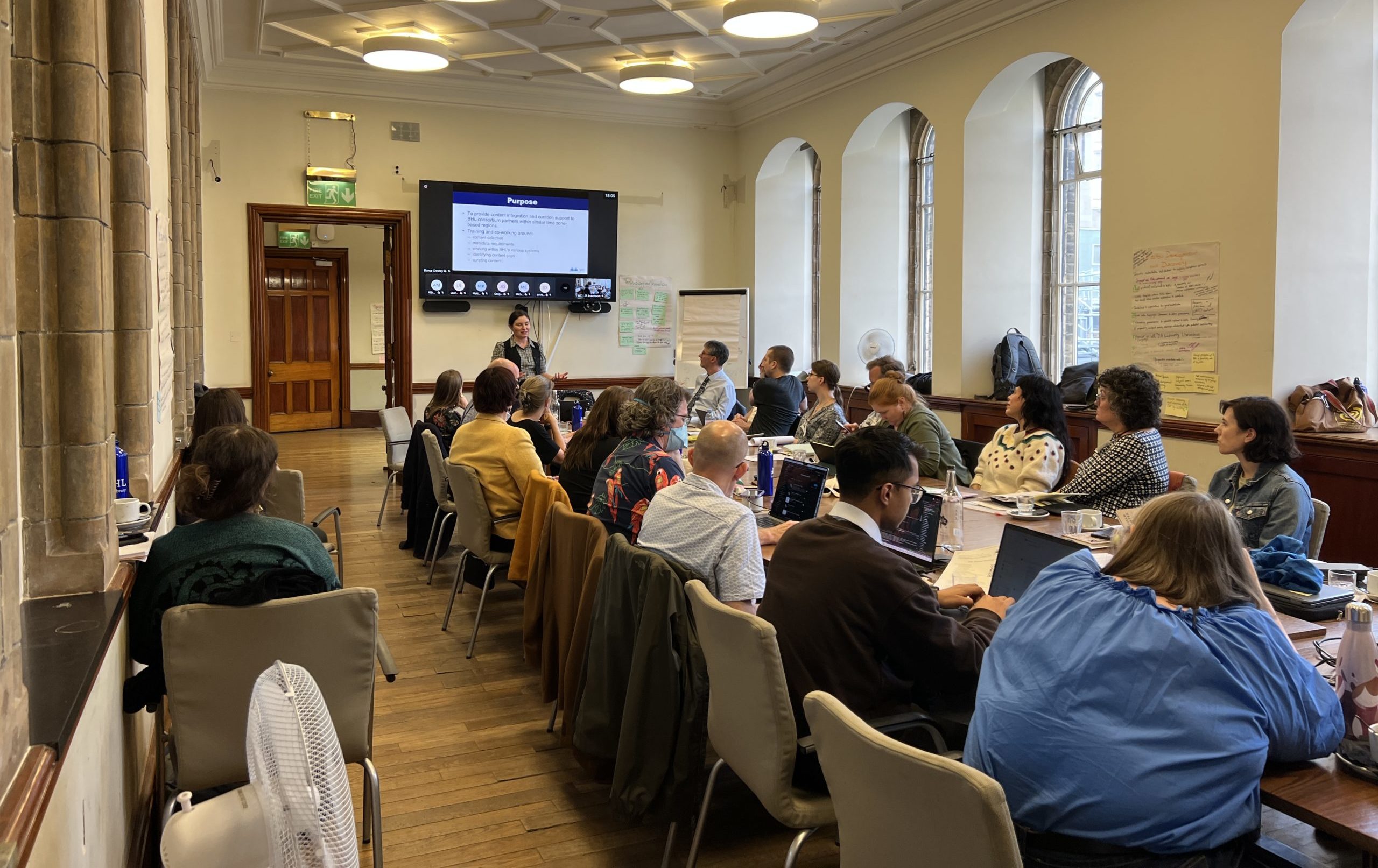
A group of people sitting at a long table watching a person give a presentation in front of a big screen.

Bianca Crowley, Digital Collections Manager, presents a new concept for regional coordination hubs. Photo credit: Colleen Funkhouser

During the business meetings throughout the week, the consortium reviewed how our committees and working groups operate, explored options for better regional support and collaboration, and identified gaps to address in our governance and committee roles. We also welcomed representatives from our newest Members (University of South Florida Libraries, Vanderbilt University Heard Libraries, and Senckenberg Gesellschaft für Naturforschung), bringing fresh perspectives, regional expertise, and new ideas to our collaborative consortium.

We also focused on long-term funding strategies for supporting BHL beyond 2027. Though the Call for Support in 2025 garnered many opportunities for financial, technical, and administrative support, which stabilized BHL’s operations during a critical period of change, the long term funding model for BHL is still a work in progress and a major focus of the year ahead.

As the consortium works to finalize its revised vision, mission, and strategic goals, we’ll be reporting out to the community throughout the year.

Stakeholder Listening Session

On Wednesday 29 April, BHL held a strategic stakeholder session to gather key collaborators from across the biodiversity informatics landscape. BHL’s EC, Secretariat, and Technical Team were on hand to hear our stakeholders’ priorities for technical development, desires for content enhancement, and opportunities for greater collaboration or technical integration. Though BHL engages at various levels with these stakeholders, including GBIF, CETAF, BioStor, Global Names Architecture, Plazi, NHM, and Kew, this collective stakeholder meeting was a first for the BHL Annual Meeting.

BHL Day 2026: Towards a Biodiversity Data Ecosystem Built on BHL Data

Following the stakeholder session, we welcomed more than 120 attendees (online and in person) to the BHL Day 2026 public symposium hosted in the Flett Theatre at NHM. This year’s focus was on the importance of BHL data in building the biodiversity data ecosystem. We heard from colleagues and researchers across the globe on how they have utilized BHL data over the past 20 years to advance their research, and how future developments can improve and expand BHL’s data integration.
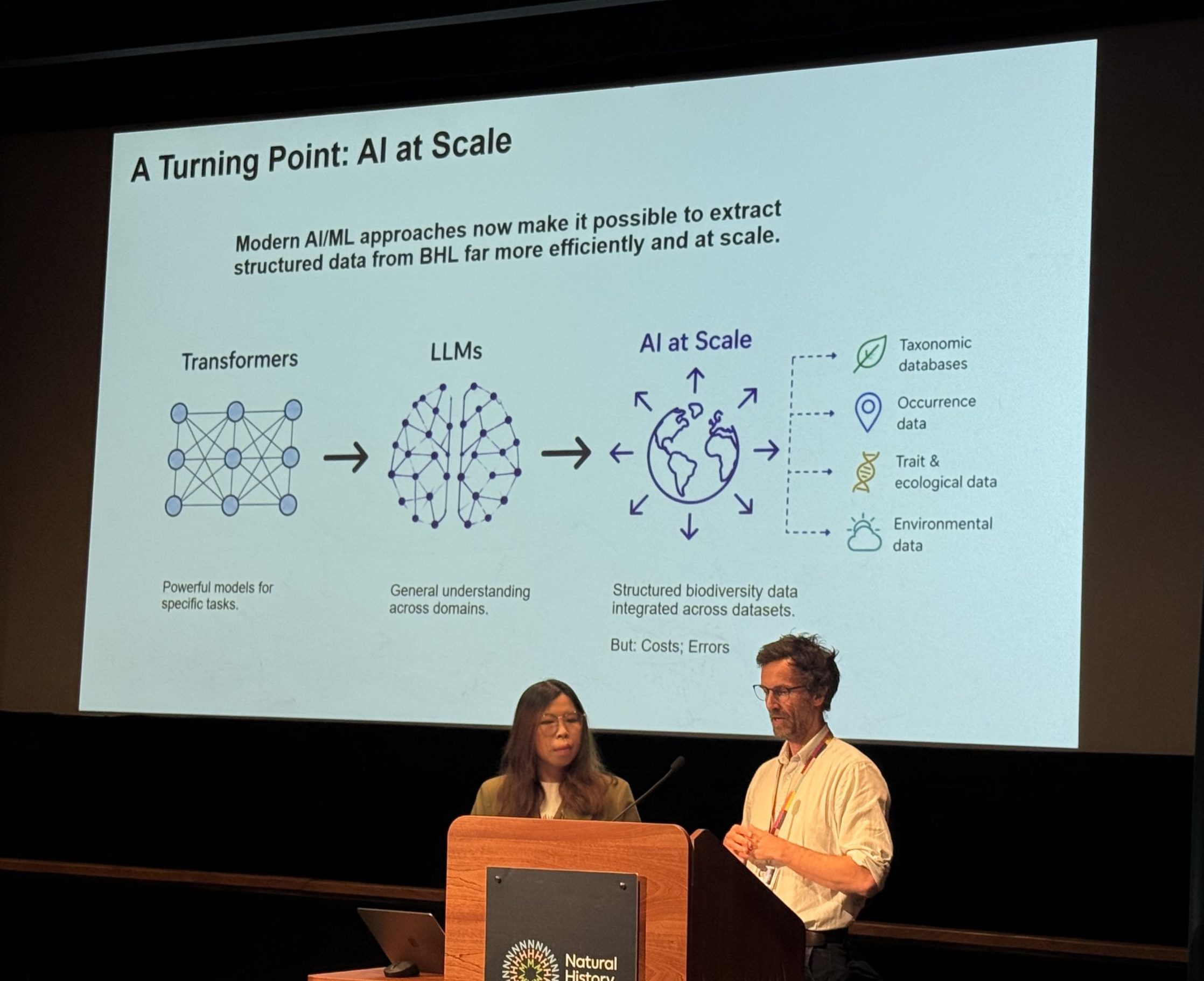
Two people standing behind a lectern on a stage in front of a large screen.

Qianqian Hiris Gu and Ben Hartley from NHM London share the possibilities of using modern AI and Large Language Models to extract data from BHL at scale. Photo credit: Nicole Kearney

Thanks to the collaborative nature of this BHL community, two speakers, Siobhan Leachman from Wikimedia Aotearoa New Zealand and Liz Smith from Cambridge University Library and Archives, brought their unique knowledge and skillsets together to solve an outstanding challenge in sharing data from the Darwin Correspondence Project. Siobhan shared more about this on-the-spot collaboration on the newly launched BHL Community Forum.

For a complete listing of BHL Day presentations and recordings, visit https://bit.ly/bhlday2026

Exploring the rich collections around London, Richmond, and Cambridge

It wouldn’t be a BHL annual meeting without visits to the rich library, archive, museum, and botanical collections around our host cities. Our Chair and Vice-Chair organized behind the scenes visits with some of the outstanding scientific collections in London, Richmond, and Cambridge. We started Monday afternoon at the Royal Society and the Linnean Society of London, exploring their deep histories and unique collections.
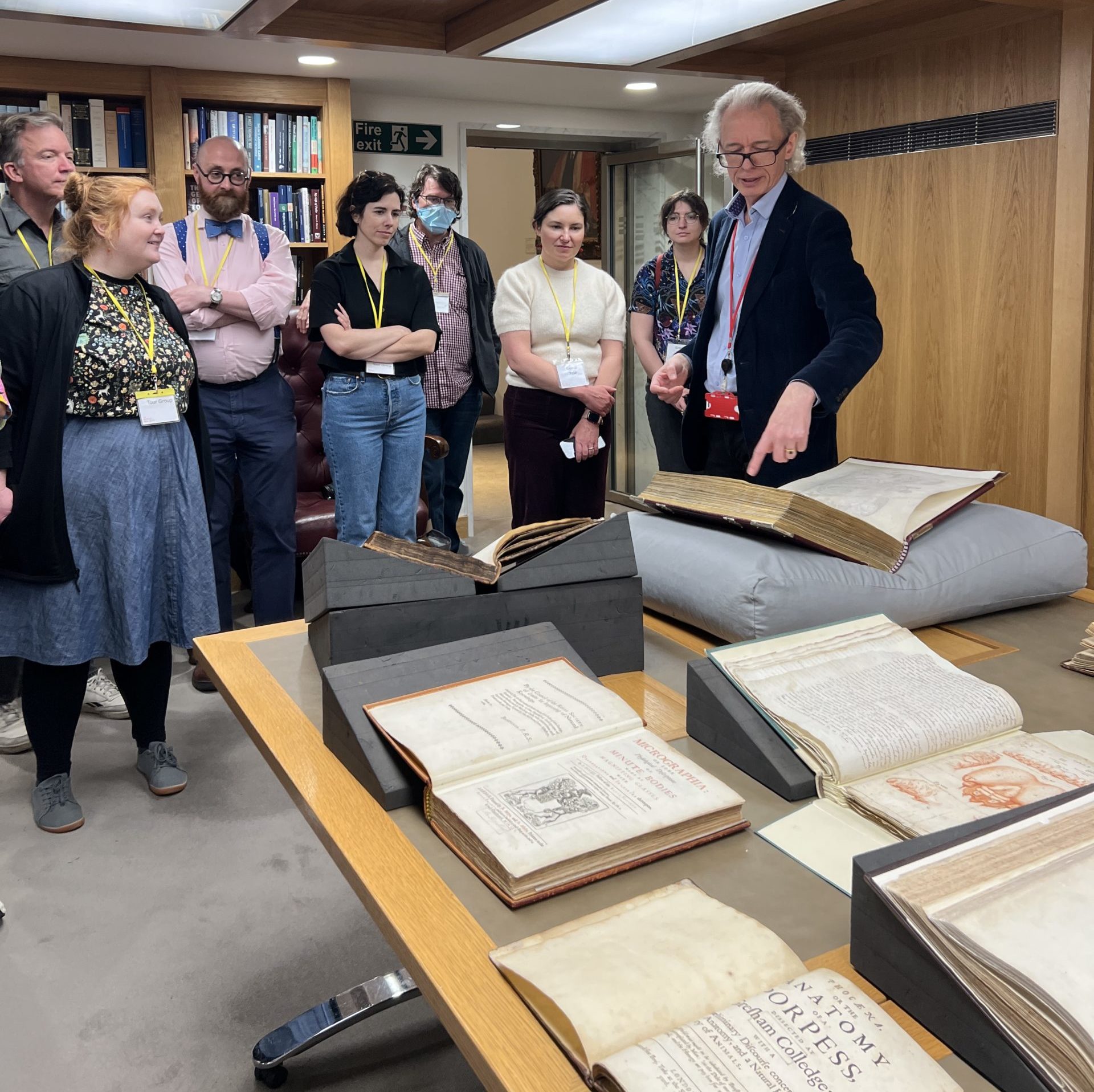
A group of people standing around a table with books on it. A man is pointing to one of the books.

Keith Moore, Head of Library and Information Services for the Royal Society, reads from the Society’s Charter Book containing the signatures of Society fellows dating back to 9 January 1665. Photo credit: Colleen Funkhouser

At the Linnean Society, attendees visited several exhibitions in the Library’s reading room, including Homo sapiens: Classifying the Human Animal and the portrait exhibition Celebrating the Linnean Society’s First Women Fellows, as well as rare materials selected on the topic of biodiversity.
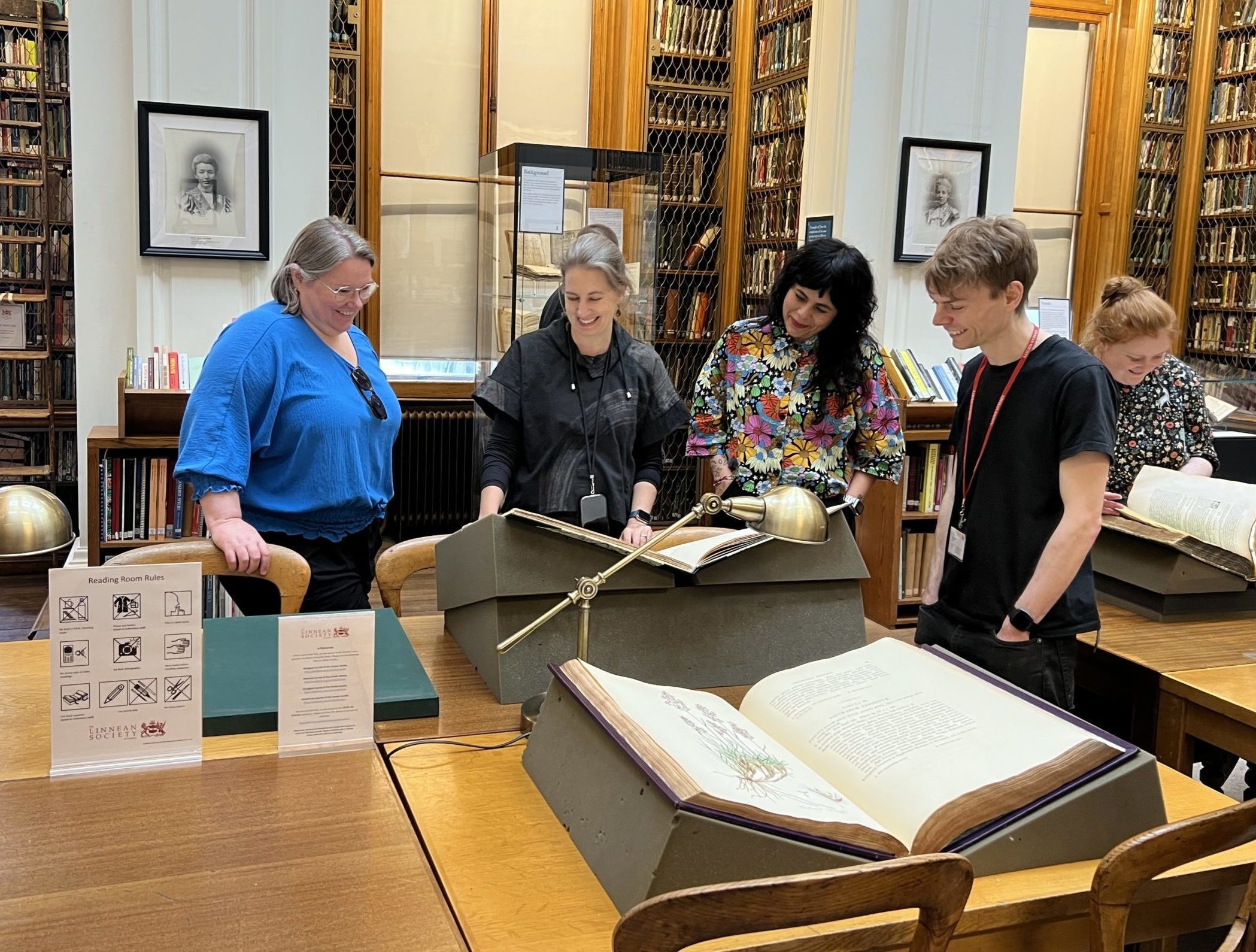
A group of smiling people looking at a large book open on a book stand on a table in a library.

Will Beharrell, Librarian, Linnean Society Library, shares unique items selected for viewing by meeting attendees. Photo credit: Colleen Funkhouser
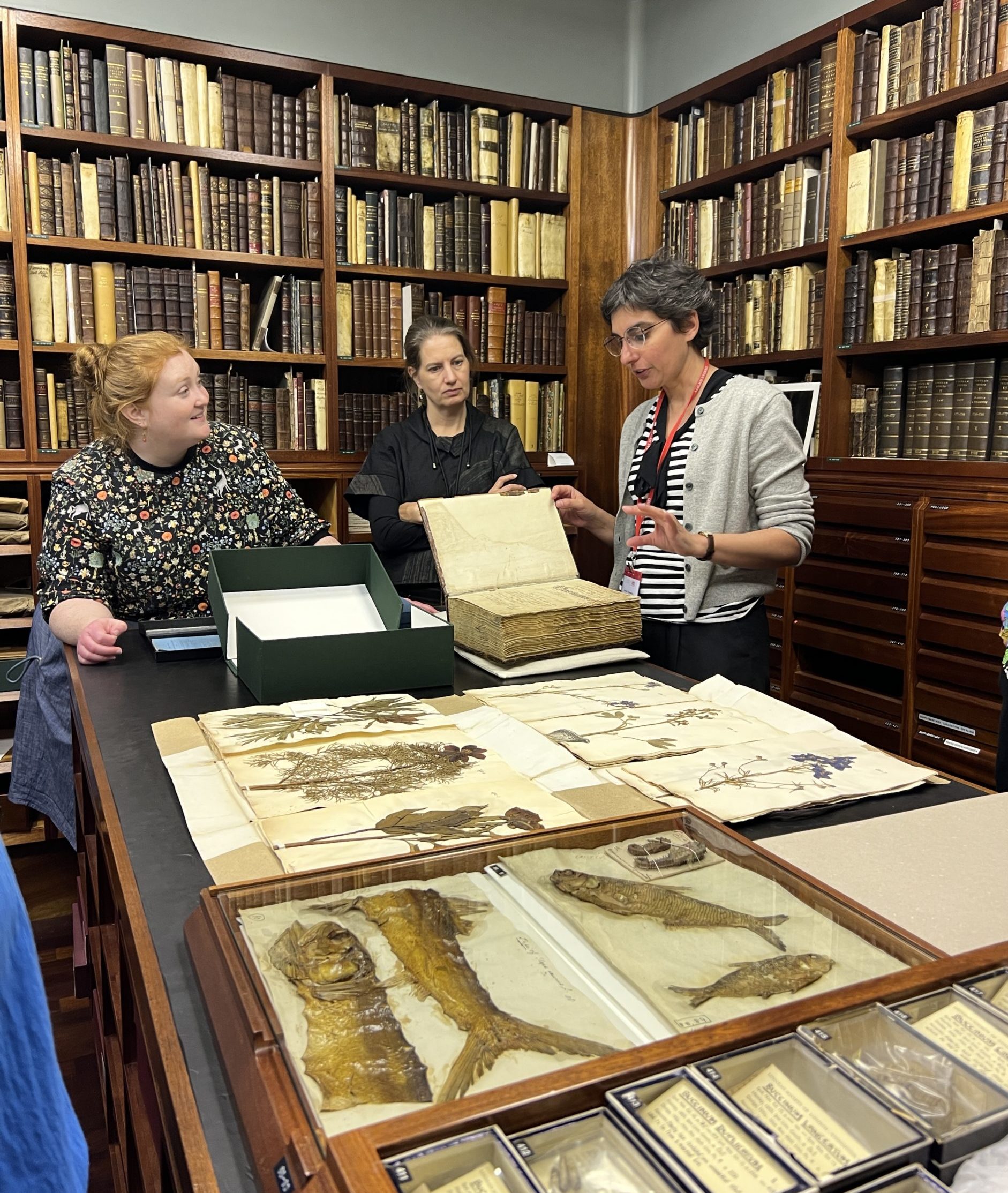
A group of people standing around a table covered in specimens and rare books in an archival storage room.

Dr. Isabelle Charmantier, Head of Collections, shares items from the Linnaeus Collections. Photo credit: Colleen Funkhouser

On Wednesday, meeting attendees received several behind-the-scenes tours of NHM, including the Historical Collections Room (pre-Linnean specimens), the Tank Room, and of course the Library and Archives.

On Thursday, Kew staff provided access to unique treasures from the Library and Archives collections. This included the oldest printed book held by the Library: the Ortus Sanitatis, a 15th century herbal printed in Germany in 1485.
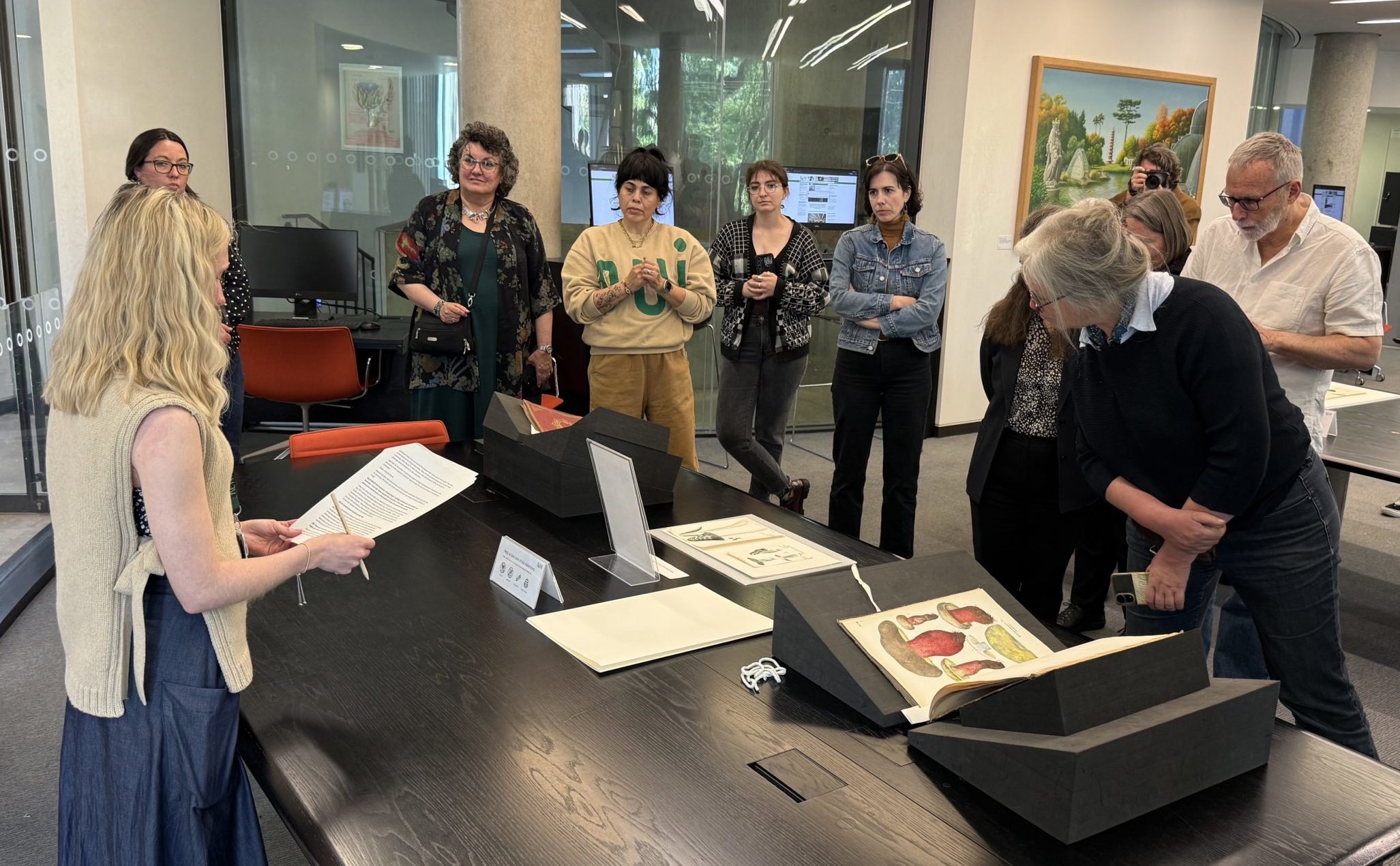
A group of people standing around a table covered in books in a library.

Meeting attendees view rare materials from Kew’s Library and Archives collections with Irene Szmelter, Library Graduate Trainee. Photo credit: Nicole Kearney
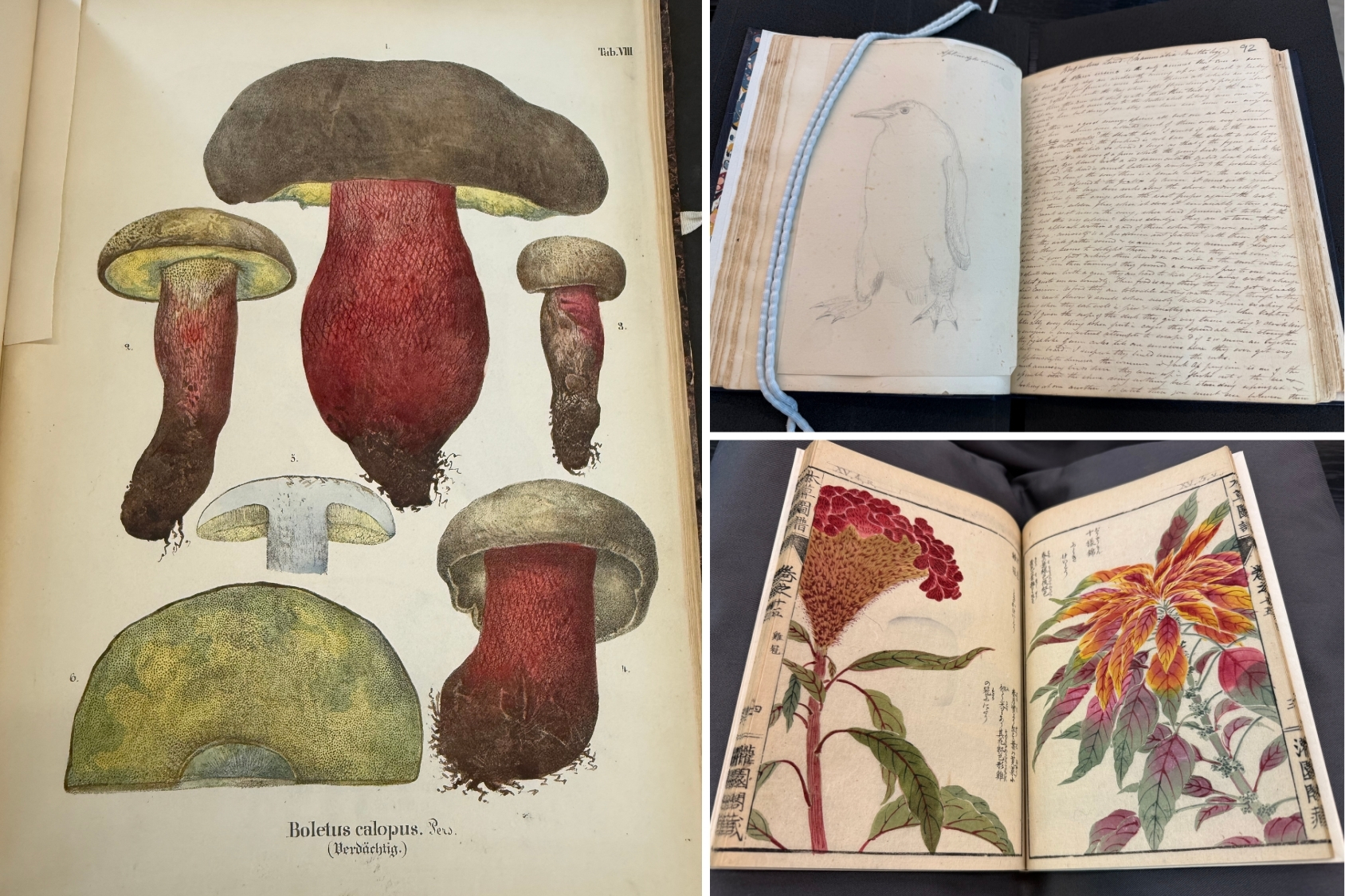
Three pages showing historic illustrations: 1) red and brown mushrooms, 2) a sketch of a penguin alongside handwritten notes, 3) red, orange and green flowers and foliage.

A selection of materials from the Kew Library and Archives collection. Photo credits: Nicole Kearney

On Friday, Vice-Chair Rich Wragg coordinated a day-long tour of institutions in Cambridge, including the Museum of Zoology, St. John’s College, the historic Wren Library at Trinity College, and the Cambridge University Library.
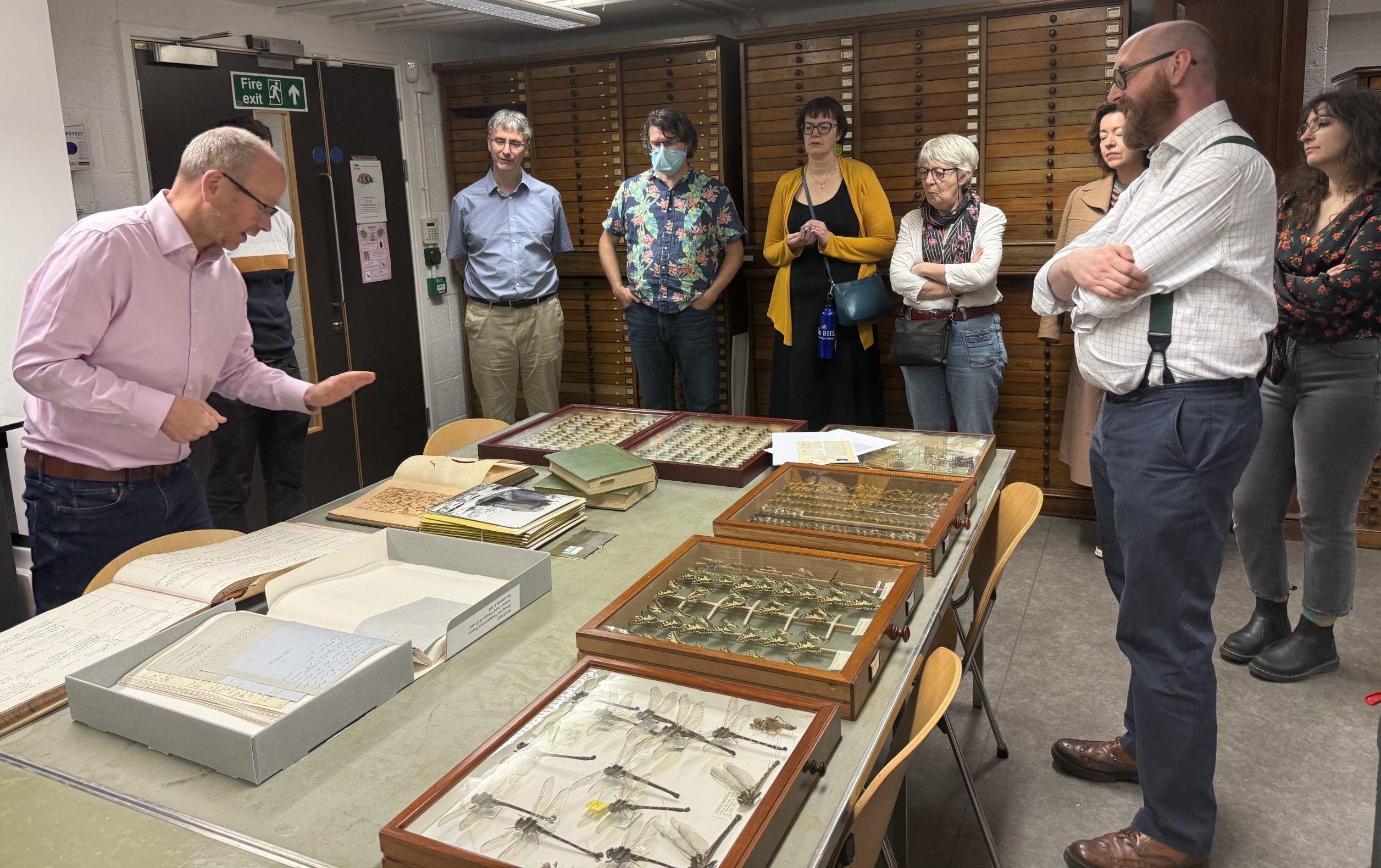
A group of people standing around a table covered in insect specimens, books, and archival material.

Russell Stebbings sharing the fascinating history of the invertebrate collections at Museum of Zoology Cambridge. Photo credit: Nicole Kearney
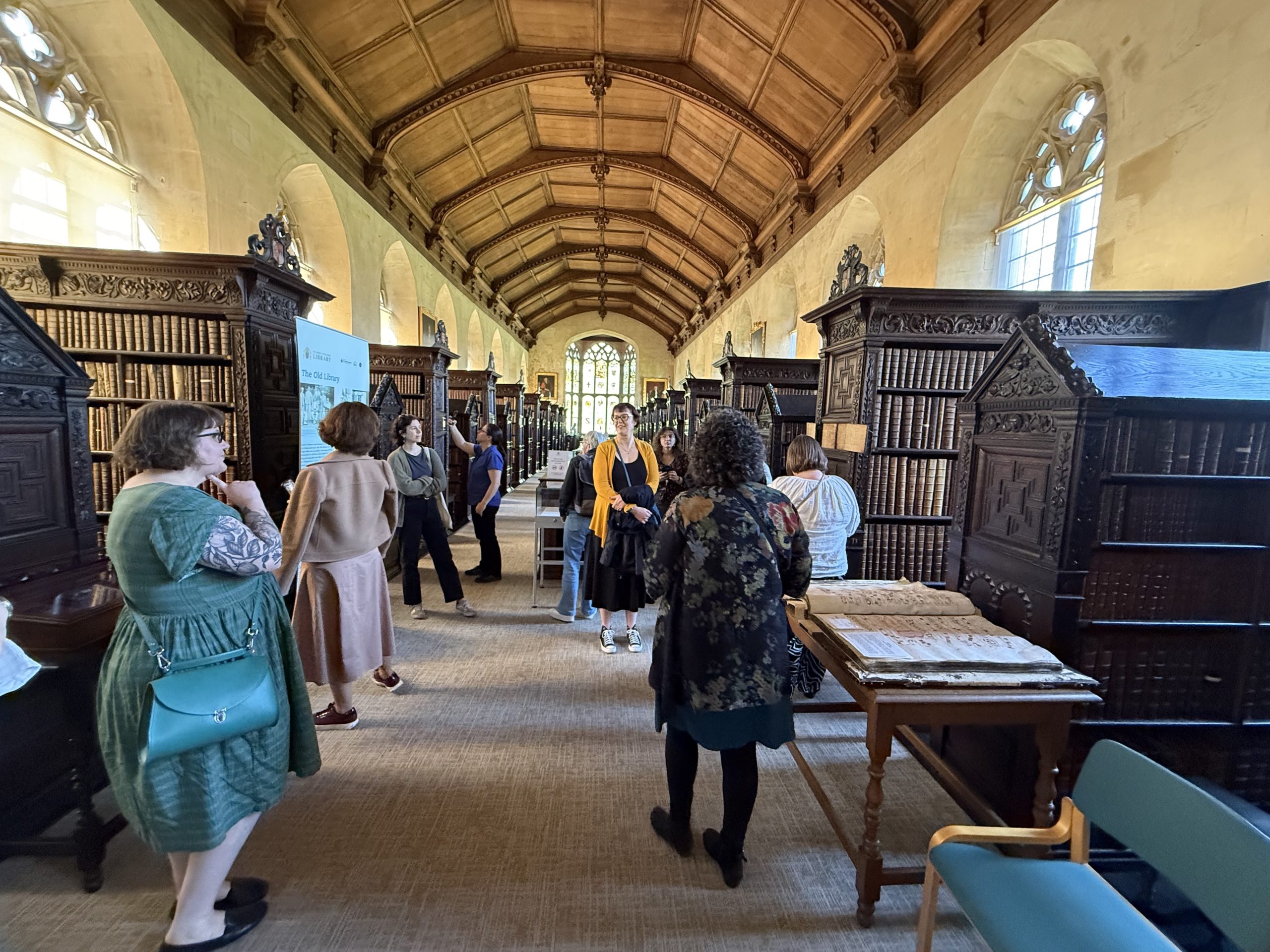
A group of people perusing books and bookshelves in an historic library.

Librarian Tanya Kirk taking BHL Members through The Old Library of St John’s College at Cambridge University. Photo credit: Nicole Kearney
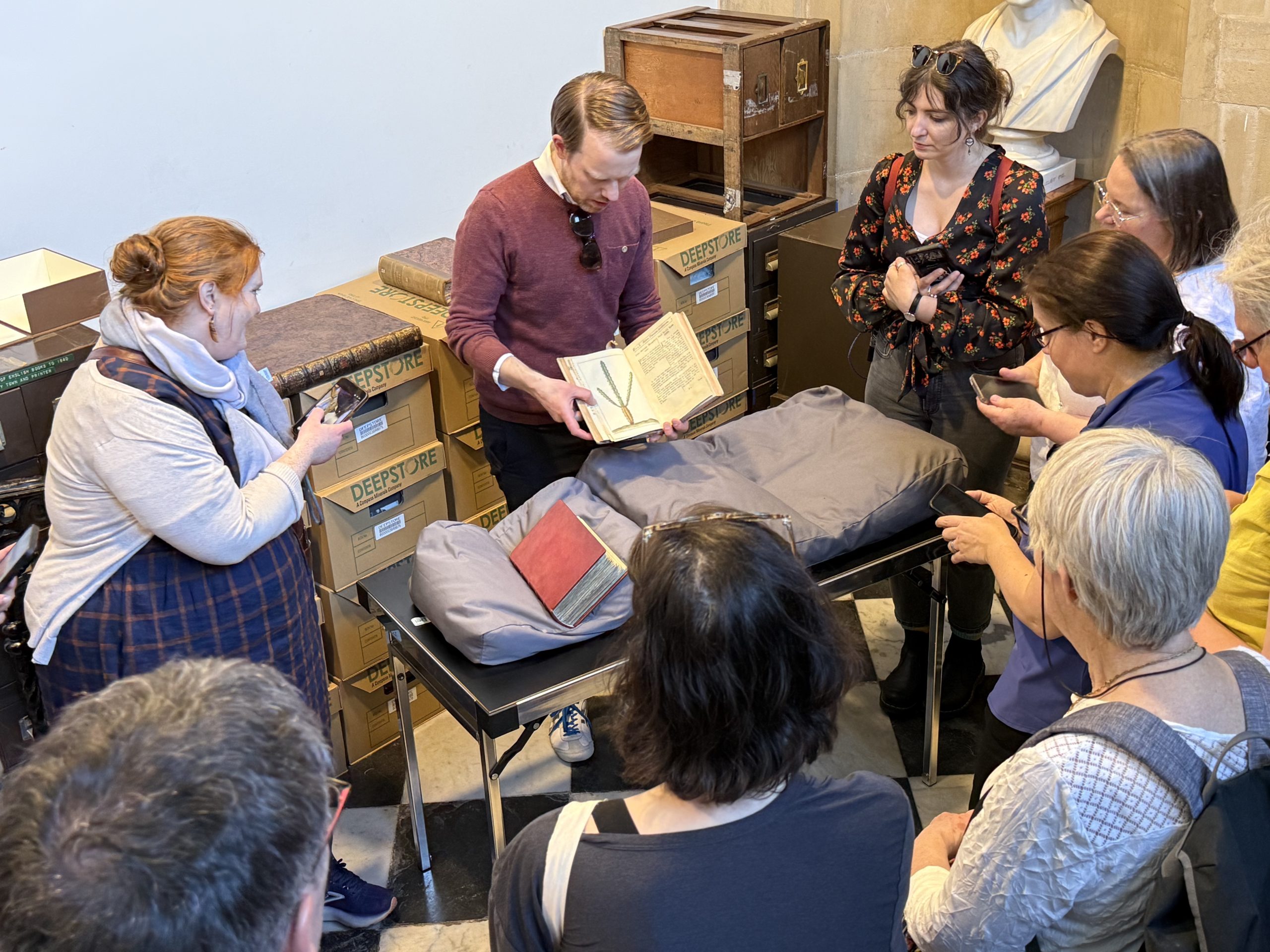
A group of people standing around a table looking at a man holding an open book.

Steven Archer, Sub-Librarian of Trinity College Cambridge, showing BHL Members treasures from Trinity’s Wren Library. Photo credit: Nicole Kearney
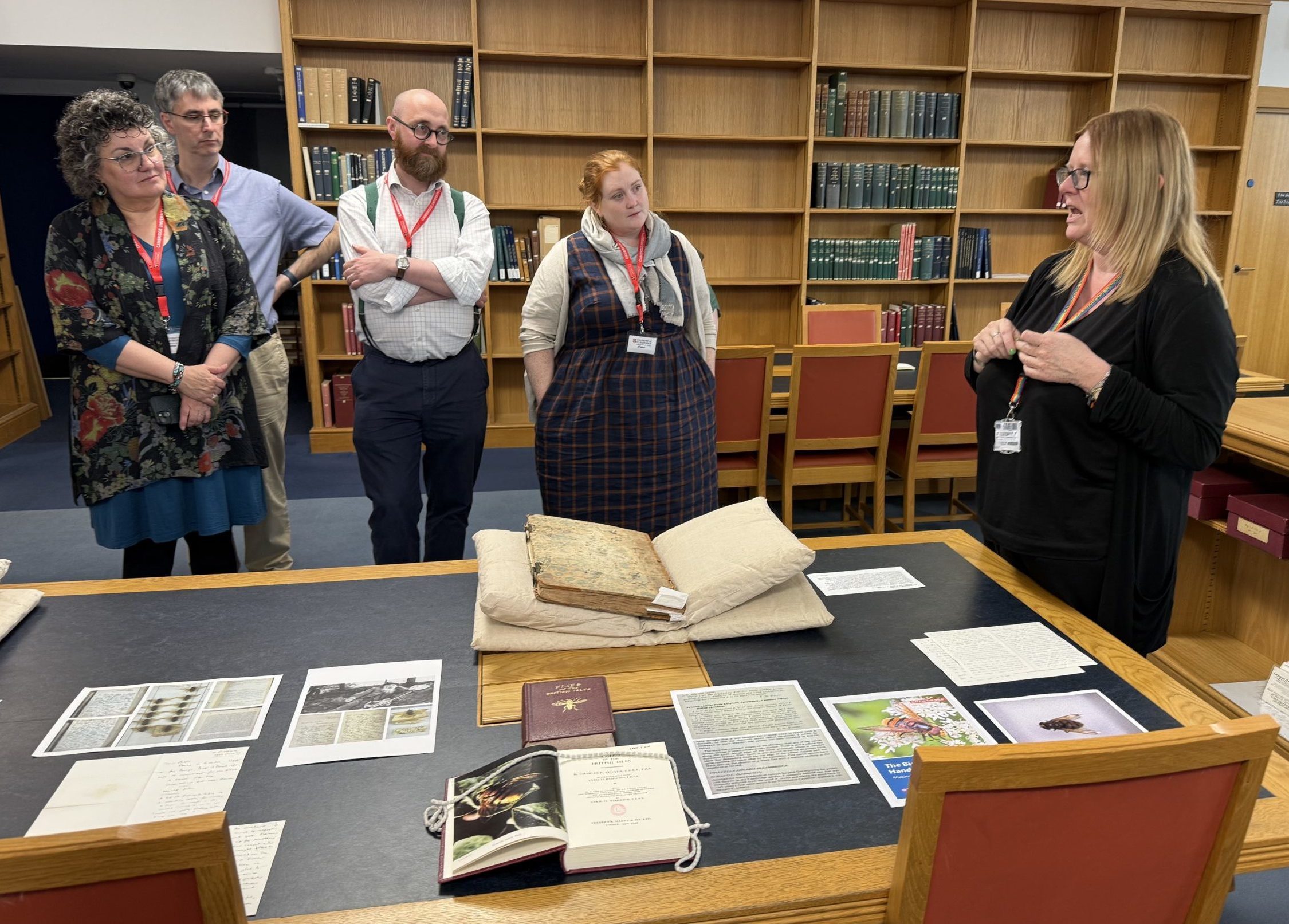
A group of people standing around a table covered in books and brochures in a library.

Jill Whitelock, Head of Special Collections, showcasing special items from the Cambridge University Library. Photo credit: Nicole Kearney
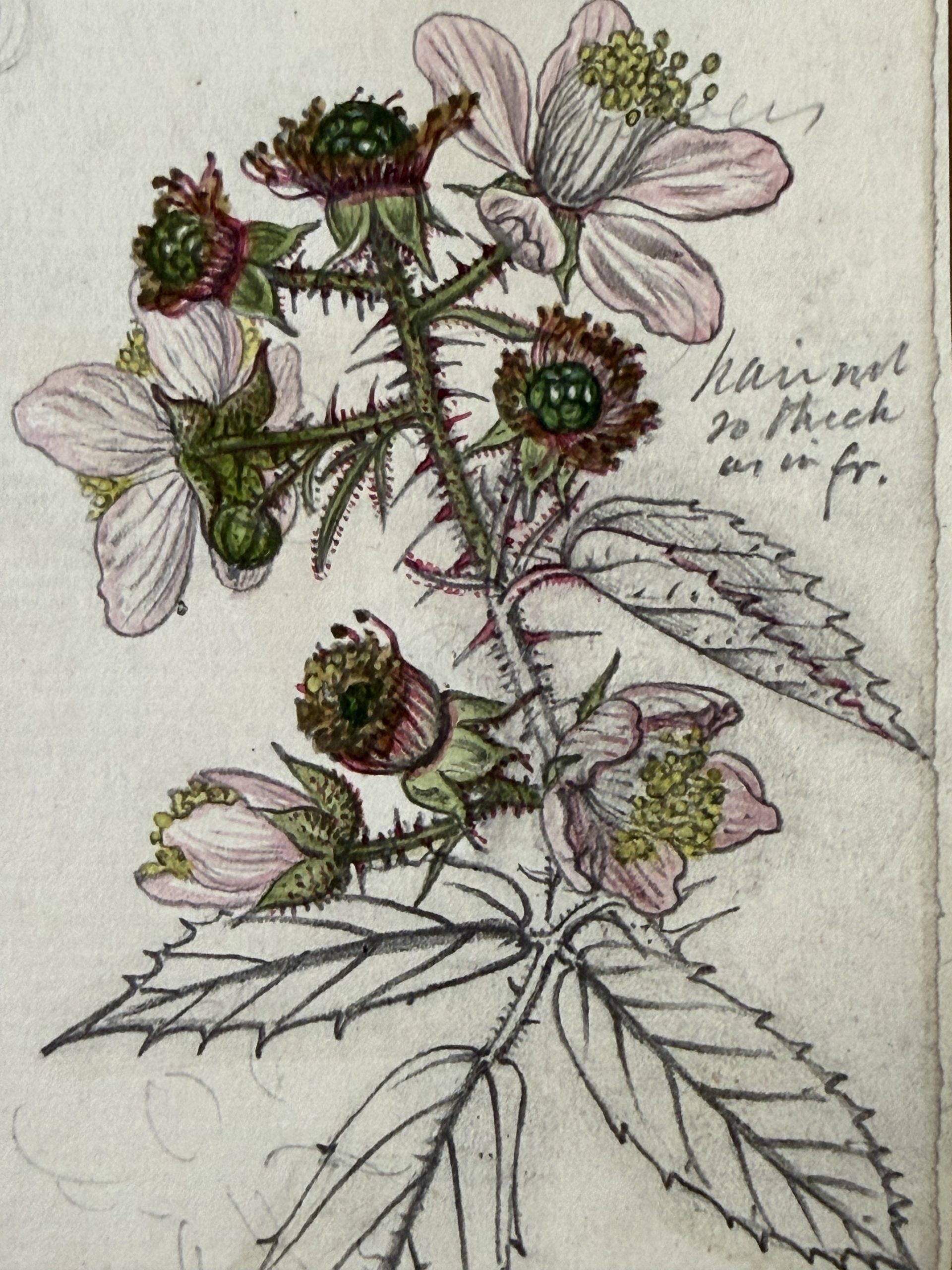
An historic color illustration of a blackberry plant.

Draft plates from British botanist Charles Cardale Babington’s “The British Rubi: an attempt to discriminate the species of Rubus known to inhabit the British Isles, from the Cambridge University Library. Photo credit: Nicole Kearney

Happy Anniversary, BHL

Meeting attendees, strategic stakeholders, and BHL Day speakers gathered after the public symposium for a reception to celebrate 20 years of BHL. Since its founding in 2006, BHL has grown into a core biodata infrastructure serving the global biodiversity community. Cheers to the next chapter for BHL!
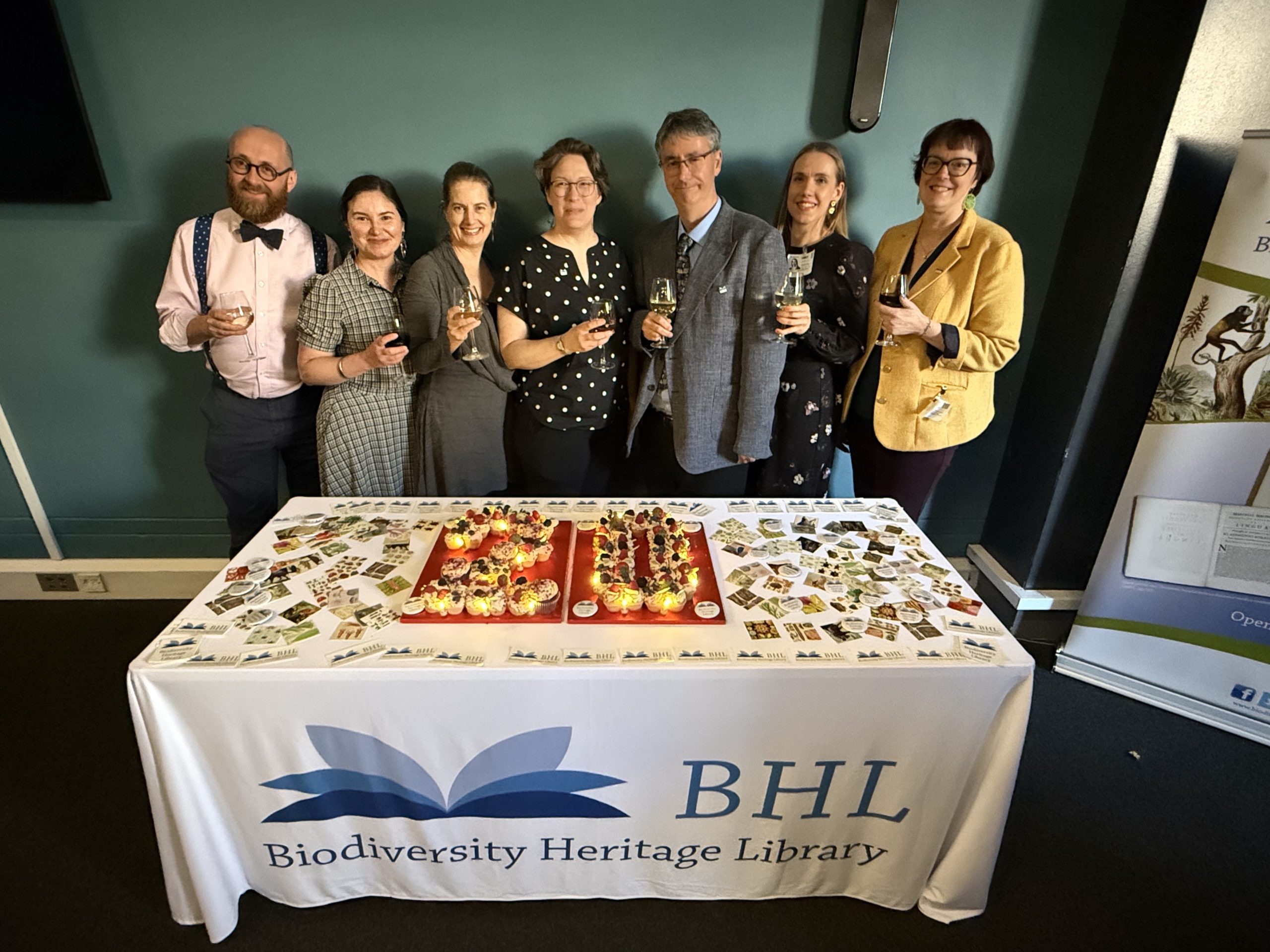
Seven people standing behind a table holding glasses of wine in a toast. The number "20" is spelled out in cupcakes on the table.

The BHL Executive Committee, Transition Team, and Secretariat members share a toast to 20 years of BHL. Left to right: Rich Wragg, Bianca Crowley, Nicole Kearney, Colleen Funkhouser, David Iggulden, Elisa Herrmann, and Kelli Trei.

biodiversity heritage library logo with 2006 and 2026

And finally, I’d like to extend a personal thank you to our co-hosts, David Iggulden and Rich Wragg, for welcoming BHL partners for the 20th anniversary meeting. To my colleagues, Kelli Trei, Nicole Kearney, Bianca Crowley, Joel Richard, and Mike Lichtenberg – thank you for your tireless efforts this past year to think critically about BHL’s future beyond the challenging but necessary transition to a new operating structure. I look forward to the next phase of planning with our global consortium.
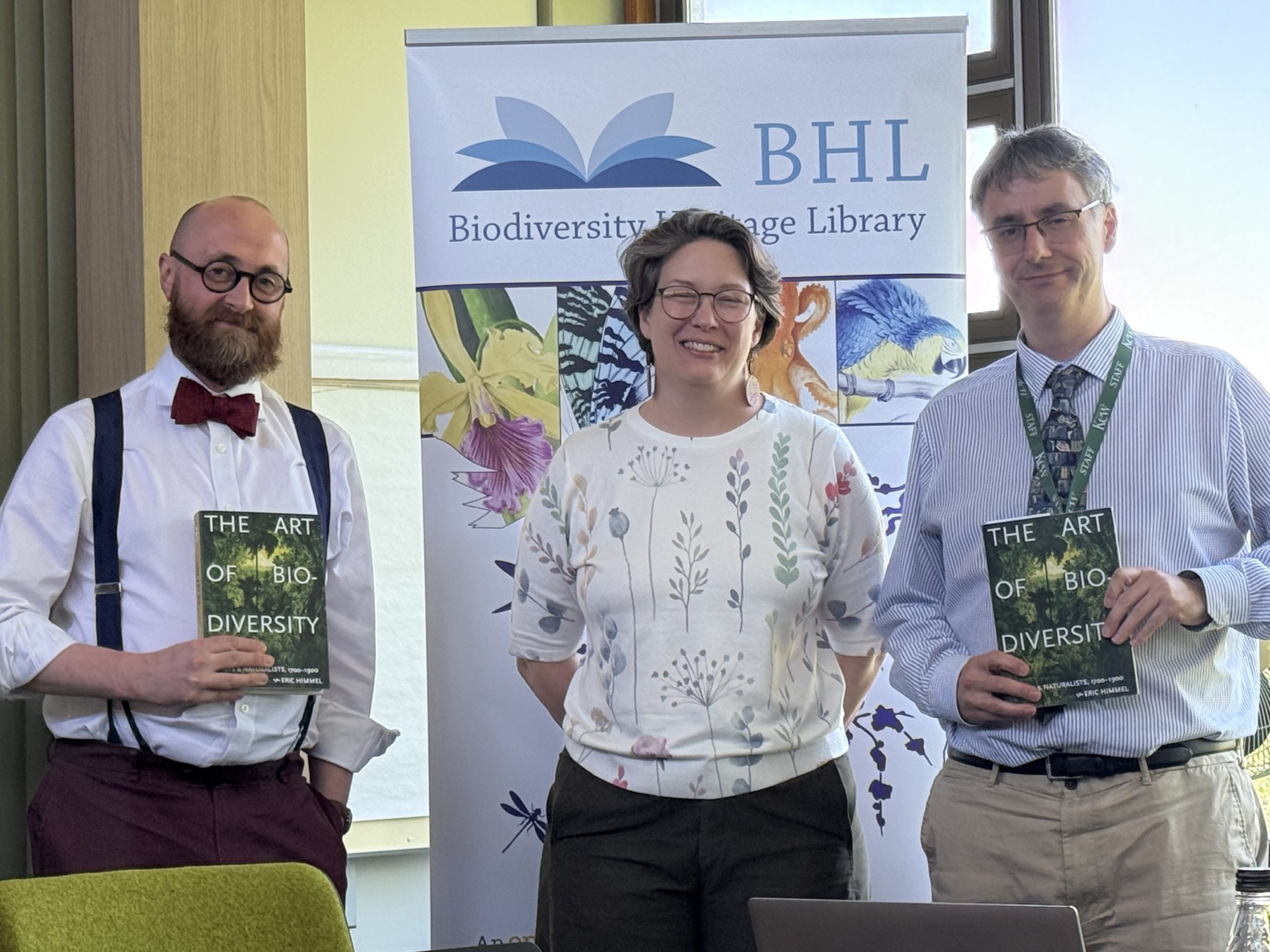
Three smiling people standing in front of a Biodiversity Heritage Library banner, two holding books "The Art of Biodiversity".

Colleen Funkhouser shares host appreciation gifts with annual meeting co-hosts Rich Wragg and David Iggulden. Photo credit: Nicole Kearney
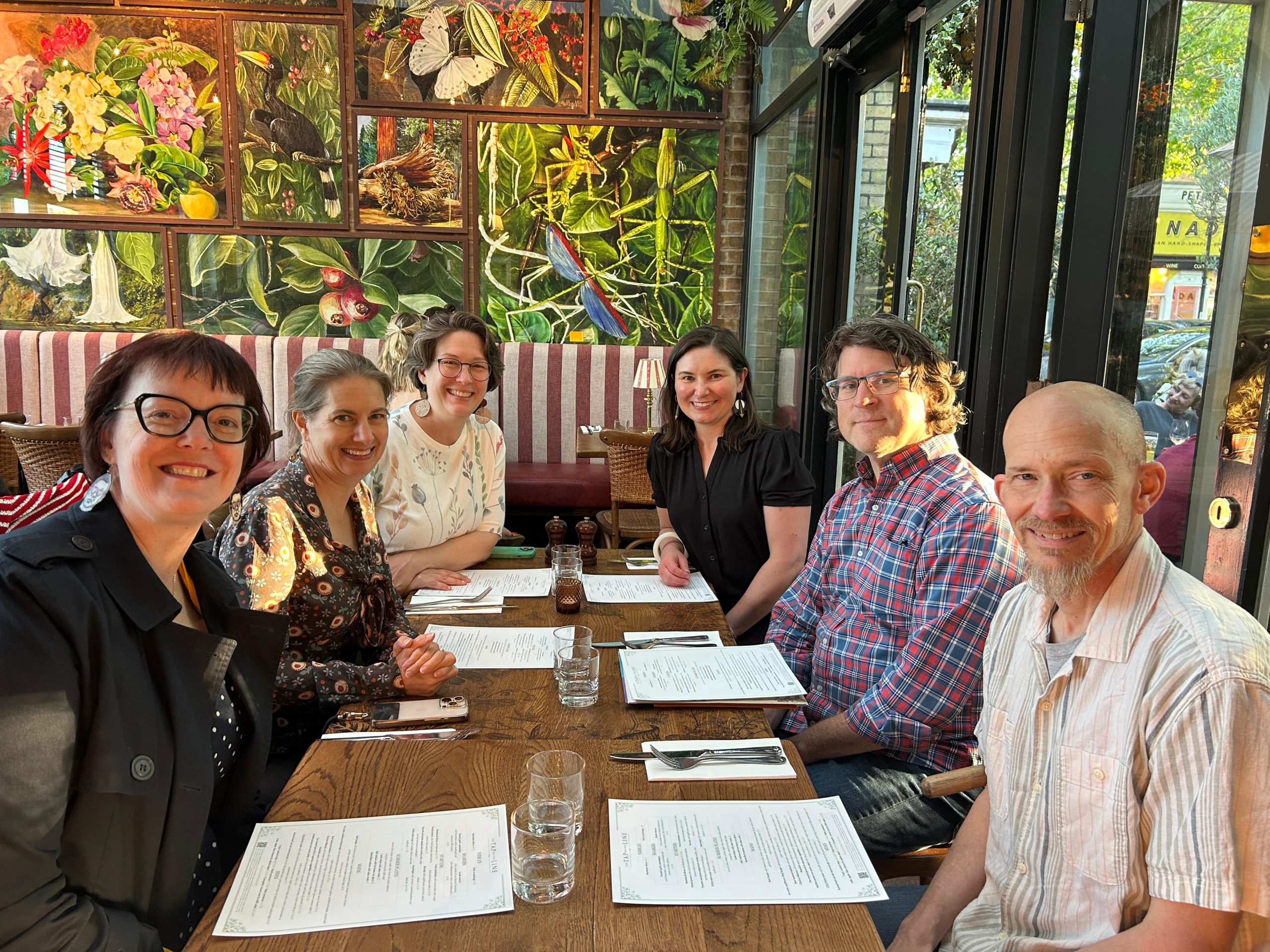
A group of six smiling people sitting around a table in a restaurant.

BHL team members celebrate the end of the meeting. Left to right: Kelli Trei, Nicole Kearney, Colleen Funkhouser, Bianca Crowley, Joel Richard, and Mike Lichtenberg. Photo credit: Emily Benton

May 27, 2026by Colleen Funkhouser
Blog Reel, Featured Books

Celebrating 50 Years of a Field Naturalists Club Through its Newsletters

The front page of a full-color glossy newsletter. There is a photograph of a butterfly, and another of a butterfly brochure.

This post is part of BHL at 20: Treasures from the Biodiversity Heritage Library, a series contributed by members of the BHL community, highlighting remarkable works from across the collection in celebration of its 20th anniversary.

The Castlemaine Field Naturalists Club in Central Victoria, Australia, is celebrating its 50th year in 2026. Since its inception in March 1976, the Club has produced a monthly newsletter for members, except in January, when no issue is produced. All issues are available on the Club’s website and through the Biodiversity Heritage Library (BHL). Through BHL, they are fully searchable, meaning that species names, locations, and historical observations can be discovered by researchers anywhere in the world. Taxonomic names are identified and indexed, articles are structured as individual records, and persistent identifiers ensure the Club’s observations are part of the global biodiversity knowledge network. This ensures that local knowledge contributes to a global, interconnected biodiversity resource.

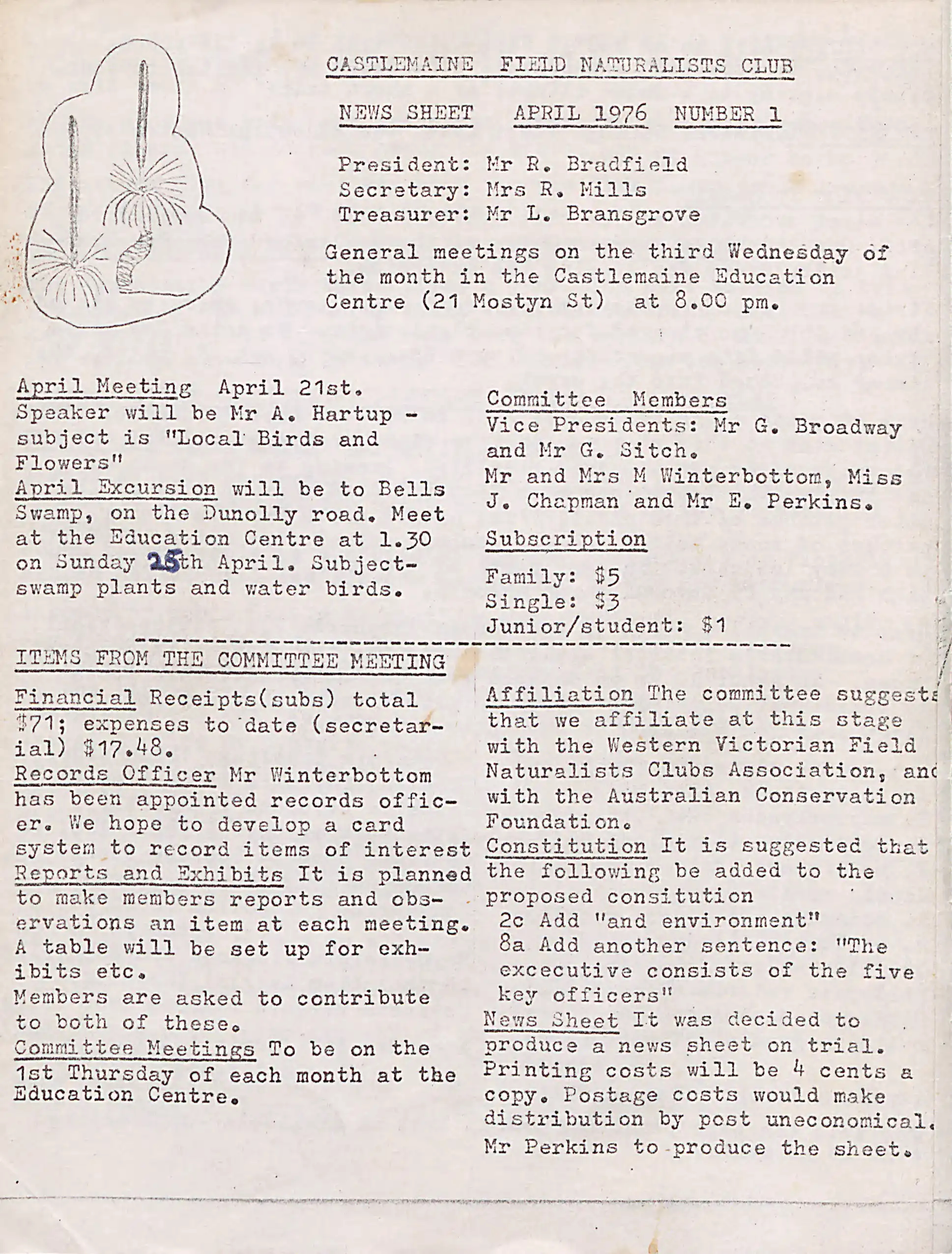
Issue number 1, published in April 1976, was a modest, typed, black-and-white, four-page circular called, simply, News Sheet, featuring two line drawings to break up the text. Family memberships were $5, single memberships were $3, and student memberships were $1. Expenses were recorded as $17.48. By the second issue the title Castlemaine Naturalist had been adopted, the name by which the newsletter is still known.

A page of a newsletter. There is an image of a grass tree in the top left corner.

Page 1 of issue number 1 of the Castlemaine Field Naturalists Club’s newsletter, April 1976.

Fifty years later, the February 2026 issue, number 549, is a twelve-page, professionally designed, full-color newsletter, featuring thirty-six photographs. Most members now receive the Castlemaine Naturalist electronically, which has the advantage of allowing them to zoom in on the detail in the photographs.

The front page of a full-color glossy newsletter. There is a photograph of a butterfly, and another of a butterfly brochure.

Page 1 of issue number 549 of the Castlemaine Naturalist, February 2026.

The February 2026 issue illustrates the breadth and depth of the members’ engagement with nature and the Club’s vitality. The lead article profiles the launch of a new glossy brochure produced by Club members, Butterflies of the Mount Alexander Region. The brochure includes all known butterflies in the region, as well as information about endangered species, the differences between moths and butterflies, and tips on how to photograph butterflies.

Also included is an article about the Club’s participation in BirdLife Australia’s Annual Challenge Bird Count, Australia’s largest citizen science event, which resulted in sightings of 1,422 birds across 110 species. Over time, the newsletters also document other citizen science initiatives the Club has been involved in, including the Great Southern Bioblitz. In 2025, the Castlemaine Field Naturalists Club hosted the BioBlitz for the Castlemaine region for the fifth time, inviting participants to record as many species of flora, fauna and fungi as possible and contribute to science alongside communities across the Southern Hemisphere.

A regular feature of every issue of the Castlemaine Naturalist is the inclusion of members’ observations. This segment was introduced in the first newsletter and provides all members with an opportunity to contribute to meetings and the newsletters. Historically, these observations were published as sighting lists with dates and locations, creating a valuable scientific record. Today, many members also contribute their wildlife observations through iNaturalist, ensuring that local records feed into national and international biodiversity databases, including the Atlas of Living Australia (ALA) and the Global Biodiversity Information Facility (GBIF).

The fifty years of the Castlemaine Naturalist provide a record of observations and activities that have benefited both the local natural environment and the Club’s members, demonstrating the important citizen science contribution the Club has made since its establishment in 1976. Together, the newsletters document five decades of change in the Mount Alexander region’s biodiversity, recording shifts in species distributions, seasonal patterns, and conservation priorities. The Club is looking forward to updating this report when it celebrates its 100th anniversary in 2076!

The digitisation of the Castlemaine Naturalist newsletters and their inclusion in BHL was undertaken by BHL Australia as part of a wider project funded by a Public Record Office Victoria Local History Grant. To learn more, see Capturing the history of Victoria’s Field Naturalists Clubs.

From the Biodiversity Heritage Library

As we look ahead to the next chapter of BHL, we invite you to be part of it. If you value open access to biodiversity literature and the global collaboration behind it, your support will help ensure this work continues and grows.

Orange button with a heart icon

May 19, 2026by nkearney
Blog Reel, Featured Books

Industrial and Technological Museum Economic Botany Illustrations and the Wax Fruit Collection

Illustration of two yellow pears with speckled skins with handwritten notes on a beige background.

This post is part of BHL at 20: Treasures from the Biodiversity Heritage Library, a series contributed by members of the BHL community, highlighting remarkable works from across the collection in celebration of its 20th anniversary.

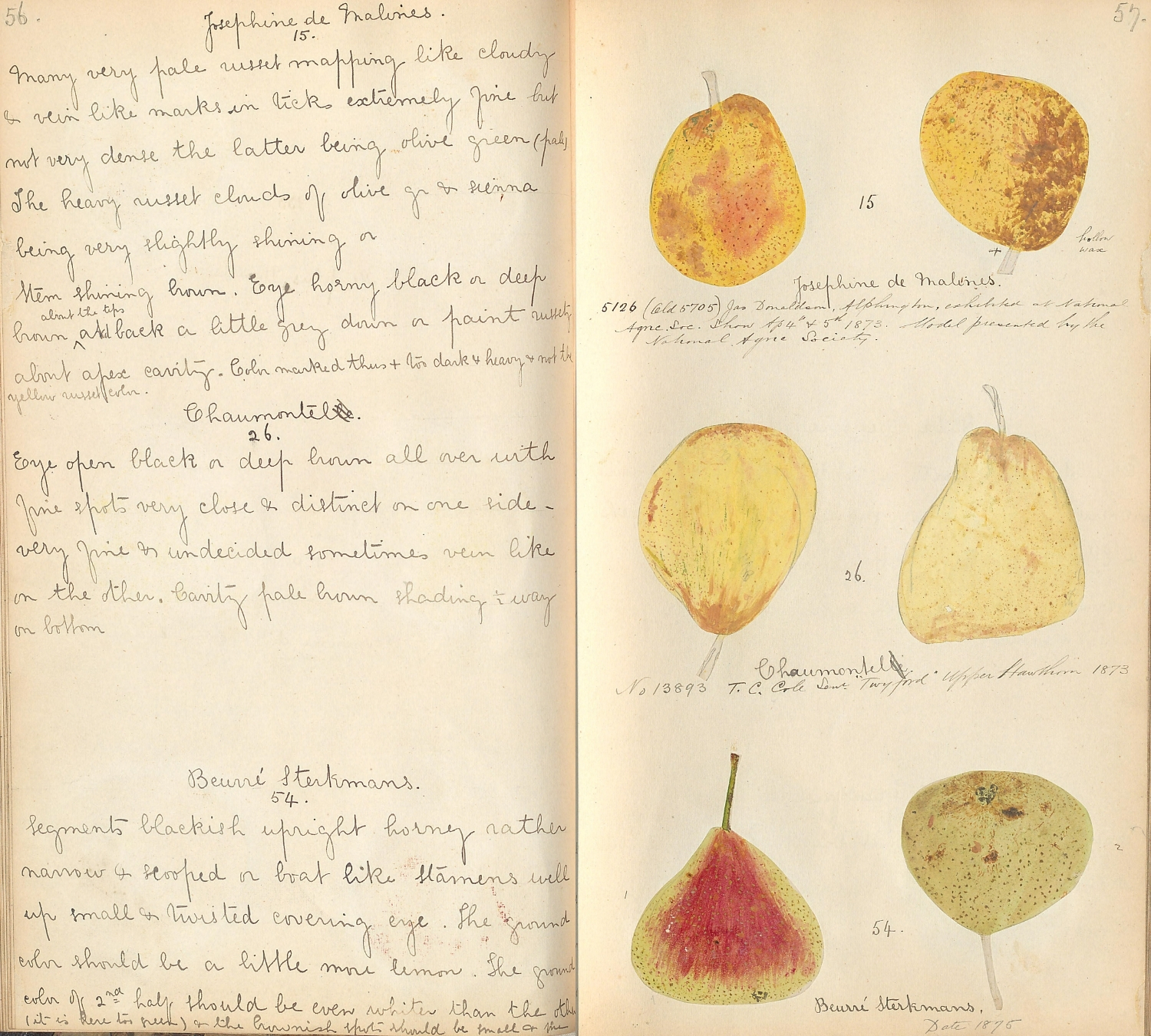
Historical illustration of different pear varieties with handwritten notes.

Pages 56 and 57 of the ITM Register, showing handwritten descriptions and illustrations of the pears Josephine de Malines, Chaumontel, and Beurre Sterkmans. Source: Museums Victoria Archives.

One of the most vibrant and colourful volumes available on BHL from the Museums Victoria Archives is the Economic Botany Fruit and Vegetable Specimen Register (ITM Register) created by Industrial and Technological Museum (ITM) model makers and used as a reference when producing the Wax Fruit Collection. This collection dates from when the ITM (now Museums Victoria) opened to the public in 1870.

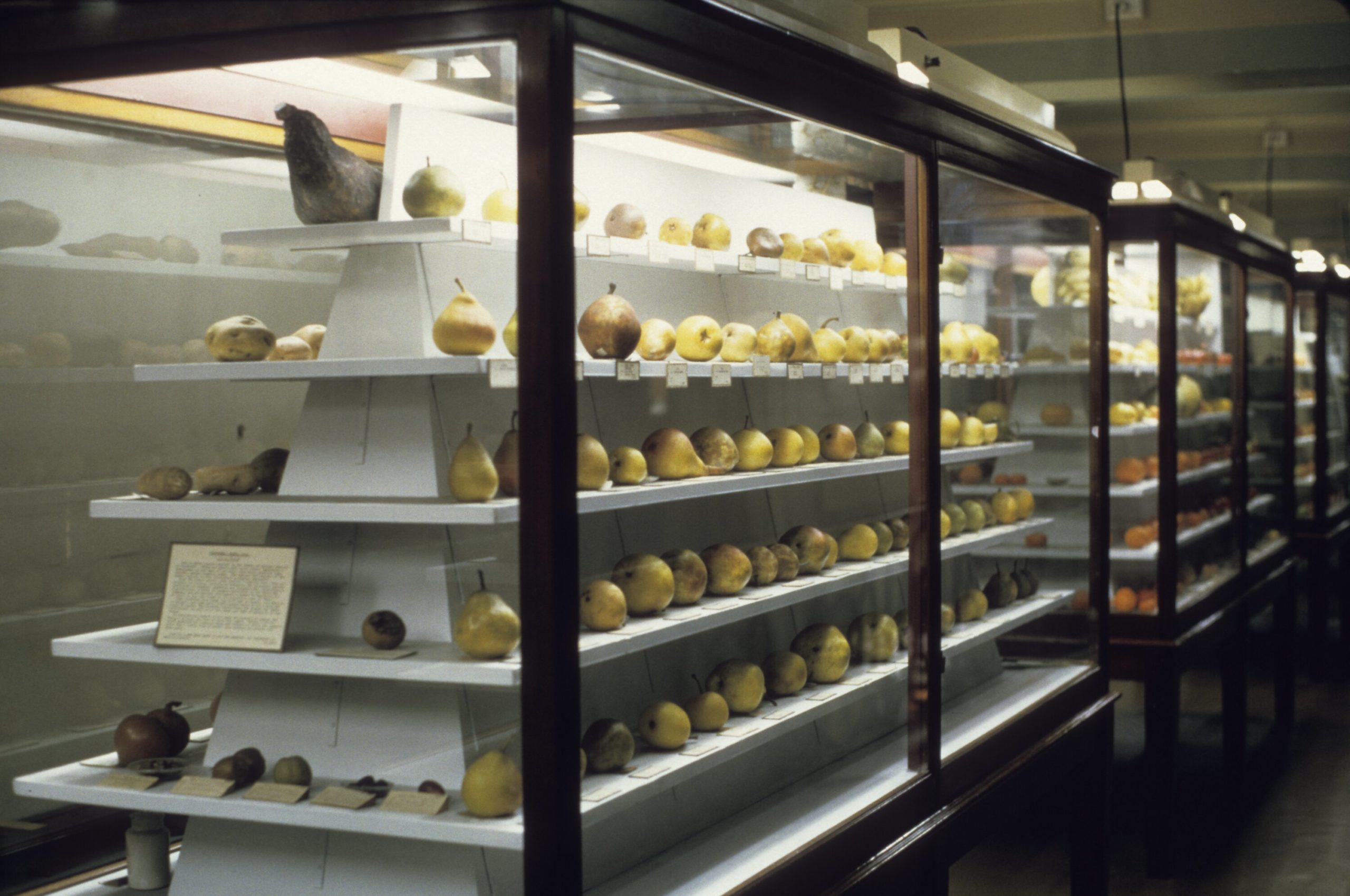
The ITM ensured that Victorians had access to the industrial and technological developments taking place overseas through its collections on display and educational programs, such as modelling and model-making. The realistic wax fruit and vegetable models created by museum model makers document almost a century of Victorian agriculture, from the 1870s to 1960s. They were exhibited at the Melbourne International Exhibition of 1880, and remained on display into the 1960s (see image below).

Display case with rows of model pears showing various shapes and colors.

Visitors could view the wax models in display cases such as this, Queen’s Hall Upper, Institute of Applied Science (predecessor of Museums Victoria), 1969. Source: Museums Victoria.

Note that the ITM Register (c.1870-1890) has two related volumes: Album – Wax Fruit Models, Industrial and Technological Museum ST 40030 (1872-1879), and Album – Wax Fruit Models produced by model maker Miss M. J. McMillan, ST 40029 (1904).

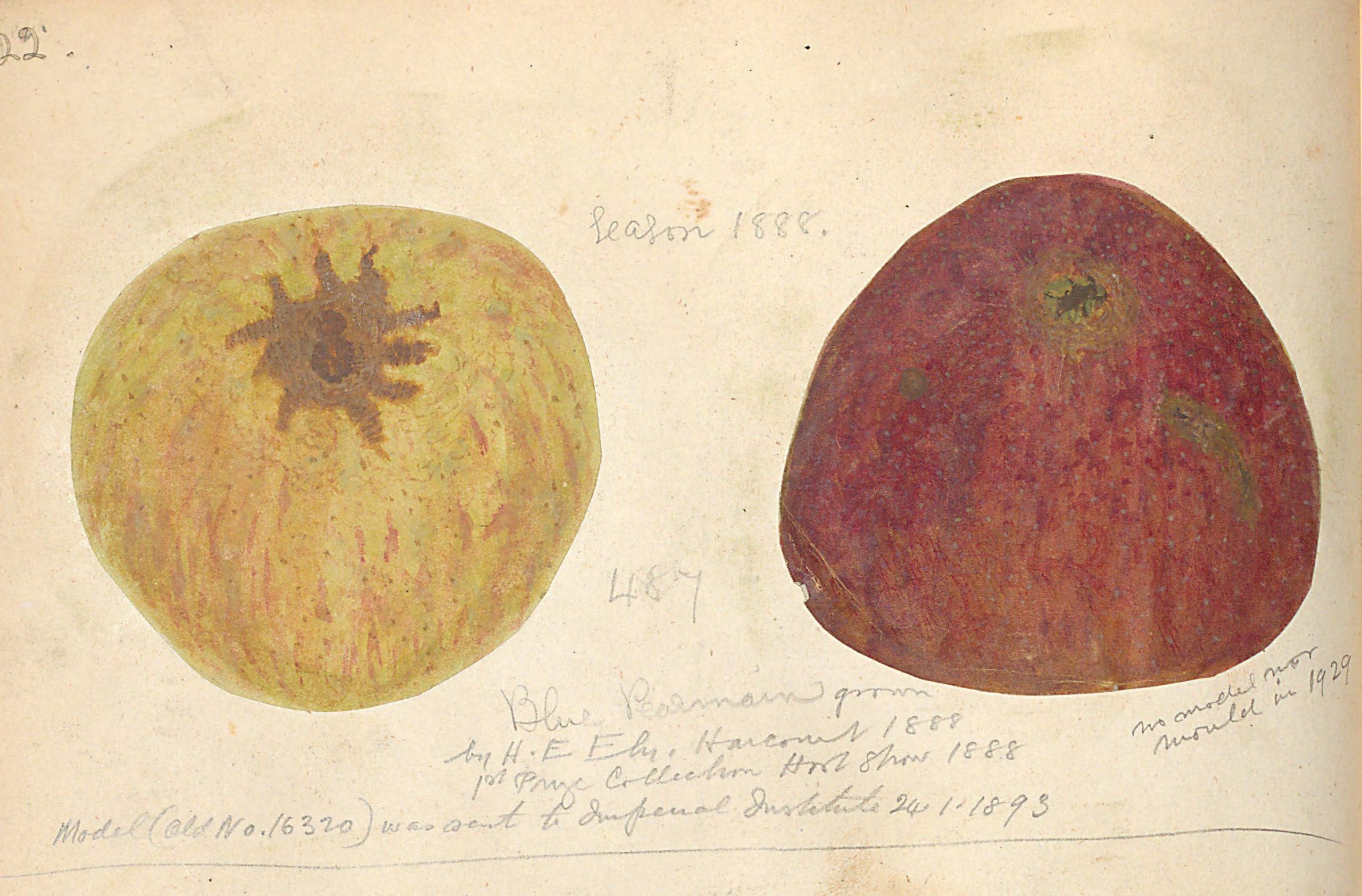
The ITM Register held in Museums Victoria Archives includes eighty pages of watercolour botanical illustrations of fruit and vegetables pasted into the volume. Drawn to scale, with bruises and imperfections included, each illustration contains the detailed visual information required to create the wax models. Two sides of each fruit or vegetable are illustrated, depicting the unique colours and markings on either side of the specimen. For example, on page 22 (see below), a Blue Permain (Old No. 16320), an American apple variety, is illustrated green on one side and red on the other.

Two illustrated apples labeled "Eason 1888." The left apple is yellow-green with a dark brown spot; the right is red, both set against a beige background.

Cropped image of page 22 of the ITM Register, showing an illustration of a Blue Permain specimen (487). Source: Museums Victoria Archives.

The ITM Register includes handwritten descriptions of varieties of apples, apricots, oranges, peaches, pears, plums, potatoes and a turnip; names of orchardists and farmers; place names across Victoria, both regional and within inner-city Melbourne/Naarm; dates grown; and unique numbers assigned to each illustration. Some of these specimens were moulded and modelled into wax and relate to Museums Victoria’s State Collection registration numbers. Some descriptions include a “new” number. For example “New 4981” (“Old 8420”) refers to the wax model ST 4981 in the State Collection. The drawing is comparable to the photograph of the apple model; however, the drawing has greener hue than the model. If no “old” number is listed with the specimen, the number, typically between four and five digits, may be the new number. This can be verified by searching for the ST State Collection registration number on the Museums Victoria Collections website and comparing the description and illustration with the information in the ITM Register.

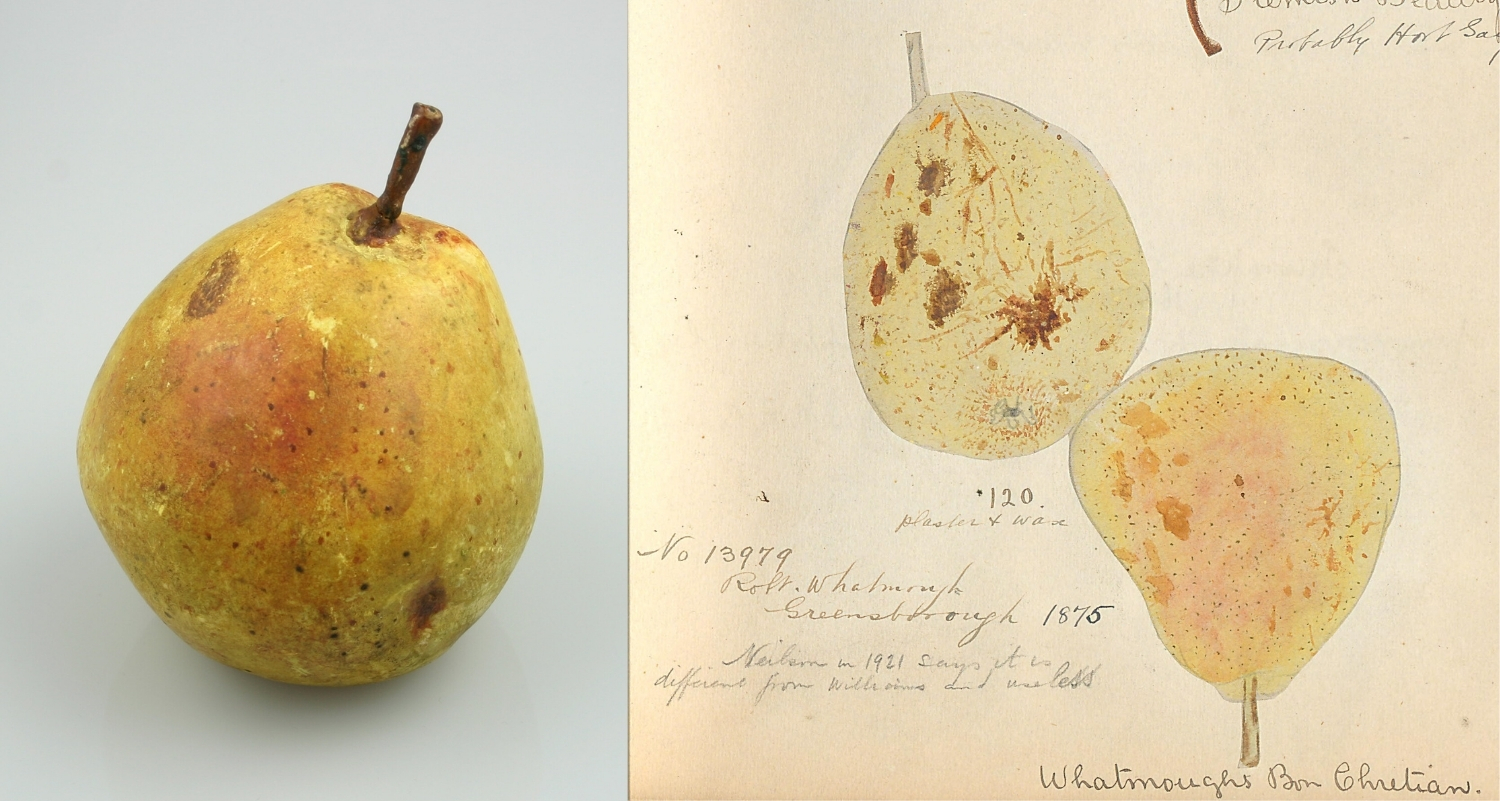
A photo of a yellow pear and a botanical illustration of the same pear.

Whatmough’s Bon Chretian (ST 13979), left: wax model; right: illustration, page 61 of the ITM Register. Source: Museums Victoria.

In the above example, compare the photograph of the wax model on the left with the related botanical illustration on the right. Note the shape of the pear model, the detailed bruising, surface dots, and the orange hue at the centre in comparison to the illustration. Mr Robert Whatmough grew the Bon Chretian at Willis Vale orchard in Greensborough, Victoria, and donated the specimen to the museum in 1875. Thomas McMillan made the wax model for the Philadelphia Centennial Exhibition of 1876.

Museum model maker Thomas McMillan managed the Botanical Collection from 1872 to 1882. He established a workroom for casting and modelling fruit and vegetables and led a fruit modelling class. His daughter, Anna McMillan, held the role of pupil-assistant. Anna McMillan and model-making student Ida Ingamells entered a collection of models in the Juvenile Industrial Exhibition, where both won prizes. After Thomas McMillan retired in 1882, Anna McMillan continued working as a model maker with the collection.

Specimens that were not modelled into wax were noted as such in the descriptions in the ITM Register. Descriptions also record when wax models were sent to the Imperial Institute in 1893, when models were exhibited at the National Agricultural Show and later presented to the Museum, and when prizes were received, such as at the Horticultural Show of 1888.

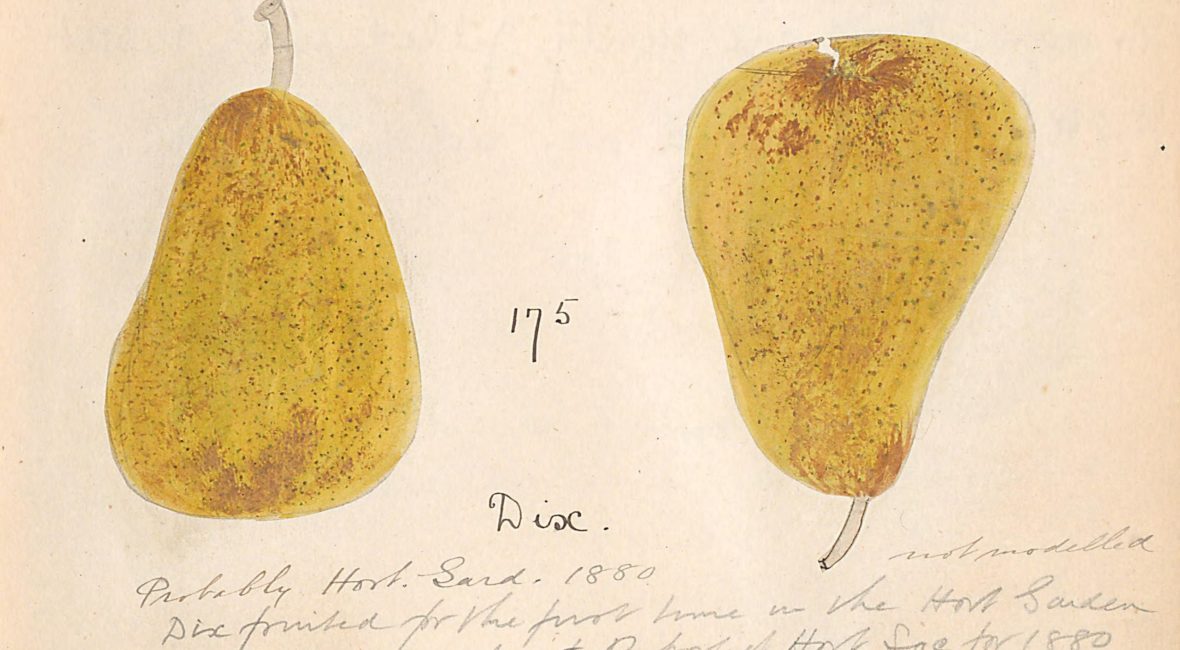
Illustration of two yellow pears with speckled skins with handwritten notes on a beige background.

Cropped image of page 103 of the ITM Register, showing an illustration of Dix (175). Source: Museums Victoria Archives.

Some illustrations include detailed descriptions, such as “Dix 175” on page 102 of the ITM Register: “Colour too bright or golden – more white & not so much body. Spots rather bright & not numerous enough. Eye nearly closed by the leaning forward of the small leathery-like segments. Stem ¾ inch curved greenish sienna & black end.” This detailed illustration of a pear (see image above) does not have a corresponding wax model.

In later years, photography was used to document varieties of fruit, as noted by ITM Curator R. Henry Walcott in the Trustees Report of 1916: “Sections, both longitudinal and transverse, of 123 varieties of pears and apples were photographed by Mr Wilson, and prints of these will be mounted and exhibited in due course. It is only through the study of the internal characters of the fruits of pears and apples that many varieties can safely be distinguished, and our object will be to try and make the collection of models and photographs a standard for reference purposes.”

Providing digital access to the ITM Register in BHL allows researchers to study and compare images of the illustrations and associated data, alongside information about the related Fruit Wax Model Collection available on the Museums Victoria Collections website. The historical and scientific significance of the agrobiodiversity documented in the volume is an important record for contemporary economic botanists studying changes in the region.

Thank you to the BHL Australia team for making this volume available online and for the vital work you do for our region.

From the Biodiversity Heritage Library

If this work matters to you, we invite you to help shape what comes next. With your support, BHL can continue to connect biodiversity knowledge across time, making it freely available to researchers, communities, and future generations worldwide. 

Orange button with a heart icon

May 6, 2026by nkearney

Help Support BHL

BHL's existence depends on the financial support of its patrons. Help us keep this free resource alive!

search

About BHL

The Biodiversity Heritage Library (BHL) is the world’s largest open access digital library for biodiversity literature and archives. BHL operates as a worldwide consortium of natural history, botanical, research, and national libraries working together to digitize the natural history literature held in their collections and make it freely available for open access as part of a global “biodiversity community.”

Join Our Mailing List

Sign up to receive the latest news, content highlights, and promotions.

Subscribe Now

Subscribe to Blog via Email

Enter your email address to subscribe to this blog and receive notifications of new posts by email.

Join 319 other subscribers

Subscribe to Blog Via RSS

Subscribe to the blog RSS feed to stay up-to-date on all the latest BHL posts.

Access RSS Feed

Inspiring Discovery through Free Access to Biodiversity Knowledge.

The Biodiversity Heritage Library makes it easier than ever for you to access the information you need to study and explore life on Earth…for free, anytime, anywhere.


ABOUT | HARMFUL CONTENT | PRIVACY | SITE MAP | TERMS OF USE