

Study Nature Not Books While Getting to Know BHL
This post is part of BHL at 20: Treasures from the Biodiversity Heritage Library, a series contributed by members of the BHL community, highlighting remarkable works from across the collection in celebration of its 20th anniversary.
The MBLWHOI Library’s BHL journey began in 2006 through contributing leadership, technical expertise, and hands-on librarian effort to the exciting BHL start-up period. Today and for many years, a quiet but deliberate process has taken place towards introducing grade school through graduate level students and researchers to the Biodiversity Heritage Library. This happens in a single one-hour-long class students attend in the MBLWHOI Library where BHL is presented as an online tool that students can learn to use to extend their research studies of bound paper science books and journals.
These classes use BHL content to show students (the youngest of whom nowadays have minimal experience using paper books) the look and tactile feel of books that are hundreds of years old, while referencing the BHL digital examples showing the interface of print and online in science publishing, such as bound-in-volume foldouts (foldouts are bound book pages sized larger than the size of the pages of a book and folded into the book). A quick foldout example is shown below, in a plate bound before the first page of volume 8, no. 81 (1672), Philosophical Transactions of the Royal Society of London: An attempt of a new kind of telescope invented by Mr. Isaac Newton.
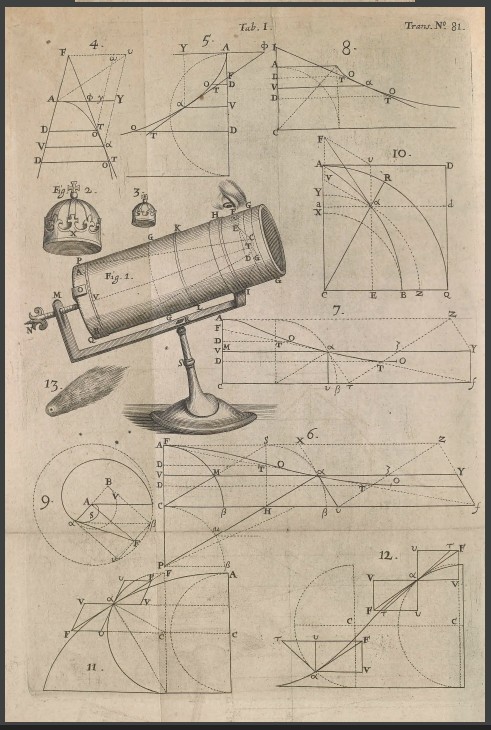
Part of the unique BHL and in-library viewing experience is looking at and being able to download and understand vital details, such as illustrations contained in foldouts. View in BHL.
Why study biology in Woods Hole?
The Marine Biological Laboratory (MBL) was founded in the village of Woods Hole, Massachusetts, in 1888 as America’s first private marine biological laboratory. In 1930, scientists at MBL and the nascent oceanography community collaborated in the founding of another of the key Woods Hole science laboratories, the Woods Hole Oceanographic Institution (WHOI).
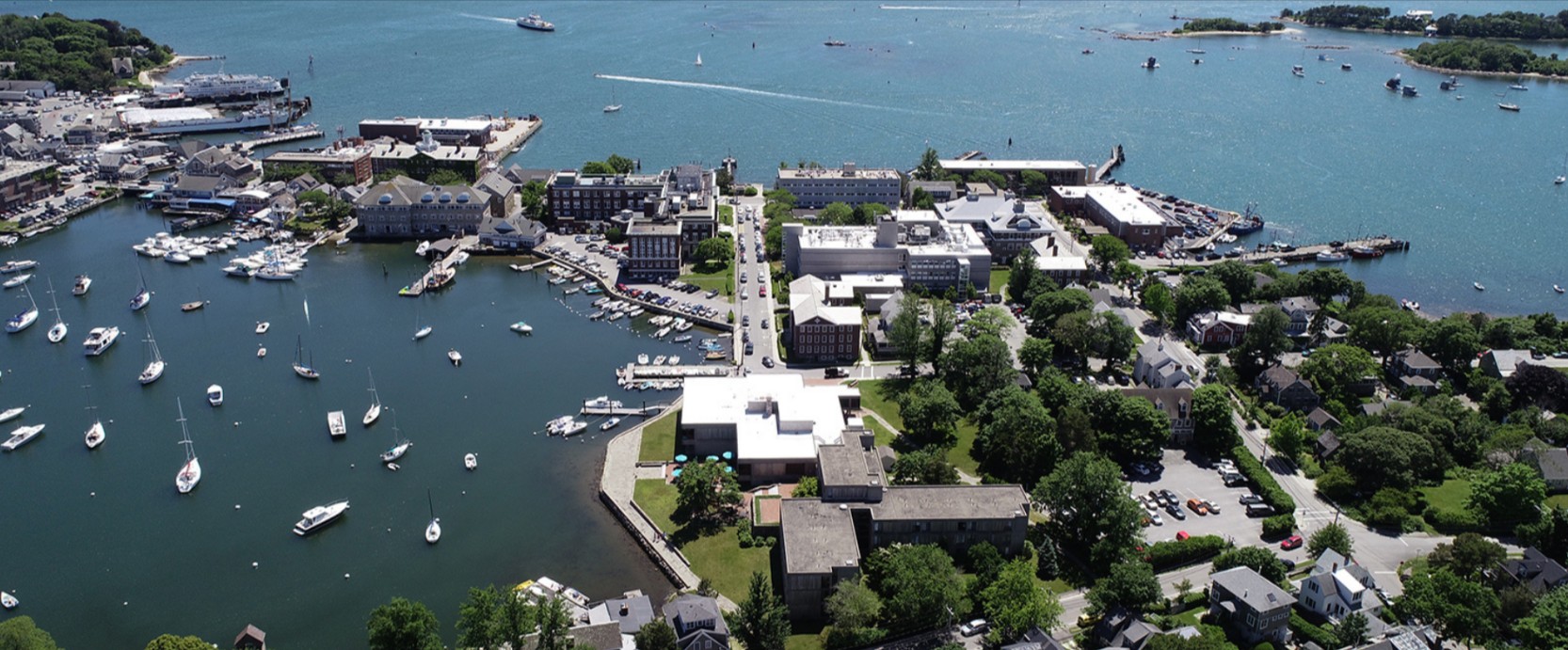
Village of Woods Hole. Photo courtesy of MBL.
In the 1870s, Spencer Fullerton Baird, Secretary of the then recently founded Smithsonian Institution followed through on a charge from US President Ulysses S. Grant to found the US Bureau of Fisheries. Through this process, Baird discovered that the regional waters surrounding the village of Woods Hole are particularly rich in marine biodiversity. This natural phenomenon is influenced by the mixing of warm Gulf Stream currents from the southeast with the cool Labrador currents of the northeast. Secretary Baird also realized that some of the strongest tidal currents on the East Coast of the US are located just off Woods Hole Harbor. See the historical note below from A biological survey of the waters of Woods Hole and vicinity, Sumner, F., Osburn, R., Cole, L. (1911) Bulletin of the Bureau of Fisheries v.31 p.12:
“…Many years ago, Woods Hole was selected by Prof. Baird as the most promising spot upon our coast for the commencement of a scientific study of fisheries problems. From the very outset he gathered about him a staff of naturalists of the type that was dominant in that generation — men eager to seek out every living thing concealed beneath the waves, to describe and figure and name…”
To this day we encourage students to explore the late-summer biodiversity of the waters surrounding Woods Hole by dropping a fishing line to explore the possible diversity of the catch.
Study Nature, Not Books: From 1666 in Print to an 1873 Classroom Poster and Online in 2026
On the wall of the office of the MBLWHOI Library is an 1873 poster that was originally hung in the classroom of the Anderson School of Natural History (1873–1875). This poster, with the quote below, was often attributed to Anderson School founder and Harvard professor Louis Agassiz. “Study nature, not books” was a statement reflective of learning through personal experience. The Anderson School of Natural History, which operated on Penikese Island near Woods Hole, was an antecedent of the Marine Biological Laboratory. This school was purposely sited on a postage-stamp-sized island so the students could do their work without summer seaside community distractions. The poster’s statement “Study nature, not books” is appropriate to the MBLWHOI Library and science study in Woods Hole because “learning science by doing science” is how research has traditionally taken place in Woods Hole. We tell the students attending the brief rare books class that we will revisit this quote later in the short class.
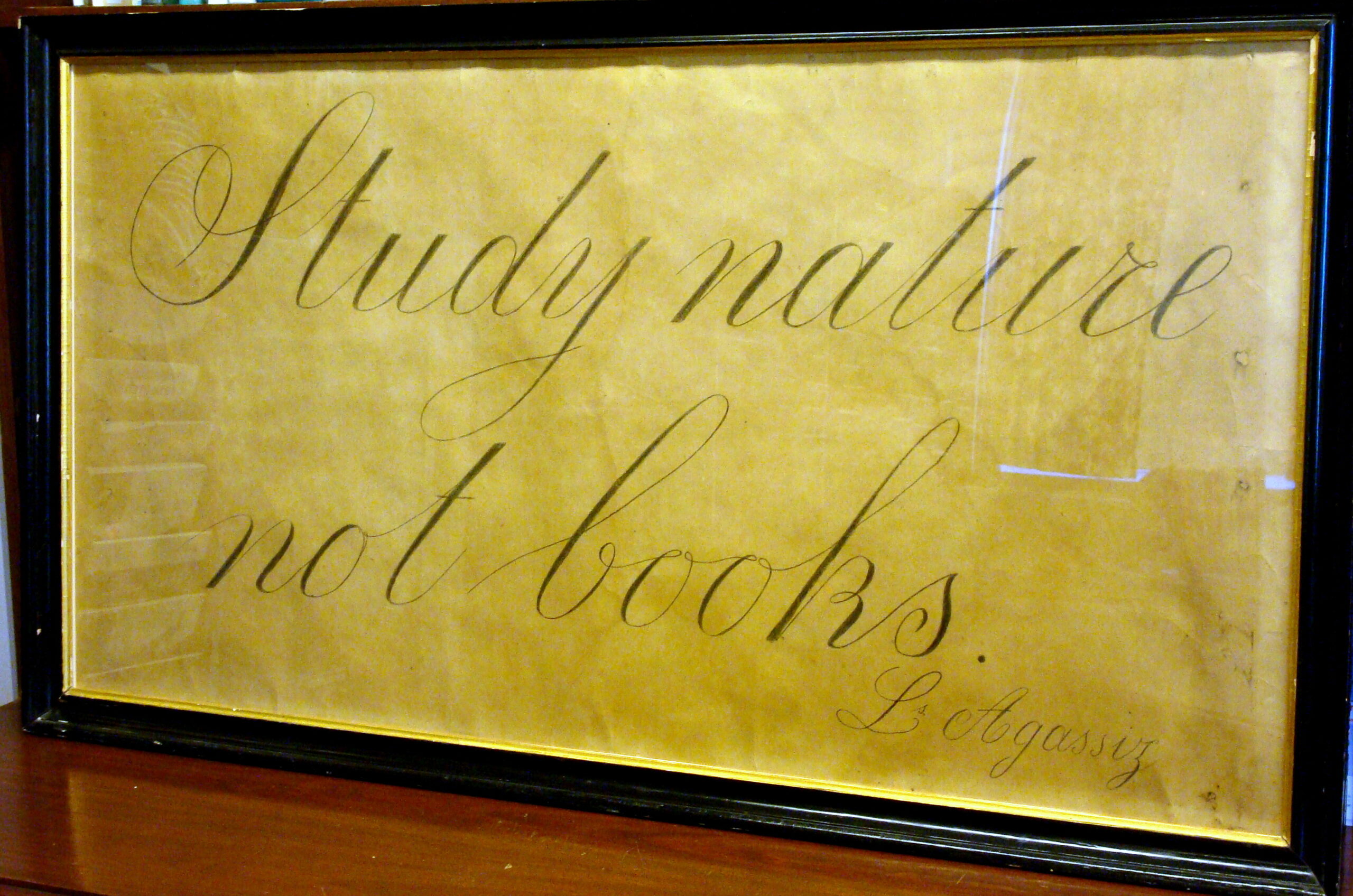
1873 poster, “Study nature not books”, from the MBLWHOI Library. Photo courtesy of the author.
In the MBLWHOI Library rare books collection, in Volume 1, number 8 (1666) of Philosophical Transactions of the Royal Society of London, is an article titled: Directions for sea-men bound for far Voyages. Philosophical Transactions of the Royal Society of London is considered the oldest continuously published scientific journal in the Western world. Its founding in the mid-1660s reflects efforts by scientists and science-interested people in Western Europe and the British Isles to create and document knowledge, compiling references to science experiments and meeting in person or through detailed correspondence to discuss often differing viewpoints on scientific matters. The journal articles which made up Philosophical Transactions were often letters received by the Royal Society, and the proceedings of meetings that took place at the Royal Society in London. Highlighted below are the first few lines of the article, Directions for Sea-men bound for far Voyages:
“It being the design of the Royal Society, for the better attaining the end of their institution, to study Nature rather than Books, and from the observations, made of the phenomena and effects she presents, to compose such a history of Her, as may hereafter serve to build a solid and useful philosophy upon…to think upon and set down Directions for sea-men going into the East- & West-Indies, the better to capacitate them for making such observations abroad, as may be pertinent and suitable for their purpose…”
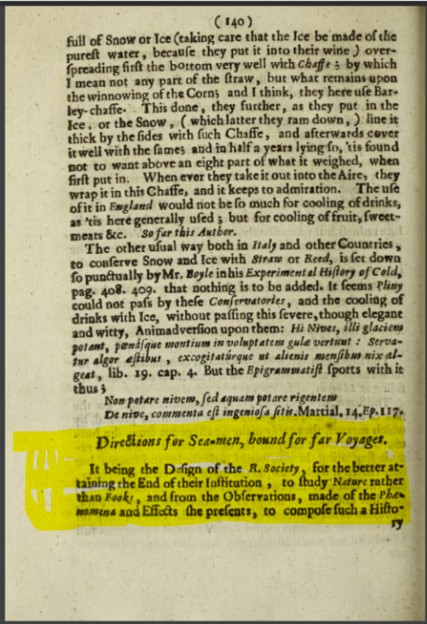
Directions for Sea-men bound for far Voyages, from Philosophical Transactions of the Royal Society of London, vol. 1, no. 8, p. 140 (1666). View in BHL.
Students can read on to see that article details are attributed to “Master Rooke”, Lawrence Rooke, a 17th-century English mathematician and astronomer from Gresham College in London. The article goes on to instruct “sea-men bound for far voyages” on what they should be doing to study nature hands-on, meaning: keeping a diary that would include using the instruments of the day to detail the data associated with their voyage: the compass, dipping needles, (another magnetic-field measuring device), visually taking note of the ebbing and flowing of the tides while noting ordinary and extraordinary events, mapmaking, depth measuring, to record and describe weather and astronomical observations, as well as filling and weighing bottles of seawater from different ocean depths.
When Louis Agassiz, in 1873, tacked “Study nature, not books” onto the wall of his classroom, he passed on to his students a new way of learning science with roots going back at least a couple of hundred years. Those roots continue to inspire generations of students in Woods Hole and will continue to do so into the future.
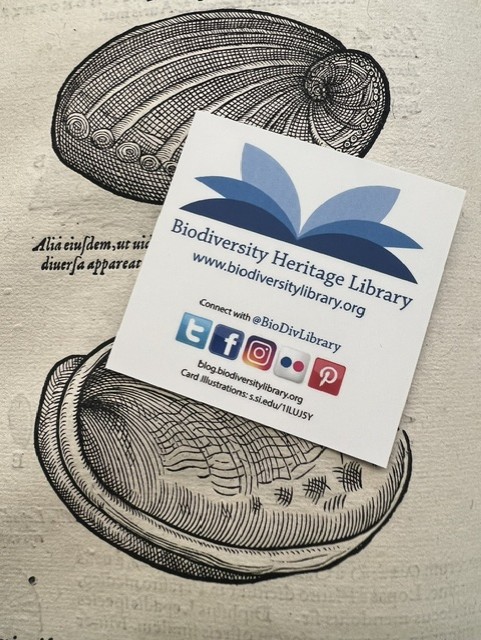
Students leave the library with one of these popular BHL cards, a key to being able to continue their biodiversity literature research away from the physical library.
From the Biodiversity Heritage Library
For 20 years, the Biodiversity Heritage Library has connected generations of students, researchers, and nature enthusiasts with centuries of scientific knowledge. From the earliest scientific journals to the discoveries of today, BHL makes the history of biodiversity research freely available to anyone, anywhere. Your support helps us preserve this extraordinary scientific record and inspire the next generation of discoveries. Please consider making a donation to help sustain BHL for the next 20 years and beyond.

Discover more from Biodiversity Heritage Library
Subscribe to get the latest posts sent to your email.

Matthew Person is Technical Services Coordinator of the MBLWHOI Library, where he has managed the journals collection for over 25 years. BHL and the global group of people who make it work continue to inspire Matthew.
Leave a Comment