Biodiversity Heritage Library - Program news and collection highlights from BHL
  • Home
  • News
  • Featured Books
    • All Featured Books
    • Book of the Month Series
    • BHL at 20
  • User Stories
  • Campaigns
    • Fossil Stories
    • Garden Stories
    • Monsters Are Real
    • Page Frights
    • Her Natural History
    • Earth Optimism 2020
  • Tech Blog
  • Visit BHL
Home
News
Featured Books
    All Featured Books
    Book of the Month Series
    BHL at 20
User Stories
Campaigns
    Fossil Stories
    Garden Stories
    Monsters Are Real
    Page Frights
    Her Natural History
    Earth Optimism 2020
Tech Blog
Visit BHL
  • Home
  • News
  • Featured Books
    • All Featured Books
    • Book of the Month Series
    • BHL at 20
  • User Stories
  • Campaigns
    • Fossil Stories
    • Garden Stories
    • Monsters Are Real
    • Page Frights
    • Her Natural History
    • Earth Optimism 2020
  • Tech Blog
  • Visit BHL
Biodiversity Heritage Library - Program news and collection highlights from BHL
Blog Reel, Featured Books

Hispanic Heritage Month: What is a Cordillera?

cordiller (cor·dil·le·ra); a noun.

Definition of cordillera : a system or group of parallel mountain ranges together with the intervening plateaus and other features, especially in the Andes or the Rockies.

Origin: early 18th century: from Spanish, from cordilla, diminutive of cuerda ‘cord’, from Latin chorda (see cord). (Oxford English Dictionary)

———————–

View Full Size Image
Cordilleras!

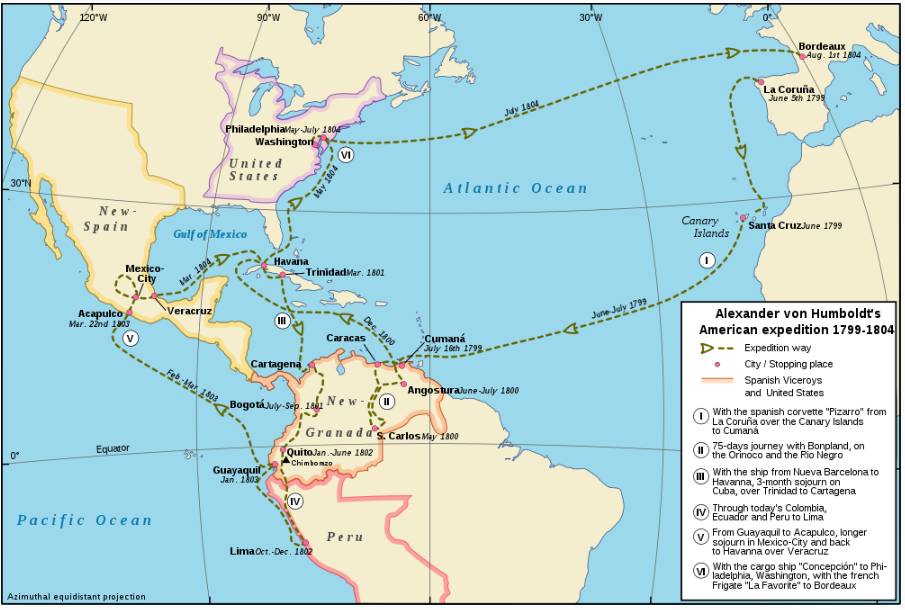
We saved something special for you for our final Hispanic Heritage Month blog installment. Today, we would like to bring your attention specifically to two Cordilleras found in Ecuador: the Cordillera Occidental and Cordillera Oriental which were extensively investigated by Alexander von Humboldt on his six-year expedition through Meso and South America. In this week’s Book of the Week, Humboldt provides us with the very first eye-witness account of some of the highest peaks found in the Andes and minutely describes their geology in: “Researches concerning the institutions & monuments of the ancient inhabitants of America : with descriptions & views of some of the most striking scenes in the Cordilleras!” Despite the long title, this two volume tome is actually just an excerpt from Humboldt’s much more voluminous 30 volume work, Personal Narrative of Travels to the Equinoctial Regions of the New Continent that he produced after his expedition.
View Full Size Image
Routing Humboldt and Bonpland’s S. America Expedition
View Full Size Image
A young Humboldt

Having the fortune of receiving a substantial inheritance following the sad event of his mother’s death, Humboldt quickly opted for a career change. Seemingly overnight, he leapt from Government Mines Inspector to Greatest Explorer the World had ever seen! Leaving the Old World behind for the very first time, he was accompanied Aimé Bonpland, a botanist who over the course of the next six years, from 1799-1805, would collect over 60,000 plants on their expedition to a largely unobserved continent and the species that they brought back were mostly unknown to Europe at the time. While Aimé focused on his field of expertise, Alexander preferred to dabble. Remembered as one of the last great scientific generalists, he believed “that no organism or phenomenon could be fully understood in isolation. Living things, the objects of biological study, had to be considered in conjunction with data from other fields of research such as meteorology and geology.”  Therefore, Humboldt bounces along through his text touching on a myriad of topics, admitting no attempt at organization in his book. And remarkably the lack of organization and vacillations between linguistics, mythology, botany, oceanography, archeology, climatology and comparative religion all somehow come together. However, it should be noted that as much as Humboldt meanders about in this week’s book of the week he always comes back to his most beloved subject– geology. At the time, geology was an emerging field of science and he should be remembered as a primary contributor to its development into a modern field of study.

Throughout what might be best called a travel narrative or informal conversation with the reader, written largely in first person, Humboldt conducts a comparative analysis on his eclectic mix of chosen topics. He seems to be in constant search for the connecting thread that will illuminate an underlying unity in nature. While some critics find this propensity for long-winded unification theories unscientific, one must remember that during the backdrop of the time providing analogues to known phenomena would certainly help the reader to better understand the natural phenomena in this new and largely undiscovered world. Such is the case with these hieroglyphic paintings which Humboldt provides the reader a lengthy analysis, a treatise almost, on comparative mythology and linguistics:

View Full Size Image
Fig. 1: Days in the Mexican Almanac
View Full Size Image
Fig 2: The Epochs of Nature According to Aztec Mythology

Humboldt compares these paintings with the writing systems of the Egyptians, Phoenicians, Hebrews and many other ancient languages. Of the content in fig 2., he compares the epochs of natural destructive cycles in Aztec mythology with the notions of a Kalpa and Yuga found in Hinduism which are described at length here. A seriously fascinating read! The Aztec culture was clearly one very imbued with the sanctity of nature. These were a people who were impatiently awaiting the return of their god Quetzalcoatl because he brought with him a time in which  “all animals, and even men, lived in peace; the earth brought forth, without culture, the most fruitful harvests ; and the air was filled with a multitude of birds, which were admired for their song, and the beauty of their plumage.” One might see why Montezuma would easily mistake Cortez for Quetzalcoatl. It was simply a case of wishful thinking.

Moving on to the crux of this book, interested in reading some of the very first observances of the best known peaks in the Andes? Humboldt delivers:

The Two Mightiest Peaks of Humboldt’s Cordilleras! Okay Three?

View Full Size ImageVolcano of Cotopaxi:  This volcano towers at 19,347 feet. Since 1738, Cotopaxi has erupted more than 50 times. It is the second most active volcano in the world. Humboldt, the first European to climb Cotopaxi is lucky to have observed it and lived to tell the tale and he seemed to be clearly aware of this fact for, at the time of this sketching of Cotopaxi, Humboldt wrote this: “The colossal volcano of Cotopaxi, the pyramidal peaks of Ilinissa, and the Nevado de Quelendanna, open here at once on the spectator, and in dreadful proximity. This is one of the most majestic and most awful views I ever beheld in either hemisphere.”
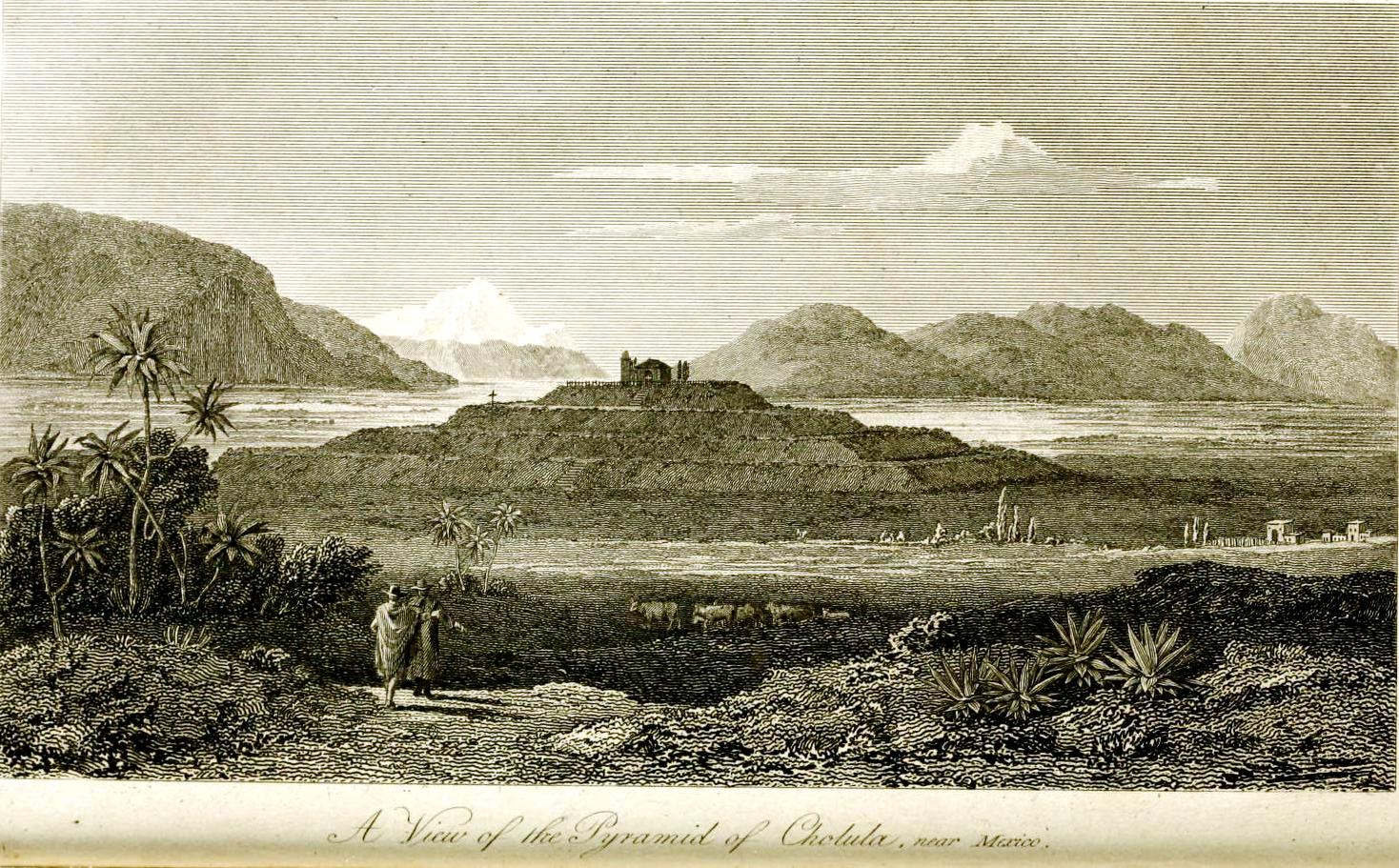
View Full Size ImagePyramid of Cholula: Not necessarily a natural “peak” per se, the pyramid that sits at the site of the holy city of Cholula is home to the greatest, most ancient monuments of the Aztec people. The pyramid is referred to by locals as the mountain made by the hand of man (monte hecho a manos). From a distance it looks like a natural hill covered with vegetation. One can see why Humboldt would be intrigued.
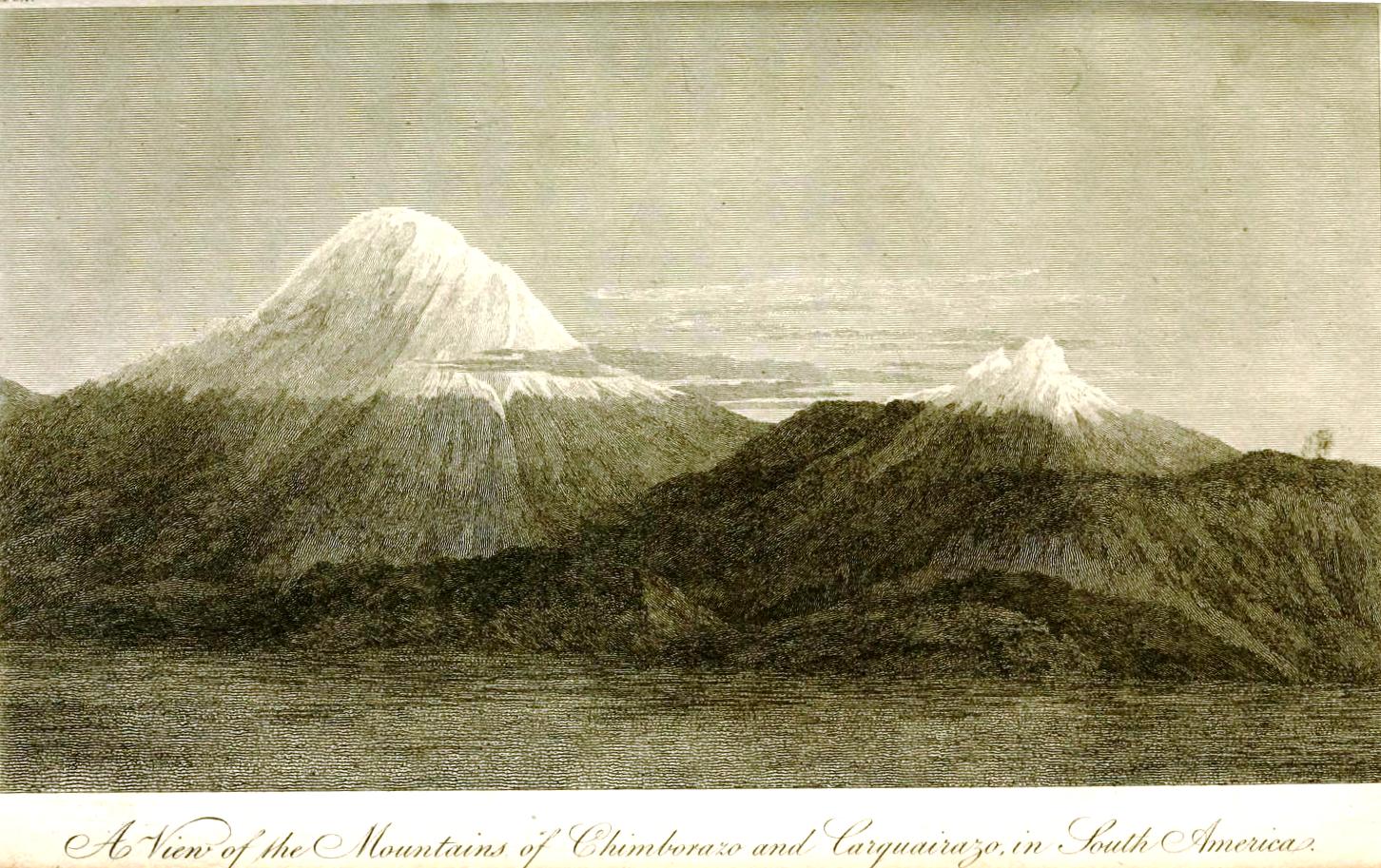
View Full Size ImageMount Chimborazo: At 20,564 ft, Chimborazo is the highest mountain in Ecuador, the highest peak in close proximity to the equator and it is the furthest point from the Earth’s center. (This is due to the oblate spheroid shape of the Earth.) Bonpland and Humboldt attempted to reach the peak of Chimborazo but, did not reach the summit. Atop Chimborazo sits a layer of permafrost which adds to its majestic beauty. Spotting the behemoth in the distance, Humboldt writes “we see Chimborazo appear like a cloud at the horizon; it detaches itself from the neighbouring summits, and towers over the whole chain of the Andes, like that majestic dome, produced by the genius of Michael Angelo, over the antique monuments, which surround the Capitol.”

The wealth of knowledge, historical importance, and richness of travel description in this book should not be overlooked. Everyone with any curiosity about our natural world should read Humboldt. Geologists especially, should not miss today’s book of the week. It’s a true gem.

All these magnificent plates from Humboldt’s expedition are available on Flickr, plus more. Also,make sure to check the Twitter, Facebook and Flickr for more content celebrating Hispanic Heritage Month!

We hope you enjoyed this post. Interested in guest-blogging for BHL? We’d love that! Natural history, biodiversity and conservation topics are especially welcomed. Email us your ideas at [email protected].
October 11, 2012by [email protected]
Blog Reel, Featured Books

Fact or Fiction? Cat Myths Debunked

“A clever writer has stated that  ‘the human race may be divided into people who love cats and people who hate them; the neutrals being few in numbers.’ ” -Frances Simpson

 Book of the Week: The Book of Cat by Frances Simpson

View Full Size Image
Frances Simpson & Cat
If you are part of the majority of people who are “dog people” this post may not be for you. Please redirect to our dog book of the week post here. Neutral folks, you can stick around. Now that we have weeded out all of those pesky dog lovers, let’s get on to a book that is the cat’s meow! Frances Simpson, author of several books on cats at the turn of the century was a serious feline aficionado. Author of The Book of the Cat (1902), Simpson put together one of the most comprehensive resources on cats around. Who knew you could write 32 chapters on cats? Besides the 362 pictures mostly of cats, our favorite parts of the book were the chapters on:
Chapter 1, Cats of the Past. Very interesting to see how cats have interacted with humans over the past 10,000 years. It has been a tumultuous relationship indeed, vacillating between extreme love and extreme hate.
Chapter 29, Cat Photography for Amateurs. Have you seen all of the pictures of cats on the internet? This chapter is really relevant to the contemporary needs of internet users.
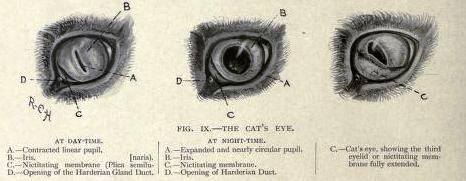
Chapter 32, The Cat’s Place in Nature. The grand prize goes to this chapter. A must read for taxonomists and natural history buffs who are interested in cat classification and physiology. Have a look at the anatomy of the cat’s eye:
View Full Size Image
The third eye-lid is called the plica semilunaris or nictitating mebrane. This is found in mostly nocturnal creatures and regulates the admission of light whilst protecting from injury.
Book of the Week’s Pictures of Cats!

Because we all need a daily cat pic fix: See more cat pics on Flickr and also don’t forget to re-pin from our Book of the Week Pinterest Board!

Time to Play Fact or Fiction
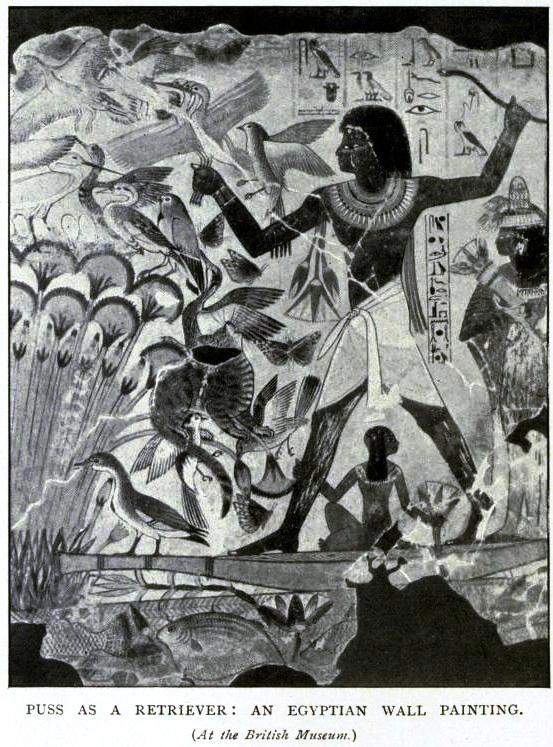
  • The ancient Egyptians worshiped cats and used them as hunting “retrievers” 

Fact: According to Horopollo, the cat was worshiped in the temple of Heliopolis, because the size of the pupil of the animal’s eye is regulated by the rising and waning of the sun. Additionally, long before dogs ever retrieved the kill on human hunts, cats did:

View Full Size Image
  • Cats have nine lives

Fiction: Ms. Simpson explains that “Cats probably owe this reputation to their extraordinary powers of endurance, and certain it is that they have a greater tenacity to life than any other animal. At the Battersea Home a dog and a cat have been placed in the lethal chamber, and it was observed that the dog died in five minutes, whereas the cat breathed for forty minutes longer.” Do the math, 45min/5min = 9X the will to live. Cats are survivors.

  • The black cat is a bad omen 
View Full Size Image
“I’m not a demon!”

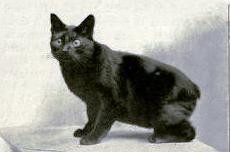
Fiction: If you haven’t heard this superstition before, it finds its origins in the Middle Ages, a time when demons inhabited bodies and witches were burned at the stake, it was also believed that the devil borrowed the coat of a black cat when he wished to torment his victims. A strange departure from worshipping cats, as the Egyptians had done.

  • Women are generally cat lovers while, men tend to like dogs: 

Fiction: Not necessarily true. Winston Churchill’s cat Jock was one of his favorite pets. Bill Clinton brought his adopted stray cat Socks with him when he moved to the White House. Victor Hugo had a favorite cat name “Chanome,” whom he slept with. Among the most powerful men the world has ever seen, Cardinal Richelieu and Napoleon counted themselves as cat lovers.

  • Domestic cats are almost identical to their wild counterparts, with few biological or genetic variations
Fact: Yes, a very strange fact indeed. Cats have been domesticated by humans for over 10,000 years yet, the human interference in breeding unlike with cows, has not resulted in significant genetic changes for the species. Top cat expert, Carlos Driscoll, explains that “cats can survive with or without us” and that they don’t rely on humans the way that other domesticated animals do — rather they coexist with humans.
  • Social media aka Web 2.0 was invented so that we could share pictures of cats. 

Arguable: Well, according to Ethan Zuckerman, Internet Activist and Harvard Berkman Fellow: “Web 1.0 was invented to allow physicists to share research papers. Web 2.0 was created to allow people to share pictures of cute cats.” (Cute Cat Theory) Yes, we know the Internet is used for so much MORE these days but, sharing picture of cats on internet forums truly is a weekly phenomenon. Every Saturday dubbed “Caturday” is a day in which global cat lovers post pictures of cats, en masse.  LOLcat has its own Wikipedia entry. If you didn’t know it was a thing, it’s definitely a thing. The internet chose cats, what can we say?

Who are we as Librarians and traditional lovers of feline companionship, to argue with popular demand? People want their pictures of cats and they want them every Saturday. We are service oriented here at the BHL and providing you with a fresh supply of cat pictures could be a considered a loose interpretation of our mission. Enjoy!

And no matter the day, let’s love cats and dogs, and all members of the animal kingdom in equal measure. Every living organism is part of the amazing tree of life.

We hope you enjoyed this post. Interested in guest-blogging for the BHL? We’d love that! Natural history, biodiversity and conservation topics are especially welcomed. Email us your ideas at [email protected]

Kitty Links, meow!

  • Why does the web love cats?
  • The Cute Cat Theory of Digital Activism
  • Why we love cats and dogs
  • Tumblr: Caturday
  • How are dog people and cat people different?
September 13, 2012by [email protected]
Blog Reel, Featured Books

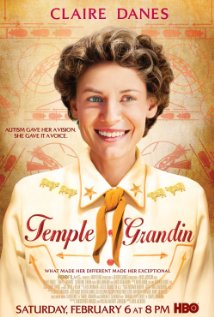
What You Need to Know about Temple Grandin and Cows

“Nature is cruel, but we don’t have to be.” ~T. Grandin

View Full Size Image
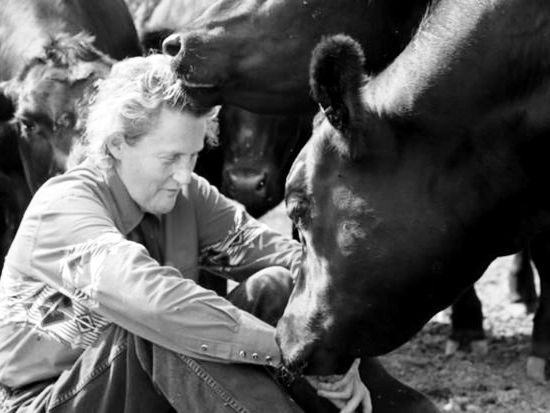
Temple with friends

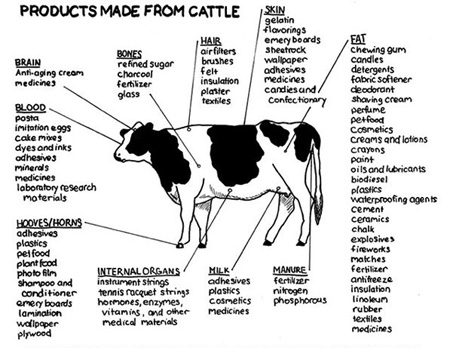
The relationship between man and cow is ancient. Evidence for domestication of cattle dates back to Mesolithic times (10,000 to 5000 BCE). For thousands of years, humans have made use of cows for labor, leather, milk, butter, cheese, meat and manure – among other things. (see diagram below) It is humbling to know that  our modern society, an urbane environment seemingly so far removed from the life of a shepherd, is built on the foundation of pastoralism and animal husbandry. We are indebted to cows, who in-part have helped transform human subsistence into secure existence.  In return for their contributions to mankind, cows only require that we feed, shelter, and defend them against wild animal attacks and disease. Regrettably, the commercialization of the beef industry has changed our ancient relationship with the cow dramatically for the worse.

Over the past century, humans have been reneging on their end of the bargain to provide for the general welfare of these docile creatures. Common today are news stories like ‘Farmers Feed Cows Candy to Reduce Costs’; ‘The Case of the Cannibal Cows’; which led to ‘Mad Cow Disease Kills Mother and Son’. And there is always your standard run-of-the-mill cow cruelty story — all highly disturbing reads, in varying degrees.

This stream of horror lays bear man’s broken contract with the cow. Isn’t it high time we make good on our end of the bargain? Appearing on the scene in the early 1970’s, one young woman named Temple Grandin seemed to think so.

View Full Size Image
 
Temple Grandin & compassion for cows

View Full Size ImageFor those of you who have yet to see the Emmy award-winning biopic on Ms. Grandin, the story begins with a brilliant young autistic girl whose affinity with cows commits her to an up-hill journey to reform the beef industry and the inhumane treatment of livestock. The rise of the modern meat-packing industry and the commodification of “cow products” have effectively altered the delicate, and in some cultures highly revered relationship, with our kindly bovine friends.

As a rule, mass-production focuses exclusively on economic bottom-lines rather than respect and fair treatment of Life.  Mentioned earlier, a few of these news stories describe humans being cruel for the sake of being cruel but, in most cases these ghastly stories are motivated by systemic greed. Profit, not barbarism, is the root cause of the perversion of our relationship with cows.

In light of this modern dilemma between profitability and animal welfare, Grandin brought us good news: unlike global warming, the damage that we have done is not irrevocable, we can treat cows humanely and it can make good business sense.

View Full Size Image
Designed to reduce stress.

Instead of asking everyone to become a vegan tomorrow, Grandin takes the more pragmatic approach maintaining that humans have always been omnivores, herself included. By working within the realm of possibility, focusing on what people can do rather, than what people should do the famed animal behaviorist revolutionized the beef industry by designing better facilities for cows. Her point-of-view is unique (Temple sees in pictures) and it has helped her understand the needs of cows in a way that you or I cannot.  She has worked tirelessly on policy to train and reform meat-packers, handlers, farm workers, agricultural companies, and big beef purchasers.

The secret to her success is that she rarely uses emotional arguments to win her battles but rather, helps to implement change by working with regulatory bodies that economically punish meat-packing plants that do not pass regular audits. She has also persuaded big beef purchasers like McDonalds and Wendy’s to sever ties with meat-packers that fail these audits. She has proven that economic consequences typically get fast results.

In addition to helping to transform the meat-packing industry, she also worked to change society’s negative perception of autism by showing that her condition is an asset that informs her work. Most laud all of Ms. Grandin’s accomplishments yet, there is some heated rhetoric aimed at Temple for not advocating veganism altogether. In response, Temple cites the laws of nature:

“Unfortunately, most people never observe the natural cycle of birth and death. They do not realize that for one living thing to survive, another living thing must die.”

Added as a corollary to this statement is:

“any animal that has the capacity to suffer when raised for human food deserves to live in an environment that prevents suffering and provides it with a life where it has opportunities to experience positive emotions. Nature cannot be moral or evil because it has no intent.”

Whether you agree with Grandin or not, one thing is for certain, she has worked tirelessly to ease the suffering and preserve the dignity of cows.

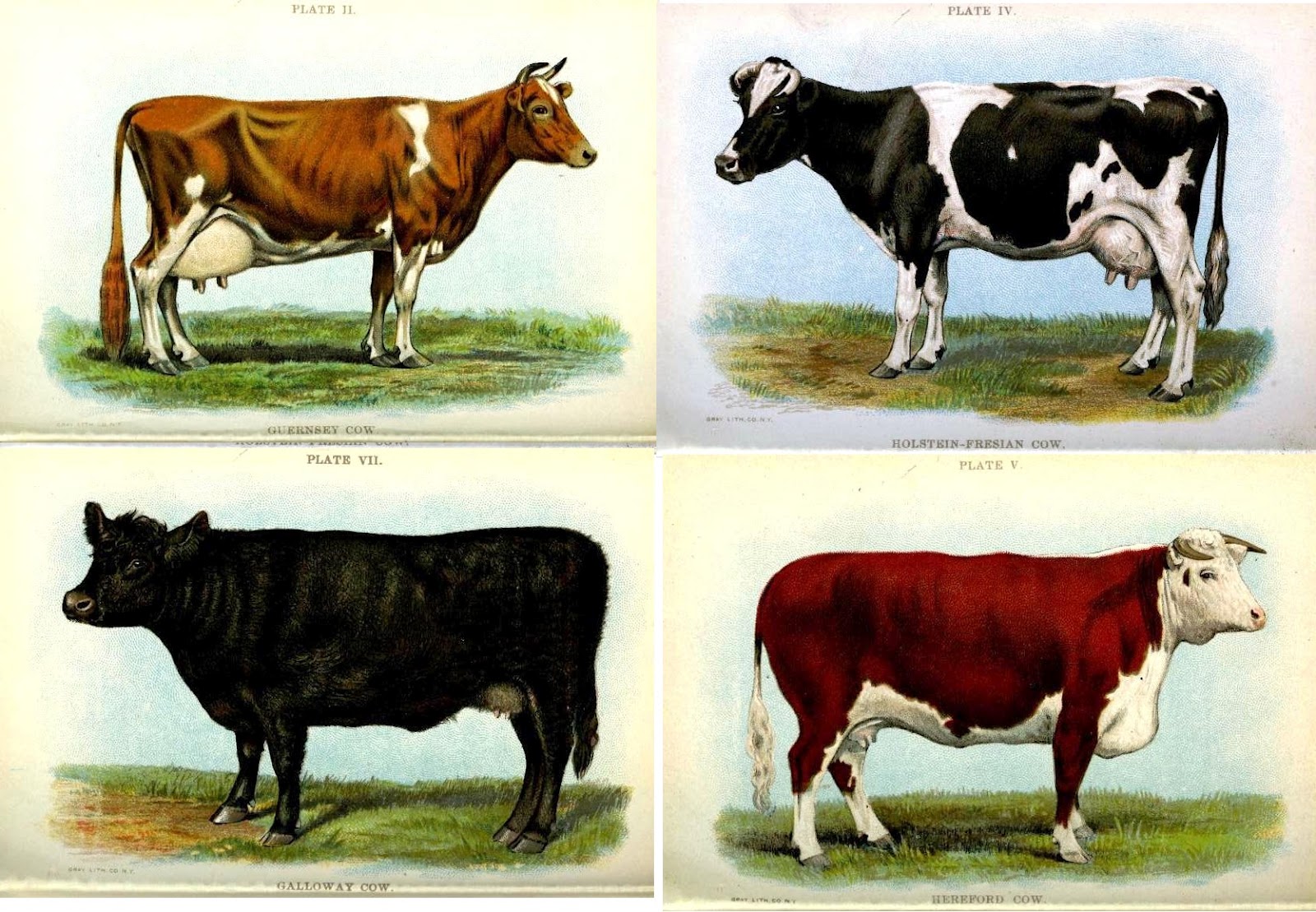
Book of the week: The Biggle Cow Book

Since it was Temple’s birthday this past Wednesday, we wanted to gift her with a lovely selection from the BHL. The Biggle Cow Book(1898), has jewels of advice about how to care for our lowing friends:

View Full Size Image
See all the Biggle Cows on Flickr.
  • A low voice makes a quiet cow
  • Old advice but excellent: Speak to a cow as you would to a lady
  • If the stable is cold at calving time blanket the cow after the birth of the calf, and the calf too
  • To scratch a nervous heifer between her forelegs has a wonderfully soothing effect
  • Don’t forget that continued good health requires proper feeding, good air, sunlight and exercise

Agrobiodiversity needs our attention too.

Alongside sound cow care advice, the Biggle Cow Book touches on an important area of biodiversity that gets very little attention: Agrobiodiversity. Conservation of a genetically diverse livestock population is a component of global biodiversity efforts that struggles to get proper exposure. Most conservation efforts are aimed at preserving wildlife biodiversity, a far sexier cause. However, this does not change the fact that the diversity of livestock animals is under threat. Surprised? Did you know that there are over 800 breeds of cattle that have been accounted for, and most of these breeds are at great risk of being wiped out?

The very definition of “domestication” negates the process of natural selection. Instead cattle are bred via artificial human selection of certain high-performing breeds and thus determines which taxa will dominate the livestock landscape. The unfortunate consequence is reduced genetic variation.

The future danger of emphasizing certain genotypes over others is best summarized by author of Livestock Biodiversity, Genetic Resources For the Farming of the Future, Stephen J.G. Hall: “the thousands of breeds that exist were mostly developed in very different circumstances from those of today, but they are not anachronisms, they represent the genetic diversity that will enable the livestock farming of the future to respond to new challenges.”

This is especially true in light of global climate change; who can predict which breed of cow will be better adapted to the environment of tomorrow? Current breeding practice is predictably only concerned with short-term gains like high-milk production or large meat yielding breeds—these are called high-input, high-output breeds (HIHO). Breeding that is driven by profits ignores the long-term viability of cattle and a vulnerable cow population flies in the face of the growing demand for meat: by 2020 global meat demand will increase from 209 tons to 327 tons, milk demand will rise from 422 million to 648 tons. Sound like another sustainability crisis?

Where do we go from here?

As our collective ethical consciousness edges ever closer to a moral crisis, the subjects of livestock conditions, treatment, and breeding practices is often a depressing discourse that most of us would much prefer to avoid. Yet, if you look for the silver-lining you will find it: as with the recent case of the cruelty violations by the Central Valley Meat, California-based fast-food chain supplier to In-N-Out Burger and McDonalds. Both fast-food companies immediately suspended their supplier relationship with Central Valley Meat after a video of brutal treatment by handlers went viral. Grandin’s strategy that stresses the importance of economic consequences as punishment for poor meat-packing practices was at work here.

Additionally, there has recently been more focus on the preservation of cattle breeds. In regards to agrobiodiversity conservation, we can look to the UN’s Food and Agricultural Organization, one of the few organizations whose mission includes promoting research and increasing awareness about livestock biodiversity. They maintain one of the most important resources for researchers, the Domestic Animal Diversity Information System or DADIS database which is a data source for the worlds’ livestock breeds. Additionally, regional efforts in countries like the UK have been leading the way with the established Rare Breeds Survival Trust. The organization has spurred other smaller organizations to form and work to gain funding for agrobiodiversity studies and policy.

One last piece of good news is that the average person can make a difference just by knowing where their meat comes from, voting with their dollar, and exploring diets that reduce their red-meat intake. During the process, if you decide to become a vegetarian, great! Either way, eating less red-meat helps to decrease the global demand for an unsustainable food resource. Adhere to this Chinese proverb: Eating what stands on one leg is better than eating what stands on two legs which is better than eating what stands on four legs.

When and if you eat red-meat, realize that you are eating a once living breathing creature that gave its life so that you may continue to live yours. This sacrifice should be honored and respected. Let’s wish Temple a very happy birthday this week and thank her for helping us to uphold our end of this ancient contract betwixt cow and human.

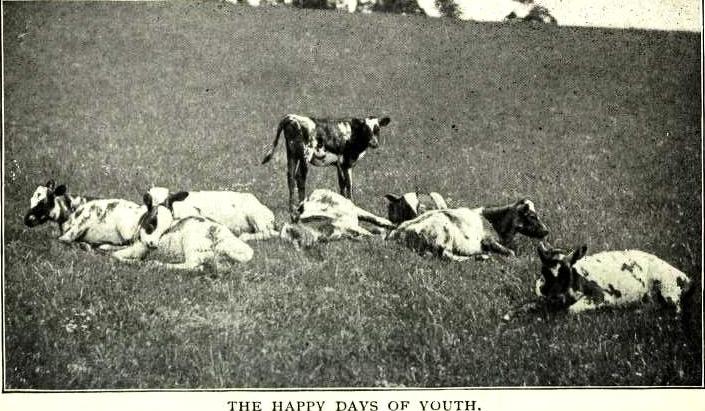
View Full Size Image
Cows a’ roamin!

Agrobio Resources:

  • BHL: Animal Husbandry Bibliography 
  • Breeds of Livestock
  • Sustainable Food Guide
  • Worldwatch: Is Meat Sustainable?
  • Good Meat: The Complete Guide to Sourcing and Cooking Sustainable Meat
  • Interactive: The Meatrix
  • PBS Program: Holy Cow
  • Breeds of Cattle (2nd ed.)
  • FAO Publication: Livestock Biodiversity
August 31, 2012by [email protected]
Blog Reel, Featured Books

Book of the Week: Shark Week Celebrates its 25th year!

This week, throngs of people who are amping up for Discovery Channel’s 25th annual Shark Week. This week long commemoration of all things sharks is aired in 72 countries watched by ~ 30 million viewers and is the longest running program event on cable. Every year schools of shark fans around the world countdown the days in anticipation for this late summer shark line-up and when it arrives they organize home-screening parties, play games, trivia, award prizes, shave their hair, get manicures and generally remain glued to their televisions marveling in the jawsome mystery and power of sharks.

What we here at the BHL love about this week of shark finaticism, is the remarkable thing that the Discovery Channel has done for shark conservation efforts. Over the course of 25 years, Discovery has significantly raised public awareness about declining shark populations by partnering with conservation organizations such as Oceana, Ocean Conservancy and The Pew Charitable Trust whose public service announcements are aired during prime-time commercial breaks, informing viewers about plummeting shark populations. Shark inspired mohawks and manicures aside, what the Discovery Network has really done is move public sentiment about sharks from a place of fear to a place of compassion. Moreover, they have successfully built a conservation army of shark lovers and enthusiasts. If every animal and organism on the planet had the same following that sharks have it would be a wonderful thing. We would all be a lot more knowledgeable about the earth’s biodiversity and the steep challenges that we face. Most importantly, we would know that there is still much work to be done.

Book of the Week: BHL’s selected homage to cartilaginous fishes aka Sharks

One hundred and fifty years ago, before twitter, television, and home-screening parties attended by folks in full shark regalia, there was a famous comparative anatomist cum ichythyologist named Johannes Müller who was also really into sharks. He may have expressed his fascination with sharks in a more traditional way by today’s standards, opting instead to publish one of the first comprehensive anatomical studies of sharks but, we think he would be tweeting it up if he was around today.

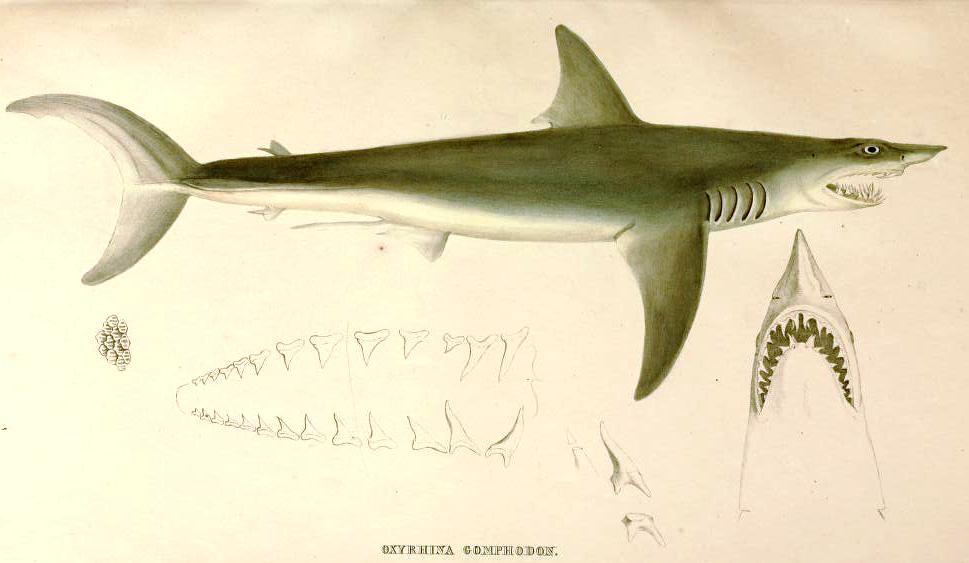
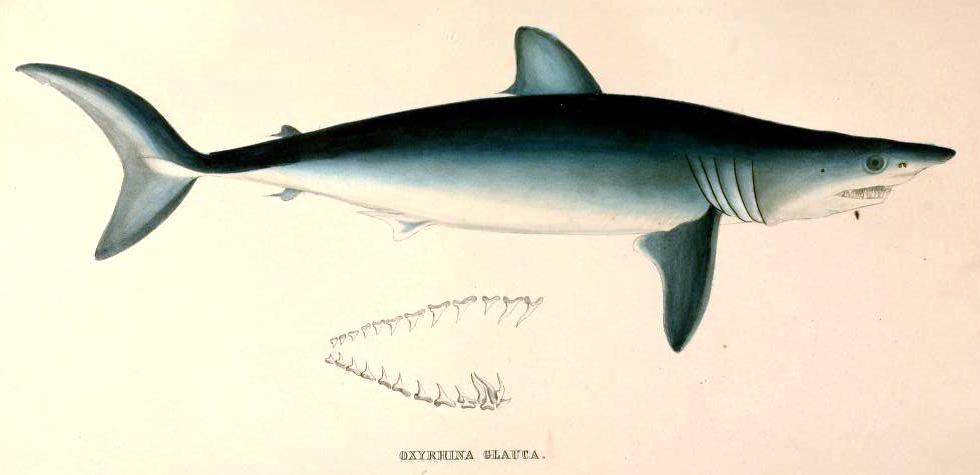
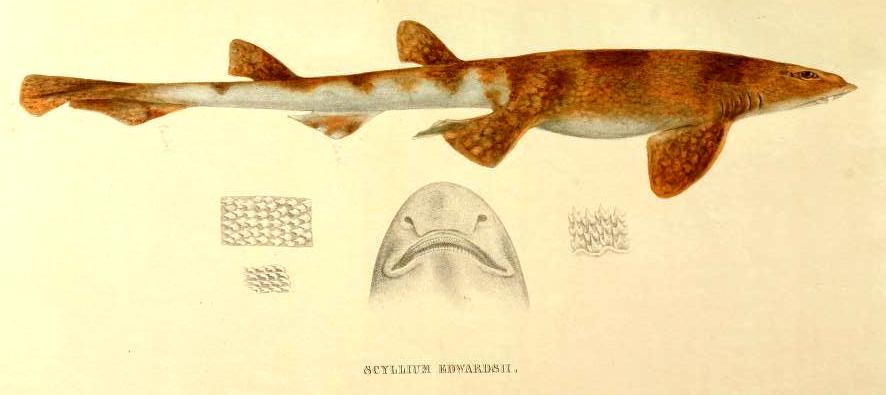
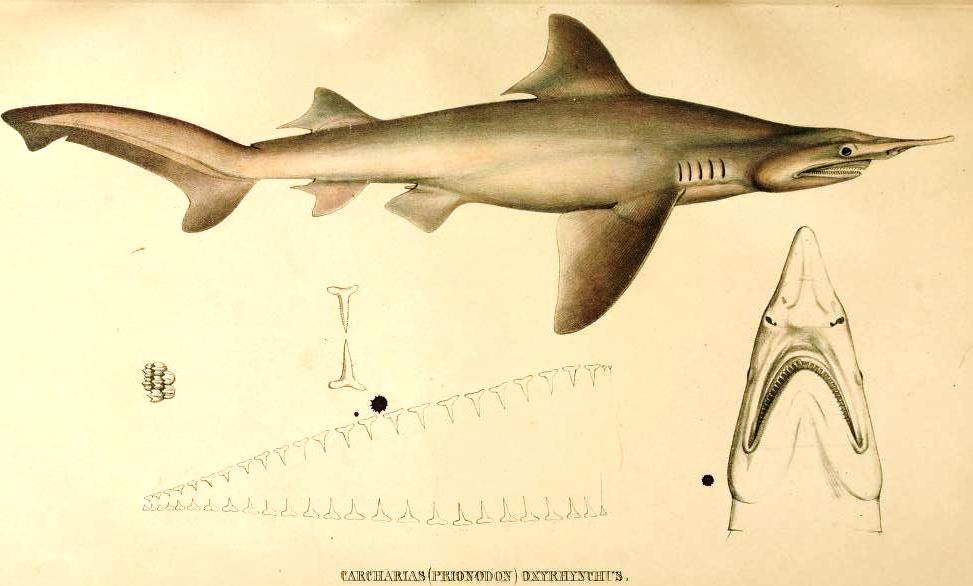
In his tome, Systematische Beschreibung der Plagiostomenor Systematic Description of Cartilaginous Fishes, Müller and his co-author Jakob Henle, provide anatomical descriptions of 214 Chondrichthyes (sharks, rays and skates). Their medical background in comparative anatomy helped to settle some taxonomic disputes about how certain species should be classified. For taxonomists, Müller asks that special attention be paid to the supplements and the detailed index of his book which guides you through his classificatory scheme. And naturally, one of the best parts of this week’s book of the week are the lovely plates provided in the text of some seriously jawsome sharks!

View Full Size Image

Want more sweet shark images? Check out the Biodivlibrary’s Flickr Stream and Pinterest Board!

We are unsure what the public perception of sharks was like in Müller’s day. Were people afraid of sharks? Did these creatures evoke blood-curdling fright and haunt them in their worst nightmares? Probably not. It was more likely that the average person never even saw a shark nor gave them much of a thought at all.Unfortunately for us, we have been subliminally programmed to be veryafraid of sharks. Movies like Jawsand over-sensationalized news stories about shark attacks have had the effect of damaging shark conservation efforts.The proof? According to a survey conducted in 2003 by the National Aquarium in Baltimore, Maryland “seventy percent of Americans surveyed […] believe that sharks are dangerous. 72 percent also believe that shark populations are just adequate or too high.”

Basically, more than half of the population seems to think that we don’t need to do anything to save sharks.This is a very dangerous sentiment indeed because the populations of these apex predators are on an alarming decline. Without sharks who will regulate the health of the ocean, chiefly coral reefs?  Sharks eat sick and diseased organisms, opening-up ocean habitats for healthy fish – in particular algae-grazing fish which act like coral vacuum cleaners.This video simulation created by the Nereus Program explains in detail how vital sharks are to reef eco-systems.

Seven Swell Facts about Sharks!

You are 15 times more likely to be struck by lightning than to be bit by a shark, and 89 times more likely to die of being struck by lightning than dying from a shark bite.  2/3 of a shark’s brain is dedicated to its sense of smell.In the 10 years between 1999 and 2009, there were 51 fatal shark attacks throughout the world. Annually, humans kill 79 million sharks. Now multiply that number by 10 years. And who’s afraid of whom again?

Sharks have seven senses compared to mammals that have five. What are the two extra that we don’t have: An electrical senseand pressure sensitive cells beneath the skin.

Of the millions of sharks killed annually, most of these deaths are a result of the high price for their fins to make shark fin soup. Fins go for $300 dollars a pound. The good news? States like California are banning the soup.

Some species of shark must keep swimming forward in order to breathe and therefore, are never stationary; they even swim while sleeping.
Some mother sharks can have parthenogenic births meaning that they can produce asexually. They are the Virgin Maries of the ocean.

Become a Shark Advocate

Convinced that sharks need your help? Here are some tangible things you can do to help shark conservation efforts:

  • Sign the “Save Sharks to Protect the Ocean” petition sponsored by the Pew Group
  • Stop eating Shark Fin soup with Yao Ming.
  • Adopt a shark
  • Eat sustainable seafood. Save sharks? Yeah, there’s an app for that. Download the Sustainable Seafood Guide on itunes.
  • Write in Scholarly Journals about declining shark populations. Get out there and collect that data!

Lastly, please educate yourself. Check out the iTunesU Shark collection that we put together that honors the power and mystery of these amazing creatures.

August 13, 2012by [email protected]
Blog Reel, Featured Books

Book of the Week: Beebe, Barton and the Bathysphere

 View Full Size Image“There is one joy of reading, another of painting, and another of writing, but none to compare with the thrill which comes to one who, loving Nature in all her moods, is about to start on a voyage of discovery to a land familiar in dreams alone.”  ~William Beebe

In 1934, William Beebe and Otis Barton made the first historic deep-sea submersible descent off the coast of Nosuch, Bermuda. At the time, they had reached a world record depth of 3,028 feet (923 meters). Beebe and Barton would later inspire ever deeper submersible dive records by many more explorers to come.

In fact, just over a month ago, China set the world record for deepest manned dive: The Jiaolong submersible reached depths of 22,600 ft (6,908 meters) in the Marianas Trench. The water pressure at that depth is equivalent to 1,600+ elephants standing on the roof of a small car! It’s important to remember that all submersible dives, including the Jiaolong are built on the initial explorations of two very brave men — William Beebe and Otis Barton.

Today, researchers have the security of new technological advances, exhaustive testing, and deep-sea robots that allow us to observe life in these extremely pressurized ecosystems with relative safety. In contrast during the 1930’s, Beebe and Barton did not have this luxury, being the first to dare such a dangerous feat. These were men whose curiosity overcame their fear, taking no refuge in the certainty that they would come back to the surface alive.

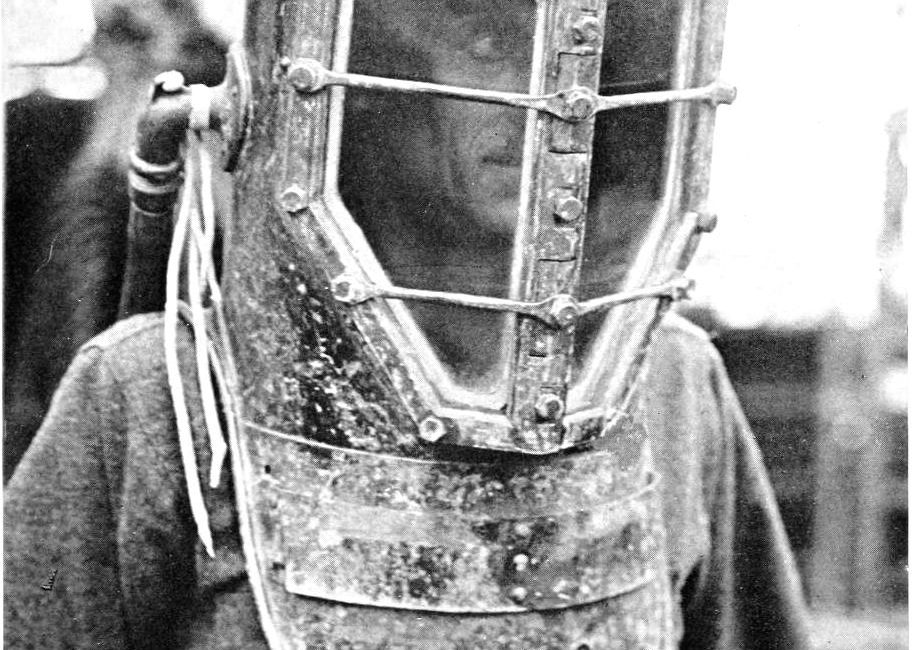
Unsophisticated by today’s standards, the original Bathysphere designed by Otis Barton, was essentially a 2.25 ton ball of casted steel, 4.75 ft. in diameter, with two windows made of three inch-thick fused quartz. Barton approached Beebe with the design after Beebe publicly made available his own preliminary design for a cylindrical deep-sea vehicle in the New York Times Barton saw Beebe’s plans and knew that his alternative spherical shape submersible would be a superior design, able to better withstand the pressure of the deep-sea.  Beebe met with Barton and approved his designs. The rest is history. 

The origins of Beebe’s quest: The Arcturus Adventure

Many scientists at the time questioned Beebe’s motives, seeing the Bathysphere as a publicity stunt by a media hungry scientist cum celebrity. Beebe’s bitter public divorce, late nights dancing in jazz clubs and stints on game shows made him an easy target for drama-driven gossip columns. In Beebe’s defense, we believe his intentions were honorable since he was so often lamenting over the fact that his deep-sea dredges off the coast of Bermuda brought back only lifeless bodies of the creatures whose behaviors and tendencies he wished to study in their own habitat.

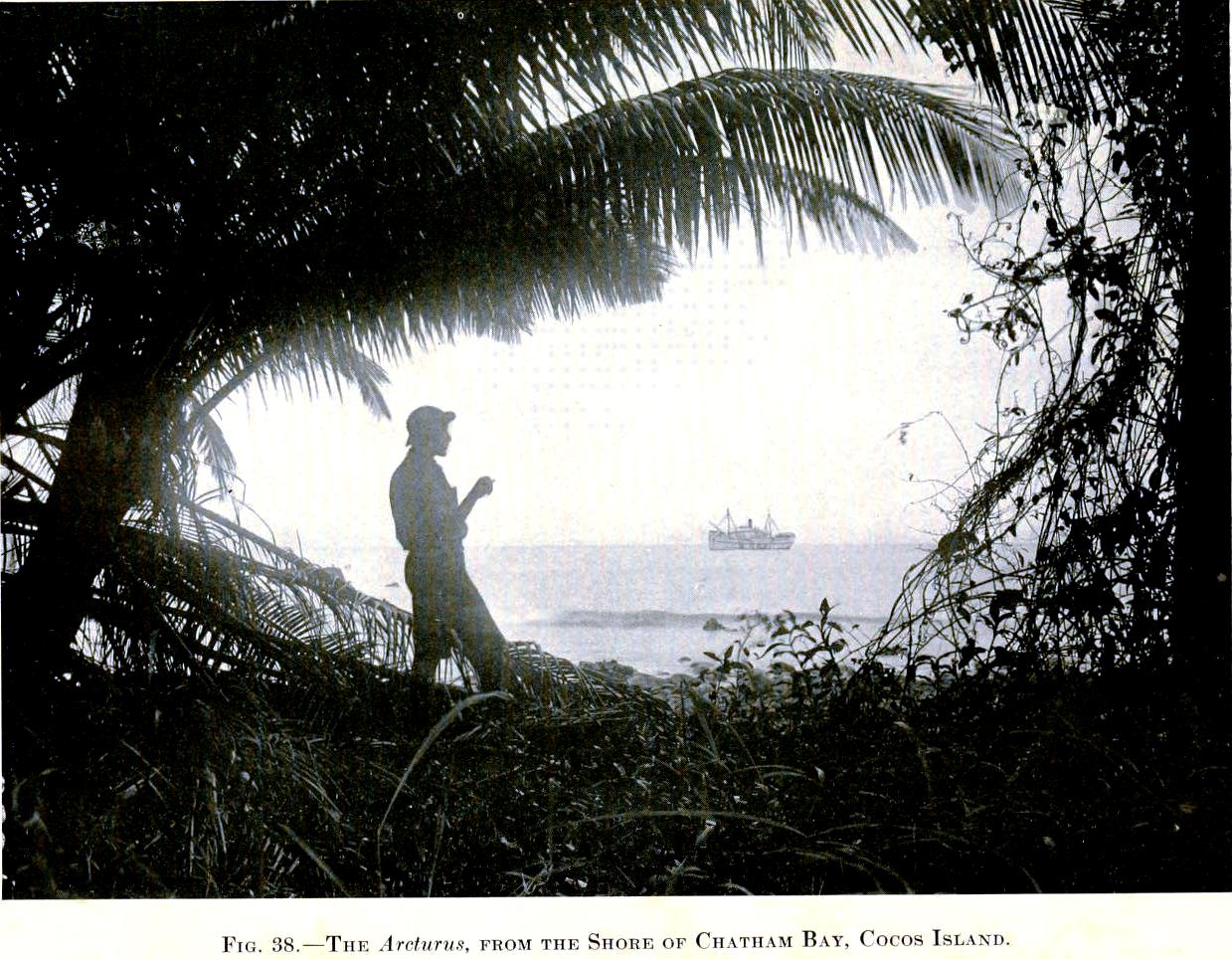
In this week’s book of the week, The Arcturus Adventure, Beebe writes, after another round of deep-sea dredging, that the eels brought back to the surface from a half-mile down only raise more questions:

“If tentacles were needed by this eel why in the name of holy natural selection must the jaws be thus sacrificed! These eels were always quite dead when I found them in the heart of the salpa mass, and how they live and move and satisfy their appetites in the icy blackness half a mile beneath our keel I shall perhaps never know. “ (p.382)

Beebe’s need to know pushed him ever further to take new risks and thus, his search for a deep-sea submersible design began, ending with Barton in 1930. Four years later on August 15, 1934 they would make headlines with the world’s first, only and deepest submersible dive. The results of these dives produced Beebe’s account of his many journeys in the Bathysphere, Half Mile Down along with a 1938 film titled, Titans of the Deep.

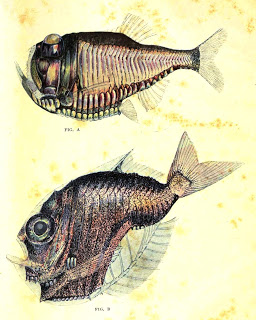
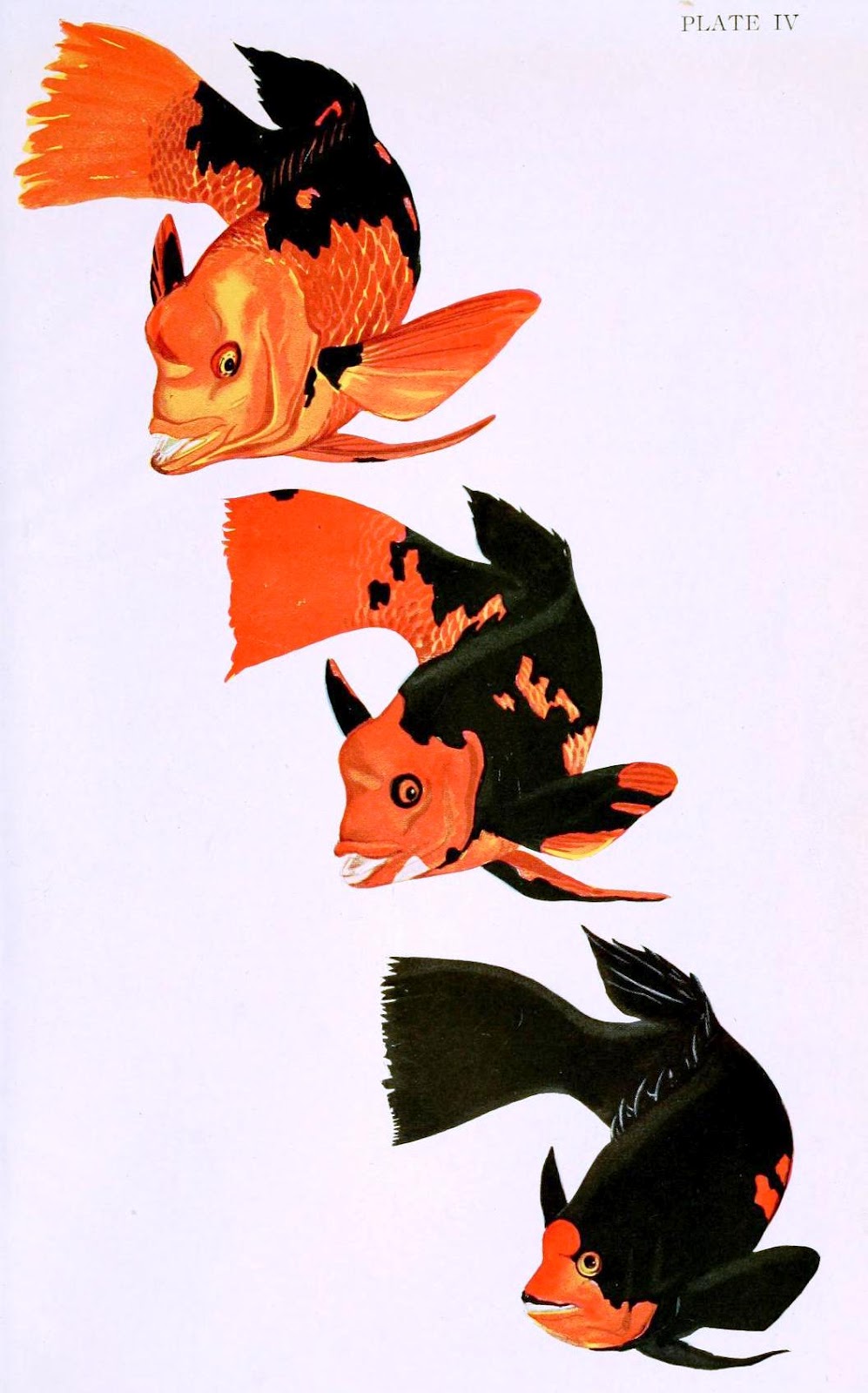
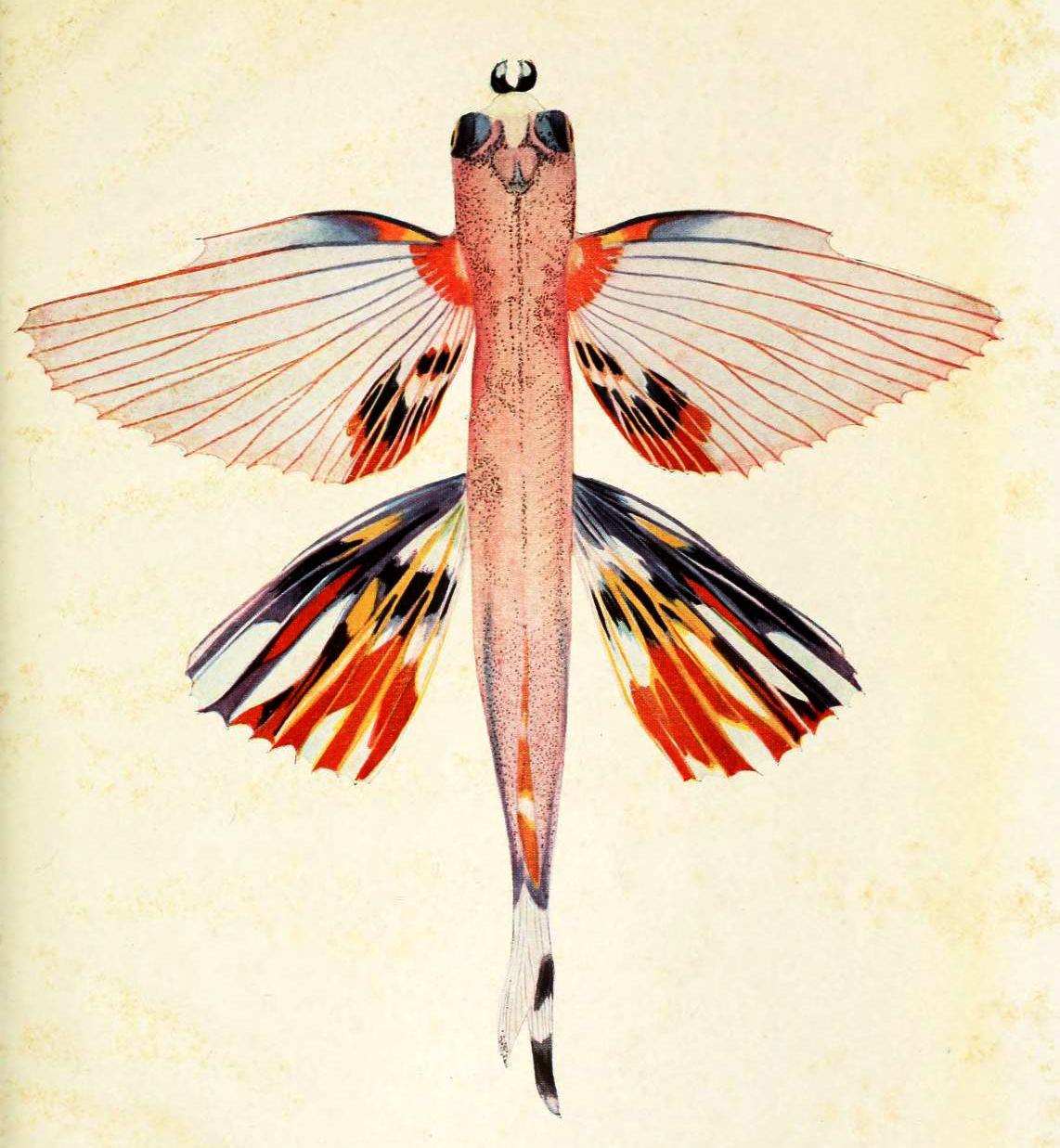
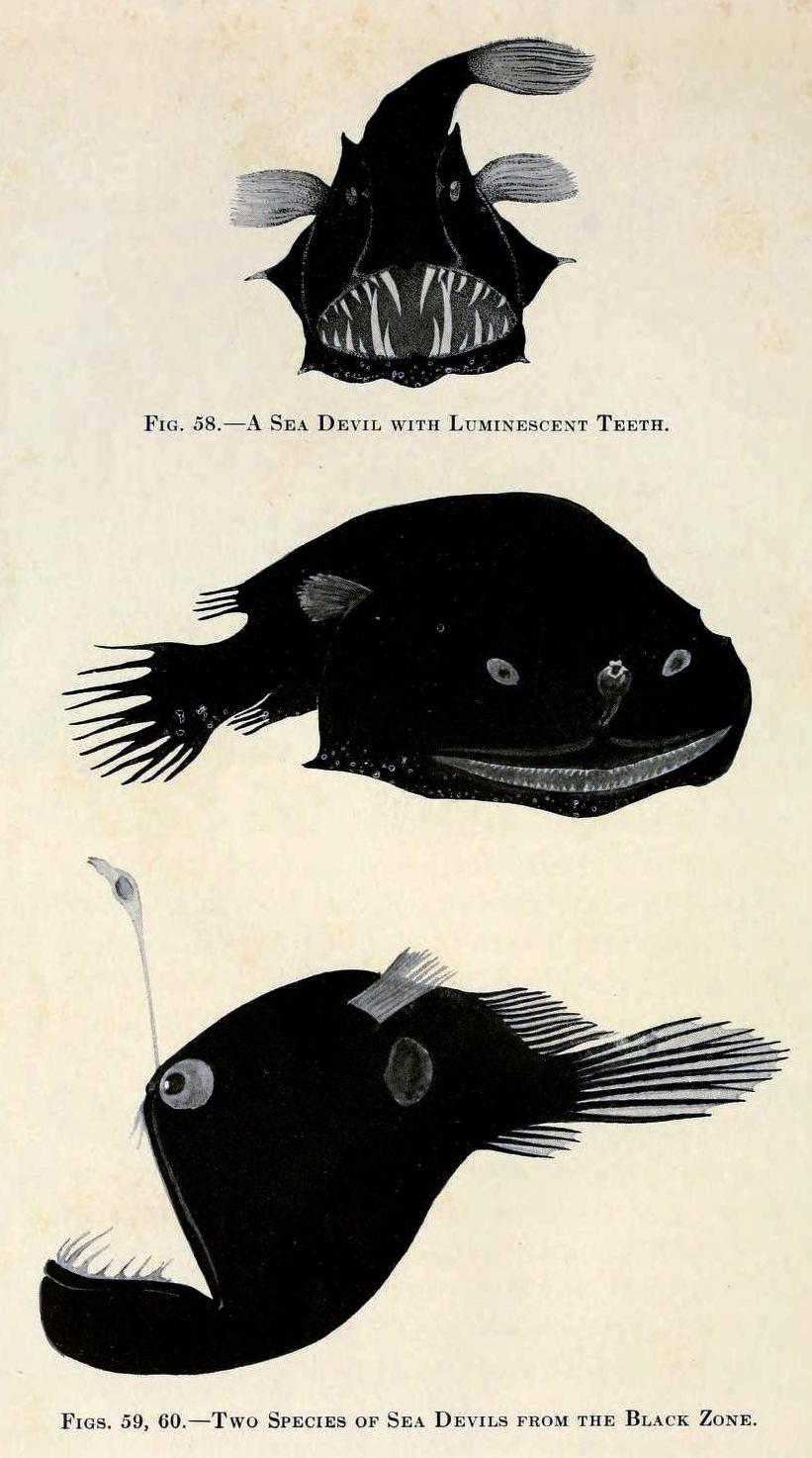
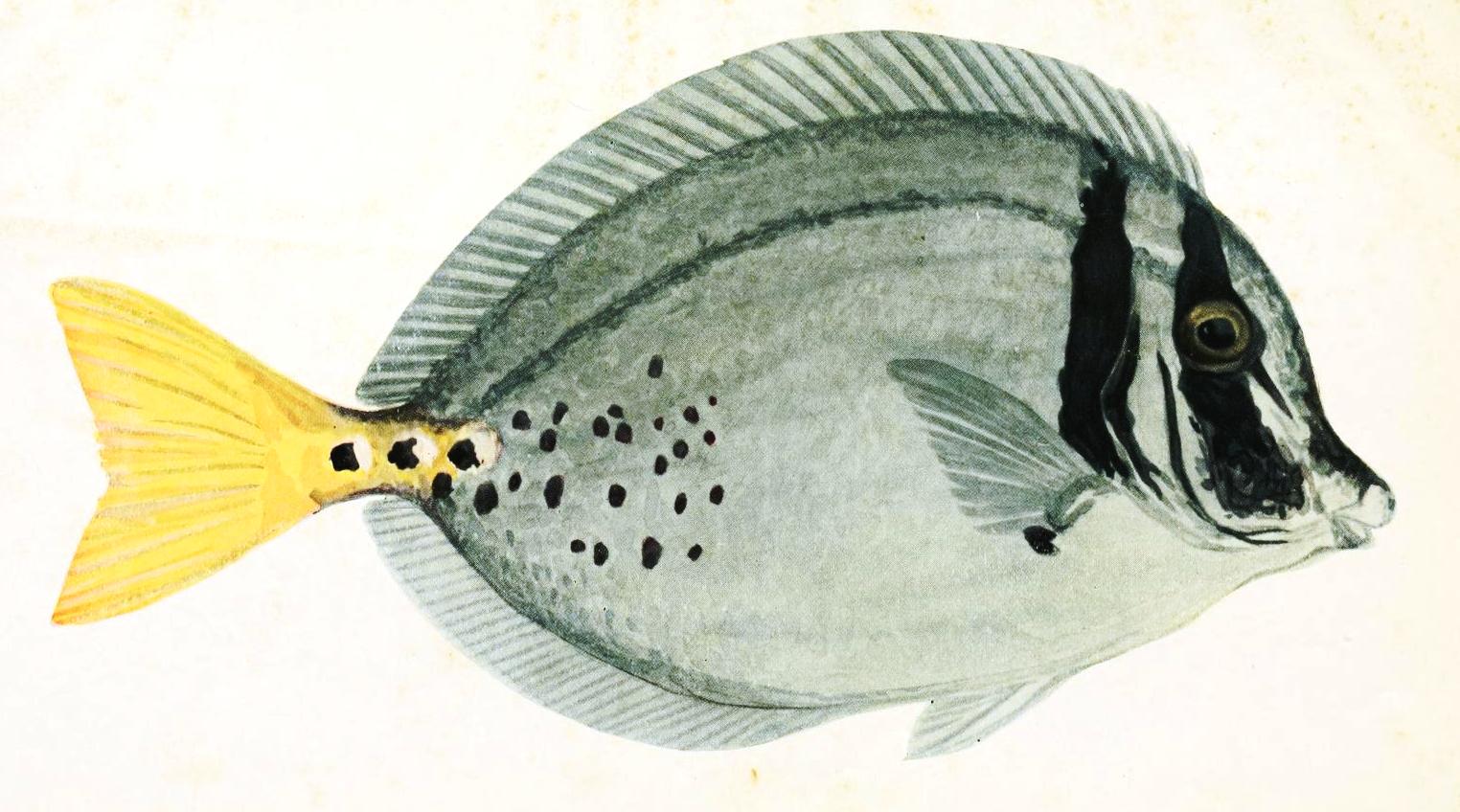
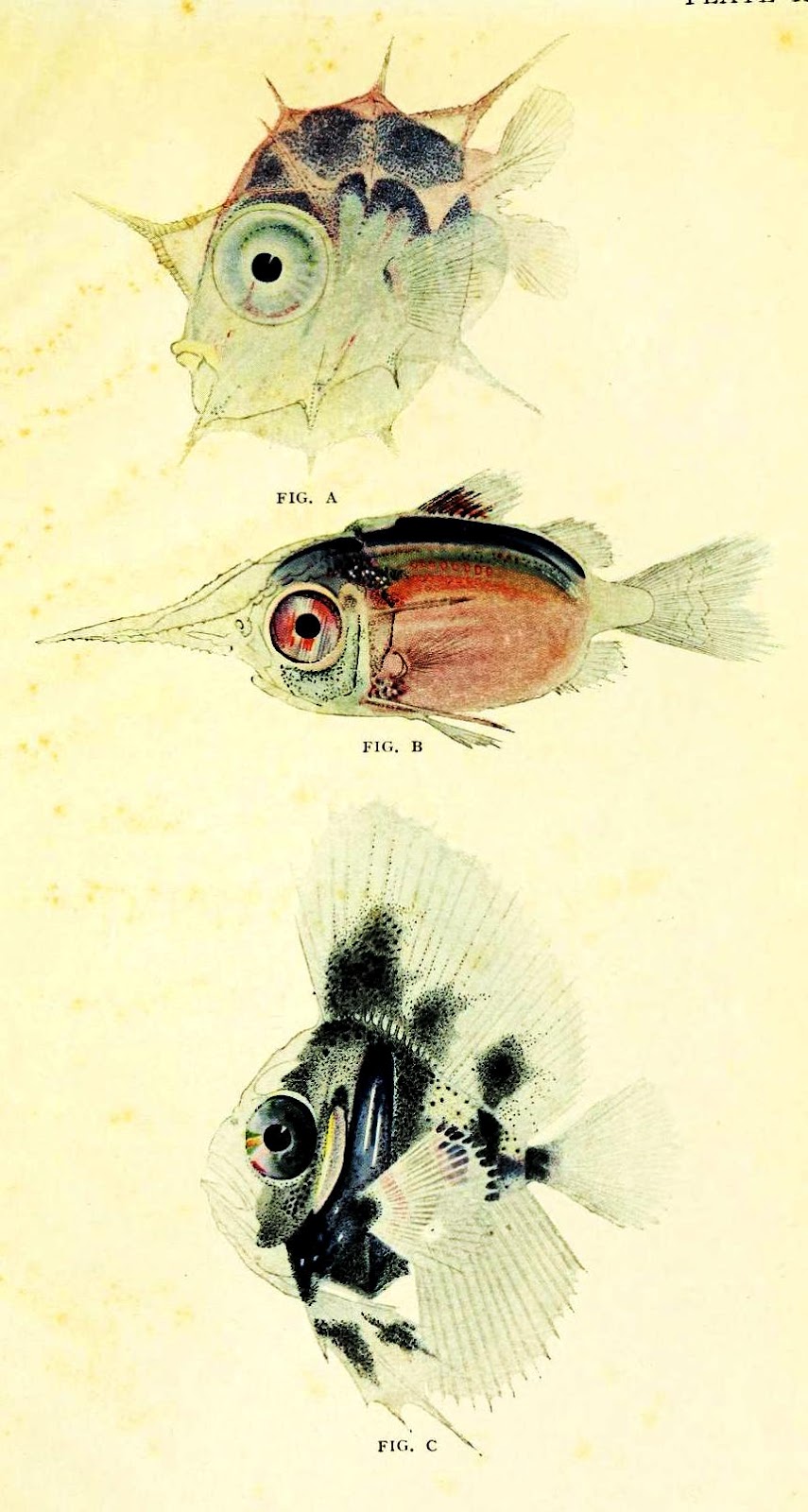
Lucky for Beebe and his insatiable curiosity, it would be only a few years later that we would have the answers to once unknowable questions about deep-sea creatures and Beebe would share his conclusions with us in his rivetingly written and richly illustrated books. The Arcturus Adventure gifts us with some fabulous images from the New York Zoological Society expedition that acted as the catalyst to the Bathysphere dives. For your viewing pleasure, please check-out some of Beebe’s dredged-up fish

View Full Size Image
Fig. A, Argyopelecus ; Fig. B: Sternoptyx
View Full Size Image
Bodianus eclancheri
View Full Size Image
Cypselurus furcatus
View Full Size Image
Melanocetus johnsonii
 
View Full Size Image
Xanthichthys Ringens
View Full Size Image
Fig A: Young Mola mola ; Fig. B: Holocentrus; Fig C: Taractes

The full-set is available for download on Flickr. This week we thank MBHLWHOI for digitizing Arcturus.

Happy Birthday Beebe

And why do we highlight Charles William Beebe today? Besides the fact that he was no ordinary scientist, this past Sunday marked Beebe’s 135th birthday. Happy belated Beebe and thank you for your contributions to the body of knowledge about life on Earth with such infectious flare! Even though Beebe was often accused by critics of “spicing” things up in popular accounts of his scientific adventures, we think he was just a man on a mission with some serious curiosity, courage and commitment to knowledge. He lived like a man who was running out of time, indefatigable to the last: on his expeditions he was noted to rise at 5AM and end the day around 10PM; the fact that a volcano was erupting did not deter him from hiking into it — almost being killed by toxic gasses. It would take a man like this to place himself into a 2+ ton steel ball called a “Bathysphere” and head down into the unexplored deep. We know Beebe was not interested in notoriety, Beebe was interested in Life.

“…the supreme joy of learning, of discovering, of adding our tiny facts to the foundation of the everlasting why of the universe; all this makes life [..] one never-ending delight.”~ William Beebe


View Full Size Image

Notes

Beebe Bibliogpraphy on the BHL
William Beebe’s Official Website
Beebe, Barton, Cameron

Beebe Media
Welcome to Bermuda (recommended)
William Beebe’s Galapagos Expeditions (recommended)
Sounding the Deep, a 2012 Hull Philharmonic Orchestra production inspired by Beebe.
Titans of the Deep (1938)
Information Please, Beebe airing as a guest on the popular quiz show.

August 2, 2012by [email protected]
Blog Reel, Featured Books

Book of the Week: The Human Side of Birds

Approach Nature anew, as a child might. 

View Full Size Image

Royal Dixon, the author of this week’s book of the week, The Human Side of Birds (1917), had an eclectic background. His formal credentials included botanist at the Chicago Field Museum, ornithologist, lecturer for the NY Board of Education, science journalist and author of several books– all of which sought to put a human face on nature. He was also a dancer, thespian, political writer and founder of the First Animal Church in America.

One might ask why was this man was so intent on humanizing plants, animals, trees and birds? Dixon, it seems, was concerned with modern society and its growing inability to relate to nature. To appreciate it. To see it. And most importantly to preserve it. He saw the good in the formal sciences yet, believed in some ways that taxonomy, in particular, barred non-experts from participating in the deeply human act of naming and organizing Nature’s Kingdom. His mission was simple: bring Nature to the people. Show them how similar every creature on this planet is to us and how we are all connected to each other on the most basic and profound levels.

Besides authoring several books, Dixon’s chosen platform from which to disseminate his message was guffawed at by most in his time. He became founder and leader of the First Church for Animal Rights, which met weekly and promoted the idea that “every creature had the inalienable right to life, liberty and the pursuit of happiness.” Although the church is now defunct, or at least seems to be since there isn’t a digital whisper of such an organization to be found out in cyberspace, we here at BHL are entirely sympathetic to Dixon’s cause!  He was a man who had a formal science background yet, his efforts were wholly aimed at the general public. He realized that in order to reach people and get them to care about Nature we need to change the hearts and minds of those who believe in the stereotype that taxonomy is just a dry, stodgy, and inaccessible science concerned with mindless minutiae and doomed to endless arguments between warring factions of men who seemed partial to fabric combinations consisting only of houndstooth, tweed, or corduroy.

View Full Size Image

In his forward Dixon states his purpose simply: “to reject the limitations of unsympathetic research, and to endeavor to see beyond formal classifications, and to understand the spirit, emotions and impulses in the lives of our feathered friends of the air.” Is this not the true reason behind all this binomial naming business? Author Carol Kaesuk Yoon seems to think so in her prize winning book on taxonomy: Naming Nature. Moreover she makes the case that those of our ancestors who were not taxonomists, or folk taxonomists more precisely, did not survive. Therefore, we are all descendents of taxonomists because those who could not name, order and understand nature were unable to discern a poisonous plant from a one that was edible, or which herbal remedy could cure their sick child’s fever. They knew to avoid eating the sacred bird of the neighboring tribe lest they’d like to find their head on a stake in the morning! Our non-taxonomist ancestors were “naturally deselected.” Taxonomy is an ancient science deeply embedded into the human experience, past and present. It was and still is vital to human existence and it belongs to everyone.

So let us humor Dixon: How can he show us that birds are just like US?

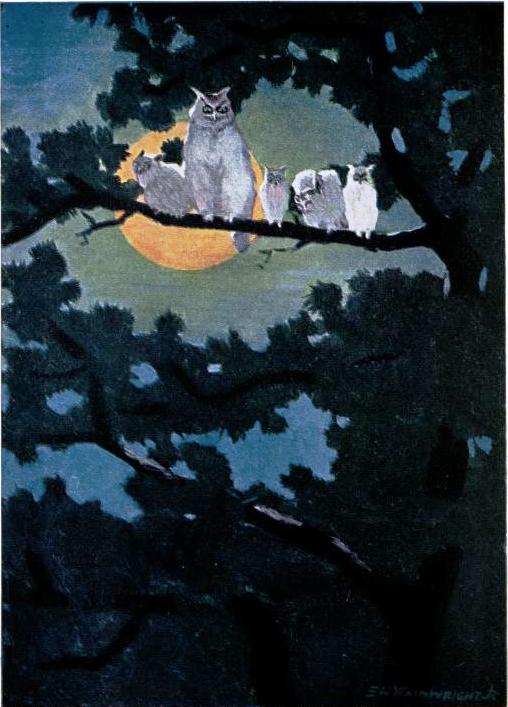
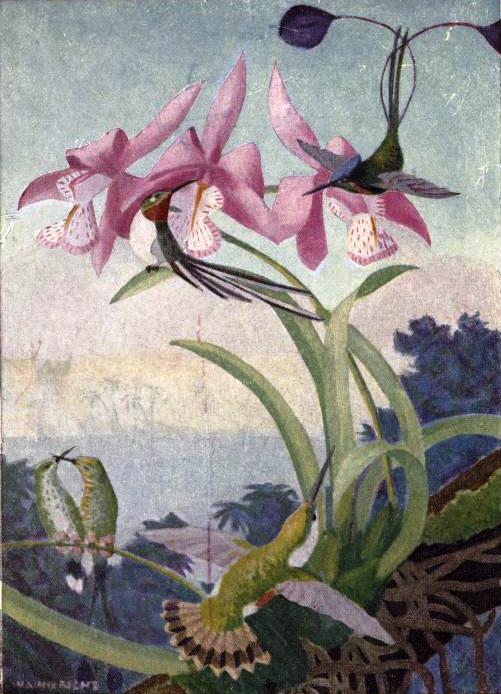
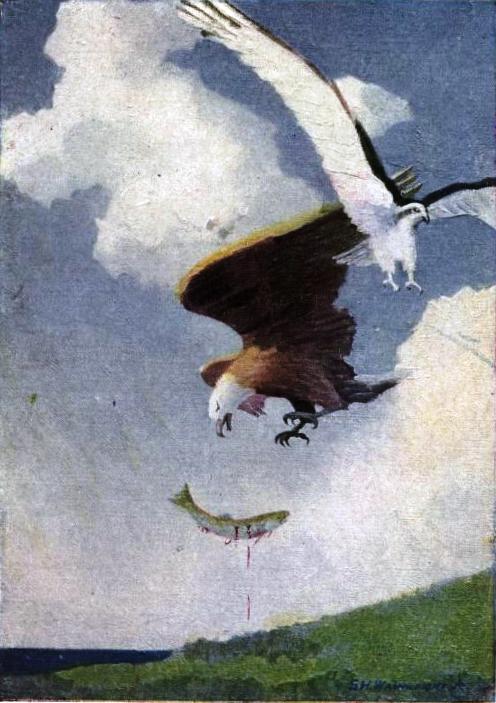
Dixon’s theater background helped him understand storytelling and the human archetypes that we identify with. Therefore, his book is divided into 14 chapters; each assigned a human archetype such as the “Athlete”, the “Artist”, the “Dancer,” and it is under these human classifications that Dixon seeks to place birds:

View Full Size Image
The urbane Penguin’s apartment houses are nestled in cliff cities.
View Full Size Image
The Wise Mother: ‘Gather ’round young ones, let mother impart her wisdom with a story
View Full Size Image
The aesthetic sense of the artistic hummingbird whose nests are wonders of delicacy and beauty
View Full Size Image
The thieving Osprey rarely fishes for himself preferring to rob others of their work. Human-like?

So today, let’s look at Nature through Dixon’s eyes: awake, appreciative, anew, as a child might. We leave you with a quote to contemplate:

“If I name every bird in my walk, describe its colour and ways, . . . give a lot of facts and details about the bird, it is doubtful if my reader is interested. But if I relate the bird in some way to human life, to my own life; show what it is to me and what it is in the landscape and season, then do I give my reader a live bird and not a labeled specimen.”

 – John Burroughs, American Naturalist and Conservationist

We would like to thank America Museum of Natural History, NY (AMNH) for digitizing this work. Incidentally, the 34 photos in Dixon’s book also come from AMNH. Bravo to the staff there for assisting in the creation and rebirth of this work. We know Dixon would be doubly pleased.

Other work’s by Dixon available on the Biodiversity Heritage Library

The Human Side of Plants (1914)
The Human Side of Trees (1917) 
The Human Side of Animals (1918)

July 19, 2012by [email protected]
Blog Reel, Featured Books

Book of the Week: The History of American Tree-Huggery

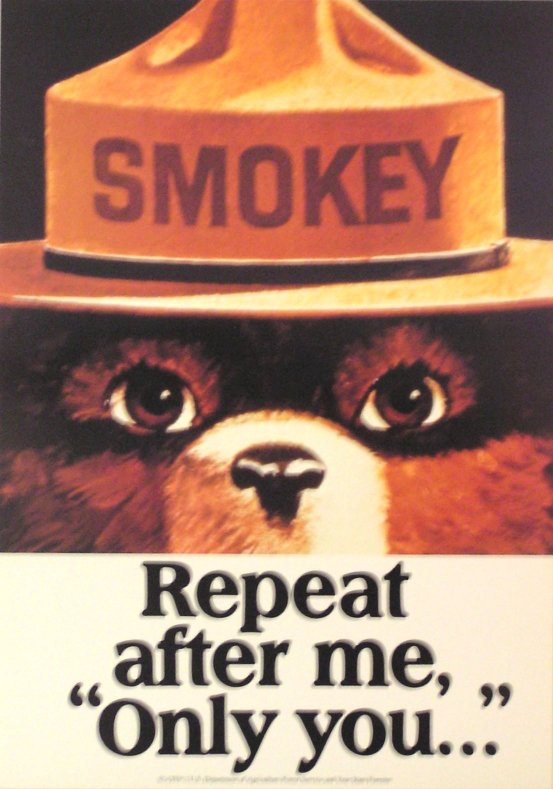
View Full Size Image

If you are an American, you know who Smokey the Bear is. He’s the bear in the ranger hat who has been adamantly spreading the same message for 70+ years: “Only YOU can prevent forest fires” — and he’s been pretty successful.

According to polls, 99% of us recognize Smokey and apparently get the message. But do we? If we pick apart the philosophical underpinnings of this simple campaign slogan, we come to a place of personal reflection:

 “What does Smokey mean by only I can prevent forest fires? Don’t I prevent them every day by not starting them in the first place? Isn’t this enough? What does this bear really want from ME?”

Smokey might want more. Even though we know who Smokey is, do we really understand his message and all of the responsibility that it entails? The recent fires that are stripping the natural beauty in the state of Colorado as we speak, remind us of our own fragility and the havoc that one small spark can create for America’s forests. It’s time to revisit Smokey’s historical origins in early American forestry and the deeper meaning of his message.

Smokey the Bear was born out of necessity in 1944. A child of the the United States Forest Service, the National Association of State Foresters, and the Ad Council, all of which were founded in the earlier half of the 20th century. The important historical question to ask ourselves is: Who was protecting America’s forests before Smokey and these federally funded institutions?

View Full Size Image
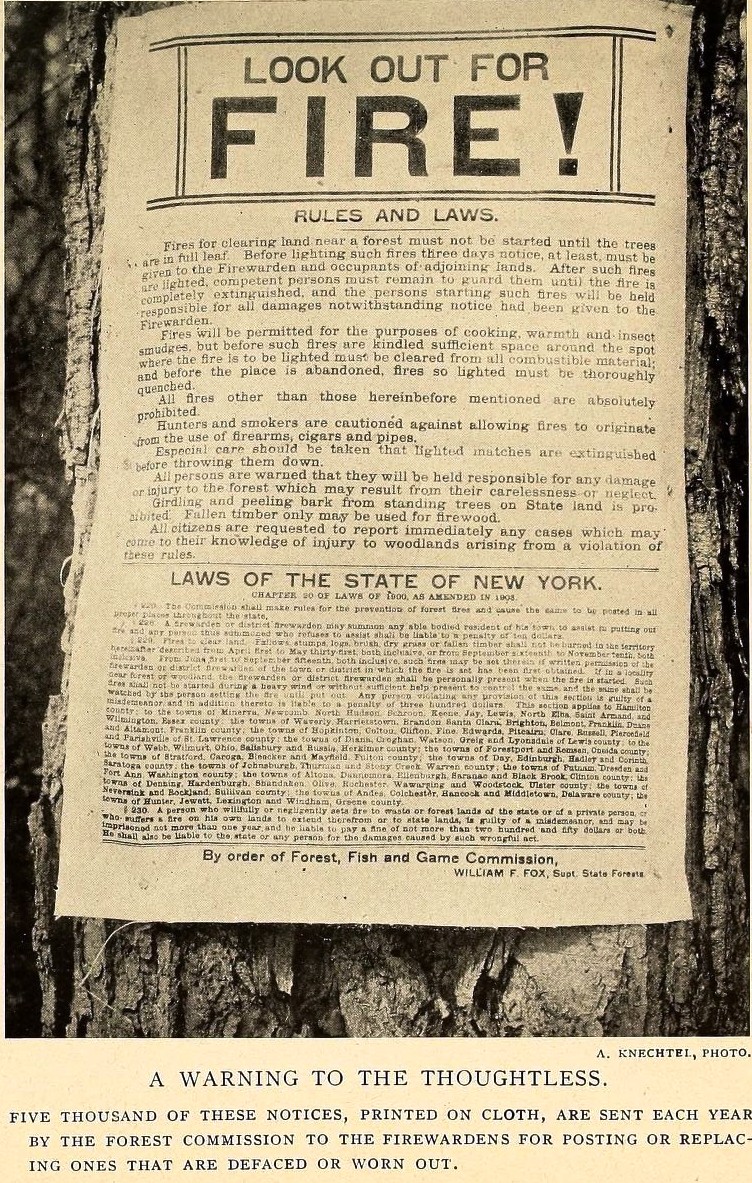
Before Smokey, there was wordy fire prevention signage.

Answer: This task fell to state run wildlife, game and fishery commissions sprinkled across the nation. Today we highlight one such commission, who was “trailblazing” the field of Forestry (pun intended). The State of New York Forest, Fish and Game Commission was spreading the fire prevention word long before cute and cuddly Smokey came along–albeit in a less concise fashion.(see above) Contrary to what one might think, their public awareness campaign was incredibly successful–and on a global scale too. This particular Commission was a formidable forestry force in its heyday. The gentlemen that ran the State of New York Forest, Fish and Game Commission were respected as top experts in forest preservation, conservation and study. Additionally, their Annual Report became, like Smokey, extremely popular and the key to their public awareness campaigns. These Annual Reports were so sought after and well-received by naturalists and the general public alike, that the Commission could never fulfill the orders for the publication. If you were to visit the Imperial library of Japan you will find a full run of the serial sitting on the shelves–that is how far reaching and influential this publication was. Even Japanese royalty coveted the tomes.

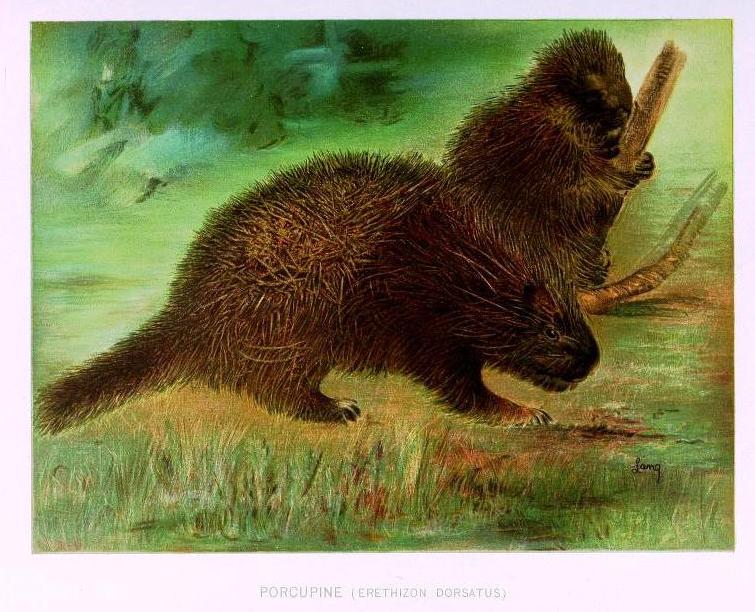
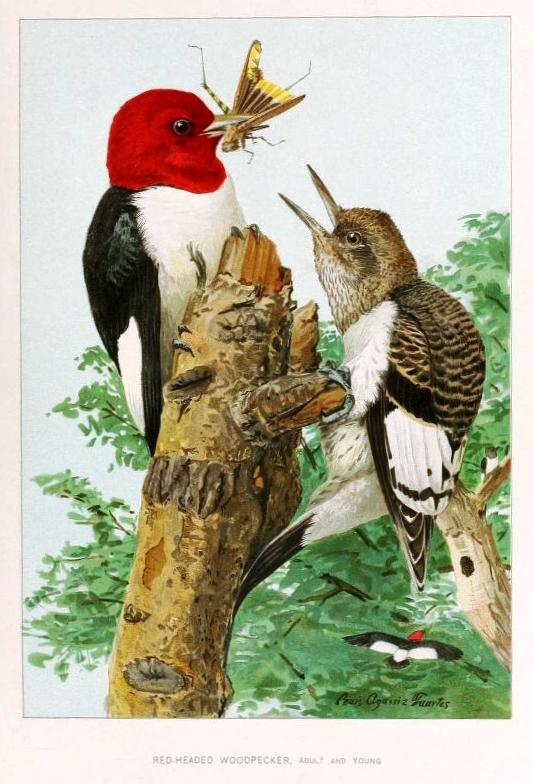
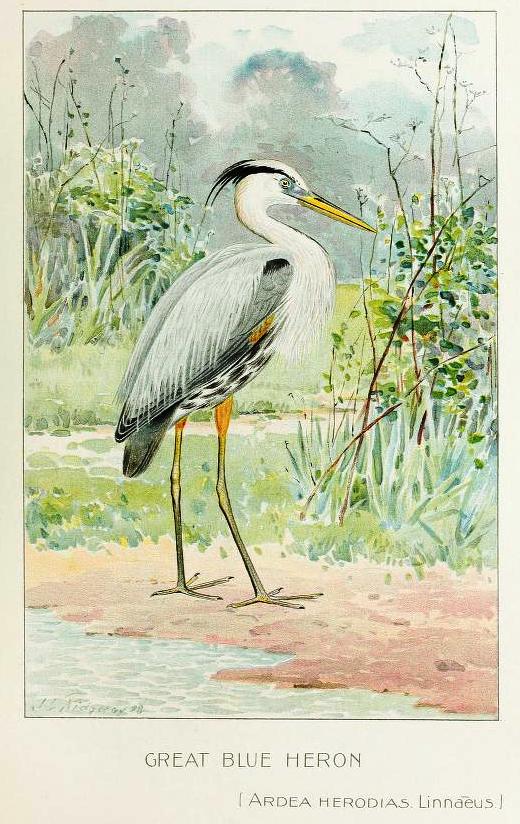
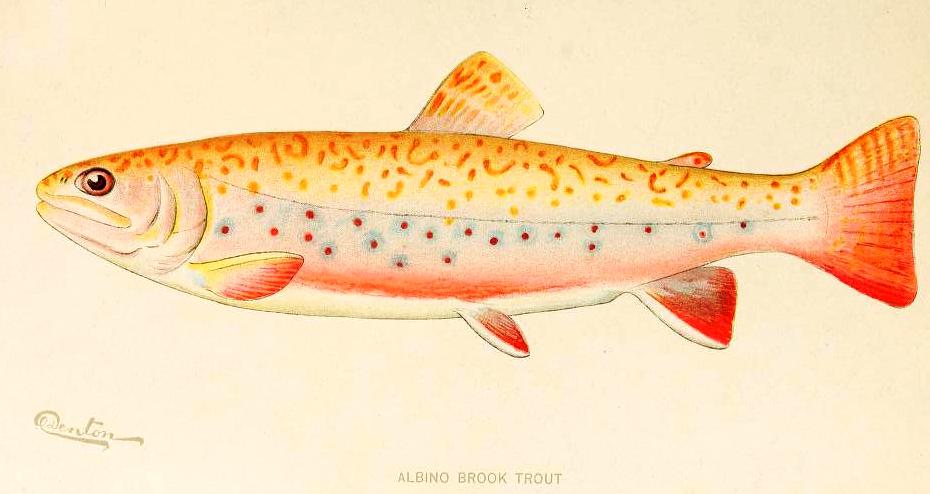
This is why we have chosen it for this week’s Book of the Week; now you may enjoy what so many others couldn’t. And while the report may not be as famous as Smokey the Bear is today, at the time the publication’s popularity could be equated with a New York times bestseller. You might be wondering how a small State Commission became an international player and authority in the budding field of American Forestry? The answer lies in the annual reports themselves. Each one is a cornucopia of natural beauty: whimsical yet reflective articles, photos of forestial scenes, colored plates of perch, woodpeckers, moose and all of the wondrous biodiversity found beneath the tree canopies of New York’s Adirondacks and Catskills. A few BHL favorites for your viewing pleasure:

View Full Size ImageView Full Size ImageView Full Size Image

View Full Size Image
Check out the rest of the illustrations for yourself on Flickr!

As one can see, the annual report seemed to be a labor of love for the commissioners in New York. If you dive into some of the articles, it becomes obvious that these men were on a mission to raise Forestry’s status from a mere vocation back to its rightful place as an ancient Teutonic art. One such man, Judd Northrup spoke of the Forest and her mysteries with poetic longing:

View Full Size Image

Judd on the forest: “all the mysteries of sound, the low murmur of the pine needles, the sweet odors of soil and vegetation, the silences, the glittering waters, the dark-hued pools, the hermit thrush’s notes at evening – a hundred other things we can name and label; but beyond all these there is something like the secret of what is life itself, which no mortal has ever solved. The humblest blade of grass, the tiniest insect, hides this sublime secret of life, and laughs at man’s ineffectual effort to reach the mystery by observation, analogy or analysis.”– Judd Northrup, United States Circuit Court Commissioner, 1897

View Full Size Image

From Judd’s description one can’t help but think of the Forest as the rugged man’s (and woman’s) holy place: commune with Her and enter that which is sublime. Stripping you down to your naked soul, Her majesty will both humble and uplift you– at least that’s what how we interpreted it here at BHL. These naturalists took their task to heart and pursued their mission with religious fervor. Their early successes proved that public awareness and strong legislation against human carelessness were the keys to forest conservation and more specifically the prevention of forest fires. The Commission in New York was even given the legal right to confiscate neglected lands from those heedless towns without fire-wardens–for the greater good of all. These early efforts paved the way for a nationally recognized Smokey the Bear campaign and subsequent legislation.

Perhaps, the most important legacy that the Commission’s Annual report leaves us with, is that the deeper meaning behind Smokey’s words lies in the superficial knowledge of this slogan. Paradoxically profound, yes! However, in this case, by simply uttering the phrase you become aware. It’s this simple self-awareness in Nature that is the primary key to preventing forest fires. Cleaning up after oneself; putting out camp fires, cigarettes and grills; and leaving no flammable item behind is what we can do to prevent fires on a personal level. So in a sense yes, most of us are doing great! It’s just those few careless folks that can destroy so much in such a small amount of time that we are worried about. On that note, I’m sure Smokey would love it if we vote for harsher penalties for arson, donate to forest conservation organizations, and participate in local forest clean-ups. Do what you can. If you aren’t already convinced, then take a hike! Literally. Lose yourself in the woods this weekend and experience some of Commissioner Judd’s old fashioned tree-huggery for yourself. You may come back a forest conservation convert, bringing home a little piece of bliss that will last you a lifetime.

July 5, 2012by [email protected]
Page 2 of 3«123»

Help Support BHL

BHL's existence depends on the financial support of its patrons. Help us keep this free resource alive!

search

About BHL

The Biodiversity Heritage Library (BHL) is the world’s largest open access digital library for biodiversity literature and archives. BHL operates as a worldwide consortium of natural history, botanical, research, and national libraries working together to digitize the natural history literature held in their collections and make it freely available for open access as part of a global “biodiversity community.”

Join Our Mailing List

Sign up to receive the latest news, content highlights, and promotions.

Subscribe Now

Subscribe to Blog via Email

Enter your email address to subscribe to this blog and receive notifications of new posts by email.

Join 319 other subscribers

Subscribe to Blog Via RSS

Subscribe to the blog RSS feed to stay up-to-date on all the latest BHL posts.

Access RSS Feed

Inspiring Discovery through Free Access to Biodiversity Knowledge.

The Biodiversity Heritage Library makes it easier than ever for you to access the information you need to study and explore life on Earth…for free, anytime, anywhere.


64+ Million Pages of
Biodiversity Literature Online.

EXPLORE

Tools and Services
to Transform Research.

EXPLORE

300,000+
Illustrations on Flickr.

EXPLORE

ABOUT | HARMFUL CONTENT | PRIVACY | SITE MAP | TERMS OF USE