Biodiversity Heritage Library - Program news and collection highlights from BHL
  • Home
  • News
  • Featured Books
    • All Featured Books
    • Book of the Month Series
    • BHL at 20
  • User Stories
  • Campaigns
    • Fossil Stories
    • Garden Stories
    • Monsters Are Real
    • Page Frights
    • Her Natural History
    • Earth Optimism 2020
  • Tech Blog
  • Visit BHL
Home
News
Featured Books
    All Featured Books
    Book of the Month Series
    BHL at 20
User Stories
Campaigns
    Fossil Stories
    Garden Stories
    Monsters Are Real
    Page Frights
    Her Natural History
    Earth Optimism 2020
Tech Blog
Visit BHL
  • Home
  • News
  • Featured Books
    • All Featured Books
    • Book of the Month Series
    • BHL at 20
  • User Stories
  • Campaigns
    • Fossil Stories
    • Garden Stories
    • Monsters Are Real
    • Page Frights
    • Her Natural History
    • Earth Optimism 2020
  • Tech Blog
  • Visit BHL
Biodiversity Heritage Library - Program news and collection highlights from BHL
Blog Reel, Campaigns, Featured Books, Her Natural History

Mary Margaret Smith: Ichthyologist, Artist, and First Director of the JLB Smith Institute of Ichthyology

Margaret and JLB Smith review art proofs

A version of this post was originally published on the blog of the Margaret Smith Library, SAIAB. It is reproduced with permission from the author, Sally Schramm.
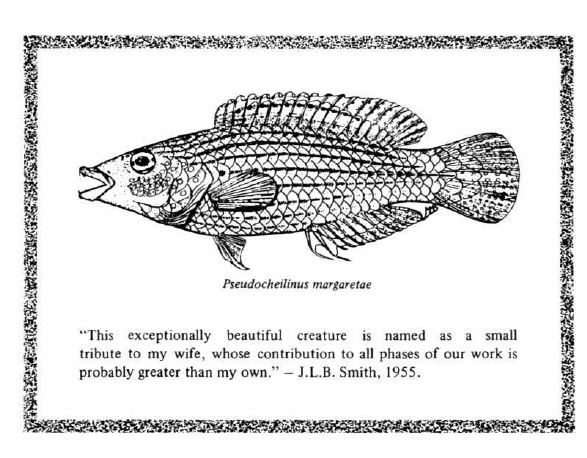
fish

From the cover of The life and work of Margaret M. Smith / Mike Bruton (c.1986)

The Library at the South African Institute for Aquatic Biodiversity is named for Mary Margaret Smith (née Macdonald), the first Director of the JLB Smith Institute of Ichthyology. Macdonald attended Rhodes University College in Grahamstown from 1934 to 1937. She was awarded her B.Sc. degree in 1936, majoring in physics and chemistry (with distinction), and became a senior demonstrator in the Chemistry Department.

James Leonard Brierley (JLB) Smith (1897-1968), Associate Professor of Organic Chemistry, and Mary Macdonald, were married in 1938. With her not liking the new name “Mary Smith”, she was from that time always known as “Margaret Smith”.
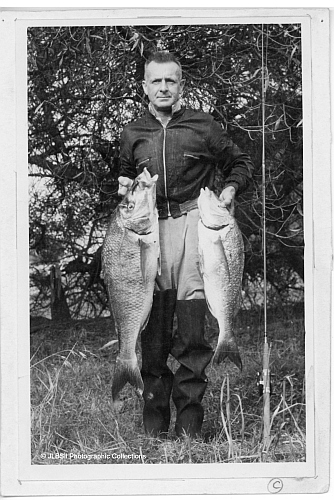
JLB Smith

JLB Smith with White steenbras , Knysna ca. 1950

JLB Smith, a keen angler, developed a more formal interest in ichthyology, the study of fishes. His young wife soon became involved in his hobby and accompanied him on fishing trips and collecting expeditions.
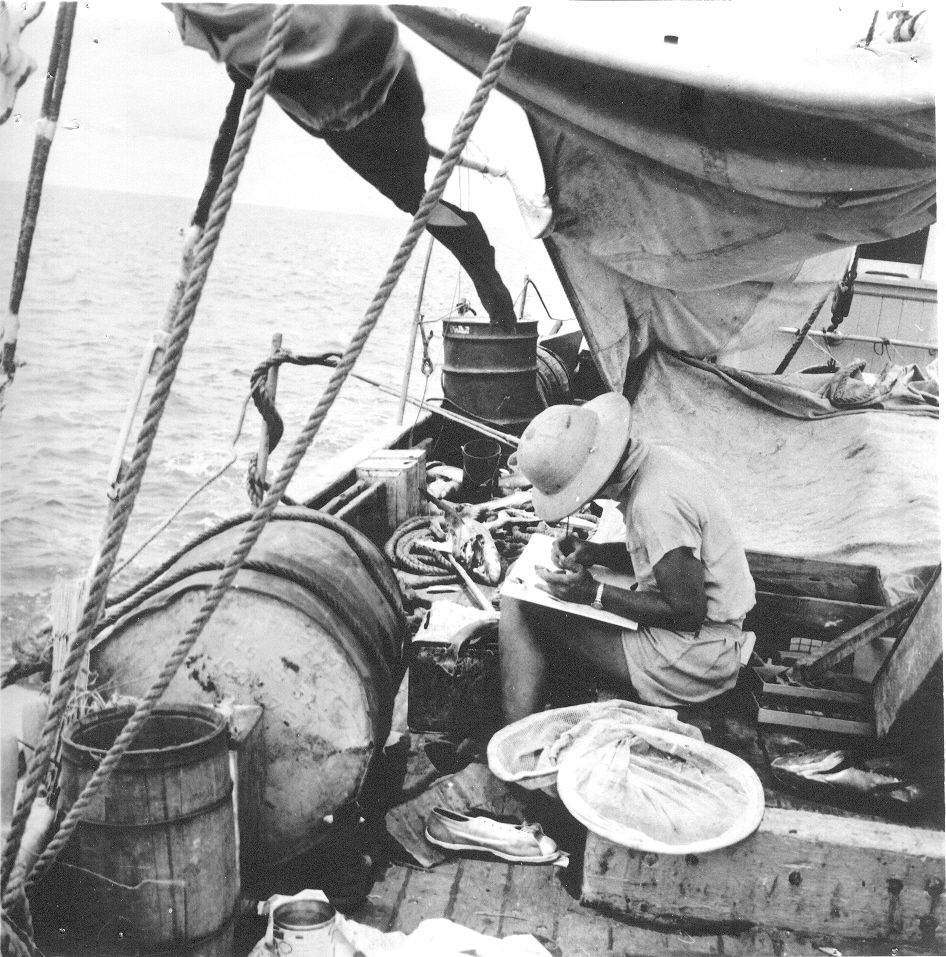
Margaret Smith

Margaret Smith drawing on a boat in the Seychelles.
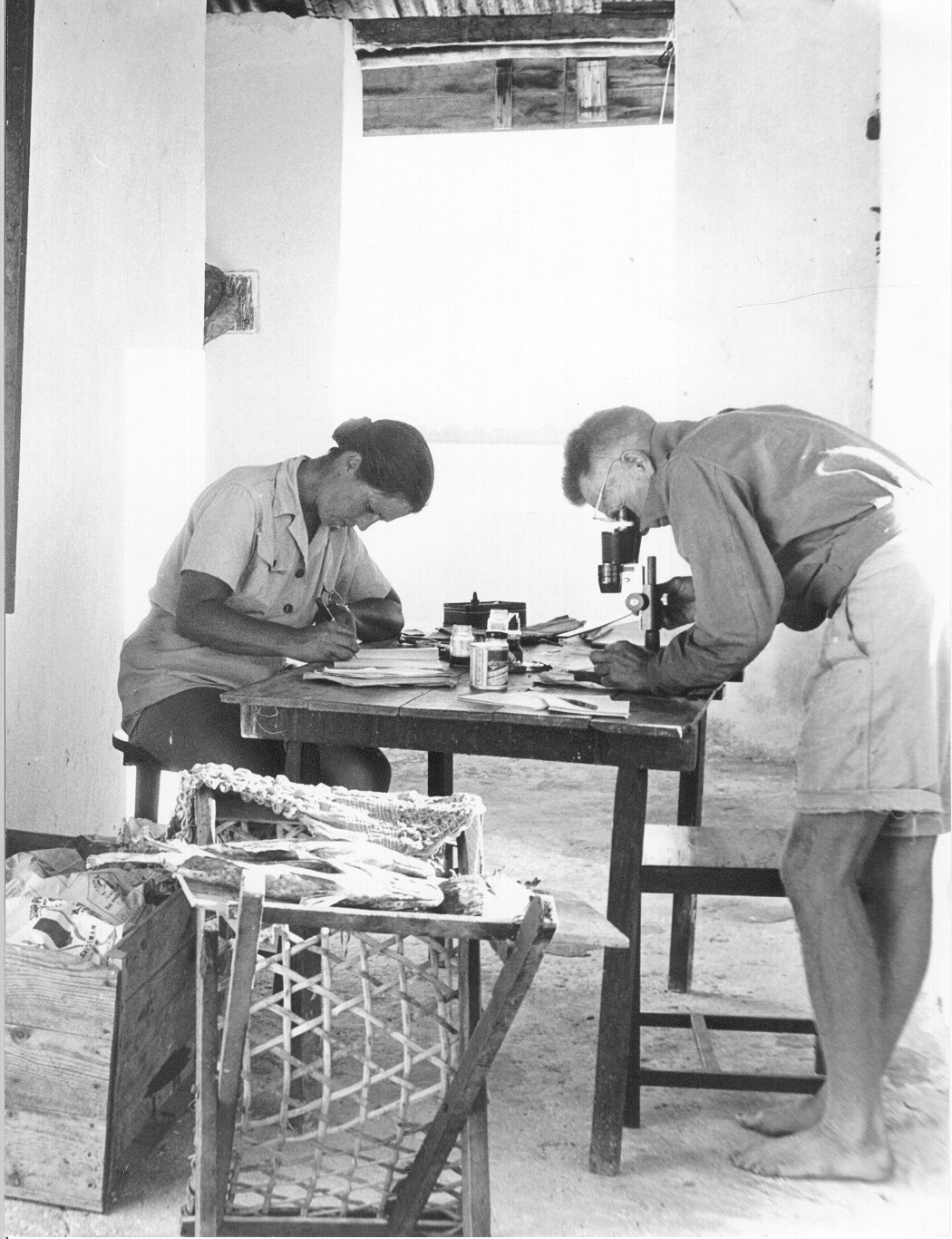
Typical lab conditions, Shimoni, Kenya 1952

Typical lab conditions, Shimoni, Kenya 1952.

In 1946, the Department of Ichthyology was established at Rhodes University and J.L.B and Margaret Smith were able to devote all their energies to the production of an authoritative book on the sea fishes of southern Africa.
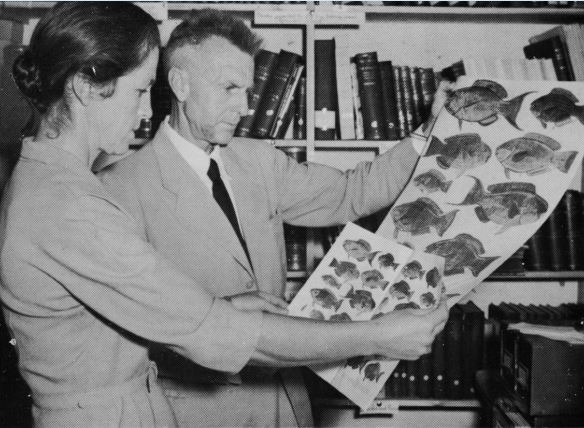
Margaret and JLB Smith review art proofs

Margaret and JLB Smith review art proofs.

One of their greatest problems was a lack of suitable illustrations. Undaunted, despite no artistic training, Margaret Smith, took on the task. The first edition of The Sea Fishes of Southern Africa, published in 1949, contained her exceptional illustrations.
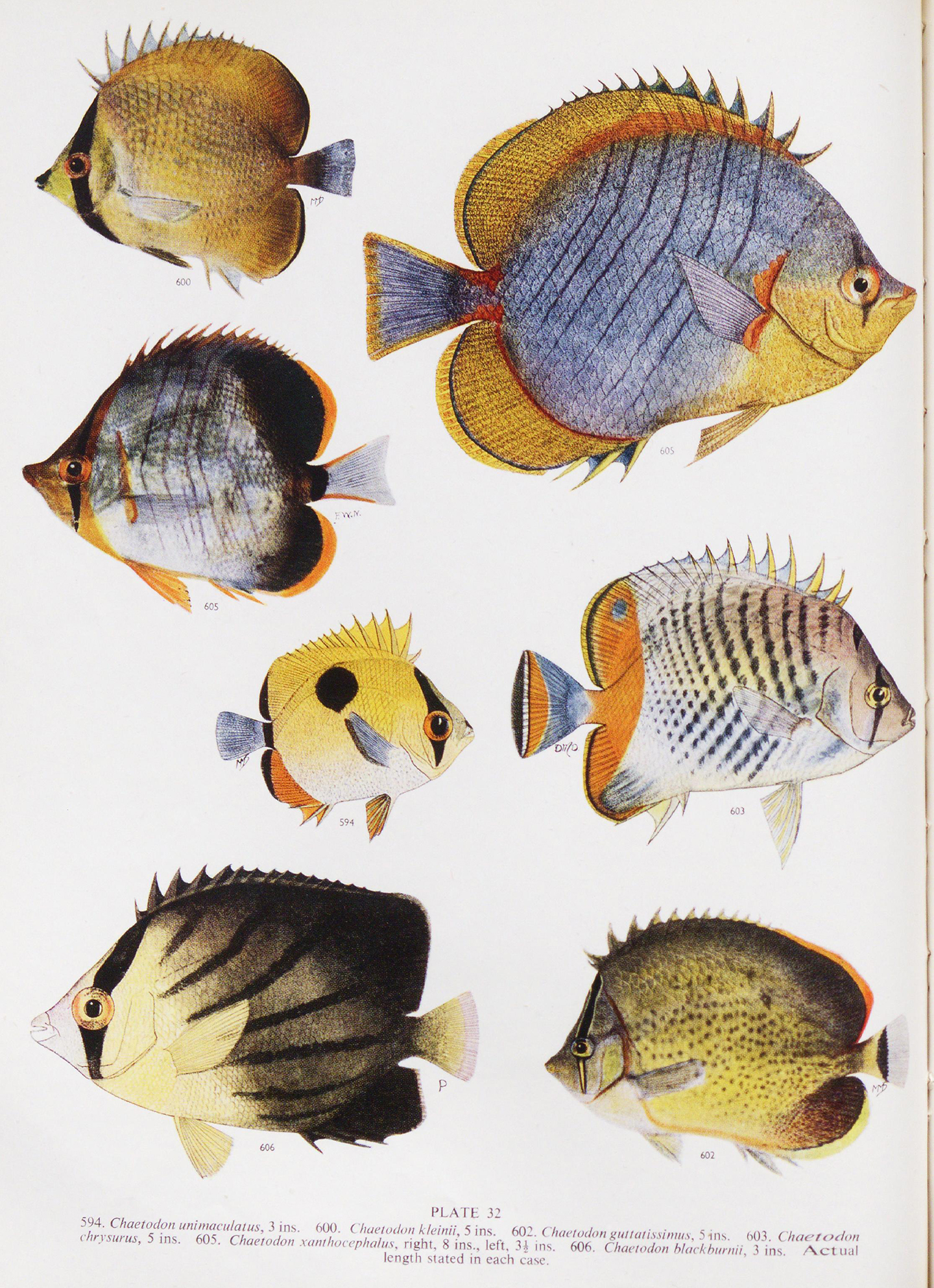
Plate 32. The sea fishes of Southern Africa. 1949. By JLB and Mary Margaret Smith. Art by Mary Margaret Smith. Contributed in BHL from Cornell University Library with permission from the South African Institute for Aquatic Biodiversity. CC-BY-NC-SA.
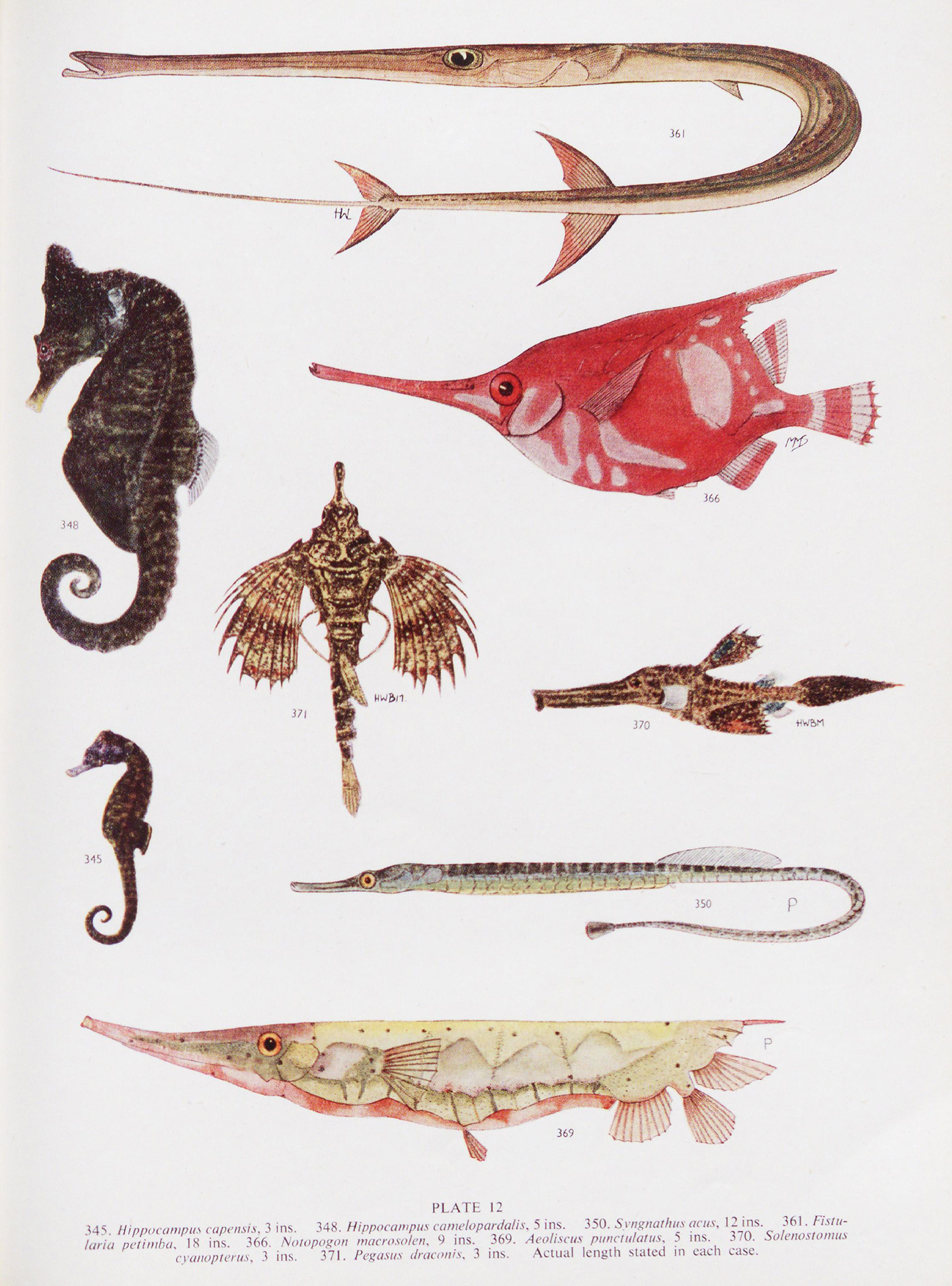
Plate 12. The sea fishes of Southern Africa. 1949. By JLB and Mary Margaret Smith. Art by Mary Margaret Smith. Contributed in BHL from Cornell University Library with permission from the South African Institute for Aquatic Biodiversity. CC-BY-NC-SA.

She in turn taught what was to become a group of acclaimed natural history artists.

After the death of JLB Smith in January 1968, Margaret Smith continued her ichthyological research in Grahamstown. At the end of 1968, the South African Council for Scientific and Industrial Research (CSIR) and Rhodes University decided to establish the J.L.B Smith Institute of Ichthyology. Margaret was appointed the first Director of the new Institute, now the South African Institute for Aquatic Biodiversity (SAIAB).
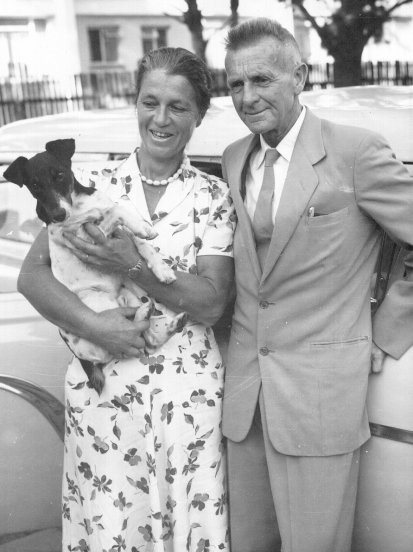
Margaret and JLB Smith with their dog, Marlin.

Margaret and JLB Smith with their dog, Marlin.

The Margaret Smith House, a women’s residence at Rhodes University, likewise honours her contribution to our local university and to international science.

Margaret Smith died in 1987. She had given 49 years of service to ichthyology.

Margaret’s achievements, the fine building, the reference collection of fish which she so adequately preserved, the status of the institute as a museum of international standing, are there for all to see. What is less known is the woman herself in her private life which few could know much about. This may be summed up in two words: for all her public flamboyance, she was a kind woman. Nobody with a hard-luck story was ever turned away … she helped innumerable people. If something was needed and could not otherwise be got she would dip into her pockets, and never say a word. [1]

The Biodiversity Heritage Library holds a collection of JBL Smith’s Ichthyological Papers, edited by his wife, Margaret Smith, and published in 1969, the year after his death. Contributed by the Library of the South African Institute for Aquatic Biodiversity, the two volume work was published by the J.L.B. Smith Institute of Ichthyology.
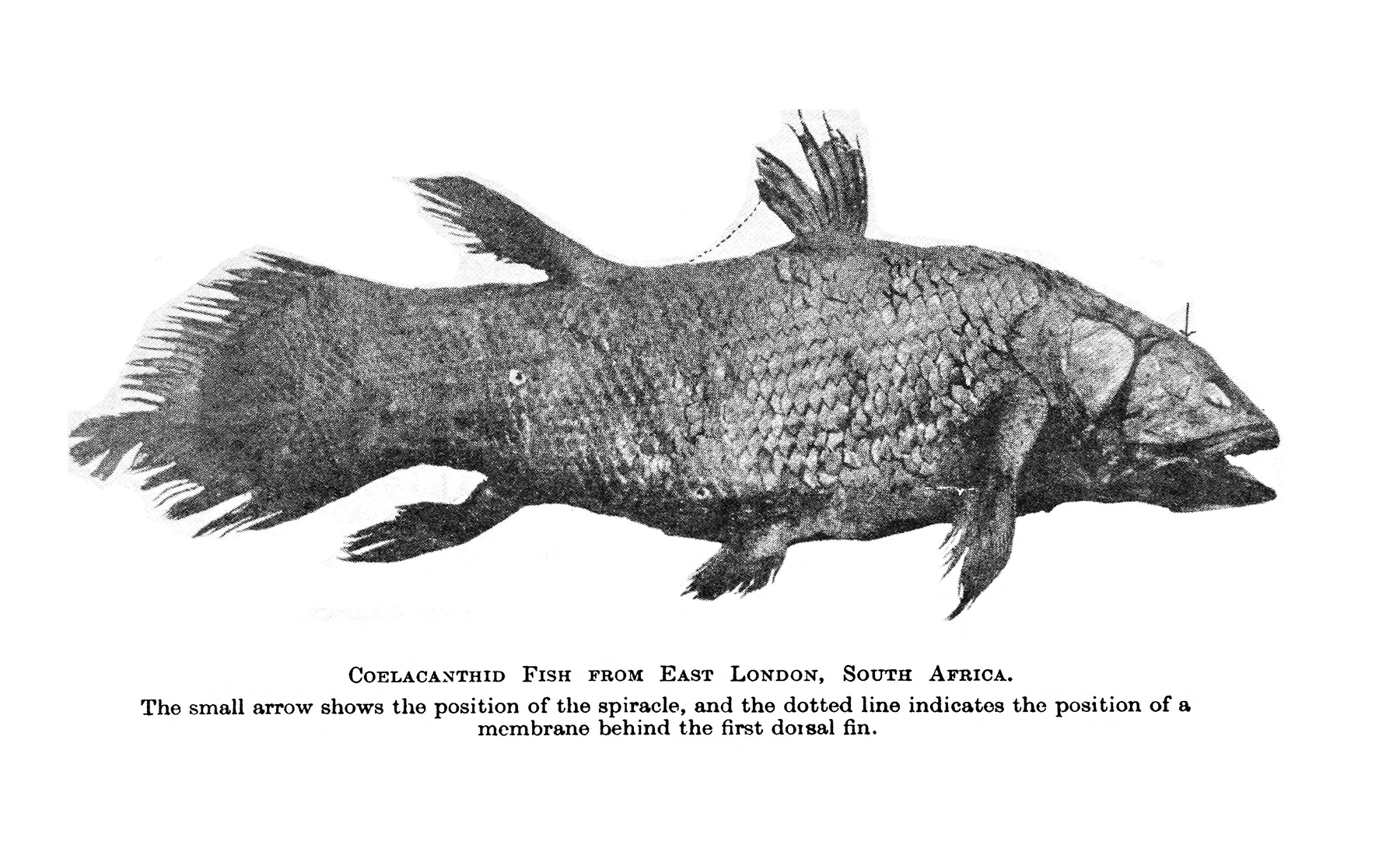
Coelacanth

Coelacanth re-discovered off the coast of South African in 1938. Smith, J.L.B. “A Living Fish of Mesozoic Type.” Nature. v. 143 (1939). In: Ichthyological Papers. Ed. Mary Margaret Smith. 1969. Contributed in BHL from the South African Institute for Aquatic Biodiversity.

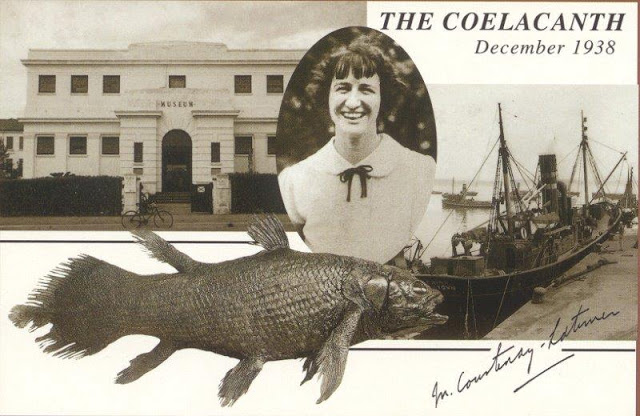
One of the highlights of the publication is the description of the “re-discovery” of the coelacanth, believed to have become extinct in the Late Cretaceous, around 66 million years ago, but rediscovered off the coast of South Africa in 1938. Marjorie Courtenay-Latimer, curator of the East London Museum, discovered a specimen from amongst the catch of a local trawler, Captain Hendrick Goosen, and contacted J.L.B. Smith regarding the discovery. Smith subsequently named the species Latimeria chalumnae after Courtenay-Latimer.
You can read more about the life and achievements of Marjorie Courtenay-Latimer as part of the #HerNaturalHistory campaign.

Reference

[1] PBN Jackson. 1997. Variations on a theme: the three directors of the first fifty years of the JLB Smith Institute of Ichthyology. Trans. Roy. Soc. S. Afr., 51:40.

March 24, 2019by michelle.underhill
Blog Reel, Campaigns, Her Natural History

Marjorie Eileen Doris Courtenay-Latimer: Beyond the Coelacanth

Commemorative postcard

A version of this post was originally published on the blog of the Margaret Smith Library, SAIAB. It is reproduced with permission from the author, Sally Schramm.

Willie and I look forward to our first born towards the end of April/beginning of May and we both pray it will be a lover of all that is beautiful in nature. Willie wants it to be a botanist — I want it to be a lover of birds and animals.
Eric Latimer’s diary, 25th November 1906

Marjorie Eileen Doris Courtenay-Latimer (1907-2004) is ubiquitously remembered and celebrated for her part in recognising that the large fish trawled by Capt. Hendrik Goosen and the crew of the Nerine in December 1938 was an astonishing find. This was to be identified as the first live coelacanth known to Western science. JLB Smith, the ichthyologist who first described it, named it Latimeria chalumnae after Marjorie, and the Eastern Cape river mouth near which it was found.

Commemorative postcard

Commemorative postcard on the “re-discovery” of the coelacanth.

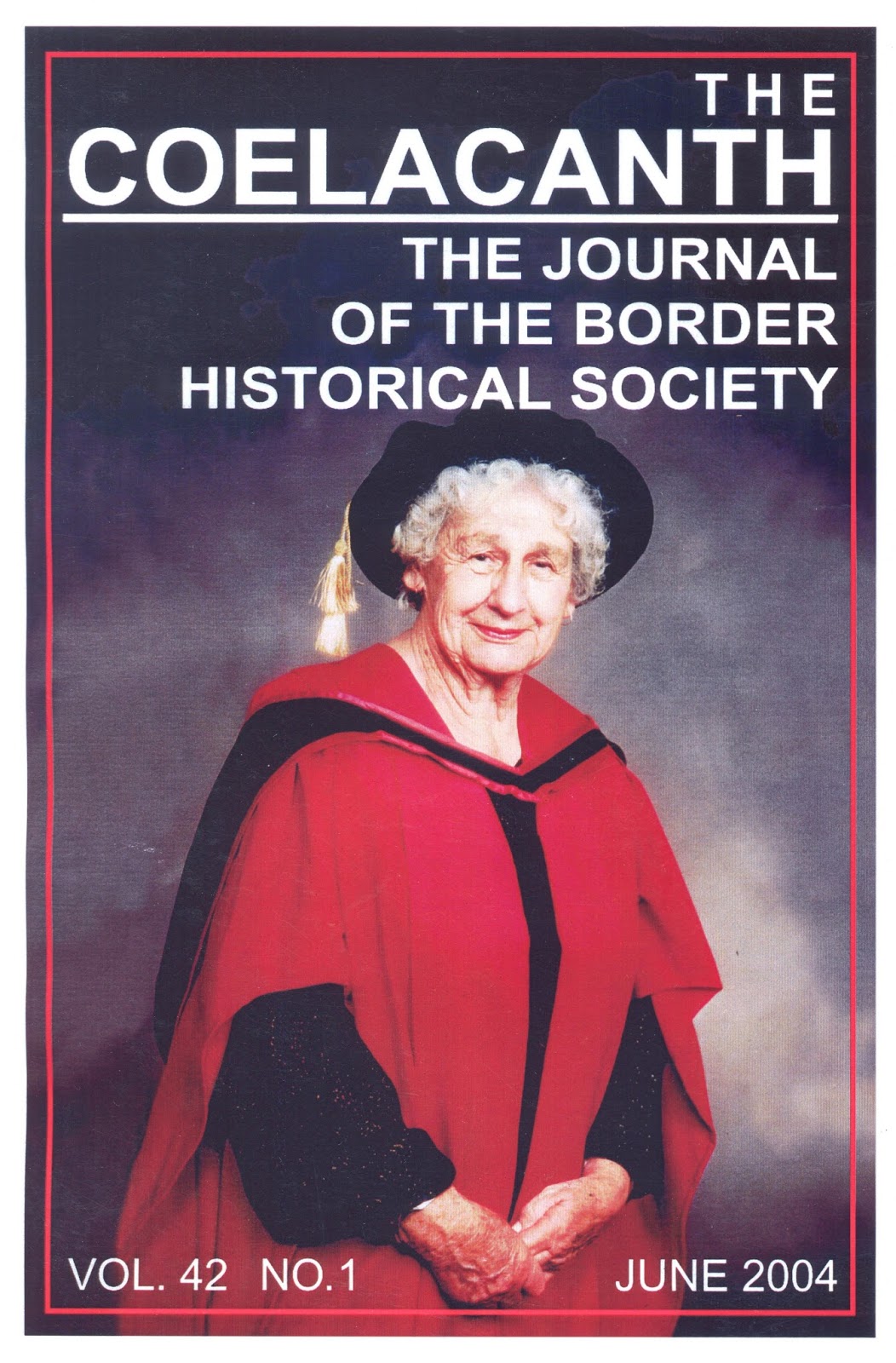
Reading the Border Historical Society’s The Coelacanth journal Commemorative edition in honour of Dr Marjorie Courtenay-Latimer (2004) we find a life dedicated to a great deal more than that single event. Her contributions to the Eastern Cape town of East London, and to the Museum in particular, were immense.

Born two months prematurely, surviving practically every childhood disease known — and the Flu Pandemic (1918-1920) — the apparently frail Marjorie’s interest in “all that is beautiful in nature” intensified as her family followed father Eric Latimer to his postings at a succession of often isolated railway stations in the Free State and Eastern Cape. The entire family walked and picnicked, collected, recorded and illustrated specimens, thoroughly appreciative of the wild areas around them.

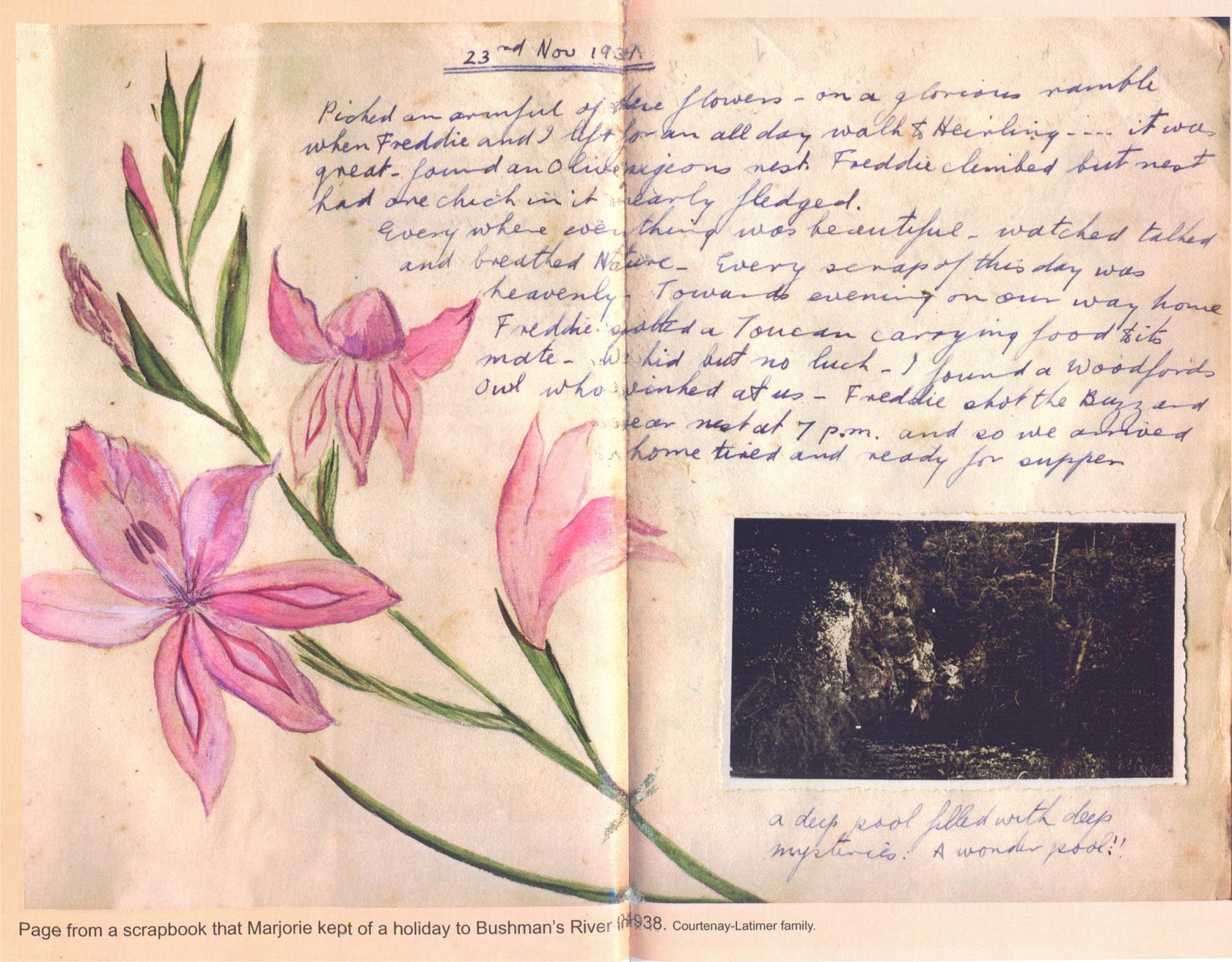
Keeping natural history journals and scrapbooks became a life-long habit for Marjorie. Here we read in 1938, “Every where everything was beautiful — watched, talked and breathed nature. Every scrap of this day was heavenly”.

The Coelacanth Vol. 42 (1) Centrepiece

The Coelacanth Vol. 42 (1) Centrepiece.

We also read of Marjorie, aged 24, as the first curator in 1931 (at £2 a month, with a petty cash allowance of 5/-) of the new and sparsely provisioned East London Museum, with its meagre collections; setting up displays (initially from her family’s own collections) and dioramas; her dedication in building collections both cultural and of natural history; her awareness of the museum’s value and interest to the public and especially to children; and of the planting of the indigenous museum garden. All this was accomplished in the early years with very little help; we read only of one named assistant Enoch [Enoch Elias], who helped Marjorie lug the coelacanth back to the Museum in 1938.

Other contributions tell of her stint on Bird Island in Algoa Bay for six weeks in 1936, with her parents as chaperones (mother enthused, father dreadfully bored); of her botanical and fossil-collecting field trips, often with close friends, specifically of the excavation and mounting of the almost-complete dicnodoni skeleton Kannemeyeria simocephalus.

Marjorie recounts many of these events from her early life and career, and explains how they ultimately contributed to the coelacanth “discovery”, in a 1979 paper published in the Occasional papers of the California Academy of Sciences. For example, it was because of her employment at the East London Museum that she met JLB Smith, with whom she developed a professional relationship that she called upon following her discovery in December 1938. And it was during her time on Bird Island that she met Capt. Hendrik Goosen, who became a regular source of specimens for her collecting activities for the Museum — and ultimately the supplied the famed coelacanth specimen.

Marjorie summarizes her story and the events that culminated in her famed discovery as such:

“This story is one of the most astounding records of a woman’s intuition, for:

had I never gone to Bird Island;
had I never met Dr. JLB Smith who, of all the scientists I met as a young girl struggling with meagre funds in a small Museum, always gave encouragement and never criticism;
and had I not gone to the wharf to wish the men a Happy Christmas,

there never would have been a coelacanth discovery in South Africa, on 22 December 1938.”

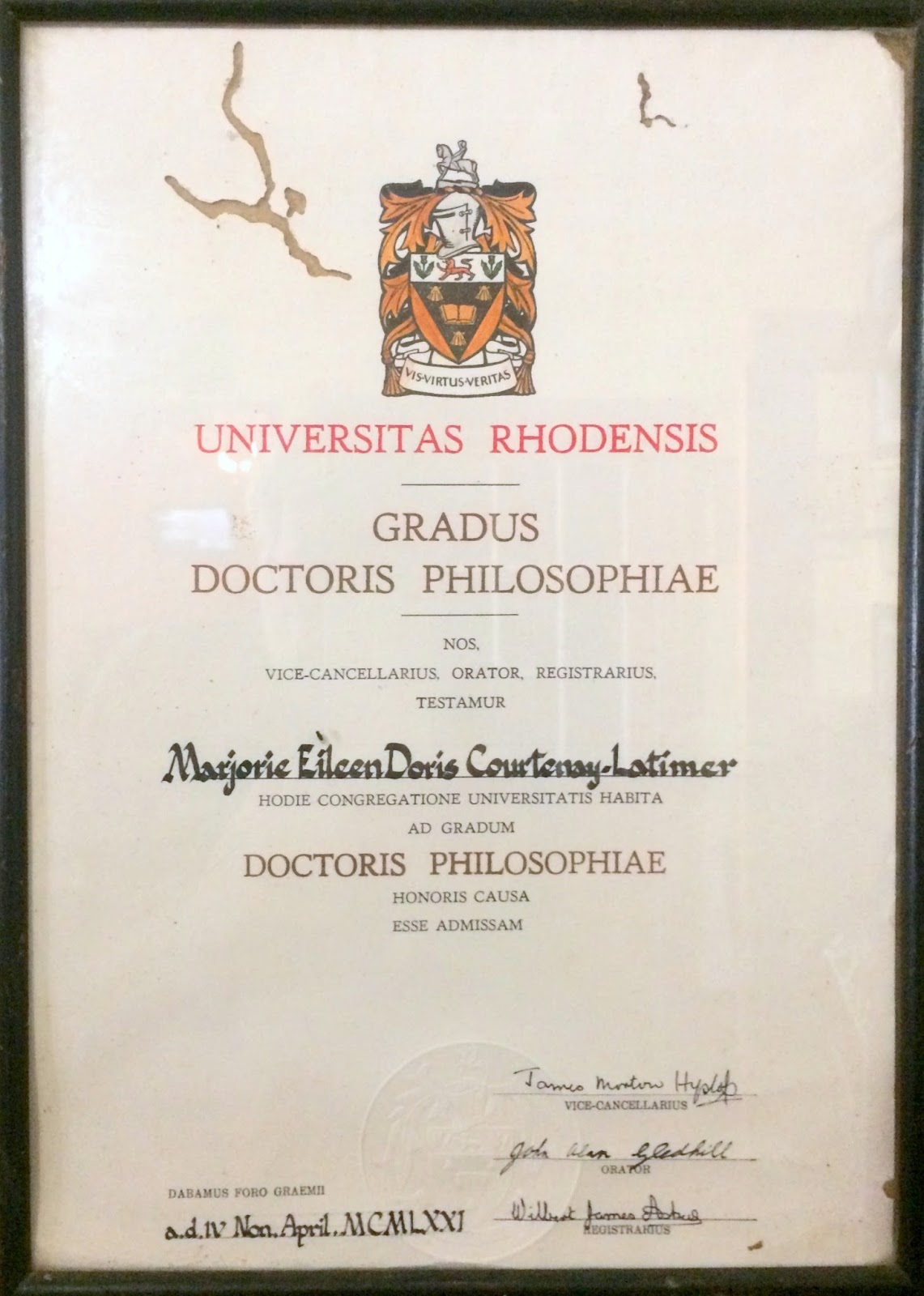
Marjorie was an author of scientific and popular literature on a wide variety of topics and was an active member of diverse museum, historical and natural history societies. She supported conservation and the establishment of nature reserves such as Potters Pass, East London, and Gonubie Nature Reserve. Finally, we read of her numerous civic awards, honorary fellowships, and her Honorary Doctorate from Rhodes University.

Dr Marjorie Courtenay-Latimer

Dr Marjorie Courtenay-Latimer PhD (Honoris Causa) 1971.

Marjorie Courtenay-Latimer Collection Thomas River Historical Village (Pic: Mike Schramm)

Marjorie Courtenay-Latimer Collection. Thomas River Historical Village. (Pic: Mike Schramm)

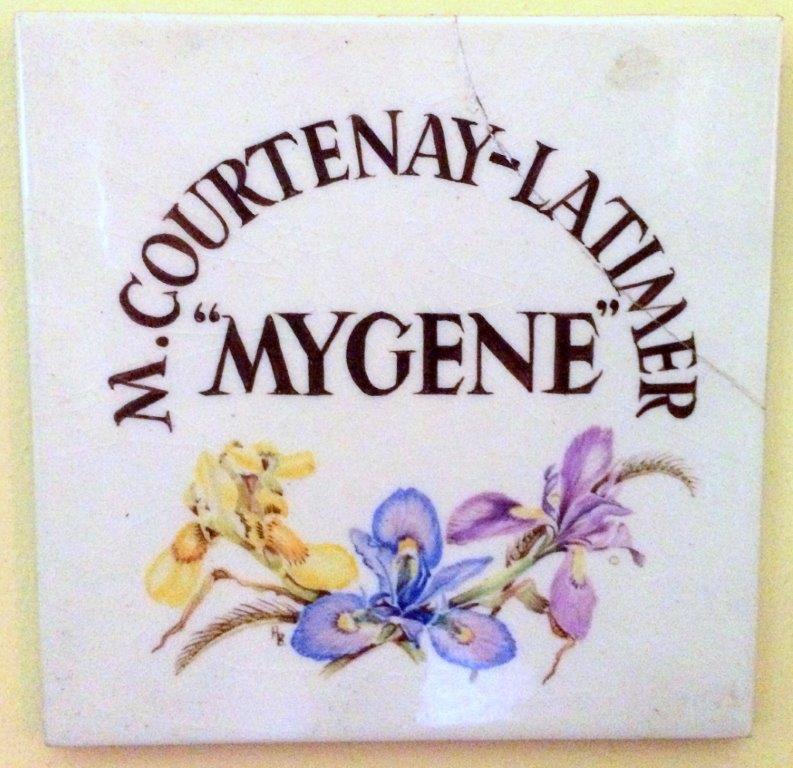
On her retirement as Director from the East London Museum in 1973, Marjorie moved to Witselbos in the Tsitsikamma area. Her house Mygene was named for her childhood nickname “Genie”, from the popular song “Jeanie with the light brown hair”, “… I see her tripping where the bright streams play, Happy as the daisies that dance on her way …”

Having done a brick-laying course at the East London Technical College, she tackled a kitchen extension with aplomb. She painted and sculpted in clay. She still kept in touch with friends and colleagues world-wide. Forays into nature continued as ever.

Marjorie Courtenay-Latimer Collection Thomas River Historical Village (Pic: Mike Schramm)

Marjorie Courtenay-Latimer Collection. Thomas River Historical Village. (Pic: Mike Schramm)

She returned to East London in the 1980s. On her moving to frail-care shortly before her death in 2004, a collection of Marjorie’s personal effects (including the certificate and house plaque above) were left behind in the house which she had recently occupied.

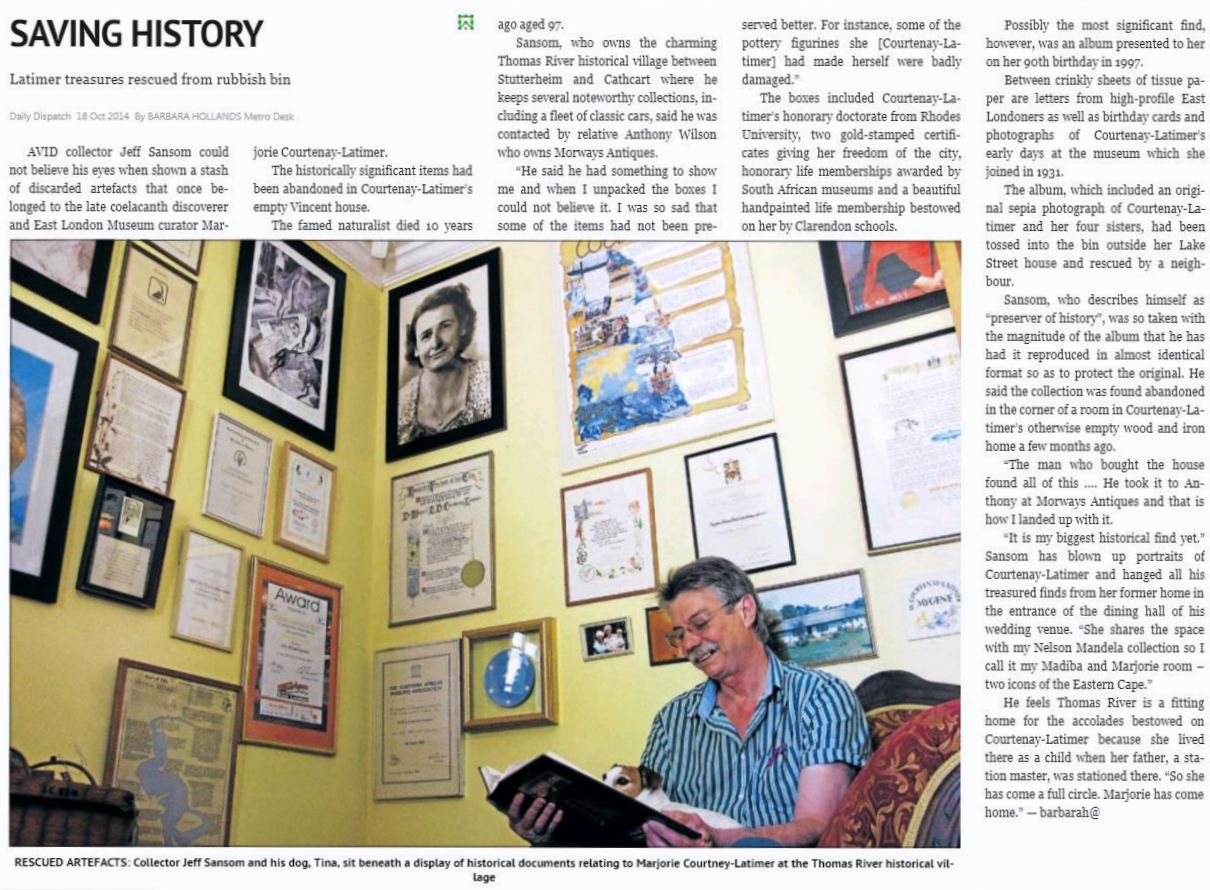
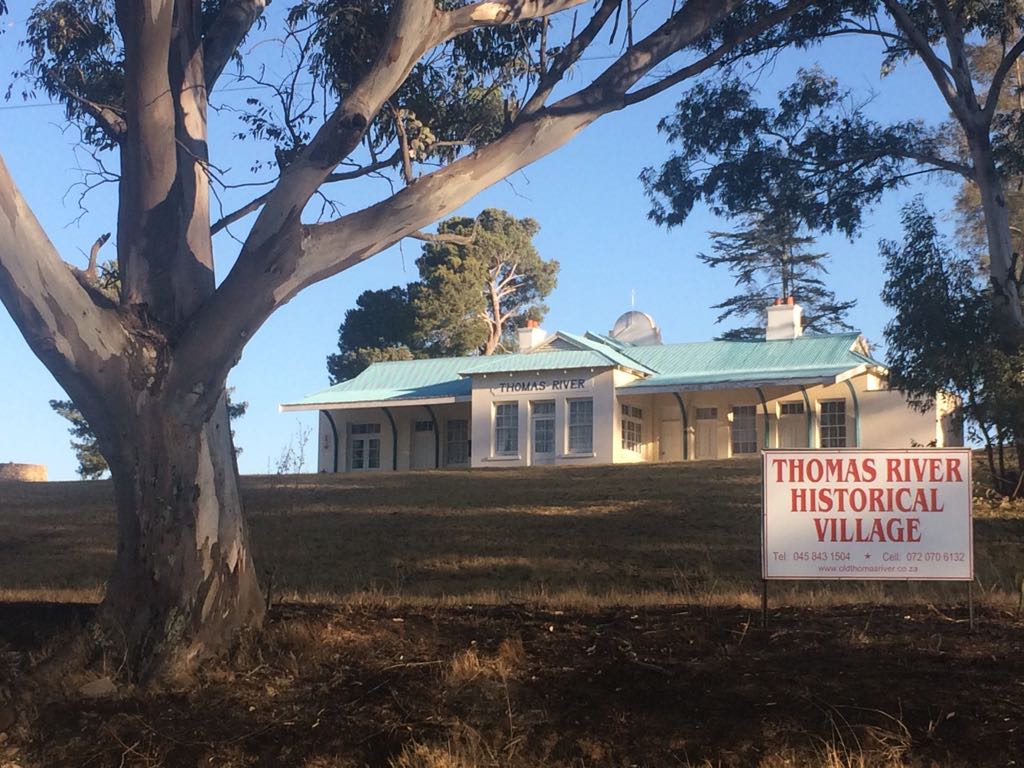
Fortuitously, these were subsequently recovered when the house was sold ten years later. A serendipitous chain of events led to the display of some items at Thomas River Historical Village near Cathcart, Eastern Cape. The Village is the site of the original Thomas River Station — where Eric Latimer and his family had lived in the late 1920s.

Saving History (Daily Dispatch 18th Oct 2014)

Saving History (Daily Dispatch 18th Oct 2014).

The original Thomas River Station, built in the late 1870s. (Pic: Mike Schramm)

The original Thomas River Station, built in the late 1870s. (Pic: Mike Schramm)

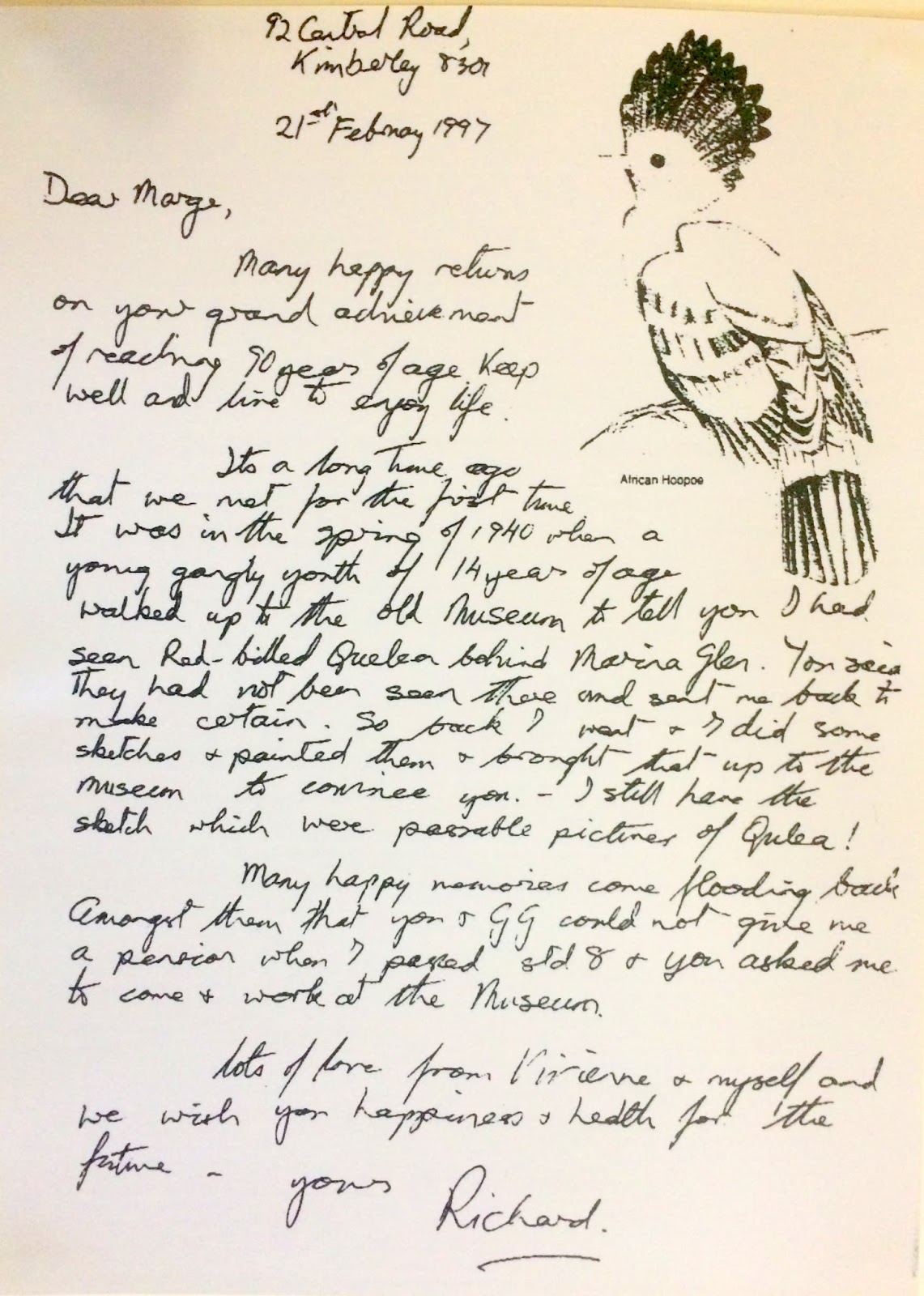
Among the treasures found was the album presented to Marjorie on her 90th birthday in 1997 “with appreciation and admiration” by the South African Museums Association. There is a facsimile copy at Thomas River Historical Village. Many of the contributors are a who’s who of prominent naturalists, authors and artists, all friends and colleagues.

Contribution by Richard Liversidge, ornithologist, previously Director, McGregor Museum, Kimberley Marjorie Courtenay-Latimer Collection,Thomas River Historical Village (Pic: Mike Schramm)

Contribution by Richard Liversidge, ornithologist, previously Director, McGregor Museum, Kimberley. Marjorie Courtenay-Latimer Collection,Thomas River Historical Village. (Pic: Mike Schramm)

The many happy memories recalled through the warm contributions would have delighted Willie and Eric Latimer. Their first child was a daughter who truly was a “lover of all that is beautiful in nature”.
Marjorie Courtney-Latimer — a life lived richly beyond the coelacanth!

March 23, 2019by michelle.underhill
BHL News, Blog Reel

BHL at XXI AETFAT 2017 in Nairobi, Kenya

Last month, the BHL Program Director Martin R. Kalfatovic and Program Manager Carolyn A. Sheffield participated in multiple events throughout different regions of Kenya to help promote BHL to existing and potentially new users, connect with our BHL Africa partners, and explore opportunities for growing partnerships in the region.  We will be highlighting each event with its own blog post throughout the week, starting with the first stop in Nairobi, Kenya.

From 15-19 May 2017, the National Museums of Kenya and the Catholic University of East Africa (CUEA) co-hosted the XXI AETFAT (Association for the Study of Tropical Flora of Africa) Congress. Held on the beautiful campus of CUEA, the Congress brought together approximately 250 individuals from around the world to meet and discuss research on various aspects of the botany of tropical Africa.  BHL participated with a symposium Botanical Contributions from the Biodiversity Heritage Library: A Focus on Africa, which focused on digital library resources related to the conference topics.

View Full Size Image
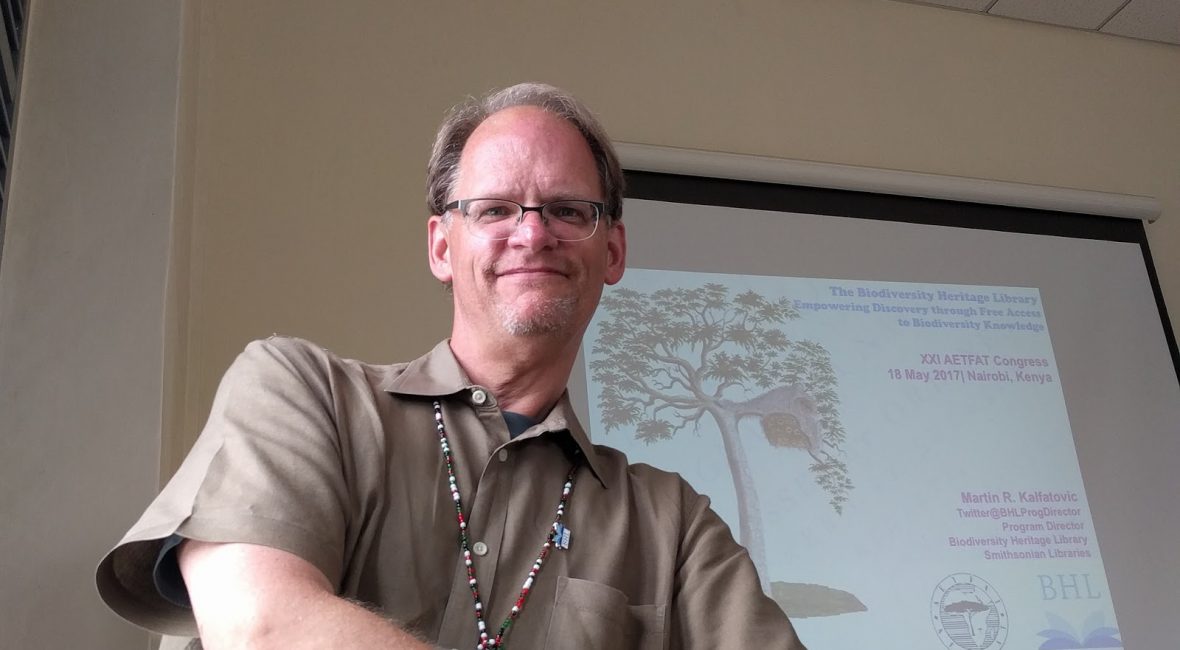
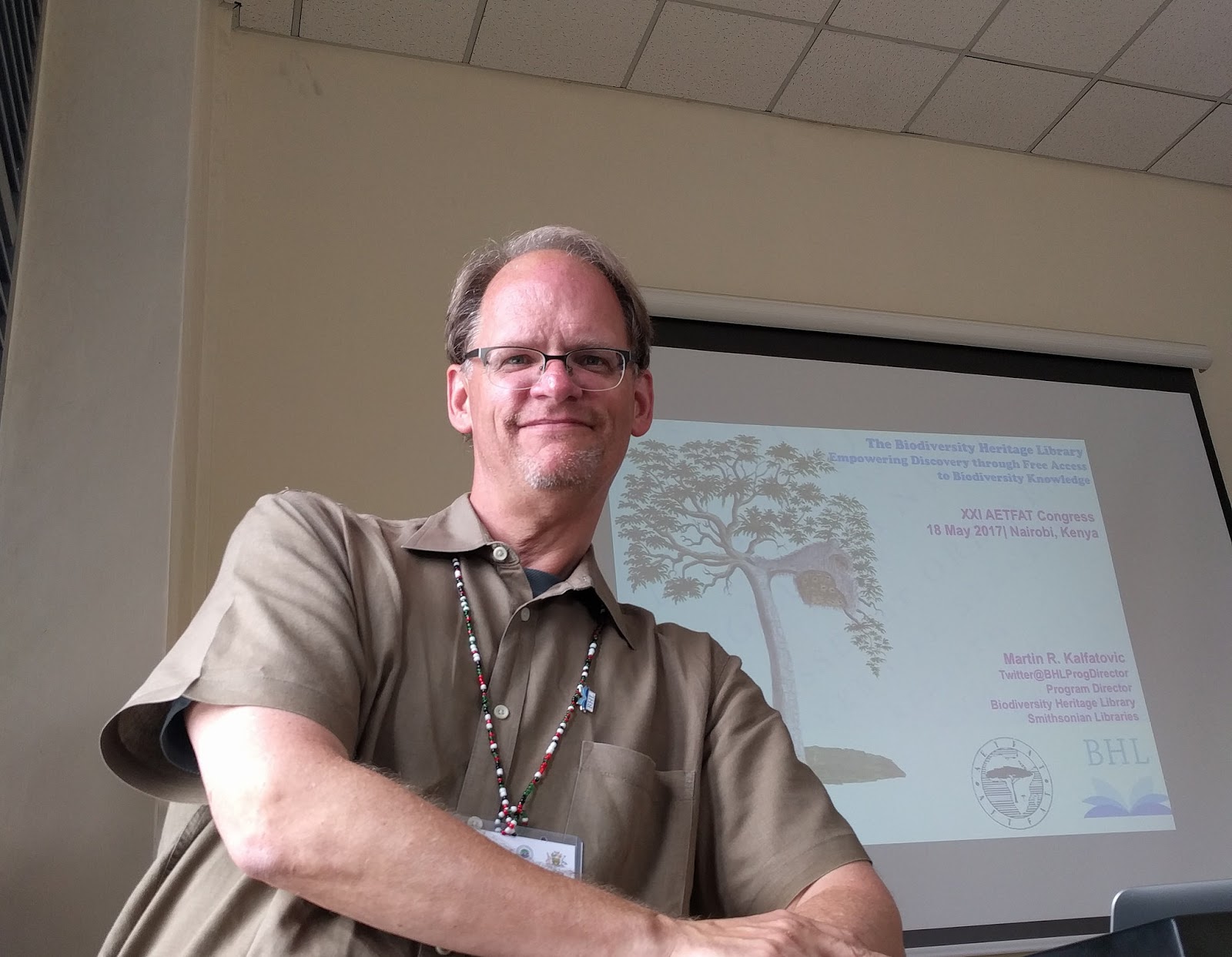
Martin R. Kalfatovic at the podium for the BHL symposium

 at XXI AETFAT 2017

The symposium was led by BHL Program Director, Martin R. Kalfatovic and also included presentations from BHL Program Manager, Carolyn Sheffield and Director of JSTOR Primary Sources, Deirdre Ryan. 

Kalfatovic opened the session with an introduction to BHL, entitled Biodiversity Heritage Library: Empowering Discovery Through Free Access to Biodiversity Knowledge. Kalfatovic also delivered a presentation on behalf of Grace Costantino entitled The Story of Engagement: Outreach Strategies at the Biodiversity Heritage Library.  
In Building the Biodiversity Heritage Library Through Standards and Content, Sheffield reported on strategies and results from BHL Workshops, highlighting involvement and new contributions from BHL Africa partners.  

Ryan delivered an overview of JSTOR entitled “Journals, AETFAT, African Plants, and more…,” covering the scope and breadth of JSTOR collections, including 2,600 journal titles which are made freely available to all non-profit and educational institutions in Africa through the African Access Initiative.  Additionally, she highlighted results of the African Plants Initiative that grew into the Global Plants Initiative and has brought digitized herbarium sheets into the JSTOR collection, many of which link to BHL!  She also identified the AETFAT Congress as a historically significant event for JSTOR, where some of the founding ideas first germinated.  Kalfatovic then concluded the session and opened it up for questions.  

View Full Size Image
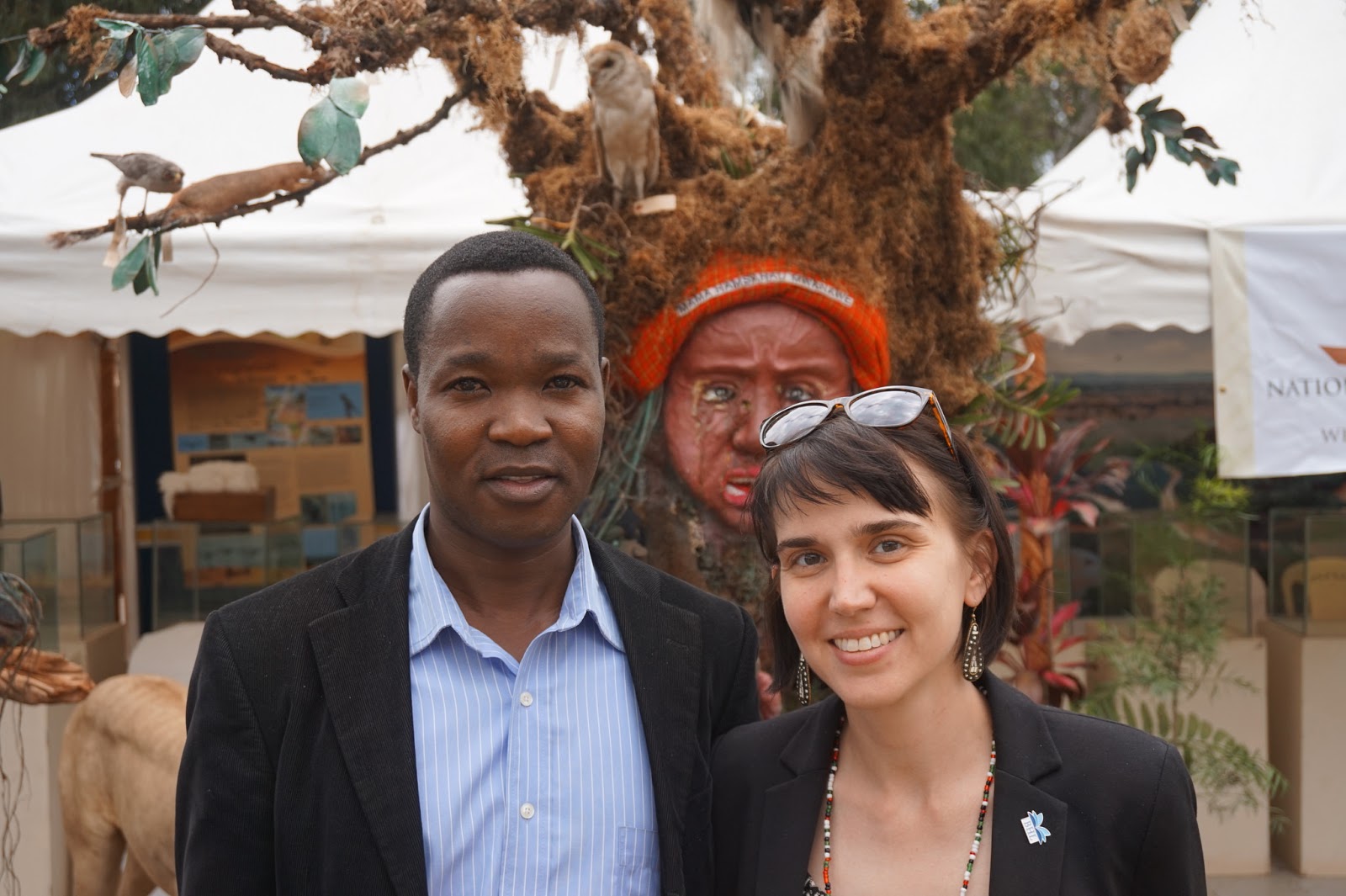
Carolyn Sheffield and Ben Nakitare at the NMK booth

      at the XXI AETFAT 2017 exhibits

Approximately 20 people were in attendance at the session and discussions were fruitful, focusing on both BHL work to date and potential future opportunities. 

In addition to the symposium, the conference provided several other opportunities for productive discussions with both BHL users and also with several BHL Africa partners.  It was especially lovely to catch up with some of our colleagues from National Museums of Kenya who hosted and participated in the BHL Africa Workshop in 2015, including Dr. Geoffrey Mwachala, Dr. Asha Owano, Lawrence Monda, and Ben Nakitare. We are thrilled with their ongoing commitment to participate in BHL, and we look forward to continued collaborations with our partners at National Museums of Kenya and all of our BHL Africa partner institutions!  

June 5, 2017by sayeedmd
Blog Reel, Featured Books

Celebrating Mary Gunn and 100 Years of Library Excellence in South Africa

In 2013, BHL Africa officially launched with the mission to provide open access to the valuable biodiversity literature found within African libraries and institutions. Today, eleven institutions have signed the BHL Africa MOU and, thanks to support from the JRS Biodiversity Foundation, each is working to contribute content from their collections to BHL. The South African National Biodiversity Institute (SANBI), which has been a member of BHL Africa since its inception, leads the current JRS-funded work.

SANBI has two libraries: the Harry Molteno Library at the Kirstenbosch National Botanical Garden in Cape Town, and the Mary Gunn Library at the Pretoria National Botanical Garden. The mission of SANBI libraries is to meet the information needs of all SANBI staff and to address a public demand for comprehensive, easily accessible information on the biodiversity of southern Africa.

The Mary Gunn Library dates back to 1916 and will celebrate its centenary this year. Today, Ms Mary Gunn’s efforts are reflected in this library’s being one of the most important botanical and biodiversity resources in Africa. Subjects covered in the collection include taxonomy, biodiversity, climate change, global warming, morphology, plant anatomy, plant geography, ethnobotany, conservation ecology, history of botany, palaeobotany and plant exploration.

Mary Davidson Gunn (1899–1989) 

View Full Size Image
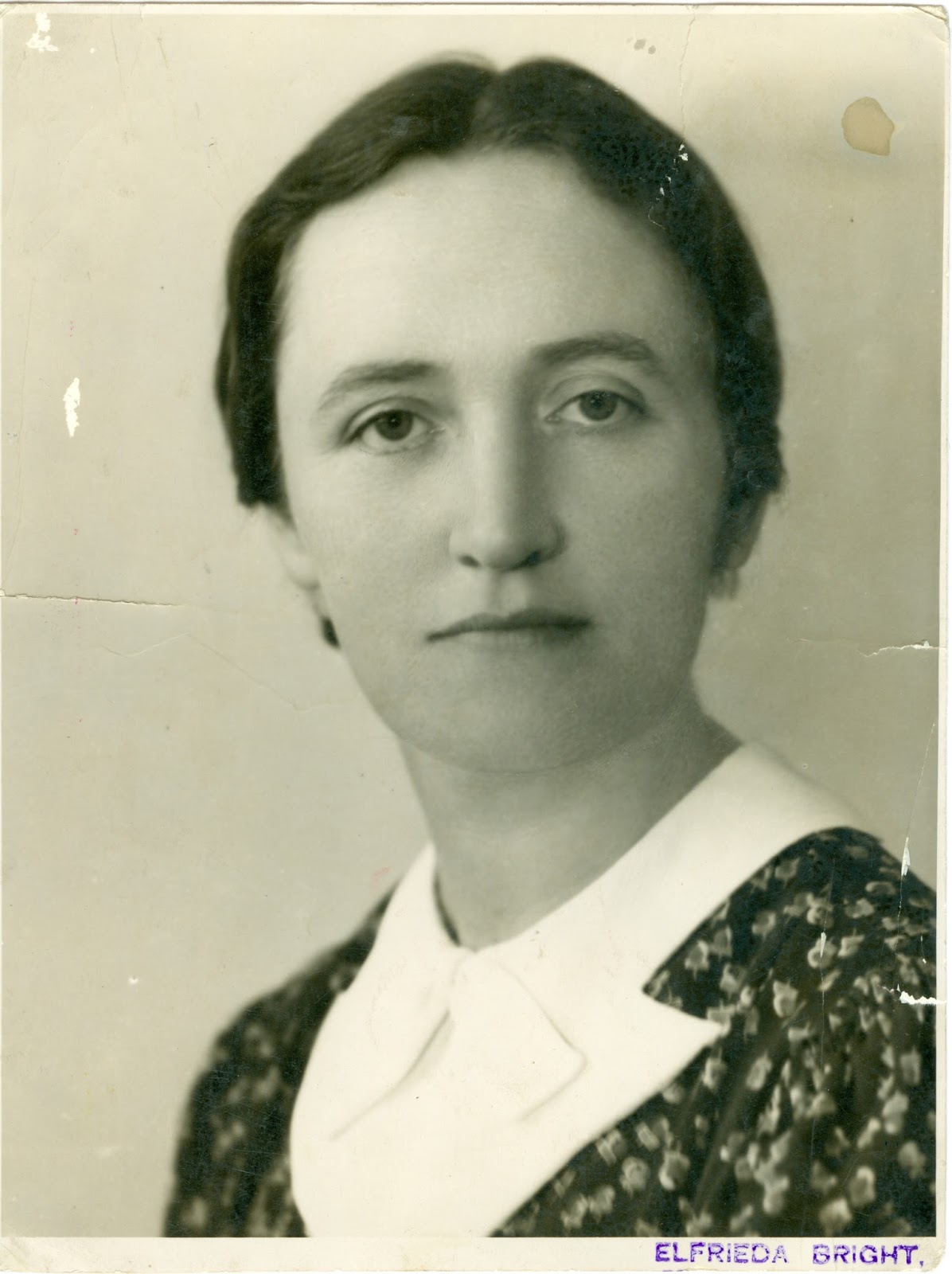
Mary Davidson Gunn. 1919-20.

Mary Davidson Gunn was born on 15 May 1899 in Kirriemuir, Scotland. Her father served in a Scottish regiment during the Anglo Boer War in South Africa and after the war, he decided to immigrate his family to South Africa. They settled in Pretoria where Ms Gunn attended the now defunct State Gymnasium. In September 1916, Ms Gunn was appointed as a clerk with ‘knowledge of typing’ in the Department of Agriculture’s Botany Division. She was not constantly busy and to keep herself occupied, she would dismantle and study the workings of her watch. Caught in the act by the chief of the division, Dr Pole Evans, she was tasked with the job of taking care of the books and building up a library. She approached her new responsibilities with great enthusiasm even though the few books did not even fill one shelf. Every night at home, she would describe each book she catalogued in detail to her father.

As Ms Gunn did not have a botanical background, she studied the catalogues of well-known antiquarian booksellers to establish which works were available and how she could purchase them. She became more and more interested in botanical literature and her knowledge developed rapidly. With enthusiasm and dedication she purchased relevant books and journals and even obtained a great number of publications as gifts – the basis of the current extensive antiquarian collection of the library. Her love for old botanical works became one of her main passions in life and made her one of the country’s most knowledgeable persons on rare botanical books and plant collectors of southern Africa.

Because of limited funds, various ways and means were devised to acquire treasures. She was very persuasive in getting rare and expensive books donated or sponsored to the library during her time as librarian. In her own words, ‘I frequently had to go hat-in-hand asking for money from influential people so that I can buy what I wanted!’ Her acquiring gifts, as well as purchasing and exchanging books and journals, populated Ms Gunn’s library until she had enough of a variety for the public. To this day, the global exchange programme remains one of the chief ways in which the Mary Gunn Library receives new journals.

View Full Size Image
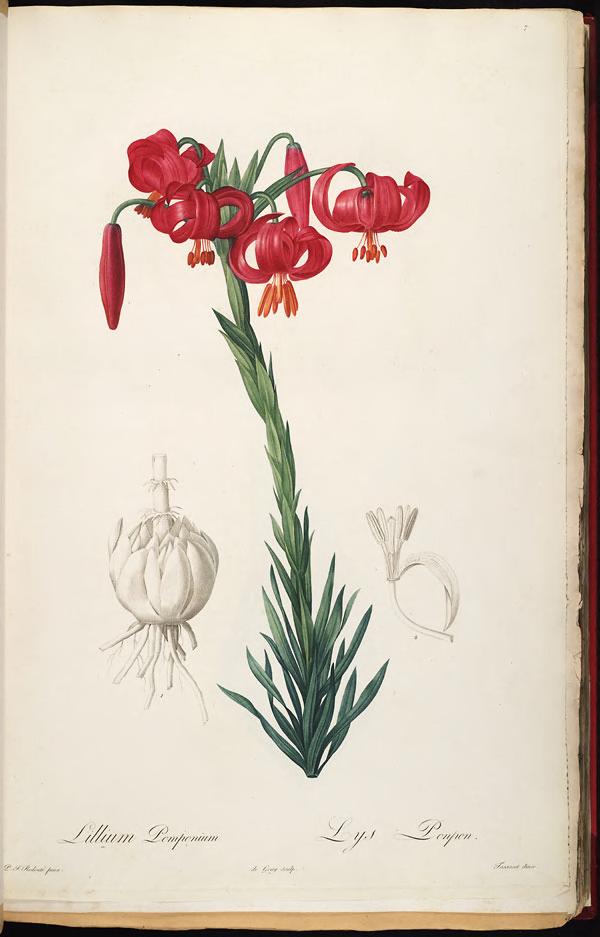
Redouté, Pierre Joseph. Les liliacees. v. 1 (1805). http://biodiversitylibrary.org/page/287202. Image from the copy in BHL digitized by the Missouri Botanical Garden, Peter H. Raven Library.

The Mary Gunn Library houses a magnificent Rare Antiquarian Book Collection that includes publications such as the broadsheet edition of Pierre-Joseph Redouté’s Les Liliacées. Redouté published Les Liliacées from 1802–1816 and the institute’s copy is one of only 18 broadsheet editions published. Redouté himself finished the plates in this edition by hand. Ms Gunn bought this rare work in England and conveyed it to South Africa in General Jan Smuts’ personal luggage after attending the signing of the Versailles Treaty. Smuts was a good friend of Ms Gunn and introduced her to businessmen such as Myles Bourke, Charles Maggs and J.J. Kirkness who donated funds to the library for purchasing rare books.

Nikolas Joseph Jacquin published Stapeliarum in 1808. The book contains 64 colour plates of stapeliads grown in the botanic garden of the University of Vienna. In 1938, Ms Gunn spotted the book in a booksellers’ catalogue and, with donations, she managed to purchase this rare book. The library now also houses other rare works by Jacquin.

View Full Size Image
Bergius, Peter Jonas. Descriptiones plantarum ex Capite Bonae Spei. (1767). http://bibdigital.rjb.csic.es/ing/Libro.php?Libro=5028. Image from the copy in BHL digitized by the Biblioteca Digital del Real Jardin Botanico de Madrid.

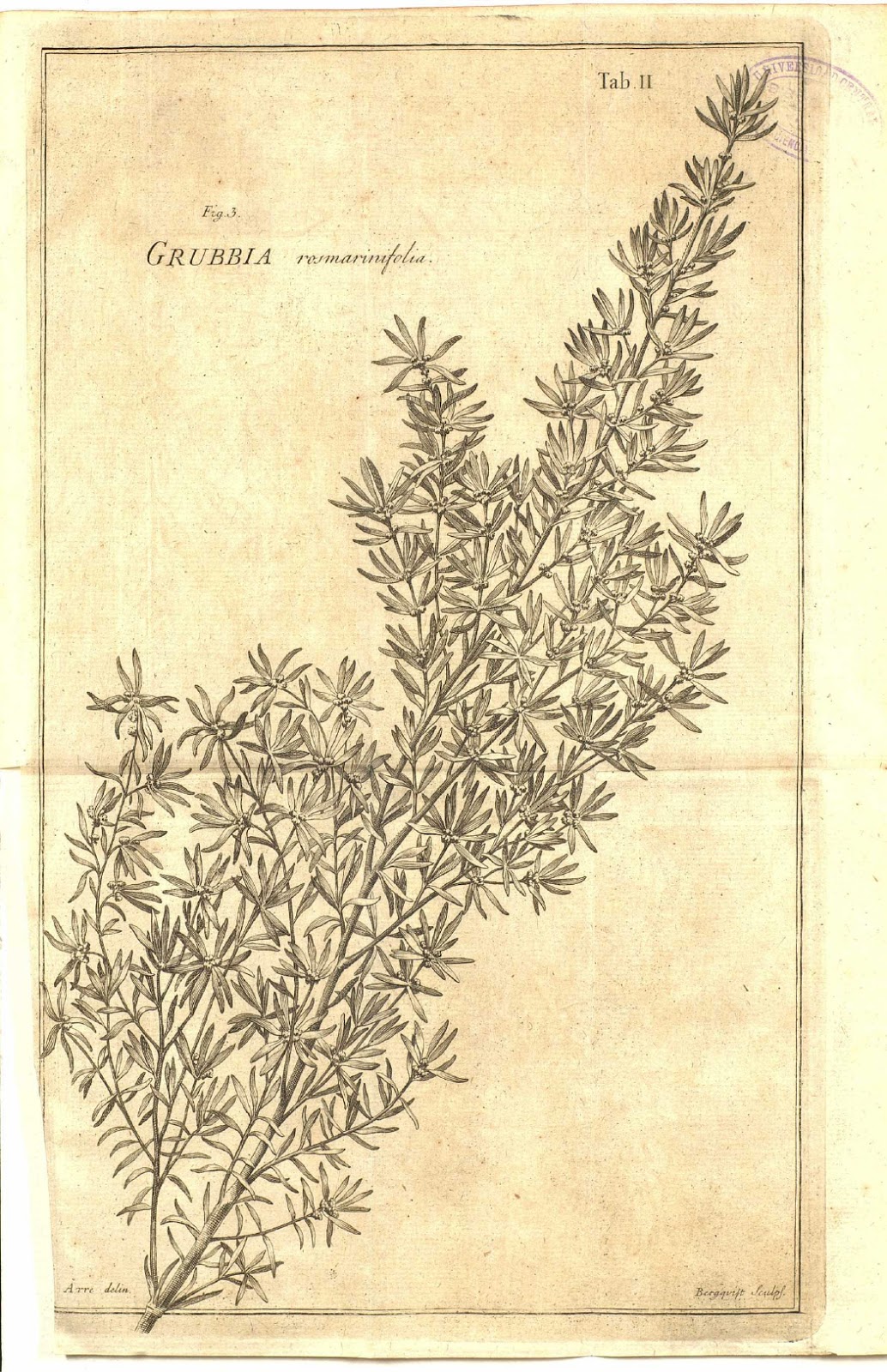
One of the rarest and oldest works on the botany of the Cape of Good Hope is Descriptions plantarum ex Capite Bonae Spei (1767) by Peter Jonas Bergius, based in part on specimens collected at the Cape by the Swede, Mikael Grubb. It predates Linnaeus’s famous Mantissa Plantarum by one month. The library’s copy of this work was once owned by Prof. W.H. Harvey, the co-initiator of Flora Capensis. A handwritten note in the book explains that the book once belonged to a young botanist, George Forster, who, with his father, accompanied Captain Cook on his second voyage around the world with this very book.

View Full Size Image
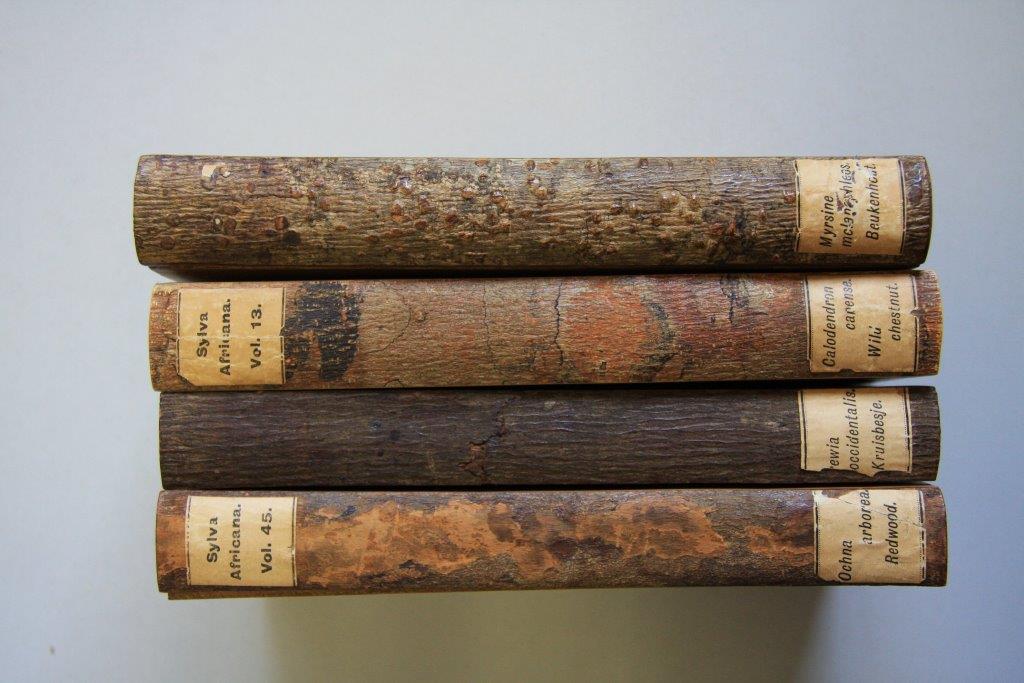
Xylotheque (wooden) book set by C.H. Wehdemann.

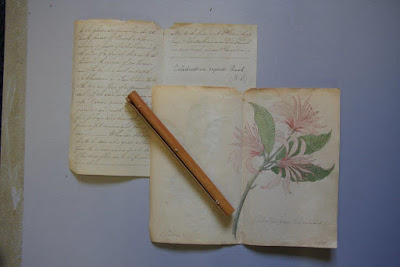
The unique 52 xylotheque (wooden) book set by C.H. Wehdemann is the only South African example ever made. Wehdemann came to the Cape Colony in the early 1800s as part of the army of the Dutch East India Company. After his dismissal in 1806, he moved to the Eastern Cape settling on a farm near Somerset East where he died in 1836. Each wooden book represents an indigenous tree. At the top of the book is a slide which gives you access to the inside of the book. Inside is a short description of the tree, some illustrations and a small cane tube with seeds inside. Of the original set of 60, the Mary Gunn Library has the remaining 52 books.

View Full Size Image
Selection from the Xylotheque (wooden) book set by C.H. Wehdemann held in The Mary Gunn Library.

Other treasures in the library:

  • J.C. Commelin: Horti medici Amstelodamensis rariorum tam orientalis, qum occidentalis Indiae, aliaumque Peregrinarum plantarum; descriptio et icones. (colour copy, BHL has the black and white) •
  • E. Sweert: Florilegium Amplissimum et Selectissimum.
  • Curtis’s Botanical Magazine.
  • C.J. Trew: Plantae Selectae, with illustrations by Georg Dionysius Egret.
  • C.-L. L’Hèritier de Brutelle: Geraniologia, seu Erodii, Pelargonii, Geranii, Monsoniae et Grieli historia icanibus illustrata.
  • H. Andrews: The botanist’s repository, for new and rare plants.
  • C.W.L. Pappe: Florae capensis medicae prodromus: or, An enumeration of South African indigenous plants, used as remedies by the colonists of the Cape of Good Hope.
  • W.H. Harvey: The genera of South African plants: arranged according to the natural system (1st Ed.). This book is considered to be the first scientific book published in South Africa. The library’s copy contains handwritten notes by the author. (BHL has the 2nd Ed.)

Dr Pole Evans’ continuous queries about botanical explorers led Ms Gunn to her second passion, namely biographical research of early botanists and plant collectors. Information on Thunberg, Burchell, Masson, Ecklon, Drège and more were collected from all corners of the world. In 1981 the major part of this information was used to publish Botanical exploration of southern Africa: an illustrated history of early botanical literature on the Cape flora. This work, produced in collaboration with Dr Leslie Codd, was the culmination of more than 60 years of research. In 2010 the work was revised and published as part of SANBI’s Strelitzia series.

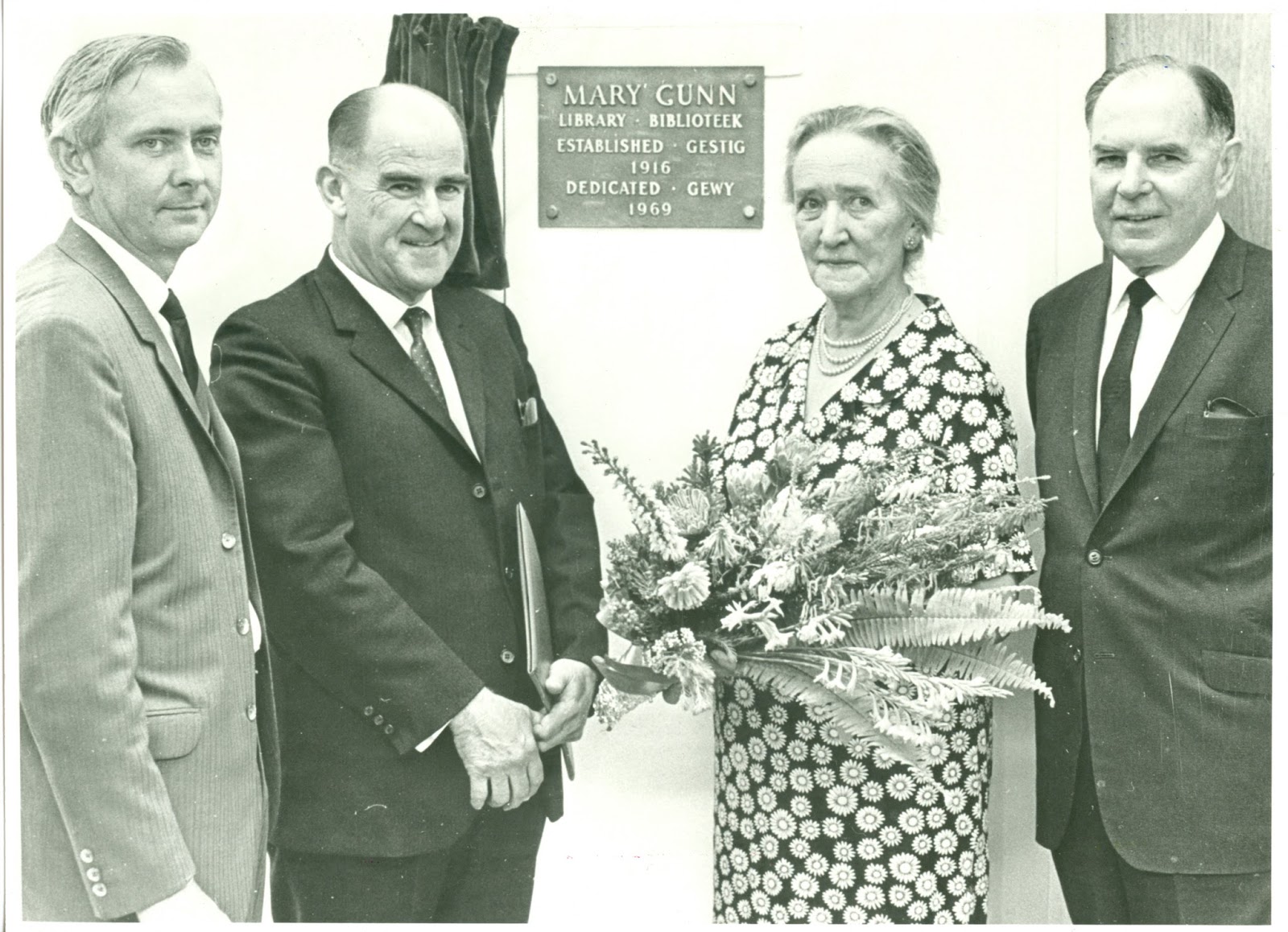
Ms Gunn possessed charm, coupled with a sharp wit, a sense of humour, steely determination and a high regard for those she felt warranted respect. After her official retirement in 1954, she continued working at the institute until 1973. In honour of Ms Gunn’s devotion to botanical literature for 60 years of her life, the National Herbarium Library was renamed the Mary Gunn Library in 1969.

View Full Size Image
The official opening of the Mary Gunn Library, 15th January 1970. From left to right: Dr. B de Winter, Deputy Director, Botanical Research Institute; Dr JW Geyer, Chief Director of Research, Department of Agriculture; Ms Gunn and Dr. LE Codd, Director, Botanical Research Institute.

Through their participation in BHL Africa, SANBI will work to digitize the treasures in the Mary Gunn Library and make them openly, globally, and freely available in BHL. In the meantime, you can view many of the books mentioned in this post in the BHL collection thanks to contributions from several of our other partner libraries.

We are excited to see the continued growth of BHL and its collections thanks to the dedicated efforts of our partners around the world. We have a feeling that Ms Gunn would heartily concur.

View Full Size Image
Ms Gunn in her later years.

References 

  1. Fourie, D. Obituary of Mary Davidson Gunn. Bothalia 20, 1: 127-130 1990.
  2. Fourie, D. The history of the Botanical Research Institute 1903-1989. Bothalia 28, 2 1998.
  3. Glen, H.F. Botanical Exploration of Southern Africa: An illustrated history of early botanical literature on the Cape Flora, Biographical accounts of the leading plant collectors and their activities in southern Africa form the days of the East India Company until the modern times. 2nd ed. Pretoria: SANBI, 2010.
  4. Gunn, M. and Codd, L. Botanical exploration of southern Africa: an illustrated history of early botanical literature on the Cape flora. Cape Town: Balkema, 1981.
  5. Killick, D.J.B. The Mary Gunn Library. 1992. Pamphlet.
January 28, 2016by ulib-libraryjobs
Blog Reel, Featured Books

Travels in Southern Africa: William John Burchell

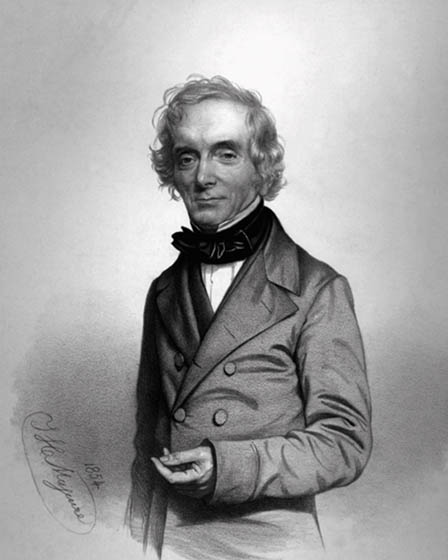
William John Burchell is credited “with having been the most prolific collector of botanical and zoological specimens.” [1] During a four-year scientific exploration of South Africa, he amassed a collection of over 63,000 specimens. And yet, Burchell’s contributions to science have been largely overlooked. As William Swainson bemoaned, “science must ever regret that one whose powers of mind were so varied…was so signally neglected in his own country.” [2]

View Full Size Image
Portrait of William John Burchell by Thomas Herbert Maguire (1854). http://www.capeorchids.co.za/history.htm.

2015 marks the 200th anniversary of Burchell’s return to Cape Town following his four-year expedition in South Africa. The University of Pretoria recently digitized Burchell’s account of this journey, a two-volume work entitled Travels in the Interior of Southern Africa (1822-24) for BHL. This offers an excellent opportunity to not only highlight this recent addition from our colleagues in BHL Africa, but recognize the incredible accomplishments of a remarkable man.

William Burchell was born in Fulham, England, in 1781. His family owned the prosperous nine-and-a-half acre Fulham Nursery and Botanical Garden, which afforded him many opportunities to study botany and interact with some of the most influential natural historians of the day. Sir William Hooker, the first director of the Royal Gardens in Kew, was Burchell’s friend and mentor. The prosperity of his family’s business provided Burchell with the means to travel and nurture his interest in natural history and particularly botany.

View Full Size Image
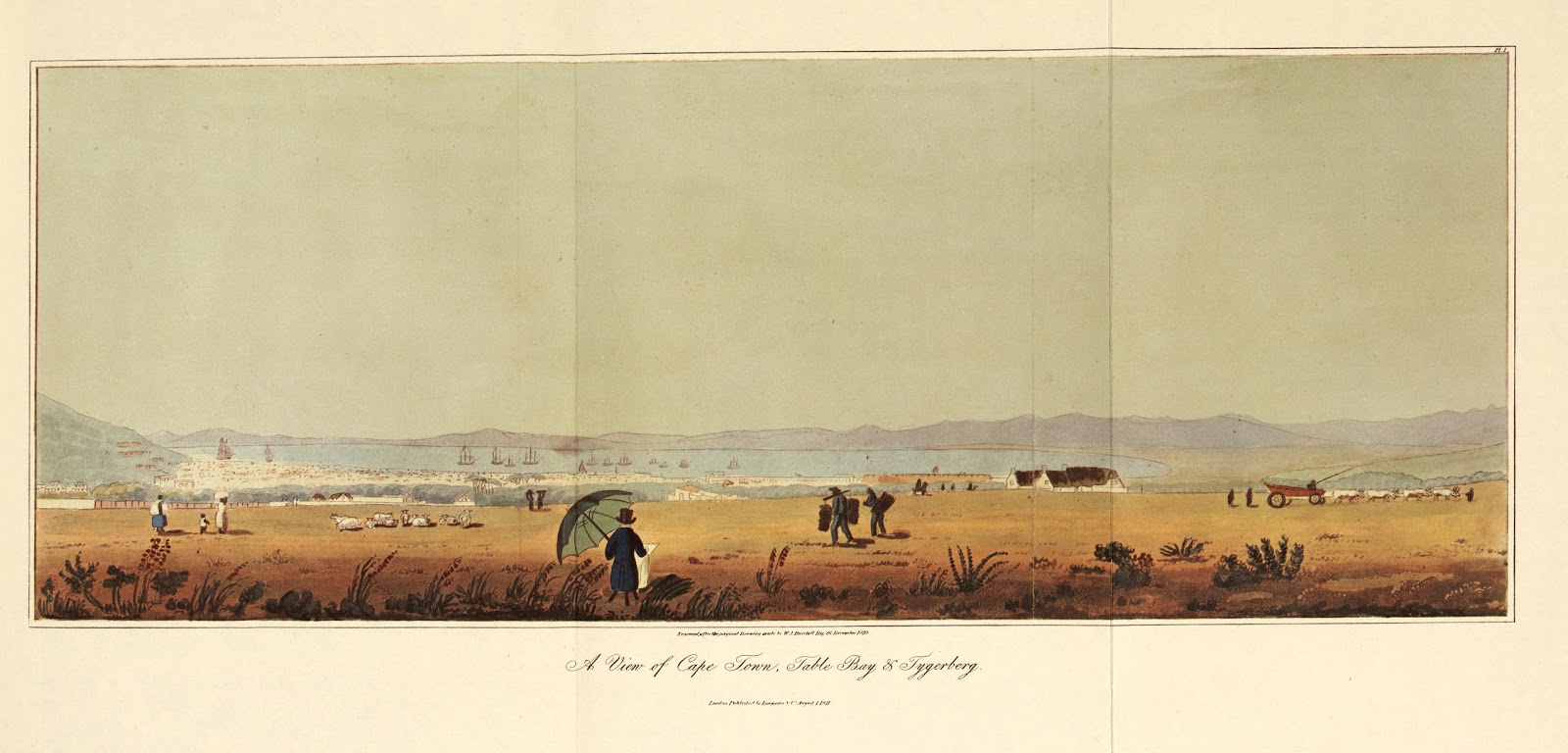
View of Cape Town, Table Bay and Tygerberg, 26 December, 1810. Engraved from a drawing by William John Burchell. Travels in the Interior of Southern Africa. v. 1 (1822). http://biodiversitylibrary.org/page/48904900. Digitized by: University of Pretoria.

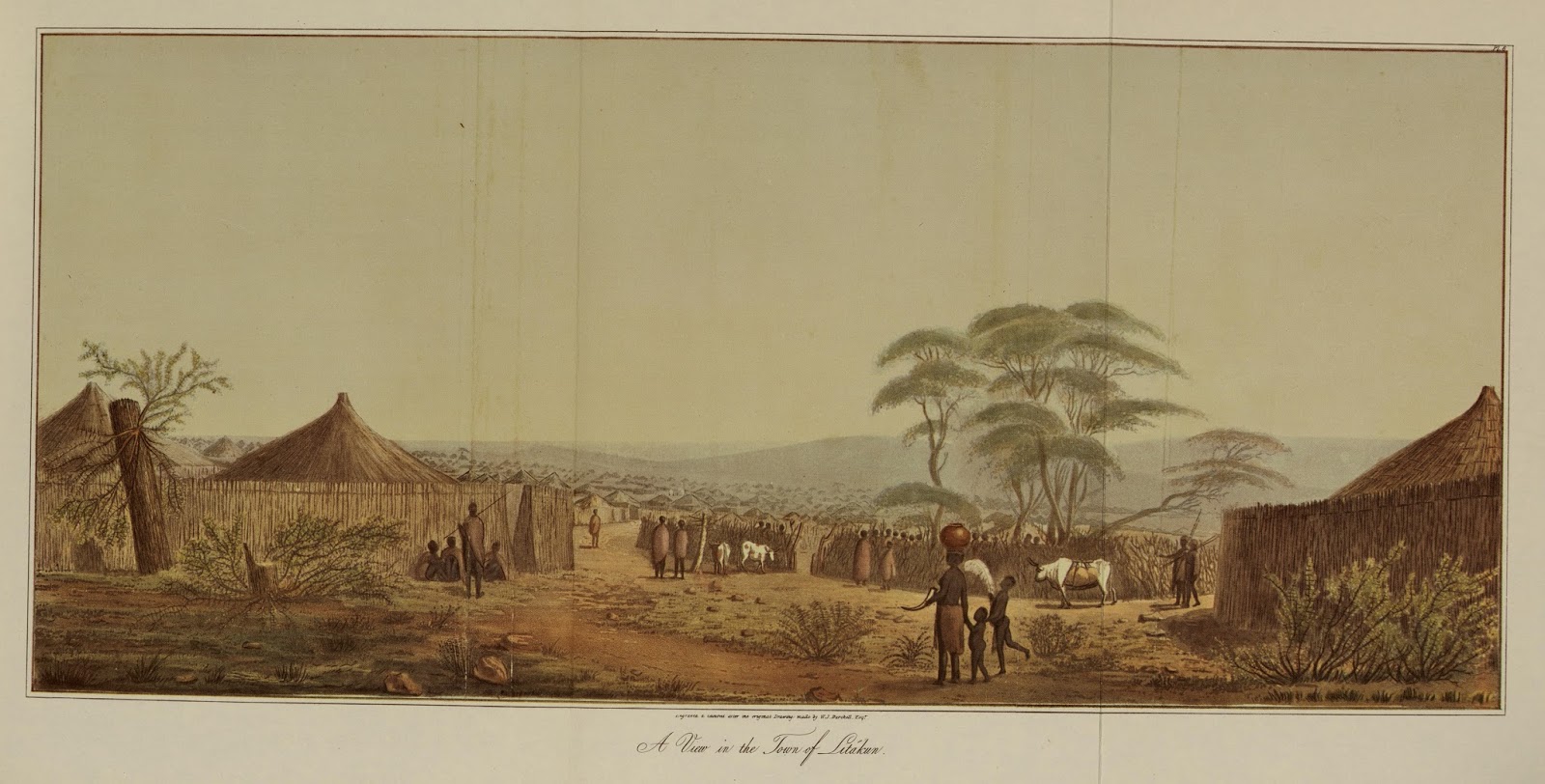
In 1810, Burchell arrived in Cape Town, South Africa, and on 19 June 1811, he set out from that city on a four-year expedition throughout the interior of southern Africa “solely for the purpose of acquiring knowledge.” [2] During the journey, he covered 7,000 km, mostly in an ox-wagon that he designed to serve as his home, laboratory, and library. He traveled as far north-east as the asbestos mountains just north of Chue Spring and became the first recorded European explorer to successfully travel through Bushmanland. The account of his expedition, Travels in the Interior of Southern Africa, covers only the period from his arrival in Cape Town through his departure from Litakun in August 1812.

View Full Size Image
“A view in the town of Litakun.” Engraved from a drawing by William John Burchell. Travels in the Interior of Southern Africa. v. 2 (1824). http://biodiversitylibrary.org/page/48905971. Digitized by: University of Pretoria.

Burchell’s accomplishments on the journey were extensive, particularly in the field of natural history. He collected 50,000 species of plants, seeds and bulbs, 10,000 specimens of insects, animal skins, skeletons, and fish, numerous anthropological artifacts, and created 500 drawings during the expedition. The Royal Botanical Gardens in Kew now holds a vast majority of Burchell’s extensive botanical collections. His journals document the precise location, morphological features, and habitat of the specimens he collected.

View Full Size Image
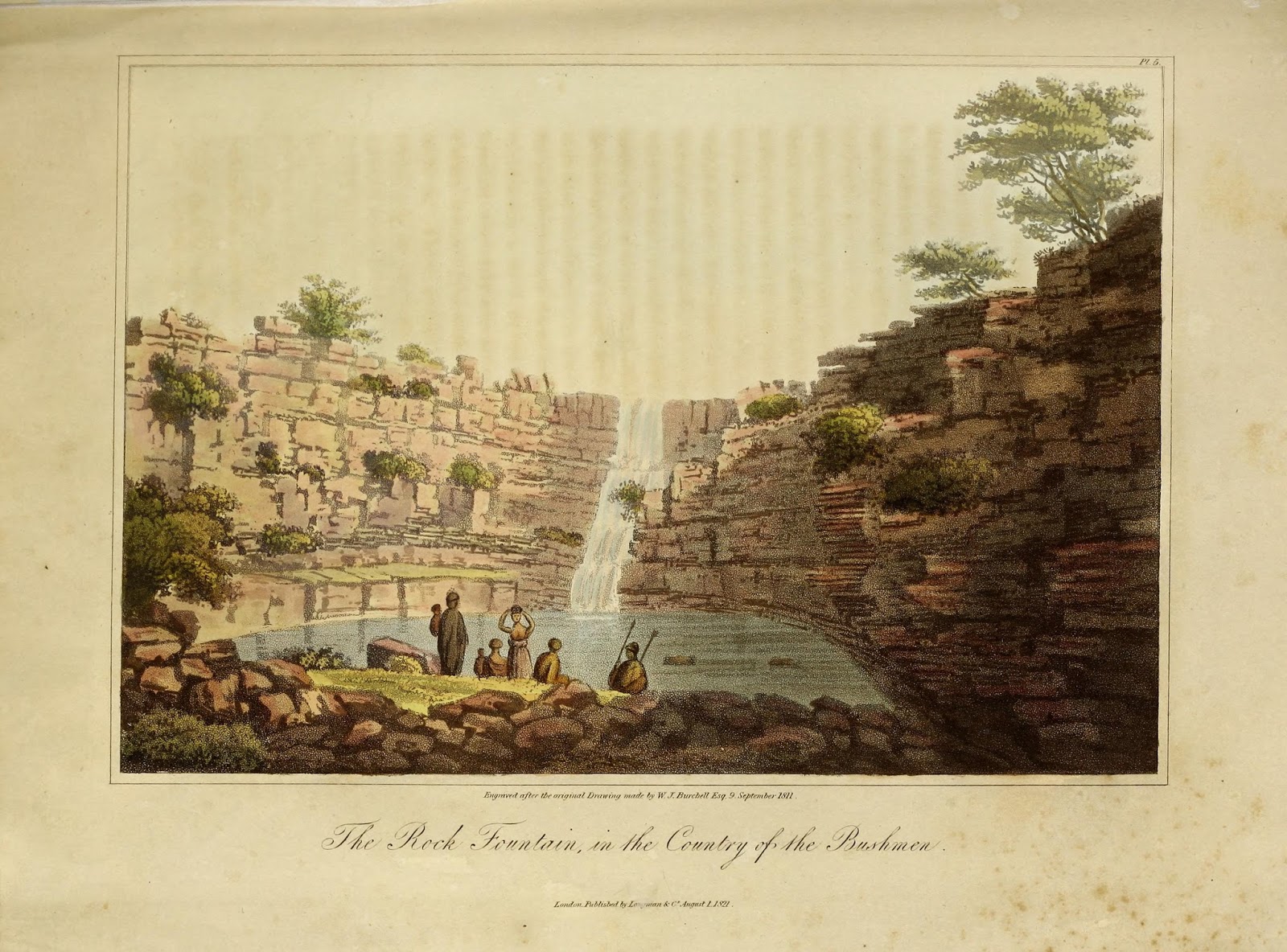
“Rock Fountain in the Country of the Bushmen.” 9 September, 1811. Engraved from a drawing by William John Burchell. Travels in the Interior of Southern Africa. v. 1 (1822). http://biodiversitylibrary.org/page/48905175. Digitized by: University of Pretoria.

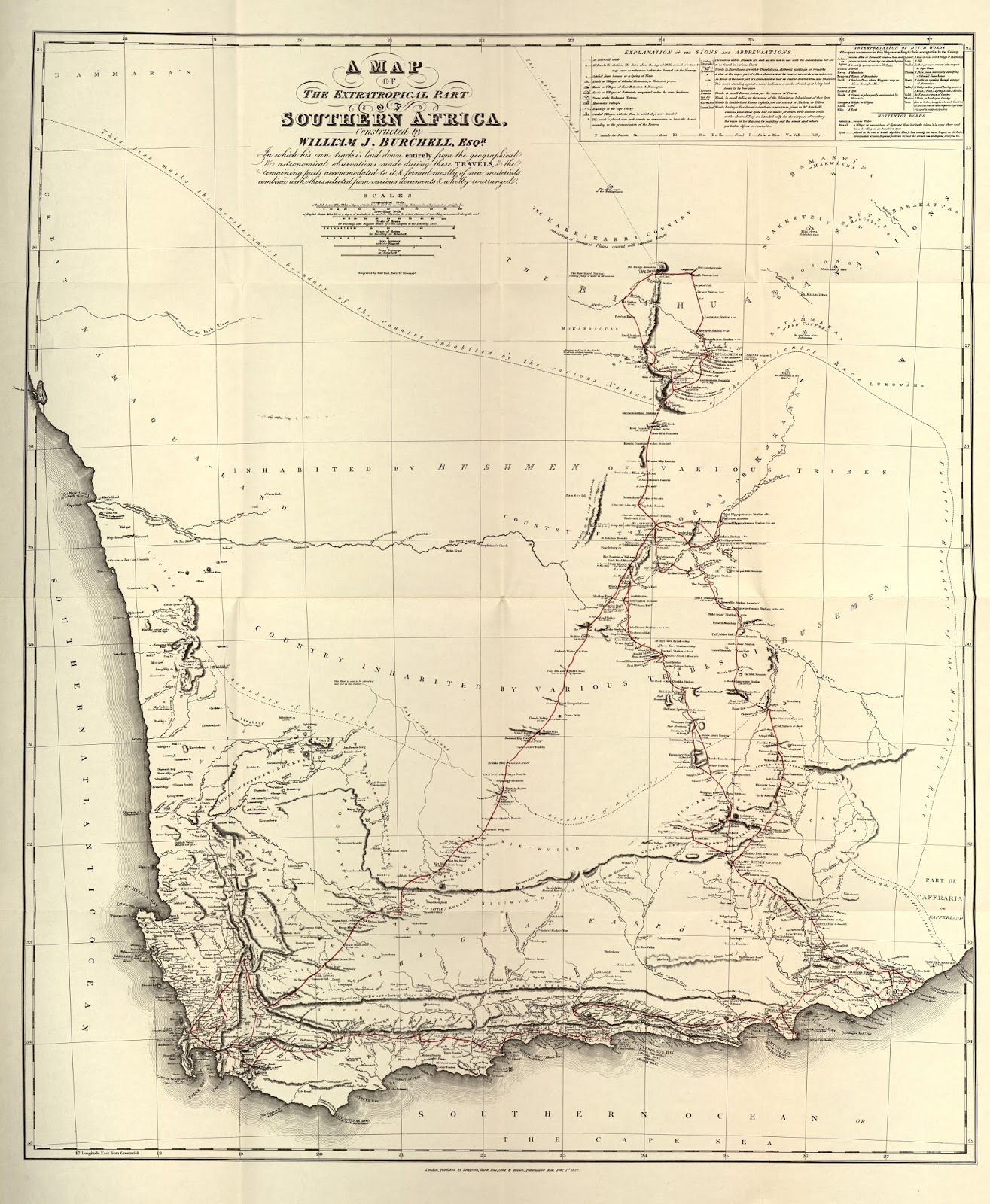
In addition to natural history, Burchell made important observations in the earth sciences during the expedition, being the first recorded person to identify asbestos in the Northern Cape and the “first to describe glacial pavements in the country.” [2] He also charted his entire route, creating a “Map of the Extratropical Parts of Southern Africa” (published in v.1 of his book), which was a “milestone in the cartography of the country.” [1] In the field of astronomy, he observed the variability of Eta Carinae’s brightness, and, by using a combination of Friar’s Balsam (Compound Tincture Benzoin), laudanum, Buchu vinegar, and Wild Wormwood to treat a serious gunshot wound afflicting one of the expedition’s members, became the first recorded person to successfully integrate indigenous herbal medicine with medicines used in Europe “into the management of such a serious condition.” [2]

View Full Size Image
Map of the Extratropical parts of Southern Africa. Travels in the Interior of Southern Africa. v. 1 (1822). http://biodiversitylibrary.org/page/48905480. Digitized by: University of Pretoria.

After Burchell’s return to Cape Town in April 1815, he went on to travel in Brazil, collecting over 23,000 additional specimens. However, after his return to England, Burchell became increasingly reclusive and protective of his collections, focusing on cataloging his vast botanical specimens but also refusing to allow others to access his collections. Some historians hypothesize that he may have suffered from a bipolar-type disorder. [2] In 1863, at the age of 82, after one unsuccessful suicide attempt by gunshot, he hung himself in a small outhouse in his garden. He is buried near his home in Fulham, in the family tomb at All Saints Church, Hammersmith.

View Full Size Image
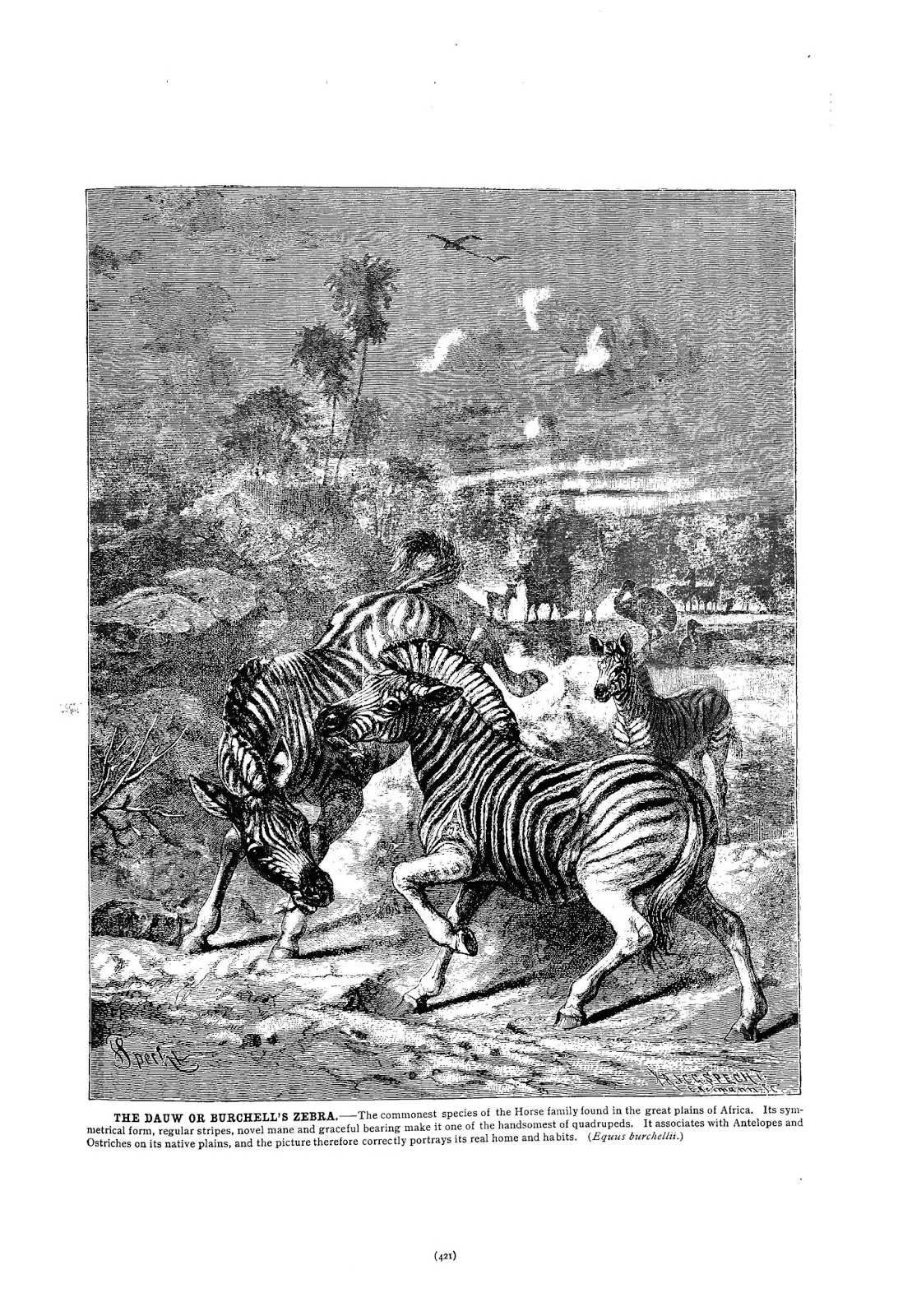
Burchell’s Zebra (Equus quagga burchellii), named after William John Burchell by John Edward Gray. Brehm, Alfred Edmund. The Animals of the World (1895). http://biodiversitylibrary.org/page/37569339. Digitized by: Cornell University Library.

Though his life had a tragic ending, Burchell’s accomplishments are remarkable. In addition to the many specimens he collected, a species of South African wild pomegranate (Burchellia bubalina) is named after him, and the common names of many animals bear his moniker, including Burchell’s zebra, Burchell’s coucal, three birds (Burchell’s starling, coarser, and grouse), a lizard (Burchell’s sand lizard), and the white rhinoceros (for which Burchell was the first to give a scientific name and is also known, although less-commonly, as Burchell’s rhinoceros). He also recommended the establishment of a public garden in Cape Town. He described the Kirstenbosch area as “the most picturesque I had seen in the vicinity.” [2] The Kirstenbosch National Botanical Garden was founded in 1913.

We are honored to have a copy of Burchell’s Travels in the Interior of Southern Africa in BHL, thanks to the University of Pretoria, as, to quote historian George Theal, it is “one of the most trustworthy and valuable books ever issued upon South Africa.” [1]

William John Burchell was an extraordinary man. We have not forgotten him.

[1] Stewart, Roger. “William John Burchell’s Medical Challenges: A 19th Century Natural Philosopher in the Field.” South African Medical Journal: 2012;102(4). pgs. 252-255.
[2] Stewart, Roger and Brian Warner. “William John Burchell: The Multi-skilled Polymath.” South African Journal of Science. 2012;108(11/12), Art. #1207, 9 pages. http://dx.doi.org/10.4102/sajs.v108i11/12.1207

November 19, 2015by ulib-libraryjobs
BHL News, Blog Reel

BHL in Africa! Workshop & TDWG

Portrait version of the Biodiversity Heritage Library logo.

An international ensemble of biodiversity-minded professionals recently gathered in Nairobi, Kenya for two weeks of trainings and conferences. From 24-26 September, 2015, fifteen representatives from eleven institutions throughout South Africa, Kenya, and Uganda attended a BHL Africa training workshop at the National Museums of Kenya. Following the workshop, 28 September – 1 October, 2015, the TDWG Annual Conference was held at the Windsor Golf Hotel and Country Club in Nairobi.

The BHL Africa Workshop was an opportunity to provide training and help build capacity amongst the current signatories of the BHL Africa MOU. The workshop was funded as part of the 2015 JRS Biodiversity Foundation grant, awarded to the South African National Biodiversity Institute (SANBI), to facilitate the growth of BHL Africa.

“This workshop is yet another example of the exciting strides the BHL Africa libraries are making towards digitizing and providing open access to their unique and important collections,” said Robert Guralnick of the Board of Trustees, JRS Biodiversity Foundation.

View Full Size Image
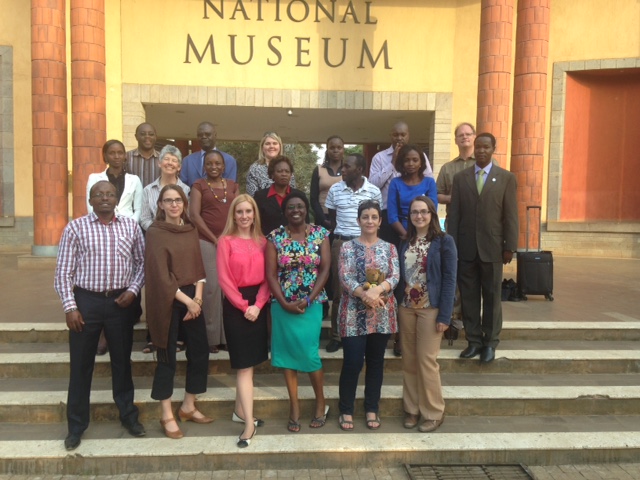
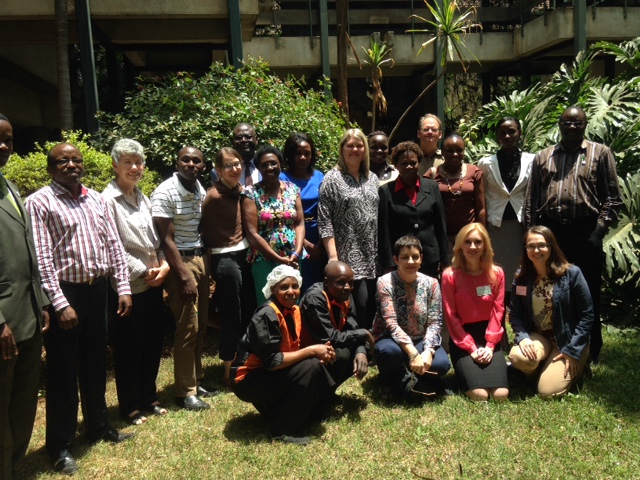
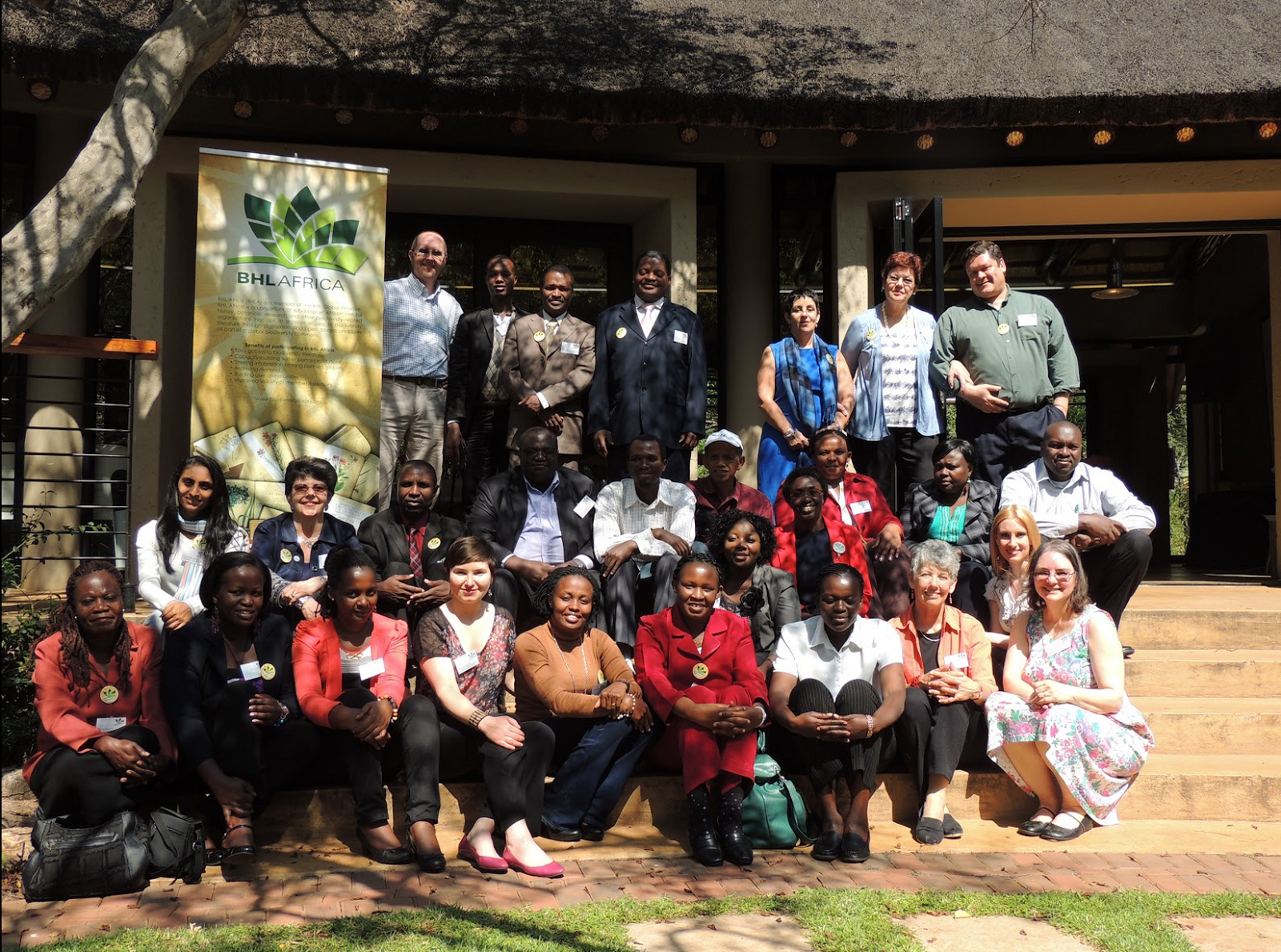
Attendees at the BHL Africa Workshop at the National Museums of Kenya in Nairobi.

Representatives from the National Museums of Kenya, the University of Nairobi, the International Centre of Insect Physiology and Ecology, the African Conservation Centre, the Kenya Wildlife Service, the Uganda National Council for Science and Technology, The Uganda Society, the National Library of Uganda, the South African National Aquatic Biodiversity Institute, the South African National Biodiversity Institute, and the University of Pretoria attended the workshop. Training was provided by four BHL representatives from the U.S., including BHL’s Program Director, Martin Kalfatovic, Program Manager, Carolyn Sheffield, Outreach and Communication Manager, Grace Costantino, and Smithsonian Digital Collections Librarian, Jacqueline Chapman.

Trainings included an overview of the structure and governance of BHL; demoes of the BHL website and administrative functions; in-depth discussions about BHL collection scope, development, digitization and curation workflows, and metadata requirements; guidance on copyright and permissions issues; methods for communication and outreach collaboration; and intensive hands-on training for several BHL tools, including the issue tracking system Gemini and the digitization workflow tool Macaw.

View Full Size Image
BHL Africa workshop attendees enjoying the beautiful grounds at the National Museums of Kenya during a lunch break.

Chief among the discussion topics was a focus on building capacity within Africa and amongst current and future participating institutions. The goal of the workshop was to not only train attendees on the many aspects of BHL participation and workflows, but to ensure that attendees could return to their own institutions and provide training to their colleagues. There was also extensive discussion on the various ways that participants could share digitization equipment amongst institutions, ensuring efficiency and a responsible use of funds.

Following the workshop, Martin Kalfatovic, Anne-Lise Fourie (Head of BHL Africa and Assistant Director of SANBI Libraries), Carolyn Sheffield, and Jacqueline Chapman continued on to the TDWG 2015 conference where they were joined by BHL Technical Director William Ulate and the Vice Chair of the Global BHL Executive Committee, Dr. Jiri Frank.  On 1 October, BHL hosted a Symposium that provided updates on the BHL consortium in general; BHL Africa’s JRS-funded capacity-building initiatives; BHL workshops; BHL projects; and a special guest, Prabhakar Rajagopal, who presented on the participation in the India Biodiversity Portal.  The session was well-attended with 137 conference attendees in the audience.

We are excited to see such wonderful progress from our colleagues in Africa, and look forward to the growth of BHL Africa content in and contributions to BHL.

October 7, 2015by michelle.underhill
BHL News, Blog Reel

Empowering Access to Biodiversity Information in Africa

View Full Size Image

Almost two years ago, BHL Africa officially launched during a three-day workshop hosted by the South African National Biodiversity Institute (SANBI) at the Pretoria National Botanical Garden in Pretoria, South Africa. In the subsequent two years, BHLA has begun digitization at some participating institutions and has drafted a governance framework for the node. Recent developments, including a grant from the JRS Biodiversity Foundation and a new status within the global BHL community, have brought our colleagues significantly closer to achieving their vision of global access to biodiversity resources in sub-Saharan African institutions.

On January 30, 2015, the JRS Biodiversity Foundation, which is committed to enhancing the understanding of biological diversity for the benefit and sustainability of life on earth, announced an award of $150,000 to facilitate the growth of BHL Africa. JRS’ support of BHL Africa began in 2011 with a sponsorship for African attendance at the BHL Life and Literature Conference in Chicago, IL, followed by additional support for the launch ceremony and corresponding workshop in April, 2013.

View Full Size Image
Group photo at the BHL Africa launch ceremony. Pretoria, South Africa. April, 2013.

Awarded to SANBI, this new grant will grow BHLA through assessment, collaboration, and digitization, resulting in a wealth of collections unique to African institutions being added to BHL. This new JRS support will allow BHLA to:

  • Conduct outreach to expand active BHLA participation through engagement with current members and recruitment of new participants
  • Improve communications and host workshops and trainings for 13 BHLA member institutions
  • Analyze the existing capacity for participation and content aggregation
  • Stabilize the governance of the organization and infrastructure through sustainability planning

In order to accomplish these objectives, Anne-Lise Fourie, Assistant Director of SANBI Libraries, Chair of BHLA and PI on the JRS Africa project, plans to survey current members and potential partners and conduct site visits to Kenya and Uganda to establish capacities and collection profiles. This information will help inform future trainings regarding identification of unique content for inclusion in BHL and the selection of digitization service providers.

Learn more about the project, planned outputs, and project staff on the BHL Africa web page on the JRS website.

We are also pleased to announce that BHL Africa has joined BHL as an Affiliate, following the example of BHL Singapore and BHL Mexico, which participate in BHL both as autonomous regional nodes and Members of the BHL. As an Affiliate, BHLA may participate in BHL committees, task forces, and working groups and will collaborate more extensively within the global BHL community. See a list of current BHL Members and Affiliates here.

We are thrilled at BHL Africa’s progress and look forward to witnessing the continued growth of the project.

Contributions from BHL Africa


View Full Size Image
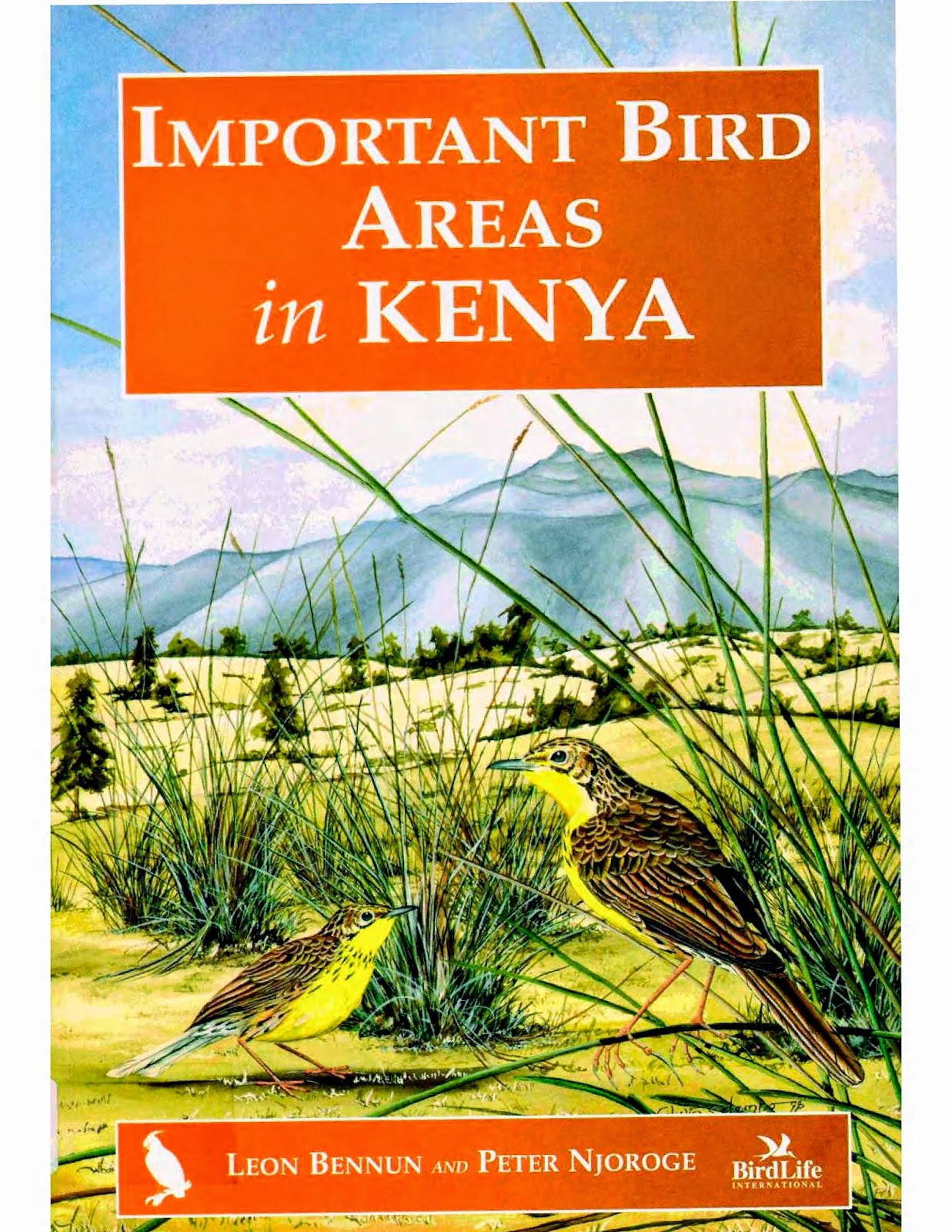
Important Birds Areas in Kenya. Contributed by Nature Kenya, East Africa Natural History Society for BHL Africa. http://biodiversitylibrary.org/bibliography/87589.

Current BHL Africa partner contributions to the BHL Collection include:

  • Publications from the South African National Biodiversity Institute
  • Articles and Publications from Nature Kenya, East Africa Natural History Society
  • The South African Institute for Aquatic Biodiversity’s “Ichthyological Papers of J.L.B. Smith 1931-1943”
February 11, 2015by ulib-libraryjobs
Page 1 of 3123»

Help Support BHL

BHL's existence depends on the financial support of its patrons. Help us keep this free resource alive!

search

About BHL

The Biodiversity Heritage Library (BHL) is the world’s largest open access digital library for biodiversity literature and archives. BHL operates as a worldwide consortium of natural history, botanical, research, and national libraries working together to digitize the natural history literature held in their collections and make it freely available for open access as part of a global “biodiversity community.”

Join Our Mailing List

Sign up to receive the latest news, content highlights, and promotions.

Subscribe Now

Subscribe to Blog via Email

Enter your email address to subscribe to this blog and receive notifications of new posts by email.

Join 319 other subscribers

Subscribe to Blog Via RSS

Subscribe to the blog RSS feed to stay up-to-date on all the latest BHL posts.

Access RSS Feed

Inspiring Discovery through Free Access to Biodiversity Knowledge.

The Biodiversity Heritage Library makes it easier than ever for you to access the information you need to study and explore life on Earth…for free, anytime, anywhere.


ABOUT | HARMFUL CONTENT | PRIVACY | SITE MAP | TERMS OF USE