Biodiversity Heritage Library - Program news and collection highlights from BHL
  • Home
  • News
  • Featured Books
    • All Featured Books
    • Book of the Month Series
    • BHL at 20
  • User Stories
  • Campaigns
    • Fossil Stories
    • Garden Stories
    • Monsters Are Real
    • Page Frights
    • Her Natural History
    • Earth Optimism 2020
  • Tech Blog
  • Visit BHL
Home
News
Featured Books
    All Featured Books
    Book of the Month Series
    BHL at 20
User Stories
Campaigns
    Fossil Stories
    Garden Stories
    Monsters Are Real
    Page Frights
    Her Natural History
    Earth Optimism 2020
Tech Blog
Visit BHL
  • Home
  • News
  • Featured Books
    • All Featured Books
    • Book of the Month Series
    • BHL at 20
  • User Stories
  • Campaigns
    • Fossil Stories
    • Garden Stories
    • Monsters Are Real
    • Page Frights
    • Her Natural History
    • Earth Optimism 2020
  • Tech Blog
  • Visit BHL
Biodiversity Heritage Library - Program news and collection highlights from BHL
Blog Reel, Featured Books

Making the Best of Difficult Times: Accelerating the Transcription of William Brewster’s Writings During the COVID-19 Pandemic

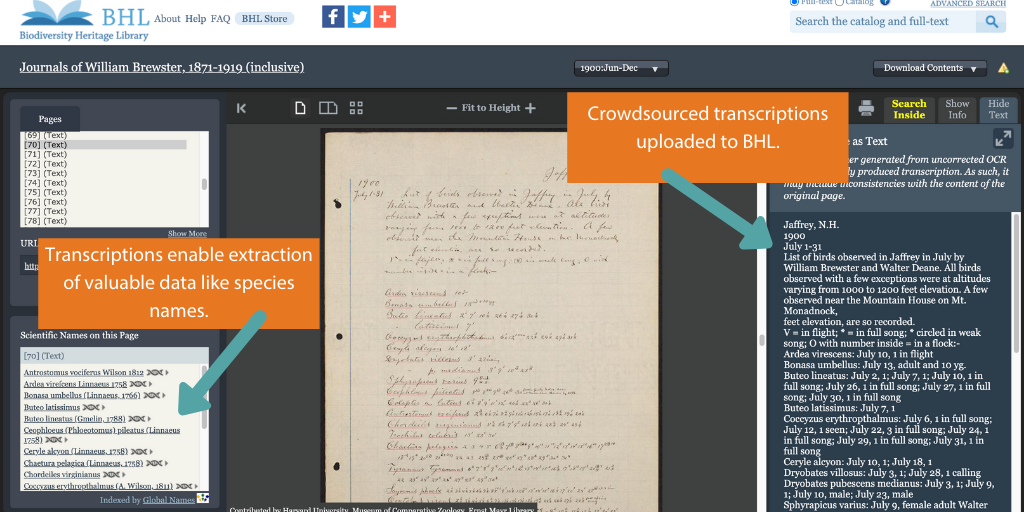
Screenshot of the BHL book viewer with crowdsourced transcriptions available for a handwritten journal.

This post is part of a series from the Ernst Mayr Library exploring the digitization and transcription of ornithologist William Brewster’s archival materials and the insights and scholarship made possible thanks to this work.

Many of us have searched for silver linings during the COVID-19 pandemic of 2020-2021. For many in the library and museum profession, one positive outcome of the mandatory transition to remote work has been the resurrection of some long-postponed projects. These are activities put on hold during normal times in deference to ever-proliferating, higher-priority onsite tasks. One such project in the Ernst Mayr Library and Archives (EMLA) of the Museum of Comparative Zoology (MCZ) at Harvard University is transcription of the digitized journals and diaries of William Brewster.

As discussed in Part One of this series, EMLA began digitization of its Brewster collection in 2012. In 2014, Library staff began transcription of Brewster’s digitized journals and diaries to produce a corpus of text files for the Purposeful Gaming and BHL project. As part of this project, EMLA was charged with leading an effort to select an appropriate open source transcription tool. At this time (early 2014), manuscript materials such as field notes and correspondence were beginning to appear in the Biodiversity Heritage Library (BHL) thanks to other grant-funded efforts among BHL members. Tools under consideration for Purposeful Gaming were thus also viewed as potential long-term transcription solutions for libraries contributing such materials to BHL.

After four months of research and testing, the grant partners selected DigiVol, a crowdsourcing transcription platform developed by the Australian Museum in collaboration with the Atlas of Living Australia, and EMLA staff set up a project space for the Library. One significant advantage of DigiVol is that it was developed specifically for the transcription of natural history materials such as specimen labels and field notes. Thus, there was the advantage of a pre-existing community of volunteers both interested in and adept at transcribing such items.

At the end of the Purposeful Gaming project (November 2015), volunteers and library staff had transcribed 12 volumes of Brewster’s journals and diaries, totaling 3,470 pages. That left 37,000 pages of Brewster’s writings in our collection awaiting transcription. Over the next four years, progress in the transcription work at EMLA was relatively slow at an average of 1,262 pages transcribed per year. During this time, EMLA had only a single, albeit enthusiastic, part-time library assistant who was able to dedicate one-third of her time or less to the project due to other higher-priority tasks.

On March 16, 2020, Harvard University staff began working remotely. Expecting a large influx of volunteers due to the quarantine in Australia, and anticipating an increase in staff availability at participating institutions, DigiVol administrators sent out a call for more materials to be uploaded for transcription. Working remotely, the author had the time available to regularly upload new volumes of Brewster’s diaries for transcription, respond to questions posted by volunteer transcribers, and validate completed transcriptions. Another EMLA staff member was able to offer several hours per week of her time as well. This was fortuitous as the volunteers were, indeed, ramping up their transcription activity, completing each diary volume in about two weeks time.

As the pandemic wore on, greater numbers of staff across the Harvard University library system were in need of work that could be done remotely. In response to this need, Harvard Library established a work share program whereby libraries in need of help could offer temporary assignments or projects to those in need of some additional work. By this time (September 2020), the volunteer transcribers were making so much progress that we were falling behind in the work of validating transcriptions. EMLA thus posted its project via the work share program, and we were fortunate to obtain the assistance of two library colleagues able to devote several hours each week to the work of transcription and validation.

With a total of 4 staff members and an average of 11 DigiVol volunteers (up from a previous average of 7) working on the project, more pages of Brewster’s writings were transcribed in 2020 than in any of the previous four years, as shown in the graphic below. There was a 242% increase in the number of pages transcribed over 2019, and a 165% increase over the average yearly number of pages transcribed from 2016 through 2019.
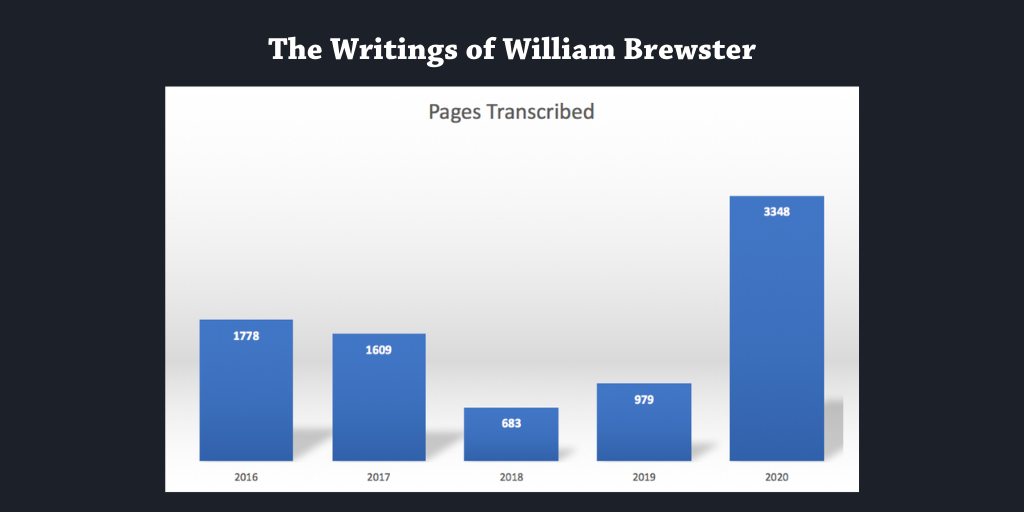
Bar graph showing number of pages transcribed per year, 2016-2020.

Number of pages transcribed per year, 2016-2020.

Transcriptions in the Biodiversity Heritage Library

The fruit of our transcribers’ labors began to materialize in 2018 when BHL developers introduced transcription import functionality to BHL. When member libraries began uploading transcribed pages of field notebooks and correspondence, the potential for access and discovery became readily apparent. Full-text indexing and searching of transcribed manuscript materials was now possible. For example, in researching the previous blog post about Robert Gilbert, the author was able to search for the name Gilbert in several transcribed volumes of Brewster’s journals. The result of such a search in Brewster’s 1898 journal is shown below.
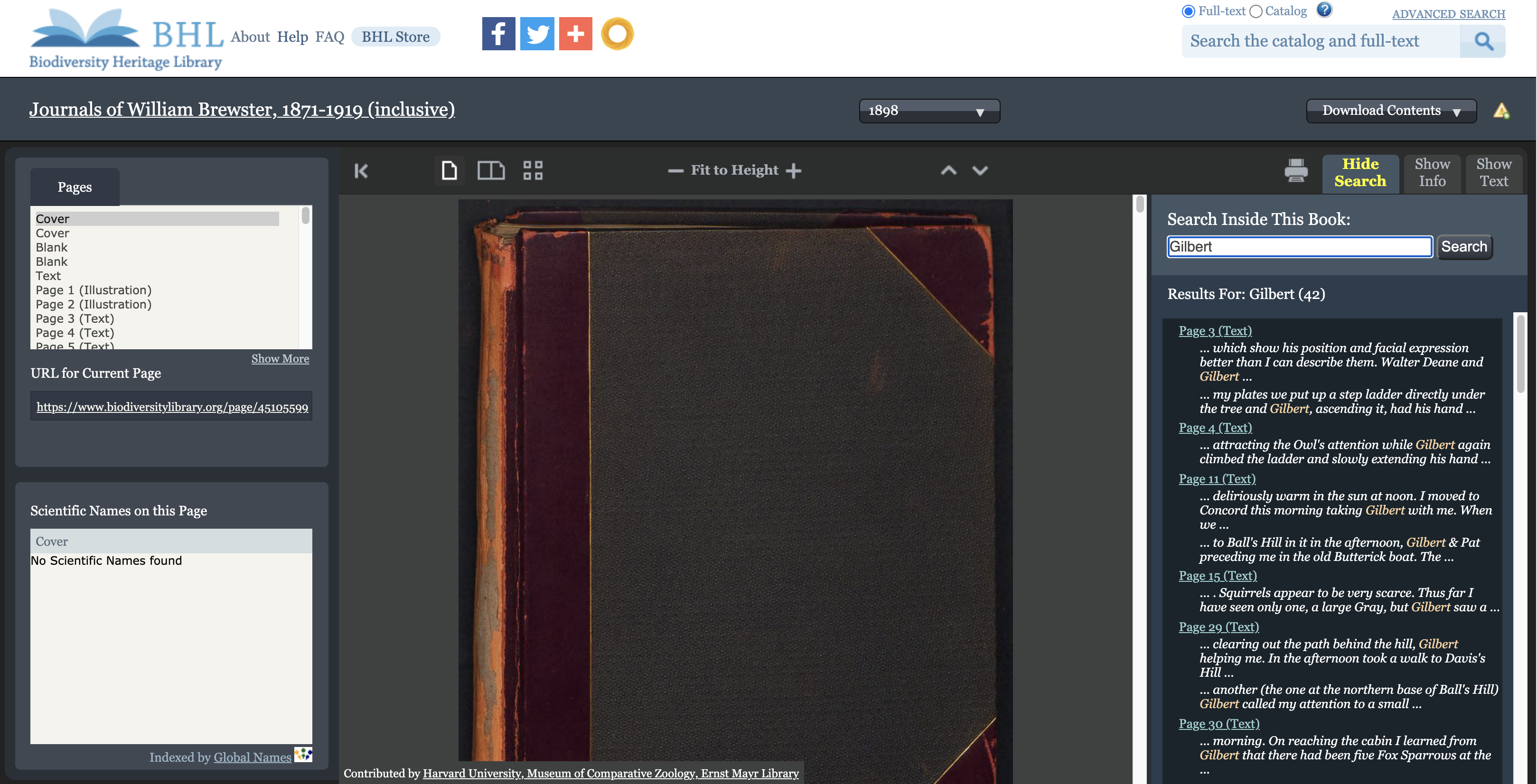
Screenshot of the BHL book viewer with full text search results for "Gilbert" displayed.

Searching for the name Gilbert in the 1898 volume of Brewster’s Journals retrieves 42 references to Robert Gilbert in this volume. The search results are shown in the right-hand panel of the BHL book viewer.

Like most field notebooks, Brewster’s diaries and journals are replete with scientific names. In order for these to be recognized by BHL’s name-finding utility, Global Names Architecture (GNA), they must be carefully transcribed. Transcription tutorials for the Brewster project in DigiVol ask that scientific names be given extra care, expanding abbreviations and correcting misspellings where possible. Our team of volunteers and staff have done an exquisite job of accurately transcribing scientific names, sometimes even doing research when unsure of the correct spelling of a name. Some of the transcribers so enjoy delving into Brewster’s world that they frequently research people, localities, or unfamiliar terms used in his writings as well.
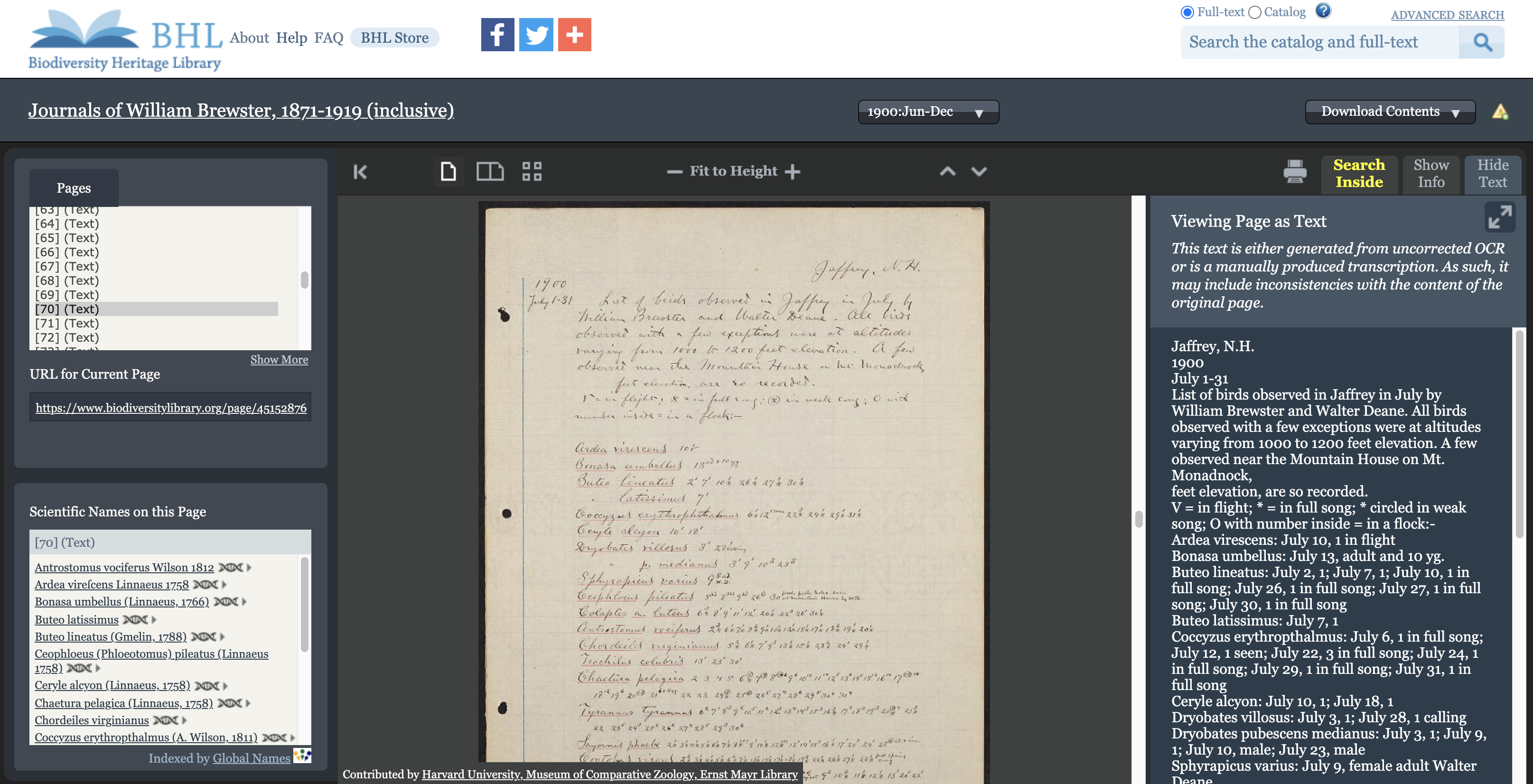
Screenshot of the BHL book viewer with scientific names found on the page.

A species observation list from Brewster’s 1900 Journal with transcription of species names and observations in the text panel on the right. Note the scientific names on the lower left, extracted from the transcription text by Global Names Architecture (GNA). Prior to addition of the transcription text, no names were found by GNA.

The end result is that the myriad of ornithological taxa mentioned in Brewster’s writings are being indexed in BHL. Thus a search across the full BHL repository for a specific taxon retrieves results from field notes and correspondence as well as the published literature. The resulting species bibliography will thus lead researchers to field observations, specimen collecting accounts, habitat and weather descriptions, and other content that may not be included in secondary sources.
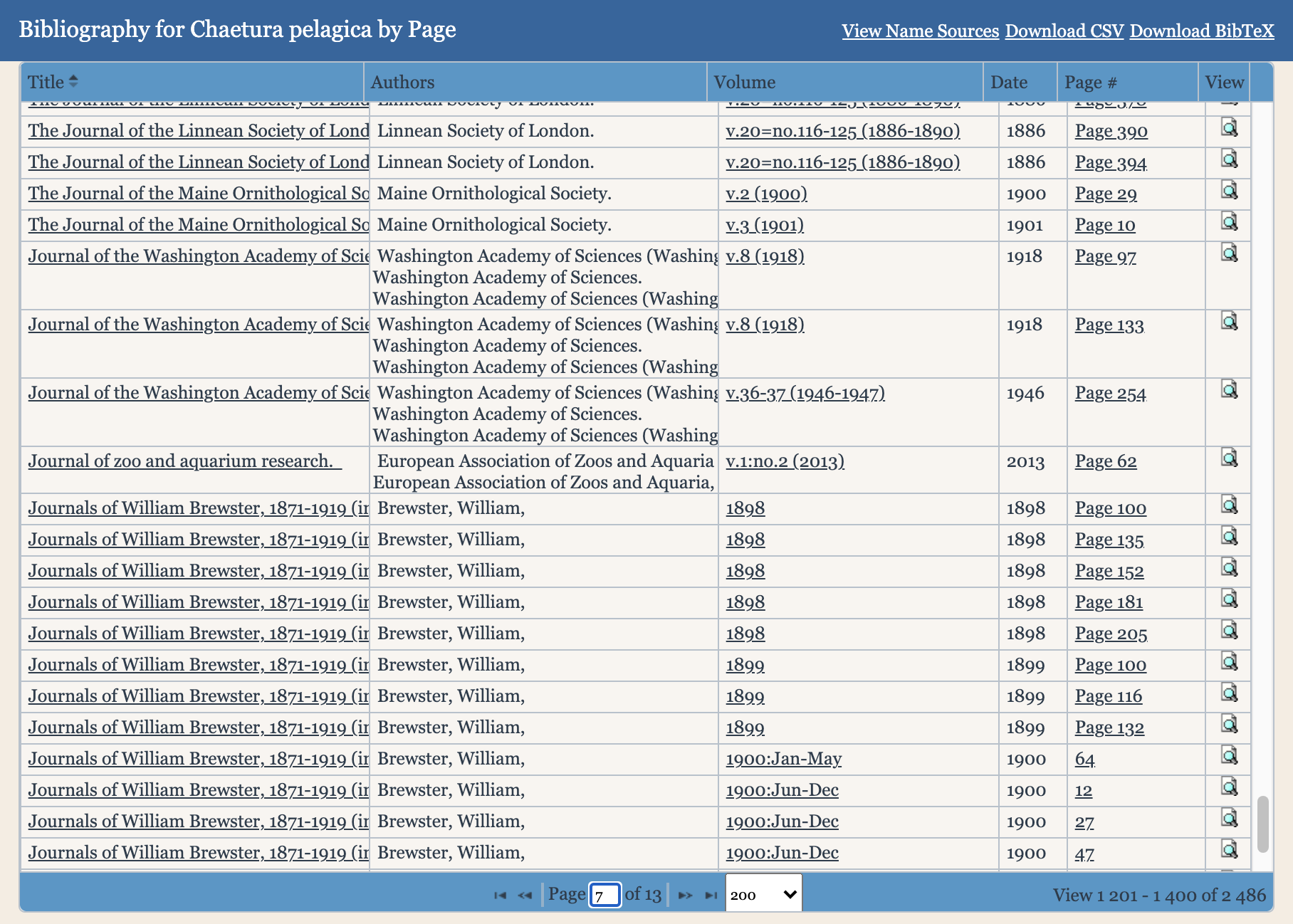
Screenshot of a species bibliography in BHL for Chaetura pelagica.

A search for Chaetura pelagica (Chimney Swift) across the full BHL repository retrieves instances of this taxon in Brewster’s transcribed Journals as well as the published literature.

Because of the hard work of our volunteer transcribers, full transcriptions of thousands of pages of Brewster’s diaries, journals, and correspondence are now being added to BHL, making this content available for text analysis, data mining, digital scholarship, and the creation of new information. Connections with similar collections in other institutions will likely be discovered as more primary source material is digitized and transcribed. Brewster’s meticulous record of species occurrences, habitat, landscape ecology, and weather can help in addressing the current climate and biodiversity crises. His record of historical events and his account of the work of Robert Gilbert might be used in social justice or other humanitarian research efforts. The staff of the EMLA are deeply indebted to the team of volunteers and our two Harvard Library colleagues who have given so much of their time and energy to help unlock the riches of the Brewster collection for the benefit of all.

If you would like to help transcribe Brewster’s writings, there is still plenty of work to do. We will soon complete his diaries and journals after which we will begin transcribing his extensive collection of correspondence. If you are interested, please visit our project page.
February 24, 2021by michelle.underhill
Blog Reel, User Stories

Finding Refuge in the Library: How BHL Inspired the Mycological Book Club

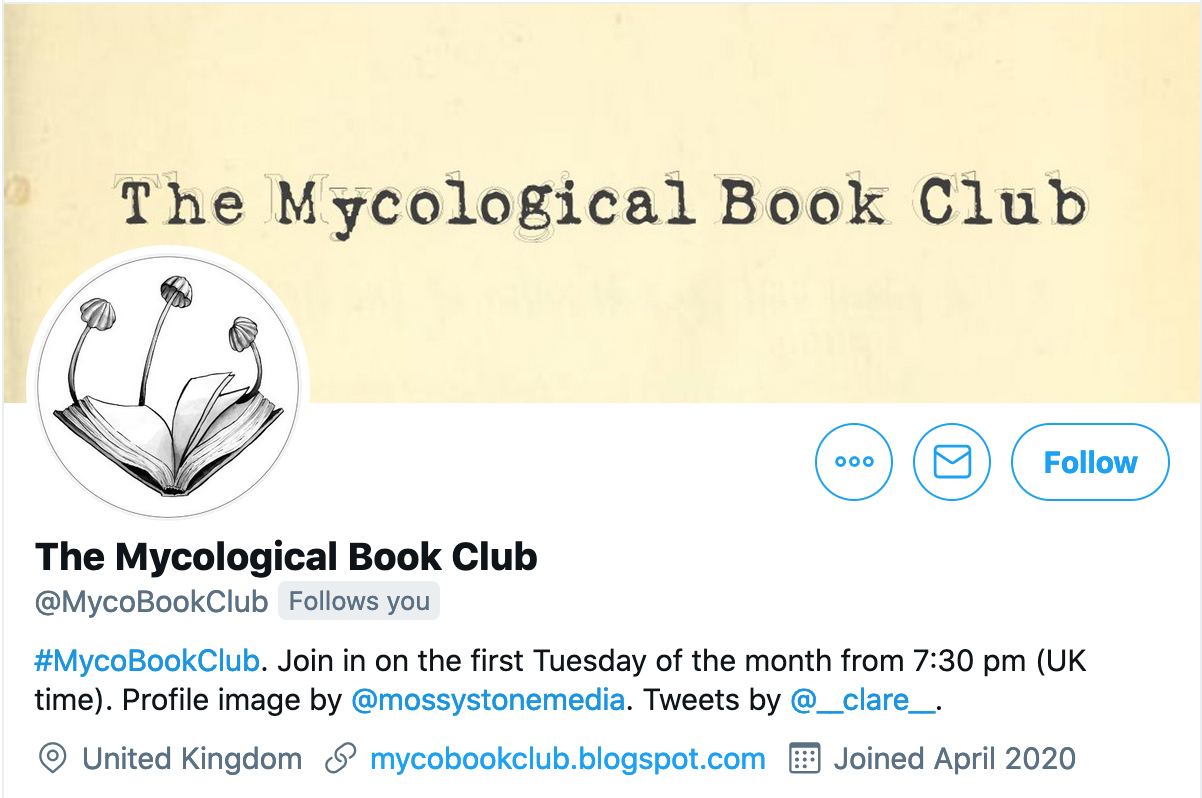
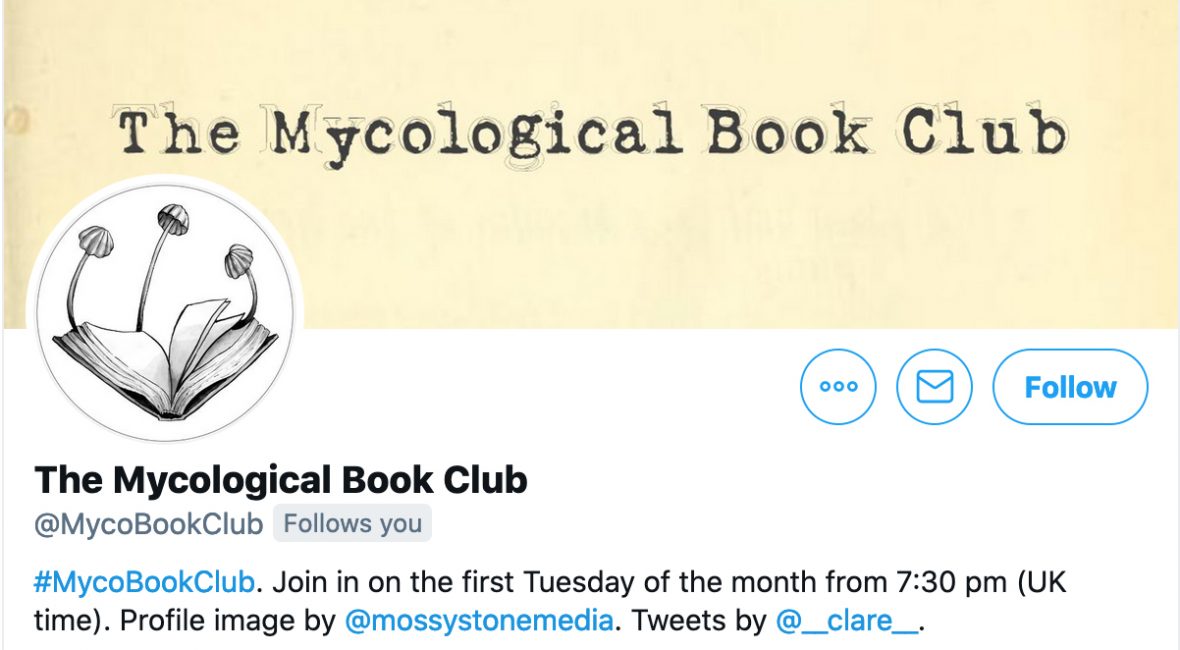
Screenshot of the Twitter profile of @MycoBookClub.

On 23 March 2020, the U.K. went into its first national lockdown in response to the COVID-19 pandemic. Social distancing and teleworking became the norm, and the walls of our homes became, in many ways, the boundaries of our individual worlds.

Amateur mycologist Clare Blencowe was eager to find a positive distraction from the realities of life during a pandemic. The Biodiversity Heritage Library’s open access collections, which for Blencowe had become a welcome refuge from the continuous onslaught of negative news articles, now became the inspiration for a new, socially distanced way to connect with other fungi lovers—in the form of “The Mycological Book Club”, an online, Twitter-based book club with a particular focus on open access literature.

#MycoBookClub logo fungi growing out of a book

#MycoBookClub logo, designed by illustrator Kelsey Sconberg of Mossy Stone Media.

“We were at the beginning of a national lockdown,” recalls Blencowe. “All social events were cancelled, and I found myself endlessly scrolling through increasingly doom-laden news, feeling increasingly doom-y. #MycoBookClub started as a simple distraction, an opportunity for a shared experience: people reading the same book and discussing it on Twitter at an allotted time.”

Screenshot of the Twitter profile of @MycoBookClub.

@MycoBookClub on Twitter.

Blencowe brought her idea to life by founding the @MycoBookClub Twitter account, establishing the #MycoBookClub hashtag to facilitate discussion, and setting a recurring date and time for book club meetings—the first Tuesday of the month at 7:30pm (GMT) on Twitter. She then scheduled the first #MycoBookClub meeting for 5 May 2020.

That first meeting, which brought together just a handful of followers, was dedicated to Mordecai Cubitt Cooke’s Rust, Smut, Mildew & Mould: An Introduction to the Study of Microscopic Fungi (Fifth ed. 1886), which club members accessed through BHL.

Welcome to #MycoBookClub, folks! It’s a pleasant evening here at @MycoBookClub headquarters in Sussex, England.

We’re talking about ‘MICROSCOPIC FUNGI: Rust, Smut, Mildew & Mould’ by M.C. Cooke (1886). You can find it at: https://t.co/7WO005ZS5Q pic.twitter.com/GxWzmYhnxg

— The Mycological Book Club (@MycoBookClub) May 5, 2020

With passages celebrating the beauty and wonder of the often unheeded nature in our own backyards and neighborhoods, the title was a fitting—and motivating—choice for an audience confined to their homes and local natural surroundings.

As Cooke writes,

“We might traverse the primeval forests of the new world, and explore the unknown regions of the old, and not encounter so much to excite our admiration, or cause our wonder, as lies about our feet at home; marvels which we tread beneath our feet, or kick from our path, because they appear to be only rotten sticks, withered grass, and decaying leaves.”

“Cooke’s writing provided inspiration for enjoying nature near home,” shares Blencowe. “I felt myself lifted by his soaring rhetoric.”

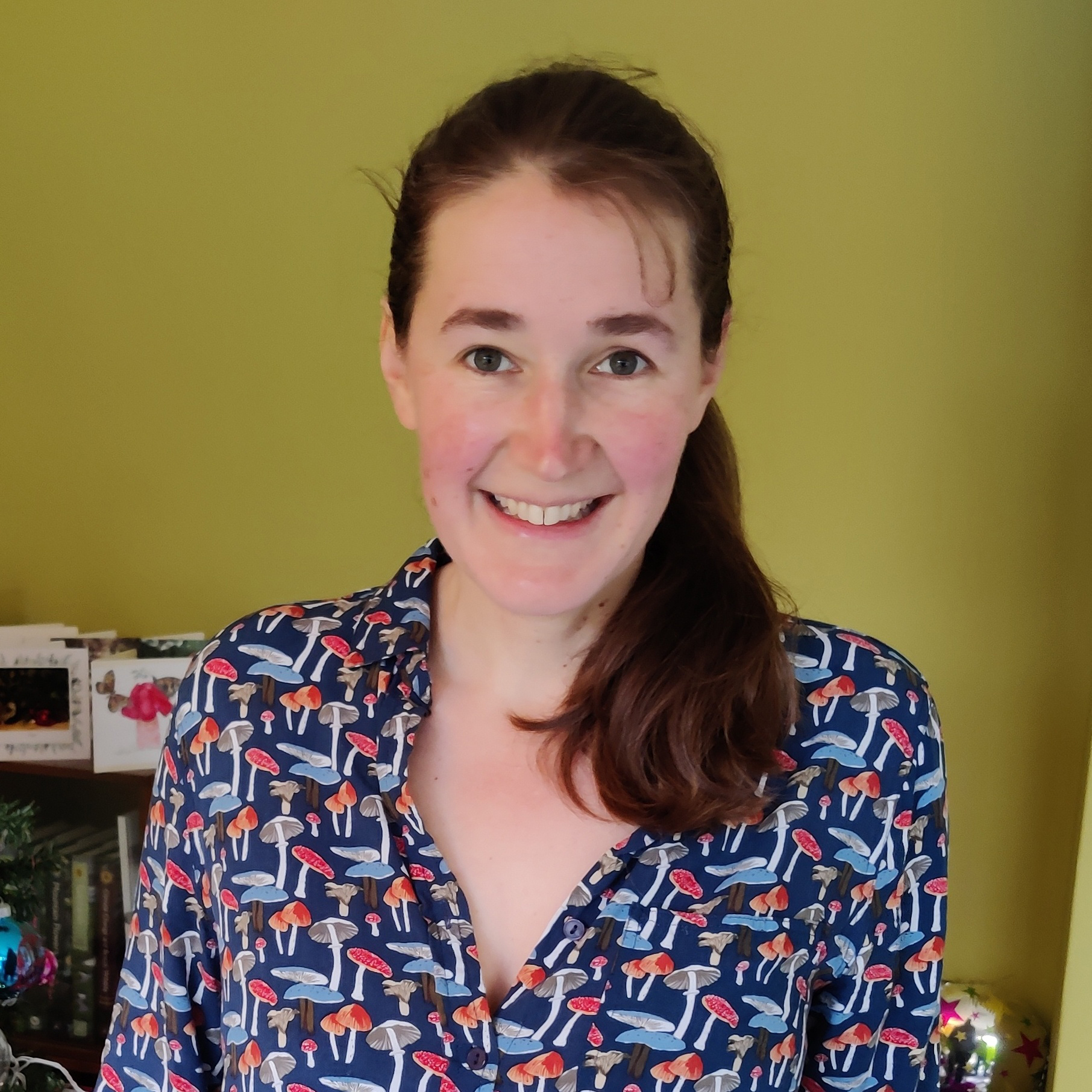
Photo of a human with long brown hair in a shirt with fungi images on it.

Amateur mycologist Clare Blencowe, founder of the #MycoBookClub. Photo courtesy of Clare Blencowe.

#MycoBookClub has allowed Blencowe to share and grow her interest in mycology—an interest that began in earnest about five years ago when a new job as manager of the Sussex Biodiversity Record Centre, and the much shorter commute that came with it, provided her with newfound time to pursue her interest in fungi. While she considers mycology a hobby, her involvement in the field has grown over the years through membership in the British Mycological Society, where she was recently elected to their Field Mycology and Conservation Committee.

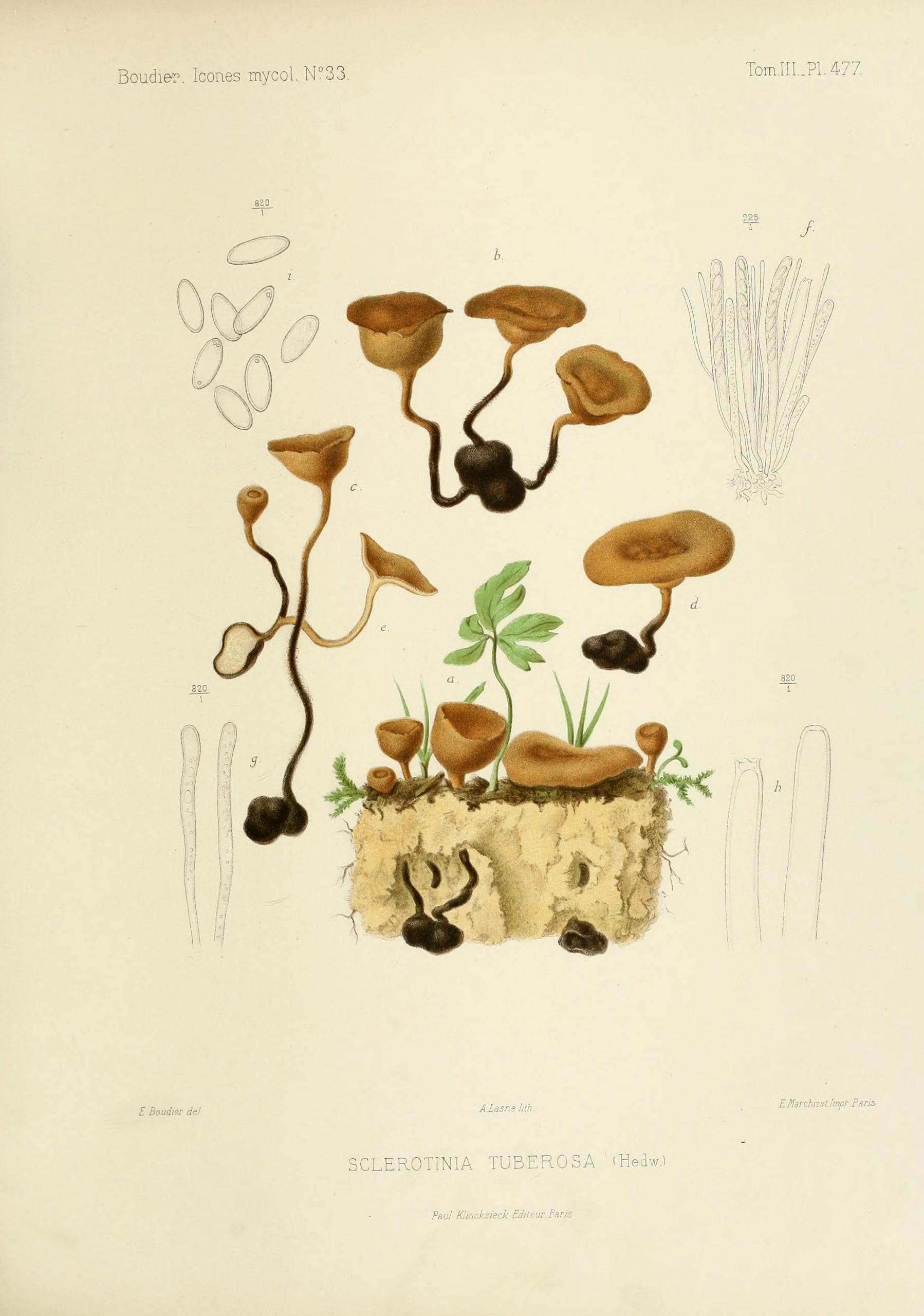
BHL helped nurture this love of mycology well before the birth of #MycoBookClub. Blencowe’s first in-depth interaction with the Library occurred in April 2019, when her discovery of a small brown fungus cup in the woods led her to seek confirmation of its identity—which she believed to be the Anemone Cup Dumontinia tuberosa—by posting to the British Mycological Society Facebook group. UK-based mycologist Lukas Large responded to her post with the link to a color plate for comparison from Émile Boudier’s Icones Mycologicæ (1905-1910) in BHL.

Illustration of fungi.

Illustration of Dumontinia tuberosa, plate 477. Boudier, Émile. Icones Mycologicæ (1905-1910), v.3. Art by Boudier. Contributed in BHL from the University Library, University of Illinois Urbana Champaign.

“The information contained in this beautiful colour plate far surpassed anything I had access to in my field guides at home,” shares Blencowe. “It helped me to understand the structure and features of this fungus I had in front of me, and spurred me on to take a closer look at it under the microscope. That experience really opened my eyes to what a useful resource the books in BHL can be: to inform observation and help identify species in a present day context. Sure, species concepts and nomenclature may have moved on, but the detail with which mycologists such as Boudier recorded their observations is a lesson in itself.”

Since that eye-opening experience, Blencowe continues to turn to BHL as a resource to support her interests in mycology, reading titles online and downloading select pages and images as needed. Some of her favorite aspects of the Library include a good search functionality, user-friendly online reading and content downloading, high quality scans, clear copyright information, easily-shareable direct page links, and the image collections in Flickr. Since founding #MycoBookClub, she uses BHL almost every week.

We’ve talked already here at #MycoBookClub about M.C. Cooke, but tonight we’re also feasting our eyes on ‘Selecta Fungorum Carpologia’ by The Brothers Tulasne.

You can find their illustrations in the Biodiversity Heritage Library: https://t.co/DN4Hi816XE pic.twitter.com/buaU9fMTa4

— The Mycological Book Club (@MycoBookClub) June 2, 2020

“I love the little bookish details that are preserved in BHL: the gilt decoration on a publication’s cover, ornate book plates, library stamps, barely-decipherable pencil marks and blank pages uniquely speckled with foxing,” shares Blencowe. “The scanned pages hold so much more than simply the words and the illustrations. They do your soul good.”

A reminder that it’s #MycoBookClub night tonight, from 7:30pm UK time.

We’re trying out a theme this evening: illustration ?https://t.co/Bvx0nDHY08

— The Mycological Book Club (@MycoBookClub) November 3, 2020

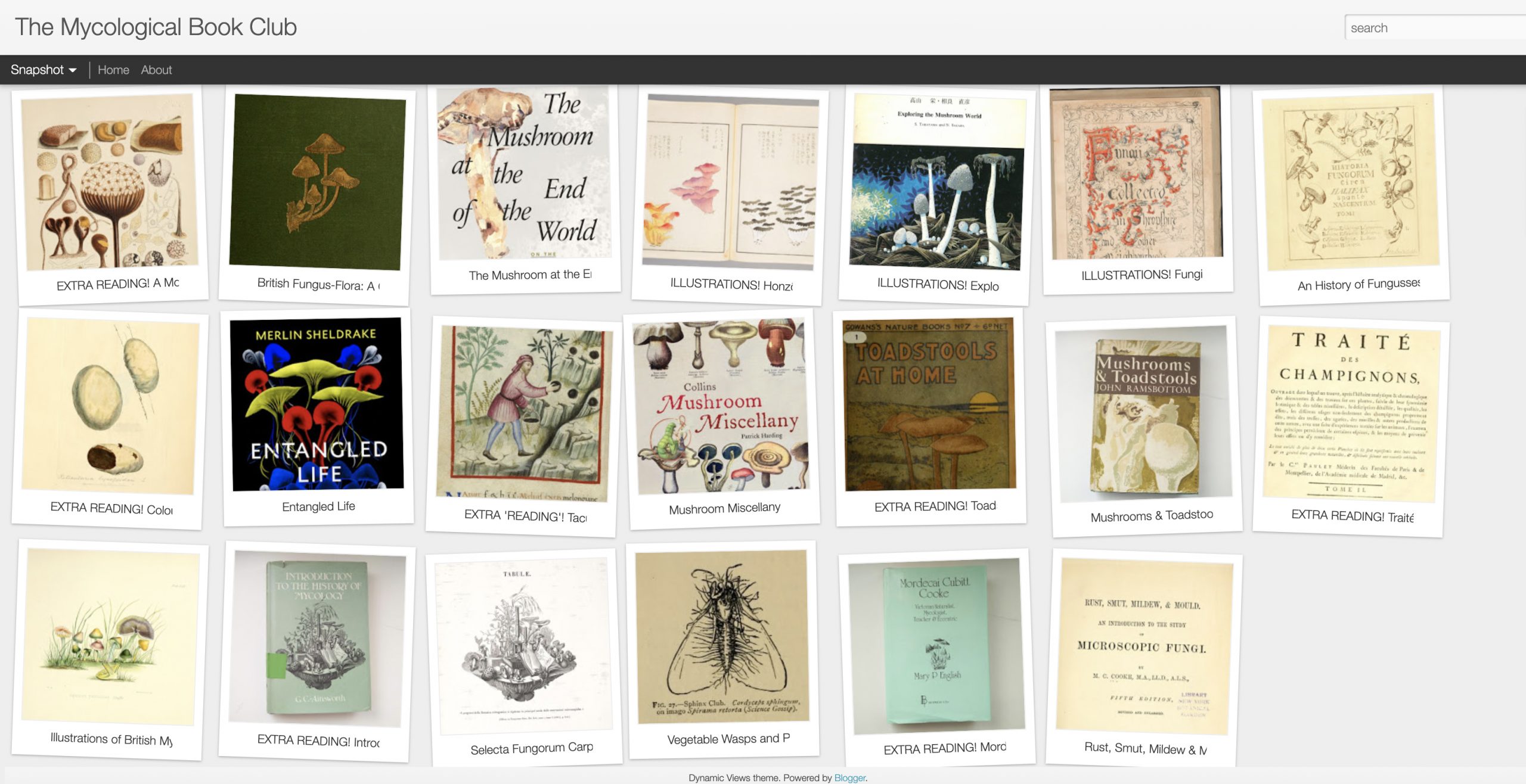
In the months following the club’s first meeting in May 2020, #MycoBookClub continued to grow, amassing more followers and receiving attention in outlets like The British Mycological Society Newsletter and IMA Fungus. Blencowe established a “virtual bookshelf” to maintain a list of all the books that #MycoBookClub had discussed—many of which were accessed through BHL.

Screenshot of a virtual bookshelf with thumbnails of book covers.

#MycoBookClub “virtual bookshelf.” Source: https://mycobookclub.blogspot.com

“The more time I spend in the Library, the more amazed I am by the vast amount of literature it contains—and the neat way it is organised and presented,” lauds Blencowe. “BHL also provides the opportunity to take a deep dive into the source material for a fascinating glimpse into the machinery of global science in the 19th century.”

While she’s enjoyed many titles in BHL, a recent favorite is Anna Maria Hussey’s Illustrations of British Mycology (1847-55), which was the subject of the July 2020 #MycoBookClub meeting. Published under the name Mrs. T.J. Hussey, the two-volume work illustrates and describes species collected by Hussey and her sister, Frances Reed.

#MycoBookClub returns Tues 7 July, 7:30pm (UK time).

Thought we could take a broader look at the fungal kingdom this month with ‘Illustrations of British Mycology’ by Anna Maria Hussey (1847).

You can read it in the @BioDivLibrary, here: https://t.co/4BPXfDyWhd pic.twitter.com/icBcIRd1xM

— The Mycological Book Club (@MycoBookClub) June 7, 2020

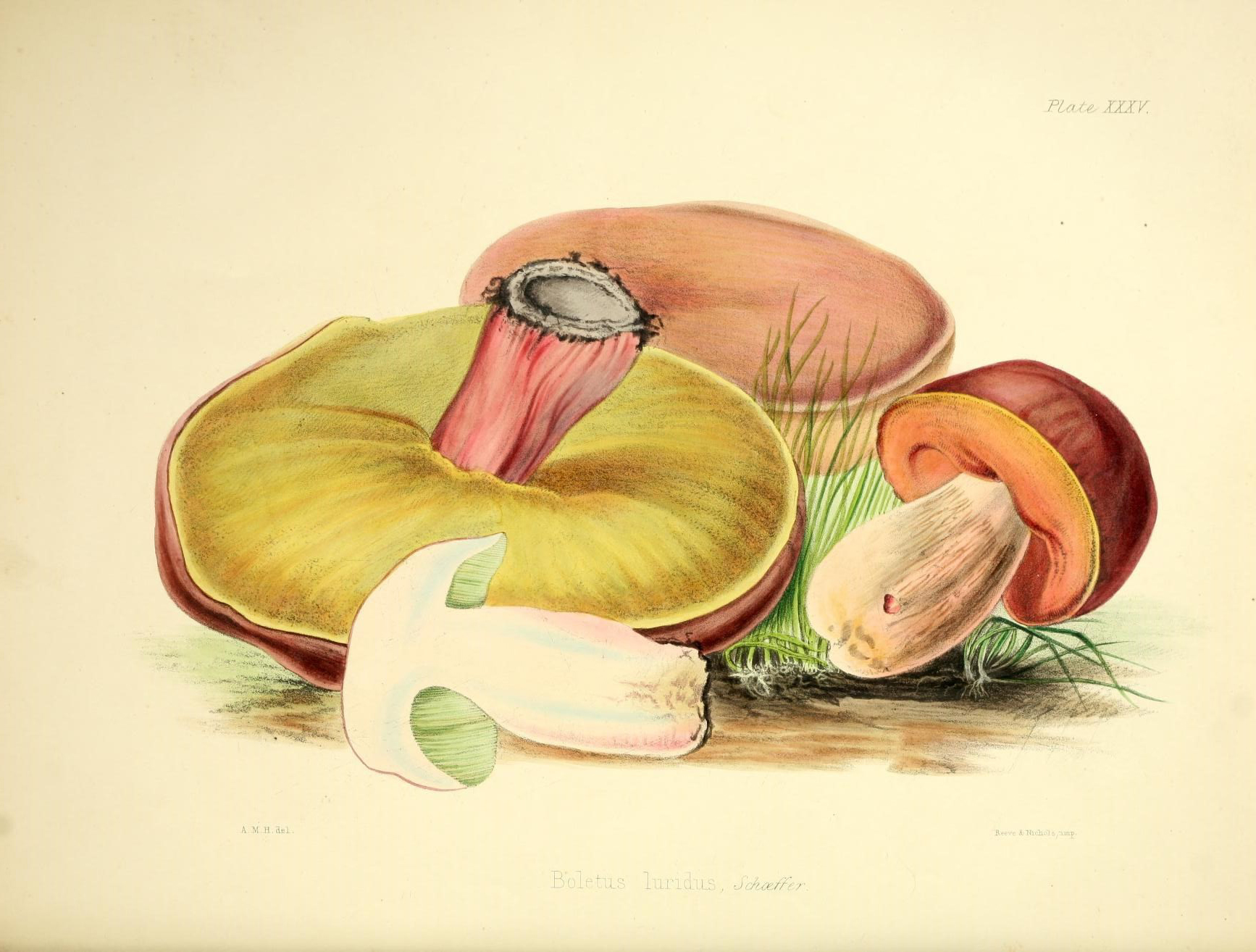
“Hussey writes from the perspective of an enthusiastic amateur which I found both highly relatable and genuinely inspiring,” affirms Blencowe. “She writes in a chatty, conversational style which is peppered with fascinating contemporary details (such as her observation that Boletus subtomentosus has ‘the texture of a Limerick glove’) and timeless wisdom (‘life passes in gaining experience for ourselves…till at last we have acquired the wisdom to guide us safely…’).”

Illustration of fungi.

Illustration of Suillellus luridus, plate 35. Hussey, Anna Maria. Illustrations of British Mycology, ser.2 (1855). Art by Hussey. Contributed in BHL from The New York Botanical Garden, LuEsther T. Mertz Library. Explore all illustrations from Illustrations of British Mycology in the BHL Flickr.

Blencowe has gathered and shared via @MycoBookClub some of her favorite elements from Hussey’s work, including her approach to mycology, her discussion of fungus names, her commentary on fungi in nature, her descriptions of fungal habitats, and miscellaneous myco-chatter. Illustrations of British Mycologyis also noteworthy as a rare female-authored work in the bibliography of historic mycological literature.

“Browsing the historic biodiversity literature, it is very noticeable that certain perspectives predominate,” notes Blencowe. “The books are mostly written by men—white men. So it was a particular joy to come across Hussey’s book. I’m keen to explore ways that @MycoBookClub can provide a platform for different perspectives and respectfully champion Indigenous knowledge of fungi.”

While ours may still be a socially-distanced world, initiatives like #MycoBookClub remind us that there are still opportunities to connect with others, share our passions, and nurture a community. And while the news may still be filled with dire headlines, naturalists like Mordecai Cubitt Cooke and Anna Maria Hussey remind us that we can still find solace in nature close to home and in unexpected places, if we are just willing to look.

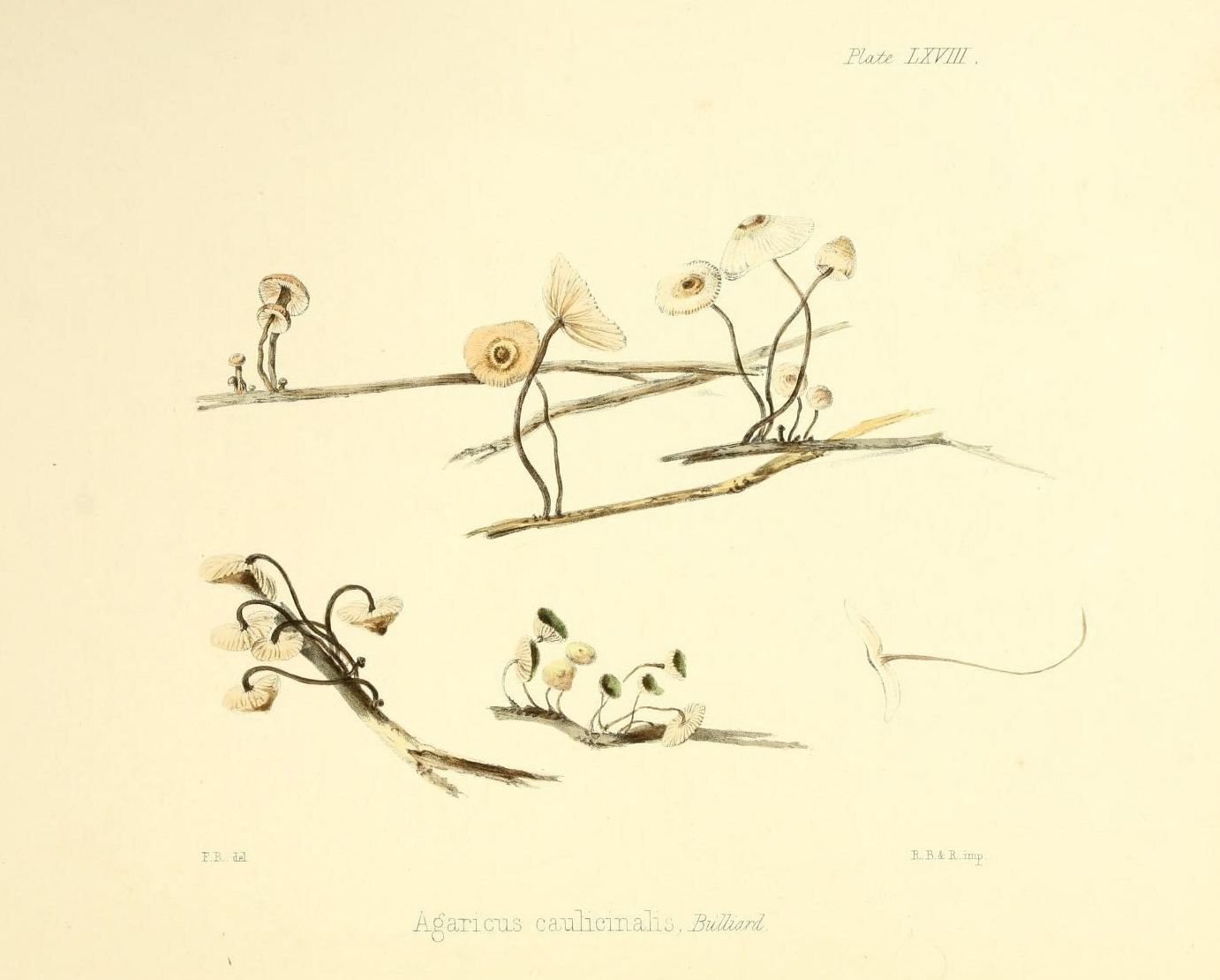
To quote Hussey: “The world is full of beauty that we pass by unheeded.”

Illustration of fungi.

Illustration of Crinipellis scabella, plate 68. Hussey, Anna Maria. Illustrations of British Mycology, ser.1 (1847). Art by Frances Reed. Contributed in BHL from The New York Botanical Garden, LuEsther T. Mertz Library. This plate accompanies Hussey’s quote: “The world is full of beauty that we pass by unheeded.”

Everyone is welcome to join the #MycoBookClub. Follow @MycoBookClub for updates and meeting information, and join the discussion the first Tuesday of each month at 7:30pm (GMT) using the #MycoBookClub hashtag on Twitter.

February 1, 2021by michelle.underhill
Blog Reel, User Stories

Teaching Rare Book Cataloguing During a Pandemic

As I am writing this, Melbourne is at the end of its second wave of COVID-19 and I have been separated from the library collections that I work with at Museums Victoria for six months, 25 days, 21 hours, and around 12 minutes… but who’s counting?!

The pandemic has created a lot of challenges, not least working out how to be a librarian of an overwhelmingly print-based collection from a distance, but this time working from home has also afforded me opportunities to present a handful of webinars, the most recent being a guest lecture on rare book cataloguing for library and information management students.

I can say without a doubt that this would have been a near impossible task without the Biodiversity Heritage Library.

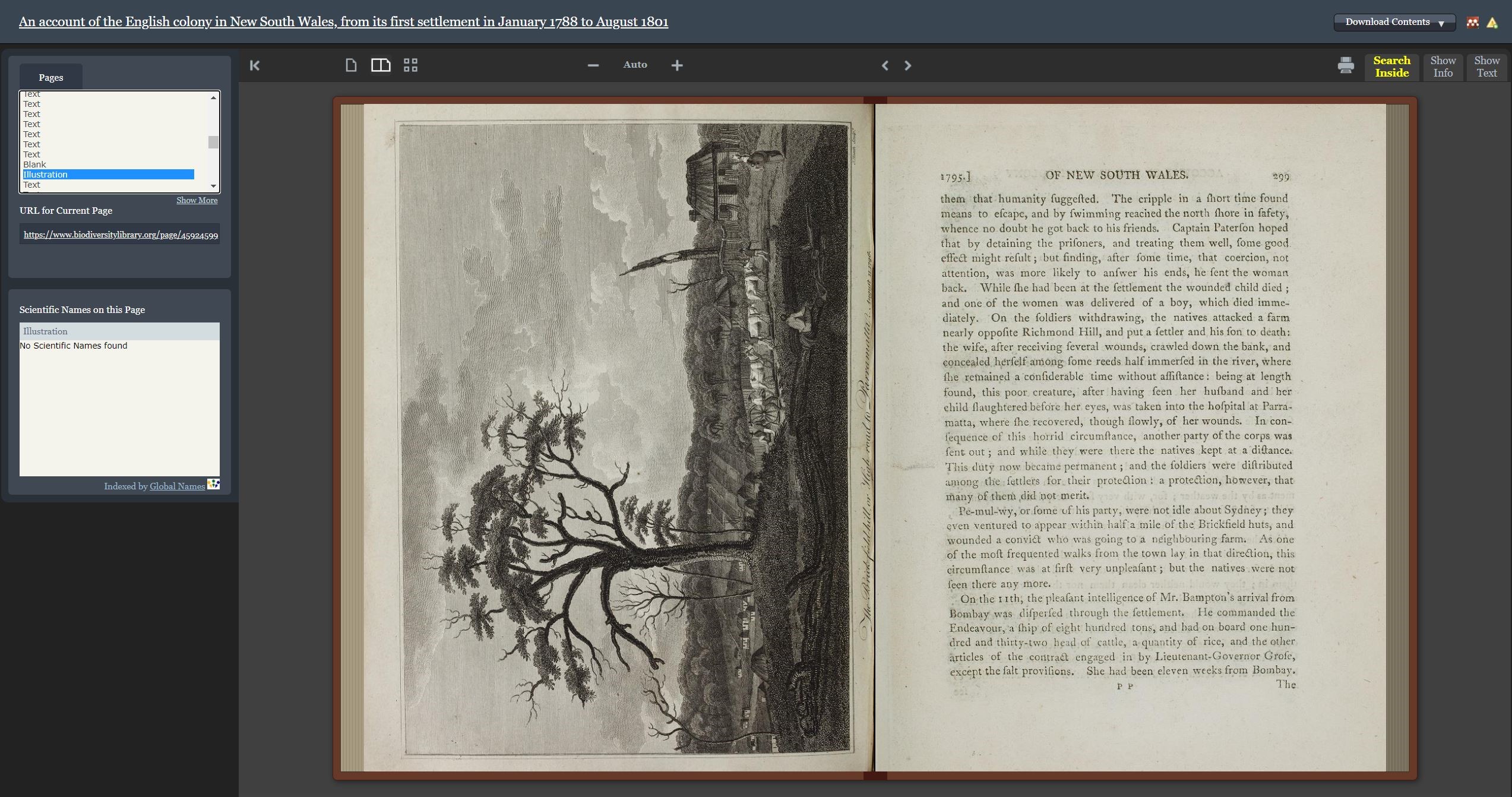
Having a number of items from the Museums Victoria Library digitised and openly available on the BHL website enabled me to access collection items virtually for students and create engaging online content showing real-life examples of features such as collation, signatures, catchwords, and provenance. These are some of the things we look for when cataloguing rare books from the hand-press era, which for Western printing spans roughly from 1440, around the time when the Gutenberg press was invented, to the early 19th century, by which time the machine age was well established and steam-powered machines dominated printing.

Screenshot of the book viewer in BHL with pages from An account of the English colony in New South Wales.

The two-page view on BHL allowed me to flick through books virtually in the same manner as a physical object in order to indicate some of the things we might look for when cataloguing rare books. Plate and text page 299. Collins, David. An account of the English colony in New South Wales, from its first settlement in January 1788 to August 1801. 1804. Contributed in BHL from Museums Victoria.

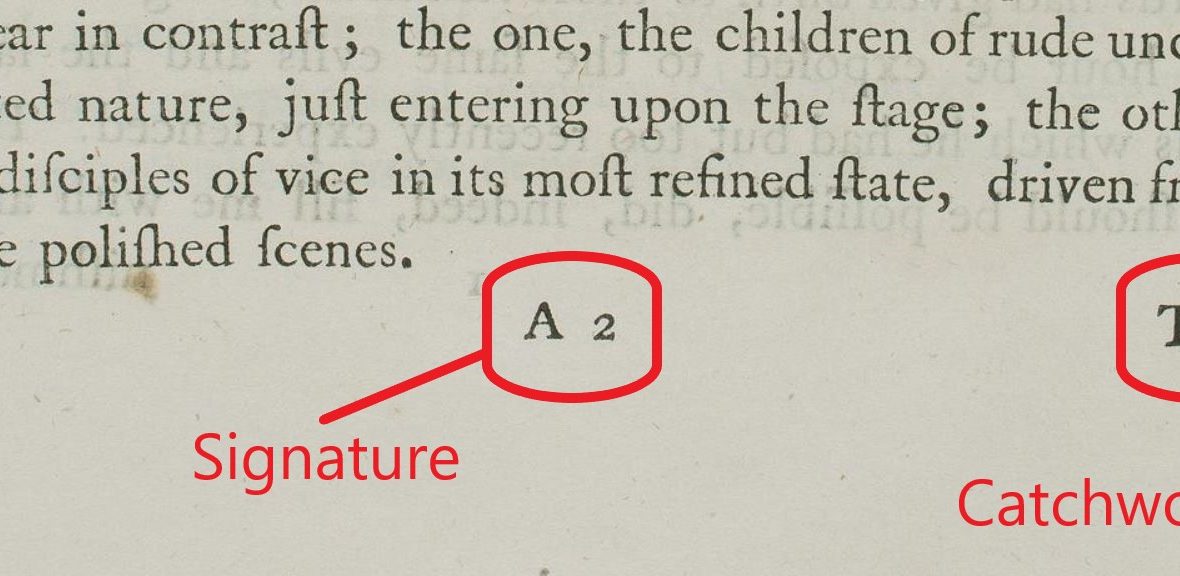
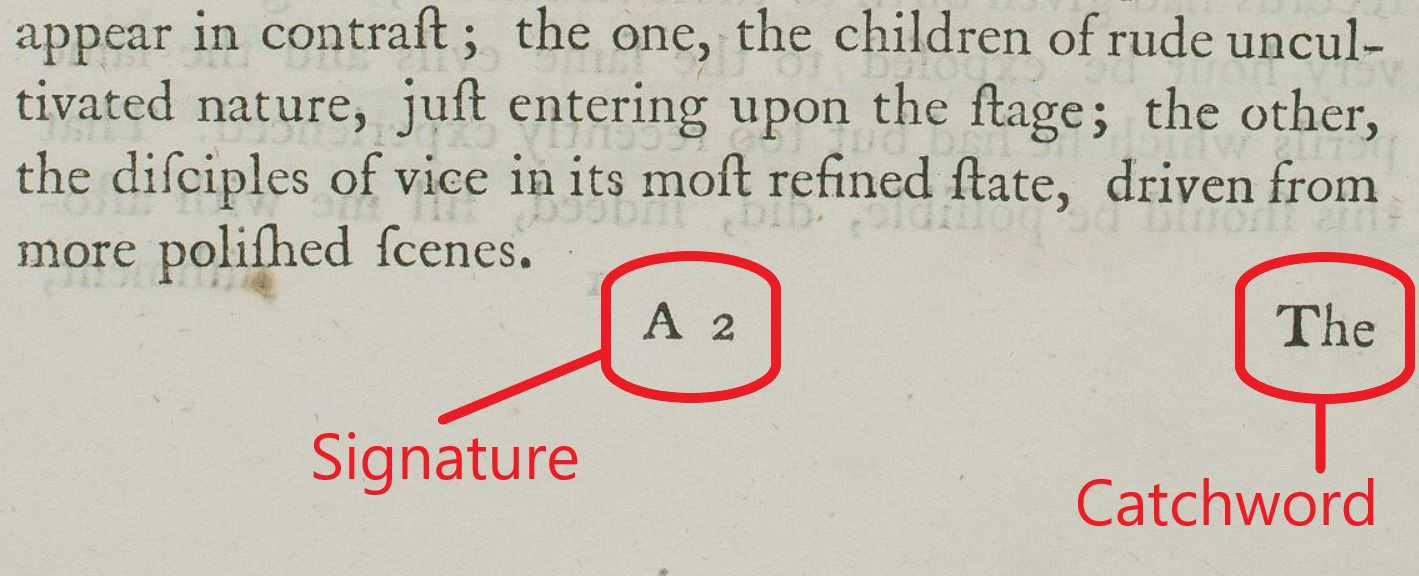
A central part of a bibliographical description is to record the format and the physical structure of the book. In determining a book’s collations—or in other words, how it was put together or assembled—we can look for evidence on books, including the impressions that the paper mould have left on the paper and devices used by printers to keep track of page order such as signatures and catchwords.

A catchword will show the first word on the following page and a signature will indicate how many pages are in each gathering of the book. Both generally appear near the bottom of a page and both are also useful for rare book cataloguers to check that the item they are cataloguing is not missing any pages.

Highlight of signatures and catchwords on a printed page of a rare book.

Close-up of a page indicating the location of the signature and catchword. Preface. Collins, David. An account of the English colony in New South Wales, from its first settlement in January 1788 to August 1801. 1804. Contributed in BHL from Museums Victoria.

During the lecture, I used BHL to flick through David Collins’ published journal, An account of the English colony in New South Wales … (1804), where I could clearly demonstrate to the students what I am referring to when I say “collations”, “signatures” and “catchwords”, and what aspects of the book that I might record in a catalogue record.

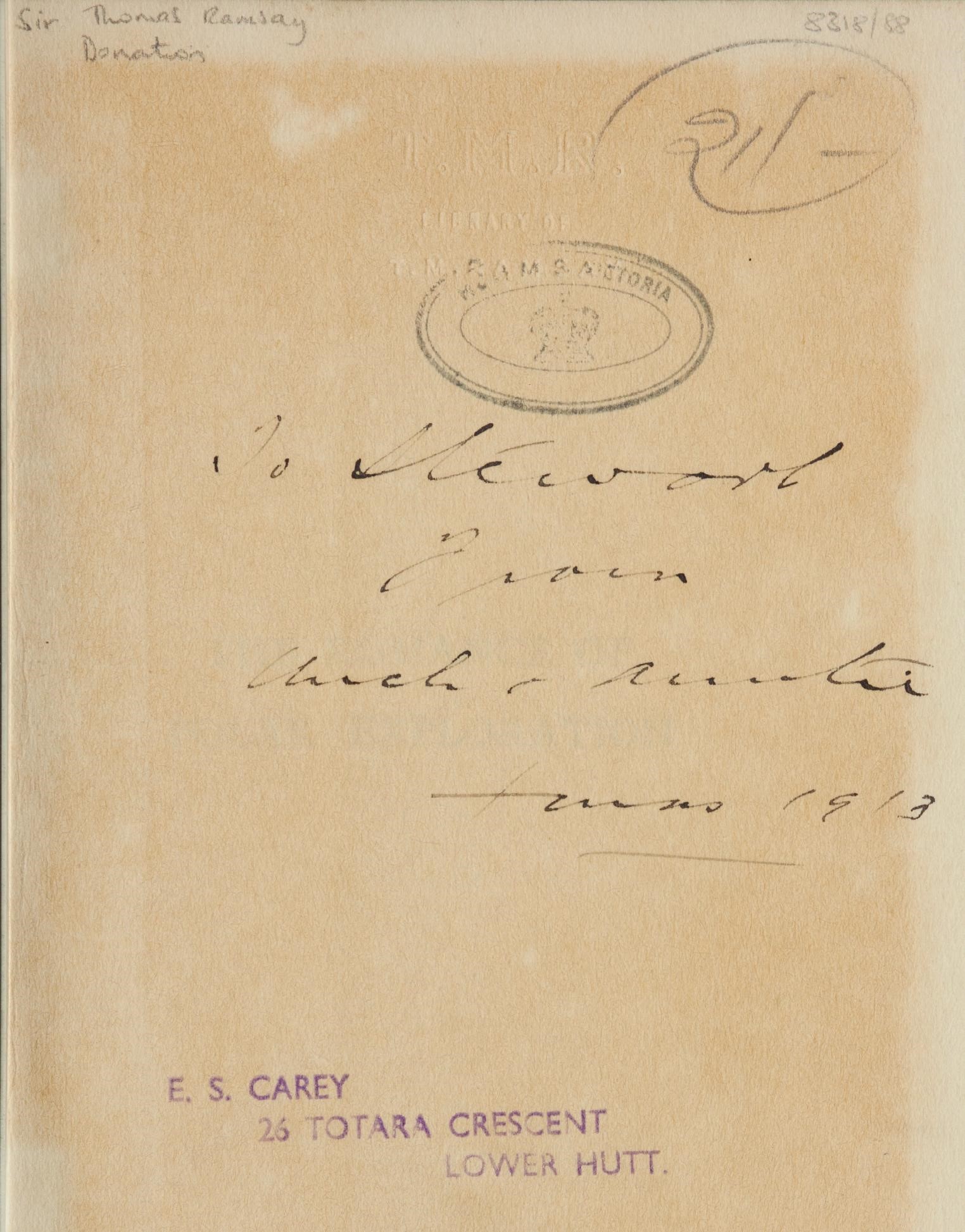
Another thing that I touched on was provenance markings and how to record any marks of ownership, custody or location on an item. In the case of books, this can mean autographs or notes written in books, as well as bookplates and stamps—people scribble, affix or slip all sorts of things in or on books! Generally, when cataloguing, I’d aim to note anything in our copy that might deviate from the “perfect” copy, so in other words, anything that’s happened to the book after publication.

Provenance information highlighted on the front flyleaf of a rare book.

The front flyleaf of the Museums Victoria Library copy features several marks of provenance, including an acquisition number, a blind or embossed stamp near the top of the page, and an inscription. Front flyleaf. Scott, G. Firth. The romance of polar exploration. 1909. Contributed in BHL from Museums Victoria.

Once again, BHL delivered the goods on provenance markings. I was able to browse some of the 600+ volumes that Museums Victoria has contributed to find many different kinds of provenance markings, including several marks of provenance in our copy of The romance of polar exploration by G. Firth Scott (1909) as well as bookplates, annotations and even a cheeky manicule! If you are interested to know more about provenance markings in our collections, take a look at this BHL blog post from 2019 by Hayley Webster.

So yes, the pandemic has been challenging, but not always in a bad way. It has certainly forced me to be adaptable and creative around my approach to my job, and I’ve also learned to love and appreciate the digital surrogates of the books in the Museums Victoria Library as much as I do the real thing.

January 14, 2021by Joel Richard
BHL News, Blog Reel

You Can Empower Global Biodiversity Research by Supporting BHL This Giving Tuesday

"As a researcher, the Biodiversity Heritage Library gives me the opportunity to seek and find scientific literature especially from home, during this pandemic—that's something so valuable to me, when I'm far away from the Smithsonian Libraries’ many branches and deep storage archives." Dr. Nicholas Pyenson, Curator of Fossil Marine Mammals in the Smithsonian's National Museum of Natural History’s Department of Paleobiology

As we come to the end of 2020, we reflect on the challenges that have profoundly impacted us as societies and individuals this year, requiring us to rethink how we do our jobs, interact with friends and colleagues, and access and share information. Facing these unprecedented challenges together, we continue to work with our partners to ensure that you have free access to the resources you need to empower your research—no matter where you are.

"As a researcher, the Biodiversity Heritage Library gives me the opportunity to seek and find scientific literature especially from home, during this pandemic—that's something so valuable to me, when I'm far away from the Smithsonian Libraries’ many branches and deep storage archives." Dr. Nicholas Pyenson, Curator of Fossil Marine Mammals in the Smithsonian's National Museum of Natural History’s Department of Paleobiology

With many of our partners working virtually this year, we’ve focused on projects to improve our digital collections remotely. We’ve uploaded previously digitized and born-digital content, including recent issues of publications like Records of the Australian Museum, Journal of the Royal Society of Western Australia, and American Museum Novitates. We’ve improved our metadata, reconciling duplicate entries for and editing over 2,000 author names and defining tens of thousands of additional articles and correspondence in the collection. We’ve also enhanced page-level descriptions for over 3,000 volumes since March. This work includes articulating illustrations within these volumes, allowing us to upload over 75,000 new images to the BHL Flickr over the past nine months—bringing our total Flickr collection to over 240,000 free nature images.

"My graduate-level museum studies class was taken online when New York University shut down. Since the shut-down, the biggest issue for my students has been in conducting research [...] BHL has emerged as one of the most popular databases for primary source work!" Dr. Elaine Ayers, Faculty Fellow at New York University

This work ensures that BHL continues to support your research needs…anytime, anywhere. It is thanks to the generosity and support of our community that we were able to pivot quickly and meet the needs of our users in a rapidly-changing environment throughout 2020. Please consider making a gift in support of BHL this Giving Tuesday, and help ensure that we can rise to meet whatever comes our way, together.

Support BHL today!


From Us to You: The Gift of Free Nature Art

Your support makes it possible for everyone to discover the wonders of biodiversity…not just through text, but through art as well! Visit the BHL Flickr to explore over 240,000 nature images—all free to download and reuse.

Visit Flickr Today!

Visit our About site for tips on how to search and download the images in Flickr. Keep scrolling to explore a selection of some of the most popular images on the BHL Flickr.

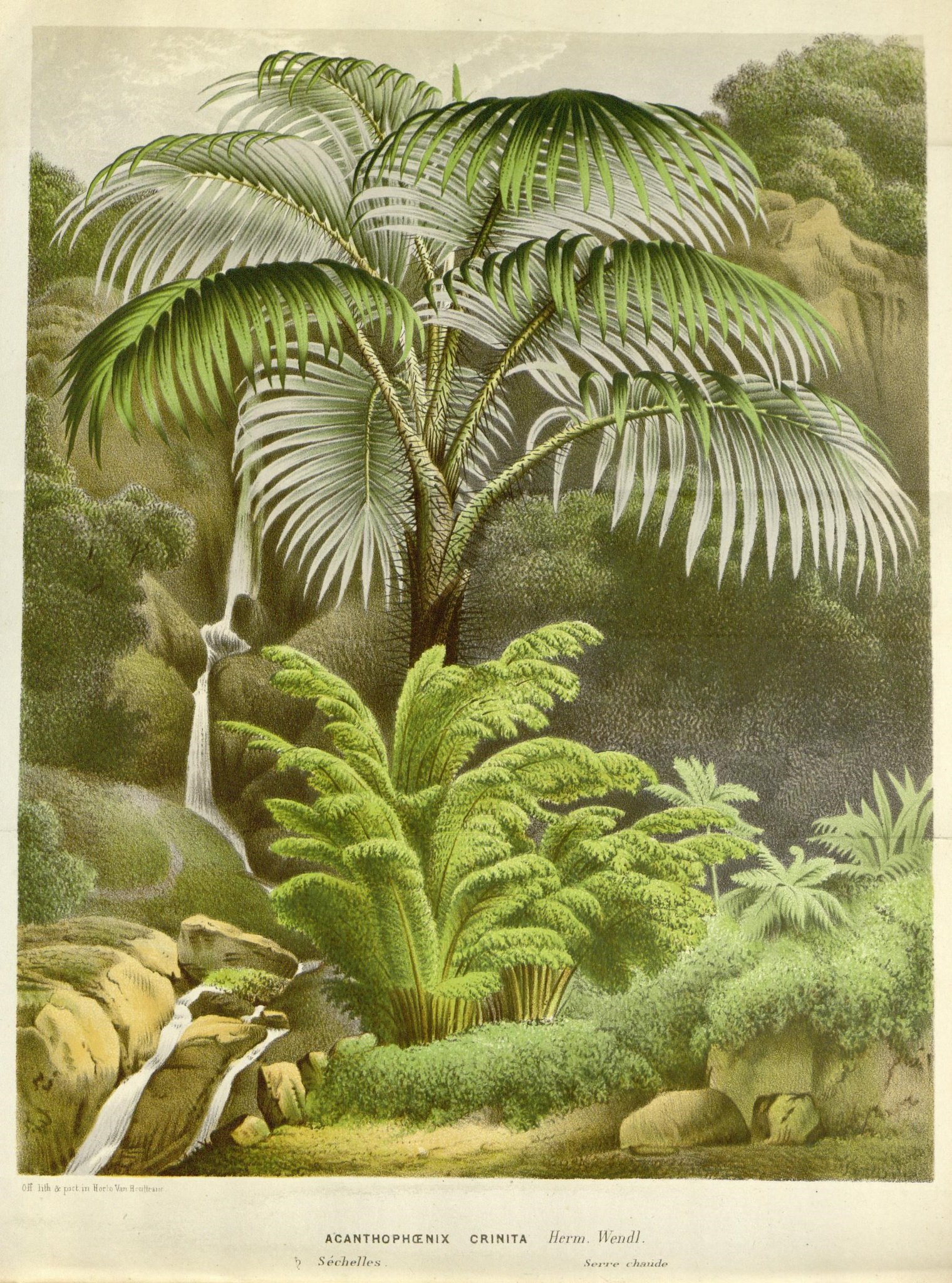
Various green plants in a jungle setting with a waterfall in the background.

Acanthophoenix crinita. Flore des serres et des jardins de l’Europe. v. 16 (1865-67). Contributed in BHL from the Missouri Botanical Garden, Peter H. Raven Library. View in Flickr.

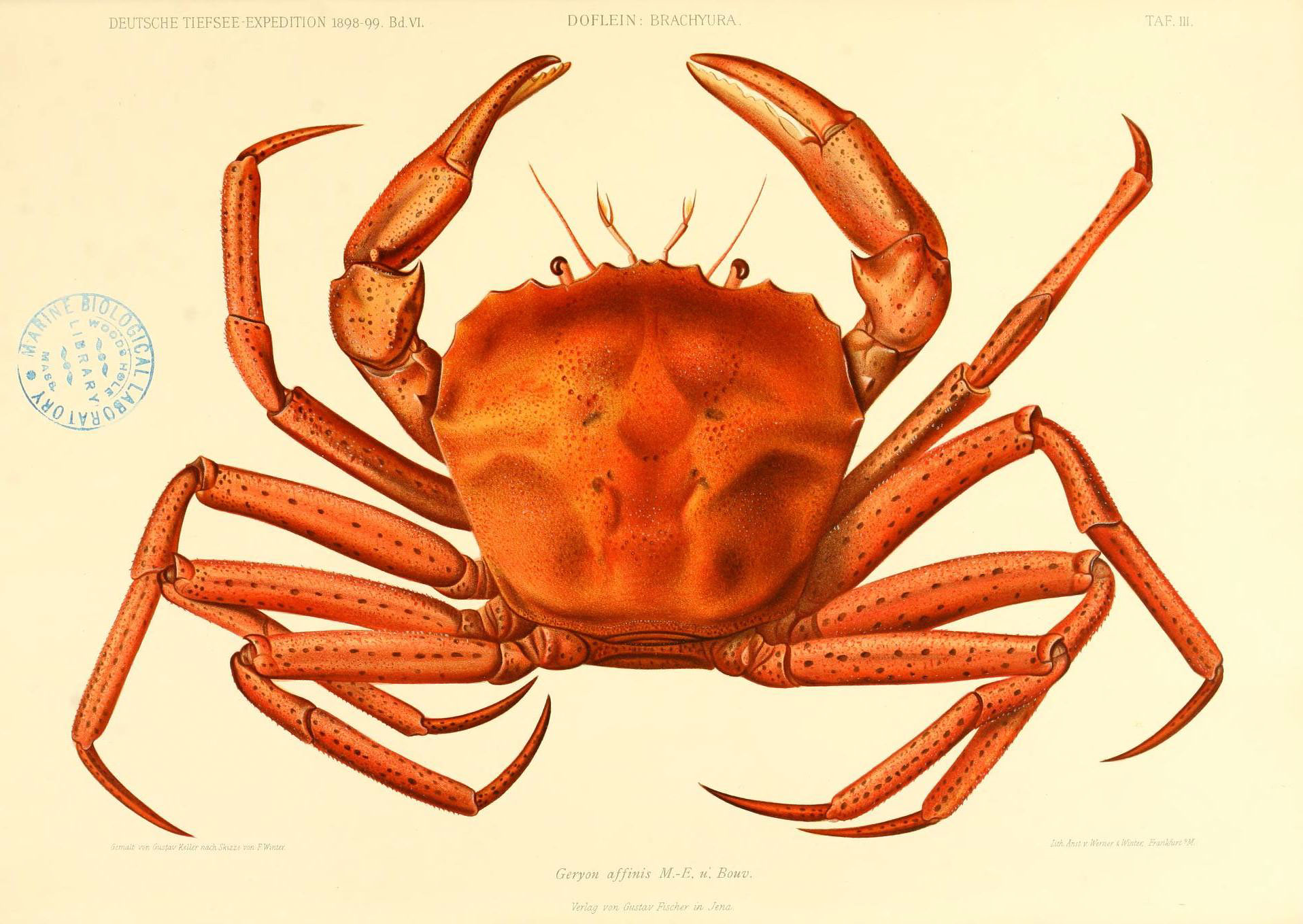
top body illustration of a red crab

Taf. III (Chaceon affinis). Wissenschaftliche Ergebnisse der Deutschen Tiefsee-Expedition auf dem Dampfer “Valdivia” 1898-1899. Bd. 6 (1904). Contributed in BHL from the MBLWHOI Library. View in Flickr.

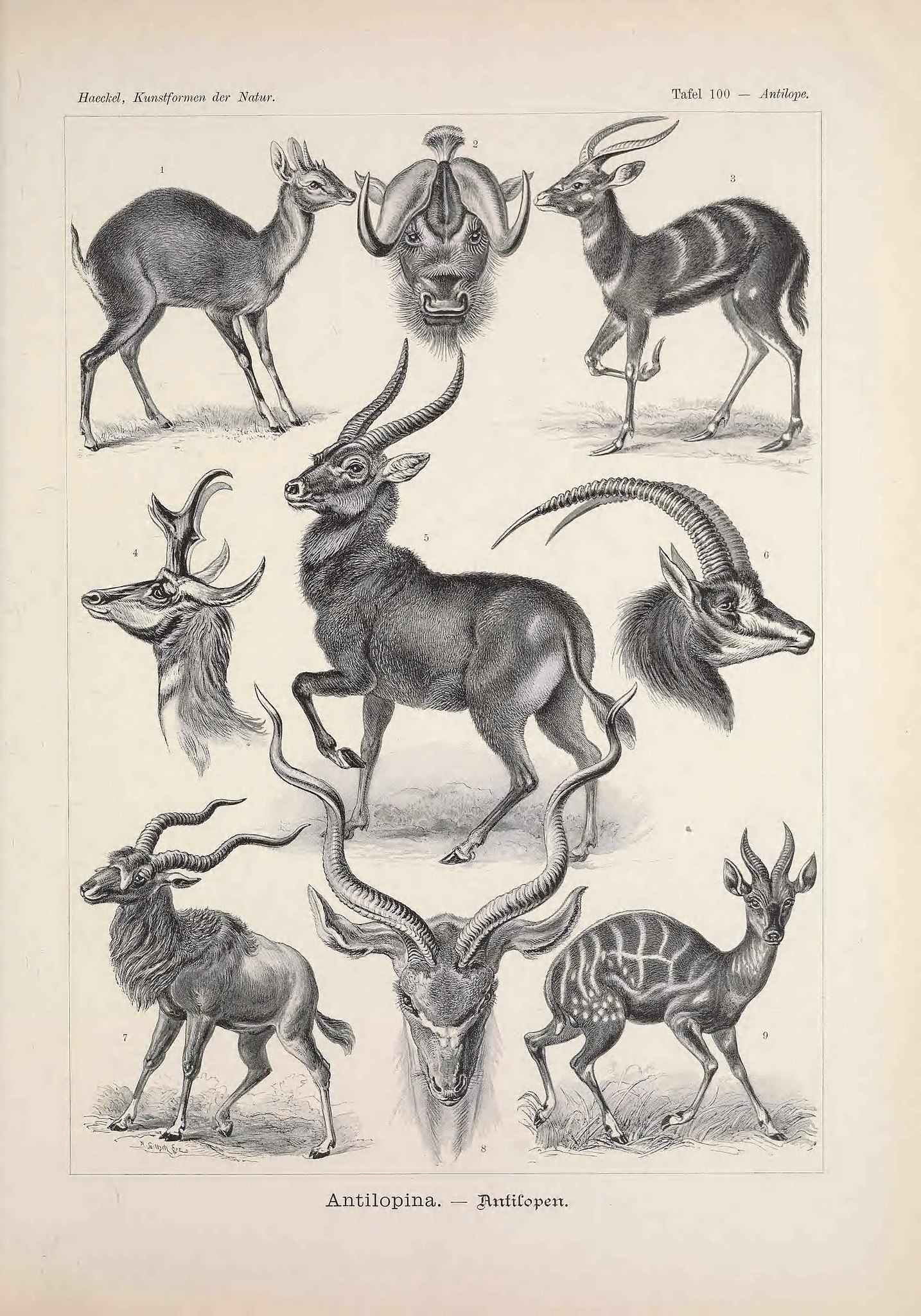
Collage of various black and white drawings of antelopes, some full body, others head only.

Taf. 100 (Antelopes). Kunstformen der Natur. (1899-1904). Contributed in BHL from Smithsonian Libraries. View in Flickr.

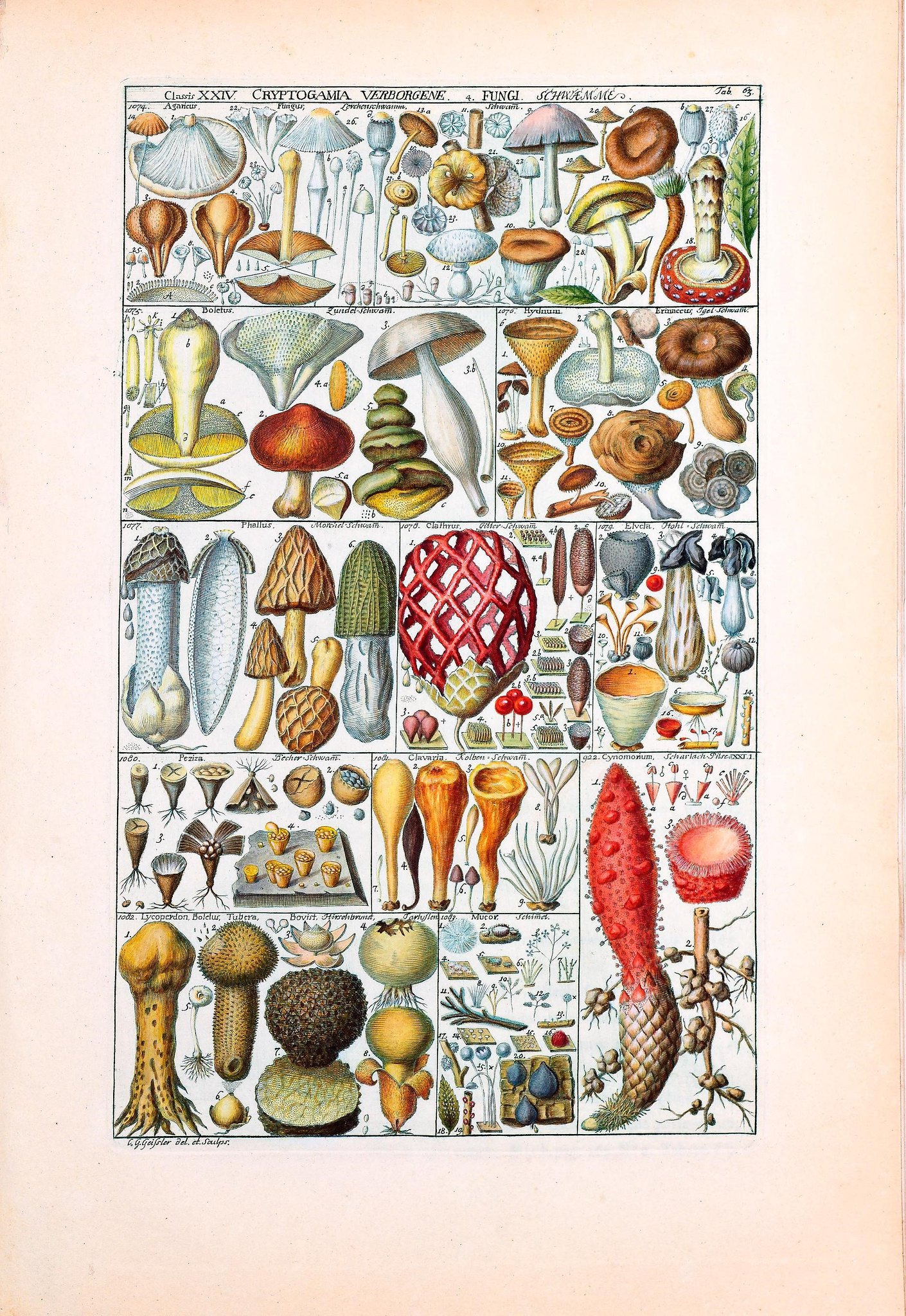
collage plate displaying various fungi specimens

Tab. 63. Tabulae phytographicae, analysin generum plantarum exhibentes. v. 2 (1804). Contributed in BHL from the New York Botanical Garden, LuEsther T. Mertz Library. View in Flickr.

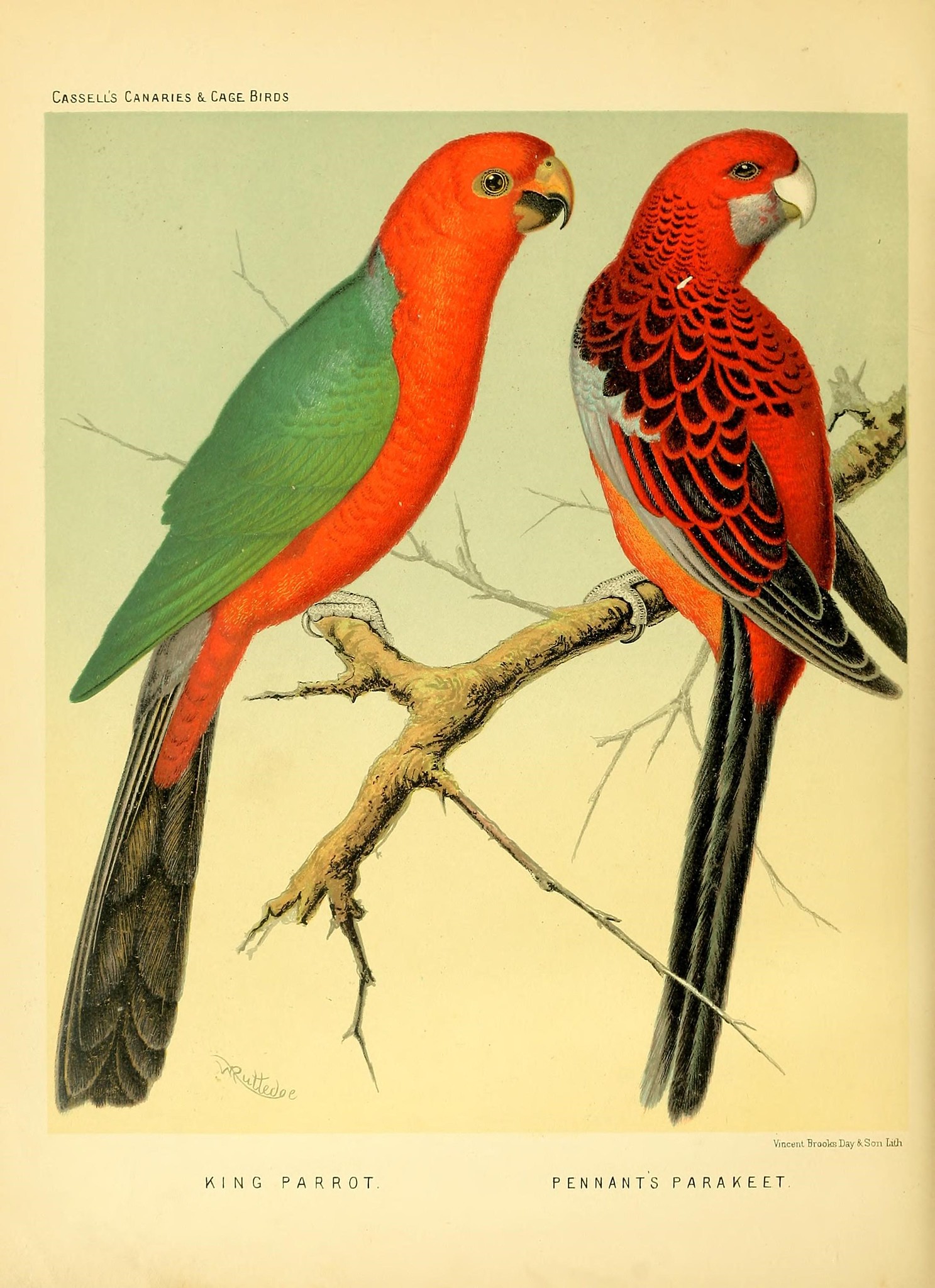
two birds perched on a stem. One if red with green wings and the other is red with black spots on the wings.

King parrot and Pennant’s parakeet. The illustrated book of canaries and cage-birds, British and foreign. (c. 1878). Contributed in BHL from the Harvard University, Museum of Comparative Zoology, Ernst Mayr Library. View in Flickr.

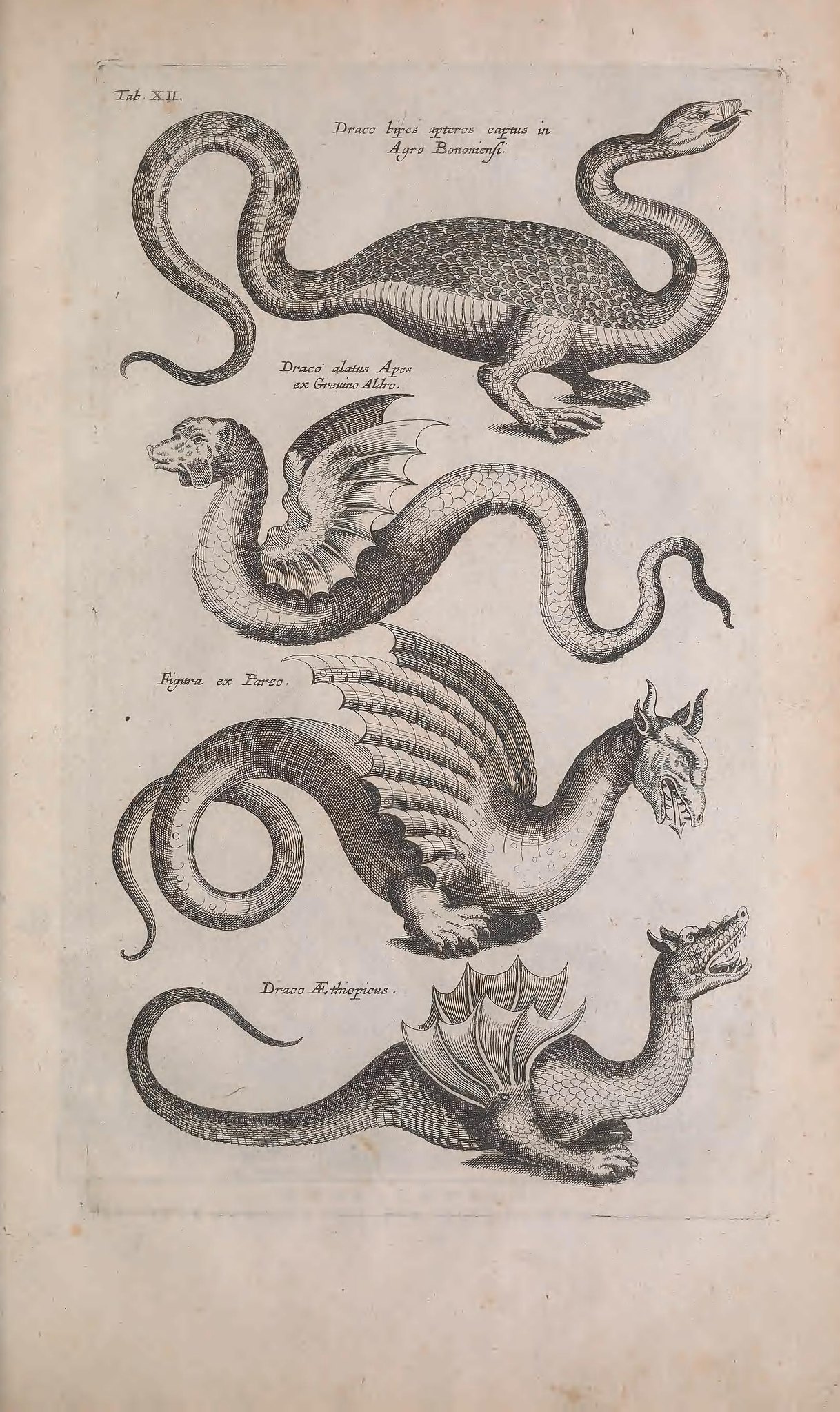
four dragons in various styles

Tab. XII (dragons). Historiae naturalis de quadrupedibus libri. (1657). Contributed in BHL from Smithsonian Libraries. View in Flickr.

December 1, 2020by michelle.underhill
Blog Reel, User Stories

Museum Studies…At Home: BHL Empowers Distance Learning for Students at NYU

papers bound in blue ribbon

The Campus is Closed: Shifting to Distance Learning

On 9 March 2020, New York University announced that it was taking classes remote, and less than two weeks later the entire campus, including our beloved Bobst Library, shut down. While I was relieved that the university was taking the pandemic seriously and acting quickly to flatten the curve, the shut-down posed serious challenges not just to teaching but to research for both me and my students.

My grad-level class, “Science, Art & Invisible Objects in Natural History Museums,” examined how natural history and anatomical collections, from the private Wunderkammern of the early modern period to the AMNH’s award-winning Hall of Biodiversity, have consistently struggled with the politics and poetics of representing objects without names, immaterial materials, and objects that, in fact, never really existed at all. Using things like gravid wombs, cosmic nebulae, rotting flora, spirits, and dinosaurs as our starting points, graduate students from NYU’s Program in Museum Studies and other departments traced the ways in which practitioners have worked to communicate, preserve, make visible, and display elusive objects of wonder and meaning across the arts and sciences.

For the class’s final assignments, students could choose to explore the history of one object—from any time period or field—through a “traditional” research paper or through a “creative” project (you can follow #unessay on Twitter for examples of projects from other schools, departments, and classes). Both options required the use of primary sources, and without access to our library, let alone museum or archival collections, I worried about whether we would need to rethink the scope of the class entirely.

Over the course of my research on 18th and 19th century natural history, I have relied on traveling to archives, often taking as many photos of sources as possible to make the most of limited time and funding. To really sit with a source, to read it line-by-line and return back to it over the course of days or weeks, requires an enormous amount of scholarly privilege—privilege that was taken away from almost everyone, suddenly and unexpectedly, when the pandemic hit.

The Biodiversity Heritage Library (BHL) has not only given me the luxury of sitting with sources, but it has opened up new research possibilities: quickly consulting books housed in collections hundreds of miles away, running full-text searches that have brought new sources into my purview, even downloading PDFs and images to work with offline or in building lectures (a real boon to anyone working remotely with unstable WiFi connections). All of these possibilities, I decided, could be leveraged to help students access primary sources at home and, indeed, to encourage new and creative ways of working with those sources outside of the boundaries of archives.

In remote one-on-one meetings with students, I laid out options of how to access sources through BHL, speaking practically about how some research plans might change using digital methodologies. All of the students, including those working on physical sciences like astronomy, also used digital sources available through our university library to round out their research.

One student leaned into these new limitations, reframing her project to ask about questions of failure is scientific representations—what might a set of images look like, she asked, if we saw all of the discarded attempts made in the process of creating the beautiful objects historians study today? Many students looked to BHL’s collections to help them explore specific themes—from the history of botany to insights from Charles Darwin’s writings and strategies for educating museum visitors about extinction.

Student Projects: Theme — History of Botany

Using BHL sources, two students worked on the history of botany, sharing sources with one another and even mailing plants to each other through the USPS.

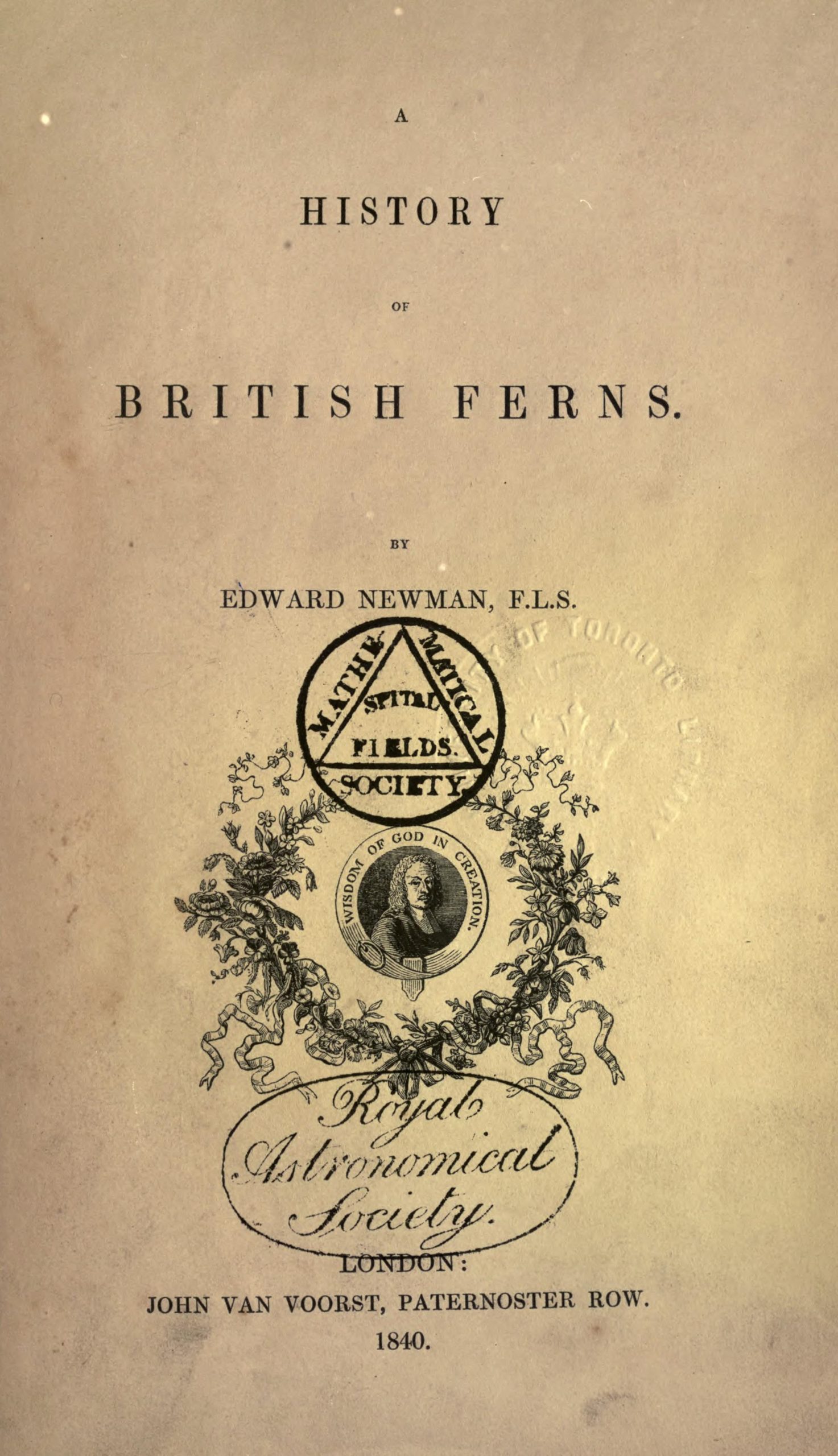
Jelane Da Silva wrote about Pteridomania, the fern-collecting craze that swept through Britain and the U.S. in the mid-19th century. “When I advance-searched the word “fern” between the years 1837 and 1901,” Jelane notes, “the BHL cumulated countless results.” Of those, Jelane focused on Nona Bellairs’ 1865 Hardy Ferns, which “called for ‘Fern Laws’ to be set in place, imminent of the trails of damage that Pteridomania was going to leave behind”, and Edward Newman’s 1840 British Ferns, one of many books that “encouraged the overcollection of ferns and enriched the desire for what was ‘in’—the fad, the fern—but not necessarily the desire to be a naturalist.”

title page of british ferns

Title Page, A History of British Ferns (1840), by Edward Newman. Reference for: Jelane Da Silva, “Just Ferns,” Research Paper, 2020. Da Silva writes: “To make describing and identifying Nature’s objects easier for all, plants and animals were classifiable by a “sexual system” that separated natural bodies based on their apparent physical features… On the basis of sight, humans were given the opportunities to classify Nature’s objects and introduce them to their historicity. This cultural history tempts nonconformity of sympathies and antipathies. The ways in which Nature’s objects have been systemized, historicized, and theorized by humans has obscured and spoiled the potential power for humankind to access the deeply rooted values and hear the intrinsic voices of Nature and Nature’s objects… Historically, in the case of Pteridomania, this was a burden upon the fern’s livelihood, inner ontological beings and further removed humanity from the natural world.”

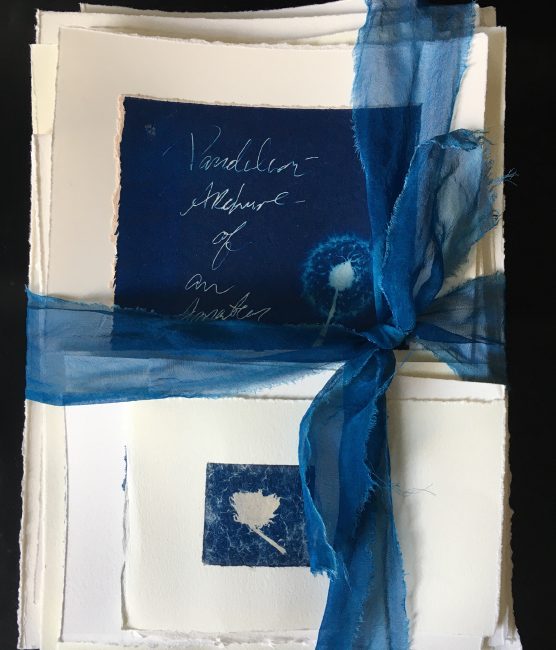
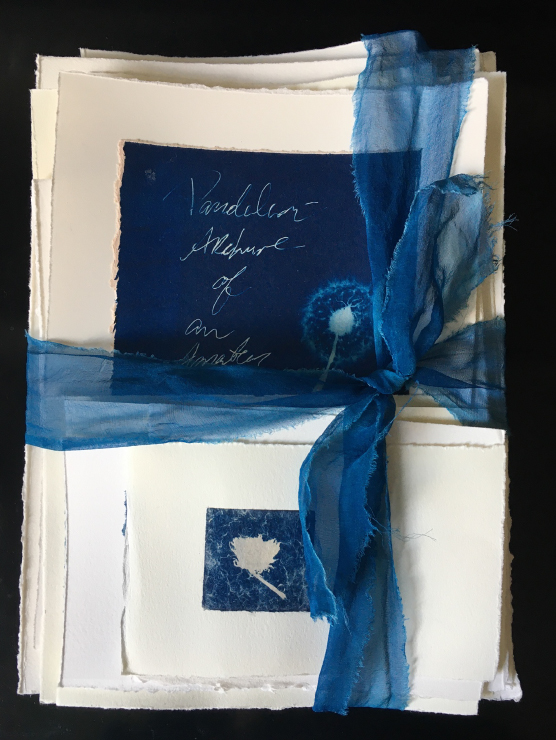
Adriana Ciocci produced a series of cyanotypes, à la Anna Atkins, in “recording and archiving a common plant, the dandelion, to emphasize the uniqueness of each specimen at different stages of preservation and decay.” Adriana relied on Joseph Dalton Hooker’s Botany of the Antarctic Voyage, among other BHL sources, to “study how plants were illustrated two-dimensionally during the 19th century” while looking for “depictions of dandelions at various stages of development.” Embracing the art of imperfection, her frustrations with limited access to the materials she had planned to work with became part of the project itself.

papers bound in blue ribbon

Adriana Ciocci (Experimental Humanities), “Dandelion: Archive of an Amateur,” cyanotypes, 2020. Ciocci writes: “In my creative project, through a series of unforeseen hurdles of acquiring dandelion specimens, learning the process of cyanotyping, and lack of access to resources I became focused on recording failures that would otherwise become archival silences. By preserving imperfect specimens using a process which distorts perception through shifting shadows, I created unpredictable yet archivally stable prints. My aim is to prove trials and failures are worthy of recording since they are an inevitable part of scientific and artistic practices.”

Student Projects: Theme — Insights from Darwin’s Writings

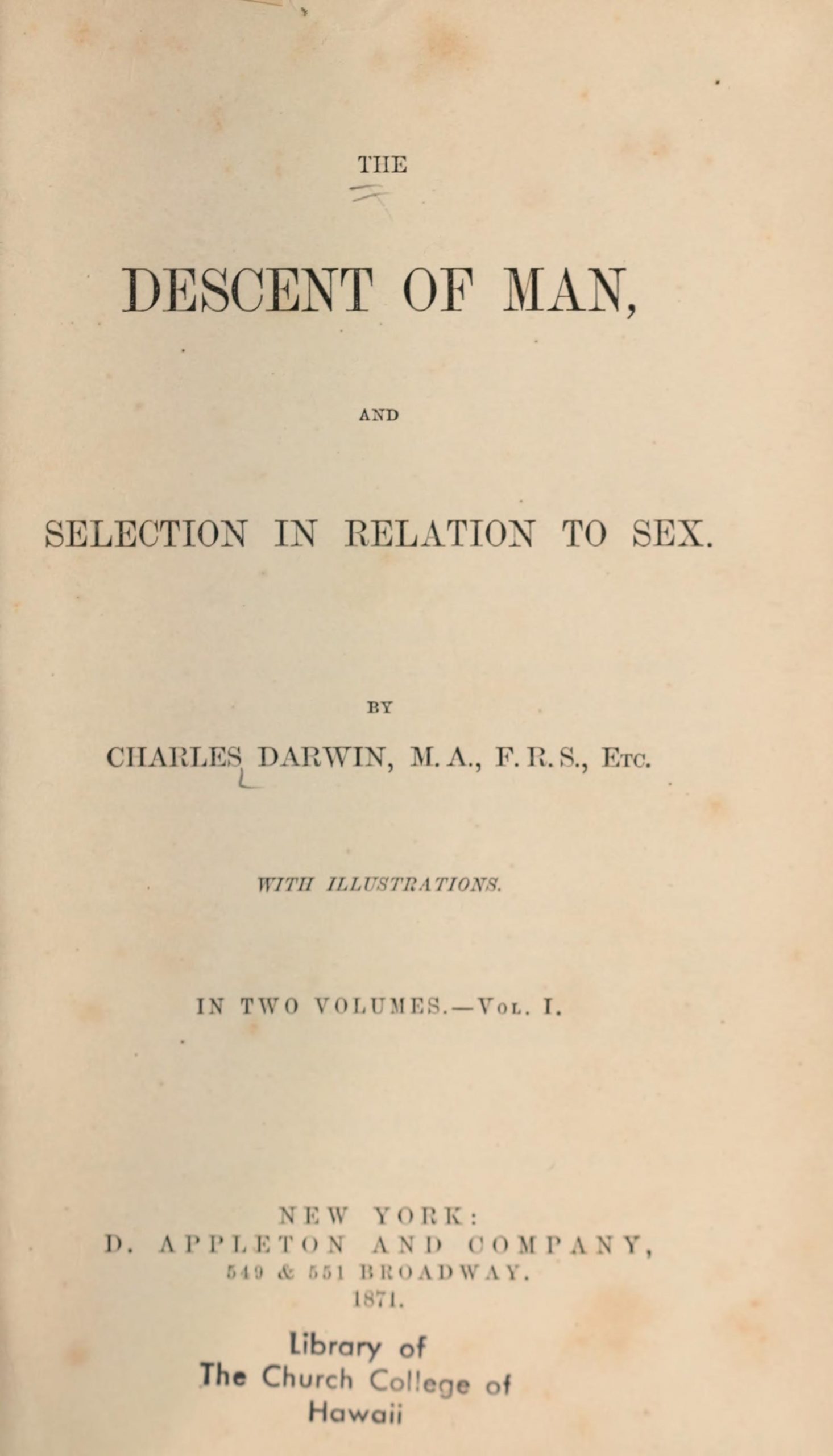
Charles Darwin’s works appeared in several projects. Yukie Zheng mined his 1871 Descent of Man and 1872 Investigation of the Emotions in Man and Animals to investigate the role that photography played in evolutionary constructions of race, pulling out physiognomic threads in his writing.

title page of the descent of man

Title Page, The Descent of Man (1871), by Charles Darwin. Reference for: Yukie Zheng (Visual Arts Administration), “Changes in Immutability,” Research Paper, 2020. Zheng writes: “In the late nineteenth century, Darwin published the Origins of the Species (1859) and the Descent of Man (1871)… Even though Darwin wrote this book in a rational and scientific way to build his theory, the public may use Darwin’s theory to construct the racial differences to justify their certain behaviors… This article will focus on the general group of people of color when talking about the Darwinism and social Darwinism, but with major emphasis on the black people. It undoubtedly helps the public to build the conception of race. The social oppression that we often see in the history of nineteenth century originates from both the cultural differences and scientific beliefs.”

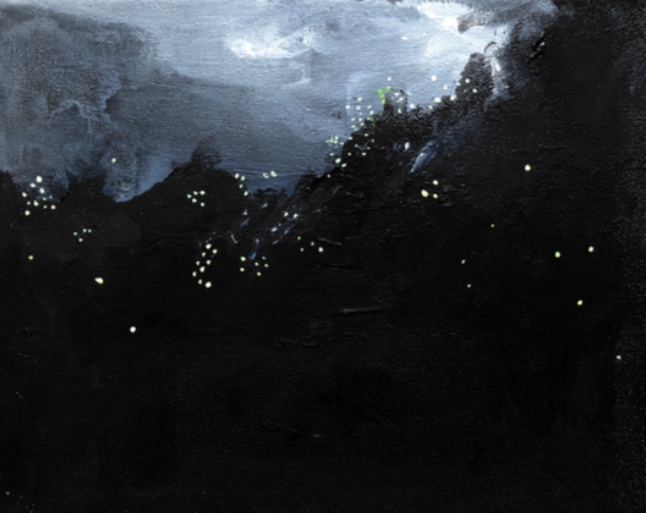
Tomas Uriburu turned to Darwin’s expedition aboard the H.M.S. Beagle to explore the long and poetic history of bioluminescence alongside theoretical issues of darkness and precarity and ways forward amidst uncertainty. Encountering bioluminescent marine life off the coast of South America, Darwin wrote that “as far as the eye reached, the crest of every wave was bright, and the sky above the horizon, from the reflected glare of this livid flames, was not so utterly obscure as over the vault of heavens” (167). Weaving Darwin’s words together with those of earlier naturalists—Erasmus Darwin, Alexander von Humboldt, and John Bowring, as well as the 20th century specialist Edmund Newton Harvey, Tomas created an illustrated history of the magical phenomenon for which “darkness is a necessary condition.”

night sky painting

Tomas Uriburu, “The Future is Dark,” creative research paper with painted illustrations, 2020. Uriburu writes: “In this paper, I won’t focus on the lights that make things appear as whole but on the vulnerable, enigmatic, mysterious, undetermined, dim, and fragile lights that activate certain types of curiosities. I am not interested in tracing the lights that make life predictable or understandable. Instead, I am interested in looking for lights that make life uncertain and incomplete.”

Student Projects: Theme —Extinction and Museum Education

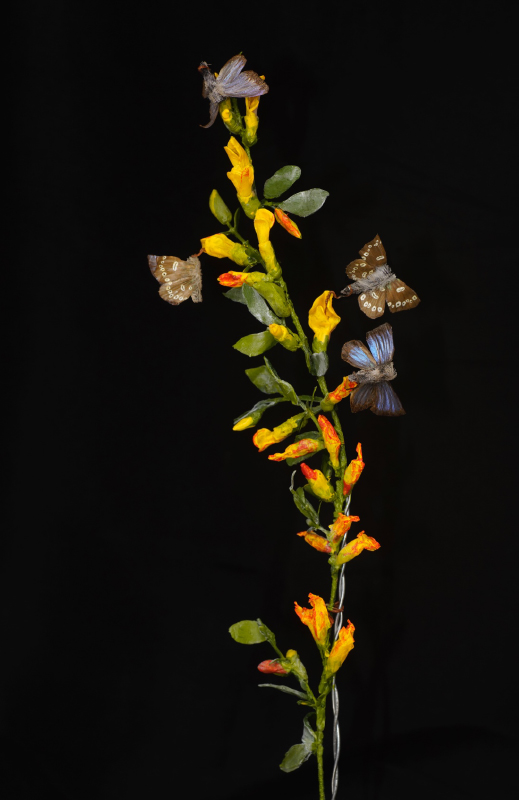
In modeling the extinct butterfly species Glaucopsyche xerces (the Xerces blue) and the deerwood flora native to coastal dunes of San Francisco, Rachel Leckman was inspired by the BHL blogpost “Breathing Life into a Museum Exhibit about Extinction.” Using materials like goldbeater skin, compressed pastels, compressed iridescent watercolor, synthetic hair, and lace, Rachel presented a case for lifelike models as a way of educating museum visitors about the species that we have lost to climate change and habitat destruction, relying on recent sources like UNEP’s “Environment on the Edge” but also historic sources about searching for lost animals like the Explorations and Field-Work of the Smithsonian Institution in 1937-1938.

model of butterflies on a plant

Rachel Leckman, “Xerces Blue Model,” goldbeater skin, compressed pastels, compressed iridescent watercolor, sculpey, lace and synthetic hair, 2020. Leckman writes: “For my final project I created models of Xerces Blue butterflies (Glaucopsyche xerces) accompanied by a model of a Deerwood (Lotus scoparius) branch. This species of butterfly was native to the coastal dunes of San Francisco and went extinct around 1941-1943. For my model I recreated this small iridescent butterfly using goldbeater skin, compressed pastels, compressed iridescent watercolor, sculpey, lace, and synthetic hair. The branch the butterflies are feeding and laying eggs on is made out of sculpey and acrylic paint. This type of model, with a more complete and narrative imitation of the natural habitat, could be used in museums as an educational facsimile of the past to make examples of human caused extinction better known.”

Planning for a Future of Distance Learning

Much has changed since March, and it seems that new information about when—and whether—institutions will reopen changes week by week. It’s unclear, at this point, whether NYU will go back to in-person classes in September and whether graduate students starting on their theses will have access to primary sources back on campus or at New York’s museums and cultural heritage sites. Much research will be done using digital sources in the meantime.

On my end, I’m using the success of working with digital sources as a model for how I’ll enter next semester—for how I’ll frame assignments, advise early-stage thesis research, and continue to conduct my own work, having canceled research trips for the foreseeable future. Our subject specialist librarian has been instrumental in helping us navigate new ways of working with digital sources, and it’s clear that some of these methodologies are, thankfully, here to stay.

Reinterrogating who has access to primary sources all the time—not just during periods of crisis—seems key, and I hope that resources like the Biodiversity Heritage Library will be there to connect scholars at any stage with the rich sources and new research methodologies that promise a stronger and more inclusive historical field writ large.

July 28, 2020by michelle.underhill
Blog Reel, User Stories

Time Traveling with BHL: Open Access to Historic Data Empowers Modern Research…At Home

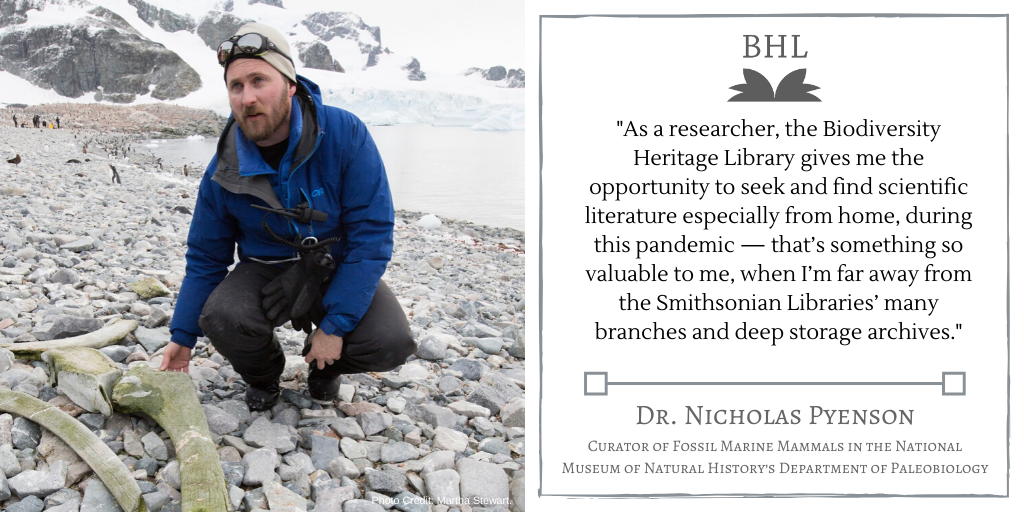
Quote from Dr. Nicholas Pyenson about BHL's impact

As the world’s largest open access digital library for biodiversity literature and archives, the Biodiversity Heritage Library (BHL) has revolutionized global research by providing free, worldwide access to knowledge about life on Earth. BHL’s digital collections provide researchers with the information they need to document Earth’s species, conserve biodiversity, research the history of science, and confront formidable challenges — from extinction crises to climate change and the spread of zoonotic diseases.

Digital access to this essential literature is especially important right now, as the COVID-19 pandemic makes physical access to collections and institutional libraries impossible for many. Open access digital libraries like BHL make continued research possible.

Dr. Nicholas Pyenson, Curator of Fossil Marine Mammals in the National Museum of Natural History’s Department of Paleobiology, has been a longtime user of and advocate for BHL. The historic data accessible through publications in BHL underpins much of his work. For example,  the Discovery Reports, which present the results of groundbreaking investigations into the biology of whales, helped inform Pyenson’s studies on the evolution of cetacean body size and whale hearing.

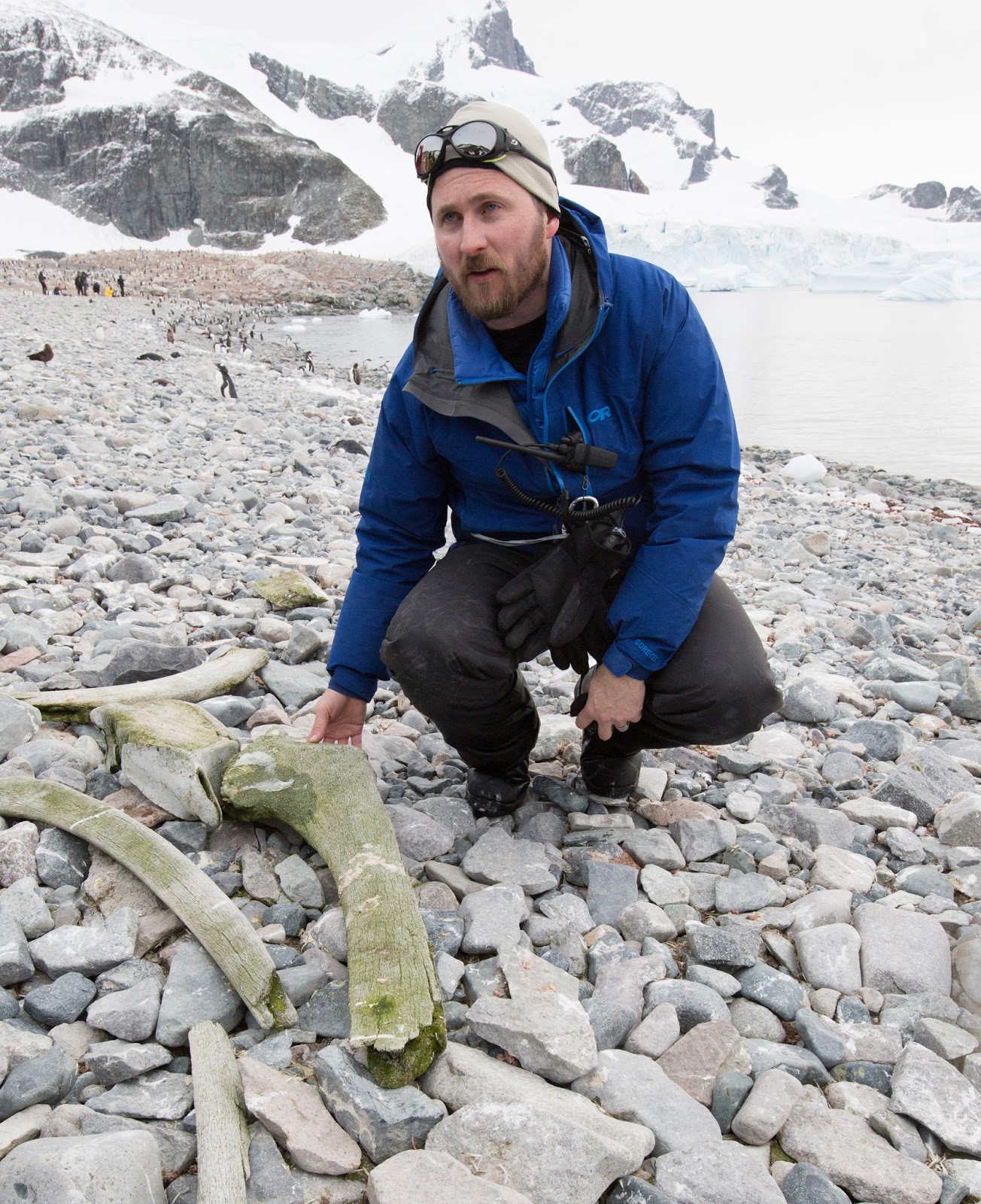
Man in a blue coat on a beach investigating whale bones

Dr. Nicholas Pyenson at Cuverville Island, Antarctica. Photo credit: Martha Stewart.

While BHL has been a valued resource for Pyenson for many years, digital access to scientific literature has become especially important as research has shifted to a telework environment.

“As a researcher, the Biodiversity Heritage Library gives me the opportunity to seek and find scientific literature especially from home, during this pandemic — that’s something so valuable to me, when I’m far away from the Smithsonian Libraries’ many branches and deep storage archives,” emphasizes Pyenson. “Access to words, images, and ideas that are either decades or centuries old drives so much of my work. It also gives me a sense of connection to people I’ve never met, but nonetheless seem very real for the questions I want to answer.”

Pyenson shares more about BHL’s impact during these unprecedented times on the Smithsonian Libraries’ YouTube channel.

As our understanding of the natural world deepens and grows, trusted, openly available resources become ever more important. BHL’s Secretariat and technical staff, together with our colleagues at BHL’s over 80 partner institutions globally, are committed to ensuring continued access to BHL resources for researchers around the globe. Your support today is deeply impactful to our ability to continue providing support to the thousands of researchers who rely on access to our digital collections.

If you’re able to give, we welcome your contribution.

May 21, 2020by michelle.underhill
BHL News, Blog Reel

BHL Resources to Support Distance Learning

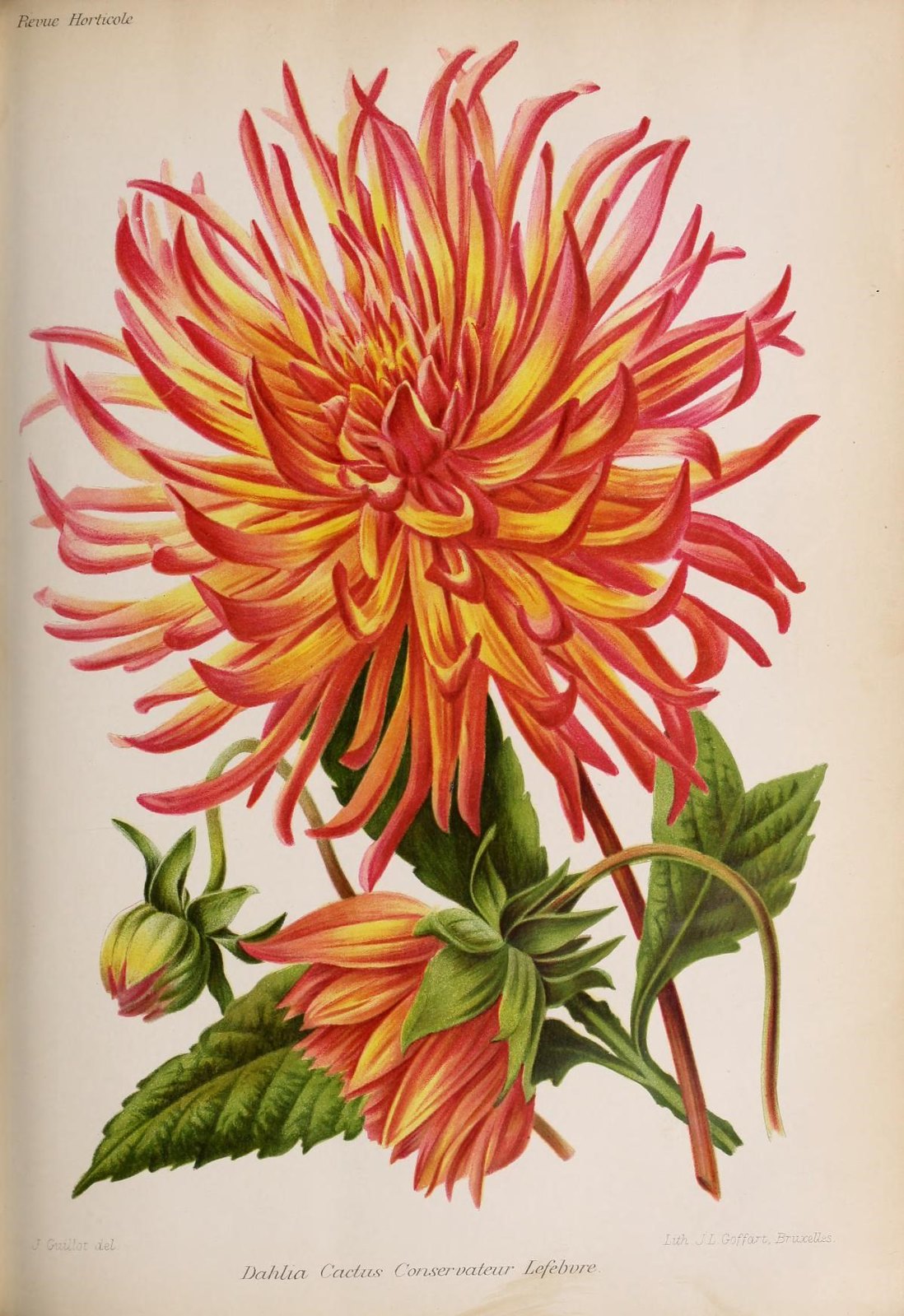
yellow and red flower

Illustration of a Cactus Dahlia from Revue horticole (1908). Contributed in BHL from the New York Botanical Garden, LuEsther T. Mertz Library. This image is one of over 160,000 that are freely available for download and reuse through the BHL Flickr.

BHL’s digital library provides free and open online access to over 250,000 volumes from the 15th-21st centuries on a wide range of biodiversity subjects. These collections offer great resources to support distance learning.

All of our content can be accessed online for free and in full through our digital library portal at biodiversitylibrary.org. No login, account, or membership is required. You can also freely download anything in our library in a variety of formats. Our FAQ provides information on how to search the library and download content.

In addition to our general collections, we’ve identified a selection of materials that may be of particular interest to educators and students. Explore these resources below.

Thematic Collections

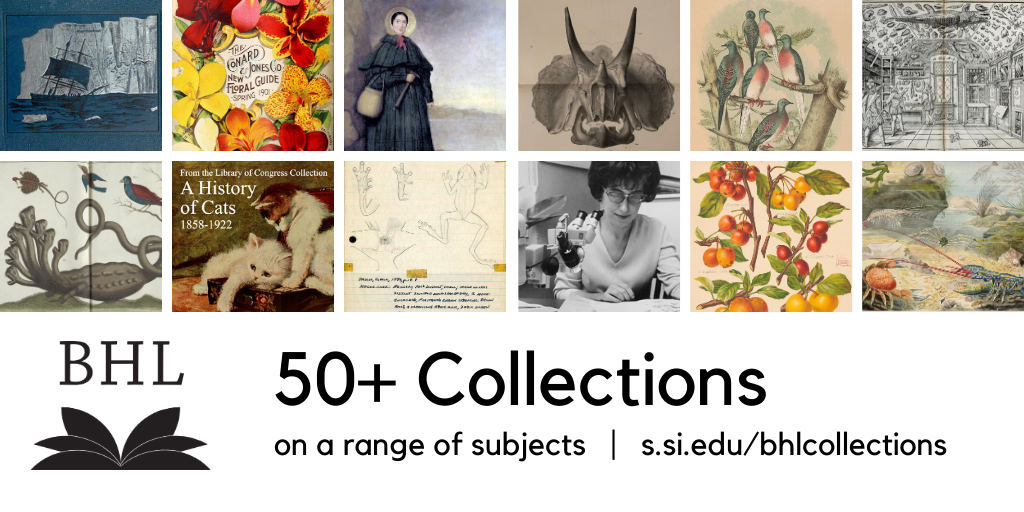
Looking for curated content? Our Collections offer a pre-selected set of materials on a variety of subjects, from Antarctic Exploration & Discovery to Seed & Nursery Catalogs and Latino Natural History.

graphic with BHL collections highlighted

Explore over 50 thematic collections on a range of subjects.

Image Resources

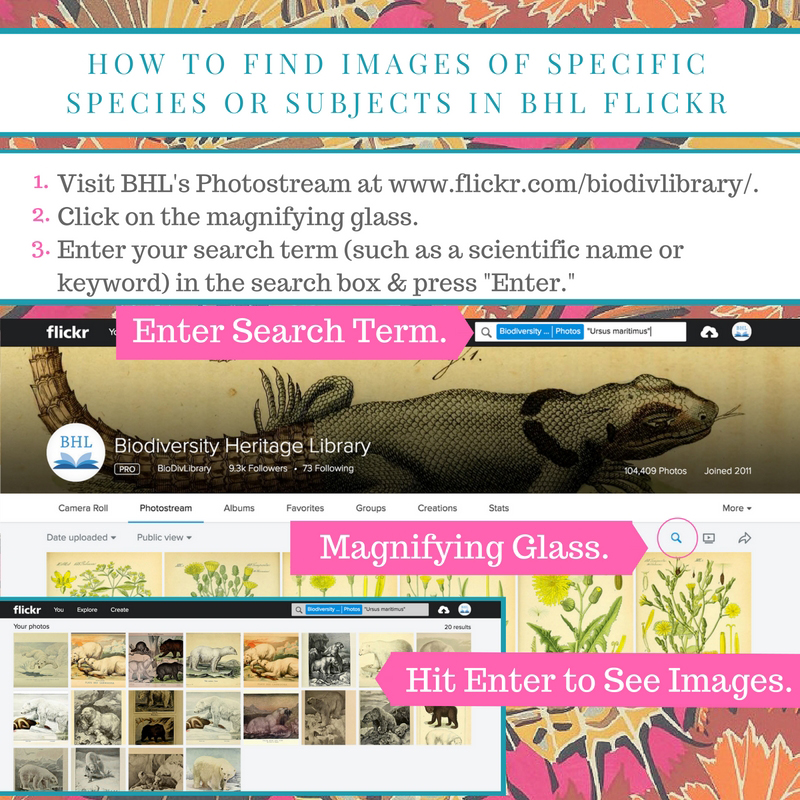
If you need image resources for your distance learning activities, we have a rich collection of over 160,000 free nature images in our Flickr. Here’s how to search and download those collections.

Instructions on how to find images in the BHL Flickr

Instructions on how to search for specific subjects and species in the BHL Flickr.

Looking for an educational activity to do online around nature art? Tagging images in the BHL Flickr with species and artist names is a great option. It’s not only a fun way to learn about taxonomy, investigate individual species, and explore artists and artistic practices, but it also makes these images more accessible and discoverable for others to support their research and educational activities.

Learn more about tagging and get started with our instructional guide.

Coloring Books

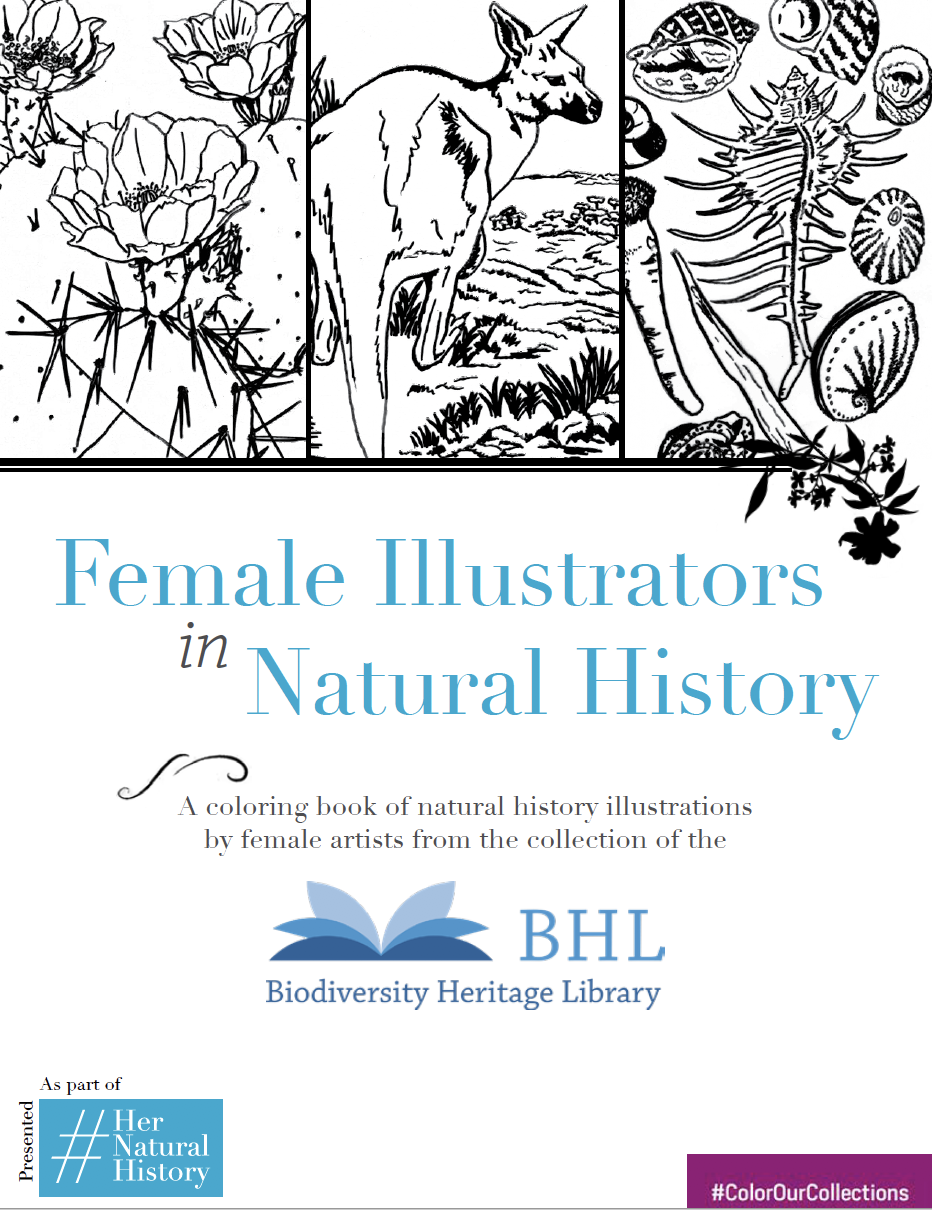
Looking for more hands-on educational resources? Explore and download our free coloring books created from images in our collection.

cover of the female illustrators in natural history coloring book

Our “Female Illustrators in Natural History” coloring book is one of several freely available from BHL. Explore and download our coloring books.

Women’s History Month Educational Resources

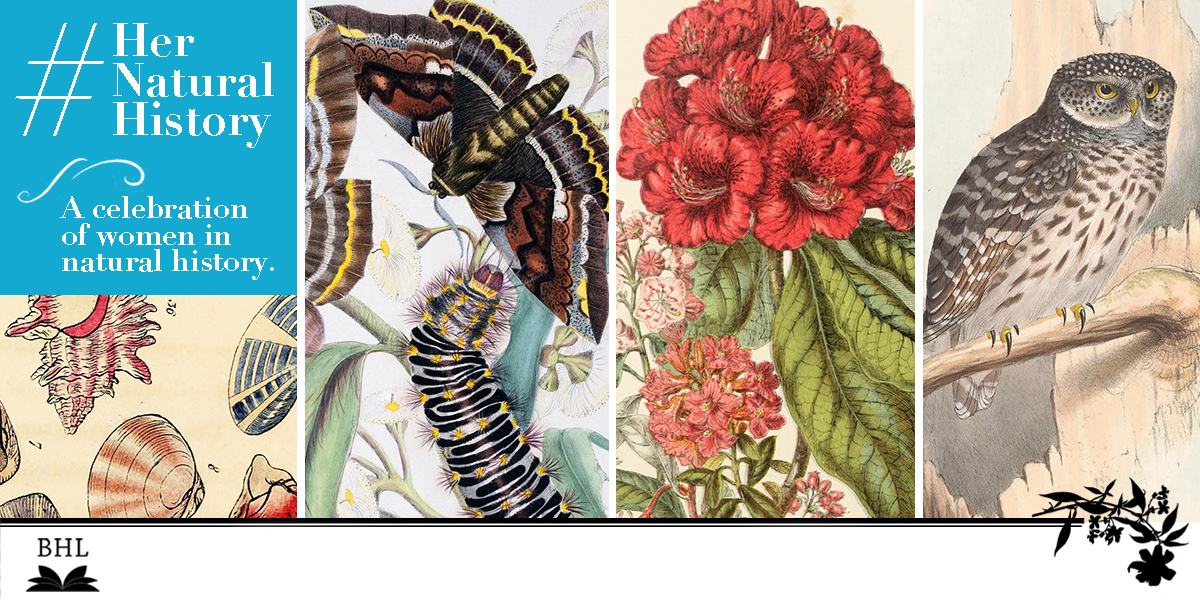
Looking for resources to support educational activities around Women’s History Month? Our #HerNaturalHistory collections offer a range of content related to women’s contributions to natural history. Explore our book and image collections, coloring book, Facebook videos, and blog series.

Her Natural History graphic

Our Her Natural History collections on women in science include book and image collections, a coloring book, Facebook videos, and informative articles.

March 17, 2020by michelle.underhill

Help Support BHL

BHL's existence depends on the financial support of its patrons. Help us keep this free resource alive!

search

About BHL

The Biodiversity Heritage Library (BHL) is the world’s largest open access digital library for biodiversity literature and archives. BHL operates as a worldwide consortium of natural history, botanical, research, and national libraries working together to digitize the natural history literature held in their collections and make it freely available for open access as part of a global “biodiversity community.”

Join Our Mailing List

Sign up to receive the latest news, content highlights, and promotions.

Subscribe Now

Subscribe to Blog via Email

Enter your email address to subscribe to this blog and receive notifications of new posts by email.

Join 319 other subscribers

Subscribe to Blog Via RSS

Subscribe to the blog RSS feed to stay up-to-date on all the latest BHL posts.

Access RSS Feed

Inspiring Discovery through Free Access to Biodiversity Knowledge.

The Biodiversity Heritage Library makes it easier than ever for you to access the information you need to study and explore life on Earth…for free, anytime, anywhere.


ABOUT | HARMFUL CONTENT | PRIVACY | SITE MAP | TERMS OF USE