
Biodiversity Heritage Library - Program news and collection highlights from BHL
  • Home
  • News
  • Featured Books
    • All Featured Books
    • Book of the Month Series
    • BHL at 20
  • User Stories
  • Campaigns
    • Fossil Stories
    • Garden Stories
    • Monsters Are Real
    • Page Frights
    • Her Natural History
    • Earth Optimism 2020
  • Tech Blog
  • Visit BHL
Home
News
Featured Books
    All Featured Books
    Book of the Month Series
    BHL at 20
User Stories
Campaigns
    Fossil Stories
    Garden Stories
    Monsters Are Real
    Page Frights
    Her Natural History
    Earth Optimism 2020
Tech Blog
Visit BHL
  • Home
  • News
  • Featured Books
    • All Featured Books
    • Book of the Month Series
    • BHL at 20
  • User Stories
  • Campaigns
    • Fossil Stories
    • Garden Stories
    • Monsters Are Real
    • Page Frights
    • Her Natural History
    • Earth Optimism 2020
  • Tech Blog
  • Visit BHL
Biodiversity Heritage Library - Program news and collection highlights from BHL
Blog Reel, Featured Books

Happy Darwin Day!

View Full Size Image
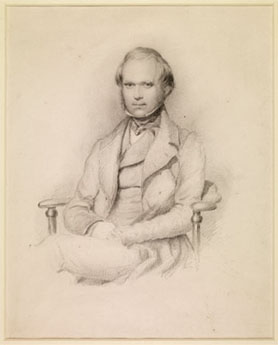
Charles Darwin by George Richmond. Cambridge University Library.

Today in 1809, Charles Darwin, remembered for his theory of Evolution by means of Natural Selection (which was so eloquently outlined in the 1859 publication On the Origin of Species by Means of Natural Selection) was born. We celebrate this day as Darwin Day.

In 2011, BHL released Charles Darwin’s Library, a collection of books found in Charles Darwin’s personal library, with his hand-written annotations marked-up and indexed. We made a selection of these books available for free download in iTunes U. This year, we’ve selected images from these books and created a Darwin collection in Flickr. As with all BHL content, these images are free for download and reuse.

As we continue our celebrations of this great man of science, we highlight another project (headquartered at the American Museum of Natural History) which is dedicated to providing free access to Charles Darwin’s scientific manuscripts – the Darwin Manuscripts Project.

In this two-part post, Darwin Manuscripts Project Director, David Kohn, examines four of Darwin’s manuscripts that show the development of his evolution theory. Let’s begin with excerpts from “Ornithology Notes” and Darwin’s “Transmutation Notebook.”

Celebrating Darwin Day. By David Kohn. Director, Darwin Manuscripts Project

The Darwin Manuscripts Project has the admittedly ambitious goal of publishing all of Darwin’s scientific manuscripts. When digitized this will come to well over 100,000 high-resolution images, which we aim to faithfully transcribe and edit to the exacting standards of contemporary textual and historical scholarship. Among all these manuscripts my first love has always been those items that reveal—or at least allow us to glimpse at—the development of Darwin’s commitment to transmutation (his term for evolution) and the insights that led him to natural selection and eventually to the Origin of Species. Beyond their intellectual content, what appeals to me is how passionate are these manuscript glimpses of Darwin deeply in the midst of theory creation. So I’ve selected three items that capture chronological high points in what must be the most crucial intellectual journey in the history of natural history. And then I’ve selected two manuscript pages from the end point of the journey—the Origin itself. The entirety of this  journey can easily be followed on the DMP site by going to Edited Manuscripts (in the left-hand navigation) and then selecting ‘Creation of the Origin’, where the reader will find all the many surviving documents that are relevant to this process from 1835 to 1859.

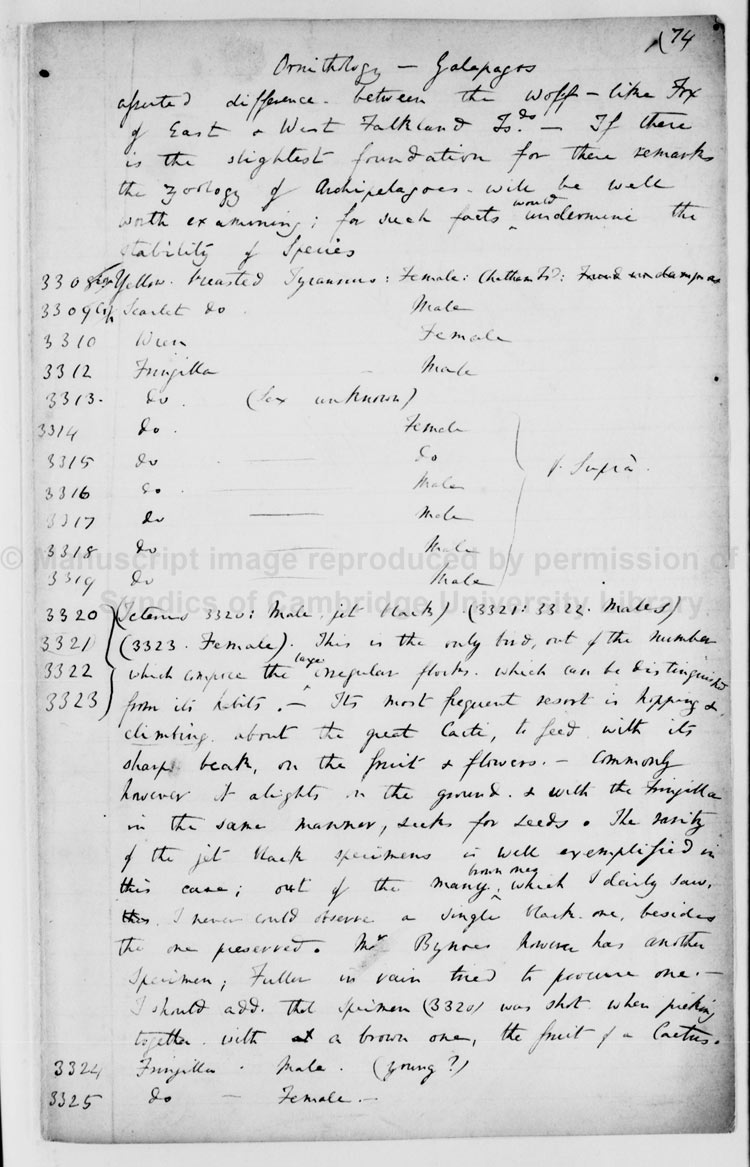
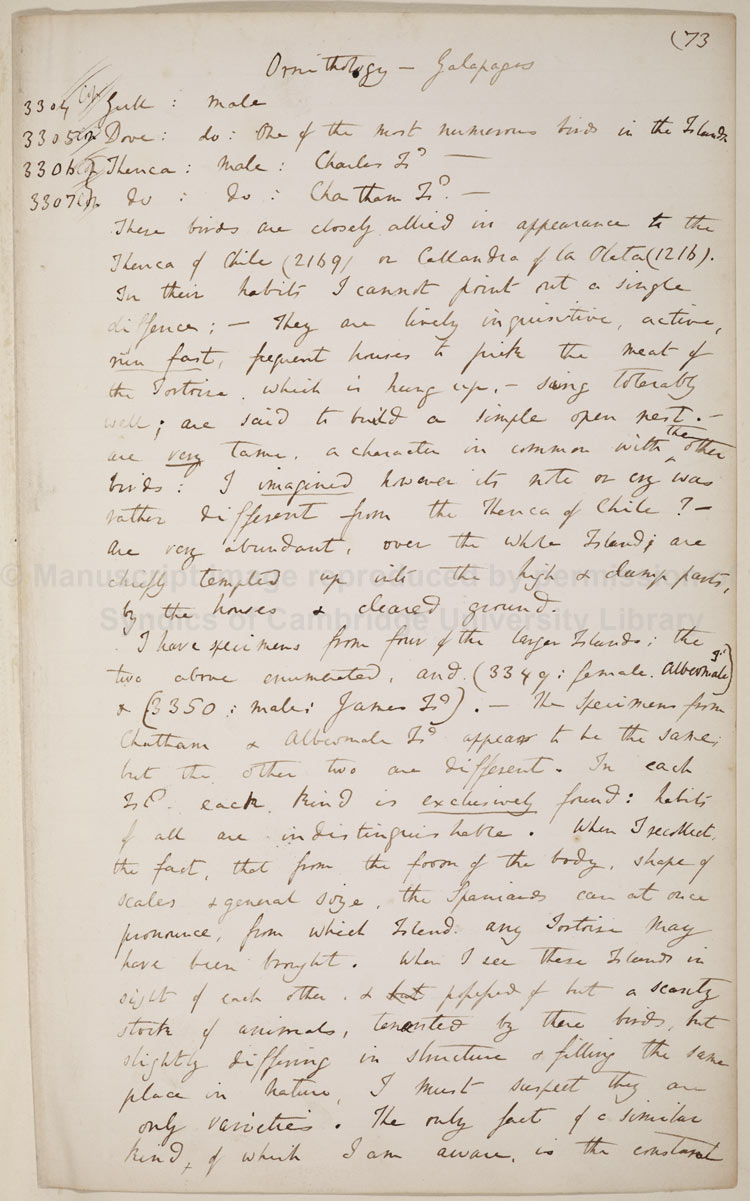
Ornithology Notes, Summer 1836

(Cambridge University Library, DAR 29.2: 73-74)
View Full Size Image
Ornithology Notes. Pg. 73. Cambridge University Library.
View Full Size Image
Ornithology Notes. Pg. 74. Cambridge University Library.

I want to focus on the following passage about the slightly different forms of mocking birds Darwin found as he travelled from island to island. This was written in the summer of 1836 and is a significantly revised version of notes written in 1835, shortly after the Beagle left the Galapagos.

“When I see these Islands…tenanted by these [mocking] birds…I must suspect they are only varieties. … If there is the slightest foundation for these remarks the Zoology of Archipelagoes, will be well worth examining; for such facts «would» undermine the stability of Species.”

What a tantalizing passage. What does he mean by the concluding remark: ‘undermine the stability of Species’?

Undoubtedly, this remains one of the most controversial passages in the Darwin manuscript corpus. And I am offering a part of my humble, yet accurate, interpretation. By ‘stability’ Darwin means immutability. For stability of species is the exact term that Charles Lyell used when he discussed Lamarck’s evolutionary theory at length in the Principles of Geology. By 1836, Darwin had almost four years to read Lyell. And we know definitively he had read and indeed thought about Lyell’s anti-evolutionary views by February 1835. While there are several ways that Darwin was exposed to evolution before the voyage, Lyell’s deep exposition of Lamarck was, I believe, the most important exposure. For reading Lyell gave Darwin a major and thorough injection of evolution theory at the very time when Darwin was actively collecting specimens. But this belief has to be a matter of guess work because Darwin did not begin annotating his books until after the Beagle voyage. (If you really want to have some fun browse through the heavy marginalia on Darwin’s immediately post-Beagle copy of the 1837 edition of Lyell’s Principles in the Charles Darwin’s Library collection at BHL: http://biodiversitylibrary.org/item/105893 and http://biodiversitylibrary.org/item/105574.)

So to me ‘undermine the Stability of species’ translates as to ‘negate immutability’. Logically, to negate immutability equates to assert evolution. But in this passage Darwin did not assert evolution—not yet. We learn that the logic of discovery can proceed more gradually than mere logic.  However, this passage is an extremely important index of Darwin’s intellectual development. For while it shows that Darwin was not yet an evolutionist, it also shows that he was thinking about evolution and indeed thinking that evidence he had collected could destroy the received view that species are perpetually immutable.

Some more context is necessary.  When he wrote this passage, Darwin was in the midst of an important transition. South America and the years of specimen collecting were long behind him. So as a scientific expedition, the voyage itself was behind him. Yet with the ship homeward bound in the Atlantic, the voyage had not yet ended. But Darwin is already looking to the near future, when he would make a powerful entrance into London’s scientific scene by delivering his Beagle specimens to specialists to identify, describe, and evaluate. For these are the people who will determine whether or not his evidence on the ‘Zoology of Archipelagoes, will be well worth examining’. But now, while still sailing, Darwin was prepared to speculate, and indeed to set the grounds for his future evolutionary theorizing.


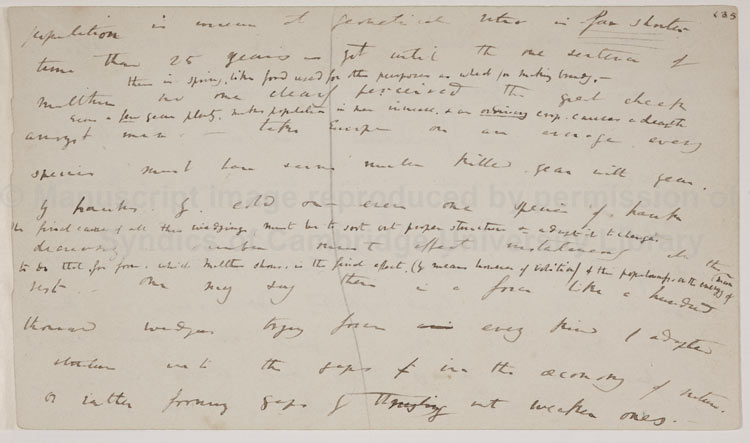
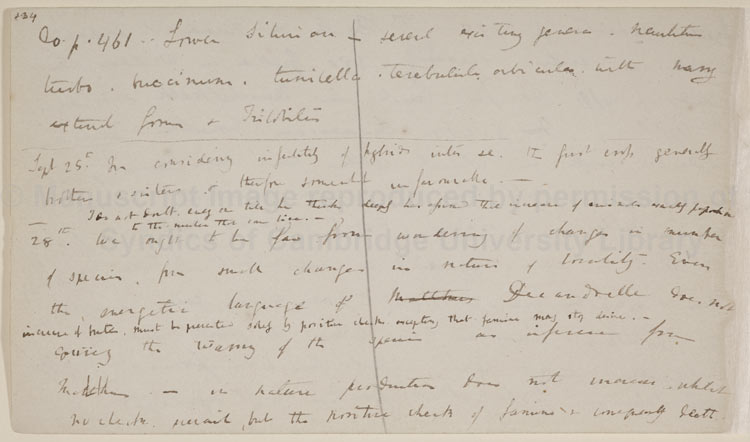
Transmutation Notebook D 134e-D135e, 28 September 1838

(Cambridge University Library, DAR 208: 73-74, http://darwin.amnh.org/viewer.php?eid=75168 and http://darwin.amnh.org/viewer.php?eid=75169.  For the whole Notebook D see http://darwin.amnh.org/viewer.php?mid=7.)
 

View Full Size Image
Transmutation Notebook D. Pg. 134e. Cambridge University Library.
View Full Size Image
Transmutation Notebook D. Pg. 135e. Cambridge University Library.


28th. «I do not doubt, every one till he thinks deeply has assumed that increase of animals exactly proportiona[l] to the number that can live.—» We ought to be far from wondering of changes in number of species, from small changes in nature of locality. Even the energetic language of ‹Malthus› «Decandoelle» does not convey the warring of the species as inference from Malthus.— … population in increase at geometrical ratio in FAR SHORTER time than 25 years— yet until the one sentence of Malthus no one clearly perceived the great check amongst men.— … One may say there is a force like a hundred thousand wedges trying force ‹into› every kind of adapted structure into the gaps ‹of› in the œconomy of Nature, or rather forming gaps by thrusting out weaker ones. «The final cause of all this wedgings, must be to sort out proper structure & adapt it to change.—»

These two pages from the third of Darwin’s ‘Notebooks on the Transmutation of Species’ give us a window into another crucial moment, for here we see Darwin’s profound excitement as he responds to reading Malthus’ Essay On Population. Visually, I have always been struck by Darwin’s uncharacteristically small, yet very well formed, handwriting here. And notice how there seems to be at least two layers of writing. Indeed the pages are so densely packed that in some places scholars have difficulty cleanly separating the layers.

But, what is Darwin saying?  Well, you need to know that by September 1838, Darwin was deeply engaged in what became the two branches of his life’s work. One branch was the constant weighing of the evidence for and against evolution, though by March 1837—so about six months after the Ornithology Notes, he was convinced that the mutability of species was the way nature is organized—evolution is a correct theory. The other branch was Darwin’s search to define mechanisms that explain two things: how species acquire adaptations and how new species are formed.  In these two pages Darwin is, for the very first time,  beginning to formulate the essence of the mechanism for adaptive evolution, namely: by natural selection. No wonder he writes with so much energy, and yet with so much precision. What he does here is grasp the power of Malthus’ population pressure—‘the energetic language of Malthus,’ which he then harnesses as a natural agent that through the differential survival of the fittest—‘forming gaps by thrusting out weaker ones’ can thereby ‘sort out proper structure & adapt it to change’. This is the essence of natural selection. Not the  grown tree in full bloom. But it is more than just a seed, for if theories are like trees, at this stage Darwin’s was a healthy sapling.

(To Be Continued…View part 2 of this blog post.)

Images in this post reproduced with the permission of the Syndics of Cambridge University Library.

___________________________

Explore Darwin on BHL and the Darwin Manuscripts Project:

Charles Darwin’s Library
Charles Darwin’s Library on iTunes U
Charles Darwin’s Library on Flickr
Darwin Manuscripts Project
Official Darwin Day Website


 

February 12, 2015by ulib-libraryjobs
BHL News, Blog Reel

The Latest News from BHL!

View Full Size Image
Latest BHL Quarterly Report

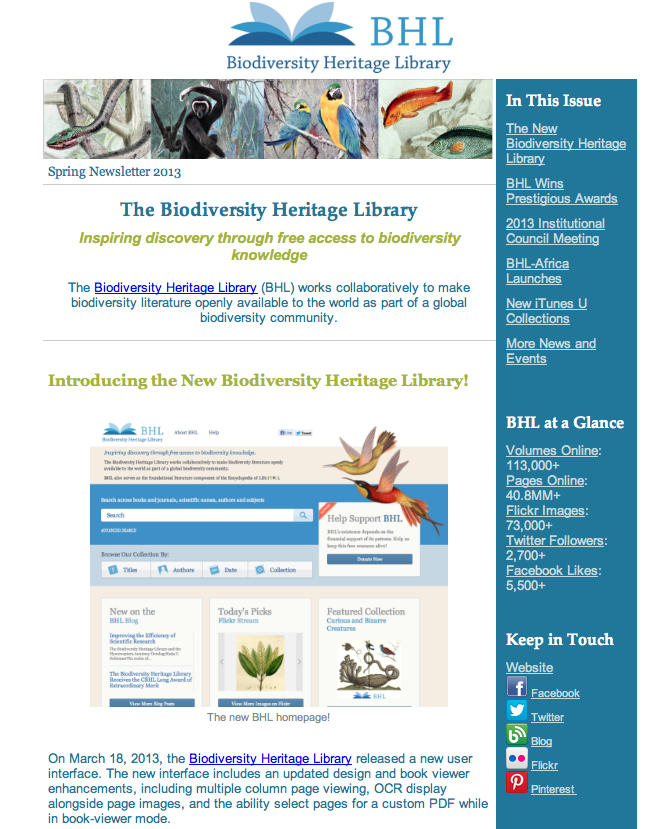
If you think all we do is digitize books, get ready to be surprised! Besides adding over 700,000 new pages of open access biodiversity literature to our collection in 2013 alone, we’ve launched a new website, celebrated the birth of another regional node – BHL-Africa, grown our consortium by adding the Library of Congress as our 15th member library, published two new iTunes U collections, received two prestigious awards, and hosted our seventh Annual Institutional Council Meeting, just to name a few things!

Learn all about these developments, and see how our project is performing, in the latest BHL Quarterly Report and Newsletter! Stay up to date in the future by subscribing to our quarterly newsletters.

We know you’ll be impressed at the ways we’re inspiring discovery through free access to biodiversity knowledge!

View Full Size Image
Spring 2013 BHL Newsletter


May 23, 2013by ulib-libraryjobs
BHL News, Blog Reel

BHL Surpasses 40 Million Pages!

May we have a drum roll please…….

The Biodiversity Heritage Library is pleased to announce that we have just surpassed 40 million pages in our online collection!

That’s 40 million pages of open access biodiversity literature that was previously available only in the collections of a few select libraries around the world. Making this literature freely available removes these boundaries to access, thus increasing the efficiency of scientific research and discovery of the natural world for anyone with an Internet connection.

View Full Size Image
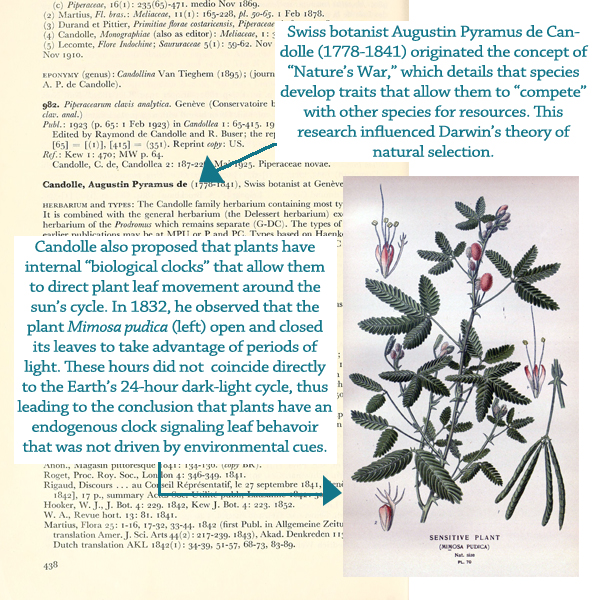
Most popular book out of those 40 million pages? Taxonomic Literature 2 (TL2). Learn more about Candolle in TL2 and explore Mimosa pudica, which played a critical part in his research, in Favourite Flowers of Garden and Greenhouse.

BHL officially launched in May, 2007, with just over 600,000 pages of primarily botanical literature previously digitized for the Botanicus program at the Missouri Botanical Garden. Today, over 5 years later, we’ve added over 39.4 million more pages, contributed from the collections of 14 BHL member institutions, 3 global partners (including China, Australia, and Europe), and 124 providers that make their content openly available in the Internet Archive. Subjects covered in the collection now include not only botany but also zoology, scientific expeditions, gardening, fungi, conservation, archaeology, fossils, and ecology, to name a few.

View Full Size Image
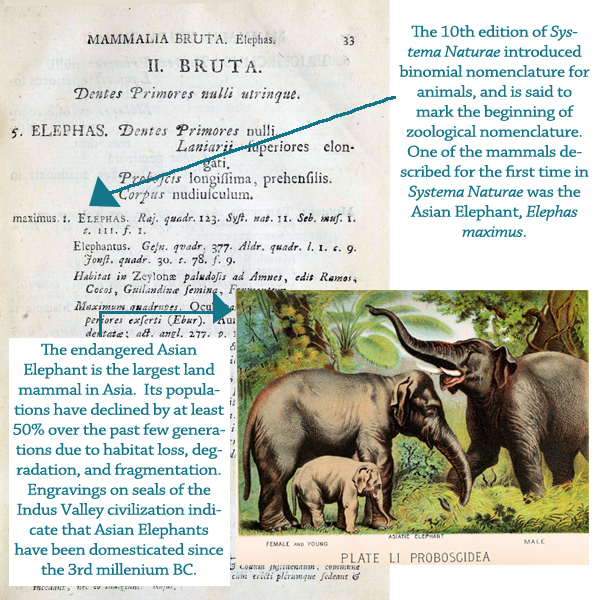
2nd most popular book in BHL: 10th Ed. Systema Naturae 

While making over 40 million pages of literature freely available, we’ve also been working to improve discoverability of and access to the thousands of incredible scientific illustrations found within these digitized texts by exposing them via Flickr. To date, we’ve added over 55,000 images to the BHL Flickr, free for browsing, downloading, and reuse via a Creative Commons license. With funds received from a recent National Endowment for the Humanities grant, we’re exploring ways to further automate the discovery of these images in BHL.

Beyond our work with images, we continue to embrace strategies that allow us to reach new audiences on new platforms and expand user opportunities to interact with our collections. This includes featuring content on Twitter, Facebook, and Pinterest, as well as making select items available for free download in iTunes U.

While the common thread throughout this post may be that all of our content is free, the cost to digitize this material and support further technical development is not. Our 40 million pages was achieved thanks to the support of grant agencies, generous in-kind contributions and subventions from our member libraries, and donations from users like you. Help us reach another 40 million pages with a tax-deductible donation to BHL. Together, we can ensure that the world’s biodiversity literature is available to everyone, everywhere.

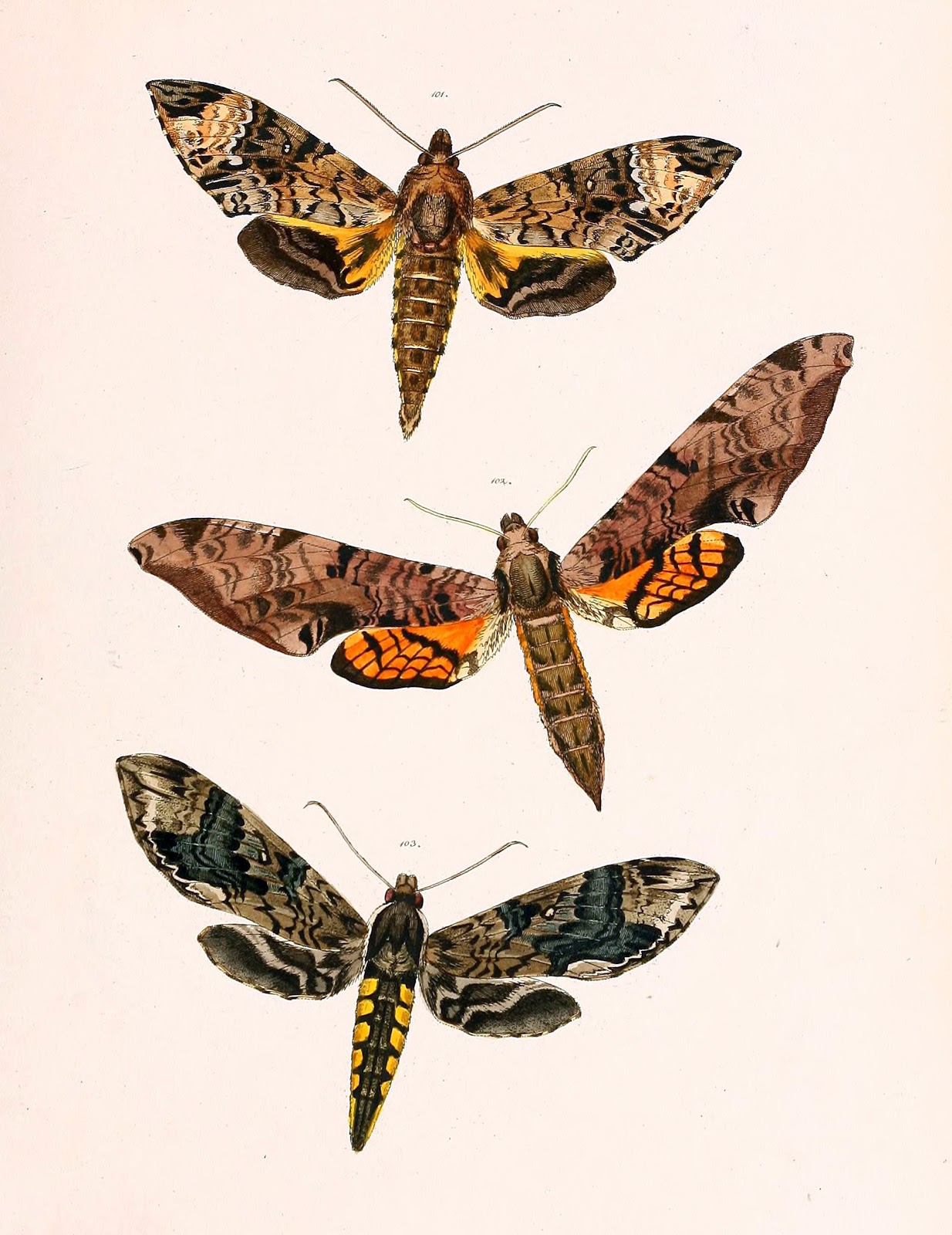
View Full Size Image
The most-viewed image in the BHL Flickr? Sammlung neuer oder wenig bekannter aussereuropäischer Schmetterlinge (1850-58), bd. 1, pl. [45], with 2,145 views.

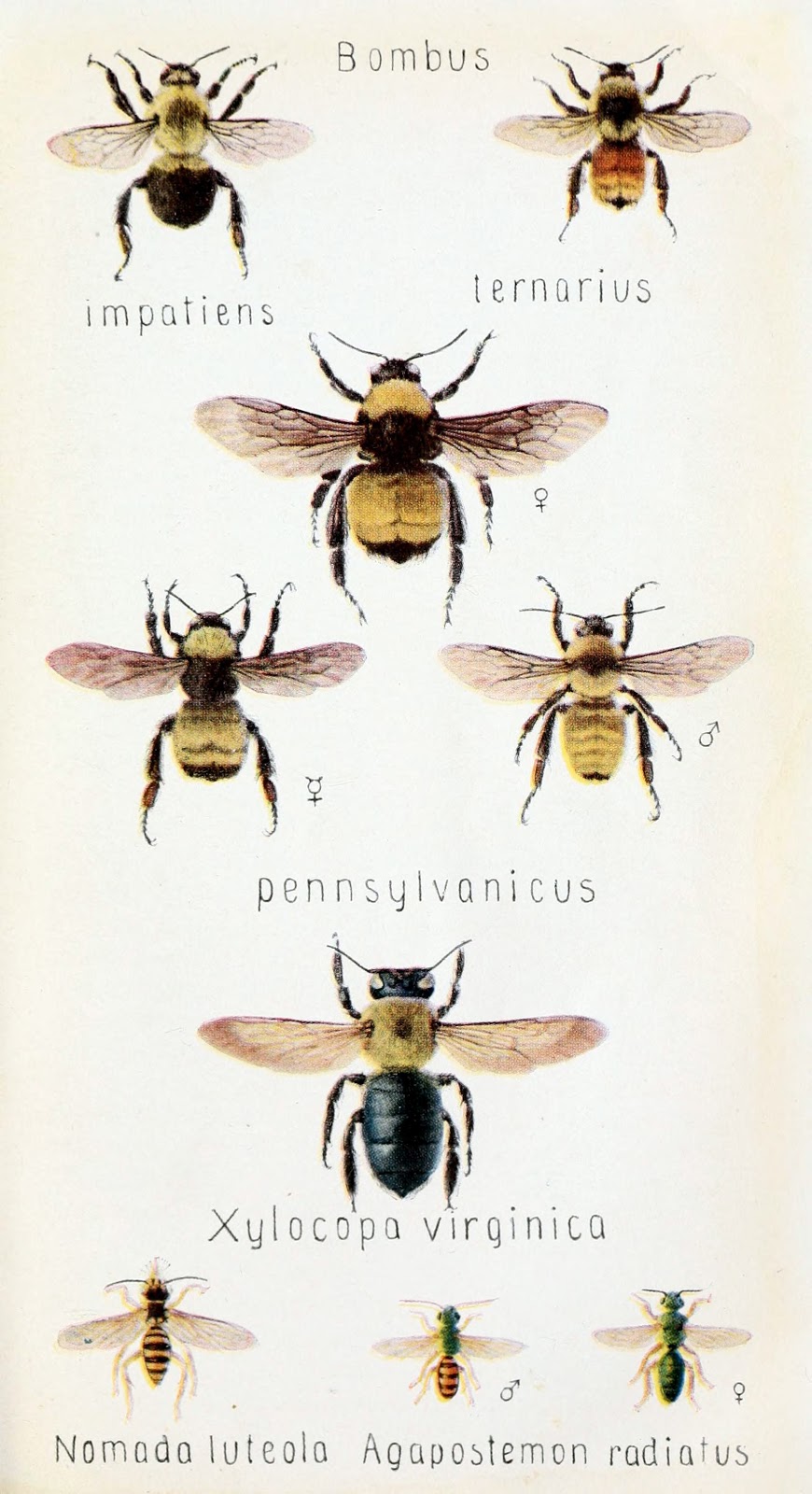
View Full Size Image
Following in the insect theme, the second-most-viewed image in Flickr: Field Book of Insects (1918), pl. 94, with 1,901 views.

View more images in the BHL Flickr!

* Find the image of the Asian Elephants, displayed in the Systema Naturae image above, in Johnson’s Household Book of Nature.

December 26, 2012by Grace Costantino
Blog Reel, Featured Books

A Tribute to America’s Conservation President

“There are no words that can tell the hidden spirit of the wilderness, that can reveal its mystery, its melancholy, and its charm.” ~ Theodore Roosevelt


Theodore Roosevelt Memorial at the American Museum of Natural History

In 2012, the American Museum of Natural History (AMNH), one of BHL’s founding members, celebrated the grand reopening of the Theodore Roosevelt Memorial. For three years, the Memorial was closed to the public as part of a 37.5 million dollar renovation plan to re-imagine this permanent exhibit. Theodore Roosevelt, America’s Conservation President, was intimately tied to the museum since its founding in 1869.  This week’s book of the week selection, A Book-lover’s Holidays in the Open (1916) was written by Teddy and affords readers an intimate glimpse inside the mind of one of America’s most fascinating presidents.

View Full Size Image
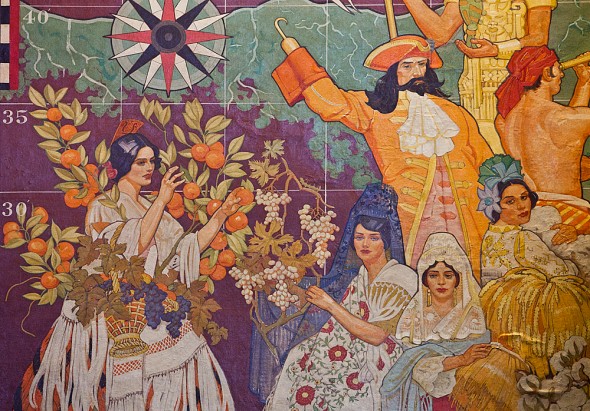
The murals depict milestones in TR’s life. (Credits: Amal Chen/The Epoch Times)

The renovation includes a new life-size bronze statue of Theodore Roosevelt and several exhibits charting Roosevelt’s journey from budding naturalist to becoming America’s conservation president. Perhaps, the most exciting for those from the art world is the 2.5 million dollar allocation that went towards the restoration of William Andrew Mackay’s murals of Roosevelt. The murals, recording key moments in the life of Roosevelt greet you at the main entrance and cover a space of over 5,200 feet.

A Book-lover’s Holidays in the Open (1916)

View Full Size Image
Book Frontispiece

To continue AMNH’s celebration of Roosevelt, we wanted to highlight a book that they digitized for the BHL. As the title of this week’s book suggests, Theodore Roosevelt liked to read books. Correction. This man LOVED to read books. Many in his personal circle have vouched that “Teedie” read at least one book per day, most often finishing said tome before breakfast. This seemingly ambitious reading schedule made Roosevelt the most well-read president alongside, Thomas Jefferson.

As a young boy, Roosevelt was an asthmatic bookworm often confined to his Manhattan family flat. One can almost see him wistfully longing for the outdoors as he escaped city life in  the imaginative world of books. However, it was this deprivation from the natural world that caused him to love the great outdoors all the more. He looked forward to family vacations in upstate New York where he could observe nature’s creatures in all their glory.

As early as age 7, Teddy began to collect specimens and wrote about them in minute detail. He even learned amateur taxidermy around age 12 and began adding specimens to a personal collection that he and his cousins dubbed “Roosevelt’s Natural History Museum.” His father fully supported young Roosevelt’s budding interest, being a nature lover himself. In fact in 1869, Theodore Roosevelt Sr. signed the American Museum of Natural History’s founding charter with other trustees in the parlor of the Roosevelt family home on East 20th Street in New York City. Moreover, the Roosevelt family is deeply connected to AMNH, having served on the Museum’s board for its entire history.

View Full Size Image
A young naturalist’s journal. Photo Credits: AMNH

With A Book-lover’s Holidays in the Open (1916), you get an eclectic mix of stories, personal anecdotes and Roosevelt’s views about conservation in America. Our favorite excerpt from this book, which defies a cursory summary and warrants a fully digested read,  illustrates Teddy’s internal transformation from a hunter that appreciated nature to a President who became, arguably history’s most influential conservation policy maker. Admittedly, this chunk of text is quite long but,  Teddy’s words are eloquent and if you are hurried at least have a look at the passages in conservation green:


“The westernmost island, we visited was outside the national reservation, and that very morning it had been visited and plundered by a party of eggers. The eggs had been completely cleared from most of the island, gulls and terns had been shot, and the survivors were in a frantic state of excitement. It was a good object-lesson in the need of having reserves, and laws protecting wildlife, and a sufficient number of efficient officers to enforce the laws and protect the reserves. Defenders of the short-sighted men who in their greed and selfishness will, if permitted, rob our country of half its charm by their reckless extermination of all useful and beautiful wild things sometimes seek to champion them by saying that “the game belongs to the people.” So it does; and not merely to the people now alive, but to the unborn people. The ”greatest good of the greatest number” applies to the number within the womb of time, compared to which those now alive form but an insignificant fraction. Our duty to the whole, including the unborn generations, bids us restrain an unprincipled present-day minority from wasting the heritage of these unborn generations. The movement for the conservation of wildlife, and the larger movement for the conservation of all our natural resources, are essentially democratic in spirit, purpose, and method.”


Teddy’s Conservation Legacy

Amen Teddy. What an incredible life you led, wearing more hats than one cares to list. Today,  we are remembering Teddy as a Book-Lover, Naturalist, “Wilderness Warrior,” Founder of the U.S National Park System and the Conservation President. He was the guy with the big stick going around speaking softly, almost lovingly into the ears of all Americans, willing them to do great things in the spirit of the common good. In his life he inspired people to embrace conservation by his actions: protecting some 230 million acres, establishing 51 Federal Bird Reservations, 4 National Game Preserves, 150 National Forests, 5 National Parks, and proclaiming 18 National Monuments.

We hope you enjoyed this post. Interested in guest-blogging for BHL? We’d love that! Natural history, biodiversity and conservation topics are especially welcomed. Email us your ideas at [email protected].

October 25, 2012by [email protected]
BHL News, Blog Reel

Celebrating Linnaeus’ Birthday with iTunes U

View Full Size Image

He has been dubbed “The Father of Modern Taxonomy,” “The Father of Modern Ecology,” Princeps botanicorum (Prince of Botanists), “The Pliny of the North,” and “The Second Adam.” He is credited with creating the classification schema known as binomial nomenclature, and today, he turns 305 years old. Of course, we’re talking about Carl Linnaeus, and we’re celebrating his birthday with the release of our latest iTunes U collection dedicated to him.

Carl Linnaeus was born May 23rd, 1707, in Småland, Sweden. As evidenced by his later publications, his first and primary passion was botany. At an early age, he took an interest in plants, eventually coming under the tutelage of Johan Rothman, the state doctor of Småland. Linnaeus first learned to classify plants under Rothman’s direction, using the system developed by Joseph Pitton de Tournefort, which, though based on artificial similarities between organisms, nevertheless was the first system to make a clear distinction between genus and species.

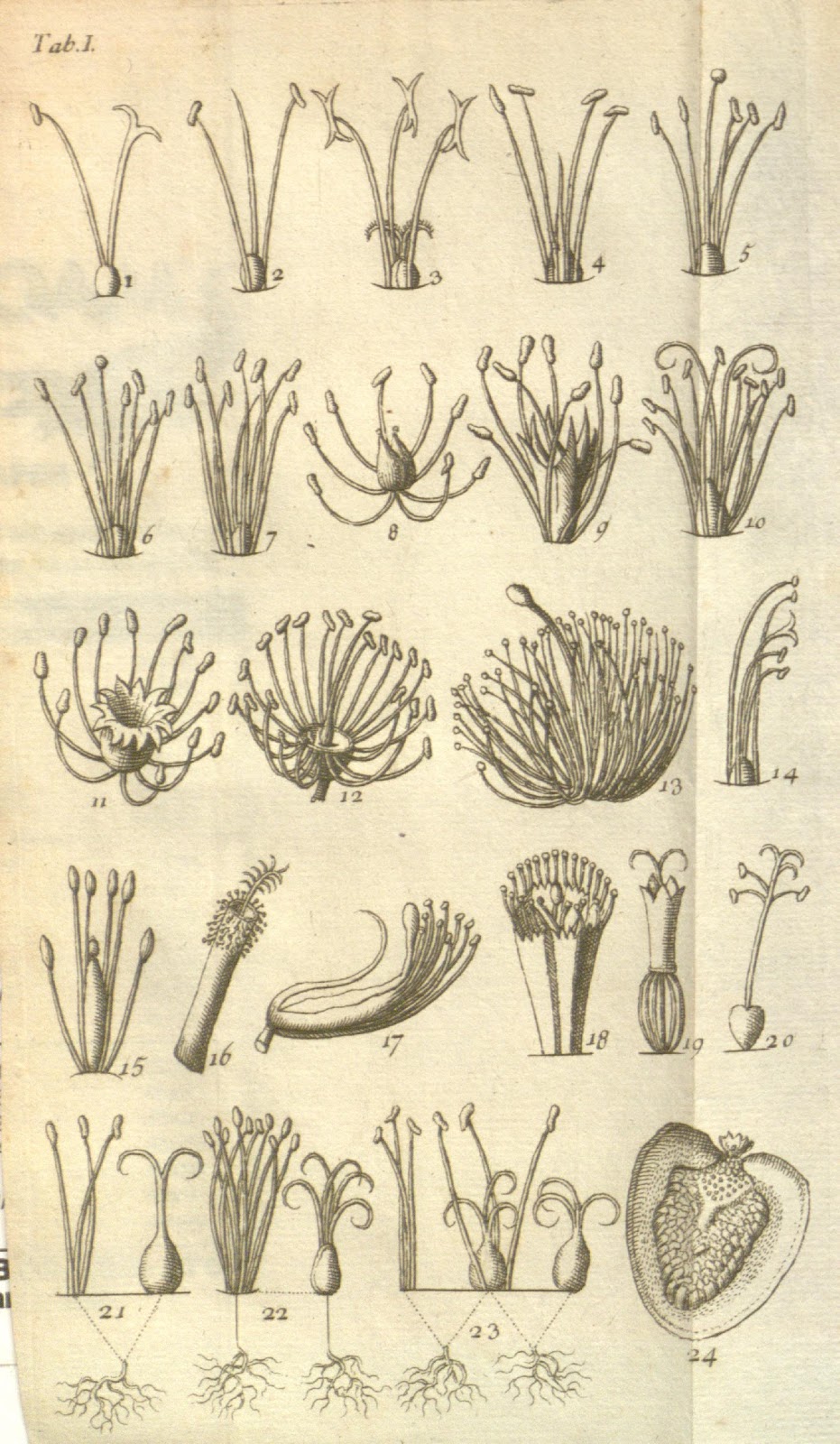
In 1728, Linnaeus enrolled at Uppsala University, where he made quick progress in the field of botany and, by only his second year, was himself giving lectures. During these years, Linnaeus began to question Tournefort’s classification system, and thus decided to develop his own. Linnaeus’ system arranged plants according to the number of stamens and pistils each possessed. This new system formed the basis of his work in the critical publication Genera Plantarum (first edition published 1737). A young German botanical draughtsman named Georg Dionys Ehret crafted a visual representation of this system, which Linnaeus included in Genera Plantarum (though without acknowledgement to Ehret). The image represents the earliest illustration of Linnaeus’ classification system for plants.

View Full Size Image
Ehret’s illustration of Linnaeus’ classification system

Linnaeus continued to revise Genera Plantarum, publishing a total of five editions (fifth edition published 1754). During the years between the publication of the first and fifth editions of this work, Linnaeus also published Species Plantarum (first edition published 1753), which arranged all plants known to him into orders, classes, and genera according to the Genera sexual system. Species Plantarum provided formal, multiple word descriptions in Latin of each species, as well as an additional epithet for easy reference. The combination of the genus and epithet quickly became a popular method by which to refer to a plant species. Species Plantarum is considered the inception of botanical nomenclature, and the use of a consistent naming structure based on the methods presented in Species and Genera was a vital step in the maturation of Linnaeus’ binomial schema.

In 1735, even before the publication of the first edition of Genera Plantarum, Linnaeus published the first edition of Systema Naturae. This first edition outlined Linnaeus’ ideas for the hierarchical arrangement of the natural world, dividing it into the animal, plant, and mineral kingdoms. His classification of the plant kingdom followed the sexual system he presented in Genera. However, it was not until the tenth edition of Systema Naturae that the binomial classification system we so readily associate with Linnaeus came into its own. While Species Plantarum had already established a binomial naming system for plants, the tenth edition of Systema Naturae (published in 1758) organized, for the first time, the animal kingdom according to this system – Kingdom, Class, Order, Genera, and Species. Thus, it represents the beginning of zoological nomenclature and, together with the first edition of Species Plantarum, is considered the starting point of binomial nomenclature.

Today, we highlight Linnaeus’ contributions to science with the release of our newest iTunes U Collection: The Carl Linnaeus Collection. The collection features 13 of Linnaeus’ publications (including the first edition of Species Plantarum, the tenth edition of Systema Naturae, and the fifth edition of Genera Plantarum), as well as two additional items about Carl Linnaeus and his sexual classification system (Carolvs Linnaevs by Edward Lee Greene and New illustration of the sexual system of Carolus von Linnaeus by Robert John Thonrton). You can download all of these titles directly onto your iPad, iPhone, or iPod Touch for free through iTunes. And, of course, you can download them directly to your computer through the BHL interface.

So Happy Birthday, Carl Linnaeus! Our present to you: Your very own iTunes U collection!

May 23, 2012by ulib-libraryjobs
BHL News, Blog Reel

Introducing the Theodore Roosevelt iTunes U Collection

View Full Size Image

When most people think of Theodore Roosevelt, they think of the twenty-sixth President of the United States. Taking office in 1901 at the age of 42 after the assassination of William McKinley, he is the youngest president in American history. As President, Roosevelt is known for his work in the Progressive Movement, completing the Panama Canal, and negotiating an end to the Russo-Japanese War. However, while many remember him as the politician, Theodore Roosevelt was also an accomplished natural historian, touring in Africa and Europe and leading a major expedition to the Amazon jungles.

To honor this remarkable man, we’ve dedicated our newest iTunes U collection to him. Our iTunes U provider page, which offers free access to a selection of BHL books organized according to theme, previously consisted of 8 collections, including Extinct Species and The Curious and the Bizarre. We’re thrilled to add the Theodore Roosevelt collection, containing 18 titles by Roosevelt, to our repertoire. To celebrate this release, we’re featuring one of the books as our Book of the Week: African Games Trails (1910).

View Full Size Image
Roosevelt’s expedition to Africa in 1909 was a major endeavor, conducted in large part to collect specimens for the Smithsonian and American Museum of Natural History. During the venture, Roosevelt and his team collected more than 11,397 animals, ranging from insects to big game animals. Roosevelt also used the expedition to interact with many native people and local leaders. A detailed account of the expedition, including descriptions of the flora and fauna he collected, are presented in his book African Game Trails, published in 1910.

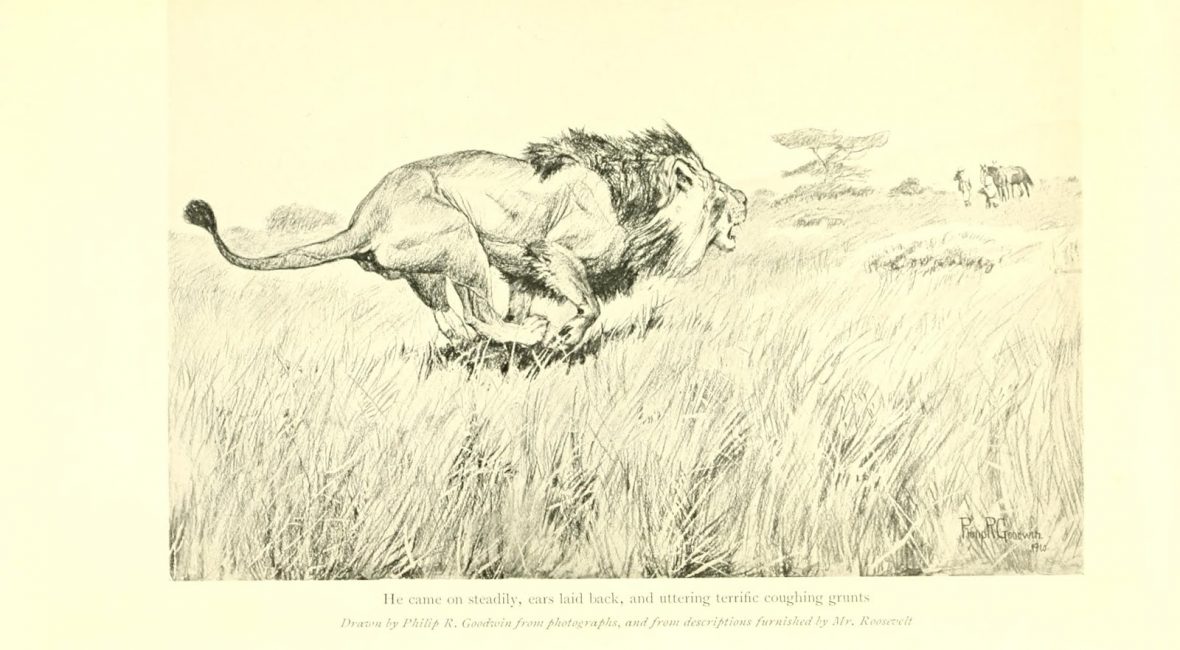
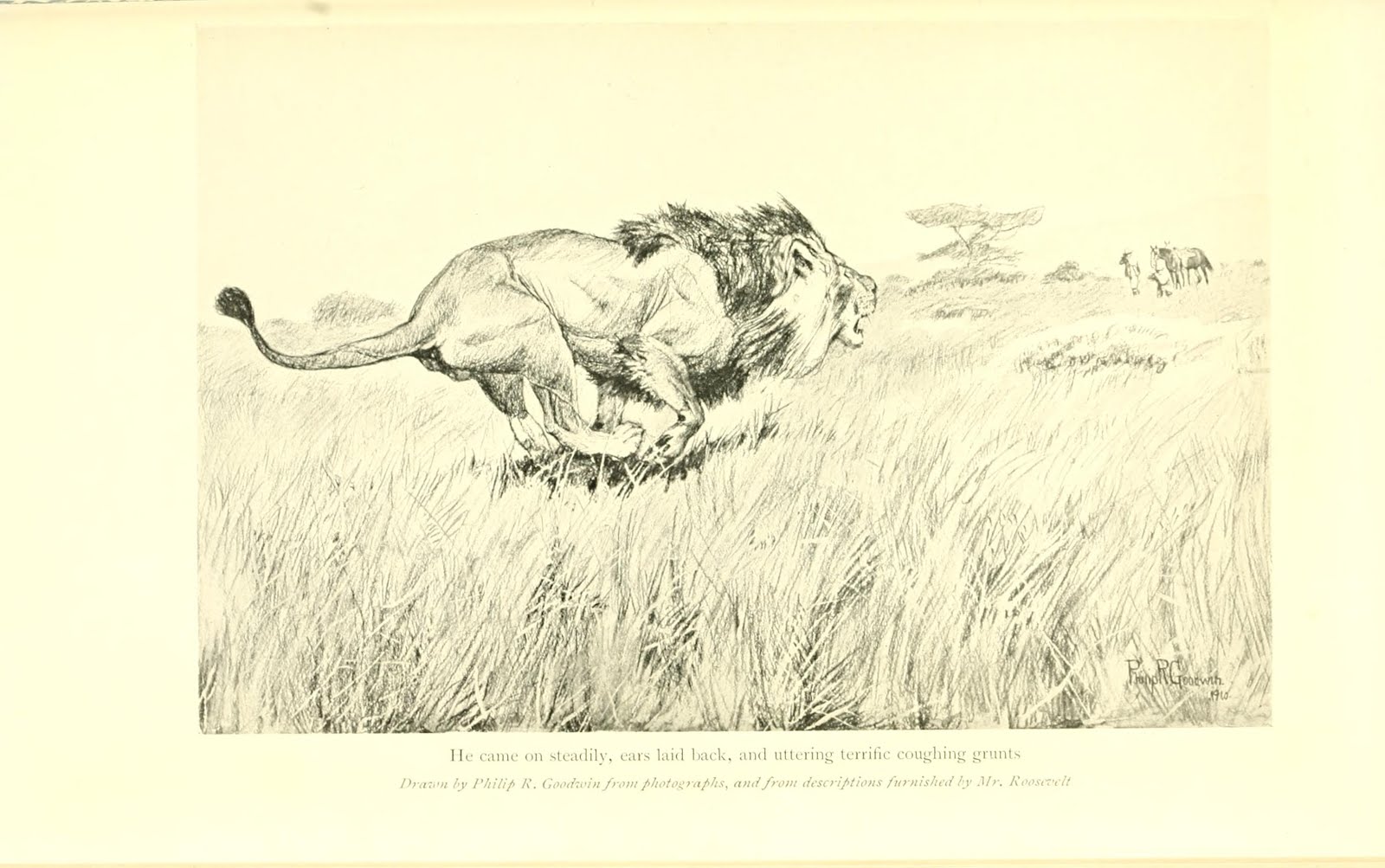
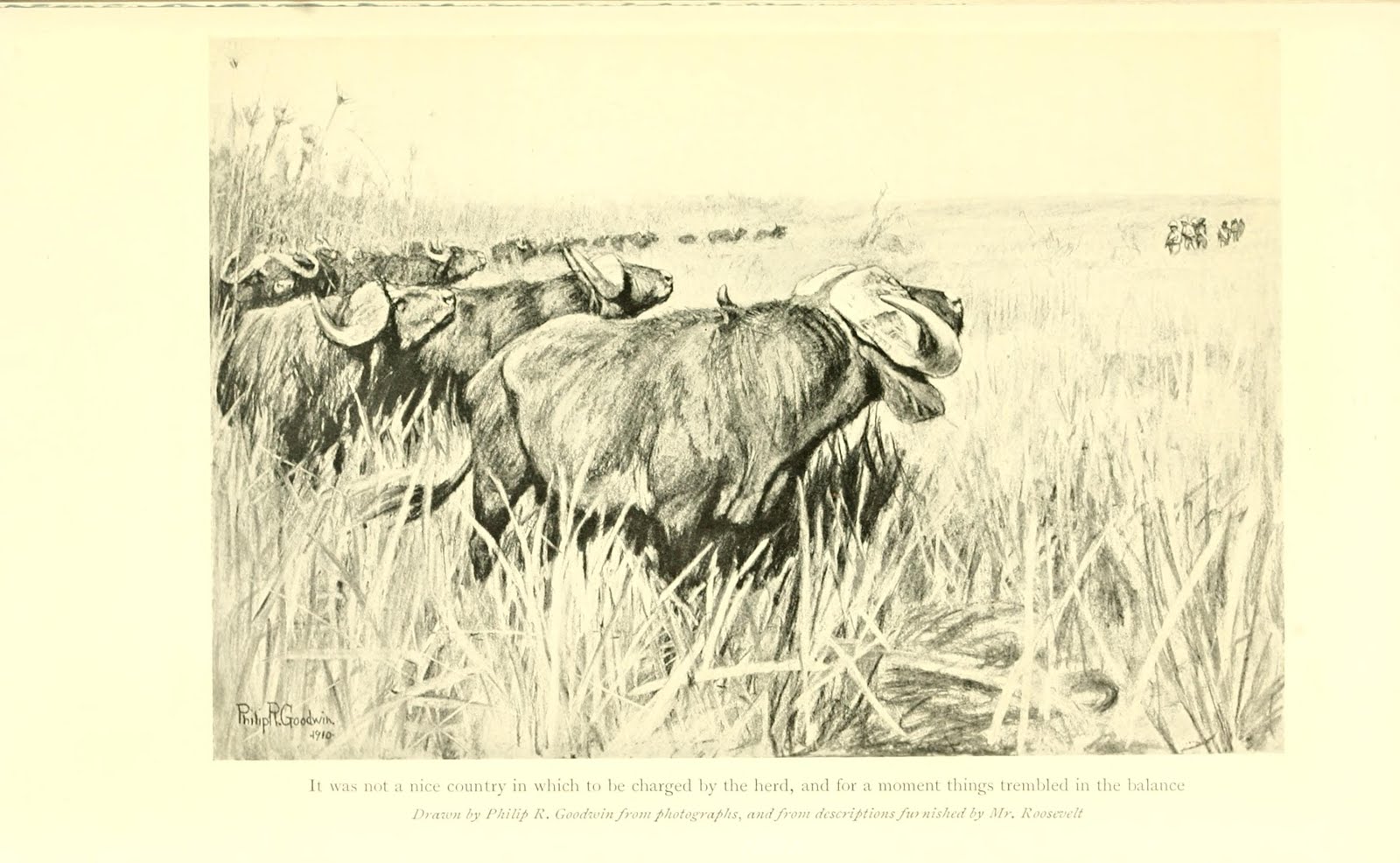
The work includes photographs taken by Roosevelt’s son, Kermit (to whom it is dedicated), as well as drawings by Philip R. Goodwin, an American artist best known for illustrating The Call of the Wild. African Game Trails contains accounts of such activities as lion hunting on the Kapiti Plains, encounters with the giant rhinoceros of the Lado, and the expedition’s trek down the Nile. Some of our favorite illustrations from the title include a herd of buffalo gazing with curiosity at the expedition team and a lion charging across the plain. A final item of interest worth noting is a map detailing the expedition’s route.

April 6, 2012by michelle.underhill
Blog Reel, Featured Books

Book of the Week: Floral Masterpiece from Biodiversity Heritage Library on iTunes U

View Full Size Image
In case you missed our post earlier this week, the Biodiversity Heritage Library is now on iTunes U. From our provider page, you can now download select BHL content through iTunes to your desktop or mobile device, i.e. iPad, iPod touch, and iPhone. And, all for free, of course! We currently have 8 collections available, including:

  • Fungus Among Us
  • Floral Mania
  • Charles Darwin’s Library: Selections*
  • Extinct Species
  • Rarest of the Rare
  • Pillars of Biodiversity
  • Biota of Cape Cod
  • The Curious and the Bizarre

You can learn more about iTunes U through Apple’s website.

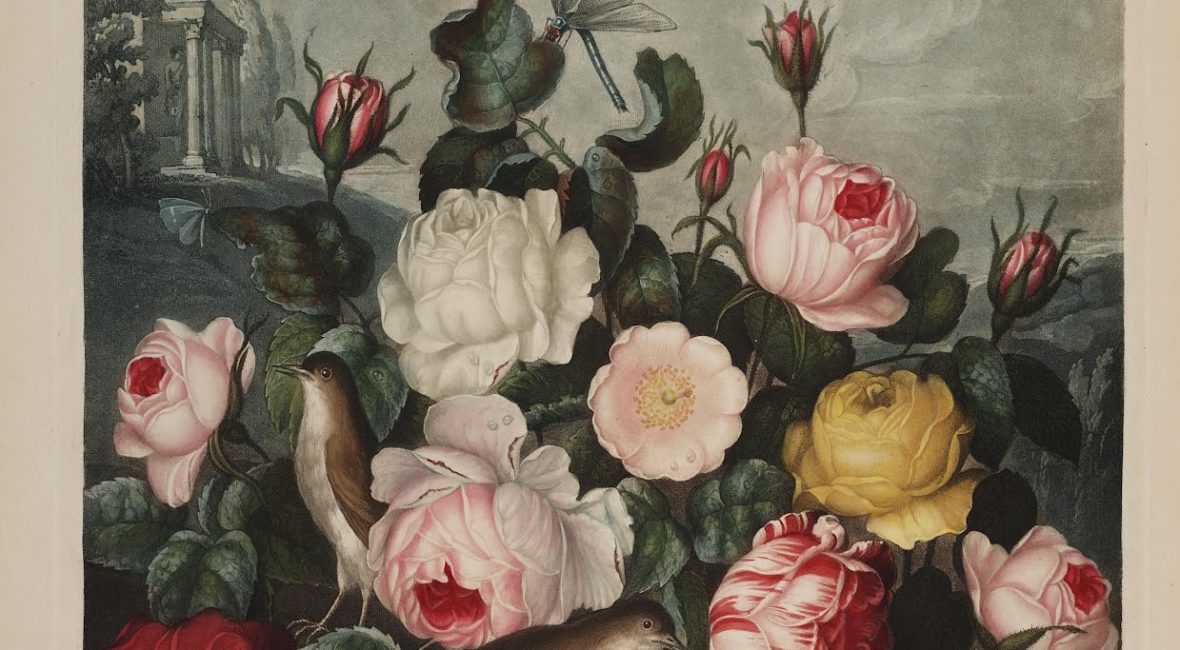
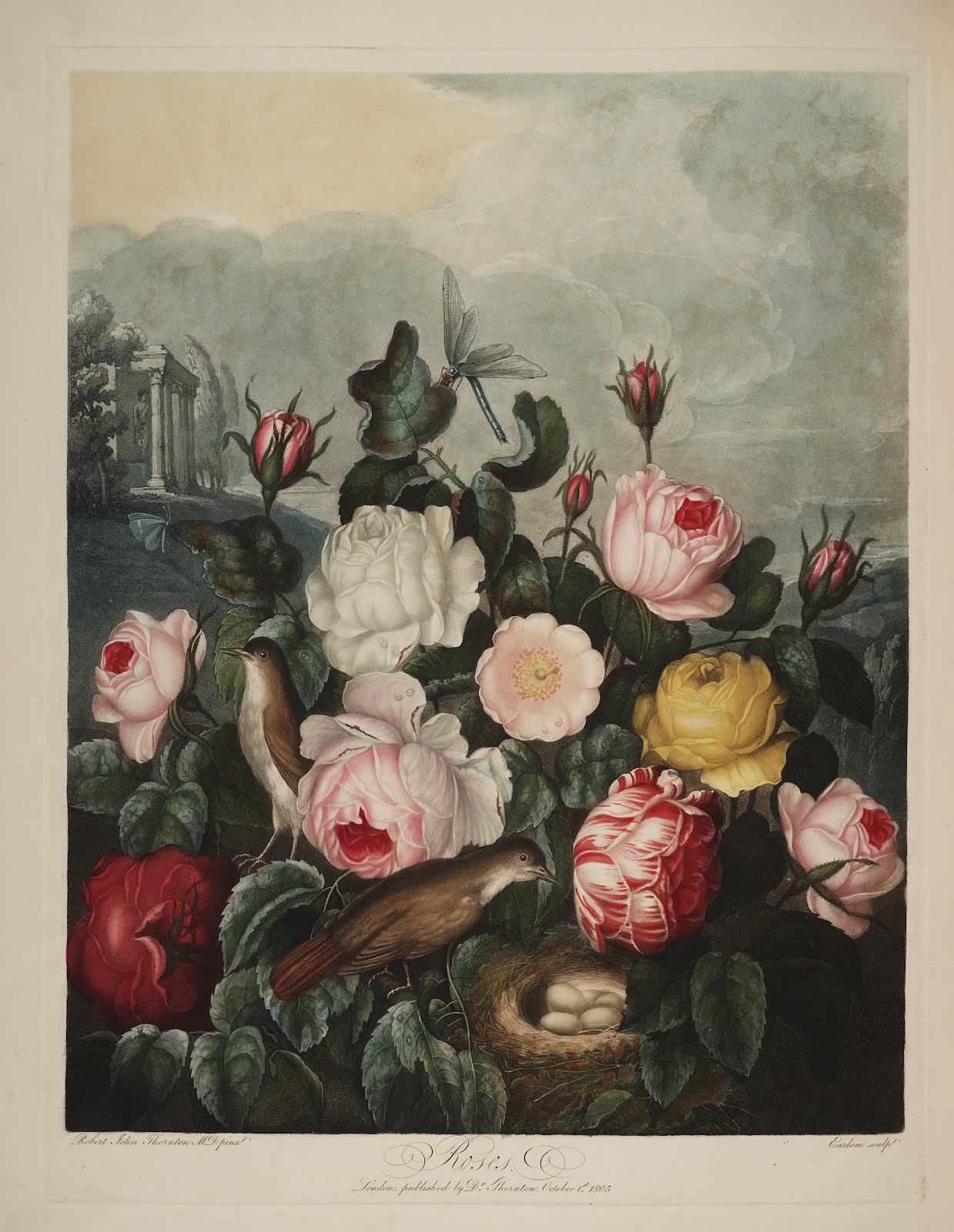
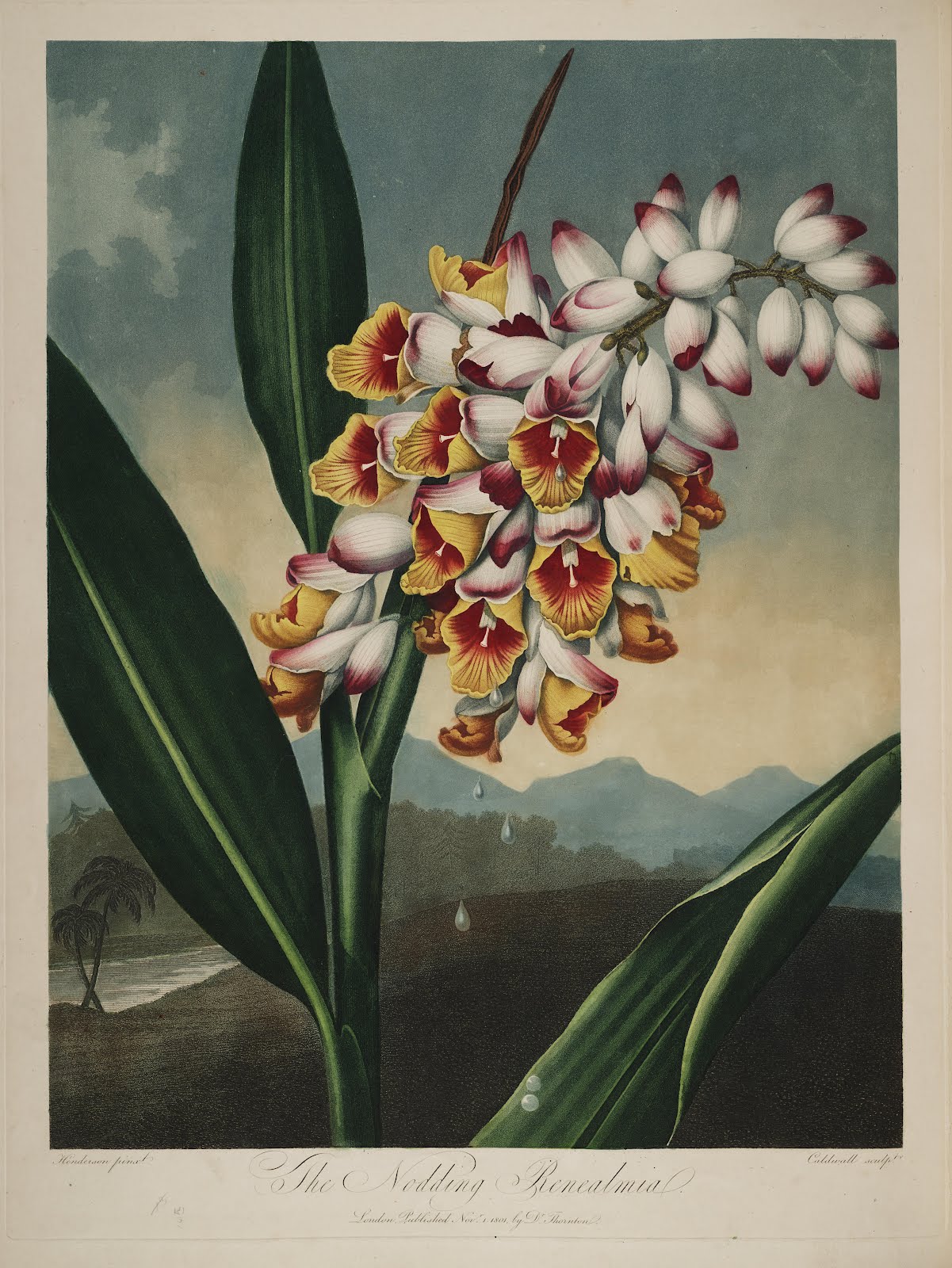
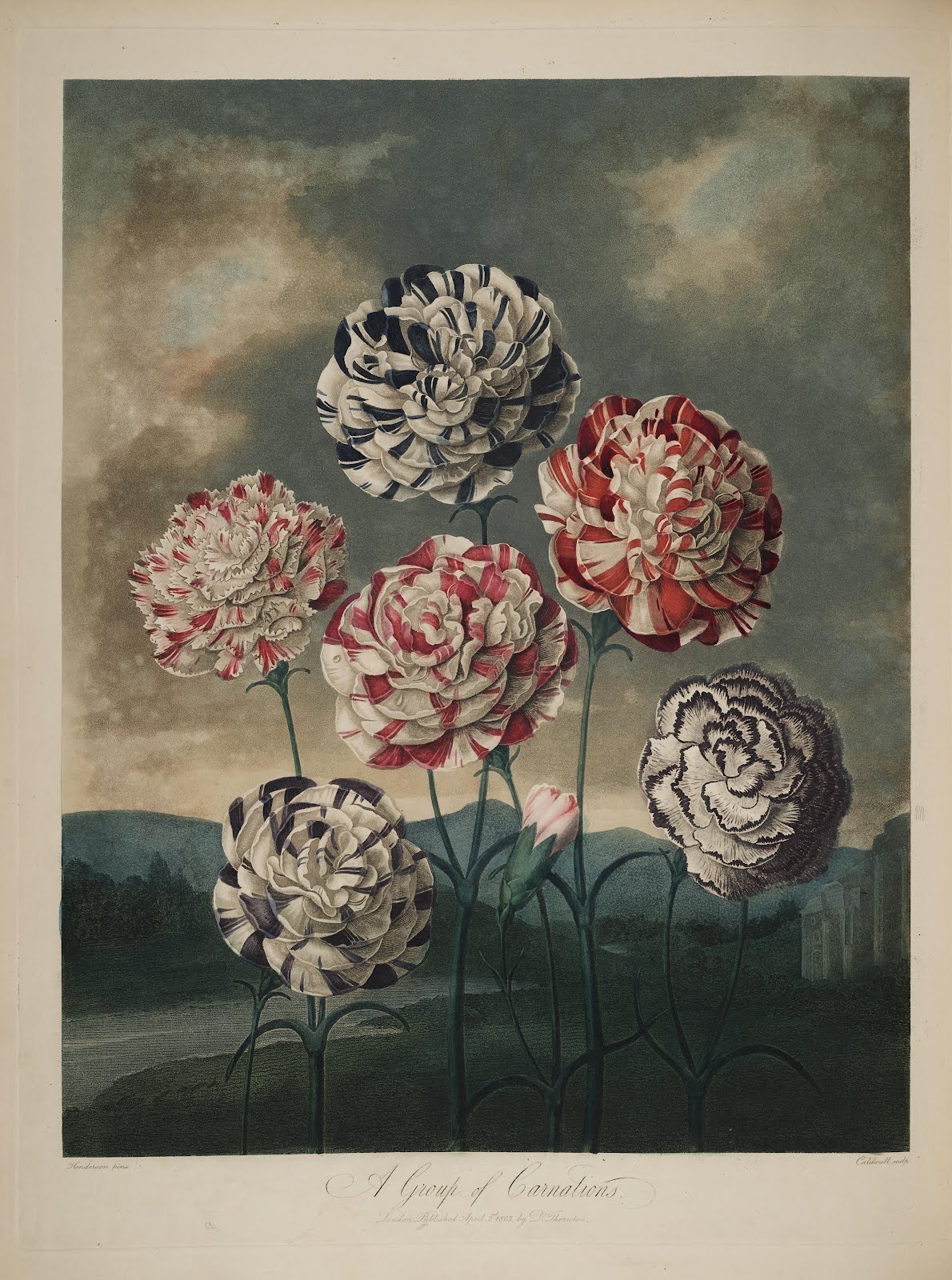
For our Book of the Week this week, we’re featuring one of the classics from our iTunes U collection Floral Mania, which consists of some of the most beautiful and unusual illustrations of flowering plants in BHL. Today, we present New Illustration of the Sexual System of Carolus von Linnaeus: and the Temple of Flora, or Garden of Nature (1807), by Robert John Thornton.

View Full Size Image

Robert John Thornton was an English physician and botanical writer. After hearing Thomas Martyn’s lectures on botany and Linnaeus, he decided to practice medicine rather than his previously-chosen profession in the church. He worked and lectured in medical botany at Guy’s Hospital in London, and at the end of the eighteenth century began working on his ambitious project New Illustration of the Sexual System of Carolus von Linnaeus.

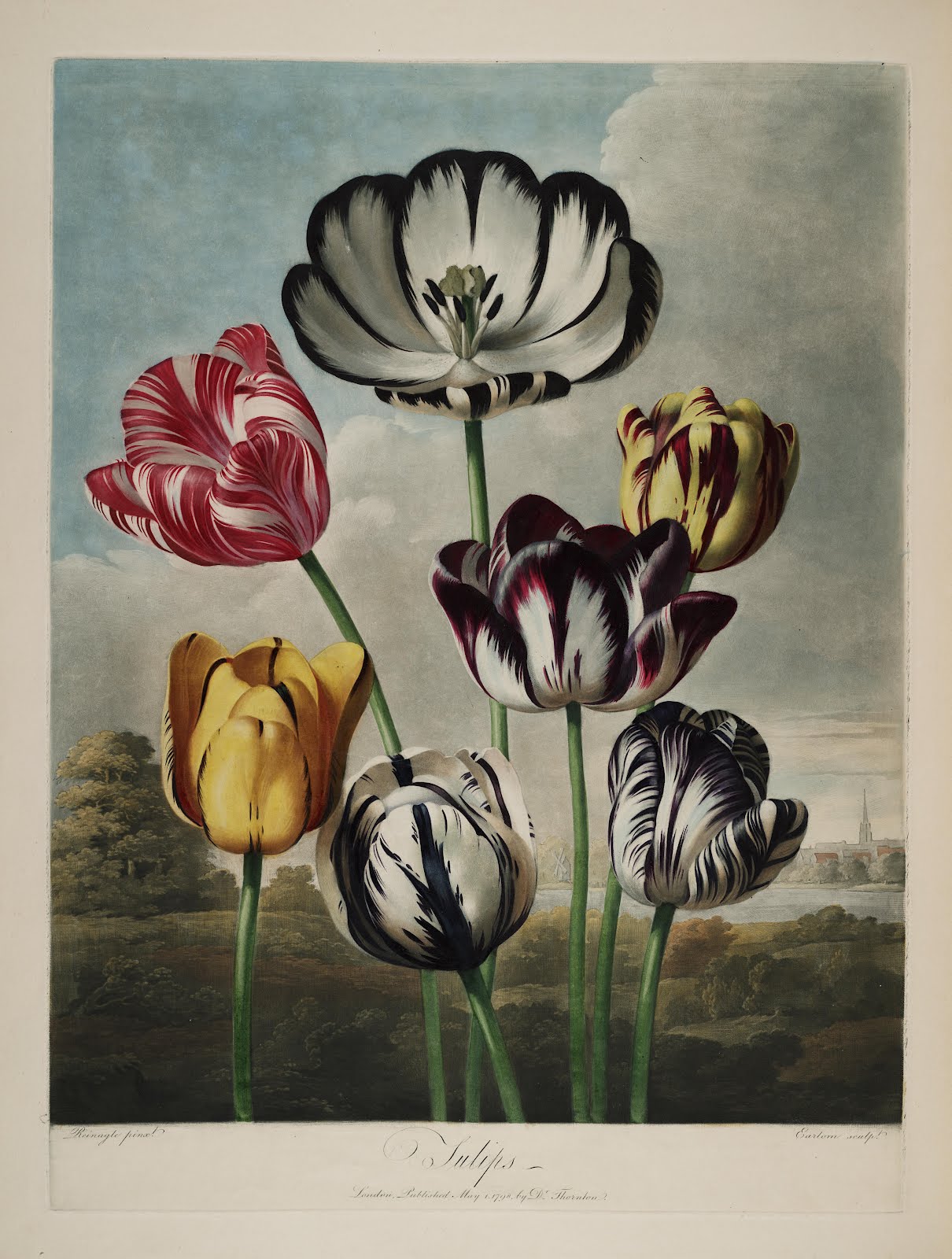
New Illustration of the Sexual System of Carolus von Linnaeus is a three-part work, the third part (Temple of Flora) of which was intended to have seventy folio-sized plates. Work on the plates began in May 1798, and the first plates were engraved by Thomas Medland after paintings by Philip Reinagle. The plates were engraved in aquatint, stipple and line.

View Full Size Image
The work, unfortunately, proved to be Thornton’s demise. The expense of the project drained his financial assets, and Thornton was unable to generate significant public interest in the work. To save the project and ensure its completion, a public lottery and a dedication within the work to Queen Charlotte, patroness of botany and fine arts, were ventured, but without success. Only thirty-three colored plates were completed between 1798-1807, and Thornton died in destitution.

It is a tragedy that Thornton’s life ended so sadly when his work is now deemed a remarkable masterpiece. We pay him tribute for the incredible achievements of his life and are proud to feature just a few of the stunning illustrations from his creation in this post. You can access New Illustration of the Sexual System of Carolus von Linnaeus: and the Temple of Flora, or Garden of Nature (1807) on BHL and within the Floral Mania collection of iTunes U, both for free of course! See all of the illustrations from this masterpiece on our Flickr account and tell us which is your favorite.

View Full Size Image

February 9, 2012by michelle.underhill

Help Support BHL

BHL's existence depends on the financial support of its patrons. Help us keep this free resource alive!

search

About BHL

The Biodiversity Heritage Library (BHL) is the world’s largest open access digital library for biodiversity literature and archives. BHL operates as a worldwide consortium of natural history, botanical, research, and national libraries working together to digitize the natural history literature held in their collections and make it freely available for open access as part of a global “biodiversity community.”

Join Our Mailing List

Sign up to receive the latest news, content highlights, and promotions.

Subscribe Now

Subscribe to Blog via Email

Enter your email address to subscribe to this blog and receive notifications of new posts by email.

Join 319 other subscribers

Subscribe to Blog Via RSS

Subscribe to the blog RSS feed to stay up-to-date on all the latest BHL posts.

Access RSS Feed

Inspiring Discovery through Free Access to Biodiversity Knowledge.

The Biodiversity Heritage Library makes it easier than ever for you to access the information you need to study and explore life on Earth…for free, anytime, anywhere.


64+ Million Pages of
Biodiversity Literature Online.

EXPLORE

Tools and Services
to Transform Research.

EXPLORE

300,000+
Illustrations on Flickr.

EXPLORE

ABOUT | HARMFUL CONTENT | PRIVACY | SITE MAP | TERMS OF USE