
Biodiversity Heritage Library - Program news and collection highlights from BHL
  • Home
  • News
  • Featured Books
    • All Featured Books
    • Book of the Month Series
    • BHL at 20
  • User Stories
  • Campaigns
    • Fossil Stories
    • Garden Stories
    • Monsters Are Real
    • Page Frights
    • Her Natural History
    • Earth Optimism 2020
  • Tech Blog
  • Visit BHL
Home
News
Featured Books
    All Featured Books
    Book of the Month Series
    BHL at 20
User Stories
Campaigns
    Fossil Stories
    Garden Stories
    Monsters Are Real
    Page Frights
    Her Natural History
    Earth Optimism 2020
Tech Blog
Visit BHL
  • Home
  • News
  • Featured Books
    • All Featured Books
    • Book of the Month Series
    • BHL at 20
  • User Stories
  • Campaigns
    • Fossil Stories
    • Garden Stories
    • Monsters Are Real
    • Page Frights
    • Her Natural History
    • Earth Optimism 2020
  • Tech Blog
  • Visit BHL
Biodiversity Heritage Library - Program news and collection highlights from BHL
Blog Reel, Featured Books

Guess Whose 228th Birthday is Today?

View Full Size Image
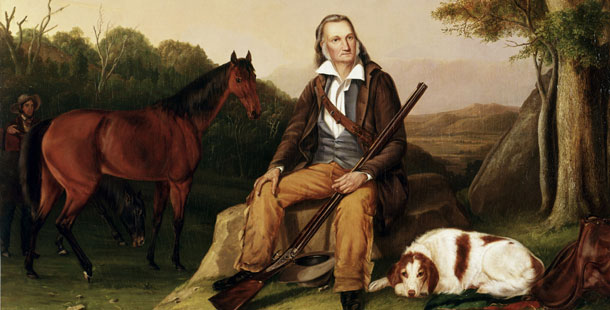
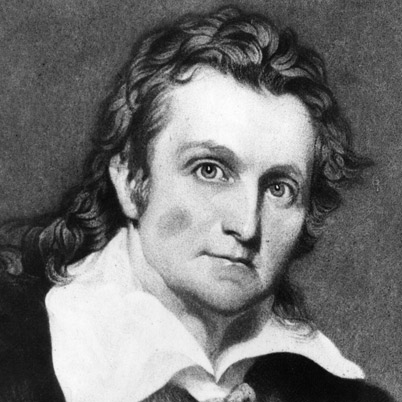
John Woodhouse Audubon, John James Audubon (1785-1851). Oil on linen.

It’s time to take a break from work and celebrate John James Audubon’s Birthday with the BHL! This was the man who is best remembered for his masterpiece Birds of America which is arguably the most prized Natural History work in existence. Just last year, the Smithsonian successfully digitized their entire set of all 435 copperplate etchings that contain 1,065 life-size birds representing around 500 species. Audubons’ birds are now available to be enjoyed and freely downloaded by all.

Book of the week: The Birds of America by J. Audubon

Audubon, the man, has been immortalized in history books as a larger than life figure. His life-story transcends the typical ins and outs of human existence and mirrors more closely a Romantic era novel extolling the promise of the American dream. His story follows the monomyth plot, i.e. the “Hero’s Journey”, that we readers so delightfully relish in: French man is born of low-birth (his father’s illegitimate child), called forth to adventure in the New World, undergoes a series of challenges and failures, overcomes a terrible rock-bottom, only to become wildly successful overnight and live happily ever after as a legendary ornithologist and illustrator, retiring on his wildlife sanctuary estate in America. Last year’s Audubon birthday post covered some really important biographical details and is definitely worth a read. However, this year we decided to scrounge-up some lesser-known juicy tidbits to humanize this incredibly famous bird lover. He may have been one of America’s great men, but he was also just like you and I. Well, sorta.

Lesser Known Facts About Audubon
View Full Size Image
Laforest, the Popinjay

Audubon might have had better hair than you

Audubon was extremely handsome in his youth. And he knew it. He actually refers to himself as a “popinjay” in his journals. He and everyone else were particularly enamored with his hair: “My locks flew freely from under my hat, and every lady that I met looked at them and then at me until – she could see no more.” We have to admit his hair was pretty fantastic and in no portrait of him is it ever seen shorn. Long hair, don’t care!

Audubon had a secret codename

It was “Laforest.” Okay, maybe it wasn’t a secret codename but rather his second middle name that always gets dropped-off when people refer to him. Only his father and his wife ever called him by this name. In a letter to a Mrs. Rathbone in 1827 he writes, “My name is John James Laforest Audubon. The name Laforest I never sign except when writing to my wife, and she is the only being, since my father’s death, who calls me by it.” Evidently the name held sacred meaning for Audubon’s most dearly beloved.

Audubon was jailed how many times? 

Three times that we were able to count, maybe more. Audubon was notoriously poor at managing his finances and was arrested for financial hardships and debts in the years of 1819, 1828 and 1833. These dates are according to several biographies that you may read on the BHL, however there may have been even more undocumented arrests. Clearly this man just wanted to chase birds; he certainly wasn’t cut out to be hedge fund portfolio manager — but, aren’t we all rather glad of it?

Rats not jail-time were the cause of Audubon’s “rock-bottom”

Rats you say? Yes, the years between 1815-1820 were a very inactive period for Audubon in regards to ornithological endeavor. He pretty much turned his back on birds entirely. Many speculate that he gave-up on his dream for a time after he left hundreds prints in the care of a relative that remains unknown to this day. While his illustrations were in this relative’s care, rats had decided to nest and make their new family using the box that held Audubon’s bird illustrations as the material for their new home. Upon returning from a business trip, John James found his watercolor masterpieces shredded to bits. Naturally, he was crushed at the site of the ruined heap which represented thousands of observation and illustration hours in the field. Audubon needed a period of mourning, weeping, and insomnia before he resurfaced years later with the most incredible illustrations of birds the world had ever seen. Call him the comeback kid!
View Full Size Image
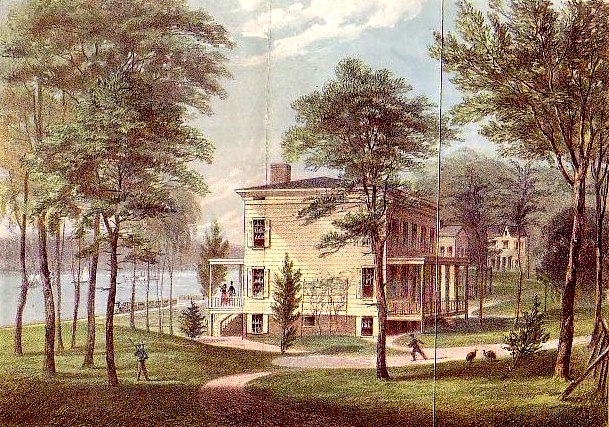
“Minnie’s Land”

Where did this adventurous fellow call home?

Believe it or not you can still visit Audubon’s home even though it was levelled in 1931 by a developer after it was deemed irreparable. Where? Online, of course. “Minnie’s Land” was Audubon’s final American home and it was located just outside of New York City along the Hudson at 155th and 156 Streets just west of Riverside Drive.

Historical price tag for Birds of America

The original cost of the double-elephant folio work of life- sized birds was $1000 for the entire subscription series. This was an exhorbitant amount at the time (1838) but, considering that the work sold at an auction in December 2010 for a record-breaking 11.5M, its original price seems like a bargain. According to Audubon he believed there to be about 175 copies of Birds of America in existence and that around 80 were in America. It’s speculated that 119 complete sets have survived.

Audubon was a man of many talents

Besides being a walking bird encyclopedia, Audubon was a great dancer, marksman, fencer, musician, horseman, basket weaver, and of course quite the lady killer

Birds of America That Are Now Extinct

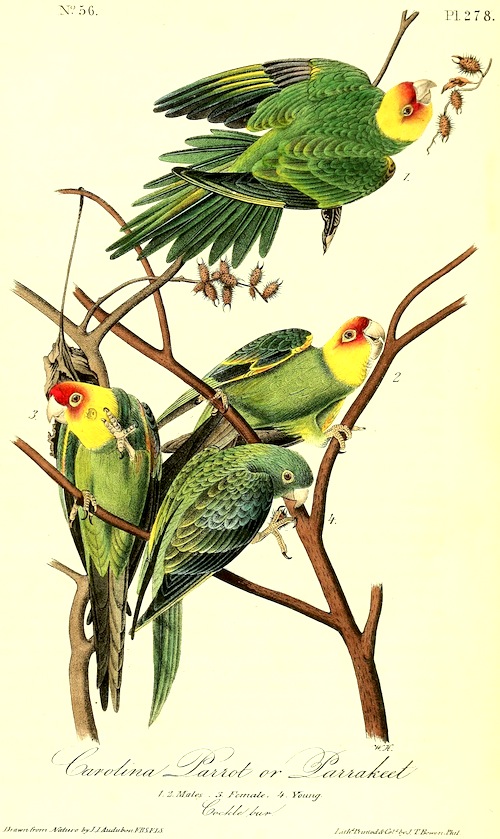
By the time Audubon was finishing his masterpiece he began to notice a decline in bird populations. Once an avid hunter, like Teddy Roosevelt, he quickly changed his tune and became a champion of conservation. In his writings, he often laments about decreasing species populations.  In fact, six species that were alive during Audubon’s time are now considered extinct. Luckily, we have Audubon’s depictions of these birds that once flourished here in America, as they no longer can be observed in wild:
View Full Size Image
Carolina Parakeet = Conuropsis carolinensis (Linnaeus, 1758)

According to Audubon, the Carolina Parakeet was an avid fruit eater and thus found itself a favorite target for angry farm owners.

View Full Size Image
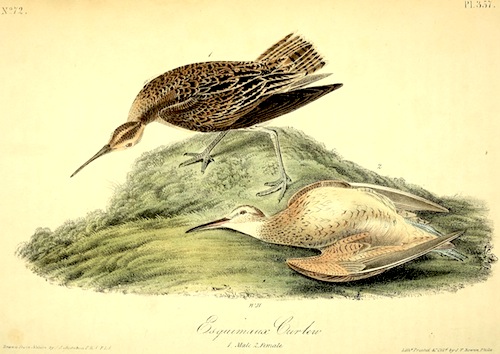
Eskimo Curlew = Numenius borealis (J. R. Forster, 1772)

Also called the “Dough Bird,” because these birds were known to engorge themselves on their favorite foods:  grasshoppers and berries. These sea-shore dwelling birds thus became the favorite meal of hunters.

 
View Full Size Image
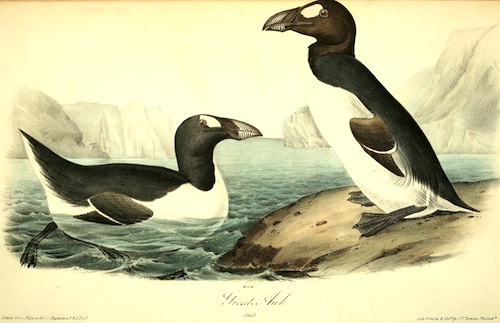
Great Auk = Pinguinus impennis (Linnaeus, 1758)

Of these six extinct bird species, the Auk is one that Audubon never actually was able to observe in the field. Their populations had already dwindled to near extinction in his time. 

View Full Size Image
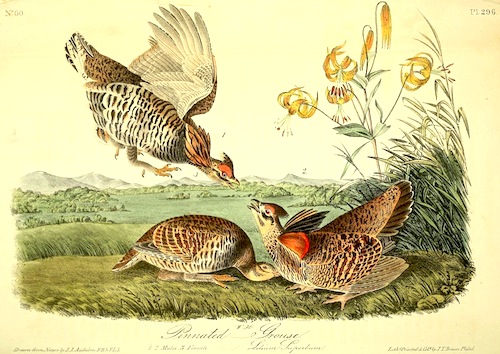
Pinnated Grouse = Tympanuchus cupido (Linnaeus, 1758)

Audubon’s first observation of the Pinnated Grouse came 25 years before the publishing of Birds of America. He remarked in his accounts that once this species was incredibly common to see and was somewhat shocked at how quickly it was being driven to extinction. Some sub-species of this hen are still in existence so there is still some hope that they won’t be completely wiped-out.

View Full Size Image
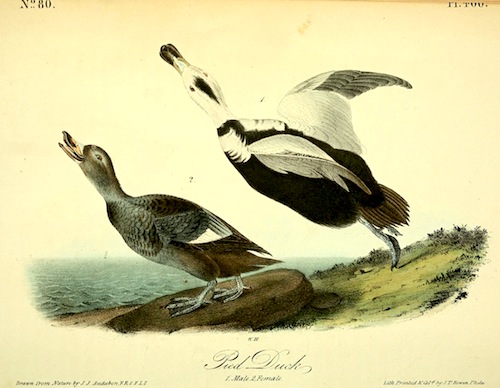
Pied Duck or Labrador Duck = Camptorhynchus labradorius (Gmelin, 1789)

According to hunters, this duck tasted bad and causes for their extinction remains a bit of mystery. Always a rare species, many speculate that a decline in their food supply of mollusks and mussels accounts for their eventual disappearance.

View Full Size Image
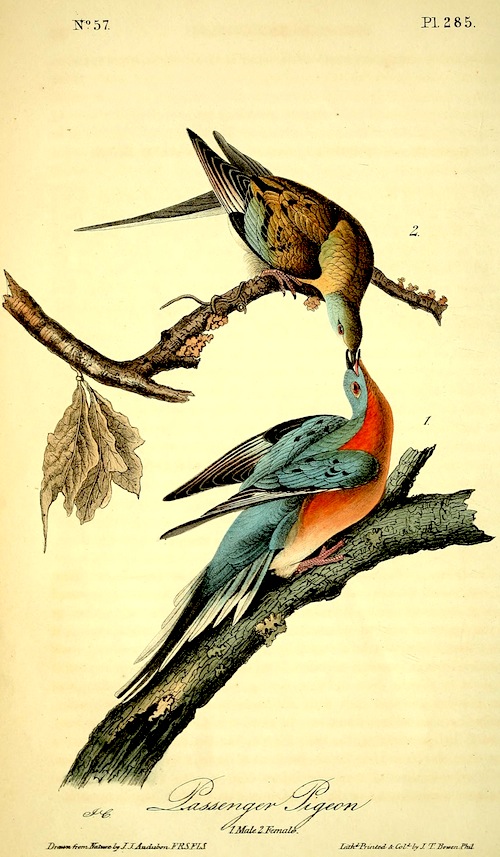
Passenger Pigeon = Ectopistes migratorius (Linnaeus, 1766)

The passenger pigeon was one of America’s most amazing birds. Audubon calculated that they could travel between 300-400 miles in six hours which is almost a mile a minute. This means that the Passenger Pigeon would be able to travel from America to Europe in less than three days!

View all of Audubon’s engravings @ Biodivlibrary’s Flickr! Free downloads!

While it is very unfortunate that these six bird species no longer exist on this planet, there is still much YOU can do as a citizen scientist to save Audubons’ birds of America that are on the endangered species list. These species include the Californian Condor, Bachman’s Warbler, Red-cockaded Woodpecker, and the Whooping Crane.

Ornithologists and birders should take pause today to remember our dear Laforest, who like so many Nature lovers often looked to escape everyday life and venture deep into the wilderness in search of the sublime:

“Thus almost every day, instead of going to school when I ought to have gone, I usually made for the fields, where I spent the day ; my little basket went with me, filled with good eatables, and when I returned home, during either winter or summer, it was replenished with what I called curiosities, such as birds’ nests, birds’ eggs, curious lichens, flowers of all sorts, and even pebbles gathered along the shore of some rivulet” – Audubon and His Journals (1899)

Audubon, will be remembered as man who was adventurous, fearless, passionate, and incredibly talented but, also flawed and very human. He had much to teach us about how a life should be lived, reminding us that while we are given a short time here on this Earth we must make the most of it. He was man who lived in his work and his work will live on forever.

Birder Links

The Academy of Natural Sciences | Audubon Page Turning

The Viviparous Quadrupeds of North America.

New York Historical Society | Audubon’s Aviary

Audubon Society | Citizen Science – Get involved!

Cornell Lab of Ornithology | Citizen Science

BHL Twitter: #Audubon #BirdsOfAmerica

Birds of America | State Bird Database

We hope you enjoyed this post. Interested in guest-blogging for BHL? We’d love that! Natural history, biodiversity and conservation topics are especially welcomed. Email us your ideas at [email protected]
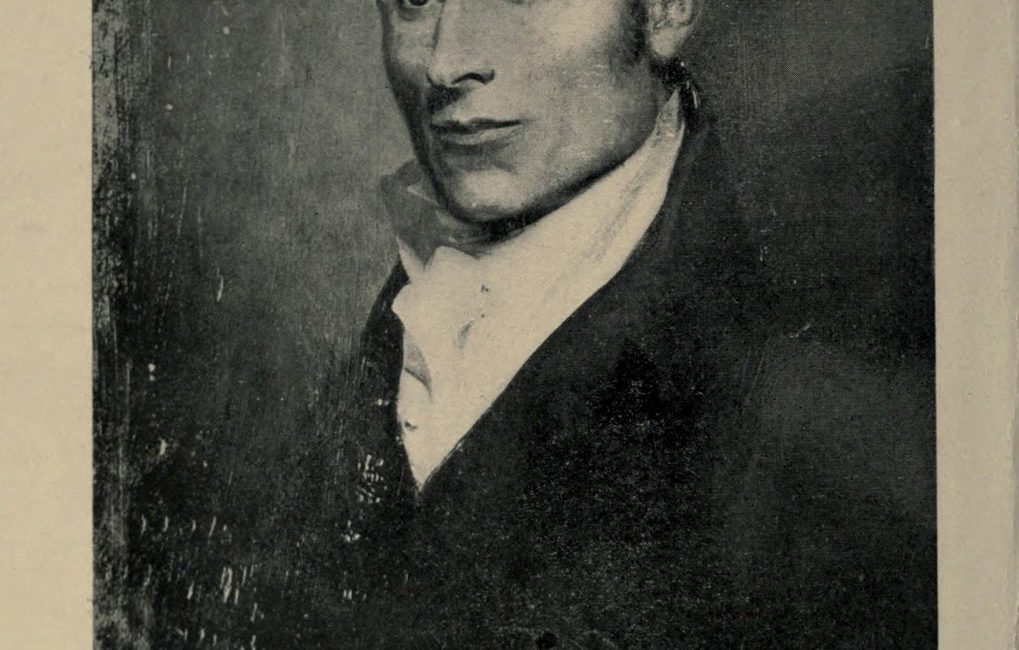
April 26, 2013by BeccaQ_92
Blog Reel, Featured Books

Our Little Town

View Full Size Image
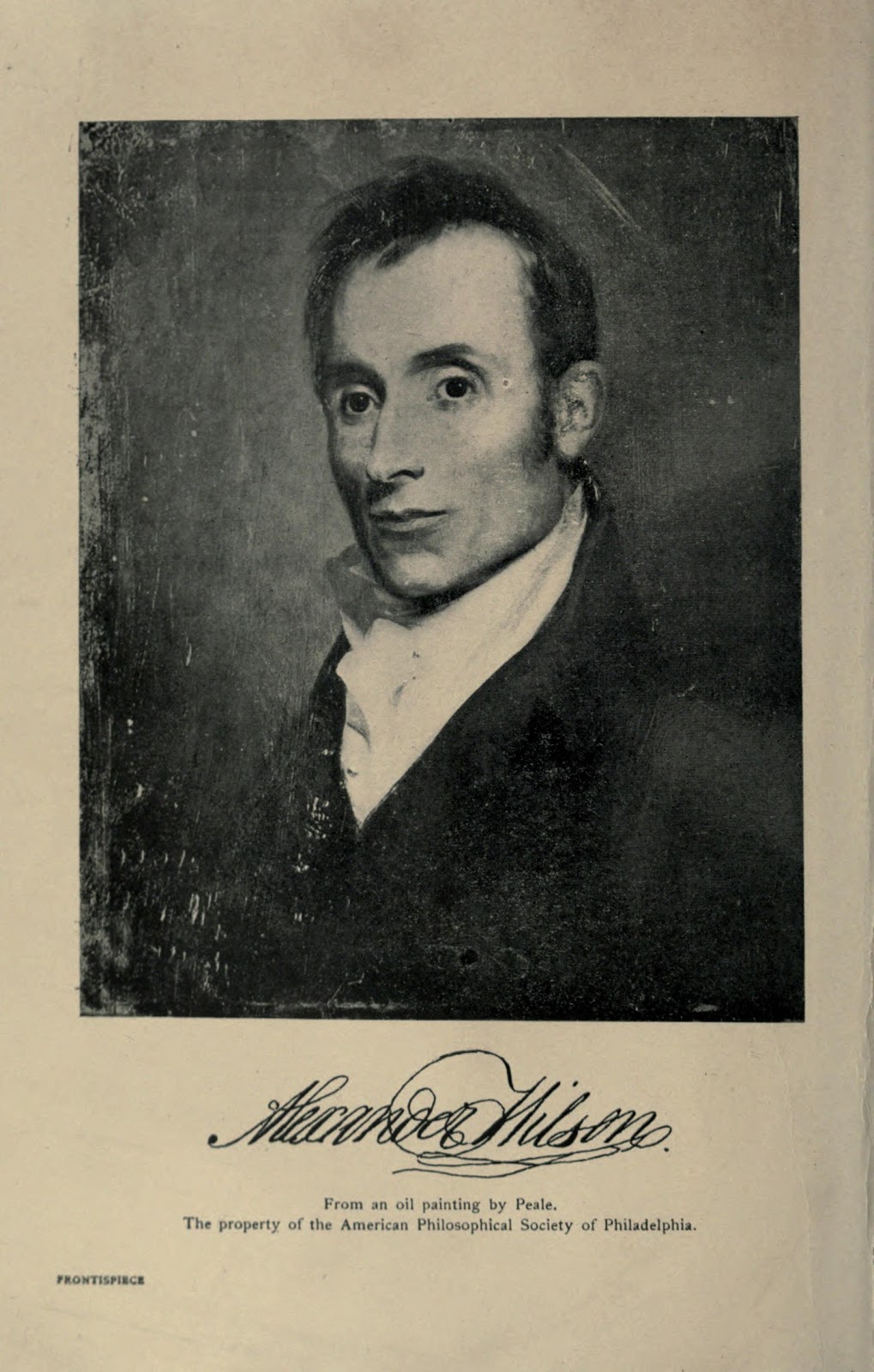
Alexander Wilson

It’s almost a year now since we moved to Bloomfield, and I’m still not over my disappointment at our new New Jersey home’s failure to honor its most distinguished citizen. Not a statue, not a plaque to be found anywhere; and that short boulevard leading to the cemetery turns out, alas, to be named for Woodrow.

Alexander Wilson, the Father of American Ornithology, served as schoolmaster in our little town for a few months in 1801. Wilson’s teaching in Bloomfield was “spirit-sinking, laborious work,” and he doesn’t seem to have found much intellectual stimulus outside the classroom either, complaining in a poem dated August 7 that:

Here bull-headed Ignorance gapes and is courted,
And pale Superstition with visage distorted.
Sweet Science and Truth, while these monsters they cherish,
Like the Babes of the Wood are abandoned to perish.

Wilson got out as soon as he could, and by February 1802 he was back among the sophisticates of Philadelphia.

-*-*-*-

If only he’d managed to stick around.

View Full Size Image

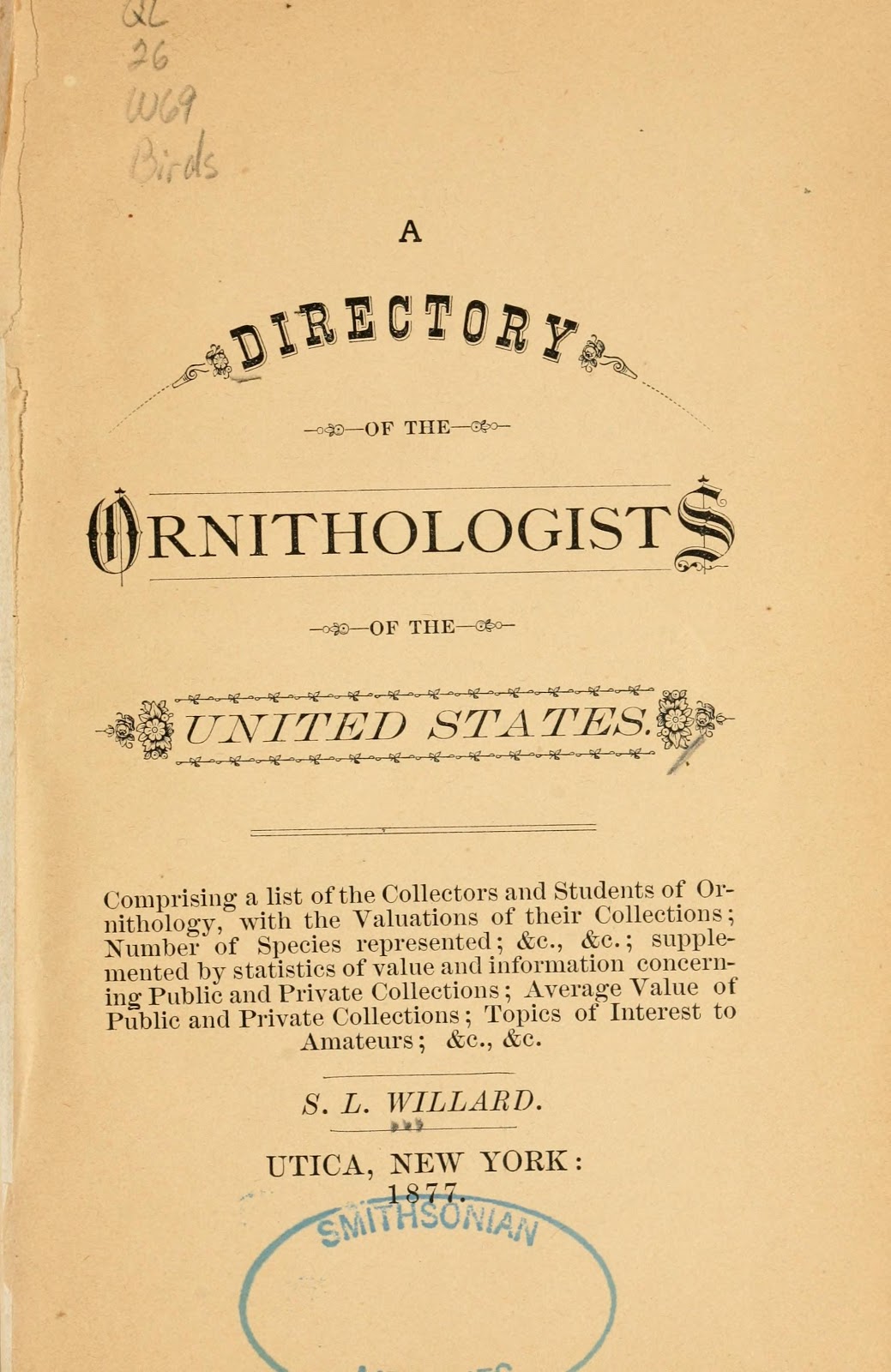
By 1877—sixty-four years after Wilson’s untimely death 200 years ago this August—Bloomfield was a veritable hotbed of ornithological activity. Of the 21 New Jersey amateurs listed in Willard’s Directory of the Ornithologists of the United States, no fewer than four give Bloomfield as their mailing address.

View Full Size Image
William Brewster

All four, admittedly, were small-time collectors.

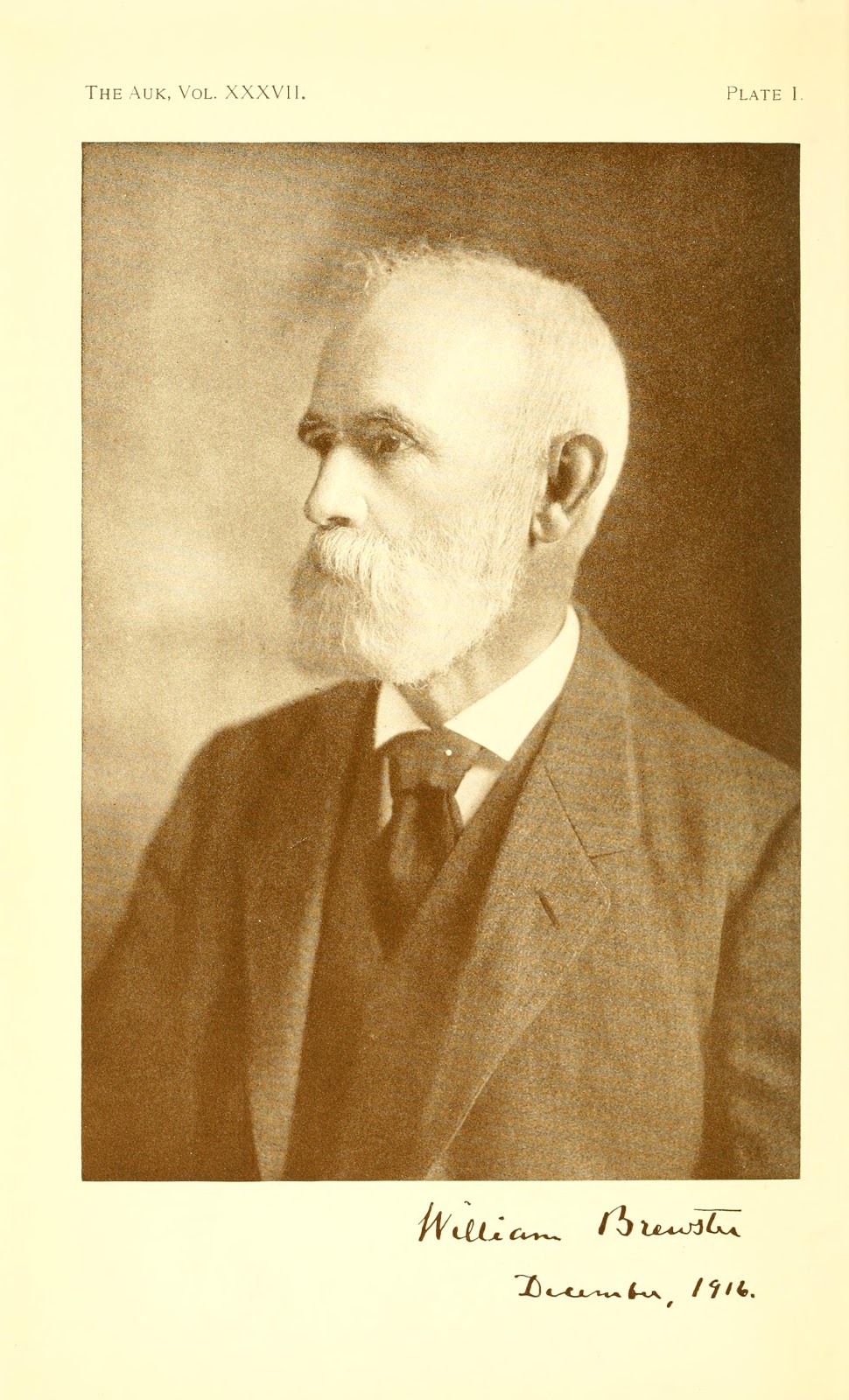
Up in Cambridge, William Brewster’s personal holdings that year comprised 6500 specimens, valued at the enormous sum of $5000. Here in Bloomfield, our colleagues had much smaller collections, each of them containing just a few dozen eggs and none of them worth more than $20.

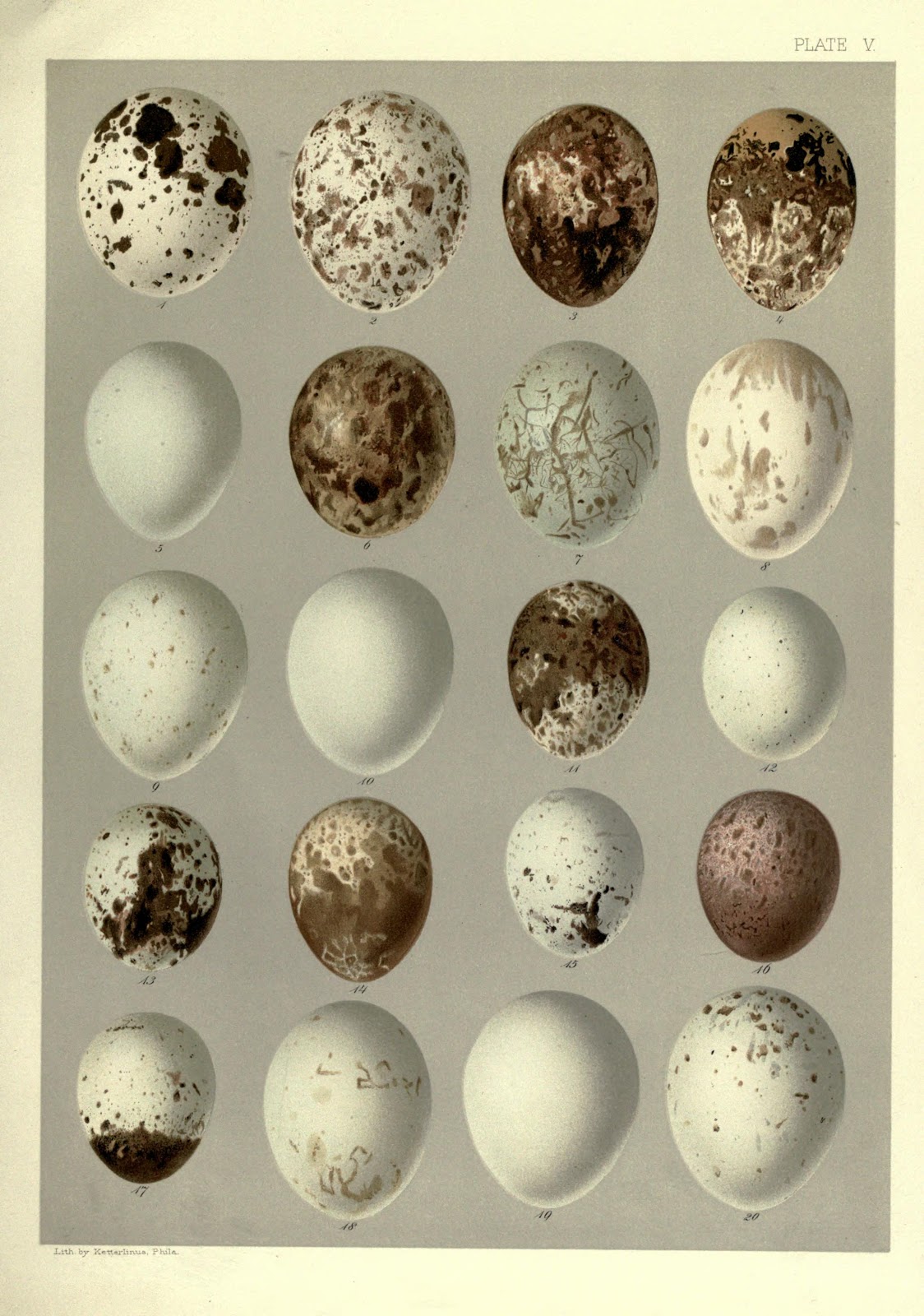
The largest collection in our little town, that belonging to J.L. Adams, held 75 eggs; that makes the average specimen worth a little more than a quarter, the going price a few years later for the shell of a Black Skimmer or a Loggerhead Shrike. The smaller cabinets of Henry D. Davenport, Wm. F. Day, and E.C. Farrand were just as modest, with the average value per egg between twenty and twenty-five cents.

View Full Size Image
Egg plate by John Ridgway from Bendire’s Life Histories

-*-*-*-

None of these Bloomfield Four seems to have left more than a trace in the written record of American birding and ornithology. Their reticence was more than made up for by Bloomfield’s leading ornithologist a generation later, Louis Slidell Kohler.

Kohler’s family was living in Bloomfield by the early 1890s; he seems to have divided his final years—starting around 1919—between Hawthorne and a farm near Paterson, where he died sometime after 1926.

Kohler began his bird studies in Bloomfield, exploring a twenty-acre farm near his house that he called “The Haunt.” He applied for membership in the Cooper Ornithological Club in 1909, and was elected an associate member of the American Ornithologists’ Union in 1910. His notes, lists, and essays appeared over the years in the Auk, the Wilson Bulletin, and the Oologist. Unlike the earlier Bloomfieldians, and refreshing for his generation, Kohler does not seem to have been much of a collector; his published articles report on the birds observed—not shot and stuffed—on his “jaunts” and “tramps” through what was still the countryside of northern New Jersey.

View Full Size Image
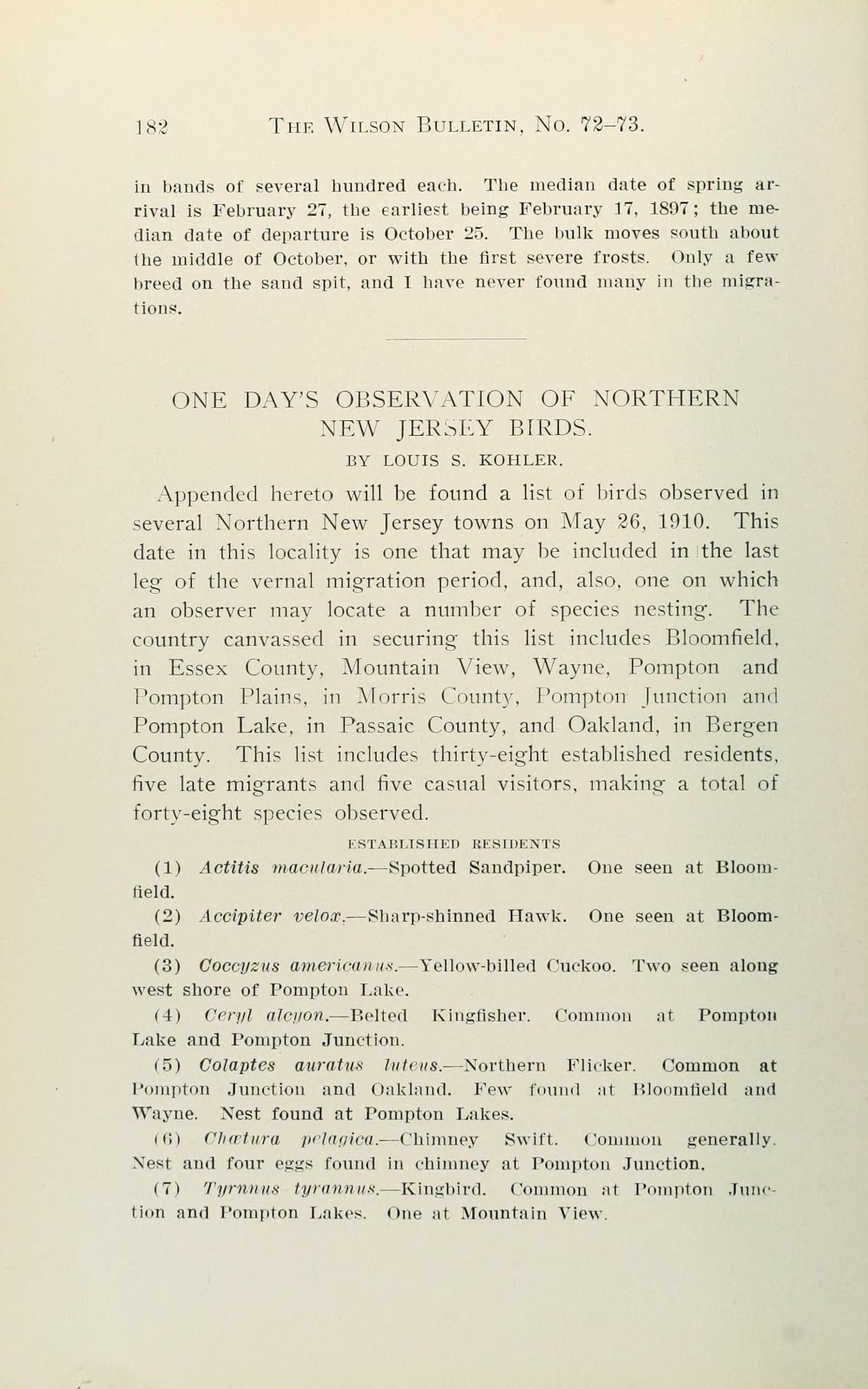
Kohler’s observations in The Wilson Bulletin

Kohler’s publications include documentation of range expansions, winter irruptions, and notable migration events. Like most of us, he made the occasional error, as when he reported the nest of a Wilson’s Warbler in New Jersey—dismissed, almost certainly correctly, by the editor of the Auk as “a case of mistaken identity.”

-*-*-*-

View Full Size Image
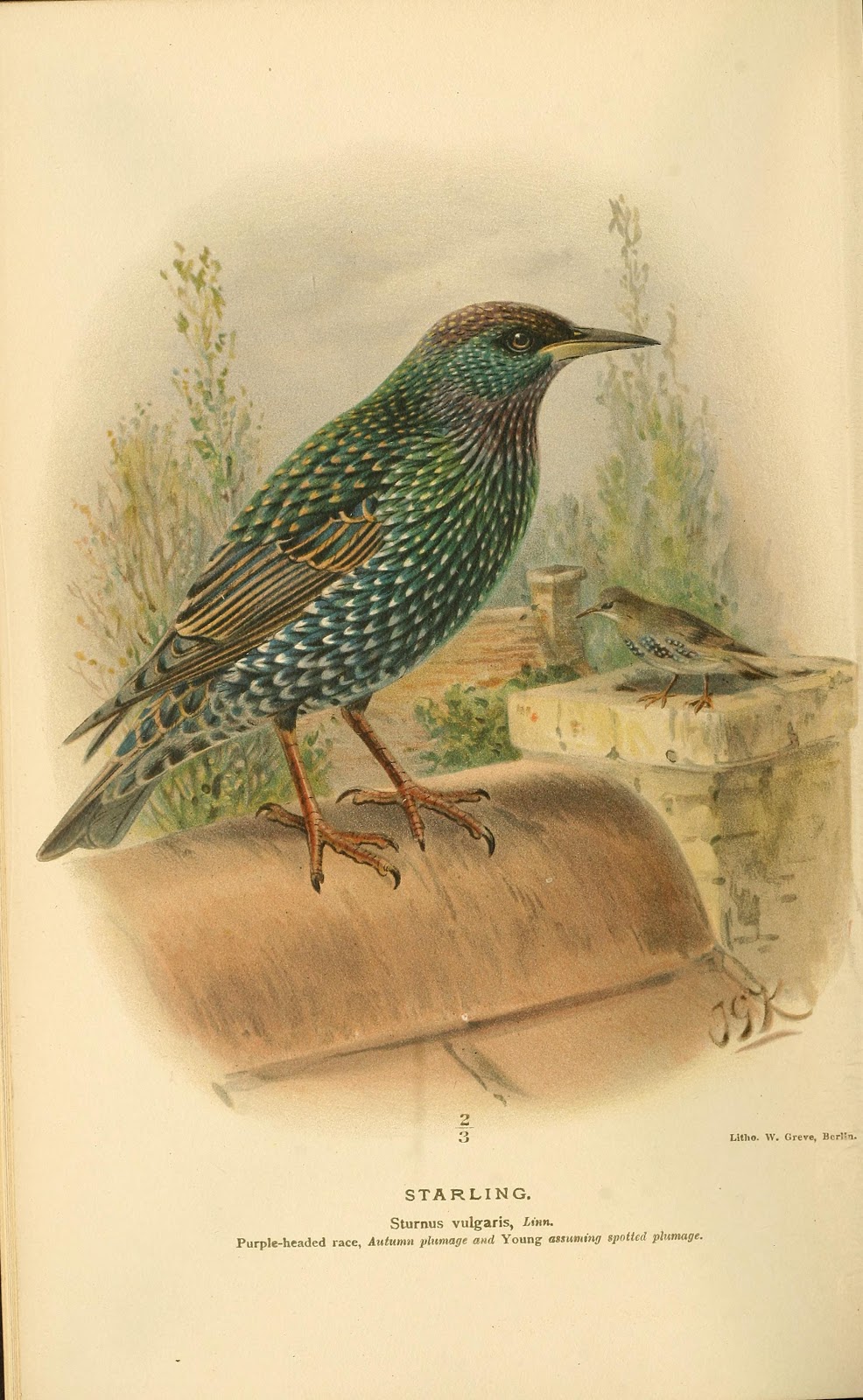
Starling

In the spring of 1903, Louis Kohler put Bloomfield firmly on the ornithological map with his sighting of a flock of fifteen European Starlings “in the neighborhood of a refuse pile on a farm”—probably “The Haunt.” The birds lingered until July, conspicuous for “their odd gyrations while in the air and methods of alighting on the ground.” When the flock returned the following March, it had grown to 200 birds, which soon “broke up into pairs and began seeing nesting places…. in cupolas, on station poles of the telephone companies and in deserted woodpecker nest holes.” Soon enough, starlings were ejecting Northern Flickers, Eastern Bluebirds, and other birds from their nests, and Kohler was “almost convinced that the time is not far off when they will become as obnoxious as the omnipresent [House Sparrow] is to us now.”

He was right.

In August 1911, Robert Barbour—himself a member of the Cooper Club and of the AOU—described in the pages of the New York Times a flock of 60,000 starlings, House Sparrows, Common Grackles, and American Robins roosting on Bloomfield Avenue just across the Montclair line.

What with the excrement of the birds, the feathers that they shed, and the leaves that they dislodged, sidewalks and piazza steps would be like a poultry yard or worse. The odor, I am told, at times made it unpleasant to use the piazzas in the evening, and those going out in the evening found it desirable to walk in the middle of the street in the interest of personal cleanliness.

Violence was inevitable. On August 30, Peter Stevens, “was arraigned before Justice of the Peace Cadmus of Bloomfield, [for] shooting five starlings” two weeks earlier. The charges had been brought by State Game Warden Frederick J. Hall of Bloomfield, and the City of Montclair wasted no time in issuing a formal denial that it had in any way authorized the shootings. Stevens, “a colored man in the employ of the Montclair Street Department,” was fined the exorbitant sum of $100—$20 a bird. Stevens could not pay, and was jailed for two days.

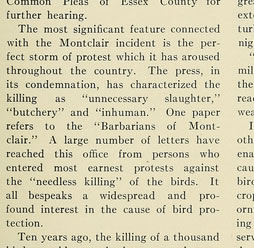
To its great credit, Montclair stepped up at the end of those two days and filed an appeal on Stevens’s behalf, arguing that the confession he signed had been obtained in an “irregular” fashion. How the case was concluded, and how the dynamics of race, social standing, and urban rivalry were finally played out, I do not know. Montclair swore to take its defense of Stevens to the Supreme Court if necessary, though public opinion was clearly against him, as shown by the scores of letters from all parts of New Jersey asking that the persons responsible for the killing of the birds be prosecuted to the full extent of the law.

View Full Size Image
Pearson on Peter Stevens’s Starlings

Gilbert Pearson, reviewing the matter in Bird Lore, took satisfaction in the affair as evidence of the rapidly increasing refinement of sentiment that comes with advancing civilization. It is a most positive fact that, the more cultured the community, the greater the esteem in which the wild bird is held.

Even starlings.

-*-*-*-

It’s easy to feel like a pioneer in a new place, as if everything new to us is, simply, new. How much richer the experience of novelty, though, when we realize that there is a past behind us, a past inhabited by the rightly famous, the nearly unknown, and the unjustly notorious. That is just the sort of knowledge that can help make any little town into our little town.

We hope you enjoyed this post. Interested in guest-blogging for BHL? We’d love that! Natural history, biodiversity and conservation topics are especially welcomed. Email us your ideas at [email protected].

February 7, 2013by ulib-libraryjobs
Blog Reel, Featured Books

Things That Go Burp In the Night

 A Tribute to the Nighthawk and “Whip-poor-will”

Imagine away the accumulated knowledge of the past 250 years. Forget that there is such a thing as a field guide. Let google vanish from memory.

And put yourself into the forest primeval of southeastern North America on a warm summer night in the middle of the eighteenth century. Above the rasping of the cicadas and the creaking of the tree crickets, beyond the yowls and hoots and delicate whistles of the owls, you hear the strange syncopated whistles of what has to be a bird.

But which one?

The first scientific attempts to sort out the disembodied voices of the American night were made three centuries ago by Mark Catesby, the great English natural historian who spent the years 1712 to 1719 traveling through the American wilds from Virginia to the Bahamas.

View Full Size Image
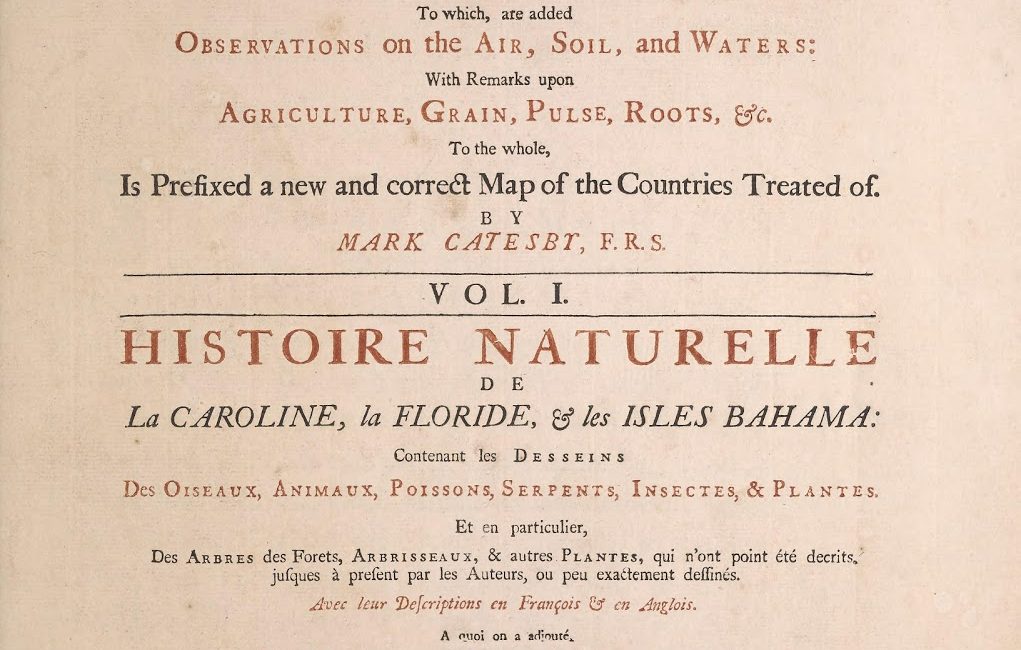
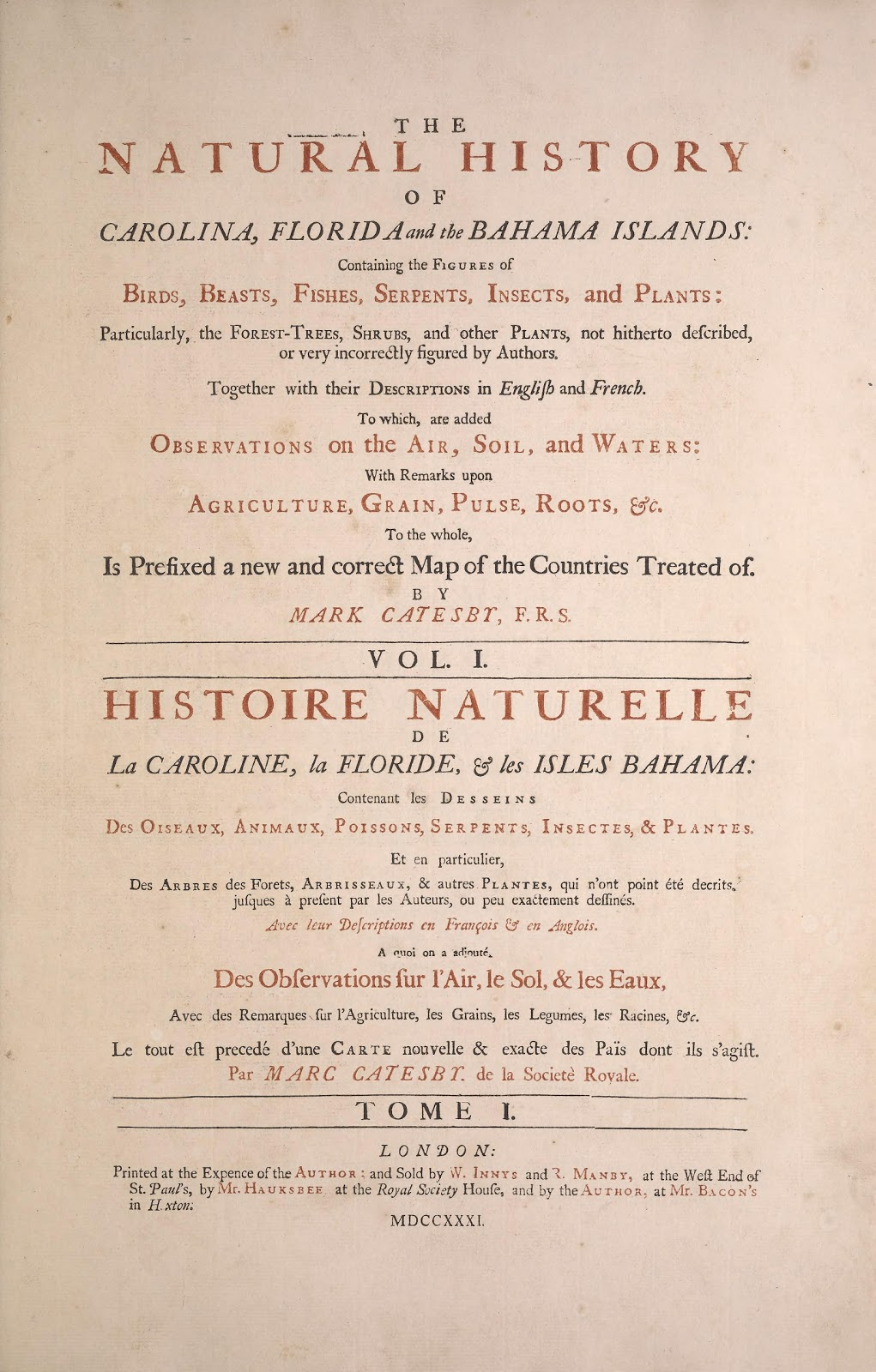
Catesby’s Natural History

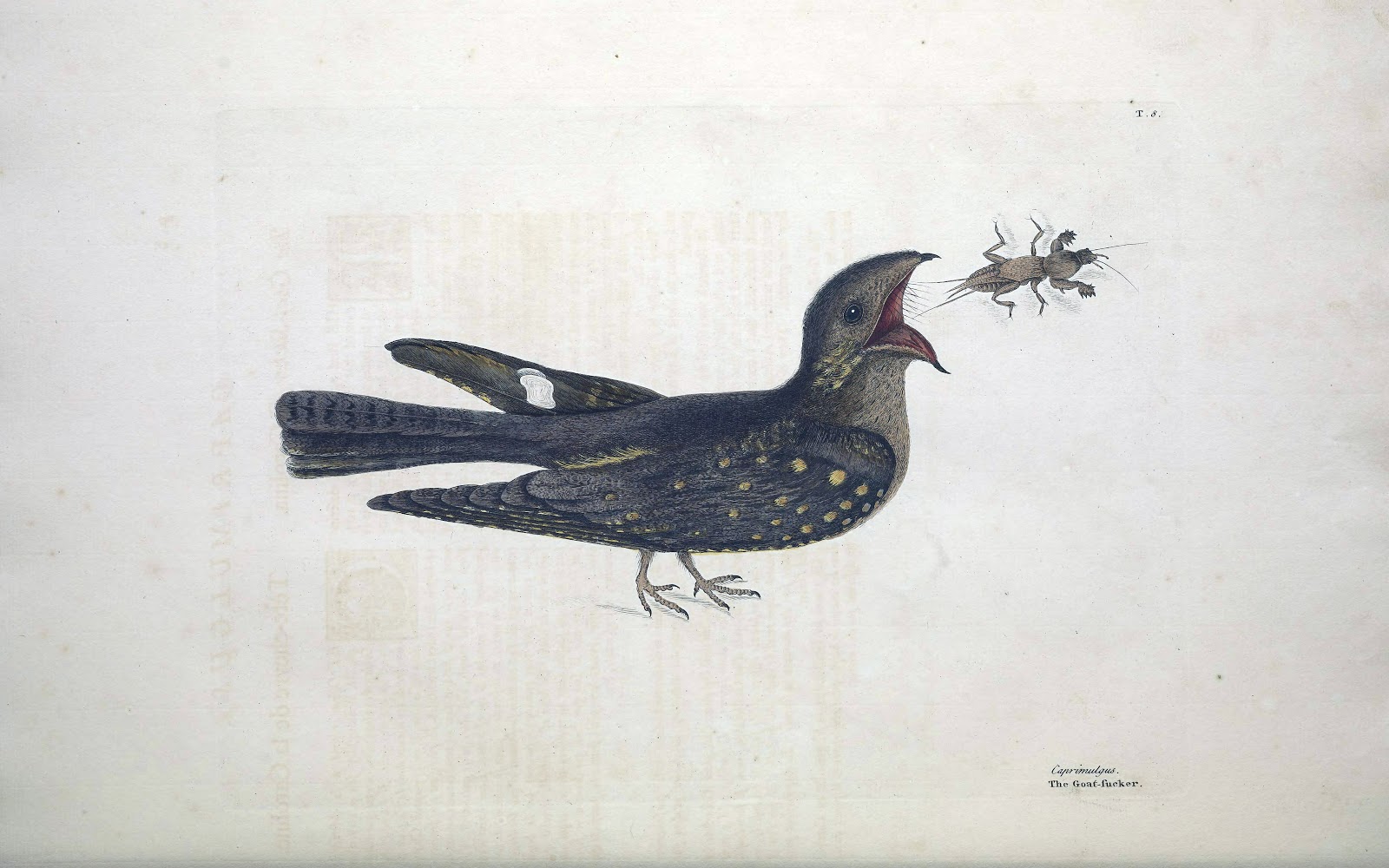
In the published account of his explorations, The Natural History of Carolina, Florida and the Bahama Islands, Catesby reports a bird he names The Goat-Sucker of Carolina; the painting shows a brown, vaguely spotted bird standing on the ground, its grotesquely huge mouth agape and about to swallow a mole cricket.

View Full Size Image
The Goat-Sucker of Carolina

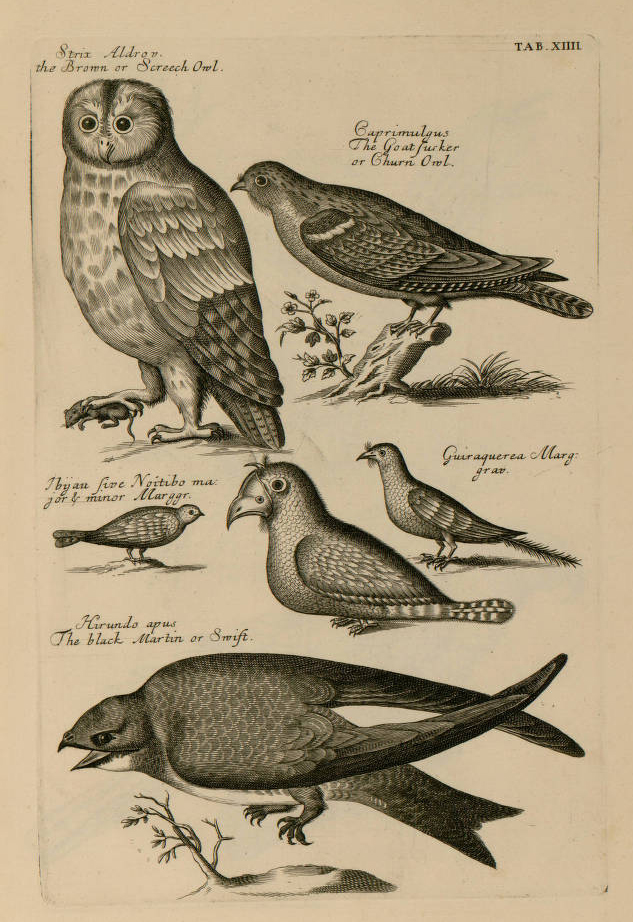
Says Catesby, “this Bird agrees with the description of that in Mr. Willoughby … of the same name, except that this is somewhat less” than the 10 or 12 inches Francis Willoughby gives as the length of his, the European, goat-sucker.

View Full Size Image
The Goat-Sucker from Willoughby’s Ornithologiae

Catesby’s American bird is “very numerous,” he writes, and in Virginia and Carolina people call it the “East India Bat.”

View Full Size Image
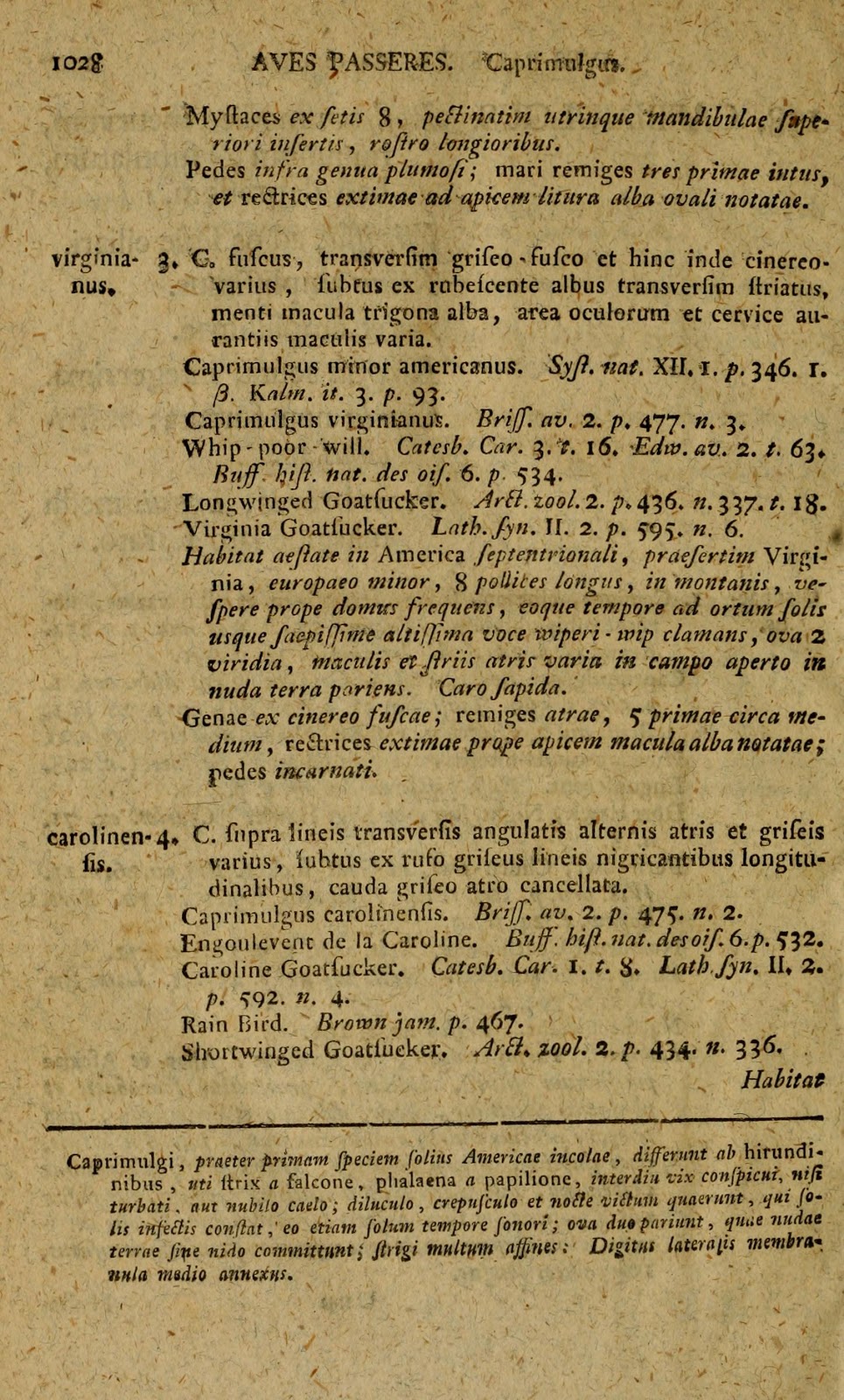
Caprimulgus carolinensis

Seventy years after Catesby’s return to England, in his thirteenth edition of the Systema naturae, Johann Friedrich Gmelin gave Catesby’s goatsucker its definitive Latin description and a formally correct Linnaean binomial, Caprimulgus carolinensis.

Absent an early specimen, Catesby’s painting serves as the type of the species, which is now assigned to the genus Antrostomus and known in English by the echoic name Chuck-will’s-widow.

Only trouble is, neither Catesby nor Gmelin actually describes a Chuck-will’s-widow. Here Catesby, on the sounds produced by his Goat-Sucker of Carolina:

Their Note is only a screep; but by their precipitating and swiftly mounting again to recover themselves from the ground, they make a hollow and surprizing noise …. like that made by the wind blowing into a hollow vessel….

And here Gmelin, on the wing pattern of his Caprimulgus carolinensis:

The flight feathers of the wing are marked with black and gray bars, with yellow dots on the outer vanes; the three first flight feathers of the wing are marked on the inner vanes with a large white spot.

This is obviously a reference to the odd oblong white patches visible on the underside of the left wing in Catesby’s painting—patches that, together with Gmelin’s plumage description and Catesby’s account of the bird’s voice, make it evident that both the Goat-Sucker of Carolina and Caprimulgus carolinensis in fact originally name, at least in muddled part, not the Chuck-will’s-widow but the Common Nighthawk, a familiar but sadly declining species in eastern North America, identified by the white bar across its outermost primaries and the whooshing, whirring boom made by its wingtips in a dive.

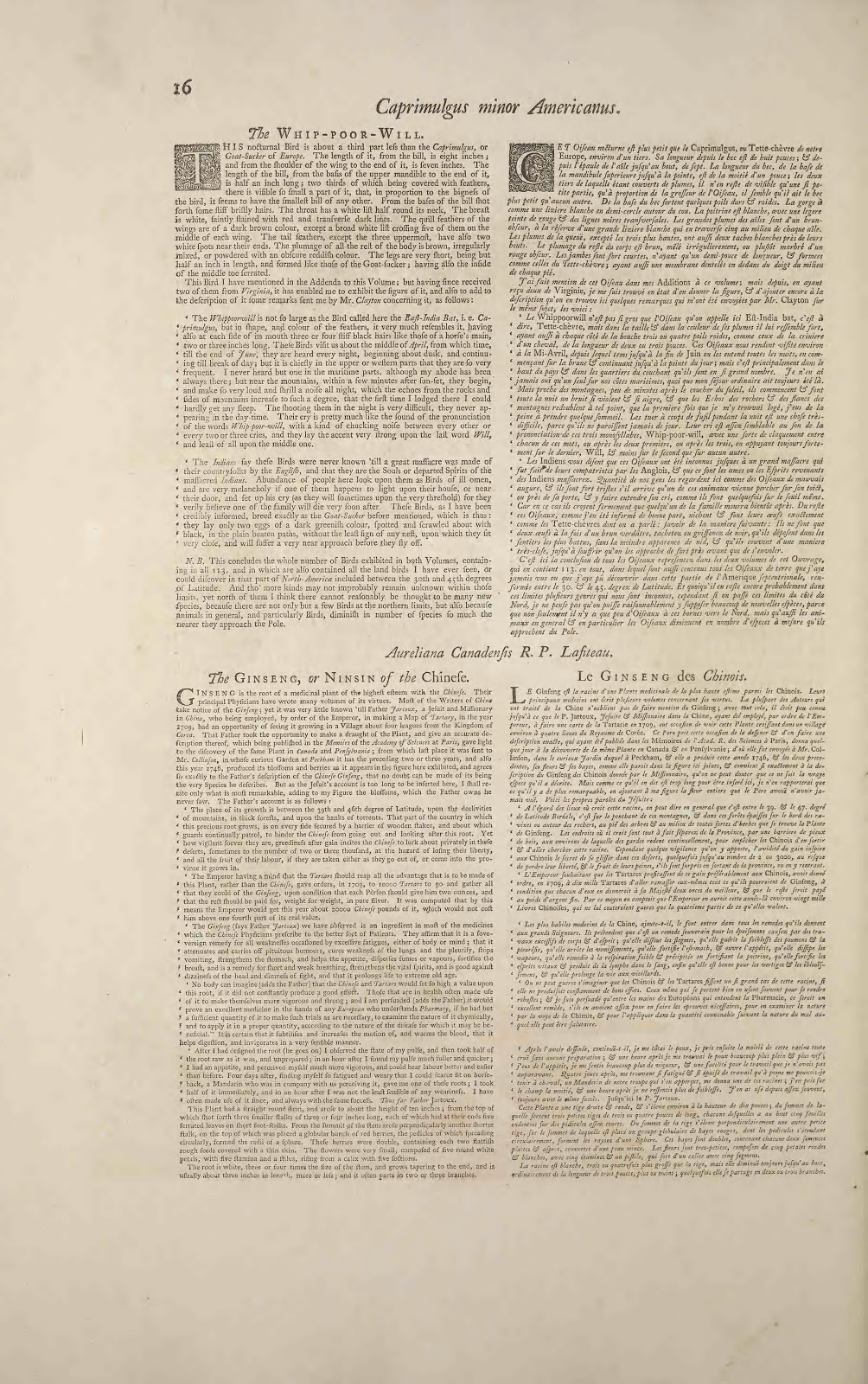
In 1746-47, Mark Catesby issued an Appendix to his Natural History. Among the additional birds illustrated there is The Whip-poor-Will; Catesby’s text quotes at length from a letter sent to him by the Virginia physician John Clayton.

View Full Size Image
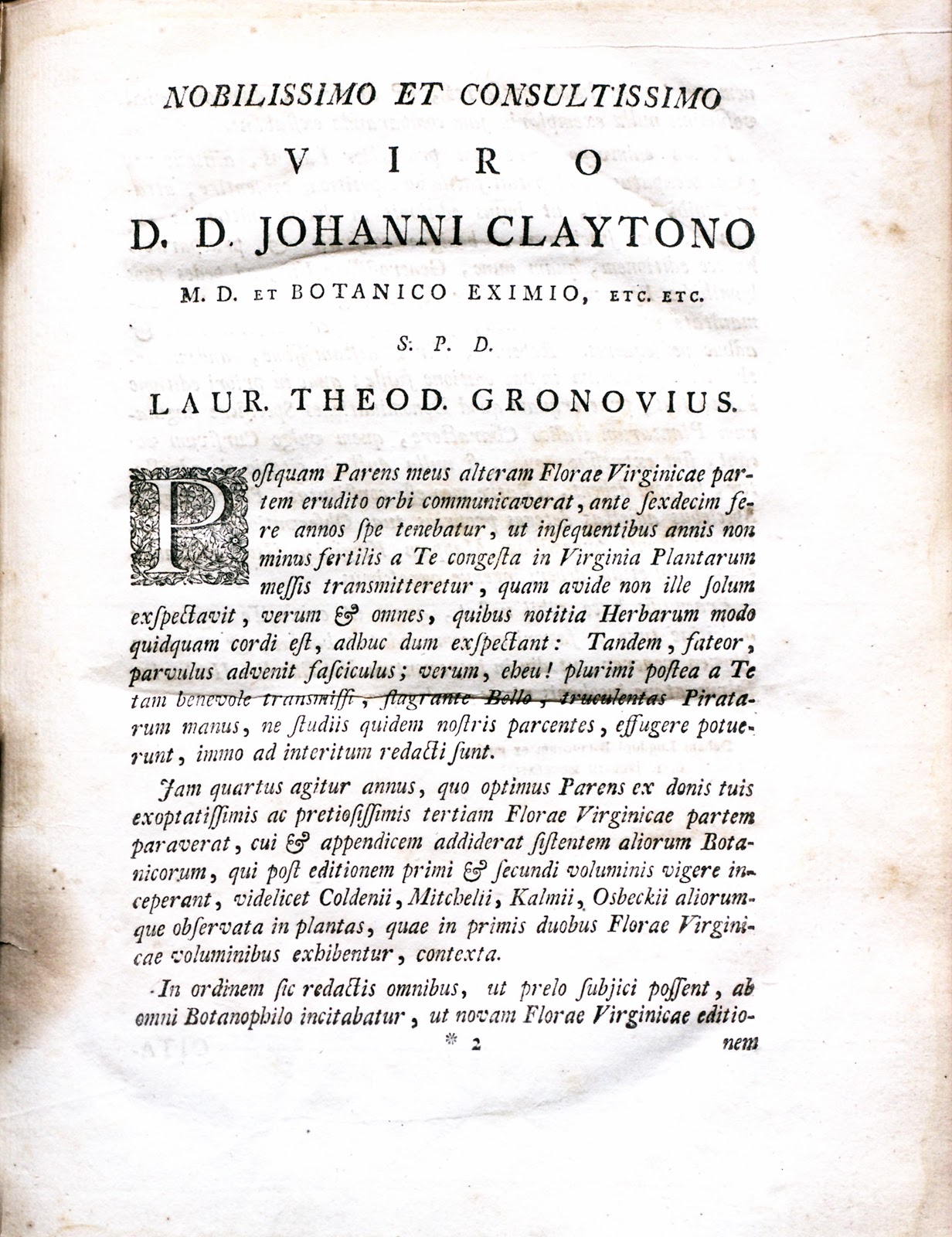
Flora Virginica, by John Clayton

Clayton, a distinguished botanist and natural historian himself, contributes a fine description of the bird’s strangely accented chanting song, and also records the poignant belief of “the Indians [that] these birds were never known ‘till a great massacre was made of their countryfolks by the English, and that they are the Souls or departed Spirits of the massacred Indians.”


View Full Size Image
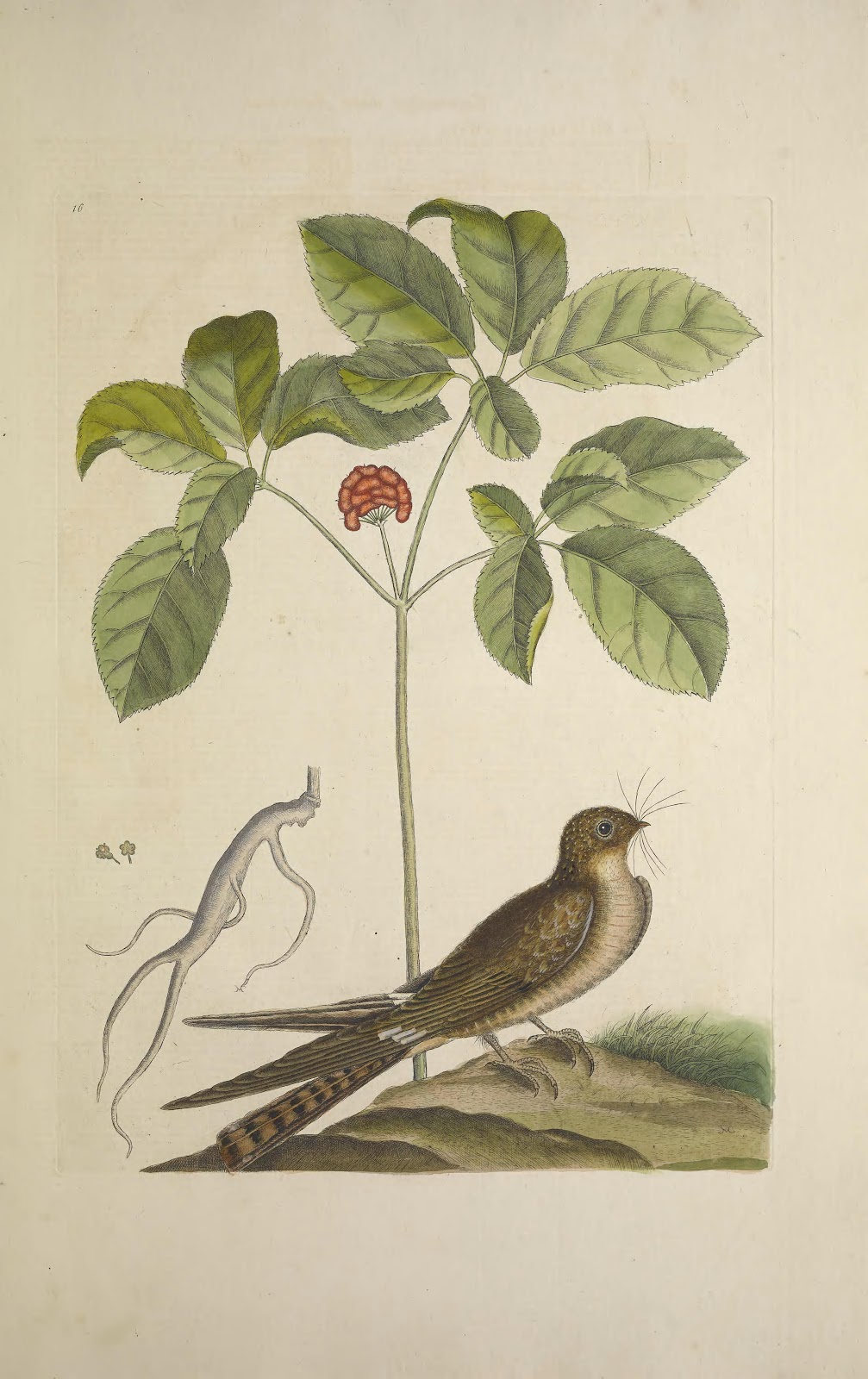
The Whip-poor-will in Catesby’s Natural History

Catesby’s own words are more problematic. Much of his plumage description clearly applies to the Eastern Whip-poor-will, but then, fatally, we learn that the “quill feathers of the wing are of a dark brown colour, except a broad white list [=contrasting stripe] crossing five of them on the middle of each wing.” This is, once again, the distinctive wing pattern of the Common Nighthawk, and Catesby’s painting clearly combines the pointed, white-barred wings of that species with the long, rounded tail and extravagant rictal bristles of the Eastern Whip-poor-will.

View Full Size Image
Combining the Common Nighthawk with the Eastern Whip-poor-will in Catesby’s Natural History

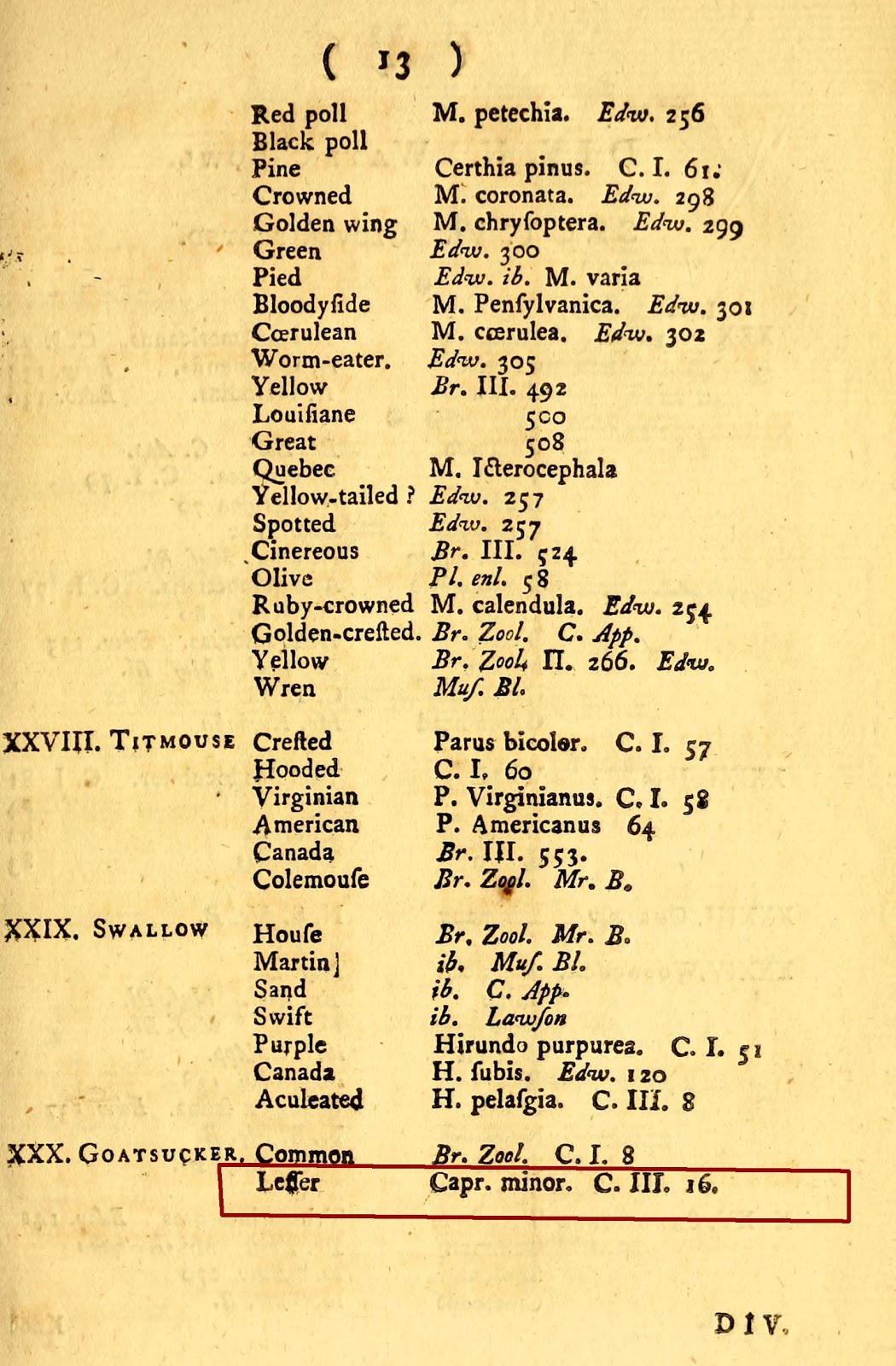
Like his Goat-Sucker of Carolina, this illustration, too, served as the type “specimen” for a later taxonomer. In 1771, Johann Reinhold Forster assigned the Linnaean name Caprimulgus minor to what he called in English the Lesser Goatsucker—giving as his authority “C.III.16,” an unequivocal citation to the “Whip-poor-will” on Plate 16 in Catesby’s Appendix.

View Full Size Image
Forster’s citation of the “Lesser Goatsucker,” based on Catesby’s Appendix

There things stood until Alexander Wilson took the birds into his own hands—quite literally.

View Full Size Image
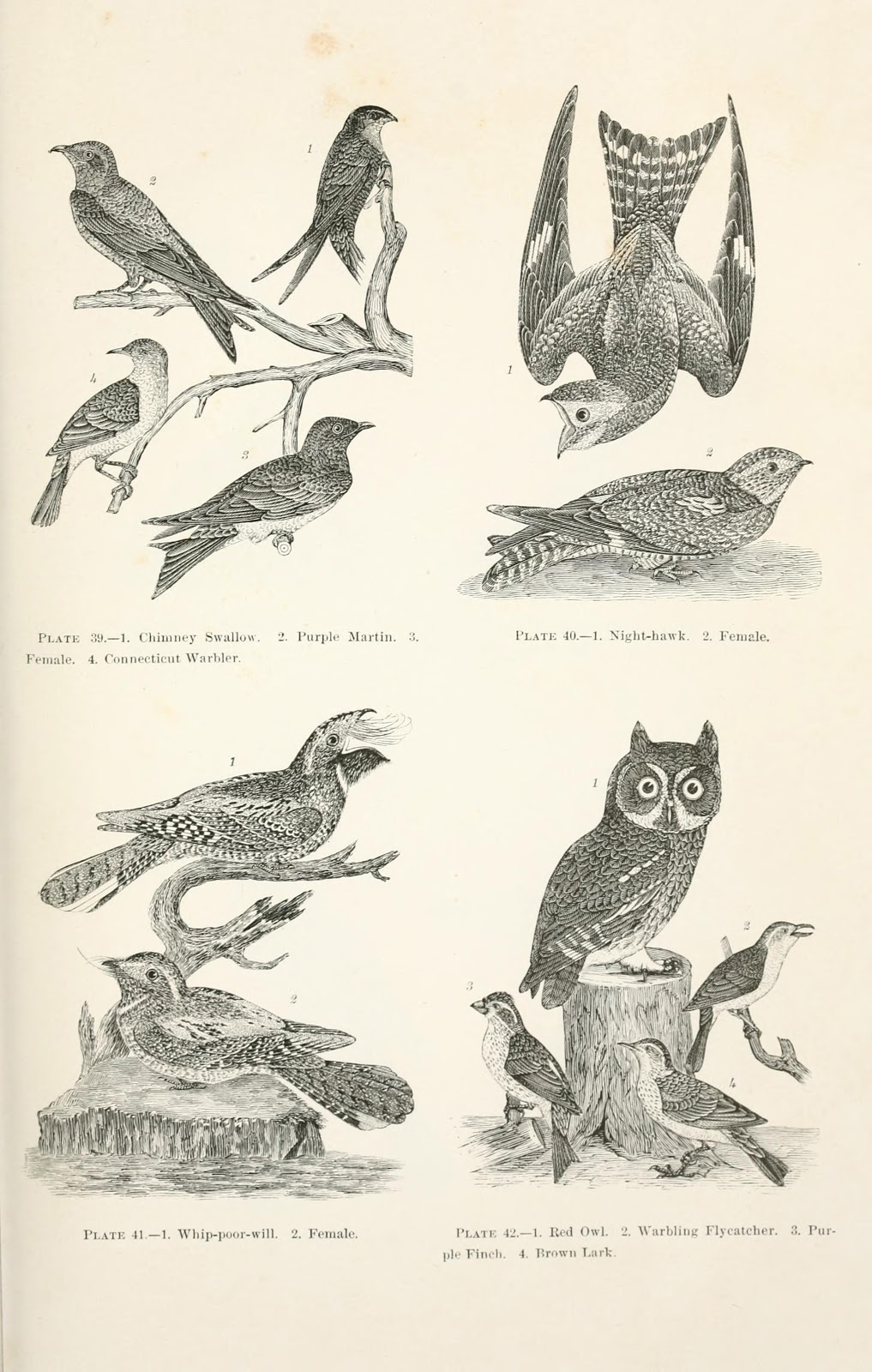
Wilson’s illustrations of the Nighthawk and Whip-poor-will


Wilson, the bicentennial of whose death we celebrate this year, determined to “divest” the North American nightjars of the “considerable obscurity” promulgated by Catesby, George Edwards, Thomas Pennant, and “many of our own citizens and … some of our naturalists and writers.”

Wilson solved the riddle in a thoroughly straightforward way, shooting and carefully dissecting nineteen of the controverted night birds. Those that

dart about in the air like Swallows, and sometimes descend with rapidity from a great height, making a hollow sounding noise like that produced by blowing into the bunghole of an empty hogshead …. All corresponded in the markings and tints of their plumage … evidently of the same species….

Another, though,

shot in the evening, while in the act of repeating his usual and well-known notes…. was found to … [differ] in many remarkable particulars…. Three others were shot… all four were evidently of one species [different from the first birds].

Wilson goes on at length to describe the differences between the first set of specimens—which were Common Nighthawks—and the second—Eastern Whip-poor-wills—concluding that it is “impossible to withstand the conviction, that these two birds belonged to two distinct species….” Wilson ends in a note of triumph:

these facts having been laid before Mr. Bartram, together with a male and female of each of the above-mentioned species … that venerable naturalist was pleased to declare … that he had no doubt of the Night Hawk and the Whip-poor-will being two very distinct species….

William Jardine, in his posthumous edition of the American Ornithology, signaled Wilson’s detective work as one of the author’s great accomplishments. But not all American ornithologists saw it the same way. Audubon, reluctant as so often to acknowledge Wilson’s attainments, wrote in the Ornithological Biography that he “had known both birds from [his] early youth,” and, more snidely still, that he had “seldom seen a farmer or even a boy in the United States, who did not know the difference between them.”

Those must have been exceptionally learned farmboys. It took a full century, from Catesby’s arrival in America in 1712 to Wilson’s Ornithology of 1812, for science to work out the voices of the night. And the unraveling continues even today: 2010 saw the split of the Whip-poor-will into two species, and in 2012—three hundred years after Catesby’s arrival in North America, 200 years after Wilson’s unveiling of the “real” Whip-poor-will—both the Chuck-will’s-widow and the whip-poor-wills were moved from the Linnaean genus Caprimulgus to Charles-Lucian Bonaparte’s Antrostomus of 1838. The night still holds its secrets.

This post was contributed by guest-blogger Rick Wright. Interested in guest-blogging for BHL? We’d love that! Natural history, biodiversity and conservation topics are especially welcomed. Email us your ideas at [email protected]
January 3, 2013by ulib-libraryjobs
Blog Reel, User Stories

Honoring the Man Who Revolutionized Bird Identification

Portrait version of the Biodiversity Heritage Library logo.
A Celebration of Chester A. Reed on the 100th Anniversary of his Death


View Full Size Image
Michel Chevalier

In the early 1930s, the name of Chester A. Reed was known to all amateur and professional ornithologists in the United States and Canada. Today, there are few who remember him. And yet, he was the first to develop the concept of the “Field Guide ” by publishing his Bird Guide Part 2, Land Birds East of the Rockies (1905)*, which presented for  the  first time colored illustrations of birds in a small format book convenient for use in the field (3 X 5 ½ inches).

Reed’s most prominent publication, Bird Guide Part 2 revolutionized the art of bird identification in the field and directly contributed to public education about identification practices. Following the success of this publication, several other identification guides were published, including the first color “Field Guide” to wild plants in 1907 and, in 1911, with the collaboration of S. Bowdish Beecher, the first color “Field Guide” of the Audubon Society of New Jersey – Guide to the Birds of New Jersey.

View Full Size Image
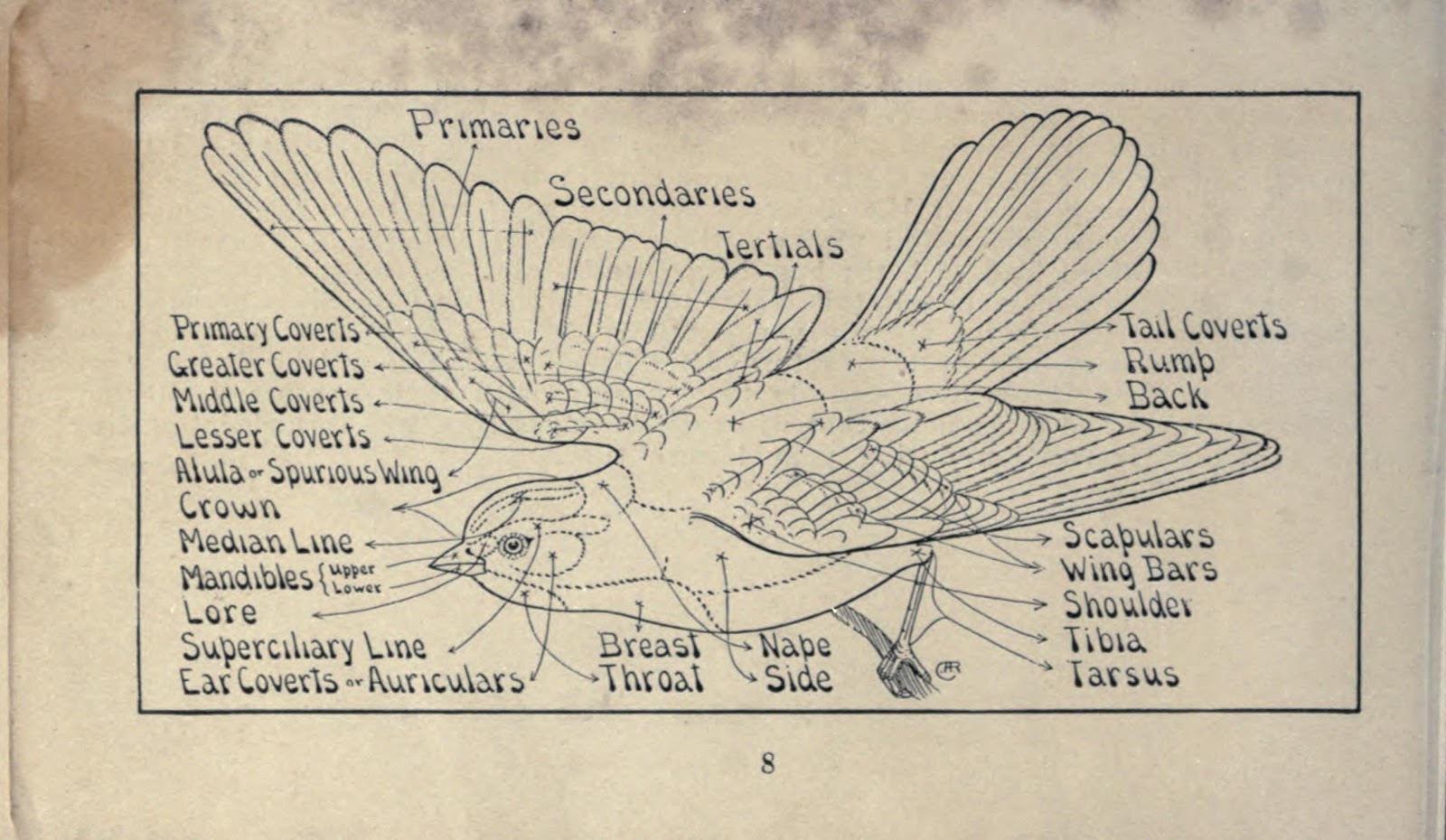
Diagram of a bird, from Bird Guide Part 2

Reed’s publication history extends significantly beyond his renowned field guides. Between 1901 and 1906, Chester published 67 issues of the magazine American Ornithology, for Home and School. This journal was dedicated to the education and conservation of birds. Between 1903 and 1912, he published 24 books mainly on the topic of ornithology.

View Full Size Image
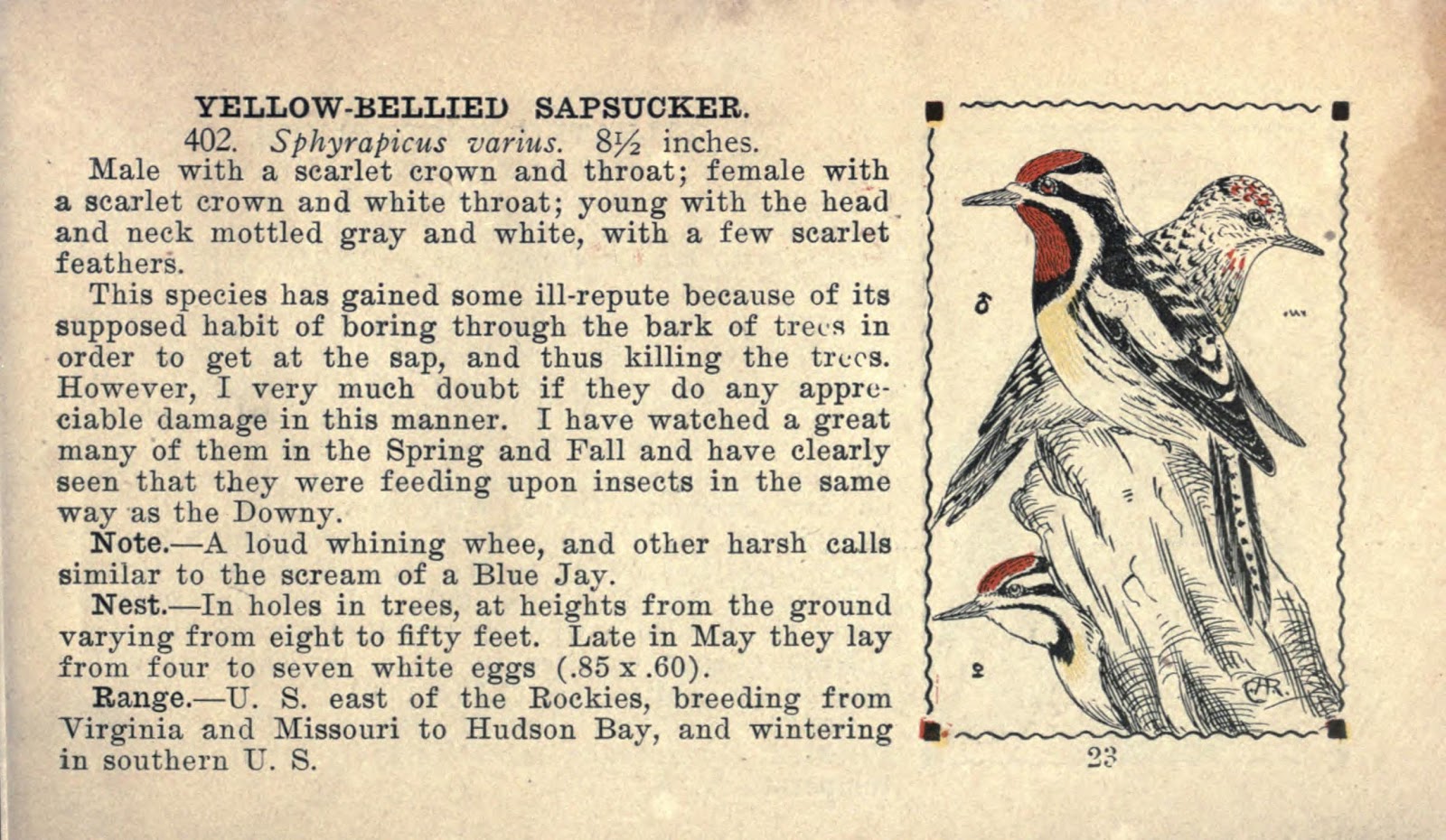
The Yellow-Bellied Sapsucker, in Bird Guide Part 2

One hundred years ago today (on December 16, 1912), at the age of 36 and five days after contracting pneumonia, Chester died. At that time, he was planning the trip of his dreams in Amazonia. Fate decided otherwise.

It was not until 22 years after his death that another talented illustrator adopted his format and improved on it, thus enabling a new generation of fans to indulge their favorite hobby. Roger T. Peterson was introduced to birding through Chester’s books and the publication of his Field Guide to the Bird in 1934 became a new source of inspiration for future authors of ornithology.

View Full Size Image
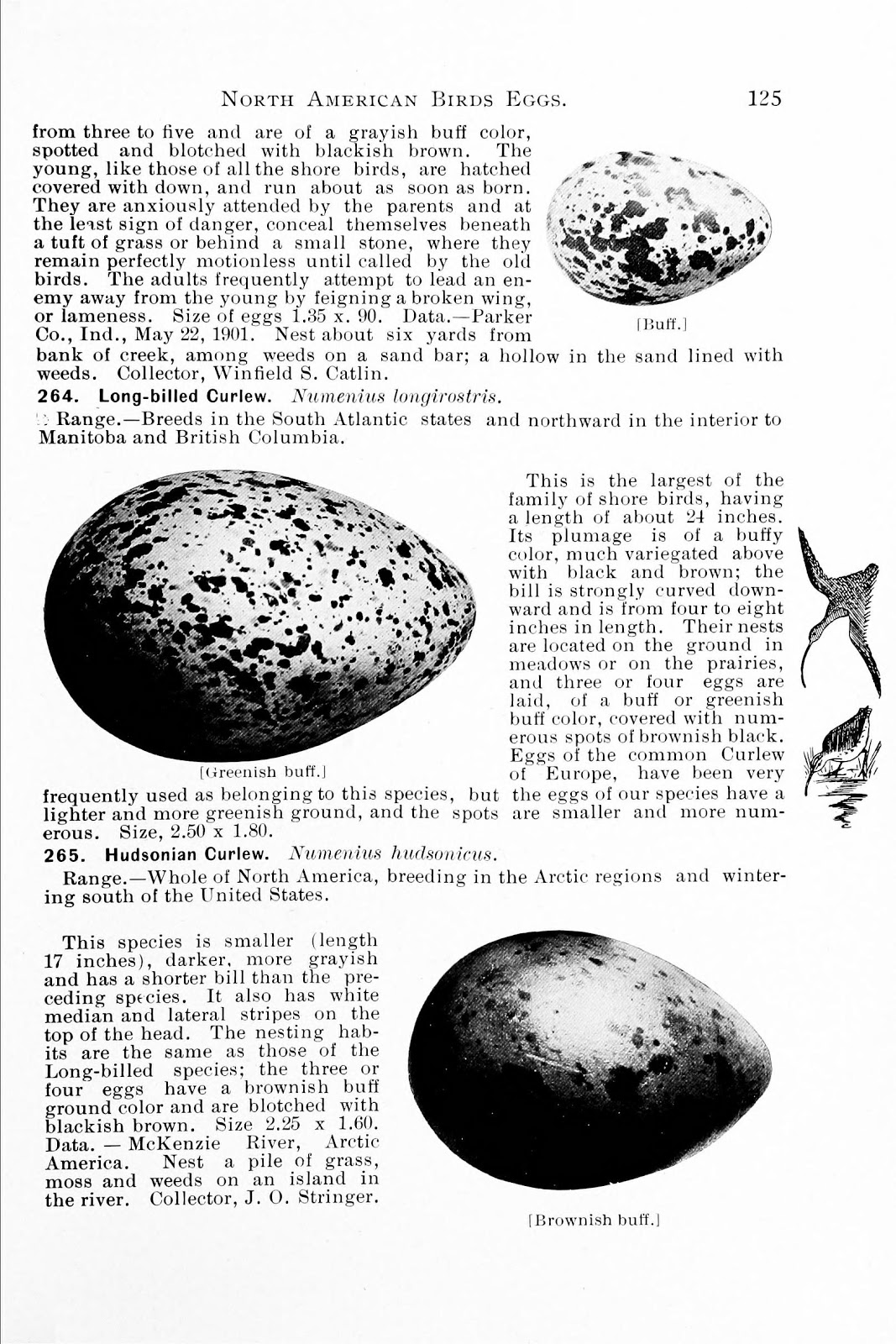
Sandpiper and Curlew Eggs

My interest in Chester A. Reed began in 2009. I wanted to pay tribute via a web project to the publication of his book North American Birds Eggs in 1904. I soon realized that there was no information on his life history and even institutions and historians were at an impasse on his personal life.

My research on Reed lasted 2 ½ years. I enlisted the help of many individuals, notably Mrs. Jean Mayo (specialist in genealogy) who enabled me to discover what history had forgotten. She helped me track down one of the last descendants of the Reed family. Mrs. Gail Berkshire had preserved the family history, and she allowed me access to his archives.

The generosity of Mrs. Berkshire has allowed me to trace a large part of the personal life of Chester, including a better understanding of the close relationship between Chester and his father Charles K. Reed, who was the publisher of all his books. This relationship earned him a great reputation amongst the birders of his time.

I could not keep this information to myself. I had to share this history and was motivated to create a website devoted to his biography and that of his father and mother. I wanted to make the experience others have of his life similar to a visit to a museum. Thus, at the end of each webpage, I present a little slideshow that allows visitors to view some of the archival material which I used in this research (see an example here-must have a Swiff player on your desktop to view).

View Full Size Image
First ad for Bird Guide pt. 2

The website also includes a Gallery section, which presents several of Reed’s illustrations which have never been published before. For instance, there you will find the first advertisement for the “Bird Guide” published in 1905.  All this valuable information has been preserved for over 100 years by the Reed family.

For the first time, all of the 34 books published by Chester and his father have been documented via this website. Each book has its own story and allows us to follow the evolution of this great pioneer of ornithological literature from the early 20th century.

The Biodiversity Heritage Library (BHL) has many of the books published by Chester A. Reed and his father Charles K. Reed. This is the only collection in digital format available on the Web. It will allow many people to become familiar with his work and discover a teacher whose passion for his research is as obvious today as it was 100 years ago.

The life of Chester A. Reed has long been a mystery to historians. Thanks to the research now presented on the Chester Reed website, this is no longer the case. His work played an important role in the history of recreational ornithology in America. He should not be forgotten.


December 16, 2012by ulib-libraryjobs
Blog Reel, User Stories

Bird Watching and Conservation with Michael Mills

View Full Size Image
Michael Mills

For many of us, leading bird watching expeditions throughout Africa would be a dream job. For Michael Mills, Angola Country Program Manager for the Percy FitzPatrick Institute of African Ornithology, The A. P. Leventis Ornithological Research Institute, and BirdLife South Africa, it’s all part of the job. It probably comes as no surprise, then, that BHL is an extremely useful resource for Michael, providing him with primary source material about and fantastic illustrations of the birds he works to conserve and share with bird watching participants. 

Michael has studied African birds for ten years, focusing on their natural history, identification and conservation, with particular interest in Angolan birds. He discovered BHL about four years ago, via the Internet Archive, our digitization partner, website. Since then, Michael says that BHL “has been a great help with accessing some of the older and more obscure literature, which is often important in the work I do.” Accessing BHL 3-4 times a month on average, Michael most often downloads PDFs of the content he seeks, building a personal, digital library of the often rare books that formerly had limited distribution outside of the physical library space, not to mention outside of the countries in which the material is housed. When asked what his favorite feature on BHL was, he simply replied, “Being able to access old literature.” 

View Full Size Image

His number one priority for the BHL project? “Make more texts available online.” We’re sure many of you can also second this request.

BHL has been making significant advances towards building a program node on the African continent beyond our current partners in Egypt at the Bibliotheca Alexandrina. Our colleagues in Africa have been hard at work establishing the initiative following our organizational meeting in Cape Town, South Africa, in June, 2012. We hope to officially announce the project in the coming year, which will significantly increase our reach throughout this magnificent continent and enhance our corpus with the invaluable literature held in our African partners’ collections. We have no doubt that such endeavors will help us fulfill Michael’s and others’ desire to see more digitized literature online, particularly in the realm of African Ornithology. 

Many of you are also familiar with our Flickr project, which is bringing unprecedented access to the thousands of incredible scientific illustrations held in the BHL collection. Now constituting over 50,000 images, freely available for browsing, download, and reuse, the BHL Flickr contains a treasure trove of illustrations of African birds. We’ve selected a few of our favorites from v. 2 of The Birds of Africa to present below.

Thanks to Michael for his dedication to the field of bird conservation and for helping others enjoy these marvelous creatures. Want to read a report of one of his bird watching expeditions? Well, you’re in luck.  We send our best wishes to Michael, and hope we can continue to build our collections to provide free, open access to the material he and other researchers need to protect our planet’s biodiversity into the future.

November 20, 2012by ulib-libraryjobs
Blog Reel, Featured Books

Biologia Centrali-Americana & Hispanic Heritage Month

Book of the Week: Biologia Centrali Americana

View Full Size Image
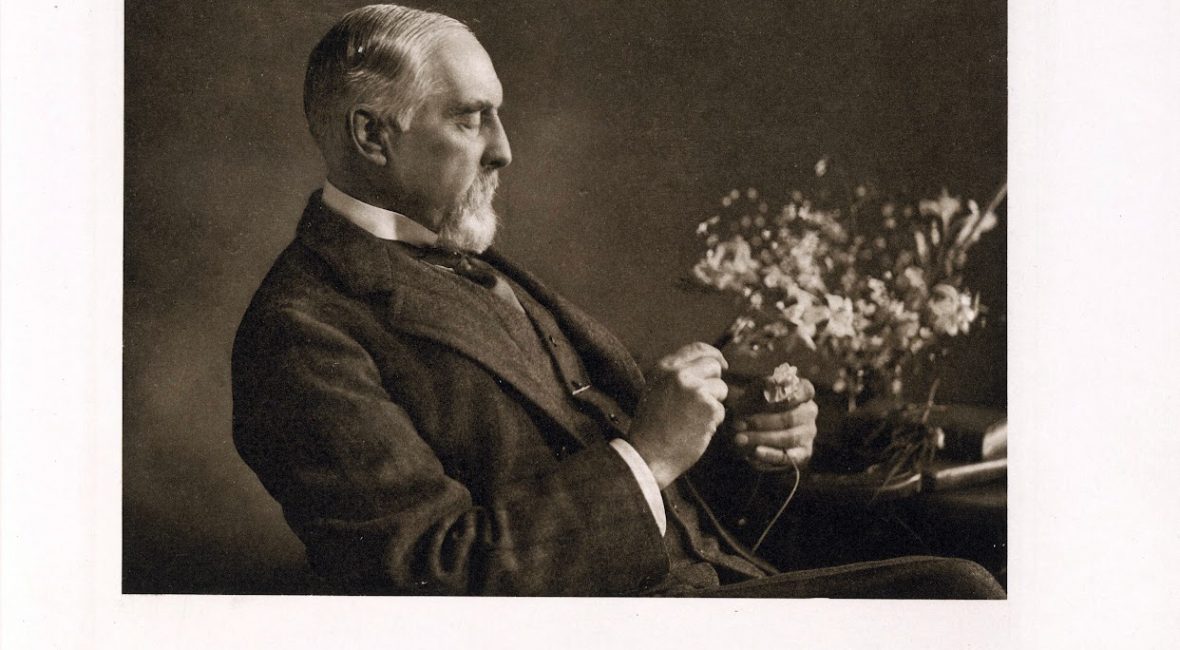
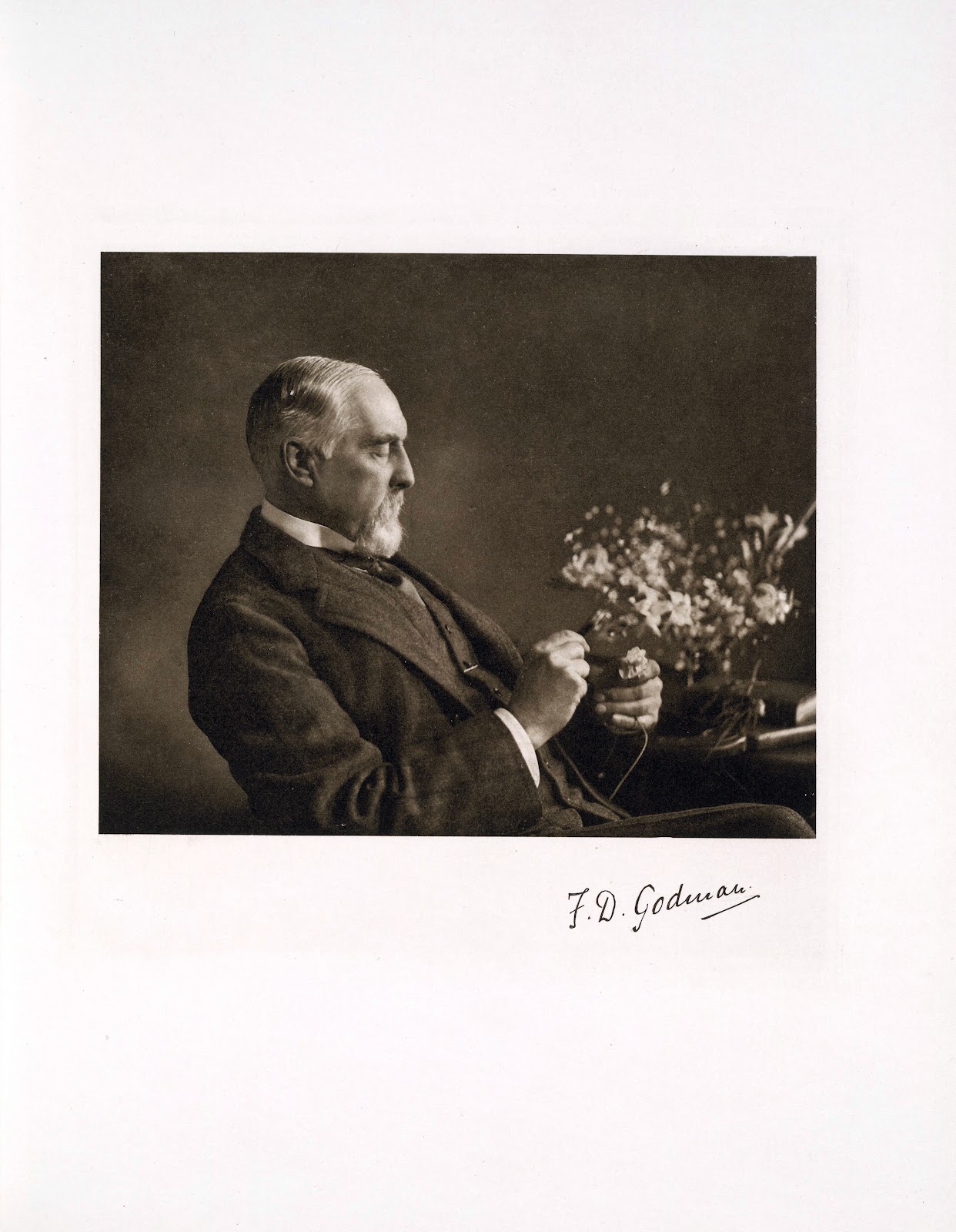
Biologia author Frederick Godman

In 1876, two men by the names of Frederick Godman and Osbert Salvin began work on perhaps the most comprehensive account of the flora and fauna of Mexico and Central America ever undertaken. Entitled Biologia Centrali Americana, this 63 volume work, published over the course of 36 years, relates nearly all information known at the time on the mammals, birds, fish, mollusks, insects, arachnids, and botany in the region. Accompanied by over 1,600 lithographic plates, 900 of which are colored, Biologia Centrali Americana is arguably the single most authoritative work on Mexico and Central America’s turn-of-the-century biodiversity and constitutes a perfect candidate to help us celebrate Hispanic Heritage Month!

Great Things have Small Beginnings

View Full Size Image
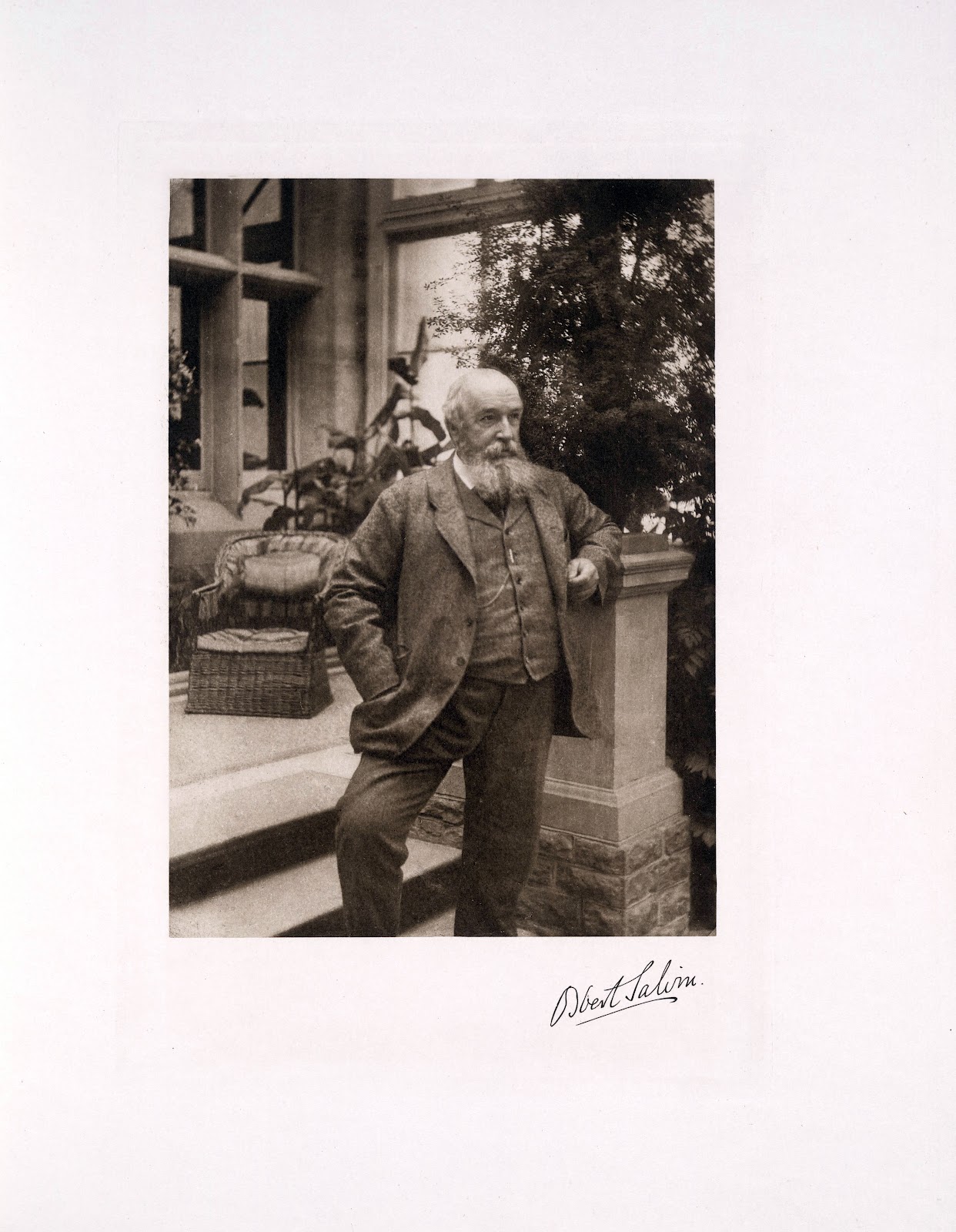
Biologia author Osbert Salvin

Godman and Salvin became fast friends while attending Cambridge, where their mutual enthusiasm for natural history solidified their lifelong friendship. Early interest in ornithology prompted them, along with 18 other friends and young ornithologists, to establish a new, and ultimately extremely influential, journal dedicated to ornithology, the Ibis (learn more about the Ibis in our previous book of the week post).

Welcome to the New World

In Fall, 1857, the pair’s first interaction with Central America transpired, when Salvin visited the area to study palm nuts and their potential application in candle making. Finding the inquiry disappointing, Salvin spent the remainder of his time studying the birds and insects of the region, which ultimately led to a publication detailing the 381 known bird species of Central America in the first volume of the new Ibis journal.

Though Salvin returned to England in 1858, he was forever mesmerized by the biodiversity he encountered in Central America. He quickly returned to the area in 1859 and continued collecting bird and insect specimens, which he initially detailed in an article written for the Ibis.

View Full Size Image
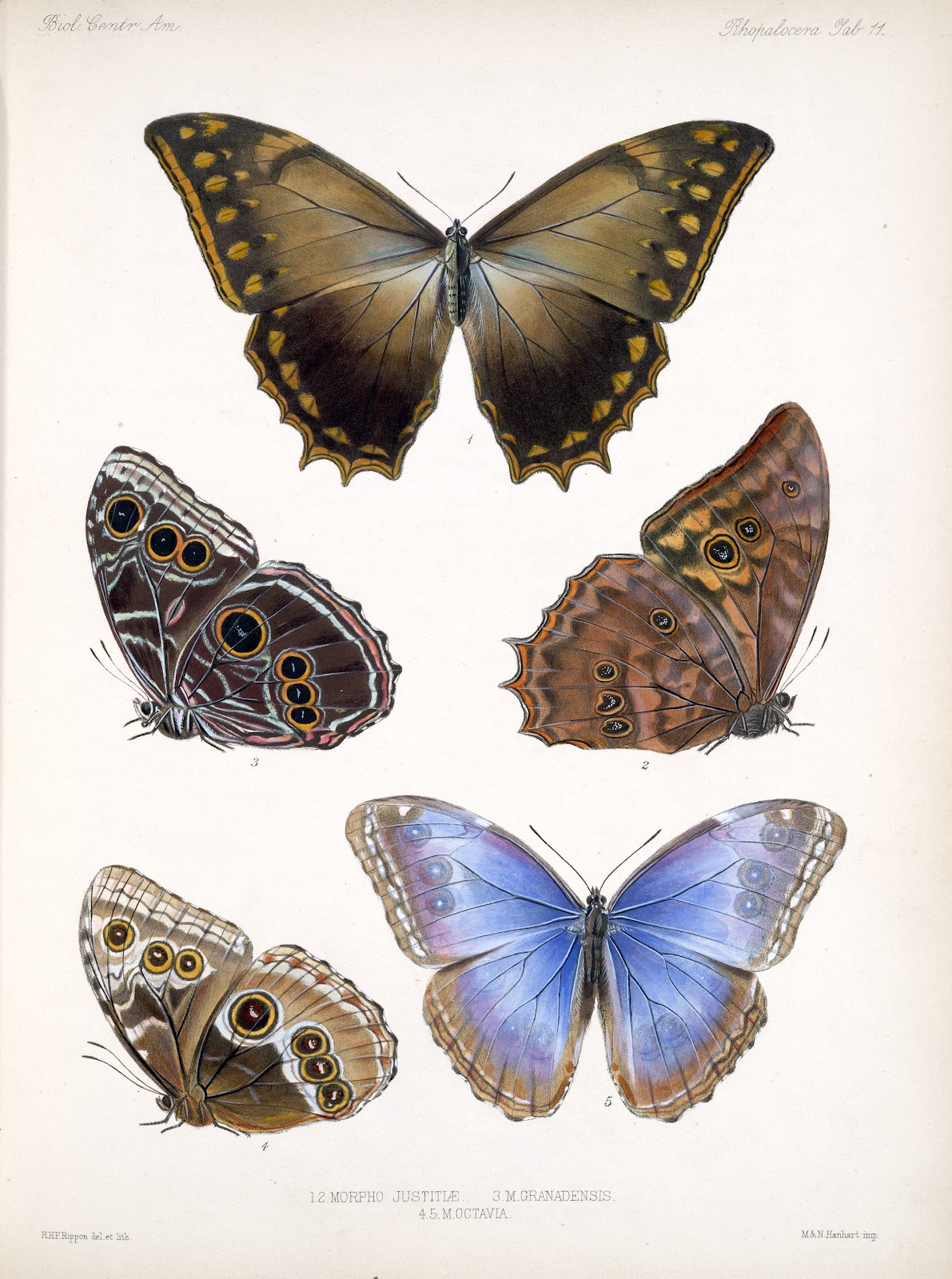
Members of the Morpho genus in Biologia

In August, 1861, Godman joined Salvin on his third expedition to Central America. It was in Yzabal, where the expedition originated, that Godman had his first magical encounter with the region’s biodiversity:

This place will, however, always be associated in my mind with my first sight of a living example of one of the most striking and gorgeous of all butterflies, Morpho peleides. I was sitting on the trunk of a fallen tree in the forest, when it came floating past me, but I was so overcome with astonishment and delight at this wonderful vision that, although I had a butterfly net in my hand, I was utterly unable to rise in pursuit until it was too late to capture it.

Godman and Salvin spent nearly two years trekking through Central America, exploring, to name a few, Quirigua, Zacapa, Guatemala City, Duenas, Escuintla, San Germonimo, Coban, Cubilguitz, and Choctum, and collecting a wide range of specimens, including birds, butterflies, and fish. Salvin describes the pragmatic method by which he obtained fish specimens in the Rio Grande:

…I employed Indians to poison some nine miles of the water in order to make a collection of fish…The method adopted for this purpose was to beat the plant (Tephrosia toxicaria) on the rocks until a froth not unlike soap-suds was formed, this when mixed with the water caused the fish to sicken and some to the surface…Vast numbers were obtained, and from them I made a selection and preserved a good many specimens in spirit (aguardiente), but was somewhat disappointed to find there were but few species represented.


View Full Size Image
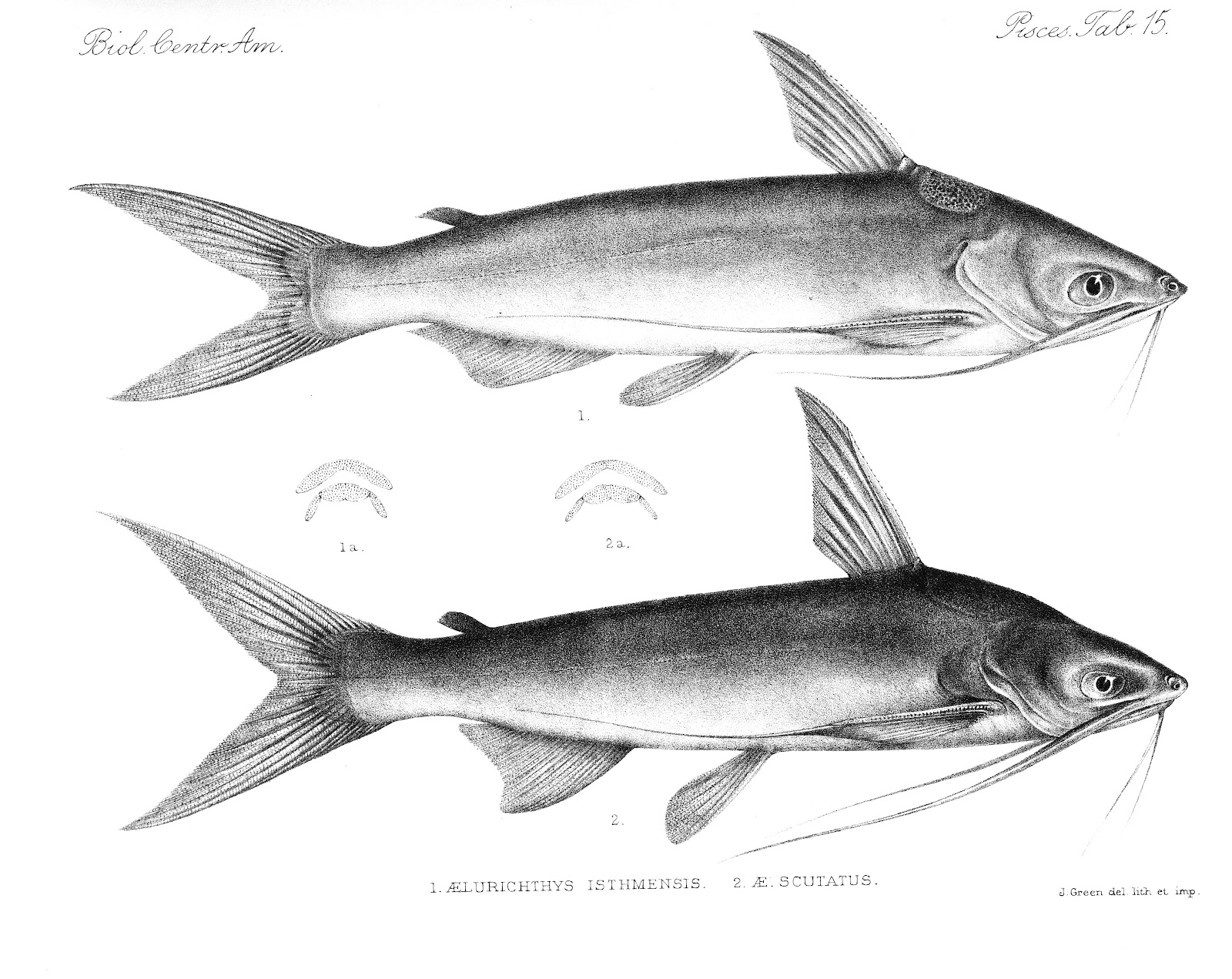
Fish of the genus Ailurichthys in Biologia

Though this first joint expedition ended in 1863, Godman and Salvin traveled back to the New World many times to study and accumulate more specimens (including trips to Mexico in the late 1880s), often bringing along additional subject specialist. Salvin’s wife, Caroline Maitland, accompanied Salvin on his final voyage to Central America, during which time she painted the illustrations of the flora found in the botanical volumes of Biologia.  The pair also employed various collection experts to gather specimens in specific region for their growing body of preserved Central American wildlife.

A Monumental Undertaking

View Full Size Image
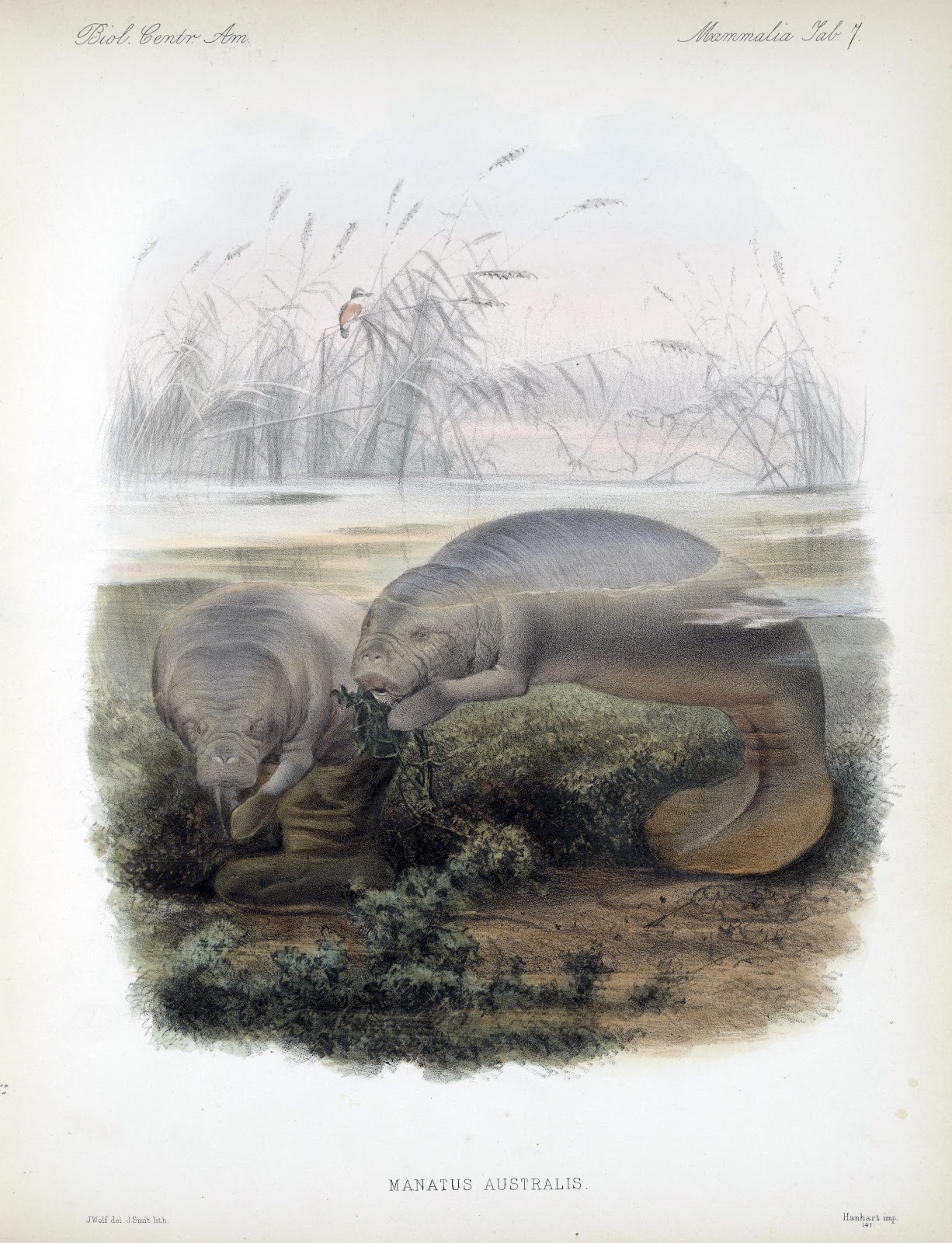
The Manatee in Biologia

In 1876, the suggestion to publish a comprehensive work describing the biodiversity collected in Central America sparked the origins of Biologia. Originally intended to be published in six quarto parts a year, each supplemented with six colored plates, resulting in a total of 60 parts over 10 years, the continuous supply of fresh specimens, and abundance of material to be published, necessitated a total of 215 parts in zoology, 5 volumes in botany, and 17 parts in archaeology, spanning 36 years of publication.

Godman and Salvin worked diligently on the title until June 1, 1898, when Salvin unexpectedly died. At the point of his death, only 141 of the 215 parts of Zoology and 8 of the 17 parts of Archaeology had been completed (all botany volumes were completed at the time of Salvin’s death). With help from additional authors, Godman persevered “with a heavy heart,” and in 1915, the final part was issued, bringing this monumental undertaking to a close.

New World Feathers

As Godman and Salvin were both avid ornithologists, and as their publishing enterprises together began with an ornithological journal, we thought it fitting to feature the Aves Atlas from Biologia Centrali Americana in our post. The Atlas contains 79 plates illustrating the species found in the three previous bird volumes.

Godman relayed particular frustrations, and ultimate triumphs, with describing the birds of Mexico. As he outlines:

In working out the Mexican Birds we found ourselves hampered for want of an authentically named collection of North American species for comparison, which did not exist in Europe at that time. In order to remedy this, I acquired the Henshaw collection, numbering 13,326 specimens, and this was rendered still more valuable through the courtesy of the authorities at the United States National Museum, who allowed Mr. Ridgway, the highest authority in America, to go through and verify all the names on the labels attached.

As the Smithsonian (National Museum of Natural History) paid a key role in deciphering the ornithological specimens contained in this work, it is no wonder that they, in collaboration with many of our other BHL partners, would build a virtual exhibition dedicated to Biologia.

We’ve presented a few of our favorite illustrations from the Aves Atlas below. Be sure to check out all of the images on Flickr and the entire set of Atlases in BHL. Delve even further into these illustrations with our Book of the Week Pinterest board.

Finally, check back on our blog, Twitter, Facebook and Flickr for more posts celebrating Hispanic Heritage Month!

We hope you enjoyed this post. Interested in guest-blogging for BHL? We’d love that! Natural history, biodiversity and conservation topics are especially welcomed. Email us your ideas at [email protected]. 

September 20, 2012by ulib-libraryjobs
Blog Reel, User Stories

BHL and Our Users: Margaret Koopman

Portrait version of the Biodiversity Heritage Library logo.
View Full Size Image

This past June, BHL-Staff visited Cape Town, South Africa for a series of meetings aimed at developing a BHL for sub-Saharan Africa. The meeting brought together 20 African participants from six countries with a variety of backgrounds including Librarians, Researchers, and Information Technologists. One such individual was Margaret Koopman, a librarian at an ornithological institute in South Africa. Margaret uses BHL regularly to help her fulfill the needs of her patrons, and she graciously agreed to be interviewed about that usage for our blog.

What is your title, institutional affiliation (or alternative place of employment), and area of interest?

I am a librarian at the Niven Library of the Percy FitzPatrick Institute of African Ornithology.  My areas of interest include ornithology, biodiversity conservation and environmental history.

How long have you been in your field of study?

I have been a qualified librarian since 1983, working almost entirely in Life Sciences libraries.  My particular field of study is environmental history in which I have an MSc.

When did you first discover BHL?

In April 2009 I linked BHL to my online catalogue.  In June 2009 I was trying to track down a copy of A Monograph of the Hirundinidae by R.B. Sharpe & C.W. Wyatt for information on population crashes of swallows in southern Africa because of extreme weather events.  I found the book in BHL and went on to write up a small piece from this publication about a population crash which took place in 1891 in Maputo, Mozambique for the Cape Bird Club Newsletter, Promerops.  The URL for BHL was included to enable readers of the article to find the BHL treasures for themselves.

What is your opinion of BHL and how has it impacted your research?

Although the Niven Library has an exceptional collection of material on African ornithology, it is not comprehensive.  BHL has been a great help in linking African ornithological research to early material published in European and British publications.  I am now able to point other researchers to what is available at BHL instead of providing pdfs myself.

How often do you use BHL?

This depends on the demand of my library users, probably on average once a week.

How do you usually use BHL (read the titles online/download whole PDFs/Select Pages to Download for a custom PDF/Download High Resolution Images/Generate Taxonomic Bibliographies/etc.)

I generally download whole PDFs, select pages to download, or identify a PDF and forward the URL to a user.

What are your favorite features/services on BHL?

I find the BHL web presence attractive and inviting.  As my use is focused I appreciate the ease with which I can establish whether a publication is available or not and the speed with which I can download material.

If you could change one thing about BHL, what would it be, or what developmental aspect would you like the BHL team to focus on next?

I know that my user community would appreciate single article access.

If you had to choose one title/item in BHL that has most impacted your research, or one item that you prefer above any other in BHL, what would it be and why?

Anything to do with African ornithology!  Providing information in this field is my mission and BHL has enabled me to do this much more easily and comprehensively.

July 24, 2012by ulib-libraryjobs
Page 6 of 7« First...«4567»

Help Support BHL

BHL's existence depends on the financial support of its patrons. Help us keep this free resource alive!

search

About BHL

The Biodiversity Heritage Library (BHL) is the world’s largest open access digital library for biodiversity literature and archives. BHL operates as a worldwide consortium of natural history, botanical, research, and national libraries working together to digitize the natural history literature held in their collections and make it freely available for open access as part of a global “biodiversity community.”

Join Our Mailing List

Sign up to receive the latest news, content highlights, and promotions.

Subscribe Now

Subscribe to Blog via Email

Enter your email address to subscribe to this blog and receive notifications of new posts by email.

Join 319 other subscribers

Subscribe to Blog Via RSS

Subscribe to the blog RSS feed to stay up-to-date on all the latest BHL posts.

Access RSS Feed

Inspiring Discovery through Free Access to Biodiversity Knowledge.

The Biodiversity Heritage Library makes it easier than ever for you to access the information you need to study and explore life on Earth…for free, anytime, anywhere.


ABOUT | HARMFUL CONTENT | PRIVACY | SITE MAP | TERMS OF USE