

It’s no surprise that the natural history books and archives available in the BHL collection are of vital importance to scientists and modern scientific research. They not only provide species and habitat information, sometimes representing the only available knowledge for rare, endangered, and extinct species, but also help scientists identify new species, inform holistic conservation efforts, and provide the foundations upon which current scientific models are based.
Science is not the only discipline that makes use of BHL’s collections. Historians and psychologists, for example, find invaluable information within the pages of historic biodiversity literature. Artists, too, uncover bountiful creative inspiration within BHL’s 45+ million pages.
Within natural history publications are millions of stunning images, ranging from simple woodcuts to elaborately hand-colored engravings, chromolithographed plates, and photographs. We’ve made nearly one hundred thousand of these images available in our Flickr collection, and through a partnership with Internet Archive, we will soon have over a million available in Flickr Commons. We’ve asked you to help us improve access to these images through Flickr tagging and crowdsourcing in the new Zooniverse Science Gossip project.
While these efforts will broaden the reach and impact of BHL’s visual treasures, many users have already discovered these gems for themselves, including sculptor and glass artist Emily Williams.
 |
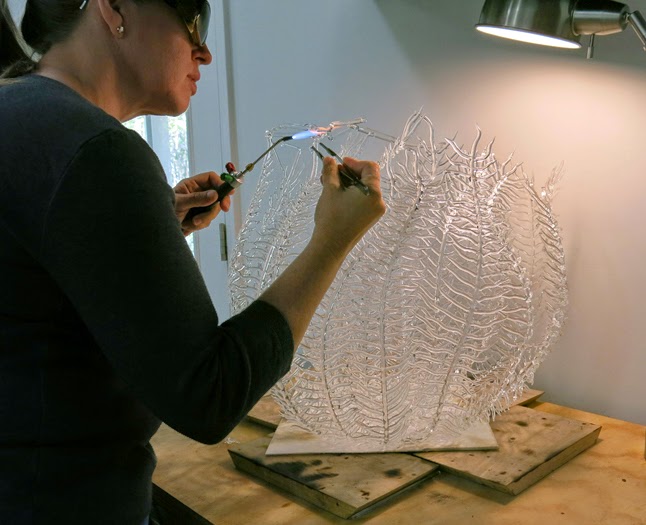
| Emily Williams creating Glass Seaweed sculpture in her Columbus, Georgia studio. |
Working professionally as a sculptor for 30 years, Emily is an Adjunct Art Professor at Troy University and a full-time Glass Artist. Through Twitter, Emily is able to connect to many world-class organizations promoting environmental conservation. It is also the medium through which she discovered BHL; it was love at first sight.
“The Biodiversity Heritage Library is an amazing resource for visual artists,” lauds Emily. “Any artist interested in learning about natural history and science would consider these rare resources invaluable. When I first began working on a series of ocean life forms I ran into some problems. Finding detailed illustrations of certain ocean life forms can be very difficult and time-consuming. Through the BHL website I can input various search terms to access an abundance of research materials. I am most drawn to the digitized books from the 19th century containing beautiful, detailed illustrations. Often these are great works of art! I have found hundreds of detailed illustrations of coral, seaweed, algae, and jellyfish. Most recently, I have uncovered some astounding scientific illustrations of Crinoids! These 19th century illustrations are a wellspring of inspiration for my current ocean life series in glass.”
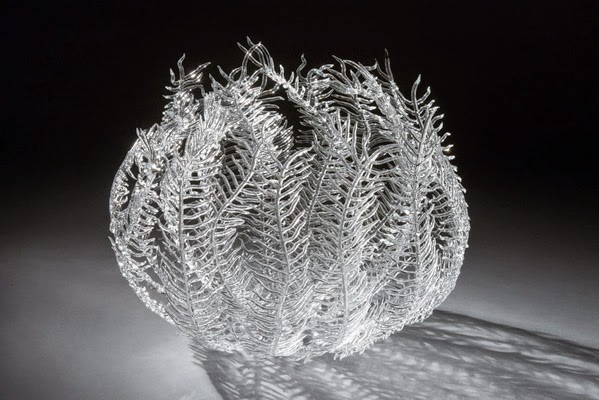 |
| Glass Seaweed sculpture by Emily Williams, 2014. Created using borosilicate glass and a glass hand-torch. |
A self-described “binge user” of BHL, Emily collects images and information about specific marine species that she wishes to create in glass, downloading the illustrations (sometimes as JPEG2000s) and PDF text files and storing them in subject-specific folders on her computer. She uses them to inspire masterpieces such as her recent borosilicate glass seaweed sculpture.
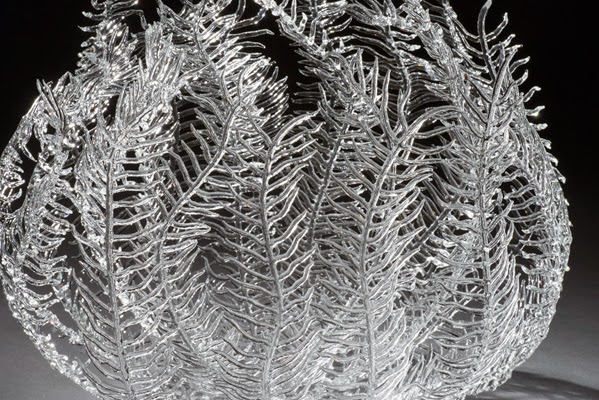 |
| Detail of Glass Seaweed sculpture by Emily Williams, 2014. Created using borosilicate glass and a glass hand-torch. |
The ability to search by subject within BHL is invaluable for Emily.
“The search feature will pull up all sorts of items including many old, rare books with illustrations,” extols Emily. “When I locate an item to investigate further I like to use the multiple page view (thumbnails) that allows me to quickly scan every page in the book. With the thumbnail feature I can see right away if there are any illustrations of interest to my research. Being a visual artist I find the high-resolution images invaluable. This allows me to enlarge and examine intricate illustrations as if using a microscope!”
This method allows Emily to discover new favorite books in BHL constantly, the most recent of which is Manuel d’actinologie ou de Zoophytologie, published in 1850.
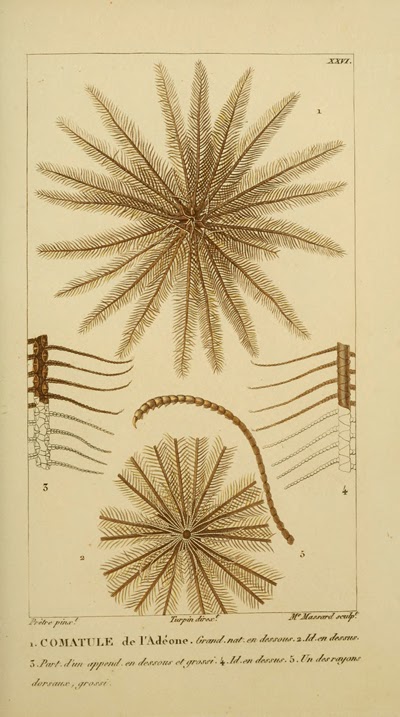 |
| Plate 26, Comatule de l’Adeone (Crinoid) Illustration from Manuel D’actinologie ou de Zoophytologie, 1850. http://biodiversitylibrary.org/page/9321291. |
“This book features some very detailed illustrations on Crinoids,” explains Emily. “The book is filled with marvelous illustrations containing fine details and color. The ability to visually understand how a Crinoid is structured becomes part of my unique creative process. Discovering an exciting branching pattern or joint segmentation may inspire an entire sculpture. Within this same book I found some detailed illustrations of the Porpite and numerous lovely jellyfish.”
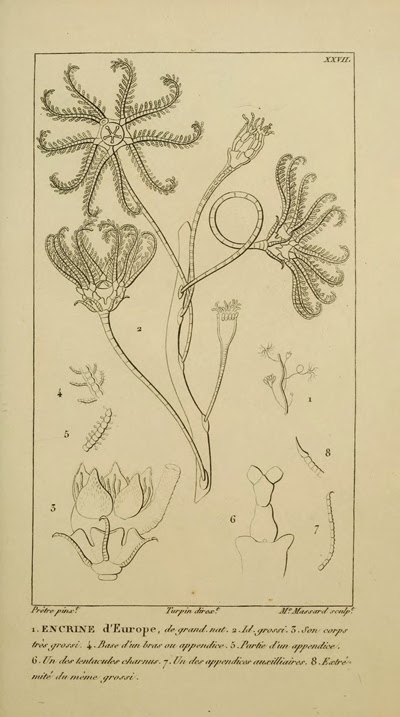 |
| Plate 27, Encrine (Sea Lily) Illustration from Manuel D’actinologie ou de Zoophytologie, 1850. http://biodiversitylibrary.org/page/9321293. |
Emily’s exploration of marine species in her recent artwork inspired a wonderful recommendation for BHL.
“An Endangered Ocean Species page would be fantastic,” suggests Emily. “For example, I read about the Australian Bennett’s red algae and how it is now extinct. The structure and patterning of the Bennett’s red algae was spectacular. It would be marvelous to access a page featuring endangered, recent extinctions of sea life such as corals, seaweed, algae, crinoids, starfish, etc.”
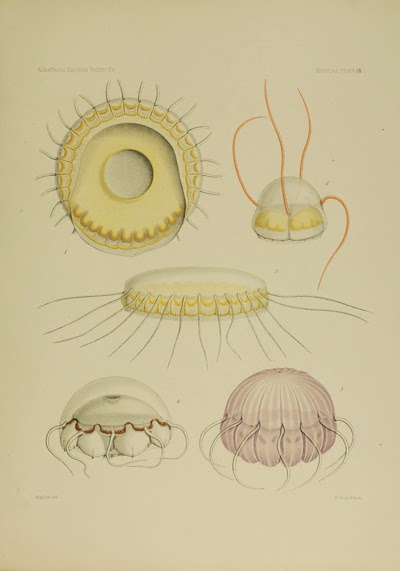 |
| Plate 14, Sketches of living specimens made on board the “Albatross.” Illustration from Memoirs of the Museum of Comparative Zoology at Harvard College, Volume 37, 1909, The Medusae/by Henry B. Bigelow. http://biodiversitylibrary.org/page/6361166. |
An excellent idea, and perhaps one that may one day be explored via our Biodiversity Library Exhibition platform. In the meantime, while they’re not exclusively endangered, browse stunning ocean wildlife illustrations in our Marine Biodiversity Flickr Collection.
Thank you, Emily, for taking the time to explain how BHL is useful not just to scientists, but to a range of disciplines including art! Do you use BHL to support your work? Want to tell us about it? Send us a message at [email protected].
