Biodiversity Heritage Library - Program news and collection highlights from BHL
  • Home
  • News
  • Featured Books
    • All Featured Books
    • Book of the Month Series
    • BHL at 20
  • User Stories
  • Campaigns
    • Fossil Stories
    • Garden Stories
    • Monsters Are Real
    • Page Frights
    • Her Natural History
    • Earth Optimism 2020
  • Tech Blog
  • Visit BHL
Home
News
Featured Books
    All Featured Books
    Book of the Month Series
    BHL at 20
User Stories
Campaigns
    Fossil Stories
    Garden Stories
    Monsters Are Real
    Page Frights
    Her Natural History
    Earth Optimism 2020
Tech Blog
Visit BHL
  • Home
  • News
  • Featured Books
    • All Featured Books
    • Book of the Month Series
    • BHL at 20
  • User Stories
  • Campaigns
    • Fossil Stories
    • Garden Stories
    • Monsters Are Real
    • Page Frights
    • Her Natural History
    • Earth Optimism 2020
  • Tech Blog
  • Visit BHL
Biodiversity Heritage Library - Program news and collection highlights from BHL
Blog Reel, Campaigns, Featured Books, Garden Stories

Shaping Early American Gardening: Bernard M’Mahon

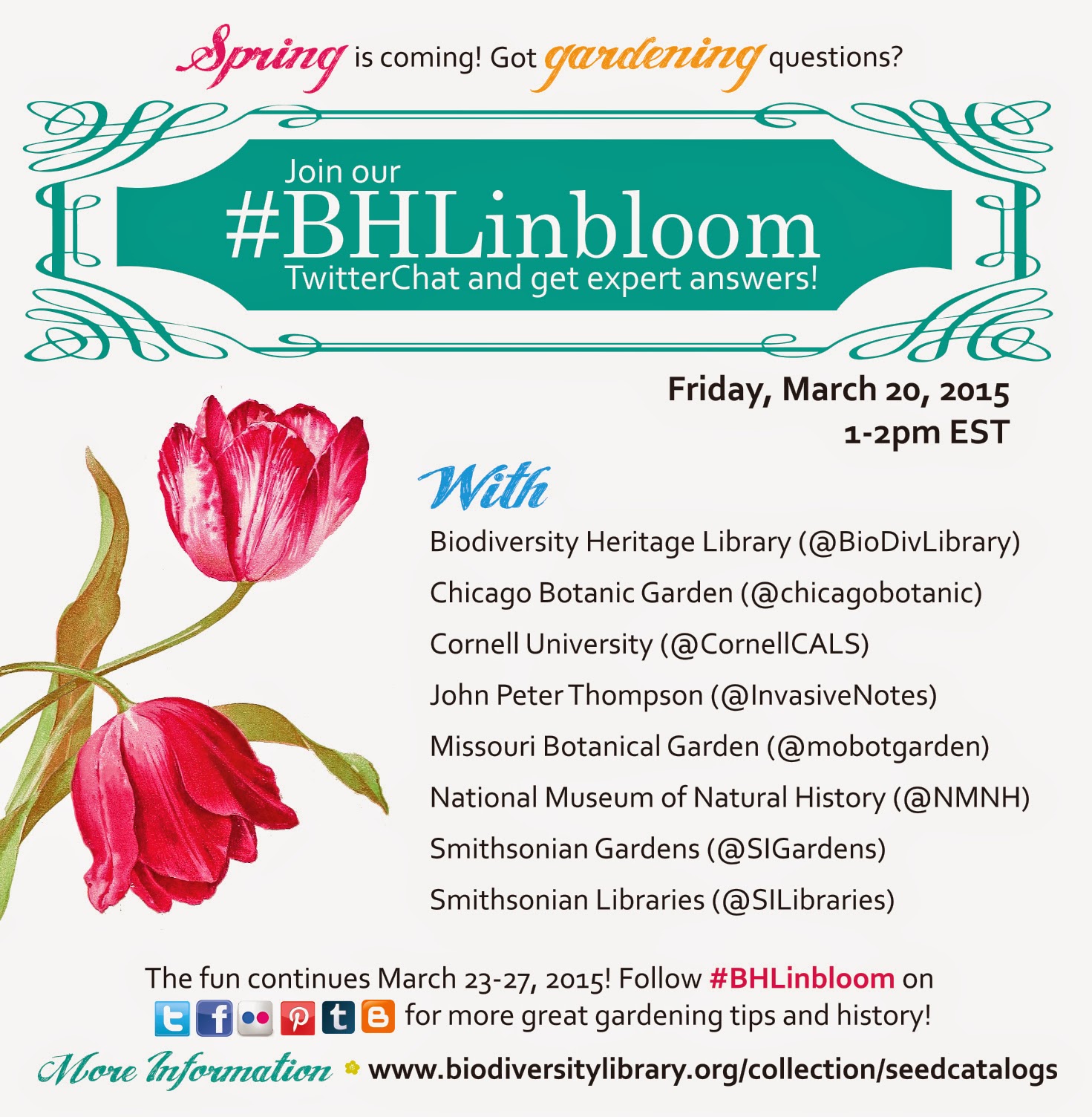
Our Garden Stories campaign is just under a week away! We’re excited to share fantastic gardening information, history, art, and tips with you March 23-27, 2015. And don’t forget our TwitterChat this Friday, March 20, from 1-2pm EST! If you have gardening questions, send them our way with the hashtag #BHLinbloom. Don’t miss out!
View Full Size Image

We thought we’d give you a taste of the fascinating history and stories you can expect next week by featuring a post on one of the individuals that helped shape the gardening industry in America: Bernard M’Mahon. It is written by Robin Everly, Botany and Horticultural Librarian at the Smithsonian Libraries and one of the experts that will be on hand to answer your gardening questions during our TwitterChat this Friday!

Bernard M’Mahon (spelled M’Mahon or McMahon) shaped American gardening during its formative years in early 19th century. Although M’Mahon left his mark by creating a successful seed and nursery business and writing an early popular horticultural book specific to American plants, accurate biographical information on him is sketchy. Born in Ireland, he came to America between 1796-1798 for political reasons. Like many immigrant stories, Ireland’s loss was the United States’ gain. Botanist William Darlington recalled meeting him in Dilworthtown, Chester County, “In autumn, I think, of 1799”, where many Philadelphians went to escape an outbreak of yellow fever. Although it is speculated he had extensive training in gardening while in Ireland, M’Mahon first worked in the printing business for William Duane and the newspaper, the Aurora, beginning in 1800. However, a few years later, he began working in the seed and nursery business, collecting and exporting seeds of America’s wild plants to Europe. At the time, native plants from America were all the rage for European gardeners.
View Full Size Image
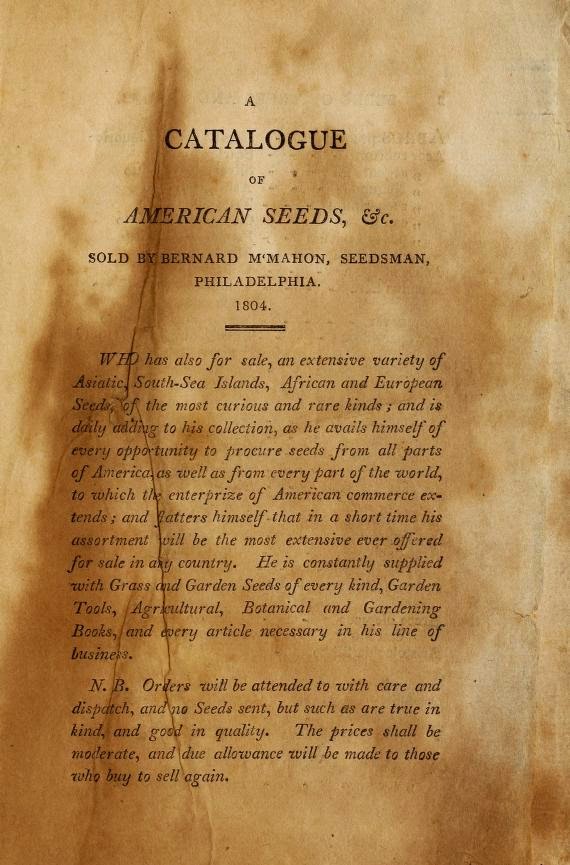
M’Mahon, Bernard. A Catalogue of American Seeds. 1804. http://biodiversitylibrary.org/page/44425433.

He is credited with publishing the first American seed catalog in booklet form in 1804. It is actually more a seed list than what we think of as a seed catalog today. It simply lists plants in alphabetical order under major categories such as “trees and shrubs” and “herbaceous plants.” For each plant the scientific and common name is given. No illustrations were included. Printing and publishing in the United States was still very new at this time. Many publishers still sent their works to England to be published and shipped back to the states. Philadelphia, with sixty paper mills located nearby, was a popular area for papermaking and printing during this period of time.
View Full Size Image
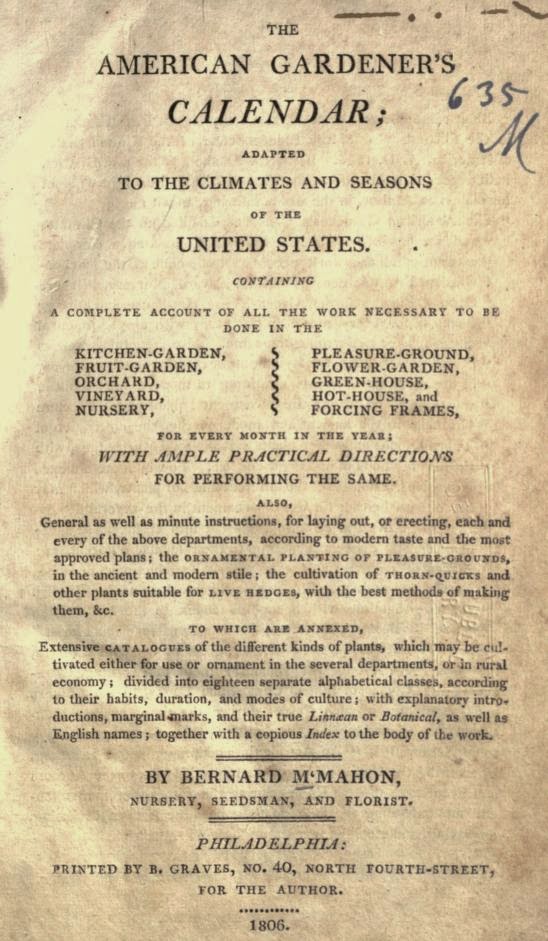
M’Mahon, Bernard. The American Gardener’s Calendar. 1806.  http://biodiversitylibrary.org/page/20142803.


In 1806, while operating his business, he published The American gardener’s calendar; adapted to the climates and seasons of the United States. Liberty Hyde Bailey, in his Cyclopedia of American Horticulture referenced it with: “He gave America its first great horticultural book.” In a sense, it became what we would call a bestseller. The book was popular for 50 years and went through 11 editions, the last published in 1857, long after M’Mahon’s death in 1818.
View Full Size Image
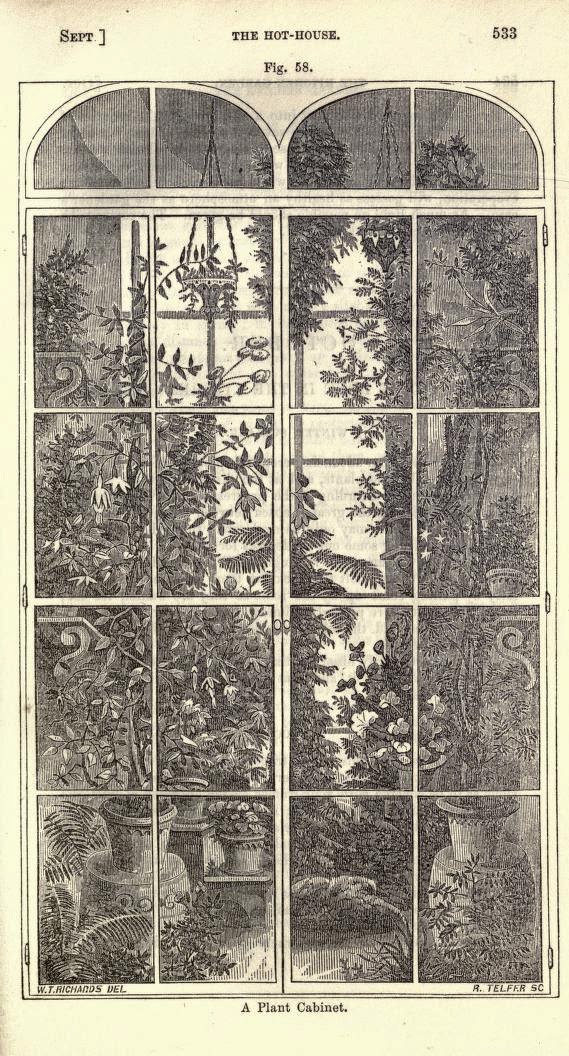
A Plant Cabinet, or Hot-House. M’Mahon, Bernard. The American Gardener’s Calendar. 11th Ed. 1857. http://biodiversitylibrary.org/page/20141911.

It was through The American gardener’s calendar that President Thomas Jefferson became acquainted and befriended M’Mahon. Jefferson found the book useful for his gardening and growing food at Monticello. M’Mahon and Jefferson began an exchange of books and seeds that went on for several years. Jefferson asked M’Mahon, along with fellow Philadelphia gardener, William Hamilton, to receive and propagate seeds and roots from plants collected on the Lewis and Clark Expedition, also known as the Corps of Discovery, in 1804 to 1806.

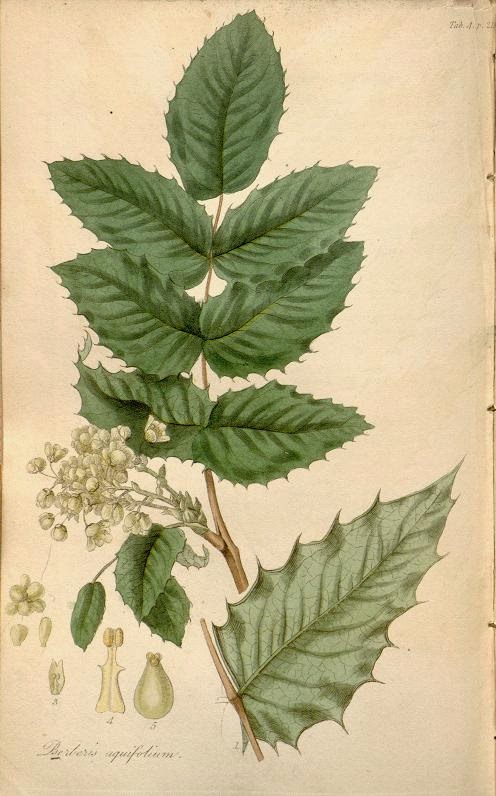
M’Mahon was a friend to many botanists; for example, Thomas Nuttall named a genus of evergreen shrubs discovered in the western U.S. during the Lewis and Clark expedition to honor him. While the name Mahonia is still used frequently in horticulture to identify these shrubs; scientifically, the Oregon grape holly or mountain holly (Berberis aquifolium) is now in the genus Berberis.
View Full Size Image
Berberis aquifolium. Pursh, Frederick. Flora Americae Septentrionalis. v. 1 (1814). http://biodiversitylibrary.org/page/396637.

In the 11th edition of The American gardener’s calendar, Jay J. Smith, who handled the revision, wrote a very personal memoir dedicated to M’Mahon which includes a tribute letter by Darlington. It is one of the few personal recollections I came across for such an important person in American gardening. M’Mahon’s publications can be found online through the BHL website.

Be sure to check out our Garden Stories event next week, March 23-27, and our TwitterChat this Friday, March 20, at 1-2pm EST. Happy gardening!
March 17, 2015by Grace Costantino
BHL News, Blog Reel, Campaigns, Garden Stories

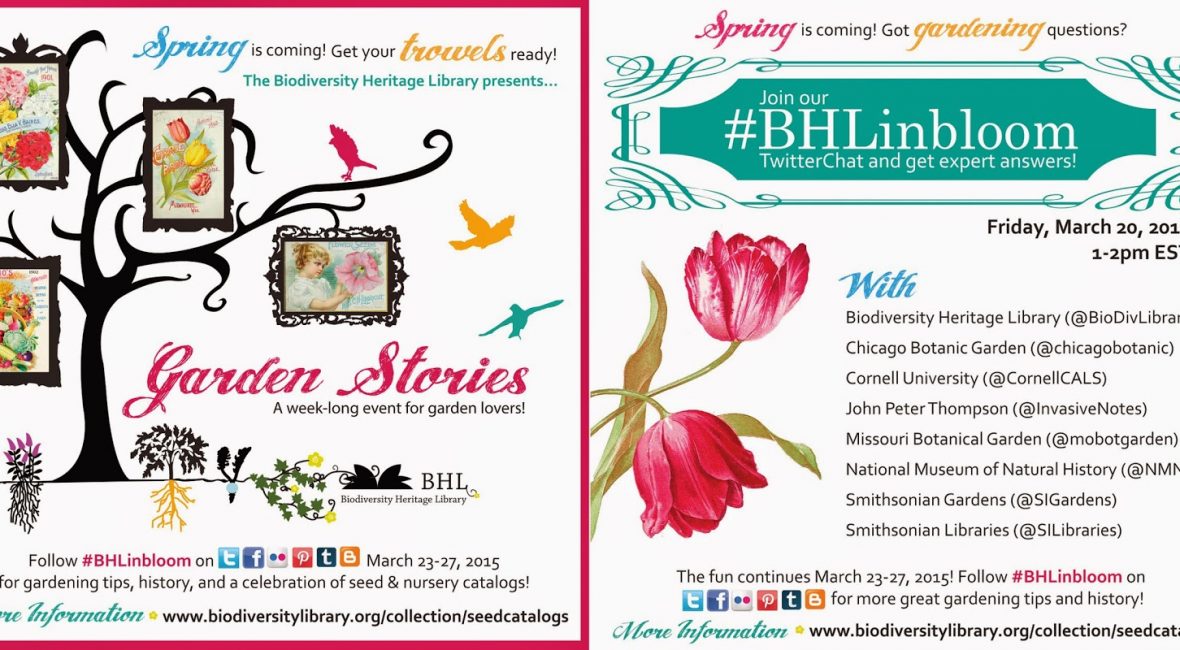
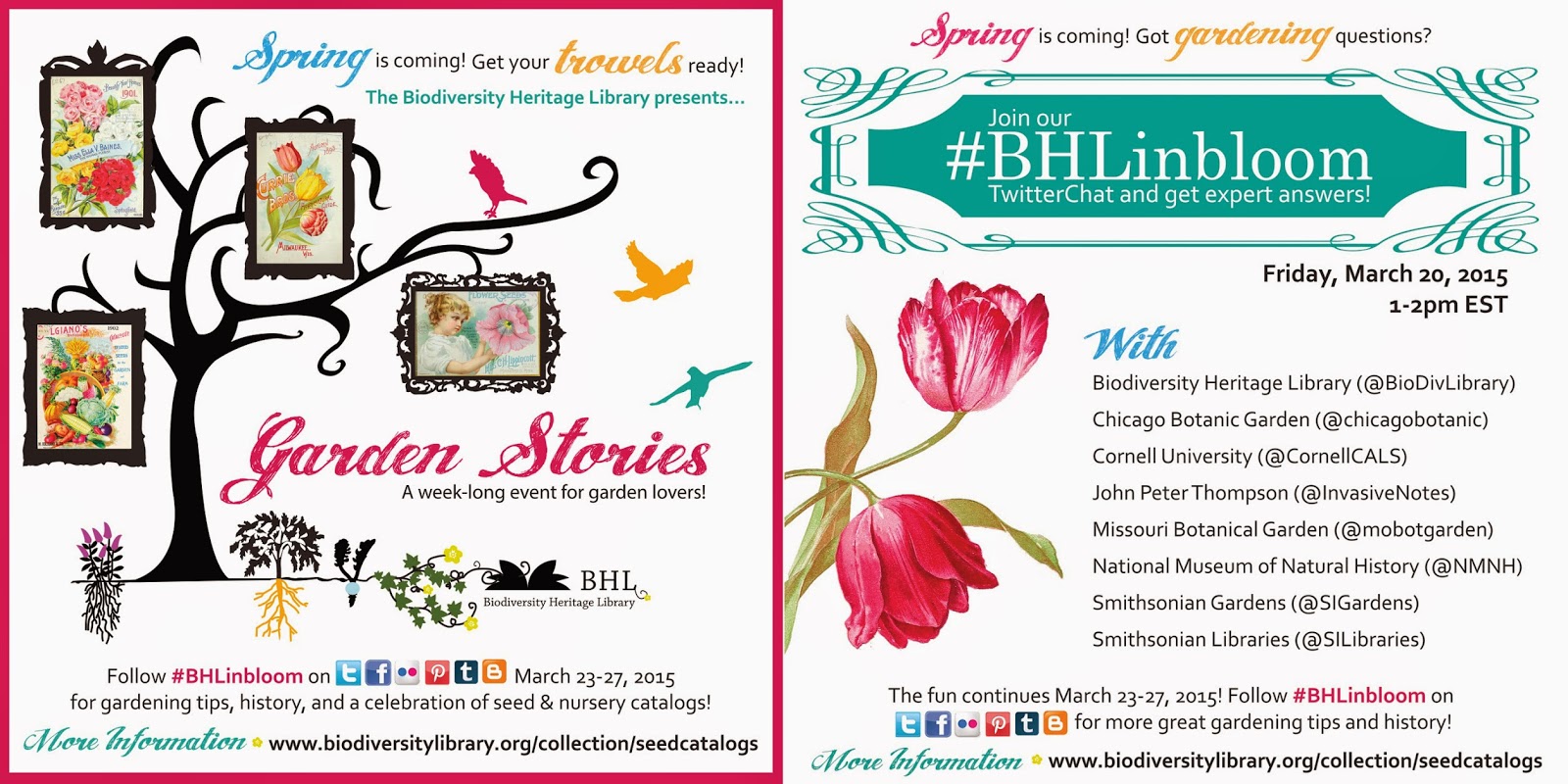
Announcing Garden Stories: A Week Long Event for Garden Lovers

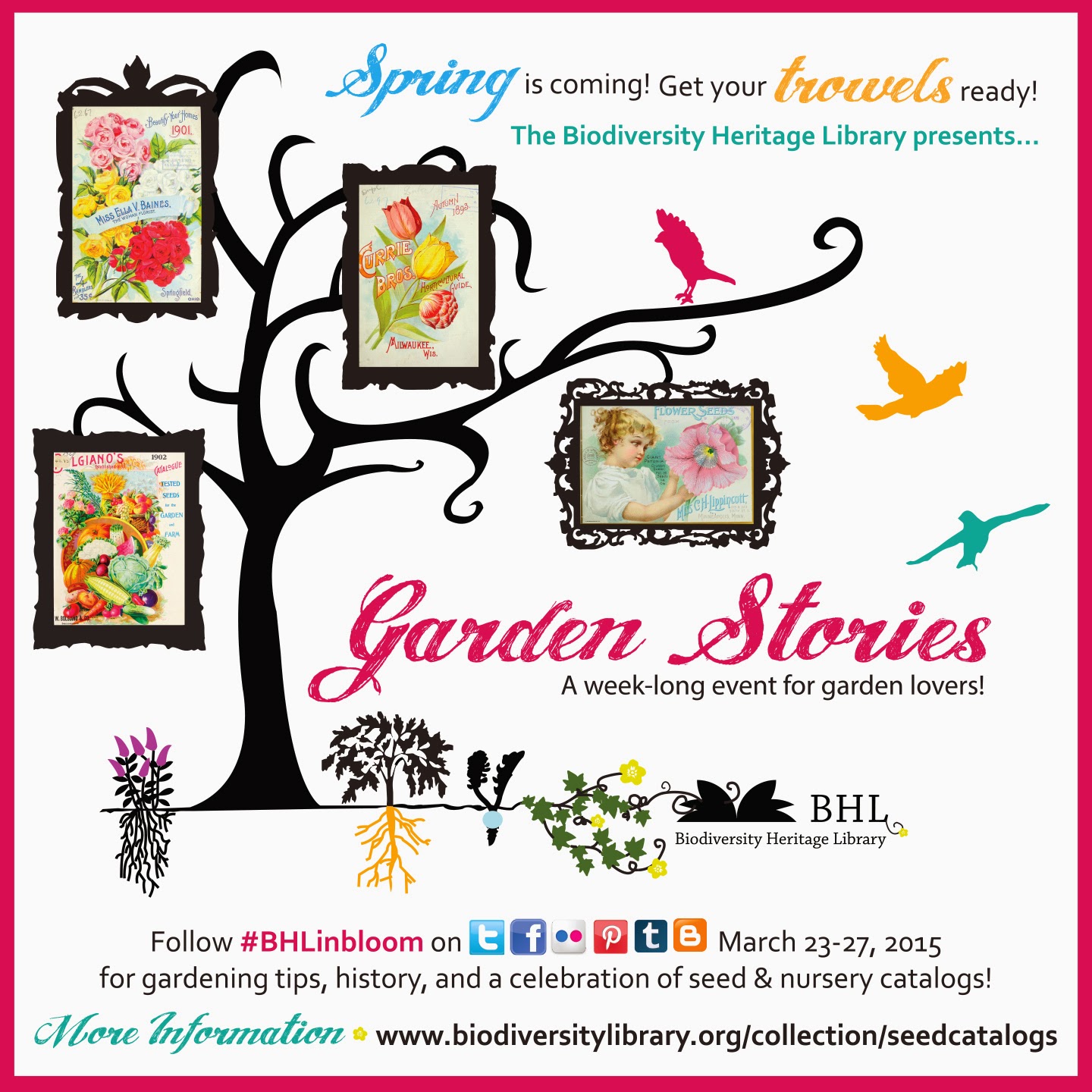
Spring is coming! Get your trowels ready!

We’re excited to announce BHL’s spring event, “Garden Stories,” which will occur March 23-27, 2015.

View Full Size Image

“Garden Stories” is a week long social media event for garden lovers. The campaign will explore the fascinating world of gardening, from the rise of agriculture to the home garden and the mail order gardening phenomenon.

Celebrating the history, science, and art of gardening, content will be published via the BHL Blog, Twitter, Facebook, Flickr, and Pinterest, with additional posts through the Smithsonian Libraries’ Tumblr. Posts will include gardening tips, history, and plant factoids, including daily blog posts highlighting topics such as the role of women in the American horticultural industry; the importance of seed lists and catalogs in the development of new cultivars; heirloom gardening; marketing and artistic revolutions in the gardening industry; and technological and garden fashion and design changes over time, using the over 13,000 seed and nursery catalogs in BHL to help tell these stories and provide this information. All content will be tagged with #BHLinbloom.

See this page for more information: http://www.biodiversitylibrary.org/collection/seedcatalogs

We will kick off the campaign with a TwitterChat on Friday, March 20, from 1-2pm EST. During the chat, we invite you to submit your gardening questions for experts to answer. Botanists and horticulturalists at BHL partner institutions, including Smithsonian Gardens, Smithsonian Libraries, National Museum of Natural History, Missouri Botanical Garden, Chicago Botanic Garden, and Cornell University’s College of Agriculture and Life Sciences are participating to answer questions and provide gardening tips and resources. Follow along and join in using #BHLinbloom.

View Full Size Image

We’re also featuring a Garden Stories t-shirt offered through T-Fund during the campaign. Proceeds will be used to digitize more books for BHL. Our goal is to sell enough shirts to digitize 5,000 pages. The shirt will be available starting on March 20th. Stay tuned on our blog and follow the campaign hashtag for more information.

Finally, during the campaign we’ll also be inviting you to help us improve access to seed and nursery catalogs by transcribing select catalogs as part of our Purposeful Gaming project. Stay tuned for more information and get your citizen science hats ready!

We hope you will join in the fun and help us spread the word about the campaign and TwitterChat. If you have gardening resources, historical information, or seed catalog collections, share them with the hashtag #BHLinbloom during the campaign and we’ll retweet and repost.

So, if you want to have some gardening fun this spring, get your garden gloves out and follow #BHLinbloom on our blog, Twitter, Facebook, Flickr, Pinterest and Tumblr, March 23-27, 2015, and join our TwitterChat on March 20 at 1pm EST!

See stunning art from seed and nursery catalogs in the BHL Flickr!

March 11, 2015by michelle.underhill
Blog Reel

Fun with Seeds

Seed and Nursery Catalogs at The New York Botanical Garden

Thanks to a generous grant from the National Endowment for the Humanities (NEH), The New York Botanical Garden’s The LuEsther T. Mertz Library, the most comprehensive botanical and horticultural library in the Americas, has recently cataloged all 58,000 items in its Nursery and Seed Trade Catalog Collection. The grant also funded the digitization of public domain pre-1923 American nursery catalogs and their publication to the web.

The Nursery and Seed Trade Catalog Collection, one of the largest and most important of its kind in the United States, provides one of the best primary sources of information available on the history and development of American botany, horticulture, and commercial agriculture. Their value to humanities research, however, extends far beyond these subjects alone.

View Full Size Image
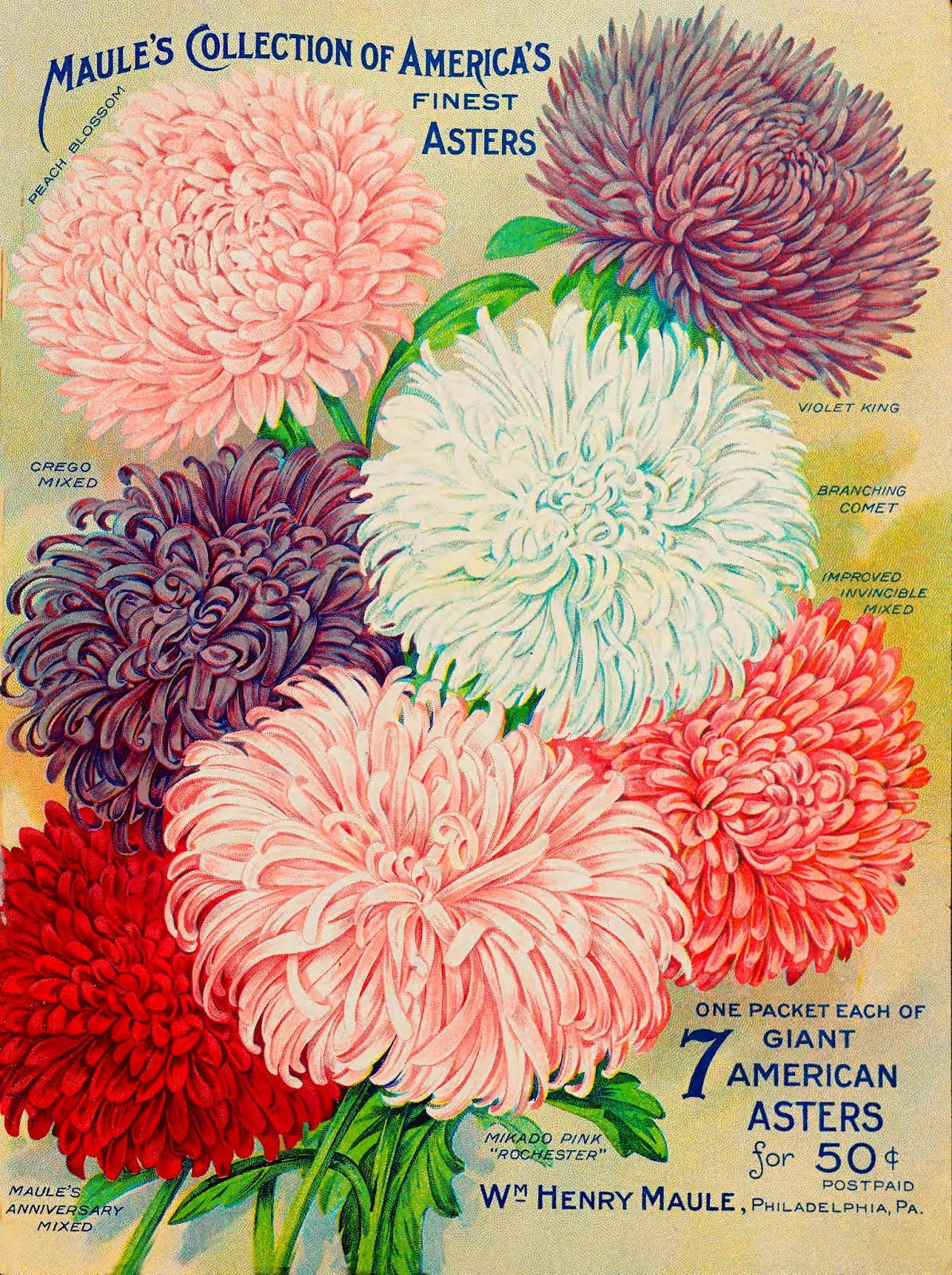
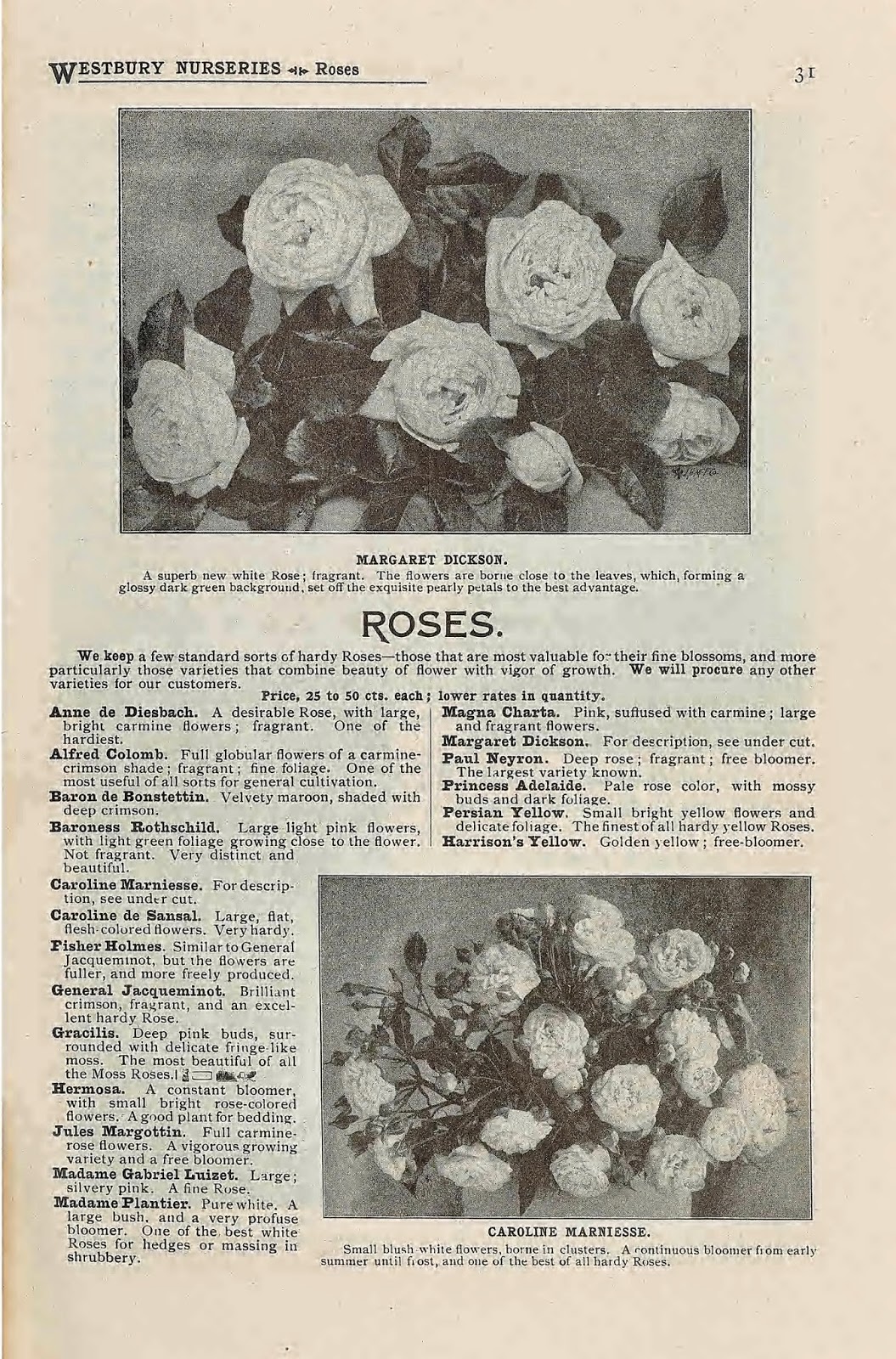
Color, skillful drawing and appealing text popularized American nursery and seed catalogs. Maule’s Seed Catalog. 1914. http://biodiversitylibrary.org/page/46265545.


The Importance of Seed Catalogs

Nursery and seed trade catalogs offer a unique window into other areas of American life, including publishing, landscape design, marketing, industry, and leisure activity, making them valuable resources for humanities research.

Nursery and seed catalogs often provide the first description of a newly introduced species or hybrid, and the establishment of accepted nomenclature for a plant or flower requires knowing the earliest date the name was used. One of the problems facing an International Registrar in establishing name priority is determining the date of the first valid publication for a new cultivar. Very often this publication is a seed catalog. Consequently, botanists and horticulturists utilize nursery catalogs to trace the development of new hybrids, varieties, and mutations.

View Full Size Image
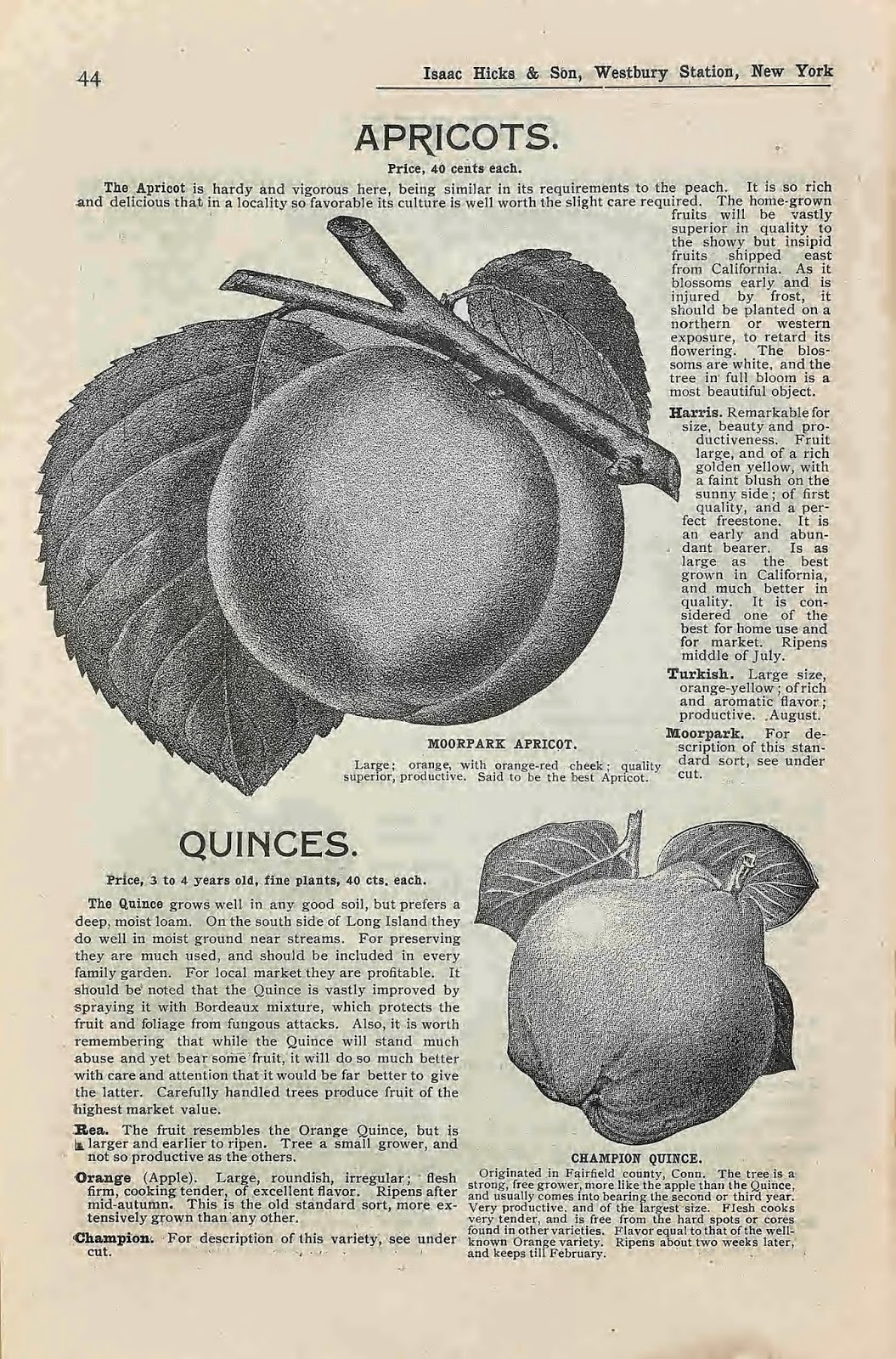
Fruits for Long Island with abridged list of lawn and street trees, evergreens, shrubs, roses, vines and hardy flowers. 1898. http://biodiversitylibrary.org/page/46037567.


Enhancing Discovery of Seed and Nursery Catalogs

Searching the text of online vintage seed catalogs, however, has often been problematic. Seed catalogs are notoriously difficult subjects for Optical Character Recognition software (OCR) to parse. The picturesque fonts and elaborate page layouts so endearingly characteristic of seed catalogs have caused the resulting OCR output to be error prone and less than optimal, at least up to now.

The Institute of Museum and Library Services (IMLS) has recently awarded a grant to the Missouri Botanical Garden and its partner institutions, including Harvard MCZ, Cornell University and the the Mertz Library at NYBG, to use purposeful gaming and crowd sourcing to improve the precision of OCR, thereby helping to optimize search and discovery of online collections. Despite the technical difficulties to be overcome, the compelling content of vintage American seed catalogs promises to motivate the search for solutions as it once did the efforts of generations of gardeners to grow flowers like the pictures in the catalog.

View Full Size Image
Fruits for Long Island with abridged list of lawn and street trees, evergreens, shrubs, roses, vines and hardy flowers. 1898. http://biodiversitylibrary.org/page/46037580.


Seeds and the Entrepreneurial Spirit

Beyond their pictorial features, another reason for the continued intense fascination with seed catalogs is that the American nursery and seed business at the turn of the last century was replete with Horatio Alger stories of enterprising individuals who combined impressive horticultural skills with savvy commercial instincts. The prosperous businesses established by James Vick, John Lewis Childs and D.M. Ferry are typical of these self-taught botanical entrepreneurs.

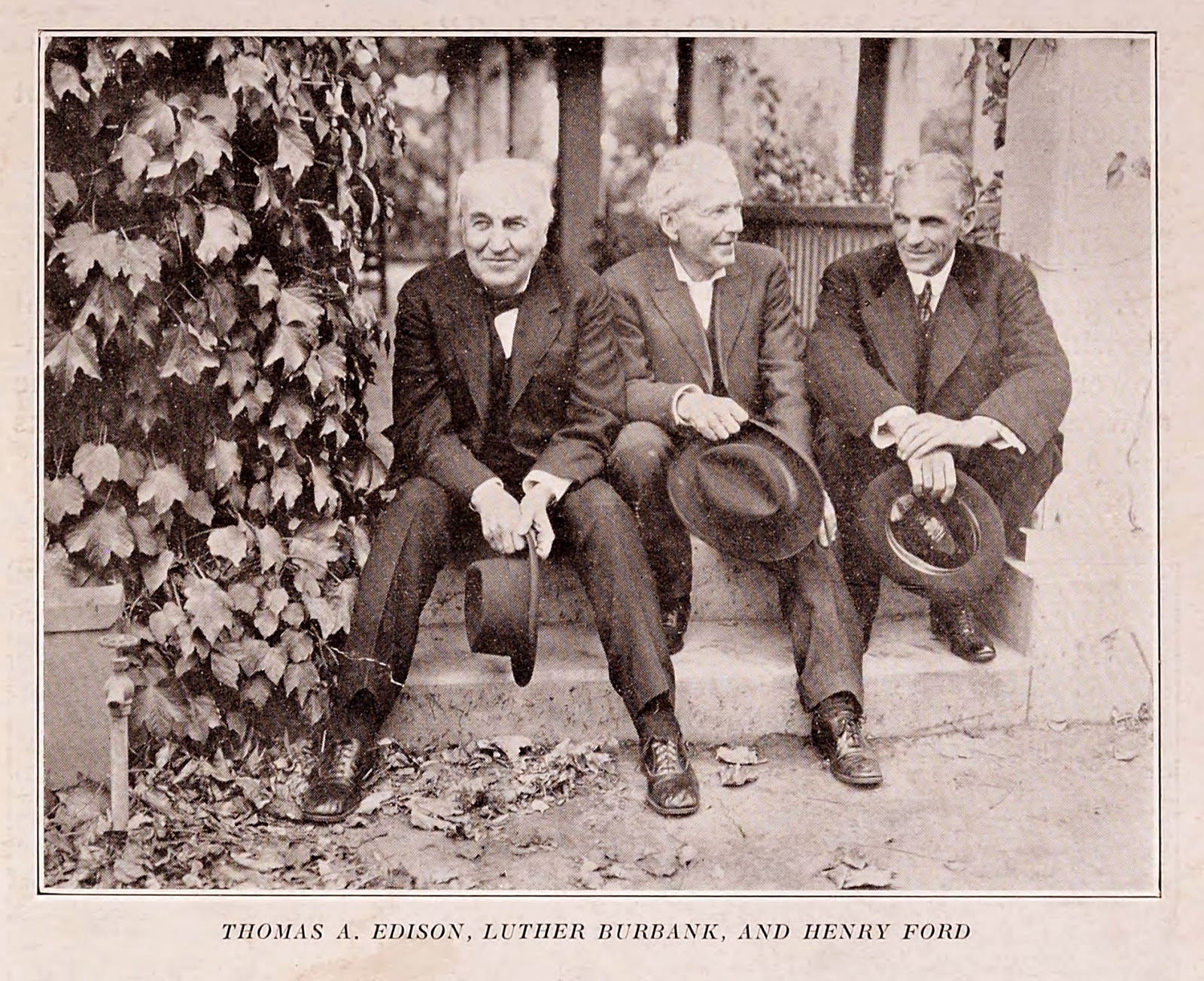
One image from the Luther Burbank seed catalog of 1916 vividly captures the heroic spirit of the era. It depicts the meeting of Thomas A. Edison, Henry Ford and Luther Burbank on the porch of Burbank’s Santa Rosa, California home in 1915. The aggressive herd of newspaper reporters and newsreel photographers who swarmed all over Burbank’s property that day prompted Edison to grumble “Darn these movies.” Burbank featured the meeting prominently in his catalogs as a celebrity endorsement of his plants and seeds.

View Full Size Image
Left to Right: Edison, Burbank and Ford. Mertz Library image in BHL. http://biodiversitylibrary.org/page/46319618.

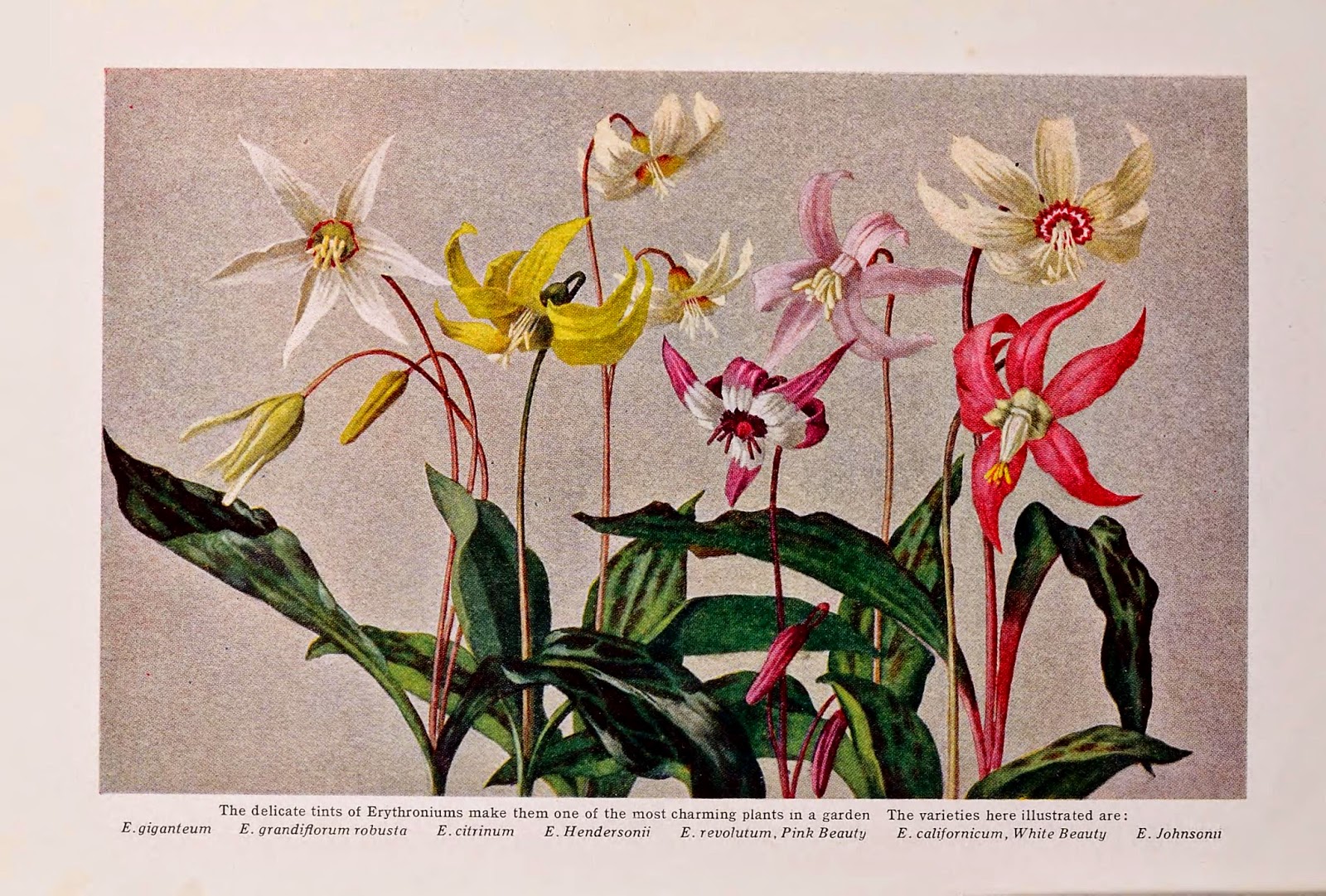
One of the more colorful figures in the American nursery business was another Californian and a close friend of Luther Burbank’s named Carl Purdy (1861-1945). He was called the “Lily Man of Ukiah” by the press and today his life story seems almost mythical. In 1870, at the age of nine, Purdy was brought west in a covered wagon to the still pristine landscape of Mendocino County, California. When he reached adulthood he travelled on stagecoaches to business meetings and botanical conferences. He witnessed the San Francisco earthquake of 1906 and was a key figure in the spectacular San Francisco World’s Fair of 1915. He was fluent in Spanish and several Native American languages and once wrote a splendid book about the extraordinary baskets fashioned by the Indians of Mendocino County. Above all, he studied and mastered the cultivation of California’s native bulbs and plants, successfully introducing them for the first time to European and American gardens. His self-taught knowledge of California’s flora was acquired first hand through precise observation and experimentation prompting the scholarly Willis Linn Jepson to acknowledge that Purdy’s expertise was of the highest order.

Purdy was well read, having immersed himself in classical literature from childhood. He wrote all of the text for his catalogs, filling page after page with expert horticultural instructions and elegant prose. His proud description of the scenery on his 180-acre horticultural ranch named “The Terraces” was a regular feature of his catalogs:

“From a scenic point of view, ‘The Terraces’ are probably the most unique gardens in the world. Large springs feed a mountain stream, which passes through a rich valley, and then, over four limestone bluffs in succession, each from 50 to 75 feet high, it plunges in many most charming cascades and waterfalls. Between the bluffs are the terraced slopes from which the gardens get their name.”

Purdy’s seed and bulb catalogs of native California plants have for decades been one of the hidden treasures of the Mertz Library, but happily they are now easily accessed on both BHL and Mertz Digital.

View Full Size Image
Erythroniums (dog-toothed violets). Carl Purdy catalog of 1921. http://biodiversitylibrary.org/page/46307063.

To read more about Carl Purdy, his life and times, please see the Mertz Library’s LibGuide here.

Thousands of Seed Catalogs in BHL

Browse over 11,000 seed and nursery catalogs in the BHL collection, digitized primarily from the significant collections of The New York Botanical Garden, Cornell University and the National Agricultural Library. The collection will continue to grow supported in part by the Purposeful Gaming grant from the Institute of Museum and Library Services. We welcome suggestions of catalogs to consider for digitizing and adding to the collection.

We hope you enjoyed this post. Interested in guest-blogging for BHL? We’d love that! Natural history, biodiversity and conservation topics are especially welcomed. Email us your ideas at [email protected].
December 18, 2014by ulib-libraryjobs
Blog Reel, Featured Books

The Stories Seeds Tell

Since the mid-19th century, seed and nursery catalogs have reflected the agricultural and horticultural landscape of the United States. These catalogs—which began as guides to medicinal herbs, and are still printed today—often contain lists of plant varieties and gardening advice. While seed catalogs are used primarily by commercial growers and home gardeners, they also represent an invaluable resource to historians, artists, and researchers of all kinds.

So, what exactly do seed and nursery catalogs tell us?

View Full Size Image

History

Seed catalogs offer a fascinating glimpse into the cultural, economic, and political history of the era in which they were published. For instance, when the outbreak of World War I halted agricultural exports from Europe to the US, American citizens planted their own “war gardens” to ease the strain on the food supply; seed catalogs of the time leveraged the economic climate to aid the war effort and increase their own sales. In 1918, Allen’s Book of Berries—a seed catalog specializing in strawberries—prefaced its annual publication with this admonition:
“Of one thing we are sure. We must not slacken our efforts to produce just as much as we can, for reasons of patriotism as well as of profit. Fruit is not a luxury; it is a necessity. As such, we should make that supply plentiful.”

Technology

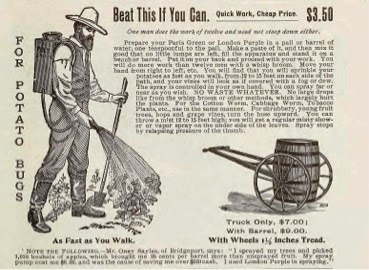
In addition to offering varieties of seeds for sale, seed and nursery catalogs often included advertisements for the latest tools and gadgets. This technology reflected the materials available at the time as well as the gradual trend toward large-scale commercial growing and away from single-household plots. The hand-held implements of the mid-19th century catalogs gave way to the combine-like machinery of the 20th century.
View Full Size Image
A new type of sprayer to combat potato bugs, featured in F.H. Ebeling’s 1899 Catalogue

Seed catalogs themselves started to change, incorporating black-and-white photography alongside traditional, brightly-colored illustrations. The widespread availability of color film in the 1940s changed the look of catalogs yet again.

Food

As the genetic landscape of our food continues to change, many people look to historical seed catalogs to understand what previous generations were eating, and what it means for GMOs and current agricultural practices. Seed catalogs are a treasure trove of information about heirloom vegetable varieties and organic gardening. As technology continues to evolve however, they face an uncertain future: does the Internet make printed seed catalogs obsolete?

The Future

View Full Size Image
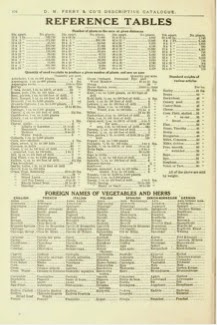
An example of material that computers have a hard time transcribing

Whether the Internet means the end of printed catalogs or not, it provides some new and exciting IMLS-funded Purposeful Gaming Project. Because they are printed in unconventional formats, with many tables and abbreviations, seed catalogs make poor candidates for Optical Character Recognition (OCR) technology. This means that in order to make them searchable in BHL, individuals must transcribe their contents by hand.
opportunities to use them as part of the

The Missouri Botanical Garden, the New York Botanical Garden, and Cornell University are providing their seed catalogs to game developer Tiltfactor, which is working on a video game to help users compare and correct these difficult transcriptions. Once corrections are made, they will be incorporated into the BHL collection.

Stay tuned for how you can help transcribe seed and nursery catalogs, and look for Tiltfactor’s new game after the holidays! If you’re eager to start transcribing now, check out the diaries and journals of ornithologist William Brewster. And don’t forget to browse a century’s worth of horticultural history in the BHL’s Seed and Nursery Catalogs collection.

November 28, 2014by [email protected]
Page 3 of 3«123

Help Support BHL

BHL's existence depends on the financial support of its patrons. Help us keep this free resource alive!

search

About BHL

The Biodiversity Heritage Library (BHL) is the world’s largest open access digital library for biodiversity literature and archives. BHL operates as a worldwide consortium of natural history, botanical, research, and national libraries working together to digitize the natural history literature held in their collections and make it freely available for open access as part of a global “biodiversity community.”

Join Our Mailing List

Sign up to receive the latest news, content highlights, and promotions.

Subscribe Now

Subscribe to Blog via Email

Enter your email address to subscribe to this blog and receive notifications of new posts by email.

Join 319 other subscribers

Subscribe to Blog Via RSS

Subscribe to the blog RSS feed to stay up-to-date on all the latest BHL posts.

Access RSS Feed

Inspiring Discovery through Free Access to Biodiversity Knowledge.

The Biodiversity Heritage Library makes it easier than ever for you to access the information you need to study and explore life on Earth…for free, anytime, anywhere.


64+ Million Pages of
Biodiversity Literature Online.

EXPLORE

Tools and Services
to Transform Research.

EXPLORE

300,000+
Illustrations on Flickr.

EXPLORE

ABOUT | HARMFUL CONTENT | PRIVACY | SITE MAP | TERMS OF USE