Biodiversity Heritage Library - Program news and collection highlights from BHL
  • Home
  • News
  • Featured Books
    • All Featured Books
    • Book of the Month Series
    • BHL at 20
  • User Stories
  • Campaigns
    • Fossil Stories
    • Garden Stories
    • Monsters Are Real
    • Page Frights
    • Her Natural History
    • Earth Optimism 2020
  • Tech Blog
  • Visit BHL
Home
News
Featured Books
    All Featured Books
    Book of the Month Series
    BHL at 20
User Stories
Campaigns
    Fossil Stories
    Garden Stories
    Monsters Are Real
    Page Frights
    Her Natural History
    Earth Optimism 2020
Tech Blog
Visit BHL
  • Home
  • News
  • Featured Books
    • All Featured Books
    • Book of the Month Series
    • BHL at 20
  • User Stories
  • Campaigns
    • Fossil Stories
    • Garden Stories
    • Monsters Are Real
    • Page Frights
    • Her Natural History
    • Earth Optimism 2020
  • Tech Blog
  • Visit BHL
Biodiversity Heritage Library - Program news and collection highlights from BHL
BHL News, Blog Reel

Digging into Data Challenge Winners Announced

Mining Biodiversity (MiBIO): innovative computational techniques to mine BHL texts

On January 15, 2014, ten international research funders from four countries jointly announced the winners of the third Digging into Data Challenge, a competition to develop new insights, tools and skills in innovative humanities and social science research using large-scale data analysis.

Fourteen international teams representing Canada, the Netherlands, the United Kingdom, and the United States will receive grants totaling approximately $5.1 million to investigate how computational techniques can be applied to “Big Data”.  Their work will address the evolving nature of humanities and social sciences research, which often relies on massive multisource datasets.  Each team represents collaborations among scholars, scientists, and information professionals from leading universities and libraries in Europe and North America.

The first round of the Digging into Data Challenge was held in 2009 and the second in 2011. Previous Digging into Data research projects have received international attention.  The 2013 winners were selected from among 69 applications and address a wide variety of topics.  Among the sponsoring bodies, the Institute of Museum and Library Services (IMLS) announced, on January 15, 2014, the winners of the third Digging into Data Challenge that they will fund.  IMLS’s contribution of $424,591 supports the American researchers from three of the mentioned fourteen international teams: the Missouri Botanical Garden, the University of Wisconsin-Madison, and the University of South Carolina.

As part of an international team involving partners in UK, Canada and the USA, Missouri Botanical Garden was awarded $175,000 by the IMLS to lead the USA members of the Mining Biodiversity Project team in applying innovative computational techniques to biodiversity texts and help improve the way we view, access and share the knowledge contained with in the Biodiversity Heritage Library.

The Mining Biodiversity (MiBIO) Project
Principal Investigators:

  • (United Kingdom) Sophia Ananiadou, Director of the National Centre for Text Mining and Professor in the School of Computer Science at the University of Manchester;
  • (Canada) Anatoliy Gruzd, Director of the SocialMedia Lab and Associate Professor at Dalhousie University;
  • (USA) William Ulate Rodríguez, Global Coordinator & Technical Director for US/UK of the Biodiversity Heritage Library and Senior Project Manager of the Center for Biodiversity Informatics at the Missouri Botanical Garden.

View Full Size Image

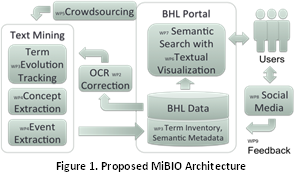
The MiBIO project is an international collaboration (UK, Canada, USA), leveraging large-scale data resources collected and curated by BHL members in US and worldwide, a digital portal developed and maintained by the BHL Technical staff at Missouri Botanical Garden and managed by the BHL Secretariat at the Smithsonian Institution Libraries, text mining resources developed by the UK partner (NaCTeM), and social media, visualization and text cleaning methodologies developed by the Canadian partner (Dalhousie).

The project’s prime objective is to promote the efficient access to and sharing of large-scale biodiversity legacy literature by the worldwide community of science libraries, museums and the interested public The project will integrate novel text mining methods, visualization, crowdsourcing and social media into the BHL to provide a semantic search system aimed to transform BHL into a next-generation social digital library resource that facilitates the study and discussion (via social media integration) of legacy science documents on biodiversity by a worldwide community.

By promoting the development of capabilities that will foster collaboration among researchers from the fields of History of Science, Environmental History, Environmental Studies, Library and Information Science and Social Media, the project hopes to make a significant impact on the above disciplines by (1) enriching a large-scale library, i.e., the BHL, via innovative application of Text Mining techniques to produce semantic metadata and a term inventory, (2) providing improved access to biodiversity-related digital artifacts via an enhanced search engine and visualization of results and (3) stimulating increased collaboration, interaction and sharing of information among BHL users via the social media environment.
View Full Size Image

The Institute of Museum and Library Services (IMLS)is the primary source of federal support for the nation’s 123,000 libraries and 17,500 museums. Our mission is to inspire libraries and museums to advance innovation, lifelong learning, and cultural and civic engagement. Our grant making, policy development, and research help libraries and museums deliver valuable services that make it possible for communities and individuals to thrive. To learn more, visit www.imls.gov and follow us on Facebook and Twitter.

In addition to the U.S. Institute of Museum and Library Services, the sponsoring funding bodies include:

  • Arts & Humanities Research Council (United Kingdom),
  • Economic & Social Research Council (United Kingdom),
  • Canada Foundation for Innovation (Canada),
  • National Endowment for the Humanities (United States),
  • Natural Sciences and Engineering Research Council (Canada),
  • National Science Foundation (United States),
  • Netherlands Organisation for Scientific Research in collaboration with The Netherlands eScience Center (NLeSC) (Netherlands),
  • Social Sciences and Humanities Research Council (Canada).

The U.K. charity Jisc will be providing professional program management in the progression of the United Kingdom projects.

The Biodiversity Heritage Library (BHL) is a consortium of natural history and botanical libraries that cooperate to digitize and make accessible the legacy literature of biodiversity held in their collections and to make that literature available for open access and responsible use as a part of a global “biodiversity commons.” The BHL consortium works with the international taxonomic community, rights holders, and other interested parties to ensure that this biodiversity heritage is made available to a global audience through open access principles. In partnership with the Internet Archive and through local digitization efforts, the BHL has digitized millions of pages of taxonomic literature, representing tens of thousands of titles and over 100,000 volumes.

The Missouri Botanical Garden’s mission is “to discover and share knowledge about plants and their environment in order to preserve and enrich life.” Today, 153 years after opening, the Missouri Botanical Garden is a National Historic Landmark and a center for science, conservation, education and horticultural display.

The Center for Biodiversity Informatics (CBI) at the Missouri Botanical Garden seeks to provide innovative technology solutions to the global community of life science scholars in order to mobilize, integrate, and repatriate data about the world’s biodiversity.

Find more information at:

MiBIO Project Website: www.nactem.ac.uk/DID-MIBIO/

Official Winners Announcement: http://www.diggingintodata.org/Home/AwardRecipientsRound32013/tabid/201/Default.aspx

IMLS Press Release: http://www.imls.gov/5.1_million_awarded_for_delving_into_big_humanities_and_social_science_data.aspx
Dalhousie University Press Release: http://www.dal.ca/news/2014/01/22/natural-history-for-the-digital-age.html
View Full Size Image

This project is made possible by a grant from the Institute for Museum and Library Services [Grant number LG-00-14-0032-14].

January 28, 2014by suzanne.chase
BHL News, Blog Reel

Ringing in the New Year with thanks!

Portrait version of the Biodiversity Heritage Library logo.

In the US, we set aside time to reflect and give thanks in November as part of the Thanksgiving holiday.  It is now the start of a new year–and only the first month, not the eleventh–yet BHL already has a lot for which to give thanks!

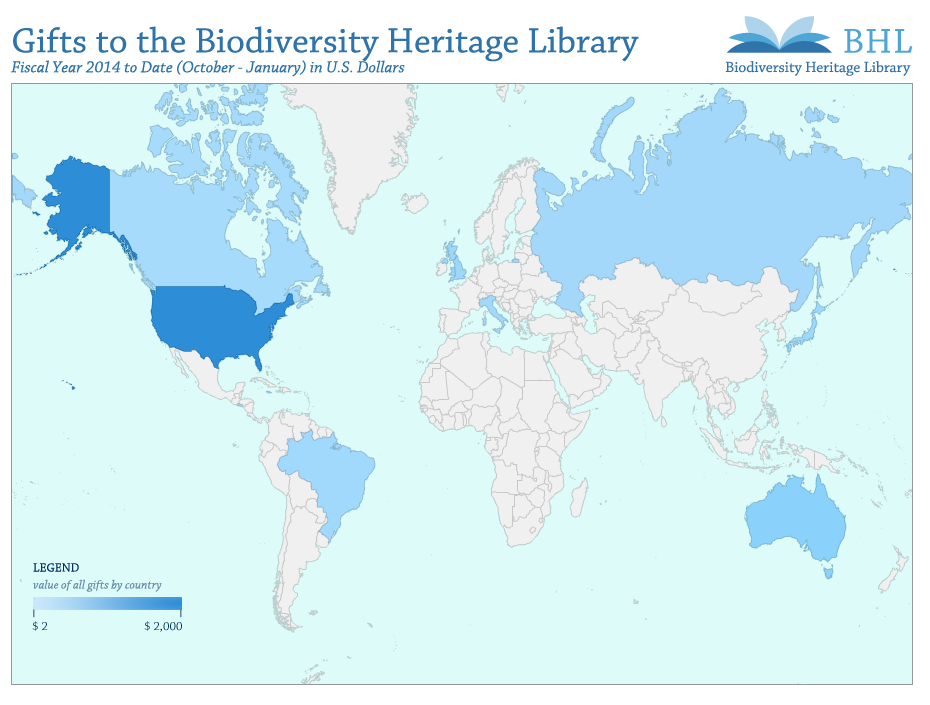
Since the start of the fiscal year 2014 (October 1), donors from across the world have contributed $2,434.12 to support BHL’s continuing mission.  As a digital library consortium comprised of 13 US and 2 UK institutions, it’s encouraging to see the generosity of donors with $1,794 coming in from those countries alone ($1,681.36 and $112.76 respectively).

View Full Size Image

The Biodiversity Heritage Library provides free global access to more than 42 million pages of digitized biodiversity literature and we are so pleased to see the global response of generous support for continuing these efforts.  Donors from Australia, Brazil, Canada, El Salvador, Italy, Jamaica, Japan, and Russia have each made generous contributions totaling $640.

Historical collections of biodiversity literature are exceptionally valuable for taxonomists and others studying the diversity of life on our planet, yet this wealth of knowledge is available only to those few who can gain direct access to significant library collections. Literature about the biota existing in developing countries is often not available within their own borders.  Free global access to digital literature repatriates information about the earth’s species to all parts of the world. Because of BHL’s success in digitizing a significant mass of biodiversity literature, the study of living organisms has become more efficient.  Scientists around the world are using BHL to identify and classify species, facilitate further scientific research, and support conservation efforts to prevent extinctions.

BHL is so thankful and encouraged by the generosity of all of our donors!  These donations help pay for the cost of digitizing additional literature, improving data curation, and continuing technical development for the BHL program. The examples below highlight the ways your donation can make a meaningful and lasting impact:

$25 – Creates Flickr sets of our images which are popular with educators and artists

$50 – Promotes biodiversity education through social media, such as our blog

$100 – Scans 1,000 pages to be made available for free and open access

$250 – Helps us host marketing interns who circulate biodiversity content worldwide

$500 – Improves existing methodology and helps develop new tools for biodiversity research

We hope you’ll consider making a contribution of your own to help BHL continue providing open access to biodiversity literature!   Donate: https://donate.sil.si.edu/v/DonateBHL.asp 

January 27, 2014by brooksm
BHL News, Blog Reel

While standing on the shoulders of giants…

Learning lessons from the CITScribe Hackathon participation

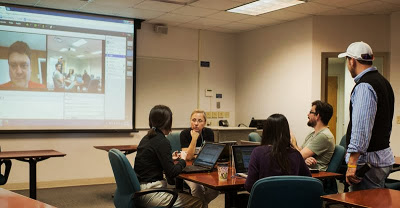
Two members of BHL’s Technical Advisory Group (TAG), BHL Technical Director William Ulate from Missouri Botanical Garden and Joe deVeer, Head of Technical Services of the Ernst Mayr Library at the Museum of Comparative Zoology, Harvard, “virtually” attended the CITSCribe Hackathon in Gainesville, Florida from Dec. 16 to 20, 2013.

The hackathon was co-organized by iDigBio (www.idigbio.org) and Zooniverse’s Notes from Nature Project (www.notesfromnature.org). Led by the co-organizers Rob Guralnick (University of Colorado, Boulder) and Austin Mast (Florida State University), the objective of the hackathon was to further enable public participation in the online transcription of biodiversity specimen labels and to produce new functionality and interoperability for Zooniverse’s Notes from Nature and similar transcription tools.  The event started by focusing on four areas of development, progressively addressed throughout the week: (1) interoperability betweenpublic participation tools and biodiversity data systems, (2) transcriptionquality assessment/quality control (QA/QC) and the reconciliation of replicatetranscriptions, (3) integration of optical character recognition (OCR) into thetranscription workflow, and (4) user engagement.

View Full Size Image
The LI LI Hackathon subgroup working on the integration of OCR.

For a while now, the BHL Technical Advisory Group (TAG) has been participating in the events of iDigBio, particularly on the Augmenting OCR Working Group, under Deb Paul and Bryan Heidorn’s guidance.  One of our BHL colleagues and TAG members, John Mignault from New York Botanical Garden, also participated last year at iDigBio’s previous hackathon which primarily focused on parsing OCR output to standard darwin core.

This time, we had a presentation by Cody Meche, an Agile trainer who gave some useful directions and tips on how to approach our hackathon to use our time as efficiently as possible while following an agile development process.  Alex Thompson, from iDigBio, presented on the digital resources that could allow programmers to run a copy of the web interface of Notes for Nature on their local machines using Vagrant and Virtualbox.  Paul Kimberly also presented the Smithsonian transcription project (transcription.si.edu) and Yonggang Liu talked about iDigBio’s image ingestion tool, useful for getting images into the iDigBio cloud.  Laura Whyte, Director of Citizen Science at Adler Planetarium joined us virtually at the Hackathon to talk about Zooniverse and citizen science.

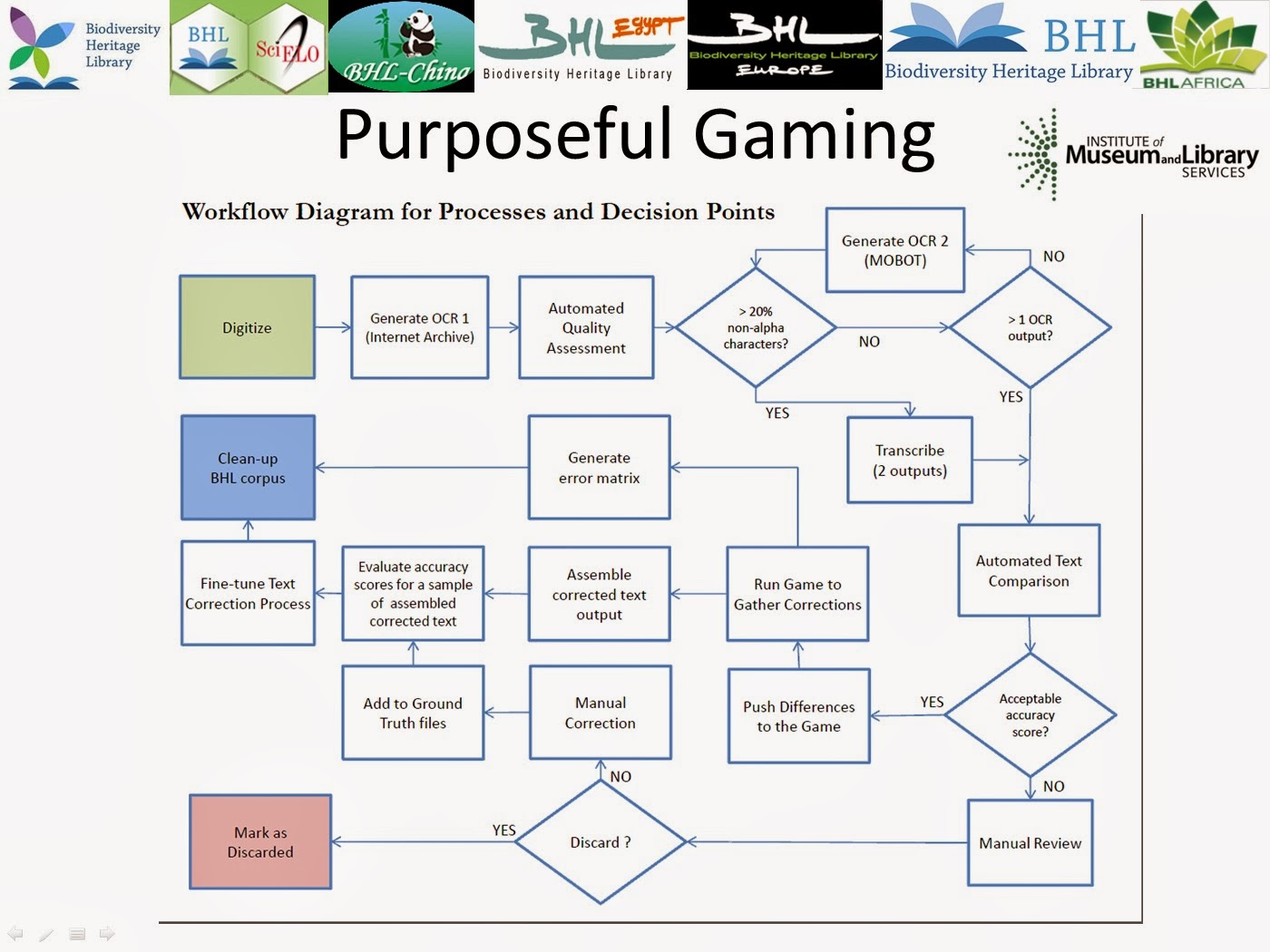
I also had a chance to present shortly about our approach to OCR and Transcription with in our Purposeful Gaming project funded by the Institute of Museum and Library Services (IMLS). Basically, we intended to leverage iDigBio’s knowledge while tackling the challenge of improving the existing BHL OCR through Purposeful Gaming.  Our interest was mainly two-fold: on one side we wanted to learn from the amazing cumulative experience and skills that iDigBio comprises and the tools that are being adapted, built and used to generate the OCR and transcribe the text of their specimen labels; a challenge very similar to our own issues with OCR of books and journals in BHL.  On the other hand, we wanted to learn from their workflow definition to improve the OCR generation process, the incorporation of their transcription outputs and the reconciliation of the existing versions into a single one (for example, read about using sequence aligning methods on this recent blogpost by Rob Guralnick), while at the same time taking advantage of the citizen scientists’ help in an efficient manner that copes with the scale of the challenge.

View Full Size Image
High level workflow proposed for the Purposeful Gaming project

Specifically, our short term goals include incorporating recommendations and adapting existing tools developed by many of the participants in the past two hackathons: Jason Best’s DarwinScore, Ben W. Brumfield’s work on QC for Collaborative (Crowdsourced) Manuscript Transcription, the QA/QC track developments to take outputs from the citizen science transcription products and assure the highest quality end result, are just some among many other outputs and suggestions from these activities that can be incorporated to our process of improving the OCR texts in BHL.  And if you have more ideas, I would definitely like to hear about them…

For more information on the recent CITScribe Event read this iDigBio’s blogpost, Austin Mast’s detailed blog post or consult directly the Hackathon wikipage.

You can access all information and results about iDigBio in their home page and follow our own BHL developments from the webpage of the Purposeful Gaming project, made possible in part by the Institute for Museum and Library Services [Grant number LG-05-13-0352-13].

View Full Size Image

January 23, 2014by Joanne A. Schneider
BHL News, Blog Reel

My experience as a BHL Intern

Portrait version of the Biodiversity Heritage Library logo.


View Full Size Image
Kai Alexis Smith, Virtual Marketing Intern, Fall 2013

I was the Virtual Marketing Intern at Smithsonian’s Biodiversity Heritage Library in fall 2013. I participated in this internship post graduation because while I have previous experience with social media and marketing from my previous career, this internship provided me experience directly promoting a library collection. Also, while my background and passion is in the arts, I always had and will have a special place in my heart for science, especially biology. For the position, I wrote seven blog posts that highlighted books from the BHL library. I also wrote Facebook and Twitter posts to promote the blog.

After graduating from the Pratt Institute School of Information and Library Science program in May 2013, I went to the University of Michigan to complete an Association of Research Libraries Fellowship where I worked on digitizing select items and created an Omeka exhibit for the Leonard B. Willeke collection. I started to wonder how this project would be promoted within the institution as the Omeka exhibit was in anticipation of the complete digital collection of 16,000 items. In August, this interest in promotion grew stronger when I was in Washington, D.C. developing a digitization strategy for vertical files at the National Gallery of Art as the ARLIS/NA Wolfgang Freitag Intern. I incorporated a promotion section in the digitization strategy, as it would be an integral part of discovering the project and spreading the word about its services, if implemented. I also, visited many libraries while in D.C. and part of my inquiries included how each institution promoted their collections and services. Many mentioned different social media platforms and others shared that marketing was centralized within the institution. I realized that while I had previous career experience with social media and marketing, I did not have direct library experience. This internship helped round out my skill set.

During the virtual marketing internship, I had the pleasure of working with Biodiversity Heritage Library Collections Coordinator Bianca Crowley. While many past interns have touted the awesomeness of the badge, which, no doubt having one is, as a virtual intern I did not have the privilege of a Smithsonian badge. However, there were many other benefits. One of the main benefits of this internship was not only the experience, but the opportunity to learn from other experienced Smithsonian Institution librarians. Even though there were setbacks with the government shutdown, Bianca did an amazing job of setting up virtual introductions and an awesome virtual tour of the scanning room. I even got the chance to video chat with President of Smithsonian Libraries Mrs. Nancy Gwinn. I also was able to meet the staff and tour the Cooper-Hewitt Library in person in New York City.

My undergraduate degree is in writing, so this internship helped me return to my roots. I learned and wrote about New York state fossil Eurypterus remipes, hummingbirds and butterflies, molluscs, parasites, cephalopods, reptiles and amphibians, and Austrian zoologist Leopold Joseph Fitzinger and his picture atlas of birds.

In conclusion, for library school students or recent graduates looking for an opportunity to supplement their curriculum, consider Smithsonian’s BHL virtual marketing internship. While you will not get the glitz and glamour of going into the museum every day, you will work with incredible colleagues, learn more about Smithsonian libraries, virtually meet and get advice from future mentors, and create great work that highlights an incredible collection.

Didn’t get a chance to read my posts? Check them out here:

“Book of the Week: Malacozoaires, ou, Animaux mollusques.” December 19, 2013.
https://blog.biodiversitylibrary.org/2013/12/book-of-week-malacozoaires-ou-animaux.html

“Book of the Week: Bilder-atlas zur Wissenschaftlich-populären Naturgeschichte der Vögel in ihren.” December 5, 2013.
https://blog.biodiversitylibrary.org/2013/12/book-of-week-bilder-atlas-zur.html

“Book of the Week: Parasites and parasitosis of the domestic animals: the zoölogy and control of the animal parasites and the pathogenesis and treatment of parasitic diseases.” November 19, 2013.
https://blog.biodiversitylibrary.org/2013/11/book-of-week-parasites-and-parasitosis.html

“Book of the Week: Biologia Centrali-Americana: Reptilia and Batrachia.” October 24, 2013.
https://blog.biodiversitylibrary.org/2013/10/book-of-week-biologia-centrali.html

“National Fossil Day: Eurypterus remipes.” October 16, 2013.
https://blog.biodiversitylibrary.org/2013/10/national-fossil-day-eurypterus-remipes.html

“Book of the Week:  Die Cephalopoden.” October 8, 2013.
https://blog.biodiversitylibrary.org/2013/10/book-of-week-die-cephalopoden.html

“Happy Butterfly and Hummingbird Day!” October 3, 2013.
https://blog.biodiversitylibrary.org/2013/10/happy-butterfly-and-hummingbird-day.html

Happy New Year!

January 21, 2014by gworthey
Blog Reel, Featured Books

The Collector Connection: US Bureau of Fisheries

This is the second of a joint blog series by the Field Book Project (FBP) and the Biodiversity Heritage Library (BHL), showcasing examples of digital connections between collectors, field book catalog records, and the resulting publications of collecting events.

The first post in this series about organizations discussed the nascence of the US Biological Survey. It seems appropriate to follow with the story of the US Bureau of Fisheries. “Why?” you might ask. Simple! These two organizations later merged and formed the US Fish and Wildlife Service! The Bureau was primarily shaped while it was still known as the US Commission of Fisheries. It would become the Bureau in 1903. To understand its development, one must look at the years prior to 1903.

View Full Size Image
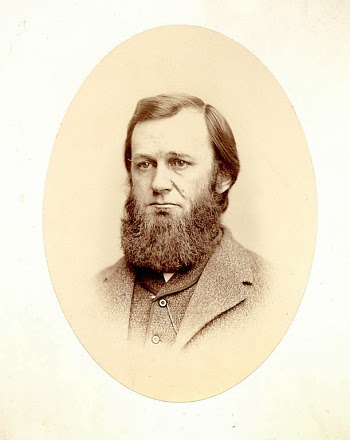
Portrait of Spencer Fullerton Baird, by Bell, William, January 10, 1867, Smithsonian Archives. SIA2004-60740.

In the 1870’s the US saw a noticeable decline in the Southern New England fisheries. The US knew little about the fishing grounds off its own coasts. Spencer F. Baird, a respected naturalist and a Smithsonian secretary, had a background in ichthyology and was approached by Congress about these issues. He recognized an important opportunity to promote the scientific study of the US’s marine natural resources in an effort to help the US economically. In 1871, he convinced Congress to establish the Commission on Fish and Fisheries. He served as the first commissioner. In the Commission’s early years, completing field work was a challenge, since it had no vessels and little funding of its own. Staffing and research (collecting and surveying) was completed in conjunction with the Smithsonian. This is one of the reasons Smithsonian Institution Archives has so many of the organization’s early records. The Commission often had to utilize ships supplied by the Revenue Service and US Navy. It was not until the 1880’s that they were able to procure their own research vessels.

When the Commission finally obtained the funds to acquire their own, they didn’t just go with any ship. They hired builders to design and construct some of the first ships dedicated solely for marine research. Each of these vessels enabled the Bureau to substantially increase their efficiency and research output. Additionally these vessels were used in the field for decades and were pivotal in assuring the quality and quantity of research data the Commission/Bureau could provide. Unlike research completed aboard another agency’s vessel, these were designed for research, and research staff didn’t have to worry about competing missions while at sea. Even the ship’s logbooks demonstrate this vividly. When scientists were aboard another agency’s vessels, their specimen collecting data was usually recorded in a journal separate from the logbook. US Fisheries vessels’ purpose was to enable the research, so the collected information was part of the ship’s logbook contents.

These ships were important tools for the numerous collectors the Commission sent into the field. Unlike Vernon Bailey who both collected and published widely over the years, several of the Commission’s collectors like William W. Welsh, focused on the field work and left the publishing to others. Ship’s logbooks, in their brevity often left little room for recording who did the research/work. Luckily, Commission and Bureau field documentation also included personal field books which document another important part of the Commission’s field work–interviewing local inhabitants for their knowledge of local fishing conditions and good fishing grounds. The field books (such as SIA RU007187) include surprisingly detailed interviews with locals about their lives, work, and personal knowledge of the habitat. Frequently the Commission’s publications are the synopsis of field work. These publications are often most easily located through the name of the vessel on which the staff worked, like the Fish Hawk (1880), Albatross (1883), and Grampus (1885).

We encourage you to take a look at the logbooks from these ships, now available in digital format through the Smithsonian, and compare to their resulting publications available through BHL. Learn more about the interviews completed by Commission staff that augmented knowledge gained by collecting.

View Full Size Image
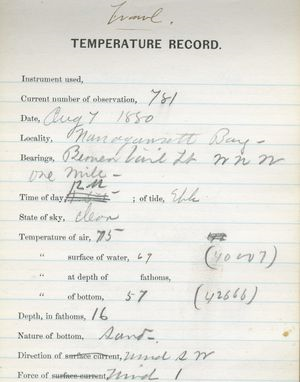
R/V Fish Hawk logbook excerpt, August 7, 1880. Smithsonian Institution Archives, RU7184, box 9, folder 3.

Field book (logbooks) through FBP:

  • US Bureau of Fisheries
  • Fish Hawk 
  • Albatross
  • Grampus
  • William W. Welsh

Publications available through BHL:

  • US Bureau of Fisheries
  • Fish Hawk
  • Albatross 
  • Grampus
 
January 16, 2014by [email protected]
BHL News, Blog Reel

Geoffrey Mwachala from the National Museum of Kenya visits BHL at Smithsonian Libraries

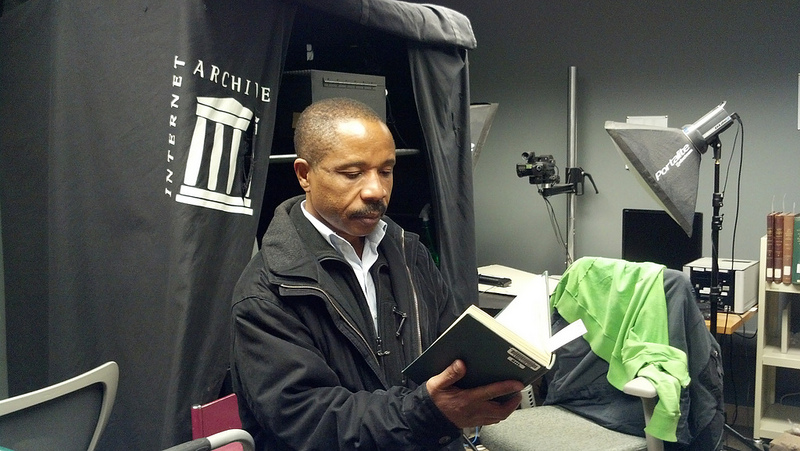
View Full Size Image
Dr. Geoffrey Mwachala
examining a copy of Victorian Naturalist

Dr. Geoffrey Mwachala, Director, Research and Collection at the National Museum of Kenya, stopped to visit Martin Kalfatovic and Nancy Gwinn while in Washington on other biodiversity and museum collections business at the Smithsonian.

While at Smithsonian Libraries, he was able to visit the scanning facility in the National Museum of Natural History and see some of the BHL digitization operations in action.

Dr. Mwachala is a strong supporter of BHL Africa and the expansion of biodiversity knowledge.

January 7, 2014by
Blog Reel, Featured Books

Hummingbirds and Harlequins

Beauty can be too much for words. So it is with the charm of what many consider the loveliest of the world’s birds, the hummingbirds: Overcome by the dazzling colors of those first tiny skins, early European naturalists reached to the limits of their vocabularies to describe them. The result, nearly five centuries after the first specimens were brought back from a then truly New World, is a large set of remarkably evocative names, hillstars and woodstars, helmetcrests and plumeleteers, jacobins and incas, metaltails and thornbills, emeralds and sapphires and topazes and rubies.

View Full Size Image

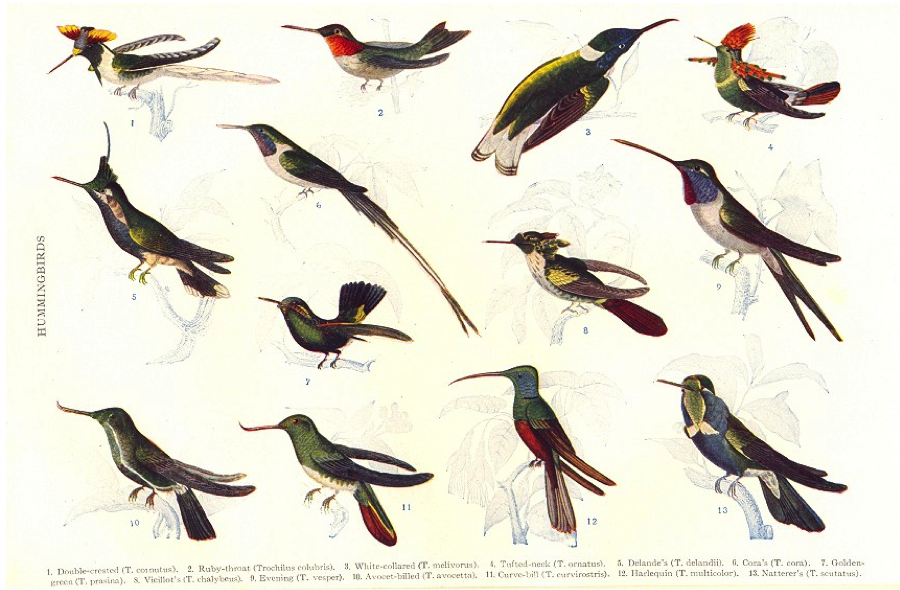
The birds, of course, are every bit as fantastic as their monikers. The 1907 edition of The Americana, the authoritative North American encyclopedia of its day, gave its readers a glimpse into the vast variety of color and adornment so typical of this large family, from the Horned Sungem to the Hyacinth Visorbearer. One of the thirteen birds shown on this appealing plate, however, is conspicuously absent from any modern list of hummingbirds: the extraordinarily colored Harlequin Hummingbird.

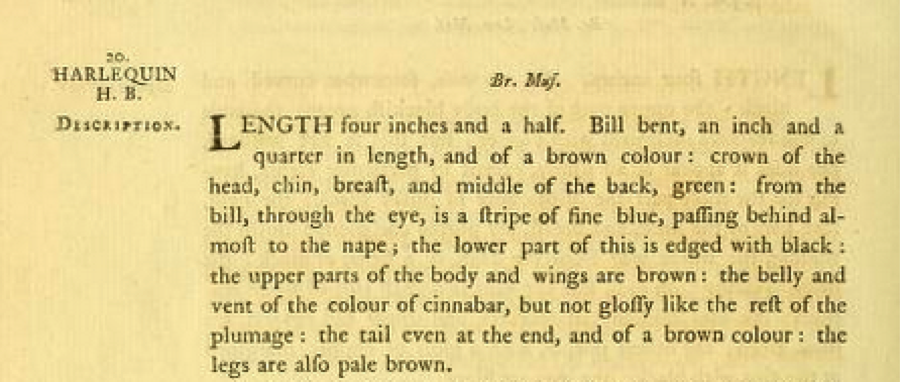
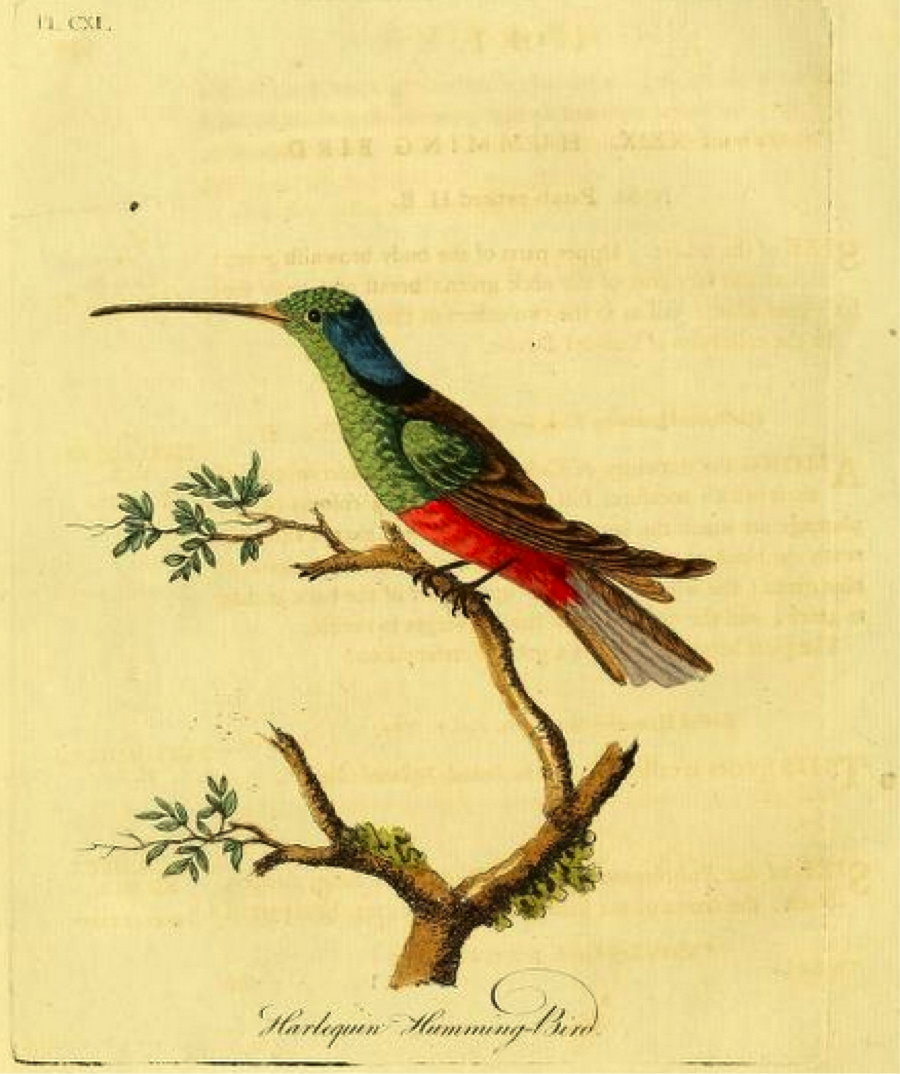
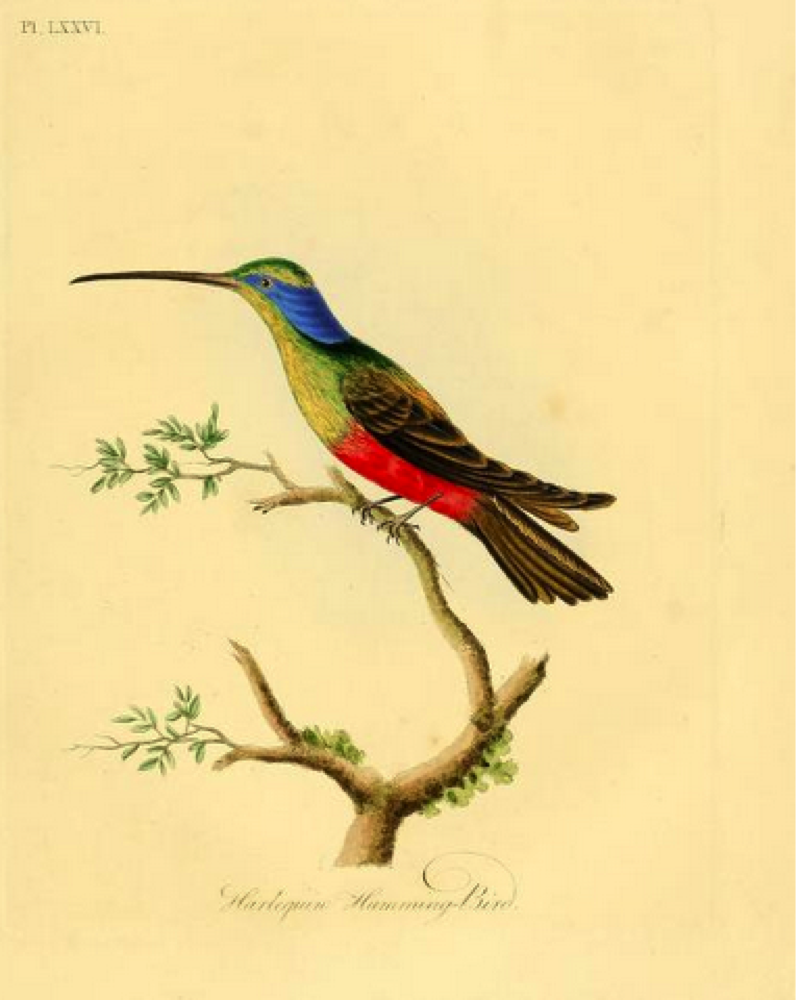
That bird was first made known to science a century and a quarter before it was depicted in The Americana. In 1782, John Latham described his new species from a specimen in the collections of the British Museum.

View Full Size Image

Unfortunately, Latham notes, that unique skin had “no history annexed to it,” and so he was unable to offer any information about the range or the habits of the species he named the Harlequin Humming-Bird.

Five years later, Latham came across another source of information, a drawing by the famous watercolorist Thomas Davies, who had been in the West Indies in 1786. Davies’s rendering of the bird differs from the British Museum specimen, Latham tells us, in its greater length—five inches rather than four and a half—and in the presence of a narrow band of blue green on the back of the head, a character well shown by Latham’s plate in the Supplement to his General Synopsis of Birds.

View Full Size Image

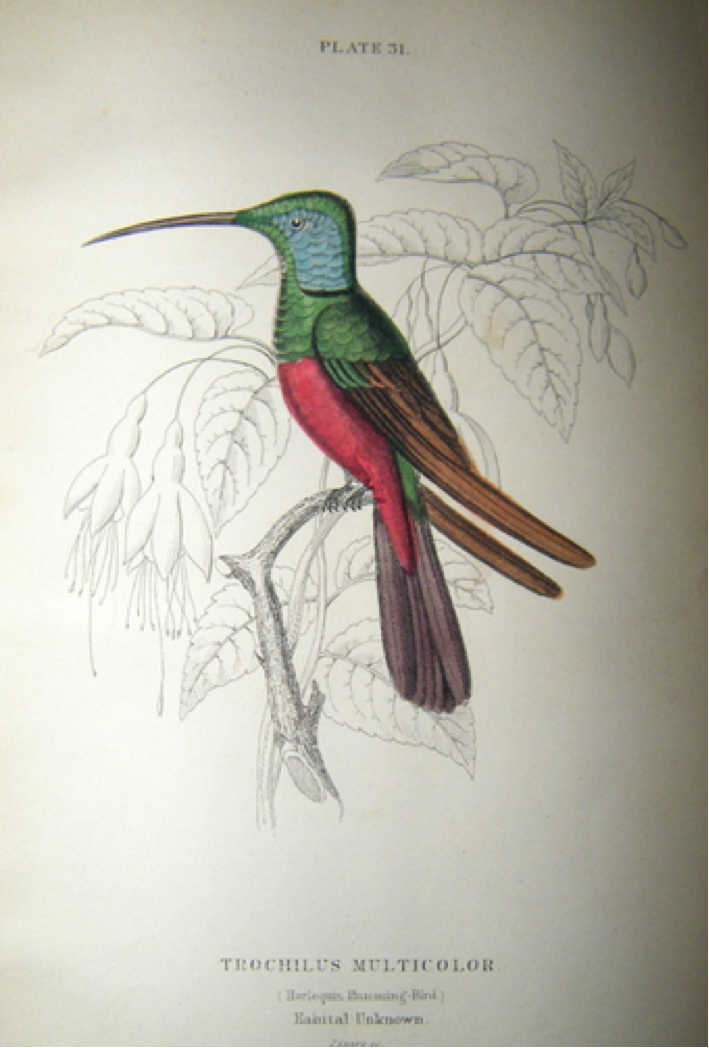
That image and the accompanying description provided the “type” for Johann Friedrich Gmelin, who gave the species its rather bland Linnaean label in 1788, Trochilus multicolor. Latham in turn adopted that name for his 1790 Index ornithologicus, where his brief description of the bird could be read to imply that he had seen further specimens, “in some of which there is a blue-green patch below the nape.”

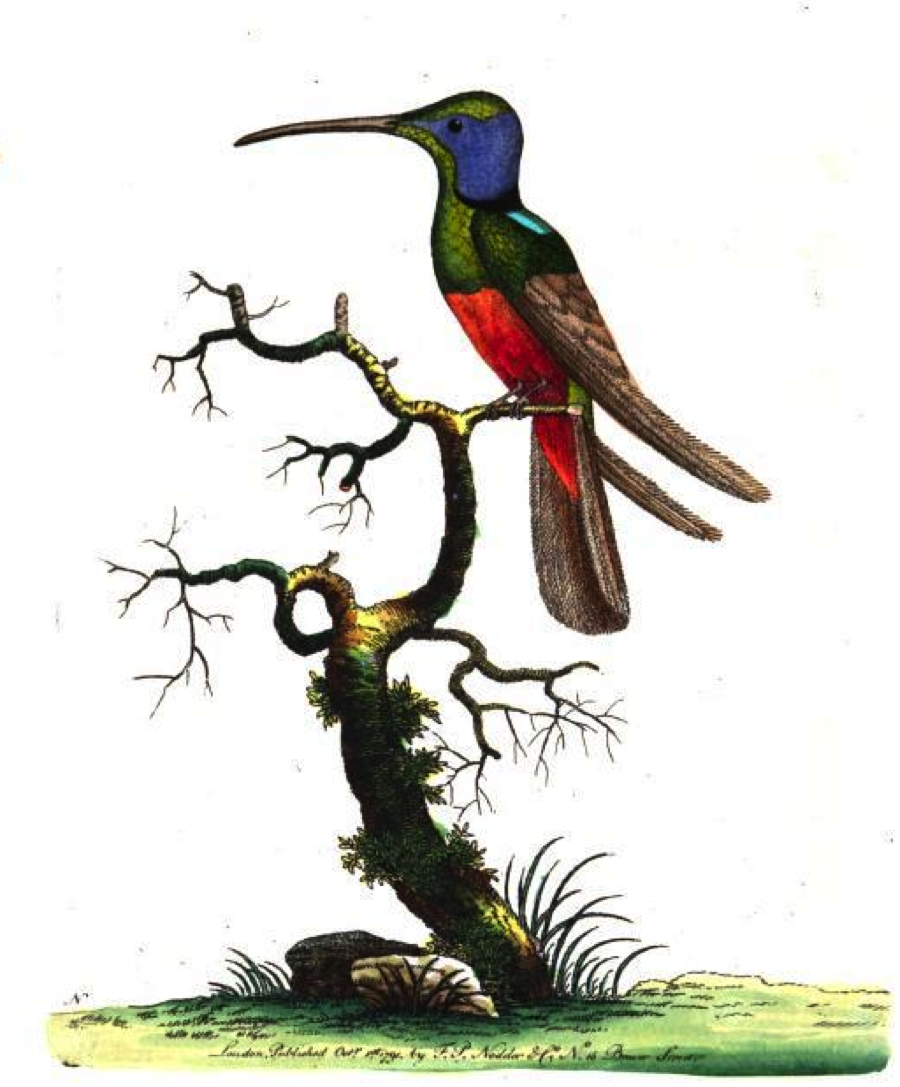
George Shaw, in his Naturalist’s Miscellany the following year, was able to narrow the range of the Harlequin, “among the rarest species of its genus,” to South America, hardly a bold conjecture in the case of a large, colorful hummingbird. Shaw’s account was accompanied by an awkwardly executed plate by Frederick Nodder, painted, Shaw claims, from the British Museum specimen; the telltale turquoise panel on the upper back, however, reveals that Nodder based his work on Davies’s—or, more likely, on Latham’s description of Davies’s sketch.

View Full Size Image

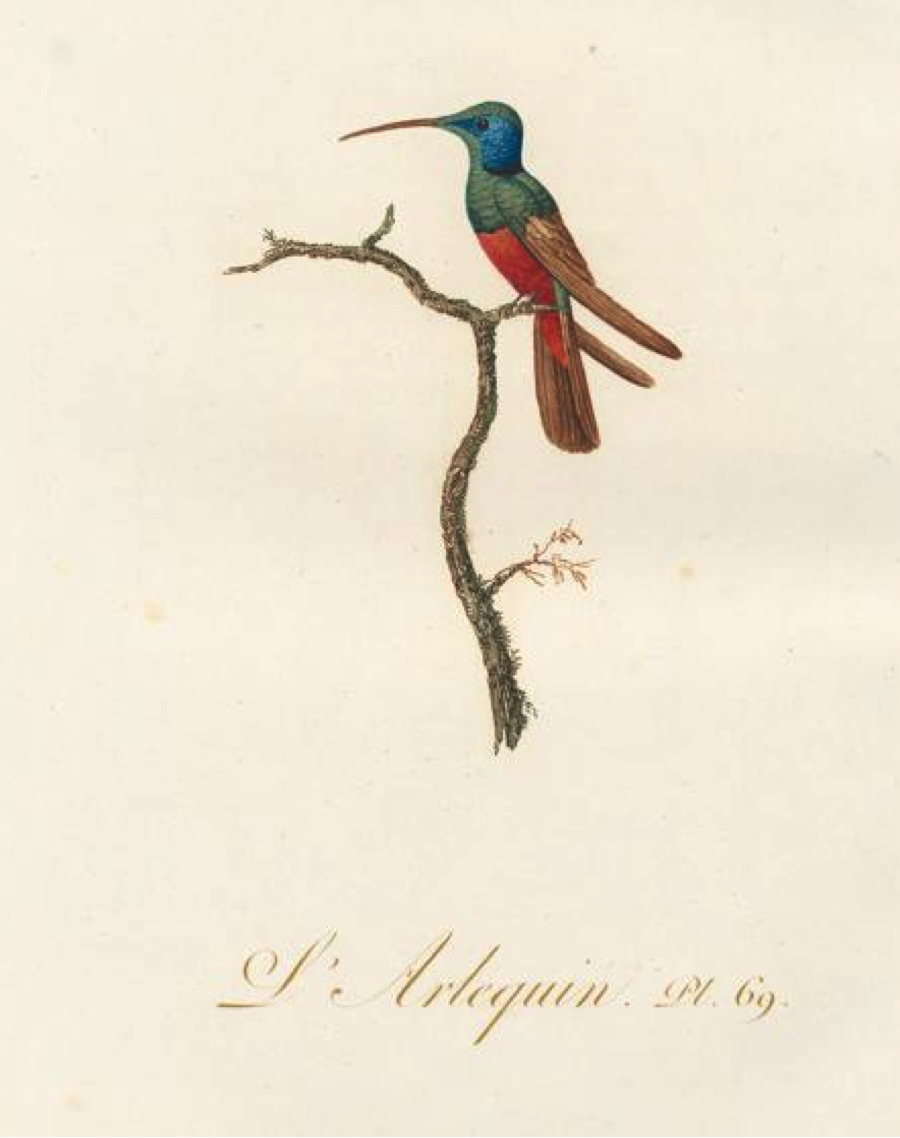
The Harlequin Hummingbird was painted again, by Sydenham Edwards, for Louis Pierre Vieillot’s 1802 continuation of the Oiseaux dorés, a lavish work begun by Vieillot and his collaborator Jean-Baptiste Audebert, who had died in December 1800. Vieillot claims that Edwards had worked directly from the skin in the British Museum; whether that was true or not, a close look suggests that Edwards was quite familiar with Nodder’s plate, too, from which it differs in omitting the nape patch Latham had noticed in the Davies drawing, a mark Vieillot says is indicative of a “variety” of the true Harlequin.

View Full Size Image

Nearly fifty years after its discovery in a museum drawer, this hummingbird was as mysterious as ever. In 1829, René Primevère Lesson wrote of the oiseau-mouche arlequin that

this bird is known only from the description and figure published by the English ornithologist Latham. That figure, drawn by Sir Edwards, was reproduced by Mr. Vieillot on Plate 69 of his Oiseaux dorés, and we have been obliged to include it in order that we omit none of the species listed on the basis of specimens preserved in collections or known from accurate portraits.
View Full Size Image

But Lesson had his doubts:

At the same time, this drawing seems to pertain rather to one of the curve-billed hummingbirds, and seems to us to be imprecise; it is only with very great reservations that the species must be admitted to the table of extant straight-billed hummingbirds. It could be, too, that it depicts nothing more than a sunbird, which we suspect even more from the fact that no hummingbird normally displays a similar distribution of solid colors in its plumage.

In 1831, Lesson had his answer. In his Trochilidées, he reported that the colibri arlequin of the British Museum had been examined by a Mr. Stokes,

who writes to us that the bird that served as the type for Latham’s description and for the figure copied by Vieillot was the product of a falsification, which one discovered on dismantling the specimen preserved in the British Museum.

It is a measure of the uncertainty that still obtained in neotropical ornithology—and, perhaps, of the antagonisms that still lingered between French and British naturalists—that William Jardine, two years after the publication of the Trochilidées, could write that

It has been hinted that the specimen in the British Museum was a specimen made up from the feathers of different birds.

Lesson’s debunking (which Jardine cites) was far more than a hint. Jardine notes, however, that Latham, who would live into the year 1837, had been aware of the rumor. In a footnote to the 1822 edition of the General History, Latham writes that

It has been suggested to me, that this is no other than a bird made up by the ingenuity of some whimsical person, who has fabricated it from the feathers of others; but which, by every attention paid to it, I cannot detect.

Jardine included the bird in his own work

with the view of attracting the attention of British naturalists…. If there is a specimen in the British Museum, and a drawing in the possession of General Davis, corresponding and evidently done from an individual of the same species, there will be no doubt of its existence.


View Full Size Image

“If.”

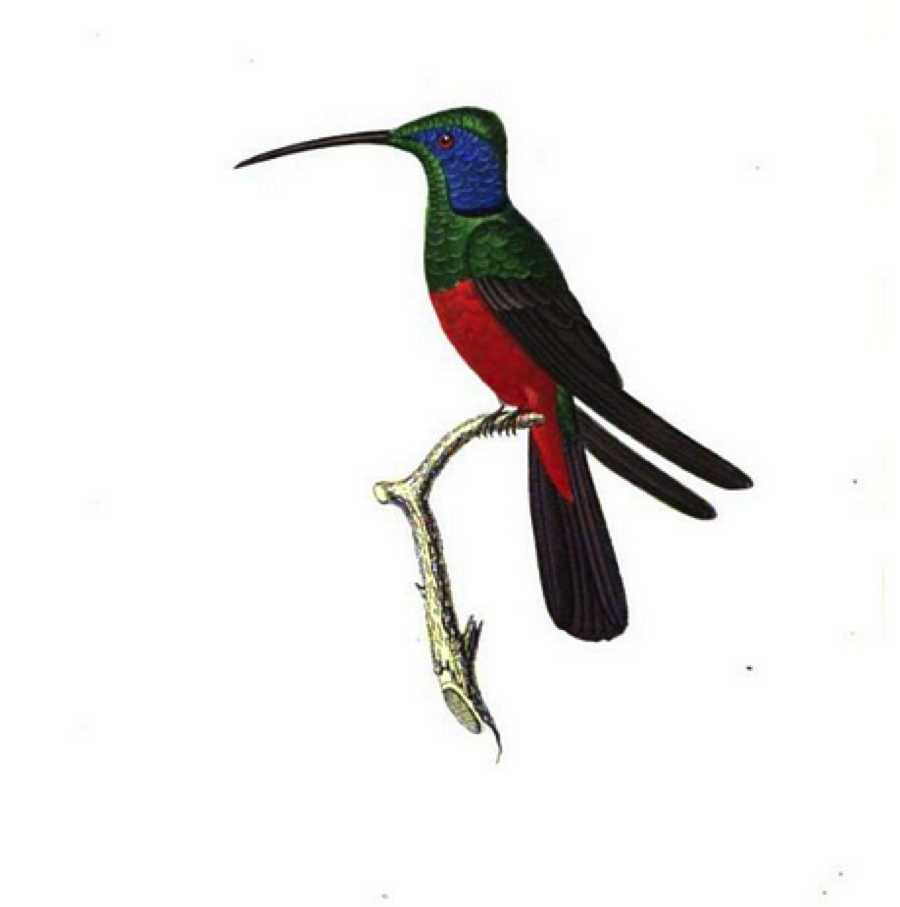
In preparing his great Monograph of the Trochilidae, John Gould was “at all times favoured … with both information and the loan of specimens” from the collections of the British Museum. Nowhere could he find a skin attesting to the existence of the Harlequin Hummingbird—Lesson’s Mr. Stokes most likely had felt no obligation to reassemble the composite hoax once it was revealed. In relying on Latham, Gould writes, Gmelin had described a new species based on

characters … taken from a plate which must have been drawn from imagination and not from any real specimen.

Indeed, of the 95 hummingbirds Latham included in the revision of his General History, Gould considered only about two-thirds “real species,” the other 30 or more, among them the Harlequin, all “so indefinitely described” as to be unassignable to any known bird.

It seems very unlikely that we will ever know who the ingenious and whimsical creator of Latham’s specimen was, or what bird was depicted in Thomas Davies’s equally mysterious drawing. What is entirely certain, though, is that this is not the only case in the history of “trochidology” where a bird turned out to be something else entirely than what its original discoverers thought or hoped.

View Full Size Image


January 6, 2014by Kathryn Stine
Page 1 of 212»

Help Support BHL

BHL's existence depends on the financial support of its patrons. Help us keep this free resource alive!

search

About BHL

The Biodiversity Heritage Library (BHL) is the world’s largest open access digital library for biodiversity literature and archives. BHL operates as a worldwide consortium of natural history, botanical, research, and national libraries working together to digitize the natural history literature held in their collections and make it freely available for open access as part of a global “biodiversity community.”

Join Our Mailing List

Sign up to receive the latest news, content highlights, and promotions.

Subscribe Now

Subscribe to Blog via Email

Enter your email address to subscribe to this blog and receive notifications of new posts by email.

Join 319 other subscribers

Subscribe to Blog Via RSS

Subscribe to the blog RSS feed to stay up-to-date on all the latest BHL posts.

Access RSS Feed

Inspiring Discovery through Free Access to Biodiversity Knowledge.

The Biodiversity Heritage Library makes it easier than ever for you to access the information you need to study and explore life on Earth…for free, anytime, anywhere.


64+ Million Pages of
Biodiversity Literature Online.

EXPLORE

Tools and Services
to Transform Research.

EXPLORE

300,000+
Illustrations on Flickr.

EXPLORE

ABOUT | HARMFUL CONTENT | PRIVACY | SITE MAP | TERMS OF USE