Biodiversity Heritage Library - Program news and collection highlights from BHL
  • Home
  • News
  • Featured Books
    • All Featured Books
    • Book of the Month Series
    • BHL at 20
  • User Stories
  • Campaigns
    • Fossil Stories
    • Garden Stories
    • Monsters Are Real
    • Page Frights
    • Her Natural History
    • Earth Optimism 2020
  • Tech Blog
  • Visit BHL
Home
News
Featured Books
    All Featured Books
    Book of the Month Series
    BHL at 20
User Stories
Campaigns
    Fossil Stories
    Garden Stories
    Monsters Are Real
    Page Frights
    Her Natural History
    Earth Optimism 2020
Tech Blog
Visit BHL
  • Home
  • News
  • Featured Books
    • All Featured Books
    • Book of the Month Series
    • BHL at 20
  • User Stories
  • Campaigns
    • Fossil Stories
    • Garden Stories
    • Monsters Are Real
    • Page Frights
    • Her Natural History
    • Earth Optimism 2020
  • Tech Blog
  • Visit BHL
Biodiversity Heritage Library - Program news and collection highlights from BHL
Blog Reel, Featured Books

Book of the Week: The Illustrations of Erpétologie Générale

View Full Size Image

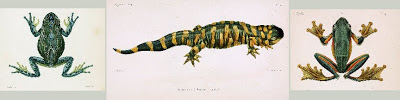
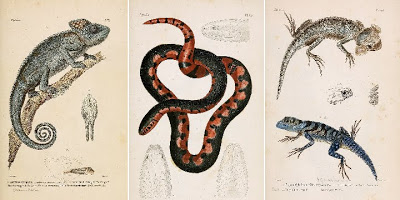
For this week’s book of the week, we feature the beautiful illustrations of André Marie Constant Duméril’s Erpétologie générale, ou, Histoire naturelle complète des reptiles, found within the 1854 Atlas volume. In this nine volume work, 1,393 species of reptiles and amphibians are described, and “their anatomy, physiology and bibliography are specified.” Interestingly, despite the recent advancements of many of his contemporaries, Duméril still asserted that amphibians and reptiles were of the same class.

Duméril was a French zoologist and professor of anatomy, herpetology, and ichthyology at the Muséum National d’Histoire Naturelle. His son, Auguste Duméril, was also a zoologist and collaborated with his father on this work.

Take a moment to explore the lovely illustrations accompanying the impressive work of André Marie Constant Duméril. And don’t miss the chance to peruse Duméril’s other zoological works in the Biodiversity Heritage Library.

View Full Size Image

January 27, 2011by Grace Costantino
Blog Reel, Featured Books

Book of the Week: Animals of the Past

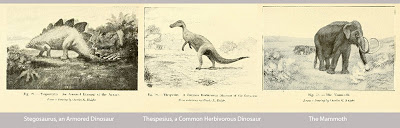
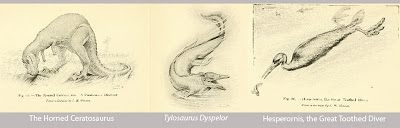
While much of the focus today has been concentrated on the existing life on planet Earth, and how to protect and preserve it, there is still a great deal of interest, and indeed things to be learned, from that life which has ceased to exist on our planet. With this in mind, we focus this week on the title Animals of the Past (1901) by Frederic A. Lucas. By his own admission, the author describes the intention of this book as:

“…to tell some of the interesting facts concerning a few of the better known or more remarkable of these extinct inhabitants of the ancient world.”

As such, this book highlights some of the more interesting or popular of these ancient animals, a few of which will also be highlighted here through the beautiful illustrations found within its pages. Take some time to take a look at these and the other fascinating creatures of the past as we strive not only to learn in this present age, but also to learn from the past, so we do not lose what we have.

View Full Size Image

View Full Size Image

This week’s book of the week, Animals of the Past (1901) by Frederic A. Lucas, was contributed by the Smithsonian Institution.

January 18, 2011by Grace Costantino
Blog Reel, Featured Books

Book of the Week: BHL Requests

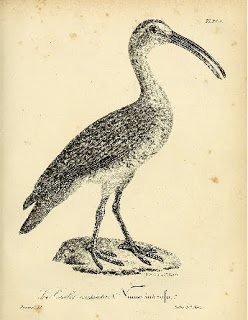
View Full Size ImageLast summer, 2010, we implemented a scanning request form by which our user community can request titles to be scanned and added to our ever-growing online collection. The feature was a runaway success, with 787 requests received to date. As we work to fulfill these requests, we thought it might be nice to highlight just a few of the rare item requests we’ve scanned thus far. So, without further ado:

La Galerie des Oiseaux (1834), T. 1 and T. 2

Die Orchideen (1915)

Symbolae ad Trematodum Evolutionis Historiam (1855)

Chronique Orchideenne (1897-1907), v. 1-2

Wild Life of the World: A Descriptive Survey of the Geographical Distribution of Animals (1916), v. 1, v. 2, v. 3

And remember, if you have any titles that you’ve been wanting to see in BHL, fill out our request form and, provided condition, availability and subject matter are appropriate, we’ll gladly add it to our request queue for scanning.

January 14, 2011by Grace Costantino
Blog Reel, Featured Books

Book of the Week: Salad and…Snails?

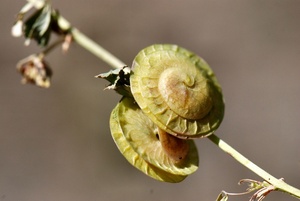
View Full Size ImageAre those snails in your salad?

Apparently this is the question that our book of the week, The Field and Garden Vegetables of America, suggests that dinner guests will ask their host or hostess should Medicago obicularis be playfully added to the plate. However, rest assured, Medicago obicularis, more commonly known as Button Clover or Button Medick, will not threaten to ooze snail slime all over the salad greens. It is a harmless plant species of the genus Medicago found throughout the Mediterranean basin, though it can also now be found in southern parts of the United States. This “hardy, annual plant has reclining stems, compound or winged leaves, and yellow flowers.” However, the “pods, or seed vessels,” according to our book of the week, “are smooth, and coiled in a singular and remarkably regular manner,” suggesting in their appearance the shell of a snail.

Interestingly, this species forms a symbiotic relationship with the bacterium Sinorhizobium medicae, which is capable of nitrogen fixation. Nitrogen fixation is the process by which “nitrogen in the atmosphere is converted to ammonia,” a process crucial for life because “fixed nitrogen is required to biosynthesize the basic building blocks of life.” In a study by the U.S. Department of Energy, “the amount of nitrogen fixed annually by the Sinorhizobium–Medicago symbioses is estimated to be worth $250 million.”

So, as the holiday season approaches and you begin planning your extravagant dinner parties, consider throwing a little fun into the mix with Medicago obicularis. As our book tells us, the pods can be “placed on dishes of salad for the purpose of exciting curiosity, or for pleasantly surprising the guests at table.”

Book of the Week: The field and garden vegetables of America: containing full descriptions of nearly eleven hundred species and varieties; with directions for propagation, culture, and use (1863), by Fearing Burr.

December 15, 2010by Grace Costantino
BHL News, Blog Reel

BHL in London!

Portrait version of the Biodiversity Heritage Library logo.

View Full Size ImageIt is no secret that the Biodiversity Heritage Library project has grown on a global scale, with BHL projects springing up in Europe, China, Australia, Brazil, and Egypt. Many of our new partners rely of the experience of BHL-US, as the original BHL project has come to be known, for insight and suggestions. One such partner is BHL-Europe, and a recent BHL-EU meeting in London proved to be a valuable opportunity to not only allow our European partners to gather and discuss various technical and workflow issues, but also to allow representatives from BHL-US to provide input based on our experience. With this intent, Bianca Crowley, Grace Costantino, and Chris Freeland, BHL-US staff, traveled to London for the latest BHL-Europe meeting on December 1-3, 2010.

View Full Size Image

The main subjects comprising this recent meeting were workflow, technical issues and portal development, and the Global References Index to Biodiversity, also known as the GRIB. The intent of the GRIB is to serve as a single point of access to all biodiversity bibliographic records held within the library catalogues of the BHL-EU partners, which will in turn link to digitized versions of the content. The GRIB will also function as a selection and de-duplication tool for all BHL partners, allowing institutions to indicate which items they wish to scan while also providing digitization status information.

A wish to contribute to the development of the GRIB by providing insight into the workflow management tools currently in use on the project was a main purpose of BHL-US staff’s involvement in the meetings. By explaining how staff currently use the many tools necessary for scanning workflow in the US, and what specific tasks staff need a master workflow management tool to address, BHL-EU was able to understand the requirements of their partners across the Atlantic, and development of the GRIB was positively impacted by the conversations.

The meetings were a productive exercise in communication and collaboration, and served as an excellent opportunity to get to know colleagues that, until the meeting, were known only through emails and occasional Skype calls. As BHL continues to expand around the world, it is hoped that such cooperation will continue, and that we will all work together to share our experience, learn from our collective mistakes, and in general provide a better digital library to the users that depend so heavily on our resources for access to the biodiversity literature of the world.

December 8, 2010by Grace Costantino
Blog Reel

The Sun Parakeet and the World Checklist of Threatened Birds

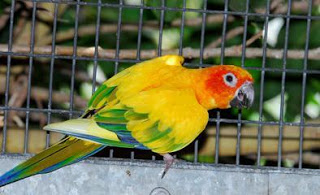
View Full Size ImageThe concept of threatened and endangered species is not a new idea for most of the world. Most are now well aware of the shadow that looms over so much of the magnificent life on our planet. While many efforts are underway around the globe to protect the species that are threatened, it is important to continue to raise awareness of the plight faced by so many of the creatures that share our planet. So, in an effort to do so, we highlight this week the Sun Parakeet, or the Aratinga solstitialis, one of the many species of threatened birds listed in this week’s book of the week, The World Checklist of Threatened Birds (1990).

The Sun Parakeet is native to northeastern South America, particularly in “the north Brazilian state of Roraima, Southern Guyana, extreme southern Suriname, and southern French Guiana.” Recent surveys revealing that the species may now be extirpated from Southern Guyana and rare in Roraima have excited recent discussions over the threatened status of this bird, and it is now listed as “Endangered” in the 2008 IUCN Red List. Deforestation, hunting, poaching, and capture for sale in the pet trade are the greatest threats facing this species.

The taxanomic history of this bird is interesting, beginning with its first description by Linnaeus in volume 1 of his 1758 work Systema Naturae. In this publication, Linnaeus situated the Sun Parakeet in the genus Psittacus. However, this genus is now reserved solely for the type species with which it is associated, the African Grey Parrot, and Aratinga solstitialis is now found in the genus Aratinga. Besides being known by the common name of Sun Parakeet, Aratinga solstitialis is also called the Sun Conure.

Aratinga solstitialis is a complex species, containing what have long been considered three sub-species: the Jandaya Parakeet, the Golden-capped Parakeet, and the Sulphur-breasted Parakeet. Recent discussions, however, have suggested that these sub-species are in fact separate species, or that the “Sun Parakeet and the Sulphur-breasted Parakeet represent one species, while the Jandaya Parakeet and Golden-capped Parakeet represent a second.” However, these species will interbreed in captivity (with the exception of the Sulphur-breasted Parakeet, of which, since it was only recently discovered in 2005, it is suspected but not confirmed that successful interbreeding with the three other mentioned species can occur).

The Sun Parakeet is among those bird species listed in The World Checklist of Threatened Birds (1990). Take a few moments to examine this species on EOL, and discover this species, along with many others, in this week’s book of the week. Think about what you can do to help ensure that these species are around for many generations to come.

November 17, 2010by Grace Costantino
Blog Reel, Featured Books

Book of the Week: More with Darwin

View Full Size Image
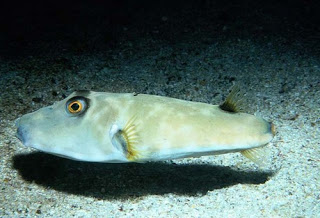
So, our last book of the week took a look at Darwin’s voyage on the H.M.S. Beagle through the eyes of a child. We thought it fitting this week to continue with the theme of the H.M.S Beagle, wrapping it together with one of the featured species on EOL this week, the Sphoeroides angusticeps, or the Narrow-Headed Puffer.

The Narrow-Headed Puffer is endemic to the Galapagos Islands, and indeed was first described in part 4 of The zoology of the voyage of H.M.S. Beagle … during the years 1832-1836, page 154. Upon returning home, Darwin gave his collection of about 137 species of fish gathered during the voyage of the H.M.S. Beagle to his friend, avid beetle collector Rev. Leonard Jenyns, for keeping. While Jenyns worked through this collection to describe it, he “had the most difficult time with the fish, as he knew next to nothing about their anatomy.”

Jenyns, transcribing Darwin’s own description of the specimen, described the Narrow-Headed Puffer fish as “above dull green, base of Pectorals and Dorsal black, a white patch beneath the Pectorals.” However, he noted that “The colors must have very much altered from the action of the spirit, as it now appears of a nearly uniform reddish brown, only paler beneath.” Interestingly, Jenyns originally misidentified the species, calling it Tetrodon aerostaticus. This was corrected to Tetrodon angusticeps, and is now known as Sphoeroides angusticeps.

Take a moment to check out the first descripton of the Narrow-Headed Puffer fish in this week’s book of the week, and be sure to take a look at this species on EOL to find more information.

This week’s book of the week, The zoology of the voyage of H.M.S. Beagle … during the years 1832-1836, part 4 (1842), was contributed by the MBLWHOI library.

October 4, 2010by Grace Costantino
Page 68 of 71« First...102030«67686970»...Last »

Help Support BHL

BHL's existence depends on the financial support of its patrons. Help us keep this free resource alive!

search

About BHL

The Biodiversity Heritage Library (BHL) is the world’s largest open access digital library for biodiversity literature and archives. BHL operates as a worldwide consortium of natural history, botanical, research, and national libraries working together to digitize the natural history literature held in their collections and make it freely available for open access as part of a global “biodiversity community.”

Join Our Mailing List

Sign up to receive the latest news, content highlights, and promotions.

Subscribe Now

Subscribe to Blog via Email

Enter your email address to subscribe to this blog and receive notifications of new posts by email.

Join 319 other subscribers

Subscribe to Blog Via RSS

Subscribe to the blog RSS feed to stay up-to-date on all the latest BHL posts.

Access RSS Feed

Inspiring Discovery through Free Access to Biodiversity Knowledge.

The Biodiversity Heritage Library makes it easier than ever for you to access the information you need to study and explore life on Earth…for free, anytime, anywhere.


ABOUT | HARMFUL CONTENT | PRIVACY | SITE MAP | TERMS OF USE