Biodiversity Heritage Library - Program news and collection highlights from BHL
  • Home
  • News
  • Featured Books
    • All Featured Books
    • Book of the Month Series
    • BHL at 20
  • User Stories
  • Campaigns
    • Fossil Stories
    • Garden Stories
    • Monsters Are Real
    • Page Frights
    • Her Natural History
    • Earth Optimism 2020
  • Tech Blog
  • Visit BHL
Home
News
Featured Books
    All Featured Books
    Book of the Month Series
    BHL at 20
User Stories
Campaigns
    Fossil Stories
    Garden Stories
    Monsters Are Real
    Page Frights
    Her Natural History
    Earth Optimism 2020
Tech Blog
Visit BHL
  • Home
  • News
  • Featured Books
    • All Featured Books
    • Book of the Month Series
    • BHL at 20
  • User Stories
  • Campaigns
    • Fossil Stories
    • Garden Stories
    • Monsters Are Real
    • Page Frights
    • Her Natural History
    • Earth Optimism 2020
  • Tech Blog
  • Visit BHL
Biodiversity Heritage Library - Program news and collection highlights from BHL
Blog Reel, Campaigns, Featured Books, Fossil Stories

Uncovering the Truth about Fossil Feces: Buckland, Anning, and Coprolites

When most people think about fossils, they generally think of body fossils, which are fossilized remains of parts of an organism’s body. But there is another type of fossil: trace fossils. Trace fossils are geological records of biological activity, and they provide important insight into an animal’s behavior.

One important trace fossil, which provides information about an animal’s diet, is the coprolite. That’s a fancy way of saying fossilized feces.

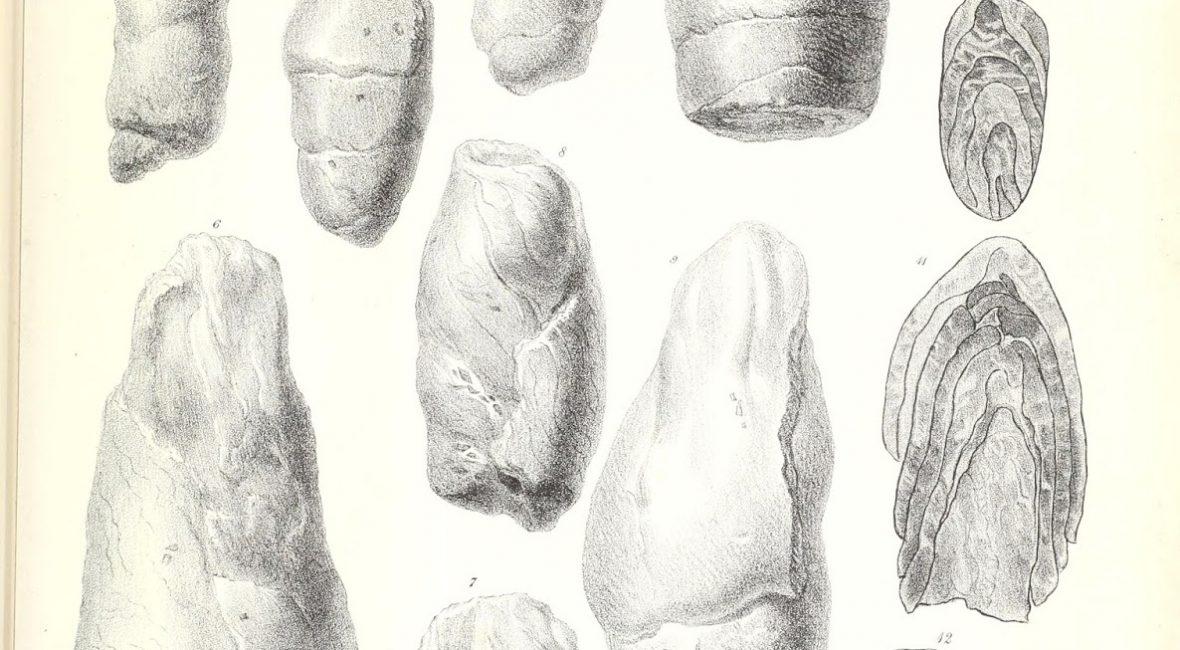
When coprolites were first discovered, they were identified as fossilized fir tree cones or bezoar stones. Bezoar stones were undigested masses found trapped in the gastrointestinal system, and were once believed to have magical properties, capable of neutralizing any poison. As an interesting aside, this claim was put to the test by surgeon Ambroise Paré in 1575. A cook caught stealing was sentenced to death by hanging, but at Paré’s request, agreed to be poisoned instead and fed a bezoar in the hopes that it would prove to be an antidote. The cook died in agony seven hours later.
View Full Size Image
Coprolites. Buckland, William. Transactions of the Geological Society of London. ser. 2, v. 3 (1835).  http://biodiversitylibrary.org/page/36239898. Digitized by the California Academy of Sciences.

William Buckland, famous for describing and validly naming the first dinosaur genus, Megalosaurus, had a theory about coprolites. He first became interested while studying cave deposits at Kirkdale. He suspected that the deposits that he found were actually preserved carnivore droppings, and even compared them with spotted hyena droppings in an attempt to prove his hypothesis.

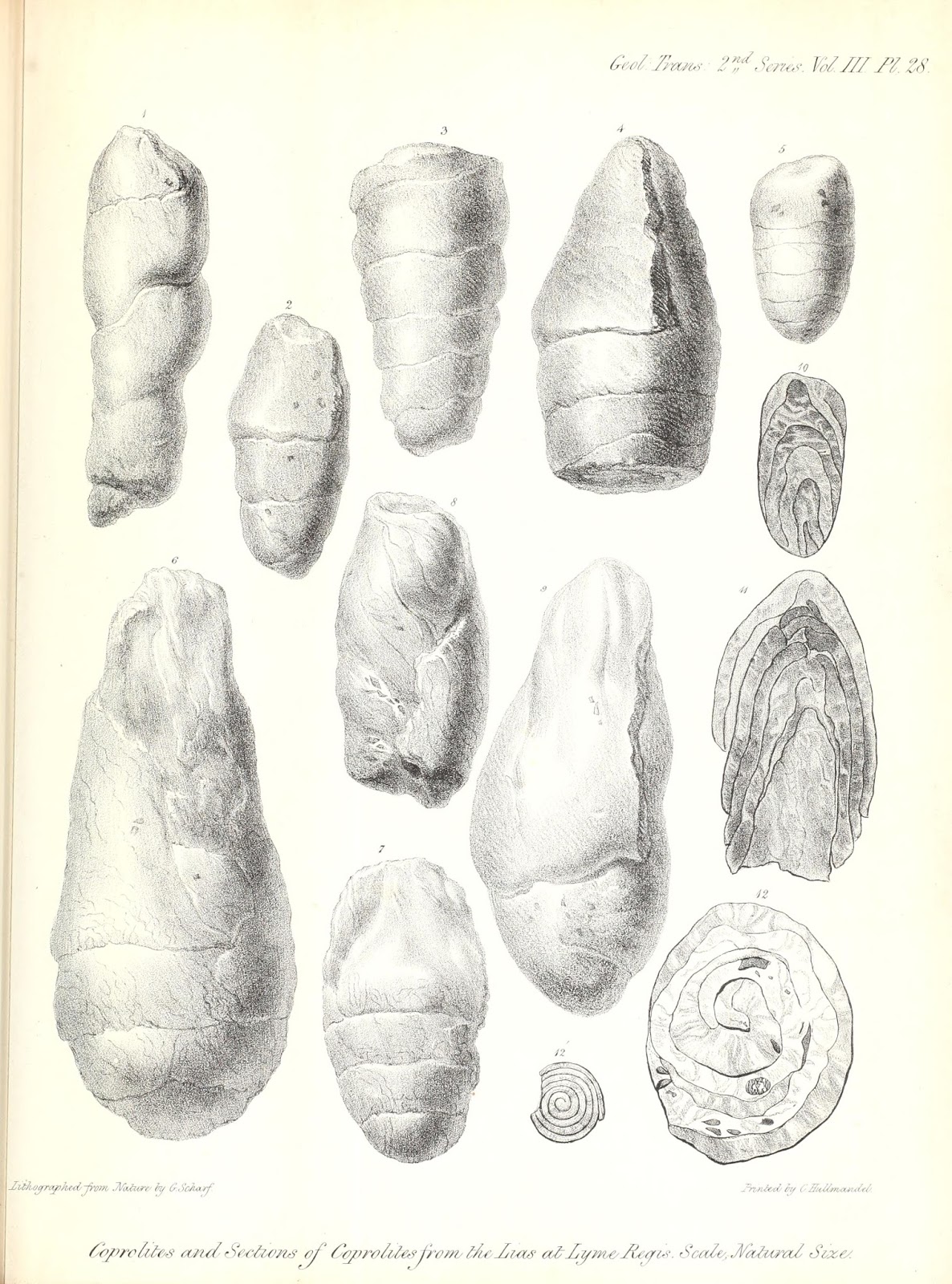
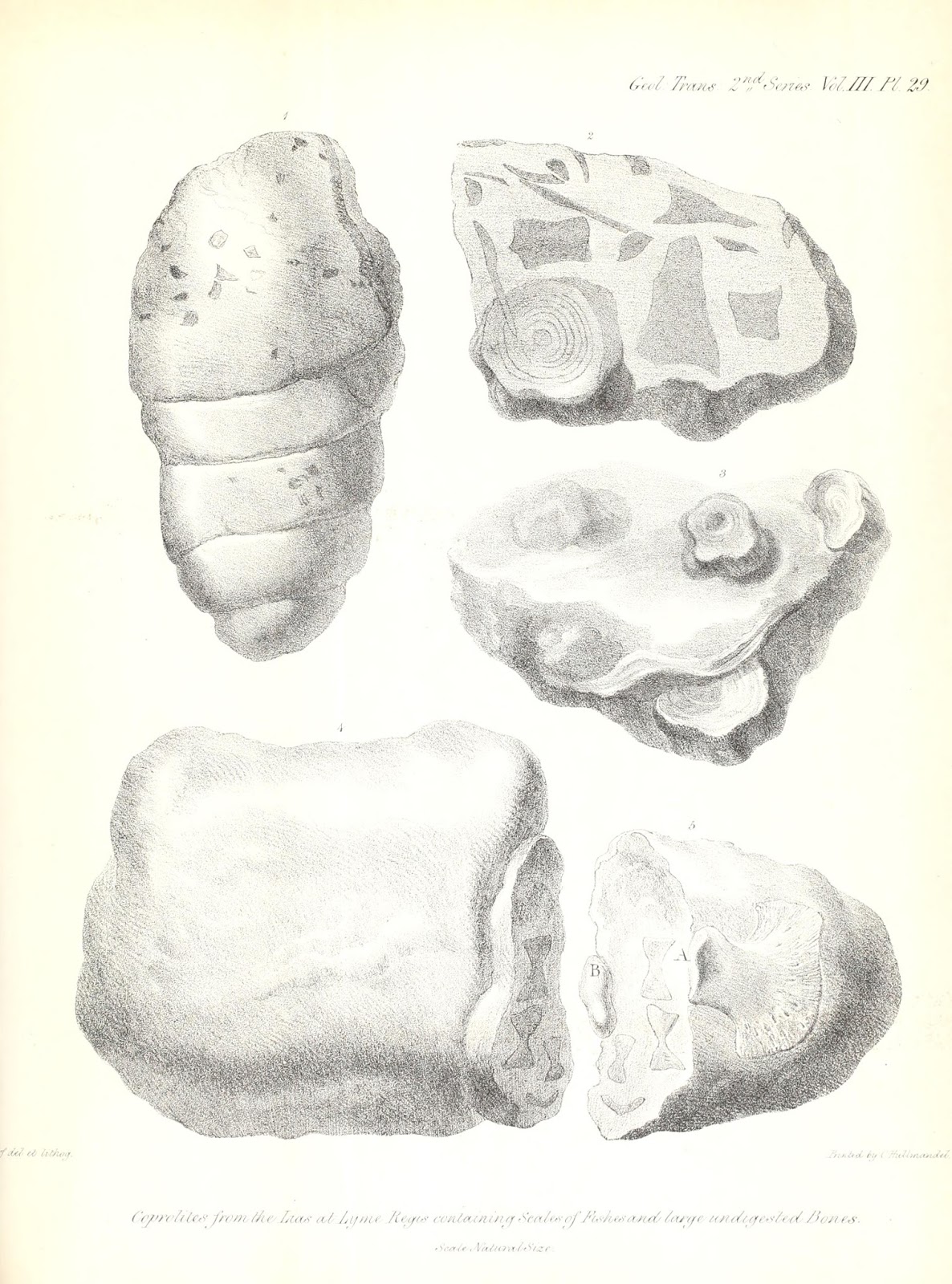
In the mid-1820s, Buckland received the evidence he needed. Famous fossil-hunter Mary Anning provided Buckland with coprolites she discovered in the cliffs near her home in Lyme Regis, England. Anning’s attention was drawn to these objects, as she usually discovered them within the ribs or near the pelvis of the ichthyosaur fossils she was discovering. She also noticed that, when the coprolites were broken open, they sometimes contained fossilized fish bones, scales, and the bones of smaller ichthyosaurs. Mary herself believed them to be fossilized feces.
View Full Size Image
Coprolites containing scales of fishes and undigested bones. Buckland, William. Transactions of the Geological Society of London. ser. 2, v. 3 (1835). http://biodiversitylibrary.org/page/36239900. Digitized by the California Academy of Sciences.

Buckland published his theory about the true nature of these fossils, and provided the name coprolite, in a paper which he read before the Geological Society of London in 1829 and was later published in the Society’s Transactions in 1835. Buckland recognized Mary Anning by name, giving her credit for her discoveries and deductions.

Fossil Stories

Stay tuned all week for more great fossil fun with our #FossilStories campaign, including:

  • Tweets and Facebook Posts
  • Blog Posts highlighting milestones and key publications in the history of fossil research
  • A Flickr Collection with hundreds of historic fossil illustrations
  • A Pinterest Collection featuring a selection of our favorite fossil illustrations
  • A BHL Collection containing seminal publications in the history of paleontology
  • A series of live webcasts at BHL partner institutions
  • A citizen science challenge in collaboration with The Field Book Project, the Smithsonian Transcription Center, and Smithsonian Institution Archives
Follow #FossilStories on Twitter and Facebook to learn more.
October 16, 2015by Grace Costantino
Blog Reel, Campaigns, Featured Books, Fossil Stories

The Birth of Dinosaurs: Richard Owen and Dinosauria

Humans have been encountering the fossilized remains of dinosaurs for millennia. The myth of the dragon, for instance, may be based on discoveries of dinosaur fossils. As an example, Chinese historian, Chang Qu mislabeled such a fossil as a dragon in the 4th century B.C.E.

The concept of dinosaurs as a group, however, occurred much more recently…in the nineteenth century, in fact.

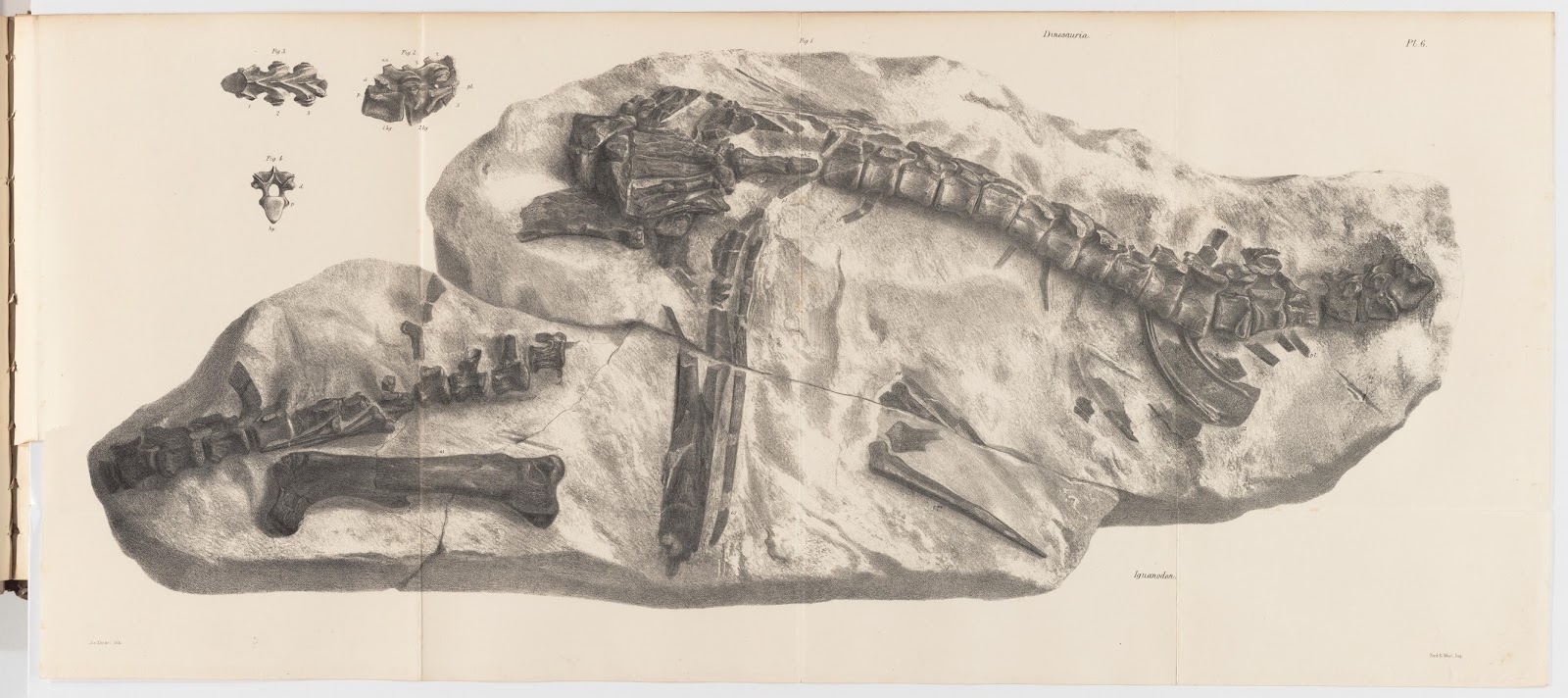
The first published description of what is now known to be a dinosaur bone (but was thought to be the thighbone of a giant human at the time) occurred in the seventeenth century. The early nineteenth century saw the first scientifically named dinosaurs, including Megalosaurus and Iguanodon. But the relationship between these extinct giants – as dinosaurs – was not uncovered until the 1840s.

View Full Size Image
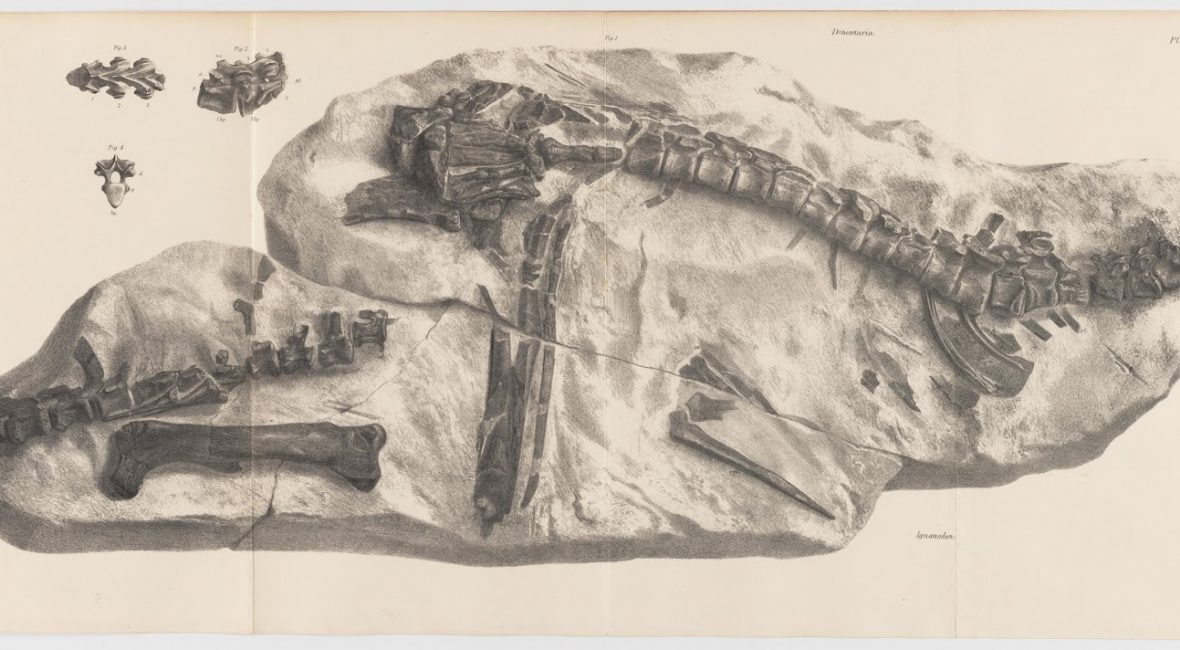
Iguanodon. Owen, Richard. History of British Fossil Reptiles. (1849-84). http://biodiversitylibrary.org/page/31985623. Digitized by: Missouri Botanical Garden.

English biologist, comparative anatomist and paleontologist Richard Owen conducted extensive research on fossils during his career. He is perhaps most famous for being the first person to introduce the concept of dinosaurs as a group.

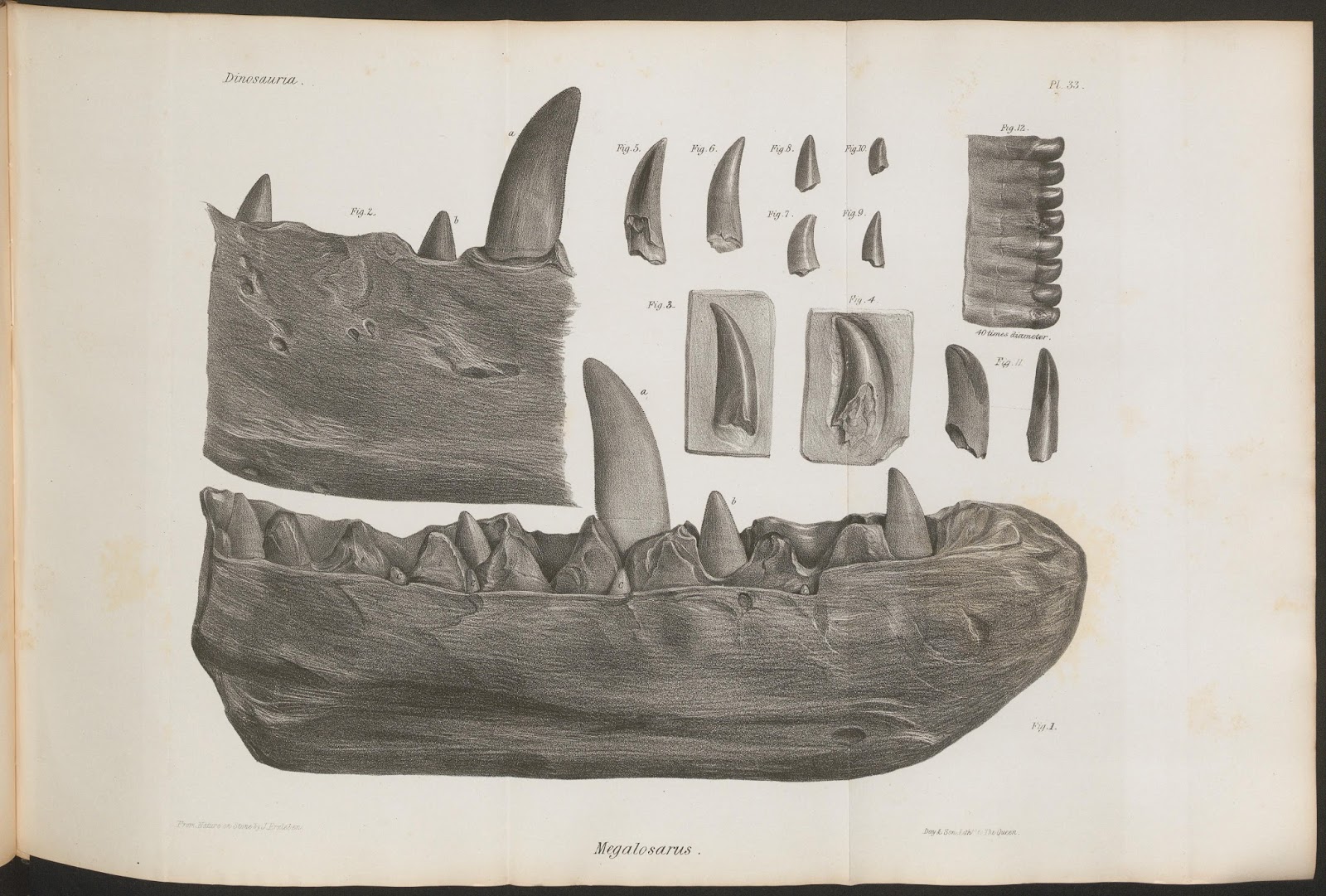
The name Dinosauria is first published in Owen’s Report on British Fossil Reptiles, which was published in 1842 as part of the Report from the 11th meeting of the British Association for the Advancement of Science.  Owen used three genera to define his dinosaurs: the carnivorous Megalosaurus, the herbivorous Iguanodon, and armored Hylaeosaurus.

View Full Size Image
Megalosaurus. Owen, Richard. History of British Fossil Reptiles. (1849-84). http://biodiversitylibrary.org/page/31985705. Digitized by: Missouri Botanical Garden.

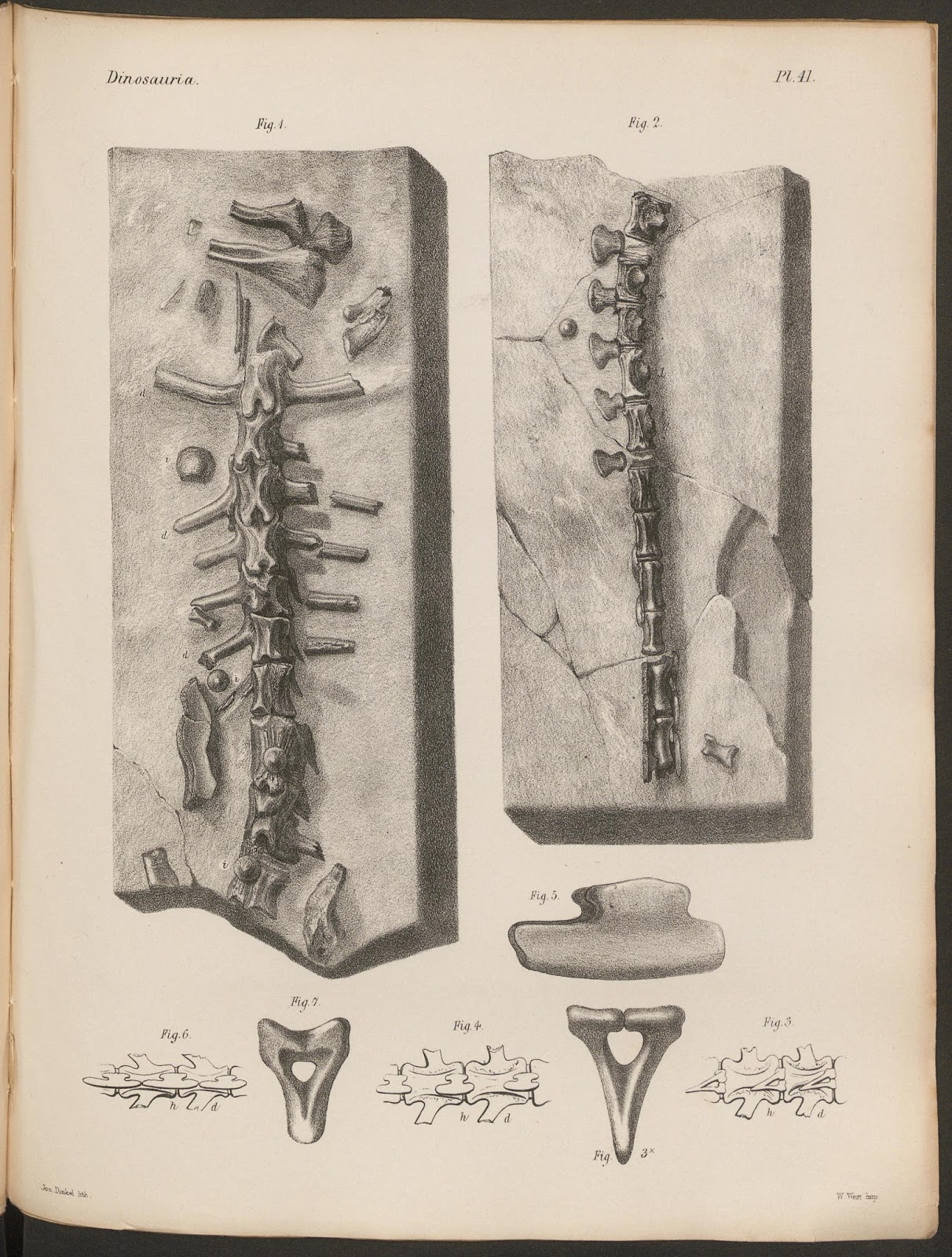
Owen was fascinated by the specimens his peers had discovered. He examined William Buckland’s Megalosaurus specimens at Oxford and Gideon Mantell’s Iguanodon and Hylaeosaurus specimens housed in the British Museum. From these, and examinations of other collections (most notably a sacrum from an Iguanodon in the collection of fossil collector William Devonshire Saull that likely first inspired Owen’s discovery), Owen determined that these three animals shared unique anatomical features that united them together while also separating them from other known groups. It was the fusion of five vertebrae at the base of the spine, observed in some of the Megalosaurus and Iguanodon fossils that Owen consulted and inferred in the Hylaeosaurus fragments – a feature unknown in other reptiles – that fueled Owen’s confidence in his new group.

View Full Size Image
Hylaeosaurus. Owen, Richard. History of British Fossil Reptiles. (1849-84). http://biodiversitylibrary.org/page/31984756. Digitized by: Missouri Botanical Garden.

The realization of this relationship among these specimens was Owen’s chief contribution to the field of Dinosaur research. It was a connection other paleontologists of the time had not uncovered. Thus, on the basis of this research and with the publication of his report in 1842, Richard Owen erected the clade Dinosauria and kindled a human love affair with dinosaurs that lasts to this day.

Owen’s chief memoirs, particularly those relating to the relationship between reptiles and extinct forms, were republished as a connected series in his History of British Fossil Reptiles (4 vols. London 1849–1884).

Fossil Stories

Stay tuned all week for more great fossil fun with our #FossilStories campaign, including:

  • Tweets and Facebook Posts
  • Blog Posts highlighting milestones and key publications in the history of fossil research
  • A Flickr Collection with hundreds of historic fossil illustrations
  • A Pinterest Collection featuring a selection of our favorite fossil illustrations
  • A BHL Collection containing seminal publications in the history of paleontology
  • A series of live webcasts at BHL partner institutions
  • A citizen science challenge in collaboration with The Field Book Project, the Smithsonian Transcription Center, and Smithsonian Institution Archives
Follow #FossilStories on Twitter and Facebook to learn more.
October 16, 2015by Grace Costantino
Blog Reel, Campaigns, Featured Books, Fossil Stories

Mantell and the Armored Dinosaurs

British geologist and paleontologist Gideon Mantell is famous for his contributions to the scientific discovery of dinosaurs. In 1825, he described and validly named the second dinosaur genus, Iguanodon. In 1833, he described another dinosaur, which was later used, along with Iguanodon and Megalosaurus, to define Dinosauria.

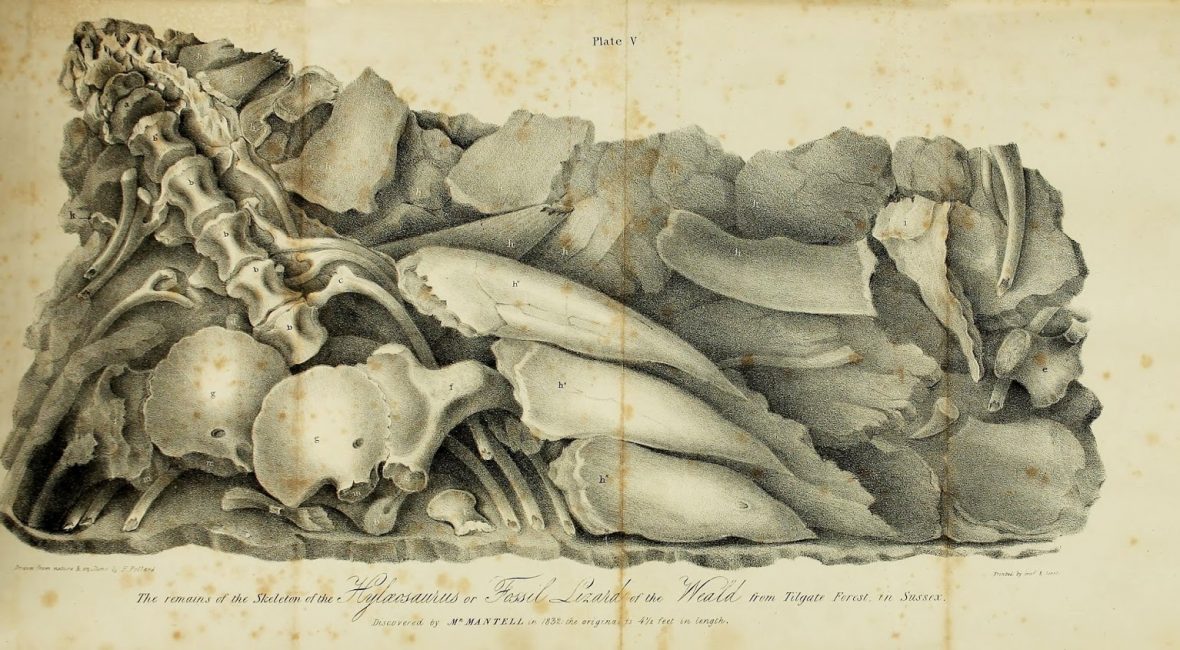
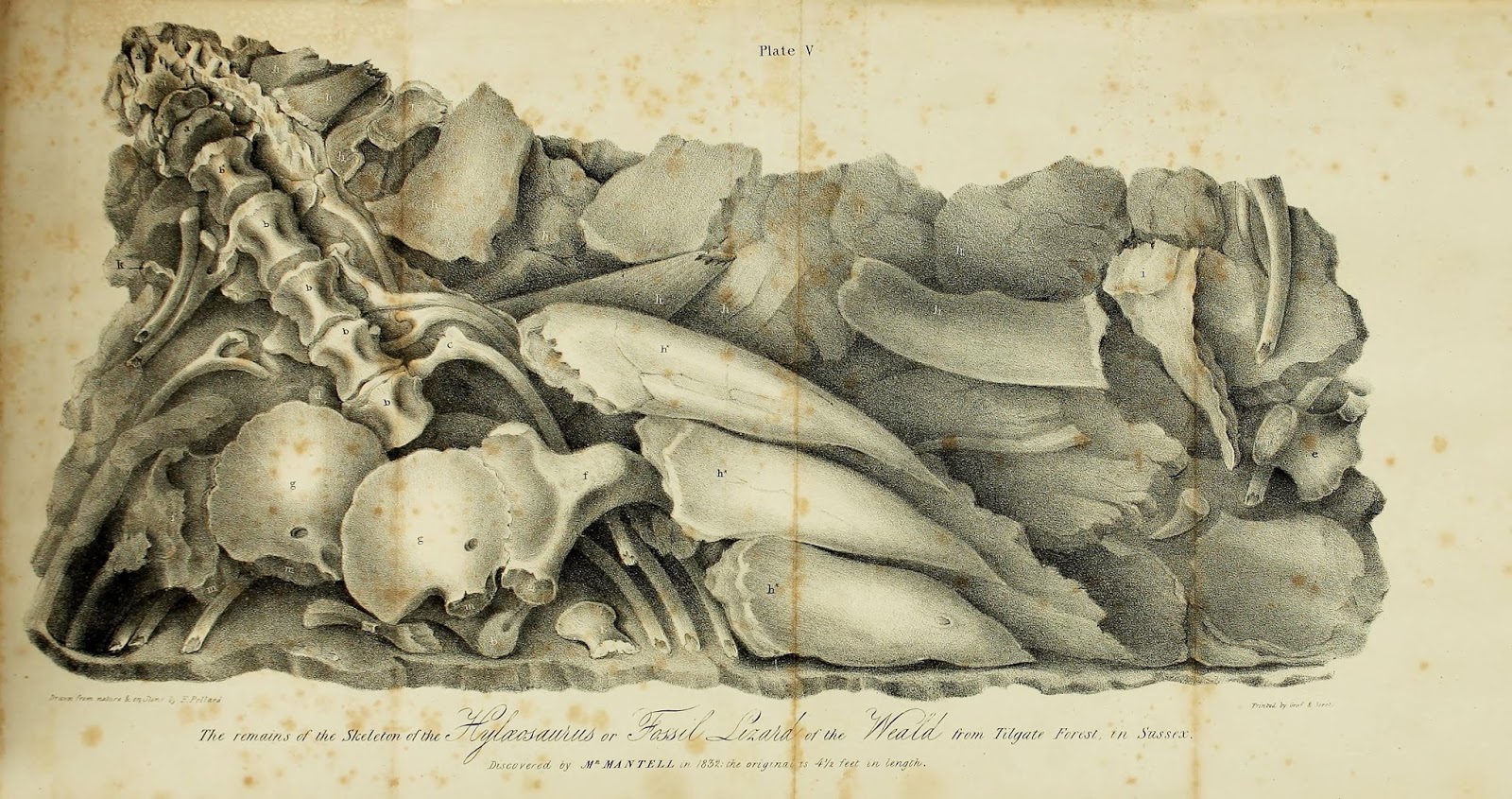
A gunpowder explosion at a quarry in Tilgate Forest, West Sussex, revealed a collection of about fifty fossil bone pieces that were acquired by Mantell in 1832. Mantell discovered that the pieces could be combined into a single, partially articulated skeleton, the most complete dinosaur skeleton known at the time. Mantell was at first inclined to attribute the fossils to his previously-named Iguanodon, but William Clift, the curator of the Royal College of Surgeons, doubted the identification, pointing out that several plates and spikes found amongst the fossils were likely body armor, thus indicating that this was a new species. Thus, Mantell decided to create a new genus for the specimen, naming it Hylaeosaurus.

View Full Size Image
Hylaeosaurus. Mantell, Gideon. The geology of the south-east of England. 1833. http://biodiversitylibrary.org/page/48441272. Digitized by: Natural History Museum, London.

Mantell originally intended to publish the new name within a journal article, but was informed that the paper he had prepared was too long for publication. Rather than rewriting the paper, Mantell decided to publish a book on his fossil finds and include a chapter on Hylaeosaurus within it. Within three weeks, Mantell compiled his notes on his fossil finds together into a single manuscript. Furthermore, being warned by Sir Henry Thomas De la Beche, the first director of the Geological Survey of Great Britain, that new nomenclature conventions required that a full species name, rather than just a genus, were required for authorship recognition, Mantell gave his specimen the binomial Hylaeosaurus armatus. The description was published in 1833 within Mantell’s book The Geology of the South-East of England.

Hylaeosaurus was the first ankylosaur (which include the majority of armored dinosaurs) to be scientifically named. Though additional Hylaeosaurus species were named over the years, Hylaeosaurus armatus is currently considered the only valid species in the genus.

Fossil Stories

Stay tuned all week for more great fossil fun with our #FossilStories campaign, including:

  • Tweets and Facebook Posts
  • Blog Posts highlighting milestones and key publications in the history of fossil research
  • A Flickr Collection with hundreds of historic fossil illustrations
  • A Pinterest Collection featuring a selection of our favorite fossil illustrations
  • A BHL Collection containing seminal publications in the history of paleontology
  • A series of live webcasts at BHL partner institutions
  • A citizen science challenge in collaboration with The Field Book Project, the Smithsonian Transcription Center, and Smithsonian Institution Archives
Follow #FossilStories on Twitter and Facebook to learn more.
October 16, 2015by Grace Costantino
BHL News, Blog Reel, Campaigns, Fossil Stories

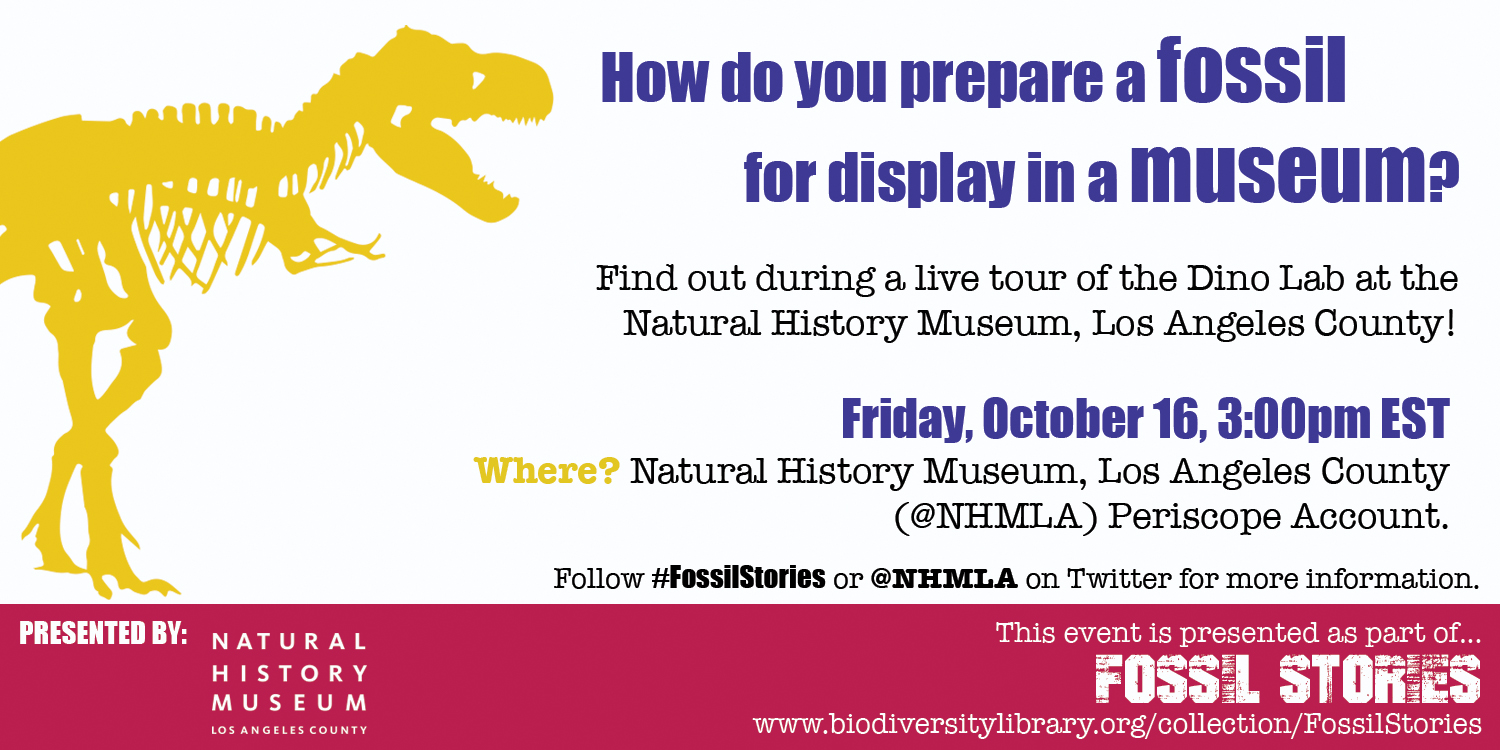
Live Webcast Today! Behind-the-Scenes Tour of the NHMLA Dino Lab

The Dino Lab at the Natural History Museum, Los Angeles County, is a busy place. The lab is responsible for cleaning and repairing the fossils uncovered by its paleontologists, sculpting missing bones to help fill in fossil gaps, and photographing and archiving the fossils held at the museum. It offers an incredible opportunity for museum visitors to get a true picture of what it takes to prepare a fossil for further research or display in a museum.

How would you like to get a behind-the-scenes tour of the Dino Lab at NHMLA? Well, you’re in luck! Tune in today, October 16, 2015, at 3pm EST on the NHMLA Periscope account for a live tour of the Dino Lab as part of our Fossil Stories event. You’ll get up close and personal with the specimens being worked on and the people who care for these incredible fossils.

View Full Size Image

To join, simply follow @NHMLA on Periscope (you’ll then receive a notification via Periscope once the event is live) or follow @NHMLA or @BioDivLibrary on Twitter. We’ll tweet out the link to the Periscope event on those accounts once it’s live.

One of the highlights in the Dino Lab is a real T. rex toe bone that museum visitors can actually touch. The toe bone, approximately eight inches long, was collected in northeastern Montana in the 1960s.

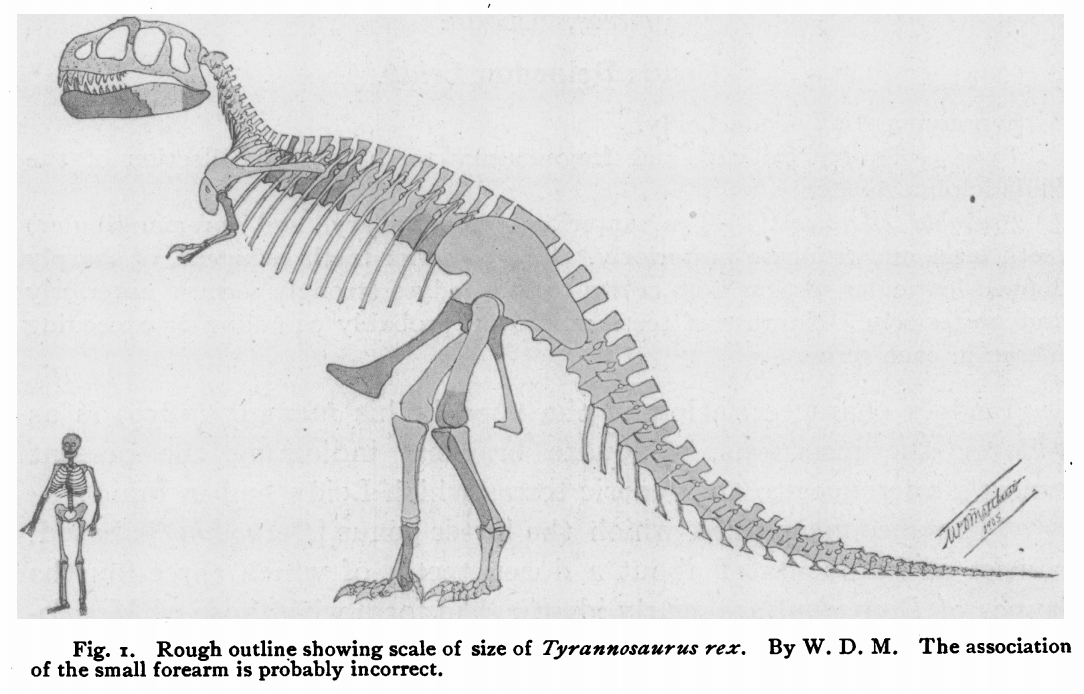
The first partial skeleton of a T. rex was discovered by Barnum Brown, assistant curator of the American Museum of Natural History, in eastern Wyoming in 1900. Brown then found another partial skeleton in the Hell Creek Formation in Montana in 1902. H. F. Osborn described both skeletons in a 1905 paper, originally assigning the 1900 skeleton the name Dynamosaurus imperiosus. Within that same paper, he used the 1902 skeleton as the holotype to describe Tyrannosaurus rex. His paper also included a skeletal restoration of T. rex (by William D. Matthew, vertebrate paleontologists and curator at the American Museum of Natural History), the first reconstruction ever published. In 1906, Osborn realized that the D. imperiosus skeletal actually belonged to the same species as the T. rex, and he selected Tyrannosaurus rex as the valid name for the species.

View Full Size Image
First published reconstruction of the Tyrannosaurus rex.. Tyrannosaurus and other Cretaceous carnivorous dinosaurs. Bulletin of the AMNH ; v. 21, article 14. 1905. http://biodiversitylibrary.org/bibliography/89582.

You can see the first publication about the T. rex in BHL, and be sure to tune in today, October 16, at 3pm EST on the NHMLA Periscope account to see the behind-the-scenes tour of the Dino Lab!

October 16, 2015by Grace Costantino
Blog Reel, Campaigns, Featured Books, Fossil Stories

Naming the Second Dinosaur: Mantell and Iguanodon

The second validly-named dinosaur was Iguanodon, but the identification of its fossils as a distinct and extinct species was a somewhat long and arduous process.

In 1822, Gideon Mantell, English geologist and paleontologist, came into possession of some large fossil teeth, discovered either by himself or his wife, Mary Ann. At the time of the discovery, Mantell had been acquiring and studying British fossils for several years, and he was in the process of publishing his first book, The Fossils of South Downs (1822).

Realizing that the teeth were something unique, but not certain what they were, Mantell presented them to several members of the Geological Society of London, including William Buckland, who described and validly named the first dinosaur genus, Megalosaurus. Geologist Charles Lyell also showed some of the teeth to the “Father of Paleontology,” Georges Cuvier. The teeth were initially dismissed as belonging to fish or a rhinoceros (even Cuvier at first attributed them to a rhinoceros). However, after his publication on Megalosaurus, Buckland again viewed Mantell’s collection of teeth, this time concluding that they were in fact teeth from a giant reptile, which he believed to be carnivorous. Emboldened by Buckland’s opinion, Mantell again sent some of the teeth to Georges Cuvier, who this time responded that he believed they were actually reptilian, belonging to an herbivore of some kind.

View Full Size Image
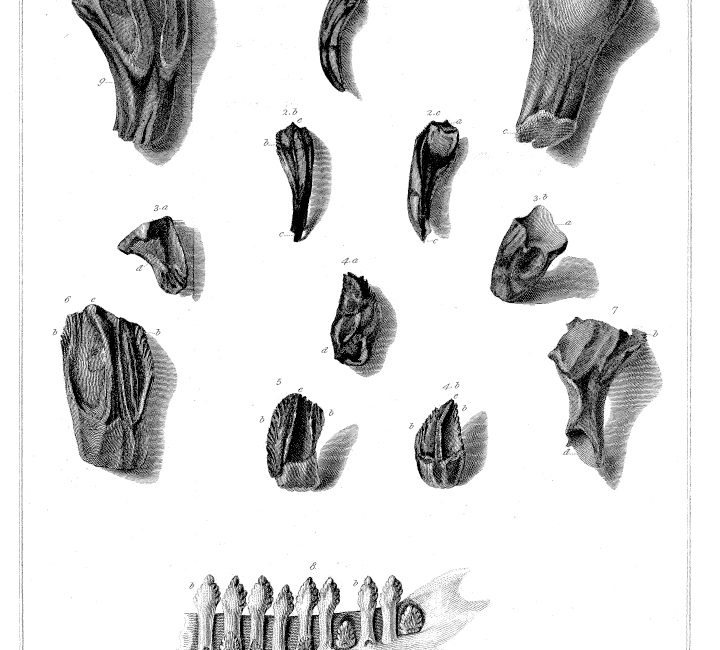
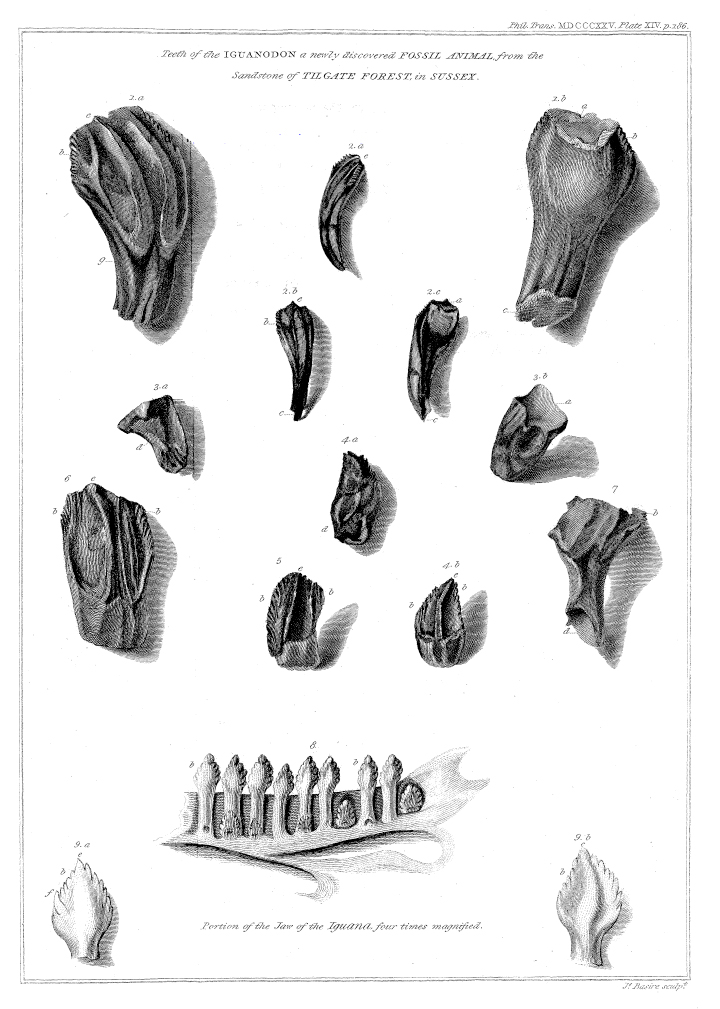
The original Iguanodon teeth described by Mantell. Philosophical Transactions of the Royal Society of London. v. 115. 1825. http://biodiversitylibrary.org/page/48364668. Digitized By: Natural History Museum, London.

Hoping to elucidate the nature of the teeth further, Mantell visited the Royal College of Surgeons in 1824, where he discovered that his teeth resembled those of an iguana skeleton recently prepared by the College’s assistant-curator, Samuel Stutchbury.

Mantell was finally ready to formally present his findings. In recognition of the resemblance between modern iguana teeth and his own fossils, Mantell gave his genus the name Iguanodon, meaning “iguana-tooth.” The name and description were published in the Philosophical Transactions of the Royal Society of London in 1825 within his article “Notice on the Iguanodon, a Newly Discovered Fossil Reptile, from the Sandstone in Tilgate Forest, in Sussex.”

View Full Size Image
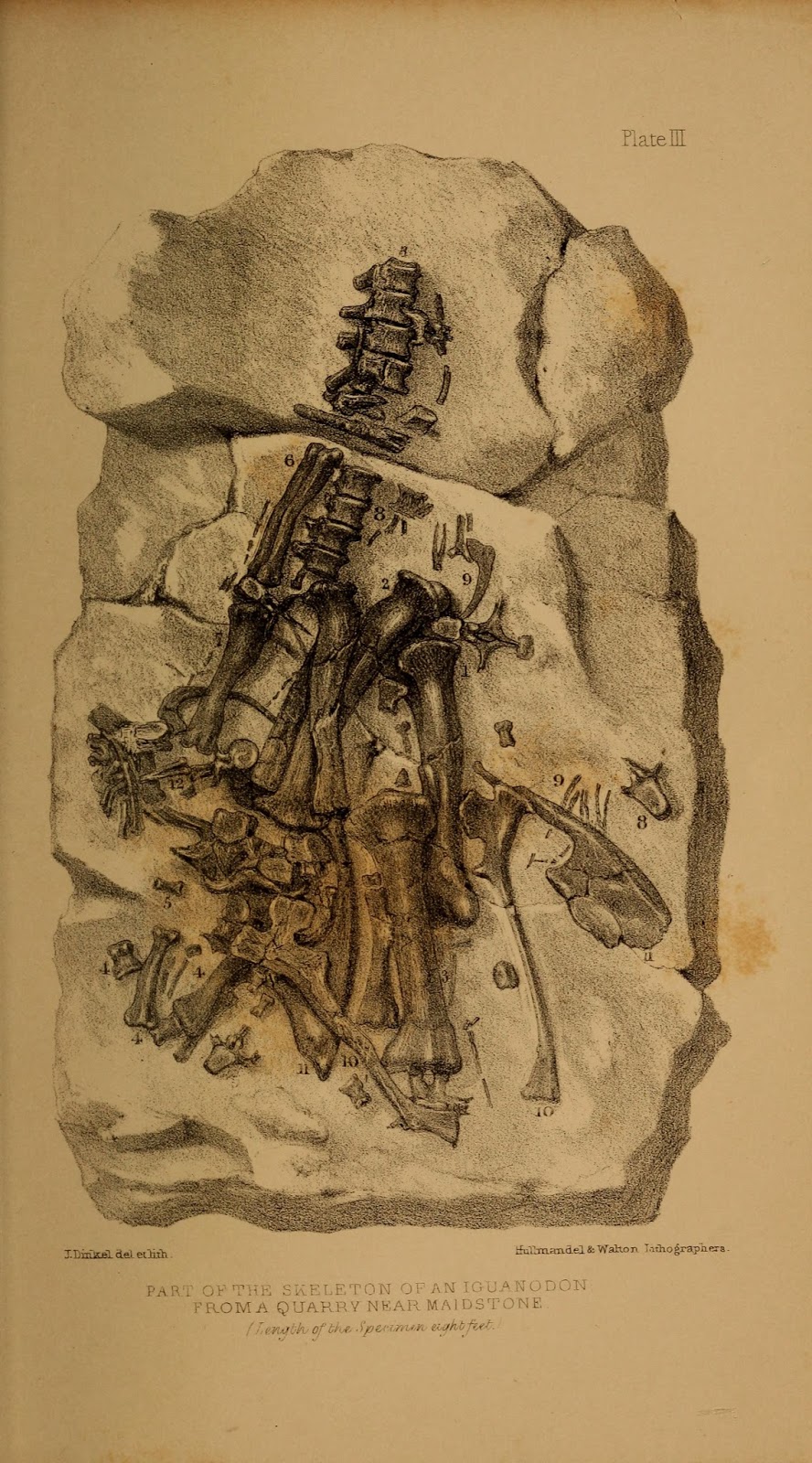
Fossil Iguanodon remains described by Mantell. Now classified as Mantellodon carpenteri. Mantell, Gideon. The Wonders of Geology. v. 1 (1841). http://biodiversitylibrary.org/page/40448764. Digitized by: Smithsonian Libraries.

Although the genus name Iguanodon means “iguana-tooth,” Iguanodon represents ornithopod, herbivorous dinosaurs, which we now know are only very distantly related to modern snakes, lizards (like iguanas), and turtles (learn more about how dinosaurs, modern reptiles, and birds are related). Nevertheless, Mantell’s description represents the second dinosaur genus to be described and validly named, and together with Megalosaurus and Hylaeosaurus, were used to define Dinosauria in 1842.

Fossil Stories

Stay tuned all week for more great fossil fun with our #FossilStories campaign, including:

  • Tweets and Facebook Posts
  • Blog Posts highlighting milestones and key publications in the history of fossil research
  • A Flickr Collection with hundreds of historic fossil illustrations
  • A Pinterest Collection featuring a selection of our favorite fossil illustrations
  • A BHL Collection containing seminal publications in the history of paleontology
  • A series of live webcasts at BHL partner institutions
  • A citizen science challenge in collaboration with The Field Book Project, the Smithsonian Transcription Center, and Smithsonian Institution Archives
Follow #FossilStories on Twitter and Facebook to learn more.
October 15, 2015by Grace Costantino
Blog Reel, Campaigns, Featured Books, Fossil Stories

The First Described and Validly Named Dinosaur: Megalosaurus

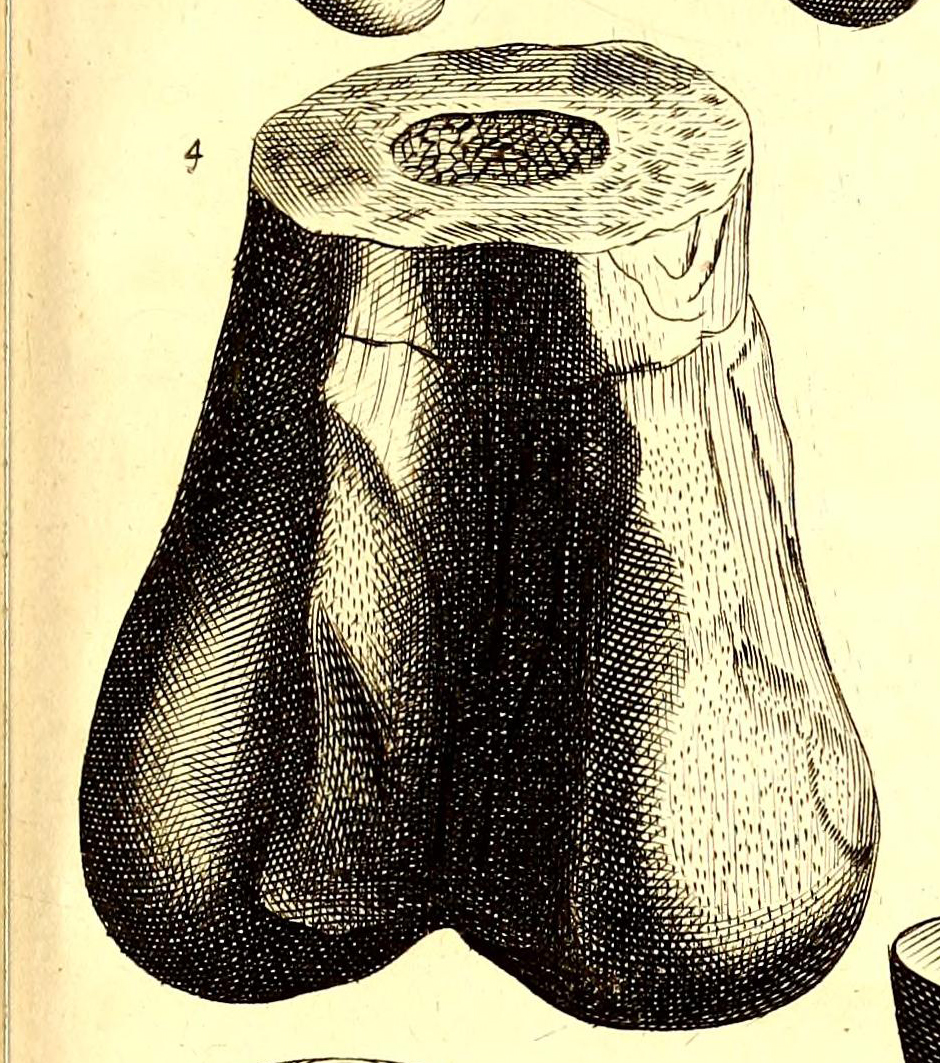
In 1676, the lower part of a massive femur was discovered in the Taynton Limestone Formation of Stonesfield limestone quarry, Oxfordshire. The bone was given to Robert Plot, Professor of Chemistry at the University of Oxford and first curator of the Ashmolean Museum. Plot published a description of it in 1677 in the Natural History of Oxfordshire. The illustration that accompanied the description is the first known published illustration of a dinosaur bone.

View Full Size Image
First published illustration of a dinosaur bone. The Natural History of Oxfordshire. 1677. http://biodiversitylibrary.org/page/48062596. Digitized by Smithsonian Libraries.

Plot first concluded that the bone belonged to a Roman war elephant, but later decided that it must instead represent the thighbone of a giant human like those described in the Bible. In 1763, Richard Brookes used Plot’s illustration of the thigh bone in his six-volume publication A System of Natural History. His reproduction of the illustration includes a caption that reads Scrotum Humanum, referencing the visual similarity between the bone and the human scrotum. Though the name is not considered valid today, its structure, following the Linnaean system of binomial nomenclature, has caused some to argue that it represents the first species name ever applied to an extinct dinosaur, because this thighbone does not, in fact, belong to a giant human, as Plot concluded. It belonged to a dinosaur, probably a Megalosaurus, although, since the specimen has since been lost, it’s impossible to know with certainty which species it belonged to.

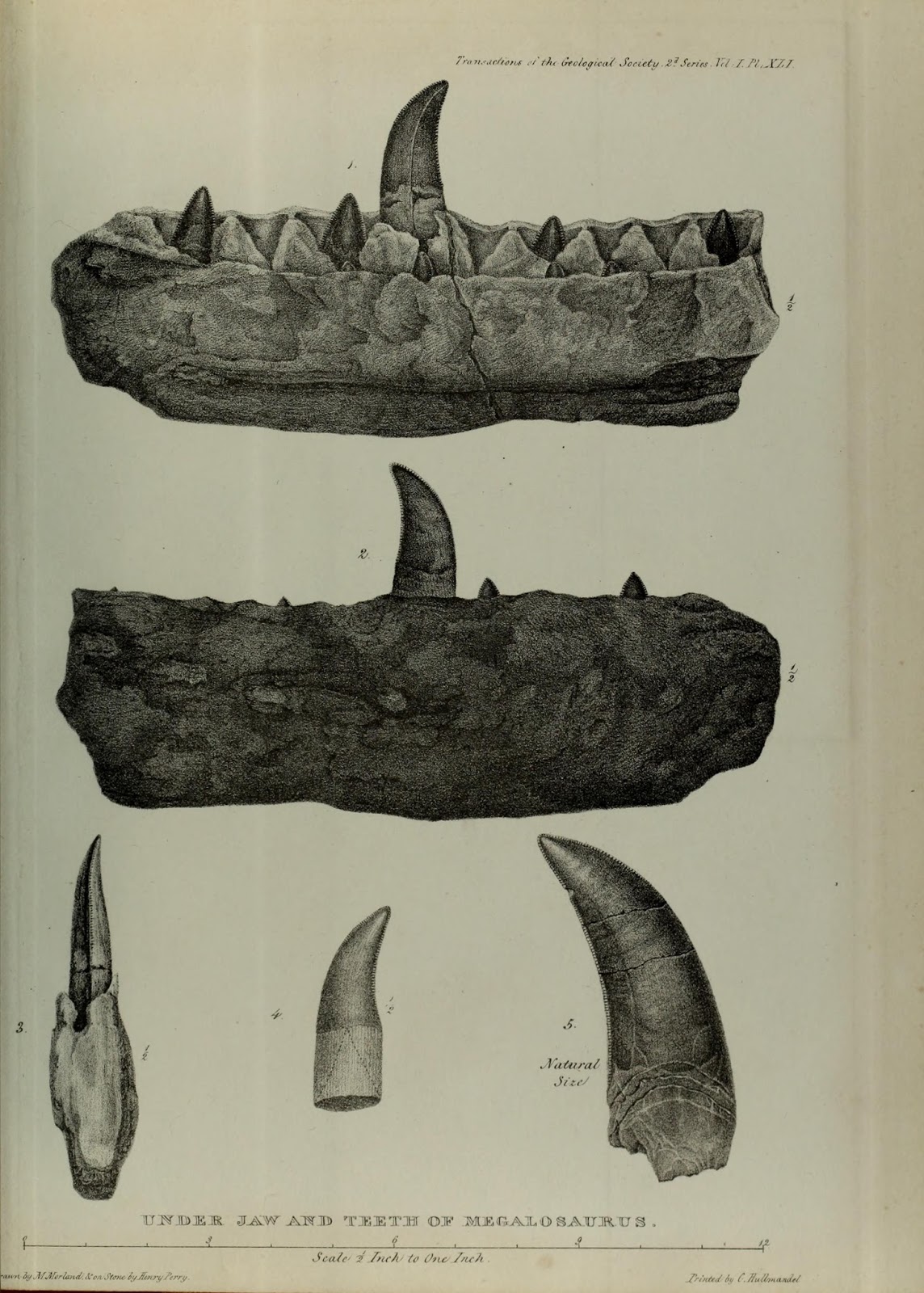
Scrotum Humanum notwithstanding , Megalosaurus represents the first dinosaur genus to be described and validly named. In 1824, William Buckland gave the genus the name Megalosaurus in his article “Notice on the Megalosaurus or Great Fossil Lizard of Stonesfield,” describing it as an extinct giant reptile. The lithograph of the Megalosaurus jaw that accompanied the description was based on drawings done by Buckland’s wife, Mary Morland. Later in 1827, Gideon Mantell, in his The Geology of the southeast of England, assigned the type specimen its current valid binomial: Megalosaurus bucklandii.

View Full Size Image
Megalosaurus jaw and teeth. Transactions of the Geological Society. ser.2, v. 1 (1824). http://biodiversitylibrary.org/page/36238855. Digitized by: California Academy of Sciences.

The carnivorous Megalosaurus, together with the herbivorous Iguanodon and armored Hylaeosaurus, were the three genera later used by Richard Owen to define Dinosauria.

Fossil Stories

Stay tuned all week for more great fossil fun with our #FossilStories campaign, including:

  • Tweets and Facebook Posts
  • Blog Posts highlighting milestones and key publications in the history of fossil research
  • A Flickr Collection with hundreds of historic fossil illustrations
  • A Pinterest Collection featuring a selection of our favorite fossil illustrations
  • A BHL Collection containing seminal publications in the history of paleontology
  • A series of live webcasts at BHL partner institutions
  • A citizen science challenge in collaboration with The Field Book Project, the Smithsonian Transcription Center, and Smithsonian Institution Archives
Follow #FossilStories on Twitter and Facebook to learn more.
October 15, 2015by Grace Costantino
Blog Reel, Campaigns, Featured Books, Fossil Stories

Identifying the First Flying Reptile: Pterosaurs

Pterosaurs, flying reptiles that lived 228-66 million years ago, are the earliest vertebrates known to have evolved the capacity for powered flight.

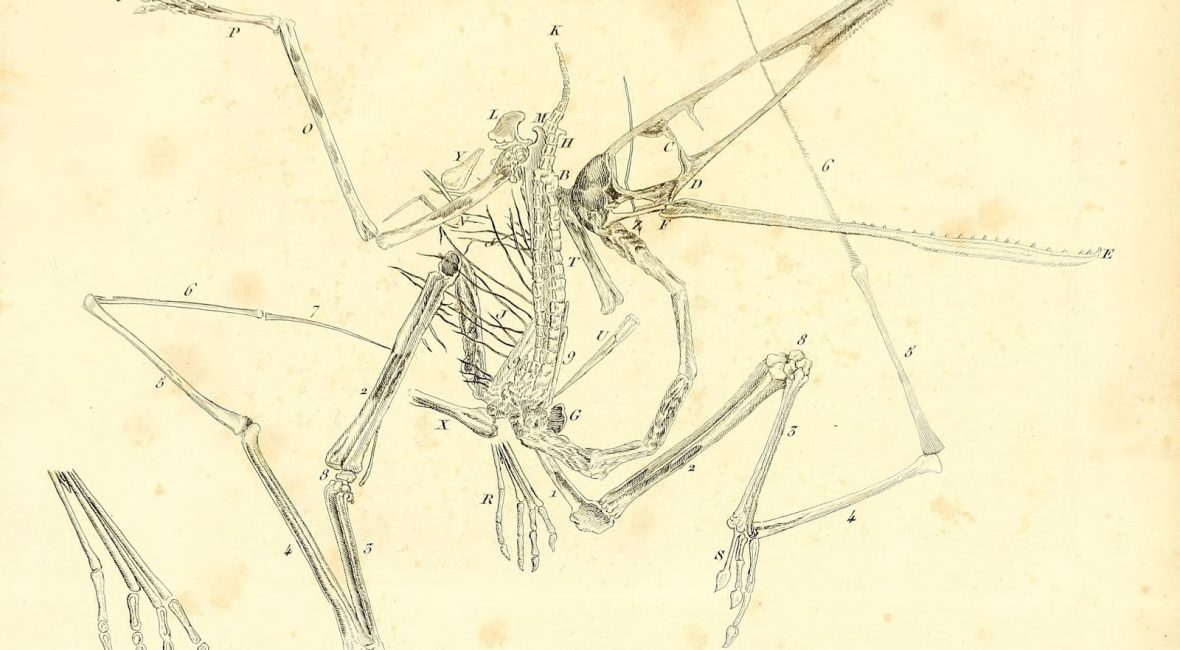
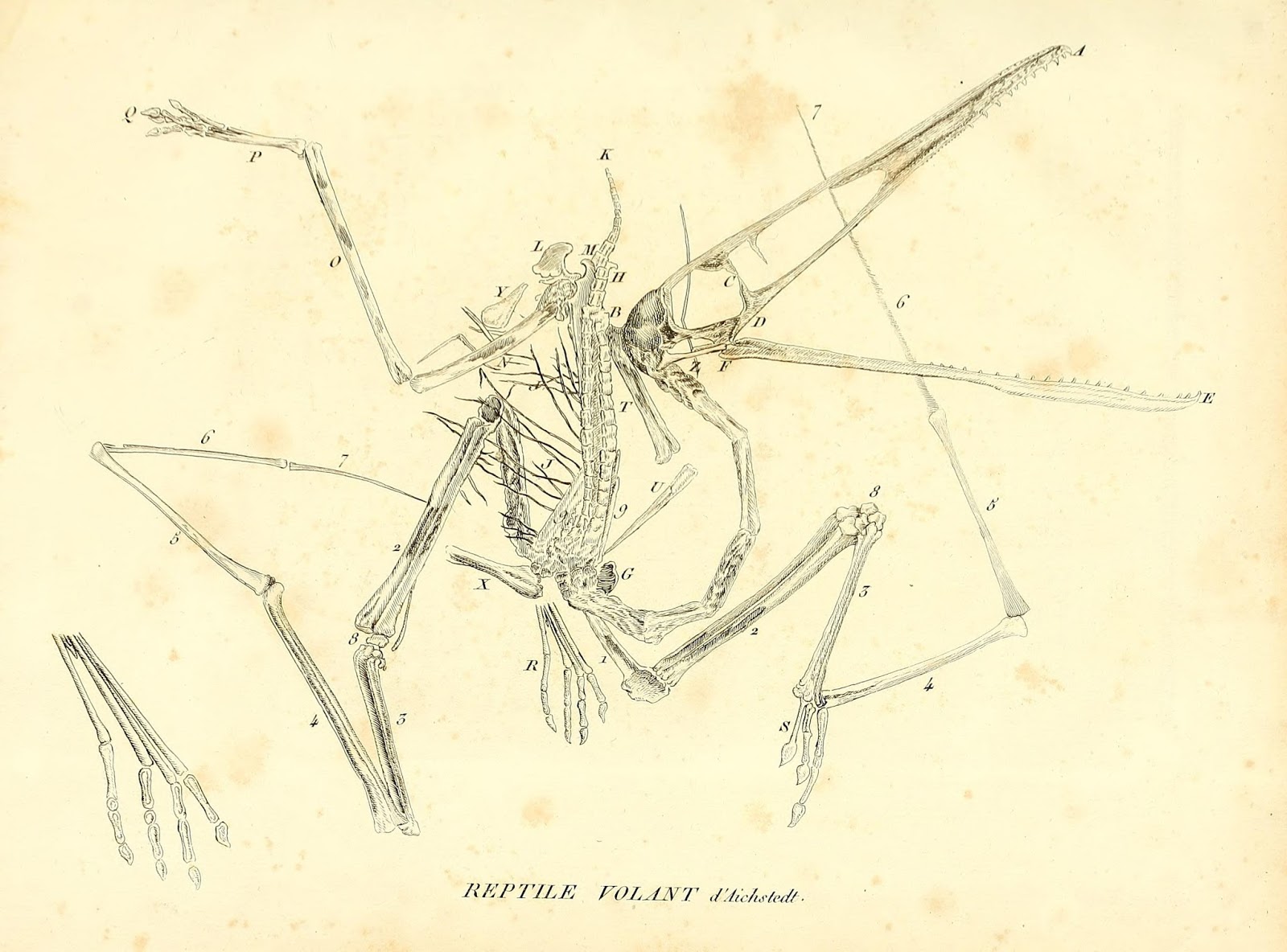
The first known pterosaur specimen was described by Cosimo Alessandro Collini in 1784. Twenty years earlier, in 1764, Collini had been appointed to supervise the Naturalienkabinett at Mannheim, established as part of the Kurpfälzische Academy of Sciences, in present-day Germany. The first-known pterosaur specimen arrived at Mannheim sometime between 1767 and 1784, probably originating from Bovaria. Collini was baffled by the specimen, but deduced that it was not a bird or a bat. He concluded that it must have been some form of marine creature, since he assumed that the ocean depths were more likely than land to house unknown species.

View Full Size Image
Collini’s pterosaur. Cuvier, Georges. Recherches sur les ossemens fossiles de quadrupèdes. t. 4 (1812). http://biodiversitylibrary.org/page/40032094. Digitized by: Smithsonian Libraries.

In 1800, Jean Hermann, Professor of Medicine in Strasbourg, drew the legendary paleontologist Georges Cuvier’s attention to the specimen through a letter that included the first restoration of a pterosaur. Hermann interpreted the figure as an intermediate form between birds and mammals and correctly deduced that the long fourth finger was used to support a wing membrane.

Reviewing Collini’s description and conclusions, Cuvier declared that the animal was actually an extinct flying reptile, which he named “Ptero-Dactyle” (Greek for “wing finger”). Cuvier published his findings in a short description in 1801 and then followed it with a longer publication in 1809. In 1818, Lorenz Oken, Professor of Medicine and Natural History at Jena, latinized Cuvier’s name to Pterodactylus.

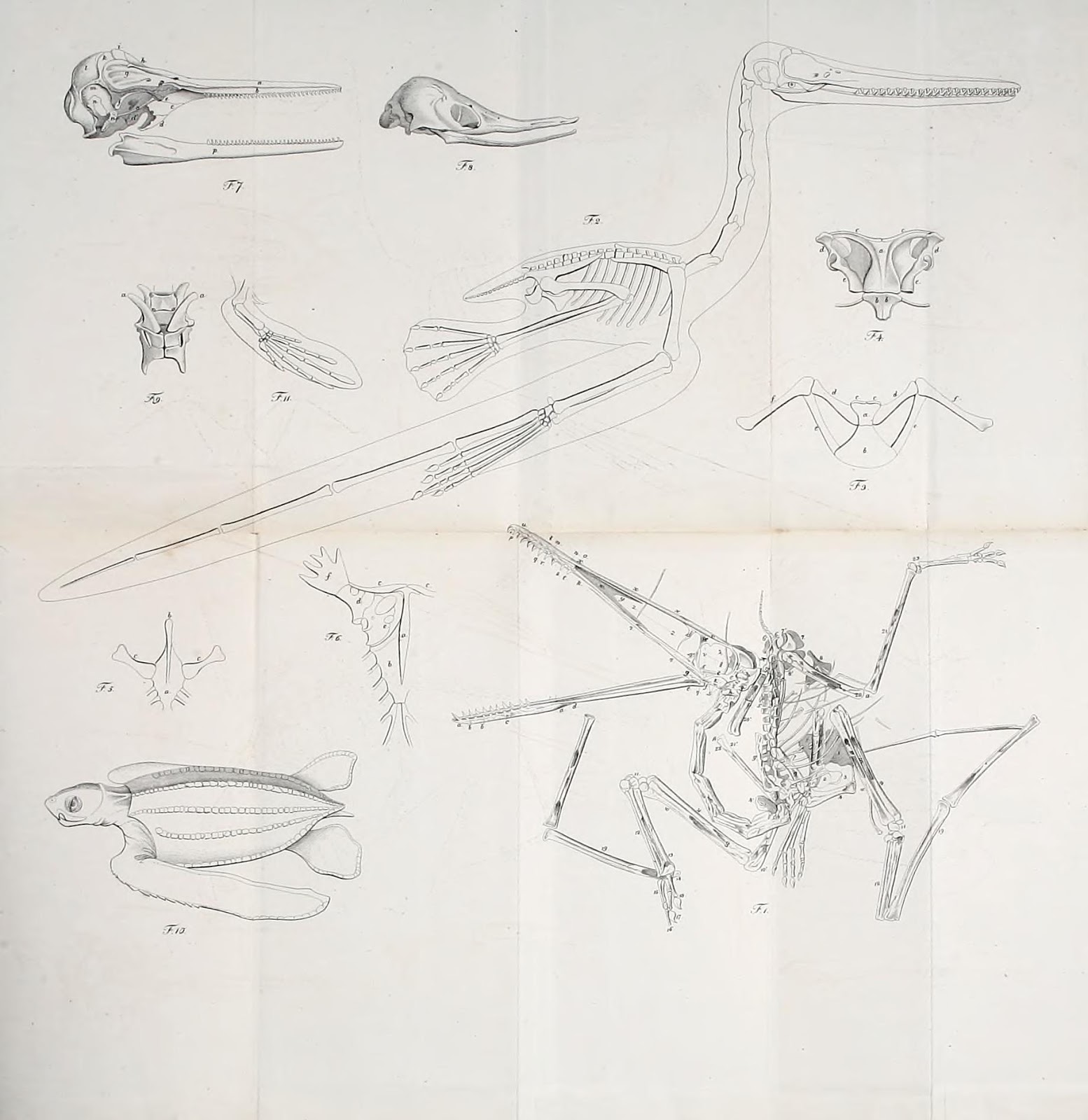
In 1812, Samuel Thomas von Sömmerring at the Academy of Science of Bavaria published the first binomial for a pterosaur. Working from the Collini specimen, Sömmerring named the creature Ornithocephalus antiquus (now Pterodactylus antiquus), believing it to be a form between mammals and birds (with which Cuvier disagreed. He again described the pterosaur as a reptile in his 1812 publication). Even into the mid-1800s, despite mounting evidence for the reptilian interpretation, many still believed that Pterodactylus antiquus represented other groups. For instance, in 1830, German zoologist Johann Georg Wagler published a paper on amphibians in which he interpreted the pterosaur’s wings as flippers.

View Full Size Image
Pterosaur with wings interpreted as flippers. Wagler, Johann Georg. Natürliches System der Amphibien. 1830. http://biodiversitylibrary.org/page/38966085. Digitized by: Smithsonian Libraries.

Although many additional Pterodactylus species were named over the years, these were found to belong to other genera or to be juvenile forms of P. antiquus, which is now the only valid species within this genus.

Fossil Stories

Stay tuned all week for more great fossil fun with our #FossilStories campaign, including:

  • Tweets and Facebook Posts
  • Blog Posts highlighting milestones and key publications in the history of fossil research
  • A Flickr Collection with hundreds of historic fossil illustrations
  • A Pinterest Collection featuring a selection of our favorite fossil illustrations
  • A BHL Collection containing seminal publications in the history of paleontology
  • A series of live webcasts at BHL partner institutions
  • A citizen science challenge in collaboration with The Field Book Project, the Smithsonian Transcription Center, and Smithsonian Institution Archives
Follow #FossilStories on Twitter and Facebook to learn more.
October 15, 2015by Grace Costantino
Page 30 of 71« First...1020«29303132»405060...Last »

Help Support BHL

BHL's existence depends on the financial support of its patrons. Help us keep this free resource alive!

search

About BHL

The Biodiversity Heritage Library (BHL) is the world’s largest open access digital library for biodiversity literature and archives. BHL operates as a worldwide consortium of natural history, botanical, research, and national libraries working together to digitize the natural history literature held in their collections and make it freely available for open access as part of a global “biodiversity community.”

Join Our Mailing List

Sign up to receive the latest news, content highlights, and promotions.

Subscribe Now

Subscribe to Blog via Email

Enter your email address to subscribe to this blog and receive notifications of new posts by email.

Join 319 other subscribers

Subscribe to Blog Via RSS

Subscribe to the blog RSS feed to stay up-to-date on all the latest BHL posts.

Access RSS Feed

Inspiring Discovery through Free Access to Biodiversity Knowledge.

The Biodiversity Heritage Library makes it easier than ever for you to access the information you need to study and explore life on Earth…for free, anytime, anywhere.


64+ Million Pages of
Biodiversity Literature Online.

EXPLORE

Tools and Services
to Transform Research.

EXPLORE

300,000+
Illustrations on Flickr.

EXPLORE

ABOUT | HARMFUL CONTENT | PRIVACY | SITE MAP | TERMS OF USE