Biodiversity Heritage Library - Program news and collection highlights from BHL
  • Home
  • News
  • Featured Books
    • All Featured Books
    • Book of the Month Series
    • BHL at 20
  • User Stories
  • Campaigns
    • Fossil Stories
    • Garden Stories
    • Monsters Are Real
    • Page Frights
    • Her Natural History
    • Earth Optimism 2020
  • Tech Blog
  • Visit BHL
Home
News
Featured Books
    All Featured Books
    Book of the Month Series
    BHL at 20
User Stories
Campaigns
    Fossil Stories
    Garden Stories
    Monsters Are Real
    Page Frights
    Her Natural History
    Earth Optimism 2020
Tech Blog
Visit BHL
  • Home
  • News
  • Featured Books
    • All Featured Books
    • Book of the Month Series
    • BHL at 20
  • User Stories
  • Campaigns
    • Fossil Stories
    • Garden Stories
    • Monsters Are Real
    • Page Frights
    • Her Natural History
    • Earth Optimism 2020
  • Tech Blog
  • Visit BHL
Biodiversity Heritage Library - Program news and collection highlights from BHL
Blog Reel, Campaigns, Featured Books, Fossil Stories

Uncovering the “Fish Lizard”: Ichthyosaurs and Home

When the fossils of extinct species were first discovered, they were often misidentified. Case in point: Ichthyosaurs.

The first probable illustrations of ichthyosaur fossils were published by Edward Lhuyd in his Lithophylacii Brittannici Ichnographia, 1699. He attributed the fossils to fish. In 1708, Swiss naturalist Johann Jakob Scheuchzer attributed two ichthyosaur vertebrae to a man who drowned during the Biblical flood. In 1783, an ichthyosaur jaw with teeth was exhibited by the Society for Promoting Natural History as those of a crocodilian. In 1804, Edward Donovan discovered a four metres long ichthyosaur specimen that he described as a giant lizard.

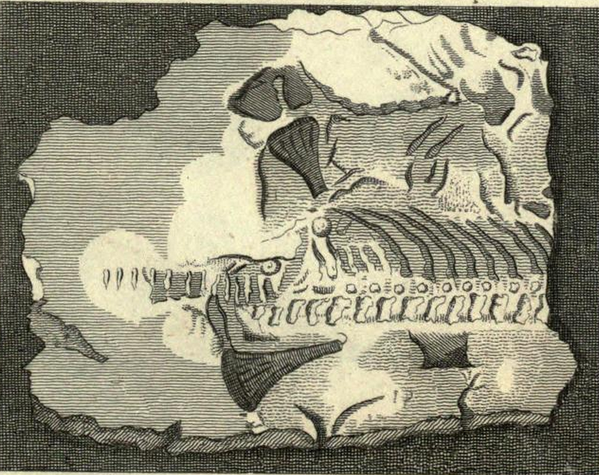
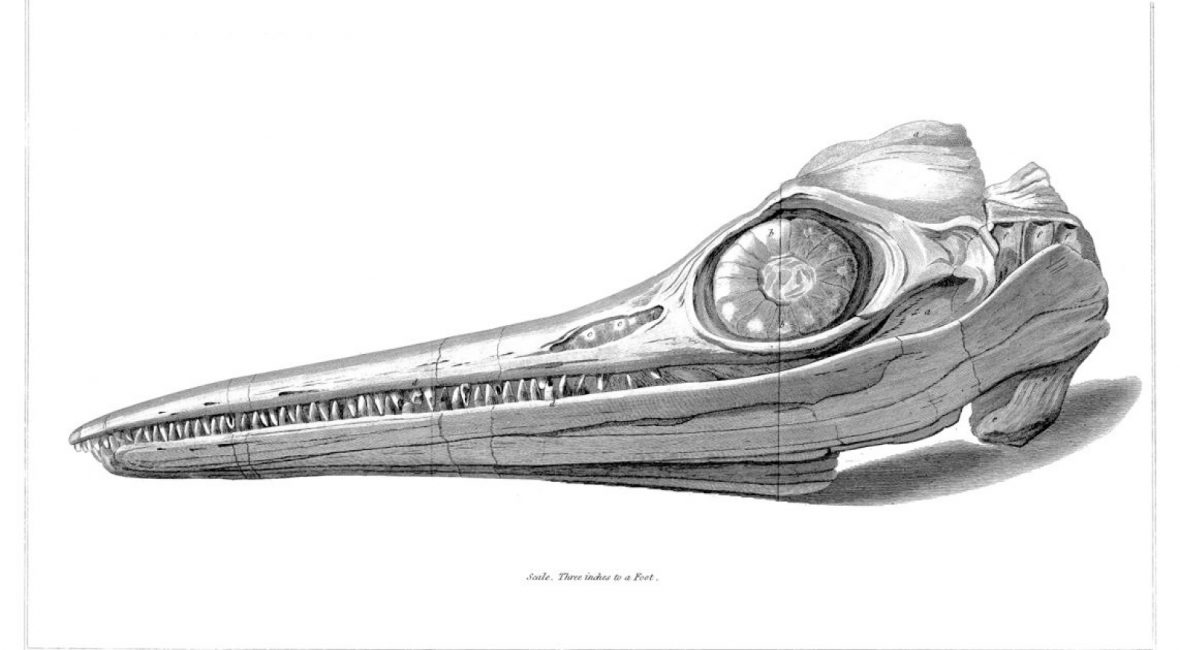
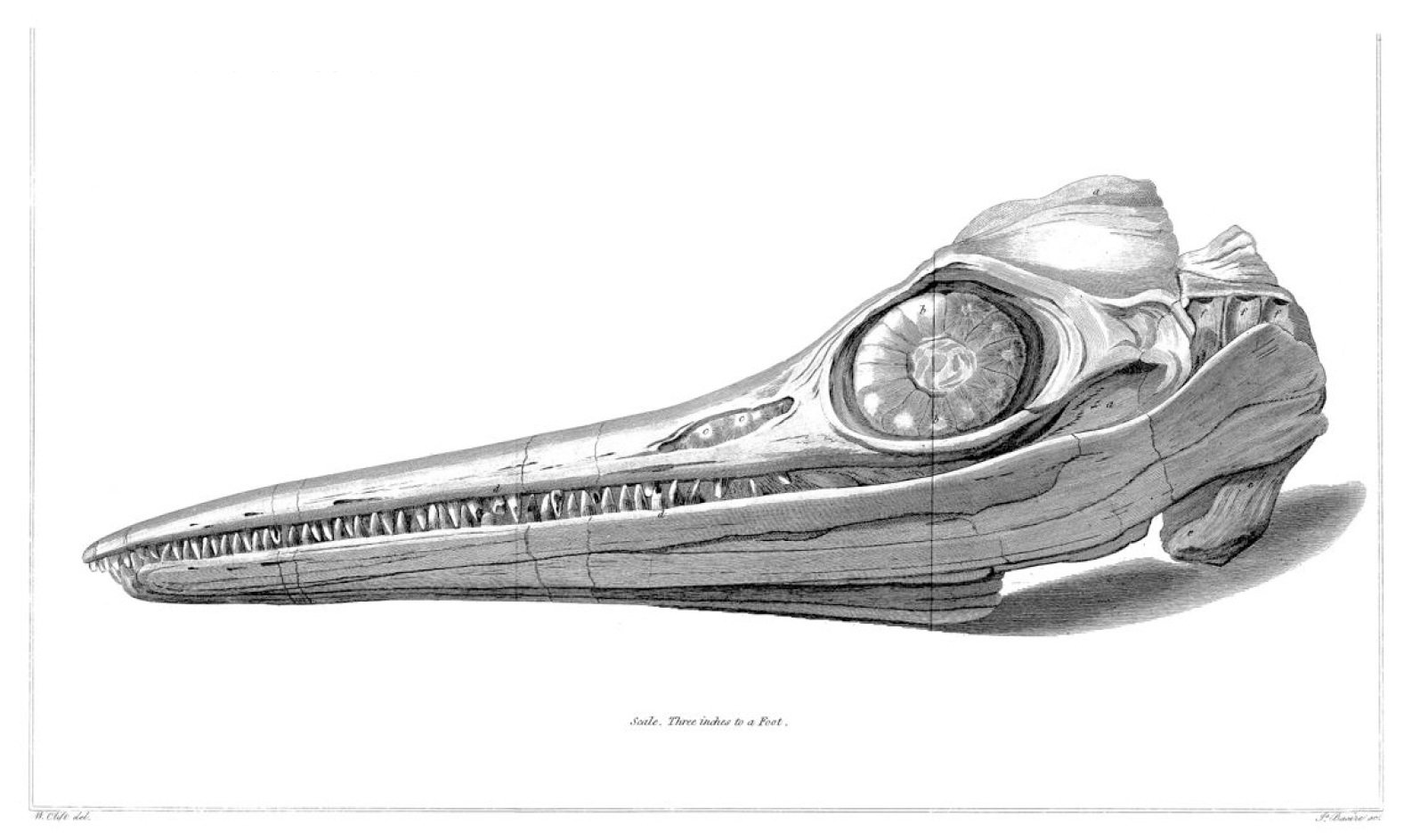
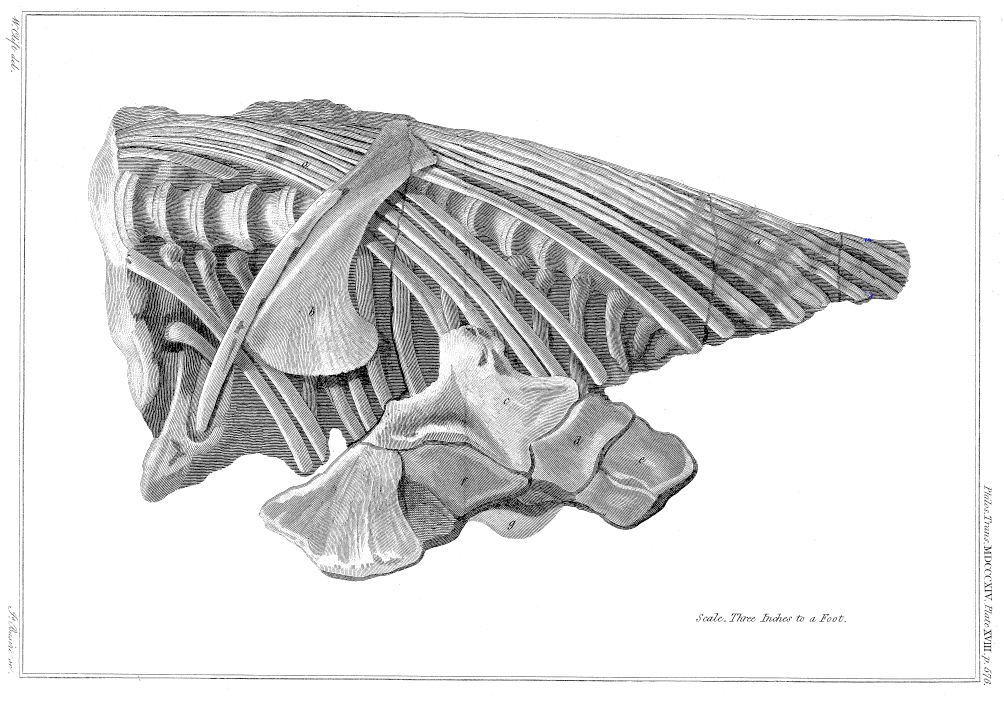
Sometime between 1809-11, a young boy named Joseph Anning spotted a “crocodile” skull in the cliffs near his home in the seaside community of Lyme Regis, England. His sister, Mary Anning, excavated the skull from the rock and, a year later, also uncovered the torso of the same specimen. Mary would go on to discover many incredibly important fossils throughout her lifetime.
View Full Size Image
Ichthyosaurus skull discovered by Joseph Anning. Philosophical Transactions of the Royal Society of London. v. 104. 1814. http://biodiversitylibrary.org/page/48435496. Digitized by: Natural History Museum, London.

The Anning specimen was sold and later acquired by the British Museum. British surgeon Sir Everard Home was intrigued by the specimen, and, in 1814, published a description of it in the Philosophical Transactions of the Royal Society of London. This article would later be recognized as the first scientific publication dedicated to an ichthyosaurus. Home believed the specimen was more closely related to fish than any other group, although he expressed some doubts, as several aspects of it resembled reptiles. He concluded that it represented a transitional form between fish and crocodiles, exhibiting, like the platypus, he argued, traits of many different groups.
View Full Size Image
Ichthyosaurus torso discovered by Mary Anning. Philosophical Transactions of the Royal Society of London. v. 104. 1814. http://biodiversitylibrary.org/page/48435498. Digitized by: Natural History Museum, London.

In 1817, German naturalist Karl Dietrich Eberhard König referred to the specimen as Ichthyosaurus, or “fish saurian.” Although he would not publish this name until 1825 (in his Icones fossilium sectiles), and despite the fact that in 1819 Home proposed the formal generic name of Proteosaurus in a scientific publication, other naturalists such as William Conybeare and Henry Thomas De la Beche adopted the name Ichthyosaurus in their own publications. By the standards of nomenclature, Home’s name should have priority, as it was published first, but the prevalent use of the name Ichthyosaurus consigned Proteosaurus to a status of “forgotten” nomen oblitum.

Today, we use the order Ichthyosauria, which was proposed by Henri Marie Ducrotay de Blainville in 1835, to describe over fifty valid genera of marine reptiles that flourished during the Mesozoic era and went extinct in the Late Cretaceous.

Fossil Stories

Stay tuned all week for more great fossil fun with our #FossilStories campaign, including:

  • Tweets and Facebook Posts
  • Blog Posts highlighting milestones and key publications in the history of fossil research
  • A Flickr Collection with hundreds of historic fossil illustrations
  • A Pinterest Collection featuring a selection of our favorite fossil illustrations
  • A BHL Collection containing seminal publications in the history of paleontology
  • A series of live webcasts at BHL partner institutions
  • A citizen science challenge in collaboration with The Field Book Project, the Smithsonian Transcription Center, and Smithsonian Institution Archives
Follow #FossilStories on Twitter and Facebook to learn more.
October 15, 2015by Grace Costantino
Blog Reel, Campaigns, Featured Books, Fossil Stories

The Roots of Paleobotany: Brongniart and Fossil Plants

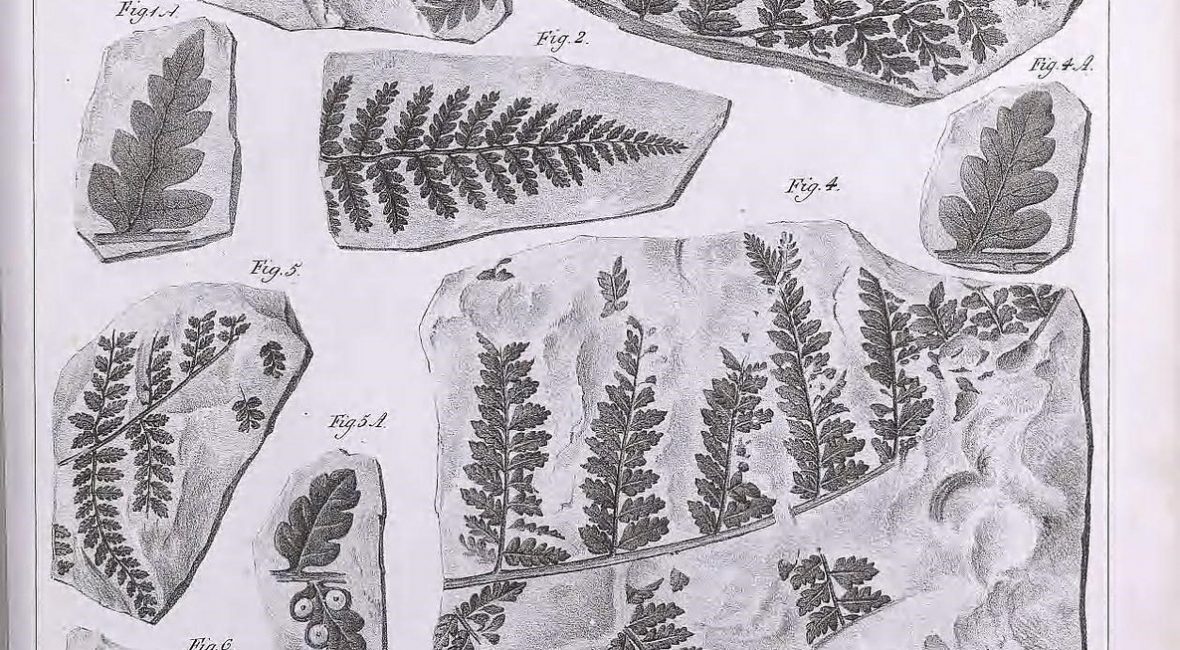
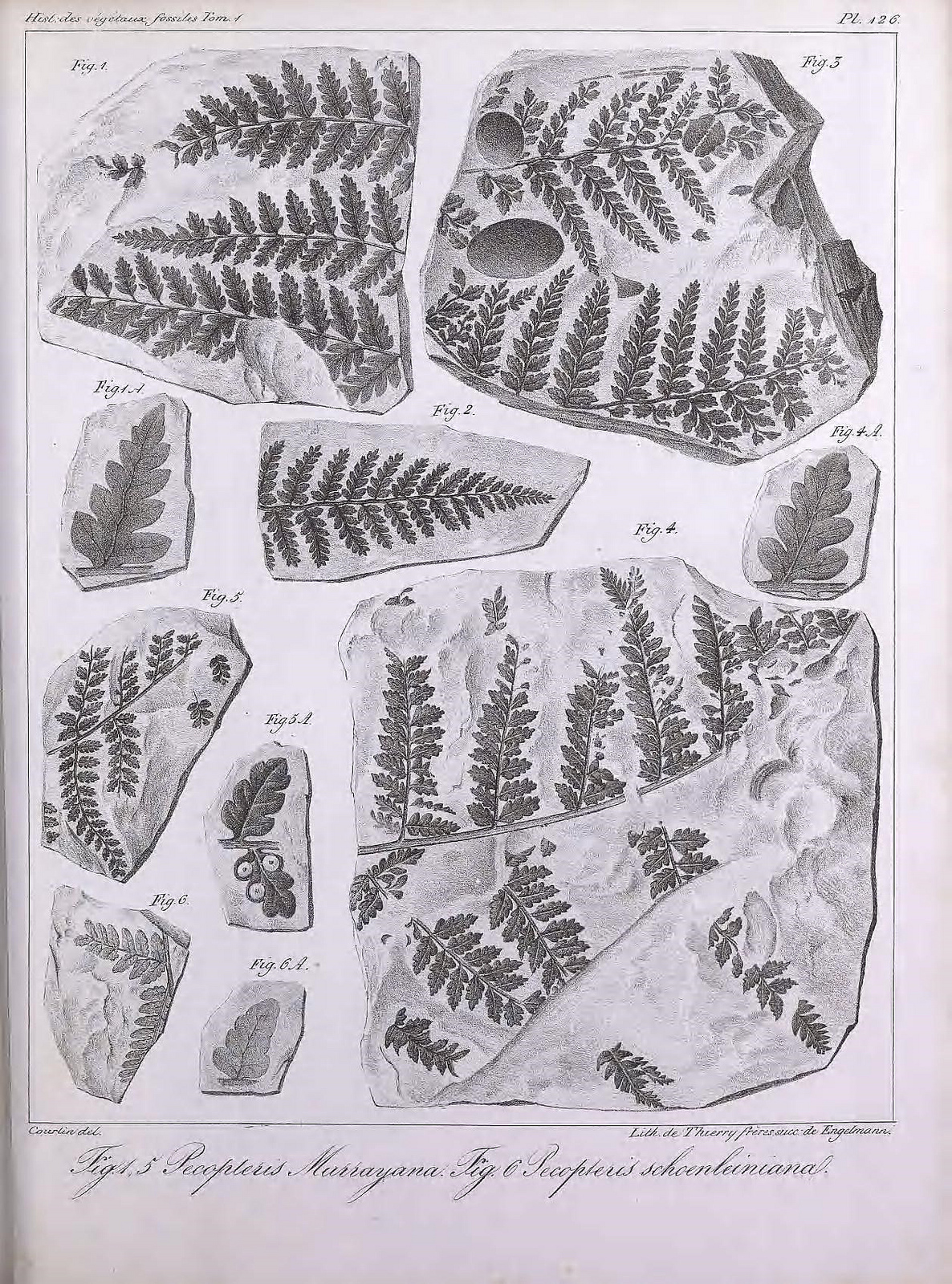
French botanist Adolphe-Théodore Brongniart is known as the Father of Paleobotany. Active in many branches of botany, Brongniart is most-remembered for his pioneering work on the relationship between extinct and living plants. In 1822, he published a paper on the classification and distribution of fossil plants, which he subsequently followed-up with his masterpiece Histoire des vegetaux fossiles (“History of fossil plants”) in 1828. This work was instrumental in the development of the field of paleobotany.

In 1828, Brongniart, son of the geologist Alexandre Brongniart (who worked with Georges Cuvier on geological studies in France), first published an introduction to his history of fossil plants, entitled Prodrome d’une histoire des végétaux fossiles. He then followed the introduction with his two-volume magnum opus, Histoire des végétaux fossiles.

View Full Size Image
Brongniart, Alexandre. Histoire des végétaux fossiles. (1828-37). http://biodiversitylibrary.org/page/40155235. Digitized by: Smithsonian Libraries.

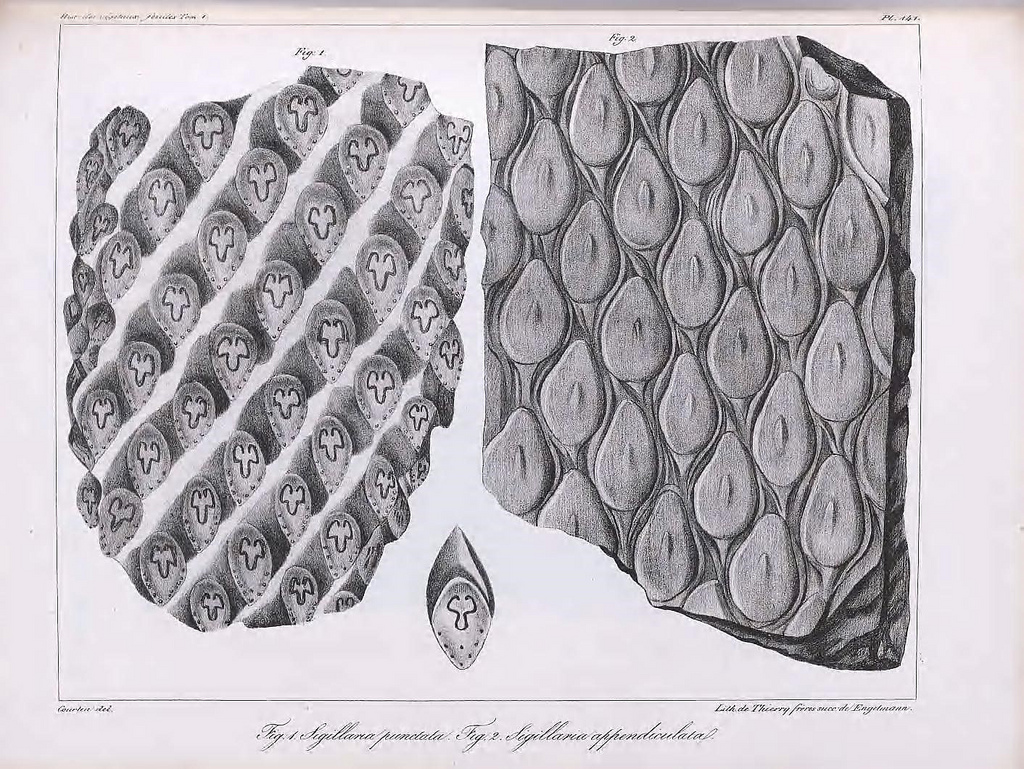
Within Histoire, Brongniart asserted that the history of plants could be divided into four periods. Mirroring findings from the animal kingdom, Brongniart found that, with each successive period, the represented plants became more diverse and complex. The first period was dominated by cryptogams; the first conifers emerged in the second period and then cycads in the third. Finally, in the fourth period, flowering plants made their debut. Though there were sharp floral discontinuities during the transitions between these four periods, during each period there were gradual changes within the characteristic groups.

View Full Size Image
Brongniart, Alexandre. Histoire des végétaux fossiles. (1828-37). http://biodiversitylibrary.org/page/40155265. Digitized by: Smithsonian Libraries.

Brongniart’s work is important not only because of its impact on the field of paleobotany, but also because it further demonstrated the long, progressive history of life on Earth and the emergence of new, increasingly complex forms of life over time. His work also supported the theory that Earth’s climate changed over time, as Brongniart concluded that the fossil record indicated that northern Europe had once had a tropical climate. Furthermore, Brongniart suggested that there was a correlation between the profusion of plants and the emergence of terrestrial vertebrates. As plants increased and diversified, they locked up more and more carbon dioxide from the atmosphere and produced more and more oxygen, thus fueling the environment necessary to support first air-breathing reptiles and later mammals. His theories show striking similarities to modern theories about the evolution of Earth’s atmosphere.

Fossil Stories

Stay tuned all week for more great fossil fun with our #FossilStories campaign, including:

  • Tweets and Facebook Posts
  • Blog Posts highlighting milestones and key publications in the history of fossil research
  • A Flickr Collection with hundreds of historic fossil illustrations
  • A Pinterest Collection featuring a selection of our favorite fossil illustrations
  • A BHL Collection containing seminal publications in the history of paleontology
  • A series of live webcasts at BHL partner institutions
  • A citizen science challenge in collaboration with The Field Book Project, the Smithsonian Transcription Center, and Smithsonian Institution Archives
Follow #FossilStories on Twitter and Facebook to learn more.
October 14, 2015by Grace Costantino
Blog Reel, Campaigns, Featured Books, Fossil Stories

Fact or Fiction? Discovering the Mosasaur

If you’ve seen Jurassic World (or even just the trailers), then you’re familiar with Mosasaurus. In the film, it’s portrayed as a giant aquatic lizard thundering out of the water to devour great white sharks…and other mega prey.

Of course, the Jurassic World version is an exaggeration of the real thing (the film version is portrayed at 60 feet long, while the real animal maxed out at 46-50 feet long and was not capable of the water acrobatics depicted in the movie), but it is nevertheless based on a real, extinct aquatic reptile.

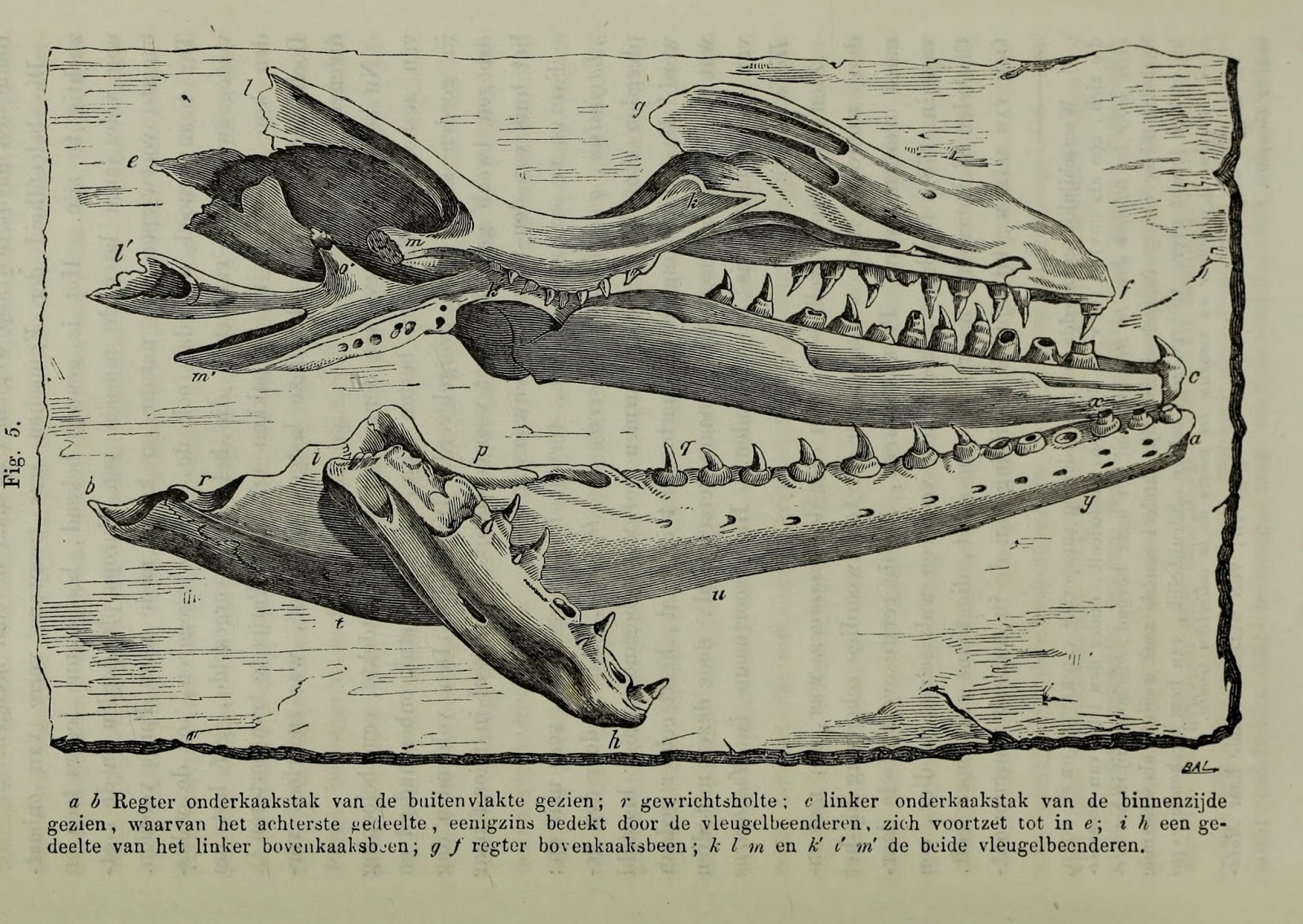
An historic account of an early discovery of mosasaur fossils is also probably more of an exaggeration than reality.

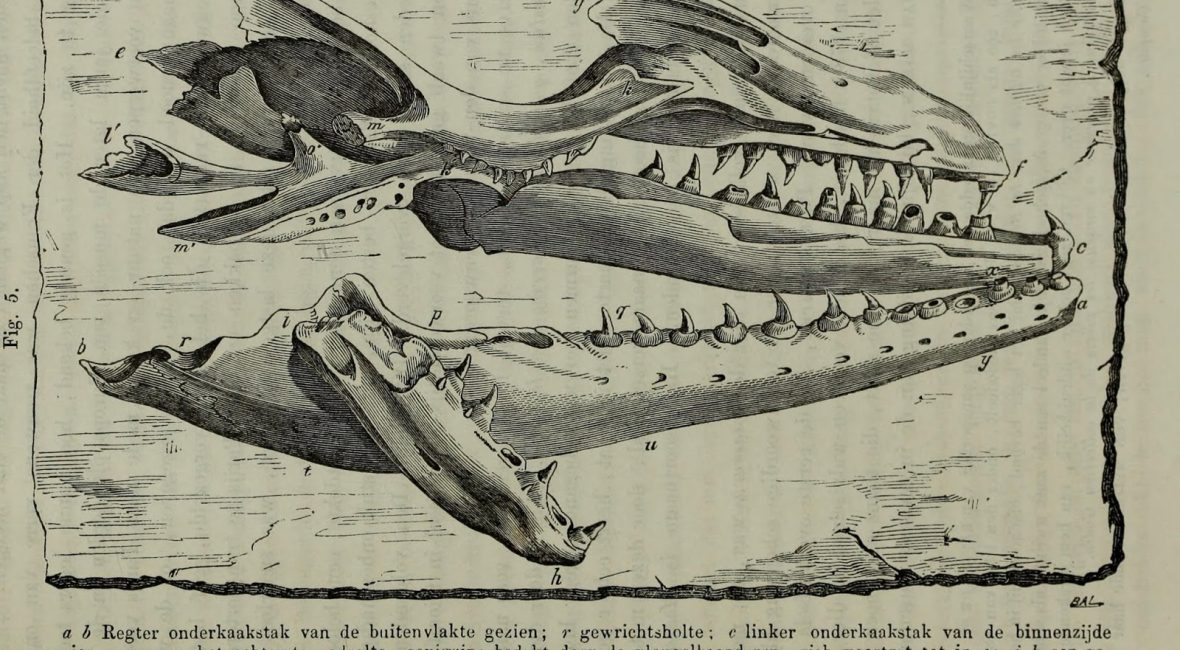
View Full Size Image
Jaws of the Mosasaur. Harting, Pieter. Album der Natuur. 1866. http://biodiversitylibrary.org/page/35222337. Digitized by Natural History Museum, London.

According to French geologist Barthélemy Faujas de Saint-Fond’s eighteenth century account of the discovery of the second known partial mosasaurus skull, quarrymen at the subterraneous quarries of St. Peter’s Mount, at Maestricht, Netherlands, uncovered the massive skull embedded in the rock sometime between 1770-74. They informed local surgeon, Leonard Hoffmann, who reportedly offered a reward for any fossils discovered in the quarry. Hoffmann took the specimen home, only to have canon Godding of Maestricht, who owned the quarry, demand to have the specimen given to him, claiming rightful ownership since the fossil had been discovered on his land. Godding subsequently filed a lawsuit against Dr. Hoffmann, eventually gaining custody of the piece.

But the story doesn’t end there. In 1795, the French revolutionary army captured Maastricht. De Saint-Fond was the Scientific Commissioner for the army, and he entered Maestricht with the express purpose of securing the “celebrated head” for the French. However, when he arrived at Godding’s mansion, the skull had already been removed from the house. A reward of six hundred bottles of good wine was offered to anyone who could locate the skull and return it to de Saint-Fond. The next morning, twelve grenadiers brought it to the French camp, where it was packaged and sent to the Museum of Natural History in Paris. De Saint-Fond also reportedly offered a substantial renumeration to Godding for the loss of the fossil.

View Full Size Image
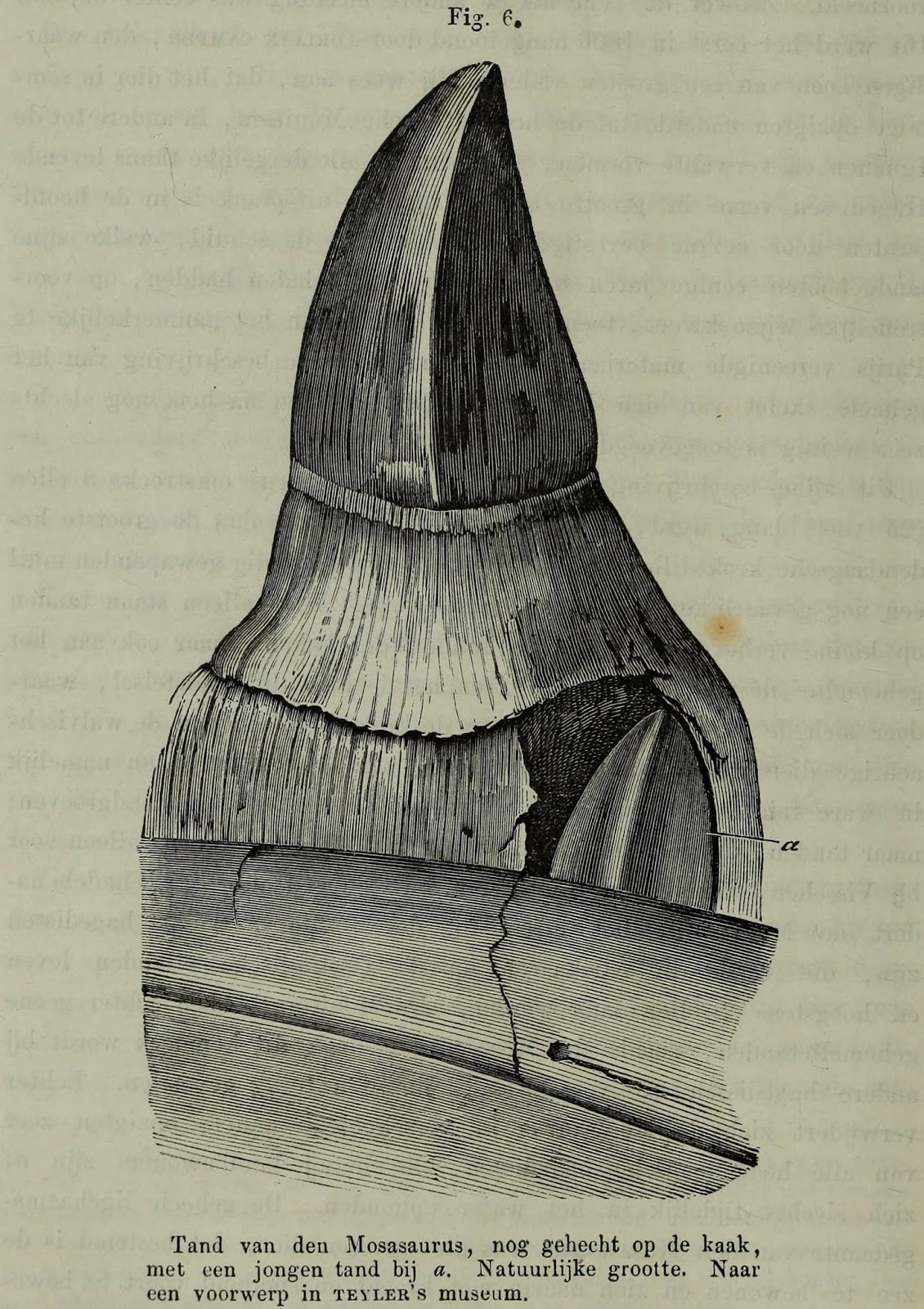
Tooth of Mosasaur. Harting, Pieter. Album der Natuur. 1866.  http://biodiversitylibrary.org/page/35222340. Digitized by Natural History Museum, London.

And so the story goes. Dutch historian Peggy Rompen, however, has found the story to be more fiction than truth. According to her 1995 thesis, Godding was in fact the original owner of the skull. Hoffmann never possessed it, there was never a lawsuit between Godding and Hoffmann, and De Saint-Fond apparently offered no renumeration to Godding for the loss of the fossil. It seems that De Saint-Fond fabricated the story to justify the French seizure of the specimen.

View Full Size Image
Mosasaur vertebrae. Camper, Adriaan Gilles. Annales du Muséum national d’histoire naturelle. v. 19 (1812). http://biodiversitylibrary.org/page/3499442. Digitized by Natural History Museum, London.

Despite the uncertainty surrounding the truth about early discoveries of mosasaur fossils (and additional evidence that some early fossils may have been tampered with), Leonard Hoffmann did corresponded with Dutch Professor Petrus Camper about the infamous mosasaur skull. Hoffmann believed the skull belonged to a giant crocodile, while Camper insisted it was some unknown toothed whale. In 1798, Petrus’ son, Adriaan Gilles Camper, reexamined his father’s description and decided that the skull must belong to a giant, extinct monitor lizard. He communicated this belief to Georges Cuvier in 1799, and in 1808, Cuvier indicated that, based on comparative anatomy, the specimen did indeed show affinities with lizards. In 1812, Camper published a longer description of several mosasaur fossils from Maastricht. Finally, in 1822, William Daniel Conybeare gave the animal the genus name Mosasaurus, and in 1829, Gideon Mantell supplied the specific epithet hoffmannii.

Fossil Stories

Stay tuned all week for more great fossil fun with our #FossilStories campaign, including:

  • Tweets and Facebook Posts
  • Blog Posts highlighting milestones and key publications in the history of fossil research
  • A Flickr Collection with hundreds of historic fossil illustrations
  • A Pinterest Collection featuring a selection of our favorite fossil illustrations
  • A BHL Collection containing seminal publications in the history of paleontology
  • A series of live webcasts at BHL partner institutions
  • A citizen science challenge in collaboration with The Field Book Project, the Smithsonian Transcription Center, and Smithsonian Institution Archives
Follow #FossilStories on Twitter and Facebook to learn more.
October 14, 2015by Grace Costantino
Blog Reel, Campaigns, Featured Books, Fossil Stories

A Sinner Killed During the Great Flood or a Fossil Reptile? Discovering the Plesiosaur

Most people today are at least somewhat familiar with the order of extinct marine reptiles known as Plesiosauria, thanks to the legend of the Loch Ness monster, which is often described as resembling a plesiosaur. Indeed, some argue that Nessie may in fact be a surviving member of this order. Scientists, however, reject this suggestion, if for no other reason that the Loch Ness lake formed a mere 10,000 years ago, while the fossil record indicates that plesiosaurs went extinct over 66 million years ago. And yet, even if plesiosaurs can’t account for the Loch Ness legend, the story of their discovery is still captivating.

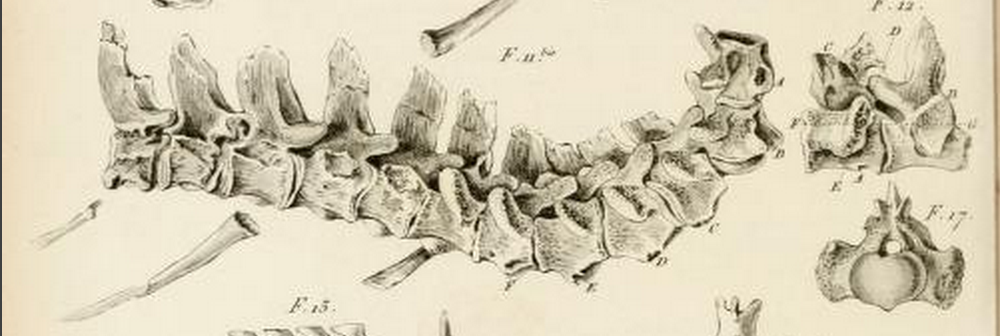
Plesiosaurs are among the first extinct fossil reptiles to be recognized as such. Plesiosaur fossils were described as early as 1605, though in the seventeenth century they were not recognized as extinct reptiles. In 1719, Anglican clergyman William Stukeley, who pioneered archaeological studies at Stonehenge and Avebury, described a partial plesiosaur skeleton that had been brought to his attention by Robert Darwin of Elston, Charles Darwin’s great-grandfather. The skeleton had been found at a quarry at Fulbeck, England. It had been used to reinforce the slope of a watering-hole until the fossils were discovered within it, after which it was displayed in the local vicarage as the remains of a sinner killed during the Biblical flood. Stukeley’s description in “An Account of the Skeleton of a Large Animal Impressed on Stone,” which describes the fossils as belonging to a sea creature such as a crocodile or porpoise, is the first published description of an articulated fossil reptile skeleton.

View Full Size Image
Stukeley’s plesiosaur. Original Publication: Philosophical Transactions of the Royal Society of London. 1719. Reprint, 1809: http://biodiversitylibrary.org/page/23269260. Digitized by University of California Libraries.

Further descriptions of plesiosaurs through the early nineteenth century were still based on incomplete specimens. In 1821, William Conybeare and Henry Thomas De la Beche gave the genus its name, Plesiosaurus, when they described a partial skeleton from the collection of Colonel Thomas James Birch.

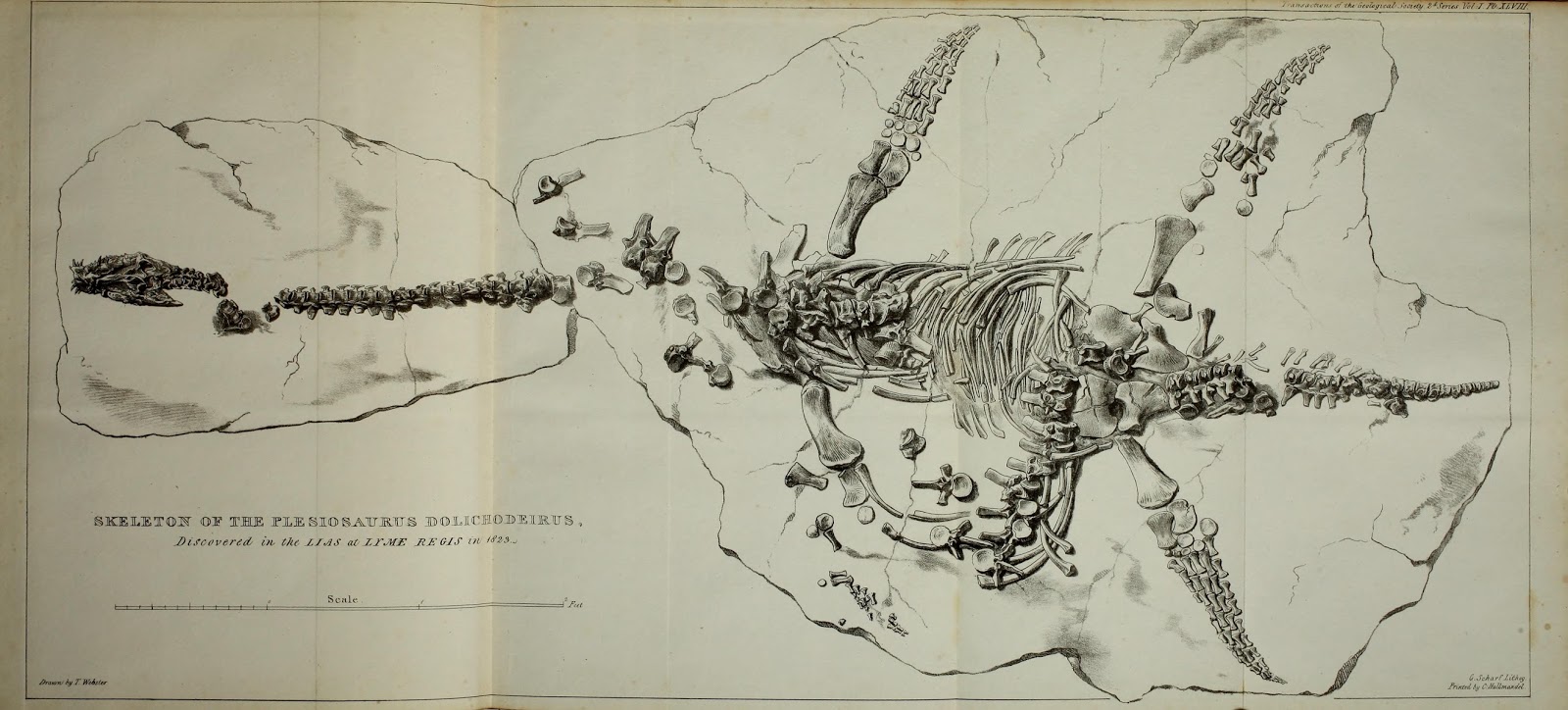
It was 1823 when the next great milestone in the plesiosaur story occurred. Famous “fossil-hunter” Mary Anning discovered a nearly complete skeleton at Lyme Regis in Dorset, England. The fossil was acquired by the Duke of Buckingham, who lent it to geologist William Buckland, who himself made it available to William Conybeare. Conybeare described the find, and asserted the full species name, Plesiosaurus dolichodeirus, during the same lecture at which Megalosaurus, the first dinosaur genus to be validly named, was described.

View Full Size Image
Anning’s plesiosaur. Transactions of the Geological Society. ser. 2, v.1. 1824. http://biodiversitylibrary.org/page/36238986. Digitized by California Academy of Sciences.

Sadly, despite Mary Anning’s significant contribution to the history of plesiosaur discovery, she is not named in Conybeare’s paper.

Fossil Stories

Stay tuned all week for more great fossil fun with our #FossilStories campaign, including:

  • Tweets and Facebook Posts
  • Blog Posts highlighting milestones and key publications in the history of fossil research
  • A Flickr Collection with hundreds of historic fossil illustrations
  • A Pinterest Collection featuring a selection of our favorite fossil illustrations
  • A BHL Collection containing seminal publications in the history of paleontology
  • A series of live webcasts at BHL partner institutions
  • A citizen science challenge in collaboration with The Field Book Project, the Smithsonian Transcription Center, and Smithsonian Institution Archives
Follow #FossilStories on Twitter and Facebook to learn more.
October 14, 2015by Grace Costantino
BHL News, Blog Reel, Campaigns, Fossil Stories

Webcast! Exploring the Smithsonian’s FossiLab

The Smithsonian National Museum of Natural History’s FossiLab is a busy place, responsible for preparing newly-collected fossils for Smithsonian’s scientists and maintaining the fossils in the Smithsonian’s collection. Visitors to the museum can actually watch staff and volunteers at work in the FossiLab, which is located within the Last American Dinosaurs Exhibition.

One of the projects in the FossiLab is the conservation and rehousing of specimens from the Museum’s fossil marine mammal collection. The specimens range from individual teeth to skulls, jaws and more-or-less complete skeletons comprised of both intact and fragmentary bones. Some of the most important specimens were described by Smithsonian scientists in articles now available online through the Biodiversity Heritage Library. The BHL collection gives FossiLab staff easy access to early photographs and drawings of these fossils, aiding their conservation work greatly. How is that? Fossils tend to break over time (gravity, vibration, and even the most careful handling may cause old repairs to fail or new fractures to form). Most such breaks are easy to repair, but in a large collection of fragmentary bones it’s not always easy to distinguish breaks that occurred during storage from those that predate a fossil’s discovery. When staff compare the bones to the original illustrations, the distinction becomes clear. Not only can they see if fragments have gone missing, but they also learn the approximate shapes of any missing pieces. If you’ve ever put a jigsaw puzzle together, you know how much easier it is to find a missing piece if you know what it looks like!

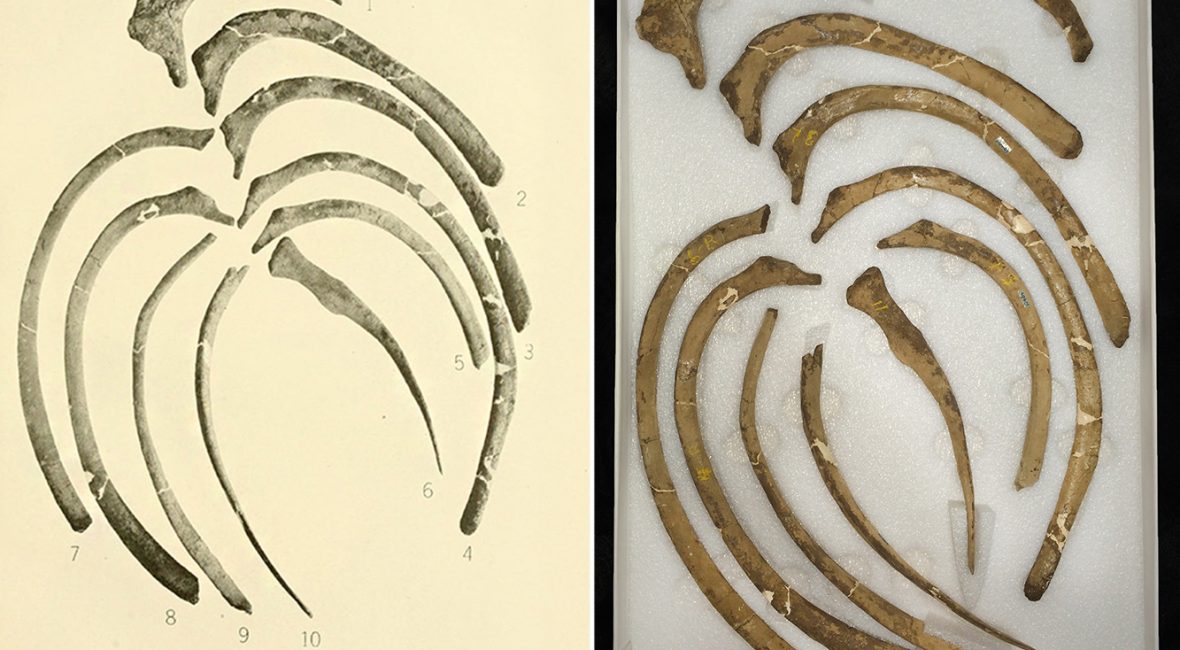
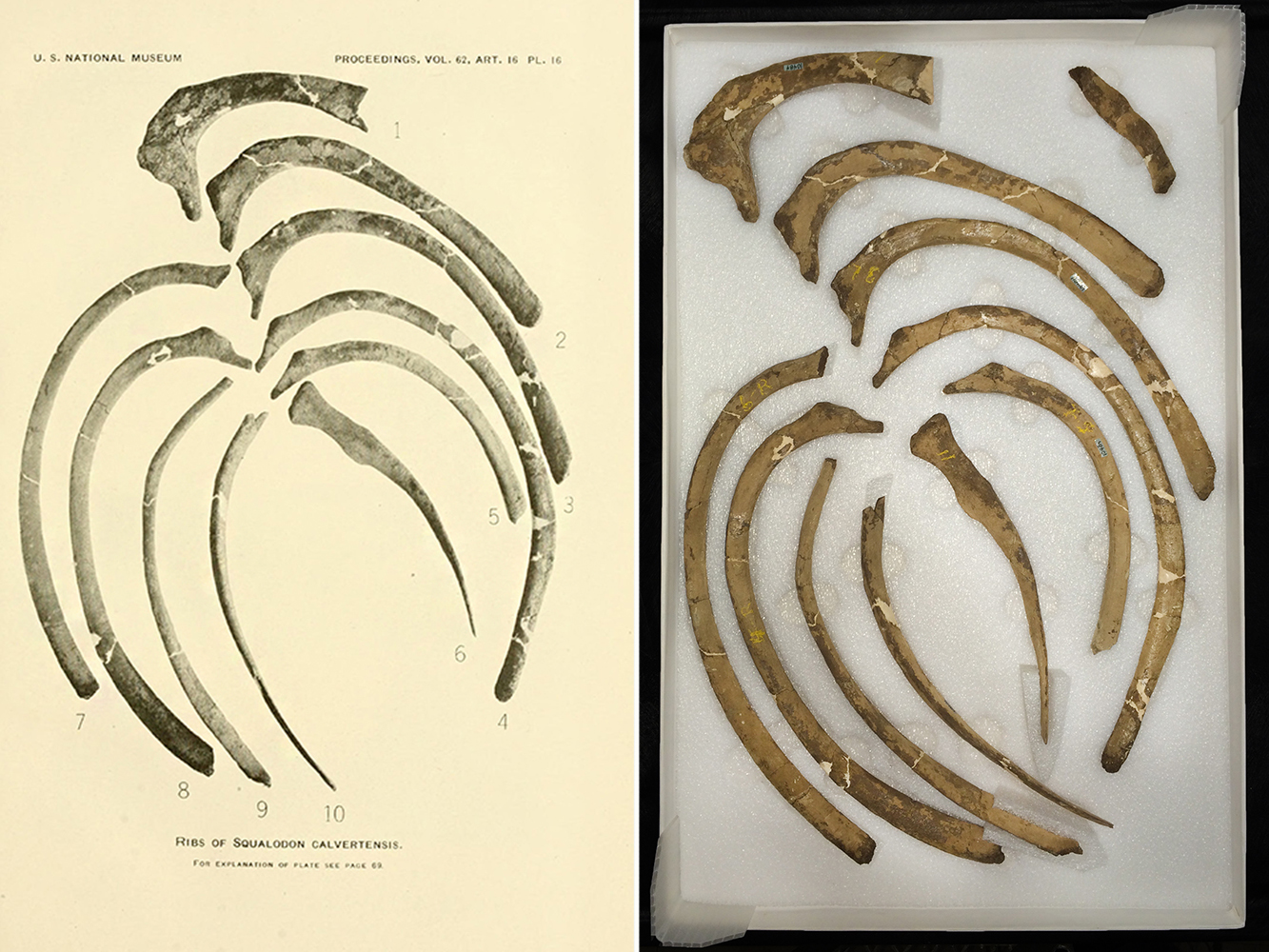
The photos below show an example of the FossiLab’s work. This past summer, the fossil of an extinct shark-toothed dolphin, Squalodon calvertensis (USNM 10484), was brought to FossiLab for rehousing. It had been described in 1923 by Remington Kellogg in the Proceedings of the United States National Museum. When staff compared the ribs with the photo in the publication (left), they realized that some had broken during their 92 years in storage. A careful search among all the bones in the storage drawer turned up the missing pieces. FossiLab staff reattached them using an archival adhesive before rehousing the entire specimen and returning it to storage. The repaired and rehoused ribs are shown in the photo on the right.

View Full Size Image
Ribs from Squalodon calvertensis. Left: Photo from “Description of two squalodonts recently discovered in the Calvert Cliffs, Maryland; and notes on the shark-toothed cetaceans.” Kellogg, Remington. Proceedings of the United States National Museum. 62(2462). pg. 1-69. http://biodiversitylibrary.org/page/16118643. Right: Same ribs, recently rehoused at the Smithsonian’s FossiLab.

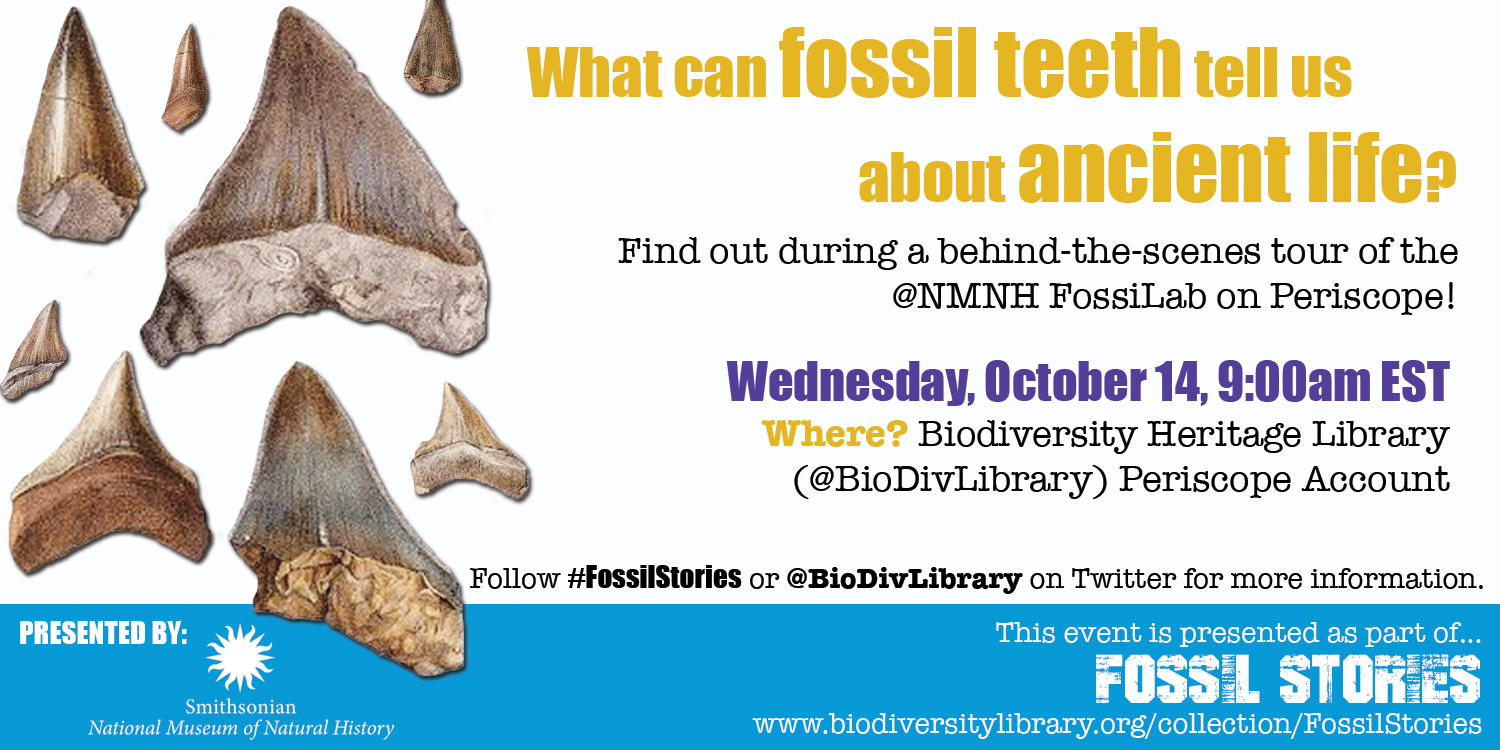
The FossiLab is also very interested in fossil teeth. Why? According to FossiLab volunteer Advait Jukar, a PhD student at George Mason University, these teeth can help us determine, for example, the number and types of dinosaur species in a region.

Curious to know more about the fascinating things that fossil teeth can tell us about ancient life and to further explore the work going on at the Smithsonian’s FossiLab? You’re in luck!

View Full Size Image

Tune in today, October 14, at 9am EST for a live tour of the FossiLab with Advait Jukar! The event will take place on the BHL Periscope account. To participate, simply follow BHL (@BioDivLibrary) on Periscope (you’ll then receive a notification via Periscope once the event is live) or follow @NMNH or @BioDivLibrary on Twitter. We’ll tweet out the link to the Periscope event on those accounts once it’s live.

If you missed the live event, you’re in luck. You can see the recording on YouTube!

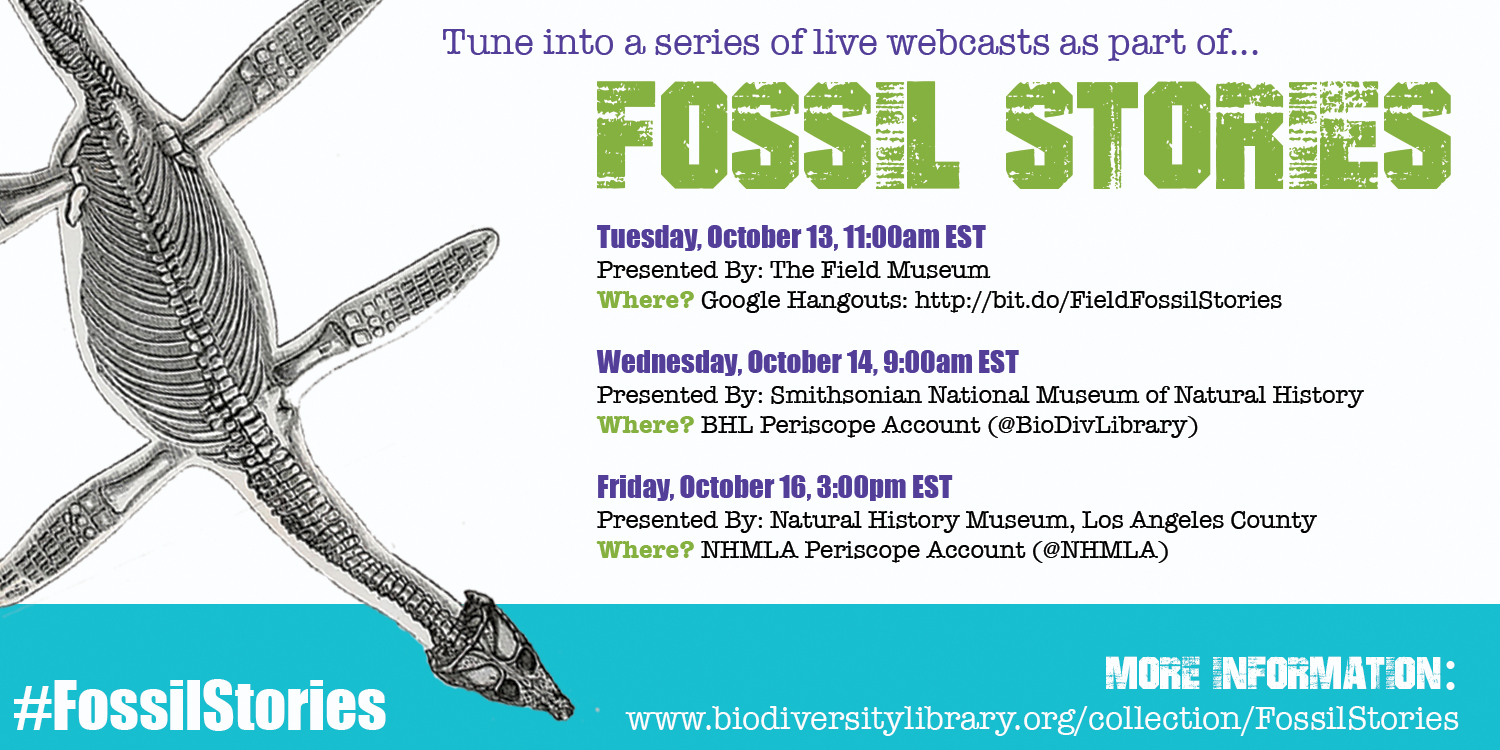
We hope to see you today on Periscope, and remember to follow our blog and #FossilStories on Twitter and Facebook all week for more great fossil fun and live webcasts. Check out the full webcast schedule below:

View Full Size Image
October 14, 2015by Grace Costantino
Blog Reel, Campaigns, Featured Books, Fossil Stories

Proving Extinction: Cuvier and the Elephantimorpha

At the end of the eighteenth century, Jean Léopold Nicolas Frédéric Cuvier, also known as Georges Cuvier and widely remembered as the Father of Paleontology, helped establish extinction as a fact and laid the foundation for vertebrate paleontology.

Born in Montbéliard, France, in 1769, Cuvier formed an interest in natural history at a young age, and by the time he was 26 (in 1795), he became the assistant of Jean-Claude Mertrud, the chair of comparative anatomy at the Jardin des Plantes. Also in 1795, Cuvier was elected a member of the Institut de France’s Academy of Sciences, and in 1796, at the opening of the National Institute, he read his first paleontological paper, which was published in 1800 as “Mémoires sur les espèces d’éléphants vivants et fossiles.”

View Full Size Image
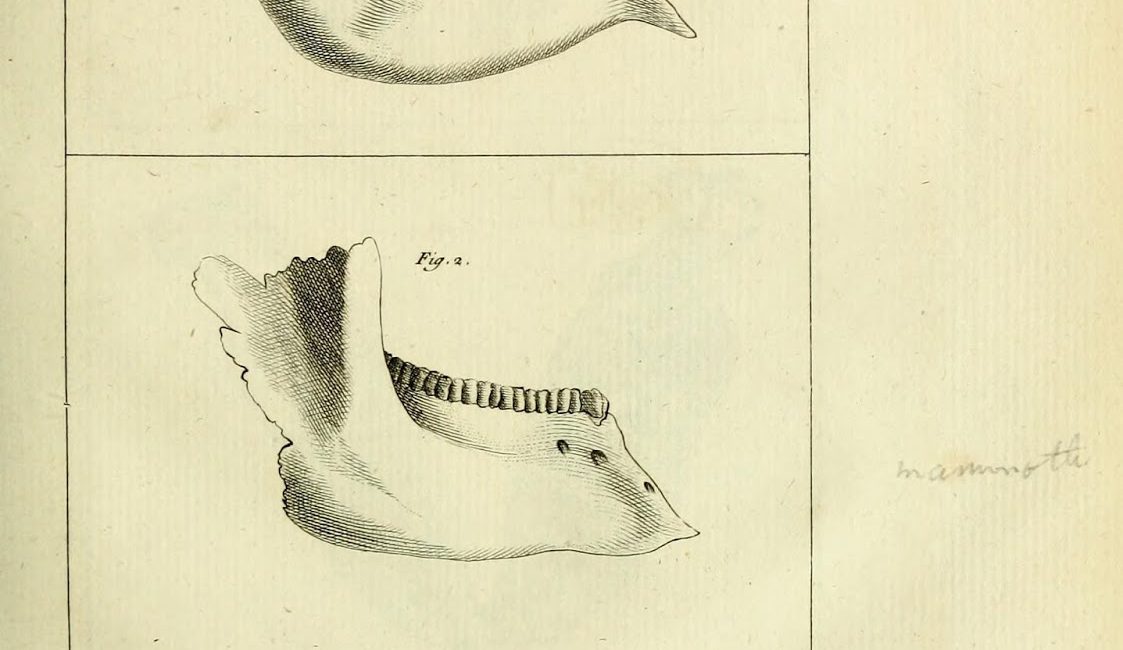
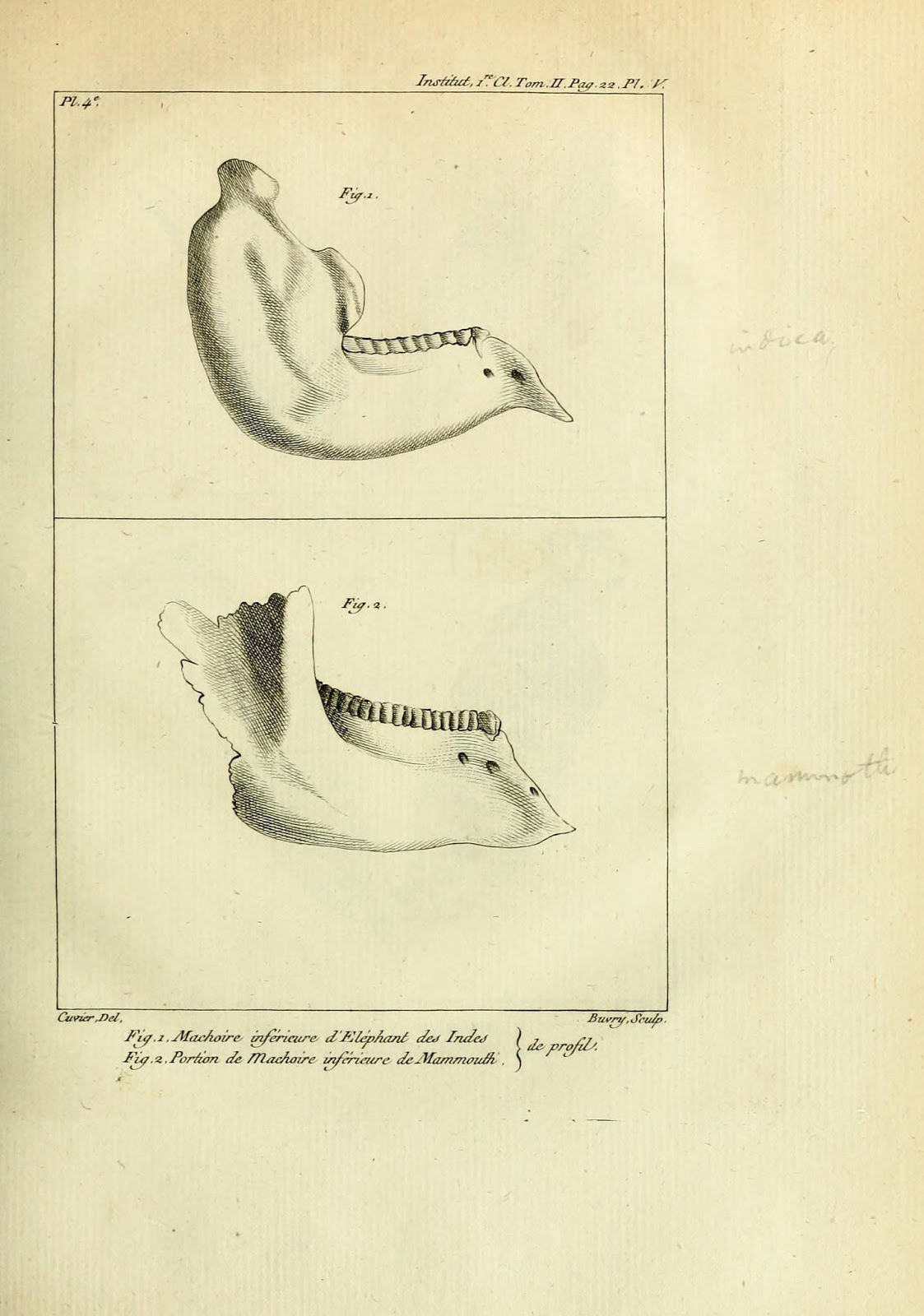
Comparing the jaws of the Indian elephant and the mammoth. Cuvier, Georges. “Mémoires sur les espèces d’éléphants vivants et fossiles.” 1800. http://biodiversitylibrary.org/page/16303001. Digitized by Natural History Museum, London.

The paper presents Cuvier’s findings from his analysis of Indian and African elephant skeletons as well as mammoth fossils and a fossil skeleton known as the “Ohio animal,” which would later be named “mastodon” by Cuvier. Using comparative anatomy, Cuvier showed for the first time that the Indian and African elephants were distinct species, and that the mammoth and mastodon fossils were distinct from living elephants, thus representing extinct species. This work represents a major milestone in the history of paleontology by establishing the use of comparative anatomy within the field and confirming the reality of extinction.

While Cuvier’s work established extinction as a fact, he believed that these extinctions were the result of catastrophism. Catastrophism is the theory that several global catastrophes have occurred throughout Earth’s history, resulting in the extinction of many species that were then replaced by new species in successive eras. Cuvier discussed these ideas in great detail in the preliminary discourse of his Recherches sur les ossements fossiles de quadrupèdes (“Researches on quadruped fossil bones”), published in 1812. This work also summarizes Cuvier’s principal palaeontological and geological investigations.

View Full Size Image
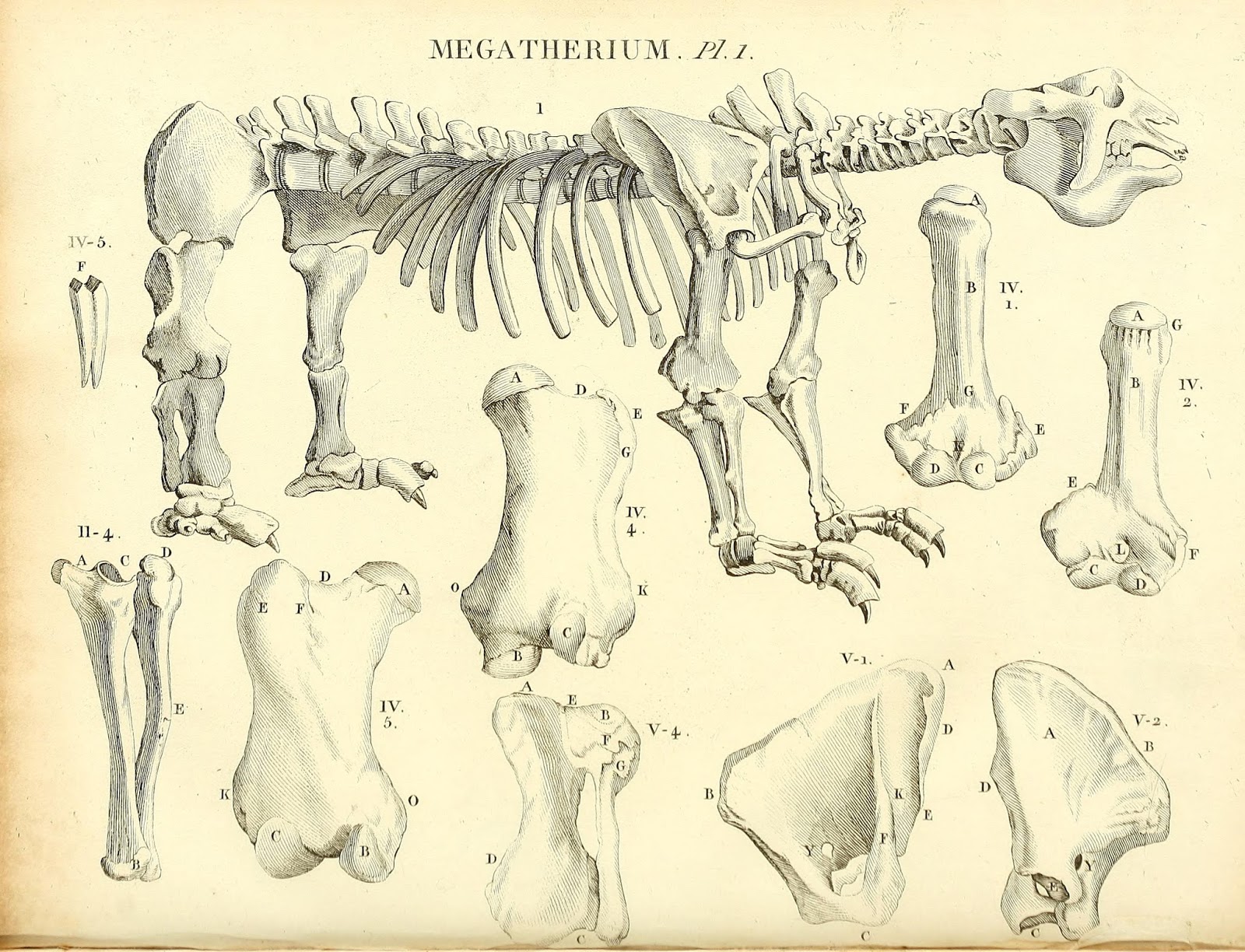
Megatherium, a genus of elephant-sized ground sloths endemic to South America. Cuvier, Georges. Recherches sur les ossemens fossiles de quadrupèdes. t. 4 (1812). http://biodiversitylibrary.org/page/40031828. Digitized by Smithsonian Libraries.

Cuvier staunchly objected to the evolutionary theories being proposed by naturalists such as Jean-Baptiste Lamarck and Geoffroy Saint-Hilaire, which argued for the gradual transmutation of species over time. These early evolutionary theories held that species were transitory (the concept of a defined species was “unreal”), constantly shifting from one form to another rather than dying off to be replaced by new species. Thus, this theory excluded the possibility of extinction. Cuvier maintained that his extensive experience with fossils indicated that species did not change over time, but instead that the fossil record showed abrupt appearances of new forms and the extinction of old ones. This fueled his support of Catastrophism.

Later that century, Darwin would propose a new theory of evolution that combined both the idea of extinction and the transmutation of species over time with his publication of On the Origin of Species. While Cuvier (or Lamarck, for that matter) may not have gotten all of the details right regarding the emergence of new species, his contributions to the field of paleontology are extensive, and indeed he is sometimes referred to as the Father of Paleontology. Establishing the reality of extinction, and the use of comparative anatomy within the field, were critical to the progress of paleontology as a science.

Fossil Stories

Stay tuned all week for more great fossil fun with our #FossilStories campaign, including:
  • Tweets and Facebook Posts
  • Blog Posts highlighting milestones and key publications in the history of fossil research
  • A Flickr Collection with hundreds of historic fossil illustrations
  • A Pinterest Collection featuring a selection of our favorite fossil illustrations
  • A BHL Collection containing seminal publications in the history of paleontology
  • A series of live webcasts at BHL partner institutions
  • A citizen science challenge in collaboration with The Field Book Project, the Smithsonian Transcription Center, and Smithsonian Institution Archives
Follow #FossilStories on Twitter and Facebook to learn more.
October 13, 2015by Grace Costantino
Blog Reel, Campaigns, Featured Books, Fossil Stories

Fossils Under the Microscope: Hooke and Micrographia

By the seventeenth century, it was still widely believed that species could not become extinct, and there were still many hypotheses about the origin of fossils. One widely-held belief, extending back to Aristotle’s time, was that fossils were formed by the Earth itself, and that some “extraordinary Plastick virtue” could create stones that resembled, but were not, living organisms.

But also during the seventeenth century, some critical advances in the world of science were having an impact on fossil research.

Robert Hooke was born at Freshwater, on the Isle of Wight, in 1635. Though of humble origins, he eventually studied at Oxford and impressed many of England’s leading scientists with his ability to design experiments and build equipment. In 1662, Hooke was named Curator of Experiments of the newly formed Royal Society of London, where he demonstrated new equipment and experiments during the Society’s weekly meetings.

View Full Size Image
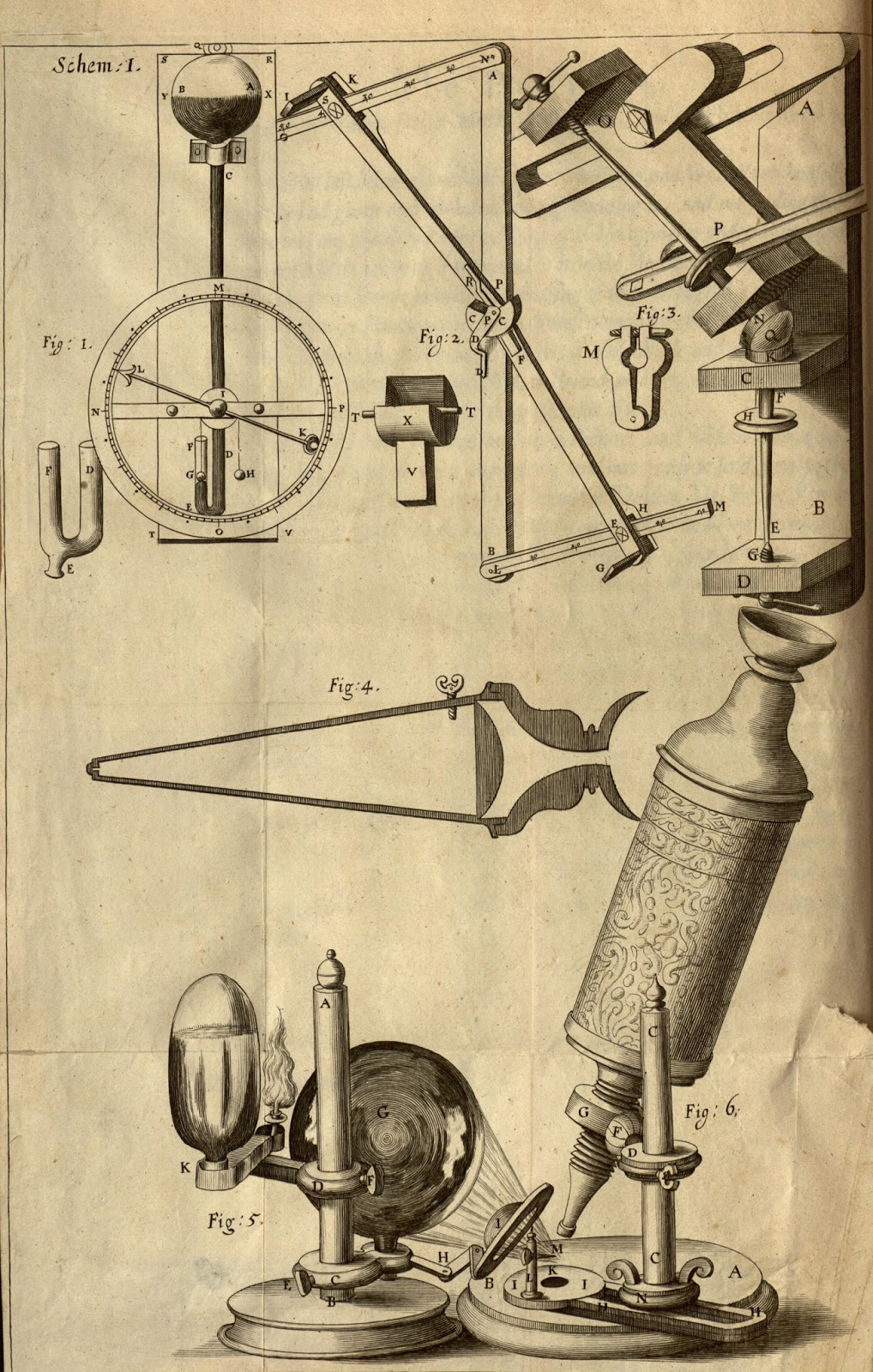
Robert Hooke’s microscope. Micrographia, 1665. http://biodiversitylibrary.org/page/786364. Digitized by: Missouri Botanical Garden.

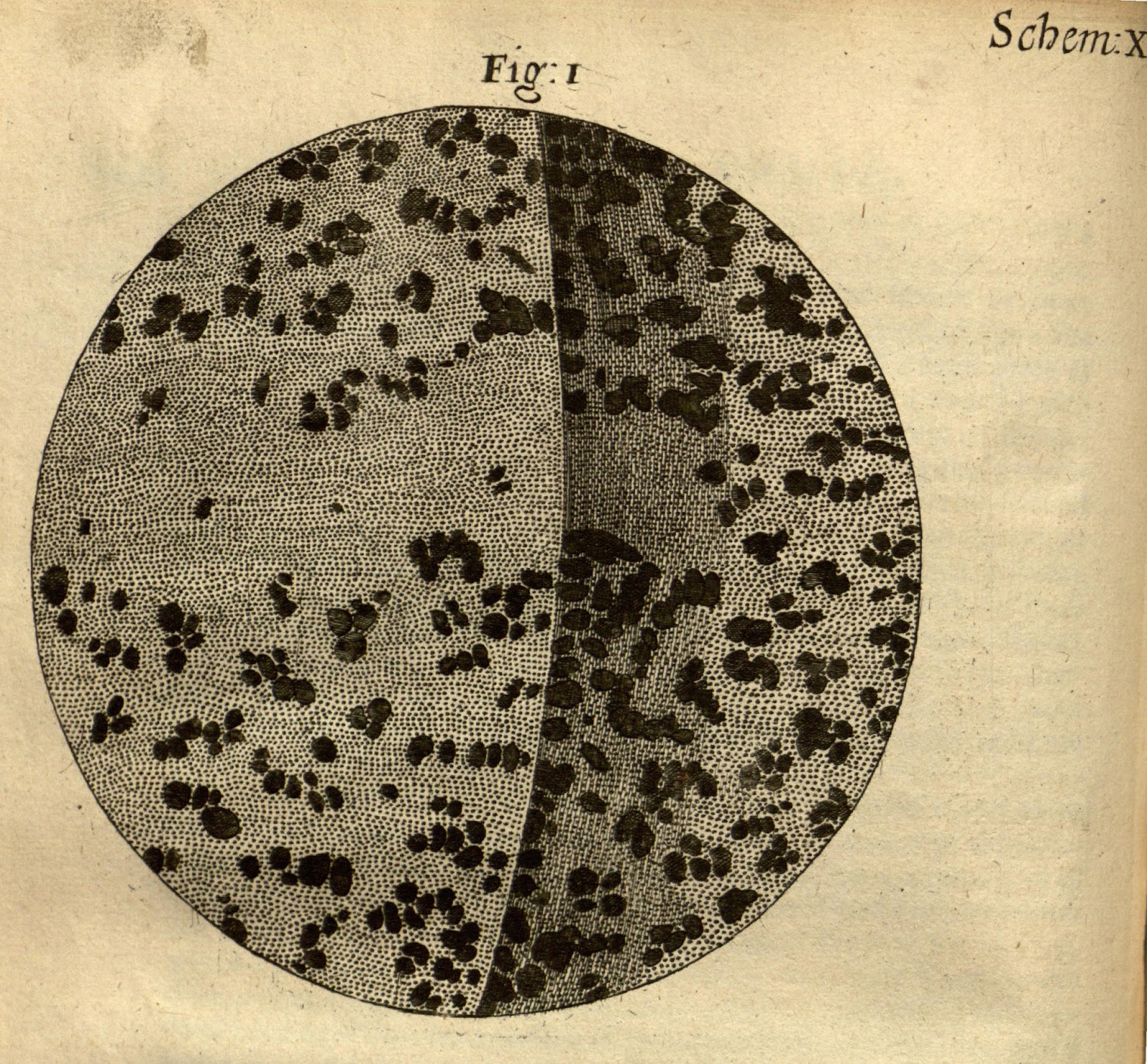
One of his inventions was a novel compound microscope and illumination system, one of the best microscopes of the time. In 1665, Hooke published Micrographia, his masterpiece detailing his microscopic observations. It is the first book to illustrate plants and animals as seen through the microscope, and the stunning illustrations capture minute details such as the intricacies of a flea or the cells in cork tissue. In fact, Hooke coined the term “cells,” as the structures he saw in his microscope reminded him of the cells of a monastery.

Hooke also examined fossils with his microscope, thus becoming the first recorded person to do so. Through his observations, he noticed striking similarities between petrified and living wood and fossil shells and living mollusk shells. Comparing petrified wood to a piece of rotten oak wood, Hooke realized that wood could be turned to stone when water deposited minerals throughout the wood. Similarly, his observations on shell-like fossils led him to conclude that shells could also be turned into fossils when they were “fill’d with some kind of Mud or Clay, or petrifying Water, or some other substance.”

View Full Size Image
A section of petrified wood. Micrographia, 1665. http://biodiversitylibrary.org/page/786478. Digitized by: Missouri Botanical Garden.

Throughout his life, Hooke continued to study fossils and compare them to living organisms. Recognizing that many fossils did not have living equivalents, he concluded that some represented species that no longer exist. If this was true, he deduced, it was likely that there are species alive today that did not exist in past ages.

Thus, nearly 200 years before Darwin, Hooke’s observations of fossils led him to assert that they are not only the remains of past-living organisms, but that they also document the history and changes of life on Earth.

Fossil Stories

Stay tuned all week for more great fossil fun with our #FossilStories campaign, including:
  • Tweets and Facebook Posts
  • Blog Posts highlighting milestones and key publications in the history of fossil research
  • A Flickr Collection with hundreds of historic fossil illustrations
  • A Pinterest Collection featuring a selection of our favorite fossil illustrations
  • A BHL Collection containing seminal publications in the history of paleontology
  • A series of live webcasts at BHL partner institutions
  • A citizen science challenge in collaboration with The Field Book Project, the Smithsonian Transcription Center, and Smithsonian Institution Archives
Follow #FossilStories on Twitter and Facebook to learn more.

Reference
UC Berkeley: Robert Hooke

October 13, 2015by Grace Costantino
Page 31 of 71« First...1020«30313233»405060...Last »

Help Support BHL

BHL's existence depends on the financial support of its patrons. Help us keep this free resource alive!

search

About BHL

The Biodiversity Heritage Library (BHL) is the world’s largest open access digital library for biodiversity literature and archives. BHL operates as a worldwide consortium of natural history, botanical, research, and national libraries working together to digitize the natural history literature held in their collections and make it freely available for open access as part of a global “biodiversity community.”

Join Our Mailing List

Sign up to receive the latest news, content highlights, and promotions.

Subscribe Now

Subscribe to Blog via Email

Enter your email address to subscribe to this blog and receive notifications of new posts by email.

Join 319 other subscribers

Subscribe to Blog Via RSS

Subscribe to the blog RSS feed to stay up-to-date on all the latest BHL posts.

Access RSS Feed

Inspiring Discovery through Free Access to Biodiversity Knowledge.

The Biodiversity Heritage Library makes it easier than ever for you to access the information you need to study and explore life on Earth…for free, anytime, anywhere.


64+ Million Pages of
Biodiversity Literature Online.

EXPLORE

Tools and Services
to Transform Research.

EXPLORE

300,000+
Illustrations on Flickr.

EXPLORE

ABOUT | HARMFUL CONTENT | PRIVACY | SITE MAP | TERMS OF USE