Biodiversity Heritage Library - Program news and collection highlights from BHL
  • Home
  • News
  • Featured Books
    • All Featured Books
    • Book of the Month Series
    • BHL at 20
  • User Stories
  • Campaigns
    • Fossil Stories
    • Garden Stories
    • Monsters Are Real
    • Page Frights
    • Her Natural History
    • Earth Optimism 2020
  • Tech Blog
  • Visit BHL
Home
News
Featured Books
    All Featured Books
    Book of the Month Series
    BHL at 20
User Stories
Campaigns
    Fossil Stories
    Garden Stories
    Monsters Are Real
    Page Frights
    Her Natural History
    Earth Optimism 2020
Tech Blog
Visit BHL
  • Home
  • News
  • Featured Books
    • All Featured Books
    • Book of the Month Series
    • BHL at 20
  • User Stories
  • Campaigns
    • Fossil Stories
    • Garden Stories
    • Monsters Are Real
    • Page Frights
    • Her Natural History
    • Earth Optimism 2020
  • Tech Blog
  • Visit BHL
Biodiversity Heritage Library - Program news and collection highlights from BHL
Blog Reel, Campaigns, Featured Books, Fossil Stories

Early Innovations in Paleontology: Gessner and Fossils

Until the end of the 18th century, it was generally believed that species could not become extinct, and despite important scientific advances in the 16th and 17th centuries, it was widely held that since the dawn of life, no new animal or plant species had been created or lost.

Furthermore, until the 19th century, the word “fossil” referred to any object that had been dug up from the ground, including not only what we recognize today as organic remains, but also gemstones, minerals, and other inorganic materials.

View Full Size Image
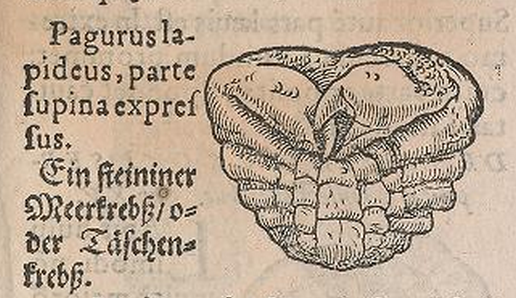
Fossil crab. Gessner, Conrad. De rerum fossilium, lapidum et gemmarum maximè, figuris & similitudinibus liber. 1565.  http://biodiversitylibrary.org/page/48518847. Digitized by: Smithsonian Libraries.

Finally, at the time of the 16th and 17th centuries, when the first books on “fossils” were being published, the living equivalent of many “fossil” species had not yet been discovered, making it extremely difficult to draw connections between fossil specimens and living organisms.

These three scenarios together created a daunting challenge for early naturalists trying to classify and understand fossils, and advances in each were required before true fossils could be widely identified as the remains of past life.

Conrad Gessner is one of the most influential naturalists in scientific history. Born in Zürich, Switzerland in 1516, his five-volume masterpiece Historiae animalium (1551–1558) is considered the beginning of modern zoology.
View Full Size Image
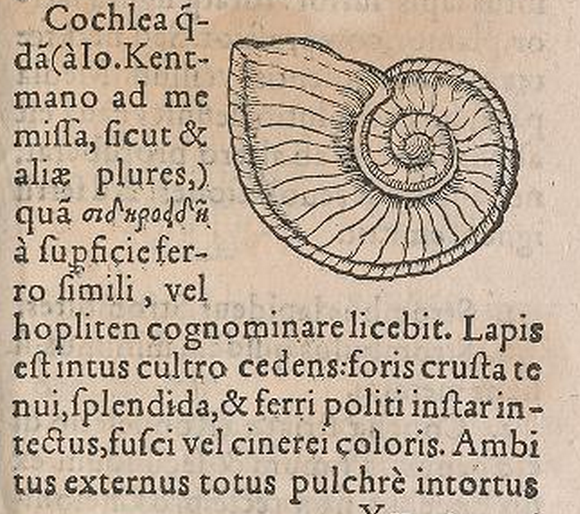
Woodcut illustration of an ammonite, which he placed in the same class as fossil shells.  Gessner, Conrad. De rerum fossilium, lapidum et gemmarum maximè, figuris & similitudinibus liber. 1565. http://biodiversitylibrary.org/page/48518841. Digitized by: Smithsonian Libraries.

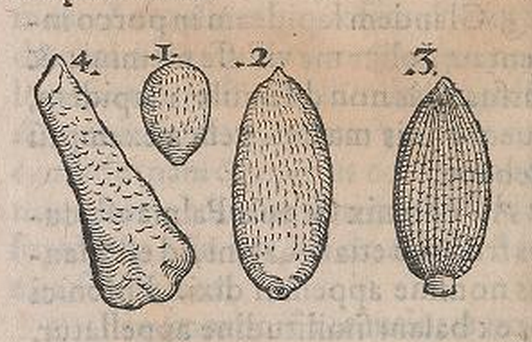
In 1565, Gessner published a short but incredibly important work entitled De rerum fossilium, lapidum et gemmarum maximè, figuris & similitudinibus liber or “A Book on Fossil Objects, Chiefly Stones and Gems, their Shapes and Appearances.” While he, like others of his time, included both organic remains and inorganic objects within his definition of fossils, he correctly recognized the resemblance of some fossils to living organisms. For instance, he recognized the similarity between several fossil echinoids and living sea-urchins, as well as a fossil and living crab. Other specimens, however, were more difficult to relate to living species. For instance, Gessner placed various fossil ammonites alongside gastropods and serpents, and the fossilized spines of cidariods he placed within his chapter on fossil wood.
View Full Size Image
Detached spines of cidaroids, which Gessner mistakenly placed in his fossil wood chapter, as he thought they resembled the fruit or acorn of a tree. Gessner, Conrad. De rerum fossilium, lapidum et gemmarum maximè, figuris & similitudinibus liber. 1565. http://biodiversitylibrary.org/page/48518770. Digitized by: Smithsonian Libraries.

In addition to correctly drawing correlations between several fossil objects and living species, On Fossil Objects represented three important innovations in the history of paleontology. First, it was the first publication in which illustrations were used systematically to supplement a text on fossils.

On Fossil Objects was also the first work on fossils that clearly refers to a distinct collection of fossil objects. The precursors to museum collections were beginning to be aggregated in university and private collections in the 15th and 16th centuries, and these collections were an important step towards ensuring that naturalists were referring to the same species as they could reference a distinct type specimen. On Fossil Objects references the “fossil objects” collection of physician Johann Kentmann of Torgau as the source of many of the objects described within the book, providing a concrete, verifiable point of reference for other naturalists.
View Full Size Image
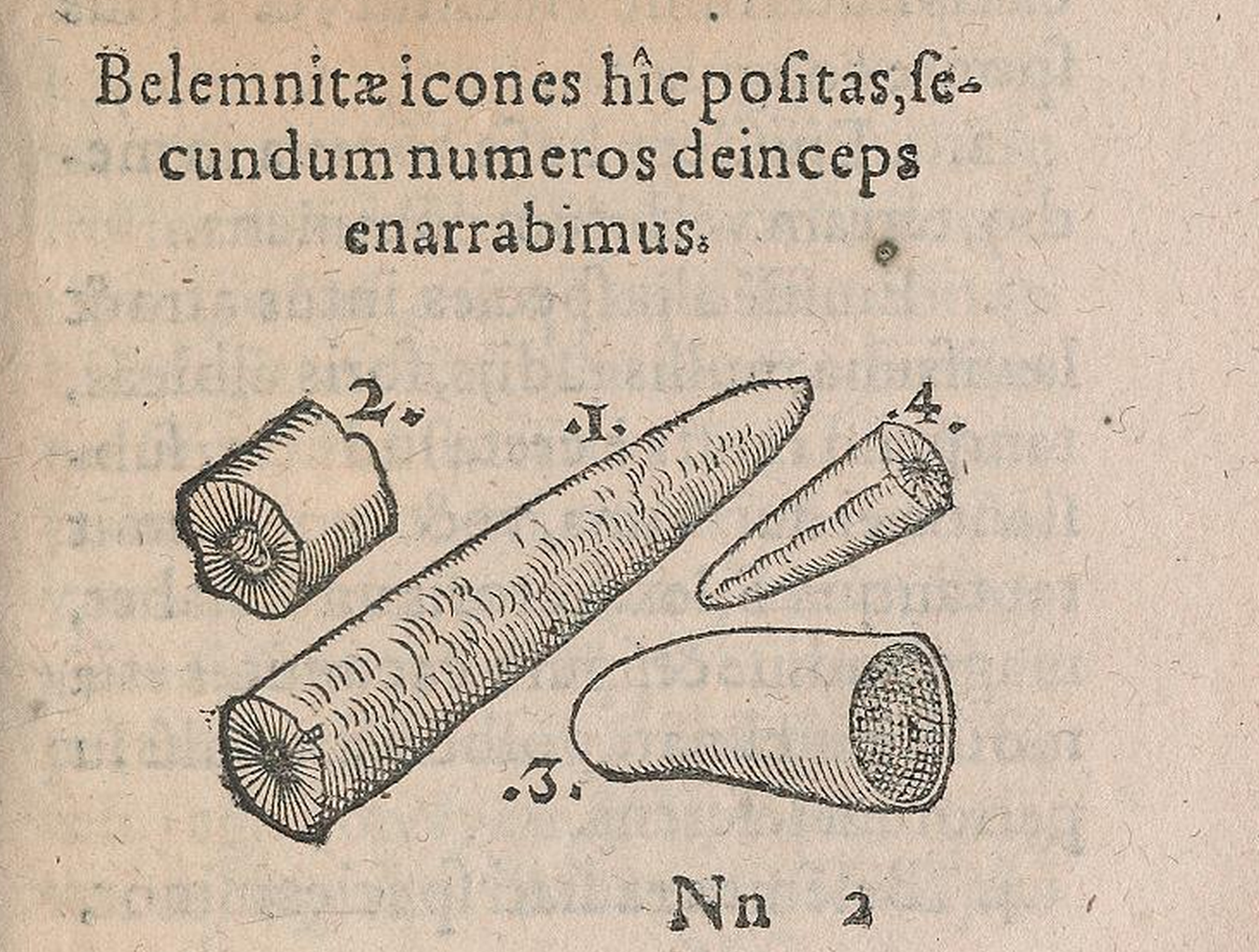
Fossil belemnites. Gessner knew of no comparable living animal. Gessner, Conrad. De rerum fossilium, lapidum et gemmarum maximè, figuris & similitudinibus liber. 1565. http://biodiversitylibrary.org/page/48518695. Digitized by: Smithsonian Libraries.

Finally, to support research for his book, Gessner corresponded with naturalists across Europe, and thus On Fossil Objects is also the first work on fossils to employ the use of a cooperative research community. This not only helped form the first scholarly paleontological community, but also ensured that a greater breadth of fossil objects could be represented within the book.

Gessner intended for On Fossil Objects to be merely a prelude to a much larger work on fossil objects akin to his Historiae animalium. Unfortunately, Gessner never had the opportunity to write his next masterpiece. He died of the plague in 1565, shortly after the publication of On Fossil Objects.

This innovative work on fossils, which helped shape the future of paleontology, was the last publication from one of history’s most influential naturalists.

Fossil Stories

Stay tuned all week for more great fossil fun with our #FossilStories campaign, including:
  • Tweets and Facebook Posts
  • Blog Posts highlighting milestones and key publications in the history of fossil research
  • A Flickr Collection with hundreds of historic fossil illustrations
  • A Pinterest Collection featuring a selection of our favorite fossil illustrations
  • A BHL Collection containing seminal publications in the history of paleontology
  • A series of live webcasts at BHL partner institutions
  • A citizen science challenge in collaboration with The Field Book Project, the Smithsonian Transcription Center, and Smithsonian Institution Archives
Follow #FossilStories on Twitter and Facebook to learn more.
October 13, 2015by Grace Costantino
BHL News, Blog Reel, Campaigns, Fossil Stories

Webcast! Exploring Antarctic Dinosaurs with The Field Museum

During the 1990-91 austral summer, geologist David Elliot came across fossil bones on Mount Kirkpatrick in the Beardmore Glacier region of the Transantarctic Mountains in Antarctica at an altitude of ~4,000 m (13,000 ft) high and about 640 km (400 mi) from the South Pole. The team notified paleontologist Bill Hammer, who then excavated the fossil-bearing rock over a three week period. The excavated skeleton was eventually given the name Cryolophosaurus ellioti in an 1994 article in Science by Hammer and paleontologist William J. Hickerson. Two subsequent expeditions to Mount Kirkpatrick in 2003 and 2010-11 recovered yet more remains of Cryolophopsaurus, as well parts of three herbivorous dinosaurs.

Cryolophosaurus ellioti was a significant find. It was the first carnivorous dinosaur to be discovered in Antarctica and the first non-avian dinosaur from the continent to be officially named. It dates from the Early Jurassic Period, and is ~194 million years old.

At this point, at least a few of you are probably saying, “I didn’t know there used to be dinosaurs in Antarctica!” Anxious to learn more about the previous inhabitants of Earth’s southern-most continent? Well, you’re in luck.

View Full Size Image

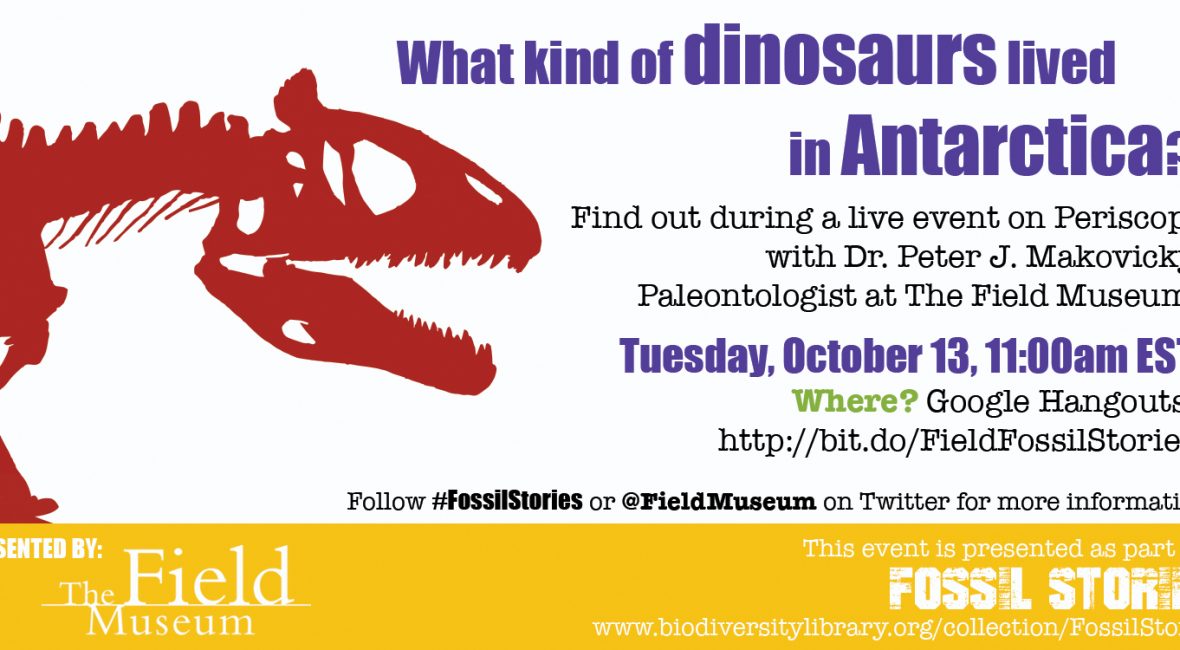
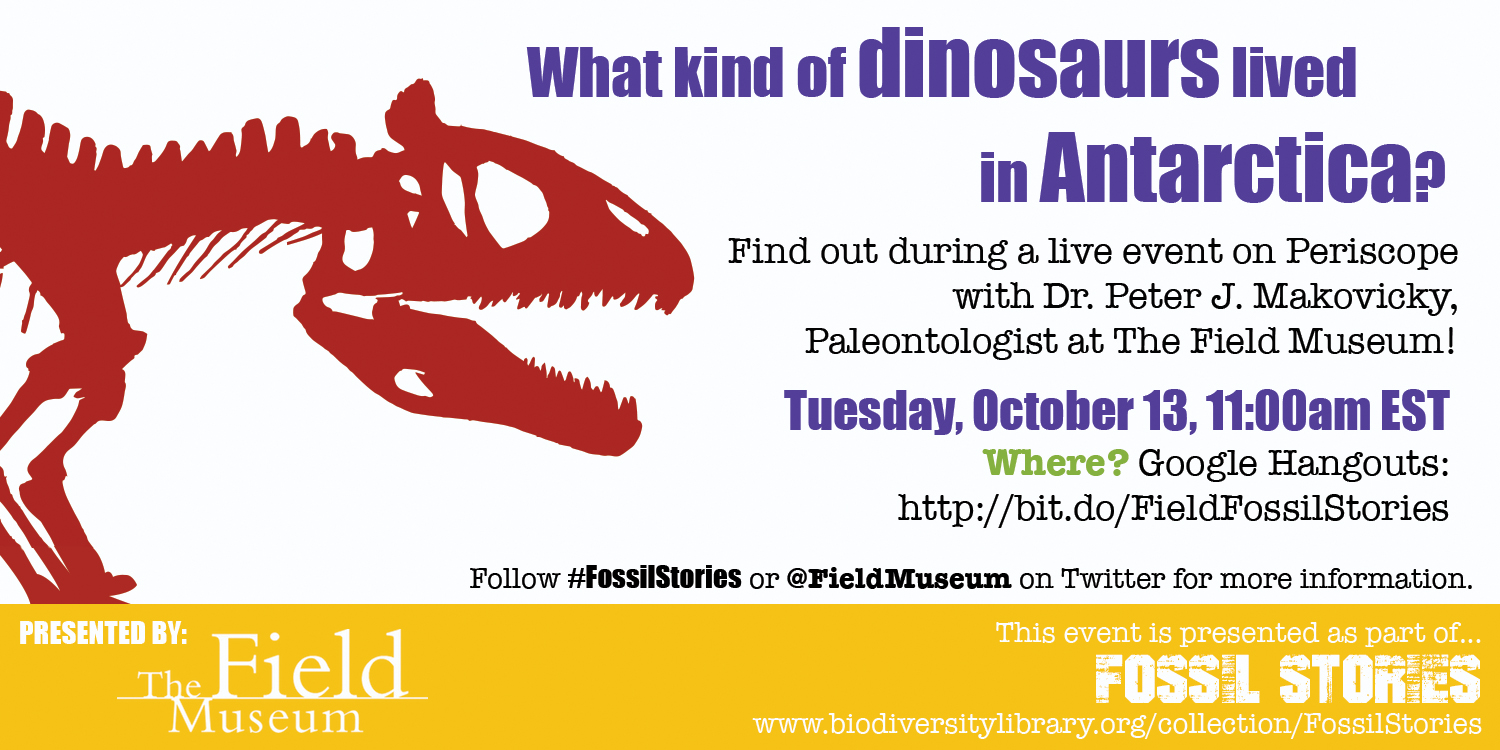
On October 13, at 11am EST, The Field Museum hosted a live webcast with Dr. Peter J. Makovicky, Associate Curator of Dinosaurs at The Field Museum. Dr. Makovicky was interviewed by none other than Field’s Chief Curiosity Correspondent, Emily Graslie, whom you may recognize from her show The Brain Scoop.

Did you miss the live event? You can see the recording of it here: http://sml.fieldmuseum.org/sml/play/DigitalStudio/48-recording

Dr. Makovicky studies dinosaurian evolutionary history, and he has led expeditions to the western US, China, Argentina and Antarctica. Some of his recent work has focused on Antarctic dinosaurs. In 2007, he co-authored a paper with Dr. Hammer and Drs. Nathan Smith and Diego Pol, as well as lengthy treatment on Cryolophosaurus in the Zoological Journal of the Linnean Society. Smith and Pol named the only other known early Jurassic dinosaur from Antarctica, Glacialisaurus hammer, in 2007.

Follow our blog and #FossilStories on Twitter and Facebook all week for more great fossil fun and live webcasts. Check out the full webcast schedule below:

View Full Size Image
October 13, 2015by Grace Costantino
BHL News, Blog Reel, Campaigns, Fossil Stories

Welcome to Fossil Stories!

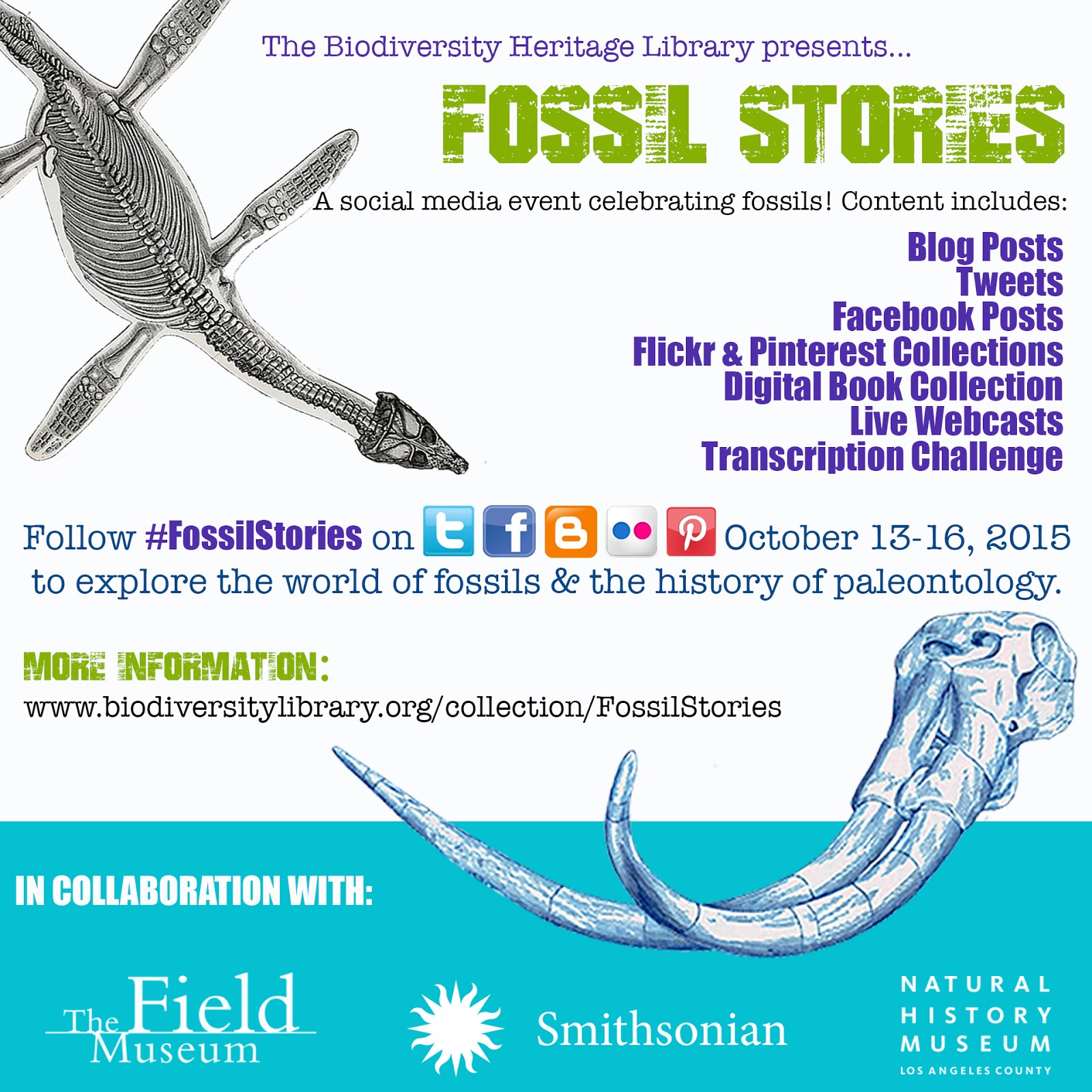
Welcome to Fossil Stories, a week-long social media event (presented by the Biodiversity Heritage Library in collaboration with several of our partner institutions) celebrating fossils!

View Full Size Image

Today, we recognize fossils as representing the preserved remains or traces of life from the ancient past. The scientific study of these fossils, how they formed, and their evolutionary relationship with each other and living species is known as paleontology.

Humans have been uncovering fossils for millennia, but we have not always understood what they were. Many of these fossils have inspired myths and legends over the centuries, including griffins, dragons, giants, and monsters.

Myths aside, the term “fossil” originally referred to anything that was dug up from the ground, including inorganic materials such as minerals. Even those specimens that were of organic origin were not widely understood as such, and it was not until the 16th century that books recognizing the similarity between some fossil objects and living creatures began to be published. And while some breakthroughs did occur during the Renaissance, it was not until the early 1800s that the reality of extinction was widely established or that the field of paleontology as we know it today was born.

And those dinosaurs that everyone loves? The first dinosaur genus was not described and validly named until the 19th century, and the term dinosaur (from the scientific clade “Dinosauria”) did not appear until 1842.

The study of fossils not only reveals Earth’s past, helping us delve into the origin of life itself, but it also informs research about our planet’s future through, for example, records of ancient climate change that can inform models regarding future change.

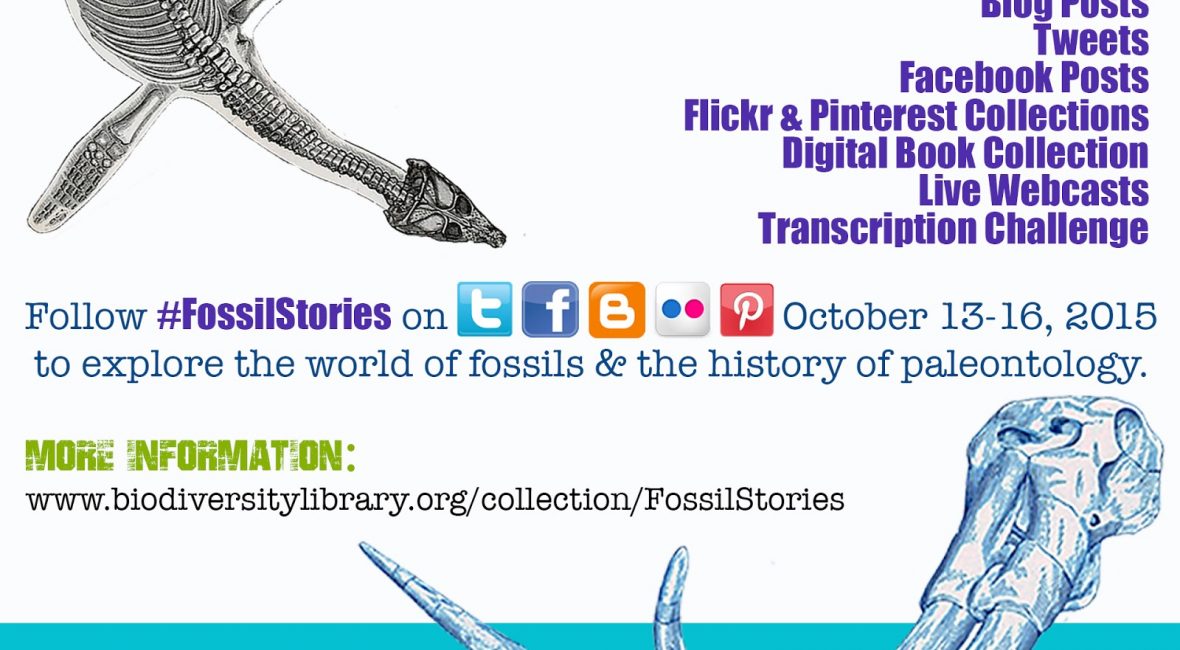
All week (October 13-16, 2015), we’ll be celebrating the world of fossils, the history of paleontology, and the men, women, and publications that shaped our knowledge about life preserved in stones with  social media content, including:

  • Tweets and Facebook Posts
  • Blog Posts highlighting milestones and key publications in the history of fossil research
  • A Flickr Collection with hundreds of historic fossil illustrations
  • A Pinterest Collection featuring a selection of our favorite fossil illustrations
  • A BHL Collection containing seminal publications in the history of paleontology
  • A series of live webcasts at BHL partner institutions
  • A citizen science challenge in collaboration with The Field Book Project, the Smithsonian Transcription Center, and Smithsonian Institution Archives (which, we’re excited to announce, was successfully completed on October 12! Learn more below)
All content will be tagged with the event hashtag, #FossilStories, to make it easy for you to follow along and catch all of our great posts. You can find more information about the webcasts and the citizen science challenge below. We hope you’ll join us in our fossil-mania this week! We’re sure you’ll dig it!

Webcasts
The Fossil Stories webcasts will feature paleontologists, fossil research, and fossil exhibits at some of America’s most prestigious natural history institutions. You’ll also have the opportunity to ask these experts your fossil questions!

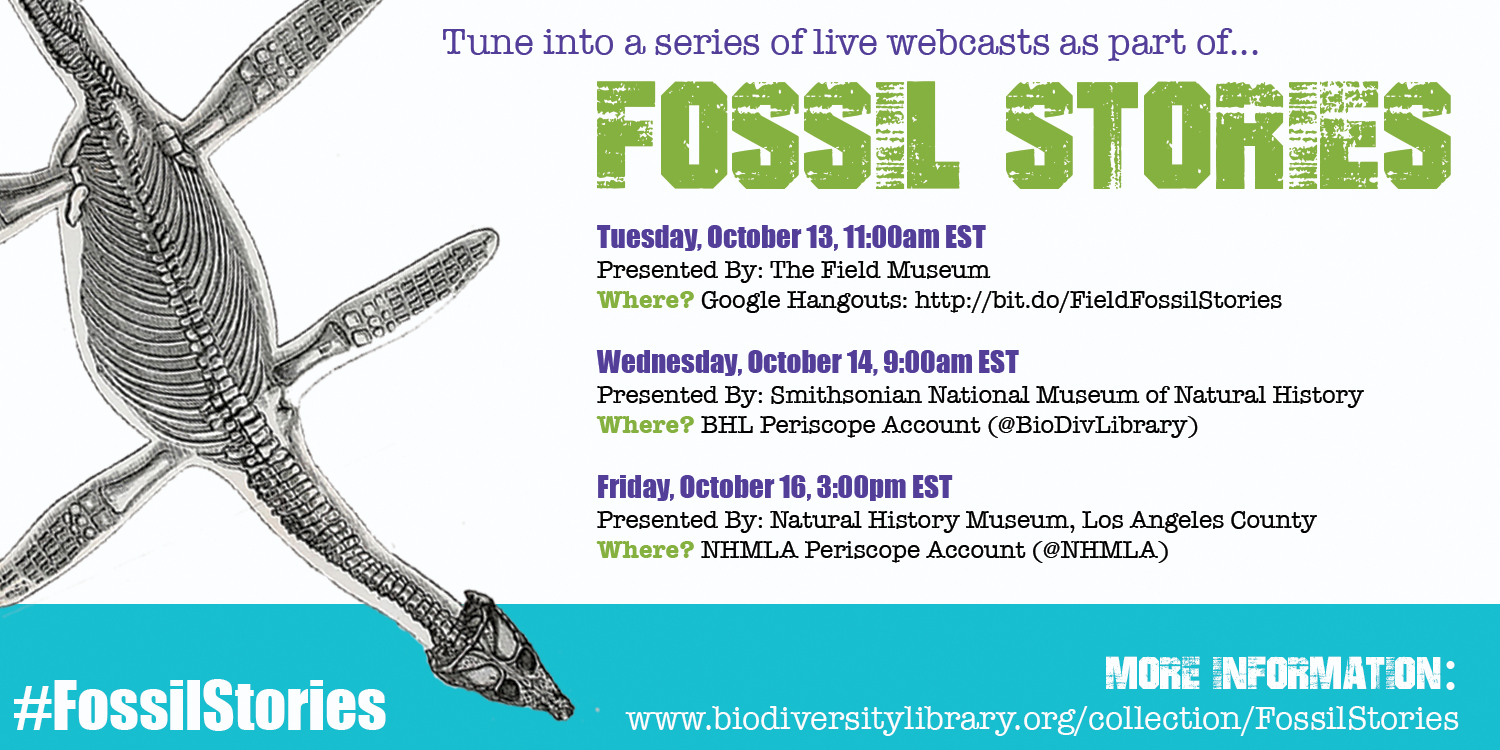
The webcast schedule is:

  • “Antarctic Dinosaurs with Dr. Peter J. Makovicky.” Presented by The Field Museum.
    • When? Tuesday, October 13, 2015, 11:00am EST
    • Where? Google Hangouts: http://bit.do/FieldFossilStories
  • “Exploring The FossiLab with Advait Jukar.” Presented by the Smithsonian National Museum of Natural History.
    • When? Wednesday, October 14, 2015, 9:00am EST
    • Where? The BHL Periscope Account. (Twitter and Periscope Handle: @BioDivLibrary)*
  • “Behind the Scenes at the NHMLA Dino Lab.” Presented by the Natural History Museum, Los Angeles County
    • When? Friday, October 16, 3:00pm EST
    • Where? The Natural History Museum, Los Angeles County Periscope Account (Twitter and Periscope Handle: @NHMLA)

*For events on Periscope, follow the indicated account on Periscope (Periscope will then alert you when the webcast is live) OR follow @BioDivLibrary or the presenting institution on Twitter to get the link to the event. When the event is live, the link to access the webcast will be tweeted out on the host institution’s Twitter account and BHL’s Twitter account.

Citizen Science Challenge

View Full Size Image


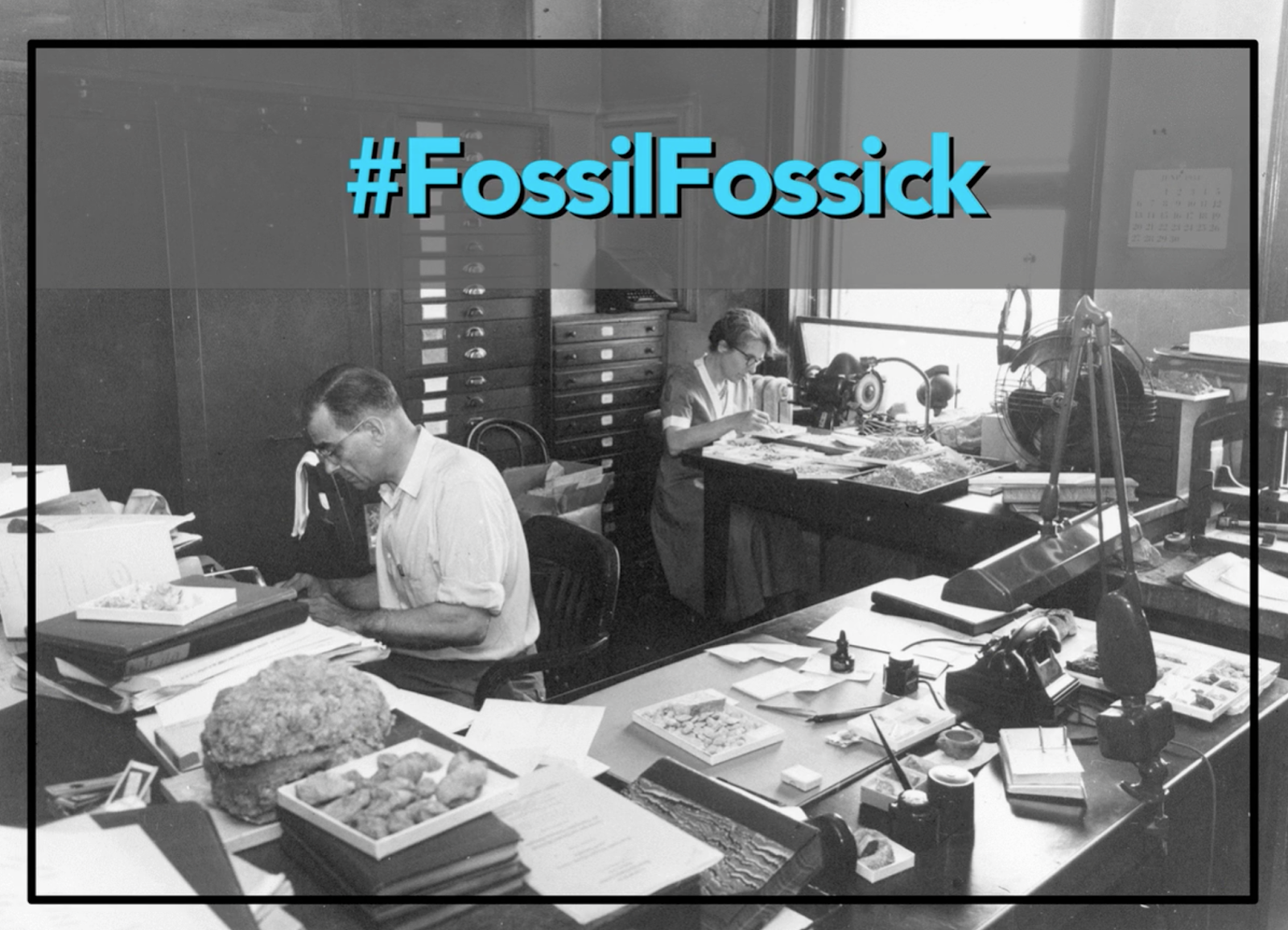
For Fossil Stories, we’ve teamed up with The Field Book Project, the Smithsonian Transcription Center, and Smithsonian Institution Archives to issue you a #FossilFossick citizen science challenge! Last Friday, October 9, we released a set of paleontology field notes from the Smithsonian’s collection into the Transcription Center. We’re excited to announce that all 252 pages of field notes that we released for the challenge have been successfully transcribed and reviewed as of Oct. 12! Thanks to all of our great volunteers for their hard work and dedication! We’ll be sharing more information about the paleontologists featured in the challenge, and highlights from the challenge, all week, so be sure to follow #FossilStories to catch all this great information.
As a reward for successfully completing the challenge, we’ll be featuring a live webcast with Dr. Nicholas D. Pyenson, Curator of Fossil Marine Mammals at the Smithsonian’s National Museum of Natural History, on October 26 via the BHL Periscope account (@BioDivLibrary). He’ll show off some of his favorite specimens in the collection and you’ll have the opportunity to ask him your most pressing fossil questions, so be sure to tune in! More information to come later.

We hope to see you on social media this week! Let the #FossilStories begin!

October 13, 2015by Grace Costantino
BHL News, Blog Reel, Campaigns, Fossil Stories

A Fossil-Focused Citizen Science Challenge!

UPDATE: We are proud to announce that after 3.5 days, volunteers successfully transcribed and reviewed all 252 pages of field notes that we uploaded as part of this challenge! Thanks to all of our great volunteers, and tune in all week (Oct. 13-16, 2015) for more great fossil fun and highlights from the challenge!

October 14 is National Fossil Day! What do you think you might learn if we unleashed notes on the mighty and micro fossilized specimens in the Smithsonian Institution’s collections? Let’s time travel together with Smithsonian scientists – to their field sites, their discoveries, and the mysteries they uncover.

We’re celebrating fossils during the BHL Fossil Stories social media event, running October 13-16, 2015. Follow #FossilStories on Twitter and Facebook or read this article to learn more.

As part of Fossil Stories, we’re teaming up with The Field Book Project, the Smithsonian Transcription Center, the Smithsonian Institution Archives, and the National Museum of Natural History to issue a transcription challenge to you!

View Full Size Image

To Fossick is to “rummage or search,” often for gold nuggets or gems, though you’ll be gathering pearls of wisdom this week. And since knowledge is golden, we know we’ll all be enriched by our #FossilFossick challenge!

Here’s how the challenge works:

  1. We’ll launch several paleontology-related field notes on the Smithsonian Transcription Center
  2. You successfully transcribe and review the pages of those field notes with many of your transcribing friends
  3. Follow and share your findings on Twitter with the #FossilFossick hashtag
  4. We connect you with behind-the-scenes access to fossil specimens and scientists who will tell you more about the real ways fossil records make a difference in our world today

The set of field notes we’ve selected for the challenge not only provides a glimpse into the worlds of three paleobiologists (Lester F. Ward, Harry S. Ladd, and G. Arthur Cooper) over nearly a hundred-year period (from 1893 to 1965), but also highlights the fact that paleontology is a discipline that is frequently transformed by technology, whether that is the technology to travel to previously inaccessible places, technology to find and excavate items too hidden or too fragile to unearth before, or technology to inspect, record, and preserve findings in new ways.

As you transcribe the field notes for this challenge, you’ll discover some of these changes in technology, from sailing ships to “electric cars” and airplanes, and from the naked eye to new scanning microscopes and 3-D scanning. You’ll also uncover the names of other scientists, researchers, and collectors that our paleobiologists corresponded with, the specimens that they collected, and the locations they collected in. We hope you’ll share these findings with us by tweeting with the challenge hashtag #FossilFossick and/or adding them to our Google spreadsheet.

View Full Size Image
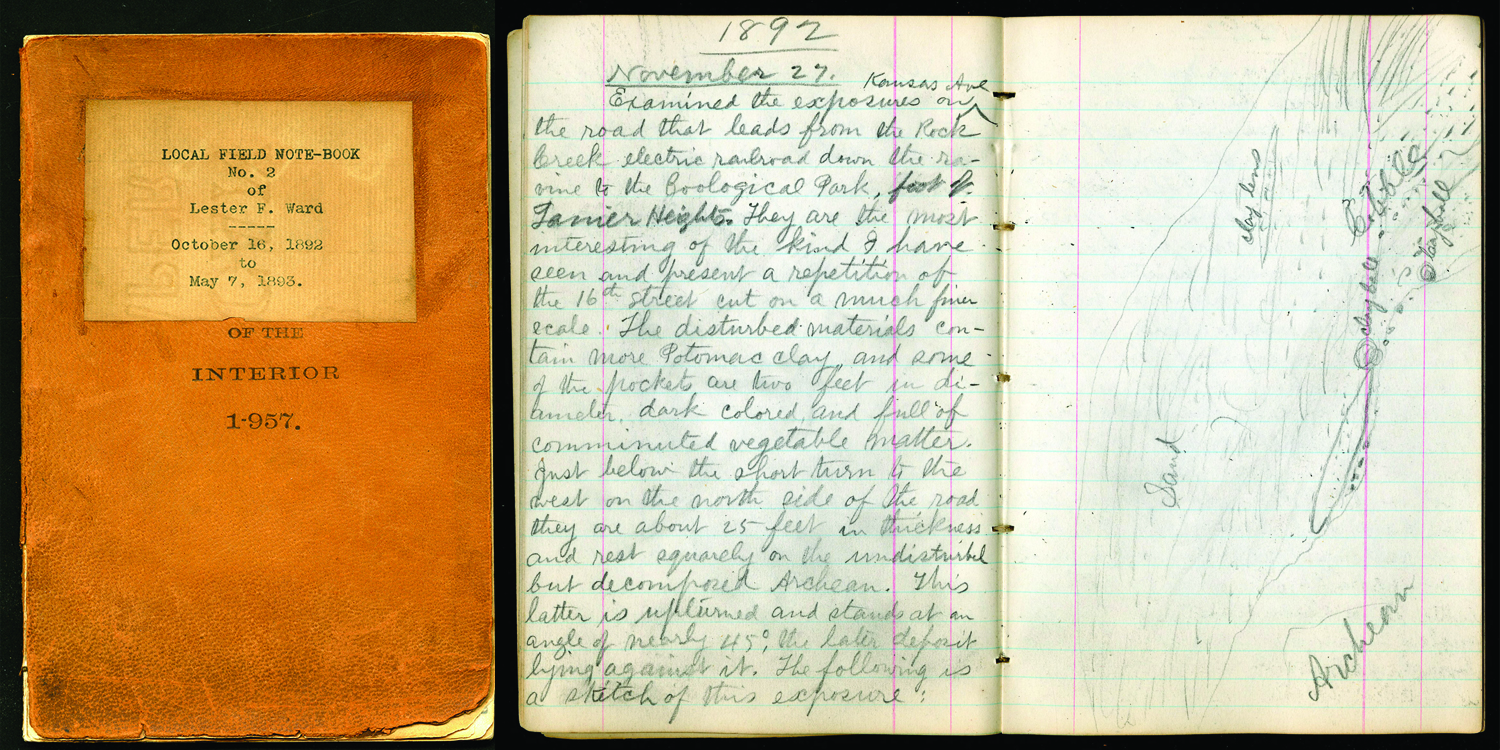
Local field note-book no. 2 of Lester F. Ward, October 16, 1892 to May 7, 1893. http://biodiversitylibrary.org/bibliography/107244. Smithsonian Institution Archives.

If you successfully transcribe all of the field notes in the challenge, we’ll celebrate with a live webcast with Dr. Nicholas D. Pyenson, Curator of Fossil Marine Mammals at the Smithsonian’s National Museum of Natural History, on October 26 via the BHL Periscope account (@BioDivLibrary). He’ll show off some of his favorite specimens in the collection and you’ll have the opportunity to ask him your most pressing fossil questions.

So, do you accept our challenge? If so, dig into the field notes here:


  • Harry S. Ladd: 
    • https://transcription.si.edu/project/7811
    • https://transcription.si.edu/project/7812
  • Lester F. Ward:
    • https://transcription.si.edu/project/7810
  • G. Arthur Cooper:
    • https://transcription.si.edu/project/7804
    • https://transcription.si.edu/project/7805
    • https://transcription.si.edu/project/7806
    • https://transcription.si.edu/project/7807
    • https://transcription.si.edu/project/7808
    • https://transcription.si.edu/project/7809

Be sure to share your discoveries using our challenge hashtag, #FossilFossick. Learn more about the collectors who created these field notes and get updates on challenge progress by following #FossilStories all next week.

Welcome to the #FossilFossick Challenge!

October 9, 2015by Grace Costantino
BHL News, Blog Reel, Campaigns, Fossil Stories

A Celebration of Fossils: Fossil Stories

October 14, 2015, is National Fossil Day, a day to celebrate all things fossils! Museums around the country are celebrating with fossil-related events the entire month of October, especially during the week of Fossil Day. BHL will be joining the fossil-mania next week with our social media campaign, Fossil Stories, running October 13-16, 2015.

Rocks hold the key to the history of life on Earth. Buried within the earth are millions of years’ worth of fossils, each of which tells a unique story about the life and ecosystems that once dominated our planet. These fossils not only reveal Earth’s past, but also provide insight into our future. Yet, the scientific study of these fossils began just a few hundred years ago.

View Full Size Image


Fossil Stories, presented by the Biodiversity Heritage Library in collaboration with several of our partner institutions, explores the world of fossils, the history of paleontology, and the men, women, and publications that shaped our knowledge about life preserved in rocks. October 13-16, BHL and our participating partner institutions will be producing a plethora of fossil content, which will publish on our blog, Twitter, and Facebook. All content will be tagged with the hashtag #FossilStories. We’ll also have hundreds of fabulous historic fossil illustrations available in Flickr and Pinterest, as well as a collection of seminal books in the history of paleontology in our BHL Fossil Stories collection.

The highlights of our campaign will be a series of three live webcasts at several of our participating partner institutions, as well as a citizen science challenge in partnership with The Field Book Project, the Smithsonian Transcription Center, and the Smithsonian Institution Archives.

Webcasts
The Fossil Stories webcasts will feature paleontologists, fossil research, and fossil exhibits at some of America’s most prestigious natural history institutions. For the webcasts featuring paleontologists at the respective institutions, you’ll have the opportunity to ask these experts your fossil questions!

The webcast schedule is:

  • “Antarctic Dinosaurs with Dr. Peter J. Makovicky.” Presented by The Field Museum.
    • When? Tuesday, October 13, 2015, 11:00am EST
    • Where? Google Hangouts: http://bit.do/FieldFossilStories 
  • “Exploring The FossiLab with Advait Jukar.” Presented by the Smithsonian National Museum of Natural History.
    • When? Wednesday, October 14, 2015, 9:00am EST
    • Where? The BHL Periscope Account. (Twitter and Periscope Handle: @BioDivLibrary)*
  • “Behind the Scenes at the NHMLA Dino Lab.” Presented by the Natural History Museum, Los Angeles County.
    • When? Friday, October 16, 2015, 3:00pm EST
    • Where? NHMLA Periscope Account (Twitter and Periscope Handle: @NHMLA)

*For events on Periscope, follow the indicated account on Periscope (Periscope will then alert you when the webcast is live) OR follow @BioDivLibrary or the presenting institution on Twitter to get the link to the event. When the event is live, the link to access the webcast will be tweeted out on the host institution’s Twitter account and BHL’s Twitter account.

Citizen Science Challenge
For Fossil Stories, we’re teaming up with The Field Book Project, the Smithsonian Transcription Center, and Smithsonian Institution Archives to issue you a citizen science challenge! Today, we’re releasing a set of paleontology field notes from the Smithsonian’s collection into the Transcription Center. Can you help transcribe all of them by the end of the campaign, October 16? There’s a reward if all of the field notes are successfully transcribed by the end of the challenge. Stay tuned to our blog later today to learn more about the challenge!
So be sure to follow #FossilStories all next week to explore fossils and the history of paleontology, and tune in later today to get more details on our transcription challenge. We know you’ll dig the event!

October 9, 2015by Grace Costantino
Blog Reel, User Stories

The scientific and historical importance of small, old collections

In 1838, Ferdinand Joseph L’Herminier, a French botanist and zoologist born in Basse-Terre, Guadeloupe, published the first description of the Double-striped Thick-knee (vocifer), today known by the scientific name Burhinus bistriatus vocifer [1]. L’Herminier used six specimens to describe the species, which he originally named Ædicnemus vocifer.

View Full Size Image
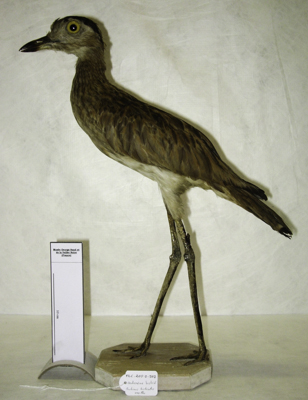
Specimen MLC.2011.0.907 (syntype). Double-striped Thick-knee (Burhinus bistriatus) collected by Dr Beauperthuy and used by L’Herminier to describe his Ædicnemus vocifer in 1838. © Christophe Gouraud, Musée George Sand et de la Vallée Noire, La Châtre, France.

One of the specimens that L’Herminier used for his description is housed in the Baillon Collection at the Musée George Sand et de la Vallée Noire, La Châtre, France. The Baillon’s inscription for the specimen indicates that it was sent by Florent Prévost, assistant naturalist at the Paris Museum, to Louis Antoine François Baillon, whose father started the Baillon Collection. The available information indicated that Prévost received the specimen from L’Herminier himself, but it was unknown who originally provided the specimen to L’Herminier. This question becomes even more intriguing when you consider that the Baillon specimen is the only surviving type specimen of the six originally used by L’Herminier for his 1838 description.

View Full Size Image
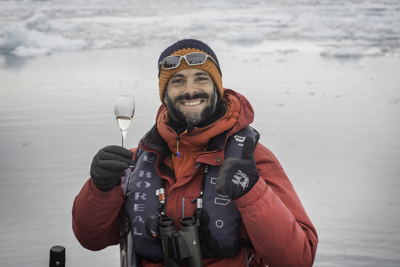
Christophe guiding on a Zodiac cruise in Antarctica (February 2015). © Lorraine Turci.

Christophe Gouraud is an expert at solving the mysteries surrounding historic specimens. With a Masters degree in ecology and a specialty in ornithology, Gouraud spends much of his time working as a Polar guide on expedition ships that cruise in Spitsbergen, Greenland, Nunavut, the Russian Arctic, the South Atlantic islands and Antarctica, but before becoming a guide, he took part in many scientific expeditions related with birds in Alaska, Morocco, Kazakhstan, and Peru. Today, he still finds time to pursue his ornithological passion. Between the Arctic and Antarctic seasons, he works with bird collections in France, particularly within the Caire-Chabrand Collection at the Musée de la Vallée, Barcelonnette, France, and the Baillon Collection of La Châtre.

View Full Size Image
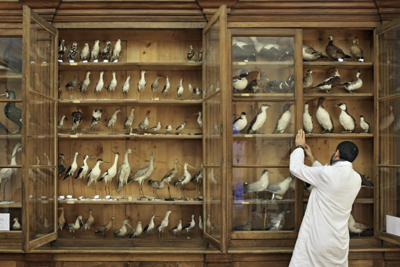
Christophe working on the Caire-Chabrand Collection, Musée de la Vallée, Barcelonnette, France. © Claude Gouron, http://www.claude-gouron.fr, https://500px.com/claudegouron/sets.

Discovering information about historic specimens can be a difficult task. Access to historic literature is essential to successful investigations, and thus, Gouraud has found BHL an invaluable ally in his hunt for information.

“BHL is such a great, impressive and useful tool,” lauds Gouraud. “As I am not working in an institution with access to huge libraries, BHL has made possible what I have achieved so far. I don’t know if my work would have been possible without BHL, but for sure it is unbelievable the time that can be saved.”

Gouraud uses BHL to search for the original descriptions of bird species (most of which were described in the 18th and 19th centuries), to locate accounts of early voyages of exploration and discovery (during which many of the specimens he researchers were collected), and to explore references cited by the authors of the publications he consults for his research. When working on the history of a collection, he consults BHL daily, exploring multiple documents during each visit.

“In a few clicks, you can access, read and download (for free!!!) most of the documents you need,” exclaims Gouraud. “All that is needed is a good Internet connection. Through BHL, I can easily access so many old and rare books deposited in just a few institutions worldwide while simply sitting at home drinking a good coffee!”

Gouraud’s favorite BHL feature is the custom PDF download, which allows him to select specific pages of interest for his research and save them for future consultation. His extensive use of the library also revealed some areas where he believes improvements can be made. These include adding a full text search option to BHL, allowing users to search within the contents of a book; improving the OCR, allowing more scientific names to be discovered; and merging the redundant author and title names sometimes displayed throughout BHL.

Full text search is a high priority for future BHL development, with prototypes currently being investigated. BHL crowdsourcing games, Smorball and Beanstalk, are one method we are currently using to improve BHL’s OCR. Multiple instances of the same author or title in BHL result from differences in the library catalogs contributing information to BHL. While we try to automatically de-duplicate entries as they are ingested, not all duplicates can be merged automatically. We rely on feedback from our users to help us identify and allow us to correct duplications that do occur. Use our feedback form to alert us of any errors that should be corrected in the BHL portal.

BHL allowed Gouraud to solve the mystery of the origin of the Double-striped Thick-knee specimen housed in the Baillon Collection. By consulting L’Herminier’s original description in BHL, Gouraud discovered that the specimen was originally collected by Doctor Louis Daniel Beauperthuy, a physician and scientist born in Basse Terre, Guadeloupe, and the discoverer of the transmitting agent of yellow fever. Beauperthuy gave the specimen to L’Herminier, who used it for his description and then sent it on to the Paris Museum.

“I completed the story and linked Dr. Beauperthuy to L’Herminier only because I had access to the original description by L’Herminier,” explains Gouraud. He published his findings in the Bulletin of the British Ornithologists’ Club.

View Full Size Image
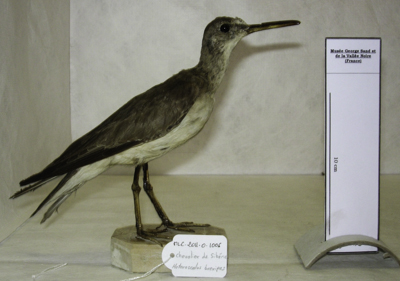
Specimen MLC.2011.0.1006. Grey-tailed Tattler (Heteroscelus brevipes) collected on Mariana Islands during the Freycinet’s circumnavigation that survived the wreckage of L’Uranie in the Falkland Islands in 1820. © Christophe Gouraud, Musée George Sand et de la Vallée Noire, La Châtre, France.

BHL has allowed Gouraud to uncover many fascinating details about the Baillon Collection. As another example, the Baillon Collection contains specimens collected during Louis Claude de Saulces de Freycinet’s three year voyage (1817-20) that cruised about the Pacific, visiting Australia, the Mariana Islands, Hawaiian Islands, other Pacific islands, and South America. One such specimen is a Grey-tailed Tattler (Heteroscelus brevipes), collected at the Mariana Islands. Sadly, the expedition met with tragedy when Freycinet’s ship, L’Uranie, wrecked in the Falkland Islands on 15 February, 1820, resulting in the loss of almost all of the expedition’s natural history collections. By consulting the account of the expedition in BHL, Gouraud discovered that specimens from 313 species survived the wreckage, and 12 specimens are now in the Baillon Collection.

Gouraud’s experiences demonstrate the multi-layered value of BHL’s collections. They are useful not only for providing information about species, ecosystems, habitats, and taxonomies, but also for historical investigations, such as uncovering the origins of museum collections. Gouraud has used BHL to uncover many other fascinating details about the Baillon Collection. You can explore some of these findings in his publications:

  • Gouraud C., 2014: Eighteenth century bird specimens in the Baillon Collection, La Châtre, France. – In: Mlíkovský, J. (Ed.) Proceedings of the 8th Meeting of European Bird Curators, Journal of the National Museum (Prague), Natural History Series. 183: 19-28.
  • Gouraud C., 2014: Extinct and endangered species and subspecies of birds in the Baillon Collection, La Châtre, France. – In: Mlíkovský, J. (Ed.) Proceedings of the 8th Meeting of European Bird Curators, Journal of the National Museum (Prague), Natural History Series. 183: 29-38.
  • Gouraud C., 2014: The authorship of the name Ornismya Parzudaki (Aves: Trochilidae). – Zoological Bibliography 3(4): 63-68. 
  • Mearns R., Gouraud C., and Chevrier L., 2015: The identity of Richard of Richard’s Pipit (Anthus richardi Vieillot, 1818). – Archives of natural history 42(1): 85-90.
  • Gouraud C., 2015: List of the type specimens of birds in the Baillon Collection (La Châtre, France). Part 1. Non-Passerines. – Bulletin of the British Ornithologists’ Club 135(2): 131-153.

Gouraud emphasizes that his research is made possible not only by BHL, but also thanks to Annick Dussault, director of the Musée George Sand et de la Vallée Noire (La Châtre, France) that houses the Baillon Collection, as well as the city of La Châtre, that gave him the opportunity of working with the Baillon Collection.

We would like to extend a special thanks to Gouraud for sharing his incredible work with us and demonstrating how BHL supports that work. Do you use BHL to support your own work? Want to be featured on our blog? Then send us a message to [email protected]!

[1] Dickinson E.C., Overstreet L.K., Dowsett R.J. and Bruce M.D., (Eds.) 2011: Priority! The Dating of Scientific Names in Ornithology: a Directory to the literature and its reviewers. Northampton, U.K., Aves Press.

October 8, 2015by Grace Costantino
BHL News, Blog Reel

BHL in Africa! Workshop & TDWG

Portrait version of the Biodiversity Heritage Library logo.

An international ensemble of biodiversity-minded professionals recently gathered in Nairobi, Kenya for two weeks of trainings and conferences. From 24-26 September, 2015, fifteen representatives from eleven institutions throughout South Africa, Kenya, and Uganda attended a BHL Africa training workshop at the National Museums of Kenya. Following the workshop, 28 September – 1 October, 2015, the TDWG Annual Conference was held at the Windsor Golf Hotel and Country Club in Nairobi.

The BHL Africa Workshop was an opportunity to provide training and help build capacity amongst the current signatories of the BHL Africa MOU. The workshop was funded as part of the 2015 JRS Biodiversity Foundation grant, awarded to the South African National Biodiversity Institute (SANBI), to facilitate the growth of BHL Africa.

“This workshop is yet another example of the exciting strides the BHL Africa libraries are making towards digitizing and providing open access to their unique and important collections,” said Robert Guralnick of the Board of Trustees, JRS Biodiversity Foundation.

View Full Size Image
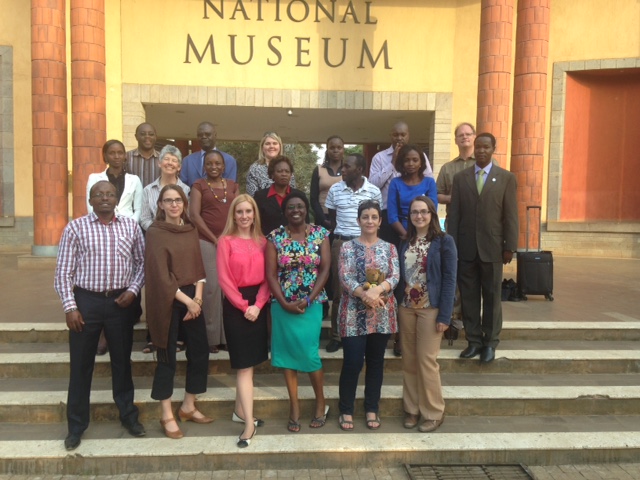
Attendees at the BHL Africa Workshop at the National Museums of Kenya in Nairobi.

Representatives from the National Museums of Kenya, the University of Nairobi, the International Centre of Insect Physiology and Ecology, the African Conservation Centre, the Kenya Wildlife Service, the Uganda National Council for Science and Technology, The Uganda Society, the National Library of Uganda, the South African National Aquatic Biodiversity Institute, the South African National Biodiversity Institute, and the University of Pretoria attended the workshop. Training was provided by four BHL representatives from the U.S., including BHL’s Program Director, Martin Kalfatovic, Program Manager, Carolyn Sheffield, Outreach and Communication Manager, Grace Costantino, and Smithsonian Digital Collections Librarian, Jacqueline Chapman.

Trainings included an overview of the structure and governance of BHL; demoes of the BHL website and administrative functions; in-depth discussions about BHL collection scope, development, digitization and curation workflows, and metadata requirements; guidance on copyright and permissions issues; methods for communication and outreach collaboration; and intensive hands-on training for several BHL tools, including the issue tracking system Gemini and the digitization workflow tool Macaw.

View Full Size Image
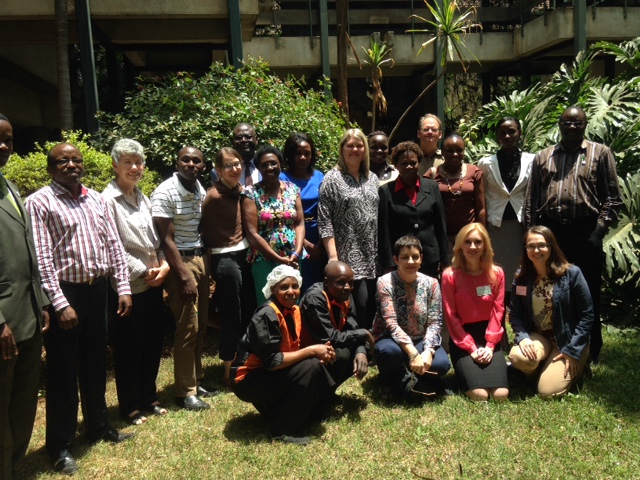
BHL Africa workshop attendees enjoying the beautiful grounds at the National Museums of Kenya during a lunch break.

Chief among the discussion topics was a focus on building capacity within Africa and amongst current and future participating institutions. The goal of the workshop was to not only train attendees on the many aspects of BHL participation and workflows, but to ensure that attendees could return to their own institutions and provide training to their colleagues. There was also extensive discussion on the various ways that participants could share digitization equipment amongst institutions, ensuring efficiency and a responsible use of funds.

Following the workshop, Martin Kalfatovic, Anne-Lise Fourie (Head of BHL Africa and Assistant Director of SANBI Libraries), Carolyn Sheffield, and Jacqueline Chapman continued on to the TDWG 2015 conference where they were joined by BHL Technical Director William Ulate and the Vice Chair of the Global BHL Executive Committee, Dr. Jiri Frank.  On 1 October, BHL hosted a Symposium that provided updates on the BHL consortium in general; BHL Africa’s JRS-funded capacity-building initiatives; BHL workshops; BHL projects; and a special guest, Prabhakar Rajagopal, who presented on the participation in the India Biodiversity Portal.  The session was well-attended with 137 conference attendees in the audience.

We are excited to see such wonderful progress from our colleagues in Africa, and look forward to the growth of BHL Africa content in and contributions to BHL.

October 7, 2015by Grace Costantino
Page 32 of 71« First...102030«31323334»405060...Last »

Help Support BHL

BHL's existence depends on the financial support of its patrons. Help us keep this free resource alive!

search

About BHL

The Biodiversity Heritage Library (BHL) is the world’s largest open access digital library for biodiversity literature and archives. BHL operates as a worldwide consortium of natural history, botanical, research, and national libraries working together to digitize the natural history literature held in their collections and make it freely available for open access as part of a global “biodiversity community.”

Join Our Mailing List

Sign up to receive the latest news, content highlights, and promotions.

Subscribe Now

Subscribe to Blog via Email

Enter your email address to subscribe to this blog and receive notifications of new posts by email.

Join 319 other subscribers

Subscribe to Blog Via RSS

Subscribe to the blog RSS feed to stay up-to-date on all the latest BHL posts.

Access RSS Feed

Inspiring Discovery through Free Access to Biodiversity Knowledge.

The Biodiversity Heritage Library makes it easier than ever for you to access the information you need to study and explore life on Earth…for free, anytime, anywhere.


64+ Million Pages of
Biodiversity Literature Online.

EXPLORE

Tools and Services
to Transform Research.

EXPLORE

300,000+
Illustrations on Flickr.

EXPLORE

ABOUT | HARMFUL CONTENT | PRIVACY | SITE MAP | TERMS OF USE